EP4516340A2 - Injektionsvorrichtung - Google Patents
Injektionsvorrichtung Download PDFInfo
- Publication number
- EP4516340A2 EP4516340A2 EP25153126.5A EP25153126A EP4516340A2 EP 4516340 A2 EP4516340 A2 EP 4516340A2 EP 25153126 A EP25153126 A EP 25153126A EP 4516340 A2 EP4516340 A2 EP 4516340A2
- Authority
- EP
- European Patent Office
- Prior art keywords
- locking member
- needle sleeve
- injection device
- housing
- needle
- Prior art date
- Legal status (The legal status is an assumption and is not a legal conclusion. Google has not performed a legal analysis and makes no representation as to the accuracy of the status listed.)
- Pending
Links
Images


Classifications
-
- A—HUMAN NECESSITIES
- A61—MEDICAL OR VETERINARY SCIENCE; HYGIENE
- A61M—DEVICES FOR INTRODUCING MEDIA INTO, OR ONTO, THE BODY; DEVICES FOR TRANSDUCING BODY MEDIA OR FOR TAKING MEDIA FROM THE BODY; DEVICES FOR PRODUCING OR ENDING SLEEP OR STUPOR
- A61M5/00—Devices for bringing media into the body in a subcutaneous, intra-vascular or intramuscular way; Accessories therefor, e.g. filling or cleaning devices, arm-rests
- A61M5/178—Syringes
- A61M5/24—Ampoule syringes, i.e. syringes with needle for use in combination with replaceable ampoules or carpules, e.g. automatic
-
- A—HUMAN NECESSITIES
- A61—MEDICAL OR VETERINARY SCIENCE; HYGIENE
- A61M—DEVICES FOR INTRODUCING MEDIA INTO, OR ONTO, THE BODY; DEVICES FOR TRANSDUCING BODY MEDIA OR FOR TAKING MEDIA FROM THE BODY; DEVICES FOR PRODUCING OR ENDING SLEEP OR STUPOR
- A61M5/00—Devices for bringing media into the body in a subcutaneous, intra-vascular or intramuscular way; Accessories therefor, e.g. filling or cleaning devices, arm-rests
- A61M5/178—Syringes
- A61M5/31—Details
- A61M5/32—Needles; Details of needles pertaining to their connection with syringe or hub; Accessories for bringing the needle into, or holding the needle on, the body; Devices for protection of needles
- A61M5/3205—Apparatus for removing or disposing of used needles or syringes, e.g. containers; Means for protection against accidental injuries from used needles
- A61M5/321—Means for protection against accidental injuries by used needles
- A61M5/322—Retractable needles, i.e. disconnected from and withdrawn into the syringe barrel by the piston
-
- A—HUMAN NECESSITIES
- A61—MEDICAL OR VETERINARY SCIENCE; HYGIENE
- A61M—DEVICES FOR INTRODUCING MEDIA INTO, OR ONTO, THE BODY; DEVICES FOR TRANSDUCING BODY MEDIA OR FOR TAKING MEDIA FROM THE BODY; DEVICES FOR PRODUCING OR ENDING SLEEP OR STUPOR
- A61M5/00—Devices for bringing media into the body in a subcutaneous, intra-vascular or intramuscular way; Accessories therefor, e.g. filling or cleaning devices, arm-rests
- A61M5/178—Syringes
- A61M5/31—Details
- A61M5/32—Needles; Details of needles pertaining to their connection with syringe or hub; Accessories for bringing the needle into, or holding the needle on, the body; Devices for protection of needles
- A61M5/3205—Apparatus for removing or disposing of used needles or syringes, e.g. containers; Means for protection against accidental injuries from used needles
- A61M5/321—Means for protection against accidental injuries by used needles
- A61M5/3243—Means for protection against accidental injuries by used needles being axially-extensible, e.g. protective sleeves coaxially slidable on the syringe barrel
- A61M5/326—Fully automatic sleeve extension, i.e. in which triggering of the sleeve does not require a deliberate action by the user
-
- A—HUMAN NECESSITIES
- A61—MEDICAL OR VETERINARY SCIENCE; HYGIENE
- A61M—DEVICES FOR INTRODUCING MEDIA INTO, OR ONTO, THE BODY; DEVICES FOR TRANSDUCING BODY MEDIA OR FOR TAKING MEDIA FROM THE BODY; DEVICES FOR PRODUCING OR ENDING SLEEP OR STUPOR
- A61M5/00—Devices for bringing media into the body in a subcutaneous, intra-vascular or intramuscular way; Accessories therefor, e.g. filling or cleaning devices, arm-rests
- A61M5/178—Syringes
- A61M5/31—Details
- A61M5/32—Needles; Details of needles pertaining to their connection with syringe or hub; Accessories for bringing the needle into, or holding the needle on, the body; Devices for protection of needles
- A61M5/3205—Apparatus for removing or disposing of used needles or syringes, e.g. containers; Means for protection against accidental injuries from used needles
- A61M5/321—Means for protection against accidental injuries by used needles
- A61M5/3243—Means for protection against accidental injuries by used needles being axially-extensible, e.g. protective sleeves coaxially slidable on the syringe barrel
- A61M5/3271—Means for protection against accidental injuries by used needles being axially-extensible, e.g. protective sleeves coaxially slidable on the syringe barrel with guiding tracks for controlled sliding of needle protective sleeve from needle exposing to needle covering position
-
- A—HUMAN NECESSITIES
- A61—MEDICAL OR VETERINARY SCIENCE; HYGIENE
- A61M—DEVICES FOR INTRODUCING MEDIA INTO, OR ONTO, THE BODY; DEVICES FOR TRANSDUCING BODY MEDIA OR FOR TAKING MEDIA FROM THE BODY; DEVICES FOR PRODUCING OR ENDING SLEEP OR STUPOR
- A61M5/00—Devices for bringing media into the body in a subcutaneous, intra-vascular or intramuscular way; Accessories therefor, e.g. filling or cleaning devices, arm-rests
- A61M5/178—Syringes
- A61M5/20—Automatic syringes, e.g. with automatically actuated piston rod, with automatic needle injection, filling automatically
- A61M2005/2073—Automatic syringes, e.g. with automatically actuated piston rod, with automatic needle injection, filling automatically preventing premature release, e.g. by making use of a safety lock
-
- A—HUMAN NECESSITIES
- A61—MEDICAL OR VETERINARY SCIENCE; HYGIENE
- A61M—DEVICES FOR INTRODUCING MEDIA INTO, OR ONTO, THE BODY; DEVICES FOR TRANSDUCING BODY MEDIA OR FOR TAKING MEDIA FROM THE BODY; DEVICES FOR PRODUCING OR ENDING SLEEP OR STUPOR
- A61M5/00—Devices for bringing media into the body in a subcutaneous, intra-vascular or intramuscular way; Accessories therefor, e.g. filling or cleaning devices, arm-rests
- A61M5/178—Syringes
- A61M5/31—Details
- A61M5/32—Needles; Details of needles pertaining to their connection with syringe or hub; Accessories for bringing the needle into, or holding the needle on, the body; Devices for protection of needles
- A61M5/3205—Apparatus for removing or disposing of used needles or syringes, e.g. containers; Means for protection against accidental injuries from used needles
- A61M5/321—Means for protection against accidental injuries by used needles
- A61M5/3243—Means for protection against accidental injuries by used needles being axially-extensible, e.g. protective sleeves coaxially slidable on the syringe barrel
- A61M5/3245—Constructional features thereof, e.g. to improve manipulation or functioning
- A61M2005/3247—Means to impede repositioning of protection sleeve from needle covering to needle uncovering position
-
- A—HUMAN NECESSITIES
- A61—MEDICAL OR VETERINARY SCIENCE; HYGIENE
- A61M—DEVICES FOR INTRODUCING MEDIA INTO, OR ONTO, THE BODY; DEVICES FOR TRANSDUCING BODY MEDIA OR FOR TAKING MEDIA FROM THE BODY; DEVICES FOR PRODUCING OR ENDING SLEEP OR STUPOR
- A61M5/00—Devices for bringing media into the body in a subcutaneous, intra-vascular or intramuscular way; Accessories therefor, e.g. filling or cleaning devices, arm-rests
- A61M5/178—Syringes
- A61M5/31—Details
- A61M5/32—Needles; Details of needles pertaining to their connection with syringe or hub; Accessories for bringing the needle into, or holding the needle on, the body; Devices for protection of needles
- A61M5/3205—Apparatus for removing or disposing of used needles or syringes, e.g. containers; Means for protection against accidental injuries from used needles
- A61M5/321—Means for protection against accidental injuries by used needles
- A61M5/3243—Means for protection against accidental injuries by used needles being axially-extensible, e.g. protective sleeves coaxially slidable on the syringe barrel
- A61M5/3245—Constructional features thereof, e.g. to improve manipulation or functioning
- A61M2005/3254—Shielding of proximal needles, e.g. for pen needles
-
- A—HUMAN NECESSITIES
- A61—MEDICAL OR VETERINARY SCIENCE; HYGIENE
- A61M—DEVICES FOR INTRODUCING MEDIA INTO, OR ONTO, THE BODY; DEVICES FOR TRANSDUCING BODY MEDIA OR FOR TAKING MEDIA FROM THE BODY; DEVICES FOR PRODUCING OR ENDING SLEEP OR STUPOR
- A61M5/00—Devices for bringing media into the body in a subcutaneous, intra-vascular or intramuscular way; Accessories therefor, e.g. filling or cleaning devices, arm-rests
- A61M5/178—Syringes
- A61M5/31—Details
- A61M5/32—Needles; Details of needles pertaining to their connection with syringe or hub; Accessories for bringing the needle into, or holding the needle on, the body; Devices for protection of needles
- A61M5/3205—Apparatus for removing or disposing of used needles or syringes, e.g. containers; Means for protection against accidental injuries from used needles
- A61M5/321—Means for protection against accidental injuries by used needles
- A61M5/3243—Means for protection against accidental injuries by used needles being axially-extensible, e.g. protective sleeves coaxially slidable on the syringe barrel
- A61M5/326—Fully automatic sleeve extension, i.e. in which triggering of the sleeve does not require a deliberate action by the user
- A61M2005/3261—Fully automatic sleeve extension, i.e. in which triggering of the sleeve does not require a deliberate action by the user triggered by radial deflection of the anchoring parts between sleeve and syringe barrel, e.g. spreading of sleeve retaining hooks having slanted surfaces by engagement with conically shaped collet of the piston rod during the last portion of the injection stroke of the plunger
-
- A—HUMAN NECESSITIES
- A61—MEDICAL OR VETERINARY SCIENCE; HYGIENE
- A61M—DEVICES FOR INTRODUCING MEDIA INTO, OR ONTO, THE BODY; DEVICES FOR TRANSDUCING BODY MEDIA OR FOR TAKING MEDIA FROM THE BODY; DEVICES FOR PRODUCING OR ENDING SLEEP OR STUPOR
- A61M5/00—Devices for bringing media into the body in a subcutaneous, intra-vascular or intramuscular way; Accessories therefor, e.g. filling or cleaning devices, arm-rests
- A61M5/178—Syringes
- A61M5/31—Details
- A61M5/32—Needles; Details of needles pertaining to their connection with syringe or hub; Accessories for bringing the needle into, or holding the needle on, the body; Devices for protection of needles
- A61M5/3205—Apparatus for removing or disposing of used needles or syringes, e.g. containers; Means for protection against accidental injuries from used needles
- A61M5/321—Means for protection against accidental injuries by used needles
- A61M5/3243—Means for protection against accidental injuries by used needles being axially-extensible, e.g. protective sleeves coaxially slidable on the syringe barrel
- A61M5/326—Fully automatic sleeve extension, i.e. in which triggering of the sleeve does not require a deliberate action by the user
- A61M2005/3267—Biased sleeves where the needle is uncovered by insertion of the needle into a patient's body
-
- A—HUMAN NECESSITIES
- A61—MEDICAL OR VETERINARY SCIENCE; HYGIENE
- A61M—DEVICES FOR INTRODUCING MEDIA INTO, OR ONTO, THE BODY; DEVICES FOR TRANSDUCING BODY MEDIA OR FOR TAKING MEDIA FROM THE BODY; DEVICES FOR PRODUCING OR ENDING SLEEP OR STUPOR
- A61M5/00—Devices for bringing media into the body in a subcutaneous, intra-vascular or intramuscular way; Accessories therefor, e.g. filling or cleaning devices, arm-rests
- A61M5/178—Syringes
- A61M5/31—Details
- A61M5/32—Needles; Details of needles pertaining to their connection with syringe or hub; Accessories for bringing the needle into, or holding the needle on, the body; Devices for protection of needles
- A61M5/3205—Apparatus for removing or disposing of used needles or syringes, e.g. containers; Means for protection against accidental injuries from used needles
- A61M5/321—Means for protection against accidental injuries by used needles
- A61M5/3243—Means for protection against accidental injuries by used needles being axially-extensible, e.g. protective sleeves coaxially slidable on the syringe barrel
- A61M5/326—Fully automatic sleeve extension, i.e. in which triggering of the sleeve does not require a deliberate action by the user
- A61M2005/3267—Biased sleeves where the needle is uncovered by insertion of the needle into a patient's body
- A61M2005/3268—Biased sleeves where the needle is uncovered by insertion of the needle into a patient's body having cantilever elastically spreadable arms, e.g. to accumulate energy during needle uncovering movement for urging protection sleeve to return to needle covering position
-
- A—HUMAN NECESSITIES
- A61—MEDICAL OR VETERINARY SCIENCE; HYGIENE
- A61M—DEVICES FOR INTRODUCING MEDIA INTO, OR ONTO, THE BODY; DEVICES FOR TRANSDUCING BODY MEDIA OR FOR TAKING MEDIA FROM THE BODY; DEVICES FOR PRODUCING OR ENDING SLEEP OR STUPOR
- A61M5/00—Devices for bringing media into the body in a subcutaneous, intra-vascular or intramuscular way; Accessories therefor, e.g. filling or cleaning devices, arm-rests
- A61M5/178—Syringes
- A61M5/31—Details
- A61M5/32—Needles; Details of needles pertaining to their connection with syringe or hub; Accessories for bringing the needle into, or holding the needle on, the body; Devices for protection of needles
- A61M5/3205—Apparatus for removing or disposing of used needles or syringes, e.g. containers; Means for protection against accidental injuries from used needles
- A61M5/321—Means for protection against accidental injuries by used needles
- A61M5/3243—Means for protection against accidental injuries by used needles being axially-extensible, e.g. protective sleeves coaxially slidable on the syringe barrel
Definitions
- the present invention relates to an injection device and to a method of actuating an injection device and a method of assembly of an injection device.
- Injection devices such as auto-injectors, are known in the art for dispensing a medicament to the injection site of a patient.
- Such injection devices often comprise a body and a cap, a needle syringe located in the body and the cap removably attached to the body to shield the needle of the needle syringe.
- the cap is first removed from the body to expose the needle. The needle is then inserted into the body of the patient at the injection site to dispense the medicament.
- a moveable needle sleeve and locking means can be provided to ensure that the needle is covered after the medicament has been dispensed and that access to the needle is restricted; this prevents the sharp needle from causing injury and can also act as an indicator that the injection device has already been used.
- an injection device comprising: a housing; a carrier disposed within the housing for holding a syringe that has a needle at one end; a needle sleeve located within the housing and being axially moveable with respect to the housing between an extended position and a retracted position; a biasing element configured to bias the needle sleeve towards the extended position; the injection device comprising a locking mechanism configured to lock the needle sleeve in the extended position after use of the injection device, the locking mechanism comprising; a first locking member provided on and projecting from the carrier; and a second locking member comprising a deflectable member provided on the needle sleeve and moveable between a relaxed position and a deflected position; wherein the housing includes an inwardly projecting boss which engages the second locking member and moves the second locking member into the deflected position as the needle sleeve is moved to the retracted position; wherein the first locking member is out of engagement with the second locking member when
- Preventing the movement of the needle sleeve back into the retracted position may improve the safety of the device as access to the needle can be restricted once the injection has occurred. This may also act as an indicator that the injection device has already been used, furthermore it can avoid accidental injury.
- the mechanism as described above may be particularly beneficial when a syringe with a short needle is required.
- 'Short' when referred to in this specification may refer to a needle length of less than about 12.5mm, typically as an example about 6mm, however it can be appreciated that the injection device described in this specification can also be used for a needle length greater than or equal to 12.5mm.
- the length of the needle can be measured from the distal end of the syringe glass to the tip of the needle.
- distal and proximal refer to directions relative to the injection device.
- distal refers to a location that is relatively closer to a site of injection
- proximal refers to a location that is relatively further away from the injection site.
- a thinner gauge needle may also mean that there is less pain for a user and could be particularly beneficial in paediatric applications.
- the or each deflectable member is a deflectable arm.
- the needle sleeve may extend further out from the housing in the extended position than in the retracted position.
- the needle sleeve may be moveable between three positions, a start position, the retracted position and the extended position, wherein the needle sleeve may extend further out from the housing in the extended position than in the start position, and may extend further out from the housing in the start position than in the retracted position.
- the needle sleeve is retractable beteween the housing and the carrier.
- the deflectable arm may have a first end fixedly attached to the rest of the needle shield and a second, free end remote from the first end.
- the injection device being moveable between three positions may aid the priming of the locking mechanism to be carried out during assembly of the device by machinery as opposed to manually.
- the locking mechanism could be primed by a user before they actuate the injection device.
- simplification of actuating the injection device by priming the locking mechanism during the assembly stage is desirable.
- first and second locking members are configured such that the first locking member is out of engagement with the second locking member when the second locking member is in the deflected position.
- first and second locking members are configured such that the second locking member blocks the first locking member when the second locking member is in the relaxed position and the needle sleeve is in the extended position.
- the first locking member comprises a protrusion
- the inwardly projecting boss of the housing may be tapered or shaped like an arrow head, pointing in a distal direction. It can be appreciated however that any shape which can forcibly move the second locking member of the needle sleeve into the deflected position may be suitable.
- a method of assembling an injection device which may comprise the following steps:insert a syringe having a needle into the carrier; move the needle sleeve relative to the housing in a proximal direction of the device to a first assembly position wherein the inwardly projecting boss of the housing engages the second locking member of the needle sleeve and moves the second locking member from the relaxed position into the deflected position;
- the second locking member may have two deflectable arms; the deflectable arms may each have a first end fixedly attached to the rest of the needle sleeve and a second end which is free. In the second assembly position the first locking member may be disposed between the two arms.
- a drug delivery device may be configured to inject a medicament into a patient.
- delivery could be sub-cutaneous, intra-muscular, or intravenous.
- Such a device could be operated by a patient or care-giver, such as a nurse or physician, and can include various types of safety syringe, pen-injector, or auto-injector.
- the device can include a cartridge-based system that requires piercing a sealed ampule before use. Volumes of medicament delivered with these various devices can range from about 0.5 ml to about 2 ml.
- the presently described devices may also be customized in order to operate within required specifications.
- the device may be customized to inject a medicament within a certain time period (e.g., about 3 to about 20 seconds for auto-injectors, and about 10 minutes to about 60 minutes for an LVD).
- Other specifications can include a low or minimal level of discomfort, or to certain conditions related to human factors, shelf-life, expiry, biocompatibility, environmental considerations, etc.
- Such variations can arise due to various factors, such as, for example, a drug ranging in viscosity from about 3 cP to about 50 cP. Consequently, a drug delivery device will often include a hollow needle ranging from about 25 to about 31 Gauge in size. Common sizes are 27 and 29 Gauge.
- the delivery devices described herein can also include one or more automated functions. For example, one or more of needle insertion, medicament injection, and needle retraction can be automated. Energy for one or more automation steps can be provided by one or more energy sources. Energy sources can include, for example, mechanical, pneumatic, chemical, or electrical energy. For example, mechanical energy sources can include springs, levers, elastomers, or other mechanical mechanisms to store or release energy. One or more energy sources can be combined into a single device. Devices can further include gears, valves, or other mechanisms to convert energy into movement of one or more components of a device.
- the one or more automated functions of an auto-injector may each be activated via an activation mechanism.
- an activation mechanism can include one or more of a button, a lever, a needle sleeve, or other activation component.
- Activation of an automated function may be a one-step or multi-step process. That is, a user may need to activate one or more activation components in order to cause the automated function. For example, in a one-step process, a user may depress a needle sleeve against their body in order to cause injection of a medicament.
- Other devices may require a multi-step activation of an automated function. For example, a user may be required to depress a button and retract a needle sleeve in order to cause injection.
- Some delivery devices can include one or more functions of a safety syringe, pen-injector, or auto-injector.
- a delivery device could include a mechanical energy source configured to automatically inject a medicament (as typically found in an auto-injector) and a dose setting mechanism (as typically found in a pen-injector).
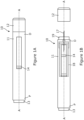
- an exemplary drug delivery device 10 is shown in Figs. 1A & 1B .
- Device 10 as described above, is configured to inject a medicament into a patient's body.
- Device 10 includes a housing 11 which typically contains a reservoir containing the medicament to be injected (e.g., a syringe) and the components required to facilitate one or more steps of the delivery process.
- Device 10 can also include a cap assembly 12 that can be detachably mounted to the housing 11. Typically a user must remove cap 12 from housing 11 before device 10 can be operated.
- housing 11 is substantially cylindrical and has a substantially constant diameter along the longitudinal axis A-A.
- the housing 11 has a distal region D and a proximal region P.
- distal refers to a location that is relatively closer to a site of injection
- proximal refers to a location that is relatively further away from the injection site.
- Device 10 can also include a needle sleeve 19 coupled to housing 11 to permit movement of needle sleeve 19 relative to housing 11.
- needle sleeve 19 can move in a longitudinal direction parallel to longitudinal axis A-A.
- movement of needle sleeve 19 in a proximal direction can permit a needle 17 to extend from distal region D of housing 11.
- buttons 13 are located at a proximal end of housing 11. However, in other embodiments, button 13 could be located on a side of housing 11.
- Injection is the process by which a bung or piston 14 is moved from a proximal location within a syringe 18 to a more distal location within the syringe 18 in order to force a medicament from the syringe 18 through needle 17.
- a drive spring (not shown) is under compression before device 10 is activated.
- a proximal end of the drive spring can be fixed within proximal region P of housing 11, and a distal end of the drive spring can be configured to apply a compressive force to a proximal surface of piston 14.
- at least part of the energy stored in the drive spring can be applied to the proximal surface of piston 14. This compressive force can act on piston 14 to move it in a distal direction. Such distal movement acts to compress the liquid medicament within the syringe 18, forcing it out of needle 17.
- needle 17 can be retracted within needle sleeve 19 or housing 11. Retraction can occur when needle sleeve 19 moves distally as a user removes device 10 from a patient's body. This can occur as needle 17 remains fixedly located relative to housing 11. Once a distal end of needle sleeve 19 has moved past a distal end of needle 17, and needle 17 is covered, needle sleeve 19 can be locked.
- the length of the needle needs to be taken into account when considering a suitable locking mechanism.
- the overall size of the device is reduced in comparison to devices with longer length needles, the injection time can be improved, more viscous fluids can be injected, storage loads and stopper impact forces can be reduced and a thinner gauge needle can be used without compromising the injection time.
- a thinner gauge needle may also mean that there is less pain for a user and could be particularly beneficial in paediatric applications.
- 'Short' when referred to in this specification refers to a length of less than about 12.5mm, typically as an example about 6mm, however it can be appreciated that the device described below can also be used for a needle length greater than or equal to 12.5mm.
- the length of the needle 17 can be measured from the distal end of the syringe 18 glass to the tip of the needle 17.
- the injection device 20 is in the form of an auto-injector 20 that has similar features to the auto-injector 10 described above in relation to Figs. 1A and 1B , with like features retaining the same reference numerals.
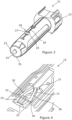
- the device 20 has a carrier 21 comprising a receiving end 22 for receiving a syringe, and a needle end 23, through which a needle 17 of the syringe protrudes when received in the carrier 21.
- the receiving end 22 is larger than the needle end 23, the needle end 23 further comprising cut out portions 24, and carrier sections 25 tapering towards a distal end of the carrier.
- the carrier 21 is inserted into a sub assembly comprising the needle sleeve 19 and the housing 11.
- the needle sleeve 19 comprises needle sleeve legs 39 and cut away portions 40.
- the needle sleeve 19 further comprises a second locking member 30 comprising a pair of deflectable arms 31 attached to each other by a strut 32.
- the strut is then coupled to the rest of the needle sleeve 19 by three supports 33.
- the deflectable arms 31, strut 32 and supports 33 can all be integrally formed with the needle sleeve 19, it can also be appreciated that these may be any combination of separate parts coupled to one another.
- the deflectable arms may be coupled directly to the needle sleeve 19 and no further struts 32 or supports 33 may be required. There may also be more or less than three supports 33, or more or less than one strut 32 depending on the structural properties required from the second locking member 30.
- the needle sleeve 19 can have a pair of second locking members 30 disposed on opposite sides of the needle sleeve 19.
- the deflectable arms 31 have a first end 36 fixedly attached to the rest of the needle sleeve 19 and a second, opposite end 37 extending from the first end in a proximal direction.
- the second end 37 is free and not attached to the rest of the needle shield other than via the first end 36.
- the deflectable arms also have an intermediate part 38 which can be straight, bent inwards towards eachother or comprise a further joint.
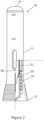
- the housing 11 further comprises an inwardly projecting boss 34 located towards a distal end of the housing 11.
- the inwardly projecting boss 34 can be tapered pointing towards a distal end of the injection device 20.
- the inwardly projecting boss 34 may be integrally formed with the housing 11, however it can be appreciated that the inwardly projecting boss 34 may be a separate component coupled to the housing 11.
- the inwardly projecting boss 34 is to engage with the second locking member 30, forcibly moving the deflectable arms 31 apart, opening the space between the two deflectable arms into a deflected position as shown in Figure 6 .
- This engagement between the second locking member 30 of the needle sleeve 19 and the inwardly projecting boss 34 of the housing can be actuated by the needle sleeve 19 being moved in a proximal direction with respect to the housing 11.
- the inwardly projecting boss 34 is not engaged with the second locking member 30 then the second locking member is in a relaxed position as shown in Figure 7 .
- the second locking member 30 When the second locking member 30 is in a deflected position as shown in Figure 6 the first locking member 26 and in particular the carrier boss 27 is able to move past the free ends 37 of the deflectable arms 31.
- the second locking member 30 When the second locking member 30 is in a relaxed position the head portion 29 of the first locking member is unable to pass the free ends 37 of the deflectable arms 31.
- the head portion 29 In a relaxed position either the head portion 29 is trapped between the deflectable arms 31 of the second locking member 30 and is restricted from axial movement in a proximal direction past the deflectable arms 31 or the head portion is stopped by the free ends 37 of the deflectable arms 31 of the second locking member and restricted from axial movement in a distal direction past the deflectable arms 31.
- the movement described above is relative to the housing.
- the needle sleeve is inserted into the housing and the syringe 17 is inserted into the carrier 21.
- the carrier 21 and syringe 18 are advanced to an intermediate position within the housing 11, an intermediate positon being less than fully inserted into the device and can be known as a first assembly position.
- the needle sleeve 19 is then moved in a proximal direction with respect to the housing 11 pushing the deflectable arms 31 towards the inwardly projecting boss 34 opening the second locking member 30 into the deflected position.
- the carrier 21 can then be moved further in the distal direction, the carrier boss 27 being able to pass the deflectable arms 31 as they are opened by the inwardly projecting boss 34.
- the second assembly position can be known as the second assembly position and can be the final assembled position for the carrier 21 and syringe. It can however be envisaged that the intermediate position is not required and the carrier 21 can be fully inserted at the same time as the needle sleeve 19 has been depressed and the deflectable arms 31 are in the deflected position.
- the rest of the device is then assembled, such as the insertion of a drive assembly into the housing to prepare the device for use.
- the drive assembly comprises a plunger 15, a drive spring 46 and a housing end 41.
- the drive spring 46 is arranged to push the plunger 15 acting on the piston 14 into the syringe 18 to force medicament through the needle 17 during use of the injector device 10.
- the plunger 15 and piston 14 may be separate components or a single component.
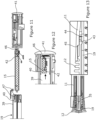
- the plunger is rotated as it is inserted into the device either manually or by a suitable assembly tool and a plunger boss 42 engages with a needle sleeve rib 47 on the needle sleeve legs 39 as can be seen in Figures 11 and 12 .
- the needle sleeve 19 is held in a retracted position while the drive assembly is inserted and then let go, when the it is let go the needle sleeve 19 moves in a distal direction, however the engagement between the plunger boss 42 and the needle sleeve rib 47 during the assembly and priming of the device prevents the needle sleeve 19 from fully extending into the extended position.
- the contact between the plunger boss 42 and the needle sleeve rib 47 also prevents downward rotation of the plunger in this position.
- the needle sleeve can be held in the start position by alternative means, for example the needle sleeve could engage with protrusions or retractible parts of the housing. The retractible parts being retracted by an actuator after an injection has occurred.
- the needle sleeve can be held in the start position by a further component such as a collar located at a distal end of the device, the needle sleeve comprising protrusions which engage with slots in the collar, the collar rotating as an injection occurs in a similar manner to the plunger 15 during the assembly stage to release the needle sleeve into a fully extended position once the injection is complete. It can be appreciated that a person skilled in the art can determine a number of alternative methods to simply catch and release two components.
- the needle sleeve 19 When the device 20 is fully assembled the needle sleeve 19 is released or moved in a distal direction disengaging from the inwardly projecting boss 34 into a start position, the head portion 29 of the carrier boss 27 remains distally of the free ends 37 of the deflectable arms 31 and the needle sleeve is not fully extended due to the engagement with the plunger 15 described above.
- This arrangement means the device is now assembled and primed for use by a user.
- the cap 12 is removed from the rest of the device, in particular from the housing 11, however it can be appreciated that the device 20 may not have a cap assembly or it may have already been removed.
- the cap also reduces the risk of accidental actuation of the injection device, for example when the device is dropped.
- a locking boss 43 on the cap 12 may engage with corresponding cut outs 44 on the needle sleeve 19 preventing accidental depression of the needle sleeve 19 before the cap 12 is removed.
- the locking boss 43 is able to elastically deform into a stepped portion 45 of the housing 11, releasing the locking boss 43 from the needle sleeve cut outs 44.
- the needle is then inserted into the body of the patient at the injection site to dispense a medicament, the needle sleeve 19 being depressed in a proximal direction in the process from the start position to the retracted position.
- the needle sleeve 19 is moved in a proximal direction against a biasing force of a biasing means, for example a spring 35, into the retracted position.
- the second locking portion engages with the inwardly projecting boss 34, the inwardly projecting boss is shaped to push against the deflectable arms, moving the second locking portion into the deflected position wherein the two deflectable arms deflect laterally of the central axis of the device from a proximal to a distal end.
- the spring biases the needle sleeve 19 in a distal direction and towards the extended position.
- the biasing means could be an alternative for example a bellows or compressed foam, or the sleeve could be moved into the extended position by a magnetic attraction or repelling means.
- the second locking portion In the extended position the first locking member is not engaged with the second locking member and the head portion 29 is on a proximal side of the deflectable arms, the second locking portion is in a relaxed position and the spring 35 pushes the needle sleeve 19 into the extended position.
- the needle sleeve is in the extended position, after an injection has occurred, if the needle sleeve 19 is depressed or moved in a proximal direction then the second locking member abuts the head portion 29 of the carrier boss 27 preventing axial movement in a proximal direction of the needle sleeve 19 in relation to the carrier 21.
- the second locking member may comprise only one deflectable arm located against a surface of the needle sleeve 19, it may also comprise a deflectable member of an alternative shape for example a cup shaped deflectable member with a corresponding T shaped head portion 29 or any alternative deflectable member with a correspondingly shaped head portion 29.
- a deflectable member of an alternative shape for example a cup shaped deflectable member with a corresponding T shaped head portion 29 or any alternative deflectable member with a correspondingly shaped head portion 29.
- deflectable or flexible members or arms which can trap and block a rigid carrier boss as described above.
- the deflectable members and arms can be made of a flexible material, however they may also include joints, pivots or hinges to deflect and can therefore be flexible or substantially rigid.
- the carrier boss 27 can have flexible properties in that it may be the shape of the carrier boss 27 when engaged with the second locking member 30 which causes it to be trapped and stopped by the deflectable arms.
- a drug or medicament can include at least one small or large molecule, or combinations thereof, in various types of formulations, for the treatment of one or more diseases.
- exemplary pharmaceutically active compounds may include small molecules; polypeptides, peptides and proteins (e.g., hormones, growth factors, antibodies, antibody fragments, and enzymes); carbohydrates and polysaccharides; and nucleic acids, double or single stranded DNA (including naked and cDNA), RNA, antisense nucleic acids such as antisense DNA and RNA, small interfering RNA (siRNA), ribozymes, genes, and oligonucleotides. Nucleic acids may be incorporated into molecular delivery systems such as vectors, plasmids, or liposomes. Mixtures of one or more of these drugs are also contemplated.
- a drug delivery device shall encompass any type of device or system configured to dispense a drug into a human or animal body.
- a drug delivery device may be an injection device (e.g., syringe, pen injector, auto injector, large-volume device, pump, perfusion system, or other device configured for intraocular, subcutaneous, intramuscular, or intravascular delivery), skin patch (e.g., osmotic, chemical, micro-needle), inhaler (e.g., nasal or pulmonary), implantable (e.g., coated stent, capsule), or feeding systems for the gastrointestinal tract.
- the presently described drugs may be particularly useful with injection devices that include a needle, e.g., a small gauge needle.
- the drug or medicament may be contained in a primary package or "drug container" adapted for use with a drug delivery device.
- the drug container may be, e.g., a cartridge, syringe, reservoir, or other vessel configured to provide a suitable chamber for storage (e.g., short- or long-term storage) of one or more pharmaceutically active compounds.
- the chamber may be designed to store a drug for at least one day (e.g., 1 to at least 30 days).
- the chamber may be designed to store a drug for about 1 month to about 2 years. Storage may occur at room temperature (e.g., about 20°C), or refrigerated temperatures (e.g., from about - 4°C to about 4°C).
- the drug container may be or may include a dual-chamber cartridge configured to store two or more components of a drug formulation (e.g., a drug and a diluent, or two different types of drugs) separately, one in each chamber.
- the two chambers of the dual-chamber cartridge may be configured to allow mixing between the two or more components of the drug or medicament prior to and/or during dispensing into the human or animal body.
- the two chambers may be configured such that they are in fluid communication with each other (e.g., by way of a conduit between the two chambers) and allow mixing of the two components when desired by a user prior to dispensing.
- the two chambers may be configured to allow mixing as the components are being dispensed into the human or animal body.
- the drug delivery devices and drugs described herein can be used for the treatment and/or prophylaxis of many different types of disorders.
- exemplary disorders include, e.g., diabetes mellitus or complications associated with diabetes mellitus such as diabetic retinopathy, thromboembolism disorders such as deep vein or pulmonary thromboembolism.
- Further exemplary disorders are acute coronary syndrome (ACS), angina, myocardial infarction, cancer, macular degeneration, inflammation, hay fever, atherosclerosis and/or rheumatoid arthritis.
- ACS acute coronary syndrome
- angina myocardial infarction
- cancer macular degeneration
- inflammation hay fever
- atherosclerosis and/or rheumatoid arthritis.
- Exemplary drugs for the treatment and/or prophylaxis of diabetes mellitus or complications associated with diabetes mellitus include an insulin, e.g., human insulin, or a human insulin analogue or derivative, a glucagon-like peptide (GLP-1), GLP-1 analogues or GLP-1 receptor agonists, or an analogue or derivative thereof, a dipeptidyl peptidase-4 (DPP4) inhibitor, or a pharmaceutically acceptable salt or solvate thereof, or any mixture thereof.
- the term "derivative” refers to any substance which is sufficiently structurally similar to the original substance so as to have substantially similar functionality or activity (e.g., therapeutic effectiveness).
- Exemplary insulin analogues are Gly(A21), Arg(B31), Arg(B32) human insulin (insulin glargine); Lys(B3), Glu(B29) human insulin; Lys(B28), Pro(B29) human insulin; Asp(B28) human insulin; human insulin, wherein proline in position B28 is replaced by Asp, Lys, Leu, Val orAla and wherein in position B29 Lys may be replaced by Pro; Ala(B26) human insulin; Des(B28-B30) human insulin; Des(B27) human insulin and Des(B30) human insulin.
- Exemplary insulin derivatives are, for example, B29-N-myristoyl-des(B30) human insulin; B29-N-palmitoyl-des(B30) human insulin; B29-N-myristoyl human insulin; B29-N-palmitoyl human insulin; B28-N-myristoyl LysB28ProB29 human insulin; B28-N-palmitoyl-LysB28ProB29 human insulin; B30-N-myristoyl-ThrB29LysB30 human insulin; B30-N-palmitoyl- ThrB29LysB30 human insulin; B29-N-(N-palmitoyl-gamma-glutamyl)-des(B30) human insulin; B29-N-(N-lithocholyl-gamma-glutamyl)-des(B30) human insulin; B29-N-(w-carboxyheptadecanoyl)-des(B30) human insulin and B29-N
- GLP-1, GLP-1 analogues and GLP-1 receptor agonists are, for example: Lixisenatide / AVE0010 / ZP10 / Lyxumia, Exenatide / Exendin-4 / Byetta / Bydureon / ITCA 650 / AC-2993 (a 39 amino acid peptide which is produced by the salivary glands of the Gila monster), Liraglutide / Victoza, Semaglutide, Taspoglutide, Syncria /Albiglutide, Dulaglutide, rExendin-4, CJC-1134-PC, PB-1023, TTP-054, Langlenatide / HM-11260C, CM-3, GLP-1 Eligen, ORMD-0901, NN-9924, NN-9926, NN-9927, Nodexen, Viador-GLP-1, CVX-096, ZYOG-1, ZYD-1, GSK-2374697, DA-3091, MAR-7
- An exemplary oligonucleotide is, for example: mipomersen / Kynamro, a cholesterol-reducing antisense therapeutic for the treatment of familial hypercholesterolemia.
- DPP4 inhibitors are Vildagliptin, Sitagliptin, Denagliptin, Saxagliptin, Berberine.
- hormones include hypophysis hormones or hypothalamus hormones or regulatory active peptides and their antagonists, such as Gonadotropine (Follitropin, Lutropin, Choriongonadotropin, Menotropin), Somatropine (Somatropin), Desmopressin, Terlipressin, Gonadorelin, Triptorelin, Leuprorelin, Buserelin, Nafarelin, and Goserelin.
- Gonadotropine Follitropin, Lutropin, Choriongonadotropin, Menotropin
- Somatropine Somatropin
- Desmopressin Terlipressin
- Gonadorelin Triptorelin
- Leuprorelin Buserelin
- Nafarelin Nafarelin
- Goserelin Goserelin.
- Exemplary polysaccharides include a glucosaminoglycane, a hyaluronic acid, a heparin, a low molecular weight heparin or an ultra-low molecular weight heparin or a derivative thereof, or a sulphated polysaccharide, e.g. a poly-sulphated form of the above-mentioned polysaccharides, and/or a pharmaceutically acceptable salt thereof.
- An example of a pharmaceutically acceptable salt of a poly-sulphated low molecular weight heparin is enoxaparin sodium.
- An example of a hyaluronic acid derivative is Hylan G-F 20 / Synvisc, a sodium hyaluronate.
- antibody refers to an immunoglobulin molecule or an antigen-binding portion thereof.
- antigen-binding portions of immunoglobulin molecules include F(ab) and F(ab')2 fragments, which retain the ability to bind antigen.
- the antibody can be polyclonal, monoclonal, recombinant, chimeric, de-immunized or humanized, fully human, non-human, (e.g., murine), or single chain antibody.
- the antibody has effector function and can fix complement.
- the antibody has reduced or no ability to bind an Fc receptor.
- the antibody can be an isotype or subtype, an antibody fragment or mutant, which does not support binding to an Fc receptor, e.g., it has a mutagenized or deleted Fc receptor binding region.
- fragment refers to a polypeptide derived from an antibody polypeptide molecule (e.g., an antibody heavy and/or light chain polypeptide) that does not comprise a full-length antibody polypeptide, but that still comprises at least a portion of a full-length antibody polypeptide that is capable of binding to an antigen.
- Antibody fragments can comprise a cleaved portion of a full length antibody polypeptide, although the term is not limited to such cleaved fragments.
- Antibody fragments that are useful in the present invention include, for example, Fab fragments, F(ab')2 fragments, scFv (single-chain Fv) fragments, linear antibodies, monospecific or multispecific antibody fragments such as bispecific, trispecific, and multispecific antibodies (e.g., diabodies, triabodies, tetrabodies), minibodies, chelating recombinant antibodies, tribodies or bibodies, intrabodies, nanobodies, small modular immunopharmaceuticals (SMIP), binding-domain immunoglobulin fusion proteins, camelized antibodies, and VHH containing antibodies. Additional examples of antigen-binding antibody fragments are known in the art.
- CDR complementarity-determining region
- framework region refers to amino acid sequences within the variable region of both heavy and light chain polypeptides that are not CDR sequences, and are primarily responsible for maintaining correct positioning of the CDR sequences to permit antigen binding.
- framework regions themselves typically do not directly participate in antigen binding, as is known in the art, certain residues within the framework regions of certain antibodies can directly participate in antigen binding or can affect the ability of one or more amino acids in CDRs to interact with antigen.
- Exemplary antibodies are anti PCSK-9 mAb (e.g., Alirocumab), anti IL-6 mAb (e.g., Sarilumab), and anti IL-4 mAb (e.g., Dupilumab).
- anti PCSK-9 mAb e.g., Alirocumab
- anti IL-6 mAb e.g., Sarilumab
- anti IL-4 mAb e.g., Dupilumab
- the compounds described herein may be used in pharmaceutical formulations comprising (a) the compound(s) or pharmaceutically acceptable salts thereof, and (b) a pharmaceutically acceptable carrier.
- the compounds may also be used in pharmaceutical formulations that include one or more other active pharmaceutical ingredients or in pharmaceutical formulations in which the present compound or a pharmaceutically acceptable salt thereof is the only active ingredient.
- the pharmaceutical formulations of the present disclosure encompass any formulation made by admixing a compound described herein and a pharmaceutically acceptable carrier.
- solvates are for example hydrates or alkanolates such as methanolates or ethanolates.
Landscapes
- Health & Medical Sciences (AREA)
- Engineering & Computer Science (AREA)
- Heart & Thoracic Surgery (AREA)
- Vascular Medicine (AREA)
- Anesthesiology (AREA)
- Biomedical Technology (AREA)
- Hematology (AREA)
- Life Sciences & Earth Sciences (AREA)
- Animal Behavior & Ethology (AREA)
- General Health & Medical Sciences (AREA)
- Public Health (AREA)
- Veterinary Medicine (AREA)
- Environmental & Geological Engineering (AREA)
- Infusion, Injection, And Reservoir Apparatuses (AREA)
Applications Claiming Priority (3)
| Application Number | Priority Date | Filing Date | Title |
|---|---|---|---|
| EP18306113 | 2018-08-13 | ||
| PCT/EP2019/071768 WO2020035513A1 (en) | 2018-08-13 | 2019-08-13 | An injection device |
| EP19752209.7A EP3836994B1 (de) | 2018-08-13 | 2019-08-13 | Injektionsvorrichtung |
Related Parent Applications (1)
| Application Number | Title | Priority Date | Filing Date |
|---|---|---|---|
| EP19752209.7A Division EP3836994B1 (de) | 2018-08-13 | 2019-08-13 | Injektionsvorrichtung |
Publications (2)
| Publication Number | Publication Date |
|---|---|
| EP4516340A2 true EP4516340A2 (de) | 2025-03-05 |
| EP4516340A3 EP4516340A3 (de) | 2025-05-21 |
Family
ID=63311954
Family Applications (2)
| Application Number | Title | Priority Date | Filing Date |
|---|---|---|---|
| EP25153126.5A Pending EP4516340A3 (de) | 2018-08-13 | 2019-08-13 | Injektionsvorrichtung |
| EP19752209.7A Active EP3836994B1 (de) | 2018-08-13 | 2019-08-13 | Injektionsvorrichtung |
Family Applications After (1)
| Application Number | Title | Priority Date | Filing Date |
|---|---|---|---|
| EP19752209.7A Active EP3836994B1 (de) | 2018-08-13 | 2019-08-13 | Injektionsvorrichtung |
Country Status (5)
| Country | Link |
|---|---|
| US (2) | US12070590B2 (de) |
| EP (2) | EP4516340A3 (de) |
| JP (1) | JP2021536271A (de) |
| CN (1) | CN112566683B (de) |
| WO (1) | WO2020035513A1 (de) |
Families Citing this family (2)
| Publication number | Priority date | Publication date | Assignee | Title |
|---|---|---|---|---|
| CN116195996B (zh) * | 2021-11-30 | 2025-09-09 | 上海微创生命科技有限公司 | 针组件、传感器底座组件及植入系统 |
| WO2024094699A1 (en) * | 2022-10-31 | 2024-05-10 | Sanofi | Container holder and drug delivery device comprising the container holder |
Family Cites Families (17)
| Publication number | Priority date | Publication date | Assignee | Title |
|---|---|---|---|---|
| DE29801168U1 (de) * | 1998-01-24 | 1999-08-12 | Medico Dev Investment Co | Injektionsgerät |
| EP1138338A1 (de) | 2000-03-20 | 2001-10-04 | Becton Dickinson and Company | Medizinische Sicherheitsentsorgungskappenanordnung |
| AT7347U1 (de) * | 2003-08-29 | 2005-02-25 | Pharma Consult Ges M B H & Co | Vorrichtung zum automatischen injizieren von injektionsflüssigkeiten |
| US8048035B2 (en) * | 2004-08-06 | 2011-11-01 | Meridian Medical Technologies, Inc. | Automatic injector with needle cover |
| EP2399630A1 (de) * | 2010-06-28 | 2011-12-28 | Sanofi-Aventis Deutschland GmbH | Automatischer Injektor |
| MY166395A (en) * | 2010-07-02 | 2018-06-25 | Sanofi Aventis Deutschland | Safety device for a pre-filled syringe and injection device |
| JP6173210B2 (ja) | 2010-08-19 | 2017-08-02 | ノボ・ノルデイスク・エー/エス | 針シールド、減衰機構、及び聴覚と触覚によるフィードバックを有する、針を手動で挿入するための医療用自動注射装置 |
| EP2489380A1 (de) * | 2011-02-18 | 2012-08-22 | Sanofi-Aventis Deutschland GmbH | Injektionsvorrichtung |
| EP2489381A1 (de) * | 2011-02-18 | 2012-08-22 | Sanofi-Aventis Deutschland GmbH | Automatischer Injektor |
| EP2578258A1 (de) * | 2011-10-06 | 2013-04-10 | Sanofi-Aventis Deutschland GmbH | Nadelsicherheitsvorrichtung |
| IN2014DN09317A (de) * | 2012-05-25 | 2015-07-10 | Aptar France Sas | |
| JP2016519976A (ja) * | 2013-06-03 | 2016-07-11 | ノボ・ノルデイスク・エー/エス | 医療用注射装置 |
| EP2823841A1 (de) * | 2013-07-09 | 2015-01-14 | Sanofi-Aventis Deutschland GmbH | Autoinjektor |
| EP3082933B1 (de) * | 2013-12-20 | 2019-06-19 | B. Braun Melsungen AG | Sicherheitsnadelanordnungen und zugehöriges verfahren |
| TW201700117A (zh) * | 2015-06-03 | 2017-01-01 | 賽諾菲阿凡提斯德意志有限公司 | 用於自動注射器的注射筒托架和組裝方法 |
| TW201711716A (zh) | 2015-06-03 | 2017-04-01 | 賽諾菲阿凡提斯德意志有限公司 | 護罩鎖 |
| GB2542202A (en) * | 2015-09-14 | 2017-03-15 | Consort Medical Plc | Injection device |
-
2019
- 2019-08-13 US US17/266,748 patent/US12070590B2/en active Active
- 2019-08-13 CN CN201980053222.0A patent/CN112566683B/zh active Active
- 2019-08-13 JP JP2021507658A patent/JP2021536271A/ja active Pending
- 2019-08-13 WO PCT/EP2019/071768 patent/WO2020035513A1/en not_active Ceased
- 2019-08-13 EP EP25153126.5A patent/EP4516340A3/de active Pending
- 2019-08-13 EP EP19752209.7A patent/EP3836994B1/de active Active
-
2024
- 2024-07-18 US US18/777,502 patent/US20250018129A1/en active Pending
Also Published As
| Publication number | Publication date |
|---|---|
| CN112566683A (zh) | 2021-03-26 |
| EP3836994C0 (de) | 2025-02-19 |
| EP3836994A1 (de) | 2021-06-23 |
| US20210316082A1 (en) | 2021-10-14 |
| WO2020035513A1 (en) | 2020-02-20 |
| JP2021536271A (ja) | 2021-12-27 |
| EP3836994B1 (de) | 2025-02-19 |
| US20250018129A1 (en) | 2025-01-16 |
| CN112566683B (zh) | 2023-04-07 |
| US12070590B2 (en) | 2024-08-27 |
| EP4516340A3 (de) | 2025-05-21 |
Similar Documents
| Publication | Publication Date | Title |
|---|---|---|
| US12616798B2 (en) | Drug delivery device | |
| US20230017944A1 (en) | Injector Device | |
| US20230277777A1 (en) | Drug Delivery Device | |
| US11766521B2 (en) | Drive subassembly for a drug delivery device | |
| CN111315429B (zh) | 柱塞和药物输送装置 | |
| US20200345948A1 (en) | Drug delivery device | |
| US11439770B2 (en) | Injection device | |
| US20250018129A1 (en) | Injection Device | |
| US11103648B2 (en) | Injector assembly | |
| US12171991B2 (en) | Injector device | |
| US12076539B2 (en) | Injector device | |
| HK40055623B (en) | An injection device | |
| HK40055623A (en) | An injection device | |
| HK40045157B (en) | Injector device | |
| HK40045157A (en) | Injector device | |
| HK40045158B (en) | Injector device | |
| HK40045158A (en) | Injector device |
Legal Events
| Date | Code | Title | Description |
|---|---|---|---|
| PUAI | Public reference made under article 153(3) epc to a published international application that has entered the european phase |
Free format text: ORIGINAL CODE: 0009012 |
|
| STAA | Information on the status of an ep patent application or granted ep patent |
Free format text: STATUS: THE APPLICATION HAS BEEN PUBLISHED |
|
| AC | Divisional application: reference to earlier application |
Ref document number: 3836994 Country of ref document: EP Kind code of ref document: P |
|
| AK | Designated contracting states |
Kind code of ref document: A2 Designated state(s): AL AT BE BG CH CY CZ DE DK EE ES FI FR GB GR HR HU IE IS IT LI LT LU LV MC MK MT NL NO PL PT RO RS SE SI SK SM TR |
|
| REG | Reference to a national code |
Ref country code: DE Ref legal event code: R079 Free format text: PREVIOUS MAIN CLASS: A61M0005240000 Ipc: A61M0005320000 |
|
| PUAL | Search report despatched |
Free format text: ORIGINAL CODE: 0009013 |
|
| AK | Designated contracting states |
Kind code of ref document: A3 Designated state(s): AL AT BE BG CH CY CZ DE DK EE ES FI FR GB GR HR HU IE IS IT LI LT LU LV MC MK MT NL NO PL PT RO RS SE SI SK SM TR |
|
| RIC1 | Information provided on ipc code assigned before grant |
Ipc: A61M 5/24 20060101ALI20250415BHEP Ipc: A61M 5/32 20060101AFI20250415BHEP |
|
| STAA | Information on the status of an ep patent application or granted ep patent |
Free format text: STATUS: REQUEST FOR EXAMINATION WAS MADE |
|
| 17P | Request for examination filed |
Effective date: 20251121 |
|
| GRAP | Despatch of communication of intention to grant a patent |
Free format text: ORIGINAL CODE: EPIDOSNIGR1 |
|
| STAA | Information on the status of an ep patent application or granted ep patent |
Free format text: STATUS: GRANT OF PATENT IS INTENDED |