EP4516273A1 - Vorrichtung zur behandlung von schlafapnoe oder anderen atemstörungen - Google Patents
Vorrichtung zur behandlung von schlafapnoe oder anderen atemstörungen Download PDFInfo
- Publication number
- EP4516273A1 EP4516273A1 EP23194710.2A EP23194710A EP4516273A1 EP 4516273 A1 EP4516273 A1 EP 4516273A1 EP 23194710 A EP23194710 A EP 23194710A EP 4516273 A1 EP4516273 A1 EP 4516273A1
- Authority
- EP
- European Patent Office
- Prior art keywords
- fastening member
- patient
- teeth
- floss
- lower portions
- Prior art date
- Legal status (The legal status is an assumption and is not a legal conclusion. Google has not performed a legal analysis and makes no representation as to the accuracy of the status listed.)
- Granted
Links
Images







Classifications
-
- A—HUMAN NECESSITIES
- A61—MEDICAL OR VETERINARY SCIENCE; HYGIENE
- A61F—FILTERS IMPLANTABLE INTO BLOOD VESSELS; PROSTHESES; DEVICES PROVIDING PATENCY TO, OR PREVENTING COLLAPSING OF, TUBULAR STRUCTURES OF THE BODY, e.g. STENTS; ORTHOPAEDIC, NURSING OR CONTRACEPTIVE DEVICES; FOMENTATION; TREATMENT OR PROTECTION OF EYES OR EARS; BANDAGES, DRESSINGS OR ABSORBENT PADS; FIRST-AID KITS
- A61F5/00—Orthopaedic methods or devices for non-surgical treatment of bones or joints; Nursing devices ; Anti-rape devices
- A61F5/56—Devices for preventing snoring
- A61F5/566—Intra-oral devices
Definitions
- the present invention generally relates to the field of devices for treating sleep apnea or other breathing disorders.
- the present invention can provide a device for treating sleep apnea that is easy to set up and use is compact in size, and may allow for increased comfort for a patient wearing the device while sleeping.
- the present invention provides an oral appliance for treating sleep apnea.
- Sleep apnea is a sleep disorder characterized by repeated pauses in breathing during sleep. These pauses can last from a few seconds to a couple of minutes and can occur multiple times throughout the night. Sleep apnea can be of different types.
- Obstructive Sleep Apnea refers to the most common type, caused by a physical blockage or collapse of the airway during sleep, leading to interrupted breathing. The most common symptoms of sleep apnea include loud snoring, abrupt awakenings accompanied by choking or gasping, excessive daytime sleepiness, morning headaches, and difficulty concentrating. This may also cause breathing through the open mouth, which may in turn cause dry mouth and bad breath. Apart from that, open-mouth breathing has an effect on the pH value in the mouth, which may cause damage to the tooth enamel and increase the potential for cavities.
- Treatment options for sleep apnea depend on the severity and type of sleep apnea.
- a patient may make certain lifestyle modifications that can help alleviate mild cases of sleep apnea. This includes maintaining a healthy weight, regular exercise, avoiding alcohol and sedatives, and sleeping on your side instead of your back.
- a common treatment for moderate to severe obstructive sleep apnea is Continuous Positive Airway Pressure (CPAP).
- CPAP machine delivers a constant stream of air through a mask, which keeps the airway open during sleep.
- CPAP machine delivers a constant stream of air through a mask, which keeps the airway open during sleep.
- Another treatment is Bi-level Positive Airway Pressure (BiPAP). This machine delivers different pressures for inhalation and exhalation. It can be an option for individuals who have trouble tolerating CPAP. In some
- CPAP masks are an integral part of the CPAP therapy used to treat obstructive sleep apnea. These masks deliver a continuous flow of pressurized air to keep the airway open during sleep, preventing pauses in breathing.
- CPAP masks There are several types of CPAP masks available to suit individual preferences and needs. Nasal masks cover the nose and are held in place with straps. They are the most common type of CPAP mask and are suitable for people who breathe through their nose during sleep. Full face masks cover both the nose and mouth. They are suitable for people who breathe through their mouth or have difficulty breathing through their nose.
- CPAP masks require a proper fit to maintain an effective seal and prevents air leaks. Most masks have adjustable straps and cushioning for personalized adjustment and comfort. It may take some time to find the right mask and make necessary adjustments to achieve a comfortable fit. Regular cleaning and maintenance of CPAP masks are necessary to ensure hygiene and prolong their lifespan. Overall, CPAP masks tend to be bulky, may be inconvenient in use and may affect the patient's sleep, e.g., because a tube connection to the CPAP machine may restrict movements of the patient.
- oral appliances Devices that secure the lips or jaws of a patient to prevent pauses in breathing during sleep are typically referred to as oral appliances. These devices are used as an alternative treatment option for certain individuals with obstructive sleep apnea (OSA) who are unable to tolerate or prefer not to use a CPAP machine. Oral appliances work by repositioning the jaw, tongue, and other oral structures to help maintain an open airway during sleep. By advancing the lower jaw (mandible) slightly forward, the oral appliance helps to prevent the collapse or obstruction of the airway that leads to breathing pauses. Such mandibular advancement devices (MADs) resemble mouthguards or dental retainers. They consist of separate upper and lower splints that fit over the teeth and are connected by hinges.
- OSA obstructive sleep apnea
- Oral appliances work by repositioning the jaw, tongue, and other oral structures to help maintain an open airway during sleep. By advancing the lower jaw (mandible) slightly forward, the oral appliance
- the lower splint is adjusted to hold the jaw in a forward position, thus opening the airway.
- a dentist will assess the patient's dental and oral health, take impressions or digital scans of the teeth, and design a custom-fitted oral appliance, which may be a hurdle for the patient and may lead to high costs for the device.
- an improved sleep apnea device shall be provided that effectively can prevent collapse or obstruction of a patient's airway during sleep.
- the device shall be designed to be easily set up and used by the patient and to be compact in size to reduce discomfort for the patient during sleep when wearing the device.
- a device for treating sleep apnea comprises an upper portion, a lower portion, and an intermediate portion.
- the upper portion is configured to be placed on at least one tooth of the upper jaw of a patient
- the lower portion is configured to be placed on at least one tooth of the lower jaw of the patient.
- the intermediate portion is configured to couple the upper and lower portions together to maintain a fixed position of the upper and lower jaws when placed on the teeth of the upper and lower jaws of the patient.
- the device further comprises at least one fastening member, the fastening member being configured to engage at least one interdental space of each the upper and lower jaws to fasten the upper and lower portions to the teeth of the upper and lower jaws, respectively.
- the device of the present invention provides an improved oral appliance for treating sleep apnea, specifically obstructive sleep apnea (OSA), that is able to maintain the upper and lower jaws of the patient in a fixed position to keep the airway open.
- OSA obstructive sleep apnea
- the "fixed position” is not necessarily a totally fixed position but may allow movement to a certain extent within certain limits which does not affect effectiveness of the sleep apnea treatment, i.e., as long as it is ensured that the jaws are maintained in such a position that prevents obstruction of the airway.
- the "fixed position” may also be referred to as "relative position”.
- the device may be able to maintain a fixed position of the jaws where the lower jaw is prevented from falling in a backward position (relative to a natural position).
- the device may generally also be referred to as “oral device” or “intra-oral device” and provides a treatment device for open airway therapy (OAT). Keeping the upper and lower jaws in a fixed position and, thus, substantially closed together, also can prevent the tongue from falling backwards (which would cause obstruction of the airway).
- the device of the present invention also provides an improved device for treating mouth breathing, snoring, or other breathing disorder for the same reasons.
- sleep apnea This means that the term “sleep apnea” shall refer to “sleep apnea, mouth breathing, snoring, or other breathing disorder”.
- the device may be able to maintain a fixed position of the jaws where the lower jaw is in a slightly forward position (relative to a natural position).
- the device may also be referred to as a mandibular advancement device (MAD).
- MAD mandibular advancement device
- Such position of the jaws specifically may tighten and thereby prevent over-relaxation of the soft tissue and muscles of the upper airway (including the so-called soft palate) which may lead to obstruction of the airway thereby causing pauses in breathing or shallow breaths during sleep.
- the device may also be suitable to treat snoring because the tightening created by the device also prevents the tissues of the upper airway from vibrating as air passes over them, which is the most common cause of snoring.
- the device can be easily set up and secured in the patient's mouth (more specifically to the teeth) by inserting the fastening member into at least one interdental space.
- the device can fit various sets of teeth without the need of custom fitting it for a specific patient.
- this provides a device at relatively low costs.
- the device is convenient to wear because the provision of the fastening member may allow a design without clamping the teeth too tightly, which might cause discomfort.
- the lips of the patient are free such that breathing through the mouth is still possible.
- the terms “upper”, “lower” and “intermediate” are used for distinguishing the portions of the device, in particular relative to a patient's mouth when worn. Thus, it will be appreciated that the position and orientation may vary when the device is not worn by a patient or when the patient moves.
- the upper jaw is also referred to as maxilla, while the lower jaw is also referred to as mandible.
- the upper and lower portions each have at least one securing means for securing the fastening member to the upper and lower portions, respectively.
- the securing means may comprise at least one of an opening, an eye, a pin, and a hook for engagement with the fastening member.
- One or more of the holes may be elongate (in a lateral direction) to allow reception of the fastening member in interdental spaces for different sizes of teeth.
- a ratchet mechanism or the like may be provided in the holes to allow securing and also tightening the fastening member.
- the fastening member may have any cross-sectional shape that is suitable to fit into an interdental space, such as round or rectangular.
- the fastening member may comprise at least one staple or at least one pin, which may penetrate at least one interdental space, just like, e.g., floss.
- Fastening could further alternatively (or in addition) be done using an adhesive material such as dental adhesives.
- the fastening member comprises one or more strands of floss, one or more loops of floss, or a combination thereof.
- the fastening member may comprise at least one piece of floss separately for each of the upper and lower portions, at least one piece of floss together for both of the upper and lower portions, or a combination thereof.
- strands or loops of floss may be provided to extend only through one interdental space or through more than one. There may be one strand or loop of floss that extends through interdental spaces in the upper and lower jaws such that by tightening the dental floss additional fixation of the upper and lower jaws may be achieved.
- the upper and lower portions are formed as dental splints that are each configured to receive teeth of the upper jaw and lower jaw, respectively.
- Each splint may extend along a section of the upper and lower jaws, i.e., it may receive more than one tooth.
- Such a section may include one or more anterior teeth (front teeth) one or more molar teeth (back teeth) or both.
- the term "sleep apnea mouthguard" may be used for the device.
- the splints may have a substantially V or U-shaped cross-sectional profile that is suitable for receiving the teeth or within one or more interdental spaces.
- the V or U shaped geometry may also be formed to provide mild compressive force due to the material of construction onto teeth providing retention for retention of the splints.
- a snapping or mechanical mechanism may be provided, which allows the splints to snap onto the teeth.
- the "legs" of a V or U-shaped profile may be in a wide configuration that may close (“snap") towards the surfaces of the teeth (e.g., using a snap mechanism known from so-called "snap wraps"). Thereby, a clamping force may be created that may support the hold of the splints on the teeth.
- a moderate release or moisture activated biocompatible adhesive may be used that retains or provides retention of the splint to the teeth while enabling user easy removal upon awaking.
- the splints each have a retaining structure on an inner side thereof, the inner side facing at least one tooth when placed on the tooth with the retaining structure engaging a surface of at least one tooth or at least one interdental space.
- the retaining structure may have at least one of one or more ridges, barbs, knobs, pins, or the like in a horizontal or vertical arrangement. In this way, the risk of the splints slipping off the teeth can be reduced or, in other words, the grip and hold of the splints on the teeth can be improved.
- the splints do not have to be custom fitted as the retention structure may be resilient and adapt to the teeth of different patients.
- the upper portion, the lower portion, and the intermediate portion together form a plate-like or pad-like element in alternative embodiments.
- splints are typically configured to extend around the teeth on both opposite sides (i.e., vestibular (labial / buccal) and oral (palatal / lingual))
- devices of such alternative embodiments may engage only one of the sides of the teeth.
- a plate or pad-like element in the region of the upper and lower anterior teeth may be provided which is secured to the teeth by means of floss to maintain the fixed position of the upper and lower jaws.
- the term "plate” or “pad” does not necessarily mean to have a totally flat shape but may comprise a curvature suitable to adapt one or more teeth.
- the plate or pad-like element may be flexible such it adapts to the dental arches of the upper and lower jaws. While floss may be sufficient to hold the device in place, the upper and lower portions may have engagement means configured for engaging the surface of at least one tooth, e.g., suction cups or the like.
- the upper portion, the lower portion, and the intermediate portion are formed as an integral piece. This may facilitate use of the device because no assembly in the mouth is necessary. An integral design also prevents individual parts from being lost.
- the intermediate portion comprises at least one elongate connection member connecting the upper and lower portions.
- the upper and lower portions may be connected to each other by a cable or band-like element.
- the elongate connection member may be flexible or semi-rigid to allow movements of the upper and lower jaws to a certain extent as long as the function as described above for treating sleep apnea is not affected negatively.
- the upper and lower portions are formed as separate pieces, wherein the intermediate portion comprises a first portion attached to the upper portion and a second portion attached to the lower portion, the first and second portions being separate from each other and each accommodating a magnet such that the first and second portions are attachable to each other by magnetic force.
- the intermediate portion comprises a first portion attached to the upper portion and a second portion attached to the lower portion, the first and second portions being separate from each other and each accommodating a magnet such that the first and second portions are attachable to each other by magnetic force.
- the device further comprises a locking member configured to engage the intermediate portion or the fastening member to secure the fixed position of the upper and lower jaws.
- the locking member may be a plate-like element.
- Such plate-like element may be provided with an opening or other receiving structure to engage the intermediate portion to tighten the device.
- the intermediate portion may comprise a cable (see above) threaded through the locking member, which can be pulled to tighten.
- the fastening member (e.g., floss) has an anchoring mechanism for anchoring in an interdental space.
- the anchoring mechanism may comprise one or more anchoring members arranged along a length of the fastening member or at an end thereof and may comprise a ball or knot (or other kind of indentation) or a barb or hook.
- the anchoring mechanism improves the hold of the fastening member in an interdental space by preventing slipping out of the interdental space.
- a fastening member with an anchoring mechanism may also be used to tighten the device to the teeth.
- the anchoring mechanism may also be configured to swell when it comes in contact with saliva. For instance, swelling floss may be used, which may improve its hold in the interdental spaces.
- the device further comprises a tongue holding portion that is attached or attachable to at least one of the upper and lower portions, the tongue holding portion being configured to be placed on at least a portion of the patient's tongue to hold the tongue and prevent the tongue from moving towards the patient's throat.
- the tongue holding portion may be attached to the tongue by a suction force, where the tongue holding portion may be provided in the form of a suction cup that can be placed over the tip of the tongue.
- the tongue holding portion can attach to the upper and/or lower portions by means of magnets.
- the tongue is held in placed but can be also easily released if desired.
- the upper portion and the lower portion are formed from a flexible material, such as rubber, silicone, or the like. It will be appreciated that the material is preferably a medical grade suitable material for use in the mouth. Any of the here described embodiments may be at least partially, or even completely disposable. This means that the device may be configured for single use, i.e., for one night.
- the device further comprises at least one sensor for measuring at least one parameter in the patient's mouth.
- the device is not only suitable for open airway therapy but also for monitoring (body) parameters that may occur in the context of sleep apnea.
- the parameters may comprise at least one of temperature, oxygen level, pH-value, breathing pattern, and snoring.
- the pH-value of the saliva may be an indicator for mouth breathing as the pH-value will slightly increase (typically from slightly acidic to slightly basic) when the patient breathes through the mouth.
- Measurement data can be stored and read out by another device, such as a mobile device, e.g., smartphone, a distinct reading device, or other user device, or can be directly sent to another device.
- Reading or sending may use a wired or wireless connection, such as Bluetooth or NFC.
- the sensor may be arranged in the intermediate portion (or locking portion, if applicable). Thereby, the sensor can be positioned between the upper and lower jaws, e.g., in front of the front teeth in direct contact with the cheeks, the gum, or the tongue which promotes measurement of several biometric signals. This may improve the measurement results, particularly with regards to the oxygen, temperature, PH, breathing frequency, and other biometrics.
- a set may be provided, comprising a plurality of devices for treating sleep apnea as described above, wherein at least one of the devices may have a sensor as explained above.
- the devices are configured as single-use (disposable) devices.
- a set may comprise devices for several days or weeks, e.g., one week or one month, wherein only some of the devices may be provided with a sensor, e.g., one per week, five per month or the like. On the one hand, this may save costs. On the other hand, it may be sufficient to measure the aforementioned body parameters only once a week (i.e., only one night per week). It may also be envisioned to provide the sensor separately, and to attach it to a device, such that measurements can be made as often as needed.
- the drawings show various embodiments of a device for treating sleep apnea. More specifically, the device is configured for treating obstructive sleep apnea (OSA), which is caused by obstruction of the airway during sleep.
- OSA obstructive sleep apnea
- the device of the present invention aims at maintaining a fixed position (or "relative position") of the upper and lower jaws of patient. That means, by fixing the jaws together, the device may thereby help to prevent the collapse or obstruction of the airway that leads to breathing pauses.
- Such mandibular advancement devices (MADs) particularly those shown in Figs. 1 to 3 , resemble mouthguards or dental retainers and may also serve as bite splints as an additional function.
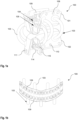
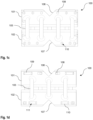
- FIG. 1a An embodiment of the device 100 is shown in a perspective view in Fig. 1a , a view from above (or below, which is basically the same view) in Fig. 1b , a view from the back in Fig. 1c and a view from the front in Fig. 1d .
- the device 100 has an upper portion 101 and a lower portion 102, both in the form of splints that are configured to fit on teeth of the upper and lower jaws, respectively.
- the upper and lower portions 101, 102 are coupled to each other by means of an intermediate portion 103, which is here in the form of flexible or semi-rigid cables, three in the front and four in the back (the number, position, diameter and arrangement of the flexible cables may vary).
- the upper portion 101, lower portion 102, and intermediate portion 103 are integrally formed, i.e., made of a single piece of material, such as an elastic plastics material. However, it may also be possible that the upper and lower portions 101, 102 are made from a different (e.g., harder, softer, more rigid) material than the intermediate portion 103.
- the intermediate portion 103 (flexible cables) is flexible but sufficiently rigid to maintain a fixed position of the upper and lower jaws, while allowing movement to a certain extent. This allows adaptation to different jaw positions ("occlusions") of different patients.
- the rigidity of the cables 103 may also provide an element of formability, which could be formed by the user using a provided tool to determine the relative position of the upper and lower jaw.
- Splints 101 and 102 may have a predetermined or adjustable fore/aft offset to promote mandibular advancement further reducing sleep apnea or snoring by varying the construction of intermediate portion 103.
- the splints forming the upper and lower portions 101, 102 have a substantially V-shaped cross-section that is sized and shaped to receive teeth of the upper and lower jaws. As particularly shown in Fig. 1b , the upper and lower portions 101, 102 have a curved shaped to receive tooth rows of the upper and lower jaws, respectively.
- a retaining structure having barbs 104, 114 and ridges 105, 115 is provided to engage the either the surfaces of the teeth or the interdental spaces to thereby support holding the device 100 in place. In this embodiment there is a single row of barbs 104, 114 one from the front, one from the back, for each of the upper and lower portions 101, 102 (i.e., in total four rows).
- the ridges 105, 115 extend in a lateral direction in parallel to the rows of barbs 104, 114, however they could also be positioned vertically to aid with mechanical retention. Apart from that, recesses 106, 107 are provided to avoid interference with the frenula of the lips. Splints 101 and 102 could also be coated with a moderate release biocompatible adhesive that provides adequate adhesion to retain to teeth yet promote user removal upon awaking.
- Intermediate portion 103 may have flexible/semi-rigid cable assembly design and geometry to support tongue depression or restraint during use.
- the upper and lower portions 101, 102 are provided with holes 108, 109, 110, 111 for receiving a fastening member (not shown here, but see description below), in particular floss.
- the fastening member helps to secure the device 100 to the teeth by passing through interdental spaces. While the holes 108, 110 in the back (the posterior side) are round, the holes 109, 111 in the front (the anterior side) are elongated in a lateral direction. In this way, the device 100 is suitable for various patients without the need for customized holes.
- the floss also prevents or at least reduces lateral movement of the jaws.
- Splints 101 and 102 are shown separated with intermediate section 103 in Figure 1a , but they could also be constructed as a single unit piece with predefined fore-aft construction to provide mandibular displacement with one or more of the above-outlined features included.
- FIG. 2a and 2b Another embodiment of the device 200 for treating sleep apnea is shown in a perspective view in Figs. 2a and 2b , while Figs. 2c and 2d show detailed views of the device 200.
- the device 200 is similar to the device 100 described above. Thus, the respective description of Figs. 1a to 1d applies where applicable.
- the major difference is the design of the intermediate portion 203. Rather than having a plurality of flexible cables, a single and longer flexible cable is provided that couples the upper and lower portions 201, 202 together. In order to maintain a relative position of the jaws, a locking member 216 can be pushed onto the flexible cable when bent as shown in Figs. 2c and 2d .
- the locking member 216 can be advanced towards the teeth to tighten the device 200, i.e., to hold the upper and lower portions 201, 202 together.
- the patient can thereby control how tight the device 200 is secured. Further securing can be achieved by threading floss (or other flexible and elongated element) through hooks 212, 213 on the back side of the upper and lower portions 201, 202.
- barbs 204, 214 are provided on the inner side of the upper and lower portions 201, 202.
- two rows of barbs 204, 214 are each provided (in total eight) but no ridges.
- Floss can be threaded through holes 208, 209, 210, 211, all of which have an elongated shape in this embodiment.
- the device 200 may comprise sensor 220 for measuring parameters in the patient's mouth.
- the device 200 may also function as a device for monitoring the sleep of the patient by measuring parameters in the mouth.
- the pH-value of the saliva may be an indicator for mouth breathing as the pH-value will slightly decrease (typically from slightly basic to slightly acidic) when the patient breathes through the mouth. A rise of the pH-value may cause damage to the tooth enamel increasing the risk of cavities.
- the parameters may comprise a temperature, an oxygen level, heart rate, or a pH-value (or various combinations thereof, including further parameters that may be measured in the mouth). It may also be envisioned to detect a breathing pattern and/or snoring, which may be an indicator for the severity of the sleep apnea. It will be appreciated that the obtained measurement data can be stored, read out, sent, and further processed, and analyzed as required. Reading or sending may use a wired or wireless connection, such as Bluetooth or NFC.
- the sensor 220 With the sensor 220 being arranged in the locking member 216 it can be positioned between the upper and lower jaws, e.g., in front of the front teeth, which puts the sensor 220 in the flow of the breathing air. This may improve the measurement results, particularly with regard to the oxygen content in the breathing air. While in this embodiment the sensor 220 may be preferably arranged in the locking member 216, it will be appreciated that a sensor 220 may be provided in any of the embodiments, particularly in an intermediate portion of the respective device. More generally in any portion of the device that is suitable to put the sensor in the breathing air and in direct contact with the cheek, tongue, or gum, particularly if the sensor shall measure an oxygen level in the breathing air and other biometric data that may be of value.
- a set may be provided, comprising a plurality of devices for treating sleep apnea, wherein at least one of the devices may have a sensor as explained above.
- the devices are configured as single use (disposable) devices.
- a set may comprise devices for several days or weeks, e.g., one week or one month, wherein only some of the devices may be provided with a sensor, e.g., one per week, five per month or the like. On the one hand, this may save costs. On the other hand, it may be sufficient to measure the aforementioned body parameters only once a week (i.e., only one night per week). It may also be envisioned to provide the sensor separately, and to attach it to a device, such that measurements can be made as often as needed.
- Fig. 3 shows a perspective view of still another embodiment of a device 300 for treating sleep apnea. It is similar to those described above with reference to Figs. 1 and 2 . Thus, the above description applies where applicable.
- the intermediate portion 303 is different. Rather than directly connecting the upper and lower portions 301, 302, the intermediate portion 303 in the embodiment of Fig. 3 has two separate parts 303a, 303b. Each part 303a, 303b forms a waterproof compartment accommodating a magnet, such that the upper and lower portions 301, 302 can be held together by magnetic force to achieve maintaining a relative position of the upper and lower jaws.
- Structures 303a and 303b could be designed to provide for adjustment of the relative magnet locations to provide varying degrees of mandibular advancement based on the patients' need and experience. Further, structures 303a and 303b could be placed on the interior (inner curvature) of splints 301 and 302 to provide the same magnetic retention and adjustable mandibular displacement, but could also provide tongue retention and house sensors for biometric measurement from the tongue.
- the retaining structure on the inner surface of the upper portion 301 only include ridges 305 running in a lateral direction. Holes 308, 309, 310, 311 for receiving floss are provided. However, rather than providing elongated holes, only round holes are provided. The greater number of holes 308, 309, 310, 311 (compared to the embodiments described above) and offset arrangement allows using the device 300 for various patients.
- the structures of the splints described with reference to Figs. 1 to 3 in particular the configurations and types of holes for receiving floss and the configurations of the retaining structure including barbs and ridges may be variable and interchangeable and may also be combined throughout the embodiments. Additional hold may be achieved by adhesive provided in the splints that may or may not be activated by saliva.
- fastening member such as floss
- Fig. 1 to 3 for clarity purposes. Examples for fastening members will be explained below particularly with respect to Figs. 6 to 15 . Thus, features described in connection with Figs. 6 to 15 , particularly as far as they concern the fastening member, may apply to the embodiments of Fig. 1 to 3 . More specifically, the devices of Figs. 1 to 3 may be used with any of the examples of fastening members described below.
- FIG. 4a cross-sectional view
- 4b front view
- the device of Figs. 4a and 4b is configured to receive teeth of the upper and lower jaws.
- the device 400 is smaller and may extend, e.g., only over the front teeth (incisors).
- a single strand of floss 420, 421 is provided in each of the upper and lower portions 401, 402 to extend through one interdental space in each of the upper and lower jaws.
- the device 400 may also be wider to span more teeth. Accordingly, more than one floss line may be provided.
- Magnets 417, 418 are provided to hold the upper and lower portions 401, 402 together. Here the magnets 417, 418 are accommodated in ends of the upper and lower portions 401, 402 facing each other when the device 400 is worn and attract each other to secure a relative position of the upper and lower jaws. The magnets 417, 418 may be movable to ensure that they meet optimally or to provide mandibular advancement.
- FIG. 5a Another embodiment of a device 500 for treating sleep apnea is shown in Figs. 5a and 5b .
- the device 500 is configured to snap onto the teeth 11, 12.
- Fig. 5a shows an open configured, in which the device 500 can be placed on the teeth 11, 12.
- the teeth 11, 12 push into the upper and lower portions 501, 502, respectively, the upper and lower portions 501, 502 snap into a closed configuration shown in Fig. 5b to clamp the teeth 11, 12.
- the biased shaped and barbs 504, 514 similar to the device 400 of Figs. 4a and 4b further supports hold on the teeth 11, 12, and the device 500 can have a similar (narrow) lateral dimension.
- the intermediate portion 503 is here in the form of a rubber band. Just like in the above-described embodiments, the rubber band helps to maintain a relative position of the upper and lower jaws when the device 500 is worn, while allowing the patient to move the jaws to a certain extent as explained above.
- the device is arranged only on one side of the teeth, preferably the front side.
- a plate-like or pad-like device is provided, which is adapted to engage to the teeth of the upper jaw and the teeth of the lower jaws (thereby forming an "upper portion” and a “lower portion”, which are integrally connected by an "intermediate portion", i.e., the middle portion of the plate-like or pad-like device).
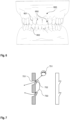
- the device 600 comprises a flexible pad, with holes 601, 602 in the upper and lower portion for receiving fastening members 650.
- the fastening members 650 are formed as staples, which are substantially rigid.
- floss may also be used.
- Fig. 7 shows a possible hole configuration that may help securing floss 750, which may apply for any embodiment using floss as the fastening member(s).
- a bar or bridge 702 protrudes into the holes 701 such that only a small opening remains that may clamp the floss 750.
- the floss 750 may be provided with barbs 751. In this way, the floss 750 can be prevented from slipping through the holes 701 backward after tightening.
- Fig. 8a show another embodiment of a device 800 for treating sleep apnea, while in Fig. 8b and 8c details of the device 800 are shown.
- the device 800 comprises a plate-like member 801 to maintain a relative position of the upper and lower jaws.
- the fastening members 850 are formed by elastic rings (e.g., rubber band), which are to be inserted into two interdental spaces and guided around the respective teeth 10.
- the plate-like member 801 has slotted openings 802 such that the elastic rings 850 can be inserted.
- the elastic rings 850 have a rectangular cross-section such that in combination with the T-shaped slotted openings 802 the elastic rings 850 are securely held in the plate-like member 801.
- hooks 803 are provided on the front side of the plate-like member 801.
- three hooks 803 are provided in an upper portion and a lower portion of the plate-like member 801 to provide three levels of tension for holding the upper and lower jaws 1, 2 together, which also allows the device 800 to be used for various patients without needing to customize it.
- the elastic rings 850 can be turned by 90 degrees in an interdental space 13 to lock. While in this embodiment the plate-like member 801 has a width that extends only over two front teeth 10, it may be wider for distributing the force on the teeth more evenly. It will be appreciated that the plate-like member 801 may also be placed on other teeth. This may also apply to other embodiments disclosed herein having such or similar plate-like member.
- Figs. 9a and 9b show embodiments of a device 900 for treating sleep apnea, in which the fastening members 950 (floss or other elongate fastening member) have anchoring members 951, 952, 953.
- the floss 950 has arrowhead-like tips 952, 953.
- the arrowhead-like tip 952 at a "leading end” has a smaller diameter, i.e., this end can be pushed through an interdental space (and hole of a plate-like member 901), while the arrowhead-like tip 953 at a "rear end” has a larger diameter that acts a stopper at the plate-like member 901 when pulled therethrough.
- ball-shaped anchoring members 951 are other suitable indentation
- FIG. 9b A similar embodiment is shown in Fig. 9b .
- the only difference is the shape of the end members 952', 953' of the fastening member 950' (likewise having indentation 951' along its length).
- "blunt" ends are provided, such as block-like or plate-like end members 952', 953'.
- any combination of the end members 952, 953, 952', 953' of Figs. 9a and 9b may be used (provided that one is small enough for insertion and the other one is large enough to act as a stopper).
- FIG. 10 Another embodiment of a device for treating sleep apnea is shown in Fig. 10 .
- the floss 1050 has indentations 1051 along its length.
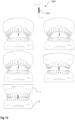
- Fig. 10 illustrates the steps of inserting the plates 1001, 1002 and floss 1050.
- the final phase is shown, i.e., when the floss 1050 has been tightened, such that the upper and lower jaws 1, 2 are in the relative position that is intended for treating sleep apnea as described herein.
- a fastening member 1150 is illustrated in Fig. 11 , which can be used rather than floss.
- the fastening member 1150 is formed as a nitinol wire.
- Nitinol is a shape memory-memory alloy that changes its shape depending on the temperature. More specifically the nitinol wire has a first shape at a first temperature (temperature outside the mouth).
- the fastening member 1150 can be placed around one or more teeth.
- a loop of nitinol wire is placed around a front tooth (left illustration in Fig. 11 ). When the fastening member 1150 reaches a certain temperature inside the mouth, the loop closes such that the fastening member 1150 is secured on the tooth.
- the final tightened configuration is shown in the right illustration of Fig. 11 .
- a fastening member 1250 is shown in Fig. 12 , which is in the form of swelling floss. More specifically, after contact with saliva, the floss swells at least along a portion of its length such that it is secured in an interdental space.
- the final tightened configuration (with a plate-like member 1201 as described above) is shown in the right illustration of Fig. 12 .
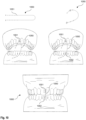
- FIG. 13 Still another example of a fastening member 1350 is shown in Fig. 13 . More specifically, the steps of installing the fastening member 1350 are illustrated (from top left, followed by top right until the final phase at the bottom).
- One piece of the fastening member 1350 is provided with a tubular member 1351 comprising a braided structure, wherein a free end of another piece (or the other end of the same piece) is inserted into the tubular member 1351 that is configured to tighten when pulled.
- Such mechanism is known as "Chinese cuff" or “Chinese finger trap”.
- the braided structure of the tubular member 1351 automatically contracts when the fastening member 1350 is tightened to thereby secure the relative position of the upper and lower jaws 1, 2.
- a tool 1405 for may be provided as shown schematically in Fig. 14 .
- Floss lines 1402 are inserted through elongated cone-shaped guiding elements 1403 extending through the tool 1405.
- the tool 1405 is held against the teeth and then pressed together (gripped on the right side in the lower drawing of Fig.
- a line locker 1407 is provide that can displace the floss lines 1402 laterally so that they are locked in the locking plate 1401 when the tool is pressed together and can slide therethrough when the tool 1405 is released.
- the floss lines 1402 are pushed through respective interdental spaces and are held in place by means of anchoring members 1404 at their ends. The tool 1405 can then be released and removed from the teeth.
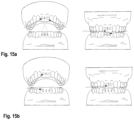
- FIG. 15 and 15b Another embodiment of a device 1500 for treating sleep apnea is shown in Figs. 15 and 15b .
- the device 1500 differs from the devices described above in that it is directly attached to the surface of the teeth 11, 12. More specifically, attachments 1501, 1502 are provided that attach to the surface of the teeth 11, 12, such as two front teeth 11 of the upper jaw 1 and two front teeth 12 of the lower jaw 2. Other teeth may be chosen for attaching the attachments, as shown in Fig. 15b compared to Fig. 15a .
- the attachments 1501, 1502 may be in the form of suction cups, which may allow easy attachment as well as easy removal.
- a fastening member 1550 such as an elastic band (e.g., rubber) brings the upper and lower jaws 1, 2 together and holds them in a relative position suitable for treating sleep apnea.
- an elastic band e.g., rubber
- Another option can be to wrap an elastic band around the patient's chin rather than having attachments on teeth of the lower jaw.
- Fig. 16 shows another embodiment of a device 1600 for treating sleep apnea (components for the lower jaw 2 are not shown here).
- the device 1600 includes a tongue holding portion 1660 that is configured to hold the tongue 20 in a forward position to prevent the tongue 20 from obstructing the airway.
- the tongue holding portion 1660 comprises a "sleeve" (or “jacket") made of a flexible material (e.g., silicone) that is placed on the tip of the tongue 20 and held on the tongue 20 by a suction force.
- the tongue holding portion 1660 On its tip, the tongue holding portion 1660 has a magnet 1661 (e.g., embedded).
- the lower portion 1602 of the device 1600 i.e., the portion configured to be placed on teeth 12 of the lower jaw 2 also has a magnet 1603 such that the tongue 20 can be maintained in a forward position by a magnet force.
Landscapes
- Health & Medical Sciences (AREA)
- Otolaryngology (AREA)
- Pulmonology (AREA)
- Nursing (AREA)
- Orthopedic Medicine & Surgery (AREA)
- Engineering & Computer Science (AREA)
- Biomedical Technology (AREA)
- Heart & Thoracic Surgery (AREA)
- Vascular Medicine (AREA)
- Life Sciences & Earth Sciences (AREA)
- Animal Behavior & Ethology (AREA)
- General Health & Medical Sciences (AREA)
- Public Health (AREA)
- Veterinary Medicine (AREA)
- Orthopedics, Nursing, And Contraception (AREA)
Priority Applications (2)
| Application Number | Priority Date | Filing Date | Title |
|---|---|---|---|
| EP23194710.2A EP4516273B1 (de) | 2023-08-31 | 2023-08-31 | Vorrichtung zur behandlung von schlafapnoe oder anderen atemstörungen |
| PCT/IB2024/058272 WO2025046437A1 (en) | 2023-08-31 | 2024-08-26 | Device for treating sleep apnea or other breathing disorder |
Applications Claiming Priority (1)
| Application Number | Priority Date | Filing Date | Title |
|---|---|---|---|
| EP23194710.2A EP4516273B1 (de) | 2023-08-31 | 2023-08-31 | Vorrichtung zur behandlung von schlafapnoe oder anderen atemstörungen |
Publications (2)
| Publication Number | Publication Date |
|---|---|
| EP4516273A1 true EP4516273A1 (de) | 2025-03-05 |
| EP4516273B1 EP4516273B1 (de) | 2026-04-01 |
Family
ID=87889596
Family Applications (1)
| Application Number | Title | Priority Date | Filing Date |
|---|---|---|---|
| EP23194710.2A Active EP4516273B1 (de) | 2023-08-31 | 2023-08-31 | Vorrichtung zur behandlung von schlafapnoe oder anderen atemstörungen |
Country Status (2)
| Country | Link |
|---|---|
| EP (1) | EP4516273B1 (de) |
| WO (1) | WO2025046437A1 (de) |
Citations (1)
| Publication number | Priority date | Publication date | Assignee | Title |
|---|---|---|---|---|
| US20230148953A1 (en) * | 2021-11-15 | 2023-05-18 | Hyeran CHOO | Mandibular advancement device for preventing sleep apnea |
-
2023
- 2023-08-31 EP EP23194710.2A patent/EP4516273B1/de active Active
-
2024
- 2024-08-26 WO PCT/IB2024/058272 patent/WO2025046437A1/en active Pending
Patent Citations (1)
| Publication number | Priority date | Publication date | Assignee | Title |
|---|---|---|---|---|
| US20230148953A1 (en) * | 2021-11-15 | 2023-05-18 | Hyeran CHOO | Mandibular advancement device for preventing sleep apnea |
Also Published As
| Publication number | Publication date |
|---|---|
| EP4516273B1 (de) | 2026-04-01 |
| WO2025046437A1 (en) | 2025-03-06 |
Similar Documents
| Publication | Publication Date | Title |
|---|---|---|
| US8474462B2 (en) | Tongue retaining oral appliance | |
| US12514741B2 (en) | Oropharynx appliance to maintain airway patency | |
| AU2017293472B2 (en) | Dental appliance for sleep apnea, snoring and tongue and oral cavity remodeling | |
| US20110277774A1 (en) | Combination intra oral and extra oral sleep apnea appliance | |
| KR20160119094A (ko) | 하악 전진 이동 장치 및 이 장치를 제조하는 방법 및 키트 | |
| US20100311008A1 (en) | Oral tongue positioning device | |
| EP2882384B1 (de) | Intraorale funktionale vorrichtung zur linderung von obstruktiver schlafapnoe, schnarchen bzw. anderen atemwegsstörungen | |
| US9492310B2 (en) | Adjustable tongue retaining oral appliance | |
| KR20230070711A (ko) | 수면무호흡 방지용 하악전진장치 | |
| EP4516273B1 (de) | Vorrichtung zur behandlung von schlafapnoe oder anderen atemstörungen | |
| US12427050B2 (en) | Anti-snoring device | |
| RU2797642C2 (ru) | Стоматологическое устройство для лечения ночного апноэ, храпа и ремоделирования языка и ротовой полости | |
| BR112019000267B1 (pt) | Aparelho dentário para apneia do sono, ronco e remodelação de língua e cavidade oral |
Legal Events
| Date | Code | Title | Description |
|---|---|---|---|
| PUAI | Public reference made under article 153(3) epc to a published international application that has entered the european phase |
Free format text: ORIGINAL CODE: 0009012 |
|
| STAA | Information on the status of an ep patent application or granted ep patent |
Free format text: STATUS: THE APPLICATION HAS BEEN PUBLISHED |
|
| AK | Designated contracting states |
Kind code of ref document: A1 Designated state(s): AL AT BE BG CH CY CZ DE DK EE ES FI FR GB GR HR HU IE IS IT LI LT LU LV MC ME MK MT NL NO PL PT RO RS SE SI SK SM TR |
|
| STAA | Information on the status of an ep patent application or granted ep patent |
Free format text: STATUS: REQUEST FOR EXAMINATION WAS MADE |
|
| 17P | Request for examination filed |
Effective date: 20250903 |
|
| GRAP | Despatch of communication of intention to grant a patent |
Free format text: ORIGINAL CODE: EPIDOSNIGR1 |
|
| STAA | Information on the status of an ep patent application or granted ep patent |
Free format text: STATUS: GRANT OF PATENT IS INTENDED |
|
| INTG | Intention to grant announced |
Effective date: 20251024 |
|
| GRAS | Grant fee paid |
Free format text: ORIGINAL CODE: EPIDOSNIGR3 |
|
| GRAA | (expected) grant |
Free format text: ORIGINAL CODE: 0009210 |
|
| STAA | Information on the status of an ep patent application or granted ep patent |
Free format text: STATUS: THE PATENT HAS BEEN GRANTED |
|
| AK | Designated contracting states |
Kind code of ref document: B1 Designated state(s): AL AT BE BG CH CY CZ DE DK EE ES FI FR GB GR HR HU IE IS IT LI LT LU LV MC ME MK MT NL NO PL PT RO RS SE SI SK SM TR |
|
| REG | Reference to a national code |
Ref country code: CH Ref legal event code: F10 Free format text: ST27 STATUS EVENT CODE: U-0-0-F10-F00 (AS PROVIDED BY THE NATIONAL OFFICE) Effective date: 20260401 Ref country code: GB Ref legal event code: FG4D |
|
| REG | Reference to a national code |
Ref country code: IE Ref legal event code: FG4D |
|
| REG | Reference to a national code |
Ref country code: DE Ref legal event code: R096 Ref document number: 602023014372 Country of ref document: DE |