EP4513253A2 - Power supply assembly with fan assembly for electronic device - Google Patents
Power supply assembly with fan assembly for electronic device Download PDFInfo
- Publication number
- EP4513253A2 EP4513253A2 EP25150308.2A EP25150308A EP4513253A2 EP 4513253 A2 EP4513253 A2 EP 4513253A2 EP 25150308 A EP25150308 A EP 25150308A EP 4513253 A2 EP4513253 A2 EP 4513253A2
- Authority
- EP
- European Patent Office
- Prior art keywords
- assembly
- disposed
- shaft
- data module
- local processing
- Prior art date
- Legal status (The legal status is an assumption and is not a legal conclusion. Google has not performed a legal analysis and makes no representation as to the accuracy of the status listed.)
- Pending
Links
Images












Classifications
-
- G—PHYSICS
- G06—COMPUTING OR CALCULATING; COUNTING
- G06F—ELECTRIC DIGITAL DATA PROCESSING
- G06F1/00—Details not covered by groups G06F3/00 - G06F13/00 and G06F21/00
- G06F1/16—Constructional details or arrangements
- G06F1/18—Packaging or power distribution
- G06F1/183—Internal mounting support structures, e.g. for supporting printed circuit boards
- G06F1/188—Mounting of power supply units
-
- H—ELECTRICITY
- H01—ELECTRIC ELEMENTS
- H01M—PROCESSES OR MEANS, e.g. BATTERIES, FOR THE DIRECT CONVERSION OF CHEMICAL ENERGY INTO ELECTRICAL ENERGY
- H01M10/00—Secondary cells; Manufacture thereof
- H01M10/60—Heating or cooling; Temperature control
- H01M10/61—Types of temperature control
- H01M10/613—Cooling or keeping cold
-
- F—MECHANICAL ENGINEERING; LIGHTING; HEATING; WEAPONS; BLASTING
- F04—POSITIVE - DISPLACEMENT MACHINES FOR LIQUIDS; PUMPS FOR LIQUIDS OR ELASTIC FLUIDS
- F04D—NON-POSITIVE-DISPLACEMENT PUMPS
- F04D25/00—Pumping installations or systems
- F04D25/02—Units comprising pumps and their driving means
- F04D25/06—Units comprising pumps and their driving means the pump being electrically driven
- F04D25/0606—Units comprising pumps and their driving means the pump being electrically driven the electric motor being specially adapted for integration in the pump
- F04D25/0613—Units comprising pumps and their driving means the pump being electrically driven the electric motor being specially adapted for integration in the pump the electric motor being of the inside-out type, i.e. the rotor is arranged radially outside a central stator
-
- F—MECHANICAL ENGINEERING; LIGHTING; HEATING; WEAPONS; BLASTING
- F04—POSITIVE - DISPLACEMENT MACHINES FOR LIQUIDS; PUMPS FOR LIQUIDS OR ELASTIC FLUIDS
- F04D—NON-POSITIVE-DISPLACEMENT PUMPS
- F04D25/00—Pumping installations or systems
- F04D25/02—Units comprising pumps and their driving means
- F04D25/06—Units comprising pumps and their driving means the pump being electrically driven
- F04D25/0606—Units comprising pumps and their driving means the pump being electrically driven the electric motor being specially adapted for integration in the pump
- F04D25/0613—Units comprising pumps and their driving means the pump being electrically driven the electric motor being specially adapted for integration in the pump the electric motor being of the inside-out type, i.e. the rotor is arranged radially outside a central stator
- F04D25/062—Details of the bearings
-
- F—MECHANICAL ENGINEERING; LIGHTING; HEATING; WEAPONS; BLASTING
- F04—POSITIVE - DISPLACEMENT MACHINES FOR LIQUIDS; PUMPS FOR LIQUIDS OR ELASTIC FLUIDS
- F04D—NON-POSITIVE-DISPLACEMENT PUMPS
- F04D29/00—Details, component parts, or accessories
- F04D29/40—Casings; Connections of working fluid
- F04D29/42—Casings; Connections of working fluid for radial or helico-centrifugal pumps
- F04D29/4206—Casings; Connections of working fluid for radial or helico-centrifugal pumps especially adapted for elastic fluid pumps
- F04D29/4226—Fan casings
-
- F—MECHANICAL ENGINEERING; LIGHTING; HEATING; WEAPONS; BLASTING
- F04—POSITIVE - DISPLACEMENT MACHINES FOR LIQUIDS; PUMPS FOR LIQUIDS OR ELASTIC FLUIDS
- F04D—NON-POSITIVE-DISPLACEMENT PUMPS
- F04D29/00—Details, component parts, or accessories
- F04D29/58—Cooling; Heating; Diminishing heat transfer
- F04D29/582—Cooling; Heating; Diminishing heat transfer specially adapted for elastic fluid pumps
- F04D29/5853—Cooling; Heating; Diminishing heat transfer specially adapted for elastic fluid pumps heat insulation or conduction
-
- F—MECHANICAL ENGINEERING; LIGHTING; HEATING; WEAPONS; BLASTING
- F04—POSITIVE - DISPLACEMENT MACHINES FOR LIQUIDS; PUMPS FOR LIQUIDS OR ELASTIC FLUIDS
- F04D—NON-POSITIVE-DISPLACEMENT PUMPS
- F04D29/00—Details, component parts, or accessories
- F04D29/60—Mounting; Assembling; Disassembling
- F04D29/601—Mounting; Assembling; Disassembling specially adapted for elastic fluid pumps
-
- G—PHYSICS
- G02—OPTICS
- G02B—OPTICAL ELEMENTS, SYSTEMS OR APPARATUS
- G02B27/00—Optical systems or apparatus not provided for by any of the groups G02B1/00 - G02B26/00, G02B30/00
- G02B27/01—Head-up displays
- G02B27/017—Head mounted
-
- G—PHYSICS
- G06—COMPUTING OR CALCULATING; COUNTING
- G06F—ELECTRIC DIGITAL DATA PROCESSING
- G06F1/00—Details not covered by groups G06F3/00 - G06F13/00 and G06F21/00
- G06F1/16—Constructional details or arrangements
- G06F1/1613—Constructional details or arrangements for portable computers
-
- G—PHYSICS
- G06—COMPUTING OR CALCULATING; COUNTING
- G06F—ELECTRIC DIGITAL DATA PROCESSING
- G06F1/00—Details not covered by groups G06F3/00 - G06F13/00 and G06F21/00
- G06F1/16—Constructional details or arrangements
- G06F1/1613—Constructional details or arrangements for portable computers
- G06F1/163—Wearable computers, e.g. on a belt
-
- G—PHYSICS
- G06—COMPUTING OR CALCULATING; COUNTING
- G06F—ELECTRIC DIGITAL DATA PROCESSING
- G06F1/00—Details not covered by groups G06F3/00 - G06F13/00 and G06F21/00
- G06F1/16—Constructional details or arrangements
- G06F1/1613—Constructional details or arrangements for portable computers
- G06F1/1633—Constructional details or arrangements of portable computers not specific to the type of enclosures covered by groups G06F1/1615 - G06F1/1626
- G06F1/1635—Details related to the integration of battery packs and other power supplies such as fuel cells or integrated AC adapter
-
- G—PHYSICS
- G06—COMPUTING OR CALCULATING; COUNTING
- G06F—ELECTRIC DIGITAL DATA PROCESSING
- G06F1/00—Details not covered by groups G06F3/00 - G06F13/00 and G06F21/00
- G06F1/16—Constructional details or arrangements
- G06F1/18—Packaging or power distribution
- G06F1/181—Enclosures
-
- G—PHYSICS
- G06—COMPUTING OR CALCULATING; COUNTING
- G06F—ELECTRIC DIGITAL DATA PROCESSING
- G06F1/00—Details not covered by groups G06F3/00 - G06F13/00 and G06F21/00
- G06F1/16—Constructional details or arrangements
- G06F1/20—Cooling means
- G06F1/203—Cooling means for portable computers, e.g. for laptops
-
- G—PHYSICS
- G06—COMPUTING OR CALCULATING; COUNTING
- G06F—ELECTRIC DIGITAL DATA PROCESSING
- G06F3/00—Input arrangements for transferring data to be processed into a form capable of being handled by the computer; Output arrangements for transferring data from processing unit to output unit, e.g. interface arrangements
- G06F3/01—Input arrangements or combined input and output arrangements for interaction between user and computer
- G06F3/011—Arrangements for interaction with the human body, e.g. for user immersion in virtual reality
-
- G—PHYSICS
- G06—COMPUTING OR CALCULATING; COUNTING
- G06T—IMAGE DATA PROCESSING OR GENERATION, IN GENERAL
- G06T19/00—Manipulating three-dimensional [3D] models or images for computer graphics
- G06T19/006—Mixed reality
-
- H—ELECTRICITY
- H01—ELECTRIC ELEMENTS
- H01M—PROCESSES OR MEANS, e.g. BATTERIES, FOR THE DIRECT CONVERSION OF CHEMICAL ENERGY INTO ELECTRICAL ENERGY
- H01M10/00—Secondary cells; Manufacture thereof
- H01M10/60—Heating or cooling; Temperature control
- H01M10/62—Heating or cooling; Temperature control specially adapted for specific applications
- H01M10/623—Portable devices, e.g. mobile telephones, cameras or pacemakers
-
- H—ELECTRICITY
- H01—ELECTRIC ELEMENTS
- H01M—PROCESSES OR MEANS, e.g. BATTERIES, FOR THE DIRECT CONVERSION OF CHEMICAL ENERGY INTO ELECTRICAL ENERGY
- H01M10/00—Secondary cells; Manufacture thereof
- H01M10/60—Heating or cooling; Temperature control
- H01M10/65—Means for temperature control structurally associated with the cells
- H01M10/656—Means for temperature control structurally associated with the cells characterised by the type of heat-exchange fluid
- H01M10/6561—Gases
- H01M10/6563—Gases with forced flow, e.g. by blowers
-
- H—ELECTRICITY
- H05—ELECTRIC TECHNIQUES NOT OTHERWISE PROVIDED FOR
- H05K—PRINTED CIRCUITS; CASINGS OR CONSTRUCTIONAL DETAILS OF ELECTRIC APPARATUS; MANUFACTURE OF ASSEMBLAGES OF ELECTRICAL COMPONENTS
- H05K5/00—Casings, cabinets or drawers for electric apparatus
- H05K5/02—Details
- H05K5/0213—Venting apertures; Constructional details thereof
-
- H—ELECTRICITY
- H05—ELECTRIC TECHNIQUES NOT OTHERWISE PROVIDED FOR
- H05K—PRINTED CIRCUITS; CASINGS OR CONSTRUCTIONAL DETAILS OF ELECTRIC APPARATUS; MANUFACTURE OF ASSEMBLAGES OF ELECTRICAL COMPONENTS
- H05K7/00—Constructional details common to different types of electric apparatus
- H05K7/14—Mounting supporting structure in casing or on frame or rack
-
- H—ELECTRICITY
- H05—ELECTRIC TECHNIQUES NOT OTHERWISE PROVIDED FOR
- H05K—PRINTED CIRCUITS; CASINGS OR CONSTRUCTIONAL DETAILS OF ELECTRIC APPARATUS; MANUFACTURE OF ASSEMBLAGES OF ELECTRICAL COMPONENTS
- H05K7/00—Constructional details common to different types of electric apparatus
- H05K7/20—Modifications to facilitate cooling, ventilating, or heating
- H05K7/20009—Modifications to facilitate cooling, ventilating, or heating using a gaseous coolant in electronic enclosures
- H05K7/20136—Forced ventilation, e.g. by fans
-
- H—ELECTRICITY
- H05—ELECTRIC TECHNIQUES NOT OTHERWISE PROVIDED FOR
- H05K—PRINTED CIRCUITS; CASINGS OR CONSTRUCTIONAL DETAILS OF ELECTRIC APPARATUS; MANUFACTURE OF ASSEMBLAGES OF ELECTRICAL COMPONENTS
- H05K7/00—Constructional details common to different types of electric apparatus
- H05K7/20—Modifications to facilitate cooling, ventilating, or heating
- H05K7/20009—Modifications to facilitate cooling, ventilating, or heating using a gaseous coolant in electronic enclosures
- H05K7/20136—Forced ventilation, e.g. by fans
- H05K7/20172—Fan mounting or fan specifications
-
- G—PHYSICS
- G02—OPTICS
- G02B—OPTICAL ELEMENTS, SYSTEMS OR APPARATUS
- G02B27/00—Optical systems or apparatus not provided for by any of the groups G02B1/00 - G02B26/00, G02B30/00
- G02B27/01—Head-up displays
- G02B27/017—Head mounted
- G02B2027/0178—Eyeglass type
Definitions
- the field relates to a power supply assembly with fan assembly for electronic devices, and in particularly, for portable electronic devices.
- thermal dissipation components may experience high mechanical loading conditions that can cause cyclic or other mechanical stresses and/or failure. It can be desirable to improve the dissipation of heat in electronic devices, and/or to improve the mechanical performance of such devices.
- a virtual reality, or "VR”, scenario typically involves presentation of digital or virtual image information without transparency to other actual real-world visual input;
- an augmented reality, or "AR”, scenario typically involves presentation of digital or virtual image information as an augmentation to visualization of the actual world around the user.
- Some VR or AR systems may include portable electronic devices that may be subject to the thermal and/or mechanical loads. Accordingly, there remains a continuing need for improved thermal and/or mechanical solutions for portable electronic devices, including those used in conjunction with VR or AR systems.
- an electronic device can comprise a housing comprising a first compartment in which a first electronic component is disposed.
- the housing can comprise a second compartment in which a second electronic component is disposed, one or both of the first and second electrical components electrically communicating with another component of the electronic device.
- the housing can comprise a connection portion extending between the first and second compartments.
- the first compartment can separated from the second compartment at a location spaced away from the connection portion by a gap to provide thermal separation between the first and second electronic components
- a portable electronic device comprises a housing and a battery disposed in the housing, the battery supplying power for at least a portion of the portable electronic device.
- the portable electronic device comprises electronic components for operating the portable electronic device, the electronic components disposed in the housing.
- the portable electronic device comprises a thermal mitigation assembly comprising a frame assembly.
- the frame assembly can comprise a shaft assembly having a first end and a second end opposite the first end, the first and second ends supported by the frame assembly.
- the frame assembly can comprise an impeller having fan blades coupled with a hub, the hub being coupled with the shaft assembly for rotation within the housing about a longitudinal axis of the shaft assembly. Loading transverse to the longitudinal axis of the shaft assembly can be controlled by the frame assembly at the second end of the shaft assembly.
- the thermal mitigation assembly removes heat generated from one or both of the battery and the electronic components.
- the housing comprises a first enclosure and a second enclosure, the electronic components and the thermal mitigation assembly disposed in the first enclosure and the battery disposed in the second enclosure.
- a fan assembly in some embodiments, can include a first support frame, a shaft assembly having a first end coupled with the first support frame and a second end disposed away from the first end, and a second support frame coupled with the first support frame and disposed at or over the second end of the shaft assembly.
- An impeller can have fan blades coupled with a hub, the hub being disposed over the shaft assembly for rotation between the first and second support frames about a longitudinal axis. Transverse loading on the shaft assembly can be controlled by the first and second support frames.
- the second support frame comprises an airflow opening disposed about the longitudinal axis which extends between the first and second ends of the shaft assembly.
- a shaft support can be coupled with the second end of the shaft assembly, the shaft support being rigidly attached to the second support frame across the airflow opening.
- the shaft support can be supported at respective first and second portions of the second support frame, the respective first and second portions spaced apart about a periphery of the airflow opening.
- the first portion of the second support frame is generally on an opposite side of the airflow opening relative to the second portion of the second support frame.
- the shaft support is disposed in a rotational position of the airflow opening corresponding to a maximum of air flow when the impeller is operating.
- the shaft support comprises an elongate member between first and second ends thereof, the elongate member having an airfoil shape.
- the shaft support comprises an elongate member between the first and second ends thereof, the elongate member having varying width along the length thereof.
- the shaft support comprises an elongate member between the first and second ends thereof, the elongate member having varying thickness along the length thereof.
- the shaft assembly comprises a first shaft portion rotationally fixed to the first support frame and a second portion rotationally fixed to the impeller, the second portion being rotatable over a free end of the first shaft portion of the shaft assembly.
- the shaft assembly comprises an elongate member having a first end disposed on a first side of the impeller and a second end disposed on a second side of the impeller, the second side being opposite the first side.
- a concave member can be coupled with the second support frame and configured to rotationally support the second end of the elongate member.
- An additional concave member can be coupled with the first support frame and configured to rotationally support the first end of the elongate member.
- An airflow pathway of the fan assembly extends between the airflow opening disposed about the longitudinal axis and a second airflow opening having a face disposed about an axis non-parallel to the longitudinal axis. The axis non-parallel to the longitudinal axis is disposed generally perpendicular to the longitudinal axis and along a radial-extending axis of the impeller.
- a fan assembly can include an enclosure supporting a shaft assembly at a first end, the shaft having a second end opposite the first end, and an impeller having fan blades coupled with a hub, the hub being coupled with the shaft for rotation within the enclosure about a longitudinal axis. Transverse loading on the shaft assembly can be controlled by the enclosure at the second end of the shaft assembly.
- a fan assembly can comprise a housing comprising a shaft support and a shaft assembly supported by the shaft support.
- An impeller can be disposed in the housing and coupled with the shaft assembly, the impeller configured to rotate about a longitudinal axis of the shaft assembly.
- a first airflow opening can be disposed about the longitudinal axis.
- a second airflow opening having a face can be disposed about an axis non-parallel to the longitudinal axis.
- An airflow pathway of the fan assembly can extend between the first airflow opening and the second airflow opening.
- the shaft support can comprise an elongate member extending across at least a portion of the first airflow opening, the elongate member angularly positioned across the first airflow opening at an angle relative to the non-parallel axis that permits at least a local maximum of airflow through the first airflow opening.
- the angle relative to the non-parallel axis is acute. In some embodiments, the angle relative to the non-parallel axis is in a range of -45° to 45°. In some embodiments, the angle relative to the non-parallel axis is in a range of -30° to 30°.
- a method of manufacturing a fan assembly can include providing a fan assembly comprising a housing and an impeller disposed in the housing and coupled with a shaft assembly, the impeller configured to rotate about a longitudinal axis of the shaft assembly.
- a first airflow opening can be disposed about the longitudinal axis.
- a second airflow opening having a face disposed about an axis non-parallel to the longitudinal axis, wherein an airflow pathway of the fan assembly extends between the first airflow opening and the second airflow opening.
- the method can include computing an airflow profile through the fan assembly, and based on the computing, providing a shaft support to support an end of the shaft assembly, the shaft support comprising an elongate member extending across at least a portion of the first airflow opening.
- the method can comprise angularly positioning the elongate member at least partially across the first airflow opening at an angle relative to the non-parallel axis that permits at least a local maximum of airflow through the first airflow opening.
- angularly positioning comprises orienting the angle relative to the non-parallel axis at an acute angle.
- angularly positioning comprises orienting the angle relative to the non-parallel axis in a range of -45° to 45°.
- angularly positioning comprises orienting the angle relative to the non-parallel axis in a range of -30° to 30°.
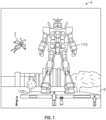
- FIG. 1 an augmented reality scene 4 is depicted wherein a user of an AR technology sees a real-world park-like setting 6 featuring people, trees, buildings in the background, and a concrete platform 1120.
- the user of the AR technology also perceives that he "sees" a robot statue 1110 standing upon the real-world platform 1120, and a cartoon-like avatar character 2 flying by which seems to be a personification of a bumble bee, even though these elements 2, 1110 do not exist in the real world.
- At least the elements 2, 1110 can be provided to the user at least in part by the portable (e.g., wearable) electronic devices disclosed herein.
- the human visual perception system is very complex, and producing a VR or AR technology that facilitates a comfortable, natural-feeling, rich presentation of virtual image elements amongst other virtual or real-world imagery elements is challenging.
- head-worn AR displays typically are at least loosely coupled to a user's head, and thus move when the user's head moves. If the user's head motions are detected by the display system, the data being displayed can be updated to take the change in head pose into account.
- a user wearing a head-worn display views a virtual representation of a three-dimensional (3D) object on the display and walks around the area where the 3D object appears, that 3D object can be re-rendered for each viewpoint, giving the user the perception that he or she is walking around an object that occupies real space.
- the head-worn display is used to present multiple objects within a virtual space (for instance, a rich virtual world)
- measurements of head pose e.g., the location and orientation of the user's head
- detection or calculation of head pose can facilitate the display system to render virtual objects such that they appear to occupy a space in the real world in a manner that makes sense to the user.
- detection of the position and/or orientation of a real object such as handheld device (which also may be referred to as a "totem"), haptic device, or other real physical object, in relation to the user's head or AR system may also facilitate the display system in presenting display information to the user to enable the user to interact with certain aspects of the AR system efficiently.
- the virtual objects may be re-rendered as a function of head pose, such that the virtual objects appear to remain stable relative to the real world.
- placement of virtual objects in spatial relation to physical objects may be a non-trivial problem.
- head movement may significantly complicate placement of virtual objects in a view of an ambient environment. Such is true whether the view is captured as an image of the ambient environment and then projected or displayed to the end user, or whether the end user perceives the view of the ambient environment directly. For instance, head movement will likely cause a field of view of the end user to change, which will likely require an update to where various virtual objects are displayed in the field of the view of the end user. Additionally, head movements may occur within a large variety of ranges and speeds.
- Head movement speed may vary not only between different head movements, but within or across the range of a single head movement. For instance, head movement speed may initially increase (e.g., linearly or not) from a starting point, and may decrease as an ending point is reached, obtaining a maximum speed somewhere between the starting and ending points of the head movement. Rapid head movements may even exceed the ability of the particular display or projection technology to render images that appear uniform and/or as smooth motion to the end user.
- Head tracking accuracy and latency have been challenges for VR and AR systems.
- the accuracy of head-tracking is high and that the overall system latency is very low from the first detection of head motion to the updating of the light that is delivered by the display to the user's visual system. If the latency is high, the system can create a mismatch between the user's vestibular and visual sensory systems, and generate a user perception scenario that can lead to motion sickness or simulator sickness. If the system latency is high, the apparent location of virtual objects will appear unstable during rapid head motions.
- head-worn display systems In addition to head-worn display systems, other display systems can benefit from accurate and low latency head pose detection. These include head-tracked display systems in which the display is not worn on the user's body, but is, e.g., mounted on a wall or other surface. The head-tracked display acts like a window onto a scene, and as a user moves his head relative to the "window" the scene is re-rendered to match the user's changing viewpoint. Other systems include a head-worn projection system, in which a head-worn display projects light onto the real world.
- AR systems may be designed to be interactive with the user. For example, multiple users may play a ball game with a virtual ball and/or other virtual objects. One user may "catch" the virtual ball, and throw the ball back to another user.
- a first user may be provided with a totem (e.g., a real bat communicatively coupled to the AR system) to hit the virtual ball.
- a virtual user interface may be presented to the AR user to allow the user to select one of many options. The user may use totems, haptic devices, wearable components, or simply touch the virtual screen to interact with the system.
- Detecting head pose and orientation of the user, and detecting a physical location of real objects in space enable the AR system to display virtual content in an effective and enjoyable manner.
- the AR system can recognize a physical location of a real object (e.g., user's head, totem, haptic device, wearable component, user's hand, etc.) and correlate the physical coordinates of the real object to virtual coordinates corresponding to one or more virtual objects being displayed to the user.
- This generally requires highly accurate sensors and sensor recognition systems that track a position and orientation of one or more objects at rapid rates.
- Current approaches do not perform localization at satisfactory speed or precision standards.
- FIG. 2A-2D some general componentry options are illustrated.
- various systems, subsystems, and components are presented for addressing the objectives of providing a high-quality, comfortably-perceived display system for human VR and/or AR.
- an AR system user 60 is depicted wearing head mounted component 58 featuring a frame 64 structure coupled to a display system 62 positioned in front of the eyes of the user.
- a speaker 66 is coupled to the frame 64 in the depicted configuration and positioned adjacent the ear canal of the user (in one embodiment, another speaker, not shown, is positioned adjacent the other ear canal of the user to provide for stereo / shapeable sound control).
- the display 62 is operatively coupled 68, such as by a wired lead or wireless connectivity, to a local processing and data module 70 which may be mounted in a variety of configurations, such as fixedly attached to the frame 64, fixedly attached to a helmet or hat 80 as shown in the embodiment of Figure 2B , embedded in headphones, removably attached to the torso 82 of the user 60 in a backpack-style configuration as shown in the embodiment of Figure 2C , or removably attached to the hip 84 of the user 60 in a belt-coupling style configuration as shown in the embodiment of Figure 2D .
- a local processing and data module 70 which may be mounted in a variety of configurations, such as fixedly attached to the frame 64, fixedly attached to a helmet or hat 80 as shown in the embodiment of Figure 2B , embedded in headphones, removably attached to the torso 82 of the user 60 in a backpack-style configuration as shown in the embodiment of Figure 2C , or removably attached to the hip 84 of
- the local processing and data module 70 may comprise a power-efficient processor or controller, as well as digital memory, such as flash memory, both of which may be utilized to assist in the processing, caching, and storage of data a) captured from sensors which may be operatively coupled to the frame 64, such as image capture devices (such as cameras), microphones, inertial measurement units, accelerometers, compasses, GPS units, radio devices, and/or gyros; and/or b) acquired and/or processed using the remote processing module 72 and/or remote data repository 74, possibly for passage to the display 62 after such processing or retrieval.
- image capture devices such as cameras
- microphones such as inertial measurement units
- accelerometers compasses
- GPS units GPS units
- radio devices radio devices
- the local processing and data module 70 may be operatively coupled 76, 78, such as via a wired or wireless communication links, to the remote processing module 72 and remote data repository 74 such that these remote modules 72, 74 are operatively coupled to each other and available as resources to the local processing and data module 70.
- Figure 3A is a schematic front plan view of the local processing and data module 70, according to one embodiment.
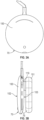
- Figure 3B is a schematic right side view of the local processing and data module 70 of Figure 3A .
- the local processing and data module 70 can comprise a housing 75 comprising a first enclosure 100 and a second enclosure 101 mechanically connected with the first enclosure 100.
- the second enclosure 101 can be fluidly coupled with the first enclosure 100 in some embodiments.
- the first enclosure 100 and the second enclosure 101 are coupled to provide thermal isolation or separation therebetween, e.g., a gap (such as an air gap) between the enclosures 100, 101 can provide improved thermal isolation therebetween.
- the first enclosure 100 can comprise a front side 102 and a back side 103 opposite the front side 102.
- the second enclosure 101 can be coupled with the back side 103 of the first enclosure.
- a connection portion comprising a channel 119 can extend between the first and second enclosures 100, 101.
- the channel 119 of the connection portion can connect an internal chamber or cavity defined within the first enclosure 100 with an internal chamber or cavity defined within the second enclosures 101.
- the channel 119 can be sized to accommodate one or more electrical connectors extending between components within the first and second enclosures 100, 101.
- the channel 119 can provide heat transfer by fluid communication or other means between the first and second enclosures 100, 101, e.g., to improve heat dissipation within the housing 75.
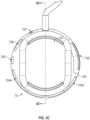
- the local processing and data module 70 can comprise one or more inlet ports 104a, 104b configured to permit gas (e.g., air) to enter the housing 75, e.g., at a position on a periphery of the first enclosure 100.
- the local processing and data module 70 can also include one or more exhaust ports 105 to permit the gas (e.g., air) to exit the housing 75, e.g., at a position on a periphery of the first enclosure 100.
- air can flow into the enclosure 100 through the inlet ports 104a, 104b, and can exit the enclosure 100 through the exhaust port(s) 105.
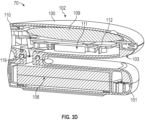
- Figure 3D is a schematic side cross-sectional view of the local processing and data module 70 shown in Figures 3A-3C .
- the local processing and data module 70 may include one or multiple electronic components 109 (illustrated schematically herein in block form), such as processors, memory dies, sensors, etc.
- the electronic components 109 can be disposed within a chamber or first compartment of the first enclosure 100 of the housing. As shown, the electronic components 109 can be arranged within a relatively low profile and a relatively small lateral footprint.
- the illustrated electronic components 109 are shown at or near the front side 102 of the first enclosure 100, but it should be appreciated that additional electronic components may be provided anywhere suitable in the enclosures 100, 101.
- a thermal mitigation assembly 110 can be provided in the housing (e.g., in the first enclosure 100) to remove heat generated by the electronic components 109 and to maintain the temperature of the housing at comfortable and/or effective levels during operation.
- the thermal mitigation assembly 110 is disposed rear of the electronic components 109.
- the thermal mitigation assembly 110 can comprise a first heat spreader 112 disposed on a first side of a fan assembly 111.
- the local processing and data module 70 may also include additional electronic components (e.g., an on-board power supply module 118) within the second enclosure 101 to provide power to the electronic components 109 in the first enclosure 100 such that the user need not be tethered to a wired power supply.
- the power supply 118 shown in Figure 3D can, for example, include one or a plurality of batteries.
- the on-board power supply may generate additional heat within the local processing and data module 70.
- the fan assembly 111 can draw a heat transfer medium (e.g., heated air or other heated gas) from the second enclosure 101 into the first enclosure 100, e.g., by way of the channel 119 that provides fluid communication between the enclosures 100, 101.
- a heat transfer medium e.g., heated air or other heated gas
- the heat sink 113 can comprise linked copper fin patterns, with each fin having a thickness in a range of 0.05 mm to 0.35 mm, e.g., in a range of 0.1 mm to 0.3 mm (about 0.2 mm in some embodiments).
- the fins can be spaced in a range of 0.25 mm to 2 mm, or in a range of 0.5 mm to 1.5 mm (about 1 mm in some embodiments).
- a second heat spreader 114 can be disposed on a second side of the fan assembly 111.
- the second heat spreader 114 can be disposed on a rear side of the fan assembly 111 and thus is sometimes a rear heat spreader.
- the first heat spreader 112 can be thermally and, optionally, mechanically coupled to some or all of the electronic components 109 by way of any suitable connector, such as a thermally conductive connector, a thermal gap pad, a thermal adhesive, etc.
- heat generated by the electronic components 109 may be conducted to the first heat spreader 112 by way of one or more thermal gap pads, which can comprise a thermally conductive elastomer.
- the thermal gap pads can generate pressure between the heat spreader 112 and the components so as to improve thermal conductivity.
- the heat can be conveyed from the heat spreader 112 and/or from the electronic components 109 along the thermal conveyance pathway 117 to the heat sink 113.
- the fan assembly 111 can drive or draw air over and/or around the first heat spreader 112, the thermal conveyance pathway 117, and/or the second heat spreader 114 to cool the first enclosure 100 and/or the second enclosure 101.
- influent air A1 can be drawn, by the fan assembly 111, into the first enclosure 100 by way of the inlet ports 104a, 104b.
- the fan assembly 111 can circulate cooling air A2 within the first enclosure 100 and over and/or around the electronic components 109 to cool the electronic components 109.
- the cooling air A2 may comprise ambient air drawn into the enclosure 100 without additional cooling in some embodiments.
- the fan assembly 111 can draw cooling air A3 into the first enclosure 100 from the second enclosure 101, e.g., by way of the channel 119.
- the electronic components 109 can be cooled by the cooling air A2 circulated within the enclosure 100.
- the battery or power supply 118 may also be cooled by way of the cooling air A3 drawn from the second enclosure 101 into the first enclosure 100. Heat from the second enclosure 101 can also be conducted by a thermal conductor into the first enclosure 100 in some embodiments and dissipated by the airflow described herein.
- the connection portion including the channel 119 can comprise a thermal insulating gap so as to mitigate or reduce the flow of heat from the first enclosure 100 to the second enclosure 101 (or vice versa).
- the cooling air currents A2 and A3 can be drawn or sucked into an airflow opening 129 formed in an interior portion (e.g., central portion) of the fan assembly 111.
- the cooling air A2 can pass laterally between the first heat spreader 112 or the base 115 and the fan assembly 111, and can enter the fan assembly 111 through the opening 129.
- the air drawn through the airflow opening 129 of the fan assembly 111 can be expelled radially outward through an outlet air opening 132 in an outflow air current A4 from the fan assembly 111.
- air pathways of the fan assembly 111 can extend between the airflow opening 129 disposed along the longitudinal axis L and the outlet airflow opening 132 having a face disposed about an axis non-parallel to the longitudinal axis L.
- the outlet airflow opening 132 can be disposed radially outward (e.g., generally perpendicular to the longitudinal axis L).
- the radially outflowing air current A4 can be directed over the heat sink 113 to drive thermal energy stored in the heat sink 113 out of the enclosure 100.
- expelled air A5 can be directed out of the first enclosure 100 through the exhaust port 105 to the outside environs.
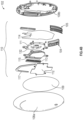
- Figure 4B is a schematic perspective, exploded view of the local processing and data module 70, according to another embodiment.
- the local processing and data module 70 of Figure 4B may be similar to the local processing and data module 70 of Figure 4A .
- in Figure 4B only a single inlet port 104 and a single exhaust port 105 are shown.
- any suitable number of inlet ports 104 and/or outlet ports 105 may be provided for intaking air into the enclosure 100 and for expelling air from the enclosure 100.
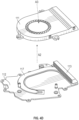
- Figure 4C is a schematic perspective, partially exploded view of the fan assembly 111 mounted to the first heat spreader 112.
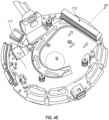
- Figure 4D is a schematic, partially exploded view of the fan assembly 111, the heat spreader 112, the thermal conveyance pathway 117, and the heat sink 113.
- the electronic components 109 can be disposed near the front cover 108a.
- the first heat spreader 112 can be disposed rear of the electronic components, and the fan assembly 111 can be thermally coupled with, and disposed rear of, the first heat spreader 112.
- the first heat spreader 112 can be disposed between the electronic components 109 and the fan assembly 111.
- the fan assembly 111 can be thermally coupled with the first heat spreader 112.
- a gap may be disposed between the fan assembly 111 and the heat spreader 112 or base 115 to permit air to enter the opening 129.
- the base 115 and thermal conveyance pathway 117 are obscured in Figure 4C , since the base 115 and conveyance pathway 117 may be disposed between the heat spreader 112 and the fan assembly 111.
- the outflow air current A5 can pass over the heat sink 113 (obscured in Figure 4C ) disposed near (e.g., upstream of) the outlet opening 132 of the fan assembly 111.
- the fan assembly 111 can comprise a rotational axis L and a transverse axis T disposed non-parallel relative to (e.g., perpendicular to) the axis L.
- the rotational axis L is a longitudinal axis of a shaft assembly or a shaft portion about which a portion of the fan assembly 111 rotates and thus is sometimes referred to as a longitudinal axis L.
- the cooling air currents A2 (see Figure 4D ) and A3 (see Figures 4C and 4D ) can enter the fan assembly 111 through the airflow opening 129 from heat source(s) in the housings 100, 101, e.g., from the electronic components 109 and the power supply 118, respectively.
- the air currents A2 can pass between the heat spreader 112 or the base 115 and the fan assembly 111, and can enter the opening 129.
- the cooling air currents A2, A3 can have velocity components aligned along the longitudinal axis L, at least locally in the vicinity of the opening 129 and at a corresponding opening on the opposite side of the fan assembly 111.
- the rotation of the blades of the fan assembly 111 can therefore draw air into the fan assembly 111 with high momentum along the longitudinal axis.
- the outflow air current A4 can be directed radially outward through the outlet opening 132, such that the air current A4 includes velocity components aligned along the transverse axis T.
- the outflow air current A4 can exit the enclosure 100 by way of the exhaust port 105 (see Figures 4A-4B ).
- Figure 4E illustrates a heat map of the assembled heat spreader, thermal conveyance pathway 117, and heat sink 113 during operation of the fan assembly 111.
- the heat map was computed using computational fluid dynamics (CFD) software.
- CFD computational fluid dynamics
- the thermal conveyance pathway 117 can be coupled with the heat spreader 112, e.g., disposed in a groove or channel of the heat spreader 112.
- the heat spreader 112 can comprise a thermally conductive material, such as copper.
- the thermal conveyance pathway 117 can comprise a heat pipe comprising a thermally conductive channel.
- a working fluid e.g., water
- the heat pipe of the conveyance pathway 117 can comprise a copper pipe that is flattened so as to have a cross-sectional profile that is generally elliptical.
- a major dimension of the heat pipe can be between two and ten times larger than a minor dimension of the heat pipe (e.g., between five and nine times larger).
- thermal energy Q can be stored in and/or conducted to the heat spreader 112 from the components 109.
- the thermal energy Q from the heat spreader 112 can be transferred to the heat sink 113 along one or more thermal pathways Q1, Q2.
- some thermal energy can be conveyed along a first pathway Q1 from the heat spreader 112 by way of the thermal conveyance pathway 117.
- a second pathway Q2 can convey thermal energy along the area of the heat spreader 112 to the heat sink.
- the conveyance pathway 117 can be significantly more thermally conductive than the first heat spreader 112 (e.g., at least five times, or at least ten times as thermally conductive as the heat spreader 112).
- heat can be rapidly transferred away from the heat sink by the outflow air current A4, as shown by the relatively cool temperatures maintained by the airflow over the heat sink 113.
- Maintaining the heat sink 113 at a cool temperature can increase the thermal gradient between the heat spreader 112 and/or the thermal conveyance pathway 117 and the heat sink 113.
- the disclosed embodiments can maintain the temperature of the local processing and data module 70 at suitably low temperatures.
- FIG. 5 is a schematic side cross-sectional view of a fan assembly 211 that can be used in conjunction with the local processing and data module 70 described herein.
- the fan assembly 211 can comprise a support frame 222 configured to provide structural support to the fan assembly 211.
- the frame 222 can comprise multiple frame portions connected together by, e.g., fasteners or other mechanical connectors. In other embodiments, the frame 222 can comprise a unitary body.
- a motor 220 can be mechanically coupled with the frame 222.
- a shaft assembly 223 can be connected to the motor 220 and can extend along the longitudinal axis L described above, such that the longitudinal axis extends between and/or through first and second ends of the shaft assembly 223.
- the shaft-supporting motor 220 may be considered part of the support frame 222 or frame assembly.
- the shaft assembly 223 is cantilevered relative to the motor 220 or the frame 222.
- the shaft assembly 223 can comprise a single shaft in some embodiments. In other embodiments, the shaft assembly 223 can comprise a plurality of shafts coupled together.
- a bearing 224 which can be a bushing, can be disposed at least partially around the shaft assembly 223.
- An impeller 221 can be operably coupled with and disposed about the bushing or other bearing 224.
- the motor 220 can comprise a stator (not shown) having one or more wire coils that, when energized by electric power, create changing or alternating magnetic fields sufficient to drive a magnetic rotor assembly (not shown) coupled or formed with the impeller 221 (e.g., in or on a hub or other central portion of the impeller 221).
- the magnetic fields generated by the motor 220 can interact with the magnetic rotor assembly of the impeller 221 to cause the magnetic rotor, and therefore the impeller 221) to rotate about the longitudinal axis L.
- the shaft assembly 223 can be fixed to the motor 220, or to the frame 222. Thus, in the illustrated embodiment, the shaft assembly 223 may not rotate.
- the bushing or other bearing 224 may be secured over or fixed to the shaft assembly 223, and the impeller 221 can rotate relative to the bushing 224 and the shaft assembly 223.
- the bushing or other bearing 224 may be secured or fixed to the impeller 221 and can rotate with the impeller 221 relative to the shaft assembly 223.
- the motor 220 can include internal stator and rotor assemblies that cause the shaft assembly 223 (or portion(s) thereof to rotate).
- the impeller 221 can be rotationally fixed relative to, and can rotate with, the shaft assembly 223.
- the impeller 221 can be driven to rotate at high speeds in order to adequately remove thermal energy from the housing.
- the impeller 221 can rotate at speeds between 5,000 rpm and 10,000 rpm, e.g., 8,000 rpm, or at higher speeds.
- the local processing and data module 70 can be worn or otherwise carried by the user for VR or AR experiences. The user may often be moving while wearing the module 70 and therefore, the local processing and data module 70, and the fan assembly 211 therein, may frequently be disposed at different angles relative to gravity g.
- the fan assembly 211 may be disposed at an angle, or may move at sufficiently high acceleration, such that the torque resulting from transverse loads on the shaft assembly 223 causes the shaft assembly 223 to bend or flex by an angle P as shown in Figure 5 .
- the deflection or bending of the shaft assembly 223 due to transverse loading conditions may cause the impeller 221 to contact or hit the interior surface of the frame 222, which can cause undesirable noise and/or vibration within the local processing and data module 70.
- the frequent application of such external torques to the shaft assembly 223 may cause the shaft assembly 223 to wear or experience fatigues, which may damage the shaft assembly.
- the shaft assembly 223 may be made sufficiently stiff so as to reduce the amount of deflection of the distal end of the shaft assembly 223.
- elements on the frame 222 can assist in preventing the impeller 221 and shaft assembly 223 from contacting the frame 222 or substantially deflecting.
- a frame portion 222' of the frame disposed about the impeller 221 can comprise one or more magnets in alignment with corresponding magnet(s) in the impeller 221.
- the magnets in the frame portion 222' and impeller can have like poles aligned so as to cause the impeller 221 to remain centered within the frame 222 or at least to oppose deflection of the impeller 221 toward the frame 222 on a transverse loading which may reduce or eliminate deflection of the shaft assembly 223.
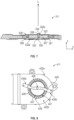
- Figure 6 is a rear plan view of a fan assembly 311, according to various embodiments disclosed herein.
- Figure 7 is a schematic side sectional view of the fan assembly 311 of Figure 6 .
- the components shown in Figures 6 and 7 may include components similar to like numbered components shown in Figure 5 .
- the fan assembly 311 can comprise a frame assembly that can have a first support frame 322a and a second support frame 322b coupled to the first frame 322a.
- the connected first and second support frames 322a, 322b can define an enclosure or chamber.
- the impeller 321 can be disposed between the first and second support frames 322a, 322b, e.g., within the enclosure defined by the frames 322a, 322b.
- the first and second support frames 322a, 322b can define a housing in which the impeller 321 is disposed.
- the impeller 321 of Figures 6 and 7 can comprise a hub 327 and one or a plurality of blades 328 (e.g., fan blades) coupled with and/or extending from the hub 327.
- the hub 327 can be coupled with the shaft assembly 323.
- a bushing can be disposed between the shaft assembly 323 and the hub 327.
- the impeller 321 can rotate relative to the rotationally fixed shaft assembly 323. In other embodiments, the impeller 321 can rotate with the rotating shaft assembly 323.
- a first end 333 of the shaft assembly 323 can be supported by or coupled with the first support frame 322a (e.g., to a support structure defined by or including the frame, to the motor, etc.)
- the first end 333 of the shaft assembly 123 can be secured to the first frame 322a at a first shaft support 330 of the first support frame 322a.
- the first end 333 can be welded, glued, or press fit onto the frame 322a.
- the first shaft support 330 can comprise a portion of a structural body defined by the first support frame 322a.
- the first support frame 322a can comprise the motor such that the first end 333 of the shaft assembly 323 is secured to the motor and the shaft support 330 comprises a portion of the motor. It should be appreciated that any suitable structure can be used as the shaft support 330 so as to secure the first end 333 of the shaft assembly 323.
- a second support frame 322b can be provided to control transverse loading on the shaft assembly 323.
- the second support frame 322b can be coupled with the first support frame 322a and can be disposed at or over a second end 334 of the shaft assembly 323 so as to control transverse loading at the second end 334 of the shaft assembly 323.
- the second support frame 322b can comprise a second shaft support 326 coupled with the second end 334 of the shaft assembly 323.
- the second shaft support 326 can be rigidly attached to the second support frame 322b across at least a portion of the airflow opening 329.
- the second shaft support 326 can comprise a pin or other connector that rigidly attaches the second end 334 of the shaft assembly 323 to the frame 322b.
- the second shaft support 326 e.g., a pin
- the second shaft support 326 can be connected concentrically or axially relative to the axis L about which the shaft assembly 323, the impeller 321 or both the shaft assembly 323 and the impeller rotate. Positioning the second shaft support 326 along or centered relative to the axis L can beneficially reduce deflections and improve the rotation of the impeller 321.
- the second shaft support 326 can comprise or be connected with an elongate member 325 between first and second end portions 335a, 335b thereof.
- the first end portion 335a of the elongate member 325 can be supported at a first portion of the second support frame 322b
- the second end portion 335b of the elongate member 325 can be supported at a second portion of the second support frame 322b.
- the first and second end portions 335a, 335b (and the corresponding first and second portions of the second frame 322b) can be spaced apart about a periphery of the airflow opening 329.
- first and second shaft portions 523a, 523b can comprise two separate shafts that are connected together, e.g., at the impeller 521.
- first and second shaft portions 523a, 523b can comprise a single shaft, with the first portion 523a on the first side of the impeller 521 and the second portion 523b on the second side of the impeller 521.
- the impeller 621 can be coupled with first and second shaft portions 623a, 623b of the shaft assembly 623.
- the first and second shaft portions 623a, 623b can comprise a single unitary shaft, or the first and second shaft portions 623a, 623b can comprise two separate shafts.
- the shaft portions 623a, 623b can be fixed to the impeller 621 so as to impart rotation to the impeller 621.
- a portion of the impeller hub 627 can include a follower magnet or rotor assembly.
- a stator assembly of the motor 620 can be energized so as to create magnetic forces on the hub 627 to impart rotation of the impeller 621.
- a concave member comprising a first bushing 624a can be coupled or formed with the first frame 622a and/or the motor 620.
- a second concave member comprising a second bushing 624b can be coupled or formed with the second frame 622b.
- the first bushing 624a can act as the first shaft support 630 to rotationally support the first end 633 of the shaft assembly 623
- the second bushing 624b can act as or comprise the second shaft support 626 to rotationally support the second end 634 of the shaft assembly 623.
- the first end 633 of the first shaft portion 623a can rotate within the first bushing 624a.
- the second end 634 of the second shaft portion 623a can rotate within the second bushing 624b.
- the second bushing 624b can assist in controlling the transverse loading on the shaft assembly 624 during operation of the fan assembly 611.
- the second bushing 624b of the shaft support 626 can be aligned along or aligned concentrically relative to the second shaft portion 623b.
- the second shaft support 626 can also comprise the elongate member 625 extending across part of or the entire airflow opening 629.
- one or both of the first and second bushings 624a, 624b can comprise a concave member, e.g., a concave inner surface.
- the concave inner surface may comprise or define a generally or substantially spherical surface.
- the concave inner surface defined in the first and/or second bushings 624a, 624b can beneficially permit rotation of the shaft assembly 623 while supporting both ends 633, 634 of the shaft assembly 623 against transverse loading conditions.
- the concave inner surfaces of the first and/or second bushings 624a, 624b can be shaped so as to accommodate small but acceptable rotation and/or translation of the ends 633, 634 of the shaft assembly 623. Accommodating such negligible movement of the ends 633, 634 can further reduce stresses on the shaft assembly 623 while preventing undesirable large deformations.
- Figures 10A-10D illustrate additional examples of a fan assembly that can be used in conjunction with the embodiments disclosed herein.
- Figure 10A is a schematic side view of a fan assembly 911 comprising a shaft assembly 923 that operably couples to an impeller assembly 921 by way of a bushing 924.
- the components shown in Figure 10A may include components similar to like numbered components shown in Figures 6-10 , with the reference numerals incremented by 100 relative to Figure 10 .
- the shaft assembly 923 can comprise a single shaft that can be connected at its ends to frames 922a, 922b (e.g., welded to the elongate member 925 or frame 922b, mechanically fastened, or otherwise fixed).
- one of the frames 922b can comprise the elongate member 925.
- the shaft assembly 923 can comprise a separate member from the bushing 924 and impeller 921, e.g., the shaft assembly 923 of Figure 10A may not be integrally formed with the bushing 924.
- the shaft assembly 923 may or may not be rotationally fixed to the bushing 924.
- the shaft assembly 923 may not be rotationally fixed to the bushing 924 such that the bushing 924 and impeller 921 may rotate relative to (e.g., may rotate about) the fixed shaft assembly 923.
- the bushing 924 and impeller 921 may be rotationally fixed or coupled to the shaft assembly 923 such that the impeller 921 and bushing 924 rotate with or follow the rotation of the shaft assembly 923.
- Figure 10B is a schematic side view of a fan assembly 1011 comprising a shaft assembly 1023 that operably couples to an impeller assembly 1021 by way of a bushing 1024.
- the components shown in Figure 10B may include components similar to like numbered components shown in Figures 6-10A , with the reference numerals incremented by 100 relative to Figure 10A .
- the shaft assembly 1023 may be physically integrated with the impeller 1021 (and/or with a bushing, not shown) so as to define a single unitary shaft assembly and impeller.
- the shaft assembly 1023 can be fixed at its ends to the frames 1022a, 1022b (one of which may comprise an elongate member 1025). Rotation of the shaft assembly 1023 can impart rotation to the integrally formed impeller 1021.
- Figure 10C is a schematic side view of a fan assembly 1111 comprising a shaft assembly 1123 having first and second shaft portions 1123a, 1123b operably coupled with the impeller 1121.
- the components shown in Figure 10C may include components similar to like numbered components shown in Figures 6-10B , with the reference numerals incremented by 100 relative to Figure 10B .
- the first and second shaft portions 1123a, 1123b can comprise separate shafts that are respectively coupled with the frames 1122a, 1122b.
- the first and second shaft portions 1123a, 1123b can connect to the impeller 1121 by way of the hub 1124.
- first and second shaft portions 1123a, 1123b can be fixed to the frames 1122a, 1122b such that the impeller 1121 and hub 1124 rotate relative to the shaft portions 1123a, 1123b.
- first and second shaft portions 1123a, 1123b can be fixed to the hub 1124 such that the hub 1124 and impeller 1121 can rotate with the first and second shaft portions 1123a, 1123b.
- Figure 10D is a schematic side view of a fan assembly 1211 comprising a shaft assembly 1223 having first and second shaft portions 1223a, 1223b operably coupled with the impeller 1221.
- the components shown in Figure 10D may include components similar to like numbered components shown in Figures 6-10C , with the reference numerals incremented by 100 relative to Figure 10C .
- the first shaft portion 1223a can be integrally formed with the first frame 1222a, e.g., the first shaft portion 1223a and the first frame 1222a can define a single unitary component such that the first shaft portion 1223a extends from the first frame 1222a.
- the second shaft portion 1223b can be integrally formed with the second frame 1222b, e.g., the second shaft portion 1223b and the second frame 1222b can define a single unitary component such that the second shaft portion 1223b extends from the second frame 1222b.
- the first and second shaft portions 1223a, 1223b can be fixed such that the hub 1224 and impeller 1221 rotate relative to the shaft portions 1223a, 1223b.
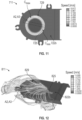
- Figure 11 is a plan view of flow patterns within a fan assembly 711 before an elongate member 725 is attached to the fan assembly 711.
- Figure 12 is a schematic perspective view of flow patterns within and around a fan assembly 811 after the elongate member 825 is placed at a desired orientation relative to the fan assembly 811.
- the flow patterns of Figures 11 and 12 were computed using computational fluid dynamics (CFD) techniques.
- CFD computational fluid dynamics
- Figure 11 represents the velocity field of cooling air currents A2, A3 (see Figure 4A ) that flow into the airflow opening 729 of the fan assembly 711, without or before the elongate member 725 is attached.
- the fan assembly 711 may be used in conjunction with various types of portable electronic devices, which may include different types or numbers of electronic components.
- the flow patterns through the fan assembly 711 can be computed to determine the velocity field of the fan assembly 711 during operation and accounting for the electronic components within the housing.
- the circumferential location Cmax representative of maximum or increased airflow can be determined.
- the circumferential location Cmin representative of minimum or reduced airflow can be determined.
- the desired orientation of the elongate member 725 can be selected. In some cases, it may be desirable to orient the elongate member 725 to correspond to minimum airflow through the opening 729.
- one end portion of the elongate member 725 can be positioned at the circumferential location Cmin and the other end portion can be disposed at an opposite circumferential location.
- the first and second end portions of the elongate member 725 can be positioned circumferentially based on a weighted average or other determinative criteria for minimum airflow. By positioning the elongate member 725 at regions of minimum or reduced airflow, the effect of the elongate member 725 on the airflow into the fan assembly 711 can be reduced or eliminated.
- Figure 12 illustrates the airflow pathways A2, A3 and their velocity profiles through the fan assembly 811 after the elongate member 825 is oriented according to the selections and determinations made in connection with Figure 11 .
- the elongate member 825 does not appreciably reduce the airflow through the fan assembly 811. Rather, the airflow pathways A2, A3 pass over the elongate member 825 with little or no loss of momentum.
- Figure 13A is a schematic back, left perspective view of an electronic device according to one embodiment.
- Figure 13B is a schematic front, right perspective view of the electronic device of Figure 13A .
- Figure 13C is a schematic front plan view of the electronic device of Figures 13A-13B .
- Figure 13D is a schematic back plan view of the electronic device of Figures 13A-13C .
- Figure 13E is a schematic right side view of the electronic device of Figures 13A-13D .
- Figure 13F is a schematic left side view of the electronic device of Figures 13A-13E .
- Figure 13G is a schematic top plan view of the electronic device of Figures 13A-13F .
- Figure 13H is a schematic bottom plan view of the electronic device of Figures 13A-13G .
- the electronic device can comprise the local processing and data module 70 described above.
- the local processing and data module 70 can comprise a first enclosure 1300 (which may be similar to the enclosure 100) and a second enclosure 1301 spaced from the first enclosure 1300 by a gap 1367.
- one or more electronic devices e.g., processor(s)
- processor(s) may be provided in a first compartment defined at least in part by the first enclosure 1301.
- One or more other electronic devices e.g., one or more batteries, one or more processor(s), etc.
- the electronic device can be desirable to operate at high speeds (e.g., at high speeds for central processing and/or graphics processing units), while also charging the power supply (e.g., battery(ies) of the electronic device).
- the battery(ies) disclosed herein can be any suitable type of battery, including, e.g., a lithium ion battery(ies).
- the processor(s) can operate up to about 95 °C before throttling back (e.g., before dynamic frequency scaling or throttling is started).
- Such high temperatures for processor operation may exceed the maximum temperature thresholds for effective battery usage (e.g., which may be at or near 45 °C in some embodiments).
- the temperature rise from operating the processor(s) at high speeds may reduce the ability to rapidly and effectively charge the battery(ies) during use of the electronic device (e.g., during high speed operation of the processor(s)).
- the processor and battery operating temperatures are schematic, and that the processor(s) and battery(ies) can be operated at various temperatures.
- various embodiments disclosed herein utilize the first and second enclosures 1300, 1301 in conjunction with a connection portion 1365 to thermally separate the compartments of the enclosures 1300, 1301.
- the processor(s) may be disposed in the first compartment of the first enclosure 1300, and may operate at high speeds and, therefore, high temperatures.
- the battery(ies) can be disposed in the second compartment of the second enclosure 1301 and can electrically communicate with other components of the device, e.g., with the processor(s) in the first enclosure 1300.
- one or more processing elements can be disposed in the first enclosure 1300, and one or more other processing elements can be disposed in the second enclosure 1301.
- the processing elements in both enclosures 1300, 1301 can be used to control the operation of the system.
- connection portion 1365 can comprise the channel 1319, which may be similar to the channel 119 described above.
- connection portion 1365 can comprise an air or thermal gap that separates the first and second enclosures 1300, 1301.
- the relatively low thermal conductivity of the air gap (and high thermal insulation properties) can serve to thermally separate the processor(s) in the first enclosure 1300 from the battery(ies) in the second enclosure 1301.
- one or more connectors or wires can pass through the channel 119 to electrically connect the processor(s) in the first enclosure 1300 with the battery(ies) of the second enclosure 1301. Additional components may also be provided in the first and/or second enclosures 1300, 1301.
- the thermal gap provided by the connection portion 1365 can reduce or substantially prevent heat from passing from the processor(s) in the first enclosure 1300 to the battery(ies) in the second enclosure 1301.
- the processor(s) can operate at relatively high speeds and temperatures, while maintaining the battery(ies) at sufficiently low temperatures so as to enable charging during operation of the processor(s).
- providing the battery(ies) and processor(s) within a single compartment or enclosure may not provide adequate heat separation between the battery(ies) and processor(s).
- connection portion 1365 comprises an air gap to provide thermal insulation between the first and second enclosures 1300, 1301.
- other low thermal conductivity materials such as insulators or dielectrics
- a thermally insulating polymer e.g., potting compound or encapsulant
- the first and second compartments defined by the first and second enclosures 1300, 1301 may also be filled with a gas (e.g., air).
- the electronic devices e.g., processor(s), battery(ies), etc.
- another type of insulating material such as a polymer or dielectric.
- the first and second enclosures 1300, 1301 can be separated by a gap 1367 (e.g., at a location spaced from or below the connection portion 1365) having a gap width G as shown in Figure 13E , which may be similar or generally the same as the width or gap defined by the connection portion 1365 disposed or extending between the first and second enclosures 1300, 1301.
- the gap 1367 e.g., an air gap between the enclosures 1300, 1301) can provide improved thermal separation between the first and second enclosures 1300, 1301.
- a majority of the spaces between the compartments within first and second enclosures 1300, 1301 may be filled with air or a gas.
- the channel 1319 can be filled with a gas in some embodiments, and the gap 1367 between outer portions of the enclosures 1300, 1301 can comprise a gas such as air.
- the channel 1319 can have a side cross-sectional area that is smaller than a cross-sectional area of the first compartment of the first enclosure 1300 (and/or smaller than the cross-sectional area of the second compartment of the second enclosure 1301), taken along a direction parallel to a maximum dimension of the first compartment.
- the enclosures 1300, 1301 can comprise a clip 1366 disposed within the gap 1367.
- the clip 1366 can comprise projection(s) extending from the first and second enclosures 1300, 1301.
- the clip 1366 can improve wearability of the module 70, e.g., on a belt or other clothing accessory of the user).
- the gap width G of the connection portion 1365 (e.g., the channel 1319) and/or the gap 1367 may be in a range of 0.5 mm to 10 mm, in a range of 1 mm to 7 mm, or in a range of 1 mm to 5 mm.
- Providing a thermal gap or thermal barrier may provide sufficient thermal separation between the enclosures 1300, 1301.
- one or both of the enclosures 1300, 1301 may be constructed of a material that has a relatively low thermal conductivity so as to further improve the thermal barrier between the internal compartments of the enclosures 1300, 1301.
- a lower thermal conductivity material e.g., aluminum or plastic
- the thermal gap provided by the connection portion 1365 and/or the gap 1367 may still permit at least some heat flow from the first enclosure 1300 to the second enclosure 1301. The fan assemblies disclosed herein can mitigate this heat transfer, however, so as to reduce heat dissipation from the first enclosure 1300 to the second enclosure 1301.
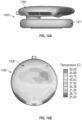
- Figure 14A is a schematic heat transfer map 1450 of a side view of the electronic device of Figures 13A-13H during operation of the electronic devices.
- Figure 14B is a schematic top view of the heat transfer map 1450.
- the temperature profile of the first enclosure 1300 in which the processor(s) may be disposed
- the second enclosure 1301 in which the battery(ies) may be disposed
- connection portion 1365 and/or the gap 1367 provide adequate thermal separation between the enclosures 1300, 1301.
- Various embodiments can beneficially provide thermal separation between the enclosures 1300, 1301 of at least 40 °C, at least 50 °C, etc.
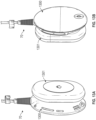
- Figure 15A is a schematic back, left perspective view of an electronic device according to one embodiment of the present design.
- Figure 15B is a schematic front, right perspective view of the electronic device of Figure 15A .
- Figure 15C is a schematic front plan view of the electronic device of Figures 15A-15B .
- Figure 15D is a schematic back plan view of the electronic device of Figures 15A-15C .
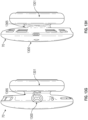
- Figure 15E is a schematic right side view of the electronic device of Figures 15A-15D .
- Figure 15F is a schematic left side view of the electronic device of Figures 15A-15E .
- Figure 15G is a schematic top plan view of the electronic device of Figures 15A-15F .
- Figure 15H is a schematic bottom plan view of the electronic device of Figures 15A-15G .
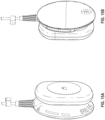
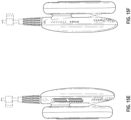
- Various embodiments are accordingly directed to the ornamental designs for an electronic device, as shown and described herein, including at least in Figures 15A-15H .
- Embodiment 1 An electronic device comprising:
- Embodiment 2 The electronic device of Embodiment 1, wherein the first electronic component comprises a processor.
- Embodiment 3 The electronic device of any one of Embodiments 1 to 2, wherein the second electronic component comprises a power supply.
- Embodiment 4 The electronic device of Embodiment 3, wherein the power supply comprises a battery.
- Embodiment 5 The electronic device of any one of Embodiments 1 to 4, wherein the first compartment, the second compartment, and the connection portion are filled with a gas.
- Embodiment 6 The electronic device of any one of Embodiments 1 to 5, wherein the connection portion comprises a channel between the first and second compartments.
- Embodiment 7 The electronic device of Embodiment 6, wherein the channel has a side cross-sectional area that is smaller than a cross-sectional area of the first compartment taken along a direction parallel to a maximum dimension of the first compartment.
- Embodiment 8 The electronic device of any one of Embodiments 1 to 7, wherein the electronic device comprises an augmented reality device.
- Embodiment 9 The electronic device of Embodiment 8, further comprising a connector configured to connect to a headpiece to be worn by a user.
- Embodiment 10 The electronic device of any one of Embodiments 1 to 9, wherein the first electronic component electrically communicates with the second electronic component.
- Embodiment 11 The electronic device of any one of Embodiments 1 to 10, further comprising a clip disposed in the gap between the first and second compartments.
- Embodiment 12 A portable electronic device comprising:
- Embodiment 13 The power supply assembly of Embodiment 12, wherein the housing comprises a first enclosure and a second enclosure, the electronic components and the thermal mitigation assembly disposed in the first enclosure and the battery disposed in the second enclosure.
- Embodiment 14 The power supply assembly of Embodiment 12 or 13, wherein the shaft assembly comprises a first shaft portion connected to a first frame of the frame assembly and a second shaft portion connected to a second frame of the frame assembly, the first and second shaft portions disposed at least partially on opposing sides of the hub.
- Embodiment 15 A fan assembly, comprising:
- Embodiment 16 The fan assembly of Embodiment 15, wherein the second support frame comprises an airflow opening disposed about the longitudinal axis which extends between the first and second ends of the shaft assembly.
- Embodiment 17 The fan assembly of Embodiment 16, further comprising a shaft support coupled with the second end of the shaft assembly, the shaft support being rigidly attached to the second support frame across the airflow opening.
- Embodiment 18 The fan assembly of Embodiment 17, wherein the shaft support is supported at respective first and second portions of the second support frame, the respective first and second portions spaced apart about a periphery of the airflow opening.
- Embodiment 19 The fan assembly of Embodiment 18, wherein the first portion of the second support frame is generally on an opposite side of the airflow opening relative to the second portion of the second support frame.
- Embodiment 20 The fan assembly of any one of Embodiments 17 to 19, wherein the shaft support is disposed in a rotational position of the airflow opening corresponding to a maximum of air flow when the impeller is operating.
- Embodiment 21 The fan assembly of any one of Embodiments 17 to 20, wherein the shaft support comprises an elongate member between first and second ends thereof, the elongate member having an airfoil shape.
- Embodiment 22 The fan assembly of any one of Embodiments 17 to 21, wherein the shaft support comprises an elongate member between the first and second ends thereof, the elongate member having varying width along the length thereof.
- Embodiment 23 The fan assembly of any one of Embodiments 17 to 22, wherein the shaft support comprises an elongate member between the first and second ends thereof, the elongate member having varying thickness along the length thereof.
- Embodiment 24 The fan assembly of any one of Embodiments 15 to 23, wherein the shaft assembly comprises a first shaft portion rotationally fixed to the first support frame and a second portion rotationally fixed to the impeller, the second portion being rotatable over a free end of the first shaft portion of the shaft assembly.
- Embodiment 25 The fan assembly of any one of Embodiments 15 to 24, wherein the shaft assembly comprises an elongate member having a first end disposed on a first side of the impeller and a second end disposed on a second side of the impeller, the second side being opposite the first side.
- Embodiment 26 The fan assembly of Embodiment 25, further comprising a concave member coupled with the second support frame and configured to rotationally support the second end of the elongate member.
- Embodiment 27 The fan assembly of Embodiment 26, further comprising an additional concave member coupled with the first support frame and configured to rotationally support the first end of the elongate member.
- Embodiment 28 The fan assembly of any one of Embodiments 16 to 27, wherein an airflow pathway of the fan assembly extends between the airflow opening disposed about the longitudinal axis and a second airflow opening having a face disposed about an axis non-parallel to the longitudinal axis.
- Embodiment 29 The fan assembly of Embodiment 28, wherein the axis non-parallel to the longitudinal axis is disposed generally perpendicular to the longitudinal axis and along a radial-extending axis of the impeller.
- Embodiment 30 A fan assembly, comprising:
- Embodiment 31 A fan assembly comprising:
- Embodiment 32 The fan assembly of Embodiment 31, wherein the angle relative to the non-parallel axis is acute.
- Embodiment 33 The fan assembly of Embodiment 32, wherein the angle relative to the non-parallel axis is in a range of -45° to 45°.
- Embodiment 34 The fan assembly of Embodiment 33, wherein the angle relative to the non-parallel axis is in a range of -30° to 30°.
- Embodiment 35 A method of manufacturing a fan assembly, the method comprising:
- Embodiment 36 The method of Embodiment 35, further comprising, based on the computing, angularly positioning the elongate member at least partially across the first airflow opening at an angle relative to the non-parallel axis that permits at least a local maximum of airflow through the first airflow opening.
- Embodiment 37 The method of Embodiment 36, wherein angularly positioning comprises orienting the angle relative to the non-parallel axis at an acute angle.
- Embodiment 38 The method of Embodiment 37, wherein angularly positioning comprises orienting the angle relative to the non-parallel axis in a range of -45° to 45°.
- Embodiment 39 The method of Embodiment 38, wherein angularly positioning comprises orienting the angle relative to the non-parallel axis in a range of -30° to 30°.
- Any processes, methods, and algorithms described herein and/or depicted in the attached figures may be embodied in, and fully or partially automated by, code modules executed by one or more physical computing systems, hardware computer processors, application-specific circuitry, and/or electronic hardware configured to execute specific and particular computer instructions.
- computing systems can include general purpose computers (e.g., servers) programmed with specific computer instructions or special purpose computers, special purpose circuitry, and so forth.
- a code module may be compiled and linked into an executable program, installed in a dynamic link library, or may be written in an interpreted programming language.
- particular operations and methods may be performed by circuitry that is specific to a given function.
- a video may include many frames, with each frame having millions of pixels, and specifically programmed computer hardware is necessary to process the video data to provide a desired image processing task or application in a commercially reasonable amount of time.
- Code modules or any type of data may be stored on any type of non-transitory computer-readable medium, such as physical computer storage including hard drives, solid state memory, random access memory (RAM), read only memory (ROM), optical disc, volatile or non-volatile storage, combinations of the same and/or the like.
- the methods and modules (or data) may also be transmitted as generated data signals (e.g., as part of a carrier wave or other analog or digital propagated signal) on a variety of computer-readable transmission mediums, including wireless-based and wired/cable-based mediums, and may take a variety of forms (e.g., as part of a single or multiplexed analog signal, or as multiple discrete digital packets or frames).
- the results of the disclosed processes or process steps may be stored, persistently or otherwise, in any type of non-transitory, tangible computer storage or may be communicated via a computer-readable transmission medium.
- any processes, blocks, states, steps, or functionalities in flow diagrams described herein and/or depicted in the attached figures should be understood as potentially representing code modules, segments, or portions of code which include one or more executable instructions for implementing specific functions (e.g., logical or arithmetical) or steps in the process.
- the various processes, blocks, states, steps, or functionalities can be combined, rearranged, added to, deleted from, modified, or otherwise changed from the illustrative examples provided herein.
- additional or different computing systems or code modules may perform some or all of the functionalities described herein.
- the processes, methods, and systems may be implemented in a network (or distributed) computing environment.
- Network environments include enterprise-wide computer networks, intranets, local area networks (LAN), wide area networks (WAN), personal area networks (PAN), cloud computing networks, crowd-sourced computing networks, the Internet, and the World Wide Web.
- the network may be a wired or a wireless network or any other type of communication network.
- the invention includes methods that may be performed using the subject devices.
- the methods may comprise the act of providing such a suitable device. Such provision may be performed by the end user.
- the "providing" act merely requires the end user obtain, access, approach, position, set-up, activate, power-up or otherwise act to provide the requisite device in the subject method.
- Methods recited herein may be carried out in any order of the recited events which is logically possible, as well as in the recited order of events.
- a phrase referring to "at least one of' a list of items refers to any combination of those items, including single members.
- "at least one of: A, B, or C” is intended to cover: A, B, C, A and B, A and C, B and C, and A, B, and C.
- Conjunctive language such as the phrase "at least one of X, Y and Z," unless specifically stated otherwise, is otherwise understood with the context as used in general to convey that an item, term, etc. may be at least one of X, Y or Z. Thus, such conjunctive language is not generally intended to imply that certain embodiments require at least one of X, at least one of Y and at least one of Z to each be present.
Landscapes
- Engineering & Computer Science (AREA)
- Theoretical Computer Science (AREA)
- General Engineering & Computer Science (AREA)
- Physics & Mathematics (AREA)
- General Physics & Mathematics (AREA)
- Computer Hardware Design (AREA)
- Human Computer Interaction (AREA)
- Mechanical Engineering (AREA)
- Microelectronics & Electronic Packaging (AREA)
- Power Engineering (AREA)
- Thermal Sciences (AREA)
- Optics & Photonics (AREA)
- Software Systems (AREA)
- Computer Graphics (AREA)
- Manufacturing & Machinery (AREA)
- Chemical & Material Sciences (AREA)
- Chemical Kinetics & Catalysis (AREA)
- Electrochemistry (AREA)
- General Chemical & Material Sciences (AREA)
- Life Sciences & Earth Sciences (AREA)
- Biophysics (AREA)
- Cooling Or The Like Of Electrical Apparatus (AREA)
- Structures Of Non-Positive Displacement Pumps (AREA)
- Secondary Cells (AREA)
- Motor Or Generator Cooling System (AREA)
Abstract
Description
- Any and all applications for which a foreign or domestic priority claim is identified in the Application Data Sheet as filed with the present application are hereby incorporated by reference under 37 C.F.R. § 1.57.
- The field relates to a power supply assembly with fan assembly for electronic devices, and in particularly, for portable electronic devices.
- In various types of portable electronic devices, it can be challenging to sufficiently dissipate heat that is generated by on-board electronics and/or the power supply (e.g., batteries). Moreover, some thermal dissipation components may experience high mechanical loading conditions that can cause cyclic or other mechanical stresses and/or failure. It can be desirable to improve the dissipation of heat in electronic devices, and/or to improve the mechanical performance of such devices.
- For example, in some embodiments, modern computing and display technologies have facilitated the development of systems for virtual reality and/or augmented reality experiences, wherein digitally reproduced images or portions thereof are presented to a user in a manner wherein they seem to be, or may be perceived to be, real. A virtual reality, or "VR", scenario typically involves presentation of digital or virtual image information without transparency to other actual real-world visual input; an augmented reality, or "AR", scenario typically involves presentation of digital or virtual image information as an augmentation to visualization of the actual world around the user.
- Some VR or AR systems may include portable electronic devices that may be subject to the thermal and/or mechanical loads. Accordingly, there remains a continuing need for improved thermal and/or mechanical solutions for portable electronic devices, including those used in conjunction with VR or AR systems.
- In some embodiments, an electronic device is disclosed. The electronic device can comprise a housing comprising a first compartment in which a first electronic component is disposed. The housing can comprise a second compartment in which a second electronic component is disposed, one or both of the first and second electrical components electrically communicating with another component of the electronic device. The housing can comprise a connection portion extending between the first and second compartments. The first compartment can separated from the second compartment at a location spaced away from the connection portion by a gap to provide thermal separation between the first and second electronic components
- In some embodiments, a portable electronic device is disclosed. The portable electronic device comprises a housing and a battery disposed in the housing, the battery supplying power for at least a portion of the portable electronic device. The portable electronic device comprises electronic components for operating the portable electronic device, the electronic components disposed in the housing. The portable electronic device comprises a thermal mitigation assembly comprising a frame assembly. The frame assembly can comprise a shaft assembly having a first end and a second end opposite the first end, the first and second ends supported by the frame assembly. The frame assembly can comprise an impeller having fan blades coupled with a hub, the hub being coupled with the shaft assembly for rotation within the housing about a longitudinal axis of the shaft assembly. Loading transverse to the longitudinal axis of the shaft assembly can be controlled by the frame assembly at the second end of the shaft assembly. The thermal mitigation assembly removes heat generated from one or both of the battery and the electronic components.
- In some embodiments, the housing comprises a first enclosure and a second enclosure, the electronic components and the thermal mitigation assembly disposed in the first enclosure and the battery disposed in the second enclosure.
- In some embodiments, a fan assembly is disclosed. The fan assembly can include a first support frame, a shaft assembly having a first end coupled with the first support frame and a second end disposed away from the first end, and a second support frame coupled with the first support frame and disposed at or over the second end of the shaft assembly. An impeller can have fan blades coupled with a hub, the hub being disposed over the shaft assembly for rotation between the first and second support frames about a longitudinal axis. Transverse loading on the shaft assembly can be controlled by the first and second support frames.
- In some embodiments, the second support frame comprises an airflow opening disposed about the longitudinal axis which extends between the first and second ends of the shaft assembly. A shaft support can be coupled with the second end of the shaft assembly, the shaft support being rigidly attached to the second support frame across the airflow opening. The shaft support can be supported at respective first and second portions of the second support frame, the respective first and second portions spaced apart about a periphery of the airflow opening. The first portion of the second support frame is generally on an opposite side of the airflow opening relative to the second portion of the second support frame. The shaft support is disposed in a rotational position of the airflow opening corresponding to a maximum of air flow when the impeller is operating. The shaft support comprises an elongate member between first and second ends thereof, the elongate member having an airfoil shape. The shaft support comprises an elongate member between the first and second ends thereof, the elongate member having varying width along the length thereof. The shaft support comprises an elongate member between the first and second ends thereof, the elongate member having varying thickness along the length thereof. The shaft assembly comprises a first shaft portion rotationally fixed to the first support frame and a second portion rotationally fixed to the impeller, the second portion being rotatable over a free end of the first shaft portion of the shaft assembly. The shaft assembly comprises an elongate member having a first end disposed on a first side of the impeller and a second end disposed on a second side of the impeller, the second side being opposite the first side. A concave member can be coupled with the second support frame and configured to rotationally support the second end of the elongate member. An additional concave member can be coupled with the first support frame and configured to rotationally support the first end of the elongate member. An airflow pathway of the fan assembly extends between the airflow opening disposed about the longitudinal axis and a second airflow opening having a face disposed about an axis non-parallel to the longitudinal axis. The axis non-parallel to the longitudinal axis is disposed generally perpendicular to the longitudinal axis and along a radial-extending axis of the impeller.
- A fan assembly can include an enclosure supporting a shaft assembly at a first end, the shaft having a second end opposite the first end, and an impeller having fan blades coupled with a hub, the hub being coupled with the shaft for rotation within the enclosure about a longitudinal axis. Transverse loading on the shaft assembly can be controlled by the enclosure at the second end of the shaft assembly.
- A fan assembly can comprise a housing comprising a shaft support and a shaft assembly supported by the shaft support. An impeller can be disposed in the housing and coupled with the shaft assembly, the impeller configured to rotate about a longitudinal axis of the shaft assembly. A first airflow opening can be disposed about the longitudinal axis. A second airflow opening having a face can be disposed about an axis non-parallel to the longitudinal axis. An airflow pathway of the fan assembly can extend between the first airflow opening and the second airflow opening. The shaft support can comprise an elongate member extending across at least a portion of the first airflow opening, the elongate member angularly positioned across the first airflow opening at an angle relative to the non-parallel axis that permits at least a local maximum of airflow through the first airflow opening.
- In some embodiments, the angle relative to the non-parallel axis is acute. In some embodiments, the angle relative to the non-parallel axis is in a range of -45° to 45°. In some embodiments, the angle relative to the non-parallel axis is in a range of -30° to 30°.
- In some embodiments, a method of manufacturing a fan assembly is disclosed. The method can include providing a fan assembly comprising a housing and an impeller disposed in the housing and coupled with a shaft assembly, the impeller configured to rotate about a longitudinal axis of the shaft assembly. A first airflow opening can be disposed about the longitudinal axis. A second airflow opening having a face disposed about an axis non-parallel to the longitudinal axis, wherein an airflow pathway of the fan assembly extends between the first airflow opening and the second airflow opening. The method can include computing an airflow profile through the fan assembly, and based on the computing, providing a shaft support to support an end of the shaft assembly, the shaft support comprising an elongate member extending across at least a portion of the first airflow opening.
- In some embodiments, based on the computing, the method can comprise angularly positioning the elongate member at least partially across the first airflow opening at an angle relative to the non-parallel axis that permits at least a local maximum of airflow through the first airflow opening. In some embodiments, angularly positioning comprises orienting the angle relative to the non-parallel axis at an acute angle. In some embodiments, angularly positioning comprises orienting the angle relative to the non-parallel axis in a range of -45° to 45°. In some embodiments, angularly positioning comprises orienting the angle relative to the non-parallel axis in a range of -30° to 30°.
- Details of one or more implementations of the subject matter described in this specification are set forth in the accompanying drawings and the description below. Other features, aspects, and advantages will become apparent from the description, the drawings, and the claims. Neither this summary nor the following detailed description purports to define or limit the scope of the inventive subject matter.
-
-
Figure 1 depicts an illustration of an augmented reality scenario with certain virtual reality objects, and certain physical objects viewed by a person. -
Figures 2A-2D schematically illustrate examples of a wearable system, according to various embodiments. -
Figure 3A is a schematic front plan view of a portion of a portable electronic device that can comprise part of a wearable system comprising a local processing and data module, according to one embodiment. -
Figure 3B is a schematic right side view of the local processing and data module ofFigure 3A . -
Figure 3C is a schematic rear plan view of the local processing and data module shown inFigures 3A-3B . -
Figure 3D is a schematic side cross-sectional view of the local processing and data module shown inFigures 3A-3C . -
Figure 4A is a schematic perspective, exploded view of a first enclosure of the local processing and data module, according to one embodiment. -
Figure 4B is a schematic perspective, exploded view of the local processing and data module, according to another embodiment. -
Figure 4C is a schematic perspective, partially exploded view of a fan assembly mounted to a first heat spreader, according to various embodiments. -
Figure 4D is a schematic, partially exploded view of the fan assembly, the first heat spreader, a thermal conveyance pathway, and a heat sink. -
Figure 4E illustrates a heat map of the assembled heat spreader, thermal conveyance pathway, and heat sink during operation of the fan assembly. -
Figure 5 is a schematic side cross-sectional view of a fan assembly that can be used in conjunction with the local processing and data module described herein. -
Figure 6 is a rear plan view of a fan assembly, according to various embodiments disclosed herein. -
Figure 6A is a schematic top plan view of an elongate member having a generally straight profile along a plane defined generally parallel with the rotational plane of the impeller. -
Figure 6B is a schematic top plan view of an elongate member having a first curved region and a second curved region, according to one embodiment. -
Figure 6C is a schematic top plan view of an elongate member having a first curved region and a second curved region, according to another embodiment. -
Figure 6D is a schematic side view of an elongate member having a generally planar or straight profile, as viewed along a plane defined generally transverse to the plane shown inFigures 6A-6C . -
Figure 6E is a schematic side view of an elongate member having a non-linear or shaped profile, as viewed along a plane defined generally transverse to the plane shown inFigures 6A-6C , according to some embodiments. -
Figure 6F is a schematic side view of an elongate member having a non-linear or curved profile, as viewed along a plane defined generally transverse to the plane shown inFigures 6A-6C , according to another embodiment. -
Figure 7 is a schematic side sectional view of the fan assembly ofFigure 6 . -
Figure 8 is a rear plan view of a fan assembly, according to another embodiment. -
Figure 9 is a schematic side sectional view of afan assembly 111, according to another embodiment. -
Figure 10 is a schematic side sectional view of a fan assembly, according to another embodiment. -
Figure 10A is a schematic side view of a fan assembly comprising a shaft assembly that operably couples to an impeller assembly by way of a bushing, according to some embodiments. -
Figure 10B is a schematic side view of a fan assembly comprising a shaft assembly that operably couples to an impeller assembly by way of a bushing, according to another embodiment. -
Figure 10C is a schematic side view of a fan assembly comprising a shaft assembly having first and second shaft portions operably coupled with the impeller, according to another embodiment. -
Figure 10D is a schematic side view of a fan assembly comprising a shaft assembly having first and second shaft portions operably coupled with the impeller, according to another embodiment. -
Figure 11 is a plan view of flow patterns within a fan assembly before an elongate member is attached to the fan assembly. -
Figure 12 is a schematic perspective view of flow patterns within and around a fan assembly after the elongate member is placed at a desired orientation relative to the fan assembly. -
Figure 13A is a schematic back, left perspective view of an electronic device according to one embodiment. -
Figure 13B is a schematic front, right perspective view of the electronic device ofFigure 13A . -
Figure 13C is a schematic front plan view of the electronic device ofFigures 13A-13B . -
Figure 13D is a schematic back plan view of the electronic device ofFigures 13A-13C . -
Figure 13E is a schematic right side view of the electronic device ofFigures 13A-13D . -
Figure 13F is a schematic left side view of the electronic device ofFigures 13A-13E . -
Figure 13G is a schematic top plan view of the electronic device ofFigures 13A-13F . -
Figure 13H is a schematic bottom plan view of the electronic device ofFigures 13A-13G . -
Figure 14A is a schematic heat transfer map of a side view of the electronic device ofFigures 13A-13H during operation of the electronic devices. -
Figure 14B is a schematic top view of the heat transfer map ofFigure 14A . -
Figure 15A is a schematic back, left perspective view of an electronic device according to one embodiment of a present design. -
Figure 15B is a schematic front, right perspective view of the electronic device ofFigure 15A . -
Figure 15C is a schematic front plan view of the electronic device ofFigures 15A-15B . -
Figure 15D is a schematic back plan view of the electronic device ofFigures 15A-15C . -
Figure 15E is a schematic right side view of the electronic device ofFigures 15A-15D . -
Figure 15F is a schematic left side view of the electronic device ofFigures 15A-15E . -
Figure 15G is a schematic top plan view of the electronic device ofFigures 15A-15F . -
Figure 15H is a schematic bottom plan view of the electronic device ofFigures 15A-15G . - Throughout the drawings, reference numbers may be re-used to indicate correspondence between referenced elements. The drawings are provided to illustrate example embodiments described herein and are not intended to limit the scope of the disclosure.
- Various embodiments disclosed herein relate to a portable (e.g., wearable) electronic device. For example, in
Figure 1 an augmented reality scene 4 is depicted wherein a user of an AR technology sees a real-world park-like setting 6 featuring people, trees, buildings in the background, and aconcrete platform 1120. In addition to these items, the user of the AR technology also perceives that he "sees" arobot statue 1110 standing upon the real-world platform 1120, and a cartoon-like avatar character 2 flying by which seems to be a personification of a bumble bee, even though theseelements 2, 1110 do not exist in the real world. At least theelements 2, 1110 can be provided to the user at least in part by the portable (e.g., wearable) electronic devices disclosed herein. As it turns out, the human visual perception system is very complex, and producing a VR or AR technology that facilitates a comfortable, natural-feeling, rich presentation of virtual image elements amongst other virtual or real-world imagery elements is challenging. - For instance, head-worn AR displays (or helmet-mounted displays, or smart glasses) typically are at least loosely coupled to a user's head, and thus move when the user's head moves. If the user's head motions are detected by the display system, the data being displayed can be updated to take the change in head pose into account.
- As an example, if a user wearing a head-worn display views a virtual representation of a three-dimensional (3D) object on the display and walks around the area where the 3D object appears, that 3D object can be re-rendered for each viewpoint, giving the user the perception that he or she is walking around an object that occupies real space. If the head-worn display is used to present multiple objects within a virtual space (for instance, a rich virtual world), measurements of head pose (e.g., the location and orientation of the user's head) can be used to re-render the scene to match the user's dynamically changing head location and orientation and provide an increased sense of immersion in the virtual space.
- In AR systems, detection or calculation of head pose can facilitate the display system to render virtual objects such that they appear to occupy a space in the real world in a manner that makes sense to the user. In addition, detection of the position and/or orientation of a real object, such as handheld device (which also may be referred to as a "totem"), haptic device, or other real physical object, in relation to the user's head or AR system may also facilitate the display system in presenting display information to the user to enable the user to interact with certain aspects of the AR system efficiently. As the user's head moves around in the real world, the virtual objects may be re-rendered as a function of head pose, such that the virtual objects appear to remain stable relative to the real world. At least for AR applications, placement of virtual objects in spatial relation to physical objects (e.g., presented to appear spatially proximate a physical object in two- or three-dimensions) may be a non-trivial problem. For example, head movement may significantly complicate placement of virtual objects in a view of an ambient environment. Such is true whether the view is captured as an image of the ambient environment and then projected or displayed to the end user, or whether the end user perceives the view of the ambient environment directly. For instance, head movement will likely cause a field of view of the end user to change, which will likely require an update to where various virtual objects are displayed in the field of the view of the end user. Additionally, head movements may occur within a large variety of ranges and speeds. Head movement speed may vary not only between different head movements, but within or across the range of a single head movement. For instance, head movement speed may initially increase (e.g., linearly or not) from a starting point, and may decrease as an ending point is reached, obtaining a maximum speed somewhere between the starting and ending points of the head movement. Rapid head movements may even exceed the ability of the particular display or projection technology to render images that appear uniform and/or as smooth motion to the end user.
- Head tracking accuracy and latency (e.g., the elapsed time between when the user moves his or her head and the time when the image gets updated and displayed to the user) have been challenges for VR and AR systems. Especially for display systems that fill a substantial portion of the user's visual field with virtual elements, it is advantageous if the accuracy of head-tracking is high and that the overall system latency is very low from the first detection of head motion to the updating of the light that is delivered by the display to the user's visual system. If the latency is high, the system can create a mismatch between the user's vestibular and visual sensory systems, and generate a user perception scenario that can lead to motion sickness or simulator sickness. If the system latency is high, the apparent location of virtual objects will appear unstable during rapid head motions.
- In addition to head-worn display systems, other display systems can benefit from accurate and low latency head pose detection. These include head-tracked display systems in which the display is not worn on the user's body, but is, e.g., mounted on a wall or other surface. The head-tracked display acts like a window onto a scene, and as a user moves his head relative to the "window" the scene is re-rendered to match the user's changing viewpoint. Other systems include a head-worn projection system, in which a head-worn display projects light onto the real world.
- Additionally, in order to provide a realistic augmented reality experience, AR systems may be designed to be interactive with the user. For example, multiple users may play a ball game with a virtual ball and/or other virtual objects. One user may "catch" the virtual ball, and throw the ball back to another user. In another embodiment, a first user may be provided with a totem (e.g., a real bat communicatively coupled to the AR system) to hit the virtual ball. In other embodiments, a virtual user interface may be presented to the AR user to allow the user to select one of many options. The user may use totems, haptic devices, wearable components, or simply touch the virtual screen to interact with the system.
- Detecting head pose and orientation of the user, and detecting a physical location of real objects in space enable the AR system to display virtual content in an effective and enjoyable manner. However, although these capabilities are key to an AR system, but are difficult to achieve. In other words, the AR system can recognize a physical location of a real object (e.g., user's head, totem, haptic device, wearable component, user's hand, etc.) and correlate the physical coordinates of the real object to virtual coordinates corresponding to one or more virtual objects being displayed to the user. This generally requires highly accurate sensors and sensor recognition systems that track a position and orientation of one or more objects at rapid rates. Current approaches do not perform localization at satisfactory speed or precision standards.
- Thus, there is a need for a better localization system in the context of AR and VR devices. Moreover, the continual and/or rapid movement of users can introduce various other problems into the electrical, thermal, and/or mechanical systems of such AR and/ VR devices.
- Referring to
Figures 2A-2D , some general componentry options are illustrated. In the portions of the detailed description which follow the discussion ofFigures 2A-2D , various systems, subsystems, and components are presented for addressing the objectives of providing a high-quality, comfortably-perceived display system for human VR and/or AR. - As shown in
Figure 2A , anAR system user 60 is depicted wearing head mountedcomponent 58 featuring aframe 64 structure coupled to adisplay system 62 positioned in front of the eyes of the user. Aspeaker 66 is coupled to theframe 64 in the depicted configuration and positioned adjacent the ear canal of the user (in one embodiment, another speaker, not shown, is positioned adjacent the other ear canal of the user to provide for stereo / shapeable sound control). Thedisplay 62 is operatively coupled 68, such as by a wired lead or wireless connectivity, to a local processing anddata module 70 which may be mounted in a variety of configurations, such as fixedly attached to theframe 64, fixedly attached to a helmet orhat 80 as shown in the embodiment ofFigure 2B , embedded in headphones, removably attached to thetorso 82 of theuser 60 in a backpack-style configuration as shown in the embodiment ofFigure 2C , or removably attached to thehip 84 of theuser 60 in a belt-coupling style configuration as shown in the embodiment ofFigure 2D . - The local processing and
data module 70 may comprise a power-efficient processor or controller, as well as digital memory, such as flash memory, both of which may be utilized to assist in the processing, caching, and storage of data a) captured from sensors which may be operatively coupled to theframe 64, such as image capture devices (such as cameras), microphones, inertial measurement units, accelerometers, compasses, GPS units, radio devices, and/or gyros; and/or b) acquired and/or processed using theremote processing module 72 and/orremote data repository 74, possibly for passage to thedisplay 62 after such processing or retrieval. The local processing anddata module 70 may be operatively coupled 76, 78, such as via a wired or wireless communication links, to theremote processing module 72 andremote data repository 74 such that theseremote modules data module 70. - In one embodiment, the
remote processing module 72 may comprise one or more relatively powerful processors or controllers configured to analyze and process data and/or image information. In one embodiment, theremote data repository 74 may comprise a relatively large-scale digital data storage facility, which may be available through the internet or other networking configuration in a "cloud" resource configuration. In one embodiment, all data is stored and all computation is performed in the local processing and data module, allowing fully autonomous use from any remote modules. -
Figure 3A is a schematic front plan view of the local processing anddata module 70, according to one embodiment.Figure 3B is a schematic right side view of the local processing anddata module 70 ofFigure 3A . As shown inFigures 3A and 3B , the local processing anddata module 70 can comprise a housing 75 comprising afirst enclosure 100 and asecond enclosure 101 mechanically connected with thefirst enclosure 100. Thesecond enclosure 101 can be fluidly coupled with thefirst enclosure 100 in some embodiments. Thefirst enclosure 100 and thesecond enclosure 101 are coupled to provide thermal isolation or separation therebetween, e.g., a gap (such as an air gap) between theenclosures second enclosure 101 at a location spaced away from the first compartment by a gap that provides thermal separation between the first andsecond enclosures second enclosure 101 can flow to thefirst enclosure 100. - The
first enclosure 100 can comprise afront side 102 and aback side 103 opposite thefront side 102. Thesecond enclosure 101 can be coupled with theback side 103 of the first enclosure. A connection portion comprising achannel 119 can extend between the first andsecond enclosures channel 119 of the connection portion can connect an internal chamber or cavity defined within thefirst enclosure 100 with an internal chamber or cavity defined within thesecond enclosures 101. As explained herein, in some embodiments, thechannel 119 can be sized to accommodate one or more electrical connectors extending between components within the first andsecond enclosures channel 119 can provide heat transfer by fluid communication or other means between the first andsecond enclosures channel 119 of the connection portion (and/or a physical air gap separating theenclosures 100, 101) can provide a thermal gap between the first andsecond enclosures enclosures Figures 3A-3B , eachenclosure enclosures -
Figure 3C is a schematic rear plan view of the local processing anddata module 70 shown inFigures 3A-3B . As shown inFigure 3C , the housing 75 (e.g., on a periphery of the first enclosure 100) can include one or a plurality ofuser interfaces 106 configured to enable the user to control the operation of the system. For example, in some embodiments, theuser interfaces 106 can comprise buttons or other types of interfaces to control the volume of the AR or VR experience, and/or to mute the volume. Other control mechanisms are possible through theinterfaces 106. In addition, the local processing anddata module 70 can include one or more input/output (I/O)ports 107 to provide input and/or output data. For example, the I/O port(s) 107 can comprise an audio port. - Also, the local processing and
data module 70 can comprise one ormore inlet ports first enclosure 100. The local processing anddata module 70 can also include one or moreexhaust ports 105 to permit the gas (e.g., air) to exit the housing 75, e.g., at a position on a periphery of thefirst enclosure 100. Thus, air can flow into theenclosure 100 through theinlet ports enclosure 100 through the exhaust port(s) 105. Theports enclosure 100 at spaced apart locations on the periphery of theenclosure 100. Theports 105 can include one or an array of holes in theenclosure 100. As discussed further below, one fan outlet is provided in some embodiments and in such embodiments asingle ports 105 can be provided for fluid communication out of thehousing 100. Theports 105 can be disposed on multiple peripheral sides of theenclosure 100 in some embodiments. Theports 104 can be disposed on multiple peripheral sides of theenclosure 100. As explained herein, the airflow through theenclosure 100 can beneficially carry heat away from the local processing anddata module 70. -
Figure 3D is a schematic side cross-sectional view of the local processing anddata module 70 shown inFigures 3A-3C . As explained above, the local processing anddata module 70 may include one or multiple electronic components 109 (illustrated schematically herein in block form), such as processors, memory dies, sensors, etc. In the embodiment ofFigure 3D , theelectronic components 109 can be disposed within a chamber or first compartment of thefirst enclosure 100 of the housing. As shown, theelectronic components 109 can be arranged within a relatively low profile and a relatively small lateral footprint. The illustratedelectronic components 109 are shown at or near thefront side 102 of thefirst enclosure 100, but it should be appreciated that additional electronic components may be provided anywhere suitable in theenclosures - Incorporating multiple
electronic components 109 within theenclosure 100 may generate substantial heat, which if not adequately cooled, may be uncomfortable to the user and/or may damage system components. Accordingly, in various embodiments, athermal mitigation assembly 110 can be provided in the housing (e.g., in the first enclosure 100) to remove heat generated by theelectronic components 109 and to maintain the temperature of the housing at comfortable and/or effective levels during operation. In the illustrated embodiment, thethermal mitigation assembly 110 is disposed rear of theelectronic components 109. In the view depicted inFigure 3D , thethermal mitigation assembly 110 can comprise afirst heat spreader 112 disposed on a first side of afan assembly 111. Thefirst heat spreader 112 can be disposed on a front side of thefan assembly 111 and thus is sometimes a front heat spreader. As explained herein, thefirst heat spreader 112 can be mechanically and thermally coupled with theelectronic components 109, so as to thermally conduct heat to a heat sink discussed below or components of thefan assembly 111. Thefan assembly 111 can blow or draw air near or over theheat spreader 112 to expel a heat transfer medium (e.g., the heated air or other heated gas) out of the local processing anddata module 70 through theexhaust port 105. - The local processing and
data module 70 may also include additional electronic components (e.g., an on-board power supply module 118) within thesecond enclosure 101 to provide power to theelectronic components 109 in thefirst enclosure 100 such that the user need not be tethered to a wired power supply. The power supply 118 shown inFigure 3D can, for example, include one or a plurality of batteries. The on-board power supply may generate additional heat within the local processing anddata module 70. In some embodiments, thefan assembly 111 can draw a heat transfer medium (e.g., heated air or other heated gas) from thesecond enclosure 101 into thefirst enclosure 100, e.g., by way of thechannel 119 that provides fluid communication between theenclosures thermal mitigation assembly 110 can be configured to remove heat that is generated from one or both of the battery (e.g., the power supply 118) and theelectronic components 109. In various embodiments, a majority of the heat removed from the local processing anddata module 70 can comprise heat generated by theelectronic components 109. -
Figure 4A is a schematic perspective, exploded view of thefirst enclosure 100 of the local processing anddata module 70, according to one embodiment. As explained above in connection withFigures 3A-3D , theelectronics components 109 can be positioned within theenclosure 100 forward of thethermal mitigation assembly 110. Theenclosure 100 can be structurally bounded or contained by connecting or mating afront cover 108a with arear cover 108b. The front andrear covers electronics components 109 and thethermal mitigation assembly 110 are disposed. AlthoughFigure 4A illustrateselectronics components 109 and thethermal mitigation assembly 110 within theenclosure 100, it should be appreciated that additional components may be provided in thefirst enclosure 100. - As shown in
Figure 4A , thethermal mitigation assembly 110 can comprise a base 115 to support various components of thethermal mitigation assembly 110. For example, as shown inFigure 4A , thefirst heat spreader 112 and a thermal conveyance pathway 117 (e.g., a heat pipe) can be mounted to or coupled with thebase 115. In some embodiments, however, theassembly 110 may not include abase 115, such that the first heat spreader 122 and thethermal conveyance pathway 117 may be disposed adjacent to or otherwise connected to thefan assembly 111. In addition, a heat sink 113 (e.g., a finned stack of metallic plates or elements) can be mounted to or coupled with thebase 115. For example, theheat sink 113 can comprise linked copper fin patterns, with each fin having a thickness in a range of 0.05 mm to 0.35 mm, e.g., in a range of 0.1 mm to 0.3 mm (about 0.2 mm in some embodiments). The fins can be spaced in a range of 0.25 mm to 2 mm, or in a range of 0.5 mm to 1.5 mm (about 1 mm in some embodiments). Asecond heat spreader 114 can be disposed on a second side of thefan assembly 111. Thesecond heat spreader 114 can be disposed on a rear side of thefan assembly 111 and thus is sometimes a rear heat spreader. Thefirst heat spreader 112 can be thermally and, optionally, mechanically coupled to some or all of theelectronic components 109 by way of any suitable connector, such as a thermally conductive connector, a thermal gap pad, a thermal adhesive, etc. For example, in some embodiments, heat generated by theelectronic components 109 may be conducted to thefirst heat spreader 112 by way of one or more thermal gap pads, which can comprise a thermally conductive elastomer. The thermal gap pads can generate pressure between theheat spreader 112 and the components so as to improve thermal conductivity. The heat can be conveyed from theheat spreader 112 and/or from theelectronic components 109 along thethermal conveyance pathway 117 to theheat sink 113. - The
fan assembly 111 can drive or draw air over and/or around thefirst heat spreader 112, thethermal conveyance pathway 117, and/or thesecond heat spreader 114 to cool thefirst enclosure 100 and/or thesecond enclosure 101. For example, influent air A1 can be drawn, by thefan assembly 111, into thefirst enclosure 100 by way of theinlet ports fan assembly 111 can circulate cooling air A2 within thefirst enclosure 100 and over and/or around theelectronic components 109 to cool theelectronic components 109. The cooling air A2 may comprise ambient air drawn into theenclosure 100 without additional cooling in some embodiments. Moreover, as shown inFigure 4A , thefan assembly 111 can draw cooling air A3 into thefirst enclosure 100 from thesecond enclosure 101, e.g., by way of thechannel 119. Thus, in the illustrated embodiment, theelectronic components 109 can be cooled by the cooling air A2 circulated within theenclosure 100. - In some embodiments, the battery or power supply 118 may also be cooled by way of the cooling air A3 drawn from the
second enclosure 101 into thefirst enclosure 100. Heat from thesecond enclosure 101 can also be conducted by a thermal conductor into thefirst enclosure 100 in some embodiments and dissipated by the airflow described herein. In some embodiments, as explained herein, the connection portion including thechannel 119 can comprise a thermal insulating gap so as to mitigate or reduce the flow of heat from thefirst enclosure 100 to the second enclosure 101 (or vice versa). The cooling air currents A2 and A3 can be drawn or sucked into anairflow opening 129 formed in an interior portion (e.g., central portion) of thefan assembly 111. In some embodiments, for example, the cooling air A2 can pass laterally between thefirst heat spreader 112 or thebase 115 and thefan assembly 111, and can enter thefan assembly 111 through theopening 129. As explained herein (seeFigures 4C and4E ), the air drawn through theairflow opening 129 of thefan assembly 111 can be expelled radially outward through anoutlet air opening 132 in an outflow air current A4 from thefan assembly 111. Thus, in various embodiments, air pathways of thefan assembly 111 can extend between theairflow opening 129 disposed along the longitudinal axis L and theoutlet airflow opening 132 having a face disposed about an axis non-parallel to the longitudinal axis L. For example, theoutlet airflow opening 132 can be disposed radially outward (e.g., generally perpendicular to the longitudinal axis L). The radially outflowing air current A4 can be directed over theheat sink 113 to drive thermal energy stored in theheat sink 113 out of theenclosure 100. As shown inFigure 4A , expelled air A5 can be directed out of thefirst enclosure 100 through theexhaust port 105 to the outside environs. -
Figure 4B is a schematic perspective, exploded view of the local processing anddata module 70, according to another embodiment. Unless otherwise noted, the local processing anddata module 70 ofFigure 4B may be similar to the local processing anddata module 70 ofFigure 4A . Unlike the embodiment ofFigure 4A , inFigure 4B , only asingle inlet port 104 and asingle exhaust port 105 are shown. Thus, it should be appreciated that any suitable number ofinlet ports 104 and/oroutlet ports 105 may be provided for intaking air into theenclosure 100 and for expelling air from theenclosure 100. -
Figure 4C is a schematic perspective, partially exploded view of thefan assembly 111 mounted to thefirst heat spreader 112.Figure 4D is a schematic, partially exploded view of thefan assembly 111, theheat spreader 112, thethermal conveyance pathway 117, and theheat sink 113. As shown inFigures 4A-4C , theelectronic components 109 can be disposed near thefront cover 108a. Thefirst heat spreader 112 can be disposed rear of the electronic components, and thefan assembly 111 can be thermally coupled with, and disposed rear of, thefirst heat spreader 112. Thefirst heat spreader 112 can be disposed between theelectronic components 109 and thefan assembly 111. Thefan assembly 111 can be thermally coupled with thefirst heat spreader 112. In some embodiments, a gap may be disposed between thefan assembly 111 and theheat spreader 112 orbase 115 to permit air to enter theopening 129. Thebase 115 andthermal conveyance pathway 117 are obscured inFigure 4C , since thebase 115 andconveyance pathway 117 may be disposed between theheat spreader 112 and thefan assembly 111. As explained above in connection withFigure 4A , the outflow air current A5 can pass over the heat sink 113 (obscured inFigure 4C ) disposed near (e.g., upstream of) the outlet opening 132 of thefan assembly 111. - As shown in
Figure 4C , thefan assembly 111 can comprise a rotational axis L and a transverse axis T disposed non-parallel relative to (e.g., perpendicular to) the axis L. The rotational axis L is a longitudinal axis of a shaft assembly or a shaft portion about which a portion of thefan assembly 111 rotates and thus is sometimes referred to as a longitudinal axis L. The cooling air currents A2 (seeFigure 4D ) and A3 (seeFigures 4C and4D ) can enter thefan assembly 111 through theairflow opening 129 from heat source(s) in thehousings electronic components 109 and the power supply 118, respectively. In some arrangements, for example, the air currents A2 can pass between theheat spreader 112 or thebase 115 and thefan assembly 111, and can enter theopening 129. The cooling air currents A2, A3 can have velocity components aligned along the longitudinal axis L, at least locally in the vicinity of theopening 129 and at a corresponding opening on the opposite side of thefan assembly 111. The rotation of the blades of thefan assembly 111 can therefore draw air into thefan assembly 111 with high momentum along the longitudinal axis. The outflow air current A4 can be directed radially outward through theoutlet opening 132, such that the air current A4 includes velocity components aligned along the transverse axis T. The outflow air current A4 can exit theenclosure 100 by way of the exhaust port 105 (seeFigures 4A-4B ). -
Figure 4E illustrates a heat map of the assembled heat spreader,thermal conveyance pathway 117, andheat sink 113 during operation of thefan assembly 111. The heat map was computed using computational fluid dynamics (CFD) software. As shown inFigures 4D and4E , thethermal conveyance pathway 117 can be coupled with theheat spreader 112, e.g., disposed in a groove or channel of theheat spreader 112. Theheat spreader 112 can comprise a thermally conductive material, such as copper. Thethermal conveyance pathway 117 can comprise a heat pipe comprising a thermally conductive channel. A working fluid (e.g., water) can be provided within a lumen of thethermal conveyance pathway 117. In various embodiments, the heat pipe of theconveyance pathway 117 can comprise a copper pipe that is flattened so as to have a cross-sectional profile that is generally elliptical. In various embodiments, for example, a major dimension of the heat pipe can be between two and ten times larger than a minor dimension of the heat pipe (e.g., between five and nine times larger). - As shown in
Figure 4E , thermal energy Q can be stored in and/or conducted to theheat spreader 112 from thecomponents 109. The thermal energy Q from theheat spreader 112 can be transferred to theheat sink 113 along one or more thermal pathways Q1, Q2. For example, as shown inFigure 4E , some thermal energy can be conveyed along a first pathway Q1 from theheat spreader 112 by way of thethermal conveyance pathway 117. By utilizing a working fluid with a high heat capacity inside a thermally conductive tubular member, thermal energy can be rapidly and effectively transferred to theheat sink 113. A second pathway Q2 can convey thermal energy along the area of theheat spreader 112 to the heat sink. As shown inFigure 4E , the arrows representative of the first pathway Q1 are wider than the arrows representative of the second pathway Q2, indicating that heat is more efficiently and/or rapidly transferred along the first pathway Q1 than the second pathway Q2. In various embodiments, theconveyance pathway 117 can be significantly more thermally conductive than the first heat spreader 112 (e.g., at least five times, or at least ten times as thermally conductive as the heat spreader 112). - As shown in
Figure 4E , during operation of thefan assembly 111, heat can be rapidly transferred away from the heat sink by the outflow air current A4, as shown by the relatively cool temperatures maintained by the airflow over theheat sink 113. Maintaining theheat sink 113 at a cool temperature can increase the thermal gradient between theheat spreader 112 and/or thethermal conveyance pathway 117 and theheat sink 113. Beneficially, the disclosed embodiments can maintain the temperature of the local processing anddata module 70 at suitably low temperatures. -
Figure 5 is a schematic side cross-sectional view of afan assembly 211 that can be used in conjunction with the local processing anddata module 70 described herein. Thefan assembly 211 can comprise asupport frame 222 configured to provide structural support to thefan assembly 211. Theframe 222 can comprise multiple frame portions connected together by, e.g., fasteners or other mechanical connectors. In other embodiments, theframe 222 can comprise a unitary body. Amotor 220 can be mechanically coupled with theframe 222. Ashaft assembly 223 can be connected to themotor 220 and can extend along the longitudinal axis L described above, such that the longitudinal axis extends between and/or through first and second ends of theshaft assembly 223. In the embodiment ofFigure 5 , in which theshaft assembly 223 is connected to themotor 220, the shaft-supportingmotor 220 may be considered part of thesupport frame 222 or frame assembly. In the illustrated arrangement, theshaft assembly 223 is cantilevered relative to themotor 220 or theframe 222. As explained herein, theshaft assembly 223 can comprise a single shaft in some embodiments. In other embodiments, theshaft assembly 223 can comprise a plurality of shafts coupled together. A bearing 224, which can be a bushing, can be disposed at least partially around theshaft assembly 223. Animpeller 221 can be operably coupled with and disposed about the bushing or other bearing 224. - In some embodiments, the
motor 220 can comprise a stator (not shown) having one or more wire coils that, when energized by electric power, create changing or alternating magnetic fields sufficient to drive a magnetic rotor assembly (not shown) coupled or formed with the impeller 221 (e.g., in or on a hub or other central portion of the impeller 221). The magnetic fields generated by themotor 220 can interact with the magnetic rotor assembly of theimpeller 221 to cause the magnetic rotor, and therefore the impeller 221) to rotate about the longitudinal axis L. In the illustrated embodiment, theshaft assembly 223 can be fixed to themotor 220, or to theframe 222. Thus, in the illustrated embodiment, theshaft assembly 223 may not rotate. In some embodiments, the bushing or other bearing 224 may be secured over or fixed to theshaft assembly 223, and theimpeller 221 can rotate relative to the bushing 224 and theshaft assembly 223. In some embodiments the bushing or other bearing 224 may be secured or fixed to theimpeller 221 and can rotate with theimpeller 221 relative to theshaft assembly 223. In other embodiments, it should be appreciated that themotor 220 can include internal stator and rotor assemblies that cause the shaft assembly 223 (or portion(s) thereof to rotate). In such arrangements, theimpeller 221 can be rotationally fixed relative to, and can rotate with, theshaft assembly 223. - The
impeller 221 can be driven to rotate at high speeds in order to adequately remove thermal energy from the housing. For example, theimpeller 221 can rotate at speeds between 5,000 rpm and 10,000 rpm, e.g., 8,000 rpm, or at higher speeds. As explained above, the local processing anddata module 70 can be worn or otherwise carried by the user for VR or AR experiences. The user may often be moving while wearing themodule 70 and therefore, the local processing anddata module 70, and thefan assembly 211 therein, may frequently be disposed at different angles relative to gravity g. However, in some cases, thefan assembly 211 may be disposed at an angle, or may move at sufficiently high acceleration, such that the torque resulting from transverse loads on theshaft assembly 223 causes theshaft assembly 223 to bend or flex by an angle P as shown inFigure 5 . The deflection or bending of theshaft assembly 223 due to transverse loading conditions may cause theimpeller 221 to contact or hit the interior surface of theframe 222, which can cause undesirable noise and/or vibration within the local processing anddata module 70. Moreover, the frequent application of such external torques to theshaft assembly 223 may cause theshaft assembly 223 to wear or experience fatigues, which may damage the shaft assembly. - Accordingly, it can be desirable to reduce or eliminate noise and vibrations caused by the application of transverse loads (and the resulting torques) on the
shaft assembly 223, and to reduce or eliminate the effects of fatigue or wear. The embodiments disclosed herein can advantageously control the loading transverse to the longitudinal axis L shown inFigure 5 . In some arrangements, for example, theshaft assembly 223 may be made sufficiently stiff so as to reduce the amount of deflection of the distal end of theshaft assembly 223. In other arrangements, elements on theframe 222 can assist in preventing theimpeller 221 andshaft assembly 223 from contacting theframe 222 or substantially deflecting. For example, in some embodiments, a frame portion 222' of the frame disposed about theimpeller 221 can comprise one or more magnets in alignment with corresponding magnet(s) in theimpeller 221. For example, the magnets in the frame portion 222' and impeller can have like poles aligned so as to cause theimpeller 221 to remain centered within theframe 222 or at least to oppose deflection of theimpeller 221 toward theframe 222 on a transverse loading which may reduce or eliminate deflection of theshaft assembly 223. -
Figure 6 is a rear plan view of afan assembly 311, according to various embodiments disclosed herein.Figure 7 is a schematic side sectional view of thefan assembly 311 ofFigure 6 . Unless otherwise noted, the components shown inFigures 6 and7 may include components similar to like numbered components shown inFigure 5 . As shown inFigures 6 and7 , thefan assembly 311 can comprise a frame assembly that can have afirst support frame 322a and asecond support frame 322b coupled to thefirst frame 322a. The connected first and second support frames 322a, 322b can define an enclosure or chamber. Theimpeller 321 can be disposed between the first and second support frames 322a, 322b, e.g., within the enclosure defined by theframes impeller 321 is disposed. Theimpeller 321 ofFigures 6 and7 can comprise ahub 327 and one or a plurality of blades 328 (e.g., fan blades) coupled with and/or extending from thehub 327. Thehub 327 can be coupled with theshaft assembly 323. In some embodiments, a bushing can be disposed between theshaft assembly 323 and thehub 327. As explained above, in some embodiments, theimpeller 321 can rotate relative to the rotationally fixedshaft assembly 323. In other embodiments, theimpeller 321 can rotate with therotating shaft assembly 323. - As shown in
Figure 7 , afirst end 333 of theshaft assembly 323 can be supported by or coupled with thefirst support frame 322a (e.g., to a support structure defined by or including the frame, to the motor, etc.) For example, in the embodiment ofFigure 7 , thefirst end 333 of the shaft assembly 123 can be secured to thefirst frame 322a at afirst shaft support 330 of thefirst support frame 322a. In various embodiments, thefirst end 333 can be welded, glued, or press fit onto theframe 322a. Thefirst shaft support 330 can comprise a portion of a structural body defined by thefirst support frame 322a. In other embodiments, thefirst support frame 322a can comprise the motor such that thefirst end 333 of theshaft assembly 323 is secured to the motor and theshaft support 330 comprises a portion of the motor. It should be appreciated that any suitable structure can be used as theshaft support 330 so as to secure thefirst end 333 of theshaft assembly 323. - As explained above, it can be advantageous to control transverse loads applied to the
shaft assembly 323 so as to reduce noise and vibrations, and to mitigate the risks of fatigue, wear, or excessive loading conditions. Accordingly, in the embodiment ofFigures 6 and7 , asecond support frame 322b can be provided to control transverse loading on theshaft assembly 323. Thesecond support frame 322b can be coupled with thefirst support frame 322a and can be disposed at or over asecond end 334 of theshaft assembly 323 so as to control transverse loading at thesecond end 334 of theshaft assembly 323. InFigures 6 and7 , thesecond support frame 322b can comprise asecond shaft support 326 coupled with thesecond end 334 of theshaft assembly 323. Thesecond shaft support 326 can be rigidly attached to thesecond support frame 322b across at least a portion of theairflow opening 329. In some embodiments, thesecond shaft support 326 can comprise a pin or other connector that rigidly attaches thesecond end 334 of theshaft assembly 323 to theframe 322b. In various embodiments, the second shaft support 326 (e.g., a pin) can be connected concentrically or axially relative to the axis L about which theshaft assembly 323, theimpeller 321 or both theshaft assembly 323 and the impeller rotate. Positioning thesecond shaft support 326 along or centered relative to the axis L can beneficially reduce deflections and improve the rotation of theimpeller 321. - In the embodiment of
Figures 6 and7 , thesecond shaft support 326 can comprise or be connected with anelongate member 325 between first andsecond end portions Figure 6 , thefirst end portion 335a of theelongate member 325 can be supported at a first portion of thesecond support frame 322b, and thesecond end portion 335b of theelongate member 325 can be supported at a second portion of thesecond support frame 322b. The first andsecond end portions second frame 322b) can be spaced apart about a periphery of theairflow opening 329. In the illustrated embodiment, for example, the first andsecond end portions frame 322b) can be disposed on generally opposite sides of theairflow opening 329. In other embodiments, however, the first andsecond end portions elongate member 325 can be spaced apart peripherally by less than 180°. For example, theelongate member 325 may extend from thefirst end portion 335a over theairflow opening 329 and may connect with thesecond end 334 of the shaft assembly. Theelongate member 325 may further extend from thesecond end 334 to thesecond end portion 335b at an angle less than 180°. - Rigidly supporting the
second end 334 of theshaft assembly 323, in addition to supporting thefirst end 333, can beneficially control transverse loading on theshaft assembly 323 and can reduce or eliminate deflections of theassembly 323. However, since theelongate member 325 may be disposed across part of or theentire airflow opening 329, theelongate member 325 may interfere with the influent air entering thefan assembly 311 through theairflow opening 329. Accordingly, in the illustrated embodiment, theelongate member 325 can be angled relative to the transverse axis T by an angle A selected or determined so as to reduce or minimize disruption to the influent air (e.g., such that the airflow into theopening 329 is maximized or increased sufficiently for thermal design goals). For example, in some embodiments, computational techniques (such as computational fluid dynamics, or CFD) can calculate the estimate air flow field through themotor assembly 311. The analysis or calculations can determine the desired angle A at which to orient theelongate member 325. In various embodiments, the desired angle A can correspond to a global or local maximum of airflow when theimpeller 321 is rotating, as compared over a range of angles A of the elongate member 325 (with theelongate member 325 being attached to theframe 322b). In some embodiments, computational techniques can be applied without theelongate member 325 to determine the locations of theopening 329 at which the airflow is less compared to other positions about theopening 329 during operation of thefan assembly 311. If a minimum or reduced airflow region is found (without theelongate member 325 being attached), then the desired location or orientation of theelongate member 325 may correspond with these regions of lesser airflow. In the illustrated embodiment, it can be desirable to orient theelongate member 325 at a sufficiently small angle A relative to the transverse axis T, so that air can flow around the relatively thin profile of theelongate member 325 at such angles. In various embodiments, the angle A can be in a range of -45° to 45°, e.g., in a range of -30° to 30°. It should be appreciated, however, that other angles A may be used depending on the specific flow dynamics of thefan assembly 311. Beneficially, in various embodiments, the manufacturer or assembler can accordingly assemble thefan assembly 311 and, based upon the determined lesser airflow regions during operation of thefan assembly 311 without theelongate member 325, the manufacturer can position theelongate member 325 so as to minimize disruptions to airflow (e.g., by orienting theelongate member 325 over these minimal flow regions). Orienting theelongate member 325 during assembly and after calculation of minimal airflow patterns can enable the manufacturer or assembler to account for specific airflow patterns of the device being cooled before affixing theelongate member 325. - As discussed further below, the orientation of the
elongate member 325 can be generally transverse to the direction of locally greater or globally greatest airflow over theframe 322a and through the opening 329 (or through an opening in theframe 322b). Theelongate member 325 can be oriented to have a minimal profile facing this greater or greatest airflow regime. -
Figures 6A-6F illustrate various top and side profiles of theelongate member 325 described herein. For example,Figure 6A is a schematic top plan view of anelongate member 325a having a generally straight profile along an x-y plane defined generally parallel with the rotational plane of theimpeller 321, e.g., theimpeller 321 may rotate within a plane generally parallel to the x-y plane shown inFigure 6 such that the x-y plane may be transverse to the rotational longitudinal axis L.Figure 6B is a schematic top plan view of anelongate member 325b having a firstcurved region 361a and a secondcurved region 361b. InFigure 6B , the first and secondcurved regions transition region 360. For example, thetransition region 360 can serve as an inflection region at which the first andsecond regions Figure 6C is a schematic top plan view of anelongate member 325c having a firstcurved region 361a and a secondcurved region 361b, according to another embodiment. Unlike inFigure 6B , inFigure 6C , the first and secondcurved regions transition region 360. The shapes as shown from a top down view (e.g., along the x-y plane) may be selected so as to achieve a desired flow profile through the fan assembly. -
Figure 6D is a schematic side view of anelongate member 325d having a generally planar or straight profile, as viewed along an x-z plane defined generally transverse to the x-y plane, e.g., parallel to the direction of the longitudinal rotational axis L (see the x-z plane shown inFigure 7 ).Figure 6E is a schematic side view of anelongate member 325e having a non-linear or shaped profile, as viewed along an x-z plane. For example, as shown inFigure 6E , theelongate member 325e can comprise afirst portion 362a disposed along a first location of the z-axis and asecond portion 362b disposed offset from thefirst portion 362a along the z-axis (which may be parallel or generally aligned with the longitudinal axis L). Athird transition portion 362c may serve to connect the first andsecond portions -
Figure 6F is a schematic side view of anelongate member 325f having a non-linear or curved profile, as viewed along an x-z plane, according to another embodiment. As with the embodiment ofFigure 6E , theelongate member 325f can comprisefirst portions 363a along a first location along the z-axis, and one or moresecond portions 363b at other locations along the z-axis. Unlike the embodiment ofFigure 6E , themember 325f ofFigure 6F can comprise curved surfaces along the z-axis. Thus, as shown inFigures 6A-6F , the shape of theelongate member 325 may vary within the x-y plane and/or within the x-z plane. Theelongate members 325a-325f may accordingly be shaped to have any suitable type of three-dimensional profile for improving the flow through the fan assembly. -
Figure 8 is a rear plan view of afan assembly 411, according to another embodiment. Unless otherwise noted, the components shown inFigure 8 may include components similar to like numbered components shown inFigures 6-7 , with the reference numerals incremented by 100 relative toFigures 6-7 . Unlike the embodiment ofFigures 6 and7 , however, theelongate member 425 shown inFigure 8 can have an airfoil shape so as to further improve airflow through thefan assembly 411. In some embodiments, a thickness of theelongate member 425 can vary along a length of theelongate member 425 between the first andsecond end portions elongate member 425 can vary along the length of theelongate member 425 between the first andsecond end portions elongate member 425 can be selected to be sufficiently strong so as to support the shaft assembly 423 during the expected transverse loading conditions and to accommodate the induced stresses. Thus, the embodiment ofFigure 8 can also beneficially control transverse loading on the shaft assembly 423 while maintaining adequate airflow through thefan assembly 411. -
Figure 9 is a schematic side sectional view of afan assembly 511, according to another embodiment. Unless otherwise noted, the components shown inFigure 9 may include components similar to like numbered components shown inFigures 6-8 , with the reference numerals incremented by 100 relative toFigure 8 . For example, as with the embodiment ofFigures 6-8 , thefan assembly 511 can include theimpeller 521 coupled with the shaft assembly 523 (e.g., by way of the bushing 524). Moreover, as withFigures 6-8 , thefirst end 533 of theshaft assembly 523 can be fixed or secured to thefirst frame 522a, for example, at thefirst shaft support 530 which may be disposed at or on themotor 520 or on a structural body defined by theframe 522a. In addition, as withFigures 6-8 , thesecond end 533 of theshaft assembly 523 can be fixed or secured to thesecond frame 522b at thesecond shaft support 526, which may also comprise theelongate member 525. Beneficially, the first and second shaft supports 526 can control transverse loading on theshaft assembly 523 and can reduce deflections of theshaft assembly 523. Moreover, as explained above, in some embodiments, the angular orientation of theelongate member 525 can be selected so as to improve airflow through thefan assembly 511 or in some cases to minimize the airflow cost of including theelongate member 525 in the air flow stream. - However, unlike the embodiments of
Figures 6-8 , inFigure 9 , theshaft assembly 523 can comprise afirst shaft portion 523a rotationally fixed (e.g., secured) to thefirst support frame 522a and asecond shaft portion 523b rotationally fixed (e.g., secured) to theimpeller 521. As shown inFigure 9 , thefirst end 533 of theshaft assembly 523 can be disposed on a first side of theimpeller 521, and thesecond end 534 of theshaft assembly 523 can be disposed on a second side of theimpeller 521 that is opposite the first side. Thesecond shaft portion 523b can be rotatable over and/or relative to a free end of thefirst shaft portion 523a. In some embodiments, the first andsecond shaft portions impeller 521. In some embodiments, the first andsecond shaft portions first portion 523a on the first side of theimpeller 521 and thesecond portion 523b on the second side of theimpeller 521. - Thus, in the embodiment of
Figure 9 , thefirst shaft portion 523a can be rotationally fixed relative to thefirst frame 522a (e.g., themotor 520 or a structural body of theframe 522a. Thesecond shaft portion 523a can rotate with theimpeller 521 andbushing 524. As with the above embodiments, supporting thesecond end 534 of theshaft assembly 523 with thesecond frame 522b can beneficially control transvers loading conditions and reduce deflections of theshaft assembly 523. -
Figure 10 is a schematic side sectional view of afan assembly 611, according to another embodiment. Unless otherwise noted, the components shown inFigure 10 may include components similar to like numbered components shown inFigures 6-9 , with the reference numerals incremented by 100 relative toFigure 9 . For example, as withFigure 9 , thefirst end 633 of theshaft assembly 623 can operably couple with thefirst frame 622a (which may comprise a structural body of the frame, themotor 620, or any other suitable stationary feature of thefan assembly 611. The second end 634 of theshaft assembly 623 can operably couple with thesecond frame 622b. InFigure 10 , theimpeller 621 andshaft assembly 623 are illustrated in a partially exploded view for ease of illustration. During operation, however, it should be appreciated that thefirst end 633 of theshaft assembly 623 engages with thefirst frame 622a, and the second end 634 of theshaft assembly 623 engages with thesecond frame 622b. - Moreover, as with
Figure 9 , theimpeller 621 can be coupled with first andsecond shaft portions shaft assembly 623. The first andsecond shaft portions second shaft portions Figure 10 , theshaft portions impeller 621 so as to impart rotation to theimpeller 621. For example, a portion of theimpeller hub 627 can include a follower magnet or rotor assembly. A stator assembly of themotor 620 can be energized so as to create magnetic forces on thehub 627 to impart rotation of theimpeller 621. In addition, as shown inFigure 10 , a concave member comprising afirst bushing 624a can be coupled or formed with thefirst frame 622a and/or themotor 620. A second concave member comprising a second bushing 624b can be coupled or formed with thesecond frame 622b. Thefirst bushing 624a can act as thefirst shaft support 630 to rotationally support thefirst end 633 of theshaft assembly 623, and the second bushing 624b can act as or comprise thesecond shaft support 626 to rotationally support the second end 634 of theshaft assembly 623. Thus, during rotation of theimpeller 621, thefirst end 633 of thefirst shaft portion 623a can rotate within thefirst bushing 624a. The second end 634 of thesecond shaft portion 623a can rotate within the second bushing 624b. - Beneficially, the second bushing 624b can assist in controlling the transverse loading on the shaft assembly 624 during operation of the
fan assembly 611. As shown, the second bushing 624b of theshaft support 626 can be aligned along or aligned concentrically relative to thesecond shaft portion 623b. In some embodiments, thesecond shaft support 626 can also comprise theelongate member 625 extending across part of or theentire airflow opening 629. As shown inFigure 10 , one or both of the first andsecond bushings 624a, 624b can comprise a concave member, e.g., a concave inner surface. In some embodiments, the concave inner surface may comprise or define a generally or substantially spherical surface. The concave inner surface defined in the first and/orsecond bushings 624a, 624b can beneficially permit rotation of theshaft assembly 623 while supporting both ends 633, 634 of theshaft assembly 623 against transverse loading conditions. Moreover, the concave inner surfaces of the first and/orsecond bushings 624a, 624b can be shaped so as to accommodate small but acceptable rotation and/or translation of theends 633, 634 of theshaft assembly 623. Accommodating such negligible movement of theends 633, 634 can further reduce stresses on theshaft assembly 623 while preventing undesirable large deformations. -
Figures 10A-10D illustrate additional examples of a fan assembly that can be used in conjunction with the embodiments disclosed herein. For example,Figure 10A is a schematic side view of afan assembly 911 comprising ashaft assembly 923 that operably couples to animpeller assembly 921 by way of abushing 924. Unless otherwise noted, the components shown inFigure 10A may include components similar to like numbered components shown inFigures 6-10 , with the reference numerals incremented by 100 relative toFigure 10 . In the embodiment ofFigure 10A , theshaft assembly 923 can comprise a single shaft that can be connected at its ends toframes elongate member 925 orframe 922b, mechanically fastened, or otherwise fixed). In some embodiments, one of theframes 922b can comprise theelongate member 925. InFigure 10A , theshaft assembly 923 can comprise a separate member from thebushing 924 andimpeller 921, e.g., theshaft assembly 923 ofFigure 10A may not be integrally formed with thebushing 924. InFigure 10A , theshaft assembly 923 may or may not be rotationally fixed to thebushing 924. For example, in some embodiments, theshaft assembly 923 may not be rotationally fixed to thebushing 924 such that thebushing 924 andimpeller 921 may rotate relative to (e.g., may rotate about) the fixedshaft assembly 923. In other embodiments, thebushing 924 andimpeller 921 may be rotationally fixed or coupled to theshaft assembly 923 such that theimpeller 921 andbushing 924 rotate with or follow the rotation of theshaft assembly 923. -
Figure 10B is a schematic side view of afan assembly 1011 comprising ashaft assembly 1023 that operably couples to animpeller assembly 1021 by way of a bushing 1024. Unless otherwise noted, the components shown inFigure 10B may include components similar to like numbered components shown inFigures 6-10A , with the reference numerals incremented by 100 relative toFigure 10A . Unlike the embodiment ofFigure 10A , in the embodiment ofFigure 10B , theshaft assembly 1023 may be physically integrated with the impeller 1021 (and/or with a bushing, not shown) so as to define a single unitary shaft assembly and impeller. Thus, inFigure 10B , theshaft assembly 1023 can be fixed at its ends to theframes shaft assembly 1023 can impart rotation to the integrally formedimpeller 1021. -
Figure 10C is a schematic side view of afan assembly 1111 comprising ashaft assembly 1123 having first andsecond shaft portions 1123a, 1123b operably coupled with theimpeller 1121. Unless otherwise noted, the components shown inFigure 10C may include components similar to like numbered components shown inFigures 6-10B , with the reference numerals incremented by 100 relative toFigure 10B . In the embodiment ofFigure 10C , the first andsecond shaft portions 1123a, 1123b can comprise separate shafts that are respectively coupled with theframes second shaft portions 1123a, 1123b can connect to theimpeller 1121 by way of thehub 1124. InFigure 10C , the first andsecond shaft portions 1123a, 1123b can be fixed to theframes impeller 1121 andhub 1124 rotate relative to theshaft portions 1123a, 1123b. In other embodiments, the first andsecond shaft portions 1123a, 1123b can be fixed to thehub 1124 such that thehub 1124 andimpeller 1121 can rotate with the first andsecond shaft portions 1123a, 1123b. -
Figure 10D is a schematic side view of afan assembly 1211 comprising ashaft assembly 1223 having first andsecond shaft portions 1223a, 1223b operably coupled with theimpeller 1221. Unless otherwise noted, the components shown inFigure 10D may include components similar to like numbered components shown inFigures 6-10C , with the reference numerals incremented by 100 relative toFigure 10C . Unlike the embodiment ofFigure 10C , for example, the first shaft portion 1223a can be integrally formed with thefirst frame 1222a, e.g., the first shaft portion 1223a and thefirst frame 1222a can define a single unitary component such that the first shaft portion 1223a extends from thefirst frame 1222a. Similarly, thesecond shaft portion 1223b can be integrally formed with thesecond frame 1222b, e.g., thesecond shaft portion 1223b and thesecond frame 1222b can define a single unitary component such that thesecond shaft portion 1223b extends from thesecond frame 1222b. In some embodiments, the first andsecond shaft portions 1223a, 1223b can be fixed such that thehub 1224 andimpeller 1221 rotate relative to theshaft portions 1223a, 1223b. -
Figure 11 is a plan view of flow patterns within afan assembly 711 before anelongate member 725 is attached to thefan assembly 711.Figure 12 is a schematic perspective view of flow patterns within and around afan assembly 811 after theelongate member 825 is placed at a desired orientation relative to thefan assembly 811. The flow patterns ofFigures 11 and 12 were computed using computational fluid dynamics (CFD) techniques. -
Figure 11 represents the velocity field of cooling air currents A2, A3 (seeFigure 4A ) that flow into theairflow opening 729 of thefan assembly 711, without or before theelongate member 725 is attached. As explained above, thefan assembly 711 may be used in conjunction with various types of portable electronic devices, which may include different types or numbers of electronic components. Once the electronic device design has been completed, the flow patterns through thefan assembly 711 can be computed to determine the velocity field of thefan assembly 711 during operation and accounting for the electronic components within the housing. For theassembly 711 shown inFigure 11 when used in conjunction with a local processing anddata module 70, the circumferential location Cmax representative of maximum or increased airflow can be determined. Similarly, the circumferential location Cmin representative of minimum or reduced airflow can be determined. - Based on the velocity profile determined for the
fan assembly 711 without theelongate member 725, the desired orientation of theelongate member 725 can be selected. In some cases, it may be desirable to orient theelongate member 725 to correspond to minimum airflow through theopening 729. In some embodiments, one end portion of theelongate member 725 can be positioned at the circumferential location Cmin and the other end portion can be disposed at an opposite circumferential location. In some embodiments, the first and second end portions of theelongate member 725 can be positioned circumferentially based on a weighted average or other determinative criteria for minimum airflow. By positioning theelongate member 725 at regions of minimum or reduced airflow, the effect of theelongate member 725 on the airflow into thefan assembly 711 can be reduced or eliminated. -
Figure 12 illustrates the airflow pathways A2, A3 and their velocity profiles through thefan assembly 811 after theelongate member 825 is oriented according to the selections and determinations made in connection withFigure 11 . As shown inFigure 12 , theelongate member 825 does not appreciably reduce the airflow through thefan assembly 811. Rather, the airflow pathways A2, A3 pass over theelongate member 825 with little or no loss of momentum. -
Figure 13A is a schematic back, left perspective view of an electronic device according to one embodiment.Figure 13B is a schematic front, right perspective view of the electronic device ofFigure 13A .Figure 13C is a schematic front plan view of the electronic device ofFigures 13A-13B .Figure 13D is a schematic back plan view of the electronic device ofFigures 13A-13C .Figure 13E is a schematic right side view of the electronic device ofFigures 13A-13D .Figure 13F is a schematic left side view of the electronic device ofFigures 13A-13E .Figure 13G is a schematic top plan view of the electronic device ofFigures 13A-13F .Figure 13H is a schematic bottom plan view of the electronic device ofFigures 13A-13G . - The electronic device can comprise the local processing and
data module 70 described above. As explained above in connection withFigures 3A-3D , the local processing anddata module 70 can comprise a first enclosure 1300 (which may be similar to the enclosure 100) and asecond enclosure 1301 spaced from thefirst enclosure 1300 by agap 1367. As explained herein, one or more electronic devices (e.g., processor(s)) may be provided in a first compartment defined at least in part by thefirst enclosure 1301. One or more other electronic devices (e.g., one or more batteries, one or more processor(s), etc.) may be provided in a second compartment defined at least in part by the second enclosure 1302. - In various embodiments, it can be desirable to operate the electronic device at high speeds (e.g., at high speeds for central processing and/or graphics processing units), while also charging the power supply (e.g., battery(ies) of the electronic device). The battery(ies) disclosed herein can be any suitable type of battery, including, e.g., a lithium ion battery(ies). However it can be challenging to operate the processor(s) at high speeds (and corresponding high temperatures) while also charging and/or discharging the battery(ies). For example, in some embodiments, the processor(s) can operate up to about 95 °C before throttling back (e.g., before dynamic frequency scaling or throttling is started). Such high temperatures for processor operation may exceed the maximum temperature thresholds for effective battery usage (e.g., which may be at or near 45 °C in some embodiments). Thus, the temperature rise from operating the processor(s) at high speeds may reduce the ability to rapidly and effectively charge the battery(ies) during use of the electronic device (e.g., during high speed operation of the processor(s)). It should be appreciated that the processor and battery operating temperatures are schematic, and that the processor(s) and battery(ies) can be operated at various temperatures.
- Accordingly, various embodiments disclosed herein utilize the first and
second enclosures connection portion 1365 to thermally separate the compartments of theenclosures first enclosure 1300, and may operate at high speeds and, therefore, high temperatures. The battery(ies) can be disposed in the second compartment of thesecond enclosure 1301 and can electrically communicate with other components of the device, e.g., with the processor(s) in thefirst enclosure 1300. In some embodiments, one or more processing elements can be disposed in thefirst enclosure 1300, and one or more other processing elements can be disposed in thesecond enclosure 1301. In some embodiments the processing elements in bothenclosures - In some embodiments, the
connection portion 1365 can comprise thechannel 1319, which may be similar to thechannel 119 described above. In some embodiments, theconnection portion 1365 can comprise an air or thermal gap that separates the first andsecond enclosures first enclosure 1300 from the battery(ies) in thesecond enclosure 1301. In some embodiments, one or more connectors or wires can pass through thechannel 119 to electrically connect the processor(s) in thefirst enclosure 1300 with the battery(ies) of thesecond enclosure 1301. Additional components may also be provided in the first and/orsecond enclosures connection portion 1365 can reduce or substantially prevent heat from passing from the processor(s) in thefirst enclosure 1300 to the battery(ies) in thesecond enclosure 1301. Thus, the processor(s) can operate at relatively high speeds and temperatures, while maintaining the battery(ies) at sufficiently low temperatures so as to enable charging during operation of the processor(s). By contrast, providing the battery(ies) and processor(s) within a single compartment or enclosure may not provide adequate heat separation between the battery(ies) and processor(s). - In the illustrated embodiment, the
connection portion 1365 comprises an air gap to provide thermal insulation between the first andsecond enclosures connection portion 1365. For example, in some embodiments, a thermally insulating polymer (e.g., potting compound or encapsulant) may be provided in theconnection portion 1365. In some embodiments, the first and second compartments defined by the first andsecond enclosures - Further, as shown in
Figures 13E-F , the first andsecond enclosures Figure 13E , which may be similar or generally the same as the width or gap defined by theconnection portion 1365 disposed or extending between the first andsecond enclosures enclosures 1300, 1301) can provide improved thermal separation between the first andsecond enclosures second enclosures channel 1319 can be filled with a gas in some embodiments, and thegap 1367 between outer portions of theenclosures channel 1319 can have a side cross-sectional area that is smaller than a cross-sectional area of the first compartment of the first enclosure 1300 (and/or smaller than the cross-sectional area of the second compartment of the second enclosure 1301), taken along a direction parallel to a maximum dimension of the first compartment. - The
enclosures clip 1366 disposed within thegap 1367. Theclip 1366 can comprise projection(s) extending from the first andsecond enclosures clip 1366 can improve wearability of themodule 70, e.g., on a belt or other clothing accessory of the user). In some embodiments, the gap width G of the connection portion 1365 (e.g., the channel 1319) and/or thegap 1367 may be in a range of 0.5 mm to 10 mm, in a range of 1 mm to 7 mm, or in a range of 1 mm to 5 mm. Providing a thermal gap or thermal barrier (e.g., air gap) may provide sufficient thermal separation between theenclosures enclosures enclosures connection portion 1365 and/or thegap 1367 may still permit at least some heat flow from thefirst enclosure 1300 to thesecond enclosure 1301. The fan assemblies disclosed herein can mitigate this heat transfer, however, so as to reduce heat dissipation from thefirst enclosure 1300 to thesecond enclosure 1301. -
Figure 14A is a schematicheat transfer map 1450 of a side view of the electronic device ofFigures 13A-13H during operation of the electronic devices.Figure 14B is a schematic top view of theheat transfer map 1450. As shown inFigures 14A and 14B , the temperature profile of the first enclosure 1300 (in which the processor(s) may be disposed) may be significantly higher than the temperature profile of the second enclosure 1301 (in which the battery(ies) may be disposed), indicating that theconnection portion 1365 and/or thegap 1367 provide adequate thermal separation between theenclosures enclosures - In various embodiments disclosed herein, we, the inventors, have invented new, original and ornamental designs for an electronic device. In
Figures 15A-15H , the shading shows contours and the broken lines are for illustrative purposes and form no part of the claimed design.Figure 15A is a schematic back, left perspective view of an electronic device according to one embodiment of the present design.Figure 15B is a schematic front, right perspective view of the electronic device ofFigure 15A .Figure 15C is a schematic front plan view of the electronic device ofFigures 15A-15B .Figure 15D is a schematic back plan view of the electronic device ofFigures 15A-15C .Figure 15E is a schematic right side view of the electronic device ofFigures 15A-15D .Figure 15F is a schematic left side view of the electronic device ofFigures 15A-15E .Figure 15G is a schematic top plan view of the electronic device ofFigures 15A-15F .Figure 15H is a schematic bottom plan view of the electronic device ofFigures 15A-15G . Various embodiments are accordingly directed to the ornamental designs for an electronic device, as shown and described herein, including at least inFigures 15A-15H . - . Embodiment 1: An electronic device comprising:
- a housing comprising:
- a first compartment in which a first electronic component is disposed;
- a second compartment in which a second electronic component is disposed, one or both of the first and second electrical components electrically communicating with another component of the electronic device; and
- a connection portion extending between the first and second compartments,
- wherein the first compartment is separated from the second compartment at a location spaced away from the connection portion by a gap to provide thermal separation between the first and second electronic components.
- Embodiment 2: The electronic device of
Embodiment 1, wherein the first electronic component comprises a processor. - Embodiment 3: The electronic device of any one of
Embodiments 1 to 2, wherein the second electronic component comprises a power supply. - Embodiment 4: The electronic device of
Embodiment 3, wherein the power supply comprises a battery. - Embodiment 5: The electronic device of any one of
Embodiments 1 to 4, wherein the first compartment, the second compartment, and the connection portion are filled with a gas. - Embodiment 6: The electronic device of any one of
Embodiments 1 to 5, wherein the connection portion comprises a channel between the first and second compartments. - Embodiment 7: The electronic device of
Embodiment 6, wherein the channel has a side cross-sectional area that is smaller than a cross-sectional area of the first compartment taken along a direction parallel to a maximum dimension of the first compartment. - Embodiment 8: The electronic device of any one of
Embodiments 1 to 7, wherein the electronic device comprises an augmented reality device. - Embodiment 9: The electronic device of Embodiment 8, further comprising a connector configured to connect to a headpiece to be worn by a user.
- Embodiment 10: The electronic device of any one of
Embodiments 1 to 9, wherein the first electronic component electrically communicates with the second electronic component. - Embodiment 11: The electronic device of any one of
Embodiments 1 to 10, further comprising a clip disposed in the gap between the first and second compartments. - Embodiment 12: A portable electronic device comprising:
- a housing;
- a battery disposed in the housing, the battery supplying power for at least a portion of the portable electronic device;
- electronic components for operating the portable electronic device, the electronic components disposed in the housing; and
- a thermal mitigation assembly comprising a frame assembly, comprising:
- a shaft assembly having a first end and a second end opposite the first end, the first and second ends supported by the frame assembly;
- an impeller having fan blades coupled with a hub, the hub being coupled with the shaft assembly for rotation within the housing about a longitudinal axis of the shaft assembly;
- wherein loading transverse to the longitudinal axis of the shaft assembly is controlled by the frame assembly at the second end of the shaft assembly; and
- wherein the thermal mitigation assembly removes heat generated from one or both of the battery and the electronic components.
- Embodiment 13: The power supply assembly of Embodiment 12, wherein the housing comprises a first enclosure and a second enclosure, the electronic components and the thermal mitigation assembly disposed in the first enclosure and the battery disposed in the second enclosure.
- Embodiment 14: The power supply assembly of Embodiment 12 or 13, wherein the shaft assembly comprises a first shaft portion connected to a first frame of the frame assembly and a second shaft portion connected to a second frame of the frame assembly, the first and second shaft portions disposed at least partially on opposing sides of the hub.
- Embodiment 15: A fan assembly, comprising:
- a first support frame;
- a shaft assembly having a first end coupled with the first support frame and a second end disposed away from the first end;
- a second support frame coupled with the first support frame and disposed at or over the second end of the shaft assembly;
- an impeller having fan blades coupled with a hub, the hub being disposed over the shaft assembly for rotation between the first and second support frames about a longitudinal axis;
- wherein transverse loading on the shaft assembly is controlled by the first and second support frames.
- Embodiment 16: The fan assembly of Embodiment 15, wherein the second support frame comprises an airflow opening disposed about the longitudinal axis which extends between the first and second ends of the shaft assembly.
- Embodiment 17: The fan assembly of Embodiment 16, further comprising a shaft support coupled with the second end of the shaft assembly, the shaft support being rigidly attached to the second support frame across the airflow opening.
- Embodiment 18: The fan assembly of Embodiment 17, wherein the shaft support is supported at respective first and second portions of the second support frame, the respective first and second portions spaced apart about a periphery of the airflow opening.
- Embodiment 19: The fan assembly of Embodiment 18, wherein the first portion of the second support frame is generally on an opposite side of the airflow opening relative to the second portion of the second support frame.
- Embodiment 20: The fan assembly of any one of Embodiments 17 to 19, wherein the shaft support is disposed in a rotational position of the airflow opening corresponding to a maximum of air flow when the impeller is operating.
- Embodiment 21: The fan assembly of any one of Embodiments 17 to 20, wherein the shaft support comprises an elongate member between first and second ends thereof, the elongate member having an airfoil shape.
- Embodiment 22: The fan assembly of any one of Embodiments 17 to 21, wherein the shaft support comprises an elongate member between the first and second ends thereof, the elongate member having varying width along the length thereof.
- Embodiment 23: The fan assembly of any one of Embodiments 17 to 22, wherein the shaft support comprises an elongate member between the first and second ends thereof, the elongate member having varying thickness along the length thereof.
- Embodiment 24: The fan assembly of any one of Embodiments 15 to 23, wherein the shaft assembly comprises a first shaft portion rotationally fixed to the first support frame and a second portion rotationally fixed to the impeller, the second portion being rotatable over a free end of the first shaft portion of the shaft assembly.
- Embodiment 25: The fan assembly of any one of Embodiments 15 to 24, wherein the shaft assembly comprises an elongate member having a first end disposed on a first side of the impeller and a second end disposed on a second side of the impeller, the second side being opposite the first side.
- Embodiment 26: The fan assembly of Embodiment 25, further comprising a concave member coupled with the second support frame and configured to rotationally support the second end of the elongate member.
- Embodiment 27: The fan assembly of Embodiment 26, further comprising an additional concave member coupled with the first support frame and configured to rotationally support the first end of the elongate member.
- Embodiment 28: The fan assembly of any one of Embodiments 16 to 27, wherein an airflow pathway of the fan assembly extends between the airflow opening disposed about the longitudinal axis and a second airflow opening having a face disposed about an axis non-parallel to the longitudinal axis.
- Embodiment 29: The fan assembly of Embodiment 28, wherein the axis non-parallel to the longitudinal axis is disposed generally perpendicular to the longitudinal axis and along a radial-extending axis of the impeller.
- Embodiment 30: A fan assembly, comprising:
- an enclosure supporting a shaft assembly at a first end, the shaft having a second end opposite the first end;
- an impeller having fan blades coupled with a hub, the hub being coupled with the shaft for rotation within the enclosure about a longitudinal axis;
- wherein transverse loading on the shaft assembly is controlled by the enclosure at the second end of the shaft assembly.
- Embodiment 31: A fan assembly comprising:
- a housing comprising a shaft support and a shaft assembly supported by the shaft support;
- an impeller disposed in the housing and coupled with the shaft assembly, the impeller configured to rotate about a longitudinal axis of the shaft assembly;
- a first airflow opening disposed about the longitudinal axis;
- a second airflow opening having a face disposed about an axis non-parallel to the longitudinal axis; and
- an airflow pathway of the fan assembly extending between the first airflow opening and the second airflow opening,
- wherein the shaft support comprises an elongate member extending across at least a portion of the first airflow opening, the elongate member angularly positioned across the first airflow opening at an angle relative to the non-parallel axis that permits at least a local maximum of airflow through the first airflow opening.
- Embodiment 32: The fan assembly of Embodiment 31, wherein the angle relative to the non-parallel axis is acute.
- Embodiment 33: The fan assembly of Embodiment 32, wherein the angle relative to the non-parallel axis is in a range of -45° to 45°.
- Embodiment 34: The fan assembly of Embodiment 33, wherein the angle relative to the non-parallel axis is in a range of -30° to 30°.
- Embodiment 35: A method of manufacturing a fan assembly, the method comprising:
- providing a fan assembly comprising:
- a housing;
- an impeller disposed in the housing and coupled with a shaft assembly, the impeller configured to rotate about a longitudinal axis of the shaft assembly;
- a first airflow opening disposed about the longitudinal axis; and
- a second airflow opening having a face disposed about an axis non-parallel to the longitudinal axis, wherein an airflow pathway of the fan assembly extends between the first airflow opening and the second airflow opening;
- computing an airflow profile through the fan assembly; and
- based on the computing, providing a shaft support to support an end of the shaft assembly, the shaft support comprising an elongate member extending across at least a portion of the first airflow opening.
- Embodiment 36: The method of Embodiment 35, further comprising, based on the computing, angularly positioning the elongate member at least partially across the first airflow opening at an angle relative to the non-parallel axis that permits at least a local maximum of airflow through the first airflow opening.
- Embodiment 37: The method of Embodiment 36, wherein angularly positioning comprises orienting the angle relative to the non-parallel axis at an acute angle.
- Embodiment 38: The method of Embodiment 37, wherein angularly positioning comprises orienting the angle relative to the non-parallel axis in a range of -45° to 45°.
- Embodiment 39: The method of Embodiment 38, wherein angularly positioning comprises orienting the angle relative to the non-parallel axis in a range of -30° to 30°.
- Any processes, methods, and algorithms described herein and/or depicted in the attached figures may be embodied in, and fully or partially automated by, code modules executed by one or more physical computing systems, hardware computer processors, application-specific circuitry, and/or electronic hardware configured to execute specific and particular computer instructions. For example, computing systems can include general purpose computers (e.g., servers) programmed with specific computer instructions or special purpose computers, special purpose circuitry, and so forth. A code module may be compiled and linked into an executable program, installed in a dynamic link library, or may be written in an interpreted programming language. In some implementations, particular operations and methods may be performed by circuitry that is specific to a given function.
- Further, certain implementations of the functionality of the present disclosure are sufficiently mathematically, computationally, or technically complex that application-specific hardware or one or more physical computing devices (utilizing appropriate specialized executable instructions) may be necessary to perform the functionality, for example, due to the volume or complexity of the calculations involved or to provide results substantially in real-time. For example, a video may include many frames, with each frame having millions of pixels, and specifically programmed computer hardware is necessary to process the video data to provide a desired image processing task or application in a commercially reasonable amount of time.
- Code modules or any type of data may be stored on any type of non-transitory computer-readable medium, such as physical computer storage including hard drives, solid state memory, random access memory (RAM), read only memory (ROM), optical disc, volatile or non-volatile storage, combinations of the same and/or the like. The methods and modules (or data) may also be transmitted as generated data signals (e.g., as part of a carrier wave or other analog or digital propagated signal) on a variety of computer-readable transmission mediums, including wireless-based and wired/cable-based mediums, and may take a variety of forms (e.g., as part of a single or multiplexed analog signal, or as multiple discrete digital packets or frames). The results of the disclosed processes or process steps may be stored, persistently or otherwise, in any type of non-transitory, tangible computer storage or may be communicated via a computer-readable transmission medium.
- Any processes, blocks, states, steps, or functionalities in flow diagrams described herein and/or depicted in the attached figures should be understood as potentially representing code modules, segments, or portions of code which include one or more executable instructions for implementing specific functions (e.g., logical or arithmetical) or steps in the process. The various processes, blocks, states, steps, or functionalities can be combined, rearranged, added to, deleted from, modified, or otherwise changed from the illustrative examples provided herein. In some embodiments, additional or different computing systems or code modules may perform some or all of the functionalities described herein. The methods and processes described herein are also not limited to any particular sequence, and the blocks, steps, or states relating thereto can be performed in other sequences that are appropriate, for example, in serial, in parallel, or in some other manner. Tasks or events may be added to or removed from the disclosed example embodiments. Moreover, the separation of various system components in the implementations described herein is for illustrative purposes and should not be understood as requiring such separation in all implementations. It should be understood that the described program components, methods, and systems can generally be integrated together in a single computer product or packaged into multiple computer products. Many implementation variations are possible.
- The processes, methods, and systems may be implemented in a network (or distributed) computing environment. Network environments include enterprise-wide computer networks, intranets, local area networks (LAN), wide area networks (WAN), personal area networks (PAN), cloud computing networks, crowd-sourced computing networks, the Internet, and the World Wide Web. The network may be a wired or a wireless network or any other type of communication network.
- The invention includes methods that may be performed using the subject devices. The methods may comprise the act of providing such a suitable device. Such provision may be performed by the end user. In other words, the "providing" act merely requires the end user obtain, access, approach, position, set-up, activate, power-up or otherwise act to provide the requisite device in the subject method. Methods recited herein may be carried out in any order of the recited events which is logically possible, as well as in the recited order of events.
- The systems and methods of the disclosure each have several innovative aspects, no single one of which is solely responsible or required for the desirable attributes disclosed herein. The various features and processes described above may be used independently of one another, or may be combined in various ways. All possible combinations and subcombinations are intended to fall within the scope of this disclosure. Various modifications to the implementations described in this disclosure may be readily apparent to those skilled in the art, and the generic principles defined herein may be applied to other implementations without departing from the spirit or scope of this disclosure. Thus, the claims are not intended to be limited to the implementations shown herein, but are to be accorded the widest scope consistent with this disclosure, the principles and the novel features disclosed herein.
- Certain features that are described in this specification in the context of separate implementations also can be implemented in combination in a single implementation. Conversely, various features that are described in the context of a single implementation also can be implemented in multiple implementations separately or in any suitable subcombination. Moreover, although features may be described above as acting in certain combinations and even initially claimed as such, one or more features from a claimed combination can in some cases be excised from the combination, and the claimed combination may be directed to a subcombination or variation of a subcombination. No single feature or group of features is necessary or indispensable to each and every embodiment.
- Conditional language used herein, such as, among others, "can," "could," "might," "may," "e.g.," and the like, unless specifically stated otherwise, or otherwise understood within the context as used, is generally intended to convey that certain embodiments include, while other embodiments do not include, certain features, elements and/or steps. Thus, such conditional language is not generally intended to imply that features, elements and/or steps are in any way required for one or more embodiments or that one or more embodiments necessarily include logic for deciding, with or without author input or prompting, whether these features, elements and/or steps are included or are to be performed in any particular embodiment. The terms "comprising," "including," "having," and the like are synonymous and are used inclusively, in an open-ended fashion, and do not exclude additional elements, features, acts, operations, and so forth. Also, the term "or" is used in its inclusive sense (and not in its exclusive sense) so that when used, for example, to connect a list of elements, the term "or" means one, some, or all of the elements in the list. In addition, the articles "a," "an," and "the" as used in this application and the appended claims are to be construed to mean "one or more" or "at least one" unless specified otherwise. Except as specifically defined herein, all technical and scientific terms used herein are to be given as broad a commonly understood meaning as possible while maintaining claim validity.
- As used herein, a phrase referring to "at least one of' a list of items refers to any combination of those items, including single members. As an example, "at least one of: A, B, or C" is intended to cover: A, B, C, A and B, A and C, B and C, and A, B, and C. Conjunctive language such as the phrase "at least one of X, Y and Z," unless specifically stated otherwise, is otherwise understood with the context as used in general to convey that an item, term, etc. may be at least one of X, Y or Z. Thus, such conjunctive language is not generally intended to imply that certain embodiments require at least one of X, at least one of Y and at least one of Z to each be present.
- Similarly, while operations may be depicted in the drawings in a particular order, it is to be recognized that such operations need not be performed in the particular order shown or in sequential order, or that all illustrated operations be performed, to achieve desirable results. Further, the drawings may schematically depict one more example processes in the form of a flowchart. However, other operations that are not depicted can be incorporated in the example methods and processes that are schematically illustrated. For example, one or more additional operations can be performed before, after, simultaneously, or between any of the illustrated operations. Additionally, the operations may be rearranged or reordered in other implementations. In certain circumstances, multitasking and parallel processing may be advantageous. Moreover, the separation of various system components in the implementations described above should not be understood as requiring such separation in all implementations, and it should be understood that the described program components and systems can generally be integrated together in a single software product or packaged into multiple software products. Additionally, other implementations are within the scope of the following claims. In some cases, the actions recited in the claims can be performed in a different order and still achieve desirable results.
Claims (15)
- A portable local processing and data module of an augmented reality system that is connectable to a headpiece of the augmented reality system, the portable local processing and data module comprising:a housing;a battery disposed in the housing, the battery supplying power for at least a portion of the portable local processing and data module;electronic components for operating the portable local processing and data module, the electronic components disposed in the housing; anda thermal mitigation assembly comprising a frame assembly, comprising:a shaft assembly having a first end and a second end opposite the first end, the first and second ends supported by the frame assembly; andan impeller having fan blades coupled with a hub, the hub being coupled with the shaft assembly for rotation within the housing about a longitudinal axis of the shaft assembly;wherein loading transverse to the longitudinal axis of the shaft assembly is controlled by the frame assembly at each of the first and second ends of the shaft assembly; andwherein the thermal mitigation assembly removes heat generated from one or both of the battery and the electronic components.
- The portable local processing and data module of Claim 1, wherein the housing comprises a first enclosure and a second enclosure, the electronic components and the thermal mitigation assembly disposed in the first enclosure and the battery disposed in the second enclosure.
- The portable local processing and data module of Claim 1, wherein the shaft assembly comprises a first shaft portion connected to a first frame of the frame assembly and a second shaft portion connected to a second frame of the frame assembly, the first and second shaft portions disposed at least partially on opposing sides of the hub.
- The portable local processing and data module of Claim 3, wherein the second frame comprises an airflow opening disposed about the longitudinal axis which extends between the first and second ends of the shaft assembly.
- The portable local processing and data module of Claim 4, further comprising a shaft support coupled with the second end of the shaft assembly, the shaft support being rigidly attached to the second frame across the airflow opening.
- The portable local processing and data module of Claim 5, wherein the shaft support is supported at respective first and second portions of the second frame, the respective first and second portions spaced apart about a periphery of the airflow opening.
- The portable local processing and data module of Claim 6, wherein the first portion of the second frame is generally on an opposite side of the airflow opening relative to the second portion of the second frame.
- The portable local processing and data module of Claim 5, wherein the shaft support comprises an elongate member between first and second ends thereof, the elongate member having an airfoil shape, varying width along the length thereof and/or varying thickness along the length thereof.
- The portable local processing and data module of Claim 4, wherein an airflow pathway of the fan assembly extends between the airflow opening disposed about the longitudinal axis and a second airflow opening having a face disposed about an axis non-parallel to the longitudinal axis.
- The portable local processing and data module of Claim 9, wherein the axis non-parallel to the longitudinal axis is disposed generally perpendicular to the longitudinal axis and along a radial-extending axis of the impeller.
- The portable local processing and data module of Claim 1, wherein the housing comprises:a first compartment in which one or more of the electronic components is/are disposed;a second compartment in which the battery is disposed; anda connection portion extending between the first and second compartments,wherein the first compartment is separated from the second compartment at a location spaced away from the connection portion by a gap to provide thermal separation between the one or more of the electronic components disposed in the first compartment and the battery disposed in the second compartment.
- The portable local processing and data module of Claim 11, wherein the one or more of the electronic components disposed in the first compartment comprises a processor.
- The portable local processing and data module of Claim 11, wherein the first compartment, the second compartment, and the connection portion are filled with a gas.
- The portable local processing and data module of Claim 11, wherein the connection portion comprises a channel between the first and second compartments.
- The portable local processing and data module of Claim 1, further comprising a connector configured to connect to the headpiece to be worn by a user.
Applications Claiming Priority (4)
| Application Number | Priority Date | Filing Date | Title |
|---|---|---|---|
| US201762512635P | 2017-05-30 | 2017-05-30 | |
| US201862671379P | 2018-05-14 | 2018-05-14 | |
| PCT/US2018/034948 WO2018222618A1 (en) | 2017-05-30 | 2018-05-29 | Power supply assembly with fan assembly for electronic device |
| EP18810860.9A EP3631874B1 (en) | 2017-05-30 | 2018-05-29 | Power supply assembly with fan assembly for electronic device |
Related Parent Applications (1)
| Application Number | Title | Priority Date | Filing Date |
|---|---|---|---|
| EP18810860.9A Division EP3631874B1 (en) | 2017-05-30 | 2018-05-29 | Power supply assembly with fan assembly for electronic device |
Publications (2)
| Publication Number | Publication Date |
|---|---|
| EP4513253A2 true EP4513253A2 (en) | 2025-02-26 |
| EP4513253A3 EP4513253A3 (en) | 2025-04-30 |
Family
ID=64455804
Family Applications (2)
| Application Number | Title | Priority Date | Filing Date |
|---|---|---|---|
| EP25150308.2A Pending EP4513253A3 (en) | 2017-05-30 | 2018-05-29 | Power supply assembly with fan assembly for electronic device |
| EP18810860.9A Active EP3631874B1 (en) | 2017-05-30 | 2018-05-29 | Power supply assembly with fan assembly for electronic device |
Family Applications After (1)
| Application Number | Title | Priority Date | Filing Date |
|---|---|---|---|
| EP18810860.9A Active EP3631874B1 (en) | 2017-05-30 | 2018-05-29 | Power supply assembly with fan assembly for electronic device |
Country Status (9)
| Country | Link |
|---|---|
| US (4) | US10871806B2 (en) |
| EP (2) | EP4513253A3 (en) |
| JP (3) | JP7319927B2 (en) |
| KR (3) | KR20240069815A (en) |
| CN (2) | CN110710014B (en) |
| AU (2) | AU2018277530B2 (en) |
| CA (1) | CA3059984C (en) |
| IL (3) | IL303933B2 (en) |
| WO (1) | WO2018222618A1 (en) |
Families Citing this family (22)
| Publication number | Priority date | Publication date | Assignee | Title |
|---|---|---|---|---|
| AU2015323940B2 (en) | 2014-09-29 | 2021-05-20 | Magic Leap, Inc. | Architectures and methods for outputting different wavelength light out of waveguides |
| US9904058B2 (en) | 2016-05-12 | 2018-02-27 | Magic Leap, Inc. | Distributed light manipulation over imaging waveguide |
| EP3933547B1 (en) | 2016-11-16 | 2023-12-27 | Magic Leap, Inc. | Thermal management systems for wearable components |
| CN110710014B (en) | 2017-05-30 | 2023-06-20 | 奇跃公司 | Power supply assembly with fan assembly for electronic devices |
| JP7398962B2 (en) | 2017-07-28 | 2023-12-15 | マジック リープ, インコーポレイテッド | Fan assembly for displaying images |
| US12099386B2 (en) | 2018-07-24 | 2024-09-24 | Magic Leap, Inc. | Thermal management system for electronic device |
| US11460899B2 (en) | 2018-12-13 | 2022-10-04 | Hewlett-Packard Development Company, L.P. | Computing devices with integrated and isolated liquid cooling |
| US10859326B2 (en) * | 2019-01-09 | 2020-12-08 | Dell Products L.P. | Fin stack for processor cooling |
| CN114174463A (en) | 2019-05-28 | 2022-03-11 | 奇跃公司 | Thermal management system for portable electronic devices |
| TWI695669B (en) * | 2019-06-21 | 2020-06-01 | 仁寶電腦工業股份有限公司 | Thermal module |
| CN110716315A (en) * | 2019-11-29 | 2020-01-21 | 北京枭龙防务科技有限公司 | a smart glasses |
| USD933358S1 (en) | 2020-02-05 | 2021-10-19 | Magic Leap, Inc. | Belt with device holders |
| USD986245S1 (en) | 2020-02-05 | 2023-05-16 | Magic Leap, Inc. | Holster with retractable device |
| USD961914S1 (en) | 2020-02-05 | 2022-08-30 | Magic Leap, Inc. | Holster for retractable device |
| USD998324S1 (en) | 2020-02-05 | 2023-09-12 | Magic Leap, Inc. | Belt assembly with holders and devices |
| USD961915S1 (en) | 2020-02-05 | 2022-08-30 | Magic Leap, Inc. | Holder with device |
| USD975716S1 (en) | 2020-02-05 | 2023-01-17 | Magic Leap, Inc. | Holder for controller |
| US11512711B2 (en) * | 2020-09-18 | 2022-11-29 | Asia Vital Components Co., Ltd. | Centrifugal fan frame body structure |
| KR20240018607A (en) * | 2021-06-09 | 2024-02-13 | 스냅 인코포레이티드 | Devices with dynamic transcode throttling |
| US11483569B1 (en) * | 2021-06-09 | 2022-10-25 | Snap Inc. | Device with dynamic transcode throttling |
| WO2024058459A1 (en) * | 2022-09-13 | 2024-03-21 | 삼성전자주식회사 | Electronic device and method for dissipating heat from plurality of heat sources |
| CN219754832U (en) * | 2023-03-14 | 2023-09-26 | 台达电子工业股份有限公司 | Centrifugal fan module |
Family Cites Families (159)
| Publication number | Priority date | Publication date | Assignee | Title |
|---|---|---|---|---|
| US1921218A (en) * | 1932-02-29 | 1933-08-08 | Clyde W Colby | Fan |
| US2853539A (en) | 1952-10-14 | 1958-09-23 | Ultra Electric Inc | Enclosure for electronic apparatus |
| US4385911A (en) * | 1982-01-22 | 1983-05-31 | Ronco Teleproducts, Inc. | Air filtering device |
| US5082422A (en) | 1991-06-10 | 1992-01-21 | Wang Sui Mu | Illuminative fan |
| US5291560A (en) | 1991-07-15 | 1994-03-01 | Iri Scan Incorporated | Biometric personal identification system based on iris analysis |
| US6222525B1 (en) | 1992-03-05 | 2001-04-24 | Brad A. Armstrong | Image controllers with sheet connected sensors |
| US5610678A (en) * | 1993-12-30 | 1997-03-11 | Canon Kabushiki Kaisha | Camera including camera body and independent optical viewfinder |
| US5577888A (en) * | 1995-06-23 | 1996-11-26 | Siemens Electric Limited | High efficiency, low-noise, axial fan assembly |
| US5670988A (en) | 1995-09-05 | 1997-09-23 | Interlink Electronics, Inc. | Trigger operated electronic device |
| JP3348576B2 (en) | 1995-11-10 | 2002-11-20 | ソニー株式会社 | Temperature detecting device, semiconductor element mounting the same, and autofocus system using the same |
| JPH09230321A (en) | 1996-02-20 | 1997-09-05 | Denso Corp | Color liquid crystal display |
| US5993060A (en) | 1997-01-14 | 1999-11-30 | Citizen Watch Co., Ltd. | Temperature sensor and method of adjusting the same |
| US6037876A (en) | 1998-04-23 | 2000-03-14 | Limelite Industries, Inc. | Lighted message fan |
| US6594630B1 (en) | 1999-11-19 | 2003-07-15 | Voice Signal Technologies, Inc. | Voice-activated control for electrical device |
| US6349864B1 (en) * | 1999-12-23 | 2002-02-26 | Hsin-Kuo Lee | Mechanical arrangement for promoting portable computer's adaptability to application |
| JP3070325U (en) * | 2000-01-17 | 2000-07-28 | 元山科技工業股▲分▼有限公司 | Axial fan shaft support structure |
| JP2001308999A (en) * | 2000-04-20 | 2001-11-02 | Kenwood Corp | Mobile wireless phone |
| US6567269B2 (en) * | 2001-04-23 | 2003-05-20 | Hewlett-Packard Development Company, L.P. | Computer system having removable processor and modular thermal unit |
| JP4375920B2 (en) * | 2001-05-17 | 2009-12-02 | ティーオーエー株式会社 | Fan control device and fan control method |
| US6561762B1 (en) * | 2001-11-14 | 2003-05-13 | Sunonwealth Electric Machine Industry Co., Ltd. | Housing structure of a fan |
| JP2003216071A (en) | 2002-01-21 | 2003-07-30 | Noritsu Koki Co Ltd | Rotary type display device |
| JP2003244296A (en) * | 2002-02-20 | 2003-08-29 | Seiko Epson Corp | Mobile phones and personal computers |
| US6805536B2 (en) * | 2003-01-28 | 2004-10-19 | Averatec Inc. | Heat dissipation fan |
| US8118674B2 (en) | 2003-03-27 | 2012-02-21 | Wms Gaming Inc. | Gaming machine having a 3D display |
| US20040223299A1 (en) * | 2003-05-07 | 2004-11-11 | Prosenjit Ghosh | Display cooling |
| TWM240488U (en) * | 2003-07-02 | 2004-08-11 | Datech Technology Co Ltd | Fan with guiding rib in vent |
| US7157818B2 (en) * | 2003-11-17 | 2007-01-02 | Emerson Electric Co. | Low noise ventilation system for electric motor |
| TW200517815A (en) | 2003-11-28 | 2005-06-01 | Soltek Comp Inc | Heat sink device of computer case |
| JP2005252732A (en) * | 2004-03-04 | 2005-09-15 | Olympus Corp | Imaging device |
| WO2005099663A2 (en) * | 2004-04-14 | 2005-10-27 | University Of Southern California | Scent delivery device and method of simulating scent in a virtual environment |
| JP2005308980A (en) | 2004-04-20 | 2005-11-04 | Seiko Epson Corp | Rotary display device |
| WO2005112711A1 (en) | 2004-04-23 | 2005-12-01 | Barker Dale E | Fan with blades and method for displaying illuminated pictoral elements |
| USD514570S1 (en) | 2004-06-24 | 2006-02-07 | Microsoft Corporation | Region of a fingerprint scanning device with an illuminated ring |
| US8411108B2 (en) | 2004-07-21 | 2013-04-02 | Lightning Wheels, Llc | Rotational display system |
| US7142423B2 (en) * | 2004-10-26 | 2006-11-28 | Comarco Wireless Technologies, Inc. | Power adapter with fan assembly |
| US20060109200A1 (en) | 2004-11-22 | 2006-05-25 | Alden Ray M | Rotating cylinder multi-program and auto-stereoscopic 3D display and camera |
| US7250954B2 (en) | 2004-12-16 | 2007-07-31 | Palo Alto Research Center, Incorporated | Three-dimensional image rendering devices and methods |
| US8696113B2 (en) | 2005-10-07 | 2014-04-15 | Percept Technologies Inc. | Enhanced optical and perceptual digital eyewear |
| US11428937B2 (en) | 2005-10-07 | 2022-08-30 | Percept Technologies | Enhanced optical and perceptual digital eyewear |
| US20070081123A1 (en) | 2005-10-07 | 2007-04-12 | Lewis Scott W | Digital eyewear |
| NZ589954A (en) * | 2005-10-28 | 2012-04-27 | Resmed Ltd | Blower motor with flexible support sleeve having integral downwardly projecting support element(s) on bottom wall |
| US20070109787A1 (en) | 2005-11-14 | 2007-05-17 | Chin-Ping Wu | Light emitting heat sink fan |
| US7390166B2 (en) * | 2005-11-15 | 2008-06-24 | Zippy Technology Corp. | Rotary structure for radiation fans |
| JP5128772B2 (en) * | 2006-01-18 | 2013-01-23 | Necカシオモバイルコミュニケーションズ株式会社 | Folding electronics |
| JP2007226013A (en) | 2006-02-24 | 2007-09-06 | Orient Corp | Stereoscopic image display device |
| US20100247344A1 (en) * | 2006-12-18 | 2010-09-30 | Sheng-An Yang | Heat dissipating fan |
| JP5087981B2 (en) * | 2007-04-23 | 2012-12-05 | 富士通株式会社 | Electronics |
| JP5009679B2 (en) * | 2007-05-15 | 2012-08-22 | 株式会社リコー | Information processing device |
| JP2009071516A (en) * | 2007-09-12 | 2009-04-02 | Olympus Imaging Corp | Electronic camera |
| US20090155055A1 (en) * | 2007-12-18 | 2009-06-18 | Hon Hai Precision Industry Co., Ltd. | Cooling fan |
| WO2009128839A1 (en) | 2008-04-19 | 2009-10-22 | Hewlett-Packard Development Company, L.P. | Device and method for cooling fan control using measured amperage load |
| WO2009139023A1 (en) * | 2008-05-15 | 2009-11-19 | パナソニック株式会社 | Fan and electronic apparatus equipped with the same |
| CN101586575A (en) | 2008-05-23 | 2009-11-25 | 富准精密工业(深圳)有限公司 | Centrifugal cutter and use the electronic equipment of this centrifugal cutter |
| TWI349072B (en) * | 2008-07-04 | 2011-09-21 | Inventec Corp | Wind guiding cover |
| US20100074747A1 (en) * | 2008-09-22 | 2010-03-25 | Chien-Chun Yu | Mini axial fan with an improved core shaft structure |
| TWM351277U (en) * | 2008-09-25 | 2009-02-21 | Risun Expanse Corp | Positioning structure of fan |
| US8011878B2 (en) * | 2008-12-07 | 2011-09-06 | Furui Precise Component (Kunshan) Co., Ltd. | Centrifugal fan and electronic device using same |
| TWM382382U (en) * | 2009-06-05 | 2010-06-11 | Delta Electronics Inc | An and its stator module and water-repellent structure |
| TWM371180U (en) * | 2009-06-26 | 2009-12-21 | Micro Star Int Co Ltd | Position-limiting structure of fan |
| US8964013B2 (en) | 2009-12-31 | 2015-02-24 | Broadcom Corporation | Display with elastic light manipulator |
| CN201656433U (en) | 2010-02-05 | 2010-11-24 | 国基电子(上海)有限公司 | Overheat protection circuit and electronic equipment using overheat protection circuit |
| US8665177B2 (en) * | 2010-02-05 | 2014-03-04 | Kopin Corporation | Touch sensor for controlling eyewear |
| TWM391269U (en) * | 2010-03-16 | 2010-10-21 | Wistron Corp | Heat dissipating structure,heat dissipating module and electronic device capable of preventing airflow from flowing back |
| US20110263200A1 (en) * | 2010-04-26 | 2011-10-27 | Sony Ericsson Mobile Communications Ab | Vibrating motor disposed external to electronic device |
| US8400765B2 (en) * | 2010-09-20 | 2013-03-19 | Amazon Technologies, Inc. | System with air flow under data storage devices |
| US9304319B2 (en) | 2010-11-18 | 2016-04-05 | Microsoft Technology Licensing, Llc | Automatic focus improvement for augmented reality displays |
| US10156722B2 (en) | 2010-12-24 | 2018-12-18 | Magic Leap, Inc. | Methods and systems for displaying stereoscopy with a freeform optical system with addressable focus for virtual and augmented reality |
| NZ706893A (en) | 2010-12-24 | 2017-02-24 | Magic Leap Inc | An ergonomic head mounted display device and optical system |
| US8712598B2 (en) | 2011-01-14 | 2014-04-29 | Microsoft Corporation | Adaptive flow for thermal cooling of devices |
| JP2012168446A (en) * | 2011-02-16 | 2012-09-06 | Nikon Corp | External device |
| US20120224951A1 (en) * | 2011-03-04 | 2012-09-06 | Apple Inc. | Compact fan assembly with thrust bearing |
| CA3035118C (en) | 2011-05-06 | 2022-01-04 | Magic Leap, Inc. | Massive simultaneous remote digital presence world |
| CN102878094A (en) * | 2011-07-14 | 2013-01-16 | 鸿富锦精密工业(深圳)有限公司 | Fan combination |
| US8963956B2 (en) * | 2011-08-19 | 2015-02-24 | Microsoft Technology Licensing, Llc | Location based skins for mixed reality displays |
| JP2013064996A (en) | 2011-08-26 | 2013-04-11 | Nikon Corp | Three-dimensional image display device |
| US9323325B2 (en) * | 2011-08-30 | 2016-04-26 | Microsoft Technology Licensing, Llc | Enhancing an object of interest in a see-through, mixed reality display device |
| CN202372910U (en) * | 2011-09-28 | 2012-08-08 | 深圳市顶星数码网络技术有限公司 | Radiating device |
| EP2760363A4 (en) | 2011-09-29 | 2015-06-24 | Magic Leap Inc | TOUCH GLOVE FOR MAN-COMPUTER INTERACTION |
| RU2017115669A (en) | 2011-10-28 | 2019-01-28 | Мэджик Лип, Инк. | SYSTEM AND METHOD FOR ADDITIONAL AND VIRTUAL REALITY |
| CN104067316B (en) | 2011-11-23 | 2017-10-27 | 奇跃公司 | 3D virtual and augmented reality display system |
| CN104081257B (en) | 2011-12-06 | 2018-05-15 | 奥斯坦多科技公司 | Space-Optic and Time-Space-Optic Directional Light Modulators |
| BR112014024941A2 (en) | 2012-04-05 | 2017-09-19 | Magic Leap Inc | Active Focusing Wide-field Imaging Device |
| US10054964B2 (en) * | 2012-05-07 | 2018-08-21 | Google Llc | Building control unit method and controls |
| JP2013251721A (en) * | 2012-05-31 | 2013-12-12 | Toshiba Corp | Television receiver and electronic apparatus |
| BE1019941A3 (en) | 2012-06-05 | 2013-02-05 | Tait Technologies Bvba | DEVICE FOR VIEWING THREE-DIMENSIONAL IMAGES, CREATION OF THREE-DIMENSIONAL IMAGES, AND METHOD FOR CREATING THREE-DIMENSIONAL IMAGES. |
| US9671566B2 (en) | 2012-06-11 | 2017-06-06 | Magic Leap, Inc. | Planar waveguide apparatus with diffraction element(s) and system employing same |
| AU2013274359B2 (en) | 2012-06-11 | 2017-05-25 | Magic Leap, Inc. | Multiple depth plane three-dimensional display using a wave guide reflector array projector |
| US9390643B2 (en) | 2012-06-25 | 2016-07-12 | Rufus Butler Seder | Rotatable animation devices with staggered illumination sources |
| US9841537B2 (en) | 2012-07-02 | 2017-12-12 | Nvidia Corporation | Near-eye microlens array displays |
| US9572552B1 (en) * | 2012-08-09 | 2017-02-21 | Integrated Medical Systems International, Inc. | Battery pack for power surgical hand piece with heat dissipating means |
| JP2015534108A (en) | 2012-09-11 | 2015-11-26 | マジック リープ, インコーポレイテッド | Ergonomic head mounted display device and optical system |
| JP2014071499A (en) * | 2012-09-27 | 2014-04-21 | Kyocera Corp | Display device and control method |
| US20140143934A1 (en) * | 2012-11-27 | 2014-05-29 | Peter Grzybowski | Transportable air circulating and cooling assembly for use with a head covering |
| US9448407B2 (en) * | 2012-12-13 | 2016-09-20 | Seiko Epson Corporation | Head-mounted display device, control method for head-mounted display device, and work supporting system |
| US9398357B2 (en) | 2012-12-22 | 2016-07-19 | Homewerks Worldwide, LLC | Audio equipped fan |
| IL301489B2 (en) | 2013-01-15 | 2024-08-01 | Magic Leap Inc | System for scanning electromagnetic imaging radiation |
| GB201304220D0 (en) * | 2013-03-08 | 2013-04-24 | Tomtom Int Bv | Fitness watch case |
| KR20230044041A (en) | 2013-03-11 | 2023-03-31 | 매직 립, 인코포레이티드 | System and method for augmented and virtual reality |
| CN105229719B (en) | 2013-03-15 | 2018-04-27 | 奇跃公司 | Display system and method |
| JP6280771B2 (en) * | 2013-03-27 | 2018-02-14 | ミネベアミツミ株式会社 | Blower, motor and manufacturing method thereof |
| CN103336532B (en) | 2013-04-26 | 2016-06-15 | 杨毅 | The support device of 3D visual-aural system and 3D visual-aural system |
| US10262462B2 (en) | 2014-04-18 | 2019-04-16 | Magic Leap, Inc. | Systems and methods for augmented and virtual reality |
| US9874749B2 (en) | 2013-11-27 | 2018-01-23 | Magic Leap, Inc. | Virtual and augmented reality systems and methods |
| US9880325B2 (en) | 2013-08-14 | 2018-01-30 | Nvidia Corporation | Hybrid optics for near-eye displays |
| KR102058523B1 (en) * | 2013-10-10 | 2020-01-22 | 인텔 코포레이션 | Using materials to increase structural rigidity, decrease size, improve safety, enhance thermal performance and speed charging in small form factor devices |
| EP3058418B1 (en) | 2013-10-16 | 2023-10-04 | Magic Leap, Inc. | Virtual or augmented reality headsets having adjustable interpupillary distance |
| US9352062B2 (en) * | 2013-10-30 | 2016-05-31 | S.C. Johnson & Son, Inc. | Wearable chemical dispenser |
| US9639125B2 (en) * | 2013-10-31 | 2017-05-02 | Microsoft Technology Licensing, Llc | Centrifugal fan with integrated thermal transfer unit |
| US9857591B2 (en) | 2014-05-30 | 2018-01-02 | Magic Leap, Inc. | Methods and system for creating focal planes in virtual and augmented reality |
| KR102651578B1 (en) | 2013-11-27 | 2024-03-25 | 매직 립, 인코포레이티드 | Virtual and augmented reality systems and methods |
| KR102177133B1 (en) | 2014-01-31 | 2020-11-10 | 매직 립, 인코포레이티드 | Multi-focal display system and method |
| NZ722903A (en) | 2014-01-31 | 2020-05-29 | Magic Leap Inc | Multi-focal display system and method |
| US20150238141A1 (en) * | 2014-02-26 | 2015-08-27 | Hing Yin Lai | Watch with separate processor and display housing |
| US10203762B2 (en) | 2014-03-11 | 2019-02-12 | Magic Leap, Inc. | Methods and systems for creating virtual and augmented reality |
| GB201405107D0 (en) | 2014-03-21 | 2014-05-07 | Old Bond London Ltd | Display apparatus |
| EP3140779A4 (en) | 2014-05-09 | 2017-11-29 | Google LLC | Systems and methods for using eye signals with secure mobile communications |
| USD759657S1 (en) | 2014-05-19 | 2016-06-21 | Microsoft Corporation | Connector with illumination region |
| US9913401B2 (en) * | 2014-05-29 | 2018-03-06 | Arris Enterprises Llc | Pivotable fan assembly and associated systems |
| NZ764905A (en) | 2014-05-30 | 2022-05-27 | Magic Leap Inc | Methods and systems for generating virtual content display with a virtual or augmented reality apparatus |
| USD752529S1 (en) | 2014-06-09 | 2016-03-29 | Comcast Cable Communications, Llc | Electronic housing with illuminated region |
| US20150379770A1 (en) | 2014-06-27 | 2015-12-31 | David C. Haley, JR. | Digital action in response to object interaction |
| EP3007029B1 (en) * | 2014-10-07 | 2017-12-27 | LG Electronics Inc. | Mobile terminal and wearable device |
| US10048722B2 (en) * | 2014-10-15 | 2018-08-14 | AzTrong Inc. | Wearable portable electronic device with heat conducting path |
| TR201807213T4 (en) * | 2014-11-04 | 2018-06-21 | Abb Schweiz Ag | Electrical appliance. |
| US9684172B2 (en) | 2014-12-03 | 2017-06-20 | Osterhout Group, Inc. | Head worn computer display systems |
| CN104566757A (en) * | 2014-12-26 | 2015-04-29 | 必宜(天津)科技有限公司 | Window sill-type ventilation cleaning device |
| KR102439993B1 (en) * | 2015-02-27 | 2022-09-06 | 삼성전자주식회사 | Electronic device with heat dissipation device and control method thereof |
| NZ773822A (en) | 2015-03-16 | 2022-07-29 | Magic Leap Inc | Methods and systems for diagnosing and treating health ailments |
| US9926935B2 (en) * | 2015-04-10 | 2018-03-27 | Arris Enterprises Llc | Fan assembly and associated systems |
| WO2016170717A1 (en) * | 2015-04-23 | 2016-10-27 | ソニー株式会社 | Wearable display, information processing system, and control method |
| USD758367S1 (en) | 2015-05-14 | 2016-06-07 | Magic Leap, Inc. | Virtual reality headset |
| CN106358419B (en) * | 2015-07-16 | 2019-05-10 | 中兴通讯股份有限公司 | Modular Data Center |
| CN204945946U (en) | 2015-09-23 | 2016-01-06 | 河北建材职业技术学院 | Computer screen control system |
| US10034411B2 (en) * | 2015-09-25 | 2018-07-24 | Apple Inc. | Thermal flow assembly including integrated fan |
| US10046234B2 (en) * | 2015-10-20 | 2018-08-14 | OBE Gaming Inc. | Interactive movement tracking system applicable to articles of clothing |
| CA3013025A1 (en) | 2016-01-29 | 2017-08-03 | Magic Leap, Inc. | Display for three-dimensional image |
| KR20160030149A (en) * | 2016-02-26 | 2016-03-16 | 김정훈 | Cooling apparatus for portable terminal of ultrathin having a fan motor |
| KR20190054031A (en) * | 2016-03-01 | 2019-05-21 | 마이어 인텔렉츄얼 프로퍼티즈 리미티드 | Induction burner cooling system and method |
| USD805734S1 (en) | 2016-03-04 | 2017-12-26 | Nike, Inc. | Shirt |
| USD794288S1 (en) | 2016-03-11 | 2017-08-15 | Nike, Inc. | Shoe with illuminable sole light sequence |
| US9848515B1 (en) * | 2016-05-27 | 2017-12-19 | Advanced Micro Devices, Inc. | Multi-compartment computing device with shared cooling device |
| US10989221B2 (en) * | 2016-06-29 | 2021-04-27 | Quanta Computer Inc. | Cooling system for streamlined airflow |
| US10953378B2 (en) | 2016-08-05 | 2021-03-23 | Church & Dwight Co., Inc. | High volume low pressure feeder system |
| EP3500977B1 (en) * | 2016-08-22 | 2023-06-28 | Magic Leap, Inc. | Virtual, augmented, and mixed reality systems and methods |
| USD797749S1 (en) | 2016-08-22 | 2017-09-19 | Magic Leap, Inc. | Mobile computing support system |
| EP3933547B1 (en) | 2016-11-16 | 2023-12-27 | Magic Leap, Inc. | Thermal management systems for wearable components |
| JP2018124721A (en) * | 2017-01-31 | 2018-08-09 | セイコーエプソン株式会社 | Head-mounted display device and control method for head-mounted display device |
| US10534412B2 (en) | 2017-02-16 | 2020-01-14 | Astronics Advanced Electronic Systems Corp. | Control of temperature in a USB type C source through re-negotiation of power delivery object |
| JP6885102B2 (en) * | 2017-02-24 | 2021-06-09 | コニカミノルタ株式会社 | Information processing equipment |
| US10037062B1 (en) | 2017-03-17 | 2018-07-31 | Microsoft Technology Licensing, Llc | Thermal venting device with pressurized plenum |
| US20180285923A1 (en) * | 2017-03-31 | 2018-10-04 | Eye Labs, LLC | Scent marketing and advertising campaigns for digital content |
| CN110710014B (en) | 2017-05-30 | 2023-06-20 | 奇跃公司 | Power supply assembly with fan assembly for electronic devices |
| US20180348828A1 (en) | 2017-06-05 | 2018-12-06 | Motorola Mobility Llc | Systems, Methods, and Modular Attachment Devices for Thermal Management of an Electronic Device |
| JP7398962B2 (en) | 2017-07-28 | 2023-12-15 | マジック リープ, インコーポレイテッド | Fan assembly for displaying images |
| CN207609586U (en) | 2017-12-08 | 2018-07-13 | 东莞市擎宇电子科技有限公司 | A holographic phantom imaging fan |
| US12099386B2 (en) | 2018-07-24 | 2024-09-24 | Magic Leap, Inc. | Thermal management system for electronic device |
| CN209638039U (en) * | 2019-01-08 | 2019-11-15 | 深圳吾迪科技有限公司 | A kind of refrigeration neck ring having music function |
| EP3858123B1 (en) * | 2018-12-24 | 2024-09-18 | Samsung Electronics Co., Ltd. | Cooler with wireless charging function for mobile electronic device |
| CN114174463A (en) | 2019-05-28 | 2022-03-11 | 奇跃公司 | Thermal management system for portable electronic devices |
-
2018
- 2018-05-29 CN CN201880036283.1A patent/CN110710014B/en active Active
- 2018-05-29 JP JP2019555851A patent/JP7319927B2/en active Active
- 2018-05-29 KR KR1020247014561A patent/KR20240069815A/en active Pending
- 2018-05-29 KR KR1020197034143A patent/KR102627882B1/en active Active
- 2018-05-29 IL IL303933A patent/IL303933B2/en unknown
- 2018-05-29 CN CN202310648397.4A patent/CN116666814A/en active Pending
- 2018-05-29 IL IL270856A patent/IL270856B2/en unknown
- 2018-05-29 US US15/992,032 patent/US10871806B2/en active Active
- 2018-05-29 AU AU2018277530A patent/AU2018277530B2/en active Active
- 2018-05-29 IL IL311011A patent/IL311011A/en unknown
- 2018-05-29 WO PCT/US2018/034948 patent/WO2018222618A1/en not_active Ceased
- 2018-05-29 KR KR1020247001914A patent/KR102664361B1/en active Active
- 2018-05-29 CA CA3059984A patent/CA3059984C/en active Active
- 2018-05-29 EP EP25150308.2A patent/EP4513253A3/en active Pending
- 2018-05-29 EP EP18810860.9A patent/EP3631874B1/en active Active
-
2020
- 2020-12-18 US US17/127,826 patent/US11797065B2/en active Active
-
2022
- 2022-09-26 JP JP2022152410A patent/JP7480236B2/en active Active
-
2023
- 2023-09-06 US US18/243,048 patent/US12085999B2/en active Active
-
2024
- 2024-01-31 JP JP2024012745A patent/JP2024036439A/en not_active Withdrawn
- 2024-03-20 AU AU2024201816A patent/AU2024201816B2/en active Active
- 2024-08-01 US US18/792,470 patent/US20240393844A1/en active Pending
Also Published As
Similar Documents
| Publication | Publication Date | Title |
|---|---|---|
| AU2024201816B2 (en) | Power supply assembly with fan assembly for electronic device | |
| JP2020524831A5 (en) | ||
| US20240402773A1 (en) | Thermal management system for electronic device | |
| JP7357081B2 (en) | Thermal management system for portable electronic devices |
Legal Events
| Date | Code | Title | Description |
|---|---|---|---|
| PUAI | Public reference made under article 153(3) epc to a published international application that has entered the european phase |
Free format text: ORIGINAL CODE: 0009012 |
|
| STAA | Information on the status of an ep patent application or granted ep patent |
Free format text: STATUS: THE APPLICATION HAS BEEN PUBLISHED |
|
| AC | Divisional application: reference to earlier application |
Ref document number: 3631874 Country of ref document: EP Kind code of ref document: P |
|
| AK | Designated contracting states |
Kind code of ref document: A2 Designated state(s): AL AT BE BG CH CY CZ DE DK EE ES FI FR GB GR HR HU IE IS IT LI LT LU LV MC MK MT NL NO PL PT RO RS SE SI SK SM TR |
|
| REG | Reference to a national code |
Ref country code: DE Ref legal event code: R079 Free format text: PREVIOUS MAIN CLASS: G02B0027010000 Ipc: H01K0005020000 |
|
| PUAL | Search report despatched |
Free format text: ORIGINAL CODE: 0009013 |
|
| AK | Designated contracting states |
Kind code of ref document: A3 Designated state(s): AL AT BE BG CH CY CZ DE DK EE ES FI FR GB GR HR HU IE IS IT LI LT LU LV MC MK MT NL NO PL PT RO RS SE SI SK SM TR |
|
| RIC1 | Information provided on ipc code assigned before grant |
Ipc: F04D 29/056 20060101ALI20250321BHEP Ipc: G02B 27/00 20060101ALI20250321BHEP Ipc: G06F 1/20 20060101ALI20250321BHEP Ipc: F04D 25/06 20060101ALI20250321BHEP Ipc: H05K 7/20 20060101ALI20250321BHEP Ipc: H01K 5/02 20060101AFI20250321BHEP |
|
| STAA | Information on the status of an ep patent application or granted ep patent |
Free format text: STATUS: REQUEST FOR EXAMINATION WAS MADE |
|
| 17P | Request for examination filed |
Effective date: 20251030 |