EP4512852A2 - Two-component phosphate ester cavity filling semi rigid foam - Google Patents
Two-component phosphate ester cavity filling semi rigid foam Download PDFInfo
- Publication number
- EP4512852A2 EP4512852A2 EP24216753.4A EP24216753A EP4512852A2 EP 4512852 A2 EP4512852 A2 EP 4512852A2 EP 24216753 A EP24216753 A EP 24216753A EP 4512852 A2 EP4512852 A2 EP 4512852A2
- Authority
- EP
- European Patent Office
- Prior art keywords
- component
- reaction product
- minutes
- less
- resulting reaction
- Prior art date
- Legal status (The legal status is an assumption and is not a legal conclusion. Google has not performed a legal analysis and makes no representation as to the accuracy of the status listed.)
- Pending
Links
Classifications
-
- C—CHEMISTRY; METALLURGY
- C08—ORGANIC MACROMOLECULAR COMPOUNDS; THEIR PREPARATION OR CHEMICAL WORKING-UP; COMPOSITIONS BASED THEREON
- C08J—WORKING-UP; GENERAL PROCESSES OF COMPOUNDING; AFTER-TREATMENT NOT COVERED BY SUBCLASSES C08B, C08C, C08F, C08G or C08H
- C08J9/00—Working-up of macromolecular substances to porous or cellular articles or materials; After-treatment thereof
- C08J9/0014—Use of organic additives
- C08J9/0038—Use of organic additives containing phosphorus
-
- C—CHEMISTRY; METALLURGY
- C08—ORGANIC MACROMOLECULAR COMPOUNDS; THEIR PREPARATION OR CHEMICAL WORKING-UP; COMPOSITIONS BASED THEREON
- C08J—WORKING-UP; GENERAL PROCESSES OF COMPOUNDING; AFTER-TREATMENT NOT COVERED BY SUBCLASSES C08B, C08C, C08F, C08G or C08H
- C08J9/00—Working-up of macromolecular substances to porous or cellular articles or materials; After-treatment thereof
- C08J9/0066—Use of inorganic compounding ingredients
-
- C—CHEMISTRY; METALLURGY
- C08—ORGANIC MACROMOLECULAR COMPOUNDS; THEIR PREPARATION OR CHEMICAL WORKING-UP; COMPOSITIONS BASED THEREON
- C08J—WORKING-UP; GENERAL PROCESSES OF COMPOUNDING; AFTER-TREATMENT NOT COVERED BY SUBCLASSES C08B, C08C, C08F, C08G or C08H
- C08J9/00—Working-up of macromolecular substances to porous or cellular articles or materials; After-treatment thereof
- C08J9/0095—Mixtures of at least two compounding ingredients belonging to different one-dot groups
-
- C—CHEMISTRY; METALLURGY
- C08—ORGANIC MACROMOLECULAR COMPOUNDS; THEIR PREPARATION OR CHEMICAL WORKING-UP; COMPOSITIONS BASED THEREON
- C08K—Use of inorganic or non-macromolecular organic substances as compounding ingredients
- C08K3/00—Use of inorganic substances as compounding ingredients
- C08K3/18—Oxygen-containing compounds, e.g. metal carbonyls
- C08K3/24—Acids; Salts thereof
- C08K3/26—Carbonates; Bicarbonates
-
- C—CHEMISTRY; METALLURGY
- C08—ORGANIC MACROMOLECULAR COMPOUNDS; THEIR PREPARATION OR CHEMICAL WORKING-UP; COMPOSITIONS BASED THEREON
- C08K—Use of inorganic or non-macromolecular organic substances as compounding ingredients
- C08K3/00—Use of inorganic substances as compounding ingredients
- C08K3/32—Phosphorus-containing compounds
-
- C—CHEMISTRY; METALLURGY
- C08—ORGANIC MACROMOLECULAR COMPOUNDS; THEIR PREPARATION OR CHEMICAL WORKING-UP; COMPOSITIONS BASED THEREON
- C08K—Use of inorganic or non-macromolecular organic substances as compounding ingredients
- C08K3/00—Use of inorganic substances as compounding ingredients
- C08K3/34—Silicon-containing compounds
-
- C—CHEMISTRY; METALLURGY
- C08—ORGANIC MACROMOLECULAR COMPOUNDS; THEIR PREPARATION OR CHEMICAL WORKING-UP; COMPOSITIONS BASED THEREON
- C08K—Use of inorganic or non-macromolecular organic substances as compounding ingredients
- C08K3/00—Use of inorganic substances as compounding ingredients
- C08K3/34—Silicon-containing compounds
- C08K3/36—Silica
-
- C—CHEMISTRY; METALLURGY
- C08—ORGANIC MACROMOLECULAR COMPOUNDS; THEIR PREPARATION OR CHEMICAL WORKING-UP; COMPOSITIONS BASED THEREON
- C08K—Use of inorganic or non-macromolecular organic substances as compounding ingredients
- C08K5/00—Use of organic ingredients
- C08K5/49—Phosphorus-containing compounds
- C08K5/51—Phosphorus bound to oxygen
- C08K5/52—Phosphorus bound to oxygen only
- C08K5/521—Esters of phosphoric acids, e.g. of H3PO4
-
- C—CHEMISTRY; METALLURGY
- C08—ORGANIC MACROMOLECULAR COMPOUNDS; THEIR PREPARATION OR CHEMICAL WORKING-UP; COMPOSITIONS BASED THEREON
- C08L—COMPOSITIONS OF MACROMOLECULAR COMPOUNDS
- C08L63/00—Compositions of epoxy resins; Compositions of derivatives of epoxy resins
-
- C—CHEMISTRY; METALLURGY
- C08—ORGANIC MACROMOLECULAR COMPOUNDS; THEIR PREPARATION OR CHEMICAL WORKING-UP; COMPOSITIONS BASED THEREON
- C08L—COMPOSITIONS OF MACROMOLECULAR COMPOUNDS
- C08L63/00—Compositions of epoxy resins; Compositions of derivatives of epoxy resins
- C08L63/04—Epoxynovolacs
-
- C—CHEMISTRY; METALLURGY
- C08—ORGANIC MACROMOLECULAR COMPOUNDS; THEIR PREPARATION OR CHEMICAL WORKING-UP; COMPOSITIONS BASED THEREON
- C08J—WORKING-UP; GENERAL PROCESSES OF COMPOUNDING; AFTER-TREATMENT NOT COVERED BY SUBCLASSES C08B, C08C, C08F, C08G or C08H
- C08J2201/00—Foams characterised by the foaming process
- C08J2201/02—Foams characterised by the foaming process characterised by mechanical pre- or post-treatments
- C08J2201/022—Foams characterised by the foaming process characterised by mechanical pre- or post-treatments premixing or pre-blending a part of the components of a foamable composition, e.g. premixing the polyol with the blowing agent, surfactant and catalyst and only adding the isocyanate at the time of foaming
-
- C—CHEMISTRY; METALLURGY
- C08—ORGANIC MACROMOLECULAR COMPOUNDS; THEIR PREPARATION OR CHEMICAL WORKING-UP; COMPOSITIONS BASED THEREON
- C08J—WORKING-UP; GENERAL PROCESSES OF COMPOUNDING; AFTER-TREATMENT NOT COVERED BY SUBCLASSES C08B, C08C, C08F, C08G or C08H
- C08J2201/00—Foams characterised by the foaming process
- C08J2201/02—Foams characterised by the foaming process characterised by mechanical pre- or post-treatments
- C08J2201/026—Crosslinking before of after foaming
-
- C—CHEMISTRY; METALLURGY
- C08—ORGANIC MACROMOLECULAR COMPOUNDS; THEIR PREPARATION OR CHEMICAL WORKING-UP; COMPOSITIONS BASED THEREON
- C08J—WORKING-UP; GENERAL PROCESSES OF COMPOUNDING; AFTER-TREATMENT NOT COVERED BY SUBCLASSES C08B, C08C, C08F, C08G or C08H
- C08J2363/00—Characterised by the use of epoxy resins; Derivatives of epoxy resins
-
- C—CHEMISTRY; METALLURGY
- C08—ORGANIC MACROMOLECULAR COMPOUNDS; THEIR PREPARATION OR CHEMICAL WORKING-UP; COMPOSITIONS BASED THEREON
- C08J—WORKING-UP; GENERAL PROCESSES OF COMPOUNDING; AFTER-TREATMENT NOT COVERED BY SUBCLASSES C08B, C08C, C08F, C08G or C08H
- C08J2385/00—Characterised by the use of macromolecular compounds obtained by reactions forming in the main chain of the macromolecule a linkage containing atoms other than silicon, sulfur, nitrogen, oxygen, and carbon; Derivatives of such polymers
- C08J2385/02—Characterised by the use of macromolecular compounds obtained by reactions forming in the main chain of the macromolecule a linkage containing atoms other than silicon, sulfur, nitrogen, oxygen, and carbon; Derivatives of such polymers containing phosphorus
-
- C—CHEMISTRY; METALLURGY
- C08—ORGANIC MACROMOLECULAR COMPOUNDS; THEIR PREPARATION OR CHEMICAL WORKING-UP; COMPOSITIONS BASED THEREON
- C08J—WORKING-UP; GENERAL PROCESSES OF COMPOUNDING; AFTER-TREATMENT NOT COVERED BY SUBCLASSES C08B, C08C, C08F, C08G or C08H
- C08J2463/00—Characterised by the use of epoxy resins; Derivatives of epoxy resins
-
- C—CHEMISTRY; METALLURGY
- C08—ORGANIC MACROMOLECULAR COMPOUNDS; THEIR PREPARATION OR CHEMICAL WORKING-UP; COMPOSITIONS BASED THEREON
- C08J—WORKING-UP; GENERAL PROCESSES OF COMPOUNDING; AFTER-TREATMENT NOT COVERED BY SUBCLASSES C08B, C08C, C08F, C08G or C08H
- C08J2463/00—Characterised by the use of epoxy resins; Derivatives of epoxy resins
- C08J2463/02—Polyglycidyl ethers of bis-phenols
-
- C—CHEMISTRY; METALLURGY
- C08—ORGANIC MACROMOLECULAR COMPOUNDS; THEIR PREPARATION OR CHEMICAL WORKING-UP; COMPOSITIONS BASED THEREON
- C08J—WORKING-UP; GENERAL PROCESSES OF COMPOUNDING; AFTER-TREATMENT NOT COVERED BY SUBCLASSES C08B, C08C, C08F, C08G or C08H
- C08J2463/00—Characterised by the use of epoxy resins; Derivatives of epoxy resins
- C08J2463/04—Epoxynovolacs
-
- C—CHEMISTRY; METALLURGY
- C08—ORGANIC MACROMOLECULAR COMPOUNDS; THEIR PREPARATION OR CHEMICAL WORKING-UP; COMPOSITIONS BASED THEREON
- C08K—Use of inorganic or non-macromolecular organic substances as compounding ingredients
- C08K3/00—Use of inorganic substances as compounding ingredients
- C08K3/18—Oxygen-containing compounds, e.g. metal carbonyls
- C08K3/24—Acids; Salts thereof
- C08K3/26—Carbonates; Bicarbonates
- C08K2003/265—Calcium, strontium or barium carbonate
-
- C—CHEMISTRY; METALLURGY
- C08—ORGANIC MACROMOLECULAR COMPOUNDS; THEIR PREPARATION OR CHEMICAL WORKING-UP; COMPOSITIONS BASED THEREON
- C08L—COMPOSITIONS OF MACROMOLECULAR COMPOUNDS
- C08L2205/00—Polymer mixtures characterised by other features
- C08L2205/02—Polymer mixtures characterised by other features containing two or more polymers of the same C08L -group
- C08L2205/025—Polymer mixtures characterised by other features containing two or more polymers of the same C08L -group containing two or more polymers of the same hierarchy C08L, and differing only in parameters such as density, comonomer content, molecular weight, structure
-
- C—CHEMISTRY; METALLURGY
- C08—ORGANIC MACROMOLECULAR COMPOUNDS; THEIR PREPARATION OR CHEMICAL WORKING-UP; COMPOSITIONS BASED THEREON
- C08L—COMPOSITIONS OF MACROMOLECULAR COMPOUNDS
- C08L2205/00—Polymer mixtures characterised by other features
- C08L2205/03—Polymer mixtures characterised by other features containing three or more polymers in a blend
- C08L2205/035—Polymer mixtures characterised by other features containing three or more polymers in a blend containing four or more polymers in a blend
Definitions
- the present teachings relate generally to two component epoxy phosphate ester based foam materials.
- Foam materials are frequently employed in the transportation and construction industries for a variety of purposes.
- foam materials may provide one or more of structural support, sealing and sound attenuation.
- room-temperature activation e.g., expansion
- polyurethane-based foams are most common.
- Polyurethane foams have a number of drawbacks, some of which are inclusion of isocyanate, a limited ability to adhere to certain substrates, poor hydrolysis resistance in wet or humid environments, unsuitability for use in slower reacting systems, high sensitivity to temperature changes during dispending and foaming, and a need for high specificity in mix ratios when formulating.
- phosphoric acids for in-place foaming reactions in polymeric materials have been utilized.
- phosphoric acid leads to additional concerns.
- reaction time with phosphoric acid is very fast which is not ideal for assembly processes that require time to locate the polymeric material onto a surface prior to foaming.
- a somewhat delayed reaction time may be preferable.
- the nature of phosphoric acid can have negative health and safety risks due to its low pH and splash hazard. Therefore, alternative materials with a reduced health and safety risk may be preferred.
- Phosphoric acid also has a much lower molecular weight, and by extension, molecular weight per functional reactive group than many oligomeric and polymeric materials, leading to undesirable mix ratios. Relatively similar mix ratios of 1:1 or 2:1 would be preferable.
- the reactive nature of phosphoric acid makes it difficult to formulate adhesive and sealant materials as so many chemical components may be unstable when utilized in conjunction with phosphoric acid. It would be preferable to have the ability to include a variety of different moieties that may be advantageous for adhesion, physical or chemical compatibility, or other reasons.
- PCT Patent Publication No. WO2016/149700 incorporated by reference herein for all purposes discloses the use of phosphate esters as an alternative to phosphoric acid.
- the addition of some amount of phosphoric acid in addition to an ester may provide significant benefit to one or more of the speed of reactivity and additional functionality.
- the addition of amount of phosphoric acid in combination with a phosphate ester may increase the speed of the reaction as compared with use of the phosphate ester alone.
- the addition of phosphoric acid may impart multi-functionality to a foaming material to prevent collapse of the foam.
- Such collapse may occur due to the reaction of the phosphate ester with a metal carbonate (which decreases the average functionality of the material).
- the addition of the phosphoric acid effectively compensates for the reaction between the metal carbonate and phosphate ester thereby minimizing collapse of the foam.
- foam materials which provide room temperature cure.
- foam materials which provide for expansion and cross-linking at reduced temperatures as compared to known foam materials.
- foam materials which provide adhesion to a wide variety of substrates.
- foam materials which utilize a component capable of both curing and foaming without the need for additional components.
- foam materials which provide desirable fire, smoke and toxicity (FST) properties while eliminating the use of undesirable agents for imparting the same.
- the present teachings provide one or more of the above mentioned benefits.
- the foam materials of the present teachings may be utilized for one or more of the following: cavity filling, sealing, reinforcing, or damping.
- the present teachings provide a method comprising: providing a two component system, the two component system including an A side and a B side, the A side including an epoxy material and the B side including a phosphate ester and a phosphoric acid; mixing the A side and the B side to form a resulting reaction product; wherein the resulting reaction product of the A side and the B side cures at a temperature of less than 50°C.
- the B side may include one or more phosphate esters.
- the A side, the B side, or both may include one or more fillers and/or one or more reinforcing materials.
- the A side may include one or more metal carbonates.
- the foaming and curing reactions may occur at a temperature of from about 10°C to about 35°C.
- the foaming and curing reactions may occur at higher and lower temperatures.
- the degree of foaming may change depending upon the temperature at which the foaming and curing occurs.
- the foaming and curing reaction may occur at a temperature of from about 15°C to about 25°C.
- the cure time of the resulting reaction product may be less than 15 minutes.
- the cure time of the resulting reaction product may be from about 5 minutes to about 10 minutes.
- the cure time may be 30 minutes or less.
- the cure time may be 60 minutes or less.
- the foaming time may be 10 minutes or less, 5 minutes or less, or even 1 minute or less.
- the foaming time may be less than the time to complete cure.
- the method may be free of any additional curing agent.
- the resulting reaction product may have a volume expansion of at least 200%.
- the phosphoric acid may be added after preparation of the phosphate ester.
- the A side and B side may be mixed in a mix ratio by volume of from about 1:4 to about 4:1 (A side:B side).
- the A side and B side may be mixed in a mix ratio by volume of about 2:1 (A side:B side).
- the reaction product may fully expand in less than 10 minutes, less than 5 minutes, or even less than 2 minutes.
- the method may include a step of adding a second amount of phosphoric acid.
- the viscosity of the A side at 23 °C may be from about 20,000 cP to about 50,000 cP.
- the viscosity of the A side at 23 °C may be from about 35,000 cP to about 45,000 cP.
- the A side may be formulated with increased functionality to create an infinite network by using a functionality higher than two.
- the present teachings further provide a composition
- a composition comprising: a) a first component including an epoxy material; b) a second component including a phosphate ester and a phosphoric acid.
- a resulting reaction product of the first component and second component cures at a temperature of less than 50°C.
- the second component may include at least one phosphate esters.
- the second component may include at least two different phosphate esters.
- the first component, the second component, or both may include one or more fillers and/or one or more reinforcing materials.
- the first component may include calcium carbonate.
- the cure temperature (e.g., the temperature at which the material begins to cure or completes curing) may be from about 10°C to about 35°C.
- the cure temperature may be from about 15°C to about 25°C.
- the cure time of the resulting reaction product may be less than 15 minutes.
- the cure time of the resulting reaction product may be from about 5 minutes to about 10 minutes.
- the resulting reaction product may have a volume expansion of at least 200%.
- the A side and B side may be in a mix ratio by volume of from about 1:4 to about 4:1 (A side: B side).
- the A side and B side may be in a mix ratio by volume of about 2:1 (A side:B side).
- the reaction product may fully expand in less than 10 minutes, less than 5 minutes, or even less than 2 minutes.
- the composition may include a second amount of phosphoric acid.
- the viscosity of the A side at 23 °C may be from about 20,000 cP to about 50,000 cP.
- the viscosity of the A side at 23 °C may be from about 35,000 cP to about 45,000 cP.
- the A side may be formulated with increased functionality to create an infinite network by using a functionality higher than two.
- the present teachings also provide for a composition
- a composition comprising a) a first component including one or more of: i) liquid epoxy resin; ii) flexible epoxy resin; iii) epoxy phenol novolac resin; iv) aliphatic multifunctional epoxy resin; v) calcium carbonate; vi) wollastonite; and vii) hydrophobic silica; and b) a second component including one or more of: i) a first phosphate ester; ii) a second phosphate ester; iii) hydrophobic silica; and iv) phosphoric acid; and wherein a resulting reaction product of the first component and second component cures at a temperature of less than 50°C.
- the present teachings provide a method comprising: providing a two component system, the two component system including an A side and a B side.
- the A side including epoxy and the B side including phosphate ester and optionally phosphoric acid.
- the A side and the B side may be mixed to form a resulting reaction product.
- the resulting reaction product of the A side and the B side cures at a temperature of less than 50°C.
- At least one component of the two component system may include phosphate ester.
- the phosphate ester may be produced by the reaction of phosphoric acid and various epoxide functional monomers, although other preparation methods are possible.
- the phosphate ester may be produced by the reaction of epoxidozed cashew nut liquid (CNSL) polymer to produce an epichlorohydrin phosphate.
- CNSL cashew nut liquid
- the phosphate ester may be used to produce 1,2-Propanediol, 3-[(2-ethylhexy)oxyl]-phosphate.
- At least one component of the two component system may include one or more phosphate esters. At least one component of the two component system may include exactly two different phosphate esters.
- the second component or B side may include a first phosphate ester and a second phosphate ester.
- the first phosphate ester may be a reaction product of epoxidized cashew nut liquid (CNSL) polymer to produce a phosphate ester.
- the second phosphate ester may be a reaction product of 2-Propanediol, 3-[(2-ethylhexy)oxyl]-phosphate.
- the first phosphate ester may be present in an amount of about 55% to about 75% by weight of the second component or B side.
- the first phosphate ester may be present in an amount of about 60% to about 70% by weight of the second component or B side.
- the first phosphate ester may be present in an amount of about 60% by weight of the second component or B side.
- the first phosphate ester may be present in an amount of about 65% by weight of the second component or B side.
- the second phosphate ester may be present in an amount of about 15% to about 35% by weight of the second component or B side.
- the second phosphate ester may be present in an amount of about 20% to about 30% by weight of the second component or B side.
- the second phosphate ester may be present in an amount of about 25% by weight of the second component or B side.
- the second phosphate ester may be present in an amount of about 28% by weight of the second component or B side.
- At least one component of the two component system may include phosphoric acid.
- the component including the one or more phosphate esters also includes phosphoric acid.
- the second component or B side may include one or more phosphate esters and phosphoric acid.
- the addition of phosphoric acid to the B side may result in increased expansion (e.g., foaming) of the resulting reaction product and/or decreased reaction time.
- the reaction time may be adjusted by the use of phosphoric acid concentrations.
- the addition of phosphoric acid to the B side may increase system reactivity to help maintain desired levels of expansion and/or curing when temperatures are below 23°C.
- the phosphoric acid may be orthophosphoric acid.
- the phosphoric acid may be polyphosphoric acid.
- the phosphoric acid may be an 85% aqueous solution.
- the phosphoric acid may be present in an amount of about 1% to about 10% by weight of the second component or B side.
- the phosphoric acid may be present in an amount of about 5% to about 8% by weight of the second component or B side.
- the curing and/or foaming may occur at a temperature of less than 40 °C.
- the curing and/or foaming may occur at a temperature of less than 30 °C.
- the curing and/or foaming may occur at a temperature of less than 20 °C.
- the curing and/or foaming may occur at a temperature of from about 10 °C to about 35 °C.
- the curing and/or foaming may occur at room temperature (e.g. at a temperature of from about 15 °C to about 25 °C).
- the curing and/or foaming may occur at a temperature of about 23 °C.
- the curing and/or foaming may occur at a temperature of about 10 °C.
- the cure time of the resulting reaction product may be less than 75 minutes.
- the cure time of the resulting reaction product may be less than 50 minutes.
- the cure time of the resulting reaction product may be less than 30 minutes, or even less than about 20 minutes.
- the cure time of the resulting reaction product may be from about 5 minutes to about 20 minutes.
- the cure time of the resulting reaction product may be about 10 minutes.
- the cure time of the resulting reaction product may be about 7 minutes.
- the cure time of the resulting reaction product may be about 5 minutes.
- Foaming is likely to begin before complete cure of the resulting reaction product.
- the foaming time of the resulting reaction product may be less than 30 minutes, or even less than about 20 minutes.
- the foaming time of the resulting reaction product may be from about 30 seconds to about 10 minutes.
- the foaming time of the resulting reaction product may be about 5 minutes.
- the foaming time of the resulting reaction product may be about 7 minutes.
- the foam materials described herein may also include epoxy-based materials, which may contain one or more epoxy resins.
- Epoxy resin is used herein to mean any of the conventional dimeric, oligomeric or polymeric epoxy materials containing at least one epoxy functional group.
- the term epoxy resin can be used to denote one epoxy resin or a combination of multiple epoxy resins.
- the epoxy may be aliphatic, cycloaliphatic, aromatic or the like.
- the epoxy may be supplied as a solid (e.g., as pellets, chunks, pieces or the like) or a liquid (e.g., a liquid epoxy resin).
- a resin is a solid resin if it is solid at a temperature of 23 °C and is a liquid resin if it a liquid at 23 °C. At least a portion of the epoxy resin may be liquid epoxy resin. For a solid epoxy to be used, it would typically require dissolution in a liquid resin.
- the foam materials described herein may include a liquid epoxy resin.
- the liquid epoxy resin may be present as a part of the first component or A side of the two component system of the present teachings.
- the liquid epoxy resin may be a liquid reaction product of epichlorohydrin and bisphenol A.
- the liquid epoxy resin may have an epoxide equivalent weight (g/eq) of about 182 to about 192 as measured according to ASTM D-1652.
- the liquid epoxy resin may have an epoxide percentage of about 20 to about 25.
- the liquid epoxy resin may have a viscosity of 11000 - 14000 mPa•s at 25 °C as measured according to ASTM D-445.
- One preferred liquid epoxy resin is sold under the trade name D.E.R. TM 331.
- the liquid epoxy resin may be present in an amount of about 10% to about 30% by weight of the first component or A side.
- the liquid epoxy resin may be present in an amount of about 15% to about 25% by weight of the first component or A side.
- the liquid epoxy resin may be present in an amount about 20% by weight of the first component or A side.
- the foam materials described herein may include a flexible epoxy resin.
- the inclusion of flexible components may reduce modulus or possibly increase strain to failure.
- the flexible epoxy resin may improve the gas entrapment capability of the foam by acting as a viscosity modifier.
- the flexible epoxy resin may be present in of the first component or A side of the two component system of the present teachings.
- the flexible epoxy resin may be a di-functional glycidyl ether epoxy resin.
- the flexible epoxy resin may be a difunctional epoxy derived from cardanol which is obtained from cashew nutshell liquid (CNSL).
- the flexible epoxy resin may have an epoxide equivalent weight (EEW) of about 350 to about 500 according to ASTM D-1652-97.
- the flexible epoxy resin may have a viscosity of 10000 - 35000 cP at 25°C as measured according to ASTM D2196.
- An exemplary flexible epoxy resin is sold under the trade name Cardolite NC-514 commercially available from Cardolite Corporation, Monmouth Junction NJ.
- the flexible epoxy resin may be present in an amount of about 5% to about 25% by weight of the first component or A side.
- the flexible epoxy resin may be present in an amount of about 10% to about 20% by weight of the first component or A side.
- the flexible epoxy resin may be present in an amount of about 15% by weight of the first component or A side.
- the flexible epoxy resin may be present in an amount of at least about 5%, at least about 10% or even at least about 15% by weight of the first component or A side.
- the flexible epoxy resin may be present in an amount of less than about 50%, less than about 30% or even less than about 25% by weight of the first component or A side.
- the foam materials described herein may also include an epoxy phenol novolac resin.
- the epoxy phenol novolac resin may be present as a part of the first component or A side of the two component system of the present teachings.
- the first component or A side may include a first epoxy phenol novolac resin and a second epoxy phenol novolac resin.
- the epoxy phenol novolac resin may have an epoxide equivalent weight (g/eq) of about 165 to about 178 as measured according to ASTM D-1652.
- the epoxy phenol novolac resin may have an epoxide equivalent weight (g/eq) of about 171 to about 183 as measured according to ASTM D-1652.
- the epoxy phenol novolac resin may have an average epoxy functionality of about 2.6 to about 3.6.
- a first epoxy phenol novolac resin may have an epoxy functionality of about 2.6 and a second epoxy phenol novolac resin may have an epoxy functionality of about 3.6.
- the epoxy phenol novolac resin may have a viscosity of 18000 - 28000 cP at 25 °C.
- the epoxy phenol novolac resin may have a viscosity of 20000 - 30000 cP at 52 °C.
- Preferred flexible epoxy resin is sold under the trade name Epalloy 8250 and Epalloy 8330 commercially available from CVC Thermoset Specialties, Moorestown, NJ.
- the epoxy phenol novolac resin may be present in an amount of about 1% to about 45% by weight of the first component or A side.
- the epoxy phenol novolac resin may be present in an amount of about 5% to about 35% by weight of the first component or A side.
- the epoxy phenol novolac resin may be present in an amount of about 10% to about 20% by weight of the first component or A side.
- the epoxy phenol novolac resin may be present in an amount of about 15% by weight of the first component or A side.
- the epoxy phenol novolac resin may be present in an amount of about 35% to about 40% by weight of the first component or A side.
- the epoxy phenol novolac resin may be present in an amount of at least about 5%, at least about 10% or even at least about 30% by weight of the first component or A side.
- the epoxy phenol novolac resin may be present in an amount of less than about 70%, less than about 50% or even less than about 30% by weight of the first component or A side.
- the aliphatic multifunctional epoxy resin may be present in an amount of about 15% to about 35% by weight of the first component or A side.
- the aliphatic multifunctional epoxy resin may be present in an amount of about 20% to about 30% by weight of the first component or A side.
- the aliphatic multifunctional epoxy resin may be present in an amount of about 20% to about 25% by weight of the first component or A side.
- the A side components described herein may impart additional functionality to the A side.
- the B side may at least partially be formed as a salt utilizing at least some of the phosphoric acid and acid esters of the B side. This inherently reduces the reactive functionality of the B side.
- the A side may be formulated with increased functionality to create an infinite network by using a functionality higher than two.
- the foam materials may include a metal carbonate.
- the foam materials may include calcium carbonate.
- the calcium carbonate may be present as one or more calcium carbonate fillers and may be introduced from mineral fillers having minor metal carbonate concentrations.
- the one or more calcium carbonate fillers may have a median particle size of from about 3 to about 25 microns.
- the calcium carbonate may be a medium fine ground.
- the median particle size of the calcium carbonate may be about 22 microns.
- An example of a preferred medium fine ground calcium carbonate is Hubercarb ® Q200 commercially available from Huber Engineered Materials, Atlanta, GA.
- the calcium carbonate may be a fine particle size.
- the median particle size of the calcium carbonate may be 4 microns.
- An example of a preferred fine particle size calcium carbonate is Hubercarb ® Q4 commercially available from Huber Engineered Materials, Atlanta, GA.
- the calcium carbonate may be present as part of the first component or A side of the two component system of the present teachings.
- the calcium carbonate may be present in an amount of less than 40% by weight of the first component or A side, between about 10% and about 30% by weight of the first component or A side, or even between about 15% and about 25% by weight of the first component or A side.
- the calcium carbonate may be present in an amount of about 20% by weight of the first component or A side.
- the calcium carbonate may be present in an amount of at least about 5% by weight of the first component or A side, at least about 10% by weight of the first component or A side, or even at least about 15% by weight of the first component or A side.
- the calcium carbonate may be present in an amount of less than about 60% by weight of the first component or A side, less than about 45% by weight of the first component or A side, or even less than about 30% by weight of the first component or A side.
- the first component or A side may include about 10% to about 20% by weight of medium fine ground calcium carbonate.
- the first component or A side may include about 15% by weight of medium fine ground calcium carbonate.
- the first component or A side may include about 2% to about 9% by weight of fine particle size calcium carbonate.
- the first component or A side may include about 5% to about 7% by weight fine particle size calcium carbonate.
- the first component or A side may include about 15% by weight of medium fine ground calcium carbonate and about 5% by weight of fine particle size calcium carbonate.
- a ratio of a medium fine ground calcium carbonate to a ratio of a fine particle size calcium carbonate in the first component or A side may be about 3:1.
- the calcium carbonate may include a coating or may be selected in a specific size (e.g., a larger size) in an effort to delay or slow expansion of the material.
- the coating may be any material that will break down during the activation/expansion process.
- the coating may be a wax, a fatty acid, or combinations thereof.
- the foam materials may include one or more minerals.
- the characteristic external shape of an individual crystal or crystal group of the mineral may be acicular or needle-like.
- the median particle size of the minerals may be about 10 ⁇ m to about 20 ⁇ m.
- the foam materials may include a reinforcement material such as Wollastonite or calcium silicate.
- the Wollastonite may be relatively pure CaSiO3.
- the Wollastonite may contain one or more of iron, magnesium, manganese, aluminum, potassium, sodium, or strontium substituting for calcium in the mineral structure.
- the median particle size of the Wollastonite may be about 18 ⁇ m.
- the median particle size of the Wollastonite may be about 12 ⁇ m.
- Preferred Wollastonite is sold under the trade name NYGLOS ® 12 and NYGLOS ® 8 commercially available from NYCO Minerals Inc., Willsboro, NY.
- the wollastonite may be present as part of the first component or A side of the two component system of the present teachings.
- the wollastonite may be present in an amount of about 1% to about 10% by weight of the first component or A side.
- the wollastonite may be present in an amount of about 3% to about 7% by weight of the first component or A side.
- the wollastonite may be present in an amount of about 5% by weight of the first component or A side.
- Complex minerals that include a metal carbonate concentration but so not solely comprise metal carbonate may be included as yet another means to slow or delay the expansion process.
- the foam materials may include hydrophobic silica.
- the hydrophobic silica may be fumed.
- the fumed silica may be surface-treated with polydimethylsiloxane.
- the hydrophobic silica may be present as part of the first component or A side of the two component system of the present teachings.
- the hydrophobic silica may be present as part of the second component or B side of the two component system of the present teachings.
- the hydrophobic silica may be present as part of both the first and second component or A and B side of the two component system of the present teachings.
- Preferred hydrophobic silica is sold under the trade name AEROSIL ® R 202 commercially available from Evonik Corporation, Parsippany, NJ.
- the hydrophobic silica may be present in an amount of about 0.25% to about 2% by weight of the first component or A side.
- the hydrophobic silica may be present in an amount of about 0.5% to about 1.5% by weight of the first component or A side.
- the hydrophobic silica may be present in an amount of about 1% by weight of the first component or A side.
- the hydrophobic silica may be present in an amount of about 1% to about 10% by weight of the second component or B side.
- the hydrophobic silica may be present in an amount of about 1% to about 8% by weight of the second component or B side.
- the hydrophobic silica may be present in an amount of about 6% by weight of the second component or B side.
- the ratio of hydrophobic silica in the first component or A side to the second component or B side may be from about 1:10 to about 10:1.
- the ratio of hydrophobic silica in the first component or A side to the second component or B side may be 1:6.
- the foam materials may include calcined kaolin clay.
- the contamination of the clay with the metal carbonate may also stimulate the foaming (e.g., expansion) process.
- the calcined kaolin clay may be present as a part of the first component or A side of the two component system of the present teachings.
- the calcined kaolin clay may be present in an amount of about .25% to about 5% by weight of the first component or A side.
- the calcined kaolin clay may be present in an amount of about 1% by weight of the first component or A side.
- the calcined kaolin clay may have an average particle size of 1.3 ⁇ m (average stokes equivalent diameter).
- the calcined kaolin clay may have an average particle size of 3.2 ⁇ m) (median malvern laser).
- Preferred calcined kaolin clay is sold under the trade name KaMin ® 70C commercially available from KaMin ® LLC, Macon, GA.
- the B side may include one or more phosphate esters.
- the B side may include phosphoric acid.
- the B side may include a material for modifying viscosity.
- the material for modifying viscosity may be a silica-based material.
- the one or more phosphate esters may be selected from mono-esters, di-esters, or tri-esters as shown below:
- the one or more esters may be combined with the A side components on their own or may be mixed with phosphoric acid prior to combination with additional components.
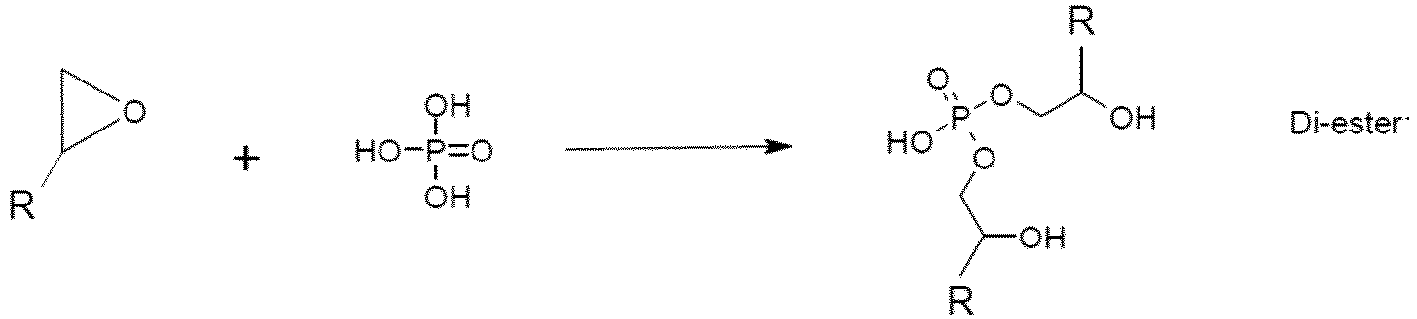
- the resulting reaction of the one or more epoxide functional materials with the phosphoric acid to create a phosphate ester is depicted below:
- the viscosity of the A side at 23 °C may be from about 20,000 cP to about 50,000 cP or even from about 35,000 cP to about 45,000 cP.
- the viscosity of the A side at 10 °C may be from about 280,000 cP to about 350,000 cP or even from about 300,000 cP to about 325,000 cP.
- the viscosity of the B side at 23 °C may be from about 20,000 cP to about 50,000 cP or even from about 35,000 cP to about 45,000 cP.
- the viscosity of the B side at 10 °C may be from about 130,000 cP to about 220,000 cP or even from about 175,000 cP to about 195,000 cP.
- the foam material may include one or more of the following in the first component or A side: liquid epoxy resin, flexible epoxy resin, epoxy phenol novolac resin, aliphatic multifunctional epoxy resin, calcium carbonate, wollastonite, and hydrophobic silica.
- the foam material may include one or more of the following in the second component or B side: phosphate ester, hydrophobic silica, and phosphoric acid.
- the present teachings provide a composition
- a composition comprising: a) a first component including: i) liquid epoxy resin; ii) flexible epoxy resin; iii) epoxy phenol novolac resin; iv) aliphatic multifunctional epoxy resin v) calcium carbonate; vi) wollastonite; and vii) hydrophobic silica; and b) a second component including: i) a first phosphate acid ester; ii) a second phosphate acid ester; iii) hydrophobic silica; and iv) phosphoric acid; and wherein a resulting reaction product of the first component and second component cures at a temperature of less than 50°C.
- the foam materials may include one or more additives (e.g., functional additives) for improving one or more various properties of the composition.
- additives may include antioxidants, antiozonants, ultraviolet absorbers, antistatic agents, colorants, coupling agents, curing agents, flame retardants, blowing agents, heat stabilizers, impact modifiers, lubricants, plasticizers, preservatives, processing aids and stabilizers and combinations thereof or the like.
- Table 1 Amount (wt. %) First component or A side liquid epoxy resin 18-24 flexible epoxy resin 12-17 epoxy phenol novolac resin 10-14 aliphatic multifunctional epoxy resin 20-28 calcium carbonate (medium fine ground) 12-17 calcium carbonate (fine particle size) 3-8 wollastonite 2-6 hydrophobic silica 0.1-2.5 Second component or B side first phosphate acid ester 50-75 second phosphate acid ester 20-30 hydrophobic silica 3-9 phosphoric acid 5-10
- Table 2 provides the technical data of a formulation in accordance with the present teachings at a cure temperature of 23°C and 10°C.
- Table 2 Physical Characteristics Mix Ratio by Volume 2 : 1 2 : 1 Temperature tested 23°C 10°C Time to Expand (sec) 20 120 Expansion (%) 350 310 Cure time (min) 7.5 9.5 Specific Gravity A side (g/cm 3 ) 1.14 Specific Gravity B side (g/cm 3 ) 1.07 Cured Specific Gravity (g/cm 3 ) 0.35 0.47 Viscosity A side (cP) @ 100 rad/s 40 315 Viscosity B side (cP) @ 100 rad/s 39 185 Peak Exotherm (°C) 127 102 Mechanical Properties Lap Shear 24 hr.
- the two component system of the present teachings may be provided as side by side cartridges, pails, and drums.
- the resulting reaction product of the two components cures at a temperature of less than 50°C and provides excellent adhesion to many substrates along with a fast cure time.
- Use of the teachings herein may result in a material that exhibits sufficient flame retardancy to meet one or more of the requirements for demonstrating flame retardancy (e.g., to meet vertical burn and/or smoke density requirements (or some other requirement) as set forth in 14 C.F.R. ⁇ 25.853 and 14 C.F.R. ⁇ 25.856 (the United States Code of Federal Regulations for compartment interiors, including but not limited to 14 C.F.R. ⁇ 25.853(a), and the referenced Appendix F and procedures referenced therein), all of which are incorporated by reference for all purposes.
- 14 C.F.R. ⁇ 25.853 and 14 C.F.R. ⁇ 25.856 the United States Code of Federal Regulations for compartment interiors, including but not limited to 14 C.F.R. ⁇ 25.853(a), and the referenced Appendix F and procedures referenced therein
- any member of a genus may be excluded from the genus; and/or any member of a Markush grouping may be excluded from the grouping.
- any numerical values recited herein include all values from the lower value to the upper value in increments of one unit provided that there is a separation of at least 2 units between any lower value and any higher value.
- the amount of a component, a property, or a value of a process variable such as, for example, temperature, pressure, time and the like is, for example, from 1 to 90, preferably from 20 to 80, more preferably from 30 to 70
- intermediate range values such as (for example, 15 to 85, 22 to 68, 43 to 51, 30 to 32 etc.) are within the teachings of this specification.
- individual intermediate values are also within the present teachings.
Landscapes
- Chemical & Material Sciences (AREA)
- Health & Medical Sciences (AREA)
- Chemical Kinetics & Catalysis (AREA)
- Medicinal Chemistry (AREA)
- Polymers & Plastics (AREA)
- Organic Chemistry (AREA)
- Engineering & Computer Science (AREA)
- Materials Engineering (AREA)
- Inorganic Chemistry (AREA)
- Epoxy Resins (AREA)
- Compositions Of Macromolecular Compounds (AREA)
- Manufacture Of Porous Articles, And Recovery And Treatment Of Waste Products (AREA)
- Adhesives Or Adhesive Processes (AREA)
Abstract
Description
- The present teachings relate generally to two component epoxy phosphate ester based foam materials.
- Foam materials are frequently employed in the transportation and construction industries for a variety of purposes. For example, foam materials may provide one or more of structural support, sealing and sound attenuation. Where room-temperature activation (e.g., expansion) is desired, polyurethane-based foams are most common. Polyurethane foams have a number of drawbacks, some of which are inclusion of isocyanate, a limited ability to adhere to certain substrates, poor hydrolysis resistance in wet or humid environments, unsuitability for use in slower reacting systems, high sensitivity to temperature changes during dispending and foaming, and a need for high specificity in mix ratios when formulating.
- As an alternative to polyurethane-based foams, phosphoric acids for in-place foaming reactions in polymeric materials have been utilized. However, phosphoric acid leads to additional concerns. As one example, reaction time with phosphoric acid is very fast which is not ideal for assembly processes that require time to locate the polymeric material onto a surface prior to foaming. Thus, a somewhat delayed reaction time may be preferable. In some situations, the nature of phosphoric acid can have negative health and safety risks due to its low pH and splash hazard. Therefore, alternative materials with a reduced health and safety risk may be preferred. There is also a significant difference in viscosity between the phosphoric acid and the oligomeric or polymeric materials that may be reacted with it. This presents challenges to both manufacturing (e.g., mixing) and storage of the material. Phosphoric acid also has a much lower molecular weight, and by extension, molecular weight per functional reactive group than many oligomeric and polymeric materials, leading to undesirable mix ratios. Relatively similar mix ratios of 1:1 or 2:1 would be preferable. Lastly, the reactive nature of phosphoric acid makes it difficult to formulate adhesive and sealant materials as so many chemical components may be unstable when utilized in conjunction with phosphoric acid. It would be preferable to have the ability to include a variety of different moieties that may be advantageous for adhesion, physical or chemical compatibility, or other reasons.
-
PCT Patent Publication No. WO2016/149700 incorporated by reference herein for all purposes discloses the use of phosphate esters as an alternative to phosphoric acid. However, the addition of some amount of phosphoric acid in addition to an ester, may provide significant benefit to one or more of the speed of reactivity and additional functionality. For example, if reactivity is desired at lower temperatures, the addition of amount of phosphoric acid in combination with a phosphate ester may increase the speed of the reaction as compared with use of the phosphate ester alone. As another example, the addition of phosphoric acid may impart multi-functionality to a foaming material to prevent collapse of the foam. Such collapse may occur due to the reaction of the phosphate ester with a metal carbonate (which decreases the average functionality of the material). The addition of the phosphoric acid effectively compensates for the reaction between the metal carbonate and phosphate ester thereby minimizing collapse of the foam. - Notwithstanding the above teachings, there has remained a need for improved foam materials. There is a need for foam materials which provide room temperature cure. There is a need for foam materials which provide for expansion and cross-linking at reduced temperatures as compared to known foam materials. There is a need for foam materials which provide adhesion to a wide variety of substrates. There is need for foam materials which utilize a component capable of both curing and foaming without the need for additional components. There is a need for foam materials which provide desirable fire, smoke and toxicity (FST) properties while eliminating the use of undesirable agents for imparting the same.
- The present teachings provide one or more of the above mentioned benefits. The foam materials of the present teachings may be utilized for one or more of the following: cavity filling, sealing, reinforcing, or damping.
- The present teachings provide a method comprising: providing a two component system, the two component system including an A side and a B side, the A side including an epoxy material and the B side including a phosphate ester and a phosphoric acid; mixing the A side and the B side to form a resulting reaction product; wherein the resulting reaction product of the A side and the B side cures at a temperature of less than 50°C.
- The B side may include one or more phosphate esters. The A side, the B side, or both may include one or more fillers and/or one or more reinforcing materials. The A side may include one or more metal carbonates.
- The foaming and curing reactions may occur at a temperature of from about 10°C to about 35°C. The foaming and curing reactions may occur at higher and lower temperatures. The degree of foaming may change depending upon the temperature at which the foaming and curing occurs. The foaming and curing reaction may occur at a temperature of from about 15°C to about 25°C.
- The cure time of the resulting reaction product may be less than 15 minutes. The cure time of the resulting reaction product may be from about 5 minutes to about 10 minutes. The cure time may be 30 minutes or less. The cure time may be 60 minutes or less. The foaming time may be 10 minutes or less, 5 minutes or less, or even 1 minute or less. The foaming time may be less than the time to complete cure. The method may be free of any additional curing agent. The resulting reaction product may have a volume expansion of at least 200%.
- The phosphoric acid may be added after preparation of the phosphate ester. The A side and B side may be mixed in a mix ratio by volume of from about 1:4 to about 4:1 (A side:B side). The A side and B side may be mixed in a mix ratio by volume of about 2:1 (A side:B side). The reaction product may fully expand in less than 10 minutes, less than 5 minutes, or even less than 2 minutes. The method may include a step of adding a second amount of phosphoric acid. The viscosity of the A side at 23 °C may be from about 20,000 cP to about 50,000 cP. The viscosity of the A side at 23 °C may be from about 35,000 cP to about 45,000 cP. The A side may be formulated with increased functionality to create an infinite network by using a functionality higher than two.
- The present teachings further provide a composition comprising: a) a first component including an epoxy material; b) a second component including a phosphate ester and a phosphoric acid. A resulting reaction product of the first component and second component cures at a temperature of less than 50°C.
- The second component may include at least one phosphate esters. The second component may include at least two different phosphate esters. The first component, the second component, or both may include one or more fillers and/or one or more reinforcing materials. The first component may include calcium carbonate.
- The cure temperature (e.g., the temperature at which the material begins to cure or completes curing) may be from about 10°C to about 35°C. The cure temperature may be from about 15°C to about 25°C.
- The cure time of the resulting reaction product may be less than 15 minutes. The cure time of the resulting reaction product may be from about 5 minutes to about 10 minutes. The resulting reaction product may have a volume expansion of at least 200%.
- The A side and B side may be in a mix ratio by volume of from about 1:4 to about 4:1 (A side: B side). The A side and B side may be in a mix ratio by volume of about 2:1 (A side:B side). The reaction product may fully expand in less than 10 minutes, less than 5 minutes, or even less than 2 minutes. The composition may include a second amount of phosphoric acid. The viscosity of the A side at 23 °C may be from about 20,000 cP to about 50,000 cP. The viscosity of the A side at 23 °C may be from about 35,000 cP to about 45,000 cP. The A side may be formulated with increased functionality to create an infinite network by using a functionality higher than two.
- The present teachings also provide for a composition comprising a) a first component including one or more of: i) liquid epoxy resin; ii) flexible epoxy resin; iii) epoxy phenol novolac resin; iv) aliphatic multifunctional epoxy resin; v) calcium carbonate; vi) wollastonite; and vii) hydrophobic silica; and b) a second component including one or more of: i) a first phosphate ester; ii) a second phosphate ester; iii) hydrophobic silica; and iv) phosphoric acid; and wherein a resulting reaction product of the first component and second component cures at a temperature of less than 50°C.
- The present teachings meet one or more of the above needs by the improved devices and methods described herein. The explanations and illustrations presented herein are intended to acquaint others skilled in the art with the teachings, its principles, and its practical application. Those skilled in the art may adapt and apply the teachings in its numerous forms, as may be best suited to the requirements of a particular use. Accordingly, the specific embodiments of the present teachings as set forth are not intended as being exhaustive or limiting of the teachings. The scope of the teachings should, therefore, be determined not with reference to the above description, but should instead be determined with reference to the appended claims, along with the full scope of equivalents to which such claims are entitled. The disclosures of all articles and references, including patent applications and publications, are incorporated by reference for all purposes. Other combinations are also possible as will be gleaned from the following claims, which are also hereby incorporated by reference into this written description.
- This application claims the benefit of the filing date of
U.S. Provisional Application No. 62/767,543, filed November 15, 2018 - The present teachings provide a method comprising: providing a two component system, the two component system including an A side and a B side. The A side including epoxy and the B side including phosphate ester and optionally phosphoric acid. The A side and the B side may be mixed to form a resulting reaction product. The resulting reaction product of the A side and the B side cures at a temperature of less than 50°C.
- At least one component of the two component system may include phosphate ester. The phosphate ester may be produced by the reaction of phosphoric acid and various epoxide functional monomers, although other preparation methods are possible. The phosphate ester may be produced by the reaction of epoxidozed cashew nut liquid (CNSL) polymer to produce an epichlorohydrin phosphate. The phosphate ester may be used to produce 1,2-Propanediol, 3-[(2-ethylhexy)oxyl]-phosphate.
- At least one component of the two component system may include one or more phosphate esters. At least one component of the two component system may include exactly two different phosphate esters. For example, the second component or B side may include a first phosphate ester and a second phosphate ester. The first phosphate ester may be a reaction product of epoxidized cashew nut liquid (CNSL) polymer to produce a phosphate ester. The second phosphate ester may be a reaction product of 2-Propanediol, 3-[(2-ethylhexy)oxyl]-phosphate.
- The first phosphate ester may be present in an amount of about 55% to about 75% by weight of the second component or B side. The first phosphate ester may be present in an amount of about 60% to about 70% by weight of the second component or B side. The first phosphate ester may be present in an amount of about 60% by weight of the second component or B side. The first phosphate ester may be present in an amount of about 65% by weight of the second component or B side. The second phosphate ester may be present in an amount of about 15% to about 35% by weight of the second component or B side. The second phosphate ester may be present in an amount of about 20% to about 30% by weight of the second component or B side. The second phosphate ester may be present in an amount of about 25% by weight of the second component or B side. The second phosphate ester may be present in an amount of about 28% by weight of the second component or B side.
- At least one component of the two component system may include phosphoric acid. Preferably, the component including the one or more phosphate esters also includes phosphoric acid. For example, the second component or B side may include one or more phosphate esters and phosphoric acid. The addition of phosphoric acid to the B side may result in increased expansion (e.g., foaming) of the resulting reaction product and/or decreased reaction time. The reaction time may be adjusted by the use of phosphoric acid concentrations. The addition of phosphoric acid to the B side may increase system reactivity to help maintain desired levels of expansion and/or curing when temperatures are below 23°C.
- The phosphoric acid may be orthophosphoric acid. The phosphoric acid may be polyphosphoric acid. The phosphoric acid may be an 85% aqueous solution. The phosphoric acid may be present in an amount of about 1% to about 10% by weight of the second component or B side. The phosphoric acid may be present in an amount of about 5% to about 8% by weight of the second component or B side.
- The curing and/or foaming may occur at a temperature of less than 40 °C. The curing and/or foaming may occur at a temperature of less than 30 °C. The curing and/or foaming may occur at a temperature of less than 20 °C. The curing and/or foaming may occur at a temperature of from about 10 °C to about 35 °C. The curing and/or foaming may occur at room temperature (e.g. at a temperature of from about 15 °C to about 25 °C). The curing and/or foaming may occur at a temperature of about 23 °C. The curing and/or foaming may occur at a temperature of about 10 °C.
- The present teachings contemplate a relatively fast curing and/or foaming time as compared to other curing agents/cure systems that occur without the addition of a stimulus (e.g., at ambient or room temperature). For example, the cure time of the resulting reaction product may be less than 75 minutes. The cure time of the resulting reaction product may be less than 50 minutes. The cure time of the resulting reaction product may be less than 30 minutes, or even less than about 20 minutes. The cure time of the resulting reaction product may be from about 5 minutes to about 20 minutes. The cure time of the resulting reaction product may be about 10 minutes. The cure time of the resulting reaction product may be about 7 minutes. The cure time of the resulting reaction product may be about 5 minutes.
- Foaming is likely to begin before complete cure of the resulting reaction product. The foaming time of the resulting reaction product may be less than 30 minutes, or even less than about 20 minutes. The foaming time of the resulting reaction product may be from about 30 seconds to about 10 minutes. The foaming time of the resulting reaction product may be about 5 minutes. The foaming time of the resulting reaction product may be about 7 minutes.
- The foam materials described herein may also include epoxy-based materials, which may contain one or more epoxy resins. Epoxy resin is used herein to mean any of the conventional dimeric, oligomeric or polymeric epoxy materials containing at least one epoxy functional group. Moreover, the term epoxy resin can be used to denote one epoxy resin or a combination of multiple epoxy resins. The epoxy may be aliphatic, cycloaliphatic, aromatic or the like. The epoxy may be supplied as a solid (e.g., as pellets, chunks, pieces or the like) or a liquid (e.g., a liquid epoxy resin). As used herein, unless otherwise stated, a resin is a solid resin if it is solid at a temperature of 23 °C and is a liquid resin if it a liquid at 23 °C. At least a portion of the epoxy resin may be liquid epoxy resin. For a solid epoxy to be used, it would typically require dissolution in a liquid resin.
- The foam materials described herein may include a liquid epoxy resin. The liquid epoxy resin may be present as a part of the first component or A side of the two component system of the present teachings. The liquid epoxy resin may be a liquid reaction product of epichlorohydrin and bisphenol A. The liquid epoxy resin may have an epoxide equivalent weight (g/eq) of about 182 to about 192 as measured according to ASTM D-1652. The liquid epoxy resin may have an epoxide percentage of about 20 to about 25. The liquid epoxy resin may have a viscosity of 11000 - 14000 mPa•s at 25 °C as measured according to ASTM D-445. One preferred liquid epoxy resin is sold under the trade name D.E.R.™ 331.
- The liquid epoxy resin may be present in an amount of about 10% to about 30% by weight of the first component or A side. The liquid epoxy resin may be present in an amount of about 15% to about 25% by weight of the first component or A side. The liquid epoxy resin may be present in an amount about 20% by weight of the first component or A side.
- The foam materials described herein may include a flexible epoxy resin. The inclusion of flexible components may reduce modulus or possibly increase strain to failure. The flexible epoxy resin may improve the gas entrapment capability of the foam by acting as a viscosity modifier. The flexible epoxy resin may be present in of the first component or A side of the two component system of the present teachings. The flexible epoxy resin may be a di-functional glycidyl ether epoxy resin. The flexible epoxy resin may be a difunctional epoxy derived from cardanol which is obtained from cashew nutshell liquid (CNSL). The flexible epoxy resin may have an epoxide equivalent weight (EEW) of about 350 to about 500 according to ASTM D-1652-97. The flexible epoxy resin may have a viscosity of 10000 - 35000 cP at 25°C as measured according to ASTM D2196. An exemplary flexible epoxy resin is sold under the trade name Cardolite NC-514 commercially available from Cardolite Corporation, Monmouth Junction NJ.
- The flexible epoxy resin, if present, may be present in an amount of about 5% to about 25% by weight of the first component or A side. The flexible epoxy resin may be present in an amount of about 10% to about 20% by weight of the first component or A side. The flexible epoxy resin may be present in an amount of about 15% by weight of the first component or A side. The flexible epoxy resin may be present in an amount of at least about 5%, at least about 10% or even at least about 15% by weight of the first component or A side. The flexible epoxy resin may be present in an amount of less than about 50%, less than about 30% or even less than about 25% by weight of the first component or A side.
- The foam materials described herein may also include an epoxy phenol novolac resin. The epoxy phenol novolac resin may be present as a part of the first component or A side of the two component system of the present teachings. The first component or A side may include a first epoxy phenol novolac resin and a second epoxy phenol novolac resin. The epoxy phenol novolac resin may have an epoxide equivalent weight (g/eq) of about 165 to about 178 as measured according to ASTM D-1652. The epoxy phenol novolac resin may have an epoxide equivalent weight (g/eq) of about 171 to about 183 as measured according to ASTM D-1652. The epoxy phenol novolac resin may have an average epoxy functionality of about 2.6 to about 3.6. For example, a first epoxy phenol novolac resin may have an epoxy functionality of about 2.6 and a second epoxy phenol novolac resin may have an epoxy functionality of about 3.6. The epoxy phenol novolac resin may have a viscosity of 18000 - 28000 cP at 25 °C. The epoxy phenol novolac resin may have a viscosity of 20000 - 30000 cP at 52 °C. Preferred flexible epoxy resin is sold under the trade name Epalloy 8250 and Epalloy 8330 commercially available from CVC Thermoset Specialties, Moorestown, NJ.
- The epoxy phenol novolac resin may be present in an amount of about 1% to about 45% by weight of the first component or A side. The epoxy phenol novolac resin may be present in an amount of about 5% to about 35% by weight of the first component or A side. The epoxy phenol novolac resin may be present in an amount of about 10% to about 20% by weight of the first component or A side. The epoxy phenol novolac resin may be present in an amount of about 15% by weight of the first component or A side. The epoxy phenol novolac resin may be present in an amount of about 35% to about 40% by weight of the first component or A side. The epoxy phenol novolac resin may be present in an amount of at least about 5%, at least about 10% or even at least about 30% by weight of the first component or A side. The epoxy phenol novolac resin may be present in an amount of less than about 70%, less than about 50% or even less than about 30% by weight of the first component or A side.
- The foam materials may include an aliphatic multifunctional epoxy resin. The aliphatic multifunctional epoxy resin may be present as a part of the first component or A side of the two component system of the present teachings. The aliphatic multifunctional epoxy resin may be epoxidized sorbitol. The aliphatic multifunctional epoxy resin may have an epoxide equivalent weight (g/eq) of about 160 to about 195 as measured according to ASTM D-1652. The aliphatic multifunctional epoxy resin may have a viscosity of 8000 - 18000 cP at 25 °C. One preferred aliphatic multifunctional epoxy resin is sold under the trade name Erisys GE-60 commercially available from CVC Thermoset Specialties, Moorestown, NJ.
- The aliphatic multifunctional epoxy resin may be present in an amount of about 15% to about 35% by weight of the first component or A side. The aliphatic multifunctional epoxy resin may be present in an amount of about 20% to about 30% by weight of the first component or A side. The aliphatic multifunctional epoxy resin may be present in an amount of about 20% to about 25% by weight of the first component or A side.
- It is possible that one or more of the A side components described herein may impart additional functionality to the A side. The B side may at least partially be formed as a salt utilizing at least some of the phosphoric acid and acid esters of the B side. This inherently reduces the reactive functionality of the B side. In an effort to compensate for this reduced functionality, the A side may be formulated with increased functionality to create an infinite network by using a functionality higher than two.
- The foam materials may include a metal carbonate. The foam materials may include calcium carbonate. The calcium carbonate may be present as one or more calcium carbonate fillers and may be introduced from mineral fillers having minor metal carbonate concentrations. The one or more calcium carbonate fillers may have a median particle size of from about 3 to about 25 microns. The calcium carbonate may be a medium fine ground. For example, the median particle size of the calcium carbonate may be about 22 microns. An example of a preferred medium fine ground calcium carbonate is Hubercarb® Q200 commercially available from Huber Engineered Materials, Atlanta, GA. The calcium carbonate may be a fine particle size. For example, the median particle size of the calcium carbonate may be 4 microns. An example of a preferred fine particle size calcium carbonate is Hubercarb® Q4 commercially available from Huber Engineered Materials, Atlanta, GA.
- The calcium carbonate may be present as part of the first component or A side of the two component system of the present teachings. The calcium carbonate may be present in an amount of less than 40% by weight of the first component or A side, between about 10% and about 30% by weight of the first component or A side, or even between about 15% and about 25% by weight of the first component or A side. The calcium carbonate may be present in an amount of about 20% by weight of the first component or A side. The calcium carbonate may be present in an amount of at least about 5% by weight of the first component or A side, at least about 10% by weight of the first component or A side, or even at least about 15% by weight of the first component or A side. The calcium carbonate may be present in an amount of less than about 60% by weight of the first component or A side, less than about 45% by weight of the first component or A side, or even less than about 30% by weight of the first component or A side.
- The first component or A side may include about 10% to about 20% by weight of medium fine ground calcium carbonate. The first component or A side may include about 15% by weight of medium fine ground calcium carbonate. The first component or A side may include about 2% to about 9% by weight of fine particle size calcium carbonate. The first component or A side may include about 5% to about 7% by weight fine particle size calcium carbonate. The first component or A side may include about 15% by weight of medium fine ground calcium carbonate and about 5% by weight of fine particle size calcium carbonate. For example, a ratio of a medium fine ground calcium carbonate to a ratio of a fine particle size calcium carbonate in the first component or A side may be about 3:1.
- It is possible that the calcium carbonate may include a coating or may be selected in a specific size (e.g., a larger size) in an effort to delay or slow expansion of the material. The coating may be any material that will break down during the activation/expansion process. The coating may be a wax, a fatty acid, or combinations thereof.
- The foam materials may include one or more minerals. The characteristic external shape of an individual crystal or crystal group of the mineral may be acicular or needle-like. The median particle size of the minerals may be about 10 µm to about 20 µm.
- The foam materials may include a reinforcement material such as Wollastonite or calcium silicate. The Wollastonite may be relatively pure CaSiO3. The Wollastonite may contain one or more of iron, magnesium, manganese, aluminum, potassium, sodium, or strontium substituting for calcium in the mineral structure. The median particle size of the Wollastonite may be about 18 µm. The median particle size of the Wollastonite may be about 12 µm. Preferred Wollastonite is sold under the trade name NYGLOS® 12 and NYGLOS® 8 commercially available from NYCO Minerals Inc., Willsboro, NY.
- The wollastonite may be present as part of the first component or A side of the two component system of the present teachings. The wollastonite may be present in an amount of about 1% to about 10% by weight of the first component or A side. The wollastonite may be present in an amount of about 3% to about 7% by weight of the first component or A side. The wollastonite may be present in an amount of about 5% by weight of the first component or A side.
- Complex minerals that include a metal carbonate concentration but so not solely comprise metal carbonate may be included as yet another means to slow or delay the expansion process.
- The foam materials may include hydrophobic silica. The hydrophobic silica may be fumed. The fumed silica may be surface-treated with polydimethylsiloxane. The hydrophobic silica may be present as part of the first component or A side of the two component system of the present teachings. The hydrophobic silica may be present as part of the second component or B side of the two component system of the present teachings. The hydrophobic silica may be present as part of both the first and second component or A and B side of the two component system of the present teachings. Preferred hydrophobic silica is sold under the trade name AEROSIL® R 202 commercially available from Evonik Corporation, Parsippany, NJ.
- The hydrophobic silica may be present in an amount of about 0.25% to about 2% by weight of the first component or A side. The hydrophobic silica may be present in an amount of about 0.5% to about 1.5% by weight of the first component or A side. The hydrophobic silica may be present in an amount of about 1% by weight of the first component or A side. The hydrophobic silica may be present in an amount of about 1% to about 10% by weight of the second component or B side. The hydrophobic silica may be present in an amount of about 1% to about 8% by weight of the second component or B side. The hydrophobic silica may be present in an amount of about 6% by weight of the second component or B side. For example, the ratio of hydrophobic silica in the first component or A side to the second component or B side may be from about 1:10 to about 10:1. The ratio of hydrophobic silica in the first component or A side to the second component or B side may be 1:6.
- The foam materials may include calcined kaolin clay. The contamination of the clay with the metal carbonate may also stimulate the foaming (e.g., expansion) process. The calcined kaolin clay may be present as a part of the first component or A side of the two component system of the present teachings. The calcined kaolin clay may be present in an amount of about .25% to about 5% by weight of the first component or A side. The calcined kaolin clay may be present in an amount of about 1% by weight of the first component or A side. The calcined kaolin clay may have an average particle size of 1.3 µm (average stokes equivalent diameter). The calcined kaolin clay may have an average particle size of 3.2 µm) (median malvern laser). Preferred calcined kaolin clay is sold under the trade name KaMin® 70C commercially available from KaMin® LLC, Macon, GA.
- The B side may include one or more phosphate esters. The B side may include phosphoric acid. The B side may include a material for modifying viscosity. The material for modifying viscosity may be a silica-based material. The one or more phosphate esters may be selected from mono-esters, di-esters, or tri-esters as shown below:

- The one or more esters may be combined with the A side components on their own or may be mixed with phosphoric acid prior to combination with additional components. The resulting reaction of the one or more epoxide functional materials with the phosphoric acid to create a phosphate ester is depicted below:


- The viscosity of the A side at 23 °C may be from about 20,000 cP to about 50,000 cP or even from about 35,000 cP to about 45,000 cP. The viscosity of the A side at 10 °C may be from about 280,000 cP to about 350,000 cP or even from about 300,000 cP to about 325,000 cP. The viscosity of the B side at 23 °C may be from about 20,000 cP to about 50,000 cP or even from about 35,000 cP to about 45,000 cP. The viscosity of the B side at 10 °C may be from about 130,000 cP to about 220,000 cP or even from about 175,000 cP to about 195,000 cP.
- In one non-limiting embodiment of the present teachings, the foam material may include one or more of the following in the first component or A side: liquid epoxy resin, flexible epoxy resin, epoxy phenol novolac resin, aliphatic multifunctional epoxy resin, calcium carbonate, wollastonite, and hydrophobic silica. The foam material may include one or more of the following in the second component or B side: phosphate ester, hydrophobic silica, and phosphoric acid. In one non-limiting embodiment, the present teachings provide a composition comprising: a) a first component including: i) liquid epoxy resin; ii) flexible epoxy resin; iii) epoxy phenol novolac resin; iv) aliphatic multifunctional epoxy resin v) calcium carbonate; vi) wollastonite; and vii) hydrophobic silica; and b) a second component including: i) a first phosphate acid ester; ii) a second phosphate acid ester; iii) hydrophobic silica; and iv) phosphoric acid; and wherein a resulting reaction product of the first component and second component cures at a temperature of less than 50°C.
- The foam materials may include one or more additives (e.g., functional additives) for improving one or more various properties of the composition. As examples, additives may include antioxidants, antiozonants, ultraviolet absorbers, antistatic agents, colorants, coupling agents, curing agents, flame retardants, blowing agents, heat stabilizers, impact modifiers, lubricants, plasticizers, preservatives, processing aids and stabilizers and combinations thereof or the like.
- A non-limiting example formulation in accordance with the present teachings is provided below at Table 1.
Table 1 Amount (wt. %) First component or A side liquid epoxy resin 18-24 flexible epoxy resin 12-17 epoxy phenol novolac resin 10-14 aliphatic multifunctional epoxy resin 20-28 calcium carbonate (medium fine ground) 12-17 calcium carbonate (fine particle size) 3-8 wollastonite 2-6 hydrophobic silica 0.1-2.5 Second component or B side first phosphate acid ester 50-75 second phosphate acid ester 20-30 hydrophobic silica 3-9 phosphoric acid 5-10 - Table 2 provides the technical data of a formulation in accordance with the present teachings at a cure temperature of 23°C and 10°C.
Table 2 Physical Characteristics Mix Ratio by Volume 2 : 1 2 : 1 Temperature tested 23°C 10°C Time to Expand (sec) 20 120 Expansion (%) 350 310 Cure time (min) 7.5 9.5 Specific Gravity A side (g/cm3) 1.14 Specific Gravity B side (g/cm3) 1.07 Cured Specific Gravity (g/cm3) 0.35 0.47 Viscosity A side (cP) @ 100 rad/s 40 315 Viscosity B side (cP) @ 100 rad/s 39 185 Peak Exotherm (°C) 127 102 Mechanical Properties Lap Shear 24 hr. cure time Peak Stress (MPa) 3.0 (not tested) Peak Load (N) 1927 (not tested) Cohesive Failure (%) 100 (not tested) Compression 30% Strain Peak Stress (MPa) 0.33 (not tested) Modulus (MPa) 8 (not tested) Energy @ 90% (N*mm) 3350 (not tested) Cured Specific Gravity (g/cm3) 0.32 (not tested) Tensile Dog Bone JIS-6301-01 Peak Stress (MPa) 0.56 (not tested) Modulus (MPa) 8 (not tested) Strain at Peak (%) 16 (not tested) - Additional examples of formulations in accordance of the present teachings are provided below at Table 3.
Table 3 A B C D E F G First component or A side Amt (wt. %) Amt (wt. %) Amt (wt. %) Amt (wt. %) Amt (wt. %) Amt (wt. %) Amt (wt. %) liquid epoxy resin 21.70 21.70 21.70 21.70 21.70 21.70 21.70 first epoxy phenol novolac resin 17.74 17.74 17.74 17.74 12.74 0.00 0.00 flexible epoxy resin 14.15 14.15 14.15 14.15 15.15 14.15 14.15 second epoxy phenol novolac resin 0.00 0.00 0.00 0.00 0.00 37.74 37.74 aliphatic multifunctional epoxy resin 20.00 20.00 20.00 20.00 24.00 0.00 0.00 calcium carbonate (medium fine ground) 15.09 15.09 15.09 15.09 15.09 15.09 15.09 calcium carbonate (fine particle size) 5.66 5.66 6.42 6.42 5.66 5.66 5.66 hydrophobic silica 0.94 0.94 0.90 0.90 0.94 0.94 0.00 wollastonite 4.72 4.72 4.00 4.00 4.72 4.72 4.72 calcined kaolin 0.00 0.00 0.00 0.00 0.00 0.00 0.94 TOTAL 100.00 100.00 100.00 100.00 100.00 100.00 100.00 Second component or B side first phosphate acid ester 65.42 62.16 65.42 60.34 65.42 65.42 70.53 second phosphate acid ester 28.04 26.64 28.04 25.86 28.04 28.04 27.36 hydrophobic silica 6.54 6.21 6.54 6.03 6.54 6.54 2.10 phosphoric acid (H3PO4) 85% 0.00 4.99 0.00 7.77 0.00 0.00 0.00 TOTAL 100.00 100.00 100.00 100.00 100.00 100.00 100.00 Control 5% H3PO4 10°C / 23°C Control 10°C / 23°C 7.8% H3PO4 10°C / 23°C 10°C 98 Bs With second epoxy phenol novolac resin With kaolin clay Time to exp (sec) 100 30/20 60/30 20 25/90 45.0 90.0 Peak Exotherm °F 232 234/240 223/213 251 233/236 220 219 Time to Peak exo (min) 13.0 8.5/7 12/10 6.5 9/9 9.0 11.0 Expansion % 277 310>350 300/310 > 380 345/300 210 211 - As depicted in Table 3, the addition of 85% phosphoric acid to the B side results in increased expansion and helps maintain desired expansion levels when temperatures are below 23°C.
- The two component system of the present teachings may be provided as side by side cartridges, pails, and drums. The resulting reaction product of the two components cures at a temperature of less than 50°C and provides excellent adhesion to many substrates along with a fast cure time.
- Use of the teachings herein may result in a material that exhibits sufficient flame retardancy to meet one or more of the requirements for demonstrating flame retardancy (e.g., to meet vertical burn and/or smoke density requirements (or some other requirement) as set forth in 14 C.F.R. §25.853 and 14 C.F.R. §25.856 (the United States Code of Federal Regulations for compartment interiors, including but not limited to 14 C.F.R. §25.853(a), and the referenced Appendix F and procedures referenced therein), all of which are incorporated by reference for all purposes.
- As used herein, unless otherwise stated, the teachings envision that any member of a genus (list) may be excluded from the genus; and/or any member of a Markush grouping may be excluded from the grouping.
- Unless otherwise stated, any numerical values recited herein include all values from the lower value to the upper value in increments of one unit provided that there is a separation of at least 2 units between any lower value and any higher value. As an example, if it is stated that the amount of a component, a property, or a value of a process variable such as, for example, temperature, pressure, time and the like is, for example, from 1 to 90, preferably from 20 to 80, more preferably from 30 to 70, it is intended that intermediate range values such as (for example, 15 to 85, 22 to 68, 43 to 51, 30 to 32 etc.) are within the teachings of this specification. Likewise, individual intermediate values are also within the present teachings. For values which are less than one, one unit is considered to be 0.0001, 0.001, 0.01, or 0.1 as appropriate. These are only examples of what is specifically intended and all possible combinations of numerical values between the lowest value and the highest value enumerated are to be considered to be expressly stated in this application in a similar manner. As can be seen, the teaching of amounts expressed as "parts by weight" herein also contemplates the same ranges expressed in terms of percent by weight. Thus, an expression in the of a range in terms of "at least 'x' parts by weight of the resulting composition" also contemplates a teaching of ranges of same recited amount of "x" in percent by weight of the resulting composition."
- Unless otherwise stated, all ranges include both endpoints and all numbers between the endpoints. The use of "about" or "approximately" in connection with a range applies to both ends of the range. Thus, "about 20 to 30" is intended to cover "about 20 to about 30", inclusive of at least the specified endpoints. Unless otherwise stated, a teaching with the term "about" or "approximately" in combination with a numerical amount encompasses a teaching of the recited amount, as well as approximations of that recited amount. By way of example, a teaching of "about 100" encompasses a teaching of 100.
- The disclosures of all articles and references, including patent applications and publications, are incorporated by reference for ail purposes. The term "consisting essentially of to describe a combination shall include the elements, ingredients, components or steps identified, and such other elements ingredients, components or steps that do not materially affect the basic and novel characteristics of the combination. The use of the terms "comprising" or "including" to describe combinations of elements, ingredients, components or steps herein also contemplates embodiments that consist of, or consist essentially of the elements, ingredients, components or steps.
- Plural elements, ingredients, components or steps can be provided by a single integrated element, ingredient, component or step. Alternatively, a single integrated element, ingredient, component or step might be divided into separate plural elements, ingredients, components or steps. The disclosure of "a" or "one" to describe an element, ingredient, component or step is not intended to foreclose additional elements, ingredients, components or steps.
- It is understood that the above description is intended to be illustrative and not restrictive. Many embodiments as well as many applications besides the examples provided will be apparent to those of skill in the art upon reading the above description. The scope of the invention should, therefore, be determined not with reference to the above description, but should instead be determined with reference to the appended claims, along with the full scope of equivalents to which such claims are entitled. The disclosures of all articles and references, including patent applications and publications, are incorporated by reference for all purposes. The omission in the following claims of any aspect of subject matter that is disclosed herein is not a disclaimer of such subject matter, nor should it be regarded that the inventors did not consider such subject matter to be part of the disclosed inventive subject matter.
Claims (15)
- A method comprising:providing a two component system, the two component system including an A side and a B side, the A side including epoxy and the B side including phosphate ester and phosphoric acid;mixing the A side and the B side to form a resulting reaction product;wherein the resulting reaction product of the A side and the B side cures at a temperature of less than 50°C.
- The method of claim 1, wherein- the B side includes two different phosphate esters; and/or- the A side, the B side, or both include filler; and/or- the A side includes calcium carbonate.
- The method of any of the preceding claims, wherein- curing occurs at a temperature of from about 10°C to about 35°C; and/or- curing occurs at a temperature of from about 15°C to about 25°C; and/or- a cure time of the resulting reaction product is less than 15 minutes; and/or- a cure time of the resulting reaction product is from about 5 minutes to about 10 minutes; and/or- the method is free of a curing agent.
- The method of any of the preceding claims, wherein- the resulting reaction product has a volume expansion of at least 200%; and/or- the phosphoric acid is added after preparation of the phosphate ester.
- The method of any of the preceding claims, wherein- the A side and B side are mixed in a mix ratio by volume of from about 1:4 to about 4:1 (A side:B side); and/or- the A side and B side are mixed in a mix ratio by volume of about 2:1 (A side:B side).
- The method of any of the preceding claims, wherein- the reaction product fully expands in less than 10 minutes, less than 5 minutes, or even less than 2 minutes; and/or- the method includes a step of adding a second amount of phosphoric acid.
- The method of any of the preceding claims, wherein- the viscosity of the A side at 23 °C is from about 20,000 cP to about 50,000 cP; and/or- the viscosity of the A side at 23 °C is from about 35,000 cP to about 45,000 cP.
- The method of any of the preceding claims, wherein the A side is formulated with increased functionality to create an infinite network by using a functionality higher than two.
- A composition comprising:a) a first component including epoxy;b) a second component including phosphate ester and phosphoric acid; and wherein a resulting reaction product of the first component and second component cures at a temperature of less than 50°C.
- The composition of claim 9, wherein- the second component includes two different phosphate esters; and/or- the first component, the second component, or both include filler; and/or- the first component includes calcium carbonate.
- The composition of any of claims 9 through 10, wherein- the cure temperature is from about 10°C to about 35°C; and/or- the cure temperature is from about 15°C to about 25°C; and/or- a cure time of the resulting reaction product is less than 15 minutes; and/or- a cure time of the resulting reaction product is from about 5 minutes to about 10 minutes.
- The composition any of claims 9 through 11, wherein- the resulting reaction product has a volume expansion of at least 200%; and/or- the A side and B side are in a mix ratio by volume of from about 1:4 to about 4:1 (A side:B side); and/or- the A side and B side are in a mix ratio by volume of about 2:1 (A side:B side).
- The composition of any of claims 9 through 12,- wherein the reaction product fully expands in less than 10 minutes, less than 5 minutes, or even less than 2 minutes; and/or- including a second amount of phosphoric acid.
- The composition of any of claims 9 through 13, wherein- the viscosity of the A side at 23 °C is from about 20,000 cP to about 50,000 cP; and/or- the viscosity of the A side at 23 °C is from about 35,000 cP to about 45,000 cP; and/or- the A side is formulated with increased functionality to create an infinite network by using a functionality higher than two.
- A composition comprising:a) a first component including:i) liquid epoxy resin;ii) flexible epoxy resin;iii) epoxy phenol novolac resin;iv) aliphatic multifunctional epoxy resin;v) calcium carbonate;vi) wollastonite;vii) hydrophobic silica; andb) a second component including:i) a first phosphate ester;ii) a second phosphate ester;iii) hydrophobic silica;iv) phosphoric acid; andwherein a resulting reaction product of the first component and second component cures at a temperature of less than 50°C.
Applications Claiming Priority (3)
| Application Number | Priority Date | Filing Date | Title |
|---|---|---|---|
| US201862767543P | 2018-11-15 | 2018-11-15 | |
| PCT/US2019/030831 WO2020101732A1 (en) | 2018-11-15 | 2019-05-06 | Two-component phosphate ester cavity filling semi rigid foam |
| EP19728790.7A EP3880742B1 (en) | 2018-11-15 | 2019-05-06 | Two-component phosphate ester cavity filling semi rigid foam |
Related Parent Applications (1)
| Application Number | Title | Priority Date | Filing Date |
|---|---|---|---|
| EP19728790.7A Division EP3880742B1 (en) | 2018-11-15 | 2019-05-06 | Two-component phosphate ester cavity filling semi rigid foam |
Publications (2)
| Publication Number | Publication Date |
|---|---|
| EP4512852A2 true EP4512852A2 (en) | 2025-02-26 |
| EP4512852A3 EP4512852A3 (en) | 2025-04-23 |
Family
ID=66770556
Family Applications (2)
| Application Number | Title | Priority Date | Filing Date |
|---|---|---|---|
| EP19728790.7A Active EP3880742B1 (en) | 2018-11-15 | 2019-05-06 | Two-component phosphate ester cavity filling semi rigid foam |
| EP24216753.4A Pending EP4512852A3 (en) | 2018-11-15 | 2019-05-06 | Two-component phosphate ester cavity filling semi rigid foam |
Family Applications Before (1)
| Application Number | Title | Priority Date | Filing Date |
|---|---|---|---|
| EP19728790.7A Active EP3880742B1 (en) | 2018-11-15 | 2019-05-06 | Two-component phosphate ester cavity filling semi rigid foam |
Country Status (11)
| Country | Link |
|---|---|
| US (2) | US12421366B2 (en) |
| EP (2) | EP3880742B1 (en) |
| JP (2) | JP7554546B2 (en) |
| KR (2) | KR20250061771A (en) |
| CN (1) | CN113039238A (en) |
| AU (2) | AU2019379502B2 (en) |
| CA (1) | CA3117663C (en) |
| ES (1) | ES3011731T3 (en) |
| MX (1) | MX2021005664A (en) |
| PL (1) | PL3880742T3 (en) |
| WO (1) | WO2020101732A1 (en) |
Families Citing this family (16)
| Publication number | Priority date | Publication date | Assignee | Title |
|---|---|---|---|---|
| PL3271413T3 (en) | 2015-03-19 | 2024-03-04 | Zephyros Inc. | Esterified acids for use in polymeric materials |
| AU2019379502B2 (en) | 2018-11-15 | 2025-11-20 | Zephyros, Inc. | Two-component phosphate ester cavity filling semi rigid foam |
| US12522688B2 (en) * | 2019-03-26 | 2026-01-13 | Zephyros, Inc. | Pultrusion with extruded gasket foam |
| CA3123309A1 (en) * | 2019-04-03 | 2020-10-08 | Zephyros, Inc. | Two-part phosphate ester elastomeric epoxy composition and method of use thereof |
| CN113710722A (en) | 2019-04-03 | 2021-11-26 | 泽菲罗斯有限公司 | Two-part phosphate ester epoxy resin composition |
| CN114981386A (en) | 2019-11-13 | 2022-08-30 | 泽费罗斯股份有限公司 | Encapsulation paste for reinforcing honeycomb |
| WO2023043930A1 (en) | 2021-09-15 | 2023-03-23 | Zephyros, Inc. | Fire resistant two-part system |
| EP4423162A1 (en) | 2021-10-29 | 2024-09-04 | Zephyros, Inc. | Reaction induced color-change composition |
| WO2023205498A1 (en) | 2022-04-22 | 2023-10-26 | Zephyros, Inc. | Lightweight structural reinforcement |
| WO2023211880A1 (en) | 2022-04-29 | 2023-11-02 | Zephyros, Inc. | Underwater curable thermoset compositions |
| WO2023212334A1 (en) | 2022-04-29 | 2023-11-02 | Zephyros, Inc. | Adhesives adapted for spray applications |
| EP4540081A1 (en) | 2022-06-20 | 2025-04-23 | Zephyros, Inc. | Battery mount reinforcements |
| EP4702074A1 (en) * | 2023-04-25 | 2026-03-04 | Zephyros, Inc. | Injectable rapid-cure two-part composition |
| EP4702069A1 (en) * | 2023-04-25 | 2026-03-04 | Zephyros, Inc. | Ambient temperature rapid cure system of oxirane-containing compounds |
| WO2025038537A1 (en) | 2023-08-11 | 2025-02-20 | Zephyros, Inc. | Adhesive delivery system |
| WO2025071656A1 (en) | 2023-09-26 | 2025-04-03 | Zephyros, Inc. | Dispensing devices |
Citations (1)
| Publication number | Priority date | Publication date | Assignee | Title |
|---|---|---|---|---|
| WO2016149700A1 (en) | 2015-03-19 | 2016-09-22 | Zephyros, Inc. | Esterified acids for use in polymeric materials |
Family Cites Families (58)
| Publication number | Priority date | Publication date | Assignee | Title |
|---|---|---|---|---|
| US2541027A (en) | 1948-05-11 | 1951-02-13 | Shell Dev | Compositions of matter containing epoxy ethers and phosphorus-containing compounds |
| US2831820A (en) | 1953-04-13 | 1958-04-22 | Honeywell Regulator Co | Foamed epoxy resin composition and method of making |
| US3317471A (en) | 1959-03-12 | 1967-05-02 | Dow Chemical Co | Thermoplastic resinous reaction product of a diglycidyl ether and an amino compound |
| BE610068A (en) | 1960-11-10 | |||
| US3282863A (en) | 1961-12-01 | 1966-11-01 | Shell Oil Co | Resin foams |
| US4016112A (en) | 1972-01-28 | 1977-04-05 | Teijin Limited | Process for production of foamed resin structure |
| US4164487A (en) | 1976-12-23 | 1979-08-14 | The Dow Chemical Company | Water-thinnable mixtures of base-neutralized products of reaction of H3 PO4 with polyether epoxides and with other type epoxides |
| US4196270A (en) | 1977-12-27 | 1980-04-01 | Ford Motor Company | High solids coating composition adapted for use as automotive topcoat-#5 |
| US4164489A (en) | 1978-04-24 | 1979-08-14 | Air Products And Chemicals, Inc. | Continuous emulsion polymerization of vinyl acetate and ethylene |
| US4438254A (en) | 1983-02-28 | 1984-03-20 | The Dow Chemical Company | Process for producing epoxy resins |
| US4638020A (en) | 1984-11-23 | 1987-01-20 | Ppg Industries, Inc. | Aqueous composition comprising a phosphated epoxy and non-self dispersible resin |
| US4613661A (en) | 1985-05-28 | 1986-09-23 | The Dow Chemical Company | Epoxy phosphate compositions |
| US4619860A (en) | 1985-07-01 | 1986-10-28 | Armstrong World Industries, Inc. | Foamed phosphate tile products |
| US4647648A (en) | 1985-08-26 | 1987-03-03 | The Dow Chemical Company | Polyhydroxyethers from hydroxybiphenyls |
| AT387028B (en) | 1987-04-28 | 1988-11-25 | Vianova Kunstharz Ag | METHOD FOR PRODUCING CATIONIC RESINS BASED ON PHOSPHORIC ACID MODIFIED EPOXY RESINS AND THE USE THEREOF |
| EP0291454A3 (en) | 1987-05-14 | 1990-05-23 | Ciba-Geigy Ag | Selected esters of phosphoric acid, as hardeners of epoxy resins |
| US4820784A (en) | 1988-01-13 | 1989-04-11 | The Dow Chemical Company | Modified advanced epoxy resins |
| US5086094A (en) | 1988-09-07 | 1992-02-04 | The Dow Chemical Company | Organic solvent solutions of phosphate esters of epoxy resins |
| US5115075A (en) | 1990-05-08 | 1992-05-19 | The Dow Chemical Company | Amide and hydroxymethyl functionalized polyethers as thermoplastic barrier resins |
| CA2130113A1 (en) | 1992-04-02 | 1993-10-14 | Shanti Swarup | Epoxide-phosphorous-containing acids-cyclic anhydride reaction products and their use in coating compositions |
| DE4231073A1 (en) | 1992-09-17 | 1994-03-24 | Rhein Chemie Rheinau Gmbh | Phosphorylation of epoxides |
| US6011111A (en) | 1993-10-18 | 2000-01-04 | The Dow Chemical Company | Hydroxy-phenoxyether polymer thermoplastic composites |
| JP3106394B2 (en) | 1995-12-21 | 2000-11-06 | 旭ファイバーグラス株式会社 | Epoxy resin foam and method for producing the same |
| DE19608611A1 (en) | 1996-03-06 | 1997-09-11 | Hoechst Ag | Phosphorus-modified coating compositions, a process for their preparation and their use |
| JP3023502B2 (en) | 1996-09-26 | 2000-03-21 | 旭ファイバーグラス株式会社 | Manufacturing method of organic foam with epoxy resin skeleton |
| WO1998014498A1 (en) | 1996-09-30 | 1998-04-09 | The Dow Chemical Company | Hydroxy-phenoxyether polymer thermoplastic composites |
| US5648401A (en) * | 1996-10-09 | 1997-07-15 | L & L Products, Inc. | Foamed articles and methods for making same |
| EP0849302A1 (en) * | 1996-12-20 | 1998-06-24 | Asahi Fiber Glass Co., Ltd. | Epoxy resin foam and method for its production |
| JP3180212B2 (en) | 1997-06-23 | 2001-06-25 | 旭ファイバーグラス株式会社 | Fireproof insulation panel |
| US6110982A (en) * | 1999-01-13 | 2000-08-29 | Sandia Corporation | Epoxy foams using multiple resins and curing agents |
| JP2001081223A (en) * | 1999-09-13 | 2001-03-27 | Asahi Fiber Glass Co Ltd | Manufacturing method of epoxy resin foam |
| US20020192387A1 (en) | 2001-06-04 | 2002-12-19 | Agarwal Rajat K. | Composites with improved foam-metal adhesion |
| US6730713B2 (en) | 2001-09-24 | 2004-05-04 | L&L Products, Inc. | Creation of epoxy-based foam-in-place material using encapsulated metal carbonate |
| US6890964B2 (en) * | 2001-09-24 | 2005-05-10 | L&L Products, Inc. | Homopolymerized epoxy-based form-in-place material |
| EP1497092A1 (en) | 2002-04-15 | 2005-01-19 | Dow Global Technologies Inc. | Improved vehicular structural members and method of making the members |
| JP4420426B2 (en) | 2002-04-18 | 2010-02-24 | 株式会社Adeka | Method for producing phosphate ester |
| JP2004099663A (en) | 2002-09-05 | 2004-04-02 | Asahi Fiber Glass Co Ltd | Method for producing aldehyde-based condensable resin foam |
| JP4052566B2 (en) | 2002-09-05 | 2008-02-27 | 本田技研工業株式会社 | Frame coupling structure and coupling method |
| AT412089B8 (en) | 2002-10-21 | 2004-10-25 | Surface Specialties Austria | ADDITIVES OF EPOXY RESINS AND PHOSPHOR DERIVED ACIDS AND METHOD FOR THE PRODUCTION THEREOF |
| US7579068B2 (en) | 2005-04-05 | 2009-08-25 | Dow Global Technologies, Inc. | Rigid polyurethane-isocyanurate reinforcing foams |
| WO2008010823A2 (en) | 2005-09-09 | 2008-01-24 | L & L Products, Inc. | Thermoplastic based composites |
| US20070270515A1 (en) | 2006-05-19 | 2007-11-22 | Zephyros, Inc. | Toughened polymeric material and method of forming and using same |
| US20080161432A1 (en) * | 2006-12-29 | 2008-07-03 | Korwin-Edson Michelle L | Room temperature crosslinked foam |
| WO2008131918A1 (en) | 2007-04-25 | 2008-11-06 | Basf Se | Reactive surfactants and their use |
| GB2448901A (en) | 2007-05-02 | 2008-11-05 | Alderley Materials Ltd | Thermal Insulation Structure |
| EP2060592B1 (en) | 2007-11-14 | 2010-01-27 | Sika Technology AG | Non-aromatic ureae containing thermosetting epoxy resin composition for use as a catalyst |
| US7879925B2 (en) | 2008-05-27 | 2011-02-01 | Zephyros, Inc. | Composite with natural fibers |
| EP2182025B1 (en) | 2008-10-31 | 2010-10-06 | Sika Technology AG | Heat curable epoxide resin compositions suitable as bodyshop adhesive or structural foam |
| GB201005444D0 (en) | 2010-03-31 | 2010-05-19 | 3M Innovative Properties Co | Epoxy adhesive compositions comprising an adhesion promoter |
| EP2426160B1 (en) | 2010-09-03 | 2014-01-15 | Sika Technology AG | Heat curable epoxy resin composition with water as foaming agent |
| JP5648401B2 (en) * | 2010-09-29 | 2015-01-07 | 株式会社Ihi | Fluid supply system |
| RU2016100823A (en) | 2013-06-14 | 2017-07-20 | Басф Се | REACTIVE COMBUSTION INHIBITORS |
| WO2015197647A1 (en) | 2014-06-24 | 2015-12-30 | Byk-Chemie Gmbh | Epoxy resin-epoxy curing systems with a latent thickening tendency |
| DE112016001251T5 (en) | 2015-03-16 | 2017-11-30 | Rogers Corporation | Process for producing a polymer foam composite, polymer foam composite prepared thereby and articles made therefrom |
| GB201509865D0 (en) | 2015-06-08 | 2015-07-22 | Advanced Insulation Plc | Syntactic foam |
| JP7186046B2 (en) | 2018-09-27 | 2022-12-08 | スリーエム イノベイティブ プロパティズ カンパニー | Graphic sheet and lighting system using graphic sheet |
| AU2019379502B2 (en) | 2018-11-15 | 2025-11-20 | Zephyros, Inc. | Two-component phosphate ester cavity filling semi rigid foam |
| US12522688B2 (en) | 2019-03-26 | 2026-01-13 | Zephyros, Inc. | Pultrusion with extruded gasket foam |
-
2019
- 2019-05-06 AU AU2019379502A patent/AU2019379502B2/en active Active
- 2019-05-06 EP EP19728790.7A patent/EP3880742B1/en active Active
- 2019-05-06 KR KR1020257013249A patent/KR20250061771A/en active Pending
- 2019-05-06 PL PL19728790.7T patent/PL3880742T3/en unknown
- 2019-05-06 US US17/289,166 patent/US12421366B2/en active Active
- 2019-05-06 EP EP24216753.4A patent/EP4512852A3/en active Pending
- 2019-05-06 JP JP2021523472A patent/JP7554546B2/en active Active
- 2019-05-06 WO PCT/US2019/030831 patent/WO2020101732A1/en not_active Ceased
- 2019-05-06 KR KR1020217017881A patent/KR20210091766A/en not_active Ceased
- 2019-05-06 MX MX2021005664A patent/MX2021005664A/en unknown
- 2019-05-06 CN CN201980075521.4A patent/CN113039238A/en active Pending
- 2019-05-06 CA CA3117663A patent/CA3117663C/en active Active
- 2019-05-06 ES ES19728790T patent/ES3011731T3/en active Active
-
2024
- 2024-09-07 JP JP2024154379A patent/JP7843813B2/en active Active
-
2025
- 2025-09-18 US US19/332,131 patent/US20260015476A1/en active Pending
-
2026
- 2026-02-13 AU AU2026201084A patent/AU2026201084A1/en active Pending
Patent Citations (1)
| Publication number | Priority date | Publication date | Assignee | Title |
|---|---|---|---|---|
| WO2016149700A1 (en) | 2015-03-19 | 2016-09-22 | Zephyros, Inc. | Esterified acids for use in polymeric materials |
Also Published As
| Publication number | Publication date |
|---|---|
| US12421366B2 (en) | 2025-09-23 |
| US20210395478A1 (en) | 2021-12-23 |
| AU2019379502B2 (en) | 2025-11-20 |
| WO2020101732A1 (en) | 2020-05-22 |
| CN113039238A (en) | 2021-06-25 |
| CA3117663C (en) | 2024-06-11 |
| AU2026201084A1 (en) | 2026-03-05 |
| EP3880742B1 (en) | 2024-12-04 |
| JP7554546B2 (en) | 2024-09-20 |
| KR20210091766A (en) | 2021-07-22 |
| CA3117663A1 (en) | 2020-05-22 |
| EP4512852A3 (en) | 2025-04-23 |
| KR20250061771A (en) | 2025-05-08 |
| MX2021005664A (en) | 2021-07-07 |
| ES3011731T3 (en) | 2025-04-08 |
| JP2024167408A (en) | 2024-12-03 |
| JP7843813B2 (en) | 2026-04-10 |
| BR112021009469A2 (en) | 2021-08-10 |
| PL3880742T3 (en) | 2025-03-31 |
| US20260015476A1 (en) | 2026-01-15 |
| JP2022506254A (en) | 2022-01-17 |
| EP3880742A1 (en) | 2021-09-22 |
| AU2019379502A1 (en) | 2021-05-27 |
Similar Documents
| Publication | Publication Date | Title |
|---|---|---|
| EP3880742B1 (en) | Two-component phosphate ester cavity filling semi rigid foam | |
| AU2020256063B2 (en) | Two-part phosphate ester epoxy composition | |
| EP3947512B1 (en) | Pultrusion with extruded gasket foam | |
| EP4036143B1 (en) | Two-part phosphate ester elastomeric epoxy composition and method of use thereof | |
| BR112021013854B1 (en) | TWO PART SYSTEM | |
| AU2023260474A1 (en) | Underwater curable thermoset compositions | |
| BR112021009469B1 (en) | METHOD AND COMPOSITION |
Legal Events
| Date | Code | Title | Description |
|---|---|---|---|
| PUAI | Public reference made under article 153(3) epc to a published international application that has entered the european phase |
Free format text: ORIGINAL CODE: 0009012 |
|
| STAA | Information on the status of an ep patent application or granted ep patent |
Free format text: STATUS: THE APPLICATION HAS BEEN PUBLISHED |
|
| AC | Divisional application: reference to earlier application |
Ref document number: 3880742 Country of ref document: EP Kind code of ref document: P |
|
| AK | Designated contracting states |
Kind code of ref document: A2 Designated state(s): AL AT BE BG CH CY CZ DE DK EE ES FI FR GB GR HR HU IE IS IT LI LT LU LV MC MK MT NL NO PL PT RO RS SE SI SK SM TR |
|
| PUAL | Search report despatched |
Free format text: ORIGINAL CODE: 0009013 |
|
| AK | Designated contracting states |
Kind code of ref document: A3 Designated state(s): AL AT BE BG CH CY CZ DE DK EE ES FI FR GB GR HR HU IE IS IT LI LT LU LV MC MK MT NL NO PL PT RO RS SE SI SK SM TR |
|
| RIC1 | Information provided on ipc code assigned before grant |
Ipc: C08J 9/00 20060101AFI20250320BHEP |
|
| STAA | Information on the status of an ep patent application or granted ep patent |
Free format text: STATUS: REQUEST FOR EXAMINATION WAS MADE |
|
| 17P | Request for examination filed |
Effective date: 20251021 |
|
| STAA | Information on the status of an ep patent application or granted ep patent |
Free format text: STATUS: EXAMINATION IS IN PROGRESS |
|
| 17Q | First examination report despatched |
Effective date: 20260213 |