EP4512847A1 - Aldehyde-modified silicone and method for producing same - Google Patents
Aldehyde-modified silicone and method for producing same Download PDFInfo
- Publication number
- EP4512847A1 EP4512847A1 EP23791784.4A EP23791784A EP4512847A1 EP 4512847 A1 EP4512847 A1 EP 4512847A1 EP 23791784 A EP23791784 A EP 23791784A EP 4512847 A1 EP4512847 A1 EP 4512847A1
- Authority
- EP
- European Patent Office
- Prior art keywords
- group
- aldehyde
- carbon atoms
- modified silicone
- sio
- Prior art date
- Legal status (The legal status is an assumption and is not a legal conclusion. Google has not performed a legal analysis and makes no representation as to the accuracy of the status listed.)
- Pending
Links
Classifications
-
- C—CHEMISTRY; METALLURGY
- C08—ORGANIC MACROMOLECULAR COMPOUNDS; THEIR PREPARATION OR CHEMICAL WORKING-UP; COMPOSITIONS BASED THEREON
- C08G—MACROMOLECULAR COMPOUNDS OBTAINED OTHERWISE THAN BY REACTIONS ONLY INVOLVING UNSATURATED CARBON-TO-CARBON BONDS
- C08G77/00—Macromolecular compounds obtained by reactions forming a linkage containing silicon with or without sulfur, nitrogen, oxygen or carbon in the main chain of the macromolecule
- C08G77/04—Polysiloxanes
- C08G77/14—Polysiloxanes containing silicon bound to oxygen-containing groups
-
- C—CHEMISTRY; METALLURGY
- C08—ORGANIC MACROMOLECULAR COMPOUNDS; THEIR PREPARATION OR CHEMICAL WORKING-UP; COMPOSITIONS BASED THEREON
- C08G—MACROMOLECULAR COMPOUNDS OBTAINED OTHERWISE THAN BY REACTIONS ONLY INVOLVING UNSATURATED CARBON-TO-CARBON BONDS
- C08G77/00—Macromolecular compounds obtained by reactions forming a linkage containing silicon with or without sulfur, nitrogen, oxygen or carbon in the main chain of the macromolecule
- C08G77/04—Polysiloxanes
- C08G77/38—Polysiloxanes modified by chemical after-treatment
Definitions
- the present invention relates to an aldehyde-modified silicone and a method for producing the aldehyde-modified silicone.
- aldehyde-modified silicone can react and bond with compounds having various polar functional groups such as hydroxy and amino groups. Accordingly, aldehyde-modified silicones have attracted attention as resin modifiers and feel improvers for cosmetics.
- synthesis routes of aldehyde-modified silicones are limited, and there are few examples in which aldehyde-modified silicones are manufactured through a large-scale industrial method.
- an object of the present invention is to provide a high-purity aldehyde-modified silicone and a method for producing the aldehyde-modified silicone in which a competitive reaction in which a hydrosilyl group is added to a carbonyl group of an aldehyde does not proceed.
- the inventor has conducted a series of intensive studies to solve the foregoing problem and has consequently found a method for producing an aldehyde-modified silicone without allowing a competitive reaction in which a hydrosilyl group is added to a carbonyl group of an aldehyde group to proceed by using an oxidation reaction of a primary alcohol without using hydrosilylation, thus completing the present invention.
- the present invention provides the aldehyde-modified silicone and the method for producing the aldehyde-modified silicone as defined below.
- the aldehyde-modified silicone of the present invention is manufactured by using an oxidation reaction of a primary alcohol without using hydrosilylation, a competitive reaction in which a hydrosilyl group is added to a carbonyl group of an aldehyde does not occur.
- a high-purity aldehyde-modified silicone can be manufactured in high yield and can be used as a material for resin modifiers and feel improvers for cosmetics.
- An aldehyde-modified silicone of the present invention is represented by the following formula (1) and is preferably represented by the following formula (2):
- R 1 is independently a group selected from an alkyl group having 1 to 10 carbon atoms, an aryl group having 6 to 10 carbon atoms, and an aralkyl group having 7 to 10 carbon atoms.
- alkyl groups having 1 to 10 carbon atoms include alkyl groups such as a methyl group, an ethyl group, a propyl group, and a butyl group; and cycloalkyl groups such as a cyclopentyl group and a cyclohexyl group.
- aryl groups having 6 to 10 carbon atoms include a phenyl group, a tolyl group, a xylyl group, and a naphthyl group.
- aralkyl groups having 7 to 10 carbon atoms include a benzyl group and a phenethyl group.
- R 1 is preferably a methyl group, a butyl group, a phenyl group, or a benzyl group, more preferably a methyl group or a butyl group.
- a is 0 ⁇ a ⁇ 3, preferably 0 ⁇ a ⁇ 1
- b is 0 ⁇ b ⁇ 200, preferably 1 ⁇ b ⁇ 100, more preferably 5 ⁇ b ⁇ 60
- c is 0 ⁇ c ⁇ 1, preferably 0,
- d is 0 ⁇ d ⁇ 1, preferably 0, provided that 1 ⁇ a + b + c + d ⁇ 200, preferably 1 ⁇ a + b + c + d ⁇ 100, more preferably 5 ⁇ a + b + c + d ⁇ 60.
- e is a number of 1 to 150, preferably 1 to 100, more preferably 5 to 60.
- A is a linear or branched alkylene group (-R-) having 2 to 20 carbon atoms or a linear or branched alkyleneoxyalkylene group (-R-O-R-) having 2 to 20 carbon atoms and is an organic group having one or two aldehyde groups at an end thereof.
- alkylene groups having 2 to 20 carbon atoms include an ethylene group, a trimethylene group, a tetramethylene group, a pentamethylene group, a hexamethylene group, a heptamethylene group, an octamethylene group, a nonamethylene group, and a decamethylene group.
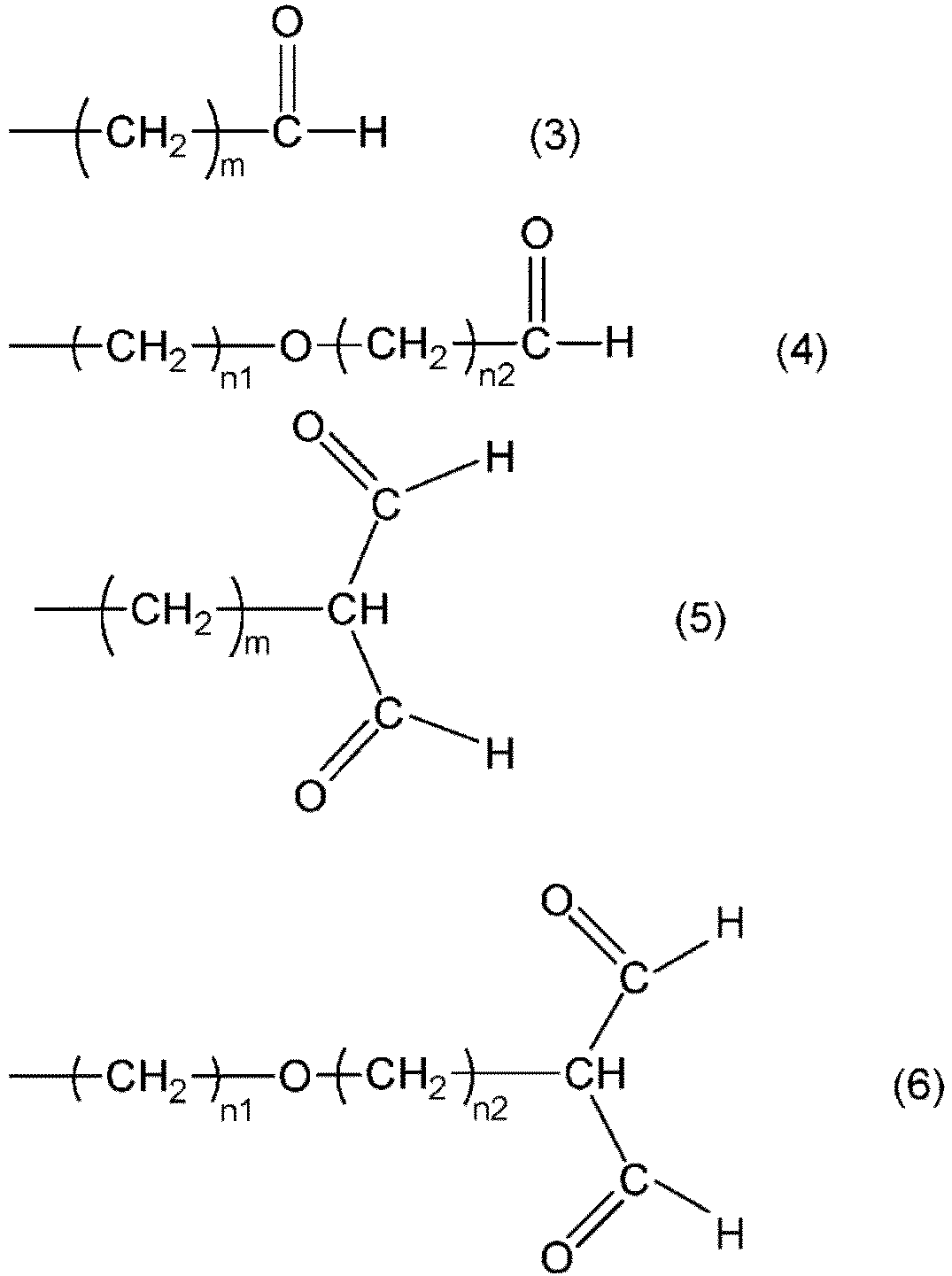
- A is a group selected from the following formulae (3) to (6): wherein, in the formulae (3) to (6), m is independently a number of 2 to 20, preferably 2 to 10, n1 is independently a number of 3 to 8, preferably 3 to 4, n2 is independently a number of 1 to 6, preferably 1 to 3. It is noted that the number of carbon atoms in A does not include the number of carbon atoms in the aldehyde groups or to which the aldehyde groups are bonded.
- aralkyl groups having 7 to 10 carbon atoms include a benzyl group and a phenethyl group.
- R 1 is preferably a methyl group, a butyl group, a phenyl group, or a benzyl group, more preferably a methyl group or a butyl group.
- a is 0 ⁇ a ⁇ 3, preferably 0 ⁇ a ⁇ 1
- b is 0 ⁇ b ⁇ 200, preferably 1 ⁇ b ⁇ 100, more preferably 5 ⁇ b ⁇ 60
- c is 0 ⁇ c ⁇ 1, preferably 0,
- d is 0 ⁇ d ⁇ 1, preferably 0, provided that 1 ⁇ a + b + c + d ⁇ 200, preferably 1 ⁇ a + b + c + d ⁇ 100, more preferably 5 ⁇ a + b + c + d ⁇ 60.
- A' is a linear or branched alkylene group (-R-) or alkyleneoxyalkylene group (-R-O-R-) having 2 to 20 carbon atoms and is an organic group having one or two hydroxymethyl groups at an end thereof.
- alkylene groups having 2 to 20 carbon atoms include an ethylene group, a trimethylene group, a tetramethylene group, a pentamethylene group, a hexamethylene group, a heptamethylene group, an octamethylene group, a nonamethylene group, and a decamethylene group. It is noted that the number of carbon atoms in A' does not include the number of carbon atoms in the hydroxymethyl groups or to which the hydroxymethyl groups are bonded.
- a nitroxyl radical compound is preferably used as an oxidant.
- 2,2,6,6-tetramethylpiperidine N-oxyl, 1-methyl-2-azaadamantane N-oxyl, 2-azaadamantane N-oxyl, 9-azabicyclo[3.3.1]nonane N-oxyl, 9-norazaadamantane N-oxyl, and the like are preferred.
- the amount of oxidant used in the production method of the present invention is not particularly limited and is selected as appropriate depending on the purpose.
- the amount of oxidant used is 1 ⁇ 10 -6 mol to 1 mol, more preferably 1 ⁇ 10 -5 mol to 0.05 mol, most preferably 1 ⁇ 10 -3 mol to 0.05 mol, per mole of hydroxymethyl groups in the carbinol-modified silicone represented by the formula (7).
- a compound known as "reoxidant” which can restore the oxidation ability of the oxidant consumed in the reaction system, be additionally used in combination.
- reoxidants used include peroxy acids, hydrogen peroxide, hypohalous acids and salts thereof, perhalous acids and salts thereof, persulfate salts, halides, halogenating agents such as N-bromosuccinimide, trihalogenated isocyanuric acids such as trichloroisocyanuric acid and tribromoisocyanuric acid, diacetoxyiodoarenes such as (diacetoxyiodo)benzene, dialkyl azodicarboxylates such as diethyl azodicarboxylate, oxygen, air, and mixtures thereof.
- the ratio of the amount of reoxidant used to the amount of oxidant used is preferably 10 to 200 mol, more preferably 20 to 150 mol, per mole of the oxidant.
- the reaction is preferably performed at low temperature so long as the desired reaction proceeds and the productivity is not impaired.
- the reaction is performed at -80°C to 120°C, more preferably 0°C to 40°C.
- reaction time is not particularly limited in the production method of the present invention, the reaction time is preferably 1 to 24 hours, more preferably 2 to 12 hours, most preferably 2 to 4 hours.
- the oxidation reaction in the production method of the present invention may be performed either in the presence of a solvent or in the absence of a solvent, the reaction is preferably performed using a solvent when the oxidant or the reoxidant is solid.
- solvents include aliphatic hydrocarbons such as hexane, heptane, and petroleum ether, aromatic hydrocarbons such as benzene, toluene, and xylene, nitriles such as acetonitrile, propionitrile, and benzonitrile, halogenated hydrocarbons such as dichloromethane, chloroform, 1,2-dichloroethane, and carbon tetrachloride, ethers such as diethyl ether, diisopropyl ether, tetrahydrofuran, dioxane, dimethoxyethane, and diethylene glycol dimethyl ether, amides such as formamide, dimethylformamide, dimethylacetamide, and hexamethylphosphoric triamide, sulfoxides such as dimethyl sulfoxide, esters such as ethyl format
- the solvent is preferably an aliphatic hydrocarbon, an aromatic hydrocarbon, a nitrile, a halogenated hydrocarbon, an ester, a carboxylic acid, water, or a mixture thereof, more preferably dichloromethane, acetonitrile, acetic acid, toluene, ethyl acetate, isopropyl acetate, water, or a mixture thereof, most preferably dichloromethane, a mixed solution of dichloromethane and water, a mixed solution of toluene and water, a mixed solution of ethyl acetate and water, acetonitrile, or acetic acid.
- the production method of the present invention preferably includes, after the oxidation reaction, a quenching step for quenching the oxidant and reoxidant used in the oxidation reaction.
- a quenching step for quenching the oxidant and reoxidant used in the oxidation reaction.
- the addition of this step can inhibit side reactions such as further oxidation of the generated aldehyde groups.
- the quencher used in the quenching step is selected as appropriate depending on the type of oxidant, one example method involves a combined use of a sodium hydrogen carbonate aqueous solution and a sodium thiosulfate aqueous solution as quenchers.
- the quenching step may be replaced by the removal of the oxidant, for example, by treatment with a column packed with silica gel or the like.
- the number average molecular weight is a value obtained by gel permeation chromatography (GPC) analysis using polystyrene as a standard substance under the following conditions:
- the kinematic viscosity is a value measured at 25°C using a Cannon-Fenske viscometer in accordance with JIS Z 8803:2011.
- the refractive index (nD) is a value measured at 25°C using an Abbe refractometer in accordance with JIS K 0062:1992.
- This product was determined by 1 H-NMR to be an aldehyde-modified silicone represented by the following formula (9), and it turned out that yield: 92%, purity: 100%, kinematic viscosity: 38.7 mm 2 /s, refractive index: 1.4091, number average molecular weight: 4,100.
- the 1 H-NMR data for the compound represented by the formula (9) is given below:
Landscapes
- Chemical & Material Sciences (AREA)
- Health & Medical Sciences (AREA)
- Chemical Kinetics & Catalysis (AREA)
- Medicinal Chemistry (AREA)
- Polymers & Plastics (AREA)
- Organic Chemistry (AREA)
- General Chemical & Material Sciences (AREA)
Abstract
Provided are a high-purity aldehyde-modified silicone and a method for producing the aldehyde-modified silicone in which a competitive reaction in which a hydrosilyl group is added to a carbonyl group of an aldehyde does not proceed. An aldehyde-modified silicone having one or two aldehyde groups per molecule is represented by the following formula (1):
[Chem. 1]
(AR1 2SiO1/2)1(R1 3SiO1/2)a(R12SiO2/2)b(R1SiO3/2)c(SiO4/2)d (1)
wherein A is a linear or branched alkylene group (-R-) or alkyleneoxyalkylene group (-R-O-R-) having 2 to 20 carbon atoms and is an organic group having one or two aldehyde groups at an end thereof, R1 is independently a group selected from an alkyl group having 1 to 10 carbon atoms, an aryl group having 6 to 10 carbon atoms, and an aralkyl group having 7 to 10 carbon atoms, a is 0 < a ≤ 3, b is 0 < b ≤ 200, c is 0 ≤ c ≤ 1, and d is 0 ≤ d ≤ 1, provided that 1 ≤ a + b + c + d ≤ 200.
[Chem. 1]
(AR1 2SiO1/2)1(R1 3SiO1/2)a(R12SiO2/2)b(R1SiO3/2)c(SiO4/2)d (1)
wherein A is a linear or branched alkylene group (-R-) or alkyleneoxyalkylene group (-R-O-R-) having 2 to 20 carbon atoms and is an organic group having one or two aldehyde groups at an end thereof, R1 is independently a group selected from an alkyl group having 1 to 10 carbon atoms, an aryl group having 6 to 10 carbon atoms, and an aralkyl group having 7 to 10 carbon atoms, a is 0 < a ≤ 3, b is 0 < b ≤ 200, c is 0 ≤ c ≤ 1, and d is 0 ≤ d ≤ 1, provided that 1 ≤ a + b + c + d ≤ 200.
Description
- The present invention relates to an aldehyde-modified silicone and a method for producing the aldehyde-modified silicone.
- An aldehyde-modified silicone can react and bond with compounds having various polar functional groups such as hydroxy and amino groups. Accordingly, aldehyde-modified silicones have attracted attention as resin modifiers and feel improvers for cosmetics. However, synthesis routes of aldehyde-modified silicones are limited, and there are few examples in which aldehyde-modified silicones are manufactured through a large-scale industrial method.
- As a simple method for producing an aldehyde-modified silicone, the hydrosilylation of an aldehyde containing an unsaturated carbon-carbon bond with a hydrosilyl group-functional siloxane is disclosed (Patent documents 1 and 2). Although this method is desirable in respect of, for example, high versatility of the hydrosilylation reaction, it unintentionally facilitates a competitive reaction in which a hydrosilyl group is added to a carbonyl group of an aldehyde. This results in a decrease in the yield and purity of the target aldehyde-modified silicone.
-
- Patent document 1:
JP-A-2008-505185 - Patent document 2:
JP-A-2009-501837 - Accordingly, an object of the present invention is to provide a high-purity aldehyde-modified silicone and a method for producing the aldehyde-modified silicone in which a competitive reaction in which a hydrosilyl group is added to a carbonyl group of an aldehyde does not proceed.
- The inventor has conducted a series of intensive studies to solve the foregoing problem and has consequently found a method for producing an aldehyde-modified silicone without allowing a competitive reaction in which a hydrosilyl group is added to a carbonyl group of an aldehyde group to proceed by using an oxidation reaction of a primary alcohol without using hydrosilylation, thus completing the present invention.
- That is, the present invention provides the aldehyde-modified silicone and the method for producing the aldehyde-modified silicone as defined below.
-
- <1> An aldehyde-modified silicone having one or two aldehyde groups per molecule, the aldehyde-modified silicone being represented by the following formula (1):
[Chem. 1]
(AR1 2SiO1/2)1(R1 3SiO1/2)a(R1 2SiO2/2)b(R1SiO3/2)c(SiO4/2)d (1)
wherein A is a linear or branched alkylene group (-R-) or alkyleneoxyalkylene group (-R-O-R-) having 2 to 20 carbon atoms and is an organic group having one or two aldehyde groups at an end thereof, R1 is independently a group selected from an alkyl group having 1 to 10 carbon atoms, an aryl group having 6 to 10 carbon atoms, and an aralkyl group having 7 to 10 carbon atoms, a is 0 < a ≤ 3, b is 0 < b ≤ 200, c is 0 ≤ c ≤ 1, and d is 0 ≤ d ≤ 1, provided that 1 ≤ a + b + c + d ≤ 200. - <2> The aldehyde-modified silicone according to <1>, wherein the aldehyde-modified silicone (1) is represented by the following formula (2):


- <3> The aldehyde-modified silicone according to <1> or <2>, wherein A is a group selected from the following formulae (3) to (6):

- <4> A method for producing an aldehyde-modified silicone represented by the following formula (1):
[Chem. 4]
(AR1 2SiO1/2)1(R1 3SiO1/2)a(R1 2SiO2/2)b(R1SiO3/2)c(SiO4/2)d (1)
wherein A is a linear or branched alkylene group (-R-) or alkyleneoxyalkylene group (-R-O-R-) having 2 to 20 carbon atoms and is an organic group having one or two aldehyde groups at an end thereof, R1 is independently a group selected from an alkyl group having 1 to 10 carbon atoms, an aryl group having 6 to 10 carbon atoms, and an aralkyl group having 7 to 10 carbon atoms, a is 0 < a ≤ 3, b is 0 < b ≤ 200, c is 0 ≤ c ≤ 1, and d is 0 ≤ d ≤ 1, provided that 1 ≤ a + b + c + d ≤ 200,
the method comprising oxidizing a hydroxymethyl group of a carbinol-modified silicone to produce the aldehyde-modified silicone, said carbinol-modified silicone being represented by the following formula (7):
[Chem. 5]
(A'R1 2SiO1/2)1(R1 3SiO1/2)a(R1 2SiO2/2)b(R1SiO3/2)c(SiO4/2)d (7)
wherein A' is a linear or branched alkylene group (-R-) or alkyleneoxyalkylene group (-R-O-R-) having 2 to 20 carbon atoms and is an organic group having one or two hydroxymethyl groups at an end thereof, R1 is independently a group selected from an alkyl group having 1 to 10 carbon atoms, an aryl group having 6 to 10 carbon atoms, and an aralkyl group having 7 to 10 carbon atoms, a is 0 < a ≤ 3, b is 0 < b ≤ 200, c is 0 ≤ c ≤ 1, and d is 0 ≤ d ≤ 1, provided that 1 ≤ a + b + c + d ≤ 200. - <5> The method for producing the aldehyde-modified silicone according to [4], wherein the aldehyde-modified silicone (1) is represented by the following formula (2):


- <6> The method for producing the aldehyde-modified silicone according to <4> or <5>, wherein A is a group selected from the following formulae (3) to (6):

- <7> The method for producing the aldehyde-modified silicone according to any one of <4> to <6>, wherein a nitroxyl radical compound is used as an oxidant.
- Because the aldehyde-modified silicone of the present invention is manufactured by using an oxidation reaction of a primary alcohol without using hydrosilylation, a competitive reaction in which a hydrosilyl group is added to a carbonyl group of an aldehyde does not occur. Thus, a high-purity aldehyde-modified silicone can be manufactured in high yield and can be used as a material for resin modifiers and feel improvers for cosmetics.
- The present invention will be described in detail below.
- An aldehyde-modified silicone of the present invention is represented by the following formula (1) and is preferably represented by the following formula (2):

- In the formulae (1) and (2), R1 is independently a group selected from an alkyl group having 1 to 10 carbon atoms, an aryl group having 6 to 10 carbon atoms, and an aralkyl group having 7 to 10 carbon atoms. Examples of alkyl groups having 1 to 10 carbon atoms include alkyl groups such as a methyl group, an ethyl group, a propyl group, and a butyl group; and cycloalkyl groups such as a cyclopentyl group and a cyclohexyl group. Examples of aryl groups having 6 to 10 carbon atoms include a phenyl group, a tolyl group, a xylyl group, and a naphthyl group. Examples of aralkyl groups having 7 to 10 carbon atoms include a benzyl group and a phenethyl group. Of these, R1 is preferably a methyl group, a butyl group, a phenyl group, or a benzyl group, more preferably a methyl group or a butyl group.
- In the formula (1), a is 0 < a ≤ 3, preferably 0 < a ≤ 1, b is 0 < b ≤ 200, preferably 1 ≤ b ≤ 100, more preferably 5 ≤ b ≤ 60, c is 0 ≤ c ≤ 1, preferably 0, and d is 0 ≤ d ≤ 1, preferably 0, provided that 1 ≤ a + b + c + d ≤ 200, preferably 1 ≤ a + b + c + d ≤ 100, more preferably 5 ≤ a + b + c + d ≤ 60.
- In addition, in the formula (2), e is a number of 1 to 150, preferably 1 to 100, more preferably 5 to 60.
- In the formulae (1) and (2), A is a linear or branched alkylene group (-R-) having 2 to 20 carbon atoms or a linear or branched alkyleneoxyalkylene group (-R-O-R-) having 2 to 20 carbon atoms and is an organic group having one or two aldehyde groups at an end thereof. Examples of alkylene groups having 2 to 20 carbon atoms include an ethylene group, a trimethylene group, a tetramethylene group, a pentamethylene group, a hexamethylene group, a heptamethylene group, an octamethylene group, a nonamethylene group, and a decamethylene group. More preferably, A is a group selected from the following formulae (3) to (6):


- A method for producing the aldehyde-modified silicone of the present invention (which may be hereinafter simply referred to as "production method of the present invention") includes a step of oxidizing a hydroxy group of a carbinol-modified silicone represented by the following formula (7).
- The production method of the present invention allows production of the aldehyde-modified silicone of the present invention represented by the above-defined formula (1) or (2).
[Chem. 10]
(A'R1 2SiO1/2)1(R1 3SiO1/2)a(R1 2SiO2/2)b(R1SiO3/2)c(SiO4/2)d (7)
- In the formula (7), R1 is independently a group selected from an alkyl group having 1 to 10 carbon atoms, an aryl group having 6 to 10 carbon atoms, and an aralkyl group having 7 to 10 carbon atoms. Examples of alkyl groups having 1 to 10 carbon atoms include alkyl groups such as a methyl group, an ethyl group, a propyl group, and a butyl group; and cycloalkyl groups such as a cyclopentyl group and a cyclohexyl group. Examples of aryl groups having 6 to 10 carbon atoms include a phenyl group, a tolyl group, a xylyl group, and a naphthyl group. Examples of aralkyl groups having 7 to 10 carbon atoms include a benzyl group and a phenethyl group. Of these, R1 is preferably a methyl group, a butyl group, a phenyl group, or a benzyl group, more preferably a methyl group or a butyl group.
- In the formula (7), a is 0 < a ≤ 3, preferably 0 < a ≤ 1, b is 0 < b ≤ 200, preferably 1 ≤ b ≤ 100, more preferably 5 ≤ b ≤ 60, c is 0 ≤ c ≤ 1, preferably 0, and d is 0 ≤ d ≤ 1, preferably 0, provided that 1 ≤ a + b + c + d ≤ 200, preferably 1 ≤ a + b + c + d ≤ 100, more preferably 5 ≤ a + b + c + d ≤ 60.
- In the formula (7), A' is a linear or branched alkylene group (-R-) or alkyleneoxyalkylene group (-R-O-R-) having 2 to 20 carbon atoms and is an organic group having one or two hydroxymethyl groups at an end thereof. Examples of alkylene groups having 2 to 20 carbon atoms include an ethylene group, a trimethylene group, a tetramethylene group, a pentamethylene group, a hexamethylene group, a heptamethylene group, an octamethylene group, a nonamethylene group, and a decamethylene group. It is noted that the number of carbon atoms in A' does not include the number of carbon atoms in the hydroxymethyl groups or to which the hydroxymethyl groups are bonded.
- In the production method of the present invention, a nitroxyl radical compound is preferably used as an oxidant. In particular, 2,2,6,6-tetramethylpiperidine N-oxyl, 1-methyl-2-azaadamantane N-oxyl, 2-azaadamantane N-oxyl, 9-azabicyclo[3.3.1]nonane N-oxyl, 9-norazaadamantane N-oxyl, and the like are preferred.
- The amount of oxidant used in the production method of the present invention is not particularly limited and is selected as appropriate depending on the purpose. Preferably, the amount of oxidant used is 1 × 10⁻⁶ mol to 1 mol, more preferably 1 × 10⁻⁵ mol to 0.05 mol, most preferably 1 × 10⁻³ mol to 0.05 mol, per mole of hydroxymethyl groups in the carbinol-modified silicone represented by the formula (7).
- In the production method of the present invention, it is preferred that a compound known as "reoxidant", which can restore the oxidation ability of the oxidant consumed in the reaction system, be additionally used in combination. Examples of reoxidants used include peroxy acids, hydrogen peroxide, hypohalous acids and salts thereof, perhalous acids and salts thereof, persulfate salts, halides, halogenating agents such as N-bromosuccinimide, trihalogenated isocyanuric acids such as trichloroisocyanuric acid and tribromoisocyanuric acid, diacetoxyiodoarenes such as (diacetoxyiodo)benzene, dialkyl azodicarboxylates such as diethyl azodicarboxylate, oxygen, air, and mixtures thereof.
- In addition, when the oxidant and the reoxidant are used in combination, the ratio of the amount of reoxidant used to the amount of oxidant used is preferably 10 to 200 mol, more preferably 20 to 150 mol, per mole of the oxidant.
- In the production method of the present invention, the reaction is preferably performed at low temperature so long as the desired reaction proceeds and the productivity is not impaired. Typically, the reaction is performed at -80°C to 120°C, more preferably 0°C to 40°C.
- Although the reaction time is not particularly limited in the production method of the present invention, the reaction time is preferably 1 to 24 hours, more preferably 2 to 12 hours, most preferably 2 to 4 hours.
- Although the oxidation reaction in the production method of the present invention may be performed either in the presence of a solvent or in the absence of a solvent, the reaction is preferably performed using a solvent when the oxidant or the reoxidant is solid.
- When a solvent is used, the type of solvent is not particularly limited as long as the solvent does not interfere with the reaction. Examples of solvents include aliphatic hydrocarbons such as hexane, heptane, and petroleum ether, aromatic hydrocarbons such as benzene, toluene, and xylene, nitriles such as acetonitrile, propionitrile, and benzonitrile, halogenated hydrocarbons such as dichloromethane, chloroform, 1,2-dichloroethane, and carbon tetrachloride, ethers such as diethyl ether, diisopropyl ether, tetrahydrofuran, dioxane, dimethoxyethane, and diethylene glycol dimethyl ether, amides such as formamide, dimethylformamide, dimethylacetamide, and hexamethylphosphoric triamide, sulfoxides such as dimethyl sulfoxide, esters such as ethyl formate, ethyl acetate, propyl acetate, butyl acetate, and diethyl carbonate, carboxylic acids such as acetic acid, formic acid, and propionic acid, sulfolane, and water, and these may be used as a mixture. In particular, the solvent is preferably an aliphatic hydrocarbon, an aromatic hydrocarbon, a nitrile, a halogenated hydrocarbon, an ester, a carboxylic acid, water, or a mixture thereof, more preferably dichloromethane, acetonitrile, acetic acid, toluene, ethyl acetate, isopropyl acetate, water, or a mixture thereof, most preferably dichloromethane, a mixed solution of dichloromethane and water, a mixed solution of toluene and water, a mixed solution of ethyl acetate and water, acetonitrile, or acetic acid.
- The production method of the present invention preferably includes, after the oxidation reaction, a quenching step for quenching the oxidant and reoxidant used in the oxidation reaction. The addition of this step can inhibit side reactions such as further oxidation of the generated aldehyde groups. Although the quencher used in the quenching step is selected as appropriate depending on the type of oxidant, one example method involves a combined use of a sodium hydrogen carbonate aqueous solution and a sodium thiosulfate aqueous solution as quenchers. Alternatively, instead of using these quenchers, the quenching step may be replaced by the removal of the oxidant, for example, by treatment with a column packed with silica gel or the like.
- The present invention will be more specifically described with reference to the Working Examples and the Comparative Examples below. However, modifications can be made as appropriate without departing from the spirit of the present invention. Therefore, the specific examples given below should not be construed as limiting the scope of the present invention.
- The 1H-NMR measurement described in the Working Examples was performed with an AVANCE-III 400 MHz (manufactured by BRUKER) using deuterated chloroform as a solvent and tetramethylsilane (TMS) as a reference substance. The values in parentheses are integral ratios.
- The number average molecular weight is a value obtained by gel permeation chromatography (GPC) analysis using polystyrene as a standard substance under the following conditions:
-
- Developing solvent: tetrahydrofuran (THF)
- Flow rate: 0.6 mL/min
- Detector: differential refractive index detector (RI)
- Column: TSK Guardcolumn Super H-H
- TSKgel Super HM-N (6.0 mm I.D. × 15 cm × 1)
- TSKgel Super H2500 (6.0 mm I.D. × 15 cm × 1)
- (all manufactured by Tosoh Corporation)
- Column temperature: 40°C
- Sample injection volume: 50 µL (THF solution with concentration of 0.3% by mass)
- The kinematic viscosity is a value measured at 25°C using a Cannon-Fenske viscometer in accordance with JIS Z 8803:2011. In addition, the refractive index (nD) is a value measured at 25°C using an Abbe refractometer in accordance with JIS K 0062:1992.
- 19.65 g (1.5 equivalents) of iodobenzene diacetate, 108.00 g of dichloromethane, and 100.00 g (0.04 mol) of a carbinol-modified (primary alcohol group-containing) silicone represented by the following formula (8) were placed into a 500 mL separable flask equipped with a thermometer, a stirrer, a reflux condenser, and a nitrogen gas inlet tube, and then 0.32 g (0.05 equivalents) of 2,2,6,6-tetramethylpiperidine N-oxyl was added with stirring at 25°C in a nitrogen atmosphere, and the mixture was reacted at 23°C for 4 hours. Subsequently, 110.00 g of a saturated aqueous solution of sodium hydrogen carbonate and 16.00 g of a 20% aqueous solution of sodium thiosulfate were added, followed by stirring for 30 minutes. The organic layer was then separated and distilled under reduced pressure at an internal temperature of 50°C to remove low-melting-point substances. Finally, the product was washed twice with 200.00 g of methanol to obtain a light yellow transparent liquid. This product was determined by 1H-NMR to be an aldehyde-modified silicone represented by the following formula (9), and it turned out that yield: 92%, purity: 100%, kinematic viscosity: 38.7 mm2/s, refractive index: 1.4091, number average molecular weight: 4,100. The 1H-NMR data for the compound represented by the formula (9) is given below:
-


- The same procedure as in Working Example 1 above was performed except that the carbinol-modified (primary alcohol group-containing) silicone (8) used in Working Example 1 above was replaced by a carbinol-modified (primary alcohol group-containing) silicone (10) (0.04 mol) to obtain a colorless transparent liquid. This product was determined by 1H-NMR to be an aldehyde-modified silicone represented by the following formula (11), and it turned out that yield: 90%, purity: 100%, kinematic viscosity: 54.3 mm2/s, refractive index: 1.4083, number average molecular weight: 4,300. The 1H-NMR data for the compound represented by the formula (11) is given below:
-

- The same procedure as in Working Example 1 above was performed except that the carbinol-modified (primary alcohol group-containing) silicone (8) used in Working Example 1 above was replaced by a carbinol-modified (primary alcohol group-containing) silicone (12) (0.04 mol) to obtain a colorless transparent liquid. This product was determined by 1H-NMR to be an aldehyde-modified silicone represented by the following formula (13), and it turned out that yield: 88%, purity: 100%, kinematic viscosity: 87.2 mm2/s, refractive index: 1.4077, number average molecular weight: 7,400. The 1H-NMR data for the compound represented by the formula (13) is given below:
-

Claims (7)
- An aldehyde-modified silicone having one or two aldehyde groups per molecule, the aldehyde-modified silicone being represented by the following formula (1):
[Chem. 1]
(AR1 2SiO1/2)1(R1 3SiO1/2)a(R1 2SiO2/2)b(R1SiO3/2)c(SiO4/2)d (1)
wherein A is a linear or branched alkylene group (-R-) or alkyleneoxyalkylene group (-R-O-R-) having 2 to 20 carbon atoms and is an organic group having one or two aldehyde groups at an end thereof, R1 is independently a group selected from an alkyl group having 1 to 10 carbon atoms, an aryl group having 6 to 10 carbon atoms, and an aralkyl group having 7 to 10 carbon atoms, a is 0 < a ≤ 3, b is 0 < b ≤ 200, c is 0 ≤ c ≤ 1, and d is 0 ≤ d ≤ 1, provided that 1 ≤ a + b + c + d ≤ 200. - The aldehyde-modified silicone according to claim 1, wherein the aldehyde-modified silicone (1) is represented by the following formula (2):

- The aldehyde-modified silicone according to claim 1 or 2, wherein A is a group selected from the following formulae (3) to (6):

- A method for producing an aldehyde-modified silicone represented by the following formula (1):
[Chem. 4]
(AR1 2SiO1/2)1(R1 3SiO1/2)a(R1 2SiO2/2)b(R1SiO3/2)c(SiO4/2)d (1)
wherein A is a linear or branched alkylene group (-R-) or alkyleneoxyalkylene group (-R-O-R-) having 2 to 20 carbon atoms and is an organic group having one or two aldehyde groups at an end thereof, R1 is independently a group selected from an alkyl group having 1 to 10 carbon atoms, an aryl group having 6 to 10 carbon atoms, and an aralkyl group having 7 to 10 carbon atoms, a is 0 < a ≤ 3, b is 0 < b ≤ 200, c is 0 ≤ c ≤ 1, and d is 0 ≤ d ≤ 1, provided that 1 ≤ a + b + c + d ≤ 200,the method comprising oxidizing a hydroxymethyl group of a carbinol-modified silicone to produce the aldehyde-modified silicone, said carbinol-modified silicone being represented by the following formula (7):wherein A' is a linear or branched alkylene group (-R-) or alkyleneoxyalkylene group (-R-O-R-) having 2 to 20 carbon atoms and is an organic group having one or two hydroxymethyl groups at an end thereof, R1 is independently a group selected from an alkyl group having 1 to 10 carbon atoms, an aryl group having 6 to 10 carbon atoms, and an aralkyl group having 7 to 10 carbon atoms, a is 0 < a ≤ 3, b is 0 < b ≤ 200, c is 0 ≤ c ≤ 1, and d is 0 ≤ d ≤ 1, provided that 1 ≤ a + b + c + d ≤ 200.
[Chem. 5]
(A'R1 2SiO1/2)1(R1 3SiO1/2)a(R1 2SiO2/2)b(R'SiO3/2)c(SiO4/2)d (7)
- The method for producing the aldehyde-modified silicone according to claim 4, wherein the aldehyde-modified silicone (1) is represented by the following formula (2):

- The method for producing the aldehyde-modified silicone according to claim 4 or 5, wherein A is a group selected from the following formulae (3) to (6):


- The method for producing the aldehyde-modified silicone according to claim 4 or 5, wherein a nitroxyl radical compound is used as an oxidant.
Applications Claiming Priority (2)
| Application Number | Priority Date | Filing Date | Title |
|---|---|---|---|
| JP2022069978 | 2022-04-21 | ||
| PCT/JP2023/015014 WO2023204136A1 (en) | 2022-04-21 | 2023-04-13 | Aldehyde-modified silicone and method for producing same |
Publications (1)
| Publication Number | Publication Date |
|---|---|
| EP4512847A1 true EP4512847A1 (en) | 2025-02-26 |
Family
ID=88420059
Family Applications (1)
| Application Number | Title | Priority Date | Filing Date |
|---|---|---|---|
| EP23791784.4A Pending EP4512847A1 (en) | 2022-04-21 | 2023-04-13 | Aldehyde-modified silicone and method for producing same |
Country Status (4)
| Country | Link |
|---|---|
| EP (1) | EP4512847A1 (en) |
| JP (1) | JPWO2023204136A1 (en) |
| CN (1) | CN119053641A (en) |
| WO (1) | WO2023204136A1 (en) |
Family Cites Families (10)
| Publication number | Priority date | Publication date | Assignee | Title |
|---|---|---|---|---|
| US2920092A (en) * | 1957-12-17 | 1960-01-05 | Union Carbide Corp | Gamma, gamma-diethoxypropyl- and beta-formylethyl-bis(trimethyl-siloxy) methylsilanes |
| US2970150A (en) * | 1957-12-17 | 1961-01-31 | Union Carbide Corp | Processes for the reaction of silanic hydrogen-bonded siloxanes with unsaturated organic compounds with a platinum catalyst |
| FR2636067B1 (en) * | 1988-09-05 | 1990-05-18 | Rhone Poulenc Chimie | PROPANALDEHYDE FUNCTIONAL POLYORGANOSILOXANE AND PROCESS FOR THE PREPARATION THEREOF BY HYDROFORMYLATION |
| FR2645867B1 (en) * | 1989-04-13 | 1991-06-14 | Rhone Poulenc Chimie | PROCESS FOR THE PREPARATION, BY HYDROFORMYLATION, OF POLYORGANOSILOXANE WITH PROPANALDEHYDE FUNCTION |
| US5739246A (en) * | 1997-03-06 | 1998-04-14 | Dow Corning Corporation | Preparation of carbonyl functional polysiloxanes |
| DE10354259A1 (en) * | 2003-11-20 | 2005-06-09 | Wacker-Chemie Gmbh | Process for the preparation of carbonyl radicals containing organosilicon compounds |
| DE05764566T1 (en) | 2004-07-02 | 2008-11-06 | Honeywell International Inc. | FUNCTIONALIZED SILICON CONNECTIONS |
| EP1904557B2 (en) | 2005-07-18 | 2016-02-17 | Dow Corning Corporation | Aldehyde functional siloxanes |
| CN116261565A (en) * | 2020-10-13 | 2023-06-13 | 美国陶氏有机硅公司 | Preparation of organosilicon compounds with aldehyde functional groups |
| US20250122229A1 (en) * | 2021-11-22 | 2025-04-17 | Dow Silicones Corporation | Preparation of organosilicon compounds with carbinol functionality |
-
2023
- 2023-04-13 WO PCT/JP2023/015014 patent/WO2023204136A1/en not_active Ceased
- 2023-04-13 EP EP23791784.4A patent/EP4512847A1/en active Pending
- 2023-04-13 CN CN202380034832.2A patent/CN119053641A/en active Pending
- 2023-04-13 JP JP2024516229A patent/JPWO2023204136A1/ja active Pending
Also Published As
| Publication number | Publication date |
|---|---|
| WO2023204136A1 (en) | 2023-10-26 |
| CN119053641A (en) | 2024-11-29 |
| JPWO2023204136A1 (en) | 2023-10-26 |
Similar Documents
| Publication | Publication Date | Title |
|---|---|---|
| EP2180001B1 (en) | Organosilicon compound having amino group and its production method | |
| JP4663893B2 (en) | Method for producing epoxy compound | |
| JPWO2017150622A1 (en) | Method for producing solution composition containing monoetherified product, solution composition, and method for producing polymerizable compound | |
| WO2023204136A1 (en) | Aldehyde-modified silicone and method for producing same | |
| KR100206530B1 (en) | Process for the preparation of alkylimidazolidone (meth)acrylates | |
| US8552222B2 (en) | Chemical process for the production of haloalkenone ethers | |
| JP3441189B2 (en) | Stabilized alicyclic epoxy-containing (meth) acrylate compound and method for producing the same | |
| JP5754133B2 (en) | Method for producing carboxylic acid tertiary butyl ester | |
| JP4471361B2 (en) | Novel fluoroalkyl group-containing acetylene alcohol and process for producing the same | |
| JP2550644B2 (en) | Cyclic monoperoxyketal | |
| EP0589621A1 (en) | Substituted styrenes | |
| KR0132768B1 (en) | Process for preparing 2-hydroxy ethyl methacrylate | |
| US7335796B2 (en) | Process for the preparation of ketones by ozonolysis | |
| US6710157B2 (en) | Polycarbamates and method for the production thereof | |
| JP3819087B2 (en) | New silane coupling agent | |
| US5508459A (en) | 2-methyldialkoxysilyl propionic acid ester | |
| EP4527840A1 (en) | Organosilicon compound having thioepoxy groups and (meth)allyl group-containing fluorine groups, and method for producing same | |
| EP2617700A1 (en) | Novel fluorinated vinyl ether compound and manufacturing method therefor | |
| JP2000007687A (en) | Phosphonic acid compound having (meth) acrylic group and method for producing the same | |
| JP2003034676A (en) | Method for producing styrene sulfonic acid esters | |
| JP3604461B2 (en) | Cyclohexenylmethyl (meth) acrylate compound, synthetic raw material alcohol compound, and production method thereof | |
| JPS6372650A (en) | Production of carbonic acid ester | |
| JPH10101661A (en) | Acrylamide derivative and method for producing the same | |
| EP4527835A1 (en) | Fluorene compound containing thioepoxy and (meth)allyl groups, and production method therefor | |
| JPH0436291A (en) | Silane compound |
Legal Events
| Date | Code | Title | Description |
|---|---|---|---|
| STAA | Information on the status of an ep patent application or granted ep patent |
Free format text: STATUS: THE INTERNATIONAL PUBLICATION HAS BEEN MADE |
|
| PUAI | Public reference made under article 153(3) epc to a published international application that has entered the european phase |
Free format text: ORIGINAL CODE: 0009012 |
|
| STAA | Information on the status of an ep patent application or granted ep patent |
Free format text: STATUS: REQUEST FOR EXAMINATION WAS MADE |
|
| 17P | Request for examination filed |
Effective date: 20241017 |
|
| AK | Designated contracting states |
Kind code of ref document: A1 Designated state(s): AL AT BE BG CH CY CZ DE DK EE ES FI FR GB GR HR HU IE IS IT LI LT LU LV MC ME MK MT NL NO PL PT RO RS SE SI SK SM TR |
|
| DAV | Request for validation of the european patent (deleted) | ||
| DAX | Request for extension of the european patent (deleted) |