EP4512793A1 - Method for producing fluoroether - Google Patents
Method for producing fluoroether Download PDFInfo
- Publication number
- EP4512793A1 EP4512793A1 EP23791715.8A EP23791715A EP4512793A1 EP 4512793 A1 EP4512793 A1 EP 4512793A1 EP 23791715 A EP23791715 A EP 23791715A EP 4512793 A1 EP4512793 A1 EP 4512793A1
- Authority
- EP
- European Patent Office
- Prior art keywords
- group
- fluorine atom
- substituent
- optionally substituted
- compound represented
- Prior art date
- Legal status (The legal status is an assumption and is not a legal conclusion. Google has not performed a legal analysis and makes no representation as to the accuracy of the status listed.)
- Pending
Links
Classifications
-
- C—CHEMISTRY; METALLURGY
- C07—ORGANIC CHEMISTRY
- C07C—ACYCLIC OR CARBOCYCLIC COMPOUNDS
- C07C41/00—Preparation of ethers; Preparation of compounds having groups, groups or groups
- C07C41/01—Preparation of ethers
- C07C41/05—Preparation of ethers by addition of compounds to unsaturated compounds
- C07C41/06—Preparation of ethers by addition of compounds to unsaturated compounds by addition of organic compounds only
-
- C—CHEMISTRY; METALLURGY
- C07—ORGANIC CHEMISTRY
- C07B—GENERAL METHODS OF ORGANIC CHEMISTRY; APPARATUS THEREFOR
- C07B61/00—Other general methods
-
- C—CHEMISTRY; METALLURGY
- C07—ORGANIC CHEMISTRY
- C07C—ACYCLIC OR CARBOCYCLIC COMPOUNDS
- C07C43/00—Ethers; Compounds having groups, groups or groups
- C07C43/02—Ethers
- C07C43/03—Ethers having all ether-oxygen atoms bound to acyclic carbon atoms
- C07C43/04—Saturated ethers
- C07C43/12—Saturated ethers containing halogen
-
- C—CHEMISTRY; METALLURGY
- C07—ORGANIC CHEMISTRY
- C07C—ACYCLIC OR CARBOCYCLIC COMPOUNDS
- C07C43/00—Ethers; Compounds having groups, groups or groups
- C07C43/02—Ethers
- C07C43/03—Ethers having all ether-oxygen atoms bound to acyclic carbon atoms
- C07C43/14—Unsaturated ethers
- C07C43/17—Unsaturated ethers containing halogen
- C07C43/174—Unsaturated ethers containing halogen containing six-membered aromatic rings
-
- C—CHEMISTRY; METALLURGY
- C07—ORGANIC CHEMISTRY
- C07C—ACYCLIC OR CARBOCYCLIC COMPOUNDS
- C07C2601/00—Systems containing only non-condensed rings
- C07C2601/12—Systems containing only non-condensed rings with a six-membered ring
- C07C2601/16—Systems containing only non-condensed rings with a six-membered ring the ring being unsaturated
Definitions
- the present disclosure relates to a method for producing a fluoroether.
- Fluoroethers that have a fluorinated ⁇ -carbon are useful as a refrigerant, solvent, pharmaceutical, agrochemical, functional material, etc.
- the production method of ⁇ -fluoroethers can be broadly divided into two methods: etherification of a fluorine-containing compound, and fluorination of a hydrocarbon ether.
- the former method has advantages over the latter method in that mild reaction conditions are applicable, no special equipment is necessary, and it is easy to control the fluorine introduction position.
- An example of the former method is reacting a fluoroolefin with an alcohol.
- Known techniques of this method include methods using a strong base such as method 1, which uses KOH (e.g., PTL 1); and methods not using a strong base, such as method 2, which uses a palladium catalyst (e.g., PTL 2), and a method that uses an ionic liquid (e.g., PTL 3).
- a strong base such as method 1, which uses KOH (e.g., PTL 1); and methods not using a strong base, such as method 2, which uses a palladium catalyst (e.g., PTL 2), and a method that uses an ionic liquid (e.g., PTL 3).
- Method 1 has room for improvement in terms of safety and environmental impact.
- Method 2 requires the use of the rare metal palladium, which is expensive and difficult to sustainably use.
- Method 3 requires the use of expensive ionic liquid, which is difficult to handle on an industrial scale.
- a main object of the present disclosure is to provide a method for producing an ⁇ -fluoroether by using a predetermined phosphine and/or amine.
- the present disclosure includes the following aspects.
- R 1 and R 2 each independently represent a fluorine atom, an alkyl group substituted with at least one fluorine atom, or an alkoxy group substituted with at least one fluorine atom.
- step A is performed in the absence of a palladium catalyst or in the presence of a palladium catalyst in an amount of more than 0 mol and 0.01 mol or less, per mole of the compound represented by formula (1).
- step A is performed in the presence of at least one solvent selected from the group consisting of ether solvents, sulfoxide solvents, nitrile solvents, and amide solvents.
- composition comprising a compound represented by the following formula (3): wherein
- the present disclosure provides a method for producing an ⁇ -fluoroether, for example, by using a predetermined phosphine and/or amine.
Landscapes
- Chemical & Material Sciences (AREA)
- Organic Chemistry (AREA)
- Organic Low-Molecular-Weight Compounds And Preparation Thereof (AREA)
- Low-Molecular Organic Synthesis Reactions Using Catalysts (AREA)
Abstract

Description
- The present disclosure relates to a method for producing a fluoroether.
- Fluoroethers that have a fluorinated α-carbon (α-fluoroethers) are useful as a refrigerant, solvent, pharmaceutical, agrochemical, functional material, etc. The production method of α-fluoroethers can be broadly divided into two methods: etherification of a fluorine-containing compound, and fluorination of a hydrocarbon ether. The former method has advantages over the latter method in that mild reaction conditions are applicable, no special equipment is necessary, and it is easy to control the fluorine introduction position. An example of the former method is reacting a fluoroolefin with an alcohol. Known techniques of this method include methods using a strong base such as method 1, which uses KOH (e.g., PTL 1); and methods not using a strong base, such as method 2, which uses a palladium catalyst (e.g., PTL 2), and a method that uses an ionic liquid (e.g., PTL 3).
-
- PTL 1:
US Patent No. 3557294B - PTL 2:
Japanese Patent No. 4009724B - PTL 3:
JP2006-256967A - Method 1 has room for improvement in terms of safety and environmental impact. Method 2 requires the use of the rare metal palladium, which is expensive and difficult to sustainably use. Method 3 requires the use of expensive ionic liquid, which is difficult to handle on an industrial scale.
- A main object of the present disclosure is to provide a method for producing an α-fluoroether by using a predetermined phosphine and/or amine.
- The present disclosure includes the following aspects.
- A method for producing a compound represented by the following formula (3):

- R1 and R2 each independently represent a hydrogen atom, a halogen atom, an alkyl group substituted with at least one fluorine atom, or an alkoxy group substituted with at least one fluorine atom,
- R3 represents a fluorine atom, an alkyl group substituted with at least one fluorine atom, or an alkoxy group substituted with at least one fluorine atom,
- R2 and R3 may be bound together to form a ring, and
- R4 represents an alkyl group optionally substituted with at least one substituent or an aryl group optionally substituted with at least one substituent,
- the method comprising step A of reacting a compound represented by the following formula (1):

- with a compound represented by the following formula (2) :

- in the presence of at least one member selected from the group consisting of
- a compound represented by the following formula (4):

- a compound represented by the following formula (5):

- The production method according to Item 1,
wherein - R5, R6, and R7 each independently represent an alkyl group optionally substituted with at least one substituent, an aryl group optionally substituted with at least one substituent, an alkoxy group optionally substituted with at least one substituent, or an aryloxy group optionally substituted with at least one substituent,
- any two of R5, R6, and R7 may be bound together to form a ring,
- R8, R9, and R10 each independently represent an alkyl group optionally substituted with at least one substituent or an aryl group optionally substituted with at least one substituent, and
- any two or all of R8, R9, and R10 may be bound together to form a ring.
- The production method according to Item 1 or 2, wherein the amount of the at least one member selected from the group consisting of the compound represented by formula (4) and the compound represented by formula (5) is 0.1 mol or less, per mole of the compound represented by formula (1).
- The production method according to any one of Items 1 to 3, wherein R1 and R2 each independently represent a fluorine atom, an alkyl group substituted with at least one fluorine atom, or an alkoxy group substituted with at least one fluorine atom.
- The production method according to any one of Items 1 to 4, wherein one of R1 and R2 is an alkyl group substituted with at least one fluorine atom or an alkoxy group substituted with at least one fluorine atom, and the other is a fluorine atom.
- The production method according to any one of Items 1 to 5, wherein R3 is a fluorine atom.
- The production method according to any one of Items 1 to 6, wherein step A is performed in the absence of a palladium catalyst or in the presence of a palladium catalyst in an amount of more than 0 mol and 0.01 mol or less, per mole of the compound represented by formula (1).
- The production method according to any one of Items 1 to 7, wherein step A is performed in the presence of at least one solvent selected from the group consisting of ether solvents, sulfoxide solvents, nitrile solvents, and amide solvents.
- A composition comprising
a compound represented by the following formula (3):
- R1 and R2 each independently represent a hydrogen atom, a halogen atom, an alkyl group substituted with at least one fluorine atom, or an alkoxy group substituted with at least one fluorine atom,
- R3 represents a fluorine atom, an alkyl group substituted with at least one fluorine atom, or an alkoxy group substituted with at least one fluorine atom,
- R2 and R3 may be bound together to form a ring, and
- R4 represents an alkyl group optionally substituted with at least one substituent or an aryl group optionally substituted with at least one substituent; and
water. - The present disclosure provides a method for producing an α-fluoroether, for example, by using a predetermined phosphine and/or amine.
- The above overview of the present disclosure is not intended to describe each of the disclosed embodiments or all of the implementations of the present disclosure. The following description of the disclosure more specifically exemplifies the embodiments of examples.
- In several parts of the present disclosure, guidance is provided through examples, and these examples can be used in various combinations.
- In each case, the group of examples can function as a non-exclusive and representative group.
- All publications, patents, and patent applications cited herein are incorporated herein by reference in their entirety.
- Unless otherwise specified, the symbols and abbreviations in the present specification can be understood in the context of the present specification in the meanings commonly used in the technical field to which the present disclosure belongs.
- In the present specification, the terms "comprise" and "contain" are used with the intention of including the terms "consisting essentially of" and "consisting of."
- Unless otherwise specified, the steps, treatments, or operations described in the present specification can be performed at room temperature. In the present specification, room temperature can refer to a temperature within the range of 10 to 40°C.
- In the present specification, the phrase "Cn-m" (wherein n and m are each a positive number, n < m) indicates that the number of carbon atoms is n or more and m or less.
- In the present specification, examples of halogen atoms include a fluorine atom, a chlorine atom, a bromine atom, and an iodine atom.
- In the present specification, the "organic group" refers to a group containing at least one carbon atom.
- Examples of organic groups may include
- a hydrocarbon group optionally substituted with at least one substituent,
- a non-aromatic heterocyclic group optionally substituted with at least one substituent,
- a heteroaryl group optionally substituted with at least one substituent,
- a cyano group,
- an aldehyde group,
- a carboxyl group,
RrO-,
RrCO-,
RrCOO-,
RrSO2-,
RrOCO-,
and
RrOSO2-
- wherein, Rr is independently
- a hydrocarbon group optionally substituted with at least one substituent,
- a non-aromatic heterocyclic group optionally substituted with at least one substituent, or
- a heteroaryl group optionally substituted with at least one substituent).
- In the present specification, the hydrocarbon group may be a saturated hydrocarbon group or an unsaturated hydrocarbon group. Examples of hydrocarbon groups include an alkyl group, an alkenyl group, an alkynyl group, a cycloalkyl group, a cycloalkenyl group, a cycloalkadienyl group, an aryl group, and a combination of two or more of these (e.g., an aralkyl group).
- In the present specification, examples of alkyl groups include linear or branched C1-12 alkyl groups, and specific examples thereof include a methyl group, an ethyl group, a propyl group (e.g., an n-propyl group and an isopropyl group), a butyl group (e.g., an n-butyl group, an isobutyl group, a sec-butyl group, and a tert-butyl group), a pentyl group, a hexyl group, a heptyl group, an octyl group, a nonyl group, and a decyl group.
- In the present specification, examples of alkenyl groups include linear or branched C2-20 alkenyl groups, and specific examples thereof include a vinyl group, a 1-propen-1-yl group, a 2-propen-1-yl group, an isopropenyl group, a 2-buten-1-yl group, a 4-penten-1-yl group, and a 5-hexen-1-yl group.
- In the present specification, examples of alkynyl groups include linear or branched C2-20 alkynyl groups, and specific examples thereof include an ethynyl group, a 1-propyn-1-yl group, a 2-propyn-1-yl group, a 4-pentyn-1-yl group, and a 5-hexyn-1-yl group.
- In the present specification, examples of cycloalkyl groups include C3-10 cycloalkyl groups, and specific examples thereof include a cyclopropyl group, a cyclobutyl group, a cyclopentyl group, a cyclohexyl group, and a cycloheptyl group.
- In the present specification, examples of cycloalkenyl groups include C3-10 cycloalkenyl groups, and specific examples thereof include a cyclopropenyl group, a cyclobutenyl group, a cyclopentenyl group, a cyclohexenyl group, and a cycloheptenyl group.
- In the present specification, examples of cycloalkadienyl groups include C4-10 cycloalkadienyl groups, and specific examples thereof include a cyclobutadienyl group, a cyclopentadienyl group, a cyclohexadienyl group, and a cycloheptadienyl group.
- In the present specification, the aryl group may be a monocyclic or polycyclic (e.g., bicyclic, tricyclic, or quadracyclic) aryl group. Examples of aryl groups include C6-14 aryl groups, and specific examples thereof include a phenyl group, a 1-naphthyl group, a 2-naphthyl group, a 2-biphenyl group, a 3-biphenyl group, a 4-biphenyl group, and a 2-anthryl group.
- In the present specification, the heteroaryl group includes monocyclic aromatic heterocyclic groups (e.g., 5- or 6-membered monocyclic aromatic heterocyclic groups) and aromatic condensed heterocyclic groups (e.g., 5- to 18-membered aromatic condensed heterocyclic groups).
- In the present specification, examples of 5- or 6-membered monocyclic aromatic heterocyclic groups include pyrrolyl (e.g., 1-pyrrolyl, 2-pyrrolyl, and 3-pyrrolyl), furyl (e.g., 2-furyl and 3-furyl), thienyl (e.g., 2-thienyl and 3-thienyl), pyrazolyl (e.g., 1-pyrazolyl, 3-pyrazolyl, and 4-pyrazolyl), imidazolyl (e.g., 1-imidazolyl, 2-imidazolyl, and 4-imidazolyl), isoxazolyl (e.g., 3-isoxazolyl, 4-isoxazolyl, and 5-isoxazolyl), oxazolyl (e.g., 2-oxazolyl, 4-oxazolyl, and 5-oxazolyl), isothiazolyl (e.g., 3-isothiazolyl, 4-isothiazolyl, and 5-isothiazolyl), thiazolyl (e.g., 2-thiazolyl, 4-thiazolyl, and 5-thiazolyl), triazolyl (e.g., 1,2,3-triazol-4-yl and 1,2,4-triazol-3-yl), oxadiazolyl (e.g., 1,2,4-oxadiazol-3-yl and 1,2,4-oxadiazol-5-yl), thiadiazolyl (e.g., 1,2,4-thiadiazol-3-yl and 1,2,4-thiadiazol-5-yl), tetrazolyl, pyridyl (e.g., 2-pyridyl, 3-pyridyl, and 4-pyridyl), pyridazinyl (e.g., 3-pyridazinyl and 4-pyridazinyl), pyrimidinyl (e.g., 2-pyrimidinyl, 4-pyrimidinyl, and 5-pyrimidinyl), and pyrazinyl.
- In the present specification, examples of 5- to 18-membered aromatic condensed heterocyclic groups include isoindolyl (e.g., 1-isoindolyl, 2-isoindolyl, 3-isoindolyl, 4-isoindolyl, 5-isoindolyl, 6-isoindolyl, and 7-isoindolyl), indolyl (e.g., 1-indolyl, 2-indolyl, 3-indolyl, 4-indolyl, 5-indolyl, 6-indolyl, and 7-indolyl), benzo[b]furanyl (e.g., 2-benzo[b]furanyl, 3-benzo[b]furanyl, 4-benzo[b]furanyl, 5-benzo[b]furanyl, 6-benzo[b]furanyl, and 7-benzo[b]furanyl), benzo[c]furanyl (e.g., 1-benzo[c]furanyl, 4-benzo[c]furanyl, and 5-benzo[c]furanyl), benzo[b]thienyl (e.g., 2-benzo[b]thienyl, 3-benzo[b]thienyl, 4-benzo[b]thienyl, 5-benzo[b]thienyl, 6-benzo[b]thienyl, and 7-benzo[b]thienyl), benzo[c]thienyl (e.g., 1-benzo[c]thienyl, 4-benzo[c]thienyl, and 5-benzo[c]thienyl), indazolyl (e.g., 1-indazolyl, 2-indazolyl, 3-indazolyl, 4-indazolyl, 5-indazolyl, 6-indazolyl, and 7-indazolyl), benzimidazolyl (e.g., 1-benzimidazolyl, 2-benzimidazolyl, 4-benzimidazolyl, and 5-benzimidazolyl), 1,2-benzisoxazolyl (e.g., 1,2-benzisoxazol-3-yl, 1,2-benzisoxazol-4-yl, 1,2-benzisoxazol-5-yl, 1,2-benzisoxazol-6-yl, and 1,2-benzisoxazol-7-yl), benzoxazolyl (e.g., 2-benzoxazolyl, 4-benzoxazolyl, 5-benzoxazolyl, 6-benzoxazolyl, and 7-benzoxazolyl), 1,2-benzisothiazolyl (e.g., 1,2-benzisothiazol-3-yl, 1,2-benzisothiazol-4-yl, 1,2-benzisothiazol-5-yl, 1,2-benzisothiazol-6-yl, and 1,2-benzisothiazol-7-yl), benzothiazolyl (e.g., 2-benzothiazolyl, 4-benzothiazolyl, 5-benzothiazolyl, 6-benzothiazolyl, and 7-benzothiazolyl), isoquinolyl (e.g., 1-isoquinolyl, 3-isoquinolyl, 4-isoquinolyl, and 5-isoquinolyl), quinolyl (e.g., 2-quinolyl, 3-quinolyl, 4-quinolyl, 5-quinolyl, and 8-quinolyl), cinnolinyl (e.g., 3-cinnolinyl, 4-cinnolinyl, 5-cinnolinyl, 6-cinnolinyl, 7-cinnolinyl, and 8-cinnolinyl), phthalazinyl (e.g., 1-phthalazinyl, 4-phthalazinyl, 5-phthalazinyl, 6-phthalazinyl, 7-phthalazinyl, and 8-phthalazinyl), quinazolinyl (e.g., 2-quinazolinyl, 4-quinazolinyl, 5-quinazolinyl, 6-quinazolinyl, 7-quinazolinyl, and 8-quinazolinyl), quinoxalinyl (e.g., 2-quinoxalinyl, 3-quinoxalinyl, 5-quinoxalinyl, 6-quinoxalinyl, 7-quinoxalinyl, and 8-quinoxalinyl), pyrazolo[1,5-a]pyridyl (e.g., pyrazolo[1,5-a]pyridin-2-yl, pyrazolo[1,5-a]pyridin-3-yl, pyrazolo[1,5-a]pyridin-4-yl, pyrazolo[1,5-a]pyridin-5-yl, pyrazolo[1,5-a]pyridin-6-yl, and pyrazolo[1,5-a]pyridin-7-yl), imidazo[1,2-a]pyridyl (e.g., imidazo[1,2-a]pyridin-2-yl, imidazo[1,2-a]pyridin-3-yl, imidazo[1,2-a]pyridin-5-yl, imidazo[1,2-a]pyridin-6-yl, imidazo[1,2-a]pyridin-7-yl, and imidazo[1,2-a]pyridin-8-yl).
- In the present specification, -CH2- that can be present in the hydrocarbon group of the "hydrocarbon group optionally substituted with at least one substituent" may be replaced with -O-, -S-, or -NH-. Examples of substituents for the hydrocarbon group include a halogen atom, a hydroxy group, a mercapto group, an amino group, a nitro group, and a cyano group. If the hydrocarbon group has substituents, the number of substituents can be selected from one to the maximum number of substituents possible, such as one, two, three, four, or five. If the number of substituents is two or more, the substituents may be identical or different from each other.
- In the present specification, examples of substituents for the alkyl group optionally substituted with at least one substituent include a halogen atom, a hydroxy group, RAO- (wherein RA represents an alkyl group or an aryl group), (RB)2N- (wherein each RB independently represents a hydrogen atom, an alkyl group, or an aryl group), (RC)2P- (wherein each Rc independently represents a hydrogen atom, an alkyl group, or an aryl group), and a combination of two or more of these (e.g., a haloalkoxy group). If the alkyl group has substituents, the number of substituents can be selected from one to the maximum number of substituents possible, such as one, two, three, four, or five. If the number of substituents is two or more, the substituents may be identical or different from each other.
- Examples of alkyl groups optionally substituted with at least one substituent include alkyl groups optionally substituted with at least one fluorine atom. The alkyl group substituted with at least one fluorine atom may be referred to as a "fluoroalkyl group." The fluoroalkyl group may be a perfluoroalkyl group or non-perfluoroalkyl group. Examples of fluoroalkyl groups include linear or branched C1-12 fluoroalkyl groups, and specific examples thereof include linear or branched C1-12 fluoroalkyl groups, such as a trifluoromethyl group, a perfluoroethyl group, a perfluoropropyl group (e.g., a perfluoro-n-propyl group, and a perfluoroisopropyl group), a perfluorobutyl group, a perfluoropentyl group, and a perfluorohexyl group. The alkyl group includes those having at least one substituent other than a fluorine atom (e.g., a fluoroalkoxy group), such as CF3-O-CF2-, CF3-O-CF(CF3)-, CF3-O-CH2-CH2-, CF3-O-CH(CF3)-CH2-, CF3-O-CF2-CF2-, CF3-CF2-O-CF2-, CF3-CF2-O-CF2-CF2-, CF3-O-CF2-O-CF2-, CF3-CF2-CF2-O-CH2-CF2-, CF3-CF2-CF2-O-CF2-CF2-, CF3-CF2-CF2-O-CF(CF3)-CF2-, CF3-CF2-CF2-O-CF(CF3)-CF2-O-CF(CF3)-CF2-, and CF3-CF2-CF2-O-[CF(CF3)-CF2-O-]2-CF(CF3)-CF2-.
- In the present specification, examples of substituents for the aryl group optionally substituted with at least one substituent include a halogen atom, a hydroxy group, an alkyl group, RAO- (wherein RA represents an alkyl group or an aryl group), (RB)2N- (wherein each RB independently represents a hydrogen atom, an alkyl group, or an aryl group), (RC)2P- (wherein each RC independently represents a hydrogen atom, an alkyl group, or an aryl group), and a combination of two or more of these (e.g., a haloalkyl group). If the aryl group has substituents, the number of substituents can be selected from one to the maximum number of substituents possible, such as one, two, three, four, or five. If the number of substituents is two or more, the substituents may be identical or different from each other.
- In the present specification, examples of alkoxy groups include linear or branched C1-12 alkoxy groups, and specific examples thereof include a methoxy group, an ethoxy group, a propoxy group (e.g., an n-propoxy group and an isopropoxy group), a butoxy group, a pentyloxy group, and a hexyloxy group.
- In the present specification, examples of substituents for the alkoxy group optionally substituted with at least one substituent include a halogen atom, a hydroxy group, an alkyl group, an alkoxy group, and a combination of two or more of these (e.g., a haloalkyl group and a haloalkoxy group). If the alkoxy group has substituents, the number of substituents can be selected from one to the maximum number of substituents possible, such as one, two, three, four, or five. If the number of substituents is two or more, the substituents may be identical or different from each other.
- Examples of alkoxy groups optionally substituted with at least one substituent include alkoxy groups optionally substituted with at least one fluorine atom. The alkoxy group substituted with at least one fluorine atom may be referred to as a "fluoroalkoxy group." The fluoroalkoxy group may be a perfluoroalkoxy group or a non-perfluoroalkoxy group. Examples of fluoroalkoxy groups include linear or branched C1-12 fluoroalkoxy groups, and specific examples thereof include linear or branched C1-12 fluoroalkoxy groups, such as a perfluoromethoxy group, a perfluoroethoxy group, a perfluoropropoxy group (e.g., a perfluoro-n-propoxy group and a perfluoroisopropoxy group), a perfluorobutoxy group, a perfluoropentyloxy group, and a perfluorohexyloxy group. The alkoxy group includes those having at least one substituent other than a fluorine atom (e.g., a fluoroalkoxy group), such as CF3-O-CF2-O-, CF3-O-CF2-CF2-CF2-O-, CF3-O-CH2-CF2-CF2-O-, CF3-CF2-O-CF2-CF2-O-, CF3-CF2-CF2-O-CH2-CF2-CF2-O-, CF3-CF2-CF2-O-CF2-CF2-CF2-O-, CF3-CF2-CF2-O-CF(CF3)-CF2-O-, CF3-CF2-CF2-O-[CF(CF3)-CF2-O-]2-, and CF3-CF2-CF2-O-[CF(CF3)-CF2-O-]3-.
- In the present specification, examples of aryloxy groups include C6-12 aryloxy groups, and specific examples thereof include a phenoxy group and a naphthoxy group.
- In the present specification, examples of substituents for the aryloxy group optionally substituted with at least one substituent include a halogen atom, a hydroxy group, an alkyl group, an alkoxy group, and a combination of two or more of these (e.g., a haloalkyl group and a haloalkoxy group). If the aryloxy group has substituents, the number of substituents can be selected from one to the maximum number of substituents possible, such as one, two, three, four, or five. If the number of substituents is two or more, the substituents may be identical or different from each other.
- In an embodiment of the present disclosure, a method for producing a compound represented by the following formula (3) :

- R1 and R2 each independently represent a hydrogen atom, a halogen atom, an alkyl group substituted with at least one fluorine atom, or an alkoxy group substituted with at least one fluorine atom,
- R3 represents a fluorine atom, an alkyl group substituted with at least one fluorine atom, or an alkoxy group substituted with at least one fluorine atom,
- R2 and R3 may be bound together to form a ring, and
- R4 represents an alkyl group optionally substituted with at least one substituent or an aryl group optionally substituted with at least one substituent,
- comprises step A of reacting a compound represented by the following formula (1):

- with a compound represented by the following formula (2) :

- in the presence of at least one member selected from the group consisting of
- a compound represented by the following formula (4):

- a compound represented by the following formula (5):

- R1 and R2 each independently represent preferably a halogen atom, an alkyl group substituted with at least one fluorine atom, or an alkoxy group substituted with at least one fluorine atom, more preferably a fluorine atom, an alkyl group substituted with at least one fluorine atom, or an alkoxy group substituted with at least one fluorine atom, and still more preferably a fluorine atom or an alkyl group substituted with at least one fluorine atom.
- R1 and R2 may both be a halogen atom (e.g., one is a chlorine atom or a bromine atom, and the other is a fluorine atom), or R1 and R2 may both be an alkyl group substituted with at least one fluorine atom or an alkoxy group substituted with at least one fluorine atom; however, it is preferred that one of R1 and R2 be an alkyl group substituted with at least one fluorine atom or an alkoxy group substituted with at least one fluorine atom, with the other being a fluorine atom. In particular, it is preferred that one of R1 and R2 be an alkyl group substituted with at least one fluorine atom, with the other being a fluorine atom.
- If R1 or R2 is an alkyl group substituted with at least one fluorine atom, the alkyl group substituted with at least one fluorine atom is preferably a C1-10 fluoroalkyl group, such as a trifluoromethyl group, a perfluoroethyl group, a perfluoropropyl group, or a perfluorobutyl group, or a (C1-4 fluoroalkoxy) C1-4 fluoroalkyl group, such as CF3-O-CF2- or CF3-O-(CF2)2-. If R1 or R2 is an alkoxy group substituted with at least one fluorine atom, the alkoxy group substituted with at least one fluorine atom is preferably a C1-10 fluoroalkoxy group, such as a trifluoromethoxy group, a perfluoroethoxy group, a perfluoropropoxy group, or a perfluorobutoxy group, or a (C1-4 fluoroalkoxy) C1-4 fluoroalkoxy group, such as CF3-O-CF2-O- or CF3-O-(CF2)2-O-.
- R3 is preferably a fluorine atom or an alkyl group substituted with at least one fluorine atom, more preferably a fluorine atom, a C1-10 fluoroalkyl group, or a (C1-4 fluoroalkoxy) C1-4 fluoroalkyl group, and still more preferably a fluorine atom.
- If R2 and R3 are bound together to form a ring, examples of rings include cyclobutene, cyclopentene, cyclohexene, cycloheptene, and cyclooctene. The ring may have at least one substituent (e.g., a halogen atom, such as a fluorine atom).
- A preferred example of R4 is an alkyl group optionally substituted with at least one substituent, and R4 is more preferably a group represented by the following formula (A):

- The group represented by formula (A) may be any of the following (A-1) to (A-5):
- (A-1) R4a and R4b are both a hydrogen atom,
- (A-2) R4a is a hydrogen atom, and R4b is an alkyl group optionally substituted with at least one substituent or an aryl group optionally substituted with at least one substituent,
- (A-3) R4a and R4b are both an alkyl group optionally substituted with at least one substituent,
- (A-4) R4a is an alkyl group optionally substituted with at least one substituent, and R4b is an aryl group optionally substituted with at least one substituent, and
- (A-5) R4a and R4b are both an aryl group optionally substituted with at least one substituent.
- If R4a and/or R4b is an alkyl group, the alkyl group may be, for example, a C1-10 alkyl group, and may be substituted with at least one (e.g., one, two, three, four, or five) substituent selected from the group consisting of a halogen atom (e.g., a fluorine atom), RAO-, (RB)2N-, (RC)2P-, an aryl group (e.g., a C6-12 aryl group, such as a phenyl group), and a combination of two or more of these.
- If R4a and/or R4b is an aryl group, the aryl group may be, for example, a C6-12 alkyl group, such as a phenyl group and may be substituted with at least one (e.g., one, two, three, four, or five) substituent selected from the group consisting of a halogen atom, an alkyl group (e.g., a C1-10 alkyl group), RAO-, (RB)2N-, (RC)2P-, and a combination of two or more of these.
- Another preferred example of R4 is an aryl group optionally substituted with at least one substituent. R4 is more preferably a C6-12 aryl group optionally substituted with at least one substituent, and still more preferably a phenyl group optionally substituted with at least one substituent. The aryl group may be substituted with, for example, at least one (e.g., one, two, three, four, or five) substituent selected from the group consisting of a halogen atom, an alkyl group (e.g., a C1-10 alkyl group), RAO-, (RB)2N-, (RC)2P-, and a combination of two or more of these.
- The amount of the compound represented by formula (2) for use is, although not limited to, for example, 0.1 mol or more, 0.2 mol or more, 0.3 mol or more, 0.4 mol or more, or 0.5 mol or more, and 5 mol or less, 4 mol or less, 3 mol or less, 2 mol or less, 1.5 mol or less, or 1 mol or less, or may be a substantially equimolar amount, such as 0.5 to 1.5 mol, per mole of the compound represented by formula (1).
- R5, R6, and R7 each independently represent preferably a hydrocarbon group optionally substituted with at least one substituent, a heteroaryl group optionally substituted with at least one substituent (e.g., a furyl group and a thienyl group), or RX-O- (wherein RX represents a hydrocarbon group optionally substituted with at least one substituent); more preferably a hydrocarbon group optionally substituted with at least one substituent or RX-O-; still more preferably an alkyl group optionally substituted with at least one substituent, a cycloalkyl group optionally substituted with at least one substituent, an aryl group optionally substituted with at least one substituent, an alkoxy group optionally substituted with at least one substituent, or an aryloxy group optionally substituted with at least one substituent; yet more preferably an alkyl group optionally substituted with at least one substituent, an aryl group optionally substituted with at least one substituent, an alkoxy group optionally substituted with at least one substituent, or an aryloxy group optionally substituted with at least one substituent; and particularly preferably a C1-6 alkyl group optionally substituted with at least one substituent, a C6-12 aryl group optionally substituted with at least one substituent (e.g., a phenyl group, a tolyl group, and a biphenyl group), a C1-6 alkoxy group optionally substituted with at least one substituent, or a C6-12 aryloxy group optionally substituted with at least one substituent (e.g., a phenoxy group). Preferred examples of substituents include a halogen atom, RAO-, and (RC)2P-, and more preferred examples include a C1-4 alkoxy group, such as a methoxy group, and a C6-12 diarylphosphino group, such as a diphenylphosphino group.
- If any two of R5, R6, and R7 are bound together to form a ring, the ring is, for example, a phosphetane, phosphorane, phosphorinan, or phosphepane.
- Although the compound represented by formula (4) may be a phosphine ligand capable of coordinating to a transition metal (e.g., Pd), the production method of the present disclosure can be suitably performed in the absence of, or substantially in the absence of, a transition metal.
- Examples of the compound represented by formula (4) include tri-n-butylphosphine, tri-t-butylphosphine, di-t-butylphenylphosphine, methyl diphenylphosphine, ethyl diphenylphosphine, isopropyl diphenylphosphine, 2-(di-t-butylphosphino)biphenyl, bis(diphenylphosphino)methane, 1,2-bis(diphenylphosphino)ethane, 1,3-bis(diphenylphosphino)propane, 1,4-bis(diphenylphosphino)butane, 1,5-bis(diphenylphosphino)pentane, 1,6-bis(diphenylphosphino)hexane, tricyclohexylphosphine, dicyclohexylphenylphosphine, dicyclohexyl(2',4',6'-triisopropyl-[1,1'-biphenyl]-2-yl)phosphine (XPhos), triphenylphosphine, 4-(dimethylamino)phenyl diphenylphosphine, tritolylphosphine, tris(4-fluorophenyl)phosphine, tris[3,5-bis(trifluoromethyl)phenyl]phosphine, tris(4-methoxyphenyl)phosphine, tris(2,6-dimethoxyphenyl)phosphine, 2-(diphenylphosphino)biphenyl, 2-diphenylphosphino-2'-methoxy-1,1'-binaphthyl, 2,2'-bis(diphenylphosphino)-1,1'-binaphthyl, bis [2-(diphenylphosphino)phenyl]ether, tri(2-furyl)phosphine, tri(2-thienyl)phosphine, triphenyl phosphite, triethyl phosphite, and triisopropyl phosphite.
- R8, R9, and R10 each independently represent preferably a hydrocarbon group optionally substituted with at least one substituent or a heteroaryl group optionally substituted with at least one substituent (e.g., a pyridyl group); more preferably a hydrocarbon group optionally substituted with at least one substituent; still more preferably an alkyl group optionally substituted with at least one substituent, a cycloalkyl group optionally substituted with at least one substituent, or an aryl group optionally substituted with at least one substituent; yet more preferably an alkyl group optionally substituted with at least one substituent or an aryl group optionally substituted with at least one substituent; and particularly preferably a C1-6 alkyl group optionally substituted with at least one substituent or a C6-12 aryl group optionally substituted with at least one substituent (e.g., a phenyl group). Preferred examples of substituents include RAO-, (RB)2N-, and (RC)2P-, and more preferred examples of substituents include a C1-4 alkoxy group, such as a methoxy group, a C1-4 dialkylamino group, such as a dimethylamino group, and a C6-12 diarylphosphino group, such as a diphenylphosphino group.
- If any two or all of R8, R9, and R10 are bound together to form a ring, the ring is, for example, pyridine, imidazole, morpholine, diazabicyclononene, or diazabicycloundecene.
- Although the compound represented by formula (5) may be an amine ligand capable of coordinating to a transition metal (e.g., Pd), the production method of the present disclosure can be suitably performed in the absence of, or substantially in the absence of, a transition metal.
- Examples of the compound represented by formula (5) include triethylamine, diisopropylethylamine, tri-n-propylamine, triisopropylamine, pyridine, 4-dimethylaminopyridine, 1-methylimidazole, N,N,N,N-tetramethyl-1,3-diaminopropane, N,N,N,N-tetraethylethylenediamine, N,N,N,N-tetramethyl-1,4-diaminobutane, 1-(diphenylphosphino)-N,N-dimethyl-2-propaneamine, diazabicyclononene, and diazabicycloundecene.
- The amount of the at least one member selected from the group consisting of the compound represented by formula (4) and the compound represented by formula (5) for use is, although not limited to, preferably a catalytic amount. Specifically, the amount is preferably 0.5 mol or less, more preferably 0.4 mol or less, still more preferably 0.3 mol or less, yet more preferably 0.2 mol or less, and particularly preferably 0.1 mol or less, per mole of the compound represented by formula (1). The amount may be, for example, 0.0001 mol or more, 0.0005 mol or more, or 0.001 mol or more, or within the range of 0.0001 to 0.5 mol, 0.0005 to 0.2 mol, or 0.001 to 0.1 mol, per mole of the compound represented by formula (1).
- Step A is preferably performed in the presence of a solvent. Examples of solvents include hydrocarbon solvents, halogen solvents, ether solvents, nitrile solvents, amide solvents, ketone solvents, and sulfoxide solvents.
- Examples of hydrocarbon solvents include aliphatic hydrocarbon solvents, such as hexane, heptane, octane, nonane, and decane, and aromatic hydrocarbon solvents, such as benzene, toluene, and xylene.
- Examples of halogen solvents include dichloromethane, dichloroethane, chloroform, and chlorobenzene.
- Examples of ether solvents include diethyl ether, diisopropyl ether, ethylene glycol dimethyl ether (DME), diethylene glycol dimethyl ether (diglyme), triethylene glycol dimethyl ether (triglyme), tetraethylene glycol dimethyl ether (tetraglyme), 1,4-dioxane, and tetrahydrofuran.
- Examples of nitrile solvents include acetonitrile, propionitrile, and benzonitrile.
- Examples of amide solvents include formamide, N,N-dimethylformamide, and N-methylpyrrolidone.
- Examples of ketone solvents include acetone, and methyl ethyl ketone.
- Examples of sulfoxide solvents include dimethyl sulfoxide.
- Of these solvents, at least one member selected from the group consisting of ether solvents, sulfoxide solvents, nitrile solvents, and amide solvents is preferable.
- The amount of the solvent for use may be, although not limited to, for example, 0.1 mL or more, 0.15 mL or more, 0.2 mL or more, 0.25 mL or more, 0.5 mL or more, 1 mL or more, or 1.5 mL or more, and 5 mL or less, 3 mL or less, 2.5 mL or less, or 2 mL or less, and may be within the range of 0.2 mL to 3 mL, per millimole of the compound represented by formula (2).
- Step A is preferably performed in the absence of a transition metal catalyst or in the presence of a transition metal catalyst in an amount of more than 0 mol and 0.01 mol or less, per mole of the compound represented by formula (1). The transition metal catalyst may be, for example, palladium. In an embodiment, step A is performed in the absence of a palladium catalyst or in the presence of a palladium catalyst in an amount of more than 0 mol and 0.01 mol or less, per mole of the compound represented by formula (1).
- Step A is preferably performed in the absence of an inorganic base or in the presence of an inorganic base in an amount of more than 0 mol and 2 mol or less, per mole of the compound represented by formula (2). Examples of inorganic bases include alkali metal hydroxides, such as KOH and NaOH, and alkaline earth metal hydroxides, such as Ca(OH)2. In an embodiment, step A is preferably performed in the absence of an alkali metal hydroxide or alkaline earth metal hydroxide or in the presence of an alkali metal hydroxide or alkaline earth metal hydroxide in an amount of more than 0 mol and 2 mol or less, per mole of the compound represented by formula (2).
- Step A is preferably performed in the absence of an ionic liquid or in the presence of an ionic liquid in an amount of more than 0 mL and less than 0.1 mL, per mole of the compound represented by formula (1). Examples of ionic liquids include imidazolium salts, such as 1-ethyl-3-methylimidazolium hexafluorophosphate and 1-butyl-3-methylimidazolium chloride, and pyridinium salts. In an embodiment, step A is preferably performed in the absence of an imidazolium salt or a pyridinium salt or in the presence of an imidazolium salt or a pyridinium salt in an amount of more than 0 mL and less than 0.1 mL, per mole of the compound represented by formula (1).
- The reaction temperature and reaction time of step A are not limited as long as the reaction proceeds. The reaction temperature may be, for example, 0°C to 60°C. The reaction time may be within the range of, for example, 10 minutes to 72 hours, and preferably 15 minutes to 48 hours.
- The composition according to an embodiment of the present disclosure contains the compound represented by formula (3) and water. The amount of the compound represented by formula (3) may be, although not limited to, for example, 60 parts by mass or more, 65 parts by mass or more, 70 parts by mass or more, or 73 parts by mass or more, and less than 100 parts by mass, 99.99 parts by mass or less, 99.9 parts by mass or less, 99 parts by mass or less, or 95 parts by mass or less, or may be within the range of 60 to 95 parts by mass, per 100 parts by mass of the composition. The amount can be measured, for example, according to 1H-NMR, gas chromatography (GC), or gas chromatography-mass spectrometry (GC-MS).
- The amount of water may be, although not limited to, for example, 0.3 parts by mass or less, 0.2 parts by mass or less, 0.1 parts by mass or less, 0.05 parts by mass or less, 0.02 parts by mass or less, 0.01 parts by mass or less, or 0.001 parts by mass or less, and more than 0 parts by mass, 0.0001 parts by mass or more, 0.0002 parts by mass or more, or 0.0003 parts by mass or more, or may be within the range of 0.0003 to 0.001 parts by mass, per 100 parts by mass of the composition or per 100 parts by mass of the compound represented by formula (3). The amount can be measured, for example, according to the Karl Fischer method.
- The composition may further contain other optional components. Examples of other optional components include byproducts from the reaction in step A.
- The following describes in more detail an embodiment of the present disclosure with reference to Examples. However, the disclosure is not limited to these Examples.
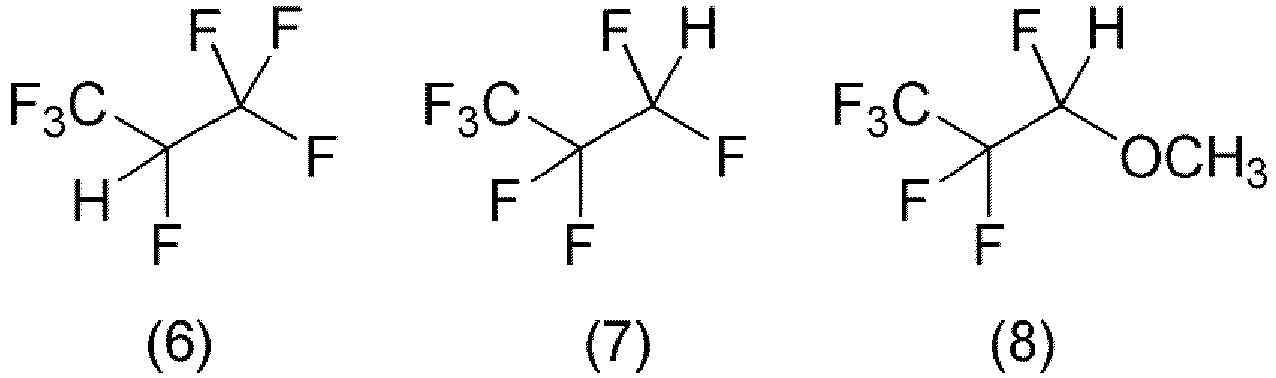
- In a nitrogen atmosphere, 2.0 mg of triphenylphosphine, 1.17 g of methanol, and 18 mL of acetonitrile were added to a 30 mL autoclave. The autoclave was depressurized at 0°C, and 5 g of 1,1,1,2,3,3-hexafluoropropene was added thereto, followed by stirring at room temperature for 19 hours. 200 mg of hexafluorobenzene (internal standard) was added to the autoclave, and analysis was performed according to 19F NMR, which found the formation of a fluoroether represented by formula (3-1) in a yield of 89%. After extraction with perfluorohexane, the solvent was distilled off, thereby giving a fluoroether represented by formula (3-1) in a yield of 90%. Measurement according to gas chromatography found that the compounds represented by formulas (6), (7), and (8) were present in a total amount of 27 mass%. The water value measured according to Karl Fischer was 6.6 ppm.

- The same operation was performed by using the catalysts shown in Table 1 instead of triphenylphosphine, and stirring was performed at room temperature for 19 hours, thereby forming fluoroethers of formula (3-1) in the yields shown in Table 1.
Table 1 Catalyst Catalytic Amount (Equivalent amount relative to Methanol) Yield of Compound (3-1) nBu3P 0.0005 95% Cy3P 0.0005 93% tBu3P 0.0005 93% PEtPh2 0.0005 99% (O-CH3C6H4)3P 0.0003 61% Ph2P(CH2)4PPh2 0.000075 97% (EtO)3P 0.01 87% 4-Dimethylaminopyridine 0.0005 95% - In Table 1, nBu denotes n-butyl, Cy denotes cyclohexyl, tBu denotes tert-butyl, Et denotes ethyl, and Ph denotes phenyl.
- The same operation was performed by using 43.7 mg of triphenylphosphine, 2.24 g of 2-phenylethan-1-ol, 2.5 g of 1,1,1,2,3,3-hexafluoropropene, and 9 mL of acetonitrile, and stirring was performed at room temperature for 17 hours, thereby forming a fluoroether represented by formula (3-2) in a yield of 76%. After purification according to silica gel column chromatography, a fluoroether represented by formula (3-2) was obtained in a yield of 80%. The water value measured according to Karl Fischer was 3.9 ppm.

- The same operation was performed by using 48.1 mg of triphenylphosphine, 2.13 g of heptan-4-ol, 3.03 g of 1,1,1,2,3,3-hexafluoropropene, and 9 mL of acetonitrile, and stirring was performed at 50°C for 22 hours, followed by removing the solvent, thereby forming a fluoroether represented by formula (3-3) in a yield of 38%. The water value measured according to Karl Fischer was 93 ppm.

- The same operation was performed by using 48.1 mg of triphenylphosphine, 2.76 g of 4-(tert-butyl)phenol, 3.03 g of 1,1,1,2,3,3-hexafluoropropene, and 9 mL of acetonitrile, and stirring was performed at 50°C for 22 hours, thereby forming a fluoroether represented by formula (3-4) in a yield of 97%.

- In a nitrogen atmosphere, 66.8 mg of tri-tert-butylphosphine, 1.17 g of methanol, and 18 mL of acetonitrile were added to a 30 mL autoclave. The autoclave was depressurized at 0°C, and 3.30 g of 1,1,2,2-tetrafluoroethylene was added thereto, followed by stirring at room temperature for 36 hours. 200 mg of hexafluorobenzene (internal standard) was added to the autoclave, and analysis was performed according to 19F NMR, which found the formation of a fluoroether represented by formula (3-5) in a yield of 79%.

- The same operation was performed by using 20.2 mg of 4-dimethylaminopyridine instead of tri-tert-butylphosphine, and stirring was performed at room temperature for 36 hours, thereby forming a fluoroether represented by formula (3-5) in a yield of 99%.
- In a nitrogen atmosphere, 38.0 mg of dimethylphenylphosphine, 2.24 g of 2-phenylethan-1-ol, and 9 mL of acetonitrile were added to a 30 mL autoclave. The autoclave was depressurized at 0°C, and 1.83 g of 1,1,2,2-tetrafluoroethylene was added thereto, followed by stirring at 50°C for 24 hours. 161 mg of hexafluorobenzene (internal standard) was added to the autoclave, and analysis was performed according to 19F NMR, which found the formation of a fluoroether represented by formula (3-6) in a yield of 98%. After purification according to silica gel column chromatography, a fluoroether represented by formula (3-6) was obtained in a yield of 95%. The water value measured according to Karl Fischer was 0.13%.

- The same operation was performed by using 33.6 mg of 4-dimethylaminopyridine instead of dimethylphenylphosphine, and stirring was performed at 50°C for 24 hours, thereby forming a fluoroether represented by formula (3-6) in a yield of 96%.
Claims (9)
- A method for producing a compound represented by the following formula (3):
 R1 and R2 each independently represent a hydrogen atom, a halogen atom, an alkyl group substituted with at least one fluorine atom, or an alkoxy group substituted with at least one fluorine atom,R3 represents a fluorine atom, an alkyl group substituted with at least one fluorine atom, or an alkoxy group substituted with at least one fluorine atom,R2 and R3 may be bound together to form a ring, andR4 represents an alkyl group optionally substituted with at least one substituent or an aryl group optionally substituted with at least one substituent,the method comprising step A of reacting a compound represented by the following formula (1):
 with a compound represented by the following formula (2) :
 in the presence of at least one member selected from the group consisting ofa compound represented by the following formula (4):
 a compound represented by the following formula (5):
- The production method according to claim 1,
whereinR5, R6, and R7 each independently represent an alkyl group optionally substituted with at least one substituent, an aryl group optionally substituted with at least one substituent, an alkoxy group optionally substituted with at least one substituent, or an aryloxy group optionally substituted with at least one substituent,any two of R5, R6, and R7 may be bound together to form a ring,R8, R9, and R10 each independently represent an alkyl group optionally substituted with at least one substituent or an aryl group optionally substituted with at least one substituent, andany two or all of R8, R9, and R10 may be bound together to form a ring. - The production method according to claim 1 or 2, wherein the amount of the at least one member selected from the group consisting of the compound represented by formula (4) and the compound represented by formula (5) is 0.1 mol or less, per mole of the compound represented by formula (1).
- The production method according to any one of claims 1 to 3, wherein R1 and R2 each independently represent a fluorine atom, an alkyl group substituted with at least one fluorine atom, or an alkoxy group substituted with at least one fluorine atom.
- The production method according to any one of claims 1 to 4, wherein one of R1 and R2 is an alkyl group substituted with at least one fluorine atom or an alkoxy group substituted with at least one fluorine atom, and the other is a fluorine atom.
- The production method according to any one of claims 1 to 5, wherein R3 is a fluorine atom.
- The production method according to any one of claims 1 to 6, wherein step A is performed in the absence of a palladium catalyst or in the presence of a palladium catalyst in an amount of more than 0 mol and 0.01 mol or less, per mole of the compound represented by formula (1).
- The production method according to any one of claims 1 to 7, wherein step A is performed in the presence of at least one solvent selected from the group consisting of ether solvents, sulfoxide solvents, nitrile solvents, and amide solvents.
- A composition comprising
a compound represented by the following formula (3): R1 and R2 each independently represent a hydrogen atom, a halogen atom, an alkyl group substituted with at least one fluorine atom, or an alkoxy group substituted with at least one fluorine atom,R3 represents a fluorine atom, an alkyl group substituted with at least one fluorine atom, or an alkoxy group substituted with at least one fluorine atom,R2 and R3 may be bound together to form a ring, andR4 represents an alkyl group optionally substituted with at least one substituent or an aryl group optionally substituted with at least one substituent; andwater.
Applications Claiming Priority (2)
| Application Number | Priority Date | Filing Date | Title |
|---|---|---|---|
| JP2022069520A JP7473826B2 (en) | 2022-04-20 | 2022-04-20 | Method for producing fluoroether |
| PCT/JP2023/014486 WO2023204066A1 (en) | 2022-04-20 | 2023-04-10 | Method for producing fluoroether |
Publications (1)
| Publication Number | Publication Date |
|---|---|
| EP4512793A1 true EP4512793A1 (en) | 2025-02-26 |
Family
ID=88419961
Family Applications (1)
| Application Number | Title | Priority Date | Filing Date |
|---|---|---|---|
| EP23791715.8A Pending EP4512793A1 (en) | 2022-04-20 | 2023-04-10 | Method for producing fluoroether |
Country Status (7)
| Country | Link |
|---|---|
| US (1) | US20250034069A1 (en) |
| EP (1) | EP4512793A1 (en) |
| JP (2) | JP7473826B2 (en) |
| KR (1) | KR20250005310A (en) |
| CN (1) | CN119053581A (en) |
| TW (1) | TW202404931A (en) |
| WO (1) | WO2023204066A1 (en) |
Family Cites Families (13)
| Publication number | Priority date | Publication date | Assignee | Title |
|---|---|---|---|---|
| US3557294A (en) | 1967-10-12 | 1971-01-19 | Allied Chem | Fluorinated ethers as inhalation convulsants |
| JPS5810801A (en) | 1981-07-13 | 1983-01-21 | パイオニア株式会社 | Automatically adjusting method |
| US6849194B2 (en) * | 2000-11-17 | 2005-02-01 | Pcbu Services, Inc. | Methods for preparing ethers, ether compositions, fluoroether fire extinguishing systems, mixtures and methods |
| JP3482488B2 (en) | 2000-12-28 | 2003-12-22 | 独立行政法人産業技術総合研究所 | Method for producing fluorine-containing ether compound |
| JP4009724B2 (en) | 2003-07-29 | 2007-11-21 | 独立行政法人産業技術総合研究所 | Method for producing fluorine-containing ether compound |
| US7531700B2 (en) * | 2003-09-24 | 2009-05-12 | E.I. Du Pont De Nemours And Company | Fluorinated arylethers and methods for use thereof |
| JP4290058B2 (en) * | 2004-04-23 | 2009-07-01 | セントラル硝子株式会社 | Method for producing fluorine-containing ether compound |
| JP4742358B2 (en) | 2005-03-15 | 2011-08-10 | 独立行政法人産業技術総合研究所 | Method for producing fluorine-containing ether compound |
| JP2007039376A (en) | 2005-08-03 | 2007-02-15 | Central Glass Co Ltd | Method for producing hydrofluoroether (hfe) |
| EP2444385B1 (en) * | 2009-06-15 | 2014-12-10 | Daikin Industries, Ltd. | Method for producing fluorine-containing ether with high purity |
| CN108101753B (en) | 2017-12-20 | 2021-03-19 | 巨化集团技术中心 | Continuous synthesis method of hydrofluoroether |
| CN109608311A (en) | 2018-12-25 | 2019-04-12 | 西安近代化学研究所 | A kind of synthetic method of 1,1,2,3,3,3- hexafluoro propyl methyl ether |
| CN113511961A (en) | 2021-05-25 | 2021-10-19 | 浙江巨化技术中心有限公司 | Hydrofluoroether and preparation method and application thereof |
-
2022
- 2022-04-20 JP JP2022069520A patent/JP7473826B2/en active Active
-
2023
- 2023-04-10 CN CN202380034843.0A patent/CN119053581A/en active Pending
- 2023-04-10 KR KR1020247038114A patent/KR20250005310A/en active Pending
- 2023-04-10 EP EP23791715.8A patent/EP4512793A1/en active Pending
- 2023-04-10 WO PCT/JP2023/014486 patent/WO2023204066A1/en not_active Ceased
- 2023-04-19 TW TW112114573A patent/TW202404931A/en unknown
-
2024
- 2024-01-09 JP JP2024001511A patent/JP2024041869A/en active Pending
- 2024-10-18 US US18/919,833 patent/US20250034069A1/en active Pending
Also Published As
| Publication number | Publication date |
|---|---|
| JP7473826B2 (en) | 2024-04-24 |
| JP2024041869A (en) | 2024-03-27 |
| US20250034069A1 (en) | 2025-01-30 |
| TW202404931A (en) | 2024-02-01 |
| WO2023204066A1 (en) | 2023-10-26 |
| WO2023204066A9 (en) | 2023-12-14 |
| JP2023159671A (en) | 2023-11-01 |
| KR20250005310A (en) | 2025-01-09 |
| CN119053581A (en) | 2024-11-29 |
Similar Documents
| Publication | Publication Date | Title |
|---|---|---|
| JP6293159B2 (en) | Fluorine-containing complex compound and method for producing fluorine-containing organic compound using the same | |
| US11932596B2 (en) | Fluorovinyl ether compound | |
| JP7473826B2 (en) | Method for producing fluoroether | |
| US20250214936A1 (en) | Method for producing fluorovinyl amide compound | |
| JP7244789B2 (en) | Cyclic carbonate compound and method for producing the same | |
| CN113260602A (en) | Process for producing fluoroalcohol salt | |
| JP2015160846A (en) | Method for producing α-fluoroacrylic acid ester or derivative thereof | |
| JP6497548B2 (en) | Fluorine-containing complex compound, and method for producing fluorine-containing organic compound using fluorine-containing complex compound | |
| JP7264363B1 (en) | Method for producing fluoroether | |
| JP6629020B2 (en) | Method for producing substituted olefin compound | |
| US12162854B2 (en) | Production method for fluoromethyl derivative | |
| RU2795917C2 (en) | Method for obtaining fluoromethyl derivative | |
| EP4039673A1 (en) | Method for producing propionic acid derivative | |
| JP2018150264A (en) | Cyclic carbonate compound and method for producing the same | |
| JP2018150263A (en) | Cyclic carbonate compound and method for producing the same | |
| JP2016166164A (en) | Method for producing organic fluorine compound | |
| JP2017202979A (en) | Method for producing halogenated fluorine-containing organic compound | |
| JP2017202989A (en) | Fluorine-containing compound, and method for producing the same | |
| JP2005047856A (en) | Method for producing fluorine-containing ether compound | |
| JP2015172016A (en) | Method for producing fluorine-containing compound |
Legal Events
| Date | Code | Title | Description |
|---|---|---|---|
| STAA | Information on the status of an ep patent application or granted ep patent |
Free format text: STATUS: THE INTERNATIONAL PUBLICATION HAS BEEN MADE |
|
| PUAI | Public reference made under article 153(3) epc to a published international application that has entered the european phase |
Free format text: ORIGINAL CODE: 0009012 |
|
| STAA | Information on the status of an ep patent application or granted ep patent |
Free format text: STATUS: REQUEST FOR EXAMINATION WAS MADE |
|
| 17P | Request for examination filed |
Effective date: 20241120 |
|
| AK | Designated contracting states |
Kind code of ref document: A1 Designated state(s): AL AT BE BG CH CY CZ DE DK EE ES FI FR GB GR HR HU IE IS IT LI LT LU LV MC ME MK MT NL NO PL PT RO RS SE SI SK SM TR |
|
| DAV | Request for validation of the european patent (deleted) | ||
| DAX | Request for extension of the european patent (deleted) | ||
| P01 | Opt-out of the competence of the unified patent court (upc) registered |
Free format text: CASE NUMBER: UPC_APP_3798_4512793/2025 Effective date: 20250820 |