EP4512788A1 - Colourable translucent white ceramic compound based on a frit comprising calcium and sodium - Google Patents
Colourable translucent white ceramic compound based on a frit comprising calcium and sodium Download PDFInfo
- Publication number
- EP4512788A1 EP4512788A1 EP23791406.4A EP23791406A EP4512788A1 EP 4512788 A1 EP4512788 A1 EP 4512788A1 EP 23791406 A EP23791406 A EP 23791406A EP 4512788 A1 EP4512788 A1 EP 4512788A1
- Authority
- EP
- European Patent Office
- Prior art keywords
- frit
- sodium
- colourable
- ceramic
- calcium
- Prior art date
- Legal status (The legal status is an assumption and is not a legal conclusion. Google has not performed a legal analysis and makes no representation as to the accuracy of the status listed.)
- Pending
Links
Images


Classifications
-
- C—CHEMISTRY; METALLURGY
- C04—CEMENTS; CONCRETE; ARTIFICIAL STONE; CERAMICS; REFRACTORIES
- C04B—LIME, MAGNESIA; SLAG; CEMENTS; COMPOSITIONS THEREOF, e.g. MORTARS, CONCRETE OR LIKE BUILDING MATERIALS; ARTIFICIAL STONE; CERAMICS; REFRACTORIES; TREATMENT OF NATURAL STONE
- C04B33/00—Clay-wares
- C04B33/32—Burning methods
- C04B33/34—Burning methods combined with glazing
-
- C—CHEMISTRY; METALLURGY
- C04—CEMENTS; CONCRETE; ARTIFICIAL STONE; CERAMICS; REFRACTORIES
- C04B—LIME, MAGNESIA; SLAG; CEMENTS; COMPOSITIONS THEREOF, e.g. MORTARS, CONCRETE OR LIKE BUILDING MATERIALS; ARTIFICIAL STONE; CERAMICS; REFRACTORIES; TREATMENT OF NATURAL STONE
- C04B33/00—Clay-wares
- C04B33/02—Preparing or treating the raw materials individually or as batches
- C04B33/13—Compounding ingredients
- C04B33/131—Inorganic additives
-
- B—PERFORMING OPERATIONS; TRANSPORTING
- B28—WORKING CEMENT, CLAY, OR STONE
- B28B—SHAPING CLAY OR OTHER CERAMIC COMPOSITIONS; SHAPING SLAG; SHAPING MIXTURES CONTAINING CEMENTITIOUS MATERIAL, e.g. PLASTER
- B28B3/00—Producing shaped articles from the material by using presses; Presses specially adapted therefor
- B28B3/02—Producing shaped articles from the material by using presses; Presses specially adapted therefor wherein a ram exerts pressure on the material in a moulding space; Ram heads of special form
-
- B—PERFORMING OPERATIONS; TRANSPORTING
- B28—WORKING CEMENT, CLAY, OR STONE
- B28B—SHAPING CLAY OR OTHER CERAMIC COMPOSITIONS; SHAPING SLAG; SHAPING MIXTURES CONTAINING CEMENTITIOUS MATERIAL, e.g. PLASTER
- B28B3/00—Producing shaped articles from the material by using presses; Presses specially adapted therefor
- B28B3/20—Producing shaped articles from the material by using presses; Presses specially adapted therefor wherein the material is extruded
-
- C—CHEMISTRY; METALLURGY
- C03—GLASS; MINERAL OR SLAG WOOL
- C03C—CHEMICAL COMPOSITION OF GLASSES, GLAZES OR VITREOUS ENAMELS; SURFACE TREATMENT OF GLASS; SURFACE TREATMENT OF FIBRES OR FILAMENTS MADE FROM GLASS, MINERALS OR SLAGS; JOINING GLASS TO GLASS OR OTHER MATERIALS
- C03C8/00—Enamels; Glazes; Fusion seal compositions being frit compositions having non-frit additions
- C03C8/02—Frit compositions, i.e. in a powdered or comminuted form
-
- C—CHEMISTRY; METALLURGY
- C03—GLASS; MINERAL OR SLAG WOOL
- C03C—CHEMICAL COMPOSITION OF GLASSES, GLAZES OR VITREOUS ENAMELS; SURFACE TREATMENT OF GLASS; SURFACE TREATMENT OF FIBRES OR FILAMENTS MADE FROM GLASS, MINERALS OR SLAGS; JOINING GLASS TO GLASS OR OTHER MATERIALS
- C03C8/00—Enamels; Glazes; Fusion seal compositions being frit compositions having non-frit additions
- C03C8/14—Glass frit mixtures having non-frit additions, e.g. opacifiers, colorants, mill-additions
-
- C—CHEMISTRY; METALLURGY
- C04—CEMENTS; CONCRETE; ARTIFICIAL STONE; CERAMICS; REFRACTORIES
- C04B—LIME, MAGNESIA; SLAG; CEMENTS; COMPOSITIONS THEREOF, e.g. MORTARS, CONCRETE OR LIKE BUILDING MATERIALS; ARTIFICIAL STONE; CERAMICS; REFRACTORIES; TREATMENT OF NATURAL STONE
- C04B14/00—Use of inorganic materials as fillers, e.g. pigments, for mortars, concrete or artificial stone; Treatment of inorganic materials specially adapted to enhance their filling properties in mortars, concrete or artificial stone
- C04B14/02—Granular materials, e.g. microballoons
- C04B14/04—Silica-rich materials; Silicates
- C04B14/22—Glass ; Devitrified glass
-
- C—CHEMISTRY; METALLURGY
- C04—CEMENTS; CONCRETE; ARTIFICIAL STONE; CERAMICS; REFRACTORIES
- C04B—LIME, MAGNESIA; SLAG; CEMENTS; COMPOSITIONS THEREOF, e.g. MORTARS, CONCRETE OR LIKE BUILDING MATERIALS; ARTIFICIAL STONE; CERAMICS; REFRACTORIES; TREATMENT OF NATURAL STONE
- C04B33/00—Clay-wares
- C04B33/02—Preparing or treating the raw materials individually or as batches
- C04B33/04—Clay; Kaolin
-
- C—CHEMISTRY; METALLURGY
- C04—CEMENTS; CONCRETE; ARTIFICIAL STONE; CERAMICS; REFRACTORIES
- C04B—LIME, MAGNESIA; SLAG; CEMENTS; COMPOSITIONS THEREOF, e.g. MORTARS, CONCRETE OR LIKE BUILDING MATERIALS; ARTIFICIAL STONE; CERAMICS; REFRACTORIES; TREATMENT OF NATURAL STONE
- C04B33/00—Clay-wares
- C04B33/02—Preparing or treating the raw materials individually or as batches
- C04B33/13—Compounding ingredients
- C04B33/14—Colouring matters
-
- C—CHEMISTRY; METALLURGY
- C04—CEMENTS; CONCRETE; ARTIFICIAL STONE; CERAMICS; REFRACTORIES
- C04B—LIME, MAGNESIA; SLAG; CEMENTS; COMPOSITIONS THEREOF, e.g. MORTARS, CONCRETE OR LIKE BUILDING MATERIALS; ARTIFICIAL STONE; CERAMICS; REFRACTORIES; TREATMENT OF NATURAL STONE
- C04B33/00—Clay-wares
- C04B33/24—Manufacture of porcelain or white ware
-
- C—CHEMISTRY; METALLURGY
- C04—CEMENTS; CONCRETE; ARTIFICIAL STONE; CERAMICS; REFRACTORIES
- C04B—LIME, MAGNESIA; SLAG; CEMENTS; COMPOSITIONS THEREOF, e.g. MORTARS, CONCRETE OR LIKE BUILDING MATERIALS; ARTIFICIAL STONE; CERAMICS; REFRACTORIES; TREATMENT OF NATURAL STONE
- C04B33/00—Clay-wares
- C04B33/32—Burning methods
-
- C—CHEMISTRY; METALLURGY
- C04—CEMENTS; CONCRETE; ARTIFICIAL STONE; CERAMICS; REFRACTORIES
- C04B—LIME, MAGNESIA; SLAG; CEMENTS; COMPOSITIONS THEREOF, e.g. MORTARS, CONCRETE OR LIKE BUILDING MATERIALS; ARTIFICIAL STONE; CERAMICS; REFRACTORIES; TREATMENT OF NATURAL STONE
- C04B2235/00—Aspects relating to ceramic starting mixtures or sintered ceramic products
- C04B2235/02—Composition of constituents of the starting material or of secondary phases of the final product
- C04B2235/30—Constituents and secondary phases not being of a fibrous nature
- C04B2235/36—Glass starting materials for making ceramics, e.g. silica glass
Definitions
- This descriptive memory refers to an invention concerning the development of a calcium and sodium ceramic frit composition that devitrifies sodium anorthite in the SiO2-Al2O3-CaO-Na2O system to be used as a main raw material (from 60% - to 90%) in porcelain stoneware compositions for the production of large format sheets (up to 2 metres).
- the frit will provide parts with an elevated whiteness without the need to introduce opacifiers such as zirconium silicate, although these could also be added, together with aluminas, to obtain a higher level of whiteness.
- opacifiers such as zirconium silicate, although these could also be added, together with aluminas, to obtain a higher level of whiteness.
- it will give the ceramic composition a high translucency, which will enable it to have a high level of colour development with the addition of inorganic pigments.
- the resulting ceramic composition can be processed in a conventional ceramics kiln, as aspects such as melt viscosity or adhesion to the rollers have been taken into account during development.
- the ceramic material can be used for the manufacture of ceramic pieces of all kinds of formats and thicknesses and can also be used for the manufacture of large format slabs in which the different whites and colours to be developed from this new ceramic material can be mixed throughout their mass (even in the form of veins imitating natural stone).
- This invention is suitable for use in the ceramic materials manufacturing industry.
- the final product consists of an atomised pressed ceramic composite, coated with a thin vitreous layer of glaze, heat treated from 1100°C in a given cycle, depending on the thickness (3 to 30 mm)
- the proposed high whiteness, translucent and colourable ceramic material based on a calcium sodium frit that devitrifies sodium anorthite is composed of a support fired in a conventional ceramic kiln, formed by uniaxial pressing of an atomised powder by means of a hydraulic press, which may also be coated with a glaze on its exposed face.
- the atomised powder has been produced by drying, in an atomiser, of a wet-milled ceramics slip in a ball mill.
- the slip is composed of a frit, clay, kaolin, water, deflocculant and a plasticising additive.
- Inorganic pigments can also be added as an option, depending on the desired colour of the fired support.
- the frit has the function of increasing the translucency of the ceramic material, without compromising the whiteness of the material.
- Clay and kaolin have a different function in each part of the process:
- the frit is a mixture of inorganic chemicals obtained by rapid cooling of a melt, converting the chemicals thus produced into insoluble glassy compounds occurring in the form of granules.
- the different raw materials were mixed in a dry process; the mixture obtained was then placed in an alumina crucible and subjected to a thermal cycle in an electric laboratory furnace, which consisted of heating from a temperature of 500°C to the maximum temperature (1500-1550°C), to a speed of 10°C/min.
- the crucible with the mixture is kept at maximum temperature for a minimum time determined according to the characteristics of the frit (30-45 minutes), after which the melt is cooled by pouring it over water, thus obtaining the frit.
- the starting point was the formula of the pure mineral anorthite (calcium aluminosilicate).
- the ones obtained with the frit formulated for the preferred embodiment are those that best balance the desired properties (whiteness, translucency and optimal colour development).
- the frit begins to shrink at a temperature of 865°C. In the temperature range 950 - 1150°C the frit undergoes crystallisation. Next the frit continues to shrink up to a temperature of 1335°C. Softening takes place at 1370°C and melting at 1380°C. Due to the nature of the material, it was not possible to detect its sphere temperature (ST). Table 3. Characteristic frit temperatures Characteristic Temperature Frit Start of contraction (TIC) 865 Start of crystallisation 950 End of contraction (TFC) 1335 Softening (TR) 1370 Sphere temperature (ST) - Semisphere temperature (T1 ⁇ 2) 1375 Melting temperature (MT) 1380
- the raw support is formed by uniaxial pressing in a hydraulic press of an atomised powder obtained by drying, in an atomiser, a ceramic slip that has been wet milled in a ball mill.
- a deflocculant (0.7% on the dry solid) is used for milling, which will allow us to regulate the density and viscosity of the slip, thus allowing us to obtain a particle size curve of the atomised material suitable for the subsequent pressing stage.
- the barbotine Before spraying, the barbotine is mixed with a plasticising additive (1% on the dry solid), which will give the pressed support the appropriate mechanical resistance to withstand the transport process through the glazing and decoration line, prior to firing.
- Table 4 Loading formula of the ceramic composition
- the coefficient of thermal expansion (CTE) of the ceramic composite was determined by means of a dilatometer.
- the CTE measures the relative change in length or volume that occurs when a solid body changes temperature.
- Table 6 Expansion coefficients of the ceramic composite.
- Property Preferred Ceramic Compound ⁇ 25-300 (oC-1) x 10-7 54.2 ⁇ 25-500 (oC-1) x 10-7 59.1 ⁇ 25-650 (oC-1) x 10-7 64.0 ⁇ 500-650 (oC-1) x 10-7 79.4
- Figure 2 (Identification of crystalline phases by XRD of the ceramic composition) shows the diffractogram obtained from the support sample, in which the peaks of maximum intensity of the identified phases have been labelled, as well as other characteristic reflections of lower intensity. The following is noted:
- the preferred ceramic compound is prepared by atomisation of the mixture of the raw materials (frit, clay and kaolin) wet milled (with water and deflocculant). It is then pressed, glazed and fired. The atomisation process only gives it the necessary fluidity so that it can be distributed in an homogeneous way in the mould and can be pressed. The pressed slab is fired and it is this fired ceramic material that possesses the aforementioned characteristics of whiteness, translucency and optimum colour development by the addition of inorganic pigments.
- the ceramic composite is based on a frit-based composition (60-90)% plus a mixture of clay and kaolin (10-40)%, as shown in table 4.
- This frit will provide parts with a high whiteness without the need to introduce opacifiers and will increase its translucency without compromising the whiteness of the material, while allowing for a high colour development with the addition of inorganic pigments.
- the characteristic temperatures of the produced frit are reflected in the shrinkage-temperature curve ( Figure 1 ) determined by a heating microscope, which shows that the frit starts to shrink at a temperature of 865°C, then in the temperature range 950 - 1150°C it undergoes crystallisation, and then continues to contract to a temperature of 1335°C. Finally, the softening takes place at 1370°C and melting at 1380°C, without it being possible to detect its sphere temperature due to the nature of the material.
- the suitability of the ceramic composite for colour development has been tested, verifying the high chromatic values obtained with the addition of inorganic pigments, and the possibility of increasing whiteness with the addition of aluminas.
- the resulting ceramic material can possibly be used for the manufacture of large format slabs, in which the different whites and colours to be developed can be mixed into all its mass without causing deformations or tensions in the final fired slab.
Landscapes
- Chemical & Material Sciences (AREA)
- Engineering & Computer Science (AREA)
- Ceramic Engineering (AREA)
- Organic Chemistry (AREA)
- Materials Engineering (AREA)
- Structural Engineering (AREA)
- Dispersion Chemistry (AREA)
- Manufacturing & Machinery (AREA)
- Mechanical Engineering (AREA)
- Inorganic Chemistry (AREA)
- Life Sciences & Earth Sciences (AREA)
- Chemical Kinetics & Catalysis (AREA)
- General Chemical & Material Sciences (AREA)
- Geochemistry & Mineralogy (AREA)
- Civil Engineering (AREA)
- Compositions Of Oxide Ceramics (AREA)
- Glass Compositions (AREA)
Abstract
Description
- This descriptive memory refers to an invention concerning the development of a calcium and sodium ceramic frit composition that devitrifies sodium anorthite in the SiO2-Al2O3-CaO-Na2O system to be used as a main raw material (from 60% - to 90%) in porcelain stoneware compositions for the production of large format sheets (up to 2 metres). The frit will provide parts with an elevated whiteness without the need to introduce opacifiers such as zirconium silicate, although these could also be added, together with aluminas, to obtain a higher level of whiteness. On the other hand, it will give the ceramic composition a high translucency, which will enable it to have a high level of colour development with the addition of inorganic pigments. In this way, a wide palette of colours will be achieved, from very intense shades to pastel tones. In addition, the resulting ceramic composition can be processed in a conventional ceramics kiln, as aspects such as melt viscosity or adhesion to the rollers have been taken into account during development. The ceramic material can be used for the manufacture of ceramic pieces of all kinds of formats and thicknesses and can also be used for the manufacture of large format slabs in which the different whites and colours to be developed from this new ceramic material can be mixed throughout their mass (even in the form of veins imitating natural stone). Until now, white ceramic compositions were difficult to mix with the coloured ones when attempting to imitate natural veins throughout their mass in a large format slab, because there are stresses involved during the firing process due to the difference in the coefficient of thermal expansion (CTE) and the linear shrinkage between them. White and coloured ceramic compositions come from different formulations with different characteristics, in the case of low CTE targets, mainly due to the use of opacifiers such as zirconium silicate. The great advantage of using the same material to achieve different whites and colours is that they can be mixed on the same board without causing deformations and stresses in the final fired board.
- This invention is suitable for use in the ceramic materials manufacturing industry.
- In the field of ceramic materials processing there are already compositions of ceramic material to achieve a certain whiteness, a certain transparency or a certain pigmentation.
- However, these treatments are achieved independently, whereas the present invention achieves at the same time a high level of whiteness and translucency, with the possibility of being colourable, based on a specific composition of calcium and sodium frit that allows the same material to be used to achieve different whites and colours mixed in the same board, without causing deformations or stresses in the final fired board.
- We can cite
European Patent No. 19382876.1 - Whereas, in the patent applied for, the final product consists of an atomised pressed ceramic composite, coated with a thin vitreous layer of glaze, heat treated from 1100°C in a given cycle, depending on the thickness (3 to 30 mm)
- The proposed high whiteness, translucent and colourable ceramic material based on a calcium sodium frit that devitrifies sodium anorthite, is composed of a support fired in a conventional ceramic kiln, formed by uniaxial pressing of an atomised powder by means of a hydraulic press, which may also be coated with a glaze on its exposed face.
- The atomised powder has been produced by drying, in an atomiser, of a wet-milled ceramics slip in a ball mill. The slip is composed of a frit, clay, kaolin, water, deflocculant and a plasticising additive. Inorganic pigments can also be added as an option, depending on the desired colour of the fired support. In the preferred embodiment of this invention, the frit has the function of increasing the translucency of the ceramic material, without compromising the whiteness of the material. Clay and kaolin have a different function in each part of the process:
- on the one hand, to facilitate the suspension of the barbotine, in order to be able to carry out he grinding and atomisation process with guarantees and,
- on the other hand, provide the atomised product with the appropriate plasticity, which allows it to be pressed in a hydraulic press without difficulty. Furthermore, the clay and kaolin allow the support to absorb part of the humidity of the glaze, maintaining the consistency of the piece in the glazing process and decoration.
- The process of obtaining the ceramic material:
- 1. Characteristics of the frit
- 2. Characteristics of the support
- 2.1 Raw Support
- 2.2 Fired Support
- 2.2.1 Colour coordinates of the fired support
- 2.2.2. Characterisation of the support
- 3. Conclusions
- The frit is a mixture of inorganic chemicals obtained by rapid cooling of a melt, converting the chemicals thus produced into insoluble glassy compounds occurring in the form of granules.
- To obtain the frits, the different raw materials were mixed in a dry process; the mixture obtained was then placed in an alumina crucible and subjected to a thermal cycle in an electric laboratory furnace, which consisted of heating from a temperature of 500°C to the maximum temperature (1500-1550°C), to a speed of 10°C/min. The crucible with the mixture is kept at maximum temperature for a minimum time determined according to the characteristics of the frit (30-45 minutes), after which the melt is cooled by pouring it over water, thus obtaining the frit.
- To obtain the frit, the starting point was the formula of the pure mineral anorthite (calcium aluminosilicate).
- Since the latter formula could not be fried, K2O was added to melt it. Subsequently, K2O was replaced by Na2O. Lastly on the Na2O frits, the SiO2/Al2O3 ratio and the Na2O/CaO ratio were optimised.
- The main components of the final frits tested, expressed as oxides, are presented below. The percentage of each oxide will depend on the desired values of flux, whiteness, translucency and colour development.
Table 1. Oxide components of the frits Rust % SiO2 45.6 - 60.5 Al2O3 14.9 - 29.9 CaO 9.2 - 19.1 Na2O 5.1 - 15.0 K2O 0.1 - 0.2 Total chromophores (Fe2O3+TiO2) 0.15 - 0.25 - Sodium feldspars, quartz, aluminas, lime carbonates and sodium nitrate were used in the frit formulations.
- The loading formula used is presented below:
Table 2. Loading formula of the tested frits Raw Material % Sodium feldspar 40.1 - 63.2 Quartz 0.0 - 24.7 Alumina 5.4 - 18.4 Calcium carbonate 13.4 - 30.3 Sodium nitrate 0.0 - 16.3 - Among the tested ceramic composites (frit + clay and kaolin), the ones obtained with the frit formulated for the preferred embodiment are those that best balance the desired properties (whiteness, translucency and optimal colour development).
- A heating microscope was used to determine the shrinkage-temperature curve, as well as the characteristic temperatures of the frit produced. (
Fig. 1 Shrinkage and temperature curve) - The frit begins to shrink at a temperature of 865°C. In the temperature range 950 - 1150°C the frit undergoes crystallisation. Next the frit continues to shrink up to a temperature of 1335°C. Softening takes place at 1370°C and melting at 1380°C. Due to the nature of the material, it was not possible to detect its sphere temperature (ST).
Table 3. Characteristic frit temperatures Characteristic Temperature Frit Start of contraction (TIC) 865 Start of crystallisation 950 End of contraction (TFC) 1335 Softening (TR) 1370 Sphere temperature (ST) - Semisphere temperature (T1\2) 1375 Melting temperature (MT) 1380 - The raw support is formed by uniaxial pressing in a hydraulic press of an atomised powder obtained by drying, in an atomiser, a ceramic slip that has been wet milled in a ball mill.
- A deflocculant (0.7% on the dry solid) is used for milling, which will allow us to regulate the density and viscosity of the slip, thus allowing us to obtain a particle size curve of the atomised material suitable for the subsequent pressing stage. Before spraying, the barbotine is mixed with a plasticising additive (1% on the dry solid), which will give the pressed support the appropriate mechanical resistance to withstand the transport process through the glazing and decoration line, prior to firing.
Table 4. Loading formula of the ceramic composition Raw material % Clay 10-20 Kaolin 10-30 Frit 60-90 - The bulk density and water absorption were tested to determine the temperature suitable for firing the support. (
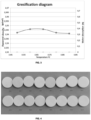
Fig 3 Evolution of bulk density and water absorption of the support with firing temperature) - In addition to a high degree of whiteness of the support, it is also interesting that the resulting ceramic composition develops the colours well. White (calcined alumina), black inorganic pigment and blue inorganic pigment have been chosen for this purpose.
Table 5. Colour coordinates of the pigmented ceramic composite. Property + 2% black + 2% blue + 4% Alumina + 6% Alumina Temperature (°C) 1150 1170 1170 1190 1210 L* 89.3 29.4 45.6 93.2 94.0 a* -1.6 0.7 0.5 -1.1 -0.8 b* 6.5 0.1 -29.0 4.3 4.2 - It is observed that the development of black colour is adequate, but not so much in the blue, which shows low negative values of the b* coordinate. The addition of alumina to the latter composition provides high whiteness values at appropriate temperatures, which was one of the initially proposed objectives.
- The coefficient of thermal expansion (CTE) of the ceramic composite was determined by means of a dilatometer. The CTE measures the relative change in length or volume that occurs when a solid body changes temperature.
Table 6. Expansion coefficients of the ceramic composite. Property Preferred Ceramic Compound α25-300 (oC-1) x 10-7 54.2 α 25-500 (oC-1) x 10-7 59.1 α 25-650 (oC-1) x 10-7 64.0 α 500-650 (oC-1) x 10-7 79.4 - For the characterisation of the support, its crystalline phases have been identified by X-ray diffraction (XRD).
-
Figure 2 (Identification of crystalline phases by XRD of the ceramic composition) shows the diffractogram obtained from the support sample, in which the peaks of maximum intensity of the identified phases have been labelled, as well as other characteristic reflections of lower intensity. The following is noted: - Sodium anorthite (Ca2Na)Al2Si2O8) was detected as a majority phase and Calcium silicon aluminate (hexagonal structure) as a minority phase (Ca2Na6Al8Si8O32).
- It has been noted the complexity of obtaining a single frit that optimises the totality of the requirements: adequate firing temperature both with and without calcined alumina, good colour development and high whiteness, with and without adding calcined alumina.
- Among the compositions tested, the one obtained with the frit of the preferred realisation is the one that best balances these properties:
- The proposed ceramic composite provides a good dry bulk density, has a high bulk density when fired, but is stable at working temperatures (1100-1200°C) and does not show pyroplastic deformation at the vitrification temperature.
- The development of black is adequate, not so much in blue, which shows slightly negative values of the b* coordinate. The addition of alumina to this ceramic composite provides high whiteness values at suitable temperatures.
-
Figure 4 . Appearance of ceramic specimens without the addition of pigment. -
Figure 5 . Appearance of ceramic specimens with 2% black pigment. -
Figure 6 . Appearance of ceramic specimens with 2% blue pigment.
-
- The figures show explanatory graphs and diffractograms of the high whiteness, translucent and colourable ceramic material based on a calcium frit.
- Figure 1:
- It shows a graph of the shrinkage and temperature curve of the frit.
- Figure 2:
- It shows a diffractogram identifying the crystalline phases by X-ray diffraction (XRD) of the ceramic composite.
- Figure 3:
- It shows a diagram of the ceramic composite's stoneware vitrification. Evolution of the bulk density and water absorption of the support with firing temperature.
- Figure 4:
- Appearance of ceramic specimens without the addition of pigment.
- Figure 5:
- Appearance of ceramic specimens with 2% black pigment.
- Figure 6:
- Appearance of ceramic specimens with 2% blue pigment.
- The preferred ceramic compound is prepared by atomisation of the mixture of the raw materials (frit, clay and kaolin) wet milled (with water and deflocculant). It is then pressed, glazed and fired. The atomisation process only gives it the necessary fluidity so that it can be distributed in an homogeneous way in the mould and can be pressed. The pressed slab is fired and it is this fired ceramic material that possesses the aforementioned characteristics of whiteness, translucency and optimum colour development by the addition of inorganic pigments.
- The ceramic composite is based on a frit-based composition (60-90)% plus a mixture of clay and kaolin (10-40)%, as shown in table 4. The use of this frit will provide parts with a high whiteness without the need to introduce opacifiers and will increase its translucency without compromising the whiteness of the material, while allowing for a high colour development with the addition of inorganic pigments.
- The characteristic temperatures of the produced frit are reflected in the shrinkage-temperature curve (
Figure 1 ) determined by a heating microscope, which shows that the frit starts to shrink at a temperature of 865°C, then in the temperature range 950 - 1150°C it undergoes crystallisation, and then continues to contract to a temperature of 1335°C. Finally, the softening takes place at 1370°C and melting at 1380°C, without it being possible to detect its sphere temperature due to the nature of the material. - As for the support of the ceramic composite, it was checked by means of the stoneware of the ceramic composition diagram (
Figure 3 ) the evolution of the bulk density and water absorption of the support with the firing temperature. From this diagram we can conclude that the temperature of maximum densification is around 1100--1200°C and that it remains at high values during the subsequent temperatures. In addition, it is observed that during the entire firing range no water absorption of the fired pieces is detected. - To complete the characterisation of the fired support, the crystalline phases present have been identified by means of an X-ray diffractogram (XRD). (
Figure 2 ). - Finally, the suitability of the ceramic composite for colour development has been tested, verifying the high chromatic values obtained with the addition of inorganic pigments, and the possibility of increasing whiteness with the addition of aluminas. Thus, the resulting ceramic material can possibly be used for the manufacture of large format slabs, in which the different whites and colours to be developed can be mixed into all its mass without causing deformations or tensions in the final fired slab.
Claims (7)
- A white, translucent, colourable ceramic compound based on a calcium sodium frit, characterised in that it is composed of:• 60 to 90% of frit in the SiO2-Al2O3-CaO-Na2O system to be used as the main raw material in porcelain stoneware compositions, which will provide pieces with high whiteness without the need to introduce opacifiers such as zirconium silicate.The frit has the following composition expressed as a percentage of major oxides:
Rust % SiO2 45.6-60.5 Al2O3 14.9-29.9 CaO 9.2-19.1 Na2O 5.1-15.0 The frit loading formula is as follows:Raw Material % Sodium feldspar 40.1 - 63.2 Quartz 0.0 - 24.7 Alumina 5.4 - 18.4 Calcium carbonate 13.4 - 30.3 Sodium nitrate 0.0 - 16.3 • 10% to 40% of "inorganic raw material". (mixture of Kaolin (10%-30%) and Clay (10%-20%)).Therefore, the formula of the ceramic compound that the invention advocates is as follows:Raw material % Clay 10-20 Kaolin 10-30 Frit 60-90 - Process for the production of a white, translucent and colourable ceramic compound based on a calcium sodium frit, according to the first claim, characterised in that the product consists of an atomised ceramic composition pressed and/or extruded, which may be covered with a thin vitreous layer of glaze, subjected to a heat treatment from 1100°C in a cycle of a certain duration depending on the thickness (3 to 30 mm).
- White, translucent, colourable ceramic material compound based on a frit according to the first claim, characterised in that, in order to give whiteness to the composition, it devitrifies, during firing, as a majority phase, sodium anorthic (Ca2Na)Al2Si2O8) and as a minority phase calcium silicon aluminate (hexagonal structure) (Ca2Na6Al8Si8O32).
- White, translucent and colourable ceramic compound based on a calcium sodium frit, according to the first claim, characterised by the addition of_of inorganic pigments such as: Fe-Cr based black with a hematite crystalline structure; Ti-W-Cr based brown with a rutile crystalline structure; Fe-Cr-Al based brown with a hematite crystalline structure; Al-Mn based pink with corundum crystalline structure; Ti-Sb-Cr based orange with rutile crystalline structure or Zr-Si-V based blue with zircon crystalline structure.
- White, translucent and colourable ceramic compound based on a calcium sodium frit, according to the first claim, characterised by being able to increase its whiteness with the addition of aluminas and opacifiers such as zirconium silicate.
- Use for the manufacture of the white, translucent and colourable ceramic compound based on a calcium-sodium frit according to the first claim, characterised in that it can be used for the manufacture of pressed and/or extruded ceramic parts of any thickness and format.
- Use for the manufacture of the white, translucent and colourable ceramic compound based on a calcium sodium frit, according to the first claim, characterised in that it can be used for the manufacture of large format slabs in which the different blanks and colours to be developed, from the claimed composition, can be mixed throughout its mass (even in the form of veins imitating natural stone) without causing deformations and stresses in the final fired board.
Applications Claiming Priority (2)
| Application Number | Priority Date | Filing Date | Title |
|---|---|---|---|
| ES202230345A ES2954835B2 (en) | 2022-04-18 | 2022-04-18 | WHITE, TRANSLUCENT AND COLORABLE CERAMIC COMPOUND BASED ON A CALCIUM AND SODIUM FRIT |
| PCT/IB2023/053345 WO2023203410A1 (en) | 2022-04-18 | 2023-04-03 | Colourable translucent white ceramic compound based on a frit comprising calcium and sodium |
Publications (2)
| Publication Number | Publication Date |
|---|---|
| EP4512788A1 true EP4512788A1 (en) | 2025-02-26 |
| EP4512788A4 EP4512788A4 (en) | 2026-04-29 |
Family
ID=88419326
Family Applications (1)
| Application Number | Title | Priority Date | Filing Date |
|---|---|---|---|
| EP23791406.4A Pending EP4512788A4 (en) | 2022-04-18 | 2023-04-03 | Colorable translucent white ceramic compound based on a frit with calcium and sodium |
Country Status (6)
| Country | Link |
|---|---|
| EP (1) | EP4512788A4 (en) |
| KR (1) | KR20250005972A (en) |
| CN (1) | CN118804904A (en) |
| CA (1) | CA3245308A1 (en) |
| ES (1) | ES2954835B2 (en) |
| WO (1) | WO2023203410A1 (en) |
Family Cites Families (5)
| Publication number | Priority date | Publication date | Assignee | Title |
|---|---|---|---|---|
| US2776899A (en) * | 1953-01-09 | 1957-01-08 | Foote Mineral Co | Ceramic product and body and method of making the same |
| DE4244734C2 (en) * | 1992-11-30 | 1994-08-25 | Rosenthal Ag | porcelain offset |
| US9181133B1 (en) * | 2014-05-14 | 2015-11-10 | Korea Institute of Ceram Choice LTD | Crystallized silicate powder by synthesized and high strengthened porcelain body having the same |
| EP3771702A1 (en) * | 2019-07-31 | 2021-02-03 | Cosentino Research & Development, S.L. | Artificial agglomerate stone article comprising synthetic silicate granules |
| ES2843267B2 (en) * | 2020-01-15 | 2021-11-24 | Coloronda S L | Ceramic glazing with a warm feeling similar to wood |
-
2022
- 2022-04-18 ES ES202230345A patent/ES2954835B2/en active Active
-
2023
- 2023-04-03 CN CN202380024518.6A patent/CN118804904A/en active Pending
- 2023-04-03 WO PCT/IB2023/053345 patent/WO2023203410A1/en not_active Ceased
- 2023-04-03 EP EP23791406.4A patent/EP4512788A4/en active Pending
- 2023-04-03 KR KR1020247028579A patent/KR20250005972A/en active Pending
- 2023-04-03 CA CA3245308A patent/CA3245308A1/en active Pending
Also Published As
| Publication number | Publication date |
|---|---|
| WO2023203410A1 (en) | 2023-10-26 |
| CN118804904A (en) | 2024-10-18 |
| ES2954835B2 (en) | 2024-12-19 |
| ES2954835A1 (en) | 2023-11-27 |
| CA3245308A1 (en) | 2025-02-03 |
| EP4512788A4 (en) | 2026-04-29 |
| KR20250005972A (en) | 2025-01-10 |
Similar Documents
| Publication | Publication Date | Title |
|---|---|---|
| RU2385309C2 (en) | Glasing compound | |
| CN112723870B (en) | Ceramic rock plate with color jade effect and preparation method thereof | |
| EP1971559B1 (en) | Glaze compositions | |
| US5716894A (en) | Whiteware ceramic compositions | |
| US9290409B2 (en) | Glaze composition, method for manufacturing the glaze composition and methods of glazing | |
| CN111943724A (en) | A kind of manufacturing method of matt transparent glaze porcelain piece | |
| CN1887810A (en) | Press formed dry glaze for ceramic tile adobe and its prepn process | |
| KR102584536B1 (en) | ethod for manufacturing ceramics using a body composition for preventing blotting defects | |
| CN118652101A (en) | Ultra-white fabric, ultra-white luxury stone ceramic rock board and preparation method thereof | |
| US10570049B2 (en) | Self glazed ceramic/glass composite and method for manufacturing the same | |
| CN100469729C (en) | Method for producing products from waste glass | |
| EP4512788A1 (en) | Colourable translucent white ceramic compound based on a frit comprising calcium and sodium | |
| EP4516761A1 (en) | Enamelled ceramic material with a low coefficient of thermal expansion | |
| KR102153315B1 (en) | Manufacturing method of bone china earthenware using the glaze composition for chemical strengthening of bone china earthenware | |
| CN116282918A (en) | Spherical crown crack ceramic art glaze and preparation method thereof | |
| CN114409387A (en) | Ultra-white rock plate and preparation method thereof | |
| CN118930223B (en) | Point-transmitting ceramic rock plate with relief effect and manufacturing method thereof | |
| JPH08133825A (en) | Manufacturing method of cement-based fired building materials | |
| JP2024095570A (en) | Pottery with a glaze layer | |
| Bengisu | Structure and Properties of Conventional Ceramics | |
| GB2309223A (en) | Prefired material for whiteware ceramic composition | |
| CN120664778A (en) | High-permeability low-abrasion dark color full-polished glaze, ceramic tile and preparation method thereof | |
| JP5479197B2 (en) | Design material | |
| CN1035653A (en) | Manufacture of gypsum ceramic decorative materials from gypsum or gypsum residue | |
| KR20120062245A (en) | Composite for ceramic ware including oxide pigment and manufacturing method of ceramic ware using the pigment |
Legal Events
| Date | Code | Title | Description |
|---|---|---|---|
| STAA | Information on the status of an ep patent application or granted ep patent |
Free format text: STATUS: THE INTERNATIONAL PUBLICATION HAS BEEN MADE |
|
| PUAI | Public reference made under article 153(3) epc to a published international application that has entered the european phase |
Free format text: ORIGINAL CODE: 0009012 |
|
| STAA | Information on the status of an ep patent application or granted ep patent |
Free format text: STATUS: REQUEST FOR EXAMINATION WAS MADE |
|
| 17P | Request for examination filed |
Effective date: 20240715 |
|
| AK | Designated contracting states |
Kind code of ref document: A1 Designated state(s): AL AT BE BG CH CY CZ DE DK EE ES FI FR GB GR HR HU IE IS IT LI LT LU LV MC ME MK MT NL NO PL PT RO RS SE SI SK SM TR |
|
| DAV | Request for validation of the european patent (deleted) | ||
| DAX | Request for extension of the european patent (deleted) | ||
| A4 | Supplementary search report drawn up and despatched |
Effective date: 20260401 |
|
| RIC1 | Information provided on ipc code assigned before grant |
Ipc: C04B 33/34 20060101AFI20260326BHEP Ipc: C04B 14/22 20060101ALI20260326BHEP Ipc: C04B 33/24 20060101ALI20260326BHEP Ipc: C04B 33/32 20060101ALI20260326BHEP |