EP4512536A1 - Paint spray booth and method for cleaning at least one part of a paint spray robot and corresponding method - Google Patents
Paint spray booth and method for cleaning at least one part of a paint spray robot and corresponding method Download PDFInfo
- Publication number
- EP4512536A1 EP4512536A1 EP23193043.9A EP23193043A EP4512536A1 EP 4512536 A1 EP4512536 A1 EP 4512536A1 EP 23193043 A EP23193043 A EP 23193043A EP 4512536 A1 EP4512536 A1 EP 4512536A1
- Authority
- EP
- European Patent Office
- Prior art keywords
- robot
- paint spray
- brush
- additional
- tool
- Prior art date
- Legal status (The legal status is an assumption and is not a legal conclusion. Google has not performed a legal analysis and makes no representation as to the accuracy of the status listed.)
- Pending
Links
Images


Classifications
-
- B—PERFORMING OPERATIONS; TRANSPORTING
- B05—SPRAYING OR ATOMISING IN GENERAL; APPLYING FLUENT MATERIALS TO SURFACES, IN GENERAL
- B05B—SPRAYING APPARATUS; ATOMISING APPARATUS; NOZZLES
- B05B15/00—Details of spraying plant or spraying apparatus not otherwise provided for; Accessories
- B05B15/50—Arrangements for cleaning; Arrangements for preventing deposits, drying-out or blockage; Arrangements for detecting improper discharge caused by the presence of foreign matter
- B05B15/52—Arrangements for cleaning; Arrangements for preventing deposits, drying-out or blockage; Arrangements for detecting improper discharge caused by the presence of foreign matter for removal of clogging particles
-
- B—PERFORMING OPERATIONS; TRANSPORTING
- B08—CLEANING
- B08B—CLEANING IN GENERAL; PREVENTION OF FOULING IN GENERAL
- B08B1/00—Cleaning by methods involving the use of tools
- B08B1/10—Cleaning by methods involving the use of tools characterised by the type of cleaning tool
- B08B1/12—Brushes
-
- B—PERFORMING OPERATIONS; TRANSPORTING
- B08—CLEANING
- B08B—CLEANING IN GENERAL; PREVENTION OF FOULING IN GENERAL
- B08B1/00—Cleaning by methods involving the use of tools
- B08B1/30—Cleaning by methods involving the use of tools by movement of cleaning members over a surface
-
- B—PERFORMING OPERATIONS; TRANSPORTING
- B08—CLEANING
- B08B—CLEANING IN GENERAL; PREVENTION OF FOULING IN GENERAL
- B08B1/00—Cleaning by methods involving the use of tools
- B08B1/40—Cleaning tools with integrated means for dispensing fluids, e.g. water, steam or detergents
-
- B—PERFORMING OPERATIONS; TRANSPORTING
- B25—HAND TOOLS; PORTABLE POWER-DRIVEN TOOLS; MANIPULATORS
- B25J—MANIPULATORS; CHAMBERS PROVIDED WITH MANIPULATION DEVICES
- B25J19/00—Accessories fitted to manipulators, e.g. for monitoring, for viewing; Safety devices combined with or specially adapted for use in connection with manipulators
- B25J19/0058—Means for cleaning manipulators, e.g. dust removing means
-
- B—PERFORMING OPERATIONS; TRANSPORTING
- B05—SPRAYING OR ATOMISING IN GENERAL; APPLYING FLUENT MATERIALS TO SURFACES, IN GENERAL
- B05B—SPRAYING APPARATUS; ATOMISING APPARATUS; NOZZLES
- B05B13/00—Machines or plants for applying liquids or other fluent materials to surfaces of objects or other work by spraying, not covered by groups B05B1/00 - B05B11/00
- B05B13/02—Means for supporting work; Arrangement or mounting of spray heads; Adaptation or arrangement of means for feeding work
- B05B13/0292—Means for supporting work; Arrangement or mounting of spray heads; Adaptation or arrangement of means for feeding work devices for holding several workpieces to be sprayed in a spaced relationship, e.g. vehicle doors spacers
-
- B—PERFORMING OPERATIONS; TRANSPORTING
- B05—SPRAYING OR ATOMISING IN GENERAL; APPLYING FLUENT MATERIALS TO SURFACES, IN GENERAL
- B05B—SPRAYING APPARATUS; ATOMISING APPARATUS; NOZZLES
- B05B13/00—Machines or plants for applying liquids or other fluent materials to surfaces of objects or other work by spraying, not covered by groups B05B1/00 - B05B11/00
- B05B13/02—Means for supporting work; Arrangement or mounting of spray heads; Adaptation or arrangement of means for feeding work
- B05B13/04—Means for supporting work; Arrangement or mounting of spray heads; Adaptation or arrangement of means for feeding work the spray heads being moved during spraying operation
- B05B13/0431—Means for supporting work; Arrangement or mounting of spray heads; Adaptation or arrangement of means for feeding work the spray heads being moved during spraying operation with spray heads moved by robots or articulated arms, e.g. for applying liquid or other fluent material to three-dimensional [3D] surfaces
- B05B13/0433—Means for supporting work; Arrangement or mounting of spray heads; Adaptation or arrangement of means for feeding work the spray heads being moved during spraying operation with spray heads moved by robots or articulated arms, e.g. for applying liquid or other fluent material to three-dimensional [3D] surfaces the work being vehicle components, e.g. vehicle bodies
Definitions
- Paint spray booths are used in vehicle production to paint car bodies.
- an atomizer of a paint spray robot gets contaminated due to paint overspray during paint applications. Therefore, the atomizer needs to be cleaned in between paint applications to ensure a desired paint quality.
- US 6 712 285 B2 discloses a station having comprises at least two areas for cleaning/filling a reservoir, each adapted to receive a sub-assembly formed by a reservoir and a sprayer while this sub-assembly is disconnected from the robot.
- a device or devices for cleaning and/or filling the reservoir and/or the sprayer in each of these areas are provided, while these areas are adapted to be brought into a position of connection of a sub-assembly, disposed in one of them with the cleaning and/or filling device or devices.
- a process consists, inter alia, in positioning a coating product supply unit, in a position of connection with the first sub-assembly received in an area of the station of cleaning/filling.
- US 9 082 454 B2 relates to automatically removing contaminants from a manufactured part.
- a first robotic arm automatically holds the manufactured part.
- a second arm automatically sprays the manufactured part with a solution that causes contaminants to be removed from the manufactured part.
- the solution is collected.
- the collected solution contains the contaminants that were removed from the manufactured part.
- US 9 452 451 B2 relates to a cleaning device for an atomizer having a specified outer contour, in particular for cleaning a rotary atomizer, comprising at least one cleaning brush for cleaning the atomizer, wherein the cleaning brush has a specified brush contour.
- the brush contour of the cleaning brush is adapted to the outer contour of the atomizer so that the cleaning brush nestles up against the atomizer.
- the invention further relates to a corresponding cleaning brush and to a suitable cleaning method.
- US 2011 / 0 045 194 A1 discloses a robot and operating methods for a painting system.
- the robot is a handling robot for opening and closing doors or bonnets of motor vehicle bodies.
- a robot element of a handling robot that is susceptible to dirt retention e.g., a handling tool, may be arranged away from the spray jet of a paint during the painting operation and is applied to the component that is to be painted.
- the robot may include a cleaning device for cleaning or for keeping the robot element of the handling robot that is susceptible to dirt retention clean from paint that is applied with spray jet in the painting operation.
- US 2019 / 0 337 003 A1 discloses a painting robot with advanced fluid delivery system, enhanced kinematics, and a service airlock compartment.
- the painting robot includes a fluid delivery system which places color changing valves and pumping hardware on the back side of the robot's mounting pedestal, where it can be serviced without a technician having to enter the spray booth. Additionally, the robot enables routine cleaning and maintenance to be performed without personnel entering the spray booth and without stopping the vehicle conveyor, due to simplified outer arm design, improved home positioning and an airlock booth adjacent to the robot pedestal. Service personnel can clean and service the applicator and other components on the outer arm from the airlock booth, while other robots continue painting parts moving on the conveyor, without allowing fume-laden vapors into the operator aisle.
- US 2020 / 0 338 583 A1 discloses a method for cleaning a paint spray gun, which comprises a rotating atomization head to apply a coating material while rotating and an outer circumferential tube to cover the exterior of the rotating atomization head.
- the method has a cleaning solution application step for applying a cleaning solution to the external face of the outer circumferential tube, and a rotating atomization head rotation step for generating a rotational flow between the rotating atomization head and the outer circumferential tube by rotating the rotating atomization head.
- the cleaning solution flowing down the external face of the outer circumferential tube applied in the cleaning solution application step penetrates between the rotating atomization head and the outer circumferential tube by way of the rotational flow.
- Such method uses a small amount of cleaning solution for cleaning external and internal faces of the outer circumferential tube and the external face of a rotating atomization head.
- this object is solved by a paint spray booth with the features of claim 1, wherein the control device is arranged to operate the additional robot at least outside a painting operation of the paint spray booth in a cleaning mode in which the additional robot is used to automatically clean at least one part of the paint spray robot.
- a paint spray booth with an automatic cleaning system uses an additional robot installed in the paint spray booth as a cleaning robot to clean at least one part, e. g. the wrist and/or an atomizer, of one or more paint spray robots in the paint spray booth. Due to this automatic cleaning the cycle time for cleaning is shorter compared to a conventional manual cleaning cycle time. Moreover, this automatic cleaning can be done with fewer operators, less solvent and fewer rags.
- the control device can be programmed according to special demands. In other words, e.g., a shorter/longer wash can be carried out with less solvent.
- the paint spray booth may comprise two or more additional robots operated by the control device according to the invention. Moreover, the paint spray booth may comprise two or more paint spray robots operated by the control device according to the invention.
- the control device may comprise at least one computer programmed to carry out the invention.
- the computer may comprise at least one memory unit including at least one algorithm for carrying out the invention.
- the paint spray booth may be used to paint vehicle bodies, especially car bodies.
- the additional robot is a handling robot, preferably a door opening robot, wherein the control device is arranged to operate the additional robot during a painting operation of the paint spray booth in a door opening mode in which the additional robot is used to automatically open at least one door of a vehicle body.
- the door opening robot can be used to open side doors, rear cargo doors and/or lift gates. Since such a door opening robot is usually installed in a paint spray booth, no additional costs arise for a separate cleaning robot.
- the paint spray booth comprises at least one brush station comprising at least one brush connectable to a tool of the additional robot, wherein the control device is arranged to operate the additional robot to connect the tool automatically to said brush.
- the tool of the additional robot may be shaped like a skewer.
- the tool of the additional robot is formed to enable the additional robot to carry out a special operation during the painting operation of the paint spray booth, wherein this special operation is not part of the cleaning mode of the additional robot.
- the tool of the additional robot is formed to carry out a door opening operation during the painting operation of the paint spray booth.
- the control device may also be arranged to disconnect the tool from the brush after inserting the brush with the additional robot in the brush station again.
- the brush station may comprise two or more brushes, especially for different purposes.
- the brush station comprises at least one solvent-applying brush
- the control device is arranged to operate the additional robot in a solvent-applying mode in which the additional robot is operated to connect its tool to said solvent-applying brush, to apply a solvent by the solvent-applying brush on the at least one part of the paint spray robot, to arrange the solvent-applying brush in the brush station after applying the solvent on the at least one part of the paint spray robot, and to disconnect the tool from said solvent-applying brush arranged in the brush station.
- the solvent-applying brush can be dampened in the solvent contained within the brush station.
- the brush station may comprise two or more solvent-applying brushes.
- the brush station may comprise at least one drying brush
- the control device may be arranged to operate the additional robot in a drying mode in which the additional robot is operated to connect its tool to said drying brush, to dry the at least one part of the paint spray robot by the drying brush, to arrange the drying brush in the brush station after drying the at least one part of the paint spray robot, and to disconnect the tool from said drying brush arranged in the brush station.
- the drying brush is dry.
- the brush station may comprise at least one lubricating brush
- the control device may be arranged to operate the additional robot in a lubricating mode in which the additional robot is operated to connect its tool to said lubricating brush, to apply a lubricant by the lubricating brush on the at least one part of the paint spray robot, to arrange the lubricating brush in the brush station after applying the lubricant on the at least one part of the paint spray robot, and to disconnect the tool from said lubricating brush arranged in the brush station.
- the lubricating brush can be damped in the lubricant, e. g. Vaseline ® . Through this, the cleaning of the at least one part of the paint spray robot during the next cleaning cycle can be enhanced.
- the additional robot may consecutively take the brushes to carry out a special cleaning of the at least one part of the paint spray robot.
- the present embodiment does not only allow to use different tools, e.g. brushes with different properties, hardness, etc., for different purposes, but also avoids having to equip the additional robot with appropriate technology. This gives more flexibility and usage options.
- the paint spray booth comprises at least one bayonet mount-like fastening mechanism for connecting the tool of the additional robot to the brush, wherein the bayonet mount-like fastening mechanism is partly constituted by a male part of the tool and partly constituted by a female part of said brush.
- the male part of the tool is inserted in the female part of the brush.
- a spring may be arranged within the female part of the brush, wherein the spring may be compressed by the male part of the tool when the male part is inserted in the female part.
- the male part inserted in the female part can be rotated by the additional robot with respect to the female part to fasten the brush to the tool.
- To disconnect the brush from the tool the above connection steps can be inverted.
- the tool of the additional robot is a 3D printing component.
- the tool can be easily formed also with a complex geometry.
- the tool of the additional robot comprises at least one mechanical fuse. This enhances the safety of the paint spray booth.
- the paint spray booth can be used in accordance with one of the above-mentioned embodiments or a combination of at least two of these embodiments with one another for carrying out the method.
- Advantageous embodiments of the paint spray booth can correspond to advantageous embodiments of the method, even if this is not referred to in detail below.
- the at least one part of the paint spray robot is automatically cleaned by means of at least one additional robot in form of a door opening robot installed in the paint spray booth.
- a solvent is applied on the at least one part of the paint spray robot by means of at least one solvent-applying brush connected to the additional robot. Thereafter, the at least one part of the paint spray robot may be dried by means of at least one drying brush connected to the additional robot. After drying, the at least one part of the paint spray robot may be lubricated by means of at least one lubricating brush connected to the additional robot.
- Fig. 1 shows a schematic and perspective view of an embodiment of a paint spray booth 1 according to the invention.
- the paint spray booth 1 comprises at least one paint spray robot which is not shown in Fig. 1 . Moreover, the paint spray booth 1 comprises at least one additional robot 2 in form of a door opening robot having a tool 3 being arranged to open doors of a vehicle body (not shown). Further, the paint spray booth 1 comprises at least one control device (not shown) for controlling operation of the paint spray robot and operation of the additional robot 2.
- the control device is arranged to operate the additional robot 2 during a painting operation of the paint spray booth 1 in a door opening mode in which the additional robot 2 is used to automatically open at least one door of the vehicle body. Moreover, the control device is arranged to operate the additional robot 2 outside a painting operation of the paint spray booth 1 in a cleaning mode in which the additional robot 2 is used to automatically clean at least one part of the paint spray robot.
- the paint spray booth 1 comprises at least one brush station 4 comprising three different brushes 5, 6 and 7 respectively connectable to the tool 3 of the additional robot 2.
- the control device is arranged to operate the additional robot 2 to connect the tool 3 automatically to the respective brush 5, 6 and 7.
- Fig. 1 for each brush 5, 6 and 7, wherein the tool 3 is shown in continuous lines in different inserted position, in which a male part 8 of the tool 3 is inserted in a female part 9 of the respective brush 5, 6 and 7.
- the tool 3 is turned with respect to the respective insertion direction about 90° in a counterclockwise direction, so that a side pin 10 extending laterally from the male part 6 engages a party circumferential slot 11 on the female part.
- This fastening position of the tool 3 is shown in dashed lines.
- a bayonet mount-like fastening mechanism for connecting the tool 3 to the respective brushes 5, 6 and 7 is created, wherein the bayonet mount-like fastening mechanism is partly constituted by the male part 8 with the side pin 10 of the tool 3 and partly constituted by the female part 9 of the respective brush 5, 6 and 7.
- the brush station 4 comprises a solvent-applying brush 5, a drying brush 6, and a lubricating brush 7, wherein in Fig. 1 each brush 5, 6 and 7 is accommodated in a respective receptacle 12 from which the respective brush 5, 6 and 7 can be taken by the additional robot 2.
- the control device is arranged to operate the additional robot 2 firstly in a solvent-applying mode in which the additional robot 2 is operated to connect its tool 3 to said solvent-applying brush 5, to apply a solvent by the solvent-applying brush 5 on the at least one part of the paint spray robot, to arrange the solvent-applying brush 5 in the brush station 4 after applying the solvent on the at least one part of the paint spray robot, and to disconnect the tool 3 from said solvent-applying brush 5 arranged in the brush station 4 again.
- control device is arranged to operate the additional robot 2 secondly in a drying mode in which the additional robot 2 is operated to connect its tool 3 to said drying brush 6, to dry the at least one part of the paint spray robot by the drying brush 6, to arrange the drying brush 6 in the brush station 4 after drying the at least one part of the paint spray robot, and to disconnect the tool 3 from said drying brush 6 arranged in the brush station 4 again.
- control device is arranged to operate the additional robot 2 thirdly in a lubricating mode in which the additional robot 2 is operated to connect its tool 3 to said lubricating brush 7, to apply a lubricant by the lubricating brush 7 on the at least one part of the paint spray robot, to arrange the lubricating brush 7 in the brush station 4 after applying the lubricant on the at least one part of the paint spray robot, and to disconnect the tool 3 from said lubricating brush 7 arranged in the brush station 4 again.
- the tool 3 of the additional robot 2 may be a 3D printing component. Moreover, the tool 3 of the additional robot 2 may comprise at least one mechanical fuse (not shown).
- Figs. 2a-2b are a schematic and perspective views of a further embodiment of a paint spray booth 1 according to the invention.
- the paint spray booth 1 differs from the embodiment shown in Fig. 1 in that the brush station 4 comprises a cover 13 for each receptacle 12.
- the covers 13 are slidingly supported by the receptacles 12, so that the covers 13 can horizontally slide between closed positions shown in Fig. 2a and open positions shown in Fig. 2b .
- the covers 13 are rigidly coupled in pairs to each other by coupling elements 14.
- each of the brushes 5 to 7 is coupled to a tool 3 of at least one additional robot 2 in form of a door opening robot. To avoid repetition reference is made to the above description of Fig. 1 .
- Fig. 3 shows a schematic and perspective detail view of the paint spray booth 1 shown in Figs. 2a-2b .
- Fig. 3 shows the tool 3 connected to the brush 5, wherein the brush 5 is moved out the receptacle 12 by means of the additional robot 2. To avoid repetition reference is made to the above description of Fig. 1 .
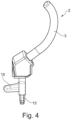
- Fig. 4 shows a schematic and perspective detail view of the tool 3 described above.
- Tool 3 comprises the side pin 10 that can engage the slot 11 according to Figs. 2a-2b and 3 .
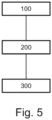
- Fig. 5 shows a flowchart of an embodiment of the method according to the invention for cleaning at least one part of a paint spray robot located in a paint spray booth.
- the at least one part of the paint spray robot is automatically cleaned by means of at least one additional robot in form of a door opening robot installed in the paint spray booth.
- a solvent is applied on the at least one part of the paint spray robot by means of at least one solvent-applying brush connected to the additional robot.
- the at least one part of the spray robot is dried by means of at least one drying brush connected to the additional robot.
- a lubricant is applied on the at least one dried part of the paint spray robot by means of at least one lubricating brush connected to the additional robot.
Landscapes
- Engineering & Computer Science (AREA)
- Robotics (AREA)
- Mechanical Engineering (AREA)
- Details Or Accessories Of Spraying Plant Or Apparatus (AREA)
Abstract
The invention relates to a paint spray booth (1) comprising at least one paint spray robot, at least one additional robot (2) and at least one control device for controlling operation of the paint spray robot and operation of the additional robot (2). To provide an automatic cleaning system and to reduce time requirements for cleaning a paint spray robot, the control device is arranged to operate the additional robot (2) at least outside a painting operation of the paint spray booth (1) in a cleaning mode in which the additional robot (2) is used to automatically clean at least one part of the paint spray robot.
Description
- The invention relates to a paint spray booth with the features of the generic part of
claim 1, comprising at least one paint spray robot, at least one additional robot and at least one control device for controlling operation of the paint spray robot and operation of the additional robot. Further, the invention relates to a method for cleaning at least one part of a paint spray robot located in a paint spray booth. - Paint spray booths are used in vehicle production to paint car bodies. Particularly, an atomizer of a paint spray robot gets contaminated due to paint overspray during paint applications. Therefore, the atomizer needs to be cleaned in between paint applications to ensure a desired paint quality.
- Currently, a paint spray robot atomizer is cleaned manually at each production break, which is time consuming and human resources consuming. A manual cleaning cycle time per robot can be estimated around two minutes. This means, for a, just exemplary, 35 robot configuration per paint spray booth in total 70 minutes cleaning time per cleaning cycle is required. This task usually is done by a multiple cleaning operators per shift.
-
JP H07 222 945 A -
US 6 712 285 B2 discloses a station having comprises at least two areas for cleaning/filling a reservoir, each adapted to receive a sub-assembly formed by a reservoir and a sprayer while this sub-assembly is disconnected from the robot. A device or devices for cleaning and/or filling the reservoir and/or the sprayer in each of these areas are provided, while these areas are adapted to be brought into a position of connection of a sub-assembly, disposed in one of them with the cleaning and/or filling device or devices. A process consists, inter alia, in positioning a coating product supply unit, in a position of connection with the first sub-assembly received in an area of the station of cleaning/filling. -
US 9 082 454 B2 -
US 9 452 451 B2 -
US 2011 / 0 045 194 A1 discloses a robot and operating methods for a painting system. The robot is a handling robot for opening and closing doors or bonnets of motor vehicle bodies. A robot element of a handling robot that is susceptible to dirt retention, e.g., a handling tool, may be arranged away from the spray jet of a paint during the painting operation and is applied to the component that is to be painted. The robot may include a cleaning device for cleaning or for keeping the robot element of the handling robot that is susceptible to dirt retention clean from paint that is applied with spray jet in the painting operation. -
US 2019 / 0 337 003 A1 discloses a painting robot with advanced fluid delivery system, enhanced kinematics, and a service airlock compartment. The painting robot includes a fluid delivery system which places color changing valves and pumping hardware on the back side of the robot's mounting pedestal, where it can be serviced without a technician having to enter the spray booth. Additionally, the robot enables routine cleaning and maintenance to be performed without personnel entering the spray booth and without stopping the vehicle conveyor, due to simplified outer arm design, improved home positioning and an airlock booth adjacent to the robot pedestal. Service personnel can clean and service the applicator and other components on the outer arm from the airlock booth, while other robots continue painting parts moving on the conveyor, without allowing fume-laden vapors into the operator aisle. -
US 2020 / 0 338 583 A1 discloses a method for cleaning a paint spray gun, which comprises a rotating atomization head to apply a coating material while rotating and an outer circumferential tube to cover the exterior of the rotating atomization head. The method has a cleaning solution application step for applying a cleaning solution to the external face of the outer circumferential tube, and a rotating atomization head rotation step for generating a rotational flow between the rotating atomization head and the outer circumferential tube by rotating the rotating atomization head. The cleaning solution flowing down the external face of the outer circumferential tube applied in the cleaning solution application step penetrates between the rotating atomization head and the outer circumferential tube by way of the rotational flow. Such method uses a small amount of cleaning solution for cleaning external and internal faces of the outer circumferential tube and the external face of a rotating atomization head. - It is an object of the invention to provide an automatic cleaning system and to reduce time requirements for cleaning a paint spray robot.
- According to the invention this object is solved by a paint spray booth with the features of
claim 1, wherein the control device is arranged to operate the additional robot at least outside a painting operation of the paint spray booth in a cleaning mode in which the additional robot is used to automatically clean at least one part of the paint spray robot. - It should be noted that the features and measures listed individually in the following description can be combined with each other in any technically useful way and show further embodiments of the invention. The description additionally characterizes and specifies the invention, in particular in connection with the figures.
- According to the invention a paint spray booth with an automatic cleaning system is disclosed that uses an additional robot installed in the paint spray booth as a cleaning robot to clean at least one part, e. g. the wrist and/or an atomizer, of one or more paint spray robots in the paint spray booth. Due to this automatic cleaning the cycle time for cleaning is shorter compared to a conventional manual cleaning cycle time. Moreover, this automatic cleaning can be done with fewer operators, less solvent and fewer rags. In addition, the control device can be programmed according to special demands. In other words, e.g., a shorter/longer wash can be carried out with less solvent.
- The paint spray booth may comprise two or more additional robots operated by the control device according to the invention. Moreover, the paint spray booth may comprise two or more paint spray robots operated by the control device according to the invention.
- The control device may comprise at least one computer programmed to carry out the invention. The computer may comprise at least one memory unit including at least one algorithm for carrying out the invention.
- The paint spray booth may be used to paint vehicle bodies, especially car bodies.
- According to an embodiment of the invention the additional robot is a handling robot, preferably a door opening robot, wherein the control device is arranged to operate the additional robot during a painting operation of the paint spray booth in a door opening mode in which the additional robot is used to automatically open at least one door of a vehicle body. Through this, in the door opening mode, the door opening robot can be used to open side doors, rear cargo doors and/or lift gates. Since such a door opening robot is usually installed in a paint spray booth, no additional costs arise for a separate cleaning robot.
- According to a further embodiment of the invention the paint spray booth comprises at least one brush station comprising at least one brush connectable to a tool of the additional robot, wherein the control device is arranged to operate the additional robot to connect the tool automatically to said brush. For example, the tool of the additional robot may be shaped like a skewer. The tool of the additional robot is formed to enable the additional robot to carry out a special operation during the painting operation of the paint spray booth, wherein this special operation is not part of the cleaning mode of the additional robot. For example, the tool of the additional robot is formed to carry out a door opening operation during the painting operation of the paint spray booth. The control device may also be arranged to disconnect the tool from the brush after inserting the brush with the additional robot in the brush station again. The brush station may comprise two or more brushes, especially for different purposes.
- According to a further embodiment of the invention the brush station comprises at least one solvent-applying brush, wherein the control device is arranged to operate the additional robot in a solvent-applying mode in which the additional robot is operated to connect its tool to said solvent-applying brush, to apply a solvent by the solvent-applying brush on the at least one part of the paint spray robot, to arrange the solvent-applying brush in the brush station after applying the solvent on the at least one part of the paint spray robot, and to disconnect the tool from said solvent-applying brush arranged in the brush station. The solvent-applying brush can be dampened in the solvent contained within the brush station. The brush station may comprise two or more solvent-applying brushes. Additionally, the brush station may comprise at least one drying brush, wherein the control device may be arranged to operate the additional robot in a drying mode in which the additional robot is operated to connect its tool to said drying brush, to dry the at least one part of the paint spray robot by the drying brush, to arrange the drying brush in the brush station after drying the at least one part of the paint spray robot, and to disconnect the tool from said drying brush arranged in the brush station. The drying brush is dry. Moreover, the brush station may comprise at least one lubricating brush, wherein the control device may be arranged to operate the additional robot in a lubricating mode in which the additional robot is operated to connect its tool to said lubricating brush, to apply a lubricant by the lubricating brush on the at least one part of the paint spray robot, to arrange the lubricating brush in the brush station after applying the lubricant on the at least one part of the paint spray robot, and to disconnect the tool from said lubricating brush arranged in the brush station. The lubricating brush can be damped in the lubricant, e. g. Vaseline®. Through this, the cleaning of the at least one part of the paint spray robot during the next cleaning cycle can be enhanced. The additional robot may consecutively take the brushes to carry out a special cleaning of the at least one part of the paint spray robot. The present embodiment does not only allow to use different tools, e.g. brushes with different properties, hardness, etc., for different purposes, but also avoids having to equip the additional robot with appropriate technology. This gives more flexibility and usage options.
- According to a further embodiment of the invention the paint spray booth comprises at least one bayonet mount-like fastening mechanism for connecting the tool of the additional robot to the brush, wherein the bayonet mount-like fastening mechanism is partly constituted by a male part of the tool and partly constituted by a female part of said brush. For connecting the tool to the brush the male part of the tool is inserted in the female part of the brush. A spring may be arranged within the female part of the brush, wherein the spring may be compressed by the male part of the tool when the male part is inserted in the female part. The male part inserted in the female part can be rotated by the additional robot with respect to the female part to fasten the brush to the tool. To disconnect the brush from the tool the above connection steps can be inverted.
- According to a further embodiment of the invention the tool of the additional robot is a 3D printing component. Through this, the tool can be easily formed also with a complex geometry.
- According to a further embodiment of the invention the tool of the additional robot comprises at least one mechanical fuse. This enhances the safety of the paint spray booth.
- The above object is also solved by a method with the features according to
claim 8, wherein the at least one part of the paint spray robot is automatically cleaned by means of at least one additional robot installed in the paint spray booth. - The advantages mentioned above with reference to the paint spray booth are correspondingly associated with the method. In particular, the paint spray booth can be used in accordance with one of the above-mentioned embodiments or a combination of at least two of these embodiments with one another for carrying out the method. Advantageous embodiments of the paint spray booth can correspond to advantageous embodiments of the method, even if this is not referred to in detail below.
- According to an embodiment of the invention the at least one part of the paint spray robot is automatically cleaned by means of at least one additional robot in form of a door opening robot installed in the paint spray booth.
- According to a further embodiment of the invention a solvent is applied on the at least one part of the paint spray robot by means of at least one solvent-applying brush connected to the additional robot. Thereafter, the at least one part of the paint spray robot may be dried by means of at least one drying brush connected to the additional robot. After drying, the at least one part of the paint spray robot may be lubricated by means of at least one lubricating brush connected to the additional robot.
- Further advantageous embodiments of the invention are disclosed in the dependent claims and the following figure description. It shows
- Fig. 1
- a schematic and perspective view of an embodiment of a paint spray booth according to the invention;
- Figs. 2a-2b
- schematic and perspective views of a further embodiment of a paint spray booth according to the invention;
- Fig. 3
- a schematic and perspective detail view of the paint spray booth shown in
Figs. 2a-2b ; - Fig. 4
- a schematic and perspective detail view of a tool; and
- Fig. 5
- a flowchart of an embodiment of the method according to the invention.
-
Fig. 1 shows a schematic and perspective view of an embodiment of apaint spray booth 1 according to the invention. - The
paint spray booth 1 comprises at least one paint spray robot which is not shown inFig. 1 . Moreover, thepaint spray booth 1 comprises at least oneadditional robot 2 in form of a door opening robot having atool 3 being arranged to open doors of a vehicle body (not shown). Further, thepaint spray booth 1 comprises at least one control device (not shown) for controlling operation of the paint spray robot and operation of theadditional robot 2. - The control device is arranged to operate the
additional robot 2 during a painting operation of thepaint spray booth 1 in a door opening mode in which theadditional robot 2 is used to automatically open at least one door of the vehicle body. Moreover, the control device is arranged to operate theadditional robot 2 outside a painting operation of thepaint spray booth 1 in a cleaning mode in which theadditional robot 2 is used to automatically clean at least one part of the paint spray robot. - For this purpose the
paint spray booth 1 comprises at least onebrush station 4 comprising threedifferent brushes tool 3 of theadditional robot 2. The control device is arranged to operate theadditional robot 2 to connect thetool 3 automatically to therespective brush Fig. 1 for eachbrush tool 3 is shown in continuous lines in different inserted position, in which amale part 8 of thetool 3 is inserted in afemale part 9 of therespective brush tool 3 is turned with respect to the respective insertion direction about 90° in a counterclockwise direction, so that aside pin 10 extending laterally from themale part 6 engages aparty circumferential slot 11 on the female part. This fastening position of thetool 3 is shown in dashed lines. Through this a bayonet mount-like fastening mechanism for connecting thetool 3 to therespective brushes male part 8 with theside pin 10 of thetool 3 and partly constituted by thefemale part 9 of therespective brush - In particular, the
brush station 4 comprises a solvent-applyingbrush 5, a dryingbrush 6, and alubricating brush 7, wherein inFig. 1 eachbrush respective receptacle 12 from which therespective brush additional robot 2. - The control device is arranged to operate the
additional robot 2 firstly in a solvent-applying mode in which theadditional robot 2 is operated to connect itstool 3 to said solvent-applyingbrush 5, to apply a solvent by the solvent-applyingbrush 5 on the at least one part of the paint spray robot, to arrange the solvent-applyingbrush 5 in thebrush station 4 after applying the solvent on the at least one part of the paint spray robot, and to disconnect thetool 3 from said solvent-applyingbrush 5 arranged in thebrush station 4 again. Moreover, the control device is arranged to operate theadditional robot 2 secondly in a drying mode in which theadditional robot 2 is operated to connect itstool 3 to said dryingbrush 6, to dry the at least one part of the paint spray robot by the dryingbrush 6, to arrange the dryingbrush 6 in thebrush station 4 after drying the at least one part of the paint spray robot, and to disconnect thetool 3 from said dryingbrush 6 arranged in thebrush station 4 again. Further, the control device is arranged to operate theadditional robot 2 thirdly in a lubricating mode in which theadditional robot 2 is operated to connect itstool 3 to saidlubricating brush 7, to apply a lubricant by the lubricatingbrush 7 on the at least one part of the paint spray robot, to arrange thelubricating brush 7 in thebrush station 4 after applying the lubricant on the at least one part of the paint spray robot, and to disconnect thetool 3 from saidlubricating brush 7 arranged in thebrush station 4 again. - The
tool 3 of theadditional robot 2 may be a 3D printing component. Moreover, thetool 3 of theadditional robot 2 may comprise at least one mechanical fuse (not shown). -
Figs. 2a-2b are a schematic and perspective views of a further embodiment of apaint spray booth 1 according to the invention. Thepaint spray booth 1 differs from the embodiment shown inFig. 1 in that thebrush station 4 comprises acover 13 for eachreceptacle 12. Thecovers 13 are slidingly supported by thereceptacles 12, so that thecovers 13 can horizontally slide between closed positions shown inFig. 2a and open positions shown inFig. 2b . Thecovers 13 are rigidly coupled in pairs to each other by couplingelements 14. InFig. 2b , for explanation, each of thebrushes 5 to 7 is coupled to atool 3 of at least oneadditional robot 2 in form of a door opening robot. To avoid repetition reference is made to the above description ofFig. 1 . -
Fig. 3 shows a schematic and perspective detail view of thepaint spray booth 1 shown inFigs. 2a-2b .Fig. 3 shows thetool 3 connected to thebrush 5, wherein thebrush 5 is moved out thereceptacle 12 by means of theadditional robot 2. To avoid repetition reference is made to the above description ofFig. 1 . -
Fig. 4 shows a schematic and perspective detail view of thetool 3 described above.Tool 3 comprises theside pin 10 that can engage theslot 11 according toFigs. 2a-2b and3 . -
Fig. 5 shows a flowchart of an embodiment of the method according to the invention for cleaning at least one part of a paint spray robot located in a paint spray booth. The at least one part of the paint spray robot is automatically cleaned by means of at least one additional robot in form of a door opening robot installed in the paint spray booth. - For this, in a
first step 100, a solvent is applied on the at least one part of the paint spray robot by means of at least one solvent-applying brush connected to the additional robot. In asecond step 200, the at least one part of the spray robot is dried by means of at least one drying brush connected to the additional robot. In athird step 300, a lubricant is applied on the at least one dried part of the paint spray robot by means of at least one lubricating brush connected to the additional robot. -
- 1
- paint spray booth
- 2
- additional robot
- 3
- tool
- 4
- brush station
- 5
- brush
- 6
- brush
- 7
- brush
- 8
- male part of 3
- 9
- female part of 5, 6 and 7
- 10
- side pin of 3
- 11
- slot of 9
- 12
- receptacle
- 13
- cover
- 14
- coupling element
- 100
- method step
- 200
- method step
- 300
- method step
Claims (11)
- A paint spray booth (1) comprising at least one paint spray robot, at least one additional robot (2) and at least one control device for controlling operation of the paint spray robot and operation of the additional robot (2),
characterized in that
the control device is arranged to operate the additional robot (2) at least outside a painting operation of the paint spray booth (1) in a cleaning mode in which the additional robot (2) is used to automatically clean at least one part of the paint spray robot. - The paint spray booth (1) according to claim 1,
characterized in that
the additional robot (2) is a handling robot, especially a door opening robot, wherein the control device is arranged to operate the additional robot (2) during a painting operation of the paint spray booth (1) in a door opening mode in which the additional robot (2) is used to automatically open at least one door of a vehicle body. - The paint spray booth (1) according to claim 1 or 2,
characterized by
at least one brush station (4) comprising at least one brush (5, 6, 7) connectable to a tool (3) of the additional robot (2), wherein the control device is arranged to operate the additional robot (2) to connect the tool (3) automatically to said brush (5, 6, 7). - The paint spray booth (1) according to claim 3,
characterized in that
the brush station (4) comprises at least one solvent-applying brush (5), wherein the control device is arranged to operate the additional robot (2) in a solvent-applying mode in which the additional robot (2) is operated to connect its tool (3) to said solvent-applying brush (5), to apply a solvent by the solvent-applying brush (5) on the at least one part of the paint spray robot, to arrange the solvent-applying brush (5) in the brush station (4) after applying the solvent on the at least one part of the paint spray robot, and to disconnect the tool (3) from said solvent-applying brush (5) arranged in the brush station (4). - The paint spray booth (1) according claims 3 or 4,
characterized by
at least one bayonet mount-like fastening mechanism for connecting the tool (3) to the brush (5, 6, 7), wherein the bayonet mount-like fastening mechanism is partly constituted by a male part (8) of the tool (3) and partly constituted by a female part (9) of said brush (5, 6, 7). - The paint spray booth (1) according to any of the claims 3 to 5,
characterized in that
the brush station (4) comprises at least one receptacle (12) for accommodating the brush (5, 6, 7) when the brush (5, 6, 7) is not connected to the tool (3), and at least one cover (13) slidingly supported by the receptacle to be slidably arranged between an open position and a closed position. - The paint spray booth (1) according to one of the preceding claims,
characterized in that
the tool (3) of the additional robot (2) is a 3D printing component. - The paint spray booth (1) according to one of the preceding claims,
characterized in that
the tool (3) of the additional robot (2) comprises at least one mechanical fuse. - A method for cleaning at least one part of a paint spray robot located in a paint spray booth (1) in particular according to one of the preceding claims,
characterized in that
the at least one part of the paint spray robot is automatically cleaned by means of at least one additional robot (2) installed in the paint spray booth (1). - The method according to claim 9,
characterized in that
the at least one part of the paint spray robot is automatically cleaned by means of at least one additional robot (2) in form of a door opening robot installed in the paint spray booth (1). - The method according to claim 9 or 10,
characterized in that
a solvent is applied on the at least one part of the paint spray robot by means of at least one solvent-applying brush (5) connected to the additional robot (2).
Priority Applications (1)
| Application Number | Priority Date | Filing Date | Title |
|---|---|---|---|
| EP23193043.9A EP4512536A1 (en) | 2023-08-23 | 2023-08-23 | Paint spray booth and method for cleaning at least one part of a paint spray robot and corresponding method |
Applications Claiming Priority (1)
| Application Number | Priority Date | Filing Date | Title |
|---|---|---|---|
| EP23193043.9A EP4512536A1 (en) | 2023-08-23 | 2023-08-23 | Paint spray booth and method for cleaning at least one part of a paint spray robot and corresponding method |
Publications (1)
| Publication Number | Publication Date |
|---|---|
| EP4512536A1 true EP4512536A1 (en) | 2025-02-26 |
Family
ID=87762706
Family Applications (1)
| Application Number | Title | Priority Date | Filing Date |
|---|---|---|---|
| EP23193043.9A Pending EP4512536A1 (en) | 2023-08-23 | 2023-08-23 | Paint spray booth and method for cleaning at least one part of a paint spray robot and corresponding method |
Country Status (1)
| Country | Link |
|---|---|
| EP (1) | EP4512536A1 (en) |
Citations (10)
| Publication number | Priority date | Publication date | Assignee | Title |
|---|---|---|---|---|
| JPH05115830A (en) * | 1991-10-29 | 1993-05-14 | Nissan Motor Co Ltd | Washing method for coating device |
| JPH07222945A (en) | 1994-02-15 | 1995-08-22 | Toyota Motor Corp | How to clean a painting robot |
| US6712285B2 (en) | 2000-07-24 | 2004-03-30 | Sames Technologies | Process and station for changing product in an installation for spraying coating product |
| US20110045194A1 (en) | 2007-10-08 | 2011-02-24 | Frank Herre | Robot comprising a cleaning device and associated operating method |
| US9082454B2 (en) | 2006-12-08 | 2015-07-14 | HGST Netherlands B.V. | Automatically removing contaminants from a manufactured part |
| US9452451B2 (en) | 2010-11-26 | 2016-09-27 | Durr Systems Gmbh | Cleaning device and cleaning brush for an atomizer and corresponding cleaning method |
| US9694378B2 (en) * | 2012-11-16 | 2017-07-04 | Eisenmann Se | Application robot having a connection unit for different applicators |
| US20170368579A1 (en) * | 2016-06-28 | 2017-12-28 | Exel Industries | Automatic cleaning process, drying station and cleaning system comprising such drying station |
| US20190337003A1 (en) | 2018-05-03 | 2019-11-07 | Fanuc America Corporation | Robotic painting booth and operating method |
| US20200338583A1 (en) | 2018-02-07 | 2020-10-29 | Honda Motor Co., Ltd. | Method for cleaning paint spray gun |
-
2023
- 2023-08-23 EP EP23193043.9A patent/EP4512536A1/en active Pending
Patent Citations (10)
| Publication number | Priority date | Publication date | Assignee | Title |
|---|---|---|---|---|
| JPH05115830A (en) * | 1991-10-29 | 1993-05-14 | Nissan Motor Co Ltd | Washing method for coating device |
| JPH07222945A (en) | 1994-02-15 | 1995-08-22 | Toyota Motor Corp | How to clean a painting robot |
| US6712285B2 (en) | 2000-07-24 | 2004-03-30 | Sames Technologies | Process and station for changing product in an installation for spraying coating product |
| US9082454B2 (en) | 2006-12-08 | 2015-07-14 | HGST Netherlands B.V. | Automatically removing contaminants from a manufactured part |
| US20110045194A1 (en) | 2007-10-08 | 2011-02-24 | Frank Herre | Robot comprising a cleaning device and associated operating method |
| US9452451B2 (en) | 2010-11-26 | 2016-09-27 | Durr Systems Gmbh | Cleaning device and cleaning brush for an atomizer and corresponding cleaning method |
| US9694378B2 (en) * | 2012-11-16 | 2017-07-04 | Eisenmann Se | Application robot having a connection unit for different applicators |
| US20170368579A1 (en) * | 2016-06-28 | 2017-12-28 | Exel Industries | Automatic cleaning process, drying station and cleaning system comprising such drying station |
| US20200338583A1 (en) | 2018-02-07 | 2020-10-29 | Honda Motor Co., Ltd. | Method for cleaning paint spray gun |
| US20190337003A1 (en) | 2018-05-03 | 2019-11-07 | Fanuc America Corporation | Robotic painting booth and operating method |
Similar Documents
| Publication | Publication Date | Title |
|---|---|---|
| JP7261244B2 (en) | Electrostatic coating equipment using a robot | |
| EP2197593B1 (en) | Robot comprising a cleaning device and associated operating method | |
| US4830882A (en) | Method of and apparatus for cleaning paint spray guns | |
| US9694378B2 (en) | Application robot having a connection unit for different applicators | |
| WO2010025827A1 (en) | Painting device and associated method | |
| WO2004037436A1 (en) | Robotic apparatus for painting | |
| KR20030040550A (en) | Device and method for feeding sprayers and spraying installation equipped with such a device | |
| JPWO2019026951A1 (en) | Painting system and painting method | |
| US6896010B2 (en) | Method and device for filling a paint reservoir in an automated painting installation | |
| US10946404B2 (en) | Cleaning-filling station for means for spraying a coating product | |
| CN107398381A (en) | A kind of paint spraying system | |
| JPS63123457A (en) | Method and apparatus for washing painting gun | |
| JP3225557B2 (en) | Cleaning method for coating equipment | |
| JP3525874B2 (en) | Cleaning method of painting robot and painting robot | |
| US20080173236A1 (en) | Shuttle Push System For Coating Applicators | |
| DE202019005366U1 (en) | Automatic painting system |
Legal Events
| Date | Code | Title | Description |
|---|---|---|---|
| PUAI | Public reference made under article 153(3) epc to a published international application that has entered the european phase |
Free format text: ORIGINAL CODE: 0009012 |
|
| STAA | Information on the status of an ep patent application or granted ep patent |
Free format text: STATUS: THE APPLICATION HAS BEEN PUBLISHED |
|
| AK | Designated contracting states |
Kind code of ref document: A1 Designated state(s): AL AT BE BG CH CY CZ DE DK EE ES FI FR GB GR HR HU IE IS IT LI LT LU LV MC ME MK MT NL NO PL PT RO RS SE SI SK SM TR |
|
| STAA | Information on the status of an ep patent application or granted ep patent |
Free format text: STATUS: REQUEST FOR EXAMINATION WAS MADE |
|
| 17P | Request for examination filed |
Effective date: 20250826 |