EP4510334A2 - Verbesserter batteriezellenhalter für ein batteriepack - Google Patents
Verbesserter batteriezellenhalter für ein batteriepack Download PDFInfo
- Publication number
- EP4510334A2 EP4510334A2 EP24194927.0A EP24194927A EP4510334A2 EP 4510334 A2 EP4510334 A2 EP 4510334A2 EP 24194927 A EP24194927 A EP 24194927A EP 4510334 A2 EP4510334 A2 EP 4510334A2
- Authority
- EP
- European Patent Office
- Prior art keywords
- printed circuit
- battery pack
- narrowing
- circuit board
- pack according
- Prior art date
- Legal status (The legal status is an assumption and is not a legal conclusion. Google has not performed a legal analysis and makes no representation as to the accuracy of the status listed.)
- Pending
Links
Images


Classifications
-
- H—ELECTRICITY
- H01—ELECTRIC ELEMENTS
- H01M—PROCESSES OR MEANS, e.g. BATTERIES, FOR THE DIRECT CONVERSION OF CHEMICAL ENERGY INTO ELECTRICAL ENERGY
- H01M50/00—Constructional details or processes of manufacture of the non-active parts of electrochemical cells other than fuel cells, e.g. hybrid cells
- H01M50/20—Mountings; Secondary casings or frames; Racks, modules or packs; Suspension devices; Shock absorbers; Transport or carrying devices; Holders
- H01M50/204—Racks, modules or packs for multiple batteries or multiple cells
- H01M50/207—Racks, modules or packs for multiple batteries or multiple cells characterised by their shape
- H01M50/213—Racks, modules or packs for multiple batteries or multiple cells characterised by their shape adapted for cells having curved cross-section, e.g. round or elliptic
-
- H—ELECTRICITY
- H01—ELECTRIC ELEMENTS
- H01M—PROCESSES OR MEANS, e.g. BATTERIES, FOR THE DIRECT CONVERSION OF CHEMICAL ENERGY INTO ELECTRICAL ENERGY
- H01M10/00—Secondary cells; Manufacture thereof
- H01M10/42—Methods or arrangements for servicing or maintenance of secondary cells or secondary half-cells
- H01M10/425—Structural combination with electronic components, e.g. electronic circuits integrated to the outside of the casing
-
- H—ELECTRICITY
- H01—ELECTRIC ELEMENTS
- H01M—PROCESSES OR MEANS, e.g. BATTERIES, FOR THE DIRECT CONVERSION OF CHEMICAL ENERGY INTO ELECTRICAL ENERGY
- H01M50/00—Constructional details or processes of manufacture of the non-active parts of electrochemical cells other than fuel cells, e.g. hybrid cells
- H01M50/20—Mountings; Secondary casings or frames; Racks, modules or packs; Suspension devices; Shock absorbers; Transport or carrying devices; Holders
- H01M50/249—Mountings; Secondary casings or frames; Racks, modules or packs; Suspension devices; Shock absorbers; Transport or carrying devices; Holders specially adapted for aircraft or vehicles, e.g. cars or trains
-
- H—ELECTRICITY
- H01—ELECTRIC ELEMENTS
- H01M—PROCESSES OR MEANS, e.g. BATTERIES, FOR THE DIRECT CONVERSION OF CHEMICAL ENERGY INTO ELECTRICAL ENERGY
- H01M50/00—Constructional details or processes of manufacture of the non-active parts of electrochemical cells other than fuel cells, e.g. hybrid cells
- H01M50/20—Mountings; Secondary casings or frames; Racks, modules or packs; Suspension devices; Shock absorbers; Transport or carrying devices; Holders
- H01M50/284—Mountings; Secondary casings or frames; Racks, modules or packs; Suspension devices; Shock absorbers; Transport or carrying devices; Holders with incorporated circuit boards, e.g. printed circuit boards [PCB]
-
- H—ELECTRICITY
- H01—ELECTRIC ELEMENTS
- H01M—PROCESSES OR MEANS, e.g. BATTERIES, FOR THE DIRECT CONVERSION OF CHEMICAL ENERGY INTO ELECTRICAL ENERGY
- H01M50/00—Constructional details or processes of manufacture of the non-active parts of electrochemical cells other than fuel cells, e.g. hybrid cells
- H01M50/50—Current conducting connections for cells or batteries
- H01M50/502—Interconnectors for connecting terminals of adjacent batteries; Interconnectors for connecting cells outside a battery casing
- H01M50/503—Interconnectors for connecting terminals of adjacent batteries; Interconnectors for connecting cells outside a battery casing characterised by the shape of the interconnectors
-
- H—ELECTRICITY
- H01—ELECTRIC ELEMENTS
- H01M—PROCESSES OR MEANS, e.g. BATTERIES, FOR THE DIRECT CONVERSION OF CHEMICAL ENERGY INTO ELECTRICAL ENERGY
- H01M50/00—Constructional details or processes of manufacture of the non-active parts of electrochemical cells other than fuel cells, e.g. hybrid cells
- H01M50/50—Current conducting connections for cells or batteries
- H01M50/502—Interconnectors for connecting terminals of adjacent batteries; Interconnectors for connecting cells outside a battery casing
- H01M50/514—Methods for interconnecting adjacent batteries or cells
- H01M50/517—Methods for interconnecting adjacent batteries or cells by fixing means, e.g. screws, rivets or bolts
-
- H—ELECTRICITY
- H01—ELECTRIC ELEMENTS
- H01M—PROCESSES OR MEANS, e.g. BATTERIES, FOR THE DIRECT CONVERSION OF CHEMICAL ENERGY INTO ELECTRICAL ENERGY
- H01M50/00—Constructional details or processes of manufacture of the non-active parts of electrochemical cells other than fuel cells, e.g. hybrid cells
- H01M50/50—Current conducting connections for cells or batteries
- H01M50/502—Interconnectors for connecting terminals of adjacent batteries; Interconnectors for connecting cells outside a battery casing
- H01M50/519—Interconnectors for connecting terminals of adjacent batteries; Interconnectors for connecting cells outside a battery casing comprising printed circuit boards [PCB]
-
- H—ELECTRICITY
- H01—ELECTRIC ELEMENTS
- H01M—PROCESSES OR MEANS, e.g. BATTERIES, FOR THE DIRECT CONVERSION OF CHEMICAL ENERGY INTO ELECTRICAL ENERGY
- H01M2220/00—Batteries for particular applications
- H01M2220/20—Batteries in motive systems, e.g. vehicle, ship, plane
-
- H—ELECTRICITY
- H01—ELECTRIC ELEMENTS
- H01M—PROCESSES OR MEANS, e.g. BATTERIES, FOR THE DIRECT CONVERSION OF CHEMICAL ENERGY INTO ELECTRICAL ENERGY
- H01M50/00—Constructional details or processes of manufacture of the non-active parts of electrochemical cells other than fuel cells, e.g. hybrid cells
- H01M50/20—Mountings; Secondary casings or frames; Racks, modules or packs; Suspension devices; Shock absorbers; Transport or carrying devices; Holders
- H01M50/262—Mountings; Secondary casings or frames; Racks, modules or packs; Suspension devices; Shock absorbers; Transport or carrying devices; Holders with fastening means, e.g. locks
- H01M50/264—Mountings; Secondary casings or frames; Racks, modules or packs; Suspension devices; Shock absorbers; Transport or carrying devices; Holders with fastening means, e.g. locks for cells or batteries, e.g. straps, tie rods or peripheral frames
-
- Y—GENERAL TAGGING OF NEW TECHNOLOGICAL DEVELOPMENTS; GENERAL TAGGING OF CROSS-SECTIONAL TECHNOLOGIES SPANNING OVER SEVERAL SECTIONS OF THE IPC; TECHNICAL SUBJECTS COVERED BY FORMER USPC CROSS-REFERENCE ART COLLECTIONS [XRACs] AND DIGESTS
- Y02—TECHNOLOGIES OR APPLICATIONS FOR MITIGATION OR ADAPTATION AGAINST CLIMATE CHANGE
- Y02E—REDUCTION OF GREENHOUSE GAS [GHG] EMISSIONS, RELATED TO ENERGY GENERATION, TRANSMISSION OR DISTRIBUTION
- Y02E60/00—Enabling technologies; Technologies with a potential or indirect contribution to GHG emissions mitigation
- Y02E60/10—Energy storage using batteries
Definitions
- the invention relates to battery packs with electric cells, specifically where the cells are held in the battery pack without soldering.
- the battery packs should preferably serve as a compact, removable power source for electric vehicles, such as electric bicycles and/or motorcycles and/or mopeds/scooters but can also be used for cars and the like.
- Prior art battery packs include a set of electric cells that together provide the necessary power to an electrical device. In the past, these were soldered into the pack, so in case of problems, the packs were often discarded because this was more economical than deconstructing and solving the problem. Moreover, there was a high probability that during the deconstruction, further damage would be caused to the pack, making repairs more expensive or even impossible without large-scale replacement of components. Finally, manufacturing battery packs in this way is a technically cumbersome process.
- the present invention aims to find a solution for at least some of the aforementioned problems.
- the invention relates to an improved battery pack with solder-free or solder-less electric cells according to claim 1 and is particularly aimed at providing a more suitable way to ensure the electrical connection with the electric cells in the pack, in a safe, secure manner.
- the battery pack typically consists of several layers, although this is not necessarily the case.
- a multi-layered structure offers the advantage that the pack can be kept compact, while at the same time the voltage per layer can be easily connected in series to provide the desired total voltage (and thus the desired power).
- Each layer comprises on the top and bottom a printed circuit board (upper and lower, although this orientation is relative), typically a PCB.
- This printed circuit board is equipped with electrically conductive contact zones that serve to contact the poles of the electric cells and is further provided with conductive paths to connect the contact zones according to technical requirements (power, voltage, etc.).
- the opposing printed circuit boards are configured so that each electric cell has a contact zone on each printed circuit board, one suitable for contacting the cell's positive pole and the other for contacting the cell's negative pole.
- the contact zones of the top and bottom printed circuit boards therefore, have mirrored positions, but the mirrored contact zones are suitable for contacting a mutually different pole of the cell.
- the contact zones are each provided with two or more conductive resilient contacts, preferably fingers, which at rest rise to a first height above the contact zones.
- the contacts can be elastically compressed under load to a height above the contact zones that is smaller than the first height.
- the electric cells of a layer are held between the two printed circuit boards of said layer. These cells are mostly elongated, rod-shaped batteries, with a cylindrical protrusion at one end that serves as the positive pole of the battery (referred to as the cathode in Lithium-ion batteries) and a flat, conductive surface at the opposite end that forms the negative pole in practice (referred to as the anode).
- the side walls are equipped with an insulation layer.
- the layers and/or printed circuit boards are interconnected via one or more connectors, for connecting the top and bottom printed circuit board, with the holders of the printed circuit boards facing each other, to hold the electric cells between the printed circuit boards in the holders without soldering.
- These connectors are typically spokes or rods that go through one or more layers and are bounded on both sides to hold the layers/printed circuit boards together.
- the connectors can run through all layers or through a subset of the layers.
- the invention is distinguished by providing a plurality of open holders at each printed circuit board, (whether interconnected per printed circuit board or not).
- the holders are positioned with a first open side facing the printed circuit board, and an opposite second open side facing away from the printed circuit board, with the two open sides connected to each other.
- the holders are dimensioned to receive an end of the electric cells and positioned to align the received end with one of the conductive contact zones of the printed circuit board associated with the holders.
- the open holder has a first section that extends from the second side.
- the diameter of the opening in the first section is at least as large as the diameter of the electric cells, allowing them to be received herein with the end.
- the opening of the open holders further has an internal narrowing adjacent to the first section and is positioned between the first section and the first side.
- the diameter of the opening at the narrowing is smaller than the diameter of the electric cells, which are thereby limited in reception depth in the open holders.
- the narrowing is provided at a narrowing height, which is lower than the first height.
- This setup allows the electric cells to be received in the open holders, where they come to rest on a narrowing when the printed circuit boards are connected with the connectors.
- the resilient contacts are somewhat compressed, but the electric cells can no longer fully compress the contacts, which often leads to plastic deformation or other damage, as well as damage to the printed circuit board.
- the narrowing of the open holders thus serves as a buffer that ensures the cells can contact the contacts but provides a play in which the contacts cannot be further deformed, and the printed circuit board is also protected.
- a segment means one or more segments.
- Quoting numeric intervals by the endpoints includes all integers, fractions, and/or real numbers between the endpoints, including those endpoints.
- the invention relates to a battery pack as described in the summary of the invention.
- open holders that form a buffer between the printed circuit board and the electric cells, and act as a "bumper" protecting the contacts (fingers) by providing a narrowing in the holders that prevents the electric cells from coming closer to the printed circuit board than a predetermined distance. In this manner, a minimum height is guaranteed for the contacts, which ensures that plastic deformation is avoided, and the printed circuit board is also shielded.
- this minimum distance depends on the characteristics of the contacts. Thus, for most resilient elements, especially in industrial applications, a length is known at which plastic deformation occurs, as well as the length at rest. By choosing the height of the narrowing in between these, it is ensured that the cells effectively contact the contacts, and the aforementioned disadvantages are avoided.
- the narrowing height is at least 25% of the first height, preferably at least 30%, more preferably 35% or even 40% or 45% or 50% of the first height. In some embodiments, the narrowing height is at least 60% or even 75% of the first height and can in principle be further increased to almost 100%.
- the narrowing height is at most 99% of the first height, to ensure that the electric cells are in contact with the contacts.
- the narrowing height is bounded between an upper limit and a lower limit according to the above sections.
- the contacts concern leaf springs, which comprise a base and an elongated contact strip.
- the contact strip is resiliently mounted to the base with a first end of the contact strip, wherein the narrowing height is positioned higher than the base relative to the contact zones.
- the movable contact strip and the electric cell are separated from the printed circuit board even more securely. In this way, it cannot be damaged by the contact strip during compression, since the base will absorb these forces and pressure and distribute them better over a larger surface area. By allowing the narrowing height to protrude above the base, it is further ensured that the contact strip cannot be plastically deformed.
- the narrowing extends from the first section to the first side. In this manner, the force of the cells is optimally distributed through the holders on the printed circuit board, by the larger surface area on the first side of the cells.
- the opening of the narrowing has a constant diameter.
- the opening of the first section has a constant diameter. In this manner, the cells in the first section are kept stable over a greater length.
- the diameter of the opening of the narrowing is at least as large as the diameter of the circumscribed circle defined by the resilient contacts or fingers of each conductive contact zone. As a result, all contacts can move freely, without any obstruction from the holders.
- the open holders per printed circuit board are provided in a one-piece grid, wherein the grid has a structure that corresponds to the configuration of the conductive contact zones of the associated printed circuit board.
- the grid involves a rectangular, preferably square, matrix structure.
- the grid pertains to a staggered grid structure.
- a structure of this kind ensures maximum power density, as this way as little free space as possible is provided between the cells, while the densely populated structure offers great strength.
- the grid comprises through-openings between three or more mutually adjacent open holders.
- the through-openings extend from the first side to the second side, with the connectors being provided through three or more of the through-openings.
- the connectors By providing the connectors in specific through-openings between the holders, it is guaranteed on the one hand that the connectors are also supported intermediately. This avoids or reduces the risk of them folding, moving, or breaking under high loads. At the same time, this also allows the connectors to be optimally distributed, thereby distributing the load as much as possible.
- the holders since the holders also have a fixed structure, it can be easily ensured that the through-openings of multiple layers are correctly aligned with each other.
- the through-openings are dimensioned to house the connectors as snugly as possible, in order to optimally support the connectors and limit their freedom of movement, as well as to maximize the structural strength of the holders.
- the open holders are fixedly positioned on the corresponding printed circuit board. As already indicated above, this ensures alignment on the contact zones/contacts, and provides additional stability and rigidity to the printed circuit board (and vice versa).
- the openings of the open holders are often described as circular in this document, but this should not be considered limiting.
- other shapes can also be used, with the aim of fitting as closely as possible to the shape around the electric cells. This allows square, rectangular, or (typically regular) polygonal cross-sections to be used.
- a support surface is defined at the transition from the first section to the narrowing, wherein said support surface is substantially parallel with respect to the associated printed circuit board. In this way, the support surface provides a maximum support area to the electric cell in the holder.
- the open holders consist of an electrically insulating material, preferably with a low thermal conductivity coefficient to avoid any heat developments as much as possible.
- the thickness of the upstanding walls of the open holders is at least 1.0 mm, preferably at least 1.5 mm, more preferably at least 2.0 mm, or even 3.0 mm, 4.0 mm, or more.
- the narrowing height is at most 2.4 mm, preferably at most 2.2 mm, more preferably at most 2.0 mm, even more preferably at most 1.8 mm, and most preferably at most 1.6 mm.
- the narrowing height is at least 1.4 mm, preferably at least 1.6 mm, more preferably at least 1.8 mm, even more preferably at least 2.0 mm, and most preferably at least 2.2 mm.
- the first conductive contact zones for electrically conductive contacting of the positive poles each comprise two or more conductive resilient contacts, preferably fingers, wherein the resilient contacts are leaf springs comprising a base and an elongated contact strip resiliently attached to the base with an end of the contact strip.
- the contact strips extend tangentially with respect to the center of the first conductive contact zone.
- the positive pole of a cell is typically provided with a central protrusion, whereby "flanking" the protrusion with the fingers, especially with three, four, five, six, or more fingers, additionally ensures the centering of the cell, but primarily that in the event of a deviating position of the cell relative to the contact zone, a number of the fingers still maintain contact with the pole.
- the contact strip has a convex, curved profile at the end thereof, which protrudes upward.
- This convex, curved section contacts the poles when the pack is assembled.
- the second conductive contact zones for electrically conductive contacting of the negative poles each comprise two or more conductive resilient contacts, preferably fingers, wherein the resilient contacts are leaf springs comprising a base and an elongated contact strip resiliently attached to the base with an end of the contact strip.
- the contact strips are positioned with the second end directed towards the center of the second conductive contact zones.
- the orientation of the fingers is of less importance, considering that the negative pole typically extends across the entire underside of the cell.
- the contact strip has a convex, curved profile at the end thereof, which protrudes upward.
- This convex, curved section contacts the poles when the pack is assembled.
- the resilient contacts are symmetrically distributed around the center of the contact zone.
- the contact strips have a minimum width of 0.25 mm, preferably 0.5 mm, more preferably 0.75 mm, and even more preferably 0.90 mm or even 1.0 mm.
- these have a maximum width of 2.5 mm, preferably of 2.0 mm, even more preferably of 1.75 mm, or of 1.5 mm or even of 1.25 mm or 1.1 mm.
- the width is approximately 1.0 mm.
- the base has a larger width than the contact strip, for example, at least 0.75 mm, 1.0 mm, 1.25 mm, 1.5 mm, or even 1.6 mm.
- the base has a width of at most 3.0 mm, preferably of at most 2.5 mm or 2.0 mm, and most preferably at most 1.75 mm.
- the width is approximately 1.7 mm.
- the contact strip itself and preferably the base and the transition between the contact strip and the base, has a thickness of at least 0.025 mm, preferably at least 0.05 mm, more preferably at least 0.075 mm, and most preferably at least 0.100 mm.
- the thickness is at most 0.25 mm, preferably at most 0.20 mm, more preferably at most 0.175 mm or even 0.15 mm, and most preferably at most 0.125 mm.
- the thickness is approximately 0.12 mm (excluding any additional layers or coatings).
- the contact strip is provided with an additional conductive layer of a different material than the contact strip, with a width that is less than the minimum width of the contact strip.
- the width of the additional conductive layer is at least 0.2 mm, preferably at least 0.3 mm.
- the resilient finger itself can be manufactured from a sturdy, elastically deformable material, with desired conductive characteristics (for example, a copper alloy), and the additional conductive layer from a material that ensures very good transfer and contact.
- the additional conductive layer preferably comprises gold, and more preferably consists of gold.
- the additional conductive layer has a thickness of at least 0.1 ⁇ m, preferably at least 0.2 ⁇ m, even more preferably at least 0.3 ⁇ m, and most preferably at least 0.4 ⁇ m.
- the additional conductive layer has a thickness of at most 0.1 ⁇ m, preferably of at most 1.0 ⁇ m, even more preferably of at most 0.75 ⁇ m, and most preferably of at most 0.6 ⁇ m.
- the thickness is approximately 0.5 ⁇ m.
- the first conductive contact zones and/or the second conductive contact zones each comprise three or more conductive resilient contacts, preferably fingers, wherein the resilient contacts together form the corners of a regular polygon, preferably centered with respect to the center of the contact zone.
- the first conductive contact zones are arranged in rows on the top printed circuit board and the second conductive contact zones are arranged in rows on the bottom printed circuit board, wherein the electric cells per row are arranged according to the same orientation with respect to the positive and negative pole, and wherein the orientation is different in successive rows.
- the cells can be connected in series via the printed circuit boards in a simple manner, which is not possible in the prior art, where the cells are provided per layer in the same direction.
- the resilient contacts preferably comprise, and more preferably contain, copper or a copper alloy. This provides sufficient strength, guarantees good suspension and elastic deformation, thereby reliably contacting of the cells, and offers the desired electrical characteristics.
- the battery pack is provided in a rigid housing, preferably conforming as closely as possible to the shape of the battery pack so that it has minimal movement space, while also saving volume.
- the battery pack is anchored, preferably with each layer.
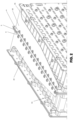
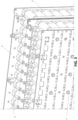
- FIGS 1 , 2 , and 3 show a battery pack (1) according to the invention from different perspectives, with two layers (2a, 2b) of electric cells (11), held together in a mechanical casing (6).
- the electric cells (11) are arranged in rows in which all cells are oriented in the same direction, and contact printed circuit boards (3, 4) on both sides, a top (3) and a bottom (4) printed circuit board. Holders (5) are provided on this, which have openings in which the ends of the electric cells (11) fit, to hold them in place and to space them apart.
- These holders (5) have an ordered structure, typically in rows and columns or in staggered rows, to maximize power density, while providing sufficient strength and electrically isolating the cells.
- the printed circuit boards (4, 3) are connected back to back between adjacent layers (2a, 2b), typically still separated by intermediate insulation layers (9).
- Such insulation layers (9) or insulation shields may also be provided on one or more sides of the battery pack (1).
- the layers (2a, 2b) are held together by spokes or rods (7) that extend through the layers (2a, 2b), between the electric cells (11), and through the printed circuit boards (3, 4) and insulation layers (9) at the bottom and top of the battery pack (1).
- a rigid protective plate (6) is also provided on the outside of the battery pack (1), on the insulation layers (9), through which some spokes (7) extend and anchor onto.
- Additional connectors (8) can be provided on the printed circuit boards (3, 4), on which electrical connections can be made for reading voltage, temperature, and other parameters. Additionally, these connectors can also be used for mechanical support and anchoring of the battery pack, for example, for fastening in a housing.
- output busbars (10) are also provided between the printed circuit boards (3, 4) of a layer, at the sides/corners thereof, which serve for electrically connecting the printed circuit boards, and provide additional support between the printed circuit boards, as these busbars typically have great structural strength.
- the output busbars extend over a substantial part of a side of the battery pack, for optimal distribution of the current (and thereby heat due to the Joule effect), as seen in Figure 2 .
- the two busbars (10), one per layer (2a, 2b), are separated by an insulation layer (9).
- the adjacent printed circuit boards (4, 3) of two adjoining layers (2a, 2b), as seen in Figure 3 for example, are connected via power output terminals on both printed circuit boards, which are connected via a serial connector busbar (12) and thus form a parallel circuit that allows for high current capacity.
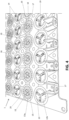
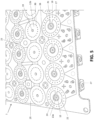
- Figures 4 and 5 show the printed circuit boards (3, 4) with conductive contact zones (13).
- the conductive contact zones comprise a number of resilient fingers (14).
- the resilient fingers (14) are provided in two configurations (13a, 13b), with each row alternating in configuration with its neighbors.
- the first configuration (13a) has three resilient fingers (14) directed away from a center of the contact zone (13), and radially directed.
- the second configuration (13b) also has three resilient fingers (14) which are tangentially positioned around the center of the contact zone (13).
- the first conductive contact zone (13a) is circular and provided with a vertical interconnect access (VIA) (15) at the center of the first conductive contact zone (13a).
- VIP vertical interconnect access
- Each first conductive contact zone (13a) is further provided with preferably three conductive resilient fingers (14).
- the conductive resilient fingers (14) are rectangular and are positioned with a long side toward the center.
- a first ring of VIAs (15) is provided towards the outer edge of the first conductive contact zone (13a). Adjacent to the first conductive contact zone (13a), an annular solder mask layer (16) is provided. Adjacent to this solder mask layer (16), a conductive outer ring (17) is provided. A second ring of VIAs (18) can be observed on this conductive outer ring.
- the second conductive contact zone (13b) is circular and provided with a VIA (19) at the center of the second conductive contact zone (13b). Every second conductive contact zone (13b) is further provided with preferably three conductive resilient fingers (14). The conductive resilient fingers are rectangular and are positioned with a short side towards the center. Subsequently, a ring of VIAs (20) is positioned between the resilient fingers (14) and an outer circumference of the second conductive contact zone (13b).
- Figure 5 shows the back side of a printed circuit board (3, 4). Alternating rows of conductive contact zones can be observed on the back side of the printed circuit board (3, 4).
- a first row comprises first conductive contact zones (13a) for electrically conductive contacting of the positive poles.
- a second row comprises second conductive (13b) contact zones for electrically conductive contacting of the negative poles, and so forth.
- the first conductive contact zone (13a) is circular and provided with a VIA (21) in the center of the first conductive contact zone (13a), this VIA (21) corresponds to the VIA (21) of the center of the cell side of the printed circuit board.
- a circular solder mask layer (22) is provided adjacent to the first conductive contact zone (13a).
- a first ring (15) of VIAs is positioned between the solder mask layer (22) and the VIA (21) at the center of the first conductive contact zone.
- the annular solder mask layer (22) is interrupted by a fuse strip (23).
- Adjacent to the solder mask layer (22) is a conductive outer ring (17), wherein the conductive outer ring (17) is provided with a second ring of VIAs (18).
- the VIAs of the first ring (15) and the second ring (18) of the back side of the printed circuit board (3, 4) correspond respectively to the VIAs of the first ring (15) and the second ring (18) of the cell side of the printed circuit board.
- the second conductive contact zone (13b) is circular and provided with a VIA (19) at the center of the second conductive contact zone (13b); this VIA (19) corresponds to the VIA (19) at the center of the cell side of the printed circuit board. Further, a ring of VIAs (20) is provided on the second conductive contact zone (13b), positioned correspondingly with those of the second conductive contact zones of the cell side of the printed circuit board.
- Figure 6 shows two adjacent layers of cells (2a, 2b), each provided with a printed circuit board (4, 3) that is separated by a number of insulation layers (9).
- a one-piece holder (5, 5a, 5b) is provided at each of the layers, in which the cells (2a, 2b) are provided.
- the cells (2a, 2b) are received in the first section (5a), and rest on the narrowing (5b), such that the contacts (14) come into contact with the electric cells (2a, 2b), but do not rest on them.
Landscapes
- Chemical & Material Sciences (AREA)
- Chemical Kinetics & Catalysis (AREA)
- Electrochemistry (AREA)
- General Chemical & Material Sciences (AREA)
- Engineering & Computer Science (AREA)
- Aviation & Aerospace Engineering (AREA)
- Microelectronics & Electronic Packaging (AREA)
- Manufacturing & Machinery (AREA)
- Battery Mounting, Suspending (AREA)
- Connection Of Batteries Or Terminals (AREA)
Applications Claiming Priority (1)
| Application Number | Priority Date | Filing Date | Title |
|---|---|---|---|
| BE20235688A BE1031899B1 (nl) | 2023-08-18 | 2023-08-18 | Verbeterde batterijcelhouder voor accupack |
Publications (2)
| Publication Number | Publication Date |
|---|---|
| EP4510334A2 true EP4510334A2 (de) | 2025-02-19 |
| EP4510334A3 EP4510334A3 (de) | 2025-05-14 |
Family
ID=87801551
Family Applications (1)
| Application Number | Title | Priority Date | Filing Date |
|---|---|---|---|
| EP24194927.0A Pending EP4510334A3 (de) | 2023-08-18 | 2024-08-16 | Verbesserter batteriezellenhalter für ein batteriepack |
Country Status (2)
| Country | Link |
|---|---|
| EP (1) | EP4510334A3 (de) |
| BE (1) | BE1031899B1 (de) |
Family Cites Families (2)
| Publication number | Priority date | Publication date | Assignee | Title |
|---|---|---|---|---|
| EP3573127A1 (de) * | 2018-05-25 | 2019-11-27 | E-Seven Systems Technology Management Ltd | Anordnung für zellen zur speicherung elektrischer energie mit federkontaktelement |
| CN217426951U (zh) * | 2022-06-08 | 2022-09-13 | 浙江丰锂科技发展有限公司 | 一种免焊接电池包 |
-
2023
- 2023-08-18 BE BE20235688A patent/BE1031899B1/nl active IP Right Grant
-
2024
- 2024-08-16 EP EP24194927.0A patent/EP4510334A3/de active Pending
Also Published As
| Publication number | Publication date |
|---|---|
| BE1031899A1 (nl) | 2025-03-12 |
| BE1031899B1 (nl) | 2025-03-17 |
| EP4510334A3 (de) | 2025-05-14 |
Similar Documents
| Publication | Publication Date | Title |
|---|---|---|
| US9929451B2 (en) | Battery assembly | |
| CN101682017B (zh) | 组装型电连接构件及包含该电连接构件的二次电池组 | |
| US9673540B2 (en) | Secondary battery pack based on mechanical connection manner | |
| US8287313B2 (en) | Electrical connecting member for secondary battery | |
| US9184431B2 (en) | Modular battery system and components | |
| KR101065963B1 (ko) | 배터리팩 및 그 제조방법 | |
| EP3188286B1 (de) | Batterieanordnung mit widerstandsausgleichsleitungen zwischen batterienpolen | |
| EP4510334A2 (de) | Verbesserter batteriezellenhalter für ein batteriepack | |
| CN216793930U (zh) | 电极连接片、电池和储能装置 | |
| EP4510333A2 (de) | Batteriepack mit verbesserter mechanischer verbindung | |
| KR100965274B1 (ko) | 이차전지용 접속부재 | |
| CN117693861A (zh) | 具有叠层母线组件的电池模块 | |
| KR101101151B1 (ko) | 이차전지용 음극 접속부재 | |
| KR101108445B1 (ko) | 이차전지의 기계적 접속방법 및 이를 위한 접속부재 | |
| KR20100000884A (ko) | 전지셀 접속부재 | |
| KR100983014B1 (ko) | 조립방식의 전기적 접속부재 및 이를 포함하고 있는이차전지 팩 | |
| US20250132465A1 (en) | Busbar Structure, CCS Assembly, and Battery Module | |
| US20150295219A1 (en) | Battery and battery module | |
| BE1031900B1 (nl) | Verbeterde zekering voor batterijcelhouder | |
| US20230411714A1 (en) | Sensing pcb structure of battery unit | |
| WO2025215679A1 (en) | Energy block assembly |
Legal Events
| Date | Code | Title | Description |
|---|---|---|---|
| PUAI | Public reference made under article 153(3) epc to a published international application that has entered the european phase |
Free format text: ORIGINAL CODE: 0009012 |
|
| STAA | Information on the status of an ep patent application or granted ep patent |
Free format text: STATUS: THE APPLICATION HAS BEEN PUBLISHED |
|
| AK | Designated contracting states |
Kind code of ref document: A2 Designated state(s): AL AT BE BG CH CY CZ DE DK EE ES FI FR GB GR HR HU IE IS IT LI LT LU LV MC ME MK MT NL NO PL PT RO RS SE SI SK SM TR |
|
| PUAL | Search report despatched |
Free format text: ORIGINAL CODE: 0009013 |
|
| AK | Designated contracting states |
Kind code of ref document: A3 Designated state(s): AL AT BE BG CH CY CZ DE DK EE ES FI FR GB GR HR HU IE IS IT LI LT LU LV MC ME MK MT NL NO PL PT RO RS SE SI SK SM TR |
|
| RIC1 | Information provided on ipc code assigned before grant |
Ipc: H01M 50/517 20210101ALI20250407BHEP Ipc: H01M 50/284 20210101ALI20250407BHEP Ipc: H01M 50/264 20210101ALI20250407BHEP Ipc: H01M 50/249 20210101ALI20250407BHEP Ipc: H01M 50/519 20210101ALI20250407BHEP Ipc: H01M 50/503 20210101ALI20250407BHEP Ipc: H01M 50/213 20210101AFI20250407BHEP |
|
| STAA | Information on the status of an ep patent application or granted ep patent |
Free format text: STATUS: REQUEST FOR EXAMINATION WAS MADE |
|
| 17P | Request for examination filed |
Effective date: 20251114 |
|
| RAV | Requested validation state of the european patent: fee paid |
Extension state: KH Effective date: 20251114 Extension state: MA Effective date: 20251114 Extension state: MD Effective date: 20251114 Extension state: TN Effective date: 20251114 |
|
| RAX | Requested extension states of the european patent have changed |
Extension state: BA Payment date: 20251114 |
|
| STAA | Information on the status of an ep patent application or granted ep patent |
Free format text: STATUS: EXAMINATION IS IN PROGRESS |
|
| 17Q | First examination report despatched |
Effective date: 20260209 |