EP4510125A1 - Identifying input for speech recognition engine - Google Patents
Identifying input for speech recognition engine Download PDFInfo
- Publication number
- EP4510125A1 EP4510125A1 EP24221982.2A EP24221982A EP4510125A1 EP 4510125 A1 EP4510125 A1 EP 4510125A1 EP 24221982 A EP24221982 A EP 24221982A EP 4510125 A1 EP4510125 A1 EP 4510125A1
- Authority
- EP
- European Patent Office
- Prior art keywords
- voice activity
- user
- pause
- determining
- audio signal
- Prior art date
- Legal status (The legal status is an assumption and is not a legal conclusion. Google has not performed a legal analysis and makes no representation as to the accuracy of the status listed.)
- Pending
Links
Images





Classifications
-
- G—PHYSICS
- G10—MUSICAL INSTRUMENTS; ACOUSTICS
- G10L—SPEECH ANALYSIS TECHNIQUES OR SPEECH SYNTHESIS; SPEECH RECOGNITION; SPEECH OR VOICE PROCESSING TECHNIQUES; SPEECH OR AUDIO CODING OR DECODING
- G10L15/00—Speech recognition
- G10L15/04—Segmentation; Word boundary detection
-
- G—PHYSICS
- G10—MUSICAL INSTRUMENTS; ACOUSTICS
- G10L—SPEECH ANALYSIS TECHNIQUES OR SPEECH SYNTHESIS; SPEECH RECOGNITION; SPEECH OR VOICE PROCESSING TECHNIQUES; SPEECH OR AUDIO CODING OR DECODING
- G10L15/00—Speech recognition
- G10L15/22—Procedures used during a speech recognition process, e.g. man-machine dialogue
-
- G—PHYSICS
- G10—MUSICAL INSTRUMENTS; ACOUSTICS
- G10L—SPEECH ANALYSIS TECHNIQUES OR SPEECH SYNTHESIS; SPEECH RECOGNITION; SPEECH OR VOICE PROCESSING TECHNIQUES; SPEECH OR AUDIO CODING OR DECODING
- G10L25/00—Speech or voice analysis techniques not restricted to a single one of groups G10L15/00 - G10L21/00
- G10L25/03—Speech or voice analysis techniques not restricted to a single one of groups G10L15/00 - G10L21/00 characterised by the type of extracted parameters
- G10L25/21—Speech or voice analysis techniques not restricted to a single one of groups G10L15/00 - G10L21/00 characterised by the type of extracted parameters the extracted parameters being power information
-
- G—PHYSICS
- G10—MUSICAL INSTRUMENTS; ACOUSTICS
- G10L—SPEECH ANALYSIS TECHNIQUES OR SPEECH SYNTHESIS; SPEECH RECOGNITION; SPEECH OR VOICE PROCESSING TECHNIQUES; SPEECH OR AUDIO CODING OR DECODING
- G10L25/00—Speech or voice analysis techniques not restricted to a single one of groups G10L15/00 - G10L21/00
- G10L25/78—Detection of presence or absence of voice signals
- G10L25/87—Detection of discrete points within a voice signal
-
- G—PHYSICS
- G10—MUSICAL INSTRUMENTS; ACOUSTICS
- G10L—SPEECH ANALYSIS TECHNIQUES OR SPEECH SYNTHESIS; SPEECH RECOGNITION; SPEECH OR VOICE PROCESSING TECHNIQUES; SPEECH OR AUDIO CODING OR DECODING
- G10L15/00—Speech recognition
- G10L15/22—Procedures used during a speech recognition process, e.g. man-machine dialogue
- G10L2015/226—Procedures used during a speech recognition process, e.g. man-machine dialogue using non-speech characteristics
- G10L2015/227—Procedures used during a speech recognition process, e.g. man-machine dialogue using non-speech characteristics of the speaker; Human-factor methodology
Definitions
- This disclosure relates in general to systems and methods for processing speech signals, and in particular to systems and methods for processing a speech signal for presentation to a speech recognition engine.
- Systems for speech recognition are tasked with receiving audio input representing human speech, typically via one or more microphones, and processing the audio input to determine words, logical structures, or other outputs corresponding to that audio input.
- ASR automatic speech recognition
- NLP natural language processing
- ASR systems may generate a text output based on the human speech corresponding to an audio input signal
- NLP natural language processing
- ASR systems may operate on a large corpus of speech recorded in advance - as one example, a system tasked with creating a written transcript of a speech that was recorded by a microphone the previous day - some ASR systems must respond to speech input provided in real-time.
- Real-time speech processing presents ASR systems with a unique set of challenges. For instance, ASR systems typically process speech not as monolithic blocks of input, but as a series of individual words or phrases that carry meaning ("utterances").
- Identifying when an utterance begins and ends can be crucial for an ASR system to accurately process a user's input speech and provide a desired result.
- the ASR system can receive speech input from a user inquiring about the weather (e.g., "What's the current weather?"); convert the speech input into a structured query (e.g., a query for data indicating the past, current, or predicted future weather at a specific date and time, and at a specific location); present the structured query to the weather reporting service; receive the query results from the service; and present the query results to the user.
- a structured query e.g., a query for data indicating the past, current, or predicted future weather at a specific date and time, and at a specific location
- the user expects the ASR system to process his or her complete question (rather than individual fragments of the question), and to promptly provide an accurate response.
- the user further expects that the ASR system will process naturally spoken commands that need not adhere to a specific, rigid format.
- the onus is on the ASR to, in real-time, identify the user's complete question; and process the question to produce an accurate response in a timely manner - ideally, as soon as the user has finished asking the question.
- the accuracy of the response may depend on when the ASR system determines the user's question (an utterance) is complete. For instance, a user may ask, "What's the weather tomorrow?" If the ASR system prematurely determines that the utterance is complete after "What's the weather", its corresponding query to the weather service would omit the modifier "tomorrow", and the resulting response would thus be inaccurate (it would not reflect the user's desired date/time). Conversely, if the ASR system takes a more conservative approach, and waits for several seconds to confirm the entire utterance has been completed before processing the utterance, the user may not consider the ASR system to be sufficiently responsive to his or her commands. (Additionally, in some cases, such a long waiting period might create inaccuracies by including unrelated follow-up speech in the utterance.)
- ASR systems struggle with this problem of determining, promptly and in real-time, when a speaker's utterance is complete.
- a fixed time-out period is employed to determine the endpoint of an utterance: if, following speech input, no speech is received for the duration of the time-out period (e.g., 750 ms), the speech input may be considered to be the end of an utterance.
- the fixed time-out period solution is imperfect: for example, in situations where a user pauses to formulate a question; where the user is momentarily interrupted; or where the user's speech is otherwise disfluent (e.g., due to anxiety, a speech impediment, environmental distractions, cognitive load, etc.), the time-out period can expire before the user's utterance is complete. And conversely, once the user's utterance is complete, the response is delayed by at least the duration of the time-out period (in which the ASR system confirms no further input is received), and the user cannot provide additional speech input (e.g., belonging to a new utterance) for that duration.
- Such interactions limit the usefulness of ASR systems, and may highlight, unhelpfully, that the user is communicating with a machine, rather than another human being.
- an ASR system it is desirable for an ASR system to adopt a more intuitive approach to determining when a user has finished providing an utterance.
- ordinary face-to-face interactions - and, to a lesser extent, telephonic interactions - people use a variety of contextual cues to understand when another person has finished talking. For example, when a speaker pauses, people evaluate the speaker's prosody, facial expression, eye gaze, mannerisms, gestures, and posture for indications whether the speaker is finished speaking, or has merely paused in the middle of a single thought.
- ASR systems may use similar cues to identify where a user's utterance begins and ends.
- an ASR system can identify such contextual cues from microphone input; and in some examples, an ASR system in communication with one or more sensors (e.g., as part of a wearable system) can glean additional speech cues about the speaker from the outputs of those sensors, and use such cues to identify utterance boundaries without the problems, such as described above, associated with conventional solutions.
- a method of presenting a signal to a speech recognition engine is disclosed.
- an audio signal is received from a user.
- a portion of the audio signal is identified, the portion having a first time and a second time.
- a pause in the portion of the audio signal, the pause comprising the second time, is identified. It is determined whether the pause indicates the completion of an utterance of the audio signal. In accordance with a determination that the pause indicates the completion of the utterance, the portion of the audio signal is presented as input to the speech recognition engine. In accordance with a determination that the pause does not indicate the completion of the utterance, the portion of the audio signal is not presented as input to the speech recognition engine.
- FIG. 1 illustrates an example wearable head device 100 configured to be worn on the head of a user.
- Wearable head device 100 may be part of a broader wearable system that comprises one or more components, such as a head device (e.g., wearable head device 100), a handheld controller (e.g., handheld controller 200 described below), and/or an auxiliary unit (e.g., auxiliary unit 300 described below).
- a head device e.g., wearable head device 100
- a handheld controller e.g., handheld controller 200 described below
- auxiliary unit e.g., auxiliary unit 300 described below.
- wearable head device 100 can be used for virtual reality, augmented reality, or mixed reality systems or applications.
- Wearable head device 100 can comprise one or more displays, such as displays 110A and 110B (which may comprise left and right transmissive displays, and associated components for coupling light from the displays to the user's eyes, such as orthogonal pupil expansion (OPE) grating sets 112A/112B and exit pupil expansion (EPE) grating sets 114A/114B); left and right acoustic structures, such as speakers 120A and 120B (which may be mounted on temple arms 122A and 122B, and positioned adjacent to the user's left and right ears, respectively); one or more sensors such as infrared sensors, accelerometers, GPS units, inertial measurement units (IMU)(e.g.
- IMU inertial measurement units
- wearable head device 100 can incorporate any suitable display technology, and any suitable number, type, or combination of sensors or other components without departing from the scope of the invention.
- wearable head device 100 may incorporate one or more microphones 150 configured to detect audio signals generated by the user's voice; such microphones may be positioned in a wearable head device adjacent to the user's mouth.
- wearable head device 100 may incorporate networking features (e.g., Wi-Fi capability) to communicate with other devices and systems, including other wearable systems.
- Wearable head device 100 may further include components such as a battery, a processor, a memory, a storage unit, or various input devices (e.g., buttons, touchpads); or may be coupled to a handheld controller (e.g., handheld controller 200) or an auxiliary unit (e.g., auxiliary unit 300) that comprises one or more such components.
- sensors may be configured to output a set of coordinates of the head-mounted unit relative to the user's environment, and may provide input to a processor performing a Simultaneous Localization and Mapping (SLAM) procedure and/or a visual odometry algorithm.
- SLAM Simultaneous Localization and Mapping
- wearable head device 100 may be coupled to a handheld controller 200, and/or an auxiliary unit 300, as described further below.
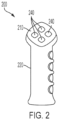
- FIG. 2 illustrates an example mobile handheld controller component 200 of an example wearable system.
- handheld controller 200 may be in wired or wireless communication with wearable head device 100 and/or auxiliary unit 300 described below.
- handheld controller 200 includes a handle portion 220 to be held by a user, and one or more buttons 240 disposed along a top surface 210.
- handheld controller 200 may be configured for use as an optical tracking target; for example, a sensor (e.g., a camera or other optical sensor) of wearable head device 100 can be configured to detect a position and/or orientation of handheld controller 200 - which may, by extension, indicate a position and/or orientation of the hand of a user holding handheld controller 200.
- a sensor e.g., a camera or other optical sensor
- handheld controller 200 may include a processor, a memory, a storage unit, a display, or one or more input devices, such as described above.
- handheld controller 200 includes one or more sensors (e.g., any of the sensors or tracking components described above with respect to wearable head device 100).
- sensors can detect a position or orientation of handheld controller 200 relative to wearable head device 100 or to another component of a wearable system.
- sensors may be positioned in handle portion 220 of handheld controller 200, and/or may be mechanically coupled to the handheld controller.
- Handheld controller 200 can be configured to provide one or more output signals, corresponding, for example, to a pressed state of the buttons 240; or a position, orientation, and/or motion of the handheld controller 200 (e.g., via an IMU). Such output signals may be used as input to a processor of wearable head device 100, to auxiliary unit 300, or to another component of a wearable system.
- handheld controller 200 can include one or more microphones to detect sounds (e.g., a user's speech, environmental sounds), and in some cases provide a signal corresponding to the detected sound to a processor (e.g., a processor of wearable head device 100).
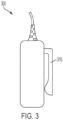
- FIG. 3 illustrates an example auxiliary unit 300 of an example wearable system.
- auxiliary unit 300 may be in wired or wireless communication with wearable head device 100 and/or handheld controller 200.
- the auxiliary unit 300 can include a battery to provide energy to operate one or more components of a wearable system, such as wearable head device 100 and/or handheld controller 200 (including displays, sensors, acoustic structures, processors, microphones, and/or other components of wearable head device 100 or handheld controller 200).
- auxiliary unit 300 may include a processor, a memory, a storage unit, a display, one or more input devices, and/or one or more sensors, such as described above.
- auxiliary unit 300 includes a clip 310 for attaching the auxiliary unit to a user (e.g., a belt worn by the user).
- auxiliary unit 300 to house one or more components of a wearable system is that doing so may allow large or heavy components to be carried on a user's waist, chest, or back - which are relatively well suited to support large and heavy objects - rather than mounted to the user's head (e.g., if housed in wearable head device 100) or carried by the user's hand (e.g., if housed in handheld controller 200). This may be particularly advantageous for relatively heavy or bulky components, such as batteries.
- FIG. 4 shows an example functional block diagram that may correspond to an example wearable system 400, such as may include example wearable head device 100, handheld controller 200, and auxiliary unit 300 described above.
- the wearable system 400 could be used for virtual reality, augmented reality, or mixed reality applications.
- wearable system 400 can include example handheld controller 400B, referred to here as a "totem" (and which may correspond to handheld controller 200 described above); the handheld controller 400B can include a totem-to-headgear six degree of freedom (6DOF) totem subsystem 404A.
- 6DOF six degree of freedom
- Wearable system 400 can also include example wearable head device 400A (which may correspond to wearable headgear device 100 described above); the wearable head device 400A includes a totem-to-headgear 6DOF headgear subsystem 404B.
- the 6DOF totem subsystem 404A and the 6DOF headgear subsystem 404B cooperate to determine six coordinates (e.g., offsets in three translation directions and rotation along three axes) of the handheld controller 400B relative to the wearable head device 400A.
- the six degrees of freedom may be expressed relative to a coordinate system of the wearable head device 400A.
- the three translation offsets may be expressed as X, Y, and Z offsets in such a coordinate system, as a translation matrix, or as some other representation.
- the rotation degrees of freedom may be expressed as sequence of yaw, pitch and roll rotations; as vectors; as a rotation matrix; as a quaternion; or as some other representation.
- one or more depth cameras 444 (and/or one or more non-depth cameras) included in the wearable head device 400A; and/or one or more optical targets (e.g., buttons 240 of handheld controller 200 as described above, or dedicated optical targets included in the handheld controller) can be used for 6DOF tracking.
- the handheld controller 400B can include a camera, as described above; and the headgear 400A can include an optical target for optical tracking in conjunction with the camera.
- the wearable head device 400A and the handheld controller 400B each include a set of three orthogonally oriented solenoids which are used to wirelessly send and receive three distinguishable signals. By measuring the relative magnitude of the three distinguishable signals received in each of the coils used for receiving, the 6DOF of the handheld controller 400B relative to the wearable head device 400A may be determined.
- 6DOF totem subsystem 404A can include an Inertial Measurement Unit (IMU) that is useful to provide improved accuracy and/or more timely information on rapid movements of the handheld controller 400B.
- IMU Inertial Measurement Unit
- a local coordinate space e.g., a coordinate space fixed relative to wearable head device 400A
- an inertial coordinate space or to an environmental coordinate space.
- such transformations may be necessary for a display of wearable head device 400A to present a virtual object at an expected position and orientation relative to the real environment (e.g., a virtual person sitting in a real chair, facing forward, regardless of the position and orientation of wearable head device 400A), rather than at a fixed position and orientation on the display (e.g., at the same position in the display of wearable head device 400A).
- a compensatory transformation between coordinate spaces can be determined by processing imagery from the depth cameras 444 (e.g., using a Simultaneous Localization and Mapping (SLAM) and/or visual odometry procedure) in order to determine the transformation of the wearable head device 400A relative to an inertial or environmental coordinate system.
- SLAM Simultaneous Localization and Mapping
- the depth cameras 444 can be coupled to a SLAM/visual odometry block 406 and can provide imagery to block 406.
- the SLAM/visual odometry block 406 implementation can include a processor configured to process this imagery and determine a position and orientation of the user's head, which can then be used to identify a transformation between a head coordinate space and a real coordinate space.
- an additional source of information on the user's head pose and location is obtained from an IMU 409 of wearable head device 400A.
- Information from the IMU 409 can be integrated with information from the SLAM/visual odometry block 406 to provide improved accuracy and/or more timely information on rapid adjustments of the user's head pose and position.
- the depth cameras 444 can supply 3D imagery to a hand gesture tracker 411, which may be implemented in a processor of wearable head device 400A.
- the hand gesture tracker 411 can identify a user's hand gestures, for example by matching 3D imagery received from the depth cameras 444 to stored patterns representing hand gestures. Other suitable techniques of identifying a user's hand gestures will be apparent.
- one or more processors 416 may be configured to receive data from headgear subsystem 404B, the IMU 409, the SLAM/visual odometry block 406, depth cameras 444, a microphone 450; and/or the hand gesture tracker 411.
- the processor 416 can also send and receive control signals from the 6DOF totem system 404A.
- the processor 416 may be coupled to the 6DOF totem system 404A wirelessly, such as in examples where the handheld controller 400B is untethered.
- Processor 416 may further communicate with additional components, such as an audio-visual content memory 418, a Graphical Processing Unit (GPU) 420, and/or a Digital Signal Processor (DSP) audio spatializer 422.
- GPU Graphical Processing Unit
- DSP Digital Signal Processor
- the DSP audio spatializer 422 may be coupled to a Head Related Transfer Function (HRTF) memory 425.
- the GPU 420 can include a left channel output coupled to the left source of imagewise modulated light 424 and a right channel output coupled to the right source of imagewise modulated light 426. GPU 420 can output stereoscopic image data to the sources of imagewise modulated light 424, 426.
- the DSP audio spatializer 422 can output audio to a left speaker 412 and/or a right speaker 414.
- the DSP audio spatializer 422 can receive input from processor 419 indicating a direction vector from a user to a virtual sound source (which may be moved by the user, e.g., via the handheld controller 400B).
- the DSP audio spatializer 422 can determine a corresponding HRTF (e.g., by accessing a HRTF, or by interpolating multiple HRTFs). The DSP audio spatializer 422 can then apply the determined HRTF to an audio signal, such as an audio signal corresponding to a virtual sound generated by a virtual object. This can enhance the believability and realism of the virtual sound, by incorporating the relative position and orientation of the user relative to the virtual sound in the mixed reality environment - that is, by presenting a virtual sound that matches a user's expectations of what that virtual sound would sound like if it were a real sound in a real environment.
- auxiliary unit 400C may include a battery 427 to power its components and/or to supply power to wearable head device 400A and/or handheld controller 400B. Including such components in an auxiliary unit, which can be mounted to a user's waist, can limit the size and weight of wearable head device 400A, which can in turn reduce fatigue of a user's head and neck.
- FIG. 4 presents elements corresponding to various components of an example wearable system 400
- various other suitable arrangements of these components will become apparent to those skilled in the art.
- elements presented in FIG. 4 as being associated with auxiliary unit 400C could instead be associated with wearable head device 400A or handheld controller 400B.
- some wearable systems may forgo entirely a handheld controller 400B or auxiliary unit 400C.
- Such changes and modifications are to be understood as being included within the scope of the disclosed examples.
- Speech recognition systems in general comprise a speech recognition engine that can accept an input audio signal corresponding to human speech (a source signal); process and analyze the input audio signal; and produce, as a result of the analysis, an output corresponding to the human speech.
- the output of a speech recognition engine may be a text transcription of the human speech.
- the output may be one or more commands or instructions indicated by the human speech; or some representation (e.g., a logical expression or a data structure) of the semantic meaning of the human speech.
- Other types of speech processing systems e.g., automatic translation systems
- a speech recognition engine can include one or more of an automated speech recognition engine, a natural language understanding engine, and other suitable components.
- ASR systems are found in a diverse array of products and applications: conventional telephone systems; automated voice messaging systems; voice assistants (including standalone and smartphone-based voice assistants); vehicles and aircraft; desktop and document processing software; data entry; home appliances; medical devices; language translation software; closed captioning systems; and others.
- An advantage of ASR systems is that they may allow users to provide input to a computer system using natural spoken language, such as presented to a microphone, instead of conventional computer input devices such as keyboards or touch panels; accordingly, speech recognition systems may be particularly useful in environments where conventional input devices (e.g., keyboards) may be unavailable or impractical. Further, by permitting users to provide intuitive voice-based input, speech recognition engines can heighten feelings of immersion.
- ASR can be a natural fit for wearable systems, and in particular, for virtual reality, augmented reality, and/or mixed reality applications of wearable systems, in which user immersion is a primary goal, and in which it may be desirable to limit the use of conventional computer input devices, whose presence may detract from feelings of immersion.
- the effectiveness of an ASR system may be limited by its ability to promptly present accurate input data to a speech recognition engine. Presenting accurate input data may require correctly identifying when individual sequences of input start and end. Some ASR systems struggle to determine, promptly and in real-time, when a speaker's utterance is complete.
- the present disclosure is directed to systems and methods for improving the accuracy of a speech processing system by accurately identifying the endpoints of utterances presented as input to the speech processing system. Quickly and accurately determining where an utterance ends enables a speech processing system to promptly deliver correct results in real-time - that is, in response to a live stream of input audio, where the entire input audio signal cannot be known in advance.
- FIG. 5 illustrates an example audio waveform 500, such as may be detected by one or more microphones and presented as input to an ASR system.
- Waveform 500 represents a user speaking the example utterance "What's the weather tomorrow in Moscow?", with the intention that an ASR system receiving that utterance as input will query a weather service, and respond with tomorrow's weather forecast for Moscow. The speed and accuracy of the ASR system's response will depend on what the ASR system determines to be the endpoint of the user's utterance.
- Example waveform 500 begins at an initial time t 0 .
- the ASR system determines, prematurely, that the utterance ends at time t 1 , which falls after the phrase "what's the weather” and before the word “tomorrow"
- the input utterance i.e., the input speech falling between time t 0 and time t 1
- the ASR system's response to this utterance will not match the user's expectations. For example, the system might return the current weather (not tomorrow's weather) in the user's current location (not in Moscow).
- the ASR system determines that the utterance ends at time t 2 , which falls after the phrase "what's the weather tomorrow" and before the phrase "in Moscow"
- the input utterance i.e., the input speech falling between time t 0 and time t 2
- the resulting response will again not match the user's expectations (tomorrow's weather in Moscow).
- An ideal ASR system may determine the end of the utterance to be at time t 3 , which falls immediately after the conclusion of the entire input query, and would correctly identify the input utterance as "what's the weather in Moscow".
- the ideal ASR system would also not include trailing portions of the input signal that do not belong to the input utterance. For example, if an ASR system determines that the utterance ends at time t 4 , the input utterance would include all of the correct input speech (i.e., "what's the weather in Moscow") but would also include extraneous information (the portion of the input speech signal between t 3 and t 4 ). This extraneous information could introduce errors into the input utterance, and further, will delay the ASR system's response (i.e., by at least the span of processing time of the signal between t 3 and t 4 ), resulting in a perceived lack of responsiveness by the user.
- Some ASR systems may incorrectly identify the endpoint of an input utterance. For instance, when presented with example waveform 500 as input, some ASR systems may incorrectly identify the end of the utterance as t 1 , t 2 , or t 4 , rather than t 3 .
- FIG. 6 illustrates an example process 600 that may be executed by an ASR system.
- Example process 600 uses a time-out interval to determine when an input utterance has concluded; that is, when input speech has not been received for an amount of time exceeding the time-out interval, the utterance is deemed complete and is presented to an ASR engine for processing.
- input speech is detected in real-time at stage 610 from one or more microphones 602.
- process 600 determines whether input speech is still being received; if so, the input utterance is deemed ongoing, and process 600 returns to stage 610 to continue detecting the input speech. If not, process 600 queries whether a time-out interval 632 has elapsed.
- process 600 If not, process 600 returns to stage 610; if so, the utterance is deemed complete (stage 640).
- process 600 then presents the utterance (or some representation of the utterance) to an ASR engine 660 for processing.
- the ASR engine 660 can generate a speech-to-text representation of the input utterance.
- a natural language understanding (NLU) engine 665 can perform additional processing based on the representation. For example, the NLU engine 665 can generate a semantic representation of the speech-to-text representation output from the ASR engine 660; determine that the input utterance represents a request for a weather report; query a weather reporting service using a structured query generated from the input utterance; and receive a response from the weather reporting service.
- NLU natural language understanding
- process 600 may stream the utterance (or some representation of the utterance) for processing (e.g., by the ASR engine 660).
- the ASR engine 660 may return or output incremental results.
- the NLU engine 665 may receive the output from the ASR engine 660 for processing after a conclusion of the utterance.
- process 600 can receive the response from the NLU engine 665, and at stage 680 present the response to the user (e.g., via a text-to-speech engine coupled to an output speaker).
- process 600 may be prone to error because, by concluding an input utterance at stages 630 and 640 using a simple time-out interval, process 600 can prematurely conclude an utterance before the user has completed speaking the utterance. With reference to waveform 500 described above, this may result in the input utterance terminating at time t 1 or t 2 rather than t 3 . This may happen when the user inadvertently inserts gaps of non-speech between two words of a single utterance (e.g., pauses between "weather” and “tomorrow” or between "tomorrow” and “in Moscow” in the example waveform 500).
- process 600 may prematurely determine that the input utterance has completed, even though the user is still completing that utterance. (This situation may be especially common with complex input queries, where the user may need additional time to formulate their question; or among users with speech impediments, or those who experience anxiety when interacting with microphones or ASR systems.)
- the problem may not be completely solvable simply by increasing the length of the time-out interval 632, because there is a tradeoff between the duration of this interval and the perceived responsiveness of the ASR system. That is, even if the time-out interval 632 can be increased such that it exceeds any possible intra-utterance input gap - preventing process 600 from prematurely cutting off an input utterance - the ASR system waits for the duration of that extended time-out interval before determining that the utterance has concluded.
- This delay can annoy the user, who may perceive the delay as non-responsiveness - particularly in comparison to face-to-face human interaction, in which listeners quickly and intuitively understand when a speaker is finished speaking.
- the delay may lead to cross-talk - when a user perceives the ASR system to be unresponsive and begins speaking again (e.g., to reiterate the initial input) - which may result in a cascade of errors.
- FIG. 7 illustrates an example process 700 (e.g., which may be executed by an ASR system) that can identify an input utterance more promptly and accurately than can process 600.
- process 700 as described below, a pause in input speech can be detected, and then analyzed for contextual cues to indicate whether the pause likely represents the completion of the current utterance (in which case the utterance can be concluded and presented to an ASR engine and a NLU engine), or whether the pause indicates that the current utterance is ongoing (in which case the ASR system should continue detecting the current utterance).
- audio input presented by a user is detected at stage 710 from one or more microphones 602.
- audio input can be received as streaming data, or as one or more data files, instead of or in addition to microphone output.
- This audio input can be stored in an input buffer, or other memory, for access by process 700.
- process 700 can determine (for example, based on the input buffer and/or sensor data as described in more detail below) whether the user has paused while presenting the input speech. If no pause is detected, indicating that the user's current utterance is ongoing, the process can return to stage 710 to continue detecting the audio input.
- process 700 can determine at stage 730 the likelihood that the pause indicates the completion of the current utterance (rather than the continuation of the current utterance). For example, stage 720 can determine a numeric confidence value, representing the likelihood that the pause indicates the current utterance is complete. This determination can be made based on the contents of the input buffer and/or sensor data, as described in more detail below.
- process 700 can evaluate the determination, at stage 730, whether the detected pause indicates the completion of the current utterance. If it has been determined with a sufficient confidence (e.g., with a confidence level that exceeds a threshold) that the pause indicates the completion of the current utterance, process 700 can proceed to conclude the utterance (stage 740); present the utterance (stage 750) to an ASR engine (760); receive a response (stage 770) from a NLU engine (765); and present the response to the user (stage 780). These steps may correspond to stage 640, stage 650, ASR engine 660, NLU engine 665, stage 670, and stage 680, respectively, described above with respect to process 600.
- a sufficient confidence e.g., with a confidence level that exceeds a threshold
- process 700 at stage 732 can take various actions in response.
- process 700 can adjust or reset (stage 734) a parameter used to determine whether a pause is detected, such as described herein with respect to stage 720. For instance, process 700 at stage 734 can increase, or reset, a time-out interval used at stage 720 to detect a pause in input speech. This may be beneficial if process 700 determines that more time is needed to determine whether the user intends to complete the current utterance.
- process 700 can present the user with a prompt (stage 736), such as a prompt for additional input (e.g., a visual and/or audible prompt that asks the user to indicate whether they are done speaking).
- a prompt for additional input e.g., a visual and/or audible prompt that asks the user to indicate whether they are done speaking. This can be beneficial in situations where it is unclear whether the current utterance is completed - for example, where process 700 returns a confidence value less than, but close to, the threshold value.
- process 700 can combine the current utterance with a second utterance (stage 738); for instance, an utterance preceding the pause could be concatenated with a second utterance following the pause, for presentation of the combined utterances to a speech recognition engine (e.g., the ASR engine and/or NLU engine).
- process 700 may return to stage 710 to continue detecting input speech, without taking any additional action such as described with respect to stages 734, 736, or 738; this behavior may be preferred where stage 730 returns a confidence value that is far below the threshold required to conclude that the current utterance is complete.
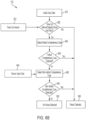
- FIG. 8A illustrates a flow chart of an example process for implementing stage 720 of process 700, such as described above with respect to FIG. 7 .
- audio input data 810 e.g., speech input signals stored in an input buffer
- the process can determine whether a value of one or more properties of an input signal is above or below a threshold for a period of time exceeding a time-out interval. In some examples, whether an amplitude of the input signal has been below a threshold amplitude level for a period of time exceeding the time-out interval may be determined. If so, this can indicate a pause in the user's input speech (stage 860), such as described above with respect to FIG. 6 .
- the length of the time-out interval may vary depending on the property.
- spectral analysis can identify a speech signal as distinct from other ambient or incidental sounds, and whether an output of the analysis has been above or below one or more thresholds for a period of time exceeding the time-out interval may be determined.
- the process can examine audio input data 810 (stage 830) to determine whether the speech data includes verbal cues (other than relative silence) that indicate a pause in the input speech.
- verbal cues can include characteristics of the user's prosody (e.g., rhythm, intonation, timbre, volume), the presence of trailing words, the presence of terminating words or phrases (e.g., "thank you" when completing a verbal request), and the like.
- These verbal cues can indicate that the current utterance is complete, even if the time-out interval has not yet elapsed.
- stage 840 the process can evaluate whether any such verbal cues exist, and if so, whether they indicate that the input speech has paused (stage 860) or not (stage 850). In some cases, stage 840 can make this determination by comparing a confidence level generated at stage 830 against a threshold value.
- the process can avoid perceptions of non-responsiveness, such as described above, that can result from waiting for the conclusion of the time-out interval before presenting the utterance for processing (e.g., by an ASR engine and/or NLU engine).
- FIG. 8B illustrates a flow chart of an example process for implementing stage 720 of process 700 in which sensor input data 844 is used, instead of or in conjunction with audio input data 810 such as described above.
- sensor input data 844 can correspond to data from sensors such as described above with respect to example wearable head device 100 in FIG. 1 .
- a wearable system can include one or more sensors that can provide input about the user and/or the environment of the wearable system.
- wearable head device 100 can include a camera (e.g., camera 444 described in FIG.
- wearable head device 100 can include a LIDAR unit, a radar unit, and/or acoustic sensors, which can output signals corresponding to the physical geometry (e.g., walls, physical objects) of the user's environment.
- wearable head device 100 can include a GPS unit, which can indicate geographic coordinates corresponding to the wearable system's current location.
- wearable head device 100 can include an accelerometer, a gyroscope; and/or an inertial measurement unit (IMU) to indicate an orientation of the wearable head device 100.
- wearable head device 100 can include environmental sensors, such as temperature or pressure sensors.
- wearable head device 100 can include biometric sensors, such as iris cameras; fingerprint sensors; eye tracking sensors (e.g., electrooculography (EOG) sensors) to measure a user's eye movements or eye gaze; or sensors to measure a user's vital signs.
- EOG electrooculography
- wearable head device 100 includes a head-mounted unit
- such orientation can correspond to an orientation of the user's head (and, by extension, the user's mouth and a direction of the user's speech).
- sensors can be included and can provide sensor input data 844.
- sensors other than those of a wearable system can be utilized as appropriate. For instance, sensors associated with a microphone of a speech recognition system (e.g., GPS, IMU) could be used to in conjunction with sensors of a wearable system to determine a relative distance and orientation between the user and the speech recognition system.
- a speech recognition system e.g., GPS, IMU
- process 800 can examine sensor input data 844 to determine whether the sensor data includes non-verbal cues that indicate a pause in the input speech.
- non-verbal cues can include, for example, characteristics of the user's eye gaze; head pose; gestures; vital signs (e.g., breathing patterns, heart rate); and facial expression.
- These non-verbal cues can indicate that the current utterance is complete, even if the time-out interval has not yet elapsed, and even in the absence of verbal cues such as described above with respect to FIG. 8A .
- a pause in a user's speech might correspond with a change in the user's eye gaze target, a change in the user's head pose, a gesture performed by the user, a change in the user's vital signs (e.g., breathing pattern, heart rate), a change in the user's facial expression, a change in movement or rotation away from a microphone, a change in the user's posture or other physical characteristics indicated by sensor input data 844, a change in orientation, and/or a rate of change of any one or more of the aforementioned characteristics.
- the process can evaluate whether any such non-verbal cues exist, and if so, whether they indicate that the input speech has paused (stage 860) or not (stage 850).
- stage 846 can make this determination by comparing a confidence level generated at stage 842 against a threshold value.
- a confidence level generated at stage 842 can be compared by evaluating the presence of non-verbal cues to indicate that an utterance has completed, even before the expiration of a time-out interval.
- the process can avoid perceptions of non-responsiveness, such as described above, that can result from waiting for the conclusion of the time-out interval before presenting an utterance to a speech recognition engine.
- FIG. 8B shows verbal cues and non-verbal cues being analyzed in separate stages (i.e., stages 840 and 846), some examples can analyze verbal cues and non-verbal cues in combination, in a single stage.
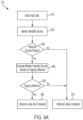
- FIG. 9A illustrates a flow chart of an example process for implementing stage 730 of process 700, such as described above with respect to FIG. 7 .
- process 700 determines, for a pause identified at stage 720 such as described above, whether or not the pause likely corresponds to the conclusion of the current utterance.
- audio input data 910 e.g., speech signals stored in an input buffer, which may correspond to 810 described above
- Interstitial sounds may be words, phrases, syllables, or other vocalizations present in the input audio that can indicate that the current utterance is not yet complete (such as where the user is mid-thought).
- interstitial sounds can include hesitation sounds (e.g., "um,” “uh”); elongated syllables (e.g., an elongated “to(ooo)” at the end of the phrase “I'm going to”); repetitions (e.g., "and, and, and . . .”); trailing filler words (e.g., "like,” "I mean”), and/or other indications that the user is likely to provide additional input audio belonging to the current utterance.
- Such interstitial sounds can be specific to individual users, to particular languages, or types of verbal input (e.g., questions, declarative statements). As described below, various classifiers can be employed to identify interstitial sounds.
- the process can determine whether any such interstitial sounds were detected at stage 920. If not, the process can conclude (stage 970) that the current utterance is completed. If interstitial sounds are present, the process at stage 940 can evaluate whether the interstitial sounds indicate that the current utterance is ongoing. For example, the presence of hesitation sounds can indicate that the user is in the process of formulating a complete utterance (as in, for instance, "What's the weather ... uh . . . tomorrow"). Similarly, elongated syllables, repetitions, filler words, and other interstitial sounds can indicate that the current utterance is not yet complete. In some examples, stage 940 can generate a confidence value, indicating the likelihood that interstitial sounds are present and indicate whether the current utterance is or is not complete.
- process 700 can extend a time-out interval (e.g., 822) in which to detect a pause, prompt the user for additional input indicating whether the current utterance is complete, and/or combine the current utterance with a second utterance; or take no action at all.
- a time-out interval e.g., 822
- process 700 may merely return to stage 710 to continue detecting audio input, without taking any further action; and in response to a medium confidence value (indicating, e.g., uncertainty regarding whether the current utterance is complete), process 700 may expressly prompt the user for additional input (stage 736). Similarly, if it is determined at stage 940 that the current utterance is completed, the process can indicate so (stage 970), and the process can proceed to present the utterance to a speech recognition system, such as described above.
- FIG. 9B illustrates a flow chart of an example process for implementing stage 730 of example process 700 in which sensor input data 942 is used, instead of or in conjunction with audio input data 910 such as described above.
- Sensor input data 942 can correspond to sensor input data 844 described above: for example, sensor input data 942 can be output by sensors such as described above with respect to example wearable head device 100 in FIG. 1 .
- sensors can include one or more cameras (e.g., RGB cameras, depth cameras); LIDAR units; radar units; acoustic sensors; GPS units; accelerometers; gyroscopes; IMUs; environmental sensors; biometric sensors (e.g., iris cameras, fingerprint sensors, eye tracking sensors, and/or sensors to measure a user's vital signs).
- Other suitable sensors can be included and can provide sensor input data 942.
- sensors other than those of a wearable system can be utilized as appropriate. For instance, as described above, sensors associated with a microphone of a speech recognition system (e.g., GPS, IMU) could be used to in conjunction with sensors of a wearable system to determine a relative distance and orientation between the user and the speech recognition system.
- sensor input data 942 can be evaluated at stage 944 to determine whether the sensor data indicates that the current utterance is ongoing, or whether the current utterance is completed.
- the completion (or non-completion) of an utterance might correspond with a change in the user's eye gaze target, a change in the user's head pose, a gesture performed by the user, a change in the user's vital signs (e.g., breathing pattern, heart rate), a change in the user's facial expression, a change in movement or rotation away from a microphone, a change in the user's posture or other physical characteristics indicated by sensor input data 944, a change in orientation, and/or a rate of change of any one or more of the aforementioned characteristics.
- vital signs e.g., breathing pattern, heart rate
- stage 944 may generate a confidence level, indicating a likelihood with which the current utterance is completed. Based on the determination made at stage 944 (e.g., by comparison of the confidence level to a threshold value), the process at stage 950 can indicate that the utterance either is (stage 970) or is not (stage 960) completed.
- input data e.g., audio data, sensor data
- a speech recognition engine e.g., the ASR engine and/or the NLU engine.
- audio input data can be evaluated to determine whether the data includes verbal cues that the current utterance is complete.
- sensor data can be evaluated for non-verbal cues (e.g. changes in facial expression) that the current utterance is complete.
- audio input data can be evaluated to identify the presence of interstitial sounds; and at stage 940, it can be evaluated whether those interstitial sounds indicate that the current utterance is ongoing. And at stage 944, as described above, sensor input data can be evaluated to determine whether the sensor input data indicates that the current utterance is ongoing.
- audio input data and/or sensor input data used as described above can be classified according to one or more parameters - resulting in one or more classifiers representing the data. These classifiers can be used (e.g., by example process 700) to evaluate the significance of that data (e.g., a probability associated with the data).
- FIG. 10 illustrates an example process 1000 for classifying input data 1010 to determine a probability of interest associated with that input data.
- a probability of interest can correspond to a probability described above with respect to example process 700: a probability that audio input data and/or sensor input data indicates a pause in input speech; a probability that a pause indicates the completion of an utterance; and/or a probability that the presence of interstitial sounds indicates that an utterance is ongoing; or another suitable probability.
- this determination can be performed using audio input data 1016, alone or in combination with sensor input data 1020. Determining a probability value for input data 1010 can be referred to as "classifying" the input data 1010, and a module or process for performing this determination (e.g., 1074) can be referred to as a "classifier.”
- input data 1010 e.g., audio input data 1016 and/or sensor input data 1020
- speech/sensor data 1029 e.g., from a database
- audio input data 1016 and/or sensor input data 1020 can be parameterized/characterized according to one or more parameters at stage 1075 in order to facilitate classifying the speech segment based on speech/sensor data 1029.
- a Fourier transform of the input data 1010 can be performed in order to provide a spectral representation of the input data 1010 (e.g., a function of frequency indicating the relative prevalence of various frequency parameters in audio input data 1016 and/or sensor input data 1020).
- this process can identify levels of (or changes in) amplitude or component frequencies of a user's speech, position, eye gaze, and/or body movements; these values can be indicative of a pause in the user's speech, the presence of interstitial sounds, or the conclusion of an utterance of the user, such as described above.
- characteristics of the user for example, the user's age, sex, and/or native language - can be used as parameters to characterize the input data 1010.
- Other ways in which input data 1010 can be parameterized, with such parameters used to determine a probability of interest of the input data, will be apparent to those skilled in the art.
- a probability value 1078 is determined for a probability of interest of input data 1010.
- probability value 1078 can be determined using speech/sensor data 1029, such as where a database including speech/sensor data 1029 identifies, for elements of speech and/or sensor data in the database, whether those elements correspond to input speech.
- audio input data 1016 can include a set of audio waveforms corresponding to speech segments; and can indicate, for each waveform, whether the corresponding speech segment indicates a pause or an interstitial sound.
- audio input data 1016 can include audio parameters that correspond to the speech segments.
- Audio input data 1016 can be compared with the speech segments of speech/sensor data 1029 - for example, by comparing an audio waveform of audio input data 1016 with analogous waveforms of speech/sensor data 1029, or by comparing parameters of audio input data 1016 (such as may be characterized at stage 1075) with analogous parameters of speech/sensor data 1029. Based on such comparisons, probability value 1078 can be determined for audio input data 1016.
- sensor input data 1020 can include sequences of raw sensor data; and can indicate, for the raw sensor data, whether that data indicates a pause, or the completion or continuation of an utterance.
- sensor input data 1020 can include sensor input parameters that correspond to the sensor data.
- Sensor input data 1020 can be compared with elements of speech/sensor data 1029 such as described above with respect to audio input data 1016.
- nearest neighbor interpolation can be used at stage 1076 to compare elements of input data 1010 to similar data elements in an N-dimensional space (in which the N dimensions can comprise, for example, audio parameters, audio waveform data, sensor parameters, or raw sensor data described above); and to determine probability value 1078 based on the relative distances between an element of input data 1010 and its neighbors in the N-dimensional space.
- support vector machines can be used at stage 1076 to determine, based on speech/sensor database 1029, a basis for classifying an element of input data 1010 as either indicating an utterance is complete or indicating the utterance is not complete; and for classifying input data 1010 (e.g., determining a probability value 1078 that input data 1010 indicates a completed utterance, a pause, or the presence of interstitial sounds) according to that basis.
- Other suitable techniques for analyzing input data 1010 and/or speech/sensor data 1029, comparing input data 1010 to speech/sensor data 1029, and/or classifying input data 1010 based on speech/sensor data 1029 in order to determine probability 1078 will be apparent; the disclosure is not limited to any particular technique or combination of techniques.
- machine learning techniques can be used, alone or in combination with other techniques described herein, to determine probability value 1078.
- a neural network could be trained on speech/sensor data 1029, and applied to input data 1010 to determine probability value 1078 for that input data.
- a genetic algorithm can be used to determine a function, based on speech/sensor data 1029, for determining probability value 1078 corresponding to input data 1010.
- Other suitable machine learning techniques which will be familiar to those skilled in the art, will be apparent; the disclosure is not limited to any particular technique or combination of techniques.
- speech/sensor data 1029 can be generated by recording a set of speech data and/or sensor data for various users, and identifying, for elements of that data, whether the user has completed an utterance; has paused his or her speech; or is providing interstitial sounds. For instance, a user could be observed interacting with a group of people, with a speech recognition system present in the same room, as the user's speech is recorded; sensor data for the user (e.g., output by a wearable system worn by the user) can also be recorded. The observer can identify, for each region of the recorded data, whether that region of data corresponds to pausing, providing interstitial sounds, or completing an utterance.
- This information can be apparent to the observer by observing the context in which the user is speaking - commonly, it is easy and intuitive for humans (unlike machines) to determine, based on an observation of a user, whether the user has completed an utterance. This process can be repeated for multiple users until a sufficiently large and diverse set of speech/sensor data is generated.
- elements of the systems and methods can be implemented by one or more computer processors (e.g., CPUs or DSPs) as appropriate.
- the disclosure is not limited to any particular configuration of computer hardware, including computer processors, used to implement these elements.
- multiple computer systems can be employed to implement the systems and methods described above.
- a first computer processor e.g., a processor of a wearable device coupled to a microphone
- a second (and perhaps more computationally powerful) processor can then be utilized to perform more computationally intensive processing, such as determining probability values associated with speech segments of those signals.
- Another computer device such as a cloud server, can host a speech recognition engine, to which input signals are ultimately provided.
- Other suitable configurations will be apparent and are within the scope of the disclosure.
Landscapes
- Engineering & Computer Science (AREA)
- Computational Linguistics (AREA)
- Health & Medical Sciences (AREA)
- Audiology, Speech & Language Pathology (AREA)
- Human Computer Interaction (AREA)
- Physics & Mathematics (AREA)
- Acoustics & Sound (AREA)
- Multimedia (AREA)
- Signal Processing (AREA)
- User Interface Of Digital Computer (AREA)
Abstract
Description
- This application claims the benefit under 35 U.S.C. § 119(e) of
U.S. Provisional Patent Application 62/836,593, filed April 19, 2019 - This disclosure relates in general to systems and methods for processing speech signals, and in particular to systems and methods for processing a speech signal for presentation to a speech recognition engine.
- Systems for speech recognition are tasked with receiving audio input representing human speech, typically via one or more microphones, and processing the audio input to determine words, logical structures, or other outputs corresponding to that audio input. For example, automatic speech recognition (ASR) systems may generate a text output based on the human speech corresponding to an audio input signal; and natural language processing (NLP) tools may generate logical structures, or computer data, corresponding to the meaning of that human speech. While some ASR systems may operate on a large corpus of speech recorded in advance - as one example, a system tasked with creating a written transcript of a speech that was recorded by a microphone the previous day - some ASR systems must respond to speech input provided in real-time. Real-time speech processing presents ASR systems with a unique set of challenges. For instance, ASR systems typically process speech not as monolithic blocks of input, but as a series of individual words or phrases that carry meaning ("utterances").
- Identifying when an utterance begins and ends can be crucial for an ASR system to accurately process a user's input speech and provide a desired result. As an example, consider a real-time "voice assistant" ASR system in communication with a weather reporting service: the ASR system can receive speech input from a user inquiring about the weather (e.g., "What's the current weather?"); convert the speech input into a structured query (e.g., a query for data indicating the past, current, or predicted future weather at a specific date and time, and at a specific location); present the structured query to the weather reporting service; receive the query results from the service; and present the query results to the user. The user expects the ASR system to process his or her complete question (rather than individual fragments of the question), and to promptly provide an accurate response. The user further expects that the ASR system will process naturally spoken commands that need not adhere to a specific, rigid format. In this example system, the onus is on the ASR to, in real-time, identify the user's complete question; and process the question to produce an accurate response in a timely manner - ideally, as soon as the user has finished asking the question.
- In this example system, the accuracy of the response may depend on when the ASR system determines the user's question (an utterance) is complete. For instance, a user may ask, "What's the weather tomorrow?" If the ASR system prematurely determines that the utterance is complete after "What's the weather", its corresponding query to the weather service would omit the modifier "tomorrow", and the resulting response would thus be inaccurate (it would not reflect the user's desired date/time). Conversely, if the ASR system takes a more conservative approach, and waits for several seconds to confirm the entire utterance has been completed before processing the utterance, the user may not consider the ASR system to be sufficiently responsive to his or her commands. (Additionally, in some cases, such a long waiting period might create inaccuracies by including unrelated follow-up speech in the utterance.)
- ASR systems struggle with this problem of determining, promptly and in real-time, when a speaker's utterance is complete. In some systems, a fixed time-out period is employed to determine the endpoint of an utterance: if, following speech input, no speech is received for the duration of the time-out period (e.g., 750 ms), the speech input may be considered to be the end of an utterance. However, the fixed time-out period solution is imperfect: for example, in situations where a user pauses to formulate a question; where the user is momentarily interrupted; or where the user's speech is otherwise disfluent (e.g., due to anxiety, a speech impediment, environmental distractions, cognitive load, etc.), the time-out period can expire before the user's utterance is complete. And conversely, once the user's utterance is complete, the response is delayed by at least the duration of the time-out period (in which the ASR system confirms no further input is received), and the user cannot provide additional speech input (e.g., belonging to a new utterance) for that duration. Such interactions limit the usefulness of ASR systems, and may highlight, unhelpfully, that the user is communicating with a machine, rather than another human being.
- It is desirable for an ASR system to adopt a more intuitive approach to determining when a user has finished providing an utterance. In ordinary face-to-face interactions - and, to a lesser extent, telephonic interactions - people use a variety of contextual cues to understand when another person has finished talking. For example, when a speaker pauses, people evaluate the speaker's prosody, facial expression, eye gaze, mannerisms, gestures, and posture for indications whether the speaker is finished speaking, or has merely paused in the middle of a single thought. ASR systems may use similar cues to identify where a user's utterance begins and ends. As described below, in some examples, an ASR system can identify such contextual cues from microphone input; and in some examples, an ASR system in communication with one or more sensors (e.g., as part of a wearable system) can glean additional speech cues about the speaker from the outputs of those sensors, and use such cues to identify utterance boundaries without the problems, such as described above, associated with conventional solutions.
- A method of presenting a signal to a speech recognition engine is disclosed. According to an example of the method, an audio signal is received from a user. A portion of the audio signal is identified, the portion having a first time and a second time. A pause in the portion of the audio signal, the pause comprising the second time, is identified. It is determined whether the pause indicates the completion of an utterance of the audio signal. In accordance with a determination that the pause indicates the completion of the utterance, the portion of the audio signal is presented as input to the speech recognition engine. In accordance with a determination that the pause does not indicate the completion of the utterance, the portion of the audio signal is not presented as input to the speech recognition engine.
-
-
FIG. 1 illustrates an example wearable system according to examples of the disclosure. -
FIG. 2 illustrates an example handheld controller that can be used in conjunction with an example wearable system according to examples of the disclosure. -
FIG. 3 illustrates an example auxiliary unit that can be used in conjunction with an example wearable system according to examples of the disclosure. -
FIG. 4 illustrates an example functional block diagram for an example wearable system according to one or more examples of the disclosure. -
FIG. 5 illustrates an example audio waveform for input to an example ASR system according to one or more examples of the disclosure. -
FIG. 6 illustrates a flow chart of an example of processing an acoustic speech signal using an ASR system according to one or more examples of the disclosure. -
FIG. 7 illustrates a flow chart of an example of processing an acoustic speech signal using an ASR system according to one or more examples of the disclosure. -
FIGs. 8A-8B illustrate flow charts of examples of detecting a pause in an input speech signal according to one or more examples of the disclosure. -
FIGs. 9A-9B illustrate flow charts of examples of determining whether an input utterance has concluded according to one or more examples of the disclosure. -
FIG. 10 illustrates an flow chart of an example of classifying input data to determine a probability associated with that input data according to one or more examples of the disclosure. - In the following description of examples, reference is made to the accompanying drawings which form a part hereof, and in which it is shown by way of illustration specific examples that can be practiced. It is to be understood that other examples can be used and structural changes can be made without departing from the scope of the disclosed examples.
-
FIG. 1 illustrates an examplewearable head device 100 configured to be worn on the head of a user.Wearable head device 100 may be part of a broader wearable system that comprises one or more components, such as a head device (e.g., wearable head device 100), a handheld controller (e.g.,handheld controller 200 described below), and/or an auxiliary unit (e.g.,auxiliary unit 300 described below). In some examples,wearable head device 100 can be used for virtual reality, augmented reality, or mixed reality systems or applications.Wearable head device 100 can comprise one or more displays, such asdisplays grating sets 112A/112B and exit pupil expansion (EPE)grating sets 114A/114B); left and right acoustic structures, such asspeakers temple arms receiver 127 shown mounted to theleft temple arm 122A); left and right cameras (e.g., depth (time-of-flight)cameras eye cameras 128 and 128B). However,wearable head device 100 can incorporate any suitable display technology, and any suitable number, type, or combination of sensors or other components without departing from the scope of the invention. In some examples,wearable head device 100 may incorporate one ormore microphones 150 configured to detect audio signals generated by the user's voice; such microphones may be positioned in a wearable head device adjacent to the user's mouth. In some examples,wearable head device 100 may incorporate networking features (e.g., Wi-Fi capability) to communicate with other devices and systems, including other wearable systems.Wearable head device 100 may further include components such as a battery, a processor, a memory, a storage unit, or various input devices (e.g., buttons, touchpads); or may be coupled to a handheld controller (e.g., handheld controller 200) or an auxiliary unit (e.g., auxiliary unit 300) that comprises one or more such components. In some examples, sensors may be configured to output a set of coordinates of the head-mounted unit relative to the user's environment, and may provide input to a processor performing a Simultaneous Localization and Mapping (SLAM) procedure and/or a visual odometry algorithm. In some examples,wearable head device 100 may be coupled to ahandheld controller 200, and/or anauxiliary unit 300, as described further below. -
FIG. 2 illustrates an example mobilehandheld controller component 200 of an example wearable system. In some examples,handheld controller 200 may be in wired or wireless communication withwearable head device 100 and/orauxiliary unit 300 described below. In some examples,handheld controller 200 includes ahandle portion 220 to be held by a user, and one ormore buttons 240 disposed along atop surface 210. In some examples,handheld controller 200 may be configured for use as an optical tracking target; for example, a sensor (e.g., a camera or other optical sensor) ofwearable head device 100 can be configured to detect a position and/or orientation of handheld controller 200 - which may, by extension, indicate a position and/or orientation of the hand of a user holdinghandheld controller 200. In some examples,handheld controller 200 may include a processor, a memory, a storage unit, a display, or one or more input devices, such as described above. In some examples,handheld controller 200 includes one or more sensors (e.g., any of the sensors or tracking components described above with respect to wearable head device 100). In some examples, sensors can detect a position or orientation ofhandheld controller 200 relative towearable head device 100 or to another component of a wearable system. In some examples, sensors may be positioned inhandle portion 220 ofhandheld controller 200, and/or may be mechanically coupled to the handheld controller.Handheld controller 200 can be configured to provide one or more output signals, corresponding, for example, to a pressed state of thebuttons 240; or a position, orientation, and/or motion of the handheld controller 200 (e.g., via an IMU). Such output signals may be used as input to a processor ofwearable head device 100, toauxiliary unit 300, or to another component of a wearable system. In some examples,handheld controller 200 can include one or more microphones to detect sounds (e.g., a user's speech, environmental sounds), and in some cases provide a signal corresponding to the detected sound to a processor (e.g., a processor of wearable head device 100). -
FIG. 3 illustrates an exampleauxiliary unit 300 of an example wearable system. In some examples,auxiliary unit 300 may be in wired or wireless communication withwearable head device 100 and/orhandheld controller 200. Theauxiliary unit 300 can include a battery to provide energy to operate one or more components of a wearable system, such aswearable head device 100 and/or handheld controller 200 (including displays, sensors, acoustic structures, processors, microphones, and/or other components ofwearable head device 100 or handheld controller 200). In some examples,auxiliary unit 300 may include a processor, a memory, a storage unit, a display, one or more input devices, and/or one or more sensors, such as described above. In some examples,auxiliary unit 300 includes aclip 310 for attaching the auxiliary unit to a user (e.g., a belt worn by the user). An advantage of usingauxiliary unit 300 to house one or more components of a wearable system is that doing so may allow large or heavy components to be carried on a user's waist, chest, or back - which are relatively well suited to support large and heavy objects - rather than mounted to the user's head (e.g., if housed in wearable head device 100) or carried by the user's hand (e.g., if housed in handheld controller 200). This may be particularly advantageous for relatively heavy or bulky components, such as batteries. -
FIG. 4 shows an example functional block diagram that may correspond to an examplewearable system 400, such as may include examplewearable head device 100,handheld controller 200, andauxiliary unit 300 described above. In some examples, thewearable system 400 could be used for virtual reality, augmented reality, or mixed reality applications. As shown inFIG. 4 ,wearable system 400 can includeexample handheld controller 400B, referred to here as a "totem" (and which may correspond tohandheld controller 200 described above); thehandheld controller 400B can include a totem-to-headgear six degree of freedom (6DOF)totem subsystem 404A.Wearable system 400 can also include examplewearable head device 400A (which may correspond towearable headgear device 100 described above); thewearable head device 400A includes a totem-to-headgear6DOF headgear subsystem 404B. In the example, the 6DOF totem subsystem 404A and the6DOF headgear subsystem 404B cooperate to determine six coordinates (e.g., offsets in three translation directions and rotation along three axes) of thehandheld controller 400B relative to thewearable head device 400A. The six degrees of freedom may be expressed relative to a coordinate system of thewearable head device 400A. The three translation offsets may be expressed as X, Y, and Z offsets in such a coordinate system, as a translation matrix, or as some other representation. The rotation degrees of freedom may be expressed as sequence of yaw, pitch and roll rotations; as vectors; as a rotation matrix; as a quaternion; or as some other representation. In some examples, one or more depth cameras 444 (and/or one or more non-depth cameras) included in thewearable head device 400A; and/or one or more optical targets (e.g.,buttons 240 ofhandheld controller 200 as described above, or dedicated optical targets included in the handheld controller) can be used for 6DOF tracking. In some examples, thehandheld controller 400B can include a camera, as described above; and theheadgear 400A can include an optical target for optical tracking in conjunction with the camera. In some examples, thewearable head device 400A and thehandheld controller 400B each include a set of three orthogonally oriented solenoids which are used to wirelessly send and receive three distinguishable signals. By measuring the relative magnitude of the three distinguishable signals received in each of the coils used for receiving, the 6DOF of thehandheld controller 400B relative to thewearable head device 400A may be determined. In some examples,6DOF totem subsystem 404A can include an Inertial Measurement Unit (IMU) that is useful to provide improved accuracy and/or more timely information on rapid movements of thehandheld controller 400B. - In some examples involving augmented reality or mixed reality applications, it may be desirable to transform coordinates from a local coordinate space (e.g., a coordinate space fixed relative to
wearable head device 400A) to an inertial coordinate space, or to an environmental coordinate space. For instance, such transformations may be necessary for a display ofwearable head device 400A to present a virtual object at an expected position and orientation relative to the real environment (e.g., a virtual person sitting in a real chair, facing forward, regardless of the position and orientation ofwearable head device 400A), rather than at a fixed position and orientation on the display (e.g., at the same position in the display ofwearable head device 400A). This can maintain an illusion that the virtual object exists in the real environment (and does not, for example, appear positioned unnaturally in the real environment as thewearable head device 400A shifts and rotates). In some examples, a compensatory transformation between coordinate spaces can be determined by processing imagery from the depth cameras 444 (e.g., using a Simultaneous Localization and Mapping (SLAM) and/or visual odometry procedure) in order to determine the transformation of thewearable head device 400A relative to an inertial or environmental coordinate system. In the example shown inFIG. 4 , thedepth cameras 444 can be coupled to a SLAM/visual odometry block 406 and can provide imagery to block 406. The SLAM/visual odometry block 406 implementation can include a processor configured to process this imagery and determine a position and orientation of the user's head, which can then be used to identify a transformation between a head coordinate space and a real coordinate space. Similarly, in some examples, an additional source of information on the user's head pose and location is obtained from anIMU 409 ofwearable head device 400A. Information from theIMU 409 can be integrated with information from the SLAM/visual odometry block 406 to provide improved accuracy and/or more timely information on rapid adjustments of the user's head pose and position. - In some examples, the
depth cameras 444 can supply 3D imagery to ahand gesture tracker 411, which may be implemented in a processor ofwearable head device 400A. Thehand gesture tracker 411 can identify a user's hand gestures, for example by matching 3D imagery received from thedepth cameras 444 to stored patterns representing hand gestures. Other suitable techniques of identifying a user's hand gestures will be apparent. - In some examples, one or
more processors 416 may be configured to receive data fromheadgear subsystem 404B, theIMU 409, the SLAM/visual odometry block 406,depth cameras 444, a microphone 450; and/or thehand gesture tracker 411. Theprocessor 416 can also send and receive control signals from the6DOF totem system 404A. Theprocessor 416 may be coupled to the6DOF totem system 404A wirelessly, such as in examples where thehandheld controller 400B is untethered.Processor 416 may further communicate with additional components, such as an audio-visual content memory 418, a Graphical Processing Unit (GPU) 420, and/or a Digital Signal Processor (DSP)audio spatializer 422. TheDSP audio spatializer 422 may be coupled to a Head Related Transfer Function (HRTF)memory 425. TheGPU 420 can include a left channel output coupled to the left source of imagewise modulated light 424 and a right channel output coupled to the right source of imagewise modulatedlight 426.GPU 420 can output stereoscopic image data to the sources of imagewise modulated light 424, 426. TheDSP audio spatializer 422 can output audio to aleft speaker 412 and/or aright speaker 414. TheDSP audio spatializer 422 can receive input from processor 419 indicating a direction vector from a user to a virtual sound source (which may be moved by the user, e.g., via thehandheld controller 400B). Based on the direction vector, theDSP audio spatializer 422 can determine a corresponding HRTF (e.g., by accessing a HRTF, or by interpolating multiple HRTFs). TheDSP audio spatializer 422 can then apply the determined HRTF to an audio signal, such as an audio signal corresponding to a virtual sound generated by a virtual object. This can enhance the believability and realism of the virtual sound, by incorporating the relative position and orientation of the user relative to the virtual sound in the mixed reality environment - that is, by presenting a virtual sound that matches a user's expectations of what that virtual sound would sound like if it were a real sound in a real environment. - In some examples, such as shown in
FIG. 4 , one or more ofprocessor 416,GPU 420,DSP audio spatializer 422,HRTF memory 425, and audio/visual content memory 418 may be included in anauxiliary unit 400C (which may correspond toauxiliary unit 300 described above). Theauxiliary unit 400C may include a battery 427 to power its components and/or to supply power towearable head device 400A and/orhandheld controller 400B. Including such components in an auxiliary unit, which can be mounted to a user's waist, can limit the size and weight ofwearable head device 400A, which can in turn reduce fatigue of a user's head and neck. - While
FIG. 4 presents elements corresponding to various components of an examplewearable system 400, various other suitable arrangements of these components will become apparent to those skilled in the art. For example, elements presented inFIG. 4 as being associated withauxiliary unit 400C could instead be associated withwearable head device 400A orhandheld controller 400B. Furthermore, some wearable systems may forgo entirely ahandheld controller 400B orauxiliary unit 400C. Such changes and modifications are to be understood as being included within the scope of the disclosed examples. - Speech recognition systems in general comprise a speech recognition engine that can accept an input audio signal corresponding to human speech (a source signal); process and analyze the input audio signal; and produce, as a result of the analysis, an output corresponding to the human speech. In the case of automatic speech recognition (ASR) systems, for example, the output of a speech recognition engine may be a text transcription of the human speech. In the case of natural language processing systems, the output may be one or more commands or instructions indicated by the human speech; or some representation (e.g., a logical expression or a data structure) of the semantic meaning of the human speech. Other types of speech processing systems (e.g., automatic translation systems), including those that do not necessarily "recognize" speech, are contemplated and are within the scope of the disclosure. Further, as used herein, a speech recognition engine can include one or more of an automated speech recognition engine, a natural language understanding engine, and other suitable components.
- ASR systems are found in a diverse array of products and applications: conventional telephone systems; automated voice messaging systems; voice assistants (including standalone and smartphone-based voice assistants); vehicles and aircraft; desktop and document processing software; data entry; home appliances; medical devices; language translation software; closed captioning systems; and others. An advantage of ASR systems is that they may allow users to provide input to a computer system using natural spoken language, such as presented to a microphone, instead of conventional computer input devices such as keyboards or touch panels; accordingly, speech recognition systems may be particularly useful in environments where conventional input devices (e.g., keyboards) may be unavailable or impractical. Further, by permitting users to provide intuitive voice-based input, speech recognition engines can heighten feelings of immersion. As such, ASR can be a natural fit for wearable systems, and in particular, for virtual reality, augmented reality, and/or mixed reality applications of wearable systems, in which user immersion is a primary goal, and in which it may be desirable to limit the use of conventional computer input devices, whose presence may detract from feelings of immersion.
- The effectiveness of an ASR system may be limited by its ability to promptly present accurate input data to a speech recognition engine. Presenting accurate input data may require correctly identifying when individual sequences of input start and end. Some ASR systems struggle to determine, promptly and in real-time, when a speaker's utterance is complete. The present disclosure is directed to systems and methods for improving the accuracy of a speech processing system by accurately identifying the endpoints of utterances presented as input to the speech processing system. Quickly and accurately determining where an utterance ends enables a speech processing system to promptly deliver correct results in real-time - that is, in response to a live stream of input audio, where the entire input audio signal cannot be known in advance.
-
FIG. 5 illustrates anexample audio waveform 500, such as may be detected by one or more microphones and presented as input to an ASR system.Waveform 500 represents a user speaking the example utterance "What's the weather tomorrow in Moscow?", with the intention that an ASR system receiving that utterance as input will query a weather service, and respond with tomorrow's weather forecast for Moscow. The speed and accuracy of the ASR system's response will depend on what the ASR system determines to be the endpoint of the user's utterance.Example waveform 500 begins at an initial time t0. If the ASR system determines, prematurely, that the utterance ends at time t1, which falls after the phrase "what's the weather" and before the word "tomorrow", the input utterance (i.e., the input speech falling between time t0 and time t1 ) will be determined to be "what's the weather". Because this input utterance would lack the qualifiers added by the user (i.e., "tomorrow" and "in Moscow"), the ASR system's response to this utterance will not match the user's expectations. For example, the system might return the current weather (not tomorrow's weather) in the user's current location (not in Moscow). Similarly, if the ASR system determines that the utterance ends at time t2 , which falls after the phrase "what's the weather tomorrow" and before the phrase "in Moscow", the input utterance (i.e., the input speech falling between time t0 and time t2 ) will be determined to be "what's the weather tomorrow", and the resulting response will again not match the user's expectations (tomorrow's weather in Moscow). An ideal ASR system may determine the end of the utterance to be at time t3 , which falls immediately after the conclusion of the entire input query, and would correctly identify the input utterance as "what's the weather in Moscow". - The ideal ASR system would also not include trailing portions of the input signal that do not belong to the input utterance. For example, if an ASR system determines that the utterance ends at time t4 , the input utterance would include all of the correct input speech (i.e., "what's the weather in Moscow") but would also include extraneous information (the portion of the input speech signal between t3 and t4 ). This extraneous information could introduce errors into the input utterance, and further, will delay the ASR system's response (i.e., by at least the span of processing time of the signal between t3 and t4 ), resulting in a perceived lack of responsiveness by the user.
- Some ASR systems may incorrectly identify the endpoint of an input utterance. For instance, when presented with
example waveform 500 as input, some ASR systems may incorrectly identify the end of the utterance as t1, t2, or t4, rather than t3. -
FIG. 6 illustrates anexample process 600 that may be executed by an ASR system.Example process 600 uses a time-out interval to determine when an input utterance has concluded; that is, when input speech has not been received for an amount of time exceeding the time-out interval, the utterance is deemed complete and is presented to an ASR engine for processing. As shown in the figure, input speech is detected in real-time atstage 610 from one ormore microphones 602. Atstage 620,process 600 determines whether input speech is still being received; if so, the input utterance is deemed ongoing, andprocess 600 returns to stage 610 to continue detecting the input speech. If not, process 600 queries whether a time-out interval 632 has elapsed. If not,process 600 returns to stage 610; if so, the utterance is deemed complete (stage 640). Atstage 650,process 600 then presents the utterance (or some representation of the utterance) to anASR engine 660 for processing. TheASR engine 660 can generate a speech-to-text representation of the input utterance. A natural language understanding (NLU) engine 665 can perform additional processing based on the representation. For example, the NLU engine 665 can generate a semantic representation of the speech-to-text representation output from theASR engine 660; determine that the input utterance represents a request for a weather report; query a weather reporting service using a structured query generated from the input utterance; and receive a response from the weather reporting service. In some embodiments,process 600 may stream the utterance (or some representation of the utterance) for processing (e.g., by the ASR engine 660). In some embodiments, theASR engine 660 may return or output incremental results. In some embodiments, the NLU engine 665 may receive the output from theASR engine 660 for processing after a conclusion of the utterance. Atstage 670,process 600 can receive the response from the NLU engine 665, and atstage 680 present the response to the user (e.g., via a text-to-speech engine coupled to an output speaker). - The
above process 600 may be prone to error because, by concluding an input utterance atstages process 600 can prematurely conclude an utterance before the user has completed speaking the utterance. With reference towaveform 500 described above, this may result in the input utterance terminating at time t1 or t2 rather than t3. This may happen when the user inadvertently inserts gaps of non-speech between two words of a single utterance (e.g., pauses between "weather" and "tomorrow" or between "tomorrow" and "in Moscow" in the example waveform 500). If these gaps exceed the length of the time-out interval 632,process 600 may prematurely determine that the input utterance has completed, even though the user is still completing that utterance. (This situation may be especially common with complex input queries, where the user may need additional time to formulate their question; or among users with speech impediments, or those who experience anxiety when interacting with microphones or ASR systems.) - The problem may not be completely solvable simply by increasing the length of the time-
out interval 632, because there is a tradeoff between the duration of this interval and the perceived responsiveness of the ASR system. That is, even if the time-out interval 632 can be increased such that it exceeds any possible intra-utterance input gap - preventingprocess 600 from prematurely cutting off an input utterance - the ASR system waits for the duration of that extended time-out interval before determining that the utterance has concluded. This delay can annoy the user, who may perceive the delay as non-responsiveness - particularly in comparison to face-to-face human interaction, in which listeners quickly and intuitively understand when a speaker is finished speaking. In some embodiments, the delay may lead to cross-talk - when a user perceives the ASR system to be unresponsive and begins speaking again (e.g., to reiterate the initial input) - which may result in a cascade of errors. -
FIG. 7 illustrates an example process 700 (e.g., which may be executed by an ASR system) that can identify an input utterance more promptly and accurately than can process 600. Inprocess 700, as described below, a pause in input speech can be detected, and then analyzed for contextual cues to indicate whether the pause likely represents the completion of the current utterance (in which case the utterance can be concluded and presented to an ASR engine and a NLU engine), or whether the pause indicates that the current utterance is ongoing (in which case the ASR system should continue detecting the current utterance). - In
process 700, audio input presented by a user is detected atstage 710 from one ormore microphones 602. (In some examples, audio input can be received as streaming data, or as one or more data files, instead of or in addition to microphone output.) This audio input can be stored in an input buffer, or other memory, for access byprocess 700. Atstage 720,process 700 can determine (for example, based on the input buffer and/or sensor data as described in more detail below) whether the user has paused while presenting the input speech. If no pause is detected, indicating that the user's current utterance is ongoing, the process can return tostage 710 to continue detecting the audio input. If a pause is detected atstage 720,process 700 can determine atstage 730 the likelihood that the pause indicates the completion of the current utterance (rather than the continuation of the current utterance). For example,stage 720 can determine a numeric confidence value, representing the likelihood that the pause indicates the current utterance is complete. This determination can be made based on the contents of the input buffer and/or sensor data, as described in more detail below. - At
stage 732,process 700 can evaluate the determination, atstage 730, whether the detected pause indicates the completion of the current utterance. If it has been determined with a sufficient confidence (e.g., with a confidence level that exceeds a threshold) that the pause indicates the completion of the current utterance,process 700 can proceed to conclude the utterance (stage 740); present the utterance (stage 750) to an ASR engine (760); receive a response (stage 770) from a NLU engine (765); and present the response to the user (stage 780). These steps may correspond to stage 640,stage 650,ASR engine 660, NLU engine 665,stage 670, andstage 680, respectively, described above with respect toprocess 600. - If
process 700 determines that the pause does not likely indicate the current utterance has been completed (e.g., that a determined confidence level does not meet a threshold value),process 700 atstage 732 can take various actions in response. In some examples,process 700 can adjust or reset (stage 734) a parameter used to determine whether a pause is detected, such as described herein with respect tostage 720. For instance,process 700 atstage 734 can increase, or reset, a time-out interval used atstage 720 to detect a pause in input speech. This may be beneficial ifprocess 700 determines that more time is needed to determine whether the user intends to complete the current utterance. In some examples,process 700 can present the user with a prompt (stage 736), such as a prompt for additional input (e.g., a visual and/or audible prompt that asks the user to indicate whether they are done speaking). This can be beneficial in situations where it is unclear whether the current utterance is completed - for example, whereprocess 700 returns a confidence value less than, but close to, the threshold value. In some examples, upon detecting that the pause does not indicate the current utterance is completed,process 700 can combine the current utterance with a second utterance (stage 738); for instance, an utterance preceding the pause could be concatenated with a second utterance following the pause, for presentation of the combined utterances to a speech recognition engine (e.g., the ASR engine and/or NLU engine). In some examples,process 700 may return tostage 710 to continue detecting input speech, without taking any additional action such as described with respect tostages stage 730 returns a confidence value that is far below the threshold required to conclude that the current utterance is complete. -
FIG. 8A illustrates a flow chart of an example process for implementingstage 720 ofprocess 700, such as described above with respect toFIG. 7 . In the figure, audio input data 810 (e.g., speech input signals stored in an input buffer) can be evaluated to determine the presence of a pause in the input. Atstage 820, the process can determine whether a value of one or more properties of an input signal is above or below a threshold for a period of time exceeding a time-out interval. In some examples, whether an amplitude of the input signal has been below a threshold amplitude level for a period of time exceeding the time-out interval may be determined. If so, this can indicate a pause in the user's input speech (stage 860), such as described above with respect toFIG. 6 . In some embodiments, the length of the time-out interval may vary depending on the property. In some examples, spectral analysis can identify a speech signal as distinct from other ambient or incidental sounds, and whether an output of the analysis has been above or below one or more thresholds for a period of time exceeding the time-out interval may be determined. - However, even if it is determined at
stage 820 that the time-out interval 822 has not elapsed, the process can examine audio input data 810 (stage 830) to determine whether the speech data includes verbal cues (other than relative silence) that indicate a pause in the input speech. These verbal cues can include characteristics of the user's prosody (e.g., rhythm, intonation, timbre, volume), the presence of trailing words, the presence of terminating words or phrases (e.g., "thank you" when completing a verbal request), and the like. These verbal cues can indicate that the current utterance is complete, even if the time-out interval has not yet elapsed. Atstage 840, the process can evaluate whether any such verbal cues exist, and if so, whether they indicate that the input speech has paused (stage 860) or not (stage 850). In some cases,stage 840 can make this determination by comparing a confidence level generated atstage 830 against a threshold value. By evaluating the presence of verbal cues to indicate that an utterance has completed, even before the expiration of a time-out interval, the process can avoid perceptions of non-responsiveness, such as described above, that can result from waiting for the conclusion of the time-out interval before presenting the utterance for processing (e.g., by an ASR engine and/or NLU engine). -
FIG. 8B illustrates a flow chart of an example process for implementingstage 720 ofprocess 700 in whichsensor input data 844 is used, instead of or in conjunction withaudio input data 810 such as described above. In some examples, as described above,sensor input data 844 can correspond to data from sensors such as described above with respect to examplewearable head device 100 inFIG. 1 . As described above, such a wearable system can include one or more sensors that can provide input about the user and/or the environment of the wearable system. For instance,wearable head device 100 can include a camera (e.g.,camera 444 described inFIG. 4 ) to output visual signals corresponding to the environment; in some examples, the camera can be a forward-facing camera on a head-mounted unit that shows what is currently in front of the user of the wearable system. In some examples,wearable head device 100 can include a LIDAR unit, a radar unit, and/or acoustic sensors, which can output signals corresponding to the physical geometry (e.g., walls, physical objects) of the user's environment. In some examples,wearable head device 100 can include a GPS unit, which can indicate geographic coordinates corresponding to the wearable system's current location. In some examples,wearable head device 100 can include an accelerometer, a gyroscope; and/or an inertial measurement unit (IMU) to indicate an orientation of thewearable head device 100. In some examples,wearable head device 100 can include environmental sensors, such as temperature or pressure sensors. In some examples,wearable head device 100 can include biometric sensors, such as iris cameras; fingerprint sensors; eye tracking sensors (e.g., electrooculography (EOG) sensors) to measure a user's eye movements or eye gaze; or sensors to measure a user's vital signs. In examples wherewearable head device 100 includes a head-mounted unit, such orientation can correspond to an orientation of the user's head (and, by extension, the user's mouth and a direction of the user's speech). Other suitable sensors can be included and can providesensor input data 844. Moreover, in some examples, sensors other than those of a wearable system can be utilized as appropriate. For instance, sensors associated with a microphone of a speech recognition system (e.g., GPS, IMU) could be used to in conjunction with sensors of a wearable system to determine a relative distance and orientation between the user and the speech recognition system. - At
stage 842, process 800 can examinesensor input data 844 to determine whether the sensor data includes non-verbal cues that indicate a pause in the input speech. These non-verbal cues can include, for example, characteristics of the user's eye gaze; head pose; gestures; vital signs (e.g., breathing patterns, heart rate); and facial expression. These non-verbal cues can indicate that the current utterance is complete, even if the time-out interval has not yet elapsed, and even in the absence of verbal cues such as described above with respect toFIG. 8A . For instance, a pause in a user's speech might correspond with a change in the user's eye gaze target, a change in the user's head pose, a gesture performed by the user, a change in the user's vital signs (e.g., breathing pattern, heart rate), a change in the user's facial expression, a change in movement or rotation away from a microphone, a change in the user's posture or other physical characteristics indicated bysensor input data 844, a change in orientation, and/or a rate of change of any one or more of the aforementioned characteristics. Atstage 846, the process can evaluate whether any such non-verbal cues exist, and if so, whether they indicate that the input speech has paused (stage 860) or not (stage 850). In some cases,stage 846 can make this determination by comparing a confidence level generated atstage 842 against a threshold value. As above, by evaluating the presence of non-verbal cues to indicate that an utterance has completed, even before the expiration of a time-out interval, the process can avoid perceptions of non-responsiveness, such as described above, that can result from waiting for the conclusion of the time-out interval before presenting an utterance to a speech recognition engine. WhileFIG. 8B shows verbal cues and non-verbal cues being analyzed in separate stages (i.e., stages 840 and 846), some examples can analyze verbal cues and non-verbal cues in combination, in a single stage. -
FIG. 9A illustrates a flow chart of an example process for implementingstage 730 ofprocess 700, such as described above with respect toFIG. 7 . Atstage 730,process 700 determines, for a pause identified atstage 720 such as described above, whether or not the pause likely corresponds to the conclusion of the current utterance. InFIG. 9A , audio input data 910 (e.g., speech signals stored in an input buffer, which may correspond to 810 described above) can be evaluated atstage 920 to determine the presence of interstitial sounds in the audio input data. Interstitial sounds may be words, phrases, syllables, or other vocalizations present in the input audio that can indicate that the current utterance is not yet complete (such as where the user is mid-thought). For example, interstitial sounds can include hesitation sounds (e.g., "um," "uh"); elongated syllables (e.g., an elongated "to(ooo)" at the end of the phrase "I'm going to"); repetitions (e.g., "and, and, and . . ."); trailing filler words (e.g., "like," "I mean"), and/or other indications that the user is likely to provide additional input audio belonging to the current utterance. Such interstitial sounds can be specific to individual users, to particular languages, or types of verbal input (e.g., questions, declarative statements). As described below, various classifiers can be employed to identify interstitial sounds. - At
stage 930, the process can determine whether any such interstitial sounds were detected atstage 920. If not, the process can conclude (stage 970) that the current utterance is completed. If interstitial sounds are present, the process at stage 940 can evaluate whether the interstitial sounds indicate that the current utterance is ongoing. For example, the presence of hesitation sounds can indicate that the user is in the process of formulating a complete utterance (as in, for instance, "What's the weather ... uh . . . tomorrow"). Similarly, elongated syllables, repetitions, filler words, and other interstitial sounds can indicate that the current utterance is not yet complete. In some examples, stage 940 can generate a confidence value, indicating the likelihood that interstitial sounds are present and indicate whether the current utterance is or is not complete. - At
stage 950, if it is determined at stage 940 that the current utterance is ongoing, the process can conclude (stage 960) that the current utterance is not completed. As described above with respect toFIG. 7 , this can result in the process performing various actions in response: for example,process 700 can extend a time-out interval (e.g., 822) in which to detect a pause, prompt the user for additional input indicating whether the current utterance is complete, and/or combine the current utterance with a second utterance; or take no action at all. In some examples, which action (if any) is performed can depend on a confidence value generated at stage 940; for instance, in response to a high confidence value that the utterance is not yet completed,process 700 may merely return tostage 710 to continue detecting audio input, without taking any further action; and in response to a medium confidence value (indicating, e.g., uncertainty regarding whether the current utterance is complete),process 700 may expressly prompt the user for additional input (stage 736). Similarly, if it is determined at stage 940 that the current utterance is completed, the process can indicate so (stage 970), and the process can proceed to present the utterance to a speech recognition system, such as described above. -
FIG. 9B illustrates a flow chart of an example process for implementingstage 730 ofexample process 700 in whichsensor input data 942 is used, instead of or in conjunction withaudio input data 910 such as described above.Sensor input data 942 can correspond tosensor input data 844 described above: for example,sensor input data 942 can be output by sensors such as described above with respect to examplewearable head device 100 inFIG. 1 . As described above, such sensors can include one or more cameras (e.g., RGB cameras, depth cameras); LIDAR units; radar units; acoustic sensors; GPS units; accelerometers; gyroscopes; IMUs; environmental sensors; biometric sensors (e.g., iris cameras, fingerprint sensors, eye tracking sensors, and/or sensors to measure a user's vital signs). Other suitable sensors can be included and can providesensor input data 942. Moreover, in some examples, sensors other than those of a wearable system can be utilized as appropriate. For instance, as described above, sensors associated with a microphone of a speech recognition system (e.g., GPS, IMU) could be used to in conjunction with sensors of a wearable system to determine a relative distance and orientation between the user and the speech recognition system. - With respect to
FIG. 9B ,sensor input data 942 can be evaluated atstage 944 to determine whether the sensor data indicates that the current utterance is ongoing, or whether the current utterance is completed. For instance, the completion (or non-completion) of an utterance might correspond with a change in the user's eye gaze target, a change in the user's head pose, a gesture performed by the user, a change in the user's vital signs (e.g., breathing pattern, heart rate), a change in the user's facial expression, a change in movement or rotation away from a microphone, a change in the user's posture or other physical characteristics indicated bysensor input data 944, a change in orientation, and/or a rate of change of any one or more of the aforementioned characteristics. In some examples,stage 944 may generate a confidence level, indicating a likelihood with which the current utterance is completed. Based on the determination made at stage 944 (e.g., by comparison of the confidence level to a threshold value), the process atstage 950 can indicate that the utterance either is (stage 970) or is not (stage 960) completed. - In
process 700 described above, input data (e.g., audio data, sensor data) can be evaluated at one or more stages for its significance with respect to how data should be presented to a speech recognition engine (e.g., the ASR engine and/or the NLU engine). For instance, atstage 830 ofprocess 720, as described above, audio input data can be evaluated to determine whether the data includes verbal cues that the current utterance is complete. Atstage 842, as described above, sensor data can be evaluated for non-verbal cues (e.g. changes in facial expression) that the current utterance is complete. Atstage 920, as described above, audio input data can be evaluated to identify the presence of interstitial sounds; and at stage 940, it can be evaluated whether those interstitial sounds indicate that the current utterance is ongoing. And atstage 944, as described above, sensor input data can be evaluated to determine whether the sensor input data indicates that the current utterance is ongoing. - In some examples, audio input data and/or sensor input data used as described above can be classified according to one or more parameters - resulting in one or more classifiers representing the data. These classifiers can be used (e.g., by example process 700) to evaluate the significance of that data (e.g., a probability associated with the data).
FIG. 10 illustrates anexample process 1000 for classifyinginput data 1010 to determine a probability of interest associated with that input data. As used herein, a probability of interest can correspond to a probability described above with respect to example process 700: a probability that audio input data and/or sensor input data indicates a pause in input speech; a probability that a pause indicates the completion of an utterance; and/or a probability that the presence of interstitial sounds indicates that an utterance is ongoing; or another suitable probability. With respect toFIG. 10 , this determination can be performed usingaudio input data 1016, alone or in combination withsensor input data 1020. Determining a probability value forinput data 1010 can be referred to as "classifying" theinput data 1010, and a module or process for performing this determination (e.g., 1074) can be referred to as a "classifier." - In the example process shown in
FIG. 10 , input data 1010 (e.g.,audio input data 1016 and/or sensor input data 1020) can be used in conjunction with speech/sensor data 1029 (e.g., from a database) to determine one or more probabilities of interest forinput data 1010. In some examples,audio input data 1016 and/orsensor input data 1020 can be parameterized/characterized according to one or more parameters atstage 1075 in order to facilitate classifying the speech segment based on speech/sensor data 1029. A Fourier transform of theinput data 1010 can be performed in order to provide a spectral representation of the input data 1010 (e.g., a function of frequency indicating the relative prevalence of various frequency parameters inaudio input data 1016 and/or sensor input data 1020). For instance, this process can identify levels of (or changes in) amplitude or component frequencies of a user's speech, position, eye gaze, and/or body movements; these values can be indicative of a pause in the user's speech, the presence of interstitial sounds, or the conclusion of an utterance of the user, such as described above. In some examples, characteristics of the user - for example, the user's age, sex, and/or native language - can be used as parameters to characterize theinput data 1010. Other ways in whichinput data 1010 can be parameterized, with such parameters used to determine a probability of interest of the input data, will be apparent to those skilled in the art. - At
stage 1076 of the example, aprobability value 1078 is determined for a probability of interest ofinput data 1010. In some examples,probability value 1078 can be determined using speech/sensor data 1029, such as where a database including speech/sensor data 1029 identifies, for elements of speech and/or sensor data in the database, whether those elements correspond to input speech. In some examples,audio input data 1016 can include a set of audio waveforms corresponding to speech segments; and can indicate, for each waveform, whether the corresponding speech segment indicates a pause or an interstitial sound. In some examples, instead of or in addition to audio waveforms,audio input data 1016 can include audio parameters that correspond to the speech segments.Audio input data 1016 can be compared with the speech segments of speech/sensor data 1029 - for example, by comparing an audio waveform ofaudio input data 1016 with analogous waveforms of speech/sensor data 1029, or by comparing parameters of audio input data 1016 (such as may be characterized at stage 1075) with analogous parameters of speech/sensor data 1029. Based on such comparisons,probability value 1078 can be determined foraudio input data 1016. - Analogous techniques can be applied with respect to
sensor input data 1020. For example,sensor input data 1020 can include sequences of raw sensor data; and can indicate, for the raw sensor data, whether that data indicates a pause, or the completion or continuation of an utterance. Similarly,sensor input data 1020 can include sensor input parameters that correspond to the sensor data.Sensor input data 1020 can be compared with elements of speech/sensor data 1029 such as described above with respect toaudio input data 1016. - Techniques for determining
probability 1078 based oninput data 1010 will be familiar to those skilled in the art. For instance, in some examples, nearest neighbor interpolation can be used atstage 1076 to compare elements ofinput data 1010 to similar data elements in an N-dimensional space (in which the N dimensions can comprise, for example, audio parameters, audio waveform data, sensor parameters, or raw sensor data described above); and to determineprobability value 1078 based on the relative distances between an element ofinput data 1010 and its neighbors in the N-dimensional space. As another example, support vector machines can be used atstage 1076 to determine, based on speech/sensor database 1029, a basis for classifying an element ofinput data 1010 as either indicating an utterance is complete or indicating the utterance is not complete; and for classifying input data 1010 (e.g., determining aprobability value 1078 thatinput data 1010 indicates a completed utterance, a pause, or the presence of interstitial sounds) according to that basis. Other suitable techniques for analyzinginput data 1010 and/or speech/sensor data 1029, comparinginput data 1010 to speech/sensor data 1029, and/or classifyinginput data 1010 based on speech/sensor data 1029 in order to determineprobability 1078 will be apparent; the disclosure is not limited to any particular technique or combination of techniques. - In some examples, machine learning techniques can be used, alone or in combination with other techniques described herein, to determine
probability value 1078. For example, a neural network could be trained on speech/sensor data 1029, and applied to inputdata 1010 to determineprobability value 1078 for that input data. As another example, a genetic algorithm can be used to determine a function, based on speech/sensor data 1029, for determiningprobability value 1078 corresponding to inputdata 1010. Other suitable machine learning techniques, which will be familiar to those skilled in the art, will be apparent; the disclosure is not limited to any particular technique or combination of techniques. - In some examples, speech/
sensor data 1029 can be generated by recording a set of speech data and/or sensor data for various users, and identifying, for elements of that data, whether the user has completed an utterance; has paused his or her speech; or is providing interstitial sounds. For instance, a user could be observed interacting with a group of people, with a speech recognition system present in the same room, as the user's speech is recorded; sensor data for the user (e.g., output by a wearable system worn by the user) can also be recorded. The observer can identify, for each region of the recorded data, whether that region of data corresponds to pausing, providing interstitial sounds, or completing an utterance. This information can be apparent to the observer by observing the context in which the user is speaking - commonly, it is easy and intuitive for humans (unlike machines) to determine, based on an observation of a user, whether the user has completed an utterance. This process can be repeated for multiple users until a sufficiently large and diverse set of speech/sensor data is generated. - With respect to the systems and methods described above, elements of the systems and methods can be implemented by one or more computer processors (e.g., CPUs or DSPs) as appropriate. The disclosure is not limited to any particular configuration of computer hardware, including computer processors, used to implement these elements. In some cases, multiple computer systems can be employed to implement the systems and methods described above. For example, a first computer processor (e.g., a processor of a wearable device coupled to a microphone) can be utilized to receive input microphone signals, and perform initial processing of those signals (e.g., signal conditioning and/or segmentation, such as described above). A second (and perhaps more computationally powerful) processor can then be utilized to perform more computationally intensive processing, such as determining probability values associated with speech segments of those signals. Another computer device, such as a cloud server, can host a speech recognition engine, to which input signals are ultimately provided. Other suitable configurations will be apparent and are within the scope of the disclosure.
- Although the disclosed examples have been fully described with reference to the accompanying drawings, it is to be noted that various changes and modifications will become apparent to those skilled in the art. For example, elements of one or more implementations may be combined, deleted, modified, or supplemented to form further implementations. Such changes and modifications are to be understood as being included within the scope of the disclosed examples as defined by the appended claims.
The disclosure further extends to the following items: - Item 1: A method comprising:
- receiving, via a microphone of a head-wearable device, an audio signal, wherein the audio signal comprises voice activity;
- determining whether the audio signal comprises a pause in the voice activity;
- responsive to determining that the audio signal comprises a pause in the voice activity, determining whether the pause in the voice activity corresponds to an end point of the voice activity; and
- responsive to determining that the pause in the voice activity corresponds to an end point of the voice activity, presenting a response to a user based on the voice activity.
- Item 2: The method of Item 0 further comprising:
responsive to determining that the pause in the voice activity does not correspond to an end point of the voice activity, forgoing presenting a response to a user based on the voice activity. - Item 3: The method of Item 0 further comprising:
responsive to determining that the audio signal does not comprise a pause in the voice activity, forgoing determining whether the pause in the voice activity corresponds to an end point of the voice activity. - Item 4: The method of Item 0, wherein determining whether the audio signal comprises a pause in the voice activity comprises determining whether an amplitude of the audio signal falls below a threshold for a predetermined period of time.
- Item 5: The method of Item 0 further comprising:
responsive to determining that the pause in the voice activity does not correspond to an end point of the voice activity, determining whether the audio signal comprises a second pause corresponding to the end point of the voice activity. - Item 6: The method of Item 0 further comprising:
responsive to determining that the pause in the voice activity does not correspond to an end point of the voice activity, prompting the user to speak. - Item 7: The method of Item 0, wherein determining whether the audio signal comprises a pause in the voice activity comprises determining whether the audio signal comprises one or more verbal cues corresponding to an end point of the voice activity.
- Item 8: The method of Item 0, wherein the one or more verbal cues comprise a characteristic of the user's prosody.
- Item 9: The method of Item 0, wherein the one or more verbal cues comprise a terminating phrase.
- Item 10: The method of Item 0, wherein determining whether the audio signal comprises a pause in the voice activity comprises evaluating non-verbal sensor data.
- Item 11: The method of Item 0, wherein the non-verbal sensor data is indicative of the user's gaze.
- Item 12: The method of Item 0, wherein the non-verbal sensor data is indicative of the user's facial expression.
- Item 13: The method of Item 0, wherein the non-verbal sensor data is indicative of the user's heart rate.
- Item 14: The method of Item 0, wherein determining whether the pause in the voice activity corresponds to an end point of the voice activity comprises identifying one or more interstitial sounds.
- Item 15: The method of Item 0, wherein determining whether the pause in the voice activity corresponds to an end point of the voice activity comprises evaluating non-verbal sensor data.
- Item 16: A system comprising:
- a microphone of a head-wearable device,
- one or more processors configured to execute a method comprising:
- receiving, via the microphone of the head-wearable device, an audio signal, wherein the audio signal comprises voice activity;
- determining whether the audio signal comprises a pause in the voice activity;
- responsive to determining that the audio signal comprises a pause in the voice activity, determining whether the pause in the voice activity corresponds to an end point of the voice activity; and
- responsive to determining that the pause in the voice activity corresponds to an end point of the voice activity, presenting a response to a user based on the voice activity.
- Item 17: The system of Item 0 further comprising:
responsive to determining that the pause in the voice activity does not correspond to an end point of the voice activity, forgoing presenting a response to a user based on the voice activity. - Item 18: The system of Item 0 further comprising:
responsive to determining that the audio signal does not comprise a pause in the voice activity, forgoing determining whether the pause in the voice activity corresponds to an end point of the voice activity. - Item 19: The system of Item 0, wherein determining whether the audio signal comprises a pause in the voice activity comprises determining whether an amplitude of the audio signal falls below a threshold for a predetermined period of time.
- Item 20: The system of Item 0 further comprising:
responsive to determining that the pause in the voice activity does not correspond to an end point of the voice activity, determining whether the audio signal comprises a second pause corresponding to the end point of the voice activity. - Item 21: The system of Item 0 further comprising:
responsive to determining that the pause in the voice activity does not correspond to an end point of the voice activity, prompting the user to speak. - Item 22: The system of Item 0, wherein determining whether the audio signal comprises a pause in the voice activity comprises determining whether the audio signal comprises one or more verbal cues corresponding to an end point of the voice activity.
- Item 23: The system of Item 0, wherein the one or more verbal cues comprise a characteristic of the user's prosody.
- Item 24: The system of Item 0, wherein the one or more verbal cues compriese a terminating phrase.
- Item 25: The system of Item 0, wherein determining whether the audio signal comprises a pause in the voice activity comprises evaluating non-verbal sensor data.
- Item 26: The system of Item 0, wherein the non-verbal sensor data is indicative of the user's gaze.
- Item 27: The system of Item 0, wherein the non-verbal sensor data is indicative of the user's facial expression.
- Item 28 The system of Item 0, wherein the non-verbal sensor data is indicative of the user's heartrate.
- Item 29: The system of Item 0, wherein determining whether the pause in the voice activity corresponds to an end point of the voice activity comprises identifying one or more interstitial sounds.
- Item 30: The system of Item 0, wherein determining whether the pause in the voice activity corresponds to an end point of the voice activity comprises evaluating non-verbal sensor data.
- Item 31: A non-transitory computer-readable medium storing one or more instructions, which, when executed by one or more processors of an electronic device, cause the device to perform a method comprising:
- receiving, via a microphone of a head-wearable device, an audio signal, wherein the audio signal comprises voice activity;
- determining whether the audio signal comprises a pause in the voice activity;
- responsive to determining that the audio signal comprises a pause in the voice activity, determining whether the pause in the voice activity corresponds to an end point of the voice activity; and
- responsive to determining that the pause in the voice activity corresponds to an end point of the voice activity, presenting a response to a user based on the voice activity.
- Item 32: The non-transitory computer-readable medium of Item 0 further comprising:
responsive to determining that the pause in the voice activity does not correspond to an end point of the voice activity, forgoing presenting a response to a user based on the voice activity. - Item 33: The non-transitory computer-readable medium of Item 0 further comprising:
responsive to determining that the audio signal does not comprise a pause in the voice activity, forgoing determining whether the pause in the voice activity corresponds to an end point of the voice activity. - Item 34: The non-transitory computer-readable medium of Item 0, wherein determining whether the audio signal comprises a pause in the voice activity comprises determining whether an amplitude of the audio signal falls below a threshold for a predetermined period of time.
- Item 35: The non-transitory computer-readable medium of Item 0 further comprising:
responsive to determining that the pause in the voice activity does not correspond to an end point of the voice activity, determining whether the audio signal comprises a second pause corresponding to the end point of the voice activity. - Item 36: The non-transitory computer-readable medium of Item 0 further comprising:
responsive to determining that the pause in the voice activity does not correspond to an end point of the voice activity, prompting the user to speak. - Item 37: The non-transitory computer-readable medium of Item 0, wherein determining whether the audio signal comprises a pause in the voice activity comprises determining whether the audio signal comprises one or more verbal cues corresponding to an end point of the voice activity.
- Item 38: The non-transitory computer-readable medium of Item 0, wherein the one or more verbal cues comprise a characteristic of the user's prosody.
- Item 39: The non-transitory computer-readable medium of Item 0, wherein the one or more verbal cues comprise a terminating phrase.
- Item 40: The non-transitory computer-readable medium of Item 0, wherein determining whether the audio signal comprises a pause in the voice activity comprises evaluating non-verbal sensor data.
- Item 41: The non-transitory computer-readable medium of Item 0, wherein the non-verbal sensor data is indicative of the user's gaze.
- Item 42: The non-transitory computer-readable medium of Item 0, wherein the non-verbal sensor data is indicative of the user's facial expression.
- Item 43: The non-transitory computer-readable medium of Item 0, wherein the non-verbal sensor data is indicative of the user's heartrate.
- Item 44: The non-transitory computer-readable medium of Item 0, wherein determining whether the pause in the voice activity corresponds to an end point of the voice activity comprises identifying one or more interstitial sounds.
- Item 45: The non-transitory computer-readable medium of Item 0, wherein determining whether the pause in the voice activity corresponds to an end point of the voice activity comprises evaluating non-verbal sensor data.
Claims (15)
- A method comprising:receiving an audio signal, wherein the audio signal comprises voice activity; receiving, via one or more sensors of a head-wearable device, non-verbal sensor data corresponding to a user of the head-wearable device, wherein the non-verbal sensor data is indicative of one or more of the user's gaze, the user's facial expression, and the user's heart rate; classifying the audio data into a class indicating a completed utterance, a pause, or a presence of an interstitial sound; determining, based on the class, an end point of the voice activity; and responsive to determining the end point of the voice activity, presenting a response to the user based on the voice activity, wherein said determining the end point of the voice activity comprises:
determining a probability of interest based on the class and based further on the non-verbal sensor data,determining whether the probability of interest exceeds a threshold, in accordance with a determination that the probability of interest exceeds the threshold, determining that a pause in the voice activity corresponds to the end point of the voice activity, and
in accordance with a determination that the probability of interest does not exceed the threshold, determining that the pause in the voice activity does not correspond to the end point of the voice activity. - The method of claim 1, wherein: the audio signal is received further via a first processor, the audio signal comprises a plurality of audio signal segments, and the method further comprises:for each of the plurality of the audio signal segments, receiving, via a second processor, a respective audio signal segment of the plurality of the audio signal segments,determining, via the second processor, whether the respective audio signal segment comprises the pause in the voice activity.
- The method of claim 1, further comprising:
responsive to determining that the pause in the voice activity does not correspond to the end point of the voice activity, forgoing presenting the response to the user based on the voice activity. - The method of claim 1, further comprising determining whether the audio signal comprises the pause in the voice activity.
- The method of claim 4, wherein said determining whether the audio signal comprises the pause in the voice activity comprises determining whether an amplitude of the audio signal falls below a second threshold for a predetermined period of time.
- The method of claim 4, wherein whether the audio signal comprises the pause in the voice activity is determined based on frequency components of the audio signal.
- The method of claim 4, wherein said determining whether the audio signal comprises the pause in the voice activity comprises determining whether the audio signal comprises one or more verbal cues corresponding to the end point of the voice activity.
- The method of claim 7, wherein the one or more verbal cues comprise a characteristic of the user's prosody, or wherein the one or more verbal cues comprise a terminating phrase.
- The method of claim 4, wherein the end point of the voice activity is determined in accordance with a determination that the audio signal comprises the pause in the voice activity.
- The method of claim 1, wherein said determining the end point of the voice activity comprises identifying the interstitial sound.
- The method of claim 1, further comprising:
responsive to determining that the pause in the voice activity does not correspond to the end point of the voice activity, determining whether the audio signal comprises a second pause corresponding to an end point of the voice activity, wherein the second pause has a different duration of pause compared to the pause in the voice activity. - The method of claim 1, further comprising:
responsive to determining that the pause in the voice activity does not correspond to the end point of the voice activity, prompting the user to speak. - The method of claim 1, wherein the non-verbal sensor data further indicates a position and an orientation of the user.
- A system comprising:
one or more sensors of the head-wearable device; and one or more processors configured to perform a method comprising:receiving an audio signal, wherein the audio signal comprises voice activity; receiving, via the one or more sensors, non-verbal sensor data corresponding to a user of the head-wearable device, wherein the non-verbal sensor data is indicative of one or more of the user's gaze, the user's facial expression, and the user's heart rate;classifying the audio data into a class indicating a completed utterance, a pause, or a presence of an interstitial sound; determining, based on the class, an end point of the voice activity; and responsive to determining the end point of the voice activity, presenting a response to the user based on the voice activity, wherein said determining the end point of the voice activity comprises:
determining a probability of interest based on the class and based further on the non-verbal sensor data, determining whether the probability of interest exceeds a threshold, in accordance with a determination that the probability of interest exceeds the threshold, determining that a pause in the voice activity corresponds to the end point of the voice activity, and in accordance with a determination that the probability of interest does not exceed the threshold, determining that the pause in the voice activity does not correspond to the end point of the voice activity. - A non-transitory computer-readable medium storing one or more instructions, which, when executed by one or more processors, cause the one or more processors to perform a method comprising:receiving an audio signal, wherein the audio signal comprises voice activity;receiving, via one or more sensors of a head-wearable device, non-verbal sensor data corresponding to a user of the head-wearable device, wherein the non-verbal sensor data is indicative of one or more of the user's gaze, the user's facial expression, and the user's heart rate; classifying the audio data into a class indicating a completed utterance, a pause, or a presence of an interstitial sound; determining, based on the class, an end point of the voice activity; and responsive to determining the end point of the voice
activity, presenting a response to the user based on the voice activity, wherein said determining the end point of the voice activity comprises:
determining a probability of interest based on the class and based further on the non-verbal sensor data, determining whether the probability of interest exceeds a threshold, in accordance with a determination that the
probability of interest exceeds the threshold, determining that a pause in the voice activity corresponds to the end point of the voice activity, and in accordance with a determination that the
probability of interest does not exceed the threshold, determining that the pause in the voice activity does not correspond to the end point of the voice activity.
Applications Claiming Priority (3)
| Application Number | Priority Date | Filing Date | Title |
|---|---|---|---|
| US201962836593P | 2019-04-19 | 2019-04-19 | |
| PCT/US2020/028570 WO2020214844A1 (en) | 2019-04-19 | 2020-04-16 | Identifying input for speech recognition engine |
| EP20791183.5A EP3956883B1 (en) | 2019-04-19 | 2020-04-16 | Identifying input for speech recognition engine |
Related Parent Applications (1)
| Application Number | Title | Priority Date | Filing Date |
|---|---|---|---|
| EP20791183.5A Division EP3956883B1 (en) | 2019-04-19 | 2020-04-16 | Identifying input for speech recognition engine |
Publications (1)
| Publication Number | Publication Date |
|---|---|
| EP4510125A1 true EP4510125A1 (en) | 2025-02-19 |
Family
ID=72830867
Family Applications (2)
| Application Number | Title | Priority Date | Filing Date |
|---|---|---|---|
| EP20791183.5A Active EP3956883B1 (en) | 2019-04-19 | 2020-04-16 | Identifying input for speech recognition engine |
| EP24221982.2A Pending EP4510125A1 (en) | 2019-04-19 | 2020-04-16 | Identifying input for speech recognition engine |
Family Applications Before (1)
| Application Number | Title | Priority Date | Filing Date |
|---|---|---|---|
| EP20791183.5A Active EP3956883B1 (en) | 2019-04-19 | 2020-04-16 | Identifying input for speech recognition engine |
Country Status (5)
| Country | Link |
|---|---|
| US (2) | US12327573B2 (en) |
| EP (2) | EP3956883B1 (en) |
| JP (2) | JP7560480B2 (en) |
| CN (1) | CN113994424B (en) |
| WO (1) | WO2020214844A1 (en) |
Families Citing this family (39)
| Publication number | Priority date | Publication date | Assignee | Title |
|---|---|---|---|---|
| US8977255B2 (en) | 2007-04-03 | 2015-03-10 | Apple Inc. | Method and system for operating a multi-function portable electronic device using voice-activation |
| US8676904B2 (en) | 2008-10-02 | 2014-03-18 | Apple Inc. | Electronic devices with voice command and contextual data processing capabilities |
| US9715875B2 (en) | 2014-05-30 | 2017-07-25 | Apple Inc. | Reducing the need for manual start/end-pointing and trigger phrases |
| US10170123B2 (en) | 2014-05-30 | 2019-01-01 | Apple Inc. | Intelligent assistant for home automation |
| US9338493B2 (en) | 2014-06-30 | 2016-05-10 | Apple Inc. | Intelligent automated assistant for TV user interactions |
| US9886953B2 (en) | 2015-03-08 | 2018-02-06 | Apple Inc. | Virtual assistant activation |
| US10460227B2 (en) | 2015-05-15 | 2019-10-29 | Apple Inc. | Virtual assistant in a communication session |
| US10331312B2 (en) | 2015-09-08 | 2019-06-25 | Apple Inc. | Intelligent automated assistant in a media environment |
| US10747498B2 (en) | 2015-09-08 | 2020-08-18 | Apple Inc. | Zero latency digital assistant |
| DK201670540A1 (en) | 2016-06-11 | 2018-01-08 | Apple Inc | Application integration with a digital assistant |
| US12197817B2 (en) | 2016-06-11 | 2025-01-14 | Apple Inc. | Intelligent device arbitration and control |
| DK201770428A1 (en) | 2017-05-12 | 2019-02-18 | Apple Inc. | Low-latency intelligent automated assistant |
| US10818288B2 (en) | 2018-03-26 | 2020-10-27 | Apple Inc. | Natural assistant interaction |
| DK180639B1 (en) | 2018-06-01 | 2021-11-04 | Apple Inc | DISABILITY OF ATTENTION-ATTENTIVE VIRTUAL ASSISTANT |
| WO2019246562A1 (en) | 2018-06-21 | 2019-12-26 | Magic Leap, Inc. | Wearable system speech processing |
| US11462215B2 (en) | 2018-09-28 | 2022-10-04 | Apple Inc. | Multi-modal inputs for voice commands |
| WO2020180719A1 (en) | 2019-03-01 | 2020-09-10 | Magic Leap, Inc. | Determining input for speech processing engine |
| US11348573B2 (en) | 2019-03-18 | 2022-05-31 | Apple Inc. | Multimodality in digital assistant systems |
| US12327573B2 (en) * | 2019-04-19 | 2025-06-10 | Magic Leap, Inc. | Identifying input for speech recognition engine |
| US11328740B2 (en) | 2019-08-07 | 2022-05-10 | Magic Leap, Inc. | Voice onset detection |
| US11749265B2 (en) * | 2019-10-04 | 2023-09-05 | Disney Enterprises, Inc. | Techniques for incremental computer-based natural language understanding |
| US11096006B1 (en) * | 2019-11-04 | 2021-08-17 | Facebook Technologies, Llc | Dynamic speech directivity reproduction |
| US20230072727A1 (en) * | 2020-01-31 | 2023-03-09 | Sony Group Corporation | Information processing device and information processing method |
| US11917384B2 (en) | 2020-03-27 | 2024-02-27 | Magic Leap, Inc. | Method of waking a device using spoken voice commands |
| US12301635B2 (en) | 2020-05-11 | 2025-05-13 | Apple Inc. | Digital assistant hardware abstraction |
| US12417766B2 (en) | 2020-09-30 | 2025-09-16 | Magic Leap, Inc. | Voice user interface using non-linguistic input |
| US11984124B2 (en) * | 2020-11-13 | 2024-05-14 | Apple Inc. | Speculative task flow execution |
| JP7331025B2 (en) * | 2021-02-05 | 2023-08-22 | Necパーソナルコンピュータ株式会社 | LEARNING SUPPORT SYSTEM, LEARNING SUPPORT METHOD, AND PROGRAM |
| US12327553B2 (en) * | 2021-05-17 | 2025-06-10 | Google Llc | Enabling natural conversations for an automated assistant |
| EP4158621B1 (en) * | 2021-08-17 | 2025-04-23 | Google LLC | Enabling natural conversations with soft endpointing for an automated assistant |
| US12020703B2 (en) * | 2021-08-17 | 2024-06-25 | Google Llc | Enabling natural conversations with soft endpointing for an automated assistant |
| US12100420B2 (en) | 2022-02-15 | 2024-09-24 | Google Llc | Speech detection using multiple acoustic sensors |
| US12424240B2 (en) * | 2022-03-24 | 2025-09-23 | Samsung Electronics Co., Ltd. | Systems and methods for dynamically adjusting a listening time of a voice assistant device |
| KR20230143436A (en) * | 2022-04-05 | 2023-10-12 | 현대자동차주식회사 | Dialogue system and method for controlling the same |
| CN114898755B (en) * | 2022-07-14 | 2023-01-17 | 科大讯飞股份有限公司 | Speech processing method and related device, electronic equipment, storage medium |
| CN120188213A (en) * | 2022-10-31 | 2025-06-20 | Cdc手机应用知识产权2023有限责任公司 | System and method for providing real-time feedback to reduce unhealthy language patterns |
| CN117351993B (en) * | 2023-12-04 | 2024-02-13 | 方图智能(深圳)科技集团股份有限公司 | Audio transmission quality evaluation method and system based on audio distribution |
| US20250324117A1 (en) * | 2024-04-12 | 2025-10-16 | Netflix, Inc. | Techniques for performing live captioning |
| US12322384B1 (en) * | 2024-09-27 | 2025-06-03 | Character Technologies Inc. | Audio turn understanding system |
Citations (2)
| Publication number | Priority date | Publication date | Assignee | Title |
|---|---|---|---|---|
| WO2018163648A1 (en) * | 2017-03-10 | 2018-09-13 | 日本電信電話株式会社 | Dialogue system, dialogue method, dialogue device, and program |
| US10134425B1 (en) * | 2015-06-29 | 2018-11-20 | Amazon Technologies, Inc. | Direction-based speech endpointing |
Family Cites Families (150)
| Publication number | Priority date | Publication date | Assignee | Title |
|---|---|---|---|---|
| JPS52144205A (en) * | 1976-05-27 | 1977-12-01 | Nec Corp | Voice recognition unit |
| GB1569450A (en) | 1976-05-27 | 1980-06-18 | Nippon Electric Co | Speech recognition system |
| US4852988A (en) | 1988-09-12 | 1989-08-01 | Applied Science Laboratories | Visor and camera providing a parallax-free field-of-view image for a head-mounted eye movement measurement system |
| JPH0675588A (en) | 1992-08-27 | 1994-03-18 | Fujitsu Ltd | Speech recognition device |
| US6847336B1 (en) | 1996-10-02 | 2005-01-25 | Jerome H. Lemelson | Selectively controllable heads-up display system |
| JP2000148184A (en) | 1998-11-06 | 2000-05-26 | Sanyo Electric Co Ltd | Speech recognizing device |
| US6433760B1 (en) | 1999-01-14 | 2002-08-13 | University Of Central Florida | Head mounted display with eyetracking capability |
| GB2349055B (en) | 1999-04-16 | 2004-03-24 | Mitel Corp | Virtual meeting rooms with spatial audio |
| US6491391B1 (en) | 1999-07-02 | 2002-12-10 | E-Vision Llc | System, apparatus, and method for reducing birefringence |
| CA2316473A1 (en) | 1999-07-28 | 2001-01-28 | Steve Mann | Covert headworn information display or data display or viewfinder |
| GB9922654D0 (en) | 1999-09-27 | 1999-11-24 | Jaber Marwan | Noise suppression system |
| GB9930731D0 (en) | 1999-12-22 | 2000-02-16 | Ibm | Voice processing apparatus |
| DE10030548A1 (en) | 2000-06-21 | 2002-01-03 | Alcatel Sa | Telephoning and hands-free calling for cordless devices with echo cancellation |
| US6820056B1 (en) | 2000-11-21 | 2004-11-16 | International Business Machines Corporation | Recognizing non-verbal sound commands in an interactive computer controlled speech word recognition display system |
| CA2362895A1 (en) | 2001-06-26 | 2002-12-26 | Steve Mann | Smart sunglasses or computer information display built into eyewear having ordinary appearance, possibly with sight license |
| DE10132872B4 (en) | 2001-07-06 | 2018-10-11 | Volkswagen Ag | Head mounted optical inspection system |
| US20030030597A1 (en) | 2001-08-13 | 2003-02-13 | Geist Richard Edwin | Virtual display apparatus for mobile activities |
| GB2384901B (en) | 2002-02-04 | 2004-04-21 | Zentian Ltd | Speech recognition circuit using parallel processors |
| EP1532734A4 (en) | 2002-06-05 | 2008-10-01 | Sonic Focus Inc | Acoustical virtual reality engine and advanced techniques for enhancing delivered sound |
| CA2388766A1 (en) | 2002-06-17 | 2003-12-17 | Steve Mann | Eyeglass frames based computer display or eyeglasses with operationally, actually, or computationally, transparent frames |
| US6943754B2 (en) | 2002-09-27 | 2005-09-13 | The Boeing Company | Gaze tracking system, eye-tracking assembly and an associated method of calibration |
| US7347551B2 (en) | 2003-02-13 | 2008-03-25 | Fergason Patent Properties, Llc | Optical system for monitoring eye movement |
| JP2004297273A (en) | 2003-03-26 | 2004-10-21 | Kenwood Corp | Speech signal noise elimination device, speech signal noise elimination method and program |
| US7500747B2 (en) | 2003-10-09 | 2009-03-10 | Ipventure, Inc. | Eyeglasses with electrical components |
| US20050033571A1 (en) | 2003-08-07 | 2005-02-10 | Microsoft Corporation | Head mounted multi-sensory audio input system |
| US7099821B2 (en) | 2003-09-12 | 2006-08-29 | Softmax, Inc. | Separation of target acoustic signals in a multi-transducer arrangement |
| US7607097B2 (en) | 2003-09-25 | 2009-10-20 | International Business Machines Corporation | Translating emotion to braille, emoticons and other special symbols |
| JP4729902B2 (en) | 2003-12-12 | 2011-07-20 | 株式会社豊田中央研究所 | Spoken dialogue system |
| CA2561287C (en) | 2004-04-01 | 2017-07-11 | William C. Torch | Biosensors, communicators, and controllers monitoring eye movement and methods for using them |
| GB0420464D0 (en) | 2004-09-14 | 2004-10-20 | Zentian Ltd | A speech recognition circuit and method |
| US7574008B2 (en) | 2004-09-17 | 2009-08-11 | Microsoft Corporation | Method and apparatus for multi-sensory speech enhancement |
| US8696113B2 (en) | 2005-10-07 | 2014-04-15 | Percept Technologies Inc. | Enhanced optical and perceptual digital eyewear |
| US20070081123A1 (en) | 2005-10-07 | 2007-04-12 | Lewis Scott W | Digital eyewear |
| JP4906379B2 (en) | 2006-03-22 | 2012-03-28 | 富士通株式会社 | Speech recognition apparatus, speech recognition method, and computer program |
| US8968195B2 (en) | 2006-05-12 | 2015-03-03 | Bao Tran | Health monitoring appliance |
| US20080124690A1 (en) * | 2006-11-28 | 2008-05-29 | Attune Interactive, Inc. | Training system using an interactive prompt character |
| US8559646B2 (en) | 2006-12-14 | 2013-10-15 | William G. Gardner | Spatial audio teleconferencing |
| JP5030150B2 (en) | 2007-03-20 | 2012-09-19 | 独立行政法人産業技術総合研究所 | Voice recognition device using myoelectric signal |
| JP2008242067A (en) | 2007-03-27 | 2008-10-09 | Advanced Telecommunication Research Institute International | Speech recognition apparatus, speech recognition system, and speech recognition method |
| JP4518151B2 (en) | 2008-01-15 | 2010-08-04 | ソニー株式会社 | Signal processing apparatus, signal processing method, and program |
| US9922640B2 (en) | 2008-10-17 | 2018-03-20 | Ashwin P Rao | System and method for multimodal utterance detection |
| US8154588B2 (en) | 2009-01-14 | 2012-04-10 | Alan Alexander Burns | Participant audio enhancement system |
| CN105717989B (en) | 2009-02-27 | 2020-02-21 | 艾卡姆有限公司 | Headset-based telecom platform |
| JP2010273305A (en) | 2009-05-25 | 2010-12-02 | J&K Car Electronics Corp | Recording device |
| US8620672B2 (en) | 2009-06-09 | 2013-12-31 | Qualcomm Incorporated | Systems, methods, apparatus, and computer-readable media for phase-based processing of multichannel signal |
| US20110238407A1 (en) | 2009-08-31 | 2011-09-29 | O3 Technologies, Llc | Systems and methods for speech-to-speech translation |
| US20110213664A1 (en) | 2010-02-28 | 2011-09-01 | Osterhout Group, Inc. | Local advertising content on an interactive head-mounted eyepiece |
| US8890946B2 (en) | 2010-03-01 | 2014-11-18 | Eyefluence, Inc. | Systems and methods for spatially controlled scene illumination |
| US20110288860A1 (en) | 2010-05-20 | 2011-11-24 | Qualcomm Incorporated | Systems, methods, apparatus, and computer-readable media for processing of speech signals using head-mounted microphone pair |
| US8531355B2 (en) | 2010-07-23 | 2013-09-10 | Gregory A. Maltz | Unitized, vision-controlled, wireless eyeglass transceiver |
| US8898058B2 (en) | 2010-10-25 | 2014-11-25 | Qualcomm Incorporated | Systems, methods, and apparatus for voice activity detection |
| US9292973B2 (en) | 2010-11-08 | 2016-03-22 | Microsoft Technology Licensing, Llc | Automatic variable virtual focus for augmented reality displays |
| US10218327B2 (en) | 2011-01-10 | 2019-02-26 | Zhinian Jing | Dynamic enhancement of audio (DAE) in headset systems |
| JP2014178339A (en) | 2011-06-03 | 2014-09-25 | Nec Corp | Voice processing system, utterer's voice acquisition method, voice processing device and method and program for controlling the same |
| US9323325B2 (en) | 2011-08-30 | 2016-04-26 | Microsoft Technology Licensing, Llc | Enhancing an object of interest in a see-through, mixed reality display device |
| US20130077147A1 (en) | 2011-09-22 | 2013-03-28 | Los Alamos National Security, Llc | Method for producing a partially coherent beam with fast pattern update rates |
| US8929589B2 (en) | 2011-11-07 | 2015-01-06 | Eyefluence, Inc. | Systems and methods for high-resolution gaze tracking |
| US8611015B2 (en) | 2011-11-22 | 2013-12-17 | Google Inc. | User interface |
| US8235529B1 (en) | 2011-11-30 | 2012-08-07 | Google Inc. | Unlocking a screen using eye tracking information |
| US9583108B2 (en) * | 2011-12-08 | 2017-02-28 | Forrest S. Baker III Trust | Voice detection for automated communication system |
| US8638498B2 (en) | 2012-01-04 | 2014-01-28 | David D. Bohn | Eyebox adjustment for interpupillary distance |
| US10013053B2 (en) | 2012-01-04 | 2018-07-03 | Tobii Ab | System for gaze interaction |
| JP2012128440A (en) * | 2012-02-06 | 2012-07-05 | Denso Corp | Voice interactive device |
| US10276156B2 (en) | 2012-02-29 | 2019-04-30 | Nvidia Corporation | Control using temporally and/or spectrally compact audio commands |
| JP5494699B2 (en) | 2012-03-02 | 2014-05-21 | 沖電気工業株式会社 | Sound collecting device and program |
| US8831255B2 (en) | 2012-03-08 | 2014-09-09 | Disney Enterprises, Inc. | Augmented reality (AR) audio with position and action triggered virtual sound effects |
| US9274338B2 (en) | 2012-03-21 | 2016-03-01 | Microsoft Technology Licensing, Llc | Increasing field of view of reflective waveguide |
| US20180316939A1 (en) | 2012-04-24 | 2018-11-01 | Skreens Entertainment Technologies, Inc. | Systems and methods for video processing, combination and display of heterogeneous sources |
| US8989535B2 (en) | 2012-06-04 | 2015-03-24 | Microsoft Technology Licensing, Llc | Multiple waveguide imaging structure |
| US9142215B2 (en) | 2012-06-15 | 2015-09-22 | Cypress Semiconductor Corporation | Power-efficient voice activation |
| US9638537B2 (en) | 2012-06-21 | 2017-05-02 | Cellepathy Inc. | Interface selection in navigation guidance systems |
| CN104781880B (en) | 2012-09-03 | 2017-11-28 | 弗劳恩霍夫应用研究促进协会 | The apparatus and method that multi channel speech for providing notice has probability Estimation |
| US10824310B2 (en) | 2012-12-20 | 2020-11-03 | Sri International | Augmented reality virtual personal assistant for external representation |
| EP2929413B1 (en) | 2012-12-06 | 2020-06-03 | Google LLC | Eye tracking wearable devices and methods for use |
| KR20150103723A (en) | 2013-01-03 | 2015-09-11 | 메타 컴퍼니 | Extramissive spatial imaging digital eye glass for virtual or augmediated vision |
| US20140195918A1 (en) | 2013-01-07 | 2014-07-10 | Steven Friedlander | Eye tracking user interface |
| JP6169849B2 (en) | 2013-01-15 | 2017-07-26 | 本田技研工業株式会社 | Sound processor |
| US10111013B2 (en) | 2013-01-25 | 2018-10-23 | Sense Intelligent | Devices and methods for the visualization and localization of sound |
| US9791921B2 (en) | 2013-02-19 | 2017-10-17 | Microsoft Technology Licensing, Llc | Context-aware augmented reality object commands |
| EP2946383B1 (en) | 2013-03-12 | 2020-02-26 | Nuance Communications, Inc. | Methods and apparatus for detecting a voice command |
| US9294859B2 (en) | 2013-03-12 | 2016-03-22 | Google Technology Holdings LLC | Apparatus with adaptive audio adjustment based on surface proximity, surface type and motion |
| CN105229737B (en) | 2013-03-13 | 2019-05-17 | 寇平公司 | Noise Cancelling Microphone Unit |
| US10306389B2 (en) | 2013-03-13 | 2019-05-28 | Kopin Corporation | Head wearable acoustic system with noise canceling microphone geometry apparatuses and methods |
| US9280972B2 (en) | 2013-05-10 | 2016-03-08 | Microsoft Technology Licensing, Llc | Speech to text conversion |
| US20140379336A1 (en) | 2013-06-20 | 2014-12-25 | Atul Bhatnagar | Ear-based wearable networking device, system, and method |
| JP6171617B2 (en) | 2013-06-24 | 2017-08-02 | 日本電気株式会社 | Response target speech determination apparatus, response target speech determination method, and response target speech determination program |
| US10070211B2 (en) | 2013-06-28 | 2018-09-04 | Kopin Corporation | Digital voice processing method and system for headset computer |
| WO2015005914A1 (en) | 2013-07-10 | 2015-01-15 | Nuance Communications, Inc. | Methods and apparatus for dynamic low frequency noise suppression |
| WO2015027241A1 (en) | 2013-08-23 | 2015-02-26 | Tobii Technology Ab | Systems and methods for providing audio to a user based on gaze input |
| US9324313B1 (en) | 2013-10-23 | 2016-04-26 | Google Inc. | Methods and systems for implementing bone conduction-based noise cancellation for air-conducted sound |
| CN103617801B (en) * | 2013-12-18 | 2017-09-29 | 联想(北京)有限公司 | Speech detection method, device and electronic equipment |
| US9294860B1 (en) | 2014-03-10 | 2016-03-22 | Amazon Technologies, Inc. | Identifying directions of acoustically reflective surfaces |
| EP2942981A1 (en) | 2014-05-05 | 2015-11-11 | Fraunhofer-Gesellschaft zur Förderung der angewandten Forschung e.V. | System, apparatus and method for consistent acoustic scene reproduction based on adaptive functions |
| US9715875B2 (en) | 2014-05-30 | 2017-07-25 | Apple Inc. | Reducing the need for manual start/end-pointing and trigger phrases |
| US9378755B2 (en) | 2014-05-30 | 2016-06-28 | Apple Inc. | Detecting a user's voice activity using dynamic probabilistic models of speech features |
| WO2016015687A1 (en) | 2014-07-31 | 2016-02-04 | 腾讯科技(深圳)有限公司 | Voiceprint verification method and device |
| US9549273B2 (en) | 2014-08-28 | 2017-01-17 | Qualcomm Incorporated | Selective enabling of a component by a microphone circuit |
| WO2016063587A1 (en) | 2014-10-20 | 2016-04-28 | ソニー株式会社 | Voice processing system |
| US9654868B2 (en) | 2014-12-05 | 2017-05-16 | Stages Llc | Multi-channel multi-domain source identification and tracking |
| US9652017B2 (en) | 2014-12-17 | 2017-05-16 | Qualcomm Incorporated | System and method of analyzing audio data samples associated with speech recognition |
| WO2016126767A1 (en) * | 2015-02-03 | 2016-08-11 | Dolby Laboratories Licensing Corporation | Conference segmentation based on conversational dynamics |
| US10475439B2 (en) | 2015-03-23 | 2019-11-12 | Sony Corporation | Information processing system and information processing method |
| US20160284349A1 (en) | 2015-03-26 | 2016-09-29 | Binuraj Ravindran | Method and system of environment sensitive automatic speech recognition |
| US9911416B2 (en) | 2015-03-27 | 2018-03-06 | Qualcomm Incorporated | Controlling electronic device based on direction of speech |
| US10192546B1 (en) | 2015-03-30 | 2019-01-29 | Amazon Technologies, Inc. | Pre-wakeword speech processing |
| US10186254B2 (en) * | 2015-06-07 | 2019-01-22 | Apple Inc. | Context-based endpoint detection |
| US9740678B2 (en) * | 2015-06-25 | 2017-08-22 | Intel Corporation | Method and system of automatic speech recognition with dynamic vocabularies |
| US20160379638A1 (en) * | 2015-06-26 | 2016-12-29 | Amazon Technologies, Inc. | Input speech quality matching |
| US10121471B2 (en) | 2015-06-29 | 2018-11-06 | Amazon Technologies, Inc. | Language model speech endpointing |
| US10327069B2 (en) | 2015-07-26 | 2019-06-18 | Vocalzoom Systems Ltd. | Laser microphone utilizing speckles noise reduction |
| US20180077095A1 (en) | 2015-09-14 | 2018-03-15 | X Development Llc | Augmentation of Communications with Emotional Data |
| US10366158B2 (en) | 2015-09-29 | 2019-07-30 | Apple Inc. | Efficient word encoding for recurrent neural network language models |
| US10269341B2 (en) | 2015-10-19 | 2019-04-23 | Google Llc | Speech endpointing |
| JP6679898B2 (en) | 2015-11-24 | 2020-04-15 | 富士通株式会社 | KEYWORD DETECTION DEVICE, KEYWORD DETECTION METHOD, AND KEYWORD DETECTION COMPUTER PROGRAM |
| US10289205B1 (en) * | 2015-11-24 | 2019-05-14 | Google Llc | Behind the ear gesture control for a head mountable device |
| WO2017108138A1 (en) * | 2015-12-23 | 2017-06-29 | Intel Corporation | Biometric information for dialog system |
| DE102016204315A1 (en) * | 2016-03-16 | 2017-09-21 | Bayerische Motoren Werke Aktiengesellschaft | Means of transport, system and method for adjusting a length of a permitted speech break in the context of a voice input |
| US10373612B2 (en) | 2016-03-21 | 2019-08-06 | Amazon Technologies, Inc. | Anchored speech detection and speech recognition |
| US10192555B2 (en) | 2016-04-28 | 2019-01-29 | Microsoft Technology Licensing, Llc | Dynamic speech recognition data evaluation |
| EP3454334A4 (en) | 2016-05-02 | 2019-05-08 | Sony Corporation | CONTROL DEVICE, CONTROL METHOD, AND COMPUTER PROGRAM |
| US10469976B2 (en) | 2016-05-11 | 2019-11-05 | Htc Corporation | Wearable electronic device and virtual reality system |
| JP6658306B2 (en) | 2016-05-27 | 2020-03-04 | トヨタ自動車株式会社 | Spoken dialogue system and utterance timing determination method |
| US10356514B2 (en) | 2016-06-15 | 2019-07-16 | Mh Acoustics, Llc | Spatial encoding directional microphone array |
| US10319365B1 (en) | 2016-06-27 | 2019-06-11 | Amazon Technologies, Inc. | Text-to-speech processing with emphasized output audio |
| EP3500977B1 (en) | 2016-08-22 | 2023-06-28 | Magic Leap, Inc. | Virtual, augmented, and mixed reality systems and methods |
| KR20180055661A (en) * | 2016-11-16 | 2018-05-25 | 삼성전자주식회사 | Electronic apparatus and control method thereof |
| KR102847032B1 (en) * | 2017-01-17 | 2025-08-20 | 삼성전자주식회사 | Method for sensing utterance completion and electronic device for the same |
| JP6538755B2 (en) | 2017-04-18 | 2019-07-03 | 株式会社バンザイ | Vehicle inspection and recording device using a head mounted display |
| US20180349946A1 (en) * | 2017-05-31 | 2018-12-06 | Telefonaktiebolaget Lm Ericsson (Publ) | System, method and architecture for real-time native advertisement placement in an augmented/mixed reality (ar/mr) environment |
| US10460728B2 (en) | 2017-06-16 | 2019-10-29 | Amazon Technologies, Inc. | Exporting dialog-driven applications to digital communication platforms |
| EP3486900A1 (en) * | 2017-11-16 | 2019-05-22 | Softbank Robotics Europe | System and method for dialog session management |
| CN110444193B (en) | 2018-01-31 | 2021-12-14 | 腾讯科技(深圳)有限公司 | Method and device for recognizing voice keywords |
| EP3788570A1 (en) * | 2018-04-30 | 2021-03-10 | Telefonaktiebolaget LM Ericsson (publ) | Automated augmented reality rendering platform for providing remote expert assistance |
| US11450071B2 (en) | 2018-05-23 | 2022-09-20 | Koninklijke Kpn N.V. | Adapting acoustic rendering to image-based object |
| CN108766418B (en) | 2018-05-24 | 2020-01-14 | 百度在线网络技术(北京)有限公司 | Voice endpoint recognition method, device and equipment |
| CN112335261B (en) | 2018-06-01 | 2023-07-18 | 舒尔获得控股公司 | patterned microphone array |
| WO2019246562A1 (en) | 2018-06-21 | 2019-12-26 | Magic Leap, Inc. | Wearable system speech processing |
| US20190392641A1 (en) | 2018-06-26 | 2019-12-26 | Sony Interactive Entertainment Inc. | Material base rendering |
| CN108920639B (en) * | 2018-07-02 | 2022-01-18 | 北京百度网讯科技有限公司 | Context obtaining method and device based on voice interaction |
| EP3901740A1 (en) * | 2018-10-15 | 2021-10-27 | Orcam Technologies Ltd. | Hearing aid systems and methods |
| US11069368B2 (en) | 2018-12-18 | 2021-07-20 | Colquitt Partners, Ltd. | Glasses with closed captioning, voice recognition, volume of speech detection, and translation capabilities |
| US10602268B1 (en) | 2018-12-20 | 2020-03-24 | Sonos, Inc. | Optimization of network microphone devices using noise classification |
| WO2020180719A1 (en) | 2019-03-01 | 2020-09-10 | Magic Leap, Inc. | Determining input for speech processing engine |
| US12327573B2 (en) * | 2019-04-19 | 2025-06-10 | Magic Leap, Inc. | Identifying input for speech recognition engine |
| US11328740B2 (en) | 2019-08-07 | 2022-05-10 | Magic Leap, Inc. | Voice onset detection |
| US11948561B2 (en) | 2019-10-28 | 2024-04-02 | Apple Inc. | Automatic speech recognition imposter rejection on a headphone with an accelerometer |
| US11917384B2 (en) | 2020-03-27 | 2024-02-27 | Magic Leap, Inc. | Method of waking a device using spoken voice commands |
| US12417766B2 (en) | 2020-09-30 | 2025-09-16 | Magic Leap, Inc. | Voice user interface using non-linguistic input |
| WO2023064875A1 (en) | 2021-10-14 | 2023-04-20 | Magic Leap, Inc. | Microphone array geometry |
| WO2023064870A1 (en) | 2021-10-15 | 2023-04-20 | Magic Leap, Inc. | Voice processing for mixed reality |
-
2020
- 2020-04-16 US US16/850,965 patent/US12327573B2/en active Active
- 2020-04-16 CN CN202080044362.4A patent/CN113994424B/en active Active
- 2020-04-16 EP EP20791183.5A patent/EP3956883B1/en active Active
- 2020-04-16 JP JP2021562002A patent/JP7560480B2/en active Active
- 2020-04-16 WO PCT/US2020/028570 patent/WO2020214844A1/en not_active Ceased
- 2020-04-16 EP EP24221982.2A patent/EP4510125A1/en active Pending
-
2024
- 2024-09-19 JP JP2024162074A patent/JP2024175095A/en active Pending
-
2025
- 2025-05-02 US US19/197,282 patent/US20250266053A1/en active Pending
Patent Citations (2)
| Publication number | Priority date | Publication date | Assignee | Title |
|---|---|---|---|---|
| US10134425B1 (en) * | 2015-06-29 | 2018-11-20 | Amazon Technologies, Inc. | Direction-based speech endpointing |
| WO2018163648A1 (en) * | 2017-03-10 | 2018-09-13 | 日本電信電話株式会社 | Dialogue system, dialogue method, dialogue device, and program |
Non-Patent Citations (3)
| Title |
|---|
| BILAC MIRIAM ET AL: "Gaze and filled pause detection for smooth human-robot conversations", 2017 IEEE-RAS 17TH INTERNATIONAL CONFERENCE ON HUMANOID ROBOTICS (HUMANOIDS), IEEE, 15 November 2017 (2017-11-15), pages 297 - 304, XP033291601, DOI: 10.1109/HUMANOIDS.2017.8246889 * |
| LIU BAIYANG ET AL: "Accurate endpointing with expected pause duration", INTERSPEECH 2015, 6 September 2015 (2015-09-06), ISCA, pages 2912 - 2916, XP055895594, DOI: 10.21437/Interspeech.2015-449 * |
| SHANNON MATT ET AL: "Improved End-of-Query Detection for Streaming Speech Recognition", INTERSPEECH, 20 August 2017 (2017-08-20), ISCA, pages 1909 - 1913, XP055895589, DOI: 10.21437/Interspeech.2017-496 * |
Also Published As
| Publication number | Publication date |
|---|---|
| JP2024175095A (en) | 2024-12-17 |
| US20250266053A1 (en) | 2025-08-21 |
| EP3956883A4 (en) | 2022-12-21 |
| EP3956883A1 (en) | 2022-02-23 |
| CN113994424A (en) | 2022-01-28 |
| JP7560480B2 (en) | 2024-10-02 |
| WO2020214844A1 (en) | 2020-10-22 |
| US12327573B2 (en) | 2025-06-10 |
| JP2022529783A (en) | 2022-06-24 |
| US20200335128A1 (en) | 2020-10-22 |
| EP3956883B1 (en) | 2024-12-25 |
| CN113994424B (en) | 2025-04-15 |
Similar Documents
| Publication | Publication Date | Title |
|---|---|---|
| US20250266053A1 (en) | Identifying input for speech recognition engine | |
| US11854550B2 (en) | Determining input for speech processing engine | |
| US12347448B2 (en) | Wearable system speech processing | |
| US8762144B2 (en) | Method and apparatus for voice activity detection | |
| US12417766B2 (en) | Voice user interface using non-linguistic input | |
| CN110874137B (en) | An interactive method and device | |
| CN112088315A (en) | Multi-mode speech positioning | |
| KR20210044475A (en) | Apparatus and method for determining object indicated by pronoun | |
| WO2019026617A1 (en) | Information processing device and information processing method | |
| CN120877773A (en) | Multi-mode human-computer interaction system based on hybrid perception | |
| CN120996055A (en) | A portable multilingual intelligent data acquisition and translation system |
Legal Events
| Date | Code | Title | Description |
|---|---|---|---|
| PUAI | Public reference made under article 153(3) epc to a published international application that has entered the european phase |
Free format text: ORIGINAL CODE: 0009012 |
|
| STAA | Information on the status of an ep patent application or granted ep patent |
Free format text: STATUS: THE APPLICATION HAS BEEN PUBLISHED |
|
| AC | Divisional application: reference to earlier application |
Ref document number: 3956883 Country of ref document: EP Kind code of ref document: P |
|
| AK | Designated contracting states |
Kind code of ref document: A1 Designated state(s): AL AT BE BG CH CY CZ DE DK EE ES FI FR GB GR HR HU IE IS IT LI LT LU LV MC MK MT NL NO PL PT RO RS SE SI SK SM TR |
|
| STAA | Information on the status of an ep patent application or granted ep patent |
Free format text: STATUS: REQUEST FOR EXAMINATION WAS MADE |
|
| 17P | Request for examination filed |
Effective date: 20250815 |
|
| GRAP | Despatch of communication of intention to grant a patent |
Free format text: ORIGINAL CODE: EPIDOSNIGR1 |
|
| STAA | Information on the status of an ep patent application or granted ep patent |
Free format text: STATUS: GRANT OF PATENT IS INTENDED |
|
| RIC1 | Information provided on ipc code assigned before grant |
Ipc: G10L 15/04 20130101AFI20260318BHEP Ipc: G10L 25/21 20130101ALI20260318BHEP Ipc: G10L 25/87 20130101ALI20260318BHEP |