EP4509567A1 - Resin molded article - Google Patents
Resin molded article Download PDFInfo
- Publication number
- EP4509567A1 EP4509567A1 EP23788414.3A EP23788414A EP4509567A1 EP 4509567 A1 EP4509567 A1 EP 4509567A1 EP 23788414 A EP23788414 A EP 23788414A EP 4509567 A1 EP4509567 A1 EP 4509567A1
- Authority
- EP
- European Patent Office
- Prior art keywords
- mass
- molded article
- resin
- resin molded
- parts
- Prior art date
- Legal status (The legal status is an assumption and is not a legal conclusion. Google has not performed a legal analysis and makes no representation as to the accuracy of the status listed.)
- Pending
Links
Images
Classifications
-
- C—CHEMISTRY; METALLURGY
- C08—ORGANIC MACROMOLECULAR COMPOUNDS; THEIR PREPARATION OR CHEMICAL WORKING-UP; COMPOSITIONS BASED THEREON
- C08J—WORKING-UP; GENERAL PROCESSES OF COMPOUNDING; AFTER-TREATMENT NOT COVERED BY SUBCLASSES C08B, C08C, C08F, C08G or C08H
- C08J5/00—Manufacture of articles or shaped materials containing macromolecular substances
- C08J5/18—Manufacture of films or sheets
-
- C—CHEMISTRY; METALLURGY
- C08—ORGANIC MACROMOLECULAR COMPOUNDS; THEIR PREPARATION OR CHEMICAL WORKING-UP; COMPOSITIONS BASED THEREON
- C08L—COMPOSITIONS OF MACROMOLECULAR COMPOUNDS
- C08L1/00—Compositions of cellulose, modified cellulose or cellulose derivatives
- C08L1/02—Cellulose; Modified cellulose
-
- B—PERFORMING OPERATIONS; TRANSPORTING
- B29—WORKING OF PLASTICS; WORKING OF SUBSTANCES IN A PLASTIC STATE IN GENERAL
- B29C—SHAPING OR JOINING OF PLASTICS; SHAPING OF MATERIAL IN A PLASTIC STATE, NOT OTHERWISE PROVIDED FOR; AFTER-TREATMENT OF THE SHAPED PRODUCTS, e.g. REPAIRING
- B29C45/00—Injection moulding, i.e. forcing the required volume of moulding material through a nozzle into a closed mould; Apparatus therefor
- B29C45/0001—Injection moulding, i.e. forcing the required volume of moulding material through a nozzle into a closed mould; Apparatus therefor characterised by the choice of material
-
- B—PERFORMING OPERATIONS; TRANSPORTING
- B29—WORKING OF PLASTICS; WORKING OF SUBSTANCES IN A PLASTIC STATE IN GENERAL
- B29C—SHAPING OR JOINING OF PLASTICS; SHAPING OF MATERIAL IN A PLASTIC STATE, NOT OTHERWISE PROVIDED FOR; AFTER-TREATMENT OF THE SHAPED PRODUCTS, e.g. REPAIRING
- B29C48/00—Extrusion moulding, i.e. expressing the moulding material through a die or nozzle which imparts the desired form; Apparatus therefor
- B29C48/03—Extrusion moulding, i.e. expressing the moulding material through a die or nozzle which imparts the desired form; Apparatus therefor characterised by the shape of the extruded material at extrusion
- B29C48/09—Articles with cross-sections having partially or fully enclosed cavities, e.g. pipes or channels
- B29C48/10—Articles with cross-sections having partially or fully enclosed cavities, e.g. pipes or channels flexible, e.g. blown foils
-
- B—PERFORMING OPERATIONS; TRANSPORTING
- B29—WORKING OF PLASTICS; WORKING OF SUBSTANCES IN A PLASTIC STATE IN GENERAL
- B29C—SHAPING OR JOINING OF PLASTICS; SHAPING OF MATERIAL IN A PLASTIC STATE, NOT OTHERWISE PROVIDED FOR; AFTER-TREATMENT OF THE SHAPED PRODUCTS, e.g. REPAIRING
- B29C55/00—Shaping by stretching, e.g. drawing through a die; Apparatus therefor
- B29C55/28—Shaping by stretching, e.g. drawing through a die; Apparatus therefor of blown tubular films, e.g. by inflation
-
- B—PERFORMING OPERATIONS; TRANSPORTING
- B32—LAYERED PRODUCTS
- B32B—LAYERED PRODUCTS, i.e. PRODUCTS BUILT-UP OF STRATA OF FLAT OR NON-FLAT, e.g. CELLULAR OR HONEYCOMB, FORM
- B32B27/00—Layered products comprising a layer of synthetic resin
- B32B27/06—Layered products comprising a layer of synthetic resin as the main or only constituent of a layer, which is next to another layer of the same or of a different material
-
- B—PERFORMING OPERATIONS; TRANSPORTING
- B32—LAYERED PRODUCTS
- B32B—LAYERED PRODUCTS, i.e. PRODUCTS BUILT-UP OF STRATA OF FLAT OR NON-FLAT, e.g. CELLULAR OR HONEYCOMB, FORM
- B32B3/00—Layered products comprising a layer with external or internal discontinuities or unevennesses, or a layer of non-planar shape; Layered products comprising a layer having particular features of form
- B32B3/02—Layered products comprising a layer with external or internal discontinuities or unevennesses, or a layer of non-planar shape; Layered products comprising a layer having particular features of form characterised by features of form at particular places, e.g. in edge regions
-
- B—PERFORMING OPERATIONS; TRANSPORTING
- B32—LAYERED PRODUCTS
- B32B—LAYERED PRODUCTS, i.e. PRODUCTS BUILT-UP OF STRATA OF FLAT OR NON-FLAT, e.g. CELLULAR OR HONEYCOMB, FORM
- B32B3/00—Layered products comprising a layer with external or internal discontinuities or unevennesses, or a layer of non-planar shape; Layered products comprising a layer having particular features of form
- B32B3/26—Layered products comprising a layer with external or internal discontinuities or unevennesses, or a layer of non-planar shape; Layered products comprising a layer having particular features of form characterised by a particular shape of the outline of the cross-section of a continuous layer; characterised by a layer with cavities or internal voids ; characterised by an apertured layer
-
- C—CHEMISTRY; METALLURGY
- C08—ORGANIC MACROMOLECULAR COMPOUNDS; THEIR PREPARATION OR CHEMICAL WORKING-UP; COMPOSITIONS BASED THEREON
- C08J—WORKING-UP; GENERAL PROCESSES OF COMPOUNDING; AFTER-TREATMENT NOT COVERED BY SUBCLASSES C08B, C08C, C08F, C08G or C08H
- C08J5/00—Manufacture of articles or shaped materials containing macromolecular substances
-
- B—PERFORMING OPERATIONS; TRANSPORTING
- B29—WORKING OF PLASTICS; WORKING OF SUBSTANCES IN A PLASTIC STATE IN GENERAL
- B29B—PREPARATION OR PRETREATMENT OF THE MATERIAL TO BE SHAPED; MAKING GRANULES OR PREFORMS; RECOVERY OF PLASTICS OR OTHER CONSTITUENTS OF WASTE MATERIAL CONTAINING PLASTICS
- B29B17/00—Recovery of plastics or other constituents of waste material containing plastics
- B29B17/04—Disintegrating plastics, e.g. by milling
- B29B17/0412—Disintegrating plastics, e.g. by milling to large particles, e.g. beads, granules, flakes, slices
-
- B—PERFORMING OPERATIONS; TRANSPORTING
- B29—WORKING OF PLASTICS; WORKING OF SUBSTANCES IN A PLASTIC STATE IN GENERAL
- B29K—INDEXING SCHEME ASSOCIATED WITH SUBCLASSES B29B, B29C OR B29D, RELATING TO MOULDING MATERIALS OR TO MATERIALS FOR MOULDS, REINFORCEMENTS, FILLERS OR PREFORMED PARTS, e.g. INSERTS
- B29K2105/00—Condition, form or state of moulded material or of the material to be shaped
- B29K2105/0005—Condition, form or state of moulded material or of the material to be shaped containing compounding ingredients
- B29K2105/0032—Pigments, colouring agents or opacifiyng agents
-
- B—PERFORMING OPERATIONS; TRANSPORTING
- B29—WORKING OF PLASTICS; WORKING OF SUBSTANCES IN A PLASTIC STATE IN GENERAL
- B29K—INDEXING SCHEME ASSOCIATED WITH SUBCLASSES B29B, B29C OR B29D, RELATING TO MOULDING MATERIALS OR TO MATERIALS FOR MOULDS, REINFORCEMENTS, FILLERS OR PREFORMED PARTS, e.g. INSERTS
- B29K2105/00—Condition, form or state of moulded material or of the material to be shaped
- B29K2105/26—Scrap or recycled material
-
- B—PERFORMING OPERATIONS; TRANSPORTING
- B29—WORKING OF PLASTICS; WORKING OF SUBSTANCES IN A PLASTIC STATE IN GENERAL
- B29K—INDEXING SCHEME ASSOCIATED WITH SUBCLASSES B29B, B29C OR B29D, RELATING TO MOULDING MATERIALS OR TO MATERIALS FOR MOULDS, REINFORCEMENTS, FILLERS OR PREFORMED PARTS, e.g. INSERTS
- B29K2509/00—Use of inorganic materials not provided for in groups B29K2503/00 - B29K2507/00, as filler
-
- B—PERFORMING OPERATIONS; TRANSPORTING
- B29—WORKING OF PLASTICS; WORKING OF SUBSTANCES IN A PLASTIC STATE IN GENERAL
- B29K—INDEXING SCHEME ASSOCIATED WITH SUBCLASSES B29B, B29C OR B29D, RELATING TO MOULDING MATERIALS OR TO MATERIALS FOR MOULDS, REINFORCEMENTS, FILLERS OR PREFORMED PARTS, e.g. INSERTS
- B29K2995/00—Properties of moulding materials, reinforcements, fillers, preformed parts or moulds
- B29K2995/0037—Other properties
- B29K2995/0068—Permeability to liquids; Adsorption
-
- B—PERFORMING OPERATIONS; TRANSPORTING
- B32—LAYERED PRODUCTS
- B32B—LAYERED PRODUCTS, i.e. PRODUCTS BUILT-UP OF STRATA OF FLAT OR NON-FLAT, e.g. CELLULAR OR HONEYCOMB, FORM
- B32B2272/00—Resin or rubber layer comprising scrap, waste or recycling material
-
- B—PERFORMING OPERATIONS; TRANSPORTING
- B32—LAYERED PRODUCTS
- B32B—LAYERED PRODUCTS, i.e. PRODUCTS BUILT-UP OF STRATA OF FLAT OR NON-FLAT, e.g. CELLULAR OR HONEYCOMB, FORM
- B32B2451/00—Decorative or ornamental articles
-
- C—CHEMISTRY; METALLURGY
- C08—ORGANIC MACROMOLECULAR COMPOUNDS; THEIR PREPARATION OR CHEMICAL WORKING-UP; COMPOSITIONS BASED THEREON
- C08J—WORKING-UP; GENERAL PROCESSES OF COMPOUNDING; AFTER-TREATMENT NOT COVERED BY SUBCLASSES C08B, C08C, C08F, C08G or C08H
- C08J2300/00—Characterised by the use of unspecified polymers
- C08J2300/30—Polymeric waste or recycled polymer
-
- C—CHEMISTRY; METALLURGY
- C08—ORGANIC MACROMOLECULAR COMPOUNDS; THEIR PREPARATION OR CHEMICAL WORKING-UP; COMPOSITIONS BASED THEREON
- C08J—WORKING-UP; GENERAL PROCESSES OF COMPOUNDING; AFTER-TREATMENT NOT COVERED BY SUBCLASSES C08B, C08C, C08F, C08G or C08H
- C08J2323/00—Characterised by the use of homopolymers or copolymers of unsaturated aliphatic hydrocarbons having only one carbon-to-carbon double bond; Derivatives of such polymers
- C08J2323/02—Characterised by the use of homopolymers or copolymers of unsaturated aliphatic hydrocarbons having only one carbon-to-carbon double bond; Derivatives of such polymers not modified by chemical after treatment
- C08J2323/04—Homopolymers or copolymers of ethene
- C08J2323/06—Polyethene
-
- C—CHEMISTRY; METALLURGY
- C08—ORGANIC MACROMOLECULAR COMPOUNDS; THEIR PREPARATION OR CHEMICAL WORKING-UP; COMPOSITIONS BASED THEREON
- C08J—WORKING-UP; GENERAL PROCESSES OF COMPOUNDING; AFTER-TREATMENT NOT COVERED BY SUBCLASSES C08B, C08C, C08F, C08G or C08H
- C08J2323/00—Characterised by the use of homopolymers or copolymers of unsaturated aliphatic hydrocarbons having only one carbon-to-carbon double bond; Derivatives of such polymers
- C08J2323/02—Characterised by the use of homopolymers or copolymers of unsaturated aliphatic hydrocarbons having only one carbon-to-carbon double bond; Derivatives of such polymers not modified by chemical after treatment
- C08J2323/10—Homopolymers or copolymers of propene
- C08J2323/12—Polypropene
-
- C—CHEMISTRY; METALLURGY
- C08—ORGANIC MACROMOLECULAR COMPOUNDS; THEIR PREPARATION OR CHEMICAL WORKING-UP; COMPOSITIONS BASED THEREON
- C08J—WORKING-UP; GENERAL PROCESSES OF COMPOUNDING; AFTER-TREATMENT NOT COVERED BY SUBCLASSES C08B, C08C, C08F, C08G or C08H
- C08J2325/00—Characterised by the use of homopolymers or copolymers of compounds having one or more unsaturated aliphatic radicals, each having only one carbon-to-carbon double bond, and at least one being terminated by an aromatic carbocyclic ring; Derivatives of such polymers
- C08J2325/02—Homopolymers or copolymers of hydrocarbons
- C08J2325/04—Homopolymers or copolymers of styrene
- C08J2325/06—Polystyrene
-
- C—CHEMISTRY; METALLURGY
- C08—ORGANIC MACROMOLECULAR COMPOUNDS; THEIR PREPARATION OR CHEMICAL WORKING-UP; COMPOSITIONS BASED THEREON
- C08J—WORKING-UP; GENERAL PROCESSES OF COMPOUNDING; AFTER-TREATMENT NOT COVERED BY SUBCLASSES C08B, C08C, C08F, C08G or C08H
- C08J2367/00—Characterised by the use of polyesters obtained by reactions forming a carboxylic ester link in the main chain; Derivatives of such polymers
- C08J2367/02—Polyesters derived from dicarboxylic acids and dihydroxy compounds
-
- C—CHEMISTRY; METALLURGY
- C08—ORGANIC MACROMOLECULAR COMPOUNDS; THEIR PREPARATION OR CHEMICAL WORKING-UP; COMPOSITIONS BASED THEREON
- C08K—Use of inorganic or non-macromolecular organic substances as compounding ingredients
- C08K3/00—Use of inorganic substances as compounding ingredients
- C08K3/16—Halogen-containing compounds
- C08K2003/162—Calcium, strontium or barium halides, e.g. calcium, strontium or barium chloride
-
- Y—GENERAL TAGGING OF NEW TECHNOLOGICAL DEVELOPMENTS; GENERAL TAGGING OF CROSS-SECTIONAL TECHNOLOGIES SPANNING OVER SEVERAL SECTIONS OF THE IPC; TECHNICAL SUBJECTS COVERED BY FORMER USPC CROSS-REFERENCE ART COLLECTIONS [XRACs] AND DIGESTS
- Y02—TECHNOLOGIES OR APPLICATIONS FOR MITIGATION OR ADAPTATION AGAINST CLIMATE CHANGE
- Y02W—CLIMATE CHANGE MITIGATION TECHNOLOGIES RELATED TO WASTEWATER TREATMENT OR WASTE MANAGEMENT
- Y02W30/00—Technologies for solid waste management
- Y02W30/50—Reuse, recycling or recovery technologies
- Y02W30/62—Plastics recycling; Rubber recycling
Definitions
- the present invention relates to a resin molded article.
- PTL 1 has proposed a method of regenerating materials used in used paper diapers, characterized in that a water absorbing polymer contained in a paper diaper is decomposed into monomers, and then a pulp component contained in the paper diaper is separated and collected.
- the method used in PTL 1 is a technology that reuses the pulp component and other components separately, and further efficiency is required for material reuse.
- an object of the present invention is to provide a resin molded article that can use materials of used paper diapers more efficiently and effectively.
- the present invention has the following aspects.
- materials of used paper diapers can be used effectively.
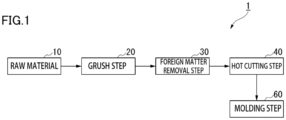
- FIG. 1 is a block diagram showing the flow of a method for producing a resin molded article according to an embodiment of the present invention.
- the "resin molded article” comprises a resin as an essential component.
- a resin that is generally used for paper diapers can be used, and examples include polyethylene, polypropylene, polystyrene, polyesters, and the like.
- polyesters include polyethylene terephthalate and the like. These resins may be used singly or in combination of two or more.
- the resin molded article of the present disclosure comprises a resin derived from a used paper diaper. That is, in the present disclosure, part or all of the resin as an essential component is derived from a used paper diaper.
- the content of the resin derived from a used paper diaper is, for example, preferably 10 mass% or more, more preferably 50 mass% or more, and even more preferably 70 mass% or more, relative to the total mass of the resin molded article.
- the upper limit value of the content of the resin derived from a used paper diaper is not particularly limited, but is, for example, 99 mass%.
- the content of the resin in the resin molded article is determined, for example, by a nuclear magnetic resonance (NMR) method, and the content of the resin derived from a used paper diaper can be determined by subtracting the content of a resin added during the molding of the resin molded article from the content of the resin in the resin molded article.
- NMR nuclear magnetic resonance
- the resin molded article may contain a resin other than the resin derived from a used paper diaper (hereinafter also referred to as the "additive resin").
- the additive resin include general-purpose resins, such as polyethylene, polypropylene, polystyrene, and polyethylene terephthalate.
- polyethylene and polypropylene are preferable, and polyethylene is more preferable.
- polyethylene include low-density polyethylene (LDPE), linear low-density polyethylene (LLDPE), medium-density polyethylene (MDPE), high-density polyethylene (HDPE), and the like.
- polypropylene include stretched polypropylene (OPP), unstretched polypropylene (CPP), and the like.
- the content of the additive resin is, for example, preferably 70 mass% or less, more preferably 50 mass% or less, even more preferably 10 mass% or less, and may be 0 mass%, relative to the total mass of the resin molded article.
- the content of the additive resin is equal to or less than the above upper limit value, the material of the used paper diaper can be used more effectively.
- the content of the additive resin can be adjusted by the amount of resin added during the molding of the resin molded article, and can be suitably adjusted according to the physical properties required for the resin molded article.
- the used paper diaper of the present embodiment may contain urine, feces, and other excretions, and also may include discarded paper diapers that have not been used.
- the used paper diaper When a used paper diaper is recycled, the used paper diaper is washed and then immersed in an aqueous solution containing a calcium compound to release water such as urine contained in a water absorbent material. After that, the paper diaper is disinfected and dried, and resin components are separated.
- the resin molded article of the present embodiment may contain a water absorbent material and a calcium compound, in addition to a pulp component contained in the paper diaper.
- Examples of the pulp component include pulp, synthetic fibers, and the like used in the nonwoven fabric of the paper diaper.
- the content of the pulp component is, for example, preferably 70 mass% or less, more preferably 50 mass% or less, and even more preferably 10 mass% or less, relative to the mass of the resin derived from the used paper diaper, which is taken as 100 parts by mass.
- the lower limit value of the content of the pulp component is not particularly limited; however, in terms of easily specifying that the resin molded article uses a paper diaper as a raw material, the lower limit value is, for example, 0.1 parts by mass relative to the mass of the resin derived from the used paper diaper, which is taken as 100 parts by mass.
- the content of the pulp component can be determined, for example, by constituent sugar analysis.
- water absorbent material examples include super absorbent polymers (SAP) and the like.
- super absorbent polymers examples include sodium polyacrylate, carboxymethylcellulose, polyvinyl alcohol, and the like. Since these super absorbent polymers are widely used, sodium polyacrylate is preferred.
- the content of the water absorbent material is, for example, preferably 70 parts by mass or less, more preferably 50 parts by mass or less, and even more preferably 10 parts by mass or less, relative to the mass of the resin derived from the used paper diaper, which is taken as 100 parts by mass.
- the lower limit value of the content of the water absorbent material is not particularly limited; however, in terms of easily specifying that the resin molded article uses a paper diaper as a raw material, the lower limit value is, for example, 0.1 parts by mass relative to the mass of the resin derived from the used paper diaper, which is taken as 100 parts by mass.
- the content of the water absorbent material can be determined, for example, by an NMR method or a time-of-flight secondary ion mass spectrometry (TOF-SIMS) method.
- NMR nuclear magnetic resonance
- TOF-SIMS time-of-flight secondary ion mass spectrometry
- the water absorbent material is not included in the "resin derived from a used paper diaper” and the “additive resin” mentioned above.
- the calcium compound examples include calcium chloride, calcium oxide (quicklime), calcium hydroxide (slaked lime), and the like. Since calcium compounds are widely used as dehydrating materials, the calcium compound is preferably calcium chloride.
- the content of the calcium compound is, for example, preferably 70 parts by mass or less, more preferably 50 parts by mass or less, and even more preferably 10 parts by mass or less, relative to the mass of the resin derived from the used paper diaper, which is taken as 100 parts by mass.
- the lower limit value of the content of the calcium compound is not particularly limited; however, in terms of easily specifying that the resin molded article uses a used paper diaper as a raw material, the lower limit value is, for example, 0.1 parts by mass relative to the mass of the resin derived from the used paper diaper, which is taken as 100 parts by mass.
- the content of the calcium compound can be determined, for example, by the X-ray diffraction (XRD) method or X-ray photoelectron spectroscopy (XPS).
- XRD X-ray diffraction
- XPS X-ray photoelectron spectroscopy
- the resin molded article may contain a coloring material, such as pigment or dye.
- the content of the coloring material is, for example, preferably 0.1 to 70 parts by mass, more preferably 1 to 50 parts by mass, and even more preferably 5 to 30 parts by mass, relative to the mass of the resin derived from the used paper diaper, which is taken as 100 parts by mass.
- the content of the coloring material is equal to or more than the above lower limit value, the resin molded article can have a better appearance.
- the content of the coloring material is equal to or less than the above upper limit value, the physical properties of the resin molded article can be further enhanced.
- the content of the coloring material can be determined, for example, by the NMR method or the TOF-SIMS method.
- the resin molded article may have a decorative layer on its surface.
- the decorative layer is, for example, a printed layer with printing on its surface, a decorative layer with decoration on its surface, or the like.
- the form of the resin molded article is not particularly limited, and examples include inflation molded inflation films, pelletized pellets, injection molded injection parts (injection molded articles), sheet molded articles formed in sheet form, and the like.
- the resin molded article can be used for various applications, and examples of the applications include packaging bags made of inflation films, injection molded playground blocks, flower bed fences, roofing materials, extruded building sheets, agricultural cover sheets, and the like.
- the resin molded article of the present disclosure can be produced in the same manner as for conventionally known resin molded articles, except that a used paper diaper is used as a raw material.
- the method 1 for producing a resin molded article of the present embodiment comprises a grush step 20, a foreign matter removal step 30, a hot cutting step 40, a crushing step 50, and a molding step 60.
- Examples of the raw material 10 include resin components etc. separated from a used paper diaper.
- the paper diaper of the present embodiment is composed of, for example, a surface material, a three-dimensional leakage-preventing gather, a water absorbent material, and a waterproof material.
- the surface material include non-woven fabrics made of polyethylene or polypropylene.
- the three-dimensional leakage-preventing gather include composites of non-woven fabrics and elastic materials.
- the water absorbent material include absorbent paper, pulp, polymer absorbent composites, and the like.
- the waterproof material include non-woven fabrics made of synthetic fibers that cover the outer surface of the paper diaper.
- the paper diaper may have adhesive tape, adhesive material, and other members for fastening the paper diaper.
- the used paper diaper When a used paper diaper is recycled, the used paper diaper is washed and then immersed in an aqueous solution containing a calcium compound to release water such as urine contained in a water absorbent material. After that, the paper diaper is disinfected and dried, and the resin components are separated to obtain a raw material 10.
- the grush step 20 is a step of reducing (compressing) the volume of the raw material 10 by rotating the raw material 10 and utilizing the friction heat and shear heat generated during rotation.
- the method for producing a resin molded article of the present embodiment has the grush step 20
- a reduced volume product (grush) with a reduced resin content can be obtained. Since the resin component in the grush is not melted, there is little degradation, and mixing and blending can be performed efficiently. Accordingly, a large amount of grush can be treated in the subsequent foreign matter removal step 30.
- equipment such as a hopper that rotates the raw material 10 while shearing it can be used.
- the foreign matter removal step 30 is a step of heating and melting the grush, and removing foreign matter.
- the hot cutting step 40 is a step of extruding and cutting the molten material from which foreign matter has been removed.
- the cut molten material is cooled to obtain a solidified product (hot-cut product) of the desired size.
- An additive resin, a coloring material, and the like are added to the solidified product obtained in the hot cutting step 40, followed by kneading and cooling, thereby obtaining a resin molded article (molding step 60).
- various additives may be added in addition to the additive resin and coloring material.
- the functions of the additives can be imparted to the resin molded article.
- additives examples include antioxidants, UV absorbers, antibacterials, deodorants, softeners, biodegradables, and the like.
- the amount of various additives added is, for example, preferably 0.1 to 70 parts by mass, more preferably 1 to 50 parts by mass, and even more preferably 5 to 30 parts by mass, relative to 100 parts by mass of the hot-cut product.
- the amount of various additives added is equal to or more than the above lower limit value, the functions of the additives can be imparted to the resin molded article. If the amount of various additives added is equal to or less than the above upper limit value, the strength of the resin molded article can be ensured.
- the method for providing the decorative layer is not particularly limited, and examples include a method in which after applying an adhesive etc. to the surface of the molded product, a decorative layer is laminated, and the adhesive is cured to provide the decorative layer, and a method in which a decorative layer is provided by integrally molding the decorative layer and the molded product by extrusion molding or the like.
- some of the resin components of the used paper diaper may be used as raw materials, or all of them may be used as raw materials.
- the molten material may be cut and pelletized.
- the step of disposing of the resin molded article can be omitted, which can reduce the burden on the global environment.
- the resin molded article of the present disclosure uses resin components of used paper diapers as raw materials, materials of used paper diapers, which have been disposed of in the past, can be used more efficiently and effectively. This can reduce the amount of used paper diapers to be disposed of, and thus can reduce the burden on the global environment.
- the resin molded article of the present disclosure even if the materials of paper diapers are not 100% separated for each material, they can be distributed in the market as new products. Therefore, the precision in the separation step, for which separation with precision has conventionally been required, can be reduced, and resin molded articles can be produced more easily.
- the resin molded article of the present disclosure can be used as a raw material for further reuse. This can reduce the waste of resources due to disposal etc., and thus can reduce the burden on the global environment.
- materials of used paper diapers can be used effectively.
Landscapes
- Chemical & Material Sciences (AREA)
- Engineering & Computer Science (AREA)
- Manufacturing & Machinery (AREA)
- Health & Medical Sciences (AREA)
- Chemical Kinetics & Catalysis (AREA)
- Medicinal Chemistry (AREA)
- Polymers & Plastics (AREA)
- Organic Chemistry (AREA)
- Materials Engineering (AREA)
- Mechanical Engineering (AREA)
- Absorbent Articles And Supports Therefor (AREA)
- Compositions Of Macromolecular Compounds (AREA)
Abstract
Description
- The present invention relates to a resin molded article.
- The present application claims priority to
Japanese Patent Application No. 2022-066968 filed April 14, 2022 - There is a movement to recover and reuse the constituent materials of paper diapers from used paper diapers.
- For example, PTL 1 has proposed a method of regenerating materials used in used paper diapers, characterized in that a water absorbing polymer contained in a paper diaper is decomposed into monomers, and then a pulp component contained in the paper diaper is separated and collected.
- PTL 1:
JP 3378204 B - However, the method used in PTL 1 is a technology that reuses the pulp component and other components separately, and further efficiency is required for material reuse.
- Accordingly, an object of the present invention is to provide a resin molded article that can use materials of used paper diapers more efficiently and effectively.
- The present invention has the following aspects.
- [1] A resin molded article comprises a resin derived from a used paper diaper.
- [2] In [1] above, the resin molded article comprises a pulp component, and the content of the pulp component may be 0.1 parts by mass or more relative to the mass of the resin, which is taken as 100 parts by mass.
- [3] In [1] or [2] above, the resin molded article comprises a water absorbent material, and the content of the water absorbent material may be 0.1 parts by mass or more relative to the mass of the resin, which is taken as 100 parts by mass.
- [4] In any one of [1] to [3] above, the resin molded article comprises a calcium compound, and the content of the calcium compound may be 0.1 parts by mass or more relative to the mass of the resin, which is taken as 100 parts by mass.
- [5] In any one of [1] to [4] above, the resin molded article comprises a coloring material, and the content of the coloring material may be 0.1 to 70 parts by mass relative to the mass of the resin, which is taken as 100 parts by mass.
- [6] In any one of [1] to [5] above, the resin molded article may be an inflation film.
- [7] In any one of [1] to [5] above, the resin molded article may be an injection molded article.
- [8] In any one of [1] to [7] above, the resin molded article may have a decorative layer on its surface.
- According to the resin molded article of the above aspect, materials of used paper diapers can be used effectively.
- [
Fig. 1] Fig. 1 is a block diagram showing the flow of a method for producing a resin molded article according to an embodiment of the present invention. - In the present specification, the "resin molded article" comprises a resin as an essential component. As the resin, a resin that is generally used for paper diapers can be used, and examples include polyethylene, polypropylene, polystyrene, polyesters, and the like. Examples of polyesters include polyethylene terephthalate and the like. These resins may be used singly or in combination of two or more.
- The resin molded article of the present disclosure comprises a resin derived from a used paper diaper. That is, in the present disclosure, part or all of the resin as an essential component is derived from a used paper diaper.
- The content of the resin derived from a used paper diaper is, for example, preferably 10 mass% or more, more preferably 50 mass% or more, and even more preferably 70 mass% or more, relative to the total mass of the resin molded article. When the content of the resin derived from a used paper diaper is equal to or more than the above lower limit value, the material of the used paper diaper can be used more effectively. The upper limit value of the content of the resin derived from a used paper diaper is not particularly limited, but is, for example, 99 mass%.
- The content of the resin in the resin molded article is determined, for example, by a nuclear magnetic resonance (NMR) method, and the content of the resin derived from a used paper diaper can be determined by subtracting the content of a resin added during the molding of the resin molded article from the content of the resin in the resin molded article.
- In terms of further improving the quality of the resin molded article, the resin molded article may contain a resin other than the resin derived from a used paper diaper (hereinafter also referred to as the "additive resin"). Examples of the additive resin include general-purpose resins, such as polyethylene, polypropylene, polystyrene, and polyethylene terephthalate. Among these additive resins, in terms of easily improving the quality of the resin molded article, polyethylene and polypropylene are preferable, and polyethylene is more preferable. Examples of polyethylene include low-density polyethylene (LDPE), linear low-density polyethylene (LLDPE), medium-density polyethylene (MDPE), high-density polyethylene (HDPE), and the like. Examples of polypropylene include stretched polypropylene (OPP), unstretched polypropylene (CPP), and the like.
- The content of the additive resin is, for example, preferably 70 mass% or less, more preferably 50 mass% or less, even more preferably 10 mass% or less, and may be 0 mass%, relative to the total mass of the resin molded article. When the content of the additive resin is equal to or less than the above upper limit value, the material of the used paper diaper can be used more effectively.
- The content of the additive resin can be adjusted by the amount of resin added during the molding of the resin molded article, and can be suitably adjusted according to the physical properties required for the resin molded article.
- The used paper diaper of the present embodiment may contain urine, feces, and other excretions, and also may include discarded paper diapers that have not been used.
- When a used paper diaper is recycled, the used paper diaper is washed and then immersed in an aqueous solution containing a calcium compound to release water such as urine contained in a water absorbent material. After that, the paper diaper is disinfected and dried, and resin components are separated.
- Therefore, the resin molded article of the present embodiment may contain a water absorbent material and a calcium compound, in addition to a pulp component contained in the paper diaper.
- Examples of the pulp component include pulp, synthetic fibers, and the like used in the nonwoven fabric of the paper diaper.
- The content of the pulp component is, for example, preferably 70 mass% or less, more preferably 50 mass% or less, and even more preferably 10 mass% or less, relative to the mass of the resin derived from the used paper diaper, which is taken as 100 parts by mass. When the content of the pulp component is equal to or less than the above upper limit value, the quality of the resin molded article can be ensured. The lower limit value of the content of the pulp component is not particularly limited; however, in terms of easily specifying that the resin molded article uses a paper diaper as a raw material, the lower limit value is, for example, 0.1 parts by mass relative to the mass of the resin derived from the used paper diaper, which is taken as 100 parts by mass.
- The content of the pulp component can be determined, for example, by constituent sugar analysis.
- Examples of the water absorbent material include super absorbent polymers (SAP) and the like.
- Examples of super absorbent polymers include sodium polyacrylate, carboxymethylcellulose, polyvinyl alcohol, and the like. Since these super absorbent polymers are widely used, sodium polyacrylate is preferred.
- The content of the water absorbent material is, for example, preferably 70 parts by mass or less, more preferably 50 parts by mass or less, and even more preferably 10 parts by mass or less, relative to the mass of the resin derived from the used paper diaper, which is taken as 100 parts by mass. When the content of the water absorbent material is equal to or less than the above upper limit value, the quality of the resin molded article can be ensured. The lower limit value of the content of the water absorbent material is not particularly limited; however, in terms of easily specifying that the resin molded article uses a paper diaper as a raw material, the lower limit value is, for example, 0.1 parts by mass relative to the mass of the resin derived from the used paper diaper, which is taken as 100 parts by mass.
- The content of the water absorbent material can be determined, for example, by an NMR method or a time-of-flight secondary ion mass spectrometry (TOF-SIMS) method.
- In the present specification, the water absorbent material is not included in the "resin derived from a used paper diaper" and the "additive resin" mentioned above.
- Examples of the calcium compound include calcium chloride, calcium oxide (quicklime), calcium hydroxide (slaked lime), and the like. Since calcium compounds are widely used as dehydrating materials, the calcium compound is preferably calcium chloride.
- The content of the calcium compound is, for example, preferably 70 parts by mass or less, more preferably 50 parts by mass or less, and even more preferably 10 parts by mass or less, relative to the mass of the resin derived from the used paper diaper, which is taken as 100 parts by mass. When the content of the calcium compound is equal to or less than the above upper limit value, the quality of the resin molded article can be ensured. The lower limit value of the content of the calcium compound is not particularly limited; however, in terms of easily specifying that the resin molded article uses a used paper diaper as a raw material, the lower limit value is, for example, 0.1 parts by mass relative to the mass of the resin derived from the used paper diaper, which is taken as 100 parts by mass.
- The content of the calcium compound can be determined, for example, by the X-ray diffraction (XRD) method or X-ray photoelectron spectroscopy (XPS).
- In terms of achieving a good appearance, the resin molded article may contain a coloring material, such as pigment or dye.
- The content of the coloring material is, for example, preferably 0.1 to 70 parts by mass, more preferably 1 to 50 parts by mass, and even more preferably 5 to 30 parts by mass, relative to the mass of the resin derived from the used paper diaper, which is taken as 100 parts by mass. When the content of the coloring material is equal to or more than the above lower limit value, the resin molded article can have a better appearance. When the content of the coloring material is equal to or less than the above upper limit value, the physical properties of the resin molded article can be further enhanced.
- The content of the coloring material can be determined, for example, by the NMR method or the TOF-SIMS method.
- In terms of achieving a good appearance, the resin molded article may have a decorative layer on its surface.
- The decorative layer is, for example, a printed layer with printing on its surface, a decorative layer with decoration on its surface, or the like.
- The form of the resin molded article is not particularly limited, and examples include inflation molded inflation films, pelletized pellets, injection molded injection parts (injection molded articles), sheet molded articles formed in sheet form, and the like.
- The resin molded article can be used for various applications, and examples of the applications include packaging bags made of inflation films, injection molded playground blocks, flower bed fences, roofing materials, extruded building sheets, agricultural cover sheets, and the like.
- The resin molded article of the present disclosure can be produced in the same manner as for conventionally known resin molded articles, except that a used paper diaper is used as a raw material.
- The method for producing a resin molded article of the present embodiment will be described in detail below with reference to the drawing.
- As shown in
Fig. 1 , the method 1 for producing a resin molded article of the present embodiment comprises agrush step 20, a foreignmatter removal step 30, ahot cutting step 40, a crushing step 50, and amolding step 60. - Examples of the
raw material 10 include resin components etc. separated from a used paper diaper. - The paper diaper of the present embodiment is composed of, for example, a surface material, a three-dimensional leakage-preventing gather, a water absorbent material, and a waterproof material. Examples of the surface material include non-woven fabrics made of polyethylene or polypropylene. Examples of the three-dimensional leakage-preventing gather include composites of non-woven fabrics and elastic materials.
Examples of the water absorbent material include absorbent paper, pulp, polymer absorbent composites, and the like. Examples of the waterproof material include non-woven fabrics made of synthetic fibers that cover the outer surface of the paper diaper. In addition, the paper diaper may have adhesive tape, adhesive material, and other members for fastening the paper diaper. - When a used paper diaper is recycled, the used paper diaper is washed and then immersed in an aqueous solution containing a calcium compound to release water such as urine contained in a water absorbent material. After that, the paper diaper is disinfected and dried, and the resin components are separated to obtain a
raw material 10. - The
grush step 20 is a step of reducing (compressing) the volume of theraw material 10 by rotating theraw material 10 and utilizing the friction heat and shear heat generated during rotation. - Since the method for producing a resin molded article of the present embodiment has the
grush step 20, a reduced volume product (grush) with a reduced resin content can be obtained. Since the resin component in the grush is not melted, there is little degradation, and mixing and blending can be performed efficiently. Accordingly, a large amount of grush can be treated in the subsequent foreignmatter removal step 30. - In the
grush step 20, equipment such as a hopper that rotates theraw material 10 while shearing it can be used. - The foreign
matter removal step 30 is a step of heating and melting the grush, and removing foreign matter. - The
hot cutting step 40 is a step of extruding and cutting the molten material from which foreign matter has been removed. - The cut molten material is cooled to obtain a solidified product (hot-cut product) of the desired size.
- An additive resin, a coloring material, and the like are added to the solidified product obtained in the
hot cutting step 40, followed by kneading and cooling, thereby obtaining a resin molded article (molding step 60). - In the
molding step 60, for example, depending on the desired quality of the resin molded article, various additives may be added in addition to the additive resin and coloring material. By adding various additives, the functions of the additives can be imparted to the resin molded article. - Examples of various additives include antioxidants, UV absorbers, antibacterials, deodorants, softeners, biodegradables, and the like.
- The amount of various additives added is, for example, preferably 0.1 to 70 parts by mass, more preferably 1 to 50 parts by mass, and even more preferably 5 to 30 parts by mass, relative to 100 parts by mass of the hot-cut product.
- When the amount of various additives added is equal to or more than the above lower limit value, the functions of the additives can be imparted to the resin molded article. If the amount of various additives added is equal to or less than the above upper limit value, the strength of the resin molded article can be ensured.
- When the resin molded article has a decorative layer, the method for providing the decorative layer is not particularly limited, and examples include a method in which after applying an adhesive etc. to the surface of the molded product, a decorative layer is laminated, and the adhesive is cured to provide the decorative layer, and a method in which a decorative layer is provided by integrally molding the decorative layer and the molded product by extrusion molding or the like.
- The resin molded article of the present disclosure has been described in detail with reference to the drawing. The present invention should not be construed as limited to this embodiment, which can be altered and combined within a range not departing from the spirit of the present disclosure.
- For example, some of the resin components of the used paper diaper may be used as raw materials, or all of them may be used as raw materials.
- For example, in the
hot cutting step 40, after adding various additives, the molten material may be cut and pelletized. - For example, by imparting biodegradability to the resin molded article, the step of disposing of the resin molded article can be omitted, which can reduce the burden on the global environment.
- Since the resin molded article of the present disclosure uses resin components of used paper diapers as raw materials, materials of used paper diapers, which have been disposed of in the past, can be used more efficiently and effectively. This can reduce the amount of used paper diapers to be disposed of, and thus can reduce the burden on the global environment.
- With the resin molded article of the present disclosure, even if the materials of paper diapers are not 100% separated for each material, they can be distributed in the market as new products. Therefore, the precision in the separation step, for which separation with precision has conventionally been required, can be reduced, and resin molded articles can be produced more easily.
- The resin molded article of the present disclosure can be used as a raw material for further reuse. This can reduce the waste of resources due to disposal etc., and thus can reduce the burden on the global environment.
- According to the resin molded article of the above embodiment, materials of used paper diapers can be used effectively.
-
- 1 Method for producing resin molded article
- 10 Raw material
- 20 Grush step
- 30 Foreign matter removal step
- 40 Hot cutting step
- 60 Molding step
Claims (8)
- A resin molded article comprising a resin derived from a used paper diaper.
- The resin molded article according to claim 1, comprising a pulp component, wherein the content of the pulp component is 0.1 parts by mass or more relative to the mass of the resin, which is taken as 100 parts by mass.
- The resin molded article according to claim 1 or 2, comprising a water absorbent material, wherein the content of the water absorbent material is 0.1 parts by mass or more relative to the mass of the resin, which is taken as 100 parts by mass.
- The resin molded article according to claim 1 or 2, comprising a calcium compound, wherein the content of the calcium compound is 0.1 parts by mass or more relative to the mass of the resin, which is taken as 100 parts by mass.
- The resin molded article according to claim 1 or 2, comprising a coloring material, wherein the content of the coloring material is 0.1 to 70 parts by mass relative to the mass of the resin, which is taken as 100 parts by mass.
- The resin molded article according to claim 1 or 2, which is an inflation film.
- The resin molded article according to claim 1 or 2, which is an injection molded article.
- The resin molded article according to claim 1 or 2, which has a decorative layer on its surface.
Applications Claiming Priority (2)
| Application Number | Priority Date | Filing Date | Title |
|---|---|---|---|
| JP2022066968A JP2023157210A (en) | 2022-04-14 | 2022-04-14 | resin molded products |
| PCT/JP2023/015120 WO2023199997A1 (en) | 2022-04-14 | 2023-04-14 | Resin molded article |
Publications (2)
| Publication Number | Publication Date |
|---|---|
| EP4509567A1 true EP4509567A1 (en) | 2025-02-19 |
| EP4509567A4 EP4509567A4 (en) | 2025-06-18 |
Family
ID=88329583
Family Applications (1)
| Application Number | Title | Priority Date | Filing Date |
|---|---|---|---|
| EP23788414.3A Pending EP4509567A4 (en) | 2022-04-14 | 2023-04-14 | RESIN CAST ARTICLE |
Country Status (6)
| Country | Link |
|---|---|
| US (1) | US20260022218A1 (en) |
| EP (1) | EP4509567A4 (en) |
| JP (1) | JP2023157210A (en) |
| CN (1) | CN119110827A (en) |
| TW (1) | TW202404711A (en) |
| WO (1) | WO2023199997A1 (en) |
Family Cites Families (6)
| Publication number | Priority date | Publication date | Assignee | Title |
|---|---|---|---|---|
| CN104540652B (en) * | 2012-06-20 | 2016-10-26 | 日泉化学株式会社 | Resin film, slit thin panel sheet using the resin film, and automotive interior parts |
| KR101361184B1 (en) * | 2013-09-30 | 2014-02-25 | (주)국제리프라텍 | A car interior sheet for using hygiene products and its manufacturing method |
| JP6038001B2 (en) * | 2013-10-30 | 2016-12-07 | ユニ・チャーム株式会社 | Method for producing recycled pulp from used sanitary products |
| JP6865619B2 (en) * | 2017-03-31 | 2021-04-28 | ユニ・チャーム株式会社 | How to Make Recycled Products, Recycled Resin Pellets, and Recycled Films |
| JP7234054B2 (en) * | 2019-06-28 | 2023-03-07 | 花王株式会社 | Recycled molded article and method for manufacturing recycled molded article |
| JP7476755B2 (en) | 2020-10-19 | 2024-05-01 | 株式会社島津製作所 | Treatment Support Device |
-
2022
- 2022-04-14 JP JP2022066968A patent/JP2023157210A/en active Pending
-
2023
- 2023-04-13 TW TW112113809A patent/TW202404711A/en unknown
- 2023-04-14 CN CN202380033395.2A patent/CN119110827A/en active Pending
- 2023-04-14 WO PCT/JP2023/015120 patent/WO2023199997A1/en not_active Ceased
- 2023-04-14 US US18/993,864 patent/US20260022218A1/en active Pending
- 2023-04-14 EP EP23788414.3A patent/EP4509567A4/en active Pending
Also Published As
| Publication number | Publication date |
|---|---|
| EP4509567A4 (en) | 2025-06-18 |
| WO2023199997A1 (en) | 2023-10-19 |
| TW202404711A (en) | 2024-02-01 |
| JP2023157210A (en) | 2023-10-26 |
| US20260022218A1 (en) | 2026-01-22 |
| CN119110827A (en) | 2024-12-10 |
Similar Documents
| Publication | Publication Date | Title |
|---|---|---|
| JP7080871B2 (en) | Polyester film and its manufacturing method | |
| EP2295218B1 (en) | Method for the recycling of polylactic acid plastics | |
| WO2022029323A1 (en) | Solvent-based recycling with a roll-to-roll processing step | |
| JP7127094B2 (en) | White polyester film and its manufacturing method | |
| US20030092793A1 (en) | Process for the preparation of biodegradable resin | |
| WO2023203194A1 (en) | Method for producing an rpet plastic material for use in a thin-wall injection molding method and containers, such as cups, bowls, trays or multi-compartment packagings produced by the thin-wall injection molding method | |
| MX2014004352A (en) | Materials from post-industrial absorbent product waste. | |
| WO2021151742A1 (en) | Method for recycling a transfer product | |
| EA024864B1 (en) | Method for the recycling of plastics products | |
| AT506658B1 (en) | METHOD FOR PRODUCING A FILLED POLYMER MATERIAL | |
| JP2026074212A (en) | Eggshell powder-containing resin composition and molded article | |
| US20260022218A1 (en) | Resin molded article | |
| KR20210096363A (en) | Method for manufacturing waste plastic recycled molding with excellent hardness and strength | |
| DE4221681A1 (en) | Recycling polyethylene@ polypropylene@ or polystyrene adhesive label scrap - by mixing with adhesive-free polymer and communicating to give prod. for packaging, agricultural film etc. mfr. | |
| KR100963345B1 (en) | Compound For Breathable Film Having Photodegradation Material and Breathable Film Using The Same | |
| KR101276323B1 (en) | The manufacturing method of recycling chip using a waste plastic composite sheet | |
| EP4509566A1 (en) | Paper article and shaped article | |
| DE4234953A1 (en) | Plastic film contg. contaminated recycled plastic - by crushing and opt. cleaning contaminated scrap film, compacting, re:granulating, extruding, and opt. orienting and heat-fixing | |
| CN107151458A (en) | A kind of inexpensive stalk polyethylene film and preparation method thereof | |
| US20110109007A1 (en) | Recycled post-industrial waste for plastic industrial commercial and consumer products | |
| US20230243071A1 (en) | Composition for eco-friendly filament using soybean hull and 3d printing eco-friendly filament manufactured by using same | |
| CN105643827A (en) | Machining technology for recycling leftover materials generated after existing compression molding | |
| CN102093732A (en) | Processing technology for manufacturing medical toilet by utilizing recovered fibrilia composite boards | |
| RU584519C (en) | Polymeric composition | |
| PL248741B1 (en) | Method for obtaining granulate containing recyclate from textile waste |
Legal Events
| Date | Code | Title | Description |
|---|---|---|---|
| STAA | Information on the status of an ep patent application or granted ep patent |
Free format text: STATUS: THE INTERNATIONAL PUBLICATION HAS BEEN MADE |
|
| PUAI | Public reference made under article 153(3) epc to a published international application that has entered the european phase |
Free format text: ORIGINAL CODE: 0009012 |
|
| STAA | Information on the status of an ep patent application or granted ep patent |
Free format text: STATUS: REQUEST FOR EXAMINATION WAS MADE |
|
| 17P | Request for examination filed |
Effective date: 20241031 |
|
| AK | Designated contracting states |
Kind code of ref document: A1 Designated state(s): AL AT BE BG CH CY CZ DE DK EE ES FI FR GB GR HR HU IE IS IT LI LT LU LV MC ME MK MT NL NO PL PT RO RS SE SI SK SM TR |
|
| REG | Reference to a national code |
Ref country code: DE Ref legal event code: R079 Free format text: PREVIOUS MAIN CLASS: C08L0101000000 Ipc: B29C0045000000 |
|
| A4 | Supplementary search report drawn up and despatched |
Effective date: 20250521 |
|
| RIC1 | Information provided on ipc code assigned before grant |
Ipc: C08K 3/26 20060101ALN20250515BHEP Ipc: C08J 5/18 20060101ALI20250515BHEP Ipc: C08J 5/00 20060101ALI20250515BHEP Ipc: B29C 48/10 20190101ALI20250515BHEP Ipc: C08L 1/00 20060101ALI20250515BHEP Ipc: C08K 3/20 20060101ALI20250515BHEP Ipc: C08K 3/16 20060101ALI20250515BHEP Ipc: B32B 27/00 20060101ALI20250515BHEP Ipc: B29C 55/28 20060101ALI20250515BHEP Ipc: C08L 101/00 20060101ALI20250515BHEP Ipc: B29C 45/00 20060101AFI20250515BHEP |
|
| DAV | Request for validation of the european patent (deleted) | ||
| DAX | Request for extension of the european patent (deleted) | ||
| STAA | Information on the status of an ep patent application or granted ep patent |
Free format text: STATUS: EXAMINATION IS IN PROGRESS |
|
| RIC1 | Information provided on ipc code assigned before grant |
Ipc: B29C 45/00 20060101AFI20250915BHEP Ipc: C08L 101/00 20060101ALI20250915BHEP Ipc: B29C 55/28 20060101ALI20250915BHEP Ipc: B32B 27/00 20060101ALI20250915BHEP Ipc: C08K 3/16 20060101ALI20250915BHEP Ipc: C08K 3/20 20060101ALI20250915BHEP Ipc: C08L 1/00 20060101ALI20250915BHEP Ipc: B29C 48/10 20190101ALI20250915BHEP Ipc: C08J 5/00 20060101ALI20250915BHEP Ipc: C08J 5/18 20060101ALI20250915BHEP Ipc: C08K 3/26 20060101ALN20250915BHEP |
|
| 17Q | First examination report despatched |
Effective date: 20251016 |