EP4509289A1 - Metal member and manufacturing method therefor, etching solution, and metal-resin complex and manufacturing method for metal-resin complex - Google Patents
Metal member and manufacturing method therefor, etching solution, and metal-resin complex and manufacturing method for metal-resin complex Download PDFInfo
- Publication number
- EP4509289A1 EP4509289A1 EP23787805.3A EP23787805A EP4509289A1 EP 4509289 A1 EP4509289 A1 EP 4509289A1 EP 23787805 A EP23787805 A EP 23787805A EP 4509289 A1 EP4509289 A1 EP 4509289A1
- Authority
- EP
- European Patent Office
- Prior art keywords
- resin
- etching solution
- metal
- metal member
- mass
- Prior art date
- Legal status (The legal status is an assumption and is not a legal conclusion. Google has not performed a legal analysis and makes no representation as to the accuracy of the status listed.)
- Pending
Links
Images

Classifications
-
- B—PERFORMING OPERATIONS; TRANSPORTING
- B29—WORKING OF PLASTICS; WORKING OF SUBSTANCES IN A PLASTIC STATE IN GENERAL
- B29B—PREPARATION OR PRETREATMENT OF THE MATERIAL TO BE SHAPED; MAKING GRANULES OR PREFORMS; RECOVERY OF PLASTICS OR OTHER CONSTITUENTS OF WASTE MATERIAL CONTAINING PLASTICS
- B29B11/00—Making preforms
- B29B11/14—Making preforms characterised by structure or composition
-
- B—PERFORMING OPERATIONS; TRANSPORTING
- B29—WORKING OF PLASTICS; WORKING OF SUBSTANCES IN A PLASTIC STATE IN GENERAL
- B29C—SHAPING OR JOINING OF PLASTICS; SHAPING OF MATERIAL IN A PLASTIC STATE, NOT OTHERWISE PROVIDED FOR; AFTER-TREATMENT OF THE SHAPED PRODUCTS, e.g. REPAIRING
- B29C45/00—Injection moulding, i.e. forcing the required volume of moulding material through a nozzle into a closed mould; Apparatus therefor
- B29C45/14—Injection moulding, i.e. forcing the required volume of moulding material through a nozzle into a closed mould; Apparatus therefor incorporating preformed parts or layers, e.g. injection moulding around inserts or for coating articles
-
- B—PERFORMING OPERATIONS; TRANSPORTING
- B29—WORKING OF PLASTICS; WORKING OF SUBSTANCES IN A PLASTIC STATE IN GENERAL
- B29C—SHAPING OR JOINING OF PLASTICS; SHAPING OF MATERIAL IN A PLASTIC STATE, NOT OTHERWISE PROVIDED FOR; AFTER-TREATMENT OF THE SHAPED PRODUCTS, e.g. REPAIRING
- B29C45/00—Injection moulding, i.e. forcing the required volume of moulding material through a nozzle into a closed mould; Apparatus therefor
- B29C45/14—Injection moulding, i.e. forcing the required volume of moulding material through a nozzle into a closed mould; Apparatus therefor incorporating preformed parts or layers, e.g. injection moulding around inserts or for coating articles
- B29C45/1418—Injection moulding, i.e. forcing the required volume of moulding material through a nozzle into a closed mould; Apparatus therefor incorporating preformed parts or layers, e.g. injection moulding around inserts or for coating articles the inserts being deformed or preformed, e.g. by the injection pressure
-
- B—PERFORMING OPERATIONS; TRANSPORTING
- B32—LAYERED PRODUCTS
- B32B—LAYERED PRODUCTS, i.e. PRODUCTS BUILT-UP OF STRATA OF FLAT OR NON-FLAT, e.g. CELLULAR OR HONEYCOMB, FORM
- B32B15/00—Layered products comprising a layer of metal
- B32B15/04—Layered products comprising a layer of metal comprising metal as the main or only constituent of a layer, which is next to another layer of the same or of a different material
- B32B15/08—Layered products comprising a layer of metal comprising metal as the main or only constituent of a layer, which is next to another layer of the same or of a different material of synthetic resin
-
- B—PERFORMING OPERATIONS; TRANSPORTING
- B32—LAYERED PRODUCTS
- B32B—LAYERED PRODUCTS, i.e. PRODUCTS BUILT-UP OF STRATA OF FLAT OR NON-FLAT, e.g. CELLULAR OR HONEYCOMB, FORM
- B32B15/00—Layered products comprising a layer of metal
- B32B15/04—Layered products comprising a layer of metal comprising metal as the main or only constituent of a layer, which is next to another layer of the same or of a different material
- B32B15/08—Layered products comprising a layer of metal comprising metal as the main or only constituent of a layer, which is next to another layer of the same or of a different material of synthetic resin
- B32B15/082—Layered products comprising a layer of metal comprising metal as the main or only constituent of a layer, which is next to another layer of the same or of a different material of synthetic resin comprising vinyl resins; comprising acrylic resins
-
- B—PERFORMING OPERATIONS; TRANSPORTING
- B32—LAYERED PRODUCTS
- B32B—LAYERED PRODUCTS, i.e. PRODUCTS BUILT-UP OF STRATA OF FLAT OR NON-FLAT, e.g. CELLULAR OR HONEYCOMB, FORM
- B32B15/00—Layered products comprising a layer of metal
- B32B15/04—Layered products comprising a layer of metal comprising metal as the main or only constituent of a layer, which is next to another layer of the same or of a different material
- B32B15/08—Layered products comprising a layer of metal comprising metal as the main or only constituent of a layer, which is next to another layer of the same or of a different material of synthetic resin
- B32B15/085—Layered products comprising a layer of metal comprising metal as the main or only constituent of a layer, which is next to another layer of the same or of a different material of synthetic resin comprising polyolefins
-
- B—PERFORMING OPERATIONS; TRANSPORTING
- B32—LAYERED PRODUCTS
- B32B—LAYERED PRODUCTS, i.e. PRODUCTS BUILT-UP OF STRATA OF FLAT OR NON-FLAT, e.g. CELLULAR OR HONEYCOMB, FORM
- B32B15/00—Layered products comprising a layer of metal
- B32B15/04—Layered products comprising a layer of metal comprising metal as the main or only constituent of a layer, which is next to another layer of the same or of a different material
- B32B15/08—Layered products comprising a layer of metal comprising metal as the main or only constituent of a layer, which is next to another layer of the same or of a different material of synthetic resin
- B32B15/088—Layered products comprising a layer of metal comprising metal as the main or only constituent of a layer, which is next to another layer of the same or of a different material of synthetic resin comprising polyamides
-
- B—PERFORMING OPERATIONS; TRANSPORTING
- B32—LAYERED PRODUCTS
- B32B—LAYERED PRODUCTS, i.e. PRODUCTS BUILT-UP OF STRATA OF FLAT OR NON-FLAT, e.g. CELLULAR OR HONEYCOMB, FORM
- B32B15/00—Layered products comprising a layer of metal
- B32B15/04—Layered products comprising a layer of metal comprising metal as the main or only constituent of a layer, which is next to another layer of the same or of a different material
- B32B15/08—Layered products comprising a layer of metal comprising metal as the main or only constituent of a layer, which is next to another layer of the same or of a different material of synthetic resin
- B32B15/09—Layered products comprising a layer of metal comprising metal as the main or only constituent of a layer, which is next to another layer of the same or of a different material of synthetic resin comprising polyesters
-
- B—PERFORMING OPERATIONS; TRANSPORTING
- B32—LAYERED PRODUCTS
- B32B—LAYERED PRODUCTS, i.e. PRODUCTS BUILT-UP OF STRATA OF FLAT OR NON-FLAT, e.g. CELLULAR OR HONEYCOMB, FORM
- B32B15/00—Layered products comprising a layer of metal
- B32B15/20—Layered products comprising a layer of metal comprising aluminium or copper
-
- B—PERFORMING OPERATIONS; TRANSPORTING
- B32—LAYERED PRODUCTS
- B32B—LAYERED PRODUCTS, i.e. PRODUCTS BUILT-UP OF STRATA OF FLAT OR NON-FLAT, e.g. CELLULAR OR HONEYCOMB, FORM
- B32B27/00—Layered products comprising a layer of synthetic resin
- B32B27/28—Layered products comprising a layer of synthetic resin comprising synthetic resins not wholly covered by any one of the sub-groups B32B27/30 - B32B27/42
- B32B27/286—Layered products comprising a layer of synthetic resin comprising synthetic resins not wholly covered by any one of the sub-groups B32B27/30 - B32B27/42 comprising polysulphones; polysulfides
-
- B—PERFORMING OPERATIONS; TRANSPORTING
- B32—LAYERED PRODUCTS
- B32B—LAYERED PRODUCTS, i.e. PRODUCTS BUILT-UP OF STRATA OF FLAT OR NON-FLAT, e.g. CELLULAR OR HONEYCOMB, FORM
- B32B27/00—Layered products comprising a layer of synthetic resin
- B32B27/30—Layered products comprising a layer of synthetic resin comprising vinyl (co)polymers; comprising acrylic (co)polymers
- B32B27/302—Layered products comprising a layer of synthetic resin comprising vinyl (co)polymers; comprising acrylic (co)polymers comprising aromatic vinyl (co)polymers, e.g. styrenic (co)polymers
-
- B—PERFORMING OPERATIONS; TRANSPORTING
- B32—LAYERED PRODUCTS
- B32B—LAYERED PRODUCTS, i.e. PRODUCTS BUILT-UP OF STRATA OF FLAT OR NON-FLAT, e.g. CELLULAR OR HONEYCOMB, FORM
- B32B27/00—Layered products comprising a layer of synthetic resin
- B32B27/30—Layered products comprising a layer of synthetic resin comprising vinyl (co)polymers; comprising acrylic (co)polymers
- B32B27/304—Layered products comprising a layer of synthetic resin comprising vinyl (co)polymers; comprising acrylic (co)polymers comprising vinyl halide (co)polymers, e.g. PVC, PVDC, PVF, PVDF
-
- B—PERFORMING OPERATIONS; TRANSPORTING
- B32—LAYERED PRODUCTS
- B32B—LAYERED PRODUCTS, i.e. PRODUCTS BUILT-UP OF STRATA OF FLAT OR NON-FLAT, e.g. CELLULAR OR HONEYCOMB, FORM
- B32B27/00—Layered products comprising a layer of synthetic resin
- B32B27/32—Layered products comprising a layer of synthetic resin comprising polyolefins
-
- B—PERFORMING OPERATIONS; TRANSPORTING
- B32—LAYERED PRODUCTS
- B32B—LAYERED PRODUCTS, i.e. PRODUCTS BUILT-UP OF STRATA OF FLAT OR NON-FLAT, e.g. CELLULAR OR HONEYCOMB, FORM
- B32B27/00—Layered products comprising a layer of synthetic resin
- B32B27/34—Layered products comprising a layer of synthetic resin comprising polyamides
-
- B—PERFORMING OPERATIONS; TRANSPORTING
- B32—LAYERED PRODUCTS
- B32B—LAYERED PRODUCTS, i.e. PRODUCTS BUILT-UP OF STRATA OF FLAT OR NON-FLAT, e.g. CELLULAR OR HONEYCOMB, FORM
- B32B27/00—Layered products comprising a layer of synthetic resin
- B32B27/36—Layered products comprising a layer of synthetic resin comprising polyesters
- B32B27/365—Layered products comprising a layer of synthetic resin comprising polyesters comprising polycarbonates
-
- C—CHEMISTRY; METALLURGY
- C22—METALLURGY; FERROUS OR NON-FERROUS ALLOYS; TREATMENT OF ALLOYS OR NON-FERROUS METALS
- C22C—ALLOYS
- C22C9/00—Alloys based on copper
-
- C—CHEMISTRY; METALLURGY
- C23—COATING METALLIC MATERIAL; COATING MATERIAL WITH METALLIC MATERIAL; CHEMICAL SURFACE TREATMENT; DIFFUSION TREATMENT OF METALLIC MATERIAL; COATING BY VACUUM EVAPORATION, BY SPUTTERING, BY ION IMPLANTATION OR BY CHEMICAL VAPOUR DEPOSITION, IN GENERAL; INHIBITING CORROSION OF METALLIC MATERIAL OR INCRUSTATION IN GENERAL
- C23F—NON-MECHANICAL REMOVAL OF METALLIC MATERIAL FROM SURFACE; INHIBITING CORROSION OF METALLIC MATERIAL OR INCRUSTATION IN GENERAL; MULTI-STEP PROCESSES FOR SURFACE TREATMENT OF METALLIC MATERIAL INVOLVING AT LEAST ONE PROCESS PROVIDED FOR IN CLASS C23 AND AT LEAST ONE PROCESS COVERED BY SUBCLASS C21D OR C22F OR CLASS C25
- C23F1/00—Etching metallic material by chemical means
- C23F1/10—Etching compositions
- C23F1/14—Aqueous compositions
- C23F1/16—Acidic compositions
-
- C—CHEMISTRY; METALLURGY
- C23—COATING METALLIC MATERIAL; COATING MATERIAL WITH METALLIC MATERIAL; CHEMICAL SURFACE TREATMENT; DIFFUSION TREATMENT OF METALLIC MATERIAL; COATING BY VACUUM EVAPORATION, BY SPUTTERING, BY ION IMPLANTATION OR BY CHEMICAL VAPOUR DEPOSITION, IN GENERAL; INHIBITING CORROSION OF METALLIC MATERIAL OR INCRUSTATION IN GENERAL
- C23F—NON-MECHANICAL REMOVAL OF METALLIC MATERIAL FROM SURFACE; INHIBITING CORROSION OF METALLIC MATERIAL OR INCRUSTATION IN GENERAL; MULTI-STEP PROCESSES FOR SURFACE TREATMENT OF METALLIC MATERIAL INVOLVING AT LEAST ONE PROCESS PROVIDED FOR IN CLASS C23 AND AT LEAST ONE PROCESS COVERED BY SUBCLASS C21D OR C22F OR CLASS C25
- C23F1/00—Etching metallic material by chemical means
- C23F1/10—Etching compositions
- C23F1/14—Aqueous compositions
- C23F1/16—Acidic compositions
- C23F1/18—Acidic compositions for etching copper or alloys thereof
-
- C—CHEMISTRY; METALLURGY
- C23—COATING METALLIC MATERIAL; COATING MATERIAL WITH METALLIC MATERIAL; CHEMICAL SURFACE TREATMENT; DIFFUSION TREATMENT OF METALLIC MATERIAL; COATING BY VACUUM EVAPORATION, BY SPUTTERING, BY ION IMPLANTATION OR BY CHEMICAL VAPOUR DEPOSITION, IN GENERAL; INHIBITING CORROSION OF METALLIC MATERIAL OR INCRUSTATION IN GENERAL
- C23F—NON-MECHANICAL REMOVAL OF METALLIC MATERIAL FROM SURFACE; INHIBITING CORROSION OF METALLIC MATERIAL OR INCRUSTATION IN GENERAL; MULTI-STEP PROCESSES FOR SURFACE TREATMENT OF METALLIC MATERIAL INVOLVING AT LEAST ONE PROCESS PROVIDED FOR IN CLASS C23 AND AT LEAST ONE PROCESS COVERED BY SUBCLASS C21D OR C22F OR CLASS C25
- C23F1/00—Etching metallic material by chemical means
- C23F1/10—Etching compositions
- C23F1/14—Aqueous compositions
- C23F1/16—Acidic compositions
- C23F1/28—Acidic compositions for etching iron group metals
-
- C—CHEMISTRY; METALLURGY
- C23—COATING METALLIC MATERIAL; COATING MATERIAL WITH METALLIC MATERIAL; CHEMICAL SURFACE TREATMENT; DIFFUSION TREATMENT OF METALLIC MATERIAL; COATING BY VACUUM EVAPORATION, BY SPUTTERING, BY ION IMPLANTATION OR BY CHEMICAL VAPOUR DEPOSITION, IN GENERAL; INHIBITING CORROSION OF METALLIC MATERIAL OR INCRUSTATION IN GENERAL
- C23F—NON-MECHANICAL REMOVAL OF METALLIC MATERIAL FROM SURFACE; INHIBITING CORROSION OF METALLIC MATERIAL OR INCRUSTATION IN GENERAL; MULTI-STEP PROCESSES FOR SURFACE TREATMENT OF METALLIC MATERIAL INVOLVING AT LEAST ONE PROCESS PROVIDED FOR IN CLASS C23 AND AT LEAST ONE PROCESS COVERED BY SUBCLASS C21D OR C22F OR CLASS C25
- C23F11/00—Inhibiting corrosion of metallic material by applying inhibitors to the surface in danger of corrosion or adding them to the corrosive agent
- C23F11/08—Inhibiting corrosion of metallic material by applying inhibitors to the surface in danger of corrosion or adding them to the corrosive agent in other liquids
- C23F11/10—Inhibiting corrosion of metallic material by applying inhibitors to the surface in danger of corrosion or adding them to the corrosive agent in other liquids using organic inhibitors
- C23F11/14—Nitrogen-containing compounds
-
- C—CHEMISTRY; METALLURGY
- C23—COATING METALLIC MATERIAL; COATING MATERIAL WITH METALLIC MATERIAL; CHEMICAL SURFACE TREATMENT; DIFFUSION TREATMENT OF METALLIC MATERIAL; COATING BY VACUUM EVAPORATION, BY SPUTTERING, BY ION IMPLANTATION OR BY CHEMICAL VAPOUR DEPOSITION, IN GENERAL; INHIBITING CORROSION OF METALLIC MATERIAL OR INCRUSTATION IN GENERAL
- C23F—NON-MECHANICAL REMOVAL OF METALLIC MATERIAL FROM SURFACE; INHIBITING CORROSION OF METALLIC MATERIAL OR INCRUSTATION IN GENERAL; MULTI-STEP PROCESSES FOR SURFACE TREATMENT OF METALLIC MATERIAL INVOLVING AT LEAST ONE PROCESS PROVIDED FOR IN CLASS C23 AND AT LEAST ONE PROCESS COVERED BY SUBCLASS C21D OR C22F OR CLASS C25
- C23F11/00—Inhibiting corrosion of metallic material by applying inhibitors to the surface in danger of corrosion or adding them to the corrosive agent
- C23F11/08—Inhibiting corrosion of metallic material by applying inhibitors to the surface in danger of corrosion or adding them to the corrosive agent in other liquids
- C23F11/10—Inhibiting corrosion of metallic material by applying inhibitors to the surface in danger of corrosion or adding them to the corrosive agent in other liquids using organic inhibitors
- C23F11/14—Nitrogen-containing compounds
- C23F11/149—Heterocyclic compounds containing nitrogen as hetero atom
-
- B—PERFORMING OPERATIONS; TRANSPORTING
- B29—WORKING OF PLASTICS; WORKING OF SUBSTANCES IN A PLASTIC STATE IN GENERAL
- B29C—SHAPING OR JOINING OF PLASTICS; SHAPING OF MATERIAL IN A PLASTIC STATE, NOT OTHERWISE PROVIDED FOR; AFTER-TREATMENT OF THE SHAPED PRODUCTS, e.g. REPAIRING
- B29C45/00—Injection moulding, i.e. forcing the required volume of moulding material through a nozzle into a closed mould; Apparatus therefor
- B29C45/14—Injection moulding, i.e. forcing the required volume of moulding material through a nozzle into a closed mould; Apparatus therefor incorporating preformed parts or layers, e.g. injection moulding around inserts or for coating articles
- B29C2045/1486—Details, accessories and auxiliary operations
- B29C2045/14868—Pretreatment of the insert, e.g. etching, cleaning
-
- B—PERFORMING OPERATIONS; TRANSPORTING
- B29—WORKING OF PLASTICS; WORKING OF SUBSTANCES IN A PLASTIC STATE IN GENERAL
- B29C—SHAPING OR JOINING OF PLASTICS; SHAPING OF MATERIAL IN A PLASTIC STATE, NOT OTHERWISE PROVIDED FOR; AFTER-TREATMENT OF THE SHAPED PRODUCTS, e.g. REPAIRING
- B29C45/00—Injection moulding, i.e. forcing the required volume of moulding material through a nozzle into a closed mould; Apparatus therefor
- B29C45/14—Injection moulding, i.e. forcing the required volume of moulding material through a nozzle into a closed mould; Apparatus therefor incorporating preformed parts or layers, e.g. injection moulding around inserts or for coating articles
- B29C45/14311—Injection moulding, i.e. forcing the required volume of moulding material through a nozzle into a closed mould; Apparatus therefor incorporating preformed parts or layers, e.g. injection moulding around inserts or for coating articles using means for bonding the coating to the articles
-
- B—PERFORMING OPERATIONS; TRANSPORTING
- B29—WORKING OF PLASTICS; WORKING OF SUBSTANCES IN A PLASTIC STATE IN GENERAL
- B29K—INDEXING SCHEME ASSOCIATED WITH SUBCLASSES B29B, B29C OR B29D, RELATING TO MOULDING MATERIALS OR TO MATERIALS FOR MOULDS, REINFORCEMENTS, FILLERS OR PREFORMED PARTS, e.g. INSERTS
- B29K2101/00—Use of unspecified macromolecular compounds as moulding material
- B29K2101/12—Thermoplastic materials
-
- B—PERFORMING OPERATIONS; TRANSPORTING
- B29—WORKING OF PLASTICS; WORKING OF SUBSTANCES IN A PLASTIC STATE IN GENERAL
- B29K—INDEXING SCHEME ASSOCIATED WITH SUBCLASSES B29B, B29C OR B29D, RELATING TO MOULDING MATERIALS OR TO MATERIALS FOR MOULDS, REINFORCEMENTS, FILLERS OR PREFORMED PARTS, e.g. INSERTS
- B29K2705/00—Use of metals, their alloys or their compounds, for preformed parts, e.g. for inserts
- B29K2705/08—Transition metals
- B29K2705/10—Copper
-
- B—PERFORMING OPERATIONS; TRANSPORTING
- B32—LAYERED PRODUCTS
- B32B—LAYERED PRODUCTS, i.e. PRODUCTS BUILT-UP OF STRATA OF FLAT OR NON-FLAT, e.g. CELLULAR OR HONEYCOMB, FORM
- B32B2457/00—Electrical equipment
Definitions
- the present disclosure relates to a metal member and a manufacturing method for a metal member, an etching solution, and a metal-resin complex and a manufacturing method for a metal-resin complex.
- Metal-resin complexes exhibit features derived from a metal member (such as electrical conductivity or thermal conductivity) combined with features derived from a resin member (such as electrical insulation), and are used for various purposes such as components for vehicles, for example.
- a metal member having a roughened surface is used in order to increase a joining strength with respect to the metal member.
- Such a metal member having a roughened surface is described in Patent Document 1, for example.
- Patent Document 1 Japanese Patent No. 6387543
- a problem to be solved by an embodiment of the present disclosure is to provide a metal member that exhibits excellent joining strength with respect to a resin member.
- a problem to be solved by another embodiment of the present disclosure is to provide a manufacturing method for the metal member.
- a problem to be solved by another embodiment of the present disclosure is to provide an etching solution used for the manufacture of the metal member.
- a problem to be solved by another embodiment of the present disclosure is to provide a metal-resin complex in which a resin member is joined to the metal member.
- a problem to be solved by another embodiment of the present disclosure is to provide a manufacturing method for the metal-resin complex.
- the present disclosure includes the following embodiments.
- a metal member that exhibits excellent joining strength with respect to a resin member is provided.
- a manufacturing method for the metal member is provided.
- an etching solution used for the manufacture of the metal member is provided.
- a metal-resin complex in which a resin member is joined to the metal member is provided.
- a manufacturing method for the metal-resin complex is provided.
- any numerical range described using the expression "from * to” represents a range in which numerical values described before and after the "to” are included in the range as a minimum value and a maximum value, respectively.
- an upper limit value or a lower limit value described in one numerical range may be replaced with an upper limit value or a lower limit value in another numerical range described in stages.
- the upper limit value or the lower limit value in the numerical range may be replaced with a value shown in the Examples.
- each component in a composition includes plural kinds of substances
- the content of each component refers to the total content of the plural kinds of substances present in the composition, unless otherwise specified.
- step includes not only an independent step which is distinguishable from another step, but also a step which is not clearly distinguishable from another step, as long as the purpose of the step is achieved.
- the metal member according to the present disclosure has a surface in which values of L, a and b in CIE 1976 (L*a*b*) color space satisfy at least one of the following Formula (1) or Formula (2): b ⁇ 16 or L ⁇ 2 .336 ⁇ a ⁇ 2.0536
- the metal member exhibits excellent joining strength with respect to a resin member.
- the projected mechanism by which the metal member according to the present disclosure improves the joining strength with respect to a resin member is thought to be as follows.
- the values of L, a and b at a surface of the metal member which relate to reflected light at the surface, reflect a degree of surface roughness. It is thought that a surface of the metal member at which the values of L, a and b satisfy at least one of Formula (1) or Formula (2) has a fine structure in which a degree of roughness is regulated appropriately, and that the fine structure is suitable for increasing the joining strength with respect to a resin member.
- the upper limit of b is not limited and may be, for example, 28.
- the metal member preferably has a surface in which the values of L and a in CIE 1976 (L*a*b*) color space satisfy Formula (2), and further satisfy the following Formula (3).
- Formula (2) and Formula (3) it is possible to suppress leakage of a fluid from a junction between the metal member and a resin layer more easily.
- the metal member that satisfies Formula (2) and Formula (3) is suitable for suppressing leakage of a fluid, in addition to improving the joining strength with respect to a resin member.
- the metal member preferably has a surface in which the value of a in CIE 1976 (L*a*b*) color space satisfies the following Formula (4).
- Formula (4) it is possible to suppress leakage of a fluid more easily. 25 ⁇ a ⁇ 10
- the values of L, a and b are measured with a spectroscopic chronometer.
- a spectroscopic chronometer manufactured by Nippon Denshoku Industries Co., Ltd. with a trade name of NF 333 may be used for the measurement.
- the type of the metal included in the metal member is not particularly limited.
- Specific examples of the metal include aluminum, iron, copper, nickel, gold, silver, platinum, cobalt, zinc, lead, tin, zirconium, titanium, niobium, chromium, aluminum, magnesium, manganese, and alloys including these metals.
- examples of the metal member include plated materials obtained by subjecting base materials of the aforementioned metals and the aforementioned alloys to plating.
- Examples of the alloy include brass, phosphor bronze and steel (for example, stainless steel).
- Examples of the plated member i.e., members obtained by subjecting base materials of the aforementioned metals and the aforementioned alloys to plating) include plated steel.
- Examples of the material for a plating layer include zinc, nickel and chromium.
- the metal member preferably includes at least one of copper or copper alloy.
- the shape of the metal member is not particularly limited, and examples thereof include a flat panel, a disk, a bent plate, a rod, a cylinder and a lump.
- the configuration of a surface of the metal member is not particularly limited, and may be flat, curved or the like.
- the thickness of the metal member is not particularly limited, and may be from 1 mm to 20 mm, for example.
- the thickness of the metal member may be from 1 mm to 5 mm.
- the thickness of the metal member may be from 1 mm to 5 mm.
- the metal-resin complex according to the present disclosure includes the metal member according to the present disclosure, and a resin member that is joined to at least a portion of a surface of the metal member.
- the resin included in the resin member is not particularly limited, and may be selected depending on the purposes of the metal member, and the like.
- thermoplastic resins such as polyolefin resin (for example, polypropylene), polyvinyl chloride, polyvinylidene chloride, polystyrene resin, AS resin, ABS resin, polyester resin (for example, polybutylene terephthalate), poly(meth)acrylic resin, polyvinyl alcohol, polycarbonate resin, polyamide resin, polyimide resin, polyether resin, polyacetal resin, fluorine resin, polysulfone resin, polyphenylene sulfide resin and polyketone resin; and thermosetting resins such as phenol resin, melamine resin, urea resin, polyurethane resin, epoxy resin and unsaturated polyester resin.
- polyolefin resin for example, polypropylene
- polyvinyl chloride polyvinylidene chloride
- polystyrene resin AS resin
- ABS resin polyester resin (for example, polybutylene terephthalate)
- poly(meth)acrylic resin polyvinyl alcohol, polycarbonate resin, polyamide
- the resin may be used singly, or in combination of two or more kinds.
- the resin included in the resin member is preferably a thermoplastic resin.
- the resin included in the resin member may include an additive of various kinds.
- the additive include a filler, a thermostabilizer, an antioxidant, a pigment, a weathering stabilizer, a fire retardant, a plasticizer, a dispersant, a lubricant, a mold-release agent, and an antistatic agent.
- the resin member may include a filler.
- the filler include glass fiber, carbon fiber, carbon particles, clay, talc, silica, minerals and cellulose fiber.
- the filler may be used singly, or in combination of two or more kinds.
- the configuration of the metal-resin complex is not particularly limited as long as it includes a metal member and a resin member that is joined to at least a portion of a surface of the metal member, and may be designed depending on the purposes or the like of the metal-resin complex.
- the metal-resin complex may include plural metal members; or may include two or more metal members including a single kind of metal or two or more different kinds of metals.
- the metal-resin complex may include plural resin members; or may include two or more resin members including a single kind of resin or two or more different kinds of resins.
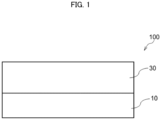
- the metal-resin complex 100 may include a metal member 10 and a resin member 30 that is disposed on the metal member 10.
- the metal-resin complex may be used for various purposes.
- Examples of the purposes for the metal-resin complex include cooling units, bus-bars, cooling component for vehicles, structural component for vehicles, on-board components for vehicles, casing for electronic components, casing for home appliances, building components, structural components, components for machines, components for automotives, components for electronic devices, household articles such as furniture or kitchen equipment, medical equipment, component for building materials, component for other purposes, and exterior components.
- An etching solution according to the present disclosure as described below may be suitably used for obtaining the metal member according to the present disclosure, for example.
- the etching solution according to the present disclosure includes an amine compound, a nitrogen-containing heteroaromatic compound, a hydrogen peroxide, and an inorganic acid.
- the amine compound functions as a complexing agent that causes a metal to dissolve as a metal complex.
- the amine compound is not particularly limited, and may be an alkanolamine compound, a hydroxylamine compound, an amino acid compound, or the like.
- alkanolamine compound examples include a mono-alkanolamine compound, a di-alkanolamine compound, and a tri-alkanolamine compound.
- Examples of the mono-alkanolamine compound include monoethanolamine, 2-methylaminoethanol, 2-ethylaminoethanol, 2-(2-aminoethoxy)ethanol, 1-amino-2-propanol, monopropanolamine, dimethylaminoethanol, and a salt of these compounds.
- di-alkanolamine compound examples include diethanolamine, N-methyldiethanolamine, dibutanolamine, and a salt of these compounds.
- tri-alkanolamine compound examples include triisopropanolamine, triethanolamine, and a salt of these compounds.
- hydroxylamine examples include hydroxylamine, N-methyl hydroxylamine, N,N-dimethylhydroxylamine, N,N-diethylhydroxylamine, hydroxylamine sulfate, and hydroxylamine hydrochloride.
- the amine compound may be used singly or in combination of two or more kinds.
- the content of the amine compound with respect to a total mass of the etching solution is preferably from 0.0001% by mass to 5% by mass, more preferably from 0.01% by mass to 0.5% by mass, further preferably from 0.01% by mass to 0.3% by mass, particularly preferably from 0.01% by mass to 0.1% by mass.
- the amine compound is preferably an amino acid compound.
- amino acid compound functions as a complexing agent that causes a metal to dissolve as a metal complex. Since an amino acid compound is highly adsorptive with respect to a metal, the amino acid compound suitably serves the function as a complexing agent.
- an amino acid compound has an ability to reduce an effect of a concentration of hydrogen peroxide, which serves as an oxidant, on a rate of etching. Specifically, decomposition of hydrogen peroxide with time may decrease the concentration of hydrogen peroxide in the etching solution and a rate of etching may be lowered. Therefore, an amino acid compound may reduce an effect of lowering a rate of etching due to the decomposition of hydrogen peroxide.
- an amino acid compound may suppress the variation in pH of the etching solution and stabilize the pH of the etching solution.
- amino acid compound refers to an amino acid and a salt thereof.
- the amino acid refers to an organic compound having both an amino group and a carboxy group.
- the amino acid compound is not particularly limited, and examples thereof include alanine, glutamic acid, glycine, leucine, isoleucine, proline, serine, threonine, valine, ⁇ -alanine, ⁇ -alanine, arginine, asparagine, asparagine acid, cysteine, glutamine, histidine, lycine, methionine, triptophan, tyrosine, ornithine, phenylalanine, 4-chlorophenylalanine, 4-bromophenylalanine, 4-nitrophenylalanine, 3-(3,4-dihydrophenyl)alanine, ⁇ -methylphenylalanine, and a salt of these compounds.
- the salt of an amino acid compound include an alkali metal salt and an ammonium salt.
- the amino acid compound is preferably an aliphatic amino acid or a salt thereof.
- the amino acid compound is preferably an ⁇ -amino acid or a salt thereof.
- a single kind of the amino acid compound may be used alone, or two or more kinds thereof may be used in combination.
- the content of the amino acid compound with respect to a total mass of the etching solution is preferably from 0.0001% by mass to 5% by mass, more preferably from 0.01% by mass to 0.5% by mass, further preferably from 0.01% by mass to 0.3% by mass, particularly preferably from 0.01% by mass to 0.1% by mass.
- the nitrogen-containing heteroaromatic compound functions to suppress rapid etching of a metal, and serves suitably to the adjustment of roughness at a surface of a metal.
- nitrogen-containing heteroaromatic compound refers to a compound having a hetero ring that contains nitrogen.
- the nitrogen-containing heteroaromatic compound is not particularly limited, and examples thereof include compounds with a 5-membered ring, such as pyrrole compounds, pyrazole compounds, imidazole compounds, triazole compounds, and derivatives of these compounds; compounds with a 6-membered ring, such as pyridine compounds, pyridazine compounds, pyrazine compounds, pyrimidine compounds, triazine compounds, and derivatives of these compounds; and compounds with multiple rings, such as indole, purine, quinoline, isoquinoline, quinoxaline, cinnoline, quinazoline, phthalazine, naphthyridine, pteridin, acridine, naphthazine, phenazine, phenanthroline, and derivatives of these compounds.
- a 5-membered ring such as pyrrole compounds, pyrazole compounds, imidazole compounds, triazole compounds, and derivatives of these compounds
- the nitrogen-containing heteroaromatic compounds is preferably an azole compound.
- the azole compound is not particularly limited, and examples thereof include triazole compounds such as 1,2,3-triazole, 1,2,4-triazole, 5-phenyl-1,2,4-triazole, 5-amino-1,2,4-triazole, 1H-benzotriazole, 1-methyl-benzotriazole, 5-methyl-1H-benzotriazole and 3-amino-1H-triazole; tetrazole compounds such as 1H-tetrazole, 5-methyl-1H-tetrazole, 5-phenyl-1H-tetrazole and 5-amino-1H-tetrazole; imidazole compounds such as 1H-imidzole and 1H-benzoimidazole; and thiazole compounds such as 1,3-thiazole and 4-methylthiazole.
- triazole compounds such as 1,2,3-triazole, 1,2,4-triazole, 5-phenyl-1,2,4-triazole, 5-amino-1,2,4-triazole, 1
- the azole compound is preferably a triazole compound.
- a single kind of the nitrogen-containing heteroaromatic compound may be used alone, or two or more kinds thereof may be used in combination.
- the content of the nitrogen-containing heteroaromatic compound with respect to a total mass of the etching solution is preferably from 0.01% by mass to 2.0% by mass, more preferably from 0.8% by mass to 1.5% by mass.
- the hydrogen peroxide functions as an oxidant that causes oxidation of a metal.
- the content of the hydrogen peroxide with respect to a total mass of the etching solution is preferably from 0.5% by mass to 7% by mass, more preferably from 1.3% by mass to 3.0% by mass.
- the inorganic acid is used to dissolve an oxidized metal.
- the inorganic acid is not particularly limited, and examples thereof include sulfuric acid, nitric acid, hydrochloric acid, phosphoric acid, hypophosphorous acid, carbonic acid, sulfamic acid, boric acid and hydofluoric acid.
- the inorganic acid is preferably inorganic acid other than hydrochloric acid, phosphoric acid or hydrofluoric acid.
- the inorganic acid is preferably sulfuric acid.
- a single kind of the inorganic acid may be used alone, or two or more kinds thereof may be used in combination.
- the content of the inorganic acid with respect to a total mass of the etching solution is preferably from 5% by mass to 20% by mass, more preferably from 5% by mass to 15% by mass, further preferably from 6% by mass to 13% by mass, particularly preferably from 8% by mass to 12% by mass.
- the etching solution may include water, in addition to an amino acid compound, a nitrogen-containing heteroaromatic compound, a hydrogen peroxide and an inorganic acid.
- Water is preferably subjected to a treatment to remove impurities such as metal ions or organic compounds, particles, or the like.
- a treatment to remove impurities such as metal ions or organic compounds, particles, or the like.
- the treatment include distillation, ionexchange treatment, filtering, and adsorption treatment of various kinds.
- Water is preferably pure water or ultrapure water.
- the etching solution may include a halide ion source that generates fluoride ions, chloride ions, bromide ions or the like, in order to increase a degree of roughness in the irregularities.
- a halide ion source that generates fluoride ions, chloride ions, bromide ions or the like, in order to increase a degree of roughness in the irregularities.
- chloride ions are preferred as the halide ions.
- halide ion source examples include alkali metal salts such as sodium chloride, ammonium chloride and potassium chloride; oxohalides such as sodium chlorate and potassium chlorate; and copper chloride.
- a single kind of the halide ion source may be used alone, or two or more kinds thereof may be used in combination.
- the content thereof may be from 0.0001% by mass to 0.05% by mass with respect to a total mass of the etching solution, from the viewpoint of etching properties.
- the etching solution may include, as a solvent other than water, an aqueous organic solvent such as alcohols, glycols or ethers, in order to adjust the etching properties.
- an aqueous organic solvent such as alcohols, glycols or ethers
- a single kind of the aqueous organic solution may be used alone, or two or more kinds thereof may be used in combination.
- the content thereof may be approximately from 0.1% by mass to 20% by mass with respect to a total mass of the etching solution, from the viewpoint of etching properties.
- the etching solution may include an organic acid other than amino acid compounds in order to adjust the etching properties.
- organic acid other than amino acid compounds include aliphatic carboxylic acid and aromatic carboxylic acid.
- a single kind of the organic acid may be used alone, or two or more kinds thereof may be used in combination.
- the content thereof may be approximately from 1% by mass to 15% by mass with respect to a total mass of the etching solution.
- the etching solution may include an additive typically used for an etching solution, other than the components as described above.
- the additive examples include a stabilizer, a solubilizer, an antifoamer, a pH adjuster, a specific gravity adjuster, a viscosity adjuster, a wettability adjuster, a chelating agent, an oxidant, a reductant, and a surfactant.
- a single kind of the additive may be used alone, or two or more kinds thereof may be used in combination.
- the content thereof may be approximately from 0.001% by mass to 10% by mass with respect to a total mass of the etching solution.
- the pH at 25°C of the etching solution is preferably 3.0 or less, more preferably 1.0 or less.
- the pH is measured with a pH meter.
- the metal to be etched with the etching solution is not particularly limited.
- the etching solution may be used for the etching of the metal in connection with the metal member as described above.
- the method for producing the etching solution is not particularly limited.
- the etching solution may be produced by mixing the components as described above, and stirring the mixture as necessary.
- the method for manufacturing the metal member according to the present disclosure is not particularly limited.
- the metal member may be suitably manufactured by the manufacturing method according to the present disclosure as explained below.
- the manufacturing method for a metal member according to the present disclosure includes a process of roughening at least a portion of a surface of a metal member (hereinafter, also referred to as a "roughening process").
- the manufacturing method for a metal member may include a pretreatment process prior to the roughening process, or may include an aftertreatment process after the roughening process.
- the manufacturing method for a metal member is described in detail by referring to an embodiment of the method in which a pretreatment process, a roughening process and an aftertreatment process are performed in this order.
- a pretreatment process is performed for removing a film disposed at a surface of the metal member, such as a film formed of oxides, hydroxides or the like.
- the pretreatment process is typically performed by way of mechanical polishing or chemical polishing.
- a degreasing process may be performed prior to the pretreatment process using an alkali aqueous solution, such as an aqueous solution of sodium hydroxide or potassium hydroxide.
- the method for performing roughening to at least a portion of a surface of the metal member is not particularly limited, and examples thereof include chemical treatment and mechanical treatment.
- the mechanical treatment include sand blasting, knurling and laser processing.
- the chemical treatment include etching using an alkali etchant or an acid etchant.
- a single kind of treatment may be performed alone, or two or more kinds thereof may be performed in combination.
- etching with an acid etchant is preferred.
- the etching solution according to the present disclosure may be suitable used as an acid etchant.
- the roughing process corresponds to a process of etching at least a portion of a surface of the metal member with the etching solution according to the present disclosure.
- Examples of the method for contacting a metal member with an etching solution include a dip method in which a metal member is dipped in an etching solution; a spray method in which a metal member is sprayed with an etching solution; and a spin method in which an etching solution is ejected toward a metal member while spinning the same.
- the temperature of the etching solution may be adjusted as appropriate in view of the type of a metal member, composition of an etching solution, or the like.
- the temperature of the etching solution is preferably from 30°C to 60°C, more preferably from 35°C to 45°C.
- the treatment time (i.e., the time period in which a metal member is in contact with an etching solution) may be adjusted as appropriate in view of the type of a metal member, composition of an etching solution, or the like.
- the treatment time is preferably from 60 seconds to 480 seconds, more preferably from 150 seconds to 300 seconds.
- the pH of an etching solution may vary due to the etching. Therefore, the pH of an etching solution may be adjusted during performing the etching, as necessary.
- the metal member is washed after performing the roughening process.
- the aftertreatment process typically includes water washing and drying.
- the aftertreatment process may include ultra-sonic washing for the purpose of desmutting.
- a nitrogen-containing heteroaromatic compound included in the etching solution may remain at a surface of the metal member.
- a nitrogen-containing heteroaromatic compound may exist at at least a portion of a surface (or at an entire surface).
- a nitrogen-containing heteroaromatic compound may exist at at least a portion of a joint interface (or at an entire joint interface) between the metal member and the resin member.
- the method for manufacturing the metal-resin complex according to the present disclosure is not particularly limited.
- the metal-resin complex is suitably manufactured by the method for a metal-resin complex according to the present disclosure as described below.
- the manufacturing method for a metal-resin complex according to the present disclosure includes:
- a metal member is disposed at a mold.
- a resin-supply process a melted or softened resin is supplied to the mold.
- the melted resin which has been supplied to the mold, solidifies while being in contact with at least a portion of a roughened surface of the metal member (i.e., a surface satisfying Formula (1)).
- the details and preferred embodiments of the resin are the same as the details and preferred embodiments of the resin included in the resin member of the metal-resin complex as described above.
- a metal material for manufacturing a metal member was prepared by cutting a copper alloy plate of Alloy No. C1100 according to JIS H 3100:2012 (thickness: 2 mm) into a size of 45 mm in length and 18 mm in width.
- the metal material was subjected to degreasing by dipping the metal material in an aqueous sodium hydroxide of 2.6% by mass, containing 0.16% by mass of gluconic acid sodium salt (55°C), for 5 minutes while performing ultra-sonic washing, and then washing three times (20 seconds for each washing).
- a coating at a surface of the metal material was removed by dipping the metal material in an aqueous sodium hydroxide of 0.002% by mass, containing 0.1% by mass of benzotriazole and 0.3% by mass of 2-isopropoxyethanol (35°C), for 20 seconds, and then washing three times (20 seconds for each washing).
- An etching solution was prepared by dissolving, in water, 9.5% by mass of sulfuric acid, 2% by mass of hydrogen peroxide, 1.1% by mass of benzotriazole, 0.024% by mass of glycine and 0.00225% by mass of sodium chloride
- the metal material was dipped in the etching solution (40°C) for 3 minutes and washed with water three times (20 seconds for each washing), whereby a fine structure was formed at a surface of the metal material.
- the pH of the etching solution at 25°C measured with a pH meter (D-71, manufactured by Horiba, Ltd.) was 0.3.
- the metal material was dipped in water (room temperature) for 3 minutes while performing ultra-sonic washing for desmutting.
- the metal material was dried at 80°C for 20 minutes.
- the metal member of Example 1 was manufactured by the processes as described above.
- the metal member was disposed at a small-size dumbbell metal-insert mold, attached to an injection machine (J55-AD, the Japan Steel Works, Ltd.) Subsequently, polyphenylenesulfide (PPS, SUSTEEL BGX 545, Tosoh Corporation) was supplied to the mold by injection molding at a mold temperature of 150°C, thereby preparing a metal-resin complex in which a resin member is formed on the metal member.
- the area of a joint interface between the metal member and the resin member was 10 mm ⁇ 50 mm.
- the shear joining strength (MPa) of the metal-resin complex was measured by a method according to ISO 19095.
- a breaking load (N) was measured with a tensile tester (Model 1323, Aikoh Engineering Co., Ltd.) with a special attachment at room temperature (23°C), under the conditions of a chuck distance of 60 mm and a tensile rate of 10 mm/min.
- the shear joining strength (MPa) was calculated by dividing the breaking load (N) by the area of a joint interface between the metal member and the resin member (50 mm 2 ).
- the metal-resin complex has a shear joining strength of 15 MPa or more, the metal-resin complex was regarded as having excellent joining strength. The result is shown in Table 1.
- a rate of helium leakage of the metal-resin complex was measured for the evaluation of airtightness. The measurement was performed with a helium leak detector (M-212 LD, Canon Anelva Corporation).
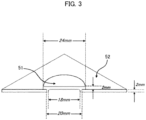
- Fig. 2 illustrates a configuration of a specimen used for the evaluation of airtightness according to ISO 19095-2 (Type D. 2.2 specimen) and Fig. 3 illustrates a sectional view of the specimen in a diagonal direction.
- the specimen has a hole with a diameter of 20 mm formed at a rectangular metal plate (50 mm ⁇ 50 mm ⁇ 2 mm), and a resin member is attached to a circumference of the hole by injecting a light-absorbing material (see Fig. 3 ).
- a portion at a periphery of a surface of the metal portion of the specimen was not etched in order to secure the airtightness of an O-ring (packing) to be disposed between the attachment of the helium leak detector (test port flange face) and the specimen.
- the portion was covered with a masking tape (No. 854, 3M Japan Limited) so as not to be etched.
- a specimen in which helium leakage is observed i.e., a specimen with an increase in the amount of helium leakage of greater than 10%, as compared with the amount of helium leakage in a blank sample within 1 minutes during the application of helium gas, was categorized as F in Table 1.
- the metal member and the metal-resin complex were prepared in the same manner as Example 1, except that the composition of an etching solution, the resin type, the solution temperature and the treatment time were changed as described in Tables 1 to 4.
- PP refers to polypropylene (Prime Polypro V7100, Prime Polymer Co., Ltd.)
- PA6 refers to polyamide 6 (Amilan CM1011G-30, Toray Industries, Inc.)
- PBT refers to polybutylene terephthalate (Duranex 930HL, Polyplastics Co., Ltd.)
- the metal member and the metal-resin complex obtained in Examples 2 to 23 were subjected to the measurement of values of L, a and b, the measurement of a joining strength, and the evaluation of a helium leakage. The results are shown in Table 1 to 4.
- Example 1 Example 2
- Example 3 Example 4
- Example 5 Example 6
- Example 7 Example 8 Etching solution composition [% by mass] Sulfuric acid 9.5 9.5 8 8 11.4 11.4 18 5 Hydrogen peroxide 2 2 1.5 1.5 2.4 2.4 4 2
- Sodium chloride 0.00225 0.00225 0.00225 0.00225 0.00225 0.0045 0.00225
- Glycine 0.024 0.024 0.024 0.024 0.024 0.024 0.024 0.048 0.024 pH 0.3 0.3 0.5-1.0 0.5-1.0 0.1 or less 0.1 or less 0.1 or less 0.5-1.0 Liquid temperature [°C] 40 40 35 35 45 45 40 40
- Treatment time [min] 3 4 3 5 3 2 1 3
Landscapes
- Chemical & Material Sciences (AREA)
- Engineering & Computer Science (AREA)
- Mechanical Engineering (AREA)
- Materials Engineering (AREA)
- Metallurgy (AREA)
- Organic Chemistry (AREA)
- Chemical Kinetics & Catalysis (AREA)
- General Chemical & Material Sciences (AREA)
- Manufacturing & Machinery (AREA)
- ing And Chemical Polishing (AREA)
Abstract
Description
- The present disclosure relates to a metal member and a manufacturing method for a metal member, an etching solution, and a metal-resin complex and a manufacturing method for a metal-resin complex.
- Metal-resin complexes exhibit features derived from a metal member (such as electrical conductivity or thermal conductivity) combined with features derived from a resin member (such as electrical insulation), and are used for various purposes such as components for vehicles, for example. In some cases of manufacturing a metal-resin complex, a metal member having a roughened surface is used in order to increase a joining strength with respect to the metal member. Such a metal member having a roughened surface is described in Patent Document 1, for example.
- Patent Document 1:
Japanese Patent No. 6387543 - A problem to be solved by an embodiment of the present disclosure is to provide a metal member that exhibits excellent joining strength with respect to a resin member.
- A problem to be solved by another embodiment of the present disclosure is to provide a manufacturing method for the metal member.
- A problem to be solved by another embodiment of the present disclosure is to provide an etching solution used for the manufacture of the metal member.
- A problem to be solved by another embodiment of the present disclosure is to provide a metal-resin complex in which a resin member is joined to the metal member.
- A problem to be solved by another embodiment of the present disclosure is to provide a manufacturing method for the metal-resin complex.
- The present disclosure includes the following embodiments.
- <1> A metal member, having a surface in which values of L, a and b in CIE 1976 (L*a*b*) color space satisfy at least one of the following Formula (1) or Formula (2):


- <2> The metal member according to <1>, wherein, in the surface, values of L and a in CIE 1976 (L*a*b*) color space satisfy the Formula (2) and the following Formula (3):

- <3> The metal member according to <2>, wherein, in the surface, a value of a in CIE 1976 (L*a*b*) color space satisfies the following Formula (4):

- <4> The metal member according to any one of <1> to <3>, comprising at least one of copper or copper alloy.
- <5> The metal member according to any one of <1> to <4>, comprising a nitrogen-containing heteroaromatic compound that is disposed at at least a portion of the surface.
- <6> An etching solution, comprising an amine compound, a nitrogen-containing heteroaromatic compound, a hydrogen peroxide, and an inorganic acid.
- <7> The etching solution according to <6>, wherein a content of the amine compound with respect to a total mass of the etching solution is from 0.0001% by mass to 5% by mass.
- <8> The etching solution according to <6>, wherein a content of the nitrogen-containing heteroaromatic compound with respect to a total mass of the etching solution is from 0.01% by mass to 2.0% by mass.
- <9> The etching solution according to <6>, wherein a content of the hydrogen peroxide with respect to a total mass of the etching solution is from 0.5% by mass to 7% by mass.
- <10> The etching solution according to <6>, wherein a content of the inorganic acid with respect to a total mass of the etching solution is from 5% by mass to 20% by mass.
- <11> The etching solution according to <6>, wherein the amine compound is an amino acid compound.
- <12> The etching solution according to <11>, wherein the amino acid compound is an aliphatic amino acid or a salt thereof.
- <13> The etching solution according to <11>, wherein the amino acid compound is an α-amino acid or a salt thereof.
- <14> The etching solution according to any one of <6> to <13>, wherein the nitrogen-containing heteroaromatic compound is an azole compound.
- <15> The etching solution according to <14>, wherein the azole compound is a triazole compound.
- <16> A method of manufacturing the metal member according to any one of <1> to <5>, the method comprising roughening at least a portion of a surface of the metal member.
- <17> The manufacturing method for the metal member according to claim 16, wherein the roughening is performed by etching at least a portion of the surface with the etching solution according to any one of <6> to <15>.
- <18> A metal-resin complex, comprising the metal member according to any one of <1> to <5>, and a resin member that is joined to at least a portion of a surface of the metal member.
- <19> The metal-resin complex according to <18>, wherein the resin member comprises a thermoplastic resin.
- <20> The metal-resin complex according to <19>, wherein the thermoplastic resin comprises at least one selected from the group consisting of polyolefin resin, polyvinyl chloride, polyvinylidene chloride, polystyrene resin, AS resin, ABS resin, polyester resin, poly(meth)acrylic resin, polyvinyl alcohol, polycarbonate resin, polyamide resin, polyimide resin, polyether resin, polyacetal resin, fluorine resin, polysulfone resin, polyphenylene sulfide resin and polyketone resin.
- <21> A manufacturing method for a metal-resin complex, the method comprising:
- disposing the metal member according to any one of <1> to <5> at a mold; and
- supplying a melted or softened resin to the mold.
- According to an embodiment of the present disclosure, a metal member that exhibits excellent joining strength with respect to a resin member is provided.
- According to another embodiment of the present disclosure, a manufacturing method for the metal member is provided.
- According to another embodiment of the present disclosure, an etching solution used for the manufacture of the metal member is provided.
- According to another embodiment of the present disclosure, a metal-resin complex in which a resin member is joined to the metal member is provided.
- According to another embodiment of the present disclosure, a manufacturing method for the metal-resin complex is provided.
-
-
Fig. 1 is a schematic sectional view illustrating an example of a metal-resin complex. -
Fig. 2 is a schematic view illustrating a specimen used for the evaluation of airtightness. -
Fig. 3 is a schematic view illustrating a section in a diagonal direction of the specimen used for the evaluation of airtightness. - In the present disclosure, any numerical range described using the expression "from * to" represents a range in which numerical values described before and after the "to" are included in the range as a minimum value and a maximum value, respectively.
- In a numerical range described in stages, in the present disclosure, an upper limit value or a lower limit value described in one numerical range may be replaced with an upper limit value or a lower limit value in another numerical range described in stages. Further, in a numerical range described in the present disclosure, the upper limit value or the lower limit value in the numerical range may be replaced with a value shown in the Examples.
- In the present disclosure, in a case in which each component in a composition includes plural kinds of substances, the content of each component refers to the total content of the plural kinds of substances present in the composition, unless otherwise specified.
- In the present disclosure, the definition of the term "step" includes not only an independent step which is distinguishable from another step, but also a step which is not clearly distinguishable from another step, as long as the purpose of the step is achieved.
- The metal member according to the present disclosure has a surface in which values of L, a and b in CIE 1976 (L*a*b*) color space satisfy at least one of the following Formula (1) or Formula (2):


- The metal member exhibits excellent joining strength with respect to a resin member.
- The projected mechanism by which the metal member according to the present disclosure improves the joining strength with respect to a resin member is thought to be as follows.
- The values of L, a and b at a surface of the metal member, which relate to reflected light at the surface, reflect a degree of surface roughness. It is thought that a surface of the metal member at which the values of L, a and b satisfy at least one of Formula (1) or Formula (2) has a fine structure in which a degree of roughness is regulated appropriately, and that the fine structure is suitable for increasing the joining strength with respect to a resin member.
- Although the projected mechanism has been explained above, the scope of the present disclosure is not limited in any way by the projected mechanism as described above.
- The upper limit of b is not limited and may be, for example, 28.
- The metal member preferably has a surface in which the values of L and a in CIE 1976 (L*a*b*) color space satisfy Formula (2), and further satisfy the following Formula (3). When the metal member satisfies Formula (2) and Formula (3), it is possible to suppress leakage of a fluid from a junction between the metal member and a resin layer more easily.

- It is thought that, because the surface roughness is more appropriately controlled, the metal member that satisfies Formula (2) and Formula (3) is suitable for suppressing leakage of a fluid, in addition to improving the joining strength with respect to a resin member.
- Although the projected mechanism has been explained above, the scope of the present disclosure is not limited in any way by the projected mechanism as described above.
- The metal member preferably has a surface in which the value of a in CIE 1976 (L*a*b*) color space satisfies the following Formula (4). When the metal member satisfies Formula (4), it is possible to suppress leakage of a fluid more easily.

- The values of L, a and b are measured with a spectroscopic chronometer. For example, a spectroscopic chronometer manufactured by Nippon Denshoku Industries Co., Ltd. with a trade name of NF 333 may be used for the measurement.
- The type of the metal included in the metal member is not particularly limited. Specific examples of the metal include aluminum, iron, copper, nickel, gold, silver, platinum, cobalt, zinc, lead, tin, zirconium, titanium, niobium, chromium, aluminum, magnesium, manganese, and alloys including these metals. Moreover, examples of the metal member include plated materials obtained by subjecting base materials of the aforementioned metals and the aforementioned alloys to plating.
- Examples of the alloy include brass, phosphor bronze and steel (for example, stainless steel). Examples of the plated member (i.e., members obtained by subjecting base materials of the aforementioned metals and the aforementioned alloys to plating) include plated steel. Examples of the material for a plating layer include zinc, nickel and chromium.
- Among the metals as mentioned above, the metal member preferably includes at least one of copper or copper alloy.
- The shape of the metal member is not particularly limited, and examples thereof include a flat panel, a disk, a bent plate, a rod, a cylinder and a lump. The configuration of a surface of the metal member is not particularly limited, and may be flat, curved or the like.
- The thickness of the metal member is not particularly limited, and may be from 1 mm to 20 mm, for example. For example, when the metal member is used for cooling units, bus-bar or the like, the thickness of the metal member may be from 1 mm to 5 mm. When the metal member is used for cooling units for automobiles, the thickness of the metal member may be from 1 mm to 5 mm.
- The metal-resin complex according to the present disclosure includes the metal member according to the present disclosure, and a resin member that is joined to at least a portion of a surface of the metal member.
- The resin included in the resin member is not particularly limited, and may be selected depending on the purposes of the metal member, and the like.
- Examples of the resin include thermoplastic resins (including elastomers) such as polyolefin resin (for example, polypropylene), polyvinyl chloride, polyvinylidene chloride, polystyrene resin, AS resin, ABS resin, polyester resin (for example, polybutylene terephthalate), poly(meth)acrylic resin, polyvinyl alcohol, polycarbonate resin, polyamide resin, polyimide resin, polyether resin, polyacetal resin, fluorine resin, polysulfone resin, polyphenylene sulfide resin and polyketone resin; and thermosetting resins such as phenol resin, melamine resin, urea resin, polyurethane resin, epoxy resin and unsaturated polyester resin.
- The resin may be used singly, or in combination of two or more kinds.
- From the viewpoint of moldability, the resin included in the resin member is preferably a thermoplastic resin.
- The resin included in the resin member may include an additive of various kinds. Examples of the additive include a filler, a thermostabilizer, an antioxidant, a pigment, a weathering stabilizer, a fire retardant, a plasticizer, a dispersant, a lubricant, a mold-release agent, and an antistatic agent.
- The resin member may include a filler. Examples of the filler include glass fiber, carbon fiber, carbon particles, clay, talc, silica, minerals and cellulose fiber. The filler may be used singly, or in combination of two or more kinds.
- The configuration of the metal-resin complex is not particularly limited as long as it includes a metal member and a resin member that is joined to at least a portion of a surface of the metal member, and may be designed depending on the purposes or the like of the metal-resin complex.
- For example, the metal-resin complex may include plural metal members; or may include two or more metal members including a single kind of metal or two or more different kinds of metals.
- For example, the metal-resin complex may include plural resin members; or may include two or more resin members including a single kind of resin or two or more different kinds of resins.
- For example, as shown in
Fig. 1 , the metal-resin complex 100 may include ametal member 10 and aresin member 30 that is disposed on themetal member 10. - The metal-resin complex may be used for various purposes. Examples of the purposes for the metal-resin complex include cooling units, bus-bars, cooling component for vehicles, structural component for vehicles, on-board components for vehicles, casing for electronic components, casing for home appliances, building components, structural components, components for machines, components for automotives, components for electronic devices, household articles such as furniture or kitchen equipment, medical equipment, component for building materials, component for other purposes, and exterior components.
- An etching solution according to the present disclosure as described below may be suitably used for obtaining the metal member according to the present disclosure, for example.
- The etching solution according to the present disclosure includes an amine compound, a nitrogen-containing heteroaromatic compound, a hydrogen peroxide, and an inorganic acid.
- The amine compound functions as a complexing agent that causes a metal to dissolve as a metal complex.
- The amine compound is not particularly limited, and may be an alkanolamine compound, a hydroxylamine compound, an amino acid compound, or the like.
- Examples of the alkanolamine compound include a mono-alkanolamine compound, a di-alkanolamine compound, and a tri-alkanolamine compound.
- Examples of the mono-alkanolamine compound include monoethanolamine, 2-methylaminoethanol, 2-ethylaminoethanol, 2-(2-aminoethoxy)ethanol, 1-amino-2-propanol, monopropanolamine, dimethylaminoethanol, and a salt of these compounds.
- Examples of the di-alkanolamine compound include diethanolamine, N-methyldiethanolamine, dibutanolamine, and a salt of these compounds.
- Examples of the tri-alkanolamine compound include triisopropanolamine, triethanolamine, and a salt of these compounds.
- Examples of the hydroxylamine include hydroxylamine, N-methyl hydroxylamine, N,N-dimethylhydroxylamine, N,N-diethylhydroxylamine, hydroxylamine sulfate, and hydroxylamine hydrochloride.
- The amine compound may be used singly or in combination of two or more kinds.
- From the viewpoint of etching properties, the content of the amine compound with respect to a total mass of the etching solution is preferably from 0.0001% by mass to 5% by mass, more preferably from 0.01% by mass to 0.5% by mass, further preferably from 0.01% by mass to 0.3% by mass, particularly preferably from 0.01% by mass to 0.1% by mass.
- From the viewpoint of suppressing a leakage of a fluid more easily, the amine compound is preferably an amino acid compound.
- An amino acid compound functions as a complexing agent that causes a metal to dissolve as a metal complex. Since an amino acid compound is highly adsorptive with respect to a metal, the amino acid compound suitably serves the function as a complexing agent.
- Further, an amino acid compound has an ability to reduce an effect of a concentration of hydrogen peroxide, which serves as an oxidant, on a rate of etching. Specifically, decomposition of hydrogen peroxide with time may decrease the concentration of hydrogen peroxide in the etching solution and a rate of etching may be lowered. Therefore, an amino acid compound may reduce an effect of lowering a rate of etching due to the decomposition of hydrogen peroxide.
- Further, since an amino acid compound has a pH buffer action, an amino acid compound may suppress the variation in pH of the etching solution and stabilize the pH of the etching solution.
- In the present disclosure, the "amino acid compound" refers to an amino acid and a salt thereof. The amino acid refers to an organic compound having both an amino group and a carboxy group.
- The amino acid compound is not particularly limited, and examples thereof include alanine, glutamic acid, glycine, leucine, isoleucine, proline, serine, threonine, valine, β-alanine, γ-alanine, arginine, asparagine, asparagine acid, cysteine, glutamine, histidine, lycine, methionine, triptophan, tyrosine, ornithine, phenylalanine, 4-chlorophenylalanine, 4-bromophenylalanine, 4-nitrophenylalanine, 3-(3,4-dihydrophenyl)alanine, α-methylphenylalanine, and a salt of these compounds. Examples of the salt of an amino acid compound include an alkali metal salt and an ammonium salt.
- From the viewpoint of etching properties, the amino acid compound is preferably an aliphatic amino acid or a salt thereof.
- From the viewpoint of etching properties, the amino acid compound is preferably an α-amino acid or a salt thereof.
- A single kind of the amino acid compound may be used alone, or two or more kinds thereof may be used in combination.
- From the viewpoint of etching properties, the content of the amino acid compound with respect to a total mass of the etching solution is preferably from 0.0001% by mass to 5% by mass, more preferably from 0.01% by mass to 0.5% by mass, further preferably from 0.01% by mass to 0.3% by mass, particularly preferably from 0.01% by mass to 0.1% by mass.
- The nitrogen-containing heteroaromatic compound functions to suppress rapid etching of a metal, and serves suitably to the adjustment of roughness at a surface of a metal.
- In the present disclosure, the "nitrogen-containing heteroaromatic compound" refers to a compound having a hetero ring that contains nitrogen.
- The nitrogen-containing heteroaromatic compound is not particularly limited, and examples thereof include compounds with a 5-membered ring, such as pyrrole compounds, pyrazole compounds, imidazole compounds, triazole compounds, and derivatives of these compounds; compounds with a 6-membered ring, such as pyridine compounds, pyridazine compounds, pyrazine compounds, pyrimidine compounds, triazine compounds, and derivatives of these compounds; and compounds with multiple rings, such as indole, purine, quinoline, isoquinoline, quinoxaline, cinnoline, quinazoline, phthalazine, naphthyridine, pteridin, acridine, naphthazine, phenazine, phenanthroline, and derivatives of these compounds.
- From the viewpoint of etching properties, the nitrogen-containing heteroaromatic compounds is preferably an azole compound.
- The azole compound is not particularly limited, and examples thereof include triazole compounds such as 1,2,3-triazole, 1,2,4-triazole, 5-phenyl-1,2,4-triazole, 5-amino-1,2,4-triazole, 1H-benzotriazole, 1-methyl-benzotriazole, 5-methyl-1H-benzotriazole and 3-amino-1H-triazole; tetrazole compounds such as 1H-tetrazole, 5-methyl-1H-tetrazole, 5-phenyl-1H-tetrazole and 5-amino-1H-tetrazole; imidazole compounds such as 1H-imidzole and 1H-benzoimidazole; and thiazole compounds such as 1,3-thiazole and 4-methylthiazole.
- From the viewpoint of etching properties, the azole compound is preferably a triazole compound.
- A single kind of the nitrogen-containing heteroaromatic compound may be used alone, or two or more kinds thereof may be used in combination.
- From the viewpoint of readily securing the joining strength and airtightness, the content of the nitrogen-containing heteroaromatic compound with respect to a total mass of the etching solution is preferably from 0.01% by mass to 2.0% by mass, more preferably from 0.8% by mass to 1.5% by mass.
- The hydrogen peroxide functions as an oxidant that causes oxidation of a metal.
- From the viewpoint of etching properties, the content of the hydrogen peroxide with respect to a total mass of the etching solution is preferably from 0.5% by mass to 7% by mass, more preferably from 1.3% by mass to 3.0% by mass.
- The inorganic acid is used to dissolve an oxidized metal.
- The inorganic acid is not particularly limited, and examples thereof include sulfuric acid, nitric acid, hydrochloric acid, phosphoric acid, hypophosphorous acid, carbonic acid, sulfamic acid, boric acid and hydofluoric acid.
- From the viewpoint of environmental burdens, the inorganic acid is preferably inorganic acid other than hydrochloric acid, phosphoric acid or hydrofluoric acid.
- From the viewpoint of achieving a high rate of dissolving copper and from the viewpoint of economy, the inorganic acid is preferably sulfuric acid.
- A single kind of the inorganic acid may be used alone, or two or more kinds thereof may be used in combination.
- From the viewpoint of etching properties, the content of the inorganic acid with respect to a total mass of the etching solution is preferably from 5% by mass to 20% by mass, more preferably from 5% by mass to 15% by mass, further preferably from 6% by mass to 13% by mass, particularly preferably from 8% by mass to 12% by mass.
- The etching solution may include water, in addition to an amino acid compound, a nitrogen-containing heteroaromatic compound, a hydrogen peroxide and an inorganic acid.
- Water is preferably subjected to a treatment to remove impurities such as metal ions or organic compounds, particles, or the like. Examples of the treatment include distillation, ionexchange treatment, filtering, and adsorption treatment of various kinds. Water is preferably pure water or ultrapure water.
- The etching solution may include a halide ion source that generates fluoride ions, chloride ions, bromide ions or the like, in order to increase a degree of roughness in the irregularities. Typically, chloride ions are preferred as the halide ions.
- Examples of the halide ion source include alkali metal salts such as sodium chloride, ammonium chloride and potassium chloride; oxohalides such as sodium chlorate and potassium chlorate; and copper chloride.
- A single kind of the halide ion source may be used alone, or two or more kinds thereof may be used in combination.
- When the etching solution includes a halide ion source, the content thereof may be from 0.0001% by mass to 0.05% by mass with respect to a total mass of the etching solution, from the viewpoint of etching properties.
- The etching solution may include, as a solvent other than water, an aqueous organic solvent such as alcohols, glycols or ethers, in order to adjust the etching properties.
- A single kind of the aqueous organic solution may be used alone, or two or more kinds thereof may be used in combination.
- When the etching solution includes an aqueous organic solution, the content thereof may be approximately from 0.1% by mass to 20% by mass with respect to a total mass of the etching solution, from the viewpoint of etching properties.
- The etching solution may include an organic acid other than amino acid compounds in order to adjust the etching properties. Examples of the organic acid other than amino acid compounds include aliphatic carboxylic acid and aromatic carboxylic acid.
- A single kind of the organic acid may be used alone, or two or more kinds thereof may be used in combination.
- When the etching solution includes an organic acid, the content thereof may be approximately from 1% by mass to 15% by mass with respect to a total mass of the etching solution.
- The etching solution may include an additive typically used for an etching solution, other than the components as described above.
- Examples of the additive include a stabilizer, a solubilizer, an antifoamer, a pH adjuster, a specific gravity adjuster, a viscosity adjuster, a wettability adjuster, a chelating agent, an oxidant, a reductant, and a surfactant.
- A single kind of the additive may be used alone, or two or more kinds thereof may be used in combination.
- When the etching solution includes an additive, the content thereof may be approximately from 0.001% by mass to 10% by mass with respect to a total mass of the etching solution.
- From the viewpoint of etching properties, the pH at 25°C of the etching solution is preferably 3.0 or less, more preferably 1.0 or less. The pH is measured with a pH meter.
- The metal to be etched with the etching solution is not particularly limited. For example, the etching solution may be used for the etching of the metal in connection with the metal member as described above.
- The method for producing the etching solution is not particularly limited. For example, the etching solution may be produced by mixing the components as described above, and stirring the mixture as necessary.
- The method for manufacturing the metal member according to the present disclosure is not particularly limited. The metal member may be suitably manufactured by the manufacturing method according to the present disclosure as explained below.
- The manufacturing method for a metal member according to the present disclosure includes a process of roughening at least a portion of a surface of a metal member (hereinafter, also referred to as a "roughening process").
- The manufacturing method for a metal member may include a pretreatment process prior to the roughening process, or may include an aftertreatment process after the roughening process.
- In the following, the manufacturing method for a metal member is described in detail by referring to an embodiment of the method in which a pretreatment process, a roughening process and an aftertreatment process are performed in this order.
- A pretreatment process is performed for removing a film disposed at a surface of the metal member, such as a film formed of oxides, hydroxides or the like. The pretreatment process is typically performed by way of mechanical polishing or chemical polishing. When a surface of the metal member to be joined to a resin member has a significant degree of contamination such as machine oil, a degreasing process may be performed prior to the pretreatment process using an alkali aqueous solution, such as an aqueous solution of sodium hydroxide or potassium hydroxide.
- The method for performing roughening to at least a portion of a surface of the metal member is not particularly limited, and examples thereof include chemical treatment and mechanical treatment. Examples of the mechanical treatment include sand blasting, knurling and laser processing. Examples of the chemical treatment include etching using an alkali etchant or an acid etchant.
- A single kind of treatment may be performed alone, or two or more kinds thereof may be performed in combination. Among the methods for treatment, etching with an acid etchant is preferred.
- The etching solution according to the present disclosure may be suitable used as an acid etchant. In this embodiment, the roughing process corresponds to a process of etching at least a portion of a surface of the metal member with the etching solution according to the present disclosure.
- Examples of the method for contacting a metal member with an etching solution include a dip method in which a metal member is dipped in an etching solution; a spray method in which a metal member is sprayed with an etching solution; and a spin method in which an etching solution is ejected toward a metal member while spinning the same.
- The temperature of the etching solution may be adjusted as appropriate in view of the type of a metal member, composition of an etching solution, or the like. For example, the temperature of the etching solution is preferably from 30°C to 60°C, more preferably from 35°C to 45°C.
- The treatment time (i.e., the time period in which a metal member is in contact with an etching solution) may be adjusted as appropriate in view of the type of a metal member, composition of an etching solution, or the like. For example, the treatment time is preferably from 60 seconds to 480 seconds, more preferably from 150 seconds to 300 seconds.
- The pH of an etching solution may vary due to the etching. Therefore, the pH of an etching solution may be adjusted during performing the etching, as necessary.
- The metal member is washed after performing the roughening process. The aftertreatment process typically includes water washing and drying. The aftertreatment process may include ultra-sonic washing for the purpose of desmutting.
- When a metal member is prepared by performing etching with the etching solution according to the present disclosure, a nitrogen-containing heteroaromatic compound included in the etching solution may remain at a surface of the metal member. In other words, a nitrogen-containing heteroaromatic compound may exist at at least a portion of a surface (or at an entire surface). When a metal-resin complex is prepared using a metal member as mentioned above, a nitrogen-containing heteroaromatic compound may exist at at least a portion of a joint interface (or at an entire joint interface) between the metal member and the resin member.
- The method for manufacturing the metal-resin complex according to the present disclosure is not particularly limited. The metal-resin complex is suitably manufactured by the method for a metal-resin complex according to the present disclosure as described below.
- The manufacturing method for a metal-resin complex according to the present disclosure includes:
- disposing the metal member according to the present disclosure at a mold (hereinafter, also referred to as a "mold-disposition process"); and
- supplying a melted or softened resin to the mold (hereinafter, also referred to as a "resin-supply process").
- In the mold-disposition process, a metal member is disposed at a mold. In the resin-supply process, a melted or softened resin is supplied to the mold.
- The melted resin, which has been supplied to the mold, solidifies while being in contact with at least a portion of a roughened surface of the metal member (i.e., a surface satisfying Formula (1)).
- The details and preferred embodiments of the resin are the same as the details and preferred embodiments of the resin included in the resin member of the metal-resin complex as described above.
- Other conditions for the manufacture method may be determined as appropriate depending on known conditions.
- In the following, the present disclosure is explained in detail by referring to the Examples. However, the present disclosure is not limited to the Examples.
- A metal material for manufacturing a metal member was prepared by cutting a copper alloy plate of Alloy No. C1100 according to JIS H 3100:2012 (thickness: 2 mm) into a size of 45 mm in length and 18 mm in width.
- The metal material was subjected to degreasing by dipping the metal material in an aqueous sodium hydroxide of 2.6% by mass, containing 0.16% by mass of gluconic acid sodium salt (55°C), for 5 minutes while performing ultra-sonic washing, and then washing three times (20 seconds for each washing).
- Subsequently, a coating at a surface of the metal material was removed by dipping the metal material in an aqueous sodium hydroxide of 0.002% by mass, containing 0.1% by mass of benzotriazole and 0.3% by mass of 2-isopropoxyethanol (35°C), for 20 seconds, and then washing three times (20 seconds for each washing).
- An etching solution was prepared by dissolving, in water, 9.5% by mass of sulfuric acid, 2% by mass of hydrogen peroxide, 1.1% by mass of benzotriazole, 0.024% by mass of glycine and 0.00225% by mass of sodium chloride
- The metal material was dipped in the etching solution (40°C) for 3 minutes and washed with water three times (20 seconds for each washing), whereby a fine structure was formed at a surface of the metal material. The pH of the etching solution at 25°C measured with a pH meter (D-71, manufactured by Horiba, Ltd.) was 0.3.
- The metal material was dipped in water (room temperature) for 3 minutes while performing ultra-sonic washing for desmutting. The metal material was dried at 80°C for 20 minutes.
- The metal member of Example 1 was manufactured by the processes as described above.
- The values of L, a and b at a surface of the metal member was measured with a spectroscopic chronometer (NF 333, manufactured by Nippon Denshoku Industries Co., Ltd.)
- The metal member was disposed at a small-size dumbbell metal-insert mold, attached to an injection machine (J55-AD, the Japan Steel Works, Ltd.) Subsequently, polyphenylenesulfide (PPS, SUSTEEL BGX 545, Tosoh Corporation) was supplied to the mold by injection molding at a mold temperature of 150°C, thereby preparing a metal-resin complex in which a resin member is formed on the metal member. The area of a joint interface between the metal member and the resin member was 10 mm × 50 mm.
- The shear joining strength (MPa) of the metal-resin complex was measured by a method according to ISO 19095.
- Specifically, a breaking load (N) was measured with a tensile tester (Model 1323, Aikoh Engineering Co., Ltd.) with a special attachment at room temperature (23°C), under the conditions of a chuck distance of 60 mm and a tensile rate of 10 mm/min.
- The shear joining strength (MPa) was calculated by dividing the breaking load (N) by the area of a joint interface between the metal member and the resin member (50 mm2).
- When the metal-resin complex has a shear joining strength of 15 MPa or more, the metal-resin complex was regarded as having excellent joining strength. The result is shown in Table 1.
- A rate of helium leakage of the metal-resin complex was measured for the evaluation of airtightness. The measurement was performed with a helium leak detector (M-212 LD, Canon Anelva Corporation).
-
Fig. 2 illustrates a configuration of a specimen used for the evaluation of airtightness according to ISO 19095-2 (Type D. 2.2 specimen) andFig. 3 illustrates a sectional view of the specimen in a diagonal direction. The specimen has a hole with a diameter of 20 mm formed at a rectangular metal plate (50 mm × 50 mm × 2 mm), and a resin member is attached to a circumference of the hole by injecting a light-absorbing material (seeFig. 3 ). - A portion at a periphery of a surface of the metal portion of the specimen was not etched in order to secure the airtightness of an O-ring (packing) to be disposed between the attachment of the helium leak detector (test port flange face) and the specimen. The portion was covered with a masking tape (No. 854, 3M Japan Limited) so as not to be etched.
- A specimen in which helium leakage was not observed within 1 minute during the application of helium gas (0.1 MPa), i.e., a specimen with an increase in the amount of helium leakage of within 10%, as compared with the amount of helium leakage in a blank sample within 1 minutes during the application of helium gas (5.5×10⁻⁷ P a·m3/sec), was categorized as P (showing favorable results in the helium leakage test) in Table 1.
- A specimen in which helium leakage is observed, i.e., a specimen with an increase in the amount of helium leakage of greater than 10%, as compared with the amount of helium leakage in a blank sample within 1 minutes during the application of helium gas, was categorized as F in Table 1.
- The metal member and the metal-resin complex were prepared in the same manner as Example 1, except that the composition of an etching solution, the resin type, the solution temperature and the treatment time were changed as described in Tables 1 to 4.
- In Table 4, PP refers to polypropylene (Prime Polypro V7100, Prime Polymer Co., Ltd.), PA6 refers to polyamide 6 (Amilan CM1011G-30, Toray Industries, Inc.) and PBT refers to polybutylene terephthalate (Duranex 930HL, Polyplastics Co., Ltd.)
- The metal member and the metal-resin complex obtained in Examples 2 to 23 were subjected to the measurement of values of L, a and b, the measurement of a joining strength, and the evaluation of a helium leakage. The results are shown in Table 1 to 4.
Table 1 Example 1 Example 2 Example 3 Example 4 Example 5 Example 6 Example 7 Example 8 Etching solution composition [% by mass] Sulfuric acid 9.5 9.5 8 8 11.4 11.4 18 5 Hydrogen peroxide 2 2 1.5 1.5 2.4 2.4 4 2 Benzotriazole 1.1 1.1 0.88 0.88 1.32 1.32 2.2 1.1 Sodium chloride 0.00225 0.00225 0.00225 0.00225 0.00225 0.00225 0.0045 0.00225 Glycine 0.024 0.024 0.024 0.024 0.024 0.024 0.048 0.024 pH 0.3 0.3 0.5-1.0 0.5-1.0 0.1 or less 0.1 or less 0.1 or less 0.5-1.0 Liquid temperature [°C] 40 40 35 35 45 45 40 40 Treatment time [min] 3 4 3 5 3 2 1 3 Resin for joining PPS PPS PPS PPS PPS PPS PPS PPS Shear joining strength [Mpa] 44 44 45 44 45 45 48 21.9 Helium leakage P P P P P P P F L 53.2 55.8 53.8 54.9 58.7 59 52.7 63.3 a 18 18.8 18 19.5 19.8 19.7 19.7 19.1 b 19.3 20.1 19.2 19.8 20 19.8 17.5 21.5 Formula (1) sufficiency Satisfied Satisfied Satisfied Satisfied Satisfied Satisfied Satisfied Satisfied Formula (2) sufficiency Satisfied Satisfied Satisfied Satisfied Satisfied Satisfied Satisfied Satisfied Formula (3) sufficiency Satisfied Satisfied Satisfied Satisfied Satisfied Satisfied Satisfied Not satisfied Formula (4) sufficiency Satisfied Satisfied Satisfied Satisfied Satisfied Satisfied Satisfied Satisfied Table 2 Example 9 Example 10 Example 11 Example 12 Example 13 Example 14 Example 15 Etching solution composition [% by mass] Sulfuric acid 9.5 9.5 8 8 11.4 9.5 9.5 Hydrogen peroxide 2 2 1.5 1.5 2.4 2 2 Benzotriazole 1.1 1.1 0.88 0.88 1.32 1.1 1.1 Sodium chloride 0.00225 0.00225 0.00225 0.00225 0.00225 0.00225 0.00225 Glycine 0.024 0.024 0.024 0.024 0.024 0.24 0.5 pH 0.3 0.3 0.5-1.0 0.5-1.0 0.1 or less 0.3 0.3 Liquid temperature [°C] 40 40 35 35 45 40 40 Treatment time [min] 1 2 1 2 1 3 3 Resin for joining PPS PPS PPS PPS PPS PPS PPS Shear joining strength [Mpa] 38 40 41 45 35 41 41 Helium leakage F F F F F P P L 58.9 58.4 51.6 54.8 58.8 55.4 52.4 a 16.4 17.8 15.2 16.5 17.1 19.3 20.1 b 20 19 18.1 18.8 19.5 19.2 19.7 Formula (1) sufficiency Satisfied Satisfied Satisfied Satisfied Satisfied Satisfied Satisfied Formula (2) sufficiency Satisfied Satisfied Satisfied Satisfied Satisfied Satisfied Satisfied Formula (3) sufficiency Not satisfied Not satisfied Not satisfied Not satisfied Not satisfied Satisfied Satisfied Formula (4) sufficiency Satisfied Satisfied Satisfied Satisfied Satisfied Satisfied Satisfied Table 3 Example 16 Example 17 Example 18 Example 19 Example 20 Sulfuric acid 9.5 9.5 9.5 9.5 9.5 Hydrogen peroxide 2 2 2 2 2 Benzotriazole 1.1 1.1 1.1 1.1 - 3-methyl-1H-benzotriazole - - - - 0.8 Etching solution composition [% by mass] Sodium chloride 0.00225 0.00225 0.00225 0.00225 0.00225 Glycine - - - - 0.024 Alanine 0.24 - - - - Arginine - 0.24 - - - Triethanolamine - - 0.24 - - Hydroxylamine sulfate - - - 0.24 - pH 0.3 0.3 0.3 0.3 0.3 Liquid temperature [°C] 40 40 40 40 40 Treatment time [min] 3 3 3 3 2.5 Resin for joining PPS PPS PPS PPS PPS Shear joining strength [Mpa] 41 41 41 41 46 Helium leakage P P F F P L 54.8 55.6 54 52.7 45.3 a 20.6 20.2 18.4 17.5 16.2 b 19.9 19.8 18.7 18.5 17.9 Formula (1) sufficiency Satisfied Satisfied Satisfied Satisfied Satisfied Formula (2) sufficiency Satisfied Satisfied Satisfied Satisfied Satisfied Formula (3) sufficiency Satisfied Satisfied Satisfied Satisfied Satisfied Formula (4) sufficiency Satisfied Satisfied Satisfied Satisfied Satisfied Table 4 Example 21 Example 22 Example 23 Etching solution composition [% by mass] Sulfuric acid 9.5 9.5 9.5 Hydrogen peroxide 2 2 2 Benzotriazole 1.1 1.1 1.1 Sodium chloride 0.00225 0.00225 0.00225 Glycine 0.024 0.024 0.024 pH 0.3 0.3 0.3 Liquid temperature [°C] 40 40 40 Treatment time [min] 3 3 3 Resin for joining PP PA6 PBT Shear joining strength [Mpa] 16 56 34 Helium leakage P P P L 52.6 52.4 53.0 a 19.0 18.9 18.9 b 18.4 18.4 18.3 Formula (1) sufficiency Satisfied Satisfied Satisfied Formula (2) sufficiency Satisfied Satisfied Satisfied Formula (3) sufficiency Satisfied Satisfied Satisfied Formula (4) sufficiency Satisfied Satisfied Satisfied - As shown in Table 1 to 4, the metal-resin complexes of Examples 1 to 23, in which the metal member satisfies Formula (1), exhibited an excellent joining strength.
- As shown in the comparison of Examples 1 to 17 and Examples 20 to 23, in which an amino acid compound was included in the etching solution as an amine compound, the metal-resin complexes of Examples 1 to 7, 14 to 17 and 20 to 23, obtained by using a metal member that satisfies Formula (2) and Formula (3), exhibited a favorable result in the helium leakage test.
- As shown in the comparison of Examples 14 and 16-19, in which the etching solution contains an equal amount of an amine compound, the metal-resin complexes of Examples 14, 16 and 17, obtained by using an etching solution containing an amino acid compound, exhibited a favorable result in the helium leakage test.
-
- 10 Metal member
- 30 Resin member
- 100 Metal-resin complex
Claims (21)
- A metal member, having a surface in which values of L, a and b in CIE 1976 (L*a*b*) color space satisfy at least one of the following Formula (1) or Formula (2):


- The metal member according to claim 1, wherein, in the surface, values of L and a in CIE 1976 (L*a*b*) color space satisfy the Formula (2) and the following Formula (3):

- The metal member according to claim 2, wherein, in the surface, a value of a in CIE 1976 (L*a*b*) color space satisfies the following Formula (4):

- The metal member according to any one of claim 1 to claim 3, comprising at least one of copper or copper alloy.
- The metal member according to any one of claim 1 to claim 4, comprising a nitrogen-containing heteroaromatic compound that is disposed at at least a portion of the surface.
- An etching solution, comprising an amine compound, a nitrogen-containing heteroaromatic compound, a hydrogen peroxide, and an inorganic acid.
- The etching solution according to claim 6, wherein a content of the amine compound with respect to a total mass of the etching solution is from 0.0001% by mass to 5% by mass.
- The etching solution according to claim 6, wherein a content of the nitrogen-containing heteroaromatic compound with respect to a total mass of the etching solution is from 0.01% by mass to 2.0% by mass.
- The etching solution according to claim 6, wherein a content of the hydrogen peroxide with respect to a total mass of the etching solution is from 0.5% by mass to 7% by mass.
- The etching solution according to claim 6, wherein a content of the inorganic acid with respect to a total mass of the etching solution is from 5% by mass to 20% by mass.
- The etching solution according to claim 6, wherein the amine compound is an amino acid compound.
- The etching solution according to claim 11, wherein the amino acid compound is an aliphatic amino acid or a salt thereof.
- The etching solution according to claim 11, wherein the amino acid compound is an α-amino acid or a salt thereof.
- The etching solution according to any one of claim 6 to claim 13, wherein the nitrogen-containing heteroaromatic compound is an azole compound.
- The etching solution according to claim 14, wherein the azole compound is a triazole compound.
- A method of manufacturing the metal member according to any one of claim 1 to claim 5, the method comprising roughening at least a portion of a surface of the metal member.
- The manufacturing method for the metal member according to claim 16, wherein the roughening is performed by etching at least a portion of the surface with the etching solution according to any one of claim 6 to claim 15.
- A metal-resin complex, comprising the metal member according to any one of claim 1 to claim 5, and a resin member that is joined to at least a portion of a surface of the metal member.
- The metal-resin complex according to claim 18, wherein the resin member comprises a thermoplastic resin.
- The metal-resin complex according to claim 19, wherein the thermoplastic resin comprises at least one selected from the group consisting of polyolefin resin, polyvinyl chloride, polyvinylidene chloride, polystyrene resin, AS resin, ABS resin, polyester resin, poly(meth)acrylic resin, polyvinyl alcohol, polycarbonate resin, polyamide resin, polyimide resin, polyether resin, polyacetal resin, fluorine resin, polysulfone resin, polyphenylene sulfide resin and polyketone resin.
- A manufacturing method for a metal-resin complex, the method comprising:disposing the metal member according to any one of claim 1 to claim 5 at a mold; andsupplying a melted or softened resin to the mold.
Applications Claiming Priority (2)
| Application Number | Priority Date | Filing Date | Title |
|---|---|---|---|
| CN202210397468.3A CN116945408A (en) | 2022-04-15 | 2022-04-15 | Metal member and method for producing same, etching liquid, metal-resin composite and method for producing same |
| PCT/CN2023/088201 WO2023198163A1 (en) | 2022-04-15 | 2023-04-13 | Metal member and manufacturing method therefor, etching solution, and metal-resin complex and manufacturing method for metal-resin complex |
Publications (2)
| Publication Number | Publication Date |
|---|---|
| EP4509289A1 true EP4509289A1 (en) | 2025-02-19 |
| EP4509289A4 EP4509289A4 (en) | 2026-05-06 |
Family
ID=88329051
Family Applications (1)
| Application Number | Title | Priority Date | Filing Date |
|---|---|---|---|
| EP23787805.3A Pending EP4509289A4 (en) | 2022-04-15 | 2023-04-13 | METAL ELEMENT AND MANUFACTURING METHOD FOR IT, ETAWIZING SOLUTION AND METAL RESIN COMPLEX AND MANUFACTURING METHOD FOR METAL RESIN COMPLEX |
Country Status (7)
| Country | Link |
|---|---|
| US (1) | US20250154659A1 (en) |
| EP (1) | EP4509289A4 (en) |
| JP (1) | JP2025512135A (en) |
| KR (1) | KR20240132518A (en) |
| CN (2) | CN116945408A (en) |
| CA (1) | CA3252517A1 (en) |
| WO (1) | WO2023198163A1 (en) |
Family Cites Families (15)
| Publication number | Priority date | Publication date | Assignee | Title |
|---|---|---|---|---|
| CN102102206A (en) * | 2009-12-18 | 2011-06-22 | 鑫林科技股份有限公司 | Metal etchant composition and etching method thereof |
| WO2014061520A1 (en) * | 2012-10-17 | 2014-04-24 | 住友ベークライト株式会社 | Metal-resin composite, and method for producing same |
| JP2014091820A (en) * | 2012-11-07 | 2014-05-19 | Panasonic Corp | Resin molding |
| KR102090243B1 (en) * | 2016-06-08 | 2020-03-17 | 주식회사 이엔에프테크놀로지 | Hydrogen peroxide stabilizer and etching composition containing them |
| CN107690488B (en) * | 2016-09-09 | 2019-03-01 | 松下知识产权经营株式会社 | Etching solution and etching concentrate for multilayer film, and etching method |
| US10125316B2 (en) * | 2016-12-20 | 2018-11-13 | Innolux Corporation | Etching solution and manufacturing method of display |
| JP2018144475A (en) * | 2017-03-03 | 2018-09-20 | 三井化学株式会社 | Aluminum-based metal/resin composite structure, aluminum-based metallic member, production method of aluminum-based metallic member and production method of aluminum-based metal/resin composition structure |
| JP6387543B1 (en) | 2017-05-11 | 2018-09-12 | メック株式会社 | Film-forming composition, method for producing surface-treated metal member, and method for producing metal-resin composite |
| JP7049792B2 (en) * | 2017-07-14 | 2022-04-07 | 三井化学株式会社 | Metal / Resin Composite Structure and Method for Manufacturing Metal / Resin Composite Structure |
| TWI700393B (en) * | 2019-08-27 | 2020-08-01 | 長春石油化學股份有限公司 | Electrolytic copper foil and electrode and lithium ion cell comprising the same |
| JP7344737B2 (en) * | 2019-09-30 | 2023-09-14 | Toppanエッジ株式会社 | laminate |
| KR102922255B1 (en) * | 2019-11-21 | 2026-02-02 | 에스케이넥실리스 주식회사 | Copper foil free from generation of wrinkle, electrode comprisng the same, secondary battery comprising the same and method for manufacturing the same |
| JP2021195572A (en) * | 2020-06-09 | 2021-12-27 | メック株式会社 | Etching agent and etching method |
| CN112351593B (en) * | 2020-11-16 | 2022-07-12 | 珠海联鼎化工设备有限公司 | OSP microetching pretreatment liquid for printed circuit board and microetching method |
| CN114182258A (en) * | 2021-12-09 | 2022-03-15 | 上海天承化学有限公司 | Copper and copper alloy surface roughening etching solution and preparation method and application thereof |
-
2022
- 2022-04-15 CN CN202210397468.3A patent/CN116945408A/en active Pending
-
2023
- 2023-04-13 CA CA3252517A patent/CA3252517A1/en active Pending
- 2023-04-13 US US18/856,873 patent/US20250154659A1/en active Pending
- 2023-04-13 CN CN202380024648.XA patent/CN118765229A/en active Pending
- 2023-04-13 EP EP23787805.3A patent/EP4509289A4/en active Pending
- 2023-04-13 KR KR1020247027977A patent/KR20240132518A/en active Pending
- 2023-04-13 JP JP2025504616A patent/JP2025512135A/en active Pending
- 2023-04-13 WO PCT/CN2023/088201 patent/WO2023198163A1/en not_active Ceased
Also Published As
| Publication number | Publication date |
|---|---|
| US20250154659A1 (en) | 2025-05-15 |
| CA3252517A1 (en) | 2025-07-08 |
| CN116945408A (en) | 2023-10-27 |
| EP4509289A4 (en) | 2026-05-06 |
| KR20240132518A (en) | 2024-09-03 |
| CN118765229A (en) | 2024-10-11 |
| JP2025512135A (en) | 2025-04-16 |
| WO2023198163A1 (en) | 2023-10-19 |
Similar Documents
| Publication | Publication Date | Title |
|---|---|---|
| US6818313B2 (en) | Corrosion-inhibiting coating | |
| KR101411676B1 (en) | Method for producing aluminum-resin complex | |
| JP6622712B2 (en) | Compositions and methods for metallizing non-conductive plastic surfaces | |
| EP2366811A1 (en) | Composition for chemical conversion treatment, and process for production of members provided with anticorrosive coatings | |
| EP3339483B1 (en) | Process for the electrolytic polishing of a metallic substrate | |
| EP1693485A1 (en) | Liquid trivalent chromate for aluminum or aluminum alloy and method for forming corrosion-resistant film over surface of aluminum or aluminum alloy by using same | |
| US20170268112A1 (en) | Etching agent and replenishing solution therefor, method for roughening surface of magnesium component, and method for manufacturing magnesium-resin composite | |
| US4588474A (en) | Chemical milling processes and etchants therefor | |
| RU2221081C2 (en) | Method of preparation of surfaces of articles made from magnesium or magnesium alloys and method of application of coats to such articles | |
| US20250154659A1 (en) | Metal member and manufacturing method therefor, etching solution, and metal-resin complex and manufacturing method for metal-resin complex | |
| US8936672B1 (en) | Polishing and electroless nickel compositions, kits, and methods | |
| JP2003049279A (en) | Additive for accelerator bath liquid and accelerator bath liquid | |
| JP7593324B2 (en) | Laminate and manufacturing method thereof | |
| CN119800358A (en) | Method for manufacturing metal component, metal component and metal-resin composite | |
| EP3388558A1 (en) | Metal plating solution and method for producing metal plated product | |
| CN119800359A (en) | Method for manufacturing metal component, metal component and metal-resin composite | |
| EP1340839B1 (en) | Whiskerless galvanized product having multi-layer rust prevention film and manufacturing method of whiskerless galvanized product having multi-layer rust prevention film | |
| WO2021020064A1 (en) | Laminate and method for producing same | |
| KR101365663B1 (en) | Method for treating surface of metal using anodizing process | |
| US20220298604A1 (en) | Titanium alloy product, housing, and method for manufacturing the same | |
| JP2026066832A (en) | Metal component, metal-resin composite, and method for manufacturing a metal component | |
| JP3033455B2 (en) | Electroless nickel plating of aluminum | |
| KR20140011520A (en) | Surface treatment solution of aluminum die casting substrate and surface treatment method using the same | |
| EP3339472A2 (en) | Electroless plating method | |
| CN114086169A (en) | Tin surface protective agent |
Legal Events
| Date | Code | Title | Description |
|---|---|---|---|
| STAA | Information on the status of an ep patent application or granted ep patent |
Free format text: STATUS: THE INTERNATIONAL PUBLICATION HAS BEEN MADE |
|
| PUAI | Public reference made under article 153(3) epc to a published international application that has entered the european phase |
Free format text: ORIGINAL CODE: 0009012 |
|
| STAA | Information on the status of an ep patent application or granted ep patent |
Free format text: STATUS: REQUEST FOR EXAMINATION WAS MADE |
|
| 17P | Request for examination filed |
Effective date: 20240912 |
|
| AK | Designated contracting states |
Kind code of ref document: A1 Designated state(s): AL AT BE BG CH CY CZ DE DK EE ES FI FR GB GR HR HU IE IS IT LI LT LU LV MC ME MK MT NL NO PL PT RO RS SE SI SK SM TR |
|
| DAV | Request for validation of the european patent (deleted) | ||
| DAX | Request for extension of the european patent (deleted) | ||
| REG | Reference to a national code |
Ref country code: DE Ref legal event code: R079 Free format text: PREVIOUS MAIN CLASS: B29C0045140000 Ipc: C23F0001280000 |
|
| A4 | Supplementary search report drawn up and despatched |
Effective date: 20260407 |
|
| RIC1 | Information provided on ipc code assigned before grant |
Ipc: C23F 1/28 20060101AFI20260330BHEP Ipc: C23F 1/18 20060101ALI20260330BHEP Ipc: B29B 11/14 20060101ALI20260330BHEP Ipc: B29C 45/14 20060101ALI20260330BHEP Ipc: C23F 1/16 20060101ALI20260330BHEP Ipc: B32B 15/08 20060101ALI20260330BHEP Ipc: B32B 15/09 20060101ALI20260330BHEP Ipc: B32B 15/20 20060101ALI20260330BHEP Ipc: B32B 27/28 20060101ALI20260330BHEP Ipc: B32B 27/32 20060101ALI20260330BHEP Ipc: B32B 27/30 20060101ALI20260330BHEP Ipc: B32B 27/34 20060101ALI20260330BHEP Ipc: B32B 27/36 20060101ALI20260330BHEP Ipc: B32B 15/082 20060101ALI20260330BHEP Ipc: B32B 15/088 20060101ALI20260330BHEP Ipc: B32B 15/085 20060101ALI20260330BHEP |