EP4507401A1 - Verfahren und vorrichtung zum senden/empfangen eines uplink-datenkanals in einer vollduplexkommunikation - Google Patents
Verfahren und vorrichtung zum senden/empfangen eines uplink-datenkanals in einer vollduplexkommunikation Download PDFInfo
- Publication number
- EP4507401A1 EP4507401A1 EP24193668.1A EP24193668A EP4507401A1 EP 4507401 A1 EP4507401 A1 EP 4507401A1 EP 24193668 A EP24193668 A EP 24193668A EP 4507401 A1 EP4507401 A1 EP 4507401A1
- Authority
- EP
- European Patent Office
- Prior art keywords
- symbol
- sbfd
- pusch
- transmission power
- case
- Prior art date
- Legal status (The legal status is an assumption and is not a legal conclusion. Google has not performed a legal analysis and makes no representation as to the accuracy of the status listed.)
- Pending
Links
Images




Classifications
-
- H—ELECTRICITY
- H04—ELECTRIC COMMUNICATION TECHNIQUE
- H04W—WIRELESS COMMUNICATION NETWORKS
- H04W52/00—Power management, e.g. Transmission Power Control [TPC] or power classes
- H04W52/04—Transmission power control [TPC]
- H04W52/38—TPC being performed in particular situations
-
- H—ELECTRICITY
- H04—ELECTRIC COMMUNICATION TECHNIQUE
- H04W—WIRELESS COMMUNICATION NETWORKS
- H04W52/00—Power management, e.g. Transmission Power Control [TPC] or power classes
- H04W52/04—Transmission power control [TPC]
- H04W52/06—TPC algorithms
- H04W52/08—Closed loop power control
-
- H—ELECTRICITY
- H04—ELECTRIC COMMUNICATION TECHNIQUE
- H04L—TRANSMISSION OF DIGITAL INFORMATION, e.g. TELEGRAPHIC COMMUNICATION
- H04L5/00—Arrangements affording multiple use of the transmission path
- H04L5/14—Two-way operation using the same type of signal, i.e. duplex
-
- H—ELECTRICITY
- H04—ELECTRIC COMMUNICATION TECHNIQUE
- H04L—TRANSMISSION OF DIGITAL INFORMATION, e.g. TELEGRAPHIC COMMUNICATION
- H04L5/00—Arrangements affording multiple use of the transmission path
- H04L5/14—Two-way operation using the same type of signal, i.e. duplex
- H04L5/1438—Negotiation of transmission parameters prior to communication
-
- H—ELECTRICITY
- H04—ELECTRIC COMMUNICATION TECHNIQUE
- H04W—WIRELESS COMMUNICATION NETWORKS
- H04W52/00—Power management, e.g. Transmission Power Control [TPC] or power classes
- H04W52/04—Transmission power control [TPC]
- H04W52/06—TPC algorithms
- H04W52/10—Open loop power control
-
- H—ELECTRICITY
- H04—ELECTRIC COMMUNICATION TECHNIQUE
- H04W—WIRELESS COMMUNICATION NETWORKS
- H04W52/00—Power management, e.g. Transmission Power Control [TPC] or power classes
- H04W52/04—Transmission power control [TPC]
- H04W52/06—TPC algorithms
- H04W52/14—Separate analysis of uplink or downlink
- H04W52/146—Uplink power control
-
- H—ELECTRICITY
- H04—ELECTRIC COMMUNICATION TECHNIQUE
- H04W—WIRELESS COMMUNICATION NETWORKS
- H04W72/00—Local resource management
- H04W72/04—Wireless resource allocation
- H04W72/044—Wireless resource allocation based on the type of the allocated resource
- H04W72/0446—Resources in time domain, e.g. slots or frames
-
- H—ELECTRICITY
- H04—ELECTRIC COMMUNICATION TECHNIQUE
- H04W—WIRELESS COMMUNICATION NETWORKS
- H04W72/00—Local resource management
- H04W72/04—Wireless resource allocation
- H04W72/044—Wireless resource allocation based on the type of the allocated resource
- H04W72/0473—Wireless resource allocation based on the type of the allocated resource the resource being transmission power
-
- H—ELECTRICITY
- H04—ELECTRIC COMMUNICATION TECHNIQUE
- H04W—WIRELESS COMMUNICATION NETWORKS
- H04W72/00—Local resource management
- H04W72/20—Control channels or signalling for resource management
- H04W72/21—Control channels or signalling for resource management in the uplink direction of a wireless link, i.e. towards the network
Definitions
- the present disclosure relates to a method and device for transmitting/receiving an uplink data channel in full-duplex communication in a next-generation radio access network (which means "5G”, “new radio (NR)”, “5G-advanced”, “6G” or post-6G 3GPP radio access network in the disclosure).
- a next-generation radio access network which means "5G”, “new radio (NR)”, “5G-advanced”, “6G” or post-6G 3GPP radio access network in the disclosure.
- the 3 rd generation partnership project (3GPP) continues research and development of wireless communication technology.
- 3GPP 3rd generation partnership project
- eMBB enhancement mobile broadband
- mMTC massive machine type communication
- URLLC ultra-reliable and low latency communications
- Embodiments of the disclosure may provide a method and device for transmitting/receiving an uplink data channel in full-duplex communication.
- the present embodiments may provide a method, performed by a user equipment (UE), of transmitting a physical uplink shared channel (PUSCH) in full-duplex communication.
- the method may include receiving at least one power control parameter set used to determine transmission power of the PUSCH from a base station, determining the transmission power of the PUSCH based on the at least one power control parameter set, and transmitting the PUSCH according to the determined transmission power, wherein the transmission power of the PUSCH is separately determined for a case where a symbol for transmitting the PUSCH is a subband full duplex (SBFD) symbol and a case where the symbol is a non-SBFD symbol.
- SBFD subband full duplex
- the present embodiments may provide a method, performed by a base station, of receiving a physical uplink shared channel (PUSCH) in full-duplex communication.
- the method may include transmitting, to a UE, at least one power control parameter set used to determine transmission power of the PUSCH, and receiving the PUSCH according to the transmission power of the PUSCH determined based on the at least one power control parameter set, wherein the transmission power of the PUSCH is separately determined for each of a case where a symbol for receiving the PUSCH is a subband full duplex (SBFD) symbol and a case where the symbol is a non-SBFD symbol.
- SBFD subband full duplex
- the present embodiments may provide a user equipment (UE) transmitting a physical uplink shared channel (PUSCH) in full-duplex communication.
- the UE may include a transmitter, a receiver, and a controller controlling an operation of the transmitter and the receiver, wherein the controller receives at least one power control parameter set used to determine transmission power of the PUSCH from a base station, determines the transmission power of the PUSCH based on the at least one power control parameter set, and transmits the PUSCH according to the determined transmission power, and wherein the transmission power of the PUSCH is separately determined for a case where a symbol for transmitting the PUSCH is a subband full duplex (SBFD) symbol and a case where the symbol is a non-SBFD symbol.
- SBFD subband full duplex
- the present embodiments may provide a base station receiving a physical uplink shared channel (PUSCH) in full-duplex communication.
- the base station may include a transmitter, a receiver, and a controller controlling an operation of the transmitter and the receiver, wherein the controller transmits, to a UE, at least one power control parameter set used to determine transmission power of the PUSCH, and receives the PUSCH according to the transmission power of the PUSCH determined based on the at least one power control parameter set, and wherein the transmission power of the PUSCH is separately determined for each of a case where a symbol for receiving the PUSCH is a subband full duplex (SBFD) symbol and a case where the symbol is a non-SBFD symbol.
- SBFD subband full duplex
- the transmission power of an uplink data channel may be efficiently adjusted in a slot or symbol to which full-duplex communication is applied.
- Numerical values for components or information corresponding thereto may be interpreted as including an error range caused by various factors (e.g., process factors, internal or external impacts, noise, etc.) even if an explicit description thereof is not provided.
- the wireless communication system in the present specification refers to a system for providing various communication services, such as a voice service and a data service, using radio resources.
- the wireless communication system may include a user equipment (UE), a base station, a core network, and the like.
- Embodiments disclosed below may be applied to a wireless communication system using various radio access technologies.
- the embodiments may be applied to various radio access technologies such as code division multiple access (CDMA), frequency division multiple access (FDMA), time division multiple access (TDMA), orthogonal frequency division multiple access (OFDMA), single-carrier frequency division multiple access (SC-FDMA), non-orthogonal multiple access (NOMA), or the like.
- the radio access technology may refer to respective generation communication technologies established by various communication organizations, such as 3GPP, 3GPP2, Wi-Fi, Bluetooth, IEEE, ITU, or the like, as well as a specific access technology.
- CDMA may be implemented as a wireless technology such as universal terrestrial radio access (UTRA) or CDMA2000.
- TDMA may be implemented as a wireless technology such as global system for mobile communications (GSM)/general packet radio service (GPRS)/enhanced data rates for GSM evolution (EDGE).
- OFDMA may be implemented as a wireless technology such as IEEE (Institute of Electrical and Electronics Engineers) 802.11 (Wi-Fi), IEEE 802.16 (WiMAX), IEEE 802-20, evolved UTRA (E-UTRA), and the like.
- IEEE 802.16m is evolution of IEEE 802.16e, which provides backward compatibility with systems based on IEEE 802.16e.
- UTRA is a part of a universal mobile telecommunications system (UMTS).
- 3GPP (3rd-generation partnership project) LTE long-term evolution is a part of E-UMTS (evolved UMTS) using evolved-UMTS terrestrial radio access (E-UTRA), which adopts OFDMA in a downlink and SC-FDMA in an uplink.
- E-UTRA evolved-UMTS terrestrial radio access
- the embodiments may be applied to radio access technologies that have been launched or commercialized, and may be applied to radio access technologies that are being developed or will be developed in the future.
- the UE used in the specification must be interpreted as a broad meaning that indicates a device including a wireless communication module that communicates with a base station in a wireless communication system.
- the UE includes user equipment (UE) in WCDMA, LTE, NR, HSPA, IMT-2020 (5G or New Radio), and the like, a mobile station in GSM, a user terminal (UT), a subscriber station (SS), a wireless device, and the like.
- the UE may be a portable user device, such as a smart phone, or may be a vehicle, a device including a wireless communication module in the vehicle, and the like in a V2X communication system according to the usage type thereof.
- MTC machine-type communication
- the UE may refer to an MTC terminal, an M2M terminal, or a URLLC terminal, which employs a communication module capable of performing machine-type communication.
- a base station or a cell in the present specification refers to an end that communicates with a UE through a network and encompasses various coverage regions such as a Node-B, an evolved Node-B (eNB), a gNode-B, a low-power node (LPN), a sector, a site, various types of antennas, a base transceiver system (BTS), an access point, a point (e.g., a transmission point, a reception point, or a transmission/reception point), a relay node, a megacell, a macrocell, a microcell, a picocell, a femtocell, a remote radio head (RRH), a radio unit (RU), a small cell, and the like.
- the cell may be used as a meaning including a bandwidth part (BWP) in the frequency domain.
- the serving cell may refer to an active BWP of a UE.
- the various cells listed above are provided with a base station controlling one or more cells, and the base station may be interpreted as two meanings.
- the base station may be 1) a device for providing a megacell, a macrocell, a microcell, a picocell, a femtocell, or a small cell in connection with a wireless region, or the base station may be 2) a wireless region itself.
- the base station may be the devices controlled by the same entity and providing predetermined wireless regions or all devices interacting with each other and cooperatively configuring a wireless region.
- the base station may be a point, a transmission/reception point, a transmission point, a reception point, and the like according to the configuration method of the wireless region.
- the base station may be the wireless region in which a user equipment (UE) may be enabled to transmit data to and receive data from the other UE or a neighboring base station.
- UE user equipment
- the cell may refer to coverage of a signal transmitted from a transmission/reception point, a component carrier having coverage of a signal transmitted from a transmission/reception point (or a transmission point), or a transmission/reception point itself.
- An uplink refers to a scheme of transmitting data from a UE to a base station
- a downlink refers to a scheme of transmitting data from a base station to a UE.
- the downlink may mean communication or communication paths from multiple transmission/reception points to a UE
- the uplink may mean communication or communication paths from a UE to multiple transmission/reception points.
- a transmitter may be a part of the multiple transmission/reception points, and a receiver may be a part of the UE.
- the transmitter may be a part of the UE, and the receiver may be a part of the multiple transmission/reception points.
- the uplink and downlink transmit and receive control information over a control channel, such as a physical downlink control channel (PDCCH) and a physical uplink control channel (PUCCH).
- the uplink and downlink transmit and receive data over a data channel such as a physical downlink shared channel (PDSCH) and a physical uplink shared channel (PUSCH).
- a control channel such as a physical downlink control channel (PDCCH) and a physical uplink control channel (PUCCH).
- PDSCH physical downlink shared channel
- PUSCH physical uplink shared channel
- the transmission and reception of a signal over a channel such as PUCCH, PUSCH, PDCCH, PDSCH, or the like, may be expressed as "PUCCH, PUSCH, PDCCH, PDSCH, or the like is transmitted and received".
- the 3GPP has been developing a 5G (5th-Generation) communication technology in order to meet the requirements of a next-generation radio access technology of ITU-R after studying 4G (4th-generation) communication technology.
- 3GPP is developing, as a 5G communication technology, LTE-A pro by improving the LTE-Advanced technology so as to conform to the requirements of ITU-R and a new NR communication technology that is totally different from 4G communication technology.
- LTE-A pro and NR all refer to the 5G communication technology.
- the 5G communication technology will be described on the basis of NR unless a specific communication technology is specified.
- Various operating scenarios have been defined in NR in consideration of satellites, automobiles, new verticals, and the like in the typical 4G LTE scenarios so as to support an enhanced mobile broadband (eMBB) scenario in terms of services, a massive machine-type communication (mMTC) scenario in which UEs spread over a broad region at a high UE density, thereby requiring low data rates and asynchronous connections, and an ultra-reliability and low-latency (URLLC) scenario that requires high responsiveness and reliability and supports highspeed mobility.
- eMBB enhanced mobile broadband
- mMTC massive machine-type communication
- URLLC ultra-reliability and low-latency
- NR introduces a wireless communication system employing a new waveform and frame structure technology, a low-latency technology, a superhigh frequency band (mmWave) support technology, and a forward compatible provision technology.
- the NR system has various technological changes in terms of flexibility in order to provide forward compatibility. The primary technical features of NR will be described below with reference to the drawings.
- FIG. 1 is a view schematically illustrating an NR system.
- the NR system is divided into a 5G core network (5GC) and an NG-RAN part.
- the NG-RAN includes gNBs and ng-eNBs providing user plane (SDAP/PDCP/RLC/MAC/PHY) and user equipment (UE) control plane (RRC) protocol ends.
- the gNBs or the gNB and the ng-eNB are connected to each other through Xn interfaces.
- the gNB and the ng-eNB are connected to the 5GC through NG interfaces, respectively.
- the 5GC may be configured to include an access and mobility management function (AMF) for managing a control plane, such as a UE connection and mobility control function, and a user plane function (UPF) controlling user data.
- AMF access and mobility management function
- UPF user plane function
- the gNB denotes a base station that provides a UE with an NR user plane and control plane protocol end.
- the ng-eNB denotes a base station that provides a UE with an E-UTRA user plane and control plane protocol end.
- the base station described in the present specification should be understood as encompassing the gNB and the ng-eNB. However, the base station may be also used to refer to the gNB or the ng-eNB separately from each other, as necessary.
- NR uses a CP-OFDM waveform using a cyclic prefix for downlink transmission and uses CP-OFDM or DFT-s-OFDM for uplink transmission.
- OFDM technology is easy to combine with a multiple-input multiple-output (MIMO) scheme and allows a low-complexity receiver to be used with high frequency efficiency.
- MIMO multiple-input multiple-output
- the NR transmission numerology is determined on the basis of subcarrier spacing and a cyclic prefix (CP). As shown in Table 1 below, " ⁇ " is used as an exponential value of 2 so as to be changed exponentially on the basis of 15 kHz. [Table 1] ⁇ Subcarrier spacing Cyclic prefix Supported for data Supported for synch 0 15 normal Yes Yes 1 30 normal Yes Yes 2 60 Normal, Extended Yes No 3 120 normal Yes Yes 4 240 normal No Yes
- NR may have five types of numerologies according to subcarrier spacing. This is different from LTE, which is one of the 4G-communication technologies, in which the subcarrier spacing is fixed to 15 kHz. Specifically, in NR, subcarrier spacing used for data transmission is 15, 30, 60, or 120 kHz, and subcarrier spacing used for synchronization signal transmission is 15, 30, 120, or 240 kHz. In addition, an extended CP is applied only to the subcarrier spacing of 60 kHz.
- a frame that includes 10 subframes each having the same length of 1 ms and has a length of 10 ms is defined in the frame structure in NR. One frame may be divided into half frames of 5 ms, and each half frame includes 5 subframes. In the case of a subcarrier spacing of 15 kHz, one subframe includes one slot, and each slot includes 14 OFDM symbols.
- FIG. 2 is a view for explaining a frame structure in an NR system.
- a slot includes 14 OFDM symbols, which are fixed, in the case of a normal CP, but the length of the slot in the time domain may be varied depending on subcarrier spacing.
- the slot in the case of a numerology having a subcarrier spacing of 15 kHz, the slot is configured to have the same length of 1 ms as that of the subframe.
- the slot in the case of a numerology having a subcarrier spacing of 30 kHz, the slot includes 14 OFDM symbols, but one subframe may include two slots each having a length of 0.5 ms. That is, the subframe and the frame may be defined using a fixed time length, and the slot may be defined as the number of symbols such that the time length thereof is varied depending on the subcarrier spacing.
- NR defines a basic unit of scheduling as a slot and also introduces a minislot (or a subslot or a non-slot-based schedule) in order to reduce a transmission delay of a radio section. If wide subcarrier spacing is used, the length of one slot is shortened in inverse proportion thereto, thereby reducing a transmission delay in the radio section.
- a minislot (or subslot) is intended to efficiently support URLLC scenarios, and the minislot may be scheduled in 2, 4, or 7 symbol units.
- NR defines uplink and downlink resource allocation as a symbol level in one slot.
- the slot structure capable of directly transmitting HARQ ACK/NACK in a transmission slot has been defined.
- Such a slot structure is referred to as a "self-contained structure", which will be described.
- NR was designed to support a total of 256 slot formats, and 62 slot formats thereof are used in 3GPP Rel-15.
- NR supports a common frame structure constituting an FDD or TDD frame through combinations of various slots.
- NR supports i) a slot structure in which all symbols of a slot are configured for a downlink, ii) a slot structure in which all symbols are configured for an uplink, and iii) a slot structure in which downlink symbols and uplink symbols are mixed.
- NR supports data transmission that is scheduled to be distributed to one or more slots. Accordingly, the base station may inform the UE of whether the slot is a downlink slot, an uplink slot, or a flexible slot using a slot format indicator (SFI).
- SFI slot format indicator
- the base station may inform a slot format by instructing, using the SFI, the index of a table configured through UE-specific RRC signaling. Further, the base station may dynamically instruct the slot format through downlink control information (DCI) or may statically or quasi-statically instruct the same through RRC signaling.
- DCI downlink control information
- antenna ports With regard to physical resources in NR, antenna ports, resource grids, resource elements, resource blocks, bandwidth parts, and the like are taken into consideration.
- the antenna port is defined to infer a channel carrying a symbol on an antenna port from the other channel carrying another symbol on the same antenna port. If large-scale properties of a channel carrying a symbol on an antenna port can be inferred from the other channel carrying a symbol on another antenna port, the two antenna ports may have a quasi-co-located or quasi-co-location (QC/QCL) relationship.
- the large-scale properties include at least one of delay spread, Doppler spread, a frequency shift, an average received power, and a received timing.
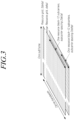
- FIG. 3 illustrates resource grids supported by a radio access technology in accordance with embodiments of the disclosure.
- resource grids may exist according to respective numerologies because NR supports a plurality of numerologies in the same carrier.
- the resource grids may exist depending on antenna ports, subcarrier spacing, and transmission directions.
- a resource block includes 12 subcarriers and is defined only in the frequency domain.
- a resource element includes one OFDM symbol and one subcarrier. Therefore, as shown in FIG. 3 , the size of one resource block may be varied according to the subcarrier spacing.
- Point A that acts as a common reference point for the resource block grids, a common resource block, and a virtual resource block are defined in NR.
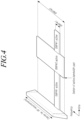
- FIG. 4 illustrates bandwidth parts supported by a radio access technology in accordance with embodiments of the disclosure.
- bandwidth parts may be specified within the carrier bandwidth in NR so that the UE may use the same.
- the bandwidth part may be associated with one numerology, may include a subset of consecutive common resource blocks, and may be activated dynamically over time.
- the UE has up to four bandwidth parts in each of the uplink and the downlink. The UE transmits and receives data using an activated bandwidth part during a given time.
- uplink and downlink bandwidth parts are configured independently.
- the downlink bandwidth part and the uplink bandwidth part are configured in pairs to share a center frequency.
- a UE performs a cell search and a random access procedure in order to access and communicates with a base station.
- the cell search is a procedure of the UE for synchronizing with a cell of a corresponding base station using a synchronization signal block (SSB) transmitted from the base station and acquiring a physical-layer cell ID and system information.
- SSB synchronization signal block
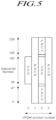
- FIG. 5 illustrates an example of a synchronization signal block in a radio access technology in accordance with embodiments of the disclosure.
- the SSB includes a primary synchronization signal (PSS) and a secondary synchronization signal (SSS), which occupy one symbol and 127 subcarriers, and PBCHs spanning three OFDM symbols and 240 subcarriers.
- PSS primary synchronization signal
- SSS secondary synchronization signal
- the UE monitors the SSB in the time and frequency domain, thereby receiving the SSB.
- the SSB may be transmitted up to 64 times for 5 ms.
- a plurality of SSBs are transmitted by different transmission beams within a time of 5 ms, and the UE performs detection on the assumption that the SSB is transmitted every 20 ms based on a specific beam used for transmission.
- the number of beams that may be used for SSB transmission within 5 ms may be increased as the frequency band is increased.
- up to 4 SSB beams may be transmitted at a frequency band of 3 GHz or less, and up to 8 SSB beams may be transmitted at a frequency band of 3 to 6 GHz.
- the SSBs may be transmitted using up to 64 different beams at a frequency band of 6 GHz or more.
- One slot includes two SSBs, and a start symbol and the number of repetitions in the slot are determined according to subcarrier spacing as follows.
- the SSB is not transmitted at the center frequency of a carrier bandwidth. That is, the SSB may also be transmitted at the frequency other than the center of the system band, and a plurality of SSBs may be transmitted in the frequency domain in the case of supporting a broadband operation. Accordingly, the UE monitors the SSB using a synchronization raster, which is a candidate frequency position for monitoring the SSB.
- a carrier raster and a synchronization raster which are the center frequency position information of the channel for the initial connection, were newly defined in NR, and the synchronization raster may support a fast SSB search of the UE because the frequency spacing thereof is configured to be wider than that of the carrier raster.
- the UE may acquire an MIB over the PBCH of the SSB.
- the MIB master information block
- the MIB includes minimum information for the UE to receive remaining minimum system information (RMSI) broadcast by the network.
- the PBCH may include information on the position of the first DM-RS symbol in the time domain, information for the UE to monitor SIB1 (e.g., SIB1 numerology information, information related to SIB1 CORESET, search space information, PDCCH-related parameter information, etc.), offset information between the common resource block and the SSB (the position of an absolute SSB in the carrier is transmitted via SIB 1), and the like.
- SIB1 e.g., SIB1 numerology information, information related to SIB1 CORESET, search space information, PDCCH-related parameter information, etc.
- offset information between the common resource block and the SSB the position of an absolute SSB in the carrier is transmitted via SIB 1
- the SIB 1 numerology information is also applied to some messages used in the random access procedure for the UE to access the base station after completing the cell search procedure.
- the numerology information of SIB1 may be applied to at least one of the messages 1 to 4 for the random access procedure.
- the above-mentioned RMSI may mean SIB 1 (system information block 1), and SIB 1 is broadcast periodically (e.g., 160 ms) in the cell.
- SIB 1 includes information necessary for the UE to perform the initial random access procedure, and SIB 1 is periodically transmitted over a PDSCH.
- the UE In order to receive SIB 1, the UE must receive numerology information used for the SIB 1 transmission and the CORESET (control resource set) information used for scheduling of SIB 1 over a PBCH.
- the UE identifies scheduling information for SIB 1 using SI-RNTI in the CORESET.
- the UE acquires SIB1 on the PDSCH according to scheduling information.
- the remaining SIBs other than SIB1 may be periodically transmitted, or the remaining SIBs may be transmitted according to the request of the UE.
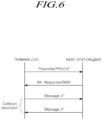
- FIG. 6 is a view for explaining a random access procedure in a radio access technology.
- the UE transmits a random access preamble for random access to the base station.
- the random access preamble is transmitted over a PRACH.
- the random access preamble is periodically transmitted to the base station over the PRACH that includes consecutive radio resources in a specific slot repeated.
- a contention-based random access procedure is performed when the UE makes initial access to a cell
- a non-contention-based random access procedure is performed when the UE performs random access for beam failure recovery (BFR).
- BFR beam failure recovery
- the UE receives a random access response to the transmitted random access preamble.
- the random access response may include a random access preamble identifier (ID), UL Grant (uplink radio resource), a temporary C-RNTI (temporary cell-radio network temporary identifier), and a TAC (time alignment command). Since one random access response may include random access response information for one or more UEs, the random access preamble identifier may be included in order to indicate the UE for which the included UL Grant, temporary C-RNTI, and TAC are valid.
- the random access preamble identifier may be an identifier of the random access preamble received by the base station.
- the TAC may be included as information for the UE to adjust uplink synchronization.
- the random access response may be indicated by a random access identifier on the PDCCH, i.e., a random access-radio network temporary identifier (RA-RNTI).
- RA-RNTI random access-radio network temporary identifier
- the UE Upon receiving a valid random access response, the UE processes information included in the random access response and performs scheduled transmission to the base station. For example, the UE applies the TAC and stores the temporary C-RNTI. In addition, the UE transmits, to the base station, data stored in the buffer of the UE or newly generated data using the UL Grant. In this case, information for identifying the UE must be included in the data.
- the UE receives a downlink message to resolve the contention.
- the downlink control channel in NR is transmitted in a CORESET (control resource set) having a length of 1 to 3 symbols, and the downlink control channel transmits uplink/downlink scheduling information, an SFI (slot format index), TPC (transmit power control) information, and the like.
- CORESET control resource set
- SFI slot format index
- TPC transmit power control
- the CORESET (control resource set) refers to a time-frequency resource for a downlink control signal.
- the UE may decode a control channel candidate using one or more search spaces in the CORESET time-frequency resource.
- CORESET-specific QCL (quasi-colocation) assumption is configured and is used for the purpose of providing information on the characteristics of analogue beam directions, as well as delay spread, Doppler spread, Doppler shift, and an average delay, which are the characteristics assumed by existing QCL.
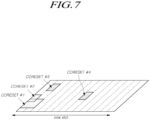
- FIG. 7 illustrates CORESET
- CORESETs may exist in various forms within a carrier bandwidth in a single slot, and the CORESET may include a maximum of 3 OFDM symbols in the time domain.
- the CORESET is defined as a multiple of six resource blocks up to the carrier bandwidth in the frequency domain.
- a first CORESET as a portion of the initial bandwidth part, is designated (e.g., instructed, assigned) through an MIB in order to receive additional configuration information and system information from a network.
- the UE may receive and configure one or more pieces of CORESET information through RRC signaling.
- the typical LTE system supports scalable bandwidth operations for any LTE CC (component carrier). That is, according to a frequency deployment scenario, an LTE provider may configure a bandwidth of a minimum of 1.4 MHz to a maximum of 20 MHz in configuring a single LTE CC, and a normal LTE UE supports a transmission/reception capability of a bandwidth of 20 MHz for a single LTE CC.
- LTE CC component carrier
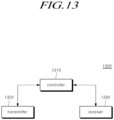
- the NR is designed to support the UE of NR having different transmission/reception bandwidth capabilities over a single wideband NR CC. Accordingly, it is required to configure one or more bandwidth parts (BWPs) including subdivided bandwidths for an NR CC as shown FIG. 13 , thereby supporting a flexible and wider bandwidth operation through configuration and activation of different bandwidth parts for respective UEs.
- BWPs bandwidth parts
- one or more bandwidth parts may be configured through a single serving cell configured for a UE in NR, and the UE is defined to activate one downlink (DL) bandwidth part and one uplink (UL) bandwidth part to use the same for uplink/downlink data transmission/reception in the corresponding serving cell.
- the UE is also defined to activate one downlink bandwidth part and/or one uplink bandwidth part in each serving cell to use the same for uplink/downlink data transmission/reception by utilizing radio resources of the corresponding serving cell.
- an initial bandwidth part for an initial access procedure of a UE may be defined in a serving cell; one or more UE-specific bandwidth parts may be configured for each UE through dedicated RRC signaling, and a default bandwidth part for a fallback operation may be defined for each UE.
- NR rel-15 defined activating and using only one downlink (DL) bandwidth part and one uplink (UL) bandwidth part at a time.
- a frequency, a frame, a subframe, a resource, a resource block, a region, a band, a subband, a control channel, a data channel, a synchronization signal, various reference signals, various signals, or various messages in relation to NR may be interpreted as meanings used at present or in the past or as various meanings to be used in the future.
- FIG. 8 is a flowchart illustrating a method of a UE for transmitting an uplink data channel in full-duplex communication according to an embodiment.
- the UE may receive at least one power control parameter set used to determine transmission power of an uplink data channel from the base station (S810).
- the UE may receive time division duplex (TDD) configuration information.
- TDD time division duplex
- the TDD divides and uses time-domain radio resources into a downlink slot and an uplink slot.
- the UE may receive the TDD configuration information from the base station to determine the format of the symbol in the slot.
- the TDD configuration information may include configuration information about the format of the slot and configuration information for determining the format of the symbol in the slot.
- the corresponding information may be received through higher layer signaling or physical layer L1 signaling.
- a downlink symbol, an uplink symbol, and a flexible symbol in which the transmission direction is not determined may be configured through an RRC message for configuring a corresponding UL-DL slot.
- the UE may receive UE-specific RRC signaling in which flexible symbols among symbols configured through cell-specific RRC signaling are reallocated to uplink symbols, downlink symbols, or flexible symbols for each UE.
- the UE may receive an indication of a dynamic slot format through a UE-group common PDCCH.
- the UE may dynamically receive the slot format through DCI format 2_0.
- the TDD configuration information may include information about a reference subcarrier spacing (SCS), pattern 1, and pattern 2 that may be applied to the serving cell.
- the TDD configuration information may provide only pattern 1 or may provide pattern 1 and pattern 2.
- the TDD configuration information may include slot configuration period information about each pattern. The UE may set the slot format per slot for a first number of slots as indicated by pattern 1. When pattern 2 is provided, the UE may set the slot format per slot for a second number of slots as indicated by pattern 2.
- the UE may receive subband full duplex (SBFD) subband configuration information.
- SBFD subband full duplex
- Full-duplex communication is a technique in which the base station simultaneously performs downlink transmission and uplink reception in the same radio resource.
- the UE may simultaneously perform downlink reception and uplink transmission.
- a specific frequency resource in the same symbol in the TDD carrier may be used for downlink transmission, and another frequency resource may be used for uplink reception.
- some frequency resources may be utilized for uplink transmission of the UE in any downlink slot or downlink symbol, or some frequency resources may be utilized like a flexible symbol for downlink/uplink transition.
- the UE may receive SBFD subband configuration information for full-duplex communication.
- the UE may receive configuration information for configuring a downlink subband in an uplink slot or for configuring an uplink subband in a downlink slot.
- the SBFD subband configuration information may include time-domain information and frequency-domain information where an uplink subband or a downlink subband is configured.
- the subband configuration information may include information about frequency-domain information and time-domain information where a guard band is configured.
- the frequency resource information may include contiguous resource block allocation information
- the time resource information may include contiguous SBFD symbol allocation information.
- the time resource information for the uplink subband may be configured based on reference SCS information and pattern configuration information.
- the time resource information may be configured based on reference subcarrier spacing (SCS) included in the TDD configuration information.
- SCS reference subcarrier spacing
- the reference subcarrier spacing configuration included in the TDD configuration information may be used as a reference SCS for configuring a time resource for configuring an uplink subband.
- the time resource information may be configured based on the number of TDD patterns included in the TDD configuration information and the period of the pattern.
- the configuration for pattern 1 and pattern 2 included in the TDD configuration information may be used as pattern configuration information for configuring a time resource for configuring an uplink subband.
- the SBFD symbol allocation information may be configured as contiguous SBFD symbols within a period of TDD patterns set as one or two.
- Each pattern configuration information may include periodic configuration information, offset information, and duration information about the corresponding pattern.
- the duration information may be set as the number of contiguous SBFD symbols from the offset, or the duration information may be set as a combination of the number of contiguous SBFD slots and the number of contiguous SBFD symbols.
- the corresponding offset may be set as an end point rather than a start point. In other words, offset information corresponding to the corresponding end point and duration information from the corresponding end point may be configured.
- the frequency resource configuration information for the uplink subband may be configured in units of a common resource block (CRB).
- the frequency resource configuration for the uplink subband may be accompanied by a guard band configuration or a downlink subband configuration in the same symbol/slot.
- the frequency resource configuration information for the uplink subband may include at least one of the frequency resource configuration information about the downlink subband or the guard band accompanied in the SBFD slot or SBFD symbol where the uplink subband is configured.
- the time resource configuration information for the guard band or the downlink subband may be configured to follow the time resource configuration information about the uplink subband.
- the frequency resource information for the uplink subband may include configuration information for one uplink subband and one or two guard bands based on the CRB.
- two guard bands may be configured above and below the corresponding uplink subband.
- one guard band may be configured under the corresponding uplink subband.
- one guard band may be configured above the corresponding uplink subband.
- configuration information for one or two guard bands may be included in the frequency resource information.
- the downlink subband may be configured with the guard band interposed therebetween, and the downlink subband may be inferred by frequency resource information about the uplink subband and the guard band.
- the frequency resource information for the uplink subband may include configuration information for one uplink subband and one or two downlink subbands based on the CRB.
- two downlink subbands may be configured at an upper portion and a lower portion of the corresponding uplink subband.
- one downlink subband may be configured under the corresponding uplink subband.
- one downlink subband may be configured above the corresponding uplink subband.
- configuration information for one or two downlink subbands may be included in the frequency resource information.
- the guard band may be configured between the uplink subband and the downlink subband, and the guard band may be inferred by frequency resource information for the uplink subband and downlink subband.
- SBFD subband configuration information may be received through cell-specific higher layer signaling.
- the UE may receive SBFD subband configuration information from the base station through cell-specific RRC signaling.
- the UE may receive TDD configuration information and SBFD subband configuration information and configure the format for each slot.
- the UE may determine transmission power to transmit the uplink data channel according to the scheduling information. To that end, the UE may use at least one power control parameter set received from the base station.
- the transmission power of the uplink data channel may be determined by Equation 1 below.
- the power control parameter set may include a parameter or a parameter set for each of the parameters constituting Equation 1.
- P PUSCH , b , ⁇ , c i j q d l min P CMAX , ⁇ , c i , P O_PUSCH , b , ⁇ , c j + 10 log 10 2 ⁇ ⁇ M RB , b , ⁇ , c PUSCH i + ⁇ b , ⁇ , c j ⁇ PL b , ⁇ , c q d + ⁇ TF , b , ⁇ , c i + ⁇ b , ⁇ , c i l [dBm]
- P CMAX,f,c ( i ) is a maximum transmission power value parameter allowed in the corresponding frequency carrier.
- P O_PUSCH,b,f,c ( j ) is the target reception power parameter in the base station, ⁇ b,f,c ( j ).
- PL b,f,c ( q d ) is a parameter for fractional path-loss compensation, and the two parameters are open-loop power control-related parameters.
- the maximum transmission power value parameter and open-loop power control-related parameter may be received through higher layer signaling, such as RRC signaling. Alternatively, the parameters may be calculated based on other parameters received through higher layer signaling.
- f b,f,c ( i,l ) is a parameter related to closed-loop power control that is adjusted according to the transmit power control (TPC) command value indicated from the base station through downlink control information (DCI).
- TPC transmit power control
- DCI downlink control information
- M RB , b , f , c PUSCH i and ⁇ TF , b , f , c i 10 log 10 2 BPRE ⁇ K s ⁇ 1 ⁇ ⁇ offset PUSCH , respectively, are parameters determined by the bandwidth and MCS according to resource allocation information for the uplink data channel.
- the above-described parameters may be distinctly configured depending on whether the type of symbol through which the uplink data channel is transmitted is an SBFD symbol or a non-SBFD symbol. Therefore, the power control parameter set may include parameters or parameter sets for when the symbol is the SBFD symbol and when the symbol is the non-SBFD symbol.
- the UE may determine the transmission power of the uplink data channel based on at least one power control parameter set (S820) and transmit the uplink data channel according to the determined transmission power (S830).
- the transmission power of the uplink data channel may be determined separately for when the symbol where the uplink data channel is transmitted is the SBFD symbol and when the symbol is the non-SBFD symbol.
- the UE may determine the transmission power for transmitting the uplink data channel to differ depending on the type of the symbol allocated to transmission of the uplink data channel. To that end, the UE may determine the transmission power by selecting the parameter according to the type of the symbol where the uplink data channel is to be transmitted of the parameter for when the symbol is the SBFD symbol included in the power control parameter set and the parameter for when the symbol is the non-SBFD symbol.
- the transmission power of the uplink data channel may be determined based on the maximum PUSCH transmission power parameter configured separately for when it is the SBFD symbol and when it is the non-SBFD symbol.
- the maximum PUSCH transmission power parameter each may be configured for the type of the symbol where the uplink data channel is transmitted and be included in one power control parameter set.
- the UE may determine the transmission power by applying the maximum transmission power value parameter corresponding to the non-SBFD symbol.
- the UE may determine the transmission power by applying the maximum transmission power value parameter corresponding to the SBFD symbol.
- the transmission power of the uplink data channel may be determined based on at least one open-loop power control parameter configured separately for when it is the SBFD symbol and when it is the non-SBFD symbol.
- the open-loop power control parameter each may be configured for the type of the symbol where the uplink data channel is transmitted and be included in one power control parameter set.
- the open-loop power control parameter may include the target reception power parameter in the base station. Further, the open-loop power control parameter may include a parameter for fractional pathloss compensation in which the downlink pathloss obtained by measuring a specific downlink reference signal is corrected with a value of a predetermined ratio.
- the UE may determine the transmission power by applying the open-loop power control parameter corresponding to the non-SBFD symbol.
- the UE may determine the transmission power by applying at least one open-loop power control parameter corresponding to the SBFD symbol. In other words, at least one of a value of a predetermined ratio and the target reception power parameter configured for the SBFD symbol may be applied.
- the transmission power of the uplink data channel may be determined based on the pathloss measurement value for the reference signal configured separately for when it is the SBFD symbol and when it is the non-SBFD symbol.
- the reference signal that is the target for measuring pathloss may be configured to differ depending on the type of symbol.
- the reference signal may be received through the same type of symbol as the symbol through which the uplink data channel is transmitted.
- the UE may measure pathloss only for the CSI-RS received through the non-SBFD symbol. If the symbol through which the uplink data channel is transmitted is the SBFD symbol, the UE may measure pathloss only for the received CSI-RS through the SBFD symbol.
- the transmission power of the uplink data channel may be determined based on the closed-loop power control command indicated separately for when it is the SBFD symbol and when it is the non-SBFD symbol.
- at least one closed-loop power control command each may be configured for the type of the symbol where the uplink data channel is transmitted and be included in one power control parameter set.
- the closed-loop power control command may be indicated through a transmit power control (TPC) command each separately configured for when it is the SBFD symbol and when it is the non-SBFD symbol or through a TPC command including symbol type indication information.
- TPC transmit power control
- the parameter determined by the TPC command may be used to determine the closed-loop power control-related parameter of Equation 1.
- the transmission power of the uplink data channel may be determined based on a power offset value configured for when it is the SBFD symbol.
- the power offset value may be configured when the type of the symbol where the uplink data channel is transmitted is the SBFD symbol and be included in one power control parameter set.
- the UE may determine the transmission power without applying a separate power offset value.
- the UE may determine the transmission power by applying the power offset value corresponding to the SBFD symbol.
- the UE may add or subtract the power offset value to/from Equation 1.
- the UE may multiply the power offset value by Equation 1.
- the UE may apply the power offset value to at least one of the parameters constituting Equation 1.
- the power offset value may be configured individually for each of the parameters constituting Equation 1.
- the transmission power of an uplink data channel is effectively adjusted in a slot or symbol to which full-duplex communication is applied.
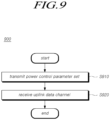
- FIG. 9 is a flowchart illustrating a method of a base station for receiving an uplink data channel in full-duplex communication according to an embodiment.
- the description made in connection with FIG. 8 may be omitted to avoid redundant description. In that case, the omitted content may be applied in substantially the same manner to the base station as long as it does not contradict the technical spirit of the disclosure.
- the base station may receive at least one power control parameter set used to determine transmission power of an uplink data channel to the UE (S910).
- the base station may transmit time division duplex (TDD) configuration information.
- TDD time division duplex
- the TDD divides and uses time-domain radio resources into a downlink slot and an uplink slot, and the base station may transmit the TDD configuration information to the UE to determine the format of the symbol in the slot.
- the TDD configuration information may include configuration information about the format of the slot and configuration information for determining the format of the symbol in the slot, and the corresponding information may be received through higher layer signaling or physical layer L1 signaling.
- a downlink symbol, an uplink symbol, and a flexible symbol in which the transmission direction is not determined of a predetermined period may be configured through an RRC message for configuring a corresponding UL-DL slot.
- the base station may transmit UE-specific RRC signaling in which flexible symbols among symbols configured through cell-specific RRC signaling are reallocated to uplink symbols, downlink symbols, or flexible symbols for each UE.
- the base station may indicate a dynamic slot format through a UE-group common PDCCH.
- the base station may dynamically indicate the slot format through DCI format 2_0.
- the TDD configuration information may include information about a reference subcarrier spacing (SCS), pattern 1, and pattern 2 that may be applied to the serving cell.
- the TDD configuration information may provide only pattern 1 or may provide pattern 1 and pattern 2.
- the TDD configuration information may include slot configuration period information about each pattern. The UE may set the slot format per slot for a first number of slots as indicated by pattern 1. When pattern 2 is provided, the UE may set the slot format per slot for a second number of slots as indicated by pattern 2.
- the base station may transmit subband full duplex (SBFD) subband configuration information.
- SBFD subband full duplex
- Full-duplex communication is a technique in which the base station simultaneously performs downlink transmission and uplink reception in the same radio resource.
- the UE side may simultaneously perform downlink reception and uplink transmission.
- a specific frequency resource in the same symbol in the TDD carrier may be used for downlink transmission, and another frequency resource may be used for uplink reception.
- some frequency resources may be utilized for uplink transmission of the UE in any downlink slot or downlink symbol, or some frequency resources may be utilized like a flexible symbol for downlink/uplink transition.
- the base station may transmit SBFD subband configuration information for full-duplex communication.
- the base station may transmit configuration information for configuring a downlink subband in an uplink slot or an uplink subband in a downlink slot.
- the SBFD subband configuration information may include time-domain information and frequency-domain information where an uplink subband or a downlink subband is configured.
- the subband configuration information may include information about frequency-domain information and time-domain information where a guard band is configured.
- the frequency resource information may include contiguous resource block allocation information
- the time resource information may include contiguous SBFD symbol allocation information.
- the time resource information for the uplink subband may be configured based on reference SCS information and pattern configuration information.
- the time resource information may be configured based on reference subcarrier spacing (SCS) included in the TDD configuration information.
- SCS reference subcarrier spacing
- the reference subcarrier spacing configuration included in the TDD configuration information may be used as a reference SCS for configuring a time resource for configuring an uplink subband.
- the time resource information may be configured based on the number of TDD patterns included in the TDD configuration information and the period of the pattern.
- the configuration for pattern 1 and pattern 2 included in the TDD configuration information may be used as pattern configuration information for configuring a time resource for configuring an uplink subband.
- the SBFD symbol allocation information may be configured as contiguous SBFD symbols within a period of TDD patterns set as one or two.
- Each pattern configuration information may include periodic configuration information, offset information, and duration information about the corresponding pattern.
- the duration information may be set as the number of contiguous SBFD symbols from the offset, or the duration information may be set as a combination of the number of contiguous SBFD slots and the number of contiguous SBFD symbols.
- the corresponding offset may be set as an end point rather than a start point. In other words, offset information corresponding to the corresponding end point and duration information from the corresponding end point may be configured.
- the frequency resource configuration information for the uplink subband may be configured in units of a common resource block (CRB).
- the frequency resource configuration for the uplink subband may be accompanied by a guard band configuration or a downlink subband configuration in the same symbol/slot.
- the frequency resource configuration information for the uplink subband may include at least one of the frequency resource configuration information about the downlink subband or the guard band accompanied in the SBFD slot or SBFD symbol where the uplink subband is configured.
- the time resource configuration information for the guard band or the downlink subband may be configured to follow the time resource configuration information about the uplink subband.
- the frequency resource information for the uplink subband may include configuration information for one uplink subband and one or two guard bands based on the CRB.
- two guard bands may be configured above and below the corresponding uplink subband.
- one guard band may be configured under the corresponding uplink subband.
- one guard band may be configured above the corresponding uplink subband.
- configuration information for one or two guard bands may be included in the frequency resource information.
- the downlink subband may be configured with the guard band interposed therebetween, and the downlink subband may be inferred by frequency resource information about the uplink subband and the guard band.
- the frequency resource information for the uplink subband may include configuration information for one uplink subband and one or two downlink subbands based on the CRB.
- two downlink subbands may be configured at an upper portion and a lower portion of the corresponding uplink subband.
- one downlink subband may be configured under the corresponding uplink subband.
- one downlink subband may be configured above the corresponding uplink subband.
- configuration information for one or two downlink subbands may be included in the frequency resource information.
- the guard band may be configured between the uplink subband and the downlink subband, and the guard band may be inferred by frequency resource information for the uplink subband and downlink subband.
- SBFD subband configuration information may be received through cell-specific higher layer signaling.
- the base station may transmit SBFD subband configuration information through cell-specific RRC signaling.
- the UE may receive TDD configuration information and SBFD subband configuration information and configure the format for each slot.
- the UE may determine transmission power to transmit the uplink data channel according to the scheduling information. To that end, the base station may transmit at least one power control parameter set to be used for the UE to determine transmission power.
- the transmission power of the uplink data channel may be determined by Equation 1 described above.
- the power control parameter set may include a parameter or a parameter set for each of the parameters constituting Equation 1. The description related to Equation 1 has been made above in connection with FIG. 8 . Accordingly, the description is not repeated below.
- the power control parameter set may include parameters or parameter sets for when the symbol is the SBFD symbol and when the symbol is the non-SBFD symbol.
- the base station may receive the uplink data channel according to the transmission power of the uplink data channel determined based on at least one power control parameter set (S920).
- the transmission power of the uplink data channel may be determined separately for when the symbol where the uplink data channel is transmitted is the SBFD symbol and when the symbol is the non-SBFD symbol.
- the UE may determine the transmission power for transmitting the uplink data channel to differ depending on the type of the symbol allocated to the transmission of the uplink data channel. To that end, the UE may determine the transmission power by selecting the parameter according to the type of the symbol where the uplink data channel is to be transmitted, between the parameter for when the symbol is the SBFD symbol included in the power control parameter set and the parameter for when the symbol is the non-SBFD symbol.
- the transmission power of the uplink data channel may be determined based on the maximum PUSCH transmission power parameter configured separately for when it is the SBFD symbol and when it is the non-SBFD symbol.
- the base station may configure the maximum PUSCH transmission power parameter each for the type of the symbol where the uplink data channel is transmitted and include and transmit the same in one power control parameter set.
- the UE may determine the transmission power by applying the maximum transmission power value parameter corresponding to the non-SBFD symbol.
- the UE may determine the transmission power by applying the maximum transmission power value parameter corresponding to the SBFD symbol.
- the transmission power of the uplink data channel may be determined based on at least one open-loop power control parameter configured separately for when it is the SBFD symbol and when it is the non-SBFD symbol.
- the base station may configure at least one open-loop power control parameter each for the type of the symbol where the uplink data channel is transmitted and include and transmit the same in one power control parameter set.
- the open-loop power control parameter may include the target reception power parameter in the base station. Further, the open-loop power control parameter may include a parameter for fractional pathloss compensation, in which the downlink pathloss obtained by measuring a specific downlink reference signal is corrected with a value of a predetermined ratio.
- the UE may determine the transmission power by applying the open-loop power control parameter corresponding to the non-SBFD symbol.
- the UE may determine the transmission power by applying at least one open-loop power control parameter corresponding to the SBFD symbol. In other words, at least one of a value of a predetermined ratio and the target reception power parameter configured for the SBFD symbol may be applied.
- the transmission power of the uplink data channel may be determined based on the pathloss measurement value for the reference signal configured separately for when it is the SBFD symbol and when it is the non-SBFD symbol.
- the reference signal that is the target for measuring pathloss may be configured to differ depending on the type of symbol.
- the reference signal may be transmitted through the same type of symbol as the symbol through which the uplink data channel is received.
- the UE may measure pathloss only for the CSI-RS received through the non-SBFD symbol. If the symbol through which the uplink data channel is transmitted is the SBFD symbol, the UE may measure pathloss only for the received CSI-RS through the SBFD symbol.
- the transmission power of the uplink data channel may be determined based on the closed-loop power control command indicated separately for when it is the SBFD symbol and when it is the non-SBFD symbol.
- the base station may configure at least one closed-loop power control command each for the type of the symbol where the uplink data channel is transmitted and include and transmit the same in one power control parameter set.
- the closed-loop power control command may be indicated through a transmit power control (TPC) command each separately configured for when it is the SBFD symbol and when it is the non-SBFD symbol or through a TPC command including symbol type indication information.
- TPC transmit power control
- the parameter determined by the TPC command may be used to determine the closed-loop power control-related parameter of Equation 1.
- the transmission power of the uplink data channel may be determined based on a power offset value configured for when it is the SBFD symbol.
- the base station may configure the power offset value when the type of the symbol where the uplink data channel is transmitted is the SBFD symbol and include and transmit the same in one power control parameter set.
- the UE may determine the transmission power without applying a separate power offset value.
- the UE may determine the transmission power by applying the power offset value corresponding to the SBFD symbol.
- the UE may add or subtract the power offset value to/from Equation 1.
- the UE may multiply the power offset value by Equation 1.
- the UE may apply the power offset value to at least one of the parameters constituting Equation 1.
- the power offset value may be configured individually for each of the parameters constituting Equation 1.
- the transmission power of an uplink data channel may be efficiently adjusted in a slot or symbol to which full-duplex communication is applied.
- PUSCH physical uplink shared channel
- the disclosure introduces an uplink transmission power control method for supporting full-duplex communication in a wireless mobile communication system.
- the disclosure introduces a method for controlling an uplink data channel, i.e., PUSCH transmission power.
- Time division duplex is a duplexing method widely used in commercial new radio (NR), i.e., 5G mobile communication systems.
- NR commercial new radio
- time-domain radio resources are divided into downlink slots and uplink slots, and downlink slots are usually distributed at a higher ratio than uplink slots according to the distribution ratio of uplink traffic and downlink traffic.
- this limitation of the uplink slot negatively affects coverage and latency.
- Full-duplex communication may be applied as a technology to address such issues.
- full-duplex communication is a technique in which aa base station (e.g., gNB) simultaneously performs DL transmission and UL reception in the same radio resource.
- the UE side may simultaneously perform DL reception and UL transmission as well.
- both the base station and the UE may support full duplex.
- DL reception performance is prone to be affected by self-interference of UL transmission signals. Therefore, it is generally considered that the base station operates in full-duplex communication and the UE operates in half-duplex communication.
- a subband non-overlapping full duplex (which may also be referred to as SBFD or subband full duplex in the disclosure) method to reduce the influence of self-interference, where the base station simultaneously performs DL transmission and UL reception but performs transmission and reception with frequency resources discerned, rather than using the same resource, may be primarily considered.
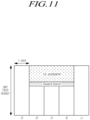
- FIGS. 10 and 11 illustrate an example in which DL slots and UL slots are configured in a ratio of 4:1 in any NR frequency band.
- some symbols of the last DL slot may be a special slot including a flexible symbol for DL/UL transition.
- TDD time division duplex
- an uplink subband for supporting UL transmission of the UE may be configured in some (or all) of the corresponding DL slots.
- the UL subband may be configured in the center of the corresponding frequency band as shown in FIG. 10 , or the UL subband may be configured at the edge of the corresponding frequency band as shown in FIG. 11 .
- a guard band may be configured between the UL subband and the downlink subband (DL subband) in the corresponding slot.
- the disclosure introduces a method for configuring a BWP when any base station/network supports subband non-overlapping full duplex and accordingly transmitting/receiving radio channels (e.g., PDCCH/PDSCH and PUSCH/PUCCH) and uplink/downlink radio signals (DM-RS, CSI-RS, SRS, and PSS/SSS) of the base station and the UE.
- radio channels e.g., PDCCH/PDSCH and PUSCH/PUCCH
- DM-RS, CSI-RS, SRS, and PSS/SSS uplink/downlink radio signals
- the embodiments of the disclosure may be substantially identically applied to other various full-duplex application scenarios.
- the full duplex application scenario may include a full duplex operation in an unpaired spectrum and a full duplex operation in a downlink (DL) frequency band or an uplink (UL) frequency band of a paired spectrum.
- the embodiments of the disclosure may be substantially identically applied to a scenario in which subband non-overlapping full duplex or pure full duplex (i.e., DL transmission and UL reception simultaneously in the same frequency resource) is supported only on the base station side, and a half duplex operation is performed in the UE. Further, the embodiments of the disclosure may be substantially identically applied even when not only the base station but also the UE supports subband non-overlapping full duplex or pure full duplex.
- the uplink-downlink (UL-DL) slot configuration defined in NR is defined to be performed in units of cells through cell-specific RRC signaling.
- patterns of DL symbols, UL symbols, and flexible symbols of a predetermined period are configured through the RRC message 'tdd-UL-DL-ConfigurationCommon' for the corresponding UL-DL slot configuration.
- 'tdd-UL-DL-ConfigurationDedicated' which is UE-specific RRC signaling
- only flexible symbols configured through the 'tdd-UL-DL-ConfigurationCommon' may be reallocated as UL symbols, DL symbols, or flexible symbols for each UE.
- a method for indicating a dynamic slot format through a UE-group common PDCCH has also been defined.
- NR also supports a slot format indication method in a dynamic form through DCI format 2_0.
- any one symbol may be configured or indicated as one of DL, UL, or Flexible.
- FIG. 10 illustrates an example in which any slot format is set as DDDSU through the existing slot configuration.
- D is a downlink slot, which means that all OFDM symbols constituting the corresponding slot are set as DL.
- U is an uplink slot, which means that all OFDM symbols constituting the corresponding slot are set as UL.
- S is a special slot, which means a slot including a flexible symbol for DL/UL transition.
- the special slot may be composed of 12 DL symbols and 2 flexible symbols out of a total of 14 symbols for a normal CP. Alternatively, it may be composed of 10 DL symbols, 2 flexible symbols, and 2 UL symbols. In other words, within any one TDD carrier, one symbol was set or indicated as only one of DL, UL, or flexible.
- DL transmission or UL transmission may occur simultaneously for each frequency resource in the corresponding symbol.
- a DL slot or symbol including a UL subband or a UL slot or symbol including a DL subband will be referred to as an SBFD slot or an SBFD symbol in the disclosure.
- a slot composed of only SBFD symbols is referred to as an SBFD slot
- a slot composed of only symbols according to the existing symbol configuration i.e., a slot composed of only symbols not including a UL subband, a DL subband, and a guardband
- a slot including at least one SBFD symbol may be referred to as an SBFD slot.
- PUSCH transmission through the corresponding UL subband may be performed in the SBFD symbol or SBFD slot in which the UL subband is configured.
- PUSCH transmission may be indicated through the SBFD symbol or SBFD slot including the UL subband.
- the time domain resource assignment information about the PUSCH scheduling control information through dynamic grant-based PUSCH transmission i.e., DCI format 0_0, 0_1, 0_2, or the like, may include the SBFD symbol.
- PUSCH time resource allocation information about the corresponding configured grant may include an SBFD symbol.
- the uplink and downlink radio channel environment between the UE and the base station in the SBFD symbol may be different from the uplink and downlink radio channel environment between the UE and the base station in the existing non-SBFD symbol.
- downlink transmission and uplink reception may occur simultaneously in the base station in the SBFD symbol, it is necessary to divide and operate the transmission/reception antennas and the RF modules of the base station for transmission and reception.
- additional radio signal interference such as self-interference or cross-link interference may appear in the SBFD symbol.
- the uplink radio channel state from any one UE to the base station may also differ in the SBFD symbol and the non-SBFD symbol.
- the disclosure proposes defining a PUSCH transmission power adjustment equation through the existing non-SBFD symbol in any one UE and a PUSCH transmission power adjustment equation through a separate SBFD symbol.
- a separate PUSCH transmission power adjustment equation may be applied for PUSCH transmission power configuration between PUSCH transmission in the non-SBFD symbol and PUSCH transmission in the SBFD symbol.
- a PUSCH transmission power adjustment equation through the existing UL symbol and a PUSCH transmission power adjustment equation through a separate SBFD symbol are defined. Accordingly, when any PUSCH transmission is performed through the non-SBFD symbols, the UE determines PUSCH transmission power based on the existing PUSCH transmission power adjustment equation and, when any PUSCH transmission is additionally performed through SBFD symbols, determines the PUSCH transmission power based on a new PUSCH transmission power adjustment equation.
- the corresponding PUSCH transmission power is determined by Equation 2 below.
- P PUSCH , b , ⁇ , c i j q d l min P CMAX , ⁇ , c i , P O_PUSCH , b , ⁇ , c j + 10 log 10 2 ⁇ ⁇ M RB , b , ⁇ , c PUSCH i + ⁇ b , ⁇ , c j ⁇ PL b , ⁇ , c q d + ⁇ TF , b , ⁇ , c i + ⁇ b , ⁇ , c i l [dBm]
- P CMAX,f,c ( i ) in the first line is the maximum transmission power value allowed in the corresponding frequency carrier.
- the transmission power adjustment equation in the second line includes a parameter related to open-loop power control, a parameter related to closed-loop power control, and parameters related to the target data rate according to the PUSCH transmission bandwidth and modulation and coding scheme (MCS) information.
- MCS modulation and coding scheme
- P O_PUSCH,b,f,c ( j ) means the target reception power at the base station.
- PL b,f,c ( q d ) may be viewed as a parameter for fractional pathloss compensation and may be regarded as a value obtained by correcting the downlink pathloss component measured using a specific downlink reference signal, q d , as a reference with an alpha value, ⁇ b,f,c ( j ) of a predetermined ratio.
- the two parameters may be viewed as open loop power control-related parameters.
- f b,f,c ( i , l ) may be viewed as a closed loop power control parameter that is adjusted according to the transmit power control (TPC) command value indicated through a UE-specific or UE-group common DCI from the base station.
- TPC transmit power control
- P CMAX,f,c ( i ) which is the maximum transmission power value for PUSCH transmission in the SBFD symbol, may be separately defined and set.
- the above-described P CMAX,f,c ( i ) value for the non-SBFD symbol and a P CMAX,f,c,SBFD ( i ) value for a separate SBFD symbol may be defined and be set by the base station.
- the UE may apply the P CMAX,f,c ( i ) value for the existing non-SBFD symbol in the above-described PUSCH transmission power adjustment equation to determine the corresponding PUSCH transmission power and, if any PUSCH transmission is PUSCH transmission through a new SBFD symbol, may apply separate P CMAX,f,c,SBFD ( i ) for PUSCH transmission power adjustment through the SBFD symbol.
- a separate open-loop power control parameter or parameter set for PUSCH transmission through the SBFD symbol may be defined and separately set by the base station.
- a corresponding target reception power P O_PUSCHb,f,c ( j ) and/or ⁇ b,f,c ( j ) value may be separately defined for the SBFD symbol and set by the base station.
- any UE may define separate open-loop power control and/or path-loss compensation parameter or parameter set(s) for the SBFD symbol constituted of the existing P O_PUSCH,b,f,c ( j ) and/or ⁇ b,f,c ( j ) value and P O_PUSCH,b,f,c,SBFD ( j ) and/or ⁇ b,f,c,SBFD ( j ) values for the SBFD symbol.
- any UE may apply separate and/or ⁇ b,f,c,SBFD ( j ) when any PUSCH transmission is performed through the SBFD symbol.
- the downlink reference signal for pathloss measurement for the above-described pathloss compensation it may be defined to measure pathloss based on separate reference signals in the SBFD symbol and the non-SBFD symbol.
- a reference signal for applying the reference signal which is a reference for deriving the corresponding pathloss measurement value, PL b,f,c ( q d ), in the non-SBFD symbol and a reference signal for applying the same in the SBFD symbol.
- the corresponding pathloss value may be defined to be measured only on the CSI-RS transmitted through the non-SBFD symbol.
- the corresponding pathloss value may be defined to be measured only on the CSI-RS transmitted through the SBFD symbol.
- the closed-loop power control-related parameter or parameter set among the components constituting the equation corresponding to the second line in the above-described transmission power adjustment equation may be separately set.
- f b,f,c,SBFD ( i, l ) determined according to the TPC command value in the SBFD symbol may be defined and a separate table for the same, other than Table 2 below to determine f b,f,c ( i, l ) according to the TPC command value in the existing non-SBFD symbol in the base station, may be defined as shown in Table 3 below.
- X1, Y1, Z1, W1 and X2, Y2, Z2, W2 in Table 3 are arbitrary numbers and may be composed of numbers separate from the corresponding numbers in Table 2.
- a separate power offset for PUSCH transmission in the SBFD symbol may be defined, and this may be defined to be included in the PUSCH transmission power adjustment equation.
- ⁇ SBFD which is a power offset value for the PUSCH transmission power in the SBFD symbol compared to the PUSCH transmission power adjustment in the non-SBFD symbol
- the PUSCH transmission power adjustment equation in the SBFD symbol may be included in a form in which ⁇ SBFD , which is a power offset value, is added (or subtracted) as in Equation 3, or may be included in a form in which ⁇ SBFD , which is a power offset value, is multiplied by a predetermined ratio as in Equation 4.
- ⁇ SBFD may be added (or subtracted) or multiplied by a predetermined ratio only for a specific item of the two items that are input to the min function.
- ⁇ SBFD may be added (or subtracted) or multiplied by a predetermined ratio only for the transmission power adjustment equation corresponding to the second line of the above equation.
- each embodiment is included in the scope of the disclosure, not only in the case of being independent, but also in the case of all examples constituted of a combination of embodiments.
- FIG. 12 is a block diagram illustrating a UE according to an embodiment.
- a UE 1200 includes a transmitter 1220, a receiver 1230, and a controller 1210 controlling operations of the transmitter and the receiver.
- the controller 1210 may be configured to control the overall operation of the UE 1200 according to the method for transmitting/receiving an uplink data channel in full-duplex communication required to the disclosure described above.
- the controller 1210 may receive information related to the configuration of the SBFD symbol or slot from the base station and accordingly configure the format of the slot. Since the related description has been made above in connection with FIG. 8 , no further description is presented below.
- the controller 1210 may receive at least one power control parameter set used to determine transmission power of an uplink data channel from the base station. When receiving scheduling information for the uplink data channel from the base station, the controller 1210 may determine transmission power to transmit the uplink data channel according to the scheduling information. To that end, the controller 1210 may use at least one power control parameter set received from the base station.
- the transmission power of the uplink data channel may be determined by Equation 1 described above.
- the power control parameter set may include a parameter or a parameter set for each of the parameters constituting Equation 1. The description related to Equation 1 has been made above in connection with FIG. 8 , and will not be repeated below.
- the power control parameter set may include parameters or parameter sets for when the symbol is the SBFD symbol and when the symbol is the non-SBFD symbol.
- the controller 1210 may determine the transmission power of the uplink data channel based on at least one power control parameter set and transmit the uplink data channel according to the determined transmission power.
- the transmission power of the uplink data channel may be determined separately for when the symbol where the uplink data channel is transmitted is the SBFD symbol and when the symbol is the non-SBFD symbol.
- the controller 1210 may determine the transmission power for transmitting the uplink data channel to differ depending on the type of the symbol allocated to transmission of the uplink data channel. To that end, the controller 1210 may determine the transmission power by selecting the parameter according to the type of the symbol where the uplink data channel is to be transmitted of the parameter for when the symbol is the SBFD symbol included in the power control parameter set and the parameter for when the symbol is the non-SBFD symbol.
- the transmission power of the uplink data channel may be determined based on the maximum PUSCH transmission power parameter configured separately for when it is the SBFD symbol and when it is the non-SBFD symbol.
- the maximum PUSCH transmission power parameter each may be configured for the type of the symbol where the uplink data channel is transmitted and be included in one power control parameter set.
- the controller 1210 may determine the transmission power by applying the maximum transmission power value parameter corresponding to the non-SBFD symbol.
- the controller 1210 may determine the transmission power by applying the maximum transmission power value parameter corresponding to the SBFD symbol.
- the transmission power of the uplink data channel may be determined based on at least one open-loop power control parameter configured separately for when it is the SBFD symbol and when it is the non-SBFD symbol.
- the open-loop power control parameter each may be configured for the type of the symbol where the uplink data channel is transmitted and be included in one power control parameter set.
- the open-loop power control parameter may include the target reception power parameter in the base station. Further, the open-loop power control parameter may include a parameter for fractional pathloss compensation in which the downlink pathloss obtained by measuring a specific downlink reference signal is corrected with a value of a predetermined ratio.
- the controller 1210 may determine the transmission power by applying the open-loop power control parameter corresponding to the non-SBFD symbol.
- the controller 1210 may determine the transmission power by applying at least one open-loop power control parameter corresponding to the SBFD symbol. In other words, at least one of a value of a predetermined ratio and the target reception power parameter configured for the SBFD symbol may be applied.
- the transmission power of the uplink data channel may be determined based on the pathloss measurement value for the reference signal configured separately for when it is the SBFD symbol and when it is the non-SBFD symbol.
- the reference signal that is the target for measuring pathloss may be configured to differ depending on the type of symbol.
- the reference signal may be received through the same type of symbol as the symbol through which the uplink data channel is transmitted.
- the controller 1210 may measure pathloss only for the CSI-RS received through the non-SBFD symbol. If the symbol through which the uplink data channel is transmitted is the SBFD symbol, the controller 1210 may measure pathloss only for the received CSI-RS through the SBFD symbol.
- the transmission power of the uplink data channel may be determined based on the closed-loop power control command indicated separately for when it is the SBFD symbol and when it is the non-SBFD symbol.
- at least one closed-loop power control command each may be configured for the type of the symbol where the uplink data channel is transmitted and be included in one power control parameter set.
- the closed-loop power control command may be indicated through a transmit power control (TPC) command each separately configured for each of when it is the SBFD symbol and when it is the non-SBFD symbol or through a TPC command including symbol type indication information.
- TPC transmit power control
- the parameter determined by the TPC command may be used to determine the closed-loop power control-related parameter of Equation 1.
- the transmission power of the uplink data channel may be determined based on a power offset value configured for when it is the SBFD symbol.
- the power offset value may be configured when the type of the symbol where the uplink data channel is transmitted is the SBFD symbol and be included in one power control parameter set.
- the controller 1210 may determine the transmission power without applying a separate power offset value.
- the controller 1210 may determine the transmission power by applying the power offset value corresponding to the SBFD symbol.
- the controller 1210 may add or subtract the power offset value to/from Equation 1. Alternatively, when transmitting the uplink data channel in the SBFD symbol, the controller 1210 may multiply the power offset value by Equation 1. Alternatively, when transmitting the uplink data channel in the SBFD symbol, the controller 1210 may apply the power offset value to at least one of the parameters constituting Equation 1. In this case, the power offset value may be configured individually for each of the parameters constituting Equation 1.
- the embodiments have been described as discerning and applying each parameter constituting Equation 1 according to the type of the symbol. However, the embodiments are not limited thereto. The embodiments may be applied independently, or two or more embodiments may be combined and applied.
- the transmission power of an uplink data channel may be efficiently adjusted in a slot or symbol to which full-duplex communication is applied.
- FIG. 13 is a block diagram illustrating a base station according to an embodiment.
- a base station 1300 includes a transmitter 1320, a receiver 1330, and a controller 1310 controlling operations of the transmitter and the receiver.
- the controller 1310 controls the overall operation of the base station 1300 according to the method for transmitting/receiving an uplink data channel in full-duplex communication required to the disclosure described above.
- the transmitter 1320 transmits downlink control information and data or messages to the UE via a corresponding channel.
- the receiver 1330 receives uplink control information and data or messages from the UE via a corresponding channel.
- the controller 1310 may transmit information related to a configuration of a slot or SBFD symbol to the UE.
- the UE may configure the format of the slot using the corresponding information. Since the related description has been made above in connection with FIG. 9 , no further description will be presented below.
- the controller 1310 may receive at least one power control parameter set used to determine transmission power of an uplink data channel to the UE.
- the controller 1310 may transmit scheduling information for the uplink data channel to the UE, the UE may determine transmission power to transmit the uplink data channel according to the scheduling information. To that end, the controller 1310 may transmit at least one power control parameter set to be used for the UE to determine transmission power.
- the transmission power of the uplink data channel may be determined by Equation 1 described above.
- the power control parameter set may include a parameter or a parameter set for each of the parameters constituting Equation 1. The description related to Equation 1 has been made above in connection with FIG. 8 , and will not be repeated below.
- the power control parameter set may include parameters or parameter sets for when the symbol is the SBFD symbol and when the symbol is the non-SBFD symbol.
- the controller 1310 may receive the uplink data channel according to the transmission power of the uplink data channel determined based on at least one power control parameter set.
- the transmission power of the uplink data channel may be determined separately for when the symbol where the uplink data channel is transmitted is the SBFD symbol and when the symbol is the non-SBFD symbol.
- the UE may determine the transmission power for transmitting the uplink data channel to differ depending on the type of the symbol allocated to transmission of the uplink data channel. To that end, the UE may determine the transmission power by selecting the parameter according to the type of the symbol where the uplink data channel is to be transmitted of the parameter for when the symbol is the SBFD symbol included in the power control parameter set and the parameter for when the symbol is the non-SBFD symbol.
- the transmission power of the uplink data channel may be determined based on the maximum PUSCH transmission power parameter configured separately for when it is the SBFD symbol and when it is the non-SBFD symbol.
- the controller 1310 may configure the maximum PUSCH transmission power parameter each for the type of the symbol where the uplink data channel is transmitted and include and transmit the same in one power control parameter set.
- the UE may determine the transmission power by applying the maximum transmission power value parameter corresponding to the non-SBFD symbol.
- the UE may determine the transmission power by applying the maximum transmission power value parameter corresponding to the SBFD symbol.
- the transmission power of the uplink data channel may be determined based on at least one open-loop power control parameter configured separately for when it is the SBFD symbol and when it is the non-SBFD symbol.
- the controller 1310 may configure at least one open-loop power control parameter each for the type of the symbol where the uplink data channel is transmitted and include and transmit the same in one power control parameter set.
- the open-loop power control parameter may include the target reception power parameter in the base station. Further, the open-loop power control parameter may include a parameter for fractional pathloss compensation in which the downlink pathloss obtained by measuring a specific downlink reference signal is corrected with a value of a predetermined ratio.
- the UE may determine the transmission power by applying the open-loop power control parameter corresponding to the non-SBFD symbol.
- the UE may determine the transmission power by applying at least one open-loop power control parameter corresponding to the SBFD symbol. In other words, at least one of a value of a predetermined ratio and the target reception power parameter configured for the SBFD symbol may be applied.
- the transmission power of the uplink data channel may be determined based on the pathloss measurement value for the reference signal configured separately for when it is the SBFD symbol and when it is the non-SBFD symbol.
- the reference signal that is the target for measuring pathloss may be configured to differ depending on the type of symbol.
- the reference signal may be transmitted through the same type of symbol as the symbol through which the uplink data channel is received.
- the UE may measure pathloss only for the CSI-RS received through the non-SBFD symbol. If the symbol through which the uplink data channel is transmitted is the SBFD symbol, the UE may measure pathloss only for the received CSI-RS through the SBFD symbol.
- the transmission power of the uplink data channel may be determined based on the closed-loop power control command indicated separately for when it is the SBFD symbol and when it is the non-SBFD symbol.
- the controller 1310 may configure at least one closed-loop power control command each for the type of the symbol where the uplink data channel is transmitted and include and transmit the same in one power control parameter set.
- the closed-loop power control command may be indicated through a transmit power control (TPC) command each separately configured for when it is the SBFD symbol and when it is the non-SBFD symbol or through a TPC command including symbol type indication information.
- TPC transmit power control
- the parameter determined by the TPC command may be used to determine the closed-loop power control-related parameter of Equation 1.
- the transmission power of the uplink data channel may be determined based on a power offset value configured for when it is the SBFD symbol.
- the controller 1310 may configure the power offset value when the type of the symbol where the uplink data channel is transmitted is the SBFD symbol and include and transmit the same in one power control parameter set.
- the UE may determine the transmission power without applying a separate power offset value.
- the UE may determine the transmission power by applying the power offset value corresponding to the SBFD symbol.
- the UE may add or subtract the power offset value to/from Equation 1.
- the UE may multiply the power offset value by Equation 1.
- the UE may apply the power offset value to at least one of the parameters constituting Equation 1.
- the power offset value may be configured individually for each of the parameters constituting Equation 1.
- the transmission power of an uplink data channel may be efficiently adjusted in a slot or symbol to which full-duplex communication is applied.
- the embodiments described above may be supported by the standard documents disclosed in at least one of the radio access systems such as IEEE 802, 3GPP, and 3GPP2. That is, the steps, configurations, and parts, which have not been described in the present embodiments, may be supported by the above-mentioned standard documents for clarifying the technical concept of the disclosure. In addition, all terms disclosed herein may be described by the standard documents set forth above.
- the above-described embodiments may be implemented by any of various means.
- the present embodiments may be implemented as hardware, firmware, software, or a combination thereof.
- the method according to the present embodiments may be implemented as at least one of an application specific integrated circuit (ASIC), a digital signal processor (DSP), a digital signal processing device (DSPD), a programmable logic device (PLD), a field programmable gate array (FPGA), a processor, a controller, a microcontroller, or a microprocessor.
- ASIC application specific integrated circuit
- DSP digital signal processor
- DSPD digital signal processing device
- PLD programmable logic device
- FPGA field programmable gate array
- processor a controller, a microcontroller, or a microprocessor.
- the method according to the present embodiments may be implemented in the form of an apparatus, a procedure, or a function for performing the functions or operations described above.
- Software code may be stored in a memory unit, and may be driven by the processor.
- the memory unit may be provided inside or outside the processor, and may exchange data with the processor by any of various well-known means.
- system may generally mean computer-related entity hardware, a combination of hardware and software, software, or running software.
- the above-described components may be, but are not limited to, a process driven by a processor, a processor, a controller, a control processor, an entity, an execution thread, a program and/or a computer.
- both the application that is running in a controller or a processor and the controller or the processor may be components.
- One or more components may be provided in a process and/or an execution thread, and the components may be provided in a single device (e.g., a system, a computing device, etc.), or may be distributed over two or more devices.
Landscapes
- Engineering & Computer Science (AREA)
- Signal Processing (AREA)
- Computer Networks & Wireless Communication (AREA)
- Quality & Reliability (AREA)
- Mobile Radio Communication Systems (AREA)
Applications Claiming Priority (2)
| Application Number | Priority Date | Filing Date | Title |
|---|---|---|---|
| KR20230104654 | 2023-08-10 | ||
| KR1020240100352A KR20250023924A (ko) | 2023-08-10 | 2024-07-29 | 전이중통신에서 상향링크 데이터 채널을 송수신하는 방법 및 장치 |
Publications (1)
| Publication Number | Publication Date |
|---|---|
| EP4507401A1 true EP4507401A1 (de) | 2025-02-12 |
Family
ID=92295554
Family Applications (1)
| Application Number | Title | Priority Date | Filing Date |
|---|---|---|---|
| EP24193668.1A Pending EP4507401A1 (de) | 2023-08-10 | 2024-08-08 | Verfahren und vorrichtung zum senden/empfangen eines uplink-datenkanals in einer vollduplexkommunikation |
Country Status (3)
| Country | Link |
|---|---|
| US (1) | US20250056418A1 (de) |
| EP (1) | EP4507401A1 (de) |
| CN (1) | CN119485605A (de) |
Families Citing this family (2)
| Publication number | Priority date | Publication date | Assignee | Title |
|---|---|---|---|---|
| CN120786623A (zh) * | 2024-04-03 | 2025-10-14 | 大唐移动通信设备有限公司 | 信息处理方法、装置、设备及介质 |
| WO2025209496A1 (zh) * | 2024-04-03 | 2025-10-09 | 大唐移动通信设备有限公司 | 一种发送功率的确定方法、装置及存储介质 |
Citations (2)
| Publication number | Priority date | Publication date | Assignee | Title |
|---|---|---|---|---|
| US20200374807A1 (en) * | 2018-03-09 | 2020-11-26 | Huawei Technologies Co., Ltd. | Power control method and device |
| WO2021253047A1 (en) * | 2020-06-10 | 2021-12-16 | Qualcomm Incorporated | Uplink power control for full duplex communication |
-
2024
- 2024-08-08 CN CN202411084942.2A patent/CN119485605A/zh active Pending
- 2024-08-08 US US18/797,901 patent/US20250056418A1/en active Pending
- 2024-08-08 EP EP24193668.1A patent/EP4507401A1/de active Pending
Patent Citations (2)
| Publication number | Priority date | Publication date | Assignee | Title |
|---|---|---|---|---|
| US20200374807A1 (en) * | 2018-03-09 | 2020-11-26 | Huawei Technologies Co., Ltd. | Power control method and device |
| WO2021253047A1 (en) * | 2020-06-10 | 2021-12-16 | Qualcomm Incorporated | Uplink power control for full duplex communication |
Non-Patent Citations (1)
| Title |
|---|
| YOUNGBUM KIM ET AL: "On SBFD for NR duplex evolution", vol. RAN WG1, no. Incheon, KR; 20230522 - 20230526, 15 May 2023 (2023-05-15), XP052310945, Retrieved from the Internet <URL:https://www.3gpp.org/ftp/TSG_RAN/WG1_RL1/TSGR1_113/Docs/R1-2305512.zip R1-2305512 SBFD final.docx> [retrieved on 20230515] * |
Also Published As
| Publication number | Publication date |
|---|---|
| US20250056418A1 (en) | 2025-02-13 |
| CN119485605A (zh) | 2025-02-18 |
Similar Documents
| Publication | Publication Date | Title |
|---|---|---|
| US11457415B2 (en) | Method and apparatus for controlling transmission power of uplink data channel | |
| US11259290B2 (en) | Method and device for transmitting uplink data | |
| US11968671B2 (en) | Method and device for transmitting uplink data channel | |
| EP3927099A1 (de) | Verfahren und vorrichtung zur durchführung einer direktzugriffsprozedur zur reichweitenerhöhung | |
| KR20190131429A (ko) | 비면허 대역의 무선 통신을 위한 LBT(Listen Before Talk)를 수행하는 방법 및 장치 | |
| EP4507401A1 (de) | Verfahren und vorrichtung zum senden/empfangen eines uplink-datenkanals in einer vollduplexkommunikation | |
| EP4507403A1 (de) | Verfahren und vorrichtung zum senden/empfangen eines uplink-steuerkanals in einer vollduplexkommunikation | |
| US11792048B2 (en) | Apparatus and method for transmitting and receiving uplink channel | |
| EP4568385A1 (de) | Verfahren und vorrichtung zur uplink-übertragung in einem drahtlosen netzwerk | |
| KR20240020268A (ko) | 무선 망에서 상향링크를 전송하는 방법 및 장치 | |
| EP4648523A1 (de) | Verfahren und vorrichtung für uplink- und downlink-übertragung und -empfang in einer vollduplexkommunikation | |
| KR20220014813A (ko) | 상향링크 송수신을 수행하는 방법 및 장치 | |
| KR20220039894A (ko) | 변조 및 부호화 형태 결정 방법 및 장치 | |
| KR20240008806A (ko) | 무선 통신망에서 인공지능/머신러닝 모델을 이용하는방법 및 장치 | |
| EP4507402A1 (de) | Verfahren und vorrichtung zum senden/empfangen eines sondierungsreferenzsignals in einer vollduplexkommunikation | |
| EP4648522A1 (de) | Verfahren und vorrichtung zum senden und empfangen eines downlink-steuerkanals in einer vollduplexkommunikation | |
| EP4651420A1 (de) | Verfahren und vorrichtung zum senden oder empfangen eines downlink-steuerkanals in einer vollduplexkommunikation | |
| EP4651604A1 (de) | Verfahren und vorrichtung zur durchführung von downlink-übertragung/-empfang in einer vollduplexkommunikation | |
| EP4694468A1 (de) | Verfahren und vorrichtung zum senden/empfangen eines downlink-datenkanals in einer vollduplexkommunikation | |
| EP4510670A1 (de) | Verfahren und vorrichtung zur unterstützung von vollduplexkommunikation in einem drahtlosen netzwerk | |
| KR20250023924A (ko) | 전이중통신에서 상향링크 데이터 채널을 송수신하는 방법 및 장치 | |
| KR20250024482A (ko) | 전이중통신에서 상향링크 제어 채널을 송수신하는 방법 및 장치 | |
| KR20250024722A (ko) | 전이중통신에서 사운딩 참조 신호를 송수신하는 방법 및 장치 | |
| EP4654717A1 (de) | Verfahren und vorrichtung zum senden und empfangen eines uplink-steuerkanals in einer vollduplexkommunikation | |
| KR20250024481A (ko) | 하향링크 참조신호 전송전력 제어방법 및 장치 |
Legal Events
| Date | Code | Title | Description |
|---|---|---|---|
| PUAI | Public reference made under article 153(3) epc to a published international application that has entered the european phase |
Free format text: ORIGINAL CODE: 0009012 |
|
| STAA | Information on the status of an ep patent application or granted ep patent |
Free format text: STATUS: REQUEST FOR EXAMINATION WAS MADE |
|
| 17P | Request for examination filed |
Effective date: 20240808 |
|
| AK | Designated contracting states |
Kind code of ref document: A1 Designated state(s): AL AT BE BG CH CY CZ DE DK EE ES FI FR GB GR HR HU IE IS IT LI LT LU LV MC ME MK MT NL NO PL PT RO RS SE SI SK SM TR |