EP4506901A1 - Bildverarbeitungsverfahren und -vorrichtung sowie elektronische vorrichtung - Google Patents
Bildverarbeitungsverfahren und -vorrichtung sowie elektronische vorrichtung Download PDFInfo
- Publication number
- EP4506901A1 EP4506901A1 EP23784228.1A EP23784228A EP4506901A1 EP 4506901 A1 EP4506901 A1 EP 4506901A1 EP 23784228 A EP23784228 A EP 23784228A EP 4506901 A1 EP4506901 A1 EP 4506901A1
- Authority
- EP
- European Patent Office
- Prior art keywords
- pixel point
- color value
- area
- coordinates
- target
- Prior art date
- Legal status (The legal status is an assumption and is not a legal conclusion. Google has not performed a legal analysis and makes no representation as to the accuracy of the status listed.)
- Pending
Links
Images


Classifications
-
- G—PHYSICS
- G06—COMPUTING OR CALCULATING; COUNTING
- G06T—IMAGE DATA PROCESSING OR GENERATION, IN GENERAL
- G06T19/00—Manipulating three-dimensional [3D] models or images for computer graphics
- G06T19/006—Mixed reality
-
- G—PHYSICS
- G06—COMPUTING OR CALCULATING; COUNTING
- G06T—IMAGE DATA PROCESSING OR GENERATION, IN GENERAL
- G06T11/00—Two-dimensional [2D] image generation
-
- G—PHYSICS
- G06—COMPUTING OR CALCULATING; COUNTING
- G06T—IMAGE DATA PROCESSING OR GENERATION, IN GENERAL
- G06T11/00—Two-dimensional [2D] image generation
- G06T11/60—Creating or editing images; Combining images with text
-
- G—PHYSICS
- G06—COMPUTING OR CALCULATING; COUNTING
- G06Q—INFORMATION AND COMMUNICATION TECHNOLOGY [ICT] SPECIALLY ADAPTED FOR ADMINISTRATIVE, COMMERCIAL, FINANCIAL, MANAGERIAL OR SUPERVISORY PURPOSES; SYSTEMS OR METHODS SPECIALLY ADAPTED FOR ADMINISTRATIVE, COMMERCIAL, FINANCIAL, MANAGERIAL OR SUPERVISORY PURPOSES, NOT OTHERWISE PROVIDED FOR
- G06Q30/00—Commerce
- G06Q30/06—Buying, selling or leasing transactions
- G06Q30/0601—Electronic shopping [e-shopping]
- G06Q30/0623—Electronic shopping [e-shopping] by investigating goods or services
-
- G—PHYSICS
- G06—COMPUTING OR CALCULATING; COUNTING
- G06Q—INFORMATION AND COMMUNICATION TECHNOLOGY [ICT] SPECIALLY ADAPTED FOR ADMINISTRATIVE, COMMERCIAL, FINANCIAL, MANAGERIAL OR SUPERVISORY PURPOSES; SYSTEMS OR METHODS SPECIALLY ADAPTED FOR ADMINISTRATIVE, COMMERCIAL, FINANCIAL, MANAGERIAL OR SUPERVISORY PURPOSES, NOT OTHERWISE PROVIDED FOR
- G06Q30/00—Commerce
- G06Q30/06—Buying, selling or leasing transactions
- G06Q30/0601—Electronic shopping [e-shopping]
- G06Q30/0641—Electronic shopping [e-shopping] utilising user interfaces specially adapted for shopping
- G06Q30/0643—Electronic shopping [e-shopping] utilising user interfaces specially adapted for shopping graphically representing goods, e.g. 3D product representation
-
- G—PHYSICS
- G06—COMPUTING OR CALCULATING; COUNTING
- G06T—IMAGE DATA PROCESSING OR GENERATION, IN GENERAL
- G06T15/00—Three-dimensional [3D] image rendering
- G06T15/005—General purpose rendering architectures
-
- G—PHYSICS
- G06—COMPUTING OR CALCULATING; COUNTING
- G06T—IMAGE DATA PROCESSING OR GENERATION, IN GENERAL
- G06T15/00—Three-dimensional [3D] image rendering
- G06T15/04—Texture mapping
-
- G—PHYSICS
- G06—COMPUTING OR CALCULATING; COUNTING
- G06T—IMAGE DATA PROCESSING OR GENERATION, IN GENERAL
- G06T19/00—Manipulating three-dimensional [3D] models or images for computer graphics
- G06T19/20—Editing of three-dimensional [3D] images, e.g. changing shapes or colours, aligning objects or positioning parts
-
- G—PHYSICS
- G06—COMPUTING OR CALCULATING; COUNTING
- G06V—IMAGE OR VIDEO RECOGNITION OR UNDERSTANDING
- G06V40/00—Recognition of biometric, human-related or animal-related patterns in image or video data
- G06V40/10—Human or animal bodies, e.g. vehicle occupants or pedestrians; Body parts, e.g. hands
-
- G—PHYSICS
- G06—COMPUTING OR CALCULATING; COUNTING
- G06T—IMAGE DATA PROCESSING OR GENERATION, IN GENERAL
- G06T2210/00—Indexing scheme for image generation or computer graphics
- G06T2210/16—Cloth
Definitions
- the present disclosure relates to the field of image processing technology, in particular to an image processing method and apparatus and an electronic device.
- shoes may be drawn onto the feet in a video through image processing.
- an image processing method comprises: obtaining an original image; in response to determining that a foot feature area is in the original image, determining a foot overlay model according to the foot feature area in the original image, wherein the foot overlay model is configured to mark an area to be optimized in the foot feature area; performing background completion on the area to be optimized in the original image to obtain a completed image; determining a shoe model according to the foot feature area in the completed image; and rendering the shoe model in the foot feature area in the completed image to obtain a target image.
- an image processing apparatus comprising: an obtaining module configured to obtain an original image; and a processing module configured to in response to determining that a foot feature area is in the original image, determine a foot overlay model according to the foot feature area in the original image, wherein the foot overlay model is configured to mark an area to be optimized in the foot feature area; perform background completion on the area to be optimized in the original image to obtain a completed image; determine a shoe model according to the foot feature area in the completed image; and render the shoe model in the foot feature area in the completed image to obtain a target image.
- an electronic device comprises a processor, a memory and a computer program stored in the memory and executable on the processor, wherein the computer program, when executed by the processor, implements the image processing method according to the first aspect or its any alternative implementation.
- a computer-readable storage medium comprises: a computer program stored on the computer-readable storage medium, wherein the computer program, when executed by a processor, implements the image processing method according to the first aspect or its any alternative implementation.
- a computer program comprises instructions that, when executed by a processor, cause the processor to perform the image processing method according to the first aspect or its any alternative implementation.
- the words "exemplary” or “for example” are used to express as examples, illustrations or explanations. Any embodiment or design solution described as “exemplary” or “for example” in the embodiment of the present disclosure should not be construed as being more preferred or advantageous than other embodiments or design solutions. Specifically, the use of words such as “exemplary” or “for example” is intended to present related concepts in a concrete way. In addition, in the description of the embodiment of the present disclosure, unless otherwise stated, the meaning of "a plurality of" refers to two or more.
- the shoes may be drawn onto the feet in a video through image processing.
- some features of the feet might goof in response to being exposed in positions not covered by the shoes, that is, for some shoes with a special structure, in response to the shoes being drawn onto the feet in the video, there is a glitch in the foot feature rendering, causing some parts of the feet to be exposed and resulting in an inconsistency with the shoe fitting.
- FIG. 1 is a schematic view of a goof case in response to shoes being drawn onto the feet in a video provided by an embodiment of the present disclosure. As shown in Fig. 1 , after a shoe model 12 is drawn to a foot feature area 11 in the video, there will be a goof area 13 as shown in Fig. 1 in the obtained image.
- the present disclosure provides an image processing method and apparatus and an electronic device, and for some shoes with a special structure, it is possible to avoid the problem of goof occurring in response to the shoes being drawn onto the feet in a video through image processing.
- the embodiment of the present disclosure provides an image processing method, in which it is possible to first determine an area to be optimized in a foot feature area in an original image through a foot overlay model and perform background completion before wearing the shoes on the feet in an image through image processing. In this way, after the shoe model is subsequently rendered to the original image, even if the shoes are shoes with a special structure, since background completion is performed on the foot feature in advance, the foot feature will not be exposed outside the rendered shoe model after the shoe model is rendered, and the obtained target image conforms more to a screen of putting shoes onto the feet in an actual scene, thereby avoiding a goof case.
- the image processing method provided in an embodiment of the present disclosure may be implemented by an image processing apparatus or an electronic device, and the image processing apparatus may be a functional module or a functional entity in the electronic device.
- the above-described electronic device may comprise: a cell phone, a tablet computer, a notebook computer, a palmtop computer, an in-vehicle terminal, a wearable device, an ultra-mobile personal computer (UMPC), a netbook, a personal digital assistant (PDA), a personal computer (PC) and the like, and the embodiment of the present disclosure is not specifically limited thereto.
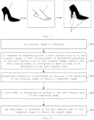
- FIG. 2 it is a flowchart of an image processing method provided by an embodiment of the present disclosure, which comprises the following Steps 201 to 205.
- Step 201 an original image is obtained.
- the above-described original image may be a frame of images in a video image obtained in real time.
- Step 202 in response to determining that a foot feature area is in the original image, a foot overlay model is determined according to the foot feature area in the original image, wherein the foot overlay model is configured to mark an area to be optimized in the foot feature area.
- the foot overlay model may be a model that can cover the heel and the forefoot, and the area covered by the foot overlay model is the area that might cause goof in response to the shoes being drawn to the foot feature area.
- the foot overlay model may be a preset model.
- foot overlay models corresponding to these shoe models might be different.
- the shoes with a triangular contour correspond to one foot overlay model
- the shoes with a diamond contour correspond to another foot overlay model.
- FIG. 3 it is a schematic view of a foot overlay model provided by an embodiment of the present disclosure.
- the foot overlay model 32 is determined based on the foot feature area 31 present in the image in Fig. 3 , wherein the area indicated by the foot overlay model 32 is the area to be optimized.
- Step 203 background completion (background inpainting) is performed on the area to be optimized in the original image to obtain a completed image.
- Fig. 4 it is a schematic view of a completed image provided by an embodiment of the present disclosure.
- the area to be optimized in the foot feature area may be determined according to the foot overlay model, and then background completion may be performed on this area, so that a completed image 41 may be obtained.
- the method of performing background completion on the area to be optimized in the original image comprises: according to an initial screen coordinates of a target pixel point in the area to be optimized in the original image, a width of the foot feature area on the screen and a length of the foot feature area on the screen, calculating the offset screen coordinates corresponding to the target pixel point; and replacing a color value of the target pixel point with a color value of a pixel point corresponding to the offset screen coordinates to perform background completion on the area to be optimized.
- the target pixel point is any of at least some pixels in the area to be optimized, and the at least some pixels in the area to be optimized comprise all pixels in the area to be optimized or some pixels in the area to be optimized.
- the color values involved refer to the values of three channels: R (red), G (green) and B (blue).
- the color values of the pixel points in the non-foot feature area are sampled by using the initial screen coordinates of the target pixel point in the area to be optimized in the original image, the width of the foot feature area on the screen and the length of the foot feature area on the screen, and the color values of the pixel points in the area to be optimized are replaced with the color values of the pixel points in the non-foot feature area.
- the pixel points of the non-foot feature area are determined as a background, and the color value of the area to be optimized is replaced with the color value of the non-foot area to perform background completion on the area to be optimized.
- the color values of the pixel points in the area to be optimized may be replaced with the color values of the pixel points at a distance from the foot feature area within a preset range.
- the pixel points at a distance from the foot feature area within a preset range are determined as background, so as to perform background completion on the area to be optimized.
- Color texture2D(u_inputTex, g_vary_sp_uv - u_widthVector + u_heightVector)
- “Color” represents the color value of a pixel point in the area to be optimized after background completion
- “texture2D” represents 2D texture mapping
- “u_inputTex” is the input texture of a corresponding image of the video, also that is, the initial color value of the pixel
- "g_vary_sp_uv” is the screen coordinates of the currently rendered pixel point, that is, the screen coordinates corresponding to the pixel point
- “u_widthVector” is the length of the foot feature area on the screen.
- the offset screen coordinates corresponding to the pixel point 52 may be calculated based on the initial screen coordinates of the pixel point 52 in the area to be optimized, the width of the foot feature area on the screen and the length of the foot feature area on the screen, and the pixel point 51 corresponding to the offset screen coordinates may be determined according to the offset screen coordinates, and the color value of the pixel point 52 may be replaced with the color value of the pixel point 51.
- the color value may be replaced in the above-described method to perform background completion on the pixel point in the area to be optimized.
- the method of performing background completion on the area to be optimized in the original image comprises: according to an obtained initial color value of a target pixel point in the area to be optimized in the original image and the initial color value of an adjacent pixel point of the target pixel point, determining the final color value corresponding to the target pixel point; replacing the initial color value of the target pixel point with the final color value corresponding to the target pixel point to perform background completion on the area to be optimized.
- the target pixel point is any pixel in at least some pixels in the area to be optimized.
- the at least some pixels in the area to be optimized comprise all pixels in the area to be optimized or some pixels in the area to be optimized.
- the final color value corresponding to the target pixel point may be a result of weighted summation of the initial color value of the target pixel point in the area to be optimized and the initial color value of an adjacent pixel point thereof.
- the final color value of the area closer to the background in the area to be optimized will be closer to the real background, so that the area to be optimized may be integrated with the background, and the boundary between the area to be optimized and the background may be blurred, which may also implement performing background completion on the area to be optimized.
- the weight value of the current pixel point (the target pixel point) to be optimized in the area to be optimized may be set to be larger, and the weight value of an adjacent pixel point of the current pixel point may be set to be smaller, which may achieve a better display effect.
- the initial color value of the pixel point A in the original image is obtained, and the initial color value of four pixel points comprising the pixel point B1, the pixel point B2, the pixel point B3 and the pixel point B4 adjacent to the pixel point A are obtained.
- the final color value is calculated, and then the color value of the pixel point A is replaced with the final color value.
- Step 204 a shoe model is determined according to the foot feature area of the completed image.
- Step 205 the shoe model is rendered in the foot feature area in the completed image to obtain the target image.
- Fig. 6 it is a schematic view of obtaining a target image provided by an embodiment of the present disclosure.
- the shoe model may also be further determined, and based on the completed image 61, the shoe model is rendered in the foot feature area of the completed image, and then the target image 62 as shown in Fig. 6 , that is, the image of the effect of trying on high heels, may be obtained.
- the image processing method it is possible to obtain the original image; determine a foot overlay model according to a foot feature area of the original image in response to determining that a foot feature area is in the original image, wherein the foot overlay model is configured to mark an area to be optimized in the foot feature area; perform background completion on the area to be optimized in the original image to obtain a completed image; determine the shoe model according to the foot feature area of the completed image; render the shoe model in the foot feature area in the completed image so as to obtain the target image.
- the area to be optimized in the foot feature area in the original image may be first determined by the foot overlay model, and background completion may be performed.
- some special display effects may also be superimposed on the shoe model, effects may be superimposed based on some effect view sampling, and a fade-in effect may also be realized when the shoe model is drawn.
- the starfield effect may be superimposed on the basis of the shoe model, and the fade-in effect from heel to toe may be realized in response to the shoe model being drawn, or the fade-in effect from toe to heel may be realized in response to the shoe model being drawn.
- step 205 after rendering the shoe model to obtain the target image in the foot feature area of the completed image in the above-described step 205, there may further comprise the following steps: obtaining the initial color value of the first pixel point, wherein the first pixel point is any pixel point corresponding to the shoe model in the completed image; sampling from the target effect image to obtain a first color value according to the first coordinates corresponding to the first pixel point; calculating the final color value of the first pixel point according to the initial color value of the first pixel point and the first color value; and replacing the initial color value of the first pixel point with the final color value.
- the first coordinates comprise any of the following: two-dimensional space coordinates, world space coordinates, and screen control coordinates.
- the final color value of the first pixel point may be calculated according to the following formula (2), that is, according to the initial color value of the first pixel point and the first color value.
- finalRGB.xyz refractionRGB.xyz * galaxyColor * 2.0 * (1.0 - cfg) + (1.0 - (1.0 - galaxyColor) * (1.0 - refractionRGB.xyz) * 2.0)
- finalRGB.xyz represents the final color value of the first pixel point
- reffractionRGB.xyz represents the initial color value of the first pixel point
- galaxyColor represents the first color value obtained by sampling from the target effect image according to the first coordinates corresponding to the first pixel point
- the target effect image may be a starfield effect image
- cfg is the superposition parameter of the initial color value of the first pixel point and the first color value, wherein the first pixel point is used to indicate the ratio when the initial color value of the first pixel point and the first color value are superimposed.
- the superposition parameter may be set according to actual requirements, and the embodiment of the present disclosure is not limited thereto.
- the starfield effect will be fixed on the shoe model in response to "galaxyColor" is a color value obtained by sampling based on the two-dimensional space coordinates (UV coordinates); the starfield effect will realize a flow effect when the model moves in response to "galaxyColor” being a color value obtained by sampling based on the world space coordinates; and the starfield effect is displayed in a fixed position on the screen in response to "galaxyColor” being a color value obtained by sampling based on the screen control coordinates.
- "galaxyColor” is a color value obtained by sampling based on the two-dimensional space coordinates (UV coordinates)
- the starfield effect will realize a flow effect when the model moves in response to "galaxyColor” being a color value obtained by sampling based on the world space coordinates
- the starfield effect is displayed in a fixed position on the screen in response to "galaxyColor” being a color value obtained by sampling based on the screen control coordinates.
- the target effect may be superimposed on the shoe model by sampling the target effect image, so that the rendered shoes have a better display effect.
- the method of rendering the shoe model in the foot feature area in the image to obtain the target image comprise: establishing a shoe model space based on the shoe model; determining a target noise value according to the second coordinates in the shoe model space, wherein the second coordinates are any model space coordinates in the shoe model space; in response to the target noise value being greater than the preset value, rendering the second pixel point corresponding to the second coordinates in the foot feature area.
- the preset value decreases within a first duration.
- the first duration is the total duration of drawing a complete shoe model.
- the above-described embodiments may implement dissolution and fade-in based on the axial direction of the shoe model space, and add noise to increase the randomness of the edge, so as to realize the fade-in effect of the shoes from toe to heel.
- a shoe model space is established based on the shoe model, wherein the direction from heel to toe may be taken as an axial direction of the shoe model space (for example, it may be the Y axis of the shoe model space). Then, for any model space coordinates in the shoe model space, a value corresponding to the model space coordinates on the Y axis is determined, and this value is taken as a corresponding target noise value. For example, suppose that the value corresponding to the toe is 1 and the value corresponding to the heel is 0 on the Y axis, then the target noise value is a value between 0 and 1, which is determined as the target noise value.
- the preset value is set to be a value that gradually changes from 1 to 0 over time in the first duration.
- the target noise value being greater than the preset value
- the second pixel point corresponding to the second coordinates is rendered in the foot feature area, and correspondingly, in response to the target noise value being less than or equal to the preset value, the second pixel point corresponding to the second coordinates is not rendered in the foot feature area. In this way, the fade-in display effect from toe to heel may be presented.
- the above-described method of determining the target noise value according to the second coordinates in the shoe model space comprises: determining the first noise value according to the position of the second coordinates along a target axial direction in the shoe model space; generating a random number according to the second coordinates; and calculating the target noise value according to the first noise value and the random number.
- a shoe model space is established based on the shoe model, wherein the direction from heel to toe may be taken as an axial direction of the shoe model space (for example, it may be the Y axis of the shoe model space). Then, for the second coordinates in the shoe model space, the value corresponding to the model space coordinates on the Y axis is determined, and this value is taken as the corresponding first noise value. For example, suppose that the value corresponding to the toe is 1 and the value corresponding to the heel is 0 on the Y axis, then the target noise value is a value between 0 and 1, which is determined as the first noise value.
- noise3 represents the target noise value
- noisese1 represents the first noise value
- noisese2 represents the above-described random number
- the preset value is set to be a value that gradually changes from 1 to 0 over time in the first duration.
- the target noise value is a random number added on the basis of the first noise value
- the target noise value is a random number added on the basis of the first noise value
- the embodiment of the present disclosure provides a structural block view of an image processing apparatus, comprising: an obtaining module 701 configured to obtain an original image; a processing module 702 configured to determine a foot overlay model according to a foot feature area of the original image in response to determining that a foot feature area is in the original image, wherein the foot overlay model is configured to mark an area to be optimized in the foot feature area; perform background completion on the area to be optimized in the original image to obtain a completed image; determine a shoe model according to the foot feature area in the completed image; and render the shoe model in the foot feature area in the completed image to obtain a target image.
- the processing module 702 may be, for example, configured to: according to an initial screen coordinates of a target pixel point in the area to be optimized in the original image, a width of the foot feature area on the screen and a length of the foot feature area on the screen, calculate the offset screen coordinates corresponding to the target pixel point, wherein the target pixel point is any pixel point in at least some pixel points in the area to be optimized; and replace the color value of the target pixel point with the color value of the pixel point corresponding to the offset screen coordinates to perform background completion on the area to be optimized.
- the processing module 702 may be, for example, configured to: determine a final color value corresponding to a target pixel point according to the obtained initial color value of the target pixel point in the area to be optimized in the original image and the initial color value of an adjacent pixel point of the target pixel point, wherein the target pixel point is any pixel point in at least some pixel points in the area to be optimized; and replace the initial color value of the target pixel point with the final color value corresponding to the target pixel point to perform background completion on the area to be optimized.
- the processing module 702 is further configured to: obtain an initial color value of a first pixel point, wherein the first pixel point is any pixel point corresponding to the shoe model in the completed image; sample from a target effect image according to the first coordinates corresponding to the first pixel point to obtain a first color value; calculate a final color value of the first pixel point according to the initial color value of the first pixel point and the first color value; and replace the initial color value of the first pixel point with the final color value.
- the first coordinates comprise any of the following: two-dimensional space coordinates, world space coordinates and screen control coordinates.
- the processing module 702 is specifically configured to: establish a shoe model space based on the shoe model; determine a target noise value according to the second coordinates in the shoe model space, wherein the second coordinates are any model space coordinates in the shoe model space; and render the second pixel point corresponding to the second coordinates in the foot feature area in response to the target noise value being greater than a preset value.
- the processing module 702 may be, for example, configured to: determine a first noise value according to the position of the second coordinates along a target axial direction in the shoe model space; generate a random number according to the second coordinates; and calculate the target noise value according to the first noise value and the random number.
- the embodiment of the present disclosure provides an electronic device, comprising: a processor 801, a memory 802, and a computer program stored on the memory 802 and running on the processor 801.
- a processor 801 a memory 802
- a computer program stored on the memory 802 and running on the processor 801.
- the embodiment of the present invention provides a computer-readable storage medium having a computer program stored thereon that, when executed by a processor 801, implement each process of the image processing method in the above-described method embodiments, and the same technical effect may be achieved, which will not be described in detail here in order to avoid repetition.
- the computer-readable storage medium may be a Read-Only Memory (ROM), a Random Access Memory (RAM), a magnetic disk or an optical disk.
- ROM Read-Only Memory
- RAM Random Access Memory
- magnetic disk or an optical disk.
- the embodiment of the present invention provides a computer program product having a computer program stored thereon that, when executed by a processor, implement each process of the image processing method in the above-described method embodiments, and the same technical effect may be achieved, which will not be described in detail here in order to avoid repetition.
- the embodiment of the present disclosure provides a computer program comprising instructions that, when executed by a processor, cause the processor to perform the image processing method according to any of the embodiments in the present disclosure.
- the embodiments of the present disclosure may be provided as a method, system, or computer program product. Accordingly, the present disclosure may take the form of an entirely hardware embodiment, an entirely software embodiment, or a combination of software and hardware aspects. Moreover, the present disclosure may take the form of a computer program product embodied in one or more computer-usable storage media containing computer usable program codes therein.
- the processor may be a Central Processing Unit (CPU), and may also be other general purpose processors, a Digital Signal Processor (DSP), an Application Specific Integrated Circuit (ASIC), a Field-Programmable Gate Array (FPGA) or other programmable logic devices, a discrete gate or transistor logic device, and a discrete hardware component.
- the general purpose processor may be a microprocessor or the processor may also be any conventional processor or the like.
- the memory might be in the form of a non-permanent memory, a random access memory (RAM) and/or a nonvolatile memory in a computer-readable medium, for example, a Read-only Memory (ROM) or a flash (flash R_AM) .
- RAM random access memory
- ROM Read-only Memory
- flash R_AM flash R_AM
- the memory is an example of a computer-readable medium.
- the computer-readable medium comprises a permanent, non-permanent, removable and non-removable storage medium.
- the storage medium may implement information storage by any method or technology, and information may be computer-readable instructions, data structures, modules of programs or other data.
- Examples of storage media for computers comprise, but are not limited to, phase change memory (PRAM), static random access memory (SRAM), dynamic random access memory (DRAM), other types of random access memory (RAM), read-only memory (ROM), electrically erasable programmable read-only memory (EEPROM), flash memory or other memory technologies, Compact Disc Read-Only Memory (CD-ROM), digital versatile disc (DVD) or other optical storage, magnetic cassette type magnetic tape, magnetic disk storage or other magnetic storage devices, or any other non-transmission medium, which may be used to store information accessible by a computing device.
- the computer-readable medium does not comprise temporary computer-readable media (transitory media), such as modulated data signals and carrier waves.
Landscapes
- Engineering & Computer Science (AREA)
- Physics & Mathematics (AREA)
- General Physics & Mathematics (AREA)
- Theoretical Computer Science (AREA)
- Business, Economics & Management (AREA)
- Computer Graphics (AREA)
- Finance (AREA)
- Accounting & Taxation (AREA)
- Computer Hardware Design (AREA)
- General Engineering & Computer Science (AREA)
- Software Systems (AREA)
- Development Economics (AREA)
- Economics (AREA)
- Marketing (AREA)
- Strategic Management (AREA)
- General Business, Economics & Management (AREA)
- Multimedia (AREA)
- Human Computer Interaction (AREA)
- Architecture (AREA)
- Processing Or Creating Images (AREA)
Applications Claiming Priority (2)
| Application Number | Priority Date | Filing Date | Title |
|---|---|---|---|
| CN202210369250.7A CN114742978B (zh) | 2022-04-08 | 2022-04-08 | 一种图像处理方法、装置及电子设备 |
| PCT/CN2023/085565 WO2023193664A1 (zh) | 2022-04-08 | 2023-03-31 | 图像处理方法、装置及电子设备 |
Publications (2)
| Publication Number | Publication Date |
|---|---|
| EP4506901A1 true EP4506901A1 (de) | 2025-02-12 |
| EP4506901A4 EP4506901A4 (de) | 2026-03-18 |
Family
ID=82279790
Family Applications (1)
| Application Number | Title | Priority Date | Filing Date |
|---|---|---|---|
| EP23784228.1A Pending EP4506901A4 (de) | 2022-04-08 | 2023-03-31 | Bildverarbeitungsverfahren und -vorrichtung sowie elektronische vorrichtung |
Country Status (4)
| Country | Link |
|---|---|
| US (1) | US20250232499A1 (de) |
| EP (1) | EP4506901A4 (de) |
| CN (1) | CN114742978B (de) |
| WO (1) | WO2023193664A1 (de) |
Families Citing this family (1)
| Publication number | Priority date | Publication date | Assignee | Title |
|---|---|---|---|---|
| CN114742978B (zh) * | 2022-04-08 | 2025-11-04 | 北京字跳网络技术有限公司 | 一种图像处理方法、装置及电子设备 |
Family Cites Families (19)
| Publication number | Priority date | Publication date | Assignee | Title |
|---|---|---|---|---|
| JP2012253483A (ja) * | 2011-06-01 | 2012-12-20 | Sony Corp | 画像処理装置、画像処理方法、およびプログラム |
| EP4538969A3 (de) * | 2013-08-04 | 2025-08-20 | Eyesmatch Ltd. | Vorrichtungen, systeme und verfahren zur virtualisierung eines spiegels |
| FR3053509B1 (fr) * | 2016-06-30 | 2019-08-16 | Fittingbox | Procede d’occultation d’un objet dans une image ou une video et procede de realite augmentee associe |
| US10534809B2 (en) * | 2016-08-10 | 2020-01-14 | Zeekit Online Shopping Ltd. | Method, system, and device of virtual dressing utilizing image processing, machine learning, and computer vision |
| WO2018049430A2 (en) * | 2016-08-11 | 2018-03-15 | Integem Inc. | An intelligent interactive and augmented reality based user interface platform |
| CN108961386B (zh) * | 2017-05-26 | 2021-05-25 | 腾讯科技(深圳)有限公司 | 虚拟形象的显示方法及装置 |
| CN107316020B (zh) * | 2017-06-26 | 2020-05-08 | 司马大大(北京)智能系统有限公司 | 人脸替换方法、装置及电子设备 |
| CN107977885B (zh) * | 2017-12-12 | 2021-12-14 | 北京小米移动软件有限公司 | 虚拟试穿的方法及装置 |
| CN108961015A (zh) * | 2018-07-27 | 2018-12-07 | 朱培恒 | 一种在线虚拟试鞋方法 |
| TWI682658B (zh) * | 2018-08-21 | 2020-01-11 | 國立清華大學 | 鞋品虛擬試穿之遮蔽改善的方法與系統 |
| CN111369686A (zh) * | 2020-03-03 | 2020-07-03 | 足购科技(杭州)有限公司 | 能够处理局部遮挡物的ar成像虚拟试鞋方法及装置 |
| CN111784568A (zh) * | 2020-07-06 | 2020-10-16 | 北京字节跳动网络技术有限公司 | 人脸图像处理方法、装置、电子设备及计算机可读介质 |
| CN111985995A (zh) * | 2020-08-14 | 2020-11-24 | 足购科技(杭州)有限公司 | 基于微信小程序的鞋子虚拟试穿方法及装置 |
| CN111882408B (zh) * | 2020-09-27 | 2021-07-09 | 北京达佳互联信息技术有限公司 | 虚拟试用方法、装置、电子设备及存储介质 |
| CN112258416B (zh) * | 2020-10-27 | 2024-08-20 | 维沃移动通信有限公司 | 图像处理方法、装置、电子设备 |
| CN112581567B (zh) * | 2020-12-25 | 2024-05-28 | 腾讯科技(深圳)有限公司 | 图像处理方法、装置、电子设备及计算机可读存储介质 |
| CN112634312B (zh) * | 2020-12-31 | 2023-02-24 | 上海商汤智能科技有限公司 | 图像背景处理方法、装置、电子设备及存储介质 |
| CN113034655A (zh) * | 2021-03-11 | 2021-06-25 | 北京字跳网络技术有限公司 | 基于增强现实的试鞋方法、装置和电子设备 |
| CN114742978B (zh) * | 2022-04-08 | 2025-11-04 | 北京字跳网络技术有限公司 | 一种图像处理方法、装置及电子设备 |
-
2022
- 2022-04-08 CN CN202210369250.7A patent/CN114742978B/zh active Active
-
2023
- 2023-03-31 US US18/848,495 patent/US20250232499A1/en active Pending
- 2023-03-31 EP EP23784228.1A patent/EP4506901A4/de active Pending
- 2023-03-31 WO PCT/CN2023/085565 patent/WO2023193664A1/zh not_active Ceased
Also Published As
| Publication number | Publication date |
|---|---|
| US20250232499A1 (en) | 2025-07-17 |
| CN114742978B (zh) | 2025-11-04 |
| CN114742978A (zh) | 2022-07-12 |
| EP4506901A4 (de) | 2026-03-18 |
| WO2023193664A1 (zh) | 2023-10-12 |
Similar Documents
| Publication | Publication Date | Title |
|---|---|---|
| US10573017B2 (en) | Depth estimation method and depth estimation apparatus of multi-view images | |
| EP3509034B1 (de) | Bildfilterung auf basis von bildgradienten | |
| US8055101B2 (en) | Subpixel registration | |
| CN114937050B (zh) | 绿幕抠图方法、装置及电子设备 | |
| US20160142615A1 (en) | Robust layered light-field rendering | |
| US10049432B2 (en) | Image processing apparatus, image processing method, program and recording medium | |
| US9569822B2 (en) | Removing noise from an image via efficient patch distance computations | |
| CN114742931B (zh) | 渲染图像的方法、装置、电子设备及存储介质 | |
| CN110335330B (zh) | 图像模拟生成方法及其系统、深度学习算法训练方法及电子设备 | |
| EP4506901A1 (de) | Bildverarbeitungsverfahren und -vorrichtung sowie elektronische vorrichtung | |
| CN109993718B (zh) | 一种多通道投影图像融合方法及装置 | |
| US20140369622A1 (en) | Image completion based on patch offset statistics | |
| KR20230077854A (ko) | 단일 이미지를 이용한 특징 강화 가중치 기반의 딥러닝 다중 노출 융합 방법, 장치, 및 프로그램 | |
| CN113487480A (zh) | 图像处理方法、装置、电子设备及计算机可读存储介质 | |
| Zhou et al. | Adaptive patch size determination for patch-based image completion | |
| CN109615583B (zh) | 一种游戏地图的生成方法及装置 | |
| US10212412B2 (en) | Method of increasing photographing speed of photographing device | |
| CN110866928B (zh) | 基于神经网络的目标边界分割及背景噪声抑制方法及设备 | |
| US20250322640A1 (en) | Upsampling | |
| CN110852936B (zh) | 对图片进行混合处理的方法和装置 | |
| CN117495694B (zh) | 一种视频和地图三维场景融合的方法、电子设备及存储介质 | |
| CN120182103B (zh) | 基于分块直方图的拼接红外图像灰度差异解决方法及设备 | |
| CN112785699A (zh) | 图像绘制方法与设备 | |
| US20250390992A1 (en) | Image processing method and apparatus | |
| CN117692581A (zh) | 图像处理方法、装置、电子设备和存储介质 |
Legal Events
| Date | Code | Title | Description |
|---|---|---|---|
| STAA | Information on the status of an ep patent application or granted ep patent |
Free format text: STATUS: THE INTERNATIONAL PUBLICATION HAS BEEN MADE |
|
| PUAI | Public reference made under article 153(3) epc to a published international application that has entered the european phase |
Free format text: ORIGINAL CODE: 0009012 |
|
| STAA | Information on the status of an ep patent application or granted ep patent |
Free format text: STATUS: REQUEST FOR EXAMINATION WAS MADE |
|
| 17P | Request for examination filed |
Effective date: 20240909 |
|
| AK | Designated contracting states |
Kind code of ref document: A1 Designated state(s): AL AT BE BG CH CY CZ DE DK EE ES FI FR GB GR HR HU IE IS IT LI LT LU LV MC ME MK MT NL NO PL PT RO RS SE SI SK SM TR |
|
| DAV | Request for validation of the european patent (deleted) | ||
| DAX | Request for extension of the european patent (deleted) | ||
| A4 | Supplementary search report drawn up and despatched |
Effective date: 20260213 |
|
| RIC1 | Information provided on ipc code assigned before grant |
Ipc: G06T 19/00 20110101AFI20260209BHEP Ipc: G06T 5/77 20240101ALI20260209BHEP |