EP4506884A1 - Trainingsverfahren und -vorrichtung für ein artefaktentfernungsmodell sowie vorrichtung, medium und programmprodukt - Google Patents
Trainingsverfahren und -vorrichtung für ein artefaktentfernungsmodell sowie vorrichtung, medium und programmprodukt Download PDFInfo
- Publication number
- EP4506884A1 EP4506884A1 EP23851326.1A EP23851326A EP4506884A1 EP 4506884 A1 EP4506884 A1 EP 4506884A1 EP 23851326 A EP23851326 A EP 23851326A EP 4506884 A1 EP4506884 A1 EP 4506884A1
- Authority
- EP
- European Patent Office
- Prior art keywords
- artifact
- removal
- model
- sample
- image
- Prior art date
- Legal status (The legal status is an assumption and is not a legal conclusion. Google has not performed a legal analysis and makes no representation as to the accuracy of the status listed.)
- Pending
Links
Images





Classifications
-
- G—PHYSICS
- G06—COMPUTING OR CALCULATING; COUNTING
- G06T—IMAGE DATA PROCESSING OR GENERATION, IN GENERAL
- G06T5/00—Image enhancement or restoration
- G06T5/73—Deblurring; Sharpening
-
- G—PHYSICS
- G06—COMPUTING OR CALCULATING; COUNTING
- G06T—IMAGE DATA PROCESSING OR GENERATION, IN GENERAL
- G06T5/00—Image enhancement or restoration
- G06T5/77—Retouching; Inpainting; Scratch removal
-
- G—PHYSICS
- G06—COMPUTING OR CALCULATING; COUNTING
- G06N—COMPUTING ARRANGEMENTS BASED ON SPECIFIC COMPUTATIONAL MODELS
- G06N3/00—Computing arrangements based on biological models
- G06N3/02—Neural networks
- G06N3/08—Learning methods
- G06N3/084—Backpropagation, e.g. using gradient descent
-
- G—PHYSICS
- G06—COMPUTING OR CALCULATING; COUNTING
- G06T—IMAGE DATA PROCESSING OR GENERATION, IN GENERAL
- G06T11/00—2D [Two Dimensional] image generation
- G06T11/003—Reconstruction from projections, e.g. tomography
- G06T11/008—Specific post-processing after tomographic reconstruction, e.g. voxelisation, metal artifact correction
-
- G—PHYSICS
- G06—COMPUTING OR CALCULATING; COUNTING
- G06T—IMAGE DATA PROCESSING OR GENERATION, IN GENERAL
- G06T5/00—Image enhancement or restoration
- G06T5/50—Image enhancement or restoration using two or more images, e.g. averaging or subtraction
-
- G—PHYSICS
- G06—COMPUTING OR CALCULATING; COUNTING
- G06T—IMAGE DATA PROCESSING OR GENERATION, IN GENERAL
- G06T5/00—Image enhancement or restoration
- G06T5/60—Image enhancement or restoration using machine learning, e.g. neural networks
-
- G—PHYSICS
- G06—COMPUTING OR CALCULATING; COUNTING
- G06T—IMAGE DATA PROCESSING OR GENERATION, IN GENERAL
- G06T5/00—Image enhancement or restoration
- G06T5/80—Geometric correction
-
- G—PHYSICS
- G06—COMPUTING OR CALCULATING; COUNTING
- G06T—IMAGE DATA PROCESSING OR GENERATION, IN GENERAL
- G06T2207/00—Indexing scheme for image analysis or image enhancement
- G06T2207/10—Image acquisition modality
- G06T2207/10072—Tomographic images
- G06T2207/10081—Computed x-ray tomography [CT]
-
- G—PHYSICS
- G06—COMPUTING OR CALCULATING; COUNTING
- G06T—IMAGE DATA PROCESSING OR GENERATION, IN GENERAL
- G06T2207/00—Indexing scheme for image analysis or image enhancement
- G06T2207/20—Special algorithmic details
- G06T2207/20081—Training; Learning
-
- G—PHYSICS
- G06—COMPUTING OR CALCULATING; COUNTING
- G06T—IMAGE DATA PROCESSING OR GENERATION, IN GENERAL
- G06T2207/00—Indexing scheme for image analysis or image enhancement
- G06T2207/20—Special algorithmic details
- G06T2207/20084—Artificial neural networks [ANN]
-
- G—PHYSICS
- G06—COMPUTING OR CALCULATING; COUNTING
- G06T—IMAGE DATA PROCESSING OR GENERATION, IN GENERAL
- G06T2211/00—Image generation
- G06T2211/40—Computed tomography
- G06T2211/424—Iterative
-
- G—PHYSICS
- G06—COMPUTING OR CALCULATING; COUNTING
- G06T—IMAGE DATA PROCESSING OR GENERATION, IN GENERAL
- G06T2211/00—Image generation
- G06T2211/40—Computed tomography
- G06T2211/441—AI-based methods, deep learning or artificial neural networks
Definitions
- This application relates to the field of machine learning, and in particular, to a method and an apparatus for training an artifact removal model, a device, a medium, and a program product.
- CT computed tomography
- a dual-domain network (DuDoNet) is used to remove the artifact in the CT image.
- the dual-domain network includes two modules. By presetting a CT value processing window, a chordal diagram including the artifact is processed in a chordal diagram domain, and a CT image including the artifact is processed in an image domain, to output a repaired sinusoidal image and an enhanced CT image. Finally, a CT image with the artifact removed is outputted by using a back-projection layer.
- a CT image including the artifact is removed by using the dual-domain network.
- the CT image with the artifact removed has a lower restoration fidelity, lower image accuracy, and a poorer image quality.
- Embodiments of this application provide a method and an apparatus for training an artifact removal model, a device, a medium, and a program product, which can improve accuracy of an output result of the artifact removal model.
- the technical solutions are as follows:
- a method for training an artifact removal model is provided, and is performed by a computer device.
- the method includes:
- an apparatus for training an artifact removal model includes:
- a computer device includes a processor and a memory, the memory storing at least one instruction, at least one program, a code set or an instruction set, the at least one instruction, the at least one program, the code set or the instruction set being loaded and executed by the processor to implement the method for training an artifact removal model according to any one of the foregoing embodiments of this application.
- a computer-readable storage medium stores at least one instruction, at least one program, a code set, or an instruction set, the at least one instruction, the at least one program, the code set or the instruction set being loaded and executed by a processor to implement the method for training an artifact removal model according to any one of the foregoing embodiments of this application.
- a computer program product or a computer program includes computer instructions, the computer instructions being stored in a computer-readable storage medium.
- a processor of a computer device reads the computer instructions from the computer-readable storage medium.
- the processor executes the computer instructions, so that the computer device performs the method for training an artifact removal model according to any one of the foregoing embodiments.
- the technical solutions provided in the embodiments of this application include at least the following beneficial effects:
- the plurality of sample removal models are trained by using the reference image and the artifact image.
- the artifact image is inputted into the plurality of sample removal models to obtain artifact removal results respectively, and the predicted loss values between the respective artifact removal result and the reference image are determined.
- the weight adjustment parameters corresponding to the predicted loss values are finally obtained.
- the plurality of sample removal models are trained based on the predicted loss values and the weight adjustment parameters to finally obtain the artifact removal model including the plurality of artifact removal sub-models.
- the plurality of sample removal models corresponding to different preset window ranges are trained by using the weight adjustment parameters and the predicted loss values, so that the artifact removal model finally obtained through training can output artifact removal images corresponding to the different window ranges, which meets artifact removal requirements of different images and improves artifact removal accuracy of the artifact removal results.
- the window technology is a display technology configured to observe normal tissues or lesions of different densities in a computed tomography (CT) check, including a window width (Window Width) and a window level (Window Level). Since various tissue structures or lesions have different CT values, when details of a specified tissue structure need to be displayed on a CT image, a window width and a window level that are suitable for observing the specified tissue structure needs to be selected to form a specified window range to obtain an optimal display mode for the specified tissue structure, so that a grayscale image of a CT value corresponding to the specified window range is generated.
- CT computed tomography
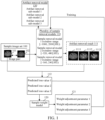
- FIG. 1 is a schematic diagram of a method for training an artifact removal model according to an exemplary embodiment of this application.
- a training image set 100 can be obtained, where the training image set 100 includes a reference image 101 and an artifact image 102 whose image content matches, the reference image 101 and the artifact image 102 are a sample image pair.
- Both the reference image 101 and the artifact image 102 are CT images obtained by performing the computed tomography (CT) on abdomen.
- CT computed tomography
- the artifact image 102 is an image including an artifact (an abdominal CT image contaminated by an artifact), and the reference image 101 does not include an artifact (an abdominal CT image not contaminated by an artifact).
- the artifact image 102 can be inputted into a plurality of sample removal models 110 to respectively output artifact removal results 111 of the artifact image 102, where the sample removal models in the plurality of sample removal models 110 correspond to different preset window ranges, so that the artifact removal results 111 are implemented as artifact removal images corresponding to different preset window ranges (for example: an image 1111 is a CT image in a [-1000, 2000] HU window range, an image 1112 is a CT image in a [-320, 480] HU window range, and an image 1113 is a CT image in a [-160, 240] HU window range).
- Predicted loss values 112 respectively corresponding to the plurality of sample removal models 110 are determined based on pixel differences between the artifact removal results 111 and reference image 101.
- the predicted loss values 112 can be inputted into a sample weight model 120 to output weight adjustment parameters 121 respectively corresponding to the predicted loss values 112, and the weight adjustment parameter 121 is configured to perform weight adjustment on a parameter update of the sample removal model 110.
- the plurality of sample removal models 110 are trained based on the predicted loss values 112 and the weight adjustment parameters 121 to finally obtain an artifact removal model 130 including a plurality of artifact removal sub-models, where the artifact removal model 130 is configured to remove an artifact from an input target image including the artifact.
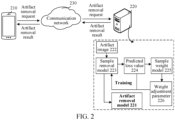
- the implementation environment involves a terminal 210 and a server 220.
- the terminal 210 is connected to the server 220 through a communication network 230.
- the terminal 210 transmits an artifact removal request to the server 220, where the artifact removal request includes a target scan image.
- the target scan image is implemented as a CT image (to be specific, in a CT scanning process of a specified part of a human body, a metal artifact generated when a generated CT image is affected by metal implanted in the designated part) contaminated by metal.
- the server 220 After receiving the artifact removal request transmitted from the terminal, the server 220 performs artifact removal on the metal artifact included in the target scan image to generate an artifact removal result, and feeds back the artifact removal result to the terminal 210.
- the server 220 can include an artifact removal model 221.
- the server 220 inputs the target scan image into the artifact removal model 221 to output an artifact removal result, and the artifact removal result refers to a CT enhanced image generated by removing an identified artifact region in the target scan image.
- the artifact removal model 221 can be obtained by inputting an artifact image 222 for training into a plurality of sample removal models 223 to output a plurality of artifact removal results, determining a plurality of predicted loss values 224 based on pixel differences between the artifact removal results and the reference image (an image whose image content matches that of the artifact image 222 and does not include an artifact), inputting the predicted loss values 224 into a sample weight model 225 to output weight adjustment parameters 226 respectively corresponding to the plurality of predicted loss values 224, and training the sample removal models 223 based on the weight adjustment parameters 226 and the predicted loss values 224.
- the foregoing terminal 210 may be terminal devices in a plurality of forms such as a mobile phone, a tablet computer, a desktop computer, a portable notebook computer, a smart television, and a smart vehicle. This is not limited in the embodiments of this application.
- the foregoing server 220 may be an independent physical server, or may be a server cluster or a distributed system formed by a plurality of physical servers, or may be a cloud server that provides basic cloud computing services such as a cloud service, a cloud database, cloud computing, a cloud function, cloud storage, a network service, cloud communication, a middleware service, a domain name service, a security service, a content delivery network (CDN), big data, and an AI platform.
- basic cloud computing services such as a cloud service, a cloud database, cloud computing, a cloud function, cloud storage, a network service, cloud communication, a middleware service, a domain name service, a security service, a content delivery network (CDN), big data, and an AI platform.
- the cloud technology can be a hosting technology that unifies a series of resources such as hardware, software, and networks in a wide area network or a local area network to implement computing, storage, processing, and sharing of data.
- the foregoing server 220 may alternatively be implemented as a node in a blockchain system.
- the information including, but not limited to, user equipment information, user personal information, and the like
- data including, but not limited to, data for analysis, stored data, displayed data, and the like
- signals involved in this application all are authorized by the user or fully authorized by each party, and the collection, use, and processing of relevant data need to comply with relevant laws and regulations of relevant countries and regions.
- the reference image and the artifact image configured for training, and a verification image configured for model verification involved in this application are all obtained with full authorization.
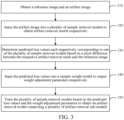
- FIG. 3 is a schematic flowchart of a method for training an artifact removal model according to an exemplary embodiment of this application.
- the method is performed by a computer device, for example, the method may be performed by a terminal, a server, or both a terminal and a server. In this embodiment, description is made by using an example in which the method is performed by the server.
- the method includes the following operaions: Operation 310 : Obtain a reference image and an artifact image.
- the reference image can be an image generated by scanning a sample detection object without an implant
- the artifact image can be formed by introducing an artifact to the reference image
- the artifact can be a shadow caused by an implant during scanning of a sample detection object including the implant. That is, the foregoing artifact can be a shadow of the implant generated during scanning.
- the reference image refers to a medical image generated by scanning the sample detection object using a specified scanning technology.
- the artifact image is implemented as a grayscale image.
- the sample detection object is configured to represent a specified tissue or organ (for example, a heart, an abdomen, a chest, and a lung).
- the reference image can be a medical image obtained by scanning the sample detection object that does not include the implant, that is, the reference image is a medical image that is not affected by the implant.
- the implant can refer to an object that includes a metal part and is implanted in a detection object, for example, at least one type of implant such as dentures, a pacemaker, or a stent. This is not limited herein.
- the specified scanning technology refers to a CT scanning technology. Therefore, images involved in the embodiments of this application are all CT images.
- image content matching means that a content included in the reference image and a content included in the artifact image are the same.
- the reference image and the artifact image are both CT images generated by performing CT scanning on the same abdomen.
- a difference between the artifact image and the reference image is that the artifact image is the reference image including the artifact. That is, the reference image and the artifact image are implemented as a sample image pair.
- the artifact represents a shadow (or a dark band) on an image caused by an object other than the sample detection object during scanning.
- Operation 320 Input the artifact image into a plurality of sample removal models to obtain artifact removal results respectively.
- the computer device for example, a server
- the plurality of sample removal models correspond to different preset window ranges, and each of the sample removal models can be configured to remove the artifact in the artifact image based on a corresponding preset window range.
- the artifact removal result can refer to removing the artifact included in the artifact image through the sample removal model and outputting a scan image corresponding to the preset window range corresponding to the sample removal model, that is, the scan image does not include the artifact.
- a contrast relationship between regions presented in the foregoing scan image can be the same as or different from a contrast relationship between regions presented in the artifact image. This is not limited herein.
- the preset window range is configured to represent a contrast relationship between regions in the scan image.
- the scan image includes a region a and a region b.
- a corresponding preset window range A the brightness of the region a in the scan image is higher than that of the region b.
- a corresponding preset window range B the brightness of the region a in the scan image is lower than that of the region b. That is, when the same scan image corresponds to different preset window ranges, the contrasts of displayed regions of the same scan image are different, which facilitates targeted viewing of a designated region.
- a preset window range corresponding to a sample removal model is a preset fixed window range, for example: the preset window range corresponding to a sample removal model A is [-1000, 2000] HU; or the preset window range corresponding to the sample removal model is an adjustable window range set according to actual needs. This is not limited herein.
- the plurality of sample removal models correspond to the same model structure; or the plurality of sample removal models correspond to different model structures. This is not limited herein.
- Operation 330 Determine predicted loss values each respectively corresponding to one of the plurality of sample removal models based on a pixel difference between the respective artifact removal result and the reference image.
- the predicted loss value is configured to represent a difference between pixels of the artifact removal result and the reference image.
- a loss function can be preset. A distance between a pixel value corresponding to the artifact removal result and a pixel value corresponding to the reference image is calculated through the loss function, and a result obtained through calculation is used as the predicted loss value corresponding to the plurality of sample removal models.
- Operation 340 Input the predicted loss values into a sample weight model to output weight adjustment parameters respectively.
- each of the weight adjustment parameters can be configured to perform weight adjustment on a parameter update of a corresponding sample removal model.
- the predicted loss values corresponding to the plurality of sample removal models can be respectively inputted into the sample weight model to output a scalar result, and the scalar result can be used as a weight adjustment parameter corresponding to a single predicted loss value.
- the weight adjustment parameters of the plurality of predicted loss values correspondingly outputted are different; or there are at least two predicted loss values respectively corresponding to the same weight adjustment parameter. This is not limited herein.
- the weight adjustment parameter can be configured to assign different weights to predicted loss values during training of the sample removal model using the predicted loss values.
- the plurality of predicted loss values can be simultaneously inputted into the sample weight model to simultaneously output the weight adjustment parameters respectively corresponding to the plurality of predicted loss values. That is, the weight adjustment parameters respectively corresponding to the plurality of predicted loss values are simultaneously obtained.
- the predicted loss value corresponding to a sample removal model is obtained, the predicted loss value corresponding to the sample removal model is inputted into the sample weight model to output the weight adjustment parameter corresponding to the sample weight model. That is, the weight adjustment parameters respectively corresponding to the plurality of predicted loss values are sequentially obtained. This is not limited herein.
- Operation 350 Train the sample removal model based on the predicted loss values and the weight adjustment parameters to obtain an artifact removal model including a plurality of artifact removal sub-models.
- each of the artifact removal sub-models can be configured to perform artifact removal on the target image based on a corresponding preset window range.
- parameter adjustment is performed on first model parameters of the sample removal model based on the predicted loss values and the weight adjustment parameters, and the artifact removal sub-model is determined based on adjusted parameters.
- a single artifact removal sub-model can be obtained by training a single sample removal model, and finally the plurality of artifact removal sub-models constitute the artifact removal model.
- training processes of the sample removal models can be simultaneously performed, or training processes of the sample removal models can be sequentially performed, that is, after the first sample removal model is trained, the second sample removal model starts to be trained. This is not limited herein.
- the plurality of sample removal models are trained by using the reference image and the artifact image whose image content matches.
- the artifact image is inputted into the plurality of sample removal models to respectively output the plurality of artifact removal results, and the predicted loss values between the plurality of artifact removal results and the reference image are determined.
- the weight adjustment parameters corresponding to the predicted loss values are finally obtained.
- the plurality of sample removal models are trained based on the predicted loss values and the weight adjustment parameters to finally obtain the artifact removal model including the plurality of artifact removal sub-models.
- the plurality of sample removal models corresponding to different preset window ranges are trained by using the weight adjustment parameters and the predicted loss values, so that the artifact removal model finally obtained through training can output artifact removal images corresponding to the different window ranges, which meets artifact removal requirements of different images and improves artifact removal accuracy of the artifact removal results.
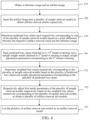
- FIG. 4 is a schematic flowchart of a method for training an artifact removal model according to an exemplary embodiment of this application.
- the method is performed by a computer device, for example, the method may be performed by a terminal, a server, or both a terminal and a server. In this embodiment, description is made by using an example in which the method is performed by the server.
- operation 350 includes operation 351, operation 352, and operation 353, and operation 340 further includes operation 341
- the method includes the following operations: Operation 310 : Obtain a reference image and an artifact image.
- the reference image can be an image generated by scanning a sample detection object without an implant
- the artifact image can be formed by introducing an artifact to the reference image
- the artifact can be a shadow caused by an implant during scanning of a sample detection object including the implant.
- a metal artifact is used as an example for description.
- the artifact made of metal is implemented as an artifact in a strip-shaped structure.
- the reference image is a CT image generated after a sample detection image is performed CT scanning
- the artifact image is a CT image including the metal artifact, that is, a current artifact image includes the metal artifact in an image generated by CT scanning due to the presence of metal in the sample detection image.
- the artifact image and the reference image can be directly obtained from an authorized public dataset; or the reference image is an image directly obtained from a public data set.
- the artifact image is a reference image including the metal artifact that is artificially synthesized based on the reference image and combined with metal mask information corresponding to different metals. This is not limited herein.
- the reference image and the artifact image are implemented as a sample image pair.
- the reference image and the artifact image can be scan images corresponding to the same sample detection object.
- Operation 320 Input the artifact image into a plurality of sample removal models to obtain artifact removal results respectively.
- the plurality of sample removal models correspond to different preset window ranges, and each of the sample removal models can be configured to remove the artifact in the artifact image based on a corresponding preset window range.
- the preset window range of the sample removal model is a preset fixed window range, for example: the preset window range of the sample removal model A is fixed at [-320, 480] HU.
- the sample removal model can be configured to remove the artifact from the artifact image and adjust the artifact image to a display mode corresponding to the preset window range based on the preset window range.
- An output result is the artifact removal result, for example, the artifact image is a CT image including the metal artifact with a window range of [-1000, 2000] HU.
- the window range of the artifact image is first adjusted to [-320, 480] HU and then the artifact image is inputted into the sample removal model.
- the sample removal model removes the metal artifact from the artifact image and outputs the image as the artifact removal result.
- the image content displayed by the artifact removal results corresponding to different preset window ranges remains consistent, and the contrast of regions displayed by each artifact removal result is different.
- the sample removal model in the embodiments of this application may be implemented as a neural network model such as a deep interpretables convolutional dictionary network (DICD-Net), a convolutional neural network (CNN), and a U-net network. This is not limited herein.
- sample removal model is implemented as the DICD-Net.
- FIG. 5 is a schematic diagram of a DICD-Net model according to an exemplary embodiment of this application.
- the DICD-Net 500 includes N iteration processes.
- a single iteration process includes a network ( -Net) and a X network ( X -Net) in sequence.
- an artifact image 510 is inputted into the DICD-Net for N iterative removal (N Stages) to output an artifact removal result 520 corresponding to the artifact image.
- the artifact removal result 520 is implemented as a CT image obtained by removing the artifact image through N M networks and X networks.
- the M network and the X network separately complete an update of a feature layer ( ) and the artifact removal result 520.
- FIG. 6 is a schematic structural diagram of a network according to an exemplary embodiment of this application.
- a schematic diagram 600 corresponding to an M network and an X network is currently displayed in a single stage, including an network structure 610 and an X network structure 620.
- proxNet ⁇ m n ⁇ represents a residual network 630.
- Each residual block in the residual network 630 includes: a convolution layer, a batch normalization layer (Batch Normalization), a ReLU layer, a convolution layer, a Batch Normalization layer, and a cross-link layer in sequence.
- Y represents an inputted artifact image (and the artifact image includes an metal artifact);
- X represents an artifact removal result ( X ( n -1) represents an artifact removal result obtained in an (n-1) th iterative stage);
- I represents mask information (Mask) corresponding to a non-metallic artifact in the artifact image; and represents a mode of recurring the metal artifact. In this embodiment, it may be understood as a display mode of the metal artifact.
- M is a feature layer, which represents a strip-shaped artifact structure of the metal artifact.
- ⁇ 1 is an update step of the network.
- X n proxNet ⁇ X n X n ⁇ 0.5
- X ( n ) represents an output result of the X network during n th iterative removal
- proxNet ⁇ X n ⁇ represents a residual network 640.
- Each residual block in the residual network 640 includes: a convolution layer, a batch normalization layer (Batch Normalization), a ReLU layer, a convolution layer, a Batch Normalization layer, and a cross-link layer in sequence.
- X (n-0.5) ( 1 - ⁇ 2 I ) ⁇ X ( n -1) + ⁇ 2 I ⁇ ( Y - ⁇ ),
- Y represents an inputted artifact image (and the artifact image includes an metal artifact);
- X represents an artifact removal result ( X ( n -1) represents an artifact removal result obtained in an (n-1) th iterative stage);
- I represents mask information (Mask) corresponding to a non-metallic artifact in the artifact image; and represents a mode of recurring the metal artifact. In this embodiment, it may be understood as a display mode of the metal artifact.
- M is a feature layer, which represents a strip-shaped artifact structure of the metal artifact.
- it may be understood as a feature map (Feature Map) corresponding to the metal artifact
- ⁇ 2 is an update step of the X network.
- Operation 330 Determine predicted loss values each respectively corresponding to one of the plurality of sample removal models based on a pixel difference between the respective artifact removal result and the reference image.
- a loss function is preset. Pixel value differences between the artifact removal results and the reference image are calculated through a preset loss function, and calculated results are used as the predicted loss values respectively corresponding to the plurality of sample removal models.
- the preset loss function is ( ⁇ ).
- b represents a sample removal model corresponding to a b th preset window range
- ⁇ represents a first model parameter of the sample removal model.
- Operation 341 Input predicted loss values obtained in (s-1) th iterative training into a sample weight model obtained in s th iterative training to output weight adjustment parameters corresponding to the s th iterative training.
- the sample weight model also needs to be trained.
- a training process for the sample weight model is first described in the following.
- a verification reference image and a verification artifact image whose image content matches are obtained; the verification artifact image is inputted into the plurality of sample removal models to respectively output verification removal results corresponding to the verification artifact image; verification loss values respectively corresponding to the plurality of sample removal models are determined based on pixel differences between the verification removal results and the verification reference image; and the sample weight model is trained based on the verification loss values.
- the verification reference image is a CT image obtained by performing CT scanning on a verification detection object
- the verification artifact image is a CT image including a metal artifact.
- the image content corresponding to the verification reference image and the image content corresponding to the verification artifact image are the same (for example: both the verification reference image and the verification artifact image are CT images obtained by performing CT scanning on the same abdomen, where the verification artifact image includes the metal artifact, and the verification reference image does not include the artifact).
- the verification reference image and the verification artifact image are an image pair in a verification sample.
- the verification artifact image and the artifact image belong to different CT images.
- the verification artifact image is inputted into the plurality of sample removal models. After the artifact is removed from the artifact image through the plurality of sample removal models, an image corresponding to the preset window range of the sample removal model is generated as a verification removal result. Each sample removal model corresponds to a verification removal result.
- the loss function is preset. Differences between pixel points between a plurality of verification removal results and the verification reference image are calculated through the loss function, and the differences are used as the verification loss values corresponding to the sample removal model.
- the plurality of sample removal models respectively correspond to a plurality of verification loss values.
- a preset loss function is implemented as L b meta ⁇ .
- An output result of the loss function is configured to represent a verification loss value corresponding to the b th sample removal model.
- second model parameters of the sample weight model are adjusted through the plurality of verification loss values.
- gradient adjustment is performed on the second model parameters of the sample weight model based on verification loss values obtained in (s-1) th iterative training to obtain a sample weight model corresponding to the s th iterative training.
- training for the sample weight model includes training the sample weight model for N iterations (corresponding to the N iteration processes included in the foregoing DICD-Net network). That is, during N iterations, the sample weight model and the sample removal model are iteratively and alternately updated.
- the sample weight model is trained based on verification loss values corresponding to the plurality of sample removal models.
- a process of training the sample weight model for a single verification loss value is used as an example for description.
- ⁇ ( s ) represents a sample weight model corresponding to the s th iterative training
- ⁇ is a preset second learning rate, which is configured to represent an update step for training the sample weight model
- L b meta ⁇ ⁇ s ⁇ 1 ⁇ represents a verification loss value corresponding to the b th sample removal model.
- ⁇ ( s -1) ( ⁇ ) is configured to represent a mapping function about ⁇ in an (s-1) th iteration. Since a second model parameter ( ⁇ ) is not updated during a current s th iterative training, a mapping function about ⁇ is set to represent a mapping relationship between a first model parameter ( ⁇ ) corresponding to the sample removal model and a second model parameter ( ⁇ ) corresponding to the sample weight model.
- mapping relationships between the first model parameters and the second model parameters during the (s-1) th iterative training are determined based on the first model parameters obtained in the (s-1) th iterative training; and the verification loss values obtained in the (s-1) th iterative training are determined based on the mapping relationships.
- ⁇ ( s -1) ( ⁇ ) is configured to represent a mapping function about ⁇ in the (s-1) th iterative training, ⁇ represents a preset first learning rate, and f meta ( ( ⁇ ( s -1) ); ⁇ ) is configured to represent a network structure corresponding to the sample weight model during the (s-1) th iterative training, that is, a network mapping function including ⁇ .
- Operation 351 Determine weighted loss values respectively corresponding to the plurality of sample removal models based on the plurality of predicted loss values and weight adjustment parameters respectively corresponding to a plurality of loss values.
- ( ⁇ ) is a sum of losses of predicted loss values respectively corresponding to B sample removal models (DICD-Net) included in a model, ( ⁇ ) is configured to represent a predicted loss value of an artifact image corresponding to a b th DICD-Net, and W b is configured to represent a weight adjustment parameter corresponding to a b th predicted loss value.
- DICD-Net B sample removal models
- W b f meta ( ( ⁇ ); ⁇ ) , where f meta ( ; ⁇ ) represents a network structure of the sample weight model, an input thereof is a predicted loss value , an output thereof is a weight adjustment parameter W , and a corresponding second model parameter in the network structure is ⁇ .
- f meta ( ( ⁇ ); ⁇ ) is set to be a multi-layer perception (MLP) network including one hidden layer.
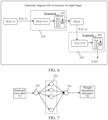
- FIG. 7 is a schematic diagram of a network structure of a sample weight model according to an exemplary embodiment of this application. As shown in FIG. 7 , an MLP network is currently displayed. The network includes an input layer 710, a hidden layer 720, and an output layer 730. The input layer is a predicted loss value 711, and the output layer 730 is a weight adjustment parameter 731 corresponding to the predicted loss value 711.
- the hidden layer 720 includes a plurality of neurons, and a number of neurons in the hidden layer 720 is limited according to actual needs.
- an s th weighted loss value is determined based on an (s-1) th predicted loss value and an s th weight adjustment parameter.
- the weighted loss value is configured to represent a corresponding predicted loss value of the sample removal model after weight adjustment is performed.
- f meta ( ( ⁇ ); ⁇ ) is configured to represent a weight adjustment parameter corresponding to the predicted loss value, ( ⁇ ) is configured to represent the predicted loss value, and ( ⁇ ) is configured to represent a sum of losses of weighted loss values respectively corresponding to B sample removal models during single iterative training.
- Operation 352 Respectively adjust first model parameters of the plurality of sample removal models based on the weighted loss values respectively corresponding to the plurality of sample removal models to obtain the plurality of artifact removal sub-models.
- the first model parameters of the plurality of sample removal models are performed gradient adjustment based on the plurality of weighted loss values to obtain adjusted parameters as model parameters corresponding to the artifact removal model, so that the artifact removal model is obtained.
- ⁇ ( s -1) is configured to represent the first model parameters obtained during the (s-1) th iterative training (for a plurality of first model parameters respectively corresponding to B sample removal models in a single iterative training), and f meta ( ( ⁇ ( s -1) ); ⁇ ( s ) ) ⁇ ⁇ ( ⁇ )
- a corresponding training sequence is Formula 4 ( ⁇ is parameterized to obtain a mapping function about ⁇ ), Formula 3 (gradient adjustment is performed on the second model parameter of the sample weight model), and Formula 7 (gradient adjustment is performed on the first parameter models respectively corresponding to plurality of sample removal models).
- ⁇ * ( ⁇ ) is configured to represent an optimal solution corresponding to the plurality of first model parameters (that is, the first parameter that meets the adjustment effect condition), and the optimal solution of the plurality of first model parameters may be obtained by calculating a minimum value corresponding to the weighted loss value.
- ⁇ * is configured to represent an optimal solution of the second model parameter, and the optimal solution may be obtained by calculating a minimum value corresponding to the predicted loss value.
- the second model parameter reaches the optimal solution (or is infinitely close to the optimal solution)
- the second model parameter is used as the second parameter obtained in a final training for the sample weight model.
- Formula 8 and Formula 9 are only training objectives set for the sample removal model and the sample weight model. During actual training, a training process of the sample removal model and the sample weight model is performed iterative loop training in a specified order through Formula 4, Formula 3, and Formula 7.
- artifact sub-models respectively corresponding to the plurality of sample removal models are generated, that is, a single artifact sub-model corresponds to a single sample removal model.
- Operation 353 Use a plurality of artifact removal sub-models as an artifact removal model.
- the artifact removal model includes a plurality of sample removal models that have completed training, that is, the artifact removal model includes the plurality of artifact removal sub-models.
- a first model parameter obtained in a most recent adjustment can be determined as a first parameter in response to a number of cyclical iterative adjustment times of the first model parameter reaching a number-of-times threshold; or the first model parameter can be determined as a first parameter in response to an adjustment effect of the first model parameter meeting an adjustment effect condition, the adjustment effect condition being configured to represent a restriction requirement on the predicted loss value.
- the model parameter in the artifact removal model is the first parameter.
- a training objective for the plurality of sample removal models is to use results obtained by performing gradient adjustment on the first model parameters respectively corresponding to the plurality of sample removal models as final first parameters corresponding to the artifact removal models.
- the number-of-times threshold can be a preset specified number of times or may be set by yourself according to a training situation. For example: If the plurality of sample removal model is trained for 100 times, 100 times is the number-of-times threshold. When a number of cyclical iterative adjustments for the first model parameters of the plurality of sample removal models reaches 100 times, a plurality of first model parameters obtained in 100 th training are determined as the first parameters.
- the adjustment effect condition can refer to that after gradient adjustment is performed on the plurality of sample removal models, and the artifact image is inputted and the predicted loss value between the artifact removal result outputted by the artifact image and the reference image meets the adjustment effect condition, the first model parameters respectively corresponding to the plurality of sample removal models are determined as the first parameters of an artifact removal network, that is, the first model parameters of this training meet the training objective of the sample removal model.
- the plurality of sample removal models are trained by using the reference image and the artifact image.
- the artifact image is inputted into the plurality of sample removal models to obtain artifact removal results respectively, and the predicted loss values between the plurality of artifact removal results and the reference image are determined.
- the weight adjustment parameters corresponding to the predicted loss values are finally obtained.
- the plurality of sample removal models are trained based on the predicted loss values and the weight adjustment parameters to finally obtain the artifact removal model including the plurality of artifact removal sub-models.
- the plurality of sample removal models corresponding to different preset window ranges are trained by using the weight adjustment parameters and the predicted loss values, so that the artifact removal model finally obtained through training can output artifact removal images corresponding to the different window ranges, which meets artifact removal requirements of different images and improves artifact removal accuracy of the artifact removal results.
- the sample weight model is first trained, and then the predicted loss value is inputted into the sample weight model obtained by training to output the weight adjustment parameter, and gradient adjustment is performed on the first model parameters of the plurality of sample removal models based on the weight adjustment parameter and the plurality of predicted loss values.
- the sample weight model and the sample removal model are alternately and iteratively trained, and the sample weight model can be trained to assist in training the sample removal model, which improves accuracy and a training effect of model training.
- different preset window ranges also include a process of window conversion.
- FIG. 3 is used as an example to describe an application of the solution of this application in the field of auxiliary diagnosis.
- Operation 310 Obtain a reference image and an artifact image.
- the reference image can be an image generated by scanning a sample detection object without an implant
- the artifact image can be formed by introducing an artifact to the reference image
- the artifact can be a shadow caused by an implant during scanning of a sample detection object including the implant.
- the artifact image can be a CT image synthesized from an authorized CT image obtained in advance in the public data set.
- a CT image that is not affected by metal in the public data set is used as the reference image, as well as different types of metal masks (Mask). Based on a data simulation process, the CT image and the metal mask are performed image synthesis to obtain the CT image including the metal artifact as training data.
- a CT value corresponding to the training data can be cropped to obtain a CT image with a window range of [-1000,2000] HU. Then, the CT image can be converted into an attenuation coefficient and placed in the [0, 1] range, and finally converted to a CT image in a [0, 255] range.
- each piece of training data can be randomly cropped into image blocks with a side length of 64 ⁇ 64, and then horizontal mirror flipping and vertical mirror flipping can be randomly performed with a probability of 0.5 to finally generate different artifact images.
- the reference image and the artifact image are implemented as a sample image pair.
- the plurality of sample removal models respectively correspond to different preset window ranges, which are configured to mark a contrast relationship displayed in each region of the scan image for different CT values.
- three sample removal models are used as an example for description. That is, the three sample removal models included in this embodiment have their corresponding preset window ranges respectively [-1000, 2000] HU, [-320, 480] HU, and [-160, 240] HU. This is not limited herein.
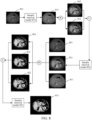
- FIG. 8 is a schematic diagram of a plurality of sample removal models according to an exemplary embodiment of this application.
- a schematic diagram of a multi-window sample removal model is currently displayed.
- the multi-window sample removal model includes a sample removal model 810, a sample removal model 820, and a sample removal model 830 that are respectively corresponding to three different preset window ranges.
- the sample removal model is implemented as a model with a DICD-Net structure.
- the artifact image 801 can be inputted into the sample removal model 810 to output a first predicted region 811 corresponding to the sample removal model 810, where the first predicted region 811 is configured to represent a CT image generated by removing the metal artifact in the artifact image 801 by using the sample removal model 810 based on the first preset window range.
- the artifact image before the artifact image is inputted into the sample removal model, the artifact image also has a corresponding preset window range. Therefore, when the preset window range of the artifact image and the preset window range of the inputted sample removal model belong to different window ranges, the artifact image needs to be performed window conversion before inputting the sample removal model to generate an artifact image consistent with the preset window range corresponding to the sample removal model.
- the artifact image 801 and the first predicted region 811 are inputted into a window conversion layer (Window Layer, marked as W in FIG. 8 ) for window conversion to obtain a first sample conversion result 802 corresponding to the artifact image 801 and a first predicted conversion result 812 corresponding to the first predicted region 811.
- the window range corresponding to the first sample conversion result 802 and the first predicted conversion result 812 is consistent with the preset window range of the sample removal model 820.
- the first predicted region 811 and the first predicted conversion result 812 are inputted into a channel concatenation layer (Channel Concatenation, marked C in FIG. 8 ).
- a first fusion result is inputted into the sample removal model 820 to output a second predicted region 821 corresponding to the sample removal model 820.
- the artifact image 801, the first predicted region 811, and the second predicted region 821 are inputted into the window conversion layer for window conversion to obtain a second sample conversion result 803 corresponding to the artifact image 801, a second predicted conversion result 813 corresponding to the first predicted region 811, and a third predicted conversion result 822 corresponding to the second predicted region 821.
- the sample removal model 830 is inputted to output a third predicted region 831 corresponding to the sample removal model 830.
- a window range corresponding to an i th sample removal model can be determined, i being a positive integer; and window conversion is performed on the artifact image and an (i-1) th artifact removal result to obtain a window conversion result corresponding to both the artifact image and the (i-1) th artifact removal result as a model input of the i th sample removal model.
- X ori is configured to represent an original image
- X curr and X next respectively represent corresponding scan images before and after window conversion
- [ L curr , H curr ] and [ L next , H next ] respectively represent corresponding preset window ranges before and after window conversion (L represents a window level, and H represents a window height).
- Operation 320 Input the artifact image into a plurality of sample removal models to obtain artifact removal results respectively.
- the plurality of sample removal models correspond to different preset window ranges, and each of the sample removal models can be configured to remove the artifact in the artifact image based on a corresponding preset window range.
- three artifact removal results are respectively outputted based on the sample removal models with different preset window ranges. Pixel distances between the three artifact removal results and the reference image are respectively calculated through the preset loss function ( ⁇ ) to output three predicted loss values, namely ( ⁇ ), ( ⁇ ), and ( ⁇ )
- Operation 330 Determine predicted loss values each respectively corresponding to one of the plurality of sample removal models based on a pixel difference between the respective artifact removal result and the reference image.
- the three predicted loss values can be respectively inputted into the sample weight model to output three weight adjustment parameters, where the sample weight model is implemented as f meta ( ( ⁇ ) ; ⁇ ).
- Operation 340 Input the predicted loss values into a sample weight model to output weight adjustment parameters respectively.
- each of the weight adjustment parameters can be configured to perform weight adjustment on a parameter update of a corresponding sample removal model.
- the three sample removal models are simultaneously trained to obtain three artifact removal sub-models, and the three artifact removal sub-models are used as a final artifact removal network (Mar Network).
- training processes of the plurality of sample removal models and the sample weight model are iteratively and alternately performed. That is, the first model parameters of the plurality of sample removal models and the second model parameters of the sample weight model are alternately updated, and parameter adjustment is performed on the first model parameters through updated second model parameters.
- FIG. 9 is a schematic diagram of a method for training an artifact removal model according to an exemplary embodiment of this application.
- the artifact image 910 is inputted into the sample removal model 920 (including three, and a number of models is not shown in the figure) to output the artifact removal result 931, the artifact removal result 932, and the artifact removal result 933.
- the sample removal model 920 and the sample weight model 940 are alternately trained.
- the first model parameter ( ⁇ ( s -1) ) and the second model parameter ( ⁇ ( s -1) ) are currently obtained by (s-1) th iterative training.
- a mapping function ⁇ ( s -1) ( ⁇ ) about ⁇ obtained by the (s-1) th iterative training is determined based on the first model parameters obtained by the (s-1) th iterative training.
- a verification loss value obtained by the (s-1) th iterative training is determined based on the mapping function ⁇ ( s -1) ( ⁇ ) about ⁇ obtained by the (s-1) th iterative training, gradient adjustment is performed on ⁇ ( s -1) based on the verification loss value obtained by the (s-1) th iterative training to obtain a corresponding second model parameter ( ⁇ ( s ) ) after the (s-1) th iterative training, the sample weight model corresponding to the s th iterative training is determined based on ⁇ ( s ) , and the predicted loss value obtained by the (s-1) th iterative training is inputted into the sample weight model corresponding to the s th iterative training to obtain a corresponding weight adjustment parameter after the s th iterative training.
- the weighted loss value corresponding to the s th iterative training is determined for performing gradient adjustment on ⁇ ( s -1) to obtain the second model parameter ( ⁇ ( s ) ) corresponding to the s th iterative training. In this way, cyclical iterative training is performed until the sample removal model training ends.
- both the first model parameter and the second model parameter are preset initial values.
- a first learning attenuation rate can be obtained, the first learning attenuation rate being configured to adjust a first learning rate in a form of attenuation based on a number of iterations, the first learning rate being a preset update step for training the plurality of sample removal models; and during training for the plurality of sample removal models, gradient descent can be performed on the first learning rate based on the first learning attenuation rate to obtain a target learning rate corresponding to the artifact removal model.
- the first learning rate is set to 2 ⁇ 10 -4 , and the first learning attenuation rate is set every 30 epochs.
- the first learning rate attenuates by 0.5, and a total number of training epochs is 200.
- a batch size is 16, and a sample CT image block size is 64 ⁇ 64.
- the second learning rate is set to 1 ⁇ 10 -5 for the sample weight model, and a number of neurons corresponding to the hidden layer is 100.
- FIG. 10 is a schematic diagram of a processing process of an artifact removal model according to an exemplary embodiment of this application.
- a current processing system includes a front end A1010 (for example: a CT scanner), a server 1020, and a front end B1030 (for example: a computer terminal or a mobile phone terminal).
- a CT image generated by the current front end A1010 includes a metal artifact region caused by the metal.
- the CT image can be inputted into the artifact removal model in the server 1020 to perform artifact removal on the CT image.
- the identified metal artifact region is removed to generate a CT image with non-metal artifact under different preset window ranges, and the CT image is fed back to the front end B1030 for a doctor to assist in diagnosis.
- the plurality of sample removal models are trained by using the reference image and the artifact image.
- the artifact image is inputted into the plurality of sample removal models to obtain artifact removal results respectively, and the predicted loss values between the plurality of artifact removal results and the reference image are determined.
- the weight adjustment parameters corresponding to the predicted loss values are finally obtained.
- the plurality of sample removal models are trained based on the predicted loss values and the weight adjustment parameters to finally obtain the artifact removal model including the plurality of artifact removal sub-models.
- the plurality of sample removal models corresponding to different preset window ranges are trained by using the weight adjustment parameters and the predicted loss values, so that the artifact removal model finally obtained through training can output artifact removal images corresponding to the different window ranges, which meets artifact removal requirements of different images and improves artifact removal accuracy of the artifact removal results.
- the plurality of sample removal models with different window ranges are enabled to be simultaneously trained to finally obtain the artifact removal model that can output artifact removal results in different window ranges, which can better improve a training effect of the model.
- images in different window ranges are converted through window conversion, which enables better model learning between different window ranges and improves accuracy and flexibility of model training.
- FIG. 11 is a schematic diagram of a method for training an artifact removal model according to an exemplary embodiment of this application. As shown in FIG. 11 , the method includes the following operations: Operation 1110 : Start.
- the method for training an artifact removal model provided in this application is performed by the server.
- the server starts to perform a training process for the artifact removal model.
- the server can first determine whether it is currently in a training stage or a testing stage. If it is in the training stage, operation 1120 is performed. If it is in the testing stage, operation 1150 is performed.
- Operation 1120 Obtain the artifact image.
- the artifact image refers to the CT image including the metal artifact.
- the artifact image is a CT image including the metal artifact that is synthesized through a data simulation process by obtaining the reference image from the public data set, and combined with different metal mask information, and is used as training data.
- the reference image and the artifact image correspond to the same image content, that is, the reference image and the artifact image are implemented as a sample image pair.
- Operation 1130 Perform iterative loop training on the first model parameter of the sample removal model and the second model parameter of the sample weight model.
- gradient adjustment is simultaneously performed on the first model parameters respectively corresponding to the three sample removal models.
- the artifact image is inputted into the three sample removal models to output three artifact removal results.
- the predicted loss values respectively corresponding to the three sample removal models are determined through the preset loss function ( ⁇ ).
- the three predicted loss values are respectively inputted into the sample weight model f meta ( ( ⁇ ); ⁇ ) to output the weight adjustment parameters respectively corresponding to the three predicted loss values, namely W 1 , W 2 , and W 3 .
- operation 1140 When a number of cyclical iterative training for the first model parameter reaches the number-of-times threshold, operation 1140 is performed, otherwise operation 1130 is continued.
- Operation 1140 Store a trained model.
- a plurality of first model parameters obtained in the last training are used as first parameters to determine the artifact removal model, where the artifact removal model includes three trained artifact removal sub-models.
- the server stores the trained artifact removal model.
- Operation 1150 Obtain a test artifact image.
- test artifact image including the metal artifact is obtained, where the test artifact image is implemented as a CT image configured to test an effect of the trained artifact removal model.
- Operation 1160 Load a trained artifact removal model.
- the server After obtaining the test artifact image, the server loads the stored artifact removal model that is trained.
- Operation 1170 The artifact removal result is generated by the artifact removal model through forward calculation.
- the test artifact image is inputted into the artifact removal model, and forward calculation is performed on the test artifact image to obtain the artifact removal result corresponding to the test artifact image.
- the artifact removal result refers to generating a CT image within a preset window range after the artifact is removed from the test artifact image.
- Operation 1180 Output CT images of different preset window ranges corresponding to the artifact removal result.
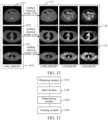
- FIG. 12 is a schematic diagram of an application process of an artifact removal model according to an exemplary embodiment of this application. As shown in FIG.
- the target image 1210 in this embodiment, abdominal CT images in three different display modes for the same abdominal tissue in the same window range are provided, namely an image 1211, an image 1212, and an image 1213
- artifact removal results including three artifact removal results 111 corresponding to the image 1211, three artifact removal results 122 corresponding to the image 1212, and three artifact removal results 133 corresponding to the image 1213) for three different window ranges are simultaneously outputted.
- the artifact removal result is configured to assist the doctor in diagnosing abdominal tissues.
- the plurality of sample removal models are trained by using the reference image and the artifact image whose image content matches.
- the artifact image is inputted into the plurality of sample removal models to respectively output the plurality of artifact removal results, and the predicted loss values between the plurality of artifact removal results and the reference image are determined.
- the weight adjustment parameters corresponding to the predicted loss values are finally obtained.
- the plurality of sample removal models are trained based on the predicted loss values and the weight adjustment parameters to finally obtain the artifact removal model including the plurality of artifact removal sub-models.
- the plurality of sample removal models corresponding to different preset window ranges are trained by using the weight adjustment parameters and the predicted loss values, so that the artifact removal model finally obtained through training can output artifact removal images corresponding to the different window ranges, which meets artifact removal requirements of different images and improves artifact removal accuracy of the artifact removal results.
- FIG. 13 is a structural block diagram of an apparatus for training an artifact removal model according to an exemplary embodiment of this application. As shown in FIG. 13 , the apparatus can include the following parts:
- the training module 1340 can include:
- the determining unit 1341 can be further configured to determine, during s th iterative training, weighted loss values corresponding to the s th iterative training based on predicted loss values obtained in (s-1) th iterative training and weight adjustment parameters obtained in the s th iterative training; and
- the adjusting unit 1342 can be further configured to perform, based on weighted loss values corresponding to the s th iterative training, gradient adjustment on the first model parameters obtained in the (s-1) th iterative training of the sample removal model to obtain first model parameters corresponding to the s th iterative training, and perform (s+1) th cyclical adjustment until training of the artifact removal model ends, s being an integer greater than or equal to 1.
- the input module 1320 can be further configured to input the predicted loss values obtained in the (s-1) th iterative training into a sample weight model obtained in the s th iterative training to output weight adjustment parameters corresponding to the s th iterative training.
- the training module 1340 can be further configured to perform, during the s th iterative training, gradient adjustment on second model parameters of the sample weight model based on verification loss values obtained in the (s-1) th iterative training to obtain a sample weight model corresponding to the s th iterative training.
- the determining module 1330 can be further configured to: determine corresponding mapping relationships between the first model parameters and the second model parameters during the (s-1) th iterative training based on the first model parameters obtained in the (s-1) th iterative training; and determine the verification loss values obtained in the (s-1) th iterative training based on the mapping relationships.
- the determining module 1330 can be further configured to: determine a first model parameter obtained in a most recent adjustment as a first parameter in response to a number of cyclical iterative adjustment times of the first model parameter reaching a number-of-times threshold; or determine the first model parameter as a first parameter in response to an adjustment effect of the first model parameter meeting an adjustment effect condition, the adjustment effect condition being configured to represent a restriction requirement on the predicted loss value.
- the obtaining module 1310 can be further configured to obtain a first learning attenuation rate, the first learning attenuation rate being configured to adjust a first learning rate in a form of attenuation based on a number of iterations, the first learning rate being a preset update step for training the plurality of sample removal models; and
- the apparatus can further include: a gradient descent module 1350, configured to perform, during training for the plurality of sample removal models, gradient descent on the first learning rate based on the first learning attenuation rate to obtain a target learning rate corresponding to the artifact removal model.
- a gradient descent module 1350 configured to perform, during training for the plurality of sample removal models, gradient descent on the first learning rate based on the first learning attenuation rate to obtain a target learning rate corresponding to the artifact removal model.
- the determining module 1330 can be further configured to determine a window range corresponding to an i th sample removal model, i being a positive integer; and
- the apparatus can further include: a conversion module 1360, configured to perform window conversion on the artifact image and an (i-1) th artifact removal result to obtain a window conversion result corresponding to both the artifact image and the (i-1) th artifact removal result as a model input of the i th sample removal model.
- the plurality of sample removal models are trained by using the reference image and the artifact image.
- the artifact image is inputted into the plurality of sample removal models to obtain artifact removal results respectively, and the predicted loss values between the plurality of artifact removal results and the reference image are determined.
- the weight adjustment parameters corresponding to the predicted loss values are finally obtained.
- the plurality of sample removal models are trained based on the predicted loss values and the weight adjustment parameters to finally obtain the artifact removal model including the plurality of artifact removal sub-models.
- the plurality of sample removal models corresponding to different preset window ranges are trained by using the weight adjustment parameters and the predicted loss values, so that the artifact removal model finally obtained through training can output artifact removal images corresponding to the different window ranges, which meets artifact removal requirements of different images and improves artifact removal accuracy of the artifact removal results.
- the apparatus for training an artifact removal model provided in the foregoing embodiments is merely illustrated with an example of division of each functional module.
- the function distribution may be implemented by different functional modules according to requirements, that is, an internal structure of the device is divided into different functional modules, to implement all or some of the functions described above.
- embodiments of the apparatus for training an artifact removal model and embodiments of the method for training an artifact removal model provided in the foregoing embodiments belong to one conception. For the specific implementation process, reference may be made to the method embodiments, and details are not described herein again.
- FIG. 15 is a schematic structural diagram of a server according to an exemplary embodiment of this application.
- the server 1500 can include a central processing unit (CPU) 1501, a system memory 1504 including a random access memory (RAM) 1502 and a read only memory (ROM) 1503, and a system bus 1505 connecting the system memory 1504 to the CPU 1501.
- the server 1500 further includes a mass storage device 1506 configured to store an operating system 1513, an application 1514, and another program module 1515.
- the mass storage device 1506 can be connected to the CPU 1501 by using a mass storage controller (not shown) connected to the system bus 1505.
- the mass storage device 1506 and a computer-readable medium associated with the mass storage device 1506 provide non-volatile storage for the server 1500. That is, the mass storage device 1506 may include a computer-readable medium (not shown) such as a hard disk or a compact disc read only memory (CD-ROM) drive.
- a computer-readable medium such as a hard disk or a compact disc read only memory (CD-ROM) drive.
- the computer-readable medium may include a computer storage medium and a communication medium.
- the computer storage medium includes volatile and non-volatile, removable and non-removable media that are configured to store information such as computer-readable instructions, data structures, program modules, or other data and that are implemented by using any method or technology.
- the computer storage medium includes a RAM, a ROM, an erasable programmable read only memory (EPROM), an electrically erasable programmable read only memory (EEPROM), a flash memory or another solid-state memory technology, a CD-ROM, a digital versatile disc (DVD) or another optical memory, a tape cartridge, a magnetic cassette, a magnetic disk memory, or another magnetic storage device.
- a person skilled in the art may know that the computer storage medium is not limited to the foregoing several types.
- the foregoing system memory 1504 and mass storage device 1506 may be collectively referred to as a memory.
- the server 1500 may further be connected, by using a network such as the Internet, to a remote computer on the network and run. That is, the server 1500 may be connected to a network 1512 by using a network interface unit 1511 that is connected to the system bus 1505, or may be connected to a network of another type or a remote computer system (not shown) by using the network interface unit 1511.
- a network such as the Internet
- the foregoing memory further includes one or more programs.
- the one or more programs are stored in the memory and are configured to be executed by the CPU.
- An embodiment of this application further provides a computer device.
- the computer device includes a processor and a memory, the memory storing at least one instruction, at least one program, a code set or an instruction set, the at least one instruction, the at least one program, the code set or the instruction set being loaded and executed by the processor to implement the method for training an artifact removal model according to the foregoing method embodiments.
- An embodiment of this application further provides a computer-readable storage medium.
- the computer-readable storage medium stores at least one instruction, at least one program, a code set or an instruction set, the at least one instruction, the at least one program, the code set or the instruction set being loaded and executed by the processor to implement the method for training an artifact removal model according to the foregoing method embodiments.
- An embodiment of this application further provides a computer program product or a computer program.
- the computer program product or the computer program includes computer instructions, the computer instructions being stored in a computer-readable storage medium.
- a processor of a computer device reads the computer instructions from the computer-readable storage medium.
- the processor executes the computer instructions, so that the computer device performs the method for training an artifact removal model according to any one of the foregoing embodiments.
Landscapes
- Engineering & Computer Science (AREA)
- Physics & Mathematics (AREA)
- Theoretical Computer Science (AREA)
- General Physics & Mathematics (AREA)
- Data Mining & Analysis (AREA)
- Molecular Biology (AREA)
- Artificial Intelligence (AREA)
- Biomedical Technology (AREA)
- Biophysics (AREA)
- Computational Linguistics (AREA)
- Health & Medical Sciences (AREA)
- Evolutionary Computation (AREA)
- General Health & Medical Sciences (AREA)
- Life Sciences & Earth Sciences (AREA)
- Computing Systems (AREA)
- General Engineering & Computer Science (AREA)
- Mathematical Physics (AREA)
- Software Systems (AREA)
- Apparatus For Radiation Diagnosis (AREA)
- Image Processing (AREA)
- Image Analysis (AREA)
- Electrically Operated Instructional Devices (AREA)
Applications Claiming Priority (2)
| Application Number | Priority Date | Filing Date | Title |
|---|---|---|---|
| CN202210951294.0A CN115330615A (zh) | 2022-08-09 | 2022-08-09 | 伪影去除模型的训练方法、装置、设备、介质及程序产品 |
| PCT/CN2023/096836 WO2024032098A1 (zh) | 2022-08-09 | 2023-05-29 | 伪影去除模型的训练方法、装置、设备、介质及程序产品 |
Publications (2)
| Publication Number | Publication Date |
|---|---|
| EP4506884A1 true EP4506884A1 (de) | 2025-02-12 |
| EP4506884A4 EP4506884A4 (de) | 2025-08-20 |
Family
ID=83921833
Family Applications (1)
| Application Number | Title | Priority Date | Filing Date |
|---|---|---|---|
| EP23851326.1A Pending EP4506884A4 (de) | 2022-08-09 | 2023-05-29 | Trainingsverfahren und -vorrichtung für ein artefaktentfernungsmodell sowie vorrichtung, medium und programmprodukt |
Country Status (4)
| Country | Link |
|---|---|
| US (1) | US20240412335A1 (de) |
| EP (1) | EP4506884A4 (de) |
| CN (1) | CN115330615A (de) |
| WO (1) | WO2024032098A1 (de) |
Families Citing this family (5)
| Publication number | Priority date | Publication date | Assignee | Title |
|---|---|---|---|---|
| CN115330615A (zh) * | 2022-08-09 | 2022-11-11 | 腾讯医疗健康(深圳)有限公司 | 伪影去除模型的训练方法、装置、设备、介质及程序产品 |
| CN115690255B (zh) * | 2023-01-04 | 2023-05-09 | 浙江双元科技股份有限公司 | 基于卷积神经网络的ct图像去伪影方法、装置及系统 |
| CN116228916B (zh) * | 2023-05-10 | 2023-07-11 | 中日友好医院(中日友好临床医学研究所) | 一种图像去金属伪影方法、系统及设备 |
| CN116993845B (zh) * | 2023-06-09 | 2024-03-15 | 西安交通大学 | 一种基于集成深度网络DnCNN的CT图像去伪影方法 |
| CN117649358B (zh) * | 2024-01-30 | 2024-04-16 | 腾讯科技(深圳)有限公司 | 图像处理方法、装置、设备及存储介质 |
Family Cites Families (10)
| Publication number | Priority date | Publication date | Assignee | Title |
|---|---|---|---|---|
| EP3731144A1 (de) * | 2019-04-25 | 2020-10-28 | Koninklijke Philips N.V. | Tiefe kontradiktorische artefaktentfernung |
| CN111626098B (zh) * | 2020-04-09 | 2023-04-18 | 北京迈格威科技有限公司 | 模型的参数值更新方法、装置、设备及介质 |
| EP4139881A1 (de) * | 2020-05-18 | 2023-03-01 | Shanghai United Imaging Healthcare Co., Ltd. | Systeme und verfahren zur bildoptimierung |
| CN112037146B (zh) * | 2020-09-02 | 2023-12-22 | 广州海兆印丰信息科技有限公司 | 医学图像伪影自动校正方法、装置和计算机设备 |
| CN112446873B (zh) * | 2020-12-11 | 2024-09-24 | 深圳高性能医疗器械国家研究院有限公司 | 一种图像伪影的去除方法 |
| CN112862728B (zh) * | 2021-03-22 | 2023-06-27 | 上海壁仞智能科技有限公司 | 伪影去除方法、装置、电子设备和存储介质 |
| CN113689359B (zh) * | 2021-09-23 | 2024-05-14 | 上海联影医疗科技股份有限公司 | 一种图像伪影去除模型及其训练方法和系统 |
| CN114241070B (zh) * | 2021-12-01 | 2022-09-16 | 北京长木谷医疗科技有限公司 | Ct图像去金属伪影以及模型训练的方法和装置 |
| CN114494498B (zh) * | 2022-01-28 | 2023-04-18 | 复旦大学 | 一种基于双域傅里叶神经网络的金属伪影去除方法 |
| CN115330615A (zh) * | 2022-08-09 | 2022-11-11 | 腾讯医疗健康(深圳)有限公司 | 伪影去除模型的训练方法、装置、设备、介质及程序产品 |
-
2022
- 2022-08-09 CN CN202210951294.0A patent/CN115330615A/zh active Pending
-
2023
- 2023-05-29 WO PCT/CN2023/096836 patent/WO2024032098A1/zh not_active Ceased
- 2023-05-29 EP EP23851326.1A patent/EP4506884A4/de active Pending
-
2024
- 2024-08-18 US US18/808,030 patent/US20240412335A1/en active Pending
Also Published As
| Publication number | Publication date |
|---|---|
| EP4506884A4 (de) | 2025-08-20 |
| CN115330615A (zh) | 2022-11-11 |
| US20240412335A1 (en) | 2024-12-12 |
| WO2024032098A1 (zh) | 2024-02-15 |
Similar Documents
| Publication | Publication Date | Title |
|---|---|---|
| EP4506884A1 (de) | Trainingsverfahren und -vorrichtung für ein artefaktentfernungsmodell sowie vorrichtung, medium und programmprodukt | |
| US11727569B2 (en) | Training a CNN with pseudo ground truth for CT artifact reduction | |
| CN110348515B (zh) | 图像分类方法、图像分类模型训练方法及装置 | |
| CN109949235A (zh) | 一种基于深度卷积神经网络的胸部x光片去噪方法 | |
| CN116071401B (zh) | 基于深度学习的虚拟ct图像的生成方法及装置 | |
| JP2014064941A (ja) | 医療用途のデジタルx線画像の明るさレベルを計算する方法 | |
| CN117152365B (zh) | 一种口腔cbct超低剂量成像的方法、系统及装置 | |
| CN115511995A (zh) | 一种血管造影图像处理方法和系统 | |
| CN111681233A (zh) | 基于深度神经网络的us-ct图像分割方法、系统及设备 | |
| CN115115736B (zh) | 图像去伪影方法、装置、设备及存储介质 | |
| JP2022070035A (ja) | 医用画像処理装置、医用画像処理方法及びプログラム | |
| CN114565623B (zh) | 肺血管分割方法、装置、存储介质及电子设备 | |
| CN117173271A (zh) | Ct图像处理方法、模型训练方法、设备、介质及产品 | |
| KR20250075623A (ko) | 초음파 이미지 및 클립을 위한 신경망 시뮬레이터 | |
| CN113850796B (zh) | 基于ct数据的肺部疾病识别方法及装置、介质和电子设备 | |
| CN119648552B (zh) | 一种多域感知对比增强计算机断层扫描图像合成方法、系统及电子设备 | |
| CN117115046B (zh) | 一种放疗cbct稀疏采样影像增强的方法、系统及装置 | |
| CN117690596B (zh) | 器官耐受剂量的确定装置、电子设备及存储介质 | |
| CN118334471A (zh) | 一种基于深度学习的医学图像转换方法、系统及装置 | |
| CN113538451B (zh) | 一种深静脉血栓的磁共振图像分割方法及装置,电子设备及存储介质 | |
| HK40075677A (en) | Method and apparatus for training artifact removal model, device, medium, and program product | |
| CN113592968A (zh) | 断层扫描图像中金属伪影的消减方法和装置 | |
| CN118397059B (zh) | 用于多模态影像增强与配准的模型训练方法及配准方法 | |
| CN114638907B (zh) | 基于深度学习的骨硬化伪影校正方法及装置 | |
| CN120525990B (zh) | 一种噪声纹理恢复的低剂量ct成像方法 |
Legal Events
| Date | Code | Title | Description |
|---|---|---|---|
| STAA | Information on the status of an ep patent application or granted ep patent |
Free format text: STATUS: THE INTERNATIONAL PUBLICATION HAS BEEN MADE |
|
| PUAI | Public reference made under article 153(3) epc to a published international application that has entered the european phase |
Free format text: ORIGINAL CODE: 0009012 |
|
| STAA | Information on the status of an ep patent application or granted ep patent |
Free format text: STATUS: REQUEST FOR EXAMINATION WAS MADE |
|
| 17P | Request for examination filed |
Effective date: 20241107 |
|
| AK | Designated contracting states |
Kind code of ref document: A1 Designated state(s): AL AT BE BG CH CY CZ DE DK EE ES FI FR GB GR HR HU IE IS IT LI LT LU LV MC ME MK MT NL NO PL PT RO RS SE SI SK SM TR |
|
| A4 | Supplementary search report drawn up and despatched |
Effective date: 20250718 |
|
| RIC1 | Information provided on ipc code assigned before grant |
Ipc: G06T 5/00 20240101AFI20250714BHEP Ipc: G06T 11/00 20060101ALI20250714BHEP |
|
| DAV | Request for validation of the european patent (deleted) | ||
| DAX | Request for extension of the european patent (deleted) |