EP4506351A1 - Transition metal compound for olefin polymerization catalyst, olefin polymerization catalyst comprising same, and polyolefin polymerized using same - Google Patents
Transition metal compound for olefin polymerization catalyst, olefin polymerization catalyst comprising same, and polyolefin polymerized using same Download PDFInfo
- Publication number
- EP4506351A1 EP4506351A1 EP23781372.0A EP23781372A EP4506351A1 EP 4506351 A1 EP4506351 A1 EP 4506351A1 EP 23781372 A EP23781372 A EP 23781372A EP 4506351 A1 EP4506351 A1 EP 4506351A1
- Authority
- EP
- European Patent Office
- Prior art keywords
- substituted
- unsubstituted
- alkyl
- aryl
- group
- Prior art date
- Legal status (The legal status is an assumption and is not a legal conclusion. Google has not performed a legal analysis and makes no representation as to the accuracy of the status listed.)
- Pending
Links
Classifications
-
- C—CHEMISTRY; METALLURGY
- C08—ORGANIC MACROMOLECULAR COMPOUNDS; THEIR PREPARATION OR CHEMICAL WORKING-UP; COMPOSITIONS BASED THEREON
- C08F—MACROMOLECULAR COMPOUNDS OBTAINED BY REACTIONS ONLY INVOLVING CARBON-TO-CARBON UNSATURATED BONDS
- C08F210/00—Copolymers of unsaturated aliphatic hydrocarbons having only one carbon-to-carbon double bond
- C08F210/02—Ethene
-
- C—CHEMISTRY; METALLURGY
- C07—ORGANIC CHEMISTRY
- C07F—ACYCLIC, CARBOCYCLIC OR HETEROCYCLIC COMPOUNDS CONTAINING ELEMENTS OTHER THAN CARBON, HYDROGEN, HALOGEN, OXYGEN, NITROGEN, SULFUR, SELENIUM OR TELLURIUM
- C07F17/00—Metallocenes
-
- C—CHEMISTRY; METALLURGY
- C07—ORGANIC CHEMISTRY
- C07F—ACYCLIC, CARBOCYCLIC OR HETEROCYCLIC COMPOUNDS CONTAINING ELEMENTS OTHER THAN CARBON, HYDROGEN, HALOGEN, OXYGEN, NITROGEN, SULFUR, SELENIUM OR TELLURIUM
- C07F7/00—Compounds containing elements of Groups 4 or 14 of the Periodic Table
- C07F7/02—Silicon compounds
- C07F7/08—Compounds having one or more C—Si linkages
- C07F7/0803—Compounds with Si-C or Si-Si linkages
- C07F7/081—Compounds with Si-C or Si-Si linkages comprising at least one atom selected from the elements N, O, halogen, S, Se or Te
-
- C—CHEMISTRY; METALLURGY
- C07—ORGANIC CHEMISTRY
- C07F—ACYCLIC, CARBOCYCLIC OR HETEROCYCLIC COMPOUNDS CONTAINING ELEMENTS OTHER THAN CARBON, HYDROGEN, HALOGEN, OXYGEN, NITROGEN, SULFUR, SELENIUM OR TELLURIUM
- C07F7/00—Compounds containing elements of Groups 4 or 14 of the Periodic Table
- C07F7/28—Titanium compounds
-
- C—CHEMISTRY; METALLURGY
- C08—ORGANIC MACROMOLECULAR COMPOUNDS; THEIR PREPARATION OR CHEMICAL WORKING-UP; COMPOSITIONS BASED THEREON
- C08F—MACROMOLECULAR COMPOUNDS OBTAINED BY REACTIONS ONLY INVOLVING CARBON-TO-CARBON UNSATURATED BONDS
- C08F210/00—Copolymers of unsaturated aliphatic hydrocarbons having only one carbon-to-carbon double bond
- C08F210/14—Monomers containing five or more carbon atoms
-
- C—CHEMISTRY; METALLURGY
- C08—ORGANIC MACROMOLECULAR COMPOUNDS; THEIR PREPARATION OR CHEMICAL WORKING-UP; COMPOSITIONS BASED THEREON
- C08F—MACROMOLECULAR COMPOUNDS OBTAINED BY REACTIONS ONLY INVOLVING CARBON-TO-CARBON UNSATURATED BONDS
- C08F210/00—Copolymers of unsaturated aliphatic hydrocarbons having only one carbon-to-carbon double bond
- C08F210/16—Copolymers of ethene with alpha-alkenes, e.g. EP rubbers
-
- C—CHEMISTRY; METALLURGY
- C08—ORGANIC MACROMOLECULAR COMPOUNDS; THEIR PREPARATION OR CHEMICAL WORKING-UP; COMPOSITIONS BASED THEREON
- C08F—MACROMOLECULAR COMPOUNDS OBTAINED BY REACTIONS ONLY INVOLVING CARBON-TO-CARBON UNSATURATED BONDS
- C08F4/00—Polymerisation catalysts
- C08F4/42—Metals; Metal hydrides; Metallo-organic compounds; Use thereof as catalyst precursors
- C08F4/44—Metals; Metal hydrides; Metallo-organic compounds; Use thereof as catalyst precursors selected from light metals, zinc, cadmium, mercury, copper, silver, gold, boron, gallium, indium, thallium, rare earths or actinides
- C08F4/60—Metals; Metal hydrides; Metallo-organic compounds; Use thereof as catalyst precursors selected from light metals, zinc, cadmium, mercury, copper, silver, gold, boron, gallium, indium, thallium, rare earths or actinides together with refractory metals, iron group metals, platinum group metals, manganese, rhenium technetium or compounds thereof
- C08F4/62—Refractory metals or compounds thereof
- C08F4/64—Titanium, zirconium, hafnium or compounds thereof
- C08F4/646—Catalysts comprising at least two different metals, in metallic form or as compounds thereof, in addition to the component covered by group C08F4/64
- C08F4/6465—Catalysts comprising at least two different metals, in metallic form or as compounds thereof, in addition to the component covered by group C08F4/64 containing silicium
-
- C—CHEMISTRY; METALLURGY
- C08—ORGANIC MACROMOLECULAR COMPOUNDS; THEIR PREPARATION OR CHEMICAL WORKING-UP; COMPOSITIONS BASED THEREON
- C08F—MACROMOLECULAR COMPOUNDS OBTAINED BY REACTIONS ONLY INVOLVING CARBON-TO-CARBON UNSATURATED BONDS
- C08F4/00—Polymerisation catalysts
- C08F4/42—Metals; Metal hydrides; Metallo-organic compounds; Use thereof as catalyst precursors
- C08F4/44—Metals; Metal hydrides; Metallo-organic compounds; Use thereof as catalyst precursors selected from light metals, zinc, cadmium, mercury, copper, silver, gold, boron, gallium, indium, thallium, rare earths or actinides
- C08F4/60—Metals; Metal hydrides; Metallo-organic compounds; Use thereof as catalyst precursors selected from light metals, zinc, cadmium, mercury, copper, silver, gold, boron, gallium, indium, thallium, rare earths or actinides together with refractory metals, iron group metals, platinum group metals, manganese, rhenium technetium or compounds thereof
- C08F4/62—Refractory metals or compounds thereof
- C08F4/64—Titanium, zirconium, hafnium or compounds thereof
- C08F4/659—Component covered by group C08F4/64 containing a transition metal-carbon bond
- C08F4/65912—Component covered by group C08F4/64 containing a transition metal-carbon bond in combination with an organoaluminium compound
-
- C—CHEMISTRY; METALLURGY
- C08—ORGANIC MACROMOLECULAR COMPOUNDS; THEIR PREPARATION OR CHEMICAL WORKING-UP; COMPOSITIONS BASED THEREON
- C08F—MACROMOLECULAR COMPOUNDS OBTAINED BY REACTIONS ONLY INVOLVING CARBON-TO-CARBON UNSATURATED BONDS
- C08F4/00—Polymerisation catalysts
- C08F4/42—Metals; Metal hydrides; Metallo-organic compounds; Use thereof as catalyst precursors
- C08F4/44—Metals; Metal hydrides; Metallo-organic compounds; Use thereof as catalyst precursors selected from light metals, zinc, cadmium, mercury, copper, silver, gold, boron, gallium, indium, thallium, rare earths or actinides
- C08F4/60—Metals; Metal hydrides; Metallo-organic compounds; Use thereof as catalyst precursors selected from light metals, zinc, cadmium, mercury, copper, silver, gold, boron, gallium, indium, thallium, rare earths or actinides together with refractory metals, iron group metals, platinum group metals, manganese, rhenium technetium or compounds thereof
- C08F4/62—Refractory metals or compounds thereof
- C08F4/64—Titanium, zirconium, hafnium or compounds thereof
- C08F4/659—Component covered by group C08F4/64 containing a transition metal-carbon bond
- C08F4/6592—Component covered by group C08F4/64 containing a transition metal-carbon bond containing at least one cyclopentadienyl ring, condensed or not, e.g. an indenyl or a fluorenyl ring
- C08F4/65922—Component covered by group C08F4/64 containing a transition metal-carbon bond containing at least one cyclopentadienyl ring, condensed or not, e.g. an indenyl or a fluorenyl ring containing at least two cyclopentadienyl rings, fused or not
- C08F4/65927—Component covered by group C08F4/64 containing a transition metal-carbon bond containing at least one cyclopentadienyl ring, condensed or not, e.g. an indenyl or a fluorenyl ring containing at least two cyclopentadienyl rings, fused or not two cyclopentadienyl rings being mutually bridged
-
- C—CHEMISTRY; METALLURGY
- C08—ORGANIC MACROMOLECULAR COMPOUNDS; THEIR PREPARATION OR CHEMICAL WORKING-UP; COMPOSITIONS BASED THEREON
- C08F—MACROMOLECULAR COMPOUNDS OBTAINED BY REACTIONS ONLY INVOLVING CARBON-TO-CARBON UNSATURATED BONDS
- C08F2420/00—Metallocene catalysts
- C08F2420/07—Heteroatom-substituted Cp, i.e. Cp or analog where at least one of the substituent of the Cp or analog ring is or contains a heteroatom
-
- C—CHEMISTRY; METALLURGY
- C08—ORGANIC MACROMOLECULAR COMPOUNDS; THEIR PREPARATION OR CHEMICAL WORKING-UP; COMPOSITIONS BASED THEREON
- C08F—MACROMOLECULAR COMPOUNDS OBTAINED BY REACTIONS ONLY INVOLVING CARBON-TO-CARBON UNSATURATED BONDS
- C08F4/00—Polymerisation catalysts
- C08F4/42—Metals; Metal hydrides; Metallo-organic compounds; Use thereof as catalyst precursors
- C08F4/44—Metals; Metal hydrides; Metallo-organic compounds; Use thereof as catalyst precursors selected from light metals, zinc, cadmium, mercury, copper, silver, gold, boron, gallium, indium, thallium, rare earths or actinides
- C08F4/60—Metals; Metal hydrides; Metallo-organic compounds; Use thereof as catalyst precursors selected from light metals, zinc, cadmium, mercury, copper, silver, gold, boron, gallium, indium, thallium, rare earths or actinides together with refractory metals, iron group metals, platinum group metals, manganese, rhenium technetium or compounds thereof
- C08F4/62—Refractory metals or compounds thereof
- C08F4/64—Titanium, zirconium, hafnium or compounds thereof
- C08F4/659—Component covered by group C08F4/64 containing a transition metal-carbon bond
- C08F4/65916—Component covered by group C08F4/64 containing a transition metal-carbon bond supported on a carrier, e.g. silica, MgCl2, polymer
Definitions
- the present invention relates to a transition metal compound for a catalyst for olefin polymerization, a catalyst for olefin polymerization including the same, and a polyolefin polymerized using the same.
- the present invention relates to a transition metal compound for a catalyst for olefin polymerization where a cyclopentadienyl group and a silane substituent are introduced and the cyclopentadienyl group is connected by a bridge, a catalyst for olefin polymerization including the same, and a polyolefin polymerized using the same.
- a metallocene catalyst is one of the catalysts used in olefin polymerization, which is a compound in which a ligand such as cyclopentadienyl, indenyl, or cycloheptadienyl is coordinated to a transition metal or a transition metal halogen compound, and has a sandwich structure as a basic form.
- a Ziegler-Natta catalyst which is another catalyst used for polymerizing olefins, has an active site having heterogeneous properties, since a metal component as the active site is dispersed on an inert solid surface; however, the metallocene catalyst is known as a single-site catalyst having identical polymerization properties in all active sites, since it is one compound having a certain structure.
- a polymer polymerized with the metallocene catalyst as such has a narrow molecular weight distribution, a uniform comonomer distribution, and copolymerization activity higher than the Ziegler Natta catalyst.
- An object of the present invention is to provide a transition metal compound for a catalyst for olefin polymerization which allows preparation of a polyolefin-based resin having excellent processability and has a novel structure, a catalyst for olefin polymerization including the same, and a polyolefin polymerized using the same.
- a transition metal compound represented by the following Chemical Formula 1 is provided: wherein n is an integer of 1 to 20,
- n may be 1 or 2
- M may be zirconium or hafnium
- X may be a halogen or substituted or unsubstituted C 1-20 alkyl
- Q may be silicon
- R 1 to R 3 may be hydrogen, respectively
- R 4 to R 7 may be hydrogen or substituted or unsubstituted C 1-20 alkyl, respectively
- R 8 and R 9 may be substituted or unsubstituted C 1-20 alkyl, respectively
- R 10 to R 12 may be substituted or unsubstituted C 1-20 alkyl or substituted or unsubstituted C 6-20 aryl, respectively.
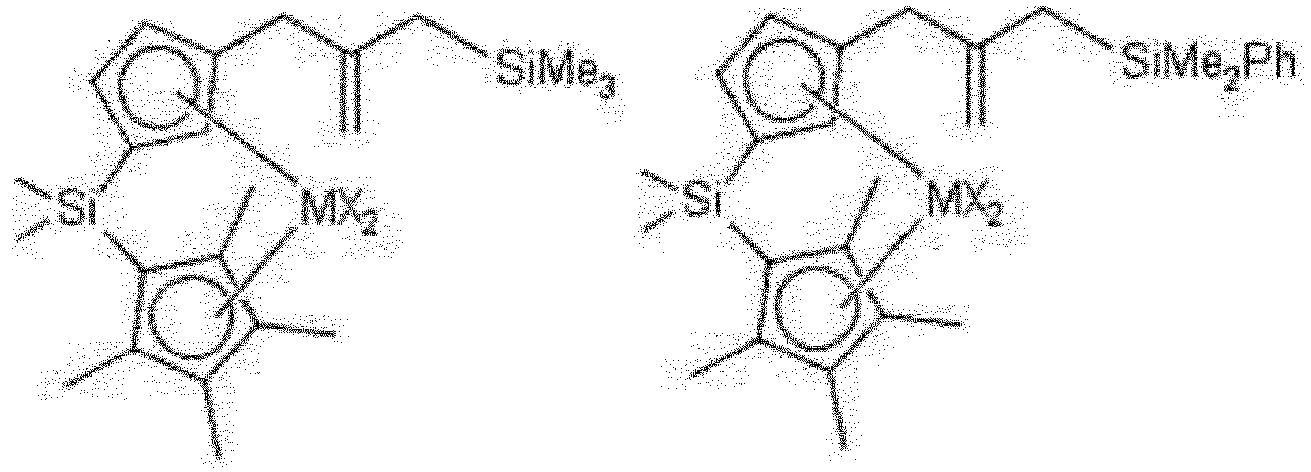
- the compound represented by Chemical Formula 1 may be any one of the compounds represented by the following Chemical Formulae 1-1 to 1-16: wherein M is zirconium or hafnium, X is a halogen or substituted or unsubstituted C 1-20 alkyl, respectively, Me is a methyl group, and Ph is a phenyl group.
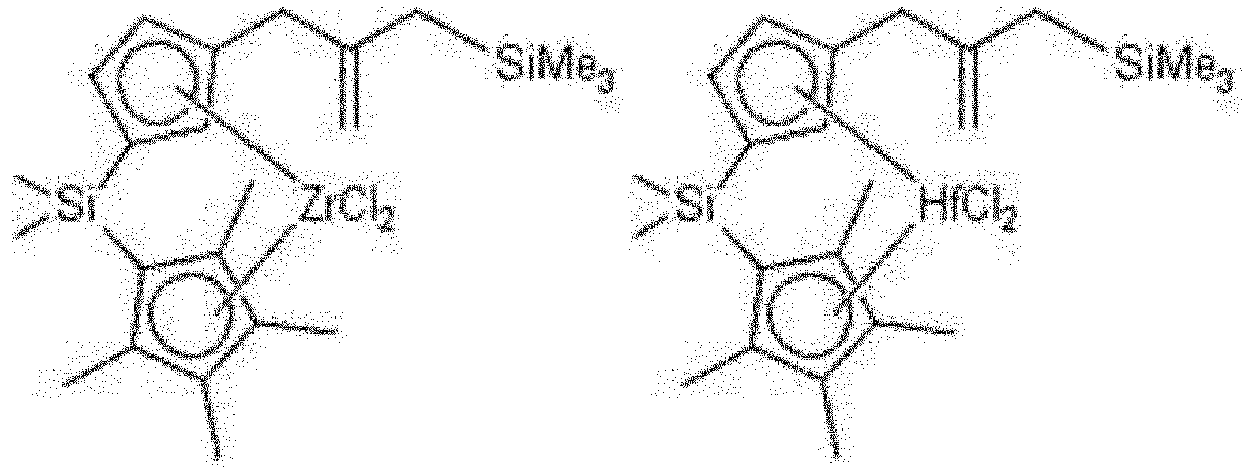
- the compound represented by Chemical Formula 1 may be a compound represented by the following Chemical Formula 1-17 or 1-18: wherein Me is a methyl group.
- a catalyst for olefin polymerization includes: the transition metal compound; and a cocatalyst compound.
- the cocatalyst compound may be one or more selected from the group consisting of a compound represented by the following Chemical Formula 2, a compound represented by the following Chemical Formula 3, and a compound represented by the following Chemical Formula 4: [Chemical Formula 4] [L-H] + [Z(A) 4 ] - or [L] + [Z(A) 4 ] -
- the compound represented by Chemical Formula 2 may be at least one selected from the group consisting of methylaluminoxane, ethylaluminoxane, isobutylaluminoxane, and butylaluminoxane.
- the compound represented by Chemical Formula 3 may be at least one selected from the group consisting of trimethylaluminum, triethylaluminum, triisobutylaluminum, tripropylaluminum, tributylaluminum, dimethylchloroaluminum, triisopropylaluminum, tri-s-butylaluminum, tricyclopentylaluminum, tripentylaluminum, triisopentylaluminum, trihexylaluminum, trioctylaluminum, ethyldimethylaluminum, methyldiethylaluminum, triphenylaluminum, tri- p -tolylaluminum, dimethylaluminummethoxide, dimethylaluminumethoxide, trimethylboron, triethylboron, triisobutylboron, tripropylboron, and tributylboron.
- the compound represented by Chemical Formula 4 may be at least one selected from the group consisting of triethylammonium tetraphenylboron, tributylammonium tetraphenylboron, trimethylammonium tetraphenylboron, tripropylammonium tetraphenylboron, trimethylammonium tetra( p -tolyl)boron, trimethylammonium tetra( o,p- dimethylphenyl) boron, tributylammonium tetra( p- trifluoromethylphenyl)boron, trimethylammonium tetra( p- trifluoromethylphenyl)boron, tributylammonium tetrapentafluorophenylboron, N,N-diethylanilinium tetraphenylboron, N,N-diethylanilinium te
- the catalyst for olefin polymerization may further include a carrier for supporting the transition metal compound.
- the carrier may support both the transition metal compound and the cocatalyst compound.
- the carrier may include at least one selected from the group consisting of silica, alumina, and magnesia.
- an amount of the transition metal compound supported on the carrier may be 0.001 to 1 mmol based on 1 g of the carrier, and an amount of the cocatalyst compound supported on the carrier may be 2 to 15 mmol based on 1 g of the carrier.
- a polyolefin obtained by polymerizing an olefin-based monomer in the presence of the catalyst for olefin polymerization is provided.
- the olefin-based monomer may be at least one selected from the group consisting of C 2-20 ⁇ -olefin, C 1-20 diolefin, C 3-20 cycloolefin, and C 3-20 cyclodiolefin.
- the polyolefin may be obtained by copolymerizing ethylene and 1-hexene.
- the transition metal compound for a catalyst for olefin polymerization and the catalyst for olefin polymerization including the same according to an exemplary embodiment of the present invention have a unique stereostructure, the physical properties of the polymer may be adjusted, and in particular, a polyolefin-based resin having excellent processability may be prepared.
- a transition metal compound represented by the following Chemical Formula 1 is provided:
- n is an integer of 1 to 20, preferably an integer of 1 to 10, and more preferably an integer of 1 to 5. Specifically, n may be 1 or 2.
- M is titanium (Ti), zirconium (Zr), or hafnium (Hf). Specifically, M may be zirconium or hafnium.
- X is independently of each other a halogen, C 1-20 alkyl, C 2-20 alkenyl, C 2-20 alkynyl, C 6-20 aryl, C 1-20 alkyl C 6-20 aryl, C 6-20 aryl C 1-20 alkyl, C 1-20 alkylamido, or C 6-20 arylamido.
- X may be a halogen or substituted or unsubstituted C 1-20 alkyl, respectively. More specifically, X may be chlorine, respectively.
- Q is carbon (C), silicon (Si), germanium (Ge), or tin (Sn). Specifically, Q may be silicon.
- R 1 to R 7 are independently of one another hydrogen, substituted or unsubstituted C 1-20 alkyl, substituted or unsubstituted C 2-20 alkenyl, substituted or unsubstituted C 6-20 aryl, substituted or unsubstituted C 1-20 alkyl C 6-20 aryl, substituted or unsubstituted C 6-20 aryl C 1-20 alkyl, substituted or unsubstituted C 1-20 heteroalkyl, substituted or unsubstituted C 3-20 heteroaryl, substituted or unsubstituted C 1-20 alkylamido, substituted or unsubstituted C 6-20 arylamido, or substituted or unsubstituted C 1-20 silyl.
- R 1 to R 3 may be hydrogen, respectively, and R 4 to R 7 may be hydrogen or substituted or unsubstituted C 1-20 alkyl, respectively.
- R 1 to R 7 may be independently of one another connected to an adjacent group to form a substituted or unsubstituted and saturated or unsaturated C 4-20 ring.
- R 8 and R 9 are independently of each other substituted or unsubstituted C 1-20 alkyl, substituted or unsubstituted C 2-20 alkenyl, substituted or unsubstituted C 6-20 aryl, substituted or unsubstituted C 1-20 alkyl C 6-20 aryl, substituted or unsubstituted C 6-20 aryl C 1-20 alkyl, substituted or unsubstituted C 1-20 heteroalkyl, substituted or unsubstituted C 3-20 heteroaryl, substituted or unsubstituted C 1-20 alkylamido, substituted or unsubstituted C 6-20 arylamido, or substituted or unsubstituted C 1-20 silyl.
- R 8 and R 9 may be substituted or unsubstituted C 1-20 alkyl, respectively. More specifically, R 8 and R 9 may be methyl, respectively. In addition, R 8 and R 9 may be connected to each other to form a substituted or unsubstituted and saturated or unsaturated C 2-20 ring.
- R 10 to R 12 are independently of one another substituted or unsubstituted C 1-20 alkyl, substituted or unsubstituted C 2-20 alkenyl, substituted or unsubstituted C 6-20 aryl, substituted or unsubstituted C 1-20 alkyl C 6-20 aryl, substituted or unsubstituted C 6-20 aryl C 1-20 alkyl, substituted or unsubstituted C 1-20 heteroalkyl, substituted or unsubstituted C 3-20 heteroaryl, substituted or unsubstituted C 1-20 alkylamido, substituted or unsubstituted C 6-20 arylamido, or substituted or unsubstituted C 1-20 silyl.
- R 10 to R 12 may be substituted or unsubstituted C 1-20 alkyl or substituted or unsubstituted C 6-20 aryl, respectively. More specifically, R 10 to R 12 may be methyl or phenyl, respectively.
- the compound represented by Chemical Formula 1 may be any one of compounds represented by the following Chemical Formulae 1-1 to 1-16: wherein M is zirconium or hafnium, X is a halogen or substituted or unsubstituted C 1-20 alkyl, respectively, Me is a methyl group, and Ph is a phenyl group.
- the compound represented by Chemical Formula 1 may be a compound represented by the following Chemical Formula 1-17 or 1-18: wherein Me is a methyl group.
- a catalyst for olefin polymerization including: a transition metal compound represented by the following Chemical Formula 1; and a cocatalyst compound is provided: wherein n, M, X, Q, and R 1 to R 12 are as defined for the transition metal compound above.
- the compound represented by Chemical Formula 1 may be any one of the following Chemical Formulae 1-1 to 1-16: wherein M, X, Me, and Ph are as defined for the transition metal compound above.
- the compound represented by Chemical Formula 1 may be a compound represented by the following Chemical Formula 1-17 or 1-18: wherein Me is as defined for the transition metal compound above.
- the cocatalyst compound may include one or more of a compound represented by the following Chemical Formula 2, a compound represented by the following Chemical Formula 3, and a compound represented by the following Chemical Formula 4:
- n is an integer of 2 or more
- R a is a halogen atom, C 1-20 hydrocarbon, or C 1-20 hydrocarbon substituted with a halogen.
- R a may be methyl, ethyl, n-butyl, or isobutyl.
- D is aluminum (Al) or boron (B), and R b , R c , and R d are independently of one another a halogen atom, a C 1-20 hydrocarbon group, a C 1-20 hydrocarbon group substituted with a halogen, or a C 1-20 alkoxy group.
- R b , R c , and R d may be independently of one another methyl or isobutyl
- D is boron (B)
- R b , R c , and R d may be pentafluorophenyl, respectively.
- L is a neutral or cationic Lewis base
- [L-H] + and [L] + are a Bronsted acid
- Z is a group 13 element
- A is independently of each other a substituted or unsubstituted C 6-20 aryl group or a substituted or unsubstituted C 1-20 alkyl group.
- [L-H] + may be dimethylanilinium cation
- [Z(A) 4 ] - may be [B(C 6 F 5 ) 4 ] -
- [L] + may be [(C 6 H 5 ) 3 C] + .
- an example of the compound represented by Chemical Formula 2 includes methylaluminoxane, ethylaluminoxane, isobutylaluminoxane, butylaluminoxane, and the like, and is preferably methylaluminoxane, but is not limited thereto.
- An example of the compound represented by Chemical Formula 3 includes trimethylaluminum, triethylaluminum, triisobutylaluminum, tripropylaluminum, tributylaluminum, dimethylchloroaluminum, triisopropylaluminum, tri-s-butylaluminum, tricyclopentylaluminum, tripentylaluminum, triisopentylaluminum, trihexylaluminum, trioctylaluminum, ethyldimethylaluminum, methyldiethylaluminum, triphenylaluminum, tri-p-tolylaluminum, dimethylaluminummethoxide, dimethylaluminumethoxide, trimethylboron, triethylboron, triisobutylboron, tripropylboron, tributylboron, and the like, and is preferably trimethylaluminum, triethylalumin
- An example of the compound represented by Chemical Formula 4 may include triethylammonium tetraphenylboron, tributylammonium tetraphenylboron, trimethylammonium tetraphenylboron, tripropylammonium tetraphenylboron, trimethylammonium tetra ( p -tolyl)boron, trimethylammonium tetra ( o , p -dimethylphenyl) boron, tributylammonium tetra ( p- trifluoromethylphenyl) boron, trimethylammonium tetra ( p- trifluoromethylphenyl) boron, tributylammonium tetrapentafluorophenylboron, N,N-diethylanilinium tetraphenylboron, N,N-diethylanilinium tetrapentafluorophenylboron
- the catalyst for olefin polymerization may further include a carrier for supporting the transition metal compound.
- the carrier may support both the transition metal compound and the cocatalyst compound.
- the carrier may include a material containing a hydroxyl group on the surface, and preferably, may use a material having highly reactive hydroxyl group and siloxane group which is dried to remove moisture from the surface.
- the carrier may include at least one selected from the group consisting of silica, alumina, and magnesia.
- silica, silica-alumina, silica-magnesia, and the like which are dried at a high temperature may be used as the carrier, and these may usually contain oxide, carbonate, sulfate, and nitrate components such as Na 2 O, K 2 CO 3 , BaSO 4 , and Mg(NO 3 ) 2 .
- these may include carbon, zeolite, magnesium chloride, and the like.
- the carrier is not limited thereto, and is not particularly limited as long as it may support a transition metal compound and a cocatalyst compound.
- a physical adsorption method or a chemical adsorption method may be used as a method of supporting the transition metal compound and/or the cocatalyst compound which may be used in the catalyst for olefin polymerization.
- the physical adsorption method may be a method of bringing a solution in which a transition metal compound is dissolved into contact with a carrier and then drying, a method of bringing a solution in which a transition metal compound and a cocatalyst compound are dissolved into contact with a carrier and then drying, a method of bringing a solution in which a transition metal compound is dissolved into contact with a carrier and then drying to produce a carrier on which the transition metal compound is supported, separately bringing a solution in which a cocatalyst compound is dissolved into contact with a carrier and then drying to produce a carrier on which the cocatalyst compound is supported, and then mixing them, or the like.
- the chemical adsorption method may be a method of first supporting a cocatalyst compound on the surface of a carrier and then supporting a transition metal compound on the cocatalyst compound, a method of binding a functional group (for example, in the case of silica, a hydroxyl group (-OH) on the surface of silica) on the surface of a carrier and a catalyst compound covalently.
- a functional group for example, in the case of silica, a hydroxyl group (-OH) on the surface of silica
- the amount of the transition metal compound supported on the carrier may be 0.001 to 1 mmol based on 1 g of the carrier.
- the amount of the cocatalyst compound supported on the carrier may be 2 to 15 mmol based on 1 g of the carrier.
- One or two or more carriers may be used.
- both the transition metal compound and the cocatalyst compound may be supported on one carrier, and each of the transition metal compound and the cocatalyst compound may be supported on two or more carriers.
- only one of the transition metal compound and the cocatalyst compound may be supported on the carrier.
- the olefin-based polymer may be a homopolymer of an olefin-based monomer or a copolymer of olefin-based monomer and comonomer.
- the olefin-based monomer may be at least one selected from the group consisting of C 2-20 ⁇ -olefin, C 1-20 diolefin, C 3-20 cycloolefin, and C 3-20 cyclodiolefin.
- the olefin-based monomer may be ethylene, propylene, 1-butene, 1-pentene, 4-methyl-1-pentene, 1-hexene, 1-heptene, 1-octene, 1-decene, 1-undecene, 1-dodecene, 1-tetradecene, 1-hexadecene, or the like and the olefin-based polymer may be a homopolymer including only one of the olefin-based monomers exemplified above or a copolymer including two or more thereof.
- the olefin-based polymer may be a copolymer in which ethylene and C 3-20 ⁇ -olefin are copolymerized, and a copolymer in which ethylene and 1-hexene are copolymerized is preferred, but is not limited thereto.
- the content of ethylene is preferably 55 to 99.9 wt%, and more preferably 90 to 99.9 wt%.
- the content of the ⁇ -olefin-based comonomer is preferably 0.1 to 45 wt%, and more preferably 0.1 to 10 wt%.
- the olefin-based polymer according to a specific example of the present invention may be polymerized by a polymerization reaction such as free radical, cationic, coordination, condensation, and addition polymerization, but is not limited thereto.
- the olefin-based polymer may be prepared by a gas phase polymerization method, a solution polymerization method, a slurry polymerization method, or the like.
- an example of the solvent to be used may include a C 5-12 aliphatic hydrocarbon solvent such as pentane, hexane, heptane, nonane, decane, and isomers thereof; an aromatic hydrocarbon solvent such as toluene and benzene; a hydrocarbon solvent substituted by a chlorine atom such as dichloromethane and chlorobenzene; and a mixture thereof, but is not limited thereto.
- n-BuLi (2.43 g, 5.72 mmol, 1.6 M hexane solution) was slowly added to a solution of (2-(cyclopentadienylmethyl)allyl) trimethylsilane (1 g, 5.19 mmol) diluted with tetrahydrofuran (20 ml) at -30°C, the temperature was slowly raised to room temperature, and stirring was performed for 12 hours. The solvent of the reaction solution was dried under vacuum to obtain a light yellow solid compound.
- Dimethylsilyl(2,3,4,5-tetramethylcyclopentadienyl) chloride (1.12 g, 5.19 mmol) was slowly added dropwise to a solution of the solid compound diluted with tetrahydrofuran(20 ml) at -30°C, the temperature was slowly raised to room temperature, and stirring was performed for 12 hours. The solvent was removed under vacuum, extraction with hexane was performed, and filtration was performed. The solvent was removed under vacuum to obtain 1.93 g (100%) of a yellow liquid compound.
- n-BuLi (4.67 g, 11.0 mmol, 1.6 M hexane solution) was slowly added to a solution of dimethyl[(2-trimethylsiylmethylallyl)cyclopentadienyl](2,3,4,5-tetramethylcyclopentadienyl)silane) (1.93 g, 5.21 mmol) diluted with diethyl ether (20 ml) at -30°C, the temperature was slowly raised to room temperature, and stirring was performed for 12 hours. The solvent of the reaction solution was removed under vacuum, and the reactant was filtered with hexane. The solvent was removed under vacuum to obtain 2 g (100%) of a yellow solid compound.
- Zirconium tetrachloride (ZrCl 4 ) (610 mg, 2.61 mmol) was slowly added to a solution of (dimethylsilane[(2-trimethylsilylmethylallyl)cyclopentadienyl](2,3,4,5-tetramethylcyclopentadienyl) lithium) (1 g, 2.61 mmol) diluted with toluene (20 ml) at -30°C, the temperature was slowly raised to room temperature, and stirring was performed for 12 hours. When the reaction ended, the reaction solution was filtered, and then the solvent of the filtrate was dried under vacuum. The produced solid was dried to obtain 540 mg (39%) of a yellow solid compound.
- Hafnium tetrachloride (HfCl 4 ) (840 mg, 2.61 mmol) was slowly added to a solution of dimethylsilane[(2-trimethylsilylmethylallyl)cyclopentadienyl](2,3,4,5-tetramethylcyclopentadienyl) lithium (1 g, 2.61 mmol) obtained in the same manner as in Preparation Example 1 diluted with toluene (20 ml) at -30°C, the temperature was slowly raised to room temperature, and stirring was performed for 12 hours. When the reaction ended, the reaction solution was filtered, and then the solvent of the filtrate was dried under vacuum. The produced solid was dried to obtain 570 mg (35%) of a yellow solid compound.
- Pentamethylcyclopentadienyl zirconium trichloride (Cp*ZrCl 3 ) (168 mg, 0.50 mmol) was slowly added to a solution of 2-[2-(trimethylsilylmethyl)allyl] cyclopentadienyl lithium(100 mg, 0.50 mmol) obtained in the same manner as in Preparation Example 3 diluted with toluene/tetrahydrofuran (3.0 ml) at -30°C, the temperature was slowly raised to room temperature, and stirring was performed for 12 hours. When the reaction ended, the reaction solution was filtered, and then the solvent of the filtrate was dried under vacuum. The produced solid was washed with hexane and dried to obtain 180 mg (73 %) of a light brown solid compound.
- a polyolefin was polymerized using the transition metal compound (Compound 1-17) obtained in Example 1. Specifically, a 2-liter autoclaved reactor was used for polymerization. All reagents were used in inert conditions using a glove box or Schlenk technology.
- Olefin polymerization was performed in the same manner as in Example 1, except that Compound A-1 was used as the transition metal compound. Amounts of the used catalyst and 1-hexene are shown in the following Table 1.
- Olefin polymerization was performed in the same manner as in Example 1, except that Compound A-2 was used as the transition metal compound. Amounts of the used catalyst and 1-hexene are shown in the following Table 1.
- Example 1 The physical properties of polyolefins obtained in Example 1 and Comparative Examples 1 and 2 were measured, and then the results are shown in the following Table 1.
- Table 1 1-Hexene (ml) Catalyst (mg) Activity (T/mol ⁇ h) Activity (gPE/gcat ⁇ h) Mw (g/mol) PDI Density (g/cm 3 ) Tm (°C)
- Example 1 0 1.6 30.52 57,500 74,900 3.96 0.962 133.13 15 1.6 47.78 90,000 67,000 3.65 0.937 124.53 30 1.6 62.37 117,500 61,600 3.76 0.932 122.29 45 1.6 67.68 127,500 56,600 3.83 0.926 110.3, 118.96 Comparative Example 1 15 3.2 15.70 37,500 170,385 3.25 0.960 125 45 3.2 17.27 41,250 84, 188 2.73 0.944 119.57 Comparative Example 2
- a transition metal compound for catalyst for olefin polymerization which has a unique three-dimensional structure, may adjust the physical properties of a polymer, and in particular, allows preparation of a polyolefin-based resin having excellent processability, and a catalyst for olefin polymerization including the same may be provided.
Landscapes
- Chemical & Material Sciences (AREA)
- Organic Chemistry (AREA)
- Health & Medical Sciences (AREA)
- Chemical Kinetics & Catalysis (AREA)
- Medicinal Chemistry (AREA)
- Polymers & Plastics (AREA)
- Engineering & Computer Science (AREA)
- Materials Engineering (AREA)
- Crystallography & Structural Chemistry (AREA)
- Transition And Organic Metals Composition Catalysts For Addition Polymerization (AREA)
- Organic Low-Molecular-Weight Compounds And Preparation Thereof (AREA)
- Addition Polymer Or Copolymer, Post-Treatments, Or Chemical Modifications (AREA)
Abstract
Description
- The present invention relates to a transition metal compound for a catalyst for olefin polymerization, a catalyst for olefin polymerization including the same, and a polyolefin polymerized using the same. Specifically, the present invention relates to a transition metal compound for a catalyst for olefin polymerization where a cyclopentadienyl group and a silane substituent are introduced and the cyclopentadienyl group is connected by a bridge, a catalyst for olefin polymerization including the same, and a polyolefin polymerized using the same.
- A metallocene catalyst is one of the catalysts used in olefin polymerization, which is a compound in which a ligand such as cyclopentadienyl, indenyl, or cycloheptadienyl is coordinated to a transition metal or a transition metal halogen compound, and has a sandwich structure as a basic form.
- A Ziegler-Natta catalyst, which is another catalyst used for polymerizing olefins, has an active site having heterogeneous properties, since a metal component as the active site is dispersed on an inert solid surface; however, the metallocene catalyst is known as a single-site catalyst having identical polymerization properties in all active sites, since it is one compound having a certain structure. A polymer polymerized with the metallocene catalyst as such has a narrow molecular weight distribution, a uniform comonomer distribution, and copolymerization activity higher than the Ziegler Natta catalyst.
- However, a catalyst for olefin polymerization which allows preparation of a polyolefin-based resin having excellent processability is still demanded.
- An object of the present invention is to provide a transition metal compound for a catalyst for olefin polymerization which allows preparation of a polyolefin-based resin having excellent processability and has a novel structure, a catalyst for olefin polymerization including the same, and a polyolefin polymerized using the same.
- In one general aspect, a transition metal compound represented by the following Chemical Formula 1 is provided:

- M is titanium (Ti), zirconium (Zr), or hafnium (Hf),
- X is independently of each other a halogen, C1-20 alkyl, C2-20 alkenyl, C2-20 alkynyl, C6-20 aryl, C1-20 alkyl C6-20 aryl, C6-20 aryl C1-20 alkyl, C1-20 alkylamido, or C6-20 arylamido,
- Q is carbon (C), silicon (Si), germanium (Ge), or tin (Sn),
- R1 to R7 are independently of one another hydrogen, substituted or unsubstituted C1-20 alkyl, substituted or unsubstituted C2-20 alkenyl, substituted or unsubstituted C6-20 aryl, substituted or unsubstituted C1-20 alkyl C6-20 aryl, substituted or unsubstituted C6-20 aryl C1-20 alkyl, substituted or unsubstituted C1-20 heteroalkyl, substituted or unsubstituted C3-20 heteroaryl, substituted or unsubstituted C1-20 alkylamido, substituted or unsubstituted C6-20 arylamido, or substituted or unsubstituted C1-20 silyl, but R1 to R7 may be independently of one another connected to an adjacent group to form a substituted or unsubstituted and saturated or unsaturated C4-20 ring,
- R8 and R9 are independently of each other substituted or unsubstituted C1-20 alkyl, substituted or unsubstituted C2-20 alkenyl, substituted or unsubstituted C6-20 aryl, substituted or unsubstituted C1-20 alkyl C6-20 aryl, substituted or unsubstituted C6-20 aryl C1-20 alkyl, substituted or unsubstituted C1-20 heteroalkyl, substituted or unsubstituted C3-20 heteroaryl, substituted or unsubstituted C1-20 alkylamido, substituted or unsubstituted C6-20 arylamido, or substituted or unsubstituted C1-20 silyl, but R8 and R9 may be connected to each other to form a substituted or unsubstituted and saturated or unsaturated C2-20 ring, and
- R10 to R12 are independently of one another substituted or unsubstituted C1-20 alkyl, substituted or unsubstituted C2-20 alkenyl, substituted or unsubstituted C6-20 aryl, substituted or unsubstituted C1-20 alkyl C6-20 aryl, substituted or unsubstituted C6-20 aryl C1-20 alkyl, substituted or unsubstituted C1-20 heteroalkyl, substituted or unsubstituted C3-20 heteroaryl, substituted or unsubstituted C1-20 alkylamido, substituted or unsubstituted C6-20 arylamido, or substituted or unsubstituted C1-20 silyl.
- In a specific example of the present invention, in Chemical Formula 1, n may be 1 or 2, M may be zirconium or hafnium, X may be a halogen or substituted or unsubstituted C1-20 alkyl, Q may be silicon, R1 to R3 may be hydrogen, respectively, R4 to R7 may be hydrogen or substituted or unsubstituted C1-20 alkyl, respectively, R8 and R9 may be substituted or unsubstituted C1-20 alkyl, respectively, and R10 to R12 may be substituted or unsubstituted C1-20 alkyl or substituted or unsubstituted C6-20 aryl, respectively.
- In a preferred specific example of the present invention, the compound represented by Chemical Formula 1 may be any one of the compounds represented by the following Chemical Formulae 1-1 to 1-16:




- In a preferred specific example of the present invention, the compound represented by Chemical Formula 1 may be a compound represented by the following Chemical Formula 1-17 or 1-18:

- In another general aspect, a catalyst for olefin polymerization includes: the transition metal compound; and a cocatalyst compound.
- In a specific example of the present invention, the cocatalyst compound may be one or more selected from the group consisting of a compound represented by the following Chemical Formula 2, a compound represented by the following Chemical Formula 3, and a compound represented by the following Chemical Formula 4:


[Chemical Formula 4] [L-H]+[Z(A)4]- or [L]+[Z(A)4]-
- wherein n is an integer of 2 or more, Ra is a halogen atom, a C1-20 hydrocarbon group, or a C1-20 hydrocarbon group substituted with a halogen,
- D is aluminum (Al) or boron (B), Rb, Rc, and Rd are independently of one another a halogen atom, a C1-20 hydrocarbon group, a C1-20 hydrocarbon group substituted with a halogen, or a C1-20 alkoxy group,
- L is a neutral or cationic Lewis base, [L-H]+ and [L]+ are a Bronsted acid, Z is a group 13 element, and A is independently of each other a substituted or unsubstituted C6-20 aryl group or a substituted or unsubstituted C1-20 alkyl group.
- In a preferred specific example of the present invention, the compound represented by Chemical Formula 2 may be at least one selected from the group consisting of methylaluminoxane, ethylaluminoxane, isobutylaluminoxane, and butylaluminoxane.
- In a preferred specific example of the present invention, the compound represented by Chemical Formula 3 may be at least one selected from the group consisting of trimethylaluminum, triethylaluminum, triisobutylaluminum, tripropylaluminum, tributylaluminum, dimethylchloroaluminum, triisopropylaluminum, tri-s-butylaluminum, tricyclopentylaluminum, tripentylaluminum, triisopentylaluminum, trihexylaluminum, trioctylaluminum, ethyldimethylaluminum, methyldiethylaluminum, triphenylaluminum, tri-p-tolylaluminum, dimethylaluminummethoxide, dimethylaluminumethoxide, trimethylboron, triethylboron, triisobutylboron, tripropylboron, and tributylboron.
- In a preferred specific example of the present invention, the compound represented by Chemical Formula 4 may be at least one selected from the group consisting of triethylammonium tetraphenylboron, tributylammonium tetraphenylboron, trimethylammonium tetraphenylboron, tripropylammonium tetraphenylboron, trimethylammonium tetra(p-tolyl)boron, trimethylammonium tetra(o,p-dimethylphenyl) boron, tributylammonium tetra(p-trifluoromethylphenyl)boron, trimethylammonium tetra(p-trifluoromethylphenyl)boron, tributylammonium tetrapentafluorophenylboron, N,N-diethylanilinium tetraphenylboron, N,N-diethylanilinium tetrapentafluorophenylboron, diethylammonium tetrapentafluorophenylboron, triphenylphosphonium tetraphenylboron, trimethylphosphonium tetraphenylboron, triethylammonium tetraphenylaluminum, tributylammonium tetraphenylaluminum, trimethylammonium tetraphenylaluminum, tripropylammonium tetraphenylaluminum, trimethylammonium tetra(p-tolyl)aluminum, tripropylammonium tetra(p-tolyl)aluminum, triethylammonium tetra(o,p-dimethylphenyl)aluminum, tributylammonium tetra(p-trifluoromethylphenyl) aluminum, trimethylammonium tetra(p-trifluoromethylphenyl)aluminum, tributylammonium tetrapentafluorophenylaluminum, N,N-diethylanilinium tetraphenylaluminum, N,N-diethylanilinium tetrapentafluorophenylaluminum, diethylammonium tetrapentatetraphenylaluminum, triphenylphosphonium tetraphenylaluminum, trimethylphosphonium tetraphenylaluminum, tripropylammoniumtetra (p-tolyl) boron, triethylammonium tetra (o,p-dimethylphenyl)boron, tributylammonium tetra(p-trifluoromethylphenyl)boron, triphenylcarbonium tetra(p-trifluoromethylphenyl)boron, and triphenylcarbonium tetrapentafluorophenylboron.
- In a specific example of the present invention, the catalyst for olefin polymerization may further include a carrier for supporting the transition metal compound. In a specific example of the present invention, the carrier may support both the transition metal compound and the cocatalyst compound. In a further preferred specific example of the present invention, the carrier may include at least one selected from the group consisting of silica, alumina, and magnesia.
- In a specific example of the present invention, an amount of the transition metal compound supported on the carrier may be 0.001 to 1 mmol based on 1 g of the carrier, and an amount of the cocatalyst compound supported on the carrier may be 2 to 15 mmol based on 1 g of the carrier.
- In still another general aspect, a polyolefin obtained by polymerizing an olefin-based monomer in the presence of the catalyst for olefin polymerization is provided.
- In a specific example of the present invention, the olefin-based monomer may be at least one selected from the group consisting of C2-20 α-olefin, C1-20 diolefin, C3-20 cycloolefin, and C3-20 cyclodiolefin.
- In a preferred specific example of the present invention, the polyolefin may be obtained by copolymerizing ethylene and 1-hexene.
- Since the transition metal compound for a catalyst for olefin polymerization and the catalyst for olefin polymerization including the same according to an exemplary embodiment of the present invention have a unique stereostructure, the physical properties of the polymer may be adjusted, and in particular, a polyolefin-based resin having excellent processability may be prepared.
- Hereinafter, the present invention will be described in more detail.
- According to a specific example of the present invention, a transition metal compound represented by the following Chemical Formula 1 is provided:

- In Chemical Formula 1, n is an integer of 1 to 20, preferably an integer of 1 to 10, and more preferably an integer of 1 to 5. Specifically, n may be 1 or 2.
- M is titanium (Ti), zirconium (Zr), or hafnium (Hf). Specifically, M may be zirconium or hafnium.
- X is independently of each other a halogen, C1-20 alkyl, C2-20 alkenyl, C2-20 alkynyl, C6-20 aryl, C1-20 alkyl C6-20 aryl, C6-20 aryl C1-20 alkyl, C1-20 alkylamido, or C6-20 arylamido. Specifically, X may be a halogen or substituted or unsubstituted C1-20 alkyl, respectively. More specifically, X may be chlorine, respectively.
- Q is carbon (C), silicon (Si), germanium (Ge), or tin (Sn). Specifically, Q may be silicon.
- R1 to R7 are independently of one another hydrogen, substituted or unsubstituted C1-20 alkyl, substituted or unsubstituted C2-20 alkenyl, substituted or unsubstituted C6-20 aryl, substituted or unsubstituted C1-20 alkyl C6-20 aryl, substituted or unsubstituted C6-20 aryl C1-20 alkyl, substituted or unsubstituted C1-20 heteroalkyl, substituted or unsubstituted C3-20 heteroaryl, substituted or unsubstituted C1-20 alkylamido, substituted or unsubstituted C6-20 arylamido, or substituted or unsubstituted C1-20 silyl. Specifically, R1 to R3 may be hydrogen, respectively, and R4 to R7 may be hydrogen or substituted or unsubstituted C1-20 alkyl, respectively. In addition, R1 to R7 may be independently of one another connected to an adjacent group to form a substituted or unsubstituted and saturated or unsaturated C4-20 ring.
- R8 and R9 are independently of each other substituted or unsubstituted C1-20 alkyl, substituted or unsubstituted C2-20 alkenyl, substituted or unsubstituted C6-20 aryl, substituted or unsubstituted C1-20 alkyl C6-20 aryl, substituted or unsubstituted C6-20 aryl C1-20 alkyl, substituted or unsubstituted C1-20 heteroalkyl, substituted or unsubstituted C3-20 heteroaryl, substituted or unsubstituted C1-20 alkylamido, substituted or unsubstituted C6-20 arylamido, or substituted or unsubstituted C1-20 silyl. Specifically, R8 and R9 may be substituted or unsubstituted C1-20 alkyl, respectively. More specifically, R8 and R9 may be methyl, respectively. In addition, R8 and R9 may be connected to each other to form a substituted or unsubstituted and saturated or unsaturated C2-20 ring.
- R10 to R12 are independently of one another substituted or unsubstituted C1-20 alkyl, substituted or unsubstituted C2-20 alkenyl, substituted or unsubstituted C6-20 aryl, substituted or unsubstituted C1-20 alkyl C6-20 aryl, substituted or unsubstituted C6-20 aryl C1-20 alkyl, substituted or unsubstituted C1-20 heteroalkyl, substituted or unsubstituted C3-20 heteroaryl, substituted or unsubstituted C1-20 alkylamido, substituted or unsubstituted C6-20 arylamido, or substituted or unsubstituted C1-20 silyl. Specifically, R10 to R12 may be substituted or unsubstituted C1-20 alkyl or substituted or unsubstituted C6-20 aryl, respectively. More specifically, R10 to R12 may be methyl or phenyl, respectively.
- In a preferred specific example of the present invention, the compound represented by Chemical Formula 1 may be any one of compounds represented by the following Chemical Formulae 1-1 to 1-16:


- In a more preferred specific example of the present invention, the compound represented by Chemical Formula 1 may be a compound represented by the following Chemical Formula 1-17 or 1-18:

- According to another exemplary embodiment of the present invention, a catalyst for olefin polymerization including: a transition metal compound represented by the following Chemical Formula 1; and a cocatalyst compound is provided:

- In a specific example of the present invention, the compound represented by Chemical Formula 1 may be any one of the following Chemical Formulae 1-1 to 1-16:


- In a preferred specific example of the present invention, the compound represented by Chemical Formula 1 may be a compound represented by the following Chemical Formula 1-17 or 1-18:

- In a specific example of the present invention, the cocatalyst compound may include one or more of a compound represented by the following Chemical Formula 2, a compound represented by the following Chemical Formula 3, and a compound represented by the following Chemical Formula 4:

- In Chemical Formula 2, n is an integer of 2 or more, Ra is a halogen atom, C1-20 hydrocarbon, or C1-20 hydrocarbon substituted with a halogen. Specifically, Ra may be methyl, ethyl, n-butyl, or isobutyl.

- In Chemical Formula 3, D is aluminum (Al) or boron (B), and Rb, Rc, and Rd are independently of one another a halogen atom, a C1-20 hydrocarbon group, a C1-20 hydrocarbon group substituted with a halogen, or a C1-20 alkoxy group. Specifically, when D is aluminum (Al), Rb, Rc, and Rd may be independently of one another methyl or isobutyl, and when D is boron (B), Rb, Rc, and Rd may be pentafluorophenyl, respectively.
[Chemical Formula 4] [L-H]+[Z(A)4]- or [L]+[Z(A)4]-
- In Chemical Formula 4, L is a neutral or cationic Lewis base, [L-H]+ and [L]+ are a Bronsted acid, Z is a group 13 element, and A is independently of each other a substituted or unsubstituted C6-20 aryl group or a substituted or unsubstituted C1-20 alkyl group. Specifically, [L-H]+ may be dimethylanilinium cation, [Z(A)4]- may be [B(C6F5)4]-, and [L]+ may be [(C6H5)3C]+.
- Specifically, an example of the compound represented by Chemical Formula 2 includes methylaluminoxane, ethylaluminoxane, isobutylaluminoxane, butylaluminoxane, and the like, and is preferably methylaluminoxane, but is not limited thereto.
- An example of the compound represented by Chemical Formula 3 includes trimethylaluminum, triethylaluminum, triisobutylaluminum, tripropylaluminum, tributylaluminum, dimethylchloroaluminum, triisopropylaluminum, tri-s-butylaluminum, tricyclopentylaluminum, tripentylaluminum, triisopentylaluminum, trihexylaluminum, trioctylaluminum, ethyldimethylaluminum, methyldiethylaluminum, triphenylaluminum, tri-p-tolylaluminum, dimethylaluminummethoxide, dimethylaluminumethoxide, trimethylboron, triethylboron, triisobutylboron, tripropylboron, tributylboron, and the like, and is preferably trimethylaluminum, triethylaluminum, and triisobutylaluminum, but is not limited thereto.
- An example of the compound represented by Chemical Formula 4 may include triethylammonium tetraphenylboron, tributylammonium tetraphenylboron, trimethylammonium tetraphenylboron, tripropylammonium tetraphenylboron, trimethylammonium tetra (p-tolyl)boron, trimethylammonium tetra (o,p-dimethylphenyl) boron, tributylammonium tetra (p-trifluoromethylphenyl) boron, trimethylammonium tetra (p-trifluoromethylphenyl) boron, tributylammonium tetrapentafluorophenylboron, N,N-diethylanilinium tetraphenylboron, N,N-diethylanilinium tetrapentafluorophenylboron, diethylammonium tetrapentafluorophenylboron, triphenylphosphonium tetraphenylboron, trimethylphosphonium tetraphenylboron, triethylammonium tetraphenylaluminum, tributylammonium tetraphenylaluminum, trimethylammonium tetraphenylaluminum, tripropylammonium tetraphenylaluminum, trimethylammonium tetra(p-tolyl)aluminum, tripropylammonium tetra(p-tolyl)aluminum, triethylammonium tetra(o,p-dimethylphenyl)aluminum, tributylammonium tetra(p-trifluoromethylphenyl) aluminum, trimethylammonium tetra(p-trifluoromethylphenyl)aluminum, tributylammonium tetrapentafluorophenylaluminum, N,N-diethylanilinium tetraphenylaluminum, N,N-diethylanilinium tetrapentafluorophenylaluminum, diethylammonium tetrapentatetraphenylaluminum, triphenylphosphonium tetraphenylaluminum, trimethylphosphonium tetraphenylaluminum, tripropylammoniumtetra(p-tolyl)boron, triethylammonium tetra(o,p-dimethylphenyl)boron, tributylammonium tetra(p-trifluoromethylphenyl)boron, triphenylcarbonium tetra(p-trifluoromethylphenyl)boron, and triphenylcarbonium tetrapentafluorophenylboron, and the like.
- In a specific example of the present invention, the catalyst for olefin polymerization may further include a carrier for supporting the transition metal compound. In a preferred specific example of the present invention, the carrier may support both the transition metal compound and the cocatalyst compound.
- Herein, the carrier may include a material containing a hydroxyl group on the surface, and preferably, may use a material having highly reactive hydroxyl group and siloxane group which is dried to remove moisture from the surface. For example, the carrier may include at least one selected from the group consisting of silica, alumina, and magnesia. Specifically, silica, silica-alumina, silica-magnesia, and the like which are dried at a high temperature may be used as the carrier, and these may usually contain oxide, carbonate, sulfate, and nitrate components such as Na2O, K2CO3, BaSO4, and Mg(NO3)2. In addition, these may include carbon, zeolite, magnesium chloride, and the like. However, the carrier is not limited thereto, and is not particularly limited as long as it may support a transition metal compound and a cocatalyst compound.
- As a method of supporting the transition metal compound and/or the cocatalyst compound which may be used in the catalyst for olefin polymerization, a physical adsorption method or a chemical adsorption method may be used.
- For example, the physical adsorption method may be a method of bringing a solution in which a transition metal compound is dissolved into contact with a carrier and then drying, a method of bringing a solution in which a transition metal compound and a cocatalyst compound are dissolved into contact with a carrier and then drying, a method of bringing a solution in which a transition metal compound is dissolved into contact with a carrier and then drying to produce a carrier on which the transition metal compound is supported, separately bringing a solution in which a cocatalyst compound is dissolved into contact with a carrier and then drying to produce a carrier on which the cocatalyst compound is supported, and then mixing them, or the like.
- The chemical adsorption method may be a method of first supporting a cocatalyst compound on the surface of a carrier and then supporting a transition metal compound on the cocatalyst compound, a method of binding a functional group (for example, in the case of silica, a hydroxyl group (-OH) on the surface of silica) on the surface of a carrier and a catalyst compound covalently.
- The amount of the transition metal compound supported on the carrier may be 0.001 to 1 mmol based on 1 g of the carrier. When a ratio between the transition metal compound and the carrier satisfies the above range, appropriate supported catalyst activity is shown, which is advantageous in terms of the activity maintenance and economic feasibility of a catalyst.
- The amount of the cocatalyst compound supported on the carrier may be 2 to 15 mmol based on 1 g of the carrier. When the ratio of the cocatalyst compound and the carrier satisfies the above range, it is advantageous in terms of the activity maintenance and economic feasibility of a catalyst.
- One or two or more carriers may be used. For example, both the transition metal compound and the cocatalyst compound may be supported on one carrier, and each of the transition metal compound and the cocatalyst compound may be supported on two or more carriers. In addition, only one of the transition metal compound and the cocatalyst compound may be supported on the carrier.
- An olefin-based polymer may be prepared by polymerizing an olefin-based monomer in the presence of the catalyst for olefin polymerization according to a specific example of the present invention.
- Herein, the olefin-based polymer may be a homopolymer of an olefin-based monomer or a copolymer of olefin-based monomer and comonomer.
- The olefin-based monomer may be at least one selected from the group consisting of C2-20 α-olefin, C1-20 diolefin, C3-20 cycloolefin, and C3-20 cyclodiolefin.
- For example, the olefin-based monomer may be ethylene, propylene, 1-butene, 1-pentene, 4-methyl-1-pentene, 1-hexene, 1-heptene, 1-octene, 1-decene, 1-undecene, 1-dodecene, 1-tetradecene, 1-hexadecene, or the like and the olefin-based polymer may be a homopolymer including only one of the olefin-based monomers exemplified above or a copolymer including two or more thereof.
- In an illustrative example, the olefin-based polymer may be a copolymer in which ethylene and C3-20 α-olefin are copolymerized, and a copolymer in which ethylene and 1-hexene are copolymerized is preferred, but is not limited thereto.
- In this case, the content of ethylene is preferably 55 to 99.9 wt%, and more preferably 90 to 99.9 wt%. The content of the α-olefin-based comonomer is preferably 0.1 to 45 wt%, and more preferably 0.1 to 10 wt%.
- The olefin-based polymer according to a specific example of the present invention may be polymerized by a polymerization reaction such as free radical, cationic, coordination, condensation, and addition polymerization, but is not limited thereto.
- In a preferred exemplary embodiment example, the olefin-based polymer may be prepared by a gas phase polymerization method, a solution polymerization method, a slurry polymerization method, or the like. When the olefin-based polymer is prepared by a solution polymerization method or a slurry polymerization method, an example of the solvent to be used may include a C5-12 aliphatic hydrocarbon solvent such as pentane, hexane, heptane, nonane, decane, and isomers thereof; an aromatic hydrocarbon solvent such as toluene and benzene; a hydrocarbon solvent substituted by a chlorine atom such as dichloromethane and chlorobenzene; and a mixture thereof, but is not limited thereto.
- Hereinafter, the present disclosure will be specifically described through the following examples. However, the following examples are only illustrative of the present invention, and do not limit the scope of the present invention.
- Sodium cyclopentadienide (6.92 g, 14.7 mmol, 2.4 M tetrahydrofuran solution) was slowly added dropwise to a solution of 2-(trimethylsilylmethyl) allyl chloride (2 g, 12.3 mmol) diluted with tetrahydrofuran(40 ml) at -30°C, the temperature was slowly raised to room temperature, and stirring was performed for 12 hours. Distilled water was added at 0°C to terminate the reaction, and then extraction was performed with diethyl ether to separate an organic layer. Remaining water was removed with magnesium sulfate (MgSO4), and separation was performed with column chromatography (hexane) to obtain 2.01 g (85%) of light brown oil.
- 1H-NMR (CDCl3, 300 MHz): δ 6.42-6.02 (m, 4H), 4.60-4.55 (m, 2H), 3.06-2.97 (m, 2H), 2.87-2.85 (m, 2H), 1.54 (s, 2H), 0.03 (d, 9H).
- n-BuLi (2.43 g, 5.72 mmol, 1.6 M hexane solution) was slowly added to a solution of (2-(cyclopentadienylmethyl)allyl) trimethylsilane (1 g, 5.19 mmol) diluted with tetrahydrofuran (20 ml) at -30°C, the temperature was slowly raised to room temperature, and stirring was performed for 12 hours. The solvent of the reaction solution was dried under vacuum to obtain a light yellow solid compound. Dimethylsilyl(2,3,4,5-tetramethylcyclopentadienyl) chloride (1.12 g, 5.19 mmol) was slowly added dropwise to a solution of the solid compound diluted with tetrahydrofuran(20 ml) at -30°C, the temperature was slowly raised to room temperature, and stirring was performed for 12 hours. The solvent was removed under vacuum, extraction with hexane was performed, and filtration was performed. The solvent was removed under vacuum to obtain 1.93 g (100%) of a yellow liquid compound.
- n-BuLi (4.67 g, 11.0 mmol, 1.6 M hexane solution) was slowly added to a solution of dimethyl[(2-trimethylsiylmethylallyl)cyclopentadienyl](2,3,4,5-tetramethylcyclopentadienyl)silane) (1.93 g, 5.21 mmol) diluted with diethyl ether (20 ml) at -30°C, the temperature was slowly raised to room temperature, and stirring was performed for 12 hours. The solvent of the reaction solution was removed under vacuum, and the reactant was filtered with hexane. The solvent was removed under vacuum to obtain 2 g (100%) of a yellow solid compound.
- Zirconium tetrachloride (ZrCl4) (610 mg, 2.61 mmol) was slowly added to a solution of (dimethylsilane[(2-trimethylsilylmethylallyl)cyclopentadienyl](2,3,4,5-tetramethylcyclopentadienyl) lithium) (1 g, 2.61 mmol) diluted with toluene (20 ml) at -30°C, the temperature was slowly raised to room temperature, and stirring was performed for 12 hours. When the reaction ended, the reaction solution was filtered, and then the solvent of the filtrate was dried under vacuum. The produced solid was dried to obtain 540 mg (39%) of a yellow solid compound.
- 1H-NMR (CDCl3, 500 MHz): δ 6.68 (m, 1H), 5.67 (m, 1H), 5.31 (m, 1H), 4.56 (s, 1H), 4.48 (s, 1H), 3.34 (m, 1H), 2.08 (s, 3H), 2.04 (s, 3H), 1.95 (s, 3H), 1.88 (s, 3H), 1.53 (s, 3H), 0.84 (s, 3H), 0.81 (s, 3H), 0.04 (s, 9H).
- Hafnium tetrachloride (HfCl4) (840 mg, 2.61 mmol) was slowly added to a solution of dimethylsilane[(2-trimethylsilylmethylallyl)cyclopentadienyl](2,3,4,5-tetramethylcyclopentadienyl) lithium (1 g, 2.61 mmol) obtained in the same manner as in Preparation Example 1 diluted with toluene (20 ml) at -30°C, the temperature was slowly raised to room temperature, and stirring was performed for 12 hours. When the reaction ended, the reaction solution was filtered, and then the solvent of the filtrate was dried under vacuum. The produced solid was dried to obtain 570 mg (35%) of a yellow solid compound.
- 1H-NMR (CDCl3, 500 MHz): δ 6.59 (m, 1H), 5.63 (m, 1H), 5.27 (m, 1H), 4.55 (s, 1H), 4.47 (s, 1H), 3.35 (m, 1H), 2.10 (s, 3H), 2.07 (s, 3H), 2.03 (s, 3H), 1.95 (s, 3H), 1.53 (s, 3H), 0.83 (s, 3H), 0.80 (s, 3H), 0.04 (s, 9H).
-

- Cyclopentadienyl zirconium trichloride (CpZrCl3) (40 mg, 0.15 mmol) was slowly added to a solution of 2-[2-(trimethylsilylmethyl)allyl] cyclopentadienyl lithium(30 mg, 0.15 mmol) diluted with toluene/tetrahydrofuran (1.5 ml) at -30°C, the temperature was slowly raised to room temperature, and stirring was performed for 12 hours. When the reaction ended, the reaction solution was filtered, and then the solvent of the filtrate was dried under vacuum. The produced solid was washed with hexane and dried to obtain 27 mg (43 %) of a light brown solid compound.
- 1H-NMR (CDCl3, 300 MHz): δ 6.46 (s, 5H), 6.33 (t, 2H), 6.23 (t, 2H), 4.55 (d, 1H), 4.44 (d, 1H), 3.27 (s, 2H), 1.52 (s, 2H), 0.05 (s, 9H).
-

- Pentamethylcyclopentadienyl zirconium trichloride (Cp*ZrCl3) (168 mg, 0.50 mmol) was slowly added to a solution of 2-[2-(trimethylsilylmethyl)allyl] cyclopentadienyl lithium(100 mg, 0.50 mmol) obtained in the same manner as in Preparation Example 3 diluted with toluene/tetrahydrofuran (3.0 ml) at -30°C, the temperature was slowly raised to room temperature, and stirring was performed for 12 hours. When the reaction ended, the reaction solution was filtered, and then the solvent of the filtrate was dried under vacuum. The produced solid was washed with hexane and dried to obtain 180 mg (73 %) of a light brown solid compound.
- 1H-NMR (CDCl3, 300 MHz): δ 6.05 (t, 2H), 5.97 (t, 2H), 4.53 (m, 1H), 4.43 (m, 1H), 3.24 (s, 2H), 2.03 (s, 15H), 0.04 (s, 9H).
- A polyolefin was polymerized using the transition metal compound (Compound 1-17) obtained in Example 1. Specifically, a 2-liter autoclaved reactor was used for polymerization. All reagents were used in inert conditions using a glove box or Schlenk technology.
- Foreign matters such as moisture and oxygen were removed under vacuum at 100°C for about 20 minutes, 1 liter of hexane was injected into the reactor, stirring was performed at 200 rpm, and the temperature was raised up to 80°C which was a polymerization temperature. Thereafter, Compound 1-17 and methylaluminoxane (MAO) as a cocatalyst were mixed at a ratio of Al/Zr=2,000, and the previously prepared catalyst was added to the reactor. At this time, the amount of the catalyst was adjusted to 0.8 to 3.2 mg depending on the activity.
- Thereafter, nitrogen was injected to be 1 kgf/cm2 including hexane vapor pressure, and then ethylene was injected to be 4 kgf/cm2, so that the total pressure was adjusted to 5 kgf/cm2. 1-Hexene was added while stirring the reactor at 1,000 rpm and polymerization was performed for 15 minutes. After completing the polymerization, reaction gas was vented and the reactor was opened to obtain a produced resin. The resin was dried for 24 hours or more and its physical properties were measured. Amounts of the used catalyst and 1-hexene are shown in the following Table 1.
- Olefin polymerization was performed in the same manner as in Example 1, except that Compound A-1 was used as the transition metal compound. Amounts of the used catalyst and 1-hexene are shown in the following Table 1.
- Olefin polymerization was performed in the same manner as in Example 1, except that Compound A-2 was used as the transition metal compound. Amounts of the used catalyst and 1-hexene are shown in the following Table 1.
- The physical properties of polyolefins obtained in Example 1 and Comparative Examples 1 and 2 were measured, and then the results are shown in the following Table 1.
[Table 1] 1-Hexene (ml) Catalyst (mg) Activity (T/mol ·h) Activity (gPE/gcat ·h) Mw (g/mol) PDI Density (g/cm3) Tm (°C) Example 1 0 1.6 30.52 57,500 74,900 3.96 0.962 133.13 15 1.6 47.78 90,000 67,000 3.65 0.937 124.53 30 1.6 62.37 117,500 61,600 3.76 0.932 122.29 45 1.6 67.68 127,500 56,600 3.83 0.926 110.3, 118.96 Comparative Example 1 15 3.2 15.70 37,500 170,385 3.25 0.960 125 45 3.2 17.27 41,250 84, 188 2.73 0.944 119.57 Comparative Example 2 0 3.2 35.43 72,500 263,200 2.30 0.956 134.27 15 1.6 46.43 95,000 343,986 2.62 0.936 124.78 30 1.6 50.09 102,500 282,928 2.40 0.936 122.44 45 1.6 57.42 117,500 290,555 2.60 0.922 120.05 * MW: weight average molecular weight, PDI: polydispersity index, Tm: melting point - According to exemplary embodiments of the present invention, a transition metal compound for catalyst for olefin polymerization which has a unique three-dimensional structure, may adjust the physical properties of a polymer, and in particular, allows preparation of a polyolefin-based resin having excellent processability, and a catalyst for olefin polymerization including the same may be provided.
Claims (15)
- A transition metal compound represented by the following Chemical Formula 1:
 M is titanium (Ti), zirconium (Zr), or hafnium (Hf),X is independently of each other a halogen, C1-20 alkyl, C2-20 alkenyl, C2-20 alkynyl, C6-20 aryl, C1-20 alkyl C6-20 aryl, C6-20 aryl C1-20 alkyl, C1-20 alkylamido, or C6-20 arylamido,Q is carbon (C), silicon (Si), germanium (Ge), or tin (Sn),R1 to R7 are independently of one another hydrogen, substituted or unsubstituted C1-20 alkyl, substituted or unsubstituted C2-20 alkenyl, substituted or unsubstituted C6-20 aryl, substituted or unsubstituted C1-20 alkyl C6-20 aryl, substituted or unsubstituted C6-20 aryl C1-20 alkyl, substituted or unsubstituted C1-20 heteroalkyl, substituted or unsubstituted C3-20 heteroaryl, substituted or unsubstituted C1-20 alkylamido, substituted or unsubstituted C6-20 arylamido, or substituted or unsubstituted C1-20 silyl, but R1 to R7 may be independently of one another connected to an adjacent group to form a substituted or unsubstituted and saturated or unsaturated C4-20 ring,R8 and R9 are independently of each other substituted or unsubstituted C1-20 alkyl, substituted or unsubstituted C2-20 alkenyl, substituted or unsubstituted C6-20 aryl, substituted or unsubstituted C1-20 alkyl C6-20 aryl, substituted or unsubstituted C6-20 aryl C1-20 alkyl, substituted or unsubstituted C1-20 heteroalkyl, substituted or unsubstituted C3-20 heteroaryl, substituted or unsubstituted C1-20 alkylamido, substituted or unsubstituted C6-20 arylamido, or substituted or unsubstituted C1-20 silyl, but R8 and R9 may be connected to each other to form a substituted or unsubstituted and saturated or unsaturated C2-20 ring, andR10 to R12 are independently of one another substituted or unsubstituted C1-20 alkyl, substituted or unsubstituted C2-20 alkenyl, substituted or unsubstituted C6-20 aryl, substituted or unsubstituted C1-20 alkyl C6-20 aryl, substituted or unsubstituted C6-20 aryl C1-20 alkyl, substituted or unsubstituted C1-20 heteroalkyl, substituted or unsubstituted C3-20 heteroaryl, substituted or unsubstituted C1-20 alkylamido, substituted or unsubstituted C6-20 arylamido, or substituted or unsubstituted C1-20 silyl.
 - The transition metal compound of claim 1, wherein in Chemical Formula 1, n is 1 or 2, M is zirconium or hafnium, X is a halogen or substituted or unsubstituted C1-20 alkyl, Q is silicon, R1 to R3 are hydrogen, respectively, R4 to R7 are hydrogen or substituted or unsubstituted C1-20 alkyl, respectively, R8 and R9 are substituted or unsubstituted C1-20 alkyl, respectively, and R10 to R12 are substituted or unsubstituted C1-20 alkyl or substituted or unsubstituted C6-20 aryl, respectively.
- The transition metal compound of claim 1, wherein the compound represented by Chemical Formula 1 is any one of compounds represented by the following Chemical Formulae 1-1 to 1-16:


- The transition metal compound of claim 4, wherein the compound represented by Chemical Formula 1 is a compound represented by Chemical Formula 1-17 or 1-18:


- A catalyst for olefin polymerization comprising: the transition metal compound of any one of claims 1 to 4; and a cocatalyst compound.
- The catalyst for olefin polymerization of claim 5, wherein the cocatalyst compound is one or more selected from the group consisting of a compound represented by the following Chemical Formula 2, a compound represented by the following Chemical Formula 3, and a compound represented by the following Chemical Formula 4:


[Chemical Formula 4] [L-H]+[Z(A)4]- or [L]+[Z(A)4]-
wherein n is an integer of 2 or more, Ra is a halogen atom, a C1-20 hydrocarbon group, or a C1-20 hydrocarbon group substituted with a halogen,D is aluminum (Al) or boron (B), Rb, Rc, and Rd are independently of one another a halogen atom, a C1-20 hydrocarbon group, a C1-20 hydrocarbon group substituted with a halogen, or a C1-20 alkoxy group,L is a neutral or cationic Lewis base, [L-H]+ and [L]+ are a Bronsted acid, Z is a group 13 element, and A is independently of each other a substituted or unsubstituted C6-20 aryl group or a substituted or unsubstituted C1-20 alkyl group. - The catalyst for olefin polymerization of claim 6, wherein the compound represented by Chemical Formula 2 is at least one selected from the group consisting of methylaluminoxane, ethylaluminoxane, isobutylaluminoxane, and butylaluminoxane.
- The catalyst for olefin polymerization of claim 6, wherein the compound represented by Chemical Formula 3 is at least one selected from the group consisting of trimethylaluminum, triethylaluminum, triisobutylaluminum, tripropylaluminum, tributylaluminum, dimethylchloroaluminum, triisopropylaluminum, tri-s-butylaluminum, tricyclopentylaluminum, tripentylaluminum, triisopentylaluminum, trihexylaluminum, trioctylaluminum, ethyldimethylaluminum, methyldiethylaluminum, triphenylaluminum, tri-p-tolylaluminum, dimethylaluminummethoxide, dimethylaluminumethoxide, trimethylboron, triethylboron, triisobutylboron, tripropylboron, and tributylboron.
- The catalyst for olefin polymerization of claim 6, wherein the compound represented by Chemical Formula 4 is at least one selected from the group consisting of triethylammonium tetraphenylboron, tributylammonium tetraphenylboron, trimethylammonium tetraphenylboron, tripropylammonium tetraphenylboron, trimethylammonium tetra(p-tolyl)boron, trimethylammonium tetra(o,p-dimethylphenyl) boron, tributylammonium tetra(p-trifluoromethylphenyl)boron, trimethylammonium tetra(p-trifluoromethylphenyl)boron, tributylammonium tetrapentafluorophenylboron, N,N-diethylanilinium tetraphenylboron, N,N-diethylanilinium tetrapentafluorophenylboron, diethylammonium tetrapentafluorophenylboron, triphenylphosphonium tetraphenylboron, trimethylphosphonium tetraphenylboron, triethylammonium tetraphenylaluminum, tributylammonium tetraphenylaluminum, trimethylammonium tetraphenylaluminum, tripropylammonium tetraphenylaluminum, trimethylammonium tetra(p-tolyl)aluminum, tripropylammonium tetra(p-tolyl)aluminum, triethylammonium tetra(o,p-dimethylphenyl)aluminum, tributylammonium tetra(p-trifluoromethylphenyl) aluminum, trimethylammonium tetra(p-trifluoromethylphenyl)aluminum, tributylammonium tetrapentafluorophenylaluminum, N,N-diethylanilinium tetraphenylaluminum, N,N-diethylanilinium tetrapentafluorophenylaluminum, diethylammonium tetrapentatetraphenylaluminum, triphenylphosphonium tetraphenylaluminum, trimethylphosphonium tetraphenylaluminum, tripropylammoniumtetra(p-tolyl)boron, triethylammonium tetra(o,p-dimethylphenyl)boron, tributylammonium tetra(p-trifluoromethylphenyl)boron, triphenylcarbonium tetra(p-trifluoromethylphenyl)boron, and triphenylcarbonium tetrapentafluorophenylboron.
- The catalyst for olefin polymerization of claim 5, further comprising a carrier for supporting the transition metal compound, the cocatalyst compound, or both.
- The catalyst for olefin polymerization of claim 10, wherein the carrier includes at least one selected from the group consisting of silica, alumina, and magnesia.
- The catalyst for olefin polymerization of claim 10, wherein an amount of the transition metal compound supported on the carrier is 0.001 to 1 mmol based on 1 g of the carrier, and an amount of the cocatalyst compound supported on the carrier is 2 to 15 mmol based on 1 g of the carrier.
- A polyolefin obtained by polymerizing an olefin-based monomer in the presence of the catalyst for olefin polymerization of claim 5.
- The polyolefin of claim 13, wherein the olefin-based monomer is at least one selected from the group consisting of C2-20 α-olefin, C1-20 diolefin, C3-20 cycloolefin, and C3-20 cyclodiolefin.
- The polyolefin of claim 14, wherein the polyolefin is obtained by copolymerizing ethylene and 1-hexene.
Applications Claiming Priority (2)
| Application Number | Priority Date | Filing Date | Title |
|---|---|---|---|
| KR1020220041318A KR102925513B1 (en) | 2022-04-01 | 2022-04-01 | Transition Metal Compound for a Catalyst for Olefin Polymerization, Catalyst for Olefin Polymerization Comprising the Same, and Polyolefin Polymerized Using the Same |
| PCT/KR2023/004225 WO2023191519A1 (en) | 2022-04-01 | 2023-03-30 | Transition metal compound for olefin polymerization catalyst, olefin polymerization catalyst comprising same, and polyolefin polymerized using same |
Publications (2)
| Publication Number | Publication Date |
|---|---|
| EP4506351A1 true EP4506351A1 (en) | 2025-02-12 |
| EP4506351A4 EP4506351A4 (en) | 2025-06-25 |
Family
ID=88203146
Family Applications (1)
| Application Number | Title | Priority Date | Filing Date |
|---|---|---|---|
| EP23781372.0A Pending EP4506351A4 (en) | 2022-04-01 | 2023-03-30 | Transition metal compound for olefin polymerization catalyst, olefin polymerization catalyst comprising same, and polyolefin polymerized using same |
Country Status (6)
| Country | Link |
|---|---|
| US (1) | US20250136729A1 (en) |
| EP (1) | EP4506351A4 (en) |
| JP (1) | JP2025510579A (en) |
| KR (1) | KR102925513B1 (en) |
| CN (1) | CN118829644A (en) |
| WO (1) | WO2023191519A1 (en) |
Families Citing this family (2)
| Publication number | Priority date | Publication date | Assignee | Title |
|---|---|---|---|---|
| CN117603247A (en) * | 2024-01-23 | 2024-02-27 | 安徽亚格盛电子新材料股份有限公司 | Preparation method of oxygen-containing trimethylaluminum |
| CN121248824B (en) * | 2025-12-08 | 2026-03-27 | 拓烯科技(衢州)有限公司 | Cycloolefin copolymer and preparation method and application thereof |
Family Cites Families (8)
| Publication number | Priority date | Publication date | Assignee | Title |
|---|---|---|---|---|
| JPH02237417A (en) * | 1989-03-08 | 1990-09-20 | Showa Electric Wire & Cable Co Ltd | Holding mechanism of cable in u-shaped movement |
| US7148298B2 (en) * | 2004-06-25 | 2006-12-12 | Chevron Phillips Chemical Company, L.P. | Polymerization catalysts for producing polymers with low levels of long chain branching |
| JP5262405B2 (en) | 2008-08-04 | 2013-08-14 | 東ソー株式会社 | Olefin polymerization catalyst and method for producing polyolefin |
| WO2018182982A2 (en) * | 2017-03-28 | 2018-10-04 | Exxonmobil Chemical Patents Inc. | Metallocene-catalyzed polyalpha-olefins |
| KR102452018B1 (en) * | 2017-10-23 | 2022-10-07 | 엑손모빌 케미칼 패턴츠 인코포레이티드 | Catalyst system and polymerization method using same |
| KR102219407B1 (en) * | 2018-11-20 | 2021-02-23 | 한화솔루션 주식회사 | Transition metal compound for a catalyst for polymerizing an olefin and catalyst for polymerizing an olefin comprising the same |
| KR102221215B1 (en) * | 2019-06-27 | 2021-03-03 | 한화시스템 주식회사 | Method and apparatus for identifying frind or foe |
| KR102565858B1 (en) * | 2019-07-30 | 2023-08-11 | 한화솔루션 주식회사 | Transition Metal Compound for a Catalyst for Polymerizing an Olefin, Catalyst for Polymerizing an Olefin Comprising the Same, and Polyolefin Polymerized Using the Same |
-
2022
- 2022-04-01 KR KR1020220041318A patent/KR102925513B1/en active Active
-
2023
- 2023-03-30 JP JP2024553507A patent/JP2025510579A/en active Pending
- 2023-03-30 US US18/836,782 patent/US20250136729A1/en active Pending
- 2023-03-30 EP EP23781372.0A patent/EP4506351A4/en active Pending
- 2023-03-30 CN CN202380025652.8A patent/CN118829644A/en active Pending
- 2023-03-30 WO PCT/KR2023/004225 patent/WO2023191519A1/en not_active Ceased
Also Published As
| Publication number | Publication date |
|---|---|
| KR102925513B1 (en) | 2026-02-09 |
| US20250136729A1 (en) | 2025-05-01 |
| EP4506351A4 (en) | 2025-06-25 |
| CN118829644A (en) | 2024-10-22 |
| WO2023191519A1 (en) | 2023-10-05 |
| JP2025510579A (en) | 2025-04-15 |
| KR20230142275A (en) | 2023-10-11 |
Similar Documents
| Publication | Publication Date | Title |
|---|---|---|
| US5442020A (en) | Bimetallic metallocene alumoxane catalyst system and its use in the preparation of ethylene-alpha olefin and ethylene-alpha olefin-non-conjugated diolefin elastomers | |
| EP3865516B1 (en) | Transition metal compound for olefin polymerization catalyst, and olefin polymerization catalyst comprising same | |
| US11384183B2 (en) | Hybrid supported metallocene catalyst and method for preparing olefin polymer using the same | |
| KR20010099705A (en) | Bridged metallocenes for olefin copolymerization | |
| EP4506351A1 (en) | Transition metal compound for olefin polymerization catalyst, olefin polymerization catalyst comprising same, and polyolefin polymerized using same | |
| KR20190038387A (en) | A novel indene-based transition metal complexes, catalysts composition containing the same, and methods for preparing ethylene homopolymers or copolymers of ethylene and α-olefins using the same | |
| US12258433B2 (en) | Transition metal compound for a catalyst for olefin polymerization, catalyst for olefin polymerization comprising the same, and polyolefin prepared using the same | |
| CN111164111A (en) | Catalyst compositions and methods for producing olefin polymers using the same | |
| EP3670544B1 (en) | Catalyst composition and method for preparing olefin polymer by using same | |
| KR102564398B1 (en) | Hybride supported metallocene catalyst and method for preparing polyethylene copolymer using the same | |
| EP3330296B1 (en) | Method for preparing supported metallocene catalyst | |
| KR102565859B1 (en) | Transition Metal Compound for a Catalyst for Polymerizing an Olefin, Catalyst for Polymerizing an Olefin Comprising the Same, and Polyolefin Polymerized Using the Same | |
| KR102806313B1 (en) | Hybrid supported catalyst | |
| KR20220101481A (en) | Hybride supported metallocene catalyst and method for preparing olefin polymer using the same | |
| JP7660682B2 (en) | Olefin polymer and method for producing same | |
| KR20220066744A (en) | Hybrid supported catalyst | |
| KR20220101482A (en) | Novel metallocene compound, catalyst composition comprising the same, and method for preparing olefin polymer using the same | |
| EP3936543A1 (en) | Supported hybrid metallocene catalyst and method for preparing polyethylene copolymer by using same | |
| US20220162353A1 (en) | Hybrid Supported Metallocene Catalyst and Process for Preparing Polyethylene Copolymer Using the Same |
Legal Events
| Date | Code | Title | Description |
|---|---|---|---|
| STAA | Information on the status of an ep patent application or granted ep patent |
Free format text: STATUS: THE INTERNATIONAL PUBLICATION HAS BEEN MADE |
|
| PUAI | Public reference made under article 153(3) epc to a published international application that has entered the european phase |
Free format text: ORIGINAL CODE: 0009012 |
|
| STAA | Information on the status of an ep patent application or granted ep patent |
Free format text: STATUS: REQUEST FOR EXAMINATION WAS MADE |
|
| 17P | Request for examination filed |
Effective date: 20240827 |
|
| AK | Designated contracting states |
Kind code of ref document: A1 Designated state(s): AL AT BE BG CH CY CZ DE DK EE ES FI FR GB GR HR HU IE IS IT LI LT LU LV MC ME MK MT NL NO PL PT RO RS SE SI SK SM TR |
|
| A4 | Supplementary search report drawn up and despatched |
Effective date: 20250526 |
|
| RIC1 | Information provided on ipc code assigned before grant |
Ipc: C08F 4/659 20060101ALI20250520BHEP Ipc: C08F 4/6592 20060101ALI20250520BHEP Ipc: C08F 4/646 20060101ALI20250520BHEP Ipc: C08F 210/14 20060101ALI20250520BHEP Ipc: C08F 210/16 20060101ALI20250520BHEP Ipc: C07F 7/28 20060101ALI20250520BHEP Ipc: C07F 17/00 20060101AFI20250520BHEP |
|
| DAV | Request for validation of the european patent (deleted) | ||
| DAX | Request for extension of the european patent (deleted) | ||
| STAA | Information on the status of an ep patent application or granted ep patent |
Free format text: STATUS: EXAMINATION IS IN PROGRESS |
|
| 17Q | First examination report despatched |
Effective date: 20260216 |