EP4503683A1 - Data acquisition method and apparatus, and network-side device - Google Patents
Data acquisition method and apparatus, and network-side device Download PDFInfo
- Publication number
- EP4503683A1 EP4503683A1 EP23778092.9A EP23778092A EP4503683A1 EP 4503683 A1 EP4503683 A1 EP 4503683A1 EP 23778092 A EP23778092 A EP 23778092A EP 4503683 A1 EP4503683 A1 EP 4503683A1
- Authority
- EP
- European Patent Office
- Prior art keywords
- plmn
- user terminal
- network element
- data
- request
- Prior art date
- Legal status (The legal status is an assumption and is not a legal conclusion. Google has not performed a legal analysis and makes no representation as to the accuracy of the status listed.)
- Pending
Links
Images





Classifications
-
- H—ELECTRICITY
- H04—ELECTRIC COMMUNICATION TECHNIQUE
- H04W—WIRELESS COMMUNICATION NETWORKS
- H04W8/00—Network data management
- H04W8/02—Processing of mobility data, e.g. registration information at HLR [Home Location Register] or VLR [Visitor Location Register]; Transfer of mobility data, e.g. between HLR, VLR or external networks
- H04W8/06—Registration at serving network Location Register, VLR or user mobility server
-
- H—ELECTRICITY
- H04—ELECTRIC COMMUNICATION TECHNIQUE
- H04W—WIRELESS COMMUNICATION NETWORKS
- H04W76/00—Connection management
- H04W76/10—Connection setup
- H04W76/11—Allocation or use of connection identifiers
-
- H—ELECTRICITY
- H04—ELECTRIC COMMUNICATION TECHNIQUE
- H04W—WIRELESS COMMUNICATION NETWORKS
- H04W8/00—Network data management
- H04W8/02—Processing of mobility data, e.g. registration information at HLR [Home Location Register] or VLR [Visitor Location Register]; Transfer of mobility data, e.g. between HLR, VLR or external networks
-
- H—ELECTRICITY
- H04—ELECTRIC COMMUNICATION TECHNIQUE
- H04W—WIRELESS COMMUNICATION NETWORKS
- H04W8/00—Network data management
- H04W8/02—Processing of mobility data, e.g. registration information at HLR [Home Location Register] or VLR [Visitor Location Register]; Transfer of mobility data, e.g. between HLR, VLR or external networks
- H04W8/08—Mobility data transfer
-
- H—ELECTRICITY
- H04—ELECTRIC COMMUNICATION TECHNIQUE
- H04W—WIRELESS COMMUNICATION NETWORKS
- H04W8/00—Network data management
- H04W8/02—Processing of mobility data, e.g. registration information at HLR [Home Location Register] or VLR [Visitor Location Register]; Transfer of mobility data, e.g. between HLR, VLR or external networks
- H04W8/08—Mobility data transfer
- H04W8/12—Mobility data transfer between location registers or mobility servers
-
- H—ELECTRICITY
- H04—ELECTRIC COMMUNICATION TECHNIQUE
- H04W—WIRELESS COMMUNICATION NETWORKS
- H04W84/00—Network topologies
- H04W84/02—Hierarchically pre-organised networks, e.g. paging networks, cellular networks, WLAN [Wireless Local Area Network] or WLL [Wireless Local Loop]
- H04W84/04—Large scale networks; Deep hierarchical networks
- H04W84/042—Public Land Mobile systems, e.g. cellular systems
Definitions
- This application pertains to the field of wireless communication technologies, and specifically, relates to a data acquisition method and apparatus, and a network-side device.
- NWDAF Network Data Analytics Function
- AI Artificial Intelligence
- the NWDAF (the NWDAF containing (containing) a model training logical function (Model Training Logical Function, MTLF)) may perform artificial intelligence/machine learning (AI/(Machine Learning, ML)) model training based on training data to obtain a corresponding model suitable for an AI task.
- the NWDAF (the NWDAF containing (containing) an analytics logical function (Analytics Logical Function, AnLF)) performs model inference based on an AI/ML model and inference input data to obtain a data analytics result (or referred to as an inference result, namely, analytics) corresponding to a specific AI inference task.
- An NWDAF data analytics result consumer for example, a policy control function (Policy Control Function, PCF), executes an intelligent policy and charging control (Policy and Charging Control, PCC) policy based on an inference result, namely, analytics, for example, creates an intelligent user camping policy based on a service behavior analytics result for a user to improve service experience of the user.
- Policy Control Function Policy Control Function
- PCC Policy and Charging Control
- an NWDAF consumer for example, an access and mobility management function (Access and Mobility Management Function, AMF), performs an intelligent mobility management operation based on an inference result, namely, analytics, for example, intelligently pages a user based on a moving trajectory analytics result for the user to improve paging reachability.
- AMF Access and Mobility Management Function
- the NWDAF may acquire a large amount of data generated in the network and produce a data analytics result (data analytics).
- data analytics data analytics
- PLMN Public Land Mobile Network
- the related art involves only data acquisition in one public land mobile network (Public Land Mobile Network, PLMN).
- PLMN Public Land Mobile Network
- the NWDAF and a data provider (data provider) belong to one PLMN. How to complete data acquisition across PLMNs is still unclear.
- Embodiments of this application provide a data acquisition method and apparatus, and a network-side device, to resolve a problem that data cannot be acquired across PLMNs.
- a data acquisition method includes:
- a data acquisition method including:
- a data acquisition method including:
- a data acquisition method including:
- a data acquisition apparatus including:
- a data acquisition apparatus including:
- a data acquisition apparatus including:
- a data acquisition apparatus including:
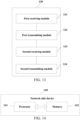
- a network-side device where the terminal includes a processor and a memory, the memory stores a program or instructions capable of running on the processor, and when the program or instructions are executed by the processor, the steps of the method according to the first aspect, the second aspect, the third aspect, or the fourth aspect are implemented.
- a network-side device including a processor and a communication interface.
- the communication interface is configured to: transmit a first request to a second network element in a second PLMN, where the first request is used to acquire data generated by a roaming user terminal in the second PLMN and/or a data analytics result generated by the second PLMN for the roaming user terminal, and the roaming user terminal is a user terminal that roams from the first PLMN to the second PLMN or a user terminal that roams from the second PLMN to the first PLMN; and receive a first response transmitted by the second network element for the first request.
- a network-side device including a processor and a communication interface.
- the communication interface is configured to: receive a first request transmitted by a first network element in a first PLMN, where the first request is used to acquire data generated by a roaming user terminal in a second PLMN and/or a data analytics result generated by the second PLMN for the roaming user terminal, and the roaming user terminal is a user terminal that roams from the first PLMN to the second PLMN or a user terminal that roams from the second PLMN to the first PLMN; process the first request, and transmit a processed first request to a second network element in the second PLMN; receive a first response transmitted by the second network element for the first request; and transmit the first response to the first network element.
- a network-side device including a processor and a communication interface.
- the communication interface is configured to receive a first request transmitted by a first network element in a first PLMN, where the first request is used to acquire data generated by a roaming user terminal in a second PLMN and/or a data analytics result generated by the second PLMN for the roaming user terminal, and the roaming user terminal is a user terminal that roams from the first PLMN to the second PLMN or a user terminal that roams from the second PLMN to the first PLMN.
- the processor is configured to acquire, based on the first request, the data generated by the roaming user terminal in the second PLMN, and/or acquire the data analytics result generated based on the data generated by the roaming user terminal in the second PLMN.
- the communication interface is configured to transmit a first response to the first network element, where the first response includes the acquired data and/or data analytics result.
- a network-side device including a processor and a communication interface.
- the communication interface is configured to: receive a first request transmitted by a first network element in a first PLMN, where the first request is used to acquire data generated by a roaming user terminal in a second PLMN and/or a data analytics result generated by the second PLMN for the roaming user terminal, and the roaming user terminal is a user terminal that roams from the first PLMN to the second PLMN or a user terminal that roams from the second PLMN to the first PLMN; transmit the first request to a second network element in the second PLMN; receive a first response transmitted by the second network element for the first request; and transmit the first response to the first network element.
- a data acquisition system including a first network element and a second network element, where the first network element may be configured to perform the steps of the method according to the first aspect, and the second network element may be configured to perform the steps of the method according to the third aspect.
- a data acquisition system including a first network element, a first interface network element, and a second network element, where the first network element may be configured to perform the steps of the method according to the first aspect, the first interface network element may be configured to perform the steps of the method according to the second aspect, and the second network element may be configured to perform the steps of the method according to the third aspect.
- a data acquisition system including a first network element, a second interface network element, and a second network element, where the first network element may be configured to perform the steps of the method according to the first aspect, the second interface network element may be configured to perform the steps of the method according to the fourth aspect, and the second network element may be configured to perform the steps of the method according to the third aspect.
- a data acquisition system including a first network element, a first interface network element, a second interface network element, and a second network element, where the first network element may be configured to perform the steps of the method according to the first aspect, the first interface network element may be configured to perform the steps of the method according to the second aspect, the second interface network element may be configured to perform the steps of the method according to the fourth aspect, and the second network element may be configured to perform the steps of the method according to the third aspect.
- a readable storage medium stores a program or instructions, and when the program or instructions are executed by a processor, the steps of the method according to the first aspect, the second aspect, the third aspect, or the fourth aspect are implemented.
- a chip is provided, where the chip includes a processor and a communication interface, the communication interface is coupled to the processor, and the processor is configured to run a program or instructions to implement the method according to the first aspect, the second aspect, the third aspect, or the fourth aspect.
- a computer program or program product is provided, where the computer program or program product is stored in a storage medium, and the computer program or program product is executed by at least one processor to implement the steps of the method according to the first aspect, the second aspect, the third aspect, or the fourth aspect.
- data or a data analytics result of a roaming user terminal can be acquired across PLMNs, to perform policy optimization on mobility management (Mobility Management, MM) and/or session management (Session Management, SM) for the roaming user terminal.
- Mobility Management Mobility Management
- Session Management Session Management
- first, second, and the like in this specification and the claims of this application are used to distinguish between similar objects rather than to describe a specific order or sequence. It should be understood that terms used in this way are interchangeable in appropriate circumstances, so that embodiments of this application can be implemented in an order other than the order illustrated or described herein.
- the objects distinguished by “first” and “second” usually belong to one category, and the number of objects is not limited. For example, there may be one or more first objects.
- “and/or” represents at least one of connected objects, and the character “/” typically represents an “or” relationship between the associated objects.
- technologies described in embodiments of this application are not limited to a long term evolution (Long Term Evolution, LTE)/LTE-advanced (LTE-Advanced, LTE-A) system, and may be further used in other wireless communication systems, such as code division multiple access (Code Division Multiple Access, CDMA), time division multiple access (Time Division Multiple Access, TDMA), frequency division multiple access (Frequency Division Multiple Access, FDMA), orthogonal frequency division multiple access (Orthogonal Frequency Division Multiple Access, OFDMA), single-carrier frequency division multiple access (Single-carrier Frequency Division Multiple Access, SC-FDMA), and other systems.
- code division multiple access Code Division Multiple Access
- TDMA time division multiple access
- FDMA frequency division multiple access
- OFDMA Orthogonal frequency division multiple access
- SC-FDMA single-carrier Frequency Division Multiple Access
- system and “network” in embodiments of this application are usually used interchangeably, and the technologies described herein may be used in the aforementioned systems and radio technologies, and may also be used in other systems and radio technologies.
- a new radio New Radio, NR
- NR New Radio
- 6G 6th Generation
- FIG. 1 is a block diagram of a wireless communication system to which embodiments of this application are applicable.
- the wireless communication system includes a terminal 11 and a network-side device 12.
- the terminal 11 may be a terminal-side device such as a mobile phone, a tablet personal computer (Tablet Personal Computer), a laptop computer (Laptop Computer) or referred to as a notebook computer, a personal digital assistant (Personal Digital Assistant, PDA), a palmtop computer, a netbook, an ultra-mobile personal computer (ultra-mobile personal computer, UMPC), a mobile Internet device (Mobile Internet Device, MID), an augmented reality (augmented reality, AR)/virtual reality (virtual reality, VR) device, a robot, a wearable device (Wearable Device), vehicle user equipment (Vehicle User Equipment, VUE), pedestrian user equipment (Pedestrian User Equipment, PUE), smart household (a home appliance with a wireless communication function, for example, a refrigerator, a television, a washing machine, or furniture), a game
- the wearable device includes a smart watch, a smart band, a smart headset, smart glasses, smart jewelry (a smart bangle, a smart bracelet, a smart ring, a smart necklace, a smart anklet, a smart ankle chain, or the like), a smart wristband, smart clothing, or the like. It should be noted that a specific type of the terminal 11 is not limited in embodiments of this application.
- the network-side device 12 may include an access network device or a core network device.
- the access network device may also be referred to as a radio access network device, a radio access network (Radio Access Network, RAN), a radio access network function, or a radio access network unit.
- RAN Radio Access Network
- the access network device may include a base station, a wireless local area network (Wireless Local Area Network, WLAN) access point, a Wi-Fi node, or the like.
- the base station may be referred to as a NodeB, an evolved NodeB (eNB), an access point, a base transceiver station (Base Transceiver Station, BTS), a radio base station, a radio transceiver, a basic service set (Basic Service Set, BSS), an extended service set (Extended Service Set, ESS), a home NodeB, a home evolved NodeB, a transmitting receiving point (Transmitting Receiving Point, TRP), or another appropriate term in the art.
- the base station is not limited to a specific technical term. It should be noted that the base station in the NR system is used only as an example for description in embodiments of this application, but a specific type of the base station is not limited.
- the core network device may include but is not limited to at least one of the following: a core network node, a core network function, a mobility management entity (Mobility Management Entity, MME), an access and mobility management function (Access and Mobility Management Function, AMF), a session management function (Session Management Function, SMF), a user plane function (User Plane Function, UPF), a policy control function (Policy Control Function, PCF), a policy and charging rules function (Policy and Charging Rules Function, PCRF), an edge application server discovery function (Edge Application Server Discovery Function, EASDF), unified data management (Unified Data Management, UDM), a unified data repository (Unified Data Repository, UDR), a home subscriber server (Home Subscriber Server, HSS), centralized network configuration (Centralized network configuration, CNC), a network repository function (Network Repository Function, NRF), a network exposure function (Network Exposure Function, NEF), a local NEF (Local NEF, or L-NEF), a
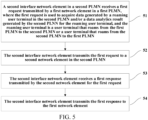
- an embodiment of this application provides a data acquisition method, including the following steps:
- Step 21 A first network element in a first PLMN transmits a first request to a second network element in a second PLMN, where the first request is used to acquire data generated by a roaming user terminal in the second PLMN and/or a data analytics result generated by the second PLMN for the roaming user terminal, and the roaming user terminal is a user terminal that roams from the first PLMN to the second PLMN or a user terminal that roams from the second PLMN to the first PLMN.
- the first network element may be an NWDAF in the first PLMN
- the second network element may be a data provider (data provider) in the second PLMN.
- the first network element may be a data analytics result consumer (consumer) in the first PLMN, and the second network element may be an NWDAF in the second PLMN.
- the first network element may be an NWDAF in the first PLMN
- the second network element may be an NWDAF or a network element (for example, an ADRF) that stores a data analytics result in the second PLMN.
- the first PLMN is a home PLMN of the roaming user terminal (namely, Home PLMN, where the roaming user terminal comes from the first PLMN through roaming)
- the second PLMN is a visited PLMN of the roaming user terminal (namely, Visited PLMN, where the roaming user terminal roams to the second PLMN).
- the home PLMN may acquire, from the visited PLMN, data generated by the roaming user terminal in the visited PLMN or a data analytics result generated by the visited PLMN for the roaming user terminal.
- the first PLMN is a visited PLMN of the roaming user terminal
- the second PLMN is a home PLMN of the roaming user terminal.
- the visited PLMN may acquire, from the home PLMN, data generated by the roaming user terminal in the home PLMN or a data analytics result generated by the home PLMN for the roaming user terminal.
- the roaming user terminal may be all or some of roaming user terminals that roam from the home PLMN to the visited PLMN.
- Step 22 The first network element receives a first response transmitted by the second network element for the first request.
- the data or the data analytics result of the roaming user terminal can be acquired across PLMNs, to perform policy optimization on mobility management (Mobility Management, MM) and/or session management (Session Management, SM) for the roaming user terminal.
- Mobility Management Mobility Management
- Session Management Session Management
- the first network element may be a network data analytics function (Network Data Analytics Function, NWDAF), an SMF, an AMF, or the like, and certainly, may alternatively be another network element.
- NWDAF Network Data Analytics Function
- SMF Serving Mobility Management Function
- AMF Access Management Function
- the NWDAF in the first PLMN is to generate a data analytics result for one or more roaming user terminals, and needs to acquire, from an NF in the second PLMN, data generated by the roaming user terminal in the second PLMN (for example, acquire location information of the roaming user terminal in the second PLMN from an AMF in the second PLMN).
- the first network element in the first PLMN acquires a data analytics result for one or more roaming user terminals from the NWDAF (namely, the second network element) in the second PLMN, so that the first network element executes a corresponding policy.
- the NWDAF in the second PLMN generates DN performance analytics (a data network performance analytics result) for the roaming user terminal to describe service experience analytics results obtained after services are distributed to different DNs.
- the SMF may select a session UPF and a DN for the roaming user terminal, to select an appropriate data path.
- the second network element may be one or more of a network function (Network Function, NF), an application function (Application Function, AF), an operation, administration, and maintenance (Operation Administration Maintenance, OAM), a radio access network (Radio Access Network, RAN), UE, an ADRF, an NWDAF, and the like.
- a network function Network Function, NF
- an application function Application Function, AF
- an operation, administration, and maintenance OAM
- a radio access network Radio Access Network, RAN
- UE Radio Access Network
- ADRF Access Network
- NWDAF Access Network
- the data analytics result may be a historical data analytics result or an instantaneously generated data analytics result.
- the first request includes at least one of the following information:
- the foregoing information is carried, so that the second PLMN can conveniently determine information about a roaming user terminal corresponding to data and/or a data analytics result that need to be provided.
- the first request further includes at least one of the following information:
- the foregoing information is carried, so that the second PLMN can conveniently determine information about a roaming user terminal corresponding to data and/or a data analytics result that need to be provided, a type of the data that needs to be provided, and/or a time period within which data needs to be provided.
- the information about the target data type may include an event identifier (event ID), used to indicate the type of the data that needs to be acquired; or the information about the target data type may include an analytics identifier (analytics ID), used to indicate the type of the data analytics result that needs to be acquired.
- event ID event identifier
- analytics ID analytics identifier
- a first network element in a first PLMN transmits a first request to a second network element in a second PLMN includes: The first network element transmits the first request to the second network element through a first interface network element.
- the first interface network element is an interface network element for transmitting data between roaming networks, and may be a data collection coordination function (Data Collection Coordination Function, DCCF) or an analytics data repository function (Analytics Data Repository Function, ADRF), or certainly may be another network element. This is not limited in this application.
- DCCF Data Collection Coordination Function
- ADRF Analytics Data Repository Function
- the first request may be Ndccf_DataManagement_Subscribe; or if the first request is transmitted to the ADRF, the first request may be Nadrf_DataManagement_RetrievalRequest or Nadrf_DataManagement_RetrievalSubscribe.
- different second PLMNs may alternatively correspond to different first interface network elements.
- different first interface network elements are used for different second PLMNs.
- the method further includes: The first network element determines, based on the identifier of the first PLMN and/or the identifier of the second PLMN, the first interface network element that is in the first PLMN and that corresponds to the second PLMN.
- each second PLMN corresponds to one first interface network element.
- each first interface network element may correspond to one or more second PLMNs.
- the first network element determines, based on the identifier of the first PLMN and/or the identifier of the second PLMN, the first interface network element that is in the first PLMN and that corresponds to the second PLMN includes: The first network element queries, based on the identifier of the first PLMN and/or the identifier of the second PLMN, a UDM network element or an NRF network element for the first interface network element that is in the first PLMN and that corresponds to the second PLMN.
- the first network element uses Nnrf_NFDiscovery_ to query the NRF for the first interface network element, where the Nnrf_NFDiscovery_ carries the identifier of the first PLMN and/or the identifier of the second PLMN.
- the first interface network element needs to pre-register, with the UDM network element or the NRF network element, a second PLMN corresponding to the first interface network element, for example, use Nnrf_NFManagement_NFRegister for registration.
- the first response includes at least one of the following information:
- the foregoing information is carried in the first response, so that the first network element can quickly and conveniently learn of a roaming terminal to which the first response is specific, and further learn of a specific type of roaming terminal to which the first response is specific.
- the first response further includes at least one of the following information:
- an embodiment of this application further provides a data acquisition method, including the following steps:
- Step 31 A first interface network element in a first PLMN receives a first request transmitted by a first network element in the first PLMN, where the first request is used to acquire data generated by a roaming user terminal in a second PLMN and/or a data analytics result generated by the second PLMN for the roaming user terminal, and the roaming user terminal is a user terminal that roams from the first PLMN to the second PLMN or a user terminal that roams from the second PLMN to the first PLMN.
- the first interface network element is an interface network element for transmitting data between roaming networks.
- Step 32 The first interface network element processes the first request, and transmits a processed first request to a second network element in the second PLMN.
- the processing the first request may include only forwarding, or may include forwarding and other processing.
- Step 33 The first interface network element receives a first response transmitted by the second network element for the first request.
- Step 34 The first interface network element transmits the first response to the first network element.
- the first interface network element serves as a data proxy network element for transmitting data between roaming networks, so that different networks can smoothly communicate with each other.
- the first interface network element may be a data collection coordination function (Data Collection Coordination Function, DCCF), an analytics data repository function (Analytics Data Repository Function, ADRF), a security edge protection proxy (Security Edge Protection Proxy, SEPP), or an interface NWDAF, or certainly, may be another network element. This is not limited in this application.
- DCCF Data Collection Coordination Function
- ADRF Analytics Data Repository Function
- SEPP Security Edge Protection Proxy
- NWDAF interface NWDAF
- the second network element may be one or more of a network function (Network Function, NF), an application function (Application Function, AF), an operation, administration, and maintenance (Operation Administration Maintenance, OAM), a radio access network (Radio Access Network, RAN), UE, an ADRF, an NWDAF, and the like.
- a network function Network Function, NF
- an application function Application Function, AF
- an operation, administration, and maintenance OAM
- a radio access network Radio Access Network, RAN
- UE Radio Access Network
- ADRF Access Network
- NWDAF Access Network
- the first request includes at least one of the following information:
- the first interface network element processes the first request includes:
- the first interface network element determines user list information based on the identifier of the first area in the first PLMN, where the user list information is used to indicate the roaming user terminal, and the roaming user terminal is located in the first area or comes from the first area through roaming; and the first interface network element adds the user list information to the first request to obtain the processed first request.
- the first interface network element may query an AMF corresponding to the first area in the first PLMN for the user list information in the first area in the first PLMN.
- the first interface network element queries an AMF in the first PLMN to learn of a user terminal that is in the first area and that comes from the second PLMN, and treats the learned user terminal as the roaming user terminal; or when the first PLMN is a home PLMN of the roaming user terminal, the first interface network element queries a UDM in the first PLMN to learn of a user terminal that roams from the first area to the second PLMN, and treats the learned user terminal as the roaming user terminal.
- the first interface network element may determine a roaming user terminal corresponding to data and/or a data analytics result that need to be provided, add the roaming user terminal to the first request, and forward the first request to the second network element, so that the second network element can quickly learn of the roaming user terminal corresponding to the data and/or the data analytics result that need to be provided.
- the method further includes:
- the first interface network element determines a second interface network element in the second PLMN.
- the transmitting a processed first request to a second network element in the second PLMN includes: The first interface network element transmits the processed first request to the second network element through the second interface network element.
- the first interface network element determines a second interface network element in the second PLMN includes: The first interface network element determines, based on the identifier of the first PLMN and/or the identifier of the second PLMN, the second interface network element that is in the second PLMN and that corresponds to the first PLMN.
- each first PLMN corresponds to one second interface network element.
- each second interface network element may correspond to one or more first PLMNs.
- the first interface network element determines, based on the identifier of the first PLMN and/or the identifier of the second PLMN, the second interface network element that is in the second PLMN and that corresponds to the first PLMN includes: The first interface network element queries, based on the identifier of the first PLMN and/or the identifier of the second PLMN, a UDM network element or an NRF network element for the second interface network element that is in the second PLMN and that corresponds to the first PLMN.
- the first interface network element may query the UDM network element or the NRF network element by using an Nnrf_NFDiscovery_request message to learn of the second interface network element.
- an embodiment of this application further provides a data acquisition method, including the following steps: Step 41: A second network element in a second PLMN receives a first request transmitted by a first network element in a first PLMN, where the first request is used to acquire data generated by a roaming user terminal in the second PLMN and/or a data analytics result generated by the second PLMN for the roaming user terminal, and the roaming user terminal is a user terminal that roams from the first PLMN to the second PLMN or a user terminal that roams from the second PLMN to the first PLMN.
- the second network element may be one or more of a network function (Network Function, NF), an application function (Application Function, AF), an operation, administration, and maintenance (Operation Administration Maintenance, OAM), a radio access network (Radio Access Network, RAN), UE, an ADRF, an NWDAF, and the like.
- Network Function Network Function
- AF Application Function
- OAM Opera Administration Maintenance
- RAN Radio Access Network
- UE User Equipment
- ADRF Access Network
- NWDAF NWDAF
- the first network element may be an NWDAF in the first PLMN
- the second network element may be a data provider (data provider), for example, an NF, an AF, an OAM, a RAN, and/or UE, in the second PLMN.
- the first network element may be a data analytics result consumer (consumer) in the first PLMN, and the second network element may be an NWDAF in the second PLMN.
- the first network element may be an NWDAF in the first PLMN
- the second network element may be an NWDAF or a network element (for example, an ADRF) that stores a data analytics result in the second PLMN.
- Step 42 The second network element acquires, based on the first request, the data generated by the roaming user terminal in the second PLMN, and/or acquires the data analytics result generated based on the data generated by the roaming user terminal in the second PLMN.
- Step 43 The second network element transmits a first response to the first network element, where the first response includes the acquired data and/or data analytics result.
- the data or the data analytics result of the roaming user terminal can be acquired across PLMNs, to perform policy optimization on mobility management and/or session management for the roaming user terminal.
- the first request includes at least one of the following information:
- the first request further includes at least one of the following information:
- the second network element acquires, based on the first request, the data generated by the roaming user terminal in the second PLMN, and/or acquires the data analytics result generated based on the data generated by the roaming user terminal in the second PLMN includes:
- the second network element determines, based on the first roaming indication in the first request, that the first request is specific to the roaming user terminal; or the second network element determines, based on the first roaming indication in the first request, that the roaming user terminal is a user terminal that roams from the first PLMN to the second PLMN or a user terminal that roams from the second PLMN to the first PLMN.
- the second network element acquires, based on the first request, the data generated by the roaming user terminal in the second PLMN, and/or acquires the data analytics result generated based on the data generated by the roaming user terminal in the second PLMN further includes:
- the second network element determines, based on a PLMN identifier included in an identifier of a user terminal, whether the user terminal comes from the first PLMN; and by treating a user terminal that comes from the first PLMN as the roaming user terminal, acquires the data generated by the roaming user terminal in the second PLMN, and/or acquires the data analytics result generated based on the data generated by the roaming user terminal in the second PLMN.
- the identifier of the user terminal may be an international mobile subscriber identification (International Mobile Subscriber Identification, IMSI), a subscription permanent identifier (Subscription Permanent Identifier, SUPI), or the like.
- IMSI International Mobile Subscriber Identification
- SUPI Subscribe Permanent Identifier
- the second network element acquires, based on the first request, the data generated by the roaming user terminal in the second PLMN, and/or acquires the data analytics result generated based on the data generated by the roaming user terminal in the second PLMN further includes:
- the second network element determines, based on a PLMN identifier included in an identifier of a user terminal, whether the user terminal comes from the first PLMN;
- the second network element acquires, based on the first request, the data generated by the roaming user terminal in the second PLMN, and/or acquires the data analytics result generated based on the data generated by the roaming user terminal in the second PLMN further includes:
- the second network element acquires, based on the first request, the data generated by the roaming user terminal in the second PLMN, and/or acquires the data analytics result generated based on the data generated by the roaming user terminal in the second PLMN further includes at least one of the following:
- the second network element acquires, based on the information about the target data type in the first request, data of the roaming user terminal that belongs to the target data type;
- the first response includes at least one of the following information:
- the first response further includes at least one of the following information:
- an embodiment of this application further provides a data acquisition method, including the following steps:
- Step 51 A second interface network element in a second PLMN receives a first request transmitted by a first network element in a first PLMN, where the first request is used to acquire data generated by a roaming user terminal in the second PLMN and/or a data analytics result generated by the second PLMN for the roaming user terminal, and the roaming user terminal is a user terminal that roams from the first PLMN to the second PLMN or a user terminal that roams from the second PLMN to the first PLMN.
- Step 52 The second interface network element transmits the first request to a second network element in the second PLMN.
- Step 53 The second interface network element receives a first response transmitted by the second network element for the first request.
- Step 54 The second interface network element transmits the first response to the first network element.
- the second interface network element serves as a data proxy network element for transmitting data between roaming networks, so that different networks can smoothly communicate with each other.
- the second interface network element may be a data collection coordination function (Data Collection Coordination Function, DCCF), an analytics data repository function (Analytics Data Repository Function, ADRF), a security edge protection proxy (Security Edge Protection Proxy, SEPP), or an interface NWDAF, or certainly, may be another network element. This is not limited in this application.
- the second network element may be one or more of a network function (Network Function, NF), an application function (Application Function, AF), an operation, administration, and maintenance (Operation Administration Maintenance, OAM), a radio access network (Radio Access Network, RAN), UE, an ADRF, an NWDAF, and the like.
- a network function Network Function, NF
- an application function Application Function, AF
- an operation, administration, and maintenance OAM
- a radio access network Radio Access Network, RAN
- UE Radio Access Network
- ADRF Access Network
- NWDAF Access Network
- the second interface network element may request the data analytics result from the NWDAF by using Nnwdaf_DataManagement_Subscribe, Nnwdaf_AnalyticsSubscription_Subscribe, or Nnwdaf_AnalyticsInfo_Request.
- the second interface network element may acquire data from an NF by using Nnf_EventExposure_Subscribe.
- the first network element may be an NWDAF in the first PLMN
- the second network element may be a data provider (data provider), for example, an NF, an AF, an OAM, a RAN, and/or UE, in the second PLMN.
- the first network element may be a data analytics result consumer (consumer) in the first PLMN, and the second network element may be an NWDAF in the second PLMN.
- the first network element may be an NWDAF in the first PLMN
- the second network element may be an NWDAF or a network element (for example, an ADRF) that stores a data analytics result in the second PLMN.
- the first request includes at least one of the following information:
- the first request further includes at least one of the following information:
- the method further includes: The second interface network element determines authorization information of the first network element based on the first request, where the authorization information is used to indicate that the first network element is authorized to acquire the data generated by the roaming user terminal in the second PLMN and/or the data analytics result generated by the second PLMN for the roaming user terminal.
- the authorization information includes one or more of the following information:
- the first PLMN is authorized to acquire data and/or a data analytics result in the second PLMN.
- a specific first network element and/or first interface network element in the first PLMN is authorized to acquire data and/or a data analytics result in the second PLMN.
- a specific first network element and/or first interface network element in the first PLMN is authorized to acquire data and/or a data analytics result of a specific second interface network element, second network element, or second area in the second PLMN.
- the first PLMN is authorized to acquire specific data (identified by an event ID) and/or a specific data analytics result (identified by an analytics ID) in the second PLMN.
- the second interface network element may not transmit the first request to the second network element, and optionally, may further transmit a reject request to the first network element, where a reject cause value may be: having no permission to acquire the data generated by the roaming user terminal in the second PLMN and/or the data analytics result generated by the second PLMN for the roaming user terminal.
- the second interface network element may query another network element for whether the first network element is authorized, or may determine, based on a local policy of the second interface network element or an operator-configured policy, whether the first network element is authorized.
- the local policy or the operator-configured policy may be, for example, a roaming agreement signed between two PLMNs. Information, such as a scope and/or a type of data and/or data analytics results allowed to be acquired between the two PLMNs, is signed in the roaming agreement.
- the second interface network element determines authorization information of the first network element based on the first request includes: The second interface network element determines the authorization information of the first network element based on the identifier of the first PLMN and/or the identifier of the first area in the first PLMN in the first request.
- the second interface network element determines the authorization information of the first network element based on the identifier of the first PLMN and/or the identifier of the first area in the first PLMN in the first request includes: The second interface network element queries a UDM, a network exposure function (NEF), or a security edge protection proxy (SEPP) of the second PLMN for data acquisition authorization information corresponding to the identifier of the first PLMN and/or the identifier of the first area in the first PLMN, where the data acquisition authorization information is used to indicate that the first PLMN and/or a network element of the first PLMN is allowed to acquire the data generated by the roaming user terminal in the second PLMN and/or the data analytics result generated by the second PLMN for the roaming user terminal; and the second interface network element determines the authorization information of the first network element based on the data acquisition authorization information.
- NEF network exposure function
- SEPP security edge protection proxy
- the method further includes: The second interface network element determines the second network element based on the identifier of the second area in the second PLMN and/or the information about the target data type in the first request.
- a to-be-acquired event ID is a UE location
- a type of the second network element is an AMF type.
- an analytics ID UE mobility (mobility)
- a V-NWDAF for generating the UE mobility analytics in a visited PLMN is determined.
- the second interface network element determines that an AMF instance (instance) serving the AOI in the V-PLMN is an AMF instance 1.
- An NWDAF (namely, the foregoing first network element, also referred to as an H-NWDAF) in an H-PLMN (home PLMN, namely, the foregoing first PLMN) is to generate a data analytics result for one or more roaming user terminals, and needs to acquire, from an NF in a V-PLMN (visited PLMN, namely, the foregoing second PLMN), data generated by the roaming user terminal in the V-PLMN (for example, acquire location information of the roaming user terminal in the V-PLMN from an AMF in the V-PLMN).
- V-PLMN visitor PLMN
- AMF AMF
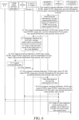
- a data acquisition method in this embodiment of this application includes the following steps: Step 61: The H-NWDAF determines that data generated by the roaming user terminal in the V-PLMN needs to be acquired. In this case, the H-NWDAF transmits a first request to a first interface network element (for example, a data collection coordination function (Data Collection Coordination Function, H-DCCF) or an analytics data repository function (Analytics Data Repository Function, H-ADRF)), where the first request includes at least one of the following information:
- a first interface network element for example, a data collection coordination function (Data Collection Coordination Function, H-DCCF) or an analytics data repository function (Analytics Data Repository Function, H-ADRF)
- the first request may be Ndccf_DataManagement_Subscribe; or if the first request is transmitted to the H-ADRF, the first request may be Nadrf_DataManagement_RetrievalRequest or Nadrf_DataManagement_RetrievalSubscribe.
- the first request message may further include other information, for example:
- the first interface network element is an interface network element for transmitting data between roaming networks, for example, the H-DCCF deployed in the H-PLMN.
- different visited networks V-PLMNs may alternatively correspond to different H-DCCFs.
- different H-DCCFs are used for different V-PLMNs.
- the H-NWDAF queries a unified data management (Unified Data Management, UDM) network element or an NF repository function (NF Repository Function, NRF) network element for an H-DCCF corresponding to a specific V-PLMN ID, for example, queries the NRF for an H-DCCF by using Nnrf_NFDiscovery_, where the Nnrf_NFDiscovery_ carries an H-PLMN ID and/or a V-PLMN ID.
- UDM Unified Data Management
- NRF NF Repository Function
- the H-DCCF needs to pre-register, with the UDM network element or the NRF network element, a V-PLMN ID corresponding to the H-DCCF, for example, use Nnrf_NFManagement_NFRegister for registration.
- Step 62 The H-DCCF/H-ADRF processes the first request, and transmits a processed first request to a V-DCCF/V-ADRF.
- the H-DCCF/H-ADRF may query the UDM network element or the NRF network element for the V-DCCF/V-ADRF based on a target V-PLMN ID.
- the H-DCCF/H-ADRF may query the UDM network element or the NRF network element by using an Nnrf_NFDiscovery_request message to learn of the V-DCCF/V-ADRF.
- step 61 if the H-DCCF/H-ADRF only forwards the first request, for content included in the first request, refer to step 61.
- the H-DCCF/H-ADRF may further determine a UE list based on the source area in the H-PLMN, and add the UE list to the first request to obtain the processed first request. Specifically, the H-DCCF/H-ADRF may query the UDM in the H-PLMN for a list of UEs that roam from the HAOI to the V-PLMN.
- Step 63 The V-DCCF/V-ADRF determines a data provider (data provider, namely, the foregoing second network element) in the V-PLMN based on the first request.
- the data provider in the V-PLMN may include one or more of an NF, an AF, an OAM, a RAN, UE, and an NWDAF in the V-PLMN.
- the V-DCCF/V-ADRF further needs to determine whether the H-PLMN is authorized to acquire data.
- the V-DCCF/V-ADRF determines one or more of the following information:
- This may be specifically determined based on a roaming agreement signed between the two PLMNs.
- Information such as a scope and/or a type of data allowed to be acquired between the two PLMNs, is signed in the roaming agreement.
- Step 64 The V-DCCF/V-ADRF transmits a first request to the data provider in the V-PLMN.
- Step 65 The data provider in the V-PLMN acquires corresponding data based on the first request.
- the data provider determines, based on the roaming indication in the first request, that a data collection object is UE that roams to the V-PLMN.
- the data provider determines, based on PLMN ID information included in a UE ID (for example, an IMSI or an SUPI), whether the UE comes from the H-PLMN, and acquires related data for roaming UE that comes from the H-PLMN.
- PLMN ID information included in a UE ID (for example, an IMSI or an SUPI)
- the data provider may query the UDM in the H-PLMN for home area information of UE, determine, based on the home area information, whether the UE comes from the source area in the PLMN, and acquire related data for roaming UE that comes from the source area in the PLMN.
- the data provider acquires, based on the target data type (data type/event ID), data of the UE that belongs to the data type.
- the data provider acquires, based on the information about the target time period, data generated by the object UE within the target time period.
- the data provider determines a data collection object (namely, the object UE) based on the UE list.
- Step 66 The data provider transmits a first response for the first request to the V-DCCF/V-ADRF, where the first response includes the acquired data.
- Step 67 The V-DCCF/V-ADRF transmits a first response to the H-DCCF/H-ADRF.
- the first response includes at least one of the following information:
- Step 68 The H-DCCF/H-ADRF transmits a first response to the H-NWDAF.
- the H-DCCF/H-ADRF may further filter data in the first response based on the UE list.
- Step 69 The H-NWDAF performs data analytics based on data of the roaming user terminal that is acquired from the V-PLMN, to obtain a data analytics result for the roaming user terminal.
- data analytics may be performed for each roaming user terminal, or analytics may be performed for a roaming user terminal in each source area in the H-PLMN.
- a data analytics result consumer (consumer, namely, the foregoing first network element) in an H-PLMN (home PLMN, namely, the foregoing first PLMN) acquires a data analytics result for one or more roaming user terminals from an NWDAF (namely, the foregoing second network element) in a V-PLMN (visited PLMN, namely, the foregoing second PLMN), so that the H-consumer executes a corresponding policy.
- the NWDAF in the V-PLMN generates DN performance analytics (a data network performance analytics result) for the roaming user terminal to describe service experience analytics results obtained after services are distributed to different DNs.
- the H-SMF may select a session UPF and a DN for the roaming user terminal, to select an appropriate data path.
- Embodiment 2 of this application refers to Embodiment 1 of this application.
- a difference lies in that a data analytics result is acquired. Specifically, the following steps are included:
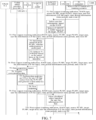
- Step 71 The H-consumer determines that a data analytics result for a roaming user terminal that roams to the V-PLMN needs to be acquired.
- the H-consumer transmits a first request to a first interface network element (for example, an H-DCCF or an H-ADRF), where the first request includes at least one of the following information:
- the first request message may further include other information, for example:
- the first interface network element is an interface network element for transmitting data between roaming networks, for example, the H-DCCF deployed in the H-PLMN.
- different visited networks V-PLMNs may alternatively correspond to different H-DCCFs.
- different H-DCCFs are used for different V-PLMNs.
- the H-NWDAF queries a UDM network element or an NRF network element for an H-DCCF corresponding to a specific V-PLMN ID, for example, queries the NRF for an H-DCCF by using Nnrf_NFDiscovery_, where the Nnrf_NFDiscovery_ carries an H-PLMN ID and/or a V-PLMN ID.
- the H-DCCF needs to pre-register, with the UDM network element or the NRF network element, a V-PLMN corresponding to the H-DCCF, for example, use Nnrf_NFManagement_NFRegister for registration.
- Step 72 The H-DCCF/H-ADRF processes the first request, and transmits a processed first request to a V-DCCF/V-ADRF.
- the H-DCCF/H-ADRF may query the UDM network element or the NRF network element for the V-DCCF/V-ADRF based on a target V-PLMN ID.
- the H-DCCF/H-ADRF may query the UDM network element or the NRF network element by using an Nnrf_NFDiscovery_request message to learn of the V-DCCF/V-ADRF.
- step 71 if the H-DCCF/H-ADRF only forwards the first request, for content included in the first request, refer to step 71.
- the H-DCCF/H-ADRF may further determine a UE list based on the source area in the H-PLMN, and add the UE list to the first request to obtain the processed first request. Specifically, the H-DCCF/H-ADRF may query the UDM in the H-PLMN for a list of UEs that roam from the HAOI to the V-PLMN.
- Step 73 The V-DCCF/V-ADRF determines, based on the first request, an NWDAF (namely, the foregoing second network element) for providing a data analytics result in the V-PLMN.
- NWDAF namely, the foregoing second network element
- the V-DCCF/V-ADRF may further determine, based on the target data type (analytics ID) in the first request, an NWDAF that can provide the type.
- the V-DCCF/V-ADRF determines, based on the target area in the V-PLMN that is included in the first request, an NWDAF serving the area.
- the V-DCCF/V-ADRF may further determine whether the H-PLMN is authorized to acquire a data analytics result.
- the V-DCCF/V-ADRF determines one or more of the following information:
- This may be specifically determined based on a roaming agreement signed between the two PLMNs.
- Information such as a scope and/or a type of a data analytics result allowed to be acquired between the two PLMNs, is signed in the roaming agreement.
- Step 74 The V-DCCF/V-ADRF transmits a first request to a V-NWDAF.
- Step 75 The V-NWDAF transmits a data acquisition request to a V-data provider to acquire corresponding data for generating a data analytics result.
- the method further includes: Optionally, the V-NWDAF determines, based on the roaming indication in the first request, that a data collection object is UE that roams to the V-PLMN.
- the data provider determines a data collection object (namely, the object UE) based on the UE list.
- the V-NWDAF determines, based on PLMN ID information included in a UE ID (for example, an IMSI or an SUPI), whether the UE comes from the H-PLMN, and acquires related data for roaming UE that comes from the H-PLMN.
- PLMN ID information included in a UE ID (for example, an IMSI or an SUPI)
- the V-NWDAF may query the UDM in the H-PLMN for home area information of UE, determine, based on the home area information, whether the UE comes from the source area in the PLMN, and acquire related data for roaming UE that comes from the source area in the PLMN.
- the method Before the transmitting a data acquisition request to a V-data provider, the method further includes:
- the V-NWDAF determines, based on the target data analytics result type (analytics ID), a type of data (event ID/data type) to be acquired from the V-data provider, to generate a target data analytics result.
- the target data analytics result type analytics ID
- a type of data event ID/data type
- the V-NWDAF acquires, based on the information about the target time period, data generated by the object UE within the target time period, to generate the target data analytics result.
- Step 76 The V-data provider acquires corresponding data based on the data acquisition request.
- Step 77 The V-NWDAF generates a data analytics result based on the data acquired from the V-data provider.
- data analytics may be performed for each roaming user terminal or all roaming user terminals.
- Step 78 The V-NWDAF transmits a first response for the first request to the V-DCCF/V-ADRF, where the first response includes the acquired data analytics result.
- Step 79 The V-DCCF/V-ADRF transmits a first response to the H-DCCF/H-ADRF.
- the first response includes at least one of the following information:
- Step 710 The H-DCCF/H-ADRF transmits a first response to the H-consumer.
- the H-DCCF/H-ADRF may further filter data in the first response based on the UE list.
- the first request transmitted by the V-DCCF to the V-NWDAF in step 74 may be Nnwdaf_AnalyticsSubscription_Subscribe or Nnwdaf_AnalyticsInfo_Request.
- an NWDAF (namely, the foregoing first network element, also referred to as a V-NWDAF) in a V-PLMN (visited PLMN, namely, the foregoing first PLMN) is to generate a data analytics result for one or more roaming user terminals, and needs to acquire, from a data provider in an H-PLMN (home PLMN, namely, the foregoing second PLMN), data generated by the roaming user terminal in the H-PLMN.
- home PLMN home PLMN, namely, the foregoing second PLMN
- a data acquisition method in this embodiment of this application includes the following steps:
- Step 81 The V-NWDAF determines that data generated in the H-PLMN by a roaming user terminal that roams from the H-PLMN to the V-PLMN needs to be acquired.
- the V-NWDAF transmits a first request to a first interface network element (for example, a V-DCCF or a V-ADRF), where the first request includes at least one of the following information:
- the first request message may further include other information, for example:
- the first interface network element is an interface network element for transmitting data between roaming networks, for example, the V-DCCF deployed in the V-PLMN.
- different H-PLMNs may alternatively correspond to different V-DCCFs.
- different V-DCCFs are used for different H-PLMNs.
- the V-NWDAF queries a UDM network element or an NRF network element for a V-DCCF corresponding to a specific H-PLMN ID.
- the V-DCCF needs to pre-register, with the UDM network element or the NRF network element, an H-PLMN corresponding to the V-DCCF, for example, use Nnrf_NFManagement_NFRegister for registration.
- Step 82 The V-DCCF/V-ADRF processes the first request, and transmits a processed first request to an H-DCCF/H-ADRF.
- the V-DCCF/V-ADRF may query the UDM network element or the NRF network element for the H-DCCF/H-ADRF based on an H-PLMN ID.
- step 81 if the V-DCCF/V-ADRF only forwards the first request, for content included in the first request, refer to step 81.
- the V-DCCF/V-ADRF may further determine a UE list based on the source area in the V-PLMN, and add the UE list to the first request to obtain the processed first request. Specifically, the V-DCCF/V-ADRF may query an AMF corresponding to the VAOI for a list of UEs in the VAOI that come from the HPLMN.
- Step 83 The H-DCCF/H-ADRF determines a data provider (data provider, namely, the foregoing second network element) in the H-PLMN based on the first request.
- the data provider in the H-PLMN may include one or more of an NF, an AF, an OAM, a RAN, UE, and an NWDAF in the H-PLMN.
- the H-DCCF/H-ADRF may further determine, based on the target data type (data type/event ID) in the first request, a type of an NF that can provide the type.
- the H-DCCF/H-ADRF determines, based on the target area included in the first request, an NF instance (instance(s)) corresponding to a type (type) of an NF serving the area.
- the H-DCCF/H-ADRF further needs to determine whether the V-PLMN is authorized to acquire data.
- the H-DCCF/H-ADRF determines one or more of the following information:
- This may be specifically determined based on a roaming agreement signed between the two PLMNs.
- Information such as a scope and/or a type of data allowed to be acquired between the two PLMNs, is signed in the roaming agreement.
- Step 84 The H-DCCF/H-ADRF transmits a first request to the data provider in the H-PLMN.
- Step 85 The data provider in the H-PLMN acquires corresponding data based on the first request.
- the data provider in the H-PLMN determines a UE list based on the roaming indication and the V-PLMN in the first request, where a roaming user terminal in the UE list is a user terminal that roams to the V-PLMN.
- the data provider in the H-PLMN determines a UE list based on the source AOI (the AOI in the V-PLMN in this embodiment) in the first request, where a roaming user terminal in the UE list is a user terminal that roams to the source AOI.
- the data provider acquires, based on the target data type (data type/event ID), data of the UE that belongs to the data type.
- the data provider acquires, based on the information about the target time period, data generated by object UE within the target time period.
- the data provider determines a data collection object (namely, the object UE) based on the UE list.
- Step 86 The data provider transmits a first response for the first request to the H-DCCF/H-ADRF, where the first response includes the acquired data.
- Step 87 The H-DCCF/H-ADRF transmits a first response to the V-DCCF/V-ADRF.
- the first response includes at least one of the following information:
- Step 88 The V-DCCF/V-ADRF transmits a first response to the V-NWDAF.
- the V-DCCF/V-ADRF may further filter data in the first response based on the UE list.
- Step 89 The V-NWDAF performs data analytics based on data of the roaming user terminal that is acquired from the H-PLMN, to obtain a data analytics result for the roaming user terminal.
- a data acquisition direction in this embodiment is opposite to that in Embodiment 1, but a principle is similar. Differences are as follows:
- the data provider in the H-PLMN may determine a UE list based on the roaming indication and the V-PLMN ID in the first request, where a roaming user terminal in the UE list is a user terminal that roams to the V-PLMN.
- the data provider in the H-PLMN may alternatively determine a UE list based on the source AOI in the in VPLMN (the AOI in the V-PLMN in this embodiment) in the first request, where a roaming user terminal in the UE list is a user terminal that roams to the source AOI in the VPLMN.
- a data analytics result consumer (consumer, namely, the foregoing first network element) in a V-PLMN (namely, the foregoing first PLMN) acquires a data analytics result for one or more roaming user terminals from an NWDAF (namely, the foregoing second network element) in an H-PLMN (namely, the foregoing second PLMN), so that the V-consumer executes a corresponding policy.
- NWDAF namely, the foregoing second network element
- H-PLMN namely, the foregoing second PLMN
- Step 91 The V-consumer determines that a data analytics result, in the H-PLMN, for a roaming user terminal that roams to the V-PLMN needs to be acquired.
- the V-consumer transmits a first request to a first interface network element (for example, a V-DCCF or a V-ADRF), where the first request includes at least one of the following information:
- the first request message may further include other information, for example:
- the first interface network element is an interface network element for transmitting data between roaming networks, for example, the V-DCCF deployed in the V-PLMN.
- different H-PLMNs may alternatively correspond to different V-DCCFs.
- different V-DCCFs are used for different H-PLMNs.
- the V-consumer queries a UDM network element or an NRF network element for a V-DCCF corresponding to a specific H-PLMN ID.
- the V-DCCF needs to pre-register, with the UDM network element or the NRF network element, an H-PLMN corresponding to the V-DCCF.
- Step 92 The V-DCCF/V-ADRF processes the first request, and transmits a processed first request to an H-DCCF/H-ADRF.
- the V-DCCF/V-ADRF may query the UDM network element or the NRF network element for the H-DCCF/H-ADRF based on an H-PLMN ID.
- step 91 if the V-DCCF/V-ADRF only forwards the first request, for content included in the first request, refer to step 91.
- the V-DCCF/V-ADRF may further determine a UE list based on the source area in the V-PLMN, and add the UE list to the first request to obtain the processed first request. Specifically, the V-DCCF/V-ADRF may query an AMF corresponding to the VAOI for a list of UEs in the VAOI that come from the HPLMN.
- Step 93 The H-DCCF/H-ADRF determines, based on the first request, an NWDAF (namely, the foregoing second network element) for providing a data analytics result in the H-PLMN.
- NWDAF namely, the foregoing second network element
- the H-DCCF/H-ADRF may further determine, based on the target data type (Analytics ID) in the first request, an NWDAF that can provide the type.
- the H-DCCF/H-ADRF determines, based on the target area in the HPLMN that is included in the first request, an NWDAF serving the area.
- the H-DCCF/H-ADRF may further determine whether the V-PLMN is authorized to acquire a data analytics result.
- the H-DCCF/H-ADRF determines one or more of the following information:
- This may be specifically determined based on a roaming agreement signed between the two PLMNs.
- Information such as a scope and/or a type of a data analytics result allowed to be acquired between the two PLMNs, is signed in the roaming agreement.
- Step 94 The H-DCCF/H-ADRF transmits a first request to an H-NWDAF.
- Step 95 The H-NWDAF transmits a data acquisition request to an H-data provider to acquire corresponding data for generating a data analytics result.
- the method further includes: Optionally, the H-NWDAF determines, based on the roaming indication in the first request, that a data collection object is UE that roams to the V-PLMN.
- the data provider determines a data collection object (namely, the object UE) based on the UE list.
- the H-NWDAF may query the UDM in the H-PLMN for whether UE is located in the source area in the V-PLMN, and acquire related data for roaming UE that is located in the source area in the V-PLMN.
- the method further includes: Optionally, the H-NWDAF determines, based on the target data analytics result type (analytics ID), a type of data (event ID/data type) to be acquired from the H-data provider, to generate a target data analytics result.
- the target data analytics result type analytics ID
- a type of data event ID/data type
- the H-NWDAF acquires, based on the information about the target time period, data generated by the object UE within the target time period, to generate the target data analytics result.
- Step 96 The H-data provider acquires corresponding data based on the data acquisition request.
- the H-data provider may alternatively determine, based on the roaming indication in the first request, that a data collection object is UE that roams to the V-PLMN.
- Step 97 The H-NWDAF generates a data analytics result based on the data acquired from the H-data provider.
- data analytics may be performed for each roaming user terminal or all roaming user terminals.
- Step 78 The H-NWDAF transmits a first response for the first request to the H-DCCF/H-ADRF, where the first response includes the acquired data analytics result.
- Step 79 The H-DCCF/H-ADRF transmits a first response to the V-DCCF/V-ADRF.
- the first response includes at least one of the following information:
- Step 910 The V-DCCF/V-ADRF transmits a first response to the V-consumer.
- the V-DCCF/V-ADRF may further filter data in the first response based on the UE list.
- a data analytics result acquisition direction in this embodiment is opposite to that in Embodiment 2, but a principle is similar. Differences are as follows:
- the data provider in the H-PLMN determines a UE list based on two pieces of information: the roaming indication and a source PLMN (the V-PLMN in this embodiment), where the UE list includes UE that roams to the V-PLMN.
- the data provider in the H-PLMN may alternatively determine a UE list based on a source AOI (the AOI in the V-PLMN in this embodiment), where the UE list includes UE that roams to the V-AOI.
- the data acquisition method provided in embodiments of this application may be performed by a data acquisition apparatus.
- a data acquisition apparatus provided in embodiments of this application is described by using an example in which a data acquisition apparatus performs the data acquisition method.
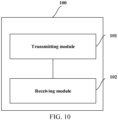
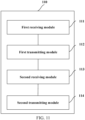
- an embodiment of this application further provides a data acquisition apparatus 100, including:
- the data or the data analytics result of the roaming user terminal can be acquired across PLMNs, to perform policy optimization on mobility management and/or session management for the roaming user terminal.
- data is transmitted between roaming networks through a data proxy network element, so that different networks can smoothly communicate with each other.
- the first request includes at least one of the following information:
- the first request further includes at least one of the following information:
- the transmitting module 101 is configured to transmit the first request to the second network element through a first interface network element.
- the data acquisition apparatus 100 further includes: a determining module, configured to determine, based on the identifier of the first PLMN and/or the identifier of the second PLMN, the first interface network element that is in the first PLMN and that corresponds to the second PLMN.
- a determining module configured to determine, based on the identifier of the first PLMN and/or the identifier of the second PLMN, the first interface network element that is in the first PLMN and that corresponds to the second PLMN.
- each second PLMN corresponds to one first interface network element.
- the determining module is configured to query, based on the identifier of the first PLMN and/or the identifier of the second PLMN, a UDM network element or an NRF network element for the first interface network element that is in the first PLMN and that corresponds to the second PLMN.
- the first response includes at least one of the following information:
- the data acquisition apparatus in this embodiment of this application may be an electronic device, for example, an electronic device with an operating system; or may be a component in an electronic device, for example, an integrated circuit or a chip.
- the data acquisition apparatus provided in this embodiment of this application is capable of implementing the processes implemented in the method embodiment of FIG. 2 , with the same technical effect achieved. To avoid repetition, details are not described herein again.
- an embodiment of this application further provides a data acquisition apparatus 110, including:
- data is transmitted between roaming networks through a data proxy network element, so that different networks can smoothly communicate with each other.
- the first request includes at least one of the following information:
- the first transmitting module 112 is configured to: determine user list information based on the identifier of the first area in the first PLMN, where the user list information is used to indicate the roaming user terminal, and the roaming user terminal is located in the first area or comes from the first area through roaming; and add the user list information to the first request to obtain the processed first request.
- the data acquisition apparatus 110 further includes:
- the determining module is configured to determine, based on the identifier of the first PLMN and/or the identifier of the second PLMN, the second interface network element that is in the second PLMN and that corresponds to the first PLMN.
- each first PLMN corresponds to one second interface network element.
- the determining module is configured to query, based on the identifier of the first PLMN and/or the identifier of the second PLMN, a UDM network element or an NRF network element for the second interface network element that is in the second PLMN and that corresponds to the first PLMN.
- the data acquisition apparatus in this embodiment of this application may be an electronic device, for example, an electronic device with an operating system; or may be a component in an electronic device, for example, an integrated circuit or a chip.
- the data acquisition apparatus provided in this embodiment of this application is capable of implementing the processes implemented in the method embodiment of FIG. 3 , with the same technical effect achieved. To avoid repetition, details are not described herein again.
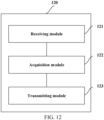
- an embodiment of this application further provides a data acquisition apparatus 120, including:
- the data or the data analytics result of the roaming user terminal can be acquired across PLMNs, to perform policy optimization on mobility management and/or session management for the roaming user terminal.
- the first request includes at least one of the following information:
- the first request further includes at least one of the following information:
- the acquisition module 122 is configured to determine, based on the first roaming indication in the first request, that the roaming user terminal is a user terminal that roams from the first PLMN to the second PLMN or a user terminal that roams from the second PLMN to the first PLMN.
- the acquisition module 122 is configured to: in the case of determining that the roaming user terminal is a user terminal that roams from the first PLMN to the second PLMN, determine, based on a PLMN identifier included in an identifier of a user terminal, whether the user terminal comes from the first PLMN, and by treating a user terminal that comes from the first PLMN as the roaming user terminal, acquire the data generated by the roaming user terminal in the second PLMN, and/or acquire the data analytics result generated based on the data generated by the roaming user terminal in the second PLMN.
- the acquisition module 122 is configured to: in the case of determining that the roaming user terminal is a user terminal that roams from the first PLMN to the second PLMN, determine, based on a PLMN identifier included in an identifier of a user terminal, whether the user terminal comes from the first PLMN; if the user terminal comes from the first PLMN, query a UDM in the first PLMN for home area information of the user terminal; determine, based on the home area information, whether the user terminal comes from the first area in the first PLMN; and by treating a user terminal that comes from the first area in the first PLMN as the roaming user terminal, acquire the data generated by the roaming user terminal in the second PLMN, and/or acquire the data analytics result generated based on the data generated by the roaming user terminal in the second PLMN.
- the acquisition module 122 is configured to: in the case of determining that the roaming user terminal is a user terminal that roams from the second PLMN to the first PLMN, query a UDM of the second PLMN to learn of a user terminal that is located in the first PLMN or the first area in the first PLMN; and by treating the user terminal as the roaming user terminal, acquire the data generated by the roaming user terminal in the second PLMN, and/or acquire the data analytics result generated based on the data generated by the roaming user terminal in the second PLMN.
- the first response includes at least one of the following information:
- the data acquisition apparatus in this embodiment of this application may be an electronic device, for example, an electronic device with an operating system; or may be a component in an electronic device, for example, an integrated circuit or a chip.
- the data acquisition apparatus provided in this embodiment of this application is capable of implementing the processes implemented in the method embodiment of FIG. 4 , with the same technical effect achieved. To avoid repetition, details are not described herein again.
- an embodiment of this application further provides a data acquisition apparatus 130, including:
- data is transmitted between roaming networks through a data proxy network element, so that different networks can smoothly communicate with each other.
- the first request includes at least one of the following information:
- the first request further includes at least one of the following information:
- the data acquisition apparatus 130 further includes: a first determining module, configured to determine authorization information of the first network element based on the first request, where the authorization information is used to indicate that the first network element is authorized to acquire the data generated by the roaming user terminal in the second PLMN and/or the data analytics result generated by the second PLMN for the roaming user terminal.
- a first determining module configured to determine authorization information of the first network element based on the first request, where the authorization information is used to indicate that the first network element is authorized to acquire the data generated by the roaming user terminal in the second PLMN and/or the data analytics result generated by the second PLMN for the roaming user terminal.
- the first determining module is configured to determine the authorization information of the first network element based on the identifier of the first PLMN and/or the identifier of the first area in the first PLMN in the first request.
- the first determining module is configured to: query a UDM, a network exposure function NEF, or a security edge protection proxy SEPP of the second PLMN for data acquisition authorization information corresponding to the identifier of the first PLMN and/or the identifier of the first area in the first PLMN, where the data acquisition authorization information is used to indicate that the first PLMN and/or a network element of the first PLMN is allowed to acquire the data generated by the roaming user terminal in the second PLMN and/or the data analytics result generated by the second PLMN for the roaming user terminal; and determine the authorization information of the first network element based on the data acquisition authorization information.
- the data acquisition apparatus 130 further includes: a second determining module, configured to determine the second network element based on the identifier of the second area in the second PLMN and/or the information about the target data type in the first request.
- a second determining module configured to determine the second network element based on the identifier of the second area in the second PLMN and/or the information about the target data type in the first request.
- the data acquisition apparatus in this embodiment of this application may be an electronic device, for example, an electronic device with an operating system; or may be a component in an electronic device, for example, an integrated circuit or a chip.
- the data acquisition apparatus provided in this embodiment of this application is capable of implementing the processes implemented in the method embodiment of FIG. 5 , with the same technical effect achieved. To avoid repetition, details are not described herein again.
- an embodiment of this application further provides a network-side device 140, including a processor 141 and a memory 142.
- the memory 142 stores a program or instructions capable of running on the processor 141.
- the steps in the embodiments of the data acquisition method are implemented, with the same technical effect achieved. To avoid repetition, details are not described herein again.
- an embodiment of this application further provides a network-side device.
- the network-side device 150 includes a processor 151, a network interface 152, and a memory 153.
- the network interface 152 is, for example, a common public radio interface (common public radio interface, CPRI).
- the network-side device 150 in this embodiment of this application further includes instructions or a program stored in the memory 153 and capable of running on the processor 151, and the processor 151 invokes the instructions or program in the memory 153 to perform the method performed by the modules shown in FIG. 10 , FIG. 11 , FIG. 12 , or FIG. 13 , with the same technical effect achieved. To avoid repetition, details are not described herein again.
- An embodiment of this application further provides a readable storage medium.
- the readable storage medium stores a program or instructions.
- the program or instructions are executed by a processor, the processes in the embodiments of the data acquisition method are implemented, with the same technical effect achieved. To avoid repetition, details are not described herein again.
- the processor is a processor in the terminal in the foregoing embodiments.
- the readable storage medium includes a computer-readable storage medium, such as a computer read-only memory (Read-Only Memory, ROM), a random access memory (Random Access Memory, RAM), a magnetic disk, or an optical disc.
- An embodiment of this application further provides a chip.
- the chip includes a processor and a communications interface.
- the communications interface is coupled to the processor.
- the processor is configured to run a program or instructions, to implement the processes in the embodiments of the data acquisition method, with the same technical effect achieved. To avoid repetition, details are not described herein again.
- the chip provided in this embodiment of this application may also be referred to as a system-level chip, a system on chip, a chip system, a system-on-a-chip, or the like.
- An embodiment of this application further provides a computer program or program product.
- the computer program or program product is stored in a storage medium.
- the computer program or program product is executed by at least one processor to implement the processes in the embodiments of the data acquisition method, with the same technical effect achieved. To avoid repetition, details are not described herein again.
- An embodiment of this application further provides a data acquisition system, including a first network element and a second network element, where the first network element may be configured to perform the steps of the data acquisition method performed by the foregoing first network element, and the second network element may be configured to perform the steps of the data acquisition method performed by the foregoing second network element.
- An embodiment of this application further provides a data acquisition system, including a first network element, a first interface network element, and a second network element, where the first network element may be configured to perform the steps of the data acquisition method performed by the foregoing first network element, the first interface network element may be configured to perform the steps of the data acquisition method performed by the foregoing first interface network element, and the second network element may be configured to perform the steps of the data acquisition method performed by the foregoing second network element.
- a data acquisition system including a first network element, a second interface network element, and a second network element, where the first network element may be configured to perform the steps of the data acquisition method performed by the foregoing first network element, the second interface network element may be configured to perform the steps of the data acquisition method performed by the foregoing second interface network element, and the second network element may be configured to perform the steps of the data acquisition method performed by the foregoing second network element.
- a data acquisition system including a first network element, a first interface network element, a second interface network element, and a second network element, where the first network element may be configured to perform the steps of the data acquisition method performed by the foregoing first network element, the first interface network element may be configured to perform the steps of the data acquisition method performed by the foregoing first interface network element, the second interface network element may be configured to perform the steps of the data acquisition method performed by the foregoing second interface network element, and the second network element may be configured to perform the steps of the data acquisition method performed by the foregoing second network element.
- the methods in the foregoing embodiments may be implemented by using software in combination with a necessary common hardware platform, or certainly may be implemented by using hardware. However, in most cases, the former is a preferred implementation.
- the technical solutions of this application essentially or the part contributing to the conventional technology may be implemented in a form of a computer software product.
- the computer software product may be stored in a storage medium (for example, a ROM/RAM, a magnetic disk, or a compact disc), and includes several instructions for instructing a terminal (which may be a mobile phone, a computer, a server, an air conditioner, a network device, or the like) to perform the methods in embodiments of this application.
Landscapes
- Engineering & Computer Science (AREA)
- Computer Networks & Wireless Communication (AREA)
- Signal Processing (AREA)
- Databases & Information Systems (AREA)
- Mobile Radio Communication Systems (AREA)
Abstract
Description
- This application claims priority to
Chinese Patent Application No. 202210317114.3, filed in China on March 28, 2022 - This application pertains to the field of wireless communication technologies, and specifically, relates to a data acquisition method and apparatus, and a network-side device.
- In a communication network, some network elements (for example, a network data analytics function (Network Data Analytics Function, NWDAF)) are introduced to perform intelligent data analytics and generate data analytics results for some tasks. The data analytics results may assist devices in and out of the network in policy decision. An objective is to use an artificial intelligence (Artificial Intelligence, AI) method to improve intelligence of policy decision by a device.
- For example, the NWDAF (the NWDAF containing (containing) a model training logical function (Model Training Logical Function, MTLF)) may perform artificial intelligence/machine learning (AI/(Machine Learning, ML)) model training based on training data to obtain a corresponding model suitable for an AI task. The NWDAF (the NWDAF containing (containing) an analytics logical function (Analytics Logical Function, AnLF)) performs model inference based on an AI/ML model and inference input data to obtain a data analytics result (or referred to as an inference result, namely, analytics) corresponding to a specific AI inference task. An NWDAF data analytics result consumer (consumer), for example, a policy control function (Policy Control Function, PCF), executes an intelligent policy and charging control (Policy and Charging Control, PCC) policy based on an inference result, namely, analytics, for example, creates an intelligent user camping policy based on a service behavior analytics result for a user to improve service experience of the user. Alternatively, an NWDAF consumer, for example, an access and mobility management function (Access and Mobility Management Function, AMF), performs an intelligent mobility management operation based on an inference result, namely, analytics, for example, intelligently pages a user based on a moving trajectory analytics result for the user to improve paging reachability.
- The NWDAF may acquire a large amount of data generated in the network and produce a data analytics result (data analytics). However, the related art involves only data acquisition in one public land mobile network (Public Land Mobile Network, PLMN). To be specific, the NWDAF and a data provider (data provider) belong to one PLMN. How to complete data acquisition across PLMNs is still unclear.
- Embodiments of this application provide a data acquisition method and apparatus, and a network-side device, to resolve a problem that data cannot be acquired across PLMNs.
- According to a first aspect, a data acquisition method is provided. The method includes:
- transmitting, by a first network element in a first PLMN, a first request to a second network element in a second PLMN, where the first request is used to acquire data generated by a roaming user terminal in the second PLMN and/or a data analytics result generated by the second PLMN for the roaming user terminal, and the roaming user terminal is a user terminal that roams from the first PLMN to the second PLMN or a user terminal that roams from the second PLMN to the first PLMN; and
- receiving, by the first network element, a first response transmitted by the second network element for the first request.
- According to a second aspect, a data acquisition method is provided, including:
- receiving, by a first interface network element in a first PLMN, a first request transmitted by a first network element in the first PLMN, where the first request is used to acquire data generated by a roaming user terminal in a second PLMN and/or a data analytics result generated by the second PLMN for the roaming user terminal, and the roaming user terminal is a user terminal that roams from the first PLMN to the second PLMN or a user terminal that roams from the second PLMN to the first PLMN;
- processing, by the first interface network element, the first request, and transmitting a processed first request to a second network element in the second PLMN;
- receiving, by the first interface network element, a first response transmitted by the second network element for the first request; and
- transmitting, by the first interface network element, the first response to the first network element.
- According to a third aspect, a data acquisition method is provided, including:
- receiving, by a second network element in a second PLMN, a first request transmitted by a first network element in a first PLMN, where the first request is used to acquire data generated by a roaming user terminal in the second PLMN and/or a data analytics result generated by the second PLMN for the roaming user terminal, and the roaming user terminal is a user terminal that roams from the first PLMN to the second PLMN or a user terminal that roams from the second PLMN to the first PLMN;
- acquiring, by the second network element based on the first request, the data generated by the roaming user terminal in the second PLMN, and/or acquiring the data analytics result generated based on the data generated by the roaming user terminal in the second PLMN; and
- transmitting, by the second network element, a first response to the first network element, where the first response includes the acquired data and/or data analytics result.
- According to a fourth aspect, a data acquisition method is provided, including:
- receiving, by a second interface network element in a second PLMN, a first request transmitted by a first network element in a first PLMN, where the first request is used to acquire data generated by a roaming user terminal in the second PLMN and/or a data analytics result generated by the second PLMN for the roaming user terminal, and the roaming user terminal is a user terminal that roams from the first PLMN to the second PLMN or a user terminal that roams from the second PLMN to the first PLMN;
- transmitting, by the second interface network element, the first request to a second network element in the second PLMN;
- receiving, by the second interface network element, a first response transmitted by the second network element for the first request; and
- transmitting, by the second interface network element, the first response to the first network element.
- According to a fifth aspect, a data acquisition apparatus is provided, including:
- a transmitting module, configured to transmit a first request to a second network element in a second PLMN, where the first request is used to acquire data generated by a roaming user terminal in the second PLMN and/or a data analytics result generated by the second PLMN for the roaming user terminal, and the roaming user terminal is a user terminal that roams from a first PLMN to the second PLMN or a user terminal that roams from the second PLMN to the first PLMN; and
- a receiving module, configured to receive a first response transmitted by the second network element for the first request.
- According to a sixth aspect, a data acquisition apparatus is provided, including:
- a first receiving module, configured to receive a first request transmitted by a first network element in a first PLMN, where the first request is used to acquire data generated by a roaming user terminal in a second PLMN and/or a data analytics result generated by the second PLMN for the roaming user terminal, and the roaming user terminal is a user terminal that roams from the first PLMN to the second PLMN or a user terminal that roams from the second PLMN to the first PLMN;
- a first transmitting module, configured to process the first request, and transmit a processed first request to a second network element in the second PLMN;
- a second receiving module, configured to receive a first response transmitted by the second network element for the first request; and
- a second transmitting module, configured to transmit the first response to the first network element.
- According to a seventh aspect, a data acquisition apparatus is provided, including:
- a receiving module, configured to receive a first request transmitted by a first network element in a first PLMN, where the first request is used to acquire data generated by a roaming user terminal in a second PLMN and/or a data analytics result generated by the second PLMN for the roaming user terminal, and the roaming user terminal is a user terminal that roams from the first PLMN to the second PLMN or a user terminal that roams from the second PLMN to the first PLMN;
- an acquisition module, configured to acquire, based on the first request, the data generated by the roaming user terminal in the second PLMN, and/or acquire the data analytics result generated based on the data generated by the roaming user terminal in the second PLMN; and
- a transmitting module, configured to transmit a first response to the first network element, where the first response includes the acquired data and/or data analytics result.
- According to an eighth aspect, a data acquisition apparatus is provided, including:
- a first receiving module, configured to receive a first request transmitted by a first network element in a first PLMN, where the first request is used to acquire data generated by a roaming user terminal in a second PLMN and/or a data analytics result generated by the second PLMN for the roaming user terminal, and the roaming user terminal is a user terminal that roams from the first PLMN to the second PLMN or a user terminal that roams from the second PLMN to the first PLMN;
- a first transmitting module, configured to transmit the first request to a second network element in the second PLMN;
- a second receiving module, configured to receive a first response transmitted by the second network element for the first request; and
- a second transmitting module, configured to transmit the first response to the first network element.
- According to a ninth aspect, a network-side device is provided, where the terminal includes a processor and a memory, the memory stores a program or instructions capable of running on the processor, and when the program or instructions are executed by the processor, the steps of the method according to the first aspect, the second aspect, the third aspect, or the fourth aspect are implemented.
- According to a tenth aspect, a network-side device is provided, including a processor and a communication interface. The communication interface is configured to: transmit a first request to a second network element in a second PLMN, where the first request is used to acquire data generated by a roaming user terminal in the second PLMN and/or a data analytics result generated by the second PLMN for the roaming user terminal, and the roaming user terminal is a user terminal that roams from the first PLMN to the second PLMN or a user terminal that roams from the second PLMN to the first PLMN; and receive a first response transmitted by the second network element for the first request.
- According to an eleventh aspect, a network-side device is provided, including a processor and a communication interface. The communication interface is configured to: receive a first request transmitted by a first network element in a first PLMN, where the first request is used to acquire data generated by a roaming user terminal in a second PLMN and/or a data analytics result generated by the second PLMN for the roaming user terminal, and the roaming user terminal is a user terminal that roams from the first PLMN to the second PLMN or a user terminal that roams from the second PLMN to the first PLMN; process the first request, and transmit a processed first request to a second network element in the second PLMN; receive a first response transmitted by the second network element for the first request; and transmit the first response to the first network element.
- According to a twelfth aspect, a network-side device is provided, including a processor and a communication interface. The communication interface is configured to receive a first request transmitted by a first network element in a first PLMN, where the first request is used to acquire data generated by a roaming user terminal in a second PLMN and/or a data analytics result generated by the second PLMN for the roaming user terminal, and the roaming user terminal is a user terminal that roams from the first PLMN to the second PLMN or a user terminal that roams from the second PLMN to the first PLMN. The processor is configured to acquire, based on the first request, the data generated by the roaming user terminal in the second PLMN, and/or acquire the data analytics result generated based on the data generated by the roaming user terminal in the second PLMN. The communication interface is configured to transmit a first response to the first network element, where the first response includes the acquired data and/or data analytics result.
- According to a thirteenth aspect, a network-side device is provided, including a processor and a communication interface. The communication interface is configured to: receive a first request transmitted by a first network element in a first PLMN, where the first request is used to acquire data generated by a roaming user terminal in a second PLMN and/or a data analytics result generated by the second PLMN for the roaming user terminal, and the roaming user terminal is a user terminal that roams from the first PLMN to the second PLMN or a user terminal that roams from the second PLMN to the first PLMN; transmit the first request to a second network element in the second PLMN; receive a first response transmitted by the second network element for the first request; and transmit the first response to the first network element.
- According to a fourteenth aspect, a data acquisition system is provided, including a first network element and a second network element, where the first network element may be configured to perform the steps of the method according to the first aspect, and the second network element may be configured to perform the steps of the method according to the third aspect.
- According to a fifteenth aspect, a data acquisition system is provided, including a first network element, a first interface network element, and a second network element, where the first network element may be configured to perform the steps of the method according to the first aspect, the first interface network element may be configured to perform the steps of the method according to the second aspect, and the second network element may be configured to perform the steps of the method according to the third aspect.
- According to a sixteenth aspect, a data acquisition system is provided, including a first network element, a second interface network element, and a second network element, where the first network element may be configured to perform the steps of the method according to the first aspect, the second interface network element may be configured to perform the steps of the method according to the fourth aspect, and the second network element may be configured to perform the steps of the method according to the third aspect.
- According to a seventeenth aspect, a data acquisition system is provided, including a first network element, a first interface network element, a second interface network element, and a second network element, where the first network element may be configured to perform the steps of the method according to the first aspect, the first interface network element may be configured to perform the steps of the method according to the second aspect, the second interface network element may be configured to perform the steps of the method according to the fourth aspect, and the second network element may be configured to perform the steps of the method according to the third aspect.
- According to an eighteenth aspect, a readable storage medium is provided, where the readable storage medium stores a program or instructions, and when the program or instructions are executed by a processor, the steps of the method according to the first aspect, the second aspect, the third aspect, or the fourth aspect are implemented.
- According to a nineteenth aspect, a chip is provided, where the chip includes a processor and a communication interface, the communication interface is coupled to the processor, and the processor is configured to run a program or instructions to implement the method according to the first aspect, the second aspect, the third aspect, or the fourth aspect.
- According to a twentieth aspect, a computer program or program product is provided, where the computer program or program product is stored in a storage medium, and the computer program or program product is executed by at least one processor to implement the steps of the method according to the first aspect, the second aspect, the third aspect, or the fourth aspect.
- In embodiments of this application, data or a data analytics result of a roaming user terminal can be acquired across PLMNs, to perform policy optimization on mobility management (Mobility Management, MM) and/or session management (Session Management, SM) for the roaming user terminal.
-
-
FIG. 1 is a block diagram of a wireless communication system to which embodiments of this application are applicable; -
FIG. 2 is a first schematic flowchart of a data acquisition method according to an embodiment of this application; -
FIG. 3 is a second schematic flowchart of a data acquisition method according to an embodiment of this application; -
FIG. 4 is a third schematic flowchart of a data acquisition method according to an embodiment of this application; -
FIG. 5 is a fourth schematic flowchart of a data acquisition method according to an embodiment of this application; -
FIG. 6 is a schematic flowchart of a data acquisition method according toEmbodiment 1 of this application; -
FIG. 7 is a schematic flowchart of a data acquisition method according toEmbodiment 2 of this application; -
FIG. 8 is a schematic flowchart of a data acquisition method according to Embodiment 3 of this application; -
FIG. 9 is a schematic flowchart of a data acquisition method according to Embodiment 4 of this application; -
FIG. 10 is a first schematic structural diagram of a data acquisition apparatus according to an embodiment of this application; -
FIG. 11 is a second schematic structural diagram of a data acquisition apparatus according to an embodiment of this application; -
FIG. 12 is a third schematic structural diagram of a data acquisition apparatus according to an embodiment of this application; -
FIG. 13 is a fourth schematic structural diagram of a data acquisition apparatus according to an embodiment of this application; -
FIG. 14 is a first schematic structural diagram of a network-side device according to an embodiment of this application; and -
FIG. 15 is a second schematic structural diagram of a network-side device according to an embodiment of this application. - The following clearly describes technical solutions in embodiments of this application with reference to accompanying drawings in embodiments of this application. Clearly, the described embodiments are some but not all of embodiments of this application. All other embodiments obtained by a person of ordinary skill in the art based on embodiments of this application shall fall within the protection scope of this application.
- The terms "first", "second", and the like in this specification and the claims of this application are used to distinguish between similar objects rather than to describe a specific order or sequence. It should be understood that terms used in this way are interchangeable in appropriate circumstances, so that embodiments of this application can be implemented in an order other than the order illustrated or described herein. In addition, the objects distinguished by "first" and "second" usually belong to one category, and the number of objects is not limited. For example, there may be one or more first objects. In addition, in this specification and the claims, "and/or" represents at least one of connected objects, and the character "/" typically represents an "or" relationship between the associated objects.
- It should be noted that technologies described in embodiments of this application are not limited to a long term evolution (Long Term Evolution, LTE)/LTE-advanced (LTE-Advanced, LTE-A) system, and may be further used in other wireless communication systems, such as code division multiple access (Code Division Multiple Access, CDMA), time division multiple access (Time Division Multiple Access, TDMA), frequency division multiple access (Frequency Division Multiple Access, FDMA), orthogonal frequency division multiple access (Orthogonal Frequency Division Multiple Access, OFDMA), single-carrier frequency division multiple access (Single-carrier Frequency Division Multiple Access, SC-FDMA), and other systems. The terms "system" and "network" in embodiments of this application are usually used interchangeably, and the technologies described herein may be used in the aforementioned systems and radio technologies, and may also be used in other systems and radio technologies. In the following descriptions, a new radio (New Radio, NR) system is described for an illustration purpose, and NR terms are used in most of the following descriptions. However, these technologies may also be applied to applications other than an NR system application, for example, a 6th generation (6th Generation, 6G) communication system.
-
FIG. 1 is a block diagram of a wireless communication system to which embodiments of this application are applicable. The wireless communication system includes a terminal 11 and a network-side device 12. The terminal 11 may be a terminal-side device such as a mobile phone, a tablet personal computer (Tablet Personal Computer), a laptop computer (Laptop Computer) or referred to as a notebook computer, a personal digital assistant (Personal Digital Assistant, PDA), a palmtop computer, a netbook, an ultra-mobile personal computer (ultra-mobile personal computer, UMPC), a mobile Internet device (Mobile Internet Device, MID), an augmented reality (augmented reality, AR)/virtual reality (virtual reality, VR) device, a robot, a wearable device (Wearable Device), vehicle user equipment (Vehicle User Equipment, VUE), pedestrian user equipment (Pedestrian User Equipment, PUE), smart household (a home appliance with a wireless communication function, for example, a refrigerator, a television, a washing machine, or furniture), a game console, a personal computer (personal computer, PC), a teller machine, or a self-service machine. The wearable device includes a smart watch, a smart band, a smart headset, smart glasses, smart jewelry (a smart bangle, a smart bracelet, a smart ring, a smart necklace, a smart anklet, a smart ankle chain, or the like), a smart wristband, smart clothing, or the like. It should be noted that a specific type of the terminal 11 is not limited in embodiments of this application. The network-side device 12 may include an access network device or a core network device. The access network device may also be referred to as a radio access network device, a radio access network (Radio Access Network, RAN), a radio access network function, or a radio access network unit. The access network device may include a base station, a wireless local area network (Wireless Local Area Network, WLAN) access point, a Wi-Fi node, or the like. The base station may be referred to as a NodeB, an evolved NodeB (eNB), an access point, a base transceiver station (Base Transceiver Station, BTS), a radio base station, a radio transceiver, a basic service set (Basic Service Set, BSS), an extended service set (Extended Service Set, ESS), a home NodeB, a home evolved NodeB, a transmitting receiving point (Transmitting Receiving Point, TRP), or another appropriate term in the art. Provided that the same technical effect is achieved, the base station is not limited to a specific technical term. It should be noted that the base station in the NR system is used only as an example for description in embodiments of this application, but a specific type of the base station is not limited. The core network device may include but is not limited to at least one of the following: a core network node, a core network function, a mobility management entity (Mobility Management Entity, MME), an access and mobility management function (Access and Mobility Management Function, AMF), a session management function (Session Management Function, SMF), a user plane function (User Plane Function, UPF), a policy control function (Policy Control Function, PCF), a policy and charging rules function (Policy and Charging Rules Function, PCRF), an edge application server discovery function (Edge Application Server Discovery Function, EASDF), unified data management (Unified Data Management, UDM), a unified data repository (Unified Data Repository, UDR), a home subscriber server (Home Subscriber Server, HSS), centralized network configuration (Centralized network configuration, CNC), a network repository function (Network Repository Function, NRF), a network exposure function (Network Exposure Function, NEF), a local NEF (Local NEF, or L-NEF), a binding support function (Binding Support Function, BSF), an application function (Application Function, AF), and the like. It should be noted that the core network device in the NR system is used only as an example for description in embodiments of this application, but a specific type of the core network device is not limited. - The following describes in detail a data acquisition method, a data acquisition apparatus, and a network-side device provided in embodiments of this application with reference to accompanying drawings and by using some embodiments and application scenarios thereof.
- As shown in
FIG. 2 , an embodiment of this application provides a data acquisition method, including the following steps: - Step 21: A first network element in a first PLMN transmits a first request to a second network element in a second PLMN, where the first request is used to acquire data generated by a roaming user terminal in the second PLMN and/or a data analytics result generated by the second PLMN for the roaming user terminal, and the roaming user terminal is a user terminal that roams from the first PLMN to the second PLMN or a user terminal that roams from the second PLMN to the first PLMN.
- When the first request is used to acquire the data generated by the roaming user terminal in the second PLMN, the first network element may be an NWDAF in the first PLMN, and the second network element may be a data provider (data provider) in the second PLMN.
- When the first request is used to acquire the data analytics result generated by the second PLMN for the roaming user terminal, the first network element may be a data analytics result consumer (consumer) in the first PLMN, and the second network element may be an NWDAF in the second PLMN. Alternatively, the first network element may be an NWDAF in the first PLMN, and the second network element may be an NWDAF or a network element (for example, an ADRF) that stores a data analytics result in the second PLMN.
- To be specific, in some embodiments, the first PLMN is a home PLMN of the roaming user terminal (namely, Home PLMN, where the roaming user terminal comes from the first PLMN through roaming), and the second PLMN is a visited PLMN of the roaming user terminal (namely, Visited PLMN, where the roaming user terminal roams to the second PLMN). The home PLMN may acquire, from the visited PLMN, data generated by the roaming user terminal in the visited PLMN or a data analytics result generated by the visited PLMN for the roaming user terminal.
- In some other embodiments, the first PLMN is a visited PLMN of the roaming user terminal, and the second PLMN is a home PLMN of the roaming user terminal. The visited PLMN may acquire, from the home PLMN, data generated by the roaming user terminal in the home PLMN or a data analytics result generated by the home PLMN for the roaming user terminal.
- In this embodiment of this application, the roaming user terminal may be all or some of roaming user terminals that roam from the home PLMN to the visited PLMN.
- Step 22: The first network element receives a first response transmitted by the second network element for the first request.
- In this embodiment of this application, the data or the data analytics result of the roaming user terminal can be acquired across PLMNs, to perform policy optimization on mobility management (Mobility Management, MM) and/or session management (Session Management, SM) for the roaming user terminal.
- In this embodiment of this application, optionally, the first network element may be a network data analytics function (Network Data Analytics Function, NWDAF), an SMF, an AMF, or the like, and certainly, may alternatively be another network element.
- For example, the NWDAF in the first PLMN is to generate a data analytics result for one or more roaming user terminals, and needs to acquire, from an NF in the second PLMN, data generated by the roaming user terminal in the second PLMN (for example, acquire location information of the roaming user terminal in the second PLMN from an AMF in the second PLMN).
- For another example, the first network element in the first PLMN acquires a data analytics result for one or more roaming user terminals from the NWDAF (namely, the second network element) in the second PLMN, so that the first network element executes a corresponding policy. For example, the NWDAF in the second PLMN generates DN performance analytics (a data network performance analytics result) for the roaming user terminal to describe service experience analytics results obtained after services are distributed to different DNs. After the results are obtained by the first network element, for example, an SMF, the SMF may select a session UPF and a DN for the roaming user terminal, to select an appropriate data path.
- In this embodiment of this application, optionally, the second network element may be one or more of a network function (Network Function, NF), an application function (Application Function, AF), an operation, administration, and maintenance (Operation Administration Maintenance, OAM), a radio access network (Radio Access Network, RAN), UE, an ADRF, an NWDAF, and the like. In this embodiment of this application, when the second network element includes an NWDAF, a data analytics result (data analytics) generated by the NWDAF may be provided for the first network element.
- In this embodiment of this application, optionally, the data analytics result may be a historical data analytics result or an instantaneously generated data analytics result.
- In this embodiment of this application, optionally, the first request includes at least one of the following information:
- a first roaming indication, used to indicate that the first request is specific to the roaming user terminal, or indicate that the first request is specific to the user terminal that roams from the first PLMN to the second PLMN or the user terminal that roams from the second PLMN to the first PLMN;
- an identifier of the second PLMN, used to indicate a data provider network, where the data provider network is a network for providing data generated by the roaming user terminal in the network and/or a data analytics result for the roaming user terminal;
- an identifier of a second area in the second PLMN, used to indicate that data and/or a data analytics result corresponding to the roaming user terminal in the second area need to be acquired;
- an identifier of the first PLMN, used to indicate a data requester network, where the data requester network is a network for requesting data generated by the roaming user terminal in another network and/or a data analytics result for the roaming user terminal; and
- an identifier of a first area in the first PLMN, used to indicate that the roaming user terminal is located in the first area or comes from the first area through roaming, where the identifier of the first area in the first PLMN is used to indicate a target roaming user terminal object corresponding to data and/or a data analytics result that need to be acquired.
- The foregoing information is carried, so that the second PLMN can conveniently determine information about a roaming user terminal corresponding to data and/or a data analytics result that need to be provided.
- In this embodiment of this application, optionally, the first request further includes at least one of the following information:
- information about a target data type, used to indicate a type of data that needs to be acquired and/or a type of a data analytics result that needs to be acquired;
- information about a target time period, used to indicate that data that needs to be acquired is data and/or a data analytics result within the target time period; and
- user list information, used to indicate the roaming user terminal.
- The foregoing information is carried, so that the second PLMN can conveniently determine information about a roaming user terminal corresponding to data and/or a data analytics result that need to be provided, a type of the data that needs to be provided, and/or a time period within which data needs to be provided.
- In this embodiment of this application, optionally, the information about the target data type may include an event identifier (event ID), used to indicate the type of the data that needs to be acquired; or the information about the target data type may include an analytics identifier (analytics ID), used to indicate the type of the data analytics result that needs to be acquired.
- In this embodiment of this application, optionally, that a first network element in a first PLMN transmits a first request to a second network element in a second PLMN includes: The first network element transmits the first request to the second network element through a first interface network element.
- Optionally, the first interface network element is an interface network element for transmitting data between roaming networks, and may be a data collection coordination function (Data Collection Coordination Function, DCCF) or an analytics data repository function (Analytics Data Repository Function, ADRF), or certainly may be another network element. This is not limited in this application.
- Optionally, if the first network element transmits the first request to the DCCF, the first request may be Ndccf_DataManagement_Subscribe; or if the first request is transmitted to the ADRF, the first request may be Nadrf_DataManagement_RetrievalRequest or Nadrf_DataManagement_RetrievalSubscribe.
- In this embodiment of this application, different second PLMNs may alternatively correspond to different first interface network elements. In other words, different first interface network elements are used for different second PLMNs. Optionally, before the first network element transmits the first request to the second network element through the first interface network element, the method further includes: The first network element determines, based on the identifier of the first PLMN and/or the identifier of the second PLMN, the first interface network element that is in the first PLMN and that corresponds to the second PLMN.
- In this embodiment of this application, optionally, each second PLMN corresponds to one first interface network element. Optionally, each first interface network element may correspond to one or more second PLMNs.
- In this embodiment of this application, optionally, that the first network element determines, based on the identifier of the first PLMN and/or the identifier of the second PLMN, the first interface network element that is in the first PLMN and that corresponds to the second PLMN includes: The first network element queries, based on the identifier of the first PLMN and/or the identifier of the second PLMN, a UDM network element or an NRF network element for the first interface network element that is in the first PLMN and that corresponds to the second PLMN. For example, the first network element uses Nnrf_NFDiscovery_ to query the NRF for the first interface network element, where the Nnrf_NFDiscovery_ carries the identifier of the first PLMN and/or the identifier of the second PLMN. It should be noted that, in this embodiment, the first interface network element needs to pre-register, with the UDM network element or the NRF network element, a second PLMN corresponding to the first interface network element, for example, use Nnrf_NFManagement_NFRegister for registration.
- In this embodiment of this application, optionally, the first response includes at least one of the following information:
- a second roaming indication, used to indicate that the first response is specific to the roaming terminal, or indicate that the first response is specific to the user terminal that roams from the first PLMN to the second PLMN or the user terminal that roams from the second PLMN to the first PLMN;
- an identifier of the second PLMN, used to indicate a data provider network;
- an identifier of a second area in the second PLMN, used to indicate that data and/or a data analytics result corresponding to the roaming user terminal in the second area are to be acquired;
- an identifier of the first PLMN, used to indicate a data requester network; and
- an identifier of a first area in the first PLMN, used to indicate that the roaming user terminal is located in the first area or comes from the first area through roaming.
- The foregoing information is carried in the first response, so that the first network element can quickly and conveniently learn of a roaming terminal to which the first response is specific, and further learn of a specific type of roaming terminal to which the first response is specific.
- In this embodiment of this application, optionally, the first response further includes at least one of the following information:
- a target data type, used to indicate a type of data to be acquired;
- a target time period, used to indicate that data to be acquired is data within the target time period; and
- a user list, used to indicate the roaming user terminal.
- As shown in
FIG. 3 , an embodiment of this application further provides a data acquisition method, including the following steps: - Step 31: A first interface network element in a first PLMN receives a first request transmitted by a first network element in the first PLMN, where the first request is used to acquire data generated by a roaming user terminal in a second PLMN and/or a data analytics result generated by the second PLMN for the roaming user terminal, and the roaming user terminal is a user terminal that roams from the first PLMN to the second PLMN or a user terminal that roams from the second PLMN to the first PLMN.
- The first interface network element is an interface network element for transmitting data between roaming networks.
- Step 32: The first interface network element processes the first request, and transmits a processed first request to a second network element in the second PLMN.
- In this embodiment of this application, optionally, the processing the first request may include only forwarding, or may include forwarding and other processing.
- Step 33: The first interface network element receives a first response transmitted by the second network element for the first request.
- Step 34: The first interface network element transmits the first response to the first network element.
- In this embodiment of this application, the first interface network element serves as a data proxy network element for transmitting data between roaming networks, so that different networks can smoothly communicate with each other.
- In this embodiment of this application, optionally, the first interface network element may be a data collection coordination function (Data Collection Coordination Function, DCCF), an analytics data repository function (Analytics Data Repository Function, ADRF), a security edge protection proxy (Security Edge Protection Proxy, SEPP), or an interface NWDAF, or certainly, may be another network element. This is not limited in this application.
- In this embodiment of this application, optionally, the second network element may be one or more of a network function (Network Function, NF), an application function (Application Function, AF), an operation, administration, and maintenance (Operation Administration Maintenance, OAM), a radio access network (Radio Access Network, RAN), UE, an ADRF, an NWDAF, and the like. In this embodiment of this application, when the second network element includes an NWDAF, a data analytics result (data analytics) generated by the NWDAF may be provided for the first network element.
- In this embodiment of this application, optionally, the first request includes at least one of the following information:
- a first roaming indication, used to indicate that the first request is specific to the roaming user terminal, or indicate that the first request is specific to the user terminal that roams from the first PLMN to the second PLMN or the user terminal that roams from the second PLMN to the first PLMN;
- an identifier of the second PLMN, used to indicate a data provider network;
- an identifier of a second area in the second PLMN, used to indicate that data and/or a data analytics result corresponding to the roaming user terminal in the second area need to be acquired;
- an identifier of the first PLMN, used to indicate a data requester network; and
- an identifier of a first area in the first PLMN, used to indicate that the roaming user terminal is located in the first area or comes from the first area through roaming.
- In this embodiment of this application, optionally, that the first interface network element processes the first request includes:
- The first interface network element determines user list information based on the identifier of the first area in the first PLMN, where the user list information is used to indicate the roaming user terminal, and the roaming user terminal is located in the first area or comes from the first area through roaming; and
the first interface network element adds the user list information to the first request to obtain the processed first request. - In this embodiment of this application, the first interface network element may query an AMF corresponding to the first area in the first PLMN for the user list information in the first area in the first PLMN.
- In this embodiment of this application, optionally, when the first PLMN is a visited PLMN of the roaming user terminal, the first interface network element queries an AMF in the first PLMN to learn of a user terminal that is in the first area and that comes from the second PLMN, and treats the learned user terminal as the roaming user terminal;
or
when the first PLMN is a home PLMN of the roaming user terminal, the first interface network element queries a UDM in the first PLMN to learn of a user terminal that roams from the first area to the second PLMN, and treats the learned user terminal as the roaming user terminal. - By processing the first request, the first interface network element may determine a roaming user terminal corresponding to data and/or a data analytics result that need to be provided, add the roaming user terminal to the first request, and forward the first request to the second network element, so that the second network element can quickly learn of the roaming user terminal corresponding to the data and/or the data analytics result that need to be provided.
- In this embodiment of this application, optionally, before the transmitting a processed first request to a second network element in the second PLMN, the method further includes:
- The first interface network element determines a second interface network element in the second PLMN.
- The transmitting a processed first request to a second network element in the second PLMN includes:
The first interface network element transmits the processed first request to the second network element through the second interface network element. - In this embodiment of this application, optionally, that the first interface network element determines a second interface network element in the second PLMN includes: The first interface network element determines, based on the identifier of the first PLMN and/or the identifier of the second PLMN, the second interface network element that is in the second PLMN and that corresponds to the first PLMN.
- In this embodiment of this application, optionally, each first PLMN corresponds to one second interface network element. Optionally, each second interface network element may correspond to one or more first PLMNs.
- In this embodiment of this application, optionally, that the first interface network element determines, based on the identifier of the first PLMN and/or the identifier of the second PLMN, the second interface network element that is in the second PLMN and that corresponds to the first PLMN includes: The first interface network element queries, based on the identifier of the first PLMN and/or the identifier of the second PLMN, a UDM network element or an NRF network element for the second interface network element that is in the second PLMN and that corresponds to the first PLMN.
- Optionally, the first interface network element may query the UDM network element or the NRF network element by using an Nnrf_NFDiscovery_request message to learn of the second interface network element.
- As shown in
FIG. 4 , an embodiment of this application further provides a data acquisition method, including the following steps:
Step 41: A second network element in a second PLMN receives a first request transmitted by a first network element in a first PLMN, where the first request is used to acquire data generated by a roaming user terminal in the second PLMN and/or a data analytics result generated by the second PLMN for the roaming user terminal, and the roaming user terminal is a user terminal that roams from the first PLMN to the second PLMN or a user terminal that roams from the second PLMN to the first PLMN. - In this embodiment of this application, optionally, the second network element may be one or more of a network function (Network Function, NF), an application function (Application Function, AF), an operation, administration, and maintenance (Operation Administration Maintenance, OAM), a radio access network (Radio Access Network, RAN), UE, an ADRF, an NWDAF, and the like.
- When the first request is used to acquire the data generated by the roaming user terminal in the second PLMN, the first network element may be an NWDAF in the first PLMN, and the second network element may be a data provider (data provider), for example, an NF, an AF, an OAM, a RAN, and/or UE, in the second PLMN.
- When the first request is used to acquire the data analytics result generated by the second PLMN for the roaming user terminal, the first network element may be a data analytics result consumer (consumer) in the first PLMN, and the second network element may be an NWDAF in the second PLMN. Alternatively, the first network element may be an NWDAF in the first PLMN, and the second network element may be an NWDAF or a network element (for example, an ADRF) that stores a data analytics result in the second PLMN.
- Step 42: The second network element acquires, based on the first request, the data generated by the roaming user terminal in the second PLMN, and/or acquires the data analytics result generated based on the data generated by the roaming user terminal in the second PLMN.
- Step 43: The second network element transmits a first response to the first network element, where the first response includes the acquired data and/or data analytics result.
- In this embodiment of this application, the data or the data analytics result of the roaming user terminal can be acquired across PLMNs, to perform policy optimization on mobility management and/or session management for the roaming user terminal.
- In this embodiment of this application, optionally, the first request includes at least one of the following information:
- a first roaming indication, used to indicate that the first request is specific to the roaming user terminal, or indicate that the first request is specific to the user terminal that roams from the first PLMN to the second PLMN or the user terminal that roams from the second PLMN to the first PLMN;
- an identifier of the second PLMN, used to indicate a data provider network;
- an identifier of a second area in the second PLMN, used to indicate that data and/or a data analytics result corresponding to the roaming user terminal in the second area need to be acquired;
- an identifier of the first PLMN, used to indicate a data requester network; and
- an identifier of a first area in the first PLMN, used to indicate that the roaming user terminal is located in the first area or comes from the first area through roaming.
- In this embodiment of this application, optionally, the first request further includes at least one of the following information:
- a target data type, used to indicate a type of data that needs to be acquired and/or a type of a data analytics result that needs to be acquired;
- a target time period, used to indicate that data that needs to be acquired is data and/or a data analytics result within the target time period; and
- a user list, used to indicate the roaming user terminal.
- In this embodiment of this application, optionally, that the second network element acquires, based on the first request, the data generated by the roaming user terminal in the second PLMN, and/or acquires the data analytics result generated based on the data generated by the roaming user terminal in the second PLMN includes:
- The second network element determines, based on the first roaming indication in the first request, that the first request is specific to the roaming user terminal; or the second network element determines, based on the first roaming indication in the first request, that the roaming user terminal is a user terminal that roams from the first PLMN to the second PLMN or a user terminal that roams from the second PLMN to the first PLMN.
- In this embodiment of this application, optionally, that the second network element acquires, based on the first request, the data generated by the roaming user terminal in the second PLMN, and/or acquires the data analytics result generated based on the data generated by the roaming user terminal in the second PLMN further includes:
- In the case of determining that the roaming user terminal is a user terminal that roams from the first PLMN to the second PLMN (to be specific, the first PLMN is a home (Home) PLMN, and the second PLMN is a visited (Visited) PLMN), the second network element determines, based on a PLMN identifier included in an identifier of a user terminal, whether the user terminal comes from the first PLMN; and by treating a user terminal that comes from the first PLMN as the roaming user terminal, acquires the data generated by the roaming user terminal in the second PLMN, and/or acquires the data analytics result generated based on the data generated by the roaming user terminal in the second PLMN.
- In this embodiment of this application, the identifier of the user terminal may be an international mobile subscriber identification (International Mobile Subscriber Identification, IMSI), a subscription permanent identifier (Subscription Permanent Identifier, SUPI), or the like.
- In this embodiment of this application, optionally, that the second network element acquires, based on the first request, the data generated by the roaming user terminal in the second PLMN, and/or acquires the data analytics result generated based on the data generated by the roaming user terminal in the second PLMN further includes:
- In the case of determining that the roaming user terminal is a user terminal that roams from the first PLMN to the second PLMN (to be specific, the first PLMN is a home (Home) PLMN, and the second PLMN is a visited (Visited) PLMN), the second network element determines, based on a PLMN identifier included in an identifier of a user terminal, whether the user terminal comes from the first PLMN;
- if the user terminal comes from the first PLMN, the second network element queries a UDM in the first PLMN for home area information of the user terminal;
- the second network element determines, based on the home area information, whether the user terminal comes from the first area in the first PLMN; and
- by treating a user terminal that comes from the first area in the first PLMN as the roaming user terminal, the second network element acquires the data generated by the roaming user terminal in the second PLMN, and/or acquires the data analytics result generated based on the data generated by the roaming user terminal in the second PLMN.
- In this embodiment of this application, optionally, that the second network element acquires, based on the first request, the data generated by the roaming user terminal in the second PLMN, and/or acquires the data analytics result generated based on the data generated by the roaming user terminal in the second PLMN further includes:
- in the case of determining that the roaming user terminal is a user terminal that roams from the second PLMN to the first PLMN, querying, by the second network element, a UDM of the second PLMN to learn of a user terminal that is located in the first PLMN or the first area in the first PLMN; and
- by treating the user terminal as the roaming user terminal, acquiring, by the second network element, the data generated by the roaming user terminal in the second PLMN, and/or acquiring the data analytics result generated based on the data generated by the roaming user terminal in the second PLMN.
- In this embodiment of this application, optionally, that the second network element acquires, based on the first request, the data generated by the roaming user terminal in the second PLMN, and/or acquires the data analytics result generated based on the data generated by the roaming user terminal in the second PLMN further includes at least one of the following:
- The second network element acquires, based on the information about the target data type in the first request, data of the roaming user terminal that belongs to the target data type;
- the second network element acquires, based on the information about the target time period in the first request, data generated by the roaming user terminal within the target time period; and
- the second network element determines the roaming user terminal based on the user list information in the first request.
- In this embodiment of this application, optionally, the first response includes at least one of the following information:
- a second roaming indication, used to indicate that the first response is specific to the roaming terminal, or indicate that the first response is specific to the user terminal that roams from the first PLMN to the second PLMN or the user terminal that roams from the second PLMN to the first PLMN;
- an identifier of the second PLMN, used to indicate a data provider network;
- an identifier of a second area in the second PLMN, used to indicate that data and/or a data analytics result corresponding to the roaming user terminal in the second area are to be acquired;
- an identifier of the first PLMN, used to indicate a data requester network; and
- an identifier of a first area in the first PLMN, used to indicate that the roaming user terminal is located in the first area or comes from the first area through roaming.
- In this embodiment of this application, optionally, the first response further includes at least one of the following information:
- a target data type, used to indicate a type of data to be acquired;
- a target time period, used to indicate that data to be acquired is data within the target time period; and
- a user list, used to indicate the roaming user terminal.
- As shown in
FIG. 5 , an embodiment of this application further provides a data acquisition method, including the following steps: - Step 51: A second interface network element in a second PLMN receives a first request transmitted by a first network element in a first PLMN, where the first request is used to acquire data generated by a roaming user terminal in the second PLMN and/or a data analytics result generated by the second PLMN for the roaming user terminal, and the roaming user terminal is a user terminal that roams from the first PLMN to the second PLMN or a user terminal that roams from the second PLMN to the first PLMN.
- Step 52: The second interface network element transmits the first request to a second network element in the second PLMN.
- Step 53: The second interface network element receives a first response transmitted by the second network element for the first request.
- Step 54: The second interface network element transmits the first response to the first network element.
- In this embodiment of this application, the second interface network element serves as a data proxy network element for transmitting data between roaming networks, so that different networks can smoothly communicate with each other.
- In this embodiment of this application, optionally, the second interface network element may be a data collection coordination function (Data Collection Coordination Function, DCCF), an analytics data repository function (Analytics Data Repository Function, ADRF), a security edge protection proxy (Security Edge Protection Proxy, SEPP), or an interface NWDAF, or certainly, may be another network element. This is not limited in this application.
- In this embodiment of this application, optionally, the second network element may be one or more of a network function (Network Function, NF), an application function (Application Function, AF), an operation, administration, and maintenance (Operation Administration Maintenance, OAM), a radio access network (Radio Access Network, RAN), UE, an ADRF, an NWDAF, and the like. In this embodiment of this application, when the second network element includes an NWDAF, a data analytics result (data analytics) generated by the NWDAF may be provided for the first network element.
- In this embodiment of this application, the second interface network element may request the data analytics result from the NWDAF by using Nnwdaf_DataManagement_Subscribe, Nnwdaf_AnalyticsSubscription_Subscribe, or Nnwdaf_AnalyticsInfo_Request.
- In this embodiment of this application, during data acquisition, the second interface network element may acquire data from an NF by using Nnf_EventExposure_Subscribe.
- When the first request is used to acquire the data generated by the roaming user terminal in the second PLMN, the first network element may be an NWDAF in the first PLMN, and the second network element may be a data provider (data provider), for example, an NF, an AF, an OAM, a RAN, and/or UE, in the second PLMN.
- When the first request is used to acquire the data analytics result generated by the second PLMN for the roaming user terminal, the first network element may be a data analytics result consumer (consumer) in the first PLMN, and the second network element may be an NWDAF in the second PLMN. Alternatively, the first network element may be an NWDAF in the first PLMN, and the second network element may be an NWDAF or a network element (for example, an ADRF) that stores a data analytics result in the second PLMN.
- In this embodiment of this application, optionally, the first request includes at least one of the following information:
- a first roaming indication, used to indicate that the first request is specific to the roaming user terminal, or indicate that the first request is specific to the user terminal that roams from the first PLMN to the second PLMN or the user terminal that roams from the second PLMN to the first PLMN;
- an identifier of the second PLMN, used to indicate a data provider network;
- an identifier of a second area in the second PLMN, used to indicate that data and/or a data analytics result corresponding to the roaming user terminal in the second area need to be acquired;
- an identifier of the first PLMN, used to indicate a data requester network; and
- an identifier of a first area in the first PLMN, used to indicate that the roaming user terminal is located in the first area or comes from the first area through roaming.
- In this embodiment of this application, optionally, the first request further includes at least one of the following information:
- information about a target data type, used to indicate a type of data that needs to be acquired and/or a type of a data analytics result that needs to be acquired;
- information about a target time period, used to indicate that data that needs to be acquired is data and/or a data analytics result within the target time period; and
- user list information, used to indicate the roaming user terminal.
- In this embodiment of this application, optionally, before the second interface network element transmits the first request to the second network element in the second PLMN, the method further includes: The second interface network element determines authorization information of the first network element based on the first request, where the authorization information is used to indicate that the first network element is authorized to acquire the data generated by the roaming user terminal in the second PLMN and/or the data analytics result generated by the second PLMN for the roaming user terminal.
- Optionally, the authorization information includes one or more of the following information:
The first PLMN is authorized to acquire data and/or a data analytics result in the second PLMN. - A specific first network element and/or first interface network element in the first PLMN is authorized to acquire data and/or a data analytics result in the second PLMN.
- A specific first network element and/or first interface network element in the first PLMN is authorized to acquire data and/or a data analytics result of a specific second interface network element, second network element, or second area in the second PLMN.
- The first PLMN is authorized to acquire specific data (identified by an event ID) and/or a specific data analytics result (identified by an analytics ID) in the second PLMN.
- In this embodiment of this application, optionally, if the second interface network element determines, based on the first request, that the first network element is not authorized to acquire the data generated by the roaming user terminal in the second PLMN and/or the data analytics result generated by the second PLMN for the roaming user terminal, the second interface network element may not transmit the first request to the second network element, and optionally, may further transmit a reject request to the first network element, where a reject cause value may be: having no permission to acquire the data generated by the roaming user terminal in the second PLMN and/or the data analytics result generated by the second PLMN for the roaming user terminal.
- In this embodiment of this application, the second interface network element may query another network element for whether the first network element is authorized, or may determine, based on a local policy of the second interface network element or an operator-configured policy, whether the first network element is authorized. The local policy or the operator-configured policy may be, for example, a roaming agreement signed between two PLMNs. Information, such as a scope and/or a type of data and/or data analytics results allowed to be acquired between the two PLMNs, is signed in the roaming agreement.
- In some embodiments, optionally, that the second interface network element determines authorization information of the first network element based on the first request includes:
The second interface network element determines the authorization information of the first network element based on the identifier of the first PLMN and/or the identifier of the first area in the first PLMN in the first request. - Further, optionally, that the second interface network element determines the authorization information of the first network element based on the identifier of the first PLMN and/or the identifier of the first area in the first PLMN in the first request includes:
The second interface network element queries a UDM, a network exposure function (NEF), or a security edge protection proxy (SEPP) of the second PLMN for data acquisition authorization information corresponding to the identifier of the first PLMN and/or the identifier of the first area in the first PLMN, where the data acquisition authorization information is used to indicate that the first PLMN and/or a network element of the first PLMN is allowed to acquire the data generated by the roaming user terminal in the second PLMN and/or the data analytics result generated by the second PLMN for the roaming user terminal; and
the second interface network element determines the authorization information of the first network element based on the data acquisition authorization information. - Optionally, before the second interface network element transmits the first request to the second network element in the second PLMN, the method further includes: The second interface network element determines the second network element based on the identifier of the second area in the second PLMN and/or the information about the target data type in the first request.
- For example, if a to-be-acquired event ID (target data type) is a UE location, it can be determined that a type of the second network element is an AMF type. For another example, based on an analytics ID = UE mobility (mobility), a V-NWDAF for generating the UE mobility analytics in a visited PLMN (Visited PLMN, V-PLMN) is determined.
- For example, based on a target area (the identifier of the second area in the second PLMN) = an AOI in a V-PLMN (for example, a tracking area 1 (TA 1) in the V-PLMN), the second interface network element determines that an AMF instance (instance) serving the AOI in the V-PLMN is an
AMF instance 1. - The following describes the data acquisition method in embodiments of this application with reference to specific application scenarios.
- Application scenario: An NWDAF (namely, the foregoing first network element, also referred to as an H-NWDAF) in an H-PLMN (home PLMN, namely, the foregoing first PLMN) is to generate a data analytics result for one or more roaming user terminals, and needs to acquire, from an NF in a V-PLMN (visited PLMN, namely, the foregoing second PLMN), data generated by the roaming user terminal in the V-PLMN (for example, acquire location information of the roaming user terminal in the V-PLMN from an AMF in the V-PLMN).
- As shown in
FIG. 6 , a data acquisition method in this embodiment of this application includes the following steps:
Step 61: The H-NWDAF determines that data generated by the roaming user terminal in the V-PLMN needs to be acquired. In this case, the H-NWDAF transmits a first request to a first interface network element (for example, a data collection coordination function (Data Collection Coordination Function, H-DCCF) or an analytics data repository function (Analytics Data Repository Function, H-ADRF)), where the first request includes at least one of the following information: - a roaming indication (namely, the foregoing first roaming indication), used to indicate that the first request is specific to the roaming user terminal, or indicate that the first request is specific to a user terminal that roams from the H-PLMN to the V-PLMN;
- a visited/target PLMN (namely, the foregoing identifier of the second PLMN), used to indicate a data provider network;
- a target area in the V-PLMN (namely, the foregoing identifier of the second area in the second PLMN), used to indicate that data corresponding to the target area (namely, the foregoing second area) needs to be acquired;
- a home/source PLMN (namely, the foregoing identifier of the first PLMN), used to indicate a data requester network; and
- a source area in the H-PLMN (namely, the foregoing identifier of the first area in the first PLMN, corresponding to an HAOI (area of interest in H-PLMN) in the figure), used to indicate that the roaming user terminal comes from the source area (namely, the foregoing first area) through roaming.
- Optionally, if the H-NWDAF transmits the first request to the H-DCCF, the first request may be Ndccf_DataManagement_Subscribe; or if the first request is transmitted to the H-ADRF, the first request may be Nadrf_DataManagement_RetrievalRequest or Nadrf_DataManagement_RetrievalSubscribe.
- In this embodiment of this application, optionally, the first request message may further include other information, for example:
- information about a target data type (event ID or data type), used to indicate a type of data that needs to be acquired;
- user list information (UE list), used to indicate the roaming user terminal; and
- information about a target time period (Target Time Period), used to indicate that data that needs to be acquired is data within the target time period.
- The first interface network element is an interface network element for transmitting data between roaming networks, for example, the H-DCCF deployed in the H-PLMN. In addition, different visited networks V-PLMNs may alternatively correspond to different H-DCCFs. In other words, different H-DCCFs are used for different V-PLMNs.
- When different H-DCCFs are deployed for different V-PLMNs, the H-NWDAF queries a unified data management (Unified Data Management, UDM) network element or an NF repository function (NF Repository Function, NRF) network element for an H-DCCF corresponding to a specific V-PLMN ID, for example, queries the NRF for an H-DCCF by using Nnrf_NFDiscovery_, where the Nnrf_NFDiscovery_ carries an H-PLMN ID and/or a V-PLMN ID.
- It should be noted that, in this embodiment, the H-DCCF needs to pre-register, with the UDM network element or the NRF network element, a V-PLMN ID corresponding to the H-DCCF, for example, use Nnrf_NFManagement_NFRegister for registration.
- Step 62: The H-DCCF/H-ADRF processes the first request, and transmits a processed first request to a V-DCCF/V-ADRF.
- Optionally, before this, the H-DCCF/H-ADRF may query the UDM network element or the NRF network element for the V-DCCF/V-ADRF based on a target V-PLMN ID. Optionally, the H-DCCF/H-ADRF may query the UDM network element or the NRF network element by using an Nnrf_NFDiscovery_request message to learn of the V-DCCF/V-ADRF.
- In this embodiment of this application, if the H-DCCF/H-ADRF only forwards the first request, for content included in the first request, refer to step 61.
- In this embodiment of this application, optionally, if the first request includes the source area in the H-PLMN (HAOI), the H-DCCF/H-ADRF may further determine a UE list based on the source area in the H-PLMN, and add the UE list to the first request to obtain the processed first request. Specifically, the H-DCCF/H-ADRF may query the UDM in the H-PLMN for a list of UEs that roam from the HAOI to the V-PLMN.
- Step 63: The V-DCCF/V-ADRF determines a data provider (data provider, namely, the foregoing second network element) in the V-PLMN based on the first request.
- The data provider in the V-PLMN may include one or more of an NF, an AF, an OAM, a RAN, UE, and an NWDAF in the V-PLMN.
- Optionally, the V-DCCF/V-ADRF may further determine, based on the target data type (data type/event ID) in the first request, a type of an NF that can provide the type. For example, if a to-be-acquired event ID is a UE location, it can be determined that a type of the NF is an AMF type. For another example, based on an analytics ID in the first request = UE mobility (mobility), a VNWDAF for generating the UE mobility analytics in the V-PLMN is determined.
- Optionally, the V-DCCF/V-ADRF determines, based on the target area included in the first request, an NF instance (instance(s)) corresponding to a type (type) of an NF serving the area. For example, based on a target area = an AOI in the V-PLMN (for example, a
TA 1 in the V-PLMN), the V-DCCF/V-ADRF determines that an AMF instance serving the AOI in the V-PLMN is anAMF instance 1. - Optionally, before determining the data provider or acquiring data from the data provider, the V-DCCF/V-ADRF further needs to determine whether the H-PLMN is authorized to acquire data.
- Optionally, the V-DCCF/V-ADRF determines one or more of the following information:
- whether the H-PLMN is authorized to acquire data in the V-PLMN;
- whether a specific H-DCCF/H-ADRF and/or H-NWDAF in the H-PLMN are authorized to acquire data in the V-PLMN;
- whether a specific H-DCCF/H-ADRF and/or H-NWDAF in the H-PLMN are authorized to acquire data of a specific V-DCCF in the V-PLMN or a specific target area in the V-PLMN; and
- whether the H-PLMN is authorized to acquire data corresponding to a specific data type (identified by an event ID) in the V-PLMN.
- This may be specifically determined based on a roaming agreement signed between the two PLMNs. Information, such as a scope and/or a type of data allowed to be acquired between the two PLMNs, is signed in the roaming agreement.
- Step 64: The V-DCCF/V-ADRF transmits a first request to the data provider in the V-PLMN.
- For content included in the first request, refer to the first request in step 62.
- Step 65: The data provider in the V-PLMN acquires corresponding data based on the first request.
- Optionally, the data provider determines, based on the roaming indication in the first request, that a data collection object is UE that roams to the V-PLMN.
- Optionally, the data provider determines, based on PLMN ID information included in a UE ID (for example, an IMSI or an SUPI), whether the UE comes from the H-PLMN, and acquires related data for roaming UE that comes from the H-PLMN.
- Further, optionally, the data provider may query the UDM in the H-PLMN for home area information of UE, determine, based on the home area information, whether the UE comes from the source area in the PLMN, and acquire related data for roaming UE that comes from the source area in the PLMN.
- Optionally, the data provider acquires, based on the target data type (data type/event ID), data of the UE that belongs to the data type.
- Optionally, the data provider acquires, based on the information about the target time period, data generated by the object UE within the target time period.
- Optionally, the data provider determines a data collection object (namely, the object UE) based on the UE list.
- Step 66: The data provider transmits a first response for the first request to the V-DCCF/V-ADRF, where the first response includes the acquired data.
- Step 67: The V-DCCF/V-ADRF transmits a first response to the H-DCCF/H-ADRF.
- The first response includes at least one of the following information:
- a roaming indication (namely, the foregoing second roaming indication), used to indicate that the first response is specific to the roaming terminal, or indicate that the first response is specific to a user terminal that roams from the H-PLMN to the V-PLMN;
- a target PLMN (namely, the foregoing identifier of the second PLMN), used to indicate a data provider network;
- a target area in the V-PLMN (namely, the foregoing identifier of the second area in the second PLMN), used to indicate that the acquired data is data corresponding to the target area;
- a source PLMN (namely, the foregoing identifier of the first PLMN), used to indicate a data requester network; and
- a source area in the H-PLMN (namely, the foregoing identifier of the first area in the first PLMN, corresponding to an HAOI (area of interest in H-PLMN) in the figure), used to indicate that the roaming user terminal comes from the source area through roaming.
- Step 68: The H-DCCF/H-ADRF transmits a first response to the H-NWDAF.
- Optionally, before the H-DCCF/H-ADRF transmits the first response to the H-NWDAF, the H-DCCF/H-ADRF may further filter data in the first response based on the UE list.
- Step 69: The H-NWDAF performs data analytics based on data of the roaming user terminal that is acquired from the V-PLMN, to obtain a data analytics result for the roaming user terminal.
- Optionally, data analytics may be performed for each roaming user terminal, or analytics may be performed for a roaming user terminal in each source area in the H-PLMN.
- Application scenario: A data analytics result consumer (consumer, namely, the foregoing first network element) in an H-PLMN (home PLMN, namely, the foregoing first PLMN) acquires a data analytics result for one or more roaming user terminals from an NWDAF (namely, the foregoing second network element) in a V-PLMN (visited PLMN, namely, the foregoing second PLMN), so that the H-consumer executes a corresponding policy. For example, the NWDAF in the V-PLMN generates DN performance analytics (a data network performance analytics result) for the roaming user terminal to describe service experience analytics results obtained after services are distributed to different DNs. After the results are obtained by the H-consumer, for example, an H-SMF, the H-SMF may select a session UPF and a DN for the roaming user terminal, to select an appropriate data path.
- As shown in
FIG. 7 , for steps ofEmbodiment 2 of this application, refer toEmbodiment 1 of this application. A difference lies in that a data analytics result is acquired. Specifically, the following steps are included: - Step 71: The H-consumer determines that a data analytics result for a roaming user terminal that roams to the V-PLMN needs to be acquired. In this case, the H-consumer transmits a first request to a first interface network element (for example, an H-DCCF or an H-ADRF), where the first request includes at least one of the following information:
- a roaming indication (namely, the foregoing first roaming indication), used to indicate that the first request is specific to the roaming user terminal, or indicate that the first request is specific to a user terminal that roams from the H-PLMN to the V-PLMN;
- a visited/target PLMN (namely, the foregoing identifier of the second PLMN), used to indicate a data provider network;
- a target area in the V-PLMN (namely, the foregoing identifier of the second area in the second PLMN), used to indicate that a data analytics result corresponding to the target area (namely, the foregoing second area) needs to be acquired;
- a home/source PLMN (namely, the foregoing identifier of the first PLMN), used to indicate a data requester network; and
- a source area in the H-PLMN (namely, the foregoing identifier of the first area in the first PLMN, corresponding to an HAOI (area of interest in H-PLMN) in the figure), used to indicate that the roaming user terminal comes from the source area (namely, the foregoing first area) through roaming.
- In this embodiment of this application, optionally, the first request message may further include other information, for example:
- target data analytics result type information (analytics ID), used to indicate a type of a data analytics result that needs to be acquired;
- user list information (UE list), used to indicate the roaming user terminal; and
- information about a target time period (Time period), used to indicate that data that needs to be acquired is a data analytics result within the target time period.
- The first interface network element is an interface network element for transmitting data between roaming networks, for example, the H-DCCF deployed in the H-PLMN. In addition, different visited networks V-PLMNs may alternatively correspond to different H-DCCFs. In other words, different H-DCCFs are used for different V-PLMNs.
- When different H-DCCFs are deployed for different V-PLMNs, the H-NWDAF queries a UDM network element or an NRF network element for an H-DCCF corresponding to a specific V-PLMN ID, for example, queries the NRF for an H-DCCF by using Nnrf_NFDiscovery_, where the Nnrf_NFDiscovery_ carries an H-PLMN ID and/or a V-PLMN ID.
- It should be noted that, in this embodiment, the H-DCCF needs to pre-register, with the UDM network element or the NRF network element, a V-PLMN corresponding to the H-DCCF, for example, use Nnrf_NFManagement_NFRegister for registration.
- Step 72: The H-DCCF/H-ADRF processes the first request, and transmits a processed first request to a V-DCCF/V-ADRF.
- Optionally, before this, the H-DCCF/H-ADRF may query the UDM network element or the NRF network element for the V-DCCF/V-ADRF based on a target V-PLMN ID. Optionally, the H-DCCF/H-ADRF may query the UDM network element or the NRF network element by using an Nnrf_NFDiscovery_request message to learn of the V-DCCF/V-ADRF.
- In this embodiment of this application, if the H-DCCF/H-ADRF only forwards the first request, for content included in the first request, refer to step 71.
- In this embodiment of this application, optionally, if the first request includes the source area in the H-PLMN (HAOI), the H-DCCF/H-ADRF may further determine a UE list based on the source area in the H-PLMN, and add the UE list to the first request to obtain the processed first request. Specifically, the H-DCCF/H-ADRF may query the UDM in the H-PLMN for a list of UEs that roam from the HAOI to the V-PLMN.
- Step 73: The V-DCCF/V-ADRF determines, based on the first request, an NWDAF (namely, the foregoing second network element) for providing a data analytics result in the V-PLMN.
- Optionally, the V-DCCF/V-ADRF may further determine, based on the target data type (analytics ID) in the first request, an NWDAF that can provide the type.
- Optionally, the V-DCCF/V-ADRF determines, based on the target area in the V-PLMN that is included in the first request, an NWDAF serving the area.
- Optionally, the V-DCCF/V-ADRF may further determine whether the H-PLMN is authorized to acquire a data analytics result.
- Optionally, the V-DCCF/V-ADRF determines one or more of the following information:
- whether the H-PLMN is authorized to acquire a data analytics result in the V-PLMN;
- whether a specific H-DCCF/H-ADRF and/or H-consumer in the H-PLMN are authorized to acquire a data analytics result in the V-PLMN;
- whether a specific H-DCCF/H-ADRF and/or H-consumer in the H-PLMN are authorized to acquire a data analytics result for a specific V-DCCF in the V-PLMN or a specific target area in the V-PLMN; and
- whether the H-PLMN is authorized to acquire a specific data analytics result (identified by an analytics ID) in the V-PLMN.
- This may be specifically determined based on a roaming agreement signed between the two PLMNs. Information, such as a scope and/or a type of a data analytics result allowed to be acquired between the two PLMNs, is signed in the roaming agreement.
- Step 74: The V-DCCF/V-ADRF transmits a first request to a V-NWDAF.
- For content included in the first request, refer to the first request in step 72.
- Step 75: The V-NWDAF transmits a data acquisition request to a V-data provider to acquire corresponding data for generating a data analytics result.
- Before the transmitting a data acquisition request to a V-data provider, the method further includes:
Optionally, the V-NWDAF determines, based on the roaming indication in the first request, that a data collection object is UE that roams to the V-PLMN. - Optionally, the data provider determines a data collection object (namely, the object UE) based on the UE list.
- Alternatively, optionally, the V-NWDAF determines, based on PLMN ID information included in a UE ID (for example, an IMSI or an SUPI), whether the UE comes from the H-PLMN, and acquires related data for roaming UE that comes from the H-PLMN.
- Further, optionally, the V-NWDAF may query the UDM in the H-PLMN for home area information of UE, determine, based on the home area information, whether the UE comes from the source area in the PLMN, and acquire related data for roaming UE that comes from the source area in the PLMN.
- Before the transmitting a data acquisition request to a V-data provider, the method further includes:
- Optionally, the V-NWDAF determines, based on the target data analytics result type (analytics ID), a type of data (event ID/data type) to be acquired from the V-data provider, to generate a target data analytics result.
- Optionally, the V-NWDAF acquires, based on the information about the target time period, data generated by the object UE within the target time period, to generate the target data analytics result.
- Step 76: The V-data provider acquires corresponding data based on the data acquisition request.
- Step 77: The V-NWDAF generates a data analytics result based on the data acquired from the V-data provider.
- In this embodiment of this application, data analytics may be performed for each roaming user terminal or all roaming user terminals.
- Step 78: The V-NWDAF transmits a first response for the first request to the V-DCCF/V-ADRF, where the first response includes the acquired data analytics result.
- Step 79: The V-DCCF/V-ADRF transmits a first response to the H-DCCF/H-ADRF.
- The first response includes at least one of the following information:
- a roaming indication (namely, the foregoing second roaming indication), used to indicate that the first response is specific to the roaming user terminal, or indicate that the first response is specific to a user terminal that roams from the H-PLMN to the V-PLMN;
- a target PLMN (namely, the foregoing identifier of the second PLMN), used to indicate a data provider network;
- a target area in the V-PLMN (namely, the foregoing identifier of the second area in the second PLMN), used to indicate that a data analytics result corresponding to the roaming user terminal in the target area is acquired;
- a source PLMN (namely, the foregoing identifier of the first PLMN), used to indicate a data requester network; and
- a source area in the H-PLMN (namely, the foregoing identifier of the first area in the first PLMN, corresponding to an HAOI (area of interest in H-PLMN) in the figure), used to indicate that the roaming user terminal comes from the source area through roaming.
- Step 710: The H-DCCF/H-ADRF transmits a first response to the H-consumer.
- Optionally, before the H-DCCF/H-ADRF transmits the first response to the H-consumer, the H-DCCF/H-ADRF may further filter data in the first response based on the UE list.
- The first request transmitted by the V-DCCF to the V-NWDAF in step 74 may be Nnwdaf_AnalyticsSubscription_Subscribe or Nnwdaf_AnalyticsInfo_Request.
- In this embodiment, an NWDAF (namely, the foregoing first network element, also referred to as a V-NWDAF) in a V-PLMN (visited PLMN, namely, the foregoing first PLMN) is to generate a data analytics result for one or more roaming user terminals, and needs to acquire, from a data provider in an H-PLMN (home PLMN, namely, the foregoing second PLMN), data generated by the roaming user terminal in the H-PLMN.
- As shown in
FIG. 8 , a data acquisition method in this embodiment of this application includes the following steps: - Step 81: The V-NWDAF determines that data generated in the H-PLMN by a roaming user terminal that roams from the H-PLMN to the V-PLMN needs to be acquired. In this case, the V-NWDAF transmits a first request to a first interface network element (for example, a V-DCCF or a V-ADRF), where the first request includes at least one of the following information:
- a roaming indication (namely, the foregoing first roaming indication), used to indicate that the first request is specific to the roaming user terminal, or indicate that the first request is specific to a user terminal that roams from the H-PLMN to the V-PLMN;
- a home/target PLMN (namely, the foregoing identifier of the second PLMN), used to indicate a data provider network;
- a target area in the H-PLMN (namely, the foregoing identifier of the second area in the second PLMN), used to indicate that data corresponding to the target area (namely, the foregoing second area) needs to be acquired;
- a visited/source PLMN (namely, the foregoing identifier of the first PLMN), used to indicate a data requester network; and
- a source area in the V-PLMN (namely, the foregoing identifier of the first area in the first PLMN, corresponding to a VAOI (area of interest in V-PLMN) in the figure), used to indicate that the roaming user terminal is located in the source area (namely, the foregoing first area).
- In this embodiment of this application, optionally, the first request message may further include other information, for example:
- information about a target data type (event ID or data type), used to indicate a type of data that needs to be acquired;
- user list information (UE list), used to indicate the roaming user terminal; and
- information about a target time period (Time period), used to indicate that data that needs to be acquired is data within the target time period.
- The first interface network element is an interface network element for transmitting data between roaming networks, for example, the V-DCCF deployed in the V-PLMN. In addition, different H-PLMNs may alternatively correspond to different V-DCCFs. In other words, different V-DCCFs are used for different H-PLMNs.
- When different V-DCCFs are deployed for different H-PLMNs, the V-NWDAF queries a UDM network element or an NRF network element for a V-DCCF corresponding to a specific H-PLMN ID.
- It should be noted that, in this embodiment, the V-DCCF needs to pre-register, with the UDM network element or the NRF network element, an H-PLMN corresponding to the V-DCCF, for example, use Nnrf_NFManagement_NFRegister for registration.
- Step 82: The V-DCCF/V-ADRF processes the first request, and transmits a processed first request to an H-DCCF/H-ADRF.
- Optionally, before this, the V-DCCF/V-ADRF may query the UDM network element or the NRF network element for the H-DCCF/H-ADRF based on an H-PLMN ID.
- In this embodiment of this application, if the V-DCCF/V-ADRF only forwards the first request, for content included in the first request, refer to step 81.
- In this embodiment of this application, optionally, if the first request includes the source area in the V-PLMN (V-AOI), the V-DCCF/V-ADRF may further determine a UE list based on the source area in the V-PLMN, and add the UE list to the first request to obtain the processed first request. Specifically, the V-DCCF/V-ADRF may query an AMF corresponding to the VAOI for a list of UEs in the VAOI that come from the HPLMN.
- Step 83: The H-DCCF/H-ADRF determines a data provider (data provider, namely, the foregoing second network element) in the H-PLMN based on the first request.
- The data provider in the H-PLMN may include one or more of an NF, an AF, an OAM, a RAN, UE, and an NWDAF in the H-PLMN.
- Optionally, the H-DCCF/H-ADRF may further determine, based on the target data type (data type/event ID) in the first request, a type of an NF that can provide the type.
- Optionally, the H-DCCF/H-ADRF determines, based on the target area included in the first request, an NF instance (instance(s)) corresponding to a type (type) of an NF serving the area.
- Optionally, before determining the data provider or acquiring data from the data provider, the H-DCCF/H-ADRF further needs to determine whether the V-PLMN is authorized to acquire data.
- Optionally, the H-DCCF/H-ADRF determines one or more of the following information:
- whether the V-PLMN is authorized to acquire data in the H-PLMN;
- whether a specific V-DCCF/V-ADRF and/or V-NWDAF in the V-PLMN are authorized to acquire data in the H-PLMN;
- whether a specific V-DCCF/V-ADRF and/or V-NWDAF in the V-PLMN are authorized to acquire data of a specific H-DCCF in the H-PLMN or a specific target area in the H-PLMN; and
- whether the V-PLMN is authorized to acquire specific data (identified by an event ID) in the H-PLMN.
- This may be specifically determined based on a roaming agreement signed between the two PLMNs. Information, such as a scope and/or a type of data allowed to be acquired between the two PLMNs, is signed in the roaming agreement.
- Step 84: The H-DCCF/H-ADRF transmits a first request to the data provider in the H-PLMN.
- For content included in the first request, refer to the first request in step 82.
- Step 85: The data provider in the H-PLMN acquires corresponding data based on the first request.
- Optionally, the data provider in the H-PLMN determines a UE list based on the roaming indication and the V-PLMN in the first request, where a roaming user terminal in the UE list is a user terminal that roams to the V-PLMN.
- Optionally, the data provider in the H-PLMN determines a UE list based on the source AOI (the AOI in the V-PLMN in this embodiment) in the first request, where a roaming user terminal in the UE list is a user terminal that roams to the source AOI.
- Optionally, the data provider acquires, based on the target data type (data type/event ID), data of the UE that belongs to the data type.
- Optionally, the data provider acquires, based on the information about the target time period, data generated by object UE within the target time period.
- Optionally, the data provider determines a data collection object (namely, the object UE) based on the UE list.
- Step 86: The data provider transmits a first response for the first request to the H-DCCF/H-ADRF, where the first response includes the acquired data.
- Step 87: The H-DCCF/H-ADRF transmits a first response to the V-DCCF/V-ADRF.
- The first response includes at least one of the following information:
- a roaming indication (namely, the foregoing second roaming indication), used to indicate that the first response is specific to the roaming terminal, or indicate that the first response is specific to a user terminal that roams from the H-PLMN to the V-PLMN;
- a home/target PLMN (namely, the foregoing identifier of the second PLMN), used to indicate a data provider network;
- a target area in the H-PLMN (namely, the foregoing identifier of the second area in the second PLMN), used to indicate that data corresponding to the roaming user terminal in the target area is acquired;
- a visited/source PLMN (namely, the foregoing identifier of the first PLMN), used to indicate a data requester network; and
- a source area in the V-PLMN (namely, the foregoing identifier of the first area in the first PLMN, corresponding to a VAOI (area of interest in V-PLMN) in the figure), used to indicate that the roaming user terminal is a user terminal that roams to the source area.
- Step 88: The V-DCCF/V-ADRF transmits a first response to the V-NWDAF.
- Optionally, before the V-DCCF/V-ADRF transmits the first response to the V-NWDAF, the V-DCCF/V-ADRF may further filter data in the first response based on the UE list.
- Step 89: The V-NWDAF performs data analytics based on data of the roaming user terminal that is acquired from the H-PLMN, to obtain a data analytics result for the roaming user terminal.
- A data acquisition direction in this embodiment is opposite to that in
Embodiment 1, but a principle is similar. Differences are as follows: - The data provider in the H-PLMN may determine a UE list based on the roaming indication and the V-PLMN ID in the first request, where a roaming user terminal in the UE list is a user terminal that roams to the V-PLMN.
- The data provider in the H-PLMN may alternatively determine a UE list based on the source AOI in the in VPLMN (the AOI in the V-PLMN in this embodiment) in the first request, where a roaming user terminal in the UE list is a user terminal that roams to the source AOI in the VPLMN.
- Application scenario: A data analytics result consumer (consumer, namely, the foregoing first network element) in a V-PLMN (namely, the foregoing first PLMN) acquires a data analytics result for one or more roaming user terminals from an NWDAF (namely, the foregoing second network element) in an H-PLMN (namely, the foregoing second PLMN), so that the V-consumer executes a corresponding policy.
- As shown in
FIG. 9 , the following steps are specifically included:
Step 91: The V-consumer determines that a data analytics result, in the H-PLMN, for a roaming user terminal that roams to the V-PLMN needs to be acquired. In this case, the V-consumer transmits a first request to a first interface network element (for example, a V-DCCF or a V-ADRF), where the first request includes at least one of the following information: - a roaming indication (namely, the foregoing first roaming indication), used to indicate that the first request is specific to the roaming user terminal, or indicate that the first request is specific to a user terminal that roams from the H-PLMN to the V-PLMN;
- a home/target PLMN (namely, the foregoing identifier of the second PLMN), used to indicate a data provider network;
- a target area in the H-PLMN (namely, the foregoing identifier of the second area in the second PLMN), used to indicate that data corresponding to the target area (namely, the foregoing second area) needs to be acquired;
- a visited/source PLMN (namely, the foregoing identifier of the first PLMN), used to indicate a data requester network; and
- a source area in the V-PLMN (namely, the foregoing identifier of the first area in the first PLMN, corresponding to a VAOI (area of interest in V-PLMN) in the figure), used to indicate that the roaming user terminal is located in the source area (namely, the foregoing first area).
- In this embodiment of this application, optionally, the first request message may further include other information, for example:
- information about a target data type (Analytics ID), used to indicate a type of a data analytics result that needs to be acquired;
- user list information (UE list), used to indicate the roaming user terminal; and
- information about a target time period (Time period), used to indicate that data that needs to be acquired is a data analytics result within the target time period.
- The first interface network element is an interface network element for transmitting data between roaming networks, for example, the V-DCCF deployed in the V-PLMN. In addition, different H-PLMNs may alternatively correspond to different V-DCCFs. In other words, different V-DCCFs are used for different H-PLMNs.
- When different V-DCCFs are deployed for different H-PLMNs, the V-consumer queries a UDM network element or an NRF network element for a V-DCCF corresponding to a specific H-PLMN ID.
- It should be noted that, in this embodiment, the V-DCCF needs to pre-register, with the UDM network element or the NRF network element, an H-PLMN corresponding to the V-DCCF.
- Step 92: The V-DCCF/V-ADRF processes the first request, and transmits a processed first request to an H-DCCF/H-ADRF.
- Optionally, before this, the V-DCCF/V-ADRF may query the UDM network element or the NRF network element for the H-DCCF/H-ADRF based on an H-PLMN ID.
- In this embodiment of this application, if the V-DCCF/V-ADRF only forwards the first request, for content included in the first request, refer to step 91.
- In this embodiment of this application, optionally, if the first request includes the source area in the V-PLMN (VAOI), the V-DCCF/V-ADRF may further determine a UE list based on the source area in the V-PLMN, and add the UE list to the first request to obtain the processed first request. Specifically, the V-DCCF/V-ADRF may query an AMF corresponding to the VAOI for a list of UEs in the VAOI that come from the HPLMN.
- Step 93: The H-DCCF/H-ADRF determines, based on the first request, an NWDAF (namely, the foregoing second network element) for providing a data analytics result in the H-PLMN.
- Optionally, the H-DCCF/H-ADRF may further determine, based on the target data type (Analytics ID) in the first request, an NWDAF that can provide the type.
- Optionally, the H-DCCF/H-ADRF determines, based on the target area in the HPLMN that is included in the first request, an NWDAF serving the area.
- Optionally, the H-DCCF/H-ADRF may further determine whether the V-PLMN is authorized to acquire a data analytics result.
- Optionally, the H-DCCF/H-ADRF determines one or more of the following information:
- whether the V-PLMN is authorized to acquire a data analytics result in the H-PLMN;
- whether a specific V-DCCF/V-ADRF and/or V-consumer in the V-PLMN are authorized to acquire a data analytics result in the H-PLMN;
- whether a specific V-DCCF/V-ADRF and/or V-consumer in the V-PLMN are authorized to acquire a data analytics result of a specific H-DCCF in the H-PLMN or a specific target area in the HPLMN; and
- whether the V-PLMN is authorized to acquire a specific data analytics result (identified by an analytics ID) in the H-PLMN.
- This may be specifically determined based on a roaming agreement signed between the two PLMNs. Information, such as a scope and/or a type of a data analytics result allowed to be acquired between the two PLMNs, is signed in the roaming agreement.
- Step 94: The H-DCCF/H-ADRF transmits a first request to an H-NWDAF.
- For content included in the first request, refer to the first request in step 92.
- Step 95: The H-NWDAF transmits a data acquisition request to an H-data provider to acquire corresponding data for generating a data analytics result.
- Before the transmitting a data acquisition request to an H-data provider, the method further includes:
Optionally, the H-NWDAF determines, based on the roaming indication in the first request, that a data collection object is UE that roams to the V-PLMN. - Optionally, the data provider determines a data collection object (namely, the object UE) based on the UE list.
- Alternatively, further, optionally, the H-NWDAF may query the UDM in the H-PLMN for whether UE is located in the source area in the V-PLMN, and acquire related data for roaming UE that is located in the source area in the V-PLMN.
- Before the transmitting a data acquisition request to an H-data provider, the method further includes:
Optionally, the H-NWDAF determines, based on the target data analytics result type (analytics ID), a type of data (event ID/data type) to be acquired from the H-data provider, to generate a target data analytics result. - Optionally, the H-NWDAF acquires, based on the information about the target time period, data generated by the object UE within the target time period, to generate the target data analytics result.
- Step 96: The H-data provider acquires corresponding data based on the data acquisition request.
- If the H-NWDAF does not determine a UE list, the H-data provider may alternatively determine, based on the roaming indication in the first request, that a data collection object is UE that roams to the V-PLMN.
- Step 97: The H-NWDAF generates a data analytics result based on the data acquired from the H-data provider.
- In this embodiment of this application, data analytics may be performed for each roaming user terminal or all roaming user terminals.
- Step 78: The H-NWDAF transmits a first response for the first request to the H-DCCF/H-ADRF, where the first response includes the acquired data analytics result.
- Step 79: The H-DCCF/H-ADRF transmits a first response to the V-DCCF/V-ADRF.
- The first response includes at least one of the following information:
- a roaming indication (namely, the foregoing second roaming indication), used to indicate that the first response is specific to the roaming terminal, or indicate that the first response is specific to a user terminal that roams from the H-PLMN to the V-PLMN;
- a home/target PLMN (namely, the foregoing identifier of the second PLMN), used to indicate a data provider network;
- a target area in the H-PLMN (namely, the foregoing identifier of the second area in the second PLMN), used to indicate that a data analytics result corresponding to the roaming user terminal in the target area needs to be acquired;
- a visited/source PLMN (namely, the foregoing identifier of the first PLMN), used to indicate a data requester network; and
- a source area in the V-PLMN (namely, the foregoing identifier of the first area in the first PLMN, corresponding to a VAOI (area of interest in V-PLMN) in the figure), used to indicate that the roaming user terminal is a user terminal that roams to the source area in the V-PLMN.
- Step 910: The V-DCCF/V-ADRF transmits a first response to the V-consumer.
- Optionally, before the V-DCCF/V-ADRF transmits the first response to the V-consumer, the V-DCCF/V-ADRF may further filter data in the first response based on the UE list.
- A data analytics result acquisition direction in this embodiment is opposite to that in
Embodiment 2, but a principle is similar. Differences are as follows:
Optionally, in a manner, the data provider in the H-PLMN determines a UE list based on two pieces of information: the roaming indication and a source PLMN (the V-PLMN in this embodiment), where the UE list includes UE that roams to the V-PLMN. - Optionally, the data provider in the H-PLMN may alternatively determine a UE list based on a source AOI (the AOI in the V-PLMN in this embodiment), where the UE list includes UE that roams to the V-AOI.
- The data acquisition method provided in embodiments of this application may be performed by a data acquisition apparatus. In embodiments of this application, a data acquisition apparatus provided in embodiments of this application is described by using an example in which a data acquisition apparatus performs the data acquisition method.
- As shown in
FIG. 10 , an embodiment of this application further provides adata acquisition apparatus 100, including: - a
transmitting module 101, configured to transmit a first request to a second network element in a second PLMN, where the first request is used to acquire data generated by a roaming user terminal in the second PLMN and/or a data analytics result generated by the second PLMN for the roaming user terminal, and the roaming user terminal is a user terminal that roams from a first PLMN to the second PLMN or a user terminal that roams from the second PLMN to the first PLMN; and - a
receiving module 102, configured to receive a first response transmitted by the second network element for the first request. - In this embodiment of this application, the data or the data analytics result of the roaming user terminal can be acquired across PLMNs, to perform policy optimization on mobility management and/or session management for the roaming user terminal.
- In this embodiment of this application, data is transmitted between roaming networks through a data proxy network element, so that different networks can smoothly communicate with each other.
- Optionally, the first request includes at least one of the following information:
- a first roaming indication, used to indicate that the first request is specific to the roaming user terminal, or indicate that the first request is specific to the user terminal that roams from the first PLMN to the second PLMN or the user terminal that roams from the second PLMN to the first PLMN;
- an identifier of the second PLMN, used to indicate a data provider network;
- an identifier of a second area in the second PLMN, used to indicate that data and/or a data analytics result corresponding to the roaming user terminal in the second area need to be acquired;
- an identifier of the first PLMN, used to indicate a data requester network; and
- an identifier of a first area in the first PLMN, used to indicate that the roaming user terminal is located in the first area or comes from the first area through roaming.
- Optionally, the first request further includes at least one of the following information:
- information about a target data type, used to indicate a type of data that needs to be acquired and/or a type of a data analytics result that needs to be acquired;
- information about a target time period, used to indicate that data that needs to be acquired is data and/or a data analytics result within the target time period; and
- user list information, used to indicate the roaming user terminal.
- Optionally, the transmitting
module 101 is configured to transmit the first request to the second network element through a first interface network element. - Optionally, the
data acquisition apparatus 100 further includes:
a determining module, configured to determine, based on the identifier of the first PLMN and/or the identifier of the second PLMN, the first interface network element that is in the first PLMN and that corresponds to the second PLMN. - Optionally, each second PLMN corresponds to one first interface network element.
- Optionally, the determining module is configured to query, based on the identifier of the first PLMN and/or the identifier of the second PLMN, a UDM network element or an NRF network element for the first interface network element that is in the first PLMN and that corresponds to the second PLMN.
- Optionally, the first response includes at least one of the following information:
- a second roaming indication, used to indicate that the first response is specific to the roaming terminal, or indicate that the first response is specific to the user terminal that roams from the first PLMN to the second PLMN or the user terminal that roams from the second PLMN to the first PLMN;
- an identifier of the second PLMN, used to indicate a data provider network;
- an identifier of a second area in the second PLMN, used to indicate that data and/or a data analytics result corresponding to the roaming user terminal in the second area are to be acquired;
- an identifier of the first PLMN, used to indicate a data requester network; and
- an identifier of a first area in the first PLMN, used to indicate that the roaming user terminal is located in the first area or comes from the first area through roaming.
- The data acquisition apparatus in this embodiment of this application may be an electronic device, for example, an electronic device with an operating system; or may be a component in an electronic device, for example, an integrated circuit or a chip.
- The data acquisition apparatus provided in this embodiment of this application is capable of implementing the processes implemented in the method embodiment of
FIG. 2 , with the same technical effect achieved. To avoid repetition, details are not described herein again. - As shown in
FIG. 11 , an embodiment of this application further provides adata acquisition apparatus 110, including: - a
first receiving module 111, configured to receive a first request transmitted by a first network element in a first PLMN, where the first request is used to acquire data generated by a roaming user terminal in a second PLMN and/or a data analytics result generated by the second PLMN for the roaming user terminal, and the roaming user terminal is a user terminal that roams from the first PLMN to the second PLMN or a user terminal that roams from the second PLMN to the first PLMN; - a
first transmitting module 112, configured to process the first request, and transmit a processed first request to a second network element in the second PLMN; - a
second receiving module 113, configured to receive a first response transmitted by the second network element for the first request; and - a
second transmitting module 114, configured to transmit the first response to the first network element. - In this embodiment of this application, data is transmitted between roaming networks through a data proxy network element, so that different networks can smoothly communicate with each other.
- Optionally, the first request includes at least one of the following information:
- a first roaming indication, used to indicate that the first request is specific to the roaming user terminal, or indicate that the first request is specific to the user terminal that roams from the first PLMN to the second PLMN or the user terminal that roams from the second PLMN to the first PLMN;
- an identifier of the second PLMN, used to indicate a data provider network;
- an identifier of a second area in the second PLMN, used to indicate that data and/or a data analytics result corresponding to the roaming user terminal in the second area need to be acquired;
- an identifier of the first PLMN, used to indicate a data requester network; and
- an identifier of a first area in the first PLMN, used to indicate that the roaming user terminal is located in the first area or comes from the first area through roaming.
- Optionally, the
first transmitting module 112 is configured to: determine user list information based on the identifier of the first area in the first PLMN, where the user list information is used to indicate the roaming user terminal, and the roaming user terminal is located in the first area or comes from the first area through roaming; and add the user list information to the first request to obtain the processed first request. - Optionally, the
data acquisition apparatus 110 further includes: - a determining module, configured to determine a second interface network element in the second PLMN, where
- the
first transmitting module 112 is configured to transmit the processed first request to the second network element through the second interface network element. - Optionally, the determining module is configured to determine, based on the identifier of the first PLMN and/or the identifier of the second PLMN, the second interface network element that is in the second PLMN and that corresponds to the first PLMN.
- Optionally, each first PLMN corresponds to one second interface network element.
- Optionally, the determining module is configured to query, based on the identifier of the first PLMN and/or the identifier of the second PLMN, a UDM network element or an NRF network element for the second interface network element that is in the second PLMN and that corresponds to the first PLMN.
- The data acquisition apparatus in this embodiment of this application may be an electronic device, for example, an electronic device with an operating system; or may be a component in an electronic device, for example, an integrated circuit or a chip.
- The data acquisition apparatus provided in this embodiment of this application is capable of implementing the processes implemented in the method embodiment of
FIG. 3 , with the same technical effect achieved. To avoid repetition, details are not described herein again. - As shown in
FIG. 12 , an embodiment of this application further provides adata acquisition apparatus 120, including: - a
receiving module 121, configured to receive a first request transmitted by a first network element in a first PLMN, where the first request is used to acquire data generated by a roaming user terminal in a second PLMN and/or a data analytics result generated by the second PLMN for the roaming user terminal, and the roaming user terminal is a user terminal that roams from the first PLMN to the second PLMN or a user terminal that roams from the second PLMN to the first PLMN; - an
acquisition module 122, configured to acquire, based on the first request, the data generated by the roaming user terminal in the second PLMN, and/or acquire the data analytics result generated based on the data generated by the roaming user terminal in the second PLMN; and - a
transmitting module 123, configured to transmit a first response to the first network element, where the first response includes the acquired data and/or data analytics result. - In this embodiment of this application, the data or the data analytics result of the roaming user terminal can be acquired across PLMNs, to perform policy optimization on mobility management and/or session management for the roaming user terminal.
- Optionally, the first request includes at least one of the following information:
- a first roaming indication, used to indicate that the first request is specific to the roaming user terminal, or indicate that the first request is specific to the user terminal that roams from the first PLMN to the second PLMN or the user terminal that roams from the second PLMN to the first PLMN;
- an identifier of the second PLMN, used to indicate a data provider network;
- an identifier of a second area in the second PLMN, used to indicate that data and/or a data analytics result corresponding to the roaming user terminal in the second area need to be acquired;
- an identifier of the first PLMN, used to indicate a data requester network; and
- an identifier of a first area in the first PLMN, used to indicate that the roaming user terminal is located in the first area or comes from the first area through roaming.
- Optionally, the first request further includes at least one of the following information:
- a target data type, used to indicate a type of data that needs to be acquired and/or a type of a data analytics result that needs to be acquired;
- a target time period, used to indicate that data that needs to be acquired is data and/or a data analytics result within the target time period; and
- a user list, used to indicate the roaming user terminal.
- Optionally, the
acquisition module 122 is configured to determine, based on the first roaming indication in the first request, that the roaming user terminal is a user terminal that roams from the first PLMN to the second PLMN or a user terminal that roams from the second PLMN to the first PLMN. - Optionally, the
acquisition module 122 is configured to: in the case of determining that the roaming user terminal is a user terminal that roams from the first PLMN to the second PLMN, determine, based on a PLMN identifier included in an identifier of a user terminal, whether the user terminal comes from the first PLMN, and by treating a user terminal that comes from the first PLMN as the roaming user terminal, acquire the data generated by the roaming user terminal in the second PLMN, and/or acquire the data analytics result generated based on the data generated by the roaming user terminal in the second PLMN. - Optionally, the
acquisition module 122 is configured to: in the case of determining that the roaming user terminal is a user terminal that roams from the first PLMN to the second PLMN, determine, based on a PLMN identifier included in an identifier of a user terminal, whether the user terminal comes from the first PLMN; if the user terminal comes from the first PLMN, query a UDM in the first PLMN for home area information of the user terminal; determine, based on the home area information, whether the user terminal comes from the first area in the first PLMN; and by treating a user terminal that comes from the first area in the first PLMN as the roaming user terminal, acquire the data generated by the roaming user terminal in the second PLMN, and/or acquire the data analytics result generated based on the data generated by the roaming user terminal in the second PLMN. - Optionally, the
acquisition module 122 is configured to: in the case of determining that the roaming user terminal is a user terminal that roams from the second PLMN to the first PLMN, query a UDM of the second PLMN to learn of a user terminal that is located in the first PLMN or the first area in the first PLMN; and by treating the user terminal as the roaming user terminal, acquire the data generated by the roaming user terminal in the second PLMN, and/or acquire the data analytics result generated based on the data generated by the roaming user terminal in the second PLMN. - Optionally, the first response includes at least one of the following information:
- a second roaming indication, used to indicate that the first response is specific to the roaming terminal, or indicate that the first response is specific to the user terminal that roams from the first PLMN to the second PLMN or the user terminal that roams from the second PLMN to the first PLMN;
- an identifier of the second PLMN, used to indicate a data provider network;
- an identifier of a second area in the second PLMN, used to indicate that data and/or a data analytics result corresponding to the roaming user terminal in the second area are to be acquired;
- an identifier of the first PLMN, used to indicate a data requester network; and
- an identifier of a first area in the first PLMN, used to indicate that the roaming user terminal is located in the first area or comes from the first area through roaming.
- The data acquisition apparatus in this embodiment of this application may be an electronic device, for example, an electronic device with an operating system; or may be a component in an electronic device, for example, an integrated circuit or a chip.
- The data acquisition apparatus provided in this embodiment of this application is capable of implementing the processes implemented in the method embodiment of
FIG. 4 , with the same technical effect achieved. To avoid repetition, details are not described herein again. - As shown in
FIG. 13 , an embodiment of this application further provides adata acquisition apparatus 130, including: - a
first receiving module 131, configured to receive a first request transmitted by a first network element in a first PLMN, where the first request is used to acquire data generated by a roaming user terminal in a second PLMN and/or a data analytics result generated by the second PLMN for the roaming user terminal, and the roaming user terminal is a user terminal that roams from the first PLMN to the second PLMN or a user terminal that roams from the second PLMN to the first PLMN; - a
first transmitting module 132, configured to transmit the first request to a second network element in the second PLMN; - a
second receiving module 133, configured to receive a first response transmitted by the second network element for the first request; and - a
second transmitting module 134, configured to transmit the first response to the first network element. - In this embodiment of this application, data is transmitted between roaming networks through a data proxy network element, so that different networks can smoothly communicate with each other.
- Optionally, the first request includes at least one of the following information:
- a first roaming indication, used to indicate that the first request is specific to the roaming user terminal, or indicate that the first request is specific to the user terminal that roams from the first PLMN to the second PLMN or the user terminal that roams from the second PLMN to the first PLMN;
- an identifier of the second PLMN, used to indicate a data provider network;
- an identifier of a second area in the second PLMN, used to indicate that data and/or a data analytics result corresponding to the roaming user terminal in the second area need to be acquired;
- an identifier of the first PLMN, used to indicate a data requester network; and
- an identifier of a first area in the first PLMN, used to indicate that the roaming user terminal is located in the first area or comes from the first area through roaming.
- Optionally, the first request further includes at least one of the following information:
- information about a target data type, used to indicate a type of data that needs to be acquired and/or a type of a data analytics result that needs to be acquired;
- information about a target time period, used to indicate that data that needs to be acquired is data and/or a data analytics result within the target time period; and
- user list information, used to indicate the roaming user terminal.
- Optionally, the
data acquisition apparatus 130 further includes:
a first determining module, configured to determine authorization information of the first network element based on the first request, where the authorization information is used to indicate that the first network element is authorized to acquire the data generated by the roaming user terminal in the second PLMN and/or the data analytics result generated by the second PLMN for the roaming user terminal. - Optionally, the first determining module is configured to determine the authorization information of the first network element based on the identifier of the first PLMN and/or the identifier of the first area in the first PLMN in the first request.
- Optionally, the first determining module is configured to: query a UDM, a network exposure function NEF, or a security edge protection proxy SEPP of the second PLMN for data acquisition authorization information corresponding to the identifier of the first PLMN and/or the identifier of the first area in the first PLMN, where the data acquisition authorization information is used to indicate that the first PLMN and/or a network element of the first PLMN is allowed to acquire the data generated by the roaming user terminal in the second PLMN and/or the data analytics result generated by the second PLMN for the roaming user terminal; and determine the authorization information of the first network element based on the data acquisition authorization information.
- Optionally, the
data acquisition apparatus 130 further includes:
a second determining module, configured to determine the second network element based on the identifier of the second area in the second PLMN and/or the information about the target data type in the first request. - The data acquisition apparatus in this embodiment of this application may be an electronic device, for example, an electronic device with an operating system; or may be a component in an electronic device, for example, an integrated circuit or a chip.
- The data acquisition apparatus provided in this embodiment of this application is capable of implementing the processes implemented in the method embodiment of
FIG. 5 , with the same technical effect achieved. To avoid repetition, details are not described herein again. - As shown in
FIG. 14 , an embodiment of this application further provides a network-side device 140, including aprocessor 141 and amemory 142. Thememory 142 stores a program or instructions capable of running on theprocessor 141. When the program or instructions are executed by theprocessor 141, the steps in the embodiments of the data acquisition method are implemented, with the same technical effect achieved. To avoid repetition, details are not described herein again. - Specifically, an embodiment of this application further provides a network-side device. As shown in
FIG. 15 , the network-side device 150 includes aprocessor 151, anetwork interface 152, and amemory 153. Thenetwork interface 152 is, for example, a common public radio interface (common public radio interface, CPRI). - Specifically, the network-
side device 150 in this embodiment of this application further includes instructions or a program stored in thememory 153 and capable of running on theprocessor 151, and theprocessor 151 invokes the instructions or program in thememory 153 to perform the method performed by the modules shown inFIG. 10 ,FIG. 11 ,FIG. 12 , orFIG. 13 , with the same technical effect achieved. To avoid repetition, details are not described herein again. - An embodiment of this application further provides a readable storage medium. The readable storage medium stores a program or instructions. When the program or instructions are executed by a processor, the processes in the embodiments of the data acquisition method are implemented, with the same technical effect achieved. To avoid repetition, details are not described herein again.
- The processor is a processor in the terminal in the foregoing embodiments. The readable storage medium includes a computer-readable storage medium, such as a computer read-only memory (Read-Only Memory, ROM), a random access memory (Random Access Memory, RAM), a magnetic disk, or an optical disc.
- An embodiment of this application further provides a chip. The chip includes a processor and a communications interface. The communications interface is coupled to the processor. The processor is configured to run a program or instructions, to implement the processes in the embodiments of the data acquisition method, with the same technical effect achieved. To avoid repetition, details are not described herein again.
- It should be understood that the chip provided in this embodiment of this application may also be referred to as a system-level chip, a system on chip, a chip system, a system-on-a-chip, or the like.
- An embodiment of this application further provides a computer program or program product. The computer program or program product is stored in a storage medium. The computer program or program product is executed by at least one processor to implement the processes in the embodiments of the data acquisition method, with the same technical effect achieved. To avoid repetition, details are not described herein again.
- An embodiment of this application further provides a data acquisition system, including a first network element and a second network element, where the first network element may be configured to perform the steps of the data acquisition method performed by the foregoing first network element, and the second network element may be configured to perform the steps of the data acquisition method performed by the foregoing second network element.
- An embodiment of this application further provides a data acquisition system, including a first network element, a first interface network element, and a second network element, where the first network element may be configured to perform the steps of the data acquisition method performed by the foregoing first network element, the first interface network element may be configured to perform the steps of the data acquisition method performed by the foregoing first interface network element, and the second network element may be configured to perform the steps of the data acquisition method performed by the foregoing second network element.
- According to a sixteenth aspect, a data acquisition system is provided, including a first network element, a second interface network element, and a second network element, where the first network element may be configured to perform the steps of the data acquisition method performed by the foregoing first network element, the second interface network element may be configured to perform the steps of the data acquisition method performed by the foregoing second interface network element, and the second network element may be configured to perform the steps of the data acquisition method performed by the foregoing second network element.
- According to a seventeenth aspect, a data acquisition system is provided, including a first network element, a first interface network element, a second interface network element, and a second network element, where the first network element may be configured to perform the steps of the data acquisition method performed by the foregoing first network element, the first interface network element may be configured to perform the steps of the data acquisition method performed by the foregoing first interface network element, the second interface network element may be configured to perform the steps of the data acquisition method performed by the foregoing second interface network element, and the second network element may be configured to perform the steps of the data acquisition method performed by the foregoing second network element.
- It should be noted that the terms "include", "comprise", or any other variation thereof in this specification are intended to cover a non-exclusive inclusion, so that a process, a method, an object, or an apparatus that includes a list of elements not only includes those elements but also includes other elements that are not expressly listed, or further includes elements inherent to such a process, method, object, or apparatus. In absence of more constraints, an element preceded by "includes a ..." does not preclude the existence of other identical elements in the process, method, article, or apparatus that includes the element. In addition, it should be noted that the scope of the methods and apparatuses in the implementations of this application is not limited to performing functions in the shown or described order, but may also include performing functions in a substantially simultaneous manner or in a reverse order depending on the functions involved. For example, the described method may be performed in an order different from that described, and steps may be added, omitted, or combined. In addition, features described with reference to some examples may be combined in other examples.
- According to the foregoing descriptions of the implementations, a person skilled in the art can clearly understand that the methods in the foregoing embodiments may be implemented by using software in combination with a necessary common hardware platform, or certainly may be implemented by using hardware. However, in most cases, the former is a preferred implementation. Based on such an understanding, the technical solutions of this application essentially or the part contributing to the conventional technology may be implemented in a form of a computer software product. The computer software product may be stored in a storage medium (for example, a ROM/RAM, a magnetic disk, or a compact disc), and includes several instructions for instructing a terminal (which may be a mobile phone, a computer, a server, an air conditioner, a network device, or the like) to perform the methods in embodiments of this application.
- The foregoing describes embodiments of this application with reference to accompanying drawings. However, this application is not limited to the foregoing specific implementations. The foregoing specific implementations are merely examples, but are not limitative. Inspired by this application, a person of ordinary skill in the art may further make many modifications without departing from the purposes of this application and the protection scope of the claims, and all the modifications shall fall within the protection scope of this application.
Claims (36)
- A data acquisition method, comprising:transmitting, by a first network element in a first public land mobile network PLMN, a first request to a second network element in a second PLMN, wherein the first request is used to acquire data generated by a roaming user terminal in the second PLMN and/or a data analytics result generated by the second PLMN for the roaming user terminal, and the roaming user terminal is a user terminal that roams from the first PLMN to the second PLMN or a user terminal that roams from the second PLMN to the first PLMN; andreceiving, by the first network element, a first response transmitted by the second network element for the first request.
- The method according to claim 1, wherein the first request comprises at least one of the following information:a first roaming indication, used to indicate that the first request is specific to the roaming user terminal, or indicate that the first request is specific to the user terminal that roams from the first PLMN to the second PLMN or the user terminal that roams from the second PLMN to the first PLMN;an identifier of the second PLMN, used to indicate a data provider network;an identifier of a second area in the second PLMN, used to indicate that data and/or a data analytics result corresponding to the roaming user terminal in the second area need to be acquired;an identifier of the first PLMN, used to indicate a data requester network; andan identifier of a first area in the first PLMN, used to indicate that the roaming user terminal is located in the first area or comes from the first area through roaming.
- The method according to claim 2, wherein the first request further comprises at least one of the following information:information about a target data type, used to indicate a type of data that needs to be acquired and/or a type of a data analytics result that needs to be acquired;information about a target time period, used to indicate that data that needs to be acquired is data and/or a data analytics result within the target time period; anduser list information, used to indicate the roaming user terminal.
- The method according to claim 2, wherein the transmitting, by a first network element in a first PLMN, a first request to a second network element in a second PLMN comprises:
transmitting, by the first network element, the first request to the second network element through a first interface network element. - The method according to claim 4, wherein before the transmitting, by the first network element, the first request to the second network element through a first interface network element, the method further comprises:
determining, by the first network element based on the identifier of the first PLMN and/or the identifier of the second PLMN, the first interface network element that is in the first PLMN and that corresponds to the second PLMN. - The method according to claim 5, wherein each second PLMN corresponds to one first interface network element.
- The method according to claim 5, wherein the determining, by the first network element based on the identifier of the first PLMN and/or the identifier of the second PLMN, the first interface network element that is in the first PLMN and that corresponds to the second PLMN comprises:
querying, by the first network element based on the identifier of the first PLMN and/or the identifier of the second PLMN, a unified data management UDM network element or a network repository function NRF network element for the first interface network element that is in the first PLMN and that corresponds to the second PLMN. - The method according to claim 1, wherein the first response comprises at least one of the following information:a second roaming indication, used to indicate that the first response is specific to the roaming terminal, or indicate that the first response is specific to the user terminal that roams from the first PLMN to the second PLMN or the user terminal that roams from the second PLMN to the first PLMN;an identifier of the second PLMN, used to indicate a data provider network;an identifier of a second area in the second PLMN, used to indicate that data and/or a data analytics result corresponding to the roaming user terminal in the second area are to be acquired;an identifier of the first PLMN, used to indicate a data requester network; andan identifier of a first area in the first PLMN, used to indicate that the roaming user terminal is located in the first area or comes from the first area through roaming.
- A data acquisition method, comprising:receiving, by a first interface network element in a first PLMN, a first request transmitted by a first network element in the first PLMN, wherein the first request is used to acquire data generated by a roaming user terminal in a second PLMN and/or a data analytics result generated by the second PLMN for the roaming user terminal, and the roaming user terminal is a user terminal that roams from the first PLMN to the second PLMN or a user terminal that roams from the second PLMN to the first PLMN;processing, by the first interface network element, the first request, and transmitting a processed first request to a second network element in the second PLMN;receiving, by the first interface network element, a first response transmitted by the second network element for the first request; andtransmitting, by the first interface network element, the first response to the first network element.
- The method according to claim 9, wherein the first request comprises at least one of the following information:a first roaming indication, used to indicate that the first request is specific to the roaming user terminal, or indicate that the first request is specific to the user terminal that roams from the first PLMN to the second PLMN or the user terminal that roams from the second PLMN to the first PLMN;an identifier of the second PLMN, used to indicate a data provider network;an identifier of a second area in the second PLMN, used to indicate that data and/or a data analytics result corresponding to the roaming user terminal in the second area need to be acquired;an identifier of the first PLMN, used to indicate a data requester network; andan identifier of a first area in the first PLMN, used to indicate that the roaming user terminal is located in the first area or comes from the first area through roaming.
- The method according to claim 10, wherein the processing, by the first interface network element, the first request comprises:determining, by the first interface network element, user list information based on the identifier of the first area in the first PLMN, wherein the user list information is used to indicate the roaming user terminal, and the roaming user terminal is located in the first area or comes from the first area through roaming; andadding, by the first interface network element, the user list information to the first request to obtain the processed first request.
- The method according to claim 9, wherein before the transmitting a processed first request to a second network element in the second PLMN, the method further comprises:determining, by the first interface network element, a second interface network element in the second PLMN; andthe transmitting a processed first request to a second network element in the second PLMN comprises:
transmitting, by the first interface network element, the processed first request to the second network element through the second interface network element. - The method according to claim 10, wherein the determining, by the first interface network element, a second interface network element of the second PLMN comprises:
determining, by the first interface network element based on the identifier of the first PLMN and/or the identifier of the second PLMN, the second interface network element that is in the second PLMN and that corresponds to the first PLMN. - The method according to claim 13, wherein each first PLMN corresponds to one second interface network element.
- The method according to claim 13, wherein the determining, by the first interface network element based on the identifier of the first PLMN and/or the identifier of the second PLMN, the second interface network element that is in the second PLMN and that corresponds to the first PLMN comprises:
querying, by the first interface network element based on the identifier of the first PLMN and/or the identifier of the second PLMN, a UDM network element or an NRF network element for the second interface network element that is in the second PLMN and that corresponds to the first PLMN. - A data acquisition method, comprising:receiving, by a second network element in a second PLMN, a first request transmitted by a first network element in a first PLMN, wherein the first request is used to acquire data generated by a roaming user terminal in the second PLMN and/or a data analytics result generated by the second PLMN for the roaming user terminal, and the roaming user terminal is a user terminal that roams from the first PLMN to the second PLMN or a user terminal that roams from the second PLMN to the first PLMN;acquiring, by the second network element based on the first request, the data generated by the roaming user terminal in the second PLMN, and/or acquiring the data analytics result generated based on the data generated by the roaming user terminal in the second PLMN; andtransmitting, by the second network element, a first response to the first network element, wherein the first response comprises the acquired data and/or data analytics result.
- The method according to claim 16, wherein the first request comprises at least one of the following information:a first roaming indication, used to indicate that the first request is specific to the roaming user terminal, or indicate that the first request is specific to the user terminal that roams from the first PLMN to the second PLMN or the user terminal that roams from the second PLMN to the first PLMN;an identifier of the second PLMN, used to indicate a data provider network;an identifier of a second area in the second PLMN, used to indicate that data and/or a data analytics result corresponding to the roaming user terminal in the second area need to be acquired;an identifier of the first PLMN, used to indicate a data requester network; andan identifier of a first area in the first PLMN, used to indicate that the roaming user terminal is located in the first area or comes from the first area through roaming.
- The method according to claim 17, wherein the first request further comprises at least one of the following information:a target data type, used to indicate a type of data that needs to be acquired and/or a type of a data analytics result that needs to be acquired;a target time period, used to indicate that data that needs to be acquired is data and/or a data analytics result within the target time period; anda user list, used to indicate the roaming user terminal.
- The method according to claim 17, wherein the acquiring, by the second network element based on the first request, the data generated by the roaming user terminal in the second PLMN, and/or acquiring the data analytics result generated based on the data generated by the roaming user terminal in the second PLMN comprises:
determining, by the second network element based on the first roaming indication in the first request, that the roaming user terminal is a user terminal that roams from the first PLMN to the second PLMN or a user terminal that roams from the second PLMN to the first PLMN. - The method according to claim 19, wherein the acquiring, by the second network element based on the first request, the data generated by the roaming user terminal in the second PLMN, and/or acquiring the data analytics result generated based on the data generated by the roaming user terminal in the second PLMN further comprises:in the case of determining that the roaming user terminal is a user terminal that roams from the first PLMN to the second PLMN, determining, by the second network element based on a PLMN identifier comprised in an identifier of a user terminal, whether the user terminal comes from the first PLMN, and by treating a user terminal that comes from the first PLMN as the roaming user terminal, acquiring the data generated by the roaming user terminal in the second PLMN, and/or acquiring the data analytics result generated based on the data generated by the roaming user terminal in the second PLMN.
- The method according to claim 19, wherein the acquiring, by the second network element based on the first request, the data generated by the roaming user terminal in the second PLMN, and/or acquiring the data analytics result generated based on the data generated by the roaming user terminal in the second PLMN further comprises:in the case of determining that the roaming user terminal is a user terminal that roams from the first PLMN to the second PLMN, determining, by the second network element based on a PLMN identifier comprised in an identifier of a user terminal, whether the user terminal comes from the first PLMN;if the user terminal comes from the first PLMN, querying, by the second network element, a UDM in the first PLMN for home area information of the user terminal;determining, by the second network element based on the home area information, whether the user terminal comes from the first area in the first PLMN; andby treating a user terminal that comes from the first area in the first PLMN as the roaming user terminal, acquiring, by the second network element, the data generated by the roaming user terminal in the second PLMN, and/or acquiring the data analytics result generated based on the data generated by the roaming user terminal in the second PLMN.
- The method according to claim 19, wherein the acquiring, by the second network element based on the first request, the data generated by the roaming user terminal in the second PLMN, and/or acquiring the data analytics result generated based on the data generated by the roaming user terminal in the second PLMN further comprises:in the case of determining that the roaming user terminal is a user terminal that roams from the second PLMN to the first PLMN, querying, by the second network element, a UDM of the second PLMN to learn of a user terminal that is located in the first PLMN or the first area in the first PLMN; andby treating the user terminal as the roaming user terminal, acquiring, by the second network element, the data generated by the roaming user terminal in the second PLMN, and/or acquiring the data analytics result generated based on the data generated by the roaming user terminal in the second PLMN.
- The method according to claim 16, wherein the first response comprises at least one of the following information:a second roaming indication, used to indicate that the first response is specific to the roaming terminal, or indicate that the first response is specific to the user terminal that roams from the first PLMN to the second PLMN or the user terminal that roams from the second PLMN to the first PLMN;an identifier of the second PLMN, used to indicate a data provider network;an identifier of a second area in the second PLMN, used to indicate that data and/or a data analytics result corresponding to the roaming user terminal in the second area are to be acquired;an identifier of the first PLMN, used to indicate a data requester network; andan identifier of a first area in the first PLMN, used to indicate that the roaming user terminal is located in the first area or comes from the first area through roaming.
- A data acquisition method, comprising:receiving, by a second interface network element in a second PLMN, a first request transmitted by a first network element in a first PLMN, wherein the first request is used to acquire data generated by a roaming user terminal in the second PLMN and/or a data analytics result generated by the second PLMN for the roaming user terminal, and the roaming user terminal is a user terminal that roams from the first PLMN to the second PLMN or a user terminal that roams from the second PLMN to the first PLMN;transmitting, by the second interface network element, the first request to a second network element in the second PLMN;receiving, by the second interface network element, a first response transmitted by the second network element for the first request; andtransmitting, by the second interface network element, the first response to the first network element.
- The method according to claim 24, wherein the first request comprises at least one of the following information:a first roaming indication, used to indicate that the first request is specific to the roaming user terminal, or indicate that the first request is specific to the user terminal that roams from the first PLMN to the second PLMN or the user terminal that roams from the second PLMN to the first PLMN;an identifier of the second PLMN, used to indicate a data provider network;an identifier of a second area in the second PLMN, used to indicate that data and/or a data analytics result corresponding to the roaming user terminal in the second area need to be acquired;an identifier of the first PLMN, used to indicate a data requester network; andan identifier of a first area in the first PLMN, used to indicate that the roaming user terminal is located in the first area or comes from the first area through roaming.
- The method according to claim 25, wherein the first request further comprises at least one of the following information:information about a target data type, used to indicate a type of data that needs to be acquired and/or a type of a data analytics result that needs to be acquired;information about a target time period, used to indicate that data that needs to be acquired is data and/or a data analytics result within the target time period; anduser list information, used to indicate the roaming user terminal.
- The method according to claim 25, wherein before the transmitting, by the second interface network element, the first request to a second network element in the second PLMN, the method further comprises:
determining, by the second interface network element, authorization information of the first network element based on the first request, wherein the authorization information is used to indicate that the first network element is authorized to acquire the data generated by the roaming user terminal in the second PLMN and/or the data analytics result generated by the second PLMN for the roaming user terminal. - The method according to claim 27, wherein the determining, by the second interface network element, authorization information of the first network element based on the first request comprises:
determining, by the second interface network element, the authorization information of the first network element based on the identifier of the first PLMN and/or the identifier of the first area in the first PLMN in the first request. - The method according to claim 28, wherein the determining, by the second interface network element, the authorization information of the first network element based on the identifier of the first PLMN and/or the identifier of the first area in the first PLMN in the first request comprises:querying, by the second interface network element, a UDM, a network exposure function NEF, or a security edge protection proxy SEPP of the second PLMN for data acquisition authorization information corresponding to the identifier of the first PLMN and/or the identifier of the first area in the first PLMN, wherein the data acquisition authorization information is used to indicate that the first PLMN and/or a network element of the first PLMN is allowed to acquire the data generated by the roaming user terminal in the second PLMN and/or the data analytics result generated by the second PLMN for the roaming user terminal; anddetermining, by the second interface network element, the authorization information of the first network element based on the data acquisition authorization information.
- The method according to claim 26, wherein before the transmitting, by the second interface network element, the first request to a second network element in the second PLMN, the method further comprises:
determining, by the second interface network element, the second network element based on the identifier of the second area in the second PLMN and/or the information about the target data type in the first request. - A data acquisition apparatus, comprising:a transmitting module, configured to transmit a first request to a second network element in a second PLMN, wherein the first request is used to acquire data generated by a roaming user terminal in the second PLMN and/or a data analytics result generated by the second PLMN for the roaming user terminal, and the roaming user terminal is a user terminal that roams from a first PLMN to the second PLMN or a user terminal that roams from the second PLMN to the first PLMN; anda receiving module, configured to receive a first response transmitted by the second network element for the first request.
- A data acquisition apparatus, comprising:a first receiving module, configured to receive a first request transmitted by a first network element in a first PLMN, wherein the first request is used to acquire data generated by a roaming user terminal in a second PLMN and/or a data analytics result generated by the second PLMN for the roaming user terminal, and the roaming user terminal is a user terminal that roams from the first PLMN to the second PLMN or a user terminal that roams from the second PLMN to the first PLMN;a first transmitting module, configured to process the first request, and transmit a processed first request to a second network element in the second PLMN;a second receiving module, configured to receive a first response transmitted by the second network element for the first request; anda second transmitting module, configured to transmit the first response to the first network element.
- A data acquisition apparatus, comprising:a receiving module, configured to receive a first request transmitted by a first network element in a first PLMN, wherein the first request is used to acquire data generated by a roaming user terminal in a second PLMN and/or a data analytics result generated by the second PLMN for the roaming user terminal, and the roaming user terminal is a user terminal that roams from the first PLMN to the second PLMN or a user terminal that roams from the second PLMN to the first PLMN;an acquisition module, configured to acquire, based on the first request, the data generated by the roaming user terminal in the second PLMN, and/or acquire the data analytics result generated based on the data generated by the roaming user terminal in the second PLMN; anda transmitting module, configured to transmit a first response to the first network element, wherein the first response comprises the acquired data and/or data analytics result.
- A data acquisition apparatus, comprising:a first receiving module, configured to receive a first request transmitted by a first network element in a first PLMN, wherein the first request is used to acquire data generated by a roaming user terminal in a second PLMN and/or a data analytics result generated by the second PLMN for the roaming user terminal, and the roaming user terminal is a user terminal that roams from the first PLMN to the second PLMN or a user terminal that roams from the second PLMN to the first PLMN;a first transmitting module, configured to transmit the first request to a second network element in the second PLMN;a second receiving module, configured to receive a first response transmitted by the second network element for the first request; anda second transmitting module, configured to transmit the first response to the first network element.
- A network-side device, comprising a processor and a memory, wherein the memory stores a program or instructions capable of running on the processor, and when the program or instructions are executed by the processor, the steps of the data acquisition method according to any one of claims 1 to 8 are implemented; or when the program or instructions are executed by the processor, the steps of the data acquisition method according to any one of claims 9 to 15 are implemented; or when the program or instructions are executed by the processor, the steps of the data acquisition method according to any one of claims 16 to 23 are implemented; or when the program or instructions are executed by the processor, the steps of the data acquisition method according to any one of claims 24 to 30 are implemented.
- A readable storage medium, wherein the readable storage medium stores a program or instructions, and when the program or instructions are executed by a processor, the steps of the data acquisition method according to any one of claims 1 to 8 are implemented; or the steps of the data acquisition method according to any one of claims 9 to 15 are implemented; or the steps of the data acquisition method according to any one of claims 16 to 23 are implemented; or the steps of the data acquisition method according to any one of claims 24 to 30 are implemented.
Applications Claiming Priority (2)
| Application Number | Priority Date | Filing Date | Title |
|---|---|---|---|
| CN202210317114.3A CN116866878A (en) | 2022-03-28 | 2022-03-28 | Data acquisition method, device and network side equipment |
| PCT/CN2023/084047 WO2023185725A1 (en) | 2022-03-28 | 2023-03-27 | Data acquisition method and apparatus, and network-side device |
Publications (2)
| Publication Number | Publication Date |
|---|---|
| EP4503683A1 true EP4503683A1 (en) | 2025-02-05 |
| EP4503683A4 EP4503683A4 (en) | 2025-06-25 |
Family
ID=88199395
Family Applications (1)
| Application Number | Title | Priority Date | Filing Date |
|---|---|---|---|
| EP23778092.9A Pending EP4503683A4 (en) | 2022-03-28 | 2023-03-27 | DATA ACQUISITION METHOD AND APPARATUS AND NETWORK SIDE DEVICE |
Country Status (4)
| Country | Link |
|---|---|
| US (1) | US20250024244A1 (en) |
| EP (1) | EP4503683A4 (en) |
| CN (1) | CN116866878A (en) |
| WO (1) | WO2023185725A1 (en) |
Families Citing this family (1)
| Publication number | Priority date | Publication date | Assignee | Title |
|---|---|---|---|---|
| US20250247686A1 (en) * | 2024-01-30 | 2025-07-31 | T-Mobile Innovations Llc | Returning Attachment of a Communication Device to a Home Wireless Communication Network Based on Geo-location |
Family Cites Families (5)
| Publication number | Priority date | Publication date | Assignee | Title |
|---|---|---|---|---|
| CN111800776B (en) * | 2019-04-08 | 2022-01-28 | 华为技术有限公司 | Data processing method and device |
| CN111800777B (en) * | 2019-04-08 | 2021-08-03 | 华为技术有限公司 | A roaming data processing method, device and system |
| CN110677299B (en) * | 2019-09-30 | 2024-06-28 | 中兴通讯股份有限公司 | Network data collection method, device and system |
| WO2021069057A1 (en) * | 2019-10-07 | 2021-04-15 | Huawei Technologies Co., Ltd. | Network entities for intra and inter plmn roaming |
| CN113068173B (en) * | 2020-01-02 | 2023-01-17 | 中国移动通信有限公司研究院 | Method and device for data roaming |
-
2022
- 2022-03-28 CN CN202210317114.3A patent/CN116866878A/en active Pending
-
2023
- 2023-03-27 WO PCT/CN2023/084047 patent/WO2023185725A1/en not_active Ceased
- 2023-03-27 EP EP23778092.9A patent/EP4503683A4/en active Pending
-
2024
- 2024-09-27 US US18/899,329 patent/US20250024244A1/en active Pending
Also Published As
| Publication number | Publication date |
|---|---|
| EP4503683A4 (en) | 2025-06-25 |
| US20250024244A1 (en) | 2025-01-16 |
| CN116866878A (en) | 2023-10-10 |
| WO2023185725A1 (en) | 2023-10-05 |
Similar Documents
| Publication | Publication Date | Title |
|---|---|---|
| US20250055763A1 (en) | Model information obtaining method and apparatus, model information sending method and apparatus, node, and storage medium | |
| US20240244419A1 (en) | Data subscription method and apparatus, and network element | |
| US20240244431A1 (en) | Method and apparatus for processing user-related data service and network element | |
| EP4503702A1 (en) | Candidate member determination method and apparatus, and device | |
| US20250023800A1 (en) | Device Determining Method and Communication Device | |
| US20250031126A1 (en) | User equipment route selection policy ursp determining method, user equipment, and network side device | |
| US20250024244A1 (en) | Data acquisition method and apparatus, and network-side device | |
| CN118175529A (en) | Communication methods, terminals and core network functions | |
| US20250071543A1 (en) | Privacy protection information processing method and apparatus, and communication device | |
| CN118175530A (en) | Communication methods, terminals and core network functions | |
| CN117560790A (en) | Session establishment method, device, communication equipment and network element | |
| US20250061232A1 (en) | Data processing method and apparatus, core network node, electronic device, and storage medium | |
| US20250016544A1 (en) | Method and apparatus for determining user plane function network element | |
| WO2024032588A1 (en) | User will verification method and apparatus, and network-side device | |
| CN116847328A (en) | User plane function network element determination method and device | |
| CN117793951A (en) | A network communication method, device, network side equipment, terminal and medium | |
| CN116866886A (en) | Data acquisition method and communication equipment | |
| CN117062098A (en) | Model acquisition method and communication equipment | |
| US20250211974A1 (en) | Target information obtaining method and apparatus, information obtaining method and apparatus, and device | |
| EP4503720A1 (en) | Method for negotiating unavailable period of terminal, terminal, and network side device | |
| CN117692982A (en) | Routing policy execution status processing method, device and equipment | |
| CN118509951A (en) | Information providing method, device, system and network element | |
| CN117692986A (en) | Routing policy execution result processing method, device and equipment | |
| WO2025209284A1 (en) | Communication data processing method and apparatus, and communication device | |
| CN120264250A (en) | Information processing method, device, communication system and communication equipment |
Legal Events
| Date | Code | Title | Description |
|---|---|---|---|
| STAA | Information on the status of an ep patent application or granted ep patent |
Free format text: STATUS: THE INTERNATIONAL PUBLICATION HAS BEEN MADE |
|
| PUAI | Public reference made under article 153(3) epc to a published international application that has entered the european phase |
Free format text: ORIGINAL CODE: 0009012 |
|
| STAA | Information on the status of an ep patent application or granted ep patent |
Free format text: STATUS: REQUEST FOR EXAMINATION WAS MADE |
|
| 17P | Request for examination filed |
Effective date: 20240927 |
|
| AK | Designated contracting states |
Kind code of ref document: A1 Designated state(s): AL AT BE BG CH CY CZ DE DK EE ES FI FR GB GR HR HU IE IS IT LI LT LU LV MC ME MK MT NL NO PL PT RO RS SE SI SK SM TR |
|
| A4 | Supplementary search report drawn up and despatched |
Effective date: 20250522 |
|
| RIC1 | Information provided on ipc code assigned before grant |
Ipc: H04W 84/04 20090101ALI20250519BHEP Ipc: H04W 76/11 20180101ALI20250519BHEP Ipc: H04W 8/12 20090101ALI20250519BHEP Ipc: H04W 8/06 20090101ALI20250519BHEP Ipc: H04W 8/02 20090101ALI20250519BHEP Ipc: H04W 76/10 20180101ALI20250519BHEP Ipc: H04W 8/08 20090101AFI20250519BHEP |
|
| DAV | Request for validation of the european patent (deleted) | ||
| DAX | Request for extension of the european patent (deleted) |