EP4502797A1 - Signal processing device, and vehicle display device having same - Google Patents
Signal processing device, and vehicle display device having same Download PDFInfo
- Publication number
- EP4502797A1 EP4502797A1 EP22935897.3A EP22935897A EP4502797A1 EP 4502797 A1 EP4502797 A1 EP 4502797A1 EP 22935897 A EP22935897 A EP 22935897A EP 4502797 A1 EP4502797 A1 EP 4502797A1
- Authority
- EP
- European Patent Office
- Prior art keywords
- signal processing
- data
- virtual machine
- server
- processing devices
- Prior art date
- Legal status (The legal status is an assumption and is not a legal conclusion. Google has not performed a legal analysis and makes no representation as to the accuracy of the status listed.)
- Pending
Links
Images














Classifications
-
- B—PERFORMING OPERATIONS; TRANSPORTING
- B60—VEHICLES IN GENERAL
- B60K—ARRANGEMENT OR MOUNTING OF PROPULSION UNITS OR OF TRANSMISSIONS IN VEHICLES; ARRANGEMENT OR MOUNTING OF PLURAL DIVERSE PRIME-MOVERS IN VEHICLES; AUXILIARY DRIVES FOR VEHICLES; INSTRUMENTATION OR DASHBOARDS FOR VEHICLES; ARRANGEMENTS IN CONNECTION WITH COOLING, AIR INTAKE, GAS EXHAUST OR FUEL SUPPLY OF PROPULSION UNITS IN VEHICLES
- B60K35/00—Instruments specially adapted for vehicles; Arrangement of instruments in or on vehicles
- B60K35/20—Output arrangements, i.e. from vehicle to user, associated with vehicle functions or specially adapted therefor
- B60K35/21—Output arrangements, i.e. from vehicle to user, associated with vehicle functions or specially adapted therefor using visual output, e.g. blinking lights or matrix displays
- B60K35/23—Head-up displays [HUD]
- B60K35/231—Head-up displays [HUD] characterised by their arrangement or structure for integration into vehicles
-
- B—PERFORMING OPERATIONS; TRANSPORTING
- B60—VEHICLES IN GENERAL
- B60K—ARRANGEMENT OR MOUNTING OF PROPULSION UNITS OR OF TRANSMISSIONS IN VEHICLES; ARRANGEMENT OR MOUNTING OF PLURAL DIVERSE PRIME-MOVERS IN VEHICLES; AUXILIARY DRIVES FOR VEHICLES; INSTRUMENTATION OR DASHBOARDS FOR VEHICLES; ARRANGEMENTS IN CONNECTION WITH COOLING, AIR INTAKE, GAS EXHAUST OR FUEL SUPPLY OF PROPULSION UNITS IN VEHICLES
- B60K35/00—Instruments specially adapted for vehicles; Arrangement of instruments in or on vehicles
- B60K35/20—Output arrangements, i.e. from vehicle to user, associated with vehicle functions or specially adapted therefor
- B60K35/21—Output arrangements, i.e. from vehicle to user, associated with vehicle functions or specially adapted therefor using visual output, e.g. blinking lights or matrix displays
- B60K35/22—Display screens
-
- G—PHYSICS
- G06—COMPUTING OR CALCULATING; COUNTING
- G06F—ELECTRIC DIGITAL DATA PROCESSING
- G06F21/00—Security arrangements for protecting computers, components thereof, programs or data against unauthorised activity
- G06F21/50—Monitoring users, programs or devices to maintain the integrity of platforms, e.g. of processors, firmware or operating systems
- G06F21/52—Monitoring users, programs or devices to maintain the integrity of platforms, e.g. of processors, firmware or operating systems during program execution, e.g. stack integrity ; Preventing unwanted data erasure; Buffer overflow
- G06F21/53—Monitoring users, programs or devices to maintain the integrity of platforms, e.g. of processors, firmware or operating systems during program execution, e.g. stack integrity ; Preventing unwanted data erasure; Buffer overflow by executing in a restricted environment, e.g. sandbox or secure virtual machine
-
- G—PHYSICS
- G06—COMPUTING OR CALCULATING; COUNTING
- G06F—ELECTRIC DIGITAL DATA PROCESSING
- G06F21/00—Security arrangements for protecting computers, components thereof, programs or data against unauthorised activity
- G06F21/50—Monitoring users, programs or devices to maintain the integrity of platforms, e.g. of processors, firmware or operating systems
- G06F21/55—Detecting local intrusion or implementing counter-measures
- G06F21/56—Computer malware detection or handling, e.g. anti-virus arrangements
-
- G—PHYSICS
- G06—COMPUTING OR CALCULATING; COUNTING
- G06F—ELECTRIC DIGITAL DATA PROCESSING
- G06F21/00—Security arrangements for protecting computers, components thereof, programs or data against unauthorised activity
- G06F21/50—Monitoring users, programs or devices to maintain the integrity of platforms, e.g. of processors, firmware or operating systems
- G06F21/57—Certifying or maintaining trusted computer platforms, e.g. secure boots or power-downs, version controls, system software checks, secure updates or assessing vulnerabilities
-
- G—PHYSICS
- G06—COMPUTING OR CALCULATING; COUNTING
- G06F—ELECTRIC DIGITAL DATA PROCESSING
- G06F9/00—Arrangements for program control, e.g. control units
- G06F9/06—Arrangements for program control, e.g. control units using stored programs, i.e. using an internal store of processing equipment to receive or retain programs
- G06F9/44—Arrangements for executing specific programs
- G06F9/455—Emulation; Interpretation; Software simulation, e.g. virtualisation or emulation of application or operating system execution engines
- G06F9/45533—Hypervisors; Virtual machine monitors
- G06F9/45545—Guest-host, i.e. hypervisor is an application program itself, e.g. VirtualBox
-
- G—PHYSICS
- G06—COMPUTING OR CALCULATING; COUNTING
- G06F—ELECTRIC DIGITAL DATA PROCESSING
- G06F9/00—Arrangements for program control, e.g. control units
- G06F9/06—Arrangements for program control, e.g. control units using stored programs, i.e. using an internal store of processing equipment to receive or retain programs
- G06F9/44—Arrangements for executing specific programs
- G06F9/455—Emulation; Interpretation; Software simulation, e.g. virtualisation or emulation of application or operating system execution engines
- G06F9/45533—Hypervisors; Virtual machine monitors
- G06F9/45558—Hypervisor-specific management and integration aspects
-
- H—ELECTRICITY
- H04—ELECTRIC COMMUNICATION TECHNIQUE
- H04L—TRANSMISSION OF DIGITAL INFORMATION, e.g. TELEGRAPHIC COMMUNICATION
- H04L9/00—Cryptographic mechanisms or cryptographic arrangements for secret or secure communications; Network security protocols
- H04L9/06—Cryptographic mechanisms or cryptographic arrangements for secret or secure communications; Network security protocols the encryption apparatus using shift registers or memories for block-wise or stream coding, e.g. DES systems or RC4; Hash functions; Pseudorandom sequence generators
-
- H—ELECTRICITY
- H04—ELECTRIC COMMUNICATION TECHNIQUE
- H04L—TRANSMISSION OF DIGITAL INFORMATION, e.g. TELEGRAPHIC COMMUNICATION
- H04L9/00—Cryptographic mechanisms or cryptographic arrangements for secret or secure communications; Network security protocols
- H04L9/08—Key distribution or management, e.g. generation, sharing or updating, of cryptographic keys or passwords
-
- H—ELECTRICITY
- H04—ELECTRIC COMMUNICATION TECHNIQUE
- H04L—TRANSMISSION OF DIGITAL INFORMATION, e.g. TELEGRAPHIC COMMUNICATION
- H04L9/00—Cryptographic mechanisms or cryptographic arrangements for secret or secure communications; Network security protocols
- H04L9/08—Key distribution or management, e.g. generation, sharing or updating, of cryptographic keys or passwords
- H04L9/0816—Key establishment, i.e. cryptographic processes or cryptographic protocols whereby a shared secret becomes available to two or more parties, for subsequent use
- H04L9/0819—Key transport or distribution, i.e. key establishment techniques where one party creates or otherwise obtains a secret value, and securely transfers it to the other(s)
- H04L9/0822—Key transport or distribution, i.e. key establishment techniques where one party creates or otherwise obtains a secret value, and securely transfers it to the other(s) using key encryption key
-
- H—ELECTRICITY
- H04—ELECTRIC COMMUNICATION TECHNIQUE
- H04L—TRANSMISSION OF DIGITAL INFORMATION, e.g. TELEGRAPHIC COMMUNICATION
- H04L9/00—Cryptographic mechanisms or cryptographic arrangements for secret or secure communications; Network security protocols
- H04L9/08—Key distribution or management, e.g. generation, sharing or updating, of cryptographic keys or passwords
- H04L9/0894—Escrow, recovery or storing of secret information, e.g. secret key escrow or cryptographic key storage
-
- H—ELECTRICITY
- H04—ELECTRIC COMMUNICATION TECHNIQUE
- H04L—TRANSMISSION OF DIGITAL INFORMATION, e.g. TELEGRAPHIC COMMUNICATION
- H04L9/00—Cryptographic mechanisms or cryptographic arrangements for secret or secure communications; Network security protocols
- H04L9/32—Cryptographic mechanisms or cryptographic arrangements for secret or secure communications; Network security protocols including means for verifying the identity or authority of a user of the system or for message authentication, e.g. authorization, entity authentication, data integrity or data verification, non-repudiation, key authentication or verification of credentials
-
- H—ELECTRICITY
- H04—ELECTRIC COMMUNICATION TECHNIQUE
- H04L—TRANSMISSION OF DIGITAL INFORMATION, e.g. TELEGRAPHIC COMMUNICATION
- H04L9/00—Cryptographic mechanisms or cryptographic arrangements for secret or secure communications; Network security protocols
- H04L9/32—Cryptographic mechanisms or cryptographic arrangements for secret or secure communications; Network security protocols including means for verifying the identity or authority of a user of the system or for message authentication, e.g. authorization, entity authentication, data integrity or data verification, non-repudiation, key authentication or verification of credentials
- H04L9/3236—Cryptographic mechanisms or cryptographic arrangements for secret or secure communications; Network security protocols including means for verifying the identity or authority of a user of the system or for message authentication, e.g. authorization, entity authentication, data integrity or data verification, non-repudiation, key authentication or verification of credentials using cryptographic hash functions
-
- H—ELECTRICITY
- H04—ELECTRIC COMMUNICATION TECHNIQUE
- H04L—TRANSMISSION OF DIGITAL INFORMATION, e.g. TELEGRAPHIC COMMUNICATION
- H04L9/00—Cryptographic mechanisms or cryptographic arrangements for secret or secure communications; Network security protocols
- H04L9/32—Cryptographic mechanisms or cryptographic arrangements for secret or secure communications; Network security protocols including means for verifying the identity or authority of a user of the system or for message authentication, e.g. authorization, entity authentication, data integrity or data verification, non-repudiation, key authentication or verification of credentials
- H04L9/3247—Cryptographic mechanisms or cryptographic arrangements for secret or secure communications; Network security protocols including means for verifying the identity or authority of a user of the system or for message authentication, e.g. authorization, entity authentication, data integrity or data verification, non-repudiation, key authentication or verification of credentials involving digital signatures
-
- H—ELECTRICITY
- H04—ELECTRIC COMMUNICATION TECHNIQUE
- H04L—TRANSMISSION OF DIGITAL INFORMATION, e.g. TELEGRAPHIC COMMUNICATION
- H04L9/00—Cryptographic mechanisms or cryptographic arrangements for secret or secure communications; Network security protocols
- H04L9/32—Cryptographic mechanisms or cryptographic arrangements for secret or secure communications; Network security protocols including means for verifying the identity or authority of a user of the system or for message authentication, e.g. authorization, entity authentication, data integrity or data verification, non-repudiation, key authentication or verification of credentials
- H04L9/3263—Cryptographic mechanisms or cryptographic arrangements for secret or secure communications; Network security protocols including means for verifying the identity or authority of a user of the system or for message authentication, e.g. authorization, entity authentication, data integrity or data verification, non-repudiation, key authentication or verification of credentials involving certificates, e.g. public key certificate [PKC] or attribute certificate [AC]; Public key infrastructure [PKI] arrangements
-
- G—PHYSICS
- G06—COMPUTING OR CALCULATING; COUNTING
- G06F—ELECTRIC DIGITAL DATA PROCESSING
- G06F9/00—Arrangements for program control, e.g. control units
- G06F9/06—Arrangements for program control, e.g. control units using stored programs, i.e. using an internal store of processing equipment to receive or retain programs
- G06F9/44—Arrangements for executing specific programs
- G06F9/455—Emulation; Interpretation; Software simulation, e.g. virtualisation or emulation of application or operating system execution engines
- G06F9/45533—Hypervisors; Virtual machine monitors
- G06F9/45558—Hypervisor-specific management and integration aspects
- G06F2009/45562—Creating, deleting, cloning virtual machine instances
-
- G—PHYSICS
- G06—COMPUTING OR CALCULATING; COUNTING
- G06F—ELECTRIC DIGITAL DATA PROCESSING
- G06F9/00—Arrangements for program control, e.g. control units
- G06F9/06—Arrangements for program control, e.g. control units using stored programs, i.e. using an internal store of processing equipment to receive or retain programs
- G06F9/44—Arrangements for executing specific programs
- G06F9/455—Emulation; Interpretation; Software simulation, e.g. virtualisation or emulation of application or operating system execution engines
- G06F9/45533—Hypervisors; Virtual machine monitors
- G06F9/45558—Hypervisor-specific management and integration aspects
- G06F2009/45583—Memory management, e.g. access or allocation
-
- G—PHYSICS
- G06—COMPUTING OR CALCULATING; COUNTING
- G06F—ELECTRIC DIGITAL DATA PROCESSING
- G06F9/00—Arrangements for program control, e.g. control units
- G06F9/06—Arrangements for program control, e.g. control units using stored programs, i.e. using an internal store of processing equipment to receive or retain programs
- G06F9/44—Arrangements for executing specific programs
- G06F9/455—Emulation; Interpretation; Software simulation, e.g. virtualisation or emulation of application or operating system execution engines
- G06F9/45533—Hypervisors; Virtual machine monitors
- G06F9/45558—Hypervisor-specific management and integration aspects
- G06F2009/45587—Isolation or security of virtual machine instances
-
- G—PHYSICS
- G06—COMPUTING OR CALCULATING; COUNTING
- G06F—ELECTRIC DIGITAL DATA PROCESSING
- G06F9/00—Arrangements for program control, e.g. control units
- G06F9/06—Arrangements for program control, e.g. control units using stored programs, i.e. using an internal store of processing equipment to receive or retain programs
- G06F9/44—Arrangements for executing specific programs
- G06F9/455—Emulation; Interpretation; Software simulation, e.g. virtualisation or emulation of application or operating system execution engines
- G06F9/45533—Hypervisors; Virtual machine monitors
- G06F9/45558—Hypervisor-specific management and integration aspects
- G06F2009/45591—Monitoring or debugging support
-
- H—ELECTRICITY
- H04—ELECTRIC COMMUNICATION TECHNIQUE
- H04L—TRANSMISSION OF DIGITAL INFORMATION, e.g. TELEGRAPHIC COMMUNICATION
- H04L2209/00—Additional information or applications relating to cryptographic mechanisms or cryptographic arrangements for secret or secure communication H04L9/00
- H04L2209/84—Vehicles
Definitions
- the present disclosure relates to a signal processing device and a vehicle display apparatus including the same, and more particularly to a signal processing device capable of enhancing security in data transmission among a plurality of signal processing devices in a vehicle, and a vehicle display apparatus including the signal processing device.
- a vehicle is an apparatus that a driver moves in a desired direction.
- a representative example of the vehicle is a car.
- a display apparatus for vehicles is mounted in the vehicle for convenience of users who use the vehicle.
- a display is disposed in a cluster in order to display various kinds of information.
- various displays such as an audio video navigation (AVN) display, are mounted in the vehicle, in addition to the cluster.
- APN audio video navigation
- the vehicle display apparatus requires a high-performance computing system.
- a high-performance integrated display apparatus for vehicles includes a plurality of signal processing devices. Meanwhile, signal processing in data transmission among the plurality of signal processing devices becomes complicated, such that security in data transmission may be raised as an important issue.
- ASIL Automotive Safety Integrity Level
- the above and other objectives can be accomplished by providing a signal processing device and a vehicle display apparatus including the same, the signal processing device including: a secured storage device configured to store a digital signature from an external server; and a processor configured to perform authentication with a plurality of zone signal processing devices, wherein the processor is configured to execute a secure server to perform authentication with the plurality of zone signal processing devices, wherein the secure server is configured to transmit a security key and encrypted data to at least one of the plurality of zone signal processing devices.
- the secure server may be configured to receive a request for encryption from at least one of the plurality of zone signal processing devices, and based on the request for encryption, transmit the security key and the encrypted data to at least one of the plurality of zone signal processing devices.
- the secure server may be configured to transmit a certificate together when transmitting the security key and the encrypted data.
- the secure server may be configured to receive an updated digital signature, key, certificate information, or topic policy.
- the secured storage device may be configured to store the updated digital signature, key, certificate information, or topic policy.
- the secure server may be configured to transmit the updated digital signature, key, certificate information, or topic policy to the plurality of zone signal processing devices.
- an authentication manager in the secure server may be configured to perform authentication with at least one of the plurality of zone signal processing devices, and based on the authentication by the authentication manager, the encrypted data may be transmitted to at least one of the plurality of zone signal processing devices.
- the authentication manager in the secure server may be configured to perform authentication with at least one of the plurality of zone signal processing devices, and based on the authentication by the authentication manager, data may be transmitted among the plurality of zone signal processing devices.
- the secure server may be configured to receive a Key Encryption Key from at least one of the plurality of zone signal processing devices, and to generate the security key based on the Key Encryption Key and transmit the generated security key and the encrypted data.
- the secure server may not transmit the generated security key and the encrypted data to the some of the plurality of zone signal processing devices.
- the secure server may be configured to receive an updated policy table from the external server, and to transmit the updated policy table to at least one of the plurality of zone signal processing devices.
- the secure server may be configured to receive, from the external server, updated Automotive Safety Integrity Level (ASIL) ratings of the plurality of zone signal processing devices, and to transmit the updated ASIL ratings to at least one of the plurality of zone signal processing devices.
- ASIL Automotive Safety Integrity Level
- the secure server may be configured to receive an updated policy table from the external server, and to transmit the updated policy table to at least one of the plurality of zone signal processing devices, wherein in response to receiving a request for use of a one-time password function from at least one of the plurality of zone signal processing devices, the secure server may be configured to transmit information about the use of the one-time password function to another zone signal processing device.
- the secure server may be configured to selectively encrypt data to be shared with the plurality of zone signal processing devices based on impacting levels according to the ASIL ratings and a data type, and to store the encrypted data in a shared memory.
- the secure server may be configured to: in response to the impacting level being level 1, perform authentication and encryption without encrypting data; in response to the impacting level being level 2, perform authentication and encrypt data without updating the security key; and in response to the impacting level being level 3, perform authentication, encrypt data, and update the security key.
- the above and other objectives can be accomplished by providing a signal processing device and a vehicle display apparatus including the same, the signal processing device including: a secured storage device configured to store a digital signature from an external server; and a processor configured to perform authentication with a plurality of zone signal processing devices, wherein the processor is configured to execute a secure server to perform authentication with the plurality of zone signal processing devices, wherein after performing authentication with the external server, the secure server is configured to receive an updated digital signature, key, certificate information, or topic policy, and to store the updated digital signature, key, certificate information, or topic policy.
- a signal processing device includes: a secured storage device configured to store a digital signature from an external server; and a processor configured to perform authentication with a plurality of zone signal processing devices, wherein the processor is configured to execute a secure server to perform authentication with the plurality of zone signal processing devices, wherein the secure server is configured to transmit a security key and encrypted data to at least one of the plurality of zone signal processing devices. Accordingly, it is possible to enhance security in data transmission among the plurality of signal processing devices in a vehicle.
- the secure server may be configured to receive a request for encryption from at least one of the plurality of zone signal processing devices, and based on the request for encryption, transmit the security key and the encrypted data to at least one of the plurality of zone signal processing devices. Accordingly, it is possible to enhance security in data transmission among the plurality of signal processing devices in a vehicle.
- the secure server may be configured to transmit a certificate together when transmitting the security key and the encrypted data. Accordingly, it is possible to enhance security in data transmission among the plurality of signal processing devices in a vehicle.
- the secure server may be configured to receive an updated digital signature, key, certificate information, or topic policy. Accordingly, it is possible to enhance security in data transmission among the plurality of signal processing devices in a vehicle.
- the secured storage device may be configured to store the updated digital signature, key, certificate information, or topic policy. Accordingly, it is possible to enhance security in data transmission among the plurality of signal processing devices in a vehicle.
- the secure server may be configured to transmit the updated digital signature, key, certificate information, or topic policy to the plurality of zone signal processing devices. Accordingly, it is possible to enhance security in data transmission among the plurality of signal processing devices in a vehicle.
- an authentication manager in the secure server may be configured to perform authentication with at least one of the plurality of zone signal processing devices, and based on the authentication by the authentication manager, the encrypted data may be transmitted to at least one of the plurality of zone signal processing devices. Accordingly, it is possible to enhance security in data transmission among the plurality of signal processing devices in a vehicle.
- the authentication manager in the secure server may be configured to perform authentication with at least one of the plurality of zone signal processing devices, and based on the authentication by the authentication manager, data may be transmitted among the plurality of zone signal processing devices.
- the secure server may be configured to receive a Key Encryption Key from at least one of the plurality of zone signal processing devices, and to generate the security key based on the Key Encryption Key and transmit the generated security key and the encrypted data. Accordingly, it is possible to enhance security in data transmission among the plurality of signal processing devices in a vehicle.
- the secure server may not transmit the generated security key and the encrypted data to the some of the plurality of zone signal processing devices. Accordingly, it is possible to enhance security in data transmission among the plurality of signal processing devices in a vehicle.
- the secure server may be configured to receive an updated policy table from the external server, and to transmit the updated policy table to at least one of the plurality of zone signal processing devices. Accordingly, it is possible to enhance security in data transmission among the plurality of signal processing devices in a vehicle based on the updated policy table.
- the secure server may be configured to receive, from the external server, updated Automotive Safety Integrity Level (ASIL) ratings of the plurality of zone signal processing devices, and to transmit the updated ASIL ratings to at least one of the plurality of zone signal processing devices. Accordingly, it is possible to enhance security in data transmission among the plurality of signal processing devices in a vehicle based on the updated ASIL ratings.
- ASIL Automotive Safety Integrity Level
- the secure server may be configured to receive an updated policy table from the external server, and to transmit the updated policy table to at least one of the plurality of zone signal processing devices, wherein in response to receiving a request for use of a one-time password function from at least one of the plurality of zone signal processing devices, the secure server may be configured to transmit information about the use of the one-time password function to another zone signal processing device. Accordingly, it is possible to enhance security in data transmission among the plurality of signal processing devices in a vehicle based on the updated policy table.
- the secure server may be configured to selectively encrypt data to be shared with the plurality of zone signal processing devices based on impacting levels according to the ASIL ratings and a data type, and to store the encrypted data in a shared memory. Accordingly, levels of security among the plurality of signal processing devices in a vehicle may be classified based on the ASIL.
- the secure server may be configured to: in response to the impacting level being level 1, perform authentication and encryption without encrypting data; in response to the impacting level being level 2, perform authentication and encrypt data without updating the security key; and in response to the impacting level being level 3, perform authentication, encrypt data, and update the security key. Accordingly, levels of security among the plurality of signal processing devices in a vehicle may be classified based on the ASIL.
- a signal processing device includes: a secured storage device configured to store a digital signature from an external server; and a processor configured to perform authentication with a plurality of zone signal processing devices, wherein the processor is configured to execute a secure server to perform authentication with the plurality of zone signal processing devices, wherein after performing authentication with the external server, the secure server is configured to receive an updated digital signature, key, certificate information, or topic policy, and to store the updated digital signature, key, certificate information, or topic policy. Accordingly, it is possible to enhance security in data transmission among the plurality of signal processing devices in a vehicle.
- suffixes “module” and “unit” are given only in consideration of ease in preparation of the specification, and do not have or serve different meanings. Accordingly, the suffixes “module” and “unit” may be used interchangeably.
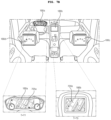
- FIG. 1A is a view showing an example of the exterior and interior of a vehicle.
- a vehicle 200 is moved by a plurality of wheels 103FR, 103FL, 103RL,... rotated by a power source and a steering wheel 150 configured to adjust an advancing direction of the vehicle 200.
- the vehicle 200 may be provided with a camera 195 configured to acquire an image of the front of the vehicle.
- the vehicle 200 may be further provided therein with a plurality of displays 180a and 180b configured to display images and information.
- a cluster display 180a and an audio video navigation (AVN) display 180b are illustrated as the plurality of displays 180a and 180b.
- APN audio video navigation
- HUD head up display
- the audio video navigation (AVN) display 180b may also be called a center information display.
- the embodiment of the present disclosure proposes a scheme for dividing data processing in a display apparatus 100 for vehicles including a plurality of displays 180a and 180b.
- the vehicle 200 described in this specification may be a concept including all of a vehicle having an engine as a power source, a hybrid vehicle having an engine and an electric motor as a power source, and an electric vehicle having an electric motor as a power source.
- FIG. 1B is a view showing another example of the interior of the vehicle.
- a cluster display 180a an audio video navigation (AVN) display 180b, rear seat entertainment displays 180c and 180d, and a rear-view mirror display (not shown) may be mounted in the vehicle.
- APN audio video navigation
- rear seat entertainment displays 180c and 180d rear seat entertainment displays
- a rear-view mirror display (not shown) may be mounted in the vehicle.
- FIG. 2 is a view showing the external appearance of a display apparatus for vehicles according to an embodiment of the present disclosure.
- a display apparatus 100 for vehicles may include a plurality of displays 180a and 180b, a signal processing device 170 configured to perform signal processing to display images, information, and the like on the plurality of displays 180a and 180b, at least one display 180c and 180d, and a second signal processing device 170b configured to perform signal processing to display images, information, and the like on the at least one display 180c and 180d.
- the signal processing device 170 and the second signal processing device 170b may be spaced apart from each other.
- the second signal processing device 170b and the signal processing device 170 may operate on different operating systems OS.
- the first display 180a which is one of the plurality of displays 180a and 180b, may be a cluster display 180a configured to display a driving state and operation information
- the second display 180b may be an audio video navigation (AVN) display 180b configured to display vehicle driving information, a navigation map, various kinds of entertainment information, or an image.
- APN audio video navigation
- a third display 180c of the at least one display 180c and 180d may be a right rear seat entertainment display of the vehicle, and a fourth display 180d may be a left rear seat entertainment display of the vehicle.
- the at least one display 180c and 180d may display driving state information, simple navigation information, various types of entertainment information, or an image.
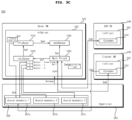
- the signal processing device 170 may have a processor 175 provided therein, and a server virtual machine 520 and first and second guest virtual machines 530 and 540 may be executed by a hypervisor 505 in the processor 175.
- the server virtual machine 520 may correspond to a server virtual machine, and the first and second guest virtual machines may correspond to guest virtual machines.
- data communication may be performed between the server virtual machine 520 and the first guest virtual machine 530 or the second guest virtual machine 540 according to a server interface and a client interface.
- the first guest virtual machine 530 may operate for the first display 180a, and the second guest virtual machine 540 may operate for the second display 180b.
- the server virtual machine 520 in the processor 175 may share at least some of data with the first guest virtual machine 530 and the second guest virtual machine 540 for divided processing of data.
- the server virtual machine 520 in the processor 175 may receive and process wheel speed sensor data of the vehicle, and may transmit the processed wheel speed sensor data to at least one of the first guest virtual machine 530 or the second guest virtual machine 540, or to the second signal processing device 170b. Accordingly, at least one virtual machine or the second signal processing device may share the wheel speed sensor data of the vehicle.
- the server virtual machine 520 in the processor 175 writes some of data in a first shared memory 508a so that the data may be transmitted to the first guest virtual machine 530, and writes some other of data in the first shared memory 508a so that the data may be transmitted to the second guest virtual machine 540.
- the first guest virtual machine 530 and the second guest virtual machine 540 may process the received data and write the processed data in a second shared memory (not shown). Accordingly, the plurality of signal processing devices in the vehicle may efficiently perform data processing.
- the server virtual machine 520 in the processor 175 may be configured to set a shared memory 508 based on the hypervisor 505 for transmission of the same data to the first guest virtual machine 530 and the second guest virtual machine 540. Accordingly, the first display 180a and the second display 180b in the vehicle may display the same information or the same image in a synchronized state.
- the signal processing device 170 may include the processor 175 and may execute the server virtual machine 520 and the first and second guest virtual machines 530 and 540 on the hypervisor 505 in the processor 175.
- the server virtual machine 520 may correspond to a server virtual machine, and the first and second guest virtual machines may correspond to guest virtual machines.
- data communication may be performed between the server virtual machine 520 and the first guest virtual machine 530 or the second guest virtual machine 540 according to a server interface and a client interface.
- the second signal processing device 170b may include a second processor 175b and may execute a server virtual machine VIMc and a guest virtual machine VIMd on a hypervisor 505b in the second processor 175b.
- some of the plurality of displays 180a to 180d may be operated based on a Linux Operating System (OS), and others may be operated based on a Web Operating System (OS).
- OS Linux Operating System
- OS Web Operating System
- the signal processing device 170 and the second signal processing device 170b may divide and process data for the displays 180a to 180d that operate on various operating systems.
- the signal processing device 170 and the second signal processing device 170b may also control the displays 180a to 180d, operating on various operating systems, to display the same information or the same image in a synchronized state.
- the signal processing device 170 and the second signal processing device 170b may share at least some of data for divided processing of the data. Accordingly, the plurality of signal processing devices 170 and 170b for the plurality of displays in the vehicle may divide and process data. In addition, the plurality of signal processing devices 170 and 170b may efficiently manage resources.
- FIG. 3 illustrates an exemplary internal block diagram of the display apparatus for vehicles according to the embodiment of the present disclosure.
- the display apparatus 100 for vehicles may include an input device 110, a transceiver 120, an interface 130, a second interface 130b, a signal processing device 170, a plurality of displays 180a to 180d, an audio output device 185, and a power supply 190.
- the input device 110 may include a physical button or pad for button input or touch input.
- the input device 110 may include a microphone (not shown) for user voice input.
- the transceiver 120 may wirelessly exchange data with a mobile terminal 800 or a server 900.
- the transceiver 120 may wirelessly exchange data with a mobile terminal of a vehicle driver.
- Any of various data communication schemes such as Bluetooth, Wi-Fi, WIFI Direct, and APIX, may be used as a wireless data communication scheme.
- the transceiver 120 may receive weather information and road traffic situation information, such as transport protocol expert group (TPEG) information, from the mobile terminal 800 or the server 900. To this end, the transceiver 120 may include a mobile communication module (not shown) .
- TPEG transport protocol expert group
- the interface 130 may receive sensor information from an electronic control unit (ECU) 770 or a sensor device 750, and may transmit the received information to the signal processing device 170.
- ECU electronice control unit
- the second interface 130b may receive sensor information and the like from the electronic control unit (ECU) 770 or the sensor device 760, and may transmit the received information to the second signal processing device 170b.
- ECU electronice control unit
- the sensor information may include at least one of vehicle direction information, vehicle position information (global positioning system (GPS) information), vehicle angle information, vehicle velocity information, vehicle acceleration information, vehicle inclination information, vehicle forward/backward movement information, battery information, fuel information, tire information, vehicle lamp information, in-vehicle temperature information, or in-vehicle humidity information.
- vehicle position information global positioning system (GPS) information
- GPS global positioning system
- the sensor information may be acquired from a heading sensor, a yaw sensor, a gyro sensor, a position sensor, a vehicle forward/backward movement sensor, a wheel sensor, a vehicle velocity sensor, a car body inclination sensor, a battery sensor, a fuel sensor, a tire sensor, a steering-wheel-rotation-based steering sensor, an in-vehicle temperature sensor, or an in-vehicle humidity sensor.
- the position module may include a GPS module configured to receive GPS information.
- the interface 130 may receive front-of-vehicle image data, side-of-vehicle image data, rear-of-vehicle image data, and obstacle-around-vehicle distance information from a camera 195 or lidar (not shown), and may transmit the received information to the signal processing device 170.
- the memory 140 may store various data necessary for overall operation of the display apparatus 100 for vehicles, such as programs for processing or control of the signal processing device 170.
- the memory 140 may store data about the hypervisor, the server virtual machine, and the first and second guest virtual machines which are to be executed in the processor 175.
- the memory 140 may be provided in the signal processing device 170 but is not limited thereto, and may be provided outside the signal processing device 170.
- the audio output device 185 may convert an electrical signal from the signal processing device 170 into an audio signal, and may output the audio signal. To this end, the audio output device 185 may include a speaker and the like.
- the power supply 190 may supply power necessary to operate components under control of the signal processing device 170.
- the power supply 190 may receive power from a battery in the vehicle.
- the signal processing device 170 may control the overall operation of each unit in the vehicle display apparatus 100.
- the signal processing device 170 may include the processor 175 configured to perform signal processing for at least one of the first display 180a or the second display 180b.
- the processor 175 may execute the server virtual machine 520 and the first and second guest virtual machines 530 and 540 on the hypervisor 505 (see FIG. 5 ) in the processor 175.
- the server virtual machines 520 may be referred to as a server virtual machine
- the first and second guest virtual machines 530 and 540 may be referred to as guest virtual machines.
- the first guest virtual machine 530 may operate for the first display 180a
- the second guest virtual machine 540 may operate for the second display 180b.
- the server virtual machine 520 in the processor 715 may receive, process, and output vehicle sensor data, position information data, camera image data, audio data, or touch input data.
- Data processing may be efficiently performed by separating data processed only by a legacy virtual machine and data processed by the server virtual machine 520.
- the server virtual machine 520 may process most of the data, thereby allowing 1:N data sharing.
- server virtual machine 520 may directly receive and process CAN communication data, audio data, radio data, USB data, and wireless communication data for the first and second guest virtual machines 530 and 540.
- server virtual machine 520 may transmit the processed data to the first and second guest virtual machines 530 and 540.
- the server virtual machine 520 may receive communication data and external input data and may perform signal processing, whereby load in signal processing by the other virtual machines may be reduced and 1:N data communication may be achieved, and therefore synchronization at the time of data sharing may be achieved.
- the server virtual machine 520 in the processor 175 writes some of data in a first shared memory 508a so that the data may be transmitted to the first guest virtual machine 530, and writes some other of data in the first shared memory 508a so that the data may be transmitted to the second guest virtual machine 540.
- the first guest virtual machine 530 and the second guest virtual machine 540 may process the received data and write the processed data in a second shared memory (not shown). Accordingly, the plurality of signal processing devices in the vehicle may efficiently perform data processing.
- the data may be any one of image data, audio data, navigation data, and voice recognition data.
- the server virtual machine 520 may process some other of data and may write the processed data in the second shared memory (not shown). That is, the server virtual machine 520 may perform data processing in addition to the first guest virtual machine 530 and the second guest virtual machine 540.
- the server virtual machine 520 may create command queues for distributed processing of data in the first guest virtual machine 530 and the second guest virtual machine 540. Accordingly, the plurality of virtual machines may divide and process data.
- the server virtual machine 520 in the processor 175 may create one command queue. Accordingly, the same data may be synchronized and shared.
- server virtual machine 520 may create command queues corresponding to the number of virtual machines for distributed processing of data.
- the server virtual machine 520 may control at least some of data to be transmitted to at least one of the first guest virtual machine 530 or the second guest virtual machine 540, or to the second signal processing device 170b.
- the server virtual machine 520 may allocate the first shared memory 508a for transmitting at least some of data to at least one of the first guest virtual machine 530 or the second guest virtual machine 540, or to the second signal processing device 170b, and image data processed by the first guest virtual machine 530 or the second guest virtual machine 540 may be written in the second shared memory (not shown).
- the server virtual machine 520 may be configured to write data in the shared memory 508, whereby the first guest virtual machine 530 and the second guest virtual machine 540 share identical data.
- the server virtual machines 520 may write radio data or wireless communication data in the shared memory 508, so that the first guest virtual machine 530 and the second guest virtual machine 540 may share the same data. Accordingly, 1:N data sharing may be achieved.
- the server virtual machine 520 may process most of the data, thereby allowing 1:N data sharing.
- the server virtual machine 520 in the processor 175 may be configured to set up the shared memory 508 based on the hypervisor 505 for transmission of identical data to the first guest virtual machine 530 and the second guest virtual machine 540.
- the server virtual machine 520 in the processor 175 may transmit identical data to the first guest virtual machine 530 and the second guest virtual machine 540 in a synchronized manner by using the shared memory 508 based on the hypervisor 505. Accordingly, the plurality of displays 180a and 180b in the vehicle may display identical images in a synchronized manner.
- the signal processing device 170 may process various signals, such as an audio signal, an image signal, and a data signal.
- the signal processing device 170 may be implemented in the form of a system on chip (SOC).
- the second signal processing device 170b performs signal processing for the displays 180c and 180d for vehicles, and to this end, the second signal processing device 170b may include a second processor 175b and a second memory 140b.
- the second processor 175b may execute a plurality of virtual machines 520b, 530b, and 540b (see FIG. 8 ) on the hypervisor 505b ( FIG. 8 ) in the second processor 175b.
- the second processor 175b may also execute the server virtual machine and guest virtual machines on the hypervisor in the second processor 175b.
- the server virtual machine in the second processor 175b may receive, process, and output vehicle sensor data, position information data, camera image data, audio data, or touch input data from the server virtual machine 520 in the processor 175 of the signal processing device 170.
- the server virtual machine in the second processor 175b may receive and process CAN communication data, audio data, radio data, USB data, and wireless communication data from the server virtual machine 520 in the processor 175 of the signal processing device 170 for the guest virtual machine.
- server virtual machine in the second processor 175b may transmit the processed data to the guest virtual machines.
- the server virtual machine and guest virtual machines in the second processor 175b only the server virtual machine receives communication data and external input data and performs signal processing, such that load in signal processing by the other virtual machines may be reduced and 1:N data communication may be achieved, and therefore synchronization at the time of data sharing may be achieved.
- the server virtual machine in the second processor 175b may be configured to set up a shared memory 508b (see FIG. 8 ) based on the hypervisor 505 for transmitting identical data to the guest virtual machines.
- the server virtual machine in the second processor 175b may transmit the same data to the guest virtual machines in a synchronized manner by using the shared memory 508b based on the hypervisor 505. Accordingly, the plurality of displays 180c and 180d in the vehicle may display the same image in a synchronized manner.
- the second signal processing device 170b may process various signals, such as an audio signal, an image signal, a data signal, and the like.
- the second signal processing device 170b may be implemented in the form of a system on chip (SOC).
- FIG. 4 is a view showing a system driven in a signal processing device related to the present disclosure.
- FIG. 4 an example is illustrated in which virtual machines are used for the cluster display 180a and the AVN display 180b.
- a cluster virtual machine 430 and an AVN virtual machine 440 are executed on a hypervisor 405 in the processor 175.
- a legacy virtual machine 410 is also executed on the hypervisor 405 in the processor 175.
- the legacy virtual machine 410 may include an interface 412 for data communication with the memory 140 and an interface 413 for Ethernet communication.
- the cluster virtual machine 430 may include an interface 431 for CAN communication, an interface 432 for communication with the interface 412 of the legacy virtual machine 410, and an interface 433 for communication with the interface 413 of the legacy virtual machine 410.
- the AVN virtual machine 440 may include an interface 441 for input and output of audio data, radio data, USB data, and wireless communication data, an interface 442 for communication with the interface 412 of the legacy virtual machine 410, and an interface 443 for communication with the interface 413 of the legacy virtual machine 410.
- the cluster virtual machine 430 and the AVN virtual machine 440 are required to include the interfaces 431 and 432 and the interfaces 441 and 442, respectively, for memory data and Ethernet communication data input and output in the legacy virtual machine 410.
- the present disclosure proposes a scheme for improving the system of FIG. 4 . That is, unlike FIG. 4 , virtual machines are divided into the server virtual machine 520 and the guest virtual machines such that various memory data, communication data, and the like are input and output in the server virtual machine 520, instead of the guest virtual machines, which will be described below with reference to FIG. 5 and subsequent figures.
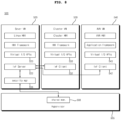
- FIG. 5 is a view showing an example of a system running on a signal processing device according to an embodiment of the present disclosure.
- the server virtual machine 520, the first guest virtual machine 530, and the second guest virtual machine 540 are executed on the hypervisor 505 in the processor 175 of the signal processing device 170.
- the first guest virtual machine 530 may be a virtual machine for the cluster display 180a
- the second guest virtual machine 540 may be a virtual machine for the AVN display 180b.
- the first guest virtual machine 530 and the second guest virtual machine 540 may be operated for image rendering of the cluster display 180a and the AVN display 180b, respectively.
- a legacy virtual machine 510 is also executed on the hypervisor 505 in the processor 175.
- the legacy virtual machine 510 may include an interface 511 for data communication and Ethernet communication with the memory 140.
- the legacy virtual machine 510 may further include a virtio-backend interface 512 for data communication with the first and second guest virtual machines 530 and 540.
- the server virtual machine 520 may include an interface 521 for input and output of audio data, radio data, USB data, and wireless communication data, and an input and output server interface 522 for data communication with the guest virtual machines.
- the server virtual machine 520 may provide inputs/outputs (I/O) difficult to virtualize with standard virtualization technology (VirtIO) to a plurality of guest virtual machines, e.g., the first and second guest virtual machines 530 and 540.
- I/O inputs/outputs
- VirtualIO standard virtualization technology
- the server virtual machine 520 may control radio data and audio data at a supervisor level, and may provide the data to a plurality of guest virtual machines, e.g., the first and second guest virtual machines 530 and 540, and the like.
- the server virtual machine 520 may process vehicle data, sensor data, and surroundings-of-vehicle information, and may provide the processed data or information to a plurality of guest virtual machines, e.g., the first and second guest virtual machines 530 and 540, and the like.
- the server virtual machine 520 may provide supervisory services, such as processing of vehicle data and audio routing management, and the like.
- the first guest virtual machine 530 may include an input and output client interface 532 for data communication with the server virtual machine 520 and APIs 533 configured to control the input and output client interface 532.
- the first guest virtual machine 530 may include a virtio-backend interface for data communication with the legacy virtual machine 510.
- the first guest virtual machine 530 may receive memory data by communication with the memory 140 and Ethernet data by Ethernet communication from the virtio-backend interface 512 of the legacy virtual machine 510 through the virtio-backend interface.
- the second guest virtual machine 540 may include an input and output client interface 542 for data communication with the server virtual machine 520 and APIs 543 configured to control the input and output client interface 542.
- the second guest virtual machine 540 may include a virtio-backend interface for data communication with the legacy virtual machine 510.
- the second guest virtual machine 540 may receive memory data by communication with the memory 140 and Ethernet data by Ethernet communication from the virtio-backend interface 512 of the legacy virtual machine 510 through the virtio-backend interface.
- the legacy virtual machine 510 may be provided in the server virtual machine 520.
- CAN communication data are input and output only in the server virtual machine 520, but may be provided to a plurality of guest virtual machines, e.g., the first and second guest virtual machines 530 and 540, etc., through data processing in the server virtual machine 520. Accordingly, 1:N data communication by processing of the server virtual machine 520 may be achieved.
- audio data, radio data, USB data, and wireless communication data are input and output only in the server virtual machine 520, but may be provided to a plurality of guest virtual machines, e.g., the first and second guest virtual machines 530 and 540, etc., through data processing in the server virtual machine 520. Accordingly, 1:N data communication by processing of the server virtual machine 520 may be achieved.
- the first and second guest virtual machines 530 and 540 may operate on different operating systems.
- the first guest virtual machine 540 may operate on Linux OS, and the second guest virtual machine 540 may operate on a Web-based OS.
- the shared memory 508 based on the hypervisor 505 is set up for data sharing even when the first and second guest virtual machines 530 and 540 operate on different operating systems. Accordingly, even when the first and second guest virtual machines 530 and 540 operate on different operating systems, identical data or identical images may be shared in a synchronized manner. As a result, the plurality of displays 180a and 180b may display identical data or identical images in a synchronized manner.
- FIG. 6 is a diagram referred to in the description of operation of a system running on a signal processing device according to the embodiment of the present disclosure
- FIGS. 7A to 9D are diagrams referred to in the description of FIG. 5 or FIG. 6 .
- the processor 175 in the signal processing device 170 executes the server virtual machine 520 and the plurality of guest virtual machines 530 and 540 on the hypervisor 505 in the processor 175, and the server virtual machine 520 in the processor 175 may be configured to set up the shared memory 508 based on the hypervisor 505 for data transmission to the first and second guest virtual machines 530 and 540.
- identical image data may be transmitted from the server virtual machine 520 to the first guest virtual machine 530 and the second guest virtual machine 540. Accordingly, the plurality of displays 180a and 180b in the vehicle may display identical images in a synchronized manner.
- the processor 175 in the signal processing device 170 executes the server virtual machine 520 and the plurality of guest virtual machines 530 and 540 on the hypervisor 505 in the processor 175, and the server virtual machine 520 in the processor 175 may transmit identical data to the first and second guest virtual machines 530 and 540 in a synchronized manner by using the shared memory 508 based on the hypervisor 505.
- examples of identical data may include CAN communication data, audio data, radio data, USB data, wireless communication data, position information data, or touch data, and the like. Accordingly, the plurality of displays 180a and 180b in the vehicle may display identical data in a synchronized manner.
- the server virtual machine 520 in the processor 175 may receive and process position information data that changes according to movement, and may provide the processed data to the first guest virtual machine 530 or the second guest virtual machine 540. Accordingly, instead of 1:1 data communication, 1:N data communication between the virtual machines may be achieved by using the shared memory.
- the first guest virtual machine 530 and the second guest virtual machine 540 may be driven by different operating systems. Accordingly, even when the plurality of virtual machines are driven by different operating systems, high-speed data communication may be performed.
- the legacy virtual machine 510 may transmit memory data from the memory 140 and Ethernet data by Ethernet communication to the first guest virtual machine 530 and the second guest virtual machines 540 in a synchronized manner by using the shared memory 508 based on the hypervisor 505. That is, 1:N data communication of the memory data or the Ethernet data may be performed. Accordingly, identical data may be transmitted in a synchronized manner.
- server virtual machine 520 in the processor 175 may execute supervisory services, such as a system manager, a display manager, and the like.
- the server virtual machine 520 in the processor 175 may execute systemic services, such as vehicle information service, position information service, camera service, AUTOSAR, Bluetooth communication service, radio service, Wi-Fi service, audio service, touch service, and the like.
- systemic services such as vehicle information service, position information service, camera service, AUTOSAR, Bluetooth communication service, radio service, Wi-Fi service, audio service, touch service, and the like.
- the signal processing device 170 may further include a secured storage device 509 configured to store a digital signature and a public key of the external server 900, in addition to the shared memory 508 and the processor 175.
- a secured storage device 509 configured to store a digital signature and a public key of the external server 900, in addition to the shared memory 508 and the processor 175.
- the signal processing device 170 may further include a security executor TEE configured to receive an encrypted data from the server 900, to decrypt the encrypted data from the server 900 based on the digital signature and the public key of the server 900, and to transmit the decrypted data to the server virtual machine 520 or at least one of the plurality of guest virtual machines 530 or 540.
- a security executor TEE configured to receive an encrypted data from the server 900, to decrypt the encrypted data from the server 900 based on the digital signature and the public key of the server 900, and to transmit the decrypted data to the server virtual machine 520 or at least one of the plurality of guest virtual machines 530 or 540.
- the security executor TEE may also be executed by the processor 175 in the signal processing device 170.
- the security executor TEE may include a policy manager PM configured to set data so that data, shared with the first guest virtual machine 530 and the second guest virtual machine 540, may change based on a sharing policy, and an interface SS configured to exchange data with the secured storage device 509.
- server virtual machine 520 and the first and second guest virtual machines 530 and 540 may include security interfaces 525, 535, and 545, respectively, which are configured to decrypt the encrypted data received from the shared memory 508 or to store the encrypted data in the shared memory 508.
- FIG. 7A is a diagram illustrating an example of three virtual machines 420, 420, and 430 operating on a system 400b of FIG. 4 .
- the server virtual machine 520 and 420 is a Linux-based virtual machine, and may include an input and output server interface 422 for data transmission, and the first guest virtual machine 530 and the second guest virtual machine 540 may include input and output client interfaces 432 and 552 for data communication with the input and output server interface 422.
- the server virtual machine 520 and 420 is required to set up a first shared memory 408a in a hypervisor 405 in order to transmit first data to the first guest virtual machine 430, and to set up a separate second shared memory 408b, different from the first shared memory 408a, in the hypervisor 405 in order to transmit the same first data to the second guest virtual machine 440.
- FIG. 7B illustrates an example in which, by the system 400b of FIG. 7A , the first guest virtual machine 430 displays image data received through the first shared memory 408a on the first display 180a, and the second guest virtual machine 440 displays image data received through the second shared memory 408b on the second display 180b.
- FIG. 7B illustrates that an image 705a displayed on the first display 180a and an image 705b displayed on the second display 180b are not synchronized with each other and that the image 705b displayed on the second display 180b corresponds to a more previous frame than the image 705a displayed on the first display 180a.
- the present disclosure proposes a scheme for allocating a single shared memory at the time of transmission of identical data. Consequently, 1:N data communication is performed, whereby synchronized data transmission is achieved.
- FIG. 8 is a diagram illustrating an example in which the server virtual machine 520 and the plurality of guest virtual machines 530 and 540 are executed on the hypervisor 505 in the processor 175 of the system 500, and the server virtual machine 520 in the processor 175 may be configured to set up the shared memory 508 based on the hypervisor 505 for transmission of identical data to the first guest virtual machine 530 and the second guest virtual machine 540.
- the plurality of displays 180a and 180b in the vehicle may display identical images in a synchronized manner.
- high-speed data communication may be performed among the plurality of virtual machines 520, 530, and 540. Further, high-speed data communication may be performed even when the plurality of virtual machines 520, 530, and 540 are driven by different operating systems.
- the server virtual machine 520 in the processor 175 may transmit data, processed by the server virtual machine 520, to another virtual machine by using a single shared memory 508 instead of allocating memories, the number of which corresponds to the number of virtual machines. Accordingly, instead of 1:1 data communication, 1:N data communication between the virtual machines may be achieved by using the shared memory 508.
- server virtual machine 520 in the processor 175 may include the input and output server interface 522 and a security manager 526.
- the first guest virtual machine 530 and the second guest virtual machine 540 may include input and output client interfaces 532 and 542, respectively. Accordingly, high-speed data communication between the plurality of virtual machines may be performed by using the input and output server interface 522 and the input and output client interfaces 532 and 542.
- the input and output server interface 522 in the first virtual machine 520 may receive requests for transmission of identical data from the respective input and output client interfaces 532 and 542 in the first guest virtual machine 530 and the second guest virtual machine 540, and may transmit shared data to the shared memory 508 through the security manager 526 based thereon.
- FIG. 9A is a diagram illustrating in further detail transmission of shared data.
- the input and output server interface 522 in the server virtual machine 520 may be configured to transmit a request for allocation of the shared memory 508 to the security manager 526 (S1).
- the security manager 526 may be configured to allocate the shared memory 508 using the hypervisor 505 (S2), and may write shared data in the shared memory 508.
- the input and output client interfaces 532 and 542 may be configured to transmit a request for connection to the input and output server interface 522 after allocation of the shared memory 508 (S3).
- the input and output server interface 522 may be configured to transmit information regarding the shared memory 508 including key data to the input and output client interfaces 532 and 542 (S4).
- the key data may be data for data access.
- the server virtual machine 520 in the processor 175 may transmit information regarding the shared memory 508 to the first guest virtual machine 530 and the second guest virtual machine 540.
- the input and output client interfaces 532 and 542 may access the shared memory 508 based on the received key data (S5), and may copy the shared data from the shared memory 508.
- the first guest virtual machine 530 and the second guest virtual machine 540 may access the shared memory 508, and thus, may share the shared data.
- the first guest virtual machine 530 and the second guest virtual machine 540 may share the image data, and thus, the plurality of displays 180a and 180b in the vehicle may display the same shared image in a synchronized manner.
- FIG. 9B illustrates that an image 905 displayed on the first display 180a and an image 905 displayed on the second display 180b are synchronized, such that the same image may be displayed.
- image data processed by the server virtual machine 520 in the processor 175 are transmitted to the first guest virtual machine 530 and the second guest virtual machine 540 through the shared memory 508, and based on the image data, a first image 905 displayed on the first display 180a and a second image 905 displayed on the second display 180b may be identical to each other. Accordingly, the plurality of displays 180a and 180b in the vehicle may display the same images in a synchronized manner. Further, high-speed data communication among the plurality of virtual machines 520, 530, and 540 may be performed.
- FIG. 9C is a diagram illustrating in detail the input and output server interface 522 of FIG. 8 .
- a plurality of buffers 507a, 507b, and 507c may be set up in the shared memory 508.
- the input and output client interfaces 532 and 542 in the first guest virtual machine 530 and the second guest virtual machine 540 may include consumers 533 and 543, respectively.
- the input and output server interface 522 in the server virtual machine 520 may include a producer 1010 configured to create a synchronization object for graphical synchronization, a recvQueue 1020 configured to manage, particularly receive, a queue, a WorkThread 1030 configured to manage a queue and to control operation of the queue, and a sendQueue 1040 configured to manage, particularly transmit, a queue.
- a producer 1010 configured to create a synchronization object for graphical synchronization
- a recvQueue 1020 configured to manage, particularly receive, a queue
- a WorkThread 1030 configured to manage a queue and to control operation of the queue
- a sendQueue 1040 configured to manage, particularly transmit, a queue.
- the producer 1010 receives information regarding the index of an empty index, among the plurality of buffers 507a, 507b, and 507c in the shared memory 508, from the recvQueue 1020 (Sa1). For example, in the case in which the first buffer 507a, among the plurality of buffers 507a, 507b, and 507c, is empty, information regarding the first buffer 507a is received (Sa1).
- the producer 1010 may receive information regarding the first buffer 507a having a reference count refcnt of 0 from the recvQueue 1020.
- the producer 1010 may be configured to create a synchronization object for graphical synchronization in order to perform writing in the first buffer 507a (Sa2).
- the producer 1010 may be configured to write data about the created synchronization object in the first buffer 507a in the shared memory 508 (Sa3).
- the producer 1010 may be configured to queue information regarding the first buffer 507a, i.e. a buffer index, to the sendQueue 1040 (Sa4).
- the WorkThread 1030 may be configured to sense and receive or read the data (Sa5).
- the WorkThread 1030 may be configured to receive the information.
- the WorkThread 1030 may be configured to wait until a frame about the created synchronization object is completely drawn (Sa6).
- the WorkThread 1030 may be configured to increase the reference count refcnt of the buffer corresponding to the first buffer 507a by the number of consumers or the number of input and output client interfaces (Sa7).
- the reference count refcnt of the buffer corresponding to the first buffer 507a is increased from 0 to 2.
- the WorkThread 1030 transmits the buffer index to the consumers 533 and 543 (Sa8). For example, information corresponding to the first buffer 507a is transmitted (Sa8).
- the consumers 533 and 543 access the first buffer 507a in the shared memory 508 using the received buffer index to copy data (Sa9).
- the consumers 533 and 543 return the buffer index to the producer 1010 or the WorkThread 1030 after completion of data copying (Sa10).
- the producer 1010 reduces the reference count refcnt of the first buffer 507a by 1 based on information or a buffer index received after completion of data copying for each of the consumers 533 and 543.
- the reference count refcnt of the first buffer 507a is reduced from 2 to 1.
- the reference count refcnt of the first buffer 507a is reduced from 1 to 0.
- the buffer may be used by the producer 1010.
- first frame data may be shared using the first buffer 507a
- second frame data may be shared using the second buffer 507b
- third frame data may be shared using the third buffer 507c
- fourth frame data may be shared using the first buffer 507a again.
- the input and output server interface 522 may receive information regarding the empty first buffer 507a in the shared memory 508, may write the first data in the first buffer 507a in the shared memory 508, and may transmit buffer information of the first buffer 507a to the input and output client interfaces 532 and 542 in the first guest virtual machine 530 and the second guest virtual machine 540.
- the reference count of the first buffer 507a may be changed in a first direction (e.g. the reference count being increased) based on writing of the first data in the first buffer 507a, and in case in which copying of the first data to the first buffer 507a is completed, the reference count of the first buffer 507a may be changed in a second direction, which is opposite the first direction, (e.g. the reference count being decreased).
- the consumers 533 and 543 in the respective input and output client interfaces 532 and 542 in the first guest virtual machine 530 and the second guest virtual machine 540 may change the reference count of the first buffer 507a in the first direction (e.g. the reference count being increased) based on writing of the first data in the first buffer 507a.
- the producer 1010 in the input and output server interface 522 in the server virtual machine 520 may change the reference count of the first buffer 507a in the second direction, which is opposite the first direction, (e.g. the reference count being decreased). Accordingly, after completion of copying, new data may be written in the first buffer 507a.
- the server virtual machine 520 may write first frame data to third frame data in the first buffer 507a to the third buffer 507c, respectively, among the plurality of buffers 507a to 507c, and the respective input and output client interfaces 532 and 542 in the first guest virtual machine 530 and the second guest virtual machine 540 may sequentially copy the first frame data to the third frame data from the first buffer 507a to the third buffer 507c.
- the first guest virtual machine 530 may copy the second frame data from the second buffer 507b. Accordingly, synchronization between the first guest virtual machine 530 and the second guest virtual machine 540 may be performed during data sharing.
- FIG. 9D a diagram illustrating that various drivers DRa, DRb, and DRc are provided in the server virtual machine 520.
- the server virtual machine 520 may include a position information driver DRa for processing position information, a touch driver DRb for processing touch input, and a camera driver DRc for processing an image from the camera.
- a position information driver DRa for processing position information
- a touch driver DRb for processing touch input
- a camera driver DRc for processing an image from the camera.
- the server virtual machine 520 may set up the shared memory 508 based on the hypervisor 505 for each of the position information driver DRa, the touch driver DRb, and the camera driver DRc.
- the input and output server interface 522 may set up a first shared memory 508a for transmission of image data from the camera driver DRc, and may set up a second shared memory 508b for transmission of position information from the position information driver DRa.
- key data of the first shared memory 508a and key data of the second shared memory 508b may be transmitted to the first guest virtual machine 530 and the second guest virtual machine 540, and the first guest virtual machine 530 and the second guest virtual machine 540 may access the first shared memory 508a and the second shared memory 508b based on the key data of the first shared memory 508a and the key data of the second shared memory 508b.
- the security manager 526 may create key data information for data access, and may create and register virtual machine information, information for each piece of equipment, allocated memory address information, buffer index information, and the created key data information in the form of a table.
- the respective input and output client interfaces 532 and 542 in the first guest virtual machine 530 and the second guest virtual machine 540 may be connected to the security manager 526, may request and receive key data by referring to the table in the security manager 526, and may access a corresponding shared memory using the received key data.
- the virtual machine information in one case and the virtual machine information in the other case are identical to each other, but the information for each piece of equipment, the allocated memory address information, the buffer index information, and the created key data information in one case and the information for each piece of equipment, the allocated memory address information, the buffer index information, and the created key data information in the other case are different from each other. Accordingly, it is possible to prevent data confusion during of sharing of different types of data and to perform high-speed data communication among the plurality of virtual machines 520, 530, and 540.
- FIG. 10 is a diagram illustrating in detail the system running on the signal processing device of FIG. 5 .
- the signal processing device 170 includes the shared memory 508 and the processor 175 configured to perform signal processing for display mounted in a vehicle.
- the processor 175 may execute the server virtual machine 520 and the plurality of guest virtual machines 530 and 540 on the hypervisor 505 in the processor 175, in which of the plurality of guest virtual machines 530 and 540, the first guest virtual machine 530 operates for the first display 180a and the second guest virtual machine 540 operates for the second display 180b.
- the server virtual machine 520 may be configured to store data to be transmitted to at least one of the first guest virtual machine 530 or the second guest virtual machine 540 in the shared memory 508, and transmit a security key to at least one of the first guest virtual machine 530 or the second guest virtual machine 540. Accordingly, it is possible to increase security during data transmission. Particularly, it is possible to increase security during data transmission to the guest virtual machine 530 or 540. Further, it is possible to increase security during data transmission among the virtual machines 520 to 540.
- At least one of the first guest virtual machine 530 or the second guest virtual machine 540 may receive the data stored in the shared memory 508, and may decrypt the received data based on the security key. Accordingly, it is possible to increase security during data transmission.
- the server virtual machine 520 may be configured to store data to be transmitted to at least one of the first guest virtual machine 530 or the second guest virtual machine 540 in the shared memory 508, may encrypt a symmetric key, and may transmit a security key including the encrypted symmetric key to at least one of the first guest virtual machine 530 or the second guest virtual machine 540. Accordingly, it is possible to increase security during data transmission.
- the server virtual machine 520 transmits the security key including the encrypted symmetric key to the first guest virtual machine 530 and the second guest virtual machine 540.
- the first guest virtual machine 530 and the second guest virtual machine 540 may receive the encrypted symmetric key and may decrypt the data, stored in the shared memory 508, by using the symmetric key.
- the server virtual machine 520 may transmit the security key including the encrypted symmetric key to at least one of the first guest virtual machine 530 or the second guest virtual machine 540 at a first time, and may transmit the security key, including the encrypted and updated symmetric key, to at least one of the first guest virtual machine 530 or the second guest virtual machine 540 at a second time after the first time. Accordingly, it is possible to increase security during data transmission based on the updated security key.
- the server virtual machine 520 may generate and update new symmetric keys as random key values at predetermined intervals.
- the server virtual machine 520 may transmit the updated symmetric key to the security interface 535 or 545 in at least one of the first guest virtual machine 530 or the second guest virtual machine 540. Accordingly, it is possible to increase security during data transmission based on the updated security key.
- the server virtual machine 520 may be configured to store data to be transmitted thereto in the shared memory 508, and may transmit the security key to the first guest virtual machine 530 and the second guest virtual machine 540. Accordingly, while transmitting the identical data, security may increase during transmission of the identical data.
- the first guest virtual machine 530 and the second guest virtual machine 540 may receive the identical data stored in the shared memory 508, and may decrypt the received identical data based on the security key. Accordingly, while transmitting the identical data, security may increase during transmission of the identical data.
- the server 900 may include a hash value generator 911 and a digital signature generator 913.
- the hash value generator 911 may generate hash value of binaries of the security interfaces 525, 535, and 545 in the respective virtual machines 520, 530, and 540, and the digital signature generator 913 may generate digital signature based on the generated hash value.
- the signal processing device 170 may further include the secured storage device 509 configured to store a digital signature and a public key of the external server 900.
- the signal processing device 170 may execute the security executor TEE configured to receive encrypted data form the server 900, to decrypt the encrypted data from the server 900 based on the digital signature and the public key of the server 900, and to transmit the decrypted data to the server virtual machine 520 or at least one of the plurality of guest virtual machines 530 or 540.
- the security executor TEE configured to receive encrypted data form the server 900, to decrypt the encrypted data from the server 900 based on the digital signature and the public key of the server 900, and to transmit the decrypted data to the server virtual machine 520 or at least one of the plurality of guest virtual machines 530 or 540.
- the signal processing device 170 may further include a hardware-based security executor TEE.
- the signal processing device 170 may further include a security executor TEE configured to receive encrypted data form the external server 900, to decrypt the encrypted data from the server 900 based on the digital signature and the public key of the server 900, and to transmit the decrypted data to the server virtual machine 520 or at least one of the plurality of guest virtual machines 530 or 540. Accordingly, while increasing security when data is received from the external server 900, data may be transmitted to internal virtual machines.
- a security executor TEE configured to receive encrypted data form the external server 900, to decrypt the encrypted data from the server 900 based on the digital signature and the public key of the server 900, and to transmit the decrypted data to the server virtual machine 520 or at least one of the plurality of guest virtual machines 530 or 540. Accordingly, while increasing security when data is received from the external server 900, data may be transmitted to internal virtual machines.
- the security executor TEE may include a policy manager PM configured to set data so that data, shared with the first guest virtual machine 530 and the second guest virtual machine 540, may vary based on a sharing policy, and an interface SS for data exchange with the secured storage device 509.
- the server virtual machine 520 may receive external input data and communication data. Accordingly, interface for the external input data and the communication data may be implemented efficiently.
- the server virtual machine 520 may share the external input data or the communication data with at least one of the first guest virtual machine 530 or the second guest virtual machine 540.
- the server virtual machine 520 may encrypt the external input data or the communication data and control the encrypted external input data or communication data to be stored in the shared memory 508, and may transmit a security key to at least one of the first guest virtual machine 530 or the second guest virtual machine 540.
- At least one of the first guest virtual machine 530 or the second guest virtual machine 540 may decrypt the received external input data or communication data based on the security key. Accordingly, interface for the external input data and the communication data may be implemented efficiently.
- server virtual machine 520 and the first and second guest virtual machines 530 and 540 may include security interfaces 525, 535, and 545, respectively, for decrypting the encrypted data received from the shared memory 508 or for storing the encrypted data in the shared memory 508.
- the security interface 525 in the server virtual machine 520 may perform encryption for storing the encrypted data in the shared memory 508, and the first and second guest virtual machines 530 and 540 may decrypt the encrypted data received from the shared memory 508. Accordingly, it is possible to increase security during data transmission. Particularly, it is possible to increase security during data transmission to the guest virtual machine 530 or 540. Further, it is possible to increase security during data transmission among the virtual machines 520 to 540.
- a verifier VFR executed in the hypervisor 505 may verify integrity of the server virtual machine 520 and the plurality of guest virtual machines 530 and 540.
- the server virtual machine 520 may determine that the server virtual machine 520 and the first guest virtual machine 530 are valid virtual machines, and in response to the integrity of the second guest virtual machine 540 not being verified by the verifier VFR, the server virtual machine 520 may determine that the second guest virtual machine 530 is not a valid virtual machine, may perform control so that data to the transmitted to the first guest virtual machine 530 may be stored in the shared memory 508, and may transmit a security key to the first guest virtual machine 530, without transmitting the security key to the second guest virtual machine 540. Accordingly, it is possible to increase security during data transmission to the virtual machines whose integrity is verified.
- the server virtual machine 520 may perform control so that data to the transmitted to the first guest virtual machine 530 may be stored in the shared memory 508 and may transmit a security key to the first guest virtual machine 530 and the second guest virtual machine 540. Accordingly, it is possible to increase security during data transmission to the virtual machines whose integrity is verified.
- the policy manager PM in the security executor TEE shares a sharing policy or a topic based on the sharing policy with the respective security interfaces 525, 535, and 545 in the server virtual machine 520 and the first and second guest virtual machines 530 and 540.
- Data to be transmitted to the respective security interfaces 525, 535, and 545 in the server virtual machine 520 and the first and second guest virtual machines 530 and 540 may vary depending on the sharing policy or the topic based on the sharing policy.
- the security interface 525 in the server virtual machine 520 may include a security manager TEma for data exchange with the security executor TEE and a shared buffer SBa for interfacing with the shared memory 508.
- the respective security interfaces 535 and 545 in the first and second guest virtual machines 530 and 540 may include security managers TEmb and TEmc, respectively, for data exchange with the security executor TEE and shared buffers SBb and SBc, respectively, for interfacing with the shared memory 508.
- ARs may be referred to as secure world
- Arn may be referred to as normal world. That is, the security executor TEE is the secure world, and the hypervisor 505 and the respective virtual machines 520, 530, and 540 may be the normal world.
- FIGS. 11A to 13C are diagrams referred to in the description of FIG. 10 .
- FIG. 11A is a diagram referred to in the description of operation of the external server 900. Particularly, FIG. 11A is a diagram explaining a signing process of the server 900.
- the external server 900 may be a signing server.
- the external server 900 may be configured to transmit a request for hash value of binaries to the security interfaces 525, 535, and 545 of the respective virtual machines 520, 530, and 540 executed in the signal processing device 170 (S1110).
- the security interfaces 525, 535, and 545 of the respective virtual machines 520, 530, and 540 may be configured to access binary files to generate hash value for the corresponding files in a predetermined manner (S1112), and transmit the generated hash value to the server 900 (S1114).
- the external server 900 may sign the received hash value with its private key (S1116).
- the digital signature information may be updated.
- FIG. 11B is a diagram referred to in the description of operation of a verifier. Particularly, FIG. 11B is a diagram explaining a verification process of a verifier VFR in the signal processing device 170.
- the verifier VFR first may be configured to access the secured storage device 509 and transmit a request for the stored digital signature of binaries of the security interfaces 525, 535, and 545 in the respective virtual machines 520, 530, and 540 and the public key of the server 900 (S1120).
- the secured storage device 509 may be configured to transmit the digital signature of the binaries of the security interfaces 525, 535, and 545 in the respective virtual machines 520, 530, and 540 and the public key of the server 900 to the verifier VFR (S1122).
- the verifier VFR may be configured to access the security interfaces 525, 535, and 545 of the respective virtual machines 520, 530, and 540 and calculates hash value (S1124, S1126, and S1128).
- the verifier VFR may be configured to compare the hash value, obtained in operations 1124 to 1128 (S1124 to S1128), with the hash value calculated based on the public key and the digital signature retrieved from the secured storage device 509 (S1130).
- the verifier VFR may be configured to determine a virtual machine to be a valid virtual machine, and if a comparison result value is false, the verifier VFR may be configured to determine a virtual machine to be an invalid virtual machine.
- the verifier VFR transmits determination results to the respective virtual machines 520, 530, and 540 (S1132, S1134, and S1136).
- data is shared between the server virtual machine 520 and the first guest virtual machine 530, but the data is not shared with the second virtual machine 540.
- connection may be made between the server virtual machine 520 and the first guest virtual machine 530, but no connection is made between the server virtual machine 520 and the second virtual machine 540.
- data is shared among the server virtual machine 520, the first virtual machine 530, and the second virtual machine 540.
- FIG. 11C is a diagram illustrating an example of operation of the verifier VFR.
- the verifier VFR may be configured to transmit a request for a digital signature and a public key to the secured storage device 509 (S1165).
- the secured storage device 509 may be configured to transmit the digital signature and the public key to the verifier VFR (S1167).
- the verifier VFR may be configured to transmit a request for hash value to the virtual machine 520 or 530 (S1168).
- the virtual machine 520 or 530 may be configured to calculate hash value (S1169) and transmits the calculated hash value to the verifier VFR (S1170).
- the verifier VFR may be configured to compare the hash value, received from the security interface 525 or 535 of the virtual machine 520 or 530, with the hash value calculated based on the public key and the digital signatures retrieved from the secured storage device 509 (S1171).
- the verifier VFR may be configured to transmit a result message to the virtual machine 520 or 530 (S1172).
- the verifier VFR Upon comparison, if the hash values do not coincide, the verifier VFR does not transmit a result message to the virtual machine 520 or 530 and outputs an error code (S1173).
- the verifier VFR may transmit a list of valid guest virtual machines.
- the verifier VFR may transmit validity of the server virtual machine 520.
- the verifier VFR may verify integrity of the server virtual machine 520 and the guest virtual machine 530.
- FIG. 11D is a diagram illustrating another example of operation of the verifier VFR.
- the application Apt transmits an application ID, metadata, and the like to the verifier VFR (S1179).
- the verifier VFR may be configured to receive the application ID, metadata, etc., and may parse the metadata.
- the verifier VFR may transmit the application ID to a registered application list RAL (S1181).
- the verifier VFR may be configured to compare the calculated hash value of the execution file ELF with a hash value in the metadata (S1187), and if the hash values coincide, the verifier VFR may be configured to transmit coincidence information to the registered application list RAL (S1188).
- the verifier VFR may be configured to stop data sharing with the application (S1190). Accordingly, all communications and processors with the application are stopped.
- the verifier VFR may verify integrity of the executed application.
- FIG. 11E is a diagram explaining an example of sharing data based on sharing of a symmetric key.
- the security interface 535 in the first guest virtual machine 530 may be configured to transmit a request for authentication to the security interface 525 in the server virtual machine 520 (S1140).
- the security interface 525 in the server virtual machine 520 may be configured to verify certificate validity of the security interface 535 in the first guest virtual machine 530 that has requested authentication (S1142).
- the security interface 525 in the server virtual machine 520 may be configured to encrypt a symmetric key, to be used for transmitting and receiving encrypted data, with a public key of the security interface 535 in the first guest virtual machine 530 which is a counterpart virtual machine (S1144).
- the security interface 525 in the server virtual machine 520 may be configured to transmit the encrypted symmetric key to the security interface 535 in the first guest virtual machine 530 (S1146).
- the security interface 535 in the first guest virtual machine 530 may be configured to decrypt the symmetric key with its private key to obtain the symmetric key (S1148).
- the security interface 535 in the first guest virtual machine 530 may be configured to transmit a request for data subscription to the security interface 525 in the server virtual machine 520 (S1150).
- the security interface 525 in the server virtual machine 520 may be configured to encrypt the data with the symmetric key (S1151), and transmit the encrypted data to the security interface 535 in the first guest virtual machine 520 (S1152).
- the security interface 535 in the first guest virtual machine 530 decrypts the encrypted data with the symmetric key (S1154).
- the security interface 545 in the second guest virtual machine 540 and the security interface 525 in the server virtual machine 520 may request mutual authentication (S1156).
- the security interface 545 in the second guest virtual machine 540 transmits a request for data subscription to the security interface 525 in the server virtual machine 520 (S1158).
- the security interface 525 in the server virtual machine 520 may be configured to encrypt the data with the symmetric key (S1159), and transmit the encrypted data to the security interface 535 in the first guest virtual machine 530 and the security interface 545 in the second guest virtual machine 540 (S1160).
- the security interface 525 in the server virtual machine 520 may generate new symmetric keys as random key values at predetermined intervals.
- the security interface 525 in the server virtual machine 520 may update the symmetric key.
- the security interface 525 in the server virtual machine 520 may be configured to transmit the encrypted and updated symmetric key to the security interface 535 in the first guest virtual machine 530 and the security interface 545 in the second guest virtual machine 540 (S1162).
- FIG. 11F is a diagram illustrating the format of a message, such as an authentication request or a subscription request of FIG. 11E .
- the message such as the authentication request or the subscription request, may include a message ID, a request ID, flag information, reserved information, type information, M/Q/C information in the interface header, and the like.
- the M/Q/C information in the interface header and the like may include an extension bit.
- the reserved information of [0x00] indicates Find Server VM
- the reserved information of [0x01] indicates Offer Server VM
- the reserved information of [0x02] indicates Request capability
- the reserved information of [0x03] indicates Request capability ACK.
- the type information of [0x00] indicates Find Service
- the type information of [0x01] indicates Offer Service
- the type information of [0x02] indicates Request Service
- the type information of [0x03] indicates Request Service ACK
- the type information of [0x04] indicates Find EVENT group
- the type information of [0x05] indicates Publish Event group
- the type information of [0x06] indicates Subscribe Event group
- the type information of [0x07] indicates Subscribe Event group ACK.
- extension bit of [0x00] indicates only IxF
- extension bit of [0x01] indicates IxF with SOME/IP.
- the server virtual machine 520 may perform control so that data, shared between the first guest virtual machine 530 and the second guest virtual machine 540, may vary depending on a sharing policy. Accordingly, based on the sharing policy, it is possible to differentiate data to be transmitted.
- the server virtual machine 520 may set data shared between the first guest virtual machine 530 and the second guest virtual machine 540. Accordingly, data to be transmitted may be set up based on the updating of the sharing policy.
- the server virtual machine 520 may receive position information data, camera data, or sensing data, and may be configured to transmit the position information data to the first guest virtual machine 530 and not be transmitted to the second guest virtual machine 540, by using the shared memory 508 based on the sharing policy. Accordingly, based on the sharing policy, it is possible to differentiate data to be transmitted.
- the server virtual machine 520 may be configured to transmit the position information data to the first guest virtual machine 530 and the second guest virtual machine 540 by using the shared memory 508. Accordingly, data to be transmitted may be set up based on the updating of the sharing policy.
- FIG. 12A is a diagram explaining a sharing policy.
- Publisher-Subscriber communication data transmitted by the publisher is transmitted to all subscribers requesting subscription.
- the policy manager PM may be configured to manage a sharing policy table showing whether applications are accessible to each topic.
- the sharing policy table managed by the policy manager PM is transmitted to all the security interfaces 525, 535, and 545 of the respective virtual machines 520, 530, and 540, and the security interfaces 525, 535, and 545 of the respective virtual machines 520, 530, and 540 determine whether to transmit data to applications by referring to the table.
- the security interfaces 525, 535, and 545 of the respective virtual machines 520, 530, and 540 respectively transmit requests for the sharing policy table to the policy manager PM at the time of initialization (S1210, S1220, and S1230).
- the security interface 525 of the server virtual machine 520 transmits a request for the sharing policy table to the policy manager PM at the time of initialization.
- the security interface 535 of the first guest virtual machine 530 transmits a request for the sharing policy table to the policy manager PM at the time of initialization.
- the security interface 545 of the second guest virtual machine 540 may be configured to transmit a request for the sharing policy table to the policy manager PM at the time of initialization.
- the policy manager PM reads each sharing policy table from the secured storage device 509 (S1012, S1022, and S1032) for the respective security interfaces.
- the policy manager PM may be configured to transmit the sharing policy table to the security interfaces 525, 535, and 545 of the respective virtual machines 520, 530, and 540 (S1216, S1224, and S1234).
- an Augmented Reality (AR) navigation application running on the first guest virtual machine, subscribes to the position information (S1236).
- the security interface 535 of the first guest virtual machine 530 may transmit a request for subscription to position information to the security interface 525 of the server virtual machine 520.
- MR Mixed Reality
- the security interface 545 of the second guest virtual machine 540 may transmit a request for subscription to the position information to the security interface 525 of the server virtual machine 520.
- the security interface 525 of the server virtual machine 520 may be configured to publish the position information (S1238).
- the security interface 525 of the server virtual machine 520 may receive the position information via a position information sensor or a communication module, etc., and may publish the position information.
- the security interface 525 of the server virtual machine 520 may encrypt the position information, and may transmit the encrypted position information data to the security interface 535 of the first guest virtual machine 530 and the security interface 545 of the second guest virtual machine 540 (S1240).
- the security interface 535 of the first guest virtual machine 530 may be configured to compare the sharing policy tables (S1242), and if the encrypted position information is allowed based on the sharing policy tables, the security interface 535 of the first guest virtual machine 530 may be configured to decrypt the position information and transmit the decrypted position information to the Augmented Reality (AR) navigation application (S1248).
- AR Augmented Reality
- the security interface 545 of the second guest virtual machine 540 may be configured to compare the sharing policy tables (S1242), and if the encrypted position information is not allowed based on the sharing policy tables, the security interface 545 of the second guest virtual machine 540 may be configured to decrypt the position information, and may not transmit the decrypted position information to the Mixed Reality (MR) navigation application (S1248).
- MR Mixed Reality
- the security interface 525 of the server virtual machine 520 may be configured to transmit the position information data to the security interface 535 of the first guest virtual machine 530 and not be transmitted to the security interface 545 of the second guest virtual machine 540, by using the shared memory 508 based on the sharing policy. Accordingly, based on the sharing policy, it is possible to differentiate data to be transmitted.
- FIG. 12B is a diagram illustrating an example of a sharing policy table 1200.
- position information GNSS may be used in the AR navigation application and is allowed only for the first guest virtual machine 530.
- CAN data CAN which is sensor data, is used in the MR navigation application and is allowed only for the second guest virtual machine 540.
- Camera data Camera is used in the AR navigation application and is allowed only for the first guest virtual machine 530.
- the security interface 525 of the server virtual machine 520 may be configured to transmit position information GNSS or the camera data Camera to the security interface 535 of the first guest virtual machine 530, but not be transmitted to the security interface 545 of the second guest virtual machine 540.
- the security interface 525 of the server virtual machine 520 may not be configured to transmit the CAN data CAN to the security interface 535 of the first guest virtual machine 530, but be transmitted to the security interface 545 of the second guest virtual machine 540.
- FIG. 12C is a diagram explaining an updated sharing policy.
- a sharing policy table may be updated at a run time, and if the sharing policy table is updated, the policy manager PM may be configured to store the updated table in the secured storage device 509.
- the policy manager PM may be configured to share the updated table with the security interfaces 525, 535, and 545 of the respective virtual machines 520, 530, and 540 to synchronize sharing policy tables of the entire system.
- the security interface 525 of the server virtual machine 520 may be configured to transmit a request for updating the sharing policy table to the policy manager PM (S1260).
- the policy manager PM may be configured to store an updated sharing policy table in the secured storage device 509 (S1262), and notify completion of updating the sharing policy table to the security interface 525 of the server virtual machine 520 (S1264).
- the policy manager PM may be configured to transmit the updated sharing policy table to the respective security interfaces 525, 535, and 545 of the respective virtual machines 520, 530, and 540 (S1266).
- the security interfaces 525, 535, and 545 of the respective virtual machines 520, 530, and 540 may be configured to respectively store the updated sharing policy table (S1268, S1269, and S1270).
- the security interface 525 of the server virtual machine 520 publishes the position information (S1272).
- the security interface 525 of the server virtual machine 520 may receive the position information via a position information sensor or a communication module, etc. and may publish the position information.
- the security interface 525 of the server virtual machine 520 may be configured to encrypt the position information and transmit the encrypted position information data to the security interface 535 of the first guest virtual machine 530 and the security interface 545 of the second guest virtual machine 540 (S1274).
- the security interface 535 of the first guest virtual machine 530 may be configured to compare the sharing policy tables (S1276), and if the encrypted position information is allowed based on the updated sharing policy tables, the security interface 535 of the first guest virtual machine 530 may be configured to decrypt the position information and transmits the decrypted position information to the AR navigation application (S1278).
- the security interface 545 of the second guest virtual machine 540 may be configured to compare the sharing policy tables (S1277), and if the encrypted position information is allowed based on the updated sharing policy tables, the security interface 545 of the second guest virtual machine 540 may be configured to decrypt the position information and transmit the decrypted position information to the MR navigation application (S1279).
- the security interface 545 of the second guest virtual machine 540 may also transmit the decrypted position information to the MR navigation application according to the updated sharing policy table.
- FIG. 12D is a diagram illustrating an example of an updated sharing policy table 1200b.
- the sharing policy table 1200 shows that, as in FIG. 12A , position information GNSS and camera data Camera are allowed only for the first guest virtual machine 530, and CAN data CAN, which is sensor data, is allowed only for the second guest virtual machine 540.
- the sharing policy table may be updated, and according to the updated sharing policy table 1200b, the position information GNSS is allowed for both the first guest virtual machine 530 and the second guest virtual machine 540, and the CAN data CAN as sensor data is allowed only for the second guest virtual machine 540, and the camera data Camera is allowed only for the first guest virtual machine 530.
- the security interface 525 of the server virtual machine 520 may perform control so that the position information data may be transmitted to the security interface 535 of the first guest virtual machine 530 and the security interface 545 of the second guest virtual machine 540 by using the shared memory 508 according to the updated sharing policy.
- the security interface 535 of the first guest virtual machine 530 and the security interface 545 of the second guest virtual machine 540 may transmit the position information to each of the AR navigation application and the MR navigation application.
- FIG. 12E is a diagram explaining an example of sharing a symmetric key.
- a security interface in the first guest virtual machine 530 or in the external second signal processing device 170b may be configured to transmit a request for authentication to the security interface 525 in the server virtual machine 520 (S1280).
- the server virtual machine 520 verifies validity of a certificate (S1281).
- the server virtual machine 520 may be configured to encrypt a symmetric key, to be used for transmitting and receiving encrypted data, with a public key of a counterpart (S1285).
- the server virtual machine 520 may transmit a security key, including the encrypted symmetric key, as a response message to the first guest virtual machine 530 or the external second signal processing device 170b (S1287).
- the server virtual machine 520 may transmit a response message, indicating that the certificate of the first guest virtual machine 530 or the external second signal processing device 170b is not valid (S1283).
- FIG. 12F is a diagram explaining an example of data sharing using a symmetric key.
- the first guest virtual machine 530 or the external second signal processing device 170b receives data published by the server virtual machine 520 and the like (S1290).
- the first guest virtual machine 530 or the external second signal processing device 170b may be configured to check whether a corresponding topic is subscribed to (S1291), and if so, check whether the received data is important information (S1292), and if so, check whether the first guest virtual machine 530 or the external second signal processing device 170b holds a symmetric key (S1294), and if so, decrypt the received data with the symmetric key held by first guest virtual machine 530 or the external second signal processing device 170b (S1295).
- the first guest virtual machine 530 or the external second signal processing device 170b transmits the decrypted data to an application and the like that subscribe to the topic (S1293).
- the received data does not include important information, the data is not encrypted, such that the data may be directly transmitted to the application and the like that subscribe to the data, without being decrypted.
- the data received from an external source may be processed, and particularly the same data may be shared with another virtual machine or another signal processing device 170b.
- FIG. 13A is a diagram illustrating a relationship between an Automotive Safety Integrity Level (ASIL) and an impacting level.
- ASIL Automotive Safety Integrity Level
- ASIL is divided into four levels ranging from level A to level D, and impacting levels may range from level 0 to level 3 based on the ASIL.
- the impacting levels may vary depending on a user's setting and the like based on the ASIL.
- the server virtual machine 520 does not encrypt data, and if the impacting level is level 1, the server virtual machine 520 encrypts a certificate without encrypting data, if the impacting level is level 2, the server virtual machine 520 performs authentication and encrypts data without updating a security key, and if the impacting level is level 3, the server virtual machine 520 performs authentication, encrypts data, and regularly updates a security key.
- security levels of data may be classified based on the ASIL.
- FIG. 13B is a flowchart related to FIG. 13A
- FIG. 13C is a diagram referred to in the description of FIG. 13B .
- the server virtual machine 520 may set an impacting level according to ASIL ratings and data type (S1310).
- server virtual machine 520 may be configured to store a sharing policy table in the secured storage device 509 and the like based on the set impacting level (S1315).
- FIG. 13C is a diagram illustrating an example of a sharing policy table.
- FIG. 13C illustrates an example in which an impacting level is level 2 for position information data, an impacting level is level 1 for camera data, and an impacting level is level 0 for street name data.
- the server virtual machine 520 when transmitting data, selectively may be configured to perform encryption based on the impacting level in the sharing policy table (S1320).
- the position information data of FIG. 13C is encrypted, and the camera data is not encrypted.
- the guest virtual machine 530 or the second signal processing device 170b may be configured to check the impacting level in the sharing policy table and perform decryption (S1325).
- the position information data of FIG. 13C is decrypted, and the camera data is not decrypted.
- FIG. 14 is an exemplary internal block diagram of a vehicle display apparatus according to an embodiment of the present disclosure.
- a vehicle display apparatus 300 includes a plurality of signal processing devices 170 and 170Z1 to 170Z4.
- the plurality of signal processing devices 170 and 170Z1 to 170Z4 include zone signal processing devices 170Z1 to 170Z4 which are located in each of a plurality of zones of the vehicle 200, and a central signal processing device 170 that exchanges data with the zone signal processing devices 170Z1 to 170Z4 and an external server 2000.
- the central signal processing device 170 may be configured to store a digital signature from the external server 2000, perform authentication with the plurality of zone signal processing devices 170, and transmit a security key and encrypted data to at least one of the plurality of zone signal processing devices 170. Accordingly, it is possible to enhance security in data transmission among the plurality of signal processing devices 170 and 170Z1 to 170Z4 in a vehicle.
- the central signal processing device 170 may be configured to perform device authentication of the zone signal processing devices 170Z1 to 170Z4, and transmit the encrypted data to the zone signal processing devices 170Z1 to 170Z4 or receive the encrypted data from the zone signal processing devices 170Z1 to 170Z4. Accordingly, it is possible to enhance security in data transmission among the plurality of signal processing devices 170 and 170Z1 to 170Z4 in a vehicle.
- the central signal processing device 170 may function as a secure server 170MB and vehicle servers 170Ma to 170Me.
- the external server 2000 may provide a digital signature service 2020 or a policy service 2010.
- the plurality of zone signal processing devices Z1 to Z4, 170Z1 to 170Z4 may be connected to a plurality of electronic control units.
- each of the four zone signal processing devices Z1 to Z4, 170Z1 to 170Z4 are connected to two electronic control units EMC1a to EMC4b.
- the plurality of electronic control units EMC1a to EMC4b may receive signals from sensor devices SNa1 to SNd6 which are located in each of the plurality of zones, and may transmit at least some of the received signals to the signal processing device 170 through the zone signal processing devices Z1 to Z4, 170Z1 to 170Z4.
- a first zone signal processing device 170Z1 receives sensing signals from sensor devices SNa1 to SNa6 located in a first zone of the vehicle 200 and transmits the sensing signals to the signal processing device 170;
- a second zone signal processing device 170Z2 receives sensing signals from sensor devices SNb1 to SNb6 located in a second zone of the vehicle 200 and transmits the sensing signals to the signal processing device 170;
- a third zone signal processing device 170Z3 receives sensing signals from sensor devices SNc1 to SNc6 located in a third zone of the vehicle 200 and transmits the sensing signals to the signal processing device 170;
- a fourth zone signal processing device 170Z4 receives sensing signals from sensor devices SNd1 to SNd6 located in a fourth zone of the vehicle 200 and transmits the sensing signals to the signal processing device 170.
- the first zone signal processing device 170Z1 located on the right front side of the vehicle may be configured to perform data communication with the signal processing device 170 based on Ethernet communication through a wiring harness HNm1;
- the second zone signal processing device 170Z2 located on the left front side of the vehicle may be configured to perform data communication with the signal processing device 170 based on Ethernet communication through a wiring harness HNm2;
- the third zone signal processing device 170Z3 located on the left rear side of the vehicle may be configured to perform data communication with the signal processing device 170 based on Ethernet communication through a wiring harness HNm3;
- the fourth zone signal processing device 170Z4 located on the right rear side of the vehicle may be configured to perform data communication with the signal processing device 170 based on Ethernet communication through a wiring harness HNm4.
- the plurality of sensor devices SNa1 to SNd6 in a vehicle are divided into four areas or zones, and the respective signal processing devices Z1 to Z4 are located in each of the plurality of areas or zones, and wiring harnesses are located between each of the signal processing devices Z1 to Z4 and the signal processing device, thereby reducing the number of wiring harnesses and the length of wiring.
- wiring harnesses may be simply provided between the plurality of sensor devices SNa1 to SNd6 and the signal processing device 170.
- efficient and stable data communication may be achieved.
- the plurality of sensor devices SNa1 to SNd6 may include a camera, lidar, radar, or a position sensor. Accordingly, signals or data may be efficiently and stably transmitted from various types of sensor devices to the signal processing device 170.
- the respective zone signal processing devices 170Z1 to 170Z4 may output vehicle control signals for door control and seat control during driving of the vehicle 200. Accordingly, the vehicle may be controlled via the respective zone signal processing devices 170Z1 to 170Z4.
- the respective zone signal processing devices 170Z1 to 170Z4 may transmit signals from the sensor devices SNa1 to SNd6, located in each of the plurality of zones of the vehicle 200, to the central signal processing device 170. Accordingly, efficient and stable data communication may be achieved.
- the respective zone signal processing devices 170Z1 to 170Z4 may selectively perform encryption based on the impacting levels of FIG. 13A , and may transmit the selectively encrypted data to the central processing device 170.
- the respective zone signal processing devices 170Z1 to 170Z4 may encrypt position information data and may transmit the encrypted data to the central signal processing device 170, and may transmit the camera data to the signal processing device 170 without encrypting the camera data.
- the central signal processing device 170 may selectively encrypt data based on the impacting levels of FIG. 13A and may transmit the selectively encrypted data to the respective zone signal processing devices 170Z1 to 170Z4.
- the central signal processing device 170 may encrypt the position information data and may transmit the encrypted data to the respective zone signal processing devices 170Z1 to 170Z4, and may transmit the camera data to the respective zone signal processing devices 170Z1 to 170Z4 without encrypting the camera data.
- FIGS. 15 to 18D are diagrams referred to in the description of FIG. 14 .
- FIG. 15 is an exemplary internal block diagram of the central signal processing device 170 of FIG. 14 .
- the central signal processing device 170 includes the secured storage device 509 storing a digital signature from the external server 2000, and a processor 175M configured to perform authentication with the plurality of zone signal processing devices 170.
- the processor 175M may be configured to execute a secure server VSS for performing authentication with the plurality of zone signal processing devices 170, and the secure server VSS may be configured to transmit a security key and encrypted data to at least one of the plurality of zone signal processing devices 170. Accordingly, it is possible to enhance security in data transmission among the plurality of signal processing devices 170 in a vehicle.
- the secure server VSS may execute a controller 2110 configured to perform communication with the external server 2000 that provides the policy service 2010, a storage service 2120 that exchanges data with the secured storage device 509, a policy service 2125 that provides a policy table, an authentication manager 2130 that performs authentication, and a cryptographic function 2135 that provides security related to one-time password (OTP).
- a controller 2110 configured to perform communication with the external server 2000 that provides the policy service 2010, a storage service 2120 that exchanges data with the secured storage device 509, a policy service 2125 that provides a policy table, an authentication manager 2130 that performs authentication, and a cryptographic function 2135 that provides security related to one-time password (OTP).
- OTP one-time password
- the secure server VSS may perform communication with an ADAS signal processing device 170Me and an IVI signal processing device 170Ma in the central signal processing device 170, or may perform communication with the respective zone signal processing devices 170Z1 to 170Z4.
- the secure server VSS may receive an encryption request from at least one of the plurality of zone signal processing devices 170, and based on the encryption request, the secure server VSS may transmit a security key and encrypted data to at least one of the plurality of zone signal processing devices 170. Accordingly, it is possible to enhance security in data transmission among the plurality of signal processing devices 170 in a vehicle.
- the secure server VSS may be configured to transmit a certificate together when transmitting the security key and the encrypted data. Accordingly, it is possible to enhance security in data transmission among the plurality of signal processing devices 170 in a vehicle.
- the secure server VSS may be configured to update information in the secured storage device 509 by interworking with the policy service 2010 and a signing service 2020 of the external server 2000.
- the controller 2110 may execute cloud control 2112 and device control 2114.
- the cloud control 2112 in the controller 2110 may manage a digital signature, key, certificate information, and topic policy table.
- the secure server VSS may receive an updated digital signature, key, certification information, or topic policy. Accordingly, it is possible to enhance security in data transmission among the plurality of signal processing devices 170 in a vehicle.
- the secured storage device 509 may store the updated digital signature, key, certification information, or topic policy. Accordingly, it is possible to enhance security in data transmission among the plurality of signal processing devices 170 in a vehicle.
- the secure server VSS may be configured to transmit the updated digital signature, key, certification information, or topic policy to the plurality of zone signal processing devices 170. Accordingly, it is possible to enhance security in data transmission among the plurality of signal processing devices 170 in a vehicle.
- the secure server VSS may receive Key Encryption Key from at least one of the plurality of zone signal processing devices 170, may generate a security key based on the Key Encryption Key, and may transmit the generated security key and the encrypted data. Accordingly, it is possible to enhance security in data transmission among the plurality of signal processing devices 170 in a vehicle.
- the secure server VSS does not receive the Key Encryption Key from some of the zone signal processing devices 170, the secure server VSS does not transmit the generated security key and the encrypted data to some of the zone signal processing devices 170. Accordingly, it is possible to enhance security in data transmission among the plurality of signal processing devices 170 in a vehicle.
- the secure server VSS may be configured to receive an updated policy table from the external server 2000, and transmit the updated policy table to at least one of the plurality of zone signal processing devices 170. Accordingly, it is possible to enhance security in data transmission among the plurality of signal processing devices 170 in a vehicle.
- the secure server VSS may be configured to receive updated Automotive Safety Integrity Level (ASIL) ratings of the plurality of zone signal processing devices 170 from the external server 2000, and transmit the updated ASIL ratings to at least one of the plurality of zone signal processing devices 170. Accordingly, it is possible to enhance security in data transmission among the plurality of signal processing devices 170 in a vehicle based on the updated ASIL ratings.
- ASIL Automotive Safety Integrity Level
- the secure server VSS may receive an updated policy table from the external server 2000 and may transmit the updated policy table to at least one of the plurality of zone signal processing devices 170, and in response to receiving a request for use of a one-time password function from at least one of the plurality of zone signal processing devices 170, the secure server VSS may transmit information about the use of the one-time password function to another zone signal processing device 170. Accordingly, it is possible to enhance security in data transmission among the plurality of signal processing devices 170 in a vehicle based on the updated policy table.
- the secure server VSS may be configured to selectively encrypt data to be shared with the plurality of zone signal processing devices 170 based on impacting levels according to the ASIL ratings and a data type, and may store the encrypted data in the shared memory. Accordingly, levels of security among the plurality of signal processing devices 170 in a vehicle may be classified based on the ASIL.
- the secure server VSS may perform authentication and encryption without encrypting data; in response to the impacting level being level 2, the secure server VSS may perform authentication and encrypt data without updating a security key; and in response to the impacting level being level 3, the secure server VSS may perform authentication, encrypt data, and update a security key. Accordingly, levels of security among the plurality of signal processing devices 170 in a vehicle may be classified based on the ASIL.
- the secure serer VSS may encrypt the position information data and transmit the encrypted data to the respective zone signal processing devices 170Z1 to 170Z4, and may transmit camera data to the respective zone signal processing devices 170Z1 to 170Z4 without encrypting the camera data.
- FIG. 16 is a diagram referred to in the description of operation of the secure server VSS in the central signal processing device 170 of FIG. 15 .
- the secure server VSS may operate by being divided into a secure world region and a normal world region.
- An authentication service 2121, a policy manager 2124, and a storage service 2128 may be included in the secure world region of the secure server VSS.
- the controller 2110, the storage service 2120, the policy service 2125, the authentication manager 2130 that performs authentication, and the cryptographic function 2135 may be included in the normal world region of the secure server VSS.
- the secure server VSS may perform communication with the IVI signal processing device, the ADAS signal processing device, a body signal processing device, etc., and may perform communication with the respective zone signal processing devices 170Z1 to 170Z4.
- the authentication manager 2130 in the secure server VSS may be configured to perform authentication with at least one of the plurality of zone signal processing devices 170, and based on the authentication by the authentication manager 2130, data may be transmitted to at least one of the plurality of zone signal processing devices 170. Accordingly, it is possible to enhance security in data transmission among the plurality of signal processing devices 170 in a vehicle.
- the authentication manager 2130 in the secure server VSS may be configured to perform authentication once in order to authenticate communication among the plurality of zone signal processing devices 170, and after the authentication, data communication may be performed among the plurality of zone signal processing devices 170 without separate authentication among the plurality of zone signal processing devices 170.
- authentication may be performed with at least one of the plurality of zone signal processing devices 170, and based on the authentication by the authentication manager 2130, data may be transmitted among the plurality of zone signal processing devices 170. Accordingly, data communication may be performed with a reduced number of authentications.
- FIG. 17 is a diagram referred to in the description of authentication of the secure server VSS and policy table update.
- the external server 2000 and the secure server VSS authenticate each other with Transport Layer Security (TLS) (SQ1).
- TLS Transport Layer Security
- the controller 2110 of the secure server VSS may be configured to receive updated certificate information and topic policy table from the external server 2000 and transmit the received certificate information and topic policy table to a connection manager CMAab of the signal processing device 170M, and the server virtual machine 520 of the signal processing device 170M may be configured to update the policy table and transmit the policy table to the respective guest virtual machines 530 and 540 (SQ2).
- connection manager CMAab in the server virtual machine 520 may be configured to transmit the updated information to a connection service CSE (SQ3).
- connection service CSE may be configured to transmit the information to the policy manager PM or the secured storage device 509 (SQ4).
- the policy manager PM may be configured to share management policy with the respective virtual machines 520 and 540, and the verifier VFR verifies the updated certificate and transmits a verification result to the security interface 525 of the server virtual machine 520 (SQ5).
- FIG. 18A is a diagram illustrating an example of authentication among six signal processing devices.
- nC2 number of authentications are required for the devices.
- FIG. 18B is a diagram illustrating an example of authentication with six signal processing devices based on the secure server VSS according to an embodiment of the present disclosure.
- the secure server VSS may enable device-to-device (D2D) communication only by authentication with the authentication manager 2130, even without performing authentication among the respective signal processing devices 170Ma, 170Md, 170Me, 170Z1, 170Z2, and 170Z3.
- D2D device-to-device
- FIG. 18C is a diagram referred to in the description of device authentication by the secure server VSS according to an embodiment of the present disclosure.
- the secure server VSS and the respective signal processing devices 170Ma, 170Md, 170Me, 170Z1, 170Z2, and 170Z3 may be configured to generate unique Key Encryption Keys (KEKs), and the respective signal processing devices 170Ma, 170Md, 170Me, 170Z1, 170Z2, and 170Z3 may be configured to hold the unique Key Encryption Keys, and the secure server VSS may be configured to collect and manage the unique Key Encryption Keys of the respective signal processing devices 170Ma, 170Md, 170Me, 170Z1, 170Z2, and 170Z3 (SR1).
- KEKs Key Encryption Keys
- the Key Encryption Key is a key for use in sharing a Data Encryption Key (DEK) for data sharing
- the respective signal processing devices 170Ma, 170Md, 170Me, 170Z1, 170Z2, and 170Z3 have their own Key Encryption Keys.
- a data transmitter may safely transmit its own generated data encryption key by using the KEK of a receiver.
- the KEKs of the signal processing devices that are to perform data sharing are shared (SR2).
- the signal processing device for transmitting data may be configured to generate a data encryption key for use in encryption, and then obtain a key encryption key of the signal processing device for receiving the data through the secure server VSS, and accordingly the data encryption key may be shared between the signal processing device for transmitting the data and the signal processing device for receiving the data (SR3).
- data may be safely transmitted using the data encryption key.
- the number of authentications for sharing the key encryption keys is reduced, and the respective signal processing devices 170Ma, 170Md, 170Me, 170Z1, 170Z2, and 170Z3 are not required to hold the key encryption keys of all the other signal processing devices, thereby reducing the risk of key management.
- FIG. 18D is a diagram referred to in the description of enhancing security of the secure server VSS.
- the secure server VSS in the central signal processing device 170 may enhance a data transmission function by providing a one-time password (OTP) function through the cryptographic function 2135.
- OTP one-time password
- the secure server VSS in the central signal processing device 170 may be configured to receive an updated policy table of the zone signal processing devices 170Z1 to 170Z4, the IVI signal processing device 170Ma, the ADAS signal processing device 170Me, or the Body signal processing device 170md (SS1).
- the ASIL of the zone signal processing devices 170Z1 to 170Z4 may be updated from level B to level C.
- the secure server VSS in the central signal processing device 170 may transmit the updated policy table to the connection manager CMAa in the server virtual machine 520 of the zone signal processing devices 170Z1 to 170Z4, and the connection manager CMAa may transmit the updated policy table to the policy manager PM.
- the policy manager PM of the zone signal processing devices 170Z1 to 170Z4 may be configured to share the updated policy table with the respective virtual machines 520 and 530 (SS2).
- some of the zone signal processing devices 170Z1 to 170Z4 may be configured to refer to the updated policy table to transmit a request for use of the OTP function to the cryptographic function 2135 (SS3).
- the encryption function 2135 of the secure server VSS may be configured to transmit information about the use of the OTP function, requested by some of the zone signal processing devices 170Z1 to 170Z4, to other signal processing devices 170Ma, 170Me, and 170md (SS4).
- the other signal processing devices 170Ma, 170Me, and 170md may be configured to update the information as to whether the OTP function is used by the zone signal processing devices 170Z1 to 170Z4, and share the policy table with the respective virtual machines 520 and 530 in the other signal processing devices 170Ma, 170Me, and 170md (SS4).
- the zone signal processing devices 170Z1 to 170Z4 may be configured to transmit encrypted data with the OTP function, and the signal processing devices that receive the data add the OTP function to decrypt data (SS5). Accordingly, it is possible to further enhance security in data transmission.
Landscapes
- Engineering & Computer Science (AREA)
- Computer Security & Cryptography (AREA)
- Software Systems (AREA)
- Theoretical Computer Science (AREA)
- Computer Networks & Wireless Communication (AREA)
- Signal Processing (AREA)
- General Engineering & Computer Science (AREA)
- Physics & Mathematics (AREA)
- General Physics & Mathematics (AREA)
- Computer Hardware Design (AREA)
- Transportation (AREA)
- General Health & Medical Sciences (AREA)
- Virology (AREA)
- Mechanical Engineering (AREA)
- Chemical & Material Sciences (AREA)
- Health & Medical Sciences (AREA)
- Combustion & Propulsion (AREA)
- Storage Device Security (AREA)
- Traffic Control Systems (AREA)
- Fittings On The Vehicle Exterior For Carrying Loads, And Devices For Holding Or Mounting Articles (AREA)
Abstract
Description
- . The present disclosure relates to a signal processing device and a vehicle display apparatus including the same, and more particularly to a signal processing device capable of enhancing security in data transmission among a plurality of signal processing devices in a vehicle, and a vehicle display apparatus including the signal processing device.
- . A vehicle is an apparatus that a driver moves in a desired direction. A representative example of the vehicle is a car.
- . Meanwhile, a display apparatus for vehicles is mounted in the vehicle for convenience of users who use the vehicle.
- . For example, a display is disposed in a cluster in order to display various kinds of information. Meanwhile, in order to display vehicle driving information, various displays, such as an audio video navigation (AVN) display, are mounted in the vehicle, in addition to the cluster.
- . In the case in which the number of displays in the display apparatus for vehicles is increased, however, signal processing for the displays is complicated.
- . Meanwhile, as a software function becomes an important part of the vehicle display apparatus, the vehicle display apparatus requires a high-performance computing system.
- . Accordingly, a high-performance integrated display apparatus for vehicles includes a plurality of signal processing devices. Meanwhile, signal processing in data transmission among the plurality of signal processing devices becomes complicated, such that security in data transmission may be raised as an important issue.
- . It is an objective of the present disclosure to provide a signal processing device capable of enhancing security in data transmission among a plurality of signal processing devices, and a vehicle display apparatus including the signal processing device.
- . Meanwhile, it is another objective of the present disclosure to provide a signal processing device capable of enhancing security in data transmission among a plurality of signal processing devices based on an updated policy table, and a vehicle display apparatus including the signal processing device.
- . Meanwhile, it is yet another objective of the present disclosure to provide a signal processing device capable of classifying levels of security among a plurality of signal processing devices in a vehicle based on Automotive Safety Integrity Level (ASIL).
- . In accordance with an aspect of the present disclosure, the above and other objectives can be accomplished by providing a signal processing device and a vehicle display apparatus including the same, the signal processing device including: a secured storage device configured to store a digital signature from an external server; and a processor configured to perform authentication with a plurality of zone signal processing devices, wherein the processor is configured to execute a secure server to perform authentication with the plurality of zone signal processing devices, wherein the secure server is configured to transmit a security key and encrypted data to at least one of the plurality of zone signal processing devices.
- . Meanwhile, the secure server may be configured to receive a request for encryption from at least one of the plurality of zone signal processing devices, and based on the request for encryption, transmit the security key and the encrypted data to at least one of the plurality of zone signal processing devices.
- . Meanwhile, the secure server may be configured to transmit a certificate together when transmitting the security key and the encrypted data.
- . Meanwhile, after performing authentication with the external server, the secure server may be configured to receive an updated digital signature, key, certificate information, or topic policy.
- . Meanwhile, the secured storage device may be configured to store the updated digital signature, key, certificate information, or topic policy.
- . Meanwhile, the secure server may be configured to transmit the updated digital signature, key, certificate information, or topic policy to the plurality of zone signal processing devices.
- . Meanwhile, an authentication manager in the secure server may be configured to perform authentication with at least one of the plurality of zone signal processing devices, and based on the authentication by the authentication manager, the encrypted data may be transmitted to at least one of the plurality of zone signal processing devices.
- . Meanwhile, the authentication manager in the secure server may be configured to perform authentication with at least one of the plurality of zone signal processing devices, and based on the authentication by the authentication manager, data may be transmitted among the plurality of zone signal processing devices.
- . Meanwhile, the secure server may be configured to receive a Key Encryption Key from at least one of the plurality of zone signal processing devices, and to generate the security key based on the Key Encryption Key and transmit the generated security key and the encrypted data.
- . Meanwhile, in response to not receiving a Key Encryption Key from some of the plurality of zone signal processing devices, the secure server may not transmit the generated security key and the encrypted data to the some of the plurality of zone signal processing devices.
- . Meanwhile, the secure server may be configured to receive an updated policy table from the external server, and to transmit the updated policy table to at least one of the plurality of zone signal processing devices.
- . Meanwhile, the secure server may be configured to receive, from the external server, updated Automotive Safety Integrity Level (ASIL) ratings of the plurality of zone signal processing devices, and to transmit the updated ASIL ratings to at least one of the plurality of zone signal processing devices.
- . Meanwhile, the secure server may be configured to receive an updated policy table from the external server, and to transmit the updated policy table to at least one of the plurality of zone signal processing devices, wherein in response to receiving a request for use of a one-time password function from at least one of the plurality of zone signal processing devices, the secure server may be configured to transmit information about the use of the one-time password function to another zone signal processing device.
- . Meanwhile, the secure server may be configured to selectively encrypt data to be shared with the plurality of zone signal processing devices based on impacting levels according to the ASIL ratings and a data type, and to store the encrypted data in a shared memory.
- . Meanwhile, the secure server may be configured to: in response to the impacting level being
level 1, perform authentication and encryption without encrypting data; in response to the impacting level beinglevel 2, perform authentication and encrypt data without updating the security key; and in response to the impacting level beinglevel 3, perform authentication, encrypt data, and update the security key. - . In accordance with another aspect of the present disclosure, the above and other objectives can be accomplished by providing a signal processing device and a vehicle display apparatus including the same, the signal processing device including: a secured storage device configured to store a digital signature from an external server; and a processor configured to perform authentication with a plurality of zone signal processing devices, wherein the processor is configured to execute a secure server to perform authentication with the plurality of zone signal processing devices, wherein after performing authentication with the external server, the secure server is configured to receive an updated digital signature, key, certificate information, or topic policy, and to store the updated digital signature, key, certificate information, or topic policy.
- . A signal processing device according to an embodiment of the present disclosure includes: a secured storage device configured to store a digital signature from an external server; and a processor configured to perform authentication with a plurality of zone signal processing devices, wherein the processor is configured to execute a secure server to perform authentication with the plurality of zone signal processing devices, wherein the secure server is configured to transmit a security key and encrypted data to at least one of the plurality of zone signal processing devices. Accordingly, it is possible to enhance security in data transmission among the plurality of signal processing devices in a vehicle.
- . Meanwhile, the secure server may be configured to receive a request for encryption from at least one of the plurality of zone signal processing devices, and based on the request for encryption, transmit the security key and the encrypted data to at least one of the plurality of zone signal processing devices. Accordingly, it is possible to enhance security in data transmission among the plurality of signal processing devices in a vehicle.
- . Meanwhile, the secure server may be configured to transmit a certificate together when transmitting the security key and the encrypted data. Accordingly, it is possible to enhance security in data transmission among the plurality of signal processing devices in a vehicle.
- . Meanwhile, after performing authentication with the external server, the secure server may be configured to receive an updated digital signature, key, certificate information, or topic policy. Accordingly, it is possible to enhance security in data transmission among the plurality of signal processing devices in a vehicle.
- . Meanwhile, the secured storage device may be configured to store the updated digital signature, key, certificate information, or topic policy. Accordingly, it is possible to enhance security in data transmission among the plurality of signal processing devices in a vehicle.
- . Meanwhile, the secure server may be configured to transmit the updated digital signature, key, certificate information, or topic policy to the plurality of zone signal processing devices. Accordingly, it is possible to enhance security in data transmission among the plurality of signal processing devices in a vehicle.
- . Meanwhile, an authentication manager in the secure server may be configured to perform authentication with at least one of the plurality of zone signal processing devices, and based on the authentication by the authentication manager, the encrypted data may be transmitted to at least one of the plurality of zone signal processing devices. Accordingly, it is possible to enhance security in data transmission among the plurality of signal processing devices in a vehicle.
- . Meanwhile, the authentication manager in the secure server may be configured to perform authentication with at least one of the plurality of zone signal processing devices, and based on the authentication by the authentication manager, data may be transmitted among the plurality of zone signal processing devices.
- . Meanwhile, the secure server may be configured to receive a Key Encryption Key from at least one of the plurality of zone signal processing devices, and to generate the security key based on the Key Encryption Key and transmit the generated security key and the encrypted data. Accordingly, it is possible to enhance security in data transmission among the plurality of signal processing devices in a vehicle.
- . Meanwhile, in response to not receiving a Key Encryption Key from some of the plurality of zone signal processing devices, the secure server may not transmit the generated security key and the encrypted data to the some of the plurality of zone signal processing devices. Accordingly, it is possible to enhance security in data transmission among the plurality of signal processing devices in a vehicle.
- . Meanwhile, the secure server may be configured to receive an updated policy table from the external server, and to transmit the updated policy table to at least one of the plurality of zone signal processing devices. Accordingly, it is possible to enhance security in data transmission among the plurality of signal processing devices in a vehicle based on the updated policy table.
- . Meanwhile, the secure server may be configured to receive, from the external server, updated Automotive Safety Integrity Level (ASIL) ratings of the plurality of zone signal processing devices, and to transmit the updated ASIL ratings to at least one of the plurality of zone signal processing devices. Accordingly, it is possible to enhance security in data transmission among the plurality of signal processing devices in a vehicle based on the updated ASIL ratings.
- . Meanwhile, the secure server may be configured to receive an updated policy table from the external server, and to transmit the updated policy table to at least one of the plurality of zone signal processing devices, wherein in response to receiving a request for use of a one-time password function from at least one of the plurality of zone signal processing devices, the secure server may be configured to transmit information about the use of the one-time password function to another zone signal processing device. Accordingly, it is possible to enhance security in data transmission among the plurality of signal processing devices in a vehicle based on the updated policy table.
- . Meanwhile, the secure server may be configured to selectively encrypt data to be shared with the plurality of zone signal processing devices based on impacting levels according to the ASIL ratings and a data type, and to store the encrypted data in a shared memory. Accordingly, levels of security among the plurality of signal processing devices in a vehicle may be classified based on the ASIL.
- . Meanwhile, the secure server may be configured to: in response to the impacting
level being level 1, perform authentication and encryption without encrypting data; in response to the impactinglevel being level 2, perform authentication and encrypt data without updating the security key; and in response to the impactinglevel being level 3, perform authentication, encrypt data, and update the security key. Accordingly, levels of security among the plurality of signal processing devices in a vehicle may be classified based on the ASIL. - . A signal processing device according to another embodiment of the present disclosure includes: a secured storage device configured to store a digital signature from an external server; and a processor configured to perform authentication with a plurality of zone signal processing devices, wherein the processor is configured to execute a secure server to perform authentication with the plurality of zone signal processing devices, wherein after performing authentication with the external server, the secure server is configured to receive an updated digital signature, key, certificate information, or topic policy, and to store the updated digital signature, key, certificate information, or topic policy. Accordingly, it is possible to enhance security in data transmission among the plurality of signal processing devices in a vehicle.
-
- .
FIG. 1A is a view showing an example of the exterior and interior of a vehicle; - .
FIG. 1B is a view showing another example of the interior of the vehicle; - .
FIG. 2 is a view showing the external appearance of a display apparatus for vehicles according to an embodiment of the present disclosure; - .
FIG. 3 illustrates an exemplary internal block diagram of the display apparatus for vehicles ofFIG. 2 ; - .
FIG. 4 is a view showing a system driven in a signal processing device related to the present disclosure; - .
FIG. 5 is a view showing an example of a system driven in a signal processing device according to an embodiment of the present disclosure; - .
FIG. 6 is a view referred to in the description of operation of the system driven in the signal processing device according to the embodiment of the present disclosure; - .
FIGS. 7A to 9D are diagrams referred to in the description ofFIG. 5 orFIG. 6 ; - .
FIG. 10 is a diagram illustrating in detail the system running on the signal processing device ofFIG. 5 ; - .
FIGS. 11A to 13C are diagrams referred to in the description ofFIG. 10 ; - .
FIG. 14 is an exemplary internal block diagram of a vehicle display apparatus according to an embodiment of the present disclosure; and - .
FIGS. 15 to 18D are diagrams referred to in the description ofFIG. 14 . - . Hereinafter, the present disclosure will be described in detail with reference to the accompanying drawings.
- . With respect to constituent elements used in the following description, suffixes "module" and "unit" are given only in consideration of ease in preparation of the specification, and do not have or serve different meanings. Accordingly, the suffixes "module" and "unit" may be used interchangeably.
- .
FIG. 1A is a view showing an example of the exterior and interior of a vehicle. - . Referring to the figure, a
vehicle 200 is moved by a plurality of wheels 103FR, 103FL, 103RL,... rotated by a power source and asteering wheel 150 configured to adjust an advancing direction of thevehicle 200. - . Meanwhile, the
vehicle 200 may be provided with acamera 195 configured to acquire an image of the front of the vehicle. - . Meanwhile, the
vehicle 200 may be further provided therein with a plurality ofdisplays - . In
FIG. 1A , acluster display 180a and an audio video navigation (AVN)display 180b are illustrated as the plurality ofdisplays - . Meanwhile, the audio video navigation (AVN)
display 180b may also be called a center information display. - . The embodiment of the present disclosure proposes a scheme for dividing data processing in a
display apparatus 100 for vehicles including a plurality ofdisplays - . Meanwhile, the
vehicle 200 described in this specification may be a concept including all of a vehicle having an engine as a power source, a hybrid vehicle having an engine and an electric motor as a power source, and an electric vehicle having an electric motor as a power source. - .
FIG. 1B is a view showing another example of the interior of the vehicle. - . Referring to the figure, a
cluster display 180a, an audio video navigation (AVN)display 180b, rear seat entertainment displays 180c and 180d, and a rear-view mirror display (not shown) may be mounted in the vehicle. - .
FIG. 2 is a view showing the external appearance of a display apparatus for vehicles according to an embodiment of the present disclosure. - . A
display apparatus 100 for vehicles (hereinafter referred to as a vehicle display apparatus) according to the embodiment of the present disclosure may include a plurality ofdisplays signal processing device 170 configured to perform signal processing to display images, information, and the like on the plurality ofdisplays display signal processing device 170b configured to perform signal processing to display images, information, and the like on the at least onedisplay - . The
signal processing device 170 and the secondsignal processing device 170b may be spaced apart from each other. - . Meanwhile, the second
signal processing device 170b and thesignal processing device 170 may operate on different operating systems OS. - . The
first display 180a, which is one of the plurality ofdisplays cluster display 180a configured to display a driving state and operation information, and thesecond display 180b may be an audio video navigation (AVN)display 180b configured to display vehicle driving information, a navigation map, various kinds of entertainment information, or an image. - . A
third display 180c of the at least onedisplay fourth display 180d may be a left rear seat entertainment display of the vehicle. - . The at least one
display - . The
signal processing device 170 may have aprocessor 175 provided therein, and a servervirtual machine 520 and first and second guestvirtual machines hypervisor 505 in theprocessor 175. - . The server
virtual machine 520 may correspond to a server virtual machine, and the first and second guest virtual machines may correspond to guest virtual machines. - . Accordingly, data communication may be performed between the server
virtual machine 520 and the first guestvirtual machine 530 or the second guestvirtual machine 540 according to a server interface and a client interface. - . The first guest
virtual machine 530 may operate for thefirst display 180a, and the second guestvirtual machine 540 may operate for thesecond display 180b. - . Meanwhile, the server
virtual machine 520 in theprocessor 175 may share at least some of data with the first guestvirtual machine 530 and the second guestvirtual machine 540 for divided processing of data. - . Meanwhile, the server
virtual machine 520 in theprocessor 175 may receive and process wheel speed sensor data of the vehicle, and may transmit the processed wheel speed sensor data to at least one of the first guestvirtual machine 530 or the second guestvirtual machine 540, or to the secondsignal processing device 170b. Accordingly, at least one virtual machine or the second signal processing device may share the wheel speed sensor data of the vehicle. - . Meanwhile, the server
virtual machine 520 in theprocessor 175 writes some of data in a first sharedmemory 508a so that the data may be transmitted to the first guestvirtual machine 530, and writes some other of data in the first sharedmemory 508a so that the data may be transmitted to the second guestvirtual machine 540. The first guestvirtual machine 530 and the second guestvirtual machine 540 may process the received data and write the processed data in a second shared memory (not shown). Accordingly, the plurality of signal processing devices in the vehicle may efficiently perform data processing. - . Meanwhile, the server
virtual machine 520 in theprocessor 175 may be configured to set a sharedmemory 508 based on thehypervisor 505 for transmission of the same data to the first guestvirtual machine 530 and the second guestvirtual machine 540. Accordingly, thefirst display 180a and thesecond display 180b in the vehicle may display the same information or the same image in a synchronized state. - . The
signal processing device 170 may include theprocessor 175 and may execute the servervirtual machine 520 and the first and second guestvirtual machines hypervisor 505 in theprocessor 175. - . The server
virtual machine 520 may correspond to a server virtual machine, and the first and second guest virtual machines may correspond to guest virtual machines. - . Accordingly, data communication may be performed between the server
virtual machine 520 and the first guestvirtual machine 530 or the second guestvirtual machine 540 according to a server interface and a client interface. - . Meanwhile, the second
signal processing device 170b may include asecond processor 175b and may execute a server virtual machine VIMc and a guest virtual machine VIMd on a hypervisor 505b in thesecond processor 175b. - . Meanwhile, some of the plurality of
displays 180a to 180d may be operated based on a Linux Operating System (OS), and others may be operated based on a Web Operating System (OS). - . The
signal processing device 170 and the secondsignal processing device 170b according to the embodiment of the present disclosure may divide and process data for thedisplays 180a to 180d that operate on various operating systems. - . Meanwhile, the
signal processing device 170 and the secondsignal processing device 170b according to the embodiment of the present disclosure may also control thedisplays 180a to 180d, operating on various operating systems, to display the same information or the same image in a synchronized state. - . Meanwhile, the
signal processing device 170 and the secondsignal processing device 170b according to the embodiment of the present disclosure may share at least some of data for divided processing of the data. Accordingly, the plurality ofsignal processing devices signal processing devices - .
FIG. 3 illustrates an exemplary internal block diagram of the display apparatus for vehicles according to the embodiment of the present disclosure. - . Referring to the
FIG. 3 , thedisplay apparatus 100 for vehicles according to the embodiment of the present disclosure may include aninput device 110, atransceiver 120, aninterface 130, asecond interface 130b, asignal processing device 170, a plurality ofdisplays 180a to 180d, anaudio output device 185, and apower supply 190. - . The
input device 110 may include a physical button or pad for button input or touch input. - . Meanwhile, the
input device 110 may include a microphone (not shown) for user voice input. - . The
transceiver 120 may wirelessly exchange data with amobile terminal 800 or aserver 900. - . In particular, the
transceiver 120 may wirelessly exchange data with a mobile terminal of a vehicle driver. Any of various data communication schemes, such as Bluetooth, Wi-Fi, WIFI Direct, and APIX, may be used as a wireless data communication scheme. - . The
transceiver 120 may receive weather information and road traffic situation information, such as transport protocol expert group (TPEG) information, from themobile terminal 800 or theserver 900. To this end, thetransceiver 120 may include a mobile communication module (not shown) . - . The
interface 130 may receive sensor information from an electronic control unit (ECU) 770 or a sensor device 750, and may transmit the received information to thesignal processing device 170. - . The
second interface 130b may receive sensor information and the like from the electronic control unit (ECU) 770 or thesensor device 760, and may transmit the received information to the secondsignal processing device 170b. - . Here, the sensor information may include at least one of vehicle direction information, vehicle position information (global positioning system (GPS) information), vehicle angle information, vehicle velocity information, vehicle acceleration information, vehicle inclination information, vehicle forward/backward movement information, battery information, fuel information, tire information, vehicle lamp information, in-vehicle temperature information, or in-vehicle humidity information.
- . The sensor information may be acquired from a heading sensor, a yaw sensor, a gyro sensor, a position sensor, a vehicle forward/backward movement sensor, a wheel sensor, a vehicle velocity sensor, a car body inclination sensor, a battery sensor, a fuel sensor, a tire sensor, a steering-wheel-rotation-based steering sensor, an in-vehicle temperature sensor, or an in-vehicle humidity sensor. Meanwhile, the position module may include a GPS module configured to receive GPS information.
- . Meanwhile, the
interface 130 may receive front-of-vehicle image data, side-of-vehicle image data, rear-of-vehicle image data, and obstacle-around-vehicle distance information from acamera 195 or lidar (not shown), and may transmit the received information to thesignal processing device 170. - . The
memory 140 may store various data necessary for overall operation of thedisplay apparatus 100 for vehicles, such as programs for processing or control of thesignal processing device 170. - . For example, the
memory 140 may store data about the hypervisor, the server virtual machine, and the first and second guest virtual machines which are to be executed in theprocessor 175. - . Meanwhile, as illustrated herein, the
memory 140 may be provided in thesignal processing device 170 but is not limited thereto, and may be provided outside thesignal processing device 170. - . The
audio output device 185 may convert an electrical signal from thesignal processing device 170 into an audio signal, and may output the audio signal. To this end, theaudio output device 185 may include a speaker and the like. - . The
power supply 190 may supply power necessary to operate components under control of thesignal processing device 170. In particular, thepower supply 190 may receive power from a battery in the vehicle. - . The
signal processing device 170 may control the overall operation of each unit in thevehicle display apparatus 100. - . For example, the
signal processing device 170 may include theprocessor 175 configured to perform signal processing for at least one of thefirst display 180a or thesecond display 180b. - . The
processor 175 may execute the servervirtual machine 520 and the first and second guestvirtual machines FIG. 5 ) in theprocessor 175. - . Among the server
virtual machine 520 and the first and second guestvirtual machines 530 and 540 (seeFIG. 5 ), the servervirtual machines 520 may be referred to as a server virtual machine, and the first and second guestvirtual machines - . In this case, the first guest
virtual machine 530 may operate for thefirst display 180a, and the second guestvirtual machine 540 may operate for thesecond display 180b. - . For example, the server
virtual machine 520 in the processor 715 may receive, process, and output vehicle sensor data, position information data, camera image data, audio data, or touch input data. Data processing may be efficiently performed by separating data processed only by a legacy virtual machine and data processed by the servervirtual machine 520. In particular, the servervirtual machine 520 may process most of the data, thereby allowing 1:N data sharing. - . In another example, the server
virtual machine 520 may directly receive and process CAN communication data, audio data, radio data, USB data, and wireless communication data for the first and second guestvirtual machines - . Further, the server
virtual machine 520 may transmit the processed data to the first and second guestvirtual machines - . Accordingly, among the server
virtual machine 520 and the first and second guestvirtual machines virtual machine 520 may receive communication data and external input data and may perform signal processing, whereby load in signal processing by the other virtual machines may be reduced and 1:N data communication may be achieved, and therefore synchronization at the time of data sharing may be achieved. - . Meanwhile, the server
virtual machine 520 in theprocessor 175 writes some of data in a first sharedmemory 508a so that the data may be transmitted to the first guestvirtual machine 530, and writes some other of data in the first sharedmemory 508a so that the data may be transmitted to the second guestvirtual machine 540. The first guestvirtual machine 530 and the second guestvirtual machine 540 may process the received data and write the processed data in a second shared memory (not shown). Accordingly, the plurality of signal processing devices in the vehicle may efficiently perform data processing. - . In this case, the data may be any one of image data, audio data, navigation data, and voice recognition data.
- . Meanwhile, the server
virtual machine 520 may process some other of data and may write the processed data in the second shared memory (not shown). That is, the servervirtual machine 520 may perform data processing in addition to the first guestvirtual machine 530 and the second guestvirtual machine 540. - . Meanwhile, the server
virtual machine 520 may create command queues for distributed processing of data in the first guestvirtual machine 530 and the second guestvirtual machine 540. Accordingly, the plurality of virtual machines may divide and process data. - . Meanwhile, in response to the first guest
virtual machine 530 and the second guestvirtual machine 540 sharing the same data, the servervirtual machine 520 in theprocessor 175 may create one command queue. Accordingly, the same data may be synchronized and shared. - . Meanwhile, the server
virtual machine 520 may create command queues corresponding to the number of virtual machines for distributed processing of data. - .
- . Meanwhile, for distributed processing of data, the server
virtual machine 520 may control at least some of data to be transmitted to at least one of the first guestvirtual machine 530 or the second guestvirtual machine 540, or to the secondsignal processing device 170b. - . For example, the server
virtual machine 520 may allocate the first sharedmemory 508a for transmitting at least some of data to at least one of the first guestvirtual machine 530 or the second guestvirtual machine 540, or to the secondsignal processing device 170b, and image data processed by the first guestvirtual machine 530 or the second guestvirtual machine 540 may be written in the second shared memory (not shown). - . Meanwhile, the server
virtual machine 520 may be configured to write data in the sharedmemory 508, whereby the first guestvirtual machine 530 and the second guestvirtual machine 540 share identical data. - . For example, the server
virtual machines 520 may write radio data or wireless communication data in the sharedmemory 508, so that the first guestvirtual machine 530 and the second guestvirtual machine 540 may share the same data. Accordingly, 1:N data sharing may be achieved. - . As a result, the server
virtual machine 520 may process most of the data, thereby allowing 1:N data sharing. - . Meanwhile, the server
virtual machine 520 in theprocessor 175 may be configured to set up the sharedmemory 508 based on thehypervisor 505 for transmission of identical data to the first guestvirtual machine 530 and the second guestvirtual machine 540. - . That is, the server
virtual machine 520 in theprocessor 175 may transmit identical data to the first guestvirtual machine 530 and the second guestvirtual machine 540 in a synchronized manner by using the sharedmemory 508 based on thehypervisor 505. Accordingly, the plurality ofdisplays - . Meanwhile, the
signal processing device 170 may process various signals, such as an audio signal, an image signal, and a data signal. To this end, thesignal processing device 170 may be implemented in the form of a system on chip (SOC). - . The second
signal processing device 170b performs signal processing for thedisplays signal processing device 170b may include asecond processor 175b and asecond memory 140b. - . The
second processor 175b may execute a plurality of virtual machines 520b, 530b, and 540b (seeFIG. 8 ) on the hypervisor 505b (FIG. 8 ) in thesecond processor 175b. - . Meanwhile, the
second processor 175b may also execute the server virtual machine and guest virtual machines on the hypervisor in thesecond processor 175b. - . For example, the server virtual machine in the
second processor 175b may receive, process, and output vehicle sensor data, position information data, camera image data, audio data, or touch input data from the servervirtual machine 520 in theprocessor 175 of thesignal processing device 170. - . In another example, the server virtual machine in the
second processor 175b may receive and process CAN communication data, audio data, radio data, USB data, and wireless communication data from the servervirtual machine 520 in theprocessor 175 of thesignal processing device 170 for the guest virtual machine. - . Further, the server virtual machine in the
second processor 175b may transmit the processed data to the guest virtual machines. - . Accordingly, among the server virtual machine and guest virtual machines in the
second processor 175b, only the server virtual machine receives communication data and external input data and performs signal processing, such that load in signal processing by the other virtual machines may be reduced and 1:N data communication may be achieved, and therefore synchronization at the time of data sharing may be achieved. - . Meanwhile, the server virtual machine in the
second processor 175b may be configured to set up a sharedmemory 508b (seeFIG. 8 ) based on thehypervisor 505 for transmitting identical data to the guest virtual machines. - . That is, the server virtual machine in the
second processor 175b may transmit the same data to the guest virtual machines in a synchronized manner by using the sharedmemory 508b based on thehypervisor 505. Accordingly, the plurality ofdisplays - . Meanwhile, the second
signal processing device 170b may process various signals, such as an audio signal, an image signal, a data signal, and the like. To this end, the secondsignal processing device 170b may be implemented in the form of a system on chip (SOC). - .
FIG. 4 is a view showing a system driven in a signal processing device related to the present disclosure. - . Referring to
FIG. 4 , an example is illustrated in which virtual machines are used for thecluster display 180a and theAVN display 180b. - . In the
system 400 operated in the signal processing device ofFIG. 4 , a clustervirtual machine 430 and an AVNvirtual machine 440 are executed on ahypervisor 405 in theprocessor 175. - . Meanwhile, in the
system 400 operated in the signal processing device ofFIG. 4 , a legacyvirtual machine 410 is also executed on thehypervisor 405 in theprocessor 175. - . The legacy
virtual machine 410 may include aninterface 412 for data communication with thememory 140 and aninterface 413 for Ethernet communication. - . Meanwhile, the cluster
virtual machine 430 may include aninterface 431 for CAN communication, aninterface 432 for communication with theinterface 412 of the legacyvirtual machine 410, and aninterface 433 for communication with theinterface 413 of the legacyvirtual machine 410. - . Meanwhile, the AVN
virtual machine 440 may include an interface 441 for input and output of audio data, radio data, USB data, and wireless communication data, aninterface 442 for communication with theinterface 412 of the legacyvirtual machine 410, and aninterface 443 for communication with theinterface 413 of the legacyvirtual machine 410. - . In the
system 400, there is a disadvantage in that CAN communication data are input and output only in the clustervirtual machine 430, whereby the CAN communication data cannot be utilized in the AVNvirtual machine 440. - . Also, in the
system 400 ofFIG. 4 , there is a disadvantage in that audio data, radio data, USB data, and wireless communication data are input and output only in the AVNvirtual machine 440, whereby these data cannot be utilized in the clustervirtual machine 430. - . Meanwhile, there is a drawback in that the cluster
virtual machine 430 and the AVNvirtual machine 440 are required to include theinterfaces interfaces 441 and 442, respectively, for memory data and Ethernet communication data input and output in the legacyvirtual machine 410. - . Therefore, the present disclosure proposes a scheme for improving the system of
FIG. 4 . That is, unlikeFIG. 4 , virtual machines are divided into the servervirtual machine 520 and the guest virtual machines such that various memory data, communication data, and the like are input and output in the servervirtual machine 520, instead of the guest virtual machines, which will be described below with reference toFIG. 5 and subsequent figures. - .
FIG. 5 is a view showing an example of a system running on a signal processing device according to an embodiment of the present disclosure. - . Referring to
FIG. 5 , in asystem 500 ofFIG. 5 , the servervirtual machine 520, the first guestvirtual machine 530, and the second guestvirtual machine 540 are executed on thehypervisor 505 in theprocessor 175 of thesignal processing device 170. - . The first guest
virtual machine 530 may be a virtual machine for thecluster display 180a, and the second guestvirtual machine 540 may be a virtual machine for theAVN display 180b. - . That is, the first guest
virtual machine 530 and the second guestvirtual machine 540 may be operated for image rendering of thecluster display 180a and theAVN display 180b, respectively. - . Meanwhile, it is also illustrated that in the
system 500 running on thesignal processing device 170 ofFIG. 5 , a legacyvirtual machine 510 is also executed on thehypervisor 505 in theprocessor 175. - . The legacy
virtual machine 510 may include aninterface 511 for data communication and Ethernet communication with thememory 140. - . Meanwhile, the legacy
virtual machine 510 may further include a virtio-backend interface 512 for data communication with the first and second guestvirtual machines - . The server
virtual machine 520 may include aninterface 521 for input and output of audio data, radio data, USB data, and wireless communication data, and an input andoutput server interface 522 for data communication with the guest virtual machines. - . That is, the server
virtual machine 520 may provide inputs/outputs (I/O) difficult to virtualize with standard virtualization technology (VirtIO) to a plurality of guest virtual machines, e.g., the first and second guestvirtual machines - . Meanwhile, the server
virtual machine 520 may control radio data and audio data at a supervisor level, and may provide the data to a plurality of guest virtual machines, e.g., the first and second guestvirtual machines - . Meanwhile, the server
virtual machine 520 may process vehicle data, sensor data, and surroundings-of-vehicle information, and may provide the processed data or information to a plurality of guest virtual machines, e.g., the first and second guestvirtual machines - . Meanwhile, the server
virtual machine 520 may provide supervisory services, such as processing of vehicle data and audio routing management, and the like. - . Next, the first guest
virtual machine 530 may include an input andoutput client interface 532 for data communication with the servervirtual machine 520 andAPIs 533 configured to control the input andoutput client interface 532. - . In addition, the first guest
virtual machine 530 may include a virtio-backend interface for data communication with the legacyvirtual machine 510. - . The first guest
virtual machine 530 may receive memory data by communication with thememory 140 and Ethernet data by Ethernet communication from the virtio-backend interface 512 of the legacyvirtual machine 510 through the virtio-backend interface. - . Next, the second guest
virtual machine 540 may include an input andoutput client interface 542 for data communication with the servervirtual machine 520 andAPIs 543 configured to control the input andoutput client interface 542. - . In addition, the second guest
virtual machine 540 may include a virtio-backend interface for data communication with the legacyvirtual machine 510. - . The second guest
virtual machine 540 may receive memory data by communication with thememory 140 and Ethernet data by Ethernet communication from the virtio-backend interface 512 of the legacyvirtual machine 510 through the virtio-backend interface. - . Meanwhile, unlike
FIG. 5 , the legacyvirtual machine 510 may be provided in the servervirtual machine 520. - . In the
system 500, CAN communication data are input and output only in the servervirtual machine 520, but may be provided to a plurality of guest virtual machines, e.g., the first and second guestvirtual machines virtual machine 520. Accordingly, 1:N data communication by processing of the servervirtual machine 520 may be achieved. - . Also, in the
system 500 ofFIG. 5 , audio data, radio data, USB data, and wireless communication data are input and output only in the servervirtual machine 520, but may be provided to a plurality of guest virtual machines, e.g., the first and second guestvirtual machines virtual machine 520. Accordingly, 1:N data communication by processing of the servervirtual machine 520 may be achieved. - . Meanwhile, in the
system 500 ofFIG. 5 , the first and second guestvirtual machines - . For example, the first guest
virtual machine 540 may operate on Linux OS, and the second guestvirtual machine 540 may operate on a Web-based OS. - . In the server
virtual machine 520, the sharedmemory 508 based on thehypervisor 505 is set up for data sharing even when the first and second guestvirtual machines virtual machines displays - .
FIG. 6 is a diagram referred to in the description of operation of a system running on a signal processing device according to the embodiment of the present disclosure, andFIGS. 7A to 9D are diagrams referred to in the description ofFIG. 5 orFIG. 6 . - . First, in the
system 500 ofFIG. 6 , theprocessor 175 in thesignal processing device 170 executes the servervirtual machine 520 and the plurality of guestvirtual machines hypervisor 505 in theprocessor 175, and the servervirtual machine 520 in theprocessor 175 may be configured to set up the sharedmemory 508 based on thehypervisor 505 for data transmission to the first and second guestvirtual machines - . For example, as an example of identical data, identical image data may be transmitted from the server
virtual machine 520 to the first guestvirtual machine 530 and the second guestvirtual machine 540. Accordingly, the plurality ofdisplays - . Meanwhile, in the
system 500 ofFIG. 6 , theprocessor 175 in thesignal processing device 170 executes the servervirtual machine 520 and the plurality of guestvirtual machines hypervisor 505 in theprocessor 175, and the servervirtual machine 520 in theprocessor 175 may transmit identical data to the first and second guestvirtual machines memory 508 based on thehypervisor 505. - . For example, examples of identical data may include CAN communication data, audio data, radio data, USB data, wireless communication data, position information data, or touch data, and the like. Accordingly, the plurality of
displays - . Meanwhile, the server
virtual machine 520 in theprocessor 175 may receive and process position information data that changes according to movement, and may provide the processed data to the first guestvirtual machine 530 or the second guestvirtual machine 540. Accordingly, instead of 1:1 data communication, 1:N data communication between the virtual machines may be achieved by using the shared memory. - . Meanwhile, the first guest
virtual machine 530 and the second guestvirtual machine 540 may be driven by different operating systems. Accordingly, even when the plurality of virtual machines are driven by different operating systems, high-speed data communication may be performed. - . Meanwhile, although not illustrated in
FIG. 6 , the legacyvirtual machine 510 may transmit memory data from thememory 140 and Ethernet data by Ethernet communication to the first guestvirtual machine 530 and the second guestvirtual machines 540 in a synchronized manner by using the sharedmemory 508 based on thehypervisor 505. That is, 1:N data communication of the memory data or the Ethernet data may be performed. Accordingly, identical data may be transmitted in a synchronized manner. - . Meanwhile, the server
virtual machine 520 in theprocessor 175 may execute supervisory services, such as a system manager, a display manager, and the like. - . Meanwhile, the server
virtual machine 520 in theprocessor 175 may execute systemic services, such as vehicle information service, position information service, camera service, AUTOSAR, Bluetooth communication service, radio service, Wi-Fi service, audio service, touch service, and the like. - . Meanwhile, similarly to
FIG. 5 , thesignal processing device 170 may further include asecured storage device 509 configured to store a digital signature and a public key of theexternal server 900, in addition to the sharedmemory 508 and theprocessor 175. - . Meanwhile, the
signal processing device 170 may further include a security executor TEE configured to receive an encrypted data from theserver 900, to decrypt the encrypted data from theserver 900 based on the digital signature and the public key of theserver 900, and to transmit the decrypted data to the servervirtual machine 520 or at least one of the plurality of guestvirtual machines - . Meanwhile, as illustrated in the drawing, the security executor TEE may also be executed by the
processor 175 in thesignal processing device 170. - . The security executor TEE may include a policy manager PM configured to set data so that data, shared with the first guest
virtual machine 530 and the second guestvirtual machine 540, may change based on a sharing policy, and an interface SS configured to exchange data with thesecured storage device 509. - . Meanwhile, the server
virtual machine 520 and the first and second guestvirtual machines security interfaces memory 508 or to store the encrypted data in the sharedmemory 508. - .
FIG. 7A is a diagram illustrating an example of threevirtual machines system 400b ofFIG. 4 . - . Referring to the figure, the server
virtual machine output server interface 422 for data transmission, and the first guestvirtual machine 530 and the second guestvirtual machine 540 may include input and output client interfaces 432 and 552 for data communication with the input andoutput server interface 422. - . For example, the server
virtual machine memory 408a in ahypervisor 405 in order to transmit first data to the first guestvirtual machine 430, and to set up a separate second sharedmemory 408b, different from the first sharedmemory 408a, in thehypervisor 405 in order to transmit the same first data to the second guestvirtual machine 440. - . If a separate shared memory is used for transmitting the same first data as illustrated in
FIG. 7A , there is a drawback in that resources are wasted and synchronization is not easy. - .
FIG. 7B illustrates an example in which, by thesystem 400b ofFIG. 7A , the first guestvirtual machine 430 displays image data received through the first sharedmemory 408a on thefirst display 180a, and the second guestvirtual machine 440 displays image data received through the second sharedmemory 408b on thesecond display 180b. - .
FIG. 7B illustrates that animage 705a displayed on thefirst display 180a and animage 705b displayed on thesecond display 180b are not synchronized with each other and that theimage 705b displayed on thesecond display 180b corresponds to a more previous frame than theimage 705a displayed on thefirst display 180a. - . As described above, if the first
virtual machine FIG. 7A , there is a drawback in that images may not be displayed in a synchronized manner as illustrated inFIG. 7B . - . In order to solve this problem, the present disclosure proposes a scheme for allocating a single shared memory at the time of transmission of identical data. Consequently, 1:N data communication is performed, whereby synchronized data transmission is achieved.
- .
FIG. 8 is a diagram illustrating an example in which the servervirtual machine 520 and the plurality of guestvirtual machines hypervisor 505 in theprocessor 175 of thesystem 500, and the servervirtual machine 520 in theprocessor 175 may be configured to set up the sharedmemory 508 based on thehypervisor 505 for transmission of identical data to the first guestvirtual machine 530 and the second guestvirtual machine 540. - . Accordingly, the plurality of
displays - . Meanwhile, high-speed data communication may be performed among the plurality of
virtual machines virtual machines - . Meanwhile, the server
virtual machine 520 in theprocessor 175 may transmit data, processed by the servervirtual machine 520, to another virtual machine by using a single sharedmemory 508 instead of allocating memories, the number of which corresponds to the number of virtual machines. Accordingly, instead of 1:1 data communication, 1:N data communication between the virtual machines may be achieved by using the sharedmemory 508. - . Meanwhile, the server
virtual machine 520 in theprocessor 175 may include the input andoutput server interface 522 and asecurity manager 526. - . Meanwhile, the first guest
virtual machine 530 and the second guestvirtual machine 540 may include input and output client interfaces 532 and 542, respectively. Accordingly, high-speed data communication between the plurality of virtual machines may be performed by using the input andoutput server interface 522 and the input and output client interfaces 532 and 542. - . The input and
output server interface 522 in the firstvirtual machine 520 may receive requests for transmission of identical data from the respective input and output client interfaces 532 and 542 in the first guestvirtual machine 530 and the second guestvirtual machine 540, and may transmit shared data to the sharedmemory 508 through thesecurity manager 526 based thereon. - .
FIG. 9A is a diagram illustrating in further detail transmission of shared data. - . Referring to the figure, in order to transmit shared data, the input and
output server interface 522 in the servervirtual machine 520 may be configured to transmit a request for allocation of the sharedmemory 508 to the security manager 526 (S1). - . Subsequently, the
security manager 526 may be configured to allocate the sharedmemory 508 using the hypervisor 505 (S2), and may write shared data in the sharedmemory 508. - . Meanwhile, the input and output client interfaces 532 and 542 may be configured to transmit a request for connection to the input and
output server interface 522 after allocation of the shared memory 508 (S3). - . Meanwhile, after allocation of the shared
memory 508, the input andoutput server interface 522 may be configured to transmit information regarding the sharedmemory 508 including key data to the input and output client interfaces 532 and 542 (S4). In this case, the key data may be data for data access. - . That is, after setting up the shared
memory 508, the servervirtual machine 520 in theprocessor 175 may transmit information regarding the sharedmemory 508 to the first guestvirtual machine 530 and the second guestvirtual machine 540. - . The input and output client interfaces 532 and 542 may access the shared
memory 508 based on the received key data (S5), and may copy the shared data from the sharedmemory 508. - . Accordingly, the first guest
virtual machine 530 and the second guestvirtual machine 540 may access the sharedmemory 508, and thus, may share the shared data. - . For example, in the case in which the shared data are image data, the first guest
virtual machine 530 and the second guestvirtual machine 540 may share the image data, and thus, the plurality ofdisplays - .
FIG. 9B illustrates an example in which, by thesystem 500 ofFIG. 9A , the first guestvirtual machine 530 displays image data received through the sharedmemory 508 on thefirst display 180a, and the second guestvirtual machine 540 displays image data received through the sharedmemory 508 on thesecond display 180b. - .
FIG. 9B illustrates that animage 905 displayed on thefirst display 180a and animage 905 displayed on thesecond display 180b are synchronized, such that the same image may be displayed. - . That is, image data processed by the server
virtual machine 520 in theprocessor 175 are transmitted to the first guestvirtual machine 530 and the second guestvirtual machine 540 through the sharedmemory 508, and based on the image data, afirst image 905 displayed on thefirst display 180a and asecond image 905 displayed on thesecond display 180b may be identical to each other. Accordingly, the plurality ofdisplays virtual machines - .
FIG. 9C is a diagram illustrating in detail the input andoutput server interface 522 ofFIG. 8 . - . Referring to the figure, a plurality of
buffers memory 508. - . Meanwhile, the input and output client interfaces 532 and 542 in the first guest
virtual machine 530 and the second guestvirtual machine 540 may includeconsumers - . Meanwhile, the input and
output server interface 522 in the servervirtual machine 520 may include aproducer 1010 configured to create a synchronization object for graphical synchronization, arecvQueue 1020 configured to manage, particularly receive, a queue, aWorkThread 1030 configured to manage a queue and to control operation of the queue, and asendQueue 1040 configured to manage, particularly transmit, a queue. - . First, the
producer 1010 receives information regarding the index of an empty index, among the plurality ofbuffers memory 508, from the recvQueue 1020 (Sa1). For example, in the case in which thefirst buffer 507a, among the plurality ofbuffers first buffer 507a is received (Sa1). - . In particular, the
producer 1010 may receive information regarding thefirst buffer 507a having a reference count refcnt of 0 from therecvQueue 1020. - . Next, the
producer 1010 may be configured to create a synchronization object for graphical synchronization in order to perform writing in thefirst buffer 507a (Sa2). - . Next, the
producer 1010 may be configured to write data about the created synchronization object in thefirst buffer 507a in the shared memory 508 (Sa3). - . Next, the
producer 1010 may be configured to queue information regarding thefirst buffer 507a, i.e. a buffer index, to the sendQueue 1040 (Sa4). - . Next, in the case in which data are input to the
sendQueue 1040, which is periodically monitored, theWorkThread 1030 may be configured to sense and receive or read the data (Sa5). - . For example, in the case in which information regarding the
first buffer 507a is input to thesendQueue 1040, which is monitored, theWorkThread 1030 may be configured to receive the information. - . Meanwhile, the
WorkThread 1030 may be configured to wait until a frame about the created synchronization object is completely drawn (Sa6). - . Next, the
WorkThread 1030 may be configured to increase the reference count refcnt of the buffer corresponding to thefirst buffer 507a by the number of consumers or the number of input and output client interfaces (Sa7). - . For example, since the number of
consumers first buffer 507a is increased from 0 to 2. - . Next, the
WorkThread 1030 transmits the buffer index to theconsumers 533 and 543 (Sa8). For example, information corresponding to thefirst buffer 507a is transmitted (Sa8). - . Next, the
consumers first buffer 507a in the sharedmemory 508 using the received buffer index to copy data (Sa9). - . Next, the
consumers producer 1010 or theWorkThread 1030 after completion of data copying (Sa10). - . Next, the
producer 1010 reduces the reference count refcnt of thefirst buffer 507a by 1 based on information or a buffer index received after completion of data copying for each of theconsumers - . For example, in the case in which the
first consumer 533 completes data copying, the reference count refcnt of thefirst buffer 507a is reduced from 2 to 1. - . Subsequently, in the case in which the
second consumer 543 completes data copying, the reference count refcnt of thefirst buffer 507a is reduced from 1 to 0. - . Meanwhile, in the case in which the reference count refcnt of the
first buffer 507a is 0, the buffer may be used by theproducer 1010. - . Similarly, first frame data may be shared using the
first buffer 507a, then second frame data may be shared using thesecond buffer 507b, then third frame data may be shared using thethird buffer 507c, and then fourth frame data may be shared using thefirst buffer 507a again. - . That is, the input and
output server interface 522 may receive information regarding the emptyfirst buffer 507a in the sharedmemory 508, may write the first data in thefirst buffer 507a in the sharedmemory 508, and may transmit buffer information of thefirst buffer 507a to the input and output client interfaces 532 and 542 in the first guestvirtual machine 530 and the second guestvirtual machine 540. - . In particular, the reference count of the
first buffer 507a may be changed in a first direction (e.g. the reference count being increased) based on writing of the first data in thefirst buffer 507a, and in case in which copying of the first data to thefirst buffer 507a is completed, the reference count of thefirst buffer 507a may be changed in a second direction, which is opposite the first direction, (e.g. the reference count being decreased). - . For example, the
consumers virtual machine 530 and the second guestvirtual machine 540 may change the reference count of thefirst buffer 507a in the first direction (e.g. the reference count being increased) based on writing of the first data in thefirst buffer 507a. - . Meanwhile, in case in which copying of the first data to the
first buffer 507a is completed, theproducer 1010 in the input andoutput server interface 522 in the servervirtual machine 520 may change the reference count of thefirst buffer 507a in the second direction, which is opposite the first direction, (e.g. the reference count being decreased). Accordingly, after completion of copying, new data may be written in thefirst buffer 507a. - . Meanwhile, the server
virtual machine 520 may write first frame data to third frame data in thefirst buffer 507a to thethird buffer 507c, respectively, among the plurality ofbuffers 507a to 507c, and the respective input and output client interfaces 532 and 542 in the first guestvirtual machine 530 and the second guestvirtual machine 540 may sequentially copy the first frame data to the third frame data from thefirst buffer 507a to thethird buffer 507c. - . Meanwhile, after the input and output client interfaces 532 and 542 in the second guest
virtual machine 540 has completed copying the first frame data from thefirst buffer 507a, the first guestvirtual machine 530 may copy the second frame data from thesecond buffer 507b. Accordingly, synchronization between the first guestvirtual machine 530 and the second guestvirtual machine 540 may be performed during data sharing. - .
FIG. 9D a diagram illustrating that various drivers DRa, DRb, and DRc are provided in the servervirtual machine 520. - . Referring to the figure, the server
virtual machine 520 may include a position information driver DRa for processing position information, a touch driver DRb for processing touch input, and a camera driver DRc for processing an image from the camera. - . Accordingly, the server
virtual machine 520 may set up the sharedmemory 508 based on thehypervisor 505 for each of the position information driver DRa, the touch driver DRb, and the camera driver DRc. - . Meanwhile, the input and
output server interface 522 may set up a first sharedmemory 508a for transmission of image data from the camera driver DRc, and may set up a second sharedmemory 508b for transmission of position information from the position information driver DRa. - . Meanwhile, key data of the first shared
memory 508a and key data of the second sharedmemory 508b may be transmitted to the first guestvirtual machine 530 and the second guestvirtual machine 540, and the first guestvirtual machine 530 and the second guestvirtual machine 540 may access the first sharedmemory 508a and the second sharedmemory 508b based on the key data of the first sharedmemory 508a and the key data of the second sharedmemory 508b. - . In the figure, an example of sharing data from the position information driver DRa and data from the camera driver DRc is illustrated, such that two shared
memories hypervisor 505. - . As described above, by setting up the shared memory for each of different types of shared data, it is possible to prevent data confusion during data sharing and to perform high-speed data communication among the plurality of
virtual machines - . Meanwhile, when different types of shared data are shared, the
security manager 526 may create key data information for data access, and may create and register virtual machine information, information for each piece of equipment, allocated memory address information, buffer index information, and the created key data information in the form of a table. - . Meanwhile, the respective input and output client interfaces 532 and 542 in the first guest
virtual machine 530 and the second guestvirtual machine 540 may be connected to thesecurity manager 526, may request and receive key data by referring to the table in thesecurity manager 526, and may access a corresponding shared memory using the received key data. - . Meanwhile, in the case in which data from the camera driver DRc are shared through the first shared
memory 508a and in the case in which data from the position information driver DRa are shared through the second sharedmemory 508b, the virtual machine information in one case and the virtual machine information in the other case are identical to each other, but the information for each piece of equipment, the allocated memory address information, the buffer index information, and the created key data information in one case and the information for each piece of equipment, the allocated memory address information, the buffer index information, and the created key data information in the other case are different from each other. Accordingly, it is possible to prevent data confusion during of sharing of different types of data and to perform high-speed data communication among the plurality ofvirtual machines - .
FIG. 10 is a diagram illustrating in detail the system running on the signal processing device ofFIG. 5 . - . Referring to the figure, the
signal processing device 170 according to an embodiment of the present disclosure includes the sharedmemory 508 and theprocessor 175 configured to perform signal processing for display mounted in a vehicle. - . The
processor 175 may execute the servervirtual machine 520 and the plurality of guestvirtual machines hypervisor 505 in theprocessor 175, in which of the plurality of guestvirtual machines virtual machine 530 operates for thefirst display 180a and the second guestvirtual machine 540 operates for thesecond display 180b. - . Meanwhile, the server
virtual machine 520 according to an embodiment of the present disclosure may be configured to store data to be transmitted to at least one of the first guestvirtual machine 530 or the second guestvirtual machine 540 in the sharedmemory 508, and transmit a security key to at least one of the first guestvirtual machine 530 or the second guestvirtual machine 540. Accordingly, it is possible to increase security during data transmission. Particularly, it is possible to increase security during data transmission to the guestvirtual machine virtual machines 520 to 540. - . Meanwhile, at least one of the first guest
virtual machine 530 or the second guestvirtual machine 540 may receive the data stored in the sharedmemory 508, and may decrypt the received data based on the security key. Accordingly, it is possible to increase security during data transmission. - . Meanwhile, the server
virtual machine 520 may be configured to store data to be transmitted to at least one of the first guestvirtual machine 530 or the second guestvirtual machine 540 in the sharedmemory 508, may encrypt a symmetric key, and may transmit a security key including the encrypted symmetric key to at least one of the first guestvirtual machine 530 or the second guestvirtual machine 540. Accordingly, it is possible to increase security during data transmission. - . In the drawing, an example is illustrated in which the server
virtual machine 520 transmits the security key including the encrypted symmetric key to the first guestvirtual machine 530 and the second guestvirtual machine 540. - . Accordingly, the first guest
virtual machine 530 and the second guestvirtual machine 540 may receive the encrypted symmetric key and may decrypt the data, stored in the sharedmemory 508, by using the symmetric key. - . Meanwhile, the symmetric key is updated, and the server
virtual machine 520 may transmit the security key including the encrypted symmetric key to at least one of the first guestvirtual machine 530 or the second guestvirtual machine 540 at a first time, and may transmit the security key, including the encrypted and updated symmetric key, to at least one of the first guestvirtual machine 530 or the second guestvirtual machine 540 at a second time after the first time. Accordingly, it is possible to increase security during data transmission based on the updated security key. - . For example, the server
virtual machine 520 may generate and update new symmetric keys as random key values at predetermined intervals. - . Further, the server
virtual machine 520 may transmit the updated symmetric key to thesecurity interface virtual machine 530 or the second guestvirtual machine 540. Accordingly, it is possible to increase security during data transmission based on the updated security key. - . Meanwhile, in order to transmit identical data to the first guest
virtual machine 530 and the second guestvirtual machine 540, the servervirtual machine 520 may be configured to store data to be transmitted thereto in the sharedmemory 508, and may transmit the security key to the first guestvirtual machine 530 and the second guestvirtual machine 540. Accordingly, while transmitting the identical data, security may increase during transmission of the identical data. - . Meanwhile, the first guest
virtual machine 530 and the second guestvirtual machine 540 may receive the identical data stored in the sharedmemory 508, and may decrypt the received identical data based on the security key. Accordingly, while transmitting the identical data, security may increase during transmission of the identical data. - . Meanwhile, the
server 900 according to an embodiment of the present disclosure may include ahash value generator 911 and adigital signature generator 913. - . The
hash value generator 911 may generate hash value of binaries of the security interfaces 525, 535, and 545 in the respectivevirtual machines digital signature generator 913 may generate digital signature based on the generated hash value. - . Meanwhile, the
signal processing device 170 according to an embodiment of the present disclosure may further include thesecured storage device 509 configured to store a digital signature and a public key of theexternal server 900. - . Meanwhile, the
signal processing device 170 according to an embodiment of the present disclosure may execute the security executor TEE configured to receive encrypted data form theserver 900, to decrypt the encrypted data from theserver 900 based on the digital signature and the public key of theserver 900, and to transmit the decrypted data to the servervirtual machine 520 or at least one of the plurality of guestvirtual machines - . Meanwhile, unlike the drawing, the
signal processing device 170 according to an embodiment of the present disclosure may further include a hardware-based security executor TEE. - . Specifically, the
signal processing device 170 according to an embodiment of the present disclosure may further include a security executor TEE configured to receive encrypted data form theexternal server 900, to decrypt the encrypted data from theserver 900 based on the digital signature and the public key of theserver 900, and to transmit the decrypted data to the servervirtual machine 520 or at least one of the plurality of guestvirtual machines external server 900, data may be transmitted to internal virtual machines. - . Meanwhile, the security executor TEE may include a policy manager PM configured to set data so that data, shared with the first guest
virtual machine 530 and the second guestvirtual machine 540, may vary based on a sharing policy, and an interface SS for data exchange with thesecured storage device 509. - . Meanwhile, among the server
virtual machine 520, the first guestvirtual machine 530, and the second guestvirtual machine 540, only the servervirtual machine 520 may receive external input data and communication data. Accordingly, interface for the external input data and the communication data may be implemented efficiently. - . In this case, the server
virtual machine 520 may share the external input data or the communication data with at least one of the first guestvirtual machine 530 or the second guestvirtual machine 540. - . To this end, the server
virtual machine 520 may encrypt the external input data or the communication data and control the encrypted external input data or communication data to be stored in the sharedmemory 508, and may transmit a security key to at least one of the first guestvirtual machine 530 or the second guestvirtual machine 540. - . In response thereto, at least one of the first guest
virtual machine 530 or the second guestvirtual machine 540 may decrypt the received external input data or communication data based on the security key. Accordingly, interface for the external input data and the communication data may be implemented efficiently. - . Meanwhile, the server
virtual machine 520 and the first and second guestvirtual machines security interfaces memory 508 or for storing the encrypted data in the sharedmemory 508. - . For example, the
security interface 525 in the servervirtual machine 520 may perform encryption for storing the encrypted data in the sharedmemory 508, and the first and second guestvirtual machines memory 508. Accordingly, it is possible to increase security during data transmission. Particularly, it is possible to increase security during data transmission to the guestvirtual machine virtual machines 520 to 540. - . Meanwhile, a verifier VFR executed in the
hypervisor 505 may verify integrity of the servervirtual machine 520 and the plurality of guestvirtual machines - . Specifically, the verifier VFR executed in the
hypervisor 505 may receive digital signature and hash value of therespective security interfaces virtual machine 520 and the plurality of guestvirtual machines external server 900, may calculate hash value based on the public key of the server 90 and the digital signature of therespective security interfaces virtual machine 520 and the plurality of guestvirtual machines - . For example, in response to the integrity of the server
virtual machine 520 and the first guestvirtual machine 530 being verified by the verifier VFR executed in thehypervisor 505, the servervirtual machine 520 may determine that the servervirtual machine 520 and the first guestvirtual machine 530 are valid virtual machines, and in response to the integrity of the second guestvirtual machine 540 not being verified by the verifier VFR, the servervirtual machine 520 may determine that the second guestvirtual machine 530 is not a valid virtual machine, may perform control so that data to the transmitted to the first guestvirtual machine 530 may be stored in the sharedmemory 508, and may transmit a security key to the first guestvirtual machine 530, without transmitting the security key to the second guestvirtual machine 540. Accordingly, it is possible to increase security during data transmission to the virtual machines whose integrity is verified. - . In another example, in response to the integrity of the server
virtual machine 520, the first guestvirtual machine 530, and the second guestvirtual machine 540 being verified by the verifier VFR executed in thehypervisor 505, the servervirtual machine 520 may perform control so that data to the transmitted to the first guestvirtual machine 530 may be stored in the sharedmemory 508 and may transmit a security key to the first guestvirtual machine 530 and the second guestvirtual machine 540. Accordingly, it is possible to increase security during data transmission to the virtual machines whose integrity is verified. - . In the drawing, an example is illustrated in which the policy manager PM in the security executor TEE shares a sharing policy or a topic based on the sharing policy with the
respective security interfaces virtual machine 520 and the first and second guestvirtual machines - . Data to be transmitted to the
respective security interfaces virtual machine 520 and the first and second guestvirtual machines - . Meanwhile, the
security interface 525 in the servervirtual machine 520 may include a security manager TEma for data exchange with the security executor TEE and a shared buffer SBa for interfacing with the sharedmemory 508. - . Similarly, the
respective security interfaces virtual machines memory 508. - . Meanwhile, in the drawing, ARs may be referred to as secure world, and Arn may be referred to as normal world. That is, the security executor TEE is the secure world, and the
hypervisor 505 and the respectivevirtual machines - .
FIGS. 11A to 13C are diagrams referred to in the description ofFIG. 10 . - . First,
FIG. 11A is a diagram referred to in the description of operation of theexternal server 900. Particularly,FIG. 11A is a diagram explaining a signing process of theserver 900. - . Referring to the figure, the
external server 900 may be a signing server. - . First, the
external server 900 may be configured to transmit a request for hash value of binaries to the security interfaces 525, 535, and 545 of the respectivevirtual machines - . The security interfaces 525, 535, and 545 of the respective
virtual machines - . Then, the
external server 900 may sign the received hash value with its private key (S1116). - . Then, the
external server 900 may be configured to transmit the generated digital signature and the public key of theserver 900 to thesecured storage device 509 in thesignal processing device 170. Accordingly, thesecured storage device 509 in thesignal processing device 170 stores the digital signature and the public key of theserver 900. - . Meanwhile, if there is a change in the binaries, the digital signature information may be updated.
- . Next,
FIG. 11B is a diagram referred to in the description of operation of a verifier. Particularly,FIG. 11B is a diagram explaining a verification process of a verifier VFR in thesignal processing device 170. - . Referring to
FIG. 11B , the verifier VFR first may be configured to access thesecured storage device 509 and transmit a request for the stored digital signature of binaries of the security interfaces 525, 535, and 545 in the respectivevirtual machines - . In response thereto, the
secured storage device 509 may be configured to transmit the digital signature of the binaries of the security interfaces 525, 535, and 545 in the respectivevirtual machines server 900 to the verifier VFR (S1122). - . Meanwhile, as the verifier VFR is capable of accessing file systems of all the
virtual machines virtual machines - . Then, the verifier VFR may be configured to compare the hash value, obtained in
operations 1124 to 1128 (S1124 to S1128), with the hash value calculated based on the public key and the digital signature retrieved from the secured storage device 509 (S1130). - . Subsequently, based on comparison result values obtained corresponding to the number of virtual machines, if a comparison result value is true, the verifier VFR may be configured to determine a virtual machine to be a valid virtual machine, and if a comparison result value is false, the verifier VFR may be configured to determine a virtual machine to be an invalid virtual machine.
- . Next, the verifier VFR transmits determination results to the respective
virtual machines - . For example, in response to determination that the server
virtual machine 520 and the firstvirtual machine 530 are valid virtual machines, data is shared between the servervirtual machine 520 and the first guestvirtual machine 530, but the data is not shared with the secondvirtual machine 540. - . Meanwhile, in response to determination that the server
virtual machine 520 and the firstvirtual machine 530 are valid virtual machines, connection may be made between the servervirtual machine 520 and the first guestvirtual machine 530, but no connection is made between the servervirtual machine 520 and the secondvirtual machine 540. - . In another example, in response to determination that the server
virtual machine 520, the firstvirtual machine 530, and the secondvirtual machine 540 are valid virtual machines, data is shared among the servervirtual machine 520, the firstvirtual machine 530, and the secondvirtual machine 540. - .
FIG. 11C is a diagram illustrating an example of operation of the verifier VFR. - . Referring to the figure, the verifier VFR may be configured to transmit a request for a digital signature and a public key to the secured storage device 509 (S1165).
- . In response thereto, the
secured storage device 509 may be configured to transmit the digital signature and the public key to the verifier VFR (S1167). - . Then, the verifier VFR may be configured to transmit a request for hash value to the
virtual machine 520 or 530 (S1168). - . In response thereto, the
virtual machine - . Subsequently, the verifier VFR may be configured to compare the hash value, received from the
security interface virtual machine - . Upon comparison, if the hash values coincide, the verifier VFR may be configured to transmit a result message to the
virtual machine 520 or 530 (S1172). - . Upon comparison, if the hash values do not coincide, the verifier VFR does not transmit a result message to the
virtual machine - . Meanwhile, if the result message is transmitted to the server
virtual machine 520, the verifier VFR may transmit a list of valid guest virtual machines. - . Meanwhile, if the result message is transmitted to the guest
virtual machine 530, the verifier VFR may transmit validity of the servervirtual machine 520. - . Accordingly, the verifier VFR may verify integrity of the server
virtual machine 520 and the guestvirtual machine 530. - .
FIG. 11D is a diagram illustrating another example of operation of the verifier VFR. - . When an application Apt in the guest
virtual machine 530 is executed (S1178), the application Apt transmits an application ID, metadata, and the like to the verifier VFR (S1179). - . The verifier VFR may be configured to receive the application ID, metadata, etc., and may parse the metadata.
- . Further, the verifier VFR may transmit the application ID to a registered application list RAL (S1181).
- . The registered application list RAL receives the application ID, and determines whether there is the application ID in the list (S1182).
- . If there is no application ID in the list, the registered application list RAL notifies a result to the verifier VFR (S1183), and the verifier VFR calculates hash value of the execution file ELF (S1185).
- . Then, the verifier VFR may be configured to compare the calculated hash value of the execution file ELF with a hash value in the metadata (S1187), and if the hash values coincide, the verifier VFR may be configured to transmit coincidence information to the registered application list RAL (S1188).
- . The registered application list RAL adds the application ID to the application list based on the received coincidence information (S1189).
- . Meanwhile, if the hash values do not coincide, the verifier VFR may be configured to stop data sharing with the application (S1190). Accordingly, all communications and processors with the application are stopped.
- . Accordingly, the verifier VFR may verify integrity of the executed application.
- .
FIG. 11E is a diagram explaining an example of sharing data based on sharing of a symmetric key. - . Referring to the figure, the
security interface 535 in the first guestvirtual machine 530 may be configured to transmit a request for authentication to thesecurity interface 525 in the server virtual machine 520 (S1140). - . Then, the
security interface 525 in the servervirtual machine 520 may be configured to verify certificate validity of thesecurity interface 535 in the first guestvirtual machine 530 that has requested authentication (S1142). - . Then, the
security interface 525 in the servervirtual machine 520 may be configured to encrypt a symmetric key, to be used for transmitting and receiving encrypted data, with a public key of thesecurity interface 535 in the first guestvirtual machine 530 which is a counterpart virtual machine (S1144). - . Subsequently, the
security interface 525 in the servervirtual machine 520 may be configured to transmit the encrypted symmetric key to thesecurity interface 535 in the first guest virtual machine 530 (S1146). - . Next, the
security interface 535 in the first guestvirtual machine 530 may be configured to decrypt the symmetric key with its private key to obtain the symmetric key (S1148). - . Then, the
security interface 535 in the first guestvirtual machine 530 may be configured to transmit a request for data subscription to thesecurity interface 525 in the server virtual machine 520 (S1150). - . In response thereto, the
security interface 525 in the servervirtual machine 520 may be configured to encrypt the data with the symmetric key (S1151), and transmit the encrypted data to thesecurity interface 535 in the first guest virtual machine 520 (S1152). - . Subsequently, the
security interface 535 in the first guestvirtual machine 530 decrypts the encrypted data with the symmetric key (S1154). - . Meanwhile, the
security interface 545 in the second guestvirtual machine 540 and thesecurity interface 525 in the servervirtual machine 520 may request mutual authentication (S1156). - . Meanwhile, the
security interface 545 in the second guestvirtual machine 540 transmits a request for data subscription to thesecurity interface 525 in the server virtual machine 520 (S1158). - . In response thereto, the
security interface 525 in the servervirtual machine 520 may be configured to encrypt the data with the symmetric key (S1159), and transmit the encrypted data to thesecurity interface 535 in the first guestvirtual machine 530 and thesecurity interface 545 in the second guest virtual machine 540 (S1160). - . Meanwhile, the
security interface 525 in the servervirtual machine 520 may generate new symmetric keys as random key values at predetermined intervals. - . That is, the
security interface 525 in the servervirtual machine 520 may update the symmetric key. - . Then, the
security interface 525 in the servervirtual machine 520 may be configured to transmit the encrypted and updated symmetric key to thesecurity interface 535 in the first guestvirtual machine 530 and thesecurity interface 545 in the second guest virtual machine 540 (S1162). - .
FIG. 11F is a diagram illustrating the format of a message, such as an authentication request or a subscription request ofFIG. 11E . - . Referring to the figure, the message, such as the authentication request or the subscription request, may include a message ID, a request ID, flag information, reserved information, type information, M/Q/C information in the interface header, and the like.
- . Meanwhile, the M/Q/C information in the interface header and the like may include an extension bit.
- . For example, the reserved information of [0x00] indicates Find Server VM, the reserved information of [0x01] indicates Offer Server VM, the reserved information of [0x02] indicates Request capability, and the reserved information of [0x03] indicates Request capability ACK.
- . Meanwhile, the type information of [0x00] indicates Find Service, the type information of [0x01] indicates Offer Service, the type information of [0x02] indicates Request Service, the type information of [0x03] indicates Request Service ACK, the type information of [0x04] indicates Find EVENT group, the type information of [0x05] indicates Publish Event group, the type information of [0x06] indicates Subscribe Event group, and the type information of [0x07] indicates Subscribe Event group ACK.
- . Meanwhile, the extension bit of [0x00] indicates only IxF, and the extension bit of [0x01] indicates IxF with SOME/IP.
- . Meanwhile, the server
virtual machine 520 may perform control so that data, shared between the first guestvirtual machine 530 and the second guestvirtual machine 540, may vary depending on a sharing policy. Accordingly, based on the sharing policy, it is possible to differentiate data to be transmitted. - . Meanwhile, in response to the sharing policy being updated, the server
virtual machine 520 may set data shared between the first guestvirtual machine 530 and the second guestvirtual machine 540. Accordingly, data to be transmitted may be set up based on the updating of the sharing policy. - . Meanwhile, the server
virtual machine 520 may receive position information data, camera data, or sensing data, and may be configured to transmit the position information data to the first guestvirtual machine 530 and not be transmitted to the second guestvirtual machine 540, by using the sharedmemory 508 based on the sharing policy. Accordingly, based on the sharing policy, it is possible to differentiate data to be transmitted. - . Meanwhile, in response to the sharing policy being updated, the server
virtual machine 520 may be configured to transmit the position information data to the first guestvirtual machine 530 and the second guestvirtual machine 540 by using the sharedmemory 508. Accordingly, data to be transmitted may be set up based on the updating of the sharing policy. - . The sharing policy and the updating of the sharing policy will be described below with reference to
FIGS. 12A to 12F . - .
FIG. 12A is a diagram explaining a sharing policy. - . Referring to the figure, in Publisher-Subscriber communication, data transmitted by the publisher is transmitted to all subscribers requesting subscription.
- . Meanwhile, in order to prevent an unallowed application from accessing secured data by subscription, the policy manager PM may be configured to manage a sharing policy table showing whether applications are accessible to each topic.
- . The sharing policy table managed by the policy manager PM is transmitted to all the security interfaces 525, 535, and 545 of the respective
virtual machines virtual machines - . First, the security interfaces 525, 535, and 545 of the respective
virtual machines - . For example, in operation 1210 (S1210), the
security interface 525 of the servervirtual machine 520 transmits a request for the sharing policy table to the policy manager PM at the time of initialization. - . In another example, in operation 1220 (S1220), the
security interface 535 of the first guestvirtual machine 530 transmits a request for the sharing policy table to the policy manager PM at the time of initialization. - . In yet another example, in operation 1230 (S1230), the
security interface 545 of the second guestvirtual machine 540 may be configured to transmit a request for the sharing policy table to the policy manager PM at the time of initialization. - . Then, the policy manager PM reads each sharing policy table from the secured storage device 509 (S1012, S1022, and S1032) for the respective security interfaces.
- . Then, the policy manager PM may be configured to transmit the sharing policy table to the security interfaces 525, 535, and 545 of the respective
virtual machines - . Next, an Augmented Reality (AR) navigation application, running on the first guest virtual machine, subscribes to the position information (S1236).
- . To this end, the
security interface 535 of the first guestvirtual machine 530 may transmit a request for subscription to position information to thesecurity interface 525 of the servervirtual machine 520. - . Subsequently, a Mixed Reality (MR) navigation application, running on the second guest
virtual machine 540, subscribes to the position information (S1237). - . To this end, the
security interface 545 of the second guestvirtual machine 540 may transmit a request for subscription to the position information to thesecurity interface 525 of the servervirtual machine 520. - . Then, the
security interface 525 of the servervirtual machine 520 may be configured to publish the position information (S1238). - . To this end, the
security interface 525 of the servervirtual machine 520 may receive the position information via a position information sensor or a communication module, etc., and may publish the position information. - . Meanwhile, the
security interface 525 of the servervirtual machine 520 may encrypt the position information, and may transmit the encrypted position information data to thesecurity interface 535 of the first guestvirtual machine 530 and thesecurity interface 545 of the second guest virtual machine 540 (S1240). - . Meanwhile, the
security interface 535 of the first guestvirtual machine 530 may be configured to compare the sharing policy tables (S1242), and if the encrypted position information is allowed based on the sharing policy tables, thesecurity interface 535 of the first guestvirtual machine 530 may be configured to decrypt the position information and transmit the decrypted position information to the Augmented Reality (AR) navigation application (S1248). - . Meanwhile, the
security interface 545 of the second guestvirtual machine 540 may be configured to compare the sharing policy tables (S1242), and if the encrypted position information is not allowed based on the sharing policy tables, thesecurity interface 545 of the second guestvirtual machine 540 may be configured to decrypt the position information, and may not transmit the decrypted position information to the Mixed Reality (MR) navigation application (S1248). - . Meanwhile, unlike the drawing, the
security interface 525 of the servervirtual machine 520 may be configured to transmit the position information data to thesecurity interface 535 of the first guestvirtual machine 530 and not be transmitted to thesecurity interface 545 of the second guestvirtual machine 540, by using the sharedmemory 508 based on the sharing policy. Accordingly, based on the sharing policy, it is possible to differentiate data to be transmitted. - .
FIG. 12B is a diagram illustrating an example of a sharing policy table 1200. - . Referring to the figure, an example is illustrated in which position information GNSS may be used in the AR navigation application and is allowed only for the first guest
virtual machine 530. - . CAN data CAN, which is sensor data, is used in the MR navigation application and is allowed only for the second guest
virtual machine 540. - . Camera data Camera is used in the AR navigation application and is allowed only for the first guest
virtual machine 530. - . For example, the
security interface 525 of the servervirtual machine 520 may be configured to transmit position information GNSS or the camera data Camera to thesecurity interface 535 of the first guestvirtual machine 530, but not be transmitted to thesecurity interface 545 of the second guestvirtual machine 540. - . In another example, the
security interface 525 of the servervirtual machine 520 may not be configured to transmit the CAN data CAN to thesecurity interface 535 of the first guestvirtual machine 530, but be transmitted to thesecurity interface 545 of the second guestvirtual machine 540. - .
FIG. 12C is a diagram explaining an updated sharing policy. - . Referring to the figure, a sharing policy table may be updated at a run time, and if the sharing policy table is updated, the policy manager PM may be configured to store the updated table in the
secured storage device 509. - . The policy manager PM may be configured to share the updated table with the security interfaces 525, 535, and 545 of the respective
virtual machines - . First, the
security interface 525 of the servervirtual machine 520 may be configured to transmit a request for updating the sharing policy table to the policy manager PM (S1260). - . In response thereto, the policy manager PM may be configured to store an updated sharing policy table in the secured storage device 509 (S1262), and notify completion of updating the sharing policy table to the
security interface 525 of the server virtual machine 520 (S1264). - . Then, the policy manager PM may be configured to transmit the updated sharing policy table to the
respective security interfaces virtual machines - . In response thereto, the security interfaces 525, 535, and 545 of the respective
virtual machines - . Meanwhile, in response to the request for subscription to the position information, the
security interface 525 of the servervirtual machine 520 publishes the position information (S1272). - . To this end, the
security interface 525 of the servervirtual machine 520 may receive the position information via a position information sensor or a communication module, etc. and may publish the position information. - . Meanwhile, the
security interface 525 of the servervirtual machine 520 may be configured to encrypt the position information and transmit the encrypted position information data to thesecurity interface 535 of the first guestvirtual machine 530 and thesecurity interface 545 of the second guest virtual machine 540 (S1274). - . Meanwhile, the
security interface 535 of the first guestvirtual machine 530 may be configured to compare the sharing policy tables (S1276), and if the encrypted position information is allowed based on the updated sharing policy tables, thesecurity interface 535 of the first guestvirtual machine 530 may be configured to decrypt the position information and transmits the decrypted position information to the AR navigation application (S1278). - . Meanwhile, the
security interface 545 of the second guestvirtual machine 540 may be configured to compare the sharing policy tables (S1277), and if the encrypted position information is allowed based on the updated sharing policy tables, thesecurity interface 545 of the second guestvirtual machine 540 may be configured to decrypt the position information and transmit the decrypted position information to the MR navigation application (S1279). - . Unlike
FIG. 12A , thesecurity interface 545 of the second guestvirtual machine 540 may also transmit the decrypted position information to the MR navigation application according to the updated sharing policy table. - .
FIG. 12D is a diagram illustrating an example of an updated sharing policy table 1200b. - . Referring to the figure, the sharing policy table 1200 shows that, as in
FIG. 12A , position information GNSS and camera data Camera are allowed only for the first guestvirtual machine 530, and CAN data CAN, which is sensor data, is allowed only for the second guestvirtual machine 540. - . Meanwhile, the sharing policy table may be updated, and according to the updated sharing policy table 1200b, the position information GNSS is allowed for both the first guest
virtual machine 530 and the second guestvirtual machine 540, and the CAN data CAN as sensor data is allowed only for the second guestvirtual machine 540, and the camera data Camera is allowed only for the first guestvirtual machine 530. - . Accordingly, the
security interface 525 of the servervirtual machine 520 may perform control so that the position information data may be transmitted to thesecurity interface 535 of the first guestvirtual machine 530 and thesecurity interface 545 of the second guestvirtual machine 540 by using the sharedmemory 508 according to the updated sharing policy. - . Then, the
security interface 535 of the first guestvirtual machine 530 and thesecurity interface 545 of the second guestvirtual machine 540 may transmit the position information to each of the AR navigation application and the MR navigation application. - .
FIG. 12E is a diagram explaining an example of sharing a symmetric key. - . Referring to the figure, a security interface in the first guest
virtual machine 530 or in the external secondsignal processing device 170b may be configured to transmit a request for authentication to thesecurity interface 525 in the server virtual machine 520 (S1280). - . In response thereto, the server
virtual machine 520 verifies validity of a certificate (S1281). - . If the certificate is valid, the server
virtual machine 520 may be configured to encrypt a symmetric key, to be used for transmitting and receiving encrypted data, with a public key of a counterpart (S1285). - . Then, the server
virtual machine 520 may transmit a security key, including the encrypted symmetric key, as a response message to the first guestvirtual machine 530 or the external secondsignal processing device 170b (S1287). - . Meanwhile, in operation 1281 (S1281), if the certificate is not valid, the server
virtual machine 520 may transmit a response message, indicating that the certificate of the first guestvirtual machine 530 or the external secondsignal processing device 170b is not valid (S1283). - .
FIG. 12F is a diagram explaining an example of data sharing using a symmetric key. - . Referring to the figure, the first guest
virtual machine 530 or the external secondsignal processing device 170b receives data published by the servervirtual machine 520 and the like (S1290). - . The first guest
virtual machine 530 or the external secondsignal processing device 170b may be configured to check whether a corresponding topic is subscribed to (S1291), and if so, check whether the received data is important information (S1292), and if so, check whether the first guestvirtual machine 530 or the external secondsignal processing device 170b holds a symmetric key (S1294), and if so, decrypt the received data with the symmetric key held by first guestvirtual machine 530 or the external secondsignal processing device 170b (S1295). - . Further, the first guest
virtual machine 530 or the external secondsignal processing device 170b transmits the decrypted data to an application and the like that subscribe to the topic (S1293). - . Meanwhile, in
operation 1292, if the received data does not include important information, the data is not encrypted, such that the data may be directly transmitted to the application and the like that subscribe to the data, without being decrypted. - . Accordingly, as illustrated in
FIG. 12F , the data received from an external source may be processed, and particularly the same data may be shared with another virtual machine or anothersignal processing device 170b. - .
FIG. 13A is a diagram illustrating a relationship between an Automotive Safety Integrity Level (ASIL) and an impacting level. - . Referring to the figure, ASIL is divided into four levels ranging from level A to level D, and impacting levels may range from
level 0 tolevel 3 based on the ASIL. - . Meanwhile, the impacting levels may vary depending on a user's setting and the like based on the ASIL.
- . If the impacting level is
level 0, the servervirtual machine 520 does not encrypt data, and if the impacting level islevel 1, the servervirtual machine 520 encrypts a certificate without encrypting data, if the impacting level islevel 2, the servervirtual machine 520 performs authentication and encrypts data without updating a security key, and if the impacting level islevel 3, the servervirtual machine 520 performs authentication, encrypts data, and regularly updates a security key. - . Accordingly, security levels of data may be classified based on the ASIL.
- .
FIG. 13B is a flowchart related toFIG. 13A , andFIG. 13C is a diagram referred to in the description ofFIG. 13B . - . Referring to
FIGS. 13B and 13C , the servervirtual machine 520 may set an impacting level according to ASIL ratings and data type (S1310). - . Further, the server
virtual machine 520 may be configured to store a sharing policy table in thesecured storage device 509 and the like based on the set impacting level (S1315). - . Meanwhile,
FIG. 13C is a diagram illustrating an example of a sharing policy table. - .
FIG. 13C illustrates an example in which an impacting level islevel 2 for position information data, an impacting level islevel 1 for camera data, and an impacting level islevel 0 for street name data. - . Then, when transmitting data, the server
virtual machine 520 selectively may be configured to perform encryption based on the impacting level in the sharing policy table (S1320). - . For example, the position information data of
FIG. 13C is encrypted, and the camera data is not encrypted. - . Next, when receiving data, the guest
virtual machine 530 or the secondsignal processing device 170b may be configured to check the impacting level in the sharing policy table and perform decryption (S1325). - . For example, the position information data of
FIG. 13C is decrypted, and the camera data is not decrypted. - .
FIG. 14 is an exemplary internal block diagram of a vehicle display apparatus according to an embodiment of the present disclosure. - . Referring to the figure, a
vehicle display apparatus 300 according to an embodiment of the present disclosure includes a plurality ofsignal processing devices 170 and 170Z1 to 170Z4. - . The plurality of
signal processing devices 170 and 170Z1 to 170Z4 include zone signal processing devices 170Z1 to 170Z4 which are located in each of a plurality of zones of thevehicle 200, and a centralsignal processing device 170 that exchanges data with the zone signal processing devices 170Z1 to 170Z4 and anexternal server 2000. - . The central
signal processing device 170 may be configured to store a digital signature from theexternal server 2000, perform authentication with the plurality of zonesignal processing devices 170, and transmit a security key and encrypted data to at least one of the plurality of zonesignal processing devices 170. Accordingly, it is possible to enhance security in data transmission among the plurality ofsignal processing devices 170 and 170Z1 to 170Z4 in a vehicle. - . Meanwhile, the central
signal processing device 170 may be configured to perform device authentication of the zone signal processing devices 170Z1 to 170Z4, and transmit the encrypted data to the zone signal processing devices 170Z1 to 170Z4 or receive the encrypted data from the zone signal processing devices 170Z1 to 170Z4. Accordingly, it is possible to enhance security in data transmission among the plurality ofsignal processing devices 170 and 170Z1 to 170Z4 in a vehicle. - . Meanwhile, the central
signal processing device 170 may function as a secure server 170MB and vehicle servers 170Ma to 170Me. - . Meanwhile, the
external server 2000 may provide adigital signature service 2020 or apolicy service 2010. - . Meanwhile, the plurality of zone signal processing devices Z1 to Z4, 170Z1 to 170Z4 may be connected to a plurality of electronic control units.
- . In the drawing, an example is illustrated in which each of the four zone signal processing devices Z1 to Z4, 170Z1 to 170Z4 are connected to two electronic control units EMC1a to EMC4b.
- . Meanwhile, the plurality of electronic control units EMC1a to EMC4b may receive signals from sensor devices SNa1 to SNd6 which are located in each of the plurality of zones, and may transmit at least some of the received signals to the
signal processing device 170 through the zone signal processing devices Z1 to Z4, 170Z1 to 170Z4. - . Meanwhile, among the plurality of zone signal processing devices 170Z1 to 170Z4, a first zone signal processing device 170Z1 receives sensing signals from sensor devices SNa1 to SNa6 located in a first zone of the
vehicle 200 and transmits the sensing signals to thesignal processing device 170; a second zone signal processing device 170Z2 receives sensing signals from sensor devices SNb1 to SNb6 located in a second zone of thevehicle 200 and transmits the sensing signals to thesignal processing device 170; a third zone signal processing device 170Z3 receives sensing signals from sensor devices SNc1 to SNc6 located in a third zone of thevehicle 200 and transmits the sensing signals to thesignal processing device 170; and a fourth zone signal processing device 170Z4 receives sensing signals from sensor devices SNd1 to SNd6 located in a fourth zone of thevehicle 200 and transmits the sensing signals to thesignal processing device 170. - . Meanwhile, the first zone signal processing device 170Z1 located on the right front side of the vehicle may be configured to perform data communication with the
signal processing device 170 based on Ethernet communication through a wiring harness HNm1; the second zone signal processing device 170Z2 located on the left front side of the vehicle may be configured to perform data communication with thesignal processing device 170 based on Ethernet communication through a wiring harness HNm2; the third zone signal processing device 170Z3 located on the left rear side of the vehicle may be configured to perform data communication with thesignal processing device 170 based on Ethernet communication through a wiring harness HNm3; and the fourth zone signal processing device 170Z4 located on the right rear side of the vehicle may be configured to perform data communication with thesignal processing device 170 based on Ethernet communication through a wiring harness HNm4. - . In the
vehicle display apparatus 300 ofFIG. 14 , the plurality of sensor devices SNa1 to SNd6 in a vehicle are divided into four areas or zones, and the respective signal processing devices Z1 to Z4 are located in each of the plurality of areas or zones, and wiring harnesses are located between each of the signal processing devices Z1 to Z4 and the signal processing device, thereby reducing the number of wiring harnesses and the length of wiring. - . That is, wiring harnesses may be simply provided between the plurality of sensor devices SNa1 to SNd6 and the
signal processing device 170. In addition, efficient and stable data communication may be achieved. - . Meanwhile, the plurality of sensor devices SNa1 to SNd6 may include a camera, lidar, radar, or a position sensor. Accordingly, signals or data may be efficiently and stably transmitted from various types of sensor devices to the
signal processing device 170. - . Meanwhile, the respective zone signal processing devices 170Z1 to 170Z4 may output vehicle control signals for door control and seat control during driving of the
vehicle 200. Accordingly, the vehicle may be controlled via the respective zone signal processing devices 170Z1 to 170Z4. - . Meanwhile, the respective zone signal processing devices 170Z1 to 170Z4 may transmit signals from the sensor devices SNa1 to SNd6, located in each of the plurality of zones of the
vehicle 200, to the centralsignal processing device 170. Accordingly, efficient and stable data communication may be achieved. - . Meanwhile, the respective zone signal processing devices 170Z1 to 170Z4 may selectively perform encryption based on the impacting levels of
FIG. 13A , and may transmit the selectively encrypted data to thecentral processing device 170. - . For example, as illustrated in
FIG. 13C , the respective zone signal processing devices 170Z1 to 170Z4 may encrypt position information data and may transmit the encrypted data to the centralsignal processing device 170, and may transmit the camera data to thesignal processing device 170 without encrypting the camera data. - . Meanwhile, during transmission from the central
signal processing device 170 to the respective zone signal processing devices 170Z1 to 170Z4, the centralsignal processing device 170 may selectively encrypt data based on the impacting levels ofFIG. 13A and may transmit the selectively encrypted data to the respective zone signal processing devices 170Z1 to 170Z4. - . For example, as illustrated in
FIG. 13C , the centralsignal processing device 170 may encrypt the position information data and may transmit the encrypted data to the respective zone signal processing devices 170Z1 to 170Z4, and may transmit the camera data to the respective zone signal processing devices 170Z1 to 170Z4 without encrypting the camera data. - .
FIGS. 15 to 18D are diagrams referred to in the description ofFIG. 14 . - .
FIG. 15 is an exemplary internal block diagram of the centralsignal processing device 170 ofFIG. 14 . - . Referring to the figure, the central
signal processing device 170 according to an embodiment of the present disclosure includes thesecured storage device 509 storing a digital signature from theexternal server 2000, and aprocessor 175M configured to perform authentication with the plurality of zonesignal processing devices 170. - . The
processor 175M according to an embodiment of the present disclosure may be configured to execute a secure server VSS for performing authentication with the plurality of zonesignal processing devices 170, and the secure server VSS may be configured to transmit a security key and encrypted data to at least one of the plurality of zonesignal processing devices 170. Accordingly, it is possible to enhance security in data transmission among the plurality ofsignal processing devices 170 in a vehicle. - . Meanwhile, the secure server VSS may execute a
controller 2110 configured to perform communication with theexternal server 2000 that provides thepolicy service 2010, astorage service 2120 that exchanges data with thesecured storage device 509, apolicy service 2125 that provides a policy table, anauthentication manager 2130 that performs authentication, and acryptographic function 2135 that provides security related to one-time password (OTP). - . Meanwhile, the secure server VSS may perform communication with an ADAS signal processing device 170Me and an IVI signal processing device 170Ma in the central
signal processing device 170, or may perform communication with the respective zone signal processing devices 170Z1 to 170Z4. - . Meanwhile, the secure server VSS may receive an encryption request from at least one of the plurality of zone
signal processing devices 170, and based on the encryption request, the secure server VSS may transmit a security key and encrypted data to at least one of the plurality of zonesignal processing devices 170. Accordingly, it is possible to enhance security in data transmission among the plurality ofsignal processing devices 170 in a vehicle. - . Meanwhile, the secure server VSS may be configured to transmit a certificate together when transmitting the security key and the encrypted data. Accordingly, it is possible to enhance security in data transmission among the plurality of
signal processing devices 170 in a vehicle. - . Meanwhile, the secure server VSS may be configured to update information in the
secured storage device 509 by interworking with thepolicy service 2010 and asigning service 2020 of theexternal server 2000. - . The
controller 2110 may executecloud control 2112 anddevice control 2114. - . The
cloud control 2112 in thecontroller 2110 may manage a digital signature, key, certificate information, and topic policy table. - . Meanwhile, after performing authentication with the
external server 2000, the secure server VSS may receive an updated digital signature, key, certification information, or topic policy. Accordingly, it is possible to enhance security in data transmission among the plurality ofsignal processing devices 170 in a vehicle. - . Meanwhile, the
secured storage device 509 may store the updated digital signature, key, certification information, or topic policy. Accordingly, it is possible to enhance security in data transmission among the plurality ofsignal processing devices 170 in a vehicle. - . Meanwhile, the secure server VSS may be configured to transmit the updated digital signature, key, certification information, or topic policy to the plurality of zone
signal processing devices 170. Accordingly, it is possible to enhance security in data transmission among the plurality ofsignal processing devices 170 in a vehicle. - . Meanwhile, the secure server VSS may receive Key Encryption Key from at least one of the plurality of zone
signal processing devices 170, may generate a security key based on the Key Encryption Key, and may transmit the generated security key and the encrypted data. Accordingly, it is possible to enhance security in data transmission among the plurality ofsignal processing devices 170 in a vehicle. - . Meanwhile, if the secure server VSS does not receive the Key Encryption Key from some of the zone
signal processing devices 170, the secure server VSS does not transmit the generated security key and the encrypted data to some of the zonesignal processing devices 170. Accordingly, it is possible to enhance security in data transmission among the plurality ofsignal processing devices 170 in a vehicle. - . Meanwhile, the secure server VSS may be configured to receive an updated policy table from the
external server 2000, and transmit the updated policy table to at least one of the plurality of zonesignal processing devices 170. Accordingly, it is possible to enhance security in data transmission among the plurality ofsignal processing devices 170 in a vehicle. - . Meanwhile, the secure server VSS may be configured to receive updated Automotive Safety Integrity Level (ASIL) ratings of the plurality of zone
signal processing devices 170 from theexternal server 2000, and transmit the updated ASIL ratings to at least one of the plurality of zonesignal processing devices 170. Accordingly, it is possible to enhance security in data transmission among the plurality ofsignal processing devices 170 in a vehicle based on the updated ASIL ratings. - . Meanwhile, the secure server VSS may receive an updated policy table from the
external server 2000 and may transmit the updated policy table to at least one of the plurality of zonesignal processing devices 170, and in response to receiving a request for use of a one-time password function from at least one of the plurality of zonesignal processing devices 170, the secure server VSS may transmit information about the use of the one-time password function to another zonesignal processing device 170. Accordingly, it is possible to enhance security in data transmission among the plurality ofsignal processing devices 170 in a vehicle based on the updated policy table. - . Meanwhile, the secure server VSS may be configured to selectively encrypt data to be shared with the plurality of zone
signal processing devices 170 based on impacting levels according to the ASIL ratings and a data type, and may store the encrypted data in the shared memory. Accordingly, levels of security among the plurality ofsignal processing devices 170 in a vehicle may be classified based on the ASIL. - . Meanwhile, in response to the impacting
level being level 1, the secure server VSS may perform authentication and encryption without encrypting data; in response to the impactinglevel being level 2, the secure server VSS may perform authentication and encrypt data without updating a security key; and in response to the impactinglevel being level 3, the secure server VSS may perform authentication, encrypt data, and update a security key. Accordingly, levels of security among the plurality ofsignal processing devices 170 in a vehicle may be classified based on the ASIL. - . For example, as illustrated in
FIG. 13C , the secure serer VSS may encrypt the position information data and transmit the encrypted data to the respective zone signal processing devices 170Z1 to 170Z4, and may transmit camera data to the respective zone signal processing devices 170Z1 to 170Z4 without encrypting the camera data. - .
FIG. 16 is a diagram referred to in the description of operation of the secure server VSS in the centralsignal processing device 170 ofFIG. 15 . - . Referring to the figure, the secure server VSS may operate by being divided into a secure world region and a normal world region.
- . An
authentication service 2121, apolicy manager 2124, and astorage service 2128 may be included in the secure world region of the secure server VSS. - . The
controller 2110, thestorage service 2120, thepolicy service 2125, theauthentication manager 2130 that performs authentication, and thecryptographic function 2135 may be included in the normal world region of the secure server VSS. - . The secure server VSS may perform communication with the IVI signal processing device, the ADAS signal processing device, a body signal processing device, etc., and may perform communication with the respective zone signal processing devices 170Z1 to 170Z4.
- . Meanwhile, the
authentication manager 2130 in the secure server VSS may be configured to perform authentication with at least one of the plurality of zonesignal processing devices 170, and based on the authentication by theauthentication manager 2130, data may be transmitted to at least one of the plurality of zonesignal processing devices 170. Accordingly, it is possible to enhance security in data transmission among the plurality ofsignal processing devices 170 in a vehicle. - . Meanwhile, the
authentication manager 2130 in the secure server VSS may be configured to perform authentication once in order to authenticate communication among the plurality of zonesignal processing devices 170, and after the authentication, data communication may be performed among the plurality of zonesignal processing devices 170 without separate authentication among the plurality of zonesignal processing devices 170. - . That is, authentication may be performed with at least one of the plurality of zone
signal processing devices 170, and based on the authentication by theauthentication manager 2130, data may be transmitted among the plurality of zonesignal processing devices 170. Accordingly, data communication may be performed with a reduced number of authentications. - .
FIG. 17 is a diagram referred to in the description of authentication of the secure server VSS and policy table update. - . Referring to
FIG. 17 , theexternal server 2000 and the secure server VSS authenticate each other with Transport Layer Security (TLS) (SQ1). - . The
controller 2110 of the secure server VSS may be configured to receive updated certificate information and topic policy table from theexternal server 2000 and transmit the received certificate information and topic policy table to a connection manager CMAab of thesignal processing device 170M, and the servervirtual machine 520 of thesignal processing device 170M may be configured to update the policy table and transmit the policy table to the respective guestvirtual machines 530 and 540 (SQ2). - . The connection manager CMAab in the server
virtual machine 520 may be configured to transmit the updated information to a connection service CSE (SQ3). - . The connection service CSE may be configured to transmit the information to the policy manager PM or the secured storage device 509 (SQ4).
- . The policy manager PM may be configured to share management policy with the respective
virtual machines security interface 525 of the server virtual machine 520 (SQ5). - .
FIG. 18A is a diagram illustrating an example of authentication among six signal processing devices. - . Referring to
FIG. 18A , as the number of signal processing devices increases, the number of authentications required for communication therebetween sharply increases. - . For example, if n number of signal processing devices are used, nC2 number of authentications are required for the devices.
- . In the drawing, six signal processing devices 170Ma, 170Md, 170Me, 170Z1, 170Z2, and 170Z3 are used, such that it is required to perform 6C2 number of authentications, i.e., 15 authentications.
- .
FIG. 18B is a diagram illustrating an example of authentication with six signal processing devices based on the secure server VSS according to an embodiment of the present disclosure. - . Referring to
FIG. 18B , the secure server VSS may enable device-to-device (D2D) communication only by authentication with theauthentication manager 2130, even without performing authentication among the respective signal processing devices 170Ma, 170Md, 170Me, 170Z1, 170Z2, and 170Z3. - . Accordingly, authentication between the secure server VSS and the respective signal processing devices 170Ma, 170Md, 170Me, 170Z1, 170Z2, and 170Z3 is sufficient, and as a result, it is required to perform only six authentications with the six signal processing devices. Accordingly, data communication among the respective signal processing devices may be performed with a reduced number of authentications.
- .
FIG. 18C is a diagram referred to in the description of device authentication by the secure server VSS according to an embodiment of the present disclosure. - . Referring to the figure, in the case of using the authentication method of
FIG. 18B , the secure server VSS and the respective signal processing devices 170Ma, 170Md, 170Me, 170Z1, 170Z2, and 170Z3 may be configured to generate unique Key Encryption Keys (KEKs), and the respective signal processing devices 170Ma, 170Md, 170Me, 170Z1, 170Z2, and 170Z3 may be configured to hold the unique Key Encryption Keys, and the secure server VSS may be configured to collect and manage the unique Key Encryption Keys of the respective signal processing devices 170Ma, 170Md, 170Me, 170Z1, 170Z2, and 170Z3 (SR1). - . Meanwhile, the Key Encryption Key is a key for use in sharing a Data Encryption Key (DEK) for data sharing, and the respective signal processing devices 170Ma, 170Md, 170Me, 170Z1, 170Z2, and 170Z3 have their own Key Encryption Keys.
- . Meanwhile, a data transmitter may safely transmit its own generated data encryption key by using the KEK of a receiver.
- . Then, the KEKs of the signal processing devices that are to perform data sharing are shared (SR2).
- . If authentication fails to pass, the KEKs of corresponding signal processing devices are not known to the secure server VSS (SR2b).
- . Meanwhile, in the case where data transmission is required between some of the respective signal processing devices 170Ma, 170Md, 170Me, 170Z1, 170Z2, and 170Z3, the signal processing device for transmitting data may be configured to generate a data encryption key for use in encryption, and then obtain a key encryption key of the signal processing device for receiving the data through the secure server VSS, and accordingly the data encryption key may be shared between the signal processing device for transmitting the data and the signal processing device for receiving the data (SR3).
- . Then, data may be safely transmitted using the data encryption key.
- . Meanwhile, in the case where the key encryption key of the signal processing device that receives the data may not be obtained, it is impossible to share the data encryption key, and thus data may not be transmitted (SR3b).
- . In the method of
FIG. 18C , the number of authentications for sharing the key encryption keys is reduced, and the respective signal processing devices 170Ma, 170Md, 170Me, 170Z1, 170Z2, and 170Z3 are not required to hold the key encryption keys of all the other signal processing devices, thereby reducing the risk of key management. - .
FIG. 18D is a diagram referred to in the description of enhancing security of the secure server VSS. - . Referring to the figure, if security is enhanced by policy update from the
server 2000, the secure server VSS in the centralsignal processing device 170 may enhance a data transmission function by providing a one-time password (OTP) function through thecryptographic function 2135. - . First, the secure server VSS in the central
signal processing device 170 may be configured to receive an updated policy table of the zone signal processing devices 170Z1 to 170Z4, the IVI signal processing device 170Ma, the ADAS signal processing device 170Me, or the Body signal processing device 170md (SS1). - . For example, the ASIL of the zone signal processing devices 170Z1 to 170Z4 may be updated from level B to level C.
- . Then, the secure server VSS in the central
signal processing device 170 may transmit the updated policy table to the connection manager CMAa in the servervirtual machine 520 of the zone signal processing devices 170Z1 to 170Z4, and the connection manager CMAa may transmit the updated policy table to the policy manager PM. - . Next, the policy manager PM of the zone signal processing devices 170Z1 to 170Z4 may be configured to share the updated policy table with the respective
virtual machines 520 and 530 (SS2). - . Then, before transmitting data, some of the zone signal processing devices 170Z1 to 170Z4 may be configured to refer to the updated policy table to transmit a request for use of the OTP function to the cryptographic function 2135 (SS3).
- . In response thereto, the
encryption function 2135 of the secure server VSS may be configured to transmit information about the use of the OTP function, requested by some of the zone signal processing devices 170Z1 to 170Z4, to other signal processing devices 170Ma, 170Me, and 170md (SS4). - . The other signal processing devices 170Ma, 170Me, and 170md may be configured to update the information as to whether the OTP function is used by the zone signal processing devices 170Z1 to 170Z4, and share the policy table with the respective
virtual machines - . Then, the zone signal processing devices 170Z1 to 170Z4 may be configured to transmit encrypted data with the OTP function, and the signal processing devices that receive the data add the OTP function to decrypt data (SS5). Accordingly, it is possible to further enhance security in data transmission.
- . It will be apparent that, although the preferred embodiments have been shown and described above, the present disclosure is not limited to the above-described specific embodiments, and various modifications and variations can be made by those skilled in the art without departing from the gist of the appended claims. Thus, it is intended that the modifications and variations should not be understood independently of the technical spirit or prospect of the present disclosure.
Claims (17)
- A signal processing device configured to perform signal processing in a vehicle, the signal processing device comprising:a secured storage device configured to store a digital signature from an external server; anda processor configured to perform authentication with a plurality of zone signal processing devices,wherein the processor is configured to execute a secure server to perform authentication with the plurality of zone signal processing devices,wherein the secure server is configured to transmit a security key and encrypted data to at least one of the plurality of zone signal processing devices.
- The signal processing device of claim 1, wherein the secure server is configured to receive a request for encryption from at least one of the plurality of zone signal processing devices, and based on the request for encryption, transmit the security key and the encrypted data to at least one of the plurality of zone signal processing devices.
- The signal processing device of claim 1, wherein the secure server is configured to transmit a certificate together when transmitting the security key and the encrypted data.
- The signal processing device of claim 1, wherein after performing authentication with the external server, the secure server is configured to receive an updated digital signature, key, certificate information, or topic policy.
- The signal processing device of claim 4, wherein the secured storage device is configured to store the updated digital signature, key, certificate information, or topic policy.
- The signal processing device of claim 4, wherein the secure server is configured to transmit the updated digital signature, key, certificate information, or topic policy to the plurality of zone signal processing devices.
- The signal processing device of claim 1, wherein an authentication manager in the secure server is configured to perform authentication with at least one of the plurality of zone signal processing devices, and based on the authentication by the authentication manager, the encrypted data is transmitted to at least one of the plurality of zone signal processing devices.
- The signal processing device of claim 1, wherein the authentication manager in the secure server is configured to perform authentication with at least one of the plurality of zone signal processing devices, and based on the authentication by the authentication manager, data is transmitted among the plurality of zone signal processing devices.
- The signal processing device of claim 1, wherein the secure server is configured to receive a Key Encryption Key from at least one of the plurality of zone signal processing devices, and to generate the security key based on the Key Encryption Key and transmit the generated security key and the encrypted data.
- The signal processing device of claim 1, wherein in response to not receiving a Key Encryption Key from some of the plurality of zone signal processing devices, the secure server does not transmit the generated security key and the encrypted data to the some of the plurality of zone signal processing devices.
- The signal processing device of claim 1, wherein the secure server is configured to receive an updated policy table from the external server, and to transmit the updated policy table to at least one of the plurality of zone signal processing devices.
- The signal processing device of claim 1, wherein the secure server is configured to receive, from the external server, updated Automotive Safety Integrity Level (ASIL) ratings of the plurality of zone signal processing devices, and to transmit the updated ASIL ratings to at least one of the plurality of zone signal processing devices.
- The signal processing device of claim 1, wherein the secure server is configured to receive an updated policy table from the external server, and to transmit the updated policy table to at least one of the plurality of zone signal processing devices,
wherein in response to receiving a request for use of a one-time password function from at least one of the plurality of zone signal processing devices, the secure server is configured to transmit information about the use of the one-time password function to another zone signal processing device. - The signal processing device of claim 1, wherein the secure server is configured to selectively encrypt data to be shared with the plurality of zone signal processing devices based on impacting levels according to the ASIL ratings and a data type, and to store the encrypted data in a shared memory.
- The signal processing device of claim 14, wherein the secure server is configured to:in response to the impacting level being level 1, perform authentication and encryption without encrypting data;in response to the impacting level being level 2, perform authentication and encrypt data without updating the security key; andin response to the impacting level being level 3, perform authentication, encrypt data, and update the security key.
- A signal processing device configured to perform signal processing in a vehicle, the signal processing device comprising:a secured storage device configured to store a digital signature from an external server; anda processor configured to perform authentication with a plurality of zone signal processing devices,wherein the processor is configured to execute a secure server to perform authentication with the plurality of zone signal processing devices,wherein after performing authentication with the external server, the secure server is configured to receive an updated digital signature, key, certificate information, or topic policy, and to store the updated digital signature, key, certificate information, or topic policy.
- A vehicle display apparatus comprising the signal processing device of any one of claims 1 to 16 and the plurality of zone signal processing devices.
Applications Claiming Priority (2)
| Application Number | Priority Date | Filing Date | Title |
|---|---|---|---|
| KR20220040748 | 2022-03-31 | ||
| PCT/KR2022/017734 WO2023191223A1 (en) | 2022-03-31 | 2022-11-11 | Signal processing device, and vehicle display device having same |
Publications (2)
| Publication Number | Publication Date |
|---|---|
| EP4502797A1 true EP4502797A1 (en) | 2025-02-05 |
| EP4502797A4 EP4502797A4 (en) | 2025-06-11 |
Family
ID=88202974
Family Applications (3)
| Application Number | Title | Priority Date | Filing Date |
|---|---|---|---|
| EP22935870.0A Pending EP4485190A4 (en) | 2022-03-31 | 2022-08-11 | SIGNAL PROCESSING DEVICE AND VEHICLE DISPLAY DEVICE COMPRISING SAME |
| EP22935897.3A Pending EP4502797A4 (en) | 2022-03-31 | 2022-11-11 | SIGNAL PROCESSING DEVICE AND VEHICLE DISPLAY DEVICE THEREOF |
| EP22935896.5A Pending EP4502796A4 (en) | 2022-03-31 | 2022-11-11 | SIGNAL PROCESSING DEVICE AND VEHICLE DISPLAY DEVICE COMPRISING SAME |
Family Applications Before (1)
| Application Number | Title | Priority Date | Filing Date |
|---|---|---|---|
| EP22935870.0A Pending EP4485190A4 (en) | 2022-03-31 | 2022-08-11 | SIGNAL PROCESSING DEVICE AND VEHICLE DISPLAY DEVICE COMPRISING SAME |
Family Applications After (1)
| Application Number | Title | Priority Date | Filing Date |
|---|---|---|---|
| EP22935896.5A Pending EP4502796A4 (en) | 2022-03-31 | 2022-11-11 | SIGNAL PROCESSING DEVICE AND VEHICLE DISPLAY DEVICE COMPRISING SAME |
Country Status (5)
| Country | Link |
|---|---|
| US (3) | US20250001863A1 (en) |
| EP (3) | EP4485190A4 (en) |
| KR (3) | KR20240093723A (en) |
| CN (1) | CN118871888A (en) |
| WO (3) | WO2023191195A1 (en) |
Family Cites Families (14)
| Publication number | Priority date | Publication date | Assignee | Title |
|---|---|---|---|---|
| JP4597060B2 (en) * | 2006-02-07 | 2010-12-15 | 日立オートモティブシステムズ株式会社 | Vehicle control unit network |
| KR101323858B1 (en) * | 2011-06-22 | 2013-11-21 | 한국과학기술원 | Apparatus and method for controlling memory access in virtualized system |
| JP5479408B2 (en) * | 2011-07-06 | 2014-04-23 | 日立オートモティブシステムズ株式会社 | In-vehicle network system |
| US8788763B2 (en) * | 2011-10-13 | 2014-07-22 | International Business Machines Corporation | Protecting memory of a virtual guest |
| DE112012006148B4 (en) * | 2012-03-28 | 2023-02-23 | Intel Corporation | Method, apparatus and machine-readable medium for sharing buffers between processing elements in a network device |
| DE102013021231A1 (en) * | 2013-12-13 | 2015-06-18 | Daimler Ag | Method for operating an assistance system of a vehicle and vehicle control unit |
| US20160328254A1 (en) * | 2014-01-06 | 2016-11-10 | Johnson Controls Technology Company | Vehicle with multiple user interface operating domains |
| EP3085596B1 (en) * | 2015-04-20 | 2017-11-29 | Autoliv Development AB | A vehicle safety electronic control system |
| US10102151B2 (en) * | 2015-11-06 | 2018-10-16 | International Business Machines Corporation | Protecting a memory from unauthorized access |
| JP6704458B2 (en) * | 2016-09-07 | 2020-06-03 | 日立オートモティブシステムズ株式会社 | In-vehicle processor |
| KR101954507B1 (en) * | 2017-01-24 | 2019-05-17 | 건국대학교 산학협력단 | Method and apparatus for generating certificate of a vehicle |
| US11178158B2 (en) * | 2018-01-29 | 2021-11-16 | Nagravision S.A. | Secure communication between in-vehicle electronic control units |
| US11126453B2 (en) * | 2019-03-07 | 2021-09-21 | Micron Technology, Inc. | Protected regions management of memory |
| WO2021094967A1 (en) * | 2019-11-15 | 2021-05-20 | Marvell Asia Pte, Ltd. | Automotive gateway providing secure open platform for guest applications |
-
2022
- 2022-08-11 EP EP22935870.0A patent/EP4485190A4/en active Pending
- 2022-08-11 CN CN202280093715.9A patent/CN118871888A/en active Pending
- 2022-08-11 KR KR1020247016324A patent/KR20240093723A/en active Pending
- 2022-08-11 US US18/710,529 patent/US20250001863A1/en active Pending
- 2022-08-11 WO PCT/KR2022/012021 patent/WO2023191195A1/en not_active Ceased
- 2022-11-11 KR KR1020247033895A patent/KR20240168995A/en active Pending
- 2022-11-11 WO PCT/KR2022/017731 patent/WO2023191222A1/en not_active Ceased
- 2022-11-11 KR KR1020247033896A patent/KR20240165376A/en active Pending
- 2022-11-11 EP EP22935897.3A patent/EP4502797A4/en active Pending
- 2022-11-11 WO PCT/KR2022/017734 patent/WO2023191223A1/en not_active Ceased
- 2022-11-11 EP EP22935896.5A patent/EP4502796A4/en active Pending
- 2022-11-11 US US18/852,904 patent/US20250256570A1/en active Pending
- 2022-11-11 US US18/853,070 patent/US20250226971A1/en active Pending
Also Published As
| Publication number | Publication date |
|---|---|
| CN118871888A (en) | 2024-10-29 |
| US20250001863A1 (en) | 2025-01-02 |
| WO2023191222A1 (en) | 2023-10-05 |
| WO2023191195A1 (en) | 2023-10-05 |
| EP4485190A1 (en) | 2025-01-01 |
| WO2023191223A1 (en) | 2023-10-05 |
| US20250226971A1 (en) | 2025-07-10 |
| KR20240093723A (en) | 2024-06-24 |
| KR20240165376A (en) | 2024-11-22 |
| US20250256570A1 (en) | 2025-08-14 |
| KR20240168995A (en) | 2024-12-02 |
| EP4502796A1 (en) | 2025-02-05 |
| EP4502796A4 (en) | 2025-06-25 |
| EP4485190A4 (en) | 2025-06-04 |
| EP4502797A4 (en) | 2025-06-11 |
Similar Documents
| Publication | Publication Date | Title |
|---|---|---|
| US12498950B2 (en) | Signal processing device and display apparatus for vehicle using shared memory to transmit ethernet and controller area network data between virtual machines | |
| CN111459869B (en) | Data access method, device, equipment and storage medium | |
| WO2023107191A1 (en) | Secure encrypted communication mechanism | |
| EP4502797A1 (en) | Signal processing device, and vehicle display device having same | |
| US20250284512A1 (en) | Signal processing device and vehicle display device comprising same | |
| US12122237B2 (en) | Vehicle display apparatus | |
| EP4686145A1 (en) | Signal processing apparatus and display apparatus equipped with same for vehicles | |
| JP7131498B2 (en) | Arithmetic device and data transmission method | |
| EP4571505A1 (en) | Signal processing device, and vehicle display device comprising same | |
| EP4571504A1 (en) | Signal processing device, and display device for vehicle having same | |
| WO2021260929A1 (en) | Software activation device, information processing device, and software activation method | |
| EP4506815A1 (en) | Signal processing device and vehicle display device including same | |
| US20240140334A1 (en) | Vehicle communication device and display apparatus for vehicle including the same | |
| KR20250054474A (en) | Method and system for transferring secure data | |
| CN119968616A (en) | Upgrading method and device for vehicle-mounted equipment | |
| CN117176852A (en) | Vehicle control method, device, equipment and storage medium |
Legal Events
| Date | Code | Title | Description |
|---|---|---|---|
| STAA | Information on the status of an ep patent application or granted ep patent |
Free format text: STATUS: THE INTERNATIONAL PUBLICATION HAS BEEN MADE |
|
| PUAI | Public reference made under article 153(3) epc to a published international application that has entered the european phase |
Free format text: ORIGINAL CODE: 0009012 |
|
| STAA | Information on the status of an ep patent application or granted ep patent |
Free format text: STATUS: REQUEST FOR EXAMINATION WAS MADE |
|
| 17P | Request for examination filed |
Effective date: 20241031 |
|
| AK | Designated contracting states |
Kind code of ref document: A1 Designated state(s): AL AT BE BG CH CY CZ DE DK EE ES FI FR GB GR HR HU IE IS IT LI LT LU LV MC ME MK MT NL NO PL PT RO RS SE SI SK SM TR |
|
| A4 | Supplementary search report drawn up and despatched |
Effective date: 20250512 |
|
| RIC1 | Information provided on ipc code assigned before grant |
Ipc: H04L 9/32 20060101ALI20250506BHEP Ipc: H04L 9/08 20060101ALI20250506BHEP Ipc: H04L 9/06 20060101ALI20250506BHEP Ipc: G06F 21/57 20130101ALI20250506BHEP Ipc: G06F 21/56 20130101ALI20250506BHEP Ipc: G06F 21/53 20130101ALI20250506BHEP Ipc: G09G 5/377 20060101ALI20250506BHEP Ipc: G09G 5/14 20060101ALI20250506BHEP Ipc: G06F 3/14 20060101ALI20250506BHEP Ipc: B60R 16/023 20060101ALI20250506BHEP Ipc: G06F 15/78 20060101ALI20250506BHEP Ipc: G06F 9/451 20180101ALI20250506BHEP Ipc: G06F 9/455 20180101AFI20250506BHEP |
|
| DAV | Request for validation of the european patent (deleted) | ||
| DAX | Request for extension of the european patent (deleted) |