EP4502216A1 - Seamless steel tube - Google Patents
Seamless steel tube Download PDFInfo
- Publication number
- EP4502216A1 EP4502216A1 EP23780022.2A EP23780022A EP4502216A1 EP 4502216 A1 EP4502216 A1 EP 4502216A1 EP 23780022 A EP23780022 A EP 23780022A EP 4502216 A1 EP4502216 A1 EP 4502216A1
- Authority
- EP
- European Patent Office
- Prior art keywords
- seamless steel
- steel pipe
- content
- less
- toughness
- Prior art date
- Legal status (The legal status is an assumption and is not a legal conclusion. Google has not performed a legal analysis and makes no representation as to the accuracy of the status listed.)
- Pending
Links
Images
Classifications
-
- C—CHEMISTRY; METALLURGY
- C22—METALLURGY; FERROUS OR NON-FERROUS ALLOYS; TREATMENT OF ALLOYS OR NON-FERROUS METALS
- C22C—ALLOYS
- C22C38/00—Ferrous alloys, e.g. steel alloys
- C22C38/04—Ferrous alloys, e.g. steel alloys containing manganese
-
- C—CHEMISTRY; METALLURGY
- C21—METALLURGY OF IRON
- C21D—MODIFYING THE PHYSICAL STRUCTURE OF FERROUS METALS; GENERAL DEVICES FOR HEAT TREATMENT OF FERROUS OR NON-FERROUS METALS OR ALLOYS; MAKING METAL MALLEABLE, e.g. BY DECARBURISATION OR TEMPERING
- C21D1/00—General methods or devices for heat treatment, e.g. annealing, hardening, quenching or tempering
- C21D1/18—Hardening; Quenching with or without subsequent tempering
- C21D1/25—Hardening, combined with annealing between 300 degrees Celsius and 600 degrees Celsius, i.e. heat refining ("Vergüten")
-
- C—CHEMISTRY; METALLURGY
- C21—METALLURGY OF IRON
- C21D—MODIFYING THE PHYSICAL STRUCTURE OF FERROUS METALS; GENERAL DEVICES FOR HEAT TREATMENT OF FERROUS OR NON-FERROUS METALS OR ALLOYS; MAKING METAL MALLEABLE, e.g. BY DECARBURISATION OR TEMPERING
- C21D6/00—Heat treatment of ferrous alloys
- C21D6/004—Heat treatment of ferrous alloys containing Cr and Ni
-
- C—CHEMISTRY; METALLURGY
- C21—METALLURGY OF IRON
- C21D—MODIFYING THE PHYSICAL STRUCTURE OF FERROUS METALS; GENERAL DEVICES FOR HEAT TREATMENT OF FERROUS OR NON-FERROUS METALS OR ALLOYS; MAKING METAL MALLEABLE, e.g. BY DECARBURISATION OR TEMPERING
- C21D8/00—Modifying the physical properties of ferrous metals or ferrous alloys by deformation combined with, or followed by, heat treatment
- C21D8/10—Modifying the physical properties of ferrous metals or ferrous alloys by deformation combined with, or followed by, heat treatment during manufacturing of tubular bodies
-
- C—CHEMISTRY; METALLURGY
- C21—METALLURGY OF IRON
- C21D—MODIFYING THE PHYSICAL STRUCTURE OF FERROUS METALS; GENERAL DEVICES FOR HEAT TREATMENT OF FERROUS OR NON-FERROUS METALS OR ALLOYS; MAKING METAL MALLEABLE, e.g. BY DECARBURISATION OR TEMPERING
- C21D9/00—Heat treatment, e.g. annealing, hardening, quenching or tempering, adapted for particular articles; Furnaces therefor
- C21D9/08—Heat treatment, e.g. annealing, hardening, quenching or tempering, adapted for particular articles; Furnaces therefor for tubular bodies or pipes
- C21D9/14—Heat treatment, e.g. annealing, hardening, quenching or tempering, adapted for particular articles; Furnaces therefor for tubular bodies or pipes wear-resistant or pressure-resistant pipes
-
- C—CHEMISTRY; METALLURGY
- C22—METALLURGY; FERROUS OR NON-FERROUS ALLOYS; TREATMENT OF ALLOYS OR NON-FERROUS METALS
- C22C—ALLOYS
- C22C38/00—Ferrous alloys, e.g. steel alloys
- C22C38/001—Ferrous alloys, e.g. steel alloys containing N
-
- C—CHEMISTRY; METALLURGY
- C22—METALLURGY; FERROUS OR NON-FERROUS ALLOYS; TREATMENT OF ALLOYS OR NON-FERROUS METALS
- C22C—ALLOYS
- C22C38/00—Ferrous alloys, e.g. steel alloys
- C22C38/002—Ferrous alloys, e.g. steel alloys containing In, Mg, or other elements not provided for in one single group C22C38/001 - C22C38/60
-
- C—CHEMISTRY; METALLURGY
- C22—METALLURGY; FERROUS OR NON-FERROUS ALLOYS; TREATMENT OF ALLOYS OR NON-FERROUS METALS
- C22C—ALLOYS
- C22C38/00—Ferrous alloys, e.g. steel alloys
- C22C38/005—Ferrous alloys, e.g. steel alloys containing rare earths, i.e. Sc, Y, Lanthanides
-
- C—CHEMISTRY; METALLURGY
- C22—METALLURGY; FERROUS OR NON-FERROUS ALLOYS; TREATMENT OF ALLOYS OR NON-FERROUS METALS
- C22C—ALLOYS
- C22C38/00—Ferrous alloys, e.g. steel alloys
- C22C38/02—Ferrous alloys, e.g. steel alloys containing silicon
-
- C—CHEMISTRY; METALLURGY
- C22—METALLURGY; FERROUS OR NON-FERROUS ALLOYS; TREATMENT OF ALLOYS OR NON-FERROUS METALS
- C22C—ALLOYS
- C22C38/00—Ferrous alloys, e.g. steel alloys
- C22C38/06—Ferrous alloys, e.g. steel alloys containing aluminium
-
- C—CHEMISTRY; METALLURGY
- C22—METALLURGY; FERROUS OR NON-FERROUS ALLOYS; TREATMENT OF ALLOYS OR NON-FERROUS METALS
- C22C—ALLOYS
- C22C38/00—Ferrous alloys, e.g. steel alloys
- C22C38/18—Ferrous alloys, e.g. steel alloys containing chromium
- C22C38/40—Ferrous alloys, e.g. steel alloys containing chromium with nickel
- C22C38/42—Ferrous alloys, e.g. steel alloys containing chromium with nickel with copper
-
- C—CHEMISTRY; METALLURGY
- C22—METALLURGY; FERROUS OR NON-FERROUS ALLOYS; TREATMENT OF ALLOYS OR NON-FERROUS METALS
- C22C—ALLOYS
- C22C38/00—Ferrous alloys, e.g. steel alloys
- C22C38/18—Ferrous alloys, e.g. steel alloys containing chromium
- C22C38/40—Ferrous alloys, e.g. steel alloys containing chromium with nickel
- C22C38/44—Ferrous alloys, e.g. steel alloys containing chromium with nickel with molybdenum or tungsten
-
- C—CHEMISTRY; METALLURGY
- C22—METALLURGY; FERROUS OR NON-FERROUS ALLOYS; TREATMENT OF ALLOYS OR NON-FERROUS METALS
- C22C—ALLOYS
- C22C38/00—Ferrous alloys, e.g. steel alloys
- C22C38/18—Ferrous alloys, e.g. steel alloys containing chromium
- C22C38/40—Ferrous alloys, e.g. steel alloys containing chromium with nickel
- C22C38/46—Ferrous alloys, e.g. steel alloys containing chromium with nickel with vanadium
-
- C—CHEMISTRY; METALLURGY
- C22—METALLURGY; FERROUS OR NON-FERROUS ALLOYS; TREATMENT OF ALLOYS OR NON-FERROUS METALS
- C22C—ALLOYS
- C22C38/00—Ferrous alloys, e.g. steel alloys
- C22C38/18—Ferrous alloys, e.g. steel alloys containing chromium
- C22C38/40—Ferrous alloys, e.g. steel alloys containing chromium with nickel
- C22C38/48—Ferrous alloys, e.g. steel alloys containing chromium with nickel with niobium or tantalum
-
- C—CHEMISTRY; METALLURGY
- C22—METALLURGY; FERROUS OR NON-FERROUS ALLOYS; TREATMENT OF ALLOYS OR NON-FERROUS METALS
- C22C—ALLOYS
- C22C38/00—Ferrous alloys, e.g. steel alloys
- C22C38/18—Ferrous alloys, e.g. steel alloys containing chromium
- C22C38/40—Ferrous alloys, e.g. steel alloys containing chromium with nickel
- C22C38/50—Ferrous alloys, e.g. steel alloys containing chromium with nickel with titanium or zirconium
-
- C—CHEMISTRY; METALLURGY
- C22—METALLURGY; FERROUS OR NON-FERROUS ALLOYS; TREATMENT OF ALLOYS OR NON-FERROUS METALS
- C22C—ALLOYS
- C22C38/00—Ferrous alloys, e.g. steel alloys
- C22C38/18—Ferrous alloys, e.g. steel alloys containing chromium
- C22C38/40—Ferrous alloys, e.g. steel alloys containing chromium with nickel
- C22C38/54—Ferrous alloys, e.g. steel alloys containing chromium with nickel with boron
-
- C—CHEMISTRY; METALLURGY
- C21—METALLURGY OF IRON
- C21D—MODIFYING THE PHYSICAL STRUCTURE OF FERROUS METALS; GENERAL DEVICES FOR HEAT TREATMENT OF FERROUS OR NON-FERROUS METALS OR ALLOYS; MAKING METAL MALLEABLE, e.g. BY DECARBURISATION OR TEMPERING
- C21D1/00—General methods or devices for heat treatment, e.g. annealing, hardening, quenching or tempering
- C21D1/34—Methods of heating
- C21D1/42—Induction heating
-
- C—CHEMISTRY; METALLURGY
- C21—METALLURGY OF IRON
- C21D—MODIFYING THE PHYSICAL STRUCTURE OF FERROUS METALS; GENERAL DEVICES FOR HEAT TREATMENT OF FERROUS OR NON-FERROUS METALS OR ALLOYS; MAKING METAL MALLEABLE, e.g. BY DECARBURISATION OR TEMPERING
- C21D1/00—General methods or devices for heat treatment, e.g. annealing, hardening, quenching or tempering
- C21D1/56—General methods or devices for heat treatment, e.g. annealing, hardening, quenching or tempering characterised by the quenching agents
- C21D1/60—Aqueous agents
-
- C—CHEMISTRY; METALLURGY
- C21—METALLURGY OF IRON
- C21D—MODIFYING THE PHYSICAL STRUCTURE OF FERROUS METALS; GENERAL DEVICES FOR HEAT TREATMENT OF FERROUS OR NON-FERROUS METALS OR ALLOYS; MAKING METAL MALLEABLE, e.g. BY DECARBURISATION OR TEMPERING
- C21D9/00—Heat treatment, e.g. annealing, hardening, quenching or tempering, adapted for particular articles; Furnaces therefor
- C21D9/08—Heat treatment, e.g. annealing, hardening, quenching or tempering, adapted for particular articles; Furnaces therefor for tubular bodies or pipes
- C21D9/085—Cooling or quenching
Definitions
- the present invention relates to a seamless steel pipe.
- airbag systems have been installed, which inflate an airbag with gas or the like between an occupant and a steering wheel, an instrument panel, or the like at the time of a collision before the occupant impacts these objects, so as to absorb the kinetic energy of the occupant, thus reducing injuries of the occupant.
- airbag systems of a type that uses an explosive chemical have been adopted to date, a system that uses high-pressure fill gas has been developed from the viewpoint of environmental recyclability, and the system is increasingly applied.
- gas or the like to blow into an airbag at the time of a collision is always kept at high pressure, and at the time of a collision, the gas blows all at once. Accordingly, a stress is to be loaded to a pipe used for a high-pressure gas accumulator at a high strain rate in an extremely short time. Therefore, a pipe to be used for the accumulator is required to have excellent strength and resistance to burst.
- an accumulator is required to have excellent low-temperature toughness so as not to cause brittle fracture of the accumulator at the time of a collision, leading to a secondary accident, for example in cold regions.
- Patent Document 1 discloses a seamless steel pipe for an airbag accumulator that has a tensile strength of 850 MPa or more and resistance to burst at -20°C and can be produced only by normalizing heat treatment, without quenching and tempering.
- Patent Document 2 discloses a seamless steel pipe for an airbag system having a tensile strength of 1000 MPa or more that is subjected to cold working followed by quenching + tempering and has excellent low-temperature resistance to burst when used as an airbag accumulator component with a shrunk portion.
- Patent Document 3 discloses a process for producing a pipe for a high-strength, high-toughness airbag that enables simplification of a cold draw step and reduction in alloy cost.
- the present inventors thus conducted studies about a method for increasing strength while maintaining low-temperature toughness and found that simply increasing strength of a pipe may result in significant decrease in hydrogen embrittlement resistance properties of the pipe.
- restraint of embrittlement by hydrogen entering a pipe during a production step and in a usage environment is required even when high strength is given to the pipe.
- An objective of the present invention is to provide a seamless steel pipe that has high strength and excellent low-temperature toughness and further has excellent hydrogen embrittlement resistance properties.
- the present invention is made to solve the above problems and has a gist of the following seamless steel pipe.
- a seamless steel pipe that has high strength and excellent low-temperature toughness and further has excellent hydrogen embrittlement resistance properties can be provided.
- the present inventors conducted diligent studies about a method for increasing strength of a seamless steel pipe with low-temperature toughness of the seamless steel pipe being maintained and further keeping hydrogen embrittlement resistance properties. As a result, the present inventors obtained the following findings.
- C is an element that is effective in increasing strength of steel inexpensively. If a content of C is less than 0.05%, it is difficult to provide a desired tensile strength, and if the content of C is more than 0.20%, workability and weldability are decreased. Therefore, the content of C is set to 0.05 to 0.20%. A range of the content of C is preferably 0.07% or more to 0.18% or less, and more preferably 0.09% or more to 0.17% or less. It should be noted that when forming the seamless steel pipe into the shape of an airbag, it is necessary to perform a diameter reduction process or the like. Therefore, when the workability is particularly important, the C content is more preferably less than 0.17%.
- Si is an element that has a deoxidation action and increases hardenability of steel to enhance strength of steel.
- a content of Si is set to 0.05% or more.
- the content of Si is set to 0.50% or less.
- a range of the content of Si is preferably 0.10% or more to 0.40% or less, and more preferably 0.15% or more to 0.30% or less.
- Mn manganese
- MnS manganese
- a range of the content of Mn is preferably 0.45% or more to 1.20% or less, and more preferably 0.50% or more to 1.00% or less.
- P phosphorus
- steel is contained in steel as an impurity and leads to decrease in toughness and hydrogen embrittlement resistance properties due to grain-boundary segregation.
- the content of P is set to 0.025% or less.
- the content of P is preferably 0.020% or less, and more preferably 0.015% or less.
- S sulfur
- S is contained in steel as an impurity and decreases toughness particularly in a T direction of a pipe (a direction perpendicular to a pipe axis direction of the pipe). If a content of S is more than 0.020%, the decrease in toughness in the T direction of a pipe becomes significant. Therefore, the content of S is set to 0.020% or less. The content of S is preferably 0.010% or less.
- Cu copper
- the content of Cu is preferably 0.15% or more, and more preferably 0.20% or more.
- the content of Cu is preferably 0.40% or less, and more preferably 0.35% or less.
- Ni nickel
- a content of Ni more than 0.50% leads to increase in alloy cost. Therefore, the content of Ni is set to 0.10 to 0.50%.
- the content of Ni is preferably 0.15% or more, and more preferably 0.20% or more.
- the content of Ni is preferably 0.45% or less, and more preferably 0.40% or less.
- Cr chromium
- a content of Cr more than 1.20% leads to increase in alloy cost. Therefore, the content of Cr is set to 0.10 to 1.20%.
- the content of Cr is preferably 0.15% or more, and more preferably 0.20% or more.
- the content of Cr is preferably 1.00% or less, and more preferably 0.90% or less.
- Mo molybdenum
- a content of Mo more than 0.50% leads to increase in alloy cost. If the content of Mo is excessively high, a resultant seamless steel pipe tends to increase in strength even in air cooling after hot rolling, which requires softening heat treatment before cold drawing work, leading to increase in production cost. Therefore, the content of Mo is set to 0.10 to 0.50%.
- the content of Mo is preferably 0.15% or more, and more preferably 0.20% or more.
- the content of Mo is preferably 0.45% or less, and more preferably 0.40% or less.
- Ti titanium fixes N in steel, enhancing toughness.
- Ti nitrides finely dispersed strongly pin grain boundaries to subject grains to grain refinement, enhancing toughness of steel.
- 0.005% or more of Ti needs to be contained. However, if more than 0.050% of Ti is contained, its nitrides are coarsened, rather decreasing toughness. Therefore, a content of Ti is set to 0.005 to 0.050%.
- the content of Ti is preferably 0.040% or less, and more preferably 0.030% or less.
- Nb niobium
- Nb is finely dispersed in steel in the form of its carbides, strongly pinning crystal grain boundaries. Nb has the effect of subjecting grains to grain refinement, enhancing toughness of steel. To provide the effect, 0.005% or more of Nb needs to be contained. However, if more than 0.100% of Nb is contained, its carbides are coarsened, rather decreasing toughness. Therefore, a content of Nb is set to 0.005 to 0.100%.
- the content of Nb is preferably 0.010% or more, and more preferably 0.015% or more.
- the content of Nb is preferably 0.050% or less, and more preferably 0.030% or less.
- Ca (calcium) fixes S that is present in steel as an unavoidable impurity in the form of its sulfide and improves anisotropy of toughness to increase toughness in a T direction of a pipe, thereby increasing resistance to burst.
- Ca restrains production of MnS, thus contributing to enhancement in hydrogen embrittlement resistance properties.
- the effect appears when 0.0005% or more of Ca is contained. However, if more than 0.0025% of Ca is contained, inclusions increase, rather decreasing toughness. Therefore, a content of Ca is set to 0.0005 to 0.0025%.
- the Ca content is preferably 0.0010% or more, more preferably more than 0.0010%, further preferably 0.0012% or more, and further preferably 0.0015% or more.
- Al is an element that has a deoxidation action and is effective in increasing toughness and workability. However, if more than 0.080% of Al is contained, occurrence of macro-streak-flaw becomes significant. Therefore, a content of Al is set to 0.080% or less.
- the content of Al is preferably 0.060% or less, and more preferably 0.040% or less.
- the content of Al may be on the level of impurity. Thus, a lower limit of the content of Al is not limited to a particular content. However, the content of Al is preferably set to 0.005% or more.
- the content of Al in the present invention refers to a content of acid-soluble Al (what is called sol. Al).
- N nitrogen
- nitrogen forms fine nitrides, thereby strongly pinning grain boundaries to subject grains to grain refinement, thus enhancing toughness of steel.
- a content of N is set to 0.0100% or less.
- the content of N is preferably 0.0080% or less, and more preferably 0.0050% or less.
- the content of N may be on the level of impurity.
- a lower limit of the content of N is not limited to a particular content.
- the content of N is preferably set to 0.0005% or more, and more preferably 0.0010% or more.
- V vanadium
- V vanadium
- V vanadium
- a content of V is set to 0.100% or less.
- the content of V is preferably 0.050% or less, and more preferably 0.010% or less. Even a trace quantity of V enables the action of V to be recognized. However, to provide the effect sufficiently, 0.001% or more of V is preferably contained.
- B (boron) is an element that segregates in grain boundaries in steel to enhance hardenability of steel significantly. Therefore, B may be contained as necessary. However, if more than 0.0050% of B is contained, there is a tendency for borides to precipitate coarsely in crystal grain boundaries, decreasing toughness. Therefore, in a case where B is contained, a content of B is set to 0.0050% or less. The content of B is preferably 0.0030% or less, and more preferably 0.0020% or less. Even a trace quantity of B enables the action of B to be recognized. However, to keep the effect sufficiently, 0.0001% or more of B is preferably contained, and 0.0005% or more of B is more preferably contained.
- Mg manganesium
- Mg is an element that fixes S present in steel as an unavoidable impurity in the form of its sulfide and improves anisotropy of toughness to increase toughness in a T direction of a pipe, thereby increasing resistance to burst. Therefore, Mg may be contained as necessary. However, if more than 0.0050% of Mg is contained, inclusions increase, rather decreasing toughness. Therefore, in a case where Mg is contained, a content of Mg is set to 0.0050% or less. The content of Mg is preferably 0.0040% or less, and more preferably 0.0030% or less. Even a trace quantity of Mg enables the action of Mg to be recognized. However, to keep the effect sufficiently, 0.0001% or more of Mg is preferably contained, and 0.0005% or more of Mg is more preferably contained.
- REM rare earth metal
- REM is one or more elements that fix S present in steel as an unavoidable impurity in the form of their sulfides and improve anisotropy of toughness to increase toughness in a T direction of a pipe, thereby increasing resistance to burst. Therefore, REM may be contained as necessary. However, if more than 0.0050% of REM is contained, inclusions increase, rather decreasing toughness. Therefore, in a case where REM is contained, a content of REM is set to 0.0050% or less. The content of REM is preferably 0.0040% or less, and more preferably 0.0030% or less. Even a trace quantity of REM enables the action of REM to be recognized. However, to keep the effect sufficiently, 0.0001% or more of REM is preferably contained, and 0.0005% or more of REM is more preferably contained.
- REM refers to Sc (scandium), Y (yttrium), and lanthanoids, 17 elements in total, and in a case where REM includes one element, "the content of REM” refers to a content of the element, and in a case where REM includes two or more elements, “the content of REM” refers to a total content of the elements.
- REM is supplied in the form of misch metal, which is an alloy of a plurality of types of REM. For this reason, REM may be contained in such a manner as to add one, or two or more separate elements of REM or may be added, for example, in the form of misch metal.
- the seamless steel pipe according to the present embodiment contains the elements described above, with the balance being Fe and impurities.
- impurities herein means components that are mixed in a steel material in producing the steel material industrially from raw materials such as ores and scraps and due to various factors in the producing process, and are allowed to be mixed in the steel material within their respective ranges in which the impurities have no adverse effect on the present invention.
- contents of elements further satisfy Formula (i) shown below on the precondition that the contents of elements fall within their respective ranges described above.
- Formula (i) shown below on the precondition that the contents of elements fall within their respective ranges described above.
- the left side value of the Formula (i) below is preferably 1.20 or more, and more preferably 1.50 or more. 5 C + Mo + Cr ⁇ 1 .00 where symbols of elements in the formula mean contents (mass%) of the elements in the steel, and when an element is not contained, zero will be set to the corresponding symbol.
- the chemical composition of the seamless steel pipe according to the present embodiment satisfies Formula (ii) shown below in conjunction with a prior-austenite grain size number.
- Formula (ii) shown below in conjunction with a prior-austenite grain size number.
- the left side value of Formula (ii) below is preferably 8.00 or more, and more preferably 8.50 or more.
- GN 1.96 ⁇ Mn + 70 P + 100 N ⁇ 7.50 where symbols of elements in the formula mean contents (mass%) of the elements in the steel, and when an element is not contained, zero will be set to the corresponding symbol, and where GN means the prior-austenite grain size number.
- the chemical composition of the seamless steel pipe according to the present embodiment satisfies Formula (iii) shown below in conjunction with a prior-austenite grain size number.
- Formula (iii) shown below in conjunction with a prior-austenite grain size number.
- the prior-austenite grain size number is measured in conformance with ASTM E112 (2013). Specifically, a specimen including the entire wall thickness of the seamless steel pipe is taken such that a surface of the seamless steel pipe including a pipe axis direction and a wall-thickness direction of the seamless steel pipe (hereinafter, referred to as a "longitudinal section") serves as a test surface (hereinafter, referred to as an "observation surface"), and the observation surface is subjected to mirror polish. After the polish, prior-austenite crystal grain boundaries in the observation surface are made to appear with picral etchant.
- a prior-austenite grain size number is determined by the comparison procedure specified in ASTM E112 (2013), and the average value of the visual fields is taken as a prior-austenite grain size number of the seamless steel pipe.
- a base observation magnification is set to x100, and an observation magnification is set to x200 or x400 in accordance with the grain size number.
- Q 6.64 log 10 M / 100 where M in the formula denotes the observation magnification.
- prior-austenite grain size number is not limited to a particular number as long as the prior-austenite grain size number satisfies Formula (ii) and Formula (iii) described above.
- the prior-austenite grain size number can be set to 10.0 or more or 11.0 or more.
- the seamless steel pipe according to the present embodiment has high strength. Specifically, its tensile strength is 1200 MPa or more. When the tensile strength is 1200 MPa or more, the seamless steel pipe exerts excellent resistance to burst even in a case where the seamless steel pipe is used as an accumulator for high-pressure gas to which a stress is loaded at a high strain rate in an extremely short time.
- the tensile strength is measured in conformance with JIS Z 2241: 2011. Specifically, a tubular test specimen having a certain length is cut from the seamless steel pipe and fabricated into a No. 11 test coupon specified in JIS Z 2241: 2011. Subsequently, the tubular tensile test specified in JIS Z 2241: 2011 is performed on the No. 11 test coupon to measure the tensile strength.
- the seamless steel pipe according to the present embodiment has excellent low-temperature toughness.
- a lower limit temperature at which its ductile fracture percent is 100% (vTrs100), which is determined by the Charpy impact test specified in JIS Z 2242: 2018, is preferably -80°C or less, and more preferably -85°C or less. More specifically, in the present embodiment, vTrs100 is determined by the following method.
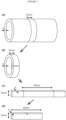
- a tubular test specimen of 10 mm in length ( Figure 1a ) is taken from a seamless steel pipe, cut in the axial direction of the pipe at room temperature into a C shape ( Figure 1b ), and thereafter spread into a plate shape ( Figure 1c ). Then, after cutting both ends in the longitudinal direction to obtain a rectangular test specimen with a length of 55 mm, a width of 10 mm, and a thickness of the original wall thickness d of the steel pipe, a V notch with notch angle of 45°, notch depth of 2 mm, and notch bottom radius of 0.25 mm is introduced in the longitudinal center of the test specimen, so that the notch bottom is parallel to the thickness direction of the test specimen ( Figure 1d ). Using the obtained test specimen, a Charpy impact test is performed in accordance with JIS Z 2242: 2018 to determine vTrs100.
- the seamless steel pipe according to the present embodiment has excellent hydrogen embrittlement resistance.
- a critical hydrogen concentration is 2.5 ppm or more. This makes it possible to ensure high reliability when used as a steel pipe for an air bag or the like.
- the critical hydrogen concentration is more preferably 2.7 ppm or more.
- the critical hydrogen concentration is determined by the following method.
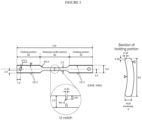
- a plurality of arc-shaped tensile test specimens having a shape illustrated in Figure 2 are taken from the seamless steel pipe.
- the arc-shaped tensile test specimen is made by cutting an arc-shaped test specimen with a length of 120 mm, a width of 9.0 mm, and a thickness of the original wall thickness d of the steel pipe from the seamless steel pipe, thereafter, providing a reduced width portion in the central part of the arc-shaped test specimen in the longitudinal direction, while holding portions are left at both ends of the arc-shaped test specimen in the longitudinal direction, and further providing a U notch in the central part of the reduced width portion in the longitudinal direction.
- Each of the holding portions has a length of 45 mm and a width of 9.0 mm
- the reduced width portion has a length of 30 mm and a width of 2.0 mm. Both ends of the reduced width portion have curved surfaces having a radius of curvature of 5.0 mm and are connected to the holding portions.
- the U notch has notch width of 0.20 mm, notch depth of 0.35 mm, and notch bottom radius of 0.10 mm.
- the cathode charge constant load test with a potential within the range of -0.9 to -1.2 V is performed with the arc-shaped tensile test specimens being immersed in various types of aqueous solutions containing 3% NaCl and ammonium thiocyanate within the range of 0 to 30 g/L. At this time, a stress that is 90% of tensile strength of each seamless steel pipe is loaded.
- test specimens that resulted in endurance times of more than 200 hours are stored in liquid nitrogen, and their parallel parts of the reduced width portions are cut to make test specimens for hydrogen concentration measurement. Thereafter, the test specimens are subjected to measurement of hydrogen concentration by a thermal desorption analysis method.
- hydrogen concentrations of the specimens are determined by heating the test specimens for hydrogen concentration measurement from normal temperature to 200°C at a heating rate of 100°C/hour and measuring their amounts of desorbed hydrogen. The highest value of the resultant concentrations of hydrogen is determined as a critical hydrogen concentration.
- the seamless steel pipe according to an embodiment of the present invention can be produced by the following method.
- a steel having the chemical composition described as in (A) is melted by a normal method and then cast into ingots or cast pieces. Note that the steel may be formed into cast pieces for pipe-making having a round billet shape by what is called a "round continuous casting” method.
- the cast ingots or cast pieces are subjected to blooming or hot forging.
- This step is a step for producing starting materials used for final hot rolling (e.g., pipe-making by piercing, rolling, and elongating steps performed as hot processing, or pipe-making by hot extrusion press).
- the cast pieces made to have the round billet shape by the "round continuous casting" can be directly finished into seamless steel pipes. Therefore, the blooming or the hot forging is not necessarily performed.
- the starting materials to be used for final hot rolling produced by the blooming or the hot forging described above or the cast pieces made to have the round billet shape (hereinafter, these will be collectively referred to as "cast pieces") are subjected to a hot rolling step, a cold working step, a quenching step, and a tempering step in this order, by which seamless steel pipes in the present embodiment are produced.
- the cast pieces are heated and then subjected to the hot rolling, by which hollow shells having a prescribed shape are produced.
- a method for the hot rolling a normal method for hot rolling is to be used.
- the Mandrel-Mannesmann process may be used.
- a heating temperature of the cast pieces can be set to, for example, 1000 to 1300°C.
- the hollow shells provided by the method described above are subjected to cold working for enhancement of dimensional accuracy.
- a method for the cold working is not limited to a particular method as long as the method enables the hollow shells to be processed evenly.
- a cold draw bench which is provided with a holed die and a plug
- a cold rolling machine called a cold Pilger mill, or the like is industrially advantageous.
- the hollow shells after the cold working are next subjected to an induction hardening process in which the hollow shells are subjected to high-frequency induction heating to a temperature of 900 to 1050°C and to rapid cooling.
- a heating temperature of the high-frequency induction heating of less than 900°C may cause incompletion of austenitization, failing to impart high strength.
- a heating temperature of the high-frequency induction heating of more than 1050°C causes austenitic grains to coarsen through rapid growth, failing to impart excellent toughness.
- Rapid heating by the high-frequency induction heating restrains growth of austenitic grains, thus providing a fine metal micro-structure.
- a retention time at the heating temperature is preferably set to 10 seconds or less, which however depends on a size of the hollow shells.
- the heating temperature refers to a temperature at outer surfaces of the hollow shells.
- any appropriate method such as water cooling and oil cooling may be used as long as the method can provide a sufficient quenching structure.
- the hollow shells subjected to the induction hardening are subjected to a tempering process in which the hollow shells are heated to 370 to 410°C and then cooled to room temperature.
- a heating temperature of the tempering is less than 370°C, strength can be kept but low-temperature toughness is decreased.
- a heating temperature of the tempering is more than 410°C, excellent low-temperature toughness can be obtained but strength is decreased, failing to provide a tensile strength of 1200 MPa or more.
- a retention time at the heating temperature is preferably set to 10 to 30 minutes, which however depends on the size of the hollow shells.
- the heating temperature refers to a temperature at the outer surfaces of the hollow shells.
- a cooling rate for the tempering is not limited to a particular cooling rate. Accordingly, cooling in accordance with facilities such as allowing cooling in the air, forced air cooling, mist cooling, oil cooling, and water cooling is to be performed.
- preheating is performed so that the residence time in the temperature range of 250 to 350°C is 5 minutes or longer. As described above, it is considered that this is because the temperature distribution in the thickness direction is eliminated and the metal structure becomes uniform by performing preheating.
- the circular billets were heated, hot-rolled into hollow shells by the Mandrel-Mannesmann process, and cooled to room temperature.
- the resultant hollow shells were subjected to cold working with a cold draw bench.
- quenching and tempering were performed under conditions shown in Table 2 to produce seamless steel pipes.
- the preheating time in Table 2 means the residence time in the temperature range of 250 to 350°C. Note that the quenching was performed in such a manner as to subject all the hollow shells to high-frequency induction heating and then water quenching at a cooling rate adjusted to 150°C/sec. As the cooling for the tempering, all the hollow shells were subjected to allowing cooling in the air.
- the resultant seamless steel pipes were first subjected to measurement of prior-austenite grain size number.
- the prior-austenite grain size number was measured in conformance with ASTM E112 (2013). Specifically, a specimen including the entire wall thickness of each seamless steel pipe was taken such that a longitudinal section of the seamless steel pipe serves as an observation surface, and the observation surface was subjected to mirror polish. After the polish, prior-austenite crystal grain boundaries in the observation surface were made to appear with picral etchant. Subsequently, five visual fields in the observation surface were observed under an optical microscope with a 1/4 position from an outer surface of the seamless steel pipe being centered in each visual field.
- a prior-austenite grain size number was determined by the comparison procedure specified in ASTM E112 (2013), and the average value of the visual fields was taken as a prior-austenite grain size number of the seamless steel pipe.
- a base observation magnification was set to x100, and an observation magnification was set to x200 or x400 in accordance with the grain size number.
- Q 6.64 log 10 M/100 where M in the formula denotes the observation magnification.
- each seamless steel pipe was evaluated in terms of tensile strength, low-temperature toughness, and hydrogen embrittlement resistance properties by the following methods.
- a tubular test specimen having a certain length is cut from each seamless steel pipe and fabricated into a No. 11 test coupon specified in JIS Z 2241: 2011. Subsequently, the tubular tensile test specified in JIS Z 2241: 2011 was performed on the No. 11 test coupon to measure the tensile strength.
- a tubular test specimen having a length of 10 mm ( Figure 1a ) was taken from each seamless steel pipe, cut in its pipe axis direction at room temperature into a C shape ( Figure 1b ), and spread into a plate shape ( Figure 1c ). Then, after cutting both ends in the longitudinal direction to obtain a rectangular test specimen with a length of 55 mm, a width of 10 mm, and a thickness of the original wall thickness d of the steel pipe, a V notch with notch angle of 45°, notch depth of 2 mm, and notch bottom radius of 0.25 mm was introduced in the longitudinal center of the test specimen, so that the notch bottom is parallel to the thickness direction of the test specimen ( Figure 1d ).
- vTrs100 was determined and taken as an index of low-temperature toughness.
- vTrs100 was -80°C or less was determined to be excellent in low-temperature toughness.
- An arc-shaped tensile test specimen having a shape illustrated in Figure 2 was taken from each seamless steel pipe and subjected to a cathode charge constant load test. Specifically, the cathode charge constant load test with a potential within the range of - 0.9 to -1.2 V was performed with a plurality of arc-shaped tensile test specimens with holding portions and reduced width portions being immersed in various types of aqueous solutions containing 3% NaCl and ammonium thiocyanate within the range of 0 to 30 g/L. At this time, a stress that was 90% of tensile strength of each seamless steel pipe was loaded.
- Test Nos. 1 to 10 which satisfied all of the specifications of the present invention, had high tensile strength and excellent low-temperature toughness and, in addition, resulted in excellent hydrogen embrittlement resistance properties.
- a seamless steel pipe that has high strength and excellent low-temperature toughness and further has excellent hydrogen embrittlement resistance properties can be provided. Accordingly, the seamless steel pipe according to the present invention is suitable for airbags.
Landscapes
- Chemical & Material Sciences (AREA)
- Engineering & Computer Science (AREA)
- Materials Engineering (AREA)
- Mechanical Engineering (AREA)
- Metallurgy (AREA)
- Organic Chemistry (AREA)
- Physics & Mathematics (AREA)
- Thermal Sciences (AREA)
- Crystallography & Structural Chemistry (AREA)
- Manufacturing & Machinery (AREA)
- Heat Treatment Of Articles (AREA)
- Heat Treatment Of Steel (AREA)
- Rigid Pipes And Flexible Pipes (AREA)
Abstract
Description
- The present invention relates to a seamless steel pipe.
- The automotive industry has been actively introducing safety-oriented equipment. In particular, airbag systems have been installed, which inflate an airbag with gas or the like between an occupant and a steering wheel, an instrument panel, or the like at the time of a collision before the occupant impacts these objects, so as to absorb the kinetic energy of the occupant, thus reducing injuries of the occupant. Although airbag systems of a type that uses an explosive chemical have been adopted to date, a system that uses high-pressure fill gas has been developed from the viewpoint of environmental recyclability, and the system is increasingly applied.
- In the system, gas or the like to blow into an airbag at the time of a collision is always kept at high pressure, and at the time of a collision, the gas blows all at once. Accordingly, a stress is to be loaded to a pipe used for a high-pressure gas accumulator at a high strain rate in an extremely short time. Therefore, a pipe to be used for the accumulator is required to have excellent strength and resistance to burst.
- Recently, there are increasing demands for weight reduction of automobiles. From this viewpoint, there is also a demand for a decreased wall thickness and weight of a pipe for an onboard airbag. To keep a high bursting pressure even in a thin-wall airbag, accumulators produced from high-strength seamless steel pipes having a tensile strength of 900 MPa or more or even 1000 MPa or more have become used in airbag systems.
- Further, an accumulator is required to have excellent low-temperature toughness so as not to cause brittle fracture of the accumulator at the time of a collision, leading to a secondary accident, for example in cold regions.
- In view of these circumstances, for example, Patent Document 1 discloses a seamless steel pipe for an airbag accumulator that has a tensile strength of 850 MPa or more and resistance to burst at -20°C and can be produced only by normalizing heat treatment, without quenching and tempering.
- Patent Document 2 discloses a seamless steel pipe for an airbag system having a tensile strength of 1000 MPa or more that is subjected to cold working followed by quenching + tempering and has excellent low-temperature resistance to burst when used as an airbag accumulator component with a shrunk portion.
- Patent Document 3 discloses a process for producing a pipe for a high-strength, high-toughness airbag that enables simplification of a cold draw step and reduction in alloy cost.
-
- Patent Document 1:
WO 2008/050628 - Patent Document 2:
JP2010-132999A - Patent Document 3:
WO 2011/152447 - With the techniques described in Patent Documents 1 to 3, a pipe for an airbag having high strength and excellent low-temperature toughness can be provided. However, because of a further request for further weight reduction in recent years, there is a demand for a seamless steel pipe for an airbag having a tensile strength of 1200 MPa or more.
- The present inventors thus conducted studies about a method for increasing strength while maintaining low-temperature toughness and found that simply increasing strength of a pipe may result in significant decrease in hydrogen embrittlement resistance properties of the pipe. To maintain higher reliability of a pipe for an airbag, restraint of embrittlement by hydrogen entering a pipe during a production step and in a usage environment is required even when high strength is given to the pipe.
- An objective of the present invention is to provide a seamless steel pipe that has high strength and excellent low-temperature toughness and further has excellent hydrogen embrittlement resistance properties.
- The present invention is made to solve the above problems and has a gist of the following seamless steel pipe.
-
- (1) A seamless steel pipe having a chemical composition consisting of, in mass%:
- C: 0.05 to 0.20%,
- Si: 0.05 to 0.50%,
- Mn: 0.40 to 1.50%,
- P: 0.025% or less,
- S: 0.020% or less,
- Cu: 0.10 to 0.50%,
- Ni: 0.10 to 0.50%,
- Cr: 0.10 to 1.20%,
- Mo: 0.10 to 0.50%,
- Ti: 0.005 to 0.050%,
- Nb: 0.005 to 0.100%,
- Ca: 0.0005 to 0.0025%,
- Al: 0.080% or less,
- N: 0.0100% or less,
- V: 0 to 0.100%,
- B: 0 to 0.0050%,
- Mg: 0 to 0.0050%, and
- REM: 0 to 0.0050%,
- with the balance: Fe and impurities, wherein
- contents of the elements satisfy Formula (i) shown below on a precondition that the contents fall within respective ranges described above,
- the chemical composition further satisfies Formula (ii) and Formula (iii) shown below in conjunction with a prior-austenite grain size number,
- a tensile strength of the seamless steel pipe is 1200 MPa or more, and a critical hydrogen concentration of the seamless steel pipe is 2.5 ppm or more:


- where symbols of elements in the formula mean contents (mass%) of the elements in the steel, and when an element is not contained, zero will be set to the corresponding symbol, and where GN means the prior-austenite grain size number.
- (2) The seamless steel pipe according to (1), wherein the chemical composition contains one or more elements selected from, in mass%:
- V: 0.001 to 0.100%,
- B: 0.0001 to 0.0050%,
- Mg: 0.0001 to 0.0100%, and
- REM: 0.0001 to 0.0100%.
- According to the present invention, a seamless steel pipe that has high strength and excellent low-temperature toughness and further has excellent hydrogen embrittlement resistance properties can be provided.
-
- [
Figure 1] Figure 1 is a diagram for describing a shape of a specimen for toughness evaluation. - [
Figure 2] Figure 2 is a diagram for describing a shape of an arc-shaped tensile test specimen used for measurement of critical hydrogen concentration. - The present inventors conducted diligent studies about a method for increasing strength of a seamless steel pipe with low-temperature toughness of the seamless steel pipe being maintained and further keeping hydrogen embrittlement resistance properties. As a result, the present inventors obtained the following findings.
-
- (a) To achieve increase in strength of a seamless steel pipe, contents of elements that enhance hardenability need to be increased. In particular, keeping sufficient contents of C, Mo, and Cr is effective. From such a viewpoint, Formula (i) shown below has to be satisfied.

- (b) Mn is also an element that enhances hardenability. However, Mn excessively contained segregates in grain boundaries to degrade low-temperature toughness. In addition to Mn, P is also an element that segregates in grain boundaries to degrade low-temperature toughness. In contrast, N precipitates in the form of nitrides, and if a content of N is excessive, the number of nitrides is increased to degrade low-temperature toughness.
- (c) Here, a degree of decrease in low-temperature toughness due to grain-boundary segregation varies based on a prior-austenite grain size number. For this reason, the present inventors evaluated an influence of contents of Mn, P, and N and the prior-austenite grain size number GN on low-temperature toughness and consequently found that excellent low-temperature toughness can be maintained by adjusting the content of each element within the specified range and satisfying Formula (ii) shown below.

- (d) If the content of Mn is excessive, a diffusion velocity of hydrogen is decreased, which causes not only localized concentration of hydrogen but also production of MnS, leading to degradation in hydrogen embrittlement resistance properties. In addition, P segregates in grain boundaries to degrade hydrogen embrittlement resistance properties. In contrast, Ca has the effect of restraining the production of MnS and thus enhances hydrogen embrittlement resistance properties.
- (e) Studies by the present inventors revealed that a degree of degradation in hydrogen embrittlement resistance properties varies based on a prior-austenite grain size number as well. The present inventors evaluated an influence of contents of Mn, P, and Ca and the prior-austenite grain size number GN on hydrogen embrittlement resistance properties and consequently found that excellent hydrogen embrittlement resistance properties can be obtained by adjusting the content of each element within the specified range and satisfying Formula (iii) shown below.

- (f) Furthermore, in order to improve hydrogen embrittlement resistance, it is necessary to perform preheating in a tempering process. The mechanism by which the hydrogen embrittlement resistance is improved by preheating has not been clarified, but it is considered that this is because the temperature distribution in the thickness direction is eliminated and the metal structure becomes uniform.
- (g) Cu, Ni, Cr and Mo are elements that enhance hardenability, as with Mn. On the other hand, Ti and Nb are elements that have the effect of strongly pinning grain boundaries. In the present invention, in order to achieve both strength and low-temperature toughness, it is necessary to utilize the effects of all these elements, and it is necessary to contain all elements in a well-balanced manner at a predetermined content or more.
- The present invention has been made based on the above findings. Requirements of the present invention will be described below in detail.
- Reasons for limiting a chemical composition of a seamless steel pipe according to an embodiment of the present invention are as follows. In the following description, the symbol "%" for a content of each element means "mass%".
- C (carbon) is an element that is effective in increasing strength of steel inexpensively. If a content of C is less than 0.05%, it is difficult to provide a desired tensile strength, and if the content of C is more than 0.20%, workability and weldability are decreased. Therefore, the content of C is set to 0.05 to 0.20%. A range of the content of C is preferably 0.07% or more to 0.18% or less, and more preferably 0.09% or more to 0.17% or less. It should be noted that when forming the seamless steel pipe into the shape of an airbag, it is necessary to perform a diameter reduction process or the like. Therefore, when the workability is particularly important, the C content is more preferably less than 0.17%.
- Si (silicon) is an element that has a deoxidation action and increases hardenability of steel to enhance strength of steel. For this purpose, a content of Si is set to 0.05% or more. However, if the content of Si is more than 0.50%, toughness is decreased. Therefore, the content of Si is set to 0.50% or less. A range of the content of Si is preferably 0.10% or more to 0.40% or less, and more preferably 0.15% or more to 0.30% or less.
- Mn (manganese) is an element that has a deoxidation action and is effective in increasing hardenability of steel to enhance strength and toughness of steel. However, if a content of Mn is less than 0.40%, sufficient strength and toughness cannot be provided. On the other hand, if the content of Mn is more than 1.50%, coarsening of MnS occurs, and coarsened MnS elongates and expands at the time of hot rolling, resulting in decrease in toughness and hydrogen embrittlement resistance properties. Further, excessive Mn decreases a diffusion velocity of hydrogen, which causes localized concentration of hydrogen, leading to decrease in hydrogen embrittlement resistance properties. For this reason, the content of Mn is set to 0.40 to 1.50%. A range of the content of Mn is preferably 0.45% or more to 1.20% or less, and more preferably 0.50% or more to 1.00% or less.
- P (phosphorus) is contained in steel as an impurity and leads to decrease in toughness and hydrogen embrittlement resistance properties due to grain-boundary segregation. In particular, if a content of P is more than 0.025%, the decrease in toughness and hydrogen embrittlement resistance properties becomes significant. Therefore, the content of P is set to 0.025% or less. The content of P is preferably 0.020% or less, and more preferably 0.015% or less.
- S (sulfur) is contained in steel as an impurity and decreases toughness particularly in a T direction of a pipe (a direction perpendicular to a pipe axis direction of the pipe). If a content of S is more than 0.020%, the decrease in toughness in the T direction of a pipe becomes significant. Therefore, the content of S is set to 0.020% or less. The content of S is preferably 0.010% or less.
- Cu (copper) increases hardenability of steel to enhance strength and toughness of the steel. The effect appears when 0.10% or more of Cu is contained. However, a content of Cu more than 0.50% leads to increase in alloy cost. Therefore, the content of Cu is set to 0.10 to 0.50%. The content of Cu is preferably 0.15% or more, and more preferably 0.20% or more. The content of Cu is preferably 0.40% or less, and more preferably 0.35% or less.
- Ni (nickel) increases hardenability of steel, thereby enhancing strength and toughness of the steel. The effect appears when 0.10% or more of Ni is contained. However, a content of Ni more than 0.50% leads to increase in alloy cost. Therefore, the content of Ni is set to 0.10 to 0.50%. The content of Ni is preferably 0.15% or more, and more preferably 0.20% or more. The content of Ni is preferably 0.45% or less, and more preferably 0.40% or less.
- Cr (chromium) increases hardenability of steel and increases temper softening resistance to enhance strength and toughness. The effect appears when 0.10% or more of Cr is contained. However, a content of Cr more than 1.20% leads to increase in alloy cost. Therefore, the content of Cr is set to 0.10 to 1.20%. The content of Cr is preferably 0.15% or more, and more preferably 0.20% or more. The content of Cr is preferably 1.00% or less, and more preferably 0.90% or less.
- Mo (molybdenum) increases hardenability of steel and increases temper softening resistance to enhance strength and toughness. The effect appears when 0.10% or more of Mo is contained. However, a content of Mo more than 0.50% leads to increase in alloy cost. If the content of Mo is excessively high, a resultant seamless steel pipe tends to increase in strength even in air cooling after hot rolling, which requires softening heat treatment before cold drawing work, leading to increase in production cost. Therefore, the content of Mo is set to 0.10 to 0.50%. The content of Mo is preferably 0.15% or more, and more preferably 0.20% or more. The content of Mo is preferably 0.45% or less, and more preferably 0.40% or less.
- Ti (titanium) fixes N in steel, enhancing toughness. In addition, Ti nitrides finely dispersed strongly pin grain boundaries to subject grains to grain refinement, enhancing toughness of steel. To provide the effect, 0.005% or more of Ti needs to be contained. However, if more than 0.050% of Ti is contained, its nitrides are coarsened, rather decreasing toughness. Therefore, a content of Ti is set to 0.005 to 0.050%. The content of Ti is preferably 0.040% or less, and more preferably 0.030% or less.
- Nb (niobium) is finely dispersed in steel in the form of its carbides, strongly pinning crystal grain boundaries. Nb has the effect of subjecting grains to grain refinement, enhancing toughness of steel. To provide the effect, 0.005% or more of Nb needs to be contained. However, if more than 0.100% of Nb is contained, its carbides are coarsened, rather decreasing toughness. Therefore, a content of Nb is set to 0.005 to 0.100%. The content of Nb is preferably 0.010% or more, and more preferably 0.015% or more. The content of Nb is preferably 0.050% or less, and more preferably 0.030% or less.
- Ca (calcium) fixes S that is present in steel as an unavoidable impurity in the form of its sulfide and improves anisotropy of toughness to increase toughness in a T direction of a pipe, thereby increasing resistance to burst. In addition, Ca restrains production of MnS, thus contributing to enhancement in hydrogen embrittlement resistance properties. The effect appears when 0.0005% or more of Ca is contained. However, if more than 0.0025% of Ca is contained, inclusions increase, rather decreasing toughness. Therefore, a content of Ca is set to 0.0005 to 0.0025%. In order to reliably obtain the effect of improving hydrogen embrittlement resistance, the Ca content is preferably 0.0010% or more, more preferably more than 0.0010%, further preferably 0.0012% or more, and further preferably 0.0015% or more.
- Al (aluminum) is an element that has a deoxidation action and is effective in increasing toughness and workability. However, if more than 0.080% of Al is contained, occurrence of macro-streak-flaw becomes significant. Therefore, a content of Al is set to 0.080% or less. The content of Al is preferably 0.060% or less, and more preferably 0.040% or less. The content of Al may be on the level of impurity. Thus, a lower limit of the content of Al is not limited to a particular content. However, the content of Al is preferably set to 0.005% or more. The content of Al in the present invention refers to a content of acid-soluble Al (what is called sol. Al).
- N (nitrogen) forms fine nitrides, thereby strongly pinning grain boundaries to subject grains to grain refinement, thus enhancing toughness of steel. However, if more than 0.0100% of N is contained, nitrides are coarsened, rather decreasing toughness. Therefore, a content of N is set to 0.0100% or less. The content of N is preferably 0.0080% or less, and more preferably 0.0050% or less. The content of N may be on the level of impurity. Thus, a lower limit of the content of N is not limited to a particular content. However, the content of N is preferably set to 0.0005% or more, and more preferably 0.0010% or more.
- V (vanadium) is an element that keeps toughness and increases strength through precipitation strengthening. Thus, V may be contained as necessary. However, more than 0.100% of V contained leads to decrease in toughness. Therefore, in a case where V is contained, a content of V is set to 0.100% or less. The content of V is preferably 0.050% or less, and more preferably 0.010% or less. Even a trace quantity of V enables the action of V to be recognized. However, to provide the effect sufficiently, 0.001% or more of V is preferably contained.
- B (boron) is an element that segregates in grain boundaries in steel to enhance hardenability of steel significantly. Therefore, B may be contained as necessary. However, if more than 0.0050% of B is contained, there is a tendency for borides to precipitate coarsely in crystal grain boundaries, decreasing toughness. Therefore, in a case where B is contained, a content of B is set to 0.0050% or less. The content of B is preferably 0.0030% or less, and more preferably 0.0020% or less. Even a trace quantity of B enables the action of B to be recognized. However, to keep the effect sufficiently, 0.0001% or more of B is preferably contained, and 0.0005% or more of B is more preferably contained.
- As with Ca, Mg (magnesium) is an element that fixes S present in steel as an unavoidable impurity in the form of its sulfide and improves anisotropy of toughness to increase toughness in a T direction of a pipe, thereby increasing resistance to burst. Therefore, Mg may be contained as necessary. However, if more than 0.0050% of Mg is contained, inclusions increase, rather decreasing toughness. Therefore, in a case where Mg is contained, a content of Mg is set to 0.0050% or less. The content of Mg is preferably 0.0040% or less, and more preferably 0.0030% or less. Even a trace quantity of Mg enables the action of Mg to be recognized. However, to keep the effect sufficiently, 0.0001% or more of Mg is preferably contained, and 0.0005% or more of Mg is more preferably contained.
- As with Ca, REM (rare earth metal) is one or more elements that fix S present in steel as an unavoidable impurity in the form of their sulfides and improve anisotropy of toughness to increase toughness in a T direction of a pipe, thereby increasing resistance to burst. Therefore, REM may be contained as necessary. However, if more than 0.0050% of REM is contained, inclusions increase, rather decreasing toughness. Therefore, in a case where REM is contained, a content of REM is set to 0.0050% or less. The content of REM is preferably 0.0040% or less, and more preferably 0.0030% or less. Even a trace quantity of REM enables the action of REM to be recognized. However, to keep the effect sufficiently, 0.0001% or more of REM is preferably contained, and 0.0005% or more of REM is more preferably contained.
- In the present embodiment, "REM" refers to Sc (scandium), Y (yttrium), and lanthanoids, 17 elements in total, and in a case where REM includes one element, "the content of REM" refers to a content of the element, and in a case where REM includes two or more elements, "the content of REM" refers to a total content of the elements. In general, REM is supplied in the form of misch metal, which is an alloy of a plurality of types of REM. For this reason, REM may be contained in such a manner as to add one, or two or more separate elements of REM or may be added, for example, in the form of misch metal.
- The seamless steel pipe according to the present embodiment contains the elements described above, with the balance being Fe and impurities. The term "impurities" herein means components that are mixed in a steel material in producing the steel material industrially from raw materials such as ores and scraps and due to various factors in the producing process, and are allowed to be mixed in the steel material within their respective ranges in which the impurities have no adverse effect on the present invention.
- In the chemical composition of the seamless steel pipe according to the present embodiment, contents of elements further satisfy Formula (i) shown below on the precondition that the contents of elements fall within their respective ranges described above. As described above, keeping sufficient contents of C, Mo, and Cr enhances hardenability, thus enabling the achievement of increase in strength of the seamless steel pipe. The left side value of the Formula (i) below is preferably 1.20 or more, and more preferably 1.50 or more.

- The chemical composition of the seamless steel pipe according to the present embodiment satisfies Formula (ii) shown below in conjunction with a prior-austenite grain size number. By adjusting the contents of Mn, P, and N, which lead to the decrease in low-temperature toughness, based on the prior-austenite grain size number, excellent low-temperature toughness can be maintained. The left side value of Formula (ii) below is preferably 8.00 or more, and more preferably 8.50 or more.

- Further, the chemical composition of the seamless steel pipe according to the present embodiment satisfies Formula (iii) shown below in conjunction with a prior-austenite grain size number. By adjusting the contents of Mn and P, which degrades hydrogen embrittlement resistance properties, and the content of Ca, which enhances hydrogen embrittlement resistance properties, based on the prior-austenite grain size number, excellent hydrogen embrittlement resistance properties can be provided. The left side value of Formula (iii) below is preferably 9.50 or more, and more preferably 10.00 or more.

- The prior-austenite grain size number is measured in conformance with ASTM E112 (2013). Specifically, a specimen including the entire wall thickness of the seamless steel pipe is taken such that a surface of the seamless steel pipe including a pipe axis direction and a wall-thickness direction of the seamless steel pipe (hereinafter, referred to as a "longitudinal section") serves as a test surface (hereinafter, referred to as an "observation surface"), and the observation surface is subjected to mirror polish. After the polish, prior-austenite crystal grain boundaries in the observation surface are made to appear with picral etchant.
- Subsequently, five visual fields in the observation surface are observed under an optical microscope with a 1/4 position from an outer surface of the seamless steel pipe being centered in each visual field. In each visual field, a prior-austenite grain size number is determined by the comparison procedure specified in ASTM E112 (2013), and the average value of the visual fields is taken as a prior-austenite grain size number of the seamless steel pipe. At this time, a base observation magnification is set to x100, and an observation magnification is set to x200 or x400 in accordance with the grain size number. When the observation magnification is set to x200 or x400, correction is made in conformance with ASTM E112 (2013) using a correction factor Q defined by Formula (I) shown below.

- Note that the prior-austenite grain size number is not limited to a particular number as long as the prior-austenite grain size number satisfies Formula (ii) and Formula (iii) described above. For example, the prior-austenite grain size number can be set to 10.0 or more or 11.0 or more.
- The seamless steel pipe according to the present embodiment has high strength. Specifically, its tensile strength is 1200 MPa or more. When the tensile strength is 1200 MPa or more, the seamless steel pipe exerts excellent resistance to burst even in a case where the seamless steel pipe is used as an accumulator for high-pressure gas to which a stress is loaded at a high strain rate in an extremely short time.
- The tensile strength is measured in conformance with JIS Z 2241: 2011. Specifically, a tubular test specimen having a certain length is cut from the seamless steel pipe and fabricated into a No. 11 test coupon specified in JIS Z 2241: 2011. Subsequently, the tubular tensile test specified in JIS Z 2241: 2011 is performed on the No. 11 test coupon to measure the tensile strength.
- Moreover, the seamless steel pipe according to the present embodiment has excellent low-temperature toughness. In the seamless steel pipe according to the present embodiment, a lower limit temperature at which its ductile fracture percent is 100% (vTrs100), which is determined by the Charpy impact test specified in JIS Z 2242: 2018, is preferably -80°C or less, and more preferably -85°C or less. More specifically, in the present embodiment, vTrs100 is determined by the following method.
- First, as shown in
Figure 1 , a tubular test specimen of 10 mm in length (Figure 1a ) is taken from a seamless steel pipe, cut in the axial direction of the pipe at room temperature into a C shape (Figure 1b ), and thereafter spread into a plate shape (Figure 1c ). Then, after cutting both ends in the longitudinal direction to obtain a rectangular test specimen with a length of 55 mm, a width of 10 mm, and a thickness of the original wall thickness d of the steel pipe, a V notch with notch angle of 45°, notch depth of 2 mm, and notch bottom radius of 0.25 mm is introduced in the longitudinal center of the test specimen, so that the notch bottom is parallel to the thickness direction of the test specimen (Figure 1d ). Using the obtained test specimen, a Charpy impact test is performed in accordance with JIS Z 2242: 2018 to determine vTrs100. - Moreover, the seamless steel pipe according to the present embodiment has excellent hydrogen embrittlement resistance. Specifically, a critical hydrogen concentration is 2.5 ppm or more. This makes it possible to ensure high reliability when used as a steel pipe for an air bag or the like. The critical hydrogen concentration is more preferably 2.7 ppm or more. Specifically, in the present embodiment, the critical hydrogen concentration is determined by the following method.
- A plurality of arc-shaped tensile test specimens having a shape illustrated in
Figure 2 are taken from the seamless steel pipe. The arc-shaped tensile test specimen is made by cutting an arc-shaped test specimen with a length of 120 mm, a width of 9.0 mm, and a thickness of the original wall thickness d of the steel pipe from the seamless steel pipe, thereafter, providing a reduced width portion in the central part of the arc-shaped test specimen in the longitudinal direction, while holding portions are left at both ends of the arc-shaped test specimen in the longitudinal direction, and further providing a U notch in the central part of the reduced width portion in the longitudinal direction. Each of the holding portions has a length of 45 mm and a width of 9.0 mm, and the reduced width portion has a length of 30 mm and a width of 2.0 mm. Both ends of the reduced width portion have curved surfaces having a radius of curvature of 5.0 mm and are connected to the holding portions. Further, the U notch has notch width of 0.20 mm, notch depth of 0.35 mm, and notch bottom radius of 0.10 mm. - Subsequently, the cathode charge constant load test with a potential within the range of -0.9 to -1.2 V is performed with the arc-shaped tensile test specimens being immersed in various types of aqueous solutions containing 3% NaCl and ammonium thiocyanate within the range of 0 to 30 g/L. At this time, a stress that is 90% of tensile strength of each seamless steel pipe is loaded.
- Then, only arc-shaped tensile test specimens that resulted in endurance times of more than 200 hours are stored in liquid nitrogen, and their parallel parts of the reduced width portions are cut to make test specimens for hydrogen concentration measurement. Thereafter, the test specimens are subjected to measurement of hydrogen concentration by a thermal desorption analysis method. In the thermal desorption analysis method, hydrogen concentrations of the specimens are determined by heating the test specimens for hydrogen concentration measurement from normal temperature to 200°C at a heating rate of 100°C/hour and measuring their amounts of desorbed hydrogen. The highest value of the resultant concentrations of hydrogen is determined as a critical hydrogen concentration.
- The seamless steel pipe according to an embodiment of the present invention can be produced by the following method.
- A steel having the chemical composition described as in (A) is melted by a normal method and then cast into ingots or cast pieces. Note that the steel may be formed into cast pieces for pipe-making having a round billet shape by what is called a "round continuous casting" method.
- As the next step, the cast ingots or cast pieces are subjected to blooming or hot forging. This step is a step for producing starting materials used for final hot rolling (e.g., pipe-making by piercing, rolling, and elongating steps performed as hot processing, or pipe-making by hot extrusion press). The cast pieces made to have the round billet shape by the "round continuous casting" can be directly finished into seamless steel pipes. Therefore, the blooming or the hot forging is not necessarily performed.
- The starting materials to be used for final hot rolling produced by the blooming or the hot forging described above or the cast pieces made to have the round billet shape (hereinafter, these will be collectively referred to as "cast pieces") are subjected to a hot rolling step, a cold working step, a quenching step, and a tempering step in this order, by which seamless steel pipes in the present embodiment are produced.
- The cast pieces are heated and then subjected to the hot rolling, by which hollow shells having a prescribed shape are produced. As a method for the hot rolling, a normal method for hot rolling is to be used. For example, the Mandrel-Mannesmann process may be used. A heating temperature of the cast pieces can be set to, for example, 1000 to 1300°C.
- The hollow shells provided by the method described above are subjected to cold working for enhancement of dimensional accuracy. A method for the cold working is not limited to a particular method as long as the method enables the hollow shells to be processed evenly. For example, use of what is called a cold draw bench, which is provided with a holed die and a plug, a cold rolling machine called a cold Pilger mill, or the like is industrially advantageous.
- The hollow shells after the cold working are next subjected to an induction hardening process in which the hollow shells are subjected to high-frequency induction heating to a temperature of 900 to 1050°C and to rapid cooling. A heating temperature of the high-frequency induction heating of less than 900°C may cause incompletion of austenitization, failing to impart high strength. On the other hand, a heating temperature of the high-frequency induction heating of more than 1050°C causes austenitic grains to coarsen through rapid growth, failing to impart excellent toughness.
- Rapid heating by the high-frequency induction heating restrains growth of austenitic grains, thus providing a fine metal micro-structure. From the viewpoint of restraining the growth of austenitic grains, a retention time at the heating temperature is preferably set to 10 seconds or less, which however depends on a size of the hollow shells. Note that the heating temperature refers to a temperature at outer surfaces of the hollow shells. As the rapid cooling, any appropriate method such as water cooling and oil cooling may be used as long as the method can provide a sufficient quenching structure.
- The hollow shells subjected to the induction hardening are subjected to a tempering process in which the hollow shells are heated to 370 to 410°C and then cooled to room temperature. When a heating temperature of the tempering is less than 370°C, strength can be kept but low-temperature toughness is decreased. On the other hand, when a heating temperature of the tempering is more than 410°C, excellent low-temperature toughness can be obtained but strength is decreased, failing to provide a tensile strength of 1200 MPa or more.
- A retention time at the heating temperature is preferably set to 10 to 30 minutes, which however depends on the size of the hollow shells. The heating temperature refers to a temperature at the outer surfaces of the hollow shells. A cooling rate for the tempering is not limited to a particular cooling rate. Accordingly, cooling in accordance with facilities such as allowing cooling in the air, forced air cooling, mist cooling, oil cooling, and water cooling is to be performed.
- Moreover, in order to obtain excellent hydrogen embrittlement resistance, it is necessary to perform preheating before the temperature is raised to the above heating temperature. Specifically, preheating is performed so that the residence time in the temperature range of 250 to 350°C is 5 minutes or longer. As described above, it is considered that this is because the temperature distribution in the thickness direction is eliminated and the metal structure becomes uniform by performing preheating.
- The present invention will be described below more specifically with reference to examples, but the present invention is not limited to these examples.
- Steels having chemical compositions shown in Table 1 were melted and cast into rectangular billets by a converter-continuous casting process. The rectangular billets were further formed into circular billets by hot forging and cooled to room temperature.
-
Table 1 Steel Chemical Composition (mass%, balance: Fe and impurities) C Si Mn P S Cu Ni Cr Mo Ti Nb Ca Al N V B Mg REM A 0.15 0.21 0.55 0.008 0.002 0.30 0.31 0.75 0.31 0.007 0.007 0.0018 0.036 0.0026 - - - - B 0.16 0.22 0.95 0.018 0.014 0.32 0.30 0.77 0.32 0.009 0.020 0.0015 0.036 0.0026 - - - - C 0.15 0.24 0.85 0.023 0.002 0.30 0.31 0.75 0.32 0.009 0.091 0.0015 0.036 0.0027 0.002 - - - D 0.15 0.24 1.47 0.007 0.002 0.31 0.32 0.85 0.12 0.009 0.012 0.0018 0.032 0.0012 - 0.0010 - - E 0.14 0.24 0.51 0.007 0.002 0.31 0.32 0.70 0.30 0.009 0.022 0.0018 0.036 0.0030 0.040 0.0030 - F 0.12 0.26 0.57 0.005 0.002 0.34 0.37 0.60 0.35 0.024 0.021 0.0017 0.030 0.0091 - - 0.0010 0.0010 G 0.12 0.34 1.10 0.008 0.018 0.30 0.30 0.55 0.33 0.007 0.079 0.0010 0.031 0.0030 0.051 - 0.0024 0.0020 H 0.11 0.08 0.61 0.007 0.001 0.17 0.19 0.46 0.27 0.044 0.022 0.0018 0.036 0.0027 0.002 0.0047 0.0045 - I 0.10 0.15 0.55 0.006 0.012 0.30 0.33 0.17 0.40 0.009 0.020 0.0015 0.035 0.0054 0.092 - - 0.0046 J 0.12 0.47 0.57 0.004 0.004 0.33 0.30 0.70 0.30 0.009 0.021 0.0023 0.035 0.0025 - - - - K 0.15 0.25 0.52 0.004 0.005 0.28 0.29 0.69 0.28 0.014 0.087 0.0024 0.003 0.0059 - - - - L 0.14 0.21 0.59 0.005 0.001 0.35 0.25 0.80 0.38 0.008 0.060 0.0021 0.020 0.0025 - - - - M 0.13 0.21 0.49 0.009 0.015 0.21 0.24 0.18 0.14 0.018 0.060 0.0010 0.024 0.0030 - - - - N 0.12 0.23 0.46 0.006 0.005 0.25 0.21 0.21 0.15 0.015 0.020 0.0021 0.031 0.0050 - 0.0015 - - O 0.11 0.21 0.60 0.007 0.004 0.28 0.25 0.17 0.12 0.018 0.019 0.0021 0.031 0.0050 0.002 0.0015 0.0042 0.0020 P 0.14 0.20 0.71 0.022 0.007 0.21 0.21 0.32 0.20 0.015 0.020 0.0007 0.031 0.0011 - - - - Q 0.13 0.24 0.70 0.023 0.006 0.19 0.15 0.27 0.23 0.011 0.021 0.0006 0.034 0.0010 - - - - R 0.15 0.19 0.81 0.020 0.012 0.15 0.25 0.35 0.22 0.015 0.020 0.0005 0.031 0.0010 - - - - 5 0.16 0.46 1.30 0.003 0.007 0.18 0.19 0.40 0.37 0.018 0.020 0.0025 0.031 0.0100 - - - - T 0.16 0.24 1.46 0.009 0.002 0.21 0.20 0.32 0.21 0.025 0.023 0.0020 0.038 0.0090 - 0.0014 - - U 0.15 0.09 1.39 0.011 0.018 0.24 0.15 0.35 0.12 0.045 0.084 0.0024 0.033 0.0060 0.004 0.0015 0.0014 0.0041 V 0.13 0.21 0.89 0.015 0.001 0.35 0.25 0.80 0.38 0.037 0.007 0.0015 0.020 0.0023 0.089 - - - W 0.12 0.25 0.85 0.006 0.015 0.02 0.33 0.95 0.33 0.020 0.008 0.0011 0.010 0.0050 0.090 0.0011 - - X 0.16 0.22 0.74 0.010 0.010 0.45 0.02 0.85 0.40 0.022 0.009 0.0018 0.022 0.0032 0.050 0.0022 - Y 0.18 0.29 1.17 0.011 0.008 0.56 0.49 0.88 0.03 0.015 0.040 0.0008 0.015 0.0022 - - - - Z 0.10 0.20 0.54 0.007 0.008 0.35 0.40 0.80 0.36 0.010 0.002 0.0022 0.041 0.0080 - - - 0.0080 AA 0.14 0.28 0.60 0.011 0.008 0.40 0.35 0.81 0.27 0.009 0.010 0.0019 0.029 0.0016 0.051 - - - AB 0.13 0.27 0.55 0.017 0.015 0.36 0.30 0.67 0.22 0.018 0.020 0.0011 0.033 0.0012 0.010 0.0014 0.0020 - AC 0.18 0.14 1.05 0.005 0.005 0.15 0.14 0.99 0.45 0.004 0.004 0.0009 0.024 0.0075 0.002 - 0.0030 0.0020 - The circular billets were heated, hot-rolled into hollow shells by the Mandrel-Mannesmann process, and cooled to room temperature. The resultant hollow shells were subjected to cold working with a cold draw bench. Subsequently, quenching and tempering were performed under conditions shown in Table 2 to produce seamless steel pipes. The preheating time in Table 2 means the residence time in the temperature range of 250 to 350°C. Note that the quenching was performed in such a manner as to subject all the hollow shells to high-frequency induction heating and then water quenching at a cooling rate adjusted to 150°C/sec. As the cooling for the tempering, all the hollow shells were subjected to allowing cooling in the air.
-
Table 2 Test No. Steel Left side value of Formula (i) Quenching Step Tempering Step Prior-γ grain size number GN Left side value of Formula (ii) Left side value of Formula (iii) Evaluation result Heating temperature (°C) Retention time (s) Preheating time (min) Heating temperature (°C) Retention time (min) TS (MPa) vTrs100 (°C) Critical hydrogen content Hc (ppm) 1 A 1.81 950 5 5 370 20 12.1 9.41 10.49 1281 -100 3.1 Inventive example 2 B 1.89 945 4 5 370 20 12.5 7.66 9.16 1285 -90 2.9 3 C 1.82 950 3 5 370 20 12.9 7.55 9.12 1275 -85 2.7 4 D 1.72 970 5 5 370 20 12.0 7.92 9.24 1265 -85 26 5 L 1.70 950 2 5 370 20 12.4 9.85 10.96 1272 -100 3_0 6 F 1.55 920 5 5 370 20 12.5 8.91 11.21 1265 -100 3.1 7 G 1.48 1000 3 5 390 20 11.5 7.66 9.10 1255 -90 2.8 8 H 1.28 930 2 7 400 20 11.8 9.11 10.22 1247 -90 3.0 9 I 1.07 980 3 7 410 20 11.1 8.14 9.71 1225 -95 3.0 10 J 1.60 1045 5 7 410 20 10.4 8.24 9.25 1257 -85 2.8 11 K 1.72 1070 3 7 370 20 10.1 7.38 9.02 1225 -75 2.5 Comparative example 12 L 1.88 950 3 7 500 20 11.8 9.47 10.50 1145 -95 3_0 13 M 0.97 950 5 10 380 20 11.7 8.92 10.02 1174 -90 2.9 14 N 0.96 950 4 10 370 20 11.8 9.10 10.56 1151 -95 2.8 15 O 0.84 950 3 12 370 20 12.1 8.98 10.55 1125 -90 2.9 16 P 1.22 950 5 12 370 20 12.2 7.57 8.69 1221 -85 2.3 17 Q 1.15 960 2 10 390 20 12.4 7.68 8.79 1225 -85 2.2 18 R 1.32 950 5 10 370 20 12.2 7.67 8.78 1237 -85 2.4 19 S 1.57 950 3 7 370 20 12.3 7.38 10.27 1245 -75 2.8 20 T 1.33 950 2 7 380 20 12.1 6.24 9.13 1234 -65 2.5 21 U 1.22 950 5 7 370 20 12.0 6.59 8. 91 1232 -70 2.6 22 V 1.83 1020 5 7 370 20 11.1 6.85 8.20 1260 -70 2.1 23 w 1.88 950 3 5 350 20 11.2 7.73 9.38 1215 -65 2.8 24 X 205 950 2 5 350 20 12.1 8.65 10.00 1210 -65 2.8 25 Y 1.81 950 5 7 350 20 11.9 7.67 9.05 1224 -70 2.6 26 Z 1.66 1020 5 7 360 20 11.6 8.01 10.14 1240 -70 3.1 27 AA 1.78 950 5 3 370 20 11.6 8.60 9.58 1240 -100 2.3 28 AB 1.54 950 5 1 370 20 12.5 8.85 9.81 1212 -95 2.0 29 AC 2.34 950 5 1 370 20 12.1 7.89 10.12 1255 -85 2.1 5C+Mo-Cr≥1.00 ... (i)
GN-1.96×(Mn+70P+100N)≥7.50 ... (ii)
GN-1.37×(Mn+85P-30Ca)≥8.90 ... (iii) - The resultant seamless steel pipes were first subjected to measurement of prior-austenite grain size number. The prior-austenite grain size number was measured in conformance with ASTM E112 (2013). Specifically, a specimen including the entire wall thickness of each seamless steel pipe was taken such that a longitudinal section of the seamless steel pipe serves as an observation surface, and the observation surface was subjected to mirror polish. After the polish, prior-austenite crystal grain boundaries in the observation surface were made to appear with picral etchant. Subsequently, five visual fields in the observation surface were observed under an optical microscope with a 1/4 position from an outer surface of the seamless steel pipe being centered in each visual field. In each visual field, a prior-austenite grain size number was determined by the comparison procedure specified in ASTM E112 (2013), and the average value of the visual fields was taken as a prior-austenite grain size number of the seamless steel pipe. At this time, a base observation magnification was set to x100, and an observation magnification was set to x200 or x400 in accordance with the grain size number. When the observation magnification was set to x200 or x400, correction was made in conformance with ASTM E112 (2013) using a correction factor Q defined by Formula (I) shown below.

- Subsequently, each seamless steel pipe was evaluated in terms of tensile strength, low-temperature toughness, and hydrogen embrittlement resistance properties by the following methods.
- A tubular test specimen having a certain length is cut from each seamless steel pipe and fabricated into a No. 11 test coupon specified in JIS Z 2241: 2011. Subsequently, the tubular tensile test specified in JIS Z 2241: 2011 was performed on the No. 11 test coupon to measure the tensile strength.
- As illustrated in
Figure 1 , a tubular test specimen having a length of 10 mm (Figure 1a ) was taken from each seamless steel pipe, cut in its pipe axis direction at room temperature into a C shape (Figure 1b ), and spread into a plate shape (Figure 1c ). Then, after cutting both ends in the longitudinal direction to obtain a rectangular test specimen with a length of 55 mm, a width of 10 mm, and a thickness of the original wall thickness d of the steel pipe, a V notch with notch angle of 45°, notch depth of 2 mm, and notch bottom radius of 0.25 mm was introduced in the longitudinal center of the test specimen, so that the notch bottom is parallel to the thickness direction of the test specimen (Figure 1d ). - The resultant specimen was subjected to the Charpy impact test in conformity with JIS Z 2242: 2018. Then, vTrs100 was determined and taken as an index of low-temperature toughness. In the present example, a case where vTrs100 was -80°C or less was determined to be excellent in low-temperature toughness.
- An arc-shaped tensile test specimen having a shape illustrated in
Figure 2 was taken from each seamless steel pipe and subjected to a cathode charge constant load test. Specifically, the cathode charge constant load test with a potential within the range of - 0.9 to -1.2 V was performed with a plurality of arc-shaped tensile test specimens with holding portions and reduced width portions being immersed in various types of aqueous solutions containing 3% NaCl and ammonium thiocyanate within the range of 0 to 30 g/L. At this time, a stress that was 90% of tensile strength of each seamless steel pipe was loaded. - Then, only specimens that resulted in endurance times of more than 200 hours were stored in liquid nitrogen, and their parallel parts of the reduced width portions were cut and subjected to measurement of hydrogen concentration by a thermal desorption analysis method. In the thermal desorption analysis method, hydrogen concentrations of the specimens were determined by heating the specimens from normal temperature to 200°C at a heating rate of 100°C/hour and measuring their amounts of desorbed hydrogen. A highest value of the resultant concentrations of hydrogen was determined as a critical hydrogen concentration (Hc) and taken as an index of hydrogen embrittlement resistance properties. In the present example, a case where He was 2.5 ppm or more was determined to be excellent in hydrogen embrittlement resistance properties.
- As shown in Table 2, Test Nos. 1 to 10, which satisfied all of the specifications of the present invention, had high tensile strength and excellent low-temperature toughness and, in addition, resulted in excellent hydrogen embrittlement resistance properties. In contrast to these, Test Nos. 11 to 29, which are comparative examples not satisfying the specifications of the present invention, resulted in degradation in at least one of tensile strength, low-temperature toughness, and hydrogen embrittlement resistance properties.
- According to the present invention, a seamless steel pipe that has high strength and excellent low-temperature toughness and further has excellent hydrogen embrittlement resistance properties can be provided. Accordingly, the seamless steel pipe according to the present invention is suitable for airbags.
Claims (2)
- A seamless steel pipe having a chemical composition consisting of, in mass%:C: 0.05 to 0.20%,Si: 0.05 to 0.50%,Mn: 0.40 to 1.50%,P: 0.025% or less,S: 0.020% or less,Cu: 0.10 to 0.50%,Ni: 0.10 to 0.50%,Cr: 0.10 to 1.20%,Mo: 0.10 to 0.50%,Ti: 0.005 to 0.050%,Nb: 0.005 to 0.100%,Ca: 0.0005 to 0.0025%,Al: 0.080% or less,N: 0.0100% or less,V: 0 to 0.100%,B: 0 to 0.0050%,Mg: 0 to 0.0050%, andREM: 0 to 0.0050%,with the balance: Fe and impurities, whereincontents of elements satisfy Formula (i) shown below on a precondition that the contents fall within respective ranges described above,the chemical composition further satisfies Formula (ii) and Formula (iii) shown below in conjunction with a prior-austenite grain size number,a tensile strength of the seamless steel pipe is 1200 MPa or more, anda critical hydrogen concentration of the seamless steel pipe is 2.5 ppm or more:


 where symbols of the elements in the formula mean contents (mass%) of the elements in the steel, and when an element is not contained, zero will be set to the corresponding symbol, and where GN means the prior-austenite grain size number.
 - The seamless steel pipe according to claim 1, wherein the chemical composition contains one or more elements selected from, in mass%:V: 0.001 to 0.100%,B: 0.0001 to 0.0050%,Mg: 0.0001 to 0.0100%, andREM: 0.0001 to 0.0100%.
Applications Claiming Priority (2)
| Application Number | Priority Date | Filing Date | Title |
|---|---|---|---|
| JP2022058282 | 2022-03-31 | ||
| PCT/JP2023/011450 WO2023190011A1 (en) | 2022-03-31 | 2023-03-23 | Seamless steel tube |
Publications (2)
| Publication Number | Publication Date |
|---|---|
| EP4502216A1 true EP4502216A1 (en) | 2025-02-05 |
| EP4502216A4 EP4502216A4 (en) | 2026-03-25 |
Family
ID=88202002
Family Applications (1)
| Application Number | Title | Priority Date | Filing Date |
|---|---|---|---|
| EP23780022.2A Pending EP4502216A4 (en) | 2022-03-31 | 2023-03-23 | SEAMLESS STEEL TUBE |
Country Status (8)
| Country | Link |
|---|---|
| US (1) | US20250305101A1 (en) |
| EP (1) | EP4502216A4 (en) |
| JP (1) | JP7372586B1 (en) |
| CN (1) | CN118647745A (en) |
| AR (1) | AR128805A1 (en) |
| CA (1) | CA3235953A1 (en) |
| MX (1) | MX2024007854A (en) |
| WO (1) | WO2023190011A1 (en) |
Family Cites Families (8)
| Publication number | Priority date | Publication date | Assignee | Title |
|---|---|---|---|---|
| US20020033591A1 (en) * | 2000-09-01 | 2002-03-21 | Trw Inc. | Method of producing a cold temperature high toughness structural steel tubing |
| JP3858615B2 (en) * | 2001-03-29 | 2006-12-20 | 住友金属工業株式会社 | Method for producing seamless steel pipe for high strength airbag with tensile strength of 900 MPa or more |
| MX2009004425A (en) | 2006-10-27 | 2009-06-30 | Sumitomo Metal Ind | Seamless steel tube for airbag accumulators and process for production thereof. |
| JP4770922B2 (en) | 2008-12-08 | 2011-09-14 | 住友金属工業株式会社 | Steel pipe for airbag and manufacturing method thereof |
| JP5234226B2 (en) | 2010-06-03 | 2013-07-10 | 新日鐵住金株式会社 | Manufacturing method of steel pipe for airbag |
| MX2012005710A (en) * | 2010-06-03 | 2012-06-12 | Sumitomo Metal Ind | Steel pipe for air bag and process for producing same. |
| WO2020166638A1 (en) * | 2019-02-13 | 2020-08-20 | 日本製鉄株式会社 | Steel pipe for fuel injection line, and fuel injection line employing same |
| JP7674693B2 (en) * | 2023-03-09 | 2025-05-12 | 日本製鉄株式会社 | Seamless steel pipes and airbag inflator bottles |
-
2023
- 2023-03-16 AR ARP230100652A patent/AR128805A1/en unknown
- 2023-03-23 MX MX2024007854A patent/MX2024007854A/en unknown
- 2023-03-23 US US18/706,067 patent/US20250305101A1/en active Pending
- 2023-03-23 WO PCT/JP2023/011450 patent/WO2023190011A1/en not_active Ceased
- 2023-03-23 EP EP23780022.2A patent/EP4502216A4/en active Pending
- 2023-03-23 CA CA3235953A patent/CA3235953A1/en active Pending
- 2023-03-23 CN CN202380020458.0A patent/CN118647745A/en active Pending
- 2023-03-23 JP JP2023538774A patent/JP7372586B1/en active Active
Also Published As
| Publication number | Publication date |
|---|---|
| CA3235953A1 (en) | 2023-10-05 |
| EP4502216A4 (en) | 2026-03-25 |
| JPWO2023190011A1 (en) | 2023-10-05 |
| WO2023190011A1 (en) | 2023-10-05 |
| MX2024007854A (en) | 2024-07-09 |
| CN118647745A (en) | 2024-09-13 |
| JP7372586B1 (en) | 2023-11-01 |
| US20250305101A1 (en) | 2025-10-02 |
| AR128805A1 (en) | 2024-06-12 |
Similar Documents
| Publication | Publication Date | Title |
|---|---|---|
| EP1637619B1 (en) | Steel pipe for airbag system and method for its manufacture | |
| EP2078764B1 (en) | Seamless steel tube for airbag accumulators and process for production thereof | |
| EP2007914B1 (en) | Low carbon alloy steel tube having ultra high strength and excellent toughness at low temperature and method of manufacturing the same | |
| EP1375683B1 (en) | High strength steel tube for air bag and method for production thereof | |
| EP2824198B1 (en) | Method for producing seamless steel pipe having high-strength and excellent sulfide stress cracking resistance | |
| EP2484793B1 (en) | Steel pipe for air bag and process for producing same | |
| EP2915896B1 (en) | Low-alloy steel for oil well pipes which has excellent sulfide stress cracking resistance, and method for manufacturing low-alloy steel for oil well pipes | |
| EP2578705B1 (en) | Process for producing steel pipe for air bag | |
| EP1983065A1 (en) | Method for manufacturing bottle member for air bag inflator | |
| EP3095886A1 (en) | Martensite-based chromium-containing steel, and steel pipe for oil well | |
| EP4678775A1 (en) | Seamless steel pipe and inflator bottle for airbags | |
| JP2002194501A (en) | High strength and high toughness steel pipe for airbag and method of manufacturing the same | |
| US20250305101A1 (en) | Seamless steel pipe | |
| EP4506472A1 (en) | Steel material | |
| EP4506473A1 (en) | Steel material | |
| WO2025215963A1 (en) | Steel material |
Legal Events
| Date | Code | Title | Description |
|---|---|---|---|
| STAA | Information on the status of an ep patent application or granted ep patent |
Free format text: STATUS: THE INTERNATIONAL PUBLICATION HAS BEEN MADE |
|
| PUAI | Public reference made under article 153(3) epc to a published international application that has entered the european phase |
Free format text: ORIGINAL CODE: 0009012 |
|
| STAA | Information on the status of an ep patent application or granted ep patent |
Free format text: STATUS: REQUEST FOR EXAMINATION WAS MADE |
|
| 17P | Request for examination filed |
Effective date: 20241029 |
|
| AK | Designated contracting states |
Kind code of ref document: A1 Designated state(s): AL AT BE BG CH CY CZ DE DK EE ES FI FR GB GR HR HU IE IS IT LI LT LU LV MC ME MK MT NL NO PL PT RO RS SE SI SK SM TR |
|
| DAV | Request for validation of the european patent (deleted) | ||
| DAX | Request for extension of the european patent (deleted) | ||
| A4 | Supplementary search report drawn up and despatched |
Effective date: 20260224 |
|
| RIC1 | Information provided on ipc code assigned before grant |
Ipc: C22C 38/00 20060101AFI20260218BHEP Ipc: C21D 1/25 20060101ALI20260218BHEP Ipc: C22C 38/48 20060101ALI20260218BHEP Ipc: C22C 38/50 20060101ALI20260218BHEP Ipc: C22C 38/44 20060101ALI20260218BHEP Ipc: C22C 38/46 20060101ALI20260218BHEP Ipc: C21D 8/10 20060101ALI20260218BHEP Ipc: C22C 38/42 20060101ALI20260218BHEP Ipc: C22C 38/04 20060101ALI20260218BHEP Ipc: C22C 38/02 20060101ALI20260218BHEP Ipc: C22C 38/54 20060101ALI20260218BHEP Ipc: C21D 6/00 20060101ALI20260218BHEP Ipc: C21D 9/08 20060101ALI20260218BHEP Ipc: C21D 9/14 20060101ALI20260218BHEP Ipc: C21D 1/42 20060101ALN20260218BHEP Ipc: C21D 1/60 20060101ALN20260218BHEP |