EP4502079A1 - Resin composition, resin molded body, and method for producing resin composition - Google Patents
Resin composition, resin molded body, and method for producing resin composition Download PDFInfo
- Publication number
- EP4502079A1 EP4502079A1 EP23780723.5A EP23780723A EP4502079A1 EP 4502079 A1 EP4502079 A1 EP 4502079A1 EP 23780723 A EP23780723 A EP 23780723A EP 4502079 A1 EP4502079 A1 EP 4502079A1
- Authority
- EP
- European Patent Office
- Prior art keywords
- mass
- parts
- resin composition
- silane coupling
- coupling agent
- Prior art date
- Legal status (The legal status is an assumption and is not a legal conclusion. Google has not performed a legal analysis and makes no representation as to the accuracy of the status listed.)
- Withdrawn
Links
Images


Classifications
-
- C—CHEMISTRY; METALLURGY
- C08—ORGANIC MACROMOLECULAR COMPOUNDS; THEIR PREPARATION OR CHEMICAL WORKING-UP; COMPOSITIONS BASED THEREON
- C08K—Use of inorganic or non-macromolecular organic substances as compounding ingredients
- C08K3/00—Use of inorganic substances as compounding ingredients
- C08K3/02—Elements
- C08K3/04—Carbon
-
- H—ELECTRICITY
- H01—ELECTRIC ELEMENTS
- H01M—PROCESSES OR MEANS, e.g. BATTERIES, FOR THE DIRECT CONVERSION OF CHEMICAL ENERGY INTO ELECTRICAL ENERGY
- H01M50/00—Constructional details or processes of manufacture of the non-active parts of electrochemical cells other than fuel cells, e.g. hybrid cells
- H01M50/20—Mountings; Secondary casings or frames; Racks, modules or packs; Suspension devices; Shock absorbers; Transport or carrying devices; Holders
- H01M50/202—Casings or frames around the primary casing of a single cell or a single battery
-
- C—CHEMISTRY; METALLURGY
- C08—ORGANIC MACROMOLECULAR COMPOUNDS; THEIR PREPARATION OR CHEMICAL WORKING-UP; COMPOSITIONS BASED THEREON
- C08J—WORKING-UP; GENERAL PROCESSES OF COMPOUNDING; AFTER-TREATMENT NOT COVERED BY SUBCLASSES C08B, C08C, C08F, C08G or C08H
- C08J3/00—Processes of treating or compounding macromolecular substances
- C08J3/20—Compounding polymers with additives, e.g. colouring
- C08J3/203—Solid polymers with solid and/or liquid additives
-
- C—CHEMISTRY; METALLURGY
- C08—ORGANIC MACROMOLECULAR COMPOUNDS; THEIR PREPARATION OR CHEMICAL WORKING-UP; COMPOSITIONS BASED THEREON
- C08K—Use of inorganic or non-macromolecular organic substances as compounding ingredients
- C08K5/00—Use of organic ingredients
- C08K5/54—Silicon-containing compounds
- C08K5/544—Silicon-containing compounds containing nitrogen
-
- C—CHEMISTRY; METALLURGY
- C08—ORGANIC MACROMOLECULAR COMPOUNDS; THEIR PREPARATION OR CHEMICAL WORKING-UP; COMPOSITIONS BASED THEREON
- C08K—Use of inorganic or non-macromolecular organic substances as compounding ingredients
- C08K7/00—Use of ingredients characterised by shape
- C08K7/02—Fibres or whiskers
- C08K7/04—Fibres or whiskers inorganic
- C08K7/06—Elements
-
- C—CHEMISTRY; METALLURGY
- C08—ORGANIC MACROMOLECULAR COMPOUNDS; THEIR PREPARATION OR CHEMICAL WORKING-UP; COMPOSITIONS BASED THEREON
- C08K—Use of inorganic or non-macromolecular organic substances as compounding ingredients
- C08K7/00—Use of ingredients characterised by shape
- C08K7/02—Fibres or whiskers
- C08K7/04—Fibres or whiskers inorganic
- C08K7/14—Glass
-
- C—CHEMISTRY; METALLURGY
- C08—ORGANIC MACROMOLECULAR COMPOUNDS; THEIR PREPARATION OR CHEMICAL WORKING-UP; COMPOSITIONS BASED THEREON
- C08L—COMPOSITIONS OF MACROMOLECULAR COMPOUNDS
- C08L101/00—Compositions of unspecified macromolecular compounds
-
- C—CHEMISTRY; METALLURGY
- C08—ORGANIC MACROMOLECULAR COMPOUNDS; THEIR PREPARATION OR CHEMICAL WORKING-UP; COMPOSITIONS BASED THEREON
- C08L—COMPOSITIONS OF MACROMOLECULAR COMPOUNDS
- C08L81/00—Compositions of macromolecular compounds obtained by reactions forming in the main chain of the macromolecule a linkage containing sulfur with or without nitrogen, oxygen or carbon only; Compositions of polysulfones; Compositions of derivatives of such polymers
- C08L81/02—Polythioethers; Polythioether-ethers
-
- H—ELECTRICITY
- H01—ELECTRIC ELEMENTS
- H01M—PROCESSES OR MEANS, e.g. BATTERIES, FOR THE DIRECT CONVERSION OF CHEMICAL ENERGY INTO ELECTRICAL ENERGY
- H01M10/00—Secondary cells; Manufacture thereof
- H01M10/60—Heating or cooling; Temperature control
- H01M10/62—Heating or cooling; Temperature control specially adapted for specific applications
- H01M10/625—Vehicles
-
- H—ELECTRICITY
- H01—ELECTRIC ELEMENTS
- H01M—PROCESSES OR MEANS, e.g. BATTERIES, FOR THE DIRECT CONVERSION OF CHEMICAL ENERGY INTO ELECTRICAL ENERGY
- H01M10/00—Secondary cells; Manufacture thereof
- H01M10/60—Heating or cooling; Temperature control
- H01M10/65—Means for temperature control structurally associated with the cells
- H01M10/658—Means for temperature control structurally associated with the cells by thermal insulation or shielding
-
- H—ELECTRICITY
- H01—ELECTRIC ELEMENTS
- H01M—PROCESSES OR MEANS, e.g. BATTERIES, FOR THE DIRECT CONVERSION OF CHEMICAL ENERGY INTO ELECTRICAL ENERGY
- H01M50/00—Constructional details or processes of manufacture of the non-active parts of electrochemical cells other than fuel cells, e.g. hybrid cells
- H01M50/20—Mountings; Secondary casings or frames; Racks, modules or packs; Suspension devices; Shock absorbers; Transport or carrying devices; Holders
- H01M50/218—Mountings; Secondary casings or frames; Racks, modules or packs; Suspension devices; Shock absorbers; Transport or carrying devices; Holders characterised by the material
- H01M50/22—Mountings; Secondary casings or frames; Racks, modules or packs; Suspension devices; Shock absorbers; Transport or carrying devices; Holders characterised by the material of the casings or racks
- H01M50/227—Organic material
-
- H—ELECTRICITY
- H01—ELECTRIC ELEMENTS
- H01M—PROCESSES OR MEANS, e.g. BATTERIES, FOR THE DIRECT CONVERSION OF CHEMICAL ENERGY INTO ELECTRICAL ENERGY
- H01M50/00—Constructional details or processes of manufacture of the non-active parts of electrochemical cells other than fuel cells, e.g. hybrid cells
- H01M50/20—Mountings; Secondary casings or frames; Racks, modules or packs; Suspension devices; Shock absorbers; Transport or carrying devices; Holders
- H01M50/218—Mountings; Secondary casings or frames; Racks, modules or packs; Suspension devices; Shock absorbers; Transport or carrying devices; Holders characterised by the material
- H01M50/22—Mountings; Secondary casings or frames; Racks, modules or packs; Suspension devices; Shock absorbers; Transport or carrying devices; Holders characterised by the material of the casings or racks
- H01M50/231—Mountings; Secondary casings or frames; Racks, modules or packs; Suspension devices; Shock absorbers; Transport or carrying devices; Holders characterised by the material of the casings or racks having a layered structure
-
- H—ELECTRICITY
- H01—ELECTRIC ELEMENTS
- H01M—PROCESSES OR MEANS, e.g. BATTERIES, FOR THE DIRECT CONVERSION OF CHEMICAL ENERGY INTO ELECTRICAL ENERGY
- H01M50/00—Constructional details or processes of manufacture of the non-active parts of electrochemical cells other than fuel cells, e.g. hybrid cells
- H01M50/20—Mountings; Secondary casings or frames; Racks, modules or packs; Suspension devices; Shock absorbers; Transport or carrying devices; Holders
- H01M50/233—Mountings; Secondary casings or frames; Racks, modules or packs; Suspension devices; Shock absorbers; Transport or carrying devices; Holders characterised by physical properties of casings or racks, e.g. dimensions
- H01M50/238—Flexibility or foldability
-
- H—ELECTRICITY
- H01—ELECTRIC ELEMENTS
- H01M—PROCESSES OR MEANS, e.g. BATTERIES, FOR THE DIRECT CONVERSION OF CHEMICAL ENERGY INTO ELECTRICAL ENERGY
- H01M50/00—Constructional details or processes of manufacture of the non-active parts of electrochemical cells other than fuel cells, e.g. hybrid cells
- H01M50/20—Mountings; Secondary casings or frames; Racks, modules or packs; Suspension devices; Shock absorbers; Transport or carrying devices; Holders
- H01M50/249—Mountings; Secondary casings or frames; Racks, modules or packs; Suspension devices; Shock absorbers; Transport or carrying devices; Holders specially adapted for aircraft or vehicles, e.g. cars or trains
-
- H—ELECTRICITY
- H01—ELECTRIC ELEMENTS
- H01M—PROCESSES OR MEANS, e.g. BATTERIES, FOR THE DIRECT CONVERSION OF CHEMICAL ENERGY INTO ELECTRICAL ENERGY
- H01M50/00—Constructional details or processes of manufacture of the non-active parts of electrochemical cells other than fuel cells, e.g. hybrid cells
- H01M50/30—Arrangements for facilitating escape of gases
- H01M50/317—Re-sealable arrangements
-
- H—ELECTRICITY
- H01—ELECTRIC ELEMENTS
- H01M—PROCESSES OR MEANS, e.g. BATTERIES, FOR THE DIRECT CONVERSION OF CHEMICAL ENERGY INTO ELECTRICAL ENERGY
- H01M50/00—Constructional details or processes of manufacture of the non-active parts of electrochemical cells other than fuel cells, e.g. hybrid cells
- H01M50/30—Arrangements for facilitating escape of gases
- H01M50/383—Flame arresting or ignition-preventing means
-
- C—CHEMISTRY; METALLURGY
- C08—ORGANIC MACROMOLECULAR COMPOUNDS; THEIR PREPARATION OR CHEMICAL WORKING-UP; COMPOSITIONS BASED THEREON
- C08J—WORKING-UP; GENERAL PROCESSES OF COMPOUNDING; AFTER-TREATMENT NOT COVERED BY SUBCLASSES C08B, C08C, C08F, C08G or C08H
- C08J2381/00—Characterised by the use of macromolecular compounds obtained by reactions forming in the main chain of the macromolecule a linkage containing sulfur with or without nitrogen, oxygen, or carbon only; Polysulfones; Derivatives of such polymers
- C08J2381/02—Polythioethers; Polythioether-ethers
-
- C—CHEMISTRY; METALLURGY
- C08—ORGANIC MACROMOLECULAR COMPOUNDS; THEIR PREPARATION OR CHEMICAL WORKING-UP; COMPOSITIONS BASED THEREON
- C08J—WORKING-UP; GENERAL PROCESSES OF COMPOUNDING; AFTER-TREATMENT NOT COVERED BY SUBCLASSES C08B, C08C, C08F, C08G or C08H
- C08J2491/00—Characterised by the use of oils, fats or waxes; Derivatives thereof
- C08J2491/06—Waxes
-
- C—CHEMISTRY; METALLURGY
- C08—ORGANIC MACROMOLECULAR COMPOUNDS; THEIR PREPARATION OR CHEMICAL WORKING-UP; COMPOSITIONS BASED THEREON
- C08K—Use of inorganic or non-macromolecular organic substances as compounding ingredients
- C08K2201/00—Specific properties of additives
- C08K2201/002—Physical properties
- C08K2201/003—Additives being defined by their diameter
-
- C—CHEMISTRY; METALLURGY
- C08—ORGANIC MACROMOLECULAR COMPOUNDS; THEIR PREPARATION OR CHEMICAL WORKING-UP; COMPOSITIONS BASED THEREON
- C08K—Use of inorganic or non-macromolecular organic substances as compounding ingredients
- C08K2201/00—Specific properties of additives
- C08K2201/002—Physical properties
- C08K2201/004—Additives being defined by their length
-
- C—CHEMISTRY; METALLURGY
- C08—ORGANIC MACROMOLECULAR COMPOUNDS; THEIR PREPARATION OR CHEMICAL WORKING-UP; COMPOSITIONS BASED THEREON
- C08K—Use of inorganic or non-macromolecular organic substances as compounding ingredients
- C08K3/00—Use of inorganic substances as compounding ingredients
- C08K3/18—Oxygen-containing compounds, e.g. metal carbonyls
- C08K3/24—Acids; Salts thereof
- C08K3/26—Carbonates; Bicarbonates
-
- C—CHEMISTRY; METALLURGY
- C09—DYES; PAINTS; POLISHES; NATURAL RESINS; ADHESIVES; COMPOSITIONS NOT OTHERWISE PROVIDED FOR; APPLICATIONS OF MATERIALS NOT OTHERWISE PROVIDED FOR
- C09K—MATERIALS FOR MISCELLANEOUS APPLICATIONS, NOT PROVIDED FOR ELSEWHERE
- C09K21/00—Fireproofing materials
- C09K21/14—Macromolecular materials
-
- H—ELECTRICITY
- H01—ELECTRIC ELEMENTS
- H01M—PROCESSES OR MEANS, e.g. BATTERIES, FOR THE DIRECT CONVERSION OF CHEMICAL ENERGY INTO ELECTRICAL ENERGY
- H01M10/00—Secondary cells; Manufacture thereof
- H01M10/05—Accumulators with non-aqueous electrolyte
- H01M10/052—Li-accumulators
- H01M10/0525—Rocking-chair batteries, i.e. batteries with lithium insertion or intercalation in both electrodes; Lithium-ion batteries
-
- H—ELECTRICITY
- H01—ELECTRIC ELEMENTS
- H01M—PROCESSES OR MEANS, e.g. BATTERIES, FOR THE DIRECT CONVERSION OF CHEMICAL ENERGY INTO ELECTRICAL ENERGY
- H01M2200/00—Safety devices for primary or secondary batteries
- H01M2200/10—Temperature sensitive devices
-
- H—ELECTRICITY
- H01—ELECTRIC ELEMENTS
- H01M—PROCESSES OR MEANS, e.g. BATTERIES, FOR THE DIRECT CONVERSION OF CHEMICAL ENERGY INTO ELECTRICAL ENERGY
- H01M2220/00—Batteries for particular applications
- H01M2220/20—Batteries in motive systems, e.g. vehicle, ship, plane
-
- Y—GENERAL TAGGING OF NEW TECHNOLOGICAL DEVELOPMENTS; GENERAL TAGGING OF CROSS-SECTIONAL TECHNOLOGIES SPANNING OVER SEVERAL SECTIONS OF THE IPC; TECHNICAL SUBJECTS COVERED BY FORMER USPC CROSS-REFERENCE ART COLLECTIONS [XRACs] AND DIGESTS
- Y02—TECHNOLOGIES OR APPLICATIONS FOR MITIGATION OR ADAPTATION AGAINST CLIMATE CHANGE
- Y02E—REDUCTION OF GREENHOUSE GAS [GHG] EMISSIONS, RELATED TO ENERGY GENERATION, TRANSMISSION OR DISTRIBUTION
- Y02E60/00—Enabling technologies; Technologies with a potential or indirect contribution to GHG emissions mitigation
- Y02E60/10—Energy storage using batteries
Definitions
- the present invention relates to a fire-resistant resin composition, a resin molded body formed of the fire-resistant resin composition, and a method for producing a resin composition.
- an exterior body of a lithium ion secondary battery (hereinafter, may also be referred to as a "battery") and other exterior components are also often formed of resin materials in order to reduce the weight. Therefore, resin materials having excellent moldability, such as moldability along with an outer shape of an object to be formed, have been demanded.
- a thermal runaway may occur in a case where the lithium ion secondary battery is overcharged or overdischarged, or internal short-circuit or external short-circuit is caused by applying an unexpected impact.
- gas is generated to increase the internal pressure of the battery.
- the exterior may rupture because of an increase in the internal pressure. Therefore, exhaust holes, safety valves, and other components for degasification are provided in these batteries.
- a high-temperature flame or high-temperature and high-pressure gas blow out through an exhaust hole or a safety valve for degasification provided in the lithium ion secondary battery in which the thermal runaway has occurred, and the maximum temperature thereof may exceed 999°C in some cases. Therefore, there is a concern that this may cause deformation or melting of the resin material.
- a high-temperature and high-pressure flame may blow out from the lithium ion secondary battery because of heat from the outside, thereby secondary damage to occupants or peripheral components may be caused.
- Patent Document 1 discloses, for example, a resin molding material to improve warpage of a molded product by the addition of specific fibers.
- Patent Document 2 discloses a polyphenylene sulfide resin composition containing carbon fibers pretreated with a silane coupling agent.
- the resin composition in which a halogen-based flame retardant is blended to improve flame retardancy may generate harmful substances such as halogen-containing gas during combustion, there is a demand for a flame-retardant resin composition that does not contain a halogen-based material.
- the present invention has been made in view of the above-described circumstances, and an object thereof is to provide a resin composition that enables the control of melting, deformation, and fluidization caused by the blowout of a high-temperature gas or a flame and has good moldability, a resin molded body formed of the resin composition, and a method for producing the resin composition.
- the present inventors have found that in a case where a resin composition is composed of materials including a thermoplastic resin, a carbon fiber, and a silane coupling agent, content ratios of the compositions are set within specific ranges, and an isotropic pitch-based carbon fiber is selectively used as the carbon fiber, it is possible to control a melt deformation amount of the resin composition when exposed to a flame of 1000°C or higher and to provide good moldability.
- the present invention proposes the following means.
- a resin composition of the present invention contains a thermoplastic resin; a carbon fiber; and a silane coupling agent, in which a content of the thermoplastic resin is within a range of 59 parts by mass or more and 88 parts by mass or less, a content of the carbon fiber is within a range of 1 part by mass or more and 18 parts by mass or less, and a content of the silane coupling agent is within a range of 0.3 parts by mass or more and 7 parts by mass or less, with respect to a total of 100 parts by mass of the resin composition, and the carbon fiber is an isotropic pitch-based carbon fiber.
- the resin composition contains the thermoplastic resin, the carbon fiber, and the silane coupling agent such that a content of the thermoplastic resin is within a range of 59 parts by mass or more and 88 parts by mass or less, a content of the carbon fiber is within a range of 1 part by mass or more and 18 parts by mass or less, and a content of the silane coupling agent is within a range of 0.3 parts by mass or more and 7 parts by mass or less, and the isotropic pitch-based carbon fiber is used as the carbon fiber, it is possible to obtain the resin composition that has the improved resistance to melt deformation and is controllable for melt deformation and fluidization even though the resin composition is exposed to flames of about 1000°C, for example.
- thermoplastic resin may include at least one of polyphenylene sulfide, polyamide, polybutylene terephthalate, a modified polyphenylene ether, or polycarbonate.
- the silane coupling agent may be at least one of an organosilicon compound or a siloxane compound.
- the organosilicon compound may be at least one of an amine-based silane coupling agent or an epoxy-based silane coupling agent.
- the resin composition may further contain a glass fiber, in which a content of the glass fiber is within a range of 3 parts by mass or more and 35 parts by mass or less with respect to 100 parts by mass of the thermoplastic resin.
- the resin molded body according to the present invention is formed by molding the resin composition described in each of the above clauses.
- the resin molded body may be attached to an outer periphery of one or more lithium ion secondary battery cells having a safety valve or an exhaust hole to cover at least the safety valve or the exhaust hole.
- a method for producing the resin composition according to the present invention is the method for producing the resin composition according to each clause and the method for producing the resin composition according to any one of Claims 1 to 4, the method including: a silane coupling agent addition step of adding a total amount of the silane coupling agent dropwise to a part of a thermoplastic resin fractionated within a range of 4 parts by mass or more and 77 parts by mass or less from 100 parts by mass of the thermoplastic resin to obtain a part of the thermoplastic resin to which the silane coupling agent is added; a first mixing step of adding a remainder of the thermoplastic resin within a range of 23 parts by mass or more and 96 parts by mass or less to the part of the thermoplastic resin to which the silane coupling agent is added and mixing the remainder and the part of the thermoplastic resin to which the silane coupling agent is added to obtain an intermediate mixture in which the silane coupling agent and a total amount of the thermoplastic resin are mixed with each other; and a second mixing step of adding a total amount of the carbon fiber to the intermediate
- the resin composition that enables the control of melting, deformation, and fluidization caused by the blowout of a high-temperature gas or a flame, the resin molded body formed by using the resin composition, and the method for producing the resin composition.
- the resin composition according to an embodiment of the present invention is formed of a mixture of a thermoplastic resin, a carbon fiber, and a silane coupling agent, and as necessary, may further contain a glass fiber.
- the resin composition according to the present embodiment includes a thermoplastic resin, a carbon fiber, and a silane coupling agent, in which a content of the thermoplastic resin is within a range of 59 parts by mass or more and 88 parts by mass or less, a content of the carbon fiber is within a range of 1 part by mass or more and 18 parts by mass or less, and a content of the silane coupling agent is within a range of 0.3 parts by mass or more and 7 parts by mass or less, with respect to a total of 100 parts by mass of the resin composition.
- the resin composition may contain the thermoplastic resin within a range of 60 to 82 parts by mass or 61 to 75 parts by mass.
- the resin composition may contain the carbon fiber within a range of 2 to 16 parts by mass or 4 to 13 parts by mass.
- the resin composition may contain the silane coupling agent within a range of 0.4 to 6 parts by mass or 0.5 to 5 parts by mass.
- the resin composition may also further contain a glass fiber, in which a content of the glass fiber is within a range of 3 parts by mass or more and 35 parts by mass or less with respect to 100 parts by mass of the thermoplastic resin.
- thermoplastic resin used in the resin composition examples include a mixture of any one kind or two or more kinds of polyphenylene sulfide (PPS), polyamide 6 (PA6), polybutylene terephthalate (PBT), a modified polyphenylene ether (mPPE), polycarbonate (PC), or polypropylene (PP).
- PPS polyphenylene sulfide
- PA6 polyamide 6
- PBT polybutylene terephthalate
- mPPE modified polyphenylene ether
- PC polycarbonate
- PP polypropylene
- PPS is particularly preferable as the thermoplastic resin because it has a high melting point (278°C) and a high glass transition temperature (92°C to 126°C).
- PPS which is a thermoplastic resin suitable for the resin composition it is possible to use any of an oxidatively crosslinked PPS that has been subjected to a heat treatment in the presence of oxygen to increase the melt viscosity, and a linear PPS in which lithium chloride, an organic acid salt, water, or other components is added in the polymerization line to increase the molecular weight while maintaining the linear shape.
- an oxidatively crosslinked PPS and a linear PPS can be mixed and used.
- An isotropic pitch-based carbon fiber having optical isotropy is used as the carbon fiber among a pitch-based carbon fiber using a pitch.
- the isotropic pitch-based carbon fiber can be used to enhance the deformation resistance of the resin composition.
- a single fiber has a fiber diameter of 1 to 20 ⁇ m, and the fibers have an average fiber length of 0.01 to 10 mm and an aspect ratio of about 1.5 to 1,300.
- the silane coupling agent contained in the resin composition is capable of controlling dropping of the melt resin composition during combustion.
- the silane coupling agent contained in the resin composition may be, for example, at least one of an organosilicon compound and a siloxane compound.
- the silane coupling agent may be at least one of an amine-based silane coupling agent and an epoxy-based silane coupling agent. In a case where the amine-based silane coupling agent and the epoxy-based silane coupling agent are compared, an amine-based silane coupling agent having an amino terminal is more preferable.
- Examples of the amine-based silane coupling agent include 3-aminopropyltriethoxysilane, 3-aminopropyltrimethoxysilane, N-2-(aminoethyl)-3-aminopropyltrimethoxysilane, N-2-(aminoethyl)-3-aminopropylmethyldimethoxysilane, N-phenyl-3-aminopropyltrimethoxysilane, and 3-triethoxysilyl-N-(1,3-dimethylbutylidene)propylamine.
- examples of the epoxy-based silane coupling agents include 3-glycidoxypropyltriethoxysilane, 3-glycidoxypropylmethyldiethoxysilane, 3-glycidoxypropyltrimethoxysilane, 3-glycidoxypropylmethyldimethoxysilane, 2-(3,4-epoxycyclohexyl)ethyltrimethoxysilane.
- silane coupling agent contained in the resin composition various silane coupling agents such as acrylic (for example, 3-acryloxypropyltrimethoxysilane), vinyl-based, methacrylic, styryl-based, ureido-based, isocyanate-based, isocyanurate-based, and mercapto-based can be used.
- acrylic for example, 3-acryloxypropyltrimethoxysilane
- vinyl-based methacrylic
- styryl-based ureido-based
- isocyanate-based isocyanurate-based
- mercapto-based mercapto-based
- silane coupling agent in addition to the liquid silane coupling agent such as amine-based silane coupling agents, epoxy-based silane coupling agents, acrylic, vinyl-based, methacrylic, styryl-based, ureido-based, isocyanate-based, isocyanurate-based, and mercapto-based, which are described above, a solid silane coupling agent can also be used.
- solid silane coupling agent examples include X-12-1273ES (manufactured by Shin-Etsu Chemical Co., Ltd.).
- the liquid silane coupling agent is excellent in that the liquid silane coupling agent has a functional group and thus reactivity can be expected (a high effect can be expected in principle), and the solid silane coupling agent is excellent in terms of ease of handling.
- any of filament fibers long fiber: glass fiber
- staple fibers short fiber: glass wool
- the resin composition of the present embodiment may further include a fluororesin.
- the fluororesin include polytetrafluoroethylene (PTFE).
- PTFE polytetrafluoroethylene
- a powdered PTFE is preferably used.
- a powdered PTFE having an average particle diameter of 10 to 30 ⁇ m and a specific surface area of 0.5 to 5 m 2 /g obtained by the BET method can be used.
- the fluororesin may include a fluororesin in a range of 1 part by mass or more and 50 parts by mass or less with respect to 100 parts by mass of the thermoplastic resin.
- the fluororesin include PTFE, PFA, FEP, and other fluororesins.
- the resin composition may further contain carbon black as a colorant, a polyolefin wax, a stearyl alcohol, or the like as a mold release agent, and hydrotalcite, zinc carbonate, or the like as a metal die corrosion inhibitor.
- the resin composition according to the present invention contains the thermoplastic resin, the carbon fiber, and the silane coupling agent, in which a content of the thermoplastic resin is within a range of 59 parts by mass or more and 88 parts by mass or less, a content of the carbon fiber is within a range of 1 part by mass or more and 18 parts by mass or less, and a content of the silane coupling agent is within a range of 0.3 parts by mass or more and 7 parts by mass or less, with respect to a total of 100 parts by mass of the resin composition, and the isotropic pitch-based carbon fiber is used as the carbon fibers, the resin composition is controllable for melt deformation and fluidization even though the resin composition is exposed to flames of about 1000°C, for example.
- thermoplastic resin is prepared.
- the amount of the thermoplastic resin corresponding to a range of 4 parts by mass or more and 77 parts by mass or less is set aside.
- the total of the silane coupling agent constituting the resin composition is gradually added dropwise to a part of thermoplastic resin set aside (silane coupling agent addition step).
- the part of the thermoplastic resin (premix) to which the silane coupling agent has been added is obtained.
- thermoplastic resin 23 parts by mass or more and 96 parts by mass or less of the remaining thermoplastic resin which has been set aside is added to the part of the thermoplastic resin to which the silane coupling agent is added, and the mixture is dry-blended to obtain an intermediate mixture in which the silane coupling agent and the total of the thermoplastic resin are mixed with each other (first mixing step).
- a material other than the isotropic pitch-based carbon fiber with isotropy, which constitute the resin composition is added to the intermediate mixture obtained in the first mixing step, and the mixture is further dry-blended (second mixing step).
- the kneading processing temperature is controlled to 270°C or higher and 300°C or lower
- the screw rotation speed is controlled to 100 rpm or more and 300 rpm or less
- the granulation is performed at the kneading processing time of 30 minutes or more and 60 minutes or less, thereby a pellet-shaped resin composition can be formed.
- the resin molded body can be produced by molding the obtained resin composition by a known molding method such as extrusion molding using an extruder, press molding using a press machine, or injection molding using an injection molding machine.
- the dry blending is important. That is, the procedures of firstly setting aside the part of the thermoplastic resin, adding the silane coupling agent dropwise thereto, and adding the remaining thermoplastic resin to blend these materials with each other are performed in this order, the silane coupling agent can be uniformly dispersed in the thermoplastic resin, the loss can be reduced, and the function of controlling the flow and deformation caused by the flames can be enhanced.
- FIG. 1 is a perspective view of a lithium ion secondary battery cell to which a resin molded body according to an embodiment of the present invention is attached.
- This lithium ion secondary battery cell 1 is a square battery cell, in which a positive electrode terminal 3 and a negative electrode terminal 4 are provided on an upper surface of an exterior can 2 that is a battery container, and a safety valve 5 is provided between the positive electrode terminal 3 and the negative electrode terminal 4.
- the safety valve 5 operates in a case where an internal pressure is increased due to thermal runaway of the lithium ion secondary battery cell 1, and prevents the exterior can 2 from rupturing caused by the blowout of a high-temperature and high-pressure gas.
- the sheet-shaped resin molded body 6 having flexibility is attached to the outer periphery of the lithium ion secondary battery cell 1 via the insulating sheet 7 to cover at least the safety valve 5.
- the resin molded body 6 may be attached without the insulating sheet 7.
- both the insulating sheet 7 and the sheet-shaped resin molded body 6 have substantially the same size as a rectangular shape and are attached to cover not only the upper surface of the rectangular lithium ion secondary battery cell 1 including the safety valve 5 but also the upper part of the front surface and the back surface (left and right surfaces in FIG. 4 ).
- the lead wire (not shown) connected to the positive electrode terminal 3 and the negative electrode terminal 4 of the lithium ion secondary battery cell 1 is drawn out using the side surface which is not covered with the insulating sheet 7 and the resin molded body 6.
- the lithium ion secondary battery cell 1 to which the insulating sheet 7 and the sheet-shaped resin molded body 6 are attached is accommodated in an exterior case (not shown). Inside the exterior case, the resin molded body 6 that covers the upper part of the front surface and the back surface of the lithium ion secondary battery cell 1 is held by being pressed by the inner wall face of the exterior case.
- the thickness of the part of the resin molded body 6 that covers the safety valve 5, that is, in this embodiment, the thickness of the resin molded body 6 is uniform, and the resin molded body 6 is sheet-shaped.
- the thickness of the sheet-shaped resin molded body 6 may be 0.5 mm or more and 10.0 mm or less, preferably 0.7 mm or more and 5 mm or less, and more preferably 1.0 mm or more and 2 mm or less.
- this thickness is less than 0.5 mm, there is a concern that a through-hole is formed in the resin molded body 6 by the high-temperature and high-pressure gas blown out from the safety valve 5, and the high-temperature and high-pressure gas blow out from the through-hole, thereby spreading fire to and burning the member outside the lithium ion secondary battery cell 1 covered with the insulating sheet 7 and the sheet-shaped resin molded body 6.
- the through-hole serves as an air (oxygen) supply port, and there is a concern that the spread of the fire or burning of the lithium ion secondary battery cell 1 itself covered with the insulating sheet 7 and the sheet-shaped resin molded body 6 is increased.
- the thickness of the sheet-shaped resin molded body 6 exceeds 10.0 mm, high-temperature and high-pressure gas can be blocked, that is, a through-hole is not formed, but the size of the resin molded body 6 becomes large, and the molding processing becomes complicated. In addition, it is difficult to accommodate the lithium ion secondary battery cell 1 in the existing exterior case for accommodating the lithium ion secondary battery cell 1.
- the hardness of the surface of the resin molded body 6 a value measured with a type D durometer using a sheet having a thickness of the resin molded body of 2 mm based on JIS K7215 is preferably 50 or more. In a case where the hardness of the surface is less than 50, there is a concern that the resin molded body 6 is damaged or a through-hole is formed due to the high-temperature and high-pressure gas (particularly, the influence of the pressure (blowout power)) blown out from the safety valve 5.
- the upper limit value of the hardness of the surface is 90 as an appropriate upper limit in the above standard, but may exceed 90 as long as it is within a moldable range. In a general measuring device, it is possible to measure up to about 100, and the hardness of the surface of the resin molded body 6 displayed by the measuring device may be 100 or less.
- the resin molded body 6 according to the present embodiment is formed to cover the safety valve 5 of the lithium ion secondary battery cell 1 by using the above-described resin composition, even in a case where the lithium ion secondary battery causes a thermal runaway, the through-hole is not formed in the resin molded body 6 due to the high-temperature and high-pressure gas blown out from the safety valve 5, and it is possible to suppress the spread of fire and the burning due to the blowout of the high-temperature and high-pressure gas.
- the total thereof is 100% by mass.
- Present invention Example 1 As the carbon fibers, OGC360 (average fiber length: 360 ⁇ m, average fiber diameter: 11 ⁇ m) (DONACARBO, manufactured by Osaka Gas Chemicals Co., Ltd.), which is isotropic pitch-based carbon fibers, was used.
- OGC360 average fiber length: 360 ⁇ m, average fiber diameter: 11 ⁇ m
- DONACARBO manufactured by Osaka Gas Chemicals Co., Ltd.
- Example 1 and Comparative Examples 1 to 3 In the test method of the deformation resistance for the resin composition in each of the present invention Example 1 and Comparative Examples 1 to 3, a burner having an output of 5,580 W was fixed vertically downward, a resin composition (each sample) having a size of 100 mm ⁇ 120 mm ⁇ 2 mmt was prepared, and each sample was disposed horizontally with a floor at a position 170 mm from the nozzle of the burner. Then, the burner was ignited and a flame was applied to each sample.
- the test was terminated when a part of the sample melted and dropped onto the floor surface.
- Table 1 shows the time (seconds) required for 10 mm deformation for each sample.
- Optical characteristics of carbon fibers Average length of carbon fibers ( ⁇ m) Average diameter of carbon fibers ( ⁇ m) Defomation time of 10 mm (sec)
- Example 1 Isotropic 360 13 77.53 Comparative Example 1 Anisotropic 6000 11 43.20 Comparative Example 2 Anisotropic 179 11 51.38 Comparative Example 3 Anisotropic 58 11 46.43
- each sample contains a metal die corrosion inhibitor, a mold release agent, and a colorant, but the resin composition for forming the resin molded body according to the present invention does not necessarily contain these metal die corrosion inhibitor, mold release agent, and colorant.
- a resin molded product having excellent deformation resistance can be obtained even though these corrosion inhibitor, the mold release agent, and the colorant are not contained.
- the content of each of the corrosion inhibitor, the mold release agent, and the colorant in the above-described evaluation for deformation resistance is an example, and the content of each of the corrosion inhibitor, the mold release agent, and the colorant can be increased or decreased to any content as necessary, that is, the contents are not limited thereto.
- the resin composition that enables the control of melting, deformation, and fluidization caused by the blowout of a high-temperature gas or a flame, the resin molded body formed by using the resin composition, and the method for producing the resin composition.
Landscapes
- Chemical & Material Sciences (AREA)
- Chemical Kinetics & Catalysis (AREA)
- Health & Medical Sciences (AREA)
- Medicinal Chemistry (AREA)
- Polymers & Plastics (AREA)
- Organic Chemistry (AREA)
- General Chemical & Material Sciences (AREA)
- Electrochemistry (AREA)
- Engineering & Computer Science (AREA)
- Manufacturing & Machinery (AREA)
- Aviation & Aerospace Engineering (AREA)
- Compositions Of Macromolecular Compounds (AREA)
- Processes Of Treating Macromolecular Substances (AREA)
- Fireproofing Substances (AREA)
Abstract
Description
- The present invention relates to a fire-resistant resin composition, a resin molded body formed of the fire-resistant resin composition, and a method for producing a resin composition.
- Priority is claimed on
Japanese Patent Application No. 2022-060227, filed March 31, 2022 - In recent years, in order to reduce the weight of various devices, exterior bodies and other components, as configuration members, which have been conventionally formed of metal, are often formed of resin materials. For example, an exterior body of a lithium ion secondary battery (hereinafter, may also be referred to as a "battery") and other exterior components are also often formed of resin materials in order to reduce the weight. Therefore, resin materials having excellent moldability, such as moldability along with an outer shape of an object to be formed, have been demanded.
- On the other hand, as the energy density increases (300 Wh/kg or more) with the size reduction, there is a concern that the batteries formed of resin materials may generate heat and have high temperature depending on the usage. Accordingly, the safety in batteries and battery packs has been more important. On the other hand, in a case where the moldability may be deteriorated as the safety (fire-resistance) is improved, ensuring both the safety and the moldability is demanded.
- For example, in the lithium ion secondary battery, a thermal runaway may occur in a case where the lithium ion secondary battery is overcharged or overdischarged, or internal short-circuit or external short-circuit is caused by applying an unexpected impact. In the lithium ion secondary battery in which the thermal runaway has occurred, gas is generated to increase the internal pressure of the battery. When such a situation occurs, there is a possibility that for example, the exterior may rupture because of an increase in the internal pressure. Therefore, exhaust holes, safety valves, and other components for degasification are provided in these batteries.
- However, a high-temperature flame or high-temperature and high-pressure gas blow out through an exhaust hole or a safety valve for degasification provided in the lithium ion secondary battery in which the thermal runaway has occurred, and the maximum temperature thereof may exceed 999°C in some cases. Therefore, there is a concern that this may cause deformation or melting of the resin material. In addition, in a vehicle fire or other emergency situations, when a lithium ion secondary battery is exposed to an external flame, a high-temperature and high-pressure flame may blow out from the lithium ion secondary battery because of heat from the outside, thereby secondary damage to occupants or peripheral components may be caused.
- As a resin material of which the moldability has been improved as well as deformation or melting caused by the blowout of such a flame or high-temperature gas is controllable,
Patent Document 1 discloses, for example, a resin molding material to improve warpage of a molded product by the addition of specific fibers. - In addition,
Patent Document 2 discloses a polyphenylene sulfide resin composition containing carbon fibers pretreated with a silane coupling agent. -
- [Patent Document 1]
Japanese Unexamined Patent Application, First Publication No. 2000-119405 (A - [Patent Document 2]
Japanese Unexamined Patent Application, First Publication No. H06-49362 (A - However, the output of flames generated during thermal runaway has increased remarkably because of the high energy density of batteries in recent years. When lithium ion secondary batteries, which have rapidly spread in recent years, ignite, the temperature of the flame is considered to be about 1000°C. The evaluation of melt deformation caused by the flame is carried out only for a flame having an output of 500 W even in a product safety standard (UL standard) established by the Underwriters Laboratories, and under the condition that the flame temperature exceeds 1000°C, even the resin compositions disclosed in
Patent Document 1 andPatent Document 2 may not achieve both the moldability and the melting and fluidization. - On the other hand, since the resin composition in which a halogen-based flame retardant is blended to improve flame retardancy may generate harmful substances such as halogen-containing gas during combustion, there is a demand for a flame-retardant resin composition that does not contain a halogen-based material.
- The present invention has been made in view of the above-described circumstances, and an object thereof is to provide a resin composition that enables the control of melting, deformation, and fluidization caused by the blowout of a high-temperature gas or a flame and has good moldability, a resin molded body formed of the resin composition, and a method for producing the resin composition.
- The present inventors have found that in a case where a resin composition is composed of materials including a thermoplastic resin, a carbon fiber, and a silane coupling agent, content ratios of the compositions are set within specific ranges, and an isotropic pitch-based carbon fiber is selectively used as the carbon fiber, it is possible to control a melt deformation amount of the resin composition when exposed to a flame of 1000°C or higher and to provide good moldability.
- In order to solve the above-described issues, the present invention proposes the following means.
- That is, a resin composition of the present invention contains a thermoplastic resin; a carbon fiber; and a silane coupling agent, in which a content of the thermoplastic resin is within a range of 59 parts by mass or more and 88 parts by mass or less, a content of the carbon fiber is within a range of 1 part by mass or more and 18 parts by mass or less, and a content of the silane coupling agent is within a range of 0.3 parts by mass or more and 7 parts by mass or less, with respect to a total of 100 parts by mass of the resin composition, and the carbon fiber is an isotropic pitch-based carbon fiber.
- According to the present invention, in a case where the total content of the resin composition is 100 parts by mass, since the resin composition contains the thermoplastic resin, the carbon fiber, and the silane coupling agent such that a content of the thermoplastic resin is within a range of 59 parts by mass or more and 88 parts by mass or less, a content of the carbon fiber is within a range of 1 part by mass or more and 18 parts by mass or less, and a content of the silane coupling agent is within a range of 0.3 parts by mass or more and 7 parts by mass or less, and the isotropic pitch-based carbon fiber is used as the carbon fiber, it is possible to obtain the resin composition that has the improved resistance to melt deformation and is controllable for melt deformation and fluidization even though the resin composition is exposed to flames of about 1000°C, for example.
- In addition, in the present invention, the thermoplastic resin may include at least one of polyphenylene sulfide, polyamide, polybutylene terephthalate, a modified polyphenylene ether, or polycarbonate.
- In addition, in the present invention, the silane coupling agent may be at least one of an organosilicon compound or a siloxane compound.
- In addition, in the present invention, the organosilicon compound may be at least one of an amine-based silane coupling agent or an epoxy-based silane coupling agent.
- In addition, in the present invention, the resin composition may further contain a glass fiber, in which a content of the glass fiber is within a range of 3 parts by mass or more and 35 parts by mass or less with respect to 100 parts by mass of the thermoplastic resin.
- The resin molded body according to the present invention is formed by molding the resin composition described in each of the above clauses.
- In the present invention, the resin molded body may be attached to an outer periphery of one or more lithium ion secondary battery cells having a safety valve or an exhaust hole to cover at least the safety valve or the exhaust hole.
- A method for producing the resin composition according to the present invention is the method for producing the resin composition according to each clause and the method for producing the resin composition according to any one of
Claims 1 to 4, the method including: a silane coupling agent addition step of adding a total amount of the silane coupling agent dropwise to a part of a thermoplastic resin fractionated within a range of 4 parts by mass or more and 77 parts by mass or less from 100 parts by mass of the thermoplastic resin to obtain a part of the thermoplastic resin to which the silane coupling agent is added; a first mixing step of adding a remainder of the thermoplastic resin within a range of 23 parts by mass or more and 96 parts by mass or less to the part of the thermoplastic resin to which the silane coupling agent is added and mixing the remainder and the part of the thermoplastic resin to which the silane coupling agent is added to obtain an intermediate mixture in which the silane coupling agent and a total amount of the thermoplastic resin are mixed with each other; and a second mixing step of adding a total amount of the carbon fiber to the intermediate mixture and further mixing the carbon fiber and the intermediate mixture to obtain the resin composition. - According to the present invention as described above, it is possible to provide the resin composition that enables the control of melting, deformation, and fluidization caused by the blowout of a high-temperature gas or a flame, the resin molded body formed by using the resin composition, and the method for producing the resin composition.
-
-
FIG. 1 is a perspective view of a lithium ion secondary battery cell to which a resin molded body according to an embodiment of the present invention is attached. -
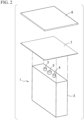
FIG. 2 is a perspective view showing a resin molded body according to an embodiment of the present invention and a lithium ion secondary battery cell to which the resin molded body is to be attached. -
FIG. 3 is a perspective view of a lithium ion secondary battery cell to which the resin molded body ofFIG. 2 is attached. -
FIG. 4 is a sectional view taken along line A-A ofFIG. 3 . - Hereinafter, a resin composition according to an embodiment of the present invention and a resin molded body using the resin composition are described in detail with reference to the drawings as appropriate. The drawings used in the following description may be drawn with specific portions enlarged as appropriate to facilitate comprehension of the features of the present invention, and the dimensional ratios and the like between the constituent elements may differ from the actual values. Materials, dimensions, and the like provided in the following description are exemplary examples, and the present invention is not limited thereto, and can be appropriately modified and implemented within the range in which the effects are exhibited.
- The resin composition according to an embodiment of the present invention is formed of a mixture of a thermoplastic resin, a carbon fiber, and a silane coupling agent, and as necessary, may further contain a glass fiber.
- The resin composition according to the present embodiment includes a thermoplastic resin, a carbon fiber, and a silane coupling agent, in which a content of the thermoplastic resin is within a range of 59 parts by mass or more and 88 parts by mass or less, a content of the carbon fiber is within a range of 1 part by mass or more and 18 parts by mass or less, and a content of the silane coupling agent is within a range of 0.3 parts by mass or more and 7 parts by mass or less, with respect to a total of 100 parts by mass of the resin composition.
- The resin composition may contain the thermoplastic resin within a range of 60 to 82 parts by mass or 61 to 75 parts by mass.
- The resin composition may contain the carbon fiber within a range of 2 to 16 parts by mass or 4 to 13 parts by mass.
- The resin composition may contain the silane coupling agent within a range of 0.4 to 6 parts by mass or 0.5 to 5 parts by mass.
- The resin composition may also further contain a glass fiber, in which a content of the glass fiber is within a range of 3 parts by mass or more and 35 parts by mass or less with respect to 100 parts by mass of the thermoplastic resin.
- Examples of the thermoplastic resin used in the resin composition include a mixture of any one kind or two or more kinds of polyphenylene sulfide (PPS), polyamide 6 (PA6), polybutylene terephthalate (PBT), a modified polyphenylene ether (mPPE), polycarbonate (PC), or polypropylene (PP).
- Among these, PPS is particularly preferable as the thermoplastic resin because it has a high melting point (278°C) and a high glass transition temperature (92°C to 126°C). As PPS which is a thermoplastic resin suitable for the resin composition, it is possible to use any of an oxidatively crosslinked PPS that has been subjected to a heat treatment in the presence of oxygen to increase the melt viscosity, and a linear PPS in which lithium chloride, an organic acid salt, water, or other components is added in the polymerization line to increase the molecular weight while maintaining the linear shape. In addition, an oxidatively crosslinked PPS and a linear PPS can be mixed and used.
- An isotropic pitch-based carbon fiber having optical isotropy is used as the carbon fiber among a pitch-based carbon fiber using a pitch. The isotropic pitch-based carbon fiber can be used to enhance the deformation resistance of the resin composition.
- As specific examples of the shape of the isotropic pitch-based carbon fiber used in the resin composition, a single fiber has a fiber diameter of 1 to 20 µm, and the fibers have an average fiber length of 0.01 to 10 mm and an aspect ratio of about 1.5 to 1,300.
- The silane coupling agent contained in the resin composition and is capable of controlling dropping of the melt resin composition during combustion.
- The silane coupling agent contained in the resin composition may be, for example, at least one of an organosilicon compound and a siloxane compound. In addition, the silane coupling agent may be at least one of an amine-based silane coupling agent and an epoxy-based silane coupling agent. In a case where the amine-based silane coupling agent and the epoxy-based silane coupling agent are compared, an amine-based silane coupling agent having an amino terminal is more preferable.
- Examples of the amine-based silane coupling agent include 3-aminopropyltriethoxysilane, 3-aminopropyltrimethoxysilane, N-2-(aminoethyl)-3-aminopropyltrimethoxysilane, N-2-(aminoethyl)-3-aminopropylmethyldimethoxysilane, N-phenyl-3-aminopropyltrimethoxysilane, and 3-triethoxysilyl-N-(1,3-dimethylbutylidene)propylamine.
- In addition, examples of the epoxy-based silane coupling agents include 3-glycidoxypropyltriethoxysilane, 3-glycidoxypropylmethyldiethoxysilane, 3-glycidoxypropyltrimethoxysilane, 3-glycidoxypropylmethyldimethoxysilane, 2-(3,4-epoxycyclohexyl)ethyltrimethoxysilane.
- Furthermore, as the silane coupling agent contained in the resin composition, various silane coupling agents such as acrylic (for example, 3-acryloxypropyltrimethoxysilane), vinyl-based, methacrylic, styryl-based, ureido-based, isocyanate-based, isocyanurate-based, and mercapto-based can be used.
- In addition, as the silane coupling agent, in addition to the liquid silane coupling agent such as amine-based silane coupling agents, epoxy-based silane coupling agents, acrylic, vinyl-based, methacrylic, styryl-based, ureido-based, isocyanate-based, isocyanurate-based, and mercapto-based, which are described above, a solid silane coupling agent can also be used.
- Examples of the solid silane coupling agent include X-12-1273ES (manufactured by Shin-Etsu Chemical Co., Ltd.).
- When a liquid silane coupling agent and a solid silane coupling agent are compared, the liquid silane coupling agent is excellent in that the liquid silane coupling agent has a functional group and thus reactivity can be expected (a high effect can be expected in principle), and the solid silane coupling agent is excellent in terms of ease of handling.
- In a case where the resin composition contains a glass fiber, any of filament fibers (long fiber: glass fiber) or staple fibers (short fiber: glass wool) can be used as the glass fiber to be employed.
- The resin composition of the present embodiment may further include a fluororesin. Examples of the fluororesin include polytetrafluoroethylene (PTFE). As the PTFE, a powdered PTFE is preferably used. For example, a powdered PTFE having an average particle diameter of 10 to 30 µm and a specific surface area of 0.5 to 5 m2/g obtained by the BET method can be used. The fluororesin may include a fluororesin in a range of 1 part by mass or more and 50 parts by mass or less with respect to 100 parts by mass of the thermoplastic resin. Examples of the fluororesin include PTFE, PFA, FEP, and other fluororesins.
- The resin composition may further contain carbon black as a colorant, a polyolefin wax, a stearyl alcohol, or the like as a mold release agent, and hydrotalcite, zinc carbonate, or the like as a metal die corrosion inhibitor.
- Since the resin composition according to the present invention contains the thermoplastic resin, the carbon fiber, and the silane coupling agent, in which a content of the thermoplastic resin is within a range of 59 parts by mass or more and 88 parts by mass or less, a content of the carbon fiber is within a range of 1 part by mass or more and 18 parts by mass or less, and a content of the silane coupling agent is within a range of 0.3 parts by mass or more and 7 parts by mass or less, with respect to a total of 100 parts by mass of the resin composition, and the isotropic pitch-based carbon fiber is used as the carbon fibers, the resin composition is controllable for melt deformation and fluidization even though the resin composition is exposed to flames of about 1000°C, for example.
- Next, an example of a method for producing the resin composition according to the present embodiment will be described.
- In order to produce the resin composition of the present embodiment, first, the above-described thermoplastic resin is prepared. In a case where the total of the thermoplastic resin is 100 parts by mass, the amount of the thermoplastic resin corresponding to a range of 4 parts by mass or more and 77 parts by mass or less is set aside.
- Next, the total of the silane coupling agent constituting the resin composition is gradually added dropwise to a part of thermoplastic resin set aside (silane coupling agent addition step). As a result, the part of the thermoplastic resin (premix) to which the silane coupling agent has been added is obtained.
- Next, 23 parts by mass or more and 96 parts by mass or less of the remaining thermoplastic resin which has been set aside is added to the part of the thermoplastic resin to which the silane coupling agent is added, and the mixture is dry-blended to obtain an intermediate mixture in which the silane coupling agent and the total of the thermoplastic resin are mixed with each other (first mixing step).
- Furthermore, a material other than the isotropic pitch-based carbon fiber with isotropy, which constitute the resin composition, is added to the intermediate mixture obtained in the first mixing step, and the mixture is further dry-blended (second mixing step). For example, while adding the total amount of the isotropic pitch-based carbon fiber constituting the resin composition by a twin-screw extruder through the feeder again, the kneading processing temperature is controlled to 270°C or higher and 300°C or lower, the screw rotation speed is controlled to 100 rpm or more and 300 rpm or less, and the granulation is performed at the kneading processing time of 30 minutes or more and 60 minutes or less, thereby a pellet-shaped resin composition can be formed.
- Then, the resin molded body can be produced by molding the obtained resin composition by a known molding method such as extrusion molding using an extruder, press molding using a press machine, or injection molding using an injection molding machine.
- As described above, in the method for producing a resin composition, the dry blending is important. That is, the procedures of firstly setting aside the part of the thermoplastic resin, adding the silane coupling agent dropwise thereto, and adding the remaining thermoplastic resin to blend these materials with each other are performed in this order, the silane coupling agent can be uniformly dispersed in the thermoplastic resin, the loss can be reduced, and the function of controlling the flow and deformation caused by the flames can be enhanced.
-
FIG. 1 is a perspective view of a lithium ion secondary battery cell to which a resin molded body according to an embodiment of the present invention is attached. - This lithium ion
secondary battery cell 1 is a square battery cell, in which apositive electrode terminal 3 and anegative electrode terminal 4 are provided on an upper surface of an exterior can 2 that is a battery container, and asafety valve 5 is provided between thepositive electrode terminal 3 and thenegative electrode terminal 4. - The
safety valve 5 operates in a case where an internal pressure is increased due to thermal runaway of the lithium ionsecondary battery cell 1, and prevents the exterior can 2 from rupturing caused by the blowout of a high-temperature and high-pressure gas. - In a case where a thermal runaway of the lithium ion
secondary battery cell 1 occurs, there is a possibility of igniting due to overheating, and when the high-temperature and high-pressure gas blown out from thesafety valve 5 spreads over a wide area at a breath, it is difficult to prevent the spread of fire and burning. - Therefore, in this embodiment, as shown in
FIG. 2 ,FIG. 3, and FIG. 4 , which is a sectional view taken along line A-A ofFIG. 3 , the sheet-shaped resin moldedbody 6 having flexibility is attached to the outer periphery of the lithium ionsecondary battery cell 1 via the insulatingsheet 7 to cover at least thesafety valve 5. In addition, in a case where the resin moldedbody 6 is an insulating material or in a case where insulating properties are not required, the resin moldedbody 6 may be attached without the insulatingsheet 7. - In this embodiment, both the insulating
sheet 7 and the sheet-shaped resin moldedbody 6 have substantially the same size as a rectangular shape and are attached to cover not only the upper surface of the rectangular lithium ionsecondary battery cell 1 including thesafety valve 5 but also the upper part of the front surface and the back surface (left and right surfaces inFIG. 4 ). - The lead wire (not shown) connected to the
positive electrode terminal 3 and thenegative electrode terminal 4 of the lithium ionsecondary battery cell 1 is drawn out using the side surface which is not covered with the insulatingsheet 7 and the resin moldedbody 6. - The lithium ion
secondary battery cell 1 to which the insulatingsheet 7 and the sheet-shaped resin moldedbody 6 are attached is accommodated in an exterior case (not shown). Inside the exterior case, the resin moldedbody 6 that covers the upper part of the front surface and the back surface of the lithium ionsecondary battery cell 1 is held by being pressed by the inner wall face of the exterior case. - In addition, the thickness of the part of the resin molded
body 6 that covers thesafety valve 5, that is, in this embodiment, the thickness of the resin moldedbody 6 is uniform, and the resin moldedbody 6 is sheet-shaped. Furthermore, the thickness of the sheet-shaped resin moldedbody 6 may be 0.5 mm or more and 10.0 mm or less, preferably 0.7 mm or more and 5 mm or less, and more preferably 1.0 mm or more and 2 mm or less. - In a case where this thickness is less than 0.5 mm, there is a concern that a through-hole is formed in the resin molded
body 6 by the high-temperature and high-pressure gas blown out from thesafety valve 5, and the high-temperature and high-pressure gas blow out from the through-hole, thereby spreading fire to and burning the member outside the lithium ionsecondary battery cell 1 covered with the insulatingsheet 7 and the sheet-shaped resin moldedbody 6. In addition, the through-hole serves as an air (oxygen) supply port, and there is a concern that the spread of the fire or burning of the lithium ionsecondary battery cell 1 itself covered with the insulatingsheet 7 and the sheet-shaped resin moldedbody 6 is increased. - In a case where the thickness of the sheet-shaped resin molded
body 6 exceeds 10.0 mm, high-temperature and high-pressure gas can be blocked, that is, a through-hole is not formed, but the size of the resin moldedbody 6 becomes large, and the molding processing becomes complicated. In addition, it is difficult to accommodate the lithium ionsecondary battery cell 1 in the existing exterior case for accommodating the lithium ionsecondary battery cell 1. - As the hardness of the surface of the resin molded
body 6, a value measured with a type D durometer using a sheet having a thickness of the resin molded body of 2 mm based on JIS K7215 is preferably 50 or more. In a case where the hardness of the surface is less than 50, there is a concern that the resin moldedbody 6 is damaged or a through-hole is formed due to the high-temperature and high-pressure gas (particularly, the influence of the pressure (blowout power)) blown out from thesafety valve 5. The upper limit value of the hardness of the surface is 90 as an appropriate upper limit in the above standard, but may exceed 90 as long as it is within a moldable range. In a general measuring device, it is possible to measure up to about 100, and the hardness of the surface of the resin moldedbody 6 displayed by the measuring device may be 100 or less. - As described above, since the resin molded
body 6 according to the present embodiment is formed to cover thesafety valve 5 of the lithium ionsecondary battery cell 1 by using the above-described resin composition, even in a case where the lithium ion secondary battery causes a thermal runaway, the through-hole is not formed in the resin moldedbody 6 due to the high-temperature and high-pressure gas blown out from thesafety valve 5, and it is possible to suppress the spread of fire and the burning due to the blowout of the high-temperature and high-pressure gas. - Hereinafter, as the evaluation for the deformation resistance (fire-resistance), samples (resin compositions) of the present invention Example 1 and Comparative Examples 1 to 3 were prepared, in which the type of carbon fibers contained in the resin composition is changed.
- The common compositional ratio of the samples of the present invention Example 1 and Comparative Examples 1 to 3 is as follows.
- · Thermoplastic resin (polyphenylene sulfide resin (PPS)): 70.4% by mass
- · Silane coupling agent (3-aminopropyltriethoxysilane): 0.70% by mass · Carbon fibers: (see the next section) 7.00% by mass
- · Glass fibers: 20.00% by mass
- · Mold release agent: (PE520: manufactured by Clariant Chemicals Ltd., polyethylene wax) 0.40% by mass
- · Corrosion inhibitor: (zinc carbonate (ZnCO3)) 0.70% by mass
- · Colorant: (BP880: manufactured by Cabot Japan K.K., carbon black) 0.80% by mass
- The total thereof is 100% by mass.
- [Present invention Example 1] As the carbon fibers, OGC360 (average fiber length: 360 µm, average fiber diameter: 11 µm) (DONACARBO, manufactured by Osaka Gas Chemicals Co., Ltd.), which is isotropic pitch-based carbon fibers, was used.
- [Comparative Example 1] As the carbon fibers, MCC6000 (average fiber length of 6,000 µm, average fiber diameter of 11 µm) (DIALEAD, manufactured by Mitsubishi Chemical Corporation), which is an anisotropic pitch-based carbon fiber, was used.
- [Comparative Example 2] As the carbon fibers, MCC200 (average fiber length of 179 µm, average fiber diameter of 11 µm) (DIALEAD, manufactured by Mitsubishi Chemical Corporation), which is an anisotropic pitch-based carbon fiber, was used. [Comparative Example 3] As the carbon fibers, MCC50 (average fiber length of 58 µm, average fiber diameter of 11 µm) (DIALEAD, manufactured by Mitsubishi Chemical Corporation), which is an anisotropic pitch-based carbon fiber, was used.
- In the test method of the deformation resistance for the resin composition in each of the present invention Example 1 and Comparative Examples 1 to 3, a burner having an output of 5,580 W was fixed vertically downward, a resin composition (each sample) having a size of 100 mm × 120 mm × 2 mmt was prepared, and each sample was disposed horizontally with a floor at a position 170 mm from the nozzle of the burner. Then, the burner was ignited and a flame was applied to each sample.
-
- Distance between sample and nozzle of burner: 170 mm
- Local exhaust by draft
- Thermal power: 5,580 W
- Air temperature: 20°C
- Humidity: 75% RH
- Weather: fine
- The test was terminated when a part of the sample melted and dropped onto the floor surface.
- Such a test method was carried out twice for each sample.
- Table 1 shows the time (seconds) required for 10 mm deformation for each sample.
[Table 1] Optical characteristics of carbon fibers Average length of carbon fibers (µm) Average diameter of carbon fibers (µm) Defomation time of 10 mm (sec) Example 1 Isotropic 360 13 77.53 Comparative Example 1 Anisotropic 6000 11 43.20 Comparative Example 2 Anisotropic 179 11 51.38 Comparative Example 3 Anisotropic 58 11 46.43 - According to the evaluation for the deformation resistance shown in FIG. 5 and Table 1, it was confirmed that, by using the isotropic pitch-based carbon fibers as the carbon fibers contained in the resin composition, it is possible to significantly delay deformation caused by heat as compared with the conventional example using the anisotropic pitch-based carbon fibers. Therefore, according to the present embodiment, it is possible to achieve the resin composition that enables the controlling of melting, deformation, and fluidization caused by the blowout of a high-temperature gas or a flame.
- In the above-described evaluation for the deformation resistance, each sample contains a metal die corrosion inhibitor, a mold release agent, and a colorant, but the resin composition for forming the resin molded body according to the present invention does not necessarily contain these metal die corrosion inhibitor, mold release agent, and colorant. A resin molded product having excellent deformation resistance can be obtained even though these corrosion inhibitor, the mold release agent, and the colorant are not contained.
- In addition, the content of each of the corrosion inhibitor, the mold release agent, and the colorant in the above-described evaluation for deformation resistance is an example, and the content of each of the corrosion inhibitor, the mold release agent, and the colorant can be increased or decreased to any content as necessary, that is, the contents are not limited thereto.
- It is possible to provide the resin composition that enables the control of melting, deformation, and fluidization caused by the blowout of a high-temperature gas or a flame, the resin molded body formed by using the resin composition, and the method for producing the resin composition.
-
- 1: Lithium ion secondary battery cell
- 2: Exterior can
- 3: Positive electrode terminal
- 4: Negative electrode terminal
- 5: Safety valve
- 6: Resin molded body
- 7: Insulating sheet
Claims (8)
- A resin composition comprising:a thermoplastic resin;a carbon fiber; anda silane coupling agent,wherein a content of the thermoplastic resin is within a range of 59 parts by mass or more and 88 parts by mass or less, a content of the carbon fiber is within a range of 1 part by mass or more and 18 parts by mass or less, and a content of the silane coupling agent is within a range of 0.3 parts by mass or more and 7 parts by mass or less, with respect to a total of 100 parts by mass of the resin composition, andthe carbon fiber is an isotropic pitch-based carbon fiber.
- The resin composition according to Claim 1,
wherein the thermoplastic resin includes at least one of polyphenylene sulfide, polyamide, polybutylene terephthalate, a modified polyphenylene ether, or polycarbonate. - The resin composition according to Claim 1 or 2,
wherein the silane coupling agent is at least one of an organosilicon compound or a siloxane compound. - The resin composition according to Claim 3,
wherein the organosilicon compound is at least one of an amine-based silane coupling agent or an epoxy-based silane coupling agent. - The resin composition according to any one of Claims 1 to 4, further comprising a glass fiber,
wherein a content of the glass fiber is within a range of 3 parts by mass or more and 35 parts by mass or less with respect to 100 parts by mass of the thermoplastic resin. - A resin molded body formed by molding the resin composition according to any one of Claims 1 to 5.
- The resin molded body according to Claim 6,
wherein the resin molded body is attached to an outer periphery of one or more lithium ion secondary battery cells having a safety valve or an exhaust hole to cover at least the safety valve or the exhaust hole. - A method for producing the resin composition according to any one of Claims 1 to 4, the method comprising:a silane coupling agent addition step of adding a total amount of the silane coupling agent dropwise to a part of a thermoplastic resin fractionated within a range of 4 parts by mass or more and 77 parts by mass or less from 100 parts by mass of the thermoplastic resin to obtain a part of the thermoplastic resin to which the silane coupling agent is added;a first mixing step of adding a remainder of the thermoplastic resin within a range of 23 parts by mass or more and 96 parts by mass or less to the part of the thermoplastic resin to which the silane coupling agent is added and mixing the remainder and the part of the thermoplastic resin to which the silane coupling agent is added to obtain an intermediate mixture in which the silane coupling agent and a total amount of the thermoplastic resin are mixed with each other; anda second mixing step of adding a total amount of the carbon fiber to the intermediate mixture and further mixing the carbon fiber and the intermediate mixture to obtain the resin composition.
Applications Claiming Priority (2)
| Application Number | Priority Date | Filing Date | Title |
|---|---|---|---|
| JP2022060227A JP7782355B2 (en) | 2022-03-31 | 2022-03-31 | Resin molded body and method for manufacturing the same |
| PCT/JP2023/012874 WO2023190715A1 (en) | 2022-03-31 | 2023-03-29 | Resin composition, resin molded body, and method for producing resin composition |
Publications (1)
| Publication Number | Publication Date |
|---|---|
| EP4502079A1 true EP4502079A1 (en) | 2025-02-05 |
Family
ID=88202113
Family Applications (1)
| Application Number | Title | Priority Date | Filing Date |
|---|---|---|---|
| EP23780723.5A Withdrawn EP4502079A1 (en) | 2022-03-31 | 2023-03-29 | Resin composition, resin molded body, and method for producing resin composition |
Country Status (7)
| Country | Link |
|---|---|
| US (1) | US20250215188A1 (en) |
| EP (1) | EP4502079A1 (en) |
| JP (1) | JP7782355B2 (en) |
| KR (1) | KR20240166459A (en) |
| CN (1) | CN118946638A (en) |
| TW (1) | TW202407053A (en) |
| WO (1) | WO2023190715A1 (en) |
Families Citing this family (1)
| Publication number | Priority date | Publication date | Assignee | Title |
|---|---|---|---|---|
| EP4668421A3 (en) * | 2024-05-24 | 2026-01-21 | Samsung Sdi Co., Ltd. | Secondary battery and battery module including the same |
Family Cites Families (13)
| Publication number | Priority date | Publication date | Assignee | Title |
|---|---|---|---|---|
| JPH0649362A (en) | 1992-07-31 | 1994-02-22 | Showa Denko Kk | Resin composition |
| JPH06220323A (en) * | 1993-01-26 | 1994-08-09 | Dainippon Ink & Chem Inc | Conductive resin composition and electronic component storage container |
| JPH06287438A (en) * | 1993-03-30 | 1994-10-11 | Nippon Zeon Co Ltd | Thermoplastic resin composition |
| JPH09194626A (en) * | 1996-01-23 | 1997-07-29 | Osaka Gas Co Ltd | Sliding material comprising resin composite |
| JP2000119405A (en) | 1998-10-16 | 2000-04-25 | Dainippon Ink & Chem Inc | Resin molding material |
| JP2005075914A (en) * | 2003-08-29 | 2005-03-24 | Fuji Beekuraito Kk | Molded product for clean room and method for producing the same |
| JP5669491B2 (en) * | 2010-09-14 | 2015-02-12 | ユニチカ株式会社 | Polyamide resin composition, method for producing the polyamide resin composition, and molded article using the polyamide resin composition |
| JP6189301B2 (en) * | 2012-08-09 | 2017-08-30 | 三洋電機株式会社 | Power supply device, electric vehicle including the same, and power storage device |
| JP6252146B2 (en) * | 2012-12-19 | 2017-12-27 | 東レ株式会社 | Carbon fiber reinforced thermoplastic resin composition, pellets formed from the same, and thin molded article |
| CN104017335A (en) * | 2014-06-10 | 2014-09-03 | 上海电力学院 | Carbon fiber conductive enhanced PET/polyester alloy and preparation method thereof |
| KR20160094724A (en) * | 2015-02-02 | 2016-08-10 | 현대자동차주식회사 | Carbon fiber reinforced thermoplastic resin composition and molded article using the same |
| JP7301271B2 (en) * | 2019-03-28 | 2023-07-03 | パナソニックエナジー株式会社 | battery pack |
| JP7014259B2 (en) | 2020-05-28 | 2022-02-01 | 凸版印刷株式会社 | Printed matter creation support system, printed matter creation support method, and program |
-
2022
- 2022-03-31 JP JP2022060227A patent/JP7782355B2/en active Active
-
2023
- 2023-03-29 US US18/851,176 patent/US20250215188A1/en active Pending
- 2023-03-29 EP EP23780723.5A patent/EP4502079A1/en not_active Withdrawn
- 2023-03-29 CN CN202380030287.XA patent/CN118946638A/en active Pending
- 2023-03-29 KR KR1020247025026A patent/KR20240166459A/en not_active Withdrawn
- 2023-03-29 WO PCT/JP2023/012874 patent/WO2023190715A1/en not_active Ceased
- 2023-03-30 TW TW112112227A patent/TW202407053A/en unknown
Also Published As
| Publication number | Publication date |
|---|---|
| JP2023150891A (en) | 2023-10-16 |
| CN118946638A (en) | 2024-11-12 |
| TW202407053A (en) | 2024-02-16 |
| KR20240166459A (en) | 2024-11-26 |
| WO2023190715A1 (en) | 2023-10-05 |
| US20250215188A1 (en) | 2025-07-03 |
| JP7782355B2 (en) | 2025-12-09 |
Similar Documents
| Publication | Publication Date | Title |
|---|---|---|
| JPH0222350A (en) | Fire-retardant ethylene polymer compound | |
| EP4502079A1 (en) | Resin composition, resin molded body, and method for producing resin composition | |
| CN1894330B (en) | Crosslinked flame retardant resin composition and insulated electric wire and wire harness using same | |
| EP1422262A2 (en) | Flame retardant ethylene family resin composite and flame retardant electric wire or cable | |
| CN103842431B (en) | Heat resisting flame retardant resin composition, insulated electric conductor and pipe | |
| JP5166862B2 (en) | THERMOPLASTIC RESIN COMPOSITION HAVING ABSORPTION FOR LIGHT OF 420nm AND MOLDED ITS THEREOF | |
| JP5392252B2 (en) | Polychlorotrifluoroethylene film and solar cell back surface protective sheet | |
| EP4317291A1 (en) | Resin composition and resin molded body | |
| EP4269493A1 (en) | Resin molded body, battery pack | |
| WO2005083004A1 (en) | Flame retardant resin composition | |
| JP2011080020A (en) | Non-halogen flame-retardant resin composition, manufacturing method therefor, and electric cable using the same | |
| US20230125875A1 (en) | Compositions comprising silicone, articles, devices, and method of making thereof | |
| EP4215585A1 (en) | Insulated electrical wire and resin composition | |
| JP2022103086A (en) | Resin molding and battery pack | |
| JP2009298831A (en) | Non-halogen flame-retardant thermoplastic elastomer resin composition, its manufacturing method and electric wire or cable using the same | |
| US7642313B2 (en) | Fluoropolymer with inorganic fluoride filler | |
| CN111199813B (en) | Wire, coaxial wire, cable and wire manufacturing method | |
| CN116648482A (en) | Resin molded body and battery pack | |
| CN101142271B (en) | Heat recoverable items and their composition | |
| CN116438249A (en) | Halogen-free flame retardant polymer composition | |
| WO1999054891A1 (en) | Flame-retardant resin magnet material | |
| JP5834231B2 (en) | Flame retardant resin composition | |
| JP2013133411A (en) | Flame-retardant resin composition and cable using the same | |
| JPH02218731A (en) | Flame-resistant vinyl chloride resin composition and flame-resistant electric wire-cable using the same composition as protecting layer material | |
| CN104262764B (en) | Generation Ⅲ nuclear power station pyrocondensation Insulation Material and preparation method thereof |
Legal Events
| Date | Code | Title | Description |
|---|---|---|---|
| STAA | Information on the status of an ep patent application or granted ep patent |
Free format text: STATUS: THE INTERNATIONAL PUBLICATION HAS BEEN MADE |
|
| PUAI | Public reference made under article 153(3) epc to a published international application that has entered the european phase |
Free format text: ORIGINAL CODE: 0009012 |
|
| STAA | Information on the status of an ep patent application or granted ep patent |
Free format text: STATUS: REQUEST FOR EXAMINATION WAS MADE |
|
| 17P | Request for examination filed |
Effective date: 20240926 |
|
| AK | Designated contracting states |
Kind code of ref document: A1 Designated state(s): AL AT BE BG CH CY CZ DE DK EE ES FI FR GB GR HR HU IE IS IT LI LT LU LV MC ME MK MT NL NO PL PT RO RS SE SI SK SM TR |
|
| DAV | Request for validation of the european patent (deleted) | ||
| DAX | Request for extension of the european patent (deleted) | ||
| STAA | Information on the status of an ep patent application or granted ep patent |
Free format text: STATUS: THE APPLICATION HAS BEEN WITHDRAWN |
|
| 18W | Application withdrawn |
Effective date: 20260121 |