EP4501573A1 - Bewegliche plattform und verfahren zur handhabung einer beweglichen plattform zur herstellung von windturbinenschaufeln - Google Patents
Bewegliche plattform und verfahren zur handhabung einer beweglichen plattform zur herstellung von windturbinenschaufeln Download PDFInfo
- Publication number
- EP4501573A1 EP4501573A1 EP23189895.8A EP23189895A EP4501573A1 EP 4501573 A1 EP4501573 A1 EP 4501573A1 EP 23189895 A EP23189895 A EP 23189895A EP 4501573 A1 EP4501573 A1 EP 4501573A1
- Authority
- EP
- European Patent Office
- Prior art keywords
- support element
- blade
- wind turbine
- working
- movable
- Prior art date
- Legal status (The legal status is an assumption and is not a legal conclusion. Google has not performed a legal analysis and makes no representation as to the accuracy of the status listed.)
- Pending
Links
Images


Classifications
-
- B—PERFORMING OPERATIONS; TRANSPORTING
- B29—WORKING OF PLASTICS; WORKING OF SUBSTANCES IN A PLASTIC STATE IN GENERAL
- B29C—SHAPING OR JOINING OF PLASTICS; SHAPING OF MATERIAL IN A PLASTIC STATE, NOT OTHERWISE PROVIDED FOR; AFTER-TREATMENT OF THE SHAPED PRODUCTS, e.g. REPAIRING
- B29C33/00—Moulds or cores; Details thereof or accessories therefor
- B29C33/30—Mounting, exchanging or centering
- B29C33/307—Mould plates mounted on frames; Mounting the mould plates; Frame constructions therefor
-
- B—PERFORMING OPERATIONS; TRANSPORTING
- B29—WORKING OF PLASTICS; WORKING OF SUBSTANCES IN A PLASTIC STATE IN GENERAL
- B29C—SHAPING OR JOINING OF PLASTICS; SHAPING OF MATERIAL IN A PLASTIC STATE, NOT OTHERWISE PROVIDED FOR; AFTER-TREATMENT OF THE SHAPED PRODUCTS, e.g. REPAIRING
- B29C31/00—Handling, e.g. feeding of the material to be shaped, storage of plastics material before moulding; Automation, i.e. automated handling lines in plastics processing plants, e.g. using manipulators or robots
- B29C31/006—Handling moulds, e.g. between a mould store and a moulding machine
-
- B—PERFORMING OPERATIONS; TRANSPORTING
- B29—WORKING OF PLASTICS; WORKING OF SUBSTANCES IN A PLASTIC STATE IN GENERAL
- B29C—SHAPING OR JOINING OF PLASTICS; SHAPING OF MATERIAL IN A PLASTIC STATE, NOT OTHERWISE PROVIDED FOR; AFTER-TREATMENT OF THE SHAPED PRODUCTS, e.g. REPAIRING
- B29C33/00—Moulds or cores; Details thereof or accessories therefor
- B29C33/12—Moulds or cores; Details thereof or accessories therefor with incorporated means for positioning inserts, e.g. labels
-
- B—PERFORMING OPERATIONS; TRANSPORTING
- B29—WORKING OF PLASTICS; WORKING OF SUBSTANCES IN A PLASTIC STATE IN GENERAL
- B29C—SHAPING OR JOINING OF PLASTICS; SHAPING OF MATERIAL IN A PLASTIC STATE, NOT OTHERWISE PROVIDED FOR; AFTER-TREATMENT OF THE SHAPED PRODUCTS, e.g. REPAIRING
- B29C33/00—Moulds or cores; Details thereof or accessories therefor
- B29C33/12—Moulds or cores; Details thereof or accessories therefor with incorporated means for positioning inserts, e.g. labels
- B29C33/14—Moulds or cores; Details thereof or accessories therefor with incorporated means for positioning inserts, e.g. labels against the mould wall
- B29C33/16—Moulds or cores; Details thereof or accessories therefor with incorporated means for positioning inserts, e.g. labels against the mould wall using magnetic means
-
- B—PERFORMING OPERATIONS; TRANSPORTING
- B29—WORKING OF PLASTICS; WORKING OF SUBSTANCES IN A PLASTIC STATE IN GENERAL
- B29C—SHAPING OR JOINING OF PLASTICS; SHAPING OF MATERIAL IN A PLASTIC STATE, NOT OTHERWISE PROVIDED FOR; AFTER-TREATMENT OF THE SHAPED PRODUCTS, e.g. REPAIRING
- B29C33/00—Moulds or cores; Details thereof or accessories therefor
- B29C33/20—Opening, closing or clamping
- B29C33/26—Opening, closing or clamping by pivotal movement
-
- B—PERFORMING OPERATIONS; TRANSPORTING
- B29—WORKING OF PLASTICS; WORKING OF SUBSTANCES IN A PLASTIC STATE IN GENERAL
- B29C—SHAPING OR JOINING OF PLASTICS; SHAPING OF MATERIAL IN A PLASTIC STATE, NOT OTHERWISE PROVIDED FOR; AFTER-TREATMENT OF THE SHAPED PRODUCTS, e.g. REPAIRING
- B29C33/00—Moulds or cores; Details thereof or accessories therefor
- B29C33/30—Mounting, exchanging or centering
-
- B—PERFORMING OPERATIONS; TRANSPORTING
- B29—WORKING OF PLASTICS; WORKING OF SUBSTANCES IN A PLASTIC STATE IN GENERAL
- B29C—SHAPING OR JOINING OF PLASTICS; SHAPING OF MATERIAL IN A PLASTIC STATE, NOT OTHERWISE PROVIDED FOR; AFTER-TREATMENT OF THE SHAPED PRODUCTS, e.g. REPAIRING
- B29C33/00—Moulds or cores; Details thereof or accessories therefor
- B29C33/30—Mounting, exchanging or centering
- B29C33/306—Exchangeable mould parts, e.g. cassette moulds, mould inserts
-
- B—PERFORMING OPERATIONS; TRANSPORTING
- B29—WORKING OF PLASTICS; WORKING OF SUBSTANCES IN A PLASTIC STATE IN GENERAL
- B29C—SHAPING OR JOINING OF PLASTICS; SHAPING OF MATERIAL IN A PLASTIC STATE, NOT OTHERWISE PROVIDED FOR; AFTER-TREATMENT OF THE SHAPED PRODUCTS, e.g. REPAIRING
- B29C33/00—Moulds or cores; Details thereof or accessories therefor
- B29C33/34—Moulds or cores; Details thereof or accessories therefor movable, e.g. to or from the moulding station
-
- B—PERFORMING OPERATIONS; TRANSPORTING
- B29—WORKING OF PLASTICS; WORKING OF SUBSTANCES IN A PLASTIC STATE IN GENERAL
- B29D—PRODUCING PARTICULAR ARTICLES FROM PLASTICS OR FROM SUBSTANCES IN A PLASTIC STATE
- B29D99/00—Subject matter not provided for in other groups of this subclass
- B29D99/0025—Producing blades or the like, e.g. blades for turbines, propellers, or wings
- B29D99/0028—Producing blades or the like, e.g. blades for turbines, propellers, or wings hollow blades
-
- B—PERFORMING OPERATIONS; TRANSPORTING
- B29—WORKING OF PLASTICS; WORKING OF SUBSTANCES IN A PLASTIC STATE IN GENERAL
- B29L—INDEXING SCHEME ASSOCIATED WITH SUBCLASS B29C, RELATING TO PARTICULAR ARTICLES
- B29L2031/00—Other particular articles
- B29L2031/08—Blades for rotors, stators, fans, turbines or the like, e.g. screw propellers
- B29L2031/082—Blades, e.g. for helicopters
-
- B—PERFORMING OPERATIONS; TRANSPORTING
- B29—WORKING OF PLASTICS; WORKING OF SUBSTANCES IN A PLASTIC STATE IN GENERAL
- B29L—INDEXING SCHEME ASSOCIATED WITH SUBCLASS B29C, RELATING TO PARTICULAR ARTICLES
- B29L2031/00—Other particular articles
- B29L2031/08—Blades for rotors, stators, fans, turbines or the like, e.g. screw propellers
- B29L2031/082—Blades, e.g. for helicopters
- B29L2031/085—Wind turbine blades
-
- F—MECHANICAL ENGINEERING; LIGHTING; HEATING; WEAPONS; BLASTING
- F03—MACHINES OR ENGINES FOR LIQUIDS; WIND, SPRING, OR WEIGHT MOTORS; PRODUCING MECHANICAL POWER OR A REACTIVE PROPULSIVE THRUST, NOT OTHERWISE PROVIDED FOR
- F03D—WIND MOTORS
- F03D13/00—Assembly, mounting or commissioning of wind motors; Arrangements specially adapted for transporting wind motor components
- F03D13/40—Arrangements or methods specially adapted for transporting wind motor components
- F03D13/401—Arrangements or methods specially adapted for transporting wind motor components for transporting or storing blades
-
- Y—GENERAL TAGGING OF NEW TECHNOLOGICAL DEVELOPMENTS; GENERAL TAGGING OF CROSS-SECTIONAL TECHNOLOGIES SPANNING OVER SEVERAL SECTIONS OF THE IPC; TECHNICAL SUBJECTS COVERED BY FORMER USPC CROSS-REFERENCE ART COLLECTIONS [XRACs] AND DIGESTS
- Y02—TECHNOLOGIES OR APPLICATIONS FOR MITIGATION OR ADAPTATION AGAINST CLIMATE CHANGE
- Y02E—REDUCTION OF GREENHOUSE GAS [GHG] EMISSIONS, RELATED TO ENERGY GENERATION, TRANSMISSION OR DISTRIBUTION
- Y02E10/00—Energy generation through renewable energy sources
- Y02E10/70—Wind energy
- Y02E10/72—Wind turbines with rotation axis in wind direction
-
- Y—GENERAL TAGGING OF NEW TECHNOLOGICAL DEVELOPMENTS; GENERAL TAGGING OF CROSS-SECTIONAL TECHNOLOGIES SPANNING OVER SEVERAL SECTIONS OF THE IPC; TECHNICAL SUBJECTS COVERED BY FORMER USPC CROSS-REFERENCE ART COLLECTIONS [XRACs] AND DIGESTS
- Y02—TECHNOLOGIES OR APPLICATIONS FOR MITIGATION OR ADAPTATION AGAINST CLIMATE CHANGE
- Y02P—CLIMATE CHANGE MITIGATION TECHNOLOGIES IN THE PRODUCTION OR PROCESSING OF GOODS
- Y02P70/00—Climate change mitigation technologies in the production process for final industrial or consumer products
- Y02P70/50—Manufacturing or production processes characterised by the final manufactured product
Definitions
- the present disclosure relates to wind turbine blades, and more particularly, to a movable platform for manufacturing wind turbine blades.
- the disclosure further concerns a method for manufacturing wind turbine blades.
- Wind turbines are commonly used to supply electricity into the electrical grid.
- Wind turbines of this kind generally comprise a tower and a rotor arranged on the tower.
- the rotor which typically comprises a hub and a plurality of blades, is set into rotation under the influence of the wind on the blades. This rotation generates a torque that is normally transmitted through a rotor shaft to a generator, either directly (in the case of “directly driven” or “gearless” wind turbines) or through the use of a gearbox. This way, the generator produces electricity which can be supplied to the electrical grid.
- the wind turbine hub may be rotatably coupled to a front of the nacelle.
- the wind turbine hub may be connected to a rotor shaft, and the rotor shaft may then be rotatably mounted in the nacelle using one or more rotor shaft bearings arranged in a frame inside the nacelle.
- the nacelle is a housing arranged on top of a wind turbine tower that may contain and protect the gearbox (if present) and the generator (if not placed outside the nacelle) and, depending on the wind turbine, further components such as a power converter, and auxiliary systems.
- the wind turbine blades are often made of fiber-reinforced polymer and are usually manufactured as shell parts in molds, whereby the top side and the bottom side of the blade profile (typically the upwind or pressure side and the downwind or suction side, respectively) are manufactured separately by arranging glass fiber (e.g. fiber mats) in each of the two molds and injecting a liquid resin, which subsequently is cured. Afterwards, the two halves are glued together, often by means of internal flange parts. Glue is applied to the inner face of the lower blade half before the upper blade half is lowered thereon or vice versa. Additionally, one or two reinforcing profiles (beams) are often attached to the inside of the lower blade half prior to gluing to the upper blade half. A crane or hoisting assembly may be used to lift one of the mold parts about a hinge line for closure and opening of the molds. Throughout this disclosure, a mold will primarily refer to each of the mold parts used for the manufacture of a blade shell part.
- the blade After gluing the two halves, the blade is demolded, i.e. it is removed from the mold, and some finishing work is carried out to complete manufacturing of the blade.
- finishing work may include trimming, painting and/or mounting final fittings, e.g. aerodynamic devices, on the wind turbine blade.
- scaffolds may be attached to the mold structure so that the scaffolds are suspended from the mold structure and may hover above ground level in a cantilevered manner.
- An example of such an arrangement may be found in WO2017009424A1 .
- a system for use in the manufacture of a wind turbine rotor blade comprises a support element for supporting a wind turbine rotor blade part.
- the system further comprises a movable scaffold and a working platform on top of the movable scaffold.
- the movable scaffold is configured to move from a first position to a working position, wherein the working position is closer to the support element or to the wind turbine rotor blade part than the first position and is suitable for carrying out a blade manufacturing step.
- the movable scaffold and/or the support element comprise a retention system for retaining the movable scaffold in the working position.
- a movable scaffold which can be moved to a working position in an area of the wind turbine rotor blade part so that a manufacturing step for which access to that area is needed can be carried out.
- the scaffold may be arranged in a separate position further away from the support element or away from the wind turbine rotor blade part being manufactured.
- certain activities may be carried out more conveniently in a first position that is separate from the working position.
- materials and tools needed for the blade manufacturing step may be loaded on the working platform before moving the scaffold to the working position, i.e. while the movable scaffold is in the first position.
- the movable scaffold is independent from the support element, so that the same movable scaffolds can be used with different support elements, including support elements of different sizes and different shapes intended for the manufacture of different blades.
- a retention system is arranged to retain the movable scaffold in a working position. The system according to this aspect of the disclosure provides a safe environment for the operators while working in the working area
- a method for manufacturing a rotor blade comprises providing a support element for supporting a wind turbine rotor blade part in a workstation and moving a movable scaffold, the movable scaffold supporting a working platform, from a first position to a working position closer to the support element or from a first position to a working position closer to the wind turbine rotor blade part.
- the method further comprises retaining the movable scaffold in the working position and carrying out a blade manufacturing step.
- the method comprises releasing the movable scaffold from the working position and moving the movable scaffold away from the support element or moving the movable scaffold away from the wind turbine rotor blade part to a third position.
- the method allows a flexible manufacturing process by enabling the positioning of a scaffold in different positions during blade manufacturing.
- the scaffold with its corresponding platform may be arranged and retained in a working area in the proximity of the blade part to conduct certain manufacturing steps for which access to that area is needed whereas the scaffold may be moved to a different position to conduct other operations not requiring access to that working area.
- a further method for manufacturing a rotor blade comprises moving a blade mold to a workstation and moving a movable scaffold, which supports a working platform, from a first position to a working position closer to the blade mold.
- the method further comprises retaining the movable scaffold in the working position and carrying out a blade manufacturing step. After that, the movable scaffold is released from the working position and moved away from the blade mold to a third position.
- this further method comprises moving the blade mold out of the workstation.
- the efficiency and the flexibility of the blade manufacturing line may further be improved.
- a blade mold may be moved to different workstations and each of the workstations may be configured to carry out a specific manufacturing step.
- a movable frame may be provided for supporting the blade mold.
- multiple workstations may be distributed in the manufacturing line and each of them may be specialized to implement one of the following methods: arranging the glass fiber in a blade mold, supplying curable matrix material, infusing curable material, bonding of two blade shell parts, etc.
- a system comprising movable scaffolds is arranged at the workstation and it is moved from a first position to a working position in the area of the blade mold where a manufacturing step is to be executed.
- a retention system is used to retain the movable scaffold in the working position, i.e. to keep the movable scaffold in position.
- the method allows the separation of the movable scaffold from the blade mold and also the movement of the blade mold out of the workstation. In that manner, the workstation can be ready to receive a new blade mold to conduct the manufacturing step for a new blade and, to that end, the movable scaffold is configured to move back to the working area of the newly provided blade mold.
- a scaffold is interpreted as any temporary structure used to support platforms for a work crew and/or for materials to aid in the manufacture, maintenance, repair, etc. of structures while working at a height above ground or floor level.
- a wind turbine rotor blade part is interpreted as any part of a wind turbine blade regardless of the stage in the manufacturing process.
- a part of a wind turbine blade may refer to glass fiber mats deposited on a blade mold (early stage of the manufacturing process), or a manufactured half blade shell, but it also may refer to a demolded complete blade awaiting only for the finishing works (advanced stage of the manufacturing process) or even after having undergone finishing works.
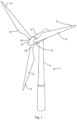
- Fig. 1 illustrates a conventional modern upwind wind turbine 2 according to the so-called "Danish concept" with a tower 4, a nacelle 6 and a rotor with a substantially horizontal rotor shaft.
- the rotor includes a hub 8 and three blades 10 extending radially from the hub 8, each having a blade root 16 nearest the hub and a blade tip 14 furthest from the hub 8.
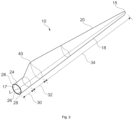
- Fig. 2 shows a schematic view of an example of a wind turbine blade 10.
- the wind turbine blade 10 has the shape of a conventional wind turbine blade with a root end 17 and a tip end 15 and comprises a root region 30 closest to the hub, a profiled or an airfoil region 34 furthest away from the hub and a transition region 32 between the root region 30 and the airfoil region 34.
- the blade 10 comprises a leading edge 18 facing the direction of rotation of the blade 10, when the blade is mounted on the hub, and a trailing edge 20 facing the opposite direction of the leading edge 18.
- the airfoil region 34 (also called the profiled region) has an ideal or almost ideal blade shape with respect to generating lift, whereas the root region 30 due to structural considerations has a substantially circular or elliptical cross-section, which for instance makes it easier and safer to mount the blade 10 to the hub.
- the diameter (or the chord) of the root region 30 may be constant along the entire root area 30.
- the transition region 32 has a transitional profile gradually changing from the circular or elliptical shape of the root region 30 to the airfoil profile of the airfoil region 34.
- the chord length of the transition region 32 typically increases with increasing distance from the hub.
- the airfoil region 34 has an airfoil profile with a chord extending between the leading edge 18 and the trailing edge 20 of the blade 10. The width of the chord decreases with increasing distance from the hub.
- a shoulder 40 of the blade 10 is defined as the position, where the blade 10 has its largest chord length.
- the shoulder 40 is typically provided at the boundary between the transition region 32 and the airfoil region 34.
- chords of different sections of the blade normally do not lie in a common plane, since the blade may be twisted and/or curved (i.e. pre-bent), thus providing the chord plane with a correspondingly twisted and/or curved course, this being most often the case in order to compensate for the local velocity of the blade being dependent on the distance to the hub.
- the wind turbine blade 10 comprises a blade shell comprising two blade shell parts or half shells, a first blade shell part 24 and a second blade shell part 26, typically made of fiber-reinforced polymer.
- the wind turbine blade 10 may comprise additional shell parts, such as a third shell part and/or a fourth shell part.
- the first blade shell part 24 is typically a pressure side or upwind blade shell part.
- the second blade shell part 26 is typically a suction side or downwind blade shell part.
- the first blade shell part 24 and the second blade shell part 26 are fastened together with adhesive, such as glue, along bond lines or glue joints 28 extending along the trailing edge 20 and the leading edge 18 of the blade 10.
- the root ends of the blade shell parts 24, 26 have a semi-circular or semi-oval outer cross-sectional shape.
- Figures 3A and 3B show an example of a system for use in the manufacture of a wind turbine rotor blade.
- the system comprises a support element 82 for supporting a wind turbine rotor blade part.
- the support element 82 may comprise a blade mold 80.
- the blade mold 80 may be used during certain blade manufacturing steps such as arrangement of the glass fiber reinforcement material, supply of curable matrix material, infusion of curable material or curing of the curable material.
- the support element 82 may also comprise a mold frame 81 to support the blade mold 80.
- the support element 82 may comprise at least one cart for supporting a wind turbine rotor blade part and, more specifically, for supporting a complete wind turbine rotor blade. These other examples may be specifically suited for manufacturing steps comprising finishing of a wind turbine blade after bonding of the two blade shell parts and after demolding.
- the system further comprises a scaffold system 50
- the scaffold system 50 in this example comprises three movable scaffolds 70 and a working platform 60 on top of each movable scaffold.
- the movable scaffolds 70 are shown in a first position which may be relatively away from the blade mold 80.
- wheels 71 are provided to enable movement of the movable scaffolds 70. Nevertheless, other systems enabling movement such as sliding pads may also be used.
- Figure 3B also shows that the support element 82 for supporting the wind turbine rotor blade part may be movable.
- a set of wheels 90 is shown under the mold frame 81 to enable displacement in the longitudinal direction. By enabling such movement, increased flexibility may be provided as a blade mold 80 may be transferred from a different location in the assembly line to the location depicted in Figure 3B so that specialized manufacturing steps may be carried out at different workstations.
- the working platforms 60 depicted in this example may comprise a materials area 61 and an operator area 62.
- the materials area 61 may be used to store all the tools and materials needed for the blade manufacturing step, whereas the operator area 62 may be designed so that work crew can stand on the working platform 60 while carrying out the blade manufacturing step. To this end, the width of the working platforms may be sufficient to account for the two areas.
- Figures 4A and 4B show an example of a scaffold system 50 for use in the manufacture of a wind turbine rotor blade in a working position wherein the system 50 comprises a plurality of movable scaffolds 70 supporting corresponding working platforms 60, the movable scaffolds 70 being arranged such that the working platforms 60 are adjacent to each other in their respective working positions.
- the system 50 comprises a plurality of movable scaffolds 70 supporting corresponding working platforms 60, the movable scaffolds 70 being arranged such that the working platforms 60 are adjacent to each other in their respective working positions.
- a certain portion of the blade mold 80 may be reachable while keeping the length of the individual movable scaffolds 70 relatively short (e.g. of a few meters).
- the adjacent arrangement shown in Figures 4A and 4B may minimize the presence of gaps at the lateral ends of the working platforms 60, thus increasing the safety of the system.
- the movable scaffolds 70 are configured to move from a first position to a working position, wherein the working position is closer to the blade mold 80 than the first position as shown in Figures 4A and 4B .
- the working position is suitable for carrying out a blade manufacturing step.
- the movable scaffold 70 and/or the blade mold 80 comprise a retention system for retaining the movable scaffold 70 in the working position.
- a working position is understood as a position that is suitable for carrying out a blade manufacturing step.
- the working position corresponds to a situation where the working platforms 60 are substantially in contact with the blade mold 80, so that gaps between the working platforms 60 and the blade mold 80 may be minimized. In this manner, access to the blade mold 80 by operators standing on the platform 60, and more specifically, on the operator platform area 62 previously depicted in Figure 3A , may be provided in a safe manner.
- the system shown in Figures 4A and 4B may further comprise sensors to monitor the relative position between the working platforms 60 and the support element 82 which, in this case, comprises a blade mold 80 and a blade frame 81.
- sensors to monitor the relative position between the working platforms 60 and the support element 82 which, in this case, comprises a blade mold 80 and a blade frame 81.
- a sensor system moving of the movable scaffolds 70 from the first position to the working position may be further controlled, thus increasing safety.
- a proximity sensor may be used to detect the proximity between the movable scaffold 70 and the blade mold 80 and/or the blade frame 81 or even to detect an initial contact between them.
- different types of sensors such as, but not limited to, electromagnetic sensors, capacitive sensors, ultrasonic sensors, or photoelectric sensors may be implemented.
- the system may comprise sensors to monitor a relative position between the working platforms 60 and the wind turbine rotor blade part supported by the supported element 82.
- Such examples may be particularly useful for manufacturing steps comprising an already demolded blade, i.e. a blade whose two blade shell parts may have been already bonded together.
- a blade may be supported by a plurality of carts distributed at different discrete positions along the length of the blade so that sensors monitoring a relative position with respect to the blade itself may be advantageously used.
- the movable scaffold 70 and/or the support element 82 comprise a retention system that is arranged to retain the movable scaffold 70 in the working position.
- both the movable scaffold 70 and the support element 82 may comprise complementary retention systems.
- a retention system of the movable scaffold 70 may also cooperate or engage with a system on the factory floor.
- a retention system may be provided in any suitable part of the support element 82.
- the blade mold 80 may be supported by a mold frame 81, in which case the retaining system may be arranged in the blade mold 80 and/or in the mold frame 81.
- a locking mechanism may be arranged on the wheels 71 of the movable scaffold. Said locking mechanism may be activated once the movable scaffold 70 is in the working position which, in some examples, may be determined by a sensor system used to monitor the position between the working platform 60 and the support element 82 and/or a wind turbine blade part. In other examples, no such sensor is used and the relative position may be visually monitored, in which case the locking mechanism may be actuated manually.
- the retention system may comprise a magnetic mechanism. More specifically, the retention system may comprise at least one electromagnet configured to connect the movable scaffold 70 with the support element 82 or, more particularly, with the blade mold 80.
- the blade mold 80 and the movable scaffold 70 may be directly connected, i.e. not only is the position of the movable scaffold 70 retained, but a direct connection with the blade mold 80 may be established. With this example, the relative position between the different parts is further ensured, thus increasing operability and safety of the operation.
- the retention system may be manually activated or engaged, and manually deactivated and disengaged.
- the system may further comprise guides 91, 92 on a floor to guide the movable scaffold 70.
- Guides may be arranged in different directions. More specifically, longitudinal guides 91 may be arranged in a direction substantially aligned with a lengthwise direction of the blade mold 80. Furthermore, additional guides 92 may be arranged in a direction running from a first position for the movable scaffolds 70 to a working position. In particular, parts of the guides 91, 92 may be arranged in a transverse direction, i.e. substantially perpendicular to the lengthwise direction of the blade mold.
- FIGS 5A and 5B depict another example of the disclosure.
- three movable scaffolds 70a, 70b, 70c with their corresponding working platforms 60a, 60b and 60c are shown.
- the three movable scaffolds 70 and their respective platforms 60 are arranged adjacent to each other.
- one of the working platforms 60c is arranged with an inclination (see angle ⁇ ) with respect to the working platforms 60a and 60b.
- a better match to the curvature of the blade mold 80 may be achieved.
- the gap between the blade mold 80 and the working platforms 60 may be minimized.
- the movable scaffolds 70 may not only move in a translation movement but they may also move in a pivot movement, so that they may be arranged, in their respective working positions, with an angle ⁇ with respect to each other.
- One or more of the movable scaffolds may be connected to another scaffold through one or more hinges allowing the pivotal movement.
- Figures 6A and 6B provide a more detailed view of the region between the blade mold 80 and the working platforms 60 according to examples of the disclosure.
- Figure 6A illustrates an example with two working platforms 60b and 60c arranged adjacent to each other with no angle between them.
- this example results in a certain gap at the interface between the blade mold 80 and, in this case, working platform 60c.
- Figure 6B illustrates an example with two working platforms 60b and 60c arranged adjacently to each other but with a certain angle, ⁇ , between them. This angle is a result of the better match between the working platforms 60 and the blade mold 80.
- platform 60c is inclined by a certain angle to increase its contact with the blade mold 80 so that a gap between the blade molt 80 and the working platform 60c may be minimized.
- the working platforms 60 may comprise plates 64 at their lateral ends configured to close a gap between adjacent working platforms 60. Said plates 64 may then reduce the risk of materials or even an operator falling.
- Different types of plates 64 may be used and they may be fixed in different forms.
- a sliding plate may be fixed underneath one of the adjacent working platforms 60. The sliding plate may be arranged to extend beyond the lateral end of the respective working platform 60 and it may be further arranged to slide underneath the adjacent working platform 60 so as to close any gap between the lateral ends of the adjacent working platforms.
- a separate plate may be fastened, e.g. by bolts, at respective ends of the working platforms 60 to close any existing gap.
- Figures 7A and 7B illustrate a further example of a working platform 60 which, in this case, comprises one or more extension planks 64 arranged along an edge of the working platform 60.
- the extension planks 64 may be configured to extend individually from a retracted position.
- the extensions planks 64 may be arranged along the edge of the working platform 60 configured to face the blade mold 80.
- Extension planks 64 may be used to align better with the blade mold 80. This may be especially relevant for working platforms 60 intended for work in the shoulder 40 area of the blades where blades exhibit largest chord lengths. In that area, very significant curvatures are present on the blade mold 80 so it may be difficult for a working platform 60 to accommodate.
- the minimization or reduction of the gap between the working platform 60 and the blade mold 80 may be desirable in order to mitigate the risk of material falling or even safety risk for the operators.
- FIG 7A depicts the situation where the extension planks 64 are in their retracted position so they are not visible and a gap exists between the blade mold 80 and the working platform 60.
- Figure 7B shows the extension planks 64 in their extended position. Thus, each extension plank 64 may be extended until it substantially abuts on the blade mold 80 and it closes the gap with the blade mold 80.
- extension planks 64 may be individually actuated so as to better reduce any gap between the working platform 60 and the blade mold 80.
- Different actuation systems may be employed for the extension planks 64.
- extension planks 64 may be actuated with a hydraulic or electromechanical actuator and a contact or proximity sensor may be used to determine contact of the individual extension planks 64 and the blade mold 80.
- manual actuation may also be used.
- extension planks 64 may be manually extended by an operator and then fixed at the right position by a fastening system, such as bolting.
- Figure 8 illustrates another example of a movable scaffold 70.
- a side view of two movable scaffolds 70a and 70b in their respective working positions is provided.
- the height of the movable scaffolds 70 is adjustable and, more specifically, the movable scaffold 70 is configured to enable different heights at its lateral ends.
- This is illustrated in this example with reference to the movable scaffold 70a, whose scaffolding comprises some legs at both lateral ends.
- the height of those legs may be adjusted so that the height at one end, h 1 , is slightly higher than the height, h 2 , at the other end.
- the specific values of the heights may be selected depending on specific needs.
- manufacturing steps at the blade mold 80 may require operators to work at different relative heights with respect to the blade mold 80. This may be particularly the case for very large wind turbine blades.
- the use of different heights at the ends of the movable scaffold 70a may result in an inclined working platform 60a (not directly visible in Figure 8 ) so that the system may easily adapt to varying heights, thus facilitating the tasks of the operators.
- Different systems may be used to adjust the height of the legs of the movable scaffold 70. In examples, these may include automatic or hydraulic actuators whereas, in other examples, a manual actuation may be used.
- Figure 8 shows a mold frame 81 supporting the blade mold 80.
- the mold frame 81 is equipped with some wheels 90, which allow the blade mold 80 to be moved in a longitudinal direction.
- movable scaffolds 70 comprise handrails 65, which may be configured to operate in two states, more specifically, in a material loading state and in a working state.
- Figure 9A shows a situation where three different movable scaffolds 70 (70a-70c) are arranged adjacent to each other with their corresponding working platforms 60 (60a-60c). Each of those scaffolds is provided with a handrail (65a-65c). All the handrails 65 are shown in a working position, i.e. all handrails 65 are in an elevated position, which provides safety to the operators. This position may be the preferred state while the movable scaffold 70 is in the working position in the proximity of the blade mold 80.
- Figure 9B shows a situation with the handrail 65b of the intermediate movable scaffold 70b in a so-called loading state. In this case, the handrail 65b is lowered. This may allow easy access to the working platform 60b from both front and rear sides, which may be convenient to load materials and/or tools needed for the manufacturing step.
- a hinge may be arranged to allow pivoting of the handrails 65 about a horizontal axis arranged substantially at the connection between the handrail 65 and the working platform 60.
- a guiding system may be arranged allowing sliding of the handrail 65 in a vertical direction to move from one state to the other.
- the number and arrangement of the movable scaffolds 70 may depend on the specific application.
- a plurality of movable scaffolds 70 may be arranged substantially surrounding the support element 82, which in some examples may comprise surrounding a blade mold 80.
- the plurality of movable scaffolds 70 may be provided substantially surrounding a blade part supported by the support element 82. This surrounding arrangement may be used for certain manufacturing steps for which access to the whole area of, e.g. the blade mold 80, may be preferred. These manufacturing steps may comprise arranging the glass fiber mats in the blade mold 80, supplying curable matrix material or infusing curable material.
- one or more movable scaffolds 70 may extend in their working positions along a portion of the support element 82, which in some examples may comprise extending along a portion of the blade mold 80.
- the one or more movable scaffolds 70 may be configured to be movable in the longitudinal direction of the support element 82.
- the operators may carry out certain tasks over a portion of the blade mold 80.
- the movable scaffolds 70, together with the working platforms 60 may be moved to a contiguous region of the blade mold 80 to continue working.
- the movable scaffolds 70 may extend along a portion of wind turbine rotor blade part supported by the support element 82.
- the movable scaffolds 70 may be configured to be movable in the longitudinal direction of the wind turbine rotor blade part. This example may be preferred in certain tasks such as those concerned with blade finishing (e.g. sanding, grinding, painting, testing, or attachment of aerodynamic devices).
- the production line may comprise a first workstation, a second workstation, one or more blade molds for manufacturing one or more wind turbine blade shell parts, and a mold conveyor system for conveying the one or more molds from the first workstation to the second workstation.
- the first workstation and/or the second workstation may comprise a scaffold system according to any of the examples provided above with reference to the different figures.
- Such a production line may benefit from the advantages of using specialized workstations for different manufacturing steps. These include, among others, higher efficiency, and higher quality due to increased specialization of the teams.
- the scaffold system 50 may be specialized for the manufacturing step and, for instance, it may be arranged to receive the adequate materials and tools for the manufacturing step carried out at the specific workstation.
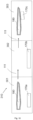
- FIG 10 schematically illustrates a production line 310 according to an example.
- the production line comprises three different workstations 301-303.
- a blade mold 180 is schematically illustrated at two different stages of the blade manufacturing process.
- the blade mold 180 is first arranged in workstation 301 where a certain manufacturing step may be carried out.
- a conveyor system may be provided to move the blade mold 180 along the longitudinal direction represented by the arrows 111.
- Figure 10 shows also the blade mold 180 at a later stage of the manufacturing process which, in this example, may be carried out at workstation 303.
- Movable scaffolds 170a-170c may be provided at each workstation 301-303. Different scaffolds, e.g. of different dimensions, may be arranged in each workstation according to the needs of the manufacturing step to be carried out at the respective workstation.
- movable scaffolds 170a-170c may be movable between a first position and a working position.
- Figure 10 depicts two movable scaffolds (170a and 170b) in a first position, whereas the movable scaffold 170c in the third workstation 303 is shown in a working position which, in this case, comprises a position substantially in contact with a portion of the blade mold 180.
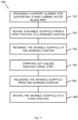
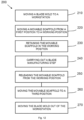
- a method 100 for manufacturing a wind turbine rotor blade is enabled.
- This method 100 is further exemplified by the flowchart presented in Figure 11 .
- the method comprises, at block 110, providing a support element for supporting a wind turbine rotor blade part in a workstation and, at block 120, moving a movable scaffold, the movable scaffold supporting a working platform, from a first position to a working position closer to the support element or to the wind turbine rotor blade part.
- the method 100 then comprises, at block 130, retaining the movable scaffold in the working position.
- the method comprises carrying out a blade manufacturing step. After that, the movable scaffold is released from the working position at block 150.
- the method 100 comprises moving the movable scaffold away from the support element or from the wind turbine rotor blade part to a third position.
- providing the support element for supporting a wind turbine rotor blade part in a workstation may comprise moving the support element.
- different manufacturing steps may be carried out at different locations of the manufacturing plant while maintaining the same support element which, in some variants, may comprise a blade mold. Accordingly, increased flexibility and efficiency may be achieved during manufacturing of wind turbine rotor blades.
- a method may comprise storing the materials to be used for the blade manufacturing step on the working platform while the movable scaffold is in the first position. Such pre-loading of materials and tools may result in a more efficient work flow.
- moving the movable scaffold away from the support element or from the wind turbine rotor blade part to a third position may comprise that the third position is the same as the first position.
- a position where the movable scaffold is in a so-called working position i.e., a position where work is carried out on the blade mold or on a blade part area
- a different position where the movable scaffold may be parked during non-working periods or where operations not requiring access to the blade mold or to the blade part area may be carried out.
- guiding of the movable scaffold may also be facilitated by providing guides.
- some other examples of the method may comprise guiding the movable scaffolds via guides arranged in the floor of the workstation. Such guides may allow for a method that increases efficiency and safety while transferring the movable scaffold from one position to another position.
- block 120 may comprise moving the movable scaffold to a position where substantially no gaps exist between the working platform supported by the movable scaffold and the support element or the wind turbine rotor blade part supported by the support element as explained with reference to Figures 4A-4B or 5A-5B .
- the support element may comprise a blade mold and block 120 may comprise moving the movable scaffold to a position where substantially no gaps exist between the working platform supported by the movable scaffold and the blade mold
- the working platform may comprise one or more extension planks arranged along an edge of the working platform facing the support element or the wind turbine rotor blade part as shown in Figures 7A-7B .
- the extension planks may be individually extended from a retracted position to an extended position so as to reduce a gap between the working platform and the support element or between the working platform and the wind turbine rotor blade part supported by the support element.
- This example may allow for a precise minimization of a gap between the working platform and the support element, which in some cases may comprise a blade mold, or between the working platform and a part of a blade where a manufacturing step may be carried out.
- the extension planks may be manually extended by an operator after retaining the movable scaffold in the working position.
- the extension of the planks may be carried out, either manually or automatically, while moving the movable scaffold from the first position to the working position and then the movable scaffold may be retained after the extension planks are properly arranged in a configuration reducing the gap between the blade mold and the working platform.
- Block 120 regarding moving the movable scaffold to a working position as explained in, e.g. Figures 4A-4B , may in some examples comprise using sensors to monitor the relative position between the working platform supported by the movable scaffold and the support element or between the working platform supported by the movable scaffold and the wind turbine rotor blade part supported by the support element.
- a highly precise positioning may be achieved in a convenient manner.
- the sensor information may be used to inform operators, who may manually move the movable scaffold.
- the information from the sensors may be fed in an automatic moving system controlling the moving operation of the movable scaffold.
- the method provides for a block 130 comprising retaining the movable scaffold once located in the working position.
- this operation may comprise connecting the movable scaffold to the support element (e.g., to a blade mold) by means of magnetic forces and, more specifically, by means of at least one electromagnet.
- the support element e.g., to a blade mold
- magnetic forces may provide an easy method to establish the connection.
- permanent magnets may be used. This may result in a simple passive system in which the magnetic strength may need to be dimensioned appropriately to ensure easy disconnection when needed.
- electromagnets may be used. Such variants may provide enhanced flexibility and may facilitate the operation by allowing activation of the electromagnets in blocks 130 (retaining the movable scaffold) and 140 (carrying out a manufacturing step) but easy deactivation at block 150 (release of the movable scaffold from its working position).
- At least two movable scaffolds supporting respective working platforms may be arranged adjacent to each other in their working positions in another example as also illustrated in, e.g., Figures 3A-3B , Figures 4A-4B or Figures 5A-5B .
- the use of movable scaffolds may provide for additional flexibility in terms of defining the dimensions of the overall working area. By moving different movable scaffolds and placing them adjacent to each other in their working positions, an effective working platform with an area corresponding to the sum of the areas of the individual working platforms may be obtained.
- This example may then provide increased versatility as a set of movable scaffolds of a certain size may be combined according to the portion of the blade mold or the blade part to be covered while conducting a certain manufacturing step. In this manner, dedicated scaffolds with specific sizes do not need to be built whenever a different blade mold or a new blade manufacturing step is required at a workstation.
- a plate may be arranged between adjacent working platforms to substantially close a gap between the adjacent working platforms as explained with reference to Figures 6A-6B .
- a method comprising such a plate may be particularly useful when adjacent working platforms are arranged at an angle to each other while in their respective working positions. It is known that blade molds may exhibit some curvature, so adjacent working platforms may be arranged at a certain angle to properly conform to such curvature. Such arrangement may result in the formation of a gap between the working platforms and, more specifically, between the lateral edges of the working platforms where the platforms face each other. This may be specifically the case if working platforms of a certain geometry, e.g., substantially rectangular, are used.
- a plate may be provided to close the formed gap.
- the plate may be a separate plate that may be fastened, e.g., by bolting, at both ends of the adjacent working platforms to extend over the gap.
- the plate may be fastened at block 130, i.e., while retaining the movable scaffold and working platforms in their working position. Subsequentially, such plates may be unfastened in block 150 while releasing the working platforms so that they can be individually moved away from the supporting element or from the blade part in block 160.
- a plate may be provided underneath the lateral edge of a working platform.
- the plate may be configured to slide in a translation movement so as to extend beyond the lateral edge of the working platform.
- a plate may be provided underneath a lateral edge of a working platform, and it may be configured to pivot so that it may also be allowed to extend beyond the lateral edge of the working platform.
- the plate may be arranged underneath one of the adjacent working platforms so that the plate may slide under the other adjacent working platforms to close the gap between the platforms.
- Examples of the method according to this disclosure may be used for different workstations and for different manufacturing steps.
- providing a support element in a workstation may comprise providing a support element supporting a first blade shell part and a second blade shell part bonded together and carrying out a blade manufacturing step may comprise carrying out at least one of sanding, grinding, painting, testing, or attachment of aerodynamic devices.
- a method is presented in which the movable scaffolds are primarily used for a blade finishing operation occurring at the last stages of the blade manufacturing process.
- Figure 12 provides a flowchart to illustrate still a further example of a method 200 for manufacturing a rotor blade.
- Method 200 comprises, at block 210, moving a blade mold to a workstation. Once the blade mold is at the workstation, method 200 proceeds with steps 220 to 260, which are equivalent to methods 120 to 160 so no further explanation is deemed necessary.
- An additional step is added in method 200 which comprises moving the blade mold out of the workstation at block 270.
- This example provides flexibility not only in terms of the working platforms but also in terms of the overall flow of the blade manufacturing line which, in an example, may be similar to the one schematically illustrated in Figure 10 .
- a blade mold is not only provided in a specific workstation but it is moved into the workstation, which allows the same mold to be conveyed among different specialized workstations where specific manufacturing steps are carried out.
- the method may comprise arranging the blade molds on a blade frame and providing the blade frame with sliding elements and/or wheels to enable movement.
Landscapes
- Engineering & Computer Science (AREA)
- Mechanical Engineering (AREA)
- Robotics (AREA)
- Wind Motors (AREA)
Priority Applications (2)
| Application Number | Priority Date | Filing Date | Title |
|---|---|---|---|
| EP23189895.8A EP4501573A1 (de) | 2023-08-04 | 2023-08-04 | Bewegliche plattform und verfahren zur handhabung einer beweglichen plattform zur herstellung von windturbinenschaufeln |
| PCT/EP2024/072097 WO2025032026A1 (en) | 2023-08-04 | 2024-08-03 | Movable platform and method for handling a movable platform for the manufacturing of wind turbine blades |
Applications Claiming Priority (1)
| Application Number | Priority Date | Filing Date | Title |
|---|---|---|---|
| EP23189895.8A EP4501573A1 (de) | 2023-08-04 | 2023-08-04 | Bewegliche plattform und verfahren zur handhabung einer beweglichen plattform zur herstellung von windturbinenschaufeln |
Publications (1)
| Publication Number | Publication Date |
|---|---|
| EP4501573A1 true EP4501573A1 (de) | 2025-02-05 |
Family
ID=87557627
Family Applications (1)
| Application Number | Title | Priority Date | Filing Date |
|---|---|---|---|
| EP23189895.8A Pending EP4501573A1 (de) | 2023-08-04 | 2023-08-04 | Bewegliche plattform und verfahren zur handhabung einer beweglichen plattform zur herstellung von windturbinenschaufeln |
Country Status (2)
| Country | Link |
|---|---|
| EP (1) | EP4501573A1 (de) |
| WO (1) | WO2025032026A1 (de) |
Citations (4)
| Publication number | Priority date | Publication date | Assignee | Title |
|---|---|---|---|---|
| EP2403708A1 (de) | 2009-03-06 | 2012-01-11 | LM Glasfiber A/S | Verfahren und fertigungsstrasse zur herstellung von windturbinenschaufeln |
| WO2017009424A1 (en) | 2015-07-15 | 2017-01-19 | Lm Wp Patent Holding A/S | Scaffold for a wind turbine blade mould tool |
| WO2022175244A1 (en) * | 2021-02-18 | 2022-08-25 | Lm Wind Power A/S | Movable platform for a mould system and method for handling a mould system comprising a movable platform |
| CN115697684A (zh) * | 2020-05-26 | 2023-02-03 | Lm风力发电公司 | 制造风力涡轮机叶片 |
-
2023
- 2023-08-04 EP EP23189895.8A patent/EP4501573A1/de active Pending
-
2024
- 2024-08-03 WO PCT/EP2024/072097 patent/WO2025032026A1/en active Pending
Patent Citations (4)
| Publication number | Priority date | Publication date | Assignee | Title |
|---|---|---|---|---|
| EP2403708A1 (de) | 2009-03-06 | 2012-01-11 | LM Glasfiber A/S | Verfahren und fertigungsstrasse zur herstellung von windturbinenschaufeln |
| WO2017009424A1 (en) | 2015-07-15 | 2017-01-19 | Lm Wp Patent Holding A/S | Scaffold for a wind turbine blade mould tool |
| CN115697684A (zh) * | 2020-05-26 | 2023-02-03 | Lm风力发电公司 | 制造风力涡轮机叶片 |
| WO2022175244A1 (en) * | 2021-02-18 | 2022-08-25 | Lm Wind Power A/S | Movable platform for a mould system and method for handling a mould system comprising a movable platform |
Also Published As
| Publication number | Publication date |
|---|---|
| WO2025032026A1 (en) | 2025-02-13 |
Similar Documents
| Publication | Publication Date | Title |
|---|---|---|
| CN104080597B (zh) | 模制后站点以及制造风轮机叶片的相关方法 | |
| US11794379B2 (en) | Turning system for wind turbine blade parts | |
| EP3134244A1 (de) | Windturbinenschaufelherstellungssystem und -verfahren | |
| US11725624B2 (en) | Wind blade component bonding fixture | |
| EP4562302B1 (de) | Mehrachsige werkzeuge zur handhabung und positionierung von schaufelfussbauteilen | |
| US20240181732A1 (en) | Pneumatically operated web lifting tongs | |
| EP4035862A1 (de) | Formenanordnung zur herstellung eines schalenteils einer windturbinenschaufel | |
| CN114352323B (zh) | 隧道钢内衬安装系统及施工方法 | |
| EP4501573A1 (de) | Bewegliche plattform und verfahren zur handhabung einer beweglichen plattform zur herstellung von windturbinenschaufeln | |
| US20200376719A1 (en) | Mold for manufacturing a wind turbine blade and a method for manufacturing a wind turbine blade | |
| US20240091989A1 (en) | Movable platform for a mould system and method for handling a mould system comprising a movable platform | |
| CN106744271A (zh) | 风力发电机叶片吊装工装、吊具及吊装方法和拆卸方法 | |
| CN116096556A (zh) | 用于将风力涡轮叶片构件附接到风力涡轮叶片壳部分的系统和方法 | |
| EP4501574A1 (de) | System und verfahren zur handhabung von schaufelformen zur herstellung von windturbinenschaufeln | |
| EP4571096A1 (de) | System und verfahren zur herstellung von windturbinenschaufeln | |
| EP2773488B1 (de) | Übertragung der bearbeitungkoordinaten eines teils | |
| EP4563338A1 (de) | System und verfahren zur scherstegbefestigung in windturbinenschaufeln | |
| EP4127454B1 (de) | Verfahren zur herstellung einer windturbinenschaufel und schersteganordnung für eine windturbinenschaufel | |
| EP4571095A1 (de) | System und verfahren zur herstellung von windturbinenschaufeln | |
| US20250051145A1 (en) | Tower climbing mechanism | |
| EP4290073A1 (de) | Werkzeuge zur lagerung von windturbinenschaufeln | |
| CN117795195A (zh) | 不使用起重机提升和下降叶片的方法以及所使用的装置 | |
| WO2013068008A1 (en) | A female guiding device and a guiding assembly for guiding the connection of two rotor blade segments of a wind turbine | |
| EP4609989A1 (de) | Bearbeitung eines wurzelteils einer windturbinenschaufel | |
| US20250026090A1 (en) | System for assembling a wind turbine blade shell |
Legal Events
| Date | Code | Title | Description |
|---|---|---|---|
| PUAI | Public reference made under article 153(3) epc to a published international application that has entered the european phase |
Free format text: ORIGINAL CODE: 0009012 |
|
| STAA | Information on the status of an ep patent application or granted ep patent |
Free format text: STATUS: THE APPLICATION HAS BEEN PUBLISHED |
|
| AK | Designated contracting states |
Kind code of ref document: A1 Designated state(s): AL AT BE BG CH CY CZ DE DK EE ES FI FR GB GR HR HU IE IS IT LI LT LU LV MC ME MK MT NL NO PL PT RO RS SE SI SK SM TR |
|
| STAA | Information on the status of an ep patent application or granted ep patent |
Free format text: STATUS: REQUEST FOR EXAMINATION WAS MADE |
|
| 17P | Request for examination filed |
Effective date: 20250805 |