EP4501493A1 - Aluminum powder product for metal additive manufacturing and method for manufacturing aluminum powder molded object - Google Patents
Aluminum powder product for metal additive manufacturing and method for manufacturing aluminum powder molded object Download PDFInfo
- Publication number
- EP4501493A1 EP4501493A1 EP23774593.0A EP23774593A EP4501493A1 EP 4501493 A1 EP4501493 A1 EP 4501493A1 EP 23774593 A EP23774593 A EP 23774593A EP 4501493 A1 EP4501493 A1 EP 4501493A1
- Authority
- EP
- European Patent Office
- Prior art keywords
- mass
- aluminum powder
- aluminum
- less
- amount
- Prior art date
- Legal status (The legal status is an assumption and is not a legal conclusion. Google has not performed a legal analysis and makes no representation as to the accuracy of the status listed.)
- Pending
Links
Images
Classifications
-
- C—CHEMISTRY; METALLURGY
- C22—METALLURGY; FERROUS OR NON-FERROUS ALLOYS; TREATMENT OF ALLOYS OR NON-FERROUS METALS
- C22C—ALLOYS
- C22C21/00—Alloys based on aluminium
- C22C21/02—Alloys based on aluminium with silicon as the next major constituent
-
- B—PERFORMING OPERATIONS; TRANSPORTING
- B22—CASTING; POWDER METALLURGY
- B22F—WORKING METALLIC POWDER; MANUFACTURE OF ARTICLES FROM METALLIC POWDER; MAKING METALLIC POWDER; APPARATUS OR DEVICES SPECIALLY ADAPTED FOR METALLIC POWDER
- B22F1/00—Metallic powder; Treatment of metallic powder, e.g. to facilitate working or to improve properties
- B22F1/05—Metallic powder characterised by the size or surface area of the particles
-
- B—PERFORMING OPERATIONS; TRANSPORTING
- B22—CASTING; POWDER METALLURGY
- B22F—WORKING METALLIC POWDER; MANUFACTURE OF ARTICLES FROM METALLIC POWDER; MAKING METALLIC POWDER; APPARATUS OR DEVICES SPECIALLY ADAPTED FOR METALLIC POWDER
- B22F1/00—Metallic powder; Treatment of metallic powder, e.g. to facilitate working or to improve properties
- B22F1/05—Metallic powder characterised by the size or surface area of the particles
- B22F1/052—Metallic powder characterised by the size or surface area of the particles characterised by a mixture of particles of different sizes or by the particle size distribution
-
- B—PERFORMING OPERATIONS; TRANSPORTING
- B22—CASTING; POWDER METALLURGY
- B22F—WORKING METALLIC POWDER; MANUFACTURE OF ARTICLES FROM METALLIC POWDER; MAKING METALLIC POWDER; APPARATUS OR DEVICES SPECIALLY ADAPTED FOR METALLIC POWDER
- B22F10/00—Additive manufacturing of workpieces or articles from metallic powder
- B22F10/10—Formation of a green body
- B22F10/14—Formation of a green body by jetting of binder onto a bed of metal powder
-
- B—PERFORMING OPERATIONS; TRANSPORTING
- B22—CASTING; POWDER METALLURGY
- B22F—WORKING METALLIC POWDER; MANUFACTURE OF ARTICLES FROM METALLIC POWDER; MAKING METALLIC POWDER; APPARATUS OR DEVICES SPECIALLY ADAPTED FOR METALLIC POWDER
- B22F10/00—Additive manufacturing of workpieces or articles from metallic powder
- B22F10/60—Treatment of workpieces or articles after build-up
-
- B—PERFORMING OPERATIONS; TRANSPORTING
- B22—CASTING; POWDER METALLURGY
- B22F—WORKING METALLIC POWDER; MANUFACTURE OF ARTICLES FROM METALLIC POWDER; MAKING METALLIC POWDER; APPARATUS OR DEVICES SPECIALLY ADAPTED FOR METALLIC POWDER
- B22F10/00—Additive manufacturing of workpieces or articles from metallic powder
- B22F10/60—Treatment of workpieces or articles after build-up
- B22F10/64—Treatment of workpieces or articles after build-up by thermal means
-
- B—PERFORMING OPERATIONS; TRANSPORTING
- B33—ADDITIVE MANUFACTURING TECHNOLOGY
- B33Y—ADDITIVE MANUFACTURING, i.e. MANUFACTURING OF THREE-DIMENSIONAL [3D] OBJECTS BY ADDITIVE DEPOSITION, ADDITIVE AGGLOMERATION OR ADDITIVE LAYERING, e.g. BY 3D PRINTING, STEREOLITHOGRAPHY OR SELECTIVE LASER SINTERING
- B33Y10/00—Processes of additive manufacturing
-
- B—PERFORMING OPERATIONS; TRANSPORTING
- B33—ADDITIVE MANUFACTURING TECHNOLOGY
- B33Y—ADDITIVE MANUFACTURING, i.e. MANUFACTURING OF THREE-DIMENSIONAL [3D] OBJECTS BY ADDITIVE DEPOSITION, ADDITIVE AGGLOMERATION OR ADDITIVE LAYERING, e.g. BY 3D PRINTING, STEREOLITHOGRAPHY OR SELECTIVE LASER SINTERING
- B33Y70/00—Materials specially adapted for additive manufacturing
-
- C—CHEMISTRY; METALLURGY
- C22—METALLURGY; FERROUS OR NON-FERROUS ALLOYS; TREATMENT OF ALLOYS OR NON-FERROUS METALS
- C22C—ALLOYS
- C22C21/00—Alloys based on aluminium
- C22C21/06—Alloys based on aluminium with magnesium as the next major constituent
- C22C21/08—Alloys based on aluminium with magnesium as the next major constituent with silicon
-
- B—PERFORMING OPERATIONS; TRANSPORTING
- B22—CASTING; POWDER METALLURGY
- B22F—WORKING METALLIC POWDER; MANUFACTURE OF ARTICLES FROM METALLIC POWDER; MAKING METALLIC POWDER; APPARATUS OR DEVICES SPECIALLY ADAPTED FOR METALLIC POWDER
- B22F2301/00—Metallic composition of the powder or its coating
- B22F2301/05—Light metals
- B22F2301/052—Aluminium
-
- B—PERFORMING OPERATIONS; TRANSPORTING
- B22—CASTING; POWDER METALLURGY
- B22F—WORKING METALLIC POWDER; MANUFACTURE OF ARTICLES FROM METALLIC POWDER; MAKING METALLIC POWDER; APPARATUS OR DEVICES SPECIALLY ADAPTED FOR METALLIC POWDER
- B22F2304/00—Physical aspects of the powder
- B22F2304/10—Micron size particles, i.e. above 1 micrometer up to 500 micrometer
-
- B—PERFORMING OPERATIONS; TRANSPORTING
- B22—CASTING; POWDER METALLURGY
- B22F—WORKING METALLIC POWDER; MANUFACTURE OF ARTICLES FROM METALLIC POWDER; MAKING METALLIC POWDER; APPARATUS OR DEVICES SPECIALLY ADAPTED FOR METALLIC POWDER
- B22F2998/00—Supplementary information concerning processes or compositions relating to powder metallurgy
- B22F2998/10—Processes characterised by the sequence of their steps
-
- B—PERFORMING OPERATIONS; TRANSPORTING
- B22—CASTING; POWDER METALLURGY
- B22F—WORKING METALLIC POWDER; MANUFACTURE OF ARTICLES FROM METALLIC POWDER; MAKING METALLIC POWDER; APPARATUS OR DEVICES SPECIALLY ADAPTED FOR METALLIC POWDER
- B22F2999/00—Aspects linked to processes or compositions used in powder metallurgy
-
- B—PERFORMING OPERATIONS; TRANSPORTING
- B22—CASTING; POWDER METALLURGY
- B22F—WORKING METALLIC POWDER; MANUFACTURE OF ARTICLES FROM METALLIC POWDER; MAKING METALLIC POWDER; APPARATUS OR DEVICES SPECIALLY ADAPTED FOR METALLIC POWDER
- B22F3/00—Manufacture of workpieces or articles from metallic powder characterised by the manner of compacting or sintering; Apparatus specially adapted therefor ; Presses and furnaces
- B22F3/10—Sintering only
- B22F3/1017—Multiple heating or additional steps
- B22F3/1021—Removal of binder or filler
-
- B—PERFORMING OPERATIONS; TRANSPORTING
- B33—ADDITIVE MANUFACTURING TECHNOLOGY
- B33Y—ADDITIVE MANUFACTURING, i.e. MANUFACTURING OF THREE-DIMENSIONAL [3D] OBJECTS BY ADDITIVE DEPOSITION, ADDITIVE AGGLOMERATION OR ADDITIVE LAYERING, e.g. BY 3D PRINTING, STEREOLITHOGRAPHY OR SELECTIVE LASER SINTERING
- B33Y40/00—Auxiliary operations or equipment, e.g. for material handling
- B33Y40/20—Post-treatment, e.g. curing, coating or polishing
-
- C—CHEMISTRY; METALLURGY
- C22—METALLURGY; FERROUS OR NON-FERROUS ALLOYS; TREATMENT OF ALLOYS OR NON-FERROUS METALS
- C22C—ALLOYS
- C22C1/00—Making non-ferrous alloys
- C22C1/04—Making non-ferrous alloys by powder metallurgy
- C22C1/0408—Light metal alloys
- C22C1/0416—Aluminium-based alloys
-
- Y—GENERAL TAGGING OF NEW TECHNOLOGICAL DEVELOPMENTS; GENERAL TAGGING OF CROSS-SECTIONAL TECHNOLOGIES SPANNING OVER SEVERAL SECTIONS OF THE IPC; TECHNICAL SUBJECTS COVERED BY FORMER USPC CROSS-REFERENCE ART COLLECTIONS [XRACs] AND DIGESTS
- Y02—TECHNOLOGIES OR APPLICATIONS FOR MITIGATION OR ADAPTATION AGAINST CLIMATE CHANGE
- Y02P—CLIMATE CHANGE MITIGATION TECHNOLOGIES IN THE PRODUCTION OR PROCESSING OF GOODS
- Y02P10/00—Technologies related to metal processing
- Y02P10/25—Process efficiency
Definitions
- the present invention relates to an aluminum powder product for metal additive manufacturing and a method for manufacturing an aluminum powder additive manufactured body.
- Aluminum has been widely used as a material for a heat sink due to its characteristics such as light weight and high thermal conductivity.
- characteristics such as light weight and high thermal conductivity.
- As a method for manufacturing a complex-shaped product, using metal 3D printers is increasing.
- a binder jet method has been attracting attention as one of additive manufacturing technologies using metal powders.
- a binder containing a thermosetting resin, a thermoplastic resin, or a photocurable resin is selectively sprayed from a print head onto a metal powder layer and repeatedly stacked the metal powder layers.
- the binder jet method is known as a method in which a metal powder green body fixed to a desired three-dimensional shape is obtained due to the repeated stacking, and then subjected to binder fixing, removal of unnecessary powder, degreasing, and sintering to obtain a three-dimensional metal additive manufactured body.
- Patent Documents 1 and 2 shown below disclose metal additive manufacturing using a binder jet method, or a molding device therefor.
- Patent Document 3 describes a method for enhancing sinterability of aluminum by using a fine powder having a large specific surface area, but when the powder is applied to the binder jet method, it is considered that aluminum having a small specific gravity scatters during formation of powder layers, and thus causes a decrease in uniformity or packing density, or poses safety problems.
- the present invention has been made in view of the above-described problems, and an object thereof is to provide an aluminum powder product for metal additive manufacturing that can be applied to a binder jet method even if it is an aluminum powder that has an oxide layer and is known as a sintering-resistant material, and a method for manufacturing an aluminum powder additive manufactured body using the aluminum powder product for metal additive manufacturing.
- the present inventors conducted studies regarding binder jet method using and applying an aluminum powder as a raw material, in which a ratio of a magnesium amount (mass%) to an oxygen amount (mass%) in the raw material is adjusted to 0.1 or more and 2.0 or less and the amount of oxygen contained in the aluminum powder is 0.3 mass% or less.
- the present inventors provide an aluminum powder product for metal additive manufacturing and a method for manufacturing an aluminum powder additive manufactured body using the aluminum powder product for metal additive manufacturing.
- An aluminum powder product for metal additive manufacturing according to Aspect 1 of the present invention is characterized in that, a purity of aluminum in the entire powder product is 98 mass% or more, and the aluminum powder product contains 0.01 mass% or more and 0.5 mass% or less of Mg, and a ratio Mg amount/oxygen amount that is a contained amount of Mg (mass%) to a contained amount of oxygen (mass%) is 0.1 or more and 2.0 or less.
- the above-described aluminum powder product for metal additive manufacturing contains an appropriate amount of Mg and an appropriate amount of oxygen corresponding to the contained Mg.
- Mg reduces and partially destroys the oxide layer on surfaces of particles of the aluminum powder product for metal additive manufacturing, thereby enhancing sinterability.
- a certain amount or more of Mg is required relative to the oxygen amount to accomplish the reduction reaction of the surfaces of the particles of the aluminum powder product for metal additive manufacturing. If the Mg amount is too small, it is not possible to achieve the partial destruction of the oxide layer on the surfaces of the particles of the aluminum powder product for metal additive manufacturing.
- the Mg amount may be preferably 0.015 mass% or more and 0.4 mass% or less, and more preferably 0.02 mass% or more and 0.3 mass% or less. The same may also apply to Aspects 2 to 10 to be described later.
- Mg amount/oxygen amount is required to be 0.1 or more and 2.0 or less to accomplish the reduction reaction of the surface of the aluminum powder product for metal additive manufacturing, enhance the sinterability, and prevent the thermal conductivity from decreasing.
- the value of Mg amount/oxygen amount may be more preferably 0.015 or more and 0.15 or less, and still more preferably 0.02 or more and 0.1 or less. The same may also apply to Aspects 2 to 10 to be described later.
- the Si content When the Si content is in the above-described range, it contributes to a decrease in melting point of the aluminum powder product for metal additive manufacturing and the sinterability can be enhanced. Moreover, high thermal conductivity can be maintained while suppressing a decrease in conductivity.
- the Si content may be 0.15 mass% or more and 0.8 mass% or less, and preferably 0.2 mass% or more and 0.7 mass% or less. The same may also apply to Aspects 3 to 10 to be described later.
- the aluminum powder product for metal additive manufacturing according to Aspect 3 is characterized in that it is a mixture of an aluminum powder having a purity of 99% or more and an aluminum alloy powder containing 0.1 mass% or more and 1.0 mass% or less of Mg and 3.0 mass% or more and 12.0 mass% or less of Si, in which a ratio Mg amount/oxygen amount of a contained amount of Mg (mass%) to a contained amount of oxygen (mass%) is 0.1 or more and 2.0 or less.
- the above-described aluminum powder product for metal additive manufacturing may contain an appropriate amount of Mg relative to the entirety of the mixture and has an appropriate amount of oxygen corresponding to the contained Mg.
- Mg reduces and partially destroys the oxide layer on surfaces of particles of the aluminum powder having a purity of 99% or more, thereby enhancing sinterability.
- a certain amount or more of Mg is required relative to the oxygen amount to accomplish the reduction reaction of the surfaces of the particles of the aluminum powder or the surfaces of the particles of the aluminum alloy powder. If the Mg amount is too small, it is not possible to achieve the partial destruction of the oxide layer on the surfaces of the particles of the aluminum powder or the particles of the aluminum alloy powder.
- the Mg amount is too large, the sinterability enhancement effect due to the destruction of the oxide layer is saturated, and an increase in Mg amount causes a decrease in conductivity and thermal conductivity, and the like.
- Mg amount/oxygen amount is required to be 0.1 or more and 2.0 or less to accomplish the reduction reaction of the surface of the aluminum powder or the aluminum alloy powder, enhance the sinterability, and prevent the thermal conductivity from decreasing.
- the oxygen amount is preferably 0.05 mass% or more and 0.3 mass% or less in Aspects 1 to 3.
- the range of the Mg amount is defined, and the range of the oxygen amount is set based on the substantial ratio of Mg amount/oxygen amount. Particularly, however, the upper limit is defined as a value that can be taken in consideration of a method for manufacturing a powder for additive manufacturing.
- the oxygen amount may be 0.05 mass% or more and 0.3 mass% or less. The same may also apply to Aspects 5 to 10 to be described later.
- a volume median diameter measured by a laser diffraction/scattering method is preferably 10 ⁇ m or more and 100 ⁇ m or less in Aspects 1 to 4.
- volume median diameter is 10 ⁇ m or more and 100 ⁇ m or less, it is possible to provide an aluminum powder having a particle diameter favorable for the stacking of the aluminum powder and a particle diameter suitable for a binder jet method.
- the volume median diameter may be 10 ⁇ m or more and 50 ⁇ m or less. The same may also apply to Aspects 6 to 10 to be described later.
- an aluminum powder product for metal additive manufacturing in which a purity of aluminum in the entire powder is 98 mass% or more, 0.01 mass% or more and 0.5 mass% or less of Mg is contained, and a ratio Mg amount/oxygen amount of a contained amount of Mg (mass%) to a contained amount of oxygen (mass%) is 0.1 or more and 2.0 or less is used.
- the degreasing step is preferably performed at 500°C or lower in any one of an oxidizing atmosphere, an inert atmosphere, or a reduced-pressure atmosphere of 1 Pa or more and 100 kPa or less.
- the aluminum powder in which 0.01 mass% or more and 0.5 mass% or less of Mg is contained and the value of Mg amount/oxygen amount is 0.1 or more and 2.0 or less is degreased, the aluminum powder can be sintered by heating while preventing Mg from oxidizing due to the conditions for the degreasing step described above. That is, it is possible to prevent Mg from oxidizing in the degreasing step and maintain a state in which Mg has no oxide layer until sintering by heating. Therefore, by making the aluminum coating destruction effect of Mg work effectively, a sinterability enhancement effect can be obtained.
- the aluminum powder additive manufactured body may be a heat sink having fins.
- Aspect 7 In the method for manufacturing an aluminum powder additive manufactured body according to Aspect 7, an aluminum powder raw material containing 0.1 mass% or more and 1.0 mass% or less of Si in addition to the Mg can be used in Aspect 6.
- the melting point of an aluminum alloy can be lowered with the addition of Si, which contributes to the enhancement of sinterability.
- an aluminum powder product for metal additive manufacturing that is a mixture of an aluminum powder having a purity of 99% or more and an aluminum alloy powder containing 0.1 mass% or more and 1.0 mass% or less of Mg and 3.0 mass% or more and 12.0 mass% or less of Si, in which a ratio Mg amount/oxygen amount of a contained amount of Mg (mass%) to a contained amount of oxygen (mass%) is 0.1 or more and 2.0 or less, is used, and sintering by heating is performed after the degreasing step is performed at 500°C or lower in any one of an oxidizing atmosphere, an inert atmosphere, or a reduced-pressure atmosphere of 1 Pa or more and 100 kPa or less to prevent Mg from oxidizing.
- Mg is prevented from oxidizing in the degreasing step, a state in which Mg has no oxide layer can be maintained until sintering by heating. Therefore, by making the aluminum coating destruction effect of Mg work effectively, a sinterability enhancement effect can be obtained.
- the aluminum alloy powder When the aluminum alloy powder is mixed with the aluminum powder having a purity of 99% or more, 3.0 mass% or more and 12.0 mass% or less of Si may be contained in addition to 0.1 mass% or more and 1.0 mass% or less of Mg.
- Si content When the Si content is in the above-described range, it contributes to a decrease in melting point of the aluminum alloy powder and the sinterability can be enhanced. Moreover, it is possible to manufacture an aluminum additive manufactured body in which high thermal conductivity are maintained without a significant decrease in conductivity.
- the step of performing sintering by heating can be performed in any one of an inert atmosphere gas flow, a reducing gas flow, an inert gas flow in a reduced-pressure atmosphere of 1 Pa or more and 100 kPa or less, or a reducing gas flow in a reduced-pressure atmosphere of 1 Pa or more and 100 kPa or less in Aspects 6 to 8.
- the added Mg can be efficiently reacted with the oxide layer of the aluminum to accelerate the generation of spinel, which can contribute to the enhancement of sinterability.
- a sufficient amount of the gas flow can be obtained, and the binder residue can be efficiently removed.
- the oxidizing atmosphere in the degreasing step can be set to be dry air having a dew point of 10°C or lower in Aspects 6 to 9.
- the oxidizing atmosphere in the degreasing step may be more preferably dry air having a dew point of -80°C or higher and 0°C or lower.
- the aluminum powder additive manufactured body obtained by the method for manufacturing an aluminum powder additive manufactured body may have a relative density of 90% or more and a thermal conductivity of 180 W/K.
- an aluminum powder product for metal additive manufacturing is an aluminum-based powder having a purity of 98% or more, and the powder contains 0.01 mass% or more and 0.5 mass% or less of Mg with a ratio Mg amount/oxygen amount of a contained amount of Mg (mass%) to a contained amount of oxygen (mass%) ranging from 0.1 or more and 2.0 or less.
- the aluminum powder product for metal additive manufacturing may be a powder mixture of an aluminum powder having a purity of 99% or more and an aluminum alloy powder containing 0.1 mass% or more and 1.0 mass% or less of Mg and 3.0 mass% or more and 12.0 mass% or less of Si.
- the aluminum powder product for metal additive manufacturing is a powder mixture of an aluminum powder having a purity of 99% or more and an aluminum alloy powder containing 0.1 mass% or more and 1.0 mass% or less of Mg
- the aluminum powder product for metal additive manufacturing contains Mg as described above, and contains Si in the above-described range as necessary, and its remainder consists of unavoidable impurities and aluminum.
- the aluminum powder product for metal additive manufacturing contains Mg in the above-described range, Mg reduces and partially destroys the oxide layer on an aluminum powder surface, thereby enhancing the sinterability of the entire aluminum powder.
- Mg a certain amount or more of Mg is required relative to the oxygen amount to accomplish the reduction reaction of the aluminum powder surface. If the Mg amount is too small, it is not possible to achieve the partial destruction of the oxide layer of the aluminum powder. If the Mg amount is too large, the sinterability enhancement effect due to the destruction of the oxide layer is saturated, and an increase in Mg amount causes a decrease in conductivity, a decrease in thermal conductivity, and the like.
- the ratio Mg amount/oxygen amount of the Mg amount (mass%) to the oxygen amount (mass%) in the aluminum powder is adjusted to 0.1 or more and 2.0 or less.
- the amount of Mg added is in a ratio of 0.1 or more and 2.0 or less relative to the amount of oxygen, so that Mg can generate spinel (MgAl 2 O 4 ) by reacting with the oxide layer on the aluminum powder surface and partially destroy the oxide layer, and high sinterability can be obtained.
- Mg amount/oxygen amount is less than 0.1, Mg is not sufficiently present relative to the oxide layer of the aluminum, and thus the oxide layer destruction effect occurring due to the generation of the spinel cannot be sufficiently obtained. If the value of Mg amount/oxygen amount is more than 2.0, too much Mg is present for the oxide layer destruction effect, Mg excessively evaporates during sintering by heating under reduced pressure, which causes pores to be generated in an aluminum additive manufactured body, and thus a reached density of the aluminum additive manufactured body may decrease.
- the oxygen content is preferably 0.3 mass% or less. If the oxygen content is more than 0.3 mass%, the thickness of the oxide layer excessively increases, and thus it may be difficult to partially destroy the oxide layer by adding Mg. It is desirable that the oxygen content in the aluminum powder product for metal additive manufacturing be small. However, since the manufacturing conditions must be strictly controlled to set the oxygen content to be less than 0.05 mass%, the oxygen content is preferably 0.05 mass% or more.
- the aluminum powder product for metal additive manufacturing may contain, in addition to Mg in the above-described range, 0.1 mass% or more and 1.0 mass% or less of Si as an alloy component.
- Si content when the Si content is in the above-described range, it contributes to a decrease in melting point of the aluminum alloy powder and the sinterability can be enhanced. Moreover, high thermal conductivity can be maintained without a significant decrease in electrical conductivity.
- a powder mixture of an aluminum powder having a purity of 99% or more and an aluminum alloy powder containing 0.1 mass% or more and 1.0 mass% or less of Mg and 3.0 mass% or more and 12.0 mass% or less of Si may be adopted.
- a volume median diameter is preferably 10 ⁇ m or more and 100 ⁇ m or less.
- the volume median diameter is 10 ⁇ m or more and 100 ⁇ m or less, it is possible to obtain a stabilized powder mixture having excellent fluidity and sinterability. If the volume median diameter (D50) is less than 10 ⁇ m, there is a risk of dust explosion due to a decrease in fluidity or scattering of the powder. If the volume median diameter (D50) is more than 100 ⁇ m, the specific surface areas of the powder particles are reduced. Therefore, the sinterability of the aluminum powder mixture decreases, and a sufficient reached density may not be obtained for a sintered body.
- a method in which, first, the above-described aluminum powder is stacked as a raw material powder (aluminum powder product for metal additive manufacturing), selective spraying a binder containing a thermosetting resin, a thermoplastic resin, or a photocurable resin onto the stacked raw material powder, and these steps are repeatedly performed to form a shape close to a target shape, a degreasing treatment is performed, and then sintering by heating is performed.
- the aluminum powder having a high purity for constituting the aluminum powder product for metal additive manufacturing can be manufactured by a method such as a nitrogen gas atomization method.
- the aluminum alloy powder for constituting the aluminum powder mixture can be manufactured from a molten alloy having a target composition by a nitrogen gas atomization method, for example.
- a necessary amount of pure aluminum according to a target composition a necessary amount of an aluminum mother alloy is added and put into a melting furnace to produce a molten aluminum alloy, and the above-described aluminum alloy powder can be prepared from the molten metal by an inert gas atomization method.
- the obtained aluminum powder or aluminum alloy powder is subjected to sieving or washing to remove a coarse powder and a fine powder consisting of fumes, and then sieved as necessary according to the target particle size.
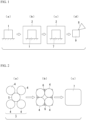
- a powder green body having a shape similar to a target product shape can be obtained by repeatedly performing stacking the raw material powder and spraying a selectively binder-containing ink. Due to the repeated stacking, the raw material powder is fixed to have a shape that matches a desired three-dimensional shape. After the raw material powder of the portion where the binder ink has been applied is fixed by heating, removal of unnecessary powder, a degreasing step, and the like are performed as necessary, and for example, a cube-shaped green body 1 shown in (a) of FIG. 1 can be obtained. The following degreasing step is performed on the green body 1.
- the degreasing step is preferably performed at 500°C or lower in an oxidizing atmosphere.
- the degreasing step is more preferably performed with dry air having a dew point of 10°C or lower at 500°C or lower in an oxidizing atmosphere (in the air or the like).
- dry air having a dew point of 10°C or lower it is possible to efficiently remove the binder contained in the aluminum powder green body while suppressing the reaction between the moisture in the air and the aluminum.
- degreasing is desirably performed under an oxidizing atmosphere containing oxygen to efficiently remove the binder contained in the ink.
- Mg is desirably present as an alloy component or a simple substance in the aluminum powder formed degreased body that is in a state of a sintering precursor to maximize the above-described oxide layer destruction effect of Mg. It is not preferable that Mg be present as an oxide at the stage of the aluminum powder formed degreased body. Therefore, it is more desirable that the degreasing step be performed at 400°C or lower to suppress the oxidation of Mg.
- the green body 1 is housed in a heating furnace 2 as shown in (b) of FIG. 1 , and sintered by being heated to a temperature of about 560°C to 650°C for a necessary time in a reducing atmosphere or an inert gas atmosphere as a reduced-pressure atmosphere.
- a liquid phase is generated at an interface between the particles of the raw material powder and wet-spreads to fill the gaps between the particles of the raw material powder, so that isotropic shrinkage can be obtained and the density can be increased.
- the rate of temperature increase it is desirable that, in order to suppress the rapid generation of the liquid phase, heating be performed at a rate of temperature increase of 10 °C/min or less in a temperature range of 500°C or higher at which the generation of the liquid phase starts.
- a heating step may be performed in two or more stages with the body of accelerating solid phase sintering by keeping the temperature at or below the temperature at which the liquid phase is generated and of stabilizing the gaps between the particles.
- the heating and sintering step is performed under a reduced-pressure atmosphere of 1 Pa or more and 100 kPa or less, the added Mg efficiently reacts with the oxide layer on the aluminum powder surface, and thus the above-described spinel forming reaction can be accelerated.
- the binder residue remaining in the degreased body can be efficiently removed.
- FIG. 2 shows an example in which an aluminum powder mixture 3 is additively manufactured, and shows an aluminum powder mixture obtained by mixing aluminum powder particles 4 having a purity of 99% or more and aluminum alloy powder particles 5 having a lower melting point than the aluminum powder particles 4.
- an aluminum powder mixture including four aluminum powder particles 4 and one aluminum alloy powder particle 5 is shown for the sake of modeling, but the number of the aluminum powder particles 4 and the number of the aluminum alloy powder particles 5 may be in any ratio as long as the above-described proportion by mass% is achieved.
- FIG. 2 is an explanatory diagram for showing a case where the aluminum powder mixture 3 is heated to a temperature of about 560°C to 650°C by modeling.
- Pure aluminum has a melting point of about 660°C.
- eutectic alloy elements such as Mg and Si are added to pure aluminum, an aluminum alloy powder having a melting point lower than the melting point of the pure aluminum of about 660°C is obtained.
- FIG. 2 shows a model configuration when the pure aluminum powder particles 4 and the aluminum alloy powder particles 5 are blended at a ratio of 4:1 to constitute the aluminum powder mixture 3, for the sake of illustration simplification.
- all the pure aluminum powder particles 4 shown in (a) of FIG. 2 may be omitted and the aluminum powder mixture 3 may be formed of the aluminum alloy powder particles 5.
- the pure aluminum powder particles 4 Since the pure aluminum powder particles 4 has a melting point of about 660°C, all the pure aluminum powder particles 4 do not completely melt by heating in the above-described temperature range, but parts where the liquid phase 6 has wet-spread, which are parts at the interfaces between the pure aluminum powder particles 4, partially melt and fuse with each other. Thus, when cooling is performed after heating for a predetermined time, it is possible to finally obtain a dense sintered body 7 that is almost entirely melted and integrated, as shown in (c) of FIG. 2 .
- (c) of FIG. 1 shows a state in which the sintered body 7 is generated in the heating furnace 2.
- the obtained sintered body 7 can be finished by being processed or surface-polished with a cutting tool 8 as needed as shown in (d) of FIG. 1 , to obtain a sintered product (aluminum powder additive manufactured body) 9.
- the sintered body 7 or the sintered product 9 since the oxygen content in the aluminum powder is 0.3 mass% or less, Mg is contained in a range of 0.01 to 0.5 mass%, and the ratio Mg amount/oxygen amount is in a range of 0.1 to 2.0, sintering can be carried out while the oxide layer on the aluminum powder surface can be efficiently destroyed during sintering. Accordingly, the sintered body 7 or the sintered product 9 has a dense structure in which the liquid phase effectively fills the gaps between the pure aluminum powder particles 4.
- a sintered body 7 or a sintered product 9 having a high density and a shape that is close to a target shape and well-regulated.
- the sintered body 7 or the sintered product 9 made of aluminum may be subjected to a surface treatment such as polishing, anodization, or plating according to the purpose.
- the sintered body 7 or the sintered product 9 described above has a high density and high thermal conductivity, it is desirable as a constituent member of a heat exchanger. Since the sintered body 7 or the sintered product 9 is dense and has high thermal conductivity, it contributes to an improvement of the performance of a heat exchanger constituted using the sintered body 7 or the sintered product 9.
- Examples 1 to 6 and Comparative Examples 1 and 2 having compositions shown in Table 1 were prepared by an inert gas atomization method.
- a necessary amount of pure aluminum or an aluminum mother alloy according to a target composition was prepared and put into a plurality of melting furnaces to produce molten pure aluminum or molten aluminum alloys, and from the molten metals in the melting furnaces, a pure aluminum powder (powder 1) and an aluminum alloy powder (powder 2) having compositions shown in Table 2 were prepared by an inert gas atomization method.
- the obtained pure aluminum powder and aluminum alloy powder were subjected to sieving or washing to remove a coarse powder and a fine powder consisting of fumes, and then sieved as necessary according to the target particle size. Then, the pure aluminum powder (powder 1) and the aluminum alloy powder (powder 2) were mixed to obtain a mixing ratio shown in Table 2 below, and thus an aluminum powder mixture was obtained.
- a shape having a length of 10 mm ⁇ a width of 10 mm ⁇ a thickness of 5 mm was formed with the use of a metal binder jet type additive manufacturing device (manufactured by Digital Metal, trade name: DM-P2500), and then heated at 250°C under an air atmosphere or an inert gas atmosphere to cure the resin. Thereafter, the obtained degreased body was degreased by heating at 400°C under a dry air atmosphere with a dew point of 10°C or lower or a humidified air atmosphere achieved by bubbling in a water tank. The resulting body was further heated to 565°C to 650°C to prepare a sintered body.
- a mass ratio of Mg and Si contained in the aluminum powder, the aluminum alloy powder, and the aluminum powder mixture was measured.
- a mass ratio of 15 elements of Fe, Cu, Mn, Zn, Ti, Cr, Zr, B, Ni, Bi, Pb, Ga, V, Sn, and Be was measured, and a value obtained by subtracting the total amount of 17 elements including Mg and Si from 100% was measured as an aluminum purity.
- the oxygen concentration in the aluminum powder mixture was measured by using an inert gas fusion-infrared absorption method.
- the prepared sintered body was processed into 8 mm ⁇ 8 mm ⁇ 2 mm and the thermal conductivity thereof was measured by a laser flash method using trade name: LFA467 manufactured by NETZSCH. The measurement results are collectively shown in Tables 1 to 3 below.
- Examples 1 to 7 are samples in which 0.02 to 0.45 mass% of Mg and 0.03 to 0.25 mass% of Si are contained in the aluminum and the value of Mg amount/oxygen amount is 0.1 or more and 2.0 or less.
- Examples 1 to 7 had an excellent relative density of 0.88 to 0.95 and exhibited an excellent thermal conductivity of 181 to 225 W/K.
- Each of Examples 8 to 14 shown in Table 2 is an aluminum powder product for additive manufacturing, consisting of a powder mixture obtained by mixing an aluminum powder (powder 1) having a purity of 99% or more and an aluminum alloy powder (powder 2) at a powder mixing ratio (shown as ratio of powder 1:powder 2, or proportion of powder 2 to powder 1) shown in Table 2.
- Examples 8 to 14 are samples in which in the aluminum powder mixture, 0.019 to 0.15 mass% of Mg is added, 0.33 to 1.42 mass% of Si is contained, and the value of Mg amount/oxygen amount is 0.13 or more and 1.10 or less.
- Examples 8 to 14 had an excellent relative density of 0.915 to 0.966 and exhibited an excellent thermal conductivity of 180 to 220 W/K.
- an aluminum powder product for metal additive manufacturing it is possible to manufacture an aluminum member having few internal defects and a high relative density by a binder jet method. As a result, it is possible to obtain a high density, high electrical conductivity, and high thermal conductivity for an aluminum sintered body to be obtained. Therefore, for example, it is possible to further improve the performance of heat exchange members, conductive members, and strength members prepared by using the binder jet method. Accordingly, the present invention is industrially usable.
Landscapes
- Chemical & Material Sciences (AREA)
- Engineering & Computer Science (AREA)
- Materials Engineering (AREA)
- Manufacturing & Machinery (AREA)
- Mechanical Engineering (AREA)
- Metallurgy (AREA)
- Organic Chemistry (AREA)
- Physics & Mathematics (AREA)
- Thermal Sciences (AREA)
- Powder Metallurgy (AREA)
Abstract
Description
- The present invention relates to an aluminum powder product for metal additive manufacturing and a method for manufacturing an aluminum powder additive manufactured body.
- Priority is claimed on
Japanese Patent Application No. 2022-048834, filed March 24, 2022 - Aluminum has been widely used as a material for a heat sink due to its characteristics such as light weight and high thermal conductivity. However, in order to further improve heat dissipation characteristics, there is a need to design and produce complex-shaped pins and fins, lattice shapes, and the like enabling more efficient heat exchange. As a method for manufacturing a complex-shaped product, using metal 3D printers is increasing.
- In recent years, a binder jet method has been attracting attention as one of additive manufacturing technologies using metal powders. In the binder jet method, a binder containing a thermosetting resin, a thermoplastic resin, or a photocurable resin is selectively sprayed from a print head onto a metal powder layer and repeatedly stacked the metal powder layers. The binder jet method is known as a method in which a metal powder green body fixed to a desired three-dimensional shape is obtained due to the repeated stacking, and then subjected to binder fixing, removal of unnecessary powder, degreasing, and sintering to obtain a three-dimensional metal additive manufactured body.
- For example,
Patent Documents -
- [Patent Document 1]
PublishedJapanese Translation No. 2020-511593 of the PCT - [Patent Document 2]
Japanese Unexamined Patent Application, First Publication No. 2020-152001 - [Patent Document 3]
Japanese Unexamined Patent Application, First Publication No. 2004-308004 - Meanwhile, when a additive manufactured body formed of aluminum or an aluminum alloy is obtained using the binder jet method, it is necessary to reduce the sintering resistance due to an oxide layer on the surface of the aluminum powder particles.
- For example,
Patent Document 3 describes a method for enhancing sinterability of aluminum by using a fine powder having a large specific surface area, but when the powder is applied to the binder jet method, it is considered that aluminum having a small specific gravity scatters during formation of powder layers, and thus causes a decrease in uniformity or packing density, or poses safety problems. - Therefore, when a additive manufactured body formed of aluminum or an aluminum alloy is manufactured using the binder jet method, it is important to secure sufficient sinterability while ensuring fluidity of the metal powder.
- The present invention has been made in view of the above-described problems, and an object thereof is to provide an aluminum powder product for metal additive manufacturing that can be applied to a binder jet method even if it is an aluminum powder that has an oxide layer and is known as a sintering-resistant material, and a method for manufacturing an aluminum powder additive manufactured body using the aluminum powder product for metal additive manufacturing.
- Based on the above background, the present inventors conducted studies regarding binder jet method using and applying an aluminum powder as a raw material, in which a ratio of a magnesium amount (mass%) to an oxygen amount (mass%) in the raw material is adjusted to 0.1 or more and 2.0 or less and the amount of oxygen contained in the aluminum powder is 0.3 mass% or less.
- As a result, they found and developed a technology for manufacturing an aluminum sintered body having a high relative density of 90% or more relative to a true density of the aluminum powder as the raw material, by performing a degreasing step at 500°C or lower in an oxidizing atmosphere after forming by the binder jet method, or sintering an obtained formed degreased body by heating in a non-oxidizing gas flow under reduced pressure of 1 Pa or more and 100 kPa or less.
- As a result of various studies, the present inventors provide an aluminum powder product for metal additive manufacturing and a method for manufacturing an aluminum powder additive manufactured body using the aluminum powder product for metal additive manufacturing.
- (Aspect 1) An aluminum powder product for metal additive manufacturing according to
Aspect 1 of the present invention is characterized in that, a purity of aluminum in the entire powder product is 98 mass% or more, and the aluminum powder product contains 0.01 mass% or more and 0.5 mass% or less of Mg, and a ratio Mg amount/oxygen amount that is a contained amount of Mg (mass%) to a contained amount of oxygen (mass%) is 0.1 or more and 2.0 or less. - The above-described aluminum powder product for metal additive manufacturing contains an appropriate amount of Mg and an appropriate amount of oxygen corresponding to the contained Mg. When the aluminum powder contains an appropriate amount of Mg, Mg reduces and partially destroys the oxide layer on surfaces of particles of the aluminum powder product for metal additive manufacturing, thereby enhancing sinterability. In addition, a certain amount or more of Mg is required relative to the oxygen amount to accomplish the reduction reaction of the surfaces of the particles of the aluminum powder product for metal additive manufacturing. If the Mg amount is too small, it is not possible to achieve the partial destruction of the oxide layer on the surfaces of the particles of the aluminum powder product for metal additive manufacturing. If the Mg amount is too large, the sinterability enhancement effect due to the destruction of the oxide layer is saturated, and an increase in Mg amount causes decreases in conductivity and thermal conductivity, and the like. The Mg amount may be preferably 0.015 mass% or more and 0.4 mass% or less, and more preferably 0.02 mass% or more and 0.3 mass% or less. The same may also apply to
Aspects 2 to 10 to be described later. - The value of Mg amount/oxygen amount is required to be 0.1 or more and 2.0 or less to accomplish the reduction reaction of the surface of the aluminum powder product for metal additive manufacturing, enhance the sinterability, and prevent the thermal conductivity from decreasing. The value of Mg amount/oxygen amount may be more preferably 0.015 or more and 0.15 or less, and still more preferably 0.02 or more and 0.1 or less. The same may also apply to
Aspects 2 to 10 to be described later. - (Aspect 2) In the aluminum powder product for metal additive manufacturing according to
Aspect 2, 0.1 mass% or more and 1.0 mass% or less of Si is preferably contained in addition to the Mg inAspect 1. - When the Si content is in the above-described range, it contributes to a decrease in melting point of the aluminum powder product for metal additive manufacturing and the sinterability can be enhanced. Moreover, high thermal conductivity can be maintained while suppressing a decrease in conductivity. The Si content may be 0.15 mass% or more and 0.8 mass% or less, and preferably 0.2 mass% or more and 0.7 mass% or less. The same may also apply to
Aspects 3 to 10 to be described later. - (Aspect 3) The aluminum powder product for metal additive manufacturing according to
Aspect 3 is characterized in that it is a mixture of an aluminum powder having a purity of 99% or more and an aluminum alloy powder containing 0.1 mass% or more and 1.0 mass% or less of Mg and 3.0 mass% or more and 12.0 mass% or less of Si, in which a ratio Mg amount/oxygen amount of a contained amount of Mg (mass%) to a contained amount of oxygen (mass%) is 0.1 or more and 2.0 or less. - The above-described aluminum powder product for metal additive manufacturing may contain an appropriate amount of Mg relative to the entirety of the mixture and has an appropriate amount of oxygen corresponding to the contained Mg. When the powder mixture contains an appropriate amount of Mg, Mg reduces and partially destroys the oxide layer on surfaces of particles of the aluminum powder having a purity of 99% or more, thereby enhancing sinterability. In addition, a certain amount or more of Mg is required relative to the oxygen amount to accomplish the reduction reaction of the surfaces of the particles of the aluminum powder or the surfaces of the particles of the aluminum alloy powder. If the Mg amount is too small, it is not possible to achieve the partial destruction of the oxide layer on the surfaces of the particles of the aluminum powder or the particles of the aluminum alloy powder. When the Mg amount is too large, the sinterability enhancement effect due to the destruction of the oxide layer is saturated, and an increase in Mg amount causes a decrease in conductivity and thermal conductivity, and the like.
- In the aluminum powder product for metal additive manufacturing according to
Aspect 3, Mg amount/oxygen amount is required to be 0.1 or more and 2.0 or less to accomplish the reduction reaction of the surface of the aluminum powder or the aluminum alloy powder, enhance the sinterability, and prevent the thermal conductivity from decreasing. - (Aspect 4) In the aluminum powder product for metal additive manufacturing according to
Aspect 4, the oxygen amount is preferably 0.05 mass% or more and 0.3 mass% or less inAspects 1 to 3. - The range of the Mg amount is defined, and the range of the oxygen amount is set based on the substantial ratio of Mg amount/oxygen amount. Particularly, however, the upper limit is defined as a value that can be taken in consideration of a method for manufacturing a powder for additive manufacturing. The oxygen amount may be 0.05 mass% or more and 0.3 mass% or less. The same may also apply to
Aspects 5 to 10 to be described later. - (Aspect 5) In the aluminum powder product for metal additive manufacturing according to
Aspect 5, a volume median diameter measured by a laser diffraction/scattering method is preferably 10 µm or more and 100 µm or less inAspects 1 to 4. - When the volume median diameter is 10 µm or more and 100 µm or less, it is possible to provide an aluminum powder having a particle diameter favorable for the stacking of the aluminum powder and a particle diameter suitable for a binder jet method. The volume median diameter may be 10 µm or more and 50 µm or less. The same may also apply to Aspects 6 to 10 to be described later.
- (Aspect 6) A method for manufacturing an aluminum powder additive manufactured body according to Aspect 6, including: alternately repeating a step of stacking an aluminum powder and a step of applying an ink containing a binder for selectively fixing the stacked aluminum powder; curing a resin in the binder by heating to form an aluminum powder green body; degreasing the aluminum powder green body by heating to prepare an aluminum powder formed degreased body that is a sintering precursor; and performing a step of sintering the aluminum powder formed degreased body by heating to obtain an aluminum additive manufactured body. As the aluminum powder, an aluminum powder product for metal additive manufacturing in which a purity of aluminum in the entire powder is 98 mass% or more, 0.01 mass% or more and 0.5 mass% or less of Mg is contained, and a ratio Mg amount/oxygen amount of a contained amount of Mg (mass%) to a contained amount of oxygen (mass%) is 0.1 or more and 2.0 or less is used. The degreasing step is preferably performed at 500°C or lower in any one of an oxidizing atmosphere, an inert atmosphere, or a reduced-pressure atmosphere of 1 Pa or more and 100 kPa or less.
- When the aluminum powder in which 0.01 mass% or more and 0.5 mass% or less of Mg is contained and the value of Mg amount/oxygen amount is 0.1 or more and 2.0 or less is degreased, the aluminum powder can be sintered by heating while preventing Mg from oxidizing due to the conditions for the degreasing step described above. That is, it is possible to prevent Mg from oxidizing in the degreasing step and maintain a state in which Mg has no oxide layer until sintering by heating. Therefore, by making the aluminum coating destruction effect of Mg work effectively, a sinterability enhancement effect can be obtained. The aluminum powder additive manufactured body may be a heat sink having fins.
- (Aspect 7) In the method for manufacturing an aluminum powder additive manufactured body according to
Aspect 7, an aluminum powder raw material containing 0.1 mass% or more and 1.0 mass% or less of Si in addition to the Mg can be used in Aspect 6. - When the aluminum powder raw material containing Si is used, the melting point of an aluminum alloy can be lowered with the addition of Si, which contributes to the enhancement of sinterability.
- (Aspect 8) A method for manufacturing an aluminum powder additive manufactured body according to
Aspect 8, including: repeating a step of stacking an aluminum powder and a step of applying an ink containing a binder for selectively fixing the stacked aluminum powder; curing a resin by heating to form an aluminum powder green body; degreasing the aluminum powder green body by heating to prepare an aluminum powder formed degreased body that is a sintering precursor; and performing a step of sintering the aluminum powder formed degreased body by heating to obtain an aluminum additive manufactured body. As the aluminum powder, an aluminum powder product for metal additive manufacturing that is a mixture of an aluminum powder having a purity of 99% or more and an aluminum alloy powder containing 0.1 mass% or more and 1.0 mass% or less of Mg and 3.0 mass% or more and 12.0 mass% or less of Si, in which a ratio Mg amount/oxygen amount of a contained amount of Mg (mass%) to a contained amount of oxygen (mass%) is 0.1 or more and 2.0 or less, is used, and sintering by heating is performed after the degreasing step is performed at 500°C or lower in any one of an oxidizing atmosphere, an inert atmosphere, or a reduced-pressure atmosphere of 1 Pa or more and 100 kPa or less to prevent Mg from oxidizing. - Because Mg is prevented from oxidizing in the degreasing step, a state in which Mg has no oxide layer can be maintained until sintering by heating. Therefore, by making the aluminum coating destruction effect of Mg work effectively, a sinterability enhancement effect can be obtained.
- When the aluminum alloy powder is mixed with the aluminum powder having a purity of 99% or more, 3.0 mass% or more and 12.0 mass% or less of Si may be contained in addition to 0.1 mass% or more and 1.0 mass% or less of Mg. When the Si content is in the above-described range, it contributes to a decrease in melting point of the aluminum alloy powder and the sinterability can be enhanced. Moreover, it is possible to manufacture an aluminum additive manufactured body in which high thermal conductivity are maintained without a significant decrease in conductivity.
- (Aspect 9) In the method for manufacturing an aluminum powder additive manufactured body according to
Aspect 9, the step of performing sintering by heating can be performed in any one of an inert atmosphere gas flow, a reducing gas flow, an inert gas flow in a reduced-pressure atmosphere of 1 Pa or more and 100 kPa or less, or a reducing gas flow in a reduced-pressure atmosphere of 1 Pa or more and 100 kPa or less in Aspects 6 to 8. - When sintering by heating is performed in any one of an inert atmosphere gas flow, a reducing gas flow, an inert gas flow in a reduced-pressure atmosphere of 1 Pa or more and 100 kPa or less, or a reducing gas flow in a reduced-pressure atmosphere of 1 Pa or more and 100 kPa or less, the added Mg can be efficiently reacted with the oxide layer of the aluminum to accelerate the generation of spinel, which can contribute to the enhancement of sinterability. In addition, when sintering by heating is performed in the above-described gas flow, a sufficient amount of the gas flow can be obtained, and the binder residue can be efficiently removed.
- (Aspect 10) In the method for manufacturing an aluminum powder additive manufactured body according to Aspect 10, the oxidizing atmosphere in the degreasing step can be set to be dry air having a dew point of 10°C or lower in Aspects 6 to 9.
- With the use of the dry air having a dew point of 10°C or lower, the reaction between the moisture in the air and the aluminum can be suppressed, and thus a binder component that is likely to be included in the aluminum powder green body can be efficiently removed. The oxidizing atmosphere in the degreasing step may be more preferably dry air having a dew point of -80°C or higher and 0°C or lower.
- The aluminum powder additive manufactured body obtained by the method for manufacturing an aluminum powder additive manufactured body may have a relative density of 90% or more and a thermal conductivity of 180 W/K.
- With an aluminum powder product for metal additive manufacturing according to each aspect of the present invention, it is possible to manufacture an aluminum member having few internal defects and a high relative density by a binder jet method.
- As a result, it is possible to obtain a high density, high electrical conductivity, and high thermal conductivity for an aluminum sintered body to be obtained. Therefore, for example, it is possible to further improve the performance of heat exchange members, conductive members, and strength members prepared by using the binder jet method.
-
-
FIG. 1 shows an example of an aluminum powder product for metal additive manufacturing and a sintering process thereof according to a first embodiment, (a) is a partially enlarged cross-sectional view showing a stacked body of an aluminum powder, (b) is an explanatory diagram showing a state in which the same stacked body is sintered in a heating furnace, (c) is an explanatory diagram showing an overview of an obtained sintered body, and (d) is an explanatory diagram showing a state in which the sintered body is subjected to final processing. -
FIG. 2 shows an example of the process of sintering the aluminum powder product for metal additive manufacturing, (a) is an explanatory diagram showing the aluminum powder product for metal additive manufacturing before sintering, (b) is an explanatory diagram showing a state in which a liquid phase wet-spreads in the middle of the sintering, and (c) is an explanatory diagram showing a state in which powder particles are integrated and form a sintered body after the sintering. - Hereinafter, the present invention will be described in detail, but is not limited to embodiments to be described below.
- For example, an aluminum powder product for metal additive manufacturing according to the present embodiment is an aluminum-based powder having a purity of 98% or more, and the powder contains 0.01 mass% or more and 0.5 mass% or less of Mg with a ratio Mg amount/oxygen amount of a contained amount of Mg (mass%) to a contained amount of oxygen (mass%) ranging from 0.1 or more and 2.0 or less.
- In addition, the aluminum powder product for metal additive manufacturing according to the present embodiment may be a powder mixture of an aluminum powder having a purity of 99% or more and an aluminum alloy powder containing 0.1 mass% or more and 1.0 mass% or less of Mg and 3.0 mass% or more and 12.0 mass% or less of Si.
- When the aluminum powder product for metal additive manufacturing is a powder mixture of an aluminum powder having a purity of 99% or more and an aluminum alloy powder containing 0.1 mass% or more and 1.0 mass% or less of Mg, it is preferable to adjust the amount of the aluminum alloy powder so that the ratio of Mg to the total mass of the powder is 0.01 mass% or more and 0.5 mass% or less, and then uniformly mix the aluminum alloy powder with the aluminum powder having a purity of 99% or more.
- The aluminum powder product for metal additive manufacturing contains Mg as described above, and contains Si in the above-described range as necessary, and its remainder consists of unavoidable impurities and aluminum.
- When the aluminum powder product for metal additive manufacturing contains Mg in the above-described range, Mg reduces and partially destroys the oxide layer on an aluminum powder surface, thereby enhancing the sinterability of the entire aluminum powder.
- In addition, a certain amount or more of Mg is required relative to the oxygen amount to accomplish the reduction reaction of the aluminum powder surface. If the Mg amount is too small, it is not possible to achieve the partial destruction of the oxide layer of the aluminum powder. If the Mg amount is too large, the sinterability enhancement effect due to the destruction of the oxide layer is saturated, and an increase in Mg amount causes a decrease in conductivity, a decrease in thermal conductivity, and the like.
- In order to accomplish the reduction reaction of the aluminum powder surface, enhance the sinterability, and prevent the thermal conductivity from decreasing, it is important that the ratio Mg amount/oxygen amount of the Mg amount (mass%) to the oxygen amount (mass%) in the aluminum powder is adjusted to 0.1 or more and 2.0 or less.
- When Mg is added to aluminum as an alloying component, the amount of Mg added is in a ratio of 0.1 or more and 2.0 or less relative to the amount of oxygen, so that Mg can generate spinel (MgAl2O4) by reacting with the oxide layer on the aluminum powder surface and partially destroy the oxide layer, and high sinterability can be obtained.
- If the value of Mg amount/oxygen amount is less than 0.1, Mg is not sufficiently present relative to the oxide layer of the aluminum, and thus the oxide layer destruction effect occurring due to the generation of the spinel cannot be sufficiently obtained. If the value of Mg amount/oxygen amount is more than 2.0, too much Mg is present for the oxide layer destruction effect, Mg excessively evaporates during sintering by heating under reduced pressure, which causes pores to be generated in an aluminum additive manufactured body, and thus a reached density of the aluminum additive manufactured body may decrease.
- In addition, in the aluminum powder product for metal additive manufacturing, the oxygen content is preferably 0.3 mass% or less. If the oxygen content is more than 0.3 mass%, the thickness of the oxide layer excessively increases, and thus it may be difficult to partially destroy the oxide layer by adding Mg. It is desirable that the oxygen content in the aluminum powder product for metal additive manufacturing be small. However, since the manufacturing conditions must be strictly controlled to set the oxygen content to be less than 0.05 mass%, the oxygen content is preferably 0.05 mass% or more.
- The aluminum powder product for metal additive manufacturing may contain, in addition to Mg in the above-described range, 0.1 mass% or more and 1.0 mass% or less of Si as an alloy component. When the Si content is in the above-described range, it contributes to a decrease in melting point of the aluminum alloy powder and the sinterability can be enhanced. Moreover, high thermal conductivity can be maintained without a significant decrease in electrical conductivity.
- In the aluminum powder for additive manufacturing according to the present embodiment, a powder mixture of an aluminum powder having a purity of 99% or more and an aluminum alloy powder containing 0.1 mass% or more and 1.0 mass% or less of Mg and 3.0 mass% or more and 12.0 mass% or less of Si may be adopted.
- In the above-described aluminum powder, or the pure aluminum powder and aluminum alloy powder constituting the powder mixture, a volume median diameter is preferably 10 µm or more and 100 µm or less.
- When the volume median diameter is 10 µm or more and 100 µm or less, it is possible to obtain a stabilized powder mixture having excellent fluidity and sinterability. If the volume median diameter (D50) is less than 10 µm, there is a risk of dust explosion due to a decrease in fluidity or scattering of the powder. If the volume median diameter (D50) is more than 100 µm, the specific surface areas of the powder particles are reduced. Therefore, the sinterability of the aluminum powder mixture decreases, and a sufficient reached density may not be obtained for a sintered body.
- In order to produce an aluminum powder sintered body using the above-described aluminum powder for additive manufacturing, a method can be used in which, first, the above-described aluminum powder is stacked as a raw material powder (aluminum powder product for metal additive manufacturing), selective spraying a binder containing a thermosetting resin, a thermoplastic resin, or a photocurable resin onto the stacked raw material powder, and these steps are repeatedly performed to form a shape close to a target shape, a degreasing treatment is performed, and then sintering by heating is performed.
- For example, the aluminum powder having a high purity for constituting the aluminum powder product for metal additive manufacturing can be manufactured by a method such as a nitrogen gas atomization method. The aluminum alloy powder for constituting the aluminum powder mixture can be manufactured from a molten alloy having a target composition by a nitrogen gas atomization method, for example.
- For example, to a necessary amount of pure aluminum according to a target composition, a necessary amount of an aluminum mother alloy is added and put into a melting furnace to produce a molten aluminum alloy, and the above-described aluminum alloy powder can be prepared from the molten metal by an inert gas atomization method.
- The obtained aluminum powder or aluminum alloy powder is subjected to sieving or washing to remove a coarse powder and a fine powder consisting of fumes, and then sieved as necessary according to the target particle size.
- When the above-described aluminum powder product is formed to obtain a target shape, a powder green body having a shape similar to a target product shape can be obtained by repeatedly performing stacking the raw material powder and spraying a selectively binder-containing ink. Due to the repeated stacking, the raw material powder is fixed to have a shape that matches a desired three-dimensional shape. After the raw material powder of the portion where the binder ink has been applied is fixed by heating, removal of unnecessary powder, a degreasing step, and the like are performed as necessary, and for example, a cube-shaped
green body 1 shown in (a) ofFIG. 1 can be obtained. The following degreasing step is performed on thegreen body 1. - The degreasing step is preferably performed at 500°C or lower in an oxidizing atmosphere. In addition, the degreasing step is more preferably performed with dry air having a dew point of 10°C or lower at 500°C or lower in an oxidizing atmosphere (in the air or the like). When degreasing is performed with dry air having a dew point of 10°C or lower, it is possible to efficiently remove the binder contained in the aluminum powder green body while suppressing the reaction between the moisture in the air and the aluminum.
- In the degreasing step, degreasing is desirably performed under an oxidizing atmosphere containing oxygen to efficiently remove the binder contained in the ink. Meanwhile, Mg is desirably present as an alloy component or a simple substance in the aluminum powder formed degreased body that is in a state of a sintering precursor to maximize the above-described oxide layer destruction effect of Mg. It is not preferable that Mg be present as an oxide at the stage of the aluminum powder formed degreased body. Therefore, it is more desirable that the degreasing step be performed at 400°C or lower to suppress the oxidation of Mg.
- Once the
green body 1 is obtained, thegreen body 1 is housed in aheating furnace 2 as shown in (b) ofFIG. 1 , and sintered by being heated to a temperature of about 560°C to 650°C for a necessary time in a reducing atmosphere or an inert gas atmosphere as a reduced-pressure atmosphere. - By heating to a temperature in the above range, a liquid phase is generated at an interface between the particles of the raw material powder and wet-spreads to fill the gaps between the particles of the raw material powder, so that isotropic shrinkage can be obtained and the density can be increased. In that case, regarding the rate of temperature increase, it is desirable that, in order to suppress the rapid generation of the liquid phase, heating be performed at a rate of temperature increase of 10 °C/min or less in a temperature range of 500°C or higher at which the generation of the liquid phase starts.
- In addition, in order to further stabilize the wet-spreading of the liquid phase between the powder particles, a heating step may be performed in two or more stages with the body of accelerating solid phase sintering by keeping the temperature at or below the temperature at which the liquid phase is generated and of stabilizing the gaps between the particles.
- When the heating and sintering step is performed under a reduced-pressure atmosphere of 1 Pa or more and 100 kPa or less, the added Mg efficiently reacts with the oxide layer on the aluminum powder surface, and thus the above-described spinel forming reaction can be accelerated. In addition, with a flow of an inert gas or a reducing gas, the binder residue remaining in the degreased body can be efficiently removed.
- In a reduced-pressure atmosphere of less than 1 Pa, it is not possible to obtain a sufficient gas flow rate for maintaining a high degree of vacuum, and the sinterability may decrease due to the influence of the binder residue. Under higher pressure than 100 kPa, the pressure reduction is not sufficient. Therefore, the added Mg does not sufficiently evaporate, the reaction with the oxide layer on the aluminum surface is not sufficient, and the sinterability enhancement effect due to the addition of Mg cannot be obtained.
- In addition, with an inert gas flow or a reducing gas flow as a gas flow, the oxidation of the aluminum surface during sintering by heating can be suppressed.
-
FIG. 2 shows an example in which analuminum powder mixture 3 is additively manufactured, and shows an aluminum powder mixture obtained by mixingaluminum powder particles 4 having a purity of 99% or more and aluminumalloy powder particles 5 having a lower melting point than thealuminum powder particles 4. InFIG. 2 , an aluminum powder mixture including fouraluminum powder particles 4 and one aluminumalloy powder particle 5 is shown for the sake of modeling, but the number of thealuminum powder particles 4 and the number of the aluminumalloy powder particles 5 may be in any ratio as long as the above-described proportion by mass% is achieved. -
FIG. 2 is an explanatory diagram for showing a case where thealuminum powder mixture 3 is heated to a temperature of about 560°C to 650°C by modeling. - Pure aluminum has a melting point of about 660°C. In addition, when eutectic alloy elements such as Mg and Si are added to pure aluminum, an aluminum alloy powder having a melting point lower than the melting point of the pure aluminum of about 660°C is obtained.
- (a) of
FIG. 2 shows a model configuration when the purealuminum powder particles 4 and the aluminumalloy powder particles 5 are blended at a ratio of 4:1 to constitute thealuminum powder mixture 3, for the sake of illustration simplification. - Also, all the pure
aluminum powder particles 4 shown in (a) ofFIG. 2 may be omitted and thealuminum powder mixture 3 may be formed of the aluminumalloy powder particles 5. - When the
aluminum powder mixture 3 shown in (a) ofFIG. 2 is heated to the above-described temperature, a liquid phase 6 is generated from the aluminumalloy powder particle 5 having a low melting point, and as shown in (b) ofFIG. 2 , the liquid phase 6 wet-spreads to the gaps between the purealuminum powder particles 4 that are present therearound. - Since the pure
aluminum powder particles 4 has a melting point of about 660°C, all the purealuminum powder particles 4 do not completely melt by heating in the above-described temperature range, but parts where the liquid phase 6 has wet-spread, which are parts at the interfaces between the purealuminum powder particles 4, partially melt and fuse with each other. Thus, when cooling is performed after heating for a predetermined time, it is possible to finally obtain a densesintered body 7 that is almost entirely melted and integrated, as shown in (c) ofFIG. 2 . (c) ofFIG. 1 shows a state in which thesintered body 7 is generated in theheating furnace 2. - The obtained sintered
body 7 can be finished by being processed or surface-polished with acutting tool 8 as needed as shown in (d) ofFIG. 1 , to obtain a sintered product (aluminum powder additive manufactured body) 9. - Regarding the
sintered body 7 or thesintered product 9, since the oxygen content in the aluminum powder is 0.3 mass% or less, Mg is contained in a range of 0.01 to 0.5 mass%, and the ratio Mg amount/oxygen amount is in a range of 0.1 to 2.0, sintering can be carried out while the oxide layer on the aluminum powder surface can be efficiently destroyed during sintering. Accordingly, thesintered body 7 or thesintered product 9 has a dense structure in which the liquid phase effectively fills the gaps between the purealuminum powder particles 4. - Therefore, it is possible to obtain a
sintered body 7 or asintered product 9 having a high density and a shape that is close to a target shape and well-regulated. For example, it is possible to obtain asintered body 7 or asintered product 9 made of aluminum with a relative density of 80% or more and a thermal conductivity of 180 W/mK or more. - With the
sintered body 7 or thesintered product 9 described above, it is possible to realize a high density and obtain high thermal conductivity. - Due to the reasons, for example, it is possible to further improve the performance of heat exchange members, conductive members, and strength members prepared by using the
sintered body 7 or thesintered product 9 described above. - In addition, the
sintered body 7 or thesintered product 9 made of aluminum may be subjected to a surface treatment such as polishing, anodization, or plating according to the purpose. - Since the
sintered body 7 or thesintered product 9 described above has a high density and high thermal conductivity, it is desirable as a constituent member of a heat exchanger. Since thesintered body 7 or thesintered product 9 is dense and has high thermal conductivity, it contributes to an improvement of the performance of a heat exchanger constituted using thesintered body 7 or thesintered product 9. - A necessary amount of an aluminum mother alloy according to a target composition was added and put into a melting furnace to produce a molten aluminum alloy, and from the molten metal, aluminum alloy powders (Examples 1 to 6 and Comparative Examples 1 and 2) having compositions shown in Table 1 were prepared by an inert gas atomization method.
- In addition, a necessary amount of pure aluminum or an aluminum mother alloy according to a target composition was prepared and put into a plurality of melting furnaces to produce molten pure aluminum or molten aluminum alloys, and from the molten metals in the melting furnaces, a pure aluminum powder (powder 1) and an aluminum alloy powder (powder 2) having compositions shown in Table 2 were prepared by an inert gas atomization method.
- The obtained pure aluminum powder and aluminum alloy powder were subjected to sieving or washing to remove a coarse powder and a fine powder consisting of fumes, and then sieved as necessary according to the target particle size. Then, the pure aluminum powder (powder 1) and the aluminum alloy powder (powder 2) were mixed to obtain a mixing ratio shown in Table 2 below, and thus an aluminum powder mixture was obtained.
- Using the aluminum powder having the composition shown in Tables 1 and 2, a shape having a length of 10 mm × a width of 10 mm × a thickness of 5 mm was formed with the use of a metal binder jet type additive manufacturing device (manufactured by Digital Metal, trade name: DM-P2500), and then heated at 250°C under an air atmosphere or an inert gas atmosphere to cure the resin. Thereafter, the obtained degreased body was degreased by heating at 400°C under a dry air atmosphere with a dew point of 10°C or lower or a humidified air atmosphere achieved by bubbling in a water tank. The resulting body was further heated to 565°C to 650°C to prepare a sintered body.
- Measurement methods for each physical property value are shown below.
- In the particle size distribution measurement for the pure aluminum powder and the aluminum alloy powder, trade name: MT3300EX II (laser diffraction/scattering type particle diameter distribution measurement device), manufactured by Microtrac, was used to measure the particle diameter distribution in a wet manner, and a volume median diameter D50 was calculated from the obtained result.
- The bulk density of the obtained additive manufactured body was measured according to JIS Z 8807 Methods of measuring density and specific gravity of solid, and the true density of the additive manufactured body was measured by a pycnometer method. From the obtained bulk density and true density, the relative density (= bulk density/true density) of the additive manufactured body was calculated.
- Using an inductively coupled plasma emission spectrometer, a mass ratio of Mg and Si contained in the aluminum powder, the aluminum alloy powder, and the aluminum powder mixture was measured. At the same time, a mass ratio of 15 elements of Fe, Cu, Mn, Zn, Ti, Cr, Zr, B, Ni, Bi, Pb, Ga, V, Sn, and Be was measured, and a value obtained by subtracting the total amount of 17 elements including Mg and Si from 100% was measured as an aluminum purity.
- The oxygen concentration in the aluminum powder mixture was measured by using an inert gas fusion-infrared absorption method.
- Regarding the thermal conductivity of the sintered body, the prepared sintered body was processed into 8 mm × 8 mm × 2 mm and the thermal conductivity thereof was measured by a laser flash method using trade name: LFA467 manufactured by NETZSCH. The measurement results are collectively shown in Tables 1 to 3 below.
[Table 1] Composition of Aluminum Powder D50 Conditions for Resin Curing Step Conditions for Degreasing Step Conditions for Sintering Step Relative Density of Sintered Body Thermal Conductivity Mg/% O/% Si/% Mg/O Al W/mK Example 1 0.02 0.09 0.15 0.222 99.73 24 200°C-Dry Air 400°C-Dry Air 620°C-Ar under Reduced Pressure of 1 kPa 0.949 225 Example 2 0.05 0.12 0.14 0.375 99.72 33 200°C-Dry Air 400°C-Dry Air 620°C-Ar under Reduced Pressure of 10 Pa 0.924 216 Example 3 0.03 0.17 0.25 0.194 99.62 23 200°C-Dry Air 400°C-Dry Air 610°C-Ar under Reduced Pressure of 1 kPa 0.936 221 Example 4 0.02 0.21 0.10 0.100 99.78 37 200°C-Dry Air 400°C-Dry Air 620°C-Ar under Ordinary Pressure 0.907 191 Example 5 0.30 0.21 0.05 1.429 99.55 22 200°C-Dry Air 400°C-Dry Air 620°C-Ar under Reduced Pressure of 10 kPa 0.935 211 Example 6 0.45 0.23 0.03 1.957 99.42 29 200°C-Dry Air 400°C-Dry Air 630°C-Ar under Reduced Pressure of 10 kPa 0.937 192 Example 7 0.03 0.17 0.25 0.194 99.62 35 200°C-Dry Air 400°C-Dry Air 620°C-Vacuum of 0.01 Pa 0.887 181 Comparative Example 1 0.53 0.12 7.00 4.417 92.37 33 200°C-Dry Air 400°C-Dry Air 560°C-Ar under Reduced Pressure of 1 kPa 0.934 155 Comparative Example 2 0.02 0.30 0.15 0.067 99.73 34 200°C-Dry Air 400°C-Dry Air 620°C-Ar under Reduced Pressure of 1 kPa 0.813 120 [Table 2] Powder 1 Powder 2 Powder Mixing Ratio Composition of Aluminum Powder Mixture Mg/% O/% Si/% Al Mg/% O/% Si/% Al Mg/% O/% Si/% Mg/O Al Example 8 0.001 0.14 0.03 99.86 0.36 0.18 9.5 Bal. 95:5 0.019 0.14 0.50 0.13 99.38 Example 9 0.001 0.14 0.03 99.86 0.36 0.18 9.5 Bal. 90:10 0.037 0.14 0.98 0.26 98.89 Example 10 0.001 0.14 0.03 99.86 0.53 0.12 7.0 Bal. 95:5 0.027 0.14 0.38 0.20 99.49 Example 11 0.001 0.14 0.03 99.86 0.53 0.12 7.0 Bal. 90:10 0.054 0.14 0.73 0.39 99.12 Example 12 0.001 0.14 0.03 99.86 0.53 0.12 7.0 Bal. 80:20 0.107 0.14 1.42 0.79 98.37 Example 13 0.001 0.14 0.03 99.86 0.49 0.12 3.0 Bal. 90:10 0.050 0.14 0.33 0.36 99.52 Example 14 0.001 0.14 0.03 99.86 0.49 0.12 3.0 Bal. 70:30 0.148 0.13 0.92 1.10 98.83 Comparative Example 3 0.001 0.25 0.03 99.86 0.36 0.18 9.5 Bal. 95:5 0.019 0.25 0.50 0.08 99.38 Comparative Example 4 0.001 0.14 0.03 99.86 0.8 0.22 3.0 Bal. 50:50 0.401 0.18 1.52 2.23 97.98 [Table 3] D50 Conditions for Resin Curing Step Conditions for Degreasing Step Conditions for Sintering Step Relative Density of Sintered Body Thermal Conductivity W/mK Example 8 21 200°C-Dry Air 400°C-Dry Air 620°C-Ar under Reduced Pressure of 1 kPa 0.915 195 Example 9 28 200°C-Dry Air 400°C-Dry Air 600°C-Ar under Reduced Pressure of 10 Pa 0.966 200 Example 10 23 200°C-Dry Air 400°C-Dry Air 610°C-Ar under Reduced Pressure of 1 kPa 0.946 209 Example 11 32 200°C-Dry Air 400°C-Dry Air 610°C-Ar under Ordinary Pressure 0.938 202 Example 12 27 200°C-Dry Air 400°C-Dry Air 600°C-Ar under Reduced Pressure of 10 kPa 0.958 181 Example 13 36 200°C-Dry Air 400°C-Dry Air 630°C-Ar under Reduced Pressure of 10 kPa 0.954 220 Example 14 28 200°C-Dry Air 400°C-Dry Air 610°C-Ar under Reduced Pressure of 1 kPa 0.939 180 Comparative Example 3 30 200°C-Dry Air 400°C-Dry Air 620°C-Ar under Reduced Pressure of 1 kPa 0.831 125 Comparative Example 4 27 200°C-Dry Air 400°C-Dry Air 560°C-Ar under Reduced Pressure of 1 kPa 0.960 148 - As shown in Table 1, Examples 1 to 7 are samples in which 0.02 to 0.45 mass% of Mg and 0.03 to 0.25 mass% of Si are contained in the aluminum and the value of Mg amount/oxygen amount is 0.1 or more and 2.0 or less.
- Examples 1 to 7 had an excellent relative density of 0.88 to 0.95 and exhibited an excellent thermal conductivity of 181 to 225 W/K.
- In contrast to Examples, in Comparative Example 1 containing 0.53 mass% of Mg, the thermal conductivity decreased since the Mg content was too large and the value of Mg amount/oxygen amount was too large.
- In Comparative Example 2, since the value of Mg amount/oxygen amount was too small, the relative density of the sintered body was low and the thermal conductivity also decreased.
- Each of Examples 8 to 14 shown in Table 2 is an aluminum powder product for additive manufacturing, consisting of a powder mixture obtained by mixing an aluminum powder (powder 1) having a purity of 99% or more and an aluminum alloy powder (powder 2) at a powder mixing ratio (shown as ratio of powder 1:
powder 2, or proportion ofpowder 2 to powder 1) shown in Table 2. - As shown in Table 3, Examples 8 to 14 are samples in which in the aluminum powder mixture, 0.019 to 0.15 mass% of Mg is added, 0.33 to 1.42 mass% of Si is contained, and the value of Mg amount/oxygen amount is 0.13 or more and 1.10 or less.
- Examples 8 to 14 had an excellent relative density of 0.915 to 0.966 and exhibited an excellent thermal conductivity of 180 to 220 W/K.
- With an aluminum powder product for metal additive manufacturing according to the aspect of the present invention, it is possible to manufacture an aluminum member having few internal defects and a high relative density by a binder jet method. As a result, it is possible to obtain a high density, high electrical conductivity, and high thermal conductivity for an aluminum sintered body to be obtained. Therefore, for example, it is possible to further improve the performance of heat exchange members, conductive members, and strength members prepared by using the binder jet method. Accordingly, the present invention is industrially usable.
-
- 1: Green body
- 2: Heating furnace
- 3: Aluminum powder mixture (aluminum powder product for metal additive manufacturing)
- 4: Pure aluminum powder
- 5: Aluminum alloy powder
- 6: Liquid phase
- 7: Sintered body
- 9: Sintered product (aluminum powder additive manufactured body)
Claims (10)
- An aluminum powder product for metal additive manufacturing,
wherein a purity of aluminum in the entire powder is 98 mass% or more, 0.01 mass% or more and 0.5 mass% or less of Mg is contained, and a ratio Mg amount/oxygen amount of a contained amount of Mg (mass%) to a contained amount of oxygen (mass%) is 0.1 or more and 2.0 or less. - The aluminum powder product for metal additive manufacturing according to Claim 1, wherein 0.1 mass% or more and 1.0 mass% or less of Si is contained in addition to the Mg.
- The aluminum powder product for metal additive manufacturing according to Claim 1 or 2, that is a mixture ofan aluminum powder having a purity of 99% or more, andan aluminum alloy powder containing 0.1 mass% or more and 1.0 mass% or less of Mg and 3.0 mass% or more and 12.0 mass% or less of Si,wherein a ratio Mg amount/oxygen amount of a contained amount of Mg (mass%) to a contained amount of oxygen (mass%) is 0.1 or more and 2.0 or less.
- The aluminum powder product for metal additive manufacturing according to any one of Claims 1 to 3,
wherein the oxygen amount is 0.05 mass% or more and 0.3 mass% or less. - The aluminum powder product for metal additive manufacturing according to any one of Claims 1 to 4,
wherein a volume median diameter measured by a laser diffraction/scattering method is 10 µm or more and 100 µm or less. - A method for manufacturing an aluminum powder additive manufactured body, the method comprising:repeating a step of stacking an aluminum powder and a step of applying an ink containing a binder for selectively fixing the stacked aluminum powder;curing a resin in the binder by heating to form an aluminum powder green body;degreasing the aluminum powder green body by heating to prepare an aluminum powder formed degreased body that is a sintering precursor; andperforming a step of sintering the aluminum powder formed degreased body by heating to obtain an aluminum additive manufactured body,wherein as the aluminum powder, an aluminum powder product for metal additive manufacturing in which a purity of aluminum in the entire powder is 98 mass% or more, 0.01 mass% or more and 0.5 mass% or less of Mg is contained, and a ratio Mg amount/oxygen amount of a contained amount of Mg (mass%) to a contained amount of oxygen (mass%) is 0.1 or more and 2.0 or less is used, andthe degreasing step is performed at 500°C or lower.
- The method for manufacturing an aluminum powder additive manufactured body according to Claim 6, wherein an aluminum powder containing 0.1 mass% or more and 1.0 mass% or less of Si in addition to the Mg is used.
- A method for manufacturing an aluminum powder additive manufactured body, the method comprising:repeating a step of stacking an aluminum powder and a step of applying an ink containing a binder for selectively fixing the stacked aluminum powder;curing a resin by heating to form an aluminum powder green body;degreasing the aluminum powder green body by heating to prepare an aluminum powder formed degreased body that is a sintering precursor; andperforming a step of sintering the aluminum powder formed degreased body by heating to obtain an aluminum additive manufactured body,wherein as the aluminum powder, an aluminum powder product for metal additive manufacturing that is a mixture of an aluminum powder having a purity of 99% or more and an aluminum alloy powder containing 0.1 mass% or more and 1.0 mass% or less of Mg and 3.0 mass% or more and 12.0 mass% or less of Si, in which a ratio Mg amount/oxygen amount of a contained amount of Mg (mass%) to a contained amount of oxygen (mass%) is 0.1 or more and 2.0 or less, is used, andthe degreasing step is performed at 500°C or lower in any one of an oxidizing atmosphere, an inert atmosphere, or a reduced-pressure atmosphere of 1 Pa or more and 100 kPa or less.
- The method for manufacturing an aluminum powder additive manufactured body according to any one of Claims 6 to 8,
wherein the step of performing sintering by heating is performed in any one of an inert atmosphere gas flow, a reducing gas flow, an inert gas flow in a reduced-pressure atmosphere of 1 Pa or more and 100 kPa or less, or a reducing gas flow at 1 Pa or more and 100 kPa or less. - The method for manufacturing an aluminum powder additive manufactured body according to any one of Claims 6 to 9, wherein the oxidizing atmosphere in the degreasing step is set to be dry air having a dew point of 10°C or lower.
Applications Claiming Priority (2)
| Application Number | Priority Date | Filing Date | Title |
|---|---|---|---|
| JP2022048834 | 2022-03-24 | ||
| PCT/JP2023/009306 WO2023181994A1 (en) | 2022-03-24 | 2023-03-10 | Aluminum powder product for metal additive manufacturing and method for manufacturing aluminum powder molded object |
Publications (2)
| Publication Number | Publication Date |
|---|---|
| EP4501493A1 true EP4501493A1 (en) | 2025-02-05 |
| EP4501493A4 EP4501493A4 (en) | 2025-10-01 |
Family
ID=88101315
Family Applications (1)
| Application Number | Title | Priority Date | Filing Date |
|---|---|---|---|
| EP23774593.0A Pending EP4501493A4 (en) | 2022-03-24 | 2023-03-10 | ALUMINUM POWDER PRODUCT FOR THE ADDED MANUFACTURING OF METAL AND METHOD FOR PRODUCING AN ALUMINUM POWDER-FORMED OBJECT |
Country Status (5)
| Country | Link |
|---|---|
| US (1) | US20250197975A1 (en) |
| EP (1) | EP4501493A4 (en) |
| JP (1) | JPWO2023181994A1 (en) |
| CN (1) | CN118984748A (en) |
| WO (1) | WO2023181994A1 (en) |
Family Cites Families (8)
| Publication number | Priority date | Publication date | Assignee | Title |
|---|---|---|---|---|
| JP4206476B2 (en) | 2003-03-26 | 2009-01-14 | 独立行政法人産業技術総合研究所 | Method for producing aluminum sintered material |
| CN104023879B (en) * | 2012-01-06 | 2016-03-09 | 株式会社Uacj | Manufacturing method of porous aluminum |
| EP3648912A4 (en) * | 2017-07-06 | 2021-01-20 | Hewlett-Packard Development Company, L.P. | THREE-DIMENSIONAL PRINTING (3D) |
| EP3820636B1 (en) * | 2018-07-09 | 2025-09-03 | ALD Nanosolutions, Inc. | Modification of particles for additive manufacturing |
| DE102018127401A1 (en) * | 2018-11-02 | 2020-05-07 | AM Metals GmbH | High-strength aluminum alloys for the additive manufacturing of three-dimensional objects |
| JP2020152001A (en) | 2019-03-20 | 2020-09-24 | 株式会社リコー | Powder additive manufacturing method |
| JP7595912B2 (en) | 2020-09-15 | 2024-12-09 | 株式会社Tok | Clutch mechanism, and blinds, forceps, and rack and pinion device equipped with said clutch mechanism |
| CN116648521A (en) * | 2020-12-23 | 2023-08-25 | 三菱综合材料株式会社 | Method for producing aluminum powder mixture and aluminum sintered body |
-
2023
- 2023-03-10 JP JP2024509999A patent/JPWO2023181994A1/ja active Pending
- 2023-03-10 CN CN202380028319.2A patent/CN118984748A/en active Pending
- 2023-03-10 EP EP23774593.0A patent/EP4501493A4/en active Pending
- 2023-03-10 WO PCT/JP2023/009306 patent/WO2023181994A1/en not_active Ceased
- 2023-03-10 US US18/849,362 patent/US20250197975A1/en active Pending
Also Published As
| Publication number | Publication date |
|---|---|
| EP4501493A4 (en) | 2025-10-01 |
| JPWO2023181994A1 (en) | 2023-09-28 |
| CN118984748A (en) | 2024-11-19 |
| US20250197975A1 (en) | 2025-06-19 |
| WO2023181994A1 (en) | 2023-09-28 |
Similar Documents
| Publication | Publication Date | Title |
|---|---|---|
| EP4269638A1 (en) | Aluminum powder mixture and method for producing aluminum sintered body | |
| CN108495831B (en) | Silicon nitride sintered substrate, silicon nitride sintered substrate sheet, circuit substrate and manufacturing method of silicon nitride sintered substrate | |
| EP3823017B1 (en) | Metal-silicon carbide-based composite material, and method for producing metal-silicon carbide-based composite material | |
| EP3951853A1 (en) | Silicon nitride substrate, silicon nitride-metal complex, silicon nitride circuit board, and semiconductor package | |
| EP3636403A1 (en) | Powder for ceramic shaping, ceramic shaped article, and method for manufacturing same | |
| EP0806489A2 (en) | Process for making improved copper/tungsten composites | |
| JP4304749B2 (en) | Method for manufacturing member for semiconductor device | |
| EP3412379A1 (en) | Copper powder and method for manufacturing same, and method for manufacturing three-dimensional molded object | |
| EP4417344A1 (en) | Aluminum powder mixture, metal additive manufacturing powder, and additively manufactured metal product | |
| EP3957417A1 (en) | Method for manufacturing aluminum-based clad heat sink, and aluminum-based clad heat sink manufactured thereby | |
| EP3674016A1 (en) | Copper alloy powder for lamination shaping, lamination shaped product production method, and lamination shaped product | |
| EP4501493A1 (en) | Aluminum powder product for metal additive manufacturing and method for manufacturing aluminum powder molded object | |
| EP3760342B1 (en) | Copper alloy powder having excellent laser absorptivity | |
| JP4206476B2 (en) | Method for producing aluminum sintered material | |
| US5605558A (en) | Nitrogenous aluminum-silicon powder metallurgical alloy | |
| WO2024190346A1 (en) | Aluminum nitride sintered body, and method for manufacturing aluminum nitride sintered body | |
| EP4269636A1 (en) | Copper alloy powder for additive manufacturing and method for evaluating said copper alloy powder, method for producing copper alloy additively-manufactured article, and copper alloy additively-manufactured article | |
| US20250229327A1 (en) | Aluminum powder product, method for producing same, and additive manufactured article | |
| JP4161299B2 (en) | Sintering method using tungsten-copper composite powder, sintered body, and heat sink | |
| JP3270798B2 (en) | Method for producing silicon carbide sintered body | |
| JP6516652B2 (en) | W-Cu-Ag alloy and method of manufacturing the same | |
| JP7317177B2 (en) | Coated metal powder, method for producing the same, and laminate-molded article using the metal powder | |
| US20260042173A1 (en) | Joining material and method of producing joined body | |
| JPH0892681A (en) | Nitrogen compound aluminum-silicon powder alloy and method for producing the same | |
| EP4257267A1 (en) | Method for producing aluminum-containing particles |
Legal Events
| Date | Code | Title | Description |
|---|---|---|---|
| STAA | Information on the status of an ep patent application or granted ep patent |
Free format text: STATUS: THE INTERNATIONAL PUBLICATION HAS BEEN MADE |
|
| PUAI | Public reference made under article 153(3) epc to a published international application that has entered the european phase |
Free format text: ORIGINAL CODE: 0009012 |
|
| STAA | Information on the status of an ep patent application or granted ep patent |
Free format text: STATUS: REQUEST FOR EXAMINATION WAS MADE |
|
| 17P | Request for examination filed |
Effective date: 20240920 |
|
| AK | Designated contracting states |
Kind code of ref document: A1 Designated state(s): AL AT BE BG CH CY CZ DE DK EE ES FI FR GB GR HR HU IE IS IT LI LT LU LV MC ME MK MT NL NO PL PT RO RS SE SI SK SM TR |
|
| DAV | Request for validation of the european patent (deleted) | ||
| DAX | Request for extension of the european patent (deleted) | ||
| A4 | Supplementary search report drawn up and despatched |
Effective date: 20250901 |
|
| RIC1 | Information provided on ipc code assigned before grant |
Ipc: B22F 1/00 20220101AFI20250826BHEP Ipc: B22F 1/052 20220101ALI20250826BHEP Ipc: B22F 10/14 20210101ALI20250826BHEP Ipc: B22F 10/34 20210101ALI20250826BHEP Ipc: B33Y 10/00 20150101ALI20250826BHEP Ipc: B33Y 70/00 20200101ALI20250826BHEP Ipc: C22C 1/04 20230101ALI20250826BHEP Ipc: C22C 21/00 20060101ALI20250826BHEP Ipc: C22C 21/02 20060101ALI20250826BHEP Ipc: B22F 10/60 20210101ALI20250826BHEP Ipc: B22F 3/10 20060101ALI20250826BHEP |