EP4501320A1 - Verfahren zur herstellung einer wässrigen dispersion von nanopartikeln - Google Patents
Verfahren zur herstellung einer wässrigen dispersion von nanopartikeln Download PDFInfo
- Publication number
- EP4501320A1 EP4501320A1 EP23189189.6A EP23189189A EP4501320A1 EP 4501320 A1 EP4501320 A1 EP 4501320A1 EP 23189189 A EP23189189 A EP 23189189A EP 4501320 A1 EP4501320 A1 EP 4501320A1
- Authority
- EP
- European Patent Office
- Prior art keywords
- acid
- nanoparticles
- solvent
- api
- methyl
- Prior art date
- Legal status (The legal status is an assumption and is not a legal conclusion. Google has not performed a legal analysis and makes no representation as to the accuracy of the status listed.)
- Pending
Links
Images












Classifications
-
- A—HUMAN NECESSITIES
- A61—MEDICAL OR VETERINARY SCIENCE; HYGIENE
- A61K—PREPARATIONS FOR MEDICAL, DENTAL OR TOILETRY PURPOSES
- A61K9/00—Medicinal preparations characterised by special physical form
- A61K9/48—Preparations in capsules, e.g. of gelatin, of chocolate
- A61K9/50—Microcapsules having a gas, liquid or semi-solid filling; Solid microparticles or pellets surrounded by a distinct coating layer, e.g. coated microspheres, coated drug crystals
- A61K9/51—Nanocapsules; Nanoparticles
- A61K9/5192—Processes
-
- A—HUMAN NECESSITIES
- A61—MEDICAL OR VETERINARY SCIENCE; HYGIENE
- A61K—PREPARATIONS FOR MEDICAL, DENTAL OR TOILETRY PURPOSES
- A61K31/00—Medicinal preparations containing organic active ingredients
- A61K31/185—Acids; Anhydrides, halides or salts thereof, e.g. sulfur acids, imidic, hydrazonic or hydroximic acids
- A61K31/19—Carboxylic acids, e.g. valproic acid
- A61K31/192—Carboxylic acids, e.g. valproic acid having aromatic groups, e.g. sulindac, 2-aryl-propionic acids, ethacrynic acid
-
- A—HUMAN NECESSITIES
- A61—MEDICAL OR VETERINARY SCIENCE; HYGIENE
- A61K—PREPARATIONS FOR MEDICAL, DENTAL OR TOILETRY PURPOSES
- A61K31/00—Medicinal preparations containing organic active ingredients
- A61K31/33—Heterocyclic compounds
- A61K31/395—Heterocyclic compounds having nitrogen as a ring hetero atom, e.g. guanethidine or rifamycins
- A61K31/435—Heterocyclic compounds having nitrogen as a ring hetero atom, e.g. guanethidine or rifamycins having six-membered rings with one nitrogen as the only ring hetero atom
- A61K31/4353—Heterocyclic compounds having nitrogen as a ring hetero atom, e.g. guanethidine or rifamycins having six-membered rings with one nitrogen as the only ring hetero atom ortho- or peri-condensed with heterocyclic ring systems
- A61K31/436—Heterocyclic compounds having nitrogen as a ring hetero atom, e.g. guanethidine or rifamycins having six-membered rings with one nitrogen as the only ring hetero atom ortho- or peri-condensed with heterocyclic ring systems the heterocyclic ring system containing a six-membered ring having oxygen as a ring hetero atom, e.g. rapamycin
-
- A—HUMAN NECESSITIES
- A61—MEDICAL OR VETERINARY SCIENCE; HYGIENE
- A61K—PREPARATIONS FOR MEDICAL, DENTAL OR TOILETRY PURPOSES
- A61K31/00—Medicinal preparations containing organic active ingredients
- A61K31/33—Heterocyclic compounds
- A61K31/395—Heterocyclic compounds having nitrogen as a ring hetero atom, e.g. guanethidine or rifamycins
- A61K31/495—Heterocyclic compounds having nitrogen as a ring hetero atom, e.g. guanethidine or rifamycins having six-membered rings with two or more nitrogen atoms as the only ring heteroatoms, e.g. piperazine or tetrazines
- A61K31/496—Non-condensed piperazines containing further heterocyclic rings, e.g. rifampin, thiothixene or sparfloxacin
-
- A—HUMAN NECESSITIES
- A61—MEDICAL OR VETERINARY SCIENCE; HYGIENE
- A61K—PREPARATIONS FOR MEDICAL, DENTAL OR TOILETRY PURPOSES
- A61K31/00—Medicinal preparations containing organic active ingredients
- A61K31/56—Compounds containing cyclopenta[a]hydrophenanthrene ring systems; Derivatives thereof, e.g. steroids
- A61K31/57—Compounds containing cyclopenta[a]hydrophenanthrene ring systems; Derivatives thereof, e.g. steroids substituted in position 17 beta by a chain of two carbon atoms, e.g. pregnane or progesterone
- A61K31/573—Compounds containing cyclopenta[a]hydrophenanthrene ring systems; Derivatives thereof, e.g. steroids substituted in position 17 beta by a chain of two carbon atoms, e.g. pregnane or progesterone substituted in position 21, e.g. cortisone, dexamethasone, prednisone or aldosterone
-
- A—HUMAN NECESSITIES
- A61—MEDICAL OR VETERINARY SCIENCE; HYGIENE
- A61K—PREPARATIONS FOR MEDICAL, DENTAL OR TOILETRY PURPOSES
- A61K31/00—Medicinal preparations containing organic active ingredients
- A61K31/70—Carbohydrates; Sugars; Derivatives thereof
- A61K31/7042—Compounds having saccharide radicals and heterocyclic rings
- A61K31/7048—Compounds having saccharide radicals and heterocyclic rings having oxygen as a ring hetero atom, e.g. leucoglucosan, hesperidin, erythromycin, nystatin, digitoxin or digoxin
-
- A—HUMAN NECESSITIES
- A61—MEDICAL OR VETERINARY SCIENCE; HYGIENE
- A61K—PREPARATIONS FOR MEDICAL, DENTAL OR TOILETRY PURPOSES
- A61K45/00—Medicinal preparations containing active ingredients not provided for in groups A61K31/00 - A61K41/00
- A61K45/06—Mixtures of active ingredients without chemical characterisation, e.g. antiphlogistics and cardiaca
-
- A—HUMAN NECESSITIES
- A61—MEDICAL OR VETERINARY SCIENCE; HYGIENE
- A61K—PREPARATIONS FOR MEDICAL, DENTAL OR TOILETRY PURPOSES
- A61K9/00—Medicinal preparations characterised by special physical form
- A61K9/48—Preparations in capsules, e.g. of gelatin, of chocolate
- A61K9/50—Microcapsules having a gas, liquid or semi-solid filling; Solid microparticles or pellets surrounded by a distinct coating layer, e.g. coated microspheres, coated drug crystals
- A61K9/51—Nanocapsules; Nanoparticles
- A61K9/5107—Excipients; Inactive ingredients
- A61K9/513—Organic macromolecular compounds; Dendrimers
- A61K9/5138—Organic macromolecular compounds; Dendrimers obtained by reactions only involving carbon-to-carbon unsaturated bonds, e.g. polyvinyl pyrrolidone, poly(meth)acrylates
Definitions
- the present invention relates to a method of preparing an aqueous dispersion of nanoparticles of a hydrophobic active pharmaceutical ingredient (API).
- API active pharmaceutical ingredient
- the present invention also relates to a plurality of nanoparticles produced by such method.
- One way of increasing the bioavailability of a water-insoluble active pharmaceutical ingredient is to produce such ingredient in nanoparticulate form thereby increasing the surface and thus, as a consequence of such increased surface, their solubility. As a result thereof, the dosage of a pharmaceutically active ingredient that is necessary to reach a defined concentration in the bloodstream can be reduced.
- One way of producing of producing pharmaceutical nanoparticles is by way of wet grinding. This process is iterative, discontinuous, limited to heat-resistant and water-resistant active agents and therefore costly.
- the active ingredient in nanoparticles produced by this method is typically in crystalline form which may, yet again, reduce their solubility.
- aqueous dispersion of nanoparticles of a hydrophobic active pharmaceutical ingredient wherein said nanoparticles have a defined size range and comprise said hydrophobic active ingredient and at least one stabilizing agent, said stabilizing agent being a polymeric stabilizing agent having ionizable groups and/or ionic groups; said method comprising the steps:
- said hydrophobic active pharmaceutical ingredient (API) is a drug that is insoluble in water and aqueous solutions and that is, preferably, selected from macrolides, non-steroidal anti-inflammatory drugs, hormones, antibodies, steroids, anti-cancer agents, opioid drugs, and mixtures thereof, wherein more preferably said macrolide is selected from macrolide immune suppressants, macrolide antibiotics, and macrolide antifungals; wherein more preferably, said hydrophobic active pharmaceutical ingredient (API) is selected from tacrolimus, sirolimus, everolimus, pimecrolimus, erythromycin, clarithromycin, azithromycin, roxithromycin, josamycin, spiramycin, telithromycin, tylosin, fidaxomicin, nystatin, natamycin, amphotericin B; in particular, acetylsalicylic acid, ibuprofen, dexibuprofen, flurbiprofen, naprox
- the hydrophobic active pharmaceutical ingredient is a macrolide
- the macrolide is selected from macrolide immune suppressants, macrolide antibiotics, and macrolide antifungals, wherein the macrolide immune suppressant is selected from tacrolimus, sirolimus, everolimus and pimecrolimus;
- the macrolide antibiotic is selected from erythromycin, clarithromycin, azithromycin, roxithromycin, josamycin, spiramycin, telithromycin, tylosin, and fidaxomicin;
- the macrolide antifungal is selected from polyenes, in particular nystatin, natamycin, and amphotericin B.
- said suitable non-aqueous solvent is selected from acetone, dimethyl sulfoxide, ethanol, methanol, 1-propanol, 2-propanol, tetrahydrofuran, acetic acid, acetonitrile, anisole, 1-butanol, 2-butanol, t-butyl alcohol, 2-methyl-1-propanol, 3-methyl-1-butanol, 1-pentanol, butyl acetate, chloroform, cyclohexane, 1,1,-diethoxypropane, 1,1-dimethoxymethane, 1,2-dimethoxyethane, 1,4-dioxane, 2,2-dimethoxypropane, dichloromethane, diethyl ether, di-iso-propyl ether, dimethylformamide, 2-ethoxyethanol, ethyl acetate, ethyl formate, ethylene glycol (1,2-ethanediol), formic acid
- said mixing step occurs by a suitable mixing technology allowing for the intimate and immediate mixing of said first and second compositions, wherein, preferably, said mixing technology is selected from split and recombine mixing (SAR), mixing by impinging-jet mixers, e.g. microjet reactor mixing (MJR), stirring in a vessel, e.g. a batch reactor, mixing by T- and/or Y shaped fluidic mixers, mixing by static mixers, in-line rotor stator mixing, dynamic in-line mixing, and ultrasonic mixing.
- SAR split and recombine mixing
- impinging-jet mixers e.g. microjet reactor mixing (MJR)
- MTR microjet reactor mixing
- stirring in a vessel e.g. a batch reactor
- T- and/or Y shaped fluidic mixers mixing by static mixers, in-line rotor stator mixing, dynamic in-line mixing, and ultrasonic mixing.
- said defined size range is from 10 nm to 500 nm, preferably from 20 nm to more preferably from 20 nm to 250 nm, even more preferably from 50 nm to 200 nm.
- the present invention relates to a plurality of nanoparticles, e.g. a dispersion of nanoparticles, produced by the method according to any of the foregoing embodiments, wherein said nanoparticles comprise a hydrophobic active ingredient (API) and at least one stabilizing agent, having a defined size range from 10 nm to 500 nm, preferably from 20 nm to 350 nm, more preferably from 20 nm to 250 nm, even more preferably from 50 nm to 200 nm, and having one or several of the following structural features:
- API active ingredient
- the present invention relates to a plurality of nanoparticles, e.g. a dispersion of nanoparticles, as produced in accordance with the present invention, for use in the treatment of a disease or for use as a medicament or medicine.
- these nanoparticles are applied or administered to the oral mucosa or other mucosal tissue(s).
- the pharmaceutical composition is applied or administered to the oral mucosa or other mucosal tissue(s).
- the present invention also relates to a use of a plurality of nanoparticles, e.g. a dispersion of nanoparticles, as produced in accordance with the present invention, for the preparation of a medicament or medicine for the treatment of a disease.
- these nanoparticles are applied or administered to the oral mucosa or other mucosal tissue(s).
- the present invention also relates to a method of treatment of a disease, wherein said method comprises administering to a patient in need thereof, a plurality of nanoparticles, e.g. a dispersion of nanoparticles, as produced in accordance with the present invention, or wherein said method comprises administering to a patient in need thereof, a pharmaceutical composition comprising a plurality of nanoparticles, e.g. a dispersion of nanoparticles, as produced in accordance with the present invention.
- a pharmaceutical composition comprising a plurality of nanoparticles, e.g. a dispersion of nanoparticles, as produced in accordance with the present invention.
- these nanoparticles are applied or administered to the oral mucosa or other mucosal tissue(s).
- respective diseases may be treated by such medicament or medicine.
- exemplary diseases include, but are not limited to immunological diseases or disorders, inflammatory diseases, cancerous diseases, and infectious diseases.
- immunological disease or disorder relates to any immunological disease or disorder known to the person skilled in the art, particularly to diseases, disorders, and/or conditions that can be prevented or treated with a macrolide, such as tacrolimus or sirolimus.
- an immunological disease or disorder may be selected from transplant rejections, preferably solid organ transplant rejections, such as liver, kidney or heart allograft rejections; autoimmune diseases, such as systemic lupus erythematosus, psoriasis, vitiligo, or lichen ruber planus; infections, such as bacterial infections, e.g.
- Helicobacter pylori infections or lyme disease such as angiofibroma, lymphoma, e.g. T-cell lymphoma, kidney cancer, neuroendocrine tumors, or breast cancer; and inflammatory diseases or conditions, such as atopic eczema, uveitis, dermatitis, Kimura's disease, or inflammations associated with coronary heart disease.
- tumors such as angiofibroma, lymphoma, e.g. T-cell lymphoma, kidney cancer, neuroendocrine tumors, or breast cancer
- inflammatory diseases or conditions such as atopic eczema, uveitis, dermatitis, Kimura's disease, or inflammations associated with coronary heart disease.
- an immunological disease or disorder to be prevented or treated with a macrolide may be selected from transplant rejections, preferably solid organ transplant rejections, such as liver, kidney or heart allograft rejections; autoimmune diseases, such as psoriasis; infections; tumors; and inflammatory diseases, disorders, or conditions, such as atopic eczema, uveitis, or Kimura's disease.
- transplant rejections preferably solid organ transplant rejections, such as liver, kidney or heart allograft rejections
- autoimmune diseases such as psoriasis
- infections such as psoriasis
- tumors such as atopic eczema, uveitis, or Kimura's disease.
- the immunological disease or disorder is selected from transplant rejections, preferably solid organ transplant rejections, such as liver, kidney or heart allograft rejections; autoimmune diseases, such as systemic lupus erythematosus, psoriasis, vitiligo, or lichen ruber planus; infections, such as bacterial infections, e.g. Helicobacter pylori infections or lyme disease; tumors, such as angiofibroma, lymphoma, e.g.
- transplant rejections preferably solid organ transplant rejections, such as liver, kidney or heart allograft rejections
- autoimmune diseases such as systemic lupus erythematosus, psoriasis, vitiligo, or lichen ruber planus
- infections such as bacterial infections, e.g. Helicobacter pylori infections or lyme disease
- tumors such as angiofibroma, lymphoma, e.g.
- the immunological disease or disorder is a transplant rejection.
- the immunological disease or disorder is a transplant rejection, preferably a solid organ transplant rejection, such as a liver, kidney or heart allograft rejection.
- the terms "immunological disorder” and "immunological condition" are used interchangeably.
- the macrolide is for use in preventing or treating a transplant rejection.
- nanoparticles produced in accordance with the present invention allow for a release of the API in a controlled manner by appropriate selection of acid or base, its respective strength, and/or the ionization degree of the polymeric stabilizer.
- the hydrophobic active pharmaceutical ingredient (API) is present therein in amorphous form and does not show any XRPD signals attributable to crystalline form(s) of said API. Moreover, it also does not show any 1 H-NMR signals attributable to a mobile or liquid state.
- nanoparticles according to the present invention for example when provided as a dispersion of a plurality of nanoparticles, can be dried and processed into a solid dosage form whilst maintaining the amorphous state of the API.
- Nanoparticles according to the present invention display mucoadhesive properties as measured by an increase in zeta potential which is observed for a mixture of a dispersion of nanoparticles and an aqueous suspension of mucin versus an aqueous suspension of mucin alone without any nanoparticles present.
- the nanoparticles according to the present invention are particularly useful for dosage forms that are to be used for buccal or sublingual applications, such as a mucoadhesive film that is applied to the oral mucosa. Moreover, they are also useful for other dosage forms that are to be used for application to any other mucosal tissue(s).
- active pharmaceutical ingredient refers to an agent that provides pharmacological activity in the treatment, medication, cure, prevention, diagnosis of a disease.
- active pharmaceutical ingredient is used synonymously with the term “drug” or “medicine” or “pharmaceutically active agent”.
- hydrophobic refers to a quality of such API that renders such API “practically insoluble in water” and, instead "soluble or freely soluble in an organic solvent or a hydrophobic solvent”.
- insoluble in water is meant to refer to the solubility of a solute, in particular of an active pharmaceutical ingredient, in water being preferably ⁇ 0.01 g/l more preferably being ⁇ 0.001 g/l. It is preferred that the definition of insolubility in water is understood in accordance with the corresponding definitions of the US Pharmacopoeia, according to which an API is
- an API that is "insoluble in water” may be “sparingly soluble”, “slightly soluble”, “very slightly soluble” or “practically insoluble” in water, as defined herein.
- soluble or freely soluble in an organic solvent or hydrophobic solvent is meant to refer to the solubility of a solute, in particular of an active pharmaceutical ingredient in an organic solvent or hydrophobic solvent in ⁇ 10 g/l, preferably ⁇ 100 g/l.
- a hydrophobic active pharmaceutical ingredient is practically insoluble in water or insoluble in water, and is soluble or freely soluble in one or several non-aqueous solvents or organic solvents or hydrophobic solvents.
- a suitable non-aqueous solvent according to the present invention is selected from acetone, dimethyl sulfoxide, ethanol, methanol, tetrahydrofuran, 1-propanol, 2-propanol, acetic acid, acetonitrile, anisole, 1-butanol, 2-butanol, butyl acetate, chloroform, cyclohexane, 1,1,-diethoxypropane, 1,1-dimethoxymethane, 1,2-dimethoxyethane, 1,4-dioxane, 2,2-dimethoxypropane, dichloromethane, diethyl ether, di-iso-propyl ether, dimethylformamide, 2-ethoxyethanol, ethyl acetate, ethyl formate, ethylene glycol (1,2-ethanediol), formic acid, heptane, hexane, isobutyl acetate, isoprop
- the suitable non-aqueous solvent is selected from acetone, dimethyl sulfoxide, ethanol, methanol, tetrahydrofuran, 1-propanol, 2-propanol, acetic acid, acetonitrile, anisole, 1-butanol, 2-butanol, butyl acetate, chloroform, cyclohexane, 1,1,-diethoxypropane, 1,1-dimethoxymethane, 1,2-dimethoxyethane, 1,4-dioxane, 2,2-dimethoxypropane, dichloromethane, diethyl ether, di-iso-propyl ether, dimethylformamide, 2-ethoxyethanol, ethyl acetate, ethyl formate, ethylene glycol (1,2-ethanediol), formic acid, heptane, hexane, isobutyl acetate, isopropyl acetate, 2-me
- the non-aqueous solvent is selected from DMSO, acetone, acetic acid, methanol, ethanol, iso-propanol, dimethylformamide, chloroform, and ethyl acetate, preferably acetone, DMSO or ethanol, more preferably acetone.
- hydrophilic solvent is meant to refer to a solvent which is or comprises water or an aqueous solution, such that the major portion of such hydrophilic solvent is water and displays all the characteristics typical of water or an aqueous solution, such as water being the solvent for all solutes in such solution, and the capability of such solvent to form a hydration shell.
- polymeric stabilizing agent is meant to refer to a polymer that acts as a stabilizer for the nanoparticles in accordance with the present invention.
- said polymeric stabilizing agent is a polymer that has ionizable groups that are ionizable by the addition of a suitable acid or suitable base, and/or having ionic groups.
- said polymeric stabilizing agent is selected from polycationic polymers and polyanionic polymers, preferably of a polymethacrylate-based-copolymer-type.
- said polymeric stabilizing agent having ionizable or ionic groups is a poly(methacrylate), preferably selected from neutral protonizable poly(methacrylates) and cationic poly(methacrylates), and anionic poly(methacrylates).
- said poly(methacrylate) is selected from copolymers of dialkylaminoethyl methacrylates and methacrylic acid ester(s), and copolymers of trialkylamonioethylmethacrylates and methacrylic acid ester(s), in particular copolymers of dimethylaminoethylmethacrylates and methacrylic acid ester(s) and copolymers of trimethylamonioethylmethacrylates and methacrylic acid esters.
- said poly(methacrylate) is a cationic copolymer based on dimethylaminoethylmethacrylate, butylmethacrylate, and methylmethacrylate with a ratio of approximately 2:1:1.
- cationic copolymer is available as Eudragit E100. (It is sometimes herein also referred to as poly(butyl methacrylate-co-(2-dimethylaminoethyl) methacrylate-co-methyl methacrylate).
- said polymeric stabilizing agent is selected from poly(butyl methacrylate-co-(2-dimethylaminoethyl) methacrylate-co-methyl methacrylate), methyl methacrylate and diethylaminoethyl methacrylate copolymer, ammonio methacrylate copolymer type B, and ammonio methacrylate copolymer type A.
- the latter two copolymers are commercially available as Eudragit RS and Eudragit RL, respectively.
- a methyl methacrylate and diethylaminoethyl methacrylate copolymer is commercially available under the designation Kollicoat ® Smartseal 100P.
- said polymeric stabilizing agent preferably said poly(methacrylate) is a methacrylic acid-based anionic copolymer, based on methacrylic acid and methyl methacrylate, preferably with a ratio of free carboxyl groups to ester groups being in a range of from 1:1 to 1:5, more preferably in a range of from 1:1 to 1:2, even more preferably being either approximately 1:1 or approximately 1:2.
- such poly(methacrylate) is commercially available as Eudragit L100
- such poly(methacrylate) is commercially available as Eudragit S100.
- nanoparticle relates to a particle of an active pharmaceutical ingredient (API), the average dimension(s) of which is (are) in the nanometer range, in particular such that any longest extension of such nanoparticle is ⁇ 1 ⁇ m.
- a nanoparticle in accordance with the present invention has a defined size that is in the range of from 10 nm to 500 nm, preferably from 20 nm to 350 nm, more preferably from 20 nm to 250 nm, even more preferably from 50 nm to 200 nm.
- first amount a “second amount”, and/or a “third amount”
- first composition comprising a hydrophobic active pharmaceutical ingredient (API) and a polymeric stabilizing agent both of which are dissolved in a "first amount” of a suitable non-aqueous solvent.
- first composition comprises a "second amount” of a suitable hydrophilic solvent.
- second amount a suitable hydrophilic solvent.
- acid or base contained within said "second amount”.
- the usage of the ordinal adjectives "first”, “second”, and “third” simply serves to distinguish the different amounts (of solvent(s) or acid(s) or base(s)) from each other, and any such (first, second or third) amount(s) can also simply be referred to as “amount(s)" (or “volume(s)”), without specifying them to be “first”, “second” or “third”.
- any such (first, second or third) amount(s) can also simply be referred to as “amount(s)" (or “volume(s)”), without specifying them to be “first”, “second” or “third”.
- usage of the ordinal adjectives "first”, “second”, and “third” does not imply any order or quality attributed to the different amounts thus referred to, other than that these amounts are not the same entities and can be distinguished from each other either by their size/volume, their content or both.
- the polymeric stabilizing agent having ionic groups or groups that are ionizable may be provided in a single first space in a first composition as part of such first composition together with a hydrophobic active pharmaceutical ingredient (API) that is dissolved in first amount of a suitable non-aqueous solvent, wherein, however, the polymeric stabilizing agent forming part of such first composition is provided therein as being dissolved also within said suitable non-aquoeus solvent.
- API active pharmaceutical ingredient
- the non-aqueous solvent dissolving both the hydrophobic active pharmaceutical ingredient and the polymeric stabilizing agent is provided in a first amount within said first composition, and the hydrophilic solvent is provided in a second amount within the first composition, and the volume ratio of such first amount to said second amount is typically in the range of from 20:1 to 2:1, preferably in a volume ratio in the range of from 10:1 to 4:1.
- the non-aquoeus character of said first composition prevails, and the non-aqueous solvent is always provided therein as the major part thereof, such that the overall character of such first composition is always non-aqueous and thus results in said first composition comprising the hydrophobic active pharmaceutical ingredient in dissolved form.
- the polymeric stabilizing agent may also be provided within said first composition as part of, and being dissolved within, said hydrophilic solvent, i.e. within said second amount, instead of being provided as part of, and being dissolved within, said non-aqueous solvent, i.e. within said first amount.
- the polymeric stabilizing agent may be provided within said first composition as part of, and being dissolved within, both said hydrophilic solvent, i.e. within said second amount, and as part of, and being dissolved within, said non-aqueous solvent, i.e. within said first amount.
- said first composition may additionally comprise further solutes, such as stabilizing agents and/or surfactants.
- said second composition may additionally comprise further solutes, such as stabilizing agents and/or surfactants.
- the present inventors have surprisingly found that in providing the hydrophobic active pharmaceutical ingredient together with said polymeric stabilizing agent in a single (first) composition, before the generation of nanoparticles, an aggregation of such nanoparticles later formed may be prevented.
- the present inventors believe that the advantage of providing the polymeric stabilizing agent together with the hydrophobic active pharmaceutical ingredient in said first composition allows for the formation of suitable interfaces between the hydrophobic active pharmaceutical ingredient and the polymeric stabilizing agent as well as the hydrophobic solvent, such that later on in step c), when said first composition is mixed with a second composition that (only) comprises a suitable hydrophilic solvent (such mixing resulting in the generation of nanoparticles), aqueous dispersions of nanoparticles of the hydrophobic active pharmaceutical ingredient (API) stabilized by the polymeric stabilizing agent may be formed that are stable and non-aggregate.
- the stability of the resultant aqueous dispersion of nanoparticles of API stabilized by said polymeric stabilizing agent may be even increased by the addition of a third amount of a suitable acid or suitable base as part of the first composition. To the best knowledge of the inventors, this has not been described anywhere before.
- the present invention relates to a method of producing nanoparticles of a defined size, said nanoparticles comprising an active pharmaceutical ingredient (API) and, optionally, at least one polymer, wherein said pharmaceutically active agent is soluble or freely soluble in an organic solvent and has a solubility in water of ⁇ 33mg/ml, preferably ⁇ 10 mg/ml, more preferably ⁇ 1 mg/ml, wherein, more preferably, said pharmaceutically active agent has a solubility in water of ⁇ 0.1 mg/ml, said method comprising:
- step e said streams are allowed to run in laminar flow parallel and adjacent to each other.
- said mixing device is a split- and-recombine-mixer.
- At least said first region and said second region, preferably also said third region, are made of a material that is inert against said organic solvent; wherein, preferably, said inert material is a metal, more preferably, selected from stainless steel, nickel, aluminum, titanium, molybdenum, chromium, and alloys of any of the foregoing; wherein, even more preferably, said inert material is selected from stainless steel, aluminum, nickel, nickel alloys, in particular alloys of nickel and molybdenum, and alloys of nickel, molybdenum and chromium.
- said active pharmaceutical ingredient is selected from macrolides, non-steroidal anti-inflammatory drugs, hormones, antibodies, steroids, anti-cancer agents, opioid drugs, and mixtures thereof, wherein, preferably, said pharmaceutically active agent is selected from tacrolimus, sirolimus, everolimus, pimecrolimus, erythromycin, clarithromycin, azithromycin, roxithromycin, josamycin, spiramycin, telithromycin, tylosin, fidaxomicin, nystatin, natamycin, amphotericin B; in particular, acetylsalicylic acid, ibuprofen, dexibuprofen, flurbiprofen, naproxen, ketoprofen, tiaprofenic acid, diclofenac, indomethacin, acemetacin, flufenamic acid, mefenamic acid, oxicams, e.g.
- piroxicam tenoxicam, meloxicam, lornoxicam, nabumeton, rofecoxib, parecoxib, etoricoxib, celecoxib, alpha-atrial natriuretic peptide, arginine vasopressin, atropine, augrnerosen, atorvastatin, bevacizumab, calcitonins, chorionic gonadotropins, corticotropin, desmopressin, epibatidine, cetuxirnab, exenatide, trastuzumab, adalimumab, human insulin, ketoconazole, lanreotide, lutropin alpha, metoprolol, minoxidil, nesiritide, octreotide, paclitaxel, paracetamol, pegaptanib, recombinant follicle stimulating hormone, recombinant growth factors, infliximab,
- said active pharmaceutical ingredient is selected from a wide range of known drug classes, including, but not limited to, painkillers, anti-inflammatory substances, anthelmintics, antiarrhythmic substances, antibiotics (including penicillins), anticoagulants, antidepressants, antidiabetic substances, anti-epileptics, antihistamines, antihypertensive substances, antimuscarinic substances, antimycobacterial substances, antineoplastic substances, immunosuppressants, antithyroid substances, antiviral substances, anoxiolytic sedatives (hypnotics and neuroleptics), astringents, beta-adrenoreceptor antagonists, blood products and blood substitute products, inotropic substances for the heart, contrast agents, corticosteroids, substances to suppress coughing, (expectorants and mucolytics), diagnostic substances, diagnostic imaging substances, diuretics, dopaminergic substances (substances to combat Parkinson's disease), hemostatics, immunological substances, substances to regulate fat, muscle relax
- step b) in addition to the to the pharmaceutically active agent, also at least one polymer is provided, wherein preferably, said polymer is an amphiphilic polymer.
- said polymer in particular said amphiphilic polymer, is selected from polyvinyl caprolactam-polyvinyl acetate-polyethylene glycol graft copolymers; castor oils, in particular non-hydrogenated castor oils, hydrogenated castor oils, pegylated castor oils, and polyoxyl castor oils; poly(methacrylates) and D- ⁇ -tocopherol-polyethylenglycol-succinate (TPGS), and wherein, preferably, the poly(methacrylates) are selected from neutral protonizable poly(methacrylates), cationic poly(methacrylates) and anionic poly(methacrylates), more preferably selected from copolymers of dialkylaminoethyl methacrylates and methacrylic acid ester(s), and copolymers of trialkylammonioethyl methacrylates and methacrylic acid ester(s), in particular
- a ratio of said defined second flow rate to said defined first flow rate is in the range of from 1:1 to 100.
- the nanoparticles produced by the method according to this aspect have an average size in the range of from 5 nm to 700 nm, preferably from 10 nm to 700 nm, more preferably from 20 nm to 500 nm, even more more preferably, 20 nm to 100 nm; said average size of said nanoparticles being preferably measured or determined by dynamic light scattering as described herein. (.
- the nanoparticles produced have a polydispersity index ⁇ 1, preferably ⁇ 0.4, more preferably ⁇ 0.2, even more preferably ⁇ 0.15, even more preferably ⁇ 0.1.
- the total flow rate is in a range of from 1 ml/min to 300 ml/min. In embodiments useful for research and development, the total flow rate is in a range of from 1 ml/min to 50 ml/min.
- the present invention also relates to a nanoparticle or a plurality of nanoparticles, produced by the method for producing nanoparticles of a defined size, as defined further above, wherein preferably said plurality of nanoparticles has a polydispersity index (PDI) of ⁇ 0.4, preferably ⁇ 0.2, more preferably ⁇ 0.1.
- PDI polydispersity index
- One task is the production of a highly concentrated dispersion.
- the prerequisite for this is the use of a solvent for the production of the dispersion in which the active substance has a high solubility.
- the saturation solubility of sirolimus in suitable organic solvents was determined. Crystalline active ingredient was added to a defined amount of solvent at room temperature while stirring until an insoluble sediment was formed. After filtration, the concentration of sirolimus in the supernatant was quantified by HPLC.
- sirolimus Although sirolimus is practically insoluble in water, the active substance was very soluble in polar, protic solvents. However, the active ingredient is also very soluble ( ⁇ 200 mg/ml) in the polar, aprotic solvent tested.
- Acetone was chosen for all further experiments. Non-toxicity (ICH Class 3) and lowest boiling point - and thus the possibility of complete removal by drying at low temperatures - distinguish this solvent.
- Process solution A (solvent) consists of a mixture of API and the stabiliser (e.g. Eudragit E100), which are first dissolved in an appropriate solvent.
- solvent e.g. Eudragit E100
- the choice of solvent depends on the specific solubility.
- Organic solvents such as THF, acetone, chlorinated hydrocarbons or water can be used.
- a defined amount of an acid is added.
- the acid can be diluted in water or added as a pure substance (liquid, solid).
- a defined amount of water is added to produce the desired water content, preferably 20 % (v/v) relative to the process solution.
- the process solution A is ready for further production after a standing time of preferably 1-2 hours.
- Process solution B (non-solvent) consists of an aqueous solution that may contain additional stabilisers.
- process solution A is combined with a non-solvent (process solution B) in which the API has little or low solubility and in which the stabiliser has sufficient solubility at acidic, neutral or basic pH.
- process solution B non-solvent
- the combining of the two phases can be done by batch stirring processes or continuous mixing processes.
- Particle size was determined using dynamic light scattering (DLS) at a scattering angle of 150° using a DynaPro Plate Reader (Wyatt) after dilution of the sample with deionized water (dilution factors see respective chapter). Water was used as non-solvent in the precipitation of the drug product intermediate. Therefore, minimal influence of nanoparticles on dilution is expected.
- DLS dynamic light scattering
- Wyatt DynaPro Plate Reader
- the autocorrelation function of the scattered light was analysed applying the cumulant algorithm to the autocorrelation function of the measured intensity according to ISO 13321 and ISO 22412.
- a mono-exponential function is fitted to the autocorrelation function resulting in an intensity-based mean value for the size (z-average) and the dimensionless width parameter PDI (Polydispersity Index) which describes the width of the assumed Gaussian distribution.
- PDI Polydispersity Index
- the PDI is scaled such that values smaller than 0.05 are rarely seen other than with highly monodisperse standards. Values greater than 0.7 indicate that the sample has a very broad size distribution and is probably not suitable for the dynamic light scattering technique.
- the interface of the particles of a colloidal dispersion has a significant influence on its stability. If the particles repel each other through their surface properties, the substance system remains stable against coagulation and subsequent phase separation. If the particles are large enough and the density difference to the medium is sufficient, sedimentation or flotation can occur.
- Electrostatic charged and steric shells prevent the particles from coming so close to each other that the short-range van der Waals attraction could lead to flocculation or coalescence.
- Steric stabilisation occurs when macromolecules are attached to the particle surface by adsorption or covalent bonds. If the solvent is good in relation to the macromolecules of the shell, the shells of the particles cannot push significantly into each other and the particles remain far enough apart for the dispersion to be stable.
- the zeta potential of the E100-based dispersion NUC05_036 was determined by electrophoretic light scattering at a scattering angle of 173 ° using a Zetasizer Nano ZS (Malvern) after dilution of the sample with water (10 ⁇ l dispersion plus 1 ml water).
- solubilisates based on the charged polymer methacrylate are stabilised primarily by electrostatic forces rather than steric interactions.
- Process solution A A solution consisting of 167 mg/mL sirolimus and 250 mg/mL Eudragit E100 in acetone is prepared. To 8 mL of this solution, add 2 mL of acid solution (concentration of acid see Table 2) and let the mixture stand for 2 hours. The process solution can then be used.
- Process solution B (non-solvent): Demineralised water was used as process solution B.
- process solution A 1 mL of process solution A is added to 4 mL of process solution B with rapid stirring (750 rpm). The solution is stirred for another 30 minutes and is then ready for characterisation.
- the hydrodynamic diameter was determined by means of dynamic light scattering (DLS) on a Wyatt Plate Reader III.
- the degree of dilution was chosen depending on the solid concentration and was between 1:10 and 1:500 in water and/or pH buffers.
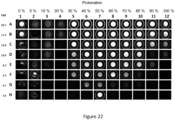
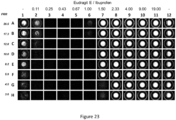
- the homogeneity of the prepared samples was examined optically and by light microscopy. Here, the samples were qualitatively classified into the corresponding categories.
- Part 1 Solids content, degree of protonation, amount of water, API/stabiliser ratios, FRR
- the variation of the formulation parameters was carried out with the active ingredient sirolimus.
- the formulation parameters solids content, degree of protonation, amount of water, API/stabiliser ratios, FRR were investigated.
- the total solids content has no significant influence on the particle size.
- the amount of water has a significant effect on particle size at a FRR of 4. As the amount of water in the solvent solution increases, the total amount of non-solvent (water) in the final formulation increases, resulting in an increase in particle size.
- the degree of protonation of the stabilising polymer plays the central role in adjusting the particle size. As the degree of protonation increases, the particle size increases.
- the stabiliser/API ratio also influences particle size and pH. The higher the stabiliser/API ratio at constant total substance content, the larger the particle size.
- Formulation code Protonation [SIR] [E100] FRR NUC05_ % mg/ml mg/ml b073 25 167 83 4 b074 25 167 83 10 b075 50 167 83 4 b076 50 167 83 10 b077 75 167 83 4 b078 75 167 83 10 b079 100 167 83 4 b080 100 167 83 10 b081 25 167 167 4 b082 25 167 167 10 b083 50 167 167 4 b084 50 167 167 10 b085 75 167 167 4 b086 75 167 167 10 b087 100 167 167 4 b088 100 167 167 10 b089 25 167 250 4 b090 25 167 250 10 b091 50 167 250 4 b092 50 167 250 10 b093 75 167 250 4 b094 75 167 250 10 b095 100 167 250 4
- Formulation code Protonation Acetone [SIR] [E100] E100/ SIR Optical homogenei ty pH Zeta potential size PDI NUC05_ % v/v mg/ml mg/ml mV nm b073 25 0.16 26.7 13.3 0.5 low 6.0 58 195 0.178 b074 25 0.073 12.1 6.0 0.5 low 5.7 62 181 0.234 b075 50 0.16 26.7 13.3 0.5 medium 6.0 59 196 0.116 b076 50 0.073 12.1 6.0 0.5 medium 5.7 61 188 0.125 b077 75 0.16 26.7 13.3 0.5 low 5.8 61 289 0.158 b078 75 0.073 12.1 6.0 0.5 low 5.5 79 254 0.219 b079 100 0.16 26.7 13.3 0.5 low 5.4 51 337 0.153 b080 100 0.073 12.1 6.0 0.5 low
- Table 6 The manufacturing conditions and results are shown in Table 6 and Table 7 and figure 6 .
- Table 8 An overview of the used acids is shown in table 8: Table 6: Preparation conditions of the samples prepared via batch stirring process using different acids.
- Formulation code Protonation Acid [SIR] [E100] E100/SIR FRR NUC05_ % mg/ml mg/ml b143 60 Hydrochloric Acid 167 250 1.5 4 b144 60 Acetic Acid 167 250 1.5 4 b145 60 Oleic Acid 167 250 1.5 4 b146 60 Octanoic Acid 167 250 1.5 4 b148 60 Stearic Acid 167 250 1.5 4 b149 60 Propionic acid 167 250 1.5 4 b150 60 Valeric acid 167 250 1.5 4 b151 60 Valeric acid 167 250 1.5 4 b152 60 Citric acid 167 250 - 4 b153 30 Citric acid 167 250 1.5 4 b154 60 Malic acid 167 250 - 4 b155 30 Malic acid 167 250 1.5 4 b164 20 Citric acid
- Process solution A (solvent): A solution consisting of 167 mg/mL sirolimus and 250 mg/mL Eudragit E100 in acetone is prepared. To 8 mL of this solution, 2 mL of acid solution are added and the mixture is left to stand for 2 hours. The process solution can then be used.
- Process solution B (non-solvent): Demineralised water was used as process solution B.
- Figure 7 shows the data from table 10 as resulting pH-value vs. degree of protonation ("protonation grade").
- the dispersions were produced in accordance with table 9.
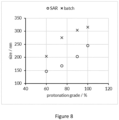
- Figure 8 shows the data from table 10 as particle size vs. degree of protonation ("protonation grade").
- the dispersions were produced in accordance with table 9.
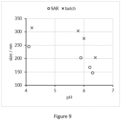
- Figure 9 shows the data from table 10 as particle size vs. pH.
- the dispersions were produced in accordance with table 9.
- Table 11 Preparation of the dispersions Formulation code Protonation [SIR] [E100] FRR TFR % mg/ml mg/ml ml/min NUC05_028 60 167 250 4 30
- Table 12 Composition of the dispersions and their characterisation Composition Characterisation Formulation code Acetone [SIR] [E100] E100 /SIR pH Zeta potential Diameter PDI v/v mg/ml mg/ml mV nm NUC05_028 16 26.7 40.0 1.5 6.3 35 142 0.268
- the prepared dispersions were therefore subjected to size exclusion chromatography (SEC) and the content of the filtrate quantified by HPLC as described above. Particles above a certain size are not retained by the column material and are found in the filtrate, while free, non-encapsulated active substance is retained by the column material.
- SEC size exclusion chromatography
- the interaction of dispersions with mucin was evaluated by means of electrostatic investigations.
- the zeta potential of mucin/dispersion mixtures was determined.
- the zeta potential determined as a function of the mixing ratios serves as a measure of the interactions between mucin and particle dispersion.
- Chitosan was used as a positively charged mucoadhesive reference substance.
- the polymer used Eudragit E100, was used alone as reference substance as well.
- a formulation containing sirolimus (code NUC05_b143) was used as an example with regard to its mucin adhesion (for formulation parameters see Table 7).
- a mucin suspension was prepared and different amounts of the test substances were added (final composition 0.05-0.80 % (w/w).
- a prerequisite for the successful use of the solubilised active substance in any pharmaceutical dosage form is release.
- Release means that the active ingredient can leave the solubilisate unchanged. This creates the prerequisite for the active ingredient to be absorbed by the body over time.
- the dispersion was prepared with a microfluidic device.
- a dispersion in which the active ingredient was micellarly solubilised in the polymer Soluplus served as a control.
- sirolimus was dissolved in acetone at a concentration of 150 mg/mL and continuously processed at a volume ratio of 1:7 with a 150 mg/mL Soluplus solution. The total flow rate was 17.5 mL/min. Approximately 10 mL of an opalescent dispersion was obtained.
- Sirolimus dispersion containing Eudragit Sirolimus was dissolved in acetone at a concentration of 167 mg/mL and Eudragit E100 at a concentration of 250 mg/mL.
- the particle size of the dispersions was determined after preparation and after dilution with water of 1:100 using dynamic light scattering (DLS) at a scattering angle of 150°.
- DLS dynamic light scattering
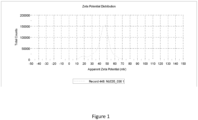
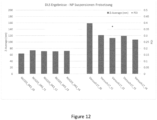
- the zeta potential of the dispersions was determined after preparation and after dilution with water of 1:10 using a Zetasizer Nano ZS (Malvern) after dilution of the sample with water (10 ⁇ l dispersion plus 1 ml water). Results are shown in table 15 and figure 12 .
- Table 14 Manufacturing process Formulation code Protonation [SIR] [E100] [Soluplus] in Non-solvent FRR TFR % mg/ml mg/ml mg/ml ml/min NUC03_043 - 150 - 150 7 17.5 Trial 17 60 167 250 - 5.3 31.4
- Table 15 Composition of the dispersion and its characterisation Composition Characterisation Formulation code Acetone [SIR] [Polymer] Polymer/SIR Zeta potential size PDI v/v mg/ml mg/ml mV nm NUC03_043 12 19 131 7 1 64 0.089 Trial 17 16 26 40 1.5 n/a 159 0.365
- the selection of the dialysis membrane depends on the particle size of the nanosuspension.
- the chosen material should be compatible with acetone. Regenerated cellulose with a MWCO of 300 kDa was selected.
- the nanoparticles are retained behind the membrane due to their size, while the active ingredient (914 Da) and the free, stabilising polymers Soluplus ( ⁇ 118 kDa) and Eudragit E100 (47 kDa) can pass through the membrane.
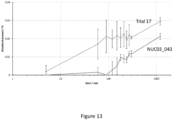
- Figure 13 shows the release of two dispersions: Sirolimus solubilized in E100 ("Trial 17”) and Sirolimus solubilized in Soluplus (control, "NUC03_043”) with logarithmic time axis. Shown is the mean value from each of 3 independent experiments and the standard deviation of the mean values.
- the chemical stability of the dispersion during release was assessed using the chromatograms obtained during quantification. No new signals could be observed in the chromatogram.
- the active substance is stable under the selected release conditions.
- the dispersion was prepared with a microfluidic device.
- Sirolimus was dissolved in acetone at a concentration of 167 mg/mL and Eudragit at a concentration of 250 mg/mL. Subsequently, the reaction was carried out with a HCl solution to obtain a degree of protonation of 60%, respectively 75% and 90% and a water content of 20% (v/v). This solution was continuously mixed with water in a volume ratio of 1:4. This produces an opalescent dispersion. The total flow rate at which the dispersion was collected was 30 mL/min. 10 mL were prepared.
- control was a physical mixture of the same chemical composition as NUC05_036, in which the active ingredient was dispersed (stirred) in the mixture as an unmodified crystalline powder.
- the particle size of the dispersions was determined after preparation and after dilution with water of 1:100 using dynamic light scattering (DLS) at a scattering angle of 150°.
- the zeta potential of the dispersions was determined after preparation and after dilution with water of 1:10 with a Zetasizer Nano ZS (Malvern) after dilution of the sample with water (10 ⁇ l dispersion plus 1 ml water).
- Table 21 Manufacturing process Formulation code Prototype Protonation [SIR] [E100] FRR TFR % mg/ml mg/ml ml/min NUC05_036 1a 60 167 250 4 30 NUC05_037 1b 75 167 250 4 30 NUC05_038 1C 90 167 250 4 30 211118_NUC05_036 -control Control 4 30
- Table 22 Composition of the dispersion and its characterisation Composition Characterisation Formulation code Acetone [SIR] [E 100] E100/SIR pH size PDI v/v mg/ml mg/ml nm Prototype 1a 16 26.7 40 1,5 6.3 147 0.294 Prototype 1b 16 26.7 40 1,5 6.2 168 0.201 Prototype 1c 16 26.7 40 1,5 5.9 203 0.222 Control 16 26.7 40 1,5 N/D N/D
- the standard solutions of Sirolimus were prepared using serial addition method. Briefly, a stock solution of SIR was prepared by dissolving powder of SIR in DMSO mixture at concentration ⁇ 2 mg/mL. Calculated aliquots of the stock solution were added to corresponding medium and spectral data were obtained at 4 concentration points ranging from 0.3 to 5.1 ⁇ g/mL. No precipitation occurred during the standards preparation. Area under the second derivative curve ( Figure 14A ) in wavelength region 300 - 312 nm was selected to build the standard curves ( Figure 14A ). Linearity of the standard curves was characterised by R 2 > 0.999. Results are shown in figure 14 A and B .
- Flux measurements were performed using ⁇ FLUX TM apparatus (Pion Inc., Billerica,MA, USA).
- ⁇ FLUX TM apparatus Pulon Inc., Billerica,MA, USA.
- four side-by-side donor-receiver pairs are placed in a temperature controlled unit connected to a circulating water bath.
- the donor chambers were separated from the receiver chambers by a vertically positioned filter supported membrane.
- the membrane Prior to the assay the membrane was formed by placing 25 ⁇ l of 20% lecithin in dodecane lipid solution (GIT Lipid, Pion Inc., Billerica MA) on the filter support material (PVDF, polyvinylidene fluoride, 1.54 cm 2 open area, 0.45 ⁇ m pore size, 120 ⁇ m thickness, 70% nominal porosity).
- GIT Lipid dodecane lipid solution
- PVDF polyvinylidene fluoride
- the donor chambers were filled with 20 ml of simulated saliva medium and loaded with the different prototype formulations (600 ⁇ l each).
- the formulations were added at a concentration of 26.6 mg/ml to the donor compartments to obtain a final concentration of 0.78 mg/ml of Sirolimus.
- the receiver compartments contained 20 ml of acceptor sink buffer (ASB, Pion Inc., Billerica, MA, USA).
- ASB is a 20 mM HEPES buffer solution adjusted to pH 7.4 containing surfactant (1% SDS ) that allows to maintain sink conditions during the experiments.
- Media in donor and receiver compartments were maintained at 37 ⁇ 2 °C. Each flux experiment was done in duplicate.
- Absorbance spectra in all four receiver chambers were monitored between 250 and 400 nm (2 nm spectral resolution) in situ every 30 seconds using fibre optic UV/VIS probes equipped with 20 mm pathlength tips and connected to the Rainbow ® instrument (Pion Inc., Billerica, MA, USA).
- the concentration of SIR in the receiver chambers was calculated from the UV absorbance using standard curves described above.
- flux (J) was calculated.
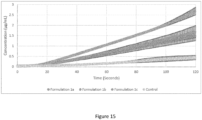
- the latter is a measurement of the mass transfer through the membrane, and it is defined as total amount of material (or mass) crossing one unit area of the membrane per unit time, as provided by: where A is the area of the membrane (1.54 cm 2 ), V is the volume of the receiver compartment (20 ml) and dc/dt is the slope of the concentration-time profile of SIR in the receiver compartment ( Figure 15 ).
- a prerequisite for the successful use of the solubilised active ingredient in any pharmaceutical dosage form is its chemical stability.
- the dispersion produces an intermediate that is further processed into a final dosage form. For the duration of processing, the dispersion must not show any detectable degradation.
- the mixing of the liquid streams was carried out using a microfluidic device.
- sirolimus was dissolved in acetone at a concentration of 167 mg/ml and mixed with a prehydrated solution of Eudragit E100. This solution was continuously mixed with water in a volume ratio of 1:5.3. This produces an opalescent dispersion.
- the total flow rate at which the dispersion was collected was 33 ml/min. 10 ml were prepared.
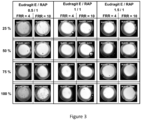
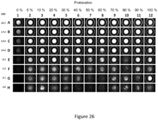
- the particle size of the dispersions was determined after preparation and after dilution with water of 1:100 using dynamic light scattering (DLS) at a scattering angle of 150°. Images of dilutions are shown in figure 17 .
- DLS dynamic light scattering
- the zeta potential of the dispersions was determined after preparation and after dilution with water of 1:10 using a Zetasizer Nano ZS (Malvern) after dilution of the sample with water (10 ⁇ l dispersion plus 1 ml water).
- Table 25 Variation of the degree of protonation: manufacturing process Formulation code Protonation [SIR] [E100] E100/ SIR FRR TFR NUC05_ % mg/ml mg/ml ml/min 024 100 167 250 1.5 5.3 33.0 025 60 167 250 1.5 5.3 33.0 026 25 167 250 1.5 5.3 33.0
- Table 26 Variation of the degree of protonation: dispersion and its characterisation Formulation code Protonation Acetone [SIR] [E100] pH Zeta potential size (2 h) PDI (2 h) size (14 d) PDI (14 d) NUC05_ % v/v mg/m l mg/ml mV nm nm 024 100 0.16 21.3 30.3 6.1 59 207 0.297 169 0.376 025 60 0.16 21.3 30.3 6.1 50 141 0.227 89 0.307 026 25 0.16 21.3 30.3 6.4 49 n/a (*
- TEM micrographs were recorded on a Tecnai F20 transmission electron microscope operated at an acceleration voltage of 200 kV. Electrons are generated by a Schottky field emission cathode. The information limit of the electron optics is specified at 0.19 nm.
- Micrographs were recorded using a direct electron detection camera (K2 summit, Gatan) with a size of 3710 pixels ⁇ 3838 pixels or with a CCD camera (ultrascan 1000, Gatan) with a size of 2048 pixels ⁇ 2048 pixels. The cameras have been calibrated using a cross grating replica standard with 2160 lines per mm. All micrographs used for the data analysis were acquired with a pixel size of 0.17 nm.
- Cryo-TEM samples were prepared according to a standard protocol using a Vitrobot ⁇ (FEI, Netherlands) plunge freeze device.
- TEM grids used for this method are Quantifoil ⁇ copper grids. To hydrophilize these grids, they are flow discharged prior to application. Subsequently, 3 ⁇ l of sample dispersion is applied to the grid and excess solution is blotted off with a filter paper. Directly after the blotting, the specimen is plunged into liquid ethane. Finally, the frozen specimen is stored in liquid nitrogen until TEM inspection.
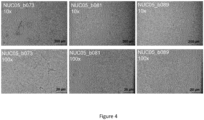
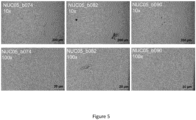
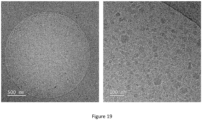
- Drop cast samples are prepared by applying approx 3 ⁇ l of sample dispersion to a carbon coated TEM grid (custom made). For negative staining with uranyl acetate the same amount of 4% aq. solution of uranyl acetate is additionally applied to the grid and left on the grid for 30 seconds. Then, excess solution is blotted off with a filter paper and the sample is allowed to dry at ambient conditions. After completely dry, the sample is ready for TEM inspection. TEM images are shown in Figures 18 - 20 .
- a nano formulation was produced from the active ingredient.
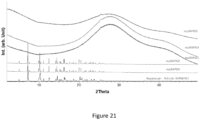
- the active ingredient dispersion was analysed by X ray powder diffractometry using a capillary sample holder
- the corresponding placebo formulation (Eudragit E 100 in aqueous acetone solution) is investigated in order to be able to identify possible Sirolimus Bragg signals in the subsequent phase analysis.
- Table 27 Manufacturing process Formulation code Protonation [SIR] [E100] FRR TFR NUC05_ % mg/ml mg/ml ml/min 025 60 167 250 5.2 33.0
- Table 28 Dispersion and its characterisation Formulation code Protonation Acetone [SIR] [E100] E100 /SIR pH Zeta potential size PDI NUC05_ % v/v mg/ml mg/ml mV nm 025 60 0.16 21.5 32.3 1.5 6.1 50 141 0.227
- XRPD Powder X Ray Diffraction
- the samples were placed into standard glass capillaries of 10 mm (liquid sample) and 0 7 mm diameter (powder).
- Data were collected in a two-theta range of 1.5 - 50°.
- the tube voltage and current were 40 kV and 40 mA, respectively.
- phase analysis of the samples are performed by using X ray powder diffraction.
- the measured diffraction patterns are compared to an X ray powder diffractogram calculated from single crystal data.
- the samples nucRAP 001 & 002 show X ray diffraction patterns that are consistent with the reference pattern of rapamacyin. Results are shown in Figure 21 .
- the amorphous part of a sample is identified by a so-called characteristic halo in an X ray powder pattern.
- the crystalline part of a sample is shown by X ray signals.
- nucRAP 003 004 an amorphous halo was detected
- the API exists in the amorphous state in sample nucRAP 003
- it might be the case that the low concentration of the sample is insufficient for the used method
- nucRAP 003 and nucRAP 004 an amorphous halo with only one signal at 25.48° 2Theta could be observed.
- the signal at 25.48°might therefore originate from a compound of the placebo mixture or can be attributed to an artifact
- the use of the formulation as a template formulation was investigated with different active ingredients.
- Prednisolone, itraconazole, ibuprofen and tacrolimus were investigated as active ingredients.
- Formulation can be used to prepare dispersions of prednisolone nanoparticles.
- the methodology according to the present invention can also be used to prepare nanoparticles of a hydrophobic active pharmaceutical ingredient (API) which are stabilized by an anionic polymeric stabilizing agent.
- API active pharmaceutical ingredient
- tacrolimus hydrophobic active pharmaceutical ingredient (API)
- Eudragit L100 e.g. Eudragit L100-55, as anionic polymeric stabilizing agent.
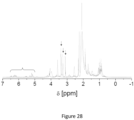
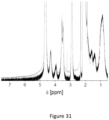
- NMR spectroscopy can be used to distinguish between the two states of aggregation, liquid and solid.
- SIR state sirolimus
- Liquids usually show very narrow lines in the 1H-NMR, which corresponds to long transverse relaxation times in the range of several 100 ms - s.
- the transverse relaxation becomes much shorter compared to the value in the liquid, corresponding to a much larger line width. If this value is mainly determined by the technique in the case of low molecular weight liquids, intrinsic factors are decisive in the solid state.
- this is mainly the 1H-1H homonuclear dipolar interaction; in the case of disperse mixtures of substances, the influence of the interfaces on the line width caused by differences in susceptibility may also have to be taken into account.
- Verum SIR/E100+ acid in D 2 O/Acetone FLM02_b615 26.7 40 16 (60 % protonation) 10 Verum: SIR/E100+ acid in D 2 O/Acetone FLM02_b616 26.7 40 16 (25 % protonation) 11 Verum: SIR/E100+ acid in D 2 O/Acetone FLM02_b617 26.7 40 16 (100 % protonation)
- Rats were selected as an animal model for evaluation of the pharmacokinetic of tacrolimus or sirolimus nanosuspensions. Application was done sublingual in order to benefit from the reduced thickness of this tissue compared to the buccal area.
- Naive, adult male Sprague Dawley rats of around 300 g body weight were housed in a separate temperature-controlled room (20-24°C) and maintained in a 12h light/12h dark cycle. Food and water were available ad libitum throughout the duration of the study.
- Formulation was freshly prepared on the day of application. It was administered sublingually to each animal at a dose of 5 mg per kg body weight.
- mice were shortly anaesthetized with isoflurane. Prior to application, the sublingual area was blotted dry with cotton swabs. The appropriate volume of the formulation was applied under the tongue with a pipette. The animals were kept in a sitting position for 5 minutes. After 5 minutes the area under the tongue was blotted dry again to avoid oral administration of the remaining suspension. Then the animals were placed into the cage until recovery.
- Blood samples were collected by puncture of the lateral tail vein at the following time points: predose, 15 min, 30 min, 1 h, 2 h, 4 h, 8 h and 24 h post dose.
- 20 ⁇ l blood was collected from the tail vein into K3-EDTA capillaries (Minivette POCT, SARSTEDT). The blood samples were transferred into polypropylene tubes and frozen on dry ice within 1-2 min. of sampling and stored at -20°C until LC-MS analysis.
- a volume of 20 ⁇ L of each unknown sample, zero, blank and wash blank sample was spiked with 2.4 ⁇ L DMSO. The mixtures were vortexed twice for 5 s with a 5-s break in between. After 1 min of equilibration, a volume of 40 ⁇ L internal standard Sirolimus (1200 ng/ml) diluted in HFBA 0.2% in ACN was added to each calibration standard, QC sample, zero sample and unknown sample, while a volume of 40 ⁇ L plain ACN was added to all blanks and wash blanks. Samples were vortexed for 10 s and then centrifuged for 10 minutes at 8000 rpm and at room temperature.
- the HPLC system consisted of a Dionex UltiMate 3000 RS pump and Dionex UltiMate 3000 RS column compartment and an Accela Open Autosampler (Thermo Fisher Scientific, USA). Mass spectrometry was performed on a Q Exactive (Orbitrap) accurate mass spectrometer equipped with a heated electrospray (H-ESI) interface (Thermo Fisher Scientific, USA) connected to a PC running the standard software Chromeleon 7.2.
- Q Exactive (Orbitrap) accurate mass spectrometer equipped with a heated electrospray (H-ESI) interface (Thermo Fisher Scientific, USA) connected to a PC running the standard software Chromeleon 7.2.
- Table41 Overview on the MS conditions and retention time Items Molecular weight (g/mol) Precursor Mass m/z Scan range (m/z) Quantitation Ion m/z Retention time (min) Sirolimus 914.17 936.54 65.00-975.00 409.234 2.18 Tacrolimus (ISTD) 804.02 826.47 57.33-860.00 616.309 2.16
- Formulations were freshly prepared on the day of application using the procedure as described herein.
- Table42 Preparation of formulation FLM04_025 FLM02_b230 Method CF System Batch Solvent Acetone Acetone Sirolimus in solvent 167 mg/mL 167 mg/mL Components in solvent • Eudragit E100 250 mg/mL 250 mg/mL Non-solvent Water water Components in non-solvent • TPGS1000 100 mg/ml - Mixing ratio 1:4 (V/V) 1:4 (V/V) CF Reactor Asymmetric cascade mixer - CF Reactor nozzle size 500 ⁇ m - Flow rate solvent or volume 6 mL/min 1,0 mL Flow rate non-solvent or volume 24 mL/min 4 mL Components in volumetric flask • TPGS1000 - 80 mg/ml Table: Composition of dispersion and characterisation Composition Characterization Formulation code Acetone [SIR] [E100] [TPGS] pH size PDI
- Test item formulations were administered sublingual to 5 animals with 7 days wash-out intervals at a dose of 5 mg per kg body weight. Application procedure, blood sampling and their as quantification was as described before.
- the pharmacokinetic profile of three different nanoparticular formulations of Tacrolimus after sublingual administration in five naive male Sprague Dawley rats with 14 days wash-out interval was evaluated.
- the same animals were administered in an intra-individual three-way cross-over after washout period.
- the animals were housed in a separate temperature-controlled room (20-24°C) and maintained in a 12h light/12h dark cycle. Food and water were available ad libitum throughout the duration of the study.
- Formulations were freshly prepared on the day of application using the procedure described herein and administered freshly after arrival.
- Tacrolimus whole blood concentrations were analysed by LC-MS/MS and Cmax, tmax, and AUC were calculated.
- the HPLC system consisted of a Dionex UltiMate 3000 RS pump and Dionex UltiMate 3000 RS column compartment and an Accela Open Autosampler (Thermo Fisher Scientific, USA). Mass spectrometry was performed on a Q Exactive (Orbitrap) accurate mass spectrometer equipped with a heated electrospray (H-ESI) interface (Thermo Fisher Scientific, USA) connected to a PC running the standard software Chromeleon 7.2.
- Q Exactive (Orbitrap) accurate mass spectrometer equipped with a heated electrospray (H-ESI) interface (Thermo Fisher Scientific, USA) connected to a PC running the standard software Chromeleon 7.2.
- Tacrolimus was detected in the blood of all rats after sublingual administration; the maximum concentration was reached after 0.5 hours (t_max) as can be seen from the following table:
Landscapes
- Health & Medical Sciences (AREA)
- Chemical & Material Sciences (AREA)
- Life Sciences & Earth Sciences (AREA)
- Public Health (AREA)
- Epidemiology (AREA)
- Pharmacology & Pharmacy (AREA)
- Animal Behavior & Ethology (AREA)
- General Health & Medical Sciences (AREA)
- Medicinal Chemistry (AREA)
- Veterinary Medicine (AREA)
- Bioinformatics & Cheminformatics (AREA)
- Engineering & Computer Science (AREA)
- Physics & Mathematics (AREA)
- Biomedical Technology (AREA)
- Nanotechnology (AREA)
- Optics & Photonics (AREA)
- Molecular Biology (AREA)
- Pharmaceuticals Containing Other Organic And Inorganic Compounds (AREA)
Priority Applications (3)
| Application Number | Priority Date | Filing Date | Title |
|---|---|---|---|
| EP23189189.6A EP4501320A1 (de) | 2023-08-02 | 2023-08-02 | Verfahren zur herstellung einer wässrigen dispersion von nanopartikeln |
| PCT/EP2024/072042 WO2025027194A1 (en) | 2023-08-02 | 2024-08-02 | A method of preparing an aqueous dispersion of nanoparticles |
| PCT/EP2024/072044 WO2025027196A1 (en) | 2023-08-02 | 2024-08-02 | A method of producing nanoparticles of a defined size |
Applications Claiming Priority (1)
| Application Number | Priority Date | Filing Date | Title |
|---|---|---|---|
| EP23189189.6A EP4501320A1 (de) | 2023-08-02 | 2023-08-02 | Verfahren zur herstellung einer wässrigen dispersion von nanopartikeln |
Publications (1)
| Publication Number | Publication Date |
|---|---|
| EP4501320A1 true EP4501320A1 (de) | 2025-02-05 |
Family
ID=87555149
Family Applications (1)
| Application Number | Title | Priority Date | Filing Date |
|---|---|---|---|
| EP23189189.6A Pending EP4501320A1 (de) | 2023-08-02 | 2023-08-02 | Verfahren zur herstellung einer wässrigen dispersion von nanopartikeln |
Country Status (2)
| Country | Link |
|---|---|
| EP (1) | EP4501320A1 (de) |
| WO (2) | WO2025027196A1 (de) |
Citations (4)
| Publication number | Priority date | Publication date | Assignee | Title |
|---|---|---|---|---|
| WO1999000113A1 (en) * | 1997-06-27 | 1999-01-07 | Vivorx Pharmaceuticals, Inc. | Novel formulations of pharmacological agents, methods for the preparation thereof and methods for the use thereof |
| EP2251006A1 (de) * | 2008-02-22 | 2010-11-17 | Toray Industries, Inc. | Mikropartikel und pharmazeutische zusammensetzungen daraus |
| EP2510930A1 (de) * | 2011-04-15 | 2012-10-17 | Bionanoplus, S.L. | Nanopartikel mit Halbestern aus Poly(Methylvinylether-Co-Maleinsäureanhydrid) und Verwendungen davon |
| EP3662894A1 (de) * | 2018-12-04 | 2020-06-10 | Leon-Nanodrugs GmbH | Nanopartikel mit tacrolimus |
Family Cites Families (2)
| Publication number | Priority date | Publication date | Assignee | Title |
|---|---|---|---|---|
| EA025562B1 (ru) | 2010-03-22 | 2017-01-30 | Инстилло Гмбх | Способ для получения микрочастиц или наночастиц и устройство для его осуществления |
| WO2013059922A1 (en) | 2011-10-25 | 2013-05-02 | The University Of British Columbia | Limit size lipid nanoparticles and related methods |
-
2023
- 2023-08-02 EP EP23189189.6A patent/EP4501320A1/de active Pending
-
2024
- 2024-08-02 WO PCT/EP2024/072044 patent/WO2025027196A1/en active Pending
- 2024-08-02 WO PCT/EP2024/072042 patent/WO2025027194A1/en active Pending
Patent Citations (4)
| Publication number | Priority date | Publication date | Assignee | Title |
|---|---|---|---|---|
| WO1999000113A1 (en) * | 1997-06-27 | 1999-01-07 | Vivorx Pharmaceuticals, Inc. | Novel formulations of pharmacological agents, methods for the preparation thereof and methods for the use thereof |
| EP2251006A1 (de) * | 2008-02-22 | 2010-11-17 | Toray Industries, Inc. | Mikropartikel und pharmazeutische zusammensetzungen daraus |
| EP2510930A1 (de) * | 2011-04-15 | 2012-10-17 | Bionanoplus, S.L. | Nanopartikel mit Halbestern aus Poly(Methylvinylether-Co-Maleinsäureanhydrid) und Verwendungen davon |
| EP3662894A1 (de) * | 2018-12-04 | 2020-06-10 | Leon-Nanodrugs GmbH | Nanopartikel mit tacrolimus |
Non-Patent Citations (3)
| Title |
|---|
| BOWEN P: "Particle Size Distribution Measurement from Millimeters to Nanometers and from Rods to Platelets", JOURNAL OF DISPERSION SCIENCE AND TECHNOLOGY, TAYLOR AND FRANCIS GROUP, NEW YORK, NY, US, vol. 23, no. 5, 1 January 2002 (2002-01-01), pages 631 - 662, XP009102859, ISSN: 0193-2691, DOI: 10.1081/DIS-120015368 * |
| MARQUES, M. R. C.LOEBENBERG, R.ALMUKAINZI, M.: "Simulated Biological Fluids with Possible Application in Dissolution Testing", DISSOLUTION TECHNOL, vol. 18, 2011, pages 15 - 28, XP055068302, DOI: 10.14227/DT180311P15 |
| SWINDELLS: "The X ray crystal structure of Sirolimus", CANADIAN JOURNAL OF CHEMISTRY, vol. 56, 1978, pages 2491 |
Also Published As
| Publication number | Publication date |
|---|---|
| WO2025027194A1 (en) | 2025-02-06 |
| WO2025027196A1 (en) | 2025-02-06 |
Similar Documents
| Publication | Publication Date | Title |
|---|---|---|
| Alshweiat et al. | Nasal delivery of nanosuspension-based mucoadhesive formulation with improved bioavailability of loratadine: preparation, characterization, and in vivo evaluation | |
| Elmowafy et al. | Multifunctional carbamazepine loaded nanostructured lipid carrier (NLC) formulation | |
| Casadei et al. | Solid lipid nanoparticles incorporated in dextran hydrogels: a new drug delivery system for oral formulations | |
| Kwon et al. | Pharmaceutical evaluation of genistein-loaded pluronic micelles for oral delivery | |
| Hu et al. | Preparation and characterization of solid lipid nanoparticles containing peptide | |
| Zhong et al. | Supersaturation induced by Itraconazole/Soluplus® micelles provided high GI absorption in vivo | |
| Shaikh et al. | Formulation and optimization of cilnidipine loaded nanosuspension for the enhancement of solubility, dissolution and bioavailability | |
| Duong et al. | Nanostructured lipid carriers containing ondansetron hydrochloride by cold high-pressure homogenization method: Preparation, characterization, and pharmacokinetic evaluation | |
| Chary et al. | Optimizing entrectinib nanosuspension: quality by design for enhanced oral bioavailability and minimized fast-fed variability | |
| Wan et al. | Impact of molecular rearrangement of amphiphilic stabilizers on physical stability of itraconazole nanoparticles prepared by flash nanoprecipitation | |
| HUE035331T2 (en) | Microparticles and pharmaceutical preparations containing them | |
| Alshetaili et al. | Enhanced oral bioavailability of ibrutinib encapsulated poly (lactic-co-glycolic acid) nanoparticles: Pharmacokinetic evaluation in rats | |
| Xia et al. | Enhanced transport of nanocage stabilized pure nanodrug across intestinal epithelial barrier mimicking Listeria monocytogenes | |
| Hussien et al. | Formulation and characterization of isradipine nanoparticle for dissolution enhancement | |
| Ueda et al. | Effect of molecular weight of hypromellose on mucin diffusion and oral absorption behavior of fenofibrate nanocrystal | |
| Rawat et al. | USP apparatus 4 method for in vitro release testing of protein loaded microspheres | |
| JP2006131577A (ja) | 異なる粒子径を有する薬物封入ナノ粒子の作製方法および当該方法で得られたナノ粒子 | |
| Vaculikova et al. | Improvement of glibenclamide water solubility by nanoparticle preparation | |
| Purohit et al. | Proof-of-concept in developing a 45% drug loaded amorphous nanoparticle formulation | |
| Patil et al. | Nanostructured lipid carrier: a potential system for enhanced oral bioavailability of felodipine | |
| EP4501320A1 (de) | Verfahren zur herstellung einer wässrigen dispersion von nanopartikeln | |
| Baek et al. | Effect of phosphatidylcholine in bentonite-quetiapine complex on enhancing drug release and oral bioavailability | |
| Zhang et al. | Direct drug milling in organic PLGA solution facilitates the encapsulation of nanosized drug into PLGA microparticles | |
| Mohammed et al. | Investigation of solubility enhancement approaches of ticagrelor | |
| de Jesús Valle et al. | Albumin micro/nanoparticles entrapping liposomes for itraconazole green formulation |
Legal Events
| Date | Code | Title | Description |
|---|---|---|---|
| PUAI | Public reference made under article 153(3) epc to a published international application that has entered the european phase |
Free format text: ORIGINAL CODE: 0009012 |
|
| STAA | Information on the status of an ep patent application or granted ep patent |
Free format text: STATUS: THE APPLICATION HAS BEEN PUBLISHED |
|
| AK | Designated contracting states |
Kind code of ref document: A1 Designated state(s): AL AT BE BG CH CY CZ DE DK EE ES FI FR GB GR HR HU IE IS IT LI LT LU LV MC ME MK MT NL NO PL PT RO RS SE SI SK SM TR |
|
| STAA | Information on the status of an ep patent application or granted ep patent |
Free format text: STATUS: REQUEST FOR EXAMINATION WAS MADE |
|
| 17P | Request for examination filed |
Effective date: 20250804 |