EP4501278A1 - Set of artificial teeth - Google Patents
Set of artificial teeth Download PDFInfo
- Publication number
- EP4501278A1 EP4501278A1 EP23779027.4A EP23779027A EP4501278A1 EP 4501278 A1 EP4501278 A1 EP 4501278A1 EP 23779027 A EP23779027 A EP 23779027A EP 4501278 A1 EP4501278 A1 EP 4501278A1
- Authority
- EP
- European Patent Office
- Prior art keywords
- artificial teeth
- cusp
- occlusal
- buccal
- lingual
- Prior art date
- Legal status (The legal status is an assumption and is not a legal conclusion. Google has not performed a legal analysis and makes no representation as to the accuracy of the status listed.)
- Pending
Links
Images



Classifications
-
- A—HUMAN NECESSITIES
- A61—MEDICAL OR VETERINARY SCIENCE; HYGIENE
- A61C—DENTISTRY; APPARATUS OR METHODS FOR ORAL OR DENTAL HYGIENE
- A61C13/00—Dental prostheses; Making same
- A61C13/08—Artificial teeth; Making same
- A61C13/097—Artificial teeth; Making same characterised by occlusal profiles, i.e. chewing contact surfaces
-
- A—HUMAN NECESSITIES
- A61—MEDICAL OR VETERINARY SCIENCE; HYGIENE
- A61C—DENTISTRY; APPARATUS OR METHODS FOR ORAL OR DENTAL HYGIENE
- A61C13/00—Dental prostheses; Making same
- A61C13/08—Artificial teeth; Making same
-
- A—HUMAN NECESSITIES
- A61—MEDICAL OR VETERINARY SCIENCE; HYGIENE
- A61C—DENTISTRY; APPARATUS OR METHODS FOR ORAL OR DENTAL HYGIENE
- A61C13/00—Dental prostheses; Making same
- A61C13/34—Making or working of models, e.g. preliminary castings, trial dentures; Dowel pins [4]
Definitions
- the present disclosure relates to a group of artificial teeth which includes plural artificial teeth and is for making up dentures.
- a balanced occlusion is a desired form of the occlusion of a group of artificial teeth which comprises plural artificial teeth and make up dentures.
- the balanced occlusion is such that the occlusal balance of at least part of occlusion is kept by occlusal facets being in contact with and sliding on each other in the processes at a maximal intercuspal position (centric occlusal position) and an eccentric occlusal position.
- a further desired form of the balanced occlusion is such that concerning all the artificial teeth, the occlusal facets are in contact with and slide on each other in the processes at a maximal intercuspal position and an eccentric occlusal position, which is called a full-balanced occlusion.
- This balanced occlusion or full-balanced occlusion corresponds to a condition where the attrition of natural teeth has progressed, and is considered to be a desired form of the occlusion of artificial teeth because a group of artificial teeth which has artificial teeth in surface-to-surface contact that corresponds to this condition improves the efficiency of mastication to enable flavors to be tasted more. Therefore, this form of occlusion is popular, and is often applied to dentures and the like for the elderly.
- patent literatures 1 and 2 each disclose an artificial tooth including occlusal facets that have predetermined forms in advance. According to this, the workloads for grinding to adjust the tooth can be decreased.
- An object of the present disclosure is to provide a group of artificial teeth which can lead to a more appropriate masticatory movement.
- the present application discloses a group of artificial teeth which comprises plural artificial teeth, wherein a lingual cusp, a buccal cusp, and a pit between the lingual cusp and the buccal cusp are formed on an occlusal surface of each of artificial teeth belonging to posterior teeth parts among the plural artificial teeth; occlusal facets are provided on a slope between the lingual cusp and the pit, and on a slope between the buccal cusp and the pit, respectively; in a centric occlusal position of upper and lower jaws, the buccal cusp of the lower jaw is arranged in the pit of the upper jaw, so that the occlusal facets come into contact with each other; in a lateral occlusal position of the upper and lower jaws, on a working side, the buccal cusps of the upper and lower jaws come into contact with each other, and the lingual cusps of the upper and lower jaws come into contact with each other, to form a space between the pits of the upper and lower
- a group of artificial teeth which comprises plural artificial teeth and can lead to a more appropriate masticatory movement can be provided.
- Fig. 1 is a front view of dentures 1 including a group of artificial teeth 10 according to one embodiment.
- Fig. 2 shows the dentures 1 on the occlusal surface side with the dentures 1 separated into an upper jaw A (upper side in Fig. 2 ) and a lower jaw B (lower side in Fig. 2 ).
- Fig. 3 is focused on posterior teeth parts.
- the group of artificial teeth 10 of the present disclosure comprises plural artificial teeth 11.
- artificial teeth corresponding to an anterior teeth part a central incisor, a lateral incisor and a canine
- a posterior teeth part a first premolar, a second premolar, a first molar and a second molar
- the present disclosure is not limited to this as long as a part of them is included.
- the artificial teeth 11 are formed from a ceramic, a synthetic resin, or a composite material thereof, and are fixed to denture bases 2 that are made from a resin and modeled on gingival parts.
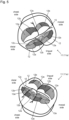
- Fig. 4 shows one of the artificial teeth 11 (a posterior tooth or first molar 11a) on the occlusal surface 12 side (top), and the mesial side (bottom).
- This artificial teeth 11 each have a rugged occlusal surface 12.
- On this occlusal surface 12 on each posterior tooth a convex lingual cusp 13, a convex buccal cusp 14, and a pit 15 that is the valley between the lingual cusp 13 and the buccal cusp 14 are formed.
- These lingual cusp 13, buccal cusp 14, and pit 15 are each not uniform in shape, but extend in the mesial and distal direction.
- the artificial teeth 11 included in the group of artificial teeth 10 of the present disclosure have the following structure.
- the first molar 11a among the artificial teeth 11 that are included in this embodiment includes occlusal facets (12a, 12b, 12c) that are small flat faces on the occlusal surface 12.
- Fig. 5 shows a pair of the first molars 11a of the upper and lower jaws as an example so that the occlusal facets (12a, 12b, 12c) can be seen.
- the occlusal facets (12a, 12b, 12c) are formed on the occlusal surface 12, and are the parts of the flat faces which are provided so as to each have a predetermined angle with the occlusal plane.
- the occlusal facets include the protrusive facets 12a, the retrusive facets 12b, and the balancing occlusal facet 12c.
- the occlusal plane is as known, and is a hypothetical plane including the incisal point and the cusp tips of the right and left terminal molars at the dentition of the upper or lower jaw.
- the occlusal surface 12 of each of the artificial teeth 11 in the posterior teeth parts in the group of artificial teeth 10 preferably includes all types of the occlusal facets; or the protrusive facets 12a and the retrusive facets 12b.
- the artificial teeth 11 in the anterior teeth parts are each provided with, on the occlusal surface 12, the protrusive facet 12a and the retrusive facet 12b; or the protrusive facet 12a.
- the occlusal facets (12a, 12b, 12c) are arranged on proper places on the occlusal surface 12, and are arranged at least on the slope between the lingual cusp 13 and the pit 15, and the slope between the buccal cusp 14 and the pit 15.
- the dentures 1 worn by a patient produce a protrusive movement and a lateral movement: in the protrusive movement, the protrusive facets 12a of the upper jaw come into contact with and glide on those of the lower jaw in the group of artificial teeth 10; and in the lateral movement, the protrusive facets 12a and the retrusive facets 12b of the upper jaw come into contact with and glide on the protrusive facets 12a and the retrusive facets 12b of the lower jaw, respectively.
- the balancing occlusal facet 12c is formed on the inner bevel between the lingual cusp 13 and the pit 15 in the upper jaw A; and formed between the buccal cusp 14 and the pit 15 in the lower jaw B.
- the inner bevel of the buccal cusp of the upper jaw comes into contact with the outer bevel of the buccal cusp of the lower jaw on the working side (contact C1 in Fig. 6 ); the lingual cusp of the upper jaw comes into contact with the inner bevel of the lingual cusp of the lower jaw on the working side (contact C2 in Fig. 6 ); and the inner bevel of the lingual cusp of the upper jaw comes into contact with the inner bevel of the buccal cusp of the lower jaw on the balancing side (contact C3 in Fig. 6 ) at the same time on the occlusal facets (12a, 12b, 12c).
- each occlusal facet (12a, 12b, 12c) is as known.
- Each occlusal facet (12a, 12b, 12c) can be formed appropriately in view of mastication, occlusion, etc.
- the occlusal facets are formed on the occlusal surface in advance as described, no selective griding is necessary, or just a little griding is necessary even if the grinding is performed, which can result in smooth production of artificial teeth.
- the formation of the appropriate occlusal facets in advance allows artificial dentition to be formed, so that the surface-to-surface contacts between the occlusal facets in the occlusion are on correct places, which brings the dentures with which chewing becomes easy.
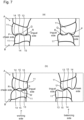
- the occlusal surfaces 12 of artificial teeth 11 of the upper and lower jaws which are in an occlusal relationship in the centric occlusal position as shown in Fig. 7(a) are formed to have at least three contact parts (P, Q, R); here, the artificial teeth 11 are the ones belonging to the posterior teeth parts.
- the buccal cusp 14 of each of the artificial teeth 11 of the lower jaw B enters the pit 15 of each of the artificial teeth 11 of the upper jaw A, and is in contact with the slope between the pit 15 and the lingual cusp 13 of each of the artificial teeth 11 of the upper jaw A, and the slope between the pit 15 and the buccal cusp 14 of each of the artificial teeth 11 of the upper jaw A (contact parts P, Q). Further, the lingual cusp 13 of each of the artificial teeth 11 of the upper jaw A enters the pit 15 of each of the artificial teeth 11 of the lower jaw B to form the contact part R.
- These contacts are contacts between the occlusal facets.
- the occlusal surfaces 12 of artificial teeth 11 of the upper and lower jaws are in contact with each other on the working side on at least two planes (contact parts R, S) in a lateral occlusal position in the eccentric occlusal position as shown in Fig. 7(b) to form a space W therebetween; here, the artificial teeth 11 are the ones belonging to the posterior teeth parts.
- the space W is formed between the pit 15 of each of the artificial teeth 11 of the upper jaw and that of each of the artificial teeth 11 of the lower jaw by the contact between the buccal cusp 14 of each of the artificial teeth 11 of the upper jaw and that of each of the artificial teeth 11 of the lower jaw (contact part R), and the contact between the lingual cusp 13 of each of the artificial teeth 11 of the upper jaw and that of each of the artificial teeth 11 of the lower jaw (contact part S).
- the occlusal surfaces 12 of the artificial teeth 11 of the upper and lower jaws are in contact with each other on one plane (contact part U). Specifically, the slope from the pit 15 to the buccal cusp 14 of each of the artificial teeth 11 of the lower jaw B is in contact with the slope from the pit 15 to the lingual cusp 13 of each of the artificial teeth 11 of the upper jaw A to form the contact part U.
- These contacts are also contacts between the occlusal facets.
- the buccolingual diameter D of the occlusal surface proper to the first molars 11a is formed to be larger.
- the buccolingual diameter D/mesiodistal distance E of the proper occlusal surface is preferably no less than 0.69.
- the buccolingual diameter of the proper occlusal surface is the distance D in Fig. 4 , and is the distance between the lingual cusp 13 and the buccal cusp 14.
- the foregoing construction of the buccolingual diameter can elongate the chewing cycle, and enables cases requiring gliding to be appropriately handled. Gliding enables food to be ground more. As a result, the aromas and deep flavors in the food can be tasted.
- the group of artificial teeth 10 of this embodiment is formed in such a way that angles each between buccal and lingual internal cusp slopes in the posterior teeth parts are gradually developed when the group of artificial teeth 10 is formed to be an artificial dentition as dentures. As shown by ⁇ in Fig. 4 , each angle between buccal and lingual internal cusp slopes is the angle formed by the slope from the pit 15 to the buccal cusp 14, and the slope from the pit 15 to the lingual cusp 13.
- the angle between buccal and lingual internal cusp slopes is different between the premolars and the molars.
- the ascending order of the angle between buccal and lingual internal cusp slopes is preferably the first premolars, the second premolars, the first molars, and the second molars.
- the group of artificial teeth 10 of this embodiment is preferably provided with protrusive facets and retrusive facets when formed to be an artificial dentition as dentures.
- the protrusive facets are the faces where the force of closing the mouth is received, and, as schematically shown by the signs CS in Fig. 3(b) , are the faces where the force of closing the mouth when the oral cavity is closed is received.
- the protrusive facets are the occlusal facets provided on the distal side of the upper jaw, and incline toward the mesial side as facing the lower jaw.
- the retrusive facets are the faces where the retrusion force is received: the retrusion force is the force by the lower jaw when the lower jaw moves in the retruding direction.
- the retrusive facets are the faces where the retrusion force is received.
- the retrusive facets are the occlusal facets provided on the mesial side of the upper jaw, and incline toward the distal side as facing the lower jaw.
- the group of artificial teeth provided with these protrusive facets and retrusive facets can receive the occlusal force, can bring more certain mastication, and can distribute the occlusal force, which can reduce pains.
- such a group of artificial teeth can improve the stability of the occlusion to prevent the dentures from getting off.
- the aforementioned group of artificial teeth can be provided as a group of artificial teeth.
- the aforementioned group of artificial teeth can be provided as a prosthesis that is obtained by uniting the group of artificial teeth and a gingiva into one body and that has the shape of teeth which reproduces the inside of an oral cavity, and as a partial denture base or a denture base including the aforementioned combination of the upper and lower jaws of the group of artificial teeth. Any of these forms include the group of artificial teeth of the present disclosure.
Landscapes
- Health & Medical Sciences (AREA)
- Oral & Maxillofacial Surgery (AREA)
- Dentistry (AREA)
- Epidemiology (AREA)
- Life Sciences & Earth Sciences (AREA)
- Animal Behavior & Ethology (AREA)
- General Health & Medical Sciences (AREA)
- Public Health (AREA)
- Veterinary Medicine (AREA)
- Dental Tools And Instruments Or Auxiliary Dental Instruments (AREA)
- Dental Prosthetics (AREA)
Abstract
Description
- The present disclosure relates to a group of artificial teeth which includes plural artificial teeth and is for making up dentures.
- A balanced occlusion is a desired form of the occlusion of a group of artificial teeth which comprises plural artificial teeth and make up dentures. The balanced occlusion is such that the occlusal balance of at least part of occlusion is kept by occlusal facets being in contact with and sliding on each other in the processes at a maximal intercuspal position (centric occlusal position) and an eccentric occlusal position. A further desired form of the balanced occlusion is such that concerning all the artificial teeth, the occlusal facets are in contact with and slide on each other in the processes at a maximal intercuspal position and an eccentric occlusal position, which is called a full-balanced occlusion.
- This balanced occlusion or full-balanced occlusion corresponds to a condition where the attrition of natural teeth has progressed, and is considered to be a desired form of the occlusion of artificial teeth because a group of artificial teeth which has artificial teeth in surface-to-surface contact that corresponds to this condition improves the efficiency of mastication to enable flavors to be tasted more. Therefore, this form of occlusion is popular, and is often applied to dentures and the like for the elderly.
- In contrast, it takes a lot of effort to achieve a balanced occlusion because occlusal facets have to be ground to be adjusted according to a patient, which is problematic.
- For this, for example,
patent literatures 1 and 2 each disclose an artificial tooth including occlusal facets that have predetermined forms in advance. According to this, the workloads for grinding to adjust the tooth can be decreased. -
- [Patent Literature 1]
JP 4546572 B1 - [Patent Literature 2]
WO 2009/044443 A1 - However, just the formation of occlusal facets as conventional in order that the form of the occlusion is a balanced or full-balanced occlusion does not always lead to an appropriate masticatory movement, which is problematic.
- An object of the present disclosure is to provide a group of artificial teeth which can lead to a more appropriate masticatory movement.
- The present application discloses a group of artificial teeth which comprises plural artificial teeth, wherein a lingual cusp, a buccal cusp, and a pit between the lingual cusp and the buccal cusp are formed on an occlusal surface of each of artificial teeth belonging to posterior teeth parts among the plural artificial teeth; occlusal facets are provided on a slope between the lingual cusp and the pit, and on a slope between the buccal cusp and the pit, respectively; in a centric occlusal position of upper and lower jaws, the buccal cusp of the lower jaw is arranged in the pit of the upper jaw, so that the occlusal facets come into contact with each other; in a lateral occlusal position of the upper and lower jaws, on a working side, the buccal cusps of the upper and lower jaws come into contact with each other, and the lingual cusps of the upper and lower jaws come into contact with each other, to form a space between the pits of the upper and lower jaws; and an angle between buccal and lingual internal cusp slopes is different between premolars and molars.
- According to the present disclosure, a group of artificial teeth which comprises plural artificial teeth and can lead to a more appropriate masticatory movement can be provided.
-
- [
Fig. 1] Fig. 1 is a front view of dentures 1 including a group ofartificial teeth 10. - [
Fig. 2] Fig. 2 shows an upper jaw A and a lower jaw B on the occlusal surfaces side. - [
Fig. 3] Fig. 3 shows a part (posterior teeth) of the group ofartificial teeth 10 on the buccal side. - [
Fig. 4] Fig. 4 illustrates anartificial tooth 11. - [
Fig. 5] Fig. 5 illustrates an occlusal surface of theartificial tooth 11. - [
Fig. 6] Fig. 6 illustrates occlusal contacts of occlusal facets in a lateral movement. - [
Fig. 7] Fig. 7 illustrates a centric occlusal position (Fig. 7(a) ) and a lateral occlusal position (Fig. 7(b) ). -
Fig. 1 is a front view of dentures 1 including a group ofartificial teeth 10 according to one embodiment.Fig. 2 shows the dentures 1 on the occlusal surface side with the dentures 1 separated into an upper jaw A (upper side inFig. 2 ) and a lower jaw B (lower side inFig. 2 ).Fig. 3 is focused on posterior teeth parts. - As can be seen from these drawings, the group of
artificial teeth 10 of the present disclosure comprises pluralartificial teeth 11. In this embodiment, as theartificial teeth 11, artificial teeth corresponding to an anterior teeth part (a central incisor, a lateral incisor and a canine) and a posterior teeth part (a first premolar, a second premolar, a first molar and a second molar) are included on each right and left side on each of the upper jaw A and the lower jaw B. The present disclosure is not limited to this as long as a part of them is included. - The
artificial teeth 11 are formed from a ceramic, a synthetic resin, or a composite material thereof, and are fixed todenture bases 2 that are made from a resin and modeled on gingival parts.Fig. 4 shows one of the artificial teeth 11 (a posterior tooth orfirst molar 11a) on theocclusal surface 12 side (top), and the mesial side (bottom). Thisartificial teeth 11 each have a ruggedocclusal surface 12. On thisocclusal surface 12 on each posterior tooth, a convexlingual cusp 13, a convexbuccal cusp 14, and apit 15 that is the valley between thelingual cusp 13 and thebuccal cusp 14 are formed. Theselingual cusp 13,buccal cusp 14, andpit 15 are each not uniform in shape, but extend in the mesial and distal direction. - The
artificial teeth 11 included in the group ofartificial teeth 10 of the present disclosure have the following structure. - The
first molar 11a among theartificial teeth 11 that are included in this embodiment includes occlusal facets (12a, 12b, 12c) that are small flat faces on theocclusal surface 12.Fig. 5 shows a pair of thefirst molars 11a of the upper and lower jaws as an example so that the occlusal facets (12a, 12b, 12c) can be seen. The occlusal facets (12a, 12b, 12c) are formed on theocclusal surface 12, and are the parts of the flat faces which are provided so as to each have a predetermined angle with the occlusal plane. The occlusal facets include theprotrusive facets 12a, theretrusive facets 12b, and the balancingocclusal facet 12c. The occlusal plane is as known, and is a hypothetical plane including the incisal point and the cusp tips of the right and left terminal molars at the dentition of the upper or lower jaw. - The
occlusal surface 12 of each of theartificial teeth 11 in the posterior teeth parts in the group ofartificial teeth 10 preferably includes all types of the occlusal facets; or theprotrusive facets 12a and theretrusive facets 12b. Theartificial teeth 11 in the anterior teeth parts are each provided with, on theocclusal surface 12, theprotrusive facet 12a and theretrusive facet 12b; or theprotrusive facet 12a. - The occlusal facets (12a, 12b, 12c) are arranged on proper places on the
occlusal surface 12, and are arranged at least on the slope between thelingual cusp 13 and thepit 15, and the slope between thebuccal cusp 14 and thepit 15. - The dentures 1 worn by a patient produce a protrusive movement and a lateral movement: in the protrusive movement, the
protrusive facets 12a of the upper jaw come into contact with and glide on those of the lower jaw in the group ofartificial teeth 10; and in the lateral movement, theprotrusive facets 12a and theretrusive facets 12b of the upper jaw come into contact with and glide on theprotrusive facets 12a and theretrusive facets 12b of the lower jaw, respectively. The balancingocclusal facet 12c is formed on the inner bevel between thelingual cusp 13 and thepit 15 in the upper jaw A; and formed between thebuccal cusp 14 and thepit 15 in the lower jaw B. - As the aspect of the occlusion in the lateral movement as schematically shown in
Fig. 6 , preferably, in the lateral movement, the inner bevel of the buccal cusp of the upper jaw comes into contact with the outer bevel of the buccal cusp of the lower jaw on the working side (contact C1 inFig. 6 ); the lingual cusp of the upper jaw comes into contact with the inner bevel of the lingual cusp of the lower jaw on the working side (contact C2 inFig. 6 ); and the inner bevel of the lingual cusp of the upper jaw comes into contact with the inner bevel of the buccal cusp of the lower jaw on the balancing side (contact C3 inFig. 6 ) at the same time on the occlusal facets (12a, 12b, 12c). - Other than the foregoing, specific aspects of the arrangement, the shape, the inclination, and the size of each occlusal facet (12a, 12b, 12c) are as known. Each occlusal facet (12a, 12b, 12c) can be formed appropriately in view of mastication, occlusion, etc.
- Because the occlusal facets are formed on the occlusal surface in advance as described, no selective griding is necessary, or just a little griding is necessary even if the grinding is performed, which can result in smooth production of artificial teeth. In addition, the formation of the appropriate occlusal facets in advance allows artificial dentition to be formed, so that the surface-to-surface contacts between the occlusal facets in the occlusion are on correct places, which brings the dentures with which chewing becomes easy.
- In relation to the occlusal facets (12a, 12b, 12c), the
occlusal surfaces 12 ofartificial teeth 11 of the upper and lower jaws which are in an occlusal relationship in the centric occlusal position as shown inFig. 7(a) are formed to have at least three contact parts (P, Q, R); here, theartificial teeth 11 are the ones belonging to the posterior teeth parts. That is, in the centric occlusal position, thebuccal cusp 14 of each of theartificial teeth 11 of the lower jaw B enters thepit 15 of each of theartificial teeth 11 of the upper jaw A, and is in contact with the slope between thepit 15 and thelingual cusp 13 of each of theartificial teeth 11 of the upper jaw A, and the slope between thepit 15 and thebuccal cusp 14 of each of theartificial teeth 11 of the upper jaw A (contact parts P, Q). Further, thelingual cusp 13 of each of theartificial teeth 11 of the upper jaw A enters thepit 15 of each of theartificial teeth 11 of the lower jaw B to form the contact part R. - These contacts are contacts between the occlusal facets.
- In contrast, in relation to the occlusal facets (12a, 12b, 12c), the
occlusal surfaces 12 ofartificial teeth 11 of the upper and lower jaws are in contact with each other on the working side on at least two planes (contact parts R, S) in a lateral occlusal position in the eccentric occlusal position as shown inFig. 7(b) to form a space W therebetween; here, theartificial teeth 11 are the ones belonging to the posterior teeth parts. More specifically, on the working side, the space W is formed between thepit 15 of each of theartificial teeth 11 of the upper jaw and that of each of theartificial teeth 11 of the lower jaw by the contact between thebuccal cusp 14 of each of theartificial teeth 11 of the upper jaw and that of each of theartificial teeth 11 of the lower jaw (contact part R), and the contact between thelingual cusp 13 of each of theartificial teeth 11 of the upper jaw and that of each of theartificial teeth 11 of the lower jaw (contact part S). - On the balancing side (nonworking side), the
occlusal surfaces 12 of theartificial teeth 11 of the upper and lower jaws are in contact with each other on one plane (contact part U). Specifically, the slope from thepit 15 to thebuccal cusp 14 of each of theartificial teeth 11 of the lower jaw B is in contact with the slope from thepit 15 to thelingual cusp 13 of each of theartificial teeth 11 of the upper jaw A to form the contact part U. - These contacts are also contacts between the occlusal facets.
- The foregoing construction of the aspect of the contacts between the artificial teeth of the upper and lower jaws for movements in addition to that including the arrangement of the occlusal facets allows chews in the spaces W to be efficiently masticated on the working side, and brings entirely well-balanced dentures, which allows a stable occlusal condition to be maintained.
- As shown in
Fig. 4 , among theartificial teeth 11 included in the group ofartificial teeth 10 of this embodiment, the buccolingual diameter D of the occlusal surface proper to thefirst molars 11a is formed to be larger. The buccolingual diameter D/mesiodistal distance E of the proper occlusal surface is preferably no less than 0.69. - Here, the buccolingual diameter of the proper occlusal surface is the distance D in
Fig. 4 , and is the distance between thelingual cusp 13 and thebuccal cusp 14. - The foregoing construction of the buccolingual diameter can elongate the chewing cycle, and enables cases requiring gliding to be appropriately handled. Gliding enables food to be ground more. As a result, the aromas and deep flavors in the food can be tasted.
- The group of
artificial teeth 10 of this embodiment is formed in such a way that angles each between buccal and lingual internal cusp slopes in the posterior teeth parts are gradually developed when the group ofartificial teeth 10 is formed to be an artificial dentition as dentures. As shown by θ inFig. 4 , each angle between buccal and lingual internal cusp slopes is the angle formed by the slope from thepit 15 to thebuccal cusp 14, and the slope from thepit 15 to thelingual cusp 13. - That is, in this embodiment, the angle between buccal and lingual internal cusp slopes is different between the premolars and the molars. The ascending order of the angle between buccal and lingual internal cusp slopes is preferably the first premolars, the second premolars, the first molars, and the second molars.
- According to this, unnecessary contacts between artificial teeth in the movements of the upper and lower jaws can be reduced to prevent the artificial teeth from getting off, and pains from being caused.
- The group of
artificial teeth 10 of this embodiment is preferably provided with protrusive facets and retrusive facets when formed to be an artificial dentition as dentures. - The protrusive facets are the faces where the force of closing the mouth is received, and, as schematically shown by the signs CS in
Fig. 3(b) , are the faces where the force of closing the mouth when the oral cavity is closed is received. The protrusive facets are the occlusal facets provided on the distal side of the upper jaw, and incline toward the mesial side as facing the lower jaw. - The retrusive facets are the faces where the retrusion force is received: the retrusion force is the force by the lower jaw when the lower jaw moves in the retruding direction. As schematically shown by the signs EC in
Fig. 3(b) , the retrusive facets are the faces where the retrusion force is received. The retrusive facets are the occlusal facets provided on the mesial side of the upper jaw, and incline toward the distal side as facing the lower jaw. - The group of artificial teeth provided with these protrusive facets and retrusive facets can receive the occlusal force, can bring more certain mastication, and can distribute the occlusal force, which can reduce pains. In addition, such a group of artificial teeth can improve the stability of the occlusion to prevent the dentures from getting off.
- The aforementioned group of artificial teeth can be provided as a group of artificial teeth. Other than this, the aforementioned group of artificial teeth can be provided as a prosthesis that is obtained by uniting the group of artificial teeth and a gingiva into one body and that has the shape of teeth which reproduces the inside of an oral cavity, and as a partial denture base or a denture base including the aforementioned combination of the upper and lower jaws of the group of artificial teeth. Any of these forms include the group of artificial teeth of the present disclosure.
-
- 1 dentures
- 10 group of artificial teeth
- 11 artificial teeth
- 11a first molar (artificial tooth)
- 12 occlusal surface
- 13 lingual cusp
- 14 buccal cusp
- 15 pit
Claims (1)
- A group of artificial teeth, the group comprising plural artificial teeth, whereina lingual cusp, a buccal cusp, and a pit between the lingual cusp and the buccal cusp are formed on an occlusal surface of each of artificial teeth among the plural artificial teeth, the artificial teeth belonging to posterior teeth parts,occlusal facets are provided on a slope between the lingual cusp and the pit, and on a slope between the buccal cusp and the pit, respectively,in a centric occlusal position of upper and lower jaws, the buccal cusp of the lower jaw is arranged in the pit of the upper jaw, so that the occlusal facets come into contact with each other,in a lateral occlusal position of the upper and lower jaws, on a working side, the buccal cusps of the upper and lower jaws come into contact with each other, and the lingual cusps of the upper and lower jaws come into contact with each other, to form a space between the pits of the upper and lower jaws, andan angle between buccal and lingual internal cusp slopes is different between premolars and molars.
Applications Claiming Priority (2)
| Application Number | Priority Date | Filing Date | Title |
|---|---|---|---|
| JP2022055820A JP2023148001A (en) | 2022-03-30 | 2022-03-30 | artificial teeth group |
| PCT/JP2023/005984 WO2023188997A1 (en) | 2022-03-30 | 2023-02-20 | Set of artificial teeth |
Publications (2)
| Publication Number | Publication Date |
|---|---|
| EP4501278A1 true EP4501278A1 (en) | 2025-02-05 |
| EP4501278A4 EP4501278A4 (en) | 2026-04-01 |
Family
ID=88200388
Family Applications (1)
| Application Number | Title | Priority Date | Filing Date |
|---|---|---|---|
| EP23779027.4A Pending EP4501278A4 (en) | 2022-03-30 | 2023-02-20 | SET OF ARTIFICIAL TEETH |
Country Status (6)
| Country | Link |
|---|---|
| US (1) | US20250195186A1 (en) |
| EP (1) | EP4501278A4 (en) |
| JP (1) | JP2023148001A (en) |
| KR (1) | KR20230160331A (en) |
| CN (1) | CN117440788A (en) |
| WO (1) | WO2023188997A1 (en) |
Families Citing this family (1)
| Publication number | Priority date | Publication date | Assignee | Title |
|---|---|---|---|---|
| CN119770210B (en) * | 2025-03-07 | 2025-12-12 | 四川大学 | Auxiliary scanning and data correction device and method for toothless jaw implantation impression |
Citations (4)
| Publication number | Priority date | Publication date | Assignee | Title |
|---|---|---|---|---|
| US4795345A (en) | 1986-10-31 | 1989-01-03 | G-C Toshi Kogyo Corporation | Artificial teeth |
| JP2002177301A (en) | 2000-12-17 | 2002-06-25 | Gc Dental Products Corp | Artificial molars |
| US20100266988A1 (en) | 2007-10-01 | 2010-10-21 | Hirokazu Satoh | Artificial teeth easily enabling bilateral balanced occlusion |
| US20110045441A1 (en) | 2009-08-21 | 2011-02-24 | Yusei Kadobayashi | Artificial molar teeth |
Family Cites Families (9)
| Publication number | Priority date | Publication date | Assignee | Title |
|---|---|---|---|---|
| JPS6311186A (en) * | 1986-07-02 | 1988-01-18 | 豊丸産業株式会社 | Safe ball processing apparatus in pinball machine |
| JP4338649B2 (en) * | 2003-05-01 | 2009-10-07 | ヘレウスクルツァージャパン株式会社 | Artificial teeth |
| JP2005157521A (en) * | 2003-11-21 | 2005-06-16 | Hitachi Ltd | Status information monitoring method and storage subsystem of remote storage device |
| CN2778225Y (en) * | 2004-06-30 | 2006-05-10 | 北京世纪康特齿科用材有限公司 | Artificial tooth |
| GB2532060B (en) * | 2014-11-07 | 2020-09-16 | Davis Schottlander & Davis Ltd | Artificial teeth |
| US10591767B2 (en) * | 2015-07-29 | 2020-03-17 | Sharp Kabushiki Kaisha | Sunlight readable LCD with uniform in-cell retarder |
| AU2016310913B9 (en) * | 2015-08-27 | 2021-03-11 | Tokuyama Dental Corporation | Standard dental plate, standard denture, denture fabrication kit and denture fabrication method |
| EP3597143B1 (en) * | 2018-07-16 | 2021-07-07 | Ivoclar Vivadent AG | Dental prosthesis |
| EP3939539B1 (en) * | 2020-07-14 | 2023-08-09 | Kabushiki Kaisha Shofu | Partially connected full denture having an adjustable dental arch and occlusion curvature |
-
2022
- 2022-03-30 JP JP2022055820A patent/JP2023148001A/en active Pending
-
2023
- 2023-02-20 EP EP23779027.4A patent/EP4501278A4/en active Pending
- 2023-02-20 US US18/846,316 patent/US20250195186A1/en active Pending
- 2023-02-20 KR KR1020237036005A patent/KR20230160331A/en active Pending
- 2023-02-20 WO PCT/JP2023/005984 patent/WO2023188997A1/en not_active Ceased
- 2023-02-20 CN CN202380012188.9A patent/CN117440788A/en active Pending
Patent Citations (4)
| Publication number | Priority date | Publication date | Assignee | Title |
|---|---|---|---|---|
| US4795345A (en) | 1986-10-31 | 1989-01-03 | G-C Toshi Kogyo Corporation | Artificial teeth |
| JP2002177301A (en) | 2000-12-17 | 2002-06-25 | Gc Dental Products Corp | Artificial molars |
| US20100266988A1 (en) | 2007-10-01 | 2010-10-21 | Hirokazu Satoh | Artificial teeth easily enabling bilateral balanced occlusion |
| US20110045441A1 (en) | 2009-08-21 | 2011-02-24 | Yusei Kadobayashi | Artificial molar teeth |
Non-Patent Citations (4)
| Title |
|---|
| "Dental Technology for Removable Dentures; 1st ed.", 10 February 2017, ISHIYAKU PUBLISHERS, article ANONYMOUS: "Latest Textbook for Dental Technicians", pages: 71 - 75, XP093405604 |
| GC CORP: "Advertisement for "Livdent FB-20"", THE JOURNAL OF DENTAL TECHNICS, vol. 6, no. 2, 20 March 1978 (1978-03-20), pages 98, XP093405601 |
| JAPAN DENTAL TECHNICIANS ASSOCIATION: "Japan Dental Technology; Passage", JAPAN DENTAL TECHNOLOGY, JAPAN DENTAL TECHNICIANS ASSOCIATION, no. 406, 20 March 2003 (2003-03-20), pages 1 - 10, XP093405608 |
| See also references of WO2023188997A1 |
Also Published As
| Publication number | Publication date |
|---|---|
| US20250195186A1 (en) | 2025-06-19 |
| WO2023188997A1 (en) | 2023-10-05 |
| KR20230160331A (en) | 2023-11-23 |
| EP4501278A4 (en) | 2026-04-01 |
| CN117440788A (en) | 2024-01-23 |
| JP2023148001A (en) | 2023-10-13 |
Similar Documents
| Publication | Publication Date | Title |
|---|---|---|
| US20140322671A1 (en) | Artificial tooth, a jig for arranging the same, an arrangement method of the same and a denture | |
| US5326262A (en) | Method of making cuspless artificial dentition | |
| CN109640875B (en) | Denture systems and prostheses used in denture systems | |
| JP4495245B2 (en) | Artificial molar | |
| CN110464490B (en) | A tooth arrangement device, a tooth arrangement box, and a preparation method and application thereof | |
| US20250195186A1 (en) | Group of artificial teeth | |
| JP4546572B1 (en) | Artificial molar | |
| JP4495244B2 (en) | Artificial molar | |
| JPH11290347A (en) | Artificial molars | |
| US10456226B2 (en) | Tooth replacement | |
| Gupta et al. | Management of missing maxillary lateral incisor: A contemporary review | |
| Vig | Splinting bars and maxillary indirect retainers for removable partial dentures | |
| EP4501277A1 (en) | Set of artificial teeth | |
| CN221691377U (en) | Dental instrument system | |
| CN221691381U (en) | Dental instrument system | |
| CN221691379U (en) | Dental Instruments | |
| JP7854459B2 (en) | Veneer crowns and wax carvers for creating veneer crowns | |
| JP3064138U (en) | Artificial teeth | |
| COZZA et al. | Characteristics and development of deciduous and permanent dentition | |
| CN110464489B (en) | Tooth arranging device, tooth arranging sleeve box, and preparation methods and applications thereof | |
| JP7112616B2 (en) | Artificial tooth piece unit, denture, and method for manufacturing denture | |
| CN117881364A (en) | Orthodontic appliance with bulge | |
| Manjunatha et al. | 9 Deciduous Dentition | |
| JP5812654B2 (en) | Dental model controller | |
| PROSTHODONTICS | Complex multiple fixed and combined fixed and removable prosthodontics |
Legal Events
| Date | Code | Title | Description |
|---|---|---|---|
| STAA | Information on the status of an ep patent application or granted ep patent |
Free format text: STATUS: THE INTERNATIONAL PUBLICATION HAS BEEN MADE |
|
| PUAI | Public reference made under article 153(3) epc to a published international application that has entered the european phase |
Free format text: ORIGINAL CODE: 0009012 |
|
| STAA | Information on the status of an ep patent application or granted ep patent |
Free format text: STATUS: REQUEST FOR EXAMINATION WAS MADE |
|
| 17P | Request for examination filed |
Effective date: 20240905 |
|
| AK | Designated contracting states |
Kind code of ref document: A1 Designated state(s): AL AT BE BG CH CY CZ DE DK EE ES FI FR GB GR HR HU IE IS IT LI LT LU LV MC ME MK MT NL NO PL PT RO RS SE SI SK SM TR |
|
| DAV | Request for validation of the european patent (deleted) | ||
| DAX | Request for extension of the european patent (deleted) | ||
| A4 | Supplementary search report drawn up and despatched |
Effective date: 20260302 |
|
| RIC1 | Information provided on ipc code assigned before grant |
Ipc: A61C 13/097 20060101AFI20260224BHEP |
|
| TPAC | Observations filed by third parties |
Free format text: ORIGINAL CODE: EPIDOSNTIPA |