EP4501138A1 - Liquid-type inhalation formulation for use in surface wave atomizer, and cartridge and aerosol-generating apparatus comprising same - Google Patents
Liquid-type inhalation formulation for use in surface wave atomizer, and cartridge and aerosol-generating apparatus comprising same Download PDFInfo
- Publication number
- EP4501138A1 EP4501138A1 EP23843170.4A EP23843170A EP4501138A1 EP 4501138 A1 EP4501138 A1 EP 4501138A1 EP 23843170 A EP23843170 A EP 23843170A EP 4501138 A1 EP4501138 A1 EP 4501138A1
- Authority
- EP
- European Patent Office
- Prior art keywords
- liquid
- inhalation formulation
- type inhalation
- type
- glycerin
- Prior art date
- Legal status (The legal status is an assumption and is not a legal conclusion. Google has not performed a legal analysis and makes no representation as to the accuracy of the status listed.)
- Pending
Links
Images
Classifications
-
- A—HUMAN NECESSITIES
- A24—TOBACCO; CIGARS; CIGARETTES; SIMULATED SMOKING DEVICES; SMOKERS' REQUISITES
- A24B—MANUFACTURE OR PREPARATION OF TOBACCO FOR SMOKING OR CHEWING; TOBACCO; SNUFF
- A24B15/00—Chemical features or treatment of tobacco; Tobacco substitutes, e.g. in liquid form
- A24B15/10—Chemical features of tobacco products or tobacco substitutes
- A24B15/16—Chemical features of tobacco products or tobacco substitutes of tobacco substitutes
- A24B15/167—Chemical features of tobacco products or tobacco substitutes of tobacco substitutes in liquid or vaporisable form, e.g. liquid compositions for electronic cigarettes
-
- A—HUMAN NECESSITIES
- A24—TOBACCO; CIGARS; CIGARETTES; SIMULATED SMOKING DEVICES; SMOKERS' REQUISITES
- A24B—MANUFACTURE OR PREPARATION OF TOBACCO FOR SMOKING OR CHEWING; TOBACCO; SNUFF
- A24B15/00—Chemical features or treatment of tobacco; Tobacco substitutes, e.g. in liquid form
- A24B15/18—Treatment of tobacco products or tobacco substitutes
- A24B15/24—Treatment of tobacco products or tobacco substitutes by extraction; Tobacco extracts
- A24B15/241—Extraction of specific substances
- A24B15/243—Nicotine
-
- A—HUMAN NECESSITIES
- A24—TOBACCO; CIGARS; CIGARETTES; SIMULATED SMOKING DEVICES; SMOKERS' REQUISITES
- A24B—MANUFACTURE OR PREPARATION OF TOBACCO FOR SMOKING OR CHEWING; TOBACCO; SNUFF
- A24B15/00—Chemical features or treatment of tobacco; Tobacco substitutes, e.g. in liquid form
- A24B15/18—Treatment of tobacco products or tobacco substitutes
- A24B15/28—Treatment of tobacco products or tobacco substitutes by chemical substances
-
- A—HUMAN NECESSITIES
- A24—TOBACCO; CIGARS; CIGARETTES; SIMULATED SMOKING DEVICES; SMOKERS' REQUISITES
- A24B—MANUFACTURE OR PREPARATION OF TOBACCO FOR SMOKING OR CHEWING; TOBACCO; SNUFF
- A24B15/00—Chemical features or treatment of tobacco; Tobacco substitutes, e.g. in liquid form
- A24B15/18—Treatment of tobacco products or tobacco substitutes
- A24B15/28—Treatment of tobacco products or tobacco substitutes by chemical substances
- A24B15/30—Treatment of tobacco products or tobacco substitutes by chemical substances by organic substances
-
- A—HUMAN NECESSITIES
- A24—TOBACCO; CIGARS; CIGARETTES; SIMULATED SMOKING DEVICES; SMOKERS' REQUISITES
- A24B—MANUFACTURE OR PREPARATION OF TOBACCO FOR SMOKING OR CHEWING; TOBACCO; SNUFF
- A24B15/00—Chemical features or treatment of tobacco; Tobacco substitutes, e.g. in liquid form
- A24B15/18—Treatment of tobacco products or tobacco substitutes
- A24B15/28—Treatment of tobacco products or tobacco substitutes by chemical substances
- A24B15/30—Treatment of tobacco products or tobacco substitutes by chemical substances by organic substances
- A24B15/302—Treatment of tobacco products or tobacco substitutes by chemical substances by organic substances by natural substances obtained from animals or plants
-
- A—HUMAN NECESSITIES
- A24—TOBACCO; CIGARS; CIGARETTES; SIMULATED SMOKING DEVICES; SMOKERS' REQUISITES
- A24B—MANUFACTURE OR PREPARATION OF TOBACCO FOR SMOKING OR CHEWING; TOBACCO; SNUFF
- A24B15/00—Chemical features or treatment of tobacco; Tobacco substitutes, e.g. in liquid form
- A24B15/18—Treatment of tobacco products or tobacco substitutes
- A24B15/28—Treatment of tobacco products or tobacco substitutes by chemical substances
- A24B15/30—Treatment of tobacco products or tobacco substitutes by chemical substances by organic substances
- A24B15/302—Treatment of tobacco products or tobacco substitutes by chemical substances by organic substances by natural substances obtained from animals or plants
- A24B15/303—Plant extracts other than tobacco
-
- A—HUMAN NECESSITIES
- A24—TOBACCO; CIGARS; CIGARETTES; SIMULATED SMOKING DEVICES; SMOKERS' REQUISITES
- A24B—MANUFACTURE OR PREPARATION OF TOBACCO FOR SMOKING OR CHEWING; TOBACCO; SNUFF
- A24B15/00—Chemical features or treatment of tobacco; Tobacco substitutes, e.g. in liquid form
- A24B15/18—Treatment of tobacco products or tobacco substitutes
- A24B15/28—Treatment of tobacco products or tobacco substitutes by chemical substances
- A24B15/30—Treatment of tobacco products or tobacco substitutes by chemical substances by organic substances
- A24B15/308—Treatment of tobacco products or tobacco substitutes by chemical substances by organic substances vitamins
-
- A—HUMAN NECESSITIES
- A24—TOBACCO; CIGARS; CIGARETTES; SIMULATED SMOKING DEVICES; SMOKERS' REQUISITES
- A24B—MANUFACTURE OR PREPARATION OF TOBACCO FOR SMOKING OR CHEWING; TOBACCO; SNUFF
- A24B15/00—Chemical features or treatment of tobacco; Tobacco substitutes, e.g. in liquid form
- A24B15/18—Treatment of tobacco products or tobacco substitutes
- A24B15/28—Treatment of tobacco products or tobacco substitutes by chemical substances
- A24B15/30—Treatment of tobacco products or tobacco substitutes by chemical substances by organic substances
- A24B15/32—Treatment of tobacco products or tobacco substitutes by chemical substances by organic substances by acyclic compounds
-
- A—HUMAN NECESSITIES
- A24—TOBACCO; CIGARS; CIGARETTES; SIMULATED SMOKING DEVICES; SMOKERS' REQUISITES
- A24F—SMOKERS' REQUISITES; MATCH BOXES; SIMULATED SMOKING DEVICES
- A24F40/00—Electrically operated smoking devices; Component parts thereof; Manufacture thereof; Maintenance or testing thereof; Charging means specially adapted therefor
- A24F40/40—Constructional details, e.g. connection of cartridges and battery parts
- A24F40/42—Cartridges or containers for inhalable precursors
-
- A—HUMAN NECESSITIES
- A24—TOBACCO; CIGARS; CIGARETTES; SIMULATED SMOKING DEVICES; SMOKERS' REQUISITES
- A24F—SMOKERS' REQUISITES; MATCH BOXES; SIMULATED SMOKING DEVICES
- A24F40/00—Electrically operated smoking devices; Component parts thereof; Manufacture thereof; Maintenance or testing thereof; Charging means specially adapted therefor
- A24F40/50—Control or monitoring
-
- A—HUMAN NECESSITIES
- A24—TOBACCO; CIGARS; CIGARETTES; SIMULATED SMOKING DEVICES; SMOKERS' REQUISITES
- A24F—SMOKERS' REQUISITES; MATCH BOXES; SIMULATED SMOKING DEVICES
- A24F40/00—Electrically operated smoking devices; Component parts thereof; Manufacture thereof; Maintenance or testing thereof; Charging means specially adapted therefor
- A24F40/05—Devices without heating means
-
- A—HUMAN NECESSITIES
- A24—TOBACCO; CIGARS; CIGARETTES; SIMULATED SMOKING DEVICES; SMOKERS' REQUISITES
- A24F—SMOKERS' REQUISITES; MATCH BOXES; SIMULATED SMOKING DEVICES
- A24F40/00—Electrically operated smoking devices; Component parts thereof; Manufacture thereof; Maintenance or testing thereof; Charging means specially adapted therefor
- A24F40/10—Devices using liquid inhalable precursors
Definitions
- the present disclosure relates to a liquid-type inhalation formulation for use in a surface wave atomizer, and a cartridge and an aerosol-generating apparatus including the same.
- a method of generating an aerosol by heating an aerosol generating material in a cigarette or a cartridge is widely used, instead of a method of generating an aerosol by burning a cigarette, and there is an increasing demand for this method. Accordingly, research on a heating-type (non-combustible) cigarette or a heating-type (non-combustible) aerosol generating system has been actively conducted.
- an aerosol generating system has a similar structure as a combustible cigarette of the related art and generates mainstream smoke containing an aerosol by heating an aerosol generating material in a heating-type (non-combustible) cigarette or a cartridge with a heater or ultrasonic vibration.
- first, second, A, B, (a), and (b) may be used to describe constituent elements of the embodiments. These terms are used only for the purpose of discriminating one component from another component, and the nature, the sequences, or the orders of the components are not limited by the terms.
- a component which has the same common function as a component included in any one embodiment, will be described by using the same name in other embodiments. Unless otherwise mentioned, the descriptions of an embodiment may be applicable to other embodiments and thus, repeated descriptions will be omitted for conciseness.
- a liquid-type inhalation formulation for use in a surface wave atomizer, wherein the liquid-type inhalation formulation has a viscosity of 1.0 to 120 mPa ⁇ s at 20°C, and includes one or more selected from a group consisting of propylene glycol, glycerin, and physiological saline, and a content of the glycerin is 50 wt% or more with respect to a total weight of the propylene glycol, the glycerin, and the physiological saline.
- An atomizer refers to an operation of vaporizing a liquid as liquid droplets in a gas.
- the atomizer may be implemented as an electrical heater including a coil for resistance (Joule) heating, resistive wires formed in different shapes, or a susceptor for induction heating, and a capillary tube or a porous element having working performance adjacent to the heater, which absorbs a liquid from a liquid storage and delivers the liquid to the electrical heater.
- Surface waves may be spread along a surface of a liquid, the energy is concentrated mainly on a surface of a medium such that an amplitude exponentially decreases inside the medium along with a distance from the surface.
- the characteristics of the surface waves may be used to generate an aerosol on the liquid surface.
- the energy orientation concentration characteristic may increase atomization efficiency and continuously and stably generate an aerosol with uniform particle size, and may be more suitable to atomize a cigarette solution having a high viscosity than ultrasonic waves.
- a frequency of the surface wave is generally 10 megahertz (MHz) to 500 megahertz (MHz), that is higher than a frequency of the ultrasonic wave.
- the liquid-type inhalation formulation which is an aerosol forming formulation, may be a mixture of diol and glycerin, and diol herein may be propylene glycol.
- diol herein may be propylene glycol.
- propylene glycol may be understood as propane-1,2-diol
- glycerin may be understood as propane-1,2,3-triol.
- the viscosity of the liquid-type inhalation formulation is important. Normally, a viscosity of a liquid composition of 10 mPa ⁇ s or more may be considered as a high viscosity. When such a liquid composition having a high viscosity is used in an electrically heating-type or ultrasonic aerosol-generating apparatus, failure of the apparatus easily occurs or it is difficult to generate stable atomization.
- a surface tension of the liquid-type inhalation formulation according to an embodiment of the present disclosure may be 50 to 70 dyne at 25°C.
- the surface tension is higher than the above range (50 to 70 dyne)
- a size of a liquid droplet may be reduced.
- it is necessary to add a large amount of ethanol, which is harmful to the human body and causes danger during the process.
- a density of the liquid-type inhalation formulation according to an embodiment of the present disclosure measured after storage at 25°C for a day may be 0.995 to 1.164 g/cc.
- a mass ratio of the propylene glycol to the glycerin in the liquid-type inhalation formulation according to an embodiment of the present disclosure may be 1:3 to 1:5.
- the ratio of the propylene glycol to the glycerin may affect the viscosity of the liquid-type inhalation formulation, and when the mass ratio of the propylene glycol to the glycerin is 1:3 to 1:5, the viscosity of the liquid-type inhalation formulation may be 1.0 to 120 mPa ⁇ s (20°C).
- a mass ratio of the physiological saline to the glycerin in the liquid-type inhalation formulation may be 4:5 to 1:7, the mass ratio of the physiological saline to the glycerin may be desirably 4:5 to 2:6, and the density at 25°C may be 1.125 to 1.164 g/cc.
- the physiological saline of the liquid-type inhalation formulation may include a functional inhalation material.
- the functional inhalation material may be a liquid or solid.
- the functional inhalation material may be included in an amount of 0 to 20 wt% with respect to the physiological saline.
- Examples of the functional inhalation material may include nicotine, caffeine, vitamin, natural extracts, and the like.
- Examples of the natural extracts may include rosemary, pine leaves, peppermint, spearmint, coffee, pineapple, chamomile, orange, eucalyptus, thyme, geranium, jasmine, lavender, lemongrass, pine needles, clover, sage, taxol, bergamot, basil, thyme, valerian, hyssop, tea tree, myrrh, juniper, and the like.
- the scope of the present disclosure is not limited to the examples listed above.
- a flavoring agent may be mixed.
- the flavoring agent may be one or more selected from a group consisting of mint, chocolate, cocoa, coffee, licorice, coriander, vanillin, ethyl vanillin, maltol, ethyl maltol, eucalyptol, acetic acid, a breath freshener flavor, bergamot oil, rosemary, geranium oil, lemon oil, orange oil, lime oil, grapefruit oil, mint oil, ginger oil, isosweet, and a fruit flavor component, and is not limited to the listed materials.
- propylene glycol may not be included.
- the aerosol-generating apparatus may include a cartridge including the liquid-type inhalation formulation, and a control unit.
- the cartridge may generally include a liquid storage containing the liquid-type inhalation formulation.
- the control unit may generally include a battery that supplies power to operate the aerosol-generating apparatus, a controller that controls driving of a system, and the like.
- the power may be delivered from the battery to activate a heater included in the atomizer, the heater may vaporize a liquid delivered from the liquid storage, and the vaporized liquid may be inhaled by a user.
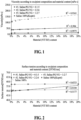
- the inventors measured a viscosity of the liquid-type inhalation formulation at 20°C using a Brookfield Viscometer. A spindle was used 0 times, a rotation speed was set to 4 to 100 rpm, and a water bath was used to maintain a temperature. This process was repeated three times, and the analysis was requested to a polymer testing and research Institute and self-analysis was performed (crossed check). The results are shown in Table 1 below and FIG. 1 .
- Example 1 A liquid-type inhalation formulation in which a mass ratio of saline:propylene glycol (PG):glycerin (VG) is 4:1:5.
- Example 2 A liquid-type inhalation formulation in which a mass ratio of saline:propylene glycol (PG):glycerin (VG) is 2:2:6.
- Example 3 A liquid-type inhalation formulation in which a mass ratio of saline:propylene glycol (PG):glycerin (VG) is 1:2:7. Comparative Example - A liquid-type inhalation formulation including only saline.
- a large number of large liquid droplets having a diameter of 200 ⁇ m or more may be generated. It is estimated that the large number of large liquid droplets are generated, because, in order to vibrate a surface of a liquid having a high viscosity, more wave energy is required, which increases irregularity of surface vibration.
- the large liquid droplets may adhere to an inner wall of an airflow tube to block an airflow path, or may be discharged to the outside of the airflow tube to cause discomfort to a smoker, and may disturb smooth spraying. There may be a difficulty of storage according to changes in a temperature and humidity.
- the liquid-type inhalation formulation according to the present disclosure may realize stable and continuous atomization up to a range of a high viscosity of 120 mPa ⁇ s.
Landscapes
- Chemical & Material Sciences (AREA)
- Chemical Kinetics & Catalysis (AREA)
- General Chemical & Material Sciences (AREA)
- Health & Medical Sciences (AREA)
- General Health & Medical Sciences (AREA)
- Toxicology (AREA)
- Life Sciences & Earth Sciences (AREA)
- Agronomy & Crop Science (AREA)
- Botany (AREA)
- Medicinal Preparation (AREA)
- Manufacture Of Tobacco Products (AREA)
Abstract
Description
- The present disclosure relates to a liquid-type inhalation formulation for use in a surface wave atomizer, and a cartridge and an aerosol-generating apparatus including the same.
- As an alternative to overcome disadvantages of combustible tobacco, a method of generating an aerosol by heating an aerosol generating material in a cigarette or a cartridge is widely used, instead of a method of generating an aerosol by burning a cigarette, and there is an increasing demand for this method. Accordingly, research on a heating-type (non-combustible) cigarette or a heating-type (non-combustible) aerosol generating system has been actively conducted.
- Specifically, an aerosol generating system has a similar structure as a combustible cigarette of the related art and generates mainstream smoke containing an aerosol by heating an aerosol generating material in a heating-type (non-combustible) cigarette or a cartridge with a heater or ultrasonic vibration.
- An electrical heating-type aerosol-generating apparatus for boiling and vaporizing a liquid among liquid-type aerosol-generating apparatuses has high thermal conductivity and high atomization efficiency. However, there is a possibility of altering functional inhalation materials in the liquid. For example, the release of harmful components such as aldehyde from a high-temperature heat may pose a major health risk.
- Meanwhile, an example of a method of atomization without boiling includes a method of using ultrasonic waves of the related art. However, this method also causes a temperature rise in the process of causing vibration, and even when a cooling method is used to lower the temperature, it is difficult to continuously perform stable atomization without failure using a liquid having a high viscosity, and the method causes high power consumption for atomization and has low efficiency due to a low speed.
- Therefore, it is currently required to develop a liquid-type inhalation formulation using a surface wave (surface acoustic wave (SAW)) atomizer capable of continuously and stably generating an aerosol while causing atomization with vibration without a temperature rise and failure issues of a liquid having a high viscosity, and a cartridge and a liquid-type aerosol-generating apparatus including the same.
- Therefore, in order to overcome the problems and/or limitations of existing technologies as described above, an object of the present disclosure is to provide a liquid-type inhalation formulation for use in a surface wave atomizer, and a cartridge and an aerosol-generating apparatus including the same.
- However, goals to be achieved are not limited to those described above, and other goals not mentioned above are clearly understood by one of ordinary skill in the art from the following description.
- According to an embodiment of the present disclosure, there is provided a liquid-type inhalation formulation for a surface wave atomizer, in which
- a viscosity at 20°C is 1.0 to 120 mPa·s,
- the liquid-type inhalation formulation includes one or more selected from a group consisting of propylene glycol, glycerin, and physiological saline, and
- a content of the glycerin is 50 wt% or more with respect to a total weight of the propylene glycol, the glycerin, and the physiological saline.
- According to an aspect of the present disclosure, there is provided a cartridge including the liquid-type inhalation formulation described above.
- According to another aspect of the present disclosure, there is provided an aerosol-generating apparatus including:
- a cartridge including the liquid-type inhalation formulation described above; and
- a control unit.
- When the liquid-type inhalation formulation for use in the surface wave atomizer according to an aspect of the present disclosure is used, stable atomization may be continuously performed up to a range of higher viscosity, and therefore, a liquid having a viscosity in a wide range may be used in the aerosol-generating apparatus. Furthermore, the use of the liquid-type inhalation formulation of the present disclosure may provide a sufficient amount of atomization and facilitate pulmonary delivery. In addition, a flavoring agent may be mixed into the liquid-type inhalation formulation, and a functional material (solid-phase or liquid-phase material) may be mixed with physiological saline for inhalation.
- The cartridge and the aerosol-generating apparatus including the liquid-type inhalation formulation for use in the surface wave atomizer according to an aspect of the present disclosure uses a surface wave to stably and continuously perform atomization even with a liquid having a high viscosity using vibration without failure and a temperature rise of the liquid.
- It should be understood that the effects of the present disclosure are not limited to the above-described effects, but are construed as including all effects that may be inferred from the configurations and features described in the following description or claims of the present disclosure.
-
-
FIG. 1 is a diagram illustrating a change of a viscosity (20°C) according to a composition of a liquid-type inhalation formulation for a surface wave atomizer and a content of a functional material (VIT B3) according to an embodiment of the present disclosure. -
FIG. 2 is a diagram illustrating a change of a surface tension (25°C) according to a composition of a liquid-type inhalation formulation for a surface wave atomizer and a content of a functional material (VIT B3) according to an embodiment of the present disclosure. -
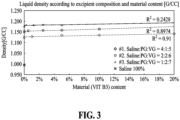
FIG. 3 is a diagram illustrating a change of a liquid density (25°C) according to a composition of a liquid-type inhalation formulation for a surface wave atomizer and a content of a functional material (VIT B3) according to an embodiment of the present disclosure. - Hereinafter, embodiments will be described in detail with reference to the accompanying drawings. However, various alterations and modifications may be made to the embodiments. Here, the embodiments are not construed as limited to the disclosure. The embodiments should be understood to include all changes, equivalents, and replacements within the idea and the technical scope of the disclosure.
- The terminology used herein is for the purpose of describing particular embodiments only and is not to be limiting of the embodiments. The singular forms "a", "an", and "the" are intended to include the plural forms as well, unless the context clearly indicates otherwise. It will be further understood that the terms "comprises/comprising" and/or "includes/including" when used herein, specify the presence of stated features, integers, steps, operations, elements, and/or components, but do not preclude the presence or addition of one or more other features, integers, steps, operations, elements, components and/or groups thereof.
- Unless otherwise defined, all terms including technical and scientific terms used herein have the same meaning as commonly understood by one of ordinary skill in the art to which the embodiments belong. It will be further understood that terms, such as those defined in commonly-used dictionaries, should be interpreted as having a meaning that is consistent with their meaning in the context of the relevant art and will not be interpreted in an idealized or overly formal sense unless expressly so defined herein.
- When describing the embodiments with reference to the accompanying drawings, like reference numerals refer to like components and a repeated description related thereto will be omitted. In the description of embodiments, detailed description of well-known related structures or functions will be omitted when it is deemed that such description will cause ambiguous interpretation of the present disclosure.
- In addition, the terms first, second, A, B, (a), and (b) may be used to describe constituent elements of the embodiments. These terms are used only for the purpose of discriminating one component from another component, and the nature, the sequences, or the orders of the components are not limited by the terms.
- A component, which has the same common function as a component included in any one embodiment, will be described by using the same name in other embodiments. Unless otherwise mentioned, the descriptions of an embodiment may be applicable to other embodiments and thus, repeated descriptions will be omitted for conciseness.
- According to an embodiment of the present disclosure, there is provided a liquid-type inhalation formulation for use in a surface wave atomizer, wherein the liquid-type inhalation formulation has a viscosity of 1.0 to 120 mPa·s at 20°C, and includes one or more selected from a group consisting of propylene glycol, glycerin, and physiological saline, and a content of the glycerin is 50 wt% or more with respect to a total weight of the propylene glycol, the glycerin, and the physiological saline.
- An atomizer refers to an operation of vaporizing a liquid as liquid droplets in a gas. For example, the atomizer may be implemented as an electrical heater including a coil for resistance (Joule) heating, resistive wires formed in different shapes, or a susceptor for induction heating, and a capillary tube or a porous element having working performance adjacent to the heater, which absorbs a liquid from a liquid storage and delivers the liquid to the electrical heater.
- Surface waves may be spread along a surface of a liquid, the energy is concentrated mainly on a surface of a medium such that an amplitude exponentially decreases inside the medium along with a distance from the surface. The characteristics of the surface waves may be used to generate an aerosol on the liquid surface. The energy orientation concentration characteristic may increase atomization efficiency and continuously and stably generate an aerosol with uniform particle size, and may be more suitable to atomize a cigarette solution having a high viscosity than ultrasonic waves. A frequency of the surface wave is generally 10 megahertz (MHz) to 500 megahertz (MHz), that is higher than a frequency of the ultrasonic wave. Thus, compared to ultrasonic waves, an aerosol generated by the surface waves has a smaller particle size, does not easily remain on the oral mucous or tongue surface, has a stronger inhalation strength, and smells thicker, mild, and soft.
- The liquid-type inhalation formulation, which is an aerosol forming formulation, may be a mixture of diol and glycerin, and diol herein may be propylene glycol. In the present disclosure, propylene glycol may be understood as propane-1,2-diol, and glycerin may be understood as propane-1,2,3-triol.
- For the stable atomization of an aerosol-generating apparatus, the viscosity of the liquid-type inhalation formulation is important. Normally, a viscosity of a liquid composition of 10 mPa·s or more may be considered as a high viscosity. When such a liquid composition having a high viscosity is used in an electrically heating-type or ultrasonic aerosol-generating apparatus, failure of the apparatus easily occurs or it is difficult to generate stable atomization.
- A surface tension of the liquid-type inhalation formulation according to an embodiment of the present disclosure may be 50 to 70 dyne at 25°C. When the surface tension is higher than the above range (50 to 70 dyne), a size of a liquid droplet may be reduced. Meanwhile, in order to increase the surface tension, it is necessary to add a large amount of ethanol, which is harmful to the human body and causes danger during the process.
- A density of the liquid-type inhalation formulation according to an embodiment of the present disclosure measured after storage at 25°C for a day may be 0.995 to 1.164 g/cc.
- A mass ratio of the propylene glycol to the glycerin in the liquid-type inhalation formulation according to an embodiment of the present disclosure may be 1:3 to 1:5.
- The ratio of the propylene glycol to the glycerin may affect the viscosity of the liquid-type inhalation formulation, and when the mass ratio of the propylene glycol to the glycerin is 1:3 to 1:5, the viscosity of the liquid-type inhalation formulation may be 1.0 to 120 mPa·s (20°C).
- A mass ratio of the physiological saline to the glycerin in the liquid-type inhalation formulation may be 4:5 to 1:7, the mass ratio of the physiological saline to the glycerin may be desirably 4:5 to 2:6, and the density at 25°C may be 1.125 to 1.164 g/cc.
- The physiological saline of the liquid-type inhalation formulation according to an embodiment of the present disclosure may include a functional inhalation material. The functional inhalation material may be a liquid or solid. The functional inhalation material may be included in an amount of 0 to 20 wt% with respect to the physiological saline. Examples of the functional inhalation material may include nicotine, caffeine, vitamin, natural extracts, and the like. Examples of the natural extracts may include rosemary, pine leaves, peppermint, spearmint, coffee, pineapple, chamomile, orange, eucalyptus, thyme, geranium, jasmine, lavender, lemongrass, pine needles, clover, sage, taxol, bergamot, basil, thyme, valerian, hyssop, tea tree, myrrh, juniper, and the like. However, the scope of the present disclosure is not limited to the examples listed above.
- When propylene glycol is added to the liquid-type inhalation formulation according to an embodiment of the present disclosure, a flavoring agent may be mixed. The flavoring agent may be one or more selected from a group consisting of mint, chocolate, cocoa, coffee, licorice, coriander, vanillin, ethyl vanillin, maltol, ethyl maltol, eucalyptol, acetic acid, a breath freshener flavor, bergamot oil, rosemary, geranium oil, lemon oil, orange oil, lime oil, grapefruit oil, mint oil, ginger oil, isosweet, and a fruit flavor component, and is not limited to the listed materials. When the condition is odorless, propylene glycol may not be included.
- The aerosol-generating apparatus according to an embodiment of the present disclosure may include a cartridge including the liquid-type inhalation formulation, and a control unit.
- The aerosol-generating apparatus may refer to an apparatus that generates an aerosol using an aerosol forming material to generate an aerosol that may be inhaled through the mouth of a user directly to the lungs of the user. In a case of the aerosol-generating apparatus of the present disclosure, the liquid-type inhalation formulation may be aerosolized using a surface wave atomizer.
- The cartridge may generally include a liquid storage containing the liquid-type inhalation formulation.
- The liquid storage may have a cylindrical shape with a hollow formed therein, and the hollow may be an inlet. The inlet may provide steam to a user.
- The control unit may generally include a battery that supplies power to operate the aerosol-generating apparatus, a controller that controls driving of a system, and the like. The power may be delivered from the battery to activate a heater included in the atomizer, the heater may vaporize a liquid delivered from the liquid storage, and the vaporized liquid may be inhaled by a user.
- Hereinafter, the present disclosure will be described in detail with reference to examples, however, the present disclosure is not limited to the following examples.
- The inventors measured a viscosity of the liquid-type inhalation formulation at 20°C using a Brookfield Viscometer. A spindle was used 0 times, a rotation speed was set to 4 to 100 rpm, and a water bath was used to maintain a temperature. This process was repeated three times, and the analysis was requested to a polymer testing and research Institute and self-analysis was performed (crossed check). The results are shown in Table 1 below and
FIG. 1 .[Table 1] Viscosity (mPa·s) Functional material content (wt%) 0 0.25 0.5 1 1.25 2.5 5 10 20 Example 1 9.3 9.6 10.3 11.6 14.0 Example 2 39.5 39.6 40.4 43.3 47.3 Example 3 114.9 118.0 120.2 124.0 127.7 Comparative Example 1.3 Example 1 - A liquid-type inhalation formulation in which a mass ratio of saline:propylene glycol (PG):glycerin (VG) is 4:1:5.
Example 2 - A liquid-type inhalation formulation in which a mass ratio of saline:propylene glycol (PG):glycerin (VG) is 2:2:6.
Example 3 - A liquid-type inhalation formulation in which a mass ratio of saline:propylene glycol (PG):glycerin (VG) is 1:2:7.
Comparative Example - A liquid-type inhalation formulation including only saline. - When the viscosity exceeds 120 mPa·s, a large number of large liquid droplets having a diameter of 200 µm or more may be generated. It is estimated that the large number of large liquid droplets are generated, because, in order to vibrate a surface of a liquid having a high viscosity, more wave energy is required, which increases irregularity of surface vibration. The large liquid droplets may adhere to an inner wall of an airflow tube to block an airflow path, or may be discharged to the outside of the airflow tube to cause discomfort to a smoker, and may disturb smooth spraying. There may be a difficulty of storage according to changes in a temperature and humidity.
- In addition, in order to observe whether stable atomization occurs within the range of the viscosity described above, a surface wave common element used for frequency filtering of a smartphone and a solution that wets a tobacco paper filter were used. As a result of the atomization of the solution, it was confirmed that a uniform aerosol was continuously and stably generated within the range of the viscosity described above. Therefore, the liquid-type inhalation formulation according to the present disclosure may realize stable and continuous atomization up to a range of a high viscosity of 120 mPa·s.
- In order to obtain results of Table 2 below, the measurement was performed using a tensiometer (plate type) at 25°C. The results are shown in Table 2 below and
FIG. 2 .[Table 2] Surface tension (dyne) Functional material content (wt%) 0 0.25 0.5 1 1.25 2.5 5 10 20 Example 1 57.0 57.0 57.2 57.4 57.3 Example 2 50.8 50.7 50.5 50.9 51.1 Example 3 49.5 50.0 50.1 50.4 51.3 Comparative Example 64.2 - In order to measure a density of the liquid-type inhalation formulation at 25°C, a volume of a liquid having a certain volume was measured with a measuring cylinder, a weight thereof was measured and calculated up to four valid numbers, and results thereof are shown in Table 3 below and
FIG. 3 .[Table 3] Density (g/cc) Functional material content (wt%) 0 0.25 0.5 1 1.25 2.5 5 10 20 Example 1 1.125 1.128 1.134 1.135 1.142 Example 2 1.152 1.155 1.158 1.159 1.164 Example 3 1.178 1.183 1.183 1.184 1.183 Comparative Example 0.995 - While the embodiments are described with reference to drawings, it will be apparent to one of ordinary skill in the art that various alterations and modifications in form and details may be made in these embodiments without departing from the spirit and scope of the claims and their equivalents. For example, suitable results may be achieved if the described techniques are performed in a different order, and/or if components in a described system, architecture, device, or circuit are combined in a different manner, and/or replaced or supplemented by other components or their equivalents.
- Therefore, other implementations, other embodiments, and equivalents to the claims are also within the scope of the following claims.
Claims (14)
- A liquid-type inhalation formulation for a surface wave atomizer, whereina viscosity at 20°C is 1.0 to 120 mPa·s,the liquid-type inhalation formulation comprises one or more selected from a group consisting of propylene glycol, glycerin, and physiological saline, anda content of the glycerin is 50 wt% or more with respect to a total weight of the propylene glycol, the glycerin, and the physiological saline.
- The liquid-type inhalation formulation of claim 1,
wherein a surface tension at 25°C is 50 to 70 dyne. - The liquid-type inhalation formulation of claim 1,
wherein a density at 25°C is 0.995 to 1.164 g/cc. - The liquid-type inhalation formulation of claim 1,
wherein a mass ratio of the propylene glycol to the glycerin is 1:3 to 1:5. - The liquid-type inhalation formulation of claim 4,
wherein a mass ratio of the physiological saline to the glycerin is 4:5 to 1:7. - The liquid-type inhalation formulation of claim 4,
wherein a mass ratio of the physiological saline to the glycerin is 4:5 to 2:6, and a density at 25°C is 1.125 to 1.164 g/cc. - The liquid-type inhalation formulation of claim 1,
wherein the physiological saline comprises a functional inhalation material. - The liquid-type inhalation formulation of claim 7,
wherein the functional inhalation material is included in an amount of 0 to 20 wt% with respect to the physiological saline. - The liquid-type inhalation formulation of claim 7,
wherein the functional inhalation material comprises one or more selected from a group consisting of nicotine, caffeine, vitamin, and natural extracts. - The liquid-type inhalation formulation of claim 9,
wherein the natural extracts comprises one or more selected from a group consisting of rosemary, pine leaves, peppermint, spearmint, coffee, pineapple, chamomile, orange, eucalyptus, thyme, geranium, jasmine, lavender, lemongrass, pine needles, clove, sage, taxol, bergamot, basil, thyme, valerian, hyssop, tea tree, myrrh, juniper, and the like. - The liquid-type inhalation formulation of claim 1,
wherein the propylene glycol comprises a flavoring agent. - The liquid-type inhalation formulation of claim 11,
wherein the flavoring agent comprises one or more selected from a group consisting of mint, chocolate, cocoa, coffee, licorice, coriander, vanillin, ethyl vanillin, maltol, ethyl maltol, eucalyptol, acetic acid, a breath freshener flavor, bergamot oil, rosemary, geranium oil, lemon oil, orange oil, lime oil, grapefruit oil, mint oil, ginger oil, isosweet, and a fruit flavor component. - A cartridge comprising the liquid-type inhalation formulation of one of claims 1 to 12.
- An aerosol-generating apparatus comprising:a cartridge comprising the liquid-type inhalation formulation of one of claims 1 to 12; anda control unit.
Applications Claiming Priority (2)
| Application Number | Priority Date | Filing Date | Title |
|---|---|---|---|
| KR1020220089831A KR20240012197A (en) | 2022-07-20 | 2022-07-20 | Liquid inhalant formulation for use in surface wave atomizer, and cartridge and apparatus for generating aerosol using the formulation |
| PCT/KR2023/007560 WO2024019313A1 (en) | 2022-07-20 | 2023-06-02 | Liquid-type inhalation formulation for use in surface wave atomizer, and cartridge and aerosol-generating apparatus comprising same |
Publications (2)
| Publication Number | Publication Date |
|---|---|
| EP4501138A1 true EP4501138A1 (en) | 2025-02-05 |
| EP4501138A4 EP4501138A4 (en) | 2025-06-11 |
Family
ID=89618142
Family Applications (1)
| Application Number | Title | Priority Date | Filing Date |
|---|---|---|---|
| EP23843170.4A Pending EP4501138A4 (en) | 2022-07-20 | 2023-06-02 | Liquid-type inhalation formulation for use in surface wave atomizer, and cartridge and aerosol-generating apparatus comprising same |
Country Status (5)
| Country | Link |
|---|---|
| EP (1) | EP4501138A4 (en) |
| JP (1) | JP2025514263A (en) |
| KR (1) | KR20240012197A (en) |
| CN (1) | CN119451588A (en) |
| WO (1) | WO2024019313A1 (en) |
Family Cites Families (16)
| Publication number | Priority date | Publication date | Assignee | Title |
|---|---|---|---|---|
| ES2913095T3 (en) * | 2011-01-31 | 2022-05-31 | Avalyn Pharma Inc | Aerosolized pirfenidone and pyridone analog compounds and uses thereof |
| EP3073846B1 (en) * | 2013-05-22 | 2023-07-05 | Njoy, Inc. | Compositions, devices, and methods for nicotine aerosol delivery |
| WO2015006465A1 (en) * | 2013-07-10 | 2015-01-15 | Ahkeo Ventures LLC | Inhalable compositions comprising caffeine, methods of use and an apparatus for using the same |
| FR3015186A1 (en) * | 2014-03-11 | 2015-06-26 | Antoine Piccirilli | USE OF A COMPOSITION COMPRISING 1,3-PROPANEDIOL AS E-LIQUID |
| GB201420061D0 (en) * | 2014-11-11 | 2014-12-24 | Univ Glasgow | Nebulisation of liquids |
| CA3003056C (en) * | 2015-11-02 | 2023-09-26 | Philip Morris Products S.A. | An aerosol-generating system comprising a vibratable element |
| BR112018010507B1 (en) * | 2015-11-24 | 2022-12-06 | R. J. Reynolds Tobacco Company | ELECTRICALLY POWERED AEROSOL DISTRIBUTION SYSTEM |
| UA125292C2 (en) * | 2016-03-30 | 2022-02-16 | Філіп Морріс Продактс С.А. | Smoking device and method for aerosol-generation |
| US20190015612A1 (en) * | 2016-04-04 | 2019-01-17 | Nexvap Sa | A mobile inhaler and a container for using therewith |
| EP3574902A1 (en) * | 2018-06-01 | 2019-12-04 | Yatzz Limited | Nicotine formulation and mode of delivery |
| CN109011043A (en) * | 2018-08-01 | 2018-12-18 | 哈尔滨工业大学(深圳) | A kind of atomising device and method based on surface acoustic wave |
| CN113163844B (en) * | 2018-12-28 | 2023-08-15 | 菲利普莫里斯生产公司 | High Viscosity Nicotine Preparations |
| US20220071270A1 (en) * | 2018-12-31 | 2022-03-10 | Philip Morris Products S.A. | Liquid nicotine formulation |
| EP4114214B1 (en) * | 2020-03-05 | 2025-05-07 | Philip Morris Products S.A. | Aerosol-generating device with feedback control of transducer |
| EP4228459A1 (en) * | 2020-10-16 | 2023-08-23 | Philip Morris Products S.A. | Aerosol generator with curved chamber |
| MA72835B1 (en) * | 2020-12-15 | 2025-10-31 | Shaheen Innovations Holding Limited | NICOTINE DELIVERY DEVICE |
-
2022
- 2022-07-20 KR KR1020220089831A patent/KR20240012197A/en not_active Ceased
-
2023
- 2023-06-02 JP JP2024563480A patent/JP2025514263A/en active Pending
- 2023-06-02 WO PCT/KR2023/007560 patent/WO2024019313A1/en not_active Ceased
- 2023-06-02 EP EP23843170.4A patent/EP4501138A4/en active Pending
- 2023-06-02 CN CN202380050563.9A patent/CN119451588A/en active Pending
Also Published As
| Publication number | Publication date |
|---|---|
| EP4501138A4 (en) | 2025-06-11 |
| KR20240012197A (en) | 2024-01-29 |
| CN119451588A (en) | 2025-02-14 |
| WO2024019313A1 (en) | 2024-01-25 |
| JP2025514263A (en) | 2025-05-02 |
Similar Documents
| Publication | Publication Date | Title |
|---|---|---|
| JP7086859B2 (en) | Aerosol generation system with heated aerosol generation article | |
| CN113395909B (en) | Aerosol generation | |
| CN113163848B (en) | Low viscosity liquid nicotine formulations | |
| JP2019521654A (en) | Refillable aerosol generating articles | |
| JP7644751B2 (en) | Smoking article sheet | |
| KR102930317B1 (en) | Electronic aerosol delivery system | |
| EP1596824A1 (en) | Aerosol formulations and aerosol delivery of buspirone, buprenorphine, triazolam, cyclobenzaprine and zolpidem | |
| EP3703656B1 (en) | Aerosolisable gel | |
| IL293171A (en) | Aerosol-generating comprising an amorphous solid with alginate and pectin as gelling agents | |
| JP2021531803A (en) | Generation of suctionable medium | |
| JP2022516311A (en) | Aerosol outbreak | |
| CN113951573A (en) | Atomizing substrate, aerosol raw product, electronic atomizer and atomizing system | |
| WO2021039343A1 (en) | Non-heating type flavor inhaler | |
| WO2021039340A1 (en) | Liquid for atomization | |
| KR102493439B1 (en) | Aerosol generating device and aerosol generating system including the same | |
| WO2024212780A1 (en) | Water-based electronic cigarette atomization formulation, and preparation method therefor and use thereof | |
| KR20240012197A (en) | Liquid inhalant formulation for use in surface wave atomizer, and cartridge and apparatus for generating aerosol using the formulation | |
| JP7755751B2 (en) | Aerosolizable Materials | |
| JP7724843B2 (en) | Aerosolizable Formulations | |
| JP7577750B2 (en) | Aerosol Generation | |
| KR20230104361A (en) | Catridge containing essential oil and aerosol generating system comprising the same | |
| Vyshneva | Effect of Propylene Glycol and Vegetable Glycerine Ratio in E-Liquid on Aerosol Formation: Overview of Relevant Properties. | |
| KR102705968B1 (en) | Preparation of gaseous media to enhance the amount of active ingredient transfer | |
| RU2827957C2 (en) | Aerosol generating article and aerosol generating device | |
| EP4684663A1 (en) | Delivery systems, devices and methods |
Legal Events
| Date | Code | Title | Description |
|---|---|---|---|
| STAA | Information on the status of an ep patent application or granted ep patent |
Free format text: STATUS: THE INTERNATIONAL PUBLICATION HAS BEEN MADE |
|
| PUAI | Public reference made under article 153(3) epc to a published international application that has entered the european phase |
Free format text: ORIGINAL CODE: 0009012 |
|
| STAA | Information on the status of an ep patent application or granted ep patent |
Free format text: STATUS: REQUEST FOR EXAMINATION WAS MADE |
|
| 17P | Request for examination filed |
Effective date: 20241028 |
|
| AK | Designated contracting states |
Kind code of ref document: A1 Designated state(s): AL AT BE BG CH CY CZ DE DK EE ES FI FR GB GR HR HU IE IS IT LI LT LU LV MC ME MK MT NL NO PL PT RO RS SE SI SK SM TR |
|
| A4 | Supplementary search report drawn up and despatched |
Effective date: 20250513 |
|
| RIC1 | Information provided on ipc code assigned before grant |
Ipc: A24F 40/05 20200101ALI20250508BHEP Ipc: A24F 40/50 20200101ALI20250508BHEP Ipc: A24F 40/42 20200101ALI20250508BHEP Ipc: A24F 40/10 20200101ALI20250508BHEP Ipc: A24B 15/28 20060101ALI20250508BHEP Ipc: A24B 15/30 20060101ALI20250508BHEP Ipc: A24B 15/24 20060101ALI20250508BHEP Ipc: A24B 15/32 20060101ALI20250508BHEP Ipc: A24B 15/167 20200101AFI20250508BHEP |
|
| DAV | Request for validation of the european patent (deleted) | ||
| DAX | Request for extension of the european patent (deleted) |