EP4498685A1 - Kameramodul und elektronische vorrichtung - Google Patents
Kameramodul und elektronische vorrichtung Download PDFInfo
- Publication number
- EP4498685A1 EP4498685A1 EP23773770.5A EP23773770A EP4498685A1 EP 4498685 A1 EP4498685 A1 EP 4498685A1 EP 23773770 A EP23773770 A EP 23773770A EP 4498685 A1 EP4498685 A1 EP 4498685A1
- Authority
- EP
- European Patent Office
- Prior art keywords
- color filter
- electrochromic
- region
- layer
- camera module
- Prior art date
- Legal status (The legal status is an assumption and is not a legal conclusion. Google has not performed a legal analysis and makes no representation as to the accuracy of the status listed.)
- Pending
Links
Images
Classifications
-
- H—ELECTRICITY
- H10—SEMICONDUCTOR DEVICES; ELECTRIC SOLID-STATE DEVICES NOT OTHERWISE PROVIDED FOR
- H10F—INORGANIC SEMICONDUCTOR DEVICES SENSITIVE TO INFRARED RADIATION, LIGHT, ELECTROMAGNETIC RADIATION OF SHORTER WAVELENGTH OR CORPUSCULAR RADIATION
- H10F39/00—Integrated devices, or assemblies of multiple devices, comprising at least one element covered by group H10F30/00, e.g. radiation detectors comprising photodiode arrays
- H10F39/10—Integrated devices
- H10F39/12—Image sensors
- H10F39/18—Complementary metal-oxide-semiconductor [CMOS] image sensors; Photodiode array image sensors
- H10F39/182—Colour image sensors
-
- G—PHYSICS
- G02—OPTICS
- G02F—OPTICAL DEVICES OR ARRANGEMENTS FOR THE CONTROL OF LIGHT BY MODIFICATION OF THE OPTICAL PROPERTIES OF THE MEDIA OF THE ELEMENTS INVOLVED THEREIN; NON-LINEAR OPTICS; FREQUENCY-CHANGING OF LIGHT; OPTICAL LOGIC ELEMENTS; OPTICAL ANALOGUE/DIGITAL CONVERTERS
- G02F1/00—Devices or arrangements for the control of the intensity, colour, phase, polarisation or direction of light arriving from an independent light source, e.g. switching, gating or modulating; Non-linear optics
- G02F1/01—Devices or arrangements for the control of the intensity, colour, phase, polarisation or direction of light arriving from an independent light source, e.g. switching, gating or modulating; Non-linear optics for the control of the intensity, phase, polarisation or colour
- G02F1/15—Devices or arrangements for the control of the intensity, colour, phase, polarisation or direction of light arriving from an independent light source, e.g. switching, gating or modulating; Non-linear optics for the control of the intensity, phase, polarisation or colour based on an electrochromic effect
- G02F1/153—Constructional details
- G02F1/157—Structural association of cells with optical devices, e.g. reflectors or illuminating devices
-
- G—PHYSICS
- G02—OPTICS
- G02F—OPTICAL DEVICES OR ARRANGEMENTS FOR THE CONTROL OF LIGHT BY MODIFICATION OF THE OPTICAL PROPERTIES OF THE MEDIA OF THE ELEMENTS INVOLVED THEREIN; NON-LINEAR OPTICS; FREQUENCY-CHANGING OF LIGHT; OPTICAL LOGIC ELEMENTS; OPTICAL ANALOGUE/DIGITAL CONVERTERS
- G02F1/00—Devices or arrangements for the control of the intensity, colour, phase, polarisation or direction of light arriving from an independent light source, e.g. switching, gating or modulating; Non-linear optics
- G02F1/01—Devices or arrangements for the control of the intensity, colour, phase, polarisation or direction of light arriving from an independent light source, e.g. switching, gating or modulating; Non-linear optics for the control of the intensity, phase, polarisation or colour
- G02F1/15—Devices or arrangements for the control of the intensity, colour, phase, polarisation or direction of light arriving from an independent light source, e.g. switching, gating or modulating; Non-linear optics for the control of the intensity, phase, polarisation or colour based on an electrochromic effect
- G02F1/153—Constructional details
- G02F1/155—Electrodes
-
- H—ELECTRICITY
- H04—ELECTRIC COMMUNICATION TECHNIQUE
- H04N—PICTORIAL COMMUNICATION, e.g. TELEVISION
- H04N23/00—Cameras or camera modules comprising electronic image sensors; Control thereof
-
- H—ELECTRICITY
- H04—ELECTRIC COMMUNICATION TECHNIQUE
- H04N—PICTORIAL COMMUNICATION, e.g. TELEVISION
- H04N23/00—Cameras or camera modules comprising electronic image sensors; Control thereof
- H04N23/50—Constructional details
- H04N23/55—Optical parts specially adapted for electronic image sensors; Mounting thereof
-
- H—ELECTRICITY
- H04—ELECTRIC COMMUNICATION TECHNIQUE
- H04N—PICTORIAL COMMUNICATION, e.g. TELEVISION
- H04N25/00—Circuitry of solid-state image sensors [SSIS]; Control thereof
- H04N25/10—Circuitry of solid-state image sensors [SSIS]; Control thereof for transforming different wavelengths into image signals
- H04N25/11—Arrangement of colour filter arrays [CFA]; Filter mosaics
-
- H—ELECTRICITY
- H10—SEMICONDUCTOR DEVICES; ELECTRIC SOLID-STATE DEVICES NOT OTHERWISE PROVIDED FOR
- H10F—INORGANIC SEMICONDUCTOR DEVICES SENSITIVE TO INFRARED RADIATION, LIGHT, ELECTROMAGNETIC RADIATION OF SHORTER WAVELENGTH OR CORPUSCULAR RADIATION
- H10F39/00—Integrated devices, or assemblies of multiple devices, comprising at least one element covered by group H10F30/00, e.g. radiation detectors comprising photodiode arrays
- H10F39/80—Constructional details of image sensors
- H10F39/805—Coatings
- H10F39/8053—Colour filters
-
- H—ELECTRICITY
- H10—SEMICONDUCTOR DEVICES; ELECTRIC SOLID-STATE DEVICES NOT OTHERWISE PROVIDED FOR
- H10F—INORGANIC SEMICONDUCTOR DEVICES SENSITIVE TO INFRARED RADIATION, LIGHT, ELECTROMAGNETIC RADIATION OF SHORTER WAVELENGTH OR CORPUSCULAR RADIATION
- H10F39/00—Integrated devices, or assemblies of multiple devices, comprising at least one element covered by group H10F30/00, e.g. radiation detectors comprising photodiode arrays
- H10F39/80—Constructional details of image sensors
- H10F39/806—Optical elements or arrangements associated with the image sensors
- H10F39/8063—Microlenses
-
- H—ELECTRICITY
- H10—SEMICONDUCTOR DEVICES; ELECTRIC SOLID-STATE DEVICES NOT OTHERWISE PROVIDED FOR
- H10F—INORGANIC SEMICONDUCTOR DEVICES SENSITIVE TO INFRARED RADIATION, LIGHT, ELECTROMAGNETIC RADIATION OF SHORTER WAVELENGTH OR CORPUSCULAR RADIATION
- H10F39/00—Integrated devices, or assemblies of multiple devices, comprising at least one element covered by group H10F30/00, e.g. radiation detectors comprising photodiode arrays
- H10F39/80—Constructional details of image sensors
- H10F39/811—Interconnections
Definitions
- This application pertains to the technical field of terminal devices and specifically relates to a camera module and an electronic device.
- the nightshot effect has gradually become an important selling point for many electronic devices such as smart phones.
- the key point of nightshot is to make a camera obtain more light input in a dark environment, so as to improve the brightness of photos taken.
- An amount of light input of the camera can be increased by increasing the aperture of a lens or sensitivity of an image sensor.
- apertures of lenses will be limited to a certain size and cannot be increased any more. Therefore, improving sensitivity of image sensors has become an important technical development direction for improving the effect of taking pictures at night (in a dark environment).
- the way to improve the sensitivity of image sensors is to replace some R, G and B pixels in image sensors with W pixels, which improves the photosensitivity in the dark environment.
- W pixels are fully transmissive to incident light, this may lead to excessive photosensitivity.
- a problem of overexposure is caused to photos taken in a bright environment, and details in highlights of photos may lose after overexposure, affecting imaging quality.
- This application is intended to provide a camera module and an electronic device, so as to at least solve a problem that an existing camera module cannot adapt to dark light or bright shooting scenes due to poor photosensitivity.
- an embodiment of this application provides a camera module.
- the camera module includes a color filter layer.
- the color filter layer includes an electrochromic region and a plurality of color filter regions.
- Each color filter region is used for transmitting a spectrum of a band corresponding to the color filter region.
- the electrochromic region has a fully light-transmissive state and a filter state.
- the electrochromic region is used for transmitting spectra of a plurality of different bands.
- the electrochromic region is used for transmitting spectra of a same band.
- an embodiment of this application provides an electronic device, where the electronic device includes the foregoing camera module.
- a solution is provided for the camera module to improve its photosensitivity so as to improve imaging quality in different shooting scenes.
- An appropriate quantity of electrochromic regions are added to the color filter layer and light-transmissive bands are adjusted for the electrochromic regions, to form a dynamically changeable color filter layer in the camera module.
- the color filter layer can have a plurality of different filter modes or fully light-transmissive modes, to adapt to different shooting scene requirements. In this way, an appropriate filter mode can be obtained through adjustment according to an actual shooting scene in both the bright environment and the dark environment, to obtain a better imaging effect.
- color filter layer 11. color filter region; 111. first color filter region; 112. second color filter region; 113. third color filter region; 12. electrochromic region; 121. electrolyte layer; 122. electrochromic layer; 123. ion storage layer; 124. transparent conductive layer; 13. grid; 2. electrode structure; 21. first control electrode; 22. second control electrode; 3. driving device; 4. photosensitive layer; 5. micro lens layer.
- the terms “mount”, “join”, and “connect” should be understood in a broad sense. For example, they may refer to a fixed, detachable, or integral connection, a mechanical connection, an electrical connection, a direct connection, an indirect connection through an intermediary medium, or a connection within two elements. Persons of ordinary skilled in the art can understand the specific meanings of the foregoing terms in this application in specific circumstances.
- a camera module is provided.
- the camera module can be applied to various forms of electronic devices.
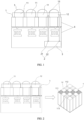
- the camera module includes a color filter layer 1.
- the color filter layer 1 includes an electrochromic region 12 and a plurality of color filter regions 11.
- Each color filter region 11 is used for transmitting a spectrum of a band corresponding to the color filter region 11.
- the electrochromic region 12 has a fully light-transmissive state and a filter state.
- the electrochromic region 12 is used for transmitting spectra of a plurality of different bands.
- the electrochromic region 12 is used for transmitting spectra of a same band.
- the color filter layer 1 is used in the camera module, and the color filter layer 1 is improved by adding an electrochromic material.
- the electrochromic region 12 is formed on the color filter layer 1 in addition to the plurality of color filter regions 11. Coloring and transparency of the electrochromic region 12 can be adjusted based on, for example, a change of a voltage.
- the electrochromic region 12 can be decolored or colored (color added), so that the electrochromic region 12 can be switched between the filter state and the fully light-transmissive state.
- the electrochromic region 12 not only can be used as a filter but also can be adjusted to be a fully light-transmissive sheet. This makes the entire color filter layer 1 form a dynamically changeable color filter structure. This dynamically changeable color filter structure is different from a conventional colorfilter (CF).
- CF colorfilter
- the electrochromic region 12 on the color filter layer 1 is adjusted to be in the fully light-transmissive state due to dark ambient light. In this way, an amount of light input of a camera can be increased to improve the shooting effect in dark light.
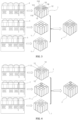
- FIG. 2 to distinguish the electrochromic region 12 and the color filter region 11 on the color filter layer 1, a plain box represents the electrochromic region 12, which is in the fully light-transmissive state, and a box filled with patterns represents the color filter region 11.
- FIG. 2 shows three different color filter regions 11 on the color filter layer 1, which are respectively a first color filter region 111, a second color filter region 112, and a third color filter region 113.
- the first color filter region 111 is used for transmitting a red spectrum in visible light
- the second color filter region 112 is used for transmitting a green spectrum in the visible light
- the third color filter region 113 is used for transmitting a blue spectrum in the visible light.
- first color filter region 111, the second color filter region 112, and the third color filter region 113 each are provided in plurality. Since each electrochromic region 12 on the color filter layer 1 is in the fully light-transmissive state, fully light-transmissive pixels are added in the color filter layer 1, and these fully light-transmissive pixels can be used for transmitting the visible light. This can increase the amount of light input, to improve sensitivity of the camera module in the dark environment and improve brightness of photos taken in the dark environment.
- the electrochromic regions 12 can be adjusted from a transparent fully light-transmissive state (plain box) to a colored filter state (plain box is filled with patterns) due to the bright ambient light. Because the electrochromic region 12 is used as a filter at this time, the electrochromic region can be used for transmitting a spectrum of a specified band, so that there are fewer fully light-transmissive pixels on the color filter layer 1, or there are no fully light-transmissive pixels at all (refer to the rightmost part in FIG. 3 ). This can reduce the amount of light input and avoid a problem of overexposure of photos taken in the bright environment.
- an RGBW pixel mode will reduce a quantity of color pixels due to an increase in a quantity of fully light-transmissive pixels.
- a certain quantity of electrochromic regions 12 are added to the color filter layer 1, so that a filter mode of the color filter layer 1 can be dynamically adjusted by adjusting usage states of the electrochromic regions 12, thereby addressing the deficiency.
- a spectrum that can be transmitted by the electrochromic region can also be designed to be different from that transmitted by each color filter region 11, so as to enrich types of color pixels.
- the plurality of color filter regions 11 can transmit a red spectrum, a green spectrum, and a blue spectrum, respectively, while the electrochromic region 12 can transmit, in the filter state, a pink spectrum, a yellow spectrum, or another spectrum that is different from those transmitted by the plurality of color filter regions 11, so as to enrich the types of color pixels.
- electrochromic regions 12 can be controlled to be in the filter state as required, while remaining electrochromic regions 12 are in the fully light-transmissive state, that is, are light-transmissive pixels. This is not limited in this embodiment of this application.
- All three electrochromic regions 12 around the first color filter region 111 are converted to transmit a spectrum of a same band as the first color filter region 111, while the other electrochromic regions 12 on the color filter layer 1 are in the fully light-transmissive state.
- All three electrochromic regions 12 around the second color filter region 112 are converted to transmit a spectrum of a same band as the second color filter region 112, while the other electrochromic regions 12 on the color filter layer 1 are in the fully light-transmissive state.
- All three electrochromic regions 12 around the third color filter region 113 are converted to transmit a spectrum of a same band as the third color filter region 113, while the other electrochromic regions 12 on the color filter layer 1 are in the fully light-transmissive state.
- each electrochromic region 12 is used for transmitting spectra of a plurality of different bands.
- visible light can directly pass through the electrochromic region. This design can increase an amount of light input for the camera module to meet the shooting needs in dark scenes.
- each electrochromic region 12 can be used for transmitting a spectrum of a band corresponding to the electrochromic region 12.
- the electrochromic region 12 in a case that the electrochromic region 12 is in the filter state and is configured to filter out green light and blue light in the visible light, the electrochromic region 12 allows only red light in the visible light to pass through, but the green light and the blue light in the visible light cannot pass through the electrochromic region 12.
- This design can increase a quantity of color pixels and reduce an amount of light input, which is conducive to taking more colorful photos in bright scenes.
- a solution is provided for the camera module to improve its photosensitivity so as to improve imaging quality in different shooting scenes.
- An appropriate quantity of electrochromic regions 12 are added to the color filter layer 1 and light-transmissive bands are adjusted for the electrochromic regions 12, to form a dynamically changeable color filter layer 1 in the camera module.
- the color filter layer 1 can have a plurality of different filter modes or fully light-transmissive modes, to adapt to different shooting scene requirements. In this way, an appropriate filter mode can be obtained through adjustment according to an actual shooting scene in both the bright environment and the dark environment, to obtain a better imaging effect.
- light transmittance of the color filter layer 1 can be dynamically adjusted by adjusting the electrochromic region 12 to switch between the filter state and the fully light-transmissive state, which can adapt to various complicated and changeable shooting environments.
- This embodiment of this application can give consideration to the dark environment, the bright environment and the service environment with complex colors at the same time, which is different from a conventional color filter layer with a fixed array arrangement.
- An arrangement manner of the color filter region 11 on the color filter layer 1 includes at least one of the following:
- One or more of the electrochromic regions 12 are arranged on at least one side of each of the color filter region 11 and one or more of the electrochromic regions 12 are arranged between two adjacent color filter regions 11.
- the color filter layer 1 includes a plurality of first color filter regions 111, a plurality of second color filter regions 112, and a plurality of third color filter regions 113, which are arranged at different positions on the color filter layer 1 to form a specific color filter array.
- the first color filter region 111 is used for outputting red light in the visible light
- the second color filter region 112 is used for outputting green light in the visible light
- the third color filter region 113 is used for outputting blue light in the visible light.
- a plurality of electrochromic regions 12 are simultaneously arranged on the color filter layer 1, and these electrochromic regions 12 are arranged among the first color filter regions 111, the second color filter regions 112, and the third color filter regions 113.
- a quantity of required color filter regions can be correspondingly increased on the color filter layer 1.
- fully light-transmissive pixels can be correspondingly added on the color filter layer 1.
- the electrochromic region 12 is configured to be capable of transmitting spectra of a same band as one of the adjacent color filter regions 11.
- the electrochromic regions 12 around the first color filter region 111 are configured to be capable of transmitting, in the filter state, a spectrum of a same band as the first color filter region 111. In this way, a quantity of first color filter regions 111 can be increased on the color filter layer 1. Similarly, a quantity of second color filter regions 112 and a quantity of third color filter regions 113 can also be increased on the color filter layer 1. Details are not repeated in this application.
- the electrochromic region 12 is configured to transmit a spectrum of a different band from any color filter region 11.
- the electrochromic regions 12 on the color filter layer 1 is adjusted to the filter state and configured to transmit light different from that transmitted by any color filter region 11, as shown in FIG. 4 .
- the color-transmissive array arranged on the color filter layer 1 can be changed to an arrangement mode with more color channels, for example, an RGBCMY arrangement mode. With an increase in color channels, the camera module can obtain richer color information, so that a real color of a scene can be better restored.
- the first color filter region 111, the second color filter region 112, and the third color filter region 113 respectively transmit the red spectrum, the green spectrum, and the blue spectrum in the visible light
- the plurality of electrochromic regions 12 can respectively transmit a pink spectrum, a yellow spectrum, and a purple spectrum after filtering, as shown in the right view in FIG. 4 .
- six color filter channels can be formed on the color filter layer 1 ( FIG. 4 shows the six different filter channels by using six different patterns).
- a formed color filter layer 1 has more color channels, which is conducive to achieving better color restoration of images and enriching the color expression of the camera module.
- the electrochromic region 12 is provided in plurality, where in the filter state, electrochromic regions 12 used for transmitting spectra of a same band are connected to each other, and are all connected to a same driving device 3, and the driving device 3 is configured to drive the connected electrochromic regions 12 to be switchable between the fully light-transmissive state and the filter state.
- a plurality of electrochromic regions 12 are arranged on the color filter layer 1, a part of the electrochromic regions 12 can transmit a spectrum of a same band in the filter state, and these electrochromic regions 12 are connected together and are driven and controlled by the driving device 3.
- a plurality of electrochromic regions 12 are arranged on the color filter layer 1, and the plurality of electrochromic regions 12 are divided into three groups, namely, a group A, a group B, and a group C.
- Each electrochromic region 12 in the group A is used for outputting a red spectrum in visible light in a case of being adjusted to the filter state, and electrochromic regions 12 in the group A are connected together and connected to a driving device A.
- Each electrochromic region 12 in the group B is used for outputting a green spectrum in the visible light in a case of being adjusted to the filter state, and electrochromic regions 12 in the group B are connected together and connected to a driving device B.
- Each electrochromic region 12 in the group C is used for outputting a blue spectrum in the visible light in a case of being adjusted to the filter state, and electrochromic regions 12 in the group C are connected together and connected to a driving device C.
- the driving device A is configured to control the electrochromic regions 12 in the group A to be switchable between the fully light-transmissive state and the filter state
- the driving device B is configured to control the electrochromic regions 12 in the group B to be switchable between the fully light-transmissive state and the filter state
- the driving device C is configured to control the electrochromic regions 12 in the group C to be switchable between the fully light-transmissive state and the filter state.
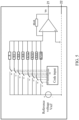
- An operating core of the driving device 3 is a digital analog converter (DAC), and a working principle thereof is as follows:
- D7, D6, D5, ..., and D0 shown in FIG. 5 are all designed as 8-bit binary codes, and each bit can be set to 1 or 0.
- the proportional coefficient K is a constant and can be determined by calibration.
- a calibration process is briefly described as follows:
- the camera module including the color filter layer 1 and a conventional RGB camera module are placed in a same QE test environment.
- the conventional RGB camera module can be calibrated with a QE curve in a G (filtered) band.
- a value of K is adjusted to make a QE curve of the color filter layer 1 and the QE curve of the RGB camera module approach to a certain error range, to obtain an accurate value of K.
- an independent driving device 3 can be provided for each electrochromic region 12.
- a plurality of electrochromic regions 12 are arranged on the color filter layer 1, where a part of the electrochromic regions 12 can be converted to be in a same filter state as the first color filter region 111 (that is, transmit a spectrum of a same band as the first color filter region 111), a part of the electrochromic regions 12 can be converted to be in a same filter state as the second color filter region 112 (that is, transmit a spectrum of a same band as the second color filter region 112). and a part of the electrochromic regions 12 can be converted to be in a same filter state as the third color filter region 113 (that is, transmit a spectrum of a same band as the third color filter region 113).
- three driving device can be equipped accordingly. Certainly, this embodiment of this application is not limited to this arrangement manner.
- a process of adjusting transmittance of the color filter layer 1 including the electrochromic region 12 is as follows, in which coding control is added:
- each electrochromic region 12 on the color filter layer 1 is in a transparent state, that is, a plurality of fully light-transmissive pixels are formed on the color filter layer 1, so as to improve sensitivity of the camera module in the dark environment.
- a driving device A there are three driving device 3: a driving device A, a driving device B, and a driving device C.
- the driving device A, B, and C are driven and controlled to be turned on, so that a plurality of electrochromic regions 12 on the color filter layer 1 are all in a filter state and can separately transmit control codes corresponding to, for example, R pixels, G pixels, and B pixels.
- R pixels for example, R pixels, G pixels, and B pixels.
- the camera module can obtain more color information and avoid a problem of color noise.
- the electrochromic region 12 controlled by the driving device A can transmit the green spectrum in the filter state; in a case that the driving device B outputs a code 00011111, the electrochromic region 12 controlled by the driving device B can transmit the blue spectrum in the filter state; and in a case that the driving device C outputs a code 11101111, the electrochromic region 12 controlled by the driving device C can transmit the red spectrum in the filter state.
- color information of the photographed object can be obtained through some open source tools (for example, Color Copy Paste). Based on the obtained color information, color complexity of the currently photographed object can be determined, and then the driving device is controlled to implement arrangement of, for example, RGBCMY (red, green, blue, magenta, cyan, and yellow). More color channels allow the camera module to achieve better color restoration in the environment with complex colors, thereby greatly enriching color performance of image sensors.
- RGBCMY red, green, blue, magenta, cyan, and yellow
- the electrochromic region 12 controlled by the driving device A can transmit the yellow spectrum in the filter state; in a case that the driving device B outputs a code 00101111, the electrochromic region 12 controlled by the driving device B can transmit the cyan spectrum in the filter state; and in a case that the driving device C outputs a code 11000000, the electrochromic region 12 controlled by the driving device C can transmit the magenta spectrum in the filter state.
- the camera module further includes an electrode structure 2 and a driving device 3 connected to the electrode structure 2.
- the electrode structure 2 includes a first control electrode 21 and a second control electrode 22, where the first control electrode 21 and the second control electrode 22 are separately connected to the electrochromic region 12.
- the driving device 3 is configured to apply a control voltage or a control current to the electrode structure 2 and drive, via the electrode structure 2, the electrochromic region 12 to be switchable between the fully light-transmissive state and the filter state.
- One of the first control electrode 21 and the second control electrode 22 is a positive electrode, and the other is a negative electrode.
- the driving device 3 can be electrically connected to the electrochromic region 12 through the electrode structure 2, so as to drive the connected electrochromic region 12 to be switchable between the fully light-transmissive state and the filter state.
- the driving device 3 can control the electrification of the electrode structure 2 to provide different voltages or different currents for the electrochromic region 12.
- the electrochromic region 12 can be in different working states under the control of different voltages or currents.
- FIG. 1 A grid 13 is provided on a periphery of the electrochromic region 12, the first control electrode 21 and the second control electrode 22 are oppositely arranged on two sides of the electrochromic region 12 respectively, and both are at least partially inserted into the grid 13.
- the grid 13 is made of metal, that is, a metal grid, which can be used for isolating transmission areas of different colors on the color filter layer 1, and can prevent light crosstalk.
- the grid 13 is not limited to be arranged on a peripheral side of the electrochromic region 12, and the grid 13 may be arranged between different color-transmissive regions.
- the grid 13 is used for accommodating the electrode structure 2, so that the electrode structure 2 does not occupy space on a surface of the color filter layer 1 during arrangement.
- the camera module further includes a photosensitive layer 4 and a micro lens layer 5.
- the color filter layer 1 covers the photosensitive layer 4, and the driving device 3 is arranged in the photosensitive layer 4.
- the micro lens layer 5 covers the color filter layer 1.
- the photosensitive layer 4 includes a photodiode layer, a DTI (deep trench isolation), and a logic circuit layer.
- the photodiode converts an optical signal filtered by the color filter layer into an electrical signal.
- the DTI namely, deep trench isolation, is configured to isolate the photodiode and prevent light crosstalk.
- the logic circuit layer processes the electrical signal converted by the photodiode.
- the driving device 3 is arranged in the photosensitive layer 4 (for example, the logic circuit layer) of the camera module, used as an independent module, and can apply a control voltage to the electrochromic region 12.
- the micro lens layer 5 covers the color filter layer 1, and incident light passes through the micro lens layer 5 and the color filter layer 1 in sequence and then is transmitted to the photosensitive layer 4.
- the micro lens layer 5 is configured to condense light to obtain more light input.
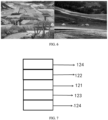
- the electrochromic region 12 includes an electrolyte layer 121, an electrochromic layer 122, an ion storage layer 123, and two transparent conductive layers 124.
- the electrochromic layer 122 and the ion storage layer 123 are respectively arranged on two surfaces of the electrolyte layer 121.
- the two transparent conductive layers 124 respectively cover the electrochromic layer 122 and the ion storage layer 123.
- the electrochromic region 12 undergoes a redox reaction driven by an applied voltage, so that a color of a material changes, and the color tends to be stable after the reaction is balanced.
- a material of the electrochromic region 12 is tungsten oxide (WO 3 ).
- tungsten oxide is the material of the electrochromic region 12. A principle of color adjustment of the electrochromic region 12 is explained.
- Decolorization of the electrochromic region 12 After a specified voltage is applied to the electrochromic region 12, ions and electrons in the ion storage layer 123 move out of the electrochromic layer 122, and chemical valences of a part of W change from +5 to +6, thereby making a color lighter and forming a transparent state.
- an electronic device is provided.
- the electronic device includes the foregoing camera module.
- the electronic device may be a terminal, or may be another device different from the terminal.
- the electronic device may be, for example, a mobile phone, a tablet computer, a notebook computer, a palm computer, a vehicle-mounted electronic device, a mobile internet device (Mobile Internet Device, MID), an augmented reality (augmented reality, AR)/virtual reality (virtual reality, VR) device, a robot, a wearable device, an ultra-mobile personal computer (ultra-mobile personal computer, UMPC), a netbook, or a personal digital assistant (personal digital assistant, PDA), or may be a server, a network attached storage (Network Attached Storage, NAS), a personal computer (personal computer, PC), a television (television, TV), a teller machine, or a self-service machine.
- Network Attached Storage Network Attached Storage
- NAS Network Attached Storage
- personal computer personal computer, PC
- TV television
- teller machine or a self-service machine.
- references terms such as “one embodiment”, “some embodiments”, “example embodiment”, “example”, “specific example”, or “some examples” mean that specific features, structures, materials or characteristics described with reference to embodiments or examples are included in at least one embodiment or example of this application.
- schematic expressions of the foregoing terms do not necessarily refer to a same embodiment or example.
- the specific features, structures, materials or characteristics described may be combined in any one or more embodiments or examples in a suitable manner.
Landscapes
- Physics & Mathematics (AREA)
- Nonlinear Science (AREA)
- Engineering & Computer Science (AREA)
- Multimedia (AREA)
- Signal Processing (AREA)
- General Physics & Mathematics (AREA)
- Optics & Photonics (AREA)
- Electrochromic Elements, Electrophoresis, Or Variable Reflection Or Absorption Elements (AREA)
- Blocking Light For Cameras (AREA)
Applications Claiming Priority (2)
| Application Number | Priority Date | Filing Date | Title |
|---|---|---|---|
| CN202210291666.1A CN114650358A (zh) | 2022-03-22 | 2022-03-22 | 摄像模组以及电子设备 |
| PCT/CN2023/082435 WO2023179522A1 (zh) | 2022-03-22 | 2023-03-20 | 摄像模组以及电子设备 |
Publications (2)
| Publication Number | Publication Date |
|---|---|
| EP4498685A1 true EP4498685A1 (de) | 2025-01-29 |
| EP4498685A4 EP4498685A4 (de) | 2025-07-02 |
Family
ID=81995479
Family Applications (1)
| Application Number | Title | Priority Date | Filing Date |
|---|---|---|---|
| EP23773770.5A Pending EP4498685A4 (de) | 2022-03-22 | 2023-03-20 | Kameramodul und elektronische vorrichtung |
Country Status (4)
| Country | Link |
|---|---|
| US (1) | US20250015121A1 (de) |
| EP (1) | EP4498685A4 (de) |
| CN (1) | CN114650358A (de) |
| WO (1) | WO2023179522A1 (de) |
Families Citing this family (3)
| Publication number | Priority date | Publication date | Assignee | Title |
|---|---|---|---|---|
| CN114650358A (zh) * | 2022-03-22 | 2022-06-21 | 维沃移动通信有限公司 | 摄像模组以及电子设备 |
| CN116017148A (zh) * | 2022-12-30 | 2023-04-25 | 歌尔科技有限公司 | 摄像装置的控制方法、摄像装置以及头戴显示器及其套件 |
| US20250232399A1 (en) * | 2024-01-12 | 2025-07-17 | Visera Technologies Company Ltd. | Demosaicing device and demosaicing method for image sensor |
Family Cites Families (14)
| Publication number | Priority date | Publication date | Assignee | Title |
|---|---|---|---|---|
| KR101262507B1 (ko) * | 2011-04-11 | 2013-05-08 | 엘지이노텍 주식회사 | 픽셀, 픽셀 어레이, 픽셀 어레이의 제조방법 및 픽셀 어레이를 포함하는 이미지센서 |
| JP6161007B2 (ja) * | 2012-09-14 | 2017-07-12 | パナソニックIpマネジメント株式会社 | 固体撮像装置及びカメラモジュール |
| US9338413B2 (en) * | 2013-11-26 | 2016-05-10 | Semiconductor Components Industries, Llc | Imaging systems with image pixels having adjustable spectral responses |
| CN105511206A (zh) * | 2014-09-26 | 2016-04-20 | 宁波舜宇光电信息有限公司 | 一种影像模组及其感光芯片封装结构及方法 |
| CN104678672B (zh) * | 2015-03-16 | 2018-03-23 | 京东方科技集团股份有限公司 | 一种电致变色模组、显示面板、显示装置和显示方法 |
| CN105578079B (zh) * | 2015-12-18 | 2017-11-17 | 广东欧珀移动通信有限公司 | 图像传感器及画质调节方法、成像装置及方法和移动终端 |
| CN105681637B (zh) * | 2016-03-15 | 2019-12-31 | 宁波舜宇光电信息有限公司 | 阵列摄像模组及其感光组件和制造方法 |
| CN110401787B (zh) * | 2019-07-22 | 2020-08-18 | 珠海格力电器股份有限公司 | 一种图像采集方法、装置和可读介质 |
| CN110518029A (zh) * | 2019-09-23 | 2019-11-29 | 德淮半导体有限公司 | 图像传感器及其制备方法 |
| CN110646995A (zh) * | 2019-09-25 | 2020-01-03 | Oppo(重庆)智能科技有限公司 | 镜头组件、潜望式摄像头和电子设备 |
| CN114002889A (zh) * | 2020-07-17 | 2022-02-01 | 深圳市万普拉斯科技有限公司 | 一种摄像头的偏振盖板及电子设备 |
| CN112822466A (zh) * | 2020-12-28 | 2021-05-18 | 维沃移动通信有限公司 | 图像传感器、摄像模组和电子设备 |
| CN112928148A (zh) * | 2021-04-02 | 2021-06-08 | 维沃移动通信有限公司 | 显示面板和电子设备 |
| CN114650358A (zh) * | 2022-03-22 | 2022-06-21 | 维沃移动通信有限公司 | 摄像模组以及电子设备 |
-
2022
- 2022-03-22 CN CN202210291666.1A patent/CN114650358A/zh active Pending
-
2023
- 2023-03-20 EP EP23773770.5A patent/EP4498685A4/de active Pending
- 2023-03-20 WO PCT/CN2023/082435 patent/WO2023179522A1/zh not_active Ceased
-
2024
- 2024-09-20 US US18/891,996 patent/US20250015121A1/en active Pending
Also Published As
| Publication number | Publication date |
|---|---|
| WO2023179522A1 (zh) | 2023-09-28 |
| CN114650358A (zh) | 2022-06-21 |
| US20250015121A1 (en) | 2025-01-09 |
| EP4498685A4 (de) | 2025-07-02 |
Similar Documents
| Publication | Publication Date | Title |
|---|---|---|
| EP4498685A1 (de) | Kameramodul und elektronische vorrichtung | |
| CN114650377A (zh) | 摄像模组、摄像模组的控制方法以及电子设备 | |
| EP2752008B1 (de) | Pixelanordnung, kamera damit und farbverarbeitungsverfahren basierend auf der pixelanordnung | |
| US6950156B1 (en) | Reflection type color liquid crystal display device having sub-pixels for increasing luminance, and a light scattering film including color filters for the sub-pixels and manufacturing method thereof | |
| US12044869B2 (en) | Image sensor and electronic camera | |
| CN102742279A (zh) | 滤色器阵列图像的迭代去噪 | |
| US9338413B2 (en) | Imaging systems with image pixels having adjustable spectral responses | |
| JP2023538781A (ja) | ホワイトバランス補正方法、装置及び電子機器 | |
| CN1949882B (zh) | 图像显示装置、电子设备和像素配置设计方法 | |
| CN112415805B (zh) | 彩膜基板、显示面板及显示装置 | |
| US8363305B2 (en) | Full color electrophoretic display device | |
| CN112882306A (zh) | 一种显示装置及其驱动方法 | |
| US20090251405A1 (en) | Colour reflective display devices | |
| TWI229544B (en) | Preview system of a digital camera | |
| CN110875008B (zh) | 一种子像素亮度的确定方法、显示面板的驱动方法及装置 | |
| WO2010122716A1 (ja) | 固体撮像素子 | |
| CN115841521B (zh) | 显示数据转换方法及转换模块、介质、装置和电子设备 | |
| JP2008268738A (ja) | 半透過型液晶表示装置用カラーフィルタ及び半透過型液晶表示装置 | |
| CN114341723A (zh) | 成像方法、成像模组、电子装置和存储介质 | |
| JP2012090138A (ja) | 3次元撮像装置および画像処理装置 | |
| JP2005084168A (ja) | 表示画面 | |
| Frey | Digital photography | |
| JP2004302340A (ja) | 表示画面 | |
| CN117423300A (zh) | 显示屏的亮色度调节方法、装置、终端设备和显示屏系统 | |
| JP2004264411A (ja) | 表示画面 |
Legal Events
| Date | Code | Title | Description |
|---|---|---|---|
| STAA | Information on the status of an ep patent application or granted ep patent |
Free format text: STATUS: THE INTERNATIONAL PUBLICATION HAS BEEN MADE |
|
| PUAI | Public reference made under article 153(3) epc to a published international application that has entered the european phase |
Free format text: ORIGINAL CODE: 0009012 |
|
| STAA | Information on the status of an ep patent application or granted ep patent |
Free format text: STATUS: REQUEST FOR EXAMINATION WAS MADE |
|
| 17P | Request for examination filed |
Effective date: 20241018 |
|
| AK | Designated contracting states |
Kind code of ref document: A1 Designated state(s): AL AT BE BG CH CY CZ DE DK EE ES FI FR GB GR HR HU IE IS IT LI LT LU LV MC ME MK MT NL NO PL PT RO RS SE SI SK SM TR |
|
| DAV | Request for validation of the european patent (deleted) | ||
| DAX | Request for extension of the european patent (deleted) | ||
| A4 | Supplementary search report drawn up and despatched |
Effective date: 20250602 |
|
| RIC1 | Information provided on ipc code assigned before grant |
Ipc: H04N 23/00 20230101ALI20250526BHEP Ipc: H04N 23/55 20230101ALI20250526BHEP Ipc: G02F 1/157 20060101ALI20250526BHEP Ipc: H04N 23/45 20230101AFI20250526BHEP |