EP4498674A2 - Codierer, decodierer und zugehörige verfahren - Google Patents
Codierer, decodierer und zugehörige verfahren Download PDFInfo
- Publication number
- EP4498674A2 EP4498674A2 EP24212325.5A EP24212325A EP4498674A2 EP 4498674 A2 EP4498674 A2 EP 4498674A2 EP 24212325 A EP24212325 A EP 24212325A EP 4498674 A2 EP4498674 A2 EP 4498674A2
- Authority
- EP
- European Patent Office
- Prior art keywords
- aps
- alf
- parameters
- type
- slice
- Prior art date
- Legal status (The legal status is an assumption and is not a legal conclusion. Google has not performed a legal analysis and makes no representation as to the accuracy of the status listed.)
- Pending
Links
Images



Classifications
-
- H—ELECTRICITY
- H04—ELECTRIC COMMUNICATION TECHNIQUE
- H04N—PICTORIAL COMMUNICATION, e.g. TELEVISION
- H04N19/00—Methods or arrangements for coding, decoding, compressing or decompressing digital video signals
- H04N19/10—Methods or arrangements for coding, decoding, compressing or decompressing digital video signals using adaptive coding
- H04N19/102—Methods or arrangements for coding, decoding, compressing or decompressing digital video signals using adaptive coding characterised by the element, parameter or selection affected or controlled by the adaptive coding
- H04N19/117—Filters, e.g. for pre-processing or post-processing
-
- H—ELECTRICITY
- H04—ELECTRIC COMMUNICATION TECHNIQUE
- H04N—PICTORIAL COMMUNICATION, e.g. TELEVISION
- H04N19/00—Methods or arrangements for coding, decoding, compressing or decompressing digital video signals
- H04N19/20—Methods or arrangements for coding, decoding, compressing or decompressing digital video signals using video object coding
-
- G—PHYSICS
- G06—COMPUTING OR CALCULATING; COUNTING
- G06T—IMAGE DATA PROCESSING OR GENERATION, IN GENERAL
- G06T9/00—Image coding
-
- H—ELECTRICITY
- H04—ELECTRIC COMMUNICATION TECHNIQUE
- H04B—TRANSMISSION
- H04B1/00—Details of transmission systems, not covered by a single one of groups H04B3/00 - H04B13/00; Details of transmission systems not characterised by the medium used for transmission
- H04B1/66—Details of transmission systems, not covered by a single one of groups H04B3/00 - H04B13/00; Details of transmission systems not characterised by the medium used for transmission for reducing bandwidth of signals; for improving efficiency of transmission
-
- H—ELECTRICITY
- H04—ELECTRIC COMMUNICATION TECHNIQUE
- H04N—PICTORIAL COMMUNICATION, e.g. TELEVISION
- H04N19/00—Methods or arrangements for coding, decoding, compressing or decompressing digital video signals
- H04N19/10—Methods or arrangements for coding, decoding, compressing or decompressing digital video signals using adaptive coding
- H04N19/102—Methods or arrangements for coding, decoding, compressing or decompressing digital video signals using adaptive coding characterised by the element, parameter or selection affected or controlled by the adaptive coding
- H04N19/103—Selection of coding mode or of prediction mode
- H04N19/105—Selection of the reference unit for prediction within a chosen coding or prediction mode, e.g. adaptive choice of position and number of pixels used for prediction
-
- H—ELECTRICITY
- H04—ELECTRIC COMMUNICATION TECHNIQUE
- H04N—PICTORIAL COMMUNICATION, e.g. TELEVISION
- H04N19/00—Methods or arrangements for coding, decoding, compressing or decompressing digital video signals
- H04N19/10—Methods or arrangements for coding, decoding, compressing or decompressing digital video signals using adaptive coding
- H04N19/134—Methods or arrangements for coding, decoding, compressing or decompressing digital video signals using adaptive coding characterised by the element, parameter or criterion affecting or controlling the adaptive coding
-
- H—ELECTRICITY
- H04—ELECTRIC COMMUNICATION TECHNIQUE
- H04N—PICTORIAL COMMUNICATION, e.g. TELEVISION
- H04N19/00—Methods or arrangements for coding, decoding, compressing or decompressing digital video signals
- H04N19/10—Methods or arrangements for coding, decoding, compressing or decompressing digital video signals using adaptive coding
- H04N19/169—Methods or arrangements for coding, decoding, compressing or decompressing digital video signals using adaptive coding characterised by the coding unit, i.e. the structural portion or semantic portion of the video signal being the object or the subject of the adaptive coding
- H04N19/17—Methods or arrangements for coding, decoding, compressing or decompressing digital video signals using adaptive coding characterised by the coding unit, i.e. the structural portion or semantic portion of the video signal being the object or the subject of the adaptive coding the unit being an image region, e.g. an object
- H04N19/174—Methods or arrangements for coding, decoding, compressing or decompressing digital video signals using adaptive coding characterised by the coding unit, i.e. the structural portion or semantic portion of the video signal being the object or the subject of the adaptive coding the unit being an image region, e.g. an object the region being a slice, e.g. a line of blocks or a group of blocks
-
- H—ELECTRICITY
- H04—ELECTRIC COMMUNICATION TECHNIQUE
- H04N—PICTORIAL COMMUNICATION, e.g. TELEVISION
- H04N19/00—Methods or arrangements for coding, decoding, compressing or decompressing digital video signals
- H04N19/10—Methods or arrangements for coding, decoding, compressing or decompressing digital video signals using adaptive coding
- H04N19/169—Methods or arrangements for coding, decoding, compressing or decompressing digital video signals using adaptive coding characterised by the coding unit, i.e. the structural portion or semantic portion of the video signal being the object or the subject of the adaptive coding
- H04N19/184—Methods or arrangements for coding, decoding, compressing or decompressing digital video signals using adaptive coding characterised by the coding unit, i.e. the structural portion or semantic portion of the video signal being the object or the subject of the adaptive coding the unit being bits, e.g. of the compressed video stream
-
- H—ELECTRICITY
- H04—ELECTRIC COMMUNICATION TECHNIQUE
- H04N—PICTORIAL COMMUNICATION, e.g. TELEVISION
- H04N19/00—Methods or arrangements for coding, decoding, compressing or decompressing digital video signals
- H04N19/10—Methods or arrangements for coding, decoding, compressing or decompressing digital video signals using adaptive coding
- H04N19/169—Methods or arrangements for coding, decoding, compressing or decompressing digital video signals using adaptive coding characterised by the coding unit, i.e. the structural portion or semantic portion of the video signal being the object or the subject of the adaptive coding
- H04N19/186—Methods or arrangements for coding, decoding, compressing or decompressing digital video signals using adaptive coding characterised by the coding unit, i.e. the structural portion or semantic portion of the video signal being the object or the subject of the adaptive coding the unit being a colour or a chrominance component
-
- H—ELECTRICITY
- H04—ELECTRIC COMMUNICATION TECHNIQUE
- H04N—PICTORIAL COMMUNICATION, e.g. TELEVISION
- H04N19/00—Methods or arrangements for coding, decoding, compressing or decompressing digital video signals
- H04N19/10—Methods or arrangements for coding, decoding, compressing or decompressing digital video signals using adaptive coding
- H04N19/169—Methods or arrangements for coding, decoding, compressing or decompressing digital video signals using adaptive coding characterised by the coding unit, i.e. the structural portion or semantic portion of the video signal being the object or the subject of the adaptive coding
- H04N19/187—Methods or arrangements for coding, decoding, compressing or decompressing digital video signals using adaptive coding characterised by the coding unit, i.e. the structural portion or semantic portion of the video signal being the object or the subject of the adaptive coding the unit being a scalable video layer
-
- H—ELECTRICITY
- H04—ELECTRIC COMMUNICATION TECHNIQUE
- H04N—PICTORIAL COMMUNICATION, e.g. TELEVISION
- H04N19/00—Methods or arrangements for coding, decoding, compressing or decompressing digital video signals
- H04N19/10—Methods or arrangements for coding, decoding, compressing or decompressing digital video signals using adaptive coding
- H04N19/169—Methods or arrangements for coding, decoding, compressing or decompressing digital video signals using adaptive coding characterised by the coding unit, i.e. the structural portion or semantic portion of the video signal being the object or the subject of the adaptive coding
- H04N19/188—Methods or arrangements for coding, decoding, compressing or decompressing digital video signals using adaptive coding characterised by the coding unit, i.e. the structural portion or semantic portion of the video signal being the object or the subject of the adaptive coding the unit being a video data packet, e.g. a network abstraction layer [NAL] unit
-
- H—ELECTRICITY
- H04—ELECTRIC COMMUNICATION TECHNIQUE
- H04N—PICTORIAL COMMUNICATION, e.g. TELEVISION
- H04N19/00—Methods or arrangements for coding, decoding, compressing or decompressing digital video signals
- H04N19/30—Methods or arrangements for coding, decoding, compressing or decompressing digital video signals using hierarchical techniques, e.g. scalability
-
- H—ELECTRICITY
- H04—ELECTRIC COMMUNICATION TECHNIQUE
- H04N—PICTORIAL COMMUNICATION, e.g. TELEVISION
- H04N19/00—Methods or arrangements for coding, decoding, compressing or decompressing digital video signals
- H04N19/42—Methods or arrangements for coding, decoding, compressing or decompressing digital video signals characterised by implementation details or hardware specially adapted for video compression or decompression, e.g. dedicated software implementation
-
- H—ELECTRICITY
- H04—ELECTRIC COMMUNICATION TECHNIQUE
- H04N—PICTORIAL COMMUNICATION, e.g. TELEVISION
- H04N19/00—Methods or arrangements for coding, decoding, compressing or decompressing digital video signals
- H04N19/46—Embedding additional information in the video signal during the compression process
-
- H—ELECTRICITY
- H04—ELECTRIC COMMUNICATION TECHNIQUE
- H04N—PICTORIAL COMMUNICATION, e.g. TELEVISION
- H04N19/00—Methods or arrangements for coding, decoding, compressing or decompressing digital video signals
- H04N19/70—Methods or arrangements for coding, decoding, compressing or decompressing digital video signals characterised by syntax aspects related to video coding, e.g. related to compression standards
-
- H—ELECTRICITY
- H04—ELECTRIC COMMUNICATION TECHNIQUE
- H04N—PICTORIAL COMMUNICATION, e.g. TELEVISION
- H04N19/00—Methods or arrangements for coding, decoding, compressing or decompressing digital video signals
- H04N19/80—Details of filtering operations specially adapted for video compression, e.g. for pixel interpolation
- H04N19/82—Details of filtering operations specially adapted for video compression, e.g. for pixel interpolation involving filtering within a prediction loop
Definitions
- the present disclosure is generally related to video coding, and is specifically related to efficient signaling of coding tool parameters used to compress video data in video coding.
- video data is generally compressed before being communicated across modem day telecommunications networks.
- the size of a video could also be an issue when the video is stored on a storage device because memory resources may be limited.
- Video compression devices often use software and/or hardware at the source to code the video data prior to transmission or storage, thereby decreasing the quantity of data needed to represent digital video images.
- the compressed data is then received at the destination by a video decompression device that decodes the video data.
- the disclosure includes a method implemented in a decoder, the method comprising: receiving, by a receiver of the decoder, a bitstream comprising a first adaptation parameter set (APS) network abstraction layer (NAL) unit including an adaptive loop filter (ALF) type associated with a coded slice; obtaining, by a processor of the decoder, ALF parameters from the first APS NAL unit; decoding, by the processor, the coded slice using the ALF parameters; and forwarding, by the processor, the decoding results for display as part of a decoded video sequence.
- An APS is used to maintain data that relates to multiple slices over multiple pictures.
- the present disclosure introduces the concept of multiple types of APS containing different types of data.
- an APS of type ALF can contain ALF parameters.
- an APS of type scaling list referred to as a scaling list APS
- an APS of type luma mapping with chroma scaling (LMCS) can contain LMCS/reshaper parameters.
- the ALF APS, scaling list APS, and the LMCS APS may each be coded as separate NAL types, and hence included in different NAL units. In this way, a change to data in one type of APS (e.g., ALF parameters) does not result in a redundant coding of other types of data that do not change (e.g., LMCS parameters). Accordingly, providing multiple types of APSs increases coding efficiency and hence reduces the usage of network resources, memory resources, and/or processing resources at the encoder and the decoder.
- bitstream further comprises a second APS NAL unit including a scaling list type
- the method further comprises obtaining, by the processor, scaling list parameters from the second APS NAL unit, and wherein the slice is further decoded using the scaling list parameters.
- bitstream further comprises a third APS NAL unit including a LMCS type
- the method further comprises obtaining, by the processor, LMCS parameters from the third APS NAL unit, and wherein the slice is further decoded using the LMCS parameters.
- bitstream further comprises a sequence parameter set (SPS) including a flag set to indicate LMCS is enabled for an encoded video sequence including the slice, and wherein the LMCS parameters from the third APS NAL unit are obtained based on the flag.
- SPS sequence parameter set
- Video sequences are coded by employing various coding tools.
- the encoder selects parameters for the coding tools with the objective of increasing compression with a minimal loss of quality when the video sequence is decoded.
- Coding tools may be relevant to different portions of the video at different scopes. For example, some coding tools are relevant at a video sequence level, some coding tools are relevant at a picture level, some coding tools are relevant at a slice level, etc.
- An APS may be employed to signal information that can be shared by multiple pictures and/or multiple slices across different pictures. Specifically, an APS may carry Adaptive Loop Filter (ALF) parameters.
- ALF Adaptive Loop Filter
- the tile_group_reshaper_model_present_flag is set equal to one to specify that the tile_group_reshaper_model() is present in tile group header.
- the tile_group_reshaper _model_present_flag is set equal to zero to specify that the tile_group_reshaper_model() is not present in tile group header.
- the flag is inferred to be equal to zero.
- the tile_group_reshaper_enabled_flag is set equal to one to specify that the reshaper is enabled for the current tile group.
- the reshaper_model_bin_delta_sign_CW_flag[ i ] specifies the sign of reshape_model_bin_delta_abs_CW[ i ] as follows. If reshape_model_bin_delta_sign_CW_flag[ i ] is equal to zero, the corresponding variable RspDeltaCW[ i ] is a positive value. Otherwise, (e.g., reshape_model_bin_delta_sign_CW_flag[ i ] is not equal to zero), the corresponding variable RspDeltaCW[ i ] is a negative value.
- the variable RspCW[ i ] is derived as follows.
- the value of RspCW [ i ] shall be in the range of thirty two to 2 * OrgCW - 1 if the value of BitDepthY is equal to ten.
- the forgoing video coding systems include certain problems. First, such systems are only configured to carry ALF parameters in the APS. Further, reshaper/LMCS parameters can be shared by multiple pictures and can include many variations.
- an APS of type ALF referred to as an ALF APS
- an APS of type scaling list referred to as a scaling list APS
- an APS of type LMCS can contain LMCS/reshaper parameters.
- the ALF APS, scaling list APS, and the LMCS APS may each be coded as separate NAL types, and hence included in different NAL units.
- a change to data in one type of APS does not result in a redundant coding of other types of data that do not change (e.g., LMCS parameters).
- ALF parameters e.g., ALF parameters
- LMCS parameters e.g., LMCS parameters
- each APS includes an APS Identifier (ID).
- each APS type includes a separate value space for corresponding APS IDs. Such value spaces can overlap.
- an APS of a first type e.g., an ALF APS
- a second type e.g., a LMCS APS.
- the codec does not need to check across APS types for ID conflicts.
- the codec can avoid employing larger ID values, which results in a bit savings.
- employing separate overlapping value spaces for APSs of different types increases coding efficiency and hence reduces the usage of network resources, memory resources, and/or processing resources at the encoder and the decoder.
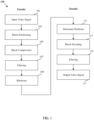
- the video signal is input into the encoder.
- the video signal may be an uncompressed video file stored in memory.
- the video file may be captured by a video capture device, such as a video camera, and encoded to support live streaming of the video.
- the video file may include both an audio component and a video component.
- the video component contains a series of image frames that, when viewed in a sequence, gives the visual impression of motion.
- the frames contain pixels that are expressed in terms of light, referred to herein as luma components (or luma samples), and color, which is referred to as chroma components (or color samples).
- the frames may also contain depth values to support three dimensional viewing.
- the video is partitioned into blocks.
- Partitioning includes subdividing the pixels in each frame into square and/or rectangular blocks for compression.
- HEVC High Efficiency Video Coding
- the frame can first be divided into coding tree units (CTUs), which are blocks of a predefined size (e.g., sixty-four pixels by sixty-four pixels).
- the CTUs contain both luma and chroma samples.
- Coding trees may be employed to divide the CTUs into blocks and then recursively subdivide the blocks until configurations are achieved that support further encoding. For example, luma components of a frame may be subdivided until the individual blocks contain relatively homogenous lighting values. Further, chroma components of a frame may be subdivided until the individual blocks contain relatively homogenous color values. Accordingly, partitioning mechanisms vary depending on the content of the video frames.
- inter-prediction and/or intra-prediction may be employed.
- Inter-prediction is designed to take advantage of the fact that objects in a common scene tend to appear in successive frames. Accordingly, a block depicting an object in a reference frame need not be repeatedly described in adjacent frames. Specifically, an object, such as a table, may remain in a constant position over multiple frames. Hence the table is described once and adjacent frames can refer back to the reference frame.
- Pattern matching mechanisms may be employed to match objects over multiple frames. Further, moving objects may be represented across multiple frames, for example due to object movement or camera movement. As a particular example, a video may show an automobile that moves across the screen over multiple frames.
- Motion vectors can be employed to describe such movement.
- a motion vector is a two-dimensional vector that provides an offset from the coordinates of an object in a frame to the coordinates of the object in a reference frame.
- inter-prediction can encode an image block in a current frame as a set of motion vectors indicating an offset from a corresponding block in a reference frame.
- Intra-prediction encodes blocks in a common frame. Intra-prediction takes advantage of the fact that luma and chroma components tend to cluster in a frame. For example, a patch of green in a portion of a tree tends to be positioned adjacent to similar patches of green. Intra-prediction employs multiple directional prediction modes (e.g., thirty-three in HEVC), a planar mode, and a direct current (DC) mode. The directional modes indicate that a current block is similar/the same as samples of a neighbor block in a corresponding direction. Planar mode indicates that a series of blocks along a row/column (e.g., a plane) can be interpolated based on neighbor blocks at the edges of the row.
- a row/column e.g., a plane
- Planar mode in effect, indicates a smooth transition of light/color across a row/column by employing a relatively constant slope in changing values.
- DC mode is employed for boundary smoothing and indicates that a block is similar/the same as an average value associated with samples of all the neighbor blocks associated with the angular directions of the directional prediction modes.
- intra-prediction blocks can represent image blocks as various relational prediction mode values instead of the actual values.
- inter-prediction blocks can represent image blocks as motion vector values instead of the actual values. In either case, the prediction blocks may not exactly represent the image blocks in some cases. Any differences are stored in residual blocks. Transforms may be applied to the residual blocks to further compress the file.
- various filtering techniques may be applied.
- the filters are applied according to an in-loop filtering scheme.
- the block based prediction discussed above may result in the creation of blocky images at the decoder. Further, the block based prediction scheme may encode a block and then reconstruct the encoded block for later use as a reference block.
- the in-loop filtering scheme iteratively applies noise suppression filters, de-blocking filters, adaptive loop filters, and sample adaptive offset (SAO) filters to the blocks/frames. These filters mitigate such blocking artifacts so that the encoded file can be accurately reconstructed. Further, these filters mitigate artifacts in the reconstructed reference blocks so that artifacts are less likely to create additional artifacts in subsequent blocks that are encoded based on the reconstructed reference blocks.
- the bitstream includes the data discussed above as well as any signaling data desired to support proper video signal reconstruction at the decoder.
- data may include partition data, prediction data, residual blocks, and various flags providing coding instructions to the decoder.
- the bitstream may be stored in memory for transmission toward a decoder upon request.
- the bitstream may also be broadcast and/or multicast toward a plurality of decoders.
- the creation of the bitstream is an iterative process. Accordingly, steps 101, 103, 105, 107, and 109 may occur continuously and/or simultaneously over many frames and blocks.
- FIG. 1 is presented for clarity and ease of discussion, and is not intended to limit the video coding process to a particular order.
- the decoder receives the bitstream and begins the decoding process at step 111. Specifically, the decoder employs an entropy decoding scheme to convert the bitstream into corresponding syntax and video data. The decoder employs the syntax data from the bitstream to determine the partitions for the frames at step 111. The partitioning should match the results of block partitioning at step 103. Entropy encoding/decoding as employed in step 111 is now described. The encoder makes many choices during the compression process, such as selecting block partitioning schemes from several possible choices based on the spatial positioning of values in the input image(s). Signaling the exact choices may employ a large number of bins.
- a bin is a binary value that is treated as a variable (e.g., a bit value that may vary depending on context).
- Entropy coding allows the encoder to discard any options that are clearly not viable for a particular case, leaving a set of allowable options.
- Each allowable option is then assigned a code word.
- the length of the code words is based on the number of allowable options (e.g., one bin for two options, two bins for three to four options, etc.)
- the encoder then encodes the code word for the selected option. This scheme reduces the size of the code words as the code words are as big as desired to uniquely indicate a selection from a small sub-set of allowable options as opposed to uniquely indicating the selection from a potentially large set of all possible options.
- the decoder then decodes the selection by determining the set of allowable options in a similar manner to the encoder. By determining the set of allowable options, the decoder can read the code word and determine the selection made by the encoder.
- the decoder performs block decoding. Specifically, the decoder employs reverse transforms to generate residual blocks. Then the decoder employs the residual blocks and corresponding prediction blocks to reconstruct the image blocks according to the partitioning.
- the prediction blocks may include both intra-prediction blocks and inter-prediction blocks as generated at the encoder at step 105.
- the reconstructed image blocks are then positioned into frames of a reconstructed video signal according to the partitioning data determined at step 111. Syntax for step 113 may also be signaled in the bitstream via entropy coding as discussed above.
- step 115 filtering is performed on the frames of the reconstructed video signal in a manner similar to step 107 at the encoder. For example, noise suppression filters, de-blocking filters, adaptive loop filters, and SAO filters may be applied to the frames to remove blocking artifacts. Once the frames are filtered, the video signal can be output to a display at step 117 for viewing by an end user.
- noise suppression filters For example, noise suppression filters, de-blocking filters, adaptive loop filters, and SAO filters may be applied to the frames to remove blocking artifacts.
- the video signal can be output to a display at step 117 for viewing by an end user.
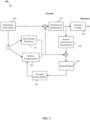
- FIG. 2 is a schematic diagram of an example coding and decoding (codec) system 200 for video coding.
- codec system 200 provides functionality to support the implementation of operating method 100.
- Codec system 200 is generalized to depict components employed in both an encoder and a decoder.
- Codec system 200 receives and partitions a video signal as discussed with respect to steps 101 and 103 in operating method 100, which results in a partitioned video signal 201.
- Codec system 200 then compresses the partitioned video signal 201 into a coded bitstream when acting as an encoder as discussed with respect to steps 105, 107, and 109 in method 100.
- codec system 200 When acting as a decoder, codec system 200 generates an output video signal from the bitstream as discussed with respect to steps 111, 113, 115, and 117 in operating method 100.
- the codec system 200 includes a general coder control component 211, a transform scaling and quantization component 213, an intra-picture estimation component 215, an intra-picture prediction component 217, a motion compensation component 219, a motion estimation component 221, a scaling and inverse transform component 229, a filter control analysis component 227, an in-loop filters component 225, a decoded picture buffer component 223, and a header formatting and context adaptive binary arithmetic coding (CABAC) component 231.
- CABAC header formatting and context adaptive binary arithmetic coding
- codec system 200 black lines indicate movement of data to be encoded/decoded while dashed lines indicate movement of control data that controls the operation of other components.
- the components of codec system 200 may all be present in the encoder.
- the decoder may include a subset of the components of codec system 200.
- the decoder may include the intra-picture prediction component 217, the motion compensation component 219, the scaling and inverse transform component 229, the in-loop filters component 225, and the decoded picture buffer component 223. These components are now described.
- the partitioned video signal 201 is a captured video sequence that has been partitioned into blocks of pixels by a coding tree.
- a coding tree employs various split modes to subdivide a block of pixels into smaller blocks of pixels. These blocks can then be further subdivided into smaller blocks.
- the blocks may be referred to as nodes on the coding tree. Larger parent nodes are split into smaller child nodes. The number of times a node is subdivided is referred to as the depth of the node/coding tree.
- the divided blocks can be included in coding units (CUs) in some cases.
- a CU can be a sub-portion of a CTU that contains a luma block, red difference chroma (Cr) block(s), and a blue difference chroma (Cb) block(s) along with corresponding syntax instructions for the CU.
- the split modes may include a binary tree (BT), triple tree (TT), and a quad tree (QT) employed to partition a node into two, three, or four child nodes, respectively, of varying shapes depending on the split modes employed.
- the partitioned video signal 201 is forwarded to the general coder control component 211, the transform scaling and quantization component 213, the intra-picture estimation component 215, the filter control analysis component 227, and the motion estimation component 221 for compression.
- the general coder control component 211 is configured to make decisions related to coding of the images of the video sequence into the bitstream according to application constraints. For example, the general coder control component 211 manages optimization of bitrate/bitstream size versus reconstruction quality. Such decisions may be made based on storage space/bandwidth availability and image resolution requests.
- the general coder control component 211 also manages buffer utilization in light of transmission speed to mitigate buffer underrun and overrun issues. To manage these issues, the general coder control component 211 manages partitioning, prediction, and filtering by the other components. For example, the general coder control component 211 may dynamically increase compression complexity to increase resolution and increase bandwidth usage or decrease compression complexity to decrease resolution and bandwidth usage.
- the general coder control component 211 controls the other components of codec system 200 to balance video signal reconstruction quality with bit rate concerns.
- the general coder control component 211 creates control data, which controls the operation of the other components.
- the control data is also forwarded to the header formatting and CABAC component 231 to be encoded in the bitstream to signal parameters for decoding at the decoder.
- the partitioned video signal 201 is also sent to the motion estimation component 221 and the motion compensation component 219 for inter-prediction.
- a frame or slice of the partitioned video signal 201 may be divided into multiple video blocks.
- Motion estimation component 221 and the motion compensation component 219 perform inter-predictive coding of the received video block relative to one or more blocks in one or more reference frames to provide temporal prediction.
- Codec system 200 may perform multiple coding passes, e.g., to select an appropriate coding mode for each block of video data.
- Motion estimation component 221 and motion compensation component 219 may be highly integrated, but are illustrated separately for conceptual purposes.
- Motion estimation performed by motion estimation component 221, is the process of generating motion vectors, which estimate motion for video blocks.
- a motion vector for example, may indicate the displacement of a coded object relative to a predictive block.
- a predictive block is a block that is found to closely match the block to be coded, in terms of pixel difference.
- a predictive block may also be referred to as a reference block.
- Such pixel difference may be determined by sum of absolute difference (SAD), sum of square difference (SSD), or other difference metrics.
- HEVC employs several coded objects including a CTU, coding tree blocks (CTBs), and CUs.
- a CTU can be divided into CTBs, which can then be divided into CBs for inclusion in CUs.
- a CU can be encoded as a prediction unit (PU) containing prediction data and/or a transform unit (TU) containing transformed residual data for the CU.
- the motion estimation component 221 generates motion vectors, PUs, and TUs by using a rate-distortion analysis as part of a rate distortion optimization process. For example, the motion estimation component 221 may determine multiple reference blocks, multiple motion vectors, etc. for a current block/frame, and may select the reference blocks, motion vectors, etc. having the best rate-distortion characteristics. The best rate-distortion characteristics balance both quality of video reconstruction (e.g., amount of data loss by compression) with coding efficiency (e.g., size of the final encoding).
- codec system 200 may calculate values for sub-integer pixel positions of reference pictures stored in decoded picture buffer component 223. For example, video codec system 200 may interpolate values of one-quarter pixel positions, one-eighth pixel positions, or other fractional pixel positions of the reference picture. Therefore, motion estimation component 221 may perform a motion search relative to the full pixel positions and fractional pixel positions and output a motion vector with fractional pixel precision. The motion estimation component 221 calculates a motion vector for a PU of a video block in an inter-coded slice by comparing the position of the PU to the position of a predictive block of a reference picture. Motion estimation component 221 outputs the calculated motion vector as motion data to header formatting and CABAC component 231 for encoding and motion to the motion compensation component 219.
- Motion compensation performed by motion compensation component 219, may involve fetching or generating the predictive block based on the motion vector determined by motion estimation component 221. Again, motion estimation component 221 and motion compensation component 219 may be functionally integrated, in some examples. Upon receiving the motion vector for the PU of the current video block, motion compensation component 219 may locate the predictive block to which the motion vector points. A residual video block is then formed by subtracting pixel values of the predictive block from the pixel values of the current video block being coded, forming pixel difference values. In general, motion estimation component 221 performs motion estimation relative to luma components, and motion compensation component 219 uses motion vectors calculated based on the luma components for both chroma components and luma components. The predictive block and residual block are forwarded to transform scaling and quantization component 213.
- the partitioned video signal 201 is also sent to intra-picture estimation component 215 and intra-picture prediction component 217.
- intra-picture estimation component 215 and intra-picture prediction component 217 may be highly integrated, but are illustrated separately for conceptual purposes.
- the intra-picture estimation component 215 and intra-picture prediction component 217 intra-predict a current block relative to blocks in a current frame, as an alternative to the inter-prediction performed by motion estimation component 221 and motion compensation component 219 between frames, as described above.
- the intra-picture estimation component 215 determines an intra-prediction mode to use to encode a current block.
- intra-picture estimation component 215 selects an appropriate intra-prediction mode to encode a current block from multiple tested intra-prediction modes. The selected intra-prediction modes are then forwarded to the header formatting and CABAC component 231 for encoding.
- Such scaling involves applying a scale factor to the residual information so that different frequency information is quantized at different granularities, which may affect final visual quality of the reconstructed video.
- the transform scaling and quantization component 213 is also configured to quantize the transform coefficients to further reduce bit rate.
- the quantization process may reduce the bit depth associated with some or all of the coefficients.
- the degree of quantization may be modified by adjusting a quantization parameter.
- the transform scaling and quantization component 213 may then perform a scan of the matrix including the quantized transform coefficients.
- the quantized transform coefficients are forwarded to the header formatting and CABAC component 231 to be encoded in the bitstream.
- the scaling and inverse transform component 229 applies a reverse operation of the transform scaling and quantization component 213 to support motion estimation.
- the scaling and inverse transform component 229 applies inverse scaling, transformation, and/or quantization to reconstruct the residual block in the pixel domain, e.g., for later use as a reference block which may become a predictive block for another current block.
- the motion estimation component 221 and/or motion compensation component 219 may calculate a reference block by adding the residual block back to a corresponding predictive block for use in motion estimation of a later block/frame. Filters are applied to the reconstructed reference blocks to mitigate artifacts created during scaling, quantization, and transform. Such artifacts could otherwise cause inaccurate prediction (and create additional artifacts) when subsequent blocks are predicted.
- the filter control analysis component 227 analyzes the reconstructed reference blocks to determine where such filters should be applied and sets corresponding parameters. Such data is forwarded to the header formatting and CABAC component 231 as filter control data for encoding.
- the in-loop filters component 225 applies such filters based on the filter control data.
- the filters may include a deblocking filter, a noise suppression filter, a SAO filter, and an adaptive loop filter. Such filters may be applied in the spatial/pixel domain (e.g., on a reconstructed pixel block) or in the frequency domain, depending on the example.
- the filtered reconstructed image block, residual block, and/or prediction block are stored in the decoded picture buffer component 223 for later use in motion estimation as discussed above.
- the decoded picture buffer component 223 stores and forwards the reconstructed and filtered blocks toward a display as part of an output video signal.
- the decoded picture buffer component 223 may be any memory device capable of storing prediction blocks, residual blocks, and/or reconstructed image blocks.
- the header formatting and CABAC component 231 receives the data from the various components of codec system 200 and encodes such data into a coded bitstream for transmission toward a decoder. Specifically, the header formatting and CABAC component 231 generates various headers to encode control data, such as general control data and filter control data. Further, prediction data, including intra-prediction and motion data, as well as residual data in the form of quantized transform coefficient data are all encoded in the bitstream.
- the final bitstream includes all information desired by the decoder to reconstruct the original partitioned video signal 201. Such information may also include intra-prediction mode index tables (also referred to as codeword mapping tables), definitions of encoding contexts for various blocks, indications of most probable intra-prediction modes, an indication of partition information, etc.
- Such data may be encoded by employing entropy coding.
- the information may be encoded by employing context adaptive variable length coding (CAVLC), CABAC, syntax-based context-adaptive binary arithmetic coding (SBAC), probability interval partitioning entropy (PIPE) coding, or another entropy coding technique.
- CAVLC context adaptive variable length coding
- CABAC syntax-based context-adaptive binary arithmetic coding
- PIPE probability interval partitioning entropy
- the coded bitstream may be transmitted to another device (e.g., a video decoder) or archived for later transmission or retrieval.
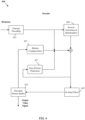
- FIG. 3 is a block diagram illustrating an example video encoder 300.
- Video encoder 300 may be employed to implement the encoding functions of codec system 200 and/or implement steps 101, 103, 105, 107, and/or 109 of operating method 100.
- Encoder 300 partitions an input video signal, resulting in a partitioned video signal 301, which is substantially similar to the partitioned video signal 201.
- the partitioned video signal 301 is then compressed and encoded into a bitstream by components of encoder 300.
- the partitioned video signal 301 is forwarded to an intra-picture prediction component 317 for intra-prediction.
- the intra-picture prediction component 317 may be substantially similar to intra-picture estimation component 215 and intra-picture prediction component 217.
- the partitioned video signal 301 is also forwarded to a motion compensation component 321 for inter-prediction based on reference blocks in a decoded picture buffer component 323.
- the motion compensation component 321 may be substantially similar to motion estimation component 221 and motion compensation component 219.
- the prediction blocks and residual blocks from the intra-picture prediction component 317 and the motion compensation component 321 are forwarded to a transform and quantization component 313 for transform and quantization of the residual blocks.
- the transform and quantization component 313 may be substantially similar to the transform scaling and quantization component 213.
- the transformed and quantized residual blocks and the corresponding prediction blocks (along with associated control data) are forwarded to an entropy coding component 331 for coding into a bitstream.
- the entropy coding component 331 may be substantially similar to the header formatting and CABAC component 231.
- the transformed and quantized residual blocks and/or the corresponding prediction blocks are also forwarded from the transform and quantization component 313 to an inverse transform and quantization component 329 for reconstruction into reference blocks for use by the motion compensation component 321.
- the inverse transform and quantization component 329 may be substantially similar to the scaling and inverse transform component 229.
- In-loop filters in an in-loop filters component 325 are also applied to the residual blocks and/or reconstructed reference blocks, depending on the example.
- the in-loop filters component 325 may be substantially similar to the filter control analysis component 227 and the in-loop filters component 225.
- the in-loop filters component 325 may include multiple filters as discussed with respect to in-loop filters component 225.
- the filtered blocks are then stored in a decoded picture buffer component 323 for use as reference blocks by the motion compensation component 321.
- the decoded picture buffer component 323 may be substantially similar to the decoded picture buffer component 223.
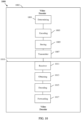
- FIG. 4 is a block diagram illustrating an example video decoder 400.
- Video decoder 400 may be employed to implement the decoding functions of codec system 200 and/or implement steps 111, 113, 115, and/or 117 of operating method 100.
- Decoder 400 receives a bitstream, for example from an encoder 300, and generates a reconstructed output video signal based on the bitstream for display to an end user.
- the bitstream is received by an entropy decoding component 433.
- the entropy decoding component 433 is configured to implement an entropy decoding scheme, such as CAVLC, CABAC, SBAC, PIPE coding, or other entropy coding techniques.
- the entropy decoding component 433 may employ header information to provide a context to interpret additional data encoded as codewords in the bitstream.
- the decoded information includes any desired information to decode the video signal, such as general control data, filter control data, partition information, motion data, prediction data, and quantized transform coefficients from residual blocks.
- the quantized transform coefficients are forwarded to an inverse transform and quantization component 429 for reconstruction into residual blocks.
- the inverse transform and quantization component 429 may be similar to inverse transform and quantization component 329.
- the reconstructed residual blocks and/or prediction blocks are forwarded to intra-picture prediction component 417 for reconstruction into image blocks based on intra-prediction operations.
- the intra-picture prediction component 417 may be similar to intra-picture estimation component 215 and an intra-picture prediction component 217. Specifically, the intra-picture prediction component 417 employs prediction modes to locate a reference block in the frame and applies a residual block to the result to reconstruct intra-predicted image blocks.
- the reconstructed intra-predicted image blocks and/or the residual blocks and corresponding inter-prediction data are forwarded to a decoded picture buffer component 423 via an in-loop filters component 425, which may be substantially similar to decoded picture buffer component 223 and in-loop filters component 225, respectively.
- the in-loop filters component 425 filters the reconstructed image blocks, residual blocks and/or prediction blocks, and such information is stored in the decoded picture buffer component 423.
- Reconstructed image blocks from decoded picture buffer component 423 are forwarded to a motion compensation component 421 for inter-prediction.
- the motion compensation component 421 may be substantially similar to motion estimation component 221 and/or motion compensation component 219. Specifically, the motion compensation component 421 employs motion vectors from a reference block to generate a prediction block and applies a residual block to the result to reconstruct an image block.
- the resulting reconstructed blocks may also be forwarded via the in-loop filters component 425 to the decoded picture buffer component 423.
- the decoded picture buffer component 423 continues to store additional reconstructed image blocks, which can be reconstructed into frames via the partition information. Such frames may also be placed in a sequence. The sequence is output toward a display as a reconstructed output video signal.
- FIG. 5 is a schematic diagram illustrating an example bitstream 500 containing multiple types of APSs including different types of coding tool parameters.
- the bitstream 500 can be generated by a codec system 200 and/or an encoder 300 for decoding by a codec system 200 and/or a decoder 400.
- the bitstream 500 may be generated by an encoder at step 109 of method 100 for use by a decoder at step 111.
- the bitstream 500 includes a sequence parameter set (SPS) 510, a plurality of picture parameter sets (PPSs) 511, a plurality of ALF APSs 512, a plurality of scaling list APSs 513, a plurality of LMCS APSs 514, a plurality of slice headers 515, and image data 520.
- SPS sequence parameter set
- PPSs picture parameter sets
- ALF APSs a plurality of picture parameter sets
- ALF APSs a plurality of scaling list APSs 513
- LMCS APSs 514 a plurality of slice headers 515
- image data 520 image data 520.
- An SPS 510 contains sequence data common to all the pictures in the video sequence contained in the bitstream 500. Such data can include picture sizing, bit depth, coding tool parameters, bit rate restrictions, etc.
- the PPS 511 contains parameters that apply to an entire picture. Hence, each picture in the video sequence may refer to a PPS 511.
- a single PPS 511 can contain data for multiple pictures in some examples. For example, multiple similar pictures may be coded according to similar parameters. In such a case, a single PPS 511 may contain data for such similar pictures.
- the PPS 511 can indicate coding tools available for slices in corresponding pictures, quantization parameters, offsets, etc.
- the slice header 515 contains parameters that are specific to each slice in a picture. Hence, there may be one slice header 515 per slice in the video sequence.
- the slice header 515 may contain slice type information, picture order counts (POCs), reference picture lists, prediction weights, tile entry points, deblocking parameters, etc. It should be noted that a slice header 515 may also be referred to as a tile group header in some contexts.
- An APS is a syntax structure containing syntax elements that apply to one or more pictures 521 and/or slices 523.
- an APS can be seperated into multiple types.
- An ALF APS 512 is an APS of type ALF that includes ALF parameters.
- An ALF is an adaptive block based filter that includes a transfer function controlled by varible parameters and employs feedback from a feedback loop to refine the transfer function. Further, the ALF is employed to correct coding artifacts (e.g., errors) that occur as a result of block based coding.
- An adaptive filter is a linear filter with a transfer function controller by variable parameters that can be controlled by an optimation algorithm, such as the RDO process operating at the encoder.
- ALF parameters included in an ALF APS 512 may include variable parameters selected by the encoder to cause the filter to remove block based coding artifacts during decoding at the decoder.
- a scaling list APS 513 is an APS of type scaling list that includes scaling list parameters.
- a current block is coded according to inter-prediction or intra-prediction which results in a residual.
- the residual is the difference between the luma and/or chroma values of the block and corresponding values of the prediction block.
- a transform is then applied to the residual to convert the residual into transform coefficients (which are smaller than the residual values). Encoding high definition and/or ultra high definition content may result in increased residual data.
- a simple transform process may result in significant quantization noise when applied to such data.
- scaling list parameters included in an scaling list APS 513 may include weighting parameters that can be applied to scale the transform matrices to account for variations in display resolutions and/or acceptible levels of quantization noise in a resulting decoded video image.
- An LMCS APS 514 is an APS of type LMCS that includes LMCS parameters, which are also known as reshaper parameters.
- the human visual system is less capable of distinguishing differences in color (e.g., chrominance) than differences in light (e.g., luminance).
- some video systems use a chroma sub-sampling mechanism to compress video data by reducing the resolution of chroma values without adjusting the corresponding luma values.
- One concern with such mechanisms is that associated interpolation can produce interpolated chroma values during decoding that are incompatible with corresponding luma values in some locations. This creates color artifacts at such locations, which should be corrected by corresponding filters. This is complicated by luma mapping mechanisms.
- Luma mapping is the process of remapping coded luma components across a dynamic range of an input luma signal (e.g., according to a peicewise linear function). This compresses the luma components.
- LMCS algorithms scale the compressed chroma values based on the luma mappings to remove artefacts related to chroma sub-sampling.
- LMCS parameters included in a LMCS APS 514 indicate the chroma scaling used to account for luma mapping.
- the LMCS parameters are determined by the encoder and can be employed by the decoder to filter out artifacts caused by chroma sub-sampling in when luma mapping is employed.
- the image data 520 contains video data encoded according to inter-prediction and/or intra-prediction as well as corresponding transformed and quantized residual data.
- a video sequence includes a plurality of pictures 521 coded as image data.
- a picture 521 is a single frame of a video sequence and hence is generally displayed as a single unit when displaying the video sequence.
- partial pictures may be displayed to implement certain technologies such as virtual reality, picture in picture, etc.
- the pictures 521 each reference a PPS 511.
- the pictures 521 are divided into slices 523.
- a slice 523 may be defined as a horizontal section of a picture 521.
- a slice 523 may contain a portion of the height of the picture 521 and the complete width of the picture 521.
- the picture 521 may be divided into columns and rows and a slice 523 may be included in a rectangular portion of the picture 521 created by such columns and rows.
- the slices 523 are sub-divided into tiles.
- the slices 523 are referred to as tile groups containing the tiles.
- the slices 523 and/or tile groups of tiles reference a slice header 515.
- the slices 523 are further divided into coding tree units (CTUs).
- the CTUs are further divided into coding blocks based on coding trees.
- the coding blocks can then be encoded/decoded according to prediction mechanisms.
- the picture 521 and/or the slice 523 may refer, directly or indirectly, to an ALF APS 512, the scaling list APS 513, and/or the LMCS APS 514 containing relevant parameters.
- a slice 523 may refer to a slice header 515.
- a picture 521 may refer to a corresponding picture header.
- the slice header 515 and/or picture header may refer to the ALF APS 512, the scaling list APS 513, and/or the LMCS APS 514 containing parameters used in coding the relevant slice 523 and/or picture 521.
- a decoder can obtain the coding tool parameters that are relevant to a slice 523 and/or picture 521 according header references related to the corresponding slice 523 and/or picture 521.
- the bitstream 500 is coded into video coding layer (VCL) NAL units 535 and non-VCL NAL units 531.
- a NAL unit is a coded data unit sized to be placed as a payload for a single packet for transmission over a network.
- a VCL NAL unit 535 is a NAL unit that contains coded video data.
- each VCL NAL unit 535 may contain one slice 523 and/or tile group of data, CTUs, and/or coding blocks.
- a non-VCL NAL unit 531 is a NAL unit that contains supporting syntax, but does not contain coded video data.
- a non-VCL NAL unit 531 may contain the SPS 510, a PPS 511, an APS, a slice header 515, etc.
- the decoder receives the bitstream 500 in discrete VCL NAL units 535 and non-VCL NAL units 531.
- An access unit is a group of VCL NAL units 535 and/or non-VCL NAL units 531 that include data sufficient to code a single picture 521.
- the ALF APS 512, the scaling list APS 513, and the LMCS APS 514 are each assigned to a separate non-VCL NAL unit 531 type.
- the ALF APS 512, the scaling list APS 513, and the LMCS APS 514 are included in an ALF APS NAL unit 532, a scaling list APS NAL unit 533, and a LMCS APS NAL unit 534, respectively.
- an ALF APS NAL unit 532 contains ALF parameters that remain in force until another ALF APS NAL unit 532 is received.
- a scaling list APS NAL unit 533 contains scaling list parameters that remain in force until another scaling list APS NAL unit 533 is received.
- a LMCS APS NAL unit 534 contains LMCS parameters that remain in force until another LMCS APS NAL unit 534 is received. In this way, there is no need to issue a new APS each time an APS parameter changes. For example, a change in LMCS parameters results in an additional LMCS APS 514, but does not result in an additional ALF APS 512 or scaling list APS 513. Accordingly, by separating APSs into different NAL unit types based on parameter type, redundant signaling of unrelated parameters is avoided. As such, separating APSs into different NAL unit types increases coding efficiency, and hence decreases usage of processor, memory, and/or network resources at the encoder and the decoder.
- a slice 523 and/or a picture 521 may directly or indirectly reference an ALF APS 512, ALF APS NAL unit 532, scaling list APS 513, scaling list APS NAL unit 533, LMCS APS 514, and/or an LMCS APS NAL unit 534 containing coding tool parameters employed to code the slice 523 and/or a picture 521.
- each APS may contain an APS ID 542 and a parameter type 541.
- the APS ID 542 is a value (e.g., a number) that identifies the corresponding APS.
- the APS ID 542 may contain a predefined number of bits.
- the APS ID 542 may increase according to a predefined sequence (e.g., increase by one) and may reset at a minimum value (e.g., zero) once the sequence reaches the end of a predefined range.
- the parameter type 541 indicates the type of parameters contained in the APS (e.g., ALF, scaling list, and/or LMCS).
- the parameter type 541 may include an APS parameter type (aps_params_type) code set to a predefined value indicating a type of parameters included in each APS.
- the parameter type 541 can be used to distinguish between an ALF APS 512, a scaling list APS 513, and an LMCS APS 514.
- the ALF APS 512, the scaling list APS 513, and the LMCS APS 514 can each be uniquely identified by a combination of a parameter type 541 and an APS ID 542.
- each APS type may include a separate value space for corresponding APS IDs 542.
- each APS type may include an APS ID 542 that increases in sequence based on a previous APS of the same type.
- the APS ID 542 for a first APS type may not be related to an APS ID 542 for a previous APS of a different second APS type.
- APS IDs 542 for different APS types may include value spaces that overlap.
- an APS of a first type can include the same APS ID 542 as an APS of a second type (e.g., a LMCS APS) in some cases.
- the codec does not need to check across APS types for APS ID 542 conflicts.
- the codec can avoid employing larger APS ID 542 values, which results in a bit savings.
- employing separate overlapping value spaces for APS IDs 542 of different APS types increases coding efficiency and hence reduces the usage of network resources, memory resources, and/or processing resources at the encoder and the decoder.
- the APS ID 542 may extend over a predefined range.
- the predefined range of the APS ID 542 may vary depending on the APS type indicated by the parameter type 541. This may allow for a different number of bits to be assigned to different APS types depending on how often parameters of different types generally change.
- the APS IDs 542 of the ALF APS 512 may have a range of zero to seven
- the APS IDs 542 of the scaling list APS 513 may have a range of zero to seven
- the APS IDs 542 of the LMCS APS 514 may have a range of zero to three.
- LMCS parameters are included in the LMCS APS 514.
- Some systems include LMCS parameters in a slice header 515.
- LMCS/reshaper parameters may change about once a second.
- Video sequences may display thirty to sixty pictures 521 per second.
- LMCS parameters may not change for thirty to sixty frames.
- Including LMCS parameters into an LMCS APS 514 significantly reduces redundant coding of LMCS parameters.
- a slice header 515 and/or a picture header associated with a slice 523 and/or picture 521, respectively can reference the relevant LMCS APS 514.
- the slice 523 and/or picture 521 then reference the slice header 515 and/or a picture header.
- the decoder may obtain the LMCS parameters for the associated slice 523 and/or picture 521.
- the LMCS parameters are only encoded when the LMCS parameters for a slice 523 and/or picture 521 change.
- employing an LMCS APS 514 to encode LMCS parameters increases coding efficiency and hence reduces the usage of network resources, memory resources, and/or processing resources at the encoder and the decoder.
- the SPS 510 may include a LMCS enabled flag 543.
- the LMCS enabled flag 543 can be set to indicate LMCS is enabled for an encoded video sequence.
- the decoder may obtain the LMCS parameters from the LMCS APS 514 based on the LMCS enabled flag 543 when the LMCS enabled flag 543 is set (e.g., to one). Further, the decoder may not attempt to obtain LMCS parameters when the LMCS enabled flag 543 is not set (e.g., to zero).
- FIG. 6 is a schematic diagram illustrating an example mechanism 600 for assigning APS IDs 642 to different APS types over different value spaces.
- mechanism 600 can be applied to a bitstream 500 to assign APS IDs 542 to ALF APS 512, scaling list APS 513, and/or LMCS APS 514.
- mechanism 600 may be applied to a codec 200, an encoder 300, and/or a decoder 400 when coding a video according to method 100.
- Mechanism 600 assigns APS IDs 642 to ALF APS 612, scaling list APS 613, and LMCS APS 614, which may be substantially similar to APS IDs 542, ALF APS 512, scaling list APS 513, and LMCS APS 514, respectively.
- the APS ID 642 may be assigned in sequence over a plurality of different value spaces where each value space is specific to the APS type. Further, each value space may extend over a different range that is specific to the APS type. In the example shown, the range of the value space of the APS ID 642 for the ALF APS 612 is from zero to seven (e.g., three bits).
- the range of the value space of the APS ID 642 for the scaling list APS 613 is from zero to seven (e.g., three bits). Also, the range of the value space of the APS ID 642 for the LMCS APS 611 is from zero to three (e.g., two bits).
- the APS ID 642 of the next APS of the corresponding type returns to the start of the range (e.g., zero).
- the previous APS is no longer active and can no longer be referenced.
- the range of a value space can be expanded to allow for more APSs of a type to be actively referenced. Further, the range of a value space can be reduced for increased coding efficiency, but such reduction also reduces the number of APSs of the corresponding type that can simultaneously remain active and available for referencing.
- each ALF APS 612, scaling list APS 613, and LMCS APS 614 are referenced by a combination of APS ID 642 and APS type.
- the ALF APS 612, the LMCS APS 614, and the scaling list APS 613 each receive an APS ID 642 of zero.
- the APS ID 642 is incremented from the value used for the previous ALF APS 612.
- the same sequence applies for the scaling list APS 613 and LMCS APS 614.
- each APS ID 642 is related to the APS ID 642 for previous APSs of the same type.
- the APS ID 642 is not related to an APS ID 642 of previous APSs of other types.
- the APS ID 642 of the ALF APS 612 increase incrementally from zero to seven and then return to zero before continuing to increment.
- the APS ID 642 of the scaling list APS 613 increase incrementally from zero to seven and then return to zero before continuing to increment.
- the APS ID 642 of the LMCS APS 611 increase incrementally from zero to three and then return to zero before continuing to increment. As shown, such value spaces are overlapping as different APSs of different APS types can share the same APS ID 642 at the same point in the video sequence.
- mechanism 600 only depicts the APS. In a bitstream, the APS depicted would be interspersed between other VCL and non-VCL NAL units, such as an SPS, PPS, slice header, picture header, slices, etc.
- the present disclosure includes improvements to the design of the APS as well as some improvements for signaling of the reshaper/LMCS parameters.
- the APS is designed for signaling of information that can be shared by multiple pictures and can include many variations.
- the reshaper/LMCS parameters are employed for an adaptive in-loop reshaper/LMCS video coding tool.
- the preceding mechanisms can be implemented as follows. In order to solve the problems listed herein, this includes several aspects that can be employed individually and/or in combination.
- the disclosed APS is modified such that multiple APSs can be used to carry different types of parameters.
- Each APS NAL unit is used to carry only one type of parameters. Consequently, two APS NAL units are encoded when two types of information are carried for a particular tile group/slice (e.g., one for each type of information).
- the APS may include an APS parameters type field in the APS syntax. Only parameters of the type indicated by the APS parameters type field can be included in the APS NAL unit.
- different types of APS parameters are indicated by different NAL unit types.
- two different NAL unit types are used for APS.
- the two types of APSs may be referred to as ALF APS and reshaper APS, respectively.
- a type of tool parameters that is carried in an APS NAL unit is specified in the NAL unit header.
- a NAL unit header has reserved bits (e.g., seven bits denoted as nuh_reserved_zero_7bits). In some examples, some of these bits (e.g., three bits out of the seven bits) may be used for specifying an APS parameter type field.
- APSs of a particular type may share the same value space for the APS IDs.
- APSs use different value spaces of the APS ID. Accordingly, two APSs of different types may co-exist and have the same value of APS ID at the same instant. Further, the combination of APS ID and APS parameters type may be employed to identify an APS from other APSs.
- the APS ID may be included in the tile group header syntax when a corresponding coding tool is enabled for the tile group. Otherwise the APS ID of the corresponding type may not be included in the tile group header.
- the APS ID of the ALF APS is included in the tile group header. For example, this can be accomplished by setting the APS parameters type field to indicate the ALF type. Accordingly, when ALF is not enabled for the tile group, the APS ID of the ALF APS is not included in the tile group header.
- the APS ID of the reshaper APS is included in the tile group header.
- the presence of APS parameters type information in an APS may be conditioned by the use of coding tools associated with the parameters.
- APS parameters type information may be not present and may instead be inferred.
- an APS can contains parameters for ALF and reshaper coding tools but only ALF is enabled (e.g., as specified by a flag in the SPS) and reshaper is not enabled (e.g., as specified by a flag in the SPS), the APS parameter type may not be signaled and can be inferred to be equal to ALF parameters.
- APS parameter type information can be inferred from the APS ID value.
- a predefined APS ID value range can be associated with a corresponding APS parameter type.
- This aspect can be implemented as follows. Instead of assigning X bits for signaling an APS ID and Y bits for signaling APS parameters type, X + Y bits can be assigned for signaling the APS ID. The different ranges of the value of the APS ID can then be specified to indicate different types of APS parameter types. For example, instead of using five bits for signaling an APS ID and three bits for signaling an APS parameters type, eight bits can be assigned for signaling an APS ID (e.g., without increasing bit costs).
- the APS ID value range from zero to sixty three indicates the APS contains parameters for ALF
- the ID value range from sixty four to ninety five indicates the APS contains parameters for reshaper
- ninety six to two hundred fifty five can be reserved for other parameters types, such as scaling list.
- the APS ID value range from zero to thirty one indicates the APS contains parameters for ALF
- the ID value range from thirty two to forty seven indicates the APS contains parameters for reshaper
- from forty eight to two hundred fifty five can be reserved for other parameters types, such as scaling list.
- the advantage of this approach is that the APS ID range can be assigned depending on the frequency of the parameter changes of each tool. For example, ALF parameters may be expected to change more frequently than reshaper parameters. In such a case, a larger APS ID range may be employed for indicating an APS is an APS containing ALF parameter.
- An ALF APS may be defined as an APS that has aps_params_type equal to ALF_APS.
- a reshaper APS (or LMCS APS) may be defined as an APS that has aps_params_type equal to MAP_APS.
- An example SPS syntax and semantics are as follows. seq_parameter_set_rbsp( ) ⁇ Descriptor ... sps_reshaper_enabled_flag u(1) ... ⁇ The sps_reshaper_enabled_flag is set equal to one to specify that reshaper is used in the coded video sequence (CVS). The sps_reshaper_enabled_flag is set equal to zero to specify that reshaper is not used in the CVS.
- the aps_params_type specifies the type of APS parameters carried in the APS as specified in the following table. Table 1 - APS parameters type codes and types of APS parameters aps_params_type Name of aps_params_type Type of APS parameters 0 ALF_APS ALF parameters 1 MAP_APS In-loop mapping (i.e., reshaper) parameters 2..7 Reserved Reserved
- tile_group_header( ) Descriptor ... if( sps_alf_enabled_flag ) ⁇ tile_group_alf_enabled_flag u(1) if( tile_group_alf_enabled_flag ) tile_group_alf_aps_id u(5) ⁇ ... if( sps_reshaper_enabled_flag) ⁇ tile_group_reshaper_enable_flag u(1) tile_group_reshaper_aps_id u(5) if( tile_group_reshaper_enable_flag && ( !
- tile_group_reshaper_chroma_residual_scale_flag u(1) ⁇ ... if( NumTilesInCurrTileGroup > 1 ) ⁇ offset_len_minus1 ue(v) for( i 0; i ⁇ NumTilesInCurrTileGroup - 1; i++ ) entry_point_offset_minus1[ i ] u(v) ⁇ byte_alignment( ) ⁇
- the tile_group_alf_aps_id specifies the adaptation_parameter_set_id of the ALF APS that the tile group refers to.
- the TemporalId of the ALF APS NAL unit having adaptation_parameter_set_id equal to tile_group_alf_aps_id shall be less than or equal to the TemporalId of the coded tile group NAL unit.
- the multiple ALF APSs with the same value of adaptation_parameter_set_id shall have the same content.
- the tile_group_reshaper_enabled_flag is set equal to one to specify that reshaper is enabled for the current tile group.
- the tile_group_reshaper_enabled_flag is set equal to zero to specify that reshaper is not enabled for the current tile group.
- the flag is inferred to be equal to zero.
- the tile_group_reshaper_aps_id specifies the adaptation_parameter_set_id of the reshaper APS that the tile group refers to.
- the TemporalId of the reshaper APS NAL unit having adaptation_parameter_set_id equal to tile_group_reshaper_aps_id shall be less than or equal to the TemporalId of the coded tile group NAL unit.
- the multiple reshaper APSs with the same value of adaptation_parameter_set_id shall have the same content.
- the tile_group_reshaper_chroma_residual_scale_flag is set equal to one to specify that chroma residual scaling is enabled for the current tile group.
- tile_group_reshaper_chroma_residual_scale_flag is set equal to zero to specify that chroma residual scaling is not enabled for the current tile group.
- the flag is inferred to be equal to zero.
- the reshaper_model_min_bin_idx specifies the minimum bin (or piece) index to be used in the reshaper construction process.
- the value of reshaper_model_min_bin_idx shall be in the range of zero to MaxBinIdx, inclusive.
- the value of MaxBinIdx shall be equal to fifteen.
- the reshaper_model_delta_max_bin_idx specifies the maximum allowed bin (or piece) index MaxBinIdx minus the maximum bin index to be used in the reshaper construction process.
- the value of reshaper_model_max_bin_idx is set equal to MaxBinIdx - reshaper_model_ delta_max_bin_idx.
- the reshaper_model_bin_delta_abs_cw_prec_minus1 plus 1 specifies the number of bits used for the representation of the syntax element reshaper_model _bin_delta_abs_CW[ i].
- the reshaper_model_bin_delta_abs_CW[ i ] specifies the absolute delta codeword value for the i-th bin.
- the reshaper_model_bin_delta_abs_CW[ i ] syntax element is represented by reshaper_model_bin_delta_abs_cw_prec_minus1 + 1 bits.
- the reshaper_model_bin_delta_sign_CW_flag[ i ] specifies the sign of reshaper_model_bin_delta_abs_CW[ i ].
- one or more of the preceding aspects may be implemented as follows.
- An example SPS syntax and semantics is as follows. seq_parameter_set_rbsp( ) ⁇ Descriptor ... sps_alf_enabled_flag u(1) ... sps_reshaper_enabled_flag u(1) ... ⁇
- the aps_params_type specifies the type of APS parameters carried in the APS as specified in the following table. Table 2 - APS parameters type codes and types of APS parameters aps_params_type Name of aps_params_type Type of APS parameters 0 ALF_APS ALF parameters 1 MAP_APS In-loop mapping (i.e., reshaper) parameters 2..7 Reserved Reserved
- aps_params_type When not present, the value of aps_params_type is inferred as follows. If ALFEnabled, aps_params_type is set to be equal to zero. Else, aps_params_type is set to be equal to one.
- the adaptation_parameter_set_id provides an identifier for the APS for reference by other syntax elements.
- APSs can be shared across pictures and can be different in different tile groups within a picture.
- the value and description of the variable APSParamsType is defined in the following table.
- tile_group_alf_aps_id specifies the adaptation_parameter_set_id of the ALF APS that the tile group refers to.
- the TemporalId of the ALF APS NAL unit having adaptation_parameter_set _id equal to tile_group_alf_aps_id shall be less than or equal to the TemporalId of the coded tile group NAL unit.
- the value of tile_group_alf_aps_id shall be in the range of zero to sixty three, inclusive.
- the multiple ALF APSs with the same value of adaptation_parameter_set_id shall have the same content.
- the tile_group_reshaper_aps_id specifies the adaptation_parameter_set_id of the reshaper APS that the tile group refers to.
- the TemporalId of the reshaper APS NAL unit having adaptation _parameter_set_id equal to tile_group_reshaper_aps_id shall be less than or equal to the TemporalId of the coded tile group NAL unit.
- tile_group_reshaper_aps_id shall be in the range of sixty four to ninety five, inclusive.
- the multiple reshaper APSs with the same value of adaptation_parameter_set_id shall have the same content.
- FIG. 7 is a schematic diagram of an example video coding device 700.
- the video coding device 700 is suitable for implementing the disclosed examples/embodiments as described herein.
- the video coding device 700 comprises downstream ports 720, upstream ports 750, and/or transceiver units (Tx/Rx) 710, including transmitters and/or receivers for communicating data upstream and/or downstream over a network.
- the video coding device 700 also includes a processor 730 including a logic unit and/or central processing unit (CPU) to process the data and a memory 732 for storing the data.
- CPU central processing unit
- the video coding device 700 may also comprise electrical, optical-to-electrical (OE) components, electrical-to-optical (EO) components, and/or wireless communication components coupled to the upstream ports 750 and/or downstream ports 720 for communication of data via electrical, optical, or wireless communication networks.
- the video coding device 700 may also include input and/or output (I/O) devices 760 for communicating data to and from a user.
- the I/O devices 760 may include output devices such as a display for displaying video data, speakers for outputting audio data, etc.
- the I/O devices 760 may also include input devices, such as a keyboard, mouse, trackball, etc., and/or corresponding interfaces for interacting with such output devices.
- the processor 730 is implemented by hardware and software.
- the processor 730 may be implemented as one or more CPU chips, cores (e.g., as a multi-core processor), field-programmable gate arrays (FPGAs), application specific integrated circuits (ASICs), and digital signal processors (DSPs).
- the processor 730 is in communication with the downstream ports 720, Tx/Rx 710, upstream ports 750, and memory 732.
- the processor 730 comprises a coding module 714.
- the coding module 714 implements the disclosed embodiments described herein, such as methods 100, 800, and 900, which may employ a bitstream 500 and/or mechanism 600.
- the coding module 714 may also implement any other method/mechanism described herein.
- the coding module 714 may implement a codec system 200, an encoder 300, and/or a decoder 400.
- the coding module 714 can encode/decode pictures in a bitstream and encode/decode parameters associated with slices of the pictures in a plurality of APSs.
- different types of parameters can be coded into different types of APSs.
- different types of APSs can be included into different NAL unit types.
- Such APS types can include ALF APS, scaling list APS, and/or LMCS APS.
- the APS can each include APS IDs.
- the APS IDs of different APS types my increase in sequence over different value spaces.
- slices and/or pictures can reference corresponding slice headers and/or picture headers.
- coding module 714 causes the video coding device 700 to provide additional functionality and/or coding efficiency when coding video data. As such, the coding module 714 improves the functionality of the video coding device 700 as well as addresses problems that are specific to the video coding arts. Further, the coding module 714 effects a transformation of the video coding device 700 to a different state. Alternatively, the coding module 714 can be implemented as instructions stored in the memory 732 and executed by the processor 730 (e.g., as a computer program product stored on a non-transitory medium).
- the memory 732 comprises one or more memory types such as disks, tape drives, solid-state drives, read only memory (ROM), random access memory (RAM), flash memory, ternary content-addressable memory (TCAM), static random-access memory (SRAM), etc.
- the memory 732 may be used as an over-flow data storage device, to store programs when such programs are selected for execution, and to store instructions and data that are read during program execution.
- FIG. 8 is a flowchart of an example method 800 of encoding a video sequence into a bitstream, such as bitstream 500, by employing a plurality of APS types, such as ALF APS 512, scaling list APS 513, and/or LMCS APS 514.
- Method 800 may be employed by an encoder, such as a codec system 200, an encoder 300, and/or a video coding device 700 when performing method 100.
- Method 800 may also assign APS IDs to APSs of different types by employing different value spaces according to mechanism 600.
- Method 800 may begin when an encoder receives a video sequence including a plurality of pictures and determines to encode that video sequence into a bitstream, for example based on user input.
- the video sequence is partitioned into pictures/images/frames for further partitioning prior to encoding.
- a slice is encoded into a bitstream as part of an encoded video sequence.
- the slice may be encoded as part of a picture.
- the slice may be encoded by encoding CTUs and/or CUs contained in the slice.
- Such CUs can be coded according to intra-prediction and/or inter-prediction.
- the encoder may code the CUs of the slice.
- the encoder may then employ a hypothetical reference decoder (HRD) to decode the coded slice and filter the decoded slice to increase the output quality of the slice.
- HRD hypothetical reference decoder
- the encoder determines parameters employed by filters applied by the HRD to increase the quality of the encoded slice. These parameters may include ALF parameters, scaling list parameters, and LMCS parameters. Determining these parameters allows the encoder to determine the parameters that should be employed for application to the slice at the decoder.
- the ALF parameters are encoded into the bitstream in a first APS NAL unit including an ALF type.
- the scaling list parameters are encoded into the bitstream in a second APS NAL unit including a scaling list type.
- the LMCS parameters are encoded into the bitstream in a third APS NAL unit including a LMCS type.
- the ALF parameters, scaling list parameters, and the LMCS parameters are each encoded into different APS by employing a plurality of different NAL unit types.
- the first APS NAL unit, the second APS NAL unit, and the third APS NAL unit may all be non-video coding layer (non-VCL) NAL units.
- a SPS may be encoded into the bitstream.
- the SPS includes a flag that can be set to indicate LMCS is enabled for the encoded video sequence including the slice. It should be noted that the flag may also be set to indicate LMCS is not enabled for the encoded video sequence. In such a case, LMCS parameters are omitted in the other steps of method 800.
- a slice header is encoded into the bitstream.
- the slice header may be associated with the slice.
- the slice references the slice header.
- the slice header may then reference the first APS NAL unit, the second APS NAL unit, and the third APS NAL unit. This ensures the decoder can determine the relevant parameters for the slice based on the reference to the slice header and the references to the various APS NAL units.
- a picture header may contain such references.
- the picture header is encoded into the bitstream at step 809. In this example, the picture containing the slice references the picture header and the picture header references the first APS NAL unit, the second APS NAL unit, and the third APS NAL unit.
- each APS is identified by a combination of a parameter type and an APS ID.
- each APS may include an APS parameter type code (e.g., aps_params _type) set to a predefined value indicating a type of parameters included in each APS.
- the aps_params_type code may be set to ALF type for the first APS NAL unit, may be set to scaling list type for the second APS NAL unit, and may be set to LMCS type for the third APS NAL unit, respectively.
- each APS may include an APS ID selected from a predefined range.
- the predefined range may be determined based on a parameter type of each APS.
- a current APS may include a current APS ID selected from a predefined range.
- the current APS ID is sequentially related to a previous APS ID associated with a previous APS of the same type as the current APS.
- the current APS ID is not related to another previous APS ID associated with another previous APS of a different type than the current APS as the sequences for the different APS types are different.
- the slice header and/or picture header of step 809 may uniquely reference the first APS NAL unit, the second APS NAL unit, and the third APS NAL unit by employing a combination of the relevant APS parameter type code and APS ID.
- bitstream is stored in memory.
- bitstream can then be communicated toward a decoder, for example via a transmitter.
- FIG. 9 is a flowchart of an example method 900 of decoding a video sequence from a bitstream, such as bitstream 500, by employing a plurality of APS types, such as ALF APS 512, scaling list APS 513, and/or LMCS APS 514.
- Method 900 may be employed by a decoder, such as a codec system 200, a decoder 400, and/or a video coding device 700 when performing method 100.
- Method 900 may also reference APS based on APS IDs assigned according to mechanism 600 where APSs of different types employ APS IDs assigned according to different value spaces.
- Method 900 may begin when a decoder begins receiving a bitstream of coded data representing a video sequence, for example as a result of method 800.
- a bitstream is received at a decoder.
- the bitstream comprises a first APS NAL unit including an ALF type, a second APS NAL unit including a scaling list type, and a third APS NAL unit including an LMCS type.
- the bitstream also comprises a slice.
- the first APS NAL unit, the second APS NAL unit, and the third APS NAL unit may all be non-video coding layer (non-VCL) NAL units.
- the bitstream may further comprise an SPS.
- a value of an LMCS enabled flag is obtained from the SPS in the bitstream.
- the flag may be set to indicate LMCS is enabled for an encoded video sequence including the slice.
- the LMCS parameters from the third APS NAL unit may be obtained at step 903 based on the value of the flag.
- the ALF parameters are obtained from the first APS NAL unit.
- the scaling list parameters are obtained from the second APS NAL unit.
- the LMCS parameters are obtained from the third APS NAL unit.
- the LMCS parameters are only obtained when the LMCS enabled flag is set to a particular value, such as a value of one.
- Obtaining parameters for the APSs can be accomplished by various mechanisms.
- the bitstream also comprises a slice header.
- the slice references the slice header.
- the slice header references the first APS NAL unit, the second APS NAL unit, and the third APS NAL unit.
- the references can be employed to locate and obtain the parameters relevant to the slice.
- the bitstream also comprises a picture header that may contain such references.
- the slice is part of a picture. In this example, the picture containing the slice references the picture header and the picture header references the first APS NAL unit, the second APS NAL unit, and the third APS NAL unit.
- each APS is identified by a combination of a parameter type and an APS ID.
- each APS may include an APS parameter type code (e.g., aps_params _type) set to a predefined value indicating a type of parameters included in each APS.
- the aps_params_type code may be set to ALF type for the first APS NAL unit, may be set to scaling list type for the second APS NAL unit, and may be set to LMCS type for the third APS NAL unit, respectively.
- each APS may include an APS ID selected from a predefined range.
- the predefined range may be determined based on a parameter type of each APS.
- a current APS may include a current APS ID selected from a predefined range.
- the current APS ID is sequentially related to a previous APS ID associated with a previous APS of the same type as the current APS.
- the current APS ID is not related to another previous APS ID associated with another previous APS of a different type than the current APS as the sequences for the different APS types are different.
- the slice header and/or picture header of step 903 may uniquely reference the first APS NAL unit, the second APS NAL unit, and the third APS NAL unit by employing a combination of the relevant APS parameter type code and APS ID.
- the slice is decoded by using the ALF parameters, the scaling list parameters, and the LMCS parameters obtained at step 903.
- the decoder can forward the slice for display as part of a decoded video sequence.
- FIG. 10 is a schematic diagram of an example system 1000 for coding a video sequence of images in a bitstream, such as bitstream 500, by employing a plurality of APS types, such as ALF APS 512, scaling list APS 513, and/or LMCS APS 514.
- System 1000 may be implemented by an encoder and a decoder such as a codec system 200, an encoder 300, a decoder 400, and/or a video coding device 700. Further, system 1000 may be employed when implementing method 100, 800, 900, and/or mechanism 600.
- the system 1000 includes a video encoder 1002.
- the video encoder 1002 comprises a determining module 1001 for determining ALF parameters, scaling list parameters, and LMCS parameters for application to a slice.
- the video encoder 1002 further comprises an encoding module 1003 for encoding the slice into a bitstream as part of an encoded video sequence.
- the encoding module 1003 is further for encoding the ALF parameters into the bitstream in a first APS NAL unit including an ALF type.
- the encoding module 1003 is further for encoding the scaling list parameters into the bitstream in a second APS NAL unit including a scaling list type.
- the encoding module 1003 is further for encoding the LMCS parameters into the bitstream in a third APS NAL unit including a LMCS type.
- the video encoder 1002 further comprises a storing module 1005 for storing the bitstream for communication toward a decoder.
- the video encoder 1002 further comprises a transmitting module 1007 for transmitting the bitstream with the first APS NAL unit, the second APS NAL unit, and the third APS NAL unit to support decoding the slices at a decoder based on the corresponding coding tool parameters.
- the video encoder 1002 may be further configured to perform any of the steps of method 800.
- the system 1000 also includes a video decoder 1010.
- the video decoder 1010 comprises a receiving module 1011 for receiving a bitstream comprising a first APS NAL unit including an ALF type, a second APS NAL unit including a scaling list type, a third APS NAL unit including a LMCS type, and a slice.
- the video decoder 1010 further comprises an obtaining module 1013 for obtaining ALF parameters from the first APS NAL unit.
- the obtaining module 1013 is further for obtaining scaling list parameters from the second APS NAL unit.
- the obtaining module 1013 is further for obtaining LMCS parameters from the third APS NAL unit.
- the video decoder 1010 further comprises a decoding module 1015 for decoding the slice using the ALF parameters, the scaling list parameters, and the LMCS parameters.
- the video decoder 1010 further comprises a forwarding module 1017 for forwarding the slice for display as part of a decoded video sequence.
- the video decoder 1010 may be further configured to perform any of the steps of method 900.
- a first component is directly coupled to a second component when there are no intervening components, except for a line, a trace, or another medium between the first component and the second component.
- the first component is indirectly coupled to the second component when there are intervening components other than a line, a trace, or another medium between the first component and the second component.
- the term “coupled” and its variants include both directly coupled and indirectly coupled. The use of the term “about” means a range including ⁇ 10% of the subsequent number unless otherwise stated.
- Embodiment 1 A method implemented in a decoder, the method comprising: receiving, by a receiver of the decoder, a bitstream comprising a first adaptation parameter set, APS, network abstraction layer, NAL, unit with an adaptive loop filter, ALF, type associated with a coded slice; obtaining, by a processor of the decoder, ALF parameters from the first APS NAL unit; and decoding, by the processor, the coded slice using the ALF parameters; wherein the bitstream further comprises a third APS NAL unit with a luma mapping with chroma scaling, LMCS, type, wherein the method further comprises obtaining, by the processor, LMCS parameters from the third APS NAL unit, and wherein the coded slice is further decoded using the LMCS parameters; wherein the bitstream comprises an ALF APS assigned to the first APS NAL and a LMCS APS assigned to the third APS NAL, wherein each APS includes an APS ID from a predefined range which is determined based
- Embodiment 2 The method of embodiment 1, wherein the bitstream further comprises a second APS NAL unit with a scaling list type, wherein the method further comprises obtaining, by the processor, scaling list parameters from the second APS NAL unit, and wherein the coded slice is further decoded using the scaling list parameters; wherein the scaling parameters are included in a scaling list for a transform process.
- Embodiment 3 The method of any of embodiments 1-2, wherein the bitstream further comprises a slice header of the coded slice, wherein the slice header references the first APS NAL unit.
- Embodiment 4 The method of any of embodiments 1-3, wherein a current APS includes a current APS identifier, ID, from a predefined range, wherein the current APS ID is sequentially related to a previous APS ID associated with a previous APS of a same type as the current APS, and wherein the current APS ID is not related to another previous APS ID associated with another previous APS of a different type than the current APS.
- ID current APS identifier
- Embodiment 5 The method of any of embodiments 1-4, wherein each APS is identified by a combination of a parameter type and an APS ID.
- Embodiment 6 The method of any of embodiments 1-5, wherein the bitstream further comprises a sequence parameter set, SPS, including a flag set to indicate ALF is enabled for an encoded video sequence including the coded slice, and wherein the ALF parameters from the first APS NAL unit are obtained based on the flag.
- SPS sequence parameter set
- Embodiment 7 A method implemented in an encoder, the method comprising: determining, by a processor of the encoder, adaptive loop filter, ALF, parameters associated with a coded slice; encoding, by the processor, a slice into a bitstream as the coded slice as part of an encoded video sequence; encoding, by the processor, the ALF parameters into a first adaptation parameter set, APS, network abstraction layer, NAL, unit with an ALF type of the bitstream; and storing, by a memory coupled to the processor, the bitstream for communication toward a decoder; the method further comprising: determining, by the processor, luma mapping with chroma scaling, LMCS, parameters for the coded slice; and encoding, by the processor, the LMCS parameters into a third APS NAL unit with a LMCS type of the bitstream; wherein the bitstream comprises an ALF APS assigned to the first APS NAL and a LMCS APS assigned to the third APS NAL, wherein each APS includes
- Embodiment 8 The method of embodiment 7, further comprising: determining, by the processor, scaling list parameters for the coded slice; wherein the scaling parameters are included in a scaling list for a transform process; and encoding, by the processor, the scaling list parameters into a second APS NAL unit with a scaling list type of the bitstream.
- Embodiment 9 The method of any of embodiments 7 and 8, further comprising encoding, by the processor, a slice header of the coded slice into the bitstream, wherein the coded slice header references the first APS NAL unit.
- Embodiment 10 The method of any of embodiments 7-9, further comprising encoding, by the processor, a sequence parameter set, SPS, into the bitstream, wherein the SPS includes a flag set to indicate ALF is enabled for the encoded video sequence including the coded slice.
- a decoder comprising: a receiving unit, configured to receive a bitstream comprising a first adaptation parameter set, APS, network abstraction layer, NAL, unit with an adaptive loop filter, ALF, type, and a third APS NAL unit with a luma mapping with chroma scaling, LMCS, type associated with a coded slice; an obtaining unit, configured to: obtain ALF parameters from the first APS NAL unit; obtain LMCS parameters from the third APS NAL unit; and a decoding unit, configured to decoded the coded slice using the ALF parameters, and the LMCS parameters; wherein the bitstream comprises an ALF APS assigned to the first APS NAL and a LMCS APS assigned to the third APS NAL, wherein each APS includes an APS ID from a predefined range which is determined based on a parameter type of the each APS, wherein the APS is a syntax structure used to signal information for slices, wherein the LMCS parameters are used for a LMCS
- Embodiment 12 The decoder of embodiment 11, wherein the decoder is further configured to perform the method of any of embodiments 1-6.
- An encoder comprising: a determining unit, configured to determine adaptive loop filter, ALF, parameters, and luma mapping with chroma scaling, LMCS, parameters associated with a coded slice; an encoding unit, configured to: encode a slice into a bitstream as the coded slice as part of an encoded video sequence; encode the ALF parameters into a first adaptation parameter set, APS, network abstraction layer, NAL, unit with an ALF type of the bitstream; encode the LMCS parameters into a third APS NAL unit with a LMCS type of the bitstream; and a storing means for storing the bitstream for communication toward a decoder; wherein the bitstream comprises an ALF APS assigned to the first APS NAL and a LMCS APS assigned to the third APS NAL, wherein each APS includes an APS ID from a predefined range which is determined based on a parameter type of the each APS, wherein the APS is a syntax structure used to signal information for slices, wherein
- Embodiment 14 The encoder of embodiment 13, wherein the encoder is further configured to perform the method of any of embodiments 7-10.
- Embodiment 15 A non-transitory storage medium which includes an encoded bitstream, the bitstream comprising a first adaptation parameter set, APS, network abstraction layer, NAL, unit with an adaptive loop filter, ALF, type associated with a coded slice, wherein the first APS NAL unit comprises ALF parameters; the bitstream further comprising a third APS NAL unit with a luma mapping with chroma scaling, LMCS, type, wherein the third APS NAL unit comprises LMCS parameters; wherein the bitstream comprises an ALF APS assigned to the first APS NAL and a LMCS APS assigned to the third APS NAL, wherein each APS includes an APS ID from a predefined range which is determined based on a parameter type of the each APS, wherein the APS is a syntax structure used to signal information for slices, wherein the LMCS parameters are used for a LMCS which is a process that scale chroma values based on luma mappings, and wherein the ALF parameters are
- Embodiment 16 A non-transitory computer-readable medium carrying a program code which, when executed by a computer device, causes the computer device to perform the method of any one of embodiments 1 to 10.
Landscapes
- Engineering & Computer Science (AREA)
- Multimedia (AREA)
- Signal Processing (AREA)
- Physics & Mathematics (AREA)
- General Physics & Mathematics (AREA)
- Theoretical Computer Science (AREA)
- Computer Networks & Wireless Communication (AREA)
- Compression Or Coding Systems Of Tv Signals (AREA)
- Two-Way Televisions, Distribution Of Moving Picture Or The Like (AREA)
- Error Detection And Correction (AREA)
Applications Claiming Priority (5)
| Application Number | Priority Date | Filing Date | Title |
|---|---|---|---|
| US201962811358P | 2019-02-27 | 2019-02-27 | |
| US201962816753P | 2019-03-11 | 2019-03-11 | |
| US201962850973P | 2019-05-21 | 2019-05-21 | |
| PCT/US2020/019918 WO2020176633A1 (en) | 2019-02-27 | 2020-02-26 | Adaptation parameter set types in video coding |
| EP20762269.7A EP3931745B1 (de) | 2019-02-27 | 2020-02-26 | Anpassung von parametersatztypen in der videocodierung |
Related Parent Applications (1)
| Application Number | Title | Priority Date | Filing Date |
|---|---|---|---|
| EP20762269.7A Division EP3931745B1 (de) | 2019-02-27 | 2020-02-26 | Anpassung von parametersatztypen in der videocodierung |
Publications (2)
| Publication Number | Publication Date |
|---|---|
| EP4498674A2 true EP4498674A2 (de) | 2025-01-29 |
| EP4498674A3 EP4498674A3 (de) | 2025-04-09 |
Family
ID=72238683
Family Applications (6)
| Application Number | Title | Priority Date | Filing Date |
|---|---|---|---|
| EP20763125.0A Active EP3931746B1 (de) | 2019-02-27 | 2020-02-26 | Kanalia-abbildung mit farbskalierungsanpassungsparameter in videokodierung |
| EP20763133.4A Active EP3931747B1 (de) | 2019-02-27 | 2020-02-26 | Anpassung von parametersatzkennzahlen in videokodierung |
| EP24213159.7A Pending EP4503604A3 (de) | 2019-02-27 | 2020-02-26 | Luma-kartierung mit parametersatz zur anpassung der chroma-skalierung in der videocodierung |
| EP24212325.5A Pending EP4498674A3 (de) | 2019-02-27 | 2020-02-26 | Codierer, decodierer und zugehörige verfahren |
| EP24215336.9A Pending EP4525441A3 (de) | 2019-02-27 | 2020-02-26 | Ein encoder , ein decoder und entsprechende methoden |
| EP20762269.7A Active EP3931745B1 (de) | 2019-02-27 | 2020-02-26 | Anpassung von parametersatztypen in der videocodierung |
Family Applications Before (3)
| Application Number | Title | Priority Date | Filing Date |
|---|---|---|---|
| EP20763125.0A Active EP3931746B1 (de) | 2019-02-27 | 2020-02-26 | Kanalia-abbildung mit farbskalierungsanpassungsparameter in videokodierung |
| EP20763133.4A Active EP3931747B1 (de) | 2019-02-27 | 2020-02-26 | Anpassung von parametersatzkennzahlen in videokodierung |
| EP24213159.7A Pending EP4503604A3 (de) | 2019-02-27 | 2020-02-26 | Luma-kartierung mit parametersatz zur anpassung der chroma-skalierung in der videocodierung |
Family Applications After (2)
| Application Number | Title | Priority Date | Filing Date |
|---|---|---|---|
| EP24215336.9A Pending EP4525441A3 (de) | 2019-02-27 | 2020-02-26 | Ein encoder , ein decoder und entsprechende methoden |
| EP20762269.7A Active EP3931745B1 (de) | 2019-02-27 | 2020-02-26 | Anpassung von parametersatztypen in der videocodierung |
Country Status (15)
| Country | Link |
|---|---|
| US (8) | US11889030B2 (de) |
| EP (6) | EP3931746B1 (de) |
| JP (7) | JP7418458B2 (de) |
| KR (6) | KR20240058982A (de) |
| CN (9) | CN120321407A (de) |
| AU (1) | AU2020227754B2 (de) |
| BR (3) | BR112021016953A2 (de) |
| DK (2) | DK3931746T3 (de) |
| ES (3) | ES3004733T3 (de) |
| HU (2) | HUE069870T2 (de) |
| MX (1) | MX2021010337A (de) |
| PL (3) | PL3931745T3 (de) |
| PT (2) | PT3931745T (de) |
| SG (3) | SG11202109287PA (de) |
| WO (3) | WO2020176636A1 (de) |
Families Citing this family (59)
| Publication number | Priority date | Publication date | Assignee | Title |
|---|---|---|---|---|
| KR20240058982A (ko) | 2019-02-27 | 2024-05-03 | 후아웨이 테크놀러지 컴퍼니 리미티드 | 인코더, 디코더 및 대응하는 방법 |
| WO2020177703A1 (en) * | 2019-03-04 | 2020-09-10 | Beijing Bytedance Network Technology Co., Ltd. | Signaling of filtering information in video processing |
| WO2020180122A1 (ko) * | 2019-03-06 | 2020-09-10 | 엘지전자 주식회사 | 조건적으로 파싱되는 alf 모델 및 리셰이핑 모델 기반 비디오 또는 영상 코딩 |
| US20220150481A1 (en) * | 2019-03-07 | 2022-05-12 | Lg Electronics Inc. | Video or image coding based on luma mapping with chroma scaling |
| CN113632462B (zh) * | 2019-03-23 | 2023-08-22 | 北京字节跳动网络技术有限公司 | 默认的环内整形参数 |
| WO2020197207A1 (ko) * | 2019-03-23 | 2020-10-01 | 엘지전자 주식회사 | 맵핑을 포함하는 필터링 기반 비디오 또는 영상 코딩 |
| CN118631993B (zh) * | 2019-04-03 | 2026-02-03 | 诺基亚技术有限公司 | 视频或图像编码方法及其装置 |
| WO2020204413A1 (ko) * | 2019-04-03 | 2020-10-08 | 엘지전자 주식회사 | 복원 픽처를 수정하는 비디오 또는 영상 코딩 |
| CN113785571B (zh) * | 2019-04-03 | 2025-01-03 | Lg电子株式会社 | 基于自适应环路滤波器的视频或图像编译 |
| CN120017845A (zh) * | 2019-04-15 | 2025-05-16 | Lg 电子株式会社 | 基于缩放列表数据的信令的视频或图像编译 |
| US11368684B2 (en) * | 2019-04-23 | 2022-06-21 | Qualcomm Incorporated | Adaptation parameter sets (APS) for adaptive loop filter (ALF) parameters |
| KR20220016839A (ko) | 2019-06-04 | 2022-02-10 | 베이징 바이트댄스 네트워크 테크놀로지 컴퍼니, 리미티드 | 기하학적 분할 모드 코딩을 갖는 모션 후보 리스트 |
| CN117395397A (zh) | 2019-06-04 | 2024-01-12 | 北京字节跳动网络技术有限公司 | 使用临近块信息的运动候选列表构建 |
| US11166033B2 (en) * | 2019-06-06 | 2021-11-02 | Qualcomm Incorporated | Adaptation parameter set in access unit in video coding |
| EP3970366B1 (de) | 2019-06-14 | 2025-12-10 | Beijing Bytedance Network Technology Co., Ltd. | Handhabung von videoeinheitsgrenzen und virtuellen grenzen |
| CN118631992A (zh) * | 2019-06-17 | 2024-09-10 | 韩国电子通信研究院 | 自适应环内滤波方法和设备 |
| CN118018728A (zh) * | 2019-06-20 | 2024-05-10 | Lg电子株式会社 | 解码和编码设备以及发送用于图像的数据的设备 |
| CN114270823B (zh) | 2019-06-24 | 2025-08-15 | Lg电子株式会社 | 基于亮度映射和色度缩放的视频或图像编码 |
| KR102863118B1 (ko) | 2019-06-24 | 2025-09-19 | 엘지전자 주식회사 | 루마 맵핑 기반 비디오 또는 영상 코딩 |
| WO2020262952A1 (ko) | 2019-06-24 | 2020-12-30 | 엘지전자 주식회사 | 루마 샘플들의 맵핑 및 크로마 샘플들의 스케일링 기반 비디오 또는 영상 코딩 |
| KR20250114576A (ko) * | 2019-07-08 | 2025-07-29 | 엘지전자 주식회사 | 스케일링 리스트 데이터의 시그널링 기반 비디오 또는 영상 코딩 |
| KR20250126151A (ko) * | 2019-07-08 | 2025-08-22 | 엘지전자 주식회사 | 스케일링 리스트 데이터 기반 영상 또는 비디오 코딩 |
| CN117478878A (zh) | 2019-07-09 | 2024-01-30 | 北京字节跳动网络技术有限公司 | 用于自适应环路滤波的样点确定 |
| EP3984223A4 (de) | 2019-07-11 | 2022-11-09 | Beijing Bytedance Network Technology Co., Ltd. | Proben-padding in einer adaptiven schleifenfilterung |
| CN114128258B (zh) | 2019-07-14 | 2023-12-22 | 北京字节跳动网络技术有限公司 | 视频编解码中的变换块尺寸的限制 |
| CN117676168A (zh) | 2019-07-15 | 2024-03-08 | 北京字节跳动网络技术有限公司 | 自适应环路滤波中的分类 |
| CN114270817B (zh) | 2019-08-20 | 2024-07-05 | 北京字节跳动网络技术有限公司 | 基于位置的系数缩放 |
| EP4014495A4 (de) | 2019-09-14 | 2022-11-02 | ByteDance Inc. | Chroma-quantisierungsparameter in der videocodierung |
| KR102707780B1 (ko) | 2019-09-18 | 2024-09-20 | 베이징 바이트댄스 네트워크 테크놀로지 컴퍼니, 리미티드 | 비디오 코딩에서 적응형 루프 필터의 2-파트 시그널링 |
| KR20220065758A (ko) | 2019-09-20 | 2022-05-20 | 베이징 바이트댄스 네트워크 테크놀로지 컴퍼니, 리미티드 | 코딩 블록의 스케일링 프로세스 |
| CN117278747A (zh) | 2019-09-22 | 2023-12-22 | 北京字节跳动网络技术有限公司 | 自适应环路滤波中的填充过程 |
| EP4035372A4 (de) * | 2019-09-23 | 2022-11-23 | Telefonaktiebolaget LM Ericsson (publ) | Segmentpositionssignalisierung mit ableitung der position von teilbildscheiben |
| JP7416921B2 (ja) * | 2019-09-24 | 2024-01-17 | ホアウェイ・テクノロジーズ・カンパニー・リミテッド | 解像度変更のためのデコードされたピクチャバッファ動作 |
| KR102721536B1 (ko) | 2019-09-27 | 2024-10-25 | 베이징 바이트댄스 네트워크 테크놀로지 컴퍼니, 리미티드 | 상이한 비디오 유닛들 간의 적응적 루프 필터링 |
| WO2021057996A1 (en) | 2019-09-28 | 2021-04-01 | Beijing Bytedance Network Technology Co., Ltd. | Geometric partitioning mode in video coding |
| WO2021072177A1 (en) | 2019-10-09 | 2021-04-15 | Bytedance Inc. | Cross-component adaptive loop filtering in video coding |
| JP7454042B2 (ja) | 2019-10-10 | 2024-03-21 | 北京字節跳動網絡技術有限公司 | 適応ループ・フィルタリングにおける利用可能でないサンプル位置でのパディング・プロセス |
| KR20220073746A (ko) | 2019-10-14 | 2022-06-03 | 바이트댄스 아이엔씨 | 비디오 처리에서 크로마 양자화 파라미터 사용 |
| WO2021083257A1 (en) | 2019-10-29 | 2021-05-06 | Beijing Bytedance Network Technology Co., Ltd. | Cross-component adaptive loop filter |
| CN114930832B (zh) | 2019-11-30 | 2025-10-28 | 抖音视界(北京)有限公司 | 跨分量自适应滤波和子块编解码 |
| WO2021118977A1 (en) | 2019-12-09 | 2021-06-17 | Bytedance Inc. | Using quantization groups in video coding |
| JP7393550B2 (ja) | 2019-12-11 | 2023-12-06 | 北京字節跳動網絡技術有限公司 | クロス成分適応ループフィルタリングのためのサンプルパディング |
| CN120639972A (zh) * | 2019-12-23 | 2025-09-12 | Lg电子株式会社 | 图像编码方法、图像解码方法和比特流发送方法 |
| CN114902657B (zh) | 2019-12-31 | 2025-06-13 | 字节跳动有限公司 | 视频编解码中的自适应颜色变换 |
| KR102750625B1 (ko) | 2020-01-05 | 2025-01-09 | 두인 비전 컴퍼니 리미티드 | 비디오 코딩을 위한 일반적인 제약 정보 |
| KR102842990B1 (ko) | 2020-01-09 | 2025-08-05 | 텔레폰악티에볼라겟엘엠에릭슨(펍) | 화상 헤더 존재 |
| WO2021143896A1 (en) | 2020-01-18 | 2021-07-22 | Beijing Bytedance Network Technology Co., Ltd. | Adaptive colour transform in image/video coding |
| US11463737B2 (en) * | 2020-02-21 | 2022-10-04 | Qualcomm Incorporated | Signaling of dynamic range adjustment parameters for decoded picture buffer management and dynamic range |
| WO2021180022A1 (en) | 2020-03-07 | 2021-09-16 | Beijing Bytedance Network Technology Co., Ltd. | Handling of transform skip mode in video coding |
| US20230188714A1 (en) * | 2020-06-10 | 2023-06-15 | Lg Electronics Inc | Image encoding/decoding method and device for signaling aps identifier, and computer-readable recording medium in which bitstream is stored |
| EP4173290A4 (de) | 2020-06-30 | 2024-01-10 | Beijing Bytedance Network Technology Co., Ltd. | Grenzposition für adaptive schleifenfilterung |
| WO2022037700A1 (en) | 2020-08-21 | 2022-02-24 | Beijing Bytedance Network Technology Co., Ltd. | Coding mode dependent selection of transform skip mode |
| US11750815B2 (en) | 2020-09-17 | 2023-09-05 | Lemon, Inc. | Versatile video coding track coding |
| US20230379460A1 (en) * | 2020-09-29 | 2023-11-23 | Telefonaktiebolaget Lm Ericsson (Publ) | Filter strength control for adaptive loop filtering |
| US11611752B2 (en) * | 2020-10-07 | 2023-03-21 | Lemon Inc. | Adaptation parameter set storage in video coding |
| CN116601953A (zh) | 2020-11-24 | 2023-08-15 | 抖音视界有限公司 | 编解码视频中的位置相关系数重新排序 |
| CN116803087A (zh) * | 2021-02-02 | 2023-09-22 | 索尼集团公司 | 信息处理装置和信息处理方法 |
| CN117121481A (zh) | 2021-03-17 | 2023-11-24 | 抖音视界有限公司 | 单独树编解码限制 |
| USD950521S1 (en) * | 2021-05-11 | 2022-05-03 | Shenzhen Jing Peng Xing Electronic Technology Co., Ltd. | Headphone |
Family Cites Families (18)
| Publication number | Priority date | Publication date | Assignee | Title |
|---|---|---|---|---|
| CN103370936A (zh) * | 2011-04-21 | 2013-10-23 | 联发科技股份有限公司 | 用于改进环内滤波的方法与装置 |
| US8891630B2 (en) * | 2011-10-24 | 2014-11-18 | Blackberry Limited | Significance map encoding and decoding using partition set based context assignment |
| CN103096054B (zh) * | 2011-11-04 | 2015-07-08 | 华为技术有限公司 | 一种视频图像滤波处理方法和装置 |
| US20130114694A1 (en) * | 2011-11-08 | 2013-05-09 | Qualcomm Incorporated | Parameter set groups for coded video data |
| US9451252B2 (en) * | 2012-01-14 | 2016-09-20 | Qualcomm Incorporated | Coding parameter sets and NAL unit headers for video coding |
| WO2013109505A2 (en) * | 2012-01-19 | 2013-07-25 | Vid Scale, Inc. | Methods, apparatus and systems for signaling video coding adaptation parameters |
| GB2501535A (en) * | 2012-04-26 | 2013-10-30 | Sony Corp | Chrominance Processing in High Efficiency Video Codecs |
| EP2853096A4 (de) * | 2012-05-21 | 2016-07-06 | Mediatek Singapore Pte Ltd | Verfahren und vorrichtung zur zwischenschichtfilterung zur skalierbaren videocodierung |
| EP3120553B1 (de) * | 2014-03-17 | 2022-02-23 | Nokia Technologies Oy | Vorrichtung, verfahren und computerprogramm zur codierung und decodierung von videoinhalten |
| US10992941B2 (en) * | 2017-06-29 | 2021-04-27 | Dolby Laboratories Licensing Corporation | Integrated image reshaping and video coding |
| CN113475079B (zh) * | 2019-02-01 | 2026-03-24 | 北京字节跳动网络技术有限公司 | 环路整形和帧内块复制之间的相互作用 |
| AU2020214946B2 (en) * | 2019-02-01 | 2023-06-08 | Beijing Bytedance Network Technology Co., Ltd. | Interactions between in-loop reshaping and inter coding tools |
| KR20240058982A (ko) | 2019-02-27 | 2024-05-03 | 후아웨이 테크놀러지 컴퍼니 리미티드 | 인코더, 디코더 및 대응하는 방법 |
| WO2020197207A1 (ko) * | 2019-03-23 | 2020-10-01 | 엘지전자 주식회사 | 맵핑을 포함하는 필터링 기반 비디오 또는 영상 코딩 |
| US11683487B2 (en) * | 2019-03-26 | 2023-06-20 | Qualcomm Incorporated | Block-based adaptive loop filter (ALF) with adaptive parameter set (APS) in video coding |
| CN118631993B (zh) * | 2019-04-03 | 2026-02-03 | 诺基亚技术有限公司 | 视频或图像编码方法及其装置 |
| WO2020262952A1 (ko) * | 2019-06-24 | 2020-12-30 | 엘지전자 주식회사 | 루마 샘플들의 맵핑 및 크로마 샘플들의 스케일링 기반 비디오 또는 영상 코딩 |
| KR20250126151A (ko) * | 2019-07-08 | 2025-08-22 | 엘지전자 주식회사 | 스케일링 리스트 데이터 기반 영상 또는 비디오 코딩 |
-
2020
- 2020-02-26 KR KR1020247013536A patent/KR20240058982A/ko active Pending
- 2020-02-26 HU HUE20762269A patent/HUE069870T2/hu unknown
- 2020-02-26 ES ES20763133T patent/ES3004733T3/es active Active
- 2020-02-26 WO PCT/US2020/019921 patent/WO2020176636A1/en not_active Ceased
- 2020-02-26 PL PL20762269.7T patent/PL3931745T3/pl unknown
- 2020-02-26 CN CN202510272022.1A patent/CN120321407A/zh active Pending
- 2020-02-26 CN CN202510430556.2A patent/CN120499372A/zh active Pending
- 2020-02-26 ES ES20763125T patent/ES3033548T3/es active Active
- 2020-02-26 JP JP2021550020A patent/JP7418458B2/ja active Active
- 2020-02-26 JP JP2021550021A patent/JP7418459B2/ja active Active
- 2020-02-26 MX MX2021010337A patent/MX2021010337A/es unknown
- 2020-02-26 CN CN202510272445.3A patent/CN120321408A/zh active Pending
- 2020-02-26 KR KR1020217030764A patent/KR102794434B1/ko active Active
- 2020-02-26 AU AU2020227754A patent/AU2020227754B2/en active Active
- 2020-02-26 EP EP20763125.0A patent/EP3931746B1/de active Active
- 2020-02-26 DK DK20763125.0T patent/DK3931746T3/da active
- 2020-02-26 CN CN202080017344.7A patent/CN113508397A/zh active Pending
- 2020-02-26 CN CN202510437648.3A patent/CN120499373A/zh active Pending
- 2020-02-26 CN CN202510272560.0A patent/CN120321409A/zh active Pending
- 2020-02-26 EP EP20763133.4A patent/EP3931747B1/de active Active
- 2020-02-26 SG SG11202109287PA patent/SG11202109287PA/en unknown
- 2020-02-26 EP EP24213159.7A patent/EP4503604A3/de active Pending
- 2020-02-26 BR BR112021016953A patent/BR112021016953A2/pt unknown
- 2020-02-26 BR BR112021016925A patent/BR112021016925A2/pt unknown
- 2020-02-26 CN CN202080017445.4A patent/CN113498522A/zh active Pending
- 2020-02-26 CN CN202080017295.7A patent/CN113508396A/zh active Pending
- 2020-02-26 PL PL20763125.0T patent/PL3931746T3/pl unknown
- 2020-02-26 ES ES20762269T patent/ES3004732T3/es active Active
- 2020-02-26 BR BR112021016895A patent/BR112021016895A2/pt unknown
- 2020-02-26 KR KR1020257011268A patent/KR20250052488A/ko active Pending
- 2020-02-26 WO PCT/US2020/019920 patent/WO2020176635A1/en not_active Ceased
- 2020-02-26 WO PCT/US2020/019918 patent/WO2020176633A1/en not_active Ceased
- 2020-02-26 EP EP24212325.5A patent/EP4498674A3/de active Pending
- 2020-02-26 SG SG11202109285VA patent/SG11202109285VA/en unknown
- 2020-02-26 KR KR1020257011267A patent/KR20250052487A/ko active Pending
- 2020-02-26 DK DK20762269.7T patent/DK3931745T3/da active
- 2020-02-26 KR KR1020217030682A patent/KR102661416B1/ko active Active
- 2020-02-26 EP EP24215336.9A patent/EP4525441A3/de active Pending
- 2020-02-26 PL PL20763133.4T patent/PL3931747T3/pl unknown
- 2020-02-26 CN CN202510280234.4A patent/CN120321410A/zh active Pending
- 2020-02-26 PT PT207622697T patent/PT3931745T/pt unknown
- 2020-02-26 PT PT207631250T patent/PT3931746T/pt unknown
- 2020-02-26 SG SG11202109325VA patent/SG11202109325VA/en unknown
- 2020-02-26 JP JP2021550022A patent/JP7422159B2/ja active Active
- 2020-02-26 KR KR1020217030828A patent/KR102794435B1/ko active Active
- 2020-02-26 HU HUE20763125A patent/HUE071122T2/hu unknown
- 2020-02-26 EP EP20762269.7A patent/EP3931745B1/de active Active
-
2021
- 2021-08-27 US US17/459,779 patent/US11889030B2/en active Active
- 2021-08-27 US US17/459,806 patent/US11895294B2/en active Active
- 2021-08-27 US US17/459,789 patent/US12348739B2/en active Active
-
2023
- 2023-11-02 JP JP2023188954A patent/JP7725800B2/ja active Active
- 2023-11-02 JP JP2023188951A patent/JP7651653B2/ja active Active
- 2023-11-02 JP JP2023188953A patent/JP7725799B2/ja active Active
- 2023-12-18 US US18/544,105 patent/US12464143B2/en active Active
- 2023-12-20 US US18/390,930 patent/US12250376B2/en active Active
-
2025
- 2025-01-15 US US19/022,751 patent/US20250234014A1/en active Pending
- 2025-03-13 JP JP2025040034A patent/JP7844696B2/ja active Active
- 2025-06-06 US US19/231,206 patent/US20250301157A1/en active Pending
- 2025-10-22 US US19/366,226 patent/US20260046426A1/en active Pending
Also Published As
Similar Documents
| Publication | Publication Date | Title |
|---|---|---|
| US12464143B2 (en) | Adaptation parameter set types in video coding | |
| US12309409B2 (en) | ALF APS constraints in video coding | |
| CA3151525C (en) | Alf aps constraints in video coding |
Legal Events
| Date | Code | Title | Description |
|---|---|---|---|
| PUAI | Public reference made under article 153(3) epc to a published international application that has entered the european phase |
Free format text: ORIGINAL CODE: 0009012 |
|
| STAA | Information on the status of an ep patent application or granted ep patent |
Free format text: STATUS: THE APPLICATION HAS BEEN PUBLISHED |
|
| AC | Divisional application: reference to earlier application |
Ref document number: 3931745 Country of ref document: EP Kind code of ref document: P |
|
| AK | Designated contracting states |
Kind code of ref document: A2 Designated state(s): AL AT BE BG CH CY CZ DE DK EE ES FI FR GB GR HR HU IE IS IT LI LT LU LV MC MK MT NL NO PL PT RO RS SE SI SK SM TR |
|
| REG | Reference to a national code |
Ref country code: DE Ref legal event code: R079 Free format text: PREVIOUS MAIN CLASS: H04N0019117000 Ipc: H04B0001660000 |
|
| PUAL | Search report despatched |
Free format text: ORIGINAL CODE: 0009013 |
|
| AK | Designated contracting states |
Kind code of ref document: A3 Designated state(s): AL AT BE BG CH CY CZ DE DK EE ES FI FR GB GR HR HU IE IS IT LI LT LU LV MC MK MT NL NO PL PT RO RS SE SI SK SM TR |
|
| RIC1 | Information provided on ipc code assigned before grant |
Ipc: H04N 19/117 20140101ALI20250304BHEP Ipc: H04N 19/70 20140101ALI20250304BHEP Ipc: H04B 1/66 20060101AFI20250304BHEP |
|
| STAA | Information on the status of an ep patent application or granted ep patent |
Free format text: STATUS: REQUEST FOR EXAMINATION WAS MADE |
|
| 17P | Request for examination filed |
Effective date: 20251009 |