EP4497748A1 - Improved multicomponent crystals of tocopherol mixtures and process of making - Google Patents
Improved multicomponent crystals of tocopherol mixtures and process of making Download PDFInfo
- Publication number
- EP4497748A1 EP4497748A1 EP23187383.7A EP23187383A EP4497748A1 EP 4497748 A1 EP4497748 A1 EP 4497748A1 EP 23187383 A EP23187383 A EP 23187383A EP 4497748 A1 EP4497748 A1 EP 4497748A1
- Authority
- EP
- European Patent Office
- Prior art keywords
- formula
- tocopherol
- active
- molecules
- further preferred
- Prior art date
- Legal status (The legal status is an assumption and is not a legal conclusion. Google has not performed a legal analysis and makes no representation as to the accuracy of the status listed.)
- Withdrawn
Links
Images





Classifications
-
- C—CHEMISTRY; METALLURGY
- C07—ORGANIC CHEMISTRY
- C07D—HETEROCYCLIC COMPOUNDS
- C07D311/00—Heterocyclic compounds containing six-membered rings having one oxygen atom as the only hetero atom, condensed with other rings
- C07D311/02—Heterocyclic compounds containing six-membered rings having one oxygen atom as the only hetero atom, condensed with other rings ortho- or peri-condensed with carbocyclic rings or ring systems
- C07D311/04—Benzo[b]pyrans, not hydrogenated in the carbocyclic ring
- C07D311/58—Benzo[b]pyrans, not hydrogenated in the carbocyclic ring other than with oxygen or sulphur atoms in position 2 or 4
- C07D311/70—Benzo[b]pyrans, not hydrogenated in the carbocyclic ring other than with oxygen or sulphur atoms in position 2 or 4 with two hydrocarbon radicals attached in position 2 and elements other than carbon and hydrogen in position 6
- C07D311/72—3,4-Dihydro derivatives having in position 2 at least one methyl radical and in position 6 one oxygen atom, e.g. tocopherols
-
- A—HUMAN NECESSITIES
- A23—FOODS OR FOODSTUFFS; TREATMENT THEREOF, NOT COVERED BY OTHER CLASSES
- A23K—FODDER
- A23K20/00—Accessory food factors for animal feeding-stuffs
- A23K20/10—Organic substances
- A23K20/111—Aromatic compounds
-
- A—HUMAN NECESSITIES
- A23—FOODS OR FOODSTUFFS; TREATMENT THEREOF, NOT COVERED BY OTHER CLASSES
- A23K—FODDER
- A23K20/00—Accessory food factors for animal feeding-stuffs
- A23K20/10—Organic substances
- A23K20/116—Heterocyclic compounds
- A23K20/121—Heterocyclic compounds containing oxygen or sulfur as hetero atom
-
- A—HUMAN NECESSITIES
- A23—FOODS OR FOODSTUFFS; TREATMENT THEREOF, NOT COVERED BY OTHER CLASSES
- A23K—FODDER
- A23K20/00—Accessory food factors for animal feeding-stuffs
- A23K20/10—Organic substances
- A23K20/174—Vitamins
-
- A—HUMAN NECESSITIES
- A23—FOODS OR FOODSTUFFS; TREATMENT THEREOF, NOT COVERED BY OTHER CLASSES
- A23L—FOODS, FOODSTUFFS OR NON-ALCOHOLIC BEVERAGES, NOT OTHERWISE PROVIDED FOR; PREPARATION OR TREATMENT THEREOF
- A23L33/00—Modifying nutritive qualities of foods; Dietetic products; Preparation or treatment thereof
- A23L33/10—Modifying nutritive qualities of foods; Dietetic products; Preparation or treatment thereof using additives
- A23L33/15—Vitamins
-
- C—CHEMISTRY; METALLURGY
- C07—ORGANIC CHEMISTRY
- C07C—ACYCLIC OR CARBOCYCLIC COMPOUNDS
- C07C229/00—Compounds containing amino and carboxyl groups bound to the same carbon skeleton
- C07C229/02—Compounds containing amino and carboxyl groups bound to the same carbon skeleton having amino and carboxyl groups bound to acyclic carbon atoms of the same carbon skeleton
- C07C229/04—Compounds containing amino and carboxyl groups bound to the same carbon skeleton having amino and carboxyl groups bound to acyclic carbon atoms of the same carbon skeleton the carbon skeleton being acyclic and saturated
- C07C229/06—Compounds containing amino and carboxyl groups bound to the same carbon skeleton having amino and carboxyl groups bound to acyclic carbon atoms of the same carbon skeleton the carbon skeleton being acyclic and saturated having only one amino and one carboxyl group bound to the carbon skeleton
- C07C229/10—Compounds containing amino and carboxyl groups bound to the same carbon skeleton having amino and carboxyl groups bound to acyclic carbon atoms of the same carbon skeleton the carbon skeleton being acyclic and saturated having only one amino and one carboxyl group bound to the carbon skeleton the nitrogen atom of the amino group being further bound to acyclic carbon atoms or to carbon atoms of rings other than six-membered aromatic rings
- C07C229/12—Compounds containing amino and carboxyl groups bound to the same carbon skeleton having amino and carboxyl groups bound to acyclic carbon atoms of the same carbon skeleton the carbon skeleton being acyclic and saturated having only one amino and one carboxyl group bound to the carbon skeleton the nitrogen atom of the amino group being further bound to acyclic carbon atoms or to carbon atoms of rings other than six-membered aromatic rings to carbon atoms of acyclic carbon skeletons
Definitions
- synthetic ⁇ -tocopherol or DL- ⁇ -tocopherol is also named all-rac ⁇ -tocopherol.
- All-rac ⁇ -tocopherol has three stereocenters viz. at position 2, 4' and 8'as shown in formula (3) and thus it can form the eight stereoisomers having the following conformation: RRR, RRS, RSS, SSS, RSR, SRS, SRR and SSR.
- DL- ⁇ -tocopherol as well as all-rac ⁇ -tocopherol are synthetically produced mixtures of Vitamin E active compounds or actives of formula (3). They are highly viscous oils, which are sensitive to oxidation and thus not stable for extended storage. Taking into account this sensitivity towards oxygen, stemming from the OH-group in position 6 of the aromatic ring of DL- ⁇ -tocopherol as well as all-rac ⁇ -tocopherol, both shown in formula (3), successful attempts were made to protect said OH group of said actives against oxidation by means of esterification.
- Vitamin E activity is not only the compound mixtures of formula (3) but rather the mixtures of the larger group of DL- ⁇ -tocopherol, all-rac ⁇ -tocopherol and their respective esters, all of which are grouped under formula (1) with R being at least one selected from the group consisting of H, COCH 3 , COCH 2 CH 3 , CO(CH 2 ) 14 CH 3 , CO(CH 2 ) 16 CH 3 and with the methyl groups in position 2, 4', 8' respectively having a S-configuration or a R-configuration.
- the actives or active mixtures of formula (1) are either highly viscous oils difficult to handle and to formulate or fragile solids. All of them are light-sensitive and degrade upon application of elevated temperatures. They do not exhibit characteristics of a fine powder and unfavorably tend for clumping or caking. In order to preserve the mixtures of formula (1) from oxidation or degradation by light or high temperature and to achieve non-hygroscopic defined solids, sophisticated formulation technology is needed to produce a lasting free flowing powder. To obtain good formulation properties carbohydrates, colloids and/or silica are generally used as adjuvants in an expensive spray drying or beadlet process.
- the tocopherol comprises natural tocopherol and synthetic tocopherol, the natural tocopherol comprises ⁇ -, ⁇ -, ⁇ -, ⁇ -tocopherols and ⁇ -, ⁇ -, ⁇ -tocotrienols; the synthetic tocopherol comprises DL- ⁇ -tocopherols.” (cf. claim 2).
- proline is D-proline, or L-proline, or a racemic mixture of the both.” (cf. para 7 of ⁇ 657) and "The proline comprises D-proline, or L-proline, or a racemic mixture of the both.” (cf. claim 2).
- the invention intends to overcome the drawbacks of the prior art.
- it is an object of the invention to obtain a more homogeneous or higher structured and thus more stable multi-component crystal.
- Another object of the invention is to obtain this more stable multicomponent crystal not from D- ⁇ -tocopherol but from a mixture of at least two molecules of formula (1) or of formula (3).
- Yet another inventive object is to obtain a multicomponent crystal which remains stable at higher temperatures than in those disclosed the prior art.
- a further inventive objective is to obtain a multicomponent crystal, which is free flowable and does not clot. It shall not tend to be hygroscopic, even after storage periods over weeks and months.
- Another object is to provide a multicomponent crystal, which can be readily formulated into a composition of the invention.
- Yet another object is to obtain a multicomponent crystal, in which the bioavailability is as in the mixture of formula (1) or of formula (3) prior to crystallization or is only slightly reduced with respect to the uncrystallized mixture of formula
- Yet another object of the invention is to provide a composition comprising the multicomponent crystal.
- Said composition shall be timely obtained. It shall exhibit at least the performance characteristics of state-of-the-art formulations of DL- ⁇ -tocopherol or of all-rac ⁇ -tocopherol and even perform better. Said composition shall have the same or a better bioavailability as prior art DL- ⁇ -tocopherol or of all-rac ⁇ -tocopherol compositions. It shall exhibit at least identical and even better rheology characteristics/flowability than art prior art DL- ⁇ -tocopherol or of all-rac ⁇ -tocopherol compositions. Another object of the invention shall be to design said composition such that it can be made with low cost.
- Said multicomponent crystal comprising as active a mixture of at least two molecules of formula (1) and a crystallizing agent (2), which exhibits the property of being suitable to form ions and/or contains a H-bond donor and/or contains a H-bond acceptor and/or being suitable to form a zwitterionic structure and/or having a molecular weight, which ranges from 100 g/mol to 135 g/mol, with the proviso that the combination of proline as crystallizing agent (2) and tocopherol as active is excluded from the teaching of this embodiment, gives rise to advantages in comparison to neat DL- ⁇ -tocopherol or DL- ⁇ -tocopherol L-proline co-crystal with respect to flowability, stability, hygroscopicity, storage stability, bio-availability, purity, purification.
- the new multicomponent crystal in solid form is stable at higher temperatures compared to those of the prior art. It is obtained as fines. It has for example better flowability without clotting, lower hygroscopicity even after storage periods over weeks and months, better storage stability, higher purity and better purification properties.
- the inventive multicomponent crystal does not require any further purification and can be directly formulated into a composition. Compared to compositions of the prior art containing an active of formula (1) or of formula (3) the inventive multicomponent crystal preferably exhibits higher bioavailability and bioavailability with less variability.
- the bioavailability of the mixture of formula (1) or of formula (3) in the new multicomponent crystal is higher, comparable or only slightly lower than this one of the uncrystallized mixture of formula (1) or of formula (3).
- Proline as understood within the phrasing "with the proviso that the combination of proline as crystallizing agent (2) and tocopherol as active is excluded from the teaching of this embodiment.” means proline to comprise D-proline, or L-proline, or a racemic mixture of the both.
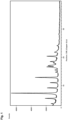
- the multicomponent crystal of the invention has a powder x-ray diffraction pattern (PXRD pattern) with at least one characteristic peak expressed in °2 ⁇ ⁇ 0.2 °2 ⁇ (CuKa radiation), which is selected from the peaks located at 5.5, 7.4, 9.2, 12.9, 16.7 and 20.4, preferably it has a powder x-ray diffraction pattern (PXRD pattern) with at least three characteristic peaks expressed in °2 ⁇ ⁇ 0.2 °2 ⁇ (CuKa radiation), which are selected from the peaks located at 5.5, 7.4, 9.2, 12.9, 16.7 and 20.4, further preferred it has a powder x-ray diffraction pattern (PXRD pattern) with the following characteristic peaks expressed in °2 ⁇ ⁇ 0. 2 °2 ⁇ (CuKa radiation) and located at 5.5, 7.4, 9.2, 12.9, 16.7 and 20.4.
- PXRD pattern powder x-ray diffraction pattern
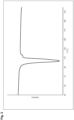
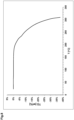
- thermogravimetric analysis (TGA) results of example 1 and Fig. 2 showing a high temperature of decomposition T D of 200 °C and by the high onset temperature T O of 98 °C, the high peak temperature T P of 103 °C and the high phase transition enthalpy ⁇ H of 82 J/g as given in example 1 and Fig.
- a further advanced embodiment of the inventive multicomponent crystal has a powder x-ray diffraction pattern (PXRD pattern) with at least one characteristic peak expressed in °2 ⁇ ⁇ 0.2 °2 ⁇ (CuKa radiation), which is selected from the peaks located at 3,7, 5.5, 7.4, 9.2, 11,1 12.9, 14,8, 15,6, 16.7, 17,0, 18,1, 18,5, 20.4, 21,8 and 24,2, preferably it has a powder x-ray diffraction pattern (PXRD pattern) with at least three characteristic peaks expressed in °2 ⁇ ⁇ 0.2 °2 ⁇ (CuKa radiation), which are selected from the peaks located at 3.7, 5.5, 7.4, 9.2, 11.1 12.9, 14.8, 15.6, 16.7, 17.0, 18.1, 18.5, 20.4, 21.8 and 24.2, further preferred it has a powder x-ray diffraction pattern (PXRD pattern) with the following characteristic peaks expressed in °2 ⁇ ⁇ 0.2 °2 ⁇ (CuKa radiation) and located at 3.7, 5.5
- Co-crystals of the prior art still comprise as non-crystallized matter free D/L- ⁇ -tocopherol as shown in comparative example 9.
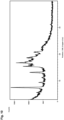
- Non crystallized matter can be any active of formula (1) or of formula (3), which does not get appropriately located in the ordered structure of a crystal or sticks in an amorphous way either to its surface and/or in holes, gaps or interstitials of a less ordered or partially amorphous crystal. This likewise contributes to make the crystal less homogeneous and less structured as can be seen in the powder x-ray diffraction diagrams (PXRD) of Fig. 10 compared to Fig. 1 and Fig. 4 , Fig. 10 exhibiting a greater background especially in the middle of the diagram.
- PXRD powder x-ray diffraction diagrams
- the inventive multicomponent crystal presents a highly ordered structure and only a small to no amount of excess or not crystallized active is present. Only then, elevated onset temperatures T o , peak temperatures T p and phase transition enthalpies ⁇ H can be observed.
- thermogravimetric analysis TGA
- TGA thermogravimetric analysis
- a process for preparing a multicomponent crystal of the invention from at least two solids or from at least one solid and at least one liquid comprises the steps:
- Proline as understood within the phrasing "with the proviso that the combination of proline as crystallizing agent (2) and tocopherol as active is excluded from the teaching of this process.” means proline to comprise D-proline, or L-proline, or a racemic mixture of the both.
- a solvent is understood to be any solvent which solubilizes at least the active, but also the active and the crystallizing agent (2).
- Appropriate solvents are selected form the group consisting of methanol, ethanol, iso-propanol, heptane, acetonitrile and ethyl acetate and mixtures thereof.
- An antisolvent is meant to be each solvent, which reduces the amount of solubilized active and/or of solubilized crystallizing agent (2) or completely prevents solubilization of the active and/or of the crystallizing agent (2).
- An antisolvent is understood to be a solvent that causes precipitation when added to a solution in another solvent. Nitromethane or water is used as antisolvent.
- step vi) Incubating in step vi) is meant to leave the mixture of step v) with or without stirring at a reduced temperature, preferably at the temperature at which it was cooled in step v).
- An active solubilization solvent is a solvent which solubilizes either the active or the crystallizing agent (2) or both of them.
- the special feature of the active solubilization solvent is, that it is used prior to the process as disclosed in claim 10.
- Appropriate solvents are selected form the group consisting of methanol, ethanol, iso-propanol, heptane, acetonitrile and ethyl acetate and mixtures thereof.
- capsules may be composed for example of hard or soft gelatin.
- Part of the invention is also a composition comprising the multicomponent crystal as defined in at least one of the embodiments mentioned supra or as obtained in at least one of the process embodiments as previously defined and at least one dietary acceptable constituent.
- composition preferably a pharmaceutical composition further comprising at least one pharmaceutically acceptable carrier, and/or at least one diluent, and/or further ingredients, and/or at least one pharmaceutical excipient.
- the composition in one extension is a pre-formulation, an oral formulation, a solid formulation such as a powder, a capsule, a tablet, a pill, a troche or a liquid suspension formulation.
- a further important aspect of the invention is the use of a multicomponent crystal as previously defined or as obtained in a process as identified supra, or the use of the above disclosed composition in a food formulation or a feed formulation or in a pharmaceutical preparation.
- room temperature depicts a temperature from the range 22-25 °C
- ambient temperature is defined as 25 ⁇ 10 °C and percentages are given by weight, if not indicated otherwise.
- the measurements were carried out with a Panalytical X'Pert Pro diffractometer (manufacturer: Panalytical) using Cu K ⁇ radiation in the Bragg-Brentano reflection geometry. Generally, the 2 ⁇ values are accurate within an error of ⁇ 0.1-0.2°. The relative peak intensities can vary considerably for different samples of the same crystalline form because of different preferred orientations of the crystals.
- TGA data were recorded with a TG/DTA 7200 (SII Nano Technology Inc).
- the samples were placed in platinum standard pans.
- the sample size in each case was 2 to 10 mg.
- the heating rate was 10°C/min.
- the samples were purged with a stream of synthetic air during the experiment.
- DSC Differential scanning calorimetry
- DSC data were recorded with a Mettler Toledo DSC 823e/700/229 module.
- the samples were placed in aluminum standard pans.
- the sample size in each case was 1 to 10 mg.
- the heating rate was 10°C/min.
- the samples were purged with a stream of nitrogen during the experiment. The onset point of the endothermic event is reported as melting point.
- ATR-IR spectra were measured at room temperature on Nicolet iS50_2. 32 scans with a resolution of 4 cm -1 measured in the range 4000 cm -1 to 400 cm -1 .
- the all-rac - ⁇ -tocopherol - betaine co-crystal 2:1 is prepared from all-rac ⁇ -tocopherol and betaine.
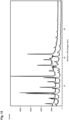
- the PXRD pattern is displayed in Figure 1 .
- Characteristic PXRD peaks (expressed in °2 ⁇ ⁇ 0.2 °2 ⁇ ; Cu K ⁇ radiation) are observed at 3.7, 5.5, 7.4, 9.2, 11.1, 12.9, 14.8, 15.6, 16.7, 17.0, 18.1, 18.5, 20.4, 21.8 and 24.2.
- the ATR-IR data is presented in Fig. 6 . Characteristic peaks are observed at 2953, 2897, 1647, 1639, 1223, 1029 and 721 cm -1 .
- TG data show no significant weight loss up to the melting peak and above, first significant weight loss is observed around 200°C.
- DSC data show a melting point with an onset of 98°C and a peak maximum of 103°C as well as a transition enthalpy ⁇ H of 82 J/g.
- the ATR-IR spectrum is displayed in Figure 6 .
- the result of the HPLC measurement is shown Fig 7 .
- the chiral HPLC method does not separate alle eight isomers, but the ratio of 1 (12.12 area%) : 3 (37.57 ar-ea%) : 1 (12.74 area%) : 2 (25.16 are%) : 1 (12.41 area%) is the same as in all-rac ⁇ -tocopherol (1 (12.18 area%) : 3 (37.81 area%) : 1 (12.66 area%) : 2 (25.11 area%) : 1 (12.25 area%)) ( Figure 7 ).
- the data confirm that all eight all-rac ⁇ -tocopherol isomers are incorporated into the co-crystal.
- the stirrer speed was kept at 1000 rpm. Starting 30 minutes after the beginning of the agitation, periodically over the course of the experiment, the material was manually homogenized as the dissolver was not able to effectively agitate the complete reaction mixture.
- the PXRD pattern is similar to the pattern presented in Figure 1 .
- 1 H-NMR spectroscopy indicates a molar ratio of all-rac ⁇ -tocopherol to L-proline of about 2:1.
- TG data show no significant weight loss up to the melting peak and above, first significant weight loss is observed around 170°C.
- DSC data show a melting point with an onset of 69°C and 72°C peak maximum (44 J/g).
Landscapes
- Chemical & Material Sciences (AREA)
- Life Sciences & Earth Sciences (AREA)
- Polymers & Plastics (AREA)
- Organic Chemistry (AREA)
- Engineering & Computer Science (AREA)
- Food Science & Technology (AREA)
- Animal Husbandry (AREA)
- Zoology (AREA)
- Mycology (AREA)
- Health & Medical Sciences (AREA)
- Nutrition Science (AREA)
- Pharmaceuticals Containing Other Organic And Inorganic Compounds (AREA)
Abstract
Multicomponent crystal comprising
a) an active, said active being a mixture of at least two molecules of formula (1) 
with R being at least one selected from the group consisting of H, COCH3, COCH2CH3, CO(CH2)14CH3, CO(CH2)16CH3,
- with the methyl groups in position 2, 4', 8' respectively having a S-configuration or a R-configuration,
and
b) a crystallizing agent (2), said crystallizing agent (2) exhibiting the property of
- being suitable to form ions and/or
- containing a H-bond donor and/or
- containing a H-bond acceptor and/or
- being suitable to form a zwitterionic structure and/or
- having a molecular weight, which ranges from 100 g/mol to 135 g/mol,
with the proviso that the combination of proline as crystallizing agent (2) and tocopherol as active is excluded from the teaching of claim 1.
a) an active, said active being a mixture of at least two molecules of formula (1)
- with the methyl groups in position 2, 4', 8' respectively having a S-configuration or a R-configuration,
and
b) a crystallizing agent (2), said crystallizing agent (2) exhibiting the property of
- being suitable to form ions and/or
- containing a H-bond donor and/or
- containing a H-bond acceptor and/or
- being suitable to form a zwitterionic structure and/or
- having a molecular weight, which ranges from 100 g/mol to 135 g/mol,
with the proviso that the combination of proline as crystallizing agent (2) and tocopherol as active is excluded from the teaching of claim 1.
Description
- This invention relates to improved multicomponent crystals of α-tocopherol mixtures as well as to a process of making same. A further aspect of the invention covers a composition comprising said multicomponent crystals as well as the use of said multicomponent crystals and said composition.
- Synthetic α-tocopherol or syn α-tocopherol, also referred to as DL-α-tocopherol or D/L α-tocopherol is an isomeric mixture comprising at least two stereoisomers. It can also comprise three stereoisomers, four stereoisomers, five stereoisomers, six stereoisomers, seven stereoisomers and in most cases eight stereoisomers. It can be defined by formula (3)

- In case of all eight stereoisomers being present, synthetic α-tocopherol or DL-α-tocopherol is also named all-rac α-tocopherol. All-rac α-tocopherol has three stereocenters viz. at position 2, 4' and 8'as shown in formula (3) and thus it can form the eight stereoisomers having the following conformation: RRR, RRS, RSS, SSS, RSR, SRS, SRR and SSR.
- DL-α-tocopherol as well as all-rac α-tocopherol are synthetically produced mixtures of Vitamin E active compounds or actives of formula (3). They are highly viscous oils, which are sensitive to oxidation and thus not stable for extended storage. Taking into account this sensitivity towards oxygen, stemming from the OH-group in position 6 of the aromatic ring of DL-α-tocopherol as well as all-rac α-tocopherol, both shown in formula (3), successful attempts were made to protect said OH group of said actives against oxidation by means of esterification.
- Beside the actives DL-α-tocopherol as well as all-rac α-tocopherol, both shown in formula (3), the acetate, propionate, palmitate and stearate of DL-α-tocopherol as well as of all-rac α-tocopherol became important feed and food supplements and pharmaceutical ingredients. Thus, commercial important compound mixtures exhibiting Vitamin E activity are not only the compound mixtures of formula (3) but rather the mixtures of the larger group of DL-α-tocopherol, all-rac α-tocopherol and their respective esters, all of which are grouped under formula (1)

- However, also the actives or active mixtures of formula (1) are either highly viscous oils difficult to handle and to formulate or fragile solids. All of them are light-sensitive and degrade upon application of elevated temperatures. They do not exhibit characteristics of a fine powder and unfavorably tend for clumping or caking. In order to preserve the mixtures of formula (1) from oxidation or degradation by light or high temperature and to achieve non-hygroscopic defined solids, sophisticated formulation technology is needed to produce a lasting free flowing powder. To obtain good formulation properties carbohydrates, colloids and/or silica are generally used as adjuvants in an expensive spray drying or beadlet process.
- An attempt to overcome the previously mentioned drawbacks was made by Mei and coworkers in
EP 3 733 657 A1 . They produced crystalline or partial crystalline "co-crystals" of tocopherol and proline (cf. para. 15). - In this reference `657 tocopherol is understood to mean: "Tocopherols include natural tocopherol and synthetic tocopherol. Natural tocopherol comprises two types of tocopherols and tocotrienols, and comprises 8 kinds of compounds, namely α-, β-, γ-, δ-tocopherols and α-, β-, γ-, δ-tocotrienols. Synthetic tocopherol refers to α-tocopherol, and has 8 optical isomers. Among them, D-α-tocopherol is a form of tocopherol which is most widely distributed in nature, most abundant, and has the highest activity." (cf. para. 0002) and "The tocopherol comprises natural tocopherol and synthetic tocopherol, the natural tocopherol comprises α-, β-, γ-, δ-tocopherols and α-, β-, γ-, δ-tocotrienols; the synthetic tocopherol comprises DL-α-tocopherols." (cf. claim 2).
- Likewise, a definition is given for proline, which reads: "Preferably, the proline is D-proline, or L-proline, or a racemic mixture of the both." (cf. para 7 of `657) and "The proline comprises D-proline, or L-proline, or a racemic mixture of the both." (cf. claim 2).
- Upon reworking the examples of `657, we found, that the onset temperatures To, the peak temperatures Tp and the transition enthalpy ΔH all measured by differential scanning calorimetry were low (cf. comparative examples below). Likewise the temperature of decomposition Td as measured by differential gravimetric analysis (TGA) is reduced. This indicates crystallinity in `657 being moderate or only partially developed and samples being heterogeneous and partially amorph or still containing not crystallized matter.
- In Int. J. Pharm. 592 (2021) 120057, hereinafter '057, Mei and coworkers study co-crystals or partially crystalline co-crystals formed from the single molecule D-α-tocopherol, also named RRR-α-tocopherol and either 1 ,2-di (4-pyridyl)ethylene (DPE) or L-proline or betaine. This is to say, that mixtures like DL-α-tocopherol or all-rac α-tocopherol are not assayed for co-crystal formation, let alone mixtures of formula (1).
- We reproduced the preparation indicated under 2.4. of '057 comprising D-α-tocopherol and betaine (cf. comparative examples below) and could only establish the partial formation of co-crystals.
- The invention intends to overcome the drawbacks of the prior art. In particular, it is an object of the invention to obtain a more homogeneous or higher structured and thus more stable multi-component crystal. Another object of the invention is to obtain this more stable multicomponent crystal not from D-α-tocopherol but from a mixture of at least two molecules of formula (1) or of formula (3). Yet another inventive object is to obtain a multicomponent crystal which remains stable at higher temperatures than in those disclosed the prior art. A further inventive objective is to obtain a multicomponent crystal, which is free flowable and does not clot. It shall not tend to be hygroscopic, even after storage periods over weeks and months. Another object is to provide a multicomponent crystal, which can be readily formulated into a composition of the invention. Yet another object is to obtain a multicomponent crystal, in which the bioavailability is as in the mixture of formula (1) or of formula (3) prior to crystallization or is only slightly reduced with respect to the uncrystallized mixture of formula (1) or of formula (3).
- A further object of the invention is to provide a process for obtaining the inventive multicomponent crystal. Said process is to be straight forward, shall avoid harmful operation steps or compounds and shall be inexpensive. The way of conducting said process shall not be excessively time-consuming and easy to realize. Furthermore, said process shall ensure a huge amount of active to become part of the multicomponent crystal. It shall avoid to the utmost extent having non-crystallized matter being part of the multicomponent crystal.
- Yet another object of the invention is to provide a composition comprising the multicomponent crystal. Said composition shall be timely obtained. It shall exhibit at least the performance characteristics of state-of-the-art formulations of DL-α-tocopherol or of all-rac α-tocopherol and even perform better. Said composition shall have the same or a better bioavailability as prior art DL-α-tocopherol or of all-rac α-tocopherol compositions. It shall exhibit at least identical and even better rheology characteristics/flowability than art prior art DL-α-tocopherol or of all-rac α-tocopherol compositions. Another object of the invention shall be to design said composition such that it can be made with low cost.
- Another object of the invention is to provide uses for the inventive multicomponent crystal, its process of making and for the compositions comprising the multicomponent crystal.
- All these objects are fulfilled by a multicomponent crystal comprising
- a) an active, said active being a mixture of at least two molecules of formula (1)

- with the methyl groups in position 2, 4', 8' respectively having a S-configuration or a R-configuration,
- b) a crystallizing agent (2), said crystallizing agent (2) exhibiting the property of
- being suitable to form ions and/or
- containing a H-bond donor and/or
- containing a H-bond acceptor and/or
- being suitable to form a zwitterionic structure and/or
- having a molecular weight, which ranges from 100 g/mol to 135 g/mo,
- Said multicomponent crystal comprising as active a mixture of at least two molecules of formula (1) and a crystallizing agent (2), which exhibits the property of being suitable to form ions and/or contains a H-bond donor and/or contains a H-bond acceptor and/or being suitable to form a zwitterionic structure and/or having a molecular weight, which ranges from 100 g/mol to 135 g/mol, with the proviso that the combination of proline as crystallizing agent (2) and tocopherol as active is excluded from the teaching of this embodiment, gives rise to advantages in comparison to neat DL-α-tocopherol or DL-α-tocopherol L-proline co-crystal with respect to flowability, stability, hygroscopicity, storage stability, bio-availability, purity, purification. This means that the new multicomponent crystal in solid form is stable at higher temperatures compared to those of the prior art. It is obtained as fines. It has for example better flowability without clotting, lower hygroscopicity even after storage periods over weeks and months, better storage stability, higher purity and better purification properties. The inventive multicomponent crystal does not require any further purification and can be directly formulated into a composition. Compared to compositions of the prior art containing an active of formula (1) or of formula (3) the inventive multicomponent crystal preferably exhibits higher bioavailability and bioavailability with less variability. The bioavailability of the mixture of formula (1) or of formula (3) in the new multicomponent crystal is higher, comparable or only slightly lower than this one of the uncrystallized mixture of formula (1) or of formula (3).
- Said multicomponent crystal is also suited to be employed as intermediate or starting material to produce a pure active out of a mixture of a multitude of compounds..
- All this is due to the higher degree of crystallinity, to a more homogeneous or higher structured and thus more stable multicomponent crystal, as can be deduced from the respective onset temperature To, the respective peak temperature Tp and from the respective enthalpy ΔH as measured by DSC and shown below, and which are respectively higher than for neat DL-α-tocopherol or for co-crystals comprising a combination of proline as crystallizing agent (2) and tocopherol as active.
- This is astonishing, since the active of the invention is not a single distinct compound but a mixture of several distinct compounds and/or a mixture of several stereoisomers of a distinct compound. Distinct moieties of the molecules in such mixtures, due to their respective isomeric structure, have different special orientations. They are thus not prone to readily arrange in a highly ordered structure with the crystallizing agent (2) as achieved. One would rather expect to obtain an amorphous precipitate if at all or a multicomponent crystal of only one diastereomer, and not a well defined multicomponent crystal as shown in the PXRD-diagrams infra.
- Multicomponent crystal as understood under this invention means a crystal, viz a highly ordered structure comprising an active and a crystallizing agent (2). Crystalline parts of said crystal can have different orientations into one and the same particle.. There can be also parts, which still have an amorphous character, however the degree of crystallinity in the multicomponent crystal is higher than in the co-crystals of the prior art. The word "multicomponent crystal" and "multi-component crystals" are understood to have the same meaning and they are reciprocally used in this disclosure.
- However, crystals formed from proline and tocopherol do not exhibit the increased stability, the better rheological properties and the more pronounced crystallinity of the multicomponent crystal.
- Tocopherol as understood within the phrasing "with the proviso that the combination of proline as crystallizing agent (2) and tocopherol as active is excluded from the teaching of this embodiment." means natural tocopherol and synthetic tocopherol. Natural tocopherol comprises two types of tocopherols and tocotrienols, and comprises 8 kinds of compounds, namely α-, β-, γ-, δ-tocopherols and α-, β-, γ-, δ-tocotrienols. Synthetic tocopherol refers to α-tocopherol, and has 8 optical isomers, viz. at least one, two, three, four, five, six, seven or eight of RRR, RRS, RSS, SSS, RSR, SRS, SRR and SSR.
- Proline as understood within the phrasing "with the proviso that the combination of proline as crystallizing agent (2) and tocopherol as active is excluded from the teaching of this embodiment." means proline to comprise D-proline, or L-proline, or a racemic mixture of the both.
- An active of the invention in any case is a mixture of at least two molecules and not a single compound like e.g. D-α-tocopherol. Actives of the invention can be mixtures of different molecules having the same stereochemistry, like e.g. D-α-tocopherol and D-α-tocopherol acetate. Also at least one of propionate, palmitate and stearate of D-α-tocopherol combined with at least one of D-α-tocopherol or D-α-tocopherol acetate can be an active Every permutation of the previously mentioned molecules is possible.
- Actives can also be mixtures of different stereoisomers of a molecule with a defined molecular weight, like e.g. DL-α-tocopherol having a variable amount of stereoisomers or of all-rac α-tocopherol having eight stereoisomers.
- An active can also be a mixture of at least one distinct stereoisomer of a molecule with a defined molecular weight combined with mixtures of different molecules having the same stereochemistry. An example would be D-α-tocopherol palmitate combined with D-α-tocopherol and D-α-tocopherol stearate.
- Finally, an active can be a mixture of distinct stereoisomers of a molecule with at least one molecule having a defined molecular weight. An example would be RRR-tocopherol acetate, RSS-tocopherol acetate and D-α-tocopherol stearate.
- A crystallizing agent (2) is any compound, which meets at least one, preferably all of the conditions, being suitable to form ions and/or containing a H-bond donor and/or containing a H-bond acceptor and/or being suitable to form a zwitterionic structure and/or having a molecular weight, which ranges from 100 g/mol to 135 g/mol. Preferably a crystallizing agent (2) is any dietary acceptable compound, adapted to form ions and/or contains a H-bond donor and/or contains a H-bond acceptor and/or being suitable to form a zwitterionic structure and/or having a molecular weight, which ranges from 100 g/mol to 135 g/mol. Exemplary co-crystallizing agents (2) are nicotinic acid, nicotinamide, succinic acid, malic acid.A highly preferred crystallizing agent is betaine.
- In a further embodiment of the invention the multicomponent crystal defines
- the active being a mixture of at least three molecules of formula (1), preferably of at least four molecules of formula (1), further preferred of at least five molecules of formula (1), yet further preferred of at least six molecules of formula (1), still further preferred of at least seven molecules of formula (1) and mostly preferred of at least eight molecules of formula (1),
and/or - R in formula (1) being at least one selected from the group consisting of H and COCH3,
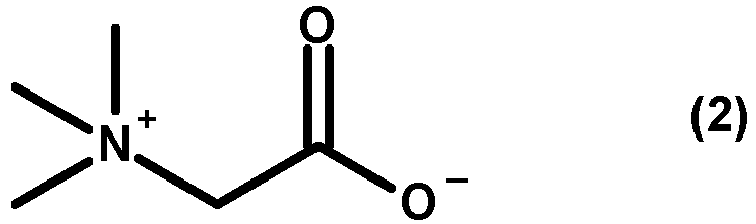
and/or - the crystallizing agent (2) being betaine of formula (2)

- Upon using betaine as crystallizing agent of formula (2) the advantages of
claim 1, viz. better flowability, stability, hygroscopicity, storage stability, bioavailability, purity, purification behavior are even improved, as can be seen below. This means that the such solid form of multicomponent crystal has better flowability, lower hygroscopicity, better storage stability, higher bioavailability, bioavailability with less variability, higher purity and better purification properties. - A further developed embodiment of the multicomponent crystal of the invention
- the active being D/L-α-tocopherol of formula (3)

and/or - the crystallizing agent (2) being betaine of formula (2)

- The stabilization of D/L-α-tocopherol or of all-rac α-tocopherol by means of esterification in order to reduce their sensitivity to oxidation also reduces to some extent their capacity of acting as antioxidant and their bioavailability. This somewhat small, however existing disadvantage can be overcome by using D/L-tocopherol of formula (3) synonymous to DL-tocopherol of formula (3), since in these entities, there is free access to the OH-group in position 6 of formula (3). This however is not detrimental, since the molecule of formula (3) is part of the multicomponent crystal.
- Provided one uses an excess of active, not all of it can be incorporated into the multicomponent crystal. A deficiency of active on the other hand would reduce its deliverable quantity e.g. in a dietary supplement and thus reduces the amount to be bioavailable accessible for the body. This can be avoided with a multicomponent crystal of the invention exhibiting the molar ratio of the active to the crystallizing agent (2) to range from 3:1 to 1:3, preferably from 2.1:1 to 1.9:1 or from 2:1 to 1:2 including a molar ratio of 1:1 and further preferred being 2:1.
- The multicomponent crystal of the invention has a powder x-ray diffraction pattern (PXRD pattern) with at least one characteristic peak expressed in °2θ ± 0.2 °2θ (CuKa radiation), which is selected from the peaks located at 5.5, 7.4, 9.2, 12.9, 16.7 and 20.4, preferably it has a powder x-ray diffraction pattern (PXRD pattern) with at least three characteristic peaks expressed in °2θ ± 0.2 °2θ (CuKa radiation), which are selected from the peaks located at 5.5, 7.4, 9.2, 12.9, 16.7 and 20.4, further preferred it has a powder x-ray diffraction pattern (PXRD pattern) with the following characteristic peaks expressed in °2θ ± 0. 2 °2θ (CuKa radiation) and located at 5.5, 7.4, 9.2, 12.9, 16.7 and 20.4.
- One observes the peaks of the highly crystalline inventive multicomponent crystal comprising the active and betaine to be different compared to the co-crystal of D-α-tocopherol and betaine disclosed in comparative example 13, as shown in
Fig. 12 . This is also backed by the thermogravimetric analysis (TGA) results of example 1 andFig. 2 showing a high temperature of decomposition TD of 200 °C and by the high onset temperature TO of 98 °C, the high peak temperature TP of 103 °C and the high phase transition enthalpy ΔH of 82 J/g as given in example 1 andFig. 3 , all of which indicating a well packed highly structured multicomponent crystal, which can only be disassembled at high temperatures and with an elevated amount of energy. As shown by HPLC analysis the multicomponent crystal comprises all eight stereoisomers in the same ratio as observed in all-rac α-tocopherol (cf.Fig. 7 ). - A further advanced embodiment of the inventive multicomponent crystal has a powder x-ray diffraction pattern (PXRD pattern) with at least one characteristic peak expressed in °2θ ± 0.2 °2θ (CuKa radiation), which is selected from the peaks located at 3,7, 5.5, 7.4, 9.2, 11,1 12.9, 14,8, 15,6, 16.7, 17,0, 18,1, 18,5, 20.4, 21,8 and 24,2, preferably it has a powder x-ray diffraction pattern (PXRD pattern) with at least three characteristic peaks expressed in °2θ ± 0.2 °2θ (CuKa radiation), which are selected from the peaks located at 3.7, 5.5, 7.4, 9.2, 11.1 12.9, 14.8, 15.6, 16.7, 17.0, 18.1, 18.5, 20.4, 21.8 and 24.2, further preferred it has a powder x-ray diffraction pattern (PXRD pattern) with the following characteristic peaks expressed in °2θ ± 0.2 °2θ (CuKa radiation) and located at 3.7, 5.5, 7.4, 9.2, 11.1 12.9, 14.8, 15.6, 16.7, 17,0, 18.1, 18,5, 20.4, 21,8 and 24,2.
- One observes the peaks of the highly crystalline inventive multicomponent crystal comprising D/L- α-tocopherol and betaine to be different compared to the co-crystal of D-α-tocopherol and betaine disclosed in comparative example 13, as shown in
Fig. 12 . This is also backed by the thermogravimetric analysis (TGA) results of example 1 andFig. 2 showing a high temperature of decomposition TD of 200 °C and by the high onset temperature TO of 98 °C, the high peak temperature TP of 103 °C and the high phase transition enthalpy ΔH of 82 J/g as given in example 1 andFig. 3 , all of which indicating a well packed highly structured multicomponent crystal, which can only be disassembled at high temperatures and with an elevated amount of energy. Likewise, the total recovery and same repartition of different stereoisomers in the multicomponent crystal when compared to neat D/L- α-tocopherol, reveals a highly ordered and not easily dissolvable structure of the inventive multicomponent crystal. As shown by HPLC analysis the multicomponent crystal comprises all eight stereoisomers in the same ratio as observed in all-rac α-tocopherol (cf.Fig. 7 ). - Co-crystals of the prior art still comprise as non-crystallized matter free D/L-α-tocopherol as shown in comparative example 9. Non crystallized matter can be any active of formula (1) or of formula (3), which does not get appropriately located in the ordered structure of a crystal or sticks in an amorphous way either to its surface and/or in holes, gaps or interstitials of a less ordered or partially amorphous crystal. This likewise contributes to make the crystal less homogeneous and less structured as can be seen in the powder x-ray diffraction diagrams (PXRD) of
Fig. 10 compared toFig. 1 andFig. 4 ,Fig. 10 exhibiting a greater background especially in the middle of the diagram. - In contrast, the multicomponent crystal of the invention comprises less than 45 w% of not crystallized matter, preferably less than 30 w%, further preferred less than 20 w%, still further preferred less than 10 w% and highly preferred less than 5 w% including 1 w% and 0 w%.
- As already mentioned, higher crystallinity of this embodiment provides better stability, flowability and hygroscopicity.
- As previously mentioned, the inventive multicomponent crystal presents a highly ordered structure and only a small to no amount of excess or not crystallized active is present. Only then, elevated onset temperatures To, peak temperatures Tp and phase transition enthalpies ΔH can be observed.
- This is reflected by a further inventive embodiment, wherein the multicomponent crystal exhibits a phase transition with
- an onset temperature To as measured by differential scanning calorimetry (DSC) of at least 72 °C,
and/or - a peak temperature Tp as measured by differential scanning calorimetry (DSC) of at least 75 °C,
and/or - a phase transition enthalpy ΔH as measured by differential scanning calorimetry (DSC) of at least 50 J/g,
preferably - an onset temperature To as measured by differential scanning calorimetry (DSC) of at least 85 °C,
and/or - a peak temperature Tp as measured by differential scanning calorimetry (DSC) of at least 89 °C,
and/or - a phase transition enthalpy ΔH as measured by differential scanning calorimetry (DSC) of at least 60 J/g,
and further preferred - an onset temperature To as measured by differential scanning calorimetry (DSC) of at least 98 °C,
and/or - a peak temperature Tp as measured by differential scanning calorimetry (DSC) of at least 103 °C,
and/or - a phase transition enthalpy ΔH as measured by differential scanning calorimetry (DSC) of at least 82 J/g.
- Within the context of this disclosure, the onset temperature To as measured by differential scanning calorimetry (DSC) is defined to be the melting point of the multicomponent crystal or of any other compound to be analyzed, whereas the peak temperature Tp as measured by differential scanning calorimetry (DSC) is defined to be the point, where the respective peak in the DSCchart shows its highest or its lowest value.
- The highly ordered structure and only a small to no amount of excess or not crystallized active in the inventive multicomponent crystal is also revealed by its high temperature of decomposition Td.
- This is reflected by a further embodiment of the inventive multicomponent crystal exhibiting a temperature of decomposition Td as measured by thermogravimetric analysis (TGA), which is at least 175 °C, preferably at least 180 °C, further preferred at least 185 °C, still further preferred at least 190 °C and yet further preferred is 195 °C or higher.
- A process for preparing a multicomponent crystal of the invention from at least two solids or from at least one solid and at least one liquid comprises the steps:
- i) providing an active, said active being a mixture of at least two molecules of formula (1)

- with R being at least one selected from the group consisting of H, COCH3, COCH2CH3, CO(CH2)14CH3, CO(CH2)16CH3,
- with the methyl groups in position 2, 4', 8' respectively having a S-configuration or a R-configuration,
- ii) adding to the active of step i) a crystallizing agent (2), said crystallizing agent (2) exhibiting the property of
- being suitable to form ions and/or
- containing a H-bond donor and/or
- containing a H-bond acceptor and/or
- being suitable to form a zwitterionic structure and/or
- having a molecular weight, which ranges from 100 g/mol to 135 g/mol,
- iii) mixing the active and the crystallizing agent (2) to obtain a mixture,
- iv) optionally concentrating the mixture of step iii) or adding a solvent and/or an antisolvent to the mixture of step iii), while stirring,
- v) cooling the mixture of step iii) or of step iv) for crystallization, and/or stirring the mixture of step iii) or of step iv) for crystallization,
- vi) incubating the mixture of step v) in order to get the formed multicomponent crystal settled,
- vii) removing the supernatant formed in step vi) by decanting or by evaporation or by filtration,
- viii) optionally washing the formed multicomponent crystal of step vii) with the solvent and/or with the antisolvent
- ix) and drying the formed multicomponent crystal of step vii) or viii),
- Said process of obtaining the inventive multicomponent crystal. is straight forward since all process steps can be realized within hours and only exceptionally over-night runs are required. Highly trained stuff is not required since every process step is self explaining. The active and the crystallizing agent (2) not harmful when handled with ordinary lab skills. This further applies when both the active and the crystallizing agent (2) in a preferred embodiment have the GRAS-status, which means they are Generaly Recognized As Save by the FDA. The process provides for using the active and the crystallizing agent (2) as such or in dilution. All process steps can be safely realized and are not harmful as well. It is apparent to the skilled person that the process steps are not expensive either. The way of conducting said process is easy to realize. By said inventive process the double molar amount of active with respect to crystallizing agent (2) and even more can become an integral, viz properly allocated part of the new multicomponent crystal. As already explained supra, non-crystallized matter can be avoided to a large extent or even completely to become a part of the multicomponent crystal. A further advantage of the inventive process is that it provides the inventive multicomponent crystal as fines, which can be directly further processed.
- Tocopherol as understood within the phrasing "with the proviso that the combination of proline as crystallizing agent (2) and tocopherol as active is excluded from the teaching of this process." means natural tocopherol and synthetic tocopherol. Natural tocopherol comprises two types of tocopherols and tocotrienols, and comprises 8 kinds of compounds, namely α-, β-, γ-, δ-tocopherols and α-, β-, γ-, δ-tocotrienols. Synthetic tocopherol refers to α-tocopherol, and has 8 optical isomers, viz. at least one, two, three, four, five, six, seven or eight of RRR, RRS, RSS, SSS, RSR, SRS, SRR and SSR.
- Proline as understood within the phrasing "with the proviso that the combination of proline as crystallizing agent (2) and tocopherol as active is excluded from the teaching of this process." means proline to comprise D-proline, or L-proline, or a racemic mixture of the both.
- A solvent is understood to be any solvent which solubilizes at least the active, but also the active and the crystallizing agent (2). Appropriate solvents are selected form the group consisting of methanol, ethanol, iso-propanol, heptane, acetonitrile and ethyl acetate and mixtures thereof.
- An antisolvent is meant to be each solvent, which reduces the amount of solubilized active and/or of solubilized crystallizing agent (2) or completely prevents solubilization of the active and/or of the crystallizing agent (2). An antisolvent is understood to be a solvent that causes precipitation when added to a solution in another solvent. Nitromethane or water is used as antisolvent.
- Incubating in step vi) is meant to leave the mixture of step v) with or without stirring at a reduced temperature, preferably at the temperature at which it was cooled in step v).
- The supernatant of step vii) is understood to be the liquid which remains above the formed multicomponent crystal of the invention.
- As can be seen from the examples below, it is sometimes difficult to work with an active and a crystallizing agent (2), especially, if the amount of active is increased with respect to the amount of crystallizing agent (2). This is fixed with an extension of the inventive process, wherein the active is diluted with or dissolved in an active solubilization solvent prior to providing it in step i) of
claim 10. - An active solubilization solvent is a solvent which solubilizes either the active or the crystallizing agent (2) or both of them. The special feature of the active solubilization solvent is, that it is used prior to the process as disclosed in
claim 10. Appropriate solvents are selected form the group consisting of methanol, ethanol, iso-propanol, heptane, acetonitrile and ethyl acetate and mixtures thereof. - A further developed embodiment of the inventive process provides
- the active being a mixture of at least three molecules of formula (1), preferably of at least four molecules of formula (1), further preferred of at least five molecules of formula (1), yet further preferred of at least six molecules of formula (1), still further preferred of at least seven molecules of formula (1) and mostly preferred of at least eight molecules of formula (1),
and/or - R being at least one selected from the group consisting of H and COCH3,
and/or - the crystallizing agent (2) being betaine of formula (2)

- Upon using the process features given supra, multicomponent crystals of high stability are obtained.
- This is even further pronounced with the following advancement of the inventive process, which defines
- said active being D/L-α-tocopherol of formula (3)

and/or - the crystallizing agent (2) being betaine of formula (2)
- The multi-component crystal according to the invention in one alternative may be used directly in the form of powders, granules, suspensions.
- In another alternative it may be combined with other dietary or pharmaceutically acceptable ingredients by admixing the multicomponent crystal and the ingredients to obtain a mixture and optionally finely grinding the components of said mixture, and then filling them into capsules. Said capsules may be composed for example of hard or soft gelatin.
- Part of the invention is also a composition comprising the multicomponent crystal as defined in at least one of the embodiments mentioned supra or as obtained in at least one of the process embodiments as previously defined and at least one dietary acceptable constituent.
- Said composition in one embodiment is a dietary supplement.
- In another embodiment it is a pharmaceutical composition, preferably a pharmaceutical composition further comprising at least one pharmaceutically acceptable carrier, and/or at least one diluent, and/or further ingredients, and/or at least one pharmaceutical excipient.
- The composition in one extension is a pre-formulation, an oral formulation, a solid formulation such as a powder, a capsule, a tablet, a pill, a troche or a liquid suspension formulation.
- A further important aspect of the invention is the use of a multicomponent crystal as previously defined or as obtained in a process as identified supra, or the use of the above disclosed composition in a food formulation or a feed formulation or in a pharmaceutical preparation.
- In the following, the present invention will be further illustrated by particular embodiments as disclosed in the examples and with reference made to figures. However, said detailed description and examples are not understood to narrow the gist of the invention down thereto. They merely serve to illustrate the invention in more details.
-
- HPLC
- high pressure liquid chromatography
- ATR-IR
- attenuated total reflectance infrared spectroscopy
- MeOH
- methanol
- NMR
- nuclear magnetic resonance
- TG
- thermogravimetry
- r.h.
- relative humidity (air, if not indicated otherwise)
- w%
- weight%
- v/v
- volume by volume
- PXRD
- powder X-ray diffraction
- DSC
- differential scanning calorimetry
-
- Fig. 1:
- PXRD pattern of a all-rac α-tocopherol - betaine co-crystal from crystallization in MeOH with the molar ratio of all-rac-α-tocopherol to betaine being 2:1; Cu Kα radiation.
- Fig. 2:
- TG data of a all-rac α-tocopherol - betaine co-crystal from crystallization in MeOH with the molar ratio of all-rac-α-tocopherol to betaine being 2:1,
heating rate 10°C/min. - Fig. 3:
- DSC data of a all-rac α-tocopherol - betaine co-crystal from crystallization in MeOH with the molar ratio of all-rac α-tocopherol to betaine being 2:1,
heating rate 10°C/min, recording of the exothermal phase transition during heating up. - Fig. 4:
- PXRD pattern of all-rac α-tocopherol - betaine co-crystal from crystallization in MeOH with the molar ratio of all-rac α-tocopherol to betaine being 2:1; Cu Kα radiation.
- Fig. 5:
- PXRD pattern of all-rac α-tocopherol - betaine co-crystal from crystallization in MeOH with the molar ratio of all-rac α-tocopherol to betaine being 2:1; Cu Kα radiation.
- Fig. 6:
- ATR-IR spectrum of all-rac-α-tocopherol - betaine co-crystal from crystallization in MeOH with the molar ratio of all-rac α-tocopherol to betaine being 2:1.
- Fig. 7:
- HPLC data of all-rac α-tocopherol - betaine co-crystal from crystallization in MeOH with the molar ratio of all-rac α-tocopherol to betaine being 2:1, 295 nm.
- Fig. 8:
- TG data of all-rac α-tocopherol - L-proline co-crystal from crystallization in MeOH with the molar ratio of all-rac α-tocopherol to proline being 2:1,
heating rate 10°C/min. - Fig. 9:
- DSC data of all-rac α-tocopherol - L-proline co-crystal from crystallization in MeOH with the molar ratio of all-rac α-tocopherol to proline being 2:1,
heating rate 10°C/min, recording of the exothermal phase transition during heating up. - Fig. 10:
- PXRD pattern of all-rac α-tocopherol - L-proline co-crystal from crystallization in MeOH : nitromethane (1:1 v/v) with the molar ratio of all-rac α-tocopherol to proline being 1:1; Cu Kα radiation.
- Fig. 11:
- PXRD pattern of D-α-tocopherol - betaine co-crystal from crystallization in MeOH with the molar ratio of D-α-tocopherol to betaine being 2:1; Cu Kα radiation.
- Fig. 12:
- PXRD pattern of all-rac α-tocopherol - betaine co-crystal 2:1 (bottom, example 1) in comparison to D-α-tocopherol - betaine co-crystal from example 13 (top; counts + 500); Cu Kα radiation.
- Wherever noted, in the following, room temperature depicts a temperature from the range 22-25 °C, ambient temperature is defined as 25±10 °C and percentages are given by weight, if not indicated otherwise.
- The measurements were carried out with a Panalytical X'Pert Pro diffractometer (manufacturer: Panalytical) using Cu Kα radiation in the Bragg-Brentano reflection geometry. Generally, the 2θ values are accurate within an error of ±0.1-0.2°. The relative peak intensities can vary considerably for different samples of the same crystalline form because of different preferred orientations of the crystals. The samples were prepared without any special treatment other than the application of slight pressure to get a flat surface. Generally, silicon single crystal sample holders of 0.2 mm depth were used. The tube voltage and current were 45 kV and 40 mA, respectively. Diffraction patterns were recorded in the range from 2θ =3°-40° with increments of 0.0167°. The samples were rotated during the measurement.
- TGA data were recorded with a TG/DTA 7200 (SII Nano Technology Inc). The samples were placed in platinum standard pans. The sample size in each case was 2 to 10 mg. The heating rate was 10°C/min. The samples were purged with a stream of synthetic air during the experiment.
- DSC data were recorded with a Mettler Toledo DSC 823e/700/229 module. The samples were placed in aluminum standard pans. The sample size in each case was 1 to 10 mg. The heating rate was 10°C/min. The samples were purged with a stream of nitrogen during the experiment. The onset point of the endothermic event is reported as melting point.
- The 1H-NMR spectra were recorded on a Bruker AVN-600 spectrometer using deuterated solvents.
- ATR-IR spectra were measured at room temperature on Nicolet iS50_2. 32 scans with a resolution of 4 cm-1 measured in the
range 4000 cm-1 to 400 cm-1. - Approximately 10 mg solid material was dissolved in approx. 8 g of isopropanol. The solution was directly used for analysis by HPLC on a Agilent 1200, equipped with a DAD1 UV detector (evaluation at 295 nm) and Sampler Type G1313A. Chromeleon 7.2.8 software was used to record the chromatograms and to calculate the chromatographic parameters. Gradient elution (solvent A: ACN + 0.1% formic acid / solvent B: water + 0.1% formic acid, gradient see below) was achieved using CHIRALPAK IG-3, 150*2.1mm, 3µm, Daicel. Injection volume was set to 5 µL by auto injector. The analysis was performed with a flux rate of 0.5 ml/min.
-
time % solvent A % solvent B 0.0 45 55 23.0 30 70 35.0 20 80 35.1 0 100 40.0 0 100 40.1 45 55 51.0 45 55 - Solvents: For all experiments, standard grade solvents are used.
- The all-rac -α-tocopherol - betaine co-crystal 2:1 is prepared from all-rac α-tocopherol and betaine.
- The PXRD pattern is displayed in
Figure 1 . Characteristic PXRD peaks (expressed in °2θ ± 0.2 °2θ; Cu Kα radiation) are observed at 3.7, 5.5, 7.4, 9.2, 11.1, 12.9, 14.8, 15.6, 16.7, 17.0, 18.1, 18.5, 20.4, 21.8 and 24.2. The ATR-IR data is presented inFig. 6 . Characteristic peaks are observed at 2953, 2897, 1647, 1639, 1223, 1029 and 721 cm-1. - 431 mg all-rac α-tocopherol (1 mmol) and 117 mg betaine (1 mmol) (ratio 1:1) were dissolved in 4 mL MeOH at 60°C. After 0.5 h the solution was cooled down to -10°C (cooling rate -5°C/h, stirring rate 120 rpm). The precipitated multicomponent crystal was filtered and dried in vacuum at room temperature. The solid material shows a PXRD pattern as in
Figure 1 having characteristic PXRD peaks (expressed in °2θ ± 0.2 °2θ; Cu Kα radiation) as indicated in example 1. 1H-NMR spectroscopy indicates a molar ratio of all-rac α-tocopherol to betaine of about 2:1. TG data show no significant weight loss up to the melting peak and above, first significant weight loss is observed around 200°C. DSC data show a melting point with an onset of 98°C and a peak maximum of 103°C as well as a transition enthalpy ΔH of 82 J/g. - Said transition enthalpy is almost the double of the value obtained for an all-rac α-tocophero-TOC - L-proline co-crystal as indicated in comparative example 8. Likewise, the onset of 98 °C and the peak maximum of 103 °C is about 30 °C higher than this one obtained for the co-crystal of comparative example 8. The significant weight loss starts at about 200 °C which is about 30 °C higher than the value obtained for a said all-rac α-tocophero - L-proline co-crystal as indicated in comparative example 8. These observations prove that much more energy is required to disassemble the multicomponent crystal of example 1a, which is only possible if said crystal is much more structured and thus has a higher crystallinity compared to the co-crystal of comparative example 8.
- 431 mg all-rac α-tocopherol (1 mmol) and 117 mg betaine (1 mmol) (ratio 1:1) were dissolved in 4 mL MeOH at 60°C. After 0.5 h the solution was cooled down to -10°C (cooling rate -5°C/h, stirring rate 120 rpm). The precipitated multicomponent crystal was filtered and dried in vacuum at room temperature to yield 303 mg all-rac α-tocopherol - betaine co-crystal. The PXRD pattern is similar to the pattern presented in
Figure 1 . - 1725 mg all-rac α-tocopherol (4 mmol) and 235 mg betaine (2 mmol) (ratio 2:1) were dissolved in 4 mL MeOH at 60°C. After 0.5 h the solution was cooled down to -10°C (cooling rate -5°C/h, stirring rate 120 rpm). The precipitated multicomponent crystal was filtered and dried in vacuum at room temperature to yield 1093 mg all-rac α-tocopherol - betaine co-crystal. The PXRD pattern is similar to the pattern presented in
Figure 1 . - 6.9 g all-rac α-tocophero (16 mmol)l and 0.94 g betaine (8 mmol) (ratio 2:1) were dissolved in 16 mL MeOH at 60°C. After 0.5 h the solution was cooled down to -10°C (cooling rate -5°C/h, stirring
rate 200 rpm). The precipitated multicomponent crystal was filtered and dried in vacuum at room temperaturα to yield 5.0 mg all-rac α-tocopherol - betaine co-crystal. The PXRD pattern is similar to the pattern presented inFigure 1 . The DSC data shows a melting point with an onset of 98°C and a peak temperature of 104°C as well as an enthalpy ΔH of 70 J/g. - 6.9 g all-rac α-tocopherol (16 mmol) and 0.94 g betaine (8 mmol) (ratio 2:1) were dissolved in 16 mL MeOH at 60°C. After 0.5 h the solution was cooled down to -10°C (cooling rate -5°C/h, stirring rate 1200 rpm). The precipitated multicomponent crystal was filtered, washed with 5 mL methanol and dried in vacuum at room temperature, yield 4,4 g all-rac α-tocopherol - betaine co-crystal. The PXRD pattern is similar to the pattern presented in
Figure 5 . The DSC data shows a melting point with an onset of 100°C and a peak temperature of 104°C (72 J/g). The ATR-IR spectrum is displayed inFigure 6 . The result of the HPLC measurement is shownFig 7 . The chiral HPLC method does not separate alle eight isomers, but the ratio of 1 (12.12 area%) : 3 (37.57 ar-ea%) : 1 (12.74 area%) : 2 (25.16 are%) : 1 (12.41 area%) is the same as in all-rac α-tocopherol (1 (12.18 area%) : 3 (37.81 area%) : 1 (12.66 area%) : 2 (25.11 area%) : 1 (12.25 area%)) (Figure 7 ). The data confirm that all eight all-rac α-tocopherol isomers are incorporated into the co-crystal. - 6.9 g all-rac α-tocopherol (16 mmol) and 0.94 g betaine (8 mmol) (ratio 2:1) were dissolved in 16 mL MeOH at 60°C. After 0.5 h the solution was cooled down to -10°C (cooling rate -5°C/h, stirring rate 1200 rpm). The precipitated multicomponent crystal was filtered, washed with 5 mL nitromethane and dried in vacuum at room temperature to yield 4.8 g all-rac α-tocopherol - betaine co-crystal. The solid material shows a PXRD pattern as in
Figure 4 . The DSC data shows a melting point with an onset of 101°C and a peak temperature of 103°C as well as an enthalpy ΔH of 60 J/g. - 6.9 g all-rac α-tocopherol and 0.94 g betaine (ratio 2:1) was dissolved in 16 mL MeOH at 60°C. After 0.5 h the solution was cooled down to -10°C (cooling rate -5°C/h, stirring rate 1200 rpm). The precipitated was filtered, washed with 5 mL heptane and dried in vacu-um at room temperature, yield 2,8 mg all-rac α-tocopherol - betaine co-crystal. The PXRD pattern is similar to the pattern presented in
Figure 1 . The DSC data shows a melting point with an onset of 101°C and a peak temperature of 105°C as well as an enthalpy ΔH of 81 J/g. - 139 g all-rac α-tocopherol (323 mmol) and 18 g betaine (154 mmol) (ratio 2:1)(were added to a 250 mL glass tall-form beaker cooled via an ice bath. The mixture was blended using a Polytron PT3100 D high shear mix-er at 30000 rpm for 40 seconds fitted with a rotor-stator-head. Afterwards, the mixture was stirred via an
IKA Eurostar 20 stirrer fitted with a dissolver. The temperature was kept be-low 50°C. The mixture was agitated for 2.25 h. After 50 minutes, the stirrer speed was stepwise reduced from the initial 5000 rpm because of the increasing viscosity. After 1 h and 23 min, the stirrer speed was kept at 1000 rpm. Starting 30 minutes after the beginning of the agitation, periodically over the course of the experiment, the material was manually homogenized as the dissolver was not able to effectively agitate the complete reaction mixture. The PXRD pattern is similar to the pattern presented inFigure 1 . - All-rac α-tocophero - L-proline co-crystal is described in
WO 2019/128175 (corresponding toEP 3733657 A1 ) with PXRD patterns of lowest crystallinity and amorphous content. Following examples are modifies examples from saidWO 2019/128175 . - 431 mg all-rac α-tocopherol (1 mmol)) and 115 mg L-proline (1 mmol) (ratio 1:1) were dissolved in 4 mL methanol : nitro-methane (1:1) at 60°C. After 1 h the solution was cooled down to -10°C (cooling rate -5°C/h, stirring rate 120 rpm). The precipitated co-crystal was filtered and dried in vacuum at room temperature and all-rac α-tocopherol - L-proline co-crystal was obtained. The solid material shows a very poor PXRD pattern similar to
Fig ity 10. - 1H-NMR spectroscopy indicates a molar ratio of all-rac α-tocopherol to L-proline of about 2:1. TG data show no significant weight loss up to the melting peak and above, first significant weight loss is observed around 170°C. DSC data show a melting point with an onset of 69°C and 72°C peak maximum (44 J/g).
- These values being low compared to those of example one, show a lower stability of the co-crystal obtained in comparative example 9.I
- 473 mg all-rac α-tocopherol I (1,1 mmol) and 127 mg L-proline (1,1 mmol) (ratio 1:1) were dissolved in 4 mL methanol : nitro-methane (1:1) at 60°C. After 1 h the solution was cooled down to -10°C (cooling rate -5°C/h, stirring rate 120 rpm). The precipitated co-crystal was filtered and dried in vacuum at room temperature to yield ∼150 mg all-rac α-tocophero - L-proline co-crystal. The solid material shows a PXRD pattern as in
Figure 10 . - 529 mg all-rac α-tocopherol (1,2 mmol) and 71 mg L-proline (0,6 mmol) (ratio 2:1) was dissolved in 4 mL methanol : nitrome-thane (1:1) at 60°C. After 1 h the solution was cooled down to -10°C (cooling rate -5°C/h, stirring rate 120 rpm). The precipitated was filtered and dried in vacuum at room temperature, yield ~100 mg all-rac α-tocopherol - L-proline co-crystal.The solid material shows a PXRD pattern as in
Figure 10 . - 529 mg all-rac α-tocopherol (1,2 mmol) and 71 mg L-proline (0,6 mmol) (ratio 2:1) was dissolved in 4 mL MeOH at 60°C. After 1 h the solution was cooled down to -10°C (cooling rate - 5°C/h, stirring rate 120 rpm). The precipitated co-crystal was filtered and dried in vacuum at room temperature, yield 9 mg all-rac α-tocophero - L-proline co-crystal, characterization PXRD.The solid material shows a PXRD pattern as in
Figure 10 . - 473 mg all-rac α-tocopherol (1,1 mmol) and 127 mg L-proline (1,1 mmol) (ratio 1:1) were dissolved in 4 mL MeOH at 60°C. After 1 h the solution was cooled down to -10°C (cooling rate - 5°C/h, stirring rate 120 rpm). The precipitated co-crystal was filtered and dried in vacuum at room temperature to yield 89 mg all-rac α-tocopherol - L-proline co-crystal. The solid material shows a PXRD pattern as in
Figure 10 . - A D-α-tocopherol - betaine co-crystal was described in Int. J. Pharm. 592 (2021) 120057. The experiment was reproduced as it was possible. No dissolution at room temperature was observed. Therefore, the solid was dissolved at 60°C, before cooling was started.
- 4.3 g d-αToc (10 mmol) and 0.585 g betaine (5 mmol) (ratio 2:1) were dissolved in 10 mL methanol at 60°C and the solution was cooled at -20°C (cooling rate -5°C/h, stirring rate 1200 rpm). The powder was filtered and dried in vacuum at room temperature. The solid material shows a PXRD pattern as in
Figure 11 . - The PXRD pattern of all-rac α-tocopherol - betaine multicomponent crystal 2:1 (bottom chart, from example 1) was compared with the D-α-tocopherol - betaine co-crystal (upper chart, from of example 13) by superposition in
Figure 12 . - Two things are apparent: First the bottom chart shows different signals, which are shifted to lower 2θ-values when comparing with the 2θ-values of the upper chart. In addition, new signals appear in the bottom chart whereas others disappear, indicating another type of crystal to be formed. Second the bottom chart looks much more homogenous and does not exhibit a large background when comparing with the upper chart.
- However, multicomponent crystal formation from all-rac α-tocopherol and betaine is more than surprising taking into account, that all-rac α-tocopherol in the multicomponent crystal of the bottom chart is a mixture of many isomers, whereas D-α-tocopherol in the co-crystal of the upper chart is only one molecule much easier to crystalize.
Claims (15)
- Multicomponent crystal comprisinga) an active, said active being a mixture of at least two molecules of formula (1)
 - with the methyl groups in position 2, 4', 8' respectively having a S-configuration or a R-configuration,andb) a crystallizing agent (2), said crystallizing agent (2) exhibiting the property ofwith the proviso that the combination of proline as crystallizing agent (2) and tocopherol as active is excluded from the teaching of claim 1.- being suitable to form ions and/or- containing a H-bond donor and/or- containing a H-bond acceptor and/or- being suitable to form a zwitterionic structure and/or- having a molecular weight, which ranges from 100 g/mol to 135 g/mol,
 - The multicomponent crystal of claim 1, wherein- said active being a mixture of at least three molecules of formula (1), preferably of at least four molecules of formula (1), further preferred of at least five molecules of formula (1), yet further preferred of at least six molecules of formula (1), still further preferred of at least seven molecules of formula (1) and mostly preferred of at least eight molecules of formula (1),
and/or- R being at least one selected from the group consisting of H and COCH3,
and/or- the crystallizing agent (2) being betaine of formula (2)
- The multicomponent crystal according to claim 1 or 2, wherein- said active being D/L-α-tocopherol of formula (3)
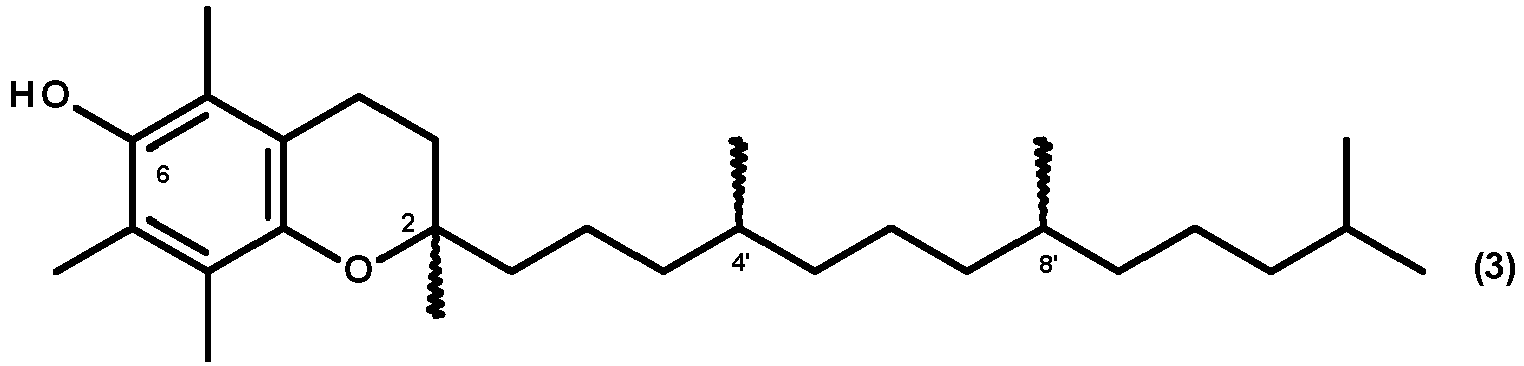
and/or- the crystallizing agent (2) being betaine of formula (2)
- The multicomponent crystal according to any one of claims 1 to 3, wherein
the molar ratio of said active to said crystallizing agent (2) ranges from 3:1 to 1:3, preferably from 2.1:1 to 1.9:1 or from 2:1 to 1:2 including a molar ratio of 1:1 and further preferred being 2:1. - The multicomponent crystal according to any one of claims 1 to 4, wherein it has a powder x-ray diffraction pattern (PXRD pattern) with at least one characteristic peak expressed in °2θ ± 0.2 °2θ (CuKα radiation), which is selected from the peaks located at 5.5, 7.4, 9.2, 12.9, 16.7 and 20.4,
preferablyit has a powder x-ray diffraction pattern (PXRD pattern) with at least three characteristic peaks expressed in °2θ ± 0.2 °2θ (CuKa radiation), which are selected from the peaks located at 5.5, 7.4, 9.2, 12.9, 16.7 and 20.4,
further preferredit has a powder x-ray diffraction pattern (PXRD pattern) with the following characteristic peaks expressed in °2θ ± 0.2 °2θ (CuKa radiation) and located at 5.5, 7.4, 9.2, 12.9, 16.7 and 20.4. - The multicomponent crystal according to any one of claims 1 to 4, wherein it has a powder x-ray diffraction pattern (PXRD pattern) with at least one characteristic peak expressed in °2θ ± 0.2 °2θ (CuKa radiation), which is selected from the peaks located at 3.7, 5.5, 7.4, 9.2, 11.1, 12.9, 14.8, 15.6, 16.7, 17.0, 18.1, 18.5, 20.4, 21.8 and 24.2,
preferablyit has a powder x-ray diffraction pattern (PXRD pattern) with at least three characteristic peaks expressed in °2θ ± 0.2 °2θ (CuKα radiation), which are selected from the peaks located at 3.7, 5.5, 7.4, 9.2, 11.1, 12.9, 14.8, 15.6, 16.7, 17.0, 18.1, 18.5, 20.4, 21,8 and 24.2, further preferredit has a powder x-ray diffraction pattern (PXRD pattern) with the following characteristic peaks expressed in °2θ ± 0.2 °2θ (CuKα radiation) and located at 3.7, 5.5, 7.4, 9.2, 11.1 12.9, 14.8, 15.6, 16.7, 17.0, 18.1, 18.5, 20.4, 21.8 and 24.2. - The multicomponent crystal according to any one of claims 1 to 6, wherein it comprises less than 45 w% of not crystallized matter, preferably less than 30 w%, further preferred less than 20 w%, still further preferred less than 10 w% and highly preferred less than 5 w% including 1 w% and 0 w%.
- The multicomponent crystal according to any one of claims 1 to 7, wherein it exhibits a phase transition with- an onset temperature To as measured by differential scanning calorimetry (DSC) of at least 72 °C,
and/or- a peak temperature Tp as measured by differential scanning calorimetry (DSC) of at least 75 °C,
and/or- a phase transition enthalpy ΔH as measured by differential scanning calorimetry (DSC) of at least 50 J/g,
preferably- an onset temperature To as measured by differential scanning calorimetry (DSC) of at least 85 °C,
and/or- a peak temperature Tp as measured by differential scanning calorimetry (DSC) of at least 89 °C,
and/or- a phase transition enthalpy ΔH as measured by differential scanning calorimetry (DSC) of at least 60 J/g,
and further preferred- an onset temperature To as measured by differential scanning calorimetry (DSC) of at least 98 °C,
and/or- a peak temperature Tp as measured by differential scanning calorimetry (DSC) of at least 103 °C,
and/or- a phase transition enthalpy ΔH as measured by differential scanning calorimetry (DSC) of at least 82 J/g. - The multicomponent crystal according to any one of claims 1 to 8, wherein its temperature of decomposition Td as measured by thermogravimetric analysis (TGA) is at least 175 °C, preferably at least 180 °C, further preferred at least 185 °C, still further preferred at least 190 °C and yet further preferred is 195 °C or higher.
- Process for preparing a multicomponent crystal as defined in any one of claims 1 to 9 from at least two solids or from at least one solid and at least one liquid comprising the steps:i) providing an active, said active being a mixture of at least two molecules of formula (1)
 - with R being at least one selected from the group consisting of H, COCH3, COCH2CH3, CO(CH2)14CH3, CO(CH2)16CH3,- with the methyl groups in position 2, 4', 8' respectively having a S-configuration or a R-configuration,ii) adding to the active of step i) a crystallizing agent (2), said crystallizing agent (2) exhibiting the property of- being suitable to form ions and/or- containing a H-bond donor and/or- containing a H-bond acceptor and/or- being suitable to form a zwitterionic structure and/or- having a molecular weight, which ranges from 100 g/mol to 135 g/mol,iii) mixing the active and the crystallizing agent (2) to obtain a mixture,iv) optionally concentrating the mixture of step iii) or adding a solvent and/or an antisolvent to the mixture of step iii), while stirring,v) cooling the mixture of step iii) or of step iv) for crystallization, and/or stirring the mixture of step iii) or of step iv) for crystallization,vi) incubating the mixture of step v) in order to get the formed multicomponent crystal settled,vii) removing the supernatant formed in step vi) by decanting or by evaporation or by filtration,viii) optionally washing the formed multicomponent crystal of step vii) with the solvent and/or with the antisolventix) and drying the formed multicomponent crystal of step vii) or viii),with the proviso that the combination of proline as crystallizing agent (2) and tocopherol as active is excluded from the teaching of claim 10.
 - The process according to claim 10, wherein the active is diluted with or dissolved in an active solubilization solvent prior to providing it in step i) of claim 10.
- The process according to claim 10 or 11, wherein- the active being a mixture of at least three molecules of formula (1), preferably of at least four molecules of formula (1), further preferred of at least five molecules of formula (1), yet further preferred of at least six molecules of formula (1), still further preferred of at least seven molecules of formula (1) and mostly preferred of at least eight molecules of formula (1),
and/or- R being at least one selected from the group consisting of H and COCH3,
and/or- the crystallizing agent (2) being betaine of formula (2)
- The process according to any one of claims 10 to 12, wherein- said active being D/L-α-tocopherol of formula (3)

and/or- the crystallizing agent (2) being betaine of formula (2)
- A composition comprising a multicomponent crystal as defined in any one of claims 1 to 9 or as obtained in a process according to any one of claims 10 to 13 and at least one dietary acceptable constituent.
- Use of a multicomponent crystal as defined in any one of claims 1 to 9 or as obtained in a process according to any one of claims 10 to 13, or of a composition according to claim 14 in a food formulation or a feed formulation or in a pharmaceutical preparation.
Priority Applications (3)
| Application Number | Priority Date | Filing Date | Title |
|---|---|---|---|
| EP23187383.7A EP4497748A1 (en) | 2023-07-24 | 2023-07-24 | Improved multicomponent crystals of tocopherol mixtures and process of making |
| CN202480048919.XA CN121568931A (en) | 2023-07-24 | 2024-07-24 | Improved multicomponent crystals of tocopherol mixtures and methods of making the same |
| PCT/EP2024/071075 WO2025021904A1 (en) | 2023-07-24 | 2024-07-24 | Improved multicomponent crystals of tocopherol mixtures and process of making |
Applications Claiming Priority (1)
| Application Number | Priority Date | Filing Date | Title |
|---|---|---|---|
| EP23187383.7A EP4497748A1 (en) | 2023-07-24 | 2023-07-24 | Improved multicomponent crystals of tocopherol mixtures and process of making |
Publications (1)
| Publication Number | Publication Date |
|---|---|
| EP4497748A1 true EP4497748A1 (en) | 2025-01-29 |
Family
ID=87474062
Family Applications (1)
| Application Number | Title | Priority Date | Filing Date |
|---|---|---|---|
| EP23187383.7A Withdrawn EP4497748A1 (en) | 2023-07-24 | 2023-07-24 | Improved multicomponent crystals of tocopherol mixtures and process of making |
Country Status (3)
| Country | Link |
|---|---|
| EP (1) | EP4497748A1 (en) |
| CN (1) | CN121568931A (en) |
| WO (1) | WO2025021904A1 (en) |
Citations (3)
| Publication number | Priority date | Publication date | Assignee | Title |
|---|---|---|---|---|
| JPS49125367A (en) * | 1973-04-06 | 1974-11-30 | ||
| WO1998024779A1 (en) * | 1996-12-06 | 1998-06-11 | Eastman Chemical Company | Process for crystallizing d-alpha-tocopheryl succinate |
| WO2019128175A1 (en) | 2017-12-26 | 2019-07-04 | 上海共晶医药科技有限公司 | Cocrystal of tocopherol and proline and preparation method therefor |
Family Cites Families (2)
| Publication number | Priority date | Publication date | Assignee | Title |
|---|---|---|---|---|
| US3153040A (en) * | 1962-04-26 | 1964-10-13 | Eastman Kodak Co | Piperazine complexes of 6-chromanols |
| JPS6012356B2 (en) * | 1982-03-26 | 1985-04-01 | 昌明 伊藤 | Tocol derivative-betaine clathrate |
-
2023
- 2023-07-24 EP EP23187383.7A patent/EP4497748A1/en not_active Withdrawn
-
2024
- 2024-07-24 WO PCT/EP2024/071075 patent/WO2025021904A1/en not_active Ceased
- 2024-07-24 CN CN202480048919.XA patent/CN121568931A/en active Pending
Patent Citations (4)
| Publication number | Priority date | Publication date | Assignee | Title |
|---|---|---|---|---|
| JPS49125367A (en) * | 1973-04-06 | 1974-11-30 | ||
| WO1998024779A1 (en) * | 1996-12-06 | 1998-06-11 | Eastman Chemical Company | Process for crystallizing d-alpha-tocopheryl succinate |
| WO2019128175A1 (en) | 2017-12-26 | 2019-07-04 | 上海共晶医药科技有限公司 | Cocrystal of tocopherol and proline and preparation method therefor |
| EP3733657A1 (en) | 2017-12-26 | 2020-11-04 | Cocrystal Pharmaceutical Technology (Shanghai) Co., Ltd. | Cocrystal of tocopherol and proline and preparation method therefor |
Non-Patent Citations (5)
| Title |
|---|
| HILFIKER R.: "Polymorphism in the Pharmaceutical Industry", January 2006, WILEY-VCH VERLAG GMBH, Weinheim, ISBN: 978-3-527-31146-0, article HILFIKER R., BLATTER F., VON RAUMER M.: "elevance of Solid-state Properties for Pharmaceutical Products", pages: 1 - 19, XP002528052 * |
| INT. J. PHARM., vol. 592, 2021, pages 120057 |
| ROBESON CHARLES D.: "CRYSTALLINE NATURAL [alpha]- AND [gamma]-TOCOPHEROLS", JOURNAL OF THE AMERICAN CHEMICAL SOCIETY, vol. 65, no. 8, August 1943 (1943-08-01), pages 1660 - 1660, XP093093405, ISSN: 0002-7863, DOI: 10.1021/ja01248a510 * |
| ZHU BINGQING ET AL: "Cocrystals to tune oily vitamin E into crystal vitamin E - Supplementary material -", INTERNATIONAL JOURNAL OF PHARMACEUTICS, vol. 592, 7 November 2020 (2020-11-07), NL, pages 1 - 6, XP093093530, ISSN: 0378-5173, DOI: 10.1016/j.ijpharm.2020.120057 * |
| ZHU BINGQING ET AL: "Cocrystals to tune oily vitamin E into crystal vitamin E", INTERNATIONAL JOURNAL OF PHARMACEUTICS, ELSEVIER, NL, vol. 592, 7 November 2020 (2020-11-07), XP086418615, ISSN: 0378-5173, [retrieved on 20201107], DOI: 10.1016/J.IJPHARM.2020.120057 * |
Also Published As
| Publication number | Publication date |
|---|---|
| WO2025021904A1 (en) | 2025-01-30 |
| CN121568931A (en) | 2026-02-24 |
Similar Documents
| Publication | Publication Date | Title |
|---|---|---|
| US10842797B2 (en) | Nutraceutical co-crystal compositions | |
| EP3436016B1 (en) | Novel co-crystals | |
| EP4303212B1 (en) | Hydroxytyrosol nicotinamide eutectic crystal, and preparation method therefor and composition thereof | |
| SG174517A1 (en) | Useful pharmaceutical salts of 7-[(3r, 4r)-3-hydroxy-4-hydroxymethyl-pyrrolidin-1-ylmethyl]-3,5-dihydro-pyrrolo[3,2-d]pyrimidin-4-one | |
| EP3243824A1 (en) | Solid forms of ibrutinib free base | |
| EP1687308B1 (en) | Process for preparating (6R)-L-erythrotetrahydrobiopterin hydrochloride crystalline form B from other crystalline forms | |
| CN104470912B (en) | AKT suppresses amorphous form, its composition and the method for pyrimidyl cyclopentane compound | |
| JP2025094218A (en) | Crystalline forms of JAK2 inhibitors | |
| EP2524921A1 (en) | Novel Crystalline Salts of Asenapine | |
| WO2008013823A2 (en) | Co-crystals of (2r-trans)-6-chloro-5-[[4-[(4-fluorophenyl)methyl]-2,5-dimethyl-1-piperazinyl]carbonyl]-n,n,1-trimethyl-alpha-oxo-1h-indole-3-acetamide | |
| EP3656768A1 (en) | Beraprost-314d crystals and methods for preparation thereof | |
| EP2524919A1 (en) | Novel crystalline salts of Asenapine with organic Di-acids and Tri-acids | |
| WO2025021904A1 (en) | Improved multicomponent crystals of tocopherol mixtures and process of making | |
| AU2019391329B2 (en) | New crystalline forms of a MCL-1 inhibitor, a process for their preparation and pharmaceutical compositions containing them. | |
| EP3981759A1 (en) | New crystal form of treprostinil sodium salt and preparation method therefor | |
| AU2019297312B2 (en) | Crystalline salts of 5-methyl-(6S)-tetrahydrofolic acid and L-leucine ethyl ester | |
| EP3601289B1 (en) | Crystalline binary sodium salts of 5-methyl-(6s)-tetrahydrofolic acid with organic bases | |
| AU2003251974C1 (en) | Novel salt and polymorphs of desloratadine hemifumarate | |
| EP4177257B1 (en) | Succinate of octahydrothienoquinoline compound, and crystals thereof | |
| AU2019298572B2 (en) | Crystalline salts of 5-methyl-(6S)-tetrahydrofolic acid and amino acid ethyl esters | |
| EP1264821B1 (en) | Novel crystal of stilbene derivative and process for producing the same | |
| EP3838884A1 (en) | An efficient crystallization process for preparing ultrapure treprostinil and crystal prepared therefrom | |
| CA2372236A1 (en) | Polymorphs of crystalline (2-benzhydryl-1-azabicyclo¬2,2,2|oct-3-yl)-(5-isopropyl-2-methoxybenzyl)-amine citrate as nk-1 receptor antagonists | |
| EP4596541A1 (en) | Novel crystalline form of enavogliflozin, and preparation method therefor | |
| EP3368506B1 (en) | Process for the preparation of enclomiphene citrate having needle shaped crystal habit. |
Legal Events
| Date | Code | Title | Description |
|---|---|---|---|
| PUAI | Public reference made under article 153(3) epc to a published international application that has entered the european phase |
Free format text: ORIGINAL CODE: 0009012 |
|
| STAA | Information on the status of an ep patent application or granted ep patent |
Free format text: STATUS: THE APPLICATION HAS BEEN PUBLISHED |
|
| AK | Designated contracting states |
Kind code of ref document: A1 Designated state(s): AL AT BE BG CH CY CZ DE DK EE ES FI FR GB GR HR HU IE IS IT LI LT LU LV MC ME MK MT NL NO PL PT RO RS SE SI SK SM TR |
|
| STAA | Information on the status of an ep patent application or granted ep patent |
Free format text: STATUS: THE APPLICATION HAS BEEN WITHDRAWN |
|
| 18W | Application withdrawn |
Effective date: 20250203 |