EP4496331A1 - Luftbildkamera mit elektronischem globalem verschluss und externem verschluss - Google Patents
Luftbildkamera mit elektronischem globalem verschluss und externem verschluss Download PDFInfo
- Publication number
- EP4496331A1 EP4496331A1 EP23186936.3A EP23186936A EP4496331A1 EP 4496331 A1 EP4496331 A1 EP 4496331A1 EP 23186936 A EP23186936 A EP 23186936A EP 4496331 A1 EP4496331 A1 EP 4496331A1
- Authority
- EP
- European Patent Office
- Prior art keywords
- shutter
- functionality
- camera instrument
- imaging sensor
- coupling
- Prior art date
- Legal status (The legal status is an assumption and is not a legal conclusion. Google has not performed a legal analysis and makes no representation as to the accuracy of the status listed.)
- Pending
Links
Images


Classifications
-
- H—ELECTRICITY
- H04—ELECTRIC COMMUNICATION TECHNIQUE
- H04N—PICTORIAL COMMUNICATION, e.g. TELEVISION
- H04N23/00—Cameras or camera modules comprising electronic image sensors; Control thereof
- H04N23/70—Circuitry for compensating brightness variation in the scene
- H04N23/75—Circuitry for compensating brightness variation in the scene by influencing optical camera components
-
- H—ELECTRICITY
- H04—ELECTRIC COMMUNICATION TECHNIQUE
- H04N—PICTORIAL COMMUNICATION, e.g. TELEVISION
- H04N23/00—Cameras or camera modules comprising electronic image sensors; Control thereof
- H04N23/50—Constructional details
-
- H—ELECTRICITY
- H04—ELECTRIC COMMUNICATION TECHNIQUE
- H04N—PICTORIAL COMMUNICATION, e.g. TELEVISION
- H04N25/00—Circuitry of solid-state image sensors [SSIS]; Control thereof
- H04N25/50—Control of the SSIS exposure
- H04N25/53—Control of the integration time
- H04N25/532—Control of the integration time by controlling global shutters in CMOS SSIS
-
- G—PHYSICS
- G02—OPTICS
- G02F—OPTICAL DEVICES OR ARRANGEMENTS FOR THE CONTROL OF LIGHT BY MODIFICATION OF THE OPTICAL PROPERTIES OF THE MEDIA OF THE ELEMENTS INVOLVED THEREIN; NON-LINEAR OPTICS; FREQUENCY-CHANGING OF LIGHT; OPTICAL LOGIC ELEMENTS; OPTICAL ANALOGUE/DIGITAL CONVERTERS
- G02F1/00—Devices or arrangements for the control of the intensity, colour, phase, polarisation or direction of light arriving from an independent light source, e.g. switching, gating or modulating; Non-linear optics
- G02F1/01—Devices or arrangements for the control of the intensity, colour, phase, polarisation or direction of light arriving from an independent light source, e.g. switching, gating or modulating; Non-linear optics for the control of the intensity, phase, polarisation or colour
- G02F1/13—Devices or arrangements for the control of the intensity, colour, phase, polarisation or direction of light arriving from an independent light source, e.g. switching, gating or modulating; Non-linear optics for the control of the intensity, phase, polarisation or colour based on liquid crystals, e.g. single liquid crystal display cells
- G02F1/133—Constructional arrangements; Operation of liquid crystal cells; Circuit arrangements
- G02F1/1333—Constructional arrangements; Manufacturing methods
- G02F1/1334—Constructional arrangements; Manufacturing methods based on polymer dispersed liquid crystals, e.g. microencapsulated liquid crystals
-
- G—PHYSICS
- G02—OPTICS
- G02F—OPTICAL DEVICES OR ARRANGEMENTS FOR THE CONTROL OF LIGHT BY MODIFICATION OF THE OPTICAL PROPERTIES OF THE MEDIA OF THE ELEMENTS INVOLVED THEREIN; NON-LINEAR OPTICS; FREQUENCY-CHANGING OF LIGHT; OPTICAL LOGIC ELEMENTS; OPTICAL ANALOGUE/DIGITAL CONVERTERS
- G02F1/00—Devices or arrangements for the control of the intensity, colour, phase, polarisation or direction of light arriving from an independent light source, e.g. switching, gating or modulating; Non-linear optics
- G02F1/01—Devices or arrangements for the control of the intensity, colour, phase, polarisation or direction of light arriving from an independent light source, e.g. switching, gating or modulating; Non-linear optics for the control of the intensity, phase, polarisation or colour
- G02F1/13—Devices or arrangements for the control of the intensity, colour, phase, polarisation or direction of light arriving from an independent light source, e.g. switching, gating or modulating; Non-linear optics for the control of the intensity, phase, polarisation or colour based on liquid crystals, e.g. single liquid crystal display cells
- G02F1/137—Devices or arrangements for the control of the intensity, colour, phase, polarisation or direction of light arriving from an independent light source, e.g. switching, gating or modulating; Non-linear optics for the control of the intensity, phase, polarisation or colour based on liquid crystals, e.g. single liquid crystal display cells characterised by the electro-optical or magneto-optical effect, e.g. field-induced phase transition, orientation effect, guest-host interaction or dynamic scattering
-
- G—PHYSICS
- G03—PHOTOGRAPHY; CINEMATOGRAPHY; ANALOGOUS TECHNIQUES USING WAVES OTHER THAN OPTICAL WAVES; ELECTROGRAPHY; HOLOGRAPHY
- G03B—APPARATUS OR ARRANGEMENTS FOR TAKING PHOTOGRAPHS OR FOR PROJECTING OR VIEWING THEM; APPARATUS OR ARRANGEMENTS EMPLOYING ANALOGOUS TECHNIQUES USING WAVES OTHER THAN OPTICAL WAVES; ACCESSORIES THEREFOR
- G03B15/00—Special procedures for taking photographs; Apparatus therefor
- G03B15/006—Apparatus mounted on flying objects
-
- G—PHYSICS
- G03—PHOTOGRAPHY; CINEMATOGRAPHY; ANALOGOUS TECHNIQUES USING WAVES OTHER THAN OPTICAL WAVES; ELECTROGRAPHY; HOLOGRAPHY
- G03B—APPARATUS OR ARRANGEMENTS FOR TAKING PHOTOGRAPHS OR FOR PROJECTING OR VIEWING THEM; APPARATUS OR ARRANGEMENTS EMPLOYING ANALOGOUS TECHNIQUES USING WAVES OTHER THAN OPTICAL WAVES; ACCESSORIES THEREFOR
- G03B7/00—Control of exposure by setting shutters, diaphragms or filters, separately or conjointly
- G03B7/08—Control effected solely on the basis of the response, to the intensity of the light received by the camera, of a built-in light-sensitive device
- G03B7/099—Arrangement of photoelectric elements in or on the camera
- G03B7/0993—Arrangement of photoelectric elements in or on the camera in the camera
-
- G—PHYSICS
- G03—PHOTOGRAPHY; CINEMATOGRAPHY; ANALOGOUS TECHNIQUES USING WAVES OTHER THAN OPTICAL WAVES; ELECTROGRAPHY; HOLOGRAPHY
- G03B—APPARATUS OR ARRANGEMENTS FOR TAKING PHOTOGRAPHS OR FOR PROJECTING OR VIEWING THEM; APPARATUS OR ARRANGEMENTS EMPLOYING ANALOGOUS TECHNIQUES USING WAVES OTHER THAN OPTICAL WAVES; ACCESSORIES THEREFOR
- G03B9/00—Exposure-making shutters; Diaphragms
- G03B9/08—Shutters
-
- G—PHYSICS
- G03—PHOTOGRAPHY; CINEMATOGRAPHY; ANALOGOUS TECHNIQUES USING WAVES OTHER THAN OPTICAL WAVES; ELECTROGRAPHY; HOLOGRAPHY
- G03B—APPARATUS OR ARRANGEMENTS FOR TAKING PHOTOGRAPHS OR FOR PROJECTING OR VIEWING THEM; APPARATUS OR ARRANGEMENTS EMPLOYING ANALOGOUS TECHNIQUES USING WAVES OTHER THAN OPTICAL WAVES; ACCESSORIES THEREFOR
- G03B9/00—Exposure-making shutters; Diaphragms
- G03B9/08—Shutters
- G03B9/10—Blade or disc rotating or pivoting about axis normal to its plane
- G03B9/14—Two separate members moving in opposite directions
-
- H—ELECTRICITY
- H04—ELECTRIC COMMUNICATION TECHNIQUE
- H04N—PICTORIAL COMMUNICATION, e.g. TELEVISION
- H04N23/00—Cameras or camera modules comprising electronic image sensors; Control thereof
- H04N23/50—Constructional details
- H04N23/54—Mounting of pick-up tubes, electronic image sensors, deviation or focusing coils
-
- H—ELECTRICITY
- H04—ELECTRIC COMMUNICATION TECHNIQUE
- H04N—PICTORIAL COMMUNICATION, e.g. TELEVISION
- H04N23/00—Cameras or camera modules comprising electronic image sensors; Control thereof
- H04N23/57—Mechanical or electrical details of cameras or camera modules specially adapted for being embedded in other devices
-
- H—ELECTRICITY
- H04—ELECTRIC COMMUNICATION TECHNIQUE
- H04N—PICTORIAL COMMUNICATION, e.g. TELEVISION
- H04N23/00—Cameras or camera modules comprising electronic image sensors; Control thereof
- H04N23/60—Control of cameras or camera modules
- H04N23/68—Control of cameras or camera modules for stable pick-up of the scene, e.g. compensating for camera body vibrations
- H04N23/681—Motion detection
-
- H—ELECTRICITY
- H04—ELECTRIC COMMUNICATION TECHNIQUE
- H04N—PICTORIAL COMMUNICATION, e.g. TELEVISION
- H04N23/00—Cameras or camera modules comprising electronic image sensors; Control thereof
- H04N23/60—Control of cameras or camera modules
- H04N23/68—Control of cameras or camera modules for stable pick-up of the scene, e.g. compensating for camera body vibrations
- H04N23/682—Vibration or motion blur correction
- H04N23/685—Vibration or motion blur correction performed by mechanical compensation
-
- H—ELECTRICITY
- H04—ELECTRIC COMMUNICATION TECHNIQUE
- H04N—PICTORIAL COMMUNICATION, e.g. TELEVISION
- H04N23/00—Cameras or camera modules comprising electronic image sensors; Control thereof
- H04N23/70—Circuitry for compensating brightness variation in the scene
- H04N23/71—Circuitry for evaluating the brightness variation
-
- H—ELECTRICITY
- H04—ELECTRIC COMMUNICATION TECHNIQUE
- H04N—PICTORIAL COMMUNICATION, e.g. TELEVISION
- H04N23/00—Cameras or camera modules comprising electronic image sensors; Control thereof
- H04N23/70—Circuitry for compensating brightness variation in the scene
- H04N23/73—Circuitry for compensating brightness variation in the scene by influencing the exposure time
-
- H—ELECTRICITY
- H04—ELECTRIC COMMUNICATION TECHNIQUE
- H04N—PICTORIAL COMMUNICATION, e.g. TELEVISION
- H04N23/00—Cameras or camera modules comprising electronic image sensors; Control thereof
- H04N23/80—Camera processing pipelines; Components thereof
- H04N23/81—Camera processing pipelines; Components thereof for suppressing or minimising disturbance in the image signal generation
-
- H—ELECTRICITY
- H04—ELECTRIC COMMUNICATION TECHNIQUE
- H04N—PICTORIAL COMMUNICATION, e.g. TELEVISION
- H04N25/00—Circuitry of solid-state image sensors [SSIS]; Control thereof
- H04N25/50—Control of the SSIS exposure
- H04N25/53—Control of the integration time
- H04N25/531—Control of the integration time by controlling rolling shutters in CMOS SSIS
-
- H—ELECTRICITY
- H04—ELECTRIC COMMUNICATION TECHNIQUE
- H04N—PICTORIAL COMMUNICATION, e.g. TELEVISION
- H04N25/00—Circuitry of solid-state image sensors [SSIS]; Control thereof
- H04N25/60—Noise processing, e.g. detecting, correcting, reducing or removing noise
- H04N25/62—Detection or reduction of noise due to excess charges produced by the exposure, e.g. smear, blooming, ghost image, crosstalk or leakage between pixels
-
- H—ELECTRICITY
- H10—SEMICONDUCTOR DEVICES; ELECTRIC SOLID-STATE DEVICES NOT OTHERWISE PROVIDED FOR
- H10F—INORGANIC SEMICONDUCTOR DEVICES SENSITIVE TO INFRARED RADIATION, LIGHT, ELECTROMAGNETIC RADIATION OF SHORTER WAVELENGTH OR CORPUSCULAR RADIATION
- H10F39/00—Integrated devices, or assemblies of multiple devices, comprising at least one element covered by group H10F30/00, e.g. radiation detectors comprising photodiode arrays
- H10F39/80—Constructional details of image sensors
- H10F39/806—Optical elements or arrangements associated with the image sensors
-
- G—PHYSICS
- G01—MEASURING; TESTING
- G01C—MEASURING DISTANCES, LEVELS OR BEARINGS; SURVEYING; NAVIGATION; GYROSCOPIC INSTRUMENTS; PHOTOGRAMMETRY OR VIDEOGRAMMETRY
- G01C11/00—Photogrammetry or videogrammetry, e.g. stereogrammetry; Photographic surveying
- G01C11/02—Picture taking arrangements specially adapted for photogrammetry or photographic surveying, e.g. controlling overlapping of pictures
Definitions
- the present invention relates to a structure and operation of an aerial camera instrument configured to acquire high-resolution aerial images from a target area.
- the aerial camera instrument comprises an imaging sensor with an electronic global shutter and an external shutter component.
- Aerial cameras are used to survey swathes of land by capturing photos of the earth surface directly below and/or at oblique angle to the aircraft.
- the aperture is rarely adjusted during a single flight, so it experiences little wear.
- the shutter on the other hand needs to actuate forth and back for every image. With frame rates of up to e.g. 5 fps, hour-long flights and multi-camera systems, this can add up to hundreds of thousands of actuations per flight. Wear of the shutters thus cannot be neglected, typically leading to designs with replaceable shutter mechanism - adding both size and cost. When a shutter fails during flight, the flight must be cancelled, the shutter exchanged and a new flight planned. Reducing the number of shutter actuations or getting rid of the mechanical shutter completely would thus be desirable.
- CMOS imaging sensors - with an electronic global shutter allows to design and build compact camera systems, which can work with short integration times. Having no moving parts, the switching speed is orders of magnitude faster than for mechanical shutters, e.g. 1 ⁇ s for electronic shutters as compared to 1 ms for mechanical shutters. It is thus possible to avoid overexposure even in the brightest conditions and with large apertures. Contemporary imaging sensors are typically not sensitive to light that came before integration start since it can perform a pixel reset before that. These properties are also advantageous as the sensitivity to movement resulting in blur is decreasing with shorter, more defined illumination times. Electronic global shutters also avoid rolling shutter effects while providing shutter speeds not practically achievable by mechanical global shutters. Additionally, the electronic shuttering is extremely precise and repeatable, making it possible to expose all cameras in a multi-camera setup exactly synchronous - which may simplify or speed up aerial triangulation processing since intra-camera exposure delay variation can be neglected.
- the readout phase is typically orders of magnitude longer than the integration phase. Unlike to mechanical shutters, electronic shutters do not truly block the light from reaching the sensor, but blocking charge movement to a storage node that is protected from incoming light, but still in very close vicinity to the sensitive area. Due to unwanted effects such as reflections and scattering, some photons may unfortunately end up in the storage node. In other words, the image sensor is to some degree still photosensitive via direct or indirect light not only during the integration phase, but also at other times, including the readout phase.
- Such parasitic light signal causes imaging artifacts that degrade image quality, in particular when the photographed scene comprises a high reflectivity surface, such as water, polished metal or glass surfaces, solar panels, reflecting direct sunlight to the camera.
- the PLS also depends on the wavelength of the light and type of sensor exposed to the light. The effect is most pronounced in the near-infrared regime, in particular 750-950 nm.
- PLS PLS-related artifacts
- the spatial extent i.e. the length of the PLS streak
- its intensity i.e. to attenuate it from complete oversaturation to a brightness and color error.
- mechanical image stabilization as a function of the current flight speed and the ground sampling distance can also be used by a so-called forward motion compensation (FMC) mount, e.g. as disclosed in EP 4 008 995 A2 .
- the FMC mount mechanically moves the camera or part thereof during the integration phase essentially parallel to the flight direction in order to provide image data without forward motion blur.
- these kind of camera systems are operated with a further gyro stabilized mount, to compensate for aircraft drift angles, and blur caused by aircraft vibrations and angular motion.
- a two- or three-axis motion compensation (MC) mounts compensating for airplane angular motion might be utilized. Said MC mounts operate analogously to the FMC mounts.
- MC mount is used as a generic term covering both the single- and multiaxis compensation mounts. Such systems can also be used to mitigate PLS effects.
- a downside of available mechanical solutions is a large construction resulting in a large camera body.
- longer stabilization times e.g. an extension to the readout phase, require longer strokes of the MC mount, which leads to even more complex mechanisms. Therefore, it is desirable to reduce the required stabilization times.
- one object of the present invention is to enable improved compact aerial camera instruments providing high image quality.
- a further object of the present invention is to improve the wear properties and the useful lifetime of components of aerial camera instruments.
- a further object of the present invention is to lessen the complexity and/or the performance requirements of mechanical components of an aerial camera instrument while maintaining or improving the image quality.
- a further object of the present invention is to provide an aerial camera instrument wherein the impact of the parasitic light is at least reduced, preferably eliminated.
- the present invention relates to aerial camera instrument configured to acquire high-resolution aerial images from a target area.
- Camera instrument in the sense of the present invention expresses that the instrument might comprise further components, in particular a support configured to mount the camera instrument to an airborne vehicle. Unless otherwise specified, a camera is to be understood as a standalone component may or may not be mounted on the airborne vehicle.
- target area is a terrestrial target area, in particular a terrestrial target area at least 100 meter from the camera.
- the airborne vehicle might be a fixed wing aircraft, a helicopter or a heavy unmanned aerial vehicle.
- the airborne vehicle thus the camera instrument itself, might travel with velocities in excess of 50 ms -1 or 100 knots relative to the target area during the acquisition of the aerial photographs.
- Camera instruments in the sense of the present invention are configured to acquire high-resolution aerial photographs with similar specifications in mind.
- the inventive camera instrument is especially suited for aerial mapping and surveying.
- Such aerial mapping and surveying systems are foreseen to comprise one or more of the inventive camera instruments and a scanning LIDAR.
- the LIDAR is designed to scan an extended area, and it is required that the camera system comprising one or more of the inventive cameras also covers this area so that the point cloud from the LIDAR can be colored using image data.
- one or more cameras might acquire aerial photographs in the near infrared spectrum.
- the aerial camera instrument comprises an imaging sensor.
- the imaging sensor comprises an electronic global shutter functionality providing for each pixel a simultaneous start and stop for an integration phase.
- the integration phase corresponds to capturing light and converting it into pixel-resolved electronic signals.
- the integration phase is activated solely by the electronic global shutter functionality.
- the integration phase depending on the ambient light, can be less than 1 ms long, in particular down to 300 ⁇ s long. In other words shutter speeds up to 1/1000 s, preferably up to 1/3000 s, are required.
- the imaging sensor further exhibits a readout phase.
- the readout phase corresponds to transforming the pixel-resolved electronic signals into digital image data.
- the readout of the pixels is typically performed sequentially. As a result the readout phase requires a longer period than the integration phase, particularly its length is in excess of 10 ms. While in principle possible, the cases with simultaneous activation of the integration and readout phases will not be discussed in detail. The specific properties of such cases can be applied accordingly.
- a non-exclusive list comprises (i) row-by-row readout, wherein the rows of pixel are read out sequentially, (ii) interleaved readout, wherein e.g. first a set of even rows are read out which is followed by reading out of a set of odd rows, (iii) random readout, etc.
- the skilled person understands that while some readout methods would provide synergetic effect with the claimed invention in the reduction of the PLS effect, the claimed invention is not limited to any specific readout technique.
- the aerial camera instrument comprises an external shutter component.
- the external shutter component is configured to provide an open state and a closed state.
- the open state provides light transmission towards the imaging sensor.
- the closed state provides reduced light transmission towards the imaging sensor as compared to the open state.
- External in the sense of the present invention means that said shutter component does not play a role in setting the integration phase.
- the aerial camera instrument notwithstanding certain artifacts, can acquire high-resolution aerial images from the target area without operating the external shutter component.
- the external shutter component can be realized both as a dismountable additional component or as integral part of the aerial camera instrument.
- the aerial camera instrument comprises a coupling functionality.
- the coupling functionality is configured to provide a settable coupling of the electronic shutter functionality and the external shutter component. Said settable coupling provides for different activation settings of the electronic shutter functionality and the external shutter component relative to each other.
- the coupling functionality can be implemented, among other options, by a hardware component, as a part of a computer program product controlling further aspects of the aerial camera instrument or as a dedicated computer program product targeting this aspect, as well as a combination of such embodiments.
- the coupling functionality is configured to provide different coupling settings, i.e. different coupling modes, as a function of different ambient light conditions and/or different reflection conditions associated with the target area.
- the coupling functionality might provide that for conditions, wherein the PLS effects are negligible, i.e. overcast weather, the external shutter is not activated.
- Ambient light conditions might be provided by a measurement.
- Ambient light and/or reflection conditions might be provided manually by an operator input.
- the operator might provide or select certain input data, e.g. clear sky, time of image acquisition 3 p.m., and the coupling functionality provides an appropriate mode.
- the coupling functionality can automatically access the required input data.
- the aerial camera instrument is configured to access navigation data.
- Navigation data in the sense of the invention corresponds to a planned route comprising a plurality of target areas.
- the aerial camera instrument is configured to derive the different reflection conditions based on the navigation data.
- Navigation data might particularly provide water surfaces, solar farms, urban areas and similar high reflectivity targets.
- the coupling functionality is configured to provide for automatic setting of the different activation settings as a function of the navigation data. Alternatively or additionally, the coupling functionality might provide a warning signal to the operator regarding a presence of high reflectivity objects in the target area.
- the aerial camera instrument in particular the imaging sensor, provides for measuring an ambient light intensity.
- a further camera might provide the ambient light intensity data and/or the inventive camera instrument might provide ambient light intensity data for the further cameras.
- the aerial camera instrument provides for determining an expected intensity within an image of the imaging sensor, in particular based on precedent digital image data.
- the coupling functionality is configured to provide for automatic setting of the different activation settings as a function of the measured ambient light intensity and/or the expected intensity within the image of the imaging sensor.
- the coupling functionality is configured to provide for automatic setting of the different activation settings as a function of meteorological information, in particular solar irradiation information and/or cloud coverage information.
- the different activation settings comprise a setting wherein only the electronic shutter functionality is activated, and a setting wherein both the electronic shutter functionality and the external shutter component are activated.
- Activating the external shutter component only on occasions when it is expected to provide benefits for the image quality reduces the number of activations, i.e. the wear of the external shutter component. In other words, the useful lifetime of the external shutter component can increase.
- the different activation settings comprise a setting wherein (i) the open state of the external shutter component is set for the integration phase, and (ii) the closed state of the external shutter component is set for at least a part of the readout phase, in particular for the majority of the readout phase.
- the external shutter protects the imaging sensor from artifacts, in particular PLS-related artifacts during the readout phase.
- the different activation settings comprise settings providing different invocation of the closed state of the external shutter component relative to a time interval provided by the readout phase of the imaging sensor.
- the closure of the external shutter component could be timed such that the highest proportion of the readout phase might be performed in the closed state of the external shutter component.
- the integration phase has a negligible length as compared to the shuttering of the external shutter component a pixel reset of the imaging sensor and the integration phase might be performed when a command to close the external shutter component is already provided.
- the aerial camera instrument further comprises a (forward) motion compensation - (F)MC - unit.
- MC units are typically utilized to reduce the motion blur.
- the MC is configured (i) to derive motion data corresponding to a relative motion of the camera instrument to the target area projected onto a stabilization plane, and (ii) to provide start and stop signal for a compensation movement of the camera instrument based on the derived motion data.
- the coupling functionality is configured to provide a settable activation settings for the MC unit regarding a coupling with any one of the electronic shutter functionality and the external shutter component.
- the coupling functionality is configured to provide a stop signal for a compensation movement of the camera instrument (i) in a first MC coupling mode, in response to shutter closed notification, indicating a closed state of the external shutter component, (ii) in a second MC coupling mode, in response to a readout start notification, indicating a readout phase of the imaging sensor, and (iii) in a third MC coupling mode, in response to a readout stop notification, indicating the completion of the readout.
- the first and second MC coupling modes correspond to the settings regarding the activation of the external shutter component.
- the MC stroke has to be extended to cover only the shuttering period of the external shutter component and not the whole readout phase.
- Such embodiments of the invention are beneficially applicable to the refurbishment of existing systems, since instead of exchanging the complete MC mechanisms installing an eventually simple and comparatively inexpensive external shutter component could provide similar performance increment.
- the second MC coupling mode refers to the prior art praxis, wherein the compensation movement is halted when the integration phase stopped.
- This mode can be advantageously utilized when ambient light conditions and/or reflection conditions associated with the target area do not necessitate the utilization of extended compensation movement and/or the usage of the external shutter component.
- the third MC coupling mode corresponds to a case, wherein the motion compensation is active for the whole acquisition of the image.
- the disadvantage of this mode is the need for longer MC strokes.
- PLS effects are typically present with high level of ambient light. Therefore, almost no MC motion is needed for the integration time, so all stroke is available for PLS-compensation. While for low ambient light conditions a long stroke is needed during integration phase, but none during readout.
- the MC unit was described by terms of a single-axis FMC unit.
- the present invention is not limited to such system and equally applicable to multi-axis MC units having a second stabilization plane and/or configured to provide rotation compensation.
- alternative compensation movements might also be performed during the shuttering of the external shutter component.
- the MC unit might provide a movement orthogonal to the motion direction so that the PLS streak becomes wider and thus less bright.
- the MC might provide a compensation motion is steps so that a continuous PLS streak become a string of bright spots covering a much smaller image area.
- the imaging sensor is embodied as a back-illuminated CMOS imaging sensor comprising at least 4000 ⁇ 4000 pixels, and is configured to provide a refresh rate of at least 1 image/sec.
- the imaging sensor is embodied as an RGB sensor and/or, a panchromatic sensor, and/or a sensor configured to provide near-infrared images.
- the photosensitive area of the imaging sensor is smaller than an area of a full-frame imaging sensor, in particular a diagonal of the sensitive area is 19.3 mm.
- the external shutter component is embodied as a mechanical shutter, in particular a central leaf shutter.
- the mechanical shutter is configured to fully block light transmission towards the imaging sensor in the closed state.
- the mechanical shutter is configured to provide a mechanical shutter speed of at least 1/50 s.
- the shuttering of the mechanical shutter is irrelevant to the integration times.
- the shuttering of the mechanical shutter is configured ensure that the least amount of further pixels are oversaturated.
- the electronic global shutter is configured to provide electronic shutter speed of at least 1/2000 s and a shutter efficiency in excess of 1000, wherein the shutter efficiency corresponds to a difference in sensitivity during the integration and readout phases.
- the external shutter component is embodied as a liquid crystal (LC) shutter.
- the LC shutter is configured to provide a contrast in excess of 100.
- the electronic global shutter is configured to provide electronic shutter speed of at least 1/2000 s.
- the electronic shutter is configured to provide a shutter efficiency in excess of 1000. While LC shutters on their own cannot suppress artifacts like PLS, according to the present invention they are not used as standalone components, rather as an auxiliary component to improve the shutter efficiency of the electronic shutter functionality.
- LC shutters are advantageous as they do not exhibit mechanical components, thus their shutter speed is not limited to mechanical movements and experience no mechanical wear. In particular, shutter speeds up to 1/5000 s are achievable with contemporary designs.
- the external shutter is embodied as a dispersive element with variable scattering states.
- the dispersive element comprises an element with a polymer-dispersed liquid crystal, and/or (ii) is configured to provide a shutter speed of at least 1/50 s.
- aerial camera instrument comprises a support element configured to provide a releasable fitting between the external shutter component and a housing of the camera instrument.
- the support element might be realized by (i) a bayonet mount, (ii) a groove or rail mount, (iii) a threaded mount, and (iv) a quick release unit.
- the skilled person understands that the above list is non exhaustive and may include any further suitable alternative.
- Figure 1 shows an aerial camera instrument 1 carried by an aircraft 4 to acquire high-resolution aerial images from a target area 2 while the aircraft 4 moves along a flight direction 40 relative to the target area 2.
- the camera instrument 1 is usually mounted together with further surveying elements and cameras aligned in a known way relative to the usual flight direction 40.
- the depicted camera face towards Nadir ("straight down").
- Alternative mountings, e.g. the camera could point obliquely to a side or forwards or backwards with respect to the flight direction 40 are also within the sense of the present invention.
- the relative movement of the field of view 20, in particular a projection of said movement into a stabilization plane 400 corresponding to the flight direction 40 might be compensated by an elaborate mounting.
- the depicted target area 2 comprises areas with different reflectivity e.g. the forest 22 or the river 21.
- the latter is considered as a partly mirror-like surface.
- a non-negligible part of the light 290 from the Sun 29 is reflected specularly. Since the Sun disc appears ⁇ 50.000 times brighter than a diffusely reflecting white surface specularly reflected 23 light 230 can be orders of magnitude brighter than the light from other sources.
- Contemporary mechanical shutters are not fast enough to avoid overexposure with large aperture lens, therefore electronic shutters are utilized.
- the disadvantage of electronic shutters is that they cannot completely prevent light from entering the sensor, in particular from causing an electronic response. This hinders a complete blocking of said reflected light 230 by contemporary electronic shutters.
- Figure 2a depicts a generic back illuminated CMOS imaging sensor 10 with a plurality of pixels 100. While many features of the invention will be illustrated in combination with back-illuminated CMOS imaging sensors 10, the present invention is not limited to this specific type of imaging sensor 10. The specific features of different types of imaging sensors 10 might be applied accordingly.
- the pixels 100 of the depicted imaging sensor 10 respectively comprise a light sensitive domain 11, i.e. comprising active cells like photodiodes, a storage domain 12, a blocking shield 13, the respective electronic wiring 14 and optionally a microlens 15. Said microlens 15 improves the light collection efficiency.
- the light sensitive domain 11 converts the captured light 110 into electric charge 119.
- the electric charge 119 is then accumulated 120 in the storage domain 12, e.g. via a drift mechanism and thereby providing pixel-resolved electric signal 121.
- the pixel-resolved electric signal 121 is accessed 140 via the electronic wiring 14 to provide electronic image data 141.
- Figure 2a depicts the normal mode of operation of the CMOS sensor 10 during an integration phase
- Figure 2b depicts the generation of electric signal 121 caused by parasitic light 111-114 in an insensitive state of the sensor 10.
- the charge generation in the light sensitive domain 11 and/or a charge transfer from the light sensitive domain to the storage domain 12 is minimal.
- electric signal 121 might be generated or modified because of parasitic light 111-114 directly reaching the storage domain 12.
- the light might pass through 113 the imperfect blocking shield 13, might reach the storage domain directly in an oblique angle of incidence 112 or the incident light 111 might be reflected/scattered 114 towards the storage domain 12 by the metal wiring 14. Since a readout, corresponding to said insensitive state, lasts typically orders of magnitude longer than the actual integration, a bright incident light 111-113 might cause a considerable electric signal 121.
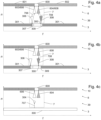
- Figure 3a depicts the effect of a mechanical shutter 30, in particular a central leaf shutter, transitioning 309 to the closed state.
- the shutter 30 and the sensor 10 are off-scale for transparency reasons. Since the mechanical shutter 30 is an external shutter component it can provide full coverage and can be made sufficiently thick to completely block the incident light 113, unlike to the blocking shield 13. In other words, in the closed state of the mechanical shutter 30 no light is transmitted towards the imaging sensor 10. It is important to note, however, that the integration phase is provided alone by the imaging sensor 10, i.e. the global electronic shutter preventing a charge transfer between the light sensitive domain 11 and the storage domain 12.
- the mechanical shutter 30 merely serves to block the parasitic light. Owing to that, the shutter speed requirements for the mechanical shutter 30 are relaxed. Therefore, a slower, i.e. an inexpensive and/or robust, mechanical shutter 30 is able to perform the required function.
- Figure 3b depicts an LC shutter 31 during transitioning, wherein a part is transformed to a closed state 311 and another part is still in the open state 310. Since said transition is fast this does not represent a typical situation.
- the skilled person understands that the electronic global shutter provides the main shutter effect for the inventive camera instrument.
- the purpose of the LC shutter 31 is to sufficiently dampen the incoming light 113, such that the light transmitted 118 in the closed state towards the imaging sensor 10 would not provide significant artifacts, in particular PLS-related artifacts. Owing to that, both the shutter speed as well as the contrast requirements of the LC shutter 31 are relaxed. I.e. and slower and less performant, i.e. inexpensive and/or more transparent LC shutters 31, which cannot be applied as stand-alone shutters, could perform the required function.
- Figure 3c depicts an external shutter component comprising an element with a polymer-dispersed liquid crystal 32 in the closed state.
- Such design works similarly to the LC shutter of Figure 3b , with an additional effect that incoming light 113 is dispersed, i.e. the transmitted light 118 is affecting a plurality of pixels of the imaging sensor 10, each with reduced intensity. This reduces the intensity of the PLS artifact, ideally to a level comparable to a background noise. Even for cases when the PLS affects the resulting image, avoiding oversaturation is advantageous for a correction by post processing.
- Figure 4a shows a first embodiment of the coupling functionality 7 using a schedule depicting the state 600-602 of the imaging sensor 10 , the commands 603,604,606,608 provided by the electronic global shutter 6 , the state 300,301,307,309 of the external shutter component 3, the command 306,308 provided by its controller 39 as well as the activation commands 706,708 provided by the coupling functionality 7 in the categories axis (n).
- bars represent a certain phase or state, with transition phases marked with dotted pattern, triangles represent commands to transit to a certain phase or state, while circles represent a notification indication an existence or a reach of a state.
- the command sequence for a single camera is shown. In a multi-camera system, there is also a need to synchronize multiple cameras. The individual camera will thus receive a trigger from an outside source, which starts the sequence.
- the claimed invention is applicable to both cases.
- the starting state is so, that the imaging sensor 10 is in a dark phase 601, i.e. neither is light integrated nor is the pixel resolved electronic signal read-out.
- the external shutter component 3 in particular a mechanical shutter, is in a closed state 301.
- an external shutter opening command 306 is generated, which causes the external shutter component 3 to transit 307 from the closed state 301 to the open state 300.
- the coupling functionality 7 provides 706 an integration start 606 command for the electronic global shutter 6 with a delay corresponding to a transition phase 307 of the external shutter component 3.
- the imaging sensor 10 changes to the integration phase 600.
- the electronic global shutter 6 and the imaging sensor 10 can provide the integration phase 600 without any significant transition.
- a pixel reset 603 is also provided for the imaging sensor 10, which causes a discarding of any pixel resolved signal corresponding to a previous phase, in particular the dark phase 601.
- the electronic global shutter 6 then provides an integration stop 608 command, for which the imaging sensor 10 terminates the integration phase 600.
- a readout start 604 command is also provided, which sets the imaging sensor 10 into the readout phase 602.
- the coupling functionality 7, in response, also provides 708 an external shutter closing command 308. Said command is provided 708 with a delay, which is not strictly necessary.
- the external shutter component 3 transits 309 from the open state 300 to the closed state 301.
- Figure 4a is an illustration of the concept, and not to scale for the said purpose, it is generally clear that the readout phase 602 is much longer than the integration phase 600.
- the transitions 307,309 of the external shutter component 3 have comparable length, when not longer, than the integration phase 600.
- the major part readout phase 602 correlates with a closed state 301 of the external shutter component 3 and only a close to insignificant part of the readout phase 602 is performed under the open state 300 of the external shutter component 3.
- Figure 4b provides an alternative embodiment of the coupling functionality 7.
- the command 306 to transit 307 the external shutter component 3 from the closed 301 to the open state 300 is provided well in advance, but independently of the integration start command 606. Since the imaging sensor performs a pixel reset 603, opening the external shutter component significantly earlier than the integration start 606 is expected to cause no adverse effect.
- the integration stop command 608 not only stops the integration phase 600 of the imaging sensor 10, but also causes 708 a generation of the external shutter closing command 308 without delay.
- the external shutter component 3 transits 309 from the open state 300 to the closed state 301.
- Figure 4c depicts an embodiment of the coupling functionality 7 , wherein the external shutter component 3 is permanently in the open state 300.
- the coupling functionality 7 receives 707 the notification 304 regarding the open state 300 of the external shutter component 3 , however the global electronic shutter functionality 6 provides the command to start 606 and stop 608 the integration phase 600 of the imaging sensor 10 largely decoupled from the controller 39 of the external shutter component 3.
- Figures 4a-c are to illustrate some salient features of some possible embodiments of the coupling functionality.
- the coupling functionality might comprise further features, in particular accessing and processing further data.
- the depicted embodiments are non-exclusive and alternative realization of the coupling functionality are within the sense of the claimed invention.
- Figure 5 depicts an embodiment of the coupling functionality 7 performing a coupling of the MC 8 with the external shutter component 3 according to the first MC coupling mode.
- the MC 8 comprises a respective controller 89.
- the MC 8 provides a compensation movement 80 in a movement-compensating phase 800 , said phase might be separated by transition phases 803 from the non-compensating phases 802 of the MC 8.
- the respective start signals 306,606,806 are non-synchronized. Due to the different time scales involved it is possible that the controllers 39,89 of the external shutter component 3 and the MC 8 and perform the respective actions independently of each other and of the electronic global shutter 6.
- the imaging sensor 10 might perform a pixel reset as depicted in Figure 4a , thus any event occurred before the integration phase 600 can be, to a large degree, neglected.
- the coupling functionality 7 provides 708 a command 308 to transit 309 to a closed state 301 of the external shutter component 3 based on a signal to stop 608 the integration phase 600 and to start 604 the readout phase 602.
- the coupling functionality 7, according to the first MC coupling mode, provides 782 a stop signal 808 for a compensation movement in response to shutter closed notification 305, indicating a closed state 301 of the external shutter component 3.
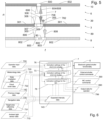
- FIG. 6 schematically depicts some possible option for the coupling functionality 7 illustrated by data flows.
- the data flows are represented by dashed lines.
- the coupling functionality 7 receives as input data operator input data 700, ambient light sensor data 710, meteorology data 720, navigation data 730, and previous image data 142.
- the skilled person understands that further embodiments of the inventive coupling functionality 7 might receive only a part of the mentioned data as input data, or might receive further input data.
- the operator input data 700 can particularly comprise preferred or forced settings, e.g. aperture size, image refresh rate, decoupling the external shutter component.
- the operator input data 700 might comprise manual settings, e.g. sensor resolution, time, weather realeted settings, whether daytime or nighttime photography is performed, or task related data.
- the ambient light sensor data 710 might be provided by an external sensor or the camera instrument itself, in particular the ambient light sensor data 710 might be derived from processing previous image data 142.
- Meteorology data 720 in the sense of the present invention especially comprise data regarding the current ambient light conditions and a forecast regarding future ambient light conditions, i.e. solar irradiation data 721 or cloud cover data 722.
- Navigation data 730 on the one hand might comprise a travel velocity of the aircraft, which is relevant for the MC control commands 890 and the activation setting 78 for the MC. Especially important is the target area reflectivity data 731, which provide information about glossy surfaces relevant for the PLS-problem.
- the coupling functionality 7 might process the ambient light sensor data 710, and/or the meteorology data 720, and/or the navigation data 730, and/or the previous image data 142 to calculate an expected intensity data 143 regarding possible pixel oversaturation.
- the activation settings 73 of the external shutter component, the activation settings 76 of the electronic global shutter 6 and activation settings 78 for the MC could be selected on the basis of the expected intensity data 143 and the constraints between the settings 73,76,78. Alternatively or additionally, a part of the input data might be directly processed.
- External shutter control commands 390, and MC control commands 890 are provided on the basis of the respective settings 73,76,78 with respect to the state of and commands provided to the electronic global shutter functionality 6.
- the coupling functionality 7 could also provide output data 799 , in particular regarding the selected activation settings 73,76,78 for the operator.
Landscapes
- Engineering & Computer Science (AREA)
- Multimedia (AREA)
- Signal Processing (AREA)
- Physics & Mathematics (AREA)
- General Physics & Mathematics (AREA)
- Nonlinear Science (AREA)
- Chemical & Material Sciences (AREA)
- Crystallography & Structural Chemistry (AREA)
- Optics & Photonics (AREA)
- Dispersion Chemistry (AREA)
- Mathematical Physics (AREA)
- Studio Devices (AREA)
Priority Applications (4)
| Application Number | Priority Date | Filing Date | Title |
|---|---|---|---|
| EP23186936.3A EP4496331A1 (de) | 2023-07-21 | 2023-07-21 | Luftbildkamera mit elektronischem globalem verschluss und externem verschluss |
| EP24186058.4A EP4496332A1 (de) | 2023-07-21 | 2024-07-02 | Luftbildkamera mit elektronischem globalem verschluss und externem dispersivem element |
| CN202410926378.8A CN119342310A (zh) | 2023-07-21 | 2024-07-11 | 具有电子全局快门和外部快门的航空摄影机 |
| US18/772,573 US20250030958A1 (en) | 2023-07-21 | 2024-07-15 | Aerial camera with electronic global shutter and external shutter |
Applications Claiming Priority (1)
| Application Number | Priority Date | Filing Date | Title |
|---|---|---|---|
| EP23186936.3A EP4496331A1 (de) | 2023-07-21 | 2023-07-21 | Luftbildkamera mit elektronischem globalem verschluss und externem verschluss |
Publications (1)
| Publication Number | Publication Date |
|---|---|
| EP4496331A1 true EP4496331A1 (de) | 2025-01-22 |
Family
ID=87429501
Family Applications (2)
| Application Number | Title | Priority Date | Filing Date |
|---|---|---|---|
| EP23186936.3A Pending EP4496331A1 (de) | 2023-07-21 | 2023-07-21 | Luftbildkamera mit elektronischem globalem verschluss und externem verschluss |
| EP24186058.4A Pending EP4496332A1 (de) | 2023-07-21 | 2024-07-02 | Luftbildkamera mit elektronischem globalem verschluss und externem dispersivem element |
Family Applications After (1)
| Application Number | Title | Priority Date | Filing Date |
|---|---|---|---|
| EP24186058.4A Pending EP4496332A1 (de) | 2023-07-21 | 2024-07-02 | Luftbildkamera mit elektronischem globalem verschluss und externem dispersivem element |
Country Status (3)
| Country | Link |
|---|---|
| US (1) | US20250030958A1 (de) |
| EP (2) | EP4496331A1 (de) |
| CN (1) | CN119342310A (de) |
Citations (3)
| Publication number | Priority date | Publication date | Assignee | Title |
|---|---|---|---|---|
| JP2006005787A (ja) * | 2004-06-18 | 2006-01-05 | Fuji Photo Film Co Ltd | 撮影装置及び撮影システム |
| US20080044170A1 (en) * | 2006-08-16 | 2008-02-21 | Choon Hwee Yap | Image Capturing System And Method Of Operating The Same |
| EP4008995A2 (de) | 2020-05-29 | 2022-06-08 | Leica Geosystems AG | Kamerakörper mit mechanischer fmc-stabilisierung für eine luft- oder raumüberwachungsvorrichtung |
Family Cites Families (6)
| Publication number | Priority date | Publication date | Assignee | Title |
|---|---|---|---|---|
| US10337862B2 (en) * | 2006-11-30 | 2019-07-02 | Rafael Advanced Defense Systems Ltd. | Digital mapping system based on continuous scanning line of sight |
| US8223217B2 (en) * | 2009-07-30 | 2012-07-17 | Motorola Mobility, Inc. | Solid state shutter devices and methods |
| US8548313B2 (en) * | 2010-09-30 | 2013-10-01 | Trimble Germany Gmbh | Aerial digital camera and method of controlling the same |
| US9998681B2 (en) * | 2016-06-28 | 2018-06-12 | Gopro, Inc. | Electronic iris for a camera |
| US20180321524A1 (en) * | 2017-05-08 | 2018-11-08 | Fenghua Li | Polymer-dispersed liquid crystal shutter with fast switching capability |
| WO2019181515A1 (ja) * | 2018-03-23 | 2019-09-26 | 富士フイルム株式会社 | 撮像制御装置、撮像装置、撮像制御方法、及び撮像制御プログラム |
-
2023
- 2023-07-21 EP EP23186936.3A patent/EP4496331A1/de active Pending
-
2024
- 2024-07-02 EP EP24186058.4A patent/EP4496332A1/de active Pending
- 2024-07-11 CN CN202410926378.8A patent/CN119342310A/zh active Pending
- 2024-07-15 US US18/772,573 patent/US20250030958A1/en active Pending
Patent Citations (3)
| Publication number | Priority date | Publication date | Assignee | Title |
|---|---|---|---|---|
| JP2006005787A (ja) * | 2004-06-18 | 2006-01-05 | Fuji Photo Film Co Ltd | 撮影装置及び撮影システム |
| US20080044170A1 (en) * | 2006-08-16 | 2008-02-21 | Choon Hwee Yap | Image Capturing System And Method Of Operating The Same |
| EP4008995A2 (de) | 2020-05-29 | 2022-06-08 | Leica Geosystems AG | Kamerakörper mit mechanischer fmc-stabilisierung für eine luft- oder raumüberwachungsvorrichtung |
Non-Patent Citations (1)
| Title |
|---|
| JENNIFER AITKEN, JOONG YOUNG PARK, ABHINAV MATHUR, MINSU KIM, GRADY TUELL, SPIE, PO BOX 10 BELLINGHAM WA 98227-0010 USA, 1 January 2010 (2010-01-01), XP040523037 * |
Also Published As
| Publication number | Publication date |
|---|---|
| EP4496332A1 (de) | 2025-01-22 |
| CN119342310A (zh) | 2025-01-21 |
| US20250030958A1 (en) | 2025-01-23 |
Similar Documents
| Publication | Publication Date | Title |
|---|---|---|
| EP2311251B1 (de) | Rolling shutter kamerasystem und verfahren | |
| JP5665159B2 (ja) | 距離画像センサ | |
| US20180100928A1 (en) | Methods circuits devices assemblies systems and functionally associated machine executable code for active scene scanning | |
| CN107302667B (zh) | 一种相机可互换动态分光成像系统及其应用于高动态成像的方法 | |
| CN102428347B (zh) | 航空摄影机系统和修正航拍失真的方法 | |
| US20220400240A1 (en) | Imaging system, control method of imaging system, and program | |
| US8796604B2 (en) | Apparatus having a controllable filter matrix to selectively acquire different components of solar irradiance | |
| US6320611B1 (en) | Method and device for air-ground recognition for optoelectronic equipment | |
| Grenzdörffer et al. | Development of four vision camera system for a micro-UAV | |
| CN112284352B (zh) | 一种用于光学遥感卫星的稳像系统和方法 | |
| CN113820009B (zh) | 一种空间极紫外太阳望远镜在轨辐射定标方法 | |
| CN100568045C (zh) | 一种适合于白天工作的高分辨力成像自适应光学望远镜 | |
| EP4496331A1 (de) | Luftbildkamera mit elektronischem globalem verschluss und externem verschluss | |
| KR101969841B1 (ko) | 정밀조도를 활용한 전천카메라 기반의 구름 관측 시스템 | |
| US12529559B2 (en) | Earth observation scanning system | |
| US8049802B2 (en) | CMOS camera adapted for forming images of moving scenes | |
| Russell et al. | Lasercom pointing, acquisition, and tracking control using a CCD-based tracker | |
| JPH11234547A (ja) | 光学撮像装置 | |
| DK181567B1 (en) | METHOD OF RECORDING ULTRA SHORT EXPOSURE HIGH DYNAMIC FIELD IMAGES AND RELATED IMAGING DEVICE | |
| US10863125B2 (en) | High-precision system for time-stamping the passage of an object, in particular a satellite | |
| US12101555B2 (en) | Imaging support device, imaging apparatus, imaging system, imaging support method, and program | |
| CN104635241A (zh) | 一种艇载多光谱高光谱对地观测装置 | |
| Serruys et al. | Linear variable filters—A camera system requirement analysis for hyperspectral imaging sensors onboard small Remotely Piloted Aircraft Systems | |
| JP2015226078A (ja) | 撮像装置 | |
| RU2803762C2 (ru) | Способ обеспечения работы телескопа и устройство для его реализации |
Legal Events
| Date | Code | Title | Description |
|---|---|---|---|
| PUAI | Public reference made under article 153(3) epc to a published international application that has entered the european phase |
Free format text: ORIGINAL CODE: 0009012 |
|
| STAA | Information on the status of an ep patent application or granted ep patent |
Free format text: STATUS: THE APPLICATION HAS BEEN PUBLISHED |
|
| AK | Designated contracting states |
Kind code of ref document: A1 Designated state(s): AL AT BE BG CH CY CZ DE DK EE ES FI FR GB GR HR HU IE IS IT LI LT LU LV MC ME MK MT NL NO PL PT RO RS SE SI SK SM TR |
|
| STAA | Information on the status of an ep patent application or granted ep patent |
Free format text: STATUS: REQUEST FOR EXAMINATION WAS MADE |
|
| 17P | Request for examination filed |
Effective date: 20250604 |
|
| RAP1 | Party data changed (applicant data changed or rights of an application transferred) |
Owner name: HEXAGON INNOVATION HUB GMBH |