EP4495804A2 - Verfahren und vorrichtung zur bildbasierten mensch-computer-interaktion, vorrichtung und speichermedium - Google Patents
Verfahren und vorrichtung zur bildbasierten mensch-computer-interaktion, vorrichtung und speichermedium Download PDFInfo
- Publication number
- EP4495804A2 EP4495804A2 EP24194902.3A EP24194902A EP4495804A2 EP 4495804 A2 EP4495804 A2 EP 4495804A2 EP 24194902 A EP24194902 A EP 24194902A EP 4495804 A2 EP4495804 A2 EP 4495804A2
- Authority
- EP
- European Patent Office
- Prior art keywords
- image
- information
- analyzed
- determining
- category
- Prior art date
- Legal status (The legal status is an assumption and is not a legal conclusion. Google has not performed a legal analysis and makes no representation as to the accuracy of the status listed.)
- Withdrawn
Links
Images



Classifications
-
- G—PHYSICS
- G06—COMPUTING OR CALCULATING; COUNTING
- G06F—ELECTRIC DIGITAL DATA PROCESSING
- G06F16/00—Information retrieval; Database structures therefor; File system structures therefor
- G06F16/50—Information retrieval; Database structures therefor; File system structures therefor of still image data
- G06F16/53—Querying
- G06F16/532—Query formulation, e.g. graphical querying
-
- G—PHYSICS
- G06—COMPUTING OR CALCULATING; COUNTING
- G06F—ELECTRIC DIGITAL DATA PROCESSING
- G06F16/00—Information retrieval; Database structures therefor; File system structures therefor
- G06F16/50—Information retrieval; Database structures therefor; File system structures therefor of still image data
- G06F16/53—Querying
-
- G—PHYSICS
- G06—COMPUTING OR CALCULATING; COUNTING
- G06F—ELECTRIC DIGITAL DATA PROCESSING
- G06F16/00—Information retrieval; Database structures therefor; File system structures therefor
- G06F16/30—Information retrieval; Database structures therefor; File system structures therefor of unstructured textual data
- G06F16/33—Querying
- G06F16/332—Query formulation
- G06F16/3329—Natural language query formulation
-
- G—PHYSICS
- G06—COMPUTING OR CALCULATING; COUNTING
- G06F—ELECTRIC DIGITAL DATA PROCESSING
- G06F16/00—Information retrieval; Database structures therefor; File system structures therefor
- G06F16/30—Information retrieval; Database structures therefor; File system structures therefor of unstructured textual data
- G06F16/36—Creation of semantic tools, e.g. ontology or thesauri
-
- G—PHYSICS
- G06—COMPUTING OR CALCULATING; COUNTING
- G06F—ELECTRIC DIGITAL DATA PROCESSING
- G06F16/00—Information retrieval; Database structures therefor; File system structures therefor
- G06F16/50—Information retrieval; Database structures therefor; File system structures therefor of still image data
- G06F16/53—Querying
- G06F16/538—Presentation of query results
-
- G—PHYSICS
- G06—COMPUTING OR CALCULATING; COUNTING
- G06F—ELECTRIC DIGITAL DATA PROCESSING
- G06F16/00—Information retrieval; Database structures therefor; File system structures therefor
- G06F16/50—Information retrieval; Database structures therefor; File system structures therefor of still image data
- G06F16/55—Clustering; Classification
-
- G—PHYSICS
- G06—COMPUTING OR CALCULATING; COUNTING
- G06F—ELECTRIC DIGITAL DATA PROCESSING
- G06F16/00—Information retrieval; Database structures therefor; File system structures therefor
- G06F16/50—Information retrieval; Database structures therefor; File system structures therefor of still image data
- G06F16/58—Retrieval characterised by using metadata, e.g. metadata not derived from the content or metadata generated manually
- G06F16/583—Retrieval characterised by using metadata, e.g. metadata not derived from the content or metadata generated manually using metadata automatically derived from the content
-
- G—PHYSICS
- G06—COMPUTING OR CALCULATING; COUNTING
- G06F—ELECTRIC DIGITAL DATA PROCESSING
- G06F16/00—Information retrieval; Database structures therefor; File system structures therefor
- G06F16/50—Information retrieval; Database structures therefor; File system structures therefor of still image data
- G06F16/58—Retrieval characterised by using metadata, e.g. metadata not derived from the content or metadata generated manually
- G06F16/583—Retrieval characterised by using metadata, e.g. metadata not derived from the content or metadata generated manually using metadata automatically derived from the content
- G06F16/5846—Retrieval characterised by using metadata, e.g. metadata not derived from the content or metadata generated manually using metadata automatically derived from the content using extracted text
-
- G—PHYSICS
- G06—COMPUTING OR CALCULATING; COUNTING
- G06F—ELECTRIC DIGITAL DATA PROCESSING
- G06F16/00—Information retrieval; Database structures therefor; File system structures therefor
- G06F16/50—Information retrieval; Database structures therefor; File system structures therefor of still image data
- G06F16/58—Retrieval characterised by using metadata, e.g. metadata not derived from the content or metadata generated manually
- G06F16/583—Retrieval characterised by using metadata, e.g. metadata not derived from the content or metadata generated manually using metadata automatically derived from the content
- G06F16/5854—Retrieval characterised by using metadata, e.g. metadata not derived from the content or metadata generated manually using metadata automatically derived from the content using shape and object relationship
-
- G—PHYSICS
- G06—COMPUTING OR CALCULATING; COUNTING
- G06V—IMAGE OR VIDEO RECOGNITION OR UNDERSTANDING
- G06V10/00—Arrangements for image or video recognition or understanding
- G06V10/40—Extraction of image or video features
- G06V10/44—Local feature extraction by analysis of parts of the pattern, e.g. by detecting edges, contours, loops, corners, strokes or intersections; Connectivity analysis, e.g. of connected components
-
- G—PHYSICS
- G06—COMPUTING OR CALCULATING; COUNTING
- G06V—IMAGE OR VIDEO RECOGNITION OR UNDERSTANDING
- G06V10/00—Arrangements for image or video recognition or understanding
- G06V10/40—Extraction of image or video features
- G06V10/48—Extraction of image or video features by mapping characteristic values of the pattern into a parameter space, e.g. Hough transformation
-
- G—PHYSICS
- G06—COMPUTING OR CALCULATING; COUNTING
- G06V—IMAGE OR VIDEO RECOGNITION OR UNDERSTANDING
- G06V10/00—Arrangements for image or video recognition or understanding
- G06V10/70—Arrangements for image or video recognition or understanding using pattern recognition or machine learning
- G06V10/77—Processing image or video features in feature spaces; using data integration or data reduction, e.g. principal component analysis [PCA] or independent component analysis [ICA] or self-organising maps [SOM]; Blind source separation
- G06V10/80—Fusion, i.e. combining data from various sources at the sensor level, preprocessing level, feature extraction level or classification level
- G06V10/803—Fusion, i.e. combining data from various sources at the sensor level, preprocessing level, feature extraction level or classification level of input or preprocessed data
-
- G—PHYSICS
- G06—COMPUTING OR CALCULATING; COUNTING
- G06V—IMAGE OR VIDEO RECOGNITION OR UNDERSTANDING
- G06V30/00—Character recognition; Recognising digital ink; Document-oriented image-based pattern recognition
- G06V30/40—Document-oriented image-based pattern recognition
- G06V30/41—Analysis of document content
- G06V30/414—Extracting the geometrical structure, e.g. layout tree; Block segmentation, e.g. bounding boxes for graphics or text
-
- G—PHYSICS
- G06—COMPUTING OR CALCULATING; COUNTING
- G06V—IMAGE OR VIDEO RECOGNITION OR UNDERSTANDING
- G06V30/00—Character recognition; Recognising digital ink; Document-oriented image-based pattern recognition
- G06V30/40—Document-oriented image-based pattern recognition
- G06V30/41—Analysis of document content
- G06V30/418—Document matching, e.g. of document images
Definitions
- the present disclosure relates to the image processing field in the field of artificial intelligence and, in particular, to an image based human-computer interaction method and apparatus, a device, and a storage medium.
- an automatic understanding and analysis technology for an image is gradually applied in various industries, which brings convenience to people's work. For example, a user may ask a question about an image, and automatically get an answer based on the content in the image.
- the types of pictures in a work scenario are complex, for example, including a document screenshot, a table screenshot, a flowchart, an architecture diagram, etc.
- the current picture understanding technology has a low ability to understand contents of these images, which cannot meet the needs of users, and provides poor experience of human-computer interaction.
- the present disclosure provides an image based human-computer interaction method and apparatus, a device, and a storage medium.
- an image based human-computer interaction method including:
- an image based human-computer interaction apparatus including:
- an electronic device including:
- a non-transitory computer-readable storage medium storing computer instructions, where the computer instructions are used for causing a computer to perform the method according to the first aspect.
- a computer program product including a computer program is provided, when the computer program is executed by a processor, the method according to the first aspect is implemented.
- a user may ask a question about an image. For example, if the user wants to get content introduction of the image, the user may request to generate a note that introduces the content of the image.
- the current image processing technology can recognize the picture content in the image.
- a model such as Bootstrapping Language-Image Pre-training (Bootstrapping Language-Image Pre-training, BLIP) may be used for image processing.
- BLIP Bootstrapping Language-Image Pre-training
- BLIP Bootstrapping Language-Image Pre-training
- picture types in a work scenario are more heterogeneous and complex, including a pure picture, a document screenshot, a table screenshot, a flowchart, an architecture diagram, a data chart, etc.
- the existing models cannot accurately understand contents of these pictures.
- An obtained answer for a question of a user is prone to being wrong, and the user experience of human-computer interaction is poor.
- the present disclosure provides an image based human-computer interaction method and apparatus, a device, and a storage medium, applied to the image processing field in the field of artificial intelligence, to improve the accuracy of understanding the image and the user experience.
- the models in the embodiments are not for a specific user, and cannot reflect personal information of the specific user. It should be noted that the images in the embodiments are from a public dataset.
- the to-be-analyzed image may be input into a preset large model, the image is processed and analyzed through the large model, and the response information is output by the large model.
- Image processing and analysis may also be completed by calling tools implemented in different ways such as deep learning, machine learning, and expert rules. In this embodiment, there is no specific limitation on the tools used.
- the to-be-analyzed image may include a variety of modal data such as the text modality and the visual modality.
- the image layout information and the image content information of the to-be-analyzed image are determined.
- the image layout information can represent distribution of the image elements with the preset granularity in the to-be-analyzed image
- the image content information can represent the content expressed by the modal data in the to-be-analyzed image.
- the response information corresponding to the question information is determined according to the image layout information and the image content information.
- FIG. 2 is a schematic flowchart of an image based human-computer interaction method according to an embodiment of the present disclosure.
- the determining the image layout information of the to-be-analyzed image may be refined as: determining the image elements with the preset granularity in the to-be-analyzed image, where the image elements represent constituents of the to-be-analyzed image; and determining coordinate positions of the image elements with the preset granularity in the to-be-analyzed image, and determining the image layout information of the to-be-analyzed image according to the coordinate positions.
- the modal data in the to-be-analyzed image includes the text modality and the visual modality.
- the determining the image content information of the to-be-analyzed image may be refined as: processing the to-be-analyzed image with text extraction of the text modality to obtain first content information corresponding to the text modality; and converting the content expressed by the visual modality in the to-be-analyzed image into a text described by a natural language, to obtain second content information corresponding to the visual modality, where the image content information includes the first content information and the second content information.
- the method includes the following steps.
- S201 acquiring a to-be-analyzed image, and determining image elements with preset granularity in the to-be-analyzed image, where the image elements represent constituents of the to-be-analyzed image; and determining coordinate positions of the image elements with the preset granularity in the to-be-analyzed image, and determining image layout information according to the coordinate positions.
- the image layout information and the image content information of the to-be-analyzed image can be determined.
- the granularity of the image elements is preset to segment the image elements.
- the image elements with the preset granularity are determined from the to-be-analyzed image, and a plurality of image elements with the preset granularity can be determined.
- the preset granularity is the granularity of one single word, and there are ten single words in the to-be-analyzed image, then ten image elements with the preset granularity can be determined.
- Coordinate positions of various image elements with the preset granularity in the to-be-analyzed image are determined; the image layout information of the to-be-analyzed image is determined according to the coordinate positions of the image elements with the preset granularity in the to-be-analyzed image.
- the coordinate positions may be determined as the image layout information.
- contents expressed by various image elements with the preset granularity may be determined, and the contents are associated with the corresponding coordinate positions as the image layout information.
- an image element with the preset granularity is a single word, and the single word and the coordinate position where the single word is located are associated and stored to obtain the image layout information.
- an image element with the preset granularity is a tree, and information of the tree, such as a size and a color, and the coordinate position of the tree are associated and stored to obtain the image layout information.
- the determining image elements with the preset granularity in the to-be-analyzed image includes: processing the to-be-analyzed image with image recognition according to the preset granularity, to obtain the image elements with the preset granularity in the to-be-analyzed image.
- the granularity of the image elements is preset, and according to the preset granularity, image recognition is performed on the to-be-analyzed image to recognize all the image elements with the preset granularity in the to-be-analyzed image. For example, if the preset granularity is one single word, then each single word in the to-be-analyzed image can be recognized, where each single word is one image element with the preset granularity.
- This embodiment does not specifically limit the preset granularity of the image elements, but it is necessary to ensure that the image elements of the preset granularity contain semantics. For example, a letter cannot be used as the preset granularity.
- a layout recognition algorithm may be preset, and may be used for recognizing the image elements with the preset granularity in the to-be-analyzed image. After all the image elements with the preset granularity in the to-be-analyzed image are determined, semantic recognition may be further performed on the image elements with the preset granularity to obtain semantics of the image elements with the preset granularity.
- the preset layout recognition algorithm there is no specific limitation on the preset layout recognition algorithm.
- Such setting has the beneficial effects that: based on the preset technology such as the layout recognition, constituents of fine-granularity elements in the to-be-analyzed image are recognized to obtain a plurality of image elements with the preset granularity, which is conductive to subsequently obtaining image layout information of the image, thereby improving the efficiency and the accuracy of information extraction.
- the preset technology such as the layout recognition
- the determining the coordinate positions of the image elements with the preset granularity in the to-be-analyzed image includes: processing the to-be-analyzed image with image segmentation according to the image elements with the preset granularity, to obtain a plurality of image blocks, where one image block represents one image element with the preset granularity; and determining coordinate positions of the image blocks in the to-be-analyzed image.
- the to-be-analyzed image is processed with image segmentation according to the image elements with the preset granularity, to segment the to-be-analyzed image into a plurality of image blocks.
- One image block can represent one image element with the preset granularity.
- the image elements with the preset granularity may be segmented in a form of a rectangular block.
- a coordinate position of each image block in the to-be-analyzed image is determined; and the image layout information of the to-be-analyzed image is determined according to the coordinate position of the image block.
- the coordinate positions may be determined as the image layout information; or the image elements in the image blocks and the corresponding coordinate positions may be jointly used as the image layout information of the to-be-analyzed image.
- an image element in an image block is one single word, and then the single word and the coordinate position of the image block are associated and stored as the image layout information. If semantic information of the image element in the image block is determined, then the semantic information and the corresponding coordinate position may be associated and stored as the image layout information.
- Such setting has the beneficial effects that: for each image block, the content in the image block and the coordinate position of the image block are determined as the image layout information, which associates the position with the content for the image element with the preset granularity, thereby avoiding confusion between the position and the content at this position, and improving the accuracy of the image layout information.
- S202 processing the to-be-analyzed image with text extraction of the text modality to obtain first content information corresponding to the text modality; and converting the content expressed by the visual modality in the to-be-analyzed image into a text described by a natural language, to obtain second content information corresponding to the visual modality.
- the to-be-analyzed image may include modal data, for example, including the text modality and the visual modality.
- the content information corresponding to various modalities can be obtained from the to-be-analyzed image.
- the to-be-analyzed image may be processed with text extraction of the text modality, that is, text information is extracted from the to-be-analyzed image to obtain the first content information.
- the first content information is the text information in the to-be-analyzed image.
- a text recognition algorithm may be preset for text extraction, for example, an optical character recognition (OCR) algorithm may be used. In this embodiment, there is no specific limitation on the preset text recognition algorithm.
- the picture content may be acquired from the to-be-analyzed image as the content expressed by the visual modality.
- a background picture of the text may be acquired, and all patterns other than the text in the to-be-analyzed image may be acquired.
- the content expressed by the visual modality in the to-be-analyzed image is converted into the text described by the natural language.
- the text described by the natural language can be used for introducing the content expressed by the visual modality.
- the text described by the natural language is determined as the second content information, that is, the visual content of the to-be-analyzed image is converted into a caption (explanation).
- An image captioning algorithm may be preset, and the second content information can be obtained according to the image captioning algorithm. In this embodiment, there is no specific limitation on the preset image captioning algorithm.
- the content information corresponding to various modalities is extracted from the to-be-analyzed image, so as to comprehensively extract information from the to-be-analyzed image, thereby avoiding information omission, improving the accuracy of understanding the image, and then improving the experience of human-computer interaction.
- S203 determining, in response to question information sent out by the user, response information corresponding to the question information according to the image layout information and the image content information, where the question information represents a question proposed by the user for the to-be-analyzed image; and the response information represents a reply answer for the question represented by the question information.
- this step can be referred to step S 102, and is not described herein again.
- FIG. 3 is a schematic diagram of a to-be-analyzed image.
- the to-be-analyzed image in FIG. 3 there are three lines of texts on the left side, trees on the right side, and clouds in the background. That is, the to-be-analyzed image contains two types of modal data i.e. the text modality and the visual modality.
- the text on the left side is the text modality
- the trees on the right side and the clouds in the background are the visual modality.
- the to-be-analyzed image may include a variety of modal data such as the text modality and the visual modality.
- the image layout information and the image content information of the to-be-analyzed image are determined.
- the image layout information can represent distribution of the image elements with the preset granularity in the to-be-analyzed image
- the image content information can represent the content expressed by the modal data in the to-be-analyzed image.
- the response information corresponding to the question information is determined according to the layout information and the content information.
- FIG. 4 is a schematic flowchart of an image based human-computer interaction method according to an embodiment of the present disclosure.
- the determining response information corresponding to the question information according to the image layout information and the image content information may be refined as: determining an image category of the to-be-analyzed image according to the image layout information and the image content information; determining semantic information of the question information, and extracting target information corresponding to the semantic information from the image layout information and the image content information; and determining the response information corresponding to the question information according to the target information and the image category of the to-be-analyzed image.
- the method includes the following steps.
- S401 acquiring a to-be-analyzed image, and determining image layout information and image content information of the to-be-analyzed image, where the to-be-analyzed image includes a variety of modal data; the image layout information represents distribution of image elements with preset granularity in the to-be-analyzed image; and the image content information represents a content expressed by the modal data in the to-be-analyzed image.
- this step can be referred to step S101, and is not described herein again.
- the image category of the to-be-analyzed image can be determined according to the image layout information and the image content information.
- the image category may be a document screenshot, a table screenshot, a flowchart, an architecture diagram, or a data chart, etc.
- the similarity threshold is preset, and each similarity obtained is compared with the similarity threshold. If the plurality of similarities obtained are all equal to or larger than the preset similarity threshold, it is considered that the image layout information is consistent with the image content information, the image layout information and the image content information are correct information, and the image category of the to-be-analyzed image can be determined according to the image layout information and the image content information.
- Such setting has the beneficial effects that: by determining the similarities, the accuracy of the image layout information and the image content information can be judged, so as to determine a category subsequently, thereby improving the accuracy of determining the image category, and then improving the accuracy of question answering.
- the standard information may be preset from the image layout information and the image content information, for example, the second content information may be preset as the standard information.
- a rule for determining the standard information may also be preset.
- the standard information may be determined according to the similarities between two kinds of information. The two kinds of information with the highest similarity may be determined, and one of the two kinds of information is determined as the standard information.
- the image layout information is information A
- the first content information is information B
- the second content information is information C. If the similarity between A and B is higher, and the similarity between A and C is lower, it may be determined that either A or B can be the standard information, and the information C is adjusted according to the standard information.
- the standard information is the image layout information
- the information needed to be adjusted is the second content information
- the image layout information indicates that the to-be-analyzed image is a tabular image
- the second content information indicates that the to-be-analyzed image is a flowchart
- the flowchart in the second content information may be changed into the tabular image.
- the image category of the to-be-analyzed image is determined according to the adjusted image layout information and image content information.
- An image classification model may be preset. The adjusted image layout information and image content information are input into the image classification model. After comprehensive judgment by the model, the image category of the to-be-analyzed image is obtained.
- the image category may be a pure image, a table, a document, a flowchart, etc.
- the image classification model may be a pre-trained neural network model. In this embodiment, there is no specific limitation on a structure of the image classification model.
- Such setting has the beneficial effects that: if there is a smaller similarity between the information, the information may be corrected to improve the accuracy of the information. Then the image category is determined, so as to improve the accuracy of the image category.
- the image category of the to-be-analyzed image can be determined, and the image category determined according to the position arrangement rule is taken as the first image category, that is, the image category determined according to the image layout information is the first image category.
- the image elements with the preset granularity may show the position arrangement rule of multiple rows and multiple columns in the to-be-analyzed image, and then the first image category is the tabular category.
- the image category of the to-be-analyzed image may also be determined, and the image category determined according to the second content information is taken as the second image category.
- the second content information refers to a caption of the image content, and the second image category may be read directly from the second content information. For example, if it is written in the second content information that the to-be-analyzed image is a flowchart, the second image category is a flowchart category.
- Such setting has the beneficial effects that: by comprehensively considering the image layout information and the image content information, an error on category determination caused by single information is avoided, which improves the accuracy of determining the category, thereby improving the accuracy of question answering and the experience of human-computer interaction.
- the method further includes: determining, in response to inconsistency between the first image category and the second image category, a target category from the first image category and the second image category according to a preset priority, as the image category of the to-be-analyzed image.
- the first image category or the second image category cannot be directly determined as the image category of the to-be-analyzed image. It is necessary to determine one image category from the first image category and the second image category as the target category, and then the target category is determined as the image category of the to-be-analyzed image.
- the priority between the image layout information and the image content information may be preset. According to the preset priority, the information with the highest priority is determined, and the image category determined by the information with the highest priority is determined as the target category. For example, the second content information has the highest priority, and then the second image category may be determined as the target category, so as to obtain the image category of the to-be-analyzed image.
- Such setting has the beneficial effects that: if the two image categories are inconsistent, a more reliable information category is selected as the image category of the to-be-analyzed image, so as to improve the accuracy of determining the image category.
- the question information sent out by the user is acquired, and semantics of the question information is recognized to obtain the semantic information of the question information, that is, the semantic information represents the semantics of the question information.
- One semantic recognition model may be preset to determine the semantic information of the question information. In this embodiment, there is no specific limitation on the preset semantic recognition model.
- the target information is screened from the image layout information and the image content information.
- corresponding information may be found from the image layout information and the image content information as the target information. That is, the target information consistent with the semantic information is found from the image layout information and the image content information.
- semantic recognition may be performed on the image layout information and the image content information to find information corresponding to the semantics consistent with the semantic information from the image layout information, and to find information corresponding to the semantics consistent with the semantic information from the image content information.
- the question information may be answered according to the target information and the image category of the to-be-analyzed image, to obtain the response information corresponding to the question information.
- the image category and the target information may be determined as the response information, or the image category and the target information may be combined to obtain the response information.
- the response information may be obtained based on a preset tool.
- the preset tool may be a tool for generating a chart or creating a to-do list, etc.
- the determining the response information according to the target information and the image category of the to-be-analyzed image includes: determining an information format corresponding to the image category of the to-be-analyzed image according to a preset association relationship between the image category and the information format; and generating the response information corresponding to the question information according to the target information, based on the information format corresponding to the image category of the to-be-analyzed image.
- the association relationship between the image category and the information format is preset. For different image categories, there may be different formats of response information. According to the image category of the to-be-analyzed image and the preset association relationship between the image category and the information format, the information format corresponding to the image category of the to-be-analyzed image is determined as a target format.
- the format of the target information is adjusted according to the target format, and the adjusted information is the response information. That is, the content expressed by the response information is the content expressed by the target information, and the format of the response information is the information format corresponding to the image category of the to-be-analyzed image.
- the target information may be adjusted into a tabular form, and a generated table is displayed to the user as the response information.
- Such setting has the beneficial effects that: for different image categories, different formats of response information can be obtained, which is conductive to the user in understanding the response information, thereby improving the user experience.
- FIG. 5 is a process diagram of human-computer interaction according to this embodiment.
- the user inputs a to-be-analyzed image and question information.
- the to-be-analyzed image is an image with multi-modal data, and the question information may be used for requesting content extraction, picture answering, picture questioning and answering, chart answering, copywriting, etc. on the to-be-analyzed image.
- the to-be-analyzed image is observed and analyzed to obtain first content information, second content information and image layout information. These obtained layout information and content information, as well as question information, are input into a preset large model.
- the large model performs reasoning of a Chain of Thought (CoT) mode, and uses a preset tool to output the response information.
- CoT Chain of Thought
- the Chain of Thought mode refers to a process of decomposing a complex question into step-by-step sub-questions through gradual participation of the large model, and solving them in sequence.
- the reasoning process of the Chain of Thought is to correct and adjust information first, then determine an image category, then extract target information, and finally combine question information indicated by the user to obtain the response information.
- the to-be-analyzed image may include a variety of modal data such as a text modality and a visual modality.
- the image layout information and the image content information of the to-be-analyzed image are determined.
- the image layout information can represent distribution of image elements with preset granularity in the to-be-analyzed image
- the image content information can represent a content expressed by the modal data in the to-be-analyzed image.
- the response information corresponding to the question information is determined according to the image layout information and the image content information.
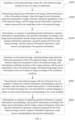
- FIG. 6 is a structural block diagram of an image based human-computer interaction apparatus according to an embodiment of the present disclosure. For convenience in description, only the parts related to the embodiments of the present disclosure are shown.
- the image based human-computer interaction apparatus 600 includes: an acquiring unit 601, a first determining unit 602 and a second determining unit 603.
- the acquiring unit 601 is configured to acquire a to-be-analyzed image, where the to-be-analyzed image includes at least two types of modal data.
- the first determining unit 602 is configured to determine image layout information and image content information of the to-be-analyzed image, where the image layout information represents distribution of image elements with preset granularity in the to-be-analyzed image; and the image content information represents a content expressed by the modal data in the to-be-analyzed image.
- the second determining unit 603 is configured to determine, in response to acquiring question information, response information corresponding to the question information according to the image layout information and the image content information, where the question information represents a question proposed for the to-be-analyzed image; and the response information represents a reply answer corresponding to the question information.
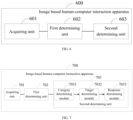
- FIG. 7 is a structural block diagram of an image based human-computer interaction apparatus according to an embodiment of the present disclosure.
- the image based human-computer interaction apparatus 700 includes: an acquiring unit 701, a first determining unit 702 and a second determining unit 703, where the second determining unit 703 includes a category determining module 7031, a target determining module 7032 and a response determining module 7033.
- the category determining module 7031 is configured to determine an image category of the to-be-analyzed image according to the image layout information and the image content information.
- the target determining module 7032 is configured to determine semantic information of the question information, and extract target information corresponding to the semantic information from the image layout information and the image content information.
- the response determining module 7033 is configured to determine the response information corresponding to the question information according to the target information and the image category of the to-be-analyzed image.
- the first determining unit 702 includes:
- the element determining module includes: an element recognition submodule, configured to process the to-be-analyzed image with image recognition according to the preset granularity, to obtain the image elements with the preset granularity in the to-be-analyzed image.
- the coordinate determining module includes:
- the at least two types of modal data include a text modality and a visual modality.
- the first determining unit 702 includes:
- the response determining module 7033 includes:
- the category determining module includes:
- the apparatus further includes:
- the category determining module 7031 includes:
- the apparatus further includes: a target category determining unit, configured to determine, in response to inconsistency between the first image category and the second image category, a target category from the first image category and the second image category according to a preset priority, as the image category of the to-be-analyzed image.
- a target category determining unit configured to determine, in response to inconsistency between the first image category and the second image category, a target category from the first image category and the second image category according to a preset priority, as the image category of the to-be-analyzed image.
- the present disclosure further provides an electronic device.
- FIG. 8 is a structural block diagram of an electronic device according to an embodiment of the present disclosure.
- the electronic device may be a terminal device or a server.
- the electronic device 800 includes: at least one processor 802, and a memory 801 communicatively connected to the at least one processor 802, where the memory stores instructions executable by the at least one processor 802; and the instructions are executed by the at least one processor 802 to cause the at least one processor 802 to perform the image based human-computer interaction method of the present disclosure.
- the electronic device 800 further includes a receiver 803 and a transmitter 804.
- the receiver 803 is configured to receive instructions and data transmitted by other devices; and the transmitter 804 is configured to transmit the instructions and data to an external device.
- the systems and technologies described here may be implemented in a computing system that includes background components (for example, as a data server), or a computing system that includes middleware components (for example, an application server), or a computing system that includes front-end components (for example, a user computer with a graphical user interface or a web browser, through which the user can interact with the implementation of the systems and technologies described here), or a computing system that includes any combination of such back-end components, middleware components, or front-end components.
- the components of the system may be connected with each other through digital data communication (for example, a communication network) in any form or medium. Examples of the communication network include: a local area network (LAN), a wide area network (WAN), and the Internet.
Landscapes
- Engineering & Computer Science (AREA)
- Theoretical Computer Science (AREA)
- Physics & Mathematics (AREA)
- General Physics & Mathematics (AREA)
- Computer Vision & Pattern Recognition (AREA)
- Databases & Information Systems (AREA)
- Data Mining & Analysis (AREA)
- General Engineering & Computer Science (AREA)
- Multimedia (AREA)
- Artificial Intelligence (AREA)
- Library & Information Science (AREA)
- Mathematical Physics (AREA)
- Computer Graphics (AREA)
- Geometry (AREA)
- Computational Linguistics (AREA)
- Health & Medical Sciences (AREA)
- Computing Systems (AREA)
- Evolutionary Computation (AREA)
- General Health & Medical Sciences (AREA)
- Medical Informatics (AREA)
- Software Systems (AREA)
- Human Computer Interaction (AREA)
- Information Retrieval, Db Structures And Fs Structures Therefor (AREA)
- User Interface Of Digital Computer (AREA)
Applications Claiming Priority (1)
| Application Number | Priority Date | Filing Date | Title |
|---|---|---|---|
| CN202410302732.XA CN118013065A (zh) | 2024-03-15 | 2024-03-15 | 基于图像的人机交互方法、装置、设备及存储介质 |
Publications (2)
| Publication Number | Publication Date |
|---|---|
| EP4495804A2 true EP4495804A2 (de) | 2025-01-22 |
| EP4495804A3 EP4495804A3 (de) | 2025-03-05 |
Family
ID=90950662
Family Applications (1)
| Application Number | Title | Priority Date | Filing Date |
|---|---|---|---|
| EP24194902.3A Withdrawn EP4495804A3 (de) | 2024-03-15 | 2024-08-16 | Verfahren und vorrichtung zur bildbasierten mensch-computer-interaktion, vorrichtung und speichermedium |
Country Status (5)
| Country | Link |
|---|---|
| US (1) | US20240338962A1 (de) |
| EP (1) | EP4495804A3 (de) |
| JP (1) | JP7789847B2 (de) |
| KR (1) | KR20240108328A (de) |
| CN (1) | CN118013065A (de) |
Families Citing this family (1)
| Publication number | Priority date | Publication date | Assignee | Title |
|---|---|---|---|---|
| CN119863810A (zh) * | 2024-12-10 | 2025-04-22 | 科大讯飞股份有限公司 | 控制方法、装置、存储介质和电子设备 |
Family Cites Families (6)
| Publication number | Priority date | Publication date | Assignee | Title |
|---|---|---|---|---|
| JP2007065763A (ja) | 2005-08-29 | 2007-03-15 | Sharp Corp | 画像データ検索装置、画像データ検索方法、プログラム及び記録媒体 |
| CN108228703B (zh) | 2017-10-31 | 2020-05-08 | 北京市商汤科技开发有限公司 | 图像问答方法、装置、系统和存储介质 |
| WO2021171575A1 (ja) | 2020-02-28 | 2021-09-02 | 日本電信電話株式会社 | 学習装置、テキスト生成装置、学習方法、テキスト生成方法及びプログラム |
| CN111782839B (zh) | 2020-06-30 | 2023-08-22 | 北京百度网讯科技有限公司 | 图像问答方法、装置、计算机设备和介质 |
| WO2024015323A1 (en) | 2022-07-11 | 2024-01-18 | Pryon Incorporated | Methods and systems for improved document processing and information retrieval |
| CN118586403A (zh) | 2024-06-13 | 2024-09-03 | 中国建设银行股份有限公司 | 基于文档图像的问答方法、装置、设备、存储介质及程序产品 |
-
2024
- 2024-03-15 CN CN202410302732.XA patent/CN118013065A/zh active Pending
- 2024-06-19 US US18/747,599 patent/US20240338962A1/en active Pending
- 2024-06-20 KR KR1020240080082A patent/KR20240108328A/ko active Pending
- 2024-06-20 JP JP2024099301A patent/JP7789847B2/ja active Active
- 2024-08-16 EP EP24194902.3A patent/EP4495804A3/de not_active Withdrawn
Also Published As
| Publication number | Publication date |
|---|---|
| JP2024120045A (ja) | 2024-09-03 |
| JP7789847B2 (ja) | 2025-12-22 |
| EP4495804A3 (de) | 2025-03-05 |
| CN118013065A (zh) | 2024-05-10 |
| US20240338962A1 (en) | 2024-10-10 |
| KR20240108328A (ko) | 2024-07-09 |
Similar Documents
| Publication | Publication Date | Title |
|---|---|---|
| US20220270382A1 (en) | Method and apparatus of training image recognition model, method and apparatus of recognizing image, and electronic device | |
| US20220391587A1 (en) | Method of training image-text retrieval model, method of multimodal image retrieval, electronic device and medium | |
| CN113392253B (zh) | 视觉问答模型训练及视觉问答方法、装置、设备及介质 | |
| EP3872652B1 (de) | Verfahren und vorrichtung zur verarbeitung von video, elektronische vorrichtung, medium und produkt | |
| US12118770B2 (en) | Image recognition method and apparatus, electronic device and readable storage medium | |
| US11138424B2 (en) | Contextual vector grids for document processing | |
| CN114092948B (zh) | 一种票据识别方法、装置、设备以及存储介质 | |
| US20230052906A1 (en) | Entity Recognition Method and Apparatus, and Computer Program Product | |
| US11816908B2 (en) | Method of generating font database, and method of training neural network model | |
| CN114187448A (zh) | 文档图像识别方法和装置、电子设备、计算机可读介质 | |
| CN113255501B (zh) | 生成表格识别模型的方法、设备、介质及程序产品 | |
| EP4057283A2 (de) | Verfahren zur spracherkennung, verfahren zum trainieren, geräte und intelligenter lautsprecher | |
| EP4116860A2 (de) | Verfahren zur erfassung von informationen, elektronische vorrichtung und speichermedium | |
| EP3961433A2 (de) | Datenannotationsverfahren und -vorrichtung sowie elektronische vorrichtung und speichermedium | |
| CN115481599A (zh) | 文档的处理方法、装置、电子设备和存储介质 | |
| US20220382991A1 (en) | Training method and apparatus for document processing model, device, storage medium and program | |
| CN114724156A (zh) | 表单识别方法、装置及电子设备 | |
| US20240303962A1 (en) | Method of determining image feature, electronic device, and storage medium | |
| CN116311300A (zh) | 表格生成方法、装置、电子设备以及存储介质 | |
| EP4495804A2 (de) | Verfahren und vorrichtung zur bildbasierten mensch-computer-interaktion, vorrichtung und speichermedium | |
| CN119202192A (zh) | 基于大模型的检索方法、装置及智能体 | |
| CN118587729A (zh) | 文本信息的生成方法、模型训练方法、装置及电子设备 | |
| US12282746B2 (en) | Display method, electronic device, and storage medium | |
| US12536821B2 (en) | Method and apparatus for recognizing text, device and storage medium | |
| CN114419327A (zh) | 图像检测方法和图像检测模型的训练方法、装置 |
Legal Events
| Date | Code | Title | Description |
|---|---|---|---|
| PUAI | Public reference made under article 153(3) epc to a published international application that has entered the european phase |
Free format text: ORIGINAL CODE: 0009012 |
|
| STAA | Information on the status of an ep patent application or granted ep patent |
Free format text: STATUS: REQUEST FOR EXAMINATION WAS MADE |
|
| 17P | Request for examination filed |
Effective date: 20240816 |
|
| AK | Designated contracting states |
Kind code of ref document: A2 Designated state(s): AL AT BE BG CH CY CZ DE DK EE ES FI FR GB GR HR HU IE IS IT LI LT LU LV MC ME MK MT NL NO PL PT RO RS SE SI SK SM TR |
|
| PUAL | Search report despatched |
Free format text: ORIGINAL CODE: 0009013 |
|
| AK | Designated contracting states |
Kind code of ref document: A3 Designated state(s): AL AT BE BG CH CY CZ DE DK EE ES FI FR GB GR HR HU IE IS IT LI LT LU LV MC ME MK MT NL NO PL PT RO RS SE SI SK SM TR |
|
| RIC1 | Information provided on ipc code assigned before grant |
Ipc: G06V 30/418 20220101ALI20250127BHEP Ipc: G06V 30/414 20220101ALI20250127BHEP Ipc: G06F 16/583 20190101AFI20250127BHEP |
|
| STAA | Information on the status of an ep patent application or granted ep patent |
Free format text: STATUS: THE APPLICATION HAS BEEN WITHDRAWN |
|
| 18W | Application withdrawn |
Effective date: 20250310 |