EP4495061A1 - Verfahren zur herstellung eines synthesegases - Google Patents
Verfahren zur herstellung eines synthesegases Download PDFInfo
- Publication number
- EP4495061A1 EP4495061A1 EP23186902.5A EP23186902A EP4495061A1 EP 4495061 A1 EP4495061 A1 EP 4495061A1 EP 23186902 A EP23186902 A EP 23186902A EP 4495061 A1 EP4495061 A1 EP 4495061A1
- Authority
- EP
- European Patent Office
- Prior art keywords
- gas
- hydrogen
- shift
- synthesis gas
- enriched
- Prior art date
- Legal status (The legal status is an assumption and is not a legal conclusion. Google has not performed a legal analysis and makes no representation as to the accuracy of the status listed.)
- Ceased
Links
Images
Classifications
-
- C—CHEMISTRY; METALLURGY
- C01—INORGANIC CHEMISTRY
- C01B—NON-METALLIC ELEMENTS; COMPOUNDS THEREOF; METALLOIDS OR COMPOUNDS THEREOF NOT COVERED BY SUBCLASS C01C
- C01B3/00—Hydrogen; Gaseous mixtures containing hydrogen; Separation of hydrogen from mixtures containing it; Purification of hydrogen; Reversible storage of hydrogen
- C01B3/02—Production of hydrogen; Production of gaseous mixtures containing hydrogen
- C01B3/32—Production of hydrogen; Production of gaseous mixtures containing hydrogen by reaction of gaseous or liquid organic compounds with gasifying agents, e.g. water, carbon dioxide or air
- C01B3/34—Production of hydrogen; Production of gaseous mixtures containing hydrogen by reaction of gaseous or liquid organic compounds with gasifying agents, e.g. water, carbon dioxide or air by reaction of hydrocarbons with gasifying agents
- C01B3/38—Production of hydrogen; Production of gaseous mixtures containing hydrogen by reaction of gaseous or liquid organic compounds with gasifying agents, e.g. water, carbon dioxide or air by reaction of hydrocarbons with gasifying agents using catalysts
- C01B3/382—Processes with two or more reaction steps, of which at least one is catalytic, e.g. steam reforming and partial oxidation
-
- C—CHEMISTRY; METALLURGY
- C01—INORGANIC CHEMISTRY
- C01B—NON-METALLIC ELEMENTS; COMPOUNDS THEREOF; METALLOIDS OR COMPOUNDS THEREOF NOT COVERED BY SUBCLASS C01C
- C01B3/00—Hydrogen; Gaseous mixtures containing hydrogen; Separation of hydrogen from mixtures containing it; Purification of hydrogen; Reversible storage of hydrogen
- C01B3/02—Production of hydrogen; Production of gaseous mixtures containing hydrogen
-
- C—CHEMISTRY; METALLURGY
- C01—INORGANIC CHEMISTRY
- C01B—NON-METALLIC ELEMENTS; COMPOUNDS THEREOF; METALLOIDS OR COMPOUNDS THEREOF NOT COVERED BY SUBCLASS C01C
- C01B3/00—Hydrogen; Gaseous mixtures containing hydrogen; Separation of hydrogen from mixtures containing it; Purification of hydrogen; Reversible storage of hydrogen
- C01B3/02—Production of hydrogen; Production of gaseous mixtures containing hydrogen
- C01B3/06—Production of hydrogen; Production of gaseous mixtures containing hydrogen by reaction of inorganic compounds containing electro-positively bound hydrogen with inorganic reducing agents
- C01B3/12—Production of hydrogen; Production of gaseous mixtures containing hydrogen by reaction of inorganic compounds containing electro-positively bound hydrogen with inorganic reducing agents by reaction of water vapour with carbon monoxide
-
- C—CHEMISTRY; METALLURGY
- C01—INORGANIC CHEMISTRY
- C01B—NON-METALLIC ELEMENTS; COMPOUNDS THEREOF; METALLOIDS OR COMPOUNDS THEREOF NOT COVERED BY SUBCLASS C01C
- C01B3/00—Hydrogen; Gaseous mixtures containing hydrogen; Separation of hydrogen from mixtures containing it; Purification of hydrogen; Reversible storage of hydrogen
- C01B3/02—Production of hydrogen; Production of gaseous mixtures containing hydrogen
- C01B3/22—Production of hydrogen; Production of gaseous mixtures containing hydrogen by decomposition of gaseous or liquid organic compounds
- C01B3/24—Production of hydrogen; Production of gaseous mixtures containing hydrogen by decomposition of gaseous or liquid organic compounds of hydrocarbons
-
- C—CHEMISTRY; METALLURGY
- C01—INORGANIC CHEMISTRY
- C01B—NON-METALLIC ELEMENTS; COMPOUNDS THEREOF; METALLOIDS OR COMPOUNDS THEREOF NOT COVERED BY SUBCLASS C01C
- C01B3/00—Hydrogen; Gaseous mixtures containing hydrogen; Separation of hydrogen from mixtures containing it; Purification of hydrogen; Reversible storage of hydrogen
- C01B3/02—Production of hydrogen; Production of gaseous mixtures containing hydrogen
- C01B3/32—Production of hydrogen; Production of gaseous mixtures containing hydrogen by reaction of gaseous or liquid organic compounds with gasifying agents, e.g. water, carbon dioxide or air
- C01B3/34—Production of hydrogen; Production of gaseous mixtures containing hydrogen by reaction of gaseous or liquid organic compounds with gasifying agents, e.g. water, carbon dioxide or air by reaction of hydrocarbons with gasifying agents
- C01B3/48—Production of hydrogen; Production of gaseous mixtures containing hydrogen by reaction of gaseous or liquid organic compounds with gasifying agents, e.g. water, carbon dioxide or air by reaction of hydrocarbons with gasifying agents followed by reaction of water vapour with carbon monoxide
-
- C—CHEMISTRY; METALLURGY
- C10—PETROLEUM, GAS OR COKE INDUSTRIES; TECHNICAL GASES CONTAINING CARBON MONOXIDE; FUELS; LUBRICANTS; PEAT
- C10J—PRODUCTION OF PRODUCER GAS, WATER-GAS, SYNTHESIS GAS FROM SOLID CARBONACEOUS MATERIAL, OR MIXTURES CONTAINING THESE GASES; CARBURETTING AIR OR OTHER GASES
- C10J1/00—Production of fuel gases by carburetting air or other gases without pyrolysis
- C10J1/02—Carburetting air
-
- C—CHEMISTRY; METALLURGY
- C01—INORGANIC CHEMISTRY
- C01B—NON-METALLIC ELEMENTS; COMPOUNDS THEREOF; METALLOIDS OR COMPOUNDS THEREOF NOT COVERED BY SUBCLASS C01C
- C01B2203/00—Integrated processes for the production of hydrogen or synthesis gas
- C01B2203/02—Processes for making hydrogen or synthesis gas
- C01B2203/0205—Processes for making hydrogen or synthesis gas containing a reforming step
- C01B2203/0227—Processes for making hydrogen or synthesis gas containing a reforming step containing a catalytic reforming step
- C01B2203/0244—Processes for making hydrogen or synthesis gas containing a reforming step containing a catalytic reforming step the reforming step being an autothermal reforming step, e.g. secondary reforming processes
-
- C—CHEMISTRY; METALLURGY
- C01—INORGANIC CHEMISTRY
- C01B—NON-METALLIC ELEMENTS; COMPOUNDS THEREOF; METALLOIDS OR COMPOUNDS THEREOF NOT COVERED BY SUBCLASS C01C
- C01B2203/00—Integrated processes for the production of hydrogen or synthesis gas
- C01B2203/02—Processes for making hydrogen or synthesis gas
- C01B2203/0283—Processes for making hydrogen or synthesis gas containing a CO-shift step, i.e. a water gas shift step
- C01B2203/0288—Processes for making hydrogen or synthesis gas containing a CO-shift step, i.e. a water gas shift step containing two CO-shift steps
-
- C—CHEMISTRY; METALLURGY
- C01—INORGANIC CHEMISTRY
- C01B—NON-METALLIC ELEMENTS; COMPOUNDS THEREOF; METALLOIDS OR COMPOUNDS THEREOF NOT COVERED BY SUBCLASS C01C
- C01B2203/00—Integrated processes for the production of hydrogen or synthesis gas
- C01B2203/04—Integrated processes for the production of hydrogen or synthesis gas containing a purification step for the hydrogen or the synthesis gas
- C01B2203/0465—Composition of the impurity
- C01B2203/0475—Composition of the impurity the impurity being carbon dioxide
-
- C—CHEMISTRY; METALLURGY
- C01—INORGANIC CHEMISTRY
- C01B—NON-METALLIC ELEMENTS; COMPOUNDS THEREOF; METALLOIDS OR COMPOUNDS THEREOF NOT COVERED BY SUBCLASS C01C
- C01B2203/00—Integrated processes for the production of hydrogen or synthesis gas
- C01B2203/04—Integrated processes for the production of hydrogen or synthesis gas containing a purification step for the hydrogen or the synthesis gas
- C01B2203/0465—Composition of the impurity
- C01B2203/0495—Composition of the impurity the impurity being water
-
- C—CHEMISTRY; METALLURGY
- C01—INORGANIC CHEMISTRY
- C01B—NON-METALLIC ELEMENTS; COMPOUNDS THEREOF; METALLOIDS OR COMPOUNDS THEREOF NOT COVERED BY SUBCLASS C01C
- C01B2203/00—Integrated processes for the production of hydrogen or synthesis gas
- C01B2203/08—Methods of heating or cooling
- C01B2203/0872—Methods of cooling
- C01B2203/0883—Methods of cooling by indirect heat exchange
-
- C—CHEMISTRY; METALLURGY
- C01—INORGANIC CHEMISTRY
- C01B—NON-METALLIC ELEMENTS; COMPOUNDS THEREOF; METALLOIDS OR COMPOUNDS THEREOF NOT COVERED BY SUBCLASS C01C
- C01B2203/00—Integrated processes for the production of hydrogen or synthesis gas
- C01B2203/08—Methods of heating or cooling
- C01B2203/0872—Methods of cooling
- C01B2203/0888—Methods of cooling by evaporation of a fluid
- C01B2203/0894—Generation of steam
Definitions
- This invention relates to a process for producing a synthesis gas by autothermal reforming, in particular a process wherein a fired heater is not used to preheat the feeds to the autothermal reformer.
- Autothermal reforming processes in which a hydrocarbon feed is partially combusted with an oxygen-containing gas and passed through a bed of steam reforming catalyst in an autothermal reformer (ATR) to generate synthesis gases containing hydrogen, carbon monoxide and carbon dioxide are known.
- the hydrocarbon feed to the ATR is generally preheated by means of a fired heater that combusts a fuel gas.
- the fuel gas typically containing methane and/or carbon monoxide and so contributes to carbon dioxide emissions from the process.
- US2013/243686 A1 discloses hydrogen production process wherein steam and a hydrocarbon feed is reacted in a pre-reformer, the pre-reformed intermediate is further reacted in an oxygen-based reformer, the reformate is shifted and then separated by a pressure swing adsorber to form a H 2 product stream and a tail gas, a first portion of the tail gas is recycled to the pre-reformer and/or the oxygen-based reformer, and a second portion of the tail gas is recycled to the pressure swing adsorber.
- Preheating of feeds is achieved by heat exchange with the reformate.
- using the reformate to pre-heat the feeds can have an impact on the overall heat balance, requiring importation of steam or combustion of a third portion of the tail gas as a fuel in a boiler to generate steam for the process.
- the Applicant has found an improved method of providing a synthesis gas by autothermal reforming with reduced carbon dioxide emissions.
- the invention provides a process for producing a synthesis gas, comprising the steps of:
- the second hydrogen enriched synthesis gas from the process may be used for any purpose, such as hydrogen, methanol and/or ammonia production, but is particularly suitable for producing a low carbon fuel which is predominantly hydrogen; this can be achieved by carbon dioxide removal using techniques known in the art.
- the low carbon fuel may be used to decarbonise chemical plants that might otherwise combust hydrocarbon containing fuels. Accordingly, the process of the present invention may be established in a new chemical plant, or an existing chemical plant may be retrofitted with the process.
- the feed gas comprises methane, which is autothermally reformed with an oxygen-containing gas to form the synthesis gas.
- the feed gas may be any gaseous mixture containing methane.
- the feed gas comprises a substantial proportion, e.g. over 50% by volume methane, such as natural gas or biogas.
- the feed gas may contain less than 50% by volume methane, such as an off gas or waste gas stream from a chemical plant.
- the chemical plant may produce a synthesis gas containing methane and the off-gas may be recovered from a synthesis gas purification unit, such as a membrane separation unit, temperature-swing absorption unit, a pressure-swing absorption unit or a cryogenic purification unit.
- the off gas is recovered from a purification unit in a hydrogen plant.
- the off-gas may be a purge gas recovered from a reaction loop in a chemical plant.
- the chemical plant may be a methanol plant that uses a synthesis gas containing methane in a methanol loop and the off gas is a purge gas recovered from the methanol loop.
- the feed gas is an off gas from a chemical plant
- it may be supplemented with a hydrocarbon feedstock, for example a portion of the hydrocarbon feedstock fed to the chemical plant.
- the feed gas is supplemented with natural gas. This increases the flexibility of the process, is advantageous during start-up of the process, and when the process is used to produce a low carbon fuel, ensures there is sufficient hydrogen for the fuel requirements of the chemical plant.
- the feed gas may be at a pressure in the range 10-100 bar abs.
- the pressure of the feed gas may usefully govern the pressure throughout the process. Operating pressure is preferably in the range 15-50 bar abs.
- Steam may be added to the feed gas to form a feed gas mixture.
- the steam to carbon ratio in the feed gas mixture may be in the range of 0.4 to 3:1, preferably 0.6 to 2.5: 1.
- the feed gas is subjected to autothermal reforming with an oxygen-containing gas in an autothermal reformer.
- the feed gas may be subjected to a stage of adiabatic pre-reforming upstream of the autothermal reformer to convert higher hydrocarbons in the feed gas to methane and form some hydrogen.
- Pre-reforming may be performed by passing a mixture of the feed gas and steam adiabatically through a fixed bed of a nickel catalyst. Known pre-reforming methods and catalysts may be used.
- the autothermal reformer suitably comprises: (i) a burner disposed near the top of the reformer when in use, to which is fed the feed gas and an oxygen-containing gas, (ii) a combustion zone beneath the burner through which, typically, a flame extends, (iii) a fixed bed of particulate steam reforming catalyst below the combustion zone.
- the heat for the endothermic steam reforming reactions is provided by combustion of hydrocarbon, e.g. methane, in the feed gas.
- the feed gas is typically fed to the top of the autothermal reformer and the oxygen-containing gas fed to the burner, mixing and combustion occur downstream of the burner generating a heated gas mixture which is brought to equilibrium as it passes through the steam reforming catalyst.
- the autothermal reforming catalyst may comprise nickel supported on a refractory support such as rings or pellets of calcium aluminate cement, alumina, titanium dioxide, zirconium dioxide and the like.
- the catalyst comprises a layer of a higher activity layer of a particulate Ni and/or Rh catalyst, preferably supported on a stabilised zirconium dioxide, over a conventional Ni on alumina catalyst to reduce catalyst support volatilisation.
- the oxygen-containing gas used in the autothermal reformer may be air, oxygen-enriched air, or oxygen gas.
- Oxygen gas is useful when the hydrogen product is to be used as a feedstock or where a relatively pure hydrogen gas is required as a product, however air or oxygen-enriched air are useful where the hydrogen product is to be used as a low carbon fuel and the presence of nitrogen at higher levels in the hydrogen product may be tolerated.
- the oxygen-containing gas used in the autothermal reformer comprises ⁇ 90% vol. O 2 , this may be provided by an air separation unit (ASU) or from another oxygen source.
- ASU air separation unit
- the O 2 content is ⁇ 95% vol, ⁇ 98% vol or ⁇ 99% vol.
- the amount of oxygen-containing gas required in the autothermal reformer is determined by the desired composition of the product gas. In general, increasing the amount of oxygen, thereby increasing the temperature of the reformed gas leaving the autothermal reformer, causes the [H 2 ] / [CO] ratio to decrease and the proportion of carbon dioxide to decrease.
- the autothermally-reformed gas, or crude synthesis gas, recovered from the autothermal reformer comprises hydrogen, carbon monoxide, carbon dioxide, methane and steam.
- the amount of methane which is desirably minimised, is influenced by the autothermal reformer exit temperature.
- the exit temperature of the crude synthesis gas recovered from the autothermal reformer is ⁇ 850 °C and may be in the range 850-1300°C.
- the exit temperature of the crude synthesis gas recovered from the autothermal reformer is ⁇ 870 °C, such as ⁇ 900 °C.
- a typical upper limit for the exit temperature is 1300°C.
- the exit temperature of the crude synthesis gas recovered from the autothermal reformer may be 850-1300 °C, 870-1300 °C or 900-1300 °C.
- the amount of methane, which is desirably minimised, is influenced by the autothermal reformer exit temperature. Operating at or above 850 °C, preferably at or above 870 °C, more preferably at or above 900 °C, usefully provides crude synthesis gases with very low residual methane levels.
- the crude synthesis gas is cooled to a temperature in the range 350 to 400 °C, preferably to a temperature in the range 370 to 400 °C.
- the cooled crude synthesis gas is subjected to two stages of water-gas shift with cooling of the resulting hydrogen-enriched gases after each stage.
- the first water-gas shift stage is a high temperature shift stage which generates a first hydrogen-enriched synthesis gas, which is then cooled by heat exchange in a first shift effluent interchanger to produce a cooled first hydrogen-enriched synthesis gas, simultaneously heating the feed gas to the autothermal reformer.
- the first water-gas shift vessel and the second water-gas shift vessel contain a bed of a high temperature shift catalyst.
- the second high temperature shift stage generates a second hydrogen-enriched synthesis gas.
- the feed gas to the autothermal reformer is heated by heat exchange with the second hydrogen-enriched synthesis gas in a second shift effluent interchanger (to produce a cooled second hydrogen-enriched synthesis gas) followed by heat exchange with the first hydrogen-enriched synthesis gas in a first shift effluent interchanger (to produce a cooled first hydrogen-enriched synthesis gas).
- the water-gas shift reaction converts carbon monoxide and steam into hydrogen and carbon dioxide.
- the reaction may be depicted as follows:
- High-temperature shift may be operated adiabatically in a shift vessel at an inlet temperature in the range 300-400°C.
- the catalyst in the first high temperature water-gas shift vessel, and if present the second high temperature water-gas shift vessel may be a bed of a reduced iron catalyst, such as chromia-promoted magnetite. Alternatively, a potassium promoted zinc-aluminate catalyst may be used.
- the high temperature shift catalyst in the first and second shift vessels may be the same or different, but is preferably the same chromia-promoted magnetite catalyst, such as KATALCO TM 71-7F available from Johnson Matthey PLC.
- the first water gas shift vessel contains a high temperature shift catalyst
- the second water-gas shift vessel contains a medium temperature shift catalyst.
- Medium temperature shift catalysts that may be used are copper-based catalysts and include copper-zinc oxide/alumina catalysts.
- the cooled crude synthesis gas is passed adiabatically through a first water-gas shift vessel containing a high temperature shift catalyst to form a first hydrogen-enriched synthesis gas at a temperature above 425 °C, preferably above 450 °C.
- the first hydrogen-enriched synthesis gas is then cooled by heat exchange in a first shift effluent interchanger to form a cooled first hydrogen-enriched synthesis gas.
- this cooling is preferably to a temperature in the range 340 to 380 °C.
- the second water-gas shift vessel contains a medium temperature shift catalyst, this cooling is preferably to a temperature in the range 290 to 320 °C.
- further cooling of the cooled first hydrogen enriched gas before the second water gas shift vessel may be achieved by the addition of steam, preferably medium pressure steam.
- the cooled first hydrogen-enriched synthesis gas is passed adiabatically through a second water-gas shift vessel containing a shift catalyst to form a second hydrogen-enriched synthesis gas.
- the resulting second hydrogen-enriched synthesis gas is preferably at a temperature above 350 °C.
- the second water-gas shift vessel contains a medium temperature shift catalyst, the resulting second hydrogen-enriched synthesis gas is preferably at a temperature above 320 °C.
- the second hydrogen-enriched synthesis gas is then cooled by heat exchange, e.g. in a second shift effluent interchanger or other heat exchanger.
- this cooling is preferably to a temperature in the range 280 to 300 °C.
- this cooling is preferably to a temperature in the range 190 to 220 °C.
- One or more further stages of cooling may be applied to the hydrogen enriched gas downstream of the second shift effluent interchanger, e.g. by cooling with water and/or air. This is particularly useful when the second water-gas shift vessel contains a high temperature shift catalyst because the second hydrogen-enriched gas is too hot to be fed directly to a downstream medium- or low-temperature shift vessel.
- the process preferably uses the heat from both vessels to pre-heat the feed gas by passing it through the second shift effluent interchanger and then the first shift effluent interchanger.
- the second water gas shift vessel contains a medium temperature shift catalyst it is preferred that steam is injected downstream of the first shift effluent interchanger and upstream of the second water gas shift vessel; this helps to reduce the temperature of the stream so that it is more appropriate for medium temperature shift and the additional steam boosts conversion in the medium temperature shift vessel.
- the feed gas is pre-heated by passing it through the second shift effluent interchanger followed by the first shift effluent interchanger.
- the feed gas may be pre-heated by passing it through the first shift effluent interchanger only.
- the second hydrogen-enriched gas is cooled using water cooling, preferably to generate boiler feed water; such water cooling usually takes place after the second shift effluent interchanger where present.
- the second hydrogen-enriched gas may additionally, or alternatively, be cooled by heat exchange with other process streams e.g. the feed gas.
- the feed gas is preheated to the autothermal reactor inlet temperature of 375 °C or higher, preferably 420 °C or higher, by passing it through at least the first shift effluent interchanger.
- the temperature at the inlet of the autothermal reformer achieved by the process ensures the desired auto-ignition of the feed gas.
- the equilibrium is effected by temperature and to achieve very low levels of residual carbon monoxide in the hydrogen-enriched gas
- a copper based catalyst is preferably used. It is preferred that the cooled second hydrogen-enriched synthesis gas, optionally after one or more further cooling steps, is treated in a single low temperature shift stage.
- Medium-temperature shift and low-temperature shift stages may be performed using adiabatic water-gas shift vessels containing supported copper-catalysts, particularly copper/zinc oxide/alumina compositions.
- the hydrogen-enriched gas containing carbon monoxide and steam may be fed to the catalyst at an inlet temperature in the range 180 to 220 °C.
- the outlet temperature may be above 270 °C and as high as 330 °C.
- a cooled hydrogen-enriched gas containing carbon monoxide (preferably ⁇ 6% vol CO on a dry basis) and steam may be passed with an inlet temperature in the range 180 to 210 °C over the catalyst.
- the outlet carbon monoxide content may be in the range 0.1 to 1.5%, especially under 0.5% vol on a dry basis if additional steam is added.
- the catalyst is cooled. Whereas the term "isothermal" is used, there may be a small increase in temperature of the gas between inlet and outlet, so that the temperature of the hydrogen-enriched gas stream at the exit of the isothermal shift converter may be between 1 and 25 degrees Celsius higher than the inlet temperature.
- the coolant conveniently may be water under pressure such that partial, or complete, boiling takes place. The water can be in tubes surrounded by catalyst or vice versa.
- the resulting steam can be used in the process, for example, to drive a turbine, e.g. for electrical power, or to provide process steam for supply to the process.
- the water-gas shift unit produces a hydrogen-enriched gas stream.
- This stream may contain unreacted steam and so following the final shift stage, the hydrogen-enriched gas may be cooled to a temperature below the dew point so that steam condenses. This forms a de-watered hydrogen-enriched gas stream.
- the liquid water condensate may then be separated using one or more, gas-liquid separators, which may have one or more further cooling stages between them. Any coolant may be used.
- cooling of the hydrogen-enriched gas may be provided by boiling water under pressure coupled to a steam drum. If desired, cooling may be carried out in heat exchange with the process condensate. As a result, a stream of heated water, which may be used to supply some or all of the steam required for the process may be formed.
- the condensate may contain ammonia, methanol, hydrogen cyanide and CO 2 , returning the condensate to form steam offers a useful way of returning hydrogen and carbon to the process.
- One or more further stages of cooling are desirable.
- the cooling may be performed in heat exchange in one or more stages using demineralised water, air, or a combination of these.
- the hydrogen-enriched gas stream preferably contains 10 to 30% vol of carbon dioxide (on a dry basis).
- the hydrogen-enriched gas may be subjected, optionally after a step of cooling and condensate removal, to a step of carbon dioxide removal in a carbon dioxide removal unit to form a crude hydrogen product.
- the carbon dioxide removal unit may operate by means of adsorption of carbon dioxide into a solid adsorbent, such as a molecular sieve, in a pressure swing absorption (PSA) unit, by separation of a hydrogen-rich gas using a hydrogen-permeable membrane, by absorption into a liquid in a physical wash system or a reactive wash system, or by cooling to condense carbon dioxide from the hydrogen-enriched gas stream.
- a solid adsorbent such as a molecular sieve
- PSA pressure swing absorption
- a de-watered hydrogen-enriched gas stream i.e. a de-watered shifted gas
- a suitable absorbent liquid such as an amine, for example monoethanolamine, diethanolamine, methyl diethanolamine and diglycolamine, particularly methyl diethanolamine (MDEA) solution
- MDEA methyl diethanolamine
- the laden absorbent liquid is then regenerated by heating, to desorb the carbon dioxide and to give a regenerated absorbent liquid, which is then recycled to the carbon dioxide absorption stage.
- the heating may suitably be provided by steam, hot condensate or another suitable heating medium generated by the process.
- chilled methanol or a glycol may be used to capture the carbon dioxide in a similar manner as the amine.
- the carbon dioxide removal step is operated using a liquid washing step as a single pressure process, i.e. essentially the same pressure is employed in the absorption and regeneration steps, only a little recompression of the recycled carbon dioxide will be required.
- Carbon dioxide removal units of the types described above are commercially available.
- the recovered carbon dioxide is relatively pure and so may be compressed and used for the manufacture of chemicals, purified for use in the food industry, or sent to storage or sequestration or used in enhanced oil recovery (EOR) processes.
- EOR enhanced oil recovery
- the carbon dioxide may be first dried to prevent liquid water, present in trace amounts, from condensing.
- the carbon dioxide may be dried to a dew point ⁇ 10°C by passing it through a bed of a suitable desiccant, such as a zeolite, or contacting it with a glycol in a glycol drying unit.
- at least a portion of the carbon dioxide may be sent to other processes that utilise carbon dioxide as a feed.
- synthesis gas fed to the methanol process is hydrogen-rich
- the adjustment of the stoichiometry of the methanol synthesis gas using recovered carbon dioxide increases methanol production but reduces the amount of purge gas that may be recovered.
- the process Upon the separation of the carbon dioxide, the process provides a crude hydrogen gas stream.
- an oxygen-rich gas stream i.e. ⁇ 90% vol, such as ⁇ 95% vol, preferably ⁇ 98% O 2 vol
- the crude hydrogen stream may comprise 75-99% vol hydrogen, preferably 90-99% vol hydrogen, with the balance comprising one or more of methane, carbon monoxide, carbon dioxide and inert gases.
- the hydrogen stream may comprise 50-60% vol hydrogen, with the balance comprising mostly nitrogen with minor amounts of one or more of methane, carbon monoxide, carbon dioxide and argon.
- the methane content of the hydrogen stream may be in the range 0.25-7.5% vol.
- the carbon monoxide content of the hydrogen stream may be in the range 0.5-7.5% vol.
- the carbon dioxide content of the hydrogen stream may be in the range 0.01-2.5% vol.
- the crude hydrogen gas stream may, if desired, be passed to a purification unit to provide a purified hydrogen product stream and an off-gas stream containing carbon compounds.
- the purification unit may comprise a membrane system, a temperature swing adsorption system, or a pressure swing adsorption system.
- the purification unit is preferably a pressure-swing adsorption unit.
- Such units comprise regenerable porous adsorbent materials that selectively trap gases other than hydrogen and thereby purify it.
- the purification unit produces a pure hydrogen stream preferably with a purity greater than 99.5% vol, more preferably greater than 99.9% vol. Such systems are commercially available.
- the purification unit also produces an off gas.
- the off gas contains carbon compounds and so is preferably not used as a fuel, but rather is fed back into the process as a feed to the autothermal reformer.
- At least a portion of the crude hydrogen stream or at least a portion of the purified hydrogen may be used as a low carbon fuel. This offers a potential reduction in carbon dioxide emissions from existing processes.
- the methane-containing feed to the autothermal reformer is heated to the inlet temperature of 375 °C or higher, preferably 420 °C or higher, without further heating, such as in a fired preheater; rather the heat for the feed gas is provided by the twin shift effluent interchangers. Not including a fired heated provides a significant reduction in carbon dioxide emissions from the process. Furthermore, adding a medium- or low-temperature shift stage improves overall CO conversion to CO 2 and enhances the carbon capture achievable from the process. Improving the conversion in the water-gas shift reactors results in a number of connected benefits: reduced CO slip from the water gas shift stages allows greater CO slip from the autothermal reformer for the same overall emissions reduction.
- the invention also provides for recovery of higher-grade heat due to the increased temperatures generated by the adiabatic water-gas shift stages.
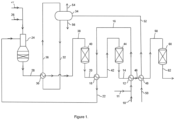
- a methane-containing feed gas such as an off gas from a chemical plant, a natural gas stream or a combination of both, fed via line 10
- a methane-containing feed gas such as an off gas from a chemical plant, a natural gas stream or a combination of both
- the feed gas mixture is heated to a temperature in the range 270 to 290 °C.
- the second hydrogen-enriched synthesis gas 14 is cooled to a temperature in the range 280 to 300 °C.
- the heated feed gas mixture is then passed from interchanger 12 via line 16 to a first shift effluent interchanger 18 where it is further heated to a temperature of 420 °C or higher in heat exchange with a first hydrogen-enriched synthesis gas 20.
- the first hydrogen-enriched synthesis gas 20 is cooled to a temperature in the range 340 to 380 °C.
- the heated feed gas mixture is then fed from the first shift effluent interchanger 18 via line 22 to the inlet of an autothermal reformer 24, where it is partially combusted in a burner with an oxygen-containing gas fed via line 26.
- the oxygen-containing gas fed to the autothermal reformer 24 may be air or an oxygen-containing gas stream produced by an air separation unit or by electrolysis.
- the partially combusted gas is then adiabatically steam reformed in a bed of steam reforming catalyst disposed beneath the burner within the autothermal reformer 24.
- the autothermal reforming generates a crude synthesis gas containing hydrogen, carbon monoxide, carbon dioxide and steam at a temperature above 850 °C.
- the crude synthesis gas is fed from the autothermal reformer 24 via line 28 to a reformed gas boiler 30, where it is cooled in heat exchange with boiling water under pressure supplied via line 32 from steam drum 34. Steam is returned from the boiler 30 to the steam drum 34 via line 36.
- the reformed gas boiler 30 cooled the crude synthesis gas to a temperature in the range 350 to 400 °C.
- Steam may be provided by line 27 and fed to the oxygen stream 26 that is fed to the burner of the autothermal reformer 24. Steam is consumed by the steam reforming and water-gas shift reactions.
- the cooled crude synthesis gas is fed from the reformed gas boiler 30 via line 38, with optional steam addition (not shown) to a first high temperature water-gas shift vessel 40 containing a high temperature shift catalyst that performs the exothermic water-gas shift reaction adiabatically to form the first hydrogen-enriched synthesis gas 20 at a temperature above 425 °C.
- the first hydrogen-enriched synthesis gas 20 is cooled in the first shift effluent interchanger 18 and then fed without further adjustment via line 42 to a second high temperature water-gas shift vessel 44 containing a high temperature shift catalyst that performs the exothermic water-gas shift reaction adiabatically to form the second hydrogen-enriched synthesis gas 14 at a temperature above 350 °C.
- the second hydrogen-enriched synthesis gas 14 is cooled in second shift effluent interchanger 12 and then fed via line 46 to a boiler feed water heater 48, where it is cooled in heat exchange with boiler feed water fed via line 50. Heated boiler feed water is fed from the boiler feed water heater 48 via line 52 to the steam drum 34.
- the steam drum 34 further provides a medium pressure steam stream 54 and a steam drum blow-down stream 56 that may be used in downstream processes.
- a cooled second hydrogen-enriched synthesis gas is fed from the boiler feed water heater 48 via line 58 at a temperature in the range 180-210 °C to a low-temperature water-gas shift vessel 60 containing a low temperature shift catalyst that performs the exothermic water-gas shift reaction adiabatically to form the third hydrogen-enriched synthesis gas 62 at a temperature 10 to 15 degrees centigrade above dew point of the syngas.
- the third hydrogen-enriched synthesis gas 62 may if desired be fed to a heat recovery unit to cool the shifted gas to below the dew point such that remaining steam condenses and fed to one or more gas-liquid separators to recover condensate (not shown).
- the third hydrogen-enriched synthesis gas 62, or the dewatered hydrogen-enriched syngas may be further processed.
- a low carbon fuel may be generated by carbon dioxide removal using a CO 2 removal unit (not shown).
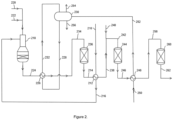
- a methane-containing feed gas such as an off gas from a chemical plant, a natural gas stream or a combination of both, is fed via line 210, to a first shift effluent interchanger 212 where it is heated in heat exchange with a first hydrogen-enriched synthesis gas 214.
- the first hydrogen-enriched synthesis gas 214 is cooled to a temperature in the range 290 to 310 °C.
- the heated feed gas mixture is then fed from the first shift effluent interchanger 212 via line 216 to the inlet of an autothermal reformer 218, where it is partially combusted in a burner with an oxygen-containing gas fed via line 220. If desired steam may be added to the oxygen stream via line 222.
- the oxygen-containing gas fed to the autothermal reformer 218 may be air or an oxygen-containing gas stream produced by an air separation unit or by electrolysis.
- the partially combusted gas is then adiabatically steam reformed in a bed of steam reforming catalyst disposed beneath the burner within the autothermal reformer.
- the autothermal reforming generates a crude synthesis gas containing hydrogen, carbon monoxide, carbon dioxide and steam at a temperature above 850 °C.
- the crude synthesis gas is fed from the autothermal reformer 218 via line 224 to a reformed gas boiler 226, where it is cooled in heat exchange with boiling water under pressure supplied via line 228 from steam drum 230. Steam is returned from the boiler 226 to the steam drum 230 via line 232.
- the reformed gas boiler 226 cools the crude synthesis gas to a temperature in the range 350 to 400 °C.
- the cooled crude synthesis gas is fed from the reformed gas boiler 226 via line 234, with optional steam addition (not shown) to a first water-gas shift vessel 236 containing a high temperature shift catalyst that performs the exothermic water-gas shift reaction adiabatically to form the first hydrogen-enriched synthesis gas 214 at a temperature above 425 °C.
- the first hydrogen-enriched synthesis gas 214 is cooled in the first shift effluent interchanger 212 to a temperature in the range 290 to 310 °C, then passed via line 238 to a mixing point where it is combined with medium-pressure steam fed via line 240 to form a steam-adjusted hydrogen-enriched gas at a temperature in the range 260 to 280 °C.
- the steam-adjusted hydrogen-enriched has is fed via line 242 to a second water-gas shift vessel 244 containing a high temperature shift catalyst that performs the exothermic water-gas shift reaction adiabatically to form a second hydrogen-enriched synthesis gas 246 at a temperature in the range 315 to 335 °C.
- the second hydrogen-enriched synthesis gas 246 is cooled in a second shift effluent interchanger 248 in exchange with boiler feed water fed via line 250.
- the second shift effluent interchanger is a boiler feed water heater.
- the heated boiler feed water is fed via line 252 to the steam drum 230.
- the second hydrogen-enriched gas is cooled to a temperature in the range 200 to 220 °C.
- the steam drum 230 further provides a medium pressure steam stream 254 and a steam drum blow-down stream 256 that may be used in downstream processes.
- the cooled second hydrogen-enriched synthesis gas is fed from the boiler feed water heater 248 via line 258 at a temperature in the range 200-220 °C to a low-temperature water-gas shift vessel 260 containing a low temperature shift catalyst that performs the exothermic water-gas shift reaction adiabatically to form the third hydrogen-enriched synthesis gas 262 at a temperature 10 to 15 degrees centigrade above dew point of the syngas.
- the third hydrogen-enriched synthesis gas 262 may if desired be fed to a heat recovery unit to cool the shifted gas to below the dew point such that remaining steam condenses and fed to one or more gas-liquid separators to recover condensate (not shown).
- the third hydrogen-enriched synthesis gas 262, or the dewatered hydrogen-enriched syngas may be further processed.
- a low carbon fuel may be generated by carbon dioxide removal using a CO 2 removal unit (not shown).
- Example 1 is an example of a flowsheet according to Figure 1 where the feed gas comprises hydrogen-depleted methanol purge gas recovered from a membrane hydrogen separation unit supplemented with 35% vol natural gas.
- the steam to carbon ratio was 2.2:1.
- the reformed gas 28 is cooled in a reformed gas boiler 30 to the inlet temperature of the first high temperature shift vessel 40, which is in the range of 380 - 390°C.
- the hydrogen-enriched gas 20 exits the first shift vessel 40 at around 470°C then passes into the first heat recovery exchanger 18, which pre-heats the feed gas to the autothermal reformer 24.
- the second shift vessel 44 operates at an inlet temperature of around 360°C.
- the outlet from this vessel 44 at around 385°C firstly passes through the feed pre-heater 12 which cools the hydrogen-enriched gas to about 290 °C, followed by a boiler feed water heater 48, utilising the remaining available duty to cool the hydrogen-enriched gas to the inlet temperature of the low-temperature shift vessel 60 of 185°C.
- the low-temperature vessel 60 experiences a temperature rise across this vessel of around 20 to 25°C.
- the hydrogen-enriched gas outlet from the low-temperature shift vessel 60 then passes into further heat recovery, e.g. a CO 2 unit reboiler duty and feed gas pre-heating, before being passed to a CO 2 removal unit for the CO 2 to be removed and a hydrogen fuel stream to be produced.
- the feed gas mixture at about 187 °C is heated in pre-heaters 12 and 18 to 420 °C and fed directly without further heating to the autothermal reformer 24.
- the autothermal reformer exit temperature was reduced from 980°C to 950°C; natural gas usage reduced from 1104 kmol/h to 1084 kmol/h (-1.81%); oxygen usage reduced from 1191 kmol/h to 1146 kmol/h (-3.77%).
Landscapes
- Chemical & Material Sciences (AREA)
- Organic Chemistry (AREA)
- Chemical Kinetics & Catalysis (AREA)
- Engineering & Computer Science (AREA)
- Combustion & Propulsion (AREA)
- Inorganic Chemistry (AREA)
- Health & Medical Sciences (AREA)
- General Health & Medical Sciences (AREA)
- Oil, Petroleum & Natural Gas (AREA)
- Hydrogen, Water And Hydrids (AREA)
Priority Applications (3)
| Application Number | Priority Date | Filing Date | Title |
|---|---|---|---|
| EP23186902.5A EP4495061A1 (de) | 2023-07-21 | 2023-07-21 | Verfahren zur herstellung eines synthesegases |
| GB2409856.8A GB2633458A (en) | 2023-07-21 | 2024-07-08 | Process for producing a synthesis gas |
| PCT/GB2024/051776 WO2025022083A1 (en) | 2023-07-21 | 2024-07-08 | Process for producing a synthesis gas |
Applications Claiming Priority (1)
| Application Number | Priority Date | Filing Date | Title |
|---|---|---|---|
| EP23186902.5A EP4495061A1 (de) | 2023-07-21 | 2023-07-21 | Verfahren zur herstellung eines synthesegases |
Publications (1)
| Publication Number | Publication Date |
|---|---|
| EP4495061A1 true EP4495061A1 (de) | 2025-01-22 |
Family
ID=87429500
Family Applications (1)
| Application Number | Title | Priority Date | Filing Date |
|---|---|---|---|
| EP23186902.5A Ceased EP4495061A1 (de) | 2023-07-21 | 2023-07-21 | Verfahren zur herstellung eines synthesegases |
Country Status (3)
| Country | Link |
|---|---|
| EP (1) | EP4495061A1 (de) |
| GB (1) | GB2633458A (de) |
| WO (1) | WO2025022083A1 (de) |
Citations (6)
| Publication number | Priority date | Publication date | Assignee | Title |
|---|---|---|---|---|
| EP0922011B1 (de) * | 1996-08-26 | 2001-07-25 | Arthur D. Little, Inc. | Verfahren und vorrichtung zur umsetzung von kohlenwasserstoffbrennstoff in wasserstoff und kohlendioxyd |
| DE10057537A1 (de) * | 2000-11-20 | 2002-06-06 | Viessmann Werke Kg | Apparat zur Erzeugung von Wasserstoff |
| US6423435B1 (en) * | 1999-03-02 | 2002-07-23 | Daimlerchrysler Ag | Fuel cell system with an assigned hydrogen generating arrangement |
| EP1181241B1 (de) * | 1999-05-03 | 2005-08-24 | Nuvera Fuel Cells | Autothermen dampfreformierungsystem mit integrierten shift betten , reaktor für präferentielle oxidation ,hilfsreaktor und systemsteuerungen |
| US20130243686A1 (en) | 2012-03-15 | 2013-09-19 | Air Products And Chemicals, Inc. | Hydrogen Production Process with Low CO2 Emissions |
| GB2602695A (en) * | 2020-10-16 | 2022-07-13 | Johnson Matthey Davy Technologies Ltd | Process for producing a gas stream comprising carbon monoxide |
Family Cites Families (6)
| Publication number | Priority date | Publication date | Assignee | Title |
|---|---|---|---|---|
| US6797252B2 (en) * | 2002-11-25 | 2004-09-28 | Conocophillips Company | Hydrocarbon gas to liquid conversion process |
| CN114466831B (zh) * | 2019-01-15 | 2023-12-19 | 沙特基础工业全球技术公司 | 可再生能源在甲醇合成中的用途 |
| EP3693338B1 (de) * | 2019-02-07 | 2021-09-01 | Sener Ingenieria Y Sistemas, S.A. | Autothermisches hochdrucksystem zur reformierung von alkohol und zur herstellung von wasserstoff, und verfahre dafür |
| EP3931147B1 (de) * | 2019-02-28 | 2023-06-07 | Topsoe A/S | Chemische anlage mit einem reformierungsabschnitt und verfahren zur herstellung eines chemischen produkts |
| AU2020242886B2 (en) * | 2019-03-15 | 2025-10-16 | Haldor Topsøe A/S | Process for the production of urea formaldehyde concentrate |
| EP3730456A1 (de) * | 2019-04-24 | 2020-10-28 | SABIC Global Technologies B.V. | Verwendung von erneuerbarer energie bei der ammoniaksynthese |
-
2023
- 2023-07-21 EP EP23186902.5A patent/EP4495061A1/de not_active Ceased
-
2024
- 2024-07-08 GB GB2409856.8A patent/GB2633458A/en active Pending
- 2024-07-08 WO PCT/GB2024/051776 patent/WO2025022083A1/en active Pending
Patent Citations (6)
| Publication number | Priority date | Publication date | Assignee | Title |
|---|---|---|---|---|
| EP0922011B1 (de) * | 1996-08-26 | 2001-07-25 | Arthur D. Little, Inc. | Verfahren und vorrichtung zur umsetzung von kohlenwasserstoffbrennstoff in wasserstoff und kohlendioxyd |
| US6423435B1 (en) * | 1999-03-02 | 2002-07-23 | Daimlerchrysler Ag | Fuel cell system with an assigned hydrogen generating arrangement |
| EP1181241B1 (de) * | 1999-05-03 | 2005-08-24 | Nuvera Fuel Cells | Autothermen dampfreformierungsystem mit integrierten shift betten , reaktor für präferentielle oxidation ,hilfsreaktor und systemsteuerungen |
| DE10057537A1 (de) * | 2000-11-20 | 2002-06-06 | Viessmann Werke Kg | Apparat zur Erzeugung von Wasserstoff |
| US20130243686A1 (en) | 2012-03-15 | 2013-09-19 | Air Products And Chemicals, Inc. | Hydrogen Production Process with Low CO2 Emissions |
| GB2602695A (en) * | 2020-10-16 | 2022-07-13 | Johnson Matthey Davy Technologies Ltd | Process for producing a gas stream comprising carbon monoxide |
Also Published As
| Publication number | Publication date |
|---|---|
| GB202409856D0 (en) | 2024-08-21 |
| GB2633458A8 (en) | 2025-04-16 |
| WO2025022083A1 (en) | 2025-01-30 |
| GB2633458A (en) | 2025-03-12 |
Similar Documents
| Publication | Publication Date | Title |
|---|---|---|
| AU742314B2 (en) | Steam reforming | |
| CA3178048A1 (en) | Process for producing hydrogen | |
| EP4522584B1 (de) | Verfahren zur synthese von methanol | |
| GB2617660A (en) | Low-carbon hydrogen process | |
| US20250223160A1 (en) | Process for producing hydrogen | |
| GB2620463A (en) | Process for producing hydrogen and method of retrofitting a hydrogen production unit | |
| US20250051159A1 (en) | Process for producing hydrogen and method of retrofitting a hydrogen production unit | |
| EP4638353A1 (de) | Verfahren zur herstellung von wasserstoff | |
| GB2625645A (en) | Process for producing hydrogen | |
| GB2630460A (en) | Process for synthesising methanol | |
| EP4495061A1 (de) | Verfahren zur herstellung eines synthesegases | |
| GB2700891A (en) | Low-carbon hydrogen process | |
| WO2025068673A1 (en) | Process for the synthesis of methanol with optimised syngas preparation and processing | |
| WO2026074262A1 (en) | Process for the production of hydrogen, carbon dioxide and power | |
| EA053077B1 (ru) | Способ получения низкоуглеродного водорода |
Legal Events
| Date | Code | Title | Description |
|---|---|---|---|
| PUAI | Public reference made under article 153(3) epc to a published international application that has entered the european phase |
Free format text: ORIGINAL CODE: 0009012 |
|
| STAA | Information on the status of an ep patent application or granted ep patent |
Free format text: STATUS: THE APPLICATION HAS BEEN PUBLISHED |
|
| AK | Designated contracting states |
Kind code of ref document: A1 Designated state(s): AL AT BE BG CH CY CZ DE DK EE ES FI FR GB GR HR HU IE IS IT LI LT LU LV MC ME MK MT NL NO PL PT RO RS SE SI SK SM TR |
|
| RAP3 | Party data changed (applicant data changed or rights of an application transferred) |
Owner name: JOHNSON MATTHEY PUBLIC LIMITED COMPANY |
|
| STAA | Information on the status of an ep patent application or granted ep patent |
Free format text: STATUS: THE APPLICATION HAS BEEN REFUSED |
|
| 18R | Application refused |
Effective date: 20250217 |