EP4494931A1 - Cockpit for a motor vehicle and method for the reconfiguration of a cockpit - Google Patents
Cockpit for a motor vehicle and method for the reconfiguration of a cockpit Download PDFInfo
- Publication number
- EP4494931A1 EP4494931A1 EP24189374.2A EP24189374A EP4494931A1 EP 4494931 A1 EP4494931 A1 EP 4494931A1 EP 24189374 A EP24189374 A EP 24189374A EP 4494931 A1 EP4494931 A1 EP 4494931A1
- Authority
- EP
- European Patent Office
- Prior art keywords
- axis
- seat
- cockpit
- support structure
- along
- Prior art date
- Legal status (The legal status is an assumption and is not a legal conclusion. Google has not performed a legal analysis and makes no representation as to the accuracy of the status listed.)
- Pending
Links
Images


Classifications
-
- B—PERFORMING OPERATIONS; TRANSPORTING
- B60—VEHICLES IN GENERAL
- B60N—SEATS SPECIALLY ADAPTED FOR VEHICLES; VEHICLE PASSENGER ACCOMMODATION NOT OTHERWISE PROVIDED FOR
- B60N2/00—Seats specially adapted for vehicles; Arrangement or mounting of seats in vehicles
- B60N2/005—Arrangement or mounting of seats in vehicles, e.g. dismountable auxiliary seats
- B60N2/01—Arrangement of seats relative to one another
-
- B—PERFORMING OPERATIONS; TRANSPORTING
- B60—VEHICLES IN GENERAL
- B60N—SEATS SPECIALLY ADAPTED FOR VEHICLES; VEHICLE PASSENGER ACCOMMODATION NOT OTHERWISE PROVIDED FOR
- B60N2/00—Seats specially adapted for vehicles; Arrangement or mounting of seats in vehicles
- B60N2/24—Seats specially adapted for vehicles; Arrangement or mounting of seats in vehicles for particular purposes or particular vehicles
- B60N2/30—Non-dismountable or dismountable seats storable in a non-use position, e.g. foldable spare seats
- B60N2/3002—Non-dismountable or dismountable seats storable in a non-use position, e.g. foldable spare seats back-rest movements
- B60N2/302—Non-dismountable or dismountable seats storable in a non-use position, e.g. foldable spare seats back-rest movements by translation only
- B60N2/3025—Non-dismountable or dismountable seats storable in a non-use position, e.g. foldable spare seats back-rest movements by translation only along transversal axis
-
- B—PERFORMING OPERATIONS; TRANSPORTING
- B60—VEHICLES IN GENERAL
- B60N—SEATS SPECIALLY ADAPTED FOR VEHICLES; VEHICLE PASSENGER ACCOMMODATION NOT OTHERWISE PROVIDED FOR
- B60N2/00—Seats specially adapted for vehicles; Arrangement or mounting of seats in vehicles
- B60N2/005—Arrangement or mounting of seats in vehicles, e.g. dismountable auxiliary seats
- B60N2/015—Attaching seats directly to vehicle chassis
-
- B—PERFORMING OPERATIONS; TRANSPORTING
- B60—VEHICLES IN GENERAL
- B60N—SEATS SPECIALLY ADAPTED FOR VEHICLES; VEHICLE PASSENGER ACCOMMODATION NOT OTHERWISE PROVIDED FOR
- B60N2/00—Seats specially adapted for vehicles; Arrangement or mounting of seats in vehicles
- B60N2/80—Head-rests
- B60N2/806—Head-rests movable or adjustable
- B60N2/809—Head-rests movable or adjustable vertically slidable
-
- B—PERFORMING OPERATIONS; TRANSPORTING
- B60—VEHICLES IN GENERAL
- B60N—SEATS SPECIALLY ADAPTED FOR VEHICLES; VEHICLE PASSENGER ACCOMMODATION NOT OTHERWISE PROVIDED FOR
- B60N2/00—Seats specially adapted for vehicles; Arrangement or mounting of seats in vehicles
- B60N2/90—Details or parts not otherwise provided for
- B60N2/986—Side-rests
- B60N2/99—Side-rests adjustable
Definitions
- This invention relates to a cockpit for a motor vehicle and a method for reconfiguring the cockpit.
- Motor vehicles comprise, in a known way:
- the passenger compartment also comprises a pair of front seats intended to be occupied by a driver and a passenger respectively, and arranged next to each other along a transverse direction of the motor vehicle orthogonal to a longitudinal direction defining a normal forward direction of the motor vehicle.
- the steering wheel and the pedals are located opposite the driver's seat and are basically arranged in a left or right front corner of the vehicle.
- passenger compartments are known that implement the so-called “single-seater” configuration.
- the passenger compartment comprises a single front seat arranged in a central position opposite the steering wheel and the pedals or passenger seats arranged to the side and/or set back from the central seat.
- the purpose of this invention is to produce a cockpit, which makes it possible to meet the need mentioned above.
- This invention also relates to a method for reconfiguring a cockpit according to what is defined in claim 9.
- reference number 1 indicates a motor vehicle comprising a body 2 defining a passenger compartment 3.
- the motor vehicle 1 also comprises ( Figure 1 ):
- the motor vehicle 1 also comprises ( Figure 1 ):
- the body 2 also comprises a pair of door sills 23, 24 with longitudinal ends opposite each other.
- the door sills 23, 24 delimit the passenger compartment 3 and are adjacent to corresponding doors 8a, 8b when the doors 8a, 8b are in the respective closed positions.
- the motor vehicle 1 also comprises control members 10 arranged in the passenger compartment 3 that the driver can activate to set a forward trajectory of the motor vehicle 1 with a desired speed.
- control members 10 comprise:
- the control members 10 are connected to the engine 9, to the brake system 21, and to the wheels 6 and/or 7 implementing a technology known in the sector as "drive by wire”.
- the term "drive by wire” mode means that the steering wheel 11 does not have physical or mechanical connections with the wheels 6, 7.
- the motor vehicle 1 also comprises a control unit 45 ( Figure 1 ) programmed to receive, as input, the actions requested at the steering wheel 11 and pedals 12 and to generate, as output, control signals for the engine 9 and the brake system 21.
- the passenger compartment 3 houses a front cockpit 25, only schematically illustrated in Figure 1 , in a known way.
- the cockpit 25 comprises:
- the support structure 29 comprises:
- the greatest dimension of the seat cushion 36 and the backrest 37 is parallel to the axis Y.
- the support structure 29 also wholly defines the seats 26, 27 in the first, two-seater configuration of the cockpit 25 and the seat 28 in the second, single-seater configuration of the cockpit 25.
- the seats 26, 27 each comprise:
- Each backrest 40, 41 comprises, in particular:
- the sides 97, 98; 99, 100 project overhanging above the seat cushion 36 of the support structure 29.
- the sides 107, 108; 109, 110 project overhanging in front of the backrest 37 of the support structure 29.
- the sides 97, 98; 99, 100 are arranged on corresponding opposite sides of the corresponding seat cushion 30; 31.
- the sides 107, 108; 109, 110 are arranged on respective opposite sides of the corresponding backrest 40, 41.
- each side 97, 98; 99, 100; 107, 108; 109, 110 comprises ( Figure 2 ):
- the sides 107, 108; 109, 110 each comprise a support 73 and a cushion 74 supported by the support 70 illustrated in Figure 3 .
- the seat 26 is arranged on the side of the door sill 23 and the other seat 24 is arranged on the side of the other door sill 24.
- the seat 27 is intended to be occupied by the driver and the other seat 26 is intended to be occupied by the passenger.
- the seat 26 is interposed along the axis Y between the door sill 23 and the seat 27.
- the seat 27 is interposed along the axis Y between the seat 26 and the door sill 24.
- the sides 97, 98; 99; 100; 107, 108; 109, 110 are arranged so that they diverge from each other, moving from the respective edges 160 to the corresponding edges 161 so as to enable easy access for the driver and passenger, respectively, to the respective seats 27, 26.
- the sides 98, 99; 108, 109 are arranged so that they converge with each other, moving from the respective edges 160 to the corresponding edges 161.
- the headrest 50 is mounted in a fixed manner on the seat cushion 36 with reference to the axis Y.
- the headrest 51 is mounted on the seat cushion 36 so that it can move between:
- the seat 28 is arranged equally distant from the door sills 23, 24 along the axis Y, and is intended to be occupied by the driver.
- the seat cushion 36 defines the seat cushion 30, 31, 32 and the backrest 37 defines the backrests 40, 41, 42.
- the backrest 42 comprises, in particular:
- the cockpit 25 comprises, in addition, an armrest 55 hinged to the seat cushion 36 of the support structure 29.
- the armrest 55 can be moved between:
- the armrest 55 is hinged to the seat cushion 32 around an axis H parallel to the axis Y so as it can be rotated parallel to the axis Y between the above-mentioned open and closed positions.
- the armrest 55 is level with the remaining part of the seat cushion 32.
- the translation of the headrest 51 from the corresponding first position to the corresponding second position occurs simultaneously to the translation of the sides 98, 99 100; 108, 109, 110 parallel to the axis Y from the respective first positions towards the corresponding second positions.
- the transition of the cockpit 25 from the first to the second configuration, and vice versa, also occurs manually or by driving an actuator (not illustrated).
- the pedals 12 and the steering wheel 11 can be moved along the axis Y to encourage the transformation of the motor vehicle 1 between the first and second configuration.
- pedals 12 and the steering wheel 11 may be moved parallel to the axis Y between:
- the pedals 12 and the steering wheel 11 are arranged adjacent to the door sill 23 when they are arranged in the third position.
- a first distance between the pedals 12 and the steering wheel 11, and the door sill 23 is less than a second distance between the pedals 12 and the steering wheel 11, and the door sill 24.
- the above-mentioned first and second distance are measured along the axis Y.
- the pedals 12 and the steering wheel 11 are arranged in a position midway between the door sills 23, 24 when they are arranged in the fourth position. In this fourth position, the pedals 12 and the steering wheel 11 are equally spaced apart from the door sills 23, 24 along the axis Y.
- the operation of the cockpit 25 of the motor vehicle 1 is described starting from a condition wherein the cockpit 25 is in the first, "two-seater" configuration.
- the seats 27, 26 are arranged in respective first positions and are intended to be occupied by the driver and the passenger respectively.
- the seat 26 is interposed between the door sill 23 and the seat 27 and the seat 27 is interposed between the seat 26 and the door sill 24 parallel to the axis Y.
- the seat 26 comprises the seat cushion 30, the backrest 40, and the headrest 50.
- the seat 26 is also delimited laterally on corresponding opposite sides by the side 97 and the side 98 arranged in the first position, and by the sides 107, 108 also arranged in the corresponding first positions.
- the seat 27 comprises the seat cushion 31, the backrest 41, and the headrest 50 arranged in the respective first position.
- the seat 27 is also delimited laterally on corresponding opposite sides by the sides 99, 100 and 109, 110 arranged in the respective first positions.
- the armrest 55 is arranged in the open position wherein it is extended parallel to the axis X and interposed parallel to the axis Y between the backrests 40, 41.
- the pedals 11 and the steering wheel 12 are arranged in the third position, wherein they face the seat 27 along the axis X, to enable the driver to guide them.
- the cockpit 25 is in the second configuration wherein:
- the pedals 11 and the steering wheel 12 are also moved parallel to the axis Y, in a known way not illustrated, from the third position to the fourth position, wherein they face the seat 28 along the axis X, to enable the driver to guide them.
- control members 10 control the engine 9, the wheels 6, 7, and the brake system 21 implementing a technology known in the sector as "drive by wire”.
- the cockpit 25 can be moved between the first, "two-seater” configuration wherein it defines the seat 27 for the driver and the seat 26 for the passenger next to each other parallel to the axis Y, and the second, “single-seater” configuration wherein it defines only the seat 28 for the driver, simply by translating, parallel to the axis Y, the sides 98, 99, 100; 108, 109, 110 and the headrest 51 from the respective first positions to the respective second positions and rotating the armrest 55 from the open position to the closed position.
- the motor vehicle 1 can be quickly and simply made more suitable for road use when the cockpit 25 assumes the first, "two-seater” configuration or sports use wherein the cockpit 25 assumes the second, “single-seater” configuration.
- the seat 27 for the driver could be arranged next to the door sill 24 and the seat 26 for the passenger could be arranged next to the other door sill 23, thus implementing a right-hand drive mode in the motor vehicle 1.
- the sides 100, 110 would be fixed in relation to the support structure 29 and the sides 97, 107; 98, 108; 99, 109 would be mounted on the support structure 29 so they can slide along the axis Y to and from the sides 100, 110 to transition the cockpit 25 between the first and second configuration.
- the cockpit could comprise just the sides 97, 98, 99, 100 or just the sides 107, 108, 109, 110.
Landscapes
- Engineering & Computer Science (AREA)
- Aviation & Aerospace Engineering (AREA)
- Transportation (AREA)
- Mechanical Engineering (AREA)
- Seats For Vehicles (AREA)
- Chair Legs, Seat Parts, And Backrests (AREA)
Abstract
Description
- This patent application claims priority from
Italian patent application no. 102023000015258 filed on July 20, 2023 - This invention relates to a cockpit for a motor vehicle and a method for reconfiguring the cockpit.
- Motor vehicles comprise, in a known way:
- a passenger compartment defining a body;
- multiple wheels;
- a steering wheel arranged inside the passenger compartment which can be driven by a driver to steer the front wheels and thus enable the motor vehicle to follow a curved trajectory; and
- pedals comprising an accelerator and a brake that the driver can activate to increase the drive torque or exert a braking torque on the wheels respectively, so as to control the speed of the motor vehicle.
- The passenger compartments of motor vehicles normally intended for use on the road implement the so-called "two-seater" configuration.
- In this "two-seater" configuration, the passenger compartment also comprises a pair of front seats intended to be occupied by a driver and a passenger respectively, and arranged next to each other along a transverse direction of the motor vehicle orthogonal to a longitudinal direction defining a normal forward direction of the motor vehicle.
- The steering wheel and the pedals are located opposite the driver's seat and are basically arranged in a left or right front corner of the vehicle.
- With particular reference to sports motor vehicles, passenger compartments are known that implement the so-called "single-seater" configuration.
- In this "single-seater" configuration, the passenger compartment comprises a single front seat arranged in a central position opposite the steering wheel and the pedals or passenger seats arranged to the side and/or set back from the central seat.
- There is a need in the sector to provide motor vehicles that enable simple and easy reconfiguration between the above-mentioned "single-seater" and "two-seater" configurations.
- The purpose of this invention is to produce a cockpit, which makes it possible to meet the need mentioned above.
- The above-mentioned purpose is achieved with this invention, as it relates to a cockpit according to what is defined in
claim 1. - This invention also relates to a method for reconfiguring a cockpit according to what is defined in
claim 9. - In order to better understand this invention, a nonlimiting preferred embodiment thereof will now be described by way of example with reference to the accompanying drawings, in which:
-
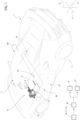
Figure 1 is a perspective view of a motor vehicle comprising a cockpit produced according to the precepts of this invention with parts removed for clarity; -
Figure 2 is a perspective view on a very enlarged scale of the cockpit inFigure 1 , with parts removed for clarity and in a first, "two-seater" operating configuration; -
Figure 3 is a perspective view on a very enlarged scale of the cockpit inFigure 1 , with parts removed for clarity and in a second, "single-seater" operating configuration; - With reference to
Figure 1 ,reference number 1 indicates a motor vehicle comprising abody 2 defining apassenger compartment 3. - It should be specified that, below in this description, expressions such as "above", "below", "in front of", "behind" and the like are used with reference to the normal movement of the
motor vehicle 1. - It is also possible to define:
- a longitudinal axis X integral with the
motor vehicle 1, arranged, in use, horizontal and parallel to a normal forward moving direction of themotor vehicle 1; - a transversal axis Y integral with the
motor vehicle 1, arranged, in use, horizontal and orthogonal to the axis X; and - an axis Z integral with the
motor vehicle 1, arranged, in use, vertical and orthogonal to the axes X, Y. - The
motor vehicle 1 also comprises (Figure 1 ): - a pair of front wheels 6 and a pair of
back wheels 7; - a known
engine 9 only schematically illustrated inFigure 1 and operationally connected to the wheels 6 and/or 7 to exert drive torque on the wheels 6 and/or 7; and - a
brake system 21, also only schematically illustrated, inFigure 1 that can be driven to exert a braking torque on thewheels 6, 7. - The
motor vehicle 1 also comprises (Figure 1 ): - a
windscreen 5 delimiting thepassenger compartment 3 at the front; and - a pair of
doors body 2 that can be moved between a closed position wherein they delimit thepassenger compartment 3 to the side and prevent entry into/exit from thepassenger compartment 3 and an open position wherein they enable entry into/exit from thepassenger compartment 3. - The
body 2 also comprises a pair ofdoor sills passenger compartment 3 and are adjacent tocorresponding doors doors - The
motor vehicle 1 also comprisescontrol members 10 arranged in thepassenger compartment 3 that the driver can activate to set a forward trajectory of themotor vehicle 1 with a desired speed. - In a known way, the
control members 10 comprise: - a
steering wheel 11 arranged inside thepassenger compartment 3 that can be driven by the driver; and -
pedals 12 also arranged inside thepassenger compartment 3 that the driver can activate. - The
control members 10 are connected to theengine 9, to thebrake system 21, and to the wheels 6 and/or 7 implementing a technology known in the sector as "drive by wire". - In this description, the term "drive by wire" mode means that the
steering wheel 11 does not have physical or mechanical connections with thewheels 6, 7. - The
motor vehicle 1 also comprises a control unit 45 (Figure 1 ) programmed to receive, as input, the actions requested at thesteering wheel 11 andpedals 12 and to generate, as output, control signals for theengine 9 and thebrake system 21. - The
passenger compartment 3 houses afront cockpit 25, only schematically illustrated inFigure 1 , in a known way. - Advantageously, the
cockpit 25 comprises: - a
support structure 29;- a pair of
sides support structure 29 in a fixed manner in relation to the axis Y; - between pairs of
sides support structure 29 in a sliding manner along the axis Y and each movable between a respective first and second position spaced apart from one another relative to the axis Y;
- the
sides 97; 107e 100; 110 are opposite each other in relation to the axis Y; - each
side respective side fourth side - each
side corresponding side corresponding side - the
cockpit 25 can be shifted to a two-seater configuration, wherein it comprises:- a
seat 26 laterally delimited by thesides sides - a
seat 27 laterally delimited by thesides sides seat 26 parallel to the axis Y;
- a
- the
cockpit 25 can be selectively arranged in a second, single-seater configuration, wherein it comprises asingle seat 28 laterally delimited by thesides sides
- a pair of
- More specifically, the
support structure 29 comprises: - a
frame 35 formed from aseat cushion 36 and abackrest 37 having corresponding upper andlower end edges - a pair of
headrests seat cushion 36 opposite theend edge 38. - The greatest dimension of the
seat cushion 36 and thebackrest 37 is parallel to the axis Y. - The
support structure 29 also wholly defines theseats cockpit 25 and theseat 28 in the second, single-seater configuration of thecockpit 25. - With reference to the first, "two-seater" configuration illustrated in
Figure 2 , theseats - a
respective seat cushion - a
respective backrest - a
respective headrest - Each
backrest - a corresponding
upper edge lower edge headrest - a corresponding
lower edge upper edge corresponding seat cushion - The
sides seat cushion 36 of thesupport structure 29. - The
sides backrest 37 of thesupport structure 29. - The
sides corresponding seat cushion 30; 31. - The
sides backrest - In particular, each
side Figure 2 ): - a
corresponding edge 160 fixed to thecorresponding seat cushion 30; 31 orbackrest 40; 41; and - a corresponding
free edge 161 opposite thecorresponding edge 160. - The
sides support 73 and acushion 74 supported by thesupport 70 illustrated inFigure 3 . - The
seat 26 is arranged on the side of thedoor sill 23 and theother seat 24 is arranged on the side of theother door sill 24. - The
seat 27 is intended to be occupied by the driver and theother seat 26 is intended to be occupied by the passenger. - More precisely, the
seat 26 is interposed along the axis Y between thedoor sill 23 and theseat 27. - The
seat 27 is interposed along the axis Y between theseat 26 and thedoor sill 24. - The
sides respective edges 160 to thecorresponding edges 161 so as to enable easy access for the driver and passenger, respectively, to therespective seats - The
sides respective edges 160 to the corresponding edges 161. - The
headrest 50 is mounted in a fixed manner on theseat cushion 36 with reference to the axis Y. - The
headrest 51 is mounted on theseat cushion 36 so that it can move between: - a respective first position (
Figure 2 ) assumed when thecockpit 25 is in the first, two-seater configuration in it is arranged above therespective backrest 41; and - a respective second position (
Figure 3 ) assumed when thecockpit 25 is in the second, single-seater configuration wherein it is arranged above therespective backrest 42. - More specifically, in the second, "single-seater" configuration of the
cockpit 25, theseat 28 is arranged equally distant from thedoor sills - The
seat cushion 36 defines theseat cushion backrest 37 defines thebackrests - The
backrest 42 comprises, in particular: - a corresponding
upper edge 62 extended along the axis Y and arranged at thelower edge 71 of theheadrest 51; and - a corresponding
lower edge 82 extended along the axis Y and arranged at a rear andupper edge 92 of theseat cushion 32. - The
cockpit 25 comprises, in addition, an armrest 55 hinged to theseat cushion 36 of thesupport structure 29. - The armrest 55 can be moved between:
- an open position (illustrated in
Figure 2 ) assumed when thecockpit 25 is in the first, two-seater position, wherein it projects in front of theframe 35 and extends parallel to the axis X in a position interposed parallel to the axis Y between theseats - a closed position (illustrated in
Figure 3 ) assumed when thecockpit 25 is in the second, single-seater configuration, wherein it is housed in aseat 56 defined by theseat cushion 32 and extends transversely to the axes X, Y. - In particular, the
armrest 55 is hinged to theseat cushion 32 around an axis H parallel to the axis Y so as it can be rotated parallel to the axis Y between the above-mentioned open and closed positions. - In the closed position, the
armrest 55 is level with the remaining part of theseat cushion 32. - The transition of the
cockpit 25 from the first, two-seater configuration to the second, single-seater configuration occurs via: - the rotation of the armrest 55 from the open position to the closed position around the axis H;
- the translation of the
sides - the simultaneous translation of the
headrest 51 and thesides - the translation of the
sides - In the example illustrated, the translation of the
headrest 51 from the corresponding first position to the corresponding second position occurs simultaneously to the translation of thesides - The transition of the
cockpit 25 from the first to the second configuration, and vice versa, also occurs manually or by driving an actuator (not illustrated). - In a way not described in detail since not necessary for this invention, the
pedals 12 and thesteering wheel 11 can be moved along the axis Y to encourage the transformation of themotor vehicle 1 between the first and second configuration. - In particular, the
pedals 12 and thesteering wheel 11 may be moved parallel to the axis Y between: - a third position (
Figure 1 ) assumed when thecockpit 25 is in the first, "two-seater" configuration and wherein they face theseat 27; and - a fourth position (not illustrated) assumed when the
cockpit 25 is in the second, "single-seater" configuration and wherein they face theseat 28. - The
pedals 12 and thesteering wheel 11 are arranged adjacent to thedoor sill 23 when they are arranged in the third position. In this third position, a first distance between thepedals 12 and thesteering wheel 11, and thedoor sill 23 is less than a second distance between thepedals 12 and thesteering wheel 11, and thedoor sill 24. The above-mentioned first and second distance are measured along the axis Y. - The
pedals 12 and thesteering wheel 11 are arranged in a position midway between thedoor sills pedals 12 and thesteering wheel 11 are equally spaced apart from thedoor sills - The operation of the
cockpit 25 of themotor vehicle 1 is described starting from a condition wherein thecockpit 25 is in the first, "two-seater" configuration. - In this first, "two-seater" configuration, the
seats - The
seat 26 is interposed between thedoor sill 23 and theseat 27 and theseat 27 is interposed between theseat 26 and thedoor sill 24 parallel to the axis Y. - More specifically, the
seat 26 comprises theseat cushion 30, thebackrest 40, and theheadrest 50. - The
seat 26 is also delimited laterally on corresponding opposite sides by theside 97 and theside 98 arranged in the first position, and by thesides - The
seat 27 comprises theseat cushion 31, thebackrest 41, and theheadrest 50 arranged in the respective first position. - The
seat 27 is also delimited laterally on corresponding opposite sides by thesides - The
armrest 55 is arranged in the open position wherein it is extended parallel to the axis X and interposed parallel to the axis Y between thebackrests - The
pedals 11 and thesteering wheel 12 are arranged in the third position, wherein they face theseat 27 along the axis X, to enable the driver to guide them. - If one wishes to reconfigure the
motor vehicle 1, so as to arrange thecockpit 25 in the second, "single-seater" configuration, it is enough to drive the actuator so as to cause: - the rotation of the armrest 55 from the open position to the closed position around the axis H;
- the translation of the
sides - the simultaneous translation of the
headrest 51 and thesides - the translation of the
headrest 51 of thesides - At the end of the transition, the
cockpit 25 is in the second configuration wherein: - the
seat 28 is in the position midway between thedoor sills sides - The
pedals 11 and thesteering wheel 12 are also moved parallel to the axis Y, in a known way not illustrated, from the third position to the fourth position, wherein they face theseat 28 along the axis X, to enable the driver to guide them. - Irrespective of the fact that the
cockpit 25 is in the first "two-seater" configuration, or in the second "single-seater" configuration, thecontrol members 10 control theengine 9, thewheels 6, 7, and thebrake system 21 implementing a technology known in the sector as "drive by wire". - The advantages enabled by this invention will be apparent from an examination thereof.
- In particular, the
cockpit 25 can be moved between the first, "two-seater" configuration wherein it defines theseat 27 for the driver and theseat 26 for the passenger next to each other parallel to the axis Y, and the second, "single-seater" configuration wherein it defines only theseat 28 for the driver, simply by translating, parallel to the axis Y, thesides headrest 51 from the respective first positions to the respective second positions and rotating the armrest 55 from the open position to the closed position. - In this way, the
motor vehicle 1 can be quickly and simply made more suitable for road use when thecockpit 25 assumes the first, "two-seater" configuration or sports use wherein thecockpit 25 assumes the second, "single-seater" configuration. - Finally, it is clear that changes may be made to the
cockpit 25 and to the reconfiguration method implemented according to this invention, and variations produced thereto that, in any case, do not depart from the scope of protection defined by the claims. - In particular, in the first, "two-seater" configuration, the
seat 27 for the driver could be arranged next to thedoor sill 24 and theseat 26 for the passenger could be arranged next to theother door sill 23, thus implementing a right-hand drive mode in themotor vehicle 1. - In this case, the
sides support structure 29 and thesides support structure 29 so they can slide along the axis Y to and from thesides cockpit 25 between the first and second configuration. - The cockpit could comprise just the
sides sides
Claims (14)
- A cockpit (25) for a motor vehicle (1), characterized in that it comprises:- a support structure (29);- a first side (97; 107) supported by said support structure (29); and- a second, third and fourth side (100, 110; 98, 108; 99, 109) mounted on said support structure (29) in a sliding manner along a first axis (Y) and each movable between a respective first and second position spaced apart from one another relative to said first axis (Y);said first side (97; 107) and said second side (100; 110) being opposite one another with reference to said first axis (Y);said third side (98, 108) being interposed between said first side (97, 107) and said fourth side (99, 109) along said first axis (Y);said fourth side (99, 109) being interposed between said third side (98, 108) and said second side (100, 110) along said first axis (Y);said cockpit (25) being available in a first two-seater configuration, wherein it comprises:- a first seat (26) laterally delimited by said first side (97, 107) and by said third side (98, 108) arranged in the respective first positions; and- a second seat (27) laterally delimited by said fourth side (99; 109) and by said second side (100, 110) arranged in the respective first positions;said first and second seats (26, 27) being next to one another parallel to said first axis (Y);said cockpit (25) being available in a second single-seater configuration, wherein it comprises one single third seat (28) laterally delimited by said first side (99, 109) arranged in said second position and by said second side (100, 110) arranged in said second position.
- The cockpit according to claim 1, characterized in that said first side (97, 107) is mounted in a fixed manner relative to said support structure (29) with reference to said first axis (Y), and in that said second side (100, 110), said third side (98, 108) and said fourth side (99, 109) are arranged in the respective first positions at respective first distances from said first side (97, 107) along said first axis (Y) and in the respective second positions at respective second distances, which are smaller than said first distances, from said first side (97, 107) along said first axis (Y).
- The cockpit according to claim 1 or 2, characterized in that said support structure (29) defines:- a first seat cushion (30) and a first backrest (40) of said first seat (26);- a second seat cushion (31) and a second backrest (41) of said second seat (27); and- a third seat cushion (32) and a third backrest (42) of said second seat (28);said third seat cushion (32) being interposed, along said first axis (Y), between said first seat cushion (30) and said second seat cushion (31);said third backrest (42) being interposed, along said first axis (Y), between said first backrest (40) and said second backrest (41).
- The cockpit according to any one of the preceding claims, characterized in that it comprises an armrest (55), which is articulated on said support structure and is movable between:- an open position assumed when said cockpit (25) is in said first two-seater configuration and wherein it projects from said support structure (29) in a position interposed between said first and second seats (26, 27); and- a closed position assumed when said cockpit (25) is in said second single-seater configuration and wherein it is housed in a relative seat (56) of said support structure (29) arranged in the area of said third seat (28).
- The cockpit according to any one of the preceding claims, characterized in that said first seat (26) comprises a first headrest (50), which is fixed relative to said support structure (29);said support structure (29) comprising, in turn:- a second head rest (51) supported by said support structure (29) in a movable manner between a third position assumed in said first configuration and a fourth position assumed in said second configuration along said first axis (Y) from and to the first headrest (50);said second headrest (51) being arranged at a first distance from said headrest (50) in said third position and at a second distance from said first headrest (50) in said fourth position; said second distance being smaller than said first distance;said first seat (26) comprising said first headrest (50) ;said second seat (27) comprising said second headrest (51) arranged in said third position and said third seat (28) comprising said second headrest (51) arranged in said fourth position.
- The cockpit according to any one of the preceding claims, characterized in that said first side (97; 107), said second side (100; 110), said third side (98; 108) and said fourth side (99; 109) each comprise:- a first edge (160) constrained to said support structure (29); and- a second edge (161) opposite said first edge (160);said first side (97; 107) and said third side (98; 108) diverging from one another, moving from the respective first edge (160) to the corresponding second edge (161);said fourth side (99; 109) and said second side (100; 110) diverging from one another, moving from the respective first edge (160) to the corresponding second edge (161).
- The cockpit according to any one of the preceding claims, characterized in that said first side (107) and said third side (108) laterally delimit said first backrest (40) and said fourth side (109) and said second side (110) laterally delimit said second backrest (41) in the respective first positions;said third side (108) and said fourth side (109) laterally delimiting said third backrest (42) in the respective second positions;said cockpit (25) further comprising:- a further first side (97) supported by said support structure (29) in a fixed position relative to said first axis (Y);- a further second side (100), a further third side (98) and a further fourth side (99), each movable between respective further first and second positions along said first axis (Y);said further third side (98) being interposed between said further first side (97) and said further fourth side (99) along said first axis (Y);said further fourth side (99) being interposed between said further third side (98) and said further second side (100) along said first axis (Y);said further first side (97) and said further third side (98) laterally delimiting said first seat cushion (30) and said further fourth side (99) and said further second side (100) laterally delimiting said second seat cushion (31) in the respective further first positions;said further fourth side (99) and said further second side (97) laterally delimiting said third seat cushion (32) in the respective further second positions.
- A motor vehicle (1) comprising:- a passenger compartment (3) defining a second axis (X) arranged, in use, parallel to a forward moving direction of the motor vehicle (1) and orthogonal said first axis (Y);- a plurality of driving members (10; 11, 12), which are housed inside said passenger compartment (3) and can be operated by a driver in order to control the trajectory and the speed of said motor vehicle (1);- at least one control member (6, 7, 9, 21) connected to at least one driving member (10; 11, 12) through a drive by wire mode; and- said cockpit (25) according to any one of the preceding claims.
- A method for the configuration of a cockpit (25) for a motor vehicle (1);said cockpit (25) comprising:- a support structure (29);- a first side (97; 107) supported by said support structure (29); and- a second, third and fourth side (100, 110; 98, 108; 99, 109) mounted on said support structure (29) in a sliding manner along a first axis (Y) and each movable between a respective first and second position spaced apart from one another relative to said first axis (Y);said first side (97; 107) and said second side (100; 110) being opposite one another with reference to said first axis (Y);said third side (98, 108) being interposed between said first side (97, 107) and said fourth side (99, 109) along said first axis (Y);said fourth side (99, 109) being interposed between said third side (98, 108) and said second side (100, 110) along said first axis (Y);characterized in that it comprises the steps of:i) arranging said cockpit (25) to a first two-seater configuration, wherein it comprises:- a first seat (26) laterally delimited by said first side (97, 107) and by said third side (98, 108) arranged in respective first positions; and- a second seat (27) laterally delimited by said fourth side (99; 109) and by said second side (100, 110) arranged in respective first positions;said first and second seats (26, 27) being next to one another parallel to said first axis (Y);characterized in that it comprises the step ii) of arranging said cockpit (25) to a second single-seater configuration, wherein it comprises one single third seat (28) laterally delimited by said fourth side (99, 109) and by said second side (98, 108) arranged in the respective second positions.
- The method according to claim 9, characterized in that said step ii) comprises the step iii) of moving said second side (100, 110), said third side (98, 108) and said fourth side (99, 109) closer to said first side (97, 107) parallel to said first axis (Y).
- The method according to claim 9 or 10, characterized in that it comprises the step iv) of moving an armrest (55) articulated on said support structure (29) between:- an open position assumed when said cockpit (25) is in said first two-seater configuration and wherein it projects from said support structure (29) in a position interposed between said first and second seats (26, 27); and- a closed position assumed when said cockpit (25) is in said second single-seater configuration and wherein it is housed in a relative seat (56) of said support structure (29) arranged in the area of said third seat (28).
- The method according to any one of the claims from 9 to 11, characterized in that said step iii) comprises the steps of:v) moving said third side (98, 108) closer to said first side (97, 107);vi) moving said fourth side (99, 109) closer to said first side (97, 107);vii) moving said second side (100, 110) closer to said first side (97, 107);said steps v), vi) and vii) being carried out, time-wise, in sequence.
- The method according to claim 12, characterized in that it comprises the step viii) of moving a second headrest (51) supported by said support structure (29) in a movable manner along said first axis (Y) from and to a first headrest (50) fixed to said support structure (29) between a first position assumed in said first configuration of said cockpit (25) and a fourth position assumed in said second configuration of said cockpit (25);said second headrest (51) being arranged at a first distance from said first headrest (50) in said third position and at a second distance from said first headrest (50) in said fourth position; said second distance being smaller than said first distance;said first seat (26) comprising said first headrest (50) ;said second seat (27) comprising said second headrest (51) arranged in said third position and said third seat (28) comprising said second headrest (51) arranged in said fourth position;said step viii) being carried out simultaneously with said step vi).
- The method according to any one of the claims from 9 to 13, wherein said support structure (29) defines:- a first seat cushion (30) and a first backrest (40) of said first seat (26);- a second seat cushion (31) and a second backrest (41) of said second seat (27); and- a third seat cushion (32) and a third backrest (42) of said second seat (28);said third seat cushion (32) being interposed, along said first axis (Y), between said first seat cushion (30) and said second seat cushion (31);said third backrest (42) being interposed, along said first axis (Y), between said first backrest (40) and said second backrest (41);said third side (108) and said fourth side (109) laterally delimiting said third backrest (42) in the respective second positions;said cockpit (25) further comprising:- a further first side (97) supported by said support structure (29) in a fixed position relative to said first axis (Y);- a further second side (100), a further third side (98) and a further fourth side (99), each movable between respective further first and second positions along said first axis (Y);said further third side (98) being interposed between said first side (97) and said fourth side (109) along said first axis (Y);said further fourth side (99) being interposed between said third side (98) and said second side (100) along said first axis (Y);said further first side (97) and said further third side (98) laterally delimiting said first seat cushion (30) and said further fourth side (99) and said further second side (100) laterally delimiting said second seat cushion (31) in the respective further first positions;said further fourth side (99) and said further second side (97) laterally delimiting said third seat cushion (32) in the respective further second positions.said step ii) comprises the further step vi) of moving said further second side (100), said further third side (98) and said further fourth side (99) to said further first side (97) parallel to said first axis (Y).
Applications Claiming Priority (1)
| Application Number | Priority Date | Filing Date | Title |
|---|---|---|---|
| IT102023000015258A IT202300015258A1 (en) | 2023-07-20 | 2023-07-20 | DRIVING POSITION FOR A MOTOR VEHICLE AND METHOD OF RECONFIGURATION OF A DRIVING POSITION |
Publications (1)
| Publication Number | Publication Date |
|---|---|
| EP4494931A1 true EP4494931A1 (en) | 2025-01-22 |
Family
ID=88290432
Family Applications (1)
| Application Number | Title | Priority Date | Filing Date |
|---|---|---|---|
| EP24189374.2A Pending EP4494931A1 (en) | 2023-07-20 | 2024-07-18 | Cockpit for a motor vehicle and method for the reconfiguration of a cockpit |
Country Status (3)
| Country | Link |
|---|---|
| US (1) | US20250026251A1 (en) |
| EP (1) | EP4494931A1 (en) |
| IT (1) | IT202300015258A1 (en) |
Citations (2)
| Publication number | Priority date | Publication date | Assignee | Title |
|---|---|---|---|---|
| FR2890911A1 (en) * | 2005-09-20 | 2007-03-23 | Heuliez Sa | Motor vehicle rear seat assembly has lever mechanism and sliders that allow seats to be folded and moved sideways to make more room |
| FR3108277A1 (en) * | 2020-03-23 | 2021-09-24 | Faurecia Sièges d'Automobile | Set of seats for motor vehicle |
-
2023
- 2023-07-20 IT IT102023000015258A patent/IT202300015258A1/en unknown
-
2024
- 2024-07-15 US US18/772,574 patent/US20250026251A1/en active Pending
- 2024-07-18 EP EP24189374.2A patent/EP4494931A1/en active Pending
Patent Citations (2)
| Publication number | Priority date | Publication date | Assignee | Title |
|---|---|---|---|---|
| FR2890911A1 (en) * | 2005-09-20 | 2007-03-23 | Heuliez Sa | Motor vehicle rear seat assembly has lever mechanism and sliders that allow seats to be folded and moved sideways to make more room |
| FR3108277A1 (en) * | 2020-03-23 | 2021-09-24 | Faurecia Sièges d'Automobile | Set of seats for motor vehicle |
Also Published As
| Publication number | Publication date |
|---|---|
| US20250026251A1 (en) | 2025-01-23 |
| IT202300015258A1 (en) | 2025-01-20 |
Similar Documents
| Publication | Publication Date | Title |
|---|---|---|
| CN108725268B (en) | Vehicle with inwardly rotating seat | |
| US10081272B2 (en) | Method of positioning a vehicle seat | |
| KR101852883B1 (en) | Electronic driving apparatus for Self driving vehicles | |
| EP4424566B1 (en) | Motor vehicle and method for the reconfiguration of the motor vehicle | |
| WO2008075721A1 (en) | Double door device of automobile | |
| EP4494931A1 (en) | Cockpit for a motor vehicle and method for the reconfiguration of a cockpit | |
| EP4494933A1 (en) | Cockpit for a motor vehicle and method for the reconfiguration of a cockpit | |
| EP4424567A1 (en) | Motor vehicle and method for the reconfiguration of a passenger compartment of the motor vehicle | |
| EP4494932A1 (en) | Cockpit for a motor vehicle and method for the reconfiguration of a cockpit | |
| US11607936B1 (en) | Moveable crossmembers adjacent vehicle doors | |
| EP3310625B1 (en) | Improvements relating to automotive bulkheads | |
| EP4494930A1 (en) | Cockpit for a motor vehicle and method for the reconfiguration of a cockpit | |
| US12600275B2 (en) | Seat adjustment apparatus for vehicle | |
| CN115303138B (en) | Car seat and car having the same | |
| WO2019031153A1 (en) | Vehicle | |
| US20240157856A1 (en) | Multi-pivot angled vehicle seat kinematics | |
| US12351007B2 (en) | Actuator moving door-trim panel in cross-vehicle direction | |
| WO2024121813A1 (en) | Two-door vehicle | |
| WO2024134626A1 (en) | Vehicle with storage arrangement | |
| EP4729351A1 (en) | Motor vehicle with particular configuration of the seats and with an anteriorly tapered body | |
| KR20240038373A (en) | Seat for vehicles |
Legal Events
| Date | Code | Title | Description |
|---|---|---|---|
| PUAI | Public reference made under article 153(3) epc to a published international application that has entered the european phase |
Free format text: ORIGINAL CODE: 0009012 |
|
| STAA | Information on the status of an ep patent application or granted ep patent |
Free format text: STATUS: THE APPLICATION HAS BEEN PUBLISHED |
|
| AK | Designated contracting states |
Kind code of ref document: A1 Designated state(s): AL AT BE BG CH CY CZ DE DK EE ES FI FR GB GR HR HU IE IS IT LI LT LU LV MC ME MK MT NL NO PL PT RO RS SE SI SK SM TR |
|
| STAA | Information on the status of an ep patent application or granted ep patent |
Free format text: STATUS: REQUEST FOR EXAMINATION WAS MADE |
|
| 17P | Request for examination filed |
Effective date: 20250619 |
|
| RIC1 | Information provided on ipc code assigned before grant |
Ipc: B60N 2/01 20060101AFI20251030BHEP Ipc: B60N 2/015 20060101ALI20251030BHEP Ipc: B60N 2/02 20060101ALI20251030BHEP Ipc: B60N 2/90 20180101ALI20251030BHEP |
|
| GRAP | Despatch of communication of intention to grant a patent |
Free format text: ORIGINAL CODE: EPIDOSNIGR1 |
|
| STAA | Information on the status of an ep patent application or granted ep patent |
Free format text: STATUS: GRANT OF PATENT IS INTENDED |
|
| INTG | Intention to grant announced |
Effective date: 20251215 |
|
| GRAS | Grant fee paid |
Free format text: ORIGINAL CODE: EPIDOSNIGR3 |
|
| GRAA | (expected) grant |
Free format text: ORIGINAL CODE: 0009210 |
|
| STAA | Information on the status of an ep patent application or granted ep patent |
Free format text: STATUS: THE PATENT HAS BEEN GRANTED |