EP4494765A2 - Flüssigkeitsabgabevorrichtung - Google Patents
Flüssigkeitsabgabevorrichtung Download PDFInfo
- Publication number
- EP4494765A2 EP4494765A2 EP24175057.9A EP24175057A EP4494765A2 EP 4494765 A2 EP4494765 A2 EP 4494765A2 EP 24175057 A EP24175057 A EP 24175057A EP 4494765 A2 EP4494765 A2 EP 4494765A2
- Authority
- EP
- European Patent Office
- Prior art keywords
- fluid
- fluid delivery
- conduit
- air induction
- switching device
- Prior art date
- Legal status (The legal status is an assumption and is not a legal conclusion. Google has not performed a legal analysis and makes no representation as to the accuracy of the status listed.)
- Pending
Links
Images




Classifications
-
- B—PERFORMING OPERATIONS; TRANSPORTING
- B05—SPRAYING OR ATOMISING IN GENERAL; APPLYING FLUENT MATERIALS TO SURFACES, IN GENERAL
- B05B—SPRAYING APPARATUS; ATOMISING APPARATUS; NOZZLES
- B05B1/00—Nozzles, spray heads or other outlets, with or without auxiliary devices such as valves, heating means
- B05B1/14—Nozzles, spray heads or other outlets, with or without auxiliary devices such as valves, heating means with multiple outlet openings; with strainers in or outside the outlet opening
- B05B1/16—Nozzles, spray heads or other outlets, with or without auxiliary devices such as valves, heating means with multiple outlet openings; with strainers in or outside the outlet opening having selectively- effective outlets
- B05B1/1627—Nozzles, spray heads or other outlets, with or without auxiliary devices such as valves, heating means with multiple outlet openings; with strainers in or outside the outlet opening having selectively- effective outlets with a selecting mechanism comprising a gate valve, a sliding valve or a cock
- B05B1/1636—Nozzles, spray heads or other outlets, with or without auxiliary devices such as valves, heating means with multiple outlet openings; with strainers in or outside the outlet opening having selectively- effective outlets with a selecting mechanism comprising a gate valve, a sliding valve or a cock by relative rotative movement of the valve elements
-
- B—PERFORMING OPERATIONS; TRANSPORTING
- B05—SPRAYING OR ATOMISING IN GENERAL; APPLYING FLUENT MATERIALS TO SURFACES, IN GENERAL
- B05B—SPRAYING APPARATUS; ATOMISING APPARATUS; NOZZLES
- B05B1/00—Nozzles, spray heads or other outlets, with or without auxiliary devices such as valves, heating means
- B05B1/14—Nozzles, spray heads or other outlets, with or without auxiliary devices such as valves, heating means with multiple outlet openings; with strainers in or outside the outlet opening
- B05B1/18—Roses; Shower heads
-
- B—PERFORMING OPERATIONS; TRANSPORTING
- B05—SPRAYING OR ATOMISING IN GENERAL; APPLYING FLUENT MATERIALS TO SURFACES, IN GENERAL
- B05B—SPRAYING APPARATUS; ATOMISING APPARATUS; NOZZLES
- B05B1/00—Nozzles, spray heads or other outlets, with or without auxiliary devices such as valves, heating means
- B05B1/02—Nozzles, spray heads or other outlets, with or without auxiliary devices such as valves, heating means designed to produce a jet, spray, or other discharge of particular shape or nature, e.g. in single drops, or having an outlet of particular shape
- B05B1/08—Nozzles, spray heads or other outlets, with or without auxiliary devices such as valves, heating means designed to produce a jet, spray, or other discharge of particular shape or nature, e.g. in single drops, or having an outlet of particular shape of pulsating nature, e.g. delivering liquid in successive separate quantities
-
- B—PERFORMING OPERATIONS; TRANSPORTING
- B05—SPRAYING OR ATOMISING IN GENERAL; APPLYING FLUENT MATERIALS TO SURFACES, IN GENERAL
- B05B—SPRAYING APPARATUS; ATOMISING APPARATUS; NOZZLES
- B05B1/00—Nozzles, spray heads or other outlets, with or without auxiliary devices such as valves, heating means
- B05B1/14—Nozzles, spray heads or other outlets, with or without auxiliary devices such as valves, heating means with multiple outlet openings; with strainers in or outside the outlet opening
- B05B1/16—Nozzles, spray heads or other outlets, with or without auxiliary devices such as valves, heating means with multiple outlet openings; with strainers in or outside the outlet opening having selectively- effective outlets
-
- B—PERFORMING OPERATIONS; TRANSPORTING
- B05—SPRAYING OR ATOMISING IN GENERAL; APPLYING FLUENT MATERIALS TO SURFACES, IN GENERAL
- B05B—SPRAYING APPARATUS; ATOMISING APPARATUS; NOZZLES
- B05B12/00—Arrangements for controlling delivery; Arrangements for controlling the spray area
- B05B12/002—Manually-actuated controlling means, e.g. push buttons, levers or triggers
-
- B—PERFORMING OPERATIONS; TRANSPORTING
- B05—SPRAYING OR ATOMISING IN GENERAL; APPLYING FLUENT MATERIALS TO SURFACES, IN GENERAL
- B05B—SPRAYING APPARATUS; ATOMISING APPARATUS; NOZZLES
- B05B3/00—Spraying or sprinkling apparatus with moving outlet elements or moving deflecting elements
- B05B3/14—Spraying or sprinkling apparatus with moving outlet elements or moving deflecting elements with oscillating elements; with intermittent operation
-
- B—PERFORMING OPERATIONS; TRANSPORTING
- B05—SPRAYING OR ATOMISING IN GENERAL; APPLYING FLUENT MATERIALS TO SURFACES, IN GENERAL
- B05B—SPRAYING APPARATUS; ATOMISING APPARATUS; NOZZLES
- B05B7/00—Spraying apparatus for discharge of liquids or other fluent materials from two or more sources, e.g. of liquid and air, of powder and gas
- B05B7/02—Spray pistols; Apparatus for discharge
- B05B7/04—Spray pistols; Apparatus for discharge with arrangements for mixing liquids or other fluent materials before discharge
- B05B7/0416—Spray pistols; Apparatus for discharge with arrangements for mixing liquids or other fluent materials before discharge with arrangements for mixing one gas and one liquid
- B05B7/0425—Spray pistols; Apparatus for discharge with arrangements for mixing liquids or other fluent materials before discharge with arrangements for mixing one gas and one liquid without any source of compressed gas, e.g. the air being sucked by the pressurised liquid
-
- E—FIXED CONSTRUCTIONS
- E03—WATER SUPPLY; SEWERAGE
- E03C—DOMESTIC PLUMBING INSTALLATIONS FOR FRESH WATER OR WASTE WATER; SINKS
- E03C1/00—Domestic plumbing installations for fresh water or waste water; Sinks
- E03C1/02—Plumbing installations for fresh water
- E03C1/04—Water-basin installations specially adapted to wash-basins or baths
- E03C1/0408—Water installations especially for showers
-
- E—FIXED CONSTRUCTIONS
- E03—WATER SUPPLY; SEWERAGE
- E03C—DOMESTIC PLUMBING INSTALLATIONS FOR FRESH WATER OR WASTE WATER; SINKS
- E03C1/00—Domestic plumbing installations for fresh water or waste water; Sinks
- E03C1/02—Plumbing installations for fresh water
- E03C1/08—Jet regulators or jet guides, e.g. anti-splash devices
-
- E—FIXED CONSTRUCTIONS
- E03—WATER SUPPLY; SEWERAGE
- E03C—DOMESTIC PLUMBING INSTALLATIONS FOR FRESH WATER OR WASTE WATER; SINKS
- E03C1/00—Domestic plumbing installations for fresh water or waste water; Sinks
- E03C1/02—Plumbing installations for fresh water
- E03C1/08—Jet regulators or jet guides, e.g. anti-splash devices
- E03C1/084—Jet regulators with aerating means
Definitions
- the present disclosure relates to a fluid delivery device such as a spray head for a shower or a faucet.
- a fluid delivery device such as a spray head for a shower or a faucet.
- the present disclosure also relates to a plumbing or ablutionary system comprising such a fluid delivery device.
- fluid delivery devices prefferably configured to provide multiple different modes of operation (spray modes).
- spray modes Typically, a user may actuate a switching device associated with a fluid delivery device, such as a spray head, to switch between spray modes and alter one or more characteristics of the resultant flow.
- Introducing multiple spray mode capabilities to a spray head may greatly increase the size, complexity and manufacturing cost of the spray head.
- the present disclosure aims to provide a compact fluid delivery device capable of operating in multiple different spray modes.
- a first aspect provides a fluid delivery device for use in an ablutionary system comprising:
- the switching device may be caused to continuously cycle between the first operating mode and the second operating mode.
- the second direction may be different from the first direction by an angle of greater than or equal to 2°, greater than or equal to 5°, greater than or equal to 10°, greater than or equal to 15°, greater than or equal to 20° or greater than or equal to 30° and/or less than or equal to 10°, less than or equal to 15°, less than or equal to 20°, less than or equal to 30°, less than or equal to 40°, less than or equal to 60° or less than or equal to 75°.
- the second location may be different from the first location by a distance of 2 cm or less, 1 cm or less or 0.5 cm or less.
- the second location may be different from the first location by a distance of at least 0.05 cm, at least 0.1 cm or at least 0.4 cm.
- the first chamber may lead to two or more of the fluid delivery outlets.
- the second chamber may lead to two or more of the fluid delivery outlets.
- the inlet and the switching device may both form part of a body of the fluid delivery device.
- the body may be a single piece. Alternately, the inlet and/or the switching device may be selectively coupled to the remainder of the body.
- the fluid delivery device may comprise a first plate containing a first plurality of through holes each of which feed a respective one of the fluid delivery outlets.
- the fluid delivery device may comprise a second plate containing: a second plurality of through holes each of which feed a respective one of the fluid delivery outlets; and a third plurality of through holes each of which fluidically connect a respective one of the first plurality of through holes to a respective one of the fluid delivery outlets.
- the first plate and/or the second plate may be disc shaped or may take any other flattened, regular or irregular, geometric shape.
- At least a selection of the fluid delivery outlets may receive flow from one of the second plurality of through holes at a different angle to which they receive flow from one of the third plurality of through holes.
- Each of the fluid delivery outlets may receive flow from one of the second plurality of through holes at a different angle to which they receive flow from one of the third plurality of through holes.
- the fluid delivery device may further comprise a spray face which includes the fluid delivery outlets.
- the fluid delivery device may further comprise a cover which forms a rear external surface of the fluid delivery device opposite the spray face.
- the cover may be configured to couple to the body.
- the spray face may constitute an outer surface of the second plate.
- the fluid delivery device may further comprise a spray plate configured to couple to a remainder of the fluid delivery device.
- the spray plate configured to selectively couple to the body, the first plate, the second plate and/or the cover.
- the spray face may constitute an outer surface of a spray plate.
- Items of the fluid delivery device which are configured to couple to one another may be configured to selectively couple to one another using any one or combination of: press-fit connectors; screws or other fastening means.
- items of the fluid delivery device which are configured to couple to one another may be configured to permanently couple to one another, for example by welding, adhesive, glue, or alternate fixing means.
- the first chamber may be further from the spray face than the second chamber. This may be measured by comparing distances, e.g. shortest distances, from respective centres of volume of the first chamber and second chamber to the spray face.
- the fluid delivery device may be configured such that the first chamber is farther from the spray face than the second chamber is from the spray face, i.e., measuring distances, e.g. shortest distances, between each point of the first/second chamber to the spray face.
- the first layer being farther from the spray face than the second layer is from the spray face means that, when measured from each and every point of the first and second layer, a distance, e.g. a shortest distance, from the first layer to the spray face is greater than a distance, e.g. a shortest distance, from the second layer to the spray face.
- the fluid delivery device may be configured such that all of the first chamber is farther from the spray face than all of the second chamber is from the spray face, i.e., measuring shortest distances between each point of the first/second chamber to the spray face.
- all of the first layer being farther from the spray face than all of the second layer is from the spray face means that, when measured from each and every point of the first and second layer, a shortest distance from the first layer to the spray face is greater than a shortest distance from the second layer to the spray face.
- the first spray plate may be parallel to the second spray plate.
- the first spray plate may not be parallel to the second spray plate.
- the spray face may be substantially planar. Either or both the first spray plate and the second spray plate may, or may not, be parallel to the spray face.
- the fluid delivery device may be configured such that when the switching device is in the first operating mode, there is not the second fluid flow from the inlet to a second chamber and when the switching device is in the second operating mode, there is not the first fluid flow from the inlet to a second chamber.
- the fluid delivery device may be configured such that when the switching device is in the first operating mode, fluid flow from the inlet to the first chamber is at a different flow rate to when the switching device is in the second operating mode.
- the fluid delivery device may be configured such that when the switching device is in the first operating mode fluid flow from the inlet to the second chamber is at a different flow rate to when the switching device is in the second operating mode.
- the fluid delivery device may be configured such that when the switching device is in the first operating mode there is no fluid flow from the inlet to the second chamber and/or when the switching device is in the second operating mode there is no fluid flow from the inlet to the second chamber.
- the switching device may comprise:
- the switching device inlet, switching means and the at least two switching device outlets may be disposed in a common plane which may be substantially (or completely) perpendicular to a direction of fluid output from the one or more fluid delivery outlets.
- the direction of fluid output from the one or more fluid delivery outlets may be a mean average of volume output rate from the fluid delivery outlets.
- the common plane may be substantially (or completely) parallel to one or more of; the spray face, the spray plate, the first plate, the second plate, or the cover.
- the switching device may be configured such that it is stationary, relative to the remainder of the fluid delivery device, during cycling between the first operating mode and the second operating mode.
- the switching device may be configured such that every part of the switching device is stationary, relative to the remainder of the fluid delivery device, during cycling between the first operating mode and the second operating mode.
- One or more of the second plurality of through holes may be tilted, by an angle ⁇ , with respect to the third plurality of through holes such that for a given fluid delivery outlet, the first fluid flow enters the fluid delivery outlet in a different direction to that which the second fluid flow enters the fluid delivery outlet.
- the angle ⁇ may be greater than or equal to 2°, greater than or equal to 5°, greater than or equal to 10°, greater than or equal to 15°, greater than or equal to 20° or greater than or equal to 30° and/or less than or equal to 10°, less than or equal to 15°, less than or equal to 20°, less than or equal to 30°, less than or equal to 40°, less than or equal to 60° or less than or equal to 75°.
- the switching device may comprise an antechamber fluidically connected to the first chamber by a first channel and fluidically connected to the second chamber by a second channel.
- the switching device may comprise a first feedback loop which provides a path for fluid flow from the first channel to the antechamber.
- the switching device may comprise a second feedback loop which provides a path for fluid flow from the second channel to the antechamber.
- the switching device may be configured such that: fluid flow from the first feedback loop disrupts fluid flow to the first channel, thereby switching the switching device from its first operating mode into its second operating mode; and fluid flow from the second feedback loop disrupts fluid flow to the second channel, thereby switching the switching device from its second operating mode into its first operating mode.
- the switching device may comprise a movable element configured to block, at least partially, and unblock, at least partially, in a continuous cycle fluid flow from the inlet to the first chamber and fluid flow from the inlet to the second chamber such that, in use, the switching device may cycle, e.g. continuously cycle, between the first operating mode and the second operating mode.
- the movable element may be rotatable and may be a turbine.
- the movable element may be driven solely or primarily by fluid flow from the inlet.
- the movable element may be motorised and/or electrically powered.
- the fluid delivery device may be configured such that when the switching device is in the first operating mode or the second operating mode there is a third fluid flow from the inlet to one or more further fluid delivery outlets.
- the fluid delivery device may comprise, or consist essentially of, a spray head, such as those typically found on a shower or a faucet.
- the fluid may comprise water.
- the fluid delivery device may comprise a conduit assembly including:
- the air induction channel closure means may be operable to translate relative to the conduit.
- the air induction channel closure means may be operable to translate relative to the conduit in a direction parallel to a longitudinal axis of the conduit.
- the air induction channel closure means may comprise a sleeve.
- the air induction channel closure means may comprise a grip means to facilitate manual actuation between the first state and the second state.
- the grip means may comprise a ridge.
- the ridge may have a crescent or arcuate shape at least in part, though other shapes are foreseeable.
- the conduit assembly may be made from two parts, e.g. a first part and a second part, which are configured to couple selectively to one another.
- Either or both of the first part and the second part may be substantially tubular in shape.
- An end of the first part proximal to the second part may form a reduced radius portion which has a smaller external radius than a remainder of the first part.
- An end of the second part proximal to the first part may form an increased radius portion which has a larger internal radius than a remainder of the second part.
- the conduit assembly may be made from more or fewer parts.
- One or more threaded portions may be disposed on an external surface of the reduced radius portion and/or on an internal surface of the increased radius portion.
- the first part may be configured to fit at least partially within and engage the second part to selectively couple the first and second parts of the conduit.
- the flow constrictor may form one end of a hollow insert.
- the conduit assembly may be configured such that the hollow insert is located within the first part.
- the hollow insert may be located within the reduced radius portion.
- the hollow insert may include a radially projecting rim distal to the flow constrictor.
- the conduit assembly may be configured such that the rim is sandwiched between the first part and the second part.
- the one or more air induction channels may include a first set of air induction passages which perforate the first part of the conduit.
- the one or more air induction channels may include a second set of air induction passages which perforate the hollow insert.
- One or more of the second set of air induction passages may be arranged to receive air from a respective one of the first set of air induction passages and provide air to an interior of the hollow insert.
- the first set and/or the second set of air induction passages may include one or more air induction passages.
- the first set of air induction passages may include greater than or equal to 2, greater than or equal to 4, greater than or equal to 8, greater than or equal to 10 or greater than or equal to 16 air induction passages and/or less than or equal to 32, less than or equal to 18, less than or equal to 16, less than or equal to 10 or less than or equal to 8 air induction passages.
- the second set of air induction passages may include greater than or equal to 2, greater than or equal to 4, greater than or equal to 8, greater than or equal to 10 or greater than or equal to 16 air induction passages and/or less than or equal to 32, less than or equal to 18, less than or equal to 16, less than or equal to 10 or less than or equal to 8 air induction passages.
- the first set of air induction passages may be regularly distributed around a circumference of the first part (optionally the reduced radius portion).
- the second set of air induction passages may be regularly distributed around a circumference of the second part (optionally the increased radius portion).
- the air induction passages may be arranged irregularly.
- the conduit assembly may be configured such that air may enter the hollow insert downstream of the flow constrictor.
- the conduit assembly may be configured such that air may enter the hollow insert immediately downstream of the flow constrictor.
- the conduit assembly may be configured such that when the air induction channel closure means is in the first state, a gap is present between a front end of the air induction channel closure means, proximal to the second part, and the second part, thereby opening up the air induction channels.
- the conduit assembly may be configured such that when the air induction channel closure means is in the second state, the front end of the air induction channel closure means contacts the second part, thereby sealing the front end of the air induction channel closure means against the second part.
- Two sealing members may be disposed on an external surface of the reduced radius portion on either side of the first set of air induction passages.
- a first of these two sealing members, distal from the second part, may act to help limit or prevent air from entering the conduit via the gap between a rear end of the air induction channel closure means and the first part.
- An internal radius of the air induction channel closure means may increase towards the front end of the air induction channel closure means.
- each of the two sealing members may inhibit or prevent fluid (e.g., air or water) from flowing between the reduced radius portion and the air induction channel closure means.
- fluid e.g., air or water
- the second sealing member may act as a secondary seal to limit or prevent air from entering into the conduit between the front end of the air induction channel closure means and the second part.
- the fluid delivery device may comprise or essentially consist of a handheld shower or a fixed overhead shower.
- the fluid delivery device may comprise a spray head for a shower.
- the conduit assembly may be integrated into a support pipe that can fix the fluid delivery device with respect to a shower enclosure in which the fluid delivery device is installed.
- the flow constrictor may comprise a section of the conduit wherein a cross-sectional area progressively narrows in a direction of the fluid stream.
- the conduit may be perforated by one or more air induction channels for conveying a stream of air from outside the conduit into the conduit.
- the air induction channel closure means may comprise a movable plate.
- the moveable plate may be operable to actuate the conveyance of air along the one or more air induction channels.
- the movable plate may form a rear external surface of the spray head.
- the movable plate may be operable to move with respect to the one or more air induction channels.
- the movable plate may be operable to rotate around an axis of the fluid delivery device.
- the axis may pass through and be aligned substantially perpendicular to a center of a spray face of the spray head.
- the movable plate When the air induction channel closure means is in the first state, the movable plate may be arranged such that the one or more through thickness apertures at least partially align with the one or more air induction channels thereby enabling airflow to the one or more air induction channels. As such, in this state, the air induction channels may be open.
- the one or more through thickness apertures may be misaligned with the one or more air induction channels, thereby preventing or substantially reducing airflow to the one or more air induction channels.
- the one or more air induction channels may be substantially or completely closed.
- the movable plate may include a grip to enable user actuation of the movable plate between the first state and the second state.
- a second aspect provides a conduit assembly comprising:
- the conduit may be configured to convey the fluid stream to a fluid delivery device or through a portion of a fluid delivery device.
- the conduit may be upstream of a fluid delivery device.
- the conduit may be disposed at least partially within a fluid delivery device.
- the air induction channel closure means may be operable to translate relative to the conduit.
- the air induction channel closure means may be operable to translate relative to the conduit in a direction parallel (or substantially parallel) to a longitudinal axis of the conduit.
- the air induction channel closure means may comprise a sleeve.
- the air induction channel closure means may comprise a grip means to facilitate manual actuation between the first state and the second state.
- the grip means may comprise a ridge.
- the ridge may have a crescent or arcuate shape at least in part. In alternative embodiments, other shapes for the ridge are foreseeable.
- the conduit assembly may be made from two parts, e.g. a first part and a second part, which are configured to couple selectively to one another (though alternative embodiments may include more or fewer parts).
- Either or both of the first part and the second part may be substantially tubular in shape.
- An end of the first part proximal to the second part may form a reduced radius portion which has a smaller external radius than a remainder of the first part.
- An end of the second part proximal to the first part may form an increased radius portion which has a larger internal radius than a remainder of the second part.
- One or more threaded portions may be disposed on an external surface of the reduced radius portion and/or on an internal surface of the increased radius portion.
- the first part may be configured to fit at least partially within and engage the second part to couple selectively the first and second parts of the conduit.
- the flow constrictor may form one end of a hollow insert.
- the conduit assembly may be configured such that the hollow insert is located within the first part.
- the hollow insert may be located within the reduced radius portion.
- the hollow insert may include a radially projecting rim distal to the flow constrictor.
- the conduit assembly may be configured such that the rim is sandwiched between the first part and the second part.
- the one or more air induction channels may include a first set of air induction passages which at least partially perforate the first part of the conduit.
- the one or more air induction channels may include a second set of air induction passages which at least partially perforate the hollow insert.
- One or more of the second set of air induction passages may be arranged to receive air from a respective one of the first set of air induction passages and provide air to an interior of the hollow insert.
- the first set and/or the second set of air induction passages may include one or more air induction passages.
- the first set of air induction passages may include greater than or equal to 2, greater than or equal to 4, greater than or equal to 8, greater than or equal to 10 or greater than or equal to 16 air induction passages and/or less than or equal to 32, less than or equal to 18, less than or equal to 16, less than or equal to 10 or less than or equal to 8 air induction passages.
- the second set of air induction passages may include greater than or equal to 2, greater than or equal to 4, greater than or equal to 8, greater than or equal to 10 or greater than or equal to 16 air induction passages and/or less than or equal to 32, less than or equal to 18, less than or equal to 16, less than or equal to 10 or less than or equal to 8 air induction passages.
- the first set of air induction passages may be regularly distributed around a circumference of the first part (optionally the reduced radius portion).
- the second set of air induction passages may be regularly distributed around a circumference of the second part (optionally the increased radius portion).
- the air induction passages may be distributed irregularly.
- the conduit assembly may be configured such that air may enter the hollow insert downstream of the flow constrictor.
- the conduit assembly may be configured such that air may enter the hollow insert immediately downstream of the flow constrictor.
- the conduit assembly may be configured such that when the air induction channel closure means is in the first state, a gap is present between a front end of the air induction channel closure means, proximal to the second part, and the second part, thereby opening up the air induction channels.
- the conduit assembly may be configured such that when the air induction channel closure means is in the second state, the front end of the air induction channel closure means contacts the second part, thereby sealing the front end of the air induction channel closure means against the second part.
- Two sealing members may be disposed on an external surface of the reduced radius portion on either side of the first set of air induction passages.
- a first of these two sealing members, distal from the second part, may act to limit or prevent air from entering the conduit via the gap between a rear end of the air induction channel closure means and the first part.
- An internal radius of the air induction channel closure means may increase towards the front end of the air induction channel closure means.
- either or both of the two sealing members may inhibit or prevent fluid (e.g., air or water) from flowing between the reduced radius portion and the air induction channel closure means.
- fluid e.g., air or water
- the second sealing member may act as a secondary seal to limit or prevent air from entering into the conduit between the front end of the air induction channel closure means and the second part.
- the conduit assembly may be integrated into a support pipe configured to fix a fluid delivery device with respect to a shower enclosure in which the fluid delivery device is installed.
- the conduit assembly may be configured to be integrated into a spray head of a fluid delivery device.
- the flow constrictor may comprise a section of the conduit wherein a cross-sectional area progressively narrows in a direction of the fluid stream.
- the conduit may be perforated by one or more air induction channels for conveying a stream of air from outside the conduit into the conduit.
- the air induction channel closure means may comprise a movable plate.
- the moveable plate may be operable to actuate the conveyance of air along the one or more air induction channels.
- the movable plate may form a rear external surface of the spray head.
- the movable plate may be operable to move with respect to the one or more air induction channels.
- the movable plate may be operable to rotate around an axis of the fluid delivery device.
- the axis may pass through and be aligned substantially perpendicular to a center of a spray face of the spray head.
- the movable plate When the air induction channel closure means is in the first state, the movable plate may be arranged such that the one or more through thickness apertures at least partially align with the one or more air induction channels thereby enabling airflow to the one or more air induction channels. As such, in this state, the air induction channels may be open.
- the one or more through thickness apertures may be misaligned with the one or more air induction channels thereby preventing or reducing airflow to the one or more air induction channels.
- the one or more air induction channels may be closed or substantially closed.
- the movable plate may include a grip to enable user actuation of the movable plate between the first state and the second state.
- a third aspect provides a fluid delivery device or a plumbing system comprising a conduit assembly according to the second aspect.
- a fourth aspect provides a plumbing system comprising:
- the fluid source may include a mixer valve or an instantaneous water heater.
- the plumbing system may be an ablutionary system, e.g. a shower system.
- the ablutionary system may be disposed at least partially within a shower and/or bath enclosure.
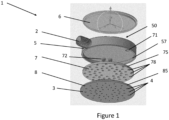
- Figure 1 shows an exploded view of a fluid delivery device 1.
- Figure 2 shows a rear view of the fluid delivery device 1 with a cover removed.
- Figure 3 shows an enlarged cross-sectional view of the fluid delivery device 1 along the line A-A ( Figure 2 ).
- Figure 4 is an enlarged view of a portion of Figure 3 .
- the fluid delivery device 1 includes a first plate 7 and a second plate 8.
- a front surface of the second plate 8 forms the spray face 3.
- the first plate 7 is disposed between the body 5 and the second plate 8.
- the first plate 7 has a circumferential flange 75, which projects from the first plate 7 in a direction away from the spray face 3.
- the body 5 has a circumferential flange 57 which projects from the body 5 toward the spray face 3.
- the flange 75 of the first plate 7 fits within the flange 57 of the body 5, e.g. to form a press fit connection.
- the second plate 8 is also configured to selectively couple to the body 5 and to the first plate 7 by press fit connections.
- a rear surface of the second plate 8 has a stepped edge 85 configured to receive an end part of the flange 57 of the body 5.
- a first chamber 70 may be formed between the body 5 and the first plate 7 (see Figure 3 ).
- the first plate 7 contains a first plurality of through holes 78 each of which feed a respective one of the fluid delivery outlets 4 of the spray face 3.
- a second chamber 80 is formed between the first plate 7 and the second plate 8.
- the second plate 8 comprises a second plurality of through holes 82 (not shown), each of which fluidically connect the chamber 80 to a respective one of the fluid delivery outlets 4.
- the second plate 8 further comprises a third plurality of through holes 81 (not shown), each of which fluidically connect a respective one of the first plurality of through holes 78 to a respective one of the fluid delivery outlets 4.
- the second set 82 and third set 81 of through holes can be seen in Figures 3 and 4 , the accompanying description of which details their role during operation of the fluid delivery device 1.
- the fluid delivery device 1 further comprises a cover 6 which forms a rear external surface of the fluid delivery device 1 opposite the spray face 3.
- the cover 6 acts to seal a rear face of the switching device 50.
- the cover 6 is selectively couplable to a rear of the body 5 via a press fit connection.
- the switching device 50 is configured to operate in a first operating mode and a second operating mode.
- first operating mode fluid is fed from the first switching device outlet 51 through the first plenum 61 to the first passage 71 and on into the first chamber 70.
- second operating mode fluid is fed from the second switching device outlet 52 through the second plenum 62 to the second passages 72 and on into the second chamber 80.
- the switching means 53 comprises an antechamber 55 having a generally triangular shape.
- the switching device inlet 21 fluidically connects the inlet 2 to the antechamber 55 at or around its apex.
- the first switching device outlet 51 and the second switching device outlet 52 connect to a basal edge of the antechamber 55 (on opposite sides of the antechamber 55).
- the first switching device outlet 51 and the second switching device outlet 52 connect to the antechamber 55 at opposite ends of the basal edge.
- the second feedback loop 55b is connected to a further non-basal edge of the antechamber 55, such that the second feedback loop 56b and the second switching device outlet 52 are both connected on the second side 55b of the antechamber 55.
- both the first feedback loop 56a and the second feedback loop 56b are connected to the antechamber 55 near its apex.
- the first feedback loop 56a and the second feedback loop 56b follow an angular path bounded by straight edges.
- their paths be any suitable conformation such as meandering curved paths.
- the first feedback loop 56a may be a mirror image of the second feedback loop 56b relative to a dashed line A-A.
- the first feedback loop 56a and the second feedback loop 56b may not be mirror images of each other.
- the first feedback loop 56a and the second feedback loop 56b may be substantially identical to each other or may be different from each other.
- the first feedback loop 56a is preferably configured such that fluid flow from the first feedback loop 56a enters the antechamber 55 in a direction pointing substantially towards the second side 55b of the antechamber 55.
- the second feedback loop 56b is preferably configured such that fluid flow from the second feedback loop 56b enters the antechamber 55 in a direction pointing substantially towards the first side 55a of the antechamber 55. This configuration may permit flow from the first feedback loop 56a to disrupt flow to the first switching device outlet 51. Similarly, the flow from the second feedback loop 56b may disrupt flow from the antechamber 55 to the second switching device outlet 52. In this way, the switching device 50 is configured to function as described below.
- the switching device 50 has a first operating mode and a second operating mode.
- first operating mode fluid enters the antechamber 55 through the switching device inlet 21 and is directed through the antechamber 55 to the first switching device outlet 51 to form a first fluid flow.
- Fluid flow through the first switching device outlet 51 drives a portion of flow through the first feedback loop 56a and back into the antechamber 55.
- fluid enters the antechamber 55 through the switching device inlet 21 and is directed through the antechamber 55 to the second switching device outlet 52 to form a second fluid flow.
- the switching device 50 is caused to continuously (or substantially continuously) cycle between the first operating mode and the second operating mode.
- the fluid delivery device 10 does not rely on any moving parts to cycle between the first operating mode and the second operating mode.
- Alternate switching means for cycling between the first operating mode and the second operating mode are considered within the scope of this disclosure.
- a rotating turbine element could be used in place of the switching means 53 to alternatingly fluidically couple the first and second switching device outlets 51, 52 to the switching device inlet 21.
- Figure 3 shows an enlarged cross-sectional view of the fluid delivery device of Figures 1 and 2 along the line A-A ( Figure 2 ).
- the path of the first fluid flow and the second fluid flow from the first and second chambers respectively to the fluid delivery outlets 4 is best shown by Figures 3 and 4 .
- Figure 4 shows an enlarged view of a portion of Figure 3 (indicated in Figure 3 by dashed box 'B').
- the first chamber 70 is farther from the spray face 3 than the second chamber 80 when measured from a centre of volume of the first chamber 70 and a centre of volume of the second chamber 80, respectively.
- having the first and second chamber 70, 80 vertically offset from one another may enable fluid to be laterally distributed across the spray head without mixing of the first and second fluid flows. This may have benefits over conventional fluid distribution arrays wherein complex pathways are used to segregate different flows within a single layer.
- the fluid delivery outlets 4 may be supplied by a respective pair of through holes (one of the second plurality of the through holes 82 and one of the third plurality of through holes 81).
- the first plurality of through holes 78 may feed a respective one of the third plurality of through holes (in the second plate 8). This prevents mixing of the first fluid flow from the first chamber 70 with the second fluid flow from the second chamber 80, effectively enabling the first fluid flow to reach the fluid delivery outlets 4 while bypassing the second chamber 80.
- fluid travels from the first chamber 70 to the fluid delivery outlets 4 via the first plurality of through holes 71 and the third plurality of through holes 82.
- This first fluid flow is represented by black block arrows 811 in Figure 4 .
- the second fluid flow i.e., flow from the second chamber 80 to one of the fluid delivery outlets 4, is shown by white block arrows 821 in Figure 4 .
- fluid travels from the second chamber 80 to the fluid delivery outlets 4 via the second plurality of through holes 82 of the second plate 8. Cycling between operating modes of the switching device 50 switches which of the first fluid flow and the second fluid flow supplies the fluid delivery outlets 4.
- each given fluid delivery outlet 4 when the switching device is in the first operating mode, the first fluid flow enters the fluid delivery outlet 4 at a first location; and when the switching device is in the second operating mode, the second fluid flow enters the given fluid delivery outlet 4 at a second location.
- each of the second plurality of through holes 82 may be tilted, by an angle ⁇ , with respect to the third plurality of through holes 81 such that for each given fluid delivery outlet 4, the first fluid flow enters the fluid delivery outlet 4 in a different direction from that which the second fluid flow enters the fluid delivery outlet 4.
- the angle ⁇ may be greater than or equal to 2°, greater than or equal to 5°, greater than or equal to 10°, greater than or equal to 15°, greater than or equal to 20° or greater than or equal to 30° and/or less than or equal to 10°, less than or equal to 15°, less than or equal to 20°, less than or equal to 30° or less than or equal to 40°.
- the third plurality of through holes 81 is substantially cylindrical in shape with longitudinal axes perpendicular to the spray face 3.
- the second plurality of through holes 82 may widen towards the spray face 3 to form an oblique frustoconical shape.
- the axes of the oblique frustoconical shapes may not be parallel to the longitudinal axes of the third plurality of through holes 81.
- the angle between the one of the third plurality of through holes 81 and the one of the second plurality of through holes 82 may be greater than or equal to 2°, greater than or equal to 5°, greater than or equal to 10°, greater than or equal to 15°, greater than or equal to 20° or greater than or equal to 30° and/or less than or equal to 10°, less than or equal to 15°, less than or equal to 20°, less than or equal to 30° or less than or equal to 40°.
- the angle between the one of the third plurality of through holes 81 and the one of the second plurality of through holes 82 is approximately 23°.
- Configuring the fluid delivery device 1 in this way may advantageously allow for unconventional output flow characteristics to be produced. Such switching flow from different locations and/or in different directions may result in output flow from the spray face 3 that mimics rainfall to at least some extent.
- a user may be provided with an unconventional and/or novel showering experience.
- the conduit assembly 100 includes a conduit 101 configured to convey a fluid stream.
- the conduit assembly 100 further includes a flow constrictor 102 configured to constrict flow of the fluid stream along the conduit 101, thereby producing, in use, a pressure drop in the fluid stream downstream of the flow constrictor 102.
- the flow constrictor 102 is arranged within the conduit 101.
- the flow constrictor 102 comprises a disc, perpendicular (or substantially perpendicular) to a longitudinal axis 1001 of the conduit 101 and perforated by a plurality of apertures 103.
- the plurality of apertures 103 includes 32 apertures arranged in two rings proximal to a perimeter of the disc.
- the flow constrictor 102 produces a pressure drop in the fluid stream downstream of the flow constrictor 102.
- Other flow constrictor configurations that may be employed without departing from the scope of this disclosure will be readily apparent to a person skilled in the art.
- the flow constrictor may have any suitable configuration to produce a pressure drop in the fluid stream downstream thereof.
- the conduit 101 may be made from two generally tubular parts: a first part 101a and a second part 101b which are configured to selectively couple to one another.
- the first part 101a is upstream of the second part 101b.
- An end of the first part 101a proximal to the second part 101b may have a reduced radius portion 105a which has a smaller external radius than a remainder of the first part 101a.
- a threaded portion may be disposed on an external surface of the reduced radius portion 105a.
- An end of the second part 101b proximal to the first part 101a may have an increased radius portion 105b which has a larger internal radius than a remainder of the second part 101b.
- a threaded portion may be disposed on an internal surface of the increased radius portion 105b.
- the reduced radius portion 105a of the first part 101a is preferably configured to fit at least partially within and threadingly engage with the increased radius portion 105b to selectively couple the first and second parts 101a, 101b of the conduit 101.
- a sealing member 163 having the form of an O-ring is configured to provide a fluid-tight (or nearly fluid-tight) seal between the first part 101a and the second part 101b of the conduit 101.
- the flow constrictor 102 may form one end of a hollow insert 106 which sits within the reduced radius portion 105a of the first part 101a.
- the hollow insert 106 can include a radially projecting rim 107 distal from the flow constrictor 102.
- the rim 107 may be positioned between the reduced radius portion 105a of the first part 101a and the second part 101b. This configuration helps prevent translation of the hollow insert 106 along the conduit 101.
- the conduit assembly 100 further comprises eight air induction channels 130 for conveying a stream of air from outside the conduit 101 into the conduit 101, though more or fewer channels 130 are foreseeable.
- the eight air induction channels 130 are distributed substantially evenly around a circumference of the conduit 101.
- each one of the eight air induction channels 130 includes a one of a first set of air induction passages 131 which perforate the first part 101a of the conduit 101 and one of a second set of air induction passages 132 which perforate the hollow insert 106.
- the first set of air induction passages 131 includes eight air induction passages regularly spaced around a circumference of the reduced radius portion 105a.
- the second set of air induction passages 132 includes eight air induction channels regularly spaced around a circumference of the hollow insert 106 proximal to the flow constrictor 102.
- the second set of air induction passages 132 may be arranged to receive air from a respective one of the first set of air induction passages 131 and provide air to an interior of the hollow insert 106.
- Sealing members 160 may be disposed on an external surface of the hollow insert 106 on either side of the second set of air induction passages 132.
- each of the sealing members such as sealing members 160 of the conduit assembly 100, is an O-ring, though other sealing members are foreseeable.
- the sealing members 160 help reduce or prevent fluid leaking from within the conduit assembly 100 along the first set of air induction passages 131 to outside the conduit assembly 100. Equally, the sealing members 160 also act to help reduce or prevent air from entering the conduit assembly 100 upstream of the flow constrictor 102.
- the conduit assembly 100 is configured such that air may enter the hollow insert 106 immediately downstream of the flow constrictor 102. At this point, in the conduit 101 there may be a pressure drop, and fluid flow is at a high velocity. This may aid air to be drawn along the air induction channels 130 and achieve effective mixing of the air into the fluid stream creating an aerated fluid stream.
- the conduit assembly 100 comprises an air induction channel closure means operable to actuate the conveyance of air along the air induction channels 130.
- the air induction channel closure means comprises a sleeve 120 operable to translate, relative to the conduit 101, parallel to the longitudinal axis 1001 of the conduit 101.
- the sleeve 120 is substantially tubular in shape and surrounds an outer circumference of the reduced radius portion 105a.
- An inner radius of the sleeve 120 is just greater than an outer radius of the reduced radius portion 105a to produce a close fit between the two pieces.
- An outer radius of the sleeve 120 is substantially equal to: an outer radius of the remainder of the first part 101a; and the increased radius portion 105b. In this way, the sleeve 120 sits flush (or nearly flush) with the first part 101a and the second part 101b of the conduit 101.
- a step is formed at the junction between the reduced radius portion 105a and the remainder of the first part 101a.
- the step forms a first contact surface 140a for interaction with the sleeve 120 and acts as an end stop for translation of the sleeve 120 in a first direction 151.
- the sleeve 120 is operable to translate between two end points determined by the first end stop and the second end stop respectively, which define first and second states of the air induction channel closure means respectively.
- the sleeve 120 further may comprise a ridge 170 which enables user actuation of the sleeve 120 between the states of the sleeve 120.
- the ridge 170 projects away from the conduit 101.
- the ridge 170 may be substantially arcuate in shape, e.g., providing a crescent (or similar shape) configured to fit a user's thumb.
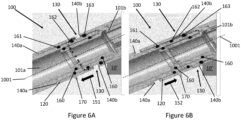
- Figure 6A shows the conduit assembly 100 wherein the sleeve 120 is in the first state.
- a rear end of the sleeve 120 contacts the first contact surface 140a of the first part 101a.
- a front end of the sleeve 120 does not contact the second contact surface 140b of the second part 101b.
- a gap is present between the front end of the sleeve 120 and second part 101b opening up the air induction channels 130.
- Two sealing members 161, 162 are preferably disposed on an external surface of the reduced radius portion 105a on either side of the first set of air induction passages 131.
- An internal radius of sleeve 120 increases towards the front end of the sleeve 120.
- the pressure drop in the fluid stream downstream of the flow constrictor 102 may cause air to be drawn through the open air induction channels 130 to mix with the fluid stream in the hollow insert 106 to form the aerated fluid stream.
- the flow of air through the air induction channels 130 is shown by dotted arrows in Figure 6A .
- Figure 6B shows the conduit assembly 100 wherein the sleeve 120 is in the second state.
- the front end of the sleeve 120 contacts the second contact surface 140b of the second part 101b, sealing the front end of the sleeve 120 against the second part 101b.
- the air induction channels 130 are closed and no (or substantially no) streams of air may be conveyed along the closed air induction channels 130 from outside the conduit 101 into the conduit 101.
- the fluid stream downstream of the flow constrictor 102 is not an aerated fluid stream.
- a gap is present between the rear end of the sleeve 120 and first contact surface 140a of the first part 101a.
- the two sealing members 161, 162 may inhibit fluid (e.g., air or water) traversing between the reduced radius portion 105a and the sleeve 120.
- the sleeve 120 may have one or more intermediate states between the first and second states. In such intermediate states, a small gap may be present between the interior surface of the sleeve 120 and the sealing member 162. When the sleeve 120 is positioned as such, the air induction channels 130 may be considered to be partially open and the resultant fluid stream may be aerated to a lesser extent than when the sleeve is in the first state. Provision of such intermediate states may allow a user finer control over the extent of aeration of the fluid stream.
- Figure 7A shows a fluid delivery device 200 including the conduit assembly 100.
- Figure 7B shows a cross-sectional view of the fluid delivery device 200.
- the fluid delivery device 200 may comprise a handset for a shower including a handle portion 110 and a head portion 10'.
- a first end of the handle portion 110 may comprise a threaded portion for connecting the handle portion 110, in use, to a fluid supply pipe (not shown).
- the handle portion 110 may include the conduit assembly 100 which enables selection between different flow characteristics of a fluid delivery device 200.
- the conduit 101 is configured to convey a fluid stream through the handle portion 110 towards the head portion 10'.
- An inlet 20' of the conduit assembly 100 is located at the first end of the handle portion 110.
- the fluid delivery device 200 is shown while the sleeve 120 is in the first state.
- the rear end of the sleeve 120 preferably contacts the first contact surface 140a of the first part 101a.
- the front end of the sleeve 120 preferably does not contact the second contact surface 140b of the second part 101b.
- a gap may be present between the front end of the sleeve 120 and second part 101b opening up the air induction channels 130.
- flow to the head portion 10' is aerated by the conduit assembly 100.
- actuation means such as those that rely on relative rotation of two parts, can cause difficulty for a user whose hands are likely to be wet. Typically, such rotational actuation requires two hands, with one hand being used to secure each part.
- actuation can be achieved by user-controlled translation of the sleeve 120 with respect to the conduit 101 (with grip aided by ridge 170). Due to the positioning of the sleeve 120 on the handle portion 110 of the fluid delivery device 10' and the provision of the ridge 170 to aid grip, a user may actuate the conduit assembly 100 with a single hand using their palm and fingers to grasp the handle portion 110 and their thumb to slide sleeve 120. In this way, the conduit 101 may provide an aerating means that can be actuated by a user without undue complexity (which may result in high manufacturing costs).
- Figure 8 shows a cross-sectional view of a fluid delivery device 300.
- the fluid delivery device 300 comprises a spray head 350 for a shower and operates in a similar fashion to the fluid delivery device 200 of Figures 7A and 7B .
- the fluid delivery device 300 comprises a conduit assembly 400.
- the conduit assembly 400 is preferably configured to couple to a fluid supply pipe (not shown) and the spray head 350.
- the spray head 350 may include one or more internal chambers 351 in fluid communication with the conduit assembly 400 and a spray face with a plurality of outlets 352 for delivering fluid, in use, to a user.
- the fluid delivery device 300 is a fixed overhead shower while the fluid delivery device 200 is a handheld shower.
- the conduit assembly 400 may be integrated into a support pipe 410 that fixes the fluid delivery device 300 with respect to a shower enclosure in which the fluid delivery device 300 is installed. This is in contrast to the fluid delivery device 300 shown in Figures 7A and 7B where the conduit assembly 100 forms part of the handle 110.
- the conduit assembly 400 may include a conduit 401 configured to convey a fluid stream from the fluid supply pipe to the spray head 350.
- the conduit 401 is preferably made from two generally tubular parts: a first part 401a and a second part 401b which are configured to selectively couple to one another.
- the first part 401a is upstream of the second part 401b and configured to couple to a fluid supply pipe.
- An end of the first part 401a proximal to the second part 401b has a reduced radius portion 405a which may have a smaller external radius than a remainder of the first part 401a.
- a threaded portion can be disposed on an external surface of the reduced radius portion 405a.
- a threaded portion 405b can be disposed on an internal surface of the second part 401b.
- the reduced radius portion 405a of the first part 401a is configured to fit at least partially within and threadingly engage with threaded portion 405b of the second part 401b to selectively couple the first and second parts 401a, 401b of the conduit 401.
- the first part 401a may include a flow constrictor 402 configured to constrict flow of the fluid stream along the conduit 401, thereby producing, in use, a pressure drop in the fluid stream downstream of the flow constrictor 402.
- the flow constrictor 402 comprises a disc, perpendicular (or substantially perpendicular) to a longitudinal axis 1002 of the conduit 401, perforated by a plurality of apertures 403.
- the plurality of apertures 403 includes 32 apertures arranged in two rings proximal to a perimeter of the disc.
- the flow constrictor 402 produces a pressure drop in the fluid stream downstream of the flow constrictor 402.
- Other flow constrictor configurations that may be employed without departing from the scope of this disclosure will be readily apparent to a person skilled in the art.
- the flow constrictor may have any suitable configuration to produce a pressure drop in the fluid stream downstream thereof.
- the first part 401a further can comprise a plurality of air induction channels 430 for conveying a stream of air from outside the conduit 401 into the conduit 401.
- the air induction channels 430 may be distributed substantially evenly around a circumference of the conduit 401.
- the conduit assembly 400 is preferably configured such that air may enter the conduit 401 downstream of the flow constrictor 402. At this point, in the conduit 401 there is a pressure drop, and fluid flow is at a high velocity. This may beneficially help draw air along the air induction channels 430 and achieve effective mixing of the air into the fluid stream, creating an aerated fluid stream.
- the conduit assembly 400 comprises an air induction channel closure means operable to actuate the conveyance of air along the air induction channels 430.
- the air induction channel closure means comprises a sleeve 420 operable to translate, relative to the conduit 401, parallel to the longitudinal axis 1002 of the conduit 401.
- the sleeve 420 is substantially tubular in shape and surrounds an outer circumference of the first part 401a.
- An inner radius of the sleeve 420 is just greater than an outer radius of the first part 401a to produce a close fit between the two pieces.
- a step may be formed on the outer surface of the first part 401a which forms a first contact surface 440a for interaction with the sleeve 420 and acts as an end stop for translation of the sleeve 420 in a first direction.
- Another step may be formed at the junction between the first part 401a and the second part 401b, which forms a second contact surface 440b for interaction with the sleeve 420.
- the second contact surface 440b acts as an end stop for translation of the sleeve 420 in a second direction, substantially opposite the first direction.
- the sleeve 420 may be operable to translate between two end points determined by the first end stop and the second end stop respectively, which define first and second states of the air induction channel closure means respectively.
- the sleeve 420 further comprises a ridge 470 which enables user actuation of the sleeve 420 between the states of the sleeve 420.
- the ridge 470 preferably projects away from the conduit 401 around a circumference of the sleeve 420.
- Figure 8 shows the conduit assembly 300 wherein the sleeve 420 is in the first state.
- a rear end of the sleeve 420 may contact the first contact surface 440a of the first part 401a.
- a front end of the sleeve 420 does not contact the second contact surface 440b of the second part 401b.
- a gap may be present between the front end of the sleeve 420 and second part 401b, opening up the air induction channels 430.
- the front end of the sleeve 420 may contact the second contact surface 440b of the second part 401b, sealing (or substantially sealing) the front end of the sleeve 420 against the second part 401b.
- the air induction channels 430 may be closed such that no (or very few) streams of air may be conveyed along the closed air induction channels 430 from outside the conduit 401 into the conduit 401.
- the fluid stream downstream of the flow constrictor 402 is not an aerated fluid stream.
- a gap may be present between the rear end of the sleeve 420 and first contact surface 440a of the first part 401a.
- Sealing members (not shown), such a O-rings, can be disposed on an external surface of the first part 401a on either side of the air induction channels 430.
- the sealing members may help prevent air from entering the conduit assembly 300 when the sleeve 420 is in the second state.
- actuation means such as those that rely on relative rotation of two parts, can cause difficulty for a user whose hands are likely to be wet. Typically, such rotational actuation requires two hands, with one hand being used to secure each part.
- actuation can be achieved by user-controlled translation of the sleeve 420 with respect to the conduit 401 (with grip aided by ridge 470). In this way, the conduit assembly 400 may provide an aerating means that can be actuated by a user without undue complexity (which may result in high manufacturing costs).
- Figure 9 illustrates a cross-section view of a fluid delivery device 500.
- the fluid delivery device 500 may comprise a spray head 550 for a shower and operates in a similar fashion to the fluid delivery device 300 of Figure 8 .
- the fluid delivery device 500 comprises a conduit assembly 600 which is configured to couple to a fluid supply pipe (not shown).
- the spray head 550 may include a switching device 553 similar to the switching device 50 of Figures 1 to 3 .
- the spray head 550 can further comprise: one or more internal chambers 551 in fluid communication with the switching device 553; and a spray face 554 with a plurality of outlets 552 for delivering fluid from the one or more internal chambers 551 to a user.
- the conduit assembly 600 may be integrated into and completely housed within the spray head 550. As in previous embodiments, the conduit assembly 600 is operable to selectively aerate flow travelling therethrough.
- the conduit assembly 600 is configured differently to the conduit assembly 400 of Figure 8 .
- the air induction channel closure means of the conduit assembly 400 comprises the sleeve 420
- the air induction channel closure means of the conduit assembly 600 does not comprise a sleeve and aeration of flow is instead actuated via rotation of a movable plate 620.
- the conduit assembly 600 includes a conduit 601.
- the conduit 601 is configured to convey a fluid stream from the fluid supply pipe to the switching device 553.
- the conduit assembly 600 includes a flow constrictor 602 configured to constrict flow of the fluid stream along the conduit 401, thereby producing, in use, a pressure drop in the fluid stream downstream of the flow constrictor 602.
- the flow constrictor 602 comprises section of the conduit 601 wherein a cross-sectional area progressively narrows in a direction 1003 of the fluid stream.
- Other flow constrictor configurations that may be employed without departing from the scope of this disclosure will be readily apparent to a person skilled in the art.
- the flow constrictor may have any suitable configuration to produce a pressure drop in the fluid stream downstream thereof.
- the conduit 601 Downstream of the flow constrictor 602, the conduit 601 is perforated by one or more air induction channels 630 for conveying a stream of air from outside the conduit 601 into the conduit 601. At this point, in the conduit 601 there is a pressure drop and fluid flow is at a high velocity. This may beneficially ensure air is drawn along the one or more air induction channels 630 and achieve effective mixing of the air into the fluid stream creating an aerated fluid stream.
- the conduit assembly 600 comprises an air induction channel closure means operable to actuate the conveyance of air along the one or more air induction channels 630.
- the air induction channel closure means comprises a movable plate 620 which forms a rear external surface of the spray head 550.
- the movable plate 620 is operable to move with respect to the one or more air induction channels 630.
- the movable plate 620 is operable to rotate around an axis 1004 of the fluid delivery device 500 with respect to a remainder of the fluid delivery device 500 upon user actuation.
- the axis 1004 passes through and is aligned substantially perpendicular to a center of the spray face 554.
- the movable plate 620 can be perforated with one or more through thickness apertures 640 arranged to selectively align with the one or more air induction channels 630.
- the movable plate 620 may be operable to be actuated between a first state and a second state.
- Figure 9 shows the conduit assembly 600 wherein the movable plate 620 is in the first state.
- the movable plate 620 is arranged such that the one or more through thickness apertures 640 at least partially align with the one or more air induction channels 630 thereby enabling airflow to the one or more air induction channels 630.
- the air induction channels 630 open and air may be conveyed along the one or more air induction channels 630 from outside the conduit 601 into the conduit 601.
- the fluid stream downstream of the flow constrictor 602 said to be an aerated fluid stream.
- the movable plate 620 may include a grip (not shown) to enable user actuation of the movable plate 620 between the first state and the second state. This configuration may allow the moveable plate to be set in either the first sate or the second state during assembly thereby limiting the number of different components required to produce spray heads with different resultant flow characteristics.
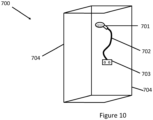
- FIG 10 shows an ablutionary system 700 comprising a fluid delivery device 701.
- the fluid delivery device 701 may be any suitable fluid delivery device within the scope of this disclosure such as the fluid delivery device 1 or the fluid delivery device 200.
- the ablutionary system 700 further comprises a fluid supply pipe 702 fluidically connected to the fluid delivery device 701.
- the fluid supply pipe 702 may be releasably connected to the fluid delivery device 701 by any suitable means, such as co-operating screw threads or snap fit connectors.
- the fluid supply pipe 702 is configured to supply fluid from a fluid source such as a mixer valve 4703 to the fluid delivery device 701.
- One or more panels 704 may partially or completely bound the ablutionary system 700.
- the fluid delivery device 701 is a showerhead and the ablutionary system 700 is a shower system.
- the panels 704 define at least partially a shower enclosure.
- One or more of the panels 704 may include a wall of an ablutionary environment.
- the ablutionary system 700 may be any suitable ablutionary system and it will be appreciated that the teaching of the present disclosure may be applied to other plumbing systems such as, for example, a fire sprinkler system.
- any or all of the features of the fluid delivery device 1 as described above in relation to Figures 1-4 may be present in head portion 10' of Figures 7A and 7B and/or the spray head 350 of Figure 8 and/or the spray head 550 of Figure 9 .
Landscapes
- Health & Medical Sciences (AREA)
- Life Sciences & Earth Sciences (AREA)
- Engineering & Computer Science (AREA)
- Hydrology & Water Resources (AREA)
- Public Health (AREA)
- Water Supply & Treatment (AREA)
- Nozzles (AREA)
- Infusion, Injection, And Reservoir Apparatuses (AREA)
- Multiple-Way Valves (AREA)
Applications Claiming Priority (1)
| Application Number | Priority Date | Filing Date | Title |
|---|---|---|---|
| GB2311088.5A GB2628682B (en) | 2023-07-19 | 2023-07-19 | Fluid delivery device |
Publications (2)
| Publication Number | Publication Date |
|---|---|
| EP4494765A2 true EP4494765A2 (de) | 2025-01-22 |
| EP4494765A3 EP4494765A3 (de) | 2025-02-12 |
Family
ID=87758378
Family Applications (1)
| Application Number | Title | Priority Date | Filing Date |
|---|---|---|---|
| EP24175057.9A Pending EP4494765A3 (de) | 2023-07-19 | 2024-05-09 | Flüssigkeitsabgabevorrichtung |
Country Status (4)
| Country | Link |
|---|---|
| US (1) | US20250025893A1 (de) |
| EP (1) | EP4494765A3 (de) |
| CN (1) | CN119327638B (de) |
| GB (1) | GB2628682B (de) |
Family Cites Families (13)
| Publication number | Priority date | Publication date | Assignee | Title |
|---|---|---|---|---|
| DE102013207679B3 (de) * | 2013-04-26 | 2014-10-16 | Hansgrohe Se | Brausekopf mit drehbeweglicher Steuerscheibe |
| DE102013213275B4 (de) * | 2013-07-05 | 2016-12-15 | Hansgrohe Se | Sanitäres Schaltventil und Brausekopf |
| CN105127022B (zh) * | 2015-09-25 | 2018-10-16 | 浙江花乐科技有限公司 | 智能化换挡顶喷花洒 |
| DE102016212254B4 (de) * | 2016-07-05 | 2018-09-20 | Hansgrohe Se | Sanitärbrause mit Fluid-Umschaltventil |
| CN108799550B (zh) * | 2017-05-04 | 2025-01-28 | 厦门松霖科技股份有限公司 | 一种止水切换阀芯和花洒 |
| DE102017216413B3 (de) * | 2017-09-15 | 2018-11-08 | Hansgrohe Se | Fluidumsteller |
| DE102017216491A1 (de) * | 2017-09-18 | 2019-03-21 | Hansgrohe Se | Fluidumstellvorrichtung und Sanitärbrause |
| WO2020014624A1 (en) * | 2018-07-12 | 2020-01-16 | Water Pik, Inc. | Tangential oscillating massage engine |
| DE102018212408B3 (de) * | 2018-07-25 | 2019-08-22 | Hansgrohe Se | Sanitärbrauseeinrichtung |
| CN112108276B (zh) * | 2020-09-07 | 2026-02-17 | 厦门建霖健康家居股份有限公司 | 一种可调节按摩强度的出水装置 |
| CN115138492A (zh) * | 2021-05-26 | 2022-10-04 | 厦门松霖科技股份有限公司 | 出水装置及花洒 |
| US12048938B2 (en) * | 2021-09-20 | 2024-07-30 | Water Pik, Inc. | Showerhead with massage engine |
| CN218394185U (zh) * | 2022-06-21 | 2023-01-31 | 箭牌家居集团股份有限公司 | 花洒喷头 |
-
2023
- 2023-07-19 GB GB2311088.5A patent/GB2628682B/en active Active
-
2024
- 2024-05-09 EP EP24175057.9A patent/EP4494765A3/de active Pending
- 2024-06-28 US US18/758,840 patent/US20250025893A1/en active Pending
- 2024-07-17 CN CN202410956348.1A patent/CN119327638B/zh active Active
Also Published As
| Publication number | Publication date |
|---|---|
| GB2628682B (en) | 2025-04-30 |
| EP4494765A3 (de) | 2025-02-12 |
| GB2628682A (en) | 2024-10-02 |
| US20250025893A1 (en) | 2025-01-23 |
| CN119327638A (zh) | 2025-01-21 |
| GB202311088D0 (en) | 2023-08-30 |
| CN119327638B (zh) | 2026-02-27 |
Similar Documents
| Publication | Publication Date | Title |
|---|---|---|
| US5499767A (en) | Shower head having elongated arm, plural nozzles, and plural inlet lines | |
| US8424781B2 (en) | Power sprayer | |
| US4340039A (en) | Hydromassage apparatus | |
| US4773104A (en) | Inflatable bath-pool with means producing massaging fluid jet | |
| US20040217209A1 (en) | Thin profile multi-function showerhead | |
| EP3391972A1 (de) | Duschvorrichtung | |
| CN111263665B (zh) | 对喷头的改进 | |
| JPH03202164A (ja) | シャワーヘッド | |
| KR20030065595A (ko) | 다기능 분배기 | |
| US5058220A (en) | Jet nozzle apparatus | |
| MX2007002293A (es) | Sistema de regadera con mango integrado. | |
| CA3086709C (en) | Integrated manifold and valve assembly | |
| US4079891A (en) | Spray nozzle | |
| US20090032610A1 (en) | Anti-Drip fluid delivery device | |
| EP4494765A2 (de) | Flüssigkeitsabgabevorrichtung | |
| CA3226173A1 (en) | Hand shower including a plurality of cleaning modes | |
| US10260218B2 (en) | Spray head | |
| RU2709887C9 (ru) | Санитарно-техническое душевое устройство | |
| GB2311474A (en) | Spray head for a shower handset | |
| GB2636318A (en) | Fluid delivery service | |
| US6964380B1 (en) | Spraying gun having flow rate control effect | |
| US20250025894A1 (en) | Fluid delivery device | |
| JPH10306481A (ja) | 混合水栓装置 | |
| CA2370612A1 (en) | A venturi feed device and fluid mixing device | |
| US8480003B2 (en) | Separated-flow temperature control faucet |
Legal Events
| Date | Code | Title | Description |
|---|---|---|---|
| PUAI | Public reference made under article 153(3) epc to a published international application that has entered the european phase |
Free format text: ORIGINAL CODE: 0009012 |
|
| STAA | Information on the status of an ep patent application or granted ep patent |
Free format text: STATUS: THE APPLICATION HAS BEEN PUBLISHED |
|
| PUAL | Search report despatched |
Free format text: ORIGINAL CODE: 0009013 |
|
| AK | Designated contracting states |
Kind code of ref document: A2 Designated state(s): AL AT BE BG CH CY CZ DE DK EE ES FI FR GB GR HR HU IE IS IT LI LT LU LV MC ME MK MT NL NO PL PT RO RS SE SI SK SM TR |
|
| AK | Designated contracting states |
Kind code of ref document: A3 Designated state(s): AL AT BE BG CH CY CZ DE DK EE ES FI FR GB GR HR HU IE IS IT LI LT LU LV MC ME MK MT NL NO PL PT RO RS SE SI SK SM TR |
|
| RIC1 | Information provided on ipc code assigned before grant |
Ipc: B05B 7/04 20060101ALI20250107BHEP Ipc: B05B 1/08 20060101ALI20250107BHEP Ipc: B05B 1/16 20060101ALI20250107BHEP Ipc: B05B 1/18 20060101AFI20250107BHEP |
|
| STAA | Information on the status of an ep patent application or granted ep patent |
Free format text: STATUS: REQUEST FOR EXAMINATION WAS MADE |
|
| 17P | Request for examination filed |
Effective date: 20250716 |