EP4494619A1 - Method and device for manufacturing disposable wearable article - Google Patents
Method and device for manufacturing disposable wearable article Download PDFInfo
- Publication number
- EP4494619A1 EP4494619A1 EP23803370.8A EP23803370A EP4494619A1 EP 4494619 A1 EP4494619 A1 EP 4494619A1 EP 23803370 A EP23803370 A EP 23803370A EP 4494619 A1 EP4494619 A1 EP 4494619A1
- Authority
- EP
- European Patent Office
- Prior art keywords
- continuous body
- absorbent bodies
- absorbent
- wearable article
- waist member
- Prior art date
- Legal status (The legal status is an assumption and is not a legal conclusion. Google has not performed a legal analysis and makes no representation as to the accuracy of the status listed.)
- Granted
Links
Images


Classifications
-
- A—HUMAN NECESSITIES
- A61—MEDICAL OR VETERINARY SCIENCE; HYGIENE
- A61F—FILTERS IMPLANTABLE INTO BLOOD VESSELS; PROSTHESES; DEVICES PROVIDING PATENCY TO, OR PREVENTING COLLAPSING OF, TUBULAR STRUCTURES OF THE BODY, e.g. STENTS; ORTHOPAEDIC, NURSING OR CONTRACEPTIVE DEVICES; FOMENTATION; TREATMENT OR PROTECTION OF EYES OR EARS; BANDAGES, DRESSINGS OR ABSORBENT PADS; FIRST-AID KITS
- A61F13/00—Bandages or dressings; Absorbent pads
- A61F13/15—Absorbent pads, e.g. sanitary towels, swabs or tampons for external or internal application to the body; Supporting or fastening means therefor; Tampon applicators
- A61F13/15577—Apparatus or processes for manufacturing
- A61F13/15707—Mechanical treatment, e.g. notching, twisting, compressing, shaping
- A61F13/15723—Partitioning batts; Cutting
-
- A—HUMAN NECESSITIES
- A61—MEDICAL OR VETERINARY SCIENCE; HYGIENE
- A61F—FILTERS IMPLANTABLE INTO BLOOD VESSELS; PROSTHESES; DEVICES PROVIDING PATENCY TO, OR PREVENTING COLLAPSING OF, TUBULAR STRUCTURES OF THE BODY, e.g. STENTS; ORTHOPAEDIC, NURSING OR CONTRACEPTIVE DEVICES; FOMENTATION; TREATMENT OR PROTECTION OF EYES OR EARS; BANDAGES, DRESSINGS OR ABSORBENT PADS; FIRST-AID KITS
- A61F13/00—Bandages or dressings; Absorbent pads
- A61F13/15—Absorbent pads, e.g. sanitary towels, swabs or tampons for external or internal application to the body; Supporting or fastening means therefor; Tampon applicators
- A61F13/15577—Apparatus or processes for manufacturing
- A61F13/15707—Mechanical treatment, e.g. notching, twisting, compressing, shaping
- A61F13/15739—Sealing, e.g. involving cutting
-
- A—HUMAN NECESSITIES
- A61—MEDICAL OR VETERINARY SCIENCE; HYGIENE
- A61F—FILTERS IMPLANTABLE INTO BLOOD VESSELS; PROSTHESES; DEVICES PROVIDING PATENCY TO, OR PREVENTING COLLAPSING OF, TUBULAR STRUCTURES OF THE BODY, e.g. STENTS; ORTHOPAEDIC, NURSING OR CONTRACEPTIVE DEVICES; FOMENTATION; TREATMENT OR PROTECTION OF EYES OR EARS; BANDAGES, DRESSINGS OR ABSORBENT PADS; FIRST-AID KITS
- A61F13/00—Bandages or dressings; Absorbent pads
- A61F13/15—Absorbent pads, e.g. sanitary towels, swabs or tampons for external or internal application to the body; Supporting or fastening means therefor; Tampon applicators
- A61F13/15577—Apparatus or processes for manufacturing
- A61F13/15707—Mechanical treatment, e.g. notching, twisting, compressing, shaping
- A61F13/15747—Folding; Pleating; Coiling; Stacking; Packaging
-
- A—HUMAN NECESSITIES
- A61—MEDICAL OR VETERINARY SCIENCE; HYGIENE
- A61F—FILTERS IMPLANTABLE INTO BLOOD VESSELS; PROSTHESES; DEVICES PROVIDING PATENCY TO, OR PREVENTING COLLAPSING OF, TUBULAR STRUCTURES OF THE BODY, e.g. STENTS; ORTHOPAEDIC, NURSING OR CONTRACEPTIVE DEVICES; FOMENTATION; TREATMENT OR PROTECTION OF EYES OR EARS; BANDAGES, DRESSINGS OR ABSORBENT PADS; FIRST-AID KITS
- A61F13/00—Bandages or dressings; Absorbent pads
- A61F13/15—Absorbent pads, e.g. sanitary towels, swabs or tampons for external or internal application to the body; Supporting or fastening means therefor; Tampon applicators
- A61F13/15577—Apparatus or processes for manufacturing
- A61F13/15756—Applying tabs, strips, tapes, loops; Knotting the ends of pads
-
- A—HUMAN NECESSITIES
- A61—MEDICAL OR VETERINARY SCIENCE; HYGIENE
- A61F—FILTERS IMPLANTABLE INTO BLOOD VESSELS; PROSTHESES; DEVICES PROVIDING PATENCY TO, OR PREVENTING COLLAPSING OF, TUBULAR STRUCTURES OF THE BODY, e.g. STENTS; ORTHOPAEDIC, NURSING OR CONTRACEPTIVE DEVICES; FOMENTATION; TREATMENT OR PROTECTION OF EYES OR EARS; BANDAGES, DRESSINGS OR ABSORBENT PADS; FIRST-AID KITS
- A61F13/00—Bandages or dressings; Absorbent pads
- A61F13/15—Absorbent pads, e.g. sanitary towels, swabs or tampons for external or internal application to the body; Supporting or fastening means therefor; Tampon applicators
- A61F13/15577—Apparatus or processes for manufacturing
- A61F13/15764—Transferring, feeding or handling devices; Drives
-
- A—HUMAN NECESSITIES
- A61—MEDICAL OR VETERINARY SCIENCE; HYGIENE
- A61F—FILTERS IMPLANTABLE INTO BLOOD VESSELS; PROSTHESES; DEVICES PROVIDING PATENCY TO, OR PREVENTING COLLAPSING OF, TUBULAR STRUCTURES OF THE BODY, e.g. STENTS; ORTHOPAEDIC, NURSING OR CONTRACEPTIVE DEVICES; FOMENTATION; TREATMENT OR PROTECTION OF EYES OR EARS; BANDAGES, DRESSINGS OR ABSORBENT PADS; FIRST-AID KITS
- A61F13/00—Bandages or dressings; Absorbent pads
- A61F13/15—Absorbent pads, e.g. sanitary towels, swabs or tampons for external or internal application to the body; Supporting or fastening means therefor; Tampon applicators
- A61F13/15577—Apparatus or processes for manufacturing
- A61F13/15804—Plant, e.g. involving several steps
Definitions
- the present invention relates to a method and a device for manufacturing a disposable wearable article, and more specifically, relates to a technique for manufacturing a substantially T-shaped disposable wearable article.
- Fig. 4 is a developed view of a substantially T-shaped disposable wearable article 101.
- the disposable wearable article 101 in the disposable wearable article 101, one end side of an absorbent body 102 is joined to an intermediate position of a waist member 103.
- the disposable wearable article 101 is provided in a state where the other end side 102c of the absorbent body 102 is folded back at a central part 102b toward the waist member 103 so that the absorbent body 102 is folded in half and the waist member is folded so that both end parts overlap.
- Fig. 5 is a perspective view showing a manufacturing process of the disposable wearable article 101.
- a wearable article continuous body 107 in which a plurality of absorbent bodies 102 have one end sides thereof joined in a comb shape with a predetermined spacing provided therebetween is formed while a waist member continuous body 171 in which first sections to be made into waist members 103 are connected is being conveyed in the direction indicated by the arrow Y.
- the waist member continuous body 171 side of the wearable article continuous body 107 is lifted and placed on the other end sides 102c of the absorbent bodies 102 to fold the absorbent bodies 102 in half so that fold lines 126 are formed at intermediate positions of the absorbent bodies 102 in a direction X orthogonal to the conveyance direction Y. Then, the wearable article continuous body 107 is cut between the adjacent absorbent bodies 102 to form disposable wearable article pieces (for example, see Patent Literature 1).
- Patent Literature 2 discloses a folding device that successively cuts an absorbent body continuous body in which second portions to be made into absorbent bodies are connected, to separate the absorbent bodies while conveying it along a cylindrical conveyance route, and further, folds the absorbent bodies in half while conveying them along the cylindrical conveyance route.
- a problem to be solved by the present invention is to provide a method and a device for manufacturing a disposable wearable article that can shorten the section for folding the absorbent bodies in half.
- the present invention provides a disposable wearable article manufacturing method structured as follows:
- the disposable wearable article manufacturing method is provided with: (i) a first conveying step of conveying, in a first direction, an absorbent body continuous body in which first sections to be made into absorbent bodies are connected in the first direction; (ii) a second conveying step of conveying, in a second direction, a waist member continuous body in which second sections to be made into waist members are connected in the second direction; (iii) a first cutting step of forming the absorbent bodies by successively cutting the absorbent body continuous body being conveyed in the first direction; (iv) a turning step of turning the absorbent bodies 90 degrees; (v) a joining step of forming a wearable article continuous body by successively placing first regions on one end side of the 90-degree turned absorbent bodies on the waist member continuous body being conveyed in the second direction with a spacing provided therebetween such that second regions on the other end side of the absorbent bodies protrude from the waist member continuous body, and joining the first regions of the absorbent bodies to the waist member continuous body; (vi) a folding
- the disposable wearable article manufacturing method is further provided with (viii) a temporarily fixing step of temporarily fixing the first regions and the second regions of the folded absorbent bodies together.
- the wearable article continuous body to which the folded absorbent bodies are joined can be conveyed at higher speed, so that the number of disposable wearable articles manufactured per unit time can be increased.
- the disposable wearable article manufacturing method is further provided with (ix) a repitching step of, by using a moving pad, receiving the 90-degree turned absorbent bodies from the turning step, and transferring the received absorbent bodies to the joining step, the moving pad receiving the 90-degree turned absorbent bodies from the turning step while moving at a first speed, and transferring the received absorbent bodies to the joining step while moving at a second speed different from the first speed.
- a repitching step of, by using a moving pad, receiving the 90-degree turned absorbent bodies from the turning step, and transferring the received absorbent bodies to the joining step, the moving pad receiving the 90-degree turned absorbent bodies from the turning step while moving at a first speed, and transferring the received absorbent bodies to the joining step while moving at a second speed different from the first speed.
- the disposable wearable article manufacturing method is further provided with (x) a size changing step of changing, according to the size of the disposable wearable articles, the spacing between the absorbent bodies placed on the waist member continuous body at the joining step by changing one or both of the conveyance speeds of the waist member continuous body and the absorbent body continuous body.
- the present invention provides a disposable wearable article manufacturing device structured as follows:
- the disposable wearable article manufacturing device is provided with: (a) a first unit that forms absorbent bodies by cutting an absorbent body continuous body in which first sections to be made into the absorbent bodies are connected in a first direction while conveying the absorbent body continuous body in the first direction, and turns the absorbent bodies 90 degrees; (b) a second unit that forms a wearable article continuous body by conveying, in a second direction, a waist member continuous body in which second sections to be made into waist members are connected in the second direction, successively placing first regions on one end side of the 90-degree turned absorbent bodies on the waist member continuous body being conveyed with a spacing provided therebetween such that second regions on the other end side of the absorbent bodies protrude from the waist member continuous body, and joining the first regions of the absorbent bodies to the waist member continuous body; and (c) a third unit that folds the absorbent bodies of the wearable article continuous body in half and cuts the wearable article continuous body at cutting positions between the adjacent absorbent bodies to form disposable wearable articles in each of which the first region of the
- the section for folding the absorbent bodies in half can be made short compared with when the absorbent bodies are folded in half while the wearable article continuous body is being conveyed along a linear conveyance route.
- the disposable wearable article manufacturing device is further provided with (d) a temporarily fixing device that temporarily fixes the first regions and the second regions of the folded absorbent bodies together.
- the wearable article continuous body to which the folded absorbent bodies are joined can be conveyed at higher speed, so that the number of disposable wearable articles manufactured per unit time can be increased.
- the disposable wearable article manufacturing device is further provided with (e) a repitching device having a moving pad that receives the 90-degree turned absorbent bodies from the first unit while moving at a first speed and transfers the received absorbent bodies to the second unit while moving at a second speed different from the first speed.
- a repitching device having a moving pad that receives the 90-degree turned absorbent bodies from the first unit while moving at a first speed and transfers the received absorbent bodies to the second unit while moving at a second speed different from the first speed.
- the spacing between the absorbent bodies placed on the waist member continuous body at the second unit can be changed.
- the section for folding the absorbent bodies in half can be shortened.
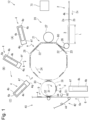
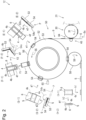
- Figs. 1 and 2 are schematic views of a disposable wearable article manufacturing device 12.
- (A), (B), (C), (D), (E-1), (E-2), (F-1), (F-2), (G-1), (G-2), (H-1) and (H-2) are partial schematic views from the directions indicated by the arrows a, b, c, d, e1, e2, f1, f2, g1, g2, h1 and h2, respectively.
- Fig. 3 is an explanatory view showing a disposable wearable article manufacturing process.
- the disposable wearable article manufacturing device 12 is provided with a first unit 20, a repitching device 30, a second unit 40, a third unit 50, a temporarily fixing device 60 and a size changing device 70.
- a guide roll 26 and a cutter roll 27 are disposed adjacent to a turning drum 21.
- the turning drum 21 is provided with a plurality of suction tables 22 that move in a direction indicated by the arrow 24 along a cylindrical conveyance route 28.
- the suction tables 22 each hold an absorbent body continuous body 2 fed through the guide roll 26 by sucking it to a suction surface 23 where non-illustrated suction holes communicating with a negative pressure source are formed.
- the cutter roll 27 forms absorbent bodies 4 by cutting the absorbent body continuous body 2 conveyed being sucked to the suction surfaces 23 of the suction tables 22, between the adjacent suction tables 22 at an appropriate timing.
- the suction tables 22 each move along the cylindrical conveyance route 28 while holding the absorbent body 4 on the suction surface 23, and turn 90 degrees, so that the direction connecting both ends 4p and 4q of the absorbent body 4 becomes orthogonal to the conveyance direction of the absorbent body 4.
- first sections 3 having a length L and to be made into the absorbent bodies 4 are connected in a first direction 2x indicated by the arrow 2x.
- first sections 3 having a length L and to be made into the absorbent bodies 4 are connected in a first direction 2x indicated by the arrow 2x.
- absorbent cores 4k containing pulp and/or superabsorbent polymer or the like are arranged in the first direction 2x with a spacing provided therebetween between two belt-form sheets 2a and 2b.
- the absorbent body continuous body 2 is cut between the adjacent absorbent cores 4k, thereby forming the absorbent bodies 4.
- the repitching unit 30 has a moving pad 32 that moves along a cylindrical conveyance route 38 in a direction indicated by the arrow 31 while changing the speed.
- the moving pad 32 has a suction surface 34 where non-illustrated suction holes communicating with a negative pressure source are formed. While moving at a first speed, the moving pad 32 sucks, to the suction surface 34, the 90-degree turned absorbent bodies 4 held by the suction table 22 of the turning drum 21 of the first unit 20, receives the 90-degree turned absorbent bodies 4, moves while changing the speed to a second speed different from a first speed, and transfers the received absorbent bodies 4 to the second unit 40 at the second speed.
- Using a servo motor makes it easy to change the speed of the moving pad 32.
- the second unit 40 has a conveyer 42 disposed adjacent to the repitching device 30 and a joining device 46 disposed along the conveyer 42.
- the conveyer 42 conveys, in a second direction 6x, a waist member continuous body 6 in which second sections 7 (see Fig. 3 ) to be made into waist members 8 (see Fig. 3 ) are connected in the second direction 6x.
- First regions 4b on one end 4p side of the 90-degree turned absorbent bodies 4 successively fed from the repitching device 30 are successively placed on the waist member continuous body 6 being conveyed by the conveyer 42, with a spacing provided therebetween such that second regions 4f on the other end 4q side of the absorbent bodies 4 protrude from the waist member continuous body 6.
- the joining device 46 joins the first regions 4b of the absorbent bodies 4 and the waist member continuous body 6 together, thereby forming a wearable article continuous body 9 in which the first regions 4b of the absorbent bodies 4 and the waist member continuous body 6 are joined together.
- the conveyer 42 is provided with, for example, an endless belt 44 having air permeability and circulating along a predetermined route and a non-illustrated suction box disposed inside the endless belt 44 and connected to a negative pressure source, and is structured so as to convey the waist member continuous body 6 and the 90-degree turned absorbent bodies 4 while sucking them to the outside of the endless belt 44.
- the joining device 46 previously applies an adhesive to at least one of a pair of facing parts of the waist member continuous body 6 and the absorbent bodies 4 which parts are to be placed one on another.
- the joining device 46 may be structured so as to join the absorbent bodies 4 and the waist member continuous body 6 together by heat sealing, ultrasonic wave sealing or the like instead of an adhesive.
- the repitching device 30 may be omitted, the provision of the repitching device 30 between the first unit 20 and the second unit 40 makes it possible to change the spacing between absorbent bodies 5 placed on the waist member continuous body 6 at the second unit 40.
- the third unit 50 includes, as shown in Fig. 2 , a folding drum 52, a guide roll 58, and a conveyer and a cutter which are not shown, folds the absorbent bodies 4 in half, and cuts the wearable article continuous body 9 at cutting positions between the adjacent absorbent bodies 4 or 5, thereby forming disposable wearable articles 10 in each of which the first region 4b of the folded absorbent body 5 is joined to an intermediate position of the waist member 8 as shown in Fig. 3 .
- the winding portion 53 moves along the cylindrical conveyance route 56 while holding the parts where the absorbent bodies 4 of the waist member continuous body 6 of the wearable article continuous body 9 overlap by sucking them to a suction surface 53s where non-illustrated suction holes communicating with a negative pressure source are formed (see the partial schematic view (E-2)) and holding them.
- the swinging pads 54 swing, as indicated by the arrow 54x, between an opened position P aligned with the winding portion 53 in the axial direction of the conveyance route 56 along the conveyance route 56 and a closed position Q facing the winding portion 53 in the radial direction of the conveyance route 56 with the conveyance route 56 in between.
- the swinging pads 54 move along the conveyance route 56 together with the winding portion 53 while holding the second regions 4f of the absorbent bodies 4 of the wearable article continuous body 9.
- the swinging pads 54 hold the second regions 4f of the absorbent bodies 4 of the wearable article continuous body 9 by sucking them to suction surfaces 54s where non-illustrated suction holes communicating with a negative pressure source are formed (see the partial schematic view (E-2)), and move with a predetermined spacing provided therebetween.
- the swinging pads 54 When the swinging pads 54 are at the opened position P, the winding portion 53 starts to hold the waist member continuous body 6 of the wearable article continuous body 9, and the swinging pads 54 start to hold the second regions 4f of the absorbent bodies 4 of the wearable article continuous body 9. While moving along the cylindrical conveyance route 56, the swinging pads 54 swing to the closed position Q to place the second regions 4f of the absorbent bodies 4 on the first regions 4b of the absorbent bodies 4, thereby folding the absorbent bodies 4 in half. On the absorbent bodies 5 folded in half, fold lines 4x (see partial schematic view (H-1)) are formed outside the waist member continuous body 6 of the wearable article continuous body 9.
- the swinging pads 54 stop holding the second regions 4f of the absorbent bodies 4 and return to the opened position P.
- the wearable article continuous body 9 where the absorbent bodies 4 have been folded in half is conveyed being held by the winding portion 53, and is conveyed to the non-illustrated cutter by the non-illustrated conveyer through the guide roll 58 rotated in the direction indicated by the arrow 59.
- the non-illustrated cutter cuts the wearable article continuous body 9 at cutting positions 9x between the adjacent folded absorbent bodies 5 of the wearable article continuous body 9, thereby forming the disposable wearable articles 10 in each of which the first region 4b of the folded absorbent body 5 are joined to an intermediate position of the waist member 8.
- the cutter is disposed so as to face the folding drum 52, and the wearable article continuous body 9 being conveyed by the folding drum 52 is cut by the cutter.
- the timing when the folding drum 52 folds the absorbent bodies 4 in half may be before, after or simultaneously with the cutting of the waist member continuous body 6 of the wearable article continuous body 9.
- the temporarily fixing device 60 is disposed, for example, along the folding drum 52, and temporarily fixes the first region 4b and the second region 4f of each folded absorbent body 5 together by heat sealing, ultrasonic wave sealing or the like. That is, the joining between the first region 4b and the second region 4f of each absorbent body 5 is made with a strength that can be released when the disposable wearable article 10 is used.
- the temporarily fixing device 60 may be structured so as to apply an adhesive to appropriate positions of the absorbent bodies 4 before being folded in half or apply double-sided tape instead of heat sealing, ultrasonic wave sealing or the like.
- While the temporarily fixing device 60 may be omitted, performing temporarily fixing with the temporarily fixing device 60 being provided stabilizes the folded state of the absorbent bodies 4 and makes it possible to convey the wearable article continuous body 9 to which the folded absorbent bodies 5 are joined at higher speed, so that the number of disposable wearable articles 10 manufactured per unit time can be increased.
- the size changing device 70 is structured so as to change one or both of a first conveyance speed at which the first unit 20 conveys the continuous body of the absorbent bodies 4 and a second conveyance speed at which the second unit 40 and the winding portion 53 of the third unit 50 convey the waist member continuous body 6 according to the size of the disposable wearable articles 10 and change the spacing between the absorbent bodies 5 placed on the waist member continuous body 6 at the second unit 40.
- the size changing device 70 includes a controller that controls a servo motor driving the first unit 20, the repitching device 30, the second unit 40, the winding portion 53 of the folding drum 52 of the third unit 50 and the like, and changes the rotation speed of the servo motor according to the size of the disposable wearable articles 10.
- the size changing device 70 may be omitted, the provision of the size changing device 70 makes it possible to accommodate size differences of the disposable wearable article 10.
- the folding drum 52 of the third unit 50 folds the absorbent bodies 4 in half while conveying the wearable article continuous body 9 along the cylindrical conveyance route 56, the section for folding the absorbent bodies in half can be made short compared with when the absorbent bodies 4 are folded in half while the wearable article continuous body 9 is conveyed along a linear conveyance route.
- the disposable wearable article 10 is formed by using the absorbent body continuous body 2 and the waist member continuous body 6.
- the method for manufacturing the disposable wearable article 10 is provided with the following steps (1) to (6):
- the absorbent body continuous body 2 is conveyed in the first direction 2x indicated by the arrow 2x.
- the first sections 3 to be made into the absorbent bodies 4 are connected in the first direction 2x.
- the absorbent bodies 4 may be continuously formed and conveyed, or previously prepared absorbent bodies 4 may be conveyed.
- the waist member continuous body 6 is conveyed in the second direction 6x indicated by the arrow 6x.
- the second sections 7 to be made into the waist members 8 are connected in the second direction 6x.
- the waist member continuous body 6 may be continuously formed and conveyed, or a previously prepared waist member continuous body 6 may be conveyed.
- the absorbent bodies are turned 90 degrees.
- the absorbent bodies 4 are conveyed in a direction indicated by the arrow 5x, and the direction of the absorbent bodies 4 relative to the conveyance direction 5x is changed by 90 degrees so that the direction connecting the ends 4p and 4q of the absorbent bodies 4 is orthogonal to the conveyance direction 5x of the absorbent bodies 4.
- the first regions 4b on the end 4p side of the 90-degree turned absorbent bodies 4 are successively placed on the waist member continuous body 6 being conveyed in the second direction 6x with a spacing provided therebetween such that the second regions 4f on the end 4q side of the absorbent bodies 4 protrude from the waist member continuous body 6, and the first regions 4b of the absorbent bodies 4 are joined to the waist member continuous body 6, thereby forming the wearable article continuous body 9 in which the first regions 4b of the absorbent bodies 4 are joined to the waist member continuous body 6.
- the absorbent bodies 4 and the waist member continuous body 6 are joined together by previously applying an adhesive to appropriate positions of the absorbent body 4 and/or the waist member continuous body 6.
- the absorbent bodies 4 and the waist member continuous body 6 may be joined together by heat sealing, ultrasonic wave sealing or the like instead of an adhesive.
- the absorbent bodies 4 are folded in half while the wearable article continuous body 9 is being conveyed. At this time, the second regions 4f of the absorbent bodies 4 are placed on the first regions 4b of the absorbent bodies 4 while the wearable article continuous body 9 is being conveyed along a cylindrical conveyance route, thereby folding the absorbent bodies 4 in half.
- the waist member continuous body 6 of the wearable article continuous body 9 is cut at the cutting positions 9x between the adjacent absorbent bodies 4 or 5.
- the order of the folding step and the second cutting step is arbitrary.
- the second cutting step may be performed after the folding step, and the folding step may be performed after the second cutting step.
- the folding step and the second cutting step may be performed at the same time.
- the second cutting step may be started before the folding step ends, or the folding step may be started before the second cutting step ends.
- the disposable wearable articles 10 are formed in each of which the first region 4b of the folded absorbent body 5 is joined to an intermediate position of the waist member 8.
- a non-illustrated hook-and-loop fastener for joining to the second region 4f of the folded absorbent body 5 may be provided on parts 8a and 8b near both ends of the waist member 8 of the disposable wearable article 10.
- This hook-and-loop fastener may be previously provided on the waist member continuous body 6, or may be provided on the disposable wearable articles 10 after the cutting.
- Other accessory members may be previously provided on the absorbent body continuous body 2 and/or the waist member continuous body 6, or may be provided on the disposable wearable articles 10 after the cutting.
- the section for folding the absorbent bodies 4 in half can be made short compared with when the absorbent bodies 4 are folded in half while the wearable article continuous body 9 to which the absorbent bodies 4 are joined is being conveyed along a linear conveyance route.
- the method for manufacturing the disposable wearable article 10 may be further provided with any one or more of the following steps (7) to (9).
- the first region 4b and the second region 4f of the folded absorbent body 5 are temporarily fixed together.
- appropriate positions of the folded absorbent body 5 are temporarily fixed by heat sealing, ultrasonic wave sealing or the like.
- they are temporarily fixed by applying an adhesive or applying double-sided tape to appropriate positions of the absorbent body 4 before folded in half. Since the temporary fixing stabilizes the folded state, the wearable article continuous body 9 to which the folded absorbent body 5 is joined can be conveyed at higher speed, so that the number of disposable wearable articles manufactured per unit time can be increased.
- the 90-degree turned absorbent bodies 4 are received from the turning process, and the received absorbent bodies 4 are transferred to the joining step.
- the moving pad 32 receives the 90-degree turned absorbent bodies 4 from the turning step while moving at a first speed, and transfers the received absorbent bodies 4 to the joining step while moving at a second speed difference from the first speed.
- the repitching step makes it possible to change the spacing between the absorbent bodies 4 placed on the waist member continuous body 6 at the boding step.
- the spacing between the absorbent bodies 4 placed on the waist member continuous body 6 at the joining step is changed by changing one or both of the first conveyance speed at which the continuous body of the absorbent bodies 4 is conveyed at the first conveying step and the second conveyance speed at which the waist member continuous body 6 is conveyed at the second conveying step.
- the winding portion and/or the swinging pad of the third unit may hold the waist member continuous body of the wearable article continuous body and/or the second regions of the absorbent bodies by a method other than the suction by a negative pressure.
Landscapes
- Health & Medical Sciences (AREA)
- Engineering & Computer Science (AREA)
- Life Sciences & Earth Sciences (AREA)
- Biomedical Technology (AREA)
- Manufacturing & Machinery (AREA)
- Epidemiology (AREA)
- Heart & Thoracic Surgery (AREA)
- Vascular Medicine (AREA)
- Animal Behavior & Ethology (AREA)
- General Health & Medical Sciences (AREA)
- Public Health (AREA)
- Veterinary Medicine (AREA)
- Mechanical Engineering (AREA)
- Botany (AREA)
- Absorbent Articles And Supports Therefor (AREA)
Abstract
Description
- The present invention relates to a method and a device for manufacturing a disposable wearable article, and more specifically, relates to a technique for manufacturing a substantially T-shaped disposable wearable article.
- For example,
Fig. 4 is a developed view of a substantially T-shaped disposablewearable article 101. As shown inFig. 4 , in the disposablewearable article 101, one end side of anabsorbent body 102 is joined to an intermediate position of awaist member 103. The disposablewearable article 101 is provided in a state where theother end side 102c of theabsorbent body 102 is folded back at acentral part 102b toward thewaist member 103 so that theabsorbent body 102 is folded in half and the waist member is folded so that both end parts overlap. -
Fig. 5 is a perspective view showing a manufacturing process of the disposablewearable article 101. As shown inFig. 5 , a wearable articlecontinuous body 107 in which a plurality ofabsorbent bodies 102 have one end sides thereof joined in a comb shape with a predetermined spacing provided therebetween is formed while a waist membercontinuous body 171 in which first sections to be made intowaist members 103 are connected is being conveyed in the direction indicated by the arrow Y. Then, while the wearable articlecontinuous body 107 is being conveyed, the waist membercontinuous body 171 side of the wearable articlecontinuous body 107 is lifted and placed on theother end sides 102c of theabsorbent bodies 102 to fold theabsorbent bodies 102 in half so thatfold lines 126 are formed at intermediate positions of theabsorbent bodies 102 in a direction X orthogonal to the conveyance direction Y. Then, the wearable articlecontinuous body 107 is cut between the adjacentabsorbent bodies 102 to form disposable wearable article pieces (for example, see Patent Literature 1). -
Patent Literature 2 discloses a folding device that successively cuts an absorbent body continuous body in which second portions to be made into absorbent bodies are connected, to separate the absorbent bodies while conveying it along a cylindrical conveyance route, and further, folds the absorbent bodies in half while conveying them along the cylindrical conveyance route. -
- [Patent Literature 1]
JP 4920424 B2 - [Patent Literature 2]
JP 2851784 B2 - In a case where the absorbent bodies of the wearable article continuous body are folded in half while the wearable article continuous body is being conveyed, it is necessary to fold the
absorbent bodies 102 in half with the angle being gradually increased so that no excessive force acts on theabsorbent bodies 102. For this reason, the section for folding theabsorbent bodies 102 in half is long, which increases the installation space of the disposable wearable article manufacturing device. - In view of such circumstances, a problem to be solved by the present invention is to provide a method and a device for manufacturing a disposable wearable article that can shorten the section for folding the absorbent bodies in half.
- To solve the above-mentioned problem, the present invention provides a disposable wearable article manufacturing method structured as follows:
- The disposable wearable article manufacturing method is provided with: (i) a first conveying step of conveying, in a first direction, an absorbent body continuous body in which first sections to be made into absorbent bodies are connected in the first direction; (ii) a second conveying step of conveying, in a second direction, a waist member continuous body in which second sections to be made into waist members are connected in the second direction; (iii) a first cutting step of forming the absorbent bodies by successively cutting the absorbent body continuous body being conveyed in the first direction; (iv) a turning step of turning the absorbent bodies 90 degrees; (v) a joining step of forming a wearable article continuous body by successively placing first regions on one end side of the 90-degree turned absorbent bodies on the waist member continuous body being conveyed in the second direction with a spacing provided therebetween such that second regions on the other end side of the absorbent bodies protrude from the waist member continuous body, and joining the first regions of the absorbent bodies to the waist member continuous body; (vi) a folding step of folding the absorbent bodies in half while the wearable article continuous body is being conveyed; and (vii) a second cutting step of cutting the waist member continuous body of the wearable article continuous body at cutting positions between the adjacent absorbent bodies while the wearable article continuous body is being conveyed. At the folding step, the absorbent bodies are folded in half by placing the second regions of the absorbent bodies on the first regions of the absorbent bodies while the wearable article continuous body is being conveyed along a cylindrical conveyance route.
- According to the above-described method, disposable wearable articles can be manufactured in each of which the first region of the folded absorbent body is joined to an intermediate position of the waist member. Since the absorbent bodies are folded in half while the wearable article continuous body is being conveyed along the cylindrical conveyance route, the section for folding the absorbent bodies in half can be made short compared with when the absorbent bodies are folded in half while the wearable article continuous body is being conveyed along a linear conveyance route.
- Preferably, the disposable wearable article manufacturing method is further provided with (viii) a temporarily fixing step of temporarily fixing the first regions and the second regions of the folded absorbent bodies together.
- In this case, since the folded state of the absorbent bodies is stabilized, the wearable article continuous body to which the folded absorbent bodies are joined can be conveyed at higher speed, so that the number of disposable wearable articles manufactured per unit time can be increased.
- Preferably, the disposable wearable article manufacturing method is further provided with (ix) a repitching step of, by using a moving pad, receiving the 90-degree turned absorbent bodies from the turning step, and transferring the received absorbent bodies to the joining step, the moving pad receiving the 90-degree turned absorbent bodies from the turning step while moving at a first speed, and transferring the received absorbent bodies to the joining step while moving at a second speed different from the first speed.
- In this case, the spacing between the absorbent bodies placed on the waist member continuous body at the joining step can be changed.
- Preferably, the disposable wearable article manufacturing method is further provided with (x) a size changing step of changing, according to the size of the disposable wearable articles, the spacing between the absorbent bodies placed on the waist member continuous body at the joining step by changing one or both of the conveyance speeds of the waist member continuous body and the absorbent body continuous body.
- In this case, it is possible to accommodate size differences of the disposable wearable articles.
- Moreover, to solve the above-mentioned problem, the present invention provides a disposable wearable article manufacturing device structured as follows:
- The disposable wearable article manufacturing device is provided with: (a) a first unit that forms absorbent bodies by cutting an absorbent body continuous body in which first sections to be made into the absorbent bodies are connected in a first direction while conveying the absorbent body continuous body in the first direction, and turns the absorbent bodies 90 degrees; (b) a second unit that forms a wearable article continuous body by conveying, in a second direction, a waist member continuous body in which second sections to be made into waist members are connected in the second direction, successively placing first regions on one end side of the 90-degree turned absorbent bodies on the waist member continuous body being conveyed with a spacing provided therebetween such that second regions on the other end side of the absorbent bodies protrude from the waist member continuous body, and joining the first regions of the absorbent bodies to the waist member continuous body; and (c) a third unit that folds the absorbent bodies of the wearable article continuous body in half and cuts the wearable article continuous body at cutting positions between the adjacent absorbent bodies to form disposable wearable articles in each of which the first region of the folded absorbent body is joined to an intermediate position of the waist member. The third unit has (c-1) a winding portion that moves along a cylindrical conveyance route; and (c-2) a swinging pad that swings between an opened position adjacent to the winding portion in an axial direction of the conveyance route along the conveyance route and a closed position facing the winding portion in a radial direction of the conveyance route with the conveyance route in between, and moves along the conveyance route together with the winding portion, (c-1) when the swinging pad is at the opened position, the winding portion starts to hold the waist member continuous body of the wearable article continuous body and the swinging pad starts to hold the second region of the absorbent body of the wearable article continuous body, and (c-ii) while moving along the conveyance route, the swinging pad swings to the closed position to place the second region of the absorbent body on the first region of the absorbent body, thereby folding the absorbent body in half.
- According to the above-described structure, since the absorbent bodies of the wearable article continuous body are folded in half while the wearable article continuous body is being conveyed along the cylindrical conveyance route, the section for folding the absorbent bodies in half can be made short compared with when the absorbent bodies are folded in half while the wearable article continuous body is being conveyed along a linear conveyance route.
- Preferably, the disposable wearable article manufacturing device is further provided with (d) a temporarily fixing device that temporarily fixes the first regions and the second regions of the folded absorbent bodies together.
- In this case, since the folded state of the absorbent bodies is stabilized, the wearable article continuous body to which the folded absorbent bodies are joined can be conveyed at higher speed, so that the number of disposable wearable articles manufactured per unit time can be increased.
- Preferably, the disposable wearable article manufacturing device is further provided with (e) a repitching device having a moving pad that receives the 90-degree turned absorbent bodies from the first unit while moving at a first speed and transfers the received absorbent bodies to the second unit while moving at a second speed different from the first speed.
- In this case, the spacing between the absorbent bodies placed on the waist member continuous body at the second unit can be changed.
- Preferably, the disposable wearable article manufacturing device is further provided with (f) a size changing device that changes, according to the size of the disposable wearable articles, the spacing between the absorbent bodies placed on the waist member continuous body by changing one or both of a first conveyance speed at which the first unit conveys the absorbent body continuous body and a second conveyance speed at which the second unit and the winding portion of the third unit convey the waist member continuous body.
- In this case, it is possible to accommodate size differences of the disposable wearable articles.
- According to the present invention, the section for folding the absorbent bodies in half can be shortened.
-
- [
Fig. 1] Fig. 1 is a schematic view of a disposable wearable article manufacturing device (first embodiment). - [
Fig. 2] Fig. 2 is a schematic view of the disposable wearable article manufacturing device (first embodiment). - [
Fig. 3] Fig. 3 is an explanatory view of a disposable wearable article manufacturing process (first embodiment). - [
Fig. 4] Fig. 4 is a developed view of the disposable wearable article (first conventional example). - [
Fig. 5] Fig. 5 is a perspective view showing the disposable wearable article manufacturing process (first conventional example). - Hereinafter, an embodiment of the present invention will be described with reference to the drawings.
- [First embodiment] A disposable wearable article manufacturing method and device of a first embodiment will be described with reference to
Figs. 1 to 3 . -
Figs. 1 and2 are schematic views of a disposable wearablearticle manufacturing device 12. InFigs. 1 and 2, (A), (B), (C), (D), (E-1), (E-2), (F-1), (F-2), (G-1), (G-2), (H-1) and (H-2) are partial schematic views from the directions indicated by the arrows a, b, c, d, e1, e2, f1, f2, g1, g2, h1 and h2, respectively.Fig. 3 is an explanatory view showing a disposable wearable article manufacturing process. - As shown in
Figs. 1 and2 , the disposable wearablearticle manufacturing device 12 is provided with afirst unit 20, arepitching device 30, asecond unit 40, athird unit 50, a temporarily fixingdevice 60 and asize changing device 70. - In the
first unit 20, aguide roll 26 and acutter roll 27 are disposed adjacent to a turningdrum 21. - The turning
drum 21 is provided with a plurality of suction tables 22 that move in a direction indicated by thearrow 24 along acylindrical conveyance route 28. The suction tables 22 each hold an absorbent bodycontinuous body 2 fed through theguide roll 26 by sucking it to asuction surface 23 where non-illustrated suction holes communicating with a negative pressure source are formed. - The
cutter roll 27 formsabsorbent bodies 4 by cutting the absorbent bodycontinuous body 2 conveyed being sucked to thesuction surfaces 23 of the suction tables 22, between the adjacent suction tables 22 at an appropriate timing. The suction tables 22 each move along thecylindrical conveyance route 28 while holding theabsorbent body 4 on thesuction surface 23, and turn 90 degrees, so that the direction connecting bothends absorbent body 4 becomes orthogonal to the conveyance direction of theabsorbent body 4. - In the absorbent body
continuous body 2,first sections 3 having a length L and to be made into theabsorbent bodies 4 are connected in afirst direction 2x indicated by thearrow 2x. For example, in the absorbent bodycontinuous body 2,absorbent cores 4k containing pulp and/or superabsorbent polymer or the like are arranged in thefirst direction 2x with a spacing provided therebetween between two belt-form sheets continuous body 2 is cut between the adjacentabsorbent cores 4k, thereby forming theabsorbent bodies 4. - The
repitching unit 30 has a movingpad 32 that moves along acylindrical conveyance route 38 in a direction indicated by thearrow 31 while changing the speed. The movingpad 32 has asuction surface 34 where non-illustrated suction holes communicating with a negative pressure source are formed. While moving at a first speed, the movingpad 32 sucks, to thesuction surface 34, the 90-degree turnedabsorbent bodies 4 held by the suction table 22 of the turningdrum 21 of thefirst unit 20, receives the 90-degree turnedabsorbent bodies 4, moves while changing the speed to a second speed different from a first speed, and transfers the receivedabsorbent bodies 4 to thesecond unit 40 at the second speed. Using a servo motor makes it easy to change the speed of the movingpad 32. - The
second unit 40 has aconveyer 42 disposed adjacent to therepitching device 30 and a joiningdevice 46 disposed along theconveyer 42. - The
conveyer 42 conveys, in asecond direction 6x, a waist membercontinuous body 6 in which second sections 7 (seeFig. 3 ) to be made into waist members 8 (seeFig. 3 ) are connected in thesecond direction 6x.First regions 4b on oneend 4p side of the 90-degree turnedabsorbent bodies 4 successively fed from therepitching device 30 are successively placed on the waist membercontinuous body 6 being conveyed by theconveyer 42, with a spacing provided therebetween such thatsecond regions 4f on theother end 4q side of theabsorbent bodies 4 protrude from the waist membercontinuous body 6. The joiningdevice 46 joins thefirst regions 4b of theabsorbent bodies 4 and the waist membercontinuous body 6 together, thereby forming a wearable articlecontinuous body 9 in which thefirst regions 4b of theabsorbent bodies 4 and the waist membercontinuous body 6 are joined together. - The
conveyer 42 is provided with, for example, anendless belt 44 having air permeability and circulating along a predetermined route and a non-illustrated suction box disposed inside theendless belt 44 and connected to a negative pressure source, and is structured so as to convey the waist membercontinuous body 6 and the 90-degree turnedabsorbent bodies 4 while sucking them to the outside of theendless belt 44. - The joining
device 46 previously applies an adhesive to at least one of a pair of facing parts of the waist membercontinuous body 6 and theabsorbent bodies 4 which parts are to be placed one on another. The joiningdevice 46 may be structured so as to join theabsorbent bodies 4 and the waist membercontinuous body 6 together by heat sealing, ultrasonic wave sealing or the like instead of an adhesive. - While the
repitching device 30 may be omitted, the provision of therepitching device 30 between thefirst unit 20 and thesecond unit 40 makes it possible to change the spacing betweenabsorbent bodies 5 placed on the waist membercontinuous body 6 at thesecond unit 40. - The
third unit 50 includes, as shown inFig. 2 , afolding drum 52, aguide roll 58, and a conveyer and a cutter which are not shown, folds theabsorbent bodies 4 in half, and cuts the wearable articlecontinuous body 9 at cutting positions between the adjacentabsorbent bodies wearable articles 10 in each of which thefirst region 4b of the foldedabsorbent body 5 is joined to an intermediate position of the waist member 8 as shown inFig. 3 . - As shown in
Fig. 2 , thefolding drum 52 which is disposed adjacent to thesecond unit 40 receives the wearable articlecontinuous body 9 from thesecond unit 40 and conveys it. Thefolding drum 52 is structured similarly to the folding device disclosed inPatent Literature 2, and has a windingportion 53 that opens and closes while moving along acylindrical conveyance route 56 and a plurality of swingingpads 54. - The winding
portion 53 moves along thecylindrical conveyance route 56 while holding the parts where theabsorbent bodies 4 of the waist membercontinuous body 6 of the wearable articlecontinuous body 9 overlap by sucking them to asuction surface 53s where non-illustrated suction holes communicating with a negative pressure source are formed (see the partial schematic view (E-2)) and holding them. - The swinging
pads 54 swing, as indicated by thearrow 54x, between an opened position P aligned with the windingportion 53 in the axial direction of theconveyance route 56 along theconveyance route 56 and a closed position Q facing the windingportion 53 in the radial direction of theconveyance route 56 with theconveyance route 56 in between. The swingingpads 54 move along theconveyance route 56 together with the windingportion 53 while holding thesecond regions 4f of theabsorbent bodies 4 of the wearable articlecontinuous body 9. The swingingpads 54 hold thesecond regions 4f of theabsorbent bodies 4 of the wearable articlecontinuous body 9 by sucking them to suctionsurfaces 54s where non-illustrated suction holes communicating with a negative pressure source are formed (see the partial schematic view (E-2)), and move with a predetermined spacing provided therebetween. - When the swinging
pads 54 are at the opened position P, the windingportion 53 starts to hold the waist membercontinuous body 6 of the wearable articlecontinuous body 9, and the swingingpads 54 start to hold thesecond regions 4f of theabsorbent bodies 4 of the wearable articlecontinuous body 9. While moving along thecylindrical conveyance route 56, the swingingpads 54 swing to the closed position Q to place thesecond regions 4f of theabsorbent bodies 4 on thefirst regions 4b of theabsorbent bodies 4, thereby folding theabsorbent bodies 4 in half. On theabsorbent bodies 5 folded in half,fold lines 4x (see partial schematic view (H-1)) are formed outside the waist membercontinuous body 6 of the wearable articlecontinuous body 9. - After folding the
absorbent bodies 4 in half, the swingingpads 54 stop holding thesecond regions 4f of theabsorbent bodies 4 and return to the opened position P. The wearable articlecontinuous body 9 where theabsorbent bodies 4 have been folded in half is conveyed being held by the windingportion 53, and is conveyed to the non-illustrated cutter by the non-illustrated conveyer through theguide roll 58 rotated in the direction indicated by thearrow 59. As shown inFig. 3 , the non-illustrated cutter cuts the wearable articlecontinuous body 9 at cutting positions 9x between the adjacent foldedabsorbent bodies 5 of the wearable articlecontinuous body 9, thereby forming the disposablewearable articles 10 in each of which thefirst region 4b of the foldedabsorbent body 5 are joined to an intermediate position of the waist member 8. - Although not shown, as another mode, the cutter is disposed so as to face the
folding drum 52, and the wearable articlecontinuous body 9 being conveyed by thefolding drum 52 is cut by the cutter. In this case, the timing when thefolding drum 52 folds theabsorbent bodies 4 in half may be before, after or simultaneously with the cutting of the waist membercontinuous body 6 of the wearable articlecontinuous body 9. - The temporarily fixing
device 60 is disposed, for example, along thefolding drum 52, and temporarily fixes thefirst region 4b and thesecond region 4f of each foldedabsorbent body 5 together by heat sealing, ultrasonic wave sealing or the like. That is, the joining between thefirst region 4b and thesecond region 4f of eachabsorbent body 5 is made with a strength that can be released when the disposablewearable article 10 is used. The temporarily fixingdevice 60 may be structured so as to apply an adhesive to appropriate positions of theabsorbent bodies 4 before being folded in half or apply double-sided tape instead of heat sealing, ultrasonic wave sealing or the like. - While the temporarily fixing
device 60 may be omitted, performing temporarily fixing with the temporarily fixingdevice 60 being provided stabilizes the folded state of theabsorbent bodies 4 and makes it possible to convey the wearable articlecontinuous body 9 to which the foldedabsorbent bodies 5 are joined at higher speed, so that the number of disposablewearable articles 10 manufactured per unit time can be increased. - The
size changing device 70 is structured so as to change one or both of a first conveyance speed at which thefirst unit 20 conveys the continuous body of theabsorbent bodies 4 and a second conveyance speed at which thesecond unit 40 and the windingportion 53 of thethird unit 50 convey the waist membercontinuous body 6 according to the size of the disposablewearable articles 10 and change the spacing between theabsorbent bodies 5 placed on the waist membercontinuous body 6 at thesecond unit 40. For example, thesize changing device 70 includes a controller that controls a servo motor driving thefirst unit 20, therepitching device 30, thesecond unit 40, the windingportion 53 of thefolding drum 52 of thethird unit 50 and the like, and changes the rotation speed of the servo motor according to the size of the disposablewearable articles 10. - While the
size changing device 70 may be omitted, the provision of thesize changing device 70 makes it possible to accommodate size differences of the disposablewearable article 10. - In the disposable wearable
article manufacturing device 12, since thefolding drum 52 of thethird unit 50 folds theabsorbent bodies 4 in half while conveying the wearable articlecontinuous body 9 along thecylindrical conveyance route 56, the section for folding the absorbent bodies in half can be made short compared with when theabsorbent bodies 4 are folded in half while the wearable articlecontinuous body 9 is conveyed along a linear conveyance route. - Next, a method for manufacturing the disposable
wearable article 10 will be described with reference toFig. 3 . As shown inFig. 3 , the disposablewearable article 10 is formed by using the absorbent bodycontinuous body 2 and the waist membercontinuous body 6. - The method for manufacturing the disposable
wearable article 10 is provided with the following steps (1) to (6): - The absorbent body
continuous body 2 is conveyed in thefirst direction 2x indicated by thearrow 2x.
In the absorbent bodycontinuous body 2, thefirst sections 3 to be made into theabsorbent bodies 4 are connected in thefirst direction 2x. Theabsorbent bodies 4 may be continuously formed and conveyed, or previously preparedabsorbent bodies 4 may be conveyed. - The waist member
continuous body 6 is conveyed in thesecond direction 6x indicated by thearrow 6x. In the waist membercontinuous body 6, the second sections 7 to be made into the waist members 8 are connected in thesecond direction 6x. The waist membercontinuous body 6 may be continuously formed and conveyed, or a previously prepared waist membercontinuous body 6 may be conveyed. - The absorbent bodies are turned 90 degrees. For example, the
absorbent bodies 4 are conveyed in a direction indicated by thearrow 5x, and the direction of theabsorbent bodies 4 relative to theconveyance direction 5x is changed by 90 degrees so that the direction connecting theends absorbent bodies 4 is orthogonal to theconveyance direction 5x of theabsorbent bodies 4. - The
first regions 4b on theend 4p side of the 90-degree turnedabsorbent bodies 4 are successively placed on the waist membercontinuous body 6 being conveyed in thesecond direction 6x with a spacing provided therebetween such that thesecond regions 4f on theend 4q side of theabsorbent bodies 4 protrude from the waist membercontinuous body 6, and thefirst regions 4b of theabsorbent bodies 4 are joined to the waist membercontinuous body 6, thereby forming the wearable articlecontinuous body 9 in which thefirst regions 4b of theabsorbent bodies 4 are joined to the waist membercontinuous body 6. - For example, the
absorbent bodies 4 and the waist membercontinuous body 6 are joined together by previously applying an adhesive to appropriate positions of theabsorbent body 4 and/or the waist membercontinuous body 6. Theabsorbent bodies 4 and the waist membercontinuous body 6 may be joined together by heat sealing, ultrasonic wave sealing or the like instead of an adhesive. - The
absorbent bodies 4 are folded in half while the wearable articlecontinuous body 9 is being conveyed. At this time, thesecond regions 4f of theabsorbent bodies 4 are placed on thefirst regions 4b of theabsorbent bodies 4 while the wearable articlecontinuous body 9 is being conveyed along a cylindrical conveyance route, thereby folding theabsorbent bodies 4 in half. - For example, as shown in
Fig. 2 , by using (a) the windingportion 53 that moves along thecylindrical conveyance route 56 and (b) theswinging pads 54 that swing between the opened position P aligned with the windingportion 53 in the axial direction of theconveyance route 56 along theconveyance route 56 and the closed position Q facing the windingportion 53 in the radial direction of theconveyance route 56 with theconveyance route 56 in between, and move along thecylindrical conveyance route 56 together with the windingportion 53, (i) when the swingingpads 54 are at the opened position P, the windingportion 53 starts to hold the waist membercontinuous body 6 of the wearable articlecontinuous body 9 and the swingingpads 54 start to hold thesecond regions 4f of theabsorbent bodies 4 of the wearable articlecontinuous body 9, and (ii) while moving along theconveyance route 56, the swingingpads 54 swing to the closed position Q to place thesecond regions 4f of theabsorbent bodies 4 on thefirst regions 4b of theabsorbent bodies 4, thereby folding theabsorbent bodies 4 in half. - While the wearable article
continuous body 9 is being conveyed, the waist membercontinuous body 6 of the wearable articlecontinuous body 9 is cut at the cutting positions 9x between the adjacentabsorbent bodies - The order of the folding step and the second cutting step is arbitrary. For example, the second cutting step may be performed after the folding step, and the folding step may be performed after the second cutting step. The folding step and the second cutting step may be performed at the same time. The second cutting step may be started before the folding step ends, or the folding step may be started before the second cutting step ends.
- By the above-described steps (1) to (6), the disposable
wearable articles 10 are formed in each of which thefirst region 4b of the foldedabsorbent body 5 is joined to an intermediate position of the waist member 8. - A non-illustrated hook-and-loop fastener for joining to the
second region 4f of the foldedabsorbent body 5 may be provided onparts wearable article 10. This hook-and-loop fastener may be previously provided on the waist membercontinuous body 6, or may be provided on the disposablewearable articles 10 after the cutting. Other accessory members may be previously provided on the absorbent bodycontinuous body 2 and/or the waist membercontinuous body 6, or may be provided on the disposablewearable articles 10 after the cutting. - Since the
absorbent bodies 4 are folded in half while the wearable articlecontinuous body 9 to which theabsorbent bodies 4 are joined is being conveyed along thecylindrical conveyance route 56, the section for folding theabsorbent bodies 4 in half can be made short compared with when theabsorbent bodies 4 are folded in half while the wearable articlecontinuous body 9 to which theabsorbent bodies 4 are joined is being conveyed along a linear conveyance route. - The method for manufacturing the disposable
wearable article 10 may be further provided with any one or more of the following steps (7) to (9). - The
first region 4b and thesecond region 4f of the foldedabsorbent body 5 are temporarily fixed together. For example, after theabsorbent body 4 is folded in half, appropriate positions of the foldedabsorbent body 5 are temporarily fixed by heat sealing, ultrasonic wave sealing or the like. Alternatively, they are temporarily fixed by applying an adhesive or applying double-sided tape to appropriate positions of theabsorbent body 4 before folded in half. Since the temporary fixing stabilizes the folded state, the wearable articlecontinuous body 9 to which the foldedabsorbent body 5 is joined can be conveyed at higher speed, so that the number of disposable wearable articles manufactured per unit time can be increased. - By using the moving pad 32 (see
Fig. 1 ), the 90-degree turnedabsorbent bodies 4 are received from the turning process, and the receivedabsorbent bodies 4 are transferred to the joining step. The movingpad 32 receives the 90-degree turnedabsorbent bodies 4 from the turning step while moving at a first speed, and transfers the receivedabsorbent bodies 4 to the joining step while moving at a second speed difference from the first speed. The repitching step makes it possible to change the spacing between theabsorbent bodies 4 placed on the waist membercontinuous body 6 at the boding step. - According to the size of the disposable wearable articles, the spacing between the
absorbent bodies 4 placed on the waist membercontinuous body 6 at the joining step is changed by changing one or both of the first conveyance speed at which the continuous body of theabsorbent bodies 4 is conveyed at the first conveying step and the second conveyance speed at which the waist membercontinuous body 6 is conveyed at the second conveying step. This makes it possible to accommodate size differences of the disposablewearable articles 10 even if the sizes of theabsorbent bodies 4 and/or the waist members 8 of the disposablewearable articles 10 are changed. - [Summary] As described above, by folding the absorbent bodies in half while the wearable article continuous body to which the absorbent bodies are joined is being conveyed along the cylindrical conveyance route, the section for folding the absorbent bodies in half can be shortened.
- The present invention is not limited to the above-described embodiment but may be carried out with various modifications being added.
- For example, the winding portion and/or the swinging pad of the third unit may hold the waist member continuous body of the wearable article continuous body and/or the second regions of the absorbent bodies by a method other than the suction by a negative pressure.
-
- 2 Absorbent body continuous body
- 2x First direction
- 3 First section
- 4 Absorbent body
- 4b First region
- 4f Second region
- 5 Folded absorbent body
- 6 Waist member continuous body
- 6x Second direction
- 7 Second section
- 8 Waist member
- 9 Wearable article continuous body
- 9x Cutting position
- 10 Disposable wearable article
- 12 Disposable wearable article manufacturing device
- 20 First unit
- 30 Repitching device
- 32 Moving pad
- 40 Second unit
- 50 Third unit
- 53 Winding portion
- 54 Swinging pad
- 56 Cylindrical conveyance route
- 60 Temporarily fixing device
- 70 Size changing device
- P Opened position
- Q Closed position
Claims (8)
- A disposable wearable article manufacturing method comprising:a first conveying step of conveying, in a first direction, an absorbent body continuous body in which first sections to be made into absorbent bodies are connected in the first direction;a second conveying step of conveying, in a second direction, a waist member continuous body in which second sections to be made into waist members are connected in the second direction;a first cutting step of forming the absorbent bodies by successively cutting the absorbent body continuous body being conveyed in the first direction;a turning step of turning the absorbent bodies 90 degrees;a joining step of forming a wearable article continuous body by successively placing first regions on one end side of the 90-degree turned absorbent bodies on the waist member continuous body being conveyed in the second direction with a spacing provided therebetween such that second regions on the other end side of the absorbent bodies protrude from the waist member continuous body, and joining the first regions of the absorbent bodies to the waist member continuous body;a folding step of folding the absorbent bodies in half while the wearable article continuous body is being conveyed; anda second cutting step of cutting the waist member continuous body of the wearable article continuous body at cutting positions between the adjacent absorbent bodies while the wearable article continuous body is being conveyed,wherein at the folding step, the absorbent bodies are folded in half by placing the second regions of the absorbent bodies on the first regions of the absorbent bodies while the wearable article continuous body is being conveyed along a cylindrical conveyance route.
- The disposable wearable article manufacturing method according to claim 1, further comprising
a temporarily fixing step of temporarily fixing the first regions and the second regions of the folded absorbent bodies together. - The disposable wearable article manufacturing method according to claim 1 or 2, further comprisinga repitching step of, by using a moving pad, receiving the 90-degree turned absorbent bodies from the turning step, and transferring the received absorbent bodies to the joining step,the moving pad receiving the 90-degree turned absorbent bodies from the turning step while moving at a first speed, and transferring the received absorbent bodies to the joining step while moving at a second speed different from the first speed.
- The disposable wearable article manufacturing method according to claim 1 or 2, further comprising
a size changing step of changing, according to the size of the disposable wearable articles, the spacing between the absorbent bodies placed on the waist member continuous body at the joining step by changing one or both of a first conveyance speed at which the absorbent body continuous body is conveyed at the first conveying step and a second conveyance speed at which the waist member continuous body is conveyed at the second conveyance step. - A disposable wearable article manufacturing device comprising:a first unit that forms absorbent bodies by cutting an absorbent body continuous body in which first sections to be made into the absorbent bodies are connected in a first direction while conveying the absorbent body continuous body in the first direction, and turns the absorbent bodies 90 degrees;a second unit that forms a wearable article continuous body by conveying, in a second direction, a waist member continuous body in which second sections to be made into waist members are connected in the second direction, successively placing first regions on one end side of the 90-degree turned absorbent bodies on the waist member continuous body being conveyed with a spacing provided therebetween such that second regions on the other end side of the absorbent bodies protrude from the waist member continuous body, and joining the first regions of the absorbent bodies to the waist member continuous body; anda third unit that folds the absorbent bodies of the wearable article continuous body in half and cuts the wearable article continuous body at cutting positions between the adjacent absorbent bodies to form disposable wearable articles in each of which the first region of the folded absorbent body is joined to an intermediate position of the waist member,wherein the third unit has:a winding portion that moves along a cylindrical conveyance route; anda swinging pad that swings between an opened position adjacent to the winding portion in an axial direction of the conveyance route along the conveyance route and a closed position facing the winding portion in a radial direction of the conveyance route with the conveyance route in between, and moves along the conveyance route together with the winding portion,when the swinging pad is at the opened position, the winding portion starts to hold the waist member continuous body of the wearable article continuous body and the swinging pad starts to hold the second region of the absorbent body of the wearable article continuous body, andwhile moving along the conveyance route, the swinging pad swings to the closed position to place the second region of the absorbent body on the first region of the absorbent body, thereby folding the absorbent body in half.
- The disposable wearable article manufacturing device according to claim 5, further comprising
a temporarily fixing device that temporarily fixes the first regions and the second regions of the folded absorbent bodies together. - The disposable wearable article manufacturing device according to claim 5 or 6, further comprising
a repitching device having a moving pad that receives the 90-degree turned absorbent bodies from the first unit while moving at a first speed and transfers the received absorbent bodies to the second unit while moving at a second speed different from the first speed. - The disposable wearable article manufacturing device according to claim 5 or 6, further comprising
a size changing device that changes, according to the size of the disposable wearable articles, the spacing between the absorbent bodies placed on the waist member continuous body by changing one or both of a first conveyance speed at which the first unit conveys the absorbent body continuous body and a second conveyance speed at which the second unit and the winding portion of the third unit convey the waist member continuous body.
Applications Claiming Priority (2)
| Application Number | Priority Date | Filing Date | Title |
|---|---|---|---|
| JP2022079835 | 2022-05-13 | ||
| PCT/JP2023/015682 WO2023218888A1 (en) | 2022-05-13 | 2023-04-19 | Method and device for manufacturing disposable wearable article |
Publications (4)
| Publication Number | Publication Date |
|---|---|
| EP4494619A1 true EP4494619A1 (en) | 2025-01-22 |
| EP4494619A4 EP4494619A4 (en) | 2025-07-16 |
| EP4494619B1 EP4494619B1 (en) | 2025-11-05 |
| EP4494619C0 EP4494619C0 (en) | 2025-11-05 |
Family
ID=88730276
Family Applications (1)
| Application Number | Title | Priority Date | Filing Date |
|---|---|---|---|
| EP23803370.8A Active EP4494619B1 (en) | 2022-05-13 | 2023-04-19 | Method and device for manufacturing disposable wearable article |
Country Status (5)
| Country | Link |
|---|---|
| US (1) | US20250325410A1 (en) |
| EP (1) | EP4494619B1 (en) |
| JP (1) | JPWO2023218888A1 (en) |
| CN (1) | CN119053303A (en) |
| WO (1) | WO2023218888A1 (en) |
Family Cites Families (5)
| Publication number | Priority date | Publication date | Assignee | Title |
|---|---|---|---|---|
| JP2851784B2 (en) | 1993-12-29 | 1999-01-27 | 株式会社瑞光 | Folding device |
| DE112005003155B4 (en) | 2004-12-24 | 2017-06-14 | Zuiko Corp. | Method for producing a disposable carrying article |
| US20140318695A1 (en) * | 2013-04-26 | 2014-10-30 | The Procter & Gamble Company | Methods and Apparatuses for Assembling Disposable Diaper Pants |
| CN111587100B (en) * | 2018-01-16 | 2022-03-18 | 株式会社瑞光 | Manufacturing method and manufacturing device of disposable wearing article |
| JP6903810B1 (en) * | 2020-12-01 | 2021-07-14 | 株式会社瑞光 | Manufacturing method of worn goods |
-
2023
- 2023-04-19 JP JP2024520339A patent/JPWO2023218888A1/ja active Pending
- 2023-04-19 EP EP23803370.8A patent/EP4494619B1/en active Active
- 2023-04-19 US US18/855,321 patent/US20250325410A1/en active Pending
- 2023-04-19 WO PCT/JP2023/015682 patent/WO2023218888A1/en not_active Ceased
- 2023-04-19 CN CN202380035133.XA patent/CN119053303A/en active Pending
Also Published As
| Publication number | Publication date |
|---|---|
| JPWO2023218888A1 (en) | 2023-11-16 |
| EP4494619B1 (en) | 2025-11-05 |
| CN119053303A (en) | 2024-11-29 |
| EP4494619C0 (en) | 2025-11-05 |
| EP4494619A4 (en) | 2025-07-16 |
| WO2023218888A1 (en) | 2023-11-16 |
| US20250325410A1 (en) | 2025-10-23 |
Similar Documents
| Publication | Publication Date | Title |
|---|---|---|
| CN103269662B (en) | For folding apparatus and the method for folding of the assembly of the serialgram relevant to absorbing product | |
| JP4528822B2 (en) | Paper binding tool, and its manufacturing system and manufacturing apparatus | |
| EP2311417B1 (en) | Absorbent article manufacturing method | |
| JP5337435B2 (en) | Absorbent article manufacturing equipment | |
| CN104427961B (en) | Conveying method, manufacturing method of disposable wearing article, wearing article and conveying device | |
| JP2006326313A (en) | Method and apparatus for folding and finishing pants-type diapers for bags | |
| WO2009123178A1 (en) | Manufacturing method for absorbent products and manufacturing device for absorbent products | |
| EP4494619B1 (en) | Method and device for manufacturing disposable wearable article | |
| CN111587100B (en) | Manufacturing method and manufacturing device of disposable wearing article | |
| EP4494618A1 (en) | Method and apparatus for manufacturing disposable wear | |
| WO2018079100A1 (en) | Article folding system and method | |
| CN107334580B (en) | Method for manufacturing absorbent article | |
| EP4420644A1 (en) | A method and apparatus for forming groups of absorbent sanitary articles | |
| WO2009123213A1 (en) | Manufacturing method for absorbent products and manufacturing device for absorbent products | |
| WO2009123176A1 (en) | Manufacturing method for absorbent products and manufacturing device for absorbent products | |
| EP4541742A1 (en) | A method and apparatus for folding absorbent sanitary articles | |
| JP2004248785A (en) | Article folding apparatus, article folding method and disposable pants manufacturing method | |
| JP6180422B2 (en) | Method and apparatus for manufacturing stretch laminate | |
| JP4908078B2 (en) | Method for manufacturing worn article | |
| JP2024010902A (en) | mask manufacturing equipment | |
| WO2021220932A1 (en) | Mask ear loop member production method and mask ear loop member production apparatus | |
| WO2009123212A1 (en) | Method of manufacturing absorptive article and device for manufacturing absorptive article |
Legal Events
| Date | Code | Title | Description |
|---|---|---|---|
| STAA | Information on the status of an ep patent application or granted ep patent |
Free format text: STATUS: THE INTERNATIONAL PUBLICATION HAS BEEN MADE |
|
| PUAI | Public reference made under article 153(3) epc to a published international application that has entered the european phase |
Free format text: ORIGINAL CODE: 0009012 |
|
| STAA | Information on the status of an ep patent application or granted ep patent |
Free format text: STATUS: REQUEST FOR EXAMINATION WAS MADE |
|
| 17P | Request for examination filed |
Effective date: 20241015 |
|
| AK | Designated contracting states |
Kind code of ref document: A1 Designated state(s): AL AT BE BG CH CY CZ DE DK EE ES FI FR GB GR HR HU IE IS IT LI LT LU LV MC ME MK MT NL NO PL PT RO RS SE SI SK SM TR |
|
| RAP3 | Party data changed (applicant data changed or rights of an application transferred) |
Owner name: ZUIKO CORPORATION |
|
| A4 | Supplementary search report drawn up and despatched |
Effective date: 20250613 |
|
| RIC1 | Information provided on ipc code assigned before grant |
Ipc: A61F 13/15 20060101AFI20250606BHEP Ipc: A61F 13/49 20060101ALI20250606BHEP |
|
| DAV | Request for validation of the european patent (deleted) | ||
| DAX | Request for extension of the european patent (deleted) | ||
| GRAP | Despatch of communication of intention to grant a patent |
Free format text: ORIGINAL CODE: EPIDOSNIGR1 |
|
| STAA | Information on the status of an ep patent application or granted ep patent |
Free format text: STATUS: GRANT OF PATENT IS INTENDED |
|
| GRAS | Grant fee paid |
Free format text: ORIGINAL CODE: EPIDOSNIGR3 |
|
| GRAA | (expected) grant |
Free format text: ORIGINAL CODE: 0009210 |
|
| STAA | Information on the status of an ep patent application or granted ep patent |
Free format text: STATUS: THE PATENT HAS BEEN GRANTED |
|
| INTG | Intention to grant announced |
Effective date: 20250911 |
|
| AK | Designated contracting states |
Kind code of ref document: B1 Designated state(s): AL AT BE BG CH CY CZ DE DK EE ES FI FR GB GR HR HU IE IS IT LI LT LU LV MC ME MK MT NL NO PL PT RO RS SE SI SK SM TR |
|
| REG | Reference to a national code |
Ref country code: CH Ref legal event code: F10 Free format text: ST27 STATUS EVENT CODE: U-0-0-F10-F00 (AS PROVIDED BY THE NATIONAL OFFICE) Effective date: 20251105 Ref country code: GB Ref legal event code: FG4D |
|
| REG | Reference to a national code |
Ref country code: DE Ref legal event code: R096 Ref document number: 602023008395 Country of ref document: DE |
|
| REG | Reference to a national code |
Ref country code: IE Ref legal event code: FG4D |
|
| U01 | Request for unitary effect filed |
Effective date: 20251117 |
|
| U07 | Unitary effect registered |
Designated state(s): AT BE BG DE DK EE FI FR IT LT LU LV MT NL PT RO SE SI Effective date: 20251121 |
|
| PG25 | Lapsed in a contracting state [announced via postgrant information from national office to epo] |
Ref country code: ES Free format text: LAPSE BECAUSE OF FAILURE TO SUBMIT A TRANSLATION OF THE DESCRIPTION OR TO PAY THE FEE WITHIN THE PRESCRIBED TIME-LIMIT Effective date: 20251105 |
|
| PG25 | Lapsed in a contracting state [announced via postgrant information from national office to epo] |
Ref country code: NO Free format text: LAPSE BECAUSE OF FAILURE TO SUBMIT A TRANSLATION OF THE DESCRIPTION OR TO PAY THE FEE WITHIN THE PRESCRIBED TIME-LIMIT Effective date: 20260205 |
|
| PG25 | Lapsed in a contracting state [announced via postgrant information from national office to epo] |
Ref country code: HR Free format text: LAPSE BECAUSE OF FAILURE TO SUBMIT A TRANSLATION OF THE DESCRIPTION OR TO PAY THE FEE WITHIN THE PRESCRIBED TIME-LIMIT Effective date: 20251105 |
|
| PG25 | Lapsed in a contracting state [announced via postgrant information from national office to epo] |
Ref country code: RS Free format text: LAPSE BECAUSE OF FAILURE TO SUBMIT A TRANSLATION OF THE DESCRIPTION OR TO PAY THE FEE WITHIN THE PRESCRIBED TIME-LIMIT Effective date: 20260205 |
|
| PG25 | Lapsed in a contracting state [announced via postgrant information from national office to epo] |
Ref country code: IS Free format text: LAPSE BECAUSE OF FAILURE TO SUBMIT A TRANSLATION OF THE DESCRIPTION OR TO PAY THE FEE WITHIN THE PRESCRIBED TIME-LIMIT Effective date: 20260305 |
|
| PG25 | Lapsed in a contracting state [announced via postgrant information from national office to epo] |
Ref country code: PL Free format text: LAPSE BECAUSE OF FAILURE TO SUBMIT A TRANSLATION OF THE DESCRIPTION OR TO PAY THE FEE WITHIN THE PRESCRIBED TIME-LIMIT Effective date: 20251105 |