EP4492524A1 - Solid electrolyte for secondary battery, and secondary battery - Google Patents
Solid electrolyte for secondary battery, and secondary battery Download PDFInfo
- Publication number
- EP4492524A1 EP4492524A1 EP23766416.4A EP23766416A EP4492524A1 EP 4492524 A1 EP4492524 A1 EP 4492524A1 EP 23766416 A EP23766416 A EP 23766416A EP 4492524 A1 EP4492524 A1 EP 4492524A1
- Authority
- EP
- European Patent Office
- Prior art keywords
- solid electrolyte
- secondary battery
- ionic conductivity
- battery according
- present
- Prior art date
- Legal status (The legal status is an assumption and is not a legal conclusion. Google has not performed a legal analysis and makes no representation as to the accuracy of the status listed.)
- Pending
Links
Images



Classifications
-
- H—ELECTRICITY
- H01—ELECTRIC ELEMENTS
- H01M—PROCESSES OR MEANS, e.g. BATTERIES, FOR THE DIRECT CONVERSION OF CHEMICAL ENERGY INTO ELECTRICAL ENERGY
- H01M10/00—Secondary cells; Manufacture thereof
- H01M10/05—Accumulators with non-aqueous electrolyte
- H01M10/056—Accumulators with non-aqueous electrolyte characterised by the materials used as electrolytes, e.g. mixed inorganic/organic electrolytes
- H01M10/0561—Accumulators with non-aqueous electrolyte characterised by the materials used as electrolytes, e.g. mixed inorganic/organic electrolytes the electrolyte being constituted of inorganic materials only
- H01M10/0562—Solid materials
-
- C—CHEMISTRY; METALLURGY
- C01—INORGANIC CHEMISTRY
- C01G—COMPOUNDS CONTAINING METALS NOT COVERED BY SUBCLASSES C01D OR C01F
- C01G33/00—Compounds of niobium
-
- C—CHEMISTRY; METALLURGY
- C01—INORGANIC CHEMISTRY
- C01G—COMPOUNDS CONTAINING METALS NOT COVERED BY SUBCLASSES C01D OR C01F
- C01G33/00—Compounds of niobium
- C01G33/006—Compounds containing niobium, with or without oxygen or hydrogen, and containing two or more other elements
-
- C—CHEMISTRY; METALLURGY
- C04—CEMENTS; CONCRETE; ARTIFICIAL STONE; CERAMICS; REFRACTORIES
- C04B—LIME, MAGNESIA; SLAG; CEMENTS; COMPOSITIONS THEREOF, e.g. MORTARS, CONCRETE OR LIKE BUILDING MATERIALS; ARTIFICIAL STONE; CERAMICS; REFRACTORIES; TREATMENT OF NATURAL STONE
- C04B35/00—Shaped ceramic products characterised by their composition; Ceramics compositions; Processing powders of inorganic compounds preparatory to the manufacturing of ceramic products
- C04B35/50—Shaped ceramic products characterised by their composition; Ceramics compositions; Processing powders of inorganic compounds preparatory to the manufacturing of ceramic products based on rare-earth compounds
-
- H—ELECTRICITY
- H01—ELECTRIC ELEMENTS
- H01B—CABLES; CONDUCTORS; INSULATORS; SELECTION OF MATERIALS FOR THEIR CONDUCTIVE, INSULATING OR DIELECTRIC PROPERTIES
- H01B1/00—Conductors or conductive bodies characterised by the conductive materials; Selection of materials as conductors
- H01B1/06—Conductors or conductive bodies characterised by the conductive materials; Selection of materials as conductors mainly consisting of other non-metallic substances
-
- H—ELECTRICITY
- H01—ELECTRIC ELEMENTS
- H01B—CABLES; CONDUCTORS; INSULATORS; SELECTION OF MATERIALS FOR THEIR CONDUCTIVE, INSULATING OR DIELECTRIC PROPERTIES
- H01B1/00—Conductors or conductive bodies characterised by the conductive materials; Selection of materials as conductors
- H01B1/06—Conductors or conductive bodies characterised by the conductive materials; Selection of materials as conductors mainly consisting of other non-metallic substances
- H01B1/08—Conductors or conductive bodies characterised by the conductive materials; Selection of materials as conductors mainly consisting of other non-metallic substances oxides
-
- H—ELECTRICITY
- H01—ELECTRIC ELEMENTS
- H01M—PROCESSES OR MEANS, e.g. BATTERIES, FOR THE DIRECT CONVERSION OF CHEMICAL ENERGY INTO ELECTRICAL ENERGY
- H01M10/00—Secondary cells; Manufacture thereof
- H01M10/05—Accumulators with non-aqueous electrolyte
- H01M10/052—Li-accumulators
-
- H—ELECTRICITY
- H01—ELECTRIC ELEMENTS
- H01M—PROCESSES OR MEANS, e.g. BATTERIES, FOR THE DIRECT CONVERSION OF CHEMICAL ENERGY INTO ELECTRICAL ENERGY
- H01M10/00—Secondary cells; Manufacture thereof
- H01M10/05—Accumulators with non-aqueous electrolyte
- H01M10/054—Accumulators with insertion or intercalation of metals other than lithium, e.g. with magnesium or aluminium
-
- H—ELECTRICITY
- H01—ELECTRIC ELEMENTS
- H01M—PROCESSES OR MEANS, e.g. BATTERIES, FOR THE DIRECT CONVERSION OF CHEMICAL ENERGY INTO ELECTRICAL ENERGY
- H01M10/00—Secondary cells; Manufacture thereof
- H01M10/05—Accumulators with non-aqueous electrolyte
- H01M10/058—Construction or manufacture
- H01M10/0585—Construction or manufacture of accumulators having only flat construction elements, i.e. flat positive electrodes, flat negative electrodes and flat separators
-
- H—ELECTRICITY
- H01—ELECTRIC ELEMENTS
- H01M—PROCESSES OR MEANS, e.g. BATTERIES, FOR THE DIRECT CONVERSION OF CHEMICAL ENERGY INTO ELECTRICAL ENERGY
- H01M4/00—Electrodes
- H01M4/02—Electrodes composed of, or comprising, active material
- H01M4/62—Selection of inactive substances as ingredients for active masses, e.g. binders, fillers
-
- H—ELECTRICITY
- H01—ELECTRIC ELEMENTS
- H01M—PROCESSES OR MEANS, e.g. BATTERIES, FOR THE DIRECT CONVERSION OF CHEMICAL ENERGY INTO ELECTRICAL ENERGY
- H01M2300/00—Electrolytes
- H01M2300/0017—Non-aqueous electrolytes
- H01M2300/0065—Solid electrolytes
- H01M2300/0068—Solid electrolytes inorganic
- H01M2300/0071—Oxides
-
- H—ELECTRICITY
- H01—ELECTRIC ELEMENTS
- H01M—PROCESSES OR MEANS, e.g. BATTERIES, FOR THE DIRECT CONVERSION OF CHEMICAL ENERGY INTO ELECTRICAL ENERGY
- H01M2300/00—Electrolytes
- H01M2300/0017—Non-aqueous electrolytes
- H01M2300/0065—Solid electrolytes
- H01M2300/0068—Solid electrolytes inorganic
- H01M2300/008—Halides
-
- Y—GENERAL TAGGING OF NEW TECHNOLOGICAL DEVELOPMENTS; GENERAL TAGGING OF CROSS-SECTIONAL TECHNOLOGIES SPANNING OVER SEVERAL SECTIONS OF THE IPC; TECHNICAL SUBJECTS COVERED BY FORMER USPC CROSS-REFERENCE ART COLLECTIONS [XRACs] AND DIGESTS
- Y02—TECHNOLOGIES OR APPLICATIONS FOR MITIGATION OR ADAPTATION AGAINST CLIMATE CHANGE
- Y02E—REDUCTION OF GREENHOUSE GAS [GHG] EMISSIONS, RELATED TO ENERGY GENERATION, TRANSMISSION OR DISTRIBUTION
- Y02E60/00—Enabling technologies; Technologies with a potential or indirect contribution to GHG emissions mitigation
- Y02E60/10—Energy storage using batteries
Definitions
- the present disclosure relates to a solid electrolyte for a secondary battery and a secondary battery including the solid electrolyte.
- Patent Literature 1 discloses an oxide solid electrolyte having a garnet structure (for example, LLZO)
- Patent Literature 2 discloses an oxide solid electrolyte having a NASICON structure (for example, LAGP).
- an object of the present disclosure is to provide a solid electrolyte for a secondary battery capable of improving an ionic conductivity.
- a solid electrolyte for a secondary battery of the present disclosure includes an oxide-based solid electrolyte having a pyrochlore structure and having a composition formula of Aa 2- ⁇ Ab (1+ ⁇ )/3 B 2 O 7- ⁇ X ⁇ .
- Aa is an alkali metal.
- Ab contains at least a lanthanoid.
- B is a cationic metal different from Aa and Ab.
- X is an anion that is substitutable with an O atom constituting a pyrochlore structure.
- a secondary battery 10 of the present embodiment is a lithium ion battery in which charging and discharging are performed by lithium ions moving between a negative electrode 12 and a positive electrode 14.
- the secondary battery 10 includes a negative electrode current collector 11, the negative electrode 12, a positive electrode current collector 13, the positive electrode 14, and a solid electrolyte 15.
- the solid electrolyte 15 corresponds to the solid electrolyte for the secondary battery.
- the solid electrolyte 15 is sandwiched between the positive electrode 14 and the negative electrode 12.
- the negative electrode 12 and the solid electrolyte 15 are in contact with each other.
- the positive electrode 14 and the solid electrolyte 15 are in contact with each other.
- the negative electrode 12 and the positive electrode 14 are connected through the solid electrolyte 15.
- the secondary battery 10 of the present embodiment is a lithium ion battery in which charging and discharging are performed by lithium ions moving between the negative electrode 12 and the positive electrode 14 through the solid electrolyte 15.
- a stacked body including the negative electrode 12, the positive electrode 14, and the solid electrolyte 15 is disposed between the negative electrode current collector 11 and the positive electrode current collector 13.
- the negative electrode current collector 11 and the negative electrode 12 are in contact with each other.
- the positive electrode current collector 13 and the positive electrode 14 are in contact with each other.
- the negative electrode current collector 11 and the positive electrode current collector 13 are connected through the stacked body.
- any material that can be used as a current collector for a lithium ion battery can be used for the negative electrode current collector 11 and the positive electrode current collector 13.
- Cu is used as the negative electrode current collector 11
- Al is used as the positive electrode current collector 13.
- a negative electrode material constituting the negative electrode 12 can be any material that can be used as a negative electrode active material for lithium ion batteries, such as a carbon-based negative electrode material, an oxide-based negative electrode material, or a metal-based negative electrode material.
- a lithium-based negative electrode material or a Si-based negative electrode material is used.
- a positive electrode material constituting the positive electrode 14 can be any material that can be used as a positive electrode active material for lithium ion batteries.
- a cobalt-based positive electrode material LiCoO 2
- a nickel-based positive electrode material LiNiO 2
- a manganese-based positive electrode material LiMn 2 O 4
- an iron phosphate-based positive electrode material LiFePO 4
- NMC ternary positive electrode material
- the solid electrolyte 15 has ion conductivity and is capable of moving lithium ions between the negative electrode 12 and the positive electrode 14.
- the solid electrolyte 15 is an oxide-based solid electrolyte, and has a pyrochlore structure represented by the composition formula "Aa 2- ⁇ Ab (1+ ⁇ )/3 B 2 O 7- ⁇ X ⁇ ".
- O is an oxygen atom
- Aa, Ab, B, and X represent any element or group.
- Aa, Ab and B are different types of cations
- O and X are different types of anions.
- Aa is an alkali metal.
- the alkali metal represented by Aa any one selected from a group consisting of Li, Na, and K can be used.
- Li is used as Aa.
- the composition ratio (2- ⁇ ) of Aa is in the range of 0 ⁇ (2- ⁇ ) ⁇ 1.4.
- Ab contains at least a lanthanoid.
- the lanthanoid represented by Ab at least one selected from a group consisting of La, Ce, Nd, and Sm can be used.
- La is used as Ab.
- the composition ratio (1+ ⁇ )/3 of Ab is in the range of 0.53 ⁇ (1+ ⁇ )/3 ⁇ 1.
- a basic structure of Ab consists of the lanthanoid, and a part of the lanthanoid constituting Ab may be substituted with an alkaline earth metal (Ca, Mg, Sr, or the like).
- an alkaline earth metal Ca, Mg, Sr, or the like.
- an A cation in a composition formula "A 2 B 2 O 7 " of a general pyrochlore structure is a composite cation including lithium and the lanthanoid. This is believed to contribute to the improvement of the ionic conductivity of the solid electrolyte 15.
- B is a cationic metal different from Aa and Ab, and is a transition metal or a metal selected from Group 15 elements. B constitutes an octahedron surrounded by six O atoms in a crystal.
- a Group 4 transition metal or a Group 5 transition metal can be used, and more specifically, at least one selected from a group consisting of Nb, Ta, Ti, Zr, Hf, and V can be used.
- Sb and Bi can be used as the Group 15 element represented by B.
- X is an anion that can be substituted with an O atom constituting the pyrochlore structure.
- X is different from an O atom in electronegativity and polarizability.
- the anion represented by X at least one selected from a group consisting of F, S, Cl, and OH can be used.
- the composition ratio ⁇ of X is in the range of 0 ⁇ 1, and at least a part of O atoms constituting the pyrochlore structure is substituted with X.
- F is used as X.
- the solid electrolyte 15 of the present embodiment has a defect structure in which lattice defects are included in the crystal by replacing a part of O atoms constituting the pyrochlore structure with anions having electronegativity and polarizability different from those of the O atoms. It is considered that the solid electrolyte 15 of the present embodiment has improved ionic conductivity due to the presence of the defect structure in the pyrochlore structure.
- the defect structure is a state in which Aa and Ab are partially deficient.
- the composition formula of the general pyrochlore structure is "A 2 B 2 O 7 ", and a composition ratio of the A cation is 2.
- composition ratios of Aa and Ab are "2- ⁇ " and"(1+ ⁇ )/3", respectively, and 0.6 ⁇ 2.0, so that the total composition ratio of Aa and Ab is less than 2. That is, in the crystal structure of the solid electrolyte 15 of the present embodiment, at least one of Aa and Ab is partially deficient.
- a composition ratio corresponding to the deficient portion of Aa and Ab is (2 ⁇ -1)/3.
- the defect structure can also be formed by making a sum of valences of the cations composed of Aa, Ab and B and the anions composed of O and X negative in the above composition formula.
- the solid electrolyte 15 of the present embodiment is a composite anion compound having the pyrochlore structure containing a plurality of anions such as O and X, and since the anion represented by X is present in the BO6 coordination octahedral structure, the alkali metal of Aa can be positioned in the center of a space between the BO6 coordination octahedrons without approaching the BO6 coordination octahedron. Therefore, it is considered that the solid electrolyte 15 of the present embodiment has high ionic conductivity when used in an electric field such as a battery.
- ⁇ and ⁇ in the above composition formula affect the lattice defects and the ionic conductivity
- ⁇ and ⁇ are large, a defect concentration in the crystal lattice increases, but when the values exceed a certain amount, the concentration of the alkali metal represented by Aa decreases and the ionic conductivity decreases. Therefore, it is desirable to control ⁇ within a range of 0.6 ⁇ 2.0 and ⁇ within a range of 0 ⁇ 1.
- a method for manufacturing the solid electrolyte 15 of the present embodiment will be described with reference to FIG. 2 .
- a first mixing process S10, a first firing process S20, a second mixing process S30, a forming process S40, and a second firing process S50 are performed in this order.
- a lanthanum source, a lithium source, and a niobium source are prepared as raw materials, and the first mixing process S10 in which these sources are mixed together is performed.
- the lanthanum source the lithium source, and the niobium source, metal oxides, metal carbonates, or the like can be used.
- La 2 O 3 is used as the lanthanum source
- Li 2 CO 3 is used as the lithium source
- Nb 2 O 5 is used as the niobium source.
- La 2 O 3 , Li 2 CO 3 , and Nb 2 O 5 are mixed at a predetermined ratio.
- the first firing process S20 of firing the mixture of La 2 O 3 , Li 2 CO 3 , and Nb 2 O 5 is performed.
- the first firing process S20 two stages of firing are performed.
- a provisional firing is performed by heating the mixture in air at 500°C for 6 hours.
- moisture and the like are removed from the mixture, and a reactivity can be increased.
- a main firing in which the mixture is heated in air at 1200°C for 4 hours is performed. Accordingly, Li 0.5 La 0.5 Nb 2 O 6 which is a precursor of a target product is obtained.
- the second mixing process S30 is performed in which a fluorine source is prepared as a raw material, and the fluorine source is mixed with Li 0.5 La 0.5 Nb 2 O 6 being the precursor.
- a fluorine source a metal fluoride can be used.
- LiF and LaF 3 are used as fluorine sources.
- LiF is a fluorine source and a lithium source
- LaF 3 is a fluorine source and a lanthanum source.
- LiF and LaF 3 are mixed with Li 0.5 La 0.5 Nb 2 O 6 at a predetermined ratio to obtain a mixed powder.
- the forming process S40 is performed in which the mixed powder of Li 0.5 La 0.5 Nb 2 O 6 , LiF, and LaF 3 is processed into a pellet shape and is pressurized at 100 MPa. Accordingly, the mixture of Li 0.5 La 0.5 Nb 2 O 6 , LiF, and LaF 3 is formed into a pellet shape.
- the second firing process S50 of firing the mixture of Li 0.5 La 0.5 Nb 2 O 6 , LiF, and LaF 3 is performed.
- firing is performed by heating the mixture of Li 0.5 La 0.5 Nb 2 O 6 , LiF, and LaF 3 at 1000°C for 6 hours in a nitrogen atmosphere.
- the crystal obtained in the second firing process S50 has the plate shape and can be used as the solid electrolyte 15 of the secondary battery 10.
- the relative density of the pellet-shaped sintered solid electrolyte was 78%.
- a crystal having a pyrochlore structure represented by the composition formula "Li 2- ⁇ La (1+ ⁇ )/3 Nb2O 7- ⁇ F ⁇ " can be obtained by changing the mixing ratio of La 2 O 3 , Li 2 CO 3 , and Nb 2 O 5 and the mixing ratio of LiF and LaF 3 in the above production process.
- ⁇ can be adjusted by changing the mixing ratio of La 2 O 3 , Li 2 CO 3 , and Nb 2 O 5 .
- ⁇ can be adjusted by changing the mixing ratio of LiF and LaF 3 .
- ⁇ and ⁇ can also be adjusted by changing firing conditions, a firing furnace atmosphere, and a firing furnace size in the first firing process and the second firing process.
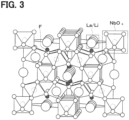
- FIG. 3 shows the crystal structure of the solid electrolyte 15 of the present embodiment obtained by a synchrotron radiation analysis.
- the crystal structure was obtained by performing Rietveld analysis using measurement data by X-ray diffraction (XRD).
- the solid electrolyte 15 of the pyrochlore structure has a crystal structure in which an octahedral three-dimensional network composed of NbO 6 is formed.
- NbO 6 O is arranged at each vertex with Nb as the center, and each vertex is shared with the adjacent NbO 6 .
- a hexagonal tunnel structure in which cations composed of La/Li and anions composed of F are arranged is formed.
- FIG. 4 shows a Nyquist plot of an impedance measured by applying an alternating current signal to the solid electrolyte 15 of the present embodiment.
- the vertical axis represents the imaginary component Z" of the impedance
- the horizontal axis represents the real component Z' of the impedance.
- FIG. 4 also shows an impedance of LLZO (Li 7 La 3 Zr 2 O 12 ) being an oxide-based solid electrolyte as a comparative example.
- the impedance measurements were carried out at room temperature. Specifically, the impedance measurement was carried out at 25°C. In the present specification, room temperature is in the range of 10 to 40°C.
- the impedance of the solid electrolyte was measured using a two-terminal method in which a measurement sample with electrodes coated on both sides of a pellet-shaped solid electrolyte was incorporated into a UFO-type cell.
- the VSP-300 manufactured by BioLogic was used for the measurement device.
- the electrodes metals with low electrical resistance and high stability, such as Au, Pt, and Ag, were used.
- an alternating current signal was applied to each solid electrolyte at a plurality of frequencies, and an alternating current impedance was measured at each frequency.
- a complex impedance plot including an arc trajectory shown in FIG. 4 was obtained.
- the resistance value of the measurement sample was acquired from the contact point between the extension line of the plurality of measurement points at which the impedance decreased in an arc shape and the horizontal axis, and the ion conductivity was calculated by multiplying the inverse of the resistance value by the thickness (cm) / the electrode area (cm 2 ) of the measurement sample.
- the ionic conductivity of the solid electrolyte 15 of the present embodiment was 2.0 ⁇ 10 -3 S/cm, and the ionic conductivity of the comparative example was 3.0 ⁇ 10 -4 S/cm.
- a significantly higher ionic conductivity was obtained than in the comparative example.
- the secondary battery 10 including the solid electrolyte 15 of the present embodiment has an ionic conductivity with a mantissa of 2.0, a base of 10, an exponent of -3, and units of S/cm.
- the solid electrolyte 15 has an ionic conductivity on the order of 10 -3 S/cm, which is significantly higher than that of the comparative example.
- the solid electrolyte 15 has an ionic conductivity that is an order of magnitude different from that of the comparative example.
- the mantissa of the ionic conductivity of the solid electrolyte 15 varies depending on the adopted alkali metal, lanthanoid, cationic metal, and anion that is substitutable with an O atom. It is also expected that the mantissa of the ionic conductivity will be 1.0 or less, or 10.0 or more.
- the ionic conductivity also varies depending on the measurement environment and the measurement method. At room temperature, it is expected that the mantissa will increase with increase in the measurement environment temperature.
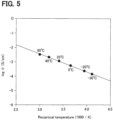
- results of measuring the ionic conductivity of the solid electrolyte 15 of the present embodiment while changing the environmental temperature will be described.
- the ionic conductivity was measured using the above-described measuring device under the same measuring conditions except for the environmental temperature.
- the ionic conductivity was measured 3 hours after the temperature was set.
- FIG. 5 shows the results of measuring the ionic conductivity ⁇ of the solid electrolyte 15 at temperatures of 60°C, 40°C, 20°C, 0°C, -20°C, and -30°C.
- the vertical axis represents the logarithm of the ionic conductivity ⁇
- the horizontal axis represents the reciprocal of the environmental temperature.
- the ionic conductivity of the solid electrolyte 15 is temperature dependent. Specifically, the ionic conductivity increases with increase in the environmental temperature, and the ionic conductivity decreases with decrease in the environmental temperature.
- the solid electrolyte 15 of the present embodiment described above has the pyrochlore structure including the alkali metal and the lanthanoid as cations.
- the solid electrolyte 15 having such characteristics can have an improved ionic conductivity compared to oxide-based solid electrolytes that have been conventionally known as solid electrolytes for secondary batteries. Therefore, the secondary battery 10 using the solid electrolyte 15 of the present embodiment can improve an output density.
- the solid electrolyte 15 of the present embodiment has the defect structure. This can improve the ionic conductivity. The output density of the secondary battery 10 using the solid electrolyte 15 can be improved.
- the solid electrolyte for the secondary battery of the present disclosure is applied to a lithium ion battery, but the solid electrolyte for the secondary battery of the present disclosure may be applied to another secondary battery.
- K is used as the alkali metal represented by Aa in the composition formula
- Na is used as the alkali metal represented by Aa in the composition formula
- it can be used as a solid electrolyte for a sodium ion battery.
Landscapes
- Chemical & Material Sciences (AREA)
- Engineering & Computer Science (AREA)
- Manufacturing & Machinery (AREA)
- Chemical Kinetics & Catalysis (AREA)
- Electrochemistry (AREA)
- General Chemical & Material Sciences (AREA)
- Organic Chemistry (AREA)
- Inorganic Chemistry (AREA)
- Ceramic Engineering (AREA)
- Materials Engineering (AREA)
- General Physics & Mathematics (AREA)
- Condensed Matter Physics & Semiconductors (AREA)
- Physics & Mathematics (AREA)
- Structural Engineering (AREA)
- Conductive Materials (AREA)
- Secondary Cells (AREA)
- Inorganic Compounds Of Heavy Metals (AREA)
Abstract
An oxide-based solid electrolyte having a pyrochlore structure and represented by a composition formula Aa2-αAb(1+α)/3B2O7-βXβ is used as a solid electrolyte for a secondary battery. Aa is an alkali metal. Ab contains at least a lanthanide. B is a cationic metal different from Aa and Ab. X is an anion that is substitutable with an O atom constituting the pyrochlore structure.
Description
- This application is based on
Japanese Patent Application No. 2022-37356 filed on March 10, 2022 - The present disclosure relates to a solid electrolyte for a secondary battery and a secondary battery including the solid electrolyte.
- In recent years, from the viewpoint of improving safety, lithium ion batteries that are entirely solidified using a solid electrolyte have been attracting attention as lithium ion batteries that do not use organic solvents as electrolytes. As solid electrolytes for use in such lithium ion batteries, sulfide solid electrolytes, oxide solid electrolytes, and the like have been proposed. For example, as solid electrolytes that are more stable in air,
Patent Literature 1 discloses an oxide solid electrolyte having a garnet structure (for example, LLZO), andPatent Literature 2 discloses an oxide solid electrolyte having a NASICON structure (for example, LAGP). -
- Patent Literature 1:
JP 2021-150140 A - Patent Literature 2:
JP 2020-80231 A - However, since ionic conductivities of conventionally used oxide solid electrolytes having a garnet structure or a NASICON structure are low, it is difficult to sufficiently increase an output density of a secondary battery.
- In view of the above, an object of the present disclosure is to provide a solid electrolyte for a secondary battery capable of improving an ionic conductivity.
- In order to achieve the above object, a solid electrolyte for a secondary battery of the present disclosure includes an oxide-based solid electrolyte having a pyrochlore structure and having a composition formula of Aa2-αAb(1+α)/3B2O7-βXβ. Aa is an alkali metal. Ab contains at least a lanthanoid. B is a cationic metal different from Aa and Ab. X is an anion that is substitutable with an O atom constituting a pyrochlore structure.
- According to the present disclosure, it is possible to improve an ionic conductivity as compared with oxide-based solid electrolytes conventionally known as solid electrolytes for secondary batteries.
-
-
FIG. 1 is a cross-sectional view showing a configuration of a secondary battery according to an embodiment of the present disclosure. -
FIG. 2 is a diagram showing a manufacturing process of a solid electrolyte. -
FIG. 3 is a diagram showing a crystal structure of the solid electrolyte. -
FIG. 4 is a diagram showing impedance measurement results of solid electrolytes of the embodiment and a comparative example. -
FIG. 5 is a diagram showing results of measuring an ionic conductivity of the solid electrolyte while changing an environmental temperature. - Hereinafter, an embodiment in which a solid electrolyte for a secondary battery of the present disclosure is applied to a lithium ion battery will be described with reference to the drawings. A
secondary battery 10 of the present embodiment is a lithium ion battery in which charging and discharging are performed by lithium ions moving between anegative electrode 12 and apositive electrode 14. - As shown in
FIG. 1 , thesecondary battery 10 includes a negative electrodecurrent collector 11, thenegative electrode 12, a positiveelectrode current collector 13, thepositive electrode 14, and asolid electrolyte 15. Thesolid electrolyte 15 corresponds to the solid electrolyte for the secondary battery. - The
solid electrolyte 15 is sandwiched between thepositive electrode 14 and thenegative electrode 12. Thenegative electrode 12 and thesolid electrolyte 15 are in contact with each other. Thepositive electrode 14 and thesolid electrolyte 15 are in contact with each other. Thenegative electrode 12 and thepositive electrode 14 are connected through thesolid electrolyte 15. Thesecondary battery 10 of the present embodiment is a lithium ion battery in which charging and discharging are performed by lithium ions moving between thenegative electrode 12 and thepositive electrode 14 through thesolid electrolyte 15. - A stacked body including the
negative electrode 12, thepositive electrode 14, and thesolid electrolyte 15 is disposed between the negativeelectrode current collector 11 and the positive electrodecurrent collector 13. The negative electrodecurrent collector 11 and thenegative electrode 12 are in contact with each other. The positive electrodecurrent collector 13 and thepositive electrode 14 are in contact with each other. The negative electrodecurrent collector 11 and the positive electrodecurrent collector 13 are connected through the stacked body. - Any material that can be used as a current collector for a lithium ion battery can be used for the negative
electrode current collector 11 and the positiveelectrode current collector 13. In the present embodiment, Cu is used as the negative electrodecurrent collector 11, and Al is used as the positive electrodecurrent collector 13. - A negative electrode material constituting the
negative electrode 12 can be any material that can be used as a negative electrode active material for lithium ion batteries, such as a carbon-based negative electrode material, an oxide-based negative electrode material, or a metal-based negative electrode material. In the present embodiment, a lithium-based negative electrode material or a Si-based negative electrode material is used. - A positive electrode material constituting the
positive electrode 14 can be any material that can be used as a positive electrode active material for lithium ion batteries. As thepositive electrode 14, for example, a cobalt-based positive electrode material (LiCoO2), a nickel-based positive electrode material (LiNiO2), a manganese-based positive electrode material (LiMn2O4), an iron phosphate-based positive electrode material (LiFePO4), a ternary positive electrode material (NMC) mainly composed of nickel, manganese, and cobalt, and the like can be used. - The
solid electrolyte 15 has ion conductivity and is capable of moving lithium ions between thenegative electrode 12 and thepositive electrode 14. Thesolid electrolyte 15 is an oxide-based solid electrolyte, and has a pyrochlore structure represented by the composition formula "Aa2-αAb(1+α)/3B2O7-βXβ". - In the above composition formula, O is an oxygen atom, and Aa, Ab, B, and X represent any element or group. Aa, Ab and B are different types of cations, and O and X are different types of anions.
- In the above composition formula, 0.6<α<2.0, and 0<β≤1. When α changes, the composition ratio of Aa and Ab changes, and when β changes, the composition ratio of O and X changes.
- Aa is an alkali metal. As the alkali metal represented by Aa, any one selected from a group consisting of Li, Na, and K can be used. In the present embodiment, Li is used as Aa. The composition ratio (2-α) of Aa is in the range of 0<(2-α)<1.4.
- Ab contains at least a lanthanoid. As the lanthanoid represented by Ab, at least one selected from a group consisting of La, Ce, Nd, and Sm can be used. In the present embodiment, La is used as Ab. The composition ratio (1+α)/3 of Ab is in the range of 0.53<(1+α)/3<1.
- A basic structure of Ab consists of the lanthanoid, and a part of the lanthanoid constituting Ab may be substituted with an alkaline earth metal (Ca, Mg, Sr, or the like). In the
solid electrolyte 15 of the present embodiment, it is considered that since the lanthanoid is contained in the pyrochlore structure in which 0.6<α<2.0 and 0<β≤1 in the above composition formula, defects are generated in a crystal structure and an ionic conductivity is improved. - In the
solid electrolyte 15 of the present embodiment, an A cation in a composition formula "A2B2O7" of a general pyrochlore structure is a composite cation including lithium and the lanthanoid. This is believed to contribute to the improvement of the ionic conductivity of thesolid electrolyte 15. - B is a cationic metal different from Aa and Ab, and is a transition metal or a metal selected from
Group 15 elements. B constitutes an octahedron surrounded by six O atoms in a crystal. As the transition metal represented by B, aGroup 4 transition metal or aGroup 5 transition metal can be used, and more specifically, at least one selected from a group consisting of Nb, Ta, Ti, Zr, Hf, and V can be used. As theGroup 15 element represented by B, Sb and Bi can be used. - X is an anion that can be substituted with an O atom constituting the pyrochlore structure. X is different from an O atom in electronegativity and polarizability. As the anion represented by X, at least one selected from a group consisting of F, S, Cl, and OH can be used. The composition ratio β of X is in the range of 0<β≤1, and at least a part of O atoms constituting the pyrochlore structure is substituted with X. In the present embodiment, F is used as X.
- The
solid electrolyte 15 of the present embodiment has a defect structure in which lattice defects are included in the crystal by replacing a part of O atoms constituting the pyrochlore structure with anions having electronegativity and polarizability different from those of the O atoms. It is considered that thesolid electrolyte 15 of the present embodiment has improved ionic conductivity due to the presence of the defect structure in the pyrochlore structure. - In the
solid electrolyte 15 of the present embodiment, the defect structure is a state in which Aa and Ab are partially deficient. The composition formula of the general pyrochlore structure is "A2B2O7", and a composition ratio of the A cation is 2. In contrast, in thesolid electrolyte 15 of the present embodiment, composition ratios of Aa and Ab are "2-α" and"(1+α)/3", respectively, and 0.6<α<2.0, so that the total composition ratio of Aa and Ab is less than 2. That is, in the crystal structure of thesolid electrolyte 15 of the present embodiment, at least one of Aa and Ab is partially deficient. A composition ratio corresponding to the deficient portion of Aa and Ab is (2α-1)/3. - In addition to the deviation of the composition ratio, the defect structure can also be formed by making a sum of valences of the cations composed of Aa, Ab and B and the anions composed of O and X negative in the above composition formula.
- Furthermore, the
solid electrolyte 15 of the present embodiment is a composite anion compound having the pyrochlore structure containing a plurality of anions such as O and X, and since the anion represented by X is present in the BO6 coordination octahedral structure, the alkali metal of Aa can be positioned in the center of a space between the BO6 coordination octahedrons without approaching the BO6 coordination octahedron. Therefore, it is considered that thesolid electrolyte 15 of the present embodiment has high ionic conductivity when used in an electric field such as a battery. - In addition, since α and β in the above composition formula affect the lattice defects and the ionic conductivity, it is desirable to set α and β in an appropriate range. When the values of α and β are large, a defect concentration in the crystal lattice increases, but when the values exceed a certain amount, the concentration of the alkali metal represented by Aa decreases and the ionic conductivity decreases. Therefore, it is desirable to control α within a range of 0.6<α<2.0 and β within a range of 0<β≤1.
- Next, a method for manufacturing the
solid electrolyte 15 of the present embodiment will be described with reference toFIG. 2 . In the method for manufacturing thesolid electrolyte 15, a first mixing process S10, a first firing process S20, a second mixing process S30, a forming process S40, and a second firing process S50 are performed in this order. - First, a lanthanum source, a lithium source, and a niobium source are prepared as raw materials, and the first mixing process S10 in which these sources are mixed together is performed. As the lanthanum source, the lithium source, and the niobium source, metal oxides, metal carbonates, or the like can be used. In the present embodiment, La2O3 is used as the lanthanum source, Li2CO3 is used as the lithium source, and Nb2O5 is used as the niobium source. In the first mixing process, La2O3, Li2CO3, and Nb2O5 are mixed at a predetermined ratio.
- Next, the first firing process S20 of firing the mixture of La2O3, Li2CO3, and Nb2O5 is performed. In the first firing process S20, two stages of firing are performed. In a first stage, a provisional firing is performed by heating the mixture in air at 500°C for 6 hours. By the provisional firing, moisture and the like are removed from the mixture, and a reactivity can be increased. Subsequent to the provisional firing, a main firing in which the mixture is heated in air at 1200°C for 4 hours is performed. Accordingly, Li0.5La0.5Nb2O6 which is a precursor of a target product is obtained.
- Next, the second mixing process S30 is performed in which a fluorine source is prepared as a raw material, and the fluorine source is mixed with Li0.5La0.5Nb2O6 being the precursor. As the fluorine source, a metal fluoride can be used. In the present embodiment, LiF and LaF3 are used as fluorine sources. LiF is a fluorine source and a lithium source, and LaF3 is a fluorine source and a lanthanum source. In the second mixing process S30, LiF and LaF3 are mixed with Li0.5La0.5Nb2O6 at a predetermined ratio to obtain a mixed powder.
- Next, the forming process S40 is performed in which the mixed powder of Li0.5La0.5Nb2O6, LiF, and LaF3 is processed into a pellet shape and is pressurized at 100 MPa. Accordingly, the mixture of Li0.5La0.5Nb2O6, LiF, and LaF3 is formed into a pellet shape.
- Next, the second firing process S50 of firing the mixture of Li0.5La0.5Nb2O6, LiF, and LaF3 is performed. In the second firing process S50, firing is performed by heating the mixture of Li0.5La0.5Nb2O6, LiF, and LaF3 at 1000°C for 6 hours in a nitrogen atmosphere.
- Through the above processes, a crystal having a pyrochlore structure represented by the composition formula "Li1.25La0.58Nb2O6F" can be obtained. In this example, the crystal obtained in the second firing process S50 has the plate shape and can be used as the
solid electrolyte 15 of thesecondary battery 10. The relative density of the pellet-shaped sintered solid electrolyte was 78%. - Note that a crystal having a pyrochlore structure represented by the composition formula "Li2-αLa(1+α)/3Nb2O7-βFβ" can be obtained by changing the mixing ratio of La2O3, Li2CO3, and Nb2O5 and the mixing ratio of LiF and LaF3 in the above production process.
- In the composition formula, α can be adjusted by changing the mixing ratio of La2O3, Li2CO3, and Nb2O5. β can be adjusted by changing the mixing ratio of LiF and LaF3. When firing is performed, a part of the materials is sublimated. Therefore, α and β can also be adjusted by changing firing conditions, a firing furnace atmosphere, and a firing furnace size in the first firing process and the second firing process.
- Next, the crystal structure of the
solid electrolyte 15 of the present embodiment will be described with reference toFIG. 3. FIG. 3 shows the crystal structure of thesolid electrolyte 15 of the present embodiment obtained by a synchrotron radiation analysis. In the synchrotron radiation analysis, the crystal structure was obtained by performing Rietveld analysis using measurement data by X-ray diffraction (XRD). - As shown in
FIG. 3 , thesolid electrolyte 15 of the pyrochlore structure has a crystal structure in which an octahedral three-dimensional network composed of NbO6 is formed. In NbO6, O is arranged at each vertex with Nb as the center, and each vertex is shared with the adjacent NbO6. In the three-dimensional network composed of NbO6, a hexagonal tunnel structure in which cations composed of La/Li and anions composed of F are arranged is formed. - Next, a result of measuring the ionic conductivity of the
solid electrolyte 15 of the present embodiment by an alternating current impedance method will be described. -
FIG. 4 shows a Nyquist plot of an impedance measured by applying an alternating current signal to thesolid electrolyte 15 of the present embodiment. InFIG. 4 , the vertical axis represents the imaginary component Z" of the impedance, and the horizontal axis represents the real component Z' of the impedance.FIG. 4 also shows an impedance of LLZO (Li7La3Zr2O12) being an oxide-based solid electrolyte as a comparative example. The impedance measurements were carried out at room temperature. Specifically, the impedance measurement was carried out at 25°C. In the present specification, room temperature is in the range of 10 to 40°C. - The impedance of the solid electrolyte was measured using a two-terminal method in which a measurement sample with electrodes coated on both sides of a pellet-shaped solid electrolyte was incorporated into a UFO-type cell. For the measurement device, the VSP-300 manufactured by BioLogic was used. For the electrodes, metals with low electrical resistance and high stability, such as Au, Pt, and Ag, were used.
- In the impedance measurement, an alternating current signal was applied to each solid electrolyte at a plurality of frequencies, and an alternating current impedance was measured at each frequency. By plotting the measured impedances on a complex plane, a complex impedance plot including an arc trajectory shown in
FIG. 4 was obtained. Then, the resistance value of the measurement sample was acquired from the contact point between the extension line of the plurality of measurement points at which the impedance decreased in an arc shape and the horizontal axis, and the ion conductivity was calculated by multiplying the inverse of the resistance value by the thickness (cm) / the electrode area (cm2) of the measurement sample. - As a result, the ionic conductivity of the
solid electrolyte 15 of the present embodiment was 2.0×10⁻³ S/cm, and the ionic conductivity of the comparative example was 3.0×10⁻⁴ S/cm. In thesolid electrolyte 15 of the present embodiment, a significantly higher ionic conductivity was obtained than in the comparative example. - Thus, the
secondary battery 10 including thesolid electrolyte 15 of the present embodiment has an ionic conductivity with a mantissa of 2.0, a base of 10, an exponent of -3, and units of S/cm. Thesolid electrolyte 15 has an ionic conductivity on the order of 10-3 S/cm, which is significantly higher than that of the comparative example. Thesolid electrolyte 15 has an ionic conductivity that is an order of magnitude different from that of the comparative example. - The mantissa of the ionic conductivity of the
solid electrolyte 15 varies depending on the adopted alkali metal, lanthanoid, cationic metal, and anion that is substitutable with an O atom. It is also expected that the mantissa of the ionic conductivity will be 1.0 or less, or 10.0 or more. - Furthermore, the ionic conductivity also varies depending on the measurement environment and the measurement method. At room temperature, it is expected that the mantissa will increase with increase in the measurement environment temperature.
- Here, results of measuring the ionic conductivity of the
solid electrolyte 15 of the present embodiment while changing the environmental temperature will be described. The ionic conductivity was measured using the above-described measuring device under the same measuring conditions except for the environmental temperature. The ionic conductivity was measured 3 hours after the temperature was set. -
FIG. 5 shows the results of measuring the ionic conductivity σ of thesolid electrolyte 15 at temperatures of 60°C, 40°C, 20°C, 0°C, -20°C, and -30°C. InFIG. 5 , the vertical axis represents the logarithm of the ionic conductivity σ, and the horizontal axis represents the reciprocal of the environmental temperature. As shown inFIG. 5 , it is understood that the ionic conductivity of thesolid electrolyte 15 is temperature dependent. Specifically, the ionic conductivity increases with increase in the environmental temperature, and the ionic conductivity decreases with decrease in the environmental temperature. - The
solid electrolyte 15 of the present embodiment described above has the pyrochlore structure including the alkali metal and the lanthanoid as cations. Thesolid electrolyte 15 having such characteristics can have an improved ionic conductivity compared to oxide-based solid electrolytes that have been conventionally known as solid electrolytes for secondary batteries. Therefore, thesecondary battery 10 using thesolid electrolyte 15 of the present embodiment can improve an output density. - Moreover, the
solid electrolyte 15 of the present embodiment has the defect structure. This can improve the ionic conductivity. The output density of thesecondary battery 10 using thesolid electrolyte 15 can be improved. - The present disclosure is not limited to the embodiments described above, and various modifications can be made as follows within a range not departing from the spirit of the present disclosure. The means disclosed in each of the above embodiments may be appropriately combined to the extent practicable.
- For example, in the above embodiments, the solid electrolyte for the secondary battery of the present disclosure is applied to a lithium ion battery, but the solid electrolyte for the secondary battery of the present disclosure may be applied to another secondary battery. Specifically, when K is used as the alkali metal represented by Aa in the composition formula, it can be used as a solid electrolyte for a potassium ion battery, and when Na is used as the alkali metal represented by Aa in the composition formula, it can be used as a solid electrolyte for a sodium ion battery.
- Although the disclosure has been described in accordance with the examples, it is understood that the present disclosure is not limited to the above examples or structures. To the contrary, the present disclosure is intended to cover various modification and equivalent arrangements. In addition, while the various elements are shown in various combinations and configurations, which are exemplary, other combinations and configurations, including more, less or only a single element, are also within the spirit and scope of the present disclosure.
Claims (9)
- A solid electrolyte for a secondary battery, comprising an oxide-based solid electrolyte having a pyrochlore structure represented by a composition formula of Aa2-αAb(1+α)/3B2O7-βXβ, whereAa is an alkali metal,Ab contains at least a lanthanoid,B is a cationic metal different from Aa and Ab, andX is an anion that is substitutable with an O atom constituting the pyrochlore structure.
- The solid electrolyte for the secondary battery according to claim 1, wherein, in the composition formula, α is in a range of 0.6<α<2.0, β is in a range of 0<β≤1, and the oxide-based solid electrolyte has a defect structure.
- The solid electrolyte for the secondary battery according to claim 1, wherein, in the composition formula, a sum of valences of cations composed of Aa, Ab, and B and anions composed of O and X is negative, and the solid electrolyte has a defect structure.
- The solid electrolyte for the secondary battery according to any one of claims 1 to 3, wherein the alkali metal is selected from a group consisting of Li, Na and K.
- The solid electrolyte for the secondary battery according to any one of claims 1 to 4, wherein the lanthanoid is at least one selected from a group consisting of La, Ce, Nd and Sm.
- The solid electrolyte for the secondary battery according to any one of claims 1 to 5, wherein B is at least one selected from a group consisting of Ta, Nb, Ti, Zr, Hf, V, Sb and Bi.
- The solid electrolyte for the secondary battery according to any one of claims 1 to 6, wherein X is at least one selected from a group consisting of F, OH, S and Cl.
- The solid electrolyte for the secondary battery according to any one of claims 1 to 7, wherein the solid electrolyte has an ionic conductivity of an order of 10-3 S/cm at room temperature.
- A secondary battery comprising:the solid electrolyte (15) for the secondary battery according to any one of claims 1 to 8; anda positive electrode (14) and a negative electrode (12) disposed so as to sandwich the solid electrolyte for the secondary battery.
Applications Claiming Priority (2)
| Application Number | Priority Date | Filing Date | Title |
|---|---|---|---|
| JP2022037356A JP7334813B1 (en) | 2022-03-10 | 2022-03-10 | Solid electrolyte for secondary battery and secondary battery |
| PCT/JP2023/004539 WO2023171236A1 (en) | 2022-03-10 | 2023-02-10 | Solid electrolyte for secondary battery, and secondary battery |
Publications (1)
| Publication Number | Publication Date |
|---|---|
| EP4492524A1 true EP4492524A1 (en) | 2025-01-15 |
Family
ID=87764177
Family Applications (1)
| Application Number | Title | Priority Date | Filing Date |
|---|---|---|---|
| EP23766416.4A Pending EP4492524A1 (en) | 2022-03-10 | 2023-02-10 | Solid electrolyte for secondary battery, and secondary battery |
Country Status (6)
| Country | Link |
|---|---|
| US (1) | US20240380001A1 (en) |
| EP (1) | EP4492524A1 (en) |
| JP (1) | JP7334813B1 (en) |
| KR (1) | KR20240129212A (en) |
| CN (1) | CN118872114A (en) |
| WO (1) | WO2023171236A1 (en) |
Families Citing this family (4)
| Publication number | Priority date | Publication date | Assignee | Title |
|---|---|---|---|---|
| JP2025072777A (en) * | 2023-10-25 | 2025-05-12 | 株式会社デンソー | Ion conductor, secondary battery, and method for producing ion conductor |
| WO2025094636A1 (en) * | 2023-10-31 | 2025-05-08 | 株式会社デンソー | Electrode structure and secondary battery |
| JPWO2025094637A1 (en) * | 2023-10-31 | 2025-05-08 | ||
| CN120709482A (en) * | 2025-06-29 | 2025-09-26 | 溧阳天目先导电池材料科技有限公司 | Fluoride oxide solid electrolyte and its preparation method and application |
Family Cites Families (2)
| Publication number | Priority date | Publication date | Assignee | Title |
|---|---|---|---|---|
| JP7217615B2 (en) | 2018-11-12 | 2023-02-03 | Jx金属株式会社 | Composite solid electrolyte pellet for unsintered all-solid-state lithium-ion battery and all-solid-state lithium-ion battery |
| JP7365947B2 (en) | 2020-03-18 | 2023-10-20 | Jx金属株式会社 | Method for manufacturing garnet-type solid electrolyte sintered body for all-solid-state lithium-ion battery and method for manufacturing all-solid-state lithium-ion battery |
-
2022
- 2022-03-10 JP JP2022037356A patent/JP7334813B1/en active Active
-
2023
- 2023-02-10 WO PCT/JP2023/004539 patent/WO2023171236A1/en not_active Ceased
- 2023-02-10 EP EP23766416.4A patent/EP4492524A1/en active Pending
- 2023-02-10 CN CN202380026156.4A patent/CN118872114A/en active Pending
- 2023-02-10 KR KR1020247026490A patent/KR20240129212A/en active Pending
-
2024
- 2024-07-24 US US18/782,847 patent/US20240380001A1/en active Pending
Also Published As
| Publication number | Publication date |
|---|---|
| JP7334813B1 (en) | 2023-08-29 |
| KR20240129212A (en) | 2024-08-27 |
| CN118872114A (en) | 2024-10-29 |
| JP2023132180A (en) | 2023-09-22 |
| WO2023171236A1 (en) | 2023-09-14 |
| US20240380001A1 (en) | 2024-11-14 |
Similar Documents
| Publication | Publication Date | Title |
|---|---|---|
| EP4492524A1 (en) | Solid electrolyte for secondary battery, and secondary battery | |
| US11702337B2 (en) | Solid ion conductor, solid electrolyte including the solid ion conductor, electrochemical cell including the solid ion conductor, and preparation method of the same | |
| EP2317596B1 (en) | Ceramic material and preparation method therefor | |
| US20240250293A1 (en) | Solid electrolyte and secondary battery including the same | |
| WO2019039567A1 (en) | Positive-electrode active material for non-aqueous-electrolyte secondary cell and method for manufacturing said positive-electrode active material, positive-electrode mixture paste for non-aqueous-electrolyte secondary cell, and non-aqueous-electrolyte secondary cell | |
| JP7174875B1 (en) | Lithium-containing chloride, method for producing same, solid electrolyte and battery | |
| JP7694686B2 (en) | secondary battery | |
| US20210408584A1 (en) | All-solid-state secondary battery | |
| JP7174181B1 (en) | Lithium-containing chloride, method for producing same, solid electrolyte and battery | |
| JP2006156284A (en) | Lithium ion conductor and secondary battery using the same | |
| EP4376145A2 (en) | Solid electrolyte having excellent moisture stability and method for preparing same | |
| EP3715332A1 (en) | Tungsten trioxide | |
| EP4571786A1 (en) | Ion conductive substance, electrolyte, and battery | |
| JP7629040B2 (en) | Alkali metal-containing halide, electrolyte, battery, and method for producing halide solid electrolyte | |
| JP7677259B2 (en) | Sulfide solid electrolytes and solid-state batteries | |
| WO2024096101A1 (en) | Ion conductive substance, electrolyte, and battery | |
| KR20250068625A (en) | Method for producing alkali metal-containing halides, electrolytes, batteries and solid halides electrolytes | |
| CN108370035A (en) | Plate lithium composite xoide and its manufacturing method | |
| WO2025033470A1 (en) | Ion conductive substance, solid electrolyte, and battery | |
| KR20260048583A (en) | Ion-conducting material, solid electrolyte, battery | |
| WO2024096107A1 (en) | Battery | |
| WO2024096113A1 (en) | Battery and laminate | |
| WO2025028408A1 (en) | Positive electrode active material for lithium ion secondary batteries, method for producing positive electrode active material for lithium ion secondary batteries, and lithium ion secondary battery | |
| CN120809761A (en) | Composite high-voltage lithium ion battery positive electrode material, preparation method thereof and battery |
Legal Events
| Date | Code | Title | Description |
|---|---|---|---|
| STAA | Information on the status of an ep patent application or granted ep patent |
Free format text: STATUS: THE INTERNATIONAL PUBLICATION HAS BEEN MADE |
|
| PUAI | Public reference made under article 153(3) epc to a published international application that has entered the european phase |
Free format text: ORIGINAL CODE: 0009012 |
|
| STAA | Information on the status of an ep patent application or granted ep patent |
Free format text: STATUS: REQUEST FOR EXAMINATION WAS MADE |
|
| 17P | Request for examination filed |
Effective date: 20240722 |
|
| AK | Designated contracting states |
Kind code of ref document: A1 Designated state(s): AL AT BE BG CH CY CZ DE DK EE ES FI FR GB GR HR HU IE IS IT LI LT LU LV MC ME MK MT NL NO PL PT RO RS SE SI SK SM TR |
|
| DAV | Request for validation of the european patent (deleted) | ||
| DAX | Request for extension of the european patent (deleted) |