EP4492384A1 - Systeme und verfahren zur synthesebewussten erzeugung von eigenschaftsoptimierten kleinen molekülen - Google Patents
Systeme und verfahren zur synthesebewussten erzeugung von eigenschaftsoptimierten kleinen molekülen Download PDFInfo
- Publication number
- EP4492384A1 EP4492384A1 EP24183434.0A EP24183434A EP4492384A1 EP 4492384 A1 EP4492384 A1 EP 4492384A1 EP 24183434 A EP24183434 A EP 24183434A EP 4492384 A1 EP4492384 A1 EP 4492384A1
- Authority
- EP
- European Patent Office
- Prior art keywords
- reaction
- molecular fragment
- fragment
- molecular
- docking
- Prior art date
- Legal status (The legal status is an assumption and is not a legal conclusion. Google has not performed a legal analysis and makes no representation as to the accuracy of the status listed.)
- Pending
Links
Images




Classifications
-
- G—PHYSICS
- G16—INFORMATION AND COMMUNICATION TECHNOLOGY [ICT] SPECIALLY ADAPTED FOR SPECIFIC APPLICATION FIELDS
- G16C—COMPUTATIONAL CHEMISTRY; CHEMOINFORMATICS; COMPUTATIONAL MATERIALS SCIENCE
- G16C20/00—Chemoinformatics, i.e. ICT specially adapted for the handling of physicochemical or structural data of chemical particles, elements, compounds or mixtures
- G16C20/50—Molecular design, e.g. of drugs
-
- G—PHYSICS
- G16—INFORMATION AND COMMUNICATION TECHNOLOGY [ICT] SPECIALLY ADAPTED FOR SPECIFIC APPLICATION FIELDS
- G16B—BIOINFORMATICS, i.e. INFORMATION AND COMMUNICATION TECHNOLOGY [ICT] SPECIALLY ADAPTED FOR GENETIC OR PROTEIN-RELATED DATA PROCESSING IN COMPUTATIONAL MOLECULAR BIOLOGY
- G16B15/00—ICT specially adapted for analysing two-dimensional [2D] or three-dimensional [3D] molecular structures, e.g. structural or functional relations or structure alignment
- G16B15/30—Drug targeting using structural data; Docking or binding prediction
-
- G—PHYSICS
- G16—INFORMATION AND COMMUNICATION TECHNOLOGY [ICT] SPECIALLY ADAPTED FOR SPECIFIC APPLICATION FIELDS
- G16C—COMPUTATIONAL CHEMISTRY; CHEMOINFORMATICS; COMPUTATIONAL MATERIALS SCIENCE
- G16C20/00—Chemoinformatics, i.e. ICT specially adapted for the handling of physicochemical or structural data of chemical particles, elements, compounds or mixtures
- G16C20/10—Analysis or design of chemical reactions, syntheses or processes
-
- G—PHYSICS
- G16—INFORMATION AND COMMUNICATION TECHNOLOGY [ICT] SPECIALLY ADAPTED FOR SPECIFIC APPLICATION FIELDS
- G16C—COMPUTATIONAL CHEMISTRY; CHEMOINFORMATICS; COMPUTATIONAL MATERIALS SCIENCE
- G16C20/00—Chemoinformatics, i.e. ICT specially adapted for the handling of physicochemical or structural data of chemical particles, elements, compounds or mixtures
- G16C20/30—Prediction of properties of chemical compounds, compositions or mixtures
-
- G—PHYSICS
- G16—INFORMATION AND COMMUNICATION TECHNOLOGY [ICT] SPECIALLY ADAPTED FOR SPECIFIC APPLICATION FIELDS
- G16C—COMPUTATIONAL CHEMISTRY; CHEMOINFORMATICS; COMPUTATIONAL MATERIALS SCIENCE
- G16C20/00—Chemoinformatics, i.e. ICT specially adapted for the handling of physicochemical or structural data of chemical particles, elements, compounds or mixtures
- G16C20/70—Machine learning, data mining or chemometrics
Definitions
- the at least one docking technique is a tethered docking technique or an untethered docking technique.
- the at least one docking technique is a tethered docking technique when the first molecular fragment is selected from a result obtained from a crystallographic screening.
- the at least one docking technique is an untethered docking technique when the first molecular fragment is randomly selected.
- the trained molecular fragment selection policy is configured to select the second molecular fragment by: predicting a property vector of one or more candidate second molecular fragments from at least one fragment library obtained from at least one source; and selecting the second molecular fragment from the fragment library based a comparison of the property vector of the one or more candidate second molecular fragments and an associated property vector of each molecular fragment comprised in the at least one fragment library.
- the at least one docking technique is a tethered docking technique when the first molecular fragment is selected from a result obtained from a crystallographic screening.
- the at least one docking technique is an untethered docking technique when the first molecular fragment is randomly selected.
- the at least one reaction intermediate comprises a highest bioactivity value.
- the trained molecular fragment selection policy is configured to select the second molecular fragment by: predicting a property vector of one or more candidate second molecular fragments from at least one fragment library obtained from at least one source; and selecting the second molecular fragment from the fragment library based a comparison of the property vector of the one or more candidate second molecular fragments and an associated property vector of each molecular fragment comprised in the at least one fragment library.
- the type of the reaction template comprises at least one of a unimolecular reaction template, and a bimolecular reaction template.
- Deep learning models have remodeled the space of drug discovery by enabling generic and specific molecule generation, property prediction and on-the-fly molecular optimization in the past couple years.
- the unimaginable pace of these models coupled with their state-of-the-art predictive abilities, has led to a tremendous acceleration of the early-stage molecule discovery process.
- Several testaments to the success of deep neural networks in identifying clinically potent and efficacious small molecules have also emerged.
- TL Transfer Learning
- RL Reinforcement Learning
- the results could be interpreted in terms of the magnitude of improvement in predicted bioactivity with the incremental growth of the molecule within the binding site.
- the synthesis-aware generative model is designed to consider any available information regarding the protein structure while designing molecules and predict their forward synthesis route using libraries of globally purchasable reactants.
- the application of the method of the present disclosure is showcased through generation of molecules specific to the human cAMP-dependent protein kinase A (PKA).
- PKA human cAMP-dependent protein kinase A
- FIGS. 1 through 13 where similar reference characters denote corresponding features consistently throughout the figures, there are shown preferred embodiments and these embodiments are described in the context of the following exemplary system and/or method.
- FIG. 1 depicts an exemplary system 100 for synthesis-aware generation of property optimized small molecules, in accordance with an embodiment of the present disclosure.
- the system 100 may also be referred to as molecule generation system and interchangeably used herein.
- the system 100 includes one or more hardware processors 104, communication interface device(s) or input/output (I/O) interface(s) 106 (also referred as interface(s)), and one or more data storage devices or memory 102 operatively coupled to the one or more hardware processors 104.
- the one or more processors 104 may be one or more software processing components and/or hardware processors.
- the hardware processors can be implemented as one or more microprocessors, microcomputers, microcontrollers, digital signal processors, central processing units, state machines, logic circuitries, and/or any devices that manipulate signals based on operational instructions.
- the processor(s) is/are configured to fetch and execute computer-readable instructions stored in the memory.
- the system 100 can be implemented in a variety of computing systems, such as laptop computers, notebooks, hand-held devices (e.g., smartphones, tablet phones, mobile communication devices, and the like), workstations, mainframe computers, servers, a network cloud, and the like.
- the I/O interface device(s) 106 can include a variety of software and hardware interfaces, for example, a web interface, a graphical user interface, and the like and can facilitate multiple communications within a wide variety of networks N/W and protocol types, including wired networks, for example, LAN, cable, etc., and wireless networks, such as WLAN, cellular, or satellite.
- the I/O interface device(s) can include one or more ports for connecting a number of devices to one another or to another server.
- the memory 102 may include any computer-readable medium known in the art including, for example, volatile memory, such as static random-access memory (SRAM) and dynamic-random access memory (DRAM), and/or non-volatile memory, such as read only memory (ROM), erasable programmable ROM, flash memories, hard disks, optical disks, and magnetic tapes.
- volatile memory such as static random-access memory (SRAM) and dynamic-random access memory (DRAM)
- non-volatile memory such as read only memory (ROM), erasable programmable ROM, flash memories, hard disks, optical disks, and magnetic tapes.
- a database 108 is comprised in the memory 102, wherein the database 108 comprises molecular fragments, fragments library, docking outputs, bioactivity value of molecular fragments, a plurality of reaction templates, one or more reaction intermediates, one or more best child nodes, molecules with an associated synthesis route, and information associated therebetween.
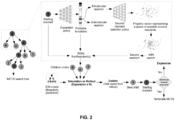
- FIG. 2 depicts an exemplary high level block diagram of the system 100 of FIG. 1 for synthesis-aware generation of property optimized small molecules, in accordance with an embodiment of the present disclosure.
- the one or more hardware processors 104 compute a first bioactivity value of the first molecular fragment using a drug-target affinity (DTA) model based on the first docking output.
- DTA drug-target affinity
- a search tree also referred to as Monte Carlo Tree Search (MCTS) search tree and interchangeably used herein
- MCTS Monte Carlo Tree Search
- the docking output from the docking step 204 is converted to an extended connectivity interaction fingerprint (ECIF), which is a one-dimensional vectorial representation of the protein-ligand interaction. This fingerprint is used as input to a trained DTA model specific to the PKA protein, to predict the bioactivity of the starting reactant or first molecular fragment.
- ECIF extended connectivity interaction fingerprint
- the fragment selection can be random or can be based on existing inhibitors for a target protein.
- rDock program was used to perform docking technique on the first molecular fragment pertaining to the crystal structure of the target protein.
- the binding site of the molecular fragments in the PKA protein was known and they were docked in the exact same crystallographic coordinates using the rDock program for consistency.
- five PDB structures (PDB ID: 3NX8, 3OOG, 5BX6, 5BX7, 5N3Q) were used to extract the co-crystallized fragment coordinates. These five structures were chosen due to the identical binding sites of the fragments involved.
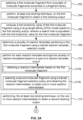
- the one or more hardware processors 104 perform, for each reaction template amongst the plurality of reaction templates based on a type of a reaction template, one of following steps to obtain one or more reaction intermediates.
- the type of the reaction template comprises at least one of a unimolecular reaction template, and a bimolecular reaction template.
- the one or more hardware processors 104 obtain a reaction intermediate based on the first molecular fragment.
- the reaction intermediate is obtained for each reaction template amongst the plurality of reaction templates for the first molecular fragment when (or if) a given reaction template is a unimolecular reaction template.
- the one or more hardware processors 104 compute a second bioactivity value of the one or more reaction intermediates using the DTA model based on the second docking output. As described in step 206, similar bioactivity value is computed for the one or more reaction intermediates. Hence, for the sake of brevity, the same is not illustrated.
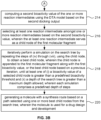
- termination condition/criteria include: (a) if the best child bioactivity value is greater than a reward threshold, terminate MCTS, (b) if the MCTS search tree depth is greater than a maximum depth allowed, terminate MCTS, or (c) continue MCTS search tree execution until either of the above conditions is met.
- the rewards and visit counts of the edges and nodes of the search tree are updated based on the simulation results from the current state to the root node.
- the average reward from the simulation is assigned to the node from where the simulation was performed.
- the state-action pair which produced the maximum average reward post-simulation is selected for the next expansion-simulation-update iteration of MCTS search tree.
- the root node pertains to the first molecular fragment during the first MCTS iteration. In further iterations, it pertains to the best child obtained post expansion and simulation steps.
- FIG. 12 depicts a complete MCTS search tree showing a termination of the MCTS search tree process upon generation of a child node with reward greater than the necessary reward threshold (in this case, 8.5), in accordance with an embodiment of the present disclosure.
- the simulation was performed 'n' times (e.g., 10 times) and the average reward of the simulations is thresholded to a cut-off bioactivity value to select the child candidate for further expansion.
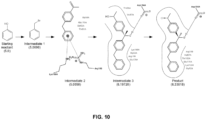
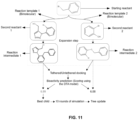
- the path containing reactants and products with most number of visits and highest average reward is reported, with the final product being the generated molecule of interest (refer FIG. 11 ).
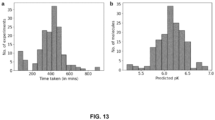
- FIG. 1 through 12 depicts a histogram illustrating (a) time distribution of the MCTS runs for the building blocks enriched in PKA inactives, wherein an average time taken is 450 mins per run, and (b) distribution of a predicted log-scale bioactivity against PKA for final products obtained from MCTS, in accordance with an embodiment of the present disclosure.
- Embodiments of the present disclosure provide systems and methods that are generic in nature and can be applied to any target protein of interest.
- the method can consider identified fragments (from fragment screening) from existing crystal structures as input and ensure preservation of the fragment throughout the molecule generation process.
- Tethered docking technique as implemented by the system and method of the present disclosure ensures that the position of the initial fragment is fixed.
- a structure-based reward was used to retain the target specificity and identify the appropriate fragment from the fragment library during the search in the MCTS search tree process.
- the method of the present disclosure can also perform de novo molecule generation for a target protein based on the proteins binding site, given a library of suitable starting reactants/molecular fragments.
- the method and system of the present disclosure use both domain knowledge and various algorithms to navigate the large space of available starting reactants/molecular fragments for synthesis of small molecules.
- the method also provides on-the-fly structural perspective and validation of the interactions of generated reaction intermediates and the final product through docking.
- the binding affinity obtained from docking calculations is used to guide the MCTS search tree process.
- Such computer-readable storage means contain program-code means for implementation of one or more steps of the method, when the program runs on a server or mobile device or any suitable programmable device.
- the hardware device can be any kind of device which can be programmed including e.g., any kind of computer like a server or a personal computer, or the like, or any combination thereof.
- the device may also include means which could be e.g., hardware means like e.g., an application-specific integrated circuit (ASIC), a field-programmable gate array (FPGA), or a combination of hardware and software means, e.g., an ASIC and an FPGA, or at least one microprocessor and at least one memory with software processing components located therein.
- the means can include both hardware means and software means.
- the method embodiments described herein could be implemented in hardware and software.
- the device may also include software means. Alternatively, the embodiments may be implemented on different hardware devices, e.g., using a plurality of CPUs.
- the embodiments herein can comprise hardware and software elements.
- the embodiments that are implemented in software include but are not limited to, firmware, resident software, microcode, etc.
- the functions performed by various components described herein may be implemented in other components or combinations of other components.
- a computer-usable or computer readable medium can be any apparatus that can comprise, store, communicate, propagate, or transport the program for use by or in connection with the instruction execution system, apparatus, or device.
Landscapes
- Chemical & Material Sciences (AREA)
- Engineering & Computer Science (AREA)
- Bioinformatics & Cheminformatics (AREA)
- Life Sciences & Earth Sciences (AREA)
- Health & Medical Sciences (AREA)
- Physics & Mathematics (AREA)
- Theoretical Computer Science (AREA)
- Bioinformatics & Computational Biology (AREA)
- Spectroscopy & Molecular Physics (AREA)
- Crystallography & Structural Chemistry (AREA)
- General Health & Medical Sciences (AREA)
- Pharmacology & Pharmacy (AREA)
- Computing Systems (AREA)
- Medicinal Chemistry (AREA)
- Biophysics (AREA)
- Biotechnology (AREA)
- Evolutionary Biology (AREA)
- Medical Informatics (AREA)
- Analytical Chemistry (AREA)
- Chemical Kinetics & Catalysis (AREA)
- Information Retrieval, Db Structures And Fs Structures Therefor (AREA)
Applications Claiming Priority (1)
| Application Number | Priority Date | Filing Date | Title |
|---|---|---|---|
| IN202321046650 | 2023-07-11 |
Publications (1)
| Publication Number | Publication Date |
|---|---|
| EP4492384A1 true EP4492384A1 (de) | 2025-01-15 |
Family
ID=91620415
Family Applications (1)
| Application Number | Title | Priority Date | Filing Date |
|---|---|---|---|
| EP24183434.0A Pending EP4492384A1 (de) | 2023-07-11 | 2024-06-20 | Systeme und verfahren zur synthesebewussten erzeugung von eigenschaftsoptimierten kleinen molekülen |
Country Status (2)
| Country | Link |
|---|---|
| US (1) | US20250037805A1 (de) |
| EP (1) | EP4492384A1 (de) |
Cited By (1)
| Publication number | Priority date | Publication date | Assignee | Title |
|---|---|---|---|---|
| CN120510958A (zh) * | 2025-07-22 | 2025-08-19 | 天津贝芸科技有限公司 | 一种逆合成路线预测及分子可合成性综合打分方法及应用 |
Families Citing this family (1)
| Publication number | Priority date | Publication date | Assignee | Title |
|---|---|---|---|---|
| US20250316343A1 (en) * | 2024-03-08 | 2025-10-09 | AxiomBio, Inc. | Optimizing molecule toxicity by replacing target fragments with bioisosteres |
Citations (1)
| Publication number | Priority date | Publication date | Assignee | Title |
|---|---|---|---|---|
| US20220188657A1 (en) * | 2020-12-16 | 2022-06-16 | Ro5 Inc. | System and method for automated retrosynthesis |
-
2024
- 2024-06-20 EP EP24183434.0A patent/EP4492384A1/de active Pending
- 2024-06-24 US US18/752,455 patent/US20250037805A1/en active Pending
Patent Citations (1)
| Publication number | Priority date | Publication date | Assignee | Title |
|---|---|---|---|---|
| US20220188657A1 (en) * | 2020-12-16 | 2022-06-16 | Ro5 Inc. | System and method for automated retrosynthesis |
Non-Patent Citations (6)
| Title |
|---|
| GOTTIPATI SAI KRISHNA ET AL: "LEARNING TO NAVIGATE THE SYNTHETICALLY ACCESSIBLE CHEMICAL SPACE USING REINFORCEMENT LEARNING", ARXIV, 21 May 2020 (2020-05-21), pages 1 - 23, XP093229480, Retrieved from the Internet <URL:https://arxiv.org/pdf/2004.12485> * |
| KRISHNAN SOWMYA RAMASWAMY ET AL: "De novo design of anti-tuberculosis agents using a structure-based deep learning method", JOURNAL OF MOLECULAR GRAPHICS AND MODELLING, vol. 118, 13 October 2022 (2022-10-13), US, pages 108361, XP093229482, ISSN: 1093-3263, DOI: 10.1016/j.jmgm.2022.108361 * |
| KRISHNAN SOWMYA RAMASWAMY ET AL: "De Novo Structure-Based Drug Design Using Deep Learning", JOURNAL OF CHEMICAL INFORMATION AND MODELING, vol. 62, no. 21, 18 November 2021 (2021-11-18), US, pages 5100 - 5109, XP093034340, ISSN: 1549-9596, Retrieved from the Internet <URL:https://pubs.acs.org/doi/pdf/10.1021/acs.jcim.1c01319> DOI: 10.1021/acs.jcim.1c01319 * |
| KRISHNAN SOWMYA RAMASWAMY ET AL: "Target-specific novel molecules with their recipe: Incorporating synthesizability in the design process", JOURNAL OF MOLECULAR GRAPHICS AND MODELLING, ELSEVIER SCIENCE, NEW YORK, NY, US, vol. 129, 28 February 2024 (2024-02-28), XP087506030, ISSN: 1093-3263, [retrieved on 20240228], DOI: 10.1016/J.JMGM.2024.108734 * |
| LI YIBO ET AL: "Structure-based de novo drug design using 3D deep generative models", CHEMICAL SCIENCE, vol. 12, no. 41, 1 September 2021 (2021-09-01), United Kingdom, pages 13664 - 13675, XP093229067, ISSN: 2041-6520, DOI: 10.1039/D1SC04444C * |
| LI YIBO ET AL: "Supporting Information: Structure-based de novo drug design using 3D deep generative models", CHEMICAL SCIENCE, 1 September 2021 (2021-09-01), United Kingdom, pages 1 - 43, XP093229569, Retrieved from the Internet <URL:https://www.rsc.org/suppdata/d1/sc/d1sc04444c/d1sc04444c2.pdf> * |
Cited By (1)
| Publication number | Priority date | Publication date | Assignee | Title |
|---|---|---|---|---|
| CN120510958A (zh) * | 2025-07-22 | 2025-08-19 | 天津贝芸科技有限公司 | 一种逆合成路线预测及分子可合成性综合打分方法及应用 |
Also Published As
| Publication number | Publication date |
|---|---|
| US20250037805A1 (en) | 2025-01-30 |
Similar Documents
| Publication | Publication Date | Title |
|---|---|---|
| Tropsha et al. | Integrating QSAR modelling and deep learning in drug discovery: the emergence of deep QSAR | |
| EP4492384A1 (de) | Systeme und verfahren zur synthesebewussten erzeugung von eigenschaftsoptimierten kleinen molekülen | |
| Sacha et al. | Molecule edit graph attention network: modeling chemical reactions as sequences of graph edits | |
| Chan et al. | Advancing drug discovery via artificial intelligence | |
| Blaschke et al. | Memory-assisted reinforcement learning for diverse molecular de novo design | |
| JP7781744B2 (ja) | 所望の有機分子に対して有機合成経路を設計するためのシステムおよび方法 | |
| Selvaraj et al. | Artificial intelligence and machine learning approaches for drug design: challenges and opportunities for the pharmaceutical industries | |
| Priya et al. | Machine learning approaches and their applications in drug discovery and design | |
| Garcia-Hernandez et al. | Ligand-based virtual screening using graph edit distance as molecular similarity measure | |
| Heikamp et al. | The future of virtual compound screening | |
| Lewis et al. | Modern 2D QSAR for drug discovery | |
| Niijima et al. | Dissecting kinase profiling data to predict activity and understand cross-reactivity of kinase inhibitors | |
| US12190999B2 (en) | Systems and methods for predicting potential inhibitors of target protein | |
| US20210287773A1 (en) | Hybrid computational system of classical and quantum computing for drug discovery and methods | |
| Yoshimori et al. | Integrating the structure–activity relationship matrix method with molecular grid maps and activity landscape models for medicinal chemistry applications | |
| Brylinski | e matchsite: Sequence order-independent structure alignments of ligand binding pockets in protein models | |
| Singh et al. | Deep Kernel learning for reaction outcome prediction and optimization | |
| Gupta-Ostermann et al. | Neighborhood-based prediction of novel active compounds from SAR matrices | |
| US20240177012A1 (en) | Molecular Docking-Enabled Modeling of DNA-Encoded Libraries | |
| KR102650868B1 (ko) | 스코어링 함수의 학습 방법 및 이를 이용한 단백질-리간드 도킹 예측 장치 | |
| Arab et al. | Semisupervised learning to boost hERG, Nav1. 5, and Cav1. 2 cardiac ion channel toxicity prediction by mining a large unlabeled small molecule data set | |
| Zipoli et al. | Growing strings in a chemical reaction space for searching retrosynthesis pathways | |
| US20180060484A1 (en) | Extending assembly contigs by analyzing local assembly sub-graph topology and connections | |
| Sharmistha et al. | Enhanced in silico QSAR-based screening of butyrylcholinesterase inhibitors using multi-feature selection and machine learning | |
| US20210225462A1 (en) | Method Of Synthesizing Chemical Compounds |
Legal Events
| Date | Code | Title | Description |
|---|---|---|---|
| PUAI | Public reference made under article 153(3) epc to a published international application that has entered the european phase |
Free format text: ORIGINAL CODE: 0009012 |
|
| STAA | Information on the status of an ep patent application or granted ep patent |
Free format text: STATUS: THE APPLICATION HAS BEEN PUBLISHED |
|
| AK | Designated contracting states |
Kind code of ref document: A1 Designated state(s): AL AT BE BG CH CY CZ DE DK EE ES FI FR GB GR HR HU IE IS IT LI LT LU LV MC ME MK MT NL NO PL PT RO RS SE SI SK SM TR |
|
| STAA | Information on the status of an ep patent application or granted ep patent |
Free format text: STATUS: REQUEST FOR EXAMINATION WAS MADE |
|
| 17P | Request for examination filed |
Effective date: 20250710 |