EP4492340A2 - Datenextraktionspipeline - Google Patents
Datenextraktionspipeline Download PDFInfo
- Publication number
- EP4492340A2 EP4492340A2 EP24216945.6A EP24216945A EP4492340A2 EP 4492340 A2 EP4492340 A2 EP 4492340A2 EP 24216945 A EP24216945 A EP 24216945A EP 4492340 A2 EP4492340 A2 EP 4492340A2
- Authority
- EP
- European Patent Office
- Prior art keywords
- data
- classification
- document
- image
- textual
- Prior art date
- Legal status (The legal status is an assumption and is not a legal conclusion. Google has not performed a legal analysis and makes no representation as to the accuracy of the status listed.)
- Pending
Links
Images




Classifications
-
- G—PHYSICS
- G06—COMPUTING OR CALCULATING; COUNTING
- G06V—IMAGE OR VIDEO RECOGNITION OR UNDERSTANDING
- G06V30/00—Character recognition; Recognising digital ink; Document-oriented image-based pattern recognition
- G06V30/10—Character recognition
- G06V30/22—Character recognition characterised by the type of writing
- G06V30/224—Character recognition characterised by the type of writing of printed characters having additional code marks or containing code marks
-
- G—PHYSICS
- G06—COMPUTING OR CALCULATING; COUNTING
- G06V—IMAGE OR VIDEO RECOGNITION OR UNDERSTANDING
- G06V30/00—Character recognition; Recognising digital ink; Document-oriented image-based pattern recognition
- G06V30/40—Document-oriented image-based pattern recognition
-
- G—PHYSICS
- G06—COMPUTING OR CALCULATING; COUNTING
- G06F—ELECTRIC DIGITAL DATA PROCESSING
- G06F16/00—Information retrieval; Database structures therefor; File system structures therefor
- G06F16/30—Information retrieval; Database structures therefor; File system structures therefor of unstructured textual data
- G06F16/35—Clustering; Classification
-
- G—PHYSICS
- G06—COMPUTING OR CALCULATING; COUNTING
- G06N—COMPUTING ARRANGEMENTS BASED ON SPECIFIC COMPUTATIONAL MODELS
- G06N3/00—Computing arrangements based on biological models
- G06N3/02—Neural networks
- G06N3/04—Architecture, e.g. interconnection topology
- G06N3/044—Recurrent networks, e.g. Hopfield networks
- G06N3/0442—Recurrent networks, e.g. Hopfield networks characterised by memory or gating, e.g. long short-term memory [LSTM] or gated recurrent units [GRU]
-
- G—PHYSICS
- G06—COMPUTING OR CALCULATING; COUNTING
- G06N—COMPUTING ARRANGEMENTS BASED ON SPECIFIC COMPUTATIONAL MODELS
- G06N3/00—Computing arrangements based on biological models
- G06N3/02—Neural networks
- G06N3/04—Architecture, e.g. interconnection topology
- G06N3/0464—Convolutional networks [CNN, ConvNet]
-
- G—PHYSICS
- G06—COMPUTING OR CALCULATING; COUNTING
- G06N—COMPUTING ARRANGEMENTS BASED ON SPECIFIC COMPUTATIONAL MODELS
- G06N3/00—Computing arrangements based on biological models
- G06N3/02—Neural networks
- G06N3/08—Learning methods
-
- G—PHYSICS
- G06—COMPUTING OR CALCULATING; COUNTING
- G06N—COMPUTING ARRANGEMENTS BASED ON SPECIFIC COMPUTATIONAL MODELS
- G06N3/00—Computing arrangements based on biological models
- G06N3/02—Neural networks
- G06N3/08—Learning methods
- G06N3/09—Supervised learning
-
- G—PHYSICS
- G06—COMPUTING OR CALCULATING; COUNTING
- G06V—IMAGE OR VIDEO RECOGNITION OR UNDERSTANDING
- G06V30/00—Character recognition; Recognising digital ink; Document-oriented image-based pattern recognition
- G06V30/10—Character recognition
- G06V30/22—Character recognition characterised by the type of writing
- G06V30/224—Character recognition characterised by the type of writing of printed characters having additional code marks or containing code marks
- G06V30/2247—Characters composed of bars, e.g. CMC-7
-
- G—PHYSICS
- G06—COMPUTING OR CALCULATING; COUNTING
- G06V—IMAGE OR VIDEO RECOGNITION OR UNDERSTANDING
- G06V30/00—Character recognition; Recognising digital ink; Document-oriented image-based pattern recognition
- G06V30/40—Document-oriented image-based pattern recognition
- G06V30/41—Analysis of document content
- G06V30/413—Classification of content, e.g. text, photographs or tables
-
- G—PHYSICS
- G06—COMPUTING OR CALCULATING; COUNTING
- G06V—IMAGE OR VIDEO RECOGNITION OR UNDERSTANDING
- G06V30/00—Character recognition; Recognising digital ink; Document-oriented image-based pattern recognition
- G06V30/40—Document-oriented image-based pattern recognition
- G06V30/41—Analysis of document content
- G06V30/414—Extracting the geometrical structure, e.g. layout tree; Block segmentation, e.g. bounding boxes for graphics or text
-
- G—PHYSICS
- G06—COMPUTING OR CALCULATING; COUNTING
- G06V—IMAGE OR VIDEO RECOGNITION OR UNDERSTANDING
- G06V30/00—Character recognition; Recognising digital ink; Document-oriented image-based pattern recognition
- G06V30/40—Document-oriented image-based pattern recognition
- G06V30/42—Document-oriented image-based pattern recognition based on the type of document
-
- G—PHYSICS
- G06—COMPUTING OR CALCULATING; COUNTING
- G06V—IMAGE OR VIDEO RECOGNITION OR UNDERSTANDING
- G06V30/00—Character recognition; Recognising digital ink; Document-oriented image-based pattern recognition
- G06V30/10—Character recognition
Definitions
- the present disclosure relates to a method to extract data from documents. More specifically it relates to a computer-implemented method for classifying a type of a document in an image and extracting data from the classified document.
- OCR optical character recognition
- the computational challenge in extracting the data can be greatly reduced if the type of the official document is known. This is because a known type of document will generally be formatted and structured according to an official template, which will provide the expected type, location, and structure of data. Knowing the type of a document therefore provides the data extraction process with prior knowledge of what is expected to be present in an image of the document. As data extraction comprises matching of characters to the processed image, such prior knowledge limits the range of possibilities and ensures better performance of the data extraction process.
- a computer-implemented method for extracting information from an image of a document comprising: acquiring an image comprising image data relating to at least a part of the document; manipulating the image data to obtain a document image; performing OCR of the image data to produce recognized data; attempting non-textual classification of the document image by machine recognition of non-textual characters to obtain classification data; attempting textual classification of the document image by machine recognition of textual characters to obtain classification data; and using the classification data and recognized data to extract information from the image.
- the two different classification methods are independent and therefore ensure a robust extraction of information is performed.
- Manipulating the image data to obtain a document image may comprises applying a transform to the image data, or cropping the image data to a different size. This ensures that the method can accept image data that has not been acquired under ideal conditions. For example, it may use image data acquired using a camera that is skewed due the angle at which the camera was operated.
- the recognized data may comprise recognized textual data and recognized positional data.
- the recognized textual data may comprise a plurality of textual characters in one or more bounding boxes, and/or the recognized positional data may comprises a position to specify each bounding box.
- OCR helps identify the relevant areas of the official document, which helps reduce the amount of data that is considered, thereby enabling more advanced processing. Additionally, some classification methods, such as machine readable code classification, e.g. barcode classification, do not rely on the OCR results and therefore the OCR data can be used to independently verify the extracted data.
- attempting non-textual classification of the document image by machine recognition of non-textual characters to obtain classification data comprises attempting machine readable code (MRC) classification, e.g. barcode or quick response (QR) code classification, of the document image to obtain classification data.
- MRC classification may be performed by a process that comprises searching for a machine-readable code segment in the document image and, if at least MRC segment is found, obtaining classification data from the at least MRC segment.
- MRC classification is fast and the resultant extracted data can then be independently confirmed by comparison with OCR results from other parts of the document. Therefore, it can provide results before other classification methods are complete.
- some MRC segments can provide a large quantity of data and may have data integrity checking features, such as checksums, to increase confidence in the extracted results.
- Attempting textual classification of the document image by machine recognition of textual characters to obtain classification data may comprise keyword classification of the document image to obtain classification data.
- Keyword classification may be performed by a process that comprises: obtaining the recognized data; retrieving a list of template data; obtaining a weighting matrix using the list of template data; classifying the document to a determined document type using the list of template data and the weighting matrix; and, if a threshold level of confidence in the classification is achieved, obtaining classification data by semantic labelling of the document image.
- keyword classification supports classification of more official document types than other classification methods and it can operate even if there is only one example of the official document.
- the list of template data may be formed by a process comprising: acquiring at least one document template image; extracting data from each document template image of the at least one document template image, the extracted data comprising an extracted keyword and a position of the extracted keyword; and combining the extracted data associated with each document template image to form the list of template data.
- This process provides a simple process to let an operator add new official documents to the list of documents that are considered by the keyword classification method.
- the weighting matrix is a term frequency-inverse document frequency weighting matrix characterizing the difference in term frequency of each extracted keyword relative to a corpus.
- the effectively provides a linear classifier to classify the official document to which the image data relates. Using a linear classification means that the confidence in the classification can be easily calculated.
- Semantic labelling of the document image may be performed by a process that comprises: retrieving standard data of the determined document type, the standard data comprising keywords, keyword positions, and expected data patterns; forming a homography that maps the standard data to the recognized data; identifying additional classification data in the recognized data using the homography; filtering the additional classification data by pattern matching using the expected data patterns; and obtaining classification data comprising the filtered additional classification data.
- Labelling affects the robustness and performance of the overall system. Therefore, automated methods of labelling, such as semantic labelling, are preferred to increase the robustness of this step.
- Attempting textual classification of the document image by machine recognition of textual characters to obtain classification data may comprise visual classification of the document image to obtain classification data.
- Visual classification may comprise using a visual classifier to classify the document image as a determined document type; obtaining data classification by semantic labelling of the document image.
- the visual classifier comprises using a bag-of-visual-words model using Kaze features and a support vector machine classifier. Relatively small numbers of images of official documents are needed for training a visual classifier. Hence, it generally supports more types of official documents than the CNN.
- attempting textual classification of the document image by machine recognition of textual characters to obtain classification data is performed if non-textual classification has failed. Since non-textual classification is faster, a process that operates in this manner is more efficient as the slower textual classification are not performed on documents that are successfully classified by non-textual means.
- the recognized data may comprise a machine-readable code, such as barcode, a QR code or a set of machine readable lines. This ensures the relevant features are quickly, and possibly automatically, identified, and the data contained therein can be read.
- a machine-readable code such as barcode, a QR code or a set of machine readable lines.
- classifying the image data as comprising a determined document type comprises using a deep CNN to assign the document image as comprising a determined document type.
- a deep CNN assigns the document image as comprising a determined document type.
- Using knowledge of the determined document type to extract image data from the document image may be performed by a process that comprises: finding a transform to define a bounding box of a template of the determined document type in the document image.
- the transform may comprise a rotation or scaling of the determined document image relative to the document image axes. This ensures that the method can accept image data that has not been acquired under ideal conditions. For example, it may use image data acquired using a camera that is skewed due the angle at which the camera was operated.
- the recognizing network has been trained with connectionist-temporal-classification as a cost function.
- the recognizing network inference is done via beam-search.
- conditioning the recognized data comprises removal of special characters, or standardizing the format of the elements of the recognized data. This prevents data contamination of any system using the extracted data results.
- the classification data may be validated by a process comprising comparing the classification data with standard data of a document of the determined document type.
- Validating the classification data by comparing the classification data with standard data of a document of the determined document type may comprise: summing the number of elements of the classification data; comparing the number of elements of the classification data to the number of elements of the standard data; and validating if the number of elements is the same.
- Validating the classification data by comparing the classification data with standard data of a document of the determined document type may comprise: comparing the structure of each of the elements of the classification data to the corresponding element of the standard data using regular expressions; validating if the structures are the same.
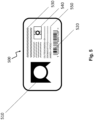
- barcode classification 602 the image data is assessed to see if the document contains a barcode 520. If at least one barcode is found, the barcode is analysed. Since the data encoded in a barcode 520, is encoded in a known method, the result of the barcode reading is data that can be decoded to form classification data, which will also reveal the type of the official document.
- the decoding may include contacting an external database and using the coded data to obtain classification data. Once classification data is obtained, the official document that the image data relates to is thereby classified as a particular type of document. Barcode classification 602 is a fast and efficient way to read official document and therefore produces a result faster than with other classification and/or data extraction methods.
- a validation 621 is then performed to ensure the data from the barcode has been extracted correctly and to ensure that the official document has been correctly classified.
- the classification data is compared to standard data of a document of the particular type as previously described.
- One method of keyword classification 603 comprises analysing example images to form a list of template data.
- An example image may be an exemplary image of the official document of a particular type or it may be a document specific template, which is a template relating to particular type of official document.
- the term "word' should be considered as merely as one of, or a group of, textual characters.
- a keyword is one or more words that are part of the standard format of official document of a particular type, for example, "Passport Number”.
- a keyword may also be a word that is commonly found on official document of the particular type, for example "Expired'.
- the weight matrix is then used as a linear classifier to classify the official document to which the image data relates.
- a linear classification means that the confidence in the classification can be easily calculated. If this confidence is above a threshold, or pre-set level, the official document that the image data relates to is classified as a particular type of document. If this threshold level of confidence is not reached the keyword classification 603 will be considered to have failed and a different classification method will be attempted.
- keyword classification 603 can easily support a lot of different documents.
- keyword classification 603 supports classification of more official document types than all the other classification methods and it can operate even if there is only one example of the official document. This is why it generally occurs after MRTD 601 and barcode classification 602.
- the keyword classifier will also be the first classification attempted documents for those official document on which a barcode 520 and MRZ 540 was not located. The accuracy of the keyword classifier is dependent on the number of keywords in the specific document and how distinct the set of keywords for a specific official document is different from all other documents.
- the homography is used to match other textual data in the recognized data from the blind OCR to the location in the example image, thereby additional classification data is acquired.
- Pattern based matching preferably using regular expression, is used to validate the text being matched to the positions in the official document.
- the CNN classification 604 Given the large number of documents used in the training of the CNN, when the CNN is classifying an official document on which it has been trained, the CNN classification 604 will provide high accuracy. Whilst the CNN classification 604 only supports the document types on which it has been trained, it may also be trained to recognize documents of a type on which it has not been trained as unknown. Therefore, it can report that it does not know about a certain document with a high accuracy. The CNN may therefore report that a document is not of one of a particular type or not one of a particular group of types, such as known types. The ability to accurately deal with unknown documents is why the CNN classification 604 occurs after the keyword classification 603, which generally cannot assign a document as an unknown type.
- the CNN classification 604 follows the same steps as a keyword classification 603. Therefore, the CNN is used to classify the official document that the image data relates to as being a particular type. If a threshold of confidence in the classification has been achieved, semantic labelling 611 of the image data is then performed to obtain classification data.
- the system will continue processing the image data.
- the next classification method to be attempted is a visual classifier based classification 605.
- the visual classifier is a bag-of-visual-words model using Kaze features and a support vector machine classifier.
- the visual classifier is trained on approximately 40 or 50 images of the official document of the particular type. Given the lower numbers of images of official documents needed for training, the visual classifier generally supports more types of official documents. As this classifier doesn't know which documents it doesn't know about it always tries to make a classification. For this reason, the visual classifier is generally last.
- the visual classification 605 follows the same steps as a keyword classification 603. Therefore, the visual classifier 605 is used to classify official documents that the image data relates to as being a particular type. If a threshold of confidence in the classification has been achieved, semantic labelling 611 of the image data is performed to obtain classification data.
- a validation 621 is then performed to ensure the data from the visual classification 605 has been extracted correctly and to ensure that the official document has been correctly classified.
- the classification data is compared to standard data of a document of the particular type as previously described.
- the above classification methods, or a subset thereof, can be completed in the described order or in a different order if necessary.
- the order of MRTD classification 601, barcode classification 602, keyword classification 603, CNN classification 604 and visual classification 605 is described herein as the first processing pipeline 600.
- the first processing pipeline 600 runs the fastest classification methods (MRTD 601 and barcode classification 602) first, falling back to keyword classification 603 if the faster classification methods fail, then failing back to CNN classification 604 if the keyword classification 603 fails, and finally failing back to the visual classification 605, which never fails to make a classification of the type of official document to which the image data relates.
- one further advantage of the first processing pipeline 600 is that that experienced users can adapt the system to deal with new document types. To adjust the method to account for a new official document type merely requires a manual process of creating a template of the keyword for the new document, for the keyword classification 603, and retraining the CNN and visual classifiers. This may be part of a processes triggered by the failure of a processed document.
- a consistency check 631 is performed on the classification data.
- the consistency check 631 takes the recognized data from the blind OCR 671 and compares it with the classification data. If a threshold of similarity is satisfied the consistency check 631 is said to be passed.
- the threshold of similarity is that the classification data comprises a set number of elements of the recognized data or a decoded form of the recognized data.
- the set number of elements corresponds to all classification data that would be expected to be visible in an official document of the classified type.
- MRTD classification 601 to result in classification data including: the name "Alice”, the nationality "British”, and the expiry date "13/10/2037”.
- This exemplary classification data would pass a consistency check 631 if the recognized data from the blind OCR comprises the words "Alice”, “British”, and "13/10/2037".
- the consistency check 631 confirms that the official document that the image data relates to was classified and processed correctly. There is always the risk that a document gets misclassified and the processing proceeds to extract erroneous classification data progressing any further. Therefore, the consistency is a simply a check that at least most of the relevant fields have been populated with plausible information.
- the validation 621 of all classification fails another is attempted until all possible classification methods have been attempted. If all classification methods have been tried, and none have produced classification data that has passed validation 621, the system will typically report data extraction to have failed. If validation 621 has been passed, but consistency checking of the validated classification data fail, the system will typically report data extraction to have failed. Failure may flag the considered document or image for further processing or consideration.
- the further processing may be manual assessment or further automatic processing. Additionally, the further processing may involve assessing whether the failed document is a new official document type. In some cases, the failure may trigger automatic requests for further documents or images.
- all processed official documents enter the first processing pipeline 600, but selected documents may be switched based on user selection or pre-configured settings to the second processing pipeline 700.
- the processing path by which a particular documents is processed be that following the first processing pipeline 600 to the end, or switching to the second processing pipeline 700 can be made decided according to an assessment made after the image data from the document has been acquired and processed.
- all documents to be processed proceed only via the first processing pipeline 600.
- all documents to be processed proceed only via the second processing pipeline 700.
- the selection of documents to switch to the second processing pipeline 700 can be made: (i) by a user, (ii) according to an algorithm based on one or more document characteristics, e.g. the type of document, the size of the document, or document image resolution; (iii) according to operational parameters of the system corresponding to the classification methods, (iv) or randomly.
- the second processing pipeline 700 has only one classification method, which is similar to the CNN classifier mentioned previously.
- a preprocessing step 720 the official document, or a portion of an official document, is located within the image data and the rotation of the official document with the image axis is calculated. The relevant image data is then identified or extracted.
- the segmenting step 730 processes the extracted image data to obtain segmentation data to find labels for each keyword in the image data. In other words, it identifies the relevant classification data and its position. Segmenting 730 the extracted image data to obtain segmentation data comprises: searching the extracted image data to find at least one text field; associating a label with each of the at least one text field; obtaining segmentation data from the extracted image data, the segmentation data comprising the position of each of the at least one text field and the associated label; returning the segmentation data.
- segmenting the extracted image data to obtain segmentation data comprises uses pixel based segmentation and is thus done in a purely visual way. The segmentation is performed using a deep CNN. This semantic labelling thereby identifies the relevant sections of the document and the reason for their importance.
- the CNN classifier of the first processing pipeline 600 and the second processing pipeline 700 are quite similar and the same advantages therefore also apply to the second processing pipeline 700, as in the first processing pipeline 600, which are discussed previously.
- pipelines two is more accurate and faster due to more performant CNNs.
- the line-OCR system is trained on a plurality of documents types and can thus generate an associated model for each document type which is used within the pipeline and utilised with the system. This makes the line-OCR system utilised with the invention described herein perform better than a general blind-OCR system.
- the second processing pipeline 700 enables data to be more easily labelled by non-experts and the models can be trained automatically for each new document type.
- the first processing pipeline 600 benefits from more involvement from experts to adapt it to account for new documents.
- the pipelines described above, and shown in Figs. 6 and 7 may in one embodiment be executed by the server 203.
- the acquired image data may be image data of an official document 500 captured by camera 253 of mobile electronic device 201 that is communicated to the server 203.
- the mobile electronic device 201 can include an application executable on the device 201 which coordinates the use of the camera 253, the communication of the image data to the server 203, and the reporting on the display 204 of the assessment result reported by the server 203.
- a user may therefore work the invention via mobile electronic device 201 or, alternatively, via any other user electronic device that is connected to the wireless network 301.
- the electromagnetic radiation source 257 is an infrared (IR) radiation source which is configured to emit infrared radiation. In at least some embodiments, the electromagnetic radiation source 257 may be configured to emit radiation which is not part of the visible spectrum.
- the camera 253 may be a camera which is configured to capture radiation of the type emitted by the electromagnetic radiation source 257. Accordingly, in at least some embodiments, the camera 253 is configured to capture at least some electromagnetic radiation which is not in the visible spectrum.
- the code may operate by contacting one or more external systems, such as a server 203, and exchanging data with the external systems. This prevents all the processing, or calculations, having to occur on the electronic device 201, 202 which is useful to spare processing load and thus battery power.
- the electronic device 201, 202 may use one preferred communication method to exchange data or it may select the optimal communication method in light of those that are available, The selection of communication methods can be adaptive or responsive.
- a wireless network communication signal using the IEEE 802.11 standard (WiFi) is initially available but lost, as the electronic device moves out of WiFi range, the electronic device may switch to a wireless network communication signal using the CDMA200 standard (3G) to continue the data exchange with the server 203.
- the data may be seamlessly transferred without interruption or the data transfer may pause during the switch over and be restarted thereafter either automatically or by the user.
- all the processing can occur on a user electronic device to prevent the need to contact external systems. This is especially useful if the user electronic device is a portable electronic device that may move into area in that is outside of all useful communications networks, since the functionality of the method is then not dependent of the availability of a communication network.
- the execution of the code may cause the user electronic device to ascertain whether or not a communications network is available and select the operation mode accordingly, the assessment may be ongoing, periodic, or occur a limited number of times.
- the identification authentication application then prompts the user, via display 204 or speaker 256, to use the camera 253 to take a photo of an official identification document, possibly using a separate camera application.
- the identification authentication application sends the image data to a server 203 to extract data.
- the data extraction uses the process described above, either or both of the first and second processing pipelines 600, 700.
- the extracted data is then communicated from the server 203 back to the identification authentication application.
- the identification authentication application then communicates this extracted data to the service.
- the service knows the identification authentication application provides authentic extracted data. Therefore, the service can use the extracted data to register the new user.
- the server 203 may alert the service. Alternatively, it may alert the user and request further images of the official document or request images of alternative official documents.
Landscapes
- Engineering & Computer Science (AREA)
- Physics & Mathematics (AREA)
- Theoretical Computer Science (AREA)
- Computer Vision & Pattern Recognition (AREA)
- General Physics & Mathematics (AREA)
- Artificial Intelligence (AREA)
- Multimedia (AREA)
- Data Mining & Analysis (AREA)
- General Engineering & Computer Science (AREA)
- Computing Systems (AREA)
- Software Systems (AREA)
- Computational Linguistics (AREA)
- Health & Medical Sciences (AREA)
- Evolutionary Computation (AREA)
- General Health & Medical Sciences (AREA)
- Biophysics (AREA)
- Biomedical Technology (AREA)
- Molecular Biology (AREA)
- Mathematical Physics (AREA)
- Life Sciences & Earth Sciences (AREA)
- Computer Graphics (AREA)
- Geometry (AREA)
- Databases & Information Systems (AREA)
- Character Discrimination (AREA)
Priority Applications (1)
| Application Number | Priority Date | Filing Date | Title |
|---|---|---|---|
| EP24216945.6A EP4492340A3 (de) | 2018-01-12 | 2018-01-12 | Datenextraktionspipeline |
Applications Claiming Priority (2)
| Application Number | Priority Date | Filing Date | Title |
|---|---|---|---|
| EP24216945.6A EP4492340A3 (de) | 2018-01-12 | 2018-01-12 | Datenextraktionspipeline |
| EP18151489.4A EP3511861B1 (de) | 2018-01-12 | 2018-01-12 | Datenextrationspipeline |
Related Parent Applications (1)
| Application Number | Title | Priority Date | Filing Date |
|---|---|---|---|
| EP18151489.4A Division EP3511861B1 (de) | 2018-01-12 | 2018-01-12 | Datenextrationspipeline |
Publications (2)
| Publication Number | Publication Date |
|---|---|
| EP4492340A2 true EP4492340A2 (de) | 2025-01-15 |
| EP4492340A3 EP4492340A3 (de) | 2025-02-19 |
Family
ID=60972092
Family Applications (2)
| Application Number | Title | Priority Date | Filing Date |
|---|---|---|---|
| EP18151489.4A Active EP3511861B1 (de) | 2018-01-12 | 2018-01-12 | Datenextrationspipeline |
| EP24216945.6A Pending EP4492340A3 (de) | 2018-01-12 | 2018-01-12 | Datenextraktionspipeline |
Family Applications Before (1)
| Application Number | Title | Priority Date | Filing Date |
|---|---|---|---|
| EP18151489.4A Active EP3511861B1 (de) | 2018-01-12 | 2018-01-12 | Datenextrationspipeline |
Country Status (3)
| Country | Link |
|---|---|
| US (1) | US11055524B2 (de) |
| EP (2) | EP3511861B1 (de) |
| WO (1) | WO2019138074A1 (de) |
Families Citing this family (29)
| Publication number | Priority date | Publication date | Assignee | Title |
|---|---|---|---|---|
| US10783400B2 (en) * | 2018-04-06 | 2020-09-22 | Dropbox, Inc. | Generating searchable text for documents portrayed in a repository of digital images utilizing orientation and text prediction neural networks |
| EP3572972A1 (de) * | 2018-05-23 | 2019-11-27 | IDEMIA Identity & Security Germany AG | Erweitertes neuronales faltungsnetzwerk für die dokumentenanalyse |
| US10402944B1 (en) * | 2018-08-20 | 2019-09-03 | Capital One Services, Llc | Determining a position of an object in a rotation corrected image |
| CN110443317A (zh) * | 2019-08-09 | 2019-11-12 | 上海尧眸电气科技有限公司 | 一种纸档资料电子化的方法、装置和电子设备 |
| JP7351159B2 (ja) * | 2019-09-19 | 2023-09-27 | 富士フイルムビジネスイノベーション株式会社 | 情報処理装置及びプログラム |
| JP2021047693A (ja) * | 2019-09-19 | 2021-03-25 | 富士ゼロックス株式会社 | 情報処理装置及びプログラム |
| US20210097274A1 (en) * | 2019-09-30 | 2021-04-01 | UiPath, Inc. | Document processing framework for robotic process automation |
| WO2021087334A1 (en) | 2019-11-01 | 2021-05-06 | Vannevar Labs, Inc. | Neural network-based optical character recognition |
| KR102830978B1 (ko) * | 2020-01-03 | 2025-07-08 | 엘지전자 주식회사 | 사용자 인증 |
| EP3905108B1 (de) | 2020-04-29 | 2025-11-05 | Onfido Ltd | Skalierbare, flexible und robuste vorlagenbasierte datenextraktionspipeline |
| CN111579212A (zh) * | 2020-05-27 | 2020-08-25 | 燕山大学 | 一种基于mrtd的显微热成像系统性能评价方法及系统 |
| US11216960B1 (en) * | 2020-07-01 | 2022-01-04 | Alipay Labs (singapore) Pte. Ltd. | Image processing method and system |
| CN111860506B (zh) * | 2020-07-24 | 2024-03-29 | 北京百度网讯科技有限公司 | 识别文字的方法和装置 |
| US11928878B2 (en) | 2020-08-26 | 2024-03-12 | Informed, Inc. | System and method for domain aware document classification and information extraction from consumer documents |
| US12354022B2 (en) * | 2020-11-12 | 2025-07-08 | Samsung Electronics Co., Ltd. | On-device knowledge extraction from visually rich documents |
| CN112906487B (zh) * | 2021-01-26 | 2023-07-11 | 北京建筑大学 | 基于规则集的明清官式建筑物样式点云分类识别方法 |
| US12050960B2 (en) * | 2021-03-24 | 2024-07-30 | Maplebear Inc. | Image-based barcode decoding |
| EP4083850A1 (de) | 2021-04-27 | 2022-11-02 | Onfido Ltd | Verfahren zum erkennen von fälschung in dokumenten |
| EP4105815A1 (de) | 2021-06-14 | 2022-12-21 | Onfido Ltd | Signalbasierte maschinenlernende betrugserkennung |
| EP4105825A1 (de) | 2021-06-14 | 2022-12-21 | Onfido Ltd | Generalisierte anomaliedetektion |
| US12211303B2 (en) * | 2021-06-28 | 2025-01-28 | Paypal, Inc. | Data classification based on recursive clustering |
| CN113971810A (zh) * | 2021-10-27 | 2022-01-25 | 北京百度网讯科技有限公司 | 文档生成方法、装置、平台、电子设备以及存储介质 |
| US11907306B2 (en) | 2022-01-04 | 2024-02-20 | Capital One Services, Llc | Systems and methods for classifying documents |
| US12008830B2 (en) * | 2022-01-07 | 2024-06-11 | Infrrd Inc. | System for template invariant information extraction |
| US12205294B2 (en) | 2022-03-07 | 2025-01-21 | Onfido Ltd. | Methods and systems for authentication of a physical document |
| US12499548B2 (en) | 2022-03-07 | 2025-12-16 | Onfido Ltd. | Methods and systems for authentication of a physical document |
| EP4266265A1 (de) * | 2022-04-18 | 2023-10-25 | UST Global (Singapore) Pte. Limited | Neuronale netzwerkarchitektur zur klassifizierung von dokumenten |
| WO2024259266A1 (en) * | 2023-06-15 | 2024-12-19 | Innovative Logistics, Llc | Systems and methods for automated document ingestion |
| CN120412000B (zh) * | 2025-07-01 | 2025-08-29 | 浙江孚临科技有限公司 | Llm驱动的复杂报表ocr错误自校正方法及系统 |
Family Cites Families (9)
| Publication number | Priority date | Publication date | Assignee | Title |
|---|---|---|---|---|
| US20020037097A1 (en) * | 2000-05-15 | 2002-03-28 | Hector Hoyos | Coupon recognition system |
| EP1439485B1 (de) * | 2002-11-22 | 2007-11-14 | Océ-Technologies B.V. | Segmentierung eines zusammengesetzten Bildes mittels Basis-Rechtecken |
| US9292737B2 (en) * | 2008-01-18 | 2016-03-22 | Mitek Systems, Inc. | Systems and methods for classifying payment documents during mobile image processing |
| US8316039B2 (en) | 2009-05-18 | 2012-11-20 | Microsoft Corporation | Identifying conceptually related terms in search query results |
| US8843494B1 (en) * | 2012-03-28 | 2014-09-23 | Emc Corporation | Method and system for using keywords to merge document clusters |
| EP2845147B1 (de) * | 2012-04-29 | 2018-06-06 | Hewlett-Packard Development Company, L.P. | Redigitalisierung und fehlerkorrektur von elektronischen dokumenten |
| US9760788B2 (en) * | 2014-10-30 | 2017-09-12 | Kofax, Inc. | Mobile document detection and orientation based on reference object characteristics |
| US9652688B2 (en) * | 2014-11-26 | 2017-05-16 | Captricity, Inc. | Analyzing content of digital images |
| US10902252B2 (en) * | 2017-07-17 | 2021-01-26 | Open Text Corporation | Systems and methods for image based content capture and extraction utilizing deep learning neural network and bounding box detection training techniques |
-
2018
- 2018-01-12 EP EP18151489.4A patent/EP3511861B1/de active Active
- 2018-01-12 EP EP24216945.6A patent/EP4492340A3/de active Pending
-
2019
- 2019-01-11 US US16/245,480 patent/US11055524B2/en active Active
- 2019-01-11 WO PCT/EP2019/050693 patent/WO2019138074A1/en not_active Ceased
Also Published As
| Publication number | Publication date |
|---|---|
| EP3511861A1 (de) | 2019-07-17 |
| EP3511861B1 (de) | 2024-12-04 |
| EP4492340A3 (de) | 2025-02-19 |
| WO2019138074A1 (en) | 2019-07-18 |
| US11055524B2 (en) | 2021-07-06 |
| US20190220660A1 (en) | 2019-07-18 |
Similar Documents
| Publication | Publication Date | Title |
|---|---|---|
| US11055524B2 (en) | Data extraction pipeline | |
| US11087125B2 (en) | Document authenticity determination | |
| US9946865B2 (en) | Document authentication based on expected wear | |
| EP4109332A1 (de) | Verfahren und vorrichtung zur identifizierung der authentizität eines zertifikats, computerlesbares medium und elektronische vorrichtung | |
| US20240176951A1 (en) | Electronic document validation | |
| US9373030B2 (en) | Automated document recognition, identification, and data extraction | |
| US20190012450A1 (en) | Biometric-based authentication method, apparatus and system | |
| US11367310B2 (en) | Method and apparatus for identity verification, electronic device, computer program, and storage medium | |
| US11100322B2 (en) | Character authenticity determination | |
| CN114820476B (zh) | 基于合规性检测的身份证识别方法 | |
| JP2016048444A (ja) | 帳票識別プログラム、帳票識別装置、帳票識別システム、および帳票識別方法 | |
| CN113111880B (zh) | 证件图像校正方法、装置、电子设备及存储介质 | |
| US20230132261A1 (en) | Unified framework for analysis and recognition of identity documents | |
| CN113239910A (zh) | 证件识别方法、装置、设备及存储介质 | |
| CN111414914A (zh) | 图像识别方法、装置、计算机设备和存储介质 | |
| CN113033271B (zh) | 利用人工智能模块学习脸部辨识的处理方法 | |
| WO2024073264A1 (en) | Fake signature detection | |
| CN114359923A (zh) | 证件字符识别方法、装置、计算机及存储介质 | |
| US20250349025A1 (en) | Automatic image cropping using a reference feature | |
| CN112434687B (zh) | 图片检测方法、装置、设备及存储介质 | |
| US20240312173A1 (en) | Automatic orientation correction for captured images | |
| CN113052237A (zh) | 目标对象的检测方法、装置和服务器 | |
| CN117373030B (zh) | 一种基于ocr的用户材料识别方法、系统、装置及介质 | |
| JP2024134395A (ja) | 判定装置、判定方法、および、判定装置用のプログラム | |
| CN118262363A (zh) | 水印识别方法、业务备件的校验方法、设备和存储介质 |
Legal Events
| Date | Code | Title | Description |
|---|---|---|---|
| PUAI | Public reference made under article 153(3) epc to a published international application that has entered the european phase |
Free format text: ORIGINAL CODE: 0009012 |
|
| STAA | Information on the status of an ep patent application or granted ep patent |
Free format text: STATUS: THE APPLICATION HAS BEEN PUBLISHED |
|
| REG | Reference to a national code |
Ref country code: DE Ref legal event code: R079 Free format text: PREVIOUS MAIN CLASS: G06V0030400000 Ipc: G06V0030224000 |
|
| AC | Divisional application: reference to earlier application |
Ref document number: 3511861 Country of ref document: EP Kind code of ref document: P |
|
| AK | Designated contracting states |
Kind code of ref document: A2 Designated state(s): AL AT BE BG CH CY CZ DE DK EE ES FI FR GB GR HR HU IE IS IT LI LT LU LV MC MK MT NL NO PL PT RO RS SE SI SK SM TR |
|
| PUAL | Search report despatched |
Free format text: ORIGINAL CODE: 0009013 |
|
| AK | Designated contracting states |
Kind code of ref document: A3 Designated state(s): AL AT BE BG CH CY CZ DE DK EE ES FI FR GB GR HR HU IE IS IT LI LT LU LV MC MK MT NL NO PL PT RO RS SE SI SK SM TR |
|
| RIC1 | Information provided on ipc code assigned before grant |
Ipc: G06V 30/42 20220101ALI20250113BHEP Ipc: G06V 30/414 20220101ALI20250113BHEP Ipc: G06V 30/413 20220101ALI20250113BHEP Ipc: G06V 30/40 20220101ALI20250113BHEP Ipc: G06V 30/224 20220101AFI20250113BHEP |
|
| STAA | Information on the status of an ep patent application or granted ep patent |
Free format text: STATUS: REQUEST FOR EXAMINATION WAS MADE |
|
| 17P | Request for examination filed |
Effective date: 20250818 |