EP4492284A1 - Informationsverarbeitungsvorrichtung, informationsverarbeitungsverfahren und programm - Google Patents
Informationsverarbeitungsvorrichtung, informationsverarbeitungsverfahren und programm Download PDFInfo
- Publication number
- EP4492284A1 EP4492284A1 EP22930780.6A EP22930780A EP4492284A1 EP 4492284 A1 EP4492284 A1 EP 4492284A1 EP 22930780 A EP22930780 A EP 22930780A EP 4492284 A1 EP4492284 A1 EP 4492284A1
- Authority
- EP
- European Patent Office
- Prior art keywords
- information
- muscle
- firing
- movement
- mnfp
- Prior art date
- Legal status (The legal status is an assumption and is not a legal conclusion. Google has not performed a legal analysis and makes no representation as to the accuracy of the status listed.)
- Pending
Links
Images








Classifications
-
- G—PHYSICS
- G06—COMPUTING OR CALCULATING; COUNTING
- G06F—ELECTRIC DIGITAL DATA PROCESSING
- G06F30/00—Computer-aided design [CAD]
- G06F30/20—Design optimisation, verification or simulation
- G06F30/27—Design optimisation, verification or simulation using machine learning, e.g. artificial intelligence, neural networks, support vector machines [SVM] or training a model
-
- G—PHYSICS
- G06—COMPUTING OR CALCULATING; COUNTING
- G06N—COMPUTING ARRANGEMENTS BASED ON SPECIFIC COMPUTATIONAL MODELS
- G06N3/00—Computing arrangements based on biological models
- G06N3/02—Neural networks
- G06N3/04—Architecture, e.g. interconnection topology
-
- G—PHYSICS
- G06—COMPUTING OR CALCULATING; COUNTING
- G06N—COMPUTING ARRANGEMENTS BASED ON SPECIFIC COMPUTATIONAL MODELS
- G06N3/00—Computing arrangements based on biological models
- G06N3/004—Artificial life, i.e. computing arrangements simulating life
- G06N3/006—Artificial life, i.e. computing arrangements simulating life based on simulated virtual individual or collective life forms, e.g. social simulations or particle swarm optimisation [PSO]
-
- G—PHYSICS
- G06—COMPUTING OR CALCULATING; COUNTING
- G06N—COMPUTING ARRANGEMENTS BASED ON SPECIFIC COMPUTATIONAL MODELS
- G06N3/00—Computing arrangements based on biological models
- G06N3/004—Artificial life, i.e. computing arrangements simulating life
- G06N3/008—Artificial life, i.e. computing arrangements simulating life based on physical entities controlled by simulated intelligence so as to replicate intelligent life forms, e.g. based on robots replicating pets or humans in their appearance or behaviour
-
- G—PHYSICS
- G06—COMPUTING OR CALCULATING; COUNTING
- G06N—COMPUTING ARRANGEMENTS BASED ON SPECIFIC COMPUTATIONAL MODELS
- G06N3/00—Computing arrangements based on biological models
- G06N3/02—Neural networks
-
- G—PHYSICS
- G06—COMPUTING OR CALCULATING; COUNTING
- G06N—COMPUTING ARRANGEMENTS BASED ON SPECIFIC COMPUTATIONAL MODELS
- G06N3/00—Computing arrangements based on biological models
- G06N3/02—Neural networks
- G06N3/04—Architecture, e.g. interconnection topology
- G06N3/044—Recurrent networks, e.g. Hopfield networks
-
- G—PHYSICS
- G06—COMPUTING OR CALCULATING; COUNTING
- G06N—COMPUTING ARRANGEMENTS BASED ON SPECIFIC COMPUTATIONAL MODELS
- G06N3/00—Computing arrangements based on biological models
- G06N3/02—Neural networks
- G06N3/04—Architecture, e.g. interconnection topology
- G06N3/045—Combinations of networks
-
- G—PHYSICS
- G06—COMPUTING OR CALCULATING; COUNTING
- G06N—COMPUTING ARRANGEMENTS BASED ON SPECIFIC COMPUTATIONAL MODELS
- G06N3/00—Computing arrangements based on biological models
- G06N3/02—Neural networks
- G06N3/04—Architecture, e.g. interconnection topology
- G06N3/0464—Convolutional networks [CNN, ConvNet]
-
- G—PHYSICS
- G06—COMPUTING OR CALCULATING; COUNTING
- G06N—COMPUTING ARRANGEMENTS BASED ON SPECIFIC COMPUTATIONAL MODELS
- G06N3/00—Computing arrangements based on biological models
- G06N3/02—Neural networks
- G06N3/04—Architecture, e.g. interconnection topology
- G06N3/047—Probabilistic or stochastic networks
-
- G—PHYSICS
- G06—COMPUTING OR CALCULATING; COUNTING
- G06N—COMPUTING ARRANGEMENTS BASED ON SPECIFIC COMPUTATIONAL MODELS
- G06N3/00—Computing arrangements based on biological models
- G06N3/02—Neural networks
- G06N3/04—Architecture, e.g. interconnection topology
- G06N3/0475—Generative networks
-
- G—PHYSICS
- G06—COMPUTING OR CALCULATING; COUNTING
- G06N—COMPUTING ARRANGEMENTS BASED ON SPECIFIC COMPUTATIONAL MODELS
- G06N3/00—Computing arrangements based on biological models
- G06N3/02—Neural networks
- G06N3/04—Architecture, e.g. interconnection topology
- G06N3/048—Activation functions
-
- G—PHYSICS
- G06—COMPUTING OR CALCULATING; COUNTING
- G06N—COMPUTING ARRANGEMENTS BASED ON SPECIFIC COMPUTATIONAL MODELS
- G06N3/00—Computing arrangements based on biological models
- G06N3/02—Neural networks
- G06N3/04—Architecture, e.g. interconnection topology
- G06N3/049—Temporal neural networks, e.g. delay elements, oscillating neurons or pulsed inputs
-
- G—PHYSICS
- G06—COMPUTING OR CALCULATING; COUNTING
- G06N—COMPUTING ARRANGEMENTS BASED ON SPECIFIC COMPUTATIONAL MODELS
- G06N3/00—Computing arrangements based on biological models
- G06N3/02—Neural networks
- G06N3/06—Physical realisation, i.e. hardware implementation of neural networks, neurons or parts of neurons
- G06N3/063—Physical realisation, i.e. hardware implementation of neural networks, neurons or parts of neurons using electronic means
-
- G—PHYSICS
- G06—COMPUTING OR CALCULATING; COUNTING
- G06N—COMPUTING ARRANGEMENTS BASED ON SPECIFIC COMPUTATIONAL MODELS
- G06N3/00—Computing arrangements based on biological models
- G06N3/02—Neural networks
- G06N3/08—Learning methods
-
- G—PHYSICS
- G06—COMPUTING OR CALCULATING; COUNTING
- G06N—COMPUTING ARRANGEMENTS BASED ON SPECIFIC COMPUTATIONAL MODELS
- G06N3/00—Computing arrangements based on biological models
- G06N3/02—Neural networks
- G06N3/08—Learning methods
- G06N3/084—Backpropagation, e.g. using gradient descent
-
- G—PHYSICS
- G06—COMPUTING OR CALCULATING; COUNTING
- G06N—COMPUTING ARRANGEMENTS BASED ON SPECIFIC COMPUTATIONAL MODELS
- G06N3/00—Computing arrangements based on biological models
- G06N3/02—Neural networks
- G06N3/08—Learning methods
- G06N3/088—Non-supervised learning, e.g. competitive learning
-
- G—PHYSICS
- G06—COMPUTING OR CALCULATING; COUNTING
- G06N—COMPUTING ARRANGEMENTS BASED ON SPECIFIC COMPUTATIONAL MODELS
- G06N7/00—Computing arrangements based on specific mathematical models
- G06N7/01—Probabilistic graphical models, e.g. probabilistic networks
-
- G—PHYSICS
- G06—COMPUTING OR CALCULATING; COUNTING
- G06N—COMPUTING ARRANGEMENTS BASED ON SPECIFIC COMPUTATIONAL MODELS
- G06N99/00—Subject matter not provided for in other groups of this subclass
-
- G—PHYSICS
- G06—COMPUTING OR CALCULATING; COUNTING
- G06T—IMAGE DATA PROCESSING OR GENERATION, IN GENERAL
- G06T13/00—Animation
- G06T13/20—Three-dimensional [3D] animation
- G06T13/40—Three-dimensional [3D] animation of characters, e.g. humans, animals or virtual beings
Definitions
- the present invention relates to an information processing apparatus and the like for simulating a movement according to cognition of a living organism such as a person.
- Patent Document 1 Conventionally, there have been techniques for controlling a movement of a movable object such as a robot or an avatar using a neural network (see Patent Document 1, for example).
- Patent Document 1 JP 2022-13786A
- a first aspect of the present invention is directed to an information processing apparatus including: a neural network (NN) storage unit in which a neural network having two or more nodes each identified with a node identifier is stored; a motor neuron firing pattern (MNFP) storage unit in which one or two or more MNFPs, each of which is information for specifying one or more firing nodes at each of two or more points in time, are stored in association with movement determination information for determining a movement of a movable object; an input accepting unit that accepts input information; an MNFP determining unit that applies the input information to the neural network, thereby acquiring, in a time series, one or more firing node identifiers of the two or more nodes included in the neural network, and sequentially determines one or more MNFPs corresponding to the one or more time-series firing node identifiers, out of the one or more MNFPs in the MNFP storage unit; a movement determining unit that sequentially acquires movement determination information respectively corresponding to the one or more
- a second aspect of the present invention is directed to the information processing apparatus according to the first aspect, further including: a muscle storage unit in which two or more pieces of muscle information are stored, each of which is information on a muscle that moves in a case in which the one or more nodes fire, is information associated with one or more firing node identifiers, and is information indicating a muscle identifier and a maximum power
- the movement determining unit includes: a muscle determining part that sequentially determines one or more pieces of muscle information associated with each of one or more firing node identifiers specified with the one or more MNFPs determined by the MNFP determining unit; and an intensity acquiring part that acquires, for each of the one or more pieces of muscle information determined by the muscle determining part, a firing number, which is the number of firing node identifiers associated with the muscle information, and sequentially acquires intensities of movements of the muscles specified with the muscle information, using the firing number and the maximum power that is indicated by the muscle information, and the moving unit sequentially moves the movement
- a third aspect of the present invention is directed to the information processing apparatus according to the first aspect, further including: a joint storage unit in which one or more pieces of joint information each having a joint identifier are stored in association with two or more muscle identifiers, wherein the movement determining unit further includes an angle acquiring part that refers to the joint storage unit, and sequentially acquires angles of joints respectively identified with one or more joint identifiers associated with muscle identifiers contained in the one or more pieces of muscle information determined by the muscle determining part, using the one or more pieces of movement muscle information, and the moving unit outputs the angles of the respective one or more joints to the movable object, thereby moving the movable object.
- a joint storage unit in which one or more pieces of joint information each having a joint identifier are stored in association with two or more muscle identifiers
- the movement determining unit further includes an angle acquiring part that refers to the joint storage unit, and sequentially acquires angles of joints respectively identified with one or more joint identifiers associated with muscle identifier
- a fourth aspect of the present invention is directed to the information processing apparatus according to the third aspect, wherein the movable object is an avatar, the joint information is information on a joint of the avatar, and indicates a joint position for specifying a position of a joint included in the avatar, the information processing apparatus further includes an avatar storage unit in which avatar information for outputting the avatar is stored, the moving unit configures an avatar whose joints respectively specified with the joint positions of the one or more joints have been bent according to the angles corresponding to the joints, using the avatar information, and outputs the avatar.
- a fifth aspect of the present invention is directed to the information processing apparatus according to the first aspect, wherein the movable object is a face of an avatar, the information processing apparatus further includes a muscle storage unit in which two or more pieces of muscle information are stored, each of which is information associated with node identifiers of one or more nodes, is information on a mesh that moves in a case in which the one or more nodes fire, and has a muscle identifier for identifying a mesh of the face of the avatar; the movement determining unit includes: a muscle determining part that sequentially determines one or more pieces of muscle information associated with each of one or more firing node identifiers specified with the one or more MNFPs determined by the MNFP determining unit, and the moving unit sequentially stretches or contracts meshes identified with muscle identifiers contained in the muscle information determined by the muscle determining part.
- a sixth aspect of the present invention is directed to the information processing apparatus according to the fifth aspect, wherein the movement determining unit includes: a muscle determining part that sequentially determines one or more pieces of muscle information associated with each of one or more firing node identifiers specified with the one or more MNFPs determined by the MNFP determining unit; and an intensity acquiring part that acquires, for each of the one or more pieces of muscle information determined by the muscle determining part, a firing number, which is the number of firing node identifiers associated with the muscle information, and sequentially acquires intensities of movements of the muscles specified with the muscle information, using the firing number, and the moving unit sequentially moves the movable object based on one or more pieces of movement muscle information, each of which is a pair of a muscle identifier contained in each of the one or more pieces of muscle information determined by the muscle determining part and the intensity acquired by the intensity acquiring part.
- the movement determining unit includes: a muscle determining part that sequentially determines one or more pieces of muscle information associated with
- a ninth aspect of the present invention is directed to the information processing apparatus according to any one of the second to fourth aspects, further including: a muscle changing unit that performs change processing for decreasing a maximum power that is paired with a muscle identifier not determined by the muscle determining part, in a case in which the muscle identifier satisfies a predetermined decrease condition.
- a twelfth aspect of the present invention is directed to the information processing apparatus according to any one of the first to eleventh aspects, wherein the number of points in time is different between at least two MNFPs among the two or more MNFPs.
- an information processing apparatus that can appropriately simulate a movement according to cognition of a living organism such as a person will be described.
- an information processing apparatus will be described that accepts input information such as an image or a speech, applies the input information to one or two or more stored neural networks, thereby acquiring one or more motor neuron firing patterns (hereinafter referred to as "MNFPs" as appropriate) for specifying time-series firing states of one or more nodes, which are output from the neural networks, acquires movement determination information corresponding to the MNFPs, and move a movable object according to the one or more pieces of movement determination information.
- MNFPs motor neuron firing patterns
- the state in which information X is associated with information Y means that the information Y can be acquired from the information X or the information X can be acquired from the information Y, and there is no limitation on the method for associating the information.
- the information X and the information Y may be linked to each other or in the same buffer.
- the information X may be contained in the information Y, or the information Y may be contained in the information X, for example.
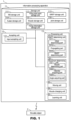
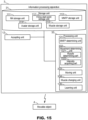
- the information processing apparatus 1 includes a storage unit 11, an accepting unit 12, and a processing unit 13.
- the storage unit 11 includes an NN storage unit 111, a firing start point storage unit 112, an MNFP storage unit 113, an avatar storage unit 114, a muscle storage unit 115, a joint storage unit 116, and a firing information storage unit 117.
- the accepting unit 12 includes an input accepting unit 121.
- the processing unit 13 includes an MNFP determining unit 131, a movement determining unit 132, a moving unit 133, a muscle changing unit 134, and a learning unit 135.
- the MNFP determining unit 131 includes an initial determining part 1311, a propagating part 1312, and an MNFP determining part 1313.
- the movement determining unit 132 includes a muscle determining part 1321, an intensity acquiring part 1322, and an angle acquiring part 1323.
- Various types of information are stored in the storage unit 11 constituting the information processing apparatus 1.
- the various types of information are, for example, a later-described neural network (hereinafter referred to as an "NN" as appropriate), later-described firing start point information, a later-described MNFP, later-described avatar information, later-described muscle information, later-described joint information, or an extinguishing condition. If the movable object 2 is not an avatar, the avatar information does not have to be stored in the storage unit 11.
- the extinguishing condition is a condition for a firing node to become a non-firing node.
- the extinguishing condition is typically a condition regarding the elapsed time since firing.
- the extinguishing condition is, for example, that the length of the elapsed time since firing is greater than or equal to a threshold value or is greater than the threshold value.
- a firing node is a node that is firing.
- a non-firing node is a node that is not firing.
- the NN has two or more pieces of node information each identified with a node identifier.
- the node information is information on a node constituting an NN.
- the node information has, for example, a node identifier and a firing condition.
- the node information has, for example, one or more connected node identifiers.
- the node information may have, for example, a propagation probability associated with each of the one or more connected node identifiers.
- the node information may have, for example, one or more source identifiers.
- the node identifier is information for identifying a node.
- the node identifier is, for example, an ID of a node or a name of a node.
- the firing condition is a condition for the node to fire.
- the firing condition may also be said to be information on a condition for the node to fire.
- the firing condition is, for example, a condition regarding one or more pieces of feature information.
- the feature information may be an information identifier for identifying information, information having an information identifier and an information quantity that indicates the size of the information, or only an information quantity.
- the information identifier is, for example, information for specifying the type of feature value of an image, and is, for example, red “R” constituting a color, green “G” constituting a color, or blue “B” constituting a color.
- the information identifier is, for example, information for specifying the type of speech feature value, and is, for example, "frequency", "amplitude", or the like.
- the information identifier is, for example, the class of a character string.
- the class is a result of the classification of the character string.
- the class is, for example, "positive” or “negative”.
- the class is, for example, "delightful", “angry”, “sad", or “happy".
- the technique of classifying character strings into classes is a known technique, and thus a detailed description thereof has been omitted.
- the information quantity is, for example, a numerical value greater than zero.
- the feature information constituting a firing condition is, for example, a feature value, but may also be input information itself.
- the feature value is, for example, a feature value of an image resulting from image analysis, and is, for example, "R", “G”, or “B”.
- the feature value is, for example, a feature value of speech sounds resulting from speech analysis, and is, for example, frequency or amplitude.
- the firing condition is preferably associated with a firing probability.
- the firing probability is information on a probability of firing.
- the firing probability may be a probability of firing itself, a value converted from the probability of firing by a function, or the like. It is preferable that if the firing condition is satisfied, the firing probability is referenced and the node fires or does not fire according to the probability indicated by the firing probability.
- the processing according to a probability such as the firing probability or the propagation probability can be similar to, for example, weighted lottery according to a probability.
- the probability here can be substituted with likelihood.
- the connected node identifier is identification information of a connected node.
- the connected node is a node connected to a node of interest and is a destination node to which the firing is propagated after the node of interest fires.
- the propagation probability is a probability that a firing will propagate.
- the source identifier is identification information of a source node.
- the source node is a node connected to a node of interest and is a node from which the firing is propagated to the node of interest after the source node fires.
- the firing start point information is information for specifying a node that fires first when input information is accepted.
- the firing start point information has, for example, one or two or more firing node identifiers.
- the firing start point information has, for example, a firing condition and one or two or more firing node identifiers.
- the firing node identifier is information for identifying a firing node.
- the firing condition in this case is a condition regarding input information.
- the firing condition is, for example, a condition regarding one or more pieces of feature information.
- the firing condition has, for example, an information identifier for identifying feature information.
- the firing condition is, for example, specific feature information or information that indicates the range of specific information.
- the firing condition is, for example, red “R” constituting a color, green “G” constituting a color, blue “B” constituting a color, sound wavenumber "30", sound frequency "60”, sound frequency "between a threshold value A and a threshold value B", the class of the string being a specific class (e.g., "negative"), or the like.
- the firing start point storage unit 112 is not provided and a node that fires first when input information is accepted is specified using a firing condition that is paired with a node identifier for identifying node information of an NN in the NN storage unit 111. That is to say, the firing start point storage unit 112 is useful to speed up the processing for specifying a node that fires first when input information is accepted.
- MNFPs motor neuron firing patterns
- the MNFP is information for controlling a movement of the movable object 2.
- the MNFP is information for specifying one or more firing nodes at each of two or more points in time.
- the MNFP is information for specifying a set of time-series firing nodes.
- the set of firing nodes is typically two or more firing nodes, but may also be one firing node.
- the MNFP is, for example, information on a matrix of two axes consisting of a time axis and a node identifier. That is to say, the MNFP is, for example, a set of vectors corresponding to two or more points in time.
- the vectors in this case are information for specifying one or more firing node identifiers.
- "n1", "n2", ..., and "nn” are node identifiers.
- the value "1" indicates that a node identified with its corresponding node identifier is a firing node.
- the value "0" indicates that a node identified with its corresponding node identifier is a non-firing node.
- the MNFP is, for example, a set of two or more vectors having a time identifier for identifying two or more points in time and one or more firing node identifiers.
- the two or more points in time in this case are typically successive points in time.
- the MNFP is, for example, [" ⁇ time identifier> t1 ⁇ vector> (1, 0, ..., 1)", " ⁇ time identifier> t2 ⁇ vector> (1, 1, ..., 1)", ..., " ⁇ time identifier> tn ⁇ vector> (0, 1, ..., 0)"].
- the data structure of the MNFP is not limited.
- the number of points in time is preferably different between at least two MNFPs among the two or more MNFPs in the MNFP storage unit 113. Different number of points in time means different length of time series. If MNFPs are matrices, matrices, different number of points in time means different number of rows or columns between at least two MNFPs.
- the movement determination information is information for determining a movement of the movable object 2.
- the movement determination information is, for example, one or more pieces of movement muscle information, angles of one or more joints, or one or more movement identifiers.
- the movement muscle information is information for specifying a muscle that is to be moved.
- the movement muscle information is a pair of a muscle identifier and an intensity.
- the muscle identifier is information for identifying a muscle.
- the muscle identifier is, for example, an ID of a muscle or a name of a muscle.
- the intensity is information indicating an intensity when a muscle is stretched and contracted. The intensity may also be an intensity when a muscle is contracted or an intensity when a muscle is stretched.
- the angle of a joint is information for specifying the angle of a joint that is to be moved.
- the angle of a joint is typically associated with a joint identifier.
- the joint identifier is information for identifying a joint.
- the joint identifier is, for example, an ID of a joint or a name of a joint.
- the movement identifier is information for identifying a movement.
- the movement identifier is, for example, a name of a module that moves the movable object 2 or an ID of a module that moves the movable object 2.
- a module may be considered to include not only an execution module but also a function, a method, and the like.
- Avatar information is stored in the avatar storage unit 114.
- the avatar information is information for outputting an avatar.
- the data structure of the avatar information is not limited.
- the avatar information typically has model information.
- the model information is information for configuring the avatar display.
- the model information has, for example, mesh information, bone information, and material information.
- the model information has, for example, the data structure "glTF?(GL Transmission Format)?".
- the data structure of the model information may also be VRM, OBJ, FBX, STL, GLB, COLLADA, or the like, and the type thereof is not limited.
- the movable object 2 is an avatar. In this case, it may be considered that the movable object 2 is stored in the avatar storage unit 114.
- the muscle information is information on a muscle that moves in a case in which the one or more nodes fire.
- the muscle information is information associated with one or more firing node identifiers, and is information indicating a muscle identifier and a maximum power.
- the moving a muscle means contracting a muscle or stretching a muscle.
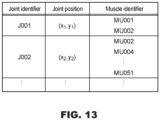
- the joint information is information on a joint.
- the joint information typically has a joint identifier.
- the joint identifier is information for identifying a joint.
- the joint identifier is, for example, an ID of a joint or a name of a joint.
- the joint information is associated with muscle identifiers of two or more muscles connected to the joint.
- a muscle identified with a muscle identifier corresponding to the joint information is a muscle for moving a joint specified with the joint information.
- the joint information indicates, for example, a joint position.
- the joint position is information for specifying a position of the joint.
- the joint position is typically a relative position of the joint within the avatar.
- the joint position is, for example, the coordinate values (x, y) of the center of gravity of the joint. Note that the data structure of the joint position is not limited.
- the feature information that is to be acquired is, for example, red “R” constituting a color, green “G” constituting a color, blue “B” constituting a color, a pixel value, or an object identifier that is the result of object recognition performed on the image.
- the feature information that is to be acquired is, for example, frequency or amplitude.
- the feature information that is to be acquired is, for example, the class of the character string.
- the initial determining part 1311 acquires, for example, one or more pieces of feature information from the input information accepted by the input accepting unit 121.
- the initial determining part 1311 refers to the firing start point storage unit 112, and acquires one or more firing node identifiers for which the acquired one or more pieces of feature information satisfy a firing condition, from the firing start point storage unit 112.
- the initial determining part 1311 acquires, for example, one or more pieces of feature information from the input information accepted by the input accepting unit 121, determines whether or not each node, of nodes identified with node identifiers corresponding to the firing condition that matches the one or more pieces of feature information, will fire according to the probability indicated by the firing probability, and acquires a firing node identifier for identifying that node only in a case in which it is determined that the node will fire.
- the propagating part 1312 acquires one or more connected node identifiers corresponding to each of the one or more firing node identifiers acquired by the initial determining part 1311.
- the propagating part 1312 acquires an information identifier contained in each of one or more pieces of feature information respectively corresponding to the one or more firing node identifiers acquired by the initial determining part 1311.
- the propagating part 1312 may acquire an information quantity corresponding to each information identifier.
- the propagating part 1312 preferably reduces an information quantity contained in feature information corresponding to a firing node identifier acquired by the initial determining part 1311 using a predetermined arithmetic formula (e.g., " ⁇ 0.9”) and acquires the reduced information quantity.
- a predetermined arithmetic formula e.g., " ⁇ 0.9
- the propagating part 1312 determines whether or not the acquired information identifier, the acquired information quantity, or the acquired information identifier and information quantity match a firing condition that is paired with each of the one or more connected node identifiers.
- the propagating part 1312 acquires, as a firing node identifier, only a connected node identifier that is paired with a firing condition determined as being matched.
- the propagating part 1312 acquires a connected node identifier corresponding to each of the one or more firing node identifiers acquired by the initial determining part 1311, according to the probability indicated by the propagation probability. If the NN has a propagation probability associated with each of the one or more node identifiers, the propagating part 1312 acquires a connected node identifier corresponding to each of the acquired one or more connected node identifiers, according to the probability indicated by the propagation probability.
- the propagating part 1312 preferably acquires or does not acquire, as a firing node identifier, a connected node identifier that is paired with a firing condition determined as being matched, according to the probability indicated by the propagation probability.
- the MNFP determining part 1313 acquires, in a time series, firing information having one or more firing node identifiers among the one or more firing node identifiers and the one or more connected node identifiers acquired by the initial determining part 1311 and the propagating part 1312.
- the acquiring information in a time series is acquiring information at two or more points in time.
- the MNFP determining part 1313 sequentially determines one or more MNFPs corresponding to the time-series firing information, out of the one or more MNFPs in the MNFP storage unit 113.
- the MNFPs corresponding to the time-series firing information are MNFPs that satisfy a correspondence condition.
- the movement determining unit 132 sequentially acquires movement determination information respectively corresponding to the one or more MNFPs determined by the MNFP determining unit 131, from the MNFP storage unit 113. That is to say, the movement determining unit 132 acquires, at each of two or more points in time, movement determination information respectively corresponding to the one or more MNFPs determined by the MNFP determining unit 131.
- the muscle determining part 1321 refers to the muscle storage unit 115, and sequentially determines one or more pieces of muscle information associated with each of one or more firing node identifiers specified with the one or more MNFPs determined by the MNFP determining unit 131. That is to say, the muscle determining part 1321 determines, at each of two or more points in time, one or more pieces of muscle information associated with each of one or more firing node identifiers specified with the one or more MNFPs determined by the MNFP determining unit 131.
- the one or more firing node identifiers specified with an MNFP are preferably one or more firing node identifiers at the latest point in time contained in the MNFP. Note that the one or more firing node identifiers specified with an MNFP may also be all firing node identifiers at two or more points in time contained in the MNFP.
- the intensity acquiring part 1322 acquires an intensity for each of the one or more pieces of muscle information determined by the muscle determining part 1321.
- the intensity acquiring part 1322 acquires, for each of the one or more pieces of muscle information determined by the muscle determining part 1321, a firing number, which is the number of firing node identifiers associated with the muscle information, for example.
- the intensity acquiring part 1322 acquires, for each of the one or more pieces of muscle information determined by the muscle determining part 1321, the maximum power indicated by the muscle information, from the muscle storage unit 115, for example.
- the intensity acquiring part 1322 sequentially acquires intensities using the firing number and the maximum power, for example.
- the intensity acquiring part 1322 typically acquires a higher intensity in accordance with an increase in the firing number.
- the intensity acquiring part 1322 typically acquires a higher intensity in accordance with an increase in the maximum power.
- the intensity acquiring part 1322 acquires, for example, an intensity using an increasing function in which the firing number and the maximum power are taken as parameters.
- the arithmetic formula indicating such an increasing function is stored in the storage unit 11.
- the intensity acquiring part 1322 acquires, for example, an intensity corresponding to the firing number and the maximum power from a correspondence table.
- the correspondence table is a table having two or more pieces of correspondence information each having the firing number and the maximum power and the intensity.
- the intensity acquiring part 1322 acquires, for example, an intensity that is paired with the firing number and the maximum power that most closely approximate the firing number and the maximum power, from the correspondence table.
- the intensity acquiring part 1322 calculates, for example, an attenuation rate for specifying a change in the intensity over time using, for example, a hill type model, and uses the attenuation rate to acquire time-series intensities such that the intensity approaches the maximum power or to acquire time-series intensities such that the intensity changes from the maximum power to 0.
- the intensity acquiring part 1322 acquires an intensity corresponding to each of the one or more pieces of muscle information.
- the intensity acquiring part 1322 sequentially acquires intensities respectively corresponding to the one or more pieces of muscle information.
- the intensity acquiring part 1322 sequentially acquires one or two or more pieces of movement muscle information.
- the movement muscle information is a pair of a muscle identifier and an intensity.
- the angle acquiring part 1323 refers to the joint storage unit 116, and sequentially acquires angles of joints respectively identified with one or more joint identifiers associated with muscle identifiers contained in the one or more pieces of muscle information determined by the muscle determining part 1321, using the one or more pieces of movement muscle information acquired by the intensity acquiring part 1322.
- the angle acquiring part 1323 calculates, for each of the one or more joints, the angle of the joint, using the intensity corresponding to one or more muscle identifiers that are paired with a joint identifier of the joint.
- the angle acquiring part 1323 determines, for example, a direction and an angle of bending of the joint using a physical calculation to calculate torque.
- the angle acquiring part 1323 sequentially acquires, for example, a joint-angle set, which is a set of pairs of a joint identifier and an angle.
- the joint-angle set may also be a set of pairs of an angle and a joint position.
- the moving unit 133 moves the movable object 2 sequentially using the one or more pieces of movement determination information acquired by the movement determining unit 132.
- the moving unit 133 sequentially moves the movable object 2, for example, based on one or more pieces of movement muscle information, each of which is a pair of a muscle identifier contained in each of the one or more pieces of muscle information determined by the muscle determining part 1321 and an intensity acquired by the intensity acquiring part 1322.
- the moving unit 133 outputs, for example, the angles of the respective one or more joints determined by the angle acquiring part 1323 to the movable object 2, thereby moving the movable object 2. That is to say, the moving unit 133 moves the movable object 2, for example, sequentially using the joint-angle set acquired the angle acquiring part 1323.
- the moving unit 133 configures an avatar whose joints respectively specified with the joint positions of the one or more joints have been bent according to the angles determined by the angle acquiring part 1323, using the avatar information, and outputs the avatar.
- the moving unit 133 sends an instruction to the robot to bend its joints respectively specified with the joint positions of the one or more joints, according to the angles determined by the angle acquiring part 1323, thereby moving the robot.
- the muscle changing unit 134 performs change processing for increasing a maximum power that is paired with a muscle identifier determined by the muscle determining part 1321, in a case in which the muscle identifier satisfies a predetermined increase condition.
- the increase condition is, for example, that the muscle determining part 1321 has determined a muscle identifier, that the number of times that the muscle determining part 1321 has determined a muscle identifier is greater than or equal to a threshold value or is greater than the threshold value, that the number of times in a unit time that the muscle determining part 1321 has determined a muscle identifier is greater than or equal to a threshold value or is greater than the threshold value, or the like.
- the degree to which the maximum power is increased is not limited. For example, if the increase condition is satisfied, the muscle changing unit 134 increases the maximum power that is paired with the muscle identifier by the number (e.g., "1") corresponding to the threshold value. For example, if the increase condition is satisfied, the muscle changing unit 134 increases the maximum power that is paired with the muscle identifier by the percentage (e.g., "10%") corresponding to the threshold value.
- the muscle changing unit 134 performs change processing for decreasing a maximum power that is paired with a muscle identifier not determined by the muscle determining part 1321, in a case in which the muscle identifier satisfies a predetermined decrease condition.
- the decrease condition is, for example, that the muscle identifier is a muscle identifier that has not been determined by the muscle determining part 1321 for a period of time whose length is greater than or equal to a threshold time or is greater than the threshold time.
- the degree to which the maximum power is decreased is not limited. For example, if the decrease condition is satisfied, the muscle changing unit 134 decreases the maximum power that is paired with the muscle identifier by the number (e.g., "1") corresponding to the threshold value. For example, if the decrease condition is satisfied, the muscle changing unit 134 decreases the maximum power that is paired with the muscle identifier by the percentage (e.g., "15%") corresponding to the threshold value.
- the learning unit 135 acquires an MNFP in a case in which the input accepting unit 121 accepts input information.
- the learning unit 135 accepts movement determination information.
- the learning unit 135 accumulates the MNFP in the MNFP storage unit 113 in association with the accepted movement determination information. This processing is referred to as learning processing.
- the storage unit 11, the NN storage unit 111, the firing start point storage unit 112, the MNFP storage unit 113, the avatar storage unit 114, the muscle storage unit 115, and the joint storage unit 116 are preferably non-volatile recording media, but may alternately be realized by volatile recording media.
- information may be stored in the storage unit 11 and the like via a recording medium
- information transmitted via a communication line or the like may be stored in the storage unit 11 and the like
- information input via an input device may be stored in the storage unit 11 and the like.
- the accepting unit 12 and the input accepting unit 121 may be realized by a device driver for an input part such as a touch screen or a keyboard, control software for a menu screen, or the like. Note that the accepting unit 12 and the like may be realized by wireless or wired communication parts.
- the processing unit 13, the MNFP determining unit 131, the movement determining unit 132, the moving unit 133, the muscle changing unit 134, the learning unit 135, the initial determining part 1311, the propagating part 1312, the MNFP determining part 1313, the muscle determining part 1321, the intensity acquiring part 1322, and the angle acquiring part 1323 may be typically realized by processors, memories, or the like.
- the processing procedure of the processing unit 13 and the like is realized by software, and the software is stored in a recording medium such as a ROM.
- the processing procedure may be realized by hardware (dedicated circuits).
- the processors are, for example, CPUs, MPUs, GPUs, or the like, and there is no limitation on the type thereof.
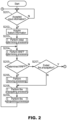
- Step S201 The input accepting unit 121 determines whether or not it has accepted input information. If it has accepted input information, the procedure advances to step S202, or otherwise the procedure returns to step S201.
- Step S202 The initial determining part 1311 acquires one or more pieces of feature information from the input information accepted in step S201.
- the technique for acquiring one or more pieces of feature information from input information such as images, speeches, or character strings is a known technique.
- Embodiment 2 is different from Embodiment 1 in that the movable object is an object with no joint.
- the movable object is, for example, a face.
- a movement of a muscle corresponding to the movable object is simulated.
- an information processing apparatus that, in a case in which the muscle that moves is a muscle of a face, acquires an intensity of stretching and contraction for each mesh of the face and uses the intensity for each mesh to change the face.
- FIG. 15 is a block diagram of a movement system B in this embodiment.
- the movement system B includes an information processing apparatus 3 and a movable object 4.
- the information processing apparatus 3 may be configured to include the movable object 4.
- the movable object 4 is an object that moves.
- the movable object 4 is, for example, an avatar or a robot, but the type thereof is not limited.
- Various types of information are stored in the storage unit 31 constituting the information processing apparatus 3.
- the various types of information are, for example, a neural network (NN), firing start point information, an MNFP, avatar information, or muscle information.
- Avatar information for outputting an avatar is stored in the avatar storage unit 314.
- the avatar information in this case does not have to indicate a joint.
- the avatar information is, for example, information for configuring a face of a living organism such as a person.
- the data structure of the avatar information is not limited.
- the avatar information typically has model information.
- the model information is information for configuring the avatar display.
- the model information has, for example, mesh information.
- the muscle information in this case is information on a mesh that moves in a case in which one or two or more nodes fire.
- the muscle information is information associated with one or two or more firing node identifiers.
- the muscle information has, for example, a muscle identifier.
- the muscle information has, for example, a muscle identifier, a maximum power, and a mesh position.
- the mesh is a partial region of a face of an avatar.
- the muscle identifier in this case is information for identifying a mesh, which is a partial region of a face of an avatar.
- the muscle identifier in this case may also be said to be a mesh identifier.
- the mesh position is information for specifying a position of a mesh.
- the processing unit 33 performs various types of processing.
- the various types of processing are, for example, processing that is performed by the movement determining unit 332, the moving unit 333, and the muscle changing unit 334.
- the movement determining unit 332 sequentially acquires movement determination information respectively corresponding to the one or more MNFPs determined by the MNFP determining unit 131.
- the movement determining unit 332 typically performs processing that is performed by the muscle determining part 1321 and the intensity acquiring part 1322.
- the moving unit 333 sequentially moves the movable object 4 based on one or more pieces of movement muscle information, each of which is a pair of a muscle identifier contained in each of the one or more pieces of muscle information determined by the muscle determining part 1321 and an intensity acquired by the intensity acquiring part 1322.
- the moving unit 333 sequentially stretches and contracts meshes identified with muscle identifiers contained in the muscle information determined by the muscle determining part 1321.
- the muscle changing unit 334 performs change processing for increasing a maximum power that is paired with a muscle identifier determined by the muscle determining part 1321, in a case in which the muscle identifier satisfies a predetermined increase condition.
- the muscle changing unit 334 performs change processing for decreasing a maximum power that is paired with a muscle identifier not determined by the muscle determining part 1321, in a case in which the muscle identifier satisfies a predetermined decrease condition.
- the muscle changing unit 334 may perform the same processing as the muscle changing unit 134.
- the storage unit 31, the avatar storage unit 314, and the muscle storage unit 315 are preferably non-volatile recording media, but may alternately be realized by volatile recording media.
- information may be stored in the storage unit 31 and the like via a recording medium
- information transmitted via a communication line or the like may be stored in the storage unit 31 and the like
- information input via an input device may be stored in the storage unit 11 and the like.
- the processing unit 33, the movement determining unit 332, the moving unit 333, and the muscle changing unit 334 may be typically realized by processors, memories, or the like.
- the processing procedure of the processing unit 33 and the like is realized by software, and the software is stored in a recording medium such as a ROM.
- the processing procedure may be realized by hardware (dedicated circuits).
- the processors are, for example, CPUs, MPUs, GPUs, or the like, and there is no limitation on the type thereof.
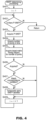
- Step S1602 The movement determining unit 132 determines whether or not there is an l th muscle identifier whose corresponding firing number is one or more. If there is an l th muscle identifier, the procedure advances to step S1603, or otherwise the procedure advances to step S1607.
- Step S1603 The movement determining unit 132 acquires a firing number corresponding to the l th muscle identifier. If there is a maximum power corresponding to the l th muscle identifier, the movement determining unit 132 acquires the firing number and the maximum power.
- Step S1605 The movement determining unit 132 temporarily stores the l th muscle identifier and the intensity that is acquired in step S1604 as a pair in an unshown buffer.
- Step S1606 The movement determining unit 132 increments the counter 1 by 1. The procedure returns to step S1602.
- Step S1607 The moving unit 133 contracts a muscle (in this case, typically a mesh) identified with each muscle identifier, by the amount corresponding to the intensity, using the one or more pairs of a muscle identifier and an intensity stored in the unshown buffer, thereby moving the movable object 4 (e.g., a face of an avatar).
- the procedure returns to the upper-level processing.
- FIG. 17 is a block diagram of a movement system C in this embodiment.
- the movement system C includes an information processing apparatus 5 and a movable object 6.
- the information processing apparatus 5 may be configured to include the movable object 6.
- the movable object 6 is an object that moves.
- the movable object 6 is, for example, an avatar or a robot, but the type thereof is not limited.
- the information processing apparatus 5 includes a storage unit 51, an accepting unit 12, and a processing unit 53.
- the storage unit 51 includes an NN storage unit 111, a firing start point storage unit 112, an MNFP storage unit 113, an avatar storage unit 114, and a module storage unit 511.
- the processing unit 53 includes an MNFP determining unit 131, a movement determining unit 532, a moving unit 533, and a learning unit 135.
- Various types of information are stored in the storage unit 51 constituting the information processing apparatus 5.
- the various types of information are, for example, a neural network (NN), firing start point information, an MNFP, avatar information, or a module.
- Each movement module is a program for moving the movable object 6.
- the movement module is, for example, an execution module, a function, or a method, but the type thereof is not limited.
- the movement module is associated with the movement identifier.
- the movement identifier is information for identifying a movement.
- the movement identifier is, for example, a name of a movement module or an ID of a movement module.
- the processing unit 53 performs various types of processing.
- the various types of processing are, for example, processing that is performed by the MNFP determining unit 131, the movement determining unit 532, the moving unit 533, and the learning unit 135.
- the movement determining unit 532 sequentially acquires movement determination information respectively corresponding to the one or more MNFPs determined by the MNFP determining unit 131.
- the movement determining unit 532 sequentially acquires movement identifiers respectively corresponding to the one or more MNFPs determined by the MNFP determining unit 131.
- the movement identifiers are associated with the MNFPs in the MNFP storage unit 113.
- the moving unit 533 moves the movable object 6 sequentially using the one or more pieces of movement determination information acquired by the movement determining unit 532.
- the moving unit 533 sequentially executes movement modules associated with the movement identifiers, acquired by the movement determining unit 532, thereby moving the movable object 6.
- the storage unit 51 and the module storage unit 511 are preferably non-volatile recording media, but may alternately be realized by volatile recording media.
- information may be stored in the storage unit 51 and the like via a recording medium
- information transmitted via a communication line or the like may be stored in the storage unit 51 and the like
- information input via an input device may be stored in the storage unit 51 and the like.
- the processing unit 53, the movement determining unit 532, and the moving unit 533 may be typically realized by processors, memories, or the like.
- the processing procedure of the processing unit 53 and the like is realized by software, and the software is stored in a recording medium such as a ROM.
- the processing procedure may be realized by hardware (dedicated circuits).
- the processors are, for example, CPUs, MPUs, GPUs, or the like, and there is no limitation on the type thereof.
- the operation example of the information processing apparatus 5 constituting the movement system C is the same as that described with reference to the flowchart in FIG. 2 , except for the moving processing in step S206.
- Step S1801 The movement determining unit 532 acquires a movement identifier corresponding to the i th MNFP from the MNFP storage unit 113.
- Step S1802 The moving unit 533 acquires a movement module identified with the movement identifier acquired in step S1801, from the module storage unit 511, and executes the movement module. The procedure advances to step S510.
- the learning processing is processing for learning an MNFP.
- Step S1901 The learning unit 135 determines whether or not it has accepted input information and movement determination information that are for use in learning. If it has accepted such information, the procedure advances to step S1902, or otherwise the procedure returns to step S1901.
- the movement determination information in this case is, for example, movement muscle information.
- Step S1902 The learning unit 135 determines whether or not a learning condition is satisfied. If a learning condition is satisfied, the procedure advances to step S1903, or otherwise the procedure advances to step S208.
- the learning condition is a condition for accumulating an MNFP in the MNFP storage unit 113.
- the learning condition is, for example, a condition regarding the number of points in time or a condition regarding the firing information.
- the condition regarding the number of points in time is a condition regarding the number of points in time in the firing information accumulated in the firing information storage unit 117, and is, for example, that the number of points in time is greater than or equal to a threshold value.
- the condition regarding the firing information is a condition regarding the content of the firing information, and is, for example, that the number of firing nodes is greater than or equal to a threshold value.
- the learning unit 135 acquires an MNFP stored in the firing information storage unit 117 at the current point in time.
- the MNFP in this case is information for specifying a set of firing node identifiers at each point in time from the first point in time to the current point in time, and is, for example, the above-described matrix.
- the matrix is a matrix of two axes consisting of a time axis and a node identifier.
- Step S1904 The learning unit 135 performs the MNFP accumulating processing.
- An example of the MNFP accumulating processing will be described with reference to the flowchart in FIG. 20 .
- the MNFP accumulating processing is processing for accumulating an MNFP in the MNFP storage unit 113.
- the processing at the steps S203, S208, and S209 may be performed by the learning unit 135.
- step S1904 an example of the MNFP accumulating processing in step S1904 will be described with reference to the flowchart in FIG. 20 .
- the learning unit 135 acquires one or more muscle identifiers contained in the accepted movement determination information.
- the one or more muscle identifiers are identifiers of muscles that move in a case in which input information is accepted.
- Step S2002 The learning unit 135 substitutes 1 for a counter i.
- Step S2003 The learning unit 135 determines whether or not there is an i th muscle identifier among the muscle identifiers acquired in step S2001. If there is an i th muscle identifier, the procedure advances to step S2004, or otherwise the procedure advances to step S2007.
- the learning unit 135 refers to the muscle storage unit 315, and acquires one or more firing node identifiers corresponding to the i th muscle identifier.
- Step S2005 The learning unit 135 sets the value of the nodes corresponding to the one or more firing node identifiers acquired in step S2004, the firing node identifiers being the node identifiers at the last point in time in the MNFP acquired in step S1903, to the value of a firing node (e.g., "1").
- a firing node e.g., "1"
- Step S2007 The learning unit 135 accumulates the MNFP changed in step S2005, in the MNFP storage unit 113. The procedure returns to the upper-level processing.
- the learning processing in this case is different from the learning processing described with reference to FIG. 19 , only in the MNFP accumulating processing.
Landscapes
- Engineering & Computer Science (AREA)
- Physics & Mathematics (AREA)
- Theoretical Computer Science (AREA)
- General Physics & Mathematics (AREA)
- Evolutionary Computation (AREA)
- Software Systems (AREA)
- General Engineering & Computer Science (AREA)
- Artificial Intelligence (AREA)
- Mathematical Physics (AREA)
- Computing Systems (AREA)
- Biomedical Technology (AREA)
- Biophysics (AREA)
- Data Mining & Analysis (AREA)
- Life Sciences & Earth Sciences (AREA)
- Health & Medical Sciences (AREA)
- Computational Linguistics (AREA)
- General Health & Medical Sciences (AREA)
- Molecular Biology (AREA)
- Probability & Statistics with Applications (AREA)
- Computer Vision & Pattern Recognition (AREA)
- Geometry (AREA)
- Computer Hardware Design (AREA)
- Medical Informatics (AREA)
- Mathematical Optimization (AREA)
- Neurology (AREA)
- Robotics (AREA)
- Pure & Applied Mathematics (AREA)
- Mathematical Analysis (AREA)
- Computational Mathematics (AREA)
- Algebra (AREA)
- Processing Or Creating Images (AREA)
Applications Claiming Priority (1)
| Application Number | Priority Date | Filing Date | Title |
|---|---|---|---|
| PCT/JP2022/010059 WO2023170795A1 (ja) | 2022-03-08 | 2022-03-08 | 情報処理装置、情報処理方法、およびプログラム |
Publications (2)
| Publication Number | Publication Date |
|---|---|
| EP4492284A1 true EP4492284A1 (de) | 2025-01-15 |
| EP4492284A4 EP4492284A4 (de) | 2025-12-24 |
Family
ID=87936257
Family Applications (1)
| Application Number | Title | Priority Date | Filing Date |
|---|---|---|---|
| EP22930780.6A Pending EP4492284A4 (de) | 2022-03-08 | 2022-03-08 | Informationsverarbeitungsvorrichtung, informationsverarbeitungsverfahren und programm |
Country Status (4)
| Country | Link |
|---|---|
| US (1) | US20250209238A1 (de) |
| EP (1) | EP4492284A4 (de) |
| JP (1) | JP7761750B2 (de) |
| WO (1) | WO2023170795A1 (de) |
Family Cites Families (5)
| Publication number | Priority date | Publication date | Assignee | Title |
|---|---|---|---|---|
| JP6864085B2 (ja) * | 2017-04-10 | 2021-04-21 | ソフトバンク株式会社 | 情報処理装置、情報処理方法、およびプログラム |
| JP7459050B2 (ja) * | 2018-07-27 | 2024-04-01 | マジック リープ, インコーポレイテッド | 仮想キャラクタの姿勢空間変形のための姿勢空間次元低減 |
| TWI829944B (zh) * | 2020-02-27 | 2024-01-21 | 未來市股份有限公司 | 虛擬化身臉部表情產生系統和虛擬化身臉部表情產生方法 |
| EP3933698A1 (de) | 2020-07-03 | 2022-01-05 | Honda Research Institute Europe GmbH | Verfahren und steuerungseinheit zur erzeugung einer stilisierten bewegung eines objekts, wie etwa eines roboters oder eines virtuellen avatars |
| JP7237891B2 (ja) * | 2020-07-15 | 2023-03-13 | ソフトバンク株式会社 | 学習実行装置、プログラム、及び学習実行方法 |
-
2022
- 2022-03-08 EP EP22930780.6A patent/EP4492284A4/de active Pending
- 2022-03-08 WO PCT/JP2022/010059 patent/WO2023170795A1/ja not_active Ceased
- 2022-03-08 US US18/844,336 patent/US20250209238A1/en active Pending
- 2022-03-08 JP JP2024505704A patent/JP7761750B2/ja active Active
Also Published As
| Publication number | Publication date |
|---|---|
| JPWO2023170795A1 (de) | 2023-09-14 |
| US20250209238A1 (en) | 2025-06-26 |
| WO2023170795A1 (ja) | 2023-09-14 |
| JP7761750B2 (ja) | 2025-10-28 |
| EP4492284A4 (de) | 2025-12-24 |
Similar Documents
| Publication | Publication Date | Title |
|---|---|---|
| KR102527878B1 (ko) | 키 포인트 학습 모델 구축 방법, 장치, 전자 기기 및 판독 가능한 저장 매체 그리고 프로그램 | |
| KR102877638B1 (ko) | 뉴럴 네트워크 양자화를 위한 방법 및 장치 | |
| CN117218498A (zh) | 基于多模态编码器的多模态大语言模型训练方法及系统 | |
| CN112434462A (zh) | 一种模型的获取方法及设备 | |
| CN105701120B (zh) | 确定语义匹配度的方法和装置 | |
| WO2019099305A1 (en) | Meta-learning for multi-task learning for neural networks | |
| Passalis et al. | Continuous drone control using deep reinforcement learning for frontal view person shooting | |
| US11417095B2 (en) | Image recognition method and apparatus, electronic device, and readable storage medium using an update on body extraction parameter and alignment parameter | |
| CN110782015A (zh) | 神经网络的网络结构优化器的训练方法、装置及存储介质 | |
| JP4201012B2 (ja) | データ処理装置、データ処理方法、およびプログラム | |
| CN113850362A (zh) | 一种模型蒸馏方法及相关设备 | |
| CN111598213B (zh) | 网络训练方法、数据识别方法、装置、设备和介质 | |
| CN110516389B (zh) | 行为控制策略的学习方法、装置、设备及存储介质 | |
| CN111738403A (zh) | 一种神经网络的优化方法及相关设备 | |
| CN112529149A (zh) | 一种数据处理方法及相关装置 | |
| CN110263916A (zh) | 数据处理方法和装置、存储介质及电子装置 | |
| US12386873B2 (en) | Apparatus and method for sharing and pruning weights for vision and language models | |
| CN114819100B (zh) | 目标检测模型的神经网络搜索方法、装置和电子设备 | |
| WO2024067113A1 (zh) | 一种动作预测方法及其相关设备 | |
| CN119597951A (zh) | 执行边缘云端融合的视觉提示大型语言模型的方法 | |
| EP4492284A1 (de) | Informationsverarbeitungsvorrichtung, informationsverarbeitungsverfahren und programm | |
| CN119397418B (zh) | 基于分布式多智能体强化学习的对象分类方法及装置 | |
| CN113994379B (zh) | 信息处理装置 | |
| CN119810748A (zh) | 障碍物检测方法及其模型获取方法、装置和智能家居设备 | |
| CN117274615B (zh) | 人体动作预测方法及相关产品 |
Legal Events
| Date | Code | Title | Description |
|---|---|---|---|
| STAA | Information on the status of an ep patent application or granted ep patent |
Free format text: STATUS: THE INTERNATIONAL PUBLICATION HAS BEEN MADE |
|
| PUAI | Public reference made under article 153(3) epc to a published international application that has entered the european phase |
Free format text: ORIGINAL CODE: 0009012 |
|
| STAA | Information on the status of an ep patent application or granted ep patent |
Free format text: STATUS: REQUEST FOR EXAMINATION WAS MADE |
|
| 17P | Request for examination filed |
Effective date: 20241008 |
|
| AK | Designated contracting states |
Kind code of ref document: A1 Designated state(s): AL AT BE BG CH CY CZ DE DK EE ES FI FR GB GR HR HU IE IS IT LI LT LU LV MC MK MT NL NO PL PT RO RS SE SI SK SM TR |
|
| DAV | Request for validation of the european patent (deleted) | ||
| DAX | Request for extension of the european patent (deleted) | ||
| A4 | Supplementary search report drawn up and despatched |
Effective date: 20251121 |
|
| RIC1 | Information provided on ipc code assigned before grant |
Ipc: G06N 3/04 20230101AFI20251117BHEP |