EP4492270A1 - Electronic control device and authentication method - Google Patents
Electronic control device and authentication method Download PDFInfo
- Publication number
- EP4492270A1 EP4492270A1 EP23766621.9A EP23766621A EP4492270A1 EP 4492270 A1 EP4492270 A1 EP 4492270A1 EP 23766621 A EP23766621 A EP 23766621A EP 4492270 A1 EP4492270 A1 EP 4492270A1
- Authority
- EP
- European Patent Office
- Prior art keywords
- software
- development
- hardware
- mass
- production
- Prior art date
- Legal status (The legal status is an assumption and is not a legal conclusion. Google has not performed a legal analysis and makes no representation as to the accuracy of the status listed.)
- Pending
Links
Images



Classifications
-
- G—PHYSICS
- G06—COMPUTING OR CALCULATING; COUNTING
- G06F—ELECTRIC DIGITAL DATA PROCESSING
- G06F21/00—Security arrangements for protecting computers, components thereof, programs or data against unauthorised activity
- G06F21/50—Monitoring users, programs or devices to maintain the integrity of platforms, e.g. of processors, firmware or operating systems
- G06F21/57—Certifying or maintaining trusted computer platforms, e.g. secure boots or power-downs, version controls, system software checks, secure updates or assessing vulnerabilities
- G06F21/572—Secure firmware programming, e.g. of basic input output system [BIOS]
-
- G—PHYSICS
- G06—COMPUTING OR CALCULATING; COUNTING
- G06F—ELECTRIC DIGITAL DATA PROCESSING
- G06F11/00—Error detection; Error correction; Monitoring
- G06F11/36—Prevention of errors by analysis, debugging or testing of software
- G06F11/362—Debugging of software
- G06F11/3648—Debugging of software using additional hardware
-
- G—PHYSICS
- G06—COMPUTING OR CALCULATING; COUNTING
- G06F—ELECTRIC DIGITAL DATA PROCESSING
- G06F21/00—Security arrangements for protecting computers, components thereof, programs or data against unauthorised activity
- G06F21/30—Authentication, i.e. establishing the identity or authorisation of security principals
- G06F21/44—Program or device authentication
-
- G—PHYSICS
- G06—COMPUTING OR CALCULATING; COUNTING
- G06F—ELECTRIC DIGITAL DATA PROCESSING
- G06F21/00—Security arrangements for protecting computers, components thereof, programs or data against unauthorised activity
- G06F21/70—Protecting specific internal or peripheral components, in which the protection of a component leads to protection of the entire computer
- G06F21/71—Protecting specific internal or peripheral components, in which the protection of a component leads to protection of the entire computer to assure secure computing or processing of information
- G06F21/73—Protecting specific internal or peripheral components, in which the protection of a component leads to protection of the entire computer to assure secure computing or processing of information by creating or determining hardware identification, e.g. serial numbers
-
- B—PERFORMING OPERATIONS; TRANSPORTING
- B60—VEHICLES IN GENERAL
- B60R—VEHICLES, VEHICLE FITTINGS, OR VEHICLE PARTS, NOT OTHERWISE PROVIDED FOR
- B60R25/00—Fittings or systems for preventing or indicating unauthorised use or theft of vehicles
-
- G—PHYSICS
- G06—COMPUTING OR CALCULATING; COUNTING
- G06F—ELECTRIC DIGITAL DATA PROCESSING
- G06F8/00—Arrangements for software engineering
- G06F8/60—Software deployment
- G06F8/65—Updates
Definitions
- the present invention relates to an electronic control device mounted in a vehicle and relates to an authentication method executed by an electronic control device.
- An electronic control device which is mounted in a vehicle and controls in-vehicle equipment, needs to be protected from unauthorized modification of data stored in a nonvolatile storage device (ROM) for cybersecurity measures and the like.
- ROM nonvolatile storage device
- a technique has been proposed in which in the case of setting a key code (secret information) in the ROM, access is controlled according to an authentication result using the key code.
- Patent Document 1 JP 2014-222546 A
- a software program that operates using a mass-produced electronic control device with security measures is subjected to, for example, redevelopment and modification.
- These redevelopment and modification works may be performed using an electronic control device for development, which is different from the mass-produced electronic control device.
- a situation may arise in which the security authentication information set in the software program created for application to the electronic control device for mass production does not conform to the electronic control device for development, and data cannot be rewritten.
- An object of an aspect of the present invention is to achieve rewriting of software program data for mass production in an electronic control device for development while maintaining effective security measures.
- an electric control device includes a processor, a nonvolatile storage device that is electronically data rewritable, and an interface that enables communication with an external data rewriting device.
- a hardware ID unique to the electronic control device and a software ID associated with a software program are set in the nonvolatile storage device, and the data rewriting device is permitted to rewrite data of the nonvolatile storage device depending on a result of collating the hardware ID with the software ID.
- a software ID for development used during development of the electronic control device and a software ID for mass-production used during mass-production of the electronic control device are set as the software ID in the nonvolatile storage device.
- the processor acquires the hardware ID and the software ID for mass-production from the nonvolatile storage device, and collates the hardware ID with the software ID for mass-production.
- the processor further acquires the software ID for development from the nonvolatile storage device to collate the hardware ID with the software ID for development.
- ECU electronic control unit
- the ECU and a software program installed in the ECU are developed by the ECU developer (supplier).
- the ECU for development used at the time of ECU development and the data of the program for development stored in the ROM is delivered from the developer to the automobile manufacturer.
- vehicle experiments and the like are conducted by the automobile manufacturer and it is confirmed that the program conforms to the vehicle, the ECU and the ROM storing the program are mass-produced by the developer.
- such an ECU for mass production and ROM storing the program for mass production are delivered to an automobile manufacturer or the like.
- ID authentication is performed when accessing data stored in the ROM as an example of a method for preventing unauthorized modification of data stored in the ROM.
- a debugging tool for development such as a Joint Test Action Group (JTAG) communication tool connected via a debugging interface for development sets a hardware ID, which is an ECU-specific ID, in a predetermined region of the ROM inside a microcomputer installed in the ECU. Then, when accessing the ROM via the debugging interface for development thereafter, ID authentication of inputting the hardware ID set in the ROM is required in the debugging tool for development. As a result, it is possible to prevent unauthorized rewriting of ROM data of the ECU from a debugging tool for development or the like.
- JTAG Joint Test Action Group
- an ID authentication function using software ID set in the software program stored in the ROM is also activated. More specifically, in this ID authentication, the software ID set in the ROM is collated with a hardware ID when ROM data is rewritten using a data rewriting tool such as a controller area network (CAN) communication tool connected via a data rewriting interface. Then, rewriting of the ROM data by the data rewriting tool is permitted only when the IDs match.
- a data rewriting tool such as a controller area network (CAN) communication tool connected via a data rewriting interface.
- an automobile manufacturer performs redevelopment and modification of a mass-produced software program. These redevelopment and modification works may be performed using an ECU for development by the automobile manufacturer.
- the ID authentication function is activated as described above, the software ID included in data set in the ROM of the ECU for mass-production does not match the hardware ID set in the ROM of the ECU for development. Hence, rewriting of ROM data using the data rewriting tool is not permitted due to the ID authentication, and program modification work using the data rewriting tool cannot be done by the automobile manufacturer.
- the problem is solved by delivering an ECU for development in which a hardware ID for mass-production is set or delivering data of a ROM in which a hardware ID of an ECU for development is set from the ECU developer to the automobile manufacturer, for example.
- a hardware ID for mass-production is set
- a ROM read-only memory
- a hardware ID of an ECU for development is set from the ECU developer to the automobile manufacturer, for example.
- the present embodiment provides a method for enabling rewriting of ROM data by a data rewriting tool in an ECU for development in a state in which ECU security measures are activated.
- FIG. 1 is a diagram for describing an overall configuration of the present embodiment.
- a debugging tool 20 for development and a data rewriting tool 30 are connected to an ECU 10 as necessary when developing or modifying a software program operating on ECU 10 mounted in a vehicle.
- ECU 10 is an electronic control device that electronically controls in-vehicle equipment.
- ECU 10 includes a microcomputer including a processor and a memory (detailed configuration will be described later), and executes a software program to perform electronic control of various in-vehicle equipment.
- Debugging tool 20 for development is a computer mainly used for testing, debugging, and the like of integrated circuits and boards at the time of development of ECU 10.
- debugging tool 20 for development is connected to ECU 10 by JTAG communication signal lines (clock, data input, data output, status control, and the like) to exchange data with ECU 10 by JTAG communication.
- JTAG communication signal lines clock, data input, data output, status control, and the like
- Such debugging tool 20 for development may use other schemes (e.g., AUD, UART, DAP, or the like).
- Data rewriting tool 30 is a computer mainly used for rewriting programs at the time of modification of the software program operating on ECU 10.
- data rewriting tool 30 is connected to ECU 10 by a CAN bus to exchange data with ECU 10 by CAN communication.
- data rewriting tool 30 can be connected to ECU 10 by other schemes such as Ethernet (registered trademark), FlexRay, and the like.
- ECU 10 includes a processor 11, a RAM 12, a ROM 13, communication interfaces 14a and 14b, and an internal bus 15 communicatively connecting these components.
- Processor 11 is hardware that executes a set of instructions (data transfer, calculation, processing, control, management, and the like) described in the program, and is formed of an arithmetic unit, a register that stores instructions and information, peripheral circuits, and the like.
- RAM 12 is formed of a volatile memory (static RAM or the like) that loses data when the power supply is interrupted, and provides a temporary storage region used by processor 11 during operation.
- ROM 13 is formed of a nonvolatile memory (flash ROM or the like) in which data can be electrically rewritten.
- ROM 13 stores control programs (e.g., programs for controlling a vehicle engine, automatic transmission, fuel injection device, and the like) according to functions of ECU 10 and various kinds of data used for processing of the programs.
- control programs e.g., programs for controlling a vehicle engine, automatic transmission, fuel injection device, and the like
- ROM 13 stores control programs (e.g., programs for controlling a vehicle engine, automatic transmission, fuel injection device, and the like) according to functions of ECU 10 and various kinds of data used for processing of the programs.
- a hardware ID and a software ID used in ID authentication processing are stored in ROM 13.
- a program and data for performing the ID authentication processing are stored in ROM 13.
- Communication interfaces 14a and 14b provide functions for enabling communication with other devices connected to ECU 10.
- communication interface 14a is an interface for enabling communication with external debugging tool 20 for development.
- Communication interface 14b is an interface for enabling communication with external data rewriting tool 30.
- ECU 10 may further include a communication interface that enables communication with an in-vehicle network (CAN network or the like) or in-vehicle equipment related to control (e.g., various sensors, actuators, and the like), for example, using CAN communication or the like or another communication scheme (on-off, analog signals or the like).
- CAN network CAN network or the like
- in-vehicle equipment related to control e.g., various sensors, actuators, and the like
- Internal bus 15 is a path for exchanging data among the devices, and includes an address bus for transferring addresses, a data bus for transferring data, and a control bus that transmits timings for actually performing input and output by the address bus and the data bus and control information.
- ECUs 10 there are two types of ECUs 10 which are an ECU 10A for development used in a development process and modification process of ECU 10, and an ECU 10B for mass-production mass-produced and mounted in a vehicle.
- FIG. 3 mainly illustrates an example of an internal region of a ROM 13A included in ECU 10A for development in a development process of ECU 10 performed by the developer.
- ROM 13A includes an unrewritable region 131A in which data is basically not rewritable from the outside, and a rewritable region 132A in which data is rewritable from the outside.
- a hardware ID for development is set in unrewritable region 131A by debugging tool 20 for development when ECU 10A is shipped. This hardware ID for development is used for ID authentication when accessing data stored in ROM 13A of ECU 10A after the ID authentication function is activated at the first access to ECU 10.
- a software program for development is stored in rewritable region 132A, and a software ID for development that matches the hardware ID for development is set.
- the ID authentication processing in this example is as follows. First, when authenticating access to ROM 13A by debugging tool 20 for development, an ID input in debugging tool 20 for development is collated with the hardware ID for development set in ROM 13A. Then, if the IDs match, rewriting of data of ROM 13A by debugging tool 20 for development is permitted. That is, the user of debugging tool 20 for development can rewrite data of ROM 13 if the user knows the hardware ID for development. On the other hand, for access to ROM 13A by data rewriting tool 30, the hardware ID of unrewritable region 131A of ROM 13 is collated with the software ID of rewritable region 132A.
- FIG. 4 mainly illustrates an example of an internal region of ROM 13B included in ECU 10B for mass-production after ECU 10 is mass-produced.
- ROM 13B includes an unrewritable region 131B in which data is basically not rewritable, and a rewritable region 132B in which data is basically rewritable.
- a hardware ID for mass-production is set in unrewritable region 131B by debugging tool 20 for development when ECU 10B is shipped.
- This hardware ID for mass-production is used for ID authentication when accessing data stored in ROM 13B of ECU 10B after the ID authentication function is activated at the first access to ECU 10B.
- a software program for mass production is stored in rewritable region 132B, and a software ID for mass-production that matches the hardware ID for mass-production is set.
- the ID authentication processing in this example is as follows. First, when authenticating access to ROM 13B by debugging tool 20 for development, an ID input in debugging tool 20 for development is collated with the hardware ID for mass-production set in ROM 13B. Then, if the IDs match, rewriting of data of ROM 13B by debugging tool 20 for development is permitted. In this case, the user of debugging tool 20 for development can rewrite data of ROM 13 if the user knows the hardware ID for mass-production. By ensuring the confidentiality of the hardware ID for mass-production, security measures are maintained effectively.
- the hardware ID of unrewritable region 131B of ROM 13 is collated with the software ID of rewritable region 132B. Then, if the IDs match, rewriting of data of ROM 13B by data rewriting tool 30 is permitted.
- the hardware ID for mass-production of unrewritable region 131B matches the software ID for mass-production of rewritable region 132B. Hence, rewriting of data of rewritable region 132B of ROM 13 by data rewriting tool 30 is permitted.
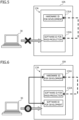
- FIG. 5 illustrates an example of the internal region of the conventional ROM 13A and ID authentication processing in this situation.
- the software ID for mass-production has been set in rewritable region 132B of ROM 13B for mass-production.
- the hardware ID for development in unrewritable region 131A does not match the software ID for mass-production set in rewritable region 132A.
- rewriting of data of rewritable region 132A of ROM 13 by data rewriting tool 30 is prohibited.
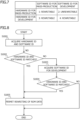
- FIG. 6 illustrates an example of the internal region of the ROM 13A of the present embodiment and ID authentication processing in this situation.
- the software ID for mass-production not only the software ID for mass-production, but also the software ID for development is set in rewritable region 132B of ROM 13B of ECU 10B for mass-production.
- both the software ID for mass-production and the software ID for development are set in rewritable region 132A. In this case, as illustrated in FIG.
- the hardware ID for development in unrewritable region 131A does not match the software ID for mass-production set in rewritable region 132A.
- the hardware ID for development in unrewritable region 131A is further collated with the software ID for development set in rewritable region 132A. In this case, the IDs match, and therefore rewriting of data in rewritable region 132B of ROM 13 by data rewriting tool 30 is permitted.
- FIG. 7 shows whether or not rewriting of data in rewritable region 132 of ROM 13 by the data rewriting tool 30 is permitted for each combination of hardware ID and software ID in such ID authentication processing in a matrix.
- Pattern 1 Hardware ID for mass-production and software ID for mass-production
- the hardware ID for mass-production in unrewritable region 131B matches the software ID for mass-production in rewritable region 132B. Accordingly, rewriting of data of ROM 13B by data rewriting tool 30 is permitted.
- Pattern 2 Hardware ID for mass-production and software ID for development
- the hardware ID for mass-production in unrewritable region 131B does not match the software ID for development in rewritable region 132B. Accordingly, rewriting of data of ROM 13B by data rewriting tool 30 is prohibited.
- Pattern 3 Hardware ID for development and software ID for mass-production
- the software ID for development is also set in rewritable region 132A of ROM 13A.
- the hardware ID for development in unrewritable region 131A matches the software ID for development in rewritable region 132A. Accordingly, rewriting of ROM 13B by data rewriting tool 30 is permitted.
- Pattern 4 Hardware ID for development and software ID for development
- the hardware ID for development in unrewritable region 131A matches the software ID for development in rewritable region 132A. Accordingly, rewriting of data of ROM 13B by data rewriting tool 30 is permitted.
- FIG. 7 is a flowchart illustrating the ID authentication processing in the present embodiment described above. This ID authentication processing is achieved by loading a program stored in ROM 13 of ECU 10 into RAM 12 and executing the program by processor 11.
- processor 11 acquires a hardware ID and a software ID used for ID authentication. More specifically, processor 11 acquires the hardware ID set in unrewritable region 131 of ROM 13 of ECU 10 and the software ID set in rewritable region 132 of ROM 13.
- step 1002 processor 11 determines whether or not the hardware ID matches the software ID. If the IDs do not match, the processing proceeds to step 1003 (No), and if the IDs match, the processing proceeds to step 1005 (Yes).
- processor 11 further acquires the software ID for development set in rewritable region 132 of ROM 13.
- step 1004 processor 11 determines whether or not the hardware ID matches the software ID for development acquired in step 1003. If the IDs match, the processing proceeds to step 1005 (Yes), and if the IDs do not match, the processing is terminated.
- step 1005 processor 11 permits rewriting of data of rewritable region 132 of ROM 13 by data rewriting tool 30. Note that when the processing is terminated without performing the processing of step 1005, rewriting of data of rewritable region 132 of ROM 13 by data rewriting tool 30 is prohibited.
- the authentication is performed by also using the software ID for development.
- ID authentication processing is executed in ECU 10A for development, rewriting of data by data rewriting tool 30 is permitted even when data of ROM 13B for mass-production is applied to ECU 10A for development.
- the software program for mass-production can be modified using ECU 10A for development while effectively maintaining the ID authentication function of ECU 10 itself. As a result, the labor required to address security issues to make such modifications can be significantly reduced.
- the ID authentication function of ECU 10 since the ID authentication function of ECU 10 is thus maintained effectively, it is still possible to prevent unauthorized access to ECU 10B for mass-production from debugging tool 20 for development or the like by ID authentication processing, for example.
- ID authentication processing for example.
- an example of an ID generation method for making security measures in ECU 10B for mass-production more robust will be described with reference to FIG. 9 .
- the ROM 13B of ECU 10B for mass-production stores both first information (corresponding to public key) that is readable from the outside, and second information (corresponding to private key) that is unreadable from the outside. Of the two pieces of information, the second information unreadable from the outside is also retained in a key management server 90.
- an ID to be used in ECU 10B for mass-production such first and second information are used as inputs, and calculations are performed using a predetermined formula (e.g., hash function) in which the output for the input is constant. Then, the output result (hash value) of the calculation is used as the ID for ECU 10B for mass-production.
- a predetermined formula e.g., hash function
- the output result (hash value) of the calculation is used as the ID for ECU 10B for mass-production.
- the ID authentication processing of the present embodiment determines whether or not the hardware ID and the software ID match, these IDs do not need to be a perfect match. That is, the hardware ID and software ID may be any combination of values, as long as the combination is such that when the hardware ID is collated with the software ID, it can be determined whether the hardware ID conforms to software ID.
- the processing may control access to data of ROM 13.
Landscapes
- Engineering & Computer Science (AREA)
- Theoretical Computer Science (AREA)
- Computer Hardware Design (AREA)
- Physics & Mathematics (AREA)
- General Engineering & Computer Science (AREA)
- Computer Security & Cryptography (AREA)
- General Physics & Mathematics (AREA)
- Software Systems (AREA)
- Mathematical Physics (AREA)
- Quality & Reliability (AREA)
- Stored Programmes (AREA)
- Storage Device Security (AREA)
Abstract
Description
- The present invention relates to an electronic control device mounted in a vehicle and relates to an authentication method executed by an electronic control device.
- An electronic control device, which is mounted in a vehicle and controls in-vehicle equipment, needs to be protected from unauthorized modification of data stored in a nonvolatile storage device (ROM) for cybersecurity measures and the like. As an example for controlling such access to the data in the ROM, a technique has been proposed in which in the case of setting a key code (secret information) in the ROM, access is controlled according to an authentication result using the key code.
-
Patent Document 1: JP 2014-222546 A - In general, in order to deal with annual improvements to vehicles, horizontal deployment of vehicle models, and the like, a software program that operates using a mass-produced electronic control device with security measures is subjected to, for example, redevelopment and modification. These redevelopment and modification works may be performed using an electronic control device for development, which is different from the mass-produced electronic control device. At this time, a situation may arise in which the security authentication information set in the software program created for application to the electronic control device for mass production does not conform to the electronic control device for development, and data cannot be rewritten.
- An object of an aspect of the present invention is to achieve rewriting of software program data for mass production in an electronic control device for development while maintaining effective security measures.
- In an aspect of the present invention, an electric control device includes a processor, a nonvolatile storage device that is electronically data rewritable, and an interface that enables communication with an external data rewriting device. In the electric control device, a hardware ID unique to the electronic control device and a software ID associated with a software program are set in the nonvolatile storage device, and the data rewriting device is permitted to rewrite data of the nonvolatile storage device depending on a result of collating the hardware ID with the software ID. Here, in the electronic control device, a software ID for development used during development of the electronic control device and a software ID for mass-production used during mass-production of the electronic control device are set as the software ID in the nonvolatile storage device. Then, the processor acquires the hardware ID and the software ID for mass-production from the nonvolatile storage device, and collates the hardware ID with the software ID for mass-production. As a result, when the hardware ID does not conform to the software ID for mass-production, the processor further acquires the software ID for development from the nonvolatile storage device to collate the hardware ID with the software ID for development.
- According to an aspect of the present invention, it is possible to achieve rewriting of software program data for mass production in an electronic control device for development while maintaining effective security measures.
-
-
FIG. 1 is a diagram illustrating an example of an overall configuration of an embodiment of the present invention. -
FIG. 2 is a diagram illustrating an example of the hardware configuration of an ECU. -
FIG. 3 is a diagram illustrating an example of the internal configuration of a ROM of an ECU and ID authentication processing. -
FIG. 4 is a diagram illustrating an example of the internal configuration of a ROM of an ECU and ID authentication processing. -
FIG. 5 is a diagram illustrating an example of the internal configuration of a ROM of an ECU and ID authentication processing. -
FIG. 6 is a diagram illustrating an example of the internal configuration of a ROM of an ECU and ID authentication processing. -
FIG. 7 is a diagram illustrating an example of patterns of ID authentication processing. -
FIG. 8 is a diagram of a flowchart illustrating an example of ID authentication processing. -
FIG. 9 is a diagram illustrating an example of a generation method of an ID for mass-production. - Hereinafter, an embodiment of the present invention will be described with reference to the drawings. Note that the present invention is not limited to the embodiment described in the present specification, and other embodiments and modifications thereof can be combined as appropriate.
- First, a detailed description will be given of the technical background to which the present embodiment may be applied. As an aspect of the development process of an electronic control device (electronic control unit (ECU)) mounted in a vehicle such as an automobile, the ECU and a software program installed in the ECU are developed by the ECU developer (supplier). Then, the ECU for development used at the time of ECU development and the data of the program for development stored in the ROM is delivered from the developer to the automobile manufacturer. Then, when vehicle experiments and the like are conducted by the automobile manufacturer and it is confirmed that the program conforms to the vehicle, the ECU and the ROM storing the program are mass-produced by the developer. Then, such an ECU for mass production and ROM storing the program for mass production are delivered to an automobile manufacturer or the like.
- Here, in the ECU mounted in a vehicle, ID authentication is performed when accessing data stored in the ROM as an example of a method for preventing unauthorized modification of data stored in the ROM. More specifically, a debugging tool for development such as a Joint Test Action Group (JTAG) communication tool connected via a debugging interface for development sets a hardware ID, which is an ECU-specific ID, in a predetermined region of the ROM inside a microcomputer installed in the ECU. Then, when accessing the ROM via the debugging interface for development thereafter, ID authentication of inputting the hardware ID set in the ROM is required in the debugging tool for development. As a result, it is possible to prevent unauthorized rewriting of ROM data of the ECU from a debugging tool for development or the like.
- However, when this ID authentication function is activated, an ID authentication function using software ID set in the software program stored in the ROM is also activated. More specifically, in this ID authentication, the software ID set in the ROM is collated with a hardware ID when ROM data is rewritten using a data rewriting tool such as a controller area network (CAN) communication tool connected via a data rewriting interface. Then, rewriting of the ROM data by the data rewriting tool is permitted only when the IDs match.
- In general, in order to deal with annual improvements to vehicles, horizontal deployment of vehicle models, and the like, an automobile manufacturer performs redevelopment and modification of a mass-produced software program. These redevelopment and modification works may be performed using an ECU for development by the automobile manufacturer. However, when the ID authentication function is activated as described above, the software ID included in data set in the ROM of the ECU for mass-production does not match the hardware ID set in the ROM of the ECU for development. Hence, rewriting of ROM data using the data rewriting tool is not permitted due to the ID authentication, and program modification work using the data rewriting tool cannot be done by the automobile manufacturer. In this case, the problem is solved by delivering an ECU for development in which a hardware ID for mass-production is set or delivering data of a ROM in which a hardware ID of an ECU for development is set from the ECU developer to the automobile manufacturer, for example. However, in a situation in which there are more annual improvements and horizontal deployment of vehicle models than new program developments, such measures for problem solving require large amounts of labor.
- Against this background, the present embodiment provides a method for enabling rewriting of ROM data by a data rewriting tool in an ECU for development in a state in which ECU security measures are activated.
-
FIG. 1 is a diagram for describing an overall configuration of the present embodiment. In the present embodiment, adebugging tool 20 for development and adata rewriting tool 30 are connected to anECU 10 as necessary when developing or modifying a software program operating onECU 10 mounted in a vehicle. - ECU 10 is an electronic control device that electronically controls in-vehicle equipment. ECU 10 includes a microcomputer including a processor and a memory (detailed configuration will be described later), and executes a software program to perform electronic control of various in-vehicle equipment.
-
Debugging tool 20 for development is a computer mainly used for testing, debugging, and the like of integrated circuits and boards at the time of development ofECU 10. In the present embodiment,debugging tool 20 for development is connected toECU 10 by JTAG communication signal lines (clock, data input, data output, status control, and the like) to exchange data withECU 10 by JTAG communication. Note thatsuch debugging tool 20 for development may use other schemes (e.g., AUD, UART, DAP, or the like). -
Data rewriting tool 30 is a computer mainly used for rewriting programs at the time of modification of the software program operating onECU 10. In the present embodiment,data rewriting tool 30 is connected toECU 10 by a CAN bus to exchange data withECU 10 by CAN communication. Note that suchdata rewriting tool 30 can be connected toECU 10 by other schemes such as Ethernet (registered trademark), FlexRay, and the like. - Next, the hardware configuration of
ECU 10 will be described. As illustrated inFIG. 2 ,ECU 10 includes aprocessor 11, aRAM 12, aROM 13,communication interfaces internal bus 15 communicatively connecting these components. -
Processor 11 is hardware that executes a set of instructions (data transfer, calculation, processing, control, management, and the like) described in the program, and is formed of an arithmetic unit, a register that stores instructions and information, peripheral circuits, and the like. -
RAM 12 is formed of a volatile memory (static RAM or the like) that loses data when the power supply is interrupted, and provides a temporary storage region used byprocessor 11 during operation. -
ROM 13 is formed of a nonvolatile memory (flash ROM or the like) in which data can be electrically rewritten.ROM 13 stores control programs (e.g., programs for controlling a vehicle engine, automatic transmission, fuel injection device, and the like) according to functions ofECU 10 and various kinds of data used for processing of the programs. Moreover, in the present embodiment, a hardware ID and a software ID used in ID authentication processing are stored inROM 13. Furthermore, a program and data for performing the ID authentication processing are stored inROM 13. -
Communication interfaces ECU 10. Specifically,communication interface 14a is an interface for enabling communication withexternal debugging tool 20 for development.Communication interface 14b is an interface for enabling communication with externaldata rewriting tool 30. Note that although not illustrated,ECU 10 may further include a communication interface that enables communication with an in-vehicle network (CAN network or the like) or in-vehicle equipment related to control (e.g., various sensors, actuators, and the like), for example, using CAN communication or the like or another communication scheme (on-off, analog signals or the like). -
Internal bus 15 is a path for exchanging data among the devices, and includes an address bus for transferring addresses, a data bus for transferring data, and a control bus that transmits timings for actually performing input and output by the address bus and the data bus and control information. - Next, an internal region of
ROM 13 ofECU 10 and ID authentication patterns will be described. In the present embodiment, there are two types ofECUs 10 which are anECU 10A for development used in a development process and modification process ofECU 10, and anECU 10B for mass-production mass-produced and mounted in a vehicle. -
FIG. 3 mainly illustrates an example of an internal region of aROM 13A included inECU 10A for development in a development process ofECU 10 performed by the developer.ROM 13A includes anunrewritable region 131A in which data is basically not rewritable from the outside, and arewritable region 132A in which data is rewritable from the outside. A hardware ID for development is set inunrewritable region 131A by debuggingtool 20 for development whenECU 10A is shipped. This hardware ID for development is used for ID authentication when accessing data stored inROM 13A ofECU 10A after the ID authentication function is activated at the first access toECU 10. Additionally, a software program for development is stored inrewritable region 132A, and a software ID for development that matches the hardware ID for development is set. - The ID authentication processing in this example is as follows. First, when authenticating access to
ROM 13A by debuggingtool 20 for development, an ID input indebugging tool 20 for development is collated with the hardware ID for development set inROM 13A. Then, if the IDs match, rewriting of data ofROM 13A by debuggingtool 20 for development is permitted. That is, the user ofdebugging tool 20 for development can rewrite data ofROM 13 if the user knows the hardware ID for development. On the other hand, for access toROM 13A bydata rewriting tool 30, the hardware ID ofunrewritable region 131A ofROM 13 is collated with the software ID ofrewritable region 132A. Then, if the IDs match, rewriting ofROM 13A bydata rewriting tool 30 is permitted. In this example, the hardware ID for development ofunrewritable region 131A matches the software ID for development ofrewritable region 132A. Hence, rewriting of data ofrewritable region 132A ofROM 13 bydata rewriting tool 30 is permitted. - Next,
FIG. 4 mainly illustrates an example of an internal region ofROM 13B included inECU 10B for mass-production afterECU 10 is mass-produced. As in the case ofECU 10A for development,ROM 13B includes anunrewritable region 131B in which data is basically not rewritable, and arewritable region 132B in which data is basically rewritable. A hardware ID for mass-production is set inunrewritable region 131B by debuggingtool 20 for development whenECU 10B is shipped. This hardware ID for mass-production is used for ID authentication when accessing data stored inROM 13B ofECU 10B after the ID authentication function is activated at the first access toECU 10B. Additionally, a software program for mass production is stored inrewritable region 132B, and a software ID for mass-production that matches the hardware ID for mass-production is set. - The ID authentication processing in this example is as follows. First, when authenticating access to
ROM 13B by debuggingtool 20 for development, an ID input indebugging tool 20 for development is collated with the hardware ID for mass-production set inROM 13B. Then, if the IDs match, rewriting of data ofROM 13B by debuggingtool 20 for development is permitted. In this case, the user ofdebugging tool 20 for development can rewrite data ofROM 13 if the user knows the hardware ID for mass-production. By ensuring the confidentiality of the hardware ID for mass-production, security measures are maintained effectively. On the other hand, for access toROM 13B bydata rewriting tool 30, the hardware ID ofunrewritable region 131B ofROM 13 is collated with the software ID ofrewritable region 132B. Then, if the IDs match, rewriting of data ofROM 13B bydata rewriting tool 30 is permitted. In this example, the hardware ID for mass-production ofunrewritable region 131B matches the software ID for mass-production ofrewritable region 132B. Hence, rewriting of data ofrewritable region 132B ofROM 13 bydata rewriting tool 30 is permitted. - Next, a description will be given of a case in which redevelopment or modification of a mass-produced software program is performed using
ECU 10A for development to deal with annual improvements to vehicles, horizontal deployment of vehicle models, etc., described earlier. In this case, data stored inrewritable region 132B ofROM 13B ofECU 10B for mass-production is set inrewritable region 132A ofROM 13A ofECU 10A for development. - Here,
FIG. 5 illustrates an example of the internal region of theconventional ROM 13A and ID authentication processing in this situation. Conventionally, only the software ID for mass-production has been set inrewritable region 132B ofROM 13B for mass-production. Hence, when the data is set inrewritable region 132A ofROM 13A ofECU 10A for development, only the software ID for mass-production is set inrewritable region 132A. In this case, in the ID authentication processing, the hardware ID for development inunrewritable region 131A does not match the software ID for mass-production set inrewritable region 132A. Hence, rewriting of data ofrewritable region 132A ofROM 13 bydata rewriting tool 30 is prohibited. - On the other hand,
FIG. 6 illustrates an example of the internal region of theROM 13A of the present embodiment and ID authentication processing in this situation. In the present embodiment, not only the software ID for mass-production, but also the software ID for development is set inrewritable region 132B ofROM 13B ofECU 10B for mass-production. Hence, when the data is set inrewritable region 132A ofROM 13A ofECU 10A for development, both the software ID for mass-production and the software ID for development are set inrewritable region 132A. In this case, as illustrated inFIG. 6 , in the ID authentication processing, the hardware ID for development inunrewritable region 131A does not match the software ID for mass-production set inrewritable region 132A. However, in this case, in the present embodiment, the hardware ID for development inunrewritable region 131A is further collated with the software ID for development set inrewritable region 132A. In this case, the IDs match, and therefore rewriting of data inrewritable region 132B ofROM 13 bydata rewriting tool 30 is permitted. -
FIG. 7 shows whether or not rewriting of data in rewritable region 132 ofROM 13 by thedata rewriting tool 30 is permitted for each combination of hardware ID and software ID in such ID authentication processing in a matrix. - This is ID authentication processing in
ECU 10B for mass-production, and is a pattern in which the software ID for mass-production is set inrewritable region 132B ofROM 13B (pattern ofFIG. 4 above). In this case, the hardware ID for mass-production inunrewritable region 131B matches the software ID for mass-production inrewritable region 132B. Accordingly, rewriting of data ofROM 13B bydata rewriting tool 30 is permitted. - This is ID authentication processing in
ECU 10B for mass-production, and is a pattern in which the software ID for development is set inrewritable region 132B ofROM 13B. In this situation, the hardware ID for mass-production inunrewritable region 131B does not match the software ID for development inrewritable region 132B. Accordingly, rewriting of data ofROM 13B bydata rewriting tool 30 is prohibited. - This is ID authentication processing in
ECU 10A for development, and is a pattern in which the software ID for mass-production is set inrewritable region 132A ofROM 13A. In this case, in the conventional state illustrated inFIG. 5 , rewriting ofROM 13B bydata rewriting tool 30 is prohibited. However, as illustrated inFIG. 6 , in the present embodiment, the software ID for development is also set inrewritable region 132A ofROM 13A. In this case, the hardware ID for development inunrewritable region 131A matches the software ID for development inrewritable region 132A. Accordingly, rewriting ofROM 13B bydata rewriting tool 30 is permitted. - This is ID authentication processing in
ECU 10A for development, and is a pattern in which the software ID for development is set inrewritable region 132A ofROM 13A (pattern ofFIG. 3 above). In this case, the hardware ID for development inunrewritable region 131A matches the software ID for development inrewritable region 132A. Accordingly, rewriting of data ofROM 13B bydata rewriting tool 30 is permitted. -
FIG. 7 is a flowchart illustrating the ID authentication processing in the present embodiment described above. This ID authentication processing is achieved by loading a program stored inROM 13 ofECU 10 intoRAM 12 and executing the program byprocessor 11. - In step 1001 (expressed as S1001 in
FIG. 7 , the same applies to following steps),processor 11 acquires a hardware ID and a software ID used for ID authentication. More specifically,processor 11 acquires the hardware ID set in unrewritable region 131 ofROM 13 ofECU 10 and the software ID set in rewritable region 132 ofROM 13. - In step 1002,
processor 11 determines whether or not the hardware ID matches the software ID. If the IDs do not match, the processing proceeds to step 1003 (No), and if the IDs match, the processing proceeds to step 1005 (Yes). - In step 1003,
processor 11 further acquires the software ID for development set in rewritable region 132 ofROM 13. - In step 1004,
processor 11 determines whether or not the hardware ID matches the software ID for development acquired in step 1003. If the IDs match, the processing proceeds to step 1005 (Yes), and if the IDs do not match, the processing is terminated. - In step 1005,
processor 11 permits rewriting of data of rewritable region 132 ofROM 13 bydata rewriting tool 30. Note that when the processing is terminated without performing the processing of step 1005, rewriting of data of rewritable region 132 ofROM 13 bydata rewriting tool 30 is prohibited. - According to the present embodiment, in ID authentication processing regarding access to
ROM 13 ofECU 10, when the hardware ID for development set inROM 13 does not match the software ID for mass-production, the authentication is performed by also using the software ID for development. Hence, when such ID authentication processing is executed inECU 10A for development, rewriting of data bydata rewriting tool 30 is permitted even when data ofROM 13B for mass-production is applied toECU 10A for development. Accordingly, when performing redevelopment or modification of a mass-produced software program, the software program for mass-production can be modified usingECU 10A for development while effectively maintaining the ID authentication function ofECU 10 itself. As a result, the labor required to address security issues to make such modifications can be significantly reduced. - Moreover, in the present embodiment, since the ID authentication function of
ECU 10 is thus maintained effectively, it is still possible to prevent unauthorized access toECU 10B for mass-production from debuggingtool 20 for development or the like by ID authentication processing, for example. Here, an example of an ID generation method for making security measures inECU 10B for mass-production more robust will be described with reference toFIG. 9 . As illustrated inFIG. 9 , theROM 13B ofECU 10B for mass-production stores both first information (corresponding to public key) that is readable from the outside, and second information (corresponding to private key) that is unreadable from the outside. Of the two pieces of information, the second information unreadable from the outside is also retained in akey management server 90. Then, when generating an ID to be used inECU 10B for mass-production, such first and second information are used as inputs, and calculations are performed using a predetermined formula (e.g., hash function) in which the output for the input is constant. Then, the output result (hash value) of the calculation is used as the ID forECU 10B for mass-production. This makes it possible to generate a unique ID using the unique information stored inROM 13B ofECU 10B for mass-production, and also prevents external identification of the information used as input for the calculation formula. Note that this ID generation method is also applicable to IDs used inECU 10A for development. - Note that while the ID authentication processing of the present embodiment determines whether or not the hardware ID and the software ID match, these IDs do not need to be a perfect match. That is, the hardware ID and software ID may be any combination of values, as long as the combination is such that when the hardware ID is collated with the software ID, it can be determined whether the hardware ID conforms to software ID.
- Additionally, while the ID authentication processing described above permits or prohibits rewriting of data of
ROM 13 bydata rewriting tool 30 depending on the result of collating the hardware ID with the software ID, the processing may control access to data ofROM 13. - The embodiments of the present invention described above are merely some of the embodiments conceivable within the technical scope of the present invention, and are disclosed as examples of the present invention. Thus, the embodiments are not intended to limit the technical scope of the present invention. Moreover, the functional configurations and physical configurations in the embodiments are not limited to the aspect described earlier. For example, the functions and physical resources can be implemented in an integrated manner, or conversely, further distributed, or even added, deleted, or replaced by other configurations for some parts of the configuration.
-
- 10
- ECU
- 10A
- ECU for development
- 10B
- ECU for mass-production
- 11
- Processor
- 13
- ROM
- 131
- Unrewritable region
- 132
- Rewritable region
- 20
- Debugging tool for development
- 30
- Data rewriting tool
Claims (5)
- An electronic control device comprising a processor, a nonvolatile storage device that is electrically data rewritable, and an interface that enables communication with an external data rewriting device, the nonvolatile storage device being set with a hardware ID unique to the electronic control device and a software ID associated with a software program, and the data rewriting device being permitted to rewrite data of the nonvolatile storage device depending on a result of collating the hardware ID with the software ID,wherein a software ID for development used during development of the electronic control device and a software ID for mass-production used during mass-production of the electronic control device are set as the software ID in the nonvolatile storage device, andwherein the processor acquires the hardware ID and the software ID for mass-production from the nonvolatile storage device, collates the hardware ID with the software ID for mass-production, and when the hardware ID does not conform to the software ID for mass-production, further acquires the software ID for development from the nonvolatile storage device to collate the hardware ID with the software ID for development.
- The electronic control device according to claim 1, wherein the hardware ID is set in a region of the nonvolatile storage device that is not rewritable from outside, and the software ID is set in a region of the nonvolatile storage device that is rewritable from outside.
- The electronic control device according to claim 1 further comprising an interface that enables communication with an external debugging tool for development, wherein
the processor collates the hardware ID with an ID input to the debugging tool for development, and permits rewriting of data of the nonvolatile storage device by the debugging tool for development on the basis of a result of the collation. - The electronic control device according to claim 1, wherein the hardware ID is generated using an output result of calculation performed with a predetermined calculation formula using, as an input, first information that is stored in the nonvolatile storage device and is readable from the outside and second information that is stored in the nonvolatile storage device and is unreadable from the outside.
- An authentication method executed by a processor of an electronic control device, the electronic control device comprising the processor, a nonvolatile storage device that is electrically data rewritable, and an interface that enables communication with an external data rewriting device, the nonvolatile storage device being set with a hardware ID unique to the electronic control device and a software ID associated with a software program, and the data rewriting device being permitted to rewrite data of the nonvolatile storage device depending on a result of collating the hardware ID with the software ID, the method causing the processor to perform the steps of:
acquiring, from the nonvolatile storage device in which a software ID for development used during development of the electronic control device and a software ID for mass-production used during mass-production of the electronic control device are set as the software ID, the hardware ID, and the software ID for mass-production, and collating the hardware ID with the software ID for mass-production; and when the hardware ID does not conform to the software ID for mass-production, further acquiring the software ID for development from the nonvolatile storage device, and collating the hardware ID with the software ID for development.
Applications Claiming Priority (2)
| Application Number | Priority Date | Filing Date | Title |
|---|---|---|---|
| JP2022037417 | 2022-03-10 | ||
| PCT/JP2023/007018 WO2023171443A1 (en) | 2022-03-10 | 2023-02-27 | Electronic control device and authentication method |
Publications (2)
| Publication Number | Publication Date |
|---|---|
| EP4492270A1 true EP4492270A1 (en) | 2025-01-15 |
| EP4492270A4 EP4492270A4 (en) | 2026-03-11 |
Family
ID=87935252
Family Applications (1)
| Application Number | Title | Priority Date | Filing Date |
|---|---|---|---|
| EP23766621.9A Pending EP4492270A4 (en) | 2022-03-10 | 2023-02-27 | ELECTRONIC CONTROL DEVICE AND AUTHENTICATION PROCEDURES |
Country Status (5)
| Country | Link |
|---|---|
| US (1) | US20250165378A1 (en) |
| EP (1) | EP4492270A4 (en) |
| JP (1) | JP7579480B2 (en) |
| CN (1) | CN118843861A (en) |
| WO (1) | WO2023171443A1 (en) |
Family Cites Families (6)
| Publication number | Priority date | Publication date | Assignee | Title |
|---|---|---|---|---|
| JP3550834B2 (en) * | 1995-11-13 | 2004-08-04 | 株式会社デンソー | Memory rewriting system for vehicle electronic control unit, vehicle electronic control unit and memory rewriting device |
| US20080101613A1 (en) * | 2006-10-27 | 2008-05-01 | Brunts Randall T | Autonomous Field Reprogramming |
| GB2477774A (en) | 2010-02-12 | 2011-08-17 | Icera Inc | Overriding production processor authentication restrictions through remote security unit for development code testing |
| JP5603993B2 (en) * | 2013-11-19 | 2014-10-08 | ルネサスエレクトロニクス株式会社 | Electrical unit and data processing method |
| JP5761880B2 (en) | 2014-08-22 | 2015-08-12 | ルネサスエレクトロニクス株式会社 | Automobile |
| IT201800005466A1 (en) * | 2018-05-17 | 2019-11-17 | METHOD AND DEVICE FOR WRITING SOFTWARE OBJECTS IN AN ELECTRONIC CONTROL UNIT OF AN INTERNAL COMBUSTION ENGINE |
-
2023
- 2023-02-27 JP JP2024506079A patent/JP7579480B2/en active Active
- 2023-02-27 WO PCT/JP2023/007018 patent/WO2023171443A1/en not_active Ceased
- 2023-02-27 EP EP23766621.9A patent/EP4492270A4/en active Pending
- 2023-02-27 US US18/839,822 patent/US20250165378A1/en active Pending
- 2023-02-27 CN CN202380026382.2A patent/CN118843861A/en active Pending
Also Published As
| Publication number | Publication date |
|---|---|
| JP7579480B2 (en) | 2024-11-07 |
| JPWO2023171443A1 (en) | 2023-09-14 |
| WO2023171443A1 (en) | 2023-09-14 |
| EP4492270A4 (en) | 2026-03-11 |
| CN118843861A (en) | 2024-10-25 |
| US20250165378A1 (en) | 2025-05-22 |
Similar Documents
| Publication | Publication Date | Title |
|---|---|---|
| CN108762783B (en) | Software updating method and device for vehicle system and vehicle system | |
| JP5419776B2 (en) | Semiconductor device and data processing method | |
| US20030051235A1 (en) | Method and apparatus for verifying and analyzing computer software installation | |
| US20130151836A1 (en) | Semiconductor device including encryption section, semiconductor device including external interface, and content reproduction method | |
| CN113935013A (en) | Method for securely updating a control device | |
| CN102763046B (en) | Programmable Logic Controller | |
| JP2023510122A (en) | Device with interface and method of operating device with interface | |
| US20250165378A1 (en) | Electronic control device and authentication method | |
| JP4585594B2 (en) | Licensed external memory | |
| US5751595A (en) | Method for building and verifying authenticity of a rule system | |
| CN114091008A (en) | Method for securely updating a control device | |
| KR101572854B1 (en) | A PLC device with enhanced cyber security | |
| JP4534731B2 (en) | Electronic control device and identification code generation method thereof | |
| CN101501585A (en) | Method for programming a controller in a motor vehicle | |
| CN111367559B (en) | Refreshing method for online refreshing patch of electric control module | |
| CN119895420A (en) | Method for verifying data in a computing unit | |
| JP5761880B2 (en) | Automobile | |
| US20260111555A1 (en) | Method and device for secure booting of electronic control unit through mutual authentication | |
| KR102864980B1 (en) | Method for reprogram with enganced security | |
| WO2021229084A1 (en) | Method and secure element for detecting a trusted electronic assembly | |
| DE102020206039A1 (en) | Create a container instance | |
| Yang et al. | SAE International™ | |
| US12151692B2 (en) | Performance tuning for electronic control unit | |
| CN116302021B (en) | BootLoader program online upgrading method, control unit and new energy automobile | |
| US11954205B2 (en) | Security control for electronic control unit |
Legal Events
| Date | Code | Title | Description |
|---|---|---|---|
| STAA | Information on the status of an ep patent application or granted ep patent |
Free format text: STATUS: THE INTERNATIONAL PUBLICATION HAS BEEN MADE |
|
| PUAI | Public reference made under article 153(3) epc to a published international application that has entered the european phase |
Free format text: ORIGINAL CODE: 0009012 |
|
| STAA | Information on the status of an ep patent application or granted ep patent |
Free format text: STATUS: REQUEST FOR EXAMINATION WAS MADE |
|
| 17P | Request for examination filed |
Effective date: 20240807 |
|
| AK | Designated contracting states |
Kind code of ref document: A1 Designated state(s): AL AT BE BG CH CY CZ DE DK EE ES FI FR GB GR HR HU IE IS IT LI LT LU LV MC ME MK MT NL NO PL PT RO RS SE SI SK SM TR |
|
| DAV | Request for validation of the european patent (deleted) | ||
| DAX | Request for extension of the european patent (deleted) | ||
| RAP3 | Party data changed (applicant data changed or rights of an application transferred) |
Owner name: ASTEMO, LTD. |
|
| A4 | Supplementary search report drawn up and despatched |
Effective date: 20260210 |
|
| RIC1 | Information provided on ipc code assigned before grant |
Ipc: G06F 21/57 20130101AFI20260204BHEP Ipc: G06F 21/44 20130101ALI20260204BHEP Ipc: B60R 25/24 20130101ALI20260204BHEP Ipc: G06F 8/65 20180101ALI20260204BHEP Ipc: G06F 21/73 20130101ALI20260204BHEP |