EP4492089A1 - Systems and methods for the detection of obstructing objects during the movement of a door leaf - Google Patents
Systems and methods for the detection of obstructing objects during the movement of a door leaf Download PDFInfo
- Publication number
- EP4492089A1 EP4492089A1 EP23185009.0A EP23185009A EP4492089A1 EP 4492089 A1 EP4492089 A1 EP 4492089A1 EP 23185009 A EP23185009 A EP 23185009A EP 4492089 A1 EP4492089 A1 EP 4492089A1
- Authority
- EP
- European Patent Office
- Prior art keywords
- door leaf
- speed
- signal
- spectrum
- arangement
- Prior art date
- Legal status (The legal status is an assumption and is not a legal conclusion. Google has not performed a legal analysis and makes no representation as to the accuracy of the status listed.)
- Pending
Links
Images




Classifications
-
- G—PHYSICS
- G01—MEASURING; TESTING
- G01S—RADIO DIRECTION-FINDING; RADIO NAVIGATION; DETERMINING DISTANCE OR VELOCITY BY USE OF RADIO WAVES; LOCATING OR PRESENCE-DETECTING BY USE OF THE REFLECTION OR RERADIATION OF RADIO WAVES; ANALOGOUS ARRANGEMENTS USING OTHER WAVES
- G01S7/00—Details of systems according to groups G01S13/00, G01S15/00, G01S17/00
- G01S7/02—Details of systems according to groups G01S13/00, G01S15/00, G01S17/00 of systems according to group G01S13/00
- G01S7/41—Details of systems according to groups G01S13/00, G01S15/00, G01S17/00 of systems according to group G01S13/00 using analysis of echo signal for target characterisation; Target signature; Target cross-section
- G01S7/415—Identification of targets based on measurements of movement associated with the target
-
- G—PHYSICS
- G01—MEASURING; TESTING
- G01S—RADIO DIRECTION-FINDING; RADIO NAVIGATION; DETERMINING DISTANCE OR VELOCITY BY USE OF RADIO WAVES; LOCATING OR PRESENCE-DETECTING BY USE OF THE REFLECTION OR RERADIATION OF RADIO WAVES; ANALOGOUS ARRANGEMENTS USING OTHER WAVES
- G01S13/00—Systems using the reflection or reradiation of radio waves, e.g. radar systems; Analogous systems using reflection or reradiation of waves whose nature or wavelength is irrelevant or unspecified
- G01S13/02—Systems using reflection of radio waves, e.g. primary radar systems; Analogous systems
- G01S13/50—Systems of measurement based on relative movement of target
- G01S13/52—Discriminating between fixed and moving objects or between objects moving at different speeds
- G01S13/56—Discriminating between fixed and moving objects or between objects moving at different speeds for presence detection
-
- G—PHYSICS
- G01—MEASURING; TESTING
- G01S—RADIO DIRECTION-FINDING; RADIO NAVIGATION; DETERMINING DISTANCE OR VELOCITY BY USE OF RADIO WAVES; LOCATING OR PRESENCE-DETECTING BY USE OF THE REFLECTION OR RERADIATION OF RADIO WAVES; ANALOGOUS ARRANGEMENTS USING OTHER WAVES
- G01S13/00—Systems using the reflection or reradiation of radio waves, e.g. radar systems; Analogous systems using reflection or reradiation of waves whose nature or wavelength is irrelevant or unspecified
- G01S13/02—Systems using reflection of radio waves, e.g. primary radar systems; Analogous systems
- G01S13/50—Systems of measurement based on relative movement of target
- G01S13/58—Velocity or trajectory determination systems; Sense-of-movement determination systems
- G01S13/60—Velocity or trajectory determination systems; Sense-of-movement determination systems wherein the transmitter and receiver are mounted on the moving object, e.g. for determining ground speed, drift angle, ground track
-
- G—PHYSICS
- G01—MEASURING; TESTING
- G01S—RADIO DIRECTION-FINDING; RADIO NAVIGATION; DETERMINING DISTANCE OR VELOCITY BY USE OF RADIO WAVES; LOCATING OR PRESENCE-DETECTING BY USE OF THE REFLECTION OR RERADIATION OF RADIO WAVES; ANALOGOUS ARRANGEMENTS USING OTHER WAVES
- G01S13/00—Systems using the reflection or reradiation of radio waves, e.g. radar systems; Analogous systems using reflection or reradiation of waves whose nature or wavelength is irrelevant or unspecified
- G01S13/88—Radar or analogous systems specially adapted for specific applications
Definitions
- the invention relates to systems comprising sensors to detect obstructing objects during the movement of a door leaf as well as methods for detecting obstructing objects during the movement of door leaves.
- Sensors for the detection of obstructing objects during the movement of door leaves are known in the art as well as methods of detecting obstructing objects during the movement of door leaves.
- An objective of the present invention is to propose systems comprising a door leaf and a sensor which provides reliable information about obstructing objects.
- a further objective of the present invention is to provide a method of detecting obstructing objects during the movement of door leaves.
- An embodiment of the present invention relates to a system comprising a door leaf and a sensor configured to detect obstructing objects during the movement of the door leaf.
- the sensor comprises a radar unit capable of emitting radar radiation and detecting reflected radiation.
- the radar unit is mounted on the door leaf and is moved together with the door leaf.
- the radar unit is configured to provide a Doppler signal during operation.
- An evaluation unit is configured to evaluate the spectrum of the Doppler signal taking the sensor's speed into account, and to generate an object detection signal based on the evaluation result.
- the senor Since the sensor is mounted on the door lead and moved together with the door leaf, stationary and moving obstructing objects can reliably be detected. For instance, in contrast to stationary radar units, the sensor can reliably detect also stationary objects because the movement of the radar unit causes a Doppler signal also for the non-moving objects.
- an evaluation of the Doppler signal provided by the radar unit allows distinguishing obstructing objects with respect to their kinematic behaviour. For instance, approaching objects can be distinguished from stationary objects as well as from other objects that move away from the door leaf. The information about the kinematic behaviour can be used for instance to improve the control of the door's movement with regard to the avoidance of a collision.
- the evaluation unit preferably calculates a threshold frequency that corresponds to the speed of the door leaf.
- the evaluation unit may generate an object detection signal that indicates an object moving towards the door leaf if the spectrum of the Doppler spectrum comprises a response above the threshold frequency.
- the evaluation unit may generate an object detection signal that indicates a stationary object if the spectrum of the Doppler spectrum comprises a response at the threshold frequency.
- the evaluation unit may generate an object detection signal that indicates an object moving away from the door leaf if the spectrum of the Doppler spectrum comprises a response below the threshold frequency.
- the evaluation unit is preferably configured to calculate and store a background data set based on a Doppler signal that has been measured during a learning step.
- the learning step preferably includes moving the door leaf from a predefined start position to a predefined end position wherein the movement takes place when no object obstructs the door's movement, and measuring the Doppler signal while the door leaf is moved, over time.
- the calculation of the background data set may include calculating a speed-normalized Doppler spectrum by removing the door velocity from the measured Doppler signal.
- the calculation of the background data set preferably includes generating a plurality of data entries, each of which refers to a given position of the sensor and comprises a speed-normalized Doppler spectrum measured at the respective position, wherein the data entries collectively cover the movement of the door from the predefined start position to the predefined end position.
- the background data set preferably comprises at least ten data entries that refer to ten different positions of the door leaf.
- Each data entry preferably indicates the signal strength of the speed-normalized Doppler signal over the speed-normalized Doppler frequency.
- the evaluation unit may be configured to evaluate a current speed-normalized Doppler spectrum at a current position of the door leaf by comparing the signal strength of the current speed-normalized Doppler spectrum with the data entry of the background data set that corresponds to said current position.
- the evaluation unit is preferably configured to generate an object detection signal that indicates an obstructing object if the difference between the signal strength of the current speed-normalized Doppler spectrum and the speed-normalized Doppler spectrum of the corresponding data entry exceeds a given threshold with respect to at least one speed-normalized Doppler frequency.
- the sensor may comprise a measurement unit configured to measure the acceleration of the door and generate an acceleration signal.
- the evaluation unit may be configured to calculate the position of the door leaf based on the measured acceleration signal.
- Another embodiment of the invention relates to a method of detecting obstructing objects during the movement of a door leaf.
- the method is characterized by the steps of emitting radar radiation and detecting reflected radiation using a radar unit, wherein the radar unit is mounted on the door leaf and is moved together with the door leaf, the radar unit being configured to provide a Doppler signal during operation, and evaluating the spectrum of the Doppler signal taking the sensor's speed into account, and to generate an object detection signal based on the evaluation result.
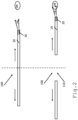
- Figure 1 depicts a first exemplary embodiment of a system 1 according to the present invention.
- the system 1 of Figure 1 comprises a door leaf 10 of a swing-door, and a sensor 20.
- the sensor 20 is mounted on the door leaf 10 and configured to detect obstructing objects during the movement of the door leaf 10.
- the sensor 20 is configured to emit radar radiation and detect radiation RR that is reflected by objects OB.
- the emitted radar field FR is delimited by two radar beams R1 and R2.
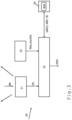
- FIG 3 shows the sensor 20 of Figure 1 in further detail.
- the sensor 20 comprises a radar unit 21, an evaluation unit 22 and a measurement unit 23.
- the measurement unit 23 of Figure 3 is an acceleration measurement device configured to measure the rotational acceleration dro/dt of the door leaf 10 and provide measurement values M that indicate the rotational speed ⁇ and/or the rotational acceleration d ⁇ /dt of the door leaf 10.
- the measurement unit 23 may be a 1-axis (or more than one axis) gyroscope, preferably a MEMS gyroscope.
- the radar unit 21 is configured to emit the radar field FR and detect the reflected radiation RR.
- the reflected radiation is processed in order to provide an output Doppler signal DS.
- the processing may include mixing an electrical detection signal that describes the detected radiation RR, with an electrical reference signal that describes the emitted radiation.
- the spectrum of the Doppler signal DS indicates the presence of the reflecting objects OB as well as the relative speed between the door leaf 10 and the reflecting objects OB. Since the radar unit 21 is mounted on the door leaf 10 and is moved together with the door leaf 10, the speed of the door leaf 10 should be considered when the speed of reflecting objects OB is calculated.
- the evaluation unit 22 may comprise one or more processor(s) to evaluate the spectrum of the Doppler signal DS in order to calculate speed signals SS (see normalized speed signals SSn in Figure 5 ) that describe the speed of the detected objects. During this evaluation, the sensor's 20 speed is taken into account. If the spectrum of the Doppler signal DS indicates one or more obstructing objects a corresponding object detection signal ODS is generated.
- the evaluation unit 22 combines the measurement values M from the gyroscope and the Doppler signal DS from the radar unit 21.
- the purpose of the gyroscope is to measure the rotation rate of the door.
- the radius or width may be communicated by service personnel as part of a calibration procedure.
- the sensor 20 may be configured to be installed at a pre-defined radius which is already implemented in the evaluation unit 22 as a constant value.
- the reflected and thereafter detected radar radiation RR is influenced by the relative motion between the sensor 20 and the reflecting objects (stationary or moving objects).
- the individual speed of each detected object can be derived from the spectrum of the reflected radar radiation.
- Such a calculation may yield a speed signal SS(t) (see normalized speed signals SSn in Figure 5 ) for each detected object.
- the calculation of speed signals SS by evaluating the frequency spectrum of a detected Doppler signal DS is well known in the art.
- the door's velocity v(t) can be calculated based on the measurement values M provided by the gyroscope, as explained above.
- the spectrum of the Doppler signal DS can be shifted by a frequency Fstatic that corresponds to the speed of the sensor 20 before calculating the speed signals.
- the normalized speed signals SSn can be directly calculated on the basis of the shifted spectrum.
- Figure 5 shows in an exemplary fashion the normalized speed signals SSn with respect to objects OB1-OB5 depicted in Figure 4 .
- the background signal is measured and stored in a memory 24 of the sensor 20 for later use during the normal operation of the system 1.
- the background signal may be measured and stored in the form of data pairs or data entries (x0( ⁇ ), d0( ⁇ , f)).
- Each data entry refers to a given position x0 and defines the speed-normalized Doppler spectrum d0( ⁇ , f) measured at the respective position x0 during the setup phase where no obstructing objects disturb the movement of the door leaf 10.
- the data entries (x0( ⁇ ), d0( ⁇ , f)) are preferably stored with respect to a time frame ⁇ ⁇ [0, T].
- T indicates the time when the door is fully open and comes to rest at the end of the setup phase.
- the speed-normalized Doppler spectrum can be calculated by shifting the measured Doppler spectrum by a correction frequency Fstatic that corresponds to the speed of the sensor 20.
- the resulting data pairs (x0( ⁇ ), d0( ⁇ , f)), ⁇ ⁇ ⁇ ⁇ 0, T ⁇ describe a "background signal", which constitutes a signal generated by the floor or other stationary objects that are always present and are a part of the background.
- the actual Doppler signal DS will be similar to the initially stored background signal described by the data pairs (x0( ⁇ ), d0( ⁇ , f)) ⁇ ⁇ ⁇ ⁇ 0, T ⁇ .
- Figure 4 shows such a scenario where three background objects OB1, OB2 and OB3 are part of the background and therefore already included in the stored background signal.
- a static obstructing object OB4 is not part of the background and therefore not included in the stored background signal.
- Figure 5 shows a simulated Doppler spectrum of the scenario depicted in Figure 4 .
- the radar radiation frequencies are already transformed into corresponding normalized speed signals SSn versus time t as the door moves.
- the static obstructing object OB4 initially generates a positive normalized speed signal. After circa 1 second, in the simulated scenario, the static obstructing object OB4 generates a negative normalized speed signal because the door has passed over the object.
- the dynamic object OB3 approaches the sensor 20 and therefore continuously generates a positive normalized speed signal that can be easily detected.
- Figure 6 shows the amplitude A of an example Doppler signal DS captured by the radar unit 21 over time t. It is apparent that the Doppler signal DS requires further analysis for instance by Fourier-transformation.
- Figure 7 shows the signal of Figure 6 after Fourier-processing in form of a frequency-time plot.
- the frequency-time plot identifies the different objects OB1-OB5 as well as their individual speeds.
- Figure 7 also depicts a threshold frequency Fstatic which describes and is proportional to the speed of the sensor 20.
- new objects OB4 and OB5 can be identified by evaluating the amplitudes of the speed-normalized Doppler spectrum and by comparing the actual speed-normalized Doppler spectrum with the stored background signal.
- the background objects OB1, OB2 and OB3 that are shown in Figure 7 are omitted to facilitate the comparison.
- Any Doppler frequency, for which the amplitude exceeds a given threshold amplitude and which is less than the threshold frequency Fstatic, is indicative of a dynamic object that is moving away from the sensor 20.
- Any Doppler frequency, for which the amplitude exceeds said given threshold amplitude and which is equal to the threshold frequency Fstatic, is indicative of a static object.
- Any Doppler frequency, for which the amplitude exceeds said given threshold amplitude and which exceeds the threshold frequency Fstatic, is indicative of a dynamic object moving towards the sensor 20.
- Th information regarding the direction of moving objects can be very helpful in predicting the time of collision and taking a corrective action.
- the motion profile of the door may change significantly due to wear and tear and the door-motor performance degradation. This may create a problem, if we store the background signal in terms of time ⁇ (e.g., ( ⁇ , d0( ⁇ , f)) instead of the location x0. Therefore, as discussed above, it is advantageous to store the data entries according to the position x0, which is backward calculated from the velocity of the door leaf 10 (see data entries (x0( ⁇ ), d0( ⁇ , f)) discussed above.
- ⁇ e.g., ( ⁇ , d0( ⁇ , f)
- Figure 2 depicts a second exemplary embodiment of a system 1 according to the present invention.
- the sensor 20 is mounted on the moving door leaf 10 of a sliding door 100 which provides a passage 110 in its open state.
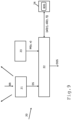
- the sensor 20 comprises a measurement unit 23 (see Figure 9 ) which is a 1-axis accelerometer (or a more than one axis accelerometer).
- the measurement unit 23 generates measurement values M that describe the acceleration a of the sensor 20.
- the calculation of the velocity v can be carried out by the measurement device 23 or the evaluation unit 22.
- the exemplary embodiments discussed above in connection with Figures 1-9 refer to systems 1 that comprises a door leaf 10 and a sensor 20 that is configured to detect obstructing objects during the movement of the door leaf 10.
- the sensor 20 comprises a radar unit 21 capable of emitting radar radiation and detecting reflected radiation RR.
- the radar unit 21 is mounted on the door leaf 10 and is moved together with the door leaf 10.
- the radar unit 21 is configured to provide a Doppler signal DS during operation.
- An evaluation unit 22 is configured to evaluate the spectrum of the Doppler signal DS taking the sensor's 20 speed into account, and to generate an object detection signal ODS based on the evaluation result.
- the evaluation unit 22 calculates and stores a background data set BDS based on a Doppler signal DS that has been measured during a learning step (initial setup- phase).
- the learning step includes moving the door leaf 10 from a predefined start position to a predefined end position wherein the movement takes place when no object obstructs the door's movement.
- the learning step further includes measuring the Doppler signal DS while the door leaf 10 is moved, over time.
- the evaluation unit 22 may further calculate a threshold frequency Fstatic that corresponds to the speed of the door leaf 10.
- the calculation of the background data set BDS may include calculating a speed-normalized Doppler spectrum by removing the door velocity from the measured Doppler signal DS.
- the removal of the door velocity from the measured Doppler signal DS can be carried out by shifting the measured Doppler signal DS by the threshold frequency Fstatic.
- the calculation of the background data set BDS includes generating a plurality of data entries (x0( ⁇ ), d0( ⁇ , f)).
- Each of the data entries (x0( ⁇ ), d0 ( ⁇ , f)) refers to a possible position x0( ⁇ ) of the sensor 20 and comprises a Doppler spectrum (preferably a speed-normalized Doppler spectrum) measured at the respective position.
- Each data entry (x0( ⁇ ), d0( ⁇ , f)) preferably indicates the signal strength (e.g., amplitude A) of the speed-normalized Doppler signal DS over the speed-normalized Doppler frequency.
- the data entries (x0( ⁇ ), d0( ⁇ , f)) collectively cover the movement of the door from the predefined start position to the predefined end position.
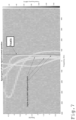
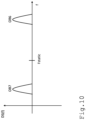
- Figure 10 shows an exemplary embodiment of a Doppler spectrum that is measured at a current position x0( ⁇ ) of the sensor 20 after completion of the setup-phase.
- the spectrum illustrates an object OB6 that approaches the sensor 20, and an object OB7 that moves away from the sensor 20.
- the evaluation unit 22 evaluates the current speed-normalized Doppler spectrum at the current position x0( ⁇ ) of the door leaf 10 by comparing the signal strength of the current speed-normalized Doppler spectrum with the data entry of the stored background data set BDS that corresponds to said current position.
- the evaluation unit 22 generates an object detection signal ODS that indicates an obstructing object if the difference between the signal strength of the currently measured speed-normalized Doppler spectrum and the signal strength of stored speed-normalized Doppler spectrum of the corresponding stored data entry exceeds a given threshold with respect to at least one speed-normalized Doppler frequency.
- the evaluation unit 22 generates an object detection signal ODS if the Doppler spectrum indicates a response from an object that is not expected in view of the stored background data set BDS.
- a response from an object is assumed if the amplitude of the Doppler spectrum exceeds a pre-defined threshold amplitude that preferably depends on the amplitude of the background data set BDS with regard to the respective position of the door leaf 10 and the same frequency. For instance, a response may be assumed if the actual amplitude of the Doppler spectrum exceed the stored amplitude with respect the same location x0 and the same frequency.
- the evaluation unit 22 generates an object detection signal ODS that indicates an object OB6 (see Figure 10 ) moving towards the door leaf 10, if the Doppler spectrum DS(f) comprises a response above the threshold frequency Fstatic.
- the evaluation unit 22 generates an object detection signal that indicates an object OB7 moving away from the door leaf 10, if the Doppler spectrum DS(f) comprises a response below the threshold frequency Fstatic.
- the evaluation unit 22 generates an object detection signal ODS that indicates a stationary object, if the Doppler spectrum DS(f) indicates a response at the threshold frequency Fstatic.
Landscapes
- Engineering & Computer Science (AREA)
- Radar, Positioning & Navigation (AREA)
- Remote Sensing (AREA)
- Physics & Mathematics (AREA)
- Computer Networks & Wireless Communication (AREA)
- General Physics & Mathematics (AREA)
- Electromagnetism (AREA)
- Radar Systems Or Details Thereof (AREA)
Abstract
Description
- The invention relates to systems comprising sensors to detect obstructing objects during the movement of a door leaf as well as methods for detecting obstructing objects during the movement of door leaves.
- Sensors for the detection of obstructing objects during the movement of door leaves are known in the art as well as methods of detecting obstructing objects during the movement of door leaves.
- An objective of the present invention is to propose systems comprising a door leaf and a sensor which provides reliable information about obstructing objects.
- A further objective of the present invention is to provide a method of detecting obstructing objects during the movement of door leaves.
- An embodiment of the present invention relates to a system comprising a door leaf and a sensor configured to detect obstructing objects during the movement of the door leaf. The sensor comprises a radar unit capable of emitting radar radiation and detecting reflected radiation. The radar unit is mounted on the door leaf and is moved together with the door leaf. The radar unit is configured to provide a Doppler signal during operation. An evaluation unit is configured to evaluate the spectrum of the Doppler signal taking the sensor's speed into account, and to generate an object detection signal based on the evaluation result.
- Since the sensor is mounted on the door lead and moved together with the door leaf, stationary and moving obstructing objects can reliably be detected. For instance, in contrast to stationary radar units, the sensor can reliably detect also stationary objects because the movement of the radar unit causes a Doppler signal also for the non-moving objects.
- Furthermore, an evaluation of the Doppler signal provided by the radar unit allows distinguishing obstructing objects with respect to their kinematic behaviour. For instance, approaching objects can be distinguished from stationary objects as well as from other objects that move away from the door leaf. The information about the kinematic behaviour can be used for instance to improve the control of the door's movement with regard to the avoidance of a collision.
- The evaluation unit preferably calculates a threshold frequency that corresponds to the speed of the door leaf.
- The evaluation unit may generate an object detection signal that indicates an object moving towards the door leaf if the spectrum of the Doppler spectrum comprises a response above the threshold frequency.
- The evaluation unit may generate an object detection signal that indicates a stationary object if the spectrum of the Doppler spectrum comprises a response at the threshold frequency.
- The evaluation unit may generate an object detection signal that indicates an object moving away from the door leaf if the spectrum of the Doppler spectrum comprises a response below the threshold frequency.
- The evaluation unit is preferably configured to calculate and store a background data set based on a Doppler signal that has been measured during a learning step.
- The learning step preferably includes moving the door leaf from a predefined start position to a predefined end position wherein the movement takes place when no object obstructs the door's movement, and measuring the Doppler signal while the door leaf is moved, over time.
- The calculation of the background data set may include calculating a speed-normalized Doppler spectrum by removing the door velocity from the measured Doppler signal.
- The calculation of the background data set preferably includes generating a plurality of data entries, each of which refers to a given position of the sensor and comprises a speed-normalized Doppler spectrum measured at the respective position, wherein the data entries collectively cover the movement of the door from the predefined start position to the predefined end position.
- The background data set preferably comprises at least ten data entries that refer to ten different positions of the door leaf.
- Each data entry preferably indicates the signal strength of the speed-normalized Doppler signal over the speed-normalized Doppler frequency.
- The evaluation unit may be configured to evaluate a current speed-normalized Doppler spectrum at a current position of the door leaf by comparing the signal strength of the current speed-normalized Doppler spectrum with the data entry of the background data set that corresponds to said current position.
- The evaluation unit is preferably configured to generate an object detection signal that indicates an obstructing object if the difference between the signal strength of the current speed-normalized Doppler spectrum and the speed-normalized Doppler spectrum of the corresponding data entry exceeds a given threshold with respect to at least one speed-normalized Doppler frequency.
- The sensor may comprise a measurement unit configured to measure the acceleration of the door and generate an acceleration signal.
- The evaluation unit may be configured to calculate the position of the door leaf based on the measured acceleration signal.
- Another embodiment of the invention relates to a method of detecting obstructing objects during the movement of a door leaf. The method is characterized by the steps of emitting radar radiation and detecting reflected radiation using a radar unit, wherein the radar unit is mounted on the door leaf and is moved together with the door leaf, the radar unit being configured to provide a Doppler signal during operation, and evaluating the spectrum of the Doppler signal taking the sensor's speed into account, and to generate an object detection signal based on the evaluation result.
- The method is preferably carried out in or with respect to a system as disclosed above. Therefore, any features or subject matter disclosed with respect to the system discussed above also applies to the method according to the present invention, and vice versa.
- In order that the manner, in which the above-recited and other advantages of the invention are obtained, will be readily understood, a more particular description of the invention briefly described above will be rendered by reference to specific embodiments thereof, which are illustrated in the appended figures. Understanding that these figures depict only typical embodiments of the invention and are therefore not to be considered limiting of its scope, the invention will be described and explained with additional specificity and detail by the use of the accompanying drawings in which
- Figs. 1 and 3
- illustrates a first exemplary embodiment of a system according to the present invention,
- Figs 2 and 9
- illustrates a second exemplary embodiment of a system according to the present invention, and
- Figs. 4-8 and 10
- visualize exemplary embodiments of preferred methods of operation of the sensors depicted in
Figures 1-3 and9 . - The preferred embodiments of the present invention will be best understood by reference to the drawings, wherein identical or comparable parts are designated by the same reference signs throughout.
- It will be readily understood that the parameters of the embodiments of the present invention, as generally described herein, could vary in a wide range. Thus, the following more detailed description of exemplary embodiments of the present invention, is not intended to limit the scope of the invention but is merely representative of presently preferred embodiments of the invention.
-
Figure 1 depicts a first exemplary embodiment of asystem 1 according to the present invention. - The
system 1 ofFigure 1 comprises adoor leaf 10 of a swing-door, and asensor 20. Thesensor 20 is mounted on thedoor leaf 10 and configured to detect obstructing objects during the movement of thedoor leaf 10. Thesensor 20 is configured to emit radar radiation and detect radiation RR that is reflected by objects OB. In the exemplary embodiment ofFigure 1 , the emitted radar field FR is delimited by two radar beams R1 and R2. -
Figure 3 shows thesensor 20 ofFigure 1 in further detail. Thesensor 20 comprises aradar unit 21, anevaluation unit 22 and ameasurement unit 23. Themeasurement unit 23 ofFigure 3 is an acceleration measurement device configured to measure the rotational acceleration dro/dt of thedoor leaf 10 and provide measurement values M that indicate the rotational speed ω and/or the rotational acceleration dω/dt of thedoor leaf 10. Themeasurement unit 23 may be a 1-axis (or more than one axis) gyroscope, preferably a MEMS gyroscope. - The
radar unit 21 is configured to emit the radar field FR and detect the reflected radiation RR. The reflected radiation is processed in order to provide an output Doppler signal DS. The processing may include mixing an electrical detection signal that describes the detected radiation RR, with an electrical reference signal that describes the emitted radiation. - The spectrum of the Doppler signal DS indicates the presence of the reflecting objects OB as well as the relative speed between the
door leaf 10 and the reflecting objects OB. Since theradar unit 21 is mounted on thedoor leaf 10 and is moved together with thedoor leaf 10, the speed of thedoor leaf 10 should be considered when the speed of reflecting objects OB is calculated. - The
evaluation unit 22 may comprise one or more processor(s) to evaluate the spectrum of the Doppler signal DS in order to calculate speed signals SS (see normalized speed signals SSn inFigure 5 ) that describe the speed of the detected objects. During this evaluation, the sensor's 20 speed is taken into account. If the spectrum of the Doppler signal DS indicates one or more obstructing objects a corresponding object detection signal ODS is generated. - The
evaluation unit 22 combines the measurement values M from the gyroscope and the Doppler signal DS from theradar unit 21. The purpose of the gyroscope is to measure the rotation rate of the door. The radius or width (distance between the axis of thedoor leaf 10 and the sensor 20) may be communicated by service personnel as part of a calibration procedure. Alternatively, thesensor 20 may be configured to be installed at a pre-defined radius which is already implemented in theevaluation unit 22 as a constant value. - Once the radius is known, the velocity of the
radar unit 21 at any point in time t can be calculated using the following equation:
evaluation unit 22 based on the measurement values M of the gyroscope. r represents the moment arm or the radius, i.e., the distance of theradar unit 21 from the rotational axis of the door. - The reflected and thereafter detected radar radiation RR is influenced by the relative motion between the
sensor 20 and the reflecting objects (stationary or moving objects). The individual speed of each detected object can be derived from the spectrum of the reflected radar radiation. Such a calculation may yield a speed signal SS(t) (see normalized speed signals SSn inFigure 5 ) for each detected object. The calculation of speed signals SS by evaluating the frequency spectrum of a detected Doppler signal DS is well known in the art. - The next step is to normalize the speed signals SS(t) and remove the door velocity v(t), for example according to the following equation:

- Alternatively, the spectrum of the Doppler signal DS can be shifted by a frequency Fstatic that corresponds to the speed of the
sensor 20 before calculating the speed signals. In the latter case, the normalized speed signals SSn can be directly calculated on the basis of the shifted spectrum. - Summarizing, the evaluation of the spectrum of the Doppler signal DS discloses the existence of objects as well as their respective relative speeds.
-
Figure 5 shows in an exemplary fashion the normalized speed signals SSn with respect to objects OB1-OB5 depicted inFigure 4 . - During an initial setup, the background signal is measured and stored in a
memory 24 of thesensor 20 for later use during the normal operation of thesystem 1. - The background signal may be measured and stored in the form of data pairs or data entries (x0(τ), d0(τ, f)). Each data entry refers to a given position x0 and defines the speed-normalized Doppler spectrum d0(τ, f) measured at the respective position x0 during the setup phase where no obstructing objects disturb the movement of the
door leaf 10. - The data entries (x0(τ), d0(τ, f)) are preferably stored with respect to a time frame τ ∈ [0, T]. t=0 indicates the moment when the door opens during the beginning of the setup phase, and T indicates the time when the door is fully open and comes to rest at the end of the setup phase. In other words, x(t=0) refers to the closed door and x(t=T) refers to the fully opened door. d0(τ, f)) describes the speed-normalized Doppler spectrum of the detected radar signal measured at the time t=τ. The speed-normalized Doppler spectrum can be calculated by shifting the measured Doppler spectrum by a correction frequency Fstatic that corresponds to the speed of the
sensor 20. - The two events τ = 0 and τ = T may be detected by evaluating the sensor's 20 speed v(t):
Once v(t) exceeds a predefined small threshold velocity above noise level, it is assumed that thedoor leaf 10 is going to be opened and the observation is started (τ = 0). - As soon as v(t) drops below the threshold velocity, it is assumed that the door is fully open (τ = T).
- The resulting data pairs (x0(τ), d0(τ, f)), ∀ τ ∈ {0, T}, describe a "background signal", which constitutes a signal generated by the floor or other stationary objects that are always present and are a part of the background.
- The data pairs (x0(τ), d0(τ, f)), ∀ τ ∈ {0, T}, collectively form a background data set BDS which is stored in the
memory 24 of thesensor 20. - Once the initial setup process is complete, the actual operation can commence.
- When the door is opening during normal operation, and there is no object obstructing the door, the actual Doppler signal DS will be similar to the initially stored background signal described by the data pairs (x0(τ), d0(τ, f)) ∀ τ ∈ {0, T}.
- But when there is some obstruction because a new object is present, the detected spectrum will be different from the background signal.
-
Figure 4 shows such a scenario where three background objects OB1, OB2 and OB3 are part of the background and therefore already included in the stored background signal. A static obstructing object OB4 is not part of the background and therefore not included in the stored background signal. Additionally, there is a moving object OB5 that moves towards the door and is depicted at different moments in times (t E [0, ..., 5] seconds). -
Figure 5 shows a simulated Doppler spectrum of the scenario depicted inFigure 4 . InFigure 5 , the radar radiation frequencies are already transformed into corresponding normalized speed signals SSn versus time t as the door moves. - In
Figure 5 , the static obstructing object OB4 initially generates a positive normalized speed signal. After circa 1 second, in the simulated scenario, the static obstructing object OB4 generates a negative normalized speed signal because the door has passed over the object. - The dynamic object OB3 approaches the
sensor 20 and therefore continuously generates a positive normalized speed signal that can be easily detected. -
Figure 6 shows the amplitude A of an example Doppler signal DS captured by theradar unit 21 over time t. It is apparent that the Doppler signal DS requires further analysis for instance by Fourier-transformation. -
Figure 7 shows the signal ofFigure 6 after Fourier-processing in form of a frequency-time plot. The frequency-time plot identifies the different objects OB1-OB5 as well as their individual speeds. -
Figure 7 also depicts a threshold frequency Fstatic which describes and is proportional to the speed of thesensor 20. - As shown in
Figure 8 , new objects OB4 and OB5 can be identified by evaluating the amplitudes of the speed-normalized Doppler spectrum and by comparing the actual speed-normalized Doppler spectrum with the stored background signal. InFigure 8 , the background objects OB1, OB2 and OB3 that are shown inFigure 7 , are omitted to facilitate the comparison. - Any Doppler frequency, for which the amplitude exceeds a given threshold amplitude and which is less than the threshold frequency Fstatic, is indicative of a dynamic object that is moving away from the
sensor 20. - Any Doppler frequency, for which the amplitude exceeds said given threshold amplitude and which is equal to the threshold frequency Fstatic, is indicative of a static object.
- Any Doppler frequency, for which the amplitude exceeds said given threshold amplitude and which exceeds the threshold frequency Fstatic, is indicative of a dynamic object moving towards the
sensor 20. - Th information regarding the direction of moving objects can be very helpful in predicting the time of collision and taking a corrective action.
- During the lifetime of the door operation, the motion profile of the door may change significantly due to wear and tear and the door-motor performance degradation. This may create a problem, if we store the background signal in terms of time τ (e.g., (τ, d0(τ, f)) instead of the location x0. Therefore, as discussed above, it is advantageous to store the data entries according to the position x0, which is backward calculated from the velocity of the door leaf 10 (see data entries (x0(τ), d0(τ, f)) discussed above.
-
Figure 2 depicts a second exemplary embodiment of asystem 1 according to the present invention. Here, thesensor 20 is mounted on the movingdoor leaf 10 of a slidingdoor 100 which provides apassage 110 in its open state. - The
sensor 20 comprises a measurement unit 23 (seeFigure 9 ) which is a 1-axis accelerometer (or a more than one axis accelerometer). Themeasurement unit 23 generates measurement values M that describe the acceleration a of thesensor 20. - The velocity v at t=τ of the
door leaf 10 can be calculated using the following equation:
- The calculation of the velocity v can be carried out by the
measurement device 23 or theevaluation unit 22. - The position of the door, in local coordinate system (door initial position = (x(t) = 0)), may be calculated using the following equation:

- In summary, the exemplary embodiments discussed above in connection with
Figures 1-9 refer tosystems 1 that comprises adoor leaf 10 and asensor 20 that is configured to detect obstructing objects during the movement of thedoor leaf 10. Thesensor 20 comprises aradar unit 21 capable of emitting radar radiation and detecting reflected radiation RR. Theradar unit 21 is mounted on thedoor leaf 10 and is moved together with thedoor leaf 10. Theradar unit 21 is configured to provide a Doppler signal DS during operation. Anevaluation unit 22 is configured to evaluate the spectrum of the Doppler signal DS taking the sensor's 20 speed into account, and to generate an object detection signal ODS based on the evaluation result. - The
evaluation unit 22 calculates and stores a background data set BDS based on a Doppler signal DS that has been measured during a learning step (initial setup- phase). - The learning step includes moving the
door leaf 10 from a predefined start position to a predefined end position wherein the movement takes place when no object obstructs the door's movement. The learning step further includes measuring the Doppler signal DS while thedoor leaf 10 is moved, over time. - The
evaluation unit 22 may further calculate a threshold frequency Fstatic that corresponds to the speed of thedoor leaf 10. - The calculation of the background data set BDS may include calculating a speed-normalized Doppler spectrum by removing the door velocity from the measured Doppler signal DS. The removal of the door velocity from the measured Doppler signal DS can be carried out by shifting the measured Doppler signal DS by the threshold frequency Fstatic.
- The calculation of the background data set BDS includes generating a plurality of data entries (x0(τ), d0(τ, f)). Each of the data entries (x0(τ), d0 (τ, f)) refers to a possible position x0(τ) of the
sensor 20 and comprises a Doppler spectrum (preferably a speed-normalized Doppler spectrum) measured at the respective position. - Each data entry (x0(τ), d0(τ, f)) preferably indicates the signal strength (e.g., amplitude A) of the speed-normalized Doppler signal DS over the speed-normalized Doppler frequency.
- The data entries (x0(τ), d0(τ, f)) collectively cover the movement of the door from the predefined start position to the predefined end position.
-
Figure 10 shows an exemplary embodiment of a Doppler spectrum that is measured at a current position x0(τ) of thesensor 20 after completion of the setup-phase. The spectrum illustrates an object OB6 that approaches thesensor 20, and an object OB7 that moves away from thesensor 20. - The
evaluation unit 22 evaluates the current speed-normalized Doppler spectrum at the current position x0(τ) of thedoor leaf 10 by comparing the signal strength of the current speed-normalized Doppler spectrum with the data entry of the stored background data set BDS that corresponds to said current position. - The
evaluation unit 22 generates an object detection signal ODS that indicates an obstructing object if the difference between the signal strength of the currently measured speed-normalized Doppler spectrum and the signal strength of stored speed-normalized Doppler spectrum of the corresponding stored data entry exceeds a given threshold with respect to at least one speed-normalized Doppler frequency. - In other words, the
evaluation unit 22 generates an object detection signal ODS if the Doppler spectrum indicates a response from an object that is not expected in view of the stored background data set BDS. A response from an object is assumed if the amplitude of the Doppler spectrum exceeds a pre-defined threshold amplitude that preferably depends on the amplitude of the background data set BDS with regard to the respective position of thedoor leaf 10 and the same frequency. For instance, a response may be assumed if the actual amplitude of the Doppler spectrum exceed the stored amplitude with respect the same location x0 and the same frequency. - For instance, the
evaluation unit 22 generates an object detection signal ODS that indicates an object OB6 (seeFigure 10 ) moving towards thedoor leaf 10, if the Doppler spectrum DS(f) comprises a response above the threshold frequency Fstatic. - For instance, the
evaluation unit 22 generates an object detection signal that indicates an object OB7 moving away from thedoor leaf 10, if the Doppler spectrum DS(f) comprises a response below the threshold frequency Fstatic. - For instance, the
evaluation unit 22 generates an object detection signal ODS that indicates a stationary object, if the Doppler spectrum DS(f) indicates a response at the threshold frequency Fstatic. - The various embodiments and aspects of embodiments of the invention disclosed herein are to be understood not only in the order and context specifically described in this specification, but to include any order and any combination thereof. Whenever the context requires, all words used in the singular number shall be deemed to include the plural and vice versa. Whenever the context requires, all options that are listed with the word "and" shall be deemed to include the word "or" and vice versa, and any combination thereof.
- In the drawings and specification, there have been disclosed a plurality of embodiments of the present invention. The applicant would like to emphasize that each feature of each embodiment may be combined with or added to any other of the embodiments in order to modify the respective embodiment and create additional embodiments. These additional embodiments form a part of the present disclosure and, therefore, the applicant may file further patent claims regarding these additional embodiments at a later stage of the prosecution.
- Further, the applicant would like to emphasize that each feature of each of the following dependent claims may be combined with any of the present independent claims as well as with any other (one ore more) of the present dependent claims (regardless of the present claim structure). Therefore, the applicant may direct further patent claims towards other claim combinations at a later stage of the prosecution.
Claims (15)
- System (1) comprising a door leaf (10) and a sensor (20) configured to detect obstructing objects (O4-O7) during the movement of the door leaf (10),
characterized in that
the sensor (20) comprises- a radar unit (21) capable of emitting radar radiation and detecting reflected radiation (RR), wherein the radar unit (21) is mounted on the door leaf (10) and is moved together with the door leaf (10), the radar unit (21) being configured to provide a Doppler signal (DS) during operation, and- an evaluation unit (22) configured to evaluate the spectrum of the Doppler signal (DS) taking the sensor (20)'s speed into account, and to generate an object detection signal (ODS) based on the evaluation result. - The arangement (1) of claim 1 wherein
the evaluation unit (22) calculates a threshold frequency (Fstatic) that corresponds to the speed of the door leaf (10) . - The arangement (1) of claim 2 wherein
the evaluation unit (22) generates an object detection signal (ODS) that indicates an object (O5-O6) moving towards the door leaf (10) if the spectrum comprises a response above the threshold frequency (Fstatic). - The arangement (1) of any of the preceding claims wherein the evaluation unit (22) generates an object detection signal (ODS) that indicates a stationary object (O4-O7) if the spectrum comprises a response at the threshold frequency (Fstatic).
- The arangement (1) of any of the preceding claims wherein the evaluation unit (22) generates an object detection signal (ODS) that indicates an object (06) moving away from the door leaf (10) if the spectrum comprises a response below the threshold frequency (Fstatic).
- The arangement (1) of any of the preceding claims wherein the evaluation unit (22) is configured to calculate and store a background data set (BDS) based on a Doppler signal (DS) that has been measured during a learning step.
- The arangement (1) of claim 6 wherein
the learning step includes- moving the door leaf (10) from a predefined start position to a predefined end position wherein the movement takes place when no object (O4-O7) obstructs the door's movement, and- measuring the Doppler signal (DS) while the door leaf (10) is moved, over time. - The arangement (1) of claim 6 or 7 wherein
the calculation of the background data set (BDS) includes- calculating a speed-normalized Doppler spectrum by removing the door velocity from the measured Doppler signal (DS) . - The arangement (1) of any of the preceding claims wherein the calculation of the background data set (BDS) includes- generating a plurality of data entries (x0(τ), d0(τ, f)), each of which refers to a given position of the sensor (20) and comprises a speed-normalized Doppler spectrum measured at the respective position,- wherein the data entries (x0(τ), d0(τ, f)) collectively cover the movement of the door leaf (10) from the predefined start position to the predefined end position.
- The arangement (1) of any of the preceding claims wherein- the background data set (BDS) comprises at least ten data entries (x0(τ), d0(τ,f)) that refer to ten different positions of the door leaf (10).
- The arangement (1) of any of the preceding claims wherein each data entry (x0(τ), d0(τ, f)) indicates the signal strength of the speed-normalized Doppler signal (DS) over the speed-normalized Doppler frequency.
- The arangement (1) of any of the preceding claims wherein the evaluation unit (22) is configured to evaluate a current speed-normalized Doppler spectrum at a current position (x0(τ)) of the door leaf (10) by comparing the signal strength of the current speed-normalized Doppler spectrum with the data entry (x0(τ), d0(τ, f)) of the background data set (BDS) that corresponds to said current position.
- The arangement (1) of any of the preceding claims wherein the evaluation unit (22) is configured to generate an object detection signal (ODS) that indicates an obstructing object (O4-O7) if the difference between the signal strength of the current speed-normalized Doppler spectrum and the speed-normalized Doppler spectrum of the corresponding data entry (x0(τ), d0(τ, f)) exceeds a given threshold with respect to at least one speed-normalized Doppler frequency.
- The arangement (1) of any of the preceding claims- wherein the sensor (20) comprises a measurement unit (23) configured to measure the acceleration of the door and generate an acceleration signal, and- wherein the evaluation unit (22) is configured to calculate the position of the door leaf (10) based on the measured acceleration signal.
- Method of detecting obstructing objects (O4-O7) during the movement of a door leaf (10),
characterized by the steps of- emitting radar radiation and detecting reflected radiation (RR) using a radar unit (21), wherein the radar unit (21) is mounted on the door leaf (10) and is moved together with the door leaf (10), the radar unit (21) being configured to provide a Doppler signal (DS) during operation, and- evaluating the spectrum of the Doppler signal (DS) taking the sensor (20)'s speed into account, and to generate an object detection signal (ODS) based on the evaluation result.
Priority Applications (1)
| Application Number | Priority Date | Filing Date | Title |
|---|---|---|---|
| EP23185009.0A EP4492089A1 (en) | 2023-07-12 | 2023-07-12 | Systems and methods for the detection of obstructing objects during the movement of a door leaf |
Applications Claiming Priority (1)
| Application Number | Priority Date | Filing Date | Title |
|---|---|---|---|
| EP23185009.0A EP4492089A1 (en) | 2023-07-12 | 2023-07-12 | Systems and methods for the detection of obstructing objects during the movement of a door leaf |
Publications (1)
| Publication Number | Publication Date |
|---|---|
| EP4492089A1 true EP4492089A1 (en) | 2025-01-15 |
Family
ID=87280760
Family Applications (1)
| Application Number | Title | Priority Date | Filing Date |
|---|---|---|---|
| EP23185009.0A Pending EP4492089A1 (en) | 2023-07-12 | 2023-07-12 | Systems and methods for the detection of obstructing objects during the movement of a door leaf |
Country Status (1)
| Country | Link |
|---|---|
| EP (1) | EP4492089A1 (en) |
Citations (3)
| Publication number | Priority date | Publication date | Assignee | Title |
|---|---|---|---|---|
| CN108979440B (en) * | 2018-07-17 | 2020-05-05 | 北京经纬恒润科技有限公司 | Control method and system for automobile door |
| US20200284876A1 (en) * | 2019-03-08 | 2020-09-10 | GM Global Technology Operations LLC | Self-learning, noise filtering of radar used for automotive applications |
| US20230018226A1 (en) * | 2019-09-23 | 2023-01-19 | Brose Fahrzeugteile Se & Co. Kommanditgesellschaft, Bamberg | Radar sensor system and method for contactlessly moving a vehicle door relative to a vehicle body |
-
2023
- 2023-07-12 EP EP23185009.0A patent/EP4492089A1/en active Pending
Patent Citations (3)
| Publication number | Priority date | Publication date | Assignee | Title |
|---|---|---|---|---|
| CN108979440B (en) * | 2018-07-17 | 2020-05-05 | 北京经纬恒润科技有限公司 | Control method and system for automobile door |
| US20200284876A1 (en) * | 2019-03-08 | 2020-09-10 | GM Global Technology Operations LLC | Self-learning, noise filtering of radar used for automotive applications |
| US20230018226A1 (en) * | 2019-09-23 | 2023-01-19 | Brose Fahrzeugteile Se & Co. Kommanditgesellschaft, Bamberg | Radar sensor system and method for contactlessly moving a vehicle door relative to a vehicle body |
Similar Documents
| Publication | Publication Date | Title |
|---|---|---|
| EP3553552B1 (en) | Method for the recognition of a moving pedestrian | |
| US11158192B2 (en) | Method and system for detecting parking spaces which are suitable for a vehicle | |
| JP3947193B2 (en) | Vehicle course prediction method and apparatus | |
| CN109305165A (en) | Intelligent ultrasonic system, vehicle rear collision warning device and control method thereof | |
| JPH09178848A (en) | Obstacle recognition device for vehicles | |
| WO2015155833A1 (en) | Collision prevention device | |
| CA2179464A1 (en) | Apparatus and method for sensing motionlessness in a vehicle | |
| CN114207469B (en) | Method for classifying objects in the surroundings of a vehicle and driver assistance system | |
| CN106339692B (en) | A method and system for determining fatigue driving state information | |
| JP2019535587A (en) | Method and parameter module for detecting the type and / or severity of a collision between a vehicle and a collision object | |
| EP1367410B1 (en) | Collision detection system and method of estimating miss distance employing curve fitting | |
| Harkous et al. | A two-stage machine learning method for highly-accurate drunk driving detection | |
| JP6847336B2 (en) | Measuring device, measuring method and measuring program | |
| CN116972827A (en) | A multi-source information fusion speed measurement method for high-speed trains | |
| US7119888B2 (en) | Method for determining the relative speed of an object | |
| CN117033943A (en) | A fault detection method and device based on multi-modal sensor fusion | |
| US12600389B2 (en) | Method for monitoring a railway track and monitoring system for monitoring a railway track | |
| EP3290945A1 (en) | Misalignment detection for a vehicle radar sensor | |
| JP2003529085A (en) | Model-assisted driving lane mapping for vehicles | |
| CN112907975B (en) | Detection method for abnormal parking based on millimeter wave radar and video | |
| US20050192731A1 (en) | Method for determining a trigger time for restraint means in a vehicle | |
| EP4360989A1 (en) | Method and device for detecting anomalies along a railway track | |
| EP1352375B1 (en) | Method and device for estimating movement parameters of targets | |
| US12092731B2 (en) | Synthetic generation of radar and LIDAR point clouds | |
| EP3575758A1 (en) | Monitoring unit for monitoring a linear asset and method for monitoring a linear asset |
Legal Events
| Date | Code | Title | Description |
|---|---|---|---|
| PUAI | Public reference made under article 153(3) epc to a published international application that has entered the european phase |
Free format text: ORIGINAL CODE: 0009012 |
|
| STAA | Information on the status of an ep patent application or granted ep patent |
Free format text: STATUS: THE APPLICATION HAS BEEN PUBLISHED |
|
| AK | Designated contracting states |
Kind code of ref document: A1 Designated state(s): AL AT BE BG CH CY CZ DE DK EE ES FI FR GB GR HR HU IE IS IT LI LT LU LV MC ME MK MT NL NO PL PT RO RS SE SI SK SM TR |
|
| STAA | Information on the status of an ep patent application or granted ep patent |
Free format text: STATUS: REQUEST FOR EXAMINATION WAS MADE |
|
| 17P | Request for examination filed |
Effective date: 20250711 |
|
| GRAP | Despatch of communication of intention to grant a patent |
Free format text: ORIGINAL CODE: EPIDOSNIGR1 |
|
| STAA | Information on the status of an ep patent application or granted ep patent |
Free format text: STATUS: GRANT OF PATENT IS INTENDED |
|
| INTG | Intention to grant announced |
Effective date: 20260623 |
|
| RIN1 | Information on inventor provided before grant (corrected) |
Inventor name: ASGHAR, SAYED ZEESHAN |