EP4492002A1 - Dispositif de mesure de forme de surface, procédé de mesure de forme de surface et procédé de gestion de courroie - Google Patents
Dispositif de mesure de forme de surface, procédé de mesure de forme de surface et procédé de gestion de courroie Download PDFInfo
- Publication number
- EP4492002A1 EP4492002A1 EP23788103.2A EP23788103A EP4492002A1 EP 4492002 A1 EP4492002 A1 EP 4492002A1 EP 23788103 A EP23788103 A EP 23788103A EP 4492002 A1 EP4492002 A1 EP 4492002A1
- Authority
- EP
- European Patent Office
- Prior art keywords
- surface shape
- belt
- pulley
- conveyor belt
- measurement
- Prior art date
- Legal status (The legal status is an assumption and is not a legal conclusion. Google has not performed a legal analysis and makes no representation as to the accuracy of the status listed.)
- Pending
Links
Images




Classifications
-
- G—PHYSICS
- G01—MEASURING; TESTING
- G01B—MEASURING LENGTH, THICKNESS OR SIMILAR LINEAR DIMENSIONS; MEASURING ANGLES; MEASURING AREAS; MEASURING IRREGULARITIES OF SURFACES OR CONTOURS
- G01B11/00—Measuring arrangements characterised by the use of optical techniques
- G01B11/24—Measuring arrangements characterised by the use of optical techniques for measuring contours or curvatures
- G01B11/25—Measuring arrangements characterised by the use of optical techniques for measuring contours or curvatures by projecting a pattern, e.g. one or more lines, moiré fringes on the object
-
- B—PERFORMING OPERATIONS; TRANSPORTING
- B65—CONVEYING; PACKING; STORING; HANDLING THIN OR FILAMENTARY MATERIAL
- B65G—TRANSPORT OR STORAGE DEVICES, e.g. CONVEYORS FOR LOADING OR TIPPING, SHOP CONVEYOR SYSTEMS OR PNEUMATIC TUBE CONVEYORS
- B65G43/00—Control devices, e.g. for safety, warning or fault-correcting
- B65G43/02—Control devices, e.g. for safety, warning or fault-correcting detecting dangerous physical condition of load carriers, e.g. for interrupting the drive in the event of overheating
-
- G—PHYSICS
- G01—MEASURING; TESTING
- G01B—MEASURING LENGTH, THICKNESS OR SIMILAR LINEAR DIMENSIONS; MEASURING ANGLES; MEASURING AREAS; MEASURING IRREGULARITIES OF SURFACES OR CONTOURS
- G01B11/00—Measuring arrangements characterised by the use of optical techniques
- G01B11/02—Measuring arrangements characterised by the use of optical techniques for measuring length, width or thickness
- G01B11/06—Measuring arrangements characterised by the use of optical techniques for measuring length, width or thickness for measuring thickness ; e.g. of sheet material
-
- G—PHYSICS
- G01—MEASURING; TESTING
- G01B—MEASURING LENGTH, THICKNESS OR SIMILAR LINEAR DIMENSIONS; MEASURING ANGLES; MEASURING AREAS; MEASURING IRREGULARITIES OF SURFACES OR CONTOURS
- G01B11/00—Measuring arrangements characterised by the use of optical techniques
- G01B11/02—Measuring arrangements characterised by the use of optical techniques for measuring length, width or thickness
- G01B11/06—Measuring arrangements characterised by the use of optical techniques for measuring length, width or thickness for measuring thickness ; e.g. of sheet material
- G01B11/0691—Measuring arrangements characterised by the use of optical techniques for measuring length, width or thickness for measuring thickness ; e.g. of sheet material of objects while moving
-
- G—PHYSICS
- G01—MEASURING; TESTING
- G01B—MEASURING LENGTH, THICKNESS OR SIMILAR LINEAR DIMENSIONS; MEASURING ANGLES; MEASURING AREAS; MEASURING IRREGULARITIES OF SURFACES OR CONTOURS
- G01B11/00—Measuring arrangements characterised by the use of optical techniques
- G01B11/24—Measuring arrangements characterised by the use of optical techniques for measuring contours or curvatures
- G01B11/25—Measuring arrangements characterised by the use of optical techniques for measuring contours or curvatures by projecting a pattern, e.g. one or more lines, moiré fringes on the object
- G01B11/2518—Projection by scanning of the object
- G01B11/2522—Projection by scanning of the object the position of the object changing and being recorded
-
- G—PHYSICS
- G01—MEASURING; TESTING
- G01B—MEASURING LENGTH, THICKNESS OR SIMILAR LINEAR DIMENSIONS; MEASURING ANGLES; MEASURING AREAS; MEASURING IRREGULARITIES OF SURFACES OR CONTOURS
- G01B11/00—Measuring arrangements characterised by the use of optical techniques
- G01B11/30—Measuring arrangements characterised by the use of optical techniques for measuring roughness or irregularity of surfaces
-
- G—PHYSICS
- G01—MEASURING; TESTING
- G01M—TESTING STATIC OR DYNAMIC BALANCE OF MACHINES OR STRUCTURES; TESTING OF STRUCTURES OR APPARATUS, NOT OTHERWISE PROVIDED FOR
- G01M13/00—Testing of machine parts
- G01M13/02—Gearings; Transmission mechanisms
- G01M13/023—Power-transmitting endless elements, e.g. belts or chains
Definitions
- the present disclosure relates to a surface shape measurement method, a surface shape measurement device, and a belt management method.
- the present disclosure relates in particular to a surface shape measurement device, a surface shape measurement method, and a belt management method that measure a surface shape of a belt wrapped around a pulley.
- belt conveyors with a conveyor belt wrapped around a pair of pulleys that serves as a driving means are known as transport devices for transporting transported materials, such as raw materials.
- transport devices for transporting transported materials, such as raw materials.
- the thickness of conveyor belts needs to be managed so as to prevent fractures of the conveyor belts.
- Patent Literatures 1 and 2 describe a device and a system by which unevenness of a surface of a conveyor belt is measured by the light-sectioning method using a line laser.
- the present disclosure can provide the surface shape measurement device, the surface shape measurement method, and the belt management method by which the measurement position in the circumferential direction of the belt is estimated without separately installing a sensor and the thickness of the belt is measured with high accuracy.
- FIG. 1 illustrates an example configuration of a surface shape measurement device 10 according to the present embodiment.
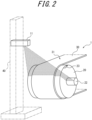
- FIG. 2 illustrates how a surface shape of a conveyor belt 30 of a belt conveyor 1 is measured by a belt surface measurement unit 11 of the surface shape measurement device 10.
- the surface shape measurement device 10 measures the surface shape of the conveyor belt 30 wrapped around a pulley 20, as illustrated in FIG. 2 .
- the pulley 20 is an example of a drive means.
- the conveyor belt 30 is an example of a belt.
- the surface shape measurement device 10 is a device that measures the surface shape of the belt driven in a direction of travel by the drive means.
- the belt is not limited to the conveyor belt 30, it is described as the conveyor belt 30 driven by the pulley 20 in the present embodiment.
- the direction of travel is a direction in which the belt moves by driving force from the drive means.
- the direction of travel is also referred to as a direction of transport or a circumferential direction.
- the direction of transport is a direction in which transported items placed on a surface 31 of the conveyor belt 30 in operation move.
- the conveyor belt 30 wrapped around a pair of pulleys 20 is driven to rotate around, and the circumferential direction means a direction in which the conveyor belt 30 moves when rotating.
- the thickness of conveyor belt 30 needs to be managed so as to prevent fractures of the conveyor belt 30.
- the thickness of the conveyor belt 30 can be computed from the surface shape measured by the surface shape measurement device 10 and managed.
- the surface shape can be measured with high accuracy, the thickness of the conveyor belt 30 can be accurately obtained by computation.
- the surface shape is a shape of the surface 31 of the conveyor belt 30 including its unevenness. For example, a portion on the surface 31 of the conveyor belt 30 that is depressed compared to its surroundings can indicate that this portion of the conveyor belt 30 is thinner than the surroundings.
- the surface shape measurement device 10 includes the belt surface measurement unit 11 and a control unit 15.
- the control unit 15 includes an arithmetic unit 12 and an analysis unit 14.
- the surface shape measurement device 10 is a device that measures the surface shape of the conveyor belt 30, by the belt surface measurement unit 11, the arithmetic unit 12, and the analysis unit 14 operating in cooperation.
- the arithmetic unit 12 acquires conveyor belt operation information 13 as needed.
- the conveyor belt operation information 13 is information regarding the operation and the state of the conveyor belt 30 that is obtained, for example, from a control unit of the belt conveyor 1.
- the belt surface measurement unit 11 and the control unit 15 may be connected by a network, such as a Local Area Network (LAN), so as to transmit and receive information (measurement data) obtained from measurement.
- the control unit of the belt conveyor 1 may be connected by the same network, such as a LAN. Details of the components of the surface shape measurement device 10 will be described later.
- the conveyor belt 30, which is an object to be measured by the surface shape measurement device 10, is wrapped around the pulley 20.
- the conveyor belt 30 moves and can transport transported items placed on the surface 31 of the conveyor belt 30.
- the surface 31 of the conveyor belt 30 is a surface (outer surface) of the conveyor belt 30 that is opposite to a surface (inner surface) located closer to the pulley 20.
- the pulley 20 has a projection 23 formed thereon.
- the projection 23 protrudes toward an outer side in a width direction from at least one end in the width direction of the pulley 20.
- the uneven portion is not limited to any shape.
- the projection 23 is an example of the uneven portion.
- the belt surface measurement unit 11 measures the surface shape of the pulley 20, in addition to the surface shape of the conveyor belt 30.
- the belt surface measurement unit 11 can identify the surface positions of the conveyor belt 30 and the pulley 20 by the measurement. That is, it can be said that local information on the surface shapes corresponds to the surface positions. For this reason, measurement by the belt surface measurement unit 11 may also be referred to below as "measuring a surface position.”
- the belt surface measurement unit 11 can simultaneously measure the surface position of the conveyor belt 30 and the surface position of the pulley 20 in a portion in which the conveyor belt 30 contacts the pulley 20.
- the belt surface measurement unit 11 is a non-contact measurement device that measures the surface positions of the conveyor belt 30 and the pulley 20 while being out of contact with the conveyor belt 30 or the pulley 20.
- the belt surface measurement unit 11 performs measurement when the pulley 20 and the conveyor belt 30 are rotating.
- the belt surface measurement unit 11 measures the surface position of the conveyor belt 30 at least over the entire length in the direction of transport.
- the belt surface measurement unit 11 is a unit, such as a light-sectioning profilometer, that uses the laser light-sectioning method.
- the belt surface measurement unit 11 can measure the surface position of the conveyor belt 30 over the entire length in a width direction, by emitting a line laser beam onto the conveyor belt 30 and the pulley 20.
- the belt surface measurement unit 11 is capable of measuring, for the pulley 20, surface positions of both ends in the width direction of the pulley 20 that are exposed from ends in the width direction of the conveyor belt 30.
- the belt surface measurement unit 11 is disposed at a position from which it can emit a laser beam onto the conveyor belt 30 from diagonally above the pulley 20, so that the surface positions of the conveyor belt 30 and the pulley 20 can simultaneously be measured in a portion in which the conveyor belt 30 contacts the pulley 20.
- the belt surface measurement unit 11 may be configured to be held in the vicinity of the pulley 20 by a holding member 40 installed on the ground. At this time, in order to accurately measure a thickness direction of the conveyor belt 30, the belt surface measurement unit 11 is installed so that a direction in which the laser beam is emitted passes through a center 22 of the pulley 20.
- the belt surface measurement unit 11 measures the surface position of the conveyor belt 30 in the portion in which it contacts the pulley 20, so that the conveyor belt 30 does not swing up and down and can be measured in a stable posture. Furthermore, the surface position of the conveyor belt 30 and the surface position of the pulley 20 can be measured simultaneously at the same position. Accordingly, the number of measurement units can be reduced, and the surface position of the conveyor belt 30 can be corrected with high accuracy in accordance with the surface position of the pulley 20, compared to a configuration in which the surface positions of the conveyor belt 30 and the pulley 20 are measured separately by two measurement units.
- the belt surface measurement unit 11 can make measurements and obtain information on the surface position of the conveyor belt 30 and information on the surface position of the pulley 20.
- the belt surface measurement unit 11 can also obtain information on the surface shape of the pulley 20 including information on the shape of the projection 23 provided at the end of the pulley 20. It is noted, however, that the obtained information on the surface position of the conveyor belt 30 is information including the eccentricity and the inclination of the pulley 20.
- the belt surface measurement unit 11 is preferably a non-contact measurement unit that can make a measurement while being out of contact with the conveyor belt 30 or the pulley 20, so that it can measure the surface positions of the conveyor belt 30 and the pulley 20 when they are rotating.
- the control unit 15 includes the arithmetic unit 12 and the analysis unit 14.
- the control unit 15 corrects the surface position of the conveyor belt 30 based on the surface position of the pulley 20 that has been measured by the belt surface measurement unit 11, and computes the surface shape of the conveyor belt 30.
- the control unit 15 may be configured to include a processor that executes computation, and a memory that stores data (such as information on the surface position) to be used in the computation.
- the processor is, for example, a general-purpose processor or a dedicated processor that is dedicated to specific processing, but is not limited to these and can be any processor.
- the memory includes one or more memories.
- the memory can be, for example, a semiconductor memory, a magnetic memory, an optical memory, or the like, but is not limited to these and can be any memory.
- the control unit 15 may be, for example, a computer.
- the arithmetic unit 12 computes the surface shape of the conveyor belt 30 over the entire length in the direction of transport, based on measurement data, which is information on the surface position from the belt surface measurement unit 11, and conveyor belt operation information 13, which is acquired as needed.
- the entire length in the direction of transport of the conveyor belt 30 may also be referred to as the entire circumference or the entire length in the circumferential direction.
- computing the surface shape may include determining the thickness of the conveyor belt 30, or it may include determining the unevenness of the surface 31 of the conveyor belt 30 by, for example, associating it with a two-dimensional map.
- the analysis unit 14 is a unit for identifying (estimating) a measurement position in the circumferential direction of the conveyor belt 30 and detecting rotations of the conveyor belt 30 using information on the surface shape of the pulley 20 and the surface shape of the conveyor belt 30. Details of the detection of rotations will be described later.
- the analysis unit 14 also removes information on the surface position (eccentricity and inclination) of the pulley 20 from information on the surface shape of the conveyor belt 30 that has been computed by the arithmetic unit 12, so as to obtain an accurate surface shape of the conveyor belt 30.
- the surface position of the pulley 20 to be removed is the surface position of the pulley 20 over the entire width (entire length in the width direction).
- the analysis unit 14 estimates the surface position of the pulley 20 over the entire length in the width direction from the surface positions of both ends in the width direction of the pulley 20 that have been measured by the belt surface measurement unit 11. As illustrated, for example, by the dashed line in FIG. 5A , the analysis unit 14 estimates a straight-line portion obtained when the positions of the both ends in the width direction of the pulley 20 are connected by a straight line as the surface position of the pulley 20.
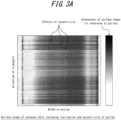
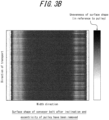
- FIG. 3A and FIG. 3B each illustrate, for measurement data obtained by the belt surface measurement unit 11, surface shapes of the conveyor belt 30 and the pulley 20 in gray scales.
- a surface position is obtained as a position in a height direction (hereinafter referred to as a "height"), where a radial direction from the center 22 of the cylindrical pulley 20 is defined as the height direction.
- the surface position of the conveyor belt 30 may be described as high when far from the center 22 in the radial direction of the pulley 20 and low when close to the center 22.
- black portions such as those in the vicinity of the center in the width direction, indicate surface positions higher than white portions.
- FIG. 3A illustrates data including effects of inclination and eccentricity of the pulley 20.
- black linear portions can be seen along the entire width direction.
- FIG. 3B illustrates data from which the effects of inclination and eccentricity of the pulley 20 have been removed.
- black linear portions or an asymmetric color distribution are not seen.
- the data for the surface shapes of the conveyor belt 30 and the pulley 20 as illustrated in FIG. 3B can be obtained, by executing correction processing that will be described below.
- FIG. 4 is a flowchart illustrating an example of the surface shape measurement method to be executed by the surface shape measurement device 10 according to the present embodiment.
- the surface shape measurement device 10 waits (No in Step S1).
- the surface shape measurement device 10 performs measurement with the belt surface measurement unit 11 (Step S2).
- the surface shape measurement device 10 measures data for a predetermined time, while the conveyor belt 30 is in operation.
- the predetermined time may be any time corresponding to a plurality of rotations of the conveyor belt 30, and it is not limited to a specific value.
- the predetermined time is, for example, twice the time it takes for the conveyor belt 30 to rotate one round (time required for two rotations).
- Step S3 When data for the predetermined time has not been measured (No in Step S3), the surface shape measurement device 10 continues measuring. When data for the predetermined time has been measured (Yes in Step S3), the surface shape measurement device 10 integrates the data for the predetermined time (Step S4).
- the surface shape data obtained in Step S3 includes effects of the surface position (inclination and eccentricity) of the pulley 20. Accordingly, the surface shape measurement device 10 analyzes accurate surface shape data for the conveyor belt 30 (Step S5). The surface shape measurement device 10 corrects the surface position of the conveyor belt 30 based on the surface position (inclination and eccentricity) of the pulley 20, and calculates the surface shape of the conveyor belt 30 from which the effects of inclination and eccentricity of the pulley 20 have been removed.
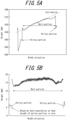
- FIG. 5A and 5B each illustrate a method of correcting the effects of inclination of the pulley 20.
- the pulley 20 and the conveyor belt 30 wrapped around the pulley 20 can be distinguished in the width direction, because a sharp height difference (level difference) occurs at both ends (boundary) of the conveyor belt 30.
- Pulley portions in FIG. 5A and FIG. 5B are portions in which the pulley 20 is determined to be exposed.
- Belt portions in FIG. 5A and FIG. 5B are portions in which the conveyor belt 30 is determined to be present.
- FIG. 5A illustrates an example of the surface position (surface shape) of the conveyor belt 30 before inclination calculated by the control unit 15 is corrected.
- the control unit 15 corrects the effects of inclination of the pulley 20, by rotating and translating the surface positions of the conveyor belt 30 and the pulley 20 so that the height of the pulley 20 is zero (at a reference point), as illustrated in FIG. 5B .
- the inclination of the pulley 20 can be measured (estimated) even while the pulley 20 (conveyor belt 30) is stopped.
- FIG. 6A and FIG. 6B illustrate a correction method in a case in which the pulley 20 has eccentricity (the center 22 is offset). Due to the eccentricity of the pulley 20, the surface shape of conveyor belt 30 becomes uneven in the direction or transport (circumferential direction).
- FIG. 6A illustrates the surface shape at a central position in the width direction of the conveyor belt 30 and the surface shape at both end positions in the width direction of the pulley 20 before eccentricity calculated by the control unit 15 is corrected.
- the moving average of the surface shape (profile of the belt portion) at the center in the width direction of the conveyor belt 30 and the moving average of the surface shape at the both end positions in the width direction (profile of the pulley portion) of the pulley 20 coincide with each other.
- the control unit 15 corrects the effects of eccentricity of the pulley 20, by subtracting the profile of the pulley portion from the profile of the belt portion and taking the difference, as illustrated in FIG. 6B .
- the range of fluctuation in the surface shape of the conveyor belt 30 is approximately 2 mm.
- the range of fluctuation is much smaller, thus indicating that the surface shape of the conveyor belt 30 can be measured with high accuracy by the correction.
- the control unit 15 can then accurately measure the thickness of the conveyor belt 30, based on the surface shape of the conveyor belt 30 obtained with high accuracy by the correction.
- distances in the direction of transport on the horizontal axis in each of FIG. 6A and FIG. 6B are positions in the direction of transport at which the surface shape (height) of the conveyor belt 30 is measured, arranged in order of measurement times. Accordingly, a break in rotations (for example, a starting point of the entire length in the direction of transport of the second rotation) is unknown.
- the surface shape measurement device 10 identifies the position of the conveyor belt 30, based on measurement data after the inclination and the eccentricity of the pulley 20 have been corrected as above (Step S6).
- the distance in the direction of transport is obtained, for example, by measurement frequency [sec/times] ⁇ number of measurements [times] ⁇ speed of conveyor belt 30 [mm/sec].
- FIG. 7A and FIG. 7B illustrate detection of rotations of the conveyor belt 30.
- the control unit 15 can use time-series data including information on the shape of the projection 23 provided at one end in the width direction of the pulley 20 to identify a position.
- a signal indicating a convex portion in this example, the projection 23
- the signal indicating the convex portion is a signal indicating the surface of the pulley 20 that is detected on the outer side in the width direction than normal.
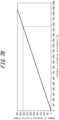
- the horizontal axis indicates distance in the direction of transport and the vertical axis indicates number of rotations of the pulley 20. Because the conveyor belt speed of the conveyor belt 30 and the diameter of the pulley 20 are known, a measurement position of the conveyor belt 30 and the distance in the direction of transport can be identified by detecting the projection 23 and counting the number of rotations of the pulley 20. Based on the above information and the length of the conveyor belt 30 that is known, the control unit 15 can identify and extract measurement data for one rotation of the conveyor belt 30.
- the diameter of the pulley 20 is 1200 [mm]
- the entire length in the direction of transport of the conveyor belt 30 is 1568000 [mm] (1568 [m]). Accordingly, the circumferential length of one rotation of the pulley 20 is approximately 3768 [mm], and the number of pulley rotations necessary for one rotation to be detected is 416.
- the projection 23 may be provided at both ends in the width direction of the pulley 20 because the surface shape of the conveyor belt 30 may be measured by two line lasers.
- the size of the projection 23 may be determined from the relationship between the measurement frequency of laser light and the speed of the conveyor belt 30. In the example of FIG. 7B , the speed is 200 [mm/sec], and the measurement frequency is 1000 times/sec. Accordingly, the projection 23 with a circumferential length (length in the circumferential direction of the pulley 20) of 20 [mm] is provided at one location in the circumferential direction of the pulley 20, so that detection can be made 100 times.
- the projection 23 is provided below the surface of the pulley 20
- a line laser may not be able to be emitted onto the projection 23 behind the pulley 20. It is therefore preferable for the projection 23 to be formed at a position that is as high as the surface of the pulley 20 or higher than the surface of the pulley 20.
- the protrusion length (length in the width direction) of the projection 23 from the pulley 20 is set to 50 [mm] or more, which is approximately 200 times of 0.5 [mm], the measurement resolution in the width direction of the line laser.
- the uneven portion is formed so that it serves as the projection 23 protruding in the width direction of the pulley 20, it may be configured to protrude in the height direction from an end of the pulley 20.
- the uneven portion may also be formed as a recessed portion (groove) rather than a projection at an end in the width direction of the pulley 20, so as to be detected by the line laser.
- the control unit 15 may thus detect rotations and determine a measurement position on the conveyor belt 30, using a position indicating a characteristic pattern on the conveyor belt 30 as a reference position (position at which the distance in the direction of transport is zero).
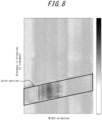
- FIG. 8 illustrates a joint portion of the conveyor belt 30.
- the joint portion of the conveyor belt 30 is a portion that is thicker than other portions. Accordingly, the joint portion of the conveyor belt 30 exhibits a characteristic pattern in measurement data.
- the joint portion is characterized by being at an angle with respect to the belt width direction. Therefore, in a case in which measurement data is obtained for the width direction, it is possible to detect that the characteristic pattern occurs at an angle and to accurately detect the joint portion.
- the control unit 15 can calculate the measurement position in the circumferential direction of the conveyor belt 30 using, for example, the joint portion of the conveyor belt 30 as the reference position, according to the aforementioned relationship of rotations based on the number of pulley rotations.
- the conveyor belt 30 can be managed (monitored), based on the computed surface shape of the conveyor belt 30.
- the surface shape measurement device 10 determines, for example, whether the thickness of the conveyor belt 30 is sufficient, based on the computed surface shape of the conveyor belt 30. When determining that the thickness is not sufficient, the surface shape measurement device 10 can inform an operator of a fault in the conveyor belt 30 or stop the conveyor belt 30.
- the surface shape measurement device 10 and the surface shape measurement method according to the present embodiment can measure the thickness of the conveyor belt 30 with high accuracy, by identifying the uneven portion formed in the pulley 20 from measurement data and estimating a measurement position in the circumferential direction of the belt without separately installing a sensor.
- the belt management method according to the present embodiment makes it possible to accurately determine the thickness of the conveyor belt 30, so that the conveyor belt 30 can be managed so as to prevent fractures or the like.
- an object to be measured is the conveyor belt 30, it is not limited to the conveyor belt 30.
- the belt, which is an object to be measured at least needs to be a belt wrapped around the pulley 20.
- the reference position is not limited to the joint portion.
- a flaw (recessed portion) or the like that is present on the surface 31 of the conveyor belt 30 may be used as the reference position.
- detection of rotations is performed using measurement data after the correction of removing effects of inclination and eccentricity of the pulley 20.
Landscapes
- Physics & Mathematics (AREA)
- General Physics & Mathematics (AREA)
- Engineering & Computer Science (AREA)
- Computer Vision & Pattern Recognition (AREA)
- Length Measuring Devices By Optical Means (AREA)
- Length Measuring Devices With Unspecified Measuring Means (AREA)
- Control Of Conveyors (AREA)
Applications Claiming Priority (2)
| Application Number | Priority Date | Filing Date | Title |
|---|---|---|---|
| JP2022065349 | 2022-04-11 | ||
| PCT/JP2023/009734 WO2023199681A1 (fr) | 2022-04-11 | 2023-03-13 | Dispositif de mesure de forme de surface, procédé de mesure de forme de surface et procédé de gestion de courroie |
Publications (2)
| Publication Number | Publication Date |
|---|---|
| EP4492002A1 true EP4492002A1 (fr) | 2025-01-15 |
| EP4492002A4 EP4492002A4 (fr) | 2025-07-23 |
Family
ID=87563005
Family Applications (1)
| Application Number | Title | Priority Date | Filing Date |
|---|---|---|---|
| EP23788103.2A Pending EP4492002A4 (fr) | 2022-04-11 | 2023-03-13 | Dispositif de mesure de forme de surface, procédé de mesure de forme de surface et procédé de gestion de courroie |
Country Status (4)
| Country | Link |
|---|---|
| EP (1) | EP4492002A4 (fr) |
| JP (1) | JP7327720B1 (fr) |
| KR (1) | KR20240150504A (fr) |
| CN (1) | CN118900982A (fr) |
Families Citing this family (1)
| Publication number | Priority date | Publication date | Assignee | Title |
|---|---|---|---|---|
| JPWO2025126586A1 (fr) * | 2023-12-11 | 2025-06-19 |
Family Cites Families (4)
| Publication number | Priority date | Publication date | Assignee | Title |
|---|---|---|---|---|
| JP2006132942A (ja) * | 2004-11-02 | 2006-05-25 | Toyota Motor Corp | ベルト表面の変形検査装置 |
| JP6554355B2 (ja) | 2015-07-30 | 2019-07-31 | 大成建設株式会社 | ベルトコンベアの監視システム |
| AU2017349631B2 (en) * | 2016-10-24 | 2020-10-29 | Wearhawk Pty Ltd | Belt inspection system and method |
| JPWO2019188718A1 (ja) | 2018-03-28 | 2020-04-30 | バンドー化学株式会社 | 表面形状監視装置、摩耗量測定システム及び表面形状監視システム |
-
2023
- 2023-03-13 EP EP23788103.2A patent/EP4492002A4/fr active Pending
- 2023-03-13 CN CN202380028282.3A patent/CN118900982A/zh active Pending
- 2023-03-13 KR KR1020247031582A patent/KR20240150504A/ko active Pending
- 2023-03-13 JP JP2023535269A patent/JP7327720B1/ja active Active
Also Published As
| Publication number | Publication date |
|---|---|
| JPWO2023199681A1 (fr) | 2023-10-19 |
| KR20240150504A (ko) | 2024-10-15 |
| JP7327720B1 (ja) | 2023-08-16 |
| CN118900982A (zh) | 2024-11-05 |
| EP4492002A4 (fr) | 2025-07-23 |
Similar Documents
| Publication | Publication Date | Title |
|---|---|---|
| US10495661B2 (en) | Method and device for monitoring state of moving object and system for fast inspecting vehicle | |
| US10352688B2 (en) | Device and method for measuring the tread depth of a tire | |
| US10444010B2 (en) | Method for detecting support surface variations during wheel alignment rolling compensation procedure | |
| US20110102811A1 (en) | Apparatus and method for measuring cylindrically-shaped object and apparatus for inspecting tire appearance | |
| CN108106652B (zh) | 编码器的校正方法和装置 | |
| EP4492002A1 (fr) | Dispositif de mesure de forme de surface, procédé de mesure de forme de surface et procédé de gestion de courroie | |
| EP2960621B1 (fr) | Dispositif d'inspection de forme | |
| EP4492001A1 (fr) | Appareil de mesure de forme de surface, procédé de mesure de forme de surface et procédé de gestion de bande | |
| CN119349157A (zh) | 一种基于光栅设备的传送带物品实时检测方法及相关设备 | |
| WO2023199681A1 (fr) | Dispositif de mesure de forme de surface, procédé de mesure de forme de surface et procédé de gestion de courroie | |
| US20160313117A1 (en) | Measuring apparatus and method for same | |
| EP4474764A1 (fr) | Dispositif de mesure de forme de surface, procédé de mesure de forme de surface et procédé de gestion de bande | |
| US9757993B2 (en) | Apparatus and method for monitoring tire pressure | |
| EP4588863A1 (fr) | Procédé de surveillance et et dispositif de surveillance | |
| EP4354080A1 (fr) | Dispositif de mesure de forme de surface, procédé de mesure de forme de surface, et procédé de gestion de bande transporteuse | |
| EP4421004A1 (fr) | Procédé de mesure de forme de surface, dispositif de mesure de forme de surface et procédé de gestion de courroie | |
| JP6433824B2 (ja) | 帯状部材の幅方向端部位置検出方法 | |
| EP4589246A1 (fr) | Dispositif de mesure de forme de surface et procédé de mesure de forme de surface | |
| US20250208001A1 (en) | Tire groove measuring device, tire groove measuring system, and trie groove measuring method | |
| CN121247309A (en) | Multi-dimensional automatic deviation correcting method, device, product and medium for belt conveyor | |
| JP6433822B2 (ja) | 帯状部材の幅方向端部位置検出方法。 | |
| JPH11118433A (ja) | 厚さ測定装置及び厚さ測定方法 | |
| JP2011021891A (ja) | タイヤの金属ワイヤ検出方法及びその装置 | |
| CN109726677A (zh) | 轮轴识别方法、装置及可读存储介质 |
Legal Events
| Date | Code | Title | Description |
|---|---|---|---|
| STAA | Information on the status of an ep patent application or granted ep patent |
Free format text: STATUS: THE INTERNATIONAL PUBLICATION HAS BEEN MADE |
|
| PUAI | Public reference made under article 153(3) epc to a published international application that has entered the european phase |
Free format text: ORIGINAL CODE: 0009012 |
|
| STAA | Information on the status of an ep patent application or granted ep patent |
Free format text: STATUS: REQUEST FOR EXAMINATION WAS MADE |
|
| 17P | Request for examination filed |
Effective date: 20241008 |
|
| AK | Designated contracting states |
Kind code of ref document: A1 Designated state(s): AL AT BE BG CH CY CZ DE DK EE ES FI FR GB GR HR HU IE IS IT LI LT LU LV MC ME MK MT NL NO PL PT RO RS SE SI SK SM TR |
|
| REG | Reference to a national code |
Ref country code: DE Ref legal event code: R079 Free format text: PREVIOUS MAIN CLASS: G01B0011250000 Ipc: B65G0043020000 |
|
| DAV | Request for validation of the european patent (deleted) | ||
| DAX | Request for extension of the european patent (deleted) | ||
| A4 | Supplementary search report drawn up and despatched |
Effective date: 20250624 |
|
| RIC1 | Information provided on ipc code assigned before grant |
Ipc: B65G 43/02 20060101AFI20250617BHEP Ipc: G01B 11/06 20060101ALI20250617BHEP Ipc: G01B 11/25 20060101ALI20250617BHEP |