EP4491794A2 - Rollengewichtssystem zur dynamischen überprüfung auf einer maschine - Google Patents
Rollengewichtssystem zur dynamischen überprüfung auf einer maschine Download PDFInfo
- Publication number
- EP4491794A2 EP4491794A2 EP24183001.7A EP24183001A EP4491794A2 EP 4491794 A2 EP4491794 A2 EP 4491794A2 EP 24183001 A EP24183001 A EP 24183001A EP 4491794 A2 EP4491794 A2 EP 4491794A2
- Authority
- EP
- European Patent Office
- Prior art keywords
- sheet
- roll
- weight
- spool
- wound
- Prior art date
- Legal status (The legal status is an assumption and is not a legal conclusion. Google has not performed a legal analysis and makes no representation as to the accuracy of the status listed.)
- Pending
Links
Images


Classifications
-
- D—TEXTILES; PAPER
- D21—PAPER-MAKING; PRODUCTION OF CELLULOSE
- D21G—CALENDERS; ACCESSORIES FOR PAPER-MAKING MACHINES
- D21G9/00—Other accessories for paper-making machines
-
- G—PHYSICS
- G01—MEASURING; TESTING
- G01G—WEIGHING
- G01G23/00—Auxiliary devices for weighing apparatus
- G01G23/14—Devices for determining tare weight or for cancelling out the tare by zeroising, e.g. mechanically operated
- G01G23/16—Devices for determining tare weight or for cancelling out the tare by zeroising, e.g. mechanically operated electrically or magnetically operated
- G01G23/163—Devices for determining tare weight or for cancelling out the tare by zeroising, e.g. mechanically operated electrically or magnetically operated involving digital counting
-
- B—PERFORMING OPERATIONS; TRANSPORTING
- B21—MECHANICAL METAL-WORKING WITHOUT ESSENTIALLY REMOVING MATERIAL; PUNCHING METAL
- B21B—ROLLING OF METAL
- B21B1/00—Metal-rolling methods or mills for making semi-finished products of solid or profiled cross-section; Sequence of operations in milling trains; Layout of rolling-mill plant, e.g. grouping of stands; Succession of passes or of sectional pass alternations
- B21B1/22—Metal-rolling methods or mills for making semi-finished products of solid or profiled cross-section; Sequence of operations in milling trains; Layout of rolling-mill plant, e.g. grouping of stands; Succession of passes or of sectional pass alternations for rolling plates, strips, bands or sheets of indefinite length
-
- B—PERFORMING OPERATIONS; TRANSPORTING
- B65—CONVEYING; PACKING; STORING; HANDLING THIN OR FILAMENTARY MATERIAL
- B65H—HANDLING THIN OR FILAMENTARY MATERIAL, e.g. SHEETS, WEBS, CABLES
- B65H18/00—Winding webs
-
- B—PERFORMING OPERATIONS; TRANSPORTING
- B65—CONVEYING; PACKING; STORING; HANDLING THIN OR FILAMENTARY MATERIAL
- B65H—HANDLING THIN OR FILAMENTARY MATERIAL, e.g. SHEETS, WEBS, CABLES
- B65H18/00—Winding webs
- B65H18/08—Web-winding mechanisms
-
- B—PERFORMING OPERATIONS; TRANSPORTING
- B65—CONVEYING; PACKING; STORING; HANDLING THIN OR FILAMENTARY MATERIAL
- B65H—HANDLING THIN OR FILAMENTARY MATERIAL, e.g. SHEETS, WEBS, CABLES
- B65H20/00—Advancing webs
- B65H20/02—Advancing webs by friction roller
-
- D—TEXTILES; PAPER
- D21—PAPER-MAKING; PRODUCTION OF CELLULOSE
- D21F—PAPER-MAKING MACHINES; METHODS OF PRODUCING PAPER THEREON
- D21F7/00—Other details of machines for making continuous webs of paper
-
- D—TEXTILES; PAPER
- D21—PAPER-MAKING; PRODUCTION OF CELLULOSE
- D21F—PAPER-MAKING MACHINES; METHODS OF PRODUCING PAPER THEREON
- D21F7/00—Other details of machines for making continuous webs of paper
- D21F7/003—Indicating or regulating the moisture content of the layer
-
- D—TEXTILES; PAPER
- D21—PAPER-MAKING; PRODUCTION OF CELLULOSE
- D21F—PAPER-MAKING MACHINES; METHODS OF PRODUCING PAPER THEREON
- D21F7/00—Other details of machines for making continuous webs of paper
- D21F7/06—Indicating or regulating the thickness of the layer; Signal devices
-
- D—TEXTILES; PAPER
- D21—PAPER-MAKING; PRODUCTION OF CELLULOSE
- D21F—PAPER-MAKING MACHINES; METHODS OF PRODUCING PAPER THEREON
- D21F9/00—Complete machines for making continuous webs of paper
- D21F9/02—Complete machines for making continuous webs of paper of the Fourdrinier type
-
- D—TEXTILES; PAPER
- D21—PAPER-MAKING; PRODUCTION OF CELLULOSE
- D21G—CALENDERS; ACCESSORIES FOR PAPER-MAKING MACHINES
- D21G9/00—Other accessories for paper-making machines
- D21G9/0009—Paper-making control systems
-
- G—PHYSICS
- G01—MEASURING; TESTING
- G01G—WEIGHING
- G01G11/00—Apparatus for weighing a continuous stream of material during flow; Conveyor belt weighers
- G01G11/003—Details; specially adapted accessories
-
- G—PHYSICS
- G01—MEASURING; TESTING
- G01G—WEIGHING
- G01G13/00—Weighing apparatus with automatic feed or discharge for weighing-out batches of material
- G01G13/24—Weighing mechanism control arrangements for automatic feed or discharge
- G01G13/247—Checking quantity of material in the feeding arrangement, e.g. discharge material only if a predetermined quantity is present
-
- G—PHYSICS
- G01—MEASURING; TESTING
- G01G—WEIGHING
- G01G13/00—Weighing apparatus with automatic feed or discharge for weighing-out batches of material
- G01G13/24—Weighing mechanism control arrangements for automatic feed or discharge
- G01G13/248—Continuous control of flow of material
-
- G—PHYSICS
- G01—MEASURING; TESTING
- G01G—WEIGHING
- G01G17/00—Apparatus for or methods of weighing material of special form or property
- G01G17/02—Apparatus for or methods of weighing material of special form or property for weighing material of filamentary or sheet form
-
- G—PHYSICS
- G01—MEASURING; TESTING
- G01G—WEIGHING
- G01G23/00—Auxiliary devices for weighing apparatus
- G01G23/18—Indicating devices, e.g. for remote indication; Recording devices; Scales, e.g. graduated
- G01G23/36—Indicating the weight by electrical means, e.g. using photoelectric cells
- G01G23/37—Indicating the weight by electrical means, e.g. using photoelectric cells involving digital counting
- G01G23/3728—Indicating the weight by electrical means, e.g. using photoelectric cells involving digital counting with wireless means
-
- G—PHYSICS
- G01—MEASURING; TESTING
- G01G—WEIGHING
- G01G23/00—Auxiliary devices for weighing apparatus
- G01G23/18—Indicating devices, e.g. for remote indication; Recording devices; Scales, e.g. graduated
- G01G23/38—Recording and/or coding devices specially adapted for weighing apparatus
- G01G23/42—Recording and/or coding devices specially adapted for weighing apparatus electrically operated
-
- G—PHYSICS
- G06—COMPUTING OR CALCULATING; COUNTING
- G06K—GRAPHICAL DATA READING; PRESENTATION OF DATA; RECORD CARRIERS; HANDLING RECORD CARRIERS
- G06K17/00—Methods or arrangements for effecting co-operative working between equipments covered by two or more of main groups G06K1/00 - G06K15/00, e.g. automatic card files incorporating conveying and reading operations
- G06K17/0022—Methods or arrangements for effecting co-operative working between equipments covered by two or more of main groups G06K1/00 - G06K15/00, e.g. automatic card files incorporating conveying and reading operations arrangements or provisions for transferring data to distant stations, e.g. from a sensing device
-
- G—PHYSICS
- G06—COMPUTING OR CALCULATING; COUNTING
- G06K—GRAPHICAL DATA READING; PRESENTATION OF DATA; RECORD CARRIERS; HANDLING RECORD CARRIERS
- G06K7/00—Methods or arrangements for sensing record carriers, e.g. for reading patterns
- G06K7/10—Methods or arrangements for sensing record carriers, e.g. for reading patterns by electromagnetic radiation, e.g. optical sensing; by corpuscular radiation
- G06K7/10009—Methods or arrangements for sensing record carriers, e.g. for reading patterns by electromagnetic radiation, e.g. optical sensing; by corpuscular radiation sensing by radiation using wavelengths larger than 0.1 mm, e.g. radio-waves or microwaves
- G06K7/10297—Methods or arrangements for sensing record carriers, e.g. for reading patterns by electromagnetic radiation, e.g. optical sensing; by corpuscular radiation sensing by radiation using wavelengths larger than 0.1 mm, e.g. radio-waves or microwaves arrangements for handling protocols designed for non-contact record carriers such as RFIDs NFCs, e.g. ISO/IEC 14443 and 18092
-
- B—PERFORMING OPERATIONS; TRANSPORTING
- B65—CONVEYING; PACKING; STORING; HANDLING THIN OR FILAMENTARY MATERIAL
- B65H—HANDLING THIN OR FILAMENTARY MATERIAL, e.g. SHEETS, WEBS, CABLES
- B65H2515/00—Physical entities not provided for in groups B65H2511/00 or B65H2513/00
- B65H2515/10—Mass, e.g. mass flow rate; Weight; Inertia
-
- B—PERFORMING OPERATIONS; TRANSPORTING
- B65—CONVEYING; PACKING; STORING; HANDLING THIN OR FILAMENTARY MATERIAL
- B65H—HANDLING THIN OR FILAMENTARY MATERIAL, e.g. SHEETS, WEBS, CABLES
- B65H2801/00—Application field
- B65H2801/84—Paper-making machines
Definitions
- the present invention generally relates to quality control techniques for fabricating sheet materials and, more particularly, to systems for measuring the actual gross weight of a roll immediately after its production in a sheet making facility.
- the weight data allows dynamic verification of the accuracy of on-line basis weight measurements so that adjustments to the operating conditions of the sheetmaking process can be made.
- On-line measurements are used to detect properties of sheet materials during manufacture to enable prompt control of the sheetmaking processes and, thus, to assure sheet quality while reducing the quantity of substandard sheet material which is produced.
- a web of paper is formed from an aqueous suspension of fibers (stock) on a traveling mesh papermaking fabric and water drains by gravity and suction through the fabric. The web is then transferred to the pressing section where more water is removed by pressure and vacuum. The web next enters the dryer section where steam heated dryers and hot air completes the drying process.
- the paper machine is, in essence, a water removal system.
- a typical forming section of a papermaking machine includes an endless traveling papermaking fabric or wire, which travels over a series of water removal elements such as table rolls, foils, vacuum foils, and suction boxes.
- the stock is carried on the top surface of the papermaking fabric and is de-watered as the stock travels over the successive de-watering elements to form a sheet of paper. Finally, the wet sheet is transferred to the press section of the papermaking machine where enough water is removed to form a sheet of paper.
- on-line measurements often include basis weight, moisture content, and sheet caliper, i.e., thickness.
- the measurements can be used for controlling process variables with the goal of maintaining output quality and minimizing the quantity of product that must be rejected due to disturbances in the manufacturing process.
- the on-line sheet property measurements are often accomplished by scanning sensors that periodically traverse the sheet material from edge to edge. It is conventional to measure the basis weight and/or caliper of sheet material after it leaves the main dryer section or at the take-up reel with scanning sensors.
- the basis weight of the sheet material produced is an important property however current production methods only provide online measurement estimates.
- the present invention is based, in part, on the development of a wireless technique of measuring the gross weight of the sheet material that is wound on the finished reel spool which generates real time weight readings to a control system.
- the actual weight measurements allow for fast dynamic correlations and verifications to the online estimate weight measurements.
- the operator can then adjust operating parameters of the various actuators and sensors in the papermaking process in response to measurement discrepancies.
- the invention is directed to a sheet production system that includes:
- the invention is directed to a method of operating a sheetmaking system that produces a continuous sheet that travels in the MD which includes:
- the invention is directed to an apparatus for determining the gross weight of sheet material on a roll that includes:
- the apparatus includes a pair of lifting devices each equipped with a load cell which is connected to a Wi-Fi signal transmitter or a Bluetooth signal transmitter.
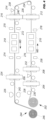
- FIG. 1 illustrates a sheetmaking system 10 that includes papermaking machine 2, control system 4 and network 6.
- the papermaking machine 2 produces a continuous sheet of paper material 12, which can be more than 10 meters in width, that is collected in take-up reel 14.
- the paper material 12, having a specific width is produced from a pulp suspension feedstock, comprising of an aqueous mixture of wood fibers and other materials, which undergoes various unit operations that are monitored and controlled by a quality control system 4.
- the network 6 facilitates communication between the components of system 10.
- the papermaking machine 2 includes a headbox 8, which distributes an aqueous pulp suspension uniformly across the machine onto a continuous screen or wire 30 that is moving in the machine direction (MD).
- Headbox 8 includes slice openings through which the pulp suspension is distributed onto screen or wire 30 which comprise a suitable structure such as a mesh for receiving a pulp suspension and allowing water or other materials to drain or leave the pulp suspension.
- the formation of the paper sheet 12 is influenced by a plurality of linear actuators 3 extending in the cross direction across the sheet 12 of paper being formed. Actuators 3 control the sheet's weight in the cross direction (CD). Sensors located downstream from the actuators measure the properties of the sheet.
- the feedstock is fed from the head box through a gap or elongated orifice 5 onto a wire section 30.
- the orifice or gap is a relatively narrow opening that extends across the width of the machine.
- Weight profile control in such an arrangement is achieved by locally adjusting the position of the slice lip across the machine with motorized linear actuators 3 to vary the dimensions of the gap or orifice immediately adjacent the actuator.
- the "wet end” forming portion of sheetmaking system 10 comprises headbox 8 and wire 30 and those sections before the wire 30, and the “dry end” comprises the sections that are downstream from wire 30.
- Sheet 12 then enters a press section 32, which includes multiple press rolls where sheet 12 travels through the openings (referred to as "nips") between pairs of counter-rotating rolls in press section 32.
- the rolls in press section 32 compress the pulp material forming sheet 12. This may help to remove more water from the pulp material and to equalize the characteristics of the sheet 12 on both of its sides.
- a tachometer 38 measures the MD line speed.
- a calendar 36 processes and finishes sheet 12, for example, by smoothing and imparting a final finish, thickness, gloss, or other characteristic to sheet 12. Other materials (such as starch or wax) can also be added to sheet 12 to obtain the desired finish.
- An array of induction heating actuators 24 applies heat along the CD to one or more of the rollers to control the roll diameters and thereby the size of the nips.
- Sheetmaking system 10 further includes an array of steam actuators 20 that controls the amount of hot steam that is projected along the CD.
- the hot steam increases the paper surface temperature and allows for easier cross direction removal of water from the paper sheet.
- paper material 14 is sprayed with water in the CD.
- an array of rewet shower actuators 22 controls the amount of water that is applied along the CD.
- Typical physical characteristics of paper that are can be measured include, for example, thickness, basis weight, moisture content, chemical composition such as ash, surface roughness, gloss, caliper, color, and crepe pattern surface features.
- CD control may be achieved by measuring sheet properties using one or more scanners 26, 28 that are capable of scanning sheet 12 and measuring one or more characteristics of sheet 12.
- scanner 28 could carry sensors for measuring the dry weight, moisture content, ash content, or any other or additional characteristics of sheet 12.
- Scanner 28 includes suitable structures for measuring or detecting one or more characteristics of sheet 12, such as a set or array of sensors.
- Scanner 28 is particularly suited for measuring the dry end dry weight and caliper of the paper product at the take-up reel 14. Suitable caliper scanning sensors, are described in U.S. Pat. No. 6,967,726 to King et al. and U.S. Pat. No. 4,678,915 to Dahlquist et al. , which are incorporated herein by reference.
- Measurements from scanners 26 and 28 are provided to control system 4 that adjusts various actuators or operations of papermaking machine 2 that affect machine direction and cross direction characteristics of sheet 12.
- a machine direction characteristic of sheet 12 generally refers to an average characteristic of sheet 12 that varies and is controlled in the machine direction.
- control system 4 is capable of controlling the dry weight of the paper sheet by adjusting the supply of pulp to the headbox 8.
- control system 4 could provide information to a stock flow controller that regulates the flow of stock through valves and to headbox 8.
- Control system 4 includes any hardware, software, firmware, or combination thereof for controlling the operation of the sheetmaking machine 2 or other machine.
- Control system 4 includes computer with a processor and memory storing instructions and data used, generated, and collected by the processor.
- FIG. 2 illustrates one particular implementation of the scanning sensor which is located at the dry end just before the take-up reel of FIG. 1 .
- the radiation source and detector are housed in a dual mounting head scanner 58 of scanner system 50 which can be employed to measure one or more characteristics of the paper that is produced.
- Upper scanner head 54 moves repeatedly back and forth in the CD across the width of the moving sheet 60, which moves in the MD, so that the characteristics of the entire sheet may be measured.
- Scanner 58 or gauge is supported by two transverse beams 52 and 62 on which are mounted upper and lower scanning heads 54 and 56, respectively.
- the operative faces of the lower and upper scanner heads 56, 54 define a measurement gap or window that accommodates sheet 60.
- the lower scanner head 56 may include a sheet stabilization system such as an air-bearing stabilizer (not shown) to maintain the sheet on a consistent plane as it passes through the measurement window.
- a sheet stabilization system such as an air-bearing stabilizer (not shown) to maintain the sheet on a consistent plane as it passes through the measurement window.
- the movement of the dual scanner heads 54, 56, is synchronized with respect to speed and direction so that they are aligned with each other.
- the scanners are also equipped with edge detectors (not shown) that measure sheet width.
- the scanning sensors can be configured to operate in the transmissive mode or reflective mode.
- Basis weight scanning sensors are described, for example, in U.S. Pat. No. 10,935,368 to Tixier and U.S. 2015/0022220 to Tixier and Hughes , which are incorporated herein by reference.
- scanner head 54 can house a radiation source that directs a beam of radiation into a moving web or sheet 26 and scanner head 56 houses a radiation receiver that detects radiation that is transmitted through the material.
- the sensor measures one or more properties of the web or sheet 60.
- the upper scanner head 54 can house both a radiation source and detector to measure one or more characteristics of the web or sheet 26.
- the basis weight, caliper, sheet width and machine direction speed of the moving sheet of paper are continuously monitored.
- the accumulated data allows the weight of the paper that is wound onto a spool of a finished roll to be estimated.
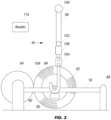
- FIG. 3 shows a wound sheet or web roll 82, that has reached its desired diameter, and which is in contact with a support drum 94.
- a reel spool 84 includes a shaft 86 which rests on support rail 92 which is secured by posts 88, 90. It is understood that each of the two ends of the spool is supported by a support rail.
- the reel spool 84 can also have a bearing housing (not shown) on each end that is in contact with the support rails.
- An RFID tag 80 which is secured to the spool 84, has an assigned identification spool number and/or spool tare weight.
- the identification numbers of the plurality of spools used in the papermaking plant and their associated tare weights can be stored in the database of control system 4 ( FIG. 1 ). In this fashion, once the identification number of a spool is known, its tare weight can be retrieved from the database.
- the RFID tag can be either passive, active or battery assisted passive. Active tags have batteries and transmits signals intermittently. Battery assisted passive tags are activated when it is activated by an RFID reader. Passive tags do not have batteries and use the radio energy transmitted by the reader for its energy source. Passive tags include an integrate circuit that is coupled with a transponder antenna for receiving interrogation signals from a RFID reader antenna and for transmitting a transponder signal. In this example, the tags used are passive. Reading or scanning spool tag 80 reveals this spool's unique identification number which in turn allows retrieval of its tare weigh from the database. Alternatively, the tare weight can be stored into the tag 80 so that reading the tag will reveal the tare weight.
- a lifting device 96 includes a cable 98 with a distal end 100, which is attachable to an overhead or bridge crane (not shown), and a proximal end which is secured to the top end of a strain gauge load cell 104 while a crane hook 106 is connected to its lower end.
- the load cell is operatively connected to a wireless transmitter 108.
- the load cell 104 is capable of sensing the weight of the roll 82 and the transmitter sends wireless signals that includes information representative of the weight.
- a pair of lifting devices each with a weight sensor and associated wireless transmitter are employed to raise the roll 82.
- the two load cells in the pair of lifting devices are calibrated so that their combined readings indicate the weight of the roll.
- the transmitter devices can be configured to operate under any known wireless communication protocols such as, for example, Wi-Fi and Bluetooth. Weight signals from the pair of transmitter devices are received by wireless receiver 40 ( FIG. 1 ).
- the RFID reader 110 in FIG. 3 has an antenna that is capable of transmitting the interrogation signal and receiving the RFID transponder signals from the spool tag 80 that are responsive to the interrogation signal.
- the spool tag transponder signal includes its identification number and/or tare weight.
- the RFID reader 110 is operatively connected to control system 4 ( FIG. 1 ) which processes the transponder signal from the spool RFID tag.
- the control system 4 receives weight signals from the pair of wireless transmitter devices. Based on this information, the computer in the control system calculates the actual gross weight of the sheet by subtracting the tare weight of the reel spool 84 from the weight of the roll 82. The computer also compares the actual gross weight to the estimated gross weight that was derived from the online measurements.
- FIG. 4 illustrates a process for coating a metal web or sheet that is used in fabricating electrodes for lithium-ion electrochemical cells and batteries.
- the electrode coating includes anodic active materials such as graphite and, for making cathodes, the electrode coating includes cathodic active materials such as a lithium metal oxide.
- Electrodes include a current collector metal foil that is coated on both sides of the foil with electrode slurry which can also include carbon black, binder, and solvent.
- a roll 200 is unwound by an unwinder and supplies a continuous metal web or sheet 230 that is coated on a top surface with a layer of electrode slurry by a coater 206.
- the basis weight, thickness, and other characteristics of the metal web or sheet 230 from roll 200 are usually known; scanning beta gauges 204 and 208 are employed to measure, respectively, the basis weight and/or thickness before, and after, the electrode slurry is applied by the coater 206.
- the coater 206 such as a tape casting coater, includes actuators that control a slot die/doctor blade to regulate the amount of slurry that is extruded onto the sheet 230.
- a dryer 210 removes excess solvents and cures the slurry that is on a moving coated sheet 232 to form an electrode layer on the sheet.
- Imaging devices 258 and 278 capture surface images of the coated sheet 232 before and after the dryer 210.
- a scanning beta gauge 212 measures the basis weight and/or thickness of the moving coated sheet 232 exiting the dryer 210 after the calender 254. Thereafter, rolling supports 234, 236 reverse the orientation of a moving sheet 238 so that the uncoated side is on top whereupon a coater 214 applies a layer of electrode slurry on the top uncoated surface of a moving sheet 238.
- the basis weight and/or thickness of a double-side coated sheet 240 are then measured with a scanning beta gauge 16 before entering a dryer 218.
- Imaging devices 270, 272, 274 and 276 are strategically located to capture top and bottom surface images.
- a beta gauge that is housed together with an infrared temperature sensor in a scanning device 224 measures the basis weight and/or thickness and the temperature of the double-coated sheet 242 as the scanning device 224 moves back and forth across the double-coated sheet 242. In particular the basis weight of each electrode layer is measured.
- a rewinder takes up the double-side coated sheet 242 into roll 244 which includes a reel spool 246 that is supported on rails (not shown). Surface defects on the top and bottom coatings are monitored by imaging devices 226, 228.
- the roll 244 is typically transferred to a calendering station whereby the double-coated electrode layer from the roll is unwound and passes through a calender which finishes and smooths the electrode layer.
- Reel spool 246 includes an RFID tag which can transmit an identification number and/or its tare weight. Before undergoing the calendering process, a pair of the lifting devices shown in FIG. 3 are used to obtain the weigh of the roll 244. The gross weight of roll 244 is determined by subtracting the tare weight of the reel spool 246 from the roll weight.
Landscapes
- Physics & Mathematics (AREA)
- General Physics & Mathematics (AREA)
- Engineering & Computer Science (AREA)
- Computer Networks & Wireless Communication (AREA)
- Theoretical Computer Science (AREA)
- Health & Medical Sciences (AREA)
- Toxicology (AREA)
- Mechanical Engineering (AREA)
- Computer Security & Cryptography (AREA)
- Electromagnetism (AREA)
- General Health & Medical Sciences (AREA)
- Artificial Intelligence (AREA)
- Computer Vision & Pattern Recognition (AREA)
- General Engineering & Computer Science (AREA)
- Paper (AREA)
- Arrangements For Transmission Of Measured Signals (AREA)
- Controlling Rewinding, Feeding, Winding, Or Abnormalities Of Webs (AREA)
Applications Claiming Priority (1)
| Application Number | Priority Date | Filing Date | Title |
|---|---|---|---|
| US18/221,156 US20250020502A1 (en) | 2023-07-12 | 2023-07-12 | Roll Weight System for On Machine Dynamic Verification |
Publications (2)
| Publication Number | Publication Date |
|---|---|
| EP4491794A2 true EP4491794A2 (de) | 2025-01-15 |
| EP4491794A3 EP4491794A3 (de) | 2025-07-09 |
Family
ID=91617236
Family Applications (1)
| Application Number | Title | Priority Date | Filing Date |
|---|---|---|---|
| EP24183001.7A Pending EP4491794A3 (de) | 2023-07-12 | 2024-06-19 | Rollengewichtssystem zur dynamischen überprüfung auf einer maschine |
Country Status (6)
| Country | Link |
|---|---|
| US (1) | US20250020502A1 (de) |
| EP (1) | EP4491794A3 (de) |
| JP (1) | JP2025013221A (de) |
| KR (1) | KR20250010546A (de) |
| CN (1) | CN119309662A (de) |
| CA (1) | CA3245037A1 (de) |
Citations (4)
| Publication number | Priority date | Publication date | Assignee | Title |
|---|---|---|---|---|
| US4678915A (en) | 1982-05-17 | 1987-07-07 | Measurex Corporation | System and process for measuring and correcting the values of a parameter of a sheet material |
| US6967726B2 (en) | 2003-10-03 | 2005-11-22 | Honeywell International Inc. | Means for in-place automated calibration of optically-based thickness sensor |
| US20150022220A1 (en) | 2013-07-22 | 2015-01-22 | Honeywell Asca Inc. | Multi-frequency Microwave Sensor for Temperature Independent Measurement of Moisture |
| US10935368B2 (en) | 2018-03-14 | 2021-03-02 | Honeywell Limited | Scanning caliper and basis weight sensor for sheet products using terahertz |
Family Cites Families (8)
| Publication number | Priority date | Publication date | Assignee | Title |
|---|---|---|---|---|
| US4879471A (en) * | 1987-03-25 | 1989-11-07 | Measurex Corporation | Rapid-scanning infrared sensor |
| JPH03199924A (ja) * | 1989-12-27 | 1991-08-30 | Dai Showa Seishi Kk | ロール状物の計量法とこれに用いる計量装置 |
| JP2002370872A (ja) * | 2001-06-13 | 2002-12-24 | Mitsubishi Heavy Ind Ltd | リールスプール識別装置及び製紙設備 |
| US7459060B2 (en) * | 2005-08-22 | 2008-12-02 | Honeywell Asca Inc. | Reverse bump test for closed-loop identification of CD controller alignment |
| US10501274B2 (en) * | 2017-07-06 | 2019-12-10 | Honeywell International Inc. | Continuous web sheet defect analytics, classification and remediation for enhancing equipment efficiency and throughput |
| IT201800006680A1 (it) * | 2018-06-26 | 2019-12-26 | Metodo di predizione della presenza di difetti di prodotto durante una fase di lavorazione intermedia di un prodotto sottile avvolto in bobina | |
| CN108584703B (zh) * | 2018-07-18 | 2019-07-02 | 安徽工业大学 | 双梁桥式起重机吊重及主梁挠度在线测量系统及其测量方法 |
| US20240140752A1 (en) * | 2021-03-30 | 2024-05-02 | Kimberly-Clark Worldwide, Inc. | System and Method for Building a Roll of Material |
-
2023
- 2023-07-12 US US18/221,156 patent/US20250020502A1/en active Pending
-
2024
- 2024-06-11 CN CN202410742629.7A patent/CN119309662A/zh active Pending
- 2024-06-19 EP EP24183001.7A patent/EP4491794A3/de active Pending
- 2024-07-01 JP JP2024105933A patent/JP2025013221A/ja active Pending
- 2024-07-02 CA CA3245037A patent/CA3245037A1/en active Pending
- 2024-07-05 KR KR1020240088941A patent/KR20250010546A/ko active Pending
Patent Citations (5)
| Publication number | Priority date | Publication date | Assignee | Title |
|---|---|---|---|---|
| US4678915A (en) | 1982-05-17 | 1987-07-07 | Measurex Corporation | System and process for measuring and correcting the values of a parameter of a sheet material |
| US4678915B1 (en) | 1982-05-17 | 1996-07-16 | Measurex Corp | System and process for measuring and correcting the values of a parameter of a sheet material |
| US6967726B2 (en) | 2003-10-03 | 2005-11-22 | Honeywell International Inc. | Means for in-place automated calibration of optically-based thickness sensor |
| US20150022220A1 (en) | 2013-07-22 | 2015-01-22 | Honeywell Asca Inc. | Multi-frequency Microwave Sensor for Temperature Independent Measurement of Moisture |
| US10935368B2 (en) | 2018-03-14 | 2021-03-02 | Honeywell Limited | Scanning caliper and basis weight sensor for sheet products using terahertz |
Also Published As
| Publication number | Publication date |
|---|---|
| KR20250010546A (ko) | 2025-01-21 |
| EP4491794A3 (de) | 2025-07-09 |
| US20250020502A1 (en) | 2025-01-16 |
| CA3245037A1 (en) | 2025-06-06 |
| CN119309662A (zh) | 2025-01-14 |
| JP2025013221A (ja) | 2025-01-24 |
Similar Documents
| Publication | Publication Date | Title |
|---|---|---|
| CA2327792C (en) | Water weight sensor array imbedded in a sheetmaking machine roll | |
| US7780817B2 (en) | Measurement system for improved paper roll runnability | |
| US20230253542A1 (en) | Traceability of Battery Electrodes with Fiducial Markers | |
| US5891306A (en) | Electromagnetic field perturbation sensor and methods for measuring water content in sheetmaking systems | |
| US7799171B2 (en) | Reeling method and system as well as an measuring apparatus | |
| EP4491794A2 (de) | Rollengewichtssystem zur dynamischen überprüfung auf einer maschine | |
| EP1342839B1 (de) | Verfahren und Vorrichtung zur Messung der Härte oder Verdichtung einer Bespannung | |
| EP1342843B1 (de) | Verfahren und System zur Steuerung der Papierformation | |
| US20240140752A1 (en) | System and Method for Building a Roll of Material | |
| US20240384469A1 (en) | Mini-Scan for Dynamic Correlation | |
| EP4481519A1 (de) | Automatisierte interframe-ausrichtungsüberwachung für blattherstellungsanwendungen | |
| Parent et al. | A guide to eliminating baggy webs | |
| FI117343B (fi) | Menetelmä ja järjestelmä värähtelyjen estämiseksi | |
| CN121089637A (zh) | 涂布设备和极片涂层厚度检测方法 | |
| FI121113B (fi) | Rullausmenetelmä ja -järjestelmä |
Legal Events
| Date | Code | Title | Description |
|---|---|---|---|
| PUAI | Public reference made under article 153(3) epc to a published international application that has entered the european phase |
Free format text: ORIGINAL CODE: 0009012 |
|
| STAA | Information on the status of an ep patent application or granted ep patent |
Free format text: STATUS: REQUEST FOR EXAMINATION WAS MADE |
|
| 17P | Request for examination filed |
Effective date: 20240619 |
|
| AK | Designated contracting states |
Kind code of ref document: A2 Designated state(s): AL AT BE BG CH CY CZ DE DK EE ES FI FR GB GR HR HU IE IS IT LI LT LU LV MC ME MK MT NL NO PL PT RO RS SE SI SK SM TR |
|
| PUAL | Search report despatched |
Free format text: ORIGINAL CODE: 0009013 |
|
| AK | Designated contracting states |
Kind code of ref document: A3 Designated state(s): AL AT BE BG CH CY CZ DE DK EE ES FI FR GB GR HR HU IE IS IT LI LT LU LV MC ME MK MT NL NO PL PT RO RS SE SI SK SM TR |
|
| RIC1 | Information provided on ipc code assigned before grant |
Ipc: B65H 20/02 20060101ALI20250530BHEP Ipc: B65H 18/08 20060101ALI20250530BHEP Ipc: B65H 18/00 20060101ALI20250530BHEP Ipc: D21G 9/00 20060101ALI20250530BHEP Ipc: D21F 7/00 20060101AFI20250530BHEP |