EP4491482A1 - Travel route management system - Google Patents
Travel route management system Download PDFInfo
- Publication number
- EP4491482A1 EP4491482A1 EP24176023.0A EP24176023A EP4491482A1 EP 4491482 A1 EP4491482 A1 EP 4491482A1 EP 24176023 A EP24176023 A EP 24176023A EP 4491482 A1 EP4491482 A1 EP 4491482A1
- Authority
- EP
- European Patent Office
- Prior art keywords
- travel
- route
- vehicle
- past
- record
- Prior art date
- Legal status (The legal status is an assumption and is not a legal conclusion. Google has not performed a legal analysis and makes no representation as to the accuracy of the status listed.)
- Pending
Links
Images


Classifications
-
- G—PHYSICS
- G01—MEASURING; TESTING
- G01C—MEASURING DISTANCES, LEVELS OR BEARINGS; SURVEYING; NAVIGATION; GYROSCOPIC INSTRUMENTS; PHOTOGRAMMETRY OR VIDEOGRAMMETRY
- G01C21/00—Navigation; Navigational instruments not provided for in groups G01C1/00 - G01C19/00
- G01C21/26—Navigation; Navigational instruments not provided for in groups G01C1/00 - G01C19/00 specially adapted for navigation in a road network
- G01C21/34—Route searching; Route guidance
- G01C21/3453—Special cost functions, i.e. other than distance or default speed limit of road segments
- G01C21/3484—Personalized, e.g. from learned user behaviour or user-defined profiles
-
- G—PHYSICS
- G01—MEASURING; TESTING
- G01C—MEASURING DISTANCES, LEVELS OR BEARINGS; SURVEYING; NAVIGATION; GYROSCOPIC INSTRUMENTS; PHOTOGRAMMETRY OR VIDEOGRAMMETRY
- G01C21/00—Navigation; Navigational instruments not provided for in groups G01C1/00 - G01C19/00
- G01C21/26—Navigation; Navigational instruments not provided for in groups G01C1/00 - G01C19/00 specially adapted for navigation in a road network
- G01C21/34—Route searching; Route guidance
- G01C21/3453—Special cost functions, i.e. other than distance or default speed limit of road segments
-
- B—PERFORMING OPERATIONS; TRANSPORTING
- B60—VEHICLES IN GENERAL
- B60W—CONJOINT CONTROL OF VEHICLE SUB-UNITS OF DIFFERENT TYPE OR DIFFERENT FUNCTION; CONTROL SYSTEMS SPECIALLY ADAPTED FOR HYBRID VEHICLES; ROAD VEHICLE DRIVE CONTROL SYSTEMS FOR PURPOSES NOT RELATED TO THE CONTROL OF A PARTICULAR SUB-UNIT
- B60W60/00—Drive control systems specially adapted for autonomous road vehicles
- B60W60/001—Planning or execution of driving tasks
-
- B—PERFORMING OPERATIONS; TRANSPORTING
- B60—VEHICLES IN GENERAL
- B60W—CONJOINT CONTROL OF VEHICLE SUB-UNITS OF DIFFERENT TYPE OR DIFFERENT FUNCTION; CONTROL SYSTEMS SPECIALLY ADAPTED FOR HYBRID VEHICLES; ROAD VEHICLE DRIVE CONTROL SYSTEMS FOR PURPOSES NOT RELATED TO THE CONTROL OF A PARTICULAR SUB-UNIT
- B60W2556/00—Input parameters relating to data
- B60W2556/10—Historical data
Definitions
- the present disclosure relates to a travel route management system which generates a travel route for autonomous driving control.
- Patent Literature 1 discloses a driving information management device which can record a route traveled by autonomous driving in the past as a history route.
- the driving information management device is mounted on a vehicle including an autonomous driving device capable of switching manual driving and autonomous driving.
- generation of autonomous driving history data indicating a history of a traveling route on which autonomous driving has been performed is automatically started.
- the autonomous driving history data is stored in a database, and when the vehicle travels, a route on which autonomous driving is possible can be read from the past history.
- Patent Literature 2 and Patent Literature 3 can be exemplified as documents showing the technical level of the technical field related to the present disclosure.
- a technique for autonomously driving a vehicle is known.
- data related to autonomous driving control be stored so that how the autonomous driving of the vehicle is performed can be verified later.
- An object of the present disclosure is to provide a technique that makes it possible to ensure transparency and ease of verification of autonomous driving control of a vehicle when log data related to the autonomous driving control is stored.
- the present disclosure provides a travel route management system that generates a travel route for autonomous driving control of a vehicle.
- the travel route management system comprises one or more storage devices configured to store a travel record that includes data of past travel of the vehicle by the autonomous driving control, and one or more processors.
- the vehicle comprises a target storage device that stores log data related to the autonomous driving control.
- the one or more processors is configured to execute acquiring a remaining capacity of the target storage device, generating one or more candidate routes, and selecting the travel route from the one or more candidate routes. Selecting the travel route includes using a number of common points with the travel record as an index for selecting the travel route from the one or more candidate routes when the remaining capacity is smaller than a predetermined amount.
- the travel route management system includes one or more storage devices that stores the travel record that includes data of past travel of the vehicle by the autonomous driving control.
- the travel route management system first generates one or more candidate route, which become one or more candidates for the travel route.
- the travel route management system selects the travel route from one or more candidate routes using the number of common points with the travel record as the index.
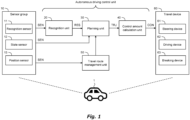
- Fig. 1 is a block diagram showing a configuration example related to autonomous driving control of a vehicle 1 according to a present embodiment.
- the autonomous driving is automatically performing at least one of steering, acceleration, and deceleration of the vehicle 1 without depending on a driving operation by an operator.
- the autonomous driving control is a concept including not only complete autonomous driving control but also risk avoidance control, lane keep assist control, and the like.
- the operator may be a driver on board the vehicle 1 or a remote operator who remotely operates the vehicle 1.
- the vehicle 1 includes a sensor group 10, a recognition unit 20, a planning unit 30, a control amount calculation unit 40, a travel route management unit 50, and a travel device 60.
- the sensor group 10 includes a recognition sensor 11, a state sensor 12, and a position sensor 13.
- the recognition sensor 11 is used for recognizing a situation around the vehicle 1. Examples of the recognition sensor 11 include a camera, a laser imaging detection and ranging (LIDAR), and a radar.
- the state sensor 12 detects a state of the vehicle 1. Examples of the state sensor 12 include a speed sensor, an acceleration sensor, a yaw rate sensor, and a steering angle sensor.
- the position sensor 13 detects a position of the vehicle 1. As the position sensor 13, a global navigation satellite system (GNSS) sensor is exemplified.
- GNSS global navigation satellite system
- Sensor detection information SEN is information acquired by the sensor group 10.
- the sensor detection information SEN includes recognition sensor information, vehicle state information, and position information.
- the recognition sensor information is information acquired by the recognition sensor 11 recognizing the situation around the vehicle 1.
- the recognition sensor information includes an image captured by the camera or point group information obtained by the LIDAR.
- the vehicle state information is information indicating the state of the vehicle 1 obtained by the state sensor 12.
- the position information is information indicating the position of the vehicle 1 obtained by the position sensor 13.
- the recognition unit 20, the planning unit 30, and the control amount calculation unit 40 constitute an "autonomous driving control unit", which controls the autonomous driving of the vehicle 1.
- the recognition unit 20 receives the sensor detection information SEN including at least the recognition sensor information from the sensor group 10.
- the recognition unit 20 recognizes the situation around the vehicle 1 based on the received sensor detection information SEN.
- the recognition unit 20 recognizes an object around the vehicle 1. Examples of the object include a pedestrian, another vehicle (e.g., a preceding vehicle, a parked vehicle, and the like), a white line, a road structure (e.g., a guard rail, a curb, and the like), a fallen object, a traffic light, an intersection, and a sign.
- Recognition result information RES indicates a recognition result by the recognition unit 20.
- the recognition result information RES includes object information indicating a relative position and a relative speed of the object with respect to the vehicle 1 and information about a curvature, a road width, and the like of a road in which the vehicle 1 travel
- the travel route management unit 50 generates and manages a travel route indicating a route which the vehicle 1 follows when traveling to a destination.
- the travel route may include specification of a lane in which the vehicle 1 travels following the route. Generation of the travel route by the travel route management unit 50 will be described later.
- the planning unit (planner) 30 receives the recognition result information RES from the recognition unit 20.
- the planning unit 30 also receives the travel route from the travel route management unit 50.
- the planning unit 30 may also receive the vehicle state information, the position information, and map information generated in advance.
- the map information may be high-precision three dimensional map information.
- the planning unit 30 generates a travel plan for traveling along the travel route based on the received information. Examples of the travel plan include maintaining a currently traveling lane, changing lanes, overtaking, turning right or left, steering, accelerating, decelerating, and stopping. Further, the planning unit 30 generates a target trajectory TRJ required for the vehicle 1 to travel in accordance with the travel plan.
- the target trajectory TRJ includes a target position and a target speed.
- the travel plan and the target trajectory TRJ may include those generated to avoid a risk.
- the control amount calculation unit 40 receives the target trajectory TRJ from the planning unit 30.
- the control amount calculation unit 40 calculates a control amount CON required for the vehicle 1 to follow the target trajectory TRJ. It can also be said that the control amount CON is a control amount which is required for reducing a deviation of the vehicle 1 from the target trajectory TRJ.
- the control amount CON includes at least one of a steering control amount, a drive control amount, and a braking control amount.
- Examples of the steering control amount include a target steering angle, a target torque, a target motor angle, and a target motor drive current.
- Examples of the drive control amount include a target speed and a target acceleration.
- Examples of the braking control amount include a target speed and a target deceleration.
- the travel device 60 includes a steering device 61, a driving device 62, and a braking device 63.
- the steering device 61 steers wheels of the vehicle 1.
- the steering device 61 includes an electric power steering (EPS) device.
- the driving device 62 is a power source that generates a driving force. Examples of the driving device 62 include an engine, an electric motor, and an in-wheel motor.
- the braking device 63 generates a braking force.
- the travel device 60 receives the control amount CON from the control amount calculation unit 40.
- the travel device 60 operates the steering device 61, the driving device 62, and the braking device 63 in accordance with the steering control amount, the driving control amount, and the braking control amount, respectively.
- the vehicle 1 travels so as to follow the target trajectory TRJ.
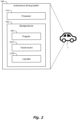
- Fig. 2 is a conceptual diagram showing a configuration example of an autonomous driving system 100 according to the present embodiment.
- the autonomous driving system 100 is mounted on the vehicle 1 and performs the autonomous driving control of the vehicle 1.
- the autonomous driving system 100 has at least the function of the above-described autonomous driving control unit.
- the autonomous driving system 100 may further include the sensor group 10 and the travel device 60.
- the autonomous driving system 100 includes one or more processors 110 (hereinafter, simply referred to as a processor 110 or processing circuitry) and one or more storage devices 120 (hereinafter, simply referred to as a storage device 120).
- processors 110 hereinafter, simply referred to as a processor 110 or processing circuitry
- storage devices 120 hereinafter, simply referred to as a storage device 120.
- the processor 110 executes various processes. Examples of the processor 110 include a central processing unit (CPU), a graphics processing unit (GPU), an application specific integrated circuit (ASIC), and a field-programmable gate array (FPGA).
- CPU central processing unit
- GPU graphics processing unit
- ASIC application specific integrated circuit
- FPGA field-programmable gate array
- the storage device 120 stores a program 130 and various kinds of information. Examples of the storage device 120 include a hard disk drive (HDD), a solid state drive (SSD), a volatile memory, and a nonvolatile memory.
- HDD hard disk drive
- SSD solid state drive
- volatile memory volatile memory
- nonvolatile memory nonvolatile memory
- the program 130 is a computer program for controlling the vehicle 1 and is executed by the processor 110.
- the program 130 may be recorded on a computer-readable storage medium.
- Various processes by the autonomous driving system 100 are implemented by a cooperation of the processor 110 executing the program 130 and the storage device 120. That is, the recognition unit 20, the planning unit 30, the control amount calculation unit 40, and the travel route management unit 50 are implemented by the processor 110 executing the program 130.
- Each of the functional units may be implemented by a single processor 110 or may be implemented by separate processors 110.
- the various kinds of information stored in the storage device 120 includes the map information and a travel record DAT.
- the travel record DAT is data for managing a path through which the vehicle 1 has traveled by the autonomous driving control.
- the travel record DAT includes past travel of the vehicle 1 by the autonomous driving control. Examples of the travel record DAT include data related to a past-record route, which is a route along which the vehicle has traveled in the past, data related to a past-record lane, which is a lane in which the vehicle travels in the past, and information about a past-record road shape, which is a road shape existing in a route along which the vehicle has traveled in the past.
- the travel record DAT may further include information about a past-record time zone in which the vehicle 1 has traveled in the past.
- the data related to a past-record route is, for example, data showing the past-record route on a map.
- the information about a past-record road shape is, for example, information indicating a curvature, a gradient, a road width, and the like of a road of at least a part of the route along which the vehicle 1 has traveled in the past.
- the information about the road shape may be information indicating whether a specific road shape is included in the route along which the vehicle 1 has traveled in the past or not.
- Examples of the specific road shape include a curved road having a predetermined curvature, a slope having a predetermined gradient, a branch, a merging point, a road marking, a road under construction, and a road sectioned by a ball, a pylon, or the like instead of a line.
- the recognition unit 20 includes at least one of a rule-based model and a machine learning model.
- the rule-based model performs a recognition process based on a predetermined rule group.
- Examples of the machine learning model include a neural network (NN), a support vector machine (SVM), a regression model, and a decision tree model.
- the NN may be a convolutional neural network (CNN), a recurrent neural network (RNN), or a combination of CNN and RNN.
- the type of each layer, the number of layers, and the number of nodes in the NN are arbitrary.
- the machine learning model is generated in advance through machine learning.
- the recognition unit 20 performs the recognition process by inputting the sensor detection information SEN into the model.
- the recognition result information RES is output from the model or generated based on the output from the model.
- the planning unit 30 also includes at least one of a rule-based model and a machine learning model.
- the planning unit 30 performs a planning process by inputting the recognition result information RES into the model.
- the target trajectory TRJ is output from the model or generated based on the output from the model.
- control amount calculation unit 40 includes at least one of a rule-based model and a machine learning model.
- the control amount calculation unit 40 performs the control amount calculation process by inputting the target trajectory TRJ to the model.
- the control amount CON is output from the model or generated based on the output from the model.
- the storage device 120 stores data of models included in the recognition unit 20, the planning unit 30, and the control amount calculation unit 40, and is used for the autonomous driving control.
- Two or more of the recognition unit 20, the planning unit 30, and the control amount calculation unit 40 may have an integrated architecture. All of the recognition unit 20, the planning unit 30, and the control amount calculation unit 40 may have an integrated architecture (End-to-End architecture).
- the recognition unit 20 and the planning unit 30 may be integrally constituted by an NN which outputs the target trajectory TRJ from the sensor detection information SEN. Even in the case of the integrated architecture, intermediate products such as the recognition result information RES or the target trajectory TRJ may be output.
- the recognition result information RES may be an output from an intermediate layer of the NN.
- a machine learning model is used in at least a part of the autonomous driving control unit. That is, at least one of the recognition unit 20, the planning unit 30, and the control amount calculation unit 40 includes a machine learning model.
- the autonomous driving control unit performs at least a part of the autonomous driving control of the vehicle 1 using the machine learning model.
- the processor 110 acquires a log of data related to the autonomous driving control.
- this data is referred to as control data.
- the processor 110 stores a log of a part or all of the control data acquired during the autonomous driving control in the storage device 120 as log data LOG.
- the processor 110 may store the control data in the storage device 120 during a predetermined period of time.
- the control data is stored in order to ensure capability of explanation of the autonomous driving control.
- the autonomous driving system 100 is configured as described above.
- a travel route management system according to the present embodiment is implemented by the processor 110 which implements the travel route management unit 50 and the storage device 120 which stores the travel record DAT.
- the storage device 120 may include a storage device for storing the travel record DAT and a storage device for storing the log data LOG separately.
- Fig. 3 is a flowchart showing an example of processing which is related to generation of the travel route and is executed by the travel route management unit 50.
- the processing according to the flowchart shown in Fig. 3 is executed at timing at which the autonomous driving system 100 determines the travel route of the vehicle 1.
- the timing at which the travel route of the vehicle 1 is determined is, for example, timing at which the vehicle 1 starts traveling by the autonomous driving.
- the travel route may be changeable at arbitrary timing after the vehicle 1 starts traveling, and the processing may be executed at timing of changing the travel route.
- Step S 110 the processor 110 generates a candidate route.
- the candidate route is a route which is a candidate for the travel route.
- the processor 110 acquires a destination input by the operator, the position information of the vehicle 1 included in the sensor detection information SEN, and the map information stored in the storage device 120 and generates a route connecting the current position of the vehicle 1 and the destination as the candidate route, for example.
- the candidate route may include information specifying a lane in which the vehicle 1 travels in addition to the route along which the vehicle 1 travels.
- Step S120 the processor 110 acquires a remaining capacity of the storage device 120.
- the remaining capacity of a storage device for storing the log data LOG is acquired here.
- Step S130 the processor 110 determines whether the remaining capacity acquired in Step S120 is less than a predetermined amount or not. If the remaining capacity is smaller than the predetermined amount (Step S130; Yes), the processing proceeds to Step S140. On the other hand, when the remaining capacity is equal to or larger than the predetermined amount (Step S130; No), the processing proceeds to Step S160.
- Step S140 the processor 110 selects a travel route from one or more candidate routes generated in Step S110. At this time, the processor 110 uses the number of common points with the travel record DAT as an index for selecting the travel route from the one or more candidate routes.
- the number of the common points of the candidate route with the travel record DAT is described.
- the number of the common points is determined, for example, based on how much the candidate route has in common with the past-record route.
- the processor 110 acquires information about a route in which the vehicle 1 has traveled in the past from the travel record DAT and compares it with the candidate route. Then, the processor 110 determines that the candidate route has more common points as it has more in common with the past-record route of the vehicle 1. Having more in common with the past-record route of the vehicle 1 is, for example, that an overlapping ratio of a route in the candidate route with the past-record route of the vehicle 1 is larger or that a remaining length of the candidate route is shorter when the past-record route of the vehicle 1 is excluded.
- the number of the common points with the travel record DAT may be determined based on how much the candidate route has in common with the past-record lane of the vehicle 1. For example, the processor 110 acquires information about the past-record route and which lane in the past-record route the vehicle 1 has traveled in the past from the travel record DAT. Then, the processor 110 determines that the candidate route has more common points with the travel record DAT as it has more in common with the past-record lane of the vehicle 1. At this time, the processor 110 may determine that the candidate route has more in common with the past-record lane of the vehicle 1 when it includes the same lane in a different route.
- the travel record DAT includes only data indicating that the vehicle 1 has traveled in a left lane in the past and does not include data indicating that the vehicle 1 has traveled in a right lane.
- the candidate route has more common points as it includes more portions in which the left lane is specified as the lane in which the vehicle 1 travels.
- the number of common points of the candidate route with the travel record DAT may be determined based how much the candidate route has in common with the past-record road shape.
- the processor 110 acquires information about one or more road shapes included in each of the candidate routes from, for example, the map information stored in the storage device 120. Then, the processor 110 determines that the candidate route has more common points with the travel record DAT as it has more in common with the past-record road shape. Having more in common with the past-record road shape means that having more in common with the road shape which the vehicle 1 has experienced in the past.
- the vehicle 1 has experienced a road shape means that there has been the road shape in a route along which the vehicle 1 has traveled in the past.
- the vehicle 1 has experienced a merging point in the past and has not experienced a slope having a predetermined gradient.
- the candidate routes include a candidate route including a merging point and a candidate route including a slope having a predetermined gradient when the processor 110 acquires information about the road shape included in each of the candidate routes.
- the processor 110 may determine that the candidate route including the merging point has more common points than the candidate route including the slope.
- a case is considered that there are the following five candidate routes.
- the first candidate route all the route the vehicle 1 travels from the departure place to the destination overlap with the past-record route and the lane is also common with the past-record lane.
- the second candidate route all the route is common with the past-record route but the lane is not common with the past-record lane.
- the third candidate route includes a route not common with the past-record route but the overlapping ratio of it with the past-record route is large.
- the fourth candidate route does not include a common route with the past-record route but include a common road shape with the past-record road shape.
- the fifth candidate route does not include a common route with the past-record route includes many road shapes not common with the past-record road shape. In this case, it is determined the first candidate route has the most common pointes and the number of common points decreases in ascending order.
- Step S160 the processor 110 selects the travel route from one or more candidate routes generated in Step S130. It is the same that the travel route is selected from one or more candidate routes is the same as in Step S140. However, when the travel route is selected in Step S160, the number of common points with the travel record DAT is not used as an index for selecting the travel route.
- the method of selecting the travel route in Step S160 is arbitrary.
- the processor 110 may select the shortest route from one or more candidate routes as the travel route, may select a route with the smallest gradient as the travel route, or may select the travel route from the viewpoint of fuel efficiency.
- the travel route is generated by processing like this.
- the generated travel route is acquired by the planning unit 30, and the planning unit 30 generates the travel plan of the vehicle 1 for traveling along the travel route. If the travel route has already been generated when the processing ends, the travel route is changed and the planning unit 30 newly generates the travel plan for traveling along the new travel route.
- Fig. 4 is a flowchart showing processing related to the storage of the control data.
- the processing according to the flowchart shown in Fig. 4 is, for example, repeatedly executed at a predetermined processing cycle while the autonomous driving control is performed.
- step S210 the processor 110 acquires date related to the autonomous driving control.
- all data used for the autonomous driving control is acquired considering that the data is used for verification or the like later.
- the sensor detection information SEN input to the recognition unit 20 and the recognition result information RES output from the recognition unit 20 are acquired.
- the recognition unit 20, the planning unit 30, and the control amount calculation unit 40 have an integrated architecture, the sensor detection information SEN input to the autonomous driving control unit, the recognition result information RES and the target trajectory TRJ as intermediate products, and the control amount CON output from the autonomous driving control unit are acquired.
- the acquired data may further include a reason of determination in the recognition process by the recognition unit 20, a reason of determination in the planning process by the planning unit 30, the presence or absence of intervention of the operator into the autonomous driving control, and the like.
- Step S220 the processor 110 acquires the remaining capacity of the storage device 120.
- the remaining capacity of the storage device 120 acquired here means a capacity of newly storing the control data.
- the remaining capacity of the storage device for storing the log data LOG is acquired.
- Step S230 the processor 110 determines whether the remaining capacity acquired in Step S210 is less than a predetermined amount or not.
- the predetermined amount used here may be larger than or equal to the predetermined amount used in Step S130 of Fig. 3 . If the remaining capacity is smaller than the predetermined amount (Step S230; Yes), the processing proceeds to Step S240.
- Step S240 the processor 110 stores difference data in the storage device 120.
- the difference data is data which is a difference of the data acquired in Step S210 from the log data LOG.
- a surrounding view captured by the camera included in the sensor detection information SEN input to the recognition unit 20 or a detection result about a position of the white line included in the recognition result information RES output from the recognition unit 20 becomes substantially equivalent to data included in the log data LOG stored in the past.
- Such data excluding data equivalent to the log data LOG is the difference data.
- the data acquired in Step S210 except for a part which can be complemented by the log data LOG stored in the past is newly stored in the storage device 120.
- Step S230 when the remaining capacity is equal to or larger than the predetermined amount (Step S230; No), the processing proceeds to Step S250.
- Step S250 the processor 110 stores all data acquired in Step S210 in the storage device 120.
- Step S240 or Step S250 Data stored in the storage device 120 in Step S240 or Step S250 is the control data. After the control data is stored in the storage device 120, the processing ends.
- control data is stored in preparation for a case where it becomes necessary to verify how the autonomous driving control is performed later or the like. Therefore, it is desirable that as much data as possible is stored among the control data acquired while the autonomous driving control is being performed at least until verification or the like is completed and it is determined that the control data does not need to be stored.
- a volume of the control data which can be stored in the storage device 120 also has a limitation. If the remaining capacity of the storage device 120 decreases and becomes insufficient for a required capacity, the control data cannot be newly stored in the storage device 120. Therefore, when the remaining capacity of the storage device 120 decreases and it is suggested that the capacity may become insufficient, it is necessary to preserve the remaining capacity.
- the autonomous driving system 100 of the present embodiment when the remaining capacity of the storage device 120 becomes equal to or less than the predetermined amount, a travel route having increased common points with the past travel of the vehicle 1 by the autonomous driving control is generated.
- a part of the control data which can be complemented by the log data LOG stored in the past becomes large.
- control data stored in the storage device 120 is the difference data.
- the difference data is data obtained by excluding a portion overlapping with the log data LOG stored in the past from the data related to the autonomous driving control. Since the overlapping portion can be complemented by the past data, if at least the difference data is stored, a situation can be explained by combining the data acquired in the past and the difference data acquired this time. That is, the difference data is, in other words, minimum data to be stored considering use for verification later. By making data to be stored minimum data needed and omitting storing data which can be explained by the combination with the past data when the remaining capacity is reduced, volume of the control data to be newly stored can be reduced.
- selecting a candidate route having more common points with the travel record DAT as the travel route is effective in reducing the volume of the difference data.
- the vehicle 1 travels along the travel route having more common points, it is expected that information which is equivalent to information included in the log data LOG stored in the past increases among information input to the autonomous driving control unit during traveling and information output from the autonomous driving control unit. That is, the volume of the difference data can be reduced, and the remaining capacity of the storage device 120 can be effectively preserved.
- the autonomous driving system 100 of the present embodiment it is possible to effectively prevent a situation in which the remaining capacity of the storage device 120 become insufficient while securing information necessary for explanation and verification.
- Fig. 5 is a flowchart showing an example of processing related to generation of the travel route in the first modification.
- the timing at which the processing is executed is the same as that in the flowchart of Fig. 3 .
- Step S310 to Step S340 Processes from Step S310 to Step S340 are the same as the processes from Step S110 to Step S140 in Fig. 3 .
- Step S330 if the remaining capacity of the storage device 120 is equal to or larger than a first predetermined amount (Step S330; No), the processing proceeds to Step S350.
- the first predetermined amount is the same as the predetermined amount in Step S130 of Fig. 3 .
- Step S350 the processor 110 determines whether the remaining capacity of the storage device 120 is larger than a second predetermined amount or not.
- the second predetermined amount may be larger than or equal to the first predetermined amount. If the remaining capacity of the storage device 120 is equal to or less than the second predetermined amount (Step S350; No), the processing proceeds to Step S360. If the remaining capacity of the storage device 120 is larger than the second predetermined amount (Step S350; Yes), the processing proceeds to Step S370.
- Step S360 A process of Step S360 is the same as the process of Step S160 in Fig. 3 .
- the processor 110 selects the travel route from one ore more candidate routes using smallness of the number of the common points with the travel record DAT as an index. Specifically, the processor 110 selects a candidate route having few common points with the travel record DAT as the travel route. After the travel route is selected in Step S370, the processing ends.
- the control data acquired during the autonomous driving and stored in the storage device 120 can be used as the log data LOG when the vehicle 1 travels later. Further, the data can be used as learning data of a machine learning model for subsequent autonomous driving control. Therefore, in this modification, when the remaining capacity of the storage device 120 is larger than the predetermined amount, the travel route is selected in which it is expected that many pieces of control data which are differences from data acquired in the past can be acquired. In other words, when the remaining capacity of the storage device 120 is sufficient, the autonomous driving system 100 selects the travel route in which more data which has not been experienced in the past can be newly collected.
- the index for determining the smallness of the common points is basically the reverse of the index for determining the largeness of the common points used in Step S140 of the flowchart of Fig. 3 . That is, in Step S370, the candidate route having few common points with the travel record DAT is selected based on smallness of the common route with the past-record route, smallness of the common lane with the past-record lane, smallness of the common road shape with the past-record road shape, or the like.
- the processor 110 may select a candidate route which includes a route including many road shapes not included in the travel record DAT.
- the processor 110 may select the candidate route in which the vehicle 1 travels in a different lane in the same road (for example, a candidate route in which the vehicle 1 travels in a right lane in a case where the travel record DAT includes data of traveling in a left lane).
- a criterion for determining the smallness of common points with the travel record DAT may further include a criterion from a viewpoint of a time zone or a frequency.
- the travel route including many portions of route which have been traveled few times in the past may be determined to have few common points.
- the travel route includes the same route as the past-record route, it may be determined that it has few common points in a case where the vehicle 1 travels in a time zone in which the vehicle has not traveled in the past.
- the candidate route which include more elements that the vehicle 1 has not experienced in the past is determined to have fewer common points.
- the vehicle 1 is connected to an external management server via a communication network.
- a part of the processor 110 and the storage device 120 may be included in the management server, and at least a part of the processing shown in the flowchart of Fig. 3 may be executed in the management server.
- the departure place, the destination, and the remaining capacity of the storage device 120 are transmitted from the vehicle 1 to the management server at the timing of determining the travel route, for example.
- the processor of the management server executes the processing shown in the flowchart of Fig. 3 based on the received information and information held by the management server and determines the travel route. Then, the determined travel route is transmitted to the vehicle 1.
- the candidate route may be generated in the management server, and the traveling route may be selected in the vehicle.
- the departure place and the destination are transmitted to the management server, and the management server generates the candidate route based on these pieces of information and information held by the management server and transmits one or more generated candidate routes to the vehicle 1.
- the management server may be a server which manages a plurality of vehicles 1.
- the travel record DAT may be aggregated data of data obtained from a plurality of vehicles 1.
- a part of the processor 110 and the storage device 120 may be included in the management server. That is, the management server may be a processing entity that generates the candidate route and selects the travel route.
- a part or all of the travel record DAT may be stored in a storage device of the management server, and the management server may distribute the stored data to the vehicle 1.
- the travel record DAT is data obtained from a plurality of vehicles 1
- the common point in the candidate route with the travel record DAT does not necessarily equal to something common with the past-record route, the past-record lane, or the past-record road shape which the target vehicle 1 itself has experienced in the past. That is, the candidate route having much in common with a route along which a vehicle 1 different from the target vehicle 1 has traveled in the past may be selected as the travel route. Since the data acquired from the plurality of vehicles 1 is aggregated, the travel record DAT can be collected more efficiently, and thus the difference data can be further reduced.
- the first modification and the second modification may be combined.
- processing described in the first modification is executed as the processing related to the generation of the travel route and the plurality of vehicles 1 are managed by the management server
- the following example is also possible. If there is insufficient data in the travel record DAT aggregated by the management server, the management server demands the user of the vehicle 1 to travel along a route in which the target data can be collected. For example, it is assumed that data of the vehicle 1 traveling in a certain route is not included in the travel record DAT. In this case, if the remaining capacity of the storage device 120 is sufficient, it is desirable that a candidate route including the certain route is selected as the travel route. However, in this case, there is a possibility that the time required for the travel becomes long.
- the management server gives an incentive such as a point return to the user when a candidate route having few points in common with the travel record DAT is selected, and promotes that the travel route which can collect a large amount of new data is selected while maintaining the user's satisfaction.
Landscapes
- Engineering & Computer Science (AREA)
- Radar, Positioning & Navigation (AREA)
- Remote Sensing (AREA)
- Automation & Control Theory (AREA)
- Transportation (AREA)
- Mechanical Engineering (AREA)
- Human Computer Interaction (AREA)
- Physics & Mathematics (AREA)
- General Physics & Mathematics (AREA)
- Health & Medical Sciences (AREA)
- General Health & Medical Sciences (AREA)
- Social Psychology (AREA)
- Traffic Control Systems (AREA)
- Control Of Driving Devices And Active Controlling Of Vehicle (AREA)
Abstract
The present disclosure provides a travel route management system (100) that generates a travel route for autonomous driving control of a vehicle (1). The travel route management system (100) comprises one or more storage devices (120) configured to store a travel record (DAT) that includes data of past travel of the vehicle (1) by the autonomous driving control, and one or more processors (110). The vehicle (1) comprises a target storage device that stores log data related to the autonomous driving control. The one or more processors (110) are configured to execute acquiring a remaining capacity of the target storage device, generating one or more candidate routes, and selecting the travel route from the one or more candidate routes. Selecting the travel route includes using a number of common points with the travel record (DAT) as an index for selecting the travel route from the one or more candidate routes when the remaining capacity is smaller than a predetermined amount.
Description
- The present disclosure relates to a travel route management system which generates a travel route for autonomous driving control.
-
Patent Literature 1 discloses a driving information management device which can record a route traveled by autonomous driving in the past as a history route. The driving information management device is mounted on a vehicle including an autonomous driving device capable of switching manual driving and autonomous driving. According to the driving information management device, when the autonomous driving device is switched to autonomous driving, generation of autonomous driving history data indicating a history of a traveling route on which autonomous driving has been performed is automatically started. The autonomous driving history data is stored in a database, and when the vehicle travels, a route on which autonomous driving is possible can be read from the past history. - In addition to the above-described
Patent Literature 1, the following Patent Literature 2 and Patent Literature 3 can be exemplified as documents showing the technical level of the technical field related to the present disclosure. -
- Patent Literature 1:
Japanese Laid-Open Patent Application No. 2020-060901 - Patent Literature 2:
Japanese Laid-Open Patent Application No. 2017-134725 - Patent Literature 3:
Japanese Laid-Open Patent Application No. 2020-008441 - A technique for autonomously driving a vehicle is known. When the vehicle travels by autonomous driving, it is desirable that data related to autonomous driving control be stored so that how the autonomous driving of the vehicle is performed can be verified later. However, it may become difficult to store all data depending on how large a capacity of data is remained. In such a case, how to ensure transparency and ease of verification of the autonomous driving control is a problem.
- An object of the present disclosure is to provide a technique that makes it possible to ensure transparency and ease of verification of autonomous driving control of a vehicle when log data related to the autonomous driving control is stored.
- The present disclosure provides a travel route management system that generates a travel route for autonomous driving control of a vehicle. The travel route management system comprises one or more storage devices configured to store a travel record that includes data of past travel of the vehicle by the autonomous driving control, and one or more processors. The vehicle comprises a target storage device that stores log data related to the autonomous driving control. The one or more processors is configured to execute acquiring a remaining capacity of the target storage device, generating one or more candidate routes, and selecting the travel route from the one or more candidate routes. Selecting the travel route includes using a number of common points with the travel record as an index for selecting the travel route from the one or more candidate routes when the remaining capacity is smaller than a predetermined amount.
- According to the technique of the present disclosure, the travel route management system includes one or more storage devices that stores the travel record that includes data of past travel of the vehicle by the autonomous driving control. The travel route management system first generates one or more candidate route, which become one or more candidates for the travel route. When the remaining capacity of one or more storage devices for storing the log data related to the autonomous driving control is equal to or less than the predetermined amount, the travel route management system selects the travel route from one or more candidate routes using the number of common points with the travel record as the index. When the vehicle travels along the travel route generated in this way, the data related to the autonomous driving control can be complemented by the log data stored in the past even if the data is not stored.
- In this way, according to the present disclosure, it is possible to ensure transparency and ease of verification of the autonomous driving control.
-
-
Fig. 1 is a diagram showing an example of a configuration related to autonomous driving control of a vehicle according to a present embodiment. -
Fig. 2 is a diagram showing an example of a configuration of an autonomous driving system according to the present embodiment. -
Fig. 3 is a flowchart showing an example of processing related to generation of a travel route. -
Fig. 4 is a flowchart showing an example of processing related to storage of control data. -
Fig. 5 is a flowchart showing an example of processing related to generation of the travel route in a first modification. -
Fig. 1 is a block diagram showing a configuration example related to autonomous driving control of avehicle 1 according to a present embodiment. The autonomous driving is automatically performing at least one of steering, acceleration, and deceleration of thevehicle 1 without depending on a driving operation by an operator. The autonomous driving control is a concept including not only complete autonomous driving control but also risk avoidance control, lane keep assist control, and the like. The operator may be a driver on board thevehicle 1 or a remote operator who remotely operates thevehicle 1. - The
vehicle 1 includes asensor group 10, arecognition unit 20, aplanning unit 30, a controlamount calculation unit 40, a travelroute management unit 50, and atravel device 60. - The
sensor group 10 includes arecognition sensor 11, astate sensor 12, and aposition sensor 13. Therecognition sensor 11 is used for recognizing a situation around thevehicle 1. Examples of therecognition sensor 11 include a camera, a laser imaging detection and ranging (LIDAR), and a radar. Thestate sensor 12 detects a state of thevehicle 1. Examples of thestate sensor 12 include a speed sensor, an acceleration sensor, a yaw rate sensor, and a steering angle sensor. Theposition sensor 13 detects a position of thevehicle 1. As theposition sensor 13, a global navigation satellite system (GNSS) sensor is exemplified. - Sensor detection information SEN is information acquired by the
sensor group 10. The sensor detection information SEN includes recognition sensor information, vehicle state information, and position information. The recognition sensor information is information acquired by therecognition sensor 11 recognizing the situation around thevehicle 1. For example, the recognition sensor information includes an image captured by the camera or point group information obtained by the LIDAR. The vehicle state information is information indicating the state of thevehicle 1 obtained by thestate sensor 12. The position information is information indicating the position of thevehicle 1 obtained by theposition sensor 13. - The
recognition unit 20, theplanning unit 30, and the controlamount calculation unit 40 constitute an "autonomous driving control unit", which controls the autonomous driving of thevehicle 1. Therecognition unit 20 receives the sensor detection information SEN including at least the recognition sensor information from thesensor group 10. Therecognition unit 20 recognizes the situation around thevehicle 1 based on the received sensor detection information SEN. For example, therecognition unit 20 recognizes an object around thevehicle 1. Examples of the object include a pedestrian, another vehicle (e.g., a preceding vehicle, a parked vehicle, and the like), a white line, a road structure (e.g., a guard rail, a curb, and the like), a fallen object, a traffic light, an intersection, and a sign. Recognition result information RES indicates a recognition result by therecognition unit 20. For example, the recognition result information RES includes object information indicating a relative position and a relative speed of the object with respect to thevehicle 1 and information about a curvature, a road width, and the like of a road in which thevehicle 1 travels. - The travel
route management unit 50 generates and manages a travel route indicating a route which thevehicle 1 follows when traveling to a destination. The travel route may include specification of a lane in which thevehicle 1 travels following the route. Generation of the travel route by the travelroute management unit 50 will be described later. - The planning unit (planner) 30 receives the recognition result information RES from the
recognition unit 20. Theplanning unit 30 also receives the travel route from the travelroute management unit 50. Theplanning unit 30 may also receive the vehicle state information, the position information, and map information generated in advance. The map information may be high-precision three dimensional map information. Theplanning unit 30 generates a travel plan for traveling along the travel route based on the received information. Examples of the travel plan include maintaining a currently traveling lane, changing lanes, overtaking, turning right or left, steering, accelerating, decelerating, and stopping. Further, theplanning unit 30 generates a target trajectory TRJ required for thevehicle 1 to travel in accordance with the travel plan. The target trajectory TRJ includes a target position and a target speed. The travel plan and the target trajectory TRJ may include those generated to avoid a risk. - The control
amount calculation unit 40 receives the target trajectory TRJ from theplanning unit 30. The controlamount calculation unit 40 calculates a control amount CON required for thevehicle 1 to follow the target trajectory TRJ. It can also be said that the control amount CON is a control amount which is required for reducing a deviation of thevehicle 1 from the target trajectory TRJ. The control amount CON includes at least one of a steering control amount, a drive control amount, and a braking control amount. Examples of the steering control amount include a target steering angle, a target torque, a target motor angle, and a target motor drive current. Examples of the drive control amount include a target speed and a target acceleration. Examples of the braking control amount include a target speed and a target deceleration. - The
travel device 60 includes asteering device 61, a drivingdevice 62, and abraking device 63. Thesteering device 61 steers wheels of thevehicle 1. For example, thesteering device 61 includes an electric power steering (EPS) device. The drivingdevice 62 is a power source that generates a driving force. Examples of the drivingdevice 62 include an engine, an electric motor, and an in-wheel motor. Thebraking device 63 generates a braking force. Thetravel device 60 receives the control amount CON from the controlamount calculation unit 40. Thetravel device 60 operates thesteering device 61, the drivingdevice 62, and thebraking device 63 in accordance with the steering control amount, the driving control amount, and the braking control amount, respectively. Thus, thevehicle 1 travels so as to follow the target trajectory TRJ. -
Fig. 2 is a conceptual diagram showing a configuration example of anautonomous driving system 100 according to the present embodiment. Theautonomous driving system 100 is mounted on thevehicle 1 and performs the autonomous driving control of thevehicle 1. Theautonomous driving system 100 has at least the function of the above-described autonomous driving control unit. Theautonomous driving system 100 may further include thesensor group 10 and thetravel device 60. - The
autonomous driving system 100 includes one or more processors 110 (hereinafter, simply referred to as aprocessor 110 or processing circuitry) and one or more storage devices 120 (hereinafter, simply referred to as a storage device 120). - The
processor 110 executes various processes. Examples of theprocessor 110 include a central processing unit (CPU), a graphics processing unit (GPU), an application specific integrated circuit (ASIC), and a field-programmable gate array (FPGA). - The
storage device 120 stores aprogram 130 and various kinds of information. Examples of thestorage device 120 include a hard disk drive (HDD), a solid state drive (SSD), a volatile memory, and a nonvolatile memory. - The
program 130 is a computer program for controlling thevehicle 1 and is executed by theprocessor 110. Theprogram 130 may be recorded on a computer-readable storage medium. Various processes by theautonomous driving system 100 are implemented by a cooperation of theprocessor 110 executing theprogram 130 and thestorage device 120. That is, therecognition unit 20, theplanning unit 30, the controlamount calculation unit 40, and the travelroute management unit 50 are implemented by theprocessor 110 executing theprogram 130. Each of the functional units may be implemented by asingle processor 110 or may be implemented byseparate processors 110. - The various kinds of information stored in the
storage device 120 includes the map information and a travel record DAT. The travel record DAT is data for managing a path through which thevehicle 1 has traveled by the autonomous driving control. The travel record DAT includes past travel of thevehicle 1 by the autonomous driving control. Examples of the travel record DAT include data related to a past-record route, which is a route along which the vehicle has traveled in the past, data related to a past-record lane, which is a lane in which the vehicle travels in the past, and information about a past-record road shape, which is a road shape existing in a route along which the vehicle has traveled in the past. The travel record DAT may further include information about a past-record time zone in which thevehicle 1 has traveled in the past. - The data related to a past-record route is, for example, data showing the past-record route on a map. The information about a past-record road shape is, for example, information indicating a curvature, a gradient, a road width, and the like of a road of at least a part of the route along which the
vehicle 1 has traveled in the past. Alternatively, the information about the road shape may be information indicating whether a specific road shape is included in the route along which thevehicle 1 has traveled in the past or not. Examples of the specific road shape include a curved road having a predetermined curvature, a slope having a predetermined gradient, a branch, a merging point, a road marking, a road under construction, and a road sectioned by a ball, a pylon, or the like instead of a line. - Reference is made to
Fig. 1 again. Therecognition unit 20 includes at least one of a rule-based model and a machine learning model. The rule-based model performs a recognition process based on a predetermined rule group. Examples of the machine learning model include a neural network (NN), a support vector machine (SVM), a regression model, and a decision tree model. The NN may be a convolutional neural network (CNN), a recurrent neural network (RNN), or a combination of CNN and RNN. The type of each layer, the number of layers, and the number of nodes in the NN are arbitrary. The machine learning model is generated in advance through machine learning. Therecognition unit 20 performs the recognition process by inputting the sensor detection information SEN into the model. The recognition result information RES is output from the model or generated based on the output from the model. - Similarly, the
planning unit 30 also includes at least one of a rule-based model and a machine learning model. Theplanning unit 30 performs a planning process by inputting the recognition result information RES into the model. The target trajectory TRJ is output from the model or generated based on the output from the model. - Similarly, the control
amount calculation unit 40 includes at least one of a rule-based model and a machine learning model. The controlamount calculation unit 40 performs the control amount calculation process by inputting the target trajectory TRJ to the model. The control amount CON is output from the model or generated based on the output from the model. Thestorage device 120 stores data of models included in therecognition unit 20, theplanning unit 30, and the controlamount calculation unit 40, and is used for the autonomous driving control. - Two or more of the
recognition unit 20, theplanning unit 30, and the controlamount calculation unit 40 may have an integrated architecture. All of therecognition unit 20, theplanning unit 30, and the controlamount calculation unit 40 may have an integrated architecture (End-to-End architecture). For example, therecognition unit 20 and theplanning unit 30 may be integrally constituted by an NN which outputs the target trajectory TRJ from the sensor detection information SEN. Even in the case of the integrated architecture, intermediate products such as the recognition result information RES or the target trajectory TRJ may be output. For example, in a case where therecognition unit 20 and theplanning unit 30 are integrally constituted by an NN, the recognition result information RES may be an output from an intermediate layer of the NN. - In the present embodiment, a machine learning model is used in at least a part of the autonomous driving control unit. That is, at least one of the
recognition unit 20, theplanning unit 30, and the controlamount calculation unit 40 includes a machine learning model. The autonomous driving control unit performs at least a part of the autonomous driving control of thevehicle 1 using the machine learning model. - During the autonomous driving control, the
processor 110 acquires a log of data related to the autonomous driving control. Hereinafter, this data is referred to as control data. Theprocessor 110 stores a log of a part or all of the control data acquired during the autonomous driving control in thestorage device 120 as log data LOG. Theprocessor 110 may store the control data in thestorage device 120 during a predetermined period of time. The control data is stored in order to ensure capability of explanation of the autonomous driving control. - The
autonomous driving system 100 according to the present embodiment is configured as described above. In theautonomous driving system 100, a travel route management system according to the present embodiment is implemented by theprocessor 110 which implements the travelroute management unit 50 and thestorage device 120 which stores the travel record DAT. Thestorage device 120 may include a storage device for storing the travel record DAT and a storage device for storing the log data LOG separately. -
Fig. 3 is a flowchart showing an example of processing which is related to generation of the travel route and is executed by the travelroute management unit 50. The processing according to the flowchart shown inFig. 3 is executed at timing at which theautonomous driving system 100 determines the travel route of thevehicle 1. The timing at which the travel route of thevehicle 1 is determined is, for example, timing at which thevehicle 1 starts traveling by the autonomous driving. Alternatively, the travel route may be changeable at arbitrary timing after thevehicle 1 starts traveling, and the processing may be executed at timing of changing the travel route. - In
Step S 110, theprocessor 110 generates a candidate route. The candidate route is a route which is a candidate for the travel route. Theprocessor 110 acquires a destination input by the operator, the position information of thevehicle 1 included in the sensor detection information SEN, and the map information stored in thestorage device 120 and generates a route connecting the current position of thevehicle 1 and the destination as the candidate route, for example. There may be a plurality of candidate routes. Further, the candidate route may include information specifying a lane in which thevehicle 1 travels in addition to the route along which thevehicle 1 travels. - In Step S120, the
processor 110 acquires a remaining capacity of thestorage device 120. In a case where thestorage device 120 includes a plurality of storage devices, the remaining capacity of a storage device for storing the log data LOG is acquired here. - In Step S130, the
processor 110 determines whether the remaining capacity acquired in Step S120 is less than a predetermined amount or not. If the remaining capacity is smaller than the predetermined amount (Step S130; Yes), the processing proceeds to Step S140. On the other hand, when the remaining capacity is equal to or larger than the predetermined amount (Step S130; No), the processing proceeds to Step S160. - In Step S140, the
processor 110 selects a travel route from one or more candidate routes generated in Step S110. At this time, theprocessor 110 uses the number of common points with the travel record DAT as an index for selecting the travel route from the one or more candidate routes. - The number of the common points of the candidate route with the travel record DAT is described. The number of the common points is determined, for example, based on how much the candidate route has in common with the past-record route. The
processor 110 acquires information about a route in which thevehicle 1 has traveled in the past from the travel record DAT and compares it with the candidate route. Then, theprocessor 110 determines that the candidate route has more common points as it has more in common with the past-record route of thevehicle 1. Having more in common with the past-record route of thevehicle 1 is, for example, that an overlapping ratio of a route in the candidate route with the past-record route of thevehicle 1 is larger or that a remaining length of the candidate route is shorter when the past-record route of thevehicle 1 is excluded. - In a case where the candidate route includes information specifying a lane in which the
vehicle 1 travels, the number of the common points with the travel record DAT may be determined based on how much the candidate route has in common with the past-record lane of thevehicle 1. For example, theprocessor 110 acquires information about the past-record route and which lane in the past-record route thevehicle 1 has traveled in the past from the travel record DAT. Then, theprocessor 110 determines that the candidate route has more common points with the travel record DAT as it has more in common with the past-record lane of thevehicle 1. At this time, theprocessor 110 may determine that the candidate route has more in common with the past-record lane of thevehicle 1 when it includes the same lane in a different route. For example, it is assumed that the travel record DAT includes only data indicating that thevehicle 1 has traveled in a left lane in the past and does not include data indicating that thevehicle 1 has traveled in a right lane. In this case, it may be determined that the candidate route has more common points as it includes more portions in which the left lane is specified as the lane in which thevehicle 1 travels. - In a case where the candidate route does not include a route in common with the past-record route, the number of common points of the candidate route with the travel record DAT may be determined based how much the candidate route has in common with the past-record road shape. In this case, the
processor 110 acquires information about one or more road shapes included in each of the candidate routes from, for example, the map information stored in thestorage device 120. Then, theprocessor 110 determines that the candidate route has more common points with the travel record DAT as it has more in common with the past-record road shape. Having more in common with the past-record road shape means that having more in common with the road shape which thevehicle 1 has experienced in the past. Here, that thevehicle 1 has experienced a road shape means that there has been the road shape in a route along which thevehicle 1 has traveled in the past. For example, it is assumed that thevehicle 1 has experienced a merging point in the past and has not experienced a slope having a predetermined gradient. Then, it is assumed that the candidate routes include a candidate route including a merging point and a candidate route including a slope having a predetermined gradient when theprocessor 110 acquires information about the road shape included in each of the candidate routes. In this case, theprocessor 110 may determine that the candidate route including the merging point has more common points than the candidate route including the slope. - As an example, a case is considered that there are the following five candidate routes. In the first candidate route, all the route the
vehicle 1 travels from the departure place to the destination overlap with the past-record route and the lane is also common with the past-record lane. In the second candidate route, all the route is common with the past-record route but the lane is not common with the past-record lane. The third candidate route includes a route not common with the past-record route but the overlapping ratio of it with the past-record route is large. The fourth candidate route does not include a common route with the past-record route but include a common road shape with the past-record road shape. The fifth candidate route does not include a common route with the past-record route includes many road shapes not common with the past-record road shape. In this case, it is determined the first candidate route has the most common pointes and the number of common points decreases in ascending order. - When the remaining capacity is equal to or larger than the predetermined amount, in Step S160, the
processor 110 selects the travel route from one or more candidate routes generated in Step S130. It is the same that the travel route is selected from one or more candidate routes is the same as in Step S140. However, when the travel route is selected in Step S160, the number of common points with the travel record DAT is not used as an index for selecting the travel route. - The method of selecting the travel route in Step S160 is arbitrary. For example, the
processor 110 may select the shortest route from one or more candidate routes as the travel route, may select a route with the smallest gradient as the travel route, or may select the travel route from the viewpoint of fuel efficiency. - After the travel route is selected in Step S140 or Step S160, the processing ends. The travel route is generated by processing like this. The generated travel route is acquired by the
planning unit 30, and theplanning unit 30 generates the travel plan of thevehicle 1 for traveling along the travel route. If the travel route has already been generated when the processing ends, the travel route is changed and theplanning unit 30 newly generates the travel plan for traveling along the new travel route. - As described above, the
processor 110 acquires the control data and stores the control data in thestorage device 120 as the log data LOG while the autonomous driving control is performed.Fig. 4 is a flowchart showing processing related to the storage of the control data. The processing according to the flowchart shown inFig. 4 is, for example, repeatedly executed at a predetermined processing cycle while the autonomous driving control is performed. - In step S210, the
processor 110 acquires date related to the autonomous driving control. Here, basically, all data used for the autonomous driving control is acquired considering that the data is used for verification or the like later. For example, the sensor detection information SEN input to therecognition unit 20 and the recognition result information RES output from therecognition unit 20 are acquired. Alternatively, for example, when therecognition unit 20, theplanning unit 30, and the controlamount calculation unit 40 have an integrated architecture, the sensor detection information SEN input to the autonomous driving control unit, the recognition result information RES and the target trajectory TRJ as intermediate products, and the control amount CON output from the autonomous driving control unit are acquired. The acquired data may further include a reason of determination in the recognition process by therecognition unit 20, a reason of determination in the planning process by theplanning unit 30, the presence or absence of intervention of the operator into the autonomous driving control, and the like. - In Step S220, the
processor 110 acquires the remaining capacity of thestorage device 120. The remaining capacity of thestorage device 120 acquired here means a capacity of newly storing the control data. In a case where thestorage device 120 includes a plurality of storage devices, the remaining capacity of the storage device for storing the log data LOG is acquired. - In Step S230, the
processor 110 determines whether the remaining capacity acquired in Step S210 is less than a predetermined amount or not. The predetermined amount used here may be larger than or equal to the predetermined amount used in Step S130 ofFig. 3 . If the remaining capacity is smaller than the predetermined amount (Step S230; Yes), the processing proceeds to Step S240. - In Step S240, the
processor 110 stores difference data in thestorage device 120. The difference data is data which is a difference of the data acquired in Step S210 from the log data LOG. For example, in a case where thevehicle 1 travels along a route along which thevehicle 1 has traveled in the past, it is expected that a surrounding view captured by the camera included in the sensor detection information SEN input to therecognition unit 20 or a detection result about a position of the white line included in the recognition result information RES output from therecognition unit 20 becomes substantially equivalent to data included in the log data LOG stored in the past. Such data excluding data equivalent to the log data LOG is the difference data. In other words, the data acquired in Step S210 except for a part which can be complemented by the log data LOG stored in the past is newly stored in thestorage device 120. - On the other hand, when the remaining capacity is equal to or larger than the predetermined amount (Step S230; No), the processing proceeds to Step S250. In Step S250, the
processor 110 stores all data acquired in Step S210 in thestorage device 120. - Data stored in the
storage device 120 in Step S240 or Step S250 is the control data. After the control data is stored in thestorage device 120, the processing ends. - Effects of these processes is described. As described above, the control data is stored in preparation for a case where it becomes necessary to verify how the autonomous driving control is performed later or the like. Therefore, it is desirable that as much data as possible is stored among the control data acquired while the autonomous driving control is being performed at least until verification or the like is completed and it is determined that the control data does not need to be stored.
- However, since the capacity of the
storage device 120 has a limitation, a volume of the control data which can be stored in thestorage device 120 also has a limitation. If the remaining capacity of thestorage device 120 decreases and becomes insufficient for a required capacity, the control data cannot be newly stored in thestorage device 120. Therefore, when the remaining capacity of thestorage device 120 decreases and it is suggested that the capacity may become insufficient, it is necessary to preserve the remaining capacity. - According to the
autonomous driving system 100 of the present embodiment, when the remaining capacity of thestorage device 120 becomes equal to or less than the predetermined amount, a travel route having increased common points with the past travel of thevehicle 1 by the autonomous driving control is generated. When thevehicle 1 travels along the travel route generated in this way, a part of the control data which can be complemented by the log data LOG stored in the past becomes large. Thus, even in a case where it is difficult to store the control data, it is possible to ensure transparency and ease of verification of the autonomous driving control. - In addition, according to the present embodiment, the control data stored in the
storage device 120 is the difference data. - The difference data is data obtained by excluding a portion overlapping with the log data LOG stored in the past from the data related to the autonomous driving control. Since the overlapping portion can be complemented by the past data, if at least the difference data is stored, a situation can be explained by combining the data acquired in the past and the difference data acquired this time. That is, the difference data is, in other words, minimum data to be stored considering use for verification later. By making data to be stored minimum data needed and omitting storing data which can be explained by the combination with the past data when the remaining capacity is reduced, volume of the control data to be newly stored can be reduced.
- Further, selecting a candidate route having more common points with the travel record DAT as the travel route is effective in reducing the volume of the difference data. When the
vehicle 1 travels along the travel route having more common points, it is expected that information which is equivalent to information included in the log data LOG stored in the past increases among information input to the autonomous driving control unit during traveling and information output from the autonomous driving control unit. That is, the volume of the difference data can be reduced, and the remaining capacity of thestorage device 120 can be effectively preserved. As described above, according to theautonomous driving system 100 of the present embodiment, it is possible to effectively prevent a situation in which the remaining capacity of thestorage device 120 become insufficient while securing information necessary for explanation and verification. -
Fig. 5 is a flowchart showing an example of processing related to generation of the travel route in the first modification. The timing at which the processing is executed is the same as that in the flowchart ofFig. 3 . - Processes from Step S310 to Step S340 are the same as the processes from Step S110 to Step S140 in
Fig. 3 . However, in Step S330, if the remaining capacity of thestorage device 120 is equal to or larger than a first predetermined amount (Step S330; No), the processing proceeds to Step S350. The first predetermined amount is the same as the predetermined amount in Step S130 ofFig. 3 . - In Step S350, the
processor 110 determines whether the remaining capacity of thestorage device 120 is larger than a second predetermined amount or not. The second predetermined amount may be larger than or equal to the first predetermined amount. If the remaining capacity of thestorage device 120 is equal to or less than the second predetermined amount (Step S350; No), the processing proceeds to Step S360. If the remaining capacity of thestorage device 120 is larger than the second predetermined amount (Step S350; Yes), the processing proceeds to Step S370. - A process of Step S360 is the same as the process of Step S160 in
Fig. 3 . On the other hand, in Step S370, theprocessor 110 selects the travel route from one ore more candidate routes using smallness of the number of the common points with the travel record DAT as an index. Specifically, theprocessor 110 selects a candidate route having few common points with the travel record DAT as the travel route. After the travel route is selected in Step S370, the processing ends. - The control data acquired during the autonomous driving and stored in the
storage device 120 can be used as the log data LOG when thevehicle 1 travels later. Further, the data can be used as learning data of a machine learning model for subsequent autonomous driving control. Therefore, in this modification, when the remaining capacity of thestorage device 120 is larger than the predetermined amount, the travel route is selected in which it is expected that many pieces of control data which are differences from data acquired in the past can be acquired. In other words, when the remaining capacity of thestorage device 120 is sufficient, theautonomous driving system 100 selects the travel route in which more data which has not been experienced in the past can be newly collected. - The index for determining the smallness of the common points is basically the reverse of the index for determining the largeness of the common points used in Step S140 of the flowchart of
Fig. 3 . That is, in Step S370, the candidate route having few common points with the travel record DAT is selected based on smallness of the common route with the past-record route, smallness of the common lane with the past-record lane, smallness of the common road shape with the past-record road shape, or the like. - For example, the
processor 110 may select a candidate route which includes a route including many road shapes not included in the travel record DAT. Alternatively, theprocessor 110 may select the candidate route in which thevehicle 1 travels in a different lane in the same road (for example, a candidate route in which thevehicle 1 travels in a right lane in a case where the travel record DAT includes data of traveling in a left lane). - Alternatively, from a viewpoint of utilization as a new travel record or learning data, a criterion for determining the smallness of common points with the travel record DAT may further include a criterion from a viewpoint of a time zone or a frequency. For example, the travel route including many portions of route which have been traveled few times in the past may be determined to have few common points. Alternatively, even if the travel route includes the same route as the past-record route, it may be determined that it has few common points in a case where the
vehicle 1 travels in a time zone in which the vehicle has not traveled in the past. Thus, the candidate route which include more elements that thevehicle 1 has not experienced in the past is determined to have fewer common points. - The second modification is described. In a second modification, the
vehicle 1 is connected to an external management server via a communication network. In this case, a part of theprocessor 110 and thestorage device 120 may be included in the management server, and at least a part of the processing shown in the flowchart ofFig. 3 may be executed in the management server. In this case the departure place, the destination, and the remaining capacity of thestorage device 120 are transmitted from thevehicle 1 to the management server at the timing of determining the travel route, for example. Then, the processor of the management server executes the processing shown in the flowchart ofFig. 3 based on the received information and information held by the management server and determines the travel route. Then, the determined travel route is transmitted to thevehicle 1. Alternatively, the candidate route may be generated in the management server, and the traveling route may be selected in the vehicle. In this case, the departure place and the destination are transmitted to the management server, and the management server generates the candidate route based on these pieces of information and information held by the management server and transmits one or more generated candidate routes to thevehicle 1. - The management server may be a server which manages a plurality of
vehicles 1. In this case, the travel record DAT may be aggregated data of data obtained from a plurality ofvehicles 1. In this case, similarly, a part of theprocessor 110 and thestorage device 120 may be included in the management server. That is, the management server may be a processing entity that generates the candidate route and selects the travel route. A part or all of the travel record DAT may be stored in a storage device of the management server, and the management server may distribute the stored data to thevehicle 1. - In a case where the travel record DAT is data obtained from a plurality of
vehicles 1, the common point in the candidate route with the travel record DAT does not necessarily equal to something common with the past-record route, the past-record lane, or the past-record road shape which thetarget vehicle 1 itself has experienced in the past. That is, the candidate route having much in common with a route along which avehicle 1 different from thetarget vehicle 1 has traveled in the past may be selected as the travel route. Since the data acquired from the plurality ofvehicles 1 is aggregated, the travel record DAT can be collected more efficiently, and thus the difference data can be further reduced. - The first modification and the second modification may be combined. In a case where processing described in the first modification is executed as the processing related to the generation of the travel route and the plurality of
vehicles 1 are managed by the management server, the following example is also possible. If there is insufficient data in the travel record DAT aggregated by the management server, the management server demands the user of thevehicle 1 to travel along a route in which the target data can be collected. For example, it is assumed that data of thevehicle 1 traveling in a certain route is not included in the travel record DAT. In this case, if the remaining capacity of thestorage device 120 is sufficient, it is desirable that a candidate route including the certain route is selected as the travel route. However, in this case, there is a possibility that the time required for the travel becomes long. In such a case, the management server gives an incentive such as a point return to the user when a candidate route having few points in common with the travel record DAT is selected, and promotes that the travel route which can collect a large amount of new data is selected while maintaining the user's satisfaction.
Claims (5)
- A travel route management system (100) that generates a travel route for autonomous driving control of a vehicle (1), the travel route management system (100) comprising:one or more storage devices (120) configured to store a travel record (DAT) that includes data of past travel of the vehicle (1) by the autonomous driving control; andone or more processors (110), whereinthe vehicle (1) comprises a target storage device that stores log data related to the autonomous driving control, andthe one or more processors (110) are configured to execute:acquiring a remaining capacity of the target storage device;generating one or more candidate routes; andselecting the travel route from the one or more candidate routes, andselecting the travel route includes using a number of common points with the travel record (DAT) as an index for selecting the travel route from the one or more candidate routes when the remaining capacity is smaller than a predetermined amount.
- The travel route management system (100) according to claim 1, wherein selecting the travel route includes using smallness of the number of the common points with the travel record (DAT) as an index for selecting the travel route from the one or more candidate routes when the remaining capacity is larger than the predetermined amount.
- The travel route management system (100) according to claim 1 or 2, whereinthe travel record (DAT) includes data related to a past-record route along which the vehicle (1) travels in a past, andthe one or more processors (110) are further configured to determine that a candidate route having more in common with the past-record route among the one or more candidate routes is larger in the number of common points.
- The travel route management system (100) according to claim 3, whereinthe travel record (DAT) further includes data related to a past-record lane in which the vehicle (1) travels in a past,the one or more candidate routes include information specifying a lane in which the vehicle (1) travels, andthe one or more processors (110) are further configured to determine that a candidate route having more in common with the past-record lane among the one or more candidate routes is larger in the number of common points.
- The travel route management system (100) according to claim 1 or 2, whereinthe travel record (DAT) includes information about a past-record road shape existing in a route along which the vehicle (1) travels in a past, andthe one or more processors (110) are further configured to execute:acquiring information about a road shape included in each of the one or more candidate routes; anddetermining that a candidate route having more in common with the past-record road shape among the one or more candidate routes is larger in the number of common points.
Applications Claiming Priority (1)
| Application Number | Priority Date | Filing Date | Title |
|---|---|---|---|
| JP2023113086A JP2025010834A (en) | 2023-07-10 | 2023-07-10 | Route Management System |
Publications (1)
| Publication Number | Publication Date |
|---|---|
| EP4491482A1 true EP4491482A1 (en) | 2025-01-15 |
Family
ID=91128100
Family Applications (1)
| Application Number | Title | Priority Date | Filing Date |
|---|---|---|---|
| EP24176023.0A Pending EP4491482A1 (en) | 2023-07-10 | 2024-05-15 | Travel route management system |
Country Status (3)
| Country | Link |
|---|---|
| US (1) | US20250020477A1 (en) |
| EP (1) | EP4491482A1 (en) |
| JP (1) | JP2025010834A (en) |
Citations (5)
| Publication number | Priority date | Publication date | Assignee | Title |
|---|---|---|---|---|
| JP2017134725A (en) | 2016-01-29 | 2017-08-03 | トヨタ自動車株式会社 | Travel route generator |
| JP2020008441A (en) | 2018-07-09 | 2020-01-16 | 株式会社日立製作所 | Self-driving assisting device and method thereof |
| JP2020060901A (en) | 2018-10-09 | 2020-04-16 | アルパイン株式会社 | Operation information management device |
| US20200191586A1 (en) * | 2018-12-18 | 2020-06-18 | Beijing Didi Infinity Technology And Development Co., Ltd. | Systems and methods for determining driving path in autonomous driving |
| US20210197805A1 (en) * | 2019-12-27 | 2021-07-01 | Motional Ad Llc | Safety system for vehicle |
Family Cites Families (10)
| Publication number | Priority date | Publication date | Assignee | Title |
|---|---|---|---|---|
| JP2010092177A (en) * | 2008-10-06 | 2010-04-22 | Hitachi Ltd | Information processor and operation method of storage system |
| JP5505243B2 (en) * | 2010-10-08 | 2014-05-28 | トヨタ自動車株式会社 | Vehicle control device |
| US10931998B2 (en) * | 2016-10-07 | 2021-02-23 | Rovi Guides, Inc. | Systems and methods for selectively storing specific versions of previously stored media assets based on pre-defined differences in characteristics |
| KR102374919B1 (en) * | 2017-10-16 | 2022-03-16 | 주식회사 만도모빌리티솔루션즈 | Device And Method of Automatic Driving Support |
| CN112997226A (en) * | 2019-03-28 | 2021-06-18 | 松下电器(美国)知识产权公司 | Information processing method and information processing system |
| WO2021006110A1 (en) * | 2019-07-11 | 2021-01-14 | 日立オートモティブシステムズ株式会社 | Vehicle control device |
| KR20220068314A (en) * | 2020-11-18 | 2022-05-26 | 한국공학대학교산학협력단 | Apparatus and method for providing adaptive autonomous driving service based on driver tendency |
| US11851081B2 (en) * | 2020-12-01 | 2023-12-26 | Waymo Llc | Predictability-based autonomous vehicle trajectory assessments |
| JP7714382B2 (en) * | 2021-05-31 | 2025-07-29 | ヤンマーホールディングス株式会社 | Route determination method, route determination system, and route determination program |
| CN120435732A (en) * | 2023-05-26 | 2025-08-05 | 安斯泰莫株式会社 | Data recording device, electronic control device, and data recording method |
-
2023
- 2023-07-10 JP JP2023113086A patent/JP2025010834A/en active Pending
-
2024
- 2024-05-15 EP EP24176023.0A patent/EP4491482A1/en active Pending
- 2024-07-02 US US18/761,904 patent/US20250020477A1/en active Pending
Patent Citations (5)
| Publication number | Priority date | Publication date | Assignee | Title |
|---|---|---|---|---|
| JP2017134725A (en) | 2016-01-29 | 2017-08-03 | トヨタ自動車株式会社 | Travel route generator |
| JP2020008441A (en) | 2018-07-09 | 2020-01-16 | 株式会社日立製作所 | Self-driving assisting device and method thereof |
| JP2020060901A (en) | 2018-10-09 | 2020-04-16 | アルパイン株式会社 | Operation information management device |
| US20200191586A1 (en) * | 2018-12-18 | 2020-06-18 | Beijing Didi Infinity Technology And Development Co., Ltd. | Systems and methods for determining driving path in autonomous driving |
| US20210197805A1 (en) * | 2019-12-27 | 2021-07-01 | Motional Ad Llc | Safety system for vehicle |
Also Published As
| Publication number | Publication date |
|---|---|
| US20250020477A1 (en) | 2025-01-16 |
| JP2025010834A (en) | 2025-01-23 |
Similar Documents
| Publication | Publication Date | Title |
|---|---|---|
| US10836405B2 (en) | Continual planning and metareasoning for controlling an autonomous vehicle | |
| CN109421712B (en) | Vehicle control device, vehicle, vehicle control method, and storage medium | |
| US12594962B2 (en) | Autonomous driving system | |
| CN116653963B (en) | Vehicle lane change control method, system and intelligent driving domain controller | |
| US12600378B2 (en) | Autonomous driving system | |
| US12485907B2 (en) | Control system | |
| EP4491482A1 (en) | Travel route management system | |
| EP4492344A1 (en) | Automated driving system | |
| EP4485401A1 (en) | Autonomous driving vehicle | |
| JP7827023B2 (en) | Autonomous Driving System | |
| EP4491485A1 (en) | Autonomous driving system and control method | |
| CN108630002A (en) | Method and apparatus at least one most probable path for determining vehicle | |
| US20250005977A1 (en) | Autonomous driving vehicle | |
| JP7816282B2 (en) | Autonomous vehicles | |
| EP4491484A1 (en) | Log management system and log management method | |
| EP4484244B1 (en) | Control apparatus, control method, and computer program | |
| EP4484243A1 (en) | Control system | |
| JP2025002291A (en) | Update verification method, update verification system, and update verification program |
Legal Events
| Date | Code | Title | Description |
|---|---|---|---|
| PUAI | Public reference made under article 153(3) epc to a published international application that has entered the european phase |
Free format text: ORIGINAL CODE: 0009012 |
|
| STAA | Information on the status of an ep patent application or granted ep patent |
Free format text: STATUS: REQUEST FOR EXAMINATION WAS MADE |
|
| 17P | Request for examination filed |
Effective date: 20240515 |
|
| AK | Designated contracting states |
Kind code of ref document: A1 Designated state(s): AL AT BE BG CH CY CZ DE DK EE ES FI FR GB GR HR HU IE IS IT LI LT LU LV MC ME MK MT NL NO PL PT RO RS SE SI SK SM TR |