CROSS-REFERENCE TO RELATED APPLICATION
-
This application claims the benefit of and priority to
U.S. Provisional Application No. 63/526,430 filed July 12, 2023 , the entire content of which is incorporated herein by reference for all purpose in its entirety.
FIELD OF THE INVENTION
-
This invention is generally in the field of asymmetric hydroxylation of alkenes, in particular styrene, styrene derivatives, and conjugated dienes, using iron-based catalysts.
BACKGROUND OF THE INVENTION
-
Alkenes are abundant in industrial chemistry and transformation of alkenes into value-added products are still hot spot in organic chemistry (Tetrahedron Lett. 2015, 56, 3732; Chem. Rec. 2019, 19, 440 ; Angew. Chem. Int. Ed. 2020, 59, 7990). Asymmetric cis-dihydroxylation of alkenes is an effective method of constructing vicinal diols prevalent in natural pharmaceuticals and active molecules (Chem. Soc. Rev. 2011, 40, 114; Tetrahedron: Asymmetry, 2017, 28, 987; Russ. Chem. Rev, 2019, 88, 1094; Molecules, 2023, 28, 2722). Currently, AD reactions are mainly performed with Os catalysts such as the commercial products AD-mix-α/β developed by Sharpless and co-workers. Nevertheless, the high toxicity of Os catalysts, together with the high cost and poor atom economy of the catalytic systems, has raised serious concerns in pharmaceutical industry and other practical synthetic applications. Moreover, the electrophilic nature of the Os oxidants favors electron-rich alkenes over electron-deficient alkenes, and a higher Os loading is typically required for the latter substrates which causes more serious Os contamination in the products.
-
Several metal catalysts, including Ru, Mn, and Fe, together with other strategies, have been exploited in the literature as Os-free alkene cis-dihydroxylation methods, yet it is still challenging for these methods to replace the current Sharpless dihydroxylation reaction due to their limitations in substrate, product yield, stereoselectivity (enantioselectivity and cis-/trans-diol selectivity), and/or chemoselectivity (e.g. diol/epoxide selectivity) (J. Am. Chem. Soc., 2005, 127, 14239; Angew. Chem. Int. Ed. 2008, 47, 1887; Chem. Commun., 2011, 47, 11204; Angew. Chem. Int. Ed. 2016, 55, 10253; Schmidt, S. and Plietker, B. 2017 Dihydroxylations of Olefins and Related Reactions. In Applied Homogeneous Catalysis with Organometallic Compounds, eds B. Cornils, W.A. Herrmann, M. Beller and R. Paciello). Rieske dioxygenases are a class of enzymes that catalyze biological AD reactions, and the nonheme Fe active center has stimulated extensive bioinorganic research in developing Fe-catalyzed AD reactions as a green alternative to the Sharpless AD reaction. The use of H2O2 is also more favorable in terms of atom economy than the terminal oxidants used in Os catalytic systems (e.g. ferricyanide). There are four effective chiral N4 ligand applied in Fe-catalyzed asymmetric cis-dihydroxylation including 6-Me2-BPMCN, 6-Me2-BPBP, 2-Me2-BQCN, 2-Me2-BQPN. However, when it comes to styrene substrates, [Fe(R,R-2-Me2-BPMCN)(OTf)2] and Fe(R,R-2-Me2-BQCN)(OTf)2] gave the diol products with low enantioselectivities (2% ee and 17.5% ee) (Angew. Chem. Int. Ed. 2008, 47, 1887; Angew. Chem. Int. Ed. 2016, 55, 10253). Optically pure 1,2-diols of teminal aromatic alkenes are important in bioactive molecules; however, methods and catalysts that afford high reactivity/selectivity are still lacking
-
Asymmetric cis-dihydroxylation of conjugated dienes is an attractive method of producing four contiguous chiral centers. For mono-dihydroxylation of electron-deficient conjugated dienes, Osmium-based catalyst prefererentially gave mono-dihydroxylation of most electron-rich double bond (J. Am. Chem. Soc. 1992, 114, 7570). It is challenging to achieve cis-dihydroxylation of the two double bonds simultaneously and avoid poor regiocontrol and over-oxidation. Chiral cis-diols of electron-deficient conjugated dienes were achieved through two separate dihydroxylation reactions catalyzed by Osmium-based catalyst [Tetrahedron Letters, 2011, 52, 6366]. However, efficient asymmetric cis-dihydroxylation of conjugated diene in a single reaction is still lacking.
-
There remains a need to develop improved methods for asymmetric cis-dihydroxylation of styrenes and conjugated dienes.
-
Therefore, it is the object of the present invention to provide methods for asymmetric cis-dihydroxylation of styrenes and conjugated dienes.
-
It is a further object of the present invention to provide iron-based catalysts for catalyzing the asymmetric cis-dihydroxylation of styrenes and conjugated dienes.
-
It is a further object of the present invention to provide cis-diol products formed from asymmetric cis-dihydroxylation of styrenes and conjugated dienes.
SUMMARY OF THE INVENTION
-
Fe(II) complexes for catalyzing asymmetric cis-dihydroxylation (AD) of styrenes and conjugated dienes have been developed. Methods for asymmetric cis-dihydroxylation (AD) of styrenes and conjugated dienes to produce cis-diols of styrenes and conjugated dienes, and tetraols of conjugated dienes have been developed. In some forms, the AD of styrenes and conjugated dienes catalyzed with the Fe(II) complexes using the disclosed methods have high yield and/or high enantioselectivity.
-
The methods described herein use the iron-based catalyst, such as one or more Fe(II) complexes, as the catalyst, and a terminal oxidant, such as H2O2. In some forms, the described methods can be performed under mild reaction conditions (e.g., up to about 30°C at 1 atm, such as room temperature at 1atm). In some forms, the described methods can be performed below 0°C at 1atm (e.g., about -30°C). The methods described herein have at least the following advantages: (1) cis-diols of styrenes and conjugated dienes and tetraols of conjugated dienes can be produced with high yield and high enantioselectivity; (2) the use of biocompatible iron-based catalysts is environmentally friendly and cost efficient; and (3) the waste generated from the reaction is non-toxic.
-
The method generally includes: (i) maintaining a reaction mixture at a temperature for a period of time sufficient to form a product, where the reaction mixture contains a styrene, a styrene derivative, or a conjugated diene, one or more iron-based catalyst(s), a solvent, and optionally an oxidant (e.g., hydrogen peroxide). The product contains a cis-diol or a tetraol. In some forms, the methods disclosed herein convert a styrene or a styrene derivative to a cis-diol via AD reaction. In some forms, the methods disclosed herein convert a conjugated diene to a cis-diol via AD reaction. In some forms, the methods disclosed herein convert a conjugated diene to a tetraol via AD reaction.
-
In some forms, the specific reaction conditions, such as the amount of the oxidant, the amount of the catalyst(s), the specific catalyst, the reaction temperature, and reaction time period used in step (i) can be selected based on the reactant and the desired product.
-
For example, the reaction mixture contains a styrene or a derivative thereof and 0.1 mol% to 20 mol% iron catalyst, and can be maintained at a temperature below freezing temperature, such as -30°C, for a period of time in a range from about 20 minutes to about 3 hours, from about 30 minutes to about 2 hours, or from about 30 minutes to 1 hour, such as about 30 minutes, to form a product containing a cis-diol.
-
For example, the reaction mixture contains a 1,3-diol and up to 6 mol% iron catalyst, and can be maintained at room temperature for a period of time in a range from about 20 minutes to about 3 hours, from about 30 minutes to about 2 hours, or from about 30 minutes to 1 hour, such as about 30 minutes, to form a product containing a cis-diol.
-
For example, the reaction mixture contains a 1,3-diol and >6 mol% iron catalyst, and can be maintained at room temperature for a period of time in a range from about 30 minutes to about 3 hours, from about 1 hour to about 3 hours, or from about 1 hour to about 2 hour, such as about 1 hour, to form a product containing a tetraol.
-
Further, in some forms, one can choose the iron-based catalyst in the AD reaction to achieve a desired stereochemistry. For example, when the disclosed methods convert a conjugated diene to a cis-diol or tetraol via AD reaction catalyzed by Fe(S,S-PQCN-6)(OTf)2 described herein, the cis-diol or tetraol of the conjugated diene can have a (2S,3R) or (2S,3R,4S,5R) stereochemistry. For example, when the disclosed methods convert a conjugated diene to a cis-diol or tetraol via AD reaction catalyzed by Fe(S,S-2-Me2-BQCN)(OTf)2 described herein, the cis-diol or tetraol of the conjugated diene can have a (2R,3S) or (2R,3S,4R,5S) stereochemistry.
-
Optionally, the method can also include adding the oxidant into a pre-mixture that contains the substrate, iron catalyst, and solvent to form the reaction mixture prior to step (i); stirring the reaction mixture prior to and/or during step (i); and/or purifying the product, optionally by column chromatography, subsequent to step (i). The oxidant may be added into the pre-mixture using any suitable technique, such as by a swift injection or a continuous injection using a syringe pump over a period of time (e.g., about 30 mins), at room temperature. In some forms, the specific technique for adding the oxidant can be selected based on the desired product. For example, when the desired product is a cis-diol, the oxidant, in the form of a solution, may be added into the pre-mixture using a syringe pump over a suitable time period (such as a time period ranging from 20 mins to 1 hour, e.g., about 30 mins), at room temperature. For example, when the desired product is a tetraol, the oxidant, in the form of a solution, may be added into the pre-mixture directly (i.e., a swift injection) at room temperature.
BRIEF DESCRIPTION OF THE DRAWINGS
-
- Figure 1 is a schematic diagram showing the X-ray crystal structure of [Fe(S,S-PQCN-1)(OTf)2].
- Figure 2 is a schematic diagram showing the X-ray crystal structure of (2R,3S,4R,5S)- 5h .
- Figures 3A and 3B are schematic diagrams showing DFT calculations on transition states for the asymmetric cis-dihydroxylation of styrene by the Fe-dioxo calculated at the B3LYP-D3/def2-TZVP(PCM)//B3LYP-D3/def2-SVP(PCM) level of theory.
- Figure 4 is a schematic diagram showing the proposed correlation between dcc and ee for the asymmetric cis-dihydroxylation of styrene by chiral unsymmetric Fe-N4 complexes based on DFT calculations calculated at the B3LYP-D3/def2-TZVP(PCM)// B3LYP-D3/def2-SVP(PCM) level of theory.
DETAILED DESCRIPTION OF THE INVENTION
-
It is to be understood that the disclosed compounds, compositions, and methods are not limited to specific synthetic methods, specific analytical techniques, or to particular reagents unless otherwise specified, and, as such, may vary. It is also to be understood that the terminology used herein is for the purpose of describing particular forms and embodiments only and is not intended to be limiting.
-
"Substituted," as used herein, refers to all permissible substituents of the compounds or functional groups described herein. In the broadest sense, the permissible substituents include acyclic and cyclic, branched and unbranched, carbocyclic and heterocyclic, aromatic and nonaromatic substituents of organic compounds. Illustrative substituents include, but are not limited to, halogens, hydroxyl groups, or any other organic groupings containing any number of carbon atoms, preferably 1-14 carbon atoms, and optionally include one or more heteroatoms such as oxygen, sulfur, or nitrogen grouping in linear, branched, or cyclic structural formats. Representative substituents include a substituted or unsubstituted alkyl, a substituted or unsubstituted alkenyl, a substituted or unsubstituted alkynyl, a substituted or unsubstituted heterocyclyl, a substituted or unsubstituted phenyl, a substituted or unsubstituted aryl, a substituted or unsubstituted heteroaryl, a substituted or unsubstituted polyaryl, a substituted or unsubstituted polyheteroaryl, a substituted or unsubstituted aralkyl, a halogen, a hydroxyl, an alkoxy, a phenoxy, an aroxy, a silyl, a thiol, an alkylthio, a substituted alkylthio, a phenylthio, an arylthio, a cyano, an isocyano, a nitro, a substituted or unsubstituted carbonyl, a carboxyl, an amino, an amido, an oxo, a sulfinyl, a sulfonyl, a sulfonic acid, a phosphonium, a phosphanyl, a phosphoryl, a phosphonyl, an amino acid. Such a substituted or unsubstituted alkyl, a substituted or unsubstituted alkenyl, a substituted or unsubstituted alkynyl, a substituted or unsubstituted heterocyclyl, a substituted or unsubstituted phenyl, a substituted or unsubstituted aryl, a substituted or unsubstituted heteroaryl, a substituted or unsubstituted polyaryl, a substituted or unsubstituted polyheteroaryl, a substituted or unsubstituted aralkyl, a halogen, a hydroxyl, an alkoxy, a phenoxy, an aroxy, a silyl, a thiol, an alkylthio, a substituted alkylthio, a phenylthio, an arylthio, a cyano, an isocyano, a nitro, a substituted or unsubstituted carbonyl, a carboxyl, an amino, an amido, an oxo, a sulfinyl, a sulfonyl, a sulfonic acid, a phosphonium, a phosphanyl, a phosphoryl, a phosphonyl, and an amino acid can be further substituted.
-
Heteroatoms such as nitrogen may have hydrogen substituents and/or any permissible substituents of organic compounds described herein which satisfy the valences of the heteroatoms. It is understood that "substitution" or "substituted" includes the implicit proviso that such substitution is in accordance with permitted valence of the substituted atom and the substituent, and that the substitution results in a stable compound, i.e., a compound that does not spontaneously undergo transformation such as by rearrangement, cyclization, elimination, etc.
-
"Alkyl," as used herein, refers to the radical of saturated aliphatic groups, including straight-chain alkyl groups, branched-chain alkyl, and cycloalkyl (alicyclic). In some forms, a straight chain or branched chain alkyl has 30 or fewer carbon atoms in its backbone (e.g., C1-C30 for straight chains, C3-C30 for branched chains), 20 or fewer, 15 or fewer, or 10 or fewer. Alkyl includes methyl, ethyl, n-propyl, isopropyl, n-butyl, isobutyl, t-butyl, pentyl, hexyl, heptyl, octyl, decyl, tetradecyl, hexadecyl, eicosyl, tetracosyl and the like. Likewise, a cycloalkyl is a non-aromatic carbon-based ring composed of at least three carbon atoms, such as a nonaromatic monocyclic or nonaromatic polycyclic ring containing 3-30 carbon atoms, 3-20 carbon atoms, or 3-10 carbon atoms in their ring structure, and have 5, 6 or 7 carbons in the ring structure. Cycloalkyls containing a polycyclic ring system can have two or more non-aromatic rings in which two or more carbons are common to two adjoining rings (i.e., "fused cycloalkyl rings"). Examples of cycloalkyl groups include, but are not limited to, cyclopropyl, cyclobutyl, cyclopentyl, cyclohexyl, cycloheptyl, cyclooctanyl, etc.
-
"Substituted alkyl" refers to alkyl moieties having one or more substituents replacing a hydrogen on one or more carbons of the hydrocarbon backbone. Such substituents can be any substituents described above, e.g., halogen (such as fluorine, chlorine, bromine, or iodine), hydroxyl, carbonyl (such as a carboxyl, alkoxycarbonyl, formyl, or an acyl), thiocarbonyl (such as a thioester, a thioacetate, or a thioformate), aryl, alkoxyl, aralkyl, phosphonium, phosphanyl, phosphonyl, phosphoryl, phosphate, phosphonate, a phosphinate, amino, amido, amidine, imine, cyano, nitro, azido, oxo, sulfhydryl, thiol, alkylthio, silyl, sulfinyl, sulfate, sulfonate, sulfamoyl, sulfonamido, sulfonyl, heterocyclyl, an aromatic or heteroaromatic moiety. -NRR', wherein R and R' are independently hydrogen, alkyl, or aryl, and wherein the nitrogen atom is optionally quaternized; -SR, wherein R is a phosphonyl, a sulfinyl, a silyl a hydrogen, an alkyl, or an aryl; -CN; -NO2; -COOH; carboxylate; -COR, -COOR, or -CON(R)2, wherein R is hydrogen, alkyl, or aryl; imino, silyl, ether, haloalkyl (such as -CF3, -CH2-CF3, -CCl3); -CN; -NCOCOCH2CH2; -NCOCOCHCH; and -NCS; and combinations thereof.
-
It will be understood by those skilled in the art that the moieties substituted on the hydrocarbon chain can themselves be substituted, if appropriate. For instance, the substituents of a substituted alkyl may include halogen, hydroxy, nitro, thiols, amino, aralkyl, azido, imino, amido, phosphonium, phosphanyl, phosphoryl (including phosphonate and phosphinate), oxo, sulfonyl (including sulfate, sulfonamido, sulfamoyl and sulfonate), and silyl groups, as well as ethers, alkylthios, carbonyls (including ketones, aldehydes, carboxylates, and esters), haloalkyls, -CN and the like. Cycloalkyls can be substituted in the same manner.
-
Unless the number of carbons is otherwise specified, "lower alkyl" as used herein means an alkyl group, as defined above, but having from one to ten carbons, more preferably from one to six carbon atoms in its backbone structure. Likewise, "lower alkenyl" and "lower alkynyl" have similar chain lengths.
-
"Heteroalkyl," as used herein, refers to straight or branched chain, or cyclic carbon-containing alkyl radicals, or combinations thereof, containing at least one heteroatom on the carbon backbone. Suitable heteroatoms include, but are not limited to, O, N, Si, P and S, wherein the nitrogen, phosphorous and sulfur atoms are optionally oxidized, and the nitrogen heteroatom is optionally quaternized. For example, the term "heterocycloalkyl group" is a cycloalkyl group as defined above where at least one of the carbon atoms of the ring is substituted with a heteroatom such as, but not limited to, nitrogen, oxygen, sulphur, or phosphorus.
-
The term "alkenyl" as used herein is a hydrocarbon group of from 2 to 24 carbon atoms and structural formula containing at least one carbon-carbon double bond. Alkenyl groups include straight-chain alkenyl groups, branched-chain alkenyl, and cycloalkenyl. A cycloalkenyl is a non-aromatic carbon-based ring composed of at least three carbon atoms and at least one carbon-carbon double bond, such as a nonaromatic monocyclic or nonaromatic polycyclic ring containing 3-30 carbon atoms and at least one carbon-carbon double bond, 3-20 carbon atoms and at least one carbon-carbon double bond, or 3-10 carbon atoms and at least one carbon-carbon double bond in their ring structure, and have 5, 6 or 7 carbons and at least one carbon-carbon double bond in the ring structure. Cycloalkenyls containing a polycyclic ring system can have two or more non-aromatic rings in which two or more carbons are common to two adjoining rings (i.e., "fused cycloalkenyl rings") and contain at least one carbon-carbon double bond. Asymmetric structures such as (AB)C=C(C'D) are intended to include both the E and Z isomers. This may be presumed in structural formulae herein wherein an asymmetric alkene is present, or it may be explicitly indicated by the bond symbol C. The term "alkenyl" as used throughout the specification, examples, and claims is intended to include both "unsubstituted alkenyls" and "substituted alkenyls," the latter of which refers to alkenyl moieties having one or more substituents replacing a hydrogen on one or more carbons of the hydrocarbon backbone. The term "alkenyl" also includes "heteroalkenyl."
-
The term "substituted alkenyl" refers to alkenyl moieties having one or more substituents replacing one or more hydrogen atoms on one or more carbons of the hydrocarbon backbone. Such substituents can be any substituents described above, e.g., halogen, azide, alkyl, aralkyl, alkenyl, alkynyl, cycloalkyl, hydroxyl, carbonyl (such as a carboxyl, alkoxycarbonyl, formyl, or an acyl), silyl, ether, ester, thiocarbonyl (such as a thioester, a thioacetate, or a thioformate), alkoxyl, phosphonium, phosphanyl, phosphoryl, phosphate, phosphonate, phosphinate, amino (e.g. quarternized amino), amido, amidine, imine, cyano, nitro, azido, oxo, sulfhydryl, alkylthio, sulfate, sulfonate, sulfamoyl, sulfonamido, sulfonyl, heterocyclyl, alkylaryl, haloalkyl, -CN, aryl, heteroaryl, polyaryl, polyheteroaryl, and combinations thereof.
-
"Heteroalkenyl," as used herein, refers to straight or branched chain, or cyclic carbon-containing alkenyl radicals, or combinations thereof, containing at least one heteroatom. Suitable heteroatoms include, but are not limited to, O, N, Si, P and S, wherein the nitrogen, phosphorous and sulfur atoms are optionally oxidized, and the nitrogen heteroatom is optionally quaternized. For example, the term "heterocycloalkenyl group" is a cycloalkenyl group where at least one of the carbon atoms of the ring is substituted with a heteroatom such as, but not limited to, nitrogen, oxygen, sulphur, or phosphorus.
-
The term "alkynyl group" as used herein is a hydrocarbon group of 2 to 24 carbon atoms and a structural formula containing at least one carbon-carbon triple bond. Alkynyl groups include straight-chain alkynyl groups, branched-chain alkynyl, and cycloalkynyl. A cycloalkynyl is a non-aromatic carbon-based ring composed of at least three carbon atoms and at least one carbon-carbon triple bond, such as a nonaromatic monocyclic or nonaromatic polycyclic ring containing 3-30 carbon atoms and at least one carbon-carbon triple bond, 3-20 carbon atoms and at least one carbon-carbon triple bond, or 3-10 carbon atoms and at least one carbon-carbon triple bond in their ring structure, and have 5, 6 or 7 carbons and at least one carbon-carbon triple bond in the ring structure. Cycloalkynyls containing a polycyclic ring system can have two or more non-aromatic rings in which two or more carbons are common to two adjoining rings (i.e., "fused cycloalkynyl rings") and contain at least one carbon-carbon triple bond. Asymmetric structures such as (AB)C=C(C"D) are intended to include both the E and Z isomers. This may be presumed in structural formulae herein wherein an asymmetric alkyne is present, or it may be explicitly indicated by the bond symbol C. The term "alkynyl" as used throughout the specification, examples, and claims is intended to include both "unsubstituted alkynyls" and "substituted alkynyls," the latter of which refers to alkynyl moieties having one or more substituents replacing a hydrogen on one or more carbons of the hydrocarbon backbone. The term "alkynyl" also includes "heteroalkynyl."
-
The term "substituted alkynyl" refers to alkynyl moieties having one or more substituents replacing one or more hydrogen atoms on one or more carbons of the hydrocarbon backbone. Such substituents can be any substituents described above, e.g., halogen, azide, alkyl, aralkyl, alkenyl, alkynyl, cycloalkyl, hydroxyl, carbonyl (such as a carboxyl, alkoxycarbonyl, formyl, or an acyl), silyl, ether, ester, thiocarbonyl (such as a thioester, a thioacetate, or a thioformate), alkoxyl, phosphonium, phosphanyl, phosphoryl, phosphate, phosphonate, phosphinate, amino (e.g. quarternized amino), amido, amidine, imine, cyano, nitro, azido, sulfhydryl, alkylthio, sulfate, sulfonate, sulfamoyl, sulfonamido, sulfonyl, heterocyclyl, alkylaryl, haloalkyl, -CN, aryl, heteroaryl, polyaryl, polyheteroaryl, and combinations thereof.
-
"Heteroalkynyl," as used herein, refers to straight or branched chain, or cyclic carbon-containing alkynyl radicals, or combinations thereof, containing at least one heteroatom. Suitable heteroatoms include, but are not limited to, O, N, Si, P and S, wherein the nitrogen, phosphorous and sulfur atoms are optionally oxidized, and the nitrogen heteroatom is optionally quaternized. For example, the term "heterocycloalkynyl group" is a cycloalkynyl group where at least one of the carbon atoms of the ring is substituted with a heteroatom such as, but not limited to, nitrogen, oxygen, sulphur, or phosphorus.
-
"Aryl," as used herein, refers to C4-C26-membered aromatic rings or fused ring systems containing one aromatic ring and optionally one or more non-aromatic rings. Examples of aryl groups are benzene, tetralin, indane, etc.
-
The term "substituted aryl" refers to an aryl group, wherein one or more hydrogen atoms on one or more aromatic rings are substituted with one or more substituents including, but not limited to, halogen, azide, alkyl, aralkyl, alkenyl, alkynyl, cycloalkyl, hydroxyl, alkoxy, carbonyl (such as a ketone, aldehyde, carboxyl, alkoxycarbonyl, formyl, or an acyl), silyl, ether, ester, thiocarbonyl (such as a thioester, a thioacetate, or a thioformate), alkoxyl, phosphoryl, phosphate, phosphonate, phosphinate, amino (or quarternized amino), amido, amidine, imine, cyano, nitro, azido, sulfhydryl, imino, alkylthio, sulfate, sulfonate, sulfamoyl, sulfoxide, sulfonamido, sulfonyl, heterocyclyl, alkylaryl, haloalkyl (such as CF3, -CH2-CF3, -CCl3), -CN, aryl, heteroaryl, and combinations thereof.
-
"Heterocyclo" and "heterocyclyl" are used interchangeably, and refer to a cyclic radical attached via a ring carbon or nitrogen atom of a monocyclic ring or polycyclic ring system containing 3-30 ring atoms, 3-20 ring atoms, 3-10 ring atoms, or 5-6 ring atoms, where the polycyclic ring system contains one or more non-aromatic rings and optionally one or more aromatic rings, where at least one non-aromatic ring contains carbon and one to four heteroatoms each selected from the group consisting of non-peroxide oxygen, sulfur, and N(Y) wherein Y is absent or is H, O, C1-C10 alkyl, phenyl or benzyl, and optionally containing 1-3 double bonds and optionally substituted with one or more substituents. Heterocyclyl are distinguished from heteroaryl by definition. Heterocycles can be a heterocycloalkyl, a heterocycloalkenyl, a heterocycloalkynyl, etc, such as piperazinyl, piperidinyl, piperidonyl, 4-piperidonyl, dihydrofuro[2,3-b]tetrahydrofuran, morpholinyl, piperazinyl, piperidinyl, piperidonyl, 4-piperidonyl, piperonyl, pyranyl, 2H-pyrrolyl, 4H-quinolizinyl, quinuclidinyl, tetrahydrofuranyl, 6H-1,2,5-thiadiazinyl. Heterocyclic groups can optionally be substituted with one or more substituents as defined above for alkyl and aryl.
-
The term "heteroaryl" refers to C3-C26-membered aromatic rings or fused ring systems containing one aromatic ring and optionally one or more non-aromatic rings, in which one or more carbon atoms on the aromatic ring structure have been substituted with a heteroatom. Suitable heteroatoms include, but are not limited to, oxygen, sulfur, and nitrogen. Examples of heteroaryl groups pyrrole, furan, thiophene, imidazole, oxazole, thiazole, triazole, tetrazole, pyrazole, pyridine, pyrazine, pyridazine and pyrimidine, and the like. Examples of heteroaryl rings include, but are not limited to, benzimidazolyl, benzofuranyl, benzothiofuranyl, benzothiophenyl, benzoxazolyl, benzoxazolinyl, benzthiazolyl, benztriazolyl, benztetrazolyl, benzisoxazolyl, benzisothiazolyl, benzimidazolinyl, carbazolyl, 4aH-carbazolyl, carbolinyl, chromanyl, chromenyl, cinnolinyl, decahydroquinolinyl, 2H,6H-1,5,2-dithiazinyl, furanyl, furazanyl, imidazolidinyl, imidazolinyl, imidazolyl, 1H-indazolyl, indolenyl, indolinyl, indolizinyl, indolyl, 3H-indolyl, isatinoyl, isobenzofuranyl, isochromanyl, isoindazolyl, isoindolinyl, isoindolyl, isoquinolinyl, isothiazolyl, isoxazolyl, methylenedioxyphenyl, naphthyridinyl, octahydroisoquinolinyl, 1,2,3-oxadiazolyl, 1,2,4-oxadiazolyl, 1,2,5-oxadiazolyl, 1,3,4-oxadiazolyl, oxazolidinyl, oxazolyl, oxindolyl, pyrimidinyl, phenanthridinyl, phenanthrolinyl, phenazinyl, phenothiazinyl, phenoxathinyl, phenoxazinyl, phthalazinyl, pteridinyl, purinyl, pyrazinyl, pyrazolidinyl, pyrazolinyl, pyrazolyl, pyridazinyl, pyridooxazole, pyridoimidazole, pyridothiazole, pyridinyl, pyridyl, pyrimidinyl, pyrrolidinyl, pyrrolinyl, pyrrolyl, quinazolinyl, quinolinyl, quinoxalinyl, tetrahydroisoquinolinyl, tetrahydroquinolinyl, tetrazolyl, 1,2,3-thiadiazolyl, 1,2,4-thiadiazolyl, 1,2,5-thiadiazolyl, 1,3,4-thiadiazolyl, thianthrenyl, thiazolyl, thienyl, thienothiazolyl, thienooxazolyl, thienoimidazolyl, thiophenyl and xanthenyl. One or more of the rings can be substituted as defined below for "substituted heteroaryl."
-
The term "substituted heteroaryl" refers to a heteroaryl group in which one or more hydrogen atoms on one or more heteroaromatic rings are substituted with one or more substituents including, but not limited to, halogen, azide, alkyl, aralkyl, alkenyl, alkynyl, cycloalkyl, hydroxyl, alkoxy, carbonyl (such as a ketone, aldehyde, carboxyl, alkoxycarbonyl, formyl, or an acyl), silyl, ether, ester, thiocarbonyl (such as a thioester, a thioacetate, or a thioformate), alkoxyl, phosphoryl, phosphate, phosphonate, phosphinate, amino (or quarternized amino), amido, amidine, imine, cyano, nitro, azido, sulfhydryl, imino, alkylthio, sulfate, sulfonate, sulfamoyl, sulfoxide, sulfonamido, sulfonyl, heterocyclyl, alkylaryl, haloalkyl (such as CF3, -CH2-CF3, -CCl3), -CN, aryl, heteroaryl, and combinations thereof.
-
The term "polyaryl" refers to a fused ring system that includes two or more aromatic rings and optionally one or more non-aromatic rings. Examples of polyaryl groups are naphthalene, anthracene, phenanthrene, chrysene, pyrene, corannulene, coronene, etc. When a fused ring system containing two or more aromatic rings and optionally one or more non-aromatic rings, in which one or more carbon atoms on two or more aromatic ring structures have been substituted with a heteroatom, the fused ring system can be referred to as a "polyheteroaryl". When a fused ring system containing two or more aromatic rings and optionally one or more non-aromatic rings, in which one or more carbon atoms in the fused ring system is substituted with a heteroatom it can be referred to as a "heteropolyaryl."
-
The term "substituted polyaryl" refers to a polyaryl in which one or more of the aryls are substituted, with one or more substituents including, but not limited to, halogen, azide, alkyl, aralkyl, alkenyl, alkynyl, cycloalkyl, hydroxyl, carbonyl (such as a carboxyl, alkoxycarbonyl, formyl, or an acyl), silyl, ether, ester, thiocarbonyl (such as a thioester, a thioacetate, or a thioformate), alkoxyl, phosphoryl, phosphate, phosphonate, phosphinate, amino (or quarternized amino), amido, amidine, imine, cyano, nitro, azido, sulfhydryl, alkylthio, sulfate, sulfonate, sulfamoyl, sulfoxide, sulfonamido, sulfonyl, heterocyclyl, alkylaryl, haloalkyl, -CN, aryl, heteroaryl, and combinations thereof. When a polyheteroaryl is involved, the chemical moiety can be referred to as a "substituted polyheteroaryl."
-
The term "cyclic ring" or "cyclic group" refers to a substituted or unsubstituted monocyclic ring or a substituted or unsubstituted polycyclic ring (such as those formed from single or fused ring systems), such as a substituted or unsubstituted cycloalkyl, a substituted or unsubstituted cycloalkenyl, a substituted or unsubstituted cycloalkynyl, or a substituted or unsubstituted heterocyclyl, that have from three to 30 carbon atoms, as geometric constraints permit. The substituted cycloalkyls, cycloalkenyls, cycloalkynyls, and heterocyclyls are substituted as defined above for the alkyls, alkenyls, alkynyls, and heterocyclyls, respectively.
-
The term "aralkyl" as used herein is an aryl group or a heteroaryl group having an alkyl, alkynyl, or alkenyl group as defined above attached to the aromatic group, such as an aryl, a heteroaryl, a polyaryl, or a polyheteroaryl. An example of an aralkyl group is a benzyl group.
-
The terms "alkoxyl" or "alkoxy," "aroxy" or "aryloxy," generally describe compounds represented by the formula -ORv, wherein Rv includes, but is not limited to, a substituted or unsubstituted alkyl, a substituted or unsubstituted alkenyl, a substituted or unsubstituted alkynyl, a substituted or unsubstituted cycloalkyl, a substituted or unsubstituted heterocyclyl, a substituted or unsubstituted cycloalkenyl, a substituted or unsubstituted heterocycloalkenyl, a substituted or unsubstituted aryl, a substituted or unsubstituted heteroaryl, a substituted or unsubstituted polyaryl, a substituted or unsubstituted polyheteroaryl, a substituted or unsubstituted arylalkyl, a substituted or unsubstituted heteroalkyl, a substituted or unsubstituted alkylaryl, a substituted or unsubstituted alkylheteroaryl, a substituted or unsubstituted aralkyl, a substituted or unsubstituted carbonyl, a phosphonium, a phosphanyl, a phosphonyl, a sulfinyl, a silyl, a thiol, an amido, and an amino. Exemplary alkoxyl groups include methoxy, ethoxy, propyloxy, tert-butoxy and the like. A "lower alkoxy" group is an alkoxy group containing from one to six carbon atoms. An "ether" is two functional groups covalently linked by an oxygen as defined below. Accordingly, the substituent of an alkyl that renders that alkyl an ether is or resembles an alkoxyl, such as can be represented by one of -O-alkyl, -O-alkenyl, -O-alkynyl, -O-arakyl, -O-aryl, -O-heteroaryl, -O-polyaryl, -O-polyheteroaryl, -O-heterocyclyl, etc.
-
The term "substituted alkoxy" refers to an alkoxy group having one or more substituents replacing one or more hydrogen atoms on one or more carbons of the alkoxy backbone. Such substituents can be any substituents described above, e.g., halogen, azide, alkyl, aralkyl, alkenyl, alkynyl, cycloalkyl, hydroxyl, carbonyl (such as a carboxyl, alkoxycarbonyl, formyl, or an acyl), silyl, ether, ester, thiocarbonyl (such as a thioester, a thioacetate, or a thioformate), alkoxyl, phosphonium, phosphanyl, phosphoryl, phosphate, phosphonate, phosphinate, amino (e.g. quarternized amino), amido, amidine, imine, cyano, nitro, azido, sulfhydryl, alkylthio, oxo, sulfate, sulfonate, sulfamoyl, sulfonamido, sulfonyl, heterocyclyl, alkylaryl, haloalkyl, -CN, aryl, heteroaryl, and combinations thereof.
-
The term "ether" as used herein is represented by the formula A2OA1, where A2 and A1 can be, independently, a substituted or unsubstituted alkyl, a substituted or unsubstituted alkenyl, a substituted or unsubstituted alkynyl, a substituted or unsubstituted heterocyclyl, a substituted or unsubstituted aryl, a substituted or unsubstituted heteroaryl, a substituted or unsubstituted aralkyl, a substituted or unsubstituted polyaryl, a substituted or unsubstituted polyheteroaryl, a phosphonium, a phosphanyl, a phosphonyl, a sulfinyl, a silyl, a thiol, a substituted or unsubstituted carbonyl, an alkoxy, an amido, or an amino, described above.
-
The term "polyether" as used herein is represented by the formula:
where A
3 can be, independently, a substituted or unsubstituted alkyl, a substituted or unsubstituted alkenyl, a substituted or unsubstituted alkynyl, a substituted or unsubstituted heterocyclyl, a substituted or unsubstituted aryl, a substituted or unsubstituted heteroaryl, a substituted or unsubstituted aralkyl, a substituted or unsubstituted polyaryl, a substituted or unsubstituted polyheteroaryl, a phosphonium, a phosphanyl, a substituted or unsubstituted carbonyl, an alkoxy, an amido, or an amino, described above; g can be a positive integer from 1 to 30.
-
The term "phenoxy" is art recognized and refers to a compound of the formula -ORv wherein Rv is C6H5 (i.e., -O-C6H5). One of skill in the art recognizes that a phenoxy is a species of the aroxy genus.
-
The term "substituted phenoxy" refers to a phenoxy group, as defined above, having one or more substituents replacing one or more hydrogen atoms on one or more carbons of the phenyl ring. Such substituents include, but are not limited to, halogen, azide, alkyl, aralkyl, alkenyl, alkynyl, cycloalkyl, hydroxyl, carbonyl (such as a carboxyl, alkoxycarbonyl, formyl, or an acyl), silyl, ether, ester, thiocarbonyl (such as a thioester, a thioacetate, or a thioformate), alkoxyl, phosphonium, phosphanyl, phosphanyl, phosphoryl, phosphate, phosphonate, phosphinate, amino (e.g. quarternized amino), amido, amidine, imine, cyano, nitro, azido, sulfhydryl, alkylthio, sulfate, sulfonate, sulfamoyl, sulfonamido, sulfonyl, heterocyclyl, alkylaryl, haloalkyl, -CN, aryl, heteroaryl, and combinations thereof.
-
The terms "aroxy" and "aryloxy," as used interchangeably herein, are represented by -O-aryl or -O-heteroaryl, wherein aryl and heteroaryl are as defined herein.
-
The terms "substituted aroxy" and "substituted aryloxy," as used interchangeably herein, represent -O-aryl or -O-heteroaryl, having one or more substituents replacing one or more hydrogen atoms on one or more ring atoms of the aryl and heteroaryl, as defined herein. Such substituents can be any substituents described above, e.g., halogen, azide, alkyl, aralkyl, alkenyl, alkynyl, cycloalkyl, hydroxyl, carbonyl (such as a carboxyl, alkoxycarbonyl, formyl, or an acyl), silyl, ether, ester, thiocarbonyl (such as a thioester, a thioacetate, or a thioformate), alkoxyl, phosphonium, phosphanyl, phosphanyl, phosphoryl, phosphate, phosphonate, phosphinate, amino (e.g. quarternized amino), amido, amidine, imine, cyano, nitro, azido, sulfhydryl, alkylthio, sulfate, sulfonate, sulfamoyl, sulfonamido, sulfonyl, heterocyclyl, alkylaryl, haloalkyl, -CN, aryl, heteroaryl, polyaryl, polyheteroaryl, and combinations thereof.
-
The term "amino" as used herein includes the group
wherein, E is absent, or E is substituted or unsubstituted alkyl, substituted or unsubstituted alkenyl, substituted or unsubstituted alkynyl, substituted or unsubstituted aralkyl, substituted or unsubstituted aryl, substituted or unsubstituted heteroaryl, a substituted or unsubstituted polyaryl, a substituted or unsubstituted polyheteroaryl, substituted or unsubstituted heterocyclyl, wherein independently of E, R
x, R
xi, and R
xii each independently represent a substituted or unsubstituted alkyl, a substituted or unsubstituted alkenyl, a substituted or unsubstituted alkynyl, a substituted or unsubstituted carbonyl, a substituted or unsubstituted heterocyclyl, a substituted or unsubstituted aralkyl (e.g. a substituted or unsubstituted alkylaryl, a substituted or unsubstituted arylalkyl), a substituted or unsubstituted aryl, a substituted or unsubstituted heteroaryl, a substituted or unsubstituted polyaryl, a substituted or unsubstituted polyheteroaryl, a substituted or unsubstituted heterocyclyl, a hydroxyl, an alkoxy, a phosphonium, a phosphanyl, a phosphonyl, a sulfinyl, a silyl, a thiol, an amido, an amino, or -(CH
2)
m-R‴; R‴ represents a hydroxyl group, a substituted or unsubstituted carbonyl group, a substituted or unsubstituted aryl, a substituted or unsubstituted cycloalkyl, a substituted or unsubstituted cycloalkenyl, a substituted or unsubstituted heterocyclyl, a substituted or unsubstituted aryl, a substituted or unsubstituted heteroaryl, a substituted or unsubstituted polyaryl, a substituted or unsubstituted polyheteroaryl, an alkoxy, a phosphonium, a phosphanyl, an amido, or an amino; and m is zero or an integer ranging from 1 to 8. The term "quaternary amino" also includes the groups where the nitrogen, R
x, R
xi, and R
xii with the N
+ to which they are attached complete a heterocyclyl or heteroaryl having from 3 to 14 atoms in the ring structure. It is understood by those of ordinary skill in the art, that the E groups listed above are divalent (e.g., methylene, ethane-1,2-diyl, ethene-1,2-diyl, 1,4-phenylene, cyclohexane-1,2-diyl).
-
The terms "amide" or "amido" are used interchangeably, refer to both "unsubstituted amido" and "substituted amido" and are represented by the general formula:
wherein, E is absent, or E is a substituted or unsubstituted alkyl, a substituted or unsubstituted alkenyl, a substituted or unsubstituted alkynyl, a substituted or unsubstituted aralkyl, a substituted or unsubstituted aryl, substituted or unsubstituted heteroaryl, a substituted or unsubstituted polyaryl, a substituted or unsubstituted polyheteroaryl, or a substituted or unsubstituted heterocyclyl, wherein independently of E, R and R' each independently represent a hydrogen, a substituted or unsubstituted alkyl, a substituted or unsubstituted alkenyl, a substituted or unsubstituted alkynyl, a substituted or unsubstituted carbonyl, a substituted or unsubstituted heterocyclyl, a substituted or unsubstituted aralkyl (e.g. a substituted or unsubstituted alkylaryl, a substituted or unsubstituted arylalkyl), a substituted or unsubstituted aryl, a substituted or unsubstituted heteroaryl, a substituted or unsubstituted polyaryl, a substituted or unsubstituted polyheteroaryl, a substituted or unsubstituted heterocyclyl, a hydroxyl, an alkoxy, a phosphonium, a phosphanyl, a phosphonyl, a sulfinyl, a silyl, a thiol, an amido, an amino, or -(CH
2)
m-R‴, or Rand R' taken together with the N atom to which they are attached complete a heterocycle having from 3 to 14 atoms in the ring structure; R‴ represents a hydroxyl group, a substituted or unsubstituted carbonyl group, a substituted or unsubstituted aryl, a substituted or unsubstituted cycloalkyl, a substituted or unsubstituted cycloalkenyl, a substituted or unsubstituted heterocyclyl, a substituted or unsubstituted aryl, a substituted or unsubstituted heteroaryl, a substituted or unsubstituted polyaryl, a substituted or unsubstituted polyheteroaryl, an alkoxy, a phosphonium, a phosphanyl, an amido, or an amino; and m is zero or an integer ranging from 1 to 8. In some forms, when E is oxygen, a carbamate is formed. It is understood by those of ordinary skill in the art, that the E groups listed above are divalent (e.g., methylene, ethane-1,2-diyl, ethene-1,2-diyl, 1,4-phenylene, cyclohexane-1,2-diyl).
-
"Carbonyl," as used herein, is art-recognized and includes such moieties as can be represented by the general formula:
wherein X is a bond, or represents an oxygen or a sulfur, and R represents a hydrogen, a substituted or unsubstituted alkyl, a substituted or unsubstituted alkenyl, a substituted or unsubstituted alkynyl, a substituted or unsubstituted carbonyl, a substituted or unsubstituted heterocyclyl, a substituted or unsubstituted aralkyl (e.g. a substituted or unsubstituted alkylaryl, a substituted or unsubstituted arylalkyl), a substituted or unsubstituted aryl, a substituted or unsubstituted heteroaryl, a substituted or unsubstituted polyaryl, a substituted or unsubstituted polyheteroaryl, a substituted or unsubstituted heterocyclyl, a hydroxyl, an alkoxy, a phosphonium, a phosphanyl, an amido, an amino, or -(CH
2)
m-R", or a pharmaceutical acceptable salt; E" is absent, or E" is a substituted or unsubstituted alkyl, a substituted or unsubstituted alkenyl, a substituted or unsubstituted alkynyl, a substituted or unsubstituted aralkyl, a substituted or unsubstituted aryl, a substituted or unsubstituted heteroaryl, a substituted or unsubstituted polyaryl, a substituted or unsubstituted polyheteroaryl, a substituted or unsubstituted heterocyclyl; R' represents a hydrogen, a substituted or unsubstituted alkyl, a substituted or unsubstituted alkenyl, a substituted or unsubstituted alkynyl, a substituted or unsubstituted heterocyclyl, a substituted or unsubstituted aralkyl (e.g. a substituted or unsubstituted alkylaryl, a substituted or unsubstituted arylalkyl), a substituted or unsubstituted aryl, a substituted or unsubstituted heteroaryl, a substituted or unsubstituted polyaryl, a substituted or unsubstituted polyheteroaryl, a substituted or unsubstituted heterocyclyl, a hydroxyl, an alkoxy, a phosphonium, a phosphanyl, an amido, an amino, or -(CH
2)
m-R"; R" represents a hydroxyl group, a substituted orunsubstituted aryl, a substituted or unsubstituted cycloalkyl, a substituted or unsubstituted cycloalkenyl, a substituted or unsubstituted heterocyclyl, a substituted or unsubstituted aryl, a substituted or unsubstituted heteroaryl, a substituted or unsubstituted polyaryl, a substituted or unsubstituted polyheteroaryl, an alkoxy, a phosphonium, a phosphanyl, an amido, or an amino; and m is zero or an integer ranging from 1 to 8. Such substituents can be any substituents described above, e.g., halogen, azide, alkyl, aralkyl, alkenyl, alkynyl, cycloalkyl, hydroxyl, carbonyl (such as a carboxyl, alkoxycarbonyl, formyl, or an acyl), silyl, ether, ester, thiocarbonyl (such as a thioester, a thioacetate, or a thioformate), alkoxyl, phosphonium, phosphanyl, phosphoryl, phosphate, phosphonate, phosphinate, amino (e.g. quarternized amino), amido, amidine, imine, cyano, nitro, azido, sulfhydryl, alkylthio, sulfate, sulfonate, sulfamoyl, sulfonamido, sulfonyl, heterocyclyl, alkylaryl, haloalkyl, -CN, aryl, heteroaryl, and combinations thereof. It is understood by those of ordinary skill in the art, that the E" groups listed above are divalent (e.g., methylene, ethane-1,2-diyl, ethene-1,2-diyl, 1,4-phenylene, cyclohexane-1,2-diyl). Where X is oxygen and R is defined as above, the moiety is also referred to as a carboxyl group. When X is oxygen and R is hydrogen, the formula represents a "carboxylic acid." Where X is oxygen and R' is hydrogen, the formula represents a "formate." Where X is oxygen and R or R' is not hydrogen, the formula represents an "ester." In general, where the oxygen atom of the above formula is replaced by a sulfur atom, the formula represents a "thiocarbonyl" group. Where X is sulfur and R or R' is not hydrogen, the formula represents a "thioester." Where X is sulfur and R is hydrogen, the formula represents a "thiocarboxylic acid." Where X is sulfur and R' is hydrogen, the formula represents a "thioformate." Where X is a bond and R is not hydrogen, the above formula represents a "ketone." Where X is a bond and R is hydrogen, the above formula represents an "aldehyde."
-
The term "phosphanyl" is represented by the formula
wherein, E is absent, or E is a substituted or unsubstituted alkyl, a substituted or unsubstituted alkenyl, a substituted or unsubstituted alkynyl, a substituted or unsubstituted aralkyl, a substituted or unsubstituted cycloalkyl, a substituted or unsubstituted aryl, a substituted or unsubstituted heteroaryl, a substituted or unsubstituted polyaryl, a substituted or unsubstituted polyheteroaryl, a substituted or unsubstituted heterocyclyl, wherein independently of E, R
vi and R
vii each independently represent a hydrogen, a substituted or unsubstituted alkyl, a substituted or unsubstituted alkenyl, a substituted or unsubstituted alkynyl, a substituted or unsubstituted carbonyl, a substituted or unsubstituted heterocyclyl, a substituted or unsubstituted aralkyl (e.g., a substituted or unsubstituted alkylaryl, a substituted or unsubstituted arylalkyl, etc.), a substituted or unsubstituted aryl, a substituted or unsubstituted heteroaryl, a substituted or unsubstituted polyaryl, a substituted or unsubstituted polyheteroaryl, a substituted or unsubstituted heterocyclyl, a hydroxyl, an alkoxy, a phosphonium, a phosphanyl, a phosphonyl, a sulfinyl, a silyl, a thiol, an amido, an amino, or -(CH
2)
m-R‴, or R
vi and R
vii taken together with the P atom to which they are attached complete a heterocycle having from 3 to 14 atoms in the ring structure; R‴ represents a hydroxyl group, a substituted or unsubstituted carbonyl group, a substituted or unsubstituted aryl, a substituted or unsubstituted cycloalkyl, a substituted or unsubstituted cycloalkenyl, a substituted or unsubstituted heterocyclyl, a substituted or unsubstituted aryl, a substituted or unsubstituted heteroaryl, a substituted or unsubstituted polyaryl, a substituted or unsubstituted polyheteroaryl, an alkoxy, a phosphonium, a phosphanyl, an amido, or an amino; and m is zero or an integer ranging from 1 to 8. Such substituents can be any substituents described above, e.g., halogen, azide, alkyl, aralkyl, alkenyl, alkynyl, cycloalkyl, hydroxyl, carbonyl (such as a carboxyl, alkoxycarbonyl, formyl, or an acyl), silyl, ether, ester, thiocarbonyl (such as a thioester, a thioacetate, or a thioformate), alkoxyl, phosphoryl, phosphate, phosphonate, phosphinate, amino (e.g. quarternized amino), amido, amidine, imine, cyano, nitro, azido, sulfhydryl, alkylthio, sulfate, sulfonate, sulfamoyl, sulfonamido, sulfonyl, heterocyclyl, alkylaryl, haloalkyl, -CN, aryl, heteroaryl, polyaryl, polyheteroaryl, and combinations thereof. It is understood by those of ordinary skill in the art, that the E groups listed above are divalent (e.g., methylene, ethane-1,2-diyl, ethene-1,2-diyl, 1,4-phenylene, cyclohexane-1,2-diyl).
-
The term "phosphonium" is represented by the formula
wherein, E is absent, or E is a substituted or unsubstituted alkyl, a substituted or unsubstituted alkenyl, a substituted or unsubstituted alkynyl, a substituted or unsubstituted aralkyl, a substituted or unsubstituted cycloalkyl, a substituted or unsubstituted aryl, a substituted or unsubstituted heteroaryl, a substituted or unsubstituted polyaryl, a substituted or unsubstituted polyheteroaryl, a substituted or unsubstituted heterocyclyl, wherein independently of E, R
vi, R
vii, and R
viii each independently represent a hydrogen, a substituted or unsubstituted alkyl, a substituted or unsubstituted alkenyl, a substituted or unsubstituted alkynyl, a substituted or unsubstituted carbonyl, a substituted or unsubstituted heterocyclyl, a substituted or unsubstituted aralkyl (e.g. a substituted or unsubstituted alkylaryl, a substituted or unsubstituted arylalkyl, etc.), a substituted or unsubstituted aryl, a substituted or unsubstituted heteroaryl, a substituted or unsubstituted polyaryl, a substituted or unsubstituted polyheteroaryl, a substituted or unsubstituted heterocyclyl, a hydroxyl, an alkoxy, a phosphonium, a phosphanyl, a phosphonyl, a sulfinyl, a silyl, a thiol, an amido, an amino, or -(CH
2)
m-R‴, or R
vi, R
vii, and R
viii taken together with the P
+ atom to which they are attached complete a heterocycle having from 3 to 14 atoms in the ring structure; R‴ represents a hydroxyl group, a substituted or unsubstituted carbonyl group, a substituted or unsubstituted aryl, a substituted or unsubstituted cycloalkyl, a substituted or unsubstituted cycloalkenyl, a substituted or unsubstituted heterocyclyl, a substituted or unsubstituted aryl, a substituted or unsubstituted heteroaryl, a substituted or unsubstituted polyaryl, a substituted or unsubstituted polyheteroaryl, an alkoxy, a phosphonium, a phosphanyl, an amido, or an amino; and m is zero or an integer ranging from 1 to 8. Such substituents can be any substituents described above, e.g., halogen, azide, alkyl, aralkyl, alkenyl, alkynyl, cycloalkyl, hydroxyl, carbonyl (such as a carboxyl, alkoxycarbonyl, formyl, or an acyl), silyl, ether, ester, thiocarbonyl (such as a thioester, a thioacetate, or a thioformate), alkoxyl, phosphoryl, phosphate, phosphonate, phosphinate, amino (e.g. quarternized amino), amido, amidine, imine, cyano, nitro, azido, sulfhydryl, alkylthio, sulfate, sulfonate, sulfamoyl, sulfonamido, sulfonyl, heterocyclyl, alkylaryl, haloalkyl, -CN, aryl, heteroaryl, polyaryl, polyheteroaryl, and combinations thereof. It is understood by those of ordinary skill in the art, that the E groups listed above are divalent (e.g., methylene, ethane-1,2-diyl, ethene-1,2-diyl, 1,4-phenylene, cyclohexane-1,2-diyl).
-
The term "phosphonyl" is represented by the formula
wherein E is absent, or E is a substituted or unsubstituted alkyl, a substituted or unsubstituted alkenyl, a substituted or unsubstituted alkynyl, a substituted or unsubstituted aralkyl (e.g., a substituted or unsubstituted alkylaryl, a substituted or unsubstituted arylalkyl, etc.), a substituted or unsubstituted aryl, a substituted or unsubstituted heteroaryl, a substituted or unsubstituted polyaryl, a substituted or unsubstituted polyheteroaryl, a substituted or unsubstituted heterocyclyl, oxygen, alkoxy, aroxy, or substituted alkoxy or substituted aroxy, wherein, independently of E, R
vi and R
vii are independently a hydrogen, a substituted or unsubstituted alkyl, a substituted or unsubstituted alkenyl, a substituted or unsubstituted alkynyl, a substituted or unsubstituted carbonyl, a substituted or unsubstituted heterocyclyl, a substituted or unsubstituted aralkyl (e.g. a substituted or unsubstituted alkylaryl, a substituted or unsubstituted arylalkyl, etc.), a substituted or unsubstituted aryl, a substituted or unsubstituted heteroaryl, a substituted or unsubstituted polyaryl, a substituted or unsubstituted polyheteroaryl, a substituted or unsubstituted heterocyclyl, a hydroxyl, an alkoxy, a phosphonium, a phosphanyl, a phosphonyl, a sulfinyl, a silyl, a thiol, an amido, an amino, or -(CH
2)
m-R‴, or R
vi and R
vii taken together with the P atom to which they are attached complete a heterocycle having from 3 to 14 atoms in the ring structure; R‴ represents a hydroxyl group, a substituted or unsubstituted carbonyl group, a substituted or unsubstituted aryl, a substituted or unsubstituted cycloalkyl, a substituted or unsubstituted cycloalkenyl, a substituted or unsubstituted heterocyclyl, a substituted or unsubstituted aryl, a substituted or unsubstituted heteroaryl, a substituted or unsubstituted polyaryl, a substituted or unsubstituted polyheteroaryl, an alkoxy, a phosphonium, a phosphanyl, an amido, or an amino; and m is zero or an integer ranging from 1 to 8. Such substituents can be any substituents described above, e.g., halogen, azide, alkyl, aralkyl, alkenyl, alkynyl, cycloalkyl, hydroxyl, carbonyl (such as a carboxyl, alkoxycarbonyl, formyl, or an acyl), silyl, ether, ester, thiocarbonyl (such as a thioester, a thioacetate, or a thioformate), alkoxyl, phosphoryl, phosphate, phosphonate, phosphinate, amino (e.g. quarternized amino), amido, amidine, imine, cyano, nitro, azido, sulfhydryl, alkylthio, sulfate, sulfonate, sulfamoyl, sulfonamido, sulfonyl, heterocyclyl, alkylaryl, haloalkyl, -CN, aryl, heteroaryl, polyaryl, polyheteroaryl, and combinations thereof. It is understood by those of ordinary skill in the art, that the E groups listed above are divalent (e.g., methylene, ethane-1,2-diyl, ethene-1,2-diyl, 1,4-phenylene, cyclohexane-1,2-diyl).
-
The term "phosphoryl" defines a phosphonyl in which E is absent, oxygen, alkoxy, aroxy, substituted alkoxy or substituted aroxy, as defined above, and independently of E, Rvi and Rvii are independently hydroxyl, alkoxy, aroxy, substituted alkoxy or substituted aroxy, as defined above. When E is oxygen, the phosphoryl cannot be attached to another chemical species, such as to form an oxygen-oxygen bond, or other unstable bonds, as understood by one of ordinary skill in the art. When E, Rvi and Rvii are substituted, the substituents include, but are not limited to, halogen, azide, alkyl, aralkyl, alkenyl, alkynyl, cycloalkyl, hydroxyl, carbonyl (such as a carboxyl, alkoxycarbonyl, formyl, or an acyl), silyl, ether, ester, thiocarbonyl (such as a thioester, a thioacetate, or a thioformate), alkoxyl, phosphoryl, phosphate, phosphonate, phosphinate, amino (e.g. quarternized amino), amido, amidine, imine, cyano, nitro, azido, sulfhydryl, alkylthio, sulfate, sulfonate, sulfamoyl, sulfonamido, sulfonyl, heterocyclyl, alkylaryl, haloalkyl, -CN, aryl, heteroaryl, polyaryl, polyheteroaryl, and combinations thereof. It is understood by those of ordinary skill in the art, that the E groups listed above are divalent (e.g., methylene, ethane-1,2-diyl, ethene-1,2-diyl, 1,4-phenylene, cyclohexane-1,2-diyl).
-
The term "sulfinyl" is represented by the formula
wherein E is absent, or E is a substituted or unsubstituted alkyl, a substituted or unsubstituted alkenyl, a substituted or unsubstituted alkynyl, a substituted or unsubstituted aralkyl (e.g., a substituted or unsubstituted alkylaryl, a substituted or unsubstituted arylalkyl, etc.), a substituted or unsubstituted aryl, a substituted or unsubstituted heteroaryl, a substituted or unsubstituted heterocyclyl, a substituted or unsubstituted polyaryl, a substituted or unsubstituted polyheteroaryl, wherein independently of E, R represents a hydrogen, a substituted or unsubstituted alkyl, a substituted or unsubstituted alkenyl, a substituted or unsubstituted alkynyl, a substituted or unsubstituted carbonyl, a substituted or unsubstituted heterocyclyl, a substituted or unsubstituted aralkyl (e.g. a substituted or unsubstituted alkylaryl, a substituted or unsubstituted arylalkyl), a substituted or unsubstituted aryl, a substituted or unsubstituted heteroaryl, a substituted or unsubstituted polyaryl, a substituted or unsubstituted polyheteroaryl, a substituted or unsubstituted heterocyclyl, a hydroxyl, an alkoxy, a phosphonium, a phosphanyl, a phosphonyl, a silyl, a thiol, an amido, an amino, or -(CH
2)
m-R‴, or E and R taken together with the S atom to which they are attached complete a heterocycle having from 3 to 14 atoms in the ring structure; R‴ represents a hydroxyl group, a substituted or unsubstituted carbonyl group, a substituted or unsubstituted aryl, a substituted or unsubstituted cycloalkyl, a substituted or unsubstituted cycloalkenyl, a substituted or unsubstituted heterocyclyl, a substituted or unsubstituted aryl, a substituted or unsubstituted heteroaryl, a substituted or unsubstituted polyaryl, a substituted or unsubstituted polyheteroaryl, an alkoxy, a phosphonium, a phosphanyl, an amido, or an amino; and m is zero or an integer ranging from 1 to 8. Such substituents can be any substituents described above, e.g., halogen, azide, alkyl, aralkyl, alkenyl, alkynyl, cycloalkyl, hydroxyl, carbonyl (such as a carboxyl, alkoxycarbonyl, formyl, or an acyl), silyl, ether, ester, thiocarbonyl (such as a thioester, a thioacetate, or a thioformate), alkoxyl, phosphoryl, phosphate, phosphonate, phosphinate, amino (e.g. quarternized amino), amido, amidine, imine, cyano, nitro, azido, sulfhydryl, alkylthio, sulfate, sulfonate, sulfamoyl, sulfonamido, sulfonyl, heterocyclyl, alkylaryl, haloalkyl, -CN, aryl, heteroaryl, polyaryl, polyheteroaryl, and combinations thereof. It is understood by those of ordinary skill in the art, that the E groups listed above are divalent (e.g., methylene, ethane-1,2-diyl, ethene-1,2-diyl, 1,4-phenylene, cyclohexane-1,2-diyl).
-
The term "sulfonyl" is represented by the formula
wherein E is absent, or E is a substituted or unsubstituted alkyl, a substituted or unsubstituted alkenyl, a substituted or unsubstituted alkynyl, a substituted or unsubstituted aralkyl (e.g., a substituted or unsubstituted alkylaryl, a substituted or unsubstituted arylalkyl, etc.), a substituted or unsubstituted aryl, a substituted or unsubstituted heteroaryl, a substituted or unsubstituted heterocyclyl, a substituted or unsubstituted polyaryl, a substituted or unsubstituted polyheteroaryl, wherein independently of E, R represents a hydrogen, a substituted or unsubstituted alkyl, a substituted or unsubstituted alkenyl, a substituted or unsubstituted alkynyl, a substituted or unsubstituted carbonyl, a substituted or unsubstituted heterocyclyl, a substituted or unsubstituted aralkyl (e.g. a substituted or unsubstituted alkylaryl, a substituted or unsubstituted arylalkyl), a substituted or unsubstituted aryl, a substituted or unsubstituted heteroaryl, a substituted or unsubstituted polyaryl, a substituted or unsubstituted polyheteroaryl, a substituted or unsubstituted heterocyclyl, a hydroxyl, an alkoxy, a phosphonium, a phosphanyl, an amido, an amino, or -(CH
2)
m-R‴, or E and R taken together with the S atom to which they are attached complete a heterocycle having from 3 to 14 atoms in the ring structure; R‴ represents a hydroxyl group, a substituted or unsubstituted carbonyl group, a substituted or unsubstituted aryl, a substituted or unsubstituted cycloalkyl, a substituted or unsubstituted cycloalkenyl, a substituted or unsubstituted heterocyclyl, a substituted or unsubstituted aryl, a substituted or unsubstituted heteroaryl, a substituted or unsubstituted polyaryl, a substituted or unsubstituted polyheteroaryl, an alkoxy, a phosphonium, a phosphanyl, an amido, or an amino; and m is zero or an integer ranging from 1 to 8. Such substituents can be any substituents described above, e.g., halogen, azide, alkyl, aralkyl, alkenyl, alkynyl, cycloalkyl, hydroxyl, carbonyl (such as a carboxyl, alkoxycarbonyl, formyl, or an acyl), silyl, ether, ester, thiocarbonyl (such as a thioester, a thioacetate, or a thioformate), alkoxyl, phosphoryl, phosphate, phosphonate, phosphinate, amino (e.g. quarternized amino), amido, amidine, imine, cyano, nitro, azido, sulfhydryl, alkylthio, sulfate, sulfonate, sulfamoyl, sulfonamido, sulfonyl, heterocyclyl, alkylaryl, haloalkyl, -CN, aryl, heteroaryl, polyaryl, polyheteroaryl, and combinations thereof. It is understood by those of ordinary skill in the art, that the E groups listed above are divalent (e.g., methylene, ethane-1,2-diyl, ethene-1,2-diyl, 1,4-phenylene, cyclohexane-1,2-diyl).
-
The term "sulfonic acid" refers to a sulfonyl, as defined above, wherein R is hydroxyl, and E is absent, or E is substituted or unsubstituted cycloalkyl, substituted or unsubstituted heterocyclyl, substituted or unsubstituted alkylaryl, substituted or unsubstituted arylalkyl, substituted or unsubstituted aryl, a substituted or unsubstituted polyaryl, a substituted or unsubstituted polyheteroaryl, or substituted or unsubstituted heteroaryl. Such substituents can be any substituents described above, e.g., halogen, azide, alkyl, aralkyl, alkenyl, alkynyl, cycloalkyl, hydroxyl, carbonyl (such as a carboxyl, alkoxycarbonyl, formyl, or an acyl), silyl, ether, ester, thiocarbonyl (such as a thioester, a thioacetate, or a thioformate), alkoxyl, phosphoryl, phosphate, phosphonate, phosphinate, amino (e.g. quarternized amino), amido, amidine, imine, cyano, nitro, azido, sulfhydryl, alkylthio, sulfate, sulfonate, sulfamoyl, sulfonamido, sulfonyl, heterocyclyl, alkylaryl, haloalkyl, -CN, aryl, heteroaryl, polyaryl, polyheteroaryl, and combinations thereof. It is understood by those of ordinary skill in the art, that the E groups listed above are divalent (e.g., methylene, ethane-1,2-diyl, ethene-1,2-diyl, 1,4-phenylene, cyclohexane-1,2-diyl).
-
The term "sulfate" refers to a sulfonyl, as defined above, wherein E is absent, oxygen, alkoxy, aroxy, substituted alkoxy or substituted aroxy, as defined above, and R is independently hydroxyl, alkoxy, aroxy, substituted alkoxy or substituted aroxy, as defined above. When E is oxygen, the sulfate cannot be attached to another chemical species, such as to form an oxygen-oxygen bond, or other unstable bonds, as understood by one of ordinary skill in the art. Such substituents can be any substituents described above, e.g., halogen, azide, alkyl, aralkyl, alkenyl, alkynyl, cycloalkyl, hydroxyl, carbonyl (such as a carboxyl, alkoxycarbonyl, formyl, or an acyl), silyl, ether, ester, thiocarbonyl (such as a thioester, a thioacetate, or a thioformate), alkoxyl, phosphoryl, phosphate, phosphonate, phosphinate, amino (e.g. quarternized amino), amido, amidine, imine, cyano, nitro, azido, sulfhydryl, alkylthio, sulfate, sulfonate, sulfamoyl, sulfonamido, sulfonyl, heterocyclyl, alkylaryl, haloalkyl, -CN, aryl, heteroaryl, polyaryl, polyheteroaryl, and combinations thereof. It is understood by those of ordinary skill in the art, that the E groups listed above are divalent (e.g., methylene, ethane-1,2-diyl, ethene-1,2-diyl, 1,4-phenylene, cyclohexane-1,2-diyl).
-
The term "sulfonate" refers to a sulfonyl, as defined above, wherein E is oxygen, alkoxy, aroxy, substituted alkoxy or substituted aroxy, as defined above, and R is independently hydrogen, substituted or unsubstituted alkyl, substituted or unsubstituted alkenyl, substituted or unsubstituted alkynyl, substituted or unsubstituted amino, substituted or unsubstituted cycloalkyl, substituted or unsubstituted heterocyclyl, substituted or unsubstituted aralkyl, substituted or unsubstituted alkylaryl, substituted or unsubstituted arylalkyl, substituted or unsubstituted aryl, substituted or unsubstituted heteroaryl, a substituted or unsubstituted polyaryl, a substituted or unsubstituted polyheteroaryl, -(CH2)m-R‴, R‴ represents a hydroxy group, substituted or unsubstituted carbonyl group, an aryl, a cycloalkyl ring, a cycloalkenyl ring, a heterocycle, an amido, an amino, or a polycycle; and m is zero or an integer ranging from 1 to 8. When E is oxygen, sulfonate cannot be attached to another chemical species, such as to form an oxygen-oxygen bond, or other unstable bonds, as understood by one of ordinary skill in the art. Such substituents can be any substituents described above, e.g., halogen, azide, alkyl, aralkyl, alkenyl, alkynyl, cycloalkyl, hydroxyl, carbonyl (such as a carboxyl, alkoxycarbonyl, formyl, or an acyl), silyl, ether, ester, thiocarbonyl (such as a thioester, a thioacetate, or a thioformate), alkoxyl, phosphoryl, phosphate, phosphonate, phosphinate, amino (e.g. quarternized amino), amido, amidine, imine, cyano, nitro, azido, sulfhydryl, alkylthio, sulfate, sulfonate, sulfamoyl, sulfonamido, sulfonyl, heterocyclyl, alkylaryl, haloalkyl, -CN, aryl, heteroaryl, polyaryl, polyheteroaryl, and combinations thereof. It is understood by those of ordinary skill in the art, that the E groups listed above are divalent (e.g., methylene, ethane-1,2-diyl, ethene-1,2-diyl, 1,4-phenylene, cyclohexane-1,2-diyl).
-
The term "sulfamoyl" refers to a sulfonamide or sulfonamide represented by the formula
wherein E is absent, or E is substituted or unsubstituted alkyl, a substituted or unsubstituted alkenyl, a substituted or unsubstituted alkynyl, a substituted or unsubstituted aralkyl (e.g., a substituted or unsubstituted alkylaryl, a substituted or unsubstituted cycloalkyl, etc.), a substituted or unsubstituted aryl, a substituted or unsubstituted heteroaryl, a substituted or unsubstituted polyaryl, a substituted or unsubstituted polyheteroaryl, a substituted or unsubstituted heterocyclyl, wherein independently of E, R and R' each independently represent a hydrogen, a substituted or unsubstituted alkyl, a substituted or unsubstituted alkenyl, a substituted or unsubstituted alkynyl, a substituted or unsubstituted carbonyl, a substituted or unsubstituted heterocyclyl, a substituted or unsubstituted aralkyl (e.g. a substituted or unsubstituted alkylaryl, a substituted or unsubstituted arylalkyl, etc.), a substituted or unsubstituted aryl, a substituted or unsubstituted heteroaryl, a substituted or unsubstituted polyaryl, a substituted or unsubstituted polyheteroaryl, a substituted or unsubstituted heterocyclyl, a hydroxyl, an alkoxy, a phosphonium, a phosphanyl, an amido, an amino, or -(CH
2)
m-R‴, or Rand R' taken together with the N atom to which they are attached complete a heterocycle having from 3 to 14 atoms in the ring structure; R‴ represents a hydroxyl group, a substituted or unsubstituted carbonyl group, a substituted or unsubstituted aryl, a substituted or unsubstituted cycloalkyl, a substituted or unsubstituted cycloalkenyl, a substituted or unsubstituted heterocyclyl, a substituted or unsubstituted aryl, a substituted or unsubstituted heteroaryl, a substituted or unsubstituted polyaryl, a substituted or unsubstituted polyheteroaryl, an alkoxy, a phosphonium, a phosphanyl, an amido, or an amino; and m is zero or an integer ranging from 1 to 8. Such substituents can be any substituents described above, e.g., halogen, azide, alkyl, aralkyl, alkenyl, alkynyl, cycloalkyl, hydroxyl, carbonyl (such as a carboxyl, alkoxycarbonyl, formyl, or an acyl), silyl, ether, ester, thiocarbonyl (such as a thioester, a thioacetate, or a thioformate), alkoxyl, phosphoryl, phosphate, phosphonate, phosphinate, amino (e.g. quarternized amino), amido, amidine, imine, cyano, nitro, azido, sulfhydryl, alkylthio, sulfate, sulfonate, sulfamoyl, sulfonamido, sulfonyl, heterocyclyl, alkylaryl, haloalkyl, -CN, aryl, heteroaryl, polyaryl, polyheteroaryl, and combinations thereof. It is understood by those of ordinary skill in the art, that the E groups listed above are divalent (e.g., methylene, ethane-1,2-diyl, ethene-1,2-diyl, 1,4-phenylene, cyclohexane-1,2-diyl).
-
The term "silyl group" as used herein is represented by the formula -SiRR'R," where R, R', and R" can be, independently, a hydrogen, a substituted or unsubstituted alkyl, a substituted or unsubstituted alkenyl, a substituted or unsubstituted alkynyl, a substituted or unsubstituted heterocyclyl, a substituted or unsubstituted aryl, a substituted or unsubstituted heteroaryl, a substituted or unsubstituted aralkyl (e.g. a substituted or unsubstituted alkylaryl, a substituted or unsubstituted arylalkyl, etc.), a substituted or unsubstituted polyaryl, a substituted or unsubstituted polyheteroaryl, a substituted or unsubstituted carbonyl, a phosphonium, a phosphanyl, a phosphonyl, a sulfinyl, a thiol, an amido, an amino, an alkoxy, or an oxo, described above. Such substituents can be any substituents described above, e.g., halogen, azide, alkyl, aralkyl, alkenyl, alkynyl, cycloalkyl, hydroxyl, carbonyl (such as a carboxyl, alkoxycarbonyl, formyl, or an acyl), silyl, ether, ester, thiocarbonyl (such as a thioester, a thioacetate, or a thioformate), alkoxyl, phosphoryl, phosphate, phosphonate, phosphinate, amino (e.g. quarternized amino), amido, amidine, imine, cyano, nitro, azido, sulfhydryl, alkylthio, sulfate, sulfonate, sulfamoyl, sulfonamido, sulfonyl, heterocyclyl, alkylaryl, haloalkyl, -CN, aryl, heteroaryl, polyaryl, polyheteroaryl, and combinations thereof.
-
The terms "thiol" are used interchangeably and are represented by -SR, where R can be a hydrogen, a substituted or unsubstituted alkyl, a substituted or unsubstituted alkenyl, a substituted or unsubstituted alkynyl, a substituted or unsubstituted heterocyclyl, a substituted or unsubstituted aryl, a substituted or unsubstituted heteroaryl, a substituted or unsubstituted aralkyl (e.g. a substituted or unsubstituted alkylaryl, a substituted or unsubstituted arylalkyl, etc.), a substituted or unsubstituted polyaryl, a substituted or unsubstituted polyheteroaryl, a substituted or unsubstituted carbonyl, a phosphonium, a phosphanyl, an amido, an amino, an alkoxy, an oxo, a phosphonyl, a sulfinyl, or a silyl, described above. Such substituents can be any substituents described above, e.g., halogen, azide, alkyl, aralkyl, alkenyl, alkynyl, cycloalkyl, hydroxyl, carbonyl (such as a carboxyl, alkoxycarbonyl, formyl, or an acyl), silyl, ether, ester, thiocarbonyl (such as a thioester, a thioacetate, or a thioformate), alkoxyl, phosphoryl, phosphate, phosphonate, phosphinate, amino (e.g. quarternized amino), amido, amidine, imine, cyano, nitro, azido, sulfhydryl, alkylthio, sulfate, sulfonate, sulfamoyl, sulfonamido, sulfonyl, heterocyclyl, alkylaryl, haloalkyl, -CN, aryl, heteroaryl, polyaryl, polyheteroaryl, and combinations thereof.
-
The disclosed compounds and substituent groups, can, independently, possess two or more of the groups listed above. For example, if the compound or substituent group is a straight chain alkyl group, one of the hydrogen atoms of the alkyl group can be substituted with a hydroxyl group, an alkoxy group, etc. Depending upon the groups that are selected, a first group can be incorporated within second group or, alternatively, the first group can be pendant (i.e., attached) to the second group. For example, with the phrase "an alkyl group comprising an ester group," the ester group can be incorporated within the backbone of the alkyl group. Alternatively, the ester can be attached to the backbone of the alkyl group. The nature of the group(s) that is (are) selected will determine if the first group is embedded or attached to the second group.
-
The compounds and substituents can be substituted, independently, with the substituents described above in the definition of "substituted."
-
The numerical ranges disclose individually each possible number that such a range could reasonably encompass, as well as any sub-ranges and combinations of sub-ranges encompassed therein. For example, in a given range carbon range of C3-C9, the range also discloses C3, C4, C5, C6, C7, C8, and C9, as well as any subrange between these numbers (for example, C4 -C6), and any possible combination of ranges possible between these values. In yet another example, a given temperature range may be from about 25 °C to 30 °C, where the range also discloses temperatures that can be selected independently from about 25, 26, 27, 28, 29, and 30 °C, as well as any range between these numbers (for example, 26 to 28 °C), and any possible combination of ranges between these values.
-
Use of the term "about" is intended to describe values either above or below the stated value, which the term "about" modifies, to be within a range of approximately +/-10%. When the term "about" is used before a range of numbers (i.e., about 1-5) or before a series of numbers (i.e., about 1, 2, 3, 4, etc.) it is intended to modify both ends of the range of numbers and/or each of the numbers recited in the entire series, unless specified otherwise.
-
The disclosed compounds and substituent groups, can, independently, possess two or more of the groups listed above. For example, if the compound or substituent group is a straight chain alkyl group, one of the hydrogen atoms of the alkyl group can be substituted with a hydroxyl group, an alkoxy group, etc. Depending upon the groups that are selected, a first group can be incorporated within second group or, alternatively, the first group can be pendant (i.e., attached) to the second group. For example, with the phrase "an alkyl group comprising an ester group," the ester group can be incorporated within the backbone of the alkyl group. Alternatively, the ester can be attached to the backbone of the alkyl group. The nature of the group(s) that is (are) selected will determine if the first group is embedded or attached to the second group.
-
The compounds and substituents can be substituted with, independently, with the substituents described above in the definition of "substituted."
II. Methods for Asymmetric cis-Dihydroxylation of Styrenes and Conjugated Dienes
-
Methods for asymmetric cis-dihydroxylation ("AD") of an alkene, such as styrenes or derivatives thereof and conjugated dienes, to produce cis-diols or tetraols of the alkene, have been developed. The methods described herein use an iron-based catalyst, such as one or more Fe(II) complexes, as the catalyst, and an oxidant, such as hydrogen peroxide. In some forms, AD of styrenes or derivatives thereof and/or conjugated dienes, catalyzed with the Fe(II) complexes, have high yield (e.g., a yield ≥ 14% or ≥ 30%, such as a yield from 14% to about 99% or from 30% to about 99%) and/or high enantioselectivity (e.g., an enantiometric excess ("ee") ≥ 60%, such as an ee from about 68% to about 99.9% or >99.9%).
-
In some forms, AD of styrenes or derivatives thereof, catalyzed with the Fe(II) complexes, have a yield ≥ 30% (such as a yield from 30% to about 99%) and/or an enantioselectivity >_ 60% (such as an ee from about 68% to about 99.9% or >99.9%).
-
In some forms, AD of conjugated dienes, catalyzed with the Fe(II) complexes, have a yield ≥ 14% or ≥ 30% (such as a yield from 14% to about 99% or from 30% to about 99%) and/or an enantioselectivity >_ 60% (such as an ee from about 68% to about 99.9% or >99.9%).
-
The methods described herein have at least the following advantages: (1) cis-diols of alkenes can be produced with high yield and/or high enantioselectivity; (2) the use of biocompatible iron-based catalysts is environmentally friendly and cost efficient; and (3) the waste generated from the reaction is non-toxic. In some forms, the methods described herein can produce cis-diols of alkenes with high yield and high enantioselectivity
-
The methods described herein overcome the disadvantages associated with conventional AD reactions of alkenes using Os-based catalysts (e.g., the commercial products AD-mix-α/β developed by Sharpless and co-workers), which are expensive due to the low abundance of osmium metal on earth and have environmental and health concerns due to the production of overstoichiometric amounts of toxic wastes. For example, in AD reactions using osmium-based catalysts, K3Fe(CN)6 is typically added as a terminal oxidant, which produces an equivalent waste of K4Fe(CN)6. Over-stoichiometric amount of K2CO3 is also needed as an additive in osmium-based catalysis. The methods described herein can use hydrogen peroxide as the terminal oxidant, which is a green oxidant and is converted to the two/four hydroxyl (OH) groups onto product molecules with 100% atom efficiency and do not need any additive.
-
The method generally includes: (i) maintaining a reaction mixture at a temperature for a period of time sufficient to form a product. The reaction mixture contains an alkene (such as a styrene, a derivative of styrene, or a conjugated diene), one or more iron-based catalyst(s), an oxidant, and a solvent. The product contains a cis-diol (e.g., when the alkene is a styrene, a derivative of styrene, or a conjugated diene) or tetraol (e.g., when the alkene is conjugated diene).
-
The reaction mixture can be formed by dissolving an alkene (such as a styrene, a derivative of styrene, or a conjugated diene) and iron-based catalyst(s) in the solvent prior to reaction. Suitable solvents for forming the reaction mixture can dissolve the alkene and the iron-based catalyst(s). For example, a styrene, styrene derivative, or conjugated diene has a solubility of at least 0.01 M and the iron-based catalyst(s) has a solubility of at least 0.0015 M in the solvent. An exemplary solvent suitable for forming the reaction mixture include, but are not limited to an alcohol, such as a C1-C6 alcohol, such as methanol, ethanol, propanol, etc.
-
Optionally, the method also includes, prior to step (i), adding the oxidant (e.g., a hydrogen peroxide solution) into a pre-mixture that contains the alkene (such as a styrene, a derivative of styrene, or a conjugated diene), the one or more iron-based catalyst(s), and the solvent, to form the reaction mixture. The oxidant may be added in the form of a solution formed by dissolving the oxidant in an oxidant solvent. The oxidant solvent may be the same or different from the solvent forming the pre-mixture. For example the solvent forming the pre-mixture and the oxidant solvent forming the oxidant solution are the same, such as an alcohol, for example, methanol.
-
The oxidant can be added into the pre-mixture using any suitable technique. For example, the oxidant, in the form of a solution, is added into the pre-mixture using a syringe pump over a suitable time period (such as a time period ranging from 20 mins to 1 hour, e.g., about 30 mins), at room temperature. For example, the oxidant, in the form of a solution, is added into the pre-mixture directly at room temperature.
-
The specific technique for adding the oxidant may be selected based on the desired product. For example, when the desired product is a cis-diol, the oxidant, in the form of a solution, may be added into the pre-mixture using a syringe pump over a suitable time period (such as a time period ranging from 20 mins to 1 hour, e.g., about 30 mins), at room temperature. For example, when the desired product is a tetraol, the oxidant, in the form of a solution, may be added into the pre-mixture directly at room temperature.
-
Optionally, the method further includes stirring the reaction mixture prior to and/or during step (i); and/or purifying the product, optionally by column chromatography, subsequent to step (i).
A. Maintaining a reaction mixture at a temperature for a period of time sufficient to form a product
-
Generally, a reaction mixture containing an alkene (such as a styrene, a derivative of styrene, or a conjugated diene), one or more iron-based catalyst(s), and an oxidant disclosed herein in a suitable solvent is maintained at a suitable temperature for a period of time sufficient to form a product containing cis-diols or tetraols of the alkenes.
-
In some forms, the specific reaction conditions, such as the amount of the oxidant, the amount of the catalyst(s), the specific catalyst, the reaction temperature, and reaction time period used in step (i) can be selected based on the reactant and the desired product.
-
In some forms, the methods disclosed herein convert a styrene or a styrene derivative to a cis-diol via AD reaction. In some forms, the methods disclosed herein convert a conjugated diene to a cis-diol via AD reaction. In some forms, the methods disclosed herein convert a conjugated diene to a tetraol via AD reaction.
-
The alkenes (i.e., substrates), such as styrene, styrene derivatives, and conjugated dienes described herein can be synthesized using methods known in the art of organic chemical synthesis or are commercially available. For example, the target substrates can be synthesized by reacting one or more corresponding reactants in a suitable solvent. The reaction solution containing the one or more corresponding reactants can be stirred at a suitable temperature for a suitable time to form a product containing the target substrates. The product containing the target substrates can be purified to isolate the target substrates.
1. Iron-based Catalysts
-
The AD reactions of alkenes described herein are catalyzed by an iron-based catalyst, optionally more than one iron-based catalysts. For example, the AD reactions of a styrene, a styrene derivative, or a conjugated diene in the reaction mixture are catalyzed by one or more Fe(II) complex(es). In some forms, the Fe(II) complex or each Fe(II) complex of the two or more catalysts in the reaction mixture can have the structure of Formula IX:
where: (a) J and J' can be independently a bond (single, double, or triple), a substituted or unsubstituted alkyl, a substituted or unsubstituted alkenyl, a substituted or unsubstituted cyclic group, a substituted or unsubstituted aryl, or a substituted or unsubstituted polyaryl; (b) L
1 can be a bond or
R
16, R
16', R
17, and R
17' can be independently a hydrogen, a substituted or unsubstituted alkyl, a substituted or unsubstituted alkenyl, a substituted or unsubstituted aryl, a substituted or unsubstituted polyaryl, or a substituted or unsubstituted cyclic group, or R
16 and R
16' together and/or R
17 and R
17' together, with the carbon atoms to which they are attached, can form a substituted or unsubstituted aryl, a substituted or unsubstituted polyaryl, or a substituted or unsubstituted cyclic group, and p can be an integer from 1 to 10, from 1 to 8, from 1 to 6, from 1 to 4, from 1 to 3, or 1 or 2; (c) R
18-R
24 and R
18'-R
24' can be independently a hydrogen, a substituted or unsubstituted alkyl, a substituted or unsubstituted alkenyl, a substituted or unsubstituted cyclic group, a substituted or unsubstituted aryl, or a substituted or unsubstituted polyaryl; (d) R
25 and R
25' can be independently a leaving group; (e) ------ can be absent or a bond (single, double, or triple); and (f) the substituents can be independently a substituted or unsubstituted alkyl, a substituted or unsubstituted alkenyl, a substituted or unsubstituted alkynyl, a substituted or unsubstituted cyclic group, a substituted or unsubstituted heterocyclic group, a substituted or unsubstituted aryl, a substituted or unsubstituted heteroaryl, a substituted or unsubstituted polyaryl, a substituted or unsubstituted polyheteroaryl, a substituted or unsubstituted aralkyl, a carbonyl, a halide, a hydroxyl, a phenoxy, an aroxy, an alkylthio, a phenylthio, an arylthio, a cyano, an isocyano, an alkoxyl, a nitro, an carboxyl, an amino, an amido, an oxo, a silyl, a sulfinyl, a sulfonyl, a sulfonic acid, a phosphonium, a phosphanyl, a phosphoryl, a phosphonyl, or a thiol, or a combination thereof.
-
In some forms of Formula IX, R19, R20, and R21 together and/or R19', R20', and R21' together, with the carbon atoms to which they are attached, can be form a substituted or unsubstituted aryl, a substituted or unsubstituted polyaryl, or a substituted or unsubstituted cyclic group.
-
In some forms, the Fe(II) complex or each Fe(II) complex of the two or more catalysts in the reaction mixture can have the structure of Formula X, XI, or XIII:
where: (a) L
1 can be a bond or
R
16, R
16', R
17, and R
17' can be independently a hydrogen, a substituted or unsubstituted alkyl, a substituted or unsubstituted alkenyl, a substituted or unsubstituted aryl, a substituted or unsubstituted polyaryl, or a substituted or unsubstituted cyclic group, or R
16 and R
16' together and/or R
17 and R
17' together, with the carbon atoms to which they are attached, can form a substituted or unsubstituted aryl, a substituted or unsubstituted polyaryl, or a substituted or unsubstituted cyclic group, and p is an integer from 1 to 10, from 1 to 8, from 1 to 6, from 1 to 4, from 1 to 3, or 1 or 2; (b) T
1' and T
2' can be independently a substituted or unsubstituted heteroaryl, a substituted or unsubstituted heteropolyaryl, or a substituted or unsubstituted heterocyclic group; (c) R
18, R
23, R
24, R
18', R
23', and R
24' can be independently a hydrogen, a substituted or unsubstituted alkyl, a substituted or unsubstituted alkenyl, a substituted or unsubstituted aryl, a substituted or unsubstituted alkylaryl, a substituted or unsubstituted polyaryl; (d) R
19 and R
19' can be independently a substituted or unsubstituted alkyl, a substituted or unsubstituted alkenyl, a substituted or unsubstituted aryl, a substituted or unsubstituted alkylaryl, a substituted or unsubstituted polyaryl; (e) R
25 and R
25' can be independently a leaving group; and (f) the substituents can be as defined above for Formula IX.
-
In some forms of Formulae IX-XI and XIII, L
1 can be a bond,
or
each occurrence of T' can be a substituted or unsubstituted monocyclic group, a substituted or unsubstituted polycyclic group, a substituted or unsubstituted aryl, or a substituted or unsubstituted polyaryl, each occurrence of R
16 and R
16' can be independently a substituted or unsubstituted phenyl, and p is an integer from 1 to 10, from 1 to 8, from 1 to 6, from 1 to 4, from 1 to 3, or 1 or 2.
-
In some forms of Formulae IX-XI and XIII, L
1 can be
each occurrence of T' is a substituted or unsubstituted monocyclic group (e.g. an unsubstituted monocycloalkyl, such as an unsubstituted C
3-C
6 monocycloalkyl) or a substituted or unsubstituted polycyclic group (e.g. an unsubstituted polycycloalkyl) and p is an integer from 1 to 3, or 1 or 2, such as 1.
-
In some forms of Formulae IX-XI and XIII, R25 and R25' can be independently a triflate, a tosylate, a mesylate, a halide, a nitrate, a phosphate, a thioether, an amino, a carboxylate, a phenoxide, an alkoxyl, or an amido, such as a triflate.
-
In some forms of Formulae IX-XI and XIII, R23 and R23' can be hydrogen, and R24 and R24' can be an unsubstituted C1-C10 alkyl, an unsubstituted C1-C8 alkyl, an unsubstituted C1-C6 alkyl, an unsubstituted C1-C4 alkyl, an unsubstituted C1-C2 alkyl, such as a methyl.
-
In some forms of Formulae IX-XI and XIII, R18 can be an unsubstituted C1-C10 alkyl, an unsubstituted C1-C8 alkyl, an unsubstituted C1-C6 alkyl, an unsubstituted C1-C4 alkyl, an unsubstituted C1-C2 alkyl, such as a methyl.
-
In some forms of Formulae IX-XI and XIII, R
18' can be an unsubstituted C
1-C
10 alkyl, an unsubstituted C
1-C
8 alkyl, an unsubstituted C
1-C
6 alkyl, an unsubstituted C
1-C
4 alkyl, an unsubstituted C
1-C
3 alkyl, such as a methyl, an ethyl, an isopropyl; or
p and q are independently an integer from 0 to 5, and each occurrence of R
3 is independently hydrogen or an unsubstituted C
1-C
10 alkyl (e.g., a methyl, an ethyl, an isopropyl, a tert-butyl, etc.), or two neighboring R
3 together with the carbon to which they are attached form an unsubstituted aryl or unsubstituted polyaryl.
-
In some forms, the Fe(II) complex for catalyzing the AD of alkenes can have the structure of Formula XII, XIV, or XV.
where: (a) R
26 and R
27 can be independently hydrogen, a substituted or unsubstituted cyclic group, a substituted or unsubstituted aryl, or a substituted or unsubstituted polyaryl; (b) R
28-R
41 can be independently a hydrogen, a substituted or unsubstituted alkyl, a substituted or unsubstituted alkenyl, a substituted or unsubstituted cyclic group, a substituted or unsubstituted aryl, or a substituted or unsubstituted polyaryl; (c) R
18' can be an unsubstituted C
1-C
10 alkyl, an unsubstituted C
1-C
8 alkyl, an unsubstituted C
1-C
6 alkyl, an unsubstituted C
1-C
4 alkyl, an unsubstituted C
1-C
3 alkyl, such as a methyl, an ethyl, an isopropyl; or
p and q are independently an integer from 0 to 5, and each occurrence of R
3 is independently hydrogen or an unsubstituted C
1-C
10 alkyl (e.g., a methyl, an ethyl, an isopropyl, a tert-butyl, etc.), or two neighboring R3 together with the carbon to which they are attached form an unsubstituted aryl or unsubstituted polyaryl; and (d) the substituents can be independently a substituted or unsubstituted alkyl, a substituted or unsubstituted alkenyl, a substituted or unsubstituted alkynyl, a substituted or unsubstituted cyclic group, a substituted or unsubstituted heterocyclic group, a substituted or unsubstituted aryl, a substituted or unsubstituted heteroaryl, a substituted or unsubstituted polyaryl, a substituted or unsubstituted polyheteroaryl, a substituted or unsubstituted aralkyl, a carbonyl, a halide, a hydroxyl, a phenoxy, an aroxy, an alkylthio, a phenylthio, an arylthio, a cyano, an isocyano, an alkoxyl, a nitro, an carboxyl, an amino, an amido, an oxo, a silyl, a sulfinyl, a sulfonyl, a sulfonic acid, a phosphonium, a phosphanyl, a phosphoryl, a phosphonyl, or a thiol, or a combination thereof. In some forms of Formula XII, R
26 and R
27 are not hydrogen.
-
In some forms of Formula XII, R26 and R27 can be independently a substituted or unsubstituted aryl, or a substituted or unsubstituted polyaryl; (b) R28-R41 can be independently a hydrogen, a substituted or unsubstituted alkyl, or a substituted or unsubstituted alkenyl; and (c) the substituents can be independently a substituted or unsubstituted alkyl, a substituted or unsubstituted alkenyl, or a substituted or unsubstituted alkynyl, or a combination thereof.
-
In some forms, for any of Formulae XIV and XV, R26 and R27 can be independently hydrogen, a substituted or unsubstituted alkyl, or a substituted or unsubstituted aryl; (b) R28 and R29 can be independently a hydrogen, a substituted or unsubstituted alkyl, or a substituted or unsubstituted alkenyl; (c) R30-R41 can be independently hydrogen or a substituted or unsubstituted alkyl; and (d) the substituents can be independently a substituted or unsubstituted alkyl, a substituted or unsubstituted alkenyl, or a substituted or unsubstituted alkynyl, or a combination thereof.
-
In some forms of Formula XII, (a) R26 and R27 can be independently a substituted or unsubstituted aryl; (b) R28-R41 can be independently a hydrogen, an unsubstituted alkyl, or an unsubstituted alkenyl; and (c) the substituents can be independently an unsubstituted alkyl, an unsubstituted alkenyl, an unsubstituted alkynyl, or a combination thereof.
-
In some forms of Formula XII, (a) R26 and R27 can be independently an unsubstituted aryl and (b) R28-R41 can be independently a hydrogen, an unsubstituted alkyl, or an unsubstituted alkenyl.
-
In some forms, for any of Formulae XIV and XV, (a) R26 and R27 can be hydrogen, (b) R28 and R29 can be independently a substituted or unsubstituted alkyl, such as an unsubstituted C1-C8 alkyl, and (c) R30-R40 can be hydrogen.
-
In some forms, the Fe(II) complex or each Fe(II) complex of the two or more catalysts in the reaction mixture can have the structure of:
where: (a) L
1 can be a bond or
R
16, R
16', R
17, and R
17' can be independently a hydrogen, a substituted or unsubstituted alkyl, a substituted or unsubstituted alkenyl, a substituted or unsubstituted aryl, a substituted or unsubstituted polyaryl, or a substituted or unsubstituted cyclic group, or R
16 and R
16' and/or R
17 and R
17' form a substituted or unsubstituted aryl, a substituted or unsubstituted polyaryl, or a substituted or unsubstituted cyclic group, and p can be an integer from 1 to 10, from 1 to 8, form 1 to 6, from 1 to 5, from 1 to 4, from 1 to 3, or 1 or 2; (b) R
18, R
23, R
24, R
18', R
23', and R
24' can be independently a hydrogen, a substituted or unsubstituted alkyl, a substituted or unsubstituted alkenyl, a substituted or unsubstituted aryl, a substituted or unsubstituted alkylaryl, or a substituted or unsubstituted polyaryl; (c) R
19 can be a substituted or unsubstituted alkyl, a substituted or unsubstituted alkenyl, a substituted or unsubstituted aryl, a substituted or unsubstituted alkylaryl, or a substituted or unsubstituted polyaryl; (d) R
22, R
22', and R
31-R
34 can be independently a hydrogen, a substituted or unsubstituted alkyl, a halogen, an amino, or an alkoxyl; (e) R
25 and R
25' can be independently a leaving group; and (f) the substituents can be independently a substituted or unsubstituted alkyl, a substituted or unsubstituted alkenyl, a substituted or unsubstituted alkynyl, a substituted or unsubstituted cyclic group, a substituted or unsubstituted heterocyclic group, a substituted or unsubstituted aryl, a substituted or unsubstituted heteroaryl, a substituted or unsubstituted polyaryl, a substituted or unsubstituted polyheteroaryl, a substituted or unsubstituted aralkyl, a carbonyl, a halide, a hydroxyl, a phenoxy, an aroxy, an alkylthio, a phenylthio, an arylthio, a cyano, an isocyano, an alkoxyl, a nitro, an carboxyl, an amino, an amido, an oxo, a silyl, a sulfinyl, a sulfonyl, a sulfonic acid, a phosphonium, a phosphanyl, a phosphoryl, a phosphonyl, or a thiol, or a combination thereof.
-
In some forms, R22, R22', and R31-R34 can be independently a hydrogen, -NRR', a methoxy, or an ethoxy, where R and R' can be independently hydrogen or an unsubstituted alkyl, such as an unsubstituted C1-C6 alkyl, for example, methyl. In some forms, R32-R34 can be hydrogen. In some forms, the compound can have a structure of Formula VI' above.
-
In some forms, L
1 can be
each occurrence of T' can be a substituted or unsubstituted monocyclic group or a substituted or unsubstituted polycyclic group and p is an integer from 1 to 3, or 1 or 2. In some forms, T' can be a substituted or unsubstituted C
3-C
6 monocycloalkyl group, and optionally wherein the substituent(s), when present, can be independently an unsubstituted phenyl or a phenyl substituted with one or more unsubstituted alkyl(s), such as one or more unsubstituted C
1-C
6 alkyls.
-
In some forms, L
1 can be
each occurrence of R
16 and R
16' can be independently a substituted or unsubstituted phenyl, and p can be an integer from 1 to 3, or 1 or 2. In some forms, R
16 and R
16' can be unsubstituted phenyl.
-
In some forms, R25 and R25' can be independently a triflate, a tosylate, a mesylate, a halide, a nitrate, a phosphate, a thioether, an amino, a carboxylate, a phenoxide, an alkoxyl, or an amido. In some forms, R25 and R25' can be triflate.
-
In some forms, R18 can be an unsubstituted C1-C6 alkyl, such as methyl or ethyl.
-
In some forms, R
18' can be an unsubstituted C
1-C
10 alkyl, an unsubstituted C
1-C
8 alkyl, an unsubstituted C
1-C
6 alkyl, an unsubstituted C
1-C
4 alkyl, an unsubstituted C
1-C
3 alkyl, such as a methyl, an ethyl, an isopropyl; or
X' can be carbon or nitrogen; p and q can be independently an integer from 0 to 5, and each occurrence of R
3 can be independently hydrogen, a halide (e.g., fluoride, chloride, bromide), an unsubstituted C
1-C
10 alkyl (e.g., a methyl, an ethyl, an isopropyl, a tert-butyl, etc.), or an unsubstituted phenyl, or two neighboring R
3 together with the carbon to which they are attached form an unsubstituted aryl or unsubstituted polyaryl. In some forms, R
18' can be methyl or
wherein X' can be nitrogen or carbon, p can be 1 or 2, such as 1, q can be an integer from 1 to 4, each occurrence of R
3 can be independently hydrogen, a halide, an unsubstituted C
1-C
6 alkyl, an unsubstituted phenyl, or two neighboring R
3 together with the carbon to which they are attached form an unsubstituted aryl.
-
In some forms, R19 can be a substituted or unsubstituted alkylene, optionally a substituted or unsubstituted methylene or ethylene group. In some forms, R19 can be an unsubstituted methylene group or a methylene group substituted with an unsubstituted C1-C6 alkyl, an unsubstituted phenyl, or an unsubstituted C3-C6 monocycloalkyl group.
-
In some forms, R23 and R23' can be hydrogen, and R24 and R24' can be independently an unsubstituted C1-C10 alkyl, an unsubstituted C1-C8 alkyl, an unsubstituted C1-C6 alkyl, an unsubstituted C1-C4 alkyl, or an unsubstituted C1-C2 alkyl, such as a methyl. In some forms, R24 and R24' can be methyl.
-
In some forms, R24 and R24' can be methyl; and R22, R22', R23, R23', and R31-R34 can be hydrogen.
-
In some forms, R22 and R22' can be independently hydrogen, -NRR', a methoxy, or an ethoxy, where R and R' can be independently hydrogen or an unsubstituted alkyl, such as an unsubstituted C1-C6 alkyl, for example, methyl; R24 and R24' can be methyl; and R23, R23', and R31-R34 can be hydrogen.
-
In some forms, R31 and R22' can be independently hydrogen, -NRR', a methoxy, or an ethoxy, where R and R' can be independently hydrogen or an unsubstituted alkyl, such as an unsubstituted C1-C6 alkyl, for example, methyl; R24 and R24' can be methyl; and R22, R23, R23', and R32-R34 can be hydrogen.
-
Exemplary iron-based catalysts suitable for use in the AD reaction in step (i) are presented below.
-
In some forms, the iron-based catalysts suitable for use in the AD reaction in step (i) are any one of those presented below.
-
In some forms, the iron-based catalyst used in the AD reaction in step (i) is:
-
Generally, the total amount of the one or more iron-based catalyst(s) in the reaction mixture is up to 20 mol%, such as ranging from 0.1 mol% to 20 mol%. The total amount of the one or more catalyst(s) in the reaction mixture can be calculated using the formula: mol% of the iron-based catalyst(s) = [(the sum of the nos. of moles of the one or more iron-based catalyst(s))/(the sum of the nos. of moles of the alkene(s)]×100%. In some forms, one can choose the amount of the iron-based catalyst in the AD reaction to achieve a specific product.
-
For example, when the disclosed methods convert a styrene or a styrene derivative to a cis-diol via AD reaction, the total amount of the one or more iron-based catalyst(s) in the reaction mixture is up to 10 mol%, up to 8 mol%, up to 6 mol%, up to 5 mol%, up to 3 mol%, at least 0.1 mol%, at least 0.5 mol%, in a range from about 0.1 mol% to about 10 mol%, from about 0.1 mol% to about 8 mol%, from about 0.1 mol% to about 6 mol%, from about 0.1 mol% to about 5 mol%, from about 0.1 mol% to about 3 mol%, from about 0.5 mol% to about 6 mol%, from about 0.5 mol% to about 5 mol%, from about 0.5 mol% to about 3 mol%, from about 1 mol% to about 6 mol%, or from about 1 mol% to about 5 mol%.
-
For example, when the disclosed methods convert a conjugated diene to a cis-diol via AD reaction, the total amount of the one or more iron-based catalyst(s) in the reaction mixture is up to 6 mol%, up to 5 mol%, up to 3 mol%, at least 0.1 mol%, at least 0.5 mol%, in a range from about 0.1 mol% to about 6 mol%, from about 0.1 mol% to about 5 mol%, from about 0.1 mol% to about 3 mol%, from about 0.5 mol% to about 6 mol%, from about 0.5 mol% to about 5 mol%, from about 0.5 mol% to about 3 mol%, from about 1 mol% to about 6 mol%, or from about 1 mol% to about 5 mol%.
-
In some forms, when the disclosed methods convert a conjugated diene to a tetraol via AD reaction, > 6 mol%, at least 7 mol%, at least 8 mol%, in a range from about 6.5 mol% to about 20 mol%, from about 7 mol% to about 20 mol%, from about 7 mol% to about 15 mol%, from about 6.5 mol% to about 15 mol%, from about 8 mol% to about 20 mol%, from about 8 mol% to about 15 mol%, from about 7 mol% to about 12 mol%, or from about 8 mol% to about 12 mol%, such as about 10 mol%.
-
In some forms, one can choose the iron-based catalyst in the AD reaction to achieve a desired stereochemistry. For example, when the disclosed methods convert a conjugated diene to a cis-diol or tetraol via AD reaction catalyzed by Fe(S,S-PQCN-6)(OTf)2 described above, the cis-diol or tetraol of the conjugated diene can have a (2S,3R) or (2S,3R,4S,5R) stereochemistry. For example, when the disclosed methods convert a conjugated diene to a cis-diol or tetraol via AD reaction catalyzed by Fe(S,S-2-Me2-BQCN)(OTf)2 described above, the cis-diol or tetraol of the conjugated diene can have a (2R,3S) or (2R,3S,4R,5S) stereochemistry.
-
The iron-based catalysts and the ligands forming the iron-based catalysts described herein can be synthesized using methods known in the art of organic chemical synthesis. For example, the target Fe(II) complexes can be synthesized by reacting a corresponding ligand, optionally more than one corresponding ligand, with an iron precursor in a suitable solvent. Exemplary solvents include organic solvents, such as acetonitrile. The corresponding ligand(s) can be prepared using methods known in the art, such as those described in the Examples. The reaction solution containing the one or more corresponding ligands and the iron precursor can be stirred at a suitable temperature, such as room temperature and optionally under an inert gas atmosphere, such as nitrogen atmosphere, for a suitable time to form a product containing the target iron-based catalysts. The product containing the target iron-based catalysts can be purified and optionally recrystallized to isolate the target iron-based catalysts.
2. Conversion of Styrene or Derivative Thereof to cis- Diol
-
In some forms, the methods disclosed herein convert a styrene or a styrene derivative to a cis-diol via AD reaction. The reaction mixture contains a styrene or a derivative thereof, optionally more than one styrene or derivative thereof, serving as the substrate in the catalytic reaction. Following step (i), a product containing one or more cis-diols converted from the styrene or styrene derivative in the reaction mixture, is formed. In some forms, the product can also contain unreacted substrates, i.e., unreacted styrene or styrene derivative, and/or the iron-based catalysts.
-
In these forms, the reaction mixture is typically maintained at a temperature below 0°C (e.g., about -30°C) for a period of time in a range from about 20 minutes to about 3 hours, from about 20 minutes to about 2 hours, or from about 20 minutes to 1 hour (e.g., about 30 mins). In these forms, the total mole amount of the oxidant in the reaction mixture is typically in a range from about 1-time to about 10-time, from about 1.5-time to about 6-time, or from about 1-time to about 5-time of the total mole amount of the styrene or styrene derivative.
a. Styrene Substrate and cis-Diol Product
-
In some forms, the styrene or styrene derivative in the reaction mixture can have the structure of Formula I and the
cis-diol converted therefrom has a structure of Formula I':
where A
1 can be a substituted aryl, an unsubstituted aryl, a substituted polyaryl, an unsubstituted polyaryl, a substituted heteroaryl, an unsubstituted heteroaryl, a substituted heteropolyaryl, or an unsubstituted heteropolyaryl.
-
In some forms, the styrene or styrene derivative in the reaction mixture can have the structure of Formula II and the
cis-diol converted therefrom has a structure of Formula II':
where: (a) X
1-X
5 can be independently carbon, nitrogen, oxygen, or sulfur; (b) n1 can be an integer from 0 to 5; (c) each occurrence of R
1 can be independently a hydrogen, a substituted alkyl, an unsubstituted alkyl, a substituted alkylaryl, an unsubstituted alkylaryl, a substituted aryl, an unsubstituted aryl, a substituted heterocyclic, an unsubstituted heterocyclic, a hydroxyl, a halide, a haloalkyl (such as haloalkyl, e.g., -CF
3), a nitro, an amino, an amido, an alkoxyl, a cyano, or a carbonyl, or two neighboring R
1 groups together with the carbon atoms to which they are attached form a substituted aryl, an unsubstituted aryl, a substituted polyaryl, an unsubstituted polyaryl, a substituted heteroaryl, an unsubstituted heteroaryl, a substituted heteropolyaryl, an unsubstituted heteropolyaryl, a substituted cycloalkyl, an unsubstituted cycloalkyl group, a substituted cycloalkenyl, an unsubstituted cycloalkenyl group, a substituted cycloalkynyl, an unsubstituted cycloalkynyl group, a substituted heterocyclic group, or an unsubstituted heterocyclic group; and (d) the substituents, when present, can be independently a substituted alkyl, an unsubstituted alkyl, a substituted cycloalkyl, an unsubstituted cycloalkyl group, a substituted cycloalkenyl, an unsubstituted cycloalkenyl group, a substituted cycloalkynyl, an unsubstituted cycloalkynyl group, a substituted heterocyclic group, an unsubstituted heterocyclic group, a substituted aryl, an unsubstituted aryl, a substituted heteroaryl, an unsubstituted heteroaryl, a substituted polyaryl, an unsubstituted polyaryl, a substituted heteropolyaryl, an unsubstituted heteropolyaryl, a substituted alkylaryl, an unsubstituted aralkyl, a haloalkyl, a carbonyl, a halide, a hydroxyl, an alkoxyl, a nitro, a cyano, an amino, an amido, an oxo, or a thiol, or a combination thereof.
-
In some forms, each occurrence of R
1 can be independently a hydrogen, an unsubstituted C
1-C
10 alkyl, an unsubstituted heterocyclic, a heterocyclic substituted with an unsubstituted C
1-C
10 alkyl, a halide, a haloalkyl (e.g., -CF
3), a nitro, a cyano, -OR
2, - C(=O)OR
4, or
or two neighboring R
1 groups together with the carbon atoms to which they are attached can form a substituted aryl or an unsubstituted aryl, and the substituents are independently an unsubstituted C
1-C
10 alkyl, an unsubstituted heterocyclic, a heterocyclic substituted with an unsubstituted C
1-C
10 alkyl, a halide, a haloalkyl (e.g., -CF
3), a nitro, a cyano, -OR
2, -C(=O)OR
4, or
where p and q can be independently an integer from 0 to 5, and R
2-R
4 can be independently hydrogen, an unsubstituted C
1-C
10 alkyl, halide, or -O-(C
1-C
10 alkyl).
-
In some forms, n1 is not 0, and at least one R
1, at least two R
1, or at least three R
1 can be electron-withdrawing group(s). In some forms, n1 is 1, and R
1 can be an electron-withdrawing group at the meta-position or para-position. In some forms, n1 is 1 and R
1 can be
at the ortho-position, p and q can be independently an integer from 0 to 5, and each occurrence of R
3 can be independently hydrogen, an unsubstituted C
1-C
10 alkyl, halide, or -O-(C
1-C
10 alkyl).
-
In some forms, X1 can be nitrogen and X2-X5 can be carbon.
-
In some forms, two neighboring R
1 groups together with the carbon atoms to which they are attached form a substituted aryl or an unsubstituted aryl, and the substituents can be independently an unsubstituted C
1-C
10 alkyl, an unsubstituted heterocyclic, a heterocyclic substituted with an unsubstituted C
1-C
10 alkyl, a halide, a haloalkyl (e.g., -CF
3), a nitro, a cyano, -OR
2, -C(=O)OR
4, or
p and q can be independently an integer from 0 to 5, and R
2-R
4 can be independently hydrogen, an unsubstituted C
1-C
10 alkyl, halide, or -O-(C
1-C
10 alkyl).
-
Exemplary
cis-diols converted from a styrene or styrene derivative are presented below.
b. Characterization
-
The disclosed methods for asymmetric cis-dihydroxylation of styrene and styrene derivatives can be characterized by cis-diol yield and enantiomeric excess ("ee") of cis-diol in the product.
-
Generally, the cis-diol(s) in the product formed from the AD reaction of styrene or styrene derivative(s) using the disclosed methods can have a total yield of at least 40%, at least 50%, in a range from about 40% to about 99%, from about 50% to about 99%, from about 60% to about 99%, from about 70% to about 99%, or from about 80% to about 99%. The yield of cis-diol(s) in the product can be calculated using the formula: cis-diol yield = (experimentally obtained total no. of mole of cis-diol(s))/(theoretical total no. of mole of cis-diol(s))×100%. The experimentally obtained total no. of mole of the cis-diol(s) can be determined using known methods, such as using NMR (e.g. 1H NMR, 19F NMR, and/or 31P NMR) spectroscopy with an internal standard of known quantity, such as using a known quantity of PhTMS as the internal standard.
-
Generally, the cis-diol or each cis-diol of two or more cis-diols in the product formed from the AD reactions of styrene or styrene derivative(s) using the disclosed methods can have an enantiomeric excess ("ee") of at least 60%, at least 70%, at least 75%, at least 80%, up to 100%, in a range from about 60% to 100%, from about 60% to 100%, from about 70% to 100%, from about 80% to 100%, from about 90% to 100%, or from about 95% to 100%, from about 60% to 99%, from about 70% to 99%, from about 80% to 99%, from about 90% to 99%, or from about 95% to 99%. The ee of cis-diol(s) in the product can be calculated using the formula: ee = [(moles of enantiomer - moles of another enantiomer)/total moles of both enantiomers] × 100%. The ee of each cis-diol can be determined using known methods, such as using chiral HPLC or a polarimeter. In some forms, the ee of each cis-diol can be determined using chiral HPLC.
-
In some forms, the above-described yield and ee of cis-diol(s) in the product formed from the AD reaction of styrene and styrene derivatives are obtained using the disclosed methods catalyzed with the Fe(II) complex of Formula VI'.
-
Specific exemplary cis-diols and their corresponding yields and ee values obtained using styrene or styrene derivatives as substrate are described in the Examples below.
2. Conversion of conjugated diene to cis-Diol or Tetraol
-
In some forms, the methods disclosed herein convert a conjugated diene to a cis-diol or tetraol via AD reaction. The reaction mixture contains a conjugated diene, optionally more than conjugated diene, serving as the substrate in the catalytic reaction. Following step (i), a product containing one or more cis-diols or tetraols converted from the conjugated diene in the reaction mixture, is formed. In some forms, the product can also contain unreacted substrates, i.e., unreacted conjugated diene, and/or the iron-based catalysts.
-
Generally, the total mole amount of the oxidant in the reaction mixture is typically in a range from about 1-time to about 10-time, from about 1.5-time to about 6-time, or from about 1-time to about 5-time of the total mole amount of the conjugated diene.
-
In some forms, the amount of the catalyst, the reaction temperature, and reaction time period can be selected such that the product from the AD reaction of a conjugated diene is a cis-diol or a tetraol.
-
For example, when the desired product from the AD reaction of the conjugated diene is a cis-diol, the total amount of the one or more iron-based catalyst(s) in the reaction mixture can be up to 6 mol%, up to 5 mol%, up to 3 mol%, at least 0.1 mol%, at least 0.5 mol%, in a range from about 0.1 mol% to about 6 mol%, from about 0.1 mol% to about 5 mol%, from about 0.1 mol% to about 3 mol%, from about 0.5 mol% to about 6 mol%, from about 0.5 mol% to about 5 mol%, from about 0.5 mol% to about 3 mol%, from about 1 mol% to about 6 mol%, or from about 1 mol% to about 5 mol%; and the reaction mixture can be maintained at room temperature (i.e., from about 20 °C to about 22 °C, at 1atm) for a period of time in a range from about 20 minutes to about 3 hours, from about 20 minutes to about 2 hours, from about 20 minutes to 1 hour, or from about 20 mins to about 50 mins (e.g., about 30 mins). Further, prior to the AD reaction, the oxidant can be added into a pre-mixture formed by the conjugated diene, iron-based catalyst(s), and solvent using a syringe pump over a time period ranging from 20 mins to 1 hour, such as about 30 mins, at room temperature.
-
For example, when the desired product from the AD reaction of the conjugated diene is a tetraol, the total amount of the one or more iron-based catalyst(s) in the reaction mixture is > 6 mol%, at least 7 mol%, at least 8 mol%, in a range from about 6.5 mol% to about 20 mol%, from about 7 mol% to about 20 mol%, from about 7 mol% to about 15 mol%, from about 6.5 mol% to about 15 mol%, from about 8 mol% to about 20 mol%, from about 8 mol% to about 15 mol%, from about 7 mol% to about 12 mol%, or from about 8 mol% to about 12 mol%, such as about 10 mol%; and the reaction mixture can be maintained at room temperatures for a period of time of at least 1 hour, in a range from 1 hour to about 5 hours, from 1 hour to about 4 hours, from 1 hour to about 3 hours, from 1 hour to about 2 hours (e.g., 1 hour). Further, prior to the AD reaction, the oxidant can be directly added into a pre-mixture formed by the conjugated diene, iron-based catalyst(s), and solvent, at room temperature.
a. conjugated diene Substrate and cis-Diol Product
-
In some forms, the conjugated diene in the reaction mixture can have the structure of Formula VII and the
cis-diol converted therefrom has a structure of Formula VII' or VII":
where: (a) A
2 can be a substituted aryl, an unsubstituted aryl, a substituted polyaryl, an unsubstituted polyaryl, a substituted heteroaryl, an unsubstituted heteroaryl, a substituted heteropolyaryl, an unsubstituted heteropolyaryl, or a carbonyl; (b) R
5 can be - C(=O)OR
6, R
6 is hydrogen, a substituted alkyl, an unsubstituted alkyl, a substituted aryl, an unsubstituted aryl, a substituted polyaryl, an unsubstituted polyaryl, a substituted heteroaryl, an unsubstituted heteroaryl, a substituted heteropolyaryl, an unsubstituted heteropolyaryl, a substituted alkylaryl, or an unsubstituted alkylaryl; (c) R'
1-R'
4 can be independently hydrogen, a substituted alkyl, an unsubstituted alkyl, a substituted aryl, an unsubstituted aryl, a substituted polyaryl, an unsubstituted polyaryl, a substituted heteroaryl, an unsubstituted heteroaryl, a substituted heteropolyaryl, an unsubstituted heteropolyaryl, a substituted alkylaryl, or an unsubstituted alkylaryl, a substituted cycloalkyl, an unsubstituted cycloalkyl, a substituted cycloalkenyl, an unsubstituted cycloalkenyl, a substituted cycloalkynyl, an unsubstituted cycloalkynyl, a substituted heterocyclic, or an unsubstituted heterocyclic; and (d) the substituents can be independently a substituted alkyl, an unsubstituted alkyl, a substituted cycloalkyl, an unsubstituted cycloalkyl group, a substituted cycloalkenyl, an unsubstituted cycloalkenyl group, a substituted cycloalkynyl, an unsubstituted cycloalkynyl group, a substituted heterocyclic group, an unsubstituted heterocyclic group, a substituted aryl, an unsubstituted aryl, a substituted heteroaryl, an unsubstituted heteroaryl, a substituted polyaryl, an unsubstituted polyaryl, a substituted heteropolyaryl, an unsubstituted heteropolyaryl, a substituted alkylaryl, an unsubstituted aralkyl, a haloalkyl, a carbonyl, a halide, a hydroxyl, an alkoxyl, a nitro, a cyano, an amino, an amido, an oxo, or a thiol, or a combination thereof.
-
As described above, in some forms, one may choose the iron-based catalyst in the AD reaction to achieve a desired stereochemistry. For example, when the disclosed methods convert a conjugated diene to a cis-diol via AD reaction catalyzed by Fe(S,S-PQCN-6)(OTf)2 described above, the cis-diol of the conjugated diene can have a (2S,3R) stereochemistry, such as the structure of Formula VII'. For example, when the disclosed methods convert a conjugated diene to a cis-diol via AD reaction catalyzed by Fe(S,S-2-Me2-BQCN)(OTf)2 described above, the cis-diol of the conjugated diene can have a (2R,3S) stereochemistry, such as the structure of Formula VII".
b. Characterization of cis-Diol product
-
The disclosed methods for asymmetric cis-dihydroxylation of conjugated diene to form cis-diol can be characterized by cis-diol yield and enantiomeric excess ("ee") of cis-diol in the product.
-
Generally, the cis-diol(s) in the product formed from the AD reaction of conjugated diene using the disclosed methods can have a total yield of at least 10%, at least 14%, at least 30%, at least 40%, in a range from about 14% to about 99%, from about 30% to about 99%, from about 40% to about 99%, from about 50% to about 99%, from about 60% to about 99%, or from about 70% to about 99%. The yield of cis-diol(s) in the product can be calculated using the method described above for styrene.
-
Generally, the cis-diol or each cis-diol of two or more cis-diols in the product formed from the AD reaction of conjugated diene using the disclosed methods can have an enantiomeric excess ("ee") of at least 80%, at least 85%, up to 100%, in a range from about 80% to 100%, from about 85% to 100%, from about 90% to 100%, from about 80% to 99.9%, from about 85% to 99.9%, or from about 90% to 99.9%, from about 80% to 99.5%, from about 85% to 99.5%, from about 90% to 99.5%, from about 80% to 99%, or from about 85% to 99%. The ee of cis-diol(s) in the product can be calculated using the method described above for styrene, such as using chiral HPLC.
-
In some forms, the above-described yield and ee of cis-diol(s) in the product formed from the AD reaction of conjugated diene is obtained using the disclosed methods catalyzed with the Fe(II) complex of Formula VI'.
-
Specific exemplary cis-diols and their corresponding yields and ee values obtained using conjugated diene as substrates are described in the Examples below.
c. Conjugated Diene Substrate and Tetraol Product
-
In some forms, the conjugated diene in the reaction mixture can have the structure of Formula VII and the tetraol converted therefrom has a structure of Formula VIII' or VIII":
where: (a) A
2 can be a substituted aryl, an unsubstituted aryl, a substituted polyaryl, an unsubstituted polyaryl, a substituted heteroaryl, an unsubstituted heteroaryl, a substituted heteropolyaryl, an unsubstituted heteropolyaryl, or a carbonyl; (b) R
5 can be - C(=O)OR
6, R
6 can be hydrogen, a substituted alkyl, an unsubstituted alkyl, a substituted aryl, an unsubstituted aryl, a substituted polyaryl, an unsubstituted polyaryl, a substituted heteroaryl, an unsubstituted heteroaryl, a substituted heteropolyaryl, an unsubstituted heteropolyaryl, a substituted alkylaryl, or an unsubstituted alkylaryl; (c) R'
1-R'
4 can be independently a substituted alkyl, an unsubstituted alkyl, a substituted aryl, an unsubstituted aryl, a substituted polyaryl, an unsubstituted polyaryl, a substituted heteroaryl, an unsubstituted heteroaryl, a substituted heteropolyaryl, an unsubstituted heteropolyaryl, a substituted alkylaryl, or an unsubstituted alkylaryl, a substituted cycloalkyl, an unsubstituted cycloalkyl, a substituted cycloalkenyl, an unsubstituted cycloalkenyl, a substituted cycloalkynyl, an unsubstituted cycloalkynyl, a substituted heterocyclic, or an unsubstituted heterocyclic; and (d) the substituents can be independently a substituted alkyl, an unsubstituted alkyl, a substituted cycloalkyl, an unsubstituted cycloalkyl group, a substituted cycloalkenyl, an unsubstituted cycloalkenyl group, a substituted cycloalkynyl, an unsubstituted cycloalkynyl group, a substituted heterocyclic group, an unsubstituted heterocyclic group, a substituted aryl, an unsubstituted aryl, a substituted heteroaryl, an unsubstituted heteroaryl, a substituted polyaryl, an unsubstituted polyaryl, a substituted heteropolyaryl, an unsubstituted heteropolyaryl, a substituted alkylaryl, an unsubstituted aralkyl, a haloalkyl, a carbonyl, a halide, a hydroxyl, an alkoxyl, a nitro, a cyano, an amino, an amido, an oxo, or a thiol, or a combination thereof.
-
As described above, in some forms, one may choose the iron-based catalyst in the AD reaction to achieve a desired stereochemistry. For example, when the disclosed methods convert a conjugated diene to a tetraol via AD reaction catalyzed by Fe(S,S-PQCN-6)(OTf)2 described above, the tetraol formed from the conjugated diene can have a (2S,3R,4R,5S) stereochemistry, such as the structure of Formula VIII'. For example, when the disclosed methods convert a conjugated diene to a tetraol via AD reaction catalyzed by Fe(S,S-2-Me2-BQCN)(OTf)2 described above, the tetraol formed from the conjugated diene can have a (2R,3S,4S,5R) stereochemistry, such as the structure of Formula VIII".
d. Characterization of Tetraol Product
-
The disclosed methods for asymmetric cis-dihydroxylation of conjugated diene to form tetraol can be characterized by cis-diol yield and enantiomeric excess ("ee") of tetraol in the product.
-
Generally, the tetraol(s) in the product formed from the AD reaction of conjugated diene using the disclosed methods can have a total yield of at least 10%, at least 14%, at least 30%, at least 40%, in a range from about 14% to about 99%, from about 30% to about 99%, from about 40% to about 99%, from about 50% to about 99%, from about 60% to about 99%, or from about 70% to about 99%. The yield of tetraol(s) in the product can be calculated using the method described above for styrene.
-
Generally, the tetraol or each tetraol of two or more tetraols in the product formed from the AD reaction of conjugated diene using the disclosed methods can have an enantiomeric excess ("ee") of at least 90%, at least 95%, at least 99.9%, >99.9%, up to 100%, in a range from about 90% to 100%, from about 95% to 100%, from about 90% to 99.9%, from about 95% to 99.9%, or from about 99.9% to 100%. The ee of tetraol(s) in the product can be calculated using the method described above for styrene, such as using chiral HPLC.
-
In some forms, the above-described yield and ee of tetraol(s) in the product formed from the AD reaction of conjugated diene are obtained using the disclosed methods catalyzed with the Fe(II) complex of Formula VI'.
-
Specific exemplary cis-diols and their corresponding yields and ee values obtained using conjugated diene as substrates are described in the Examples below.
e. Structure of Conjugated Diene, cis-Diol, and Tetraol
-
In some forms, the conjugated diene in the reaction mixture can have the structure of Formula VII, the corresponding
cis-diol in the product can have the structure of Formula VII' or VII", and the corresponding tetraol in the product can have a structure of Formula VIII' or VIII", as described above and shown below.
-
In some forms, A
2 can be:
or - C(=O)OR
14, where: (a) X'
1-X'
6 can be independently carbon, nitrogen, oxygen, or sulfur; (b) n2 and n3 can be independently an integer from 0 to 5; (c) each occurrence of R
7 and R'
7 can be independently a hydrogen, a substituted alkyl, an unsubstituted alkyl, a substituted alkylaryl, an unsubstituted alkylaryl, a substituted aryl, an unsubstituted aryl, a substituted heterocyclic, an unsubstituted heterocyclic, a hydroxyl, a halide, a haloalkyl (such as haloalkyl, e.g., -CF
3), a nitro, an amino, an amido, an alkoxyl, a cyano, or a carbonyl, or two neighboring R
7 groups or two neighboring R'
7 groups together with the carbon atoms to which they are attached can form a substituted aryl, an unsubstituted aryl, a substituted polyaryl, an unsubstituted polyaryl, a substituted heteroaryl, an unsubstituted heteroaryl, a substituted heteropolyaryl, an unsubstituted heteropolyaryl, a substituted cycloalkyl, an unsubstituted cycloalkyl group, a substituted cycloalkenyl, an unsubstituted cycloalkenyl group, a substituted cycloalkynyl, an unsubstituted cycloalkynyl group, a substituted heterocyclic group, or an unsubstituted heterocyclic group; (d) R
14 can be hydrogen, a substituted alkyl, an unsubstituted alkyl, a substituted aryl, an unsubstituted aryl, a substituted polyaryl, an unsubstituted polyaryl, a substituted heteroaryl, an unsubstituted heteroaryl, a substituted heteropolyaryl, an unsubstituted heteropolyaryl, a substituted alkylaryl, or an unsubstituted alkylaryl; and (e) the substituents can be independently a substituted alkyl, an unsubstituted alkyl, a substituted cycloalkyl, an unsubstituted cycloalkyl group, a substituted cycloalkenyl, an unsubstituted cycloalkenyl group, a substituted cycloalkynyl, an unsubstituted cycloalkynyl group, a substituted heterocyclic group, an unsubstituted heterocyclic group, a substituted aryl, an unsubstituted aryl, a substituted heteroaryl, an unsubstituted heteroaryl, a substituted polyaryl, an unsubstituted polyaryl, a substituted heteropolyaryl, an unsubstituted heteropolyaryl, a substituted alkylaryl, an unsubstituted aralkyl, a haloalkyl, a carbonyl, a halide, a hydroxyl, an alkoxyl, a nitro, a cyano, an amino, an amido, an oxo, or a thiol, or a combination thereof.
-
In some forms, each occurrence of R
7 and R'
7 can be independently a hydrogen, an unsubstituted C
1-C
10 alkyl, an unsubstituted heterocyclic, a heterocyclic substituted with an unsubstituted C
1-C
10 alkyl, a halide, a haloalkyl (e.g., -CF
3), a nitro, a cyano, -OR
2, - C(=O)OR
4, or
or two neighboring R
7 groups or two neighboring R'
7 together with the carbon atoms to which they are attached can form a substituted aryl or an unsubstituted aryl, and the substituents are independently an unsubstituted C
1-C
10 alkyl, an unsubstituted heterocyclic, a heterocyclic substituted with an unsubstituted C
1-C
10 alkyl, a halide, a haloalkyl (e.g., -CF
3), a nitro, a cyano, -OR
2, - C(=O)OR
4, or
where p and q can be independently an integer from 0 to 5, and R
2-R
4 can be independently hydrogen, an unsubstituted C
1-C
10 alkyl, halide, or -O-(C
1-C
10 alkyl).
-
In some forms, each occurrence of R7 and R'7 can be independently a hydrogen, an unsubstituted C1-C10 alkyl, an unsubstituted heterocyclic, a heterocyclic substituted with an unsubstituted C1-C10 alkyl, a halide, a haloalkyl (e.g., -CF3), or a cyano.
-
In some forms, X'2-X'5 can be carbon, X'1 can be carbon or nitrogen, and X'6 can be carbon, nitrogen, oxygen, or sulfur.
-
In some forms, R
6 can be an unsubstituted C
1-C
10 alkyl or
p' and q' can be independently an integer from 0 to 5, and each occurrence of R'
3 can be independently hydrogen, an unsubstituted C
1-C
10 alkyl, halide, or -O-(C
1-C
10 alkyl). In some forms, R
6 can be an unsubstituted C
1-C
8 alkyl, an unsubstituted C
1-C
6 alkyl, an unsubstituted C
1-C
4 alkyl, or
and p' can be an integer from 0 to 3, from 0 to 2, or 0 or 1.
-
In some forms, R'1-R'4 can be independently hydrogen, an unsubstituted C1-C10 alkyl, an unsubstituted aryl, or an unsubstituted alkylaryl.
-
In some forms, R
14 can be an unsubstituted C
1-C
8 alkyl, an unsubstituted C
1-C
6 alkyl, an unsubstituted C
1-C
4 alkyl, or
p' and q' can be independently an integer from 0 to 5, and each occurrence of R'
3 can be independently hydrogen, an unsubstituted C
1-C
10 alkyl, halide, or -O-(C
1-C
10 alkyl). In some forms, R
14 can be an unsubstituted C
1-C
4 alkyl or
and p' can be an integer from 0 to 3, from 0 to 2, or 0 or 1.
-
For any of the formulae described herein, the alkyl (when present) can be a linear alkyl, a branched alkyl, or a cyclic alkyl (either monocyclic or polycyclic). The terms "cyclic alkyl" and "cycloalkyl" are used interchangeably herein. Exemplary alkyl include a linear C1-C30 alkyl, a branched C4-C30 alkyl, a cyclic C3-C30 alkyl, a linear C1-C20 alkyl, a branched C4-C20 alkyl, a cyclic C3-C20 alkyl, a linear C1-C10 alkyl, a branched C4-C10 alkyl, a cyclic C3-C10 alkyl, a linear C1-C6 alkyl, a branched C4-C6 alkyl, a cyclic C3-C6 alkyl, a linear C1-C4 alkyl, cyclic C3-C4 alkyl, such as a linear C1-C10, C1-C9, C1-C8, C1-C7, C1-C6, C1-C5, C1-C4, C1-C3, or C1-C2 alkyl group, a branched C3-C9, C3-C9, C3-C8, C3-C7, C3-C6, C3-C5, or C3-C4 alkyl group, or a cyclic C3-C9, C3-C9, C3-C8, C3-C7, C3-C6, C3-C5, or C3-C4 alkyl group. The cyclic alkyl can be a monocyclic or polycyclic alkyl, such as a C4-C30, C4-C25, C4-C20, C4-C18, C4-C16, C4-C15, C4-C14, C4-C13, C4-C12, C4-C10, C4-C9, C4-C8, C4-C7, C4-C6, or C4-C5 monocyclic or polycyclic alkyl group.
-
For any of the formulae described herein, the alkenyl (when present) can be a linear alkenyl, a branched alkenyl, or a cyclic alkenyl (either monocyclic or polycyclic). The terms "cyclic alkenyl" and "cycloalkenyl" are used interchangeably herein. Exemplary alkenyl include a linear C2-C30 alkenyl, a branched C4-C30 alkenyl, a cyclic C3-C30 alkenyl, a linear C2-C20 alkenyl, a branched C4-C20 alkenyl, a cyclic C3-C20 alkenyl, a linear C2-C10 alkenyl, a branched C4-C10 alkenyl, a cyclic C3-C10 alkenyl, a linear C2-C6 alkenyl, a branched C4-C6 alkenyl, a cyclic C3-C6 alkenyl, a linear C2-C4 alkenyl, cyclic C3-C4 alkenyl, such as a linear C2-C10, C2-C9, C2-C8, C2-C7, C2-C6, C2-C5, C2-C4, C2-C3 alkenyl group, a branched C3-C9, C3-C9, C3-C8, C3-C7, C3-C6, C3-C5, C3-C4 alkenyl group, or a cyclic C3-C9, C3-C9, C3-C8, C3-C7, C3-C6, C3-C5, C3-C4 alkenyl group. The cyclic alkenyl can be a monocyclic or polycyclic alkenyl, such as a C4-C30, C4-C25, C4-C20, C4-C18, C4-C16, C4-C15, C4-C14, C4-C13, C4-C12, C4-C10, C4-C9, C4-C8, C4-C7, C4-C6, or C4-C5 monocyclic or polycyclic alkenyl group.
-
For any of the formulae described herein, the alkynyl (when present) can be a linear alkynyl, a branched alkynyl, or a cyclic alkynyl (either monocyclic or polycyclic). The terms "cyclic alkynyl" and "cycloalkynyl" are used interchangeably herein. Exemplary alkynyl include a linear C2-C30 alkynyl, a branched C4-C30 alkynyl, a cyclic C3-C30 alkynyl, a linear C2-C20 alkynyl, a branched C4-C20 alkynyl, a cyclic C3-C20 alkynyl, a linear C2-C10 alkynyl, a branched C4-C10 alkynyl, a cyclic C3-C10 alkynyl, a linear C2-C6 alkynyl, a branched C4-C6 alkynyl, a cyclic C3-C6 alkynyl, a linear C1-C4 alkynyl, cyclic C3-C4 alkynyl, such as a linear C2-C10, C2-C9, C2-C8, C2-C7, C2-C6, C2-C5, C2-C4, C2-C3 alkynyl group, a branched C3-C9, C3-C9, C3-C8, C3-C7, C3-C6, C3-C5, C3-C4 alkynyl group, or a cyclic C3-C9, C3-C9, C3-C8, C3-C7, C3-C6, C3-C5, C3-C4 alkynyl group. The cyclic alkynyl can be a monocyclic or polycyclic alkynyl, such as a C4-C30, C4-C25, C4-C20, C4-C18, C4-C16, C4-C15, C4-C14, C4-C13, C4-C12, C4-C10, C4-C9, C4-C8, C4-C7, C4-C6, or C4-C5 monocyclic or polycyclic alkynyl group.
-
Exemplary (2S,3R)-cis-diols converted from conjugated dienes are presented below.
-
Exemplary (
2R,
3S)-
cis-diols converted from conjugated dienes are presented below.
-
Exemplary (2S,3R,4R,5S)-tetraols converted from conjugated dienes are presented below.
-
Exemplary (2R,3S,4S,5R)-tetraols converted from conjugated dienes are presented below.
B. Optional Steps
-
The disclosed methods can include one or more optional steps, such as adding an oxidant (e.g., hydrogen peroxide) into the reaction mixture prior to step (i); stirring the reaction mixture prior to and/or during step (i); and/or purifying the product, optionally by column chromatography, subsequent to step (i).
1. Adding an oxidant
-
Optionally, the disclosed method includes a step of adding an oxidant into a pre-mixture prior to step (i), maintaining the reaction mixture at a temperature for a period of time sufficient to form a product containing cis-diol(s) or tetraol(s). The pre-mixture contains the substrate, iron catalyst(s), and solvent for forming the reaction mixture.
-
An exemplary oxidant suitable for use in the disclosed methods is hydrogen peroxide. When the oxidant is added into the pre-mixture in the form of a solution, the solvent for forming the solution of oxidant can be the same or different from the solvent forming the reaction mixture. For example, a hydrogen peroxide solution is formed by mixing hydrogen peroxide with a solvent that is the same as the solvent forming the reaction mixture, such as an alcohol (e.g. methanol, ethanol, propanol, etc.), for example, methanol.
-
The oxidant, such as hydrogen peroxide, in the form of a solution, can be added into the reaction mixture by depressing a syringe filled with the oxidant in a solution form in a swift action (direct addition). Alternatively, the oxidant, such as a hydrogen peroxide, in the form of a solution, can be added into the reaction mixture by a syringe pump at a suitable flow rate over a period of time. For example, a hydrogen peroxide solution is added into the pre-mixture by a syringe pump over a time period ranging from 20 mins to 1 hour, such as about 30 mins, at room temperature.
-
Generally, following this step, the total mole amount of the oxidant, such as hydrogen peroxide, in the reaction mixture can be in a range from about 1-time to about 10-time, from about 1.5-time to about 6-time, or from about 2-time to about 5-time of the total mole amount of the substrate. For example, following addition of hydrogen peroxide into the pre-mixture (either by a swift injection or addition over a period of time), the total number of moles of the oxidant in the reaction mixture is in a range from about 1-time to about 10-time, from about 1.5-time to about 6-time, or from about 2-time to about 5-time, such as about 3-time, of the total mole amount of the substrate in the reaction mixture.
-
In some forms, the specific technique for adding the oxidant can be selected based on the desired product. For example, when the desired product is a cis-diol, the oxidant, in the form of a solution, may be added into the pre-mixture using a syringe pump over a suitable time period (such as a time period ranging from 20 mins to 1 hour, e.g., about 30 mins), at room temperature. For example, when the desired product is a tetraol, the oxidant, in the form of a solution, may be added into the pre-mixture directly at room temperature.
2. Stirring the reaction mixture
-
Optionally, the reaction mixture is under stirring prior to and/or during step (i), maintaining the reaction mixture at a temperature for a period of time sufficient to form a product containing cis-diol(s) or tetraol(s). For example, the reaction mixture is stirred at the reaction temperature during the entire reaction period to form the product containing cis-diol(s) or tetraol(s). Techniques for stirring the reaction mixture during reaction are known, such as by using a mechanical stirring bar, magnetic stirring beads, etc.
3. Purifying the product
-
Optionally, the disclosed method includes a step of purifying the product to remove impurities, such as unreacted substrates and/or the catalysts, in the product, and thereby obtain isolated cis-diol(s) or tetraol(s), subsequent to the AD reaction (i.e. step (i)). The product can be purified by known methods, such as using column chromatography on silica gel or recrystallization in a dichloromethane/hexane mixture.
-
The disclosed substrates, iron-based catalysts, products, and methods can be further understood through the following enumerated paragraphs.
- 1. An iron-based catalyst having the structure of:
wherein:
- (a) L1 is a bond or
R16, R16', R17, and R17' are independently a hydrogen, a substituted or unsubstituted alkyl, a substituted or unsubstituted alkenyl, a substituted or unsubstituted aryl, a substituted or unsubstituted polyaryl, or a substituted or unsubstituted cyclic group, or R16 and R16' and/or R17 and R17' form a substituted or unsubstituted aryl, a substituted or unsubstituted polyaryl, or a substituted or unsubstituted cyclic group, and p is an integer from 1 to 10;
- (b) R18, R23, R24, R18', R23', and R24' are independently a hydrogen, a substituted or unsubstituted alkyl, a substituted or unsubstituted alkenyl, a substituted or unsubstituted aryl, a substituted or unsubstituted alkylaryl, or a substituted or unsubstituted polyaryl;
- (c) R19 is a substituted or unsubstituted alkyl, a substituted or unsubstituted alkenyl, a substituted or unsubstituted aryl, a substituted or unsubstituted alkylaryl, or a substituted or unsubstituted polyaryl;
- (d) R22, R22', and R31-R34 are independently a hydrogen, a substituted or unsubstituted alkyl, a halogen, an amino, or an alkoxyl;
- (e) R25 and R25' are independently a leaving group; and
- (f) the substituents are independently a substituted or unsubstituted alkyl, a substituted or unsubstituted alkenyl, a substituted or unsubstituted alkynyl, a substituted or unsubstituted cyclic group, a substituted or unsubstituted heterocyclic group, a substituted or unsubstituted aryl, a substituted or unsubstituted heteroaryl, a substituted or unsubstituted polyaryl, a substituted or unsubstituted polyheteroaryl, a substituted or unsubstituted aralkyl, a carbonyl, a halide, a hydroxyl, a phenoxy, an aroxy, an alkylthio, a phenylthio, an arylthio, a cyano, an isocyano, an alkoxyl, a nitro, an carboxyl, an amino, an amido, an oxo, a silyl, a sulfinyl, a sulfonyl, a sulfonic acid, a phosphonium, a phosphanyl, a phosphoryl, a phosphonyl, or a thiol, or a combination thereof.
- 2. The iron-based catalyst of paragraph 1, wherein R22, R22', and R31-R34 are independently a hydrogen, -NRR', a methoxy, or an ethoxy, wherein R and R' are independently hydrogen or an unsubstituted alkyl, such as an unsubstituted C1-C6 alkyl, for example, methyl.
- 3. The iron-based catalyst of paragraph 1 or 2, wherein R32-R34 are hydrogen.
- 4. The iron-based catalyst of paragraph 1, wherein the compound has a structure of:
- 5. The iron-based catalyst of any one of paragraphs 1-4, wherein L1 is
each occurrence of T' is a substituted or unsubstituted monocyclic group or a substituted or unsubstituted polycyclic group and p is an integer from 1 to 3, or 1 or 2.
- 6. The iron-based catalyst of paragraph 5, wherein T' is a substituted or unsubstituted C3-C6 monocycloalkyl group, and optionally wherein the substituent(s), when present, are independently an unsubstituted phenyl or a phenyl substituted with one or more unsubstituted alkyl(s), such as one or more unsubstituted C1-C6 alkyls.
- 7. The iron-based catalyst of any one of paragraphs 1-4, wherein L1 is
each occurrence of R16 and R16' are independently a substituted or unsubstituted phenyl, and p is an integer from 1 to 3, or 1 or 2.
- 8. The iron-based catalyst of paragraph 7, wherein R16 and R16' are unsubstituted phenyl.
- 9. The iron-based catalyst of any one of paragraphs 1-8, wherein R25 and R25' are independently a triflate, a tosylate, a mesylate, a halide, a nitrate, a phosphate, a thioether, an amino, a carboxylate, a phenoxide, an alkoxyl, or an amido.
- 10. The iron-based catalyst of any one of paragraphs 1-9, wherein R25 and R25' are triflate.
- 11. The iron-based catalyst of any one of paragraphs 1-10, wherein R18 is an unsubstituted C1-C6 alkyl, such as methyl or ethyl.
- 12. The iron-based catalyst of any one of paragraphs 1-11, wherein R18' is an unsubstituted C1-C10 alkyl, an unsubstituted C1-C8 alkyl, an unsubstituted C1-C6 alkyl, an unsubstituted C1-C4 alkyl, an unsubstituted C1-C3 alkyl, such as a methyl, an ethyl, an isopropyl; or
X' is carbon or nitrogen; p and q are independently an integer from 0 to 5, and each occurrence of R3 is independently hydrogen, a halide (e.g., fluoride, chloride, bromide), an unsubstituted C1-C10 alkyl (e.g., a methyl, an ethyl, an isopropyl, a tert-butyl, etc.), or an unsubstituted phenyl, or two neighboring R3 together with the carbon to which they are attached form an unsubstituted aryl or unsubstituted polyaryl.
- 13. The iron-based catalyst of any one of paragraphs 1-12, wherein R18' is methyl or
wherein X' is nitrogen or carbon, p is 1, q is an integer from 1 to 4, each occurrence of R3 is independently hydrogen, a halide, an unsubstituted C1-C6 alkyl, an unsubstituted phenyl, or two neighboring R3 together with the carbon to which they are attached form an unsubstituted aryl.
- 14. The iron-based catalyst of any one of paragraphs 1-13, wherein R19 is a substituted or unsubstituted alkylene, optionally a substituted or unsubstituted methylene or ethylene group.
- 15. The iron-based catalyst of any one of paragraphs 1-14, wherein R19 is an unsubstituted methylene group or a methylene group substituted with an unsubstituted C1-C6 alkyl, an unsubstituted phenyl, or an unsubstituted C3-C6 monocycloalkyl group.
- 16. The iron-based catalyst of any one of paragraphs 1-15, wherein R23 and R23' are hydrogen, and R24 and R24' are independently an unsubstituted C1-C10 alkyl, an unsubstituted C1-C8 alkyl, an unsubstituted C1-C6 alkyl, an unsubstituted C1-C4 alkyl, or an unsubstituted C1-C2 alkyl, such as a methyl.
- 17. The iron-based catalyst of any one of paragraphs 1-16, wherein the compound has a structure of:
- 18. A method for asymmetric cis-dihydroxylation of a styrene or a derivative thereof catalyzed by the iron-based catalyst of any one of paragraphs 1-17, the method comprising:
- (i) maintaining a reaction mixture at a temperature for a period of time sufficient to form a product,
- wherein the reaction mixture comprises the styrene or derivative thereof, the iron-based catalyst, an oxidant, and a solvent,
- wherein the product comprises a cis-diol, and
- optionally wherein the oxidant is hydrogen peroxide.
- 19. The method of paragraph 18, wherein the styrene or derivative thereof has a structure of:
and the cis-diol has a structure of:
wherein A1 is a substituted aryl, an unsubstituted aryl, a substituted polyaryl, an unsubstituted polyaryl, a substituted heteroaryl, an unsubstituted heteroaryl, a substituted heteropolyaryl, or an unsubstituted heteropolyaryl.
- 20. The method of paragraph 19, wherein the styrene or derivative thereof has a structure of:
and the cis-diol has a structure of:
wherein:
- (a) X1-X5 are independently carbon, nitrogen, oxygen, or sulfur;
- (b) n1 is an integer from 0 to 5;
- (c) each occurrence of R1 is independently a hydrogen, a substituted alkyl, an unsubstituted alkyl, a substituted alkylaryl, an unsubstituted alkylaryl, a substituted aryl, an unsubstituted aryl, a substituted heterocyclic, an unsubstituted heterocyclic, a hydroxyl, a halide, a haloalkyl (such as haloalkyl, e.g., -CF3), a nitro, an amino, an amido, an alkoxyl, a cyano, or a carbonyl, or two neighboring R1 groups together with the carbon atoms to which they are attached form a substituted aryl, an unsubstituted aryl, a substituted polyaryl, an unsubstituted polyaryl, a substituted heteroaryl, an unsubstituted heteroaryl, a substituted heteropolyaryl, an unsubstituted heteropolyaryl, a substituted cycloalkyl, an unsubstituted cycloalkyl group, a substituted cycloalkenyl, an unsubstituted cycloalkenyl group, a substituted cycloalkynyl, an unsubstituted cycloalkynyl group, a substituted heterocyclic group, or an unsubstituted heterocyclic group; and
- (d) the substituents are independently a substituted alkyl, an unsubstituted alkyl, a substituted cycloalkyl, an unsubstituted cycloalkyl group, a substituted cycloalkenyl, an unsubstituted cycloalkenyl group, a substituted cycloalkynyl, an unsubstituted cycloalkynyl group, a substituted heterocyclic group, an unsubstituted heterocyclic group, a substituted aryl, an unsubstituted aryl, a substituted heteroaryl, an unsubstituted heteroaryl, a substituted polyaryl, an unsubstituted polyaryl, a substituted heteropolyaryl, an unsubstituted heteropolyaryl, a substituted alkylaryl, an unsubstituted aralkyl, a haloalkyl, a carbonyl, a halide, a hydroxyl, an alkoxyl, a nitro, a cyano, an amino, an amido, an oxo, or a thiol, or a combination thereof.
- 21. A method for asymmetric cis-dihydroxylation of a conjugated diene catalyzed by the iron-based catalyst of any one of paragraphs 1-17, the method comprising:
- (i) maintaining a reaction mixture at a temperature for a period of time sufficient to form a product,
- wherein the reaction mixture comprises the conjugated diene, the iron-based catalyst(s), an oxidant, and a solvent,
- wherein the product comprises a cis-diol or a tetraol, and
- optionally wherein the oxidant is hydrogen peroxide.
- 22. The method of paragraph 21, wherein the amount of the iron-based catalyst in the reaction mixture is up to 6 mol%, up to 5 mol%, up to 3 mol%, at least 0.1 mol%, at least 0.5 mol%, in a range from about 0.1 mol% to about 6 mol%, from about 0.1 mol% to about 5 mol%, from about 0.1 mol% to about 3 mol%, from about 0.5 mol% to about 6 mol%, from about 0.5 mol% to about 5 mol%, from about 0.5 mol% to about 3 mol%, from about 1 mol% to about 6 mol%, or from about 1 mol% to about 5 mol%.
- 23. The method of paragraph 22, wherein the conjugated diene has a structure of:
and the product comprises a cis-diol having a structure of:
wherein:
- (a) A2 is a substituted aryl, an unsubstituted aryl, a substituted polyaryl, an unsubstituted polyaryl, a substituted heteroaryl, an unsubstituted heteroaryl, a substituted heteropolyaryl, an unsubstituted heteropolyaryl, or a carbonyl;
- (b) R5 is -C(=O)OR6, R6 is hydrogen, a substituted alkyl, an unsubstituted alkyl, a substituted aryl, an unsubstituted aryl, a substituted polyaryl, an unsubstituted polyaryl, a substituted heteroaryl, an unsubstituted heteroaryl, a substituted heteropolyaryl, an unsubstituted heteropolyaryl, a substituted alkylaryl, or an unsubstituted alkylaryl;
- (c) R'1-R'4 are independently hydrogen, a substituted alkyl, an unsubstituted alkyl, a substituted aryl, an unsubstituted aryl, a substituted polyaryl, an unsubstituted polyaryl, a substituted heteroaryl, an unsubstituted heteroaryl, a substituted heteropolyaryl, an unsubstituted heteropolyaryl, a substituted alkylaryl, or an unsubstituted alkylaryl, a substituted cycloalkyl, an unsubstituted cycloalkyl, a substituted cycloalkenyl, an unsubstituted cycloalkenyl, a substituted cycloalkynyl, an unsubstituted cycloalkynyl, a substituted heterocyclic, or an unsubstituted heterocyclic; and
- (d) the substituents are independently a substituted alkyl, an unsubstituted alkyl, a substituted cycloalkyl, an unsubstituted cycloalkyl group, a substituted cycloalkenyl, an unsubstituted cycloalkenyl group, a substituted cycloalkynyl, an unsubstituted cycloalkynyl group, a substituted heterocyclic group, an unsubstituted heterocyclic group, a substituted aryl, an unsubstituted aryl, a substituted heteroaryl, an unsubstituted heteroaryl, a substituted polyaryl, an unsubstituted polyaryl, a substituted heteropolyaryl, an unsubstituted heteropolyaryl, a substituted alkylaryl, an unsubstituted aralkyl, a haloalkyl, a carbonyl, a halide, a hydroxyl, an alkoxyl, a nitro, a cyano, an amino, an amido, an oxo, or a thiol, or a combination thereof.
- 24. The method of paragraph 21, wherein the amount of the iron-based catalyst in the reaction mixture is > 6 mol%, at least 7 mol%, at least 8 mol%, in a range from about 6.5 mol% to about 20 mol%, from about 7 mol% to about 20 mol%, from about 7 mol% to about 15 mol%, from about 6.5 mol% to about 15 mol%, from about 8 mol% to about 20 mol%, from about 8 mol% to about 15 mol%, from about 7 mol% to about 12 mol%, or from about 8 mol% to about 12 mol%, such as about 10 mol%.
- 25. The method of paragraph 24, wherein the conjugated diene has a structure of:
and the product comprises a tetraol having a structure of:
wherein
- (a) A2 is a substituted aryl, an unsubstituted aryl, a substituted polyaryl, an unsubstituted polyaryl, a substituted heteroaryl, an unsubstituted heteroaryl, a substituted heteropolyaryl, an unsubstituted heteropolyaryl, or a carbonyl;
- (b) R5 is -C(=O)OR6, R6 is hydrogen, a substituted alkyl, an unsubstituted alkyl, a substituted aryl, an unsubstituted aryl, a substituted polyaryl, an unsubstituted polyaryl, a substituted heteroaryl, an unsubstituted heteroaryl, a substituted heteropolyaryl, an unsubstituted heteropolyaryl, a substituted alkylaryl, or an unsubstituted alkylaryl;
- (c) R'1-R'4 are independently a substituted alkyl, an unsubstituted alkyl, a substituted aryl, an unsubstituted aryl, a substituted polyaryl, an unsubstituted polyaryl, a substituted heteroaryl, an unsubstituted heteroaryl, a substituted heteropolyaryl, an unsubstituted heteropolyaryl, a substituted alkylaryl, or an unsubstituted alkylaryl, a substituted cycloalkyl, an unsubstituted cycloalkyl, a substituted cycloalkenyl, an unsubstituted cycloalkenyl, a substituted cycloalkynyl, an unsubstituted cycloalkynyl, a substituted heterocyclic, or an unsubstituted heterocyclic; and
- (d) the substituents are independently a substituted alkyl, an unsubstituted alkyl, a substituted cycloalkyl, an unsubstituted cycloalkyl group, a substituted cycloalkenyl, an unsubstituted cycloalkenyl group, a substituted cycloalkynyl, an unsubstituted cycloalkynyl group, a substituted heterocyclic group, an unsubstituted heterocyclic group, a substituted aryl, an unsubstituted aryl, a substituted heteroaryl, an unsubstituted heteroaryl, a substituted polyaryl, an unsubstituted polyaryl, a substituted heteropolyaryl, an unsubstituted heteropolyaryl, a substituted alkylaryl, an unsubstituted aralkyl, a haloalkyl, a carbonyl, a halide, a hydroxyl, an alkoxyl, a nitro, a cyano, an amino, an amido, an oxo, or a thiol, or a combination thereof.
-
The disclosed substrates, iron-based catalysts, products, and methods can be further understood through the following enumerated paragraphs.
- 1. A method for asymmetric cis-dihydroxylation of a styrene or a derivative thereof comprising:
- (i) maintaining a reaction mixture at a temperature for a period of time sufficient to form a product,
- wherein the reaction mixture comprises the styrene or derivative thereof, one or more iron-based catalyst(s), an oxidant, and a solvent, and
- wherein the product comprises a cis-diol.
- 2. The method of paragraph 1, further comprising prior to step (i), adding the oxidant into a pre-mixture comprising the styrene or derivative thereof, one or more iron-based catalyst, and solvent to form the reaction mixture, and optionally wherein:
- the oxidant is hydrogen peroxide,
- the oxidant is added in the form of a solution comprising the oxidant and an oxidant solvent, or
- the oxidant is added using a syringe pump over a time period ranging from 20 mins to 1 hour, such as about 30 mins, at room temperature, or
- a combination thereof.
- 3. The method of paragraph 1 or 2, wherein the total mole amount of the oxidant in the reaction mixture is in a range from about 1-time to about 10-time, from about 1.5-time to about 6-time, or from about 1-time to about 5-time of the total mole amount of the styrene or derivative thereof.
- 4. The method of any one of paragraphs 1-3, wherein each of the one or more iron-based catalyst(s) has a structure of:
wherein:
- (a) J and J' are independently a bond (single, double, or triple), a substituted or unsubstituted alkyl, a substituted or unsubstituted alkenyl, a substituted or unsubstituted cyclic group, a substituted or unsubstituted aryl, or a substituted or unsubstituted polyaryl;
- (b) L1 is a bond or
R16, R16', R17, and R17' are independently a hydrogen, a substituted or unsubstituted alkyl, a substituted or unsubstituted alkenyl, a substituted or unsubstituted aryl, a substituted or unsubstituted polyaryl, or a substituted or unsubstituted cyclic group, or R16 and R16' together and/or R17 and R17' together, with the carbon atoms to which they are attached, form a substituted or unsubstituted aryl, a substituted or unsubstituted polyaryl, or a substituted or unsubstituted cyclic group, and p is an integer from 1 to 10;
- (c) R18-R24 and R18'-R24' are independently a hydrogen, a substituted or unsubstituted alkyl, a substituted or unsubstituted alkenyl, a substituted or unsubstituted cyclic group, a substituted or unsubstituted aryl, or a substituted or unsubstituted polyaryl;
- (d) R25 and R25' are independently a leaving group;
- (e) ------ is absent or a bond (single, double, or triple); and
- (f) the substituents are independently a substituted or unsubstituted alkyl, a substituted or unsubstituted alkenyl, a substituted or unsubstituted alkynyl, a substituted or unsubstituted cyclic group, a substituted or unsubstituted heterocyclic group, a substituted or unsubstituted aryl, a substituted or unsubstituted heteroaryl, a substituted or unsubstituted polyaryl, a substituted or unsubstituted polyheteroaryl, a substituted or unsubstituted aralkyl, a carbonyl, a halide, a hydroxyl, a phenoxy, an aroxy, an alkylthio, a phenylthio, an arylthio, a cyano, an isocyano, an alkoxyl, a nitro, an carboxyl, an amino, an amido, an oxo, a silyl, a sulfinyl, a sulfonyl, a sulfonic acid, a phosphonium, a phosphanyl, a phosphoryl, a phosphonyl, or a thiol, or a combination thereof.
- 5. The method of paragraph 4, wherein R19, R20, and R21 together and/or R19', R20', and R21' together with the carbon atoms to which they are attached form a substituted or unsubstituted aryl, a substituted or unsubstituted polyaryl, or a substituted or unsubstituted cyclic group.
- 6. The method of any one of paragraphs 1-5, wherein each of the one or more iron-based catalyst(s) has a structure of:
wherein:
- (a) L1 is a bond or
R16, R16', R17, and R17' are independently a hydrogen, a substituted or unsubstituted alkyl, a substituted or unsubstituted alkenyl, a substituted or unsubstituted aryl, a substituted or unsubstituted polyaryl, or a substituted or unsubstituted cyclic group, or R16 and R16' and/or R17 and R17' form a substituted or unsubstituted aryl, a substituted or unsubstituted polyaryl, or a substituted or unsubstituted cyclic group, and p is an integer from 1 to 10;
- (b) T1' and T2' are independently a substituted or unsubstituted heteroaryl, a substituted or unsubstituted heteropolyaryl, or a substituted or unsubstituted heterocyclic group;
- (c) R18, R23, R24, R18', R23', and R24' are independently a hydrogen, a substituted or unsubstituted alkyl, a substituted or unsubstituted alkenyl, a substituted or unsubstituted aryl, a substituted or unsubstituted alkylaryl, or a substituted or unsubstituted polyaryl;
- (d) R19 and R19' are independently a substituted or unsubstituted alkyl, a substituted or unsubstituted alkenyl, a substituted or unsubstituted aryl, a substituted or unsubstituted alkylaryl, or a substituted or unsubstituted polyaryl;
- (e) R25 and R25' are independently a leaving group; and
- (f) the substituents are independently a substituted or unsubstituted alkyl, a substituted or unsubstituted alkenyl, a substituted or unsubstituted alkynyl, a substituted or unsubstituted cyclic group, a substituted or unsubstituted heterocyclic group, a substituted or unsubstituted aryl, a substituted or unsubstituted heteroaryl, a substituted or unsubstituted polyaryl, a substituted or unsubstituted polyheteroaryl, a substituted or unsubstituted aralkyl, a carbonyl, a halide, a hydroxyl, a phenoxy, an aroxy, an alkylthio, a phenylthio, an arylthio, a cyano, an isocyano, an alkoxyl, a nitro, an carboxyl, an amino, an amido, an oxo, a silyl, a sulfinyl, a sulfonyl, a sulfonic acid, a phosphonium, a phosphanyl, a phosphoryl, a phosphonyl, or a thiol, or a combination thereof.
- 7. The method of paragraph 6, wherein each of the one or more iron-based catalyst(s) has a structure of:
- 8. The method of paragraph 6, (a) wherein L1 is
each occurrence of T' is a substituted or unsubstituted monocyclic group or a substituted or unsubstituted polycyclic group and p is an integer from 1 to 3; (b) wherein R25 and R25' are independently a triflate, a tosylate, a mesylate, a halide, a nitrate, a phosphate, a thioether, an amino, a carboxylate, a phenoxide, an alkoxyl, or an amido; or (c) or a combination thereof.
- 9. The method of any one of paragraphs 1-8, wherein the catalyst has a structure of:
or
- 10. The method of any one of paragraphs 1-3, wherein each of the one or more iron-based catalyst(s) has a structure of:
or
wherein:
- (a) R26 and R27 are independently hydrogen, a substituted or unsubstituted cyclic group, a substituted or unsubstituted aryl, or a substituted or unsubstituted polyaryl;
- (b) R28-R41 are independently a hydrogen, a substituted or unsubstituted alkyl, a substituted or unsubstituted alkenyl, a substituted or unsubstituted cyclic group, a substituted or unsubstituted aryl, or a substituted or unsubstituted polyaryl;
- (c) R18' are an unsubstituted C1-C10 alkyl, an unsubstituted C1-C8 alkyl, an unsubstituted C1-C6 alkyl, an unsubstituted C1-C4 alkyl, an unsubstituted C1-C3 alkyl, such as a methyl, an ethyl, an isopropyl; or
p and q are independently an integer from 0 to 5, and each occurrence of R3 is independently hydrogen or an unsubstituted C1-C10 alkyl, or two neighboring R3 together with the carbon to which they are attached form an unsubstituted aryl or unsubstituted polyaryl; and
- (d) the substituents are independently a substituted or unsubstituted alkyl, a substituted or unsubstituted alkenyl, a substituted or unsubstituted alkynyl, a substituted or unsubstituted cyclic group, a substituted or unsubstituted heterocyclic group, a substituted or unsubstituted aryl, a substituted or unsubstituted heteroaryl, a substituted or unsubstituted polyaryl, a substituted or unsubstituted polyheteroaryl, a substituted or unsubstituted aralkyl, a carbonyl, a halide, a hydroxyl, a phenoxy, an aroxy, an alkylthio, a phenylthio, an arylthio, a cyano, an isocyano, an alkoxyl, a nitro, an carboxyl, an amino, an amido, an oxo, a silyl, a sulfinyl, a sulfonyl, a sulfonic acid, a phosphonium, a phosphanyl, a phosphoryl, a phosphonyl, or a thiol, or a combination thereof. In some forms of Formula XII, R26 and R27 are not hydrogen.
- 11. The method of paragraph 10, wherein (a) R26 and R27 are independently hydrogen, a substituted or unsubstituted alkyl, or a substituted or unsubstituted aryl; (b) R28 and R29 are independently a hydrogen, a substituted or unsubstituted alkyl, or a substituted or unsubstituted alkenyl; (c) R30-R41 are independently hydrogen or a substituted or unsubstituted alkyl; and (d) the substituents are independently a substituted or unsubstituted alkyl, a substituted or unsubstituted alkenyl, or a substituted or unsubstituted alkynyl, or a combination thereof.
- 12. The method of paragraph 10 or 11, wherein (a) R26 and R27 is hydrogen, (b) R28 and R29 are independently a substituted or unsubstituted alkyl, such as an unsubstituted C1-C8 alkyl, and (c) R30-R40 is hydrogen.
- 13. The method of any one of paragraphs 10-12, wherein each of the one or more iron-based catalyst(s) has a structure of:
- 14. The method of any one of paragraphs 1-13,
- (a) wherein the total amount of the one or more iron-based catalyst(s) in the reaction mixture is up to 10 mol%, up to 8 mol%, up to 6 mol%, up to 5 mol%, up to 3 mol%, at least 0.1 mol%, at least 0.5 mol%, in a range from about 0.1 mol% to about 10 mol%, from about 0.1 mol% to about 8 mol%, from about 0.1 mol% to about 6 mol%, from about 0.1 mol% to about 5 mol%, from about 0.1 mol% to about 3 mol%, from about 0.5 mol% to about 6 mol%, from about 0.5 mol% to about 5 mol%, from about 0.5 mol% to about 3 mol%, from about 1 mol% to about 6 mol%, or from about 1 mol% to about 5 mol%;
- (b) wherein the solvent is an alcohol, optionally a C1-C6 alcohol, such as methanol; or
- (c) wherein the reaction mixture is maintained at a temperature below 0°C (e.g., about -30°C) for a period of time in a range from about 20 minutes to about 3 hours, from about 20 minutes to about 2 hours, or from about 20 minutes to 1 hour (e.g., about 30 mins); or
- (d) a combination thereof.
- 15. The method of any one of paragraphs 1-14, wherein the styrene or derivative thereof has a structure of:
and the cis-diol has a structure of:
wherein A1 is a substituted aryl, an unsubstituted aryl, a substituted polyaryl, an unsubstituted polyaryl, a substituted heteroaryl, an unsubstituted heteroaryl, a substituted heteropolyaryl, or an unsubstituted heteropolyaryl.
- 16. The method of paragraph 15, wherein the styrene or derivative thereof has a structure of:
and the cis-diol has a structure of:
wherein:
- (a) X1-X5 are independently carbon, nitrogen, oxygen, or sulfur;
- (b) n1 is an integer from 0 to 5;
- (c) each occurrence of R1 is independently a hydrogen, a substituted alkyl, an unsubstituted alkyl, a substituted alkylaryl, an unsubstituted alkylaryl, a substituted aryl, an unsubstituted aryl, a substituted heterocyclic, an unsubstituted heterocyclic, a hydroxyl, a halide, a haloalkyl (such as haloalkyl, e.g., -CF3), a nitro, an amino, an amido, an alkoxyl, a cyano, or a carbonyl, or two neighboring R1 groups together with the carbon atoms to which they are attached form a substituted aryl, an unsubstituted aryl, a substituted polyaryl, an unsubstituted polyaryl, a substituted heteroaryl, an unsubstituted heteroaryl, a substituted heteropolyaryl, an unsubstituted heteropolyaryl, a substituted cycloalkyl, an unsubstituted cycloalkyl group, a substituted cycloalkenyl, an unsubstituted cycloalkenyl group, a substituted cycloalkynyl, an unsubstituted cycloalkynyl group, a substituted heterocyclic group, or an unsubstituted heterocyclic group; and
- (d) the substituents are independently a substituted alkyl, an unsubstituted alkyl, a substituted cycloalkyl, an unsubstituted cycloalkyl group, a substituted cycloalkenyl, an unsubstituted cycloalkenyl group, a substituted cycloalkynyl, an unsubstituted cycloalkynyl group, a substituted heterocyclic group, an unsubstituted heterocyclic group, a substituted aryl, an unsubstituted aryl, a substituted heteroaryl, an unsubstituted heteroaryl, a substituted polyaryl, an unsubstituted polyaryl, a substituted heteropolyaryl, an unsubstituted heteropolyaryl, a substituted alkylaryl, an unsubstituted aralkyl, a haloalkyl, a carbonyl, a halide, a hydroxyl, an alkoxyl, a nitro, a cyano, an amino, an amido, an oxo, or a thiol, or a combination thereof.
- 17. The method of paragraph 16, wherein each occurrence of R1 is independently a hydrogen, an unsubstituted C1-C10 alkyl, an unsubstituted heterocyclic, a heterocyclic substituted with an unsubstituted C1-C10 alkyl, a halide, a haloalkyl (e.g., -CF3), a nitro, a cyano, -OR2, -C(=O)OR4, or
or wherein two neighboring R1 groups together with the carbon atoms to which they are attached form a substituted aryl or an unsubstituted aryl, and the substituents are independently an unsubstituted C1-C10 alkyl, an unsubstituted heterocyclic, a heterocyclic substituted with an unsubstituted C1-C10 alkyl, a halide, a haloalkyl (e.g., -CF3), a nitro, a cyano, -OR2, -C(=O)OR4, or
wherein p and q are independently an integer from 0 to 5, and R2-R4 are independently hydrogen, an unsubstituted C1-C10 alkyl, halide, or -O-(C1-C10 alkyl).
- 18. The method of paragraph 16 or 17, wherein n1 is not 0, and at least one R1, at least two R1, or at least three R1 is/are electron-withdrawing group(s).
- 19. The method of paragraph 18, wherein n1 is 1, and R1 is an electron-withdrawing group at the meta-position or para-position.
- 20. The method of paragraph 16 or 17, wherein n1 is 1 and R1 is
at the ortho-position, p and q are independently an integer from 0 to 5, and each occurrence of R3 is independently hydrogen, an unsubstituted C1-C10 alkyl, halide, or -O-(C1-C10 alkyl).
- 21. The method of paragraph 16 or 17, wherein X1 is nitrogen and X2-X5 are carbon.
- 22. The method of paragraph 21, wherein two neighboring R1 groups together with the carbon atoms to which they are attached form a substituted aryl or an unsubstituted aryl, and the substituents are independently an unsubstituted C1-C10 alkyl, an unsubstituted heterocyclic, a heterocyclic substituted with an unsubstituted C1-C10 alkyl, a halide, a haloalkyl (e.g., -CF3), a nitro, a cyano, -OR2, -C(=O)OR4, or
p and q are independently an integer from 0 to 5, and R2-R4 are independently hydrogen, an unsubstituted C1-C10 alkyl, halide, or -O-(C1-C10 alkyl).
- 23. The method of any one of paragraphs 15-22, wherein the cis-diol has a structure of:
- 24. The method of any one of paragraphs 1-23, further comprising stirring the reaction mixture prior to and/or during step (i); or purifying the product, optionally by column chromatography, subsequent to step (i); or a combination thereof.
- 25. The method of any one of paragraphs 1-24,
- (a) wherein the cis-diol has a yield of at least 40%, at least 50%, in a range from about 40% to about 99%, from about 50% to about 99%, from about 60% to about 99%, from about 70% to about 99%, or from about 80% to about 99%; or
- (b) wherein the cis-diol has an enantiometric excess of at least 60%, at least 70%, at least 75%, at least 80%, up to 100%, in a range from about 60% to 100%, from about 60% to 100%, from about 70% to 100%, from about 80% to 100%, from about 90% to 100%, or from about 95% to 100%, from about 60% to 99%, from about 70% to 99%, from about 80% to 99%, from about 90% to 99%, or from about 95% to 99%, as determined by chiral HPLC; or
- (c) a combination thereof.
- 26. A method for asymmetric cis-dihydroxylation of a conjugated diene comprising:
- (i) maintaining a reaction mixture at a temperature for a period of time sufficient to form a product,
- wherein the reaction mixture comprises the conjugated diene, one or more iron-based catalyst(s), an oxidant, and a solvent, and
- wherein the product comprises a cis-diol or a tetraol.
- 27. The method of paragraph 26 further comprising prior to step (i), adding the oxidant into a pre-mixture comprising the conjugated diene, one or more iron-based catalyst, and solvent to form the reaction mixture, and optionally wherein:
- the oxidant is hydrogen peroxide, or
- the oxidant is added in the form of a solution comprising the oxidant and an oxidant solvent, or
- a combination thereof.
- 28. The method of paragraph 26 or 27, wherein the total mole amount of the oxidant in the reaction mixture is in a range from about 1-time to about 10-time, from about 1.5-time to about 6-time, or from about 1-time to about 5-time of the total mole amount of the conjugated diene.
- 29. The method of any one of paragraphs 26-28, wherein each of the one or more iron-based catalyst(s) has a structure of:
wherein:
- (a) J and J' are independently a bond (single, double, or triple), a substituted or unsubstituted alkyl, a substituted or unsubstituted alkenyl, a substituted or unsubstituted cyclic group, a substituted or unsubstituted aryl, or a substituted or unsubstituted polyaryl;
- (b) L1 is a bond or
R16, R16', R17, and R17' are independently a hydrogen, a substituted or unsubstituted alkyl, a substituted or unsubstituted alkenyl, a substituted or unsubstituted aryl, a substituted or unsubstituted polyaryl, or a substituted or unsubstituted cyclic group, or R16 and R16' together and/or R17 and R17' together, with the carbon atoms to which they are attached, form a substituted or unsubstituted aryl, a substituted or unsubstituted polyaryl, or a substituted or unsubstituted cyclic group, and p is an integer from 1 to 10;
- (c) R18-R24 and R18'-R24' are independently a hydrogen, a substituted or unsubstituted alkyl, a substituted or unsubstituted alkenyl, a substituted or unsubstituted cyclic group, a substituted or unsubstituted aryl, or a substituted or unsubstituted polyaryl;
- (d) R25 and R25' are independently a leaving group;
- (e) ------ is absent or a bond (single, double, or triple); and
- (f) the substituents are independently a substituted or unsubstituted alkyl, a substituted or unsubstituted alkenyl, a substituted or unsubstituted alkynyl, a substituted or unsubstituted cyclic group, a substituted or unsubstituted heterocyclic group, a substituted or unsubstituted aryl, a substituted or unsubstituted heteroaryl, a substituted or unsubstituted polyaryl, a substituted or unsubstituted polyheteroaryl, a substituted or unsubstituted aralkyl, a carbonyl, a halide, a hydroxyl, a phenoxy, an aroxy, an alkylthio, a phenylthio, an arylthio, a cyano, an isocyano, an alkoxyl, a nitro, an carboxyl, an amino, an amido, an oxo, a silyl, a sulfinyl, a sulfonyl, a sulfonic acid, a phosphonium, a phosphanyl, a phosphoryl, a phosphonyl, or a thiol, or a combination thereof.
- 30. The method of paragraph 29, wherein R19, R20, and R21 together and/or R19', R20', and R21' together with the carbon atoms to which they are attached form a substituted or unsubstituted aryl, a substituted or unsubstituted polyaryl, or a substituted or unsubstituted cyclic group.
- 31. The method of paragraph 29 or 30, wherein each of the one or more iron-based catalyst(s) has a structure of:
wherein:
- (a) L1 is a bond or
R16, R16', R17, and R17' are independently a hydrogen, a substituted or unsubstituted alkyl, a substituted or unsubstituted alkenyl, a substituted or unsubstituted aryl, a substituted or unsubstituted polyaryl, or a substituted or unsubstituted cyclic group, or R16 and R16' and/or R17 and R17' form a substituted or unsubstituted aryl, a substituted or unsubstituted polyaryl, or a substituted or unsubstituted cyclic group, and p is an integer from 1 to 10;
- (b) T1' and T2' are independently a substituted or unsubstituted heteroaryl, a substituted or unsubstituted heteropolyaryl, or a substituted or unsubstituted heterocyclic group;
- (c) R18, R19, R23, R24, R18', R19', R23', and R24' are independently a hydrogen, a substituted or unsubstituted alkyl, a substituted or unsubstituted alkenyl, a substituted or unsubstituted aryl, a substituted or unsubstituted alkylaryl, or a substituted or unsubstituted polyaryl;
- (d) R25 and R25' are independently a leaving group; and
- (e) the substituents are independently a substituted or unsubstituted alkyl, a substituted or unsubstituted alkenyl, a substituted or unsubstituted alkynyl, a substituted or unsubstituted cyclic group, a substituted or unsubstituted heterocyclic group, a substituted or unsubstituted aryl, a substituted or unsubstituted heteroaryl, a substituted or unsubstituted polyaryl, a substituted or unsubstituted polyheteroaryl, a substituted or unsubstituted aralkyl, a carbonyl, a halide, a hydroxyl, a phenoxy, an aroxy, an alkylthio, a phenylthio, an arylthio, a cyano, an isocyano, an alkoxyl, a nitro, an carboxyl, an amino, an amido, an oxo, a silyl, a sulfinyl, a sulfonyl, a sulfonic acid, a phosphonium, a phosphanyl, a phosphoryl, a phosphonyl, or a thiol, or a combination thereof.
- 32. The method of paragraph 31, wherein each of the one or more iron-based catalyst(s) has a structure of:
- 33. The method of paragraph 31, (a) wherein L1 is
each occurrence of T' is a substituted or unsubstituted monocyclic group or a substituted or unsubstituted polycyclic group and p is an integer from 1 to 3; (b) wherein R25 and R25' are independently a triflate, a tosylate, a mesylate, a halide, a nitrate, a phosphate, a thioether, an amino, a carboxylate, a phenoxide, an alkoxyl, or an amido; or (c) or a combination thereof.
- 34. The method of any one of paragraphs 26-33, wherein the catalyst has a structure of:
or
- 35. The method of any one of paragraphs 26-28, wherein each of the one or more iron-based catalyst(s) has a structure of:
or
wherein:
- (a) R26 and R27 are independently hydrogen, a substituted or unsubstituted cyclic group, a substituted or unsubstituted aryl, or a substituted or unsubstituted polyaryl;
- (b) R28-R41 are independently a hydrogen, a substituted or unsubstituted alkyl, a substituted or unsubstituted alkenyl, a substituted or unsubstituted cyclic group, a substituted or unsubstituted aryl, or a substituted or unsubstituted polyaryl;
- (c) R18' are an unsubstituted C1-C10 alkyl, an unsubstituted C1-C8 alkyl, an unsubstituted C1-C6 alkyl, an unsubstituted C1-C4 alkyl, an unsubstituted C1-C3 alkyl, such as a methyl, an ethyl, an isopropyl; or
p and q are independently an integer from 0 to 5, and each occurrence of R3 is independently hydrogen or an unsubstituted C1-C10 alkyl, or two neighboring R3 together with the carbon to which they are attached form an unsubstituted aryl or unsubstituted polyaryl; and
- (d) the substituents are independently a substituted or unsubstituted alkyl, a substituted or unsubstituted alkenyl, a substituted or unsubstituted alkynyl, a substituted or unsubstituted cyclic group, a substituted or unsubstituted heterocyclic group, a substituted or unsubstituted aryl, a substituted or unsubstituted heteroaryl, a substituted or unsubstituted polyaryl, a substituted or unsubstituted polyheteroaryl, a substituted or unsubstituted aralkyl, a carbonyl, a halide, a hydroxyl, a phenoxy, an aroxy, an alkylthio, a phenylthio, an arylthio, a cyano, an isocyano, an alkoxyl, a nitro, an carboxyl, an amino, an amido, an oxo, a silyl, a sulfinyl, a sulfonyl, a sulfonic acid, a phosphonium, a phosphanyl, a phosphoryl, a phosphonyl, or a thiol, or a combination thereof. In some forms of Formula XII, R26 and R27 are not hydrogen.
- 36. The method of paragraph 35, wherein (a) R26 and R27 are independently hydrogen, a substituted or unsubstituted alkyl, or a substituted or unsubstituted aryl; (b) R28 and R29 are independently a hydrogen, a substituted or unsubstituted alkyl, or a substituted or unsubstituted alkenyl; (c) R30-R41 are independently hydrogen or a substituted or unsubstituted alkyl; and (d) the substituents are independently a substituted or unsubstituted alkyl, a substituted or unsubstituted alkenyl, or a substituted or unsubstituted alkynyl, or a combination thereof.
- 37. The method of paragraph 35 or 36, wherein (a) R26 and R27 is hydrogen, (b) R28 and R29 are independently a substituted or unsubstituted alkyl, such as an unsubstituted C1-C8 alkyl, and (c) R30-R40 is hydrogen.
- 38. The method of any one of paragraphs 35-37, wherein each of the one or more iron-based catalyst(s) has a structure of:
or
- 39. The method of any one of paragraphs 26-38, wherein the total amount of the one or more iron-based catalyst(s) in the reaction mixture is up to 6 mol%, up to 5 mol%, up to 3 mol%, at least 0.1 mol%, at least 0.5 mol%, in a range from about 0.1 mol% to about 6 mol%, from about 0.1 mol% to about 5 mol%, from about 0.1 mol% to about 3 mol%, from about 0.5 mol% to about 6 mol%, from about 0.5 mol% to about 5 mol%, from about 0.5 mol% to about 3 mol%, from about 1 mol% to about 6 mol%, or from about 1 mol% to about 5 mol%.
- 40. The method of paragraph 39, wherein the oxidant is added into the pre-mixture comprising the conjugated diene, one or more iron-based catalyst, and solvent using a syringe pump over a time period ranging from 20 mins to 1 hour, such as about 30 mins, at room temperature.
- 41. The method of paragraph 39 or 40, wherein the reaction mixture is maintained at room temperature for a period of time in a range from about 20 minutes to about 3 hours, from about 20 minutes to about 2 hours, from about 20 minutes to 1 hour, or from about 20 mins to about 50 mins (e.g., about 30 mins).
- 42. The method of any one of paragraphs 39-41, wherein the conjugated diene has a structure of:
and the product comprises a cis-diol having a structure of:
wherein:
- (a) A2 is a substituted aryl, an unsubstituted aryl, a substituted polyaryl, an unsubstituted polyaryl, a substituted heteroaryl, an unsubstituted heteroaryl, a substituted heteropolyaryl, an unsubstituted heteropolyaryl, or a carbonyl;
- (b) R5 is -C(=O)OR6, R6 is hydrogen, a substituted alkyl, an unsubstituted alkyl, a substituted aryl, an unsubstituted aryl, a substituted polyaryl, an unsubstituted polyaryl, a substituted heteroaryl, an unsubstituted heteroaryl, a substituted heteropolyaryl, an unsubstituted heteropolyaryl, a substituted alkylaryl, or an unsubstituted alkylaryl;
- (c) R'1-R'4 are independently hydrogen, a substituted alkyl, an unsubstituted alkyl, a substituted aryl, an unsubstituted aryl, a substituted polyaryl, an unsubstituted polyaryl, a substituted heteroaryl, an unsubstituted heteroaryl, a substituted heteropolyaryl, an unsubstituted heteropolyaryl, a substituted alkylaryl, or an unsubstituted alkylaryl, a substituted cycloalkyl, an unsubstituted cycloalkyl, a substituted cycloalkenyl, an unsubstituted cycloalkenyl, a substituted cycloalkynyl, an unsubstituted cycloalkynyl, a substituted heterocyclic, or an unsubstituted heterocyclic; and
- (d) the substituents are independently a substituted alkyl, an unsubstituted alkyl, a substituted cycloalkyl, an unsubstituted cycloalkyl group, a substituted cycloalkenyl, an unsubstituted cycloalkenyl group, a substituted cycloalkynyl, an unsubstituted cycloalkynyl group, a substituted heterocyclic group, an unsubstituted heterocyclic group, a substituted aryl, an unsubstituted aryl, a substituted heteroaryl, an unsubstituted heteroaryl, a substituted polyaryl, an unsubstituted polyaryl, a substituted heteropolyaryl, an unsubstituted heteropolyaryl, a substituted alkylaryl, an unsubstituted aralkyl, a haloalkyl, a carbonyl, a halide, a hydroxyl, an alkoxyl, a nitro, a cyano, an amino, an amido, an oxo, or a thiol, or a combination thereof.
- 43. The method of any one of paragraphs 39-42, wherein the catalyst has the structure of:
and the cis-diol has the structure of:
- 44. The method of any one of paragraphs 39-42, wherein the catalyst has the structure of:
and the cis-diol has the structure of:
- 45. The method of any one of paragraphs 42-44, wherein:
- (a) the cis-diol has a yield of at least 30%, at least 40%, in a range from about 30% to about 99%, from about 40% to about 99%, from about 50% to about 99%, from about 60% to about 99%, or from about 70% to about 99%; or
- (b) the cis-diol has an enantiometric excess of at least 80%, at least 85%, up to 100%, in a range from about 80% to 100%, from about 85% to 100%, from about 90% to 100%, from about 80% to 99.9%, from about 85% to 99.9%, or from about 90% to 99.9%, from about 80% to 99.5%, from about 85% to 99.5%, from about 90% to 99.5%, from about 80% to 99%, or from about 85% to 99%,as determined by chiral HPLC; or
- (c) a combination thereof.
- 46. The method of any one of paragraphs 26-38, wherein the total amount of the one or more iron-based catalyst(s) in the reaction mixture is > 6 mol%, at least 7 mol%, at least 8 mol%, in a range from about 6.5 mol% to about 20 mol%, from about 7 mol% to about 20 mol%, from about 7 mol% to about 15 mol%, from about 6.5 mol% to about 15 mol%, from about 8 mol% to about 20 mol%, from about 8 mol% to about 15 mol%, from about 7 mol% to about 12 mol%, or from about 8 mol% to about 12 mol%, such as about 10 mol%.
- 47. The method of paragraph 46, wherein the oxidant is directly added into the pre-mixture comprising the conjugated diene, one or more iron-based catalyst, and solvent to form the reaction mixture, at room temperature.
- 48. The method of paragraph 46 or 47, wherein the reaction mixture is maintained at room temperatures for a period of time of at least 1 hour, in a range from 1 hour to about 5 hours, from 1 hour to about 4 hours, from 1 hour to about 3 hours, from 1 hour to about 2 hours (e.g., 1 hour).
- 49. The method of any one of paragraphs 46-48, wherein the conjugated diene has a structure of:
and the product comprises a tetraol having a structure of:
wherein
- (a) A2 is a substituted aryl, an unsubstituted aryl, a substituted polyaryl, an unsubstituted polyaryl, a substituted heteroaryl, an unsubstituted heteroaryl, a substituted heteropolyaryl, an unsubstituted heteropolyaryl, or a carbonyl;
- (b) R5 is -C(=O)OR6, R6 is hydrogen, a substituted alkyl, an unsubstituted alkyl, a substituted aryl, an unsubstituted aryl, a substituted polyaryl, an unsubstituted polyaryl, a substituted heteroaryl, an unsubstituted heteroaryl, a substituted heteropolyaryl, an unsubstituted heteropolyaryl, a substituted alkylaryl, or an unsubstituted alkylaryl;
- (c) R' 1-R'4 are independently a substituted alkyl, an unsubstituted alkyl, a substituted aryl, an unsubstituted aryl, a substituted polyaryl, an unsubstituted polyaryl, a substituted heteroaryl, an unsubstituted heteroaryl, a substituted heteropolyaryl, an unsubstituted heteropolyaryl, a substituted alkylaryl, or an unsubstituted alkylaryl, a substituted cycloalkyl, an unsubstituted cycloalkyl, a substituted cycloalkenyl, an unsubstituted cycloalkenyl, a substituted cycloalkynyl, an unsubstituted cycloalkynyl, a substituted heterocyclic, or an unsubstituted heterocyclic; and
- (d) the substituents are independently a substituted alkyl, an unsubstituted alkyl, a substituted cycloalkyl, an unsubstituted cycloalkyl group, a substituted cycloalkenyl, an unsubstituted cycloalkenyl group, a substituted cycloalkynyl, an unsubstituted cycloalkynyl group, a substituted heterocyclic group, an unsubstituted heterocyclic group, a substituted aryl, an unsubstituted aryl, a substituted heteroaryl, an unsubstituted heteroaryl, a substituted polyaryl, an unsubstituted polyaryl, a substituted heteropolyaryl, an unsubstituted heteropolyaryl, a substituted alkylaryl, an unsubstituted aralkyl, a haloalkyl, a carbonyl, a halide, a hydroxyl, an alkoxyl, a nitro, a cyano, an amino, an amido, an oxo, or a thiol, or a combination thereof.
- 50. The method of any one of paragraphs 46-49, wherein the catalyst has the structure of:
and the tetraol has the structure of:
- 51. The method of any one of paragraphs 46-48, wherein the catalyst has the structure of:
and the tetraol has the structure of:
- 52. The method of any one of paragraphs 49-51, wherein:
- (a) the tetraol has a yield of at least 30%, at least 40%, in a range from about 30% to about 99%, from about 40% to about 99%, from about 50% to about 99%, from about 60% to about 99%, or from about 70% to about 99%; or
- (b) the tetraol has an enantiometric excess of at least 90%, at least 95%, at least 99.9%, >99.9%, up to 100%, in a range from about 90% to 100%, from about 95% to 100%, from about 90% to 99.9%, from about 95% to 99.9%, or from about 99.9% to 100%, as determined by chiral HPLC; or
- (c) a combination thereof.
- 53. The method of any one of paragraphs 42-52, wherein A2 is
or -C(=O)OR14, wherein:
- (a) X'1-X'6 are independently carbon, nitrogen, oxygen, or sulfur;
- (b) n2 and n3 are independently an integer from 0 to 5;
- (c) each occurrence of R7 and R'7 are independently a hydrogen, a substituted alkyl, an unsubstituted alkyl, a substituted alkylaryl, an unsubstituted alkylaryl, a substituted aryl, an unsubstituted aryl, a substituted heterocyclic, an unsubstituted heterocyclic, a hydroxyl, a halide, a haloalkyl (such as haloalkyl, e.g., -CF3), a nitro, an amino, an amido, an alkoxyl, a cyano, or a carbonyl, or two neighboring R7 groups or two neighboring R'7 groups together with the carbon atoms to which they are attached form a substituted aryl, an unsubstituted aryl, a substituted polyaryl, an unsubstituted polyaryl, a substituted heteroaryl, an unsubstituted heteroaryl, a substituted heteropolyaryl, an unsubstituted heteropolyaryl, a substituted cycloalkyl, an unsubstituted cycloalkyl group, a substituted cycloalkenyl, an unsubstituted cycloalkenyl group, a substituted cycloalkynyl, an unsubstituted cycloalkynyl group, a substituted heterocyclic group, or an unsubstituted heterocyclic group;
- (d) R14 is hydrogen, a substituted alkyl, an unsubstituted alkyl, a substituted aryl, an unsubstituted aryl, a substituted polyaryl, an unsubstituted polyaryl, a substituted heteroaryl, an unsubstituted heteroaryl, a substituted heteropolyaryl, an unsubstituted heteropolyaryl, a substituted alkylaryl, or an unsubstituted alkylaryl; and
- (e) the substituents are independently a substituted alkyl, an unsubstituted alkyl, a substituted cycloalkyl, an unsubstituted cycloalkyl group, a substituted cycloalkenyl, an unsubstituted cycloalkenyl group, a substituted cycloalkynyl, an unsubstituted cycloalkynyl group, a substituted heterocyclic group, an unsubstituted heterocyclic group, a substituted aryl, an unsubstituted aryl, a substituted heteroaryl, an unsubstituted heteroaryl, a substituted polyaryl, an unsubstituted polyaryl, a substituted heteropolyaryl, an unsubstituted heteropolyaryl, a substituted alkylaryl, an unsubstituted aralkyl, a haloalkyl, a carbonyl, a halide, a hydroxyl, an alkoxyl, a nitro, a cyano, an amino, an amido, an oxo, or a thiol, or a combination thereof.
- 54. The method of paragraph 53, wherein each occurrence of R7 and R'7 are independently a hydrogen, an unsubstituted C1-C10 alkyl, an unsubstituted heterocyclic, a heterocyclic substituted with an unsubstituted C1-C10 alkyl, a halide, a haloalkyl (e.g., - CF3), a nitro, a cyano, -OR2, -C(=O)OR4, or
or two neighboring R7 groups or two neighboring R'7 together with the carbon atoms to which they are attached form a substituted aryl or an unsubstituted aryl, and the substituents are independently an unsubstituted C1-C10 alkyl, an unsubstituted heterocyclic, a heterocyclic substituted with an unsubstituted C1-C10 alkyl, a halide, a haloalkyl (e.g., -CF3), a nitro, a cyano, -OR2, -C(=O)OR4, or
wherein p and q are independently an integer from 0 to 5, and R2-R4 are independently hydrogen, an unsubstituted C1-C10 alkyl, halide, or -O-(C1-C10 alkyl).
- 55. The method of paragraph 53 or 54, wherein each occurrence of R7 and R'7 are independently a hydrogen, an unsubstituted C1-C10 alkyl, an unsubstituted heterocyclic, a heterocyclic substituted with an unsubstituted C1-C10 alkyl, a halide, a haloalkyl (e.g., - CF3), or a cyano.
- 56. The method of any one of paragraphs 53-55, wherein X'2-X'5 are carbon, X'1 is carbon or nitrogen, and X'6 is carbon, nitrogen, oxygen, or sulfur.
- 57. The method of any one of paragraphs 42-56, wherein R6 is an unsubstituted C1-C10 alkyl or
p' and q' are independently an integer from 0 to 5, and each occurrence of R'3 is independently hydrogen, an unsubstituted C1-C10 alkyl, halide, or -O-(C1-C10 alkyl).
- 58. The method of paragraph 57, wherein R6 is an unsubstituted C1-C8 alkyl, an unsubstituted C1-C6 alkyl, an unsubstituted C1-C4 alkyl, or
and p' is an integer from 0 to 3, from 0 to 2, or 0 or 1.
- 59. The method of any one of paragraphs 42-58, wherein R'1-R'4 are independently hydrogen, an unsubstituted C1-C10 alkyl, an unsubstituted aryl, or an unsubstituted alkylaryl.
- 60. The method of any one of paragraphs 53-59, wherein R14 is an unsubstituted C1-C8 alkyl, an unsubstituted C1-C6 alkyl, an unsubstituted C1-C4 alkyl, or
p' and q' are independently an integer from 0 to 5, and each occurrence of R'3 is independently hydrogen, an unsubstituted C1-C10 alkyl, halide, or -O-(C1-C10 alkyl), optionally wherein R14 is an unsubstituted C1-C4 alkyl or
and p' is an integer from 0 to 3, from 0 to 2, or 0 or 1.
- 61. The method of any one of paragraphs 42, 43, 45, and 53-60, wherein the cis-diol has the structure of:
- 62. The method of any one of paragraphs 42, 44, 45, and 53-60, wherein the cis-diol has the structure of:
- 63. The method of any one of paragraphs 49, 50, and 52-60, wherein the tetraol has the structure of:
- 64. The method of any one of paragraphs 49, 51, and 52-60, wherein the tetraol has the structure of:
- 65. The method of any one of paragraphs 26-64, wherein the solvent is an alcohol, optionally a C1-C6 alcohol, such as methanol.
- 66. The method of any one of paragraphs 26-65 further comprising stirring the reaction mixture prior to and/or during step (i); or purifying the product, optionally by column chromatography, subsequent to step (i); or a combination thereof.
-
The present invention will be further understood by reference to the following non-limiting examples.
Examples
Example 1. Exemplary Fe(II) complexes catalyze asymmetric cis-dihydroxylation of styrenes and conjugated dienes
Materials and Methods
-
Unsymmetrical tetradentate N4 ligands including PQCN-n (n=1-8) were synthesized according to the synthesis of unsymmetric PDP ligands. Treatment of PQCN ligands with Fe(OTf)2 in dry THF afforded the corresponding [Fe(S,S-PQCN-n)(OTf)2] complexes in 60-70% yields. Crystals of [Fe(S,S-PQCN-1)(OTf)2] were obtained by layering of hexane on the top of DCM.
Synthesis of Iron Complexes
-
General procedure for synthesis of L1
-
Under argon atmosphere, 8-bromo-2-R-quinoline (5 mmol), 1,2-diamine backbone (25 mmol), Pd2(dba)3 (5 mol %), RAC-BINAP (10 mol %) were dissolved in toluene, then sodium t-butoxide (5 mmol) was added, the mixture was stirred at 85 °C for 24 h. After being cooled to room temperature, the reaction mixture was filtered through a plug of silica and concentrated under reduced pressure. The crude residue was purified by flash chromatography on silica gel (EA/Methanol = 3:1 v/v) to afford L1.
General procedure for synthesis of L2
-
Under argon atmosphere, a mixture of 6-methylpicolinaldehyde (1 equiv) and L1 (1 equiv) in methanol (0.2 M) was refluxed overnight. After being cooled to 0 °C, NaBH4 (3 equiv) was added in portions. The reaction mixture was kept at 0°C for 3 h, after completion, the reaction was quenched by water. The aqueous layer was extracted with EtOAc. Finally, organic layers were concentrated and purified by flash chromatography on silica gel to afford L2.
General procedure for synthesis of L3
-
0.5 mL CH3COOH was added dropwise to s solution of L2 (2.5 mmol), 4.3 mL formaldehyde (37% wt. % in H2O), NaCNBH3 (1.75 g) in CH3CN (25 mL) at 0 °C under air. After the mixture was stirred at room temperature overnight, the reaction was diluted with Et2O (50 mL) and washed with aqueous NaHCO3. (30 mL ×3). The organic fraction was combined and dried with NaSO4, and concentrated under reduced pressure. The crude product was purified by flash chromatography on silica gel (Hexane/Et3N= 100:1 v/v).
General procedure for synthesis of L4 (Method A)
-
Under air, 0.5 mL CH3COOH was added dropwise to a solution of L2 (2.5 mmol), aldehyde (2.5 mmol), NaCNBH3 (1.75 g) in CH3CN (25 mL) at 0 °C. After the mixture was stirred at room temperature overnight, the reaction was diluted with Et2O (50 mL) and washed with aqueous NaHCO3. (30 mL ×3). The organic fraction was combined and dried with NaSO4, and concentrated under reduced pressure. The crude product was purified by flash chromatography on silica gel (hexane/Et3N= 100:1 v/v).
General procedure for synthesis of L4 (Method B)
-
K2CO3 (1.05 mmol) was added to a solution of L2 (1 mmol) in acetonitrile (60 mL), and the reaction was brought to refluxed. Then R3Br (1.05 mmol) was added dropwise. The mixture was refluxed overnight. When the reaction was complete as monitored by thin layer chromatography, the reaction was filtered through a short column of silica (4-5 cm), and the filtrate was evaporated to dryness. The crude product was purified by flash chromatography on silica gel (hexane/Et3N=100:1 v/v).
-
The general procedure for synthesis of L5 was the same as synthesis of L3.
General procedure for synthesis of C-1 symmetric Iron complexes
-
Under Argon, L3 (1 equiv) or L5 (1 equiv), and Fe(OTf)
2 (1 equiv) in THF (0.1 M) was stirred overnight. After reaction was completed, THF was removed under reduced pressure carefully under Argon. The crude residue was washed with dry Et
2O to give pure complex as yellow solids.
(1S,2S)-N 1-(2-methylquinolin-8-yl)-N 2-(pyridin-2-ylmethyl)cyclohexane-1,2-diamine
-
(Yellow oil, yield 86%)
1H NMR (500 MHz, CD
2Cl
2) δ 8.54 (d,
J= 4.7 Hz, 1H), 7.96 (d,
J= 8.4 Hz, 1H), 7.60 (t,
J= 7.6 Hz, 1H), 7.35 (t,
J= 8.1 Hz, 2H), 7.26 (d,
J= 8.4 Hz, 1H), 7.17 - 7.08 (m, 1H), 7.04 (d,
J = 8.1 Hz, 1H), 6.87 (d,
J = 7.7 Hz, 1H), 6.32 (d,
J = 8.2 Hz, 1H), 4.06 (d,
J= 14.5 Hz, 1H), 3.95 (d,
J= 14.5 Hz, 1H), 3.48 (d,
J= 6.9 Hz, 1H), 3.23 (s, 1H), 2.76 (s, 3H), 2.70 (td,
J = 9.3, 3.8 Hz, 1H), 2.26 (d,
J = 9.3 Hz, 2H), 1.90 - 1.69 (m, 2H), 1.50 - 1.24 (m, 4H).
13C NMR (125 MHz, CD
2Cl
2) δ 160.34, 155.52, 149.52, 144.76, 138.38, 136.65, 136.57, 127.34, 127.22, 122.54, 122.52, 122.10, 114.01, 105.95, 61.66, 57.42, 54.00, 32.47, 31.92, 26.10, 25.46, 25.07.HRMS (ESI): m/z ([M+H]
+) calcd. for C
22H
27N
4 347.2230, found 347.2230.
(1S,2S)-N 1,N 2-dimethyl-N1-(2-methylquinolin-8-yl)-N2-(pyridin-2-ylmethyl)cyclohexane-1,2-diamine
-
(Yellow oil, yield 70%)
1H NMR (400 MHz, CD
2Cl
2) δ 8.40 (d,
J= 5.0 Hz, 1H), 7.92 (d,
J = 8.4 Hz, 1H), 7.58 (td,
J = 7.7, 1.8 Hz, 1H), 7.43 (d,
J = 8.1 Hz, 1H), 7.32 (t, J = 7.8 Hz, 1H), 7.18 (d,
J = 8.4 Hz, 1H), 7.15 (d,
J = 8.1 Hz, 1H), 7.07 (d,
J = 7.6 Hz, 1H), 4.71 (td,
J= 11.0, 3.8 Hz, 1H), 3.87 (d,
J = 14.1 Hz, 1H), 3.62 (d,
J = 14.1 Hz, 1H), 3.01 (s, 3H), 2.84 (td,
J= 10.8, 3.6 Hz, 1H), 2.64 (s, 3H), 2.39 - 2.26 (m, 1H), 2.00 (dt,
J = 9.4, 2.9 Hz, 1H), 1.87 (s, 3H), 1.84 - 1.76 (m, 2H), 2.07-1.95 (m, 1H), 1.38 - 1.23 (m, 3H).
13C NMR (101 MHz, CD
2Cl
2) δ 161.68, 155.31, 150.43, 148.87, 142.04, 136.82, 136.42, 128.32, 126.19, 123.42, 121.89, 121.55, 118.13, 115.70, 66.48, 62.73, 60.98, 36.38, 33.43, 30.47, 26.56, 26.34, 25.51, 24.21. HRMS (ESI): m/z ([M+H]
+) calcd. for C
24H
31N
4 375.2543, found 375.2543.
(Yellow solid, yield 70%) HRMS (ESI): m/z ([M-2OTf]2+) calcd. for C24H30FeN4 215.0910, found 215.0906.
-
(1S,2S)-N1-((6-methylpyridin-2-yl)methyl)-N2-(2-methylquinolin-8-yl)cyclohexane-1,2-diamine
-
(Yellow oil, yield 80%)
1H NMR (400 MHz, CDCl
3) δ 7.96 (d,
J = 8.3 Hz, 1H), 7.51 (t,
J = 7.7 Hz, 1H), 7.32 (t,
J = 8.0 Hz, 1H), 7.26 (d,
J= 8.4 Hz, 1H), 7.19 (d,
J= 7.7 Hz, 1H), 7.00 (t,
J= 8.9 Hz, 2H), 6.85 (d,
J = 7.7 Hz, 1H), 6.19 (s, 1H), 4.06 (d,
J = 14.4 Hz, 1H), 3.92 (d,
J= 14.4 Hz, 1H), 3.55-3.41(m, 1H), 2.80-2.66 (m, 4H), 2.49 (s, 3H), 2.35 - 2.19 (m, 2H), 1.80 (d,
J = 14.1 Hz, 2H), 1.53 - 1.26 (m, 4H).
13C NMR (101 MHz, CDCl
3) δ 159.39, 158.66, 155.49, 143.43, 137.97, 136.69, 136.24, 126.88, 125.65, 122.12, 120.51, 118.56, 111.54, 105.73, 60.83, 57.07, 52.56, 32.23, 31.51, 25.30, 24.65, 24.49.
(1S,2S)-N1,N2-dimethyl-N1-((6-methylpyridin-2-yl)methyl)-N2-(2-methylquinolin-8-yl)cyclohexane-1,2-diamine
-
(Yellow oil, yield 76%)
1H NMR (500 MHz, CD
2Cl
2) δ 7.91 (d,
J= 8.4 Hz, 1H), 7.46 (t,
J = 7.7 Hz, 1H), 7.29 (t,
J = 7.8 Hz, 1H), 7.19 (dd,
J = 11.8, 8.0 Hz, 2H), 7.13 (d,
J = 7.9 Hz, 1H), 7.05 (d,
J = 7.7 Hz, 1H), 6.93 (d,
J = 7.6 Hz, 1H), 4.66 (td,
J = 11.1, 3.8 Hz, 1H), 3.76 (d,
J= 14.2 Hz, 1H), 3.58 (d,
J= 14.2 Hz, 1H), 2.99 (s, 3H), 2.82 (td,
J= 10.8, 3.5 Hz, 1H), 2.63 (s, 3H), 2.43 (s, 3H), 2.36 - 2.28 (m, 1H), 2.06 - 1.91 (m, 1H), 1.86 - 1.74 (m, 5H), 1.68 (qd,
J = 12.1, 3.6 Hz, 1H), 1.35 - 1.26 (m, 1H), 1.25 - 1.17 (m, 2H). HRMS (ESI): m/z ([M+H]
+) calcd. for C
25H
33N
4 389.2700, found389.2703.
(Yellow solid, yield 75%) Elemental analysis for C27H32F6FeN4O6S2 Calcd for C 43.67, H 4.34, N 7.55, S 8.64, found C, 45.20; H, 4.84; N, 7.53; S, 8.42
-
(1S,2S)-N 1-(2-ethylquinolin-8-yl)-N 2-((6-methylpyridin-2-yl)methyl)cyclohexane-1,2-diamine
-
(Yellow oil, yield 75%) 1H NMR (500 MHz, CDCl3) δ 7.98 (d, J = 8.3 Hz, 1H), 7.50 (t, J= 7.6 Hz, 1H), 7.37 - 7.24 (m, 2H), 7.17 (d, J= 7.6 Hz, 1H), 7.01 (dd, J= 18.9, 7.7 Hz, 2H), 6.86 (d, J= 7.6 Hz, 1H), 6.24 (d, J= 9.1 Hz, 1H), 4.06 (d, J= 14.3 Hz, 1H), 3.93 (d, J= 14.3 Hz, 1H), 3.49 (dd, J= 17.4, 10.7 Hz, 1H), 3.02 (q, J= 7.5 Hz, 2H), 2.78 - 2.68 (m, 1H), 2.48 (s, 3H), 2.25 (d, J = 14.6 Hz, 2H), 1.89 - 1.75 (m, 2H), 1.38 (ddd, J= 35.5, 20.2, 8.7 Hz, 7H).
-
13C NMR (125 MHz, CDCl
3) δ 160.38, 159.72, 157.82, 144.47, 137.88, 136.71, 136.34, 127.12, 126.85, 121.35, 121.09, 119.04, 113.74, 105.77, 61.61, 57.10, 52.58, 32.23, 31.93, 31.41, 25.24, 24.61, 24.44, 13.88. HRMS (ESI): m/z ([M+H]+) calcd. for C
24H
31N
4 375.2543, found 375.2543.
(1S,2S)-N1-(2-ethylquinolin-8-yl)-N1,N2-dimethyl-N2-((6-methylpyridin-2-yl)methyl)cyclohexane-1,2-diamine
-
(Yellow oil, yield 69%)1H NMR (400 MHz, CD2Cl2) δ 7.96 (d, J = 8.4 Hz, 1H), 7.50 (t, J = 7.7 Hz, 1H), 7.38 (t, J = 7.8 Hz, 1H), 7.28 - 7.11 (m, 4H), 6.96 (d, J = 7.6 Hz, 1H), 4.88 (td, J = 11.0, 3.7 Hz, 1H), 3.83 (d, J = 14.2 Hz, 1H), 3.67 (d, J = 14.2 Hz, 1H), 3.07 (s, 3H), 2.99 (q, J = 7.6 Hz, 2H), 2.88 (td, J = 10.7, 3.3 Hz, 1H), 2.50 (s, 3H), 2.44 (d, J = 12.3 Hz, 1H), 2.08 - 1.98 (m, 1H), 1.86 (s, 5H), 1.80 - 1.71 (m, 1H), 1.43 (t, J = 7.6 Hz, 3H), 1.28 (t, J = 10.5 Hz, 1H). 13C NMR (100 MHz, CD2Cl2) δ 160.76, 160.20, 157.40, 150.46, 142.04, 137.20, 136.71, 128.59, 126.23, 121.23, 120.65, 120.17, 118.12, 115.58, 66.48, 62.50, 61.26, 36.09, 33.48, 32.73, 30.76, 26.68, 26.32, 24.60, 24.23, 14.31.
-
HRMS (ESI): m/z ([M+H]
+) calcd. for C
26H
35N
4 403.2856, found 403.2853.
(Yellow solid, yield 73%) HRMS (ESI): m/z ([M-2OTf]2+) calcd. for C26H34FeN4 229.1061, found 229.1061. Elemental analysis for C28H34F6FeN4O6S2 Calcd for C 44.45, H 4.53, N 7.41, S 8.48, found C 45.20, H 4.84, N 7.53, S 8.42.
-
(1S,2S)-N1-((6-isopropylpyridin-2-yl)methyl)-N2-(2-methylquinolin-8-yl)cyclohexane-1,2-diamine
-
(Yellow solid, yield 70%) 1HNMR (500 MHz, CD2Cl2) δ 7.95 (d, J = 8.4 Hz, 1H), 7.52 (t, J = 7.7 Hz, 1H), 7.31 (t, J = 7.9 Hz, 1H), 7.26 (d, J = 8.4 Hz, 1H), 7.13 (d, J = 7.6 Hz, 1H), 6.99 (t, J = 7.9 Hz, 2H), 6.85 (d, J = 7.6 Hz, 1H), 6.25 (d, J = 8.4 Hz, 1H), 4.01 (d, J = 14.2 Hz, 1H), 3.86 (d, J = 14.2 Hz, 1H), 3.46 (d, J = 6.9 Hz, 1H), 2.97 (s, 1H), 2.92 (dt, J = 13.8, 6.9 Hz, 1H), 2.72 (s, 3H), 2.70 - 2.65 (m, 1H), 2.29 - 2.14 (m, 2H), 1.79 (d, J = 15.6 Hz, 2H), 1.51 - 1.40 (m, 1H), 1.39 - 1.27 (m, 3H), 1.15 (d, J = 7.0 Hz, 6H). 13C NMR (125 MHz, CD2Cl2) δ 167.06, 160.02, 155.95, 144.88, 138.30, 137.06, 136.57, 127.39, 127.25, 122.53, 119.71, 118.85, 113.85, 105.75, 62.30, 57.53, 52.93, 36.66, 32.78, 32.04, 25.78, 25.47, 25.15, 22.82, 22.76. HRMS (ESI): m/z ([M+H]+) calcd. for C25H33N4 389.2700, found 389.2699.
(1S,2S)-N1-((6-isopropylpyridin-2-yl)methyl)-N1,N2-dimethyl-N2-(2-methylquinolin-8-yl)cyclohexane-1,2-diamine
-
(Yellow solid, yield 75%) 1HNMR (500 MHz, CD2Cl2) δ 7.93 (d, J = 8.3 Hz, 1H), 7.54 (t, J = 7.7 Hz, 1H), 7.34 (t, J = 7.8 Hz, 1H), 7.26 (d, J = 7.7 Hz, 1H), 7.18 (dd, J = 13.5, 8.2 Hz, 2H), 7.09 (d, J = 7.7 Hz, 1H), 6.99 (d, J = 7.6 Hz, 1H), 4.72 (td, J = 11.0, 3.4 Hz, 1H), 3.85 (d, J = 14.0 Hz, 1H), 3.67 (d, J = 14.0 Hz, 1H), 3.10 - 2.93 (m, 4H), 2.87 (t, J = 10.3 Hz, 1H), 2.69 (s, 3H), 2.39 (d, J = 12.0 Hz, 1H), 1.90-1.78 (d, J = 7.2 Hz, 1H), 1.91 (s, 3H), 1.83 (s, 2H), 1.78 - 1.66 (m, 1H), 1.43 - 1.16 (m, 9H). 13C NMR (126 MHz, CD2Cl2) δ 166.51, 160.58, 155.26, 150.57, 142.12, 136.81, 128.34, 126.26, 121.54, 120.64, 118.46, 118.10, 115.78, 66.32, 62.82, 61.40, 36.82, 36.27, 33.44, 30.66, 26.66, 26.41, 25.60, 24.21, 23.05, 23.04. HRMS (ESI): m/z ([M+H]+) calcd. for C27H37N4 417.3013, found 417.3013.
(Yellow solid, yield 76%) HRMS (ESI): m/z ([M-2OTf]2+) calcd. for C27H36FeN4 236.1139, found 236.1134. Elemental analysis for C39H36F6FeN4O6S2 Calcd for C 45.20, H 4.71, N 7.27, S 8.32, found C 45.16, H 4.98, N 7.34, S 8.25.
-
(1S,2S)-N1-ethyl-N1-((6-methylpyridin-2-yl)methyl)-N2-(2-methylquinolin-8-yl)cyclohexane-1,2-diamine
-
(Yellow oil, yield 80%) 1H NMR (400 MHz,CD2Cl2) δ 7.95 (d, J = 8.3 Hz, 1H), 7.48 (d, J = 7.8 Hz, 1H), 7.35 - 7.18 (m, 3H), 7.11 (t, J = 7.7 Hz, 1H), 6.96 (d, J = 8.0 Hz, 1H), 6.82 (d, J = 7.5 Hz, 1H), 6.65 (d, J = 7.6 Hz, 1H), 3.84 (d, J = 15.2 Hz, 1H), 3.59 (d, J = 15.2 Hz, 1H), 3.21 (s, 1H), 2.94 - 2.81 (m, 4H), 2.77 (s, 3H), 2.57 (s, 3H), 2.40 (s, 3H), 2.14 (d, J = 12.4 Hz, 1H), 1.92 (d, J = 9.4 Hz, 2H), 1.78 (d, J = 14.7 Hz, 1H), 1.57 - 1.34 (m, 1H), 1.33 - 1.15 (m, 2H), 1.06 (t, J = 7.0 Hz, 3H). 13C NMR (101 MHz, CD2Cl2) δ 160.68, 156.90, 155.26, 144.97, 137.89, 136.57, 135.91, 127.30, 126.79, 122.33, 121.16, 119.84, 113.66, 104.65, 64.15, 56.46, 55.62, 44.75, 34.01, 26.57, 25.46, 25.29, 24.56, 24.53, 14.88. HRMS (ESI): m/z ([M+H]+) calcd. for C25H33N4 389.2700, found 389.2692.
(1S,2S)-N1-ethyl-N2-methyl-N1-((6-methylpyridin-2-yl)methyl)-N2-(2-methylquinolin-8-yl)cyclohexane-1,2-diamine
-
(Yellow oil, yield 70%) 1HNMR (500 MHz, CD2Cl2) δ 7.88 (d, J = 8.3 Hz, 1H), 7.37 (t, J = 7.6 Hz, 1H), 7.28 (t, J = 7.8 Hz, 1H), 7.16 (dd, J = 16.3, 8.0 Hz, 2H), 7.09 (d, J = 8.0 Hz, 1H), 6.99 (d, J = 6.4 Hz, 1H), 6.88 (d, J = 7.5 Hz, 1H), 4.92 (td, J = 10.9, 3.7 Hz, 1H), 3.96 (d, J = 14.4 Hz, 1H), 3.41 (d, J = 14.2 Hz, 1H), 2.98-2.84 (m, 4H), 2.60 (s, 3H), 2.42 (s, 3H), 2.37 (dd, J = 12.9, 6.7 Hz, 1H), 2.33 - 2.21 (m, 2H), 2.04 (dd, J = 10.1, 3.8 Hz, 1H), 1.83 - 1.75 (m, 2H), 1.69 (qd, J = 12.4, 3.6 Hz, 1H), 1.38 - 1.28 (m, 1H), 1.26 - 1.12 (m, 2H), 0.70 (t, J = 7.1 Hz, 3H). 13C NMR (125 MHz, CD2Cl2) δ 160.08, 156.59, 154.08, 148.73, 140.69, 128.87, 126.27, 121.43, 120.92, 119.93, 117.72, 115.42, 62.26, 57.15, 43.76, 32.94, 31.69, 26.71, 26.58, 25.45, 24.78, 22.93, 13.50. HRMS (ESI): m/z ([M+H]+) calcd. for C26H35N4 403.2856, found 403.2852.
(Yellow solid, yield 70%) HRMS (ESI): m/z ([M-2OTf]2+) calcd. for [C26H34FeN4]2+ 229.1061, found 229.1079.
-
(1S,2S)-N1-isopropyl-N1-((6-methylpyridin-2-yl)methyl)-N2-(2-methylquinolin-8-yl)cyclohexane-1,2-diamine
-
(Yellow oil, yield 65%) 1H NMR (400 MHz, CD2Cl2) δ 7.97 (d, J = 8.3 Hz, 1H), 7.47 (d, J = 7.8 Hz, 1H), 7.36 - 7.20 (m, 2H), 7.12 (s, 1H), 6.99 (d, J = 6.3 Hz, 2H), 6.80 (d, J = 7.5 Hz, 1H), 6.62 (d, J = 7.7 Hz, 1H), 4.04 - 3.67 (m, 2H), 3.19 - 2.98 (m, 2H), 2.87 (td, J = 10.8, 10.3, 2.9 Hz, 1H), 2.77 (s, 3H), 2.58 (d, J = 12.9 Hz, 1H), 2.42 (s, 3H), 2.17 (d, J = 17.7 Hz, 1H), 1.89 (d, J = 9.3 Hz, 1H), 1.76 (d, J = 12.7 Hz,1H), 1.59 (q, J = 12.3 Hz, 1H), 1.50 - 1.33 (m, 2H), 1.22 (d, J = 6.7 Hz, 3H), 1.14 (d, J = 6.5 Hz, 3H). 13C NMR (100 MHz, CD2Cl2) δ 162.15, 157.32, 155.70, 145.52, 138.62, 136.54, 127.31, 127.25, 122.31, 121.06, 119.69, 113.65, 105.16, 61.98, 56.15, 52.03, 49.79, 34.18, 29.44, 26.86, 25.37, 25.34, 24.56, 22.79, 19.74. HRMS (ESI): m/z ([M+H]+) calcd. for C26H35N4 403.2856, found 403.2854.
(1S,2S)-N1-isopropyl-N2-methyl-N1-((6-methylpyridin-2-yl)methyl)-N2-(2-methylquinolin-8-yl)cyclohexane-1,2-diamine
-
(Yellow oil, yield 60%) 1H NMR (500 MHz, CD2Cl2) δ 7.87 (d, J = 8.3 Hz, 1H), 7.28 (t, J = 7.8 Hz, 1H), 7.22 (t, J = 7.5 Hz, 1H), 7.18 (d, J = 7.7 Hz, 1H), 7.13 (d, J = 8.4 Hz, 1H), 7.09 (d, J = 7.9 Hz, 1H), 6.89 (d, J = 7.8 Hz, 1H), 6.82 (d, J = 7.3 Hz, 1H), 5.03 - 4.84 (m, 1H), 4.01 (d, J = 14.7 Hz, 1H), 3.58 (d, J = 14.6 Hz, 1H), 3.04-2.94 (m, 1H), 2.88 (td, J = 10.8, 3.3 Hz, 1H), 2.78 (s, 3H), 2.58 (s, 3H), 2.43 (s, 3H), 2.14 (d, J = 9.6 Hz, 2H), 1.82 - 1.69 (m, 2H), 1.60 (qd, J = 12.2, 3.7 Hz, 1H), 1.36 - 1.12 (m, 4H), 0.96 (d, J = 6.5 Hz, 3H), 0.73 (d, J = 6.6 Hz, 3H). 13C NMR (125MHz, CD2Cl2) δ 162.94, 156.76, 154.66, 150.01, 141.91, 136.70, 136.11, 128.54, 126.31, 121.46, 121.38, 120.71, 117.47, 115.14, 62.47, 62.06, 52.21, 49.53, 33.60, 30.43, 29.13, 26.91, 26.62, 25.38, 24.62, 23.12, 21.03. HRMS (ESI): m/z ([M+H]+) calcd. for C27H37N4 417.3013, found 417.3015.
-
HRMS (ESI): m/z ([M-2OTf]2+) calcd. for [C27H36FeN4]2+ 236.1144, found 236.1151.
(1S,2S)-N1-benzyl-N1-((6-methylpyridin-2-yl)methyl)-N2-(2-methylquinolin-8-yl)cyclohexane-1,2-diamine
-
(Yellow oil, yield 67%) 1HNMR (400 MHz, CD2Cl2) δ 7.99 (d, J = 8.3 Hz, 1H), 7.57 (d, J = 7.8 Hz, 1H), 7.51 (d, J = 6.7 Hz, 2H), 7.35 (d, J = 8.4 Hz, 1H), 7.21 (td, J = 10.8, 10.4, 7.4 Hz, 5H), 6.98 (d, J = 9.3 Hz, 1H), 6.86 (d, J = 7.6 Hz, 1H), 6.64 (d, J = 7.6 Hz, 1H), 3.82 (dd, J = 20.3, 14.0 Hz, 2H), 3.59 (dd, J = 31.8, 14.0 Hz, 2H), 3.33 (tt, J = 10.4, 3.3 Hz, 1H), 2.89 (s, 3H), 2.81 - 2.69 (m, 1H), 2.53 (dt, J = 13.0, 2.6 Hz, 1H), 2.41 (s, 3H), 2.28 (d, J = 11.0 Hz, 1H), 1.91 (d, J = 13.0 Hz, 1H), 1.73 (d, J = 13.5 Hz, 1H), 1.57 - 1.38 (m, 2H), 1.33 - 1.23 (m, 1H), 1.18 - 1.02 (m, 1H). 13C NMR (100 MHz, CD2Cl2) δ 160.62, 157.88, 155.78, 144.67, 141.40, 138.50, 136.77, 136.69, 129.59, 128.67, 127.43, 127.37, 127.29, 122.45, 121.08, 119.72, 113.30, 106.39, 62.72, 55.79, 55.46, 54.46, 34.16, 26.38, 25.48, 25.25, 24.56, 23.79.
-
1H NMR (400 MHz, Methylene Chloride-d2) δ 7.90 (d, J = 8.4 Hz, 1H), 7.35 (t, J = 7.9 Hz, 2H), 7.31 - 7.19 (m, 5H), 7.16 (t, J = 7.4 Hz, 3H), 7.00 (d, J = 7.8 Hz, 1H), 6.89 (d, J = 7.5 Hz, 1H), 5.10 (td, J = 10.9, 3.6 Hz, 1H), 4.20 (d, J = 13.7 Hz, 1H), 3.90 (d, J = 12.9 Hz, 1H), 3.51 (dd, J = 17.4, 13.4 Hz, 2H), 2.83 (td, J = 10.9, 3.2 Hz, 1H), 2.69 (s, 3H), 2.60 (s, 3H), 2.46 (s, 3H), 2.29 (d, J = 15.3 Hz, 1H), 2.05 (d, J = 15.4 Hz, 1H), 1.84 (d, J = 18.1 Hz, 1H), 1.75 (d, J = 15.2 Hz, 1H), 1.54 (q, J = 14.0, 12.2 Hz, 1H), 1.46 - 1.18 (m, 3H). 13C NMR (100 MHz, CD2Cl2) δ 161.46, 156.99, 155.03, 149.94, 142.01, 140.97, 136.84, 136.46, 130.40, 128.55, 128.29, 127.12, 126.34, 121.55, 121.17, 121.09, 118.10, 115.83, 62.07, 60.81, 56.39, 54.76, 33.47, 29.63, 26.57, 26.48, 25.31, 24.74, 24.61. HRMS (ESI): m/z ([M+H]+) calcd. for C31H37N4 465.3013, found 465.3018.
-
(Yellow solid , yield 75%) HRMS (ESI): m/z ([M-2OTf]2+) calcd. for [C31H36FeN4]2+ 260.1145, found 260.1141. Elemental Analysis for C33H36F6FeN4O6S2 [Fe(S,S-PQCN-7)(OTf)2]•H2O, Calcd. C, 47.38; N, 6.70 H, 4.58; S, 7.66. Found: C, 47.80; N,6.36; H,4.89; S, 7.90.
(1S,2S)-N1-((6-methylpyridin-2-yl)methyl)-N2-(2-methylquinolin-8-yl)-N1-(naphthalen-1-ylmethyl)cyclohexane-1,2-diamine
-
(Yellow oil, yield 80%)
1H NMR (500 MHz, Methylene Chloride-
d 2) δ 8.24 (d,
J = 8.5 Hz, 1H), 8.03 (d,
J = 8.4 Hz, 1H), 7.80 (dd,
J = 14.2, 8.3 Hz, 2H), 7.71 (d,
J = 8.2 Hz, 1H), 7.53 (d,
J = 7.8 Hz, 1H), 7.34 (dt,
J = 24.0, 8.2 Hz, 5H), 7.11 (d,
J = 4.2 Hz, 1H), 7.03 (d,
J = 9.3 Hz, 1H), 6.98 (t,
J = 7.8 Hz, 1H), 6.89 (d,
J = 7.6 Hz, 1H), 6.71 (d,
J = 7.9 Hz, 1H), 4.27 (d,
J = 13.6 Hz, 1H), 4.18 (d,
J = 13.6 Hz, 1H), 3.95 (d,
J = 14.3 Hz, 1H), 3.82 (d,
J = 14.3 Hz, 1H), 3.57 (ddd,
J = 14.4, 9.1, 3.9 Hz, 1H), 2.96 - 2.87 (m, 1H), 2.84 (s, 3H), 2.57 (d,
J = 14.0 Hz, 1H), 2.46 (s, 3H), 2.42 (d,
J = 12.4 Hz, 1H), 1.96 (d,
J = 13.2 Hz, 1H), 1.76 (d,
J = 12.4 Hz, 1H), 1.73 - 1.60 (m, 1H), 1.57 - 1.45(m, 1H), 1.36 - 1.24 (m, 1H), 1.20 - 1.07 (m, 1H).
13C NMR (125 MHz, CD
2Cl
2) δ 160.58, 157.49, 155.72, 144.65, 138.51, 136.74, 136.64, 135.67, 134.23, 133.06, 128.76, 128.24, 128.02, 127.49, 127.34, 126.10, 125.86, 125.71, 124.70, 122.49, 121.41, 120.43, 113.61, 104.86, 63.70, 56.74, 54.89, 51.85, 33.64, 26.43, 25.63, 25.35, 24.60, 24.32. HRMS (ESI): m/z ([M+H]
+) calcd. for C
34H
37N
4 501.3013, found 501.3030.
(1S,2S)-N'-methyl-N2-((6-methylpyridin-2-yl)methyl)-N1-(2-methylquinolin-8-yl)-N2-(naphthalen-1-ylmethyl)cyclohexane-1,2-diamine
-
(Yellow oil, yield 70%)
1H NMR (400 MHz, Methylene Chloride-
d 2) δ 8.06 (d,
J = 8.6 Hz, 1H), 7.89 (d,
J = 8.3 Hz, 1H), 7.78 (d,
J = 8.2 Hz, 1H), 7.73 (d,
J = 8.2 Hz, 1H), 7.49 (d,
J = 6.9 Hz, 1H), 7.39 (td,
J = 7.3, 3.9 Hz, 2H), 7.27 (tt,
J = 11.7, 7.7 Hz, 3H), 7.17 (d,
J = 7.9 Hz, 1H), 7.12 (d,
J = 8.4 Hz, 1H), 6.88 (d,
J = 7.5 Hz, 1H), 6.82 (d,
J = 7.7 Hz, 1H), 6.77 (d,
J = 7.7 Hz, 1H), 5.17 (td,
J = 10.9, 3.6 Hz, 1H), 4.59 (d,
J = 13.0 Hz, 1H), 4.30 (d,
J = 12.9 Hz, 1H), 3.92 (d,
J = 13.0 Hz, 1H), 3.49 (d,
J = 12.8 Hz, 1H), 2.83 (td,
J = 10.9, 3.2 Hz, 1H), 2.52 (s, 3H), 2.46 - 2.37 (m, 4H), 2.27 (s, 3H), 1.93 - 1.75 (m, 2H), 1.68 (d,
J = 15.5 Hz, 1H), 1.50 - 1.31 (m, 2H), 1.29 - 1.02 (m, 2H).
13C NMR (100 MHz, CD
2Cl
2) δ 161.07, 156.89, 155.10, 149.73, 142.02, 136.86, 136.39, 136.27, 134.28, 133.62, 128.99, 128.50, 128.41, 128.03, 126.61, 126.30, 125.86, 125.56, 125.50, 122.04, 121.58, 121.20, 118.31, 116.38, 62.02, 60.79, 56.72, 52.74, 32.97, 29.31, 26.53, 26.47, 25.21, 24.61, 24.23. HRMS (ESI): m/z ([M+H]
+) calcd. for C
35H
39N
4 515.3169, found 515.3172.
(Yellow oil, yield 74%) HRMS (ESI): m/z ([M-2OTf]2+) calcd. for [C35H38FeN4]2+ 285.1217, found 285.1201.
-
(1S,2S)-N1-(3,5-di-tert-butylbenzyl)-N1-((6-methylpyridin-2-yl)methyl)-N2-(2-methylquinolin-8-yl)cyclohexane-1,2-diamine
-
(Yellow oil, yield 65%)
1H NMR (400 MHz, Methylene Chloride-
d 2) δ 7.97 (d,
J = 8.4 Hz, 1H), 7.71 (d,
J = 7.7 Hz, 1H), 7.53 (t,
J = 7.7 Hz, 1H), 7.29 (dd,
J = 19.1, 8.1 Hz, 2H), 7.14 (d,
J = 9.8 Hz, 3H), 6.95 (dd,
J = 12.9, 6.1 Hz, 3H), 6.66 (d,
J = 7.6 Hz, 1H), 3.96 (d,
J = 13.1 Hz, 1H), 3.78 (q,
J = 14.7 Hz, 2H), 3.56 (td,
J = 10.4, 5.2 Hz, 1H), 3.46 (d,
J = 13.1 Hz, 1H), 2.89 - 2.73 (m, 4H), 2.59 - 2.41 (m, 4H), 2.30 (d,
J = 12.6 Hz, 1H), 1.92 (d,
J = 9.9 Hz, 1H), 1.74 (d,
J = 12.5 Hz, 1H), 1.59 - 1.40 (m, 1H), 1.34 - 1.21 (m, 1H), 1.18 - 0.09 (s, 19H).
13C NMR (100 MHz, CD
2Cl
2) δ 160.88, 157.57, 155.77, 150.94, 144.51, 139.51, 138.49, 137.00, 136.66, 127.67, 127.30, 123.94, 122.57, 121.46, 120.82, 120.13, 113.35, 104.47, 63.21, 56.61, 54.54, 54.27, 54.12, 54.00, 53.73, 53.46, 46.82, 34.96, 33.36, 31.59, 26.40, 25.96, 25.39, 24.66, 24.10, 12.18. HRMS (ESI): m/z ([M+H]
+) calcd. for C
38H
51N
4 563.4108, found 563.4115.
(1S,2S)-N1-(3,5-di-tert-butylbenzyl)-N2-methyl-N1-((6-methylpyridin-2-yl)methyl)-N2-(2-methylquinolin-8-yl)cyclohexane-1,2-diamine
-
(Yellow oil, yield 50%)
1H NMR (500 MHz, Methylene Chloride-
d 2) δ 7.85 (d,
J = 8.3 Hz, 1H), 7.35 - 7.22 (m, 3H), 7.18 - 7.06 (m, 5H), 6.92 (d,
J = 9.1 Hz, 1H), 6.84 (d,
J = 7.4 Hz, 1H), 5.10 (td,
J = 11.0, 3.7 Hz, 1H), 4.28 (d,
J = 13.7 Hz, 1H), 3.82 (d,
J = 12.7 Hz, 1H), 3.47 (dd,
J = 13.3, 6.2 Hz, 2H), 2.79 (td,
J = 11.0, 3.2 Hz, 1H), 2.60 (s, 3H), 2.52 (s, 3H), 2.40 (s, 3H), 2.31 - 2.21 (m, 1H), 1.94 (d,
J = 12.1 Hz, 1H), 1.81 (d,
J = 10.1 Hz, 1H), 1.70 (d,
J = 12.9 Hz, 1H), 1.48 (dd,
J = 24.1, 3.7 Hz, 1H), 1.34 - 1.25 (m, 21H).
13C NMR (125 MHz, CD
2Cl
2) δ 161.51, 156.84, 155.04, 150.55, 149.83, 142.01, 139.73, 136.81, 136.31, 128.49, 126.27, 124.85, 121.55, 121.14, 120.93, 120.85, 118.08, 115.87, 62.12, 60.95, 56.40, 55.55, 35.15, 33.34, 31.82, 29.56, 26.63, 26.59, 25.21, 24.84, 24.61. HRMS (ESI): m/z ([M+H]
+) calcd. for C
39H
53N
4 577.4265, found 577.4287.
(Yellow solid, yield 30%) HRMS (ESI): m/z ([M-2OTf]2+) calcd. for [C39H52FeN4]2+ 316.1766, found 316.1798.
Characterization of Diols of Styrenes
-
(R)-1-phenylethane-1,2-diol
-
(colourless oil, 47.0, 85% yield)
1H NMR (400 MHz, CDCl
3)δ 7.41 - 7.26 (m, 5H), 4.78 (d,
J = 5.0 Hz, 1H), 3.77 - 3.54 (m, 2H), 3.36 (brs, 1H), 3.05 (brs, 1H).
13C NMR (100 MHz, CDCl
3) δ 140.55, 128.64, 128.09, 126.18, 74.82, 68.15. HPLC (Chiralcel OD-3, n-hexane/2-propanol = 93/7, flow rate: 1 ml/min, detection at 210 nm) retention time: t = 16.2 min (majo) and 25.7 min (minor), 82.9% ee. [α]
20 D=-41.0 (c=1.4, CHCl
3)
(R)-1-(p-tolyl)ethane-1,2-diol
-
(white solid, 33 mg, 54% yield)
1H NMR (500 MHz,CDCl
3) δ 7.22 (d,
J = 8.1 Hz, 2H), 7.15 (d,
J = 7.9 Hz, 2H), 4.75 (dd,
J = 8.3, 3.5 Hz, 1H), 3.80 - 3.51 (m, 2H), 2.33 (s, 3H).
13C NMR (125 MHz, CDCl
3) δ 137.82, 129.32, 126.15, 74.69, 68.17, 21.24. HRMS (ESI): m/z ([M+Na]
1+) calcd. for C
9H
12NaO
2 175.0730, found 175.0734. HPLC (Chiralcel OD-3, n-hexane/2-propanol = 90/10, flow rate: 1 ml/min, detection at 210 nm) retention time: t = 8.7 min (major) and 9.7 min (minor), 84.1% ee. [α]
20 D=-44.4 (c=1.0, CHCl
3)
(R)-1-(4-(tert-butyl)phenyl)ethane-1,2-diol
-
(white solid, 52.1 mg, 60% yield)
1H NMR (500 MHz, MeOD) δ 7.37 (s, 2H), 7.29 (d,
J = 7.9 Hz, 2H), 4.66 (t,
J = 5.9 Hz, 1H), 3.60 (d,
J = 5.9 Hz, 2H), 1.31 (s, 9H).
13C NMR (125 MHz, MeOD) δ 151.53, 140.22, 127.16, 126.12, 75.76, 68.73, 35.30, 31.80. HRMS (ESI): m/z ([M+Na]
1+) calcd. for C
12H
18NaO
2 217.1199, found 2217.1202. HPLC (Chiralcel OD-3, n-hexane/2-propanol = 95/5, flow rate: 1 ml/min, detection at 230 nm) retention time: t = 15.8 min (major) and 17.3min (minor), 82.7% ee. [α]
20 D=-36.2 (c=1.0, CHCl
3)
(R)-1-(4-fluorophenyl)ethane-1,2-diol
-
(white solid, 40.6 mg, 65% yield) 1H NMR (400 MHz, CDCl3) δ 7.37 - 7.29 (m, 2H), 7.10 - 6.99 (m, 2H), 4.81 (dd, J = 8.2, 3.4 Hz, 1H), 3.74 (dd, J = 11.3, 3.4 Hz, 1H), 3.62 (dd, J = 11.3, 8.3 Hz, 1H), 2.83 (s, 1H), 2.35 (s, 1H).
-
13C NMR (100 MHz, CDCl
3) δ 163.82, 161.37, 136.34, 127.93, 127.85, 115.67, 115.45, 74.16, 68.18. HRMS (ESI): m/z ([M+Na]
1+) calcd. for C
8H
9FNaO
2 179.0479, found 179.0482. HPLC (Chiralcel OD-3, n-hexane/2-propanol = 95/5, flow rate: 1 ml/min, detection at 210 nm) retention time: t = 22.7 min (major) and 25.8 min (minor), 80.1% ee. [α]
19 D=-38.6 (c=3.9, CHCl
3)
(R)-1-(4-chlorophenyl)ethane-1,2-diol
-
(white solid, 46 mg, 67% yield)
1H NMR (400 MHz, CDCl
3) δ 7.36 - 7.24 (m, 4H), 4.79 (dd,
J = 8.1, 3.3 Hz, 1H), 3.73 (dd,
J = 11.3, 3.3 Hz, 1H), 3.60 (dd,
J = 11.3, 8.2 Hz, 1H).
13C NMR (100 MHz, CDCl
3) δ 139.02, 133.87, 128.83, 127.58, 74.13, 68.04. HRMS (ESI): m/z ([M+Na]
1+) calcd. for C
8H
9ClNaO
2 195.0183, found 195.0183. HPLC (Chiralcel OD-3, n-hexane/2-propanol = 90/10, flow rate: 1 ml/min, detection at 210 nm) retention time: t = 9.5 min (major) and 10.8 min (minor), 84.1% ee. [α]
20 D=-38.3 (c=1, CHCl
3)
(R)-1-(4-bromophenyl)ethane-1,2-diol
-
(white solid, 53.5 mg, 62% yield)
1H NMR (500 MHz, MeOD) δ 7.48 (d,
J = 7.7 Hz, 2H), 7.30 (d,
J = 7.7 Hz, 2H), 4.66 (t,
J = 5.8 Hz, 1H), 3.67 - 3.55 (m, 2H).
3C NMR (125 MHz, MeOD) δ 142.71, 132.26, 129.37, 122.07, 75.14, 68.42. HRMS (ESI): m/z ([M+Na]
1+) calcd. for C
8H
9BrNaO
2 238.9678, found 238.9676. HPLC (Chiralcel OD-H, n-hexane/2-propanol = 90/10, flow rate: 1 ml/min, detection at 210 nm) retention time: t = 10.2 min (major) and 11.1 min (minor), 86.3% ee. [α]
19 D=-30.5 (c=3.3, CHCl
3)
(R)-1-(4-(trifluoromethyl)phenyl)ethane-1,2-diol
-
(white solid, 62.6 mg, 76% yield)
1H NMR (400 MHz, Chloroform-
d) δ 7.63 (d,
J = 8.0 Hz, 2H), 7.50 (d,
J = 8.0 Hz, 2H), 4.90 (dd,
J = 8.1, 3.4 Hz, 1H), 3.81 (dd,
J = 11.3, 3.5 Hz, 1H), 3.65 (dd,
J = 11.2, 8.0 Hz, 1H), 2.72 (s, 1H), 2.10 (s, 1H).
13C NMR (125 MHz, MeOD) δ 148.12, 130.57 (q,
J = 32.0 Hz), 129.01, 126.04 (q,
J = 3.8 Hz), 125.78 (q,
J = 270.8 Hz), 75.21, 68.45.
19F NMR (471 MHz, MeOD) δ -63.92. HRMS (ESI): m/z ([M+Na]
1+) calcd. for C
9H
9F
3O
2Na 229.0447, found 229.0451. HPLC (Chiralcel OD-3, n-hexane/2-propanol = 95/5, flow rate: 1 ml/min, detection at 210 nm) retention time: t = 48.5 min (major) and 52.9 min (minor), 88.5% ee. [α]
20 D=-40.0 (c=1.4, CHCl
3)
(R)-1-(4-nitrophenyl)ethane-1,2-diol
-
(white solid, 61.6 mg, 72% yield)
1H NMR (500 MHz, MeOD) δ 8.21 (d,
J = 7.8 Hz, 2H), 7.63 (d,
J = 8.0 Hz, 2H), 4.81 (t,
J = 5.7 Hz, 1H), 3.71 - 3.59 (m, 2H).
13C NMR (100 MHz, MeOD) δ 151.43, 148.68, 128.49, 124.24, 74.94, 68.27. HRMS (ESI): m/z ([M+H]
1+) calcd. for C
8H
10NO
4 184.0604, found 184.0609. HPLC (Chiralcel OD-3, n-hexane/2-propanol = 90/10, flow rate: 1 ml/min, detection at 210 nm) retention time: t = 20.1 min (major) and 23.3 min (minor), 89.9% ee. [α]
20 D=-30.4 (c=0.4, CHCl
3)
(R)-1-(3,5-bis(trifluoromethyl)phenyl)ethane-1,2-diol
-
(white solid, 107.5 mg, 98% yield)
1H NMR (400 MHz,CDCl
3) δ 7.86 (s, 2H), 7.83 (s, 1H), 4.97 (dd,
J = 8.1, 3.4 Hz, 1H), 3.88 (dd,
J = 11.1, 3.4 Hz, 1H), 3.66 (dd,
J = 11.1, 7.8 Hz, 1H), 2.84 (s, 1H), 2.05 (s, 1H).
13C NMR (100 MHz,MeOD) δ 147.31, 132.43 (q,
J = 33.1 Hz), 128.02, 124.95 (q,
J = 271.7 Hz), δ 121.98 (t,
J = 4.0 Hz), 73.36, 68.64.
19F NMR (377 MHz, MeOD) δ -64.33. HRMS (EI): m/z ([M-F]
1+) calcd. for 255.0444 found 255.0435. HPLC (Chiralcel OD-3, n-hexane/2-propanol = 95/5, flow rate: 1 ml/min, detection at 210 nm) retention time: t = 5.2 min (major) and 5.8 min (minor), 94.5%
ee. [α]
20 D=-24.6 (c=0.4, CHCl
3)
(R)-1-(m-tolyl)ethane-1,2-diol
-
(white solid, 34.7 mg, 57% yield)
1H NMR (500 MHz, CDCl
3) δ 7.24 (dd,
J = 15.2, 7.6 Hz, 1H), 7.18 - 7.07 (m, 3H), 4.76 (dd,
J = 8.3, 3.0 Hz, 1H), 3.71 (dd,
J = 11.4, 3.1 Hz, 1H), 3.67 - 3.58 (m, 1H), 3.44 (brs, 1H), 3.08 (brs, 1H), 2.35 (s, 3H).
13C NMR (126 MHz, CDCl
3) δ 140.56, 138.31, 128.81, 128.54, 126.86, 123.24, 74.85, 68.18, 21.53. HRMS (ESI): m/z ([M+Na]1+) calcd. for C9H12NaO2 175.0730, found 175.0730. HPLC (Chiralcel AY-H, n-hexane/2-propanol = 95/5, flow rate: 1 ml/min, detection at 220 nm) retention time: t = 23.9 min (minor) and 25.7 min (major), 84.6% ee. [α]
20 D=-40.0 (c=1.4, CHCl
3)
(R)-1-(3-fluorophenyl)ethane-1,2-diol
-
(white solid, 40.6 mg, 65% yield)
1H NMR (400 MHz, CDCl
3) δ 7.35 - 7.20 (m, 1H), 7.11 - 7.01 (m, 2H), 7.00 - 6.90 (m, 1H), 4.76 (dd,
J = 8.3, 3.2 Hz, 1H), 3.92 - 3.63 (m, 2H), 3.58 (dd,
J = 11.5, 8.3 Hz, 1H), 3.31 (s, 1H).
13C NMR (100 MHz, CDCl
3) δ 163.04 (d,
J = 246.2 Hz), 143.20 (d,
J = 6.9 Hz), 130.17 (d,
J = 8.2 Hz), 121.71 (d,
J = 2.9 Hz), 114.90 (d,
J = 21.1 Hz), 113.16 (d,
J = 22.0 Hz), 74.18 (d,
J = 1.8 Hz), 67.91. HRMS (ESI): m/z ([M+Na]
1+) calcd. for C
8H
9FNaO
2 179.0479, found 179.0475. HPLC (Chiralcel OD-3, n-hexane/2-propanol = 90/10, flow rate: 1 ml/min, detection at 210 nm) retention time: t = 8.8 min (major) and 9.9 min (minor), 85.1% ee. [α]
20 D=-36.5 (c=1.0, CHCl
3)
(R)-1-(3-chlorophenyl)ethane-1,2-diol
-
(white solid, 55 mg, 80% yield)
1H NMR (500 MHz, CDCl
3) δ 7.30 (s, 1H), 7.27 - 7.19 (m, 2H), 7.14 (d,
J = 4.3 Hz, 1H), 4.71 (dd,
J = 8.2, 2.3 Hz, 1H), 4.36 (s, 1H), 3.91 (s, 1H), 3.65 (dd,
J = 11.5, 2.6 Hz, 1H), 3.53 (dd,
J = 11.2, 8.8 Hz, 1H). 13C NMR (125 MHz, CDCl
3) δ 142.60, 134.48, 129.90, 128.12, 126.33, 124.30, 74.14, 67.80. HRMS (ESI): m/z ([M+Na]
1+) calcd. for C
8H
9ClNaO
2 195.0183, found 195.0183. HPLC (Chiralcel OD-3, n-hexane/2-propanol = 90/10, flow rate: 1 ml/min, detection at 220 nm) retention time: t = 8.9 min (major) and 10.0 min (minor), 85.8% ee. [α]
20 D=-34.6 (c=2.7, CHCl
3)
(R)-1-(3-bromophenyl)ethane-1,2-diol
-
(white solid, 62.2 mg, 72% yield)
1H NMR (500 MHz, CDCl
3) δ 7.46 (s, 1H), 7.38 (d,
J = 7.4 Hz, 1H), 7.22 - 7.11 (m, 2H), 4.75 - 4.63 (m, 1H), 4.36 (s, 1H), 3.94 (s, 1H), 3.64 (dd,
J = 11.5, 2.3 Hz, 1H), 3.58 - 3.46 (m, 1H).
13C NMR (125 MHz, CDCl
3) δ 142.85, 131.05, 130.20, 129.24, 124.79, 122.70, 74.06, 67.80. HRMS (ESI): m/z ([M+Na]
1+) calcd. for C
8H
9BrNaO
2 238.9678, found 238.9682. HPLC (Chiralcel OD-3, n-hexane/2-propanol = 90/10, flow rate: 1 ml/min, detection at 210 nm) retention time: t = 9.2 min (major) and 10.7 min (minor), 84.1% ee. [α]
20 D=-24.6 (c=0.6, CHCl
3)
(R)-1-(3-nitrophenyl)ethane-1,2-diol
-
(white solid, 58.6 mg, 80% yield)
1H NMR (500 MHz, MeOD) δ 8.29 (s, 1H), 8.13 (d,
J = 8.1 Hz, 1H), 7.78 (d,
J = 7.6 Hz, 1H), 7.58 (t,
J = 7.9 Hz, 1H), 4.81 (t,
J = 5.6 Hz, 1H), 3.73 - 3.61 (m, 2H).
13C NMR (125 MHz, MeOD) δ 149.60, 146.15, 133.81, 130.35, 123.21, 122.22, 74.64, 68.23. HRMS (ESI): m/z ([M+Na]
1+) calcd. for C
8H
9NNaO
4 206.0424, found 206.0421. HPLC (Chiralcel OD-3, n-hexane/2-propanol = 90/10, flow rate: 1 ml/min, detection at 210 nm) retention time: t = 16.1 min (major) and 18.5 min (minor), 91.7% ee. [α]
18 D=-59.3 (c=0.6, CHCl
3)
(R)-1-(perfluorophenyl)ethane-1,2-diol
-
(white solid, 80.3 mg, 88% yield)
1H NMR (500 MHz, CH
3OD) δ 5.08 (t,
J = 6.9 Hz, 1H), 3.90 (dd,
J = 11.1, 7.0 Hz, 1H), 3.76 (dd,
J = 11.1, 6.8 Hz, 1H).
13C NMR(500 MHz, CH
3OD) δ 148.15-147.84 (m), 145.70-145.26 (m), 143.33-142.78 (m), 140.78-139.86 (m), 137.76-137.34(m), 67.65, 65.27.
19F NMR (377 MHz, CH
3OD) δ -144.69 - - 144.85 (m), -158.96 (t,
J = 20.0 Hz), -165.82 (td,
J = 21.2, 8.1 Hz). HRMS (EI): m/z ([M-CH
3OH]
1-) calcd. for C
7H
2F
5O 197.0026, found 197.0018. HPLC (Chiralcel AYH, n-hexane/2-propanol = 90/10, flow rate: 1 ml/min, detection at 210 nm) retention time: t = 4.3 min (major) and 4.7 min (major), 91.6% ee.
(R)-1-(2-benzylphenyl)ethane-1,2-diol
-
(white solid, 72.0 mg, 79% yield)
1H NMR (400 MHz, CDCl
3) δ 7.51 (d,
J = 7.3 Hz, 1H), 7.33-7.23 (m, 4H), 7.21-7.12 (m, 2H), 7.10 (d,
J = 7.6 Hz, 2H), 5.02 (dd,
J = 8.4, 3.3 Hz, 2H), 4.19 - 3.88 (m, 2H), 3.60 - 3.34 (m, 1H), 2.51 (s, 1H), 2.19 (s, 1H).
13C NMR (100 MHz, CDCl
3) δ 140.69, 138.88, 137.61, 132.53, 128.72, 128.69, 128.15, 127.20, 126.68, 126.41, 71.70, 67.40, 39.23. HRMS (ESI): m/z ([M+Na]
1+) calcd. for C
15H
16O
2Na 251.1042, found 251.1032. HPLC (Chiralcel AD-H, n-hexane/2-propanol = 90/5, flow rate: 1 ml/min, detection at 210 nm) retention time: t = 30.9 min (major) and 33.0 min (minor), 79.9% ee. [α]
20 D=-47.3 (c=1.0, CHCl
3)
(R)-1-([1,1'-biphenyl]-2-yl)ethane-1,2-diol
-
(white solid, 61.6 mg, 72% yield)
1H NMR (500 MHz, CD
3OD) δ 7.62 (d,
J = 7.8 Hz, 1H), 7.41 (dd,
J = 15.6, 8.0 Hz, 3H), 7.33 (td,
J = 14.7, 7.7 Hz, 4H), 7.17 (d,
J = 7.6 Hz, 1H), 4.84 (d,
J = 6.0 Hz, 1H), 3.53 (d,
J = 6.0 Hz, 2H).
13C NMR (125 MHz, CD
3OD) δ 142.65, 142.47, 140.24, 130.87, 130.41, 129.25, 128.63, 128.30, 128.13, 127.68, 72.04, 68.07. HRMS (ESI): m/z ([M+Na]
1+) calcd. for C
14H
14O
2Na 237.0886, found 237.0879. HPLC (Chiralcel AYH, n-hexane/2-propanol = 90/10, flow rate: 1 ml/min, detection at 210 nm) retention time: t = 9.9 min (minor) and 11,0 min (major),93.1% ee. [α]
19 D=-32.4 (c=1, CHCl
3)
(R)-1-(4'-chloro-[1,1'-biphenyl]-2-yl)ethane-1,2-diol
-
(white solid, 86.3 mg, 87% yield)
1H NMR (500 MHz, CDCl
3) δ 7.61 (d,
J = 7.6 Hz, 1H), 7.38 (tt,
J = 14.6, 7.2 Hz, 4H), 7.28 - 7.13 (m, 3H), 4.91 - 4.77 (m, 1H), 3.59 (d,
J = 5.3 Hz, 2H), 2.54 (s, 1H), 2.08 (s, 1H).
13C NMR (125 MHz, CDCl
3) δ 140.09, 139.16, 137.80, 133.63, 130.66, 130.18, 128.68, 128.33, 128.00, 126.59, 71.11, 67.48. HRMS (ESI): m/z ([M+Na]
1+) calcd. for C
14H
13ClNaO
2 271.0496, 271.0499. HPLC (Chiralcel OD-3, n-hexane/2-propanol = 90/10, flow rate: 1 ml/min, detection at 210 nm) retention time: t = 8.5 min (major) and 9.5 min (minor), 94.9% ee. [α]
20 D=-24.0 (c=1.0, CHCl
3)
(R)-1-(3-methoxyphenyl)ethane-1,2-diol
-
(white solid, 45.9 mg, 60% yield)
1H NMR (400 MHz, CDCl
3) δ 7.26 (dd,
J = 9.7, 6.0 Hz, 1H), 6.90 (d,
J = 7.1 Hz, 2H), 6.82 (dd,
J = 8.9, 2.0 Hz, 1H), 4.77 (dd,
J = 8.2, 3.3 Hz, 1H), 3.79 (s, 3H), 3.72 (dd,
J = 11.4, 3.3 Hz, 1H), 3.62 (dd,
J = 11.4, 8.3 Hz, 1H), 3.38 (s, 1H), 2.96 (s, 1H).
13C NMR (100 MHz, CDCl
3) δ 159.84, 142.34, 129.68, 118.46, 113.43, 111.78, 74.72, 68.14, 55.35. HRMS (ESI): m/z ([M+Na]
1+) calcd. for C
9H
12NaO
3 191.0679, found 191.0680. HPLC (Chiralcel OD-3, n-hexane/2-propanol = 92/8, flow rate: 1 ml/min, detection at 230 nm) retention time: t = 18.0 min (major) and 20.3 min (minor), 87.7% ee. [α]
19 D=-39.4 (c=1.6, CHCl
3)
(R)-1-(2-bromophenyl)ethane-1,2-diol
-
(white solid, 64.7 mg, 75% yield) 1H NMR (400 MHz, MeOD) δ 7.60 (dd, J = 7.8, 1.5 Hz, 1H), 7.53 (dd, J = 8.0, 0.9 Hz, 1H), 7.36 (t, J = 7.5 Hz, 1H), 7.16 (td, J = 7.8, 1.7 Hz, 1H), 5.10 (dd, J = 7.8, 3.1 Hz, 1H), 3.73 (dd, J = 11.5, 3.2 Hz, 1H), 3.46 (dd, J = 11.5, 7.8 Hz, 1H). 13C NMR (100 MHz, MeOD) δ 142.15, 133.52, 130.08, 129.31, 128.65, 123.00, 74.67, 67.21. HRMS (ESI): m/z ([M+Na]1+) calcd. for C8H9BrNaO2 238.9678, found 238.9676. HPLC (Chiralcel OD-3, n-hexane/2-propanol = 95/5, flow rate: 1 ml/min, detection at 210 nm) retention time: t = 8.3 min (major) and 10.4 min (minor), 68.3% ee.
[α]21 D=-29.6 (c=0.8, CHCl3)
-
(R)-1-(2-chlorophenyl)ethane-1,2-diol
-
(white solid, 46.1 mg, 67% yield)
1H NMR (400 MHz,CDCl
3) δ 7.55 (d,
J = 7.7 Hz, 1H), 7.35 - 7.10 (m, 2H), 5.22 (d,
J = 7.2 Hz, 1H), 4.07 - 3.08 (m, 4H).
13C NMR (100 MHz, CDCl
3) δ 137.50, 132.83, 129.48, 129.00, 127.67, 127.19, 71.58, 66.35. HRMS (ESI): m/z ([M+Na]
1+) calcd. for C
8H
9ClO
2Na 195.0183, found 195.0182. HPLC (Chiralcel OD-3, n-hexane/2-propanol = 90/10, flow rate: 1 ml/min, detection at 210 nm) retention time: t = 17.4 min (major) and 24.0 min (minor), 75.5% ee. [α]
20 D=-38.4 (c=2.2, CHCl
3)
(R)-1-(o-tolyl)ethane-1,2-diol
-
(white solid, 54.7 mg, 90% yield)
1H NMR (500 MHz, CDCl
3) δ 7.47 (d,
J = 6.7 Hz, 1H), 7.26 - 7.18 (m, 2H), 7.15 (d,
J = 6.7 Hz, 1H), 5.04 (d,
J = 8.0 Hz, 1H), 3.85-3.38 (m, 4H), 2.32 (s, 3H).
13C NMR (125 MHz, CDCl
3) δ 138.54, 134.79, 130.47, 127.75, 126.35, 125.73, 71.58, 66.98, 19.07. HRMS (ESI): m/z ([M+Na]
1+) calcd. for C
9H
12NaO
2 175.0730, found 175.0729. HPLC (Chiralcel OD-H, n-hexane/2-propanol = 90/10, flow rate: 1 ml/min, detection at 220 nm) retention time: t = 8.0 min (major) and 9.7 min (minor), 76.3% ee. [α]
20 D=-51.85 (c=1.4, CHCl
3)
(R)-1-(2',4'-difluoro-[1,1'-biphenyl]-2-yl)ethane-1,2-diol
-
(white solid, 85 mg, 85% yield)
1H NMR (500 MHz, MeOD) δ 7.65 (s, 1H), 7.44 (t,
J = 7.6 Hz, 1H), 7.34 (t,
J = 7.5 Hz, 2H), 7.15 (d,
J = 7.0 Hz, 1H), 7.04 (t,
J = 8.5 Hz, 2H), 4.62 (s, 1H), 3.52 (s, 1H), 3.44 (s, 1H).
13C NMR (125 MHz, MeOD) δ 165.01 (d,
J = 11.7 Hz), 163.05 (d,
J = 11.7 Hz), 141.54 (d,
J = 31.9 Hz), 134.00 (d,
J = 67.8 Hz), 131.37, 129.56, 128.43, 127.69 (d,
J = 37.5 Hz), 125.74 (d,
J = 31.0 Hz), 112.29 (d,
J = 21.9 Hz), 104.75 (t,
J = 26.3 Hz), 72.68, 68.07 (d,
J = 41.8 Hz).
19F NMR (471 MHz, MeOD) δ -111.50, -111.98, -112.92, -113.06. HRMS (ESI): m/z ([M+Na]
1+) calcd. for C
14H
12F
2NaO
2 273.0698, found 273.0703. HPLC (Chiralcel OD-3, n-hexane/2-propanol = 90/10, flow rate: 1 ml/min, detection at 230 nm) retention time: t = 8.7 min (major) and 10.4 min (minor), 91.5% ee. [α]
20 D=-30.8 (c=2.5, CHCl
3)
(R)-1-(quinolin-2-yl)ethane-1,2-diol
-
(white solid, 34.0 mg, 45% yield)
1H NMR (500 MHz, CDCl
3) δ 8.19 (d,
J= 8.4 Hz, 1H), 8.07 (d,
J = 8.4 Hz, 1H), 7.84 (d,
J = 8.1 Hz, 1H), 7.74 (t,
J = 7.0 Hz, 1H), 7.56 (t,
J = 7.5 Hz, 1H), 7.43 (d,
J = 8.5 Hz, 1H), 5.03 - 4.94 (m, 1H), 4.07 (dd,
J = 11.4, 3.6 Hz, 1H), 3.93 - 3.79 (m, 1H).
13C NMR (100 MHz, CDCl
3) δ 191.55, 175.43, 166.26, 160.45, 157.30, 157.20, 157.15, 154.88, 149.52, 104.08, 95.78. HRMS (ESI): m/z ([M+H]
1+) calcd. for C
11H
12NO
2 190.0863, found 190.0864. HPLC (Chiralcel OD-3, n-hexane/2-propanol = 95/5, flow rate: 1 ml/min, detection at 250 nm) retention time: t = 49.6 min (major) and 51.9 min (minor), 97.9% ee.
(R)-1-([1,1'-biphenyl]-3-yl)ethane-1,2-diol
-
(white solid, 70.3 mg, 82% yield)
1H NMR (400 MHz, CDCl
3) δ 7.58 (d,
J = 7.1 Hz, 3H), 7.53 (d,
J = 7.8 Hz, 1H), 7.48 - 7.39 (m, 3H), 7.38 - 7.30 (m, 2H), 4.89 (dd,
J = 8.2, 3.5 Hz, 1H), 3.90 - 3.54 (m, 2H), 2.81 (s, 1H), 2.29 (s, 1H).
13C NMR (100 MHz, CDCl
3) δ 141.72, 141.16, 141.01, 129.15, 128.94, 127.60, 127.32, 127.00, 125.12, 125.03, 74.87, 68.27. HRMS (ESI): m/z ([M+Na]
1+) calcd. for C
14H
14NaO
2 237.0886, found 237.1011. HPLC (Chiralcel OD-3, n-hexane/2-propanol = 90/10, flow rate: 1 ml/min, detection at 210 nm) retention time: t = 17.0 min (major) and 20.9 min (minor), 87.7% ee.
methyl (R)-4-(1,2-dihydroxyethyl)benzoate
-
(white solid, 61.2 mg, 78% yield)
1H NMR (400 MHz, CDCl
3) δ 7.98 (d,
J = 8.0 Hz, 2H), 7.40 (d,
J = 8.0 Hz, 2H), 4.84 (dd,
J = 8.3, 3.3 Hz, 1H), 3.90 (s, 3H), 3.75 (dd,
J = 11.4, 3.3 Hz, 1H), 3.60 (dd,
J = 11.4, 8.2 Hz, 2H), 3.02 (s, 1H).
13C NMR (100 MHz, CDCl
3) δ 167.11, 145.77, 129.86, 129.65, 126.12, 74.38, 67.88, 52.32. HRMS (ESI): m/z ([M+H]
1+) calcd. for C
10H
13O
4 197.0808, found 197.0806. HPLC (ChiralcelOJH, n-hexane/2-propanol = 95/5, flow rate: 1 ml/min, detection at 210 nm) retention time: t = 69.7 min (major) and 74.4 min (minor), 83.3% ee.
(R)-1-(4'-methoxy-[1,1'-biphenyl]-2-yl)ethane-1,2-diol
-
(white solid, 39.1 mg, 40% yield)
1H NMR (400 MHz, CDCl
3) δ 7.57 (d,
J = 7.6 Hz, 1H), 7.44-7.27 (m, 2H), 7.19 (d,
J = 6.7 Hz, 3H), 6.92 (d,
J = 7.9 Hz, 2H), 5.02 - 4.74 (m, 1H), 3.83 (s, 3H), 3.65-3.45(m, 2H), 2.77 (brs, 1H), 2.48 (brs, 1H).
13C NMR (100 MHz, CDCl
3) δ 158.93, 140.93, 138.01, 133.03, 130.43, 130.35, 127.76, 127.70, 126.42, 113.85, 71.22, 67.49, 55.42. HRMS (ESI): m/z ([M+Na]
1+) calcd. for C
15H
16NaO
3 267.0992, found 267.0991. HPLC (Chiralcel OD-3, n-hexane/2-propanol = 90/10, flow rate: 1 ml/min, detection at 210 nm) retention time: t = 12.9 min (major) and 14.9 min (minor), 77.5% ee.
-
(R)-1-(4-(4,4,5,5-tetramethyl-1,3,2-dioxaborolan-2-yl)phenyl)ethane-1,2-diol (colourless, 59.2 mg, 56% yield) 1H NMR (400 MHz, CDCl3) δ 7.81 (s, 1H), 7.77 (d, J = 7.5 Hz, 1H), 7.51 (d, J = 7.7 Hz, 1H), 7.40 (t, J = 7.5 Hz, 1H), 4.87 (dd, J = 8.3, 3.5 Hz, 1H), 3.80 (d, J= 9.3 Hz, 1H), 3.76 - 3.65 (m, 1H), 2.59 (s, 1H), 2.15 (s, 1H), 1.37 (s, 12H). 13C NMR (100 MHz, CDCl3) δ 140.09, 134.33, 132.49, 129.23, 127.96, 83.97, 75.23, 74.75, 68.08, 24.88, 24.84. HRMS (ESI): m/z ([M+H]1+) calcd. for C14H21BNaO4 287.1425, found 287.1426. HPLC (Chiralcel OD-3, n-hexane/2-propanol = 90/10, flow rate: 1 ml/min, detection at 220 nm) retention time: t = 7.1 min (major) and 8.0 min (minor), 83.1% ee.
Characterization of Diols of Conjugated Dienes
-
ethyl (2R,3 S,E)-2,3-dihydroxy-5-phenylpent-4-enoate
-
(colourless oil, 60.5 mg, r.r.=511, 64% yield, majr product)
1H NMR (400 MHz, Chloroform-
d) δ 7.42 - 7.36 (m, 2H), 7.31 (t,
J = 7.4 Hz, 2H), 7.28 - 7.22 (m, 1H), 6.70 (d,
J = 15.9 Hz, 1H), 6.34 (dd,
J = 16.0, 6.5 Hz, 1H), 4.59 (d,
J = 4.0 Hz, 1H), 4.36 - 4.19 (m, 3H), 3.31 (brs, 1H), 2.60 (brs, 1H), 1.31 (t,
J = 7.2 Hz, 3H).
13C NMR (100MHz, CDCl
3) δ 172.87, 136.33, 132.61, 128.70, 128.10, 127.54, 126.77, 73.96, 73.73, 62.38, 14.29. HPLC (Chiralcel AD-H, n-hexane/2-propanol = 90/10, flow rate: 1 ml/min, detection at 210 nm) retention time: t = 20.8 min (major) and 24.2 min (minor), 95.7% ee.
ethyl (2R,3S,E)-5-(2,6-difluorophenyl)-2,3-dihydroxypent-4-enoate
-
(white solid, 45.7 mg, 42% yield, major product)
1H NMR (500 MHz, CDCl
3) δ 7.19 - 7.10 (m, 1H), 6.86 (t,
J = 8.2 Hz, 2H), 6.69 (dt,
J = 16.4, 11.0 Hz, 2H), 4.61 (s, 1H), 4.31 (dd,
J = 12.8, 5.8 Hz, 2H), 4.26 (s, 1H), 3.30 (d,
J = 5.2 Hz, 1H), 2.68 (d,
J = 6.6 Hz, 1H), 1.31 (t,
J = 7.1 Hz, 3H).
13C NMR (125 MHz, MeOD) δ 173.60,δ 131.18 (t,
J = 10.6 Hz), 118.22 (t,
J = 17.4 Hz), 112.80 (d,
J = 26.3 Hz), 112.80 (d,
J = 16.5 Hz), 74.42, 74.05, 72.99, 68.16, 60.83, 13.95. HRMS (ESI): m/z ([M+Na]
+) calcd. for C
13H
14F
2NaO
4 295.0752, found 295.0753. HPLC (Chiralcel AD-H, n-hexane/2-propanol = 90/10, flow rate: 1 ml/min, detection at 220 nm) retention time: t = 20.9 min (minor) and 26.4 min (major), 98.5% ee. [α]
20 D=-21.0 (c=1.6, CHCl
3)
ethyl (2R,3SE)-5-(4-bromophenyl)-2,3-dihydroxypent-4-enoate
-
(white solid, 48.2mg, 50% yield, r.r.=3.311, major product)
1H NMR (400 MHz, CDCl
3) δ 7.44 (d,
J= 8.4 Hz, 2H), 7.26 (d,
J = 8.4 Hz, 2H), 6.65 (d,
J = 16.0 Hz, 1H), 6.33 (dd,
J= 16.0, 6.3 Hz, 1H), 4.59 (t,
J= 5.0 Hz, 1H), 4.36 - 4.28 (m, 2H), 4.24 (dd,
J = 5.1, 2.7 Hz, 1H), 3.18 (d,
J = 5.4 Hz, 1H), 2.42 (d,
J = 7.8 Hz, 1H), 1.32 (t,
J = 7.1 Hz, 3H).
13C NMR (101 MHz, CDCl
3) δ 172.78, 135.30, 131.87, 131.39, 128.44, 128.31, 121.97, 73.75, 73.49, 62.53, 14.33. HRMS (ESI): m/z ([M+Na]
+) calcd. for C
13H
15BrNaO
4 337.0046, found 337.0046. HPLC (Chiralcel AD-H, n-hexane/2-propanol = 90/10, flow rate: 1 ml/min, detection at 210 nm) retention time: t = 32.3 min (minor) and 35.5min (major), 97.9% ee. [α]
20 D=-8.5 (c=1, CHCl
3)
ethyl (2R,3 S,E)-2,3-dihydroxy-5-(p-tolyl)pent-4-enoate
-
(colourless oil, 59 mg, r.r.=511, 59% yield, majr product)
1H NMR (400 MHz,CDCl
3) δ 7.34 - 7.26 (m, 2H), 7.13 (d,
J = 7.7 Hz, 2H), 6.67 (d,
J = 15.9 Hz, 1H), 6.37 - 6.19 (m, 1H), 4.63-4.52 (m, 1H), 4.31 (q,
J = 7.2 Hz, 2H), 4.24 (dt,
J = 4.8, 2.2 Hz, 1H), 3.12 (d,
J = 5.7 Hz, 1H), 2.34 (s, 3H), 2.31 (s, 1H), 1.32 (t,
J = 8.0 Hz, 3H).
13C NMR (100 MHz, CDCl
3) δ 172.90, 138.30, 136.27, 132.81, 128.95, 128.63, 127.46, 127.30, 124.01, 73.91, 73.75, 62.44, 21.51, 14.33. HRMS (ESI): m/z ([M+Na]
+) calcd. for C
14H
18NaO
4 273.1097, found 273.1097. HPLC (Chiralcel AD-H, n-hexane/2-propanol = 90/10, flow rate: 1 ml/min, detection at 220 nm) retention time: t = 27.2 min (minor) and 32.2 min (major), 94.0% ee.
ethyl (2R,3S,E)-5-(4-chlorophenyl)-2,3-dihydroxypent-4-enoate
-
(white solid, 43.8 mg, 59% yield, r.r.=511, major product)
1H NMR (500 MHz, CDCl
3) δ 7.30 (dd,
J = 18.4, 8.2 Hz, 4H), 6.66 (d,
J = 15.9 Hz, 1H), 6.32 (dd,
J = 16.0, 6.3 Hz, 1H), 4.58 (s, 1H), 4.31 (dd,
J = 14.2, 7.1 Hz, 2H), 4.24 (s, 1H), 3.23 (s, 1H), 2.48 (s, 1H), 1.32 (t,
J = 7.1 Hz, 3H).
13C NMR (125 MHz, CDCl
3) δ 172.79, 134.88, 133.79, 131.34, 128.91, 128.31, 127.99, 73.83, 73.52, 62.49, 14.32. HRMS (ESI): m/z ([M+Na]
+) calcd. for C
14H
15ClNaO
4 293.0551, found 293.0550. HPLC (Chiralcel AD-H, n-hexane/2-propanol = 90/10, flow rate: 1 ml/min, detection at 210 nm) retention time: t = 29.7 min (minor) and 31.9min (major), 96.2% ee.
[α]
20 D=-14.8 (c=1.3, CHCl
3)
ethyl (2R,3S)-2,3-dihydroxy-5,5-diphenylpent-4-enoate
-
(white solid, 60.6 mg, 97% yield,
r.r.>20//1, major product)
1H NMR (400 MHz,CDCl
3) δ 7.46-7.31 (m, 3H), 7.30-7.16 (m, 7H), 6.24 (d,
J = 9.5 Hz, 1H), 4.46 (d,
J = 9.5 Hz, 1H), 4.29 - 4.01 (m, 3H), 3.24 (s, 1H), 2.49 (s, 1H), 1.22 (t,
J = 7.0 Hz, 3H).
13C NMR (125 MHz, CDCl
3) δ 172.81, 145.81, 141.67, 138.98, 129.81, 128.41, 128.27, 127.99, 127.82, 127.79, 125.95, 74.33, 70.67, 62.16, 14.14. HRMS (ESI): m/z ([M+Na]
1+) calcd. for C
19H
20NaO
4 335.1254, found 335.1253. HPLC (Chiralcel AD-H, n-hexane/2-propanol = 90/10, flow rate: 1 ml/min, detection at 210 nm) retention time: t = 25.5 min (minor) and 34.0 min (major), 97.1% ee. [α]
20 D=-7.8 (c=2, CHCl
3)
ethyl (2R,3 S,E)-2,3-dihydroxy-5-(3-(trifluoromethyl)phenyl)pent-4-enoate
-
(white solid, 58.6 mg, 56% yield,
r.r.=6.2511, major product)
1H NMR (500 MHz, Chloroform-
d) δ 7.63 (s, 1H), 7.55 (d,
J= 7.6 Hz, 1H), 7.50 (d,
J= 7.6 Hz, 1H), 7.43 (t,
J = 7.7 Hz, 1H), 6.74 (d,
J = 16.0 Hz, 1H), 6.42 (dd,
J = 16.0, 6.1 Hz, 1H), 4.62 (s, 1H), 4.31 (q,
J = 7.2 Hz, 2H), 4.26 (s, 1H), 3.31 (d,
J = 5.6 Hz, 1H), 2.62 (d,
J = 7.9 Hz, 1H), 1.32 (t,
J = 7.2 Hz, 3H).
13C NMR (125 MHz, CDCl
3) δ 172.75, 137.19, 131.16 (q,
J = 35.4 Hz), 131.02, 129.94, 129.77, 129.20, 124.62 (q,
J = 3.7 Hz), 124.18 (q,
J = 272.4 Hz), 123.39 (q,
J = 3.8 Hz), 73.80, 73.34, 62.54, 14.28. HRMS (ESI): m/z ([M+Na]
+) calcd. for C
14H
15F
3NaO
4 327.0815, found 327.0815. HPLC (Chiralcel AD-H, n-hexane/2-propanol = 90/10, flow rate: 1 ml/min, detection at 210 nm) retention time: t = 17.1 min (minor) and 20.8 min (major), 97.7% ee. [α]
20 D=-11.5 (c=1.3, CHCl
3)
ethyl (2R,3SE)-5-(4-fluorophenyl)-2,3-dihydroxypent-4-enoate
-
(white solid, 50 mg, 59% yield, r.r.=511, major product)
1H NMR (400 MHz,CDCl
3) δ 7.37 (dd,
J = 8.5, 5.4 Hz, 2H), 7.01 (t,
J = 8.5 Hz, 2H), 6.67 (d,
J = 15.9 Hz, 1H), 6.26 (dd,
J = 15.9, 6.5 Hz, 1H), 4.59 (d,
J = 6.9 Hz, 1H), 4.32 (q,
J = 7.6, 7.0 Hz, 2H), 4.24 (s, 1H), 3.16 (s, 1H), 2.37 (d,
J = 7.3 Hz, 1H), 1.32 (t,
J = 7.1 Hz, 3H).
13C NMR (100 MHz, CDCl
3) δ 172.85, 163.88, 161.42, 132.51 (d,
J = 3.3 Hz), ,131.02, 128.33 (d,
J = 8.0 Hz), 127.33 (d,
J = 2.2 Hz), 115.66 (d,
J = 21.6 Hz), 73.75 (d,
J = 29.2 Hz), 62.45, 14.31.
19F NMR (377 MHz, CDCl
3) δ -113.83. HRMS (ESI): m/z ([M+Na]
1+) calcd. for C
13H
15FNaO
4 277.0847, found 277.0847. HPLC (Chiralcel AD-H, n-hexane/2-propanol = 90/10, flow rate: 1 ml/min, detection at 210 nm) retention time: t = 21.2 min (minor) and 29.8 min (major), 97.9% ee. [α]
20 D=-12.7 (c=2.3, CHCl
3)
methyl (2R,3SE)-2,3-dihydroxy-5-phenylpent-4-enoate
-
(white solid, 43.8 mg, 59% yield, r.r.=511, major product)
1H NMR (500 MHz, CDCl
3) δ 7.39 (d,
J = 7.7 Hz, 2H), 7.31 (t,
J = 7.4 Hz, 2H), 7.24 (d,
J = 6.9 Hz, 1H), 6.70 (d,
J = 16.0 Hz, 1H), 6.34 (dd,
J = 15.9, 6.5 Hz, 1H), 4.60 (d,
J = 5.7 Hz, 1H), 4.27 (s, 1H), 3.84 (s, 3H), 3.29 (s, 1H), 2.57 (s, 1H).
13C NMR (125 MHz, CDCl
3) δ 173.31, 136.31, 132.73, 128.72, 128.15, 127.47, 126.80, 74.02, 73.68, 53.05. HRMS (ESI): m/z ([M+Na]
1+) calcd. for C
12H
14NaO
4 245.0784, found 245.0781. HPLC (Chiralcel AD-H, n-hexane/2-propanol = 90/10, flow rate: 1 ml/min, detection at 210 nm) retention time: t = 34.2 min (minor) and 37.4 min (major), 95.3% ee. [α]
20 D=-19.6 (c=0.7, CHCl
3)
tert-butyl (2R,3SE)-2,3-dihydroxy-5-phenylpent-4-enoate
-
(white solid, 57.6 mg, 60% yield, r.r.=10/1, major product)
1H NMR (500 MHz, CDCl
3) δ 7.39 (d,
J = 7.3 Hz, 1H), 7.31 (t,
J = 7.5 Hz, 1H), 7.26 - 7.22 (m, 1H), 6.69 (d,
J = 15.9 Hz, 1H), 6.33 (dd,
J = 16.0, 6.4 Hz, 1H), 4.52 (dd,
J = 5.4, 2.9 Hz, 1H), 4.13 (d,
J = 3.0 Hz, 1H), 3.26 (s, 1H), 2.51 (s, 1H), 1.50 (s, 9H).
13C NMR (100 MHz, CDCl
3) δ 172.09, 136.45, 132.40, 128.69, 128.02, 127.82, 126.75, 83.66, 74.02, 73.88, 28.15. HRMS (ESI): m/z ([M+Na]
1+) calcd. for C
15H
20NaO
4 287.1254, found 287.1253. HPLC (Chiralcel AD-H, n-hexane/2-propanol = 90/10, flow rate: 1 ml/min, detection at 210 nm) retention time: t = 25.5 min (minor) and 30.5min (major), 92.3% ee. [α]
20 D=-16.1 (c=1, CHCl
3)
-
(white solid, 65.6 mg, 62% yield, r.r.=811, major product)
1H NMR (400 MHz,CDCl
3) δ 7.40 - 7.20 (m, 9H), 6.66 (d,
J = 15.9 Hz, 1H), 6.30 (dd,
J = 15.9, 6.6 Hz, 1H), 5.25 (d,
J = 2.9 Hz, 2H), 4.60 (dd,
J = 6.8, 2.9 Hz, 1H), 4.28 (d,
J = 3.0 Hz, 1H), 3.34 (brs, 1H), 2.70 (brs, 1H).
13C NMR (100 MHz, CDCl
3) δ 172.28, 136.26, 134.95, 132.77, 128.81, 128.78, 128.69, 128.59, 128.12, 127.29, 126.80, 74.11, 73.77, 67.97. HRMS (ESI): m/z ([M+Na]
+) calcd. for C
18H
18NaO
4 321.1097, 321.1099. HPLC (Chiralcel AD-H, n-hexane/2-propanol = 90/10, flow rate: 1 ml/min, detection at 210 nm) retention time: t = 43.4min (minor) and 46.6 min (major), 96.3% ee. [α]
20 D=-18.2 (c=1.0, CHCl
3)
ethyl (2S,3S,E)-5-(benzofuran-3-yl)-2,3-dihydroxypent-4-enoate
-
1H NMR (400 MHz,CDCl
3) δ 7.87 (d,
J = 7.0 Hz, 2H), 7.58 (s, 1H), 7.45-7.30 (m, 2H), 5.39 (d,
J = 5.1 Hz, 1H), 4.56 (d,
J = 3.0 Hz, 1H), 4.28 (p,
J = 6.9 Hz, 3H), 3.30 (s, 1H), 2.79 (d,
J = 7.9 Hz, 1H), 1.27 (t,
J = 7.2 Hz, 2H).
13C NMR (100 MHz, CDCl
3) δ 169.65, 151.89, 143.51, 125.86, 124.41, 122.96, 119.00, 113.41, 72.45, 67.99, 62.22, 14.23. HRMS (ESI): m/z ([M+Na]
+) calcd. for C
13H
14NaO
5 273.0733, found 273.0727. HPLC (Chiralcel AD-H, n-hexane/2-propanol = 90/10, flow rate: 1 ml/min, detection at 210 nm) retention time: t = 23.9 min (minor) and 26.2 min (major), 98.5% ee. [α]
20 D=-5.7 (c=1, CHCl
3)
ethyl (2S,3S,E)-5-(benzo[b]thiophen-3-yl)-2,3-dihydroxypent-4-enoate
-
(colourless oil, 39.8 mg,
r.r.>2011, 34% yield, majr product)
1H NMR (400 MHz, CDCl
3) δ 7.87 (dt,
J = 7.4, 1.9 Hz, 2H), 7.59 (s, 1H), 7.46 - 7.33 (m, 2H), 5.46 - 5.30 (m, 1H), 4.64 - 4.47 (m, 1H), 4.38 - 4.14 (m, 2H), 3.29 (d,
J = 5.4 Hz, 1H), 2.77 (d,
J = 7.8 Hz, 1H), 1.27 (t,
J = 7.2 Hz, 3H).
13C NMR (100 MHz, CDCl
3) δ 170.66, 140.73, 136.68, 134.16, 124.70, 124.39, 123.11, 121.92, 72.91, 67.22, 60.68, 14.20. HRMS (ESI): m/z ([M+Na]
+) calcd. for C
13H
14NaO
4S 289.0505, found 289.0505. HPLC (Chiralcel AD-H, n-hexane/2-propanol = 90/10, flow rate: 1 ml/min, detection at 220 nm) retention time: t = 24.7 min (minor) and 27.4 min (major), 98.1% ee. [α]
20 D=+10.5 (c=1, CHCl
3)
ethyl (2R,3 S,E)-5-(4-cyanophenyl)-2,3-dihydroxypent-4-enoate
-
(white solid, 78.4 mg, 75% yield) 1H NMR (400 MHz, CDCl3) δ 7.61 (d, J = 8.0 Hz, 2H), 7.48 (d, J = 8.1 Hz, 2H), 6.74 (d, J = 16.0 Hz, 1H), 6.47 (dd, J = 16.0, 5.9 Hz, 1H), 4.64 (s, 1H), 4.33 (q, J = 7.1 Hz, 2H), 4.27 (d, J = 2.7 Hz, 1H), 3.19 (s, 1H), 2.50 (s, 1H), 1.33 (t, J = 7.1 Hz, 3H). 13C NMR (100 MHz, CDCl3) δ 172.60, 140.90, 132.60, 131.83, 130.62, 127.26, 118.96, 112.09, 73.58, 73.11, 62.65, 14.33. HRMS (ESI): m/z ([M+Na]+) calcd. for C14H15NNaO4 284.0899, found 284.0885. HPLC (Chiralcel AD-H, n-hexane/2-propanol = 90/10, flow rate: 1 ml/min, detection at 220 nm) retention time: t = 119.7 min (major) and 150.2 min (minor), 98.3% ee
Characterization of Tetraols of Conjugated Dienes
-
1-ethyl 6-methyl (2R,3S,4S,5R)-2,3,4,5-tetrahydroxyhexanedioate
-
(white solid, 73.6 mg, 73% yield)
1H NMR (400 MHz, DMSO-
d 6) δ 5.16 (dd,
J = 19.6, 7.5 Hz, 2H), 4.75 - 4.57 (m, 2H), 4.19 (dd,
J = 11.9, 7.5 Hz, 2H), 4.14 - 3.99 (m, 2H), 3.81 (d,
J = 6.3 Hz, 2H), 3.63 (s, 3H), 1.19 (t,
J = 7.1 Hz, 3H). HPLC (Chiralcel ADH, n-hexane/2-propanol = 85/15, flow rate: 1 ml/min, detection at 210 nm) retention time: t = 33.5 min (minor) and 38.0 min (major), >99.9% ee. [α]
20 D=-5.5 (c=1, CH
3OH)
13C NMR (100 MHz, DMSO) δ 173.19, 172.68, 72.90, 72.84, 71.18, 69.93, 60.23, 51.56, 14.25. HPLC (Chiralcel AD-H, n-hexane/2-propanol = 85/15, flow rate: 1 ml/min, detection at 210 nm) retention time: t = 33.5 min (minor) and 38.1min (major), >99.9% ee.
1-benzyl 6-ethyl (2S,3R,4R,5S)-2,3,4,5-tetrahydroxyhexanedioate
-
(white solid, 105 mg, 80% yield)
1H NMR (400 MHz, Methanol-
d 4) δ 7.46 - 7.23 (m, 5H), 5.29 - 5.14 (m, 2H), 4.43 (d,
J = 2.1 Hz, 1H), 4.36 (d,
J = 2.2 Hz, 1H), 4.22 (q,
J = 7.1 Hz, 2H), 4.09 (qd,
J = 7.5, 2.1 Hz, 2H), 1.28 (t,
J = 7.1 Hz, 3H).
13C NMR (100 MHz, MeOD) δ 174.16, 174.03, 137.24, 129.49, 129.20, 129.18, 74.20, 72.57, 72.45, 67.84, 62.29, 14.47. HRMS (ESI): m/z ([M+Na]
+) calcd. for C
15H
20NaO
8 351.1050, found 351.1055. HPLC (Chiralcel AD-H, n-hexane/2-propanol = 85/15, flow rate: 1 ml/min, detection at 210 nm) retention time: t = 48.3 min (minor) and 58.4min (major), >99.9% ee.
[α]
20 D=+13.5 (c=1, CH
3OH)
ethyl (2R,3S,4R,5S)-2,3,4,5-tetrahydroxy-5-phenylpentanoate
-
1H NMR (400 MHz, MeOD) δ 7.42 (d,
J = 7.2 Hz, 2H), 7.34 (t,
J = 7.5 Hz, 2H), 7.29 - 7.22 (m, 1H), 4.81 (d,
J = 5.2 Hz, 1H), 4.31 (d,
J = 3.7 Hz, 1H), 4.25 - 4.10 (m, 2H), 3.77 (dt,
J = 18.7, 4.4 Hz, 2H), 1.25 (t,
J = 7.1 Hz, 3H).
13C NMR (100 MHz, MeOD) δ 174.11, 143.38, 129.19, 128.50, 128.00, 76.96, 75.07, 73.46, 73.18, 62.22, 14.44. HPLC (Chiralcel ADH, n-hexane/2-propanol = 85/15, flow rate: 1 ml/min, detection at 210 nm) retention time: t = 25.0 min (minor) and 27.3 min (major), >99.9% ee
ethyl (2R,3S,4R,5S)-2,3,4,5-tetrahydroxy-5-(3-(trifluoromethyl)phenyl)pentanoate
-
(white solid, 67.6 mg, 50% yield)
1H NMR (400 MHz, MeOD) δ 6.88 (s, 1H), 6.79 (d,
J = 7.0 Hz, 1H), 6.71 - 6.60 (m, 2H), 4.06 (d,
J = 3.7 Hz, 1H), 3.52 (d,
J = 3.2 Hz, 1H), 3.32 (q,
J = 7.1 Hz, 2H), 2.98 (dd,
J = 5.3, 3.2 Hz, 1H), 2.91 (t,
J = 4.6 Hz, 1H), 0.38 (t,
J = 7.1 Hz, 3H).
13C NMR (100 MHz, MeOD) δ 171.78, 140.12, 131.64, 131.35 (d,
J = 31.8 Hz), 125.81 (d,
J = 271.3 Hz) 124.98 (q,
J = 3.9 Hz), 124.60 (q,
J = 3.9 Hz). δ129.60, 76.66, 74.04, 73.66, 73.05, 62.68, 14.43. HRMS (ESI): m/z ([M+Na]
+) calcd. for C
14H
17F
3NaO
6 361.0875, found 361.0866. HPLC (Chiralcel AD-H, n-hexane/2-propanol = 90/10, flow rate: 1 ml/min, detection at 210 nm) retention time: t = 23.7 min (minor) and 27.5 min (major), >99.9% ee. [α]
20 D=+10.2 (c=1, CH
3OH)
ethyl (2R,3S,4R,5S)-5-(2,6-difluorophenyl)-2,3,4,5-tetrahydroxypentanoate (white solid, 51.4 mg, 42% yield)
-
1H NMR (400 MHz, CD
3OD) δ 7.42 - 7.26 (m, 1H), 6.95 (t,
J = 8.5 Hz, 2H), 5.19 (d,
J = 7.8 Hz, 1H), 4.31 - 4.07 (m, 4H), 3.50 (dd,
J = 5.2, 2.5 Hz, 1H), 1.25 (t,
J = 7.1 Hz, 3H).
13C NMR (100 MHz, CD
3OD) δ δ 173.95, 164.06 (d,
J = 8.5 Hz), 161.59 (d,
J = 8.6 Hz), 131.17 (t,
J = 10.6 Hz), 118.23 (t,
J = 17.3 Hz), 113.13 - 112.55 (m), 74.45 (t,
J = 2.7 Hz) , 74.04, 71.52, 67.04, 61.48, 14.38.
19F NMR (377 MHz,CD
3OD) δ -114.21 (t,
J = 7.3 Hz). HPLC (Chiralcel AD-H, n-hexane/2-propanol = 85/15, flow rate: 1 ml/min, detection at 210 nm) retention time: t = 27.4 min (major) and 30.9 min (minor), >99.9% ee. [α]
19 D=+6.3 (c=1, CH
3OH)
ethyl (2R,3S,4R,5S)-5-(4-bromophenyl)-2,3,4,5-tetrahydroxypentanoate
-
(white solid, 69.8 mg, 50% yield)
1H NMR (500 MHz, MeOD) δ 7.49 (d,
J = 8.4 Hz, 2H), 7.35 (d,
J = 8.5 Hz, 2H), 4.81 (d,
J = 4.5 Hz, 1H), 4.37 (d,
J = 3.2 Hz, 1H), 4.21 (qd,
J = 7.2, 2.7 Hz, 2H), 3.84 - 3.73 (m, 2H), δ 1.26 (t,
J = 7.1 Hz, 3H).
13C NMR (125 MHz, MeOD) δ 173.68, 142.85, 131.18, 128.76, 121.97, 76.16, 74.19, 73.31, 73.18, 62.86, 15.18. HRMS (ESI): m/z ([M+Na]
+) calcd. for C
13H
17BrNaO
6 371.0101, found 371.0096. HPLC (Chiralcel AD-H, n-hexane/2-propanol = 90/10, flow rate: 1 ml/min, detection at 210 nm) retention time: t = 46.9 min (minor) and 60.8 min (major), 99.3% ee. [α]
19 D=+9.0 (c=1, CH
3OH)
ethyl (2R,3S,4R,5S)-2,3,4,5-tetrahydroxy-5-(m-tolyl)pentanoate
-
(white solid, 64.4 mg, 55% yield)
1H NMR (400 MHz,MeOD) δ 7.27 - 7.16 (m, 3H), 7.08 (d,
J = 6.2 Hz, 1H), 4.76 (d,
J = 5.4 Hz, 1H), 4.29 (d,
J = 3.8 Hz, 1H), 4.22 - 4.13 (m, 2H), 3.82 - 3.75 (m, 1H), 3.73 (t,
J= 4.1 Hz,1H), 2.34 (s, 3H), 1.25 (t,
J= 7.1 Hz, 3H)..
13C NMR (100 MHz, MeOD) δ 174.08, 142.39, 138.83, 129.17, 129.11, 128.62, 125.09, 76.48, 75.15, 73.50, 72.38, 61.30, 21.52, 14.88. HRMS (ESI): m/z ([M+Na]
+) calcd. for C
14H
20NaO
6 307.1152, found 307.1155. HPLC (Chiralcel AD-H, n-hexane/2-propanol = 85/15, flow rate: 1 ml/min, detection at 210 nm) retention time: t = 23.7 min (minor) and 27.5 min (major), >99.9% ee. [α]
19 D=+10.8 (c=1, CH
3OH)
ethyl (2R,3S,4R,5S)-5-(4-chlorophenyl)-2,3,4,5-tetrahydroxypentanoate
-
(white solid, 61 mg, 51% yield)
1H NMR (500 MHz, MeOD) δ 7.40 (d,
J = 8.1 Hz, 2H), 7.33 (d,
J = 8.0 Hz, 2H), 4.83 - 4.75 (m, 1H), 4.34 (d,
J = 3.3 Hz, 1H), 4.25-4.13 (m, 2H), 3.78 (d,
J = 3.7 Hz, 1H), 3.74 (s, 1H), 1.25 (t,
J = 7.1 Hz, 3H).
13C NMR (125 MHz, MeOD) δ 173.72, 142.47, 134.07, 129.57, 129.18, 76.79, 74.24, 73.35, 73.27, 62.27, 14.44. HRMS (ESI): m/z ([M+Na]
+) calcd. for C
13H
17FNaO
6 327.0606, found 327.0603. HPLC (Chiralcel IA, n-hexane/2-propanol = 90/10, flow rate: 1 ml/min, detection at 210 nm) retention time: t = 40.4 min (minor) and 74.9 min (major), >99.9% ee. [α]
20 D=+10.4 (c=1, CH
3OH)
ethyl (2R,3S,4R,5S)-5-(4-fluorophenyl)-2,3,4,5-tetrahydroxypentanoate
-
(white solid, 57.6 mg, 50% yield) 1H NMR (500 MHz, Methanol-d 4) δ 7.43 (dd, J = 8.6, 5.6 Hz, 2H), 7.06 (t, J = 8.8 Hz, 2H), 4.82 (d, J = 3.9 Hz, 1H), 4.33 (d, J = 2.7 Hz, 1H), 4.18 (ddt, J = 10.8, 6.9, 3.8 Hz, 2H), 3.75 (d, J = 2.3 Hz, 2H), 1.26 (t, J = 7.1 Hz, 3H). 13C NMR (101 MHz, CD3OD_SPE) δ 174.12, 164.81, 161.98, 139.49, 129.84, 129.76, 115.85, 115.63, 76.89, 74.34, 73.37, 73.27, 62.25, 14.44. 19F NMR (471 MHz, MeOD) δ -117.64. HRMS (ESI): m/z ([M+Na]+) calcd. for C13H17FNaO6 311.0901, found 311.0903.
-
HPLC (Chiralcel AD-H, n-hexane/2-propanol = 90/10, flow rate: 1 ml/min, detection at 210 nm) retention time: t = 42.0 min (minor) and 46.9 min (major), 95.9% ee.
[α]
18 D=+10.2 (c=1, CH
3OH)
tert-butyl (2R,3S,4R,5S)-2,3,4,5-tetrahydroxy-5-phenylpentanoate
-
(white solid, 60.8 mg, 51% yield)
1H NMR (500 MHz, MeOD) δ 7.42 (d,
J = 7.2 Hz, 2H), 7.33 (t,
J = 7.5 Hz, 2H), 7.26 (t,
J = 7.3 Hz, 1H), 4.80 (d,
J = 5.5 Hz, 1H), 4.17 (d,
J = 4.1 Hz, 1H), 3.79 - 3.74 (m, 1H), 3.68 (t,
J = 4.2 Hz, 1H), 1.44 (s, 9H). HRMS (ESI): m/z ([M+Na]
+) calcd. for C
15H
22NaO
6 321.1309, found 321.1301. HPLC (Chiralcel AD-H, n-hexane/2-propanol = 85/15, flow rate: 1 ml/min, detection at 210 nm) retention time: t = 20.7min (minor) and 27.9 min (major), >99.9% ee. [α]
19 D=+10.6 (c=1, CH
3OH)
benzyl (2R,3S,4R,5S)-2,3,4,5-tetrahydroxy-5-phenylpentanoate
-
(white solid, 71.8 mg, 54% yield)
1H NMR (400 MHz, MeOD) δ 7.41 - 7.25 (m, 10H), 5.16 (s, 2H), 4.81 (d,
J = 4.3 Hz, 1H), 4.38 (s, 1H), 3.79 (s, 2H).
13C NMR (100 MHz, MeOD) δ 173.43, 143.23, 137.15, 129.50, 129.21, 129.19, 129.17, 128.47, 127.39, 76.96, 75.12, 73.58, 73.16, 68.22. HRMS (ESI): m/z ([M+Na]
+) calcd. for C
18H
20NaO
6 355.1152, found 355.1148. HPLC (Chiralcel AD-H, n-hexane/2-propanol = 90/10, flow rate: 1 ml/min, detection at 210 nm) retention time: t = 74.4min (minor) and 78.4 min (major), >99.9% ee. [α]
20 D=+13.9 (c=1, CH
3OH)
methyl (2R,3S,4R,5S)-2,3,4,5-tetrahydroxy-5-phenylpentanoate
-
(white solid, 56.3 mg, 55% yield)
1H NMR (400 MHz,MeOD) δ 7.42 (d,
J = 7.6 Hz, 2H), 7.33 (t,
J = 7.4 Hz, 2H), 7.26 (t,
J = 7.3 Hz, 1H), 4.80 (d,
J = 4.7 Hz, 1H), 4.34 (s, 1H), 3.80 (dt,
J = 6.7, 4.2 Hz, 1H), 3.76 (s, 1H), 3.72 (s, 3H).
13C NMR (100 MHz, MeOD) δ 169.45, 142.67, 129.20, 128.51, 128.00, 76.88, 75.09, 73.49, 70.91, 52.54. HRMS (ESI): m/z ([M+Na]
+) calcd. for C
12H
16NaO
6 279.0839, found 295.0834. HPLC (Chiralcel IC-3, n-hexane/2-propanol = 85/15, flow rate: 1 ml/min, detection at 210 nm) retention time: t = 63.7 min (minor) and 67.6 min (major), >99.9% ee. [α]
20 D=+8.2 (c=1, CH
3OH)
-
ethyl (2R,3S,4R,5S)-5-(4-cyanophenyl)-2,3,4,5-tetrahydroxypentanoate
-
(white solid, 41.3 mg, 35% yield) 1H NMR (400 MHz, CDCl3) δ 7.64 (d, J = 7.9 Hz, 2H), 7.54 (d, J = 8.0 Hz, 2H), 4.91 (d, J = 5.1 Hz, 1H), 4.38 - 4.17 (m, 3H), 4.14 - 3.13 (m, 6H), 1.26 (t, J = 7.1 Hz, 3H). 13C NMR (101 MHz, CDCl3) δ 172.43, 145.88, 132.37, 127.68, 118.81, 111.84, 75.99, 74.08, 72.99, 71.24, 62.63, 14.20.HRMS (ESI): m/z ([M+Na]+) calcd. for C14H17NNaO6 318.0954, found 318.0944.
Results
-
The structures of iron catalysts formed from PQCN-n (n=1-8) and BQCN ligands are shown below. X-ray diffraction analysis revealed a
cis-α configuration for [Fe(S,S-PQCN-1)(OTf)
2] (
Figure 1).
-
The unsymmetric iron catalysts were used for asymmetric
cis-dihydroxylation of styrene. Under air, 3 equiv H
2O
2 dissolved in methanol was added into a methanol solution containing the styrene substrate and 6 mol % catalysts via syringe pump over 30 minutes at -30 °C. Then reactions were stirred for another 5 h. The results are shown in
Table 1. As shown in
Table 1, [Fe(
S,S-PQCN-1)(OTf)
2] gave
cis-diols of styrene in 66% yield with 75%
ee. When compared to reported iron-catalyzed AD of styrenes ([Fe(6-Me
2-BPBPP)(OTf)
2] (
Angew. Chem. Int. Ed. 2008, 47, 1887-1889), and [Fe(2-Me
2-BQCN)(OTf)
2] (
Angew. Chem. Int. Ed. 2016, 55,10253-10257)), the enantioselectivity in the AD reaction of styrene was improved to a large extent (ee obtained using different catalysts: [Fe(
S,S-PQCN-1)(OTf)
2] = 75%, [Fe(
S,S-PQCN-6)(OTf)
2] = 84%; cf. ([Fe(6-Me
2-BPBPP)(OTf)
2] =15%, [Fe(2-Me
2-BQCN)(OTf)
2] = 17.5%). Further screening of catalyst revealed that 4 mol % [Fe(
S,S-PQCN-6)(OTf)
2] gave 89% yield and 80%
ee, and 6 mol% [Fe(
S,S-PQCN-6)(OTf)
2] gave 85% product yield and 84%
ee. When using 10 mol % [Fe(
S,S-PQCN-6)(OTf)
2], the product yield decreased to 66% while the
ee was maintained.
Table 1. Screening of Iron complexes in asymmetric cis-dihydroxylation of styrene | Entry[a] | catalyst | Yield [%][b] | ee [c] |
| 1 | [Fe(S,S-PQCN-1)(OTf)2] | 66 | 75 |
| 2 | [Fe(S,S-PQCN-2)(OTf)2] | 5 | 50 |
| 3 | [Fe(S,S-PQCN-3)(OTf)2] | 10 | 35 |
| 4 | [Fe(S,S-PQCN-4)(OTf)2] | 65 | 77 |
| 5 | [Fe(S,S-PQCN-5)(OTf)2] | 67 | 63 |
| 6 | [Fe(S,S-PQCN-6)(OTf)2] | 85 | 84 |
| 7[d] | [Fe(S,S-PQCN-6)(OTf)2] | 89 | 80 |
| 8[e] | [Fe(S,S-PQCN-6)(OTf)2] | 66 | 84 |
| 9 | [Fe(S,S-PQCN-7)(OTf)2] | 51 | 75 |
| 10 | [Fe(S,S-PQCN-8)(OTf)2] | 58 | 78 |
| [a] Reaction conditions: 1a (0.4 mmol), Fe catalyst (6 mol%), H2O2 (3 equiv, 1.2 mmol, dissolved in 1 mL CH3OH), CH3OH (5 mL) under air at -30 °C. [b] Isolated yield. [c] Enantiomeric excess (ee) determined by chiral HPLC. [d] 4 mol% of catalyst. [e] 10 mol% of catalyst. |
-
Various substrates were then investigated following the reaction scheme shown in
Table 2. The reaction conditions were as follows: H
2O
2 (3 equiv, 1.2 mmol, dissolved in 1 mL CH
3OH) was added to a CH
3OH (5 mL) solution containing styrene (1 equiv, 0.4 mmol) and [Fe(
S,S-PQCN-6)(OTf)
2] (6 mol %, 0.024 mmol) over 30 minutes with a syringe pump; after addition of H
2O
2, the reaction was stirred for additional 30 minutes at -30 °C. The product, isolated yield, and
ee from each styrene substrate are summarized in
Table 2. Generally, styrene substrates with electron-withdrawing group(s) resulted in higher enantioselectivities than substrates with electron-donating group(s), but when the substituent(s) was on
ortho position, enantioselectivity decreased slightly (67.5-72.1%
ee, 2t and
2u). Interestingly, when there is a phenyl ring on
ortho position, enantioselectivity improved dramatically (91.5-94.9%
ee, 2q,
2r and
2w). For styrene with electron-withdrawing groups on
meta position, reactions proceeded well, especially for styrene bearing NO
2 group and two CF
3 groups (84.3-94.7%
ee,
2i-2n and
2s). For substrates bearing substituents
on para position, the highest
ee value is 88.9% (
2h; with NO
2 group). Further, excellent enantioselectivity was obtained for 2-vinylquinoline (98%
ee, 2x).
-
For the asymmetric cis-dihydroxylation of electron-deficient conjugated dienes, the reaction condition was screened using ethyl (2E,4E)-5-phenylpenta-2,4-dienoate as a model substrate. When using 3 mol% [Fe(S,S-PQCN-6)(OTf)2] as catalyst and 2 equiv H2O2, which was added via syringe pump over 30 minutes at room temperature, cis-diols were obtained with regioselectivity of >20/1, product yields of 67% and 91.7% ee. Under this condition, a series of substrates were tested, which all gave the corresponding cis-diols (4b-4o) in good yield, and high regioselectivity (>20/1) with excellent ee (82.3-99.5%) (Table 3). It is stressed that for the Osmium catalytic system, the AD reaction would preferentially occur at the C=C bond that is the farthest from the ester group ( J. Am. Chem. Soc. 1992, 114, 7570-7571), because the Osmium catalytic system prefers the more electron-rich C=C bond. Without being bound to any theories, it is believed that for the iron catalysts described herein, the AD reaction would preferentially occur at the C=C bond that is closest to the electron-withdrawing ester group, indicative of the distinctly different reactivity and uniqueness of the iron catalysts. Increasing the amount of [Fe(S,S-PQCN-6)(OTf)2] to 10 mol% and H2O2 to 10 equiv (added in one portion) led to the formation of 1,2,3,4-tetraols (5a, 5b) with 14-25% yield and 99.9% ee (Table 4).
-
The activity of [Fe(
S,
S-2-Me
2-BQCN)(OTf)
2] was also tested in AD reaction of conjugated dienes (
Table 5). The use of 5 mol % [Fe(
S,S-2-Me
2-BQCN)(OTf)
2], and 3 equiv H
2O
2, which was added via syringe pump over 30 minutes, resulted in AD of the double bond next to the ester group as the major product (4a) in 64% yield with 95.7%
ee, but with a regioselectivity of 5/1. Interesting, as indicated by HPLC analysis, the stereochemistry of the
cis-diol product 4a obtained with [Fe(
S,S-2-Me
2-BQCN)(OTf)
2] is opposite to that obtained with [Fe(
S,S-PQCN-6)(OTf)
2]. Under 10 mol % [Fe(
S,S-2-Me
2-BQCN)(OTf)
2], and 3 equiv H
2O
2, which was added in one portion, the reaction afforded 1,2,3,4-tetraol 5c with 54% yield and >99.9%
ee. The substrate scope has been further explored and the results are shown in
Table 6. The tetraol product yields range from 35 to 80% with an
ee ranging from 95.7-99.9%. The X-ray crystal structure of 5h shows that it has (2R,3S,4R,5S) configuration (
Figure 2 ). Importantly, when we used the commercial available osmium-based reagent, AD-mix α, to catalyze the AD reaction of (2E,4E)-ethyl 5-phenylpenta-2,4-dienoate with the literature method (
J. Org. Chem. 1992, 57, 2768-2771), no tetraol product (5c) could be detected from the reaction.
-
The mechanism of the reaction was studied by DFT calculations. By using the Fe-dioxo species as the catalytic intermediate, DFT calculated transition state energy for the favored (TSfavor) and unfavored (TSunfavor) enantiomers is 13.0 kcal/mol and 14.2 kcal/mol, respectively. The energy difference of 1.2 kcal/mol corresponds to an ee value of 85% at - 30 °C, showing a good agreement with the ee determined by experiments (80-84%). It was found that the energy difference mainly originated from the non-covalent interactions and steric repulsion between the Fe-dioxo species and styrene. TSfavor shows C-H···π interaction (2.65 Å) between methyl of pyridine and styrene (Figure 3A), while the TSunfavor exhibits steric repulsion between methyl groups and styrene (H·. H distance 2.30 and 2.32 Å) associated with the less effective π···π interaction (poor overlap between styrene and quinoline, 3.57 Å, Figure 3B). Therefore, the TS energy difference for the enantiomers was mainly caused by the interaction between the methyl groups of Fe-dioxo and the substrate. Interestingly, we also found that there exists a very good correlation between optimized dcc (distance between two methyl groups of dioxo intermediate) and the experimental ee values (Figure 4). This intrinsic structure-property relationship may help to design more efficient catalyst for enantioselective cis-dihydroxylation of styrene.
-
In conclusion, a series of unsymmetric Fe-N4 complexes that catalyze asymmetric cis-dihydroxylation of styrenes with good to excellent enantioselectivity and product yields were developed, which can serve as a green alternative to Osmium-catalyzed AD reaction due to high toxicity and cost. The iron catalysts and methods disclosed herein provide a simple, practical, and sustainable access to chiral cis-diols of electron-deficient conjugated dienes bearing different substituents with up to 99% yield and up to 99.9% ee.
References:
-
- M.-Y. Cao, et al., Tetrahedron Lett. 2015, 56, 3732-3742.
- Y. Li, et al., Angew. Chem., Int. Ed. 2020, 59, 7990-8003.
- J. Lin, et al., The Chemical Record 2019, 19, 440-451.
- H. C. Kolb, et al., Chem. Rev. 1994, 94, 2483-2547.
- C. J. Bataille, et al., Chem. Soc. Rev. 2011, 40, 114-128.
- M. M. Heravi, et al., Tetrahedron: Asymmetry 2017, 28, 987-1043.
- R. V. Ottenbacher, et al., Russ. Chem. Rev. 2019, 88, 1094-1103.





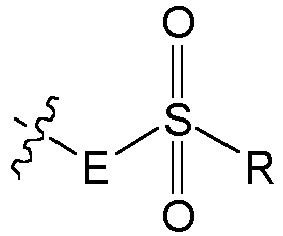


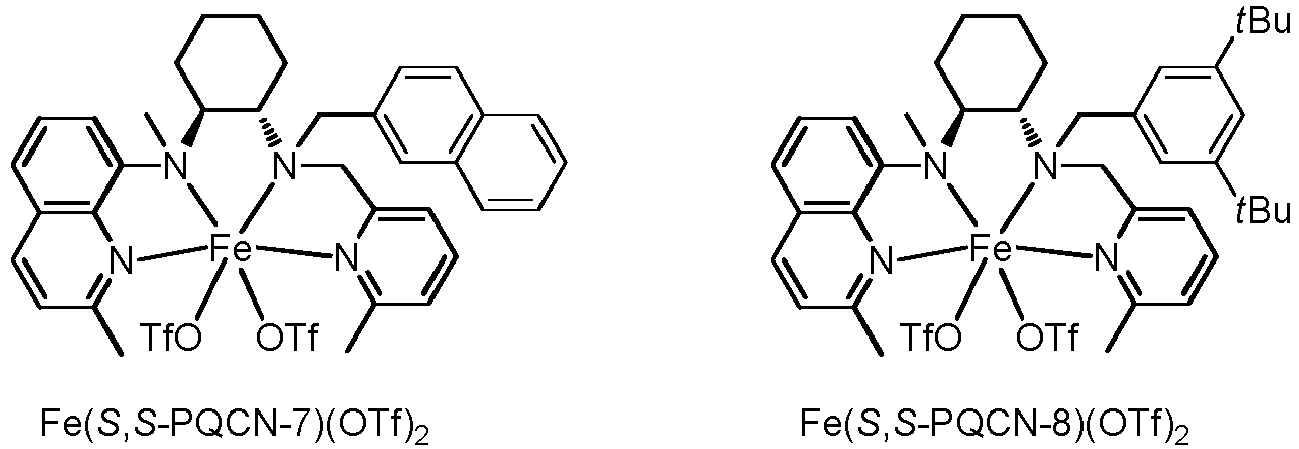
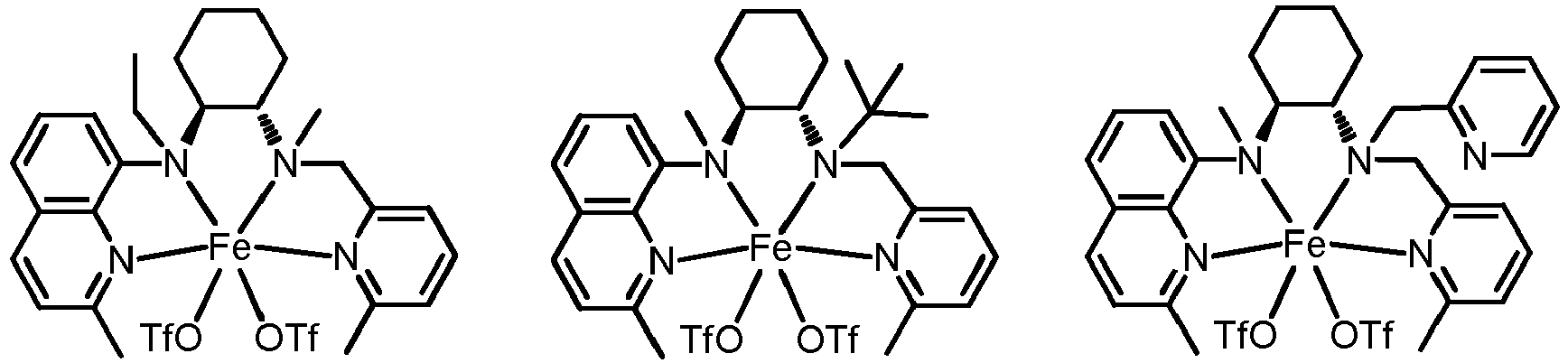


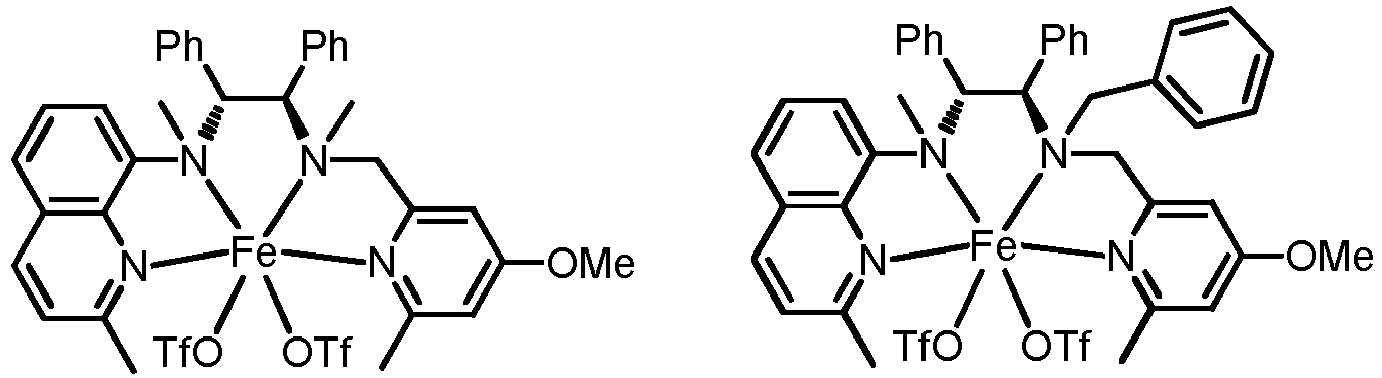


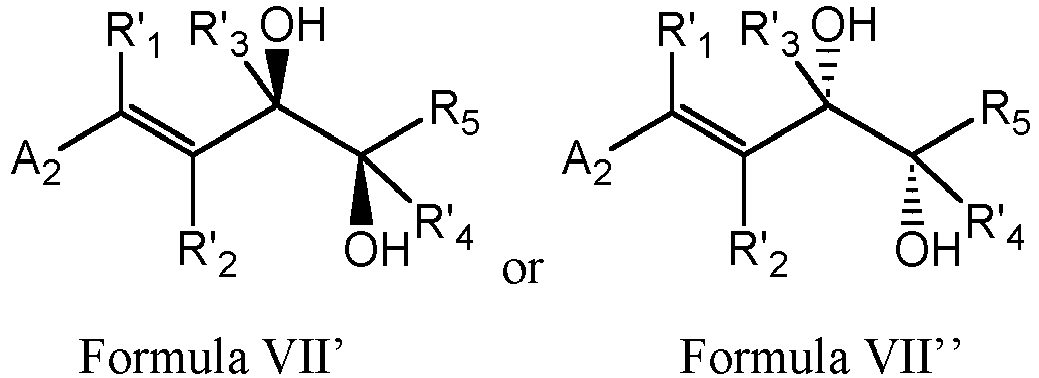
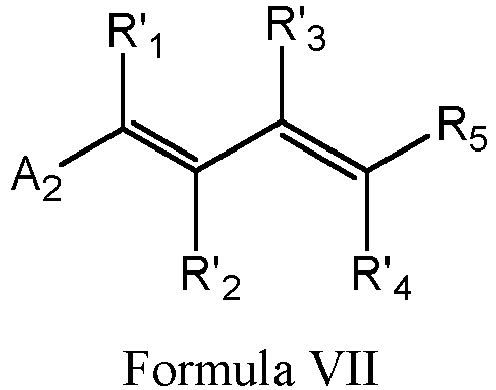


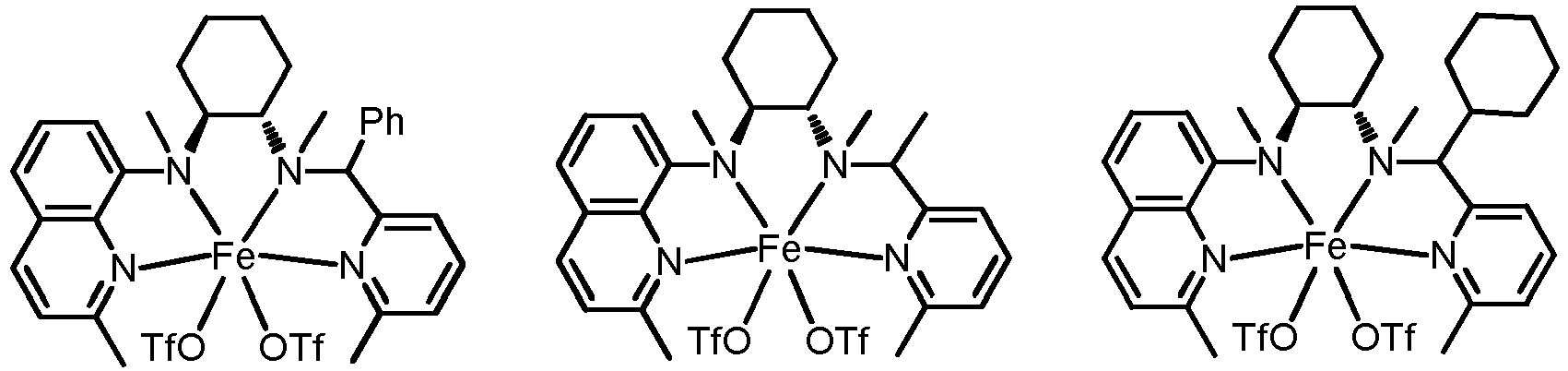


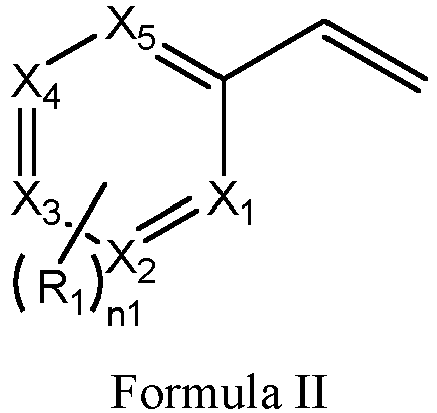








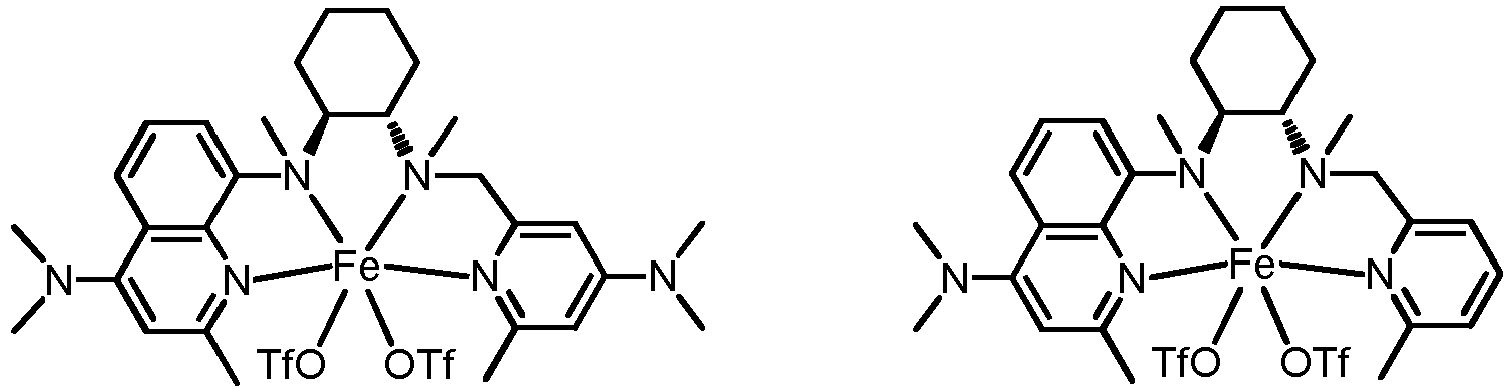


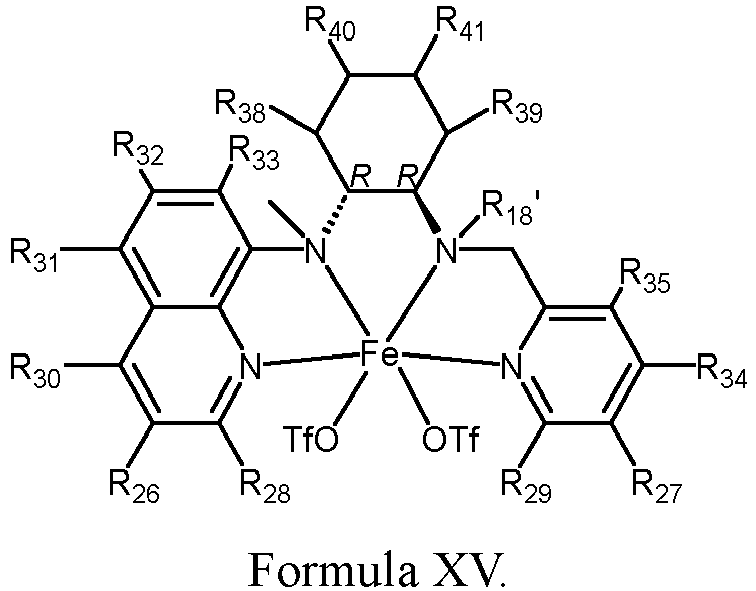


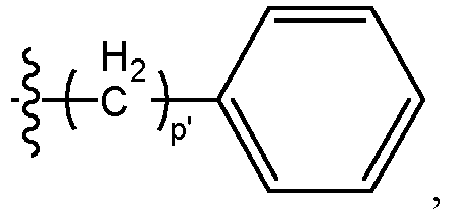


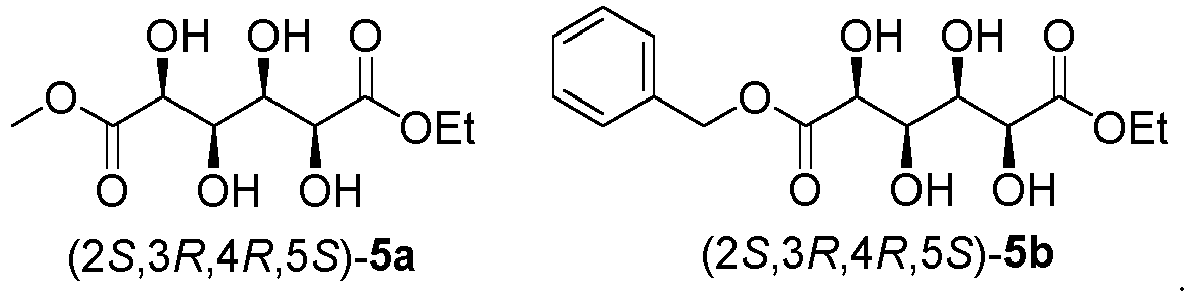





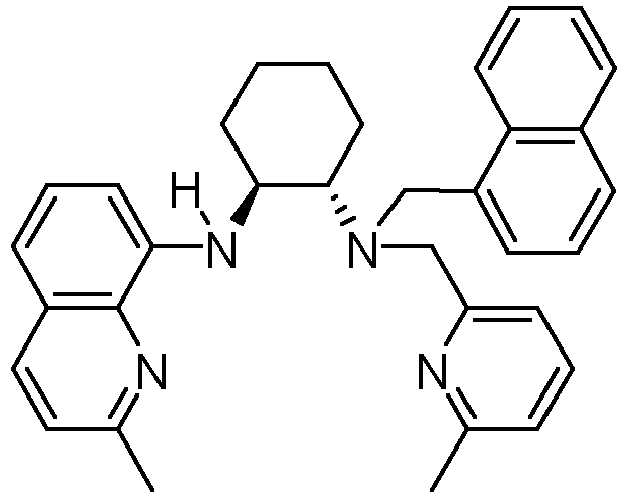


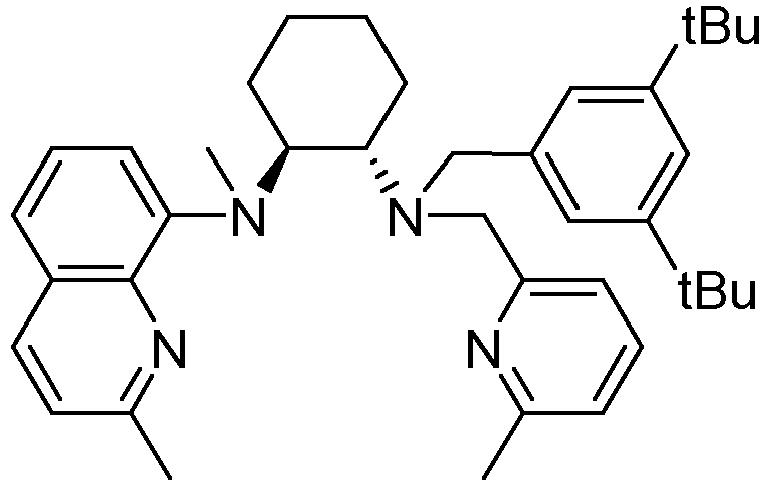


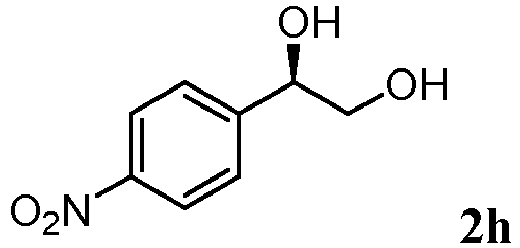


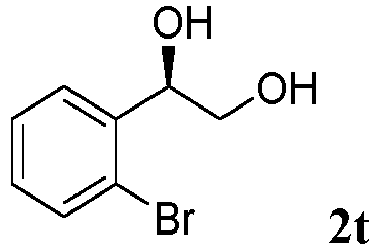

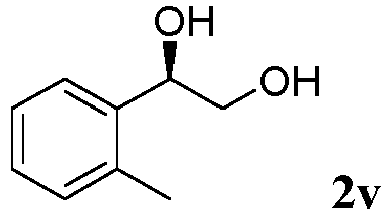


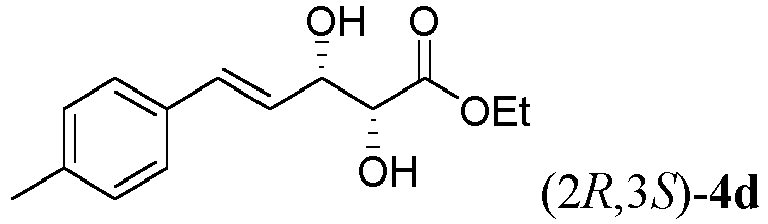


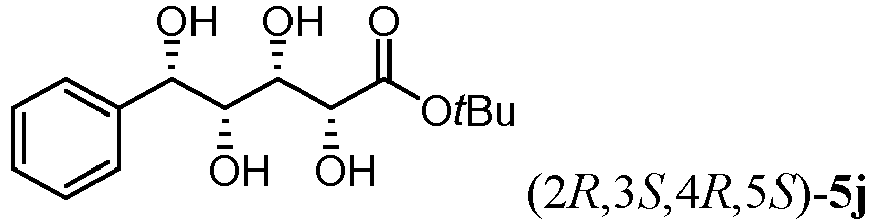


 (a) L1 is a bond or
 (b) R18, R23, R24, R18', R23', and R24' are independently a hydrogen, a substituted or unsubstituted alkyl, a substituted or unsubstituted alkenyl, a substituted or unsubstituted aryl, a substituted or unsubstituted alkylaryl, or a substituted or unsubstituted polyaryl;(c) R19 is a substituted or unsubstituted alkyl, a substituted or unsubstituted alkenyl, a substituted or unsubstituted aryl, a substituted or unsubstituted alkylaryl, or a substituted or unsubstituted polyaryl;(d) R22, R22', and R31-R34 are independently a hydrogen, a substituted or unsubstituted alkyl, a halogen, an amino, or an alkoxyl;(e) R25 and R25' are independently a leaving group; and(f) the substituents are independently a substituted or unsubstituted alkyl, a substituted or unsubstituted alkenyl, a substituted or unsubstituted alkynyl, a substituted or unsubstituted cyclic group, a substituted or unsubstituted heterocyclic group, a substituted or unsubstituted aryl, a substituted or unsubstituted heteroaryl, a substituted or unsubstituted polyaryl, a substituted or unsubstituted polyheteroaryl, a substituted or unsubstituted aralkyl, a carbonyl, a halide, a hydroxyl, a phenoxy, an aroxy, an alkylthio, a phenylthio, an arylthio, a cyano, an isocyano, an alkoxyl, a nitro, an carboxyl, an amino, an amido, an oxo, a silyl, a sulfinyl, a sulfonyl, a sulfonic acid, a phosphonium, a phosphanyl, a phosphoryl, a phosphonyl, or a thiol, or a combination thereof.

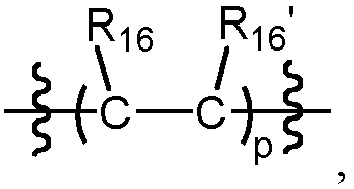


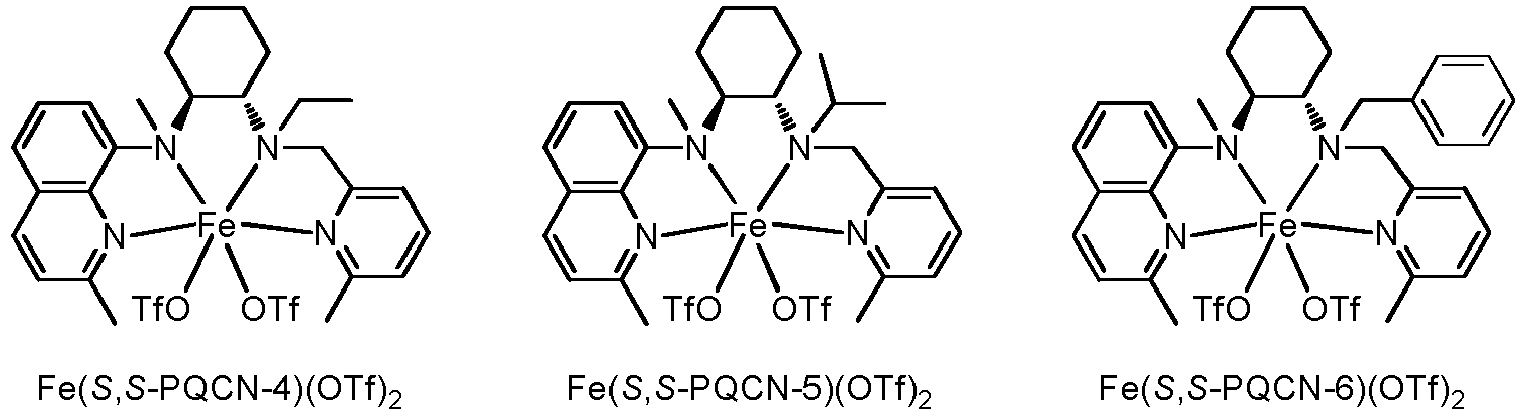


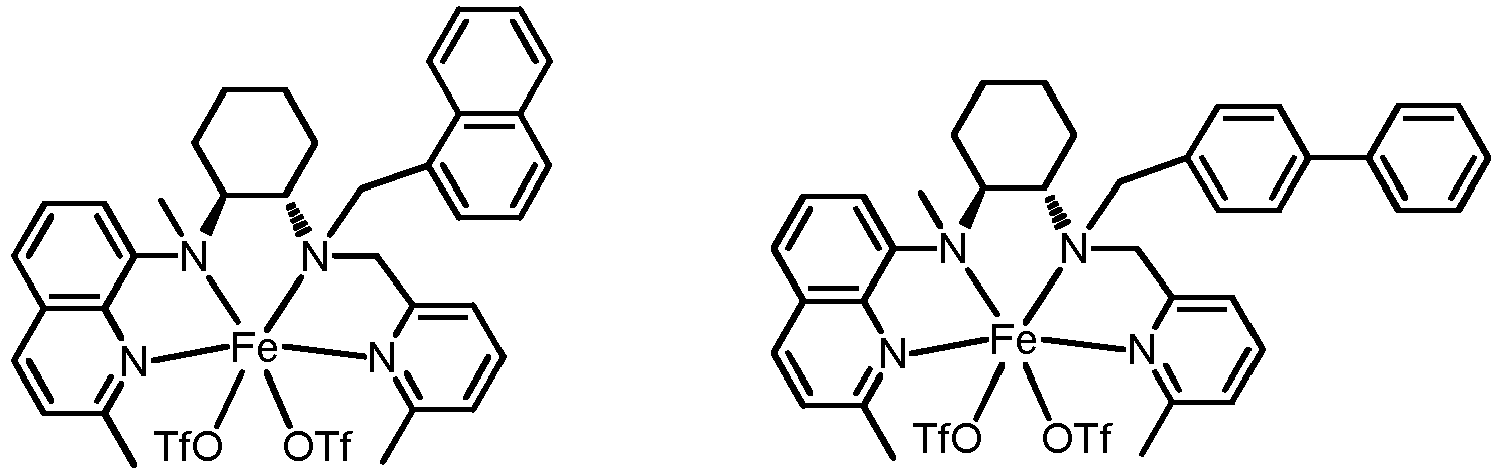


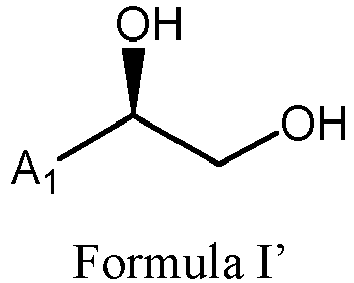

 (a) X1-X5 are independently carbon, nitrogen, oxygen, or sulfur;(b) n1 is an integer from 0 to 5;(c) each occurrence of R1 is independently a hydrogen, a substituted alkyl, an unsubstituted alkyl, a substituted alkylaryl, an unsubstituted alkylaryl, a substituted aryl, an unsubstituted aryl, a substituted heterocyclic, an unsubstituted heterocyclic, a hydroxyl, a halide, a haloalkyl (such as haloalkyl, e.g., -CF3), a nitro, an amino, an amido, an alkoxyl, a cyano, or a carbonyl, or two neighboring R1 groups together with the carbon atoms to which they are attached form a substituted aryl, an unsubstituted aryl, a substituted polyaryl, an unsubstituted polyaryl, a substituted heteroaryl, an unsubstituted heteroaryl, a substituted heteropolyaryl, an unsubstituted heteropolyaryl, a substituted cycloalkyl, an unsubstituted cycloalkyl group, a substituted cycloalkenyl, an unsubstituted cycloalkenyl group, a substituted cycloalkynyl, an unsubstituted cycloalkynyl group, a substituted heterocyclic group, or an unsubstituted heterocyclic group; and(d) the substituents are independently a substituted alkyl, an unsubstituted alkyl, a substituted cycloalkyl, an unsubstituted cycloalkyl group, a substituted cycloalkenyl, an unsubstituted cycloalkenyl group, a substituted cycloalkynyl, an unsubstituted cycloalkynyl group, a substituted heterocyclic group, an unsubstituted heterocyclic group, a substituted aryl, an unsubstituted aryl, a substituted heteroaryl, an unsubstituted heteroaryl, a substituted polyaryl, an unsubstituted polyaryl, a substituted heteropolyaryl, an unsubstituted heteropolyaryl, a substituted alkylaryl, an unsubstituted aralkyl, a haloalkyl, a carbonyl, a halide, a hydroxyl, an alkoxyl, a nitro, a cyano, an amino, an amido, an oxo, or a thiol, or a combination thereof.
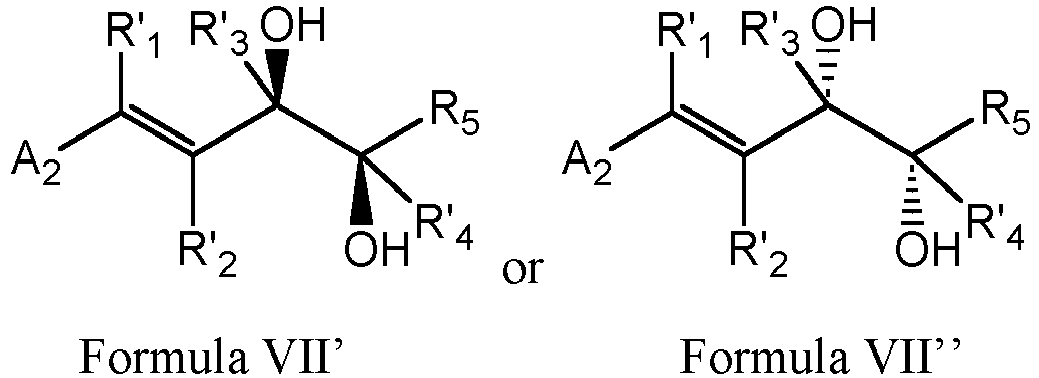 (a) A2 is a substituted aryl, an unsubstituted aryl, a substituted polyaryl, an unsubstituted polyaryl, a substituted heteroaryl, an unsubstituted heteroaryl, a substituted heteropolyaryl, an unsubstituted heteropolyaryl, or a carbonyl;(b) R5 is -C(=O)OR6, R6 is hydrogen, a substituted alkyl, an unsubstituted alkyl, a substituted aryl, an unsubstituted aryl, a substituted polyaryl, an unsubstituted polyaryl, a substituted heteroaryl, an unsubstituted heteroaryl, a substituted heteropolyaryl, an unsubstituted heteropolyaryl, a substituted alkylaryl, or an unsubstituted alkylaryl;(c) R'1-R'4 are independently hydrogen, a substituted alkyl, an unsubstituted alkyl, a substituted aryl, an unsubstituted aryl, a substituted polyaryl, an unsubstituted polyaryl, a substituted heteroaryl, an unsubstituted heteroaryl, a substituted heteropolyaryl, an unsubstituted heteropolyaryl, a substituted alkylaryl, or an unsubstituted alkylaryl, a substituted cycloalkyl, an unsubstituted cycloalkyl, a substituted cycloalkenyl, an unsubstituted cycloalkenyl, a substituted cycloalkynyl, an unsubstituted cycloalkynyl, a substituted heterocyclic, or an unsubstituted heterocyclic; and(d) the substituents are independently a substituted alkyl, an unsubstituted alkyl, a substituted cycloalkyl, an unsubstituted cycloalkyl group, a substituted cycloalkenyl, an unsubstituted cycloalkenyl group, a substituted cycloalkynyl, an unsubstituted cycloalkynyl group, a substituted heterocyclic group, an unsubstituted heterocyclic group, a substituted aryl, an unsubstituted aryl, a substituted heteroaryl, an unsubstituted heteroaryl, a substituted polyaryl, an unsubstituted polyaryl, a substituted heteropolyaryl, an unsubstituted heteropolyaryl, a substituted alkylaryl, an unsubstituted aralkyl, a haloalkyl, a carbonyl, a halide, a hydroxyl, an alkoxyl, a nitro, a cyano, an amino, an amido, an oxo, or a thiol, or a combination thereof.
 (a) A2 is a substituted aryl, an unsubstituted aryl, a substituted polyaryl, an unsubstituted polyaryl, a substituted heteroaryl, an unsubstituted heteroaryl, a substituted heteropolyaryl, an unsubstituted heteropolyaryl, or a carbonyl;(b) R5 is -C(=O)OR6, R6 is hydrogen, a substituted alkyl, an unsubstituted alkyl, a substituted aryl, an unsubstituted aryl, a substituted polyaryl, an unsubstituted polyaryl, a substituted heteroaryl, an unsubstituted heteroaryl, a substituted heteropolyaryl, an unsubstituted heteropolyaryl, a substituted alkylaryl, or an unsubstituted alkylaryl;(c) R'1-R'4 are independently a substituted alkyl, an unsubstituted alkyl, a substituted aryl, an unsubstituted aryl, a substituted polyaryl, an unsubstituted polyaryl, a substituted heteroaryl, an unsubstituted heteroaryl, a substituted heteropolyaryl, an unsubstituted heteropolyaryl, a substituted alkylaryl, or an unsubstituted alkylaryl, a substituted cycloalkyl, an unsubstituted cycloalkyl, a substituted cycloalkenyl, an unsubstituted cycloalkenyl, a substituted cycloalkynyl, an unsubstituted cycloalkynyl, a substituted heterocyclic, or an unsubstituted heterocyclic; and(d) the substituents are independently a substituted alkyl, an unsubstituted alkyl, a substituted cycloalkyl, an unsubstituted cycloalkyl group, a substituted cycloalkenyl, an unsubstituted cycloalkenyl group, a substituted cycloalkynyl, an unsubstituted cycloalkynyl group, a substituted heterocyclic group, an unsubstituted heterocyclic group, a substituted aryl, an unsubstituted aryl, a substituted heteroaryl, an unsubstituted heteroaryl, a substituted polyaryl, an unsubstituted polyaryl, a substituted heteropolyaryl, an unsubstituted heteropolyaryl, a substituted alkylaryl, an unsubstituted aralkyl, a haloalkyl, a carbonyl, a halide, a hydroxyl, an alkoxyl, a nitro, a cyano, an amino, an amido, an oxo, or a thiol, or a combination thereof.