EP4491069A1 - Machine, deformation unit for such a machine and method for preparing a beverage with such a machine - Google Patents
Machine, deformation unit for such a machine and method for preparing a beverage with such a machine Download PDFInfo
- Publication number
- EP4491069A1 EP4491069A1 EP23185509.9A EP23185509A EP4491069A1 EP 4491069 A1 EP4491069 A1 EP 4491069A1 EP 23185509 A EP23185509 A EP 23185509A EP 4491069 A1 EP4491069 A1 EP 4491069A1
- Authority
- EP
- European Patent Office
- Prior art keywords
- unit
- capsule
- preparation
- deformation
- preparation machine
- Prior art date
- Legal status (The legal status is an assumption and is not a legal conclusion. Google has not performed a legal analysis and makes no representation as to the accuracy of the status listed.)
- Granted
Links
Images

Classifications
-
- A—HUMAN NECESSITIES
- A47—FURNITURE; DOMESTIC ARTICLES OR APPLIANCES; COFFEE MILLS; SPICE MILLS; SUCTION CLEANERS IN GENERAL
- A47J—KITCHEN EQUIPMENT; COFFEE MILLS; SPICE MILLS; APPARATUS FOR MAKING BEVERAGES
- A47J31/00—Apparatus for making beverages
- A47J31/24—Coffee-making apparatus in which hot water is passed through the filter under pressure, i.e. in which the coffee grounds are extracted under pressure
- A47J31/34—Coffee-making apparatus in which hot water is passed through the filter under pressure, i.e. in which the coffee grounds are extracted under pressure with hot water under liquid pressure
- A47J31/36—Coffee-making apparatus in which hot water is passed through the filter under pressure, i.e. in which the coffee grounds are extracted under pressure with hot water under liquid pressure with mechanical pressure-producing means
- A47J31/3666—Coffee-making apparatus in which hot water is passed through the filter under pressure, i.e. in which the coffee grounds are extracted under pressure with hot water under liquid pressure with mechanical pressure-producing means whereby the loading of the brewing chamber with the brewing material is performed by the user
- A47J31/3676—Cartridges being employed
- A47J31/369—Impermeable cartridges being employed
- A47J31/3695—Cartridge perforating means for creating the hot water inlet
-
- A—HUMAN NECESSITIES
- A47—FURNITURE; DOMESTIC ARTICLES OR APPLIANCES; COFFEE MILLS; SPICE MILLS; SUCTION CLEANERS IN GENERAL
- A47J—KITCHEN EQUIPMENT; COFFEE MILLS; SPICE MILLS; APPARATUS FOR MAKING BEVERAGES
- A47J31/00—Apparatus for making beverages
- A47J31/24—Coffee-making apparatus in which hot water is passed through the filter under pressure, i.e. in which the coffee grounds are extracted under pressure
- A47J31/34—Coffee-making apparatus in which hot water is passed through the filter under pressure, i.e. in which the coffee grounds are extracted under pressure with hot water under liquid pressure
- A47J31/36—Coffee-making apparatus in which hot water is passed through the filter under pressure, i.e. in which the coffee grounds are extracted under pressure with hot water under liquid pressure with mechanical pressure-producing means
- A47J31/3604—Coffee-making apparatus in which hot water is passed through the filter under pressure, i.e. in which the coffee grounds are extracted under pressure with hot water under liquid pressure with mechanical pressure-producing means with a mechanism arranged to move the brewing chamber between loading, infusing and ejecting stations
- A47J31/3623—Cartridges being employed
- A47J31/3638—Means to eject the cartridge after brewing
-
- A—HUMAN NECESSITIES
- A47—FURNITURE; DOMESTIC ARTICLES OR APPLIANCES; COFFEE MILLS; SPICE MILLS; SUCTION CLEANERS IN GENERAL
- A47J—KITCHEN EQUIPMENT; COFFEE MILLS; SPICE MILLS; APPARATUS FOR MAKING BEVERAGES
- A47J31/00—Apparatus for making beverages
- A47J31/44—Parts or details or accessories of beverage-making apparatus
-
- A—HUMAN NECESSITIES
- A47—FURNITURE; DOMESTIC ARTICLES OR APPLIANCES; COFFEE MILLS; SPICE MILLS; SUCTION CLEANERS IN GENERAL
- A47J—KITCHEN EQUIPMENT; COFFEE MILLS; SPICE MILLS; APPARATUS FOR MAKING BEVERAGES
- A47J31/00—Apparatus for making beverages
- A47J31/44—Parts or details or accessories of beverage-making apparatus
- A47J31/60—Cleaning devices
Definitions
- the present invention is directed to a preparation machine for preparing a beverage, in particular from single-serve capsules.
- the invention is further directed to a deformation unit for being used in such a preparation machine.
- the present invention is also directed to a method for preparing a beverage with such a preparation machine.
- Single-serve capsules generally include a capsule body, which may be made out of plastics or aluminum, and an organic component, like ground coffee, which is contained in the capsule body.
- the whole process is complex and long until the capsule materials, in particular the organic component, may eventually be recycled and/or composted.
- it requires the user to carry loads of processed capsules that are relatively heavy and cumbersome all the way to the collecting station.
- the capsule body cannot be emptied from the organic component before the processed capsule is disposed of in a trash bin at home. It is not possible for the user to compost and recycle at home the used organic components.
- the processed capsule can be squeezed by the deformation element to release most or all of the used beverage component from the cavity.
- the deformation element can shrink the cavity, or even turn the capsule body inside out. The cavity can thus be emptied and the beverage component separated from the capsule body.
- the preparation machine enables to efficiently handle the released beverage component separately from the deformed capsule body, which enhances the disposability and recyclability of processed capsules. Further, the user can have the beverage component composted e.g. at home, and the user is only required to dispose of the deformed capsule bodies, hence a relatively light and compact load.
- the deformation unit is part of the preparation machine, it provides an all-in-one compact equipment for processing the capsules and enhancing their disposability and recyclability. Moreover, the deformation unit may be added to the preparation machine, thus allowing retrofitting the existing preparation machines.
- capsule may be understood as designating any container that contains a dose of beverage component(s), for example a pod or a cartridge. Such dose of beverage component(s) is usually suitable for preparing one beverage (single-serve), two or a few beverages.
- a capsule may include an inner wall arranged to divide the cavity into two or more sub-cavities for respectively containing as many beverage components.
- the preparation machine may be configured to process capsules of a given shape, for example symmetrical, frustoconical, spheroidal, etc.
- the beverage component may be selected within the list of: roast and ground coffee, a soluble ingredient such as milk-based, chocolate, soup, infusion or herbal tea ingredients as well as nutritional soluble compositions, and more generally any liquid edible composition for human or animal consumption and/or mixtures thereof.
- the fluid may be water or milk.
- the beverage component may be made to interact with the fluid injected in the capsule in order to produce any ingestible substance, for example coffee, tea, milk, cream, soup, puree, medication, etc.
- the cavity When the capsule body is deformed, the cavity may be shrunk to a volume of less than 50%, preferably less than 25%, more preferably less than 10%, of the volume the cavity has before the capsule body is deformed.
- the deformation element may further deform the capsule body until the capsule body is generally turned inside out.
- the pressure exerted by the deformation element on the capsule body may advantageously be selected to be higher than the strength of the capsule body, which strength is determined by the dimensions and materials of the capsule body.
- the deformation element may include a punch.
- the punch can form an efficient deformation element suitable for completely squeezing the capsule or even turning it inside out.
- the deformation element may include a cylinder.
- the punch or cylinder may have a pressing face having a size commensurate with a dimension of the capsule body.
- the size of the pressing face may be selected within the range of 1 to 10 cm.
- the preparation machine may further comprise a driving unit configured to move the deformation element, the driving unit including a motor or a manual actuator.
- the driving unit can transmit a mechanical force to the deformation element, which can in turn deform the capsule body.
- the deformation element may be configured to move in translation.
- the deformation element may be formed by a piston.
- the deformation element may be arranged to move in rotation.
- the motor of the driving unit may be electrically connected with the preparation machine such that the motor is powered by the same source as the preparation unit.
- the motor of the driving unit may also be coupled to the preparation unit so as to displace a movable chamber section and selectively open or close the preparation chamber.
- the same motor can be used by both the deformation unit and the preparation unit.
- the manual actuator may be a crank or a lever, which is coupled to the preparation unit so as to displace a movable chamber section and selectively open or close the preparation chamber.
- the driving unit may further comprise a mechanism configured to transmit a force from the motor or from the manual actuator to the deformation element.
- the deformation unit may further comprise an abutment wall, the deformation element being configured to move, preferably in translation, toward the abutment wall so as to push the capsule against the abutment wall.
- the deformation element can push the capsule against the abutment wall to deform the capsule body.
- the abutment wall may be static.
- the abutment wall may be mobile so as to move toward the deformation element, hence toward a capsule body to be deformed.
- the preparation machine may further comprise a separation unit configured to separate the deformed capsule body from the beverage component released from the cavity, wherein the separation unit may be part of the deformation unit.
- the released beverage component can be handled, in particular composted or recycled, separately from the deformed capsule body.
- the separation unit may be part of the deformation unit.
- the separation unit may come be an additional unit that is arranged next to the deformation unit.
- the separation unit may comprise a receiving grid, which may be arranged substantially horizontally and which is configured to retain the deformed capsule body and let the released beverage component fall through it.
- the separation unit may comprise a filtering grid configured to retain the deformed capsule body and to let all or part of the beverage component released from the cavity pass through the filtering grid.
- the filtering grid enables a quick separation of the deformed capsule body from the released beverage component.
- the released beverage component which is generally a flowable or pasty substance, can pass to one side of the filtering grid, while the deformed capsule body remains on the other side of the filtering grid.
- the filtering grid can act as a solid/liquid filter.
- the filtering grid may have holes dimensioned to prevent the capsule body or chunks thereof from passing through.
- the filtering grid may form the abutment wall if present.
- the filtering grid may extend substantially in a vertical plane.
- the filtering grid may be arranged below the deformation element such that the deformed capsule body and the beverage component released from the cavity may fall respectively onto and through the separation grid.
- the filtering grid may extend substantially in a horizontal plane.
- the preparation machine may further comprise a collecting chamber for collecting the beverage component released from the cavity and the deformed capsule body, preferably in separate sections of the collecting chamber, the collecting chamber being preferably part of the deformation unit or of the separation unit if present.
- the collecting chamber enables the user to conveniently handle the released beverage component collected on the one section of the collecting chamber, and the deformed capsule bodies on the other section of the collecting chamber.
- the separate sections may be arranged side-by-side or, alternatively, atop one another.
- Each one of the separate sections may be formed by a receptacle that can be inserted in and removed from the preparation machine quickly and independently from the receptacle of the other section.
- the preparation machine may store the released beverage component together with the deformed capsule bodies in a common container.
- the user shall shake the common container to manually separate the deformed capsule bodies from the released beverage component by density segregation.
- the preparation machine may further comprise a cutting unit having a cutting element configured to cut the capsule open after the capsule has been processed in the preparation unit and before the capsule body is deformed, wherein, preferably, the transfer section is configured to allow the transfer, preferably by gravity, of the opened capsule from the cutting unit to the deformation unit.
- the cutting unit can facilitate the releasing of the beverage component from the cavity.
- the cutting element may be formed by a blade configured to be moved by hand or by a motor.
- the cutting unit may be arranged in the preparation unit. Alternatively, the cutting unit may be arranged next to, preferably under, the preparation unit.
- the preparation unit may be detachably coupled to the deformation unit, to the separation unit if present, and/or to the collecting chamber if present.
- the user can detach from and reattach to the preparation machine the deformation unit and the separation unit if present, in particular to dispose of the deformed capsule bodies and the released beverage component.
- the preparation machine may have an accommodating space configured to accommodate most or all of the deformation unit and/or most or all of the separation unit if present.
- the accommodating space may be formed by a cavity located below, preferably under, the preparation machine.
- the accommodating space may be located adjacent the preparation unit, preferably next to a side of the preparation unit.
- the preparation machine may further comprise coupling means for detachably coupling the deformation unit and/or the separation unit, if present, to the preparation unit.
- the deformation unit and/or the separation unit may be detached by translation out of the preparation unit.
- the preparation machine may further comprise locking means configured to lock the deformation unit and/or the separation unit, if present, to the preparation unit.
- the locking means can prevent an unintended detachment of the deformation unit and/or the separation unit if present.
- the locking means may preferably be configured for reversible elastic snap-fitting of said units on one another.
- the preparation machine may further comprise a transfer section configured to allow a defined transfer, preferably by the action of gravity, of the capsule from the preparation chamber to the deformation unit, preferably via the cutting unit if present.
- the capsule can automatically transit from the preparation unit to the deformation unit and the cutting unit, if present, which enhances the convenience for the user.
- the deformation unit and the preparation unit may be configured such that, when the deformation unit and the preparation unit are coupled, the capsule may be displaced, preferably by the action of gravity, from the preparation chamber to a place within the reach of the deformation element, for example after the capsule has been processed in the preparation unit.
- the transfer section may be a passage, which joins the preparation chamber to the deformation unit and which is oriented substantially vertically.
- the capsule may be transferred by simply falling through the passage.
- the passage forms a compact transfer section.
- the passage may be an opening or a duct.
- the deformation unit may further comprise a cleaning device, the cleaning device being fluidly connected with a fluid injection unit, the cleaning device being configured to rinse the capsule body with some of the fluid after the capsule has been processed in the preparation unit, the cleaning device being arranged downstream the deformation unit or downstream the cutting unit if present.
- the cleaning device can remove some beverage component that might be stuck to the capsule body.
- the fluid injection unit may be further configured to inject fluid in the capsule when the capsule is in the preparation chamber so as to prepare the beverage. So the fluid injection unit can supply fluid for preparing a beverage. As the same fluid injection unit can be used both for preparing a beverage and for rinsing the capsule body, the overall footprint can be reduced.
- the preparation machine may further comprise a dispensing unit for dispensing the beverage out of the preparation unit.
- the present invention is directed to a deformation unit for being used in a preparation machine according to any one of preceding aspect, embodiments and implementations, the deformation unit being configured to be coupled, preferably in a detachable manner, to the preparation unit such that the capsule may be transferred from the preparation chamber to the deformation unit, the deformation unit having i) the deformation element and ii) a drive connection for functionally connecting the deformation element with a or the driving unit of the preparation machine to selectively move the deformation element.
- the processed capsule can be squeezed by the deformation element to release most or all of the used beverage component from the cavity.
- the present invention is directed to a method for preparing a beverage with a preparation machine according to any one of preceding aspect, embodiments and implementations, the method comprising:
- the processed capsule can be squeezed by the deformation element to release most or all of the used beverage component from the cavity.
- the relative terms “horizontal”, “vertical”, “below”, “under”, “bottom” and “top” generally refer to the configuration where the preparation machine is in service for preparing a beverage.
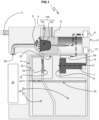
- Fig.1 shows a preparation machine 1 for preparing a beverage by injecting a fluid in a capsule 100.
- the preparation machine 1 may be of a Nespresso Essenza Mini ® or a Nespresso Pixie ® .
- the capsule 100 may be a Nespresso original ® .
- the capsule 100 has i) a capsule body 101 defining a cavity 102 and ii) a beverage component 103 ( Figs.4-5 ) contained within the cavity 102.
- the beverage component 103 may be roast and ground coffee.
- the preparation machine 1 comprises a preparation unit 2 and a deformation unit 4.
- the preparation unit 2 may be located above the deformation unit 4.
- the preparation machine 1 has an introduction duct 5 ( Fig.1 ) for introducing the capsule 100 into the beverage preparation unit 2.
- the preparation unit 2 has a preparation chamber 6 ( Fig.1 ), which is suitable for receiving the capsule 100.
- the preparation chamber 6 may include a pyramid plate 6.1 ( Fig.2 ) covered with sharp pyramids configured to tear open a closing membrane of the capsule 100 and let the prepared beverage flow out of the capsule 100.
- the preparation unit 2 also has a fluid injection unit 8 ( Fig.1 ), which maybe configured for injecting the fluid in the capsule 100 to prepare the beverage when the capsule is in the preparation chamber 6.
- the fluid may be hot water under pressure.
- the beverage component 103 may be made to interact with the fluid injected in the capsule 100 in order to produce a cup of coffee.
- the deformation unit 4 has a deformation element 7.
- the deformation element 7 is movable to deform the capsule body 101 in order to release most or all of the beverage component 103 from the cavity 102 after the capsule 100 has been processed in the preparation unit 2.
- the deformation element 7 can shrink the cavity 102 to less than 10% of its initial volume, that is, the volume the cavity 102 had before the capsule body 101 is deformed.
- practically all of the used beverage component 103 can be released from the cavity 102.
- the deformation element 7 may be formed by a piston and include a cylinder. As visible in Fig.6-7 , the deformation element 7 may be configured to completely deform the capsule body 101, thus releasing practically all of the beverage component 103 from the cavity 102.
- the deformation element 7 may have a pressing face 9, which has a size commensurate with the largest dimension of the capsule body 101, for example a width or diameter of 4 cm.
- the preparation machine 1 may further comprise a driving unit 10 ( Fig.1 ), which is configured to move the deformation element 7 in translation along direction X7, selectively back and forth.
- the driving unit 10 may include a motor (not shown), which may be powered by the same source as the preparation unit 2 and the fluid injection unit 8.
- the driving unit 10 may be mechanically connected with the deformation element 7 in order to transmit a mechanical force, possibly via mechanism (not shown), to the deformation element 7.
- the deformation element 7 can deform the capsule body 101 as shown in Fig.4-5 .
- the processed capsule 100 can be squeezed by the deformation element 7 to release most or all of the used beverage component 103 from the cavity 102.
- the preparation machine 1 may further comprise a crank 11 which may be coupled to the preparation unit 2 so as to manually displace a movable chamber section 12, and thus selectively open or close the preparation chamber 6.
- crank 11 may be horizontally placed in a first end position as the movable chamber section 12 is closing the preparation chamber 6 and the capsule 100 is processed by extraction.
- the crank 11 may be in an intermediate position as the preparation chamber 6 is partly reopened.
- the crank 11 may be in a vertical position as the preparation chamber 6 is fully open.
- crank 11 is placed in a second end position past the vertical position of Fig.3 .
- the crank 11 may activate a switch (not shown), which actuates the driving unit 10 which in turn moves the deformation element 7.
- the driving unit 10 may be activated after a predetermined time, e.g. 5 seconds, so as to ensure that the capsule can reach the deformation unit 4 and can thus undergo a deformation of the capsule body 101.
- the deformation unit 4 may further comprise a static abutment wall 14.
- the deformation element 7 may be configured to move toward the abutment wall 14 to push the capsule against the abutment wall 14.
- the deformation unit 4 may further have a drive connection 15 functionally connecting the deformation element 7 with the driving unit 10 to selectively move the deformation element 7, for example successively toward and away from the abutment wall 14 along direction X7.
- the preparation machine 1 may further comprise a separation unit 16, which is configured to separate the deformed capsule body 101 ( Figs.4-7 ) from the beverage component 103 released from the cavity 102.
- the separation unit 16 may be part of the deformation unit 4.
- the separation unit 16 may comprise a filtering grid 18, which is configured to retain the deformed capsule body 101 ( Fig.5 ) and to let the beverage component 103 released from the cavity 102 pass through the filtering grid 18 ( Fig.4 ).
- the capsule 100 is placed against the abutment wall 14 and the filtering grid 18.
- the released beverage component 103 can pass to the left side of the filtering grid 18, while the deformed capsule body 101 remains on the right side of the filtering grid 18.
- the released beverage component 103 ( Figs.4-7 ) can be handled by the user separately from the deformed capsule body 101.
- the filtering grid 18 may form the abutment wall 14.
- the filtering grid 18 may extend substantially in a vertical plane perpendicular to the plane of Fig.1 .
- the preparation machine 1 may further comprise a collecting chamber 20 configured for collecting the released beverage component 103 and the deformed capsule body 101, respectively in separate sections 21, 22 arranged side-by-side.
- the released beverage component 103 may be collected in the left section 21, while the deformed capsule bodies 101 may be collected in the right section 22.
- the separate sections 21, 22 may each be formed by a respective receptacle that can be inserted in and removed from the preparation machine 1.
- the collecting chamber 20 may be located below the separation unit 16 but the collecting chamber 20 is integral with the deformation unit 4 and with the separation unit 16, so the user can conveniently detach and reattach them altogether. Thus, the user can conveniently handle the released beverage component 103 and the deformed capsule bodies 101 and empty the collecting chamber 20.
- the preparation unit 2 may be detachably coupled to deformation unit 4, to the separation unit 16, and/or to the collecting chamber 20.
- the deformation unit 4, the separation unit 16 and/or the collecting chamber 20 may be detached from the preparation unit 2 by translation along direction X4, which is substantially horizontal in the example of Figs.1-7 .
- the preparation machine 2 may have an accommodating space 23 for accommodating most or all of the deformation unit 4, of the separation unit 16 and of the collecting chamber 20.
- the accommodating space 23 may be formed by a cavity located under the preparation unit 2.
- the preparation machine 1 may further comprise coupling means (not shown) for detachably coupling the deformation unit 4 and/or the separation unit 16 to the preparation unit 2.
- the preparation machine 1 may further comprise locking means (not shown) for locking the deformation unit 4 and/or the separation unit 16 to the preparation unit 2.
- the locking means may preferably be configured for reversible elastic snap-fitting of said units on one another.
- the preparation machine 1 may further comprise a cutting unit (not shown) having a cutting element like a blade configured to be moved by a manual actuator or by a motor.
- the cutting element may be configured to cut the capsule 100 open after the capsule 100 has been processed in the preparation unit 2 and before the capsule body 101 is deformed. This might be necessary for certain kind of capsules.
- the cutting unit may be arranged to cut the capsule 100 within the preparation chamber 6 before the capsule body 101 is transferred to and deformed in the deformation unit 4.
- the preparation machine 1 may further comprise a transfer section 25 for allowing a transfer, by the action of gravity, of the capsule 100 from the preparation chamber 2 to the deformation unit 4.
- a transfer section 25 for allowing a transfer, by the action of gravity, of the capsule 100 from the preparation chamber 2 to the deformation unit 4.
- the capsule 100 is passing through the transfer section 25.
- the transfer section 25 may be a passage joining the preparation chamber 6 to the deformation unit 4 and oriented substantially vertically.
- the processed capsule 100 is free to fall through transfer section 25 and into the deformation unit 4, hence within the reach of the deformation element 7.
- the transfer section 25 may be configured to allow the transfer, preferably by gravity, of the opened capsule 100 from the cutting unit to the deformation unit 4.
- the deformation unit 4 may further comprise a cleaning device 26 ( Fig.1 ) for rinsing the capsule body 101 with fluid after the capsule 100 has been processed in the preparation unit 2.
- the cleaning device 26 can enhance removal of beverage component 103 from the deformed capsule body 101.
- the cleaning device 26 may be fluidly connected with the fluid injection unit 8 for a supply of fluid, for example water.
- the cleaning device 26 may be arranged downstream the deformation unit 4.
- the collecting chamber 20 may be configured to collect also the rinsing fluid after the rinsing has been carried out.
- the preparation machine 1 may further comprise a drying module (not shown) configured for partly or totally dry out the beverage component.
- the drying module may be part of the separation unit 16.
- the drying module may be arranged close to the filtering grid 18.
- the drying module can enhance the separation of the beverage component 103 from the capsule body 101, in particular on the filtering grid 18.
- the preparation machine 1 may further comprise a dispensing unit 28 for dispensing the beverage out of the preparation unit 2.
- the dispensing unit 28 may be fluidly connected with the preparation chamber 6 and have a duct for guiding the beverage out of the preparation machine 1.
- the dispensing unit 28 may further have a filling space 30 where a drinking cup of a user may be placed such that the beverage can be dispensed therein.
- the filling space 30 may be located in front of the deformation unit 4.
- the preparation machine 1 When the preparation machine 1 is in service, it can be operated to prepare a beverage perform according to a method 200 illustrated in Fig.8 .
- the method 200 comprises:
- the user can thus easily handle the released beverage component 103 separately from the deformed capsule body 101.
- the disposability and recyclability of processed capsules 100 is enhanced.
- the beverage component 103 can be composted at home.
- method 200 may further comprise:
Landscapes
- Engineering & Computer Science (AREA)
- Food Science & Technology (AREA)
- Mechanical Engineering (AREA)
- Apparatus For Making Beverages (AREA)
Abstract
Description
- The present invention is directed to a preparation machine for preparing a beverage, in particular from single-serve capsules. The invention is further directed to a deformation unit for being used in such a preparation machine. The present invention is also directed to a method for preparing a beverage with such a preparation machine. Single-serve capsules generally include a capsule body, which may be made out of plastics or aluminum, and an organic component, like ground coffee, which is contained in the capsule body.
- In the field of single-serve capsules there is a general effort to reduce waste and to increase the disposability and recyclability of processed capsules. Usually the processed capsules must be collected at home by the users and brought from time to time to a collecting station like a shop. Then large quantities of processed capsules must be sent from the collecting station to a dedicated plant equipped with large machines which process bulks of processed capsule to separate the capsule bodies from the organic component, e.g. ground coffee. Once separated the organic component and the capsule bodies may be transferred to other plants for further processing and eventually recycling.
- However, the whole process is complex and long until the capsule materials, in particular the organic component, may eventually be recycled and/or composted. In particular, it requires the user to carry loads of processed capsules that are relatively heavy and cumbersome all the way to the collecting station. Besides, the capsule body cannot be emptied from the organic component before the processed capsule is disposed of in a trash bin at home. It is not possible for the user to compost and recycle at home the used organic components.
- It is thus an object of the present invention to provide a preparation machine for preparing a beverage by injecting a fluid in a capsule, the capsule having i) a capsule body defining a cavity and ii) a beverage component contained within the cavity, wherein the preparation machine comprises:
- a preparation unit having i) a preparation chamber for receiving the capsule and ii) means for injecting the fluid in the capsule to prepare the beverage, and
- a deformation unit having a deformation element, the deformation element being movable so as to deform the capsule body such that at least part of the beverage component is released from the cavity after the capsule has been processed in the preparation unit.
- Thus, the processed capsule can be squeezed by the deformation element to release most or all of the used beverage component from the cavity. For this squeezing, the deformation element can shrink the cavity, or even turn the capsule body inside out. The cavity can thus be emptied and the beverage component separated from the capsule body.
- The preparation machine enables to efficiently handle the released beverage component separately from the deformed capsule body, which enhances the disposability and recyclability of processed capsules. Further, the user can have the beverage component composted e.g. at home, and the user is only required to dispose of the deformed capsule bodies, hence a relatively light and compact load.
- As the deformation unit is part of the preparation machine, it provides an all-in-one compact equipment for processing the capsules and enhancing their disposability and recyclability. Moreover, the deformation unit may be added to the preparation machine, thus allowing retrofitting the existing preparation machines.
- In the present disclosure, the term "capsule" may be understood as designating any container that contains a dose of beverage component(s), for example a pod or a cartridge. Such dose of beverage component(s) is usually suitable for preparing one beverage (single-serve), two or a few beverages. A capsule may include an inner wall arranged to divide the cavity into two or more sub-cavities for respectively containing as many beverage components. The preparation machine may be configured to process capsules of a given shape, for example symmetrical, frustoconical, spheroidal, etc.
- The beverage component may be selected within the list of: roast and ground coffee, a soluble ingredient such as milk-based, chocolate, soup, infusion or herbal tea ingredients as well as nutritional soluble compositions, and more generally any liquid edible composition for human or animal consumption and/or mixtures thereof.
- The fluid may be water or milk. During preparation of a beverage, the beverage component may be made to interact with the fluid injected in the capsule in order to produce any ingestible substance, for example coffee, tea, milk, cream, soup, puree, medication, etc.
- When the capsule body is deformed, the cavity may be shrunk to a volume of less than 50%, preferably less than 25%, more preferably less than 10%, of the volume the cavity has before the capsule body is deformed. In an implementation, after the cavity has been shrunk, hence its volume reduced, the deformation element may further deform the capsule body until the capsule body is generally turned inside out.
- The pressure exerted by the deformation element on the capsule body may advantageously be selected to be higher than the strength of the capsule body, which strength is determined by the dimensions and materials of the capsule body.
- According to an embodiment, the deformation element may include a punch.
- Thus, the punch can form an efficient deformation element suitable for completely squeezing the capsule or even turning it inside out.
- Alternatively to a punch, the deformation element may include a cylinder.
- In an implementation, the punch or cylinder may have a pressing face having a size commensurate with a dimension of the capsule body. For example, the size of the pressing face may be selected within the range of 1 to 10 cm.
- According to an embodiment, the preparation machine may further comprise a driving unit configured to move the deformation element, the driving unit including a motor or a manual actuator.
- Thus, the driving unit can transmit a mechanical force to the deformation element, which can in turn deform the capsule body.
- In an implementation, the deformation element may be configured to move in translation. In particular, the deformation element may be formed by a piston. Alternatively or additionally, the deformation element may be arranged to move in rotation.
- In an implementation, the motor of the driving unit may be electrically connected with the preparation machine such that the motor is powered by the same source as the preparation unit.
- In an implementation, the motor of the driving unit may also be coupled to the preparation unit so as to displace a movable chamber section and selectively open or close the preparation chamber. In other words, the same motor can be used by both the deformation unit and the preparation unit.
- In an implementation, the manual actuator may be a crank or a lever, which is coupled to the preparation unit so as to displace a movable chamber section and selectively open or close the preparation chamber.
- In an implementation, the driving unit may further comprise a mechanism configured to transmit a force from the motor or from the manual actuator to the deformation element.
- According to an embodiment, the deformation unit may further comprise an abutment wall, the deformation element being configured to move, preferably in translation, toward the abutment wall so as to push the capsule against the abutment wall.
- Thus, the deformation element can push the capsule against the abutment wall to deform the capsule body.
- In an implementation, the abutment wall may be static. Alternatively, the abutment wall may be mobile so as to move toward the deformation element, hence toward a capsule body to be deformed.
- According to an embodiment, the preparation machine may further comprise a separation unit configured to separate the deformed capsule body from the beverage component released from the cavity, wherein the separation unit may be part of the deformation unit.
- Thus, the released beverage component can be handled, in particular composted or recycled, separately from the deformed capsule body.
- In an implementation, the separation unit may be part of the deformation unit. Alternatively, the separation unit may come be an additional unit that is arranged next to the deformation unit. In particular, the separation unit may comprise a receiving grid, which may be arranged substantially horizontally and which is configured to retain the deformed capsule body and let the released beverage component fall through it.
- According to an embodiment, the separation unit may comprise a filtering grid configured to retain the deformed capsule body and to let all or part of the beverage component released from the cavity pass through the filtering grid.
- Thus, the filtering grid enables a quick separation of the deformed capsule body from the released beverage component. The released beverage component, which is generally a flowable or pasty substance, can pass to one side of the filtering grid, while the deformed capsule body remains on the other side of the filtering grid. The filtering grid can act as a solid/liquid filter.
- Preferably, the filtering grid may have holes dimensioned to prevent the capsule body or chunks thereof from passing through.
- In an implementation, the filtering grid may form the abutment wall if present. In particular, the filtering grid may extend substantially in a vertical plane.
- Alternatively, the filtering grid may be arranged below the deformation element such that the deformed capsule body and the beverage component released from the cavity may fall respectively onto and through the separation grid. In particular, the filtering grid may extend substantially in a horizontal plane.
- According to an embodiment, the preparation machine may further comprise a collecting chamber for collecting the beverage component released from the cavity and the deformed capsule body, preferably in separate sections of the collecting chamber, the collecting chamber being preferably part of the deformation unit or of the separation unit if present.
- Thus, the collecting chamber enables the user to conveniently handle the released beverage component collected on the one section of the collecting chamber, and the deformed capsule bodies on the other section of the collecting chamber.
- In an implementation, the separate sections may be arranged side-by-side or, alternatively, atop one another. Each one of the separate sections may be formed by a receptacle that can be inserted in and removed from the preparation machine quickly and independently from the receptacle of the other section.
- Alternatively to this embodiment, the preparation machine may store the released beverage component together with the deformed capsule bodies in a common container. In this alternative, the user shall shake the common container to manually separate the deformed capsule bodies from the released beverage component by density segregation.
- According to an embodiment, the preparation machine may further comprise a cutting unit having a cutting element configured to cut the capsule open after the capsule has been processed in the preparation unit and before the capsule body is deformed,
wherein, preferably, the transfer section is configured to allow the transfer, preferably by gravity, of the opened capsule from the cutting unit to the deformation unit. - Thus, as the cutting unit fully opens the capsule, it can facilitate the releasing of the beverage component from the cavity.
- In an implementation, the cutting element may be formed by a blade configured to be moved by hand or by a motor.
- The cutting unit may be arranged in the preparation unit. Alternatively, the cutting unit may be arranged next to, preferably under, the preparation unit.
- According to an embodiment, the preparation unit may be detachably coupled to the deformation unit, to the separation unit if present, and/or to the collecting chamber if present.
- Thus, the user can detach from and reattach to the preparation machine the deformation unit and the separation unit if present, in particular to dispose of the deformed capsule bodies and the released beverage component.
- In an implementation, the preparation machine may have an accommodating space configured to accommodate most or all of the deformation unit and/or most or all of the separation unit if present. The accommodating space may be formed by a cavity located below, preferably under, the preparation machine. Alternatively, the accommodating space may be located adjacent the preparation unit, preferably next to a side of the preparation unit.
- In an implementation, the preparation machine may further comprise coupling means for detachably coupling the deformation unit and/or the separation unit, if present, to the preparation unit.
- In an implementation, the deformation unit and/or the separation unit, if present, may be detached by translation out of the preparation unit.
- In an implementation, the preparation machine may further comprise locking means configured to lock the deformation unit and/or the separation unit, if present, to the preparation unit. Thus, the locking means can prevent an unintended detachment of the deformation unit and/or the separation unit if present. The locking means may preferably be configured for reversible elastic snap-fitting of said units on one another.
- According to an embodiment, the preparation machine may further comprise a transfer section configured to allow a defined transfer, preferably by the action of gravity, of the capsule from the preparation chamber to the deformation unit, preferably via the cutting unit if present.
- Thus, the capsule can automatically transit from the preparation unit to the deformation unit and the cutting unit, if present, which enhances the convenience for the user.
- In an implementation, the deformation unit and the preparation unit may be configured such that, when the deformation unit and the preparation unit are coupled, the capsule may be displaced, preferably by the action of gravity, from the preparation chamber to a place within the reach of the deformation element, for example after the capsule has been processed in the preparation unit.
- In an implementation, the transfer section may be a passage, which joins the preparation chamber to the deformation unit and which is oriented substantially vertically. The capsule may be transferred by simply falling through the passage. Thus, the passage forms a compact transfer section. Preferably, the passage may be an opening or a duct.
- According to an embodiment, the deformation unit may further comprise a cleaning device, the cleaning device being fluidly connected with a fluid injection unit, the cleaning device being configured to rinse the capsule body with some of the fluid after the capsule has been processed in the preparation unit, the cleaning device being arranged downstream the deformation unit or downstream the cutting unit if present.
- Thus, the cleaning device can remove some beverage component that might be stuck to the capsule body.
- In an implementation, the fluid injection unit may be further configured to inject fluid in the capsule when the capsule is in the preparation chamber so as to prepare the beverage. So the fluid injection unit can supply fluid for preparing a beverage. As the same fluid injection unit can be used both for preparing a beverage and for rinsing the capsule body, the overall footprint can be reduced.
- According to an embodiment, the preparation machine may further comprise a dispensing unit for dispensing the beverage out of the preparation unit.
- According to another aspect, the present invention is directed to a deformation unit for being used in a preparation machine according to any one of preceding aspect, embodiments and implementations, the deformation unit being configured to be coupled, preferably in a detachable manner, to the preparation unit such that the capsule may be transferred from the preparation chamber to the deformation unit, the deformation unit having i) the deformation element and ii) a drive connection for functionally connecting the deformation element with a or the driving unit of the preparation machine to selectively move the deformation element.
- Thus, when the deformation unit is used in a preparation machine, the processed capsule can be squeezed by the deformation element to release most or all of the used beverage component from the cavity.
- According to yet another aspect, the present invention is directed to a method for preparing a beverage with a preparation machine according to any one of preceding aspect, embodiments and implementations, the method comprising:
- receiving a capsule in the preparation chamber,
- preparing a beverage by injecting the fluid in the capsule such that the fluid interacts with the beverage component,
- preferably, transferring the capsule from the preparation unit to the deformation unit after the capsule has been processed in the preparation unit, and
- moving the deformation element to deform the capsule body such that at least part of the beverage component is released from the cavity.
- Thus, when this method is carried out, the processed capsule can be squeezed by the deformation element to release most or all of the used beverage component from the cavity.
- In the present disclosure, the relative terms "horizontal", "vertical", "below", "under", "bottom" and "top" generally refer to the configuration where the preparation machine is in service for preparing a beverage.
- The words "comprise", "include", "have" and their derivatives are to be interpreted inclusively rather than exclusively. The term "and/or" used in the context of "X and/or Y" should be interpreted as "X," or "Y," or "X and Y."
- Further features, details and advantages of the present invention are described hereinafter, in particular in relation to the appended figures, which illustrate some of the afore-described aspects, embodiments and implementations thereof, and in which:
- Fig.1
- shows a schematic cross-sectional view of a preparation machine including a deformation unit according to the present invention to illustrate a step of preparing a beverage;
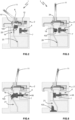
- Fig.2
- shows a view similar to
Fig.1 to illustrate a step of transferring the capsule from the preparation unit to the deformation unit after the capsule has been processed in the preparation unit; - Fig.3
- shows a view similar to
Fig.1 after the transferring step has been performed; - Fig.4
- shows a view similar to
Fig.1 to illustrate a step of deforming the capsule body, releasing beverage component from the cavity, and separating the released beverage component from the deformed capsule body; - Fig.5
- shows a view similar to
Fig.1 to illustrate a step of collecting the released beverage component; - Fig.6
- shows a view similar to
Fig.1 to illustrate a step of collecting the capsule body; - Fig.7
- shows a view similar to
Fig.1 to illustrate the preparation machine after the collecting steps ofFigs.5-6 and with open beverage preparation unit; and - Fig.8
- shows a flowchart of a method according to the present invention for preparing a beverage.
-
Fig.1 shows apreparation machine 1 for preparing a beverage by injecting a fluid in acapsule 100. Thepreparation machine 1 may be of a Nespresso Essenza Mini® or a Nespresso Pixie®. Thecapsule 100 may be a Nespresso original®. - The
capsule 100 has i) acapsule body 101 defining acavity 102 and ii) a beverage component 103 (Figs.4-5 ) contained within thecavity 102. Thebeverage component 103 may be roast and ground coffee. - The
preparation machine 1 comprises apreparation unit 2 and adeformation unit 4. Thepreparation unit 2 may be located above thedeformation unit 4. Thepreparation machine 1 has an introduction duct 5 (Fig.1 ) for introducing thecapsule 100 into thebeverage preparation unit 2. Thepreparation unit 2 has a preparation chamber 6 (Fig.1 ), which is suitable for receiving thecapsule 100. Thepreparation chamber 6 may include a pyramid plate 6.1 (Fig.2 ) covered with sharp pyramids configured to tear open a closing membrane of thecapsule 100 and let the prepared beverage flow out of thecapsule 100. - The
preparation unit 2 also has a fluid injection unit 8 (Fig.1 ), which maybe configured for injecting the fluid in thecapsule 100 to prepare the beverage when the capsule is in thepreparation chamber 6. The fluid may be hot water under pressure. During preparation of a beverage (Fig.1 ), thebeverage component 103 may be made to interact with the fluid injected in thecapsule 100 in order to produce a cup of coffee. - The
deformation unit 4 has adeformation element 7. As shown inFigs.2-5 , thedeformation element 7 is movable to deform thecapsule body 101 in order to release most or all of thebeverage component 103 from thecavity 102 after thecapsule 100 has been processed in thepreparation unit 2. In the example ofFigs.1-7 , as the processedcapsule 100 is squeezed, thedeformation element 7 can shrink thecavity 102 to less than 10% of its initial volume, that is, the volume thecavity 102 had before thecapsule body 101 is deformed. Thus, practically all of the usedbeverage component 103 can be released from thecavity 102. - The
deformation element 7 may be formed by a piston and include a cylinder. As visible inFig.6-7 , thedeformation element 7 may be configured to completely deform thecapsule body 101, thus releasing practically all of thebeverage component 103 from thecavity 102. Thedeformation element 7 may have a pressing face 9, which has a size commensurate with the largest dimension of thecapsule body 101, for example a width or diameter of 4 cm. - The
preparation machine 1 may further comprise a driving unit 10 (Fig.1 ), which is configured to move thedeformation element 7 in translation along direction X7, selectively back and forth. The drivingunit 10 may include a motor (not shown), which may be powered by the same source as thepreparation unit 2 and the fluid injection unit 8. - The driving
unit 10 may be mechanically connected with thedeformation element 7 in order to transmit a mechanical force, possibly via mechanism (not shown), to thedeformation element 7. In turn, thedeformation element 7 can deform thecapsule body 101 as shown inFig.4-5 . - Thus, when the
deformation unit 4 is used in apreparation machine 1, the processedcapsule 100 can be squeezed by thedeformation element 7 to release most or all of the usedbeverage component 103 from thecavity 102. - The
preparation machine 1 may further comprise a crank 11 which may be coupled to thepreparation unit 2 so as to manually displace amovable chamber section 12, and thus selectively open or close thepreparation chamber 6. - In
Fig.1 the crank 11 may be horizontally placed in a first end position as themovable chamber section 12 is closing thepreparation chamber 6 and thecapsule 100 is processed by extraction. InFig.2 the crank 11 may be in an intermediate position as thepreparation chamber 6 is partly reopened. InFig.3 the crank 11 may be in a vertical position as thepreparation chamber 6 is fully open. - In
Figs.4-7 thecrank 11 is placed in a second end position past the vertical position ofFig.3 . Once the user pushes thecrank 11 past the vertical position (Fig.4 ), thecrank 11 may activate a switch (not shown), which actuates the drivingunit 10 which in turn moves thedeformation element 7. The drivingunit 10 may be activated after a predetermined time, e.g. 5 seconds, so as to ensure that the capsule can reach thedeformation unit 4 and can thus undergo a deformation of thecapsule body 101. - The
deformation unit 4 may further comprise astatic abutment wall 14. Thedeformation element 7 may be configured to move toward theabutment wall 14 to push the capsule against theabutment wall 14. - The
deformation unit 4 may further have adrive connection 15 functionally connecting thedeformation element 7 with the drivingunit 10 to selectively move thedeformation element 7, for example successively toward and away from theabutment wall 14 along direction X7. - The
preparation machine 1 may further comprise aseparation unit 16, which is configured to separate the deformed capsule body 101 (Figs.4-7 ) from thebeverage component 103 released from thecavity 102. In the example ofFigs.1-7 , theseparation unit 16 may be part of thedeformation unit 4. - The
separation unit 16 may comprise afiltering grid 18, which is configured to retain the deformed capsule body 101 (Fig.5 ) and to let thebeverage component 103 released from thecavity 102 pass through the filtering grid 18 (Fig.4 ). InFig.3 , thecapsule 100 is placed against theabutment wall 14 and thefiltering grid 18. The releasedbeverage component 103 can pass to the left side of thefiltering grid 18, while thedeformed capsule body 101 remains on the right side of thefiltering grid 18. After the separation, the released beverage component 103 (Figs.4-7 ) can be handled by the user separately from thedeformed capsule body 101. - In the example of
Figs.1-7 , thefiltering grid 18 may form theabutment wall 14. Thefiltering grid 18 may extend substantially in a vertical plane perpendicular to the plane ofFig.1 . - The
preparation machine 1 may further comprise a collectingchamber 20 configured for collecting the releasedbeverage component 103 and thedeformed capsule body 101, respectively inseparate sections beverage component 103 may be collected in theleft section 21, while thedeformed capsule bodies 101 may be collected in theright section 22. Theseparate sections preparation machine 1. - In the example of
Figs.1-7 , the collectingchamber 20 may be located below theseparation unit 16 but the collectingchamber 20 is integral with thedeformation unit 4 and with theseparation unit 16, so the user can conveniently detach and reattach them altogether. Thus, the user can conveniently handle the releasedbeverage component 103 and thedeformed capsule bodies 101 and empty the collectingchamber 20. - The
preparation unit 2 may be detachably coupled todeformation unit 4, to theseparation unit 16, and/or to the collectingchamber 20. Thedeformation unit 4, theseparation unit 16 and/or the collectingchamber 20 may be detached from thepreparation unit 2 by translation along direction X4, which is substantially horizontal in the example ofFigs.1-7 . - The
preparation machine 2 may have anaccommodating space 23 for accommodating most or all of thedeformation unit 4, of theseparation unit 16 and of the collectingchamber 20. Theaccommodating space 23 may be formed by a cavity located under thepreparation unit 2. - The
preparation machine 1 may further comprise coupling means (not shown) for detachably coupling thedeformation unit 4 and/or theseparation unit 16 to thepreparation unit 2. Thepreparation machine 1 may further comprise locking means (not shown) for locking thedeformation unit 4 and/or theseparation unit 16 to thepreparation unit 2. The locking means may preferably be configured for reversible elastic snap-fitting of said units on one another. - The
preparation machine 1 may further comprise a cutting unit (not shown) having a cutting element like a blade configured to be moved by a manual actuator or by a motor. The cutting element may be configured to cut thecapsule 100 open after thecapsule 100 has been processed in thepreparation unit 2 and before thecapsule body 101 is deformed. This might be necessary for certain kind of capsules. The cutting unit may be arranged to cut thecapsule 100 within thepreparation chamber 6 before thecapsule body 101 is transferred to and deformed in thedeformation unit 4. - The
preparation machine 1 may further comprise atransfer section 25 for allowing a transfer, by the action of gravity, of thecapsule 100 from thepreparation chamber 2 to thedeformation unit 4. InFig.2 , thecapsule 100 is passing through thetransfer section 25. Thetransfer section 25 may be a passage joining thepreparation chamber 6 to thedeformation unit 4 and oriented substantially vertically. - After the
preparation chamber 6 opens, the processedcapsule 100 is free to fall throughtransfer section 25 and into thedeformation unit 4, hence within the reach of thedeformation element 7. When a cutting unit is present, thetransfer section 25 may be configured to allow the transfer, preferably by gravity, of the openedcapsule 100 from the cutting unit to thedeformation unit 4. - The
deformation unit 4 may further comprise a cleaning device 26 (Fig.1 ) for rinsing thecapsule body 101 with fluid after thecapsule 100 has been processed in thepreparation unit 2. Thecleaning device 26 can enhance removal ofbeverage component 103 from thedeformed capsule body 101. Thecleaning device 26 may be fluidly connected with the fluid injection unit 8 for a supply of fluid, for example water. Thecleaning device 26 may be arranged downstream thedeformation unit 4. The collectingchamber 20 may be configured to collect also the rinsing fluid after the rinsing has been carried out. - In addition or alternatively to the
cleaning device 26, thepreparation machine 1 may further comprise a drying module (not shown) configured for partly or totally dry out the beverage component. The drying module may be part of theseparation unit 16. The drying module may be arranged close to thefiltering grid 18. Thus, the drying module can enhance the separation of thebeverage component 103 from thecapsule body 101, in particular on thefiltering grid 18. - The
preparation machine 1 may further comprise a dispensingunit 28 for dispensing the beverage out of thepreparation unit 2. The dispensingunit 28 may be fluidly connected with thepreparation chamber 6 and have a duct for guiding the beverage out of thepreparation machine 1. The dispensingunit 28 may further have a fillingspace 30 where a drinking cup of a user may be placed such that the beverage can be dispensed therein. The fillingspace 30 may be located in front of thedeformation unit 4. - When the
preparation machine 1 is in service, it can be operated to prepare a beverage perform according to amethod 200 illustrated inFig.8 . Themethod 200 comprises: - 202) receiving a
capsule 100 in thepreparation chamber 6, - 204) preparing a beverage by injecting the fluid in the
capsule 100 such that the fluid interacts with thebeverage component 103, - 206) preferably, transferring the
capsule 100, via thetransfer section 25, from thepreparation unit 2 to thedeformation unit 4 after thecapsule 100 has been processed in thepreparation unit 2, and - 208) moving the
deformation element 7 to deform thecapsule body 101 such that at least part of thebeverage component 103 is released from thecavity 102. - The user can thus easily handle the released
beverage component 103 separately from thedeformed capsule body 101. The disposability and recyclability of processedcapsules 100 is enhanced. For example, thebeverage component 103 can be composted at home. - Further, the
method 200 may further comprise: - 210) separating, by means of
separation unit 16, thedeformed capsule body 101 from the releasedbeverage component 103, wherein the separation unit may be part of the deformation unit; - 212) actuating a
cleaning device 26 to rinse thedeformed capsule body 101 by means of fluid; and - 214) collecting in the collecting
chamber 20, preferably in theseparate sections beverage component 103 and thedeformed capsule body 101. - As long as the present invention remains covered by the appended claims, the present invention is not limited to the afore-described aspects, embodiments and implementations, most of which may be combined.
Claims (14)
- Preparation machine (1) for preparing a beverage by injecting a fluid in a capsule (100), the capsule (100) having i) a capsule body (101) defining a cavity (102) and ii) a beverage component (103) contained within the cavity (102), wherein the preparation machine (1) comprises:- a preparation unit (2) having i) a preparation chamber (5) for receiving the capsule (100) and ii) means for injecting the fluid in the capsule (100) to prepare the beverage, and- a deformation unit (4) having a deformation element (7), the deformation element (7) being movable so as to deform the capsule body (101) such that at least part of the beverage component (103) is released from the cavity (102) after the capsule (100) has been processed in the preparation unit (2).
- Preparation machine (1) according to claim 1, wherein the deformation element (7) includes a punch.
- Preparation machine (1) according to any one of the preceding claims, further comprising a driving unit (10) configured to move the deformation element (7), the driving unit (10) including a motor or a manual actuator.
- Preparation machine (1) according to any one of the preceding claims, wherein the deformation unit (4) further comprises an abutment wall (14), the deformation element (7) being configured to move, preferably in translation, toward the abutment wall (14) so as to push the capsule (100) against the abutment wall (14).
- Preparation machine (1) according to any one of the preceding claims, further comprising a separation unit (16) configured to separate the deformed capsule body (101) from the beverage component (103) released from the cavity (102), wherein the separation unit (16) may be part of the deformation unit (4).
- Preparation machine (1) according to claim 5, wherein the separation unit (16) comprises a filtering grid (18) configured to retain the deformed capsule body (101) and to let all or part of the beverage component (103) released from the cavity (102) pass through the filtering grid (18).
- Preparation machine (1) according to any one of the preceding claims, further comprising a collecting chamber (20) for collecting the beverage component (103) released from the cavity (102) and the deformed capsule body (101), preferably in separate sections (21, 22) of the collecting chamber (20), the collecting chamber (20) being preferably part of the deformation unit (4) or of the separation unit (16) if present.
- Preparation machine (1) according to any one of the preceding claims, further comprising a cutting unit having a cutting element configured to cut the capsule (100) open after the capsule (100) has been processed in the preparation unit (2) and before the capsule body (101) is deformed, wherein, preferably, the transfer section is configured to allow the transfer, preferably by gravity, of the opened capsule from the cutting unit to the deformation unit.
- Preparation machine (1) according to any one of the preceding claims, wherein the preparation unit (2) is detachably coupled to the deformation unit (4), to the separation unit (16) if present, and/or to the collecting chamber (20) if present.
- Preparation machine (1) according to any one of the preceding claims, further comprising a transfer section (25) configured to allow a defined transfer, preferably by the action of gravity, of the capsule (100) from the preparation chamber (5) to the deformation unit (4), preferably via the cutting unit if present.
- Preparation machine (1) according to any one of the preceding claims, wherein the deformation unit (4) further comprises a cleaning device (26), the cleaning device (26) being fluidly connected with a fluid injection unit, the cleaning device (26) being configured to rinse the capsule body (101) with some of the fluid after the capsule (100) has been processed in the preparation unit (2), the cleaning device (26) being arranged downstream the deformation unit (4) or downstream the cutting unit if present.
- Preparation machine (1) according to any one of the preceding claims, further comprising a dispensing unit (28) for dispensing the beverage out of the preparation unit (2).
- Deformation unit (4) for being used in a preparation machine (1) according to any one of the preceding claims, the deformation unit (4) being configured to be coupled, preferably in a detachable manner, to the preparation unit (2) such that the capsule (100) may be transferred from the preparation chamber to the deformation unit (4), the deformation unit (4) having i) the deformation element (7) and ii) a drive connection (15) for functionally connecting the deformation element (7) with a or the driving unit (10) of the preparation machine (1) to selectively move the deformation element (7).
- Method (200) for preparing a beverage with a preparation machine (1) according to any one of claims 1 to 12, the method (200) comprising:- (202) receiving a capsule (100) in the preparation chamber,- (204) preparing a beverage by injecting the fluid in the capsule (100) such that the fluid interacts with the beverage component (103),- (206) preferably, transferring the capsule (100) from the preparation unit (2) to the deformation unit (4) after the capsule (100) has been processed in the preparation unit (2), and- (208) moving the deformation element (7) to deform the capsule body (101) such that at least part of the beverage component (103) is released from the cavity (102).
Priority Applications (1)
| Application Number | Priority Date | Filing Date | Title |
|---|---|---|---|
| EP23185509.9A EP4491069B1 (en) | 2023-07-14 | 2023-07-14 | Machine, deformation unit for such a machine and method for preparing a beverage with such a machine |
Applications Claiming Priority (1)
| Application Number | Priority Date | Filing Date | Title |
|---|---|---|---|
| EP23185509.9A EP4491069B1 (en) | 2023-07-14 | 2023-07-14 | Machine, deformation unit for such a machine and method for preparing a beverage with such a machine |
Publications (2)
| Publication Number | Publication Date |
|---|---|
| EP4491069A1 true EP4491069A1 (en) | 2025-01-15 |
| EP4491069B1 EP4491069B1 (en) | 2026-02-04 |
Family
ID=87340833
Family Applications (1)
| Application Number | Title | Priority Date | Filing Date |
|---|---|---|---|
| EP23185509.9A Active EP4491069B1 (en) | 2023-07-14 | 2023-07-14 | Machine, deformation unit for such a machine and method for preparing a beverage with such a machine |
Country Status (1)
| Country | Link |
|---|---|
| EP (1) | EP4491069B1 (en) |
Citations (6)
| Publication number | Priority date | Publication date | Assignee | Title |
|---|---|---|---|---|
| US20100212520A1 (en) * | 2007-05-14 | 2010-08-26 | Guy-Jacques Franssen | Device for removing coffee grounds from special coffee capsules made of aluminium and for reducing the size of said capsules |
| WO2011051867A1 (en) * | 2009-10-26 | 2011-05-05 | Massimiliano Pineschi | A separating device for machines for preparing beverages |
| EP2291312B1 (en) * | 2008-06-20 | 2013-07-24 | Nestec S.A. | Use of a capsule treatment apparatus |
| WO2014078893A1 (en) * | 2012-11-21 | 2014-05-30 | Breville Pty Limited | Capsule compaction device |
| WO2018235044A1 (en) * | 2017-06-23 | 2018-12-27 | Ecole Polytechnique Federale De Lausanne (Epfl) | CAPSULE RECYCLING SYSTEM FOR DOMESTIC COFFEE MACHINES |
| US20210068580A1 (en) * | 2018-03-29 | 2021-03-11 | Illycaffe' S.P.A. | Used capsule disposal assembly |
-
2023
- 2023-07-14 EP EP23185509.9A patent/EP4491069B1/en active Active
Patent Citations (6)
| Publication number | Priority date | Publication date | Assignee | Title |
|---|---|---|---|---|
| US20100212520A1 (en) * | 2007-05-14 | 2010-08-26 | Guy-Jacques Franssen | Device for removing coffee grounds from special coffee capsules made of aluminium and for reducing the size of said capsules |
| EP2291312B1 (en) * | 2008-06-20 | 2013-07-24 | Nestec S.A. | Use of a capsule treatment apparatus |
| WO2011051867A1 (en) * | 2009-10-26 | 2011-05-05 | Massimiliano Pineschi | A separating device for machines for preparing beverages |
| WO2014078893A1 (en) * | 2012-11-21 | 2014-05-30 | Breville Pty Limited | Capsule compaction device |
| WO2018235044A1 (en) * | 2017-06-23 | 2018-12-27 | Ecole Polytechnique Federale De Lausanne (Epfl) | CAPSULE RECYCLING SYSTEM FOR DOMESTIC COFFEE MACHINES |
| US20210068580A1 (en) * | 2018-03-29 | 2021-03-11 | Illycaffe' S.P.A. | Used capsule disposal assembly |
Also Published As
| Publication number | Publication date |
|---|---|
| EP4491069B1 (en) | 2026-02-04 |
Similar Documents
| Publication | Publication Date | Title |
|---|---|---|
| JP6998299B2 (en) | Beverage machine with ergonomic outlet | |
| CN107117398B (en) | Capsule for beverage | |
| JP6910344B2 (en) | Beverage machine with ergonomic user interface | |
| JP4772253B2 (en) | Equipment for extracting substances | |
| WO2011051867A1 (en) | A separating device for machines for preparing beverages | |
| US20140314918A1 (en) | Juice Containing Pouch and Press for Extracting Juice from the Pouch | |
| KR20110038610A (en) | Automatic Pod Conveyor and Extractor Assembly for Fresh Hot Beverages | |
| US11759046B2 (en) | Used capsule disposal assembly | |
| US6640701B2 (en) | Apparatus for compacting and draining mixed waste in passenger transport vehicles | |
| EP3774094A1 (en) | Used capsule disposal assembly | |
| CN109843748B (en) | A handcart, waste module and system for collecting waste | |
| EP4491069B1 (en) | Machine, deformation unit for such a machine and method for preparing a beverage with such a machine | |
| EP4491070A1 (en) | Machine, cutting unit for such a machine and method for preparing a beverage with such a machine | |
| EP4491068A1 (en) | Machine, crushing unit for such a machine and method for preparing a beverage with such a machine | |
| CN210697240U (en) | Beverage extraction group suitable for intelligent extraction and drinking machine | |
| EP4216772A1 (en) | Collector of beverage machine with waste management | |
| CN108062827A (en) | A kind of fresh squeezing mixed fruit and vegetable juice vending machine and its method of work | |
| WO2014063998A1 (en) | A food preparation system | |
| GB2585175A (en) | Apparatus for the processing of pods | |
| EP2662313A1 (en) | A process for realising, using and managing a capsule for preparation of a beverage | |
| CN111839224B (en) | Beverage extraction group suitable for intelligent beverage extraction machine | |
| WO2016133772A1 (en) | Hand operated juicing system and methods | |
| RU2821226C1 (en) | Capsule coffee machine with separate collection of wastes of capsule components | |
| US20250040764A1 (en) | Plant Based Milk System | |
| JP2020518525A (en) | capsule |
Legal Events
| Date | Code | Title | Description |
|---|---|---|---|
| PUAI | Public reference made under article 153(3) epc to a published international application that has entered the european phase |
Free format text: ORIGINAL CODE: 0009012 |
|
| STAA | Information on the status of an ep patent application or granted ep patent |
Free format text: STATUS: THE APPLICATION HAS BEEN PUBLISHED |
|
| AK | Designated contracting states |
Kind code of ref document: A1 Designated state(s): AL AT BE BG CH CY CZ DE DK EE ES FI FR GB GR HR HU IE IS IT LI LT LU LV MC ME MK MT NL NO PL PT RO RS SE SI SK SM TR |
|
| P01 | Opt-out of the competence of the unified patent court (upc) registered |
Free format text: CASE NUMBER: APP_11465/2025 Effective date: 20250310 |
|
| STAA | Information on the status of an ep patent application or granted ep patent |
Free format text: STATUS: REQUEST FOR EXAMINATION WAS MADE |
|
| 17P | Request for examination filed |
Effective date: 20250715 |
|
| GRAP | Despatch of communication of intention to grant a patent |
Free format text: ORIGINAL CODE: EPIDOSNIGR1 |
|
| STAA | Information on the status of an ep patent application or granted ep patent |
Free format text: STATUS: GRANT OF PATENT IS INTENDED |
|
| RIC1 | Information provided on ipc code assigned before grant |
Ipc: A47J 31/36 20060101AFI20250801BHEP Ipc: A47J 31/44 20060101ALI20250801BHEP Ipc: A47J 31/60 20060101ALI20250801BHEP |
|
| INTG | Intention to grant announced |
Effective date: 20250904 |
|
| GRAS | Grant fee paid |
Free format text: ORIGINAL CODE: EPIDOSNIGR3 |
|
| GRAA | (expected) grant |
Free format text: ORIGINAL CODE: 0009210 |
|
| STAA | Information on the status of an ep patent application or granted ep patent |
Free format text: STATUS: THE PATENT HAS BEEN GRANTED |
|
| AK | Designated contracting states |
Kind code of ref document: B1 Designated state(s): AL AT BE BG CH CY CZ DE DK EE ES FI FR GB GR HR HU IE IS IT LI LT LU LV MC ME MK MT NL NO PL PT RO RS SE SI SK SM TR |
|
| REG | Reference to a national code |
Ref country code: CH Ref legal event code: F10 Free format text: ST27 STATUS EVENT CODE: U-0-0-F10-F00 (AS PROVIDED BY THE NATIONAL OFFICE) Effective date: 20260204 Ref country code: GB Ref legal event code: FG4D |
|
| REG | Reference to a national code |
Ref country code: DE Ref legal event code: R096 Ref document number: 602023011500 Country of ref document: DE |
|
| REG | Reference to a national code |
Ref country code: IE Ref legal event code: FG4D |