EP4489488A2 - Verfahren zur reduzierung unnötiger funkrufe - Google Patents
Verfahren zur reduzierung unnötiger funkrufe Download PDFInfo
- Publication number
- EP4489488A2 EP4489488A2 EP24215314.6A EP24215314A EP4489488A2 EP 4489488 A2 EP4489488 A2 EP 4489488A2 EP 24215314 A EP24215314 A EP 24215314A EP 4489488 A2 EP4489488 A2 EP 4489488A2
- Authority
- EP
- European Patent Office
- Prior art keywords
- extended
- wireless terminal
- bits
- bit
- signal
- Prior art date
- Legal status (The legal status is an assumption and is not a legal conclusion. Google has not performed a legal analysis and makes no representation as to the accuracy of the status listed.)
- Pending
Links
Images






Classifications
-
- H—ELECTRICITY
- H04—ELECTRIC COMMUNICATION TECHNIQUE
- H04W—WIRELESS COMMUNICATION NETWORKS
- H04W52/00—Power management, e.g. Transmission Power Control [TPC] or power classes
- H04W52/02—Power saving arrangements
- H04W52/0209—Power saving arrangements in terminal devices
- H04W52/0225—Power saving arrangements in terminal devices using monitoring of external events, e.g. the presence of a signal
- H04W52/0229—Power saving arrangements in terminal devices using monitoring of external events, e.g. the presence of a signal where the received signal is a wanted signal
- H04W52/0235—Power saving arrangements in terminal devices using monitoring of external events, e.g. the presence of a signal where the received signal is a wanted signal where the received signal is a power saving command
-
- H—ELECTRICITY
- H04—ELECTRIC COMMUNICATION TECHNIQUE
- H04W—WIRELESS COMMUNICATION NETWORKS
- H04W52/00—Power management, e.g. Transmission Power Control [TPC] or power classes
- H04W52/02—Power saving arrangements
- H04W52/0209—Power saving arrangements in terminal devices
- H04W52/0212—Power saving arrangements in terminal devices managed by the network, e.g. network or access point is leader and terminal is follower
-
- H—ELECTRICITY
- H04—ELECTRIC COMMUNICATION TECHNIQUE
- H04W—WIRELESS COMMUNICATION NETWORKS
- H04W52/00—Power management, e.g. Transmission Power Control [TPC] or power classes
- H04W52/02—Power saving arrangements
- H04W52/0209—Power saving arrangements in terminal devices
- H04W52/0225—Power saving arrangements in terminal devices using monitoring of external events, e.g. the presence of a signal
- H04W52/0229—Power saving arrangements in terminal devices using monitoring of external events, e.g. the presence of a signal where the received signal is a wanted signal
-
- H—ELECTRICITY
- H04—ELECTRIC COMMUNICATION TECHNIQUE
- H04W—WIRELESS COMMUNICATION NETWORKS
- H04W68/00—User notification, e.g. alerting and paging, for incoming communication, change of service or the like
- H04W68/005—Transmission of information for alerting of incoming communication
-
- H—ELECTRICITY
- H04—ELECTRIC COMMUNICATION TECHNIQUE
- H04W—WIRELESS COMMUNICATION NETWORKS
- H04W68/00—User notification, e.g. alerting and paging, for incoming communication, change of service or the like
- H04W68/02—Arrangements for increasing efficiency of notification or paging channel
-
- H—ELECTRICITY
- H04—ELECTRIC COMMUNICATION TECHNIQUE
- H04W—WIRELESS COMMUNICATION NETWORKS
- H04W8/00—Network data management
- H04W8/26—Network addressing or numbering for mobility support
-
- H—ELECTRICITY
- H04—ELECTRIC COMMUNICATION TECHNIQUE
- H04W—WIRELESS COMMUNICATION NETWORKS
- H04W72/00—Local resource management
- H04W72/04—Wireless resource allocation
- H04W72/044—Wireless resource allocation based on the type of the allocated resource
- H04W72/0446—Resources in time domain, e.g. slots or frames
-
- Y—GENERAL TAGGING OF NEW TECHNOLOGICAL DEVELOPMENTS; GENERAL TAGGING OF CROSS-SECTIONAL TECHNOLOGIES SPANNING OVER SEVERAL SECTIONS OF THE IPC; TECHNICAL SUBJECTS COVERED BY FORMER USPC CROSS-REFERENCE ART COLLECTIONS [XRACs] AND DIGESTS
- Y02—TECHNOLOGIES OR APPLICATIONS FOR MITIGATION OR ADAPTATION AGAINST CLIMATE CHANGE
- Y02D—CLIMATE CHANGE MITIGATION TECHNOLOGIES IN INFORMATION AND COMMUNICATION TECHNOLOGIES [ICT], I.E. INFORMATION AND COMMUNICATION TECHNOLOGIES AIMING AT THE REDUCTION OF THEIR OWN ENERGY USE
- Y02D30/00—Reducing energy consumption in communication networks
- Y02D30/70—Reducing energy consumption in communication networks in wireless communication networks
Definitions
- This document is directed generally to wireless communications.
- a discontinuous reception may be adopted for requiring a user equipment (UE) not to contiguously receive a signal/channel from a base station (BS).
- BS base station
- the UE may intermittently receive the signal/channel for a period of time and stop receiving the signal/channel in another period of time.
- a period of the DRX is called as a DRX cycle and a single DRX cycle includes an ON duration DRX-ON and an OFF duration DRX-OFF.
- a connecting state e.g. RRC CONNECTED state
- the UE applies a connected mode DRX (C-DRX).
- C-DRX connected mode DRX
- the UE applies an idle mode DRX (I-DRX).
- I-DRX idle mode DRX
- the UE detects possible paging message(s) during a paging occasion (PO) of each paging cycle during the ON duration DRX-ON.
- PO paging occasion
- DL physical downlink
- PDSCH physical DL shared channel
- This document relates to methods, systems, and devices for radio communications, especially, for saving a power consumption of a communication device.
- the present disclosure relates to a wireless communication method for use in a wireless terminal.
- the wireless communication method comprises:
- the event is that the received signal is inconsistent to the extended UE ID of the wireless terminal, and wherein processing the received signal based on the event associated with the extended UE ID comprises: ignoring the received signal associated with the paging message.
- the event is that the received signal does not comprise the extended UE ID of the wireless terminal or that failing to decode the received signal according to the extended UE ID.
- the wireless communication method further comprises at least one of:
- the wireless communication method further comprises:
- the wireless communication method further comprises:
- the event is that the received signal is consistent to the extended UE ID of the wireless terminal.
- processing the received signal based on the event associated with the extended UE ID comprises processing the received signal.
- the wireless communication method further comprises receiving, from the wireless network node, a paging message based on a result of processing the received signal.
- the event is that the received signal comprises the extended UE ID of the wireless terminal or that the received signal is successfully decoded according to the extended UE ID of the wireless terminal.
- the extended UE ID of the wireless terminal is associated with at least one of a subset of a serving temporary mobile subscriber identity, S-TMSI, preferably a 5 th generation, 5G, serving temporary mobile subscriber identity, S-TMSI, configured for the wireless terminal, a UE ID, a public radio network temporary identifier, P-RNTI, of the wireless terminal or a group ID of the wireless terminal.
- S-TMSI serving temporary mobile subscriber identity
- 5G serving temporary mobile subscriber identity
- P-RNTI public radio network temporary identifier
- the signal associated with the paging message comprises at least one first extended UE ID of at least one first wireless terminal, wherein the at least one first extended UE ID is a subset of an S-TMSI, preferably a 5G S-TMSI, configured for each of the at least one first wireless terminal.
- S-TMSI preferably a 5G S-TMSI
- the signal is carried by at least one of DL control information, DCI, a wake-up signal, at least one short message bit of DCI or at least one reserved bit of DCI.
- the signal is carried by the at least one short message bit of the DCI and the at least one first extended UE ID comprises bits from the last (10+N)th bit to the last 11th bit of the S-TMSI configured for each of the at least one first wireless terminal, wherein N is an integer greater than 1.
- N is 4.
- the signal is carried by the at least one reserved bit of the DCI and the at least one first extended UE ID comprises bits from the last (10+M) th bit to the last 11 th bit of the S-TMSI configured for each of the at least one first wireless terminal, wherein M is an integer greater than 1.
- M is 6.
- the signal associated with the paging message comprises at least one of a reference signal or a wake-up signal.
- At least one of the reference signal or the wake-up signal indicates whether to receive at least one of control information scheduling the paging message or the paging message.
- the reference signal comprised in the signal associated with paging message comprises at least one of:
- the DMRS is initialized based on an initialization seed which is generated based on a second extended UE ID corresponding to at least one second wireless terminal, wherein the second extended UE ID is a subset of at least one S-TMSI, preferably a 5G S-TMSI, configured for the at least one second wireless terminal.
- the second extended UE ID is a subset of at least one S-TMSI, preferably a 5G S-TMSI, configured for the at least one second wireless terminal.
- Ext_ID is a value of the second extended UE ID
- N ID is a number configured by a higher layer signaling
- ID Res is group ID or, resources ID.
- the second extended UE ID comprises bits from the last (10+E) th bit to the last 11 th bit of the at least one S-TMSI configured for the at least one second wireless terminal, wherein, E is an integer greater than 1.
- E is 15.
- the signal associated with paging message comprises cyclic redundancy check, CRC, bits which are scrambled based by a fourth extended UE ID of at least one fourth wireless terminal.
- CRC cyclic redundancy check
- the fourth extended UE ID comprises bits from the last (10+P) th bit to the last 11 th bit of the at least one S-TMSI configured for the at least one fourth wireless terminal, wherein, P is an integer greater than 1.
- P is one of 8, 16, or 24.
- the present disclosure relates to a wireless communication method for use in a wireless network node, the wireless communication method comprising:
- the signal comprises at least one first extended user equipment, UE, identification, ID, of at least one first wireless terminal, wherein the at least one first extended UE ID is a subset of a S-TMSI configured for each of the at least one first wireless terminal.
- the signal is carried by at least one of DL control information, DCI, a wake-up signal, at least one short message bit of DCI or at least one reserved bit of DCI.
- the signal is carried by the at least one short message bit of the DCI and the at least one first extended UE ID comprises bits from the last (10+N) th bit to the last 11 th bit of the S-TMSI configured for each of the at least one first wireless terminal, wherein N is an integer greater than 1.
- N is 4.
- the signal is carried by the at least one reserved bit of the DCI and the at least one first extended UE ID comprises bits from the last (10+M) th bit to the last 11 th bit of the S-TMSI configured for each of the at least one first wireless terminal, wherein M is an integer greater than 1.
- M is 6.
- the signal comprises at least one of a reference signal or a wake-up signal.
- At least one of the reference signal or the wake-up signal indicates whether to receive at least one of control information scheduling the paging message or the paging message.
- the reference signal comprised in the signal associated with paging message comprises at least one of:
- the DMRS is initialized based on an initialization seed which is generated based on a second extended UE ID corresponding to at least one second wireless terminal, wherein the second extended UE ID is a subset of at least one S-TMSI, preferably a 5G S-TMSI, configured for the at least one second wireless terminal.
- the second extended UE ID is a subset of at least one S-TMSI, preferably a 5G S-TMSI, configured for the at least one second wireless terminal.
- Ext_ID is a value of the second extended UE ID
- N ID is a number configured by a higher layer signaling
- ID Res is group ID or, resources ID.
- the second extended UE ID comprises bits from the last (10+E) th bit to the last 11 th bit of the at least one S-TMSI configured for the at least one second wireless terminal, wherein, E is an integer greater than 1.
- E is 15.
- the signal comprises cyclic redundancy check, CRC, bits which are scrambled based by a fourth extended UE ID of at least one fourth wireless terminal.
- CRC cyclic redundancy check
- the fourth extended UE ID comprises bits from the last (10+P) th bit to the last 11 th bit of the at least one S-TMSI configured for the at least one fourth wireless terminal, wherein, P is an integer greater than 1.
- P is one of 8, 16, or 24.
- the extended UE ID of a wireless terminal is associated with at least one of a subset of a S-TMSI, preferably a 5G S-TMSI, configured for the wireless terminal, a UE ID, a public radio network temporary identifier, P-RNTI, of the wireless terminal or a group ID of the wireless terminal.
- a S-TMSI preferably a 5G S-TMSI
- P-RNTI public radio network temporary identifier
- the present disclosure relates to a wireless communication method for use in a wireless terminal, the wireless communication method comprising: receiving, from a wireless network node, a paging message based on a paging identification, ID, of the wireless terminal.
- receiving, from the wireless network node, the paging message based on the paging ID of the wireless terminal comprises:
- receiving, from the wireless network node, the paging message based on the paging ID of the wireless terminal comprises:
- receiving, from the wireless network node, the paging message based on the paging ID of the wireless terminal comprises:
- receiving, from the wireless network node, the paging message based on the paging ID of the wireless terminal comprises:
- the paging ID of the wireless terminal is associated with at least one of a subset of a 5 th generation, 5G, serving temporary mobile subscriber identity, S-TMSI, preferably a 5 th generation, 5G, S-TMSI configured for the wireless terminal, a UE ID, a radio resource control state of the wireless terminal or a group ID of the wireless terminal.
- the present disclosure relates to a wireless communication method for use in a wireless network node, the wireless communication method comprising: transmitting, to a wireless network terminal, a paging message based on a paging identification, ID, of the wireless terminal.
- transmitting, to the wireless terminal, the paging message based on the paging ID of the wireless terminal comprises:
- transmitting, to the wireless terminal, the paging message based on the paging ID of the wireless terminal comprises:
- transmitting, to the wireless terminal, the paging message based on the paging ID of the wireless terminal comprises:
- transmitting, to the wireless terminal, the paging message based on the paging ID of the wireless terminal comprises:
- the paging ID of the wireless terminal is associated with at least one of a subset of a serving temporary mobile subscriber identity, S-TMSI, preferably a 5th generation, 5G, S-TMSI, configured for the wireless terminal, a UE ID, a radio resource control state of the wireless terminal or a group ID of the wireless terminal.
- S-TMSI serving temporary mobile subscriber identity
- 5G serving temporary mobile subscriber identity
- S-TMSI preferably a 5th generation, 5G, S-TMSI, configured for the wireless terminal
- a UE ID a radio resource control state of the wireless terminal or a group ID of the wireless terminal.
- the present disclosure relates to a wireless terminal, comprising:
- the processor is further configured to perform a wireless communication method of any of the foregoing described methods.
- the present disclosure relates to a wireless network node, comprising a communication unit, configured to transmit, to a wireless terminal, a signal, and transmit a paging message based on the signal.
- the wireless network further comprises a processor configured to perform a wireless communication method of any of the foregoing described methods.
- the present disclosure relates to a wireless terminal, comprising a communication unit configured to receive, from a wireless network node, a paging message based on a paging identification, ID, of the wireless terminal.
- the wireless terminal further comprises a processor configured to perform a wireless communication method of any of the foregoing described methods.
- the present disclosure relates to a wireless network node, comprising a communication unit, configured to transmit, to a wireless network terminal, a paging message based on a paging identification, ID, of the wireless terminal.
- the wireless network node comprises a processor configured to perform a wireless communication method of any of the foregoing described methods.
- the present disclosure relates to a computer-readable program medium code stored thereupon, the code, when executed by a processor, causing the processor to implement a wireless communication method of any of the foregoing described methods.
- the present disclosure is not limited to the exemplary embodiments and applications described and illustrated herein. Additionally, the specific order and/or hierarchy of steps in the methods disclosed herein are merely exemplary approaches. Based upon design preferences, the specific order or hierarchy of steps of the disclosed methods or processes can be re-arranged while remaining within the scope of the present disclosure. Thus, those of ordinary skill in the art will understand that the methods and techniques disclosed herein present various steps or acts in a sample order, and the present disclosure is not limited to the specific order or hierarchy presented unless expressly stated otherwise.
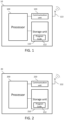
- FIG. 1 relates to a schematic diagram of a wireless terminal 10 according to an embodiment of the present disclosure.
- the wireless terminal 10 may be a user equipment (UE), a mobile phone, a laptop, a tablet computer, an electronic book or a portable computer system and is not limited herein.
- the wireless terminal 10 may include a processor 100 such as a microprocessor or Application Specific Integrated Circuit (ASIC), a storage unit 110 and a communication unit 120.
- the storage unit 110 may be any data storage device that stores a program code 112, which is accessed and executed by the processor 100.
- Embodiments of the storage unit 112 include but are not limited to a subscriber identity module (SIM), read-only memory (ROM), flash memory, random-access memory (RAM), hard-disk, and optical data storage device.
- SIM subscriber identity module
- ROM read-only memory
- RAM random-access memory
- hard-disk hard-disk
- the communication unit 120 may a transceiver and is used to transmit and receive signals (e.g. messages or packets) according to processing results of the processor 100.
- the communication unit 120 transmits and receives the signals via at least one antenna 122 shown in FIG. 1 .
- the storage unit 110 and the program code 112 may be omitted and the processor 100 may include a storage unit with stored program code.
- the processor 100 may implement any one of the steps in exemplified embodiments on the wireless terminal 10, e.g., by executing the program code 112.
- the communication unit 120 may be a transceiver.
- the communication unit 120 may as an alternative or in addition be combining a transmitting unit and a receiving unit configured to transmit and to receive, respectively, signals to and from a wireless network node (e.g. a base station).
- a wireless network node e.g. a base station
- FIG. 2 relates to a schematic diagram of a wireless network node 20 according to an embodiment of the present disclosure.
- the wireless network node 20 may be a satellite, a base station (BS), a network entity, a Mobility Management Entity (MME), Serving Gateway (S-GW), Packet Data Network (PDN) Gateway (P-GW), a radio access network (RAN), a next generation RAN (NG-RAN), a data network, a core network or a Radio Network Controller (RNC), and is not limited herein.
- the wireless network node 20 may include a processor 200 such as a microprocessor or ASIC, a storage unit 210 and a communication unit 220.
- the storage unit 210 may be any data storage device that stores a program code 212, which is accessed and executed by the processor 200. Examples of the storage unit 212 include but are not limited to a SIM, ROM, flash memory, RAM, hard-disk, and optical data storage device.
- the communication unit 220 may be a transceiver and is used to transmit and receive signals (e.g. messages or packets) according to processing results of the processor 200. In an example, the communication unit 220 transmits and receives the signals via at least one antenna 222 shown in FIG. 2 .
- the storage unit 210 and the program code 212 may be omitted.
- the processor 200 may include a storage unit with stored program code.
- the processor 200 may implement any steps described in exemplified embodiments on the wireless network node 20, e.g., via executing the program code 212.
- the communication unit 220 may be a transceiver.
- the communication unit 220 may as an alternative or in addition be combining a transmitting unit and a receiving unit configured to transmit and to receive, respectively, signals to and from a wireless terminal (e.g. a user equipment).
- a wireless terminal e.g. a user equipment
- a UE which is under a radio resource control (RRC) idle state (i.e. RRC_Idle) or an RRC inactive state (i.e. RRC_Inactive) may have no physical downlink control channel (PDCCH) which schedules a paging message. Furthermore, the UE may also have no physical downlink shared channel (PDSCH) which carries the paging message. Even without the corresponding PDCCH and/or the PDSCH, the UE has to receive and decode the PDCCH/PDSCH during a paging cycle, resulting in unnecessary power consumption.
- RRC radio resource control
- RRC_Idle radio resource control
- RRC_Inactive RRC inactive
- the UE may have the PDCCH but the content of corresponding PDSCH does not include an actual paging message for this UE because the network might schedule multiple paging messages together. Under such a condition, unnecessary power is wasted.
- the present disclosure provides a method for a UE (e.g. for data processing).
- the method comprises:
- the signal/channel includes a reference signal (RS), a wake-up signal/channel.
- the wake-up signal/channel may indicate that the UE needs to receive data or that the UE does not need to receive data.
- the received data may include a signal in the PDCCH that schedules the paging message and/or a signal in the PDSCH that carries paging message.
- the received signal/channel when the received signal/channel is inconsistent to the data in the UE, the received signal/channel (or a signal/channel associated with the received signal/channel) may not be what the UE expects. In this embodiment, the UE may discard (e.g. drop or ignore) the received signal/channel when the received signal/channel is not what the UE expects.
- the signal/channel includes the PDCCH (e.g. control information) that schedules the paging message and/or the PDSCH that carries the paging message.
- the received channel includes a wake-up channel and/or the PDCCH that schedules paging message.
- the PDCCH includes a signal indicate that the UE needs receive data or that UE does not need receive data.
- the received data includes a signal received in the PDSCH that carries the paging message.
- the received signal/channel includes an extended UE identification (ID) that is carried on the received signal/channel.
- ID is a sub-set of a serving temporary mobile subscriber identity (S-TMSI).
- S-TMSI serving temporary mobile subscriber identity
- the S-TMSI may be a 5G S-TMSI.
- the data in the UE comprises a subset of a 5G S-TMSI of the UE.
- the UE does not process signal/channel by at least one of:
- the received signal comprises at least one of:
- the DMRS comprises an initialization seed (e.g. an initialization sequence) which is generated for the DMRS, wherein the initialization seed includes the extended UE ID.
- the extended UE ID includes a sub-set of the 5G S-TMSI.
- Ext_ID is a value of the extended UE ID
- N ID is a number configured by a higher layer signaling
- ID Res is group ID or, resources ID.
- the extended UE ID comprises bits from the last (10+E) th bit to the last 11 th bit of the 5G S-TMSI.
- extended UE ID is the integer of corresponding binary bits from the last (10+E) th bit to the last 11 th bit of the 5G S-TMSI and N ID is configured by the higher layer signaling.
- the received channel comprises at least one short message bit, e.g., in the DCI.
- the at least one short messages bit includes the extended UE ID.
- the extended UE ID comprises a sub-set of 5G S-TMSI.
- the received channel comprises at least one reserved bit, e.g. in the DCI.
- the at least one reserved bit includes the extended UE ID.
- the extended UE ID may comprise a sub-set of 5G S-TMSI.
- the received channel comprises cyclic redundancy check (CRC) bits which are scrambled by the extended UE ID.
- the UE selects a public radio network temporary identifier (P-RNTI) according to the 5G S-TMSI.
- P-RNTI public radio network temporary identifier
- the UE selects a PO according to the 5G S-TMSI.
- the UE selects a paging search space according to the UE ID or the 5G S-TMSI.
- the UE selects a paging search space according to its RRC state.
- the UE receives the paging message according to its group ID.
- the present disclosure discloses a wireless communication method for a BS.
- the wireless communication method for the BS comprises:
- the transmitted signal/channel comprises at least one of:
- the extended UE ID includes a subset of a 5G S-TMSI.
- the extended UE ID for the initialization seed c init is a sub-set of the 5G S-TMSI.
- the BS generates a group ID of a UE group according to the paging probability.
- a sequence of the received signal is generated according to the group ID.
- the extended UE ID may represent a paging ID, a UE ID, a subset of 5G S TMSI, or a P-RNTI.
- do not process may be equal to “do not expect to process”, “ignore”, “drop” or “discard”, and vice versa.
- do not receive may be equal to “do not expect to receive”.
- channel may be equal to “signal”.
- the UE is able to acknowledge whether there is a paging message for itself. As a result, unnecessary paging can be avoided, and the power consumption of the UE is reduced.
- the BS may combine multiple paging messages of multiple UEs together in single transmission.
- the combination of multiple paging messages of the multiple UEs comprises 5G S-TMSIs, each 5G S TMSI is for each paging message.
- the UE is assigned (e.g. configured) with a 5G S-TMSI.
- the combination of multiple paging messages is carried by the PDSCH.
- a PDCCH e.g. signal in the PDCCH
- schedules the PDSCH should be transmitted.
- the UE when a UE receives a paging message, the UE derives a paging frame (PF) and a PO according to its UE ID.
- the UE ID is modulo of 5G S-TMSI by 1024. That is, in binary, the UE ID is the last ten bits of its 5G S-TMSI. Because there are 48 bits in the 5G S-TMSI, some UEs (i.e., 2 38 UEs) have the same UE ID. That is, one paging for one specific UE may be received by another UE (i.e.
- another UE may successful decode the PDSCH that carrying paging message because having the same UE ID) but the later UE has to drop the received PDSCH (because its 5G S-TMSI does not match to the received PDSCH). That is, a false alarm is generated and wastes unnecessary power consumption.
- the BS may transmit a RS to the UE for performing measurement, synchronization and/or automatic gain control (AGC).
- the RS can be implemented by a wake-up signal (WUS).
- WUS wake-up signal
- the UE may utilize the WUS for measuring a reference signal receiving power (RSRP), a downlink (DL) timing synchronization for good working states.
- RSRP reference signal receiving power
- DL downlink
- the BS may transmit multiple beams for a paging message.
- the UE can receive multiple beams for a better performance of paging.
- each of extended UE IDs there are N bits for each of extended UE IDs. These N bits of each of extended UE IDs can indicate whether there is a possible paging for each of corresponding UEs.
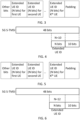
- FIG. 3 shows an example of the extended UE IDs in the DCI according to an embodiment of the present disclosure.
- each extended UE ID may have different number of bits.
- the first extended UE ID i.e. the extended UE ID
- the second extended UE ID has 5 bits.
- the BS may indicate the UEs that a start position and a length of each extended UE ID.
- the BS may indicate the UEs that the start position and end position of each Extended UE ID.
- the total number of bits of the extended UE IDs becomes K ⁇ N ⁇ Q. That is, N ⁇ Q / K or K ⁇ Q / N.
- the DCI has the identical number of bits of the DCI that schedules system information (i.e., the DCI with the CRC scrambled by system information radio network temporary identifier (SI-RNTI)).
- SI-RNTI system information radio network temporary identifier
- the extended UE ID in the DCI that is not scheduled should be set as a fixed value (i.e., all zeros in binary, or all ones in binary, or a known value).
- the extended UE ID may be bits from the last (10+N) th bit to the last 11 th bit of the 5G S-TMSI.
- the extended UE ID may be bits from the last 20 th bit to the last 11 th bit of the 5G S-TMSI, where the "last" means that it is numbering from end or rightmost.
- UE_ID_EXT is the extended UE ID and floor() is a function of getting the greatest integer that is not excess the operand and mod is a function of acquires modulo.
- FIG. 4 shows an example of the extended UE ID according to an embodiment of the present disclosure.
- the UE when the UE receives the DCI, the UE will compare the extended UE IDs (e.g. in binary format) in the DCI with the last (10+N) th bit to the last 11 th bit of the 5G S-TMSI (configured for the UE).
- the UE may continue to receive and decode the corresponding PDSCH that carries the paging message.
- the UE may not receive or stop receiving the corresponding PDSCH that carries the paging message.
- the UE may drop (e.g. discard) the corresponding PDSCH that carries the paging message and/or may not decode the corresponding PDSCH that carries the paging message.
- the false alarm of paging can be avoided by the DCI with extended UE ID(s). Therefore, the power consumption of the UE can be saved.
- each of extended UE IDs there are N bits for each of extended UE IDs. These N bits of each of extended UE IDs can indicate whether there is a possible paging for each of corresponding UEs.
- FIG. 5 shows an example of the extended UE IDs in the DCI according to an embodiment of the present disclosure.
- each extended UE ID may have different number of bits.
- the first extended UE ID i.e. the extended UE ID
- the second extended UE ID has 6 bits.
- the BS may indicate the UEs that a start position and a length of each extended UE ID.
- the BS may indicate the UEs that the start position and end position of each Extended UE ID.
- the total number of bits of the extended UE IDs becomes K ⁇ N ⁇ Q. That is, N ⁇ Q / K or K ⁇ Q / N.
- the DCI has the identical number of bits of the DCI that schedules system information (i.e., the DCI with the CRC scrambled by SI-RNTI).
- the extended UE ID in the DCI that is not scheduled should be set as a fixed value (i.e., all zeros in binary, or all ones in binary, or a known value).
- the extended UE ID may be bits from the last (10+N) th bit to the last 11 th bit of the 5G S-TMSI.
- the extended UE ID may be bits from the last 22 th bit to the last 11 th bit of the 5G S-TMSI, where the "last" means that it is numbering from end or rightmost.
- UE_ID_EXT is the extended UE ID and floor() is a function of getting the greatest integer that is not excess the operand and mod is a function of acquires modulo.
- the extended UE ID is 38 most significant bits (MSBs) of the 5G S-TMSI (i.e., the leftmost 38 bits).
- the extended UE ID may be all bits of the 5G S-TMSI (i.e., 48 bits).
- FIG. 6 shows an example of the extended UE ID according to an embodiment of the present disclosure.
- the BS configures the PDSCH that carries paging message with cross slot scheduling. For example, there are two slots between the PDCCH that schedules the paging message and the corresponding PDSCH that carries the paging message.
- the UE when the UE receives the DCI, the UE will compare the extended UE IDs (i.e., in binary format) in the DCI with the last (10+N) th bit to the last 11 th bit of the 5G S-TMSI (configured for the UE).
- the UE may continue to receive and decode the corresponding PDSCH that carries the paging message.
- the UE may directly go to sleep and does not receive and/or decode the corresponding PDSCH that carries the paging message.
- the false alarm of paging can be avoided by the DCI with extended UE ID(s).
- the UE is able to ne prevented from receiving unnecessary PDSCH that carries the paging message. Therefore, the power consumption of the UE can be saved.
- the wake-up signal/channel (e.g. WUS, in the form of DCI, carried by the PDCCH) may comprise N bits for each of extended UE IDs for each of specific UEs, so as to indicate possible paging messages for the specific UEs. That is, these N bits of each of extended UE IDs in the WUS indicate whether there is a possible paging for corresponding UE.
- FIG. 7 shows an example of the extended UE IDs in the WUS according to an embodiment of the present disclosure.
- each extended UE ID may have different number of bits.
- the first extended UE ID i.e. the extended UE ID
- the second extended UE ID has 6 bits.
- the BS may indicate the UEs that a start position and a length of each extended UE ID.
- the BS may indicate the UEs that the start position and end position of each extended UE ID.
- the total number of bits of the extended UE IDs becomes K ⁇ N ⁇ Q. That is, N ⁇ Q / K or K ⁇ QIN.
- the DCI has the identical number of bits of the DCI that schedules system information (i.e., the DCI with the CRC scrambled by SI-RNTI).
- the extended UE ID in the WUS/DCI that is not scheduled should be set as a fixed value (i.e., all zeros in binary, or all ones in binary, or a known value).
- the extended UE ID may be bits from the last (10+N) th bit to the last 11 th bit of the 5G S-TMSI.
- the extended UE ID may be bits from the last 20 th bit to the last 11 th bit of the 5G S-TMSI, where the "last" means that it is numbering from end or rightmost.
- UE_ID_EXT is the extended UE ID and floor() is a function of getting the greatest integer that is not excess the operand and mod is a function of acquires modulo.
- the extended UE ID may be that shown in FIG. 8 .
- the UE when the UE receives the WUS/DCI, the UE will compare the extended UE IDs (i.e., in binary format) in the WUS/DCI with the last (10+N) th bit to the last 11 th bit of the 5G S-TMSI (configured for the UE).
- the UE may continue to receive and decode the corresponding PDSCH that carries the paging message.
- FIG. 9 shows an example of a timing diagram of the WUS, the PDCCH and the PDSCH according to an embodiment of the present disclosure.
- the UE may receive the paging message, e.g., during the next DRX-ON period of the paging cycle. That is, the UE of the present disclosure may receive the PDCCH that scheduling paging message and/or PDSCH that carries paging message as a legacy UE (i.e., Rel-15/Rel-16 UE).
- a legacy UE i.e., Rel-15/Rel-16 UE.
- the false alarm of paging (including false alarm of the PDCCH that scheduling paging message and/or the PDSCH that carries paging message) can be avoided.
- the power consumption can be saved.
- the CRC bits are scrambled by the P-RNTI.
- the CRC bits in the corresponding DCI are scrambled by the extended UE ID after being scrambled by the P-RNTI.
- a value of the P-RNTI may be different from a pre-defined value configured for the P-RNTI (e.g. FFFE in hex).
- the value of P-RNTI may be FFFD in hex.
- the scrambling operation may be XOR or modulo of 2.
- FIG. 10 shows an example of scrambling the CRC bits according to an embodiment of the present disclosure, wherein the circle with a plus sign represents performing the scrambling operation.
- the CRC bits have 24bits and the rightmost 16 bits of the CRC bits are scrambled by the P-RNTI (which is 16 bits).
- the left most 8 bits of the CRC bits are scrambled by the extended UE ID (8 bits).
- FIG. 11 shows an example of scrambling the CRC bits according to an embodiment of the present disclosure, wherein the circle with a plus sign represents performing the scrambling operation.
- the rightmost 16 bits of the CRC bits are scrambled by the P-RNTI (16 bits).
- the extended UE ID which is 24 bits.
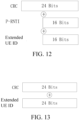
- FIG. 12 shows an example of scrambling the CRC bits according to an embodiment of the present disclosure, wherein the circle with a plus sign represents performing the scrambling operation.
- the rightmost 16 bits of the CRC bits are scrambled by the P-RNTI (16 bits).
- the rightmost 16 bits of the CRC bits are scrambled again by the extended UE ID which is 16 bits.
- FIG. 13 shows an example of scrambling the CRC bits according to an embodiment of the present disclosure, wherein the circle with a plus sign represents performing the scrambling operation.
- the CRC bits are only scrambled by the extended UE ID (24 bits).
- the extended UE ID may comprises bits from the last (10+A) th bit to the last 11 th bit of the 5G S-TMSI.
- the extended UE ID can be the last A bits of the 5G S-TMSI.
- the extended UE ID may be the first A bits of the 5G S-TMSI.
- FIG. 14 shows an example of the extended UE ID according to an embodiment of the present disclosure.
- the extended UE ID comprises bits from the last (10+B) th bit to the last 11 th bit of 5G S-TMSI, e.g. B is an integer greater than 1.
- the extended UE ID may be the last B bits of the 5G S-TMSI.
- the extended UE ID may be the first B bits of the 5G S-TMSI.
- the UE continues to receive and decode the corresponding PDSCH that carries the paging message.
- the UE determines that there is no paging message for itself and stops receiving and/or decoding (signal in) the corresponding PDSCH that carries the paging message (e.g. the UE may receive and discard the signal in the PDSCH). Therefore, the power consumption of the UE is saved.
- the UE determine there is a possible paging message for itself.
- the UE continues to receive and decode the corresponding PDSCH that carries the paging message.
- the UE determines that there is no paging message for itself and stops receiving and/or decoding the corresponding PDSCH that carries the paging message. Therefore, the power consumption of the UE is saved.
- the CRC bits may scrambled by a cell RNTI (i.e. C-RNTI).
- the CRC bits may be scrambled by the P-RNTI and the scrambled CRC bits may be scrambled by the C-RNTI again.
- the CRC bits may be scrambled by the C-RNTI and the scrambled CRC bits may be scrambled by the P-RNTI again.
- the UE may apply the abovementioned methods of scrambling the CRC bits based on the C-RNTI and/or the P-RNTI.
- the extended UE ID or the C-RNTI may also be used to scramble the DCI that schedules paging message. As a result, the false alarm is prevented and the power consumption of the UE is reduced.
- the length of extended UE ID is 16 bits.
- the extended UE ID comprises bits from the last (10+C) th bit to the last 11 th bit of the 5G S-TMSI, e.g. C is an integer greater than 1.
- the extended UE ID is an integer of corresponding binary bits from the last (10+C) th bit to the last 11 th bit of the 5G S-TMSI
- ID Res is a group ID (i.e., the ID of a group to which the UE belongs) or, a resources ID (i.e., the ID of a resource configured for the WUS).
- FIG. 15 shows an example of the resource IDs according to an embodiment of the present disclosure.
- WUS resources there are 8 resources configured for the WUS (hereinafter, WUS resources) and each of the WUS resources is labeled with one of WUS resource IDs (e.g. indexes) 0, 1, 2, 3, 4, 5, 6 and 7.
- WUS resource IDs e.g. indexes
- the WUS resources are labeled first in an order of the time domain and then in an order of the frequency domain.
- the WU resources may be labeled first in the order of the frequency domain and then in the order of the time domain.
- the PO may be a DRX-ON cycle.
- the WUS resources may have different WUS resource IDs when the time gap between the WUS and the PO changes.
- the WUS resources may be a resource in the time domain, the frequency domain and/or a search space for the PDCCH.
- the WUS resource IDs may be one of 0, 1, 2, 3, ..., 49 or 50.
- different WUS resource IDs may h av e different base se qu ence.
- different WUS resource IDs may have different initial seeds c init .
- the WUS resource can be a resource in time domain, frequency domain, or a search space for PDCCH (e.g., this ID can be 0,1,2,3, ..., 49, 50).
- this ID can be 0,1,2,3, ..., 49, 50.
- different resource ID may have different base sequence.
- different resource ID may have different initial seed c init .
- the extended UE ID may be the 5G S-TMSI or the first bit to the 38 th bit (i.e., 38 MSBs) of the 5G S-TMSI.
- the extended UE ID may be the 5G S-TMSI or bits from the last (10+D) th bit to the last 11 th bit of the 5G S-TMSI, e.g. D is an integer greater than 1.
- the extended UE ID may be the 5G S-TMSI or bits from the last (10+E) th bit to the last 11 th bit of the 5G S-TMSI, e.g. E is an integer greater than 1.
- the extended UE ID is the integer of corresponding binary bits from the last (10+E) th bit to the last 11 th bit of 5G S-TMSI.
- N ID is configured by higher layer.
- N ID has a value of the P-RNTI (e.g. FFFE in hex).
- the method of generating the DMRS on the PDCCH that schedules the paging message can also be applied to generating DMRS on the PDSCH that carries the paging message.
- the UE when the UE de-modulates the DMRS of the PDCCH that schedules the paging message, the UE initials the DMRS sequence with corresponding bits of the 5G S-TMSI configured for the UE. In an embodiment, when the UE de-modulates the DMRS of the PDCCH that schedules the paging message, the UE initials a local DMRS sequence with corresponding bits of its 5G S-TMSI.
- the UE performs a correlation between the received DMRS sequence and the local DM-RS sequence initialized with corresponding bits of the 5G S-TMSI configured for the UE.
- a correlation peak is low (i.e. the UE fails to receive (decode) the DMRS or the DMRS is inconsistent with the extended UE ID of the UE)
- the UE does not decode the PDCCH that schedules paging message, does not receive the PDSCH that carries paging message and/or does not decode PDSCH that carries paging message.
- the UE may stop processing a paging receiving procedure.
- the correlation peak is high (i.e. the UE successfully receive (decode) the DMRS or the DMRS is consistent with the extended UE ID of the UE), the UE continues to perform the paging receiving procedure.
- the UE when the DMRS in the PDCCH is not initialized by the corresponding extended UE ID, the correlation peak acquired by the UE is low. As a result, the UE is able to accordingly determine whether to perform the operation of decoding and/or receiving the PDCCH and/or the PDSCH. Hence, the false alarm of paging receiving can be reduced and the power consumption can be saved.
- the CRC bits of DCI carried by the PDCCH that scheduling the paging message is scrambled by the P-RNTI.
- the DCI there are 8 bits that carry short messages ((hereinafter short message bits)).
- F bits of short message bits may be set as the extended UE ID with F bits.
- the extended UE ID may be bits from the last (10+F) th bit to the last 11 th bit of 5G S-TMSI. That is, the extended UE ID may be bits from the last 18 th bit to the last 11 th bit of 5G S-TMSI.
- the F bits of short message bits can be set as the extended UE ID with F bits.
- all short message bits are set as the extended UE ID with 8 bits.
- the extended UE ID may be bits from the last 18 th bit to the last 11 th bit of 5G S-TMSI.
- the extended UE ID may be bits from the last G bits of the UE ID or first G bits of the UE ID.
- the UE ID is the last 10 bits of the 5G S-TMSI.
- the extended UE ID may be bits from the last (10+J) th bit to the last 11 th bit of the 5G S-TMSI.
- the first J bits of the reserved bits in the DCI are set as the extended UE ID with J bits.
- the last J bits of the reserved bits in the DCI is set as the extended UE ID with J bits.
- the J bits of the reserved bits are set as the extended UE ID with J bits.
- the extended UE ID may be the last J bit of the UE ID.
- the UE ID is the last 10 bits of the 5G S-TMSI.
- the UE after decoding the PDCCH that scheduling the paging message, the UE compares the reserved bits or the short message bits with corresponding bits in the 5G S-TMSI. When the result of comparing indicates the reserved bits or the short message bits are identical (i.e. consistent) to the corresponding bits in the 5G S-TMSI, the UE receives and decodes the later PDSCH that carries the paging message. If the reserved bits or the short message bits are inconsistent to (i.e. different from) the corresponding bits in the 5G S-TMSI, the UE stops receiving PDSCH that carrying paging message and/or stops decoding the PDSCH that carries paging message.
- the BS may indicate possible paging message via a WUS which is also a kind of reference signal as shown in FIG. 16 .
- a sequence of the WUS is initialized first.
- the sequence or the initialization of sequence of the WUS is able to carry some information.
- the extended UE ID with W bits may be utilized to generate or to initialize the sequence or the initialization of sequence of the WUS.
- the WUS may carry at least one of a paging message indication (i.e. indicating whether there is paging or not), the UE ID, the extended UE ID or a sub-group ID for paging receiving (e.g., whether there is paging or not for one sub-group).
- the WUS may be used for at least one of DL synchronization, an automatic gain control (AGC) or a physical layer measurement (e.g., RSRP).
- AGC automatic gain control
- RSRP physical layer measurement
- the WUS is transmitted P slot(s) before a synchronization signal block (SSB) before the first PO.
- SSB synchronization signal block
- [ x 0 (6), x 0 (5), x 0 (4), x 0 (3), x 0 (2), x 0 (1), x 0 (0)] and [ x 1 (6), x 1 (5), x 1 (4), x 1 (3), x 1 (2), x 1 (1), x 1 (0)] have the values of bits from the last 17 th bit to the last 11 th bit of the 5G S-TMSI.
- [ x 0 (6), x 0 (5), x 0 (4), x 0 (3), x 0 (2), x 0 (1), x 0 (0)] have the values of 7 MSB(s) of the extended UE ID
- [ x 1 (6), x 1 (5), x 1 (4), x 1 (3), x 1 (2), x 1 (1), x 1 (0)] have the values of 7 LSBs of the extended UE ID.
- the extended UE ID may be bits from the last 24 th bit to the last 11 th bit of the 5G S-TMSI.
- x 0 (0) 1; x 0 (1) and x 0 (2) have the values of two bits of the UE ID (e.g.2 LSBs of the UE ID); and x 0 (6), x 0 (5), x 0 (4), x 0 (3) are all zero.
- x 1 (0) 1; x 1 (1) and x 1 (2) have the values of two bits of the UE ID (e.g.2 LSBs of the UE ID); and x 1 (6), x 1 (5), x 1 (4), x 1 (3) are all zero.
- the UE ID are the last 10 bits of the 5G S-TMSI.
- At least one bit of the initialization seeds has the value of (e.g. associated to, related to, indicating) time domain resources (e.g. resources of the WUS, resources of search space).
- At least one bit of the initialization seeds (i.e., x 0 (0)...x 0 (6) and x 1 (0)...x 1 (6)) has the value of (e.g. associated to, related to, indicating) frequency domain resources (e.g. resources of the WUS, resources of search space).
- [ x 0 (6), x 0 (5), x 0 (4), x 0 (3), x 0 (2), x 0 (1), x 0 (0)] have the values of the last 17 th bit to the last 11 th bit of the 5GS-TMSI and [ x 1 (6), x 1 (5), x 1 (4), x 1 (3), x 1 (2), x 1 (1), x 1 (0)] have the values of the last 24 th bit to the last 18 th bit of the 5G S-TMSI.
- u has the value of the slot number of the first PO within a PF. In an embodiment, u has the value of one plus the slot number of the first PO within a PF. In an embodiment, u has the value of decimal format of the extended UE ID. In an embodiment, u has the value of one plus the decimal format of the extended UE ID.
- the other variables and their value may be referred to the above embodiments and are not narrated herein for brevity.
- the extended UE ID may be bits from the last (10+V) th bit to the last 11 th bit of the 5G S-TMSI.
- [x(6), x(5), x(4), x (3), x (2), x ( 1 ), x (0)] have the values of bits from the first bit to the 7 th bit of the UE ID (i.e. 7 MSBs of the UE ID).
- the UE ID is the last 10 bits of the 5G S-TMSI.
- x (0) 1 and x(6), x(5), x (4), x(3), x(2), x(1) have the values of bits from the last 16 th bit to the last 11 th bit of the 5G S-TMSI.
- u has the value of the slot number of the first PO within a PF.
- u has the value of one plus the slot number of the first PO within a PF.
- u has the decimal value of the extended UE ID.
- u has the value of one plus the decimal value of the extended UE ID.
- the u has the decimal value of the K MSB(s) of the UE ID, wherein K is an integer. In an embodiment, u has the value of one plus the decimal value of K MSB(s) of the UE ID, wherein K is an integer.
- K is an integer.
- the WUS can be transmitted multiple times. For example, the WUS is transmitted in the first slot and is transmitted again in the second slot.
- each of WUS transmissions utilizes different WUS sequences. For example, the first WUS sequence is transmitted in the first slot and the fourth WUS sequence is transmitted in the second slot.
- multiple WUS sequences or multiple WUS signals can be transmitted at the same time.
- multiple groups of UE(s) can be indicated to perform corresponding operations (e.g., whether to receive paging or not).
- the UE detects the WUS sequence with the specific bits of its 5G S-TMSI.
- Various embodiments of the specific bits associated to the WUS sequence can be referred to the above embodiments and are not narrated herein for brevity.
- the UE detects (e.g. receive) the WUS (e.g. successfully decodes the WUS)
- the UE receives possible paging at the next DRX-ON duration. That is, the UE receives the PDCCH that schedules paging message and corresponding PDSCH that carries paging message.
- the UE does not detect the WUS (e.g. fails to decode the WUS)
- the UE does not receive the PDCCH that schedules paging message at the next DRX-ON duration and may can go to the sleep state or keep at the sleep state.
- the UE when the WUS is not associated with the extended UE ID configured for the UE, the UE does not perform at least some procedures of receiving the paging message. As a result, the false alarm of paging (including false alarm of PDCCH that scheduling paging message and/or the PDSCH that carries paging message) can be avoided. The power consumption is therefore saved.
- the BS i.e., gNB
- the BS configures multiple P-RNTIs for multiple UEs.
- the configuration of the multiple P-RNTIs may be broadcasted via system information broadcast (e.g., SIBx, where x is a number, such as 1 or 2).
- SIBx system information broadcast
- the extended UE ID may be replaced by the UE ID.
- the relationship between the P-RNTIs and the extended UE IDs may be specified (e.g. predefined) in the protocol.
- FIG. 17 shows an example of associating the extended UE ID with one P-RNTI according to an embodiment of the present disclosure.
- the extended UE ID is bits from last 12 th bit to the 11 th bit of the 5G-S-TMSI.
- the P-RNTI "FFFD” (Hex) is configured for the UE with the extended UE ID "00" (binary)
- the P-RNTI "FFFC” (Hex) is configured for the UE with the extended UE ID "01" (binary)
- so on is configured for the UE with the extended UE ID "00" (binary)
- FIG. 18 shows an example of associating the extended UE ID with one P-RNTI according to an embodiment of the present disclosure.
- the extended UE ID is bits from last 12 th bit to the 11 th bit of the 5G-S-TMSI.
- the P-RNTI "FFFE” (Hex) is configured for the UE with the extended UE ID "00" (binary)
- the P-RNTI "FFFD” (Hex) is configured for the UE with the extended UE ID "01" (binary)
- so on is configured for the UE with the extended UE ID "00" (binary)
- FIG. 19 shows an example of associating the UE ID with one P-RNTI according to an embodiment of the present disclosure.
- each of P-RNTI is associated with two MSBs of the UE ID (i.e. bits from the last 10 th bit to the last 9 th bit of the 5G S-TMSI).
- the P-RNTI "FFFE" (Hex) is configured for the UE with the UE ID whose 2 MSBs is "00" (binary)
- the P-RNTI "FFFD” (Hex) is configured for the UE with the UE ID whose 2 MSBs is "01” (binary)
- so on is shown in FIG. 19 , the P-RNTI "FFFE" (Hex) is configured for the UE with the UE ID whose 2 MSBs is "00" (binary)
- the P-RNTI "FFFD” (Hex) is configured for the UE with the UE ID whose 2 MSBs is "01” (binary)
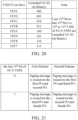
- FIG. 20 shows an example of associating the extended UE ID with one P-RNTI according to an embodiment of the present disclosure.
- the extended UE ID is bits from last 13 th bit to the 11 th bit of the 5G-S-TMSI.
- the P-RNTI "FFFE” (Hex) is configured for the UE with the extended UE ID "000" (binary)
- the P-RNTI "FFFD” (Hex) is configured for the UE with the extended UE ID "001" (binary)
- so on the extended UE ID "FFFE” (Hex) is configured for the UE with the extended UE ID "000" (binary)
- the UE receives the paging message according to its 5G S-TMSI. For example, when the last 12 th bit to last 11 th bit of the 5G S-TMSI configured for the UE are "11", the UE determines (e.g. selects) the P-RNTI of FFFA (in Hex) (e.g. based on the table shown in FIG. 17 ) and receives the paging message with the determined (selected) P-RNTI.
- the P-RNTI of FFFA in Hex
- the extended UE ID may be part of bits of the UE ID (i.e., the last 10 bits of the 5G S-TMSI).
- the extended UE ID is the highest two bits of the UE ID (i.e., the last 10 th bit to last 9 th bit of the 5G S-TMSI).
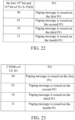
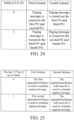
- the BS when the BS schedules the paging message of UE, the BS may divide the PO into several groups, wherein each group is associated with a sub-set of bits of the 5G S-TMSI.
- FIG. 21 shows an example of dividing the PO into several groups according to an embodiment of the present disclosure. In FIG. 21 , there are two groups indicated by the last 11 th bit of the 5G S-TMSI.
- FIG. 22 shows an example of dividing the PO into several groups according to an embodiment of the present disclosure.
- FIG. 23 shows an example of dividing the PO into several groups according to an embodiment of the present disclosure.
- FIG. 24 shows an example of dividing the PO into several groups according to an embodiment of the present disclosure.
- the UE when the UE (e.g. expects to) receives the paging message, the UE may determine (e.g. select) the PO of receiving the paging message according to the specific bit(s) of the 5G S-TMSI or the UE ID. As a result, the power consumption of UE can be reduced.
- the time-frequency resources e.g., pagingSearchSpaces, control resources sets, the positions of time-frequency resources mapped by paging or PO, DL bandwidth part
- the time-frequency resources may be used to carry some information (e.g., some bits of the UE ID and/or some bits of the 5G S-TMSI).
- the pagingSearchSpace is divided into multiple groups where each group is associated with a sub-set (bits) of the 5G S-TMSI.
- FIG. 25 shows an example of the divided pagingSearchSpace according to an embodiment of the present disclosure.
- the divided pagingSearchSpaces have the same parameters except SearchSpaceId. In an embodiment, the divided pagingSearchSpaces have the same parameters except SearchSpaceId and COntrol-REsource SET (CORESET). In an embodiment, the divided pagingSearchSpaces have the same parameters except SearchSpaceId and the offset of monitoringSlotPeriodicityAndOffset. In an embodiment, the divided pagingSearchSpaces have the same parameters except SearchSpaceId and monitoringSymbolsWithinSlot.
- FIG. 26 shows an example of the divided pagingSearchSpace according to an embodiment of the present disclosure.
- FIG. 27 shows an example of the divided pagingSearchSpace according to an embodiment of the present disclosure.
- there are two groups indicated by the MSB of the UE ID i.e. the last 10 th bit of the 5G S-TMSI).
- FIG. 28 shows an example of the divided pagingSearchSpace according to an embodiment of the present disclosure.
- FIG. 29 shows an example of the divided pagingSearchSpace according to an embodiment of the present disclosure.
- I-RNTI i.e. inactive-RNTI
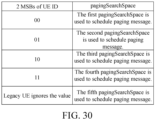
- FIG. 30 shows an example of the divided pagingSearchSpace according to an embodiment of the present disclosure.
- the legacy UE e.g. the UE of release 15 or release 16
- a fifth pagingSearchSpace is used to schedule paging message(s) for the legacy UE.
- the UE when the UE (e.g. expect to) receives the paging message, the UE receives the PDCCH that schedules paging message according to the specific bits in its 5G S-TMSI, the specific bits in its UE ID, its RRC state or the I-RNTI-Value of the UE under RRC inactive state. Under such a condition, the UE is able to reduce the frequency of receiving of the PDCCH that schedules paging message and/or the PDSCH that carries paging message. Thus, UE's power consumption is reduced.
- the gNB may divide (classify) the UEs into N groups according to their paging probability.
- the gNB groups the UEs according to the level of paging probability. For example, the gNB divides the paging probability into three levels low paging probability, medium paging probability and high paging probability and each level corresponds to one UE group.
- the gNB groups the UEs according to percentage of paging probability. For example, some percentages of paging probability are used as thresholds to indicate the UE grouping information. For example, the UE whose paging probability is small than a threshold TH1 is grouped in a UE group UEG1, the UE whose paging probability is between the threshold TH1 and a threshold TH2 is grouped in a UE group UEG2 and the rest of UEs can be grouped in the same manner.
- M ⁇ 2 10 the maximum capacity of the group.
- the out-of-range (e.g. excess) UEs are still grouped in accordance with paging probability.
- the out-of-range UEs in different groups are grouped in the same group.
- each UE group corresponds to one WUS indication.
- the WUS is DCI carried by the PDCCH and the DCI corresponding to different UE group is scrambled by different Power saving RNTIs for Paging (PSP-RNTIs).
- the PSP-RNTI may be the P-RNTI.
- the gNB broadcasts the PSP-RNTIs used by each UE group to the UE via system information broadcast.
- the UE uses its PSP-RNTI to decode the DCI.
- the DCI when the DCI is decoded successfully (e.g. the DCI is consistent to its PSP-RNTI), the DCI contains the WUS information indicating the behavior of the UE.
- the UE does not execute the PDCCH monitoring in the next DRX cycle when the UE successfully decodes the WUS.
- the UE starts a PagingArrivalTimer for the next DRX cycle when the UE successfully decodes the WUS.
- the UE does not starts the PagingArrivalTimer (or not execute the PDCCH monitoring) for the next DRX cycle when the UE successfully decodes the WUS.
- the UE judges whether to monitor the PDCCH for the next DRX cycle according to the bit indication field of the WUS. For example, the UE starts the PagingArrivalTimer for the next DRX cycle when a value of the ⁇ PDCCH monitoring' bit is ⁇ 1', and the UE does not start the PagingArrivalTimer for the next DRX cycle when a value of the ⁇ PDCCH monitoring' bit is ⁇ 0'.
- the UE starts the PagingArrivalTimer for the next DRX cycle when a value of the ⁇ PDCCH monitoring' bit is ⁇ 0', and the UE does not start the PagingArrivalTimer for the next DRX cycle when a value of the ⁇ PDCCH monitoring' bit is '1'.
- the DCI when the UE fails to decode the DCI according to its PSP-RNTI (i.e. the DCI is inconsistent to its PSP-RNTI), the DCI is not an indication configured for the UE group of the UE. Under such a condition, the UE may perform default operations. For example, UE may start the PagingArrivalTimer for the next DRX cycle and perform the PDCCH monitoring.
- the gNB divides the UEs into N groups according to the paging probability, wherein N is an integer.
- the gNB groups the UE according to level of the paging probability. For example, the gNB divides the paging probability into three levels: low paging probability, medium paging probability and high paging probability and each level corresponds to a UE group.
- the gNB groups the UE according to percentage of paging probability. For example, some percentages of paging probability are used as thresholds to indicate the UE grouping information. For example, the UE whose paging probability is small than a threshold TH1 is grouped in a UE group UEG1, the UE whose paging probability is between the threshold TH1 and a threshold TH2 is grouped in a UE group UEG2 and the rest UE can be grouped in the same manner.
- each UE group contains a maximum of P different UE-IDs (that is, the last 10 bits of the corresponding 5G_S_TMSI of the UE has P cases).
- the excess UEs will be grouped to the additional group.
- the out-of-range (e.g. excess) UEs are still grouped in accordance with paging probability.
- the out-of-range UEs in different groups are grouped in the same group.
- the gNB sends a WUS to the UE to indicate its PDCCH monitoring operation for the next DRX cycle.
- the WUS is a DCI carried by the PDCCH.
- the DCI contains N bits to indicate the PDCCH monitoring operation of the UE group and each of the N bits corresponds to one UE group.
- the gNB broadcasts the group ID corresponding to the UE via system information.
- the UE performs the operation according to the bit indication field in the DCI.
- the UE starts the PagingArrivalTimer for the next DRX cycle when a value of the ⁇ PDCCH monitoring' bit is ⁇ 1', and the UE does not start the PagingArrivalTimer for the next DRX cycle when a value of the ⁇ PDCCH monitoring' bit is ⁇ 0'. In an embodiment, the UE starts the PagingArrivalTimer for the next DRX cycle when a value of the ⁇ PDCCH monitoring' bit is ⁇ 0', and the UE not start the PagingArrivalTimer for the next DRX cycle when a value of the ⁇ PDCCH monitoring' bit is '1'.
- the gNB divides the UE into N groups according to the paging probability, wherein N is an integer.
- the gNB groups the UE according to level of the paging probability. For example, the gNB divides paging probability into three levels: low paging probability, medium paging probability and high paging probability and each level corresponds to a UE group.
- the gNB groups the UE according to percentage of paging probability. For example, some percentages of paging probability are used as thresholds to indicate the UE grouping information. For example, the UE whose paging probability is small than a threshold TH1 is grouped in a UE group UEG1, the UE whose paging probability is between the threshold TH1 and a threshold TH2 is grouped in a UE group UEG2 and the rest of UEs can be grouped in the same manner.
- the gNB sends a WUS to the UE to indicate its PDCCH monitoring operation for the next DRX cycle.
- the WUS is a sequence.
- the sequence is generated or initialized by the group ID of the UE group, so that only the UE in the corresponding group is able to obtain the paging indication information successfully.
- the WUS may be used for a periodical synchronization of the UE (e.g., downlink synchronization, precise synchronization), an automatic gain control (AGC) and measurement (e.g., received power measurement of reference signal).
- the WUS is transmitted before the P slots of the latest SSB before the first PO.
- the WUS is transmitted after the P slots of the latest SSB before the first PO.
- x 0 i + 7 x 0 i + 4 + x 0 i mod 2
- x 1 i + 7 x 1 i + 4 + x 1 i mod 2
- both [ x 0 (6), x 0 (5), x 0 (4), x 0 (3), x 0 (2), x 0 (1), x 0 (0)] and [ x 1 (6), x 1 (5), x 1 (4), x 1 (3), x 1 (2), x 1 (1), x 1 (0)] are corresponding to the binary representation of the group ID value (seven bits).
- u is the slot number of the first PO in the PF.
- u equals the slot number of the first PO in the PF plus one.
- u equals the decimal number of the group ID. Note that, the definitions and values of other variables may be referred to the aforementioned embodiments and are not narrated herein for brevity.
- u is the slot number of the first PO in the PF.
- u equals the slot number of the first PO in the PF plus one.
- u equals the decimal number of the group ID. Note that, the definitions and values of other variables may be referred to the aforementioned embodiments and are not narrated herein for brevity.
- any reference to an element herein using a designation such as "first,” “second,” and so forth does not generally limit the quantity or order of those elements. Rather, these designations can be used herein as a convenient means of distinguishing between two or more elements or instances of an element. Thus, a reference to first and second elements does not mean that only two elements can be employed, or that the first element must precede the second element in some manner.
- any of the various illustrative logical blocks, units, processors, means, circuits, methods and functions described in connection with the aspects disclosed herein can be implemented by electronic hardware (e.g., a digital implementation, an analog implementation, or a combination of the two), firmware, various forms of program or design code incorporating instructions (which can be referred to herein, for convenience, as "software” or a "software unit”), or any combination of these techniques.
- a processor, device, component, circuit, structure, machine, unit, etc. can be configured to perform one or more of the functions described herein.
- IC integrated circuit
- DSP digital signal processor
- ASIC application specific integrated circuit
- FPGA field programmable gate array
- the logical blocks, units, and circuits can further include antennas and/or transceivers to communicate with various components within the network or within the device.
- a general purpose processor can be a microprocessor, but in the alternative, the processor can be any conventional processor, controller, or state machine.
- a processor can also be implemented as a combination of computing devices, e.g., a combination of a DSP and a microprocessor, a plurality of microprocessors, one or more microprocessors in conjunction with a DSP core, or any other suitable configuration to perform the functions described herein. If implemented in software, the functions can be stored as one or more instructions or code on a computer-readable medium. Thus, the steps of a method or algorithm disclosed herein can be implemented as software stored on a computer-readable medium.
- Computer-readable media includes both computer storage media and communication media including any medium that can be enabled to transfer a computer program or code from one place to another.
- a storage media can be any available media that can be accessed by a computer.
- such computer-readable media can include RAM, ROM, EEPROM, CD-ROM or other optical disk storage, magnetic disk storage or other magnetic storage devices, or any other medium that can be used to store desired program code in the form of instructions or data structures and that can be accessed by a computer.
- unit refers to software, firmware, hardware, and any combination of these elements for performing the associated functions described herein. Additionally, for purpose of discussion, the various units are described as discrete units; however, as would be apparent to one of ordinary skill in the art, two or more units may be combined to form a single unit that performs the associated functions according embodiments of the present disclosure.
- memory or other storage may be employed in embodiments of the present disclosure.
- memory or other storage may be employed in embodiments of the present disclosure.
- any suitable distribution of functionality between different functional units, processing logic elements or domains may be used without detracting from the present disclosure.
- functionality illustrated to be performed by separate processing logic elements, or controllers may be performed by the same processing logic element, or controller.
- references to specific functional units are only references to a suitable means for providing the described functionality, rather than indicative of a strict logical or physical structure or organization.
Landscapes
- Engineering & Computer Science (AREA)
- Computer Networks & Wireless Communication (AREA)
- Signal Processing (AREA)
- Databases & Information Systems (AREA)
- Mobile Radio Communication Systems (AREA)
Priority Applications (1)
| Application Number | Priority Date | Filing Date | Title |
|---|---|---|---|
| EP24215314.6A EP4489488A3 (de) | 2020-02-14 | 2020-02-14 | Verfahren zur reduzierung unnötiger funkrufe |
Applications Claiming Priority (3)
| Application Number | Priority Date | Filing Date | Title |
|---|---|---|---|
| EP24215314.6A EP4489488A3 (de) | 2020-02-14 | 2020-02-14 | Verfahren zur reduzierung unnötiger funkrufe |
| PCT/CN2020/075398 WO2021098061A1 (en) | 2020-02-14 | 2020-02-14 | Method for reducing unnecessary paging |
| EP20891181.8A EP4104558B1 (de) | 2020-02-14 | 2020-02-14 | Verfahren zur reduzierung unnötiger funkrufe |
Related Parent Applications (2)
| Application Number | Title | Priority Date | Filing Date |
|---|---|---|---|
| EP20891181.8A Division EP4104558B1 (de) | 2020-02-14 | 2020-02-14 | Verfahren zur reduzierung unnötiger funkrufe |
| EP20891181.8A Division-Into EP4104558B1 (de) | 2020-02-14 | 2020-02-14 | Verfahren zur reduzierung unnötiger funkrufe |
Publications (2)
| Publication Number | Publication Date |
|---|---|
| EP4489488A2 true EP4489488A2 (de) | 2025-01-08 |
| EP4489488A3 EP4489488A3 (de) | 2025-03-12 |
Family
ID=75980057
Family Applications (2)
| Application Number | Title | Priority Date | Filing Date |
|---|---|---|---|
| EP24215314.6A Pending EP4489488A3 (de) | 2020-02-14 | 2020-02-14 | Verfahren zur reduzierung unnötiger funkrufe |
| EP20891181.8A Active EP4104558B1 (de) | 2020-02-14 | 2020-02-14 | Verfahren zur reduzierung unnötiger funkrufe |
Family Applications After (1)
| Application Number | Title | Priority Date | Filing Date |
|---|---|---|---|
| EP20891181.8A Active EP4104558B1 (de) | 2020-02-14 | 2020-02-14 | Verfahren zur reduzierung unnötiger funkrufe |
Country Status (6)
| Country | Link |
|---|---|
| US (2) | US12294948B2 (de) |
| EP (2) | EP4489488A3 (de) |
| KR (1) | KR102935032B1 (de) |
| CN (3) | CN116321380B (de) |
| ES (1) | ES3008031T3 (de) |
| WO (1) | WO2021098061A1 (de) |
Families Citing this family (5)
| Publication number | Priority date | Publication date | Assignee | Title |
|---|---|---|---|---|
| KR20230044477A (ko) * | 2020-08-06 | 2023-04-04 | 소니그룹주식회사 | 무선 디바이스들을 페이징하기 위한 방법들, 관련된 네트워크 노드들 및 무선 디바이스 |
| BR112023002330A2 (pt) * | 2020-08-07 | 2023-03-21 | Lenovo Singapore Pte Ltd | Extensões de paginação |
| CN115915351B (zh) * | 2021-08-25 | 2026-02-10 | 北京紫光展锐通信技术有限公司 | 一种信息传输方法、通信装置、芯片及其模组设备 |
| CN116113036A (zh) * | 2021-11-09 | 2023-05-12 | 华为技术有限公司 | 一种通信方法及装置 |
| WO2025166568A1 (en) * | 2024-02-06 | 2025-08-14 | Nec Corporation | Devices, methods, and medium for communication |
Family Cites Families (27)
| Publication number | Priority date | Publication date | Assignee | Title |
|---|---|---|---|---|
| US7711377B2 (en) * | 2004-06-10 | 2010-05-04 | Qualcomm Incorporated | Efficient paging in a wireless communication system |
| CN105075317B (zh) * | 2013-04-03 | 2019-03-08 | 寰发股份有限公司 | 监视寻呼信号的方法及装置 |
| US10321475B2 (en) * | 2014-04-14 | 2019-06-11 | Lg Electronics Inc. | Method and apparatus for retransmitting scheduling assignment information in wireless communication system supporting device to device (D2D) communication |
| US9693205B2 (en) * | 2014-07-03 | 2017-06-27 | Cisco Technology, Inc. | System and method for providing message delivery and paging to a group of users in a network environment |
| US10440661B2 (en) * | 2014-08-06 | 2019-10-08 | Quacomm Incorporated | RAN procedures for extended discontinuous reception (DRX) |
| EP3566373A1 (de) | 2017-01-06 | 2019-11-13 | Convida Wireless, LLC | Mechanismen für effizienten zugang und übertragung in nr |
| US11012974B2 (en) * | 2017-02-02 | 2021-05-18 | Convida Wireless, Llc | Apparatuses for transmission of paging blocks in swept downlink beams |
| CN113891437B (zh) | 2017-03-24 | 2024-04-26 | Lg电子株式会社 | 用于接收寻呼消息的方法和无线设备 |
| US10667238B2 (en) * | 2017-05-05 | 2020-05-26 | Qualcomm Incorporated | Multiple paging radio network temporary identifiers (PRNTIs) to reduce page collisions |
| CN115208732B (zh) * | 2017-05-05 | 2025-02-25 | 苹果公司 | Nr(新无线)的rs(参考信号)序列生成和映射以及预编码器分配 |
| CN109246814A (zh) * | 2017-05-14 | 2019-01-18 | 深圳市金立通信设备有限公司 | 寻呼方法、基站及用户设备 |
| US20180367358A1 (en) * | 2017-06-14 | 2018-12-20 | Huawei Technologies Co., Ltd. | User equipment related reference signal design, transmission and reception |
| CN111357343B (zh) | 2017-11-17 | 2023-01-17 | 上海诺基亚贝尔股份有限公司 | 使用唤醒信号来跳过寻呼dci |
| CN111567007B (zh) | 2018-01-11 | 2024-03-12 | 株式会社Ntt都科摩 | 用户终端以及无线通信方法 |
| US10820297B2 (en) * | 2018-01-12 | 2020-10-27 | Apple Inc. | Next generation node-b (GNB) and methods to indicate a type of access for paging of a user equipment (UE) |
| WO2019158446A1 (en) * | 2018-02-15 | 2019-08-22 | Sony Corporation | Wake_up signal candidate indicator |
| CN111727641B (zh) * | 2018-02-15 | 2023-08-18 | 瑞典爱立信有限公司 | 用于处理无线通信网络中的组寻呼的ue、网络节点和方法 |
| EP3777379A1 (de) * | 2018-04-05 | 2021-02-17 | Telefonaktiebolaget LM Ericsson (publ.) | Funkrufoptimierung unter verwendung von verkürzten benutzergerätekennungen |
| WO2020032732A1 (ko) | 2018-08-09 | 2020-02-13 | 엘지전자 주식회사 | 협대역 사물 인터넷 시스템을 지원하는 무선 통신 시스템에서 미리 설정된 상향링크 자원을 이용하여 상향링크 데이터를 전송하는 방법 및 그 장치 |
| EP3742820B1 (de) | 2018-08-09 | 2023-01-25 | LG Electronics Inc. | Verfahren zum senden/empfangen eines signals in einem drahtloskommunikationssystem und vorrichtung dafür |
| WO2020030983A1 (en) | 2018-08-10 | 2020-02-13 | Lenovo (Singapore) Pte. Ltd. | Identifying synchronization signal/physical broadcast channel block occasions |
| CN110839214B (zh) | 2018-08-17 | 2021-12-10 | 北京紫光展锐通信技术有限公司 | 唤醒信号的发送资源位置的配置方法、唤醒方法及其装置 |
| US11490334B2 (en) | 2018-09-19 | 2022-11-01 | Ofinno, Llc | Power saving in a wireless communication system |
| US11375452B2 (en) * | 2019-02-15 | 2022-06-28 | Qualcomm Incorporated | Wakeup grouping for discontinuous reception operation |
| EP3949540B1 (de) | 2019-03-29 | 2024-01-24 | Apple Inc. | Aufwecksignal basierend auf dem physikalischen abwärtskontrollkanal |
| US11304139B2 (en) * | 2019-06-27 | 2022-04-12 | Qualcomm Incorporated | Wake-up signal assisted link management |
| WO2021035733A1 (zh) | 2019-08-30 | 2021-03-04 | 华为技术有限公司 | 一种通信方法、装置及计算机可读存储介质 |
-
2020
- 2020-02-14 WO PCT/CN2020/075398 patent/WO2021098061A1/en not_active Ceased
- 2020-02-14 EP EP24215314.6A patent/EP4489488A3/de active Pending
- 2020-02-14 CN CN202310289692.5A patent/CN116321380B/zh active Active
- 2020-02-14 ES ES20891181T patent/ES3008031T3/es active Active
- 2020-02-14 CN CN202080096649.1A patent/CN115136676A/zh active Pending
- 2020-02-14 KR KR1020227031279A patent/KR102935032B1/ko active Active
- 2020-02-14 EP EP20891181.8A patent/EP4104558B1/de active Active
- 2020-02-14 CN CN202411351735.9A patent/CN119052906A/zh active Pending
-
2022
- 2022-08-11 US US17/886,400 patent/US12294948B2/en active Active
-
2025
- 2025-04-01 US US19/097,825 patent/US20250261116A1/en active Pending
Also Published As
| Publication number | Publication date |
|---|---|
| KR20220141327A (ko) | 2022-10-19 |
| US20250261116A1 (en) | 2025-08-14 |
| CN119052906A (zh) | 2024-11-29 |
| EP4489488A3 (de) | 2025-03-12 |
| EP4104558B1 (de) | 2025-01-08 |
| EP4104558A4 (de) | 2023-08-23 |
| US20230081856A1 (en) | 2023-03-16 |
| US12294948B2 (en) | 2025-05-06 |
| KR102935032B1 (ko) | 2026-03-05 |
| CN115136676A (zh) | 2022-09-30 |
| CN116321380B (zh) | 2024-08-30 |
| EP4104558A1 (de) | 2022-12-21 |
| CN116321380A (zh) | 2023-06-23 |
| ES3008031T3 (en) | 2025-03-21 |
| WO2021098061A1 (en) | 2021-05-27 |
Similar Documents
| Publication | Publication Date | Title |
|---|---|---|
| US12294948B2 (en) | Method for reducing unnecessary paging | |
| US12395965B2 (en) | Method for paging wireless terminal groups | |
| US20240163844A1 (en) | Signal transmitting and receiving method, device, and storage medium thereof | |
| WO2018027922A1 (zh) | 一种控制信息的传输方法和基站以及用户设备 | |
| CN119678404B (zh) | 用于无线通信的方法、设备和计算机程序产品 | |
| CN113424597A (zh) | 用于能效寻呼升级的无线通信设备、无线电接入网络节点、方法和计算机程序 | |
| US20240259998A1 (en) | Methods for paging in wireless communication | |
| CN119234445A (zh) | 无线通信的方法、终端设备和网络设备 | |
| US20220217632A1 (en) | Wus signal design | |
| US20230261824A1 (en) | Method, device and computer program product for wireless communication | |
| WO2025123741A1 (en) | Method, device and computer program product for wireless communication | |
| WO2026065147A1 (en) | Method, device and computer program product for wireless communication | |
| WO2024169090A1 (en) | Method, device and computer program product for wireless communication |
Legal Events
| Date | Code | Title | Description |
|---|---|---|---|
| PUAI | Public reference made under article 153(3) epc to a published international application that has entered the european phase |
Free format text: ORIGINAL CODE: 0009012 |
|
| STAA | Information on the status of an ep patent application or granted ep patent |
Free format text: STATUS: THE APPLICATION HAS BEEN PUBLISHED |
|
| AC | Divisional application: reference to earlier application |
Ref document number: 4104558 Country of ref document: EP Kind code of ref document: P |
|
| AK | Designated contracting states |
Kind code of ref document: A2 Designated state(s): AL AT BE BG CH CY CZ DE DK EE ES FI FR GB GR HR HU IE IS IT LI LT LU LV MC MK MT NL NO PL PT RO RS SE SI SK SM TR |
|
| PUAL | Search report despatched |
Free format text: ORIGINAL CODE: 0009013 |
|
| AK | Designated contracting states |
Kind code of ref document: A3 Designated state(s): AL AT BE BG CH CY CZ DE DK EE ES FI FR GB GR HR HU IE IS IT LI LT LU LV MC MK MT NL NO PL PT RO RS SE SI SK SM TR |
|
| RIC1 | Information provided on ipc code assigned before grant |
Ipc: H04W 52/02 20090101ALI20250204BHEP Ipc: H04W 68/02 20090101AFI20250204BHEP |
|
| STAA | Information on the status of an ep patent application or granted ep patent |
Free format text: STATUS: REQUEST FOR EXAMINATION WAS MADE |
|
| 17P | Request for examination filed |
Effective date: 20250422 |