EP4489387A1 - Audio signal processing device and remote control system - Google Patents
Audio signal processing device and remote control system Download PDFInfo
- Publication number
- EP4489387A1 EP4489387A1 EP24186294.5A EP24186294A EP4489387A1 EP 4489387 A1 EP4489387 A1 EP 4489387A1 EP 24186294 A EP24186294 A EP 24186294A EP 4489387 A1 EP4489387 A1 EP 4489387A1
- Authority
- EP
- European Patent Office
- Prior art keywords
- output
- information
- processing device
- sound signal
- audio signal
- Prior art date
- Legal status (The legal status is an assumption and is not a legal conclusion. Google has not performed a legal analysis and makes no representation as to the accuracy of the status listed.)
- Pending
Links
Images



Classifications
-
- H—ELECTRICITY
- H04—ELECTRIC COMMUNICATION TECHNIQUE
- H04M—TELEPHONIC COMMUNICATION
- H04M9/00—Arrangements for interconnection not involving centralised switching
- H04M9/08—Two-way loud-speaking telephone systems with means for conditioning the signal, e.g. for suppressing echoes for one or both directions of traffic
- H04M9/082—Two-way loud-speaking telephone systems with means for conditioning the signal, e.g. for suppressing echoes for one or both directions of traffic using echo cancellers
-
- G—PHYSICS
- G10—MUSICAL INSTRUMENTS; ACOUSTICS
- G10K—SOUND-PRODUCING DEVICES; METHODS OR DEVICES FOR PROTECTING AGAINST, OR FOR DAMPING, NOISE OR OTHER ACOUSTIC WAVES IN GENERAL; ACOUSTICS NOT OTHERWISE PROVIDED FOR
- G10K11/00—Methods or devices for transmitting, conducting or directing sound in general; Methods or devices for protecting against, or for damping, noise or other acoustic waves in general
- G10K11/16—Methods or devices for protecting against, or for damping, noise or other acoustic waves in general
- G10K11/175—Methods or devices for protecting against, or for damping, noise or other acoustic waves in general using interference effects; Masking sound
- G10K11/178—Methods or devices for protecting against, or for damping, noise or other acoustic waves in general using interference effects; Masking sound by electro-acoustically regenerating the original acoustic waves in anti-phase
- G10K11/1781—Methods or devices for protecting against, or for damping, noise or other acoustic waves in general using interference effects; Masking sound by electro-acoustically regenerating the original acoustic waves in anti-phase characterised by the analysis of input or output signals, e.g. frequency range, modes, transfer functions
- G10K11/17821—Methods or devices for protecting against, or for damping, noise or other acoustic waves in general using interference effects; Masking sound by electro-acoustically regenerating the original acoustic waves in anti-phase characterised by the analysis of input or output signals, e.g. frequency range, modes, transfer functions characterised by the analysis of the input signals only
- G10K11/17823—Reference signals, e.g. ambient acoustic environment
-
- G—PHYSICS
- G10—MUSICAL INSTRUMENTS; ACOUSTICS
- G10L—SPEECH ANALYSIS TECHNIQUES OR SPEECH SYNTHESIS; SPEECH RECOGNITION; SPEECH OR VOICE PROCESSING TECHNIQUES; SPEECH OR AUDIO CODING OR DECODING
- G10L21/00—Speech or voice signal processing techniques to produce another audible or non-audible signal, e.g. visual or tactile, in order to modify its quality or its intelligibility
- G10L21/02—Speech enhancement, e.g. noise reduction or echo cancellation
- G10L21/0208—Noise filtering
- G10L21/0216—Noise filtering characterised by the method used for estimating noise
- G10L21/0232—Processing in the frequency domain
-
- G—PHYSICS
- G10—MUSICAL INSTRUMENTS; ACOUSTICS
- G10K—SOUND-PRODUCING DEVICES; METHODS OR DEVICES FOR PROTECTING AGAINST, OR FOR DAMPING, NOISE OR OTHER ACOUSTIC WAVES IN GENERAL; ACOUSTICS NOT OTHERWISE PROVIDED FOR
- G10K11/00—Methods or devices for transmitting, conducting or directing sound in general; Methods or devices for protecting against, or for damping, noise or other acoustic waves in general
- G10K11/16—Methods or devices for protecting against, or for damping, noise or other acoustic waves in general
- G10K11/175—Methods or devices for protecting against, or for damping, noise or other acoustic waves in general using interference effects; Masking sound
- G10K11/178—Methods or devices for protecting against, or for damping, noise or other acoustic waves in general using interference effects; Masking sound by electro-acoustically regenerating the original acoustic waves in anti-phase
- G10K11/1787—General system configurations
- G10K11/17873—General system configurations using a reference signal without an error signal, e.g. pure feedforward
-
- H—ELECTRICITY
- H04—ELECTRIC COMMUNICATION TECHNIQUE
- H04R—LOUDSPEAKERS, MICROPHONES, GRAMOPHONE PICK-UPS OR LIKE ACOUSTIC ELECTROMECHANICAL TRANSDUCERS; ELECTRIC HEARING AIDS; PUBLIC ADDRESS SYSTEMS
- H04R3/00—Circuits for transducers
-
- G—PHYSICS
- G10—MUSICAL INSTRUMENTS; ACOUSTICS
- G10K—SOUND-PRODUCING DEVICES; METHODS OR DEVICES FOR PROTECTING AGAINST, OR FOR DAMPING, NOISE OR OTHER ACOUSTIC WAVES IN GENERAL; ACOUSTICS NOT OTHERWISE PROVIDED FOR
- G10K2210/00—Details of active noise control [ANC] covered by G10K11/178 but not provided for in any of its subgroups
- G10K2210/10—Applications
- G10K2210/128—Vehicles
-
- G—PHYSICS
- G10—MUSICAL INSTRUMENTS; ACOUSTICS
- G10K—SOUND-PRODUCING DEVICES; METHODS OR DEVICES FOR PROTECTING AGAINST, OR FOR DAMPING, NOISE OR OTHER ACOUSTIC WAVES IN GENERAL; ACOUSTICS NOT OTHERWISE PROVIDED FOR
- G10K2210/00—Details of active noise control [ANC] covered by G10K11/178 but not provided for in any of its subgroups
- G10K2210/30—Means
- G10K2210/301—Computational
- G10K2210/3027—Feedforward
-
- G—PHYSICS
- G10—MUSICAL INSTRUMENTS; ACOUSTICS
- G10K—SOUND-PRODUCING DEVICES; METHODS OR DEVICES FOR PROTECTING AGAINST, OR FOR DAMPING, NOISE OR OTHER ACOUSTIC WAVES IN GENERAL; ACOUSTICS NOT OTHERWISE PROVIDED FOR
- G10K2210/00—Details of active noise control [ANC] covered by G10K11/178 but not provided for in any of its subgroups
- G10K2210/30—Means
- G10K2210/301—Computational
- G10K2210/3028—Filtering, e.g. Kalman filters or special analogue or digital filters
-
- G—PHYSICS
- G10—MUSICAL INSTRUMENTS; ACOUSTICS
- G10K—SOUND-PRODUCING DEVICES; METHODS OR DEVICES FOR PROTECTING AGAINST, OR FOR DAMPING, NOISE OR OTHER ACOUSTIC WAVES IN GENERAL; ACOUSTICS NOT OTHERWISE PROVIDED FOR
- G10K2210/00—Details of active noise control [ANC] covered by G10K11/178 but not provided for in any of its subgroups
- G10K2210/30—Means
- G10K2210/301—Computational
- G10K2210/3055—Transfer function of the acoustic system
-
- H—ELECTRICITY
- H04—ELECTRIC COMMUNICATION TECHNIQUE
- H04R—LOUDSPEAKERS, MICROPHONES, GRAMOPHONE PICK-UPS OR LIKE ACOUSTIC ELECTROMECHANICAL TRANSDUCERS; ELECTRIC HEARING AIDS; PUBLIC ADDRESS SYSTEMS
- H04R2430/00—Signal processing covered by H04R, not provided for in its groups
- H04R2430/03—Synergistic effects of band splitting and sub-band processing
Definitions
- the present disclosure relates to a technique for reducing the level of unknown noise components contained in audio signals.
- This technique uses multiple microphones to collect sound in a noisy environment where the sound to be heard is produced, evaluates the correlation between audio signals output by respective microphones, and extracts only the audio components to be heard.
- the present disclosure therefore aims to reduce the level of unknown noise components contained in audio signals using a relatively simple structure.
- the present disclosure relates to an audio signal processing device and remote control system according to the appended claims. Embodiments are disclosed in the dependent claims.
- the present invention provides an audio signal processing device for generating an output signal by alleviating a noise component in an input signal that includes both a sound component to be heard and the noise component.
- the audio signal processing device includes: a composite sound output part configured to output a composite sound signal; an adaptive filter configured to receive as an input the composite sound signal output from the composite sound output part; and a subtraction part configured to output an output sound signal by subtracting an output signal of the adaptive filter from an input sound signal.
- the adaptive filter is configured to perform an adaptation operation assuming that the output sound signal output from the subtraction part is an error.
- the composite sound signal output from the composite sound output part is formed with pure tones of a plurality of frequencies extracted from a frequency band that is to be cancelled and that includes a frequency band of the noise component alleviated in the audio signal processing device.
- the composite sound signal output from the composite sound output part may be formed with the pure tones of the plurality of frequencies extracted from the frequency band to be cancelled at predetermined frequency intervals.
- the composite sound output part may include: an information storage part configured to store frequency-domain information of the composite sound signal to be output; and a conversion part configured to convert the frequency-domain information stored in the information storage part into the composite sound signal.
- the frequency-domain information of the composite sound signal may be a Fourier coefficient
- the conversion part may be configured to convert the frequency-domain information into the composite sound signal using an inverse fast Fourier transform.
- the frequency-domain information of the composite sound signal may be a wavelet transform coefficient
- the conversion part may be configured to convert the frequency-domain information into the composite sound signal using an inverse wavelet transform
- the present invention also provides an audio signal processing device for generating an output signal by alleviating a noise component in an input signal including both a sound component to be heard and the noise component.
- the audio signal processing device includes: a first conversion part configured to convert an input sound signal into first information, the first information being frequency-domain information of the input sound signal; an information storage part configured to store second information, the second information being frequency-domain information of a composite sound signal formed with pure tones of a plurality of frequencies extracted from a frequency band that is to be cancelled and that includes a frequency band of the noise component alleviated in the audio signal processing device; an adaptive filter configured to receive the second information as an input and output third information, the third information being frequency-domain information of a noise-canceling sound; a subtraction part configured to output fourth information, the fourth information being frequency-domain information obtained by subtracting the third information from the first information; and a second conversion part configured to convert the fourth information into a sound signal and output the sound signal as an output sound signal.
- the adaptive filter is configured to
- the composite sound signal may be formed with the pure tones of the plurality of frequencies extracted at predetermined frequency intervals from the frequency band to be cancelled.
- the frequency-domain information may be a Fourier coefficient
- the first conversion part may be configured to convert the input sound signal into the first information by performing a fast Fourier transform
- the second conversion part may be configured to convert the fourth information into the output sound signal by performing an inverse fast Fourier transform.
- the frequency-domain information may be a wavelet transform coefficient
- the first conversion part may be configured to convert the input sound signal into the first information by performing a wavelet transform
- the second conversion part may be configured to convert the fourth information into the output sound signal by performing an inverse wavelet transform
- a further aspect of the present invention provides a remote control system including the above audio signal processing device.
- This remote control system includes: a vehicle system installed in a vehicle; and a control system configured to control the vehicle remotely.
- the vehicle system includes: a microphone configured to pick up a sound in which a sound to be heard and noise are mixed, and output a monitoring sound signal; and a transmission part configured to transmit the monitoring sound signal output from the microphone to the control system.
- the control system includes: a receiving part configured to receive the monitoring sound signal from the vehicle system; a speaker; and the audio signal processing device. The monitoring sound signal received by the receiving part is input to the audio signal processing device as the input sound signal, and the output sound signal is output from the audio signal processing device to the speaker.
- the level of unknown noise components contained in an input sound signal can be reduced, and the resulting input signal can be output as an output sound signal, by using a simple structure that does not require multiple microphones.
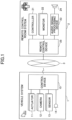
- FIG. 1 shows a structure of a remote control system according to the first embodiment.
- the remote control system is a system for remotely controlling construction vehicles such as heavy machinery.
- the remote control system includes, for example, a vehicle system 1 mounted on a construction vehicle, and a remote control room system 2 installed in a remote control room.
- the vehicle system 1 includes: actuators 11 for controlling the operation of the construction vehicle; cameras 12 for photographing the surroundings and the inside of the vehicle; sensors 13 for detecting the conditions of the construction vehicle and the surroundings; a microphone 14 that picks up a mixture of sounds to be heard such as operation and warning sounds, and noise such as engine noise; and a control device 15.
- the control device 15 transmits the images captured by the cameras 12, the conditions detected by the sensors 13, and audio signals picked up by the microphone 14, to the remote control room system 2 via the network 3.
- the control device 15 also drives the actuators 11 in accordance with control signals received from the remote control room system 2 to operate the construction vehicle.
- the remote control room system 2 includes a controller 21, monitors 22, an audio signal processing device 23, a speaker 24, and a remote control device 25.
- the remote control device 25 controls the operation of the construction vehicle by transmitting control signals in accordance with the operator's operation received by the controller 21, to the vehicle system 1, via the network 3.
- the remote control device 25 displays the images and conditions received from the vehicle system 1 via the network 3 on the monitor 22, and outputs the audio signals received from the vehicle system 1 via the network 3 to the audio signal processing device 23.
- FIG. 2 shows a structure of the audio signal processing device 23.
- the audio signal processing device 23 includes: noise element sound data 231; an IFFT 232 that performs an inverse fast Fourier transform; an adaptive filter 233; and a subtractor 234 that subtracts an output of the adaptive filter 233 from an audio signal S received as an input from the remote control device 25, thus deriving and sending an output signal S' to the speaker 24.
- the noise element sound data 231 contains Fourier coefficients.
- the IFFT 232 performs an inverse fast Fourier transform on the Fourier coefficients, producing and outputting a reference sound to the adaptive filter 233.
- the adaptive filter 233 filters the input reference sound and outputs a noise-canceling sound to the subtractor 234. Also, assuming that the output signal S' from the subtractor 234 is an error, the adaptive filter 233 optimizes the filter coefficients (transfer function, tap coefficients, etc.) for the filtering of the reference sound by using adaptive algorithms such as LMS, NLMS and so forth, such that the error is minimized.
- the Fourier coefficients contained in the noise element sound data 231 represent a composite sound of multiple frequencies' pure tones, extracted at predetermined frequency intervals from a predetermined frequency band that serves as a frequency band to be cancelled, represented by using frequency-domain information. That is, the Fourier coefficients contained in the noise element sound data 231 are determined such that the reference sound having undergone the inverse fast Fourier transform at the IFFT 23 becomes a composite sound of multiple frequencies' pure tones extracted from the frequency band to be cancelled at predetermined frequency intervals. Therefore, the noise element sound data 231 and the IFFT 232 function as a sound source device that outputs the above composite sound of pure tones.
- the Fourier coefficients contained in the noise element sound data 231 are the same or substantially the same as F( ⁇ ), calculated by the following mathematical formula 1, where f(t) is the composite sound.
- F( ⁇ ) the Fourier coefficients contained in the noise element sound data 231, once subjected to an inverse fast Fourier transform based on, for example, the following equation 2, give a sound f(t), which serves as a reference sound.
- the values of Fourier coefficients associated with respective frequencies per pure tone are all in magnitude (amplitude and power). However, the magnitude may vary per frequency as well.
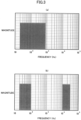
- the frequency band to be cancelled is set such that frequency bands where the sound components to be heard contained in the audio signal S are mainly found are not included, and frequency bands where noise components are likely to be found are included. For example, assuming that engine noise provides noise components, as shown by the frequency spectrum of a composite sound shown in (a) of FIG. 3 , low-order harmonics are also taken into account, and the frequency range from 20 Hz to 800 Hz is set as the frequency band to be cancelled.
- the frequency interval between pure tones is 5 Hz.
- the frequency band to be cancelled does not necessarily have to be 20 Hz to 800 Hz, and other frequency bands such as the range from 20 Hz to 1 kHz may be used. Also, multiple frequency bands to be cancelled may be set, as illustrated in (b) of FIG. 3 , where two frequency bands to be cancelled are configured.
- the noise-canceling sound and the audio signal S are output from the adaptive filter 233 using adaptive filter coefficients, so that each frequency in the frequency band to be cancelled has a frequency component that is the same or substantially the same in magnitude. Consequently, when the band from 20 Hz to 1 kHz is set as the frequency band to be cancelled as shown in FIG.
- the noise-canceling sound's components are the same or substantially the same as components contained in the audio signal S.
- the output signal S' that is sent from the subtractor 234 to the speaker 24 is one in which the level of noise components in the audio signal S is alleviated.
- FIG. 5 shows a structure of the audio signal processing device 23 according to the second embodiment.
- the audio signal processing device 23 according to the second embodiment includes noise element sound data 531, a frequency-domain adaptive filter 532, an FFT 533, a subtractor 534, and an IFFT 535.
- the noise element sound data 531 contains the same Fourier coefficients as those of the noise element sound data 231 of the first embodiment.
- the FFT 533 performs a fast Fourier transform on the audio signal S received as an input from the remote control device 25, and outputs the Fourier coefficients, which are frequency-domain information to represent the audio signal S, to the subtractor 534.
- the subtractor 534 subtracts the Fourier coefficients output from the frequency-domain adaptive filter 532, from the Fourier coefficients input from the FFT 533, on a per frequency basis, and outputs the resulting Fourier coefficients to the frequency-domain adaptive filter 532 and the IFFT 535.
- the IFFT 535 performs an inverse fast Fourier transform on the Fourier coefficients output from the subtractor 534, thus deriving and sending an output signal S' to the speaker 24.
- the frequency-domain adaptive filter 532 filters the Fourier coefficients contained in the noise element sound data 531, and outputs the results to the subtractor 534. Also, assuming that the Fourier coefficients output from the subtractor 534 are errors, the frequency-domain adaptive filter 532 optimizes the filter coefficients for the filtering of the Fourier coefficients contained in the noise element sound data 531 by using adaptive algorithms such as LMS, NLMS and so forth, such that the error is minimized.
- signal processing that is the same or substantially the same in effect as the operation of the audio signal processing device 23 of the first embodiment can be performed in the frequency domain. Accordingly, as in the first embodiment, it is possible to produce an audio signal S', in which the level of the noise components of the audio signal S substantially alone is alleviated, and produce the output signal S' from the speaker 24.
- FIG. 6 shows a structure of the audio signal processing device 23 according to the third embodiment.
- the audio signal processing device 23 includes: noise element sound data 631; an Inverse wavelet transform part 632; an adaptive filter 633; and a subtractor 634 that subtracts an output of the adaptive filter 633, from an audio signal S received as an input from the remote control device 25, thereby deriving and sending an output signal S' to a speaker 24.
- the noise element sound data 631 contains wavelet transform coefficients.
- the inverse wavelet transform part 632 performs an inverse wavelet transform on the wavelet transform coefficients, producing and outputting a reference sound to the adaptive filter 633.
- the adaptive filter 633 filters the input reference sound and outputs the resulting sound to the subtractor 634. Also, assuming that the output signal S' from the subtractor 634 is an error, the adaptive filter 633 optimizes the filter coefficients for the filtering of the reference sound by using adaptive algorithms such as LMS, NLMS and so forth, such that the error is minimized.
- the wavelet transform coefficients contained in the noise element sound data 631 represent a composite sound of multiple frequencies' pure tones, extracted at predetermined frequency intervals from the frequency band to be cancelled, represented by using frequency-domain information. Therefore, the noise element sound data 631 and the inverse wavelet transform part 632 function as a sound source device that outputs the above composite sound of pure tones.
- the wavelet transform can gain both frequency-domain information and time-domain information.
- the wavelet transform coefficients contained in the noise element sound data 631 do not represent changes over time; the magnitude of pure tone components contained in the reference sound and associated with respective frequencies therefore does not change over time.
- the wavelet transform coefficients contained in the noise element sound data 631 are the same or substantially the same as T(a, b), which is calculated by, for example, the following mathematical formula 3, where f(t) is the composite sound.
- a is a scale parameter
- b is a shift parameter
- ⁇ a, b is a wavelet with scale a and shift b
- * is the complex conjugate.
- the wavelet transform coefficients T(a, b) contained in the noise element sound data 631 once subjected to the inverse wavelet transformation based on, for example, the following equation 4, give a sound f(t), which serves as a reference sound.
- C ⁇ in the following mathematical formula is a constant determined for the type of the mother wavelet.
- signal processing that is the same or substantially the same in effect as the operation of the audio signal processing device 23 of the first embodiment can be performed using the wavelet transform instead of the Fourier transform. Accordingly, as in the first embodiment, it is possible to produce an audio signal S', in which the level of substantially the noise components of the audio signal S alone is alleviated, and produce the output signal S' from the speaker 24.
- FIG. 7 shows a structure of the audio signal processing device 23 according to the fourth embodiment.
- the audio signal processing device 23 according to the fourth embodiment includes: noise element sound data 731; a wavelet coefficient domain adaptive filter 732; a wavelet transform part 733; a subtractor 734; and an inverse wavelet transform part 735.
- the noise element sound data 731 contains the same wavelet transform coefficients as those of the noise element sound data 631 of the third embodiment.
- the wavelet transform part 733 performs a wavelet transform on the audio signal S received as an input from the remote control device 25, and outputs the wavelet transform coefficients, which are frequency-domain information to represent the audio signal S, to the subtractor 734.
- the subtractor 734 subtracts the wavelet transform coefficient output by the wavelet coefficient domain adaptive filter 732 from the wavelet transform coefficient input from the wavelet transform part 733, on a per wavelet basis, and outputs the resulting wavelet coefficients to the wavelet coefficient domain adaptive filter 732 and the inverse wavelet transform part 735.
- the inverse wavelet transform part 735 performs an inverse wavelet transform on the wavelet transform coefficients output from the subtractor 734, thus deriving and sending an output signal S' to the speaker 24.
- the wavelet coefficient domain adaptive filter 732 filters the wavelet transform coefficients contained in the noise element sound data 731 and outputs the results to the subtractor 734. Also, assuming that the wavelet transform coefficients output from the subtractor 734 are errors, the wavelet coefficient domain adaptive filter 732 optimizes the filter coefficients for the filtering of the wavelet transform coefficients contained in the noise element sound data 731 by using adaptive algorithms such as LMS, NLMS and so forth, such that the error is minimized.
- signal processing that is the same or substantially the same in effect as the operation of the audio signal processing device 23 of the third embodiment can be performed in the wavelet coefficient domain. Accordingly, as in the third embodiment, it is possible to produce an audio signal S', in which the level of substantially the noise components of the audio signal S alone is alleviated, and produce the output signal S' from the speaker 24.
- the fifth embodiment performs signal processing that is the same or substantially the same in effect as the operation of the audio signal processing device 23 of the first embodiment without using the Fourier transform, and only the audio signal processing device 23 is structured differently.
- FIG. 8 shows a structure of the audio signal processing device 23 according to the fifth embodiment.
- the audio signal processing device 23 includes: a sound source device 831 in which audio data of the above-described composite sound of multiple frequencies' pure tones extracted at predetermined frequency intervals from the frequency band to be cancelled is set; an adaptive filter 832; and a subtractor 833 that subtracts an output of the adaptive filter 832, from an audio signal S received as an input from the remote control device 25, and outputs a signal S' to the speaker 24.
- the sound source device 831 regenerates the audio data set therein and outputs a reference sound to the adaptive filter 832.
- the adaptive filter 832 filters the input reference sound and outputs the result to the subtractor 833. Also, assuming that the output signal S' from the subtractor 833 is an error, the adaptive filter 832 optimizes the filter coefficients for the filtering of the reference sound by using adaptive algorithms such as LMS, NLMS and so forth, such that the error is minimized.
- signal processing that is the same or substantially the same in effect as the operation of the audio signal processing device 23 of the first embodiment can be performed without using the Fourier transform. Accordingly, as in the third embodiment, it is possible to produce an audio signal S', in which the level of substantially the noise components of the audio signal S alone is alleviated, and produce the output signal S' from the speaker 24.
- Embodiments of the present disclosure have been described above. As described above, according to each embodiment, unknown noise components contained in an audio signal S can be alleviated and the resulting output signal S' can be output using a simple structure that does not require multiple microphones. While examples of application to a remote control system have been shown hereinabove, each of the above embodiments can be used in any system to alleviate the level of noise components from a mixture of sounds to be heard and noise picked up by microphones 14.
Landscapes
- Engineering & Computer Science (AREA)
- Physics & Mathematics (AREA)
- Acoustics & Sound (AREA)
- Multimedia (AREA)
- Signal Processing (AREA)
- Computational Linguistics (AREA)
- Quality & Reliability (AREA)
- Health & Medical Sciences (AREA)
- Audiology, Speech & Language Pathology (AREA)
- Human Computer Interaction (AREA)
- Soundproofing, Sound Blocking, And Sound Damping (AREA)
- Circuit For Audible Band Transducer (AREA)
Abstract
An audio signal processing device generates an output signal by alleviating a noise component in an input signal including both a sound component to be heard and the noise component. The audio signal processing device includes: a composite sound output part to output a composite sound signal; an adaptive filter to receive as an input the composite sound signal output from the composite sound output part; and a subtraction part to output an output sound signal by subtracting an output signal of the adaptive filter from an input sound signal. The adaptive filter performs adaptation operation assuming that the output sound signal from the subtraction part is an error. The composite sound signal from the composite sound output part is formed with pure tones of multiple frequencies extracted from a frequency band that is to be cancelled and that includes a frequency band of the alleviated noise component.
Description
- The present disclosure relates to a technique for reducing the level of unknown noise components contained in audio signals.
- There are techniques for reducing the level of unknown noise components contained in an audio signal. For example, there is a technique known for its use of blind audio source separation, which separates individual sound source signals forming a composite signal, which is a mixture of multiple sound source signals, taking advantage of the fact that each sound source signal is a separate signal, thereby canceling unknown noise components contained in an audio signal (see, for example, patent documents 1 and 2).
- This technique uses multiple microphones to collect sound in a noisy environment where the sound to be heard is produced, evaluates the correlation between audio signals output by respective microphones, and extracts only the audio components to be heard.
-
- [Patent Document 1]
Japanese Patent No. 6966750 - [Patent Document 2]
Japanese Patent No. 4616529 - The above-described technique of canceling unknown noise components using blind audio source separation requires that many microphones be positioned, and therefore the technique cannot be used if space for placing a large number of microphones cannot be secured in the environment where the sound to be heard is produced. Also, even if space for positioning many microphones can be secured, positioning many microphones necessitates troublesome work and increased costs.
- The present disclosure therefore aims to reduce the level of unknown noise components contained in audio signals using a relatively simple structure.
- The present disclosure relates to an audio signal processing device and remote control system according to the appended claims. Embodiments are disclosed in the dependent claims.
- Particularly, according to an aspect, the present invention provides an audio signal processing device for generating an output signal by alleviating a noise component in an input signal that includes both a sound component to be heard and the noise component. The audio signal processing device includes: a composite sound output part configured to output a composite sound signal; an adaptive filter configured to receive as an input the composite sound signal output from the composite sound output part; and a subtraction part configured to output an output sound signal by subtracting an output signal of the adaptive filter from an input sound signal. The adaptive filter is configured to perform an adaptation operation assuming that the output sound signal output from the subtraction part is an error. The composite sound signal output from the composite sound output part is formed with pure tones of a plurality of frequencies extracted from a frequency band that is to be cancelled and that includes a frequency band of the noise component alleviated in the audio signal processing device.
- In the audio signal processing device, the composite sound signal output from the composite sound output part may be formed with the pure tones of the plurality of frequencies extracted from the frequency band to be cancelled at predetermined frequency intervals.
- Furthermore, in the signal processing device, the composite sound output part may include: an information storage part configured to store frequency-domain information of the composite sound signal to be output; and a conversion part configured to convert the frequency-domain information stored in the information storage part into the composite sound signal.
- Furthermore, in the signal processing device, the frequency-domain information of the composite sound signal may be a Fourier coefficient, and the conversion part may be configured to convert the frequency-domain information into the composite sound signal using an inverse fast Fourier transform.
- Furthermore, in the audio signal processing device, the frequency-domain information of the composite sound signal may be a wavelet transform coefficient, and the conversion part may be configured to convert the frequency-domain information into the composite sound signal using an inverse wavelet transform.
- Furthermore, according to a further aspect, the present invention also provides an audio signal processing device for generating an output signal by alleviating a noise component in an input signal including both a sound component to be heard and the noise component. The audio signal processing device includes: a first conversion part configured to convert an input sound signal into first information, the first information being frequency-domain information of the input sound signal; an information storage part configured to store second information, the second information being frequency-domain information of a composite sound signal formed with pure tones of a plurality of frequencies extracted from a frequency band that is to be cancelled and that includes a frequency band of the noise component alleviated in the audio signal processing device; an adaptive filter configured to receive the second information as an input and output third information, the third information being frequency-domain information of a noise-canceling sound; a subtraction part configured to output fourth information, the fourth information being frequency-domain information obtained by subtracting the third information from the first information; and a second conversion part configured to convert the fourth information into a sound signal and output the sound signal as an output sound signal. The adaptive filter is configured to perform an adaptation operation assuming that the fourth information is an error.
- In the audio signal processing device, the composite sound signal may be formed with the pure tones of the plurality of frequencies extracted at predetermined frequency intervals from the frequency band to be cancelled.
- Furthermore, in the audio signal processing device, the frequency-domain information may be a Fourier coefficient, the first conversion part may be configured to convert the input sound signal into the first information by performing a fast Fourier transform, and the second conversion part may be configured to convert the fourth information into the output sound signal by performing an inverse fast Fourier transform.
- Furthermore, in the audio signal processing device, the frequency-domain information may be a wavelet transform coefficient, the first conversion part may be configured to convert the input sound signal into the first information by performing a wavelet transform, and the second conversion part may be configured to convert the fourth information into the output sound signal by performing an inverse wavelet transform.
- In addition, a further aspect of the present invention provides a remote control system including the above audio signal processing device. This remote control system includes: a vehicle system installed in a vehicle; and a control system configured to control the vehicle remotely. The vehicle system includes: a microphone configured to pick up a sound in which a sound to be heard and noise are mixed, and output a monitoring sound signal; and a transmission part configured to transmit the monitoring sound signal output from the microphone to the control system. The control system includes: a receiving part configured to receive the monitoring sound signal from the vehicle system; a speaker; and the audio signal processing device. The monitoring sound signal received by the receiving part is input to the audio signal processing device as the input sound signal, and the output sound signal is output from the audio signal processing device to the speaker.
- According to the audio signal processing device as described herein, the level of unknown noise components contained in an input sound signal can be reduced, and the resulting input signal can be output as an output sound signal, by using a simple structure that does not require multiple microphones.
- As described above, according to the present disclosure, it is possible to reduce the level of unknown noise components contained in audio signals by using a relatively simple structure.
-
FIG. 1 is a block diagram showing a structure of a remote control system according to a first embodiment of the present disclosure; -
FIG. 2 is a block diagram showing a structure of an audio signal processing device according to the first embodiment of the present disclosure; -
FIG. 3 shows schematic views of reference sound data according to the first embodiment of the present disclosure; -
FIG. 4 is a diagram showing an example of noise-canceling sound according to the first embodiment of the present disclosure; -
FIG. 5 is a block diagram showing another structure of an audio signal processing device according to a second embodiment of the present disclosure; -
FIG. 6 is a block diagram showing another structure of an audio signal processing device according to a third embodiment of the present disclosure; -
FIG. 7 is a block diagram showing another structure of an audio signal processing device according to a fourth embodiment of the present disclosure; and -
FIG. 8 is a block diagram showing another structure of an audio signal processing device according to a fifth embodiment of the present disclosure. - Now, embodiments of the present disclosure will be described below with reference to examples in which the present disclosure is applied to a remote control system. The first one of the embodiments will be described.
FIG. 1 shows a structure of a remote control system according to the first embodiment. The remote control system is a system for remotely controlling construction vehicles such as heavy machinery. The remote control system includes, for example, a vehicle system 1 mounted on a construction vehicle, and a remotecontrol room system 2 installed in a remote control room. The vehicle system 1 includes:actuators 11 for controlling the operation of the construction vehicle;cameras 12 for photographing the surroundings and the inside of the vehicle;sensors 13 for detecting the conditions of the construction vehicle and the surroundings; a microphone 14 that picks up a mixture of sounds to be heard such as operation and warning sounds, and noise such as engine noise; and acontrol device 15. - The
control device 15 transmits the images captured by thecameras 12, the conditions detected by thesensors 13, and audio signals picked up by the microphone 14, to the remotecontrol room system 2 via thenetwork 3. Thecontrol device 15 also drives theactuators 11 in accordance with control signals received from the remotecontrol room system 2 to operate the construction vehicle. - On the other hand, the remote
control room system 2 includes acontroller 21,monitors 22, an audiosignal processing device 23, aspeaker 24, and aremote control device 25. Theremote control device 25 controls the operation of the construction vehicle by transmitting control signals in accordance with the operator's operation received by thecontroller 21, to the vehicle system 1, via thenetwork 3. In addition, theremote control device 25 displays the images and conditions received from the vehicle system 1 via thenetwork 3 on themonitor 22, and outputs the audio signals received from the vehicle system 1 via thenetwork 3 to the audiosignal processing device 23. - The audio
signal processing device 23 then performs signal processing on the audio signals output from theremote control device 25, to alleviate the noise components, and outputs the resulting signals to thespeaker 24. The audiosignal processing device 23 will be described below.FIG. 2 shows a structure of the audiosignal processing device 23. As illustrated inFIG. 2 , the audiosignal processing device 23 includes: noiseelement sound data 231; an IFFT 232 that performs an inverse fast Fourier transform; anadaptive filter 233; and asubtractor 234 that subtracts an output of theadaptive filter 233 from an audio signal S received as an input from theremote control device 25, thus deriving and sending an output signal S' to thespeaker 24. - The noise
element sound data 231 contains Fourier coefficients. The IFFT 232 performs an inverse fast Fourier transform on the Fourier coefficients, producing and outputting a reference sound to theadaptive filter 233. Theadaptive filter 233 filters the input reference sound and outputs a noise-canceling sound to thesubtractor 234. Also, assuming that the output signal S' from thesubtractor 234 is an error, theadaptive filter 233 optimizes the filter coefficients (transfer function, tap coefficients, etc.) for the filtering of the reference sound by using adaptive algorithms such as LMS, NLMS and so forth, such that the error is minimized. - Now, the Fourier coefficients contained in the noise
element sound data 231 represent a composite sound of multiple frequencies' pure tones, extracted at predetermined frequency intervals from a predetermined frequency band that serves as a frequency band to be cancelled, represented by using frequency-domain information. That is, the Fourier coefficients contained in the noiseelement sound data 231 are determined such that the reference sound having undergone the inverse fast Fourier transform at theIFFT 23 becomes a composite sound of multiple frequencies' pure tones extracted from the frequency band to be cancelled at predetermined frequency intervals. Therefore, the noiseelement sound data 231 and the IFFT 232 function as a sound source device that outputs the above composite sound of pure tones. Also, the Fourier coefficients contained in the noiseelement sound data 231 are the same or substantially the same as F(ω), calculated by the following mathematical formula 1, where f(t) is the composite sound. Note that the Fourier coefficients F(ω) contained in the noiseelement sound data 231, once subjected to an inverse fast Fourier transform based on, for example, the followingequation 2, give a sound f(t), which serves as a reference sound.

- The values of Fourier coefficients associated with respective frequencies per pure tone, that is, the pure tones sampled at respective frequencies and formed into the composite sound, are all in magnitude (amplitude and power). However, the magnitude may vary per frequency as well. The frequency band to be cancelled is set such that frequency bands where the sound components to be heard contained in the audio signal S are mainly found are not included, and frequency bands where noise components are likely to be found are included. For example, assuming that engine noise provides noise components, as shown by the frequency spectrum of a composite sound shown in (a) of
FIG. 3 , low-order harmonics are also taken into account, and the frequency range from 20 Hz to 800 Hz is set as the frequency band to be cancelled. The frequency interval between pure tones is 5 Hz. Note that the frequency band to be cancelled does not necessarily have to be 20 Hz to 800 Hz, and other frequency bands such as the range from 20 Hz to 1 kHz may be used. Also, multiple frequency bands to be cancelled may be set, as illustrated in (b) ofFIG. 3 , where two frequency bands to be cancelled are configured. According to this audiosignal processing device 23, the noise-canceling sound and the audio signal S are output from theadaptive filter 233 using adaptive filter coefficients, so that each frequency in the frequency band to be cancelled has a frequency component that is the same or substantially the same in magnitude. Consequently, when the band from 20 Hz to 1 kHz is set as the frequency band to be cancelled as shown inFIG. 4 , the noise-canceling sound's components are the same or substantially the same as components contained in the audio signal S. As a result of this, the output signal S' that is sent from thesubtractor 234 to thespeaker 24 is one in which the level of noise components in the audio signal S is alleviated. - On the other hand, there is no significant impact on frequency bands other than the frequency band to be cancelled in the audio signal S. Consequently, the sound components of the audio signal S that are to be heard are included in the output signal S' with no appreciable attenuation, so that the operator can hear the sound output from the
speaker 24 well. - The first embodiment of the present disclosure has been described above. Next, a second embodiment of the present disclosure will be described. In the second embodiment, signal processing that is the same or substantially the same in effect as the operation of the audio
signal processing device 23 of the first embodiment is performed in the frequency domain, except that the audiosignal processing device 23 is structured differently.FIG. 5 shows a structure of the audiosignal processing device 23 according to the second embodiment. As illustrated in this drawing, the audiosignal processing device 23 according to the second embodiment includes noiseelement sound data 531, a frequency-domainadaptive filter 532, anFFT 533, asubtractor 534, and anIFFT 535. The noiseelement sound data 531 contains the same Fourier coefficients as those of the noiseelement sound data 231 of the first embodiment. TheFFT 533 performs a fast Fourier transform on the audio signal S received as an input from theremote control device 25, and outputs the Fourier coefficients, which are frequency-domain information to represent the audio signal S, to thesubtractor 534. Thesubtractor 534 subtracts the Fourier coefficients output from the frequency-domainadaptive filter 532, from the Fourier coefficients input from theFFT 533, on a per frequency basis, and outputs the resulting Fourier coefficients to the frequency-domainadaptive filter 532 and theIFFT 535. TheIFFT 535 performs an inverse fast Fourier transform on the Fourier coefficients output from thesubtractor 534, thus deriving and sending an output signal S' to thespeaker 24. The frequency-domainadaptive filter 532 filters the Fourier coefficients contained in the noiseelement sound data 531, and outputs the results to thesubtractor 534. Also, assuming that the Fourier coefficients output from thesubtractor 534 are errors, the frequency-domainadaptive filter 532 optimizes the filter coefficients for the filtering of the Fourier coefficients contained in the noiseelement sound data 531 by using adaptive algorithms such as LMS, NLMS and so forth, such that the error is minimized. - According to the second embodiment, signal processing that is the same or substantially the same in effect as the operation of the audio
signal processing device 23 of the first embodiment can be performed in the frequency domain. Accordingly, as in the first embodiment, it is possible to produce an audio signal S', in which the level of the noise components of the audio signal S substantially alone is alleviated, and produce the output signal S' from thespeaker 24. - A third embodiment of the present disclosure will be described below. In the third embodiment, signal processing that is the same or substantially the same in effect as the operation of the audio
signal processing device 23 of the first embodiment is performed using the wavelet transform instead of the Fourier transform, and only the audiosignal processing device 23 is structured differently.FIG. 6 shows a structure of the audiosignal processing device 23 according to the third embodiment. As illustrated in this drawing, the audiosignal processing device 23 includes: noiseelement sound data 631; an Inversewavelet transform part 632; anadaptive filter 633; and asubtractor 634 that subtracts an output of theadaptive filter 633, from an audio signal S received as an input from theremote control device 25, thereby deriving and sending an output signal S' to aspeaker 24. - The noise
element sound data 631 contains wavelet transform coefficients. The inversewavelet transform part 632 performs an inverse wavelet transform on the wavelet transform coefficients, producing and outputting a reference sound to theadaptive filter 633. Theadaptive filter 633 filters the input reference sound and outputs the resulting sound to thesubtractor 634. Also, assuming that the output signal S' from thesubtractor 634 is an error, theadaptive filter 633 optimizes the filter coefficients for the filtering of the reference sound by using adaptive algorithms such as LMS, NLMS and so forth, such that the error is minimized. - Now, as in the first embodiment, the wavelet transform coefficients contained in the noise
element sound data 631 represent a composite sound of multiple frequencies' pure tones, extracted at predetermined frequency intervals from the frequency band to be cancelled, represented by using frequency-domain information. Therefore, the noiseelement sound data 631 and the inversewavelet transform part 632 function as a sound source device that outputs the above composite sound of pure tones. Here, the wavelet transform can gain both frequency-domain information and time-domain information. However, the wavelet transform coefficients contained in the noiseelement sound data 631 do not represent changes over time; the magnitude of pure tone components contained in the reference sound and associated with respective frequencies therefore does not change over time. - The wavelet transform coefficients contained in the noise
element sound data 631 are the same or substantially the same as T(a, b), which is calculated by, for example, the followingmathematical formula 3, where f(t) is the composite sound. In the following mathematical formula, a is a scale parameter, b is a shift parameter, Ψa, b is a wavelet with scale a and shift b, and * is the complex conjugate. Note that the wavelet transform coefficients T(a, b) contained in the noiseelement sound data 631, once subjected to the inverse wavelet transformation based on, for example, the followingequation 4, give a sound f(t), which serves as a reference sound. CΨ in the following mathematical formula is a constant determined for the type of the mother wavelet.

- According to the third embodiment, signal processing that is the same or substantially the same in effect as the operation of the audio
signal processing device 23 of the first embodiment can be performed using the wavelet transform instead of the Fourier transform. Accordingly, as in the first embodiment, it is possible to produce an audio signal S', in which the level of substantially the noise components of the audio signal S alone is alleviated, and produce the output signal S' from thespeaker 24. - Next, a fourth embodiment of the present disclosure will be described. The fourth embodiment performs signal processing in the wavelet coefficient domain that is the same or substantially the same in effect as the operation of the audio
signal processing device 23 of the third embodiment, and only the audiosignal processing device 23 is structured differently.FIG. 7 shows a structure of the audiosignal processing device 23 according to the fourth embodiment. As illustrated in this drawing, the audiosignal processing device 23 according to the fourth embodiment includes: noiseelement sound data 731; a wavelet coefficient domainadaptive filter 732; awavelet transform part 733; asubtractor 734; and an inversewavelet transform part 735. The noiseelement sound data 731 contains the same wavelet transform coefficients as those of the noiseelement sound data 631 of the third embodiment. Thewavelet transform part 733 performs a wavelet transform on the audio signal S received as an input from theremote control device 25, and outputs the wavelet transform coefficients, which are frequency-domain information to represent the audio signal S, to thesubtractor 734. Thesubtractor 734 subtracts the wavelet transform coefficient output by the wavelet coefficient domainadaptive filter 732 from the wavelet transform coefficient input from thewavelet transform part 733, on a per wavelet basis, and outputs the resulting wavelet coefficients to the wavelet coefficient domainadaptive filter 732 and the inversewavelet transform part 735. - The inverse
wavelet transform part 735 performs an inverse wavelet transform on the wavelet transform coefficients output from thesubtractor 734, thus deriving and sending an output signal S' to thespeaker 24. The wavelet coefficient domainadaptive filter 732 filters the wavelet transform coefficients contained in the noiseelement sound data 731 and outputs the results to thesubtractor 734. Also, assuming that the wavelet transform coefficients output from thesubtractor 734 are errors, the wavelet coefficient domainadaptive filter 732 optimizes the filter coefficients for the filtering of the wavelet transform coefficients contained in the noiseelement sound data 731 by using adaptive algorithms such as LMS, NLMS and so forth, such that the error is minimized. - According to the fourth embodiment, signal processing that is the same or substantially the same in effect as the operation of the audio
signal processing device 23 of the third embodiment can be performed in the wavelet coefficient domain. Accordingly, as in the third embodiment, it is possible to produce an audio signal S', in which the level of substantially the noise components of the audio signal S alone is alleviated, and produce the output signal S' from thespeaker 24. - Next, a fifth embodiment of the present disclosure will be described. The fifth embodiment performs signal processing that is the same or substantially the same in effect as the operation of the audio
signal processing device 23 of the first embodiment without using the Fourier transform, and only the audiosignal processing device 23 is structured differently.FIG. 8 shows a structure of the audiosignal processing device 23 according to the fifth embodiment. As illustrated in this drawing, the audiosignal processing device 23 includes: asound source device 831 in which audio data of the above-described composite sound of multiple frequencies' pure tones extracted at predetermined frequency intervals from the frequency band to be cancelled is set; anadaptive filter 832; and asubtractor 833 that subtracts an output of theadaptive filter 832, from an audio signal S received as an input from theremote control device 25, and outputs a signal S' to thespeaker 24. - The
sound source device 831 regenerates the audio data set therein and outputs a reference sound to theadaptive filter 832. Theadaptive filter 832 filters the input reference sound and outputs the result to thesubtractor 833. Also, assuming that the output signal S' from thesubtractor 833 is an error, theadaptive filter 832 optimizes the filter coefficients for the filtering of the reference sound by using adaptive algorithms such as LMS, NLMS and so forth, such that the error is minimized. - According to the fifth embodiment, signal processing that is the same or substantially the same in effect as the operation of the audio
signal processing device 23 of the first embodiment can be performed without using the Fourier transform. Accordingly, as in the third embodiment, it is possible to produce an audio signal S', in which the level of substantially the noise components of the audio signal S alone is alleviated, and produce the output signal S' from thespeaker 24. - Embodiments of the present disclosure have been described above. As described above, according to each embodiment, unknown noise components contained in an audio signal S can be alleviated and the resulting output signal S' can be output using a simple structure that does not require multiple microphones. While examples of application to a remote control system have been shown hereinabove, each of the above embodiments can be used in any system to alleviate the level of noise components from a mixture of sounds to be heard and noise picked up by microphones 14. For example, if the embodiments described above are applied to an online conference system, it will be possible, for example, to alleviate the level of noise contained in the sound received from a participant attending an online conference from inside a vehicle by using his/her mobile terminal or the like, and output the resulting improved sound to the
speakers 24 of other participants' terminals, without relying on the noise cancellation function of the mobile terminals.
Claims (10)
- An audio signal processing device for generating an output signal by alleviating a noise component in an input signal that includes both a sound component to be heard and the noise component, the audio signal processing device comprising:a composite sound output part configured to output a composite sound signal;an adaptive filter configured to receive as an input the composite sound signal output from the composite sound output part; anda subtraction part configured to output an output sound signal by subtracting an output signal of the adaptive filter from an input sound signal,wherein the adaptive filter is configured to perform an adaptation operation assuming that the output sound signal output from the subtraction part is an error, andwherein the composite sound signal output from the composite sound output part is formed with pure tones of a plurality of frequencies extracted from a frequency band that is to be cancelled and that includes a frequency band of the noise component alleviated in the audio signal processing device.
- The audio signal processing device according to claim 1, wherein the composite sound signal output from the composite sound output part is formed with the pure tones of the plurality of frequencies extracted from the frequency band to be cancelled at predetermined frequency intervals.
- The audio signal processing device according to claim 1 or 2, further comprising:an information storage part configured to store frequency-domain information of the composite sound signal to be output; anda conversion part configured to convert the frequency-domain information stored in the information storage part into the composite sound signal.
- The audio signal processing device according to claim 3,wherein the frequency-domain information of the composite sound signal is a Fourier coefficient, andwherein the conversion part is configured to convert the frequency-domain information into the composite sound signal using an inverse fast Fourier transform.
- The audio signal processing device according to claim 3,wherein the frequency-domain information of the composite sound signal is a wavelet transform coefficient, andwherein the conversion part is configured to convert the frequency-domain information into the composite sound signal using an inverse wavelet transform.
- An audio signal processing device for generating an output signal by alleviating a noise component in an input signal including both a sound component to be heard and the noise component, the audio signal processing device comprising:a first conversion part configured to convert an input sound signal into first information, the first information being frequency-domain information of the input sound signal;an information storage part configured to store second information, the second information being frequency-domain information of a composite sound signal formed with pure tones of a plurality of frequencies extracted from a frequency band that is to be cancelled and that includes a frequency band of the noise component alleviated in the audio signal processing device;an adaptive filter configured to receive the second information as an input and output third information, the third information being frequency-domain information of a noise-canceling sound;a subtraction part configured to output fourth information, the fourth information being frequency-domain information obtained by subtracting the third information from the first information; anda second conversion part configured to convert the fourth information into a sound signal and output the sound signal as an output sound signal,wherein the adaptive filter is configured to perform an adaptation operation assuming that the fourth information is an error.
- The audio signal processing device according to claim 6, wherein the composite sound signal is formed with the pure tones of the plurality of frequencies extracted at predetermined frequency intervals from the frequency band to be cancelled.
- The audio signal processing device according to claim 6 or 7,wherein the frequency-domain information is a Fourier coefficient,wherein the first conversion part is configured to convert the input sound signal into the first information by performing a fast Fourier transform, andwherein the second conversion part is configured to convert the fourth information into the output sound signal by performing an inverse fast Fourier transform.
- The audio signal processing device according to claim 6 or 7,wherein the frequency-domain information is a wavelet transform coefficient,wherein the first conversion part is configured to convert the input sound signal into the first information by performing a wavelet transform, andwherein the second conversion part is configured to convert the fourth information into the output sound signal by performing an inverse wavelet transform.
- A remote control system comprising:the audio signal processing device of one of claims 1 to 9;a vehicle system installed in a vehicle; anda control system configured to control the vehicle remotely,wherein the vehicle system includes:a microphone configured to pick up a sound in which a sound to be heard and noise are mixed, and output a monitoring sound signal; anda transmission part configured to transmit the monitoring sound signal output from the microphone to the control system,wherein the control system includes:a receiving part configured to receive the monitoring sound signal from the vehicle system;a speaker; andthe audio signal processing device, andwherein the monitoring sound signal received by the receiving part is input to the audio signal processing device as the input sound signal, and the output sound signal is output from the audio signal processing device to the speaker.
Applications Claiming Priority (1)
| Application Number | Priority Date | Filing Date | Title |
|---|---|---|---|
| JP2023112110A JP2025009245A (en) | 2023-07-07 | 2023-07-07 | Audio signal processing device and remote control system |
Publications (1)
| Publication Number | Publication Date |
|---|---|
| EP4489387A1 true EP4489387A1 (en) | 2025-01-08 |
Family
ID=91810232
Family Applications (1)
| Application Number | Title | Priority Date | Filing Date |
|---|---|---|---|
| EP24186294.5A Pending EP4489387A1 (en) | 2023-07-07 | 2024-07-03 | Audio signal processing device and remote control system |
Country Status (4)
| Country | Link |
|---|---|
| US (1) | US20250014559A1 (en) |
| EP (1) | EP4489387A1 (en) |
| JP (1) | JP2025009245A (en) |
| CN (1) | CN119274569A (en) |
Citations (3)
| Publication number | Priority date | Publication date | Assignee | Title |
|---|---|---|---|---|
| JP4616529B2 (en) | 2001-09-03 | 2011-01-19 | クラリオン株式会社 | Blind signal separation processing device |
| US20210020155A1 (en) * | 2019-07-17 | 2021-01-21 | Silencer Devices, LLC. | Noise cancellation with improved frequency resolution |
| JP6966750B2 (en) | 2018-09-07 | 2021-11-17 | 南京地平▲線▼机器人技▲術▼有限公司Nanjing Horizon Robotics Technology Co., Ltd. | Methods, devices and electronic devices for blind signal separation |
Family Cites Families (2)
| Publication number | Priority date | Publication date | Assignee | Title |
|---|---|---|---|---|
| US10163432B2 (en) * | 2017-02-23 | 2018-12-25 | 2236008 Ontario Inc. | Active noise control using variable step-size adaptation |
| US10878796B2 (en) * | 2018-10-10 | 2020-12-29 | Samsung Electronics Co., Ltd. | Mobile platform based active noise cancellation (ANC) |
-
2023
- 2023-07-07 JP JP2023112110A patent/JP2025009245A/en active Pending
-
2024
- 2024-07-01 CN CN202410865994.7A patent/CN119274569A/en active Pending
- 2024-07-03 EP EP24186294.5A patent/EP4489387A1/en active Pending
- 2024-07-03 US US18/763,397 patent/US20250014559A1/en active Pending
Patent Citations (3)
| Publication number | Priority date | Publication date | Assignee | Title |
|---|---|---|---|---|
| JP4616529B2 (en) | 2001-09-03 | 2011-01-19 | クラリオン株式会社 | Blind signal separation processing device |
| JP6966750B2 (en) | 2018-09-07 | 2021-11-17 | 南京地平▲線▼机器人技▲術▼有限公司Nanjing Horizon Robotics Technology Co., Ltd. | Methods, devices and electronic devices for blind signal separation |
| US20210020155A1 (en) * | 2019-07-17 | 2021-01-21 | Silencer Devices, LLC. | Noise cancellation with improved frequency resolution |
Also Published As
| Publication number | Publication date |
|---|---|
| US20250014559A1 (en) | 2025-01-09 |
| CN119274569A (en) | 2025-01-07 |
| JP2025009245A (en) | 2025-01-20 |
Similar Documents
| Publication | Publication Date | Title |
|---|---|---|
| US10332502B2 (en) | Noise reducing device, noise reducing method, noise reducing program, and noise reducing audio outputting device | |
| EP1602223B1 (en) | Echo canceller with reduced requirement for processing power | |
| CN101689371B (en) | A device for and a method of processing audio signals | |
| US20040066940A1 (en) | Method and system for inhibiting noise produced by one or more sources of undesired sound from pickup by a speech recognition unit | |
| TWI682672B (en) | Echo cancellation system and method with reduced residual echo | |
| EP1855456B1 (en) | Echo reduction in time-variant systems | |
| US5859914A (en) | Acoustic echo canceler | |
| US7035796B1 (en) | System for noise suppression, transceiver and method for noise suppression | |
| JP3795070B2 (en) | Mobile radio device with hands-free call device | |
| JP5030420B2 (en) | System for limiting incoming audio | |
| US5636272A (en) | Apparatus amd method for increasing the intelligibility of a loudspeaker output and for echo cancellation in telephones | |
| KR20040030817A (en) | Echo canceller having nonlinear echo suppressor for harmonics calculations | |
| KR100470523B1 (en) | Process and Apparatus for Eliminating Loudspeaker Interference from Microphone Signals | |
| JP4544993B2 (en) | Echo processing apparatus for single-channel or multi-channel communication system | |
| EP2741481B1 (en) | Subband domain echo masking for improved duplexity of spectral domain echo suppressors | |
| JP3607625B2 (en) | Multi-channel echo suppression method, apparatus thereof, program thereof and recording medium thereof | |
| JP2006513627A (en) | Nonlinear acoustic echo canceller | |
| US20250014559A1 (en) | Audio signal processing device and remote control system | |
| JP5383008B2 (en) | Speech intelligibility improvement system and speech intelligibility improvement method | |
| US20250316256A1 (en) | Device for reducing noise during the reproduction of an audio signal using a headphone or hearing aid, and corresponding method | |
| US11553274B2 (en) | Autoregressive based residual echo suppression | |
| JP3947021B2 (en) | Call voice processing device | |
| WO1997007624A1 (en) | Echo cancelling using signal preprocessing in an acoustic environment | |
| US12356151B2 (en) | Method of suppressing undesired noise in a hearing aid | |
| JP2000353989A (en) | Echo canceller |
Legal Events
| Date | Code | Title | Description |
|---|---|---|---|
| PUAI | Public reference made under article 153(3) epc to a published international application that has entered the european phase |
Free format text: ORIGINAL CODE: 0009012 |
|
| STAA | Information on the status of an ep patent application or granted ep patent |
Free format text: STATUS: THE APPLICATION HAS BEEN PUBLISHED |
|
| AK | Designated contracting states |
Kind code of ref document: A1 Designated state(s): AL AT BE BG CH CY CZ DE DK EE ES FI FR GB GR HR HU IE IS IT LI LT LU LV MC ME MK MT NL NO PL PT RO RS SE SI SK SM TR |
|
| STAA | Information on the status of an ep patent application or granted ep patent |
Free format text: STATUS: REQUEST FOR EXAMINATION WAS MADE |
|
| 17P | Request for examination filed |
Effective date: 20250623 |