EP4488849A1 - Information processing program, information processing method, and information processing device - Google Patents
Information processing program, information processing method, and information processing device Download PDFInfo
- Publication number
- EP4488849A1 EP4488849A1 EP22929880.7A EP22929880A EP4488849A1 EP 4488849 A1 EP4488849 A1 EP 4488849A1 EP 22929880 A EP22929880 A EP 22929880A EP 4488849 A1 EP4488849 A1 EP 4488849A1
- Authority
- EP
- European Patent Office
- Prior art keywords
- vector
- subject
- tag
- information processing
- terminal
- Prior art date
- Legal status (The legal status is an assumption and is not a legal conclusion. Google has not performed a legal analysis and makes no representation as to the accuracy of the status listed.)
- Withdrawn
Links
Images




Classifications
-
- G—PHYSICS
- G06—COMPUTING OR CALCULATING; COUNTING
- G06F—ELECTRIC DIGITAL DATA PROCESSING
- G06F16/00—Information retrieval; Database structures therefor; File system structures therefor
- G06F16/30—Information retrieval; Database structures therefor; File system structures therefor of unstructured textual data
- G06F16/33—Querying
- G06F16/3331—Query processing
- G06F16/334—Query execution
- G06F16/3347—Query execution using vector based model
-
- G—PHYSICS
- G06—COMPUTING OR CALCULATING; COUNTING
- G06F—ELECTRIC DIGITAL DATA PROCESSING
- G06F16/00—Information retrieval; Database structures therefor; File system structures therefor
- G06F16/80—Information retrieval; Database structures therefor; File system structures therefor of semi-structured data, e.g. markup language structured data such as SGML, XML or HTML
- G06F16/81—Indexing, e.g. XML tags; Data structures therefor; Storage structures
-
- G—PHYSICS
- G06—COMPUTING OR CALCULATING; COUNTING
- G06F—ELECTRIC DIGITAL DATA PROCESSING
- G06F16/00—Information retrieval; Database structures therefor; File system structures therefor
- G06F16/30—Information retrieval; Database structures therefor; File system structures therefor of unstructured textual data
- G06F16/31—Indexing; Data structures therefor; Storage structures
- G06F16/316—Indexing structures
-
- G—PHYSICS
- G06—COMPUTING OR CALCULATING; COUNTING
- G06F—ELECTRIC DIGITAL DATA PROCESSING
- G06F16/00—Information retrieval; Database structures therefor; File system structures therefor
- G06F16/30—Information retrieval; Database structures therefor; File system structures therefor of unstructured textual data
- G06F16/35—Clustering; Classification
- G06F16/353—Clustering; Classification into predefined classes
Definitions
- the present invention relates to an information processing program and the like.
- a vector of each word included in the document is calculated using an existing technique such as Word2Vec or Poincaré embeddings, the vectors of the individual words are integrated to calculate a vector of the document, and the calculated vector is assigned.
- a tagged document such as a hypertext markup language (HTML) document or an extensible business reporting language (XBRL) document may be registered, and the tagged document also needs to be searched for using a vector assigned thereto.
- HTML hypertext markup language
- XBRL extensible business reporting language
- examples of the XBRL document include a securities report or the like.
- Patent Document 1 Japanese Laid-open Patent Publication No. 2006-343843
- XBRL tags used in the securities report are used to correctly extract information even when there are notation fluctuations, and the XBRL tags indicate subjects defined in rules, laws, and the like in financial accounting. Accordingly, for example, ⁇ Sales> 100 ⁇ /Sales> and ⁇ Cost of sales> 100 ⁇ /Cost of sales> may not be distinguished when the XBRL tags are simply deleted as in the existing technique, and thus the tagged document needs to be vectorized without deleting the XBRL tags.
- the Word2Vec calculates a vector from a context of a word, and thus the vector may not be correctly calculated when different XBRL tags are attached to similar sentences.
- an object of the present invention is to provide an information processing program, an information processing method, and an information processing apparatus capable of improving accuracy of a vector of a tagged document.
- a computer is caused to execute the following process.
- the computer specifies a terminal subject among subjects corresponding to a plurality of tags used in a document based on a parent-child relationship of the subjects corresponding to the plurality of tags.
- the computer calculates a vector of a tag corresponding to the terminal subject based on each word included in definition information set for the terminal subject and a word vector dictionary that defines a vector of each word.
- An XBRL document will be described before describing the information processing apparatus according to the present embodiment.
- An XBRL is an extensible markup language (XML)-based computer language standardized so that information for various financial reports may be created, distributed, and used, and a document created based on the XBRL will be referred to as an XBRL document.
- XML extensible markup language
- the XBRL document includes taxonomy and an instance.
- the taxonomy is a specification of data, and defines a definition statement of a subject, a relationship between subjects, a parent-child relationship of subjects, and the like.
- the parent-child relationship of subjects indicates, for example, a calculation relationship of the subjects.
- the definition statement of the subject indicates a definition statement described in laws, guidelines, rules, and the like corresponding to the subject.
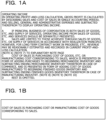
- a definition statement regarding an Operating income is as illustrated in FIG. 1A or in FIG. 1B.
- FIG. 1A is a diagram illustrating an example of a definition statement of a subject defined in a law, a guideline, or the like.
- FIG. 1B is a diagram illustrating an example in which a definition statement of a Cost of sales is extracted from FIG. 1A as an example of a tag.
- the definition statement illustrated in FIGs. 1A and 1B is a part of the definition statement regarding the Operating income. Descriptions of definition statements regarding other subjects will be omitted.
- FIG. 2 is a diagram illustrating an example of the relationship between subjects included in the taxonomy.
- a subject "Comprehensive income” is linked to be subordinate to a subject "Consolidated income (and Comprehensive income) statement”.
- a subject "Current net income or Current net loss ( ⁇ )” is linked to be subordinate to the subject "Comprehensive income”.
- a subject "Income before income taxes or Loss before income taxes ( ⁇ )” is linked to be subordinate to the subject "Current net income or Current net loss ( ⁇ )”.
- a subject "Ordinary income or Ordinary loss ( ⁇ )” is linked to be subordinate to the subject “Income before income taxes or Loss before income taxes ( ⁇ )”.
- a subject "Operating income or Operating loss ( ⁇ )” is linked to be subordinate to the subject "Ordinary income or Ordinary loss ( ⁇ )”.
- a subject "Gross profit or Gross loss ( ⁇ )” is linked to be subordinate to the subject "Operating income or Operating loss ( ⁇ )”.
- a subject "Sales” and a subject “Cost of sales” are linked to be subordinate to the subject "Gross profit or Gross loss ( ⁇ )”. Since no subject is subordinate to the subject "Sales” and the subject “Cost of sales", the subject "Sales” and the subject “Cost of sales” serve as "terminal subjects”.
- the calculation relationship of subjects defines calculation of a certain subject using a subject subordinate to the certain subject.
- the calculation relationship regarding the subject "Gross profit or Gross loss ( ⁇ )” is defined by taxonomy based on an equation (1).
- the calculation relationship of the subject "Gross profit or Gross loss ( ⁇ )” is defined by the terminal subjects "Sales” and "Cost of sales”.
- Gross profit or Gross loss ⁇ Sales ⁇ Cost of sales
- the instance is data itself, and is created by a submitter based on the taxonomy described above.
- a value of the subject is set to the instance. Examples of the value of the subject include an amount of money, a character string, a ratio, and the like.
- FIG. 3 is a diagram illustrating an example of the instance.
- Information included in an instance 10 is associated with the subject of the taxonomy by an XBRL tag.
- a value "300" between the XBRL tag ⁇ Sales> and ⁇ /Sales> is a value of the subject "Sales”.
- a value "100” between the XBRL tag ⁇ Cost of sales> and ⁇ /Cost of sales> is a value of the subject "Cost of sales”.
- a value "200" between the XBRL tag ⁇ Gross profit or Gross loss> and ⁇ /Gross profit or Gross loss> is a value of the subject "Gross profit or Gross loss ( ⁇ )".
- the XBRL tag will be referred to as a "tag" as appropriate.
- FIGs. 4 and 5 are diagrams for explaining an exemplary process of the information processing apparatus according to the present embodiment.
- the information processing apparatus includes XBRL taxonomy 141.
- the XBRL taxonomy 141 has, for each subject, information regarding a definition statement of a subject, a relationship between subjects, and a calculation relationship of subjects defined in the taxonomy described above.
- An extraction unit 151 of the information processing apparatus analyzes the XBRL taxonomy 141, and extracts information regarding a definition statement of a subject for each subject.
- the extraction unit 151 registers, in a definition statement information table 143, a subject and a definition statement in association with each other.
- a tag vector calculation unit 152 of the information processing apparatus executes the following processing to calculate a vector of the subject, and generates a tag vector table T2.
- the tag vector calculation unit 152 executes processing of specifying a terminal subject, processing of calculating a vector of the terminal subject, and processing of calculating a vector of a subject other than the terminal subject.
- the tag vector calculation unit 152 specifies a terminal subject defined by a calculation relationship of a certain subject based on the calculation relationship of the subjects and the relationship between the subjects in the XBRL taxonomy 141.
- the tag vector calculation unit 152 specifies a terminal subject defined by a calculation relationship of a certain subject based on the calculation relationship of the subjects and the relationship between the subjects in the XBRL taxonomy 141.
- the certain subject is "Gross profit or Gross loss ( ⁇ )”.
- the calculation relationship of the subject "Gross profit or Gross loss ( ⁇ )” is defined by the equation (1) described above.
- the subjects included in the equation (1) are "Sales” and "Cost of sales”.
- the tag vector calculation unit 152 compares the subject "Sales” and the subject "Cost of sales” with the relationship between the subjects to find out that no subject is linked to be subordinate to the subject "Sales” and the subject “Cost of sales", as illustrated in FIG. 2 . Thus, the tag vector calculation unit 152 specifies the terminal subjects "Sales” and “Cost of sales” from the calculation relationship of the subject "Gross profit or Gross loss ( ⁇ )”.
- the processing of calculating a vector of the terminal subject will be described.
- the tag vector calculation unit 152 specifies the terminal subject, it obtains the definition statement corresponding to the terminal subject from the definition statement information table 143.
- the tag vector calculation unit 152 performs morphological analysis on the definition statement corresponding to the terminal subject, thereby dividing the definition statement into a plurality of words.
- the tag vector calculation unit 152 specifies vectors corresponding to the words of the definition statement corresponding to the terminal subject based on a word vector table T1.
- the word vector table T1 is a table that associates a word with a vector corresponding to the word. It is assumed that the vector corresponding to the word is learned in advance using an existing technique such as Word2Vec or Poincaré embeddings.
- the tag vector calculation unit 152 calculates a vector of the terminal subject by integrating the vectors corresponding to the individual words of the definition statement of the terminal subject. For example, the tag vector calculation unit 152 calculates a vector of the terminal subject "Sales” by integrating the vectors corresponding to the individual words of the definition statement of the terminal subject "Sales”. The tag vector calculation unit 152 calculates a vector of the terminal subject "Cost of sales” by integrating the vectors corresponding to the individual words of the definition statement of the terminal subject "Cost of sales”.
- the tag vector calculation unit 152 registers the relationship between the terminal subject and the vector in the tag vector table T2.
- the processing of calculating a vector of a subject other than the terminal subject will be described.
- descriptions will be given using the subject "Gross profit or Gross loss ( ⁇ )” as a subject other than the terminal subject.
- the calculation relationship of the subject "Gross profit or Gross loss ( ⁇ )” is as expressed in the equation (1), and is defined by an operation (four arithmetic operations, etc.) of the terminal subject.
- the tag vector calculation unit 152 obtains the vector of the terminal subject from the tag vector table T2.
- the tag vector calculation unit 152 subtracts the vector of the subject "Cost of sales” from the vector of the subject "Sales” based on the equation (1), thereby calculating a vector of the subject "Gross profit or Gross loss ( ⁇ )".
- the tag vector calculation unit 152 preferentially calculates a vector from a subject on the descendant side. For example, when the relationship between the subjects is as illustrated in FIG. 2 , the tag vector calculation unit 152 calculates the vector of the "Gross profit or Gross loss ( ⁇ )", and then calculate the vector of the subject "Operating income or Operating loss ( ⁇ )”.
- the tag vector calculation unit 152 calculates the vectors in the order of the subject "Ordinary income or Ordinary loss ( ⁇ )", the subject “Income before income taxes or Loss before income taxes ( ⁇ )”, the subject “Current net income or Current net loss ( ⁇ )”, and the subject “Comprehensive income”.
- the tag vector calculation unit 152 performs an operation using the vector of the descendant subject to calculate the vector of the subject other than the terminal subject.
- the tag vector calculation unit 152 may preferentially calculate a vector of a subject for which all vectors of descendant subjects defined in the calculation relationship of the subjects have been calculated among a plurality of subjects for which vectors have not been calculated.
- the tag vector calculation unit 152 calculates, in a similar manner to the terminal subject, a vector of the subject based on a result of the morphological analysis performed on the definition statement corresponding to the subject and the word vector table T1.
- the tag vector calculation unit 152 registers, in the tag vector table T2, the relationship between the subject and the vector of the subject calculated based on the calculation relationship.
- the relationship between the subject and the vector of the subject is registered in the tag vector table T2.
- the subject registered in the tag vector table T2 corresponds to the tag included in the instance.
- FIG. 6 is a diagram illustrating an exemplary data structure of the tag vector table. As illustrated in FIG. 6 , the tag vector table T2 associates a subject (tag) with a vector.
- the information processing apparatus calculates a vector of a sentence registered in an XBRL instance 142 using the word vector table T1 and the tag vector table T2 created in FIG. 4 .
- the instance 10 (sentence including a tag, document) and the like described with reference to FIG. 3 are registered in the XBRL instance 142.
- a vector calculation unit 153 of the information processing apparatus extracts a sentence including a tag from the XBRL instance 142, and performs morphological analysis on the sentence, thereby dividing the sentence into a plurality of words and tags. For the words included in the sentence, the vector calculation unit 153 specifies a vector of each of the words based on the word vector table T1.
- the vector calculation unit 153 extracts, as a tag, a portion sandwiched by a " ⁇ character string corresponding to a subject>" and a portion sandwiched by a " ⁇ /character string corresponding to a subject>". For the tags included in the sentence, the vector calculation unit 153 specifies a vector of each of the tags based on the tag vector table T2. For example, the vector calculation unit 153 assigns a vector of the subject "Sales” in the tag vector table T2 as a vector of the tag ⁇ Sales>. The vector calculation unit 153 assigns the vector of the subject "Sales" in the tag vector table T2 as a vector of the tag ⁇ /Sales>.
- the vector calculation unit 153 calculates a vector of the sentence by integrating the vector of each word included in the sentence and the vector of each tag.
- a vector of a sentence will be referred to as a "sentence vector”.
- FIG. 7 is a diagram for explaining an exemplary process of calculating a vector of a sentence.
- the vector calculation unit 153 calculates a vector of a sentence 20 will be described. It is assumed that the sentence 20 is "An amount of sales is ⁇ Sales> 300 ⁇ /Sales> yen".
- the vector calculation unit 153 performs morphological analysis on the sentence 20 to make a division into words 20-1, 20-2, 20-3, 20-4, 20-5, 20-6, and 20-7. Furthermore, the vector calculation unit 153 specifies tags 20-8 and 20-9 from the sentence 20.
- the vector calculation unit 153 specifies each of vectors of the words 20-1 to 20-7 based on the word vector table T1.
- the vector calculation unit 153 specifies each of vectors of the tags 20-8 and 20-9 based on the tag vector table T2.
- the vector calculation unit 153 calculates a sentence vector of the sentence 20 by integrating the vectors of the words 20-1 to 20-7 and the vectors of the tags 20-8 and 20-9.
- the vector calculation unit 153 calculates a sentence vector of each sentence by repeatedly executing the process described above for each sentence included in the XBRL instance 142.
- the vector calculation unit 153 registers the sentence vectors in a sentence vector table T3.
- the vector calculation unit 153 generates an inverted index In1 in which a position (offset) of the sentence of the XBRL instance 142 is associated with the sentence vector.
- FIG. 8 is a diagram illustrating an example of the inverted index.
- a horizontal axis of the inverted index In1 is an axis corresponding to an offset.
- a vertical axis of the inverted index In1 is an axis corresponding to a sentence vector.
- the inverted index In1 is indicated by a bitmap of "0" or "1", and all bitmaps are set to "0" in the initial state.
- the information processing apparatus specifies a terminal subject defined by a calculation relationship of a certain subject based on the calculation relationship of the subjects and the relationship between the subjects in the XBRL taxonomy 141.
- the information processing apparatus calculates a vector of the terminal subject based on the definition statement corresponding to the terminal subject and the word vector table T1. As a result, the vector of the tag corresponding to the terminal subject may be accurately calculated.
- the information processing apparatus calculates a vector by the operation corresponding to the terminal subject defined by the calculation relationship of the subject.
- the vector of the tag corresponding to the subject other than the terminal subject may also be accurately calculated.
- the inverted index associated with the sentence vector has been described in the example, the inverted index may be associated with a vector of a particle size of a word or a tag.
- FIG. 9 is a functional block diagram illustrating a configuration of the information processing apparatus according to the present embodiment.
- an information processing apparatus 100 includes a communication unit 110, an input unit 120, a display unit 130, a storage unit 140, and a control unit 150.
- the communication unit 110 performs data communication with an external device via a network.
- the communication unit 110 may receive the XBRL taxonomy 141 and the XBRL instance 142 from the external device.
- the input unit 120 is an input device that receives an operation made by a user, and is implemented by, for example, a keyboard, a mouse, or the like. The user may operate the input unit 120 to input a search query.
- the display unit 130 is a display device for outputting a result of processing of the control unit 150, and is implemented by, for example, a liquid crystal monitor, a printer, or the like.
- the display unit 130 may display a search result based on the search query.
- the storage unit 140 is a storage device that stores various types of information, and is implemented by, for example, a semiconductor memory element such as a random access memory (RAM) or a flash memory, or a storage device such as a hard disk or an optical disk.
- a semiconductor memory element such as a random access memory (RAM) or a flash memory
- a storage device such as a hard disk or an optical disk.
- the storage unit 140 stores the XBRL taxonomy 141, the XBRL instance 142, and the definition statement information table 143. Furthermore, the storage unit 140 stores the word vector table T1, the tag vector table T2, the sentence vector table T3, and the inverted index In1.
- the XBRL taxonomy 141 has, for each subject, information regarding a definition statement of a subject, a relationship between subjects, and a calculation relationship of subjects defined in the taxonomy. Descriptions regarding the XBRL taxonomy 141 are similar to the contents described with reference to FIG. 4 .
- the instance 10 and the like described with reference to FIG. 3 are registered in the XBRL instance 142.
- the instance includes a plurality of sentences including tags.
- the definition statement information table 143 is a table that associates a subject extracted from the XBRL taxonomy 141 with a definition statement of the subject and retains them.
- the information in the definition statement information table 143 is extracted from the XBRL taxonomy 141 by the extraction unit 151.
- the word vector table T1 is a table that associates a word with a vector corresponding to the word and retains them. It is assumed that the vector corresponding to the word is learned in advance by a word dictionary generation unit 155 using an existing technique such as Word2Vec or Poincaré embeddings.
- the tag vector table T2 is a table in which a subject defined in the XBRL taxonomy 141, which is a subject corresponding to a tag included in the XBRL instance 142, is associated with a vector.
- a data structure of the tag vector table T2 corresponds to the data structure described with reference to FIG. 6 .
- the sentence vector table T3 is a table that retains sentence vectors of sentences including tags included in the XBRL instance 142.
- the inverted index In1 associates a position (offset) of the sentence of the XBRL instance 142 with the sentence vector.
- a data structure of the inverted index In1 corresponds to the data structure described with reference to FIG. 8 .
- the control unit 150 is implemented by a processor, such as a central processing unit (CPU) or a micro processing unit (MPU) executing various programs stored in a storage device inside the information processing apparatus 100 using a RAM or the like as a workspace. Furthermore, the control unit 150 may be implemented by an integrated circuit, such as an application specific integrated circuit (ASIC) or a field programmable gate array (FPGA).
- a processor such as a central processing unit (CPU) or a micro processing unit (MPU) executing various programs stored in a storage device inside the information processing apparatus 100 using a RAM or the like as a workspace.
- the control unit 150 may be implemented by an integrated circuit, such as an application specific integrated circuit (ASIC) or a field programmable gate array (FPGA).
- ASIC application specific integrated circuit
- FPGA field programmable gate array
- the control unit 150 includes the extraction unit 151, the tag vector calculation unit 152, the vector calculation unit 153, a search unit 154, and the word dictionary generation unit 155.
- the extraction unit 151 analyzes the XBRL taxonomy 141, and extracts information regarding a definition statement of a subject for each subject.
- the extraction unit 151 registers the extracted subject and the definition statement in the definition statement information table 143 in association with each other. Note that the user may operate the input unit 120 to input information regarding the subject and the definition statement in the definition statement information table 143.
- the tag vector calculation unit 152 executes the processing of specifying a terminal subject, the processing of calculating a vector of the terminal subject, and the processing of calculating a vector of a subject other than the terminal subject, and generates the tag vector table T2.
- the processing of specifying a terminal subject, the processing of calculating a vector of the terminal subject, and the processing of calculating a vector of a subject other than the terminal subject, which are executed by the tag vector calculation unit 152, are similar to the processing described with reference to FIG. 4 .
- the tag vector calculation unit 152 normalizes the vectors of the word and subject.
- the vector calculation unit 153 calculates a vector of a sentence registered in an XBRL instance 142 using the word vector table T1 and the tag vector table T2.
- the vector calculation unit 153 generates an inverted index In1 in which a position (offset) of the sentence of the XBRL instance 142 is associated with the sentence vector.
- the process of the vector calculation unit 153 is similar to the process described with reference to FIG. 5 .
- the search unit 154 When the search unit 154 receives a search query from the input unit 120, it searches for a sentence corresponding to the search query.
- a sentence specified as a search query may be, for example, a sentence including a tag.
- the search unit 154 performs morphological analysis on the search query, and divides the sentence included in the search query into words and tags.
- the search unit 154 specifies a vector corresponding to a word based on the word vector table T1.
- the search unit 154 specifies a vector corresponding to a tag based on the tag vector table T2.
- the search unit 154 calculates a vector of the search query by integrating the vectors of the individual words and tags of the search query.
- the processing of calculating a vector of the sentence of the search query performed by the search unit 154 is similar to the processing of calculating a vector of the sentence including a tag performed by the vector calculation unit 153.
- a vector of a search query will be referred to as a "search vector”.
- the search unit 154 calculates similarity (cosine similarity, etc.) between the search vector and each sentence vector set on the vertical axis of the inverted index In1.
- the search unit 154 obtains, from the XBRL instance 142, the sentence corresponding to the offset corresponding to the sentence vector having the maximum similarity in the inverted index In1, and outputs the obtained sentence to the display unit 130 as a search result.
- the word dictionary generation unit 155 learns the vector of each word using an existing technique such as Word2Vec or Poincaré embeddings.
- the word dictionary generation unit 155 registers the relationship between the learned word and vector in the word vector table T1.
- the information processing apparatus 100 may obtain the generated (learned) word vector table T1 from an external device or the like, and may register it in the storage unit 140.
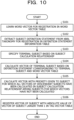
- FIG. 10 is a flowchart of the preprocessing to be executed by the information processing apparatus.
- the word dictionary generation unit 155 of the information processing apparatus 100 learns word vectors, and registers them in the word vector table T1 (step S101).
- the extraction unit 151 of the information processing apparatus 100 extracts definition statements of subjects from the XBRL taxonomy 141, and registers them in the definition statement information table (step S102).
- the tag vector calculation unit 152 of the information processing apparatus 100 specifies a terminal subject based on a calculation relationship of the subjects (step S103).
- the tag vector calculation unit 152 calculates a vector of the terminal subject based on the definition statement corresponding to the terminal subject and the word vector table T1 (step S104).
- the tag vector calculation unit 152 calculates a vector with priority given to a subject for which all vectors of descendant subjects have been calculated in the calculation relationship of the subjects among subjects for which vectors have not been calculated (step S105).
- the tag vector calculation unit 152 registers, in the tag vector table T2, a vector of a subject having an absolute value of the vector of the subject larger than 1 (step S106).
- FIG. 11 is a flowchart of the search process to be executed by the information processing apparatus.
- the search unit 154 of the information processing apparatus 100 receives a search query from the input unit 120 (step S201).
- the search unit 154 calculates a search vector of the search query based on the word vector table T1 and the tag vector table T2 (step S202). The search unit 154 calculates similarity between the search vector and each sentence vector of the inverted index In1 (step S203).
- the search unit 154 searches the XBRL instance 142 for a sentence based on the offset of the sentence vector having the maximum similarity (step S204).
- the search unit 154 outputs the search result to the display unit 130 (step S205).
- the information processing apparatus 100 specifies a terminal subject defined by a calculation relationship of a certain subject based on the calculation relationship of the subjects and the relationship between the subjects in the XBRL taxonomy 141. For the terminal subject, the information processing apparatus 100 calculates a vector of the terminal subject based on the definition statement corresponding to the terminal subject and the word vector table T1. As a result, the vector of the tag corresponding to the terminal subject may be accurately calculated.
- the information processing apparatus 100 calculates a vector by the operation corresponding to the terminal subject defined by the calculation relationship of the subject. As a result, the vector of the tag corresponding to the subject other than the terminal subject may also be accurately calculated.
- tags are for subjects of different concepts (different tags)
- text in which the tags are described may be similar (e.g., Sales and Cost of sales in FIG. 3 ).
- Word2Vec is applied to the XBRL document to calculate a vector of a tag
- the vector is calculated from the context of the tag.
- a similar vector is assigned to a subject of a concept different from the subject defined by the taxonomy or the like.
- the concept structure of tags in the XBRL definition information defined by the hierarchical relationship as illustrated in FIG. 2 subjects of different concepts exist at similar positions or hierarchical levels in the concept structure (e.g., Sales and Cost of sales in FIG. 2 ).
- the calculated vector may not be used to compare documents including tags.
- a vector of a tag is calculated based on a definition statement that defines a subject corresponding to the tag and a calculation relationship, whereby the vector of the tag corresponding to the subject may be accurately calculated.
- the information processing apparatus 100 preferentially selects a subject for which vectors of all subjects defined by the calculation relationship of the subjects have been calculated. As a result, a vector of a subject other than the terminal subject may be efficiently calculated.
- the information processing apparatus 100 generates the inverted index In1 in which a position (offset) of the sentence of the XBRL instance 142 is associated with the sentence vector, and calculates, when a search query is received, a search vector of the search query.
- the information processing apparatus 100 searches for a sentence corresponding to the search query based on the search vector and the inverted index In1. As a result, the sentence including the tag may be accurately searched for from the search query including the tag.
- the process of the information processing apparatus 100 described above is an example, and other processes may be performed. Here, other processes 1 and 2 of the information processing apparatus 100 according to the present embodiment will be described.
- the vector calculation unit 153 of the information processing apparatus 100 may calculate individual sentence vectors of individual sentences included in the XBRL document, such as a tagged securities report, and may create a transition table in which positions of the sentences are associated with the sentence vectors.
- the vector calculation unit 153 refers to the transition table to compare the sentence vectors of adjacent sentences, and specifies, as a sentence break, a point between sentences in which a difference between the sentence vectors is equal to or larger than a threshold.
- the vector calculation unit 153 may automatically generate a plurality of terms by dividing each sentence included in the XBRL document by a sentence break.
- the vector calculation unit 153 calculates a text vector by integrating sentence vectors of individual sentences included in the text.
- the vector calculation unit 153 may generate an inverted index of the text in which the text vector is associated with the offset of the text.
- the search unit 154 may receive the text as a search query, and may search the XBRL instance 142 for the text based on the text vector and the inverted index of the text.
- the information processing apparatus 100 performs the process on the XBRL document.
- the processing of calculating a vector performed by the information processing apparatus 100 may be similarly applied to a document based on ontology or a thesaurus in which a vocabulary concept (corresponding to a definition statement) and a vocabulary system (hierarchical relationship of the vocabulary) are clearly defined.
- examples of the vocabulary system of the ontology include Japanese WordNet.
- examples of information corresponding to the definition statement of the ontology include a simple knowledge organization system (SKOS) reference or the like.
- SKOS simple knowledge organization system
- the information processing apparatus 100 calculates a vector of a terminal item using the word vector table T1 and data of the vocabulary concept corresponding to the terminal item among the items of the ontology. Furthermore, the information processing apparatus 100 calculates a vector for an item defined by an operation of a descendant item among the items of the ontology by an operation of a vector of the descendant item.
- FIG. 12 is a diagram illustrating an exemplary hardware configuration of the computer that implements functions similar to those of the information processing apparatus according to the embodiment.
- a computer 200 includes a CPU 201 that executes various types of arithmetic processing, an input device 202 that receives data input from a user, and a display 203. Furthermore, the computer 200 includes a communication device 204 that exchanges data with an external device or the like via a wired or wireless network, and an interface device 205. Furthermore, the computer 200 includes a RAM 206 that temporarily stores various types of information, and a hard disk drive 207. Additionally, each of the devices 201 to 207 is coupled to a bus 208.
- the hard disk drive 207 includes an extraction program 207a, a tag vector calculation program 207b, a vector calculation program 207c, a search program 207d, and a word dictionary generation program 207e. Furthermore, the CPU 201 reads each of the programs 207a to 207e, and loads it to the RAM 206.
- the extraction program 207a functions as an extraction process 206a.
- the tag vector calculation program 207b functions as a tag vector calculation process 206b.
- the vector calculation program 207c functions as a vector calculation process 206c.
- the search program 207d functions as a search process 206d.
- the word dictionary generation program 207e functions as a word dictionary generation process 206e.
- Processing of the extraction process 206a corresponds to the processing of the extraction unit 151.
- Processing of the tag vector calculation process 206b corresponds to the processing of the tag vector calculation unit 152.
- Processing of the vector calculation process 206c corresponds to the processing of the vector calculation unit 153.
- Processing of the search process 206d corresponds to the processing of the search unit 154.
- Processing of the word dictionary generation process 206e corresponds to the processing of the word dictionary generation unit 155.
- each of the programs 207a to 207e is not necessarily stored in the hard disk drive 207 from the beginning.
- each of the programs is stored in a "portable physical medium" to be inserted into the computer 200, such as a flexible disk (FD), a compact disc read only memory (CD-ROM), a digital versatile disc (DVD), a magneto-optical disk, or an integrated circuit (IC) card.
- the computer 200 may read and execute each of the programs 207a to 207e.
Landscapes
- Engineering & Computer Science (AREA)
- Theoretical Computer Science (AREA)
- Data Mining & Analysis (AREA)
- Databases & Information Systems (AREA)
- Physics & Mathematics (AREA)
- General Engineering & Computer Science (AREA)
- General Physics & Mathematics (AREA)
- Software Systems (AREA)
- Computational Linguistics (AREA)
- Machine Translation (AREA)
- Information Retrieval, Db Structures And Fs Structures Therefor (AREA)
Abstract
Description
- The present invention relates to an information processing program and the like.
- In the field of document search technology, there is a technique in which a vector is assigned to each document registered in a document database (DB) and the document DB is searched for a document of a vector corresponding to a vector of a search query when the search query is received.
- When a vector is assigned to a document, a vector of each word included in the document is calculated using an existing technique such as Word2Vec or Poincaré embeddings, the vectors of the individual words are integrated to calculate a vector of the document, and the calculated vector is assigned.
- Note that, in the document DB described above, a tagged document such as a hypertext markup language (HTML) document or an extensible business reporting language (XBRL) document may be registered, and the tagged document also needs to be searched for using a vector assigned thereto. Examples of the XBRL document include a securities report or the like.
- According to the existing technique, when a vector of a tagged document is calculated, preprocessing of deleting information other than text, such as tags, from the tagged document is performed, and then the vector of the document is calculated in a similar manner to a normal document.
- Patent Document 1: Japanese Laid-open Patent Publication No. 2006-343843
- However, the existing technique described above has a problem that the accuracy of the vector of the tagged document decreases.
- For example, documents disclosed in the securities report vary depending on individual companies, and notation fluctuations occur. XBRL tags used in the securities report are used to correctly extract information even when there are notation fluctuations, and the XBRL tags indicate subjects defined in rules, laws, and the like in financial accounting. Accordingly, for example, <Sales> 100 </Sales> and <Cost of sales> 100 </Cost of sales> may not be distinguished when the XBRL tags are simply deleted as in the existing technique, and thus the tagged document needs to be vectorized without deleting the XBRL tags.
- Here, while it is possible to vectorize the XBRL tags using the Word2Vec, the Word2Vec calculates a vector from a context of a word, and thus the vector may not be correctly calculated when different XBRL tags are attached to similar sentences.
- Furthermore, while it is also possible to calculate a vector by learning a relationship between subjects included in XBRL definition information by the Poincaré embeddings, similar vectors are assigned to subjects of different concepts, and thus it may not be used to compare documents including XBRL tags.
- In one aspect, an object of the present invention is to provide an information processing program, an information processing method, and an information processing apparatus capable of improving accuracy of a vector of a tagged document.
- In a first idea, a computer is caused to execute the following process. The computer specifies a terminal subject among subjects corresponding to a plurality of tags used in a document based on a parent-child relationship of the subjects corresponding to the plurality of tags. The computer calculates a vector of a tag corresponding to the terminal subject based on each word included in definition information set for the terminal subject and a word vector dictionary that defines a vector of each word.
- Accuracy of a vector of a tagged document may be improved.
-
-
FIG. 1A is a diagram illustrating an example of a definition statement of a subject defined in a law, a guideline, or the like. -
FIG. 1B is a diagram illustrating an example in which a definition statement of a Cost of sales is extracted fromFIG. 1A as an example of a tag. -
FIG. 2 is a diagram illustrating an example of a relationship between subjects included in taxonomy. -
FIG. 3 is a diagram illustrating an example of an instance. -
FIG. 4 is a diagram (1) for explaining an exemplary process of an information processing apparatus according to the present embodiment. -
FIG. 5 is a diagram (2) for explaining an exemplary process of the information processing apparatus according to the present embodiment. -
FIG. 6 is a diagram illustrating an exemplary data structure of a tag vector table. -
FIG. 7 is a diagram for explaining an exemplary process of calculating a vector of a sentence. -
FIG. 8 is a diagram illustrating an exemplary inverted index. -
FIG. 9 is a functional block diagram illustrating a configuration of the information processing apparatus according to the present embodiment. -
FIG. 10 is a flowchart of preprocessing to be executed by the information processing apparatus. -
FIG. 11 is a flowchart of a search process to be executed by the information processing apparatus. -
FIG. 12 is a diagram illustrating an exemplary hardware configuration of a computer that implements functions similar to those of the information processing apparatus according to the embodiment. - Hereinafter, an embodiment of an information processing program, an information processing method, and an information processing apparatus disclosed in the present application will be described in detail with reference to the drawings. Note that the present invention is not limited by the embodiment.
- An XBRL document will be described before describing the information processing apparatus according to the present embodiment. An XBRL is an extensible markup language (XML)-based computer language standardized so that information for various financial reports may be created, distributed, and used, and a document created based on the XBRL will be referred to as an XBRL document.
- For example, the XBRL document includes taxonomy and an instance. The taxonomy is a specification of data, and defines a definition statement of a subject, a relationship between subjects, a parent-child relationship of subjects, and the like. The parent-child relationship of subjects indicates, for example, a calculation relationship of the subjects.
- The definition statement of the subject indicates a definition statement described in laws, guidelines, rules, and the like corresponding to the subject. For example, a definition statement regarding an Operating income is as illustrated in
FIG. 1A or inFIG. 1B. FIG. 1A is a diagram illustrating an example of a definition statement of a subject defined in a law, a guideline, or the like.FIG. 1B is a diagram illustrating an example in which a definition statement of a Cost of sales is extracted fromFIG. 1A as an example of a tag. The definition statement illustrated inFIGs. 1A and 1B is a part of the definition statement regarding the Operating income. Descriptions of definition statements regarding other subjects will be omitted. - The relationship between subjects is information that defines a hierarchical relationship between the subjects in a hierarchical structure.
FIG. 2 is a diagram illustrating an example of the relationship between subjects included in the taxonomy. In the example illustrated inFIG. 2 , a subject "Comprehensive income" is linked to be subordinate to a subject "Consolidated income (and Comprehensive income) statement". A subject "Current net income or Current net loss (Δ)" is linked to be subordinate to the subject "Comprehensive income". - A subject "Income before income taxes or Loss before income taxes (Δ)" is linked to be subordinate to the subject "Current net income or Current net loss (Δ)". A subject "Ordinary income or Ordinary loss (Δ)" is linked to be subordinate to the subject "Income before income taxes or Loss before income taxes (Δ)". A subject "Operating income or Operating loss (Δ)" is linked to be subordinate to the subject "Ordinary income or Ordinary loss (Δ)".
- A subject "Gross profit or Gross loss (Δ)" is linked to be subordinate to the subject "Operating income or Operating loss (Δ)". A subject "Sales" and a subject "Cost of sales" are linked to be subordinate to the subject "Gross profit or Gross loss (Δ)". Since no subject is subordinate to the subject "Sales" and the subject "Cost of sales", the subject "Sales" and the subject "Cost of sales" serve as "terminal subjects".
- The calculation relationship of subjects defines calculation of a certain subject using a subject subordinate to the certain subject. For example, the calculation relationship regarding the subject "Gross profit or Gross loss (Δ)" is defined by taxonomy based on an equation (1). In the equation (1), the calculation relationship of the subject "Gross profit or Gross loss (Δ)" is defined by the terminal subjects "Sales" and "Cost of sales".

- The instance is data itself, and is created by a submitter based on the taxonomy described above. A value of the subject is set to the instance. Examples of the value of the subject include an amount of money, a character string, a ratio, and the like.
-
FIG. 3 is a diagram illustrating an example of the instance. Information included in aninstance 10 is associated with the subject of the taxonomy by an XBRL tag. For example, inFIG. 3 , a value "300" between the XBRL tag <Sales> and </Sales> is a value of the subject "Sales". A value "100" between the XBRL tag <Cost of sales> and </Cost of sales> is a value of the subject "Cost of sales". A value "200" between the XBRL tag <Gross profit or Gross loss> and </Gross profit or Gross loss> is a value of the subject "Gross profit or Gross loss (Δ)". In the following descriptions, the XBRL tag will be referred to as a "tag" as appropriate. - Next, an exemplary process of the information processing apparatus according to the present embodiment will be described.
FIGs. 4 and5 are diagrams for explaining an exemplary process of the information processing apparatus according to the present embodiment. First,FIG. 4 will be described. As illustrated inFIG. 4 , the information processing apparatus includesXBRL taxonomy 141. TheXBRL taxonomy 141 has, for each subject, information regarding a definition statement of a subject, a relationship between subjects, and a calculation relationship of subjects defined in the taxonomy described above. - Descriptions regarding the definition statement of the subject are similar to the contents described with reference to
FIGs. 1A and 1B . Descriptions regarding the relationship between the subjects are similar to the contents described with reference toFIG. 2 . Descriptions regarding the calculation relationship of the subjects are similar to the descriptions above. - Note that, when the definition statement of the subject is not included in the taxonomy, reference information of the subject definition included in the taxonomy or definition statement information created based on laws, guidelines, documents, and the like related to the taxonomy may be used as the definition statement of the subject.
- An
extraction unit 151 of the information processing apparatus analyzes theXBRL taxonomy 141, and extracts information regarding a definition statement of a subject for each subject. Theextraction unit 151 registers, in a definition statement information table 143, a subject and a definition statement in association with each other. - A tag
vector calculation unit 152 of the information processing apparatus executes the following processing to calculate a vector of the subject, and generates a tag vector table T2. The tagvector calculation unit 152 executes processing of specifying a terminal subject, processing of calculating a vector of the terminal subject, and processing of calculating a vector of a subject other than the terminal subject. - The processing of specifying the terminal subject will be described. The tag
vector calculation unit 152 specifies a terminal subject defined by a calculation relationship of a certain subject based on the calculation relationship of the subjects and the relationship between the subjects in theXBRL taxonomy 141. Here, descriptions will be given assuming that the certain subject is "Gross profit or Gross loss (Δ)". The calculation relationship of the subject "Gross profit or Gross loss (Δ)" is defined by the equation (1) described above. The subjects included in the equation (1) (subjects other than Gross profit or Gross loss (Δ)) are "Sales" and "Cost of sales". - The tag
vector calculation unit 152 compares the subject "Sales" and the subject "Cost of sales" with the relationship between the subjects to find out that no subject is linked to be subordinate to the subject "Sales" and the subject "Cost of sales", as illustrated inFIG. 2 . Thus, the tagvector calculation unit 152 specifies the terminal subjects "Sales" and "Cost of sales" from the calculation relationship of the subject "Gross profit or Gross loss (Δ)". - The processing of calculating a vector of the terminal subject will be described. When the tag
vector calculation unit 152 specifies the terminal subject, it obtains the definition statement corresponding to the terminal subject from the definition statement information table 143. The tagvector calculation unit 152 performs morphological analysis on the definition statement corresponding to the terminal subject, thereby dividing the definition statement into a plurality of words. - The tag
vector calculation unit 152 specifies vectors corresponding to the words of the definition statement corresponding to the terminal subject based on a word vector table T1. The word vector table T1 is a table that associates a word with a vector corresponding to the word. It is assumed that the vector corresponding to the word is learned in advance using an existing technique such as Word2Vec or Poincaré embeddings. - The tag
vector calculation unit 152 calculates a vector of the terminal subject by integrating the vectors corresponding to the individual words of the definition statement of the terminal subject. For example, the tagvector calculation unit 152 calculates a vector of the terminal subject "Sales" by integrating the vectors corresponding to the individual words of the definition statement of the terminal subject "Sales". The tagvector calculation unit 152 calculates a vector of the terminal subject "Cost of sales" by integrating the vectors corresponding to the individual words of the definition statement of the terminal subject "Cost of sales". - The tag
vector calculation unit 152 registers the relationship between the terminal subject and the vector in the tag vector table T2. - The processing of calculating a vector of a subject other than the terminal subject will be described. Here, descriptions will be given using the subject "Gross profit or Gross loss (Δ)" as a subject other than the terminal subject. The calculation relationship of the subject "Gross profit or Gross loss (Δ)" is as expressed in the equation (1), and is defined by an operation (four arithmetic operations, etc.) of the terminal subject. The tag
vector calculation unit 152 obtains the vector of the terminal subject from the tag vector table T2. - The tag
vector calculation unit 152 subtracts the vector of the subject "Cost of sales" from the vector of the subject "Sales" based on the equation (1), thereby calculating a vector of the subject "Gross profit or Gross loss (Δ)". - At a time of calculating a vector of a subject other than the terminal subject, the tag
vector calculation unit 152 preferentially calculates a vector from a subject on the descendant side. For example, when the relationship between the subjects is as illustrated inFIG. 2 , the tagvector calculation unit 152 calculates the vector of the "Gross profit or Gross loss (Δ)", and then calculate the vector of the subject "Operating income or Operating loss (Δ)". - Likewise, the tag
vector calculation unit 152 calculates the vectors in the order of the subject "Ordinary income or Ordinary loss (Δ)", the subject "Income before income taxes or Loss before income taxes (Δ)", the subject "Current net income or Current net loss (Δ)", and the subject "Comprehensive income". - When the calculation relationship of the subject other than the terminal subject is defined by a descendant subject, the tag
vector calculation unit 152 performs an operation using the vector of the descendant subject to calculate the vector of the subject other than the terminal subject. - Here, the tag
vector calculation unit 152 may preferentially calculate a vector of a subject for which all vectors of descendant subjects defined in the calculation relationship of the subjects have been calculated among a plurality of subjects for which vectors have not been calculated. - When the calculation relationship is not defined for the subject other than the terminal subject, the tag
vector calculation unit 152 calculates, in a similar manner to the terminal subject, a vector of the subject based on a result of the morphological analysis performed on the definition statement corresponding to the subject and the word vector table T1. - The tag
vector calculation unit 152 registers, in the tag vector table T2, the relationship between the subject and the vector of the subject calculated based on the calculation relationship. - With the processing described above performed by the tag
vector calculation unit 152, the relationship between the subject and the vector of the subject is registered in the tag vector table T2. The subject registered in the tag vector table T2 corresponds to the tag included in the instance. -
FIG. 6 is a diagram illustrating an exemplary data structure of the tag vector table. As illustrated inFIG. 6 , the tag vector table T2 associates a subject (tag) with a vector. - The description proceeds to
FIG. 5 . InFIG. 5 , the information processing apparatus calculates a vector of a sentence registered in anXBRL instance 142 using the word vector table T1 and the tag vector table T2 created inFIG. 4 . The instance 10 (sentence including a tag, document) and the like described with reference toFIG. 3 are registered in theXBRL instance 142. - A
vector calculation unit 153 of the information processing apparatus extracts a sentence including a tag from theXBRL instance 142, and performs morphological analysis on the sentence, thereby dividing the sentence into a plurality of words and tags. For the words included in the sentence, thevector calculation unit 153 specifies a vector of each of the words based on the word vector table T1. - The
vector calculation unit 153 extracts, as a tag, a portion sandwiched by a "<character string corresponding to a subject>" and a portion sandwiched by a "</character string corresponding to a subject>". For the tags included in the sentence, thevector calculation unit 153 specifies a vector of each of the tags based on the tag vector table T2. For example, thevector calculation unit 153 assigns a vector of the subject "Sales" in the tag vector table T2 as a vector of the tag <Sales>. Thevector calculation unit 153 assigns the vector of the subject "Sales" in the tag vector table T2 as a vector of the tag </Sales>. - The
vector calculation unit 153 calculates a vector of the sentence by integrating the vector of each word included in the sentence and the vector of each tag. In the following descriptions, a vector of a sentence will be referred to as a "sentence vector". -
FIG. 7 is a diagram for explaining an exemplary process of calculating a vector of a sentence. For example, a case where thevector calculation unit 153 calculates a vector of asentence 20 will be described. It is assumed that thesentence 20 is "An amount of sales is <Sales> 300 </Sales> yen". - The
vector calculation unit 153 performs morphological analysis on thesentence 20 to make a division into words 20-1, 20-2, 20-3, 20-4, 20-5, 20-6, and 20-7. Furthermore, thevector calculation unit 153 specifies tags 20-8 and 20-9 from thesentence 20. - The
vector calculation unit 153 specifies each of vectors of the words 20-1 to 20-7 based on the word vector table T1. Thevector calculation unit 153 specifies each of vectors of the tags 20-8 and 20-9 based on the tag vector table T2. Thevector calculation unit 153 calculates a sentence vector of thesentence 20 by integrating the vectors of the words 20-1 to 20-7 and the vectors of the tags 20-8 and 20-9. - The
vector calculation unit 153 calculates a sentence vector of each sentence by repeatedly executing the process described above for each sentence included in theXBRL instance 142. Thevector calculation unit 153 registers the sentence vectors in a sentence vector table T3. - Furthermore, the
vector calculation unit 153 generates an inverted index In1 in which a position (offset) of the sentence of theXBRL instance 142 is associated with the sentence vector.FIG. 8 is a diagram illustrating an example of the inverted index. A horizontal axis of the inverted index In1 is an axis corresponding to an offset. A vertical axis of the inverted index In1 is an axis corresponding to a sentence vector. The inverted index In1 is indicated by a bitmap of "0" or "1", and all bitmaps are set to "0" in the initial state. - For example, "1" is set at a portion where the row of the sentence vector "Svec1" and the column of the offset "7" intersect. Thus, it is indicated that the position of the first word of the sentence with the sentence vector "Svec1" is present at the eighth position from the first word of the
XBRL instance 142. - As described above, the information processing apparatus according to the present embodiment specifies a terminal subject defined by a calculation relationship of a certain subject based on the calculation relationship of the subjects and the relationship between the subjects in the
XBRL taxonomy 141. For the terminal subject, the information processing apparatus calculates a vector of the terminal subject based on the definition statement corresponding to the terminal subject and the word vector table T1. As a result, the vector of the tag corresponding to the terminal subject may be accurately calculated. - For a subject other than the terminal subject, the information processing apparatus calculates a vector by the operation corresponding to the terminal subject defined by the calculation relationship of the subject. As a result, the vector of the tag corresponding to the subject other than the terminal subject may also be accurately calculated.
- Note that, while the inverted index associated with the sentence vector has been described in the example, the inverted index may be associated with a vector of a particle size of a word or a tag.
- Next, an exemplary configuration of the information processing apparatus that executes the process described with reference to
FIGs. 4 and5 will be described.FIG. 9 is a functional block diagram illustrating a configuration of the information processing apparatus according to the present embodiment. As illustrated inFIG. 9 , an information processing apparatus 100 includes acommunication unit 110, aninput unit 120, a display unit 130, a storage unit 140, and acontrol unit 150. - The
communication unit 110 performs data communication with an external device via a network. Thecommunication unit 110 may receive theXBRL taxonomy 141 and theXBRL instance 142 from the external device. - The
input unit 120 is an input device that receives an operation made by a user, and is implemented by, for example, a keyboard, a mouse, or the like. The user may operate theinput unit 120 to input a search query. - The display unit 130 is a display device for outputting a result of processing of the
control unit 150, and is implemented by, for example, a liquid crystal monitor, a printer, or the like. The display unit 130 may display a search result based on the search query. - The storage unit 140 is a storage device that stores various types of information, and is implemented by, for example, a semiconductor memory element such as a random access memory (RAM) or a flash memory, or a storage device such as a hard disk or an optical disk.
- The storage unit 140 stores the
XBRL taxonomy 141, theXBRL instance 142, and the definition statement information table 143. Furthermore, the storage unit 140 stores the word vector table T1, the tag vector table T2, the sentence vector table T3, and the inverted index In1. - The
XBRL taxonomy 141 has, for each subject, information regarding a definition statement of a subject, a relationship between subjects, and a calculation relationship of subjects defined in the taxonomy. Descriptions regarding theXBRL taxonomy 141 are similar to the contents described with reference toFIG. 4 . - The
instance 10 and the like described with reference toFIG. 3 are registered in theXBRL instance 142. The instance includes a plurality of sentences including tags. - The definition statement information table 143 is a table that associates a subject extracted from the
XBRL taxonomy 141 with a definition statement of the subject and retains them. The information in the definition statement information table 143 is extracted from theXBRL taxonomy 141 by theextraction unit 151. - The word vector table T1 is a table that associates a word with a vector corresponding to the word and retains them. It is assumed that the vector corresponding to the word is learned in advance by a word
dictionary generation unit 155 using an existing technique such as Word2Vec or Poincaré embeddings. - The tag vector table T2 is a table in which a subject defined in the
XBRL taxonomy 141, which is a subject corresponding to a tag included in theXBRL instance 142, is associated with a vector. A data structure of the tag vector table T2 corresponds to the data structure described with reference toFIG. 6 . - The sentence vector table T3 is a table that retains sentence vectors of sentences including tags included in the
XBRL instance 142. - The inverted index In1 associates a position (offset) of the sentence of the
XBRL instance 142 with the sentence vector. A data structure of the inverted index In1 corresponds to the data structure described with reference toFIG. 8 . - The
control unit 150 is implemented by a processor, such as a central processing unit (CPU) or a micro processing unit (MPU) executing various programs stored in a storage device inside the information processing apparatus 100 using a RAM or the like as a workspace. Furthermore, thecontrol unit 150 may be implemented by an integrated circuit, such as an application specific integrated circuit (ASIC) or a field programmable gate array (FPGA). - The
control unit 150 includes theextraction unit 151, the tagvector calculation unit 152, thevector calculation unit 153, a search unit 154, and the worddictionary generation unit 155. - The
extraction unit 151 analyzes theXBRL taxonomy 141, and extracts information regarding a definition statement of a subject for each subject. Theextraction unit 151 registers the extracted subject and the definition statement in the definition statement information table 143 in association with each other. Note that the user may operate theinput unit 120 to input information regarding the subject and the definition statement in the definition statement information table 143. - The tag
vector calculation unit 152 executes the processing of specifying a terminal subject, the processing of calculating a vector of the terminal subject, and the processing of calculating a vector of a subject other than the terminal subject, and generates the tag vector table T2. The processing of specifying a terminal subject, the processing of calculating a vector of the terminal subject, and the processing of calculating a vector of a subject other than the terminal subject, which are executed by the tagvector calculation unit 152, are similar to the processing described with reference toFIG. 4 . - Note that, when an absolute value of the calculated vector of the subject (tag) is larger than 1, the tag
vector calculation unit 152 normalizes the vectors of the word and subject. - The
vector calculation unit 153 calculates a vector of a sentence registered in anXBRL instance 142 using the word vector table T1 and the tag vector table T2. Thevector calculation unit 153 generates an inverted index In1 in which a position (offset) of the sentence of theXBRL instance 142 is associated with the sentence vector. The process of thevector calculation unit 153 is similar to the process described with reference toFIG. 5 . - When the search unit 154 receives a search query from the
input unit 120, it searches for a sentence corresponding to the search query. A sentence specified as a search query may be, for example, a sentence including a tag. The search unit 154 performs morphological analysis on the search query, and divides the sentence included in the search query into words and tags. - The search unit 154 specifies a vector corresponding to a word based on the word vector table T1. The search unit 154 specifies a vector corresponding to a tag based on the tag vector table T2. The search unit 154 calculates a vector of the search query by integrating the vectors of the individual words and tags of the search query. The processing of calculating a vector of the sentence of the search query performed by the search unit 154 is similar to the processing of calculating a vector of the sentence including a tag performed by the
vector calculation unit 153. In the following descriptions, a vector of a search query will be referred to as a "search vector". - The search unit 154 calculates similarity (cosine similarity, etc.) between the search vector and each sentence vector set on the vertical axis of the inverted index In1. The search unit 154 obtains, from the
XBRL instance 142, the sentence corresponding to the offset corresponding to the sentence vector having the maximum similarity in the inverted index In1, and outputs the obtained sentence to the display unit 130 as a search result. - The word
dictionary generation unit 155 learns the vector of each word using an existing technique such as Word2Vec or Poincaré embeddings. The worddictionary generation unit 155 registers the relationship between the learned word and vector in the word vector table T1. Note that the information processing apparatus 100 may obtain the generated (learned) word vector table T1 from an external device or the like, and may register it in the storage unit 140. - Next, an exemplary processing procedure of the information processing apparatus 100 according to the present embodiment will be described. Here, a processing procedure of the preprocessing and a processing procedure of the search process to be executed by the information processing apparatus 100 will be described.
-
FIG. 10 is a flowchart of the preprocessing to be executed by the information processing apparatus. As illustrated inFIG. 10 , the worddictionary generation unit 155 of the information processing apparatus 100 learns word vectors, and registers them in the word vector table T1 (step S101). - The
extraction unit 151 of the information processing apparatus 100 extracts definition statements of subjects from theXBRL taxonomy 141, and registers them in the definition statement information table (step S102). The tagvector calculation unit 152 of the information processing apparatus 100 specifies a terminal subject based on a calculation relationship of the subjects (step S103). - The tag
vector calculation unit 152 calculates a vector of the terminal subject based on the definition statement corresponding to the terminal subject and the word vector table T1 (step S104). - The tag
vector calculation unit 152 calculates a vector with priority given to a subject for which all vectors of descendant subjects have been calculated in the calculation relationship of the subjects among subjects for which vectors have not been calculated (step S105). The tagvector calculation unit 152 registers, in the tag vector table T2, a vector of a subject having an absolute value of the vector of the subject larger than 1 (step S106). -
FIG. 11 is a flowchart of the search process to be executed by the information processing apparatus. As illustrated inFIG. 11 , the search unit 154 of the information processing apparatus 100 receives a search query from the input unit 120 (step S201). - The search unit 154 calculates a search vector of the search query based on the word vector table T1 and the tag vector table T2 (step S202). The search unit 154 calculates similarity between the search vector and each sentence vector of the inverted index In1 (step S203).
- The search unit 154 searches the
XBRL instance 142 for a sentence based on the offset of the sentence vector having the maximum similarity (step S204). The search unit 154 outputs the search result to the display unit 130 (step S205). - Next, effects of the information processing apparatus 100 according to the present embodiment will be described. The information processing apparatus 100 specifies a terminal subject defined by a calculation relationship of a certain subject based on the calculation relationship of the subjects and the relationship between the subjects in the
XBRL taxonomy 141. For the terminal subject, the information processing apparatus 100 calculates a vector of the terminal subject based on the definition statement corresponding to the terminal subject and the word vector table T1. As a result, the vector of the tag corresponding to the terminal subject may be accurately calculated. - For a subject other than the terminal subject, the information processing apparatus 100 calculates a vector by the operation corresponding to the terminal subject defined by the calculation relationship of the subject. As a result, the vector of the tag corresponding to the subject other than the terminal subject may also be accurately calculated.
- For example, in an XBRL document, even if tags are for subjects of different concepts (different tags), text in which the tags are described (context of text) may be similar (e.g., Sales and Cost of sales in
FIG. 3 ). In such a case, when Word2Vec is applied to the XBRL document to calculate a vector of a tag, the vector is calculated from the context of the tag. Thus, when different tags are attached to similar sentences, it is not possible to calculate a vector that may distinguish that the concepts of the tags are different. Furthermore, it is also conceivable to calculate a vector of a tag based on a relationship between subjects included in the XBRL definition information using Poincaré embeddings. However, in this case, a similar vector is assigned to a subject of a concept different from the subject defined by the taxonomy or the like. This is because, in the concept structure of tags in the XBRL definition information defined by the hierarchical relationship as illustrated inFIG. 2 , subjects of different concepts exist at similar positions or hierarchical levels in the concept structure (e.g., Sales and Cost of sales inFIG. 2 ). Thus, the calculated vector may not be used to compare documents including tags. On the other hand, according to the information processing apparatus, a vector of a tag is calculated based on a definition statement that defines a subject corresponding to the tag and a calculation relationship, whereby the vector of the tag corresponding to the subject may be accurately calculated. - In the case of calculating a vector of a subject other than the terminal subject, the information processing apparatus 100 preferentially selects a subject for which vectors of all subjects defined by the calculation relationship of the subjects have been calculated. As a result, a vector of a subject other than the terminal subject may be efficiently calculated.
- The information processing apparatus 100 generates the inverted index In1 in which a position (offset) of the sentence of the
XBRL instance 142 is associated with the sentence vector, and calculates, when a search query is received, a search vector of the search query. The information processing apparatus 100 searches for a sentence corresponding to the search query based on the search vector and the inverted index In1. As a result, the sentence including the tag may be accurately searched for from the search query including the tag. - The process of the information processing apparatus 100 described above is an example, and other processes may be performed. Here,
other processes 1 and 2 of the information processing apparatus 100 according to the present embodiment will be described. - Another
process 1 will be described. Thevector calculation unit 153 of the information processing apparatus 100 may calculate individual sentence vectors of individual sentences included in the XBRL document, such as a tagged securities report, and may create a transition table in which positions of the sentences are associated with the sentence vectors. Thevector calculation unit 153 refers to the transition table to compare the sentence vectors of adjacent sentences, and specifies, as a sentence break, a point between sentences in which a difference between the sentence vectors is equal to or larger than a threshold. Thevector calculation unit 153 may automatically generate a plurality of terms by dividing each sentence included in the XBRL document by a sentence break. - Another process 2 will be described. Although the case where the
vector calculation unit 153 of the information processing apparatus 100 calculates a sentence vector of each sentence included in the XBRL document has been described, a vector of text including a plurality of sentences may be calculated. In the following descriptions, a vector of text will be referred to as a "text vector". Thevector calculation unit 153 calculates a text vector by integrating sentence vectors of individual sentences included in the text. Thevector calculation unit 153 may generate an inverted index of the text in which the text vector is associated with the offset of the text. The search unit 154 may receive the text as a search query, and may search theXBRL instance 142 for the text based on the text vector and the inverted index of the text. - Meanwhile, although the case where the information processing apparatus 100 according to the present embodiment performs the process on the XBRL document has been described, it is not limited to the XBRL document. The processing of calculating a vector performed by the information processing apparatus 100 may be similarly applied to a document based on ontology or a thesaurus in which a vocabulary concept (corresponding to a definition statement) and a vocabulary system (hierarchical relationship of the vocabulary) are clearly defined. For example, examples of the vocabulary system of the ontology include Japanese WordNet. Furthermore, examples of information corresponding to the definition statement of the ontology include a simple knowledge organization system (SKOS) reference or the like.
- For example, the information processing apparatus 100 calculates a vector of a terminal item using the word vector table T1 and data of the vocabulary concept corresponding to the terminal item among the items of the ontology. Furthermore, the information processing apparatus 100 calculates a vector for an item defined by an operation of a descendant item among the items of the ontology by an operation of a vector of the descendant item.
- Next, an exemplary hardware configuration of a computer that implements functions similar to those of the information processing apparatus 100 indicated in the embodiment described above will be described.
FIG. 12 is a diagram illustrating an exemplary hardware configuration of the computer that implements functions similar to those of the information processing apparatus according to the embodiment. - As illustrated in
FIG. 12 , acomputer 200 includes aCPU 201 that executes various types of arithmetic processing, aninput device 202 that receives data input from a user, and adisplay 203. Furthermore, thecomputer 200 includes acommunication device 204 that exchanges data with an external device or the like via a wired or wireless network, and aninterface device 205. Furthermore, thecomputer 200 includes aRAM 206 that temporarily stores various types of information, and ahard disk drive 207. Additionally, each of thedevices 201 to 207 is coupled to abus 208. - The
hard disk drive 207 includes anextraction program 207a, a tagvector calculation program 207b, avector calculation program 207c, asearch program 207d, and a worddictionary generation program 207e. Furthermore, theCPU 201 reads each of theprograms 207a to 207e, and loads it to theRAM 206. - The
extraction program 207a functions as anextraction process 206a. The tagvector calculation program 207b functions as a tagvector calculation process 206b. Thevector calculation program 207c functions as avector calculation process 206c. Thesearch program 207d functions as asearch process 206d. The worddictionary generation program 207e functions as a worddictionary generation process 206e. - Processing of the
extraction process 206a corresponds to the processing of theextraction unit 151. Processing of the tagvector calculation process 206b corresponds to the processing of the tagvector calculation unit 152. Processing of thevector calculation process 206c corresponds to the processing of thevector calculation unit 153. Processing of thesearch process 206d corresponds to the processing of the search unit 154. Processing of the worddictionary generation process 206e corresponds to the processing of the worddictionary generation unit 155. - Note that each of the
programs 207a to 207e is not necessarily stored in thehard disk drive 207 from the beginning. For example, each of the programs is stored in a "portable physical medium" to be inserted into thecomputer 200, such as a flexible disk (FD), a compact disc read only memory (CD-ROM), a digital versatile disc (DVD), a magneto-optical disk, or an integrated circuit (IC) card. Then, thecomputer 200 may read and execute each of theprograms 207a to 207e. -
- 100
- Information processing apparatus
- 110
- Communication unit
- 120
- Input unit
- 130
- Display unit
- 140
- Storage unit
- 141
- XBRL taxonomy
- 142
- XBRL instance
- 143
- Definition statement information table
- 150
- Control unit
- 151
- Extraction unit
- 152
- Tag vector calculation unit
- 153
- Vector calculation unit
- 154
- Search unit
- 155
- Word dictionary generation unit
Claims (21)
- An information processing program for causing a computer to perform a process comprising:specifying a terminal subject based on a parent-child relationship of subjects that correspond to a plurality of tags used in a document; andcalculating a vector of a tag that corresponds to the terminal subject based on each word included in definition information set for the terminal subject and a word vector dictionary that defines a vector of each word.
- The information processing program according to claim 1, the program causing the computer to perform the process further comprising:
calculating a vector of a tag that corresponds to a subject other than the terminal subject based on a parent-child relationship between a vector that corresponds to the terminal subject and the subject other than the terminal subject. - The information processing program according to claim 2, the program causing the computer to perform the process further comprising:
registering a relationship between the tag and the vector of the tag in a tag vector dictionary, and calculating a vector of the document based on the word vector dictionary and the tag vector dictionary. - The information processing program according to claim 3, wherein
the calculating the vector of the tag that corresponds to the subject other than the terminal subject preferentially calculates the vector of the subject for which all vectors of the subjects included in the parent-child relationship of the subject other than the terminal subject are calculated. - The information processing program according to claim 4, the program causing the computer to perform the process further comprising:
generating an index in which the vector of the document is associated with a registration position of the document, and when a search query is received, searching for a document that corresponds to the search query based on a vector of the search query and the index. - The information processing program according to claim 1, wherein
the parent-child relationship includes a calculation relationship of the subjects that correspond to the plurality of tags, and the calculation relationship derives a value of a subject using a value of the terminal subject among the subjects that correspond to the plurality of tags. - The information processing program according to claim 6, wherein
the specifying the terminal subject specifies the terminal subject based on the calculation relationship of the subjects defined in taxonomy of an extensible business reporting language (XBRL) document. - An information processing method for causing a computer to perform a process comprising:specifying a terminal subject based on a parent-child relationship of subjects that correspond to a plurality of tags used in a document; andcalculating a vector of a tag that corresponds to the terminal subject based on each word included in definition information set for the terminal subject and a word vector dictionary that defines a vector of each word.
- The information processing method according to claim 8, the program causing the computer to perform the process further comprising:
calculating a vector of a tag that corresponds to a subject other than the terminal subject based on a parent-child relationship between a vector that corresponds to the terminal subject and the subject other than the terminal subject. - The information processing method according to claim 9, the program causing the computer to perform the process further comprising:
registering a relationship between the tag and the vector of the tag in a tag vector dictionary, and calculating a vector of the document based on the word vector dictionary and the tag vector dictionary. - The information processing method according to claim 10, wherein
the calculating the vector of the tag that corresponds to the subject other than the terminal subject preferentially calculates the vector of the subject for which all vectors of the subjects included in the parent-child relationship of the subject other than the terminal subject are calculated. - The information processing method according to claim 11, the program causing the computer to perform the process further comprising:
generating an index in which the vector of the document is associated with a registration position of the document, and when a search query is received, searching for a document that corresponds to the search query based on a vector of the search query and the index. - The information processing method according to claim 8, wherein
the parent-child relationship includes a calculation relationship of the subjects that correspond to the plurality of tags, and the calculation relationship derives a value of a subject using a value of the terminal subject among the subjects that correspond to the plurality of tags. - The information processing method according to claim 13, wherein
the specifying the terminal subject specifies the terminal subject based on the calculation relationship of the subjects defined in taxonomy of an extensible business reporting language (XBRL) document. - An information processing apparatus comprising:
a control unit configured to:specify a terminal subject based on a parent-child relationship of subjects that correspond to a plurality of tags used in a document; andcalculate a vector of a tag that corresponds to the terminal subject based on each word included in definition information set for the terminal subject and a word vector dictionary that defines a vector of each word. - The information processing apparatus according to claim 15, wherein
the control unit calculates a vector of a tag that corresponds to a subject other than the terminal subject based on a parent-child relationship between a vector that corresponds to the terminal subject and the subject other than the terminal subject. - The information processing apparatus according to claim 16, wherein
the control unit registers a relationship between the tag and the vector of the tag in a tag vector dictionary, and calculates a vector of the document based on the word vector dictionary and the tag vector dictionary. - The information processing apparatus according to claim 17, wherein
a process to calculate the vector of the tag that corresponds to the subject other than the terminal subject preferentially calculates the vector of the subject for which all vectors of the subjects included in the parent-child relationship of the subject other than the terminal subject are calculated. - The information processing apparatus according to claim 18, wherein
the control unit generates an index in which the vector of the document is associated with a registration position of the document, and when a search query is received, searches for a document that corresponds to the search query based on a vector of the search query and the index. - The information processing apparatus according to claim 15, wherein
the parent-child relationship includes a calculation relationship of the subjects that correspond to the plurality of tags, and the calculation relationship derives a value of a subject using a value of the terminal subject among the subjects that correspond to the plurality of tags. - The information processing program according to claim 20, wherein
a process to specify the terminal subject specifies the terminal subject based on the calculation relationship of the subjects defined in taxonomy of an extensible business reporting language (XBRL) document.
Applications Claiming Priority (1)
| Application Number | Priority Date | Filing Date | Title |
|---|---|---|---|
| PCT/JP2022/009551 WO2023166736A1 (en) | 2022-03-04 | 2022-03-04 | Information processing program, information processing method, and information processing device |
Publications (2)
| Publication Number | Publication Date |
|---|---|
| EP4488849A1 true EP4488849A1 (en) | 2025-01-08 |
| EP4488849A4 EP4488849A4 (en) | 2025-04-09 |
Family
ID=87883504
Family Applications (1)
| Application Number | Title | Priority Date | Filing Date |
|---|---|---|---|
| EP22929880.7A Withdrawn EP4488849A4 (en) | 2022-03-04 | 2022-03-04 | INFORMATION PROCESSING PROGRAM, INFORMATION PROCESSING METHOD, AND INFORMATION PROCESSING DEVICE |
Country Status (4)
| Country | Link |
|---|---|
| US (1) | US20240419708A1 (en) |
| EP (1) | EP4488849A4 (en) |
| JP (1) | JP7750380B2 (en) |
| WO (1) | WO2023166736A1 (en) |
Family Cites Families (27)
| Publication number | Priority date | Publication date | Assignee | Title |
|---|---|---|---|---|
| US5873056A (en) * | 1993-10-12 | 1999-02-16 | The Syracuse University | Natural language processing system for semantic vector representation which accounts for lexical ambiguity |
| JP2660481B2 (en) * | 1993-12-28 | 1997-10-08 | 日本アイ・ビー・エム株式会社 | Item extraction method and device |
| JP2896634B2 (en) * | 1995-03-02 | 1999-05-31 | 富士ゼロックス株式会社 | Full-text registered word search device and full-text registered word search method |
| US6701305B1 (en) * | 1999-06-09 | 2004-03-02 | The Boeing Company | Methods, apparatus and computer program products for information retrieval and document classification utilizing a multidimensional subspace |
| US6751628B2 (en) * | 2001-01-11 | 2004-06-15 | Dolphin Search | Process and system for sparse vector and matrix representation of document indexing and retrieval |
| US6766316B2 (en) * | 2001-01-18 | 2004-07-20 | Science Applications International Corporation | Method and system of ranking and clustering for document indexing and retrieval |
| US6947947B2 (en) * | 2001-08-17 | 2005-09-20 | Universal Business Matrix Llc | Method for adding metadata to data |
| JP2003186590A (en) * | 2001-12-17 | 2003-07-04 | Sharp Corp | Equipment operation learning device |
| JP2006343843A (en) | 2005-06-07 | 2006-12-21 | Nippon Telegr & Teleph Corp <Ntt> | Similar document set extraction apparatus, similar document set extraction method, similar document set extraction program, and recording medium |
| US20080208820A1 (en) * | 2007-02-28 | 2008-08-28 | Psydex Corporation | Systems and methods for performing semantic analysis of information over time and space |
| JP2010186325A (en) * | 2009-02-12 | 2010-08-26 | Pronexus Inc | Structured document generation device, and program and recording medium therefor |
| US20120278336A1 (en) * | 2011-04-29 | 2012-11-01 | Malik Hassan H | Representing information from documents |
| US8898104B2 (en) * | 2011-07-26 | 2014-11-25 | International Business Machines Corporation | Auto-mapping between source and target models using statistical and ontology techniques |
| US8990202B2 (en) * | 2011-11-03 | 2015-03-24 | Corefiling S.A.R.L. | Identifying and suggesting classifications for financial data according to a taxonomy |
| US10796078B2 (en) * | 2012-04-27 | 2020-10-06 | Workiva Inc. | Systems and methods for automated taxonomy concept replacement in an XBRL document |
| JP6056592B2 (en) | 2013-03-26 | 2017-01-11 | 大日本印刷株式会社 | Information recommendation device, recommendation information determination method, recommendation information determination program, and information recommendation program |
| US9251136B2 (en) * | 2013-10-16 | 2016-02-02 | International Business Machines Corporation | Document tagging and retrieval using entity specifiers |
| US9235638B2 (en) * | 2013-11-12 | 2016-01-12 | International Business Machines Corporation | Document retrieval using internal dictionary-hierarchies to adjust per-subject match results |
| US11238230B2 (en) * | 2018-09-19 | 2022-02-01 | Servicenow, Inc. | Persistent word vector input to multiple machine learning models |
| US12026462B2 (en) * | 2018-11-29 | 2024-07-02 | International Business Machines Corporation | Word embedding model parameter advisor |
| US11461616B2 (en) * | 2019-08-05 | 2022-10-04 | Siemens Aktiengesellschaft | Method and system for analyzing documents |
| DE102019212421A1 (en) * | 2019-08-20 | 2021-02-25 | Fraunhofer-Gesellschaft zur Förderung der angewandten Forschung e.V. | Method and device for identifying similar documents |
| EP4524773A3 (en) * | 2019-12-05 | 2025-04-16 | Murray B. Wilshinsky | Method and system for self-aggregation of personal data and control thereof |
| JP7323846B2 (en) | 2020-02-25 | 2023-08-09 | 日本電信電話株式会社 | Document creation support device, document creation support method, and document creation support program |
| US11900272B2 (en) * | 2020-05-13 | 2024-02-13 | Factset Research System Inc. | Method and system for mapping labels in standardized tables using machine learning |
| US11281928B1 (en) * | 2020-09-23 | 2022-03-22 | Sap Se | Querying semantic data from unstructured documents |
| US11087070B1 (en) * | 2020-11-04 | 2021-08-10 | Workiva Inc. | Systems and methods for XBRL tag suggestion and validation |
-
2022
- 2022-03-04 EP EP22929880.7A patent/EP4488849A4/en not_active Withdrawn
- 2022-03-04 JP JP2024504328A patent/JP7750380B2/en active Active
- 2022-03-04 WO PCT/JP2022/009551 patent/WO2023166736A1/en not_active Ceased
-
2024
- 2024-08-27 US US18/816,036 patent/US20240419708A1/en active Pending
Also Published As
| Publication number | Publication date |
|---|---|
| JPWO2023166736A1 (en) | 2023-09-07 |
| US20240419708A1 (en) | 2024-12-19 |
| WO2023166736A1 (en) | 2023-09-07 |
| JP7750380B2 (en) | 2025-10-07 |
| EP4488849A4 (en) | 2025-04-09 |
Similar Documents
| Publication | Publication Date | Title |
|---|---|---|
| EP3920044A1 (en) | Data-driven structure extraction from text documents | |
| US12154363B2 (en) | Document display assistance system, document display assistance method, and program for executing said method | |
| US10664530B2 (en) | Control of automated tasks executed over search engine results | |
| CN1571968B (en) | A method for adding metadata associated with that data to a collection of data | |
| US11379536B2 (en) | Classification device, classification method, generation method, classification program, and generation program | |
| US10699112B1 (en) | Identification of key segments in document images | |
| Chou et al. | Integrating XBRL data with textual information in Chinese: A semantic web approach | |
| KR102457962B1 (en) | Method and apparatus for extracting metadata of thesis | |
| US20120221324A1 (en) | Document Processing Apparatus | |
| JP2024091709A (en) | Sentence creation device, sentence creation method, and sentence creation program | |
| US11645332B2 (en) | System and method for clustering documents | |
| US10896227B2 (en) | Data processing system, data processing method, and data structure | |
| Mohit et al. | Syntax-based semi-supervised named entity tagging | |
| Li et al. | A novel methodology for retrieving infographics utilizing structure and message content | |
| Wong et al. | iSentenizer‐μ: Multilingual Sentence Boundary Detection Model | |
| Prakash Hiremath | Approaches to named entity recognition in indian languages: A study | |
| Bradley et al. | SynFinTabs: a dataset of synthetic financial tables for information and table extraction | |
| CN120654658A (en) | Document format conversion method, format conversion device, apparatus, medium, and product | |
| Shi et al. | Wikidt: Visual-based table recognition and question answering dataset | |
| US20210049322A1 (en) | Input error detection device, input error detection method, and computer readable medium | |
| US20240419708A1 (en) | Computer-readable recording medium storing information processing program, information processing method, and information processing apparatus | |
| US11900060B2 (en) | Information processing device, information processing method, and computer program product | |
| Ingram et al. | Building datasets to support information extraction and structure parsing from electronic theses and dissertations | |
| Carme et al. | The lixto project: Exploring new frontiers of web data extraction | |
| Alaswad et al. | Software Requirements to UML Class Diagrams Using Machine Learning and Rule-Based Approach |
Legal Events
| Date | Code | Title | Description |
|---|---|---|---|
| STAA | Information on the status of an ep patent application or granted ep patent |
Free format text: STATUS: THE INTERNATIONAL PUBLICATION HAS BEEN MADE |
|
| PUAI | Public reference made under article 153(3) epc to a published international application that has entered the european phase |
Free format text: ORIGINAL CODE: 0009012 |
|
| STAA | Information on the status of an ep patent application or granted ep patent |
Free format text: STATUS: REQUEST FOR EXAMINATION WAS MADE |
|
| 17P | Request for examination filed |
Effective date: 20240826 |
|
| AK | Designated contracting states |
Kind code of ref document: A1 Designated state(s): AL AT BE BG CH CY CZ DE DK EE ES FI FR GB GR HR HU IE IS IT LI LT LU LV MC MK MT NL NO PL PT RO RS SE SI SK SM TR |
|
| REG | Reference to a national code |
Ref country code: DE Ref legal event code: R079 Free format text: PREVIOUS MAIN CLASS: G06F0016383000 Ipc: G06F0016810000 |
|
| A4 | Supplementary search report drawn up and despatched |
Effective date: 20250312 |
|
| RIC1 | Information provided on ipc code assigned before grant |
Ipc: G06F 16/83 20190101ALI20250306BHEP Ipc: G06F 16/81 20190101AFI20250306BHEP |
|
| DAV | Request for validation of the european patent (deleted) | ||
| DAX | Request for extension of the european patent (deleted) | ||
| STAA | Information on the status of an ep patent application or granted ep patent |
Free format text: STATUS: THE APPLICATION IS DEEMED TO BE WITHDRAWN |
|
| 18D | Application deemed to be withdrawn |
Effective date: 20251002 |