EP4488700A1 - Battery degradation amount determination method, battery management unit, and battery pack - Google Patents
Battery degradation amount determination method, battery management unit, and battery pack Download PDFInfo
- Publication number
- EP4488700A1 EP4488700A1 EP23770381.4A EP23770381A EP4488700A1 EP 4488700 A1 EP4488700 A1 EP 4488700A1 EP 23770381 A EP23770381 A EP 23770381A EP 4488700 A1 EP4488700 A1 EP 4488700A1
- Authority
- EP
- European Patent Office
- Prior art keywords
- battery
- deterioration
- deterioration amount
- amount
- data
- Prior art date
- Legal status (The legal status is an assumption and is not a legal conclusion. Google has not performed a legal analysis and makes no representation as to the accuracy of the status listed.)
- Pending
Links
Images



Classifications
-
- H—ELECTRICITY
- H02—GENERATION; CONVERSION OR DISTRIBUTION OF ELECTRIC POWER
- H02J—ELECTRIC POWER NETWORKS; CIRCUIT ARRANGEMENTS OR SYSTEMS FOR SUPPLYING OR DISTRIBUTING ELECTRIC POWER; SYSTEMS FOR STORING ELECTRIC ENERGY
- H02J7/00—Circuit arrangements for charging or discharging batteries or for supplying loads from batteries
- H02J7/80—Circuit arrangements for charging or discharging batteries or for supplying loads from batteries including monitoring or indicating arrangements
- H02J7/82—Control of state of charge [SOC]
-
- B—PERFORMING OPERATIONS; TRANSPORTING
- B60—VEHICLES IN GENERAL
- B60L—PROPULSION OF ELECTRICALLY-PROPELLED VEHICLES; SUPPLYING ELECTRIC POWER FOR AUXILIARY EQUIPMENT OF ELECTRICALLY-PROPELLED VEHICLES; ELECTRODYNAMIC BRAKE SYSTEMS FOR VEHICLES IN GENERAL; MAGNETIC SUSPENSION OR LEVITATION FOR VEHICLES; MONITORING OPERATING VARIABLES OF ELECTRICALLY-PROPELLED VEHICLES; ELECTRIC SAFETY DEVICES FOR ELECTRICALLY-PROPELLED VEHICLES
- B60L58/00—Methods or circuit arrangements for monitoring or controlling batteries or fuel cells, specially adapted for electric vehicles
- B60L58/10—Methods or circuit arrangements for monitoring or controlling batteries or fuel cells, specially adapted for electric vehicles for monitoring or controlling batteries
- B60L58/16—Methods or circuit arrangements for monitoring or controlling batteries or fuel cells, specially adapted for electric vehicles for monitoring or controlling batteries responding to battery ageing, e.g. to the number of charging cycles or the state of health [SoH]
-
- G—PHYSICS
- G01—MEASURING; TESTING
- G01R—MEASURING ELECTRIC VARIABLES; MEASURING MAGNETIC VARIABLES
- G01R31/00—Arrangements for testing electric properties; Arrangements for locating electric faults; Arrangements for electrical testing characterised by what is being tested not provided for elsewhere
- G01R31/36—Arrangements for testing, measuring or monitoring the electrical condition of accumulators or electric batteries, e.g. capacity or state of charge [SoC]
- G01R31/392—Determining battery ageing or deterioration, e.g. state of health
-
- H—ELECTRICITY
- H01—ELECTRIC ELEMENTS
- H01M—PROCESSES OR MEANS, e.g. BATTERIES, FOR THE DIRECT CONVERSION OF CHEMICAL ENERGY INTO ELECTRICAL ENERGY
- H01M10/00—Secondary cells; Manufacture thereof
- H01M10/05—Accumulators with non-aqueous electrolyte
- H01M10/052—Li-accumulators
- H01M10/0525—Rocking-chair batteries, i.e. batteries with lithium insertion or intercalation in both electrodes; Lithium-ion batteries
-
- H—ELECTRICITY
- H01—ELECTRIC ELEMENTS
- H01M—PROCESSES OR MEANS, e.g. BATTERIES, FOR THE DIRECT CONVERSION OF CHEMICAL ENERGY INTO ELECTRICAL ENERGY
- H01M10/00—Secondary cells; Manufacture thereof
- H01M10/42—Methods or arrangements for servicing or maintenance of secondary cells or secondary half-cells
- H01M10/425—Structural combination with electronic components, e.g. electronic circuits integrated to the outside of the casing
-
- H—ELECTRICITY
- H01—ELECTRIC ELEMENTS
- H01M—PROCESSES OR MEANS, e.g. BATTERIES, FOR THE DIRECT CONVERSION OF CHEMICAL ENERGY INTO ELECTRICAL ENERGY
- H01M10/00—Secondary cells; Manufacture thereof
- H01M10/42—Methods or arrangements for servicing or maintenance of secondary cells or secondary half-cells
- H01M10/48—Accumulators combined with arrangements for measuring, testing or indicating the condition of cells, e.g. the level or density of the electrolyte
-
- H—ELECTRICITY
- H01—ELECTRIC ELEMENTS
- H01M—PROCESSES OR MEANS, e.g. BATTERIES, FOR THE DIRECT CONVERSION OF CHEMICAL ENERGY INTO ELECTRICAL ENERGY
- H01M10/00—Secondary cells; Manufacture thereof
- H01M10/42—Methods or arrangements for servicing or maintenance of secondary cells or secondary half-cells
- H01M10/48—Accumulators combined with arrangements for measuring, testing or indicating the condition of cells, e.g. the level or density of the electrolyte
- H01M10/486—Accumulators combined with arrangements for measuring, testing or indicating the condition of cells, e.g. the level or density of the electrolyte for measuring temperature
-
- H—ELECTRICITY
- H02—GENERATION; CONVERSION OR DISTRIBUTION OF ELECTRIC POWER
- H02J—ELECTRIC POWER NETWORKS; CIRCUIT ARRANGEMENTS OR SYSTEMS FOR SUPPLYING OR DISTRIBUTING ELECTRIC POWER; SYSTEMS FOR STORING ELECTRIC ENERGY
- H02J7/00—Circuit arrangements for charging or discharging batteries or for supplying loads from batteries
- H02J7/80—Circuit arrangements for charging or discharging batteries or for supplying loads from batteries including monitoring or indicating arrangements
- H02J7/84—Control of state of health [SOH]
-
- G—PHYSICS
- G01—MEASURING; TESTING
- G01R—MEASURING ELECTRIC VARIABLES; MEASURING MAGNETIC VARIABLES
- G01R31/00—Arrangements for testing electric properties; Arrangements for locating electric faults; Arrangements for electrical testing characterised by what is being tested not provided for elsewhere
- G01R31/36—Arrangements for testing, measuring or monitoring the electrical condition of accumulators or electric batteries, e.g. capacity or state of charge [SoC]
- G01R31/367—Software therefor, e.g. for battery testing using modelling or look-up tables
-
- G—PHYSICS
- G01—MEASURING; TESTING
- G01R—MEASURING ELECTRIC VARIABLES; MEASURING MAGNETIC VARIABLES
- G01R31/00—Arrangements for testing electric properties; Arrangements for locating electric faults; Arrangements for electrical testing characterised by what is being tested not provided for elsewhere
- G01R31/36—Arrangements for testing, measuring or monitoring the electrical condition of accumulators or electric batteries, e.g. capacity or state of charge [SoC]
- G01R31/374—Arrangements for testing, measuring or monitoring the electrical condition of accumulators or electric batteries, e.g. capacity or state of charge [SoC] with means for correcting the measurement for temperature or ageing
-
- H—ELECTRICITY
- H01—ELECTRIC ELEMENTS
- H01M—PROCESSES OR MEANS, e.g. BATTERIES, FOR THE DIRECT CONVERSION OF CHEMICAL ENERGY INTO ELECTRICAL ENERGY
- H01M10/00—Secondary cells; Manufacture thereof
- H01M10/42—Methods or arrangements for servicing or maintenance of secondary cells or secondary half-cells
- H01M10/425—Structural combination with electronic components, e.g. electronic circuits integrated to the outside of the casing
- H01M2010/4271—Battery management systems including electronic circuits, e.g. control of current or voltage to keep battery in healthy state, cell balancing
-
- H—ELECTRICITY
- H01—ELECTRIC ELEMENTS
- H01M—PROCESSES OR MEANS, e.g. BATTERIES, FOR THE DIRECT CONVERSION OF CHEMICAL ENERGY INTO ELECTRICAL ENERGY
- H01M10/00—Secondary cells; Manufacture thereof
- H01M10/42—Methods or arrangements for servicing or maintenance of secondary cells or secondary half-cells
- H01M10/425—Structural combination with electronic components, e.g. electronic circuits integrated to the outside of the casing
- H01M2010/4278—Systems for data transfer from batteries, e.g. transfer of battery parameters to a controller, data transferred between battery controller and main controller
-
- H—ELECTRICITY
- H01—ELECTRIC ELEMENTS
- H01M—PROCESSES OR MEANS, e.g. BATTERIES, FOR THE DIRECT CONVERSION OF CHEMICAL ENERGY INTO ELECTRICAL ENERGY
- H01M2220/00—Batteries for particular applications
- H01M2220/20—Batteries in motive systems, e.g. vehicle, ship, plane
-
- H—ELECTRICITY
- H02—GENERATION; CONVERSION OR DISTRIBUTION OF ELECTRIC POWER
- H02J—ELECTRIC POWER NETWORKS; CIRCUIT ARRANGEMENTS OR SYSTEMS FOR SUPPLYING OR DISTRIBUTING ELECTRIC POWER; SYSTEMS FOR STORING ELECTRIC ENERGY
- H02J2105/00—Networks for supplying or distributing electric power characterised by their spatial reach or by the load
- H02J2105/30—Networks for supplying or distributing electric power characterised by their spatial reach or by the load the load networks being external to vehicles, i.e. exchanging power with vehicles
- H02J2105/33—Networks for supplying or distributing electric power characterised by their spatial reach or by the load the load networks being external to vehicles, i.e. exchanging power with vehicles exchanging power with road vehicles
Definitions
- the present disclosure relates to a method for determining a battery deterioration amount, a battery management unit, and a battery pack.
- Patent Literature 1 discloses an estimation device that estimates a deterioration amount of a battery.
- the estimation device acquires a current capacity retention rate of the battery.
- the estimation device calculates the deterioration amount of the battery by using first approximate data.
- the estimation device calculates the deterioration amount of the battery by using second approximate data.
- Patent Literature 1 JP2020-180935A
- a deterioration amount of a battery is used to calculate a state of charge (SOC) of the battery.
- SOC state of charge
- the present disclosure provides an improved method for determining a battery deterioration amount, a battery management unit, and a battery pack.
- a method for determining a battery deterioration amount includes: (a) a step of acquiring battery data including temperature data indicating a temperature of a battery, SOC data indicating an SOC of the battery, and integrated current amount data indicating an integrated current amount due to charging and discharging of the battery; (b) a step of calculating a first deterioration amount which is a deterioration amount of the battery according to a first deterioration characteristic based on the battery data by using a first deterioration characteristic model; (c) a step of calculating a second deterioration amount which is a deterioration amount of the battery according to a second deterioration characteristic based on the battery data by using a second deterioration characteristic model; and (d) a step of calculating a deterioration amount of the battery based on the first deterioration amount and the second deterioration amount.
- the first deterioration characteristic model defines an upper limit of the first deterioration
- a battery pack includes: a battery; a temperature sensor configured to detect a temperature of the battery and generate temperature data indicating the temperature of the battery; a voltage sensor configured to detect a voltage of the battery and generate voltage data indicating the voltage of the battery; a current sensor configured to detect a current due to charging and discharging of the battery and generate current data indicating the current of the battery; and a battery management unit connected to the temperature sensor, the voltage sensor, and the current sensor.
- the present disclosure can provide the improved method for determining a battery deterioration amount, the battery management unit, and the battery pack.
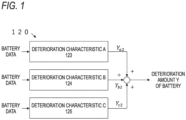
- the deterioration characteristic model 125 receives battery data and calculates a deterioration amount Y c2 of the battery according to a deterioration characteristic C of the battery based on the battery data.
- the battery deterioration amount determination process 120 calculates a battery deterioration amount Y based on the deterioration amount Y a2 according to the deterioration characteristic A, the deterioration amount Y b2 according to the deterioration characteristic B, and the deterioration amount Y c2 according to the deterioration characteristic C.
- the deterioration amount Y of the battery is the sum of the deterioration amount Y a2 , the deterioration amount Y b2 , and the deterioration amount Y c2 .
- the deterioration characteristic model 123 acquires a deterioration amount Y a1 of the battery according to the deterioration characteristic A in a first period, calculates a deterioration amount ⁇ Y a of the battery according to the deterioration characteristic A in a second period subsequent to the first period, and calculates the deterioration amount Y a2 of the battery by adding the deterioration amount ⁇ Y a in the second period to the deterioration amount Y a1 in the first period.
- the deterioration amount Y a2 of the battery is a deterioration amount accumulated over time.
- the deterioration characteristic model 124 acquires the deterioration amount Y b1 of the battery according to the deterioration characteristic B in the first period, calculates a deterioration amount ⁇ Y b of the battery according to the deterioration characteristic B in the second period, and calculates the deterioration amount Y b2 of the battery by adding the deterioration amount ⁇ Y b in the second period to the deterioration amount Y b1 in the first period.
- the deterioration amount Y b2 of the battery is a deterioration amount accumulated over time.
- the deterioration characteristic model 125 acquires a deterioration amount Y c1 of the battery according to the deterioration characteristic C in the first period, calculates a deterioration amount ⁇ Y c of the battery according to the deterioration characteristic C in the second period, and calculates the deterioration amount Y c2 of the battery by adding the deterioration amount ⁇ Y c in the second period to the deterioration amount Y c1 in the first period.
- the deterioration amount Y c2 of the battery is a deterioration amount accumulated over time.
- the deterioration amount Y of the battery is expressed by the following equation.
- Y Y a 2 + Y b 2 + Y c 2
- Y ⁇ Y a + Y a 1 + ⁇ Y b + Y b 1 + ⁇ Y c + Y c 1
- the battery data includes temperature data indicating a temperature T of the battery in the second period, SOC data indicating an SOC of the battery in the second period, and integrated current amount data indicating an integrated current amount ⁇ i due to charging and discharging of the battery in the second period.
- the temperature T of the battery in the second period is a temperature at the beginning of the second period, a temperature at the end of the second period, a temperature in an intermediate period between the beginning and the end of the second period, an average of temperatures in a plurality of periods in the second period, and another temperature representing the second period.
- the SOC of the battery in the second period is an SOC at the beginning of the second period, an SOC at the end of the second period, an SOC in an intermediate period between the beginning and the end of the second period, an average of SOCs in the plurality of periods in the second period, and another SOC representing the second period.
- the integrated current amount ⁇ i in the second period is an integration of currents sampled in the plurality of periods in the second period.
- the deterioration characteristic model 123 defines an upper limit of the deterioration amount Y a2 of the battery.
- the deterioration amount Y a2 of the battery increases by the accumulation over time, and stops increasing when reaching the upper limit.
- the deterioration characteristic model 123 reflects, for example, a deterioration tendency due to electrode material characteristics of the battery.
- the deterioration characteristic model 124 defines an upper limit of the deterioration amount Y b2 of the battery.
- the deterioration amount Y b2 of the battery increases by the accumulation over time, and stops increasing when reaching the upper limit.
- the deterioration characteristic model 124 reflects, for example, a deterioration tendency due to the electrode material characteristics of the battery.
- the upper limit of the deterioration amount Y b2 of the battery is equal to the upper limit of the deterioration amount Y a2 of the battery.
- the upper limit of the deterioration amount Y b2 of the battery is different from the upper limit of the deterioration amount Y a2 of the battery.
- the deterioration characteristic model 125 does not define an upper limit of the deterioration amount Y c2 of the battery.
- the deterioration amount Y c2 of the battery continues to increase by the accumulation over time.
- the upper limit of the deterioration amount Y a2 of the battery may be a fixed value or a variation value.
- the upper limit of the deterioration amount Y b2 of the battery may be a fixed value or a variation value.
- both the upper limit of the deterioration amount Y a2 of the battery and the upper limit of the deterioration amount Y b2 of the battery are variation values.
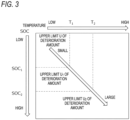
- Fig. 3 shows third map data used to determine the upper limit of the deterioration amount Y a2 of the battery.
- the third map data associates a plurality of temperature candidates, a plurality of SOC candidates, and a plurality of deterioration amount upper limit candidates with one another.
- the third map data associates a temperature T 1 , a SOC 1 , and a deterioration amount upper limit Ui with one another.
- the third map data further associates a temperature T 2 , a SOC 2 , and a deterioration amount upper limit U 2 with one another.
- the temperature T 2 is higher than the temperature T 1 .
- the SOC 2 is higher than the SOCi.
- the deterioration amount upper limit U 2 is larger than the deterioration amount upper limit Ui.
- the deterioration amount Y b2 of the battery may be determined by using map data.
- the map data for determining the deterioration amount Y b2 of the battery is the same as or different from the map data for determining the deterioration amount Y b1 of the battery.
- the deterioration characteristic model 123 includes the following equation for calculating the deterioration amount ⁇ Y a in the second period.
- the deterioration amount ⁇ Y a is proportional to a square root of ⁇ t.
- the deterioration amount ⁇ Y a represents the deterioration amount of the battery due to an elapsed time.
- ⁇ Y a a 1 + exp a 2 + a 3 T ⁇ ⁇ t 1 2 ⁇ A 1 ⁇ A 2
- a coefficient a 1 is a fixed value.
- a coefficient a 2 is a fixed value.
- a coefficient a 3 is a fixed value. In a certain battery, the coefficients a 1 , a 2 , and a 3 are equal. In another battery, the coefficients a 1 , a 2 , and a 3 are different from one another. In still another battery, two of the coefficients a 1 , a 2 , and a 3 are equal.
- ⁇ t is a time length of the second period.
- a first coefficient A1 is a variation value for reflecting a utilization environment of the battery in the second period in the deterioration amount.
- a second coefficient A2 is a variation value for reflecting an electrode deterioration characteristic of the battery in the second period in the deterioration amount.
- the deterioration characteristic model 124 includes the following equation for calculating the deterioration amount ⁇ Y b in the second period.
- the deterioration amount ⁇ Y b is proportional to the square root of ⁇ t.
- the deterioration amount ⁇ Y b represents the deterioration amount of the battery due to the elapsed time.
- ⁇ Y b b 1 + exp b 2 + b 3 T ⁇ ⁇ t 1 2 ⁇ B 1 ⁇ B 2
- a coefficient b 1 is a fixed value.
- a coefficient b 2 is a fixed value.
- a coefficient b 3 is a fixed value.
- the coefficients bi, b 2 , and b 3 are equal.
- the coefficients bi, b 2 , and b 3 are different from one another.
- two of the coefficients bi, b 2 , and b 3 are equal.
- ⁇ t is a time length of the second period.
- a first coefficient B 1 is a variation value for reflecting the utilization environment of the battery in the second period in the deterioration amount.
- a second coefficient B2 is a variation value for reflecting the electrode deterioration characteristic of the battery in the second period in the deterioration amount.
- the deterioration characteristic model 125 includes the following equations for calculating the deterioration amount ⁇ Y c in the second period.
- the deterioration amount ⁇ Y c includes a first term and a second term.
- the first term is proportional to the square root of ⁇ t.
- the first term represents the deterioration amount of the battery due to the elapsed time.
- the second term is proportional to the square root of ⁇ i.
- the second term represents a deterioration amount of the battery (also referred to as a cycle deterioration amount) due to an integrated current amount factor.
- ⁇ Y c c 1 + exp c 2 + c 3 T ⁇ ⁇ t 1 2 ⁇ C 1 + c 4 + exp c 5 + c 6 T ⁇ ⁇ ⁇ i 1 2
- a coefficient c 1 is a fixed value.
- a coefficient c 2 is a fixed value.
- a coefficient c 3 is a fixed value. In a certain battery, the coefficients c 1 , c 2 , and c 3 are equal. In another battery, the coefficients c 1 , c 2 , and c 3 are different from one another. In still another battery, two of the coefficients c 1 , c 2 , and c 3 are equal.
- ⁇ t is a time length of the second period.
- a first coefficient C1 is a variation value for reflecting the utilization environment of the battery in the second period in the deterioration amount. ⁇ i is the integrated current amount in the second period.
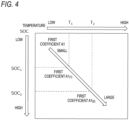
- Fig. 4 shows first map data used to determine the first coefficient A1.
- the first map data associates the plurality of temperature candidates, the plurality of SOC candidates, and a plurality of first coefficient candidates with one another.
- the first map data associates the temperature T 1 , the SOC 1 , and a first coefficient A1 (1) with one another.
- the first map data further associates the temperature T 2 , the SOC 2 , and a first coefficient A1 (2) with one another.
- the temperature T 2 is higher than the temperature T 1 .
- the SOC 2 is higher than the SOCi.
- the first coefficient A1 (2) is larger than the first coefficient A1 (1) .
- the deterioration amount of the battery depends on the temperature of the battery and the SOC of the battery.
- the first map data reflects the utilization environment of the deterioration amount of the battery.
- the first coefficient B1 may be determined by map data.
- the map data for determining the first coefficient B1 is the same as the map data for determining the first coefficient A1.
- the map data for determining the first coefficient B1 is different from the map data for determining the first coefficient Al.
- the first coefficient C1 may be determined by map data.
- the map data for determining the first coefficient C1 is the same as the map data for determining the first coefficient A1.
- the map data for determining the first coefficient C1 is different from the map data for determining the first coefficient Al.
- Fig. 5 shows second map data used to determine the second coefficient A2.
- the second map data associates a plurality of deterioration amount margin candidates with a plurality of second coefficient candidates. For example, the second map data associates a deterioration amount margin M 1 with a second coefficient A2(i).
- the second map data associates a deterioration amount margin M 2 with a second coefficient A2 (2) .
- the deterioration amount margin M 2 is larger than the deterioration amount margin M 1 .
- the second coefficient A2 (2) is larger than the second coefficient A2(i).
- the deterioration amount margin may be calculated based on the upper limit of the battery deterioration amount, the cycle deterioration amount, and the deterioration amount in the first period.
- the deterioration amount margin may be calculated by subtracting the cycle deterioration amount and the deterioration amount in the first period from the upper limit of the battery deterioration amount.
- the deterioration curve according to the deterioration characteristic A approximate to experimental data is selected from among an infinite number of candidates by trial and error or fitting.
- the deterioration curve according to the deterioration characteristic B approximate to the experimental data is selected from among an infinite number of candidates.
- the deterioration curve according to the deterioration characteristic C approximate to the experimental data is selected from among an infinite number of candidates. Accordingly, unified models (deterioration characteristic models 123, 124, and 125) outputting the results approximate to the experimental data are obtained at any of level 1 to level 4.
- the battery includes three characteristics which are the deterioration characteristic A, the deterioration characteristic B, and the deterioration characteristic C.
- the battery is not limited thereto, and may have two characteristics or four or more characteristics.
Landscapes
- Engineering & Computer Science (AREA)
- Chemical & Material Sciences (AREA)
- General Chemical & Material Sciences (AREA)
- Manufacturing & Machinery (AREA)
- Chemical Kinetics & Catalysis (AREA)
- Electrochemistry (AREA)
- Power Engineering (AREA)
- Microelectronics & Electronic Packaging (AREA)
- Materials Engineering (AREA)
- Life Sciences & Earth Sciences (AREA)
- Sustainable Development (AREA)
- Sustainable Energy (AREA)
- Transportation (AREA)
- Mechanical Engineering (AREA)
- Physics & Mathematics (AREA)
- General Physics & Mathematics (AREA)
- Tests Of Electric Status Of Batteries (AREA)
- Secondary Cells (AREA)
Abstract
Description
- The present disclosure relates to a method for determining a battery deterioration amount, a battery management unit, and a battery pack.
-
Patent Literature 1 discloses an estimation device that estimates a deterioration amount of a battery. The estimation device acquires a current capacity retention rate of the battery. When the capacity retention rate is equal to or larger than a threshold, the estimation device calculates the deterioration amount of the battery by using first approximate data. On the other hand, when the capacity retention rate is less than the threshold, the estimation device calculates the deterioration amount of the battery by using second approximate data. - Patent Literature 1:
JP2020-180935A - A deterioration amount of a battery is used to calculate a state of charge (SOC) of the battery. In order to further improve the accuracy of the SOC of the battery, it is preferable to further improve a method for determining a battery deterioration amount.
- The present disclosure provides an improved method for determining a battery deterioration amount, a battery management unit, and a battery pack.
- According to an aspect of the present disclosure, a method for determining a battery deterioration amount includes: (a) a step of acquiring battery data including temperature data indicating a temperature of a battery, SOC data indicating an SOC of the battery, and integrated current amount data indicating an integrated current amount due to charging and discharging of the battery; (b) a step of calculating a first deterioration amount which is a deterioration amount of the battery according to a first deterioration characteristic based on the battery data by using a first deterioration characteristic model; (c) a step of calculating a second deterioration amount which is a deterioration amount of the battery according to a second deterioration characteristic based on the battery data by using a second deterioration characteristic model; and (d) a step of calculating a deterioration amount of the battery based on the first deterioration amount and the second deterioration amount. The first deterioration characteristic model defines an upper limit of the first deterioration amount. The second deterioration characteristic model does not define an upper limit of the second deterioration amount.
- According to another aspect of the present disclosure, a battery management unit executes: (a) a process of acquiring battery data including temperature data indicating a temperature of a battery, SOC data indicating an SOC of the battery, and integrated current amount data indicating an integrated current amount due to charging and discharging of the battery; (b) a process of calculating a first deterioration amount which is a deterioration amount of the battery according to a first deterioration characteristic based on the battery data using a first deterioration characteristic model; (c) a process of calculating a second deterioration amount which is a deterioration amount of the battery according to a second deterioration characteristic based on the battery data using a second deterioration characteristic model; and (d) a process of calculating a deterioration amount of the battery based on the first deterioration amount and the second deterioration amount. The first deterioration characteristic model defines an upper limit of the first deterioration amount. The second deterioration characteristic model does not define an upper limit of the second deterioration amount.
- According to another aspect of the present disclosure, a battery pack includes: a battery; a temperature sensor configured to detect a temperature of the battery and generate temperature data indicating the temperature of the battery; a voltage sensor configured to detect a voltage of the battery and generate voltage data indicating the voltage of the battery; a current sensor configured to detect a current due to charging and discharging of the battery and generate current data indicating the current of the battery; and a battery management unit connected to the temperature sensor, the voltage sensor, and the current sensor. The battery management unit (a) acquires the temperature data from the temperature sensor, (b) acquires the voltage data from the voltage sensor, (c) acquires the current data from the current sensor, (d) generates battery data including the temperature data, SOC data indicating an SOC of the battery, and integrated current amount data indicating an integrated current amount due to charging and discharging of the battery based on the temperature data, the voltage data, and the current data, (e) calculates a first deterioration amount which is a deterioration amount of the battery according to a first deterioration characteristic based on the battery data by using a first deterioration characteristic model, (f) calculates a second deterioration amount which is a deterioration amount of the battery according to a second deterioration characteristic based on the battery data by using a second deterioration characteristic model, and (g) calculates a deterioration amount of the battery based on the first deterioration amount and the second deterioration amount. The first deterioration characteristic model defines an upper limit of the first deterioration amount. The second deterioration characteristic model does not define an upper limit of the second deterioration amount.
- The present disclosure can provide the improved method for determining a battery deterioration amount, the battery management unit, and the battery pack.
-
- [
FIG. 1] Fig. 1 is a functional block diagram showing a battery deterioration amount determination process according to an embodiment of the present disclosure; - [
FIG. 2] Fig. 2 is a functional block diagram showing the battery deterioration amount determination process according to the embodiment of the present disclosure; - [
FIG. 3] Fig. 3 is a diagram showing third map data used to determine an upper limit of a deterioration amount of a battery according to the embodiment of the present disclosure; - [
FIG. 4] Fig. 4 is a diagram showing first map data used to determine a first coefficient for calculating the deterioration amount of the battery according to the embodiment of the present disclosure; - [
FIG. 5] Fig. 5 is a diagram showing second map data used to determine a second coefficient for calculating the deterioration amount of the battery according to the embodiment of the present disclosure; - [
FIG. 6] Fig. 6 is a flowchart showing the battery deterioration amount determination process according to the embodiment of the present disclosure; - [
FIG. 7] Fig. 7 is a diagram for illustrating a process of constructing a deterioration characteristic model of the battery according to the embodiment of the present disclosure; - [
FIG. 8] Fig. 8 is a diagram for illustrating the process of constructing the deterioration characteristic model of the battery according to the embodiment of the present disclosure; - [
FIG. 9] Fig. 9 is a diagram showing a battery deterioration amount calculated by the battery deterioration amount determination process according to the embodiment of the present disclosure and a battery deterioration amount calculated by a battery deterioration amount determination process according to the related art; and - [
FIG. 10] Fig. 10 is a functional block diagram showing an application example of a method for determining a battery deterioration amount according to the embodiment of the present disclosure. -
Fig. 1 shows a battery deterioration amount determination process according to an embodiment of the present disclosure. In the present embodiment, a battery deterioration amount determination process 120 includes deteriorationcharacteristic models characteristic model 123 receives battery data and calculates a deterioration amount Ya2 of a battery according to a deterioration characteristic A of the battery based on the battery data. The deteriorationcharacteristic model 124 receives battery data and calculates a deterioration amount Yb2 of the battery according to a deterioration characteristic B of the battery based on the battery data. The deteriorationcharacteristic model 125 receives battery data and calculates a deterioration amount Yc2 of the battery according to a deterioration characteristic C of the battery based on the battery data. The battery deterioration amount determination process 120 calculates a battery deterioration amount Y based on the deterioration amount Ya2 according to the deterioration characteristic A, the deterioration amount Yb2 according to the deterioration characteristic B, and the deterioration amount Yc2 according to the deterioration characteristic C. Specifically, the deterioration amount Y of the battery is the sum of the deterioration amount Ya2, the deterioration amount Yb2, and the deterioration amount Yc2. - As shown in
Fig. 2 , in the present embodiment, the deteriorationcharacteristic model 123 acquires a deterioration amount Ya1 of the battery according to the deterioration characteristic A in a first period, calculates a deterioration amount ΔYa of the battery according to the deterioration characteristic A in a second period subsequent to the first period, and calculates the deterioration amount Ya2 of the battery by adding the deterioration amount ΔYa in the second period to the deterioration amount Ya1 in the first period. The deterioration amount Ya2 of the battery is a deterioration amount accumulated over time. - Similarly, in the present embodiment, the deterioration
characteristic model 124 acquires the deterioration amount Yb1 of the battery according to the deterioration characteristic B in the first period, calculates a deterioration amount ΔYb of the battery according to the deterioration characteristic B in the second period, and calculates the deterioration amount Yb2 of the battery by adding the deterioration amount ΔYb in the second period to the deterioration amount Yb1 in the first period. The deterioration amount Yb2 of the battery is a deterioration amount accumulated over time. - Similarly, in the present embodiment, the deterioration
characteristic model 125 acquires a deterioration amount Yc1 of the battery according to the deterioration characteristic C in the first period, calculates a deterioration amount ΔYc of the battery according to the deterioration characteristic C in the second period, and calculates the deterioration amount Yc2 of the battery by adding the deterioration amount ΔYc in the second period to the deterioration amount Yc1 in the first period. The deterioration amount Yc2 of the battery is a deterioration amount accumulated over time. - In the present embodiment, the deterioration amount Y of the battery is expressed by the following equation.


- In the present embodiment, the battery data includes temperature data indicating a temperature T of the battery in the second period, SOC data indicating an SOC of the battery in the second period, and integrated current amount data indicating an integrated current amount ΔΣi due to charging and discharging of the battery in the second period.
- The temperature T of the battery in the second period is a temperature at the beginning of the second period, a temperature at the end of the second period, a temperature in an intermediate period between the beginning and the end of the second period, an average of temperatures in a plurality of periods in the second period, and another temperature representing the second period.
- The SOC of the battery in the second period is an SOC at the beginning of the second period, an SOC at the end of the second period, an SOC in an intermediate period between the beginning and the end of the second period, an average of SOCs in the plurality of periods in the second period, and another SOC representing the second period.
- The integrated current amount ΔΣi in the second period is an integration of currents sampled in the plurality of periods in the second period.
- In the present embodiment, the deterioration
characteristic model 123 defines an upper limit of the deterioration amount Ya2 of the battery. The deterioration amount Ya2 of the battery increases by the accumulation over time, and stops increasing when reaching the upper limit. The deteriorationcharacteristic model 123 reflects, for example, a deterioration tendency due to electrode material characteristics of the battery. - Similarly, in the present embodiment, the deterioration
characteristic model 124 defines an upper limit of the deterioration amount Yb2 of the battery. The deterioration amount Yb2 of the battery increases by the accumulation over time, and stops increasing when reaching the upper limit. The deteriorationcharacteristic model 124 reflects, for example, a deterioration tendency due to the electrode material characteristics of the battery. In a certain battery, the upper limit of the deterioration amount Yb2 of the battery is equal to the upper limit of the deterioration amount Ya2 of the battery. In another battery, the upper limit of the deterioration amount Yb2 of the battery is different from the upper limit of the deterioration amount Ya2 of the battery. - In the present embodiment, the deterioration
characteristic model 125 does not define an upper limit of the deterioration amount Yc2 of the battery. The deterioration amount Yc2 of the battery continues to increase by the accumulation over time. - The upper limit of the deterioration amount Ya2 of the battery may be a fixed value or a variation value. The upper limit of the deterioration amount Yb2 of the battery may be a fixed value or a variation value. In the present embodiment, both the upper limit of the deterioration amount Ya2 of the battery and the upper limit of the deterioration amount Yb2 of the battery are variation values.
-
Fig. 3 shows third map data used to determine the upper limit of the deterioration amount Ya2 of the battery. The third map data associates a plurality of temperature candidates, a plurality of SOC candidates, and a plurality of deterioration amount upper limit candidates with one another. For example, the third map data associates a temperature T1, a SOC1, and a deterioration amount upper limit Ui with one another. The third map data further associates a temperature T2, a SOC2, and a deterioration amount upper limit U2 with one another. The temperature T2 is higher than the temperature T1. The SOC2 is higher than the SOCi. The deterioration amount upper limit U2 is larger than the deterioration amount upper limit Ui. Similarly, the deterioration amount Yb2 of the battery may be determined by using map data. The map data for determining the deterioration amount Yb2 of the battery is the same as or different from the map data for determining the deterioration amount Yb1 of the battery. - In the present embodiment, the deterioration
characteristic model 123 includes the following equation for calculating the deterioration amount ΔYa in the second period. The deterioration amount ΔYa is proportional to a square root of Δt. The deterioration amount ΔYa represents the deterioration amount of the battery due to an elapsed time.
- A coefficient a1 is a fixed value. A coefficient a2 is a fixed value. A coefficient a3 is a fixed value. In a certain battery, the coefficients a1, a2, and a3 are equal. In another battery, the coefficients a1, a2, and a3 are different from one another. In still another battery, two of the coefficients a1, a2, and a3 are equal. Δt is a time length of the second period. A first coefficient A1 is a variation value for reflecting a utilization environment of the battery in the second period in the deterioration amount. A second coefficient A2 is a variation value for reflecting an electrode deterioration characteristic of the battery in the second period in the deterioration amount.
- In the present embodiment, the deterioration
characteristic model 124 includes the following equation for calculating the deterioration amount ΔYb in the second period. The deterioration amount ΔYb is proportional to the square root of Δt. The deterioration amount ΔYb represents the deterioration amount of the battery due to the elapsed time.
- A coefficient b1 is a fixed value. A coefficient b2 is a fixed value. A coefficient b3 is a fixed value. In a certain battery, the coefficients bi, b2, and b3 are equal. In another battery, the coefficients bi, b2, and b3 are different from one another. In still another battery, two of the coefficients bi, b2, and b3 are equal. Δt is a time length of the second period. A
first coefficient B 1 is a variation value for reflecting the utilization environment of the battery in the second period in the deterioration amount. A second coefficient B2 is a variation value for reflecting the electrode deterioration characteristic of the battery in the second period in the deterioration amount. - In the present embodiment, the deterioration
characteristic model 125 includes the following equations for calculating the deterioration amount ΔYc in the second period. The deterioration amount ΔYc includes a first term and a second term. The first term is proportional to the square root of Δt. The first term represents the deterioration amount of the battery due to the elapsed time. The second term is proportional to the square root of ΔΣi. The second term represents a deterioration amount of the battery (also referred to as a cycle deterioration amount) due to an integrated current amount factor.
- A coefficient c1 is a fixed value. A coefficient c2 is a fixed value. A coefficient c3 is a fixed value. In a certain battery, the coefficients c1, c2, and c3 are equal. In another battery, the coefficients c1, c2, and c3 are different from one another. In still another battery, two of the coefficients c1, c2, and c3 are equal. Δt is a time length of the second period. A first coefficient C1 is a variation value for reflecting the utilization environment of the battery in the second period in the deterioration amount. ΔΣi is the integrated current amount in the second period.
-
Fig. 4 shows first map data used to determine the first coefficient A1. The first map data associates the plurality of temperature candidates, the plurality of SOC candidates, and a plurality of first coefficient candidates with one another. For example, the first map data associates the temperature T1, the SOC1, and a first coefficient A1(1) with one another. The first map data further associates the temperature T2, the SOC2, and a first coefficient A1(2) with one another. The temperature T2 is higher than the temperature T1. The SOC2 is higher than the SOCi. The first coefficient A1(2) is larger than the first coefficient A1(1). Generally, the deterioration amount of the battery depends on the temperature of the battery and the SOC of the battery. The first map data reflects the utilization environment of the deterioration amount of the battery. - Similarly, the first coefficient B1 may be determined by map data. In a certain battery, the map data for determining the first coefficient B1 is the same as the map data for determining the first coefficient A1. In another battery, the map data for determining the first coefficient B1 is different from the map data for determining the first coefficient Al.
- Similarly, the first coefficient C1 may be determined by map data. In a certain battery, the map data for determining the first coefficient C1 is the same as the map data for determining the first coefficient A1. In another battery, the map data for determining the first coefficient C1 is different from the map data for determining the first coefficient Al.
-
Fig. 5 shows second map data used to determine the second coefficient A2. The second map data associates a plurality of deterioration amount margin candidates with a plurality of second coefficient candidates. For example, the second map data associates a deterioration amount margin M1 with a second coefficient A2(i). The second map data associates a deterioration amount margin M2 with a second coefficient A2(2). The deterioration amount margin M2 is larger than the deterioration amount margin M1. The second coefficient A2(2) is larger than the second coefficient A2(i). - The deterioration amount margin may be calculated based on the upper limit of the battery deterioration amount, the cycle deterioration amount, and the deterioration amount in the first period. For example, the deterioration amount margin may be calculated by subtracting the cycle deterioration amount and the deterioration amount in the first period from the upper limit of the battery deterioration amount.
- In the present embodiment, the second coefficient A2 takes a value within a range of 0 or more and 1 or less. For example, when the deterioration amount margin is zero, the second coefficient A2 is zero. When the second coefficient A2 becomes zero, the deterioration amount ΔYa in the second period becomes zero. Since the deterioration amount ΔYa in the second period becomes zero, the deterioration amount Ya2 of the battery becomes equal to the deterioration amount Ya1 in the first period. That is, when the deterioration amount margin is zero, the increase in the deterioration amount Ya2 of the battery stops.
- Similarly, the second coefficient B2 may be determined by map data. In a certain battery, the map data for determining the second coefficient B2 is the same as the map data for determining the second coefficient A2. In another battery, the map data for determining the second coefficient B2 is different from the map data for determining the second coefficient A2.
- In the present embodiment, similarly to the second coefficient A2, the second coefficient B2 takes a value within a range of 0 or more and 1 or less. For example, when the deterioration amount margin is zero, the second coefficient B2 is zero. When the deterioration amount margin is zero, the increase in the deterioration amount Yb2 of the battery stops.
-
Fig. 6 shows a flow of the battery deterioration amount determination process in the second period. The battery deterioration amount determination process is repeated at a constant sampling cycle. - In step S101, the battery data is acquired. As described above, the battery data includes the temperature data, the SOC data, and the integrated current amount data.
- In step S102, a deterioration amount Ya of the battery according to the deterioration characteristic A is calculated. As described above, the deterioration amount Ya of the battery is calculated based on the battery data by using the deterioration
characteristic model 123. - In step S103, the deterioration amount Yb of the battery according to the deterioration characteristic B is calculated. As described above, the deterioration amount Yb of the battery is calculated based on the battery data by using the deterioration
characteristic model 124. - In step S104, a deterioration amount Yc of the battery according to the deterioration characteristic C is calculated. As described above, the deterioration amount Yc of the battery is calculated based on the battery data by using the deterioration
characteristic model 125. - In step S105, the deterioration amount Y of the battery is calculated based on the deterioration amounts Ya, Yb, and Yc.
-
Figs. 7 and8 show a process of constructing a deterioration characteristic model of the battery. First, deterioration curve data indicating changes over time of the deterioration amount of the battery is obtained by an experiment. The experiment is conducted at a plurality of different levels. For example,level 1 is a combination of a low temperature and a low SOC. Inlevel 1, adeterioration curve 10 is obtained.Level 2 is a combination of the low temperature and a high SOC. Atlevel 2, adeterioration curve 20 is obtained.Level 3 is a combination of a high temperature and the low SOC. Inlevel 3, adeterioration curve 30 is obtained.Level 4 is a combination of the high temperature and the high SOC. Inlevel 4, a deterioration curve 40 is obtained. - As shown in
Fig. 7 , in the present embodiment, each of the deterioration curves 10, 20, 30, and 40 includes two inflection points. That is, each of the deterioration curves 10, 20, 30, and 40 includes a period α having a large slope, a period β having a medium slope, and a period γ having a small slope. However, the deterioration curves 10,20, 30, and 40 are different from each other in terms of the length of each period and the slope in each period. - As shown in
Fig. 8 , thedeterioration curve 10 atlevel 1 is decomposed into a deterioration curve 11 according to the deterioration characteristic A, a deterioration curve 12 according to the deterioration characteristic B, and a deterioration curve 13 according to the deterioration characteristic C. Thedeterioration curve 10 is a sum of the deterioration curve 11, the deterioration curve 12, and the deterioration curve 13. The deterioration curve 11 reaches an upper limit in the period α, and has a slope of zero in the period β and the period γ. The deterioration curve 12 reaches upper limits in the period α and the period β, and has a slope of zero in the period γ. The deterioration curve 13 has no upper limit. There are numerous methods for decomposing thedeterioration curve 10 atlevel 1 into the deterioration curves 11, 12, and 13. That is, there are numerous candidates of the deterioration curve 11. There are numerous candidates of the deterioration curve 12. There are numerous candidates of the deterioration curve 13. - Similarly, the
deterioration curve 20 atlevel 2 is decomposed into a deterioration curve according to the deterioration characteristic A, a deterioration curve according to the deterioration characteristic B, and a deterioration curve according to the deterioration characteristic C. Atlevel 2, there are also numerous candidates of the deterioration curve according to the deterioration characteristic A. There are an infinite number of deterioration curve candidates according to the deterioration characteristic B. There are an infinite number of deterioration curve candidates according to the deterioration characteristic C. The same applies tolevels - At any of
level 1 tolevel 4, the deterioration curve according to the deterioration characteristic A approximate to experimental data is selected from among an infinite number of candidates by trial and error or fitting. Similarly, at any oflevel 1 tolevel 4, the deterioration curve according to the deterioration characteristic B approximate to the experimental data is selected from among an infinite number of candidates. At any oflevel 1 tolevel 4, the deterioration curve according to the deterioration characteristic C approximate to the experimental data is selected from among an infinite number of candidates. Accordingly, unified models (deteriorationcharacteristic models level 1 tolevel 4. - By the trial and error or the fitting, coefficients of the deterioration
characteristic models characteristic models characteristic models characteristic models - In
Fig. 9 , a deterioration curve 131 indicates a battery deterioration amount calculated by a battery deterioration amount determination process according to the related art. For example, in the related art, a slope of the deterioration curve 131 changes when the battery deterioration amount reaches a threshold Yth1 and when the battery deterioration amount reaches a threshold Yth2. Adeterioration curve 132 indicates the battery deterioration amount calculated by the battery deterioration amount determination process according to the present embodiment. Thedeterioration curve 132 may have a different slope for each of the sampling periods S1, S2, S3, S4, S5, and S6. In the sampling period S1, the battery deterioration amount is calculated based on battery data in the sampling period S1. In the sampling period S2, the battery deterioration amount is calculated based on battery data in the sampling period S2. -
Fig. 10 shows an application example of a method for determining a battery deterioration amount according to the embodiment of the present disclosure. The method for determining a battery deterioration amount may be implemented in avehicle 101. Thevehicle 101 is, for example, an electric automobile, a hybrid automobile, a plug-in hybrid automobile capable of external charging or external power feeding, or a vehicle driven by electric power received from other batteries. - The
vehicle 101 may include anengine 102 and agenerator 103. Theengine 102 may include an internal combustion engine that outputs rotational energy. Thegenerator 103 may receive the rotational energy from theengine 102 and generate electric energy based on the rotational energy. - The
vehicle 101 may further include a front motor drive unit (FPDU) 104, abattery pack 105, and afront motor 112. TheFPDU 104 receives the electric energy from thegenerator 103 or thebattery pack 105 via a power line 113, and applies the electric energy to thefront motor 112 via apower line 116. Thefront motor 112 receives the electric energy, converts the electric energy into rotational energy, and gives the rotational energy to front wheels of the vehicle. Thefront motor 112 receives cooling 117 common to thegenerator 103. - The
vehicle 101 may further include an electronic control unit (ECU) 111. TheECU 111 is connected to theFPDU 104 and thebattery pack 105 via data lines 114 and 115, respectively. - The
battery pack 105 may include abattery 106, atemperature sensor 107, avoltage sensor 108, acurrent sensor 109, and a battery management unit (BMU) 110. Thebattery 106 is, for example, a lithium ion battery. Thetemperature sensor 107 detects a temperature of thebattery 106 and generates temperature data indicating the temperature of thebattery 106. Thevoltage sensor 108 detects a voltage of thebattery 106 and generates voltage data indicating the voltage of thebattery 106. Thecurrent sensor 109 detects a current due to charging and discharging of thebattery 106, and generates current data indicating the current of thebattery 106. TheBMU 110 is connected to thetemperature sensor 107, thevoltage sensor 108, and thecurrent sensor 109. TheBMU 110 acquires the temperature data from thetemperature sensor 107, acquires the voltage data from thevoltage sensor 108, and receives the current data from thecurrent sensor 109. TheBMU 110 generates battery data including the temperature data, the SOC data indicating the SOC of thebattery 106, and the integrated current amount data indicating the integrated current amount due to the charging and discharging of thebattery 106 based on the temperature data, the voltage data, and the current data. TheBMU 110 performs the above-described battery deterioration amount determination process to determine a deterioration amount of thebattery 106 based on the battery data. - The
BMU 110 can use the deterioration amount of thebattery 106 to calculate the SOC. TheBMU 110 may generate deterioration amount data indicating the deterioration amount of thebattery 106 and transmit the deterioration amount data to theECU 111. TheECU 111 can receive the deterioration amount data and use the deterioration amount data to calculate a cruising distance of thevehicle 101 based on the deterioration amount of thebattery 106. - The
battery 106 can take different temperatures and different SOCs as the time elapses due to a time zone, a season, a region, a use situation, and other factors. In the battery deterioration amount determination process of the present embodiment, the deterioration amount of thebattery 106 is determined for each sampling period based on the temperature in the sampling period and the SOC in the sampling period. The deterioration amount of thebattery 106 reflects the different temperatures and the different SOCs as time elapses. - In the above embodiment, the battery includes three characteristics which are the deterioration characteristic A, the deterioration characteristic B, and the deterioration characteristic C. However, the battery is not limited thereto, and may have two characteristics or four or more characteristics.
- Although various embodiments have been described above with reference to the drawings, the present invention is not limited to these examples. It is apparent to those skilled in the art that variations or modifications may be conceived within the scope described in the claims, and it is understood that the variations or modifications naturally fall within the technical scope of the present invention. In addition, the components according to the embodiment described above may be freely combined without departing from the spirit of the present invention.
- The present application is based on a Japanese patent application (
Japanese Patent Application No. 2022-039897) filed on March 15, 2022 -
- 101: vehicle
- 102: engine
- 103: generator
- 105: battery pack
- 106: battery
- 107: temperature sensor
- 108: voltage sensor
- 109: current sensor
- 112: front motor
- 113: power line
- 114, 115: data line
- 116: power line
- 117: cooling
- 120: battery deterioration amount determination process
- 123: deterioration characteristic model
- 124: deterioration characteristic model
- 125: deterioration characteristic model
- 131: deterioration curve
- 132: deterioration curve
Claims (11)
- A method for determining a battery deterioration amount comprising:a step of acquiring battery data including temperature data indicating a temperature of a battery, SOC data indicating an SOC of the battery, and integrated current amount data indicating an integrated current amount due to charging and discharging of the battery;a step of calculating a first deterioration amount which is a deterioration amount of the battery according to a first deterioration characteristic based on the battery data by using a first deterioration characteristic model;a step of calculating a second deterioration amount which is a deterioration amount of the battery according to a second deterioration characteristic based on the battery data by using a second deterioration characteristic model; anda step of calculating a deterioration amount of the battery based on the first deterioration amount and the second deterioration amount, whereinthe first deterioration characteristic model defines an upper limit of the first deterioration amount, andthe second deterioration characteristic model does not define an upper limit of the second deterioration amount.
- The method for determining the battery deterioration amount according to claim 1, wherein
calculating the first deterioration amount includes:a step of acquiring first period first deterioration amount data indicating a first period first deterioration amount which is a deterioration amount of the battery according to the first deterioration characteristic in a first period;a step of calculating a second period first deterioration amount which is a deterioration amount of the battery according to the first deterioration characteristic in a second period subsequent to the first period; anda step of adding the second period first deterioration amount to the first period first deterioration amount. - The method for determining the battery deterioration amount according to claim 2, wherein
calculating the second deterioration amount includes:a step of obtaining first period second deterioration amount data indicating a first period second deterioration amount which is a deterioration amount of the battery according to the second deterioration characteristic in the first period,a step of calculating a second period second deterioration amount which is a deterioration amount of the battery according to the second deterioration characteristic in the second period, anda step of adding the second period second deterioration amount to the first period second deterioration amount. - The method for determining the battery deterioration amount according to claim 2 or 3, whereinthe first deterioration characteristic model is a mathematical model including a first coefficient, andcalculating the first deterioration amount includes a step of determining the first coefficient based on the temperature of the battery and the SOC of the battery.
- The method for determining the battery deterioration amount according to claim 4, wherein
determining the first coefficient includes:a step of acquiring first map data in which a plurality of temperature candidates related to the temperature of the battery, a plurality of SOC candidates related to the SOC of the battery, and a plurality of first coefficient candidates related to the first coefficient are associated with one another; anda step of specifying one of the plurality of first coefficient candidates associated with a temperature candidate corresponding to the temperature indicated by the temperature data and an SOC candidate corresponding to the SOC indicated by the SOC data by using the first map data. - The method for determining the battery deterioration amount according to claim 5, whereinthe plurality of temperature candidates include a first temperature and a second temperature higher than the first temperature,the plurality of SOC candidates include a first SOC and a second SOC higher than the first SOC,the plurality of first coefficient candidates include a first candidate associated with a combination of the first temperature and the first SOC and a second candidate associated with a combination of the second temperature and the second SOC, andthe second candidate is larger than the first candidate.
- The method for determining the battery deterioration amount according to claim 4, whereinthe first deterioration characteristic model further includes a second coefficient different from the first coefficient, andcalculating the first deterioration amount further includes:a step of calculating a second period cycle deterioration amount which is a deterioration amount of the battery based on the integrated current amount in the second period; anda step of determining the second coefficient based on a deterioration amount margin obtained by subtracting the second period cycle deterioration amount and the first period first deterioration amount from the upper limit of the first deterioration amount.
- The method for determining the battery deterioration amount according to claim 7, wherein
determining the second coefficient includes:a step of acquiring second map data in which a plurality of deterioration amount margin candidates related to the deterioration amount margin and a plurality of second coefficient candidates related to the second coefficient are associated with one another; anda step of specifying one of the plurality of second coefficient candidates associated with the deterioration amount margin candidate corresponding to the deterioration amount margin by using the second map data. - The method for determining the battery deterioration amount according to claim 8, whereinthe plurality of deterioration amount margin candidates include a first deterioration amount margin and a second deterioration amount margin larger than the first deterioration amount margin,the plurality of second coefficient candidates include a first candidate associated with the first deterioration amount margin and a second candidate associated with the second deterioration amount margin, andthe second candidate is larger than the first candidate.
- A battery management unit being configured to execute:a process of acquiring battery data including temperature data indicating a temperature of a battery, SOC data indicating an SOC of the battery, and integrated current amount data indicating an integrated current amount due to charging and discharging of the battery;a process of calculating a first deterioration amount which is a deterioration amount of the battery according to a first deterioration characteristic based on the battery data by using a first deterioration characteristic model;a process of calculating a second deterioration amount which is a deterioration amount of the battery according to a second deterioration characteristic based on the battery data by using a second deterioration characteristic model; anda process of calculating a deterioration amount of the battery based on the first deterioration amount and the second deterioration amount, whereinthe first deterioration characteristic model defines an upper limit of the first deterioration amount, andthe second deterioration characteristic model does not define an upper limit of the second deterioration amount.
- A battery pack comprising:a battery;a temperature sensor configured to detect a temperature of the battery and generate temperature data indicating the temperature of the battery;a voltage sensor configured to detect a voltage of the battery and generate voltage data indicating the voltage of the battery;a current sensor configured to detect a current due to charging and discharging of the battery and generate current data indicating the current of the battery; anda battery management unit connected to the temperature sensor, the voltage sensor, and the current sensor, whereinthe battery management unit is configured to:acquire the temperature data from the temperature sensor;acquire the voltage data from the voltage sensor;acquire the current data from the current sensor;generate battery data including the temperature data, SOC data indicating an SOC of the battery, and integrated current amount data indicating an integrated current amount due to charging and discharging of the battery based on the temperature data, the voltage data, and the current data;calculate a first deterioration amount which is a deterioration amount of the battery according to a first deterioration characteristic based on the battery data by using a first deterioration characteristic model;calculate a second deterioration amount which is a deterioration amount of the battery according to a second deterioration characteristic based on the battery data by using a second deterioration characteristic model; andcalculate a deterioration amount of the battery based on the first deterioration amount and the second deterioration amount,the first deterioration characteristic model defines an upper limit of the first deterioration amount, andthe second deterioration characteristic model does not define an upper limit of the second deterioration amount.
Applications Claiming Priority (2)
| Application Number | Priority Date | Filing Date | Title |
|---|---|---|---|
| JP2022039897 | 2022-03-15 | ||
| PCT/JP2023/007241 WO2023176423A1 (en) | 2022-03-15 | 2023-02-28 | Battery degradation amount determination method, battery management unit, and battery pack |
Publications (2)
| Publication Number | Publication Date |
|---|---|
| EP4488700A1 true EP4488700A1 (en) | 2025-01-08 |
| EP4488700A4 EP4488700A4 (en) | 2026-03-18 |
Family
ID=88023545
Family Applications (1)
| Application Number | Title | Priority Date | Filing Date |
|---|---|---|---|
| EP23770381.4A Pending EP4488700A4 (en) | 2022-03-15 | 2023-02-28 | METHOD FOR DETERMINING THE AMOUNT OF BATTERY DECAY, BATTERY MANAGEMENT UNIT AND BATTERY PACK |
Country Status (3)
| Country | Link |
|---|---|
| EP (1) | EP4488700A4 (en) |
| JP (1) | JP7517614B2 (en) |
| WO (1) | WO2023176423A1 (en) |
Family Cites Families (12)
| Publication number | Priority date | Publication date | Assignee | Title |
|---|---|---|---|---|
| US8407018B2 (en) * | 2009-03-24 | 2013-03-26 | American Power Conversion Corporation | Battery life estimation |
| FR3009093B1 (en) * | 2013-07-29 | 2017-01-13 | Renault Sa | ESTIMATING THE AGING CONDITION OF AN ELECTRIC BATTERY |
| KR102177721B1 (en) * | 2014-03-20 | 2020-11-11 | 현대모비스 주식회사 | Apparatus and Method for estimating deterioration of battery pack |
| JP6206370B2 (en) * | 2014-10-01 | 2017-10-04 | トヨタ自動車株式会社 | Battery deterioration judgment device |
| EP3306735B1 (en) * | 2015-05-29 | 2019-07-10 | Nissan Motor Co., Ltd. | Device for estimating degree of battery degradation, and estimation method |
| CN110998344B (en) * | 2017-07-31 | 2022-05-06 | 日产自动车株式会社 | Deterioration state computing method and deterioration state computing device |
| JP7163571B2 (en) * | 2017-10-03 | 2022-11-01 | 株式会社Gsユアサ | Deterioration amount estimation device, power storage system, deterioration amount estimation method, and computer program |
| AT521643B1 (en) * | 2018-08-31 | 2020-09-15 | Avl List Gmbh | Method and battery management system for determining a state of health of a secondary battery |
| JP7088066B2 (en) | 2019-02-15 | 2022-06-21 | トヨタ自動車株式会社 | Vehicle dispatch system |
| JP7363086B2 (en) | 2019-04-26 | 2023-10-18 | 株式会社Gsユアサ | Estimation device, estimation method |
| US11815557B2 (en) | 2019-09-09 | 2023-11-14 | Battelle Energy Alliance, Llc | Systems and methods for managing energy storage operations |
| JP7103608B2 (en) | 2020-08-27 | 2022-07-20 | テクニカ合同株式会社 | Manufacturing method of recycled material using unused ready-mixed concrete |
-
2023
- 2023-02-28 EP EP23770381.4A patent/EP4488700A4/en active Pending
- 2023-02-28 WO PCT/JP2023/007241 patent/WO2023176423A1/en not_active Ceased
- 2023-02-28 JP JP2023539930A patent/JP7517614B2/en active Active
Also Published As
| Publication number | Publication date |
|---|---|
| WO2023176423A1 (en) | 2023-09-21 |
| JPWO2023176423A1 (en) | 2023-09-21 |
| JP7517614B2 (en) | 2024-07-17 |
| EP4488700A4 (en) | 2026-03-18 |
Similar Documents
| Publication | Publication Date | Title |
|---|---|---|
| US8170818B2 (en) | Battery state estimator using multiple sampling rates | |
| US9187007B2 (en) | Online battery capacity estimation | |
| US8207706B2 (en) | Method of estimating battery state of charge | |
| KR102452548B1 (en) | Apparatus for determination battery degradation, system having the same and method thereof | |
| US9533597B2 (en) | Parameter identification offloading using cloud computing resources | |
| US9428071B2 (en) | Impedance based battery parameter estimation | |
| CN104773086B (en) | The method and system of battery impedance parameter is estimated using rolling time horizon regression analysis | |
| EP2804249B1 (en) | Method for controlling and device for controlling secondary battery | |
| US20160011274A1 (en) | Battery life estimation method and battery life estimation apparatus | |
| EP2107385A1 (en) | State estimating device for secondary battery | |
| US10124696B2 (en) | Estimation and compensation of battery measurement and asynchronization biases | |
| CN104335057B (en) | Method and apparatus for determining the actual capacity of a battery | |
| CN113484763A (en) | Method, device, equipment and storage medium for determining residual electric quantity of battery | |
| EP2851699A1 (en) | Battery system and polarization determination method for secondary battery | |
| CN105319509A (en) | System and method for battery open circuit voltage estimation | |
| EP3726639A1 (en) | Rechargeable battery temperature estimation device and rechargeable battery temperature estimation method | |
| CN110275118A (en) | A kind of power-type power battery health status evaluation method | |
| CN104723894A (en) | Vehicle, method, and system for battery parameter estimation | |
| JP2022026770A (en) | Li PRECIPITATION SUPPRESSION CONTROL METHOD OF LITHIUM ION SECONDARY BATTERY, AND CONTROL APPARATUS OF THE LITHIUM ION SECONDARY BATTERY | |
| Ramu et al. | The effects of fast and normal charging, driving cycle, and a 24-hour regional climate on the performance of electric vehicle batteries | |
| CN110542866B (en) | Method for estimating residual electric quantity parameter of battery | |
| EP3756937A1 (en) | Apparatus and method for estimating soc | |
| JP7280211B2 (en) | Method for measuring side reaction current value of secondary battery, method for estimating cell life of secondary battery, inspection method | |
| CN105313715B (en) | For maintaining to estimate the system and method for battery capacity during use in electricity | |
| Finley | Battery degradation modeling for vehicle applications |
Legal Events
| Date | Code | Title | Description |
|---|---|---|---|
| STAA | Information on the status of an ep patent application or granted ep patent |
Free format text: STATUS: THE INTERNATIONAL PUBLICATION HAS BEEN MADE |
|
| PUAI | Public reference made under article 153(3) epc to a published international application that has entered the european phase |
Free format text: ORIGINAL CODE: 0009012 |
|
| STAA | Information on the status of an ep patent application or granted ep patent |
Free format text: STATUS: REQUEST FOR EXAMINATION WAS MADE |
|
| 17P | Request for examination filed |
Effective date: 20241003 |
|
| AK | Designated contracting states |
Kind code of ref document: A1 Designated state(s): AL AT BE BG CH CY CZ DE DK EE ES FI FR GB GR HR HU IE IS IT LI LT LU LV MC ME MK MT NL NO PL PT RO RS SE SI SK SM TR |
|
| DAV | Request for validation of the european patent (deleted) | ||
| DAX | Request for extension of the european patent (deleted) | ||
| A4 | Supplementary search report drawn up and despatched |
Effective date: 20260217 |
|
| RIC1 | Information provided on ipc code assigned before grant |
Ipc: G01R 31/392 20190101AFI20260211BHEP Ipc: G01R 31/374 20190101ALI20260211BHEP Ipc: G01R 31/3828 20190101ALI20260211BHEP Ipc: G01R 31/385 20190101ALI20260211BHEP Ipc: H01M 10/42 20060101ALI20260211BHEP Ipc: H01M 10/48 20060101ALI20260211BHEP Ipc: H02J 7/00 20060101ALI20260211BHEP Ipc: G01R 31/367 20190101ALI20260211BHEP Ipc: H01M 10/0525 20100101ALI20260211BHEP Ipc: H02J 7/82 20260101ALI20260211BHEP Ipc: H02J 7/84 20260101ALI20260211BHEP |