EP4488016A1 - Learning device, control device, learning method, and storage medium - Google Patents
Learning device, control device, learning method, and storage medium Download PDFInfo
- Publication number
- EP4488016A1 EP4488016A1 EP22929722.1A EP22929722A EP4488016A1 EP 4488016 A1 EP4488016 A1 EP 4488016A1 EP 22929722 A EP22929722 A EP 22929722A EP 4488016 A1 EP4488016 A1 EP 4488016A1
- Authority
- EP
- European Patent Office
- Prior art keywords
- learning
- search point
- control
- evaluation
- unit
- Prior art date
- Legal status (The legal status is an assumption and is not a legal conclusion. Google has not performed a legal analysis and makes no representation as to the accuracy of the status listed.)
- Withdrawn
Links
Images










Classifications
-
- B—PERFORMING OPERATIONS; TRANSPORTING
- B25—HAND TOOLS; PORTABLE POWER-DRIVEN TOOLS; MANIPULATORS
- B25J—MANIPULATORS; CHAMBERS PROVIDED WITH MANIPULATION DEVICES
- B25J9/00—Program-controlled manipulators
- B25J9/16—Program controls
- B25J9/1628—Program controls characterised by the control loop
- B25J9/163—Program controls characterised by the control loop learning, adaptive, model based, rule based expert control
-
- G—PHYSICS
- G05—CONTROLLING; REGULATING
- G05B—CONTROL OR REGULATING SYSTEMS IN GENERAL; FUNCTIONAL ELEMENTS OF SUCH SYSTEMS; MONITORING OR TESTING ARRANGEMENTS FOR SUCH SYSTEMS OR ELEMENTS
- G05B13/00—Adaptive control systems, i.e. systems automatically adjusting themselves to have a performance which is optimum according to some preassigned criterion
- G05B13/02—Adaptive control systems, i.e. systems automatically adjusting themselves to have a performance which is optimum according to some preassigned criterion electric
- G05B13/04—Adaptive control systems, i.e. systems automatically adjusting themselves to have a performance which is optimum according to some preassigned criterion electric involving the use of models or simulators
- G05B13/048—Adaptive control systems, i.e. systems automatically adjusting themselves to have a performance which is optimum according to some preassigned criterion electric involving the use of models or simulators using a predictor
-
- B—PERFORMING OPERATIONS; TRANSPORTING
- B25—HAND TOOLS; PORTABLE POWER-DRIVEN TOOLS; MANIPULATORS
- B25J—MANIPULATORS; CHAMBERS PROVIDED WITH MANIPULATION DEVICES
- B25J9/00—Program-controlled manipulators
- B25J9/16—Program controls
- B25J9/1656—Program controls characterised by programming, planning systems for manipulators
-
- G—PHYSICS
- G05—CONTROLLING; REGULATING
- G05B—CONTROL OR REGULATING SYSTEMS IN GENERAL; FUNCTIONAL ELEMENTS OF SUCH SYSTEMS; MONITORING OR TESTING ARRANGEMENTS FOR SUCH SYSTEMS OR ELEMENTS
- G05B13/00—Adaptive control systems, i.e. systems automatically adjusting themselves to have a performance which is optimum according to some preassigned criterion
- G05B13/02—Adaptive control systems, i.e. systems automatically adjusting themselves to have a performance which is optimum according to some preassigned criterion electric
- G05B13/0265—Adaptive control systems, i.e. systems automatically adjusting themselves to have a performance which is optimum according to some preassigned criterion electric the criterion being a learning criterion
- G05B13/027—Adaptive control systems, i.e. systems automatically adjusting themselves to have a performance which is optimum according to some preassigned criterion electric the criterion being a learning criterion using neural networks only
-
- G—PHYSICS
- G05—CONTROLLING; REGULATING
- G05B—CONTROL OR REGULATING SYSTEMS IN GENERAL; FUNCTIONAL ELEMENTS OF SUCH SYSTEMS; MONITORING OR TESTING ARRANGEMENTS FOR SUCH SYSTEMS OR ELEMENTS
- G05B13/00—Adaptive control systems, i.e. systems automatically adjusting themselves to have a performance which is optimum according to some preassigned criterion
- G05B13/02—Adaptive control systems, i.e. systems automatically adjusting themselves to have a performance which is optimum according to some preassigned criterion electric
- G05B13/04—Adaptive control systems, i.e. systems automatically adjusting themselves to have a performance which is optimum according to some preassigned criterion electric involving the use of models or simulators
- G05B13/042—Adaptive control systems, i.e. systems automatically adjusting themselves to have a performance which is optimum according to some preassigned criterion electric involving the use of models or simulators in which a parameter or coefficient is automatically adjusted to optimise the performance
-
- G—PHYSICS
- G06—COMPUTING OR CALCULATING; COUNTING
- G06N—COMPUTING ARRANGEMENTS BASED ON SPECIFIC COMPUTATIONAL MODELS
- G06N20/00—Machine learning
-
- G—PHYSICS
- G05—CONTROLLING; REGULATING
- G05B—CONTROL OR REGULATING SYSTEMS IN GENERAL; FUNCTIONAL ELEMENTS OF SUCH SYSTEMS; MONITORING OR TESTING ARRANGEMENTS FOR SUCH SYSTEMS OR ELEMENTS
- G05B2219/00—Program-control systems
- G05B2219/30—Nc systems
- G05B2219/39—Robotics, robotics to robotics hand
- G05B2219/39244—Generic motion control operations, primitive skills each for special task
Definitions
- the present invention relates to a learning device, a control device, a learning method, and a recording medium.
- a system has been proposed that, in a case of performing a control of a robot that is necessary for executing a task, performs the control of the robot by providing a skill in which the operation of the robot has been modularized.
- Patent Document 1 a technique is disclosed where, in a system in which an articulated robot executes a given task, the skills of the robot that can be selected according to a task are defined as a tuple, and the parameters included in the tuple are updated by learning.
- Patent Document 1 PCT International Publication No. WO2018/219943
- An example object of the present disclosure is to provide a learning device, a control device, a learning method, and a recording medium that are capable of solving the above problem.
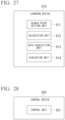
- a learning device includes: a search point setting means for selecting, from among search points indicating an operation of a control target, a search point to be subjected to training data acquisition for learning of a control of the control target; a calculation means for calculating information indicating an evaluation of whether or not an operation indicated by the selected search point is executable, and an output value for the operation indicated by the selected search point to be output by a control means for controlling the control target; a data acquisition means for acquiring, based on the selected search point, the information indicating the evaluation of whether or not the operation indicated by the selected search point is executable, and the output value for the operation indicated by the selected search point to be output by the control means, training data for learning a control of the control target that is performed by the control means; and an evaluation means for determining, based on an evaluation of an acquisition status of the training data, whether or not to continue acquiring the training data.
- a control device includes: a control means that performs a control of a robot according to a shape of a gripping target object, such that gripping target objects having different sizes are each gripped by the robot.
- a learning method is executed by a computer and includes: selecting, from among search points indicating an operation of a control target, a search point to be subjected to training data acquisition for learning of a control of the control target; calculating information indicating an evaluation of whether or not an operation indicated by the selected search point is executable, and an output value for the operation indicated by the selected search point to be output by a control means for controlling the control target; acquiring, based on the selected search point, the information indicating the evaluation of whether or not the operation indicated by the selected search point is executable, and the output value for the operation indicated by the selected search point to be output by the control means, training data for learning a control of the control target that is performed by the control means; and determining, based on an evaluation of an acquisition status of the training data, whether or not to continue acquiring the training data.
- a recording medium stores a program that causes a computer to execute: selecting, from among search points indicating an operation of a control target, a search point to be subjected to training data acquisition for learning of a control of the control target; calculating information indicating an evaluation of whether or not an operation indicated by the selected search point is executable, and an output value for the operation indicated by the selected search point to be output by a control means for controlling the control target; acquiring, based on the selected search point, the information indicating the evaluation of whether or not the operation indicated by the selected search point is executable, and the output value for the operation indicated by the selected search point to be output by the control means, training data for learning a control of the control target that is performed by the control means; and determining, based on an evaluation of an acquisition status of the training data, whether or not to continue acquiring the training data.
- the present invention if it is possible to determine whether or not it is necessary to continue the learning when learning a control of a control target, it is expected that the learning can be performed efficiently.
- FIG. 1 is a diagram showing an example of a configuration of a control system according to a first example embodiment.
- the control system 100 includes a learning device 1, a storage device 2, a robot controller 3, a measurement device 4, and a robot 5.
- the learning device 1 performs data communication with the storage device 2 via a communication network or by direct wireless or wired communication.
- the robot controller 3 performs data communication with the storage device 2, the measurement device 4, and the robot 5 via a communication network or by direct wireless or wired communication.
- the learning device 1 learns the operations of the robot 5 for executing a given task by, for example, machine learning such as self-supervised learning (SSL). Moreover, the learning device 1 learns a set of states in which the operations that are learned can be executed.
- machine learning such as self-supervised learning (SSL).
- the target of the operations that are learned by the learning device 1 is not limited to a specific target, and can be various control targets that can be controlled and whose control can be learned.
- the operations of a control target such as the robot 5 are not limited to operations that involve a change in position.
- an operation in which the robot 5 uses a sensor to acquire sensor measurement data may be set as one of the operations of the robot 5.
- the state referred to here is the state of a target system that includes the robot 5 and an operating environment of the robot 5.
- the robot 5 and the operating environment of the robot 5 are collectively referred to as a target system, or simply a system.
- a target system or simply a system.
- a task involves handling a target object, such as a task of gripping an object, it is assumed that the target object of the task is also included in the target system.
- the state at the completion of skill execution corresponds to the target state.
- the system state at the start of a task is also referred to as an initial state of the task.
- the learning device 1 performs learning relating to a skill in which specific operations of the robot 5 are modularized for each operation. In the example embodiments, it is assumed that a task can be accomplished by executing a single skill with respect to a single task, and an example will be described in which the learning device 1 learns a skill to accomplish a task.
- the learning device 1 In the learning relating to a skill, the learning device 1 also learns a set of states in which the skill can be executed.
- the learning device 1 registers information relating to skills that have been learned in a skill database stored in the storage device 2.
- the information registered in the skill database is also referred to as a skill tuple.
- the skill tuple includes various information necessary to execute an operation that is to be modularized.
- the learning device 1 generates the skill tuple based on detailed system model information, low-level controller information, and target parameter information stored in the storage device 2.
- the storage device 2 stores information that is referenced by the learning device 1 and the robot controller 3.
- the storage device 2 stores, for example, detailed system model information, low-level controller information, target parameter information, and the skill database.
- the storage device 2 may be an external storage device such as a hard disk that is connected to, or built into, the learning device 1 or the robot controller 3, a storage medium such as a flash memory, or a server device or the like that performs data communication with the learning device 1 and the robot controller 3.
- the storage device 2 may be configured by a plurality of storage devices, and each of the storage units described above may be held in a distributed manner.
- the detailed system model information is information representing a model of the target system in real space.
- a model of the target system in real space is also called a detailed system model.
- Such a model is referred to as a "detailed” system model in order to make a distinction with an "abstract” system model, which is an abstraction of the detailed system model.
- variable parts of a task are referred to as the task parameters.
- known task parameters those expressed by numerical values are referred to as known task parameters.
- known task parameters include the size of the target object in the task, such as the size of the gripping target object in a case where the task is to grip the target object, and the trajectory of the robot 5 for executing the task. However, it is not limited to this.
- the known task parameters can also be treated as parameters in a skill.
- a known task parameter corresponds to an example of a skill parameter.
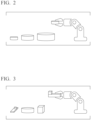
- FIG. 2 is a diagram showing an example of a known task parameter.
- FIG. 2 shows a case where the robot 5 executes the task of gripping target objects having a cylindrical shape.
- the radius and height of the cylinders representing the target objects correspond to examples of a known task parameter.
- unknown task parameters include the shape of the target object in the task, such as the shape of the gripping target object in a case where the task is to grip the target object, and the type of operation performed by the robot 5 to execute the task, such as the skill required to execute the task. However, it is not limited to this.
- FIG. 3 is a diagram showing an example of an unknown task parameter.
- FIG. 3 shows a case where the robot 5 executes the task of gripping target objects having a variety of shapes.
- the shapes of the target objects correspond to examples of an unknown task parameter.
- control system 100 handles the system state in a numerical form, and the target state is expressed as a numerical value.
- the target state may be expressed by the coordinates of the target object being within a predetermined range.
- the initial state information is information indicating a set of states in which the target skill can be executed.
- the state at the start of execution of a skill is also referred to as an initial state of the skill, or simply an initial state.
- a set of initial states is also referred to as an initial state set.
- the initial state is represented by x s or x si .
- "i" is a positive integer representing an identification number that identifies the initial state.
- the time of the initial state is 0, and the initial state is sometimes expressed as x 0 .
- the target state/known task parameter information is information representing a set of combinations of the possible values of the target state, which is a state that can be reached by executing the target skill, and the possible values of the known task parameter, which is treated as an explicit parameter of the target skill.
- the target state may include, as possible values, information relating to stable gripping conditions such as a form closure or a force closure.
- a combination of a target state and a known task parameter value is referred to as a target state/known task parameter value, and is represented by ⁇ g or ⁇ gi .
- i is a positive integer representing an identification number that identifies the target state/known task parameter value.
- the learning device 1 performs processing relating to learning a skill using a predictor
- the predictor is configured using a learning model (machine learning model), such as a neural network or a Gaussian process.
- the target state/known task parameter information may be configured as a set of possible values of the target state.
- the target state/known task parameter value ⁇ g may represent the target state.
- the unknown task parameter information is information relating to an unknown task parameter.
- a probability distribution of data relating to the unknown parameter may be represented in the unknown task parameter information.
- information relating to each unknown task parameter may be represented in the unknown task parameter information.
- the handling of the target state/known task parameter information will be described.
- the value corresponding to an unknown task parameter may be represented by a fixed value.
- An unknown task parameter value is represented by ⁇ or ⁇ j .
- "j" is a positive integer representing an identification number that identifies the unknown task parameter value.
- a task may be expressed by ⁇ or ⁇ j .
- the "j" mentioned above can also be interpreted as a positive integer representing an identification number that identifies a task.
- the execution time information is information relating to a time limit when executing a skill.
- the execution time information may indicate the execution time of the skill (the time taken to execute the skill), an allowed condition value for the time from the start to the completion of skill execution, or both.
- the general constraint information is information indicating the general constraint conditions, such as conditions relating to limits on the range of motion, limits on the speed, and limits on the inputs to the robot 5.
- the skill database is a database of skill tuples prepared for each skill.
- a skill tuple may include information relating to a high-level controller for executing the target skill, information relating to a low-level controller for executing the target skill, and information relating to a set of combinations of states (initial states of the skill) and target state/known task parameter values in which the target skill can be executed.
- the set of states and target state/known task parameter values in which the skill can be executed is also referred to as an executable state set.
- the executable state set may be defined in an abstract space, which is an abstraction of an actual space.
- the executable state set can be represented by a Gaussian process regression (GPR), a level set function estimated by a level set estimation (LSE), or an approximation function of a level set function.
- GPR Gaussian process regression
- LSE level set estimation
- an approximation function of a level set function it can be determined whether or not the executable state set includes a certain combination of a state and a target state/known task parameter value based on, whether or not the value (such as an average value) of a Gaussian process regression for the certain combination of the state and the target state/known task parameter value, or the value of an approximation function for the certain combination of the state and the target state/known task parameter value, satisfies a constraint condition that determines the executability.
- the robot controller 3 formulates an operation plan of the robot 5 based on a measurement signal supplied by the measurement device 4, the skill database, and the like.
- the robot controller 3 generates a control command (control input) for causing the robot 5 to execute the planned operation, and supplies the control command to the robot 5.
- the robot controller 3 converts a task to be executed by the robot 5 into a sequence of tasks that can be accepted by the robot 5 at each time step (time interval). Then, the robot controller 3 controls the robot 5 based on control commands corresponding to the execution commands of the generated sequence.
- the control commands correspond to the control inputs that are output by the low-level controller.
- the measurement device 4 represents one or more sensors, such as a camera, a range sensor, a sonar, or a combination thereof, that detects the state within a workspace in which the robot 5 executes tasks.
- the measurement device 4 supplies the measurement signals that have been generated, to the robot controller 3.
- the measurement device 4 may be a self-propelled or flying sensor (including a drone) that moves within the workspace.
- the measurement device 4 may include a sensor provided on the robot 5, a sensor provided on another object within the workspace, and the like.
- the measurement device 4 may include a sensor that detects sounds within the workspace. In this way, the measurement device 4 is a variety of sensors that detect the state within the workspace, and may include sensors provided at arbitrary locations.
- the configuration of the control system 100 shown in FIG. 1 is an example, and various changes may be made to the configuration.
- the robot controller 3 and the robot 5 may be integrally configured.
- at least any two of the learning device 1, the storage device 2, and the robot controller 3 may be integrally configured.
- control target of the control system 100 is not limited to being a robot.
- Various control targets in which a control can be learned by the learning device 1 can serve as the control target of the control system 100.
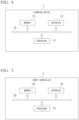
- FIG. 4 is a diagram showing an example of the hardware configuration of the learning device 1.
- the learning device 1 includes, as hardware, a processor 11, a memory 12, and an interface 13.
- the processor 11, the memory 12, and the interface 13 are connected via a data bus 10.
- the processor 11 functions as a controller (arithmetic device) that controls the entire learning device 1 by executing a program stored in the memory 12.
- the processor 11 is, for example, a processor such as a CPU (central processing unit), a GPU (graphics processing unit), or a TPU (tensor processing unit).
- the processor 11 may be configured by a plurality of processors.
- the processor 11 corresponds to an example of a computer.
- the memory 12 is configured by various types of volatile memory and non-volatile memory, such as a RAM (random access memory), a ROM (read only memory), and a flash memory. Furthermore, the memory 12 stores a program for executing the processing executed by the learning device 1. A portion of the information stored in the memory 12 may be stored in one or more external storage devices (for example, the storage device 2) that are capable of communicating with the learning device 1, or may be stored on a recording medium that is detachable from the learning device 1.
- the storage device 2 for example, the storage device 2 that are capable of communicating with the learning device 1, or may be stored on a recording medium that is detachable from the learning device 1.
- the interface 13 is an interface for electrically connecting the learning device 1 and other devices.
- the interface may be a wireless interface such as a network adapter for wirelessly transmitting and receiving data with respect to the other devices, or may be a hardware interface for connecting to the other devices via a cable or the like.
- the interface 13 may perform interface operations with input devices that accept user input (external input), such as a touch panel, a button, a keyboard, or a voice input device, or display devices such as a display or projector, and sound output devices such as a speaker.
- the hardware configuration of the learning device 1 is not limited to the configuration shown in FIG. 4 .
- at least one of a display device, an input device, and a sound output device may be built into the learning device 1.
- the learning device 1 may be configured to include the storage device 2.
- FIG. 5 is a diagram showing a hardware configuration of the robot controller 3.
- the robot controller 3 includes, as hardware, a processor 31, a memory 32, and an interface 33.
- the processor 31, the memory 32, and the interface 33 are connected via a data bus 30.
- the processor 31 functions as a controller (arithmetic device) that controls the entire robot controller 3 by executing a program stored in the memory 32.
- the processor 31 is, for example, a CPU, a GPU, or a TPU.
- the processor 31 may be configured by a plurality of processors.
- the memory 32 is configured by various types of volatile memory and non-volatile memory, such as a RAM, a ROM, and a flash memory. Furthermore, the memory 32 stores a program for executing the processing executed by the robot controller 3. A portion of the information stored in the memory 32 may be stored in one or more external storage devices (for example, the storage device 2) that are capable of communicating with the robot controller 3, or may be stored on a recording medium that is detachable from the robot controller 3.
- the storage device 2 for example, the storage device 2 that are capable of communicating with the robot controller 3, or may be stored on a recording medium that is detachable from the robot controller 3.
- the robot controller 3 formulates an operation plan of the robot 5 in an abstract space based on a skill tuple. Therefore, the abstract space subjected to operation planning of the robot 5 will be described.
- FIG. 6 is a diagram illustrating the robot (manipulator) 5 that grips an object, and the gripping target object 6 in real space.
- the robot controller 3 formulates an operation plan in an abstract space that abstractly (simply) represents the state of each object, such as the robot 5 and the gripping target object 6.
- an abstract space that abstractly (simply) represents the state of each object, such as the robot 5 and the gripping target object 6.
- the abstract space defines an abstract model 5x corresponding to the end effector of the robot 5, an abstract model 6x corresponding to the gripping target object 6, and a gripping operation executable region (see dashed line frame 60) of the gripping target object 6 by the robot 5.
- the executable state set is similarly represented as a set of combinations of the initial state and the target state/known task parameter value in which the skill can be executed.
- the set of combinations of the initial state and the target state/known task parameter value in which the gripping skill can be executed is illustrated as the gripping operation executable region indicated by the dashed line frame 60.
- the state of the robot in the abstract space abstractly represents the state of the end effector and the like. Furthermore, the state of each object corresponding to the operation target object and the environmental objects is also abstractly represented in a coordinate system or the like, which is based on a reference object such as a workbench.
- the robot controller 3 uses skills to formulate an operation plan in an abstract space, which is an abstraction of the actual system. As a result, the computational costs required for operation planning can be preferably suppressed, even for multi-stage tasks.
- the robot controller 3 formulates an operation plan that executes the skills for executing gripping in a grippable region (dashed line frame 60) defined in the abstract space, and generates the control commands of the robot 5 based on the formulated operation plan.
- the state of the system in real space is denoted by "x”
- the state of the system in an abstract space is denoted by "x'”
- the state x' is represented as a vector (abstract state vector).
- the abstract state vector includes a vector representing the state of the operation target object (such as the position, the posture, and the speed), a vector representing the state of the end effector of the robot 5 that can be operated, and a vector representing the state of the environmental objects.
- the state x' is defined as a state vector that abstractly represents the state of some of the elements in the real system.
- the target state/known task parameter value in real space is denoted by “ ⁇ g "
- the target state/known task parameter value in an abstract space is denoted by “ ⁇ g '”
- FIG. 8 is a diagram showing an example of the configuration of a control system relating to execution of a skill.
- the processor 31 of the robot controller 3 functionally includes an operation planning unit 34, a high-level control unit 35, and a low-level control unit 36.
- the system 50 corresponds to an actual system (a real system including the robot 5).
- the high-level control unit 35 is also referred to as a high-level controller, and is represented by ⁇ II .
- the high-level control unit 35 corresponds to an example of a control means.
- the low-level control unit 36 is also referred to as a low-level controller, and is represented by ⁇ L .
- the robot controller 3 corresponds to an example of a control device that controls the robot 5.
- an inset showing the diagram illustrating the abstract space targeted by the operation planning unit 34 is displayed in association with the operation planning unit 34
- an inset showing the diagram illustrating the real system corresponding to the system 50 is displayed in association with the system 50.
- an inset showing information relating to the executable state set of a skill is displayed in association with the high-level control unit 35.
- the operation planning unit 34 formulates an operation plan of the robot 5 based on the state x' of the abstract system and the skill database.
- the operation planning unit 34 expresses the target state by a logical expression based on temporal logic.
- the operation planning unit 34 may express the logical expression using any type of temporal logic, such as linear temporal logic, metric temporal logic (MTL), or signal temporal logic (STL).
- the operation planning unit 34 converts the generated logical expression into a sequence (operation sequence) for each time step.
- the operation sequence includes, for example, information relating to the skill to be used at each time step.
- the high-level control unit 35 recognizes the skill to be executed at each time step based on the operation sequence generated by the operation planning unit 34. Further, the high-level control unit 35 generates a parameter " ⁇ ", which becomes an input to the low-level control unit 36, based on the high-level controller " ⁇ H " included in the skill tuple corresponding to the skill to be executed in the current time step.
- the initial state is represented, for example, as a state in the abstract space.
- the robot controller 3 is capable of determining whether or not the state x 0 ' belongs to the executable state set ⁇ 0 ' by determining whether or not expression (2) is satisfied. [Expression 2] g ⁇ x 0 ′ ⁇ g ′ ⁇ 0
- Expression (2) can also be said to represent a constraint condition that determines whether or not a skill is executable from a certain state.
- the approximation function "g ⁇ " can be said to be a model that can evaluate whether or not the target state can be reached from a certain initial state x 0 ' under a known task parameter value.
- a target state set which is a set of target states in the abstract space after executing the target skill, is denoted as " ⁇ ' d ", and the execution time of the target skill is denoted as "T”. Furthermore, the state at a time point after a time T has elapsed from the start of skill execution is denoted as "x'(T)”.
- expression (3) can be realized. [Expression 3] x ′ T ⁇ ⁇ d ′
- the low-level controller ⁇ L is not limited to the format of the expression above, and may be a controller having various formats.
- the operator " ⁇ " represents differentiation with respect to time, or a difference with respect to time.
- FIG. 9 is a diagram showing an example of a functional configuration of the learning device 1 relating to updating a skill database.
- the processor 11 of the learning device 1 functionally includes an abstract system model setting unit 14, a skill learning unit 15, and a skill tuple generation unit 16.
- FIG. 9 an example of data exchanged in each block is shown. However, it is not limited to this. The same applies to the other diagrams.
- the abstract system model setting unit 14 sets an abstract system model based on the detailed system model information.
- the abstract system model is a simplified model of the detailed system model specified by the detailed system model information.
- the detailed system model is a model corresponding to the system 50 in FIG. 8 .
- the abstract system model is a model having, as the state, an abstract state vector x' that is constructed based on the state x of the detailed system model.
- the operation planning unit 34 formulates the operation plan using the abstract system model.
- the abstract system model setting unit 14 calculates the abstract system model from the detailed system model based on, for example, an algorithm stored in advance in the storage device 2 or the like.
- information relating to the abstract system model may be stored in advance in the storage device 2 or the like.
- the abstract system model setting unit 14 may acquire the information relating to the abstract system model from the storage device 2 or the like.
- the abstract system model setting unit 14 supplies information relating to the abstract system model that has been set, to the skill learning unit 15 and the skill tuple generation unit 16.
- the skill learning unit 15 learns a control of a skill execution based on, the abstract system model that has been set by the abstract system model setting unit 14, and the detailed system model information, the low-level controller information, and the target parameter information stored by the storage device 2.
- the skill learning unit 15 learns the value of the control parameter ⁇ of the low-level controller ⁇ L that is output by the high-level controller ⁇ H .
- the skill learning unit 15 trains the level set function and acquires training data for training the control parameter ⁇ , for example, by using an evaluation function that evaluates the prediction accuracy of the level set function.
- the skill tuple generation unit 16 generates, as a skill tuple, a set (tuple) including information relating to the executable state set ⁇ 0 ' that has been learned by the skill learning unit 15, information relating to the high-level controller ⁇ II , information relating to the abstract system model that has been set by the abstract system model setting unit 14, the low-level controller information, and the target parameter information. Then, the skill tuple generation unit 16 registers the generated skill tuple in the skill database. The data in the skill database is used by the robot controller 3 to control the robot 5.
- Each component namely the abstract system model setting unit 14, the skill learning unit 15, and the skill tuple generation unit 16, can be realized, for example, as a result of the processor 11 executing programs.
- the necessary programs may be recorded on any type of non-volatile storage medium, and installed as necessary to realize each component.
- At least a portion of each components may be realized not only by software realized by a program, but also by a combination of any of hardware, firmware, software, and the like.
- at least a portion of each component may be realized using a user-programmable integrated circuit, such as an FPGA (field-programmable gate array) or a microcontroller. In this case, the integrated circuit may be used to realize a program configured by each component described above.
- FPGA field-programmable gate array
- each component may be configured using an ASSP (application specific standard produce), an ASIC (application specific integrated circuit), or a quantum computer control chip.
- ASSP application specific standard produce
- ASIC application specific integrated circuit
- quantum computer control chip a quantum computer control chip.
- each component may be realized by various types of hardware. The above also applies to the other example embodiments described below.
- each component may be realized by the cooperation of a plurality of computers using, for example, a cloud computing technique.
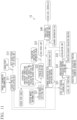
- FIG. 10 is a diagram showing an example of a configuration of the skill learning unit 15 according to the first example embodiment.
- the skill learning unit 15 functionally includes a search point set setting unit 210, a data acquisition unit 220, a prediction accuracy evaluation function learning unit 230, and a high-level controller learning unit 240.
- the search point set setting unit 210 includes a search point set initialization unit 211 and a next search point set setting unit 212.
- the data acquisition unit 220 includes a system model setting unit 221, a problem setting calculation unit 222, and a data update unit 223.
- the prediction accuracy evaluation function learning unit 230 includes a level set function learning unit 231, a prediction accuracy evaluation function setting unit 232, and an evaluation unit 233.
- the skill learning unit 15 generates training data for training the high-level controller ⁇ H , and uses the generated training data to perform the learning of the high-level controller ⁇ H . Furthermore, the skill learning unit 15 trains the level set function.
- the search point set setting unit 210 prepares a plurality of combinations of the initial state x s and the target state/known task parameter value ⁇ g as candidates of a task setting subjected to learning by the high-level controller ⁇ H .
- the search point set setting unit 210 selects, from among the plurality of prepared candidates, the task setting subjected to training data acquisition for the robot controller 3 to learn the control of the robot 5.
- the search point set setting unit 210 corresponds to an example of a search point setting means.
- the search point set initialization unit 211 sets a set of candidates of the task setting, which is subjected to the learning of the high-level controller ⁇ H and the level set function. Specifically, the search point set initialization unit 211 sets a set consisting of combinations of the initial state x s and the target state/known task parameter value ⁇ g as elements.
- the set of candidates of the task setting, which is subjected to the training of the high-level controller ⁇ H , that is set by the search point set initialization unit 211 is referred to as a search point set, and is represented by X ⁇ search .
- a candidate of the task setting is also referred to as a search point.
- the search point can be represented by (x s , ⁇ g ).
- search point (x s , ⁇ g ) Once a search point (x s , ⁇ g ) is determined, the task setting is determined, and the operation of the robot 5 is determined.
- the search point (x s , ⁇ g ) can be said to represent the operation of the robot 5 for each task.
- the next search point set setting unit 212 extracts a subset from the search point set X ⁇ search .
- Each element of the subset extracted by the next search point set setting unit 212 is treated as a task setting, which is subjected to the learning of the high-level controller ⁇ H .
- the elements of the search point subset X ⁇ check are represented by X ⁇ or X ⁇ i .
- "i" is a positive integer representing an identification number that identifies an element in the search point subset.
- search point subset X ⁇ check The elements of the search point subset X ⁇ check are referred to as selected search points, or simply search points.
- the data acquisition unit 220 acquires training data for the training of the high-level controller ⁇ H for each element X ⁇ of the search point subset X ⁇ check that is set by the next search point set setting unit 212.
- the system model setting unit 221 sets a system model or the like for setting an optimal control problem for each search point X ⁇ .
- the problem setting calculation unit 222 sets a solution search problem representing task execution by the robot 5, based on the settings made by the system model setting unit 221.
- the solution search problem referred to here is a problem of finding a solution that satisfies the presented constraint conditions.
- the problem setting calculation unit 222 sets an optimal control problem that includes constraint conditions relating to the task, constraint conditions such as a constraint condition relating to the operation of the robot, and an evaluation function that indicates the possibility of reaching the target state.
- An optimal control problem is a problem of determining a control input such that an evaluation indicated by the evaluation function value becomes as high as possible, and can be regarded as an optimization problem.
- the learning device 1 may use, as the evaluation function of the optimal control problem, a function in which a larger function value indicates a higher evaluation.
- the problem setting calculation unit 222 solves the optimal control problem that has been set, and calculates an output value of the high-level controller ⁇ H such that the evaluation function value becomes as small as possible, and the evaluation function value for the output value.
- the evaluation function value calculated by the problem setting calculation unit 222 corresponds to an example of information indicating an evaluation of whether or not the operation represented by the search point X ⁇ can be executed.
- the problem setting calculation unit 222 corresponds to an example of a calculation means.
- the data update unit 223 updates the training data such that the data obtained as a result of the problem setting calculation unit 222 solving the optimal control problem includes the training data of the high-level controller ⁇ H and the training data of the level set function.
- the training data of the high-level controller ⁇ H referred to here is training data for the training of the high-level controller ⁇ H .
- the training data of the level set function is training data for the training of the level set function.
- the parameter value a* to be output by the high-level controller ⁇ H which is obtained by solving the optimal control problem, can be used as the training data for the training of the high-level controller ⁇ H .
- information relating to whether or not the skill can be executed, which is indicated by the solution of the optimal control problem can be used as the training data of the level set function.
- each of the training data includes the search point X ⁇ j .
- the training data of the high-level controller ⁇ H can be said to be training data for the training of the control of the robot 5, which is performed by the robot controller 3 using the high-level controller ⁇ H .
- the data update unit 223 corresponds to an example of a data acquisition means.
- the set representing the training data of the high-level controller ⁇ H handled by the data update unit 223 is referred to as an obtained data set, and is represented by D opt .
- the prediction accuracy evaluation function learning unit 230 uses the obtained data set D opt to train the level set function and a prediction accuracy evaluation function, and determines whether or not it is necessary to continue the training of the level set function.
- the level set function is a function that indicates an executable state set, which is a set of combinations of the state and the target state/known task parameter value in which the target state can be reached.
- the prediction accuracy evaluation function is a function that indicates an evaluation of the estimation accuracy of the combinations of the state and the target state/known task parameter value in which the target state can be reached that have been obtained from the level set function.
- the training of the level set function is performed by using, with respect to the search points X - that have been selected as the targets of acquiring training data of the high-level controller ⁇ H , the data used for the training data of the high-level controller ⁇ H , which is calculated by the problem setting calculation unit 222.
- the prediction accuracy evaluation function can also be said to be a function that indicates an evaluation of the acquisition status of the training data.
- the level set function learning unit 231 trains the level set function using the obtained data set D opt . For example, the level set function learning unit 231 determines, for each element of the obtained data set D opt , whether or not it is possible to reach the target state based on the evaluation function value calculated by the problem setting calculation unit 222. Then, the level set function learning unit 231 uses information indicating whether or not the target state can be reached, and the combinations of the initial state x s and the target state/known task parameter value ⁇ g as training data, and trains the level set function.
- the level set function learning unit 231 corresponds to an example of a level set function learning means.
- the prediction accuracy evaluation function is represented by J g- or J g-j .
- "j" is a positive integer representing an identification number that identifies a task.
- the evaluation unit 233 uses the prediction accuracy evaluation function to determine whether or not it is necessary to continue acquiring the training data of the high-level controller ⁇ H .
- the evaluation unit 233 corresponds to an example of an evaluation means.
- the information indicating whether or not it is necessary to continue acquiring the training data of the high-level controller ⁇ H can be treated as information indicating whether or not it is necessary to continue the training of the level set function.
- a flag indicating the determination result of the evaluation unit 233 is also referred to as a learning continuation flag.
- the high-level controller learning unit 240 performs the training of the high-level controller ⁇ H using the obtained data set D opt .
- the high-level controller learning unit 240 performs the training of the high-level controller ⁇ H such that, in a case where an element among the elements of the obtained data set D opt whose evaluation function value indicates that it is possible to reach the target state is used, and the state represented by the element is input to the high-level controller ⁇ H , an output value represented by the element is output.
- the training method of the high-level controller ⁇ H performed by the high-level controller learning unit 240 is not limited to a specific method.
- FIG. 11 is a diagram showing an example of data input and output in the skill learning unit 15 according to the first example embodiment.
- the search point set initialization unit 211 sets the search point set X ⁇ search using the target parameter information stored in the storage device 2. For example, the search point set initialization unit 211 may set, based on the target parameter information, all possible combinations of the initial state x si and the target state/known task parameter value ⁇ g as the elements of the search point set X ⁇ search .
- the setting of the search point set X ⁇ search by the search point set initialization unit 211 corresponds to an initial setting of the search point set X ⁇ search .
- the search point set X ⁇ search is updated by the next search point set setting unit 212.
- the next search point set setting unit 212 extracts the search point subset X ⁇ check from the search point set X ⁇ search . Specifically, the next search point set setting unit 212 reads out one or more elements from the search point set X ⁇ search , and sets the elements that have been read out as the elements of the search point subset X - check . Then, the next search point set setting unit 212 removes the elements that have been read out and set to the search point subset X ⁇ check from the elements of the search point set X ⁇ search .
- the next search point set setting unit 212 uses the obtained prediction accuracy evaluation function to set the search point subset X - check .
- the next search point set setting unit 212 sets the elements among the elements of the search point set X ⁇ search whose prediction accuracy evaluation function value indicates that the estimated accuracy of the level set function is lower than a predetermined condition, as the elements of the search point subset X - check .
- the method of determining whether or not the estimated accuracy is lower than a predetermined condition referred to here is not limited to a specific method.
- the estimation accuracy being lower than a predetermined condition may indicate that the prediction accuracy evaluation function value is larger than a predetermined threshold.
- the system model referred to here is a model of the target system, such as a motion model of the target system.
- the constraint conditions relating to the parameters of the system model are constraint conditions on the values that can be taken by the parameters of the system model, such as the constraint conditions of the specifications of the devices included in the target system, and physical constraint conditions.
- the system model and the constraint conditions relating to the parameters of the system model are used as a portion of the constraint conditions of the optimal control problem handled by the problem setting calculation unit 222.
- the system model setting unit 221 outputs the information relating to the low-level controller ⁇ l , the system model, the parameters of the system model, the evaluation function that indicates the possibility of reaching the target state, the search points X ⁇ i , and time restrictions at the time of skill execution, such as the execution time T, that have been set, to the problem setting calculation unit 222.
- the problem setting calculation unit 222 sets an optimal control problem for each search point X ⁇ i based on the information from the system model setting unit 221, and searches for a solution to the optimal control problem that has been set.
- the problem setting calculation unit 222 sets an evaluation function that indicates the possibility of reaching the target state as the evaluation function of the optimal control problem, and sets various other settings as the constraint conditions of the optimal control problem.
- the problem setting calculation unit 222 may use an evaluation function g in which the state x' is a target state in a case where expression (6) is satisfied, as the evaluation function of the optimal control problem. [Expression 6] g x ′ , ⁇ g ′ ⁇ 0
- xa' represents a target state set.
- T represents the time required for skill execution.
- g(y(x(T)), ⁇ g ) represents the evaluation function value for the state x(T) when the skill is completed. When the evaluation function value becomes 0 or less, it can be determined that the target state can be reached by skill execution.
- ⁇ represents the output of the high-level controller ⁇ H .
- Expression (9) represents the determination of the output ⁇ of the high-level controller ⁇ H such that the value of the evaluation function g becomes as small as possible.
- ⁇ j represents an unknown task parameter.
- c is a function representing a constraint condition, and is set based on, for example, the target parameter information.
- the problem setting calculation unit 222 determines, for example, under the constraint conditions from expression (10) to expression (14), the output a * of the high-level controller such that the value of the evaluation function g shown in expression (9) becomes as small as possible, and the value g * of the evaluation function g at that time. As shown in expression (6), if g" ⁇ 0, it can be determined that the target state can be reached from the initial state at that time by executing the skill with the output a* of the high-level controller.
- the problem setting calculation unit 222 outputs the obtained minimum value g* of the evaluation function and the output a* of the high-level controller at that time, to the data update unit 223, along with the initial state x s and the target state/known task parameter value ⁇ g .
- the problem setting calculation unit 222 may output, to the data update unit 223, information indicating that the target state can be reached in addition to, or instead of, the output a * of the high-level controller.
- the method by which the problem setting calculation unit 222 solves the optimal control problem is not limited to a specific method.
- the problem setting calculation unit 222 may use a known algorithm as a solution search algorithm of the optimal control problem, or a known algorithm as a solution search problem of an optimization problem.
- the problem setting calculation unit 222 may learn an operation using reinforcement learning or the like in a simulation of the operation of the robot 5 such that the evaluation function value becomes as small as possible.
- the problem setting calculation unit 222 is capable of solving the optimal control problem using any type of optimal control algorithm, such as the direct collocation method or differential dynamic programming (DDP).
- DDP differential dynamic programming
- the problem setting calculation unit 222 is capable of solving the optimal control problem using a black-box optimization method such as path integral control, or a model-free optimization control method. In this case, the problem setting calculation unit 222 determines the control parameter ⁇ according to the problem of minimizing the evaluation function g based on the function c representing the constraint conditions.
- generating a skill refers to learning the skill of a task that is different from a task whose skills have already been learned.
- a different task is a task whose unknown task parameter has a different value.
- the execution time information of the target parameter information is assumed to include information specifying an upper limit "T max " (T ⁇ T max ) of the skill execution time T.
- the general constraint condition information of the target parameter information includes information expressing a constraint expression relating to the state x, the input u, and the contact force F as shown in expression (16). [Expression 16] c x u F ⁇ 0
- the constraint expression is an expression that comprehensively expresses the upper limit "F max " of the contact force F (F ⁇ F max ), the limit “x max “ of the movable range (or speed) (Ixl ⁇ x max ), the upper limit "u max " of the input u (
- the low-level controller ⁇ L is, for example, a servo controller using a PID.
- the problem setting calculation unit 222 solves the optimal control problem and calculates the optimal value ( ⁇ * ) of the control parameter ( ⁇ ) shown in expression (19).
- the data update unit 223 updates the obtained data set D opt so that (X - i , g * i , ⁇ * i ) output from the problem setting calculation unit 222 is included in the obtained data set Dopt.
- the level set function learning unit 231 trains the level set function based on the obtained data set D opt .
- the level set function learning unit 231 outputs the acquired level set function to the prediction accuracy evaluation function setting unit 232.
- the level set function learning unit 231 compares the evaluation function value indicated in the obtained data set D opt with a predetermined threshold to determine whether or not the target state can be reached from the initial state indicated in the obtained data set D opt .
- the level set function learning unit 231 determines whether or not the target state can be reached based on whether or not the evaluation function value g * is less than or equal to 0.
- the level set function learning unit 231 uses, as the training data, a combination of the state indicated by the obtained data set D opt , the target state, and the determination result of whether or not the target state can be reached, and trains the level set function.
- a function that outputs the optimal value g * of the evaluation function g with respect to the initial state x 0 ' in the abstract state and the target state/known task parameter value ⁇ g is represented as g * (x 0 ', ⁇ g ).
- the level set function learning unit 231 trains a level set function that represents the executable state set ⁇ 0 ' based on a plurality of sets including the initial state x 0 ', the target state/known task parameter value ⁇ g ', and the function value g* included in the obtained data set D opt .
- the level set function learning unit 231 calculates the level set function using a level set estimation method, which is an estimation method using Gaussian process regression based on a Bayesian optimization approach.
- the level set function is represented by g GP .
- the level set function g GP may be defined using a mean value function of a Gaussian process obtained through a level set estimation method, or may be defined as a combination of a mean value function and a variance function.
- the method by which the level set function learning unit 231 trains a function representing the executable state set is not limited to a specific method.
- the level set function learning unit 231 may determine the level set function using truncated variance reduction (TruVar), which is an estimation method using a Gaussian process regression in the same manner as the level set estimation method.
- TrueVar truncated variance reduction
- the level set function may be any model that evaluates the initial states from which a desired state can be reached. Furthermore, it can be said that the level set function and the output value ⁇ * of the high-level controller ⁇ H are determined based on a set including the initial state x 0 ', the target state/known task parameter value ⁇ g ', and the evaluation function value g*. Then, by determining the level set function, because it is possible to evaluate the states that can be reached and the known task parameter value, an effect can be obtained in which it is possible to determine the control parameter that enables a desired state for the system to be reached.
- the output value ⁇ * of the high-level controller ⁇ H corresponds to an example of a control parameter.
- control device of a robot or the like may use a level set function to determine whether or not a desired state can be reached from an initial state given a known task parameter value. Further, if the control device determines that the desired state can be reached, the control device may control the control target, such as a robot, using a control parameter corresponding to the initial state thereof.
- the level set function learning unit 231 may train a level set approximation function g ⁇ that satisfies expression (21). [Expression 21] g GP x 0 ′ ⁇ g ′ ⁇ g ⁇ x 0 ′ ⁇ g ′ ⁇ 0
- the prediction accuracy evaluation function setting unit 232 may train, as the prediction accuracy evaluation function, a function indicating, for the search points X ⁇ subjected to training of the level set function, an evaluation of a distribution in a candidate space of the search points X ⁇ .
- the candidate space of the search points X ⁇ referred to here is a space constituted by the values that may be taken by the search points X ⁇ .
- the prediction accuracy evaluation function setting unit 232 may use the space constituted by the domain of the search points X ⁇ as the candidate space of the search points X ⁇ .
- the candidate space of the search points X ⁇ may be the initial value of the search point set X ⁇ search .
- a function may be used that takes the candidates of the search points X ⁇ as arguments, and outputs as a function value, an evaluation value that indicates that the possibility of reaching the target state indicated by the level set function can be reached for the candidates of the search points X ⁇ .
- the prediction accuracy evaluation function setting unit 232 may calculate the prediction accuracy evaluation function value so as to indicate a higher evaluation in a case where the number of learned search points X ⁇ that are within a predetermined distance from the candidate search points X ⁇ input as the arguments to the prediction accuracy evaluation function increases.
- the prediction accuracy evaluation function setting unit 232 may set the prediction accuracy evaluation function such that the evaluation increases as the variance of the level set function value decreases.
- the method by which the prediction accuracy evaluation function setting unit 232 trains the prediction accuracy evaluation function is not limited to a specific method.
- the level set function g GP and the level set function g ⁇ will be collectively referred to as the level set function g ⁇ .
- the evaluation unit 233 uses the prediction accuracy evaluation function to determine whether or not it is necessary to continue acquiring the training data of the high-level controller ⁇ H .
- the evaluation unit 233 sets the determination result to a learning continuation flag.
- the evaluation unit 233 may calculate the minimum value of the prediction accuracy evaluation function in the candidate space of the search points X ⁇ .
- the minimum value of the prediction accuracy evaluation function referred to here is the value with the lowest evaluation. Further, in a case where the minimum value of the prediction accuracy evaluation function is evaluated as being lower than a predetermined threshold, the evaluation unit 233 may determine that it is necessary to continue acquiring the training data. On the other hand, in a case where the minimum value of the prediction accuracy evaluation function is evaluated as being higher than the predetermined threshold, the evaluation unit 233 may determine that it is not necessary to continue acquiring the training data.
- the evaluation unit 233 may sample prediction accuracy evaluation function values in the candidate space of the search points X ⁇ , and determine whether or not it is necessary to continue acquiring the training data, based on the evaluation having the lowest value among the obtained prediction accuracy evaluation function values.
- the evaluation unit 233 may determine whether or not it is necessary to continue acquiring the training data, based on a predetermined learning condition in addition to the value of the prediction accuracy evaluation function.
- the learning condition referred to here can be various conditions. For example, in a case where the number of times the training data has been acquired becomes a predetermined number or more, the evaluation unit 233 may determine that it is not necessary to continue acquiring the training data even if the evaluation indicated by the prediction accuracy evaluation function has not reached a predetermined evaluation.
- the high-level controller learning unit 240 performs the training of the high-level controller ⁇ H using the obtained data set D opt .
- the high-level controller learning unit 240 performs the training of the high-level controller ⁇ H such that, for an element among the elements of the obtained data set D opt in which it is possible to reach the target state, the high-level controller ⁇ H outputs, with respect to an input of the initial state x 0 ' and the target state/known task parameter value ⁇ g ' included in the element, an output value a * included in the element.
- the model used at the time the high-level controller learning unit 240 performs the learning of the high-level controller ⁇ H can be various models.
- a neural network a Gaussian process regression, or a support vector regression may be used. However, it is not limited to this.
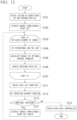
- FIG. 12 is a diagram showing an example of update processing of a skill database performed by the learning device 1 according to the first example embodiment.
- the learning device 1 executes the processing of FIG. 12 with respect to each generated skill.
- the search point set initialization unit 211 performs an initial setting of the search point set X ⁇ search and the obtained data set D opt .
- the search point set initialization unit 211 generates the search point set X ⁇ search by using, as the respective elements of the search point set X ⁇ search , arbitrary combinations of the initial state x s included in the initial state information, and the target state/known task parameter value ⁇ g included in the target state/known task parameter information.
- the search point set initialization unit 211 sets the value of the obtained data set D opt to an empty set.
- step 5101 the processing proceeds to step S102.
- the next search point set setting unit 212 extracts a subset from the search point set X ⁇ search . Specifically, the next search point set setting unit 212 sets a subset of the search point set X ⁇ search as the search point subset X - check . Then, the next search point set setting unit 212 excludes each element of the search point subset X ⁇ check that has been set, from the search point set X ⁇ search .
- the search point subset X ⁇ check has combinations of the initial state x si and the target state/known task parameter value ⁇ gi as elements. [Expression 22] x si ⁇ gi ⁇ X ⁇ check
- step S102 the processing proceeds to step S103.
- the learning device 1 starts loop L11, in which processing is performed for each search point X ⁇ that is an element of the subset X ⁇ check of the search point set.
- loop L11 the number of repetitions of the loop is represented by "i".
- the search point X ⁇ that is currently subjected to processing by loop L11 is also referred to as the target search point X ⁇ i .
- step S103 the processing proceeds to step S104.
- the system model setting unit 221 performs various settings for setting an optimal control problem based on the target search point X ⁇ i .
- the system model setting unit 221 sets the low-level controller ⁇ l , the system model, the constraint conditions relating to the parameters of the system model, and the evaluation function that indicates the possibility of reaching the target state.
- step S104 the processing proceeds to step S105.
- the problem setting calculation unit 222 sets the optimal control problem based on the settings made by the system model setting unit 221 in step S104. Then, the problem setting calculation unit 222 solves the optimal control problem that has been set, and acquires, as a solution, the output a * of the high-level controller such that the evaluation function value becomes as small as possible, and the value g* of the evaluation function g at that time.
- step S105 the processing proceeds to step S106.
- the data update unit 223 updates the obtained data set D opt . Specifically, the data update unit 223 adds the combination (X - i , g* i , a * i )) consisting of the ith element X ⁇ i of the subset X ⁇ check of the search point set, the determination result g * i indicating whether or not the task succeeded, and the obtained control parameter a * i as an element of the obtained data set D opt .
- step S106 the processing proceeds to step S107.
- the learning device 1 determines whether or not the processing of loop L11 has been performed with respect to all of the elements in the subset X ⁇ check of the search point set. If it is determined that there are elements with respect to which the processing of loop L11 has not been performed, the learning device 1 continues to perform the processing of loop L11 with respect to the elements in which the processing of loop L11 has not been executed. In this case, the processing returns to step S103.
- the learning device 1 terminates loop L11. In this case, the processing proceeds to step S111.
- the level set function learning unit 231 trains the level set function g ⁇ based on the obtained data set D opt .
- the prediction accuracy evaluation function setting unit 232 sets the prediction accuracy evaluation function J g ⁇ based on the level set function g ⁇ .
- step S112 the processing proceeds to step S110.
- the evaluation unit 233 determines whether or not it is necessary to continue the training of the level set function g ⁇ based on the prediction accuracy evaluation function J g .
- the evaluation unit 233 may determine whether or not it is necessary to continue the training of the level set function g ⁇ based on a predetermined learning condition in addition to the prediction accuracy evaluation function J g .
- step S113 determines that it is necessary to continue the training of the level set function g ⁇ (step S113: YES). If the evaluation unit 233 determines that it is necessary to continue the training of the level set function g ⁇ (step S113: YES), the processing proceeds to step S121. On the other hand, if the evaluation unit 233 determines that it is not necessary to continue the training of the level set function g ⁇ (step S113: NO), the processing proceeds to step S131.
- the next search point set setting unit 212 once again extracts a subset X ⁇ check from the search point set X ⁇ search based on the prediction accuracy evaluation function J g . Specifically, the next search point set setting unit 212 sets the subset X ⁇ check of the search point set X ⁇ search based on the prediction accuracy evaluation function J g . Then, the next search point set setting unit 212 excludes each element of the subset X ⁇ check that has been set, from the search point set X ⁇ search .
- step S121 the processing returns to step S103.
- the high-level controller learning unit 240 performs the training of the high-level controller ⁇ H using the obtained data set D opt that has been acquired.
- step S131 the learning device 1 ends the processing of FIG. 12 .
- the search point set setting unit 210 selects, from among the search points (x s , ⁇ g ) representing an operation of the robot 5, a search point X ⁇ subjected to training data acquisition for training of a control of the robot 5.
- the problem setting calculation unit 222 calculates information indicating an evaluation of whether or not an operation indicated by the selected search point X ⁇ can be executed, and an output value for the operation indicated by the selected search point X ⁇ to be output by the high-level controller ⁇ H that controls the robot 5.
- the data update unit 223 acquires, based on the selected search point X ⁇ , the information indicating an evaluation of whether or not an operation indicated by the selected search point X ⁇ can be executed, and the output value for the operation indicated by the selected search point X ⁇ to be output by the high-level controller ⁇ H , training data for learning a control of the robot 5 that is performed by the high-level controller ⁇ H .
- the evaluation unit 233 determines, based on an evaluation of an acquisition status of the training data, whether or not to continue acquiring the training data.
- the learning device 1 it is possible to determine whether or not it is necessary to continue the learning of a control of the robot 5, and the learning can be efficiently performed in that unnecessary learning can be eliminated.
- the level set function learning unit 231 receives the input of the search point (x s , ⁇ g ), and trains the level set function g ⁇ which outputs an estimated value of whether or not the operation indicated by the search point (x s , ⁇ g ) can be executed, based on the evaluation result from the problem setting calculation unit 222 of whether or not the operation indicated by the search point (x s , ⁇ g ) can be executed.
- the prediction accuracy evaluation function setting unit 232 receives the input of the search point (x s , ⁇ g ), and sets the prediction accuracy evaluation function J g ⁇ that outputs the evaluation value of the estimated accuracy of the level set function g ⁇ for the search point (x s , ⁇ g ).
- the evaluation unit 233 determines, based on the prediction accuracy evaluation function J g ⁇ , whether or not to continue acquiring the training data.
- the learning device 1 it is possible to use the level set function g ⁇ to determine whether or not to continue acquiring the training data.
- the level set function g ⁇ is used to select a skill when the robot controller 3 controls the robot 5. According to the learning device 1, the amount of work required only to determine whether or not to continue acquiring the training data is relatively small, and in this respect, it is possible to efficiently determine whether or not to continue acquiring the training data.
- the search point set setting unit 210 selects, as the target of training data acquisition of the control of the robot 5, a search point (x s , ⁇ g ) in which the evaluation value from the prediction accuracy evaluation function J g ⁇ indicates that the estimation accuracy of the level set function g ⁇ is lower than a predetermined condition.
- the learning device 1 it is possible to acquire training data representing inputs and outputs in which the accuracy of the output of the high-level controller ⁇ H is likely to be low, and to efficiently perform the training of the high-level controller ⁇ H .
- the search point (x s , ⁇ g ) includes a known task parameter, which is a parameter value of a skill in which the operation of the control target has been modularized.
- a difference in the operation of the robot 5 that can be expressed by a parameter value can be represented by the parameter value of the skill, and the learning of a control can be performed by applying the same skill to different operations.
- the search point (x s , ⁇ g ) is configured by a combination of; the initial state of the robot 5 and the operation environment at the start of performing a skill, a known parameter value of the skill, and a target state of the robot 5 and the operation environment at the completion of the skill.
- the learning device 1 is capable of performing the training of the high-level controller ⁇ H in the abstract space, and it is possible to more efficiently perform the training than in a case where the training of the control corresponding to both the high-level controller ⁇ H and the low-level controller ⁇ L is performed in real space.
- the robot controller 3 includes the high-level controller ⁇ H obtained by learning using the training data acquired by the learning device 1.
- the robot controller 3 at the time of the learning of the robot controller 3, it is possible to determine whether or not it is necessary to continue the learning of a control of the robot 5, and the learning can be efficiently performed in that unnecessary learning can be eliminated.
- the robot controller 3 includes the high-level controller ⁇ H that controls the robot 5 according to the size of the gripping target object, such that gripping target objects having different sizes are each gripped by the robot 5.
- the robot controller 3 it is expected that the robot 5 can be controlled with high accuracy according to the size of the gripping target object.
- the high-level controller learning unit 240 may perform the training of the high-level controller ⁇ H and feedback the learning result. This aspect will be described in the second example embodiment.
- the configuration of the control system 100 of the second example embodiment is the same as in the first example embodiment.
- the second example embodiment will also be described using the configuration of the control system 100 shown in FIG. 1 to FIG. 10 .
- FIG. 13 is a diagram showing an example of data input and output in the skill learning unit 15 according to the second example embodiment.
- the high-level controller learning unit 240 performs the training of the high-level controller at the time of data acquisition by the data acquisition unit 220, and outputs the high-level controller ⁇ * II acquired in the training, to the data acquisition unit 220.
- the high-level controller can be output by outputting the set value of a parameter of a predictor that constitutes the high-level controller, such as a neural network or a Gaussian process.
- the data input and output shown in FIG. 13 is the same as the data input and output in the first example embodiment described with reference to FIG. 11 .
- FIG. 14 is a diagram showing an example of update processing of a skill database performed by the learning device 1 according to the second example embodiment.
- the learning device 1 executes the processing of FIG. 14 with respect to each generated skill.
- Steps S201 to S204 in FIG. 14 are the same as steps S101 to S104 in FIG. 12 .
- loop L21 The loop from steps S203 to S207 in FIG. 14 is referred to as loop L21.
- the problem setting calculation unit 222 sets an optimal control problem, solves the optimal control problem that has been set, and determines the output of the high-level controller ⁇ H such that the evaluation function value becomes as small as possible, and the evaluation function value at that time.
- step S205 is different to step S105 in that, in a case where there is a high-level controller ⁇ H , the problem setting calculation unit 222 determines the output of the high-level controller ⁇ H so as to not deviate from the output value of the high-level controller ⁇ H .
- the problem setting calculation unit 222 may include, in the evaluation function of the optimal control problem, a term for an error norm between the obtained output value of the high-level controller ⁇ H and the output value of the high-level controller ⁇ H determined in the optimal control problem. Then, the problem setting calculation unit 222 may determine the solution of the optimal control problem such that the evaluation function value becomes as small as possible. As a result, the problem setting calculation unit 222 makes the value of the original evaluation function as small as possible, and determines a solution such that the output value of the high-level controller ⁇ H is close to the obtained output value of the high-level controller ⁇ H .
- Steps S206 and S207 are the same as steps S106 and S107 in FIG. 12 .
- step S207 after the learning device 1 terminates loop L21, the processing proceeds to step S211.
- the determination criteria used here by the high-level controller learning unit 240 to determine whether or not it is necessary to continue the training of the high-level controller learning unit ⁇ H is not limited to a specific criteria.
- the high-level controller learning unit 240 may determine that it is not necessary to continue the training of the high-level controller ⁇ H if the difference between the output of the high-level controller ⁇ H obtained by solving the optimal control problem in step S205 and the output obtained using the high-level controller ⁇ H is smaller than a predetermined condition.
- step S211 if the high-level controller learning unit 240 determines that it is necessary to continue the training of the high-level controller ⁇ H (step S211: YES), the processing proceeds to step S221.
- step S211: NO if the high-level controller learning unit 240 determines that it is not necessary to continue the training of the high-level controller ⁇ H (step S211: NO), the processing proceeds to step S231.
- the high-level controller learning unit 240 performs the training of the high-level controller ⁇ H using the obtained data set D opt .
- the method by which the high-level controller learning unit 240 performs the training of the high-level controller in step S221 is the same as in step S131 of FIG. 12 .
- Step S221 is different to step S131 in that the obtained data set D opt is still in the process of being generated.
- step S221 the processing returns to step S203.
- Steps S231 to S233 are the same as steps S111 to S113 of FIG. 12 .
- step S233 if the evaluation unit 233 determines that it is necessary to continue the training of the level set function g ⁇ (step S233: YES), the processing proceeds to step S241. On the other hand, if the evaluation unit 233 determines that it is not necessary to continue the training of the level set function g ⁇ (step S233: NO), the processing proceeds to step S251.
- Step S241 is the same as step S121 of FIG. 12 . After step S241, the processing returns to step S203.
- Step S251 is the same as step 5131 of FIG. 12 . After step S251, the learning device 1 terminates the processing of FIG. 14 .
- the learning device 1 learns a meta parameter value for each predictor constituting the level set function and each predictor constituting the high-level controller.
- the learning device 1 acquires the training data of a new task and learns a skill for executing the task, the training data that has already been acquired is used to perform the learning and setting of the meta parameter values in advance such that the prediction accuracy of the predictors becomes as high as possible.
- the learning device 1 may perform the learning according to the third example embodiment in addition to the learning of the case of the second example embodiment. That is to say, an implementation is possible in which the second example embodiment and the third example embodiment are combined.
- T represents the probability distribution that the task follows.
- ⁇ j represents a task.
- D j represents the probability distribution determined according to the task ⁇ j .
- S j represents the correct input and output data of the predictor for the task ⁇ j .
- FIG. 15 is a diagram showing an example of a configuration of the skill learning unit 15 according to the third example embodiment.
- the skill learning unit 15 includes, in addition to each unit shown in FIG. 10 , a search task setting unit 250 and a meta parameter processing unit 260.
- control system of the third example embodiment is the same as in the first example embodiment.
- the third example embodiment will also be described using the configuration of the control system 100 shown in FIG. 1 to FIG. 9 .
- the search task setting unit 250 sets a task subjected to learning by the learning device 1.
- the task subjected to learning by the learning device 1 that is set by the search task setting unit 250 is also referred to as a search task.
- the search task setting unit 250 assumes the probability distribution T that is followed by the task to be generated, and sets the search task based on the assumed probability distribution T.
- the method by which the search task setting unit 250 assumes the probability distribution T that is followed by the task to be generated is not limited to a specific method.
- the probability distribution T may be set in advance. However, it is not limited to this.
- the meta parameter processing unit 260 learns the meta parameter values of the predictors constituting the level set function and the predictors constituting the high-level controller ⁇ H , and sets the meta parameter values obtained from the learning to the predictors.
- the predictors constituting the level set function and the predictors constituting the high-level controller ⁇ H predictors based on a learning model in which the parameter values are set according to a probability distribution, such as a Bayesian neural network or a Gaussian process, are used.
- the meta parameter processing unit 260 learns and sets the probability distributions that the parameter values follow, as the meta parameter values.
- the meta parameter processing unit 260 evaluates the prediction accuracy of the predictors to which the meta parameters have been set, and determines whether or not to continue the learning of the meta parameter values based on the evaluation result.
- FIG. 16 is a diagram showing an example of data input and output in the skill learning unit 15 according to the third example embodiment.
- the skill learning unit 15 includes, in addition to each unit shown in FIG. 11 , the search task setting unit 250 and the meta parameter processing unit 260.
- the search task setting unit 250 receives the task parameter information and sets the search task.
- the task parameter information includes information relating to the probability distribution T of the generated task.
- the task parameter information may be information representing the probability distribution T of the task to be generated, and the search task setting unit 250 may set the search task following the probability distribution T.
- the search task setting unit 250 repeats the setting of the search task while a learning continuation flag for the unknown task parameter indicates continuation of the learning.
- the learning continuation flag for the unknown task parameter is a flag indicating whether or not to continue the learning of the meta parameter values of the predictors. While the learning continuation flag of the unknown task parameter indicates continuation of the learning, the search task setting unit 250 sets the next search task each time the learning device 1 finishes the learning relating to a search task.
- the learning continuation flag set by the evaluation unit 233 is also referred to as a learning continuation flag for the known task parameter in order to make a distinction with the learning continuation flag for the unknown task parameter. Furthermore, for the data of each task, " ⁇ j " or "j" may be written to indicate that the data is for each task.
- the learning device 1 performs the learning of the first example embodiment with respect to the task ⁇ j set as the search task.
- the search point set initialization unit 211 sets a search point set X ⁇ search according to the search task.
- the system model setting unit 221 performs various settings for setting the optimal control problem according to the search task.
- the meta parameter processing unit 260 uses a total obtained data set D optall to learn the meta parameter values mentioned above, and to determine whether or not to continue the learning of the meta parameter values.
- the total obtained data set D optall is a data set in which all of the obtained data sets D opt,j acquired by the data update unit 223 have been merged.
- the data update unit 223 may set the initial value of the total obtained data set D optall to 0 in advance, and each time an obtained data set D opt,j is generated, merge the obtained data set D opt,j that has been generated with the total obtained data set D optall .
- the meta parameter values learned by the meta parameter processing unit 260 are set to the predictors constituting the level set set and the predictors constituting the high-level controller.
- the search task setting unit 250 sets the next search task each time the learning device 1 finishes the learning relating to a search task.
- the meta parameter processing unit 260 includes a meta parameter individual processing unit 261 for each predictor subjected to learning.
- the level set function and the high-level controller ⁇ H are configured using predictors, and are subjected to the learning of the meta parameter values.
- the meta parameter processing unit 260 includes two meta parameter individual processing units 261.
- the number of meta parameter individual processing units 261 included in the meta parameter processing unit 260 is not limited to two.
- the meta parameter processing unit 260 may include a meta parameter individual processing unit 261 for each function that is configured using predictors and a meta parameter value that is subjected to learning.
- the units are represented as a meta parameter individual processing unit 261-1, a meta parameter individual processing unit 261-2, ..., and a meta parameter individual processing unit 261-N.
- N is a positive integer representing the number of meta parameter individual processing units 261 included in the meta parameter processing unit 260.
- the meta parameter individual processing unit 261 performs the learning of the meta parameter values of the predictors. In a case where there are a plurality of meta parameters of the predictors, the meta parameter individual processing units 261 learn the value of each meta parameter.
- the individual predictors are configured using a Bayesian neural network, and have weighting coefficients between nodes and biases for each node as parameters, the probability distribution that each of these parameters follows corresponds to the meta parameter.
- the meta parameter individual processing units 261 learn the values of each of the meta parameters.
- the meta parameter individual processing units 261 set, with respect to the targeted predictors, the value of a learning continuation flag for each predictor, which indicates whether or not it is necessary to continue the learning of the meta parameter value.
- the learning continuation flag for each predictor is also referred to as an individual learning continuation flag.
- the learning continuation flag integration unit 262 integrates the values of the individual learning continuation flags, and sets the value of the learning continuation flag for the unknown task parameter.
- the learning continuation flag integration unit 262 corresponds to an example of a learning continuation determination integration means.
- FIG. 18 is a diagram showing an example of data input and output in the meta parameter processing unit 260.
- a meta parameter individual processing unit 261 is provided for each predictor that is a target of the meta parameter processing unit 260.
- the meta parameter individual processing unit 261 receives an input of the total acquired data D optall , and a meta learning execution flag or an internal learning evaluation value, outputs the value of the meta parameter that is the target of the meta parameter individual processing unit 261, and also sets the value of the individual learning continuation flag.
- the internal learning evaluation value is a value representing an evaluation of the prediction accuracy of a predictor.
- the meta parameter individual processing unit 261 may calculate a generalization error of the meta parameter.
- the meta parameter processing unit 260 may then calculate, based on the generalization error of the meta parameter, an internal learning evaluation value that represents a comprehensive evaluation of all of the predictors that are subjected to learning of the meta parameter value.
- the learning continuation flag integration unit 262 integrates the values of the individual learning continuation flags, and sets the value of the learning continuation flag for the unknown task parameter. For example, if the values of one or more individual learning continuation flags indicate that it is necessary to continue the learning, the learning continuation flag integration unit 262 sets the value of the learning continuation flag for the unknown task parameter to a value indicating that it is necessary to continue the learning. Furthermore, if the values of all of the individual learning continuation flags indicate that it is not necessary to continue the learning, the learning continuation flag integration unit 262 sets the value of the learning continuation flag for the unknown task parameter to a value indicating that it is not necessary to continue the learning.
- FIG. 19 is a diagram showing a first example of a configuration of the meta parameter individual processing unit 261.
- the meta parameter individual processing unit 261 includes a training data extraction unit 271, a meta parameter learning unit 272, a generalization error evaluation unit 273, and a learning continuation determination unit 274.
- the training data extraction unit 271 extracts training data for learning the meta parameter value, from the total obtained data set D optall .
- the meta parameter learning unit 272 uses the training data extracted by the training data extraction unit 271 to learn the meta parameter value.
- the generalization error evaluation unit 273 calculates an evaluation value for the generalization error of the predictor in a case where the meta parameter value learned by the meta parameter learning unit 272 is used.
- the learning continuation determination unit 274 determines whether or not to continue the learning of the meta parameter value, based on the evaluation value calculated by the generalization error evaluation unit 273.
- the training data extraction unit 271 extracts the training data for learning the meta parameter value, from the total obtained data set D optall .
- the training data extraction unit 271 repeats the extraction of training data until the value of the meta learning execution flag reaches a value indicating that it is not necessary to continue the learning.
- the training data extraction unit 271 corresponds to an example of a training data extraction means.
- the meta parameter learning unit 272 learns the meta parameter value based on the training data for learning the meta parameter value, the learning parameter information, and the predictor information.
- the training data for learning the meta parameter value includes a combination of the input value to the learning model and a correct output value of the learning model for the input value.
- the meta parameter learning unit 272 corresponds to an example of a learning means.
- the predictor information is information relating to a predictor having a meta parameter subjected to learning.
- the predictor information may include information relating to a function representing the predictor.
- x represents the input to the predictor.
- ⁇ represents a parameter of the predictor.
- y represents the output of the predictor.
- S) based on the data S of the parameter ⁇ is determined.
- S) is not limited to a specific method.
- the learning device 1 may use the optimal Gibbs posterior structure shown in expression (29) to obtain the probability distribution p( ⁇
- p ⁇ S P ⁇ exp ⁇ ⁇ l S , f x ⁇ E ⁇ ⁇ P ⁇ exp ⁇ ⁇ l S , f x ⁇
- P( ⁇ ) represents the prior distribution of the value of the parameter ⁇ .
- the meta parameter learning unit 272 learns the prior distribution P( ⁇ ) as the meta parameter value.
- ⁇ is a parameter referred to as a temperature parameter.
- the value of the temperature parameter ⁇ is, for example, set in advance.
- E represents the expected value. Specifically, “E ⁇ P( ⁇ ) [exp(- ⁇ 1(S, f(x, ⁇ )))]” represents the expected value of "exp(- ⁇ 1(S, f(x, ⁇ )))" in a case where the parameter ⁇ follows the prior distribution P( ⁇ ).
- the meta parameter learning unit 272 performs the learning of the meta parameter value such that, for example, the expected value of the loss function shown in expression (30) becomes as small as possible. [Expression 30] E D ⁇ T E S ⁇ D l S f ⁇ , P
- E stands for the expected value. Specifically, “E S-D [1(S, f ⁇ ,P )]” represents the expected value of the loss function 1 in a case where the correct data S follows the probability distribution D. “E D ⁇ T [E S ⁇ D [1(S, f ⁇ ,P )]]” represents the expected value of "E D ⁇ T [E S ⁇ D [1(S, f ⁇ ,P )]]” in a case where the probability distribution D follows the probability distribution T.
- the meta parameter learning unit 272 determines the probability distribution Q(P) of the probability distribution P( ⁇ ) as the meta parameter based on expression (31).
- P(P) represents the prior distribution of the probability distribution P( ⁇ ), which is the meta parameter.
- ⁇ is a parameter referred to as a temperature parameter.
- the value of ⁇ is, for example, set in advance.
- N ⁇ is a positive integer representing the number of tasks.
- E stands for the expected value.
- E ⁇ P( ⁇ ) represents the expected value of the value in brackets ([...]) in a case where the value of the parameter ⁇ follows the probability distribution P( ⁇ ).
- E P ⁇ P represents the expected value of the value in brackets ([...]) in a case where the probability distribution P( ⁇ ) follows the probability distribution P(P).
- E stands for the expected value.
- E P ⁇ Q [E D ⁇ T [E S ⁇ D [l(S, f ⁇ ,P )]] represents the expected value of "E D ⁇ T [E S ⁇ D [l(S, f ⁇ ,P )]]” shown in expression (30) in a case where the probability distribution P( ⁇ ) follows the probability distribution Q(P).
- C( ⁇ , ⁇ , ⁇ ) is a function determined according to the type of loss function 1(S, f ⁇ , f ).
- the right-hand side of expression (33) represents the upper bound of the generalization error L(Q, T).
- the right-hand side of expression (33) is also written as L ⁇ (Q, T).
- the learning continuation determination unit 274 sets the value of the individual learning continuation flag based on the evaluation value L ⁇ (Q, T) of the generalization error calculated by the generalization error evaluation unit 273.
- the value "0" of the individual learning continuation flag I indicates that it is not necessary to continue the learning of the meta parameter value.
- the value "1" of the individual learning continuation flag I indicates that it is necessary to continue the learning of the meta parameter value.
- ⁇ is a constant representing a predetermined threshold.
- the evaluation value L ⁇ (Q, T) of the generalization error indicates a smaller value as the evaluation increases. Therefore, in a case where the evaluation value L ⁇ (Q, T) is less than or equal to the threshold ⁇ , the learning continuation determination unit 274 determines that it is not necessary to continue the learning of the meta parameter value. On the other hand, in a case where the evaluation value L ⁇ (Q, T) is larger than the threshold ⁇ , the learning continuation determination unit 274 determines that it is necessary to continue the learning of the meta parameter value.
- the learning continuation determination unit 274 may determine whether or not it is necessary to continue the learning of the meta parameter value, based on information relating to the conditions of continuing the learning.
- FIG. 20 shows an example in which the learning continuation determination unit 274 acquires error threshold information and continuation condition information as information relating to the conditions of continuing the learning.
- the error threshold information is a determination threshold for the evaluation value L ⁇ (Q, T) of the generalization error, such as the threshold ⁇ mentioned above.
- the continuation condition information is information indicating a determination method other than the determination based on the evaluation value L ⁇ (Q, T) of the generalization error. For example, in a case where the number of times the learning of the meta parameter value is repeated reaches a predetermined number, then even if the evaluation value L ⁇ (Q, T) of the generalization error is greater than the threshold ⁇ , the learning continuation determination unit 274 may determine that it is not necessary to continue the learning of the meta parameter value.
- the method by which the learning continuation determination unit 274 determines whether or not it is necessary to continue the learning of the meta parameter value is not limited to a specific method.
- the information relating to the conditions of continuing the learning used by the learning continuation determination unit 274 can be various information according to the method used by the learning continuation determination unit 274 to determine whether or not it is necessary to continue the learning the meta parameter value.
- FIG. 21 is a diagram showing a second example of a configuration of the meta parameter individual processing unit 261.
- the meta parameter individual processing unit 261 includes, in addition to each unit shown in FIG. 19 , a meta learning execution determination unit 281.
- the meta learning execution determination unit 281 sets the meta learning execution flag.
- FIG. 22 is a diagram showing an example of data input and output in the meta parameter individual processing unit 261 shown in FIG. 21 .
- the meta learning execution determination unit 281 sets the value of the meta learning execution flag based on an internal learning evaluation value.
- the meta learning execution determination unit 281 sets the value of the meta learning execution flag to a value indicating that learning of the meta parameter value is to be performed.
- the meta learning execution determination unit 281 sets the value of the meta learning execution flag to a value indicating that learning of the meta parameter value is not to be performed.
- the meta learning execution determination unit 281 corresponds to an example of a meta learning execution determination means.
- the value of the meta learning execution flag may be set within the learning continuation determination unit 274.
- FIG. 23 is a diagram showing an example of update processing of a skill database performed by the learning device 1 according to the third example embodiment.
- the learning device 1 performs the processing of FIG. 23 in a case of training data of a plurality of skills has been acquired.
- the data update unit 223 performs an initial setting of the total obtained data set D optall . Specifically, the data update unit 223 sets the value of the total obtained data set D optall to an empty set.
- step S301 the processing proceeds to step S302.
- the search task setting unit 250 sets a search task. For example, the search task setting unit 250 may select an unknown task parameter value ⁇ j , and set the task ⁇ j associated with the unknown task parameter value ⁇ j as the search task.
- step S302 the processing proceeds to step S303.
- Steps S303 to S313 in FIG. 23 are the same as steps S101 to S113 in FIG. 12 .
- loop L31 The loop from steps S305 to S309 in FIG. 23 is referred to as loop L31.
- step S313 if the high-level controller learning unit 240 determines that it is necessary to continue the training of the high-level controller ⁇ H (step S313: YES), the processing proceeds to step S321.
- step S313 determines that it is not necessary to continue the training of the high-level controller ⁇ H (step S313: NO). the processing proceeds to step S331.
- Step S321 of FIG. 23 is the same as step S121 of FIG. 12 .
- step S321 the processing returns to step S305.
- Step S331 of FIG. 23 is the same as step S131 of FIG. 12 .
- step S331 the processing proceeds to step S332.
- the data update unit 223 updates the total obtained data set D optall . As described above, the data update unit 223 joins the generated obtained data set D opt,j with the total obtained data set D optall .
- step S332 the processing proceeds to step S333.
- the meta parameter processing unit 260 calculates the meta parameter value of the predictor.
- step S333 the processing proceeds to step S334.
- the meta parameter processing unit 260 determines whether or not it is necessary to continue the learning of the meta parameter value. If the meta parameter processing unit 260 determines that it is necessary to continue the learning (step S334: YES), the processing proceeds to step S341.
- step S334 the learning device 1 terminates the processing of FIG. 23 .
- the search task setting unit 250 updates the search task. Specifically, the search task setting unit 250 sets, as the search task, one of the tasks that have not yet been set as the search task.
- step S341 the processing proceeds to step S303.
- FIG. 24 is a diagram showing an example of the processing by which the meta parameter processing unit 260 calculates the meta parameter value of a predictor.
- the meta parameter processing unit 260 performs the processing of FIG. 24 in step S333 of FIG. 23 .
- the meta parameter individual processing units 261 calculate the meta parameter value of each predictor. Furthermore, the meta parameter individual processing units 261 determine whether or not to continue the learning of the meta parameter value for each predictor.
- the meta parameter individual processing units 261 may execute the processing of step S401 for each predictor in parallel. Alternatively, the meta parameter individual processing units 261 may sequentially execute the processing of step S401 for each predictor.
- step S401 After the processing of step S401 has been completed for all of the predictors targeted for processing, the processing proceeds to step S402.
- the learning continuation flag integration unit 262 determines whether or not it is necessary to continue the learning of the meta parameter value of all of the plurality of predictors, based on the determination result of whether or not it is necessary to continue the learning of the meta parameter value for each predictor.
- step S402 the meta parameter processing unit 260 terminates the processing of FIG. 24 .
- FIG. 25 is a diagram showing a first example of the processing by which the meta parameter individual processing units 261 calculate the meta parameter value for each predictor, and determine whether or not it is necessary to continue the learning of the meta parameter value.
- the meta parameter individual processing units 261 perform the processing of FIG. 25 for each predictor in step S401 of FIG. 24 .
- the training data extraction unit 271 extracts the training data for learning the meta parameter value, from the total obtained data set D optall .
- step S411 the processing proceeds to step S412.
- the meta parameter learning unit 272 performs the learning of the meta parameter value of the predictor targeted for processing.
- step S413 the processing proceeds to step S414.
- the learning continuation determination unit 274 determines whether or not it is necessary to continue the learning of the parameter value, based on the evaluation value of the generalization error.
- Steps S422 to S425 in FIG. 26 are the same as steps S411 to S414 in FIG. 25 .
- the search task setting unit 250 selects, for example, the shape of a target object for which a gripping operation is to be learned, as the unknown task parameter.
- the search task setting unit 250 may sample the unknown task parameter following the probability distribution T.
- the search task setting unit 250 may set the unknown task parameter using an algorithm that probabilistically selects the unknown task parameter.
- step S303 the search point set initialization unit 211 defines a state variable x representing the position, posture, and the like of the robot 5 and the gripping target object, and sets the state of the robot 5 and the gripping target object before execution of the gripping operation, as the initial state x si . Furthermore, the search point set initialization unit 211 sets a target state/known task parameter ⁇ gi that includes the target state of the robot 5 and the gripping target object after execution of the gripping operation, and the size (scale) of the gripping target object.
- the search point set initialization unit 211 sets the pair (x si , ⁇ gi ) consisting of the initial state x si and a target state/known task parameter ⁇ gi , as an element of the search point set X ⁇ scarch,j .
- step S306 the system model setting unit 221 extracts the search point X ⁇ i , which is an element of the search point subset X ⁇ check , and sets the system model (dynamics), the constraint conditions of the system model, and the low-level controller ⁇ L , based on the target state/known task parameter ⁇ gi and the task ⁇ j that have been set.
- the constraint conditions referred to here include, but are not limited to, the operating region of the robot 5, upper limit values of inputs in the specifications of the robot 5, constraint conditions to avoid collisions, and the like.
- system model setting unit 221 sets the initial state x si from the search point X ⁇ i , and x fi , included in the target state/known task parameter ⁇ gi .
- system model setting unit 221 sets the evaluation function g of the optimal control problem based on these values.
- ⁇ g is a tolerance parameter representing the tolerance of the magnitude of the error.
- ⁇ g ⁇ j (X ⁇ ) denotes the predicted mean value.
- ⁇ g ⁇ j 2 (X ⁇ ) denotes the prediction variance.
- the prediction variance is multiplied by a coefficient ⁇ , which can be interpreted as a parameter that sets the confidence region (confidence interval).
- the prediction accuracy evaluation function setting unit 232 may set a function that calculates an entropy of the level set function g ⁇ i as the prediction accuracy evaluation function J g ⁇ i .
- the evaluation unit 233 calculates the prediction variance ⁇ g ⁇ j 2 (X ⁇ ) described above for each element X ⁇ of the search point set X ⁇ search,j , and determines that it is not necessary to continue the learning if ⁇ g ⁇ j 2 (X ⁇ ) ⁇ ⁇ ⁇ holds for all of the elements.
- ⁇ ⁇ is a prediction variance threshold.
- ⁇ ⁇ is also referred to as a variance threshold parameter.
- an element (x si , ⁇ gi ) of the search point set X ⁇ scarch,j is represented as X ⁇ .
- the meta parameter learning unit 272 performs the learning of a meta parameter value that represents a probability distribution in a learning model in which the parameter value follows a probability distribution based on the training data that indicates the input and output in the learning model.
- the generalization error evaluation unit 273 calculates an evaluation value indicating an evaluation of the generalization error of the learning model.
- the learning continuation determination unit 274 determines whether or not it is necessary to continue the learning of the meta parameter value, based on the evaluation value indicating an evaluation of the generalization error of the learning model.
- the learning device 1 when the learning of the meta parameter values of a learning model is performed, it is possible to determine whether or not it is necessary to continue the learning, and the learning can be efficiently performed in that unnecessary learning can be eliminated.
- the training data extraction unit 271 repeats the selection of the training data to be used for the learning, from among the training data for learning the value of the meta parameters, until it is determined that it is not necessary to continue the learning.
- the learning device 1 when learning of the meta parameter value of a learning model is performed, it is possible to determine whether or not it is necessary to continue the learning, and the learning can be efficiently performed in that unnecessary learning can be eliminated.
- the meta learning execution determination unit 281 determines whether or not to perform the learning of the meta parameter values, based on an evaluation value indicating an evaluation of the generalization error of the learning model.
- the training data extraction unit 271 selects the training data in a case where the meta learning execution determination unit 281 determines that learning of the meta parameter values is to be performed.
- the learning device 1 when the learning of the meta parameter values of a learning model is performed, it is possible to determine whether or not to continue the learning, based on an evaluation of the generalization error of the learning model, and the learning can be efficiently performed in that unnecessary learning can be eliminated.
- the learning continuation flag integration unit 262 determines whether or not it is necessary to continue the learning of the meta parameter values for all of the plurality of learning models, based on the respective determination results of the plurality of learning continuation determination means corresponding to the plurality of learning models.
- the learning device 1 it is possible to determine whether or not it is necessary to continue the learning of the meta parameter value for the plurality of learning models, and the learning can be efficiently performed in that unnecessary learning can be eliminated.
- one of the learning models is configured as a high-level controller ⁇ H that performs a control of an operation of the robot 5 that causes the robot 5 to execute a modularized task, and the parameter value of the skill is included in the input values to the learning model.
- the meta parameter learning unit 272 performs the learning of the meta parameter values using the training data of a plurality of skills.
- different tasks can be handled by learning the meta parameter values, and a plurality of tasks can be executed by a high-level controller ⁇ H based on a single learning model.
- the robot controller 3 also includes a high-level controller ⁇ H for which learning is performed by the learning device 1.
- different tasks can be handled by setting the meta parameter values, and a plurality of tasks can be executed by a high-level controller ⁇ H based on a single learning model.
- the robot controller 3 includes the high-level controller ⁇ II that controls the robot 5 according to the shape of the gripping target object, such that gripping target objects having different shapes are each gripped by the robot 5.
- the robot controller 3 it is expected that the robot 5 can be controlled with high accuracy according to the shape of the gripping target object.
- FIG. 27 is a diagram showing an example of a configuration of a learning device according to a fourth example embodiment.
- the learning device 610 includes a search point setting unit 611, a calculation unit 612, a data acquisition unit 613, and an evaluation unit 614.
- the search point setting unit 611 selects, from among the search points representing an operation of a control target, a search point subjected to training data acquisition for learning of a control of the control target.
- the calculation unit 612 calculates information indicating an evaluation of whether or not an operation indicated by the selected search point can be executed, and an output value for the operation indicated by the selected search point to be output by a control means that controls the control target.
- the data acquisition unit 613 acquires, based on the selected search point, the information indicating an evaluation of whether or not an operation indicated by the selected search point can be executed, and the output value for the operation indicated by the selected search point to be output by the control means, training data for learning a control of the control target that is performed by the control means.
- the evaluation unit 614 determines, based on an evaluation of an acquisition status of the training data, whether or not to continue acquiring the training data.
- the search point setting unit 611 corresponds to an example of a search point setting means.
- the calculation unit 612 corresponds to an example of a calculation means.
- the data acquisition unit 613 corresponds to an example of a data acquisition means.
- the evaluation unit 614 corresponds to an example of an evaluation means.
- the learning device 610 it is possible to determine whether or not it is necessary to continue the learning of a control of a control target, and the learning can be efficiently performed in that unnecessary learning can be eliminated.
- FIG. 28 is a diagram showing an example of a configuration of a control device according to a fifth example embodiment.
- the control device 620 includes a control unit 621.
- control unit 621 controls a robot according to the size of a gripping target object, such that gripping target objects having different sizes are each gripped by the robot.
- control device 620 it is expected that a robot can be controlled with high accuracy according to the size of a gripping target object.
- FIG. 29 is a diagram showing an example of the processing of a learning method according to a sixth example embodiment.
- the learning method shown in FIG. 29 includes the steps of setting a search point (step S611), performing a calculation (step S612), acquiring data (step S613), and performing an evaluation (step S614).
- a computer selects, from among the search points representing an operation of a control target, a search point subjected to training data acquisition for learning of a control of the control target.
- a computer calculates information indicating an evaluation of whether or not an operation indicated by the selected search point can be executed, and an output value for the operation indicated by the selected search point to be output by a control means that controls the control target.
- a computer acquires, based on the selected search point, the information indicating an evaluation of whether or not an operation indicated by the selected search point can be executed, and the output value for the operation indicated by the selected search point to be output by the control means, training data for learning a control of the control target that is performed by the control means.
- a computer determines, based on an evaluation of an acquisition status of the training data, whether or not to continue acquiring the training data.
- the learning method shown in FIG. 29 it is possible to determine whether or not to continue the learning of a control of a control target, and the learning can be efficiently performed in that unnecessary learning can be eliminated.
- a program for executing some or all of the processing performed by the learning device 1, the robot controller 3, the learning device 610, and the control device 620 may be recorded in a computer-readable recording medium, and the processing of each unit may be performed by a computer system reading and executing the program recorded on the recording medium.
- the "computer system” referred to here is assumed to include an OS and hardware such as a peripheral device.
- the "computer-readable recording medium” refers to a portable medium such as a flexible disk, a magnetic optical disk, a ROM (Read Only Memory), or a CD-ROM (Compact Disc Read Only Memory), or a storage device such as a hard disk built into a computer system.
- the program may be one capable of realizing some of the functions described above. Further, the functions described above may be realized in combination with a program already recorded in the computer system.
- the present invention may be applied to a learning device, a control device, a learning method, and a recording medium.
Landscapes
- Engineering & Computer Science (AREA)
- Artificial Intelligence (AREA)
- Evolutionary Computation (AREA)
- Software Systems (AREA)
- General Physics & Mathematics (AREA)
- Medical Informatics (AREA)
- Computer Vision & Pattern Recognition (AREA)
- Physics & Mathematics (AREA)
- Health & Medical Sciences (AREA)
- Automation & Control Theory (AREA)
- Mechanical Engineering (AREA)
- Robotics (AREA)
- Theoretical Computer Science (AREA)
- Data Mining & Analysis (AREA)
- Computing Systems (AREA)
- General Engineering & Computer Science (AREA)
- Mathematical Physics (AREA)
- Manipulator (AREA)
Abstract
Description
- The present invention relates to a learning device, a control device, a learning method, and a recording medium.
- A system has been proposed that, in a case of performing a control of a robot that is necessary for executing a task, performs the control of the robot by providing a skill in which the operation of the robot has been modularized. For example, in
Patent Document 1, a technique is disclosed where, in a system in which an articulated robot executes a given task, the skills of the robot that can be selected according to a task are defined as a tuple, and the parameters included in the tuple are updated by learning. - Patent Document 1:
PCT International Publication No. WO2018/219943 - When learning a control of a control target, such as learning a skill of a robot, if it is possible to determine whether or not it is necessary to continue the learning, it is expected that unnecessary learning can be eliminated, and the learning can be performed efficiently.
- An example object of the present disclosure is to provide a learning device, a control device, a learning method, and a recording medium that are capable of solving the above problem.
- According to a first example aspect of the present invention, a learning device includes: a search point setting means for selecting, from among search points indicating an operation of a control target, a search point to be subjected to training data acquisition for learning of a control of the control target; a calculation means for calculating information indicating an evaluation of whether or not an operation indicated by the selected search point is executable, and an output value for the operation indicated by the selected search point to be output by a control means for controlling the control target; a data acquisition means for acquiring, based on the selected search point, the information indicating the evaluation of whether or not the operation indicated by the selected search point is executable, and the output value for the operation indicated by the selected search point to be output by the control means, training data for learning a control of the control target that is performed by the control means; and an evaluation means for determining, based on an evaluation of an acquisition status of the training data, whether or not to continue acquiring the training data.
- According to a second example aspect of the present invention, a control device includes: a control means that performs a control of a robot according to a shape of a gripping target object, such that gripping target objects having different sizes are each gripped by the robot.
- According to a third example aspect of the present invention, a learning method is executed by a computer and includes: selecting, from among search points indicating an operation of a control target, a search point to be subjected to training data acquisition for learning of a control of the control target; calculating information indicating an evaluation of whether or not an operation indicated by the selected search point is executable, and an output value for the operation indicated by the selected search point to be output by a control means for controlling the control target; acquiring, based on the selected search point, the information indicating the evaluation of whether or not the operation indicated by the selected search point is executable, and the output value for the operation indicated by the selected search point to be output by the control means, training data for learning a control of the control target that is performed by the control means; and determining, based on an evaluation of an acquisition status of the training data, whether or not to continue acquiring the training data.
- According to a fourth example aspect of the present invention, a recording medium stores a program that causes a computer to execute: selecting, from among search points indicating an operation of a control target, a search point to be subjected to training data acquisition for learning of a control of the control target; calculating information indicating an evaluation of whether or not an operation indicated by the selected search point is executable, and an output value for the operation indicated by the selected search point to be output by a control means for controlling the control target; acquiring, based on the selected search point, the information indicating the evaluation of whether or not the operation indicated by the selected search point is executable, and the output value for the operation indicated by the selected search point to be output by the control means, training data for learning a control of the control target that is performed by the control means; and determining, based on an evaluation of an acquisition status of the training data, whether or not to continue acquiring the training data.
- According to the present invention, if it is possible to determine whether or not it is necessary to continue the learning when learning a control of a control target, it is expected that the learning can be performed efficiently.
-
- [
FIG. 1] FIG. 1 is a diagram showing an example of a configuration of a control system according to a first example embodiment. - [
FIG. 2] FIG. 2 is a diagram showing an example of a known task parameter according to the first example embodiment. - [
FIG. 3] FIG. 3 is a diagram showing an example of an unknown task parameter according to the first example embodiment. - [
FIG. 4] FIG. 4 is a diagram showing an example of a hardware configuration of a learning device according to the first example embodiment. - [
FIG. 5] FIG. 5 is a diagram showing an example of a hardware configuration of a robot controller according to the first example embodiment. - [
FIG. 6] FIG. 6 is a diagram illustrating a robot that grips an object according to the first example embodiment, and a gripping target object in real space. - [
FIG. 7] FIG. 7 is a diagram illustrating the state shown inFIG. 6 in an abstract space. - [
FIG. 8] FIG. 8 is a diagram showing an example of a configuration of a control system relating to execution of a skill according to the first example embodiment. - [
FIG. 9] FIG. 9 is a diagram showing an example of a functional configuration of the learning device relating to updating a skill database according to the first example embodiment. - [
FIG. 10] FIG. 10 is a diagram showing an example of a configuration of a skill learning unit according to the first example embodiment. - [
FIG. 11] FIG. 11 is a diagram showing an example of data input and output in the skill learning unit according to the first example embodiment. - [
FIG. 12] FIG. 12 is a diagram showing an example of update processing of a skill database performed by the learning device according to the first example embodiment. - [
FIG. 13] FIG. 13 is a diagram showing an example of data input and output in a skill learning unit according to a second example embodiment. - [
FIG. 14] FIG. 14 is a diagram showing an example of update processing of a skill database performed by a learning device according to the second example embodiment. - [
FIG. 15] FIG. 15 is a diagram showing an example of a configuration of a skill learning unit according to a third example embodiment. - [
FIG. 16] FIG. 16 is a diagram showing an example of data input and output in the skill learning unit according to the third example embodiment. - [
FIG. 17] FIG. 17 is a diagram showing an example of a configuration of a meta parameter processing unit according to the third example embodiment. - [
FIG. 18] FIG. 18 is a diagram showing an example of data input and output in the meta parameter processing unit according to the third example embodiment. - [
FIG. 19] FIG. 19 is a diagram showing a first example of a configuration of a meta parameter individual processing unit according to the third example embodiment. - [
FIG. 20] FIG. 20 is a diagram showing an example of data input and output in the meta parameter individual processing unit shown inFIG. 19 . - [
FIG. 21] FIG. 21 is a diagram showing a second example of a configuration of the meta parameter individual processing unit according to the third example embodiment. - [
FIG. 22] FIG. 22 is a diagram showing an example of data input and output in the meta parameter individual processing unit shown inFIG. 21 . - [
FIG. 23] FIG. 23 is a diagram showing an example of update processing of a skill database performed by a learning device according to the third example embodiment. - [
FIG. 24] FIG. 24 is a diagram showing an example of the processing by which a meta parameter processing unit according to the third example embodiment calculates a meta parameter value of a predictor. - [
FIG. 25] FIG. 25 is a diagram showing a first example of the processing by which the meta parameter individual processing unit according to the third example embodiment calculates a meta parameter value for each predictor, and determines whether or not it is necessary to continue the learning of the meta parameter value. - [
FIG. 26] FIG. 26 is a diagram showing a second example of the processing by which the meta parameter individual processing unit according to the third example embodiment calculates a meta parameter value for each predictor, and determines whether or not it is necessary to continue the learning of the meta parameter value. - [
FIG. 27] FIG. 27 is a diagram showing an example of a configuration of a learning device according to a fourth example embodiment. - [
FIG. 28] FIG. 28 is a diagram showing an example of a configuration of a control device according to a fifth example embodiment. - [
FIG. 29] FIG. 29 is a diagram showing an example of the processing procedure of a learning method according to a sixth example embodiment. - Hereunder, example embodiments of the present embodiment will be described. However, the following example embodiments do not limit the invention according to the claims. Furthermore, not all combinations of features described in the example embodiments are essential to the solution means of the invention. Note that, for convenience, a character in which an arbitrary symbol "x" is added above an arbitrary character "A" is written as "Ax" in the present specification.
-
FIG. 1 is a diagram showing an example of a configuration of a control system according to a first example embodiment. In the configuration shown inFIG. 1 , thecontrol system 100 includes alearning device 1, astorage device 2, arobot controller 3, ameasurement device 4, and arobot 5. Thelearning device 1 performs data communication with thestorage device 2 via a communication network or by direct wireless or wired communication. Furthermore, therobot controller 3 performs data communication with thestorage device 2, themeasurement device 4, and therobot 5 via a communication network or by direct wireless or wired communication. - The
learning device 1 learns the operations of therobot 5 for executing a given task by, for example, machine learning such as self-supervised learning (SSL). Moreover, thelearning device 1 learns a set of states in which the operations that are learned can be executed. - However, the target of the operations that are learned by the
learning device 1 is not limited to a specific target, and can be various control targets that can be controlled and whose control can be learned. Furthermore, the operations of a control target such as therobot 5 are not limited to operations that involve a change in position. For example, an operation in which therobot 5 uses a sensor to acquire sensor measurement data may be set as one of the operations of therobot 5. - The same applies to the example embodiments below.
- The state referred to here is the state of a target system that includes the
robot 5 and an operating environment of therobot 5. - The
robot 5 and the operating environment of therobot 5 are collectively referred to as a target system, or simply a system. In a case where a task involves handling a target object, such as a task of gripping an object, it is assumed that the target object of the task is also included in the target system. - The state of the target system is referred to as a system state, or simply a state. The system state at the time of task completion that is defined for a task is also referred to as a target state of the task, or simply a target state. Reaching the target state of a task is also referred to as accomplishing the task, or succeeding at the task.
- In a case where a task is accomplished by executing a skill, the state at the completion of skill execution corresponds to the target state.
- The system state at the start of a task is also referred to as an initial state of the task.
- The
learning device 1 performs learning relating to a skill in which specific operations of therobot 5 are modularized for each operation. In the example embodiments, it is assumed that a task can be accomplished by executing a single skill with respect to a single task, and an example will be described in which thelearning device 1 learns a skill to accomplish a task. - On the other hand, the
robot controller 3 may combine a plurality of skills to execute a task. For example, therobot controller 3 may plan the execution of a given task by dividing the given task into subtasks each corresponding to a skill, and then combine the skills used to execute each of the subtasks. - In the learning relating to a skill, the
learning device 1 also learns a set of states in which the skill can be executed. Thelearning device 1 registers information relating to skills that have been learned in a skill database stored in thestorage device 2. The information registered in the skill database is also referred to as a skill tuple. The skill tuple includes various information necessary to execute an operation that is to be modularized. Thelearning device 1 generates the skill tuple based on detailed system model information, low-level controller information, and target parameter information stored in thestorage device 2. - The
storage device 2 stores information that is referenced by thelearning device 1 and therobot controller 3. Thestorage device 2 stores, for example, detailed system model information, low-level controller information, target parameter information, and the skill database. Thestorage device 2 may be an external storage device such as a hard disk that is connected to, or built into, thelearning device 1 or therobot controller 3, a storage medium such as a flash memory, or a server device or the like that performs data communication with thelearning device 1 and therobot controller 3. Furthermore, thestorage device 2 may be configured by a plurality of storage devices, and each of the storage units described above may be held in a distributed manner. - The detailed system model information is information representing a model of the target system in real space. A model of the target system in real space is also called a detailed system model. Such a model is referred to as a "detailed" system model in order to make a distinction with an "abstract" system model, which is an abstraction of the detailed system model.
- The detailed system model information may be expressed as differential or difference equations representing the detailed system model. Alternatively, the detailed system model may be configured as a simulator that simulates the operation of the
robot 5. - The low-level controller information is information relating to a low-level controller that generates an input to control the actual operation of the
robot 5 based on parameter values output by a high-level controller. For example, in a case where the high-level controller generates a trajectory of therobot 5, the low-level controller may generate a control input that follows the operation of therobot 5 according to the trajectory. For example, the low-level controller may control therobot 5 by a servo control using a PID (proportional integral differential) based on parameters that are output from the high-level controller. - The target parameter information is provided for each skill learned by the
learning device 1, and includes, for example, initial state information, target state/known task parameter information, unknown task parameter information, execution time information, and general constraint information. - Here, the variable parts of a task are referred to as the task parameters.
- Among the task parameters, those expressed by numerical values are referred to as known task parameters. Examples of known task parameters include the size of the target object in the task, such as the size of the gripping target object in a case where the task is to grip the target object, and the trajectory of the
robot 5 for executing the task. However, it is not limited to this. - The known task parameters can also be treated as parameters in a skill. A known task parameter corresponds to an example of a skill parameter.
-
FIG. 2 is a diagram showing an example of a known task parameter.FIG. 2 shows a case where therobot 5 executes the task of gripping target objects having a cylindrical shape. In this case, the radius and height of the cylinders representing the target objects correspond to examples of a known task parameter. - On the other hand, among the task parameters, those that are difficult to express as a numerical value are referred to as unknown task parameters. Examples of unknown task parameters include the shape of the target object in the task, such as the shape of the gripping target object in a case where the task is to grip the target object, and the type of operation performed by the
robot 5 to execute the task, such as the skill required to execute the task. However, it is not limited to this. -
FIG. 3 is a diagram showing an example of an unknown task parameter.FIG. 3 shows a case where therobot 5 executes the task of gripping target objects having a variety of shapes. In this case, the shapes of the target objects correspond to examples of an unknown task parameter. - Furthermore, it is assumed that the
control system 100 handles the system state in a numerical form, and the target state is expressed as a numerical value. For example, in the case of a task in which therobot 5 performs pick and place, the target state may be expressed by the coordinates of the target object being within a predetermined range. - The initial state information is information indicating a set of states in which the target skill can be executed. The state at the start of execution of a skill is also referred to as an initial state of the skill, or simply an initial state. A set of initial states is also referred to as an initial state set.
- The initial state is represented by xs or xsi. Here, "i" is a positive integer representing an identification number that identifies the initial state. In addition, the time of the initial state is 0, and the initial state is sometimes expressed as x0.
- The target state/known task parameter information is information representing a set of combinations of the possible values of the target state, which is a state that can be reached by executing the target skill, and the possible values of the known task parameter, which is treated as an explicit parameter of the target skill. For example, in the case of a skill in which the
robot 5 grips a target object, the target state may include, as possible values, information relating to stable gripping conditions such as a form closure or a force closure. - A combination of a target state and a known task parameter value is referred to as a target state/known task parameter value, and is represented by βg or βgi. Here, "i" is a positive integer representing an identification number that identifies the target state/known task parameter value.
- As a result of treating differences in the target state and differences in the known task parameter value of the skill as the parameters of the skill, tasks having different target states and/or known task parameter values can be executed with a single skill.
- For example, in a case where the
learning device 1 performs processing relating to learning a skill using a predictor, it is possible to input a target state and a known task parameter value to the predictor, and obtain an output value corresponding to the target state and the known task parameter value. Here, the predictor is configured using a learning model (machine learning model), such as a neural network or a Gaussian process. - In some cases, there may be no known task parameters depending on the skill. In this case, the target state/known task parameter information may be configured as a set of possible values of the target state. Furthermore, the target state/known task parameter value βg may represent the target state.
- The unknown task parameter information is information relating to an unknown task parameter. For example, as described below in a third example embodiment, a probability distribution of data relating to the unknown parameter may be represented in the unknown task parameter information. In a case where a single skill has a plurality of unknown task parameters, information relating to each unknown task parameter may be represented in the unknown task parameter information.
- In the first example embodiment and the second example embodiment, the handling of the target state/known task parameter information will be described. In the first example embodiment and the second example embodiment, the value corresponding to an unknown task parameter may be represented by a fixed value.
- An unknown task parameter value is represented by τ or τj. Here, "j" is a positive integer representing an identification number that identifies the unknown task parameter value.
- It is assumed that although it is difficult to express an unknown parameter with a numerical value because it is difficult to systematically quantify the value, it is possible to determine whether or not unknown parameter values are the same. For example, in a case where an unknown parameter represents the shape of a target object, it is assumed that it is possible to determine whether or not the unknown parameter values are the same by comparing the shapes of two target objects.
- If the unknown task parameter values of two tasks are the same, the
control system 100 treats the two tasks as the same task. If the unknown task parameter values are different, thecontrol system 100 treats the two tasks as separate tasks. A task may be expressed by τ or τj. The "j" mentioned above can also be interpreted as a positive integer representing an identification number that identifies a task. - The execution time information is information relating to a time limit when executing a skill. For example, the execution time information may indicate the execution time of the skill (the time taken to execute the skill), an allowed condition value for the time from the start to the completion of skill execution, or both.
- The general constraint information is information indicating the general constraint conditions, such as conditions relating to limits on the range of motion, limits on the speed, and limits on the inputs to the
robot 5. - The skill database is a database of skill tuples prepared for each skill. A skill tuple may include information relating to a high-level controller for executing the target skill, information relating to a low-level controller for executing the target skill, and information relating to a set of combinations of states (initial states of the skill) and target state/known task parameter values in which the target skill can be executed. The set of states and target state/known task parameter values in which the skill can be executed is also referred to as an executable state set.
- The executable state set may be defined in an abstract space, which is an abstraction of an actual space. The executable state set can be represented by a Gaussian process regression (GPR), a level set function estimated by a level set estimation (LSE), or an approximation function of a level set function. In other words, it can be determined whether or not the executable state set includes a certain combination of a state and a target state/known task parameter value based on, whether or not the value (such as an average value) of a Gaussian process regression for the certain combination of the state and the target state/known task parameter value, or the value of an approximation function for the certain combination of the state and the target state/known task parameter value, satisfies a constraint condition that determines the executability.
- In the following, an example will be described in which a level set function is used as the function representing the executable state set. However, it is not limited to this.
- After the learning processing is performed by the
learning device 1, therobot controller 3 formulates an operation plan of therobot 5 based on a measurement signal supplied by themeasurement device 4, the skill database, and the like. Therobot controller 3 generates a control command (control input) for causing therobot 5 to execute the planned operation, and supplies the control command to therobot 5. - For example, the
robot controller 3 converts a task to be executed by therobot 5 into a sequence of tasks that can be accepted by therobot 5 at each time step (time interval). Then, therobot controller 3 controls therobot 5 based on control commands corresponding to the execution commands of the generated sequence. The control commands correspond to the control inputs that are output by the low-level controller. - For example, the
measurement device 4 represents one or more sensors, such as a camera, a range sensor, a sonar, or a combination thereof, that detects the state within a workspace in which therobot 5 executes tasks. Themeasurement device 4 supplies the measurement signals that have been generated, to therobot controller 3. Themeasurement device 4 may be a self-propelled or flying sensor (including a drone) that moves within the workspace. Furthermore, themeasurement device 4 may include a sensor provided on therobot 5, a sensor provided on another object within the workspace, and the like. Moreover, themeasurement device 4 may include a sensor that detects sounds within the workspace. In this way, themeasurement device 4 is a variety of sensors that detect the state within the workspace, and may include sensors provided at arbitrary locations. - The
robot 5 performs work relating to tasks that has been specified based on the control commands supplied from therobot controller 3. Therobot 5 is a robot that operates, for example, in various factories such as an assembly factory or a food factory, or at a distribution site. Therobot 5 may be a vertically articulated robot, a horizontally articulated robot, or any other type of robot. Therobot 5 may supply a state signal indicating the state of therobot 5, to therobot controller 3. The state signal may be an output signal of a sensor that detects the state (such as the position or angle) of theentire robot 5 or of a specific part such as a joint, or may be a signal that indicates a progress state of the operation of therobot 5. - The configuration of the
control system 100 shown inFIG. 1 is an example, and various changes may be made to the configuration. For example, therobot controller 3 and therobot 5 may be integrally configured. As another example, at least any two of thelearning device 1, thestorage device 2, and therobot controller 3 may be integrally configured. - Furthermore, the control target of the
control system 100 is not limited to being a robot. Various control targets in which a control can be learned by thelearning device 1 can serve as the control target of thecontrol system 100. -
FIG. 4 is a diagram showing an example of the hardware configuration of thelearning device 1. Thelearning device 1 includes, as hardware, aprocessor 11, amemory 12, and aninterface 13. Theprocessor 11, thememory 12, and theinterface 13 are connected via adata bus 10. - The
processor 11 functions as a controller (arithmetic device) that controls theentire learning device 1 by executing a program stored in thememory 12. Theprocessor 11 is, for example, a processor such as a CPU (central processing unit), a GPU (graphics processing unit), or a TPU (tensor processing unit). Theprocessor 11 may be configured by a plurality of processors. Theprocessor 11 corresponds to an example of a computer. - The
memory 12 is configured by various types of volatile memory and non-volatile memory, such as a RAM (random access memory), a ROM (read only memory), and a flash memory. Furthermore, thememory 12 stores a program for executing the processing executed by thelearning device 1. A portion of the information stored in thememory 12 may be stored in one or more external storage devices (for example, the storage device 2) that are capable of communicating with thelearning device 1, or may be stored on a recording medium that is detachable from thelearning device 1. - The
interface 13 is an interface for electrically connecting thelearning device 1 and other devices. The interface may be a wireless interface such as a network adapter for wirelessly transmitting and receiving data with respect to the other devices, or may be a hardware interface for connecting to the other devices via a cable or the like. For example, theinterface 13 may perform interface operations with input devices that accept user input (external input), such as a touch panel, a button, a keyboard, or a voice input device, or display devices such as a display or projector, and sound output devices such as a speaker. - The hardware configuration of the
learning device 1 is not limited to the configuration shown inFIG. 4 . For example, at least one of a display device, an input device, and a sound output device may be built into thelearning device 1. Further, thelearning device 1 may be configured to include thestorage device 2. -
FIG. 5 is a diagram showing a hardware configuration of therobot controller 3. Therobot controller 3 includes, as hardware, aprocessor 31, amemory 32, and aninterface 33. Theprocessor 31, thememory 32, and theinterface 33 are connected via adata bus 30. - The
processor 31 functions as a controller (arithmetic device) that controls theentire robot controller 3 by executing a program stored in thememory 32. Theprocessor 31 is, for example, a CPU, a GPU, or a TPU. Theprocessor 31 may be configured by a plurality of processors. - The
memory 32 is configured by various types of volatile memory and non-volatile memory, such as a RAM, a ROM, and a flash memory. Furthermore, thememory 32 stores a program for executing the processing executed by therobot controller 3. A portion of the information stored in thememory 32 may be stored in one or more external storage devices (for example, the storage device 2) that are capable of communicating with therobot controller 3, or may be stored on a recording medium that is detachable from therobot controller 3. - The
interface 33 is an interface for electrically connecting therobot controller 3 and other devices. The interface may be a wireless interface such as a network adapter for wirelessly transmitting and receiving data with respect to the other devices, or may be a hardware interface for connecting to the other devices via a cable or the like. - The hardware configuration of the
robot controller 3 is not limited to the configuration shown inFIG. 5 . For example, at least one of a display device, an input device, and a sound output device may be built into therobot controller 3. Further, therobot controller 3 may be configured to include thestorage device 2. - The
robot controller 3 formulates an operation plan of therobot 5 in an abstract space based on a skill tuple. Therefore, the abstract space subjected to operation planning of therobot 5 will be described. -
FIG. 6 is a diagram illustrating the robot (manipulator) 5 that grips an object, and thegripping target object 6 in real space. -
FIG. 7 is a diagram illustrating the state shown inFIG. 6 in an abstract space. - Generally, formulating an operation plan of a
robot 5 whose task is pick and place requires rigorous calculations that take into account the shape of an end effector of therobot 5, the geometric shape of thegripping target object 6, the gripping position and posture of therobot 5, the object characteristics of thegripping target object 6, and the like. On the other hand, in the present example embodiment, therobot controller 3 formulates an operation plan in an abstract space that abstractly (simply) represents the state of each object, such as therobot 5 and thegripping target object 6. In the example ofFIG. 7 , the abstract space defines anabstract model 5x corresponding to the end effector of therobot 5, anabstract model 6x corresponding to thegripping target object 6, and a gripping operation executable region (see dashed line frame 60) of thegripping target object 6 by therobot 5. In the abstract space, as described above, the executable state set is similarly represented as a set of combinations of the initial state and the target state/known task parameter value in which the skill can be executed. In the example ofFIG. 7 , the set of combinations of the initial state and the target state/known task parameter value in which the gripping skill can be executed is illustrated as the gripping operation executable region indicated by the dashedline frame 60. - In this way, the state of the robot in the abstract space abstractly represents the state of the end effector and the like. Furthermore, the state of each object corresponding to the operation target object and the environmental objects is also abstractly represented in a coordinate system or the like, which is based on a reference object such as a workbench.
- The
robot controller 3 according to the present example embodiment uses skills to formulate an operation plan in an abstract space, which is an abstraction of the actual system. As a result, the computational costs required for operation planning can be preferably suppressed, even for multi-stage tasks. In the example ofFIG. 7 , therobot controller 3 formulates an operation plan that executes the skills for executing gripping in a grippable region (dashed line frame 60) defined in the abstract space, and generates the control commands of therobot 5 based on the formulated operation plan. - In the following, the state of the system in real space is denoted by "x", the state of the system in an abstract space is denoted by "x'", and these are sometimes distinguished from each other. The state x' is represented as a vector (abstract state vector). For example, in the case of a task such as pick and place, the abstract state vector includes a vector representing the state of the operation target object (such as the position, the posture, and the speed), a vector representing the state of the end effector of the
robot 5 that can be operated, and a vector representing the state of the environmental objects. In this way, the state x' is defined as a state vector that abstractly represents the state of some of the elements in the real system. - Similarly, the target state/known task parameter value in real space is denoted by "βg", the target state/known task parameter value in an abstract space is denoted by "βg'", and these are sometimes distinguished from each other.
-
FIG. 8 is a diagram showing an example of the configuration of a control system relating to execution of a skill. Theprocessor 31 of therobot controller 3 functionally includes anoperation planning unit 34, a high-level control unit 35, and a low-level control unit 36. Furthermore, thesystem 50 corresponds to an actual system (a real system including the robot 5). - The high-
level control unit 35 is also referred to as a high-level controller, and is represented by πII. The high-level control unit 35 corresponds to an example of a control means. The low-level control unit 36 is also referred to as a low-level controller, and is represented by πL. - The
robot controller 3 corresponds to an example of a control device that controls therobot 5. - In addition, in
FIG. 8 , for convenience of the description, an inset showing the diagram illustrating the abstract space targeted by the operation planning unit 34 (seeFIG. 7 ) is displayed in association with theoperation planning unit 34, and an inset showing the diagram illustrating the real system corresponding to the system 50 (seeFIG. 6 ) is displayed in association with thesystem 50. Similarly, inFIG. 8 , an inset showing information relating to the executable state set of a skill is displayed in association with the high-level control unit 35. - The
operation planning unit 34 formulates an operation plan of therobot 5 based on the state x' of the abstract system and the skill database. Theoperation planning unit 34, for example, expresses the target state by a logical expression based on temporal logic. Theoperation planning unit 34 may express the logical expression using any type of temporal logic, such as linear temporal logic, metric temporal logic (MTL), or signal temporal logic (STL). - The
operation planning unit 34 converts the generated logical expression into a sequence (operation sequence) for each time step. The operation sequence includes, for example, information relating to the skill to be used at each time step. - The high-
level control unit 35 recognizes the skill to be executed at each time step based on the operation sequence generated by theoperation planning unit 34. Further, the high-level control unit 35 generates a parameter "α", which becomes an input to the low-level control unit 36, based on the high-level controller "πH" included in the skill tuple corresponding to the skill to be executed in the current time step. - The high-
level control unit 35 generates the control parameter α as shown in expression (1) below when the combination of the state "x0'" in the abstract space at the start of execution of the skill to be executed, and the target state/known task parameter value, belongs to the executable state set "χ0'" of the skill.
[Expression 1]
- As mentioned above, the state at the start of execution of a skill is referred to as an initial state. The initial state is represented, for example, as a state in the abstract space.
- Furthermore, in a case where an approximation function "g^" of a level set function is defined that can determine whether or not a state belongs to the executable state set χ0' of a skill, the
robot controller 3 is capable of determining whether or not the state x0' belongs to the executable state set χ0' by determining whether or not expression (2) is satisfied.
[Expression 2]
- Expression (2) can also be said to represent a constraint condition that determines whether or not a skill is executable from a certain state. Alternatively, the approximation function "g^" can be said to be a model that can evaluate whether or not the target state can be reached from a certain initial state x0' under a known task parameter value.
- The approximation function g^ is obtained as a result of the
learning device 1 performing learning, as described below. - A target state set, which is a set of target states in the abstract space after executing the target skill, is denoted as "χ'd", and the execution time of the target skill is denoted as "T". Furthermore, the state at a time point after a time T has elapsed from the start of skill execution is denoted as "x'(T)". As a result of executing a skill using the low-
level control unit 36, expression (3) can be realized.
[Expression 3]
- The low-
level control unit 36 generates an input "u" based on the control parameter α generated by the high-level control unit 35, and the state x of the real system and the target state/known task parameter value βg obtained from thesystem 50. The low-level control unit 36 generates the input u as shown in expression (4) as a control command based on the low-level controller "πL" included in the skill tuple.
[Expression 4]
- The low-level controller πL is not limited to the format of the expression above, and may be a controller having various formats.
- The low-
level control unit 36 acquires, as the state x, the state of therobot 5 and the environment recognized using any type of state recognition technique based on measurement signals output by the measurement device 4 (which may include signals from the robot 5). - In
FIG. 8 , thesystem 50 is represented by the state equation shown in expression (5), which uses a function "f" that takes the input u to therobot 5 and the state x as arguments.
[Expression 5]
- The operator "·" represents differentiation with respect to time, or a difference with respect to time.
-
FIG. 9 is a diagram showing an example of a functional configuration of thelearning device 1 relating to updating a skill database. Theprocessor 11 of thelearning device 1 functionally includes an abstract systemmodel setting unit 14, askill learning unit 15, and a skilltuple generation unit 16. InFIG. 9 , an example of data exchanged in each block is shown. However, it is not limited to this. The same applies to the other diagrams. - The abstract system
model setting unit 14 sets an abstract system model based on the detailed system model information. The abstract system model is a simplified model of the detailed system model specified by the detailed system model information. The detailed system model is a model corresponding to thesystem 50 inFIG. 8 . - The abstract system model is a model having, as the state, an abstract state vector x' that is constructed based on the state x of the detailed system model. The
operation planning unit 34 formulates the operation plan using the abstract system model. - The abstract system
model setting unit 14 calculates the abstract system model from the detailed system model based on, for example, an algorithm stored in advance in thestorage device 2 or the like. - Alternatively, information relating to the abstract system model may be stored in advance in the
storage device 2 or the like. In this case, the abstract systemmodel setting unit 14 may acquire the information relating to the abstract system model from thestorage device 2 or the like. The abstract systemmodel setting unit 14 supplies information relating to the abstract system model that has been set, to theskill learning unit 15 and the skilltuple generation unit 16. - The
skill learning unit 15 learns a control of a skill execution based on, the abstract system model that has been set by the abstract systemmodel setting unit 14, and the detailed system model information, the low-level controller information, and the target parameter information stored by thestorage device 2. In particular, theskill learning unit 15 learns the value of the control parameter α of the low-level controller πL that is output by the high-level controller πH. Furthermore, theskill learning unit 15 trains the level set function and acquires training data for training the control parameter α, for example, by using an evaluation function that evaluates the prediction accuracy of the level set function. - The skill
tuple generation unit 16 generates, as a skill tuple, a set (tuple) including information relating to the executable state set χ0' that has been learned by theskill learning unit 15, information relating to the high-level controller πII, information relating to the abstract system model that has been set by the abstract systemmodel setting unit 14, the low-level controller information, and the target parameter information. Then, the skilltuple generation unit 16 registers the generated skill tuple in the skill database. The data in the skill database is used by therobot controller 3 to control therobot 5. - Each component, namely the abstract system
model setting unit 14, theskill learning unit 15, and the skilltuple generation unit 16, can be realized, for example, as a result of theprocessor 11 executing programs. Furthermore, the necessary programs may be recorded on any type of non-volatile storage medium, and installed as necessary to realize each component. At least a portion of each components may be realized not only by software realized by a program, but also by a combination of any of hardware, firmware, software, and the like. Moreover, at least a portion of each component may be realized using a user-programmable integrated circuit, such as an FPGA (field-programmable gate array) or a microcontroller. In this case, the integrated circuit may be used to realize a program configured by each component described above. In addition, at least a portion of each component may be configured using an ASSP (application specific standard produce), an ASIC (application specific integrated circuit), or a quantum computer control chip. In this way, each component may be realized by various types of hardware. The above also applies to the other example embodiments described below. In addition, each component may be realized by the cooperation of a plurality of computers using, for example, a cloud computing technique. -
FIG. 10 is a diagram showing an example of a configuration of theskill learning unit 15 according to the first example embodiment. Theskill learning unit 15 functionally includes a search point set settingunit 210, adata acquisition unit 220, a prediction accuracy evaluationfunction learning unit 230, and a high-levelcontroller learning unit 240. - The search point set setting
unit 210 includes a search point setinitialization unit 211 and a next search point set settingunit 212. - The
data acquisition unit 220 includes a systemmodel setting unit 221, a problem settingcalculation unit 222, and adata update unit 223. - The prediction accuracy evaluation
function learning unit 230 includes a level setfunction learning unit 231, a prediction accuracy evaluationfunction setting unit 232, and anevaluation unit 233. - As described above, the
skill learning unit 15 generates training data for training the high-level controller πH, and uses the generated training data to perform the learning of the high-level controller πH. Furthermore, theskill learning unit 15 trains the level set function. - The search point set setting
unit 210 prepares a plurality of combinations of the initial state xs and the target state/known task parameter value βg as candidates of a task setting subjected to learning by the high-level controller πH. The search point set settingunit 210 selects, from among the plurality of prepared candidates, the task setting subjected to training data acquisition for therobot controller 3 to learn the control of therobot 5. - The search point set setting
unit 210 corresponds to an example of a search point setting means. - The search point set
initialization unit 211 sets a set of candidates of the task setting, which is subjected to the learning of the high-level controller πH and the level set function. Specifically, the search point setinitialization unit 211 sets a set consisting of combinations of the initial state xs and the target state/known task parameter value βg as elements. - The set of candidates of the task setting, which is subjected to the training of the high-level controller πH, that is set by the search point set
initialization unit 211 is referred to as a search point set, and is represented by X~ search. Furthermore, a candidate of the task setting is also referred to as a search point. The search point can be represented by (xs, βg). - Once a search point (xs, βg) is determined, the task setting is determined, and the operation of the
robot 5 is determined. The search point (xs, βg) can be said to represent the operation of therobot 5 for each task. - The next search point set setting
unit 212 extracts a subset from the search point set X~ search. Each element of the subset extracted by the next search point set settingunit 212 is treated as a task setting, which is subjected to the learning of the high-level controller πH. - The subset extracted from the search point set X~ search by the next search point set setting
unit 212 is referred to as a search point subset, and is represented by X- check. - The elements of the search point subset X~ check are represented by X~ or X~ i. Here, "i" is a positive integer representing an identification number that identifies an element in the search point subset.
- The elements of the search point subset X~ check are referred to as selected search points, or simply search points.
- The
data acquisition unit 220 acquires training data for the training of the high-level controller πH for each element X~ of the search point subset X~ check that is set by the next search point set settingunit 212. - The system
model setting unit 221 sets a system model or the like for setting an optimal control problem for each search point X~. - The problem setting
calculation unit 222 sets a solution search problem representing task execution by therobot 5, based on the settings made by the systemmodel setting unit 221. The solution search problem referred to here is a problem of finding a solution that satisfies the presented constraint conditions. - Specifically, the problem setting
calculation unit 222 sets an optimal control problem that includes constraint conditions relating to the task, constraint conditions such as a constraint condition relating to the operation of the robot, and an evaluation function that indicates the possibility of reaching the target state. An optimal control problem is a problem of determining a control input such that an evaluation indicated by the evaluation function value becomes as high as possible, and can be regarded as an optimization problem. - In the following, an example will be described in which a function where a lower evaluation function value represents a higher evaluation is used as the evaluation function of the optimal control problem. In this case, when solving the optimal control problem, a solution is sought that results in the evaluation function value becoming as small as possible, such as the minimum value of the evaluation function.
- However, the
learning device 1 may use, as the evaluation function of the optimal control problem, a function in which a larger function value indicates a higher evaluation. - The problem setting
calculation unit 222 solves the optimal control problem that has been set, and calculates an output value of the high-level controller πH such that the evaluation function value becomes as small as possible, and the evaluation function value for the output value. - The evaluation function value calculated by the problem setting
calculation unit 222 corresponds to an example of information indicating an evaluation of whether or not the operation represented by the search point X~ can be executed. The problem settingcalculation unit 222 corresponds to an example of a calculation means. - The
data update unit 223 updates the training data such that the data obtained as a result of the problem settingcalculation unit 222 solving the optimal control problem includes the training data of the high-level controller πH and the training data of the level set function. The training data of the high-level controller πH referred to here is training data for the training of the high-level controller πH. The training data of the level set function is training data for the training of the level set function. In particular, the parameter value a* to be output by the high-level controller πH, which is obtained by solving the optimal control problem, can be used as the training data for the training of the high-level controller πH. Furthermore, information relating to whether or not the skill can be executed, which is indicated by the solution of the optimal control problem, can be used as the training data of the level set function. Furthermore, each of the training data includes the search point X~ j. - The training data of the high-level controller πH can be said to be training data for the training of the control of the
robot 5, which is performed by therobot controller 3 using the high-level controller πH. Thedata update unit 223 corresponds to an example of a data acquisition means. - The set representing the training data of the high-level controller πH handled by the
data update unit 223 is referred to as an obtained data set, and is represented by Dopt. - The prediction accuracy evaluation
function learning unit 230 uses the obtained data set Dopt to train the level set function and a prediction accuracy evaluation function, and determines whether or not it is necessary to continue the training of the level set function. - As described above, the level set function is a function that indicates an executable state set, which is a set of combinations of the state and the target state/known task parameter value in which the target state can be reached. The prediction accuracy evaluation function is a function that indicates an evaluation of the estimation accuracy of the combinations of the state and the target state/known task parameter value in which the target state can be reached that have been obtained from the level set function.
- The training of the level set function is performed by using, with respect to the search points X- that have been selected as the targets of acquiring training data of the high-level controller πH, the data used for the training data of the high-level controller πH, which is calculated by the problem setting
calculation unit 222. There is considered to be a positive correlation between the number of training data acquired by thedata update unit 223 and the estimation accuracy of the level set function. The prediction accuracy evaluation function can also be said to be a function that indicates an evaluation of the acquisition status of the training data. - The level set
function learning unit 231 trains the level set function using the obtained data set Dopt. For example, the level setfunction learning unit 231 determines, for each element of the obtained data set Dopt, whether or not it is possible to reach the target state based on the evaluation function value calculated by the problem settingcalculation unit 222. Then, the level setfunction learning unit 231 uses information indicating whether or not the target state can be reached, and the combinations of the initial state xs and the target state/known task parameter value βg as training data, and trains the level set function. - The level set
function learning unit 231 corresponds to an example of a level set function learning means. - The prediction accuracy evaluation
function setting unit 232 trains the prediction accuracy evaluation function for the level set function trained by the level setfunction learning unit 231. For example, the prediction accuracy evaluationfunction setting unit 232 may train the prediction accuracy evaluation function such that, based on a distribution of the search points X~ subjected to training of the level set function in a candidate space of the search points X~, the evaluation becomes high in a partial space with a large number of search points X~ or a partial space with a high density. The prediction accuracy evaluationfunction setting unit 232 corresponds to an example of a prediction accuracy evaluation function setting means. - The prediction accuracy evaluation function is represented by Jg- or Jg-j. Here, "j" is a positive integer representing an identification number that identifies a task. As mentioned above, in a case where the unknown task parameter values of two tasks are different, the
control system 100 treats the tasks as separate tasks. - The
evaluation unit 233 uses the prediction accuracy evaluation function to determine whether or not it is necessary to continue acquiring the training data of the high-level controller πH. Theevaluation unit 233 corresponds to an example of an evaluation means. - The information indicating whether or not it is necessary to continue acquiring the training data of the high-level controller πH can be treated as information indicating whether or not it is necessary to continue the training of the level set function.
- A flag indicating the determination result of the
evaluation unit 233 is also referred to as a learning continuation flag. - In a case where the
evaluation unit 233 determines that it is not necessary to continue acquiring the training data of the high-level controller πH, the high-levelcontroller learning unit 240 performs the training of the high-level controller πH using the obtained data set Dopt. - For example, the high-level
controller learning unit 240 performs the training of the high-level controller πH such that, in a case where an element among the elements of the obtained data set Dopt whose evaluation function value indicates that it is possible to reach the target state is used, and the state represented by the element is input to the high-level controller πH, an output value represented by the element is output. - However, the training method of the high-level controller πH performed by the high-level
controller learning unit 240 is not limited to a specific method. -
FIG. 11 is a diagram showing an example of data input and output in theskill learning unit 15 according to the first example embodiment. - In the example of
FIG. 11 , the search point setinitialization unit 211 sets the search point set X~ search using the target parameter information stored in thestorage device 2. For example, the search point setinitialization unit 211 may set, based on the target parameter information, all possible combinations of the initial state xsi and the target state/known task parameter value βg as the elements of the search point set X~ search. - The setting of the search point set X~ search by the search point set
initialization unit 211 corresponds to an initial setting of the search point set X~ search. The search point set X~ search is updated by the next search point set settingunit 212. - The next search point set setting
unit 212 extracts the search point subset X~ check from the search point set X~ search. Specifically, the next search point set settingunit 212 reads out one or more elements from the search point set X~ search, and sets the elements that have been read out as the elements of the search point subset X- check. Then, the next search point set settingunit 212 removes the elements that have been read out and set to the search point subset X~ check from the elements of the search point set X~ search. - In a case where the prediction accuracy evaluation
function setting unit 232 has trained the prediction accuracy evaluation function, the next search point set settingunit 212 uses the obtained prediction accuracy evaluation function to set the search point subset X- check. In particular, the next search point set settingunit 212 sets the elements among the elements of the search point set X~ search whose prediction accuracy evaluation function value indicates that the estimated accuracy of the level set function is lower than a predetermined condition, as the elements of the search point subset X- check. - The method of determining whether or not the estimated accuracy is lower than a predetermined condition referred to here is not limited to a specific method. For example, in a case where a larger prediction accuracy evaluation function value represents an evaluation that the accuracy is lower, the estimation accuracy being lower than a predetermined condition may indicate that the prediction accuracy evaluation function value is larger than a predetermined threshold. However, it is not limited to this.
- The system
model setting unit 221 performs various settings for setting an optimal control problem for each element of the search point subset X- check. For example, the systemmodel setting unit 221, based on the detailed system model information, the low-level controller information, the target parameter information stored in thestorage device 2, and the abstract system model that is set by the abstract systemmodel setting unit 14, sets the low-level controller πl, the system model, the constraint conditions relating to the parameters of the system model, and the evaluation function that indicates the possibility of reaching the target state. - The system model referred to here is a model of the target system, such as a motion model of the target system. The constraint conditions relating to the parameters of the system model are constraint conditions on the values that can be taken by the parameters of the system model, such as the constraint conditions of the specifications of the devices included in the target system, and physical constraint conditions. The system model and the constraint conditions relating to the parameters of the system model are used as a portion of the constraint conditions of the optimal control problem handled by the problem setting
calculation unit 222. - The system
model setting unit 221 outputs the information relating to the low-level controller πl, the system model, the parameters of the system model, the evaluation function that indicates the possibility of reaching the target state, the search points X~ i, and time restrictions at the time of skill execution, such as the execution time T, that have been set, to the problem settingcalculation unit 222. - The problem setting
calculation unit 222 sets an optimal control problem for each search point X~ i based on the information from the systemmodel setting unit 221, and searches for a solution to the optimal control problem that has been set. - As mentioned above, an optimal control problem is, for example, a problem of determining a control input such that the evaluation function value becomes as small as possible. Specifically, the optimal control problem referred to here is a problem of determining a control input such that, given an initial state and an evaluation function, the evaluation function value becomes as small as possible under the constraint conditions of the operation environment and the like.
- The problem setting
calculation unit 222 sets an evaluation function that indicates the possibility of reaching the target state as the evaluation function of the optimal control problem, and sets various other settings as the constraint conditions of the optimal control problem. - The problem setting
calculation unit 222 determines, under the constraint conditions of the optimal control problem, the output value of the high-level controller πH such that the evaluation function value becomes as small as possible. The problem settingcalculation unit 222 outputs the combination (X- i, g* i, a* i) consisting of the search point X~ i, the output value a* i of the high-level controller πH that minimizes the evaluation function value, and the evaluation function value g* i at that time, to thedata update unit 223. - For example, the problem setting
calculation unit 222 may use an evaluation function g in which the state x' is a target state in a case where expression (6) is satisfied, as the evaluation function of the optimal control problem.
[Expression 6]
- The fact that the state x' is the target state in a case where expression (6) is satisfied is expressed as in expression (7).
[Expression 7]
- xa' represents a target state set.
- If the mapping from a state x of the detailed system model to a state x' of the abstract system model is represented by γ, then expression (8) can be obtained from expression (7).
[Expression 8]
- Minimizing the value of the evaluation function g in the optimal control problem is expressed as in expression (9).
[Expression 9]
- As mentioned above, T represents the time required for skill execution. g(y(x(T)), βg) represents the evaluation function value for the state x(T) when the skill is completed. When the evaluation function value becomes 0 or less, it can be determined that the target state can be reached by skill execution.
- As mentioned above, α represents the output of the high-level controller πH. Expression (9) represents the determination of the output α of the high-level controller πH such that the value of the evaluation function g becomes as small as possible.
- The system model of the optimal control problem can be expressed as in expression (10).
[Expression 10]
- As described above, τj represents an unknown task parameter.
- The time t is expressed as in expression (11).
[Expression 11]
- An inequality constraint condition of the optimal control problem can be expressed as in expression (12).
[Expression 12]
- c is a function representing a constraint condition, and is set based on, for example, the target parameter information.
- The state at
time 0 is the initial state, and is expressed as in expression (13).
[Expression 13]
- The fact that γ is a mapping from a state x of the detailed system model to a state x' of the abstract system model can be expressed as in expression (14).
[Expression 14]
- The problem setting
calculation unit 222 determines, for example, under the constraint conditions from expression (10) to expression (14), the output a* of the high-level controller such that the value of the evaluation function g shown in expression (9) becomes as small as possible, and the value g * of the evaluation function g at that time. As shown in expression (6), if g" ≤ 0, it can be determined that the target state can be reached from the initial state at that time by executing the skill with the output a* of the high-level controller. - The problem setting
calculation unit 222 outputs the obtained minimum value g* of the evaluation function and the output a* of the high-level controller at that time, to thedata update unit 223, along with the initial state xs and the target state/known task parameter value βg. Alternatively, the problem settingcalculation unit 222 may output, to thedata update unit 223, information indicating that the target state can be reached in addition to, or instead of, the output a* of the high-level controller. - The
data update unit 223 adds this data in the training data used in the training of the high-level controller πH by the high-levelcontroller learning unit 240. - The method by which the problem setting
calculation unit 222 solves the optimal control problem is not limited to a specific method. For example, the problem settingcalculation unit 222 may use a known algorithm as a solution search algorithm of the optimal control problem, or a known algorithm as a solution search problem of an optimization problem. Alternatively, the problem settingcalculation unit 222 may learn an operation using reinforcement learning or the like in a simulation of the operation of therobot 5 such that the evaluation function value becomes as small as possible. - For example, in a case where the function f in expression (10) is analytically obtained, the problem setting
calculation unit 222 is capable of solving the optimal control problem using any type of optimal control algorithm, such as the direct collocation method or differential dynamic programming (DDP). - On the other hand, when the function f is not analytically obtained, such as when a simulator is used as the function f, the problem setting
calculation unit 222 is capable of solving the optimal control problem using a black-box optimization method such as path integral control, or a model-free optimization control method. In this case, the problem settingcalculation unit 222 determines the control parameter α according to the problem of minimizing the evaluation function g based on the function c representing the constraint conditions. - Here, a specific example of the target parameter information and the low-level controller πL used in the optimal control problem will be described for a case where the skill of a gripping operation is generated in the pick and place task shown in
FIG. 6 . - Here, "generating a skill" refers to learning the skill of a task that is different from a task whose skills have already been learned. As mentioned above, a different task is a task whose unknown task parameter has a different value.
- Here, as the system model shown in expression (10), it is assumed that a physical simulator is used which is based on a state x, an input u to the
robot 5, and a contact force F, which is the force with which thegripping target object 6 is gripped. In this case, the expression for determining whether or not the target state can be reached is expressed as in expression (15).
[Expression 15]
- In a case where expression (15) is satisfied, it can be determined that the target state can be reached.
- Furthermore, the execution time information of the target parameter information is assumed to include information specifying an upper limit "Tmax" (T ≤ Tmax) of the skill execution time T. Moreover, it is assumed that the general constraint condition information of the target parameter information includes information expressing a constraint expression relating to the state x, the input u, and the contact force F as shown in expression (16).
[Expression 16]
- For example, the constraint expression is an expression that comprehensively expresses the upper limit "Fmax" of the contact force F (F ≤ Fmax), the limit "xmax" of the movable range (or speed) (Ixl ≤ xmax), the upper limit "umax" of the input u (|u| ≤ umax), and the like.
- Furthermore, it is assumed that the low-level controller πL is, for example, a servo controller using a PID. Here, in a case where the state of the
robot 5 is "xr" and the target trajectory of the state of therobot 5 is "xrd", the input u is expressed, for example, as in expression (17).
[Expression 17]
- The target trajectory xrd is expressed, for example, as shown in expression (18).
[Expression 18]
- In expression (17) and expression (18), the control parameter obtained from the output α of the high-level controller πH includes the coefficients of the target trajectory polynomial and the gains of the PID control, and is expressed as in expression (19).
[Expression 19]
- The problem setting
calculation unit 222 solves the optimal control problem and calculates the optimal value (α*) of the control parameter (α) shown in expression (19). - The
data update unit 223 updates the obtained data set Dopt so that (X- i, g* i, α* i) output from the problem settingcalculation unit 222 is included in the obtained data set Dopt. - As described above, the level set
function learning unit 231 trains the level set function based on the obtained data set Dopt. The level setfunction learning unit 231 outputs the acquired level set function to the prediction accuracy evaluationfunction setting unit 232. - For example, the level set
function learning unit 231 compares the evaluation function value indicated in the obtained data set Dopt with a predetermined threshold to determine whether or not the target state can be reached from the initial state indicated in the obtained data set Dopt. In the example of expression (8) and expression (9), the level setfunction learning unit 231 determines whether or not the target state can be reached based on whether or not the evaluation function value g* is less than or equal to 0. - Then, the level set
function learning unit 231 uses, as the training data, a combination of the state indicated by the obtained data set Dopt, the target state, and the determination result of whether or not the target state can be reached, and trains the level set function. - Here, a function that outputs the optimal value g* of the evaluation function g with respect to the initial state x0' in the abstract state and the target state/known task parameter value βg is represented as g*(x0', βg). The executable state set χ0' of the target skill is expressed as in expression (20).
[Expression 20]
- The level set
function learning unit 231 trains a level set function that represents the executable state set χ0' based on a plurality of sets including the initial state x0', the target state/known task parameter value βg', and the function value g* included in the obtained data set Dopt. For example, the level setfunction learning unit 231 calculates the level set function using a level set estimation method, which is an estimation method using Gaussian process regression based on a Bayesian optimization approach. Here, the level set function is represented by gGP. - The level set function gGP may be defined using a mean value function of a Gaussian process obtained through a level set estimation method, or may be defined as a combination of a mean value function and a variance function.
- The method by which the level set
function learning unit 231 trains a function representing the executable state set is not limited to a specific method. For example, the level setfunction learning unit 231 may determine the level set function using truncated variance reduction (TruVar), which is an estimation method using a Gaussian process regression in the same manner as the level set estimation method. - As mentioned above, the level set function may be any model that evaluates the initial states from which a desired state can be reached. Furthermore, it can be said that the level set function and the output value α* of the high-level controller πH are determined based on a set including the initial state x0', the target state/known task parameter value βg', and the evaluation function value g*. Then, by determining the level set function, because it is possible to evaluate the states that can be reached and the known task parameter value, an effect can be obtained in which it is possible to determine the control parameter that enables a desired state for the system to be reached. Here, the output value α* of the high-level controller πH corresponds to an example of a control parameter.
- Furthermore, the control device of a robot or the like may use a level set function to determine whether or not a desired state can be reached from an initial state given a known task parameter value. Further, if the control device determines that the desired state can be reached, the control device may control the control target, such as a robot, using a control parameter corresponding to the initial state thereof.
- In order to reduce the calculation cost of the level set function, the level set
function learning unit 231 may acquire a simplified level set function by a polynomial approximation or the like through training. The level set function in this case is represented by g^. g^ is also referred to as a level set approximation function. - The level set
function learning unit 231 may train a level set approximation function g^ that satisfies expression (21).
[Expression 21]
- As described above, the prediction accuracy evaluation
function setting unit 232 sets a prediction accuracy evaluation function that indicates the evaluation of the level set function that is trained by the level setfunction learning unit 231. The prediction accuracy evaluationfunction setting unit 232 outputs the obtained prediction accuracy evaluation function to theevaluation unit 233. - For example, the prediction accuracy evaluation
function setting unit 232 may train, as the prediction accuracy evaluation function, a function indicating, for the search points X~ subjected to training of the level set function, an evaluation of a distribution in a candidate space of the search points X~. The candidate space of the search points X~ referred to here is a space constituted by the values that may be taken by the search points X~. The prediction accuracy evaluationfunction setting unit 232 may use the space constituted by the domain of the search points X~ as the candidate space of the search points X~. Alternatively, the candidate space of the search points X~ may be the initial value of the search point set X~ search. - For example, as the prediction accuracy evaluation function, a function may be used that takes the candidates of the search points X~ as arguments, and outputs as a function value, an evaluation value that indicates that the possibility of reaching the target state indicated by the level set function can be reached for the candidates of the search points X~.
- Further, the prediction accuracy evaluation
function setting unit 232 may calculate the prediction accuracy evaluation function value so as to indicate a higher evaluation in a case where the number of learned search points X~ that are within a predetermined distance from the candidate search points X~ input as the arguments to the prediction accuracy evaluation function increases. - Alternatively, as described in the third example embodiment, in a case where a variance of the level set function value is obtained, the prediction accuracy evaluation
function setting unit 232 may set the prediction accuracy evaluation function such that the evaluation increases as the variance of the level set function value decreases. - However, the method by which the prediction accuracy evaluation
function setting unit 232 trains the prediction accuracy evaluation function is not limited to a specific method. - Hereunder, unless there is a particular need to distinguish between them, the level set function gGP and the level set function g^ will be collectively referred to as the level set function g^.
- As described above, the
evaluation unit 233 uses the prediction accuracy evaluation function to determine whether or not it is necessary to continue acquiring the training data of the high-level controller πH. Theevaluation unit 233 sets the determination result to a learning continuation flag. - For example, the
evaluation unit 233 may calculate the minimum value of the prediction accuracy evaluation function in the candidate space of the search points X~. The minimum value of the prediction accuracy evaluation function referred to here is the value with the lowest evaluation. Further, in a case where the minimum value of the prediction accuracy evaluation function is evaluated as being lower than a predetermined threshold, theevaluation unit 233 may determine that it is necessary to continue acquiring the training data. On the other hand, in a case where the minimum value of the prediction accuracy evaluation function is evaluated as being higher than the predetermined threshold, theevaluation unit 233 may determine that it is not necessary to continue acquiring the training data. - Alternatively, the
evaluation unit 233 may sample prediction accuracy evaluation function values in the candidate space of the search points X~, and determine whether or not it is necessary to continue acquiring the training data, based on the evaluation having the lowest value among the obtained prediction accuracy evaluation function values. - However, the method by which the
evaluation unit 233 determines whether or not it is necessary to continue acquiring the training data of the high-level controller πH is not limited to a specific method. - For example, the
evaluation unit 233 may determine whether or not it is necessary to continue acquiring the training data, based on a predetermined learning condition in addition to the value of the prediction accuracy evaluation function. The learning condition referred to here can be various conditions. For example, in a case where the number of times the training data has been acquired becomes a predetermined number or more, theevaluation unit 233 may determine that it is not necessary to continue acquiring the training data even if the evaluation indicated by the prediction accuracy evaluation function has not reached a predetermined evaluation. - As mentioned above, in a case where the
evaluation unit 233 determines that it is not necessary to continue acquiring the training data of the high-level controller πH, the high-levelcontroller learning unit 240 performs the training of the high-level controller πH using the obtained data set Dopt. - Specifically, the high-level
controller learning unit 240 performs the training of the high-level controller πH such that, for an element among the elements of the obtained data set Dopt in which it is possible to reach the target state, the high-level controller πH outputs, with respect to an input of the initial state x0' and the target state/known task parameter value βg' included in the element, an output value a* included in the element. - The model used at the time the high-level
controller learning unit 240 performs the learning of the high-level controller πH can be various models. For example, a neural network, a Gaussian process regression, or a support vector regression may be used. However, it is not limited to this. -
FIG. 12 is a diagram showing an example of update processing of a skill database performed by thelearning device 1 according to the first example embodiment. Thelearning device 1 executes the processing ofFIG. 12 with respect to each generated skill. - The search point set
initialization unit 211 performs an initial setting of the search point set X~ search and the obtained data set Dopt. - For example, the search point set
initialization unit 211 generates the search point set X~ search by using, as the respective elements of the search point set X~ search, arbitrary combinations of the initial state xs included in the initial state information, and the target state/known task parameter value βg included in the target state/known task parameter information. - Furthermore, the search point set
initialization unit 211 sets the value of the obtained data set Dopt to an empty set. - After step 5101, the processing proceeds to step S102.
- The next search point set setting
unit 212 extracts a subset from the search point set X~ search. Specifically, the next search point set settingunit 212 sets a subset of the search point set X~ search as the search point subset X- check. Then, the next search point set settingunit 212 excludes each element of the search point subset X~ check that has been set, from the search point set X~ search. - As shown in expression (22), the search point subset X~ check has combinations of the initial state xsi and the target state/known task parameter value βgi as elements.
[Expression 22]
- The processing by which the next search point set setting
unit 212 excludes each element of the set subset X~ check from the search point set X~ search can be expressed as in expression (23).
[Expression 23]
- Here, "-" indicates that the subset is excluded from the set.
- After step S102, the processing proceeds to step S103.
- The
learning device 1 starts loop L11, in which processing is performed for each search point X~ that is an element of the subset X~ check of the search point set. In loop L11, the number of repetitions of the loop is represented by "i". Furthermore, the search point X~ that is currently subjected to processing by loop L11 is also referred to as the target search point X~ i. - After step S103, the processing proceeds to step S104.
- The system
model setting unit 221 performs various settings for setting an optimal control problem based on the target search point X~ i. For example, the systemmodel setting unit 221 sets the low-level controller πl, the system model, the constraint conditions relating to the parameters of the system model, and the evaluation function that indicates the possibility of reaching the target state. - After step S104, the processing proceeds to step S105.
- The problem setting
calculation unit 222 sets the optimal control problem based on the settings made by the systemmodel setting unit 221 in step S104. Then, the problem settingcalculation unit 222 solves the optimal control problem that has been set, and acquires, as a solution, the output a* of the high-level controller such that the evaluation function value becomes as small as possible, and the value g* of the evaluation function g at that time. - After step S105, the processing proceeds to step S106.
- The
data update unit 223 updates the obtained data set Dopt. Specifically, thedata update unit 223 adds the combination (X- i, g*i, a* i)) consisting of the ith element X~ i of the subset X~ check of the search point set, the determination result g* i indicating whether or not the task succeeded, and the obtained control parameter a* i as an element of the obtained data set Dopt. - The processing by which the
data update unit 223 updates the obtained data set Dopt is expressed as in expression (24).
[Expression 24]
- "{ (X- i, g*i, a* i)}" represents a set consisting of one element having (X- i, g* i α* i) as the element.
- After step S106, the processing proceeds to step S107.
- The
learning device 1 performs termination processing of loop L11. - Specifically, the
learning device 1 determines whether or not the processing of loop L11 has been performed with respect to all of the elements in the subset X~ check of the search point set. If it is determined that there are elements with respect to which the processing of loop L11 has not been performed, thelearning device 1 continues to perform the processing of loop L11 with respect to the elements in which the processing of loop L11 has not been executed. In this case, the processing returns to step S103. - On the other hand, if it is determined that the processing of loop L11 has been performed with respect to all of the elements in the subset X~ check of the search point set, the
learning device 1 terminates loop L11. In this case, the processing proceeds to step S111. - The level set
function learning unit 231 trains the level set function g^ based on the obtained data set Dopt. - After step S111, the processing proceeds to step S112.
- The prediction accuracy evaluation
function setting unit 232 sets the prediction accuracy evaluation function Jg^ based on the level set function g^. - After step S112, the processing proceeds to step S110.
- The
evaluation unit 233 determines whether or not it is necessary to continue the training of the level set function g^ based on the prediction accuracy evaluation function Jg. Theevaluation unit 233 may determine whether or not it is necessary to continue the training of the level set function g^ based on a predetermined learning condition in addition to the prediction accuracy evaluation function Jg. - If the
evaluation unit 233 determines that it is necessary to continue the training of the level set function g^ (step S113: YES), the processing proceeds to step S121. On the other hand, if theevaluation unit 233 determines that it is not necessary to continue the training of the level set function g^ (step S113: NO), the processing proceeds to step S131. - The next search point set setting
unit 212 once again extracts a subset X~ check from the search point set X~ search based on the prediction accuracy evaluation function Jg. Specifically, the next search point set settingunit 212 sets the subset X~ check of the search point set X~ search based on the prediction accuracy evaluation function Jg. Then, the next search point set settingunit 212 excludes each element of the subset X~ check that has been set, from the search point set X~ search. - After step S121, the processing returns to step S103.
- The high-level
controller learning unit 240 performs the training of the high-level controller πH using the obtained data set Dopt that has been acquired. - After step S131, the
learning device 1 ends the processing ofFIG. 12 . - As described above, the search point set setting
unit 210 selects, from among the search points (xs, βg) representing an operation of therobot 5, a search point X~ subjected to training data acquisition for training of a control of therobot 5. - The problem setting
calculation unit 222 calculates information indicating an evaluation of whether or not an operation indicated by the selected search point X~ can be executed, and an output value for the operation indicated by the selected search point X~ to be output by the high-level controller πH that controls therobot 5. - The
data update unit 223 acquires, based on the selected search point X~, the information indicating an evaluation of whether or not an operation indicated by the selected search point X~ can be executed, and the output value for the operation indicated by the selected search point X~ to be output by the high-level controller πH, training data for learning a control of therobot 5 that is performed by the high-level controller πH. - The
evaluation unit 233 determines, based on an evaluation of an acquisition status of the training data, whether or not to continue acquiring the training data. - According to the
learning device 1, it is possible to determine whether or not it is necessary to continue the learning of a control of therobot 5, and the learning can be efficiently performed in that unnecessary learning can be eliminated. - Furthermore, the level set
function learning unit 231 receives the input of the search point (xs, βg), and trains the level set function g^ which outputs an estimated value of whether or not the operation indicated by the search point (xs, βg) can be executed, based on the evaluation result from the problem settingcalculation unit 222 of whether or not the operation indicated by the search point (xs, βg) can be executed. - The prediction accuracy evaluation
function setting unit 232 receives the input of the search point (xs, βg), and sets the prediction accuracy evaluation function Jg^ that outputs the evaluation value of the estimated accuracy of the level set function g^ for the search point (xs, βg). Theevaluation unit 233 determines, based on the prediction accuracy evaluation function Jg^, whether or not to continue acquiring the training data. - According to the
learning device 1, it is possible to use the level set function g^ to determine whether or not to continue acquiring the training data. The level set function g^ is used to select a skill when therobot controller 3 controls therobot 5. According to thelearning device 1, the amount of work required only to determine whether or not to continue acquiring the training data is relatively small, and in this respect, it is possible to efficiently determine whether or not to continue acquiring the training data. - Furthermore, the search point set setting
unit 210 selects, as the target of training data acquisition of the control of therobot 5, a search point (xs, βg) in which the evaluation value from the prediction accuracy evaluation function Jg^ indicates that the estimation accuracy of the level set function g^ is lower than a predetermined condition. - As a result, in the
learning device 1, it is possible to acquire training data representing inputs and outputs in which the accuracy of the output of the high-level controller πH is likely to be low, and to efficiently perform the training of the high-level controller πH. - Moreover, the search point (xs, βg) includes a known task parameter, which is a parameter value of a skill in which the operation of the control target has been modularized.
- As a result, in the
learning device 1, a difference in the operation of therobot 5 that can be expressed by a parameter value, can be represented by the parameter value of the skill, and the learning of a control can be performed by applying the same skill to different operations. - In addition, the search point (xs, βg) is configured by a combination of; the initial state of the
robot 5 and the operation environment at the start of performing a skill, a known parameter value of the skill, and a target state of therobot 5 and the operation environment at the completion of the skill. - As a result, the
learning device 1 is capable of performing the training of the high-level controller πH in the abstract space, and it is possible to more efficiently perform the training than in a case where the training of the control corresponding to both the high-level controller πH and the low-level controller πL is performed in real space. - Also, the
robot controller 3 includes the high-level controller πH obtained by learning using the training data acquired by thelearning device 1. - According to the
robot controller 3, at the time of the learning of therobot controller 3, it is possible to determine whether or not it is necessary to continue the learning of a control of therobot 5, and the learning can be efficiently performed in that unnecessary learning can be eliminated. - Furthermore, the
robot controller 3 includes the high-level controller πH that controls therobot 5 according to the size of the gripping target object, such that gripping target objects having different sizes are each gripped by therobot 5. - According to the
robot controller 3, it is expected that therobot 5 can be controlled with high accuracy according to the size of the gripping target object. - When the
data acquisition unit 220 acquires data, the high-levelcontroller learning unit 240 may perform the training of the high-level controller πH and feedback the learning result. This aspect will be described in the second example embodiment. - The configuration of the
control system 100 of the second example embodiment is the same as in the first example embodiment. The second example embodiment will also be described using the configuration of thecontrol system 100 shown inFIG. 1 to FIG. 10 . -
FIG. 13 is a diagram showing an example of data input and output in theskill learning unit 15 according to the second example embodiment. In the second example embodiment, the high-levelcontroller learning unit 240 performs the training of the high-level controller at the time of data acquisition by thedata acquisition unit 220, and outputs the high-level controller π* II acquired in the training, to thedata acquisition unit 220. The high-level controller can be output by outputting the set value of a parameter of a predictor that constitutes the high-level controller, such as a neural network or a Gaussian process. - In other respects, the data input and output shown in
FIG. 13 is the same as the data input and output in the first example embodiment described with reference toFIG. 11 . -
FIG. 14 is a diagram showing an example of update processing of a skill database performed by thelearning device 1 according to the second example embodiment. Thelearning device 1 executes the processing ofFIG. 14 with respect to each generated skill. - Steps S201 to S204 in
FIG. 14 are the same as steps S101 to S104 inFIG. 12 . - The loop from steps S203 to S207 in
FIG. 14 is referred to as loop L21. - In the same manner as described in step S105, the problem setting
calculation unit 222 sets an optimal control problem, solves the optimal control problem that has been set, and determines the output of the high-level controller πH such that the evaluation function value becomes as small as possible, and the evaluation function value at that time. - On the other hand, step S205 is different to step S105 in that, in a case where there is a high-level controller πH, the problem setting
calculation unit 222 determines the output of the high-level controller πH so as to not deviate from the output value of the high-level controller πH. For example, the problem settingcalculation unit 222 may include, in the evaluation function of the optimal control problem, a term for an error norm between the obtained output value of the high-level controller πH and the output value of the high-level controller πH determined in the optimal control problem. Then, the problem settingcalculation unit 222 may determine the solution of the optimal control problem such that the evaluation function value becomes as small as possible. As a result, the problem settingcalculation unit 222 makes the value of the original evaluation function as small as possible, and determines a solution such that the output value of the high-level controller πH is close to the obtained output value of the high-level controller πH. - Steps S206 and S207 are the same as steps S106 and S107 in
FIG. 12 . - In step S207, after the
learning device 1 terminates loop L21, the processing proceeds to step S211. - The determination criteria used here by the high-level
controller learning unit 240 to determine whether or not it is necessary to continue the training of the high-level controller learning unit πH is not limited to a specific criteria. For example, the high-levelcontroller learning unit 240 may determine that it is not necessary to continue the training of the high-level controller πH if the difference between the output of the high-level controller πH obtained by solving the optimal control problem in step S205 and the output obtained using the high-level controller πH is smaller than a predetermined condition. - In step S211, if the high-level
controller learning unit 240 determines that it is necessary to continue the training of the high-level controller πH (step S211: YES), the processing proceeds to step S221. - On the other hand, if the high-level
controller learning unit 240 determines that it is not necessary to continue the training of the high-level controller πH (step S211: NO), the processing proceeds to step S231. - The high-level
controller learning unit 240 performs the training of the high-level controller πH using the obtained data set Dopt. The method by which the high-levelcontroller learning unit 240 performs the training of the high-level controller in step S221 is the same as in step S131 ofFIG. 12 . Step S221 is different to step S131 in that the obtained data set Dopt is still in the process of being generated. - After step S221, the processing returns to step S203.
- Steps S231 to S233 are the same as steps S111 to S113 of
FIG. 12 . - In step S233, if the
evaluation unit 233 determines that it is necessary to continue the training of the level set function g^ (step S233: YES), the processing proceeds to step S241. On the other hand, if theevaluation unit 233 determines that it is not necessary to continue the training of the level set function g^ (step S233: NO), the processing proceeds to step S251. - Step S241 is the same as step S121 of
FIG. 12 . After step S241, the processing returns to step S203. - Step S251 is the same as step 5131 of
FIG. 12 . After step S251, thelearning device 1 terminates the processing ofFIG. 14 . - In the third example embodiment, an example will be described of a case where the
learning device 1 learns a skill by handling a difference in tasks that is difficult to express using a parameter value. - Specifically, in addition to the learning of the case of the first example embodiment, the
learning device 1 learns a meta parameter value for each predictor constituting the level set function and each predictor constituting the high-level controller. When thelearning device 1 acquires the training data of a new task and learns a skill for executing the task, the training data that has already been acquired is used to perform the learning and setting of the meta parameter values in advance such that the prediction accuracy of the predictors becomes as high as possible. - The
learning device 1 may perform the learning according to the third example embodiment in addition to the learning of the case of the second example embodiment. That is to say, an implementation is possible in which the second example embodiment and the third example embodiment are combined. - In the third example embodiment, it is assumed that tasks are generated according to a certain probability distribution, and the correct input and output data of the predictors follows a certain probability distribution that is determined for each task.
- The generation of a task that follows a certain probability distribution can be represented by τj~T. T represents the probability distribution that the task follows. Also, here, τj represents a task.
- The fact that the correct input and output data of the predictors follows a certain probability distribution determined for each task can be represented by Sj~Dj. Dj represents the probability distribution determined according to the task τj. Sj represents the correct input and output data of the predictor for the task τj.
-
FIG. 15 is a diagram showing an example of a configuration of theskill learning unit 15 according to the third example embodiment. In the configuration shown inFIG. 15 , theskill learning unit 15 includes, in addition to each unit shown inFIG. 10 , a searchtask setting unit 250 and a metaparameter processing unit 260. - In all other respects, the configuration of the control system of the third example embodiment is the same as in the first example embodiment. The third example embodiment will also be described using the configuration of the
control system 100 shown inFIG. 1 to FIG. 9 . - The search
task setting unit 250 sets a task subjected to learning by thelearning device 1. The task subjected to learning by thelearning device 1 that is set by the searchtask setting unit 250 is also referred to as a search task. - The search
task setting unit 250 assumes the probability distribution T that is followed by the task to be generated, and sets the search task based on the assumed probability distribution T. The method by which the searchtask setting unit 250 assumes the probability distribution T that is followed by the task to be generated is not limited to a specific method. For example, the probability distribution T may be set in advance. However, it is not limited to this. - The meta
parameter processing unit 260 learns the meta parameter values of the predictors constituting the level set function and the predictors constituting the high-level controller πH, and sets the meta parameter values obtained from the learning to the predictors. - In the third example embodiment, as the predictors constituting the level set function and the predictors constituting the high-level controller πH, predictors based on a learning model in which the parameter values are set according to a probability distribution, such as a Bayesian neural network or a Gaussian process, are used. The meta
parameter processing unit 260 learns and sets the probability distributions that the parameter values follow, as the meta parameter values. - In addition, the meta
parameter processing unit 260 evaluates the prediction accuracy of the predictors to which the meta parameters have been set, and determines whether or not to continue the learning of the meta parameter values based on the evaluation result. -
FIG. 16 is a diagram showing an example of data input and output in theskill learning unit 15 according to the third example embodiment. As described with reference toFIG. 15 , in the configuration shown inFIG. 16 , theskill learning unit 15 includes, in addition to each unit shown inFIG. 11 , the searchtask setting unit 250 and the metaparameter processing unit 260. - The search
task setting unit 250 receives the task parameter information and sets the search task. The task parameter information includes information relating to the probability distribution T of the generated task. For example, the task parameter information may be information representing the probability distribution T of the task to be generated, and the searchtask setting unit 250 may set the search task following the probability distribution T. - The search
task setting unit 250 repeats the setting of the search task while a learning continuation flag for the unknown task parameter indicates continuation of the learning. The learning continuation flag for the unknown task parameter is a flag indicating whether or not to continue the learning of the meta parameter values of the predictors. While the learning continuation flag of the unknown task parameter indicates continuation of the learning, the searchtask setting unit 250 sets the next search task each time thelearning device 1 finishes the learning relating to a search task. - In the third example embodiment, the learning continuation flag set by the
evaluation unit 233 is also referred to as a learning continuation flag for the known task parameter in order to make a distinction with the learning continuation flag for the unknown task parameter. Furthermore, for the data of each task, "τj" or "j" may be written to indicate that the data is for each task. - Each time the search
task setting unit 250 sets a search task, thelearning device 1 performs the learning of the first example embodiment with respect to the task τj set as the search task. Specifically, the search point setinitialization unit 211 sets a search point set X~ search according to the search task. Furthermore, the systemmodel setting unit 221 performs various settings for setting the optimal control problem according to the search task. - The meta
parameter processing unit 260 uses a total obtained data set Doptall to learn the meta parameter values mentioned above, and to determine whether or not to continue the learning of the meta parameter values. The total obtained data set Doptall is a data set in which all of the obtained data sets Dopt,j acquired by thedata update unit 223 have been merged. - For example, the
data update unit 223 may set the initial value of the total obtained data set Doptall to 0 in advance, and each time an obtained data set Dopt,j is generated, merge the obtained data set Dopt,j that has been generated with the total obtained data set Doptall. - The processing by which the obtained data set Dopt,j is merged with the total obtained data set Doptall can be expressed as in expression (25).
[Expression 25]
- The meta parameter values learned by the meta
parameter processing unit 260 are set to the predictors constituting the level set set and the predictors constituting the high-level controller. - Furthermore, as described above, while the learning continuation flag of the unknown task parameter that is set by the meta
parameter processing unit 260 indicates continuation of the learning, the searchtask setting unit 250 sets the next search task each time thelearning device 1 finishes the learning relating to a search task. -
FIG. 17 is a diagram showing an example of a configuration of the metaparameter processing unit 260. In the configuration shown inFIG. 17 , the metaparameter processing unit 260 includes meta parameterindividual processing units 261 and a learning continuationflag integration unit 262. - The meta
parameter processing unit 260 includes a meta parameterindividual processing unit 261 for each predictor subjected to learning. In the example ofFIG. 16 , the level set function and the high-level controller πH are configured using predictors, and are subjected to the learning of the meta parameter values. In this case, the metaparameter processing unit 260 includes two meta parameterindividual processing units 261. - However, the number of meta parameter
individual processing units 261 included in the metaparameter processing unit 260 is not limited to two. For example, in addition to the level set function and the high-level controller πH, there may be other functions that are configured using predictors and subjected to the learning of a meta parameter value. In this case, the metaparameter processing unit 260 may include a meta parameterindividual processing unit 261 for each function that is configured using predictors and a meta parameter value that is subjected to learning. - In a case of distinguishing between the individual meta parameter
individual processing units 261, the units are represented as a meta parameter individual processing unit 261-1, a meta parameter individual processing unit 261-2, ..., and a meta parameter individual processing unit 261-N. Here, N is a positive integer representing the number of meta parameterindividual processing units 261 included in the metaparameter processing unit 260. - The meta parameter
individual processing unit 261 performs the learning of the meta parameter values of the predictors. In a case where there are a plurality of meta parameters of the predictors, the meta parameterindividual processing units 261 learn the value of each meta parameter. - For example, if the individual predictors are configured using a Bayesian neural network, and have weighting coefficients between nodes and biases for each node as parameters, the probability distribution that each of these parameters follows corresponds to the meta parameter. The meta parameter
individual processing units 261 learn the values of each of the meta parameters. - Furthermore, the meta parameter
individual processing units 261 set, with respect to the targeted predictors, the value of a learning continuation flag for each predictor, which indicates whether or not it is necessary to continue the learning of the meta parameter value. The learning continuation flag for each predictor is also referred to as an individual learning continuation flag. - The learning continuation
flag integration unit 262 integrates the values of the individual learning continuation flags, and sets the value of the learning continuation flag for the unknown task parameter. The learning continuationflag integration unit 262 corresponds to an example of a learning continuation determination integration means. -
FIG. 18 is a diagram showing an example of data input and output in the metaparameter processing unit 260. - As described above, a meta parameter
individual processing unit 261 is provided for each predictor that is a target of the metaparameter processing unit 260. The meta parameterindividual processing unit 261 receives an input of the total acquired data Doptall, and a meta learning execution flag or an internal learning evaluation value, outputs the value of the meta parameter that is the target of the meta parameterindividual processing unit 261, and also sets the value of the individual learning continuation flag. - The meta learning execution flag is a flag representing a setting of whether or not to perform learning of the meta parameter value. For example, in a case where more than a predetermined number of data (set elements) of each task is accumulated in the total obtained data set Doptall, the
data update unit 223 may set the value of the meta learning execution flag to a value that indicates that the learning of the meta parameter value is to be performed. Furthermore, when the learning of the meta parameter value is terminated, the metaparameter processing unit 260 may set the value of the meta learning execution flag to a value that indicates that the learning of the meta parameter value is not to be performed. - The internal learning evaluation value is a value representing an evaluation of the prediction accuracy of a predictor. For example, when the learning of the meta parameter value is started, the meta parameter
individual processing unit 261 may calculate a generalization error of the meta parameter. The metaparameter processing unit 260 may then calculate, based on the generalization error of the meta parameter, an internal learning evaluation value that represents a comprehensive evaluation of all of the predictors that are subjected to learning of the meta parameter value. - The learning continuation
flag integration unit 262 integrates the values of the individual learning continuation flags, and sets the value of the learning continuation flag for the unknown task parameter. For example, if the values of one or more individual learning continuation flags indicate that it is necessary to continue the learning, the learning continuationflag integration unit 262 sets the value of the learning continuation flag for the unknown task parameter to a value indicating that it is necessary to continue the learning. Furthermore, if the values of all of the individual learning continuation flags indicate that it is not necessary to continue the learning, the learning continuationflag integration unit 262 sets the value of the learning continuation flag for the unknown task parameter to a value indicating that it is not necessary to continue the learning. -
FIG. 19 is a diagram showing a first example of a configuration of the meta parameterindividual processing unit 261. In the configuration shown inFIG. 19 , the meta parameterindividual processing unit 261 includes a trainingdata extraction unit 271, a metaparameter learning unit 272, a generalizationerror evaluation unit 273, and a learningcontinuation determination unit 274. - The training
data extraction unit 271 extracts training data for learning the meta parameter value, from the total obtained data set Doptall. - The meta
parameter learning unit 272 uses the training data extracted by the trainingdata extraction unit 271 to learn the meta parameter value. - The generalization
error evaluation unit 273 calculates an evaluation value for the generalization error of the predictor in a case where the meta parameter value learned by the metaparameter learning unit 272 is used. - The learning
continuation determination unit 274 determines whether or not to continue the learning of the meta parameter value, based on the evaluation value calculated by the generalizationerror evaluation unit 273. -
FIG. 20 is a diagram showing an example of data input and output in the meta parameterindividual processing unit 261 shown inFIG. 19 . - In a case where the value of the meta learning execution flag indicates that the meta parameter value is to be learned, the training
data extraction unit 271 extracts the training data for learning the meta parameter value, from the total obtained data set Doptall. The trainingdata extraction unit 271 repeats the extraction of training data until the value of the meta learning execution flag reaches a value indicating that it is not necessary to continue the learning. - The training
data extraction unit 271 corresponds to an example of a training data extraction means. - In a case where the value of the meta learning execution flag indicates that the meta parameter value is to be learned, the meta
parameter learning unit 272 learns the meta parameter value based on the training data for learning the meta parameter value, the learning parameter information, and the predictor information. The training data for learning the meta parameter value includes a combination of the input value to the learning model and a correct output value of the learning model for the input value. The metaparameter learning unit 272 corresponds to an example of a learning means. - The predictor information is information relating to a predictor having a meta parameter subjected to learning. For example, the predictor information may include information relating to a function representing the predictor.
- The learning parameter information is information relating to the meta parameter subjected to learning. For example, the learning parameter information may include information indicating the number of meta parameters included in the predictor subjected to the learning.
- Here, the predictor whose meta parameter value is subjected to learning is expressed by a function f as in expression (26).
[Expression 26]
- x represents the input to the predictor. θ represents a parameter of the predictor. y represents the output of the predictor.
- The probability distribution p(ylx, θ) of the output of the predictor is expressed as in expression (27).
[Expression 27]
- Ns is a positive integer indicating the number of parameters of the predictor, and is expressed as θ = (θ1, θ2, ..., θNs).
- The value of the parameters θi (i = 1, 2, ..., Ns) follows a probability distribution p(θ|S) as shown in expression (28).
[Expression 28]
- In the learning of a Bayesian neural network, a conditional probability distribution p(θ|S) based on the data S of the parameter θ is determined.
- The method by which the
learning device 1 determines the probability distribution p(θ|S) is not limited to a specific method. For example, thelearning device 1 may use the optimal Gibbs posterior structure shown in expression (29) to obtain the probability distribution p(θ|S).
[Expression 29]
- P(θ) represents the prior distribution of the value of the parameter θ. The meta
parameter learning unit 272 learns the prior distribution P(θ) as the meta parameter value. - β is a parameter referred to as a temperature parameter. The value of the temperature parameter β is, for example, set in advance.
- "1(S, f(x, θ))" represents a
loss function 1 based on the difference between the output of the predictor and the correct output value based on correct data S indicated by the training data. - "E" represents the expected value. Specifically, "Eθ~P(θ)[exp(-β1(S, f(x, θ)))]" represents the expected value of "exp(-β1(S, f(x, θ)))" in a case where the parameter θ follows the prior distribution P(θ).
- The meta
parameter learning unit 272 performs the learning of the meta parameter value such that, for example, the expected value of the loss function shown in expression (30) becomes as small as possible.
[Expression 30]
- "1(S, fθ, P)" in expression (30) represents a
loss function 1 similar to "1(S, f(x, θ))" in expression (29). In expression (30), the function f representing the predictor is written as "f0, P", which indicates the parameter θ and the probability distribution P, which is the meta parameter. - As described above, "E" stands for the expected value. Specifically, "ES-D[1(S, fθ,P)]" represents the expected value of the
loss function 1 in a case where the correct data S follows the probability distribution D. "ED~T[ES~D[1(S, fθ,P)]]" represents the expected value of "ED~T[ES~D[1(S, fθ,P)]]" in a case where the probability distribution D follows the probability distribution T. - For example, the meta
parameter learning unit 272 determines the probability distribution Q(P) of the probability distribution P(θ) as the meta parameter based on expression (31).
[Expression 31]
- "P(P)" represents the prior distribution of the probability distribution P(θ), which is the meta parameter.
- λ is a parameter referred to as a temperature parameter. The value of λ is, for example, set in advance.
- Nτ is a positive integer representing the number of tasks.
- "ln" represents the natural logarithm.
- As described above, "E" stands for the expected value. Specifically, "Eθ~P(θ)[...]" represents the expected value of the value in brackets ([...]) in a case where the value of the parameter θ follows the probability distribution P(θ). "EP~P[...]" represents the expected value of the value in brackets ([...]) in a case where the probability distribution P(θ) follows the probability distribution P(P).
- The generalization
error evaluation unit 273 calculates an evaluation value of the generalization error of a predictor in a case where the probability distributions P(θ) and Q(P) mentioned above are used. For example, the generalizationerror evaluation unit 273 calculates an evaluation value of the generalization error L(Q, T) shown in expression (32).
[Expression 32]
- As described above, "E" stands for the expected value. Specifically, the right-hand side of expression (32), "EP~Q[ED~T[ES~D[l(S, fθ,P)]]" represents the expected value of "ED~T[ES~D[l(S, fθ,P)]]" shown in expression (30) in a case where the probability distribution P(θ) follows the probability distribution Q(P).
- The generalization
error evaluation unit 273 calculates, for example, the value of the right side of expression (33) (the right side of the inequality shown in expression (33)) as the evaluation value of the generalization error L(Q, T).
[Expression 33]
- "C(δ, λ, β)" is a function determined according to the type of loss function 1(S, fθ, f).
- The right-hand side of expression (33) represents the upper bound of the generalization error L(Q, T). The right-hand side of expression (33) is also written as L^(Q, T).
- The learning
continuation determination unit 274 sets the value of the individual learning continuation flag based on the evaluation value L^(Q, T) of the generalization error calculated by the generalizationerror evaluation unit 273. The learningcontinuation determination unit 274 may calculate the value of the individual learning continuation flag I based on the expression (34).
[Expression 34]
- The value "0" of the individual learning continuation flag I indicates that it is not necessary to continue the learning of the meta parameter value. The value "1" of the individual learning continuation flag I indicates that it is necessary to continue the learning of the meta parameter value.
- ε is a constant representing a predetermined threshold.
- The evaluation value L^(Q, T) of the generalization error indicates a smaller value as the evaluation increases. Therefore, in a case where the evaluation value L^(Q, T) is less than or equal to the threshold ε, the learning
continuation determination unit 274 determines that it is not necessary to continue the learning of the meta parameter value. On the other hand, in a case where the evaluation value L^(Q, T) is larger than the threshold ε, the learningcontinuation determination unit 274 determines that it is necessary to continue the learning of the meta parameter value. - The learning
continuation determination unit 274 may determine whether or not it is necessary to continue the learning of the meta parameter value, based on information relating to the conditions of continuing the learning.FIG. 20 shows an example in which the learningcontinuation determination unit 274 acquires error threshold information and continuation condition information as information relating to the conditions of continuing the learning. - The error threshold information is a determination threshold for the evaluation value L^(Q, T) of the generalization error, such as the threshold ε mentioned above.
- The continuation condition information is information indicating a determination method other than the determination based on the evaluation value L^(Q, T) of the generalization error. For example, in a case where the number of times the learning of the meta parameter value is repeated reaches a predetermined number, then even if the evaluation value L^(Q, T) of the generalization error is greater than the threshold ε, the learning
continuation determination unit 274 may determine that it is not necessary to continue the learning of the meta parameter value. - However, the method by which the learning
continuation determination unit 274 determines whether or not it is necessary to continue the learning of the meta parameter value is not limited to a specific method. The information relating to the conditions of continuing the learning used by the learningcontinuation determination unit 274 can be various information according to the method used by the learningcontinuation determination unit 274 to determine whether or not it is necessary to continue the learning the meta parameter value. -
FIG. 21 is a diagram showing a second example of a configuration of the meta parameterindividual processing unit 261. In the configuration shown inFIG. 21 , the meta parameterindividual processing unit 261 includes, in addition to each unit shown inFIG. 19 , a meta learningexecution determination unit 281. - The meta learning
execution determination unit 281 sets the meta learning execution flag. -
FIG. 22 is a diagram showing an example of data input and output in the meta parameterindividual processing unit 261 shown inFIG. 21 . - The meta learning
execution determination unit 281 sets the value of the meta learning execution flag based on an internal learning evaluation value. - For example, if the evaluation of the prediction accuracy of the predictor indicated by the internal learning evaluation value is lower than a predetermined evaluation, the meta learning
execution determination unit 281 sets the value of the meta learning execution flag to a value indicating that learning of the meta parameter value is to be performed. On the other hand, if the evaluation of the prediction accuracy of the predictor indicated by the internal learning evaluation value is higher than a predetermined evaluation, the meta learningexecution determination unit 281 sets the value of the meta learning execution flag to a value indicating that learning of the meta parameter value is not to be performed. The meta learningexecution determination unit 281 corresponds to an example of a meta learning execution determination means. - In this way, the value of the meta learning execution flag may be set within the learning
continuation determination unit 274. -
FIG. 23 is a diagram showing an example of update processing of a skill database performed by thelearning device 1 according to the third example embodiment. For example, thelearning device 1 performs the processing ofFIG. 23 in a case of training data of a plurality of skills has been acquired. - The
data update unit 223 performs an initial setting of the total obtained data set Doptall. Specifically, thedata update unit 223 sets the value of the total obtained data set Doptall to an empty set. - After step S301, the processing proceeds to step S302.
- The search
task setting unit 250 sets a search task. For example, the searchtask setting unit 250 may select an unknown task parameter value τj, and set the task τj associated with the unknown task parameter value τj as the search task. - After step S302, the processing proceeds to step S303.
- Steps S303 to S313 in
FIG. 23 are the same as steps S101 to S113 inFIG. 12 . - The loop from steps S305 to S309 in
FIG. 23 is referred to as loop L31. - In step S313, if the high-level
controller learning unit 240 determines that it is necessary to continue the training of the high-level controller πH (step S313: YES), the processing proceeds to step S321. - On the other hand, if the high-level
controller learning unit 240 determines that it is not necessary to continue the training of the high-level controller πH (step S313: NO), the processing proceeds to step S331. - Step S321 of
FIG. 23 is the same as step S121 ofFIG. 12 . - After step S321, the processing returns to step S305.
- Step S331 of
FIG. 23 is the same as step S131 ofFIG. 12 . - After step S331, the processing proceeds to step S332.
- The
data update unit 223 updates the total obtained data set Doptall. As described above, thedata update unit 223 joins the generated obtained data set Dopt,j with the total obtained data set Doptall. - After step S332, the processing proceeds to step S333.
- The meta
parameter processing unit 260 calculates the meta parameter value of the predictor. - After step S333, the processing proceeds to step S334.
- The meta
parameter processing unit 260 determines whether or not it is necessary to continue the learning of the meta parameter value. If the metaparameter processing unit 260 determines that it is necessary to continue the learning (step S334: YES), the processing proceeds to step S341. - On the other hand, if the meta
parameter processing unit 260 determines that it is not necessary to continue the learning (step S334 : NO), thelearning device 1 terminates the processing ofFIG. 23 . - The search
task setting unit 250 updates the search task. Specifically, the searchtask setting unit 250 sets, as the search task, one of the tasks that have not yet been set as the search task. - After step S341, the processing proceeds to step S303.
-
FIG. 24 is a diagram showing an example of the processing by which the metaparameter processing unit 260 calculates the meta parameter value of a predictor. The metaparameter processing unit 260 performs the processing ofFIG. 24 in step S333 ofFIG. 23 . - The meta parameter
individual processing units 261 calculate the meta parameter value of each predictor. Furthermore, the meta parameterindividual processing units 261 determine whether or not to continue the learning of the meta parameter value for each predictor. - The meta parameter
individual processing units 261 may execute the processing of step S401 for each predictor in parallel. Alternatively, the meta parameterindividual processing units 261 may sequentially execute the processing of step S401 for each predictor. - After the processing of step S401 has been completed for all of the predictors targeted for processing, the processing proceeds to step S402.
- The learning continuation
flag integration unit 262 determines whether or not it is necessary to continue the learning of the meta parameter value of all of the plurality of predictors, based on the determination result of whether or not it is necessary to continue the learning of the meta parameter value for each predictor. - After step S402, the meta
parameter processing unit 260 terminates the processing ofFIG. 24 . -
FIG. 25 is a diagram showing a first example of the processing by which the meta parameterindividual processing units 261 calculate the meta parameter value for each predictor, and determine whether or not it is necessary to continue the learning of the meta parameter value. The meta parameterindividual processing units 261 perform the processing ofFIG. 25 for each predictor in step S401 ofFIG. 24 . - The training
data extraction unit 271 extracts the training data for learning the meta parameter value, from the total obtained data set Doptall. - After step S411, the processing proceeds to step S412.
- The meta
parameter learning unit 272 performs the learning of the meta parameter value of the predictor targeted for processing. - After step S412, the processing proceeds to step S413.
- The generalization
error evaluation unit 273 calculates an evaluation value of the generalization error in a case where the meta parameter value obtained by learning is used. - After step S413, the processing proceeds to step S414.
- The learning
continuation determination unit 274 determines whether or not it is necessary to continue the learning of the parameter value, based on the evaluation value of the generalization error. - After step S414, the meta parameter
individual processing units 261 terminate the processing ofFIG. 25 . -
FIG. 26 is a diagram showing a second example of the processing by which the meta parameterindividual processing units 261 calculate the meta parameter value for each predictor, and determine whether or not it is necessary to continue the learning of the meta parameter value. The meta parameterindividual processing units 261 perform the processing ofFIG. 26 instead of the processing ofFIG. 25 for each predictor in step S401 ofFIG. 24 . - The meta learning
execution determination unit 281 sets the value of the meta learning execution flag based on an internal learning evaluation value. - After step S421, the processing proceeds to step S422.
- Steps S422 to S425 in
FIG. 26 are the same as steps S411 to S414 inFIG. 25 . - After step S425, the meta parameter
individual processing units 261 terminate the processing ofFIG. 26 . - A more detailed example of the update processing of the skill database performed by the
learning device 1 according to the third example embodiment shown inFIG. 23 will be described. - In step S302, the search
task setting unit 250 selects, for example, the shape of a target object for which a gripping operation is to be learned, as the unknown task parameter. The searchtask setting unit 250 may sample the unknown task parameter following the probability distribution T. Alternatively, the searchtask setting unit 250 may set the unknown task parameter using an algorithm that probabilistically selects the unknown task parameter. - The same applies to step S341.
- In step S303, the search point set
initialization unit 211 defines a state variable x representing the position, posture, and the like of therobot 5 and the gripping target object, and sets the state of therobot 5 and the gripping target object before execution of the gripping operation, as the initial state xsi. Furthermore, the search point setinitialization unit 211 sets a target state/known task parameter βgi that includes the target state of therobot 5 and the gripping target object after execution of the gripping operation, and the size (scale) of the gripping target object. Then, the search point setinitialization unit 211 sets the pair (xsi, βgi) consisting of the initial state xsi and a target state/known task parameter βgi, as an element of the search point set X~ scarch,j. - In step S306, the system
model setting unit 221 extracts the search point X~ i, which is an element of the search point subset X~ check, and sets the system model (dynamics), the constraint conditions of the system model, and the low-level controller πL, based on the target state/known task parameter βgi and the task τj that have been set. Examples of the constraint conditions referred to here include, but are not limited to, the operating region of therobot 5, upper limit values of inputs in the specifications of therobot 5, constraint conditions to avoid collisions, and the like. - Further, the system
model setting unit 221 sets the initial state xsi from the search point X~ i, and xfi, included in the target state/known task parameter βgi. - In addition, the system
model setting unit 221 sets the evaluation function g of the optimal control problem based on these values. The systemmodel setting unit 221 may set the evaluation function g shown in expression (35).
[Expression 35]
- "∥·∥2" represents the square norm.
- εg is a tolerance parameter representing the tolerance of the magnitude of the error.
- In step S312, the prediction accuracy evaluation
function setting unit 232 may set the prediction accuracy evaluation function Jg^i shown in expression (36) with respect to a predictor configured using a Bayesian neural network.
[Expression 36]
- µg^j(X~) denotes the predicted mean value. σg^j 2(X~) denotes the prediction variance. These values can be obtained from a Bayesian neural network prediction.
- The prediction variance is multiplied by a coefficient γ, which can be interpreted as a parameter that sets the confidence region (confidence interval).
- Alternatively, the prediction accuracy evaluation
function setting unit 232 may set a function that calculates an entropy of the level set function g^ i as the prediction accuracy evaluation function Jg^i. - In step S313, the
evaluation unit 233 calculates the prediction variance σg^j 2(X~) described above for each element X~ of the search point set X~ search,j, and determines that it is not necessary to continue the learning if σg^j 2(X~) ≤ εσ holds for all of the elements. εσ is a prediction variance threshold. εσ is also referred to as a variance threshold parameter. Here, an element (xsi, βgi) of the search point set X~ scarch,j is represented as X~. - Alternatively, if σg^j 2(X~) ≤ εσ holds for all elements of the search point set X~ search,j, or if the number of elements in the obtained data set Dopt.j reaches a threshold that has been set, it may be determined that it is not necessary to continue the learning.
- As described above, the meta
parameter learning unit 272 performs the learning of a meta parameter value that represents a probability distribution in a learning model in which the parameter value follows a probability distribution based on the training data that indicates the input and output in the learning model. - The generalization
error evaluation unit 273 calculates an evaluation value indicating an evaluation of the generalization error of the learning model. - The learning
continuation determination unit 274 determines whether or not it is necessary to continue the learning of the meta parameter value, based on the evaluation value indicating an evaluation of the generalization error of the learning model. - According to the
learning device 1, when the learning of the meta parameter values of a learning model is performed, it is possible to determine whether or not it is necessary to continue the learning, and the learning can be efficiently performed in that unnecessary learning can be eliminated. - Furthermore, the training
data extraction unit 271 repeats the selection of the training data to be used for the learning, from among the training data for learning the value of the meta parameters, until it is determined that it is not necessary to continue the learning. - According to the
learning device 1, when learning of the meta parameter value of a learning model is performed, it is possible to determine whether or not it is necessary to continue the learning, and the learning can be efficiently performed in that unnecessary learning can be eliminated. - Furthermore, the meta learning
execution determination unit 281 determines whether or not to perform the learning of the meta parameter values, based on an evaluation value indicating an evaluation of the generalization error of the learning model. - The training
data extraction unit 271 selects the training data in a case where the meta learningexecution determination unit 281 determines that learning of the meta parameter values is to be performed. - According to the
learning device 1, when the learning of the meta parameter values of a learning model is performed, it is possible to determine whether or not to continue the learning, based on an evaluation of the generalization error of the learning model, and the learning can be efficiently performed in that unnecessary learning can be eliminated. - Moreover, the learning continuation
flag integration unit 262 determines whether or not it is necessary to continue the learning of the meta parameter values for all of the plurality of learning models, based on the respective determination results of the plurality of learning continuation determination means corresponding to the plurality of learning models. - According to the
learning device 1, it is possible to determine whether or not it is necessary to continue the learning of the meta parameter value for the plurality of learning models, and the learning can be efficiently performed in that unnecessary learning can be eliminated. - In addition, one of the learning models is configured as a high-level controller πH that performs a control of an operation of the
robot 5 that causes therobot 5 to execute a modularized task, and the parameter value of the skill is included in the input values to the learning model. The metaparameter learning unit 272 performs the learning of the meta parameter values using the training data of a plurality of skills. - According to the
learning device 1, different tasks can be handled by learning the meta parameter values, and a plurality of tasks can be executed by a high-level controller πH based on a single learning model. - Furthermore, the
robot controller 3 also includes a high-level controller πH for which learning is performed by thelearning device 1. - According to the
robot controller 3, different tasks can be handled by setting the meta parameter values, and a plurality of tasks can be executed by a high-level controller πH based on a single learning model. - Furthermore, the
robot controller 3 includes the high-level controller πII that controls therobot 5 according to the shape of the gripping target object, such that gripping target objects having different shapes are each gripped by therobot 5. - According to the
robot controller 3, it is expected that therobot 5 can be controlled with high accuracy according to the shape of the gripping target object. -
FIG. 27 is a diagram showing an example of a configuration of a learning device according to a fourth example embodiment. In the configuration shown inFIG. 27 , thelearning device 610 includes a searchpoint setting unit 611, acalculation unit 612, adata acquisition unit 613, and anevaluation unit 614. - In such a configuration, the search
point setting unit 611 selects, from among the search points representing an operation of a control target, a search point subjected to training data acquisition for learning of a control of the control target. - The
calculation unit 612 calculates information indicating an evaluation of whether or not an operation indicated by the selected search point can be executed, and an output value for the operation indicated by the selected search point to be output by a control means that controls the control target. - The
data acquisition unit 613 acquires, based on the selected search point, the information indicating an evaluation of whether or not an operation indicated by the selected search point can be executed, and the output value for the operation indicated by the selected search point to be output by the control means, training data for learning a control of the control target that is performed by the control means. - The
evaluation unit 614 determines, based on an evaluation of an acquisition status of the training data, whether or not to continue acquiring the training data. - The search
point setting unit 611 corresponds to an example of a search point setting means. Thecalculation unit 612 corresponds to an example of a calculation means. Thedata acquisition unit 613 corresponds to an example of a data acquisition means. Theevaluation unit 614 corresponds to an example of an evaluation means. - According to the
learning device 610, it is possible to determine whether or not it is necessary to continue the learning of a control of a control target, and the learning can be efficiently performed in that unnecessary learning can be eliminated. -
FIG. 28 is a diagram showing an example of a configuration of a control device according to a fifth example embodiment. In the configuration shown inFIG. 28 , thecontrol device 620 includes acontrol unit 621. - In such a configuration, the
control unit 621 controls a robot according to the size of a gripping target object, such that gripping target objects having different sizes are each gripped by the robot. - According to the
control device 620, it is expected that a robot can be controlled with high accuracy according to the size of a gripping target object. -
FIG. 29 is a diagram showing an example of the processing of a learning method according to a sixth example embodiment. The learning method shown inFIG. 29 includes the steps of setting a search point (step S611), performing a calculation (step S612), acquiring data (step S613), and performing an evaluation (step S614). - In the step of setting a search point (step S611), a computer selects, from among the search points representing an operation of a control target, a search point subjected to training data acquisition for learning of a control of the control target.
- In the step of performing a calculation (step S612), a computer calculates information indicating an evaluation of whether or not an operation indicated by the selected search point can be executed, and an output value for the operation indicated by the selected search point to be output by a control means that controls the control target.
- In the step of acquiring data (step S613), a computer acquires, based on the selected search point, the information indicating an evaluation of whether or not an operation indicated by the selected search point can be executed, and the output value for the operation indicated by the selected search point to be output by the control means, training data for learning a control of the control target that is performed by the control means.
- In the step of performing an evaluation (step S614), a computer determines, based on an evaluation of an acquisition status of the training data, whether or not to continue acquiring the training data.
- According to the learning method shown in
FIG. 29 , it is possible to determine whether or not to continue the learning of a control of a control target, and the learning can be efficiently performed in that unnecessary learning can be eliminated. - A program for executing some or all of the processing performed by the
learning device 1, therobot controller 3, thelearning device 610, and thecontrol device 620 may be recorded in a computer-readable recording medium, and the processing of each unit may be performed by a computer system reading and executing the program recorded on the recording medium. The "computer system" referred to here is assumed to include an OS and hardware such as a peripheral device. - Furthermore, the "computer-readable recording medium" refers to a portable medium such as a flexible disk, a magnetic optical disk, a ROM (Read Only Memory), or a CD-ROM (Compact Disc Read Only Memory), or a storage device such as a hard disk built into a computer system. Moreover, the program may be one capable of realizing some of the functions described above. Further, the functions described above may be realized in combination with a program already recorded in the computer system.
- Example embodiments of the present invention have been described in detail above with reference to the drawings. However, specific configurations are in no way limited to the example embodiments, and include designs and the like within a scope not departing from the spirit of the present invention.
- The present invention may be applied to a learning device, a control device, a learning method, and a recording medium.
-
- 1, 610 Learning device
- 2 Storage device
- 3 Robot controller
- 4 Measurement device
- 5 Robot
- 100 Control system
- 210 Search point set setting unit
- 211 Search point set initialization unit
- 212 Next search point set setting unit
- 221 System model setting unit
- 222 Problem setting calculation unit
- 223 Data update unit
- 230 Prediction accuracy evaluation function learning unit
- 231 Level set function learning unit
- 232 Prediction accuracy evaluation function setting unit
- 233 Evaluation unit
- 240 High-level controller learning unit
- 611 Search point setting unit
- 612 Calculation unit
- 613 Data acquisition unit
- 614 Evaluation unit
- 620 Control device
- 621 Control unit
Claims (9)
- A learning device comprising:a search point setting means for selecting, from among search points indicating an operation of a control target, a search point to be subjected to training data acquisition for learning of a control of the control target;a calculation means for calculating information indicating an evaluation of whether or not an operation indicated by the selected search point is executable, and an output value for the operation indicated by the selected search point to be output by a control means for controlling the control target;a data acquisition means for acquiring, based on the selected search point, the information indicating the evaluation of whether or not the operation indicated by the selected search point is executable, and the output value for the operation indicated by the selected search point to be output by the control means, training data for learning a control of the control target that is performed by the control means; andan evaluation means for determining, based on an evaluation of an acquisition status of the training data, whether or not to continue acquiring the training data.
- The learning device according to claim 1, comprising:a level set function learning means for training, based on a result of the evaluation from the calculation means of whether or not the operation indicated by the search point is executable, a level set function that receives an input of a search point and outputs an estimated value of whether or not an operation indicated by the search point is executable; anda prediction accuracy evaluation function setting means for setting a prediction accuracy evaluation function that receives an input of a search point and outputs an evaluation value of an estimated accuracy of the level set function for the search point,wherein the evaluation means determines whether or not to continue acquiring the training data, based on the prediction accuracy evaluation function.
- The learning device according to claim 2, wherein the search point setting means selects, as a target of training data acquisition of a control of the control target, a search point in which an evaluation value from the prediction accuracy evaluation function indicates that an estimation accuracy of the level set function is lower than a predetermined condition.
- The learning device according to any one of claims 1 to 3, wherein the search points include a parameter value of a skill in which an operation of the control target has been modularized.
- The learning device according to claim 4, wherein the search points are configured by a combination of: an initial state of the control target and an operation environment of the control target when a skill is started; a parameter value of the skill; and a target state of the control target and the operation environment of the control target when the skill is completed.
- A control device comprising:
a control means obtained by training using training data acquired by the learning device according to any one of claims 1 to 5. - A control device comprising:
a control means that performs a control of a robot according to a shape of a gripping target object, such that gripping target objects having different sizes are each gripped by the robot. - A learning method executed by a computer, comprising:selecting, from among search points indicating an operation of a control target, a search point to be subjected to training data acquisition for learning of a control of the control target;calculating information indicating an evaluation of whether or not an operation indicated by the selected search point is executable, and an output value for the operation indicated by the selected search point to be output by a control means for controlling the control target;acquiring, based on the selected search point, the information indicating the evaluation of whether or not the operation indicated by the selected search point is executable, and the output value for the operation indicated by the selected search point to be output by the control means, training data for learning a control of the control target that is performed by the control means; anddetermining, based on an evaluation of an acquisition status of the training data, whether or not to continue acquiring the training data.
- A recording medium that stores a program that causes a computer to execute:selecting, from among search points indicating an operation of a control target, a search point to be subjected to training data acquisition for learning of a control of the control target;calculating information indicating an evaluation of whether or not an operation indicated by the selected search point is executable, and an output value for the operation indicated by the selected search point to be output by a control means for controlling the control target;acquiring, based on the selected search point, the information indicating the evaluation of whether or not the operation indicated by the selected search point is executable, and the output value for the operation indicated by the selected search point to be output by the control means, training data for learning a control of the control target that is performed by the control means; anddetermining, based on an evaluation of an acquisition status of the training data, whether or not to continue acquiring the training data.
Applications Claiming Priority (1)
| Application Number | Priority Date | Filing Date | Title |
|---|---|---|---|
| PCT/JP2022/008700 WO2023166574A1 (en) | 2022-03-01 | 2022-03-01 | Learning device, control device, learning method, and storage medium |
Publications (2)
| Publication Number | Publication Date |
|---|---|
| EP4488016A1 true EP4488016A1 (en) | 2025-01-08 |
| EP4488016A4 EP4488016A4 (en) | 2025-04-23 |
Family
ID=87883191
Family Applications (1)
| Application Number | Title | Priority Date | Filing Date |
|---|---|---|---|
| EP22929722.1A Withdrawn EP4488016A4 (en) | 2022-03-01 | 2022-03-01 | LEARNING DEVICE, CONTROL DEVICE, LEARNING METHOD AND STORAGE MEDIUM |
Country Status (4)
| Country | Link |
|---|---|
| US (1) | US20250164944A1 (en) |
| EP (1) | EP4488016A4 (en) |
| JP (1) | JP7736159B2 (en) |
| WO (1) | WO2023166574A1 (en) |
Family Cites Families (4)
| Publication number | Priority date | Publication date | Assignee | Title |
|---|---|---|---|---|
| JP5648353B2 (en) * | 2010-07-23 | 2015-01-07 | セイコーエプソン株式会社 | Robot hand and robot |
| KR102421676B1 (en) * | 2017-05-29 | 2022-07-14 | 프랜카 에미카 게엠바하 | System and method for controlling actuators of articulated robot |
| EP3605404B1 (en) * | 2018-08-03 | 2023-10-04 | Siemens Healthcare Diagnostics, Inc. | Method and device for the training of a machining learning routine for controlling a technical system |
| JP7647862B2 (en) * | 2021-02-26 | 2025-03-18 | 日本電気株式会社 | Learning device, learning method, and program |
-
2022
- 2022-03-01 JP JP2024504056A patent/JP7736159B2/en active Active
- 2022-03-01 WO PCT/JP2022/008700 patent/WO2023166574A1/en not_active Ceased
- 2022-03-01 US US18/840,962 patent/US20250164944A1/en active Pending
- 2022-03-01 EP EP22929722.1A patent/EP4488016A4/en not_active Withdrawn
Also Published As
| Publication number | Publication date |
|---|---|
| EP4488016A4 (en) | 2025-04-23 |
| US20250164944A1 (en) | 2025-05-22 |
| JP7736159B2 (en) | 2025-09-09 |
| WO2023166574A1 (en) | 2023-09-07 |
| JPWO2023166574A1 (en) | 2023-09-07 |
Similar Documents
| Publication | Publication Date | Title |
|---|---|---|
| Nguyen-Tuong et al. | Model learning with local gaussian process regression | |
| KR102355489B1 (en) | Method for predicting drug-target protein interactions and device thereof | |
| JP6772213B2 (en) | Question answering device, question answering method and program | |
| JP2007299365A (en) | Data processing apparatus, data processing method, and program | |
| JP4201012B2 (en) | Data processing apparatus, data processing method, and program | |
| JP7246979B2 (en) | Biological reaction information processing system and biological reaction information processing method | |
| US20250165860A1 (en) | Learning device, control device, learning method, and storage medium | |
| US20240202504A1 (en) | Learning device, learning method, and learning program | |
| CN112016678B (en) | Training method and device for strategy generation network for reinforcement learning and electronic equipment | |
| US20240202540A1 (en) | Setting device, setting method, and recording medium | |
| Rottmann et al. | Adaptive autonomous control using online value iteration with gaussian processes | |
| EP4488016A1 (en) | Learning device, control device, learning method, and storage medium | |
| Christ et al. | Clade distillation for genome-wide association studies | |
| JP7647862B2 (en) | Learning device, learning method, and program | |
| EP4160492A1 (en) | Model training program, model training method, and information processing device | |
| JP4596024B2 (en) | Information processing apparatus and method, and program | |
| WO2024180656A1 (en) | Learning device, control device, control system, learning method, and storage medium | |
| Nuppnau et al. | Cultural algorithm guided policy gradient with parameter exploration | |
| US11410042B2 (en) | Dynamic Boltzmann machine for estimating time-varying second moment | |
| CN119252479B (en) | Intestinal microecology management method and system based on digital twin | |
| CN118212983B (en) | A method for identifying nucleic acid modification sites combined with a neural network model | |
| US12617082B2 (en) | Learning device, learning method, and recording medium | |
| JP2014081743A (en) | Information processor and information processing method and pattern recognition device | |
| Mair | Trajectory Ensembles and Machine Learning: From reinforcement learning for rare event sampling to training of neural network ensembles | |
| WO2025163857A1 (en) | Information processing device, information processing method, and program |
Legal Events
| Date | Code | Title | Description |
|---|---|---|---|
| STAA | Information on the status of an ep patent application or granted ep patent |
Free format text: STATUS: THE INTERNATIONAL PUBLICATION HAS BEEN MADE |
|
| PUAI | Public reference made under article 153(3) epc to a published international application that has entered the european phase |
Free format text: ORIGINAL CODE: 0009012 |
|
| STAA | Information on the status of an ep patent application or granted ep patent |
Free format text: STATUS: REQUEST FOR EXAMINATION WAS MADE |
|
| 17P | Request for examination filed |
Effective date: 20240829 |
|
| AK | Designated contracting states |
Kind code of ref document: A1 Designated state(s): AL AT BE BG CH CY CZ DE DK EE ES FI FR GB GR HR HU IE IS IT LI LT LU LV MC MK MT NL NO PL PT RO RS SE SI SK SM TR |
|
| REG | Reference to a national code |
Ref country code: DE Ref legal event code: R079 Free format text: PREVIOUS MAIN CLASS: B25J0013000000 Ipc: B25J0009160000 |
|
| A4 | Supplementary search report drawn up and despatched |
Effective date: 20250321 |
|
| RIC1 | Information provided on ipc code assigned before grant |
Ipc: G06N 20/00 20190101ALI20250317BHEP Ipc: B25J 13/00 20060101ALI20250317BHEP Ipc: B25J 9/16 20060101AFI20250317BHEP |
|
| STAA | Information on the status of an ep patent application or granted ep patent |
Free format text: STATUS: THE APPLICATION HAS BEEN WITHDRAWN |
|
| DAV | Request for validation of the european patent (deleted) | ||
| DAX | Request for extension of the european patent (deleted) | ||
| 18W | Application withdrawn |
Effective date: 20250514 |